From the FasterSkier archive — posts syndicated from athletes’ and coaches’ own blogs between 2004 and 2012, kept online as published. Current coverage is at fasterskier.com.
(Note: This article has been updated to reflect that Len Valjas was nominated to the B-team, rather than the A-team as previously stated.)
On Thursday, Cross Country Canada (CCC) announced its national-team nominations for the 2018/2019 season via a press release.
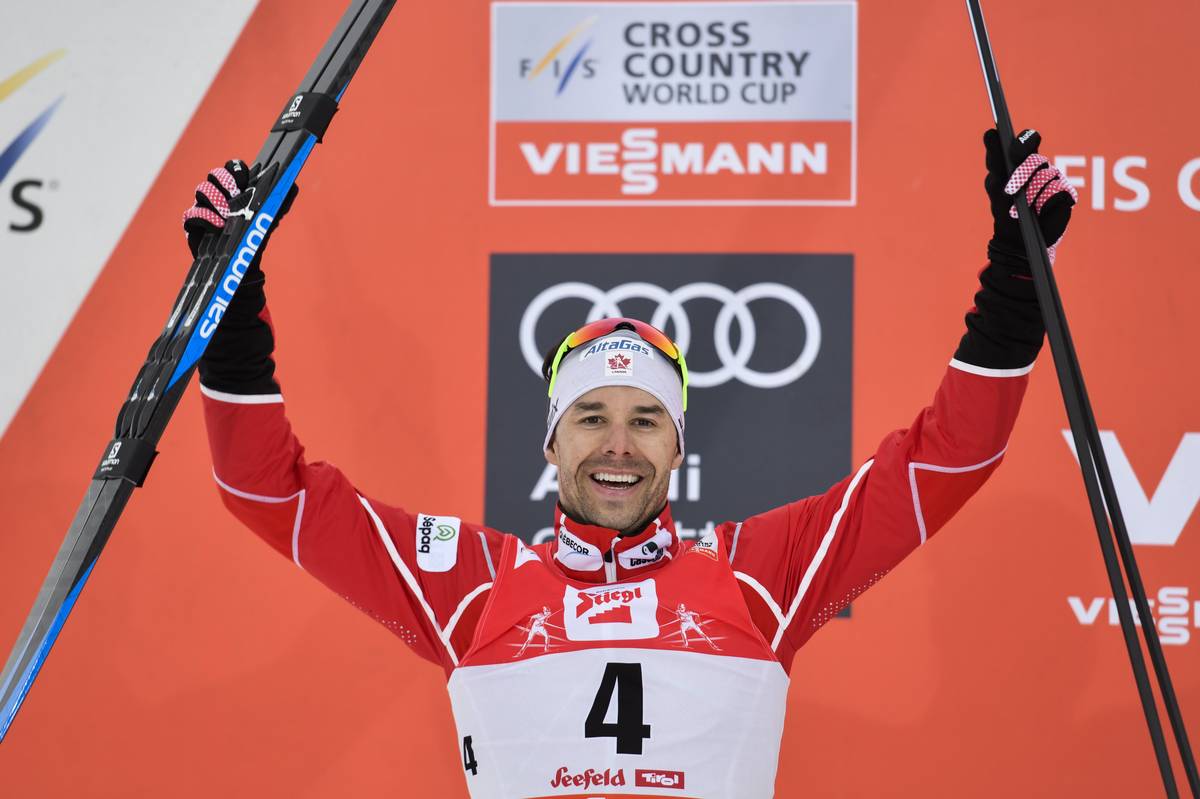
Canada’s Alex Harvey celebrating on the podium after placing second in the World Cup men’s 15 k freestyle mass start in Seefeld, Austria, last season. (Photo: Salomon/NordicFocus)
Notably, the World Cup A-team is made up of one man — Alex Harvey — after three athletes from last year’s World Cup A-team retired (Devon Kershaw, Jess Cockney and Knute Johnsgaard). Graeme Killick, of last season’s World Cup B-team, also retired. Len Valjas was nominated to the B-team, a demotion, he said, that was a result of him ending his season immediately after the PyeongChang Olympics.
“The reasoning is that I … didn’t show up to [the World Cup in] Drammen, is that I didn’t follow what the team said,” Valjas told FasterSkier on May 22. He explained he had a broken spine, which required rest and rehabilitation.
On the women’s side, Dahria Beatty was renominated to the World Cup B-team, while Emily Nishikawa and Olivia Bouffard-Nesbitt were not.
All five of last year’s U25 Team were renominated to the national team, with Cendrine Browne and Julien Locke making the jump to the World Cup B-team, while Katherine Stewart-Jones, Maya MacIsaac-Jones and Gareth Williams were renominated to the U25 Team. Also on the U25 development squad, Antoine Cyr was promoted from the junior national team, and Graham Ritchie earned his first national-team nomination.
The World Cup team will once again be led by co-coaches Ivan Babikov and Louis Bouchard.
On the Para-Nordic side, the World Cup Team grew by one despite the retirement of Chris Klebl. Six athletes and two guides were nominated to the Para-Nordic World Cup Team, while two were renamed to the Development & Prospects Team. Four other athletes round out the team as part of the Prospects Team.
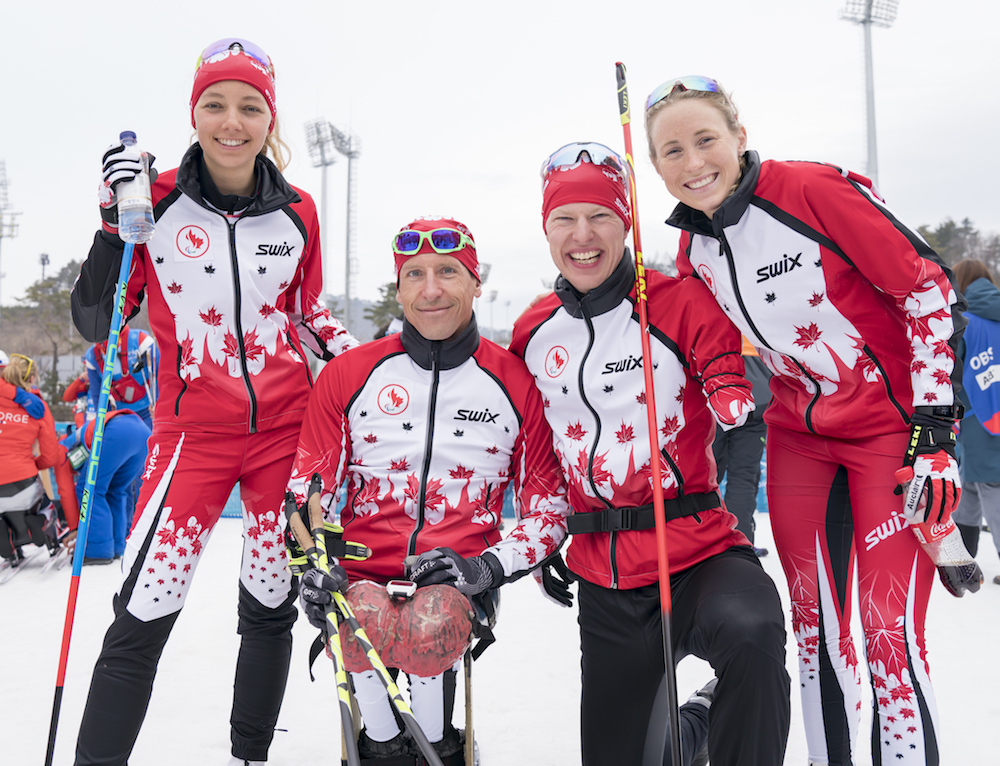
Canada’s mixed relay after taking silver on the last day of the 2018 Paralympics in PyeongChang, South Korea, with (from left to right) Natalie Wilkie, Chris Klebl, Mark Arendz and Emily Young. (Photo: Dave Holland/Canadian Paralympic Committee)
2018 Winter Paralympics (PyeongChang, South Korea): Mixed and open relays
On the final day of the PyeongChang Paralympic Games, Canada was the only country to medal in both the mixed and open cross-country relays, and its mixed relay anchor, Mark Arendz, became the most decorated Canadian at a single Winter Paralympics with his sixth medal of the week.
In the 4 x 2.5-kilometer mixed relay on Sunday, Natalie Wilkie, Emily Young, Chris Klebl, and Arendz teamed up for silver, 50 seconds behind Ukraine (Iurii Utkin, Liudmyla Liashenko, Yuliia Batenkova-Bauman, and Oksana Shyshkova), which claimed gold in 24:31.9 minutes. On the final skate leg, Arendz held off Germany (Andrea Eskau, Steffen Lehmker and Alexander Ehler) by 3.4 seconds at the line.
Wilkie and Young, standing athletes coming off gold and bronze in Saturday’s 7.5 k cross-country race, started the team off for the first two classic legs. Wilkie, 17, also earned an individual bronze at these Games. While Wilkie tagged Young in fifth, Young went on to tag Klebl, a 2014 Paralympic champion sit-skier, in seventh place.
“Our team worked so well together,” Young said of the relay, according to a Cross Country Canada press release. “It looked a little scary in the beginning, but we knew we had Chris in third and Mark anchoring which was going to be the difference. We each held our own in our individual sections and it is so fun to win this one as a team.”
Klebl, 46, made up 27 seconds on the field and tagged Arendz in fourth. Arendz then caught and passed Japan’s Taiki Kawayoke and later Germany’s Ehler on the last downhill into the finishing stretch to finish second.
“This is fantastic. It is our first relay medal ever,” Arendz, 28, told Cross Country Canada. “It is great to end the Games with a historic moment that we get to share with each other for the rest of our lives. This is a great team of two veterans and two rookies. I’m so happy we were able to get this done.”
Arendz, who elected flag bearer of the Canadian Paralympic Team for Sunday’s Closing Ceremony, is taking home a gold medal from the 15 k biathlon race, two silvers, and three bronze medals. He competed in all but one race throughout the week, skipping the distance cross-country race.
“I came in here thinking I could get three medals, but to get six is incredible,” Arendz said. “Today’s is a special one. I am happy we got this done, but there is no way I could do another race. I’m done.”
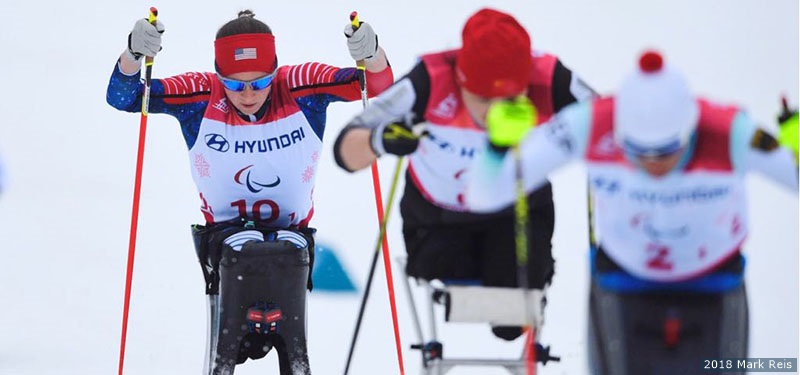
American Kendall Gretsch (l) racing in the 4 x 2.5 k open relay at the 2018 Paralympic Winter Games in PyeongChang, South Korea. (Photo: U.S. Paralympics/Mark Reis)
The U.S. team, with Kendall Gretsch, Ruslan Reiter, Jake Adicoff (and guide Sawyer Kesselheim) placed seventh in the mixed relay, 1:35.7 out of first. Gretsch skied both the first and third legs and tagged Adicoff in ninth out of 13 teams at the last exchange.
“It’s a little bit nerve-wracking and a little bit fun,” Adicoff said of skiing the anchor leg. “They did an awesome job on the first three legs.”
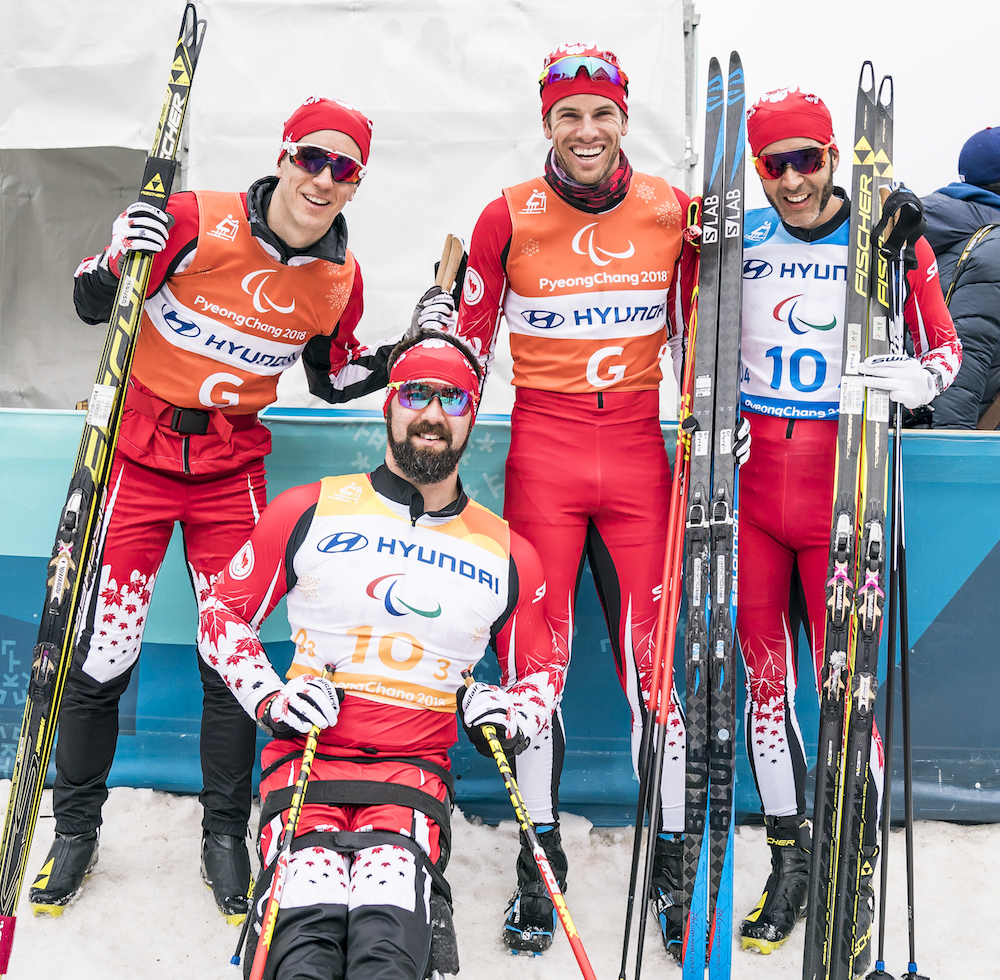
In the 4 x 2.5 k open relay an hour later, Canada raced to bronze with two athletes: sit-skier Collin Cameron and visually impaired skier Brian McKeever (and his guides Graham Nishikawa and Russell Kennedy).
The duo finished 1:05.8 behind France, which placed first with Benjamin Daviet, Anthony Chalencon and Thomas Clarion in 22:46.6. Norway finished 22.5 seconds back for silver, with Nils-Erik Ulset, Hakon Olsrud and Eirik Bye.
Ukraine (Iaroslav Reshetynskyi, Olha Prylutska, Grygorii Vovchynskyi, and Anatolii Kovalevskyi) crossed the line in third but was penalized 30 seconds for an early exchange and slipped to fifth (+1:26.3), while Canada moved into third and Belarus placed fourth (+1:23.7).
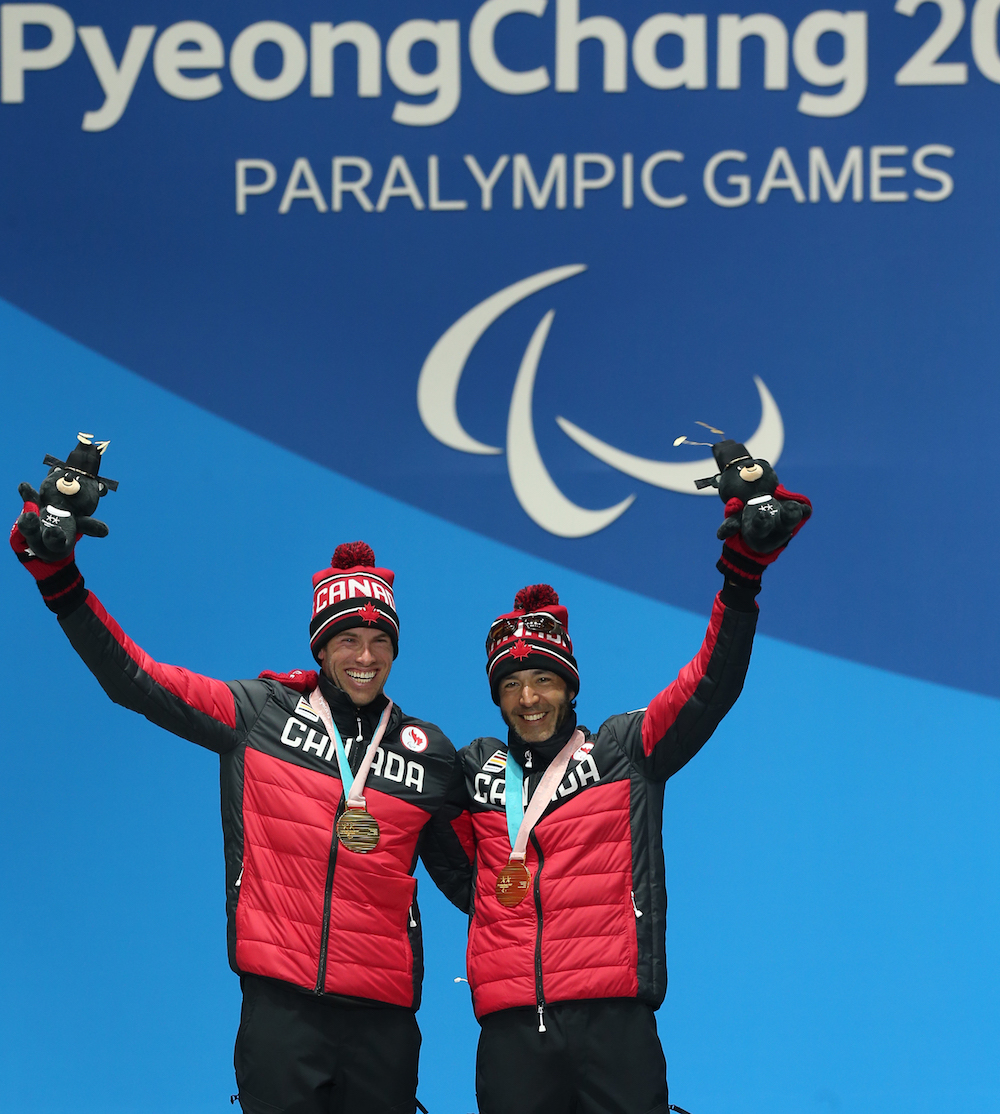
Canada’s open relay after taking bronze on the last day of the 2018 Paralympics in PyeongChang, South Korea, with (from left to right) Graham Nishikawa (guide), Collin Cameron, Russell Kennedy (guide), and Brian McKeever. (Photo: Dave Holland/Canadian Paralympic Committee)
Early in the race, Cameron tagged McKeever in eighth at the first exchange, and McKeever and his guide raced up to fourth. On the third leg, Cameron was skiing in third until he dropped a pole on the last climb and had to turn around to recover it. He came through the last exchange in sixth, 25 seconds behind Ukraine in third. McKeever went on to crossed the finish line fourth place, but his team was awarded bronze after Ukraine was penalized for tagging outside the exchange zone.
The bronze medal was Cameron’s third of the week after he placed third in two biathlon races earlier in the week. For McKeever, Canada’s most decorated Winter Paralympian of all time who won all three individual cross-country races he competed in over the last week, it was the 17th medal of his Paralympic career.
“I just tried to pace it properly and be as fast as I could. It was so much fun,” Cameron, 28, told Cross Country Canada. “This is my first relay, so I was really looking forward to this. I am super happy to leave here with three medals.”
“It’s incredible to get two relay medals today,” McKeever, 38, said. “We knew we had a shot if we all had really good days. What Mark, Chris and the girls did in that first relay was awesome. These races are so interesting with all different disabilities together. It is never over until last tour around, and in both cases, we saw that today with lots of different lead changes out there.”
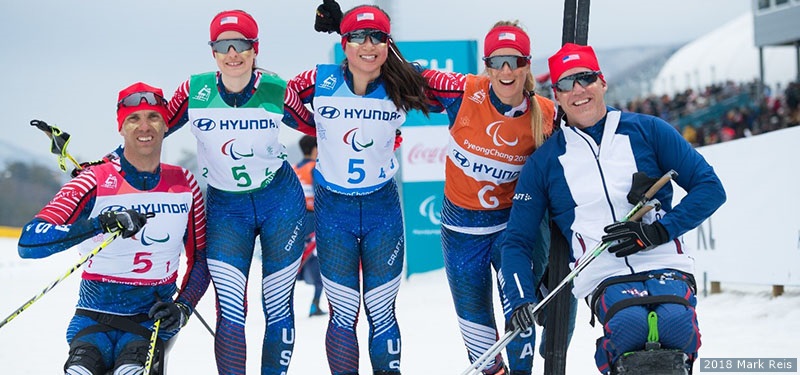
The U.S. open relay at the 2018 Paralympics in PyeongChang, South Korea, with (from left to right) Andy Soule, Grace Miller, and Mia Zutter, Kristina Trygstad-Saari (guide), and Sean Halsted. (Photo: U.S. Paralympics/Mark Reis)
The U.S. team, with Andy Soule, Sean Halsted, Grace Miller, and Mia Zutter (and guide Kristina Trygstad-Saari), placed 12th in the open relay out of 12 teams.
“It’s been an amazing Paralympic Games,” Soule, 38, told U.S. Paralympics Nordic. “The organizers have put on a great event. This is a great team to be involved with. We’ve had a lot of fun here. This is my last Paralympic race, but we have a couple of young athletes here. We’ll have a great team for a long time.”
In total, both the Canadian and U.S. Paralympic teams tallied 16 medals between nordic and biathlon in PyeongChang — a record for both programs. Notably, every member of Canada’s Para-Nordic World Cup Team is taking home at least one medal.
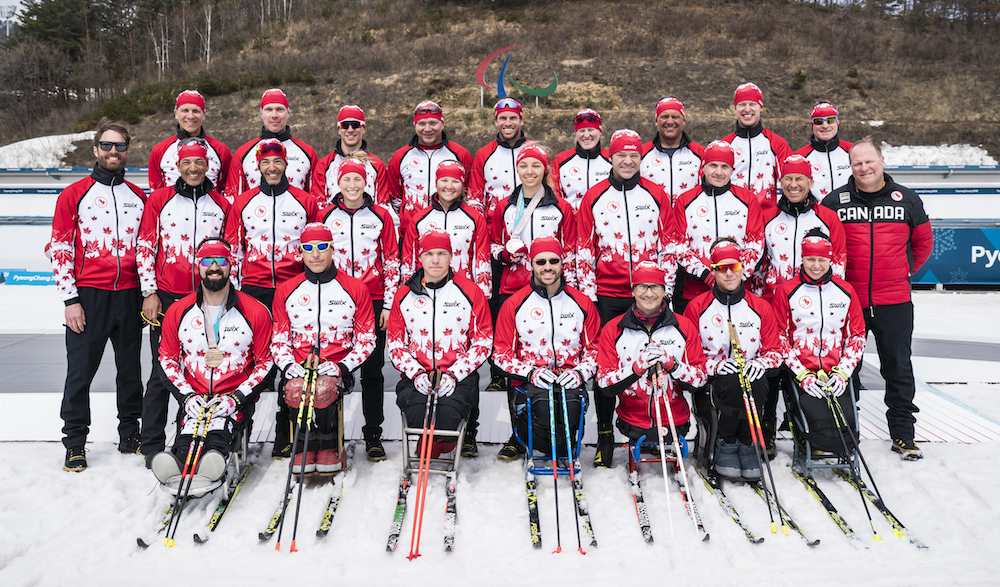
Canada’s 2018 Paralypmic cross-country and biathlon team at the Alpensia Biathlon Centre on the last day of the Games in Pyeongchang, South Korea. (Photo: Dave Holland/Canadian Paralympic Committee)
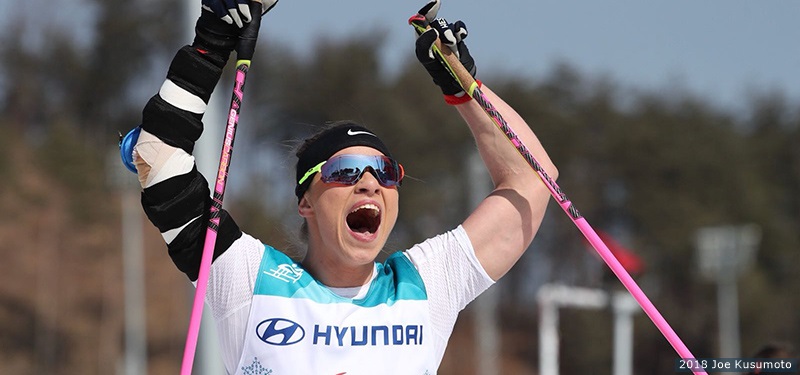
American Oksana Masters reacting to her first gold medal in her third Paralympics, after winning the women’s 1.1 k sitting sprint on Wednesday in PyeongChang, South Korea. (Photo: U.S. Paralympics/Joe Kusumoto)
2018 Winter Paralympics (PyeongChang, South Korea): Cross-country sprints
Hold onto your hats, this was a major day for both the American and Canadian teams at the 2018 Paralympics.
In the cross-country sprints on Wednesday in PyeongChang, Andy Soule and Oksana Masters of the U.S. Paralympics Nordic Program both captured their first-career Paralympic golds in the women’s and men’s sitting events, while Dan Cnossen skied to his fourth medal in as many races with a bronze to add to his collection.
Brian McKeever of the Canadian Para-Nordic Ski Team raced to his second-straight gold of the week in the men’s visually impaired sprint, with guide Russell Kennedy, and two of their teammates claimed bronze: Mark Arendz, in the men’s standing sprint for the first Paralympic cross-country medal of his career (following four biathlon medals) and Natalie Wilkie, the youngest member of the team at age 17, in the women’s standing sprint.
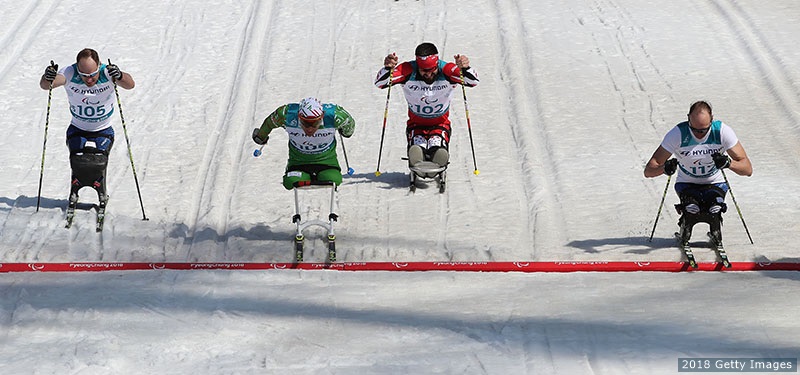
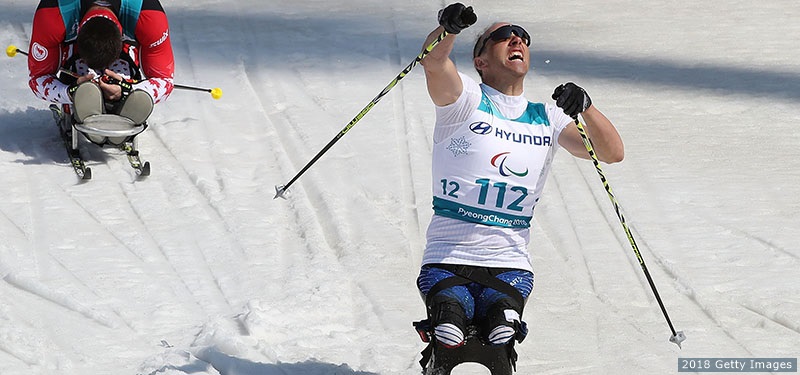
Andy Soule (r) of U.S. taking first in a photo finish with Dzmitry Loban (second from l) of Belarus, while American Dan Cnossen (l) takes third and Canada’s Collin Cameron (second from r) fourth in the men’s 1.1 k sitting cross-country sprint at the 2018 Paralympics in PyeongChang, South Korea. (Photo: U.S. Paralympics/Chung Sung-Jun for Getty Images)
In the men’s 1.1-kilometer sitting sprint final, Soule won a photo finish with Dzmitry Loban of Belarus, after both crossed the line in 3:31.4 minutes. Cnossen finished 0.4 seconds back in third and Canada’s Collin Cameron was just 0.3 seconds off the podium in fourth (+0.7).
After skiing the pack throughout the final, Soule took the lead as the four racers entered the stadium together. In the finishing stretch, Loban, Cnossen and Cameron challenged him for the gold, but with a powerful surge and lean at the line, Soule, 38, notched the first gold medal after nearly 13 years in the sport. The U.S. Army veteran had previously earned bronze at the 2010 Paralympics and bronze in Tuesday’s 12.5 k sitting biathlon race.
American Andy Soule celebrates gold in Wednesday’s 1.1 k sitting sprint final at the 2018 Paralympics in PyeongChang, South Korea. (Photo: U.S. Paralympics/Chung Sung-Jun for Getty Images)
“I chased the whole way,” he said. “I don’t think it necessarily hurt me to chase that much, it actually helped with a little bit of wind break. I think a good, tight tuck coming down the final hill put me in a natural line, and I knew I had a shot at a good sprint out. This is an incredible group to compete with. That kind of a finish … that’s what sprinting is all about.”
“I definitely lost a little gas in the final stretch,” Cnossen reflected, according to the press release. “My strategy was to tuck in behind the Belarus athlete in the beginning and then sprint over the bridge and try to hang on. Andy had such an awesome race. This is the second day in a row we’ve had two U.S. men on the podium which is just phenomenal.”
For Soule, the gold was his first in his third Paralympics, and his first Paralympic medal in a cross-country race (rather than biathlon).
“It means so much. It feels so incredible,” Soule said. “I couldn’t do it without incredible teammates pushing me all the time, and without incredible coaching and technical staff. I think it speaks to a great team effort that has really paid off for us.”
Cameron came within fractions of a second of achieving his second medal in his first Paralympics.
“I raced as hard as I could … it is what it is. I just came up a little short,” he said, according to a Cross Country Canada press release. “It is amazing that I got a medal this week in biathlon, I wasn’t expecting it, but that was behind me. I really wanted something here. This was the race I wanted a medal in. It was a close one.”
Also for Canada, Chris Klebl and Derek Zaplotinsky missed advancing to the final after both finished sixth in their respective semifinals.
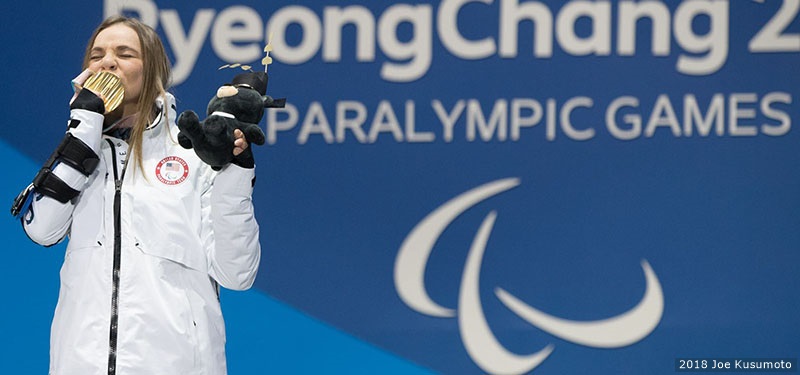
American Oksana Masters kissing her first Paralympic gold at the medals ceremony on Wednesday night after she won the women’s 1.1 k sitting sprint at the 2018 Paralympics in PyeongChang, South Korea. (Photo: U.S. Paralympics/Joe Kusumoto)
Masters, 28, won the women’s 1.1 k sitting sprint final by 2.1 seconds over Germany’s Andrea Eskau, crossing the line first in 4:06.7. The gold was Masters’s first in her third Paralympics, after she had previously collected five medals — two silver and three bronze — between the 2012 Summer Paralympics in London (where she placed third in a doubles rowing event), 2014 Winter Paralympic in Sochi, Russia (where she tallied one silver and two bronze in cross-country events), and PyeongChang (silver in the biathlon 6 k sprint).
Masters has notably been racing with an injured elbow throughout these Games. On Tuesday, she did not finish the 10 k biathlon race.
“I can’t believe it. I literally was starting to think this day would never happen,” she said of her win on Wednesday, according to the U.S. press release. “I knew that I wasn’t going to let yesterday be my last race. I couldn’t believe it, but at the same time, I knew I had it in me to dig deep a couple more times. I could not have done this without the USOC medical staff.”
In the sitting semifinals, her teammates Kendall Gretsch, who won the first two races of the 2018 Paralympics, and Aaron Pike, were eliminated after both placed fourth in their respective heats.
McKeever 2-for-2
Canada’s Brian McKeever (r) and his guide Russell Kennedy celebrate gold in the men’s 1.5 k visually impaired classic sprint at the 2018 Paralympics on Wednesday in PyeongChang, South Korea. (Photo: Scott Grant/Canadian Paralympic Committee)
A five-time Paralympian, McKeever, 38, racked up his 12th Paralympic gold medal (15th total medal) in the men’s 1.5 k visually impaired classic sprint. He finished 2.5 seconds ahead of Sweden’s Zebastien Modin (with guide Robin Bryntesson) in second place, with a time of 4:03.2. Behind them in the final, Norway’s Eirik Bye (with guide Arvid Nelson) finished third (+29.5) and Jake Adicoff (with guide Sawyer Kesselheim) was relegated to last (fourth place) for a technique violation.
McKeever has won all three Paralympic sprints since they were introduced in 2010. On Wednesday, he double poled the entire race.
“These sprint races are miserable,” McKeever said, according to a team press release. “They are so hard. The young guys are fast, and have natural snap. There is so much stress in sprint racing, and it goes all day long. I’m much more comfortable with the longer distances, but it was a great day for us. Russell carried the load for us today, and just thrilled we were able to cross the line first.”
Kennedy, 26, who competed at his first Olympics last month in PyeongChang, said it was tough battling it out in Wednesday’s soft conditions.
“We played things a bit more strategic in the semis because we knew the final was going to be a tough fight, and it was,” Kennedy reflected. “That first hill hurt a lot. Once I got to the top I was able to settle down and said to myself ‘OK, you got this.’ ”
While Kennedy guided McKeever to gold in the second half of Monday’s 20 k cross-country race, McKeever’s other guide, Graham Nishikawa (who skied the first half with him), joined McKeever on the podium. Wednesday was Kennedy’s turn at the medals ceremony.
“This is a new experience for me — especially coming from the Olympics where the focus is all on yourself,” Kennedy said. “Brian is such a strong athlete and guiding him requires a lot more communication. Competing here at the Paralympics is really rewarding because you do this as a team. It is hard at times to know if I’m going too hard or if he needs me to go faster, but it has been a lot of fun for me.”
Canada’s Mark Arendz en route to bronze in the men’s 1.5 k standing classic sprint at the 2018 Paralympics in PyeongChang, South Korea. It was his first cross-country medal (fifth total) in his second Paralympics. (Photo: Scott Grant/Canadian Paralympic Committee)
In the men’s 1.5 k standing sprint final, Arendz tied Finland’s Ilkka Tuomisto for third place, and both were awarded bronze. They finished just 0.3 seconds behind Japan’s Yoshihiro Nitta in second, and 1.1 seconds behind Kazakhstan’s Alexandr Kolyadin, who won in 4:19.7.
“Sitting there in the finish waiting for the results of the photo finish, I was just hoping for a tie,” Arendz said, according to the team press release. “It was a really good race but I made a mistake down the finishing stretch switching to try and find a faster track and that may have cost me the whole race.”
The Paralympic medal was the first in a cross-country race for the 28-year-old Arendz, who has two silver and two bronze in biathlon races between these Paralympics and the 2014 Sochi Games.
“I came here for medals in biathlon and was hoping to get my first one in cross-country,” he said. “To come away with my first bronze in cross-country skiing means a lot. I couldn’t be happier.”
In the women’s 1.5 k standing sprint final, Wilkie raced to third for her first medal in her first Paralympics. She finished just a tenth of a second behind Norway’s Vilde Nilsen, who took silver, and 3.2 seconds out of first, which went to Anna Milenina of the Neutral Paralympic Athletes (NPA) in 5:11.1.
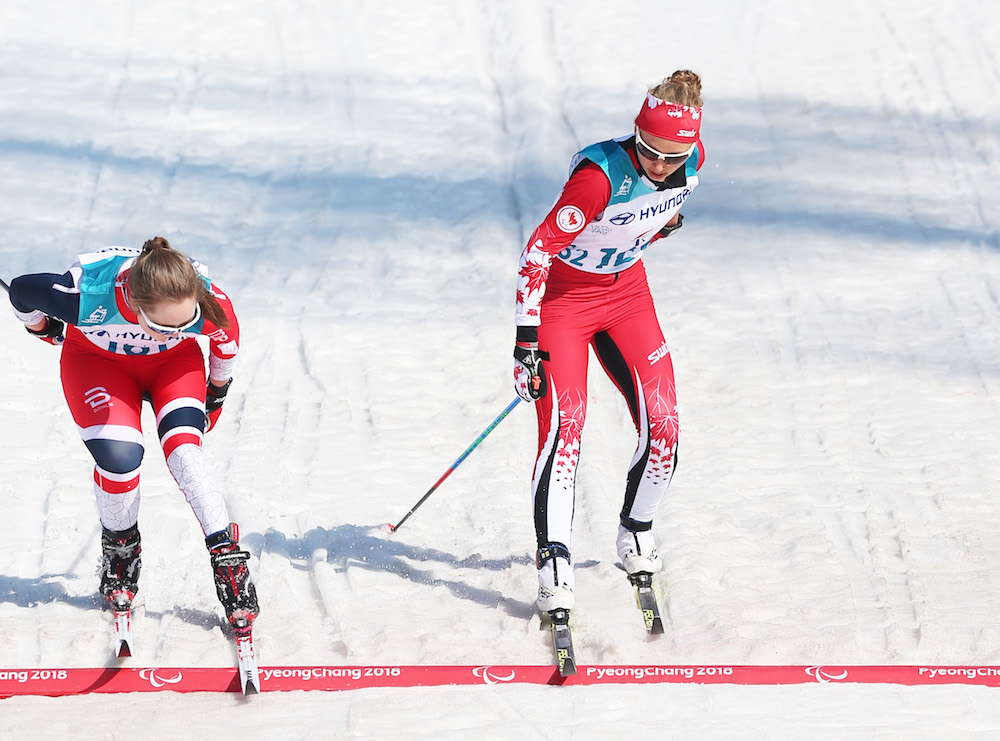
Canada’s Natalie Wilkie (r) finishing third, just 0.1 seconds behind Norway’s Vilde Nilsen (l) in second, for her first Paralympic medal on Wednesday in the women’s 1.5 k standing classic sprint in PyeongChang, South Korea. (Photo: Scott Grant/Canadian Paralympic Committee)
“It feels so awesome,” Wilkie said of her bronze medal. “This is my first Paralympics and I am just so happy to have won a medal.”
Four seconds behind Wilkie, her teammate Emily Young placed fourth (+7.2). Canada made up half of the six-woman final with Brittany Hudak placing sixth (+49.2)
“We are competing against each other, but we are also helping each other,” Wilkie said. “It was calming for me to have them there with me. We talked about strategy as a team before the final because the goal was for us to win a medal for Canada.”
Paralympic nordic skiers and biathletes have a day off on Thursday before races resume Friday with men’s and women’s long-distance biathlon races, starting at 10 a.m. Korea time Friday (9 p.m. EDT Thursday).
Canada’s Brian McKeever (r) and Russell Kennedy receiving their gold medals from the men’s visually impaired classic sprint at the 2018 Paralympic Games in PyeongChang, South Korea. (Photo: Scott Grant/Canadian Paralympic Committee)
Kendall Gretsch racing to her second gold medal of the 2018 Winter Paralympics on Sunday in the women’s 12 k sitting cross-country race in PyeongChang, South Korea. (Photo: US Paralympics/Joe Kusumoto)
2018 Winter Paralympics (PyeongChang, South Korea): 12/15 k sitting cross-country races
It was a gold, silver and bronze day for the U.S. Paralympics Nordic team on Sunday at the 2018 Paralympics in PyeongChang, as Kendall Gretsch raced to her second-straight victory in as many races, Dan Cnossen took silver and Oksana Masters claimed bronze in the cross-country distance events.
A day after achieving a historic bronze for Canada in a biathlon sit-ski event, Collin Cameron led his country in fifth in Sunday’s 15-kilometer sitting cross-country race.
Gretsch, a Paralympic rookie who won the sitting biathlon sprint to open the Paralympics, also won the women’s 12 k sitting cross-country race on Sunday in 38:15.9 minutes, 34.5 seconds clear of Germany’s Andrea Eskau in second, while Masters followed 49 seconds back in third.
“For cross-country, I was pretty unsure going in here,” said the 25-year-old Gretsch, according to a U.S. Paralympics Nordic Skiing press release. “I knew that since our last World Cup I had improved a lot, but you never know until you race. Just happy with how things went today and I was able to put together another good race.”
“It’s a very humbling experience being able to hear your anthem,” she said of her second gold medal. “Puts everything into perspective. Knowing that you’re here not just here for yourself but for your country, it’s amazing.”
For Masters, who is recovering from an elbow injury, it was her second medal after taking silver in Saturday’s biathlon sprint.
“I’m just so happy to be on the podium,” Masters told U.S. Paralympics. “I was a little worried on the long distance considering I haven’t done intensity in three weeks. It definitely is a very painful, rude awakening to how painful the sport is. I’m happy to be on the podium.”
She described the pain in her elbow as “extremely excruciating. It feels like there’s just a saw going at your bone 24/7, especially hammering up the climbs,” Masters said. “I had a spill over there through the stadium, but mind over matter.”
Ukraine’s Maksym Yarovyi won the men’s 15 k sitting in 41:37.0, and Cnossen, who had taken gold in the men’s sitting biathlon sprint, placed second, 43.1 seconds back. Sin Eui-hyun claimed South Korea’s first medal of the Games in third (+51.9) ahead of China’s Zheng Peng in fourth (+1:18.5) and Canada’s Cameron in fifth (+2:09.0).
“I’ve already exceeded my expectations,” Cnossen, 37, said of his second Paralympic medal in as many days. “I’m very proud to represent the U.S. Today, I dug as deep as I could and went as hard as I could, and regardless of where I ended up on the result, it is my success to go as hard as I could.”
Canada’s Colin Cameron racing to bronze in the mens 7.5 k sitting biathlon sprint on Saturday at the 2018 Paralympic Games in PyeongChang, South Korea. (Photo: Scott Grant/Canadian Paralympic Committee)
“It was really soft out there, but the skis were still fast,” Cameron, 29, said, according to a Canadian team press release. “The skis have been awesome both days – the guys are working their butts off back in the wax room.”
Cameron explained his goal for Sunday’s race was to “start steady and be comfortable, to get rid of the bugs from yesterday’s race because I was pretty tight.
“I was able to loosen up as I went along, which allowed me to dig a little deeper today,” he continued. “It’s tough to go from biathlon to this event. It is a totally different mindset for pacing, a totally different game. I wasn’t event thinking about [yesterday’s medal] I just wanted to build off it and take that momentum with me the rest of the week. Today was a different day and I’m happy with how I was able to perform.”
Also for Canada, Chris Klebl, who won gold in the 10 k sitting event at the 2014 Paralympics, finished eighth (+2:25.6), Derek Zaplotinsky followed in ninth (+2:42.6), Sebastien Fortier finished 18th (+5:01.0), Ethan Hess 24th (+10:37.1), and Yves Bourque 25th (+11:35.7)
In the women’s sitting race, Canada’s Cindy Ouellet, a 29-year-old Paralympic wheelchair basketball player, placed 18th (+11:37.3).
“This is my first race over five kilometres and it was tough,” Ouellet said, according to the press release. “Basketball is all stop and go, but endurance is much different. I just need more races.”
For the U.S., Andy Soule placed 11th (+2:59.1) and Sean Halsted finished 22nd (+7:18.0).
Paralympic racing continues Monday with the men’s and women’s standing and visually impaired cross-country long-distance events, starting at 10 a.m. Korea time on Monday (7 p.m. EDT on Sunday).
Olympic and Paralympic veterans lead next generation of elite skiers into new season
CANMORE, Alta. — Focused on winning medals at all levels, Cross Country Ski de Fond Canada named its 2016-17 National Ski Team loaded with promise for 2018 & 2022 Olympics and Paralympics Games on Tuesday.
Feeding off a successful ending to the inaugural Ski Tour Canada where the squad celebrated countless personal and season-best performances, seven Olympians, including six men and one woman, will lead the charge for the Canucks.
Led by Alex Harvey (St-Férréol-les-Neiges, Que.), who captured two medals last season, a high-powered group of athletes including Len Valjas (Toronto), Ivan Babikov (Canmore, Alta.), and Devon Kershaw (Canmore, Alta.) will form the World Cup A Team. Two other athletes who posted breakthrough performances during the Ski Tour Canada, Jesse Cockney (Canmore, Alta.), and Graeme Killick (Fort McMurray, Alta.), will make up the World Cup B Team with Emily Nishikawa (Whitehorse) leading the Canadian women on the elite squad.
World Cup A Team
Alex Harvey
Len Valjas
Ivan Babikov
Devon Kershaw
World Cup B Team
Jesse Cockney
Graeme Killick
Emily Nishikawa
With a focus on developing the next generation of elite skiers, Cross Country Ski de Fond Canada also selected seven athletes for its Under-25 Team who will split time racing World Cups, international development level races, and Haywood NorAms in Canada. Three athletes who cracked the top-30 on the World Cup last year while racing the Ski Tour Canada will headline this group of seven including Whitehorse skiers Dahria Beatty and Knute Johnsgaard, along with Maya MacIsaac-Jones (Athabasca, Alta.). They will be joined by Olivia Bouffard-Nesbitt (Morin Heights, Que.), Cendrine Browne (St-Jérôme, Que.), Katherine Stewart-Jones (Chelsea, Que.), and Julien Locke (Nelson).
U25 Team
Dahria Beatty
Knute Johnsgaard
Maya MacIsaac-Jones
Olivia Bouffard-Nesbitt
Cendrine Browne
Katherine Stewart-Jones
Julien Locke
The governing body for cross-country skiing in Canada also announced seven athletes who combined to win nine medals last year, will return to the Para-Nordic Ski Team. Athletes include: Brian McKeever (Canmore, Alta.) and his guides Graham Nishikawa (Whitehorse) and Erik Carleton (Canmore, Alta.); Mark Arendz (Hartsville, P.E.I.), Brittany Hudak (Prince Albert) and Paralympic champion, Chris Klebl (Canmore, Alta.). Emily Weekes (North Vancouver), who bolted onto the international para-nordic scene one year ago with multiple podium performances will continue her progression on the Development Team.
Para-Nordic Ski Team
Brian McKeever (guides: Graham Nishikawa, Erik Carleton)
Mark Arendz
Brittany Hudak
Para-Nordic Development Team
Emily Weekes
“We obviously have a great line-up of athletes that combines veteran experience with youthful energy and drive,” said Tom Holland, high-performance director, Cross Country Ski de Fond Canada. “I think our elite athletes proved last year they have what it takes to continue delivering medal-winning performances, while our next generation of athletes are steadily developing and demonstrating a promising future for our program.”
Holland and his high-performance selection team also identified one dozen athletes who will compete on the Junior National Ski Team. Athletes include:
Oksana Masters (front) and U.S. Paralympics Nordic coach Eileen Carey at 2016 IPC World Cup Finals in Vuokatti, Finland, with wax tech Dave Mark (behind). Masters won the overall cross-country World Cup for the second-straight year. (Photo: U.S. Paralympics Nordic)
When an athlete finishes a World Cup season undefeated, it’s not just a win for the athlete, it’s a win for their teammates as well.
After U.S. Paralympics Nordic sit skier Oksana Masters completed the 2015/2016 International Paralympic Committee (IPC) World Cup race season as the undefeated victor in the cross-country events, from the 1-kilometer sprints to the debut of the 20 k marathon event, her success was seen as one for and from the team.
“Oksana is an amazing athlete and I have been privileged to be a [part] of her cross country skiing career since she started the sport,” her teammate Andy Soule wrote in an email.
“We have both become better skiers by learning from one another and training together,” Soule added. “She is hard-working, motivated, and a joy to be around as a teammate and as a person; and it makes me incredibly happy to see her having the level of success she had had these past couple of years.”
Last week at IPC World Cup Finals in Vuokatti, Finland, Masters raced to three wins in a row, including the cross-country sitting sprint, but she didn’t let it get to her head.
“It [was] the last sprint of the season and I didn’t want to leave anything behind!” Masters, of Louisville, Ky., told Inside the Games.
Throughout the season, nobody came close to the 26-year-old Masters in the cross-country events. According to a U.S. Paralympics press release, nearly eight seconds separated her from her closest competitor in the sprint, and more than 28 seconds separated her from the field in the middle distance 5 k.
“Oksana brought impressive consistency to her racing this season,” U.S. high-performance coach Eileen Carey wrote in an email to FasterSkier. “We had longer travel to our World Cups this season than is typical, so quality recovery was hard to come by at times. Oksana made gains this winter in making smart decisions for her recovery and health, even when it meant backing off from training. She made a few mistakes early in the winter, training through some sickness, but she learned from it and made smarter decisions for the rest of the season. Her performances in cross country races would not have been possible without that adjustment. That self-knowledge will pay off in future seasons.”
Day 1: Canada’s Arendz Fifth, Top 10’s for Weekes and Hudak
The first day of IPC World Cup Finals took place Tuesday, March 15, with a biathlon sprint.
In the women’s 6 k visually impaired biathlon sprint, Ukraine’s Oksana Shyshkova won in a time of 20:55.8 after shooting clean. Also with perfect shooting was Mikhalina Lysova of Russia who finished in second overall. Third place went to Russian skier Elena Remizova after she missed two shots (1+1).
In the women’s 6 k standing biathlon sprint, Oleksandra Kononova of Ukraine placed first in a time of 20:53.2 after two penalties (1+1). Russia’s Anna Milenina finished in second, also with two penalties (2+0). Russian teammate Ekaterina Rumyantseva rounded out the podium in third with three penalties (1+2).
Two Canadians competed in the 6 k standing biathlon sprint, including Emily Weekes and Brittany Hudak. With three misses (0+3), Weekes finished ninth, while teammate Hudak finished just behind her in 10th place with four penalties (2+2).
In the women’s 6 k sitting biathlon sprint, the top two spots went to Russia, with Irina Guliaeva coming in first in 23:31.8, after missing one shot (1+0). Her teammate Nadezhda Fedorova, came in second after shooting clean. Third place went to Germany’s Anja Wicker after she missed one shot (1+0).
Masters finished sixth in a time of 25:47.0 after missing three shots (3+0).
In the men’s 7.5 k visually impaired biathlon sprint, Russia’s Stanislav Chokhlaev emerged victorious, winning the event in a time of 20:36.9 after perfect shooting. Also shooting clean was second place finisher, and Russian teammate Nikolay Polukhin. Third place for the men’s visually impaired event went to Ukraine’s Anatolii Kovalevskyi with one miss (1+0).
U.S. Paralympics Nordic veteran Andy Soule tucking at 2016 IPC World Cup Finals in Vuokatti, Finland. (Photo: U.S. Paralympics Nordic)
American skier Jake Adicoff also competed in the event, racing to 11th after four misses (2+2).
In the men’s 7.5 k standing biathlon sprint, Ukraine’s Ihor Reptyukh, raced to first place in a time of 18:49.5 after perfect shooting. In second place was Vladislav Lekomtsev of Russia with two misses (2+0). France’s Benjamin Daviet rounded out the top three, finishing third with one miss (0+1).
Canada’s Mark Arendz competed in the men’s standing biathlon sprint, racing to fifth place overall with two misses (1+1).
“Going into today I felt I had a lot more. The body felt ready to go, but it didn’t materialize in today’s race,” Arendz said in a Canadian Para Nordic Team press release.. “I was close on the skiing, but I’m still finding myself needing to tweak my shooting. Two misses is two too many for me right now.”
In the men’s 7.5 k sitting biathlon sprint, the top three spots all went to Russia, Grigory Murygin leading the trio in first in 25:23.6 with one miss (1+0). Ivan Golubkov and Roman Petushkov both shot clean and finished second and third, respectively.
Soule was the sole U.S. skier in the event, racing to an 11th place overall after five misses (3+2).
“[I] had a broken pole early in the sprint and I am grateful to team Russia for their display of sportsmanship in offering me one of their spare poles until a coach could get mine to me,” Soule wrote in an email.
Canada’s Derek Zaplotinsky also competed in the event, finishing in 15th overall after shooting the same as Soule.
The second day of racing, Wednesday, March 16, brought athletes out for another biathlon event.
In the women’s 12.5 k sitting biathlon, Russia’s Maria Iovleva took her first victory of the week, finishing first in a time of 53:20.6 with just one miss (0+0+1+0). She led a Russian podium sweep with Guliaeva placing second with three misses (2+0+1+0) and Svetlana Konovalova taking third with two misses (1+0+1+0).
Masters finished seventh, after skiing eight penalty loops (2+0+4+2).
In the women’s 12.5 k visually impaired biathlon, Ukraine’s Shyshkova took her second consecutive title of the week, completing the course in a time of 40:43.0 after one missed shot (1+0+0+0). Finishing in second once again behind Shyshkova was Russia’s Lysova after skiing four penalties (2+1+1+0). Third place went to Vivian Hosch of Germany, who missed three (0+3+0+0).
In the women’s 12.5 k standing biathlon, Ukraine’s Kononova continued her winning streak, taking first place in a time of 43:15.2, after missing two shots (0+0+1+1). Second place went to Russia’s Natalia Bratiuk, with one penalty (0+0+0+1). Rounding out the podium finishers for the day was Russia’s Milenina in third after missing six shots (0+1+2+3).
Weekes finished just off the podium in fourth, with two misses (0+0+0+2).
“Emily led the way for us again today, and showing steady development,” Canadian head coach Robin McKeever, said of Weekes in a team press release. “The classic sprint is a bit of a tough test for Emily, but she faired well today and skied strong.”
In the men’s 15 k visually impaired biathlon, Russia’s Polukhin bested his previous second place finish for first, winning the 15 k in a time of 43:31.3 with perfect shooting. In second place was Russian Nikita Povarov, who also shot clean. Ukrainian skier Iurii Utkin rounded out the podium in third, after two misses (1+1+0+0).
In the men’s 15 k standing biathlon, France’s Daviet raced to the win in 44:12.0 after skiing three penalties (2+0+1+0). Second place went to Ivan Kodlozerov of Russia with one miss (0+0+1+0). Russian teammate Lekomtsev finished third after missing four (0+2+1+1).
Mark Arendz (Canadian Para-Nordic Ski Team) at last year’s 2015 IPC World Cup Finals in Surnadal, Norway. This year in Finland, he placed fifth in the 2016 World Cup Finals biathlon sprint. (Photo: IPC Nordic Skiing/Facebook)
Arendz finished just off the podium in fourth after skiing three penalty loops (0+1+1+1).
In his second victory of the week, Murygin of Russia, raced to first in the men’s 15 k sitting biathlon in 54:18.1 with one penalty (0+1+0+0). Germany’s Martin Fleig finished second after missing four (2+0+2+0). The third podium spot went to Poland’s Kamil Rosiek with two penalties (2+0+0+0).
Soule finished sixth, with seven penalties (4+1+0+2).
“Both biathlon races were difficult shooting races for me. I have struggled in the range somewhat this year and will be working in the of season to return to some solid shooting fundamentals,” Soule wrote. “I am really excited for the mass start 20km marathon race [later that week] … This is a type of race that we do not get to do often and I an looking forward to the challenge.”
Canada’s Derek Zaplotinsky was the second North American to compete in the event, finishing 11th with 12 penalties (2+4+3+3).
Day 3: Masters Wins Sprint; Adicoff, Weekes and Soule All Reach Respective Finals
Thursday marked the third-consecutive day of racing with a 1 k cross-country sprint, where Masters continued her streak to finish the season with her fourth cross-country sprint win in as many races. She won the sprint in 2:12.68, besting Russia’s Iovleva in second and Germany’s Wicker in third.
The women’s 1 k visually impaired cross country sprint went to Lysova of Russia, who won in 3:31.34. Crossing after Lysova in second was her Russian teammate Remizova. Ukraine’s Shyshkova took the final podium spot in placed third overall.
Thursday brought the third-straight win for Ukraine’s Kononova, who won the women’s 1 k standing cross-country sprint in 3:28.44. Crossing behind her in second was her Ukrainian teammate Liudmyla Liashenko. Rounding out the top three was Russia’s Milenina in third.
Weekes advanced to the final where she finished fifth. Her teammate, Hudak finished ninth overall.
Three Russians dominated the men’s 1 k visually impaired cross-country sprint, with Vladimir Udaltcov taking first in 2:52.66. Chokhlaev placed second, while Oleg Ponomarev took third.
Jake Adicoff (c) and his two guides, U.S. Paralympics high-performance coach and director John Farra (r) and Germany’s Florian Grimm. (Photo: U.S. Paralympics Nordic)
Finishing just off the podium after advancing to the final was Adicoff of the U.S. in fourth.
The men’s 1 k standing cross-country sprint saw Russian Lekomtsev stand at the top of the event podium, ahead of Ukraine’s Vovchynskyi in second place. Third place went to Japan’s Yoshihiro Nitta.
Arendz missed advancing to the final by one spot, finishing seventh overall.
Competition in the men’s 1 k sitting cross-country sprint went to Ukrainian athlete Maksym Yarovyi, who crossed the final in first in a time of 1:55.47. Russia’s Golubkov and Aleksandr Davidovich finished second and third, respectively.
Soule advanced to the final, where he placed sixth overall.
Canada’s Chris Klebl advanced to the semifinal, where he placed 12th and Canadian teammate Zaplotinsky finished the day in 14th overall.
Day 4: McKeever, Masters Take Marathon Titles; Klebl Second
After a day of rest, IPC World Cup athletes returned to the Vuokatti ski trails for Saturday’s marathon events.
Masters raced to first place in the women’s 20 k sitting marathon on Saturday, March 19, completing the course in a time of 1:00:57.0.
Two Russians, Guliaeva and Fedorova finished behind Masters in second and third, respectively.
The women’s 30 k visually impaired marathon event went to Remizova of Russia, who won in 1:36:22.6. Her Russian teammate Lysova placed second. Ukraine’s Shyshkova earned her fourth-straight podium of the week, after placing third.
Ukraine’s Kononova rolled to her fourth-straight win of the week in the women’s 30 k standing cross-country marathon. She won in 1:39:09.6, while Sweden’s Helene Ripa finished second and Russia’s Rumyantseva placed third.
Hudak raced to fifth in the women’s 30 k.
Canada’s Brian McKeever (c) and his guide Graham Nishikawa with their gold medals after the men’s visually impaired 30 k at 2016 IPC World Cup Finals Vuokatti, Finland. Russia’s Alexsander Artemov (l) placed second and France’s Thomas Clarion (r) was third. (Photo: IPC Nordic Skiing/Facebook)
Canadian team veteran Brian McKeever took the victory in the men’s 30 k visually impaired cross-country marathon, completing the course in a time of 1:20:43.0. Behind him in second was Russia’s Alexsander Artemov and France’s Thomas Clarion in third.
Adicoff was the second North American in the men’s visually impaired marathon in sixth overall.
After winning Thursday’s standing sprint, Russian Lekomtsev took his second win of the week in the men’s 30 k standing in 1:17:52.8. The next closest competitor was his Russian teammate, Rushan Minnegulov in second. Third place went to France’s Daviet.
Arendz raced to eighth place in the 30 k standing marathon.
In the men’s 20 k sitting, Klebl narrowly out on a victory, placing second behind Maksym Yarovyi of Ukraine. Yarovyi completed the 20 k course in a time of 52:31.0.
Soule was one spot off the podium in fourth, behind Korea’s Eui Hyun Sin in third.
“The 20km was an interesting race,” Soule wrote in an email. “It was formatted as a mass start, which is not how we usually race. Because of the way we adjust times for differing disabilities, it was not actually first across the line wins. While we do not actually train specifically for this distance, the fast conditions and relatively flat course made it run much like a long individual race.”
Day 5: Masters Defends Unbeaten Streak; McKeever Wins Again
Athletes geared up for the final World Cup race of the season on Sunday, March 20, with the men’s and women’s middle-distance cross-country races.
American Oksana Masters (c) on the podium with one of her three gold medals from this year’s IPC World Cup Finals in Vuokatti, Finland. (Photo: IPC Nordic Skiing/Facebook)
Masters displayed her strength with one final win, topping the women’s 5 k sitting cross-country in a time of 17:16.3, for her third win of the week.
Finishing behind Masters in second was Russia’s Fedorova and in third was Guliaeva, also of Russia.
In the women’s 7.5 k visually impaired cross-country, Lysova won in a time of 20:02.0. Second place went to her Russian teammate Remizova and Ukraine’s Olga Prylutska finished behind her in third place overall.
In the women’s 7.5 k standing cross-country, Russia’s Milenina won in 19:59.2. Ukraine’s Kononova finished in second and Russian Rumyantseva placed third.
McKeever secured his second win of the week, finishing first in the men’s 10 k visually impaired cross-country. McKeever completed the 10 k course in 22:31.1. Second place went to France’s Clarion.
“We put in a really good effort today. Nish was on fire for the first five kilometres, and that moved us into a solid position,” McKeever said of his guide, Graham Nishikawa, in a team press release. “We were able to build on that pace, and nobody was able to respond.
Adicoff once again just missed the podium in fourth overall, finishing behind Russia’s Chokhlaev in third.
France’s Daviet took his second win of the week in men’s 10 k standing cross-country. Behind Daviet in second was Russia’s Minnegulov and Ukraine’s Reptyukh finished third.
Arendz placed eighth in the 10 k standing event.
In the final men’s sitting cross-country event, Russia’s Golubkov finished first in a time of 23:47.4. Second place went to Ukraine’s Yarovyi and Korea’s Eui Hyun Sin took third.
Soule led the North Americans in that race in fifth, while Canada’s Klebl and Zaplotinsky finished behind him in 12th and 16th, respectively.
“Overall the event has been a lot of fun,” Soule wrote. “I always enjoy coming to Vuokatti, a place where we have competed on a regular basis for my entire nine-year career.”
Masters Wins World Cup Globe for Second-Straight Year
Overall, Masters won the season-long World Cup title for the second year in a row in the women’s sitting cross-country. She topped the rankings with 760 points, beating out Russia’s Maria Iovleva, who had 545 points, and Russia’s Nadezhda Fedorova, who was third with 526 points.
Andy Soule was 30 points short of the cross-country podium in fourth overall, with 390 points to Russian winner Ivan Golubkov’s 689 points in first.
Emily Weekes placed seventh in the women’s standing cross-country, McKeever was eighth in the men’s visually impaired.
Soule placed fifth overall in the biathlon World Cup men’s sitting, while Masters was sixth in the women’s category. Weekes finished the season in ninth overall in the biathlon World Cup, and Mark Arendz tied for ninth in the men’s standing biathlon.
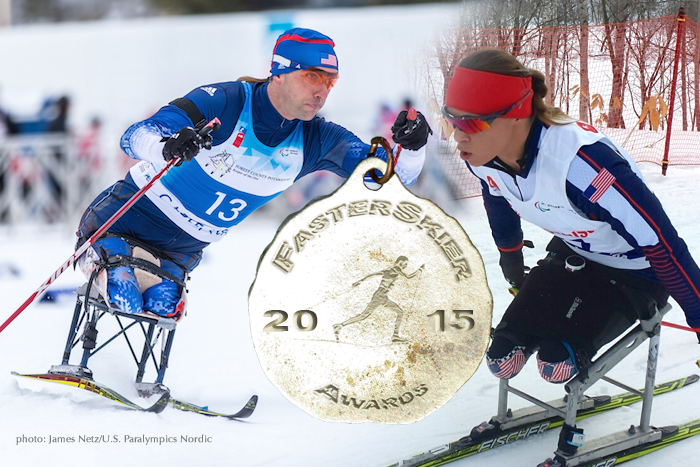
Andy Soule (l) and Oksana Masters, both of U.S. Paralympics Nordic, are FasterSkier’s 2015 Para-Nordic Skiers of the Year.
Andy Soule
When you become the first American to rack up five medals in six individual events at World Championships, you’re essentially a shoo-in for Para-Nordic Skier of the Year. Andy Soule, a U.S. Army veteran and sit skier, did just that at the 2015 International Paralympic Committee (IPC) World Championships in January in Cable, Wis., taking silver in two biathlon events and the 10-kilometer cross-country race plus bronze in the cross-country 15 k and sprint.
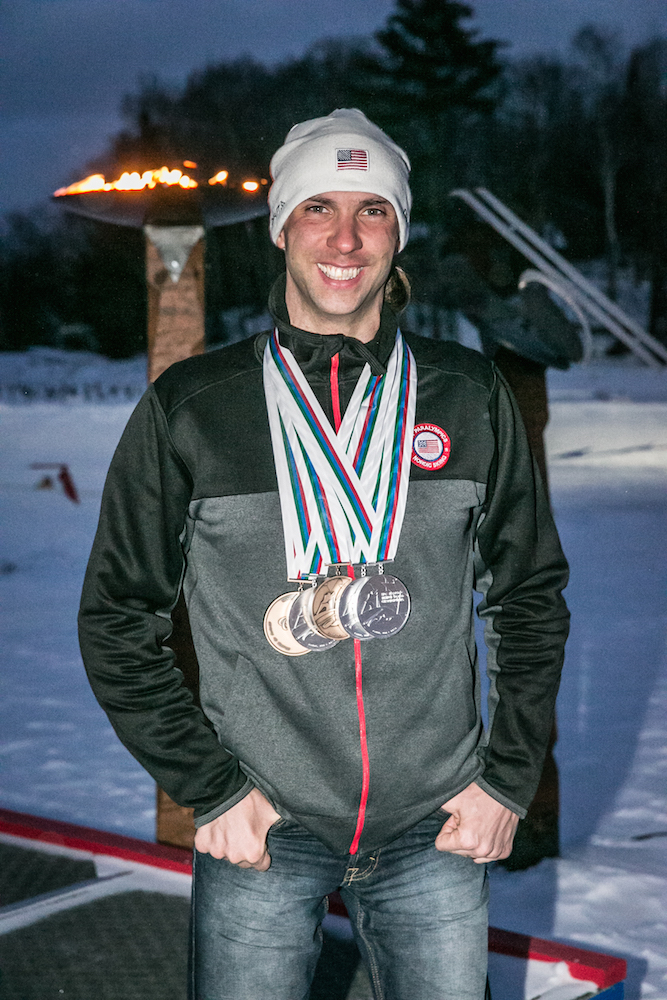
Andy Soule and his hardware from 2015 IPC World Championships: five medals with three silvers and two bronze. (Photo: James Netz)
“After the second podium, I just started feeling like that wasn’t a fluke,” Soule said in February. “This isn’t just a one-time thing … I can come out and compete on a level with the top guys every day. It was a confidence builder as well when you have that feeling.”
In his eighth year on the U.S. Paralympics Nordic Team, Soule, 35, was named IPC’s January athlete of the month. After World Championships, he improved to third overall in the World Cup and finished the season first overall in the cross-country standings.
“It is a great feeling and a great finish to the season,” he said at World Cup Finals in Surnadal, Norway.
In all, Soule tallied four World Cup golds — all of which came in Asahikawa, Japan — and a bronze during the 2014/2015 season.
And all the success has led him to commit to another three seasons leading up to the 2018 Paralympics in Pyeongchang, South Korea. According to his teammate, Dan Cnossen, Soule considered retiring after 2013/2014.
“I’m right at that age and I’m right at the point in my career where I’m in the prime of real top-performance potential,” Soule said. “I feel really great about what I have going forward and that I’ll be able to build on it and still improve on it.”
Oksana Masters
It got even better for U.S. Paralympics as Oksana Masters, another sit skier, also rose to the top of the 2014/2015 World Cup cross-country podium in her second year on the team.
Oksana Masters (U.S. Paralympics Nordic) in a biathlon competition at 2015 IPC World Cup Finals in Surnadal, Norway. Masters won the 5 k cross-country sitting to clinch the overall World Cup cross-country title for 2014/2015. (Photo: IPC Nordic Skiing/Facebook)
A rowing convert, Masters, 25, earned two cross-country medals at 2015 World Championships — silver in the middle distance and bronze in the sprint — and won four out of five races in Japan this year. That put her on top of the IPC overall and she ended the season in first with a total of seven individual World Cup golds and two silvers.
“I respect my competition, of the years they put in to be where they are now,” Masters said in February. “I’m playing catchup and I’m just doing what I can and focusing on myself. It just so happens to be putting me much higher than I ever could imagine being.”
She explained that it took her 13 years to reach the Paralympic podium in rowing (she earned bronze in the double scull in 2012) and was humble about the strides she had made in skiing since starting the sport a year and a half ago.
A silver and bronze medalist at the 2014 Winter Paralympics, Masters committed to skiing full time last spring, partially to alleviate a past rowing injury in her back. A training crash leading up to 2015 U.S. nationals re-aggravated the injury, forcing her to sit out the week.
A week before World Championships, she got back on snow while fighting bronchitis and walking pneumonia.
“World Championships was just more of a mental battle than … just a battle for getting medals, with one setback after another,” Masters said. “I didn’t really have much expectations for myself … so [I was] just basically trying to survive at that point.”
The bronze medal she earned in Cable, her first of World Championships, brought her some serious relief.
“[It] also just brought my focus more towards, OK, I had setbacks, but I still can be within the competition and hang with the field, so just believe in the previous training that I’ve done and what I do know and just do it,” she said.
Brittany Hudak (Canadian Para-Nordic Ski Team) at 2015 IPC World Cup Finals in Surnadal, Norway. Hudak won the 2014/2015 World Cup Overall Cross-Country title. (Photo: IPC Nordic Skiing/Facebook)
The Canadian Para Nordic Ski Team had a banner season as well, with standing skier Brittany Hudak topping the overall World Cup cross-country podium in her first year on the development team.
“The learning curve has been so huge for me,” Hudak, 21, said in a team press release after winning two consecutive races in Asahikawa.
At the following World Cup Finals, she collected three medals: silver in the 15 k cross-country, silver in the 12.5 k biathlon and bronze in the 6 k biathlon.
“Having the opportunity to attend national training camps … I have noticed a huge improvement in my technique,” she added. “It has been such an advantage for me to be in the same environment with the high-performance athletes, seeing how the train and learning from them.”
Hudak wrapped up 2015 with two World Cup golds, two silvers and a bronze in cross-country, and a silver and a bronze in biathlon.
Chris Klebl
It’s a close call between several Canadian Para-Nordic teammates for the men’s pick for honorable mention, but Klebl tops the list as he placed third overall on the cross-country World Cup and is currently first in the IPC rankings. Standing biathlete Mark Arendz was was fourth overall in biathlon, and longtime team veteran Brian McKeever — a visually impaired distance specialist — won most of the races he jumped into for third overall in cross-country.
Canada’s Chris Klebl racing to gold in the cross-country 10 k sit-ski at the 2014 Paralympic Winter Games in Sochi, Russia. (Photo: Matthew Murnaghan/Canadian Paralympic Committee)
In Asahikawa, both Klebl and Arendz notched back-to-back bronze medals before Klebl placed second in both the 10 and 15 k cross-country races. Klebl, a 2014 Paralympic gold medalist in the 10 k, went on to win the 15 k at World Cup Finals.
McKeever won the 20 k that same day in Surnadal (he won the same event at 2015 World Championships; it was the lone race he competed in there) and took first in the 10 k classic in Japan as well.
Arendz picked up two bronze medals at World Cup Finals in the biathlon sprint and following pursuit.
Klebl edged American Dan Cnossen by 40 points for third overall on the World Cup, making Cnossen — who won his first World Cup in Japan and achieved multiple podiums later in the season — worthy of mention as well.
Brittany Hudak (Canadian Para-Nordic Ski Team) at 2015 IPC World Cup Finals in Surnadal, Norway. Hudak took silver in Saturday’s 5 k cross-country sitting to clinch the 2014/2015 World Cup Overall Cross-Country title. (Photo: IPC Nordic Skiing/Facebook)
Three North Americans, count ’em, three, topped the 2014/2015 International Paralympic Committee (IPC) Overall World Cup cross-country podiums, ending their seasons on Sunday at IPC World Cup Finals in Surnadal, Norway.
Canada’s 21-year-old Brittany Hudak tallied her third medal of the week on Sunday, taking silver in the women’s 12.5-kilometer biathlon race a day after clinching the women’s overall cross-country title in the standing division by 33 points over Russia’s Ekaterina Rumyantseva.
Hudak placed fourth in Saturday’s 5 k cross-country race then finished second in Sunday’s biathlon distance race, 50.4 seconds behind Ukraine’s Oleksandra Kononova, who won in 39:46.2.
While Kononova missed two — one in each of the last shooting stages — Hudak cleaned every stage except the first, in which she missed one.
Two years ago, Canada’s legendary (now-retired) sit skier Colette Bourgonje encouraged her to try skiing while Hudak was working at a Canadian Tire store.
“Having the opportunity to attend national training camps, particularly the New Zealand camp this summer, I have noticed a huge improvement in my technique,” Hudak said. “It has been such an advantage for me to be in the same environment with the high-performance athletes, seeing how the train and learning from them.”
In all, she racked up two golds, two silvers and one bronze medal in IPC cross-country events this season, plus a silver and bronze in biathlon at World Cup Finals.
Oksana Masters (U.S. Paralympics Nordic) in a biathlon competition at 2015 IPC World Cup Finals in Surnadal, Norway. Masters won Saturday’s 5 k cross-country sitting to clinch the overall World Cup cross-country title for 2014/2015. (Photo: IPC Nordic Skiing/Facebook)
Hailing from south of the Canadian border, two Americans topped the overall IPC World Cup sitting standings, with Oksana Masters and Andy Soule claiming the cross-country crowns on Saturday, which U.S. Paralympics dubbed as a “three-medal day for Team USA.”
Masters and teammate Lt. Dan Cnossen won the women’s 5 k and men’s 10 k cross-country races, respectively, with the former capping her season with the overall win as well. Throughout this season, Masters earned seven World Cup golds and two silvers, plus a silver and bronze at IPC World Championships in January.
“I felt really good today,” Masters told U.S. Paralympics on Saturday. “It was a hard race, but my skis were fast, and I felt good. This is a great way to end the cross-country season. Everything has been pretty perfect here.”
A U.S. Army veteran, Andy Soule (U.S. Paralympics Nordic) at 2015 IPC World Cup Finals in Surnadal, Norway. Soule finished third in Saturday’s 10 k cross-country sitting to clinch the overall World Cup cross-country title for 2014/2015. (Photo: IPC Nordic Skiing/Facebook)
The 25-year-old former Paralympic rower won the women’s 5 k by 28 seconds over Norway’s Mariann Marthinsen in 14:19, and beat Marthinsen in the overall by 160 points.
On Sunday, Masters placed fifth in the final biathlon event: the 12.5 k sitting. While Germany’s Anja Wicker missed two shots to win in 48:46.5, Masters had a total of eight penalties to finish 5:38.2 behind.
Cnossen won Saturday’s cross-country 10 k sitting in 25:37, edging Russia’s Alexey Bychenok by 3.8 seconds. Soule finished third, 19.8 seconds back, to take the men’s overall cross-country title by 155 points over Bychenok. Cnossen ended up fourth in the overall cross-country standings.
Lt. Dan Cnossen (U.S. Paralympics Nordic) at 2015 IPC World Cup Finals in Surnadal, Norway. Cnossen won Saturday’s 10 k cross-country sitting to finish fourth in the overall World Cup cross-country standings. (Photo: IPC Nordic Skiing/Facebook)
“I was getting updates from the coaches during the race that it was a really tight race between Alexey Bychenok and myself,” Cnossen told U.S. Paralympics on Saturday. “I was really happy for Andy, who came in third and got the World Cup overall win — that is even better. Our team had a great performance today.”
“It is a great feeling and a great finish to the season,” Soule, 35, said after his first podium at World Cup Finals. “This took a lot of hard work by myself, my teammates, my coaches and wax techs. This is just a great end to the season.”
At World Championships, Soule racked up an unprecedented five medals for the U.S., three of which were in cross-country races. Adding to that haul, he totaled four World Cup golds and a bronze this season.
On Sunday, he placed seventh in the 15 k biathlon race with six penalties (1+1+2+2), finishing 4:03.6 behind Germany’s Martin Fleig, who won in 49:32.1. Cnossen was 5.4 seconds off the podium in fourth with five misses (1+2+0+2).
Canada’s Chris Klebl placed fifth in Saturday’s 10 k sitting, 51.3 seconds behind Cnossen. The result helped him secure third overall in the men’s cross-country sitting on the IPC World Cup, 40 points ahead of Cnossen. Klebl did not race on Sunday.
Klebl’s teammate, Mark Arendz finished fifth in the men’s biathlon 15 k standing on Sunday, 3:23.2 behind Ukraine’s Ihor Reptyukh, who won in 42:17.6. While Reptyukh had three penalties (1+0+1+1), Arendz had five (1+1+1+2). The Canadian placed fourth overall in the biathlon World Cup, 161 points behind Reptyukh in third.
Mark Arendz (Canadian Para-Nordic Ski Team) at 2015 IPC World Cup Finals in Surnadal, Norway. He placed fourth overall in the 2014/2015 IPC World Cup biathlon standings. (Photo: IPC Nordic Skiing/Facebook)
Rosanna Crawford with coach Roddy Ward after placing a career-best fifth in the IBU World Cup 10 k pursuit on Sunday in Hochfilzen, Austria. “Such a fun race today, I moved from 34th to 5th for a new personal best with 19-for-20 shooting,” Crawford wrote on Facebook. (Photo: Chris Lindsay)
While Roddy Ward, biathlon Canada national team coach, was referring to athlete Rosanna Crawford when he said, “Way more is possible,” it’s easily a sentiment that could be applied to the rest of the international nordic circuits after this past weekend of racing.
The weekend’s racing began Friday with the IBU World Cup 7.5/10 k sprint in Hochfilzen, Austria, that saw Johannes Thingnes Bø of Norway and Kaisa Mäkäräinen of Finland claim victories in their respective races. American Tim Burke turned in the top North American finish after placing 13th, while teammate Susan Dunklee paced 29th for the women.
Tim Burke on his way to 25th in the IBU World Cup 12.5 k pursuit on Sunday in Hochfilzen, Austria. (Photo: USBA/NordicFocus)
The action continued in Hochfilzen on Saturday with the men’s 4 x 7.5 k and the women’s 4 x 6 k relays. Russia proved dominant in the men’s race, winning by roughly 20 seconds. Canada finished a team-best sixth place while the U.S. team was lapped after a combination a poor starting position and sub-par skis. In the women’s relay, Germany proved as strong as the Russian men, topping their field by over 20 seconds. The Canadian women were unable to match their male counterparts, however, and finished 11th.
In the final day of IBU World Cup racing, one Canadian athlete demonstrated what exactly was possible. Crawford, who started the 10 k pursuit in 34th, wanted to improve her position, but when she crossed the line for a career-best fifth place it was apparent improving her position was just the beginning. On the men’s side, Burke was the top North American in 25th position.
The weekend also brought FIS Cross Country World Cup action to Davos, Switzerland. Norwegians Therese Johaug and Maritn Johnsrud Sundby won Saturday’s 10/15 k classic interval starts. A trio of Americans made up of Liz Stephen, Jessie Diggins and Sadie Bjornsen went 20-21-22 in the 10 k to give the Americans three skiers in the top 30. Canadian Emily Nishikawa placed 29th for her best-ever World Cup finish. In the 15 k, Canadian Alex Harvey also found success, skiing to 17th, which he said was one of his best distance performances at altitude.
In Sunday’s sprint, Ida Sargent returned to the spotlight after placing 16th, while teammates Kikkan Randall and Sophie Caldwell joined her in the top 30 after finishing in 20th and 22nd positions. On the men’s side, Canadian Lenny Valjasreturned to form to place 13th while American Andy Newell placed 15th.
Andy Newell (l) of the USST trails eventual 3rd place finisher Erik Brandsdal of Norway (r) and Alexey Petukhov of Russia (c) who eventually finished fourth in the 1.3 k freestyle sprint in Davos, Switzerland. (Photo: Fischer/NordicFocus)
The real story of the day, however, was that Norway continued its winning streak with both its men and women sweeping Sunday’s races and earning 10 of 12 podium positions in Davos.
Not just over the mountains from from Davos, Livigno, Italy hosted the La Sgambeda Marathon. While the women’s 42 k freestyle was dominated by Riitta-Liisa Roponen of Finland, American Holly Brooks was able to hold on for an impressive second place.
Back across the home front, NorAm racing continued in Rossland, British Columbia despite warm conditions and a lack of snow. Both races were classic distance races with 7.5/11 k on Saturday and 11/15 k on Sunday, and Canadian Alysson Marshall and American Kris Freeman topped their respective fields each day.
Last Thursday, the FIS Nordic Combined Continental Cup opened in Park City, Utah, where Taylor Fletcher posted the two best American performances in fifth and eighth place.
The IPC World Cup also opened last Wednesday in Vuokatti, Finland, with Canadian Mark Arendz taking silver in his first race on Thursday: the 15 k standing biathlon. Two days later, his Canadian Para Nordic teammates Chris Klebl and Brittany Hudakboth earned bronze in the 10 k sit-ski and 5 k standing, respectively. Also on Saturday, American Oksana Masters captured a career-best World Cup silver in the 5 k sit-ski, and Andy Soule just missed the podium in the 10 k sit-ski (behind Klebl) in fourth.
On Sunday, Masters carried her momentum to win gold in the women’s sit-ski sprint, becoming the first American female Paralympic nordic skier to do so since the early 2000s. On Tuesday, she took her first-ever international biathlon silver in the biathlon sprint.
Chris Klebl (l) with his gold medal from the men’s 10 k sit ski and Brian McKeever (r) with his third gold of the week, which he won in Sunday’s 15 k visually impaired freestyle visually at the 2014 Paralympic Winter Games in Sochi, Russia. (Photo: Matthew Murnaghan/Canadian Paralympic Committee)
Canada’s Para-Nordic Ski Team wrapped up the 2014 Paralympic Winter Games in thrilling fashion with a double-gold performance in cross-country skiing on Sunday.
In two of the most challenging classifications, Chris Klebl, of Canmore, Alta., shocked the world to win the men’s 10-kilometre sit-ski race, while Brian McKeever won his third gold medal of the week in the visually impaired category.
The 42-year-old Klebl put down the performance of the Games when it counted most to win Canada its final gold medal, and secure the country its goal of finishing in the top-three in the overall medal count. Klebl clocked a time of 30 minutes, 52.0 seconds (30:52.0).
“It feels pretty good for sure,” said Klebl. “I have exceptional skis for wet, sloppy conditions and today we got exactly those conditions. It just feels good. We prepare for this over and over and over again to try and get things to line up, and today it did.”
Canada’s Chris Klebl racing to gold in the last race of his third Paralympics on Sunday in the cross-country 10 k sit-ski at the 2014 Paralympic Winter Games in Sochi, Russia. (Photo: Matthew Murnaghan/Canadian Paralympic Committee)
A three-time Paralympian, Klebl moved to Canmore, Alta. to join the Canucks from the United States following the 2010 Games. He first made history as a member of the Canadian Team in 2011 by winning the World Championships in the sit-ski distance race.
Klebl, who grew up in Austria where he skied and snowboarded, became paralyzed from the waist down in 1995 in a snowboarding accident.
Sunday’s victory was particularly important as Canada was in a fight for third spot in the overall Paralympic gold medal count with the Ukraines with the final sit-ski race remaining.
Klebl held off the Ukraine’s Maksym Yarovyi, who finished second at 31:06.5. Russia’s Grigory Murygin skied to the bronze at 31:18.2.
“It means a tonne to me to contribute to Canada’s medal count,” said Klebl. “Four years ago I made a major decision to move to Canada, and Cross Country Canada and the Own the Podium program have backed me since. I just wanted to pay them back.”
While Klebl grabbed Canada’s final gold medal at the 2014 Games, it was Brian McKeever who secured the nation its first. On Sunday the legendary Paralympian was at it again.
Battling race fatigue and strong headwinds, the 34-year-old McKeever utilized a two-guide strategy with Erik Carleton and Graham Nishikawa, for the second time this week to gut out an impressive come-from-behind victory. Team McKeever posted a time of 23 minutes, 18.1 seconds in the men’s 10-kilometre skate-ski visually impaired category.
“That one was tough. It hurt,” said McKeever. “I woke up this morning and didn’t feel great. It was all on the guides again today. They did such a good job with the headwind. I was able to tuck in behind them and save a lot of energy. By the time we got to the last lap there was still a little gas left to get us by today.”
Outside of sprint racing, it was the smallest margin of victory at a Paralympic Winter Games for McKeever, winning by just eight seconds.
Russia’s Stanislav Chokhlaev skied to the silver at 23:25.1, while Thomas Clarion, of France, rounded out the podium in third with a time of 24:14.9.
The Canadians leveraged a two-guide race strategy to pull McKeever to the top of the podium.
The 36-year-old Carleton, of Canmore, Alta., led the way around the first 6.5-kilometres before coach Robin McKeever called in Graham Nishikawa, of Whitehorse, to pull him into the winner’s circle. McKeever was behind 12 seconds at the five-kilometre mark in the race.
“Having guided for 10 years I know how incredibly hard it is to do this job in the wind,” said Robin McKeever, head coach, Canadian Para-Nordic Ski Team, who led his brother to 10 Paralympic podiums. “It is like a tow truck pulling a Ferrari out there in the wind.
“For the guide, it is like doing a one-kilometre sprint race just to stay ahead of Brian. But the problem is you have to keep that pace for nine more kilometres. It is so difficult.”
“Having guided for 10 years I know how incredibly hard it is to do this job in the wind. It is like a tow truck pulling a Ferrari out there in the wind.” — Robin McKeever, Canadian Para-Nordic Ski Team Head Coach and former guide for his brother, Brian McKeever
Consummate team players, Carleton and Nishikawa shared the workload and trips to the podium this week to help McKeever accomplish his goal of a golden hat-trick.
“It is so tough out there and I’m thankful Graham was here to help us out and get the job done,” said Carleton. “I went hard off the start and just tried to hang on.”
“Brian is just such an incredible athlete so it is very difficult to stay ahead of him,” added Nishikawa. “This whole week has been such an awesome experience. I’ve been so impressed with everything, and of course I’d love to be back again.”
The victories bring McKeever’s Paralympic gold medal count to 10, making him the only winter Paralympian to reach double digits. He has a total of 13 Paralympic medals.
“The medals this week were very special,” said McKeever. “The way we did it was such a team effort. Both guides gave me a solid draft all week, which made a huge difference in the conditions. We orchestrated a great team effort and that makes it so special to me.”
Brian McKeever and his guide Erik Carleton race to McKeever’s third gold of the week, and Carleton’s second, in Sunday’s cross-country 10 k visually impaired freestyle race on the last day of the 2014 Paralympic Winter Games in Sochi, Russia. (Photo: Matthew Murnaghan/Canadian Paralympic Committee)
Other Canadian results on Sunday included: Mark Arendz (Hartsville, P.E.I.) in 11th at 25:16.4; and Louis Fortin (Fredericton, N.B) 36th at 32:58.8 in the men’s 10-kilometre standing race. Brittany Hudak, of Prince Albert, Sask., was 12th at 15:35.0, and Ottawa’s Caroline Bisson 16th at 16:55.2 in the women’s five-kilometre standing category.
Robbi Weldon (Thuder Bay, Ont,) and her guide Phil Wood (Canmore, Alta.) were seventh at 15:32.5, while Ottawa’s Margarita Gourbonova and her guide of Regina’s Andrea Bundon were eighth at 15:42.2 in the women’s five-kilometre visually impaired race. Saskatoon’s Colette Bourgonje was 13th in women’s five-kilometre sit-skiing at 18:13.0. Yves Bourque, of Becancour, Que., was 24th at 39:11.5, and Quebec City’s Sebastien Fortier was 26th (40:03.4) in the men’s 10-kilometre sit-ski race.
In addition to McKeever and Klebl’s four golds, Canada’s Para-Nordic squad will leave Sochi with six medals. Mark Arendz also won a silver and one bronze in biathlon racing.
Canada’s Brian McKeever (l) and his guide Graham Nishikawa win the gold medal in the Men’s 1 k visually impaired sprint final at the 2014 Paralympic Winter Games in Sochi, Russia. (Photo: Matthew Murnaghan/Canadian Paralympic Committee)
McKeever rebounds from crash in final to take down world’s best for ninth-career gold medal
SOCHI, Russia —Brian McKeever is certainly capturing the world’s attention in Sochi, Russia. And it is not just because he skied to his ninth Paralympic gold medal on Wednesday in Sochi, Russia.
McKeever and guide, Graham Nishikawa, ploughed through the field and more than 30 centimetres of fresh snow to win their second gold medal of the week in spectacular fashion in the visually impaired sprint races at the Paralympic Winter Games.
Leading all qualifiers in the head-to-head heats with the top-12 athletes, the two Canadians handily advanced to the final where the 12-time Paralympic medallist faced the biggest adversity of his career.
Stacked against two Russians, and a Swede in the final, the 30-year-old Nishikawa (Whitehorse) appeared to have led McKeever (Canmore, Alta.) through the cluttered pack of guides and athletes into clear trail until the unthinkable happened near the 200-metre mark.
A Russian skier stepped on McKeever’s pole – sending the 34-year-old airborne and onto his backside – before bouncing back up and hunting the leaders, and his ninth career Paralympic gold medal down.
“Wow, that was stressful,” sighed McKeever at the finish. “It wouldn’t be right for me to tell you what I said in my head, but once the cuss words were out, the only thing you can do is get back up and race.
“I thought we were clear, but that is normal and it happens in sprinting when you are all fighting and tight. Everyone is going flat out. It is intense and everyone is at their limit. We are just fortunate it happened in the first 200 metres and not at the end so we had time to catch up.”
“It wouldn’t be right for me to tell you what I said in my head, but once the cuss words were out, the only thing you can do is get back up and race.” — Brian McKeever, nine-time Paralympic gold medallist
After taking a deep breath, Nishikawa took control, putting the throttle down and commandeering the Canucks back into contention in the action-packed one-kilometre sprint race.
Canada’s Brian McKeever (l) celebrates his ninth-career Paralympic gold, which he won Wednesday in the 1 k visually impaired sprint with guide Graham Nishikawa in Sochi, Russia. While Nishikawa helped him win his first gold of the week in the 20 k classic with guide Erik Carleton, this was Nishikawa’s first Paralympic medal. (Photo: Matthew Murnaghan/Canadian Paralympic Committee)
“When I saw him go down, I immediately panicked and just thought ‘OH NO! Not now,’ ” said Nishikawa. “It wasn’t until we got back up around the Russians and had the Swedes in sight that I felt a huge relief.”
“What a set of wheels on Graham today. That was impressive,” said McKeever. “The snow was so heavy today. He basically towed me up that hill and got me around the Russian roadblock out there and gave us a chance. It is not how we planned things, but that was a pretty awesome day.”
Sweden’s Zebastian Modin hung on for the silver medal, while Russia’s Oleg Ponomarev outraced his countryman for the bronze.
Adding to the dramatics, it was the first time Nishikawa had guided his friend, and training partner, on his own in international competition. After racing together over the last decade in Canada, McKeever recruited Nishikawa into his training group this fall with the goal of bringing two guides to the Paralympics for the first time ever.
Earlier this week, Nishikawa, who races able-bodied both domestically in Canada and on the World Cup circuit, shared guiding duties with Erik Carleton to lead McKeever to his first gold of the 2014 Games. Recognizing the stress the warm weather, and heavy snow conditions was putting on the guides for the long-distance races, the innovative Canadians leveraged both guides – switching at the midway point. With McKeever dropping into third place, Nishikawa stepped in to blaze a trail to the gold medal step of the podium.
Carleton’s name was on the start list so he was the only one to receive a gold medal. But on Thursday, Nishikawa will get his due and receive a gold medal of his own.
“It feels absolutely awesome,” beamed Nishikawa. “I said earlier this is a whole new world for me. I’m so impressed by everything. This whole experience has been amazing and I just wanted to do whatever I could to be here and help Brian. We have been friends for a long time so this is very special.”
From sunny T-shirt weather, to pouring rain, to dumping heavy snow on Wednesday, Mother Nature is sending the world’s top Para-Nordic wax technicians into a daily frenzy at Laura Stadium.
“This whole experience has been amazing and I just wanted to do whatever I could to be here and help Brian. We have been friends for a long time so this is very special.” — Graham Nishikawa
“These conditions are definitely stressful on the wax techs,” said McKeever. “Every day they basically start from ground zero based on the conditions. We had amazing boards today and the guys deserve a lot of credit. We were so fast on the downhills which really got us back into the race today.”
The victory brings McKeever’s career medal haul to 12 at the Paralympics, including his nine gold. If he can chalk up one more victory this week he will become the first Canadian Winter Paralympian with at least 10 gold medals, and third Paralympian in Canada overall to accomplish the feat.
A handful of other Canadians also competed in the sprint races. Chris Klebl, of Canmore, Alta., qualified for the men’s sit-skiing heats, but did not advance to the final. Robbi Weldon, of Thunder Bay, Ont., along with her guide Phil Wood, of Canmore, Alta., also had their day come to an end in the semifinals of the women’s visually impaired category, while Paralympic rookie, Brittany Hudak of Prince Albert, Sask., could not advance past the women’s standing semifinals.
Other Canadians that did not qualify for the heats included: Ottawa’s Margarita Gorbournova and her Regina-based guide, Andrea Bundon, in the women’s visually impaired race.
Louis Fortin (Fredericton, N.B) did not qualify in the men’s standing class, Saskatoon’s Colette Bourgonje also competed in women’s sit-skiing, while Quebec City’s Sebastien Fortier, and Yves Bourque (Becancour, Que.) also did not qualify for the men’s sit-skiing heats.
Following a day off on Thursday, the final biathlon competition of the 2014 Paralympic Winter Games will take place at the Laura Nordic Stadium on Friday.
Brian McKeever (CAN) McKeever continued his dominance of the adaptive skiing circuit, collecting three cross-country golds at the IPC World Championships and a silver in biathlon.
All this hardware came without longtime guide, brother Robin McKeever, who suffered an injury not long before the start of the Championships. Long-time friend, and Erik Carleton took over, and McKeever did not miss a beat.
McKeever, who skis in the visually impaired category, did not race on the IPC World Cup this season, but as in the past, he contested a number of elite able-bodied events.
The 2010 Olympian posted a seventh place finish in the Canadian National Championship 50k and placed third in the final stage of the February NorAm mni-tour.
McKeever ended the season ranked a career-best 14th in the overall NorAm standings.
Brian McKeever (r) with guide Erik Carleton (l) celebrating World Championship gold (Photo: IPC)
Honorable Mention:
Chris Klebl (CAN) Klebl switched allegiance in 2011, moving north and taking Canadian colors. The move obviously suited him as he left the IPC World Championships in Khanty-Mansyisk, Russia with a gold and silver in the 15km cross-country and the sprint respectively.
Klebl, skiing in the sitting classification, contested all seven IPC World Cup events, and was ranked fourth in the world when the season came to an end.
Mark Arendz (CAN) Arendz won three IPC World Cup biathlon races, and had two seconds and a third on his way to second in the overall standings – just four points down Nils-Erik Ulset (NOR).
Arendz was shut out of the medals at the World Championships, but had two fourths and a sixth in three starts. He also raced cross-conutry World Cup events, scoring points in four races, including a
Sean Halsted (USA) Halsted lacked the top results of his Canadian counterparts, but had an impressively consistent season, racing both cross-country and biathlon.
Halsted scored points in six of seven World Cup biathlon races, ranking tenth overall. He was even better on the cross-country side, finishing in the points in every race – good enough for sixth in the World Cup standings.
[poll id=”58″]
Adaptive Skier of the Year (women):
Jody Barber (CAN) Barber, like Halsted on the men’s side, was the ultimate renaissance woman on the trails in 2011.
She placed fifth in the biathlon World Cup, finishing in the top six in six of seven events. In cross-country, she skied to a sixth in the overall, buoyed by two podium appearances.
At the World Championships, Barber came close to a medal, finishing fourth twice and fifth twice in four starts.
Barber, a teacher and mother of five, is in just her fourth season of competing in cross-country and biathlon.
Jody Barber brings it home at the World Championships (Photo: IPC)
Honorable Mention:
Colette Bourgonje (CAN) Last year’s winner of this award, Bourgonje took a break from World Cup racing, but did make the trip to Khanty-Mansyisk for the World Championships.
The journey was worth it as she won gold in the 10km sit-ski event, bettering the silver she won last year.
[poll id=”59″]
Previous Winners:
2010
Brian McKeever (CAN)
Andy Soule (USA)
Colette Bourgonje (CAN)