From the FasterSkier archive — posts syndicated from athletes’ and coaches’ own blogs between 2004 and 2012, kept online as published. Current coverage is at fasterskier.com.
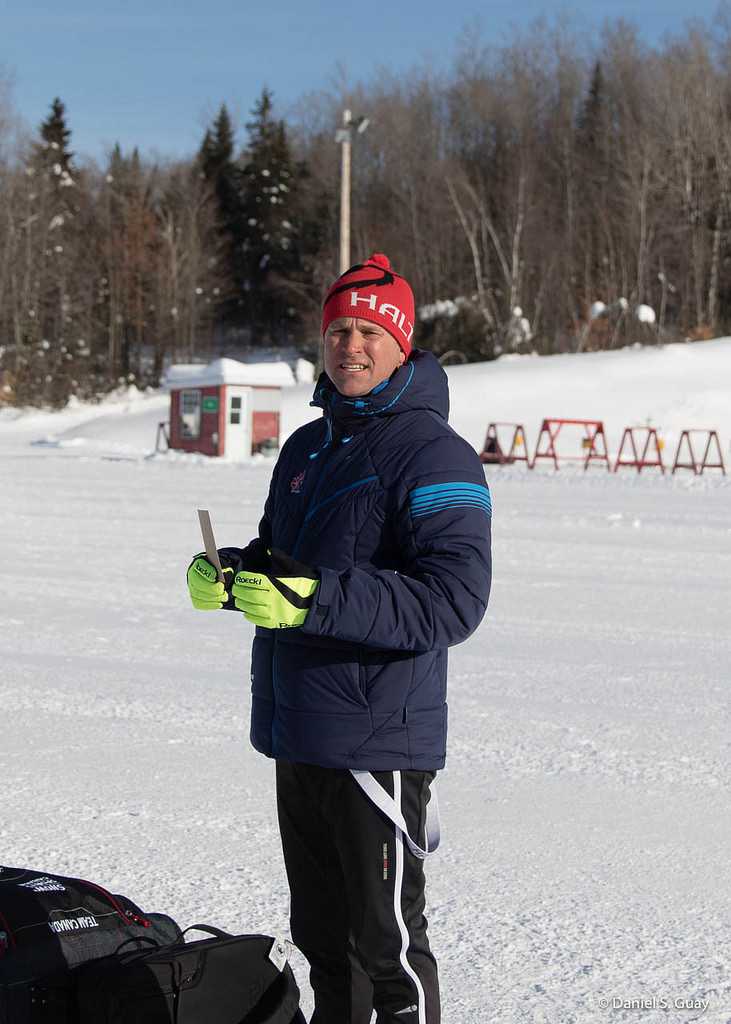
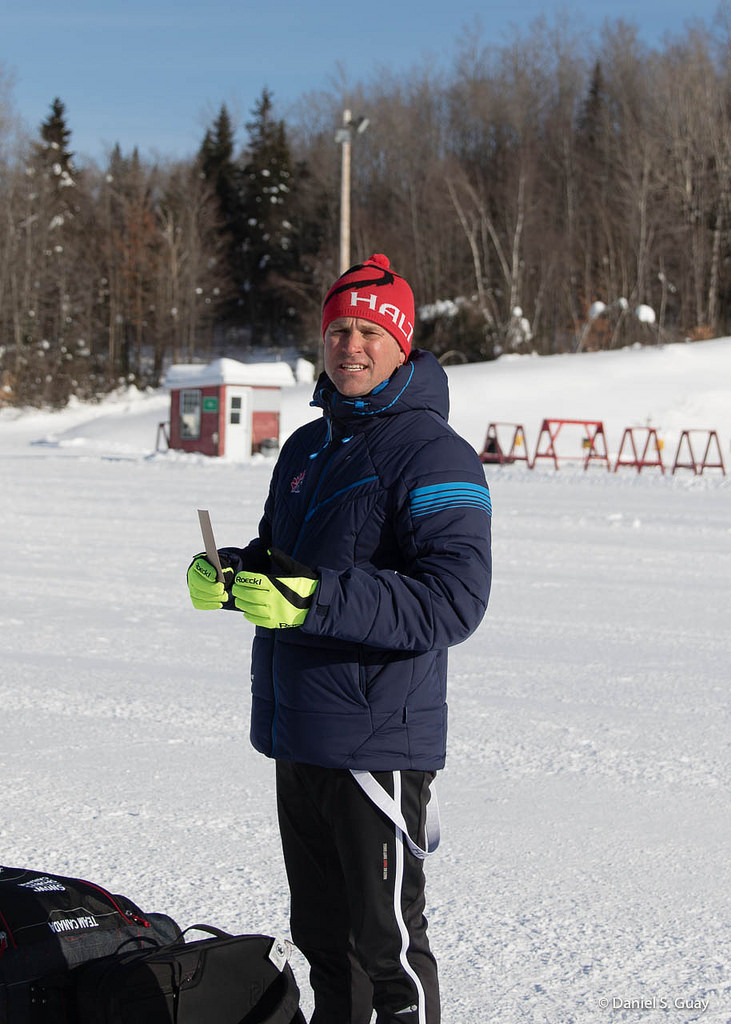
Former Biathlon Canada High Performance Director Eric de Nys making the team announcements in Valcartier, Quebec. (Photo: Dan Guay)
For the past 13 years, Eric de Nys has been ingrained in the sport of cross-country skiing and its offshoots, including biathlon. He spent 10 years as a coach on Cross Country Canada’s national team, leading the women’s World Cup team in his final two years there.
Based in the same town and out of the same training facilities in Canmore, Alberta, de Nys parted ways with the national team after the 2014 Olympics and founded a bridge development program, the WinSport Junior Cross-Country Ski Team, to prepare junior skiers for senior-level racing.
A year and a half later, in October 2015, de Nys accepted a new job as high-performance director for Biathlon Canada, replacing Chris Lindsay (who currently works as a high-performance advisor for Own the Podium).
De Nys spent two winters with Biathlon Canada, but less than week after the conclusion of the 2016/2017 competition season, that tenure ended. The move from Biathlon Canada to discharge de Nys came less than a year before the 2018 Olympics, but after a season in which the Canadian biathlon team fell short of reaching the podium in a World Cup or World Championships race.
While several younger biathletes had major breakthroughs, including Megan Bankes and Leo Grandbois at Youth/Junior World Championships, and national-team members like Scott Gow, Christian Gow, Emma Lunder, and Julia Ransom recorded career-bests on the IBU World Cup circuit, several veteran members appeared to take a step back. Nathan Smith was out most of the season with a virus, and Rosanna Crawford and Brendan Green struggled to return to their competitive form.
Biathlon Canada General Manager Andy Holmwood told the Rocky Mountain Outlook that the decision was not performance related. He explained that Biathlon Canada expected to have the position filled by May 1. A job posting on its website indicated that applications would be accepted through May 7.
In an email to FasterSkier, Holmwood wrote that the new high-performance director will take over a program with plans leading up to and through the PyeongChang Winter Games. He explained that he hoped to fill the position as soon as is “feasible.”
Other than to “confirm we’ve recently parted ways with Eric de Nys and wish him the best of success in future endeavours, Biathlon Canada has no comment on the situation,” Holmwood wrote.
De Nys declined to comment specifically on the matter as well, telling FasterSkier on the phone that, as far as he knew, the decision was not performance related. He added that he had enjoyed working with both CCC and Biathlon Canada and was remaining positive as he looked ahead.
“One door closes and multiple open,” de Nys said of his plans moving forward. “I just hope the best for the athletes.”
After spending more than a decade of his career in skiing, he suspected he will remain involved in the sport in the future — even as a volunteer — although this year may signal a break.
“I’m not sure at what level yet, but I will be helping out at the club level or something like that,” de Nys said. “Maybe volunteering, but I do think I will step away from sport for at least year, maybe forever. I don’t know.”
A 2008 file photo of Chris Lindsay. He left Biathlon Canada after eight years with the organization. (Photo: Biathlon Canada)
Biathlon Canada announced earlier this month that Chris Lindsay would leave his position as High Performance Director to assume the role of High Performance Advisor to summer sports at Own the Podium. With over four years as High Performance Director, Lindsay departs Biathlon Canada having fostered a program that has risen to the highest level of international competition.
A former biathlete who competed at both the national and international level, Lindsay has been with Biathlon Canada for roughly eight years. Previously serving as Technical Programs Coordinator, he was hired in 2010 as High Performance Director. Before joining Biathlon Canada Lindsay worked in the summer sports industry, including aquatic recreation and competitive canoeing and kayaking.
According to Lindsay, his current progression from winter to summer sports is natural given his transition between the two realms over the years. As High Performance Advisor he will work with a variety of summer sports programs’ high performance directors to realize the potential their programs hold and get them the resources necessary to realize that potential.
“While I absolutely love [being biathlon’s High Performance Director], the sport, and the athletes and the fantastic staff that I get to work with, I had this opportunity come up with Own the Podium,” Lindsay said in a phone interview. He continued, adding that the new position was the next step in his journey, “in terms of providing me with a fresh challenge and providing me with new opportunities to support high performance sport, specifically winning Olympic and World Championships medals.”
Biathlon Canada’s President, Murray Wylie, said in a press release that Lindsay would be missed by the organization. “Chris has played an integral role in leading the strategic transformation of Canada’s high-performance biathlon program from a group of participants to medal contenders at the Olympics, World Championships and World Cups during his five years with Biathlon Canada,” Wylie wrote. “He leaves having positioned Biathlon Canada with the opportunity to deliver a medal-winning performance at the 2018 Games, and beyond.”
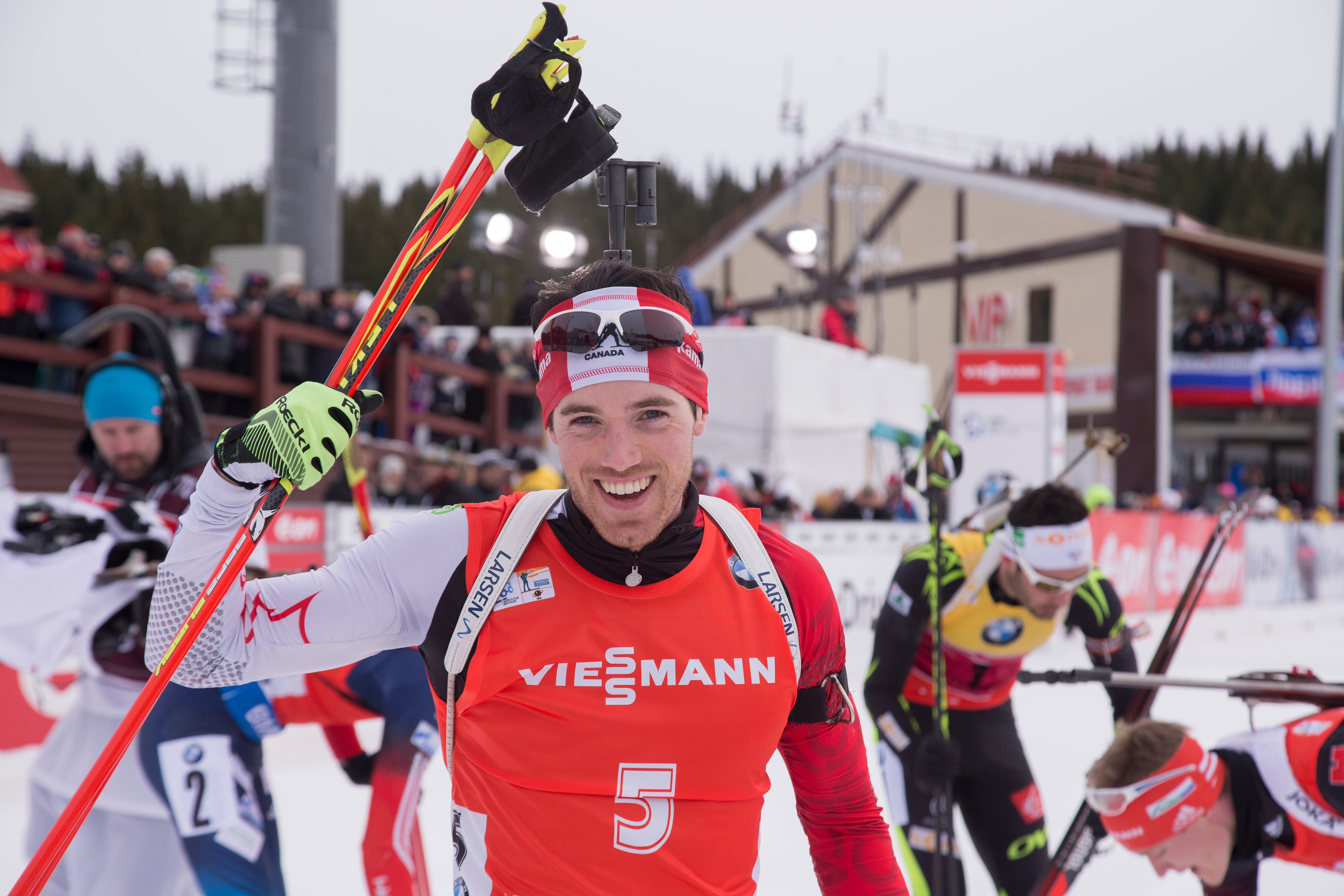
Nathan Smith celebrates after becoming just the second Canadian man to ever win a biathlon World Cup, taking the win in the 12.5 k pursuit in Khanty-Mansiysk, Russia. (Photo: Biathlon Canada/NordicFocus.com)
While Lindsay is content with his decision to leave Biathlon Canada, it doesn’t come without challenges. The former high performance director said he will not only miss the relationships with those in the biathlon community, but also opportunity to be present at races in the coming years, especially the IBU World Cup in Canmore in early February of 2016.
“In a way it makes it very challenging to leave because you want to continue to be a part of this machine that has this momentum going forward,” Lindsay said. “I think the hardest part about leaving Biathlon Canada, beyond the relationships with the athletes and the staff, is that I am not going to be around for the home World Cup next season.”
While Lindsay’s new job will keep him busy throughout the next year, he plans to schedule a vacation during the Canmore World Cup week and volunteer at the event in order to reconnect with some of his former athletes.
Looking back at his career with Biathlon Canada, Lindsay said that the sport is an example of success in the Canadian system. Just in the last year the team had several top-10 performances on the World Cup, the most notable of which were Nathan Smith’s silver medal in the sprint at World Championships and his victory in a late-season World Cup pursuit. “The systematic successes we have seen prove the mission and how we’ve been able to execute it,” Lindsay explained.
Although some of Biathlon Canada’s target races are several years out, most notably the 2018 Olympics, Lindsay is certain that the program he has been a part of for eight years will achieve its goals and then some.
“We have been working hard as a nation to be recognized as a real member of the club and we fully expect that by the 2018 season,” Lindsay said. “We will be firmly recognized as a top-10 nation in the sport and we will be regularly, perhaps not frequently but regularly, converting medals at the World Cup and World Championships level. There will always be setbacks and there will be dry spells, but if the machine is fully functioning then we have multiple athletes who can take the mantle.”
There was no official word from Biathlon Canada regarding Lindsay’s replacement.
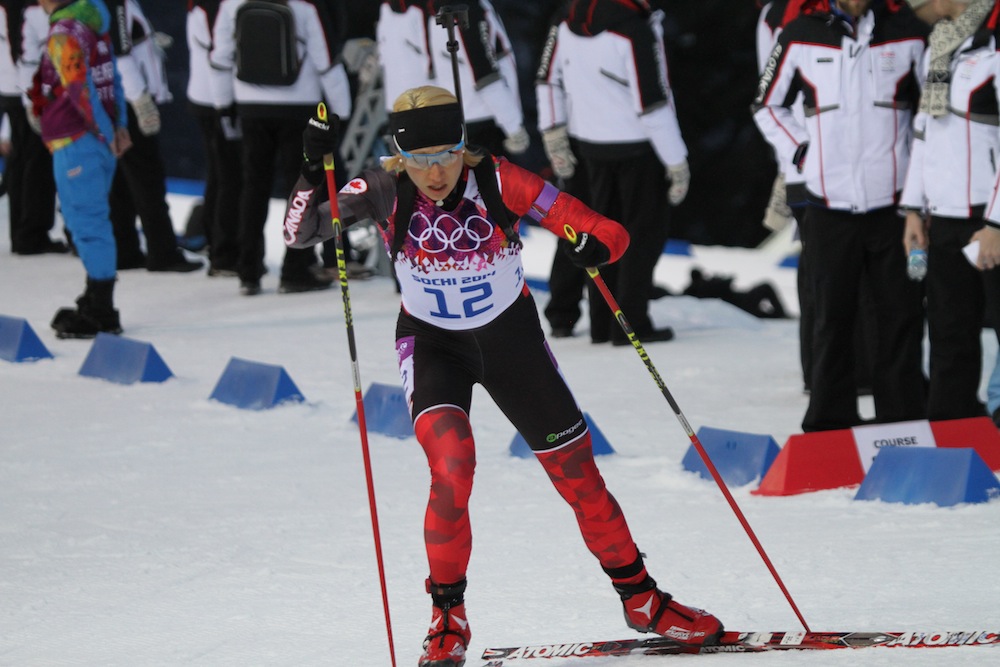
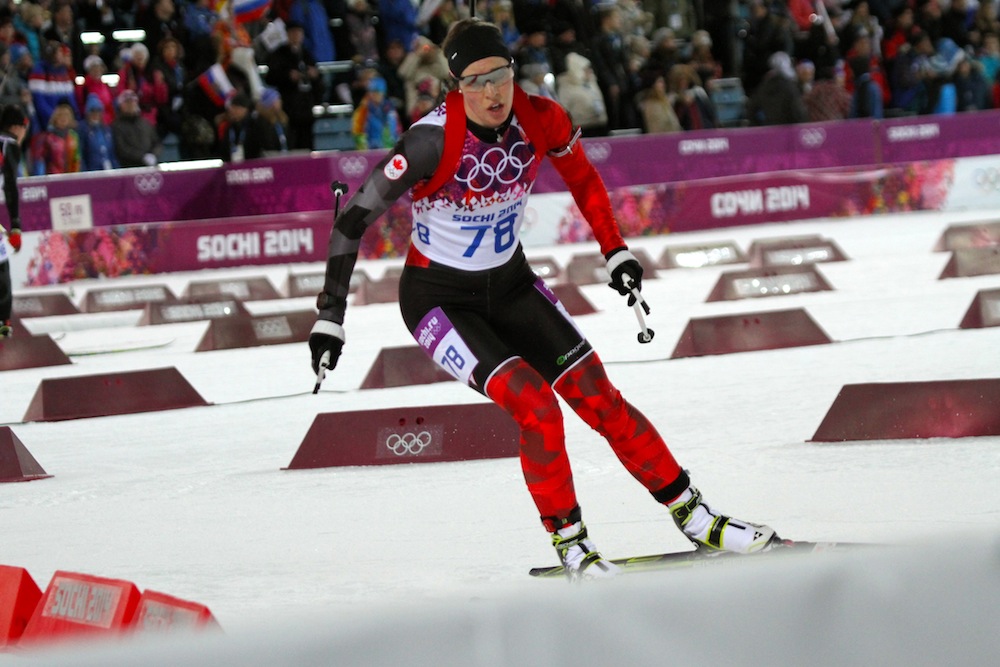
Canada’s Zina Kocher finished 32nd in the 2014 Olympic 7.5 k sprint in Sochi, Russia. After a top World Cup performance of 48th this year, she won back her Sport Canada funding support through an illness provision, but was left off the national team roster.
Three-time Olympian Zina Kocher has not been named to the Canadian national biathlon team this season, a status she disputes. Kocher has been representing Canada on the World Cup since 2002.
After a lackluster season, Kocher had a top World Cup finish of 48th place, short of the three top-30 results she would need to meet the national “A” team standards or the one top-40 needed to meet national “B” team standards.
Besides the national team snub, that meant that Kocher was not eligible for Athlete Assistance Program (AAP) “carding” from Sport Canada: financial support for top athletes that is intended to keep them training without having to hold a full- or part-time job. Kocher and teammate Scott Perras, who was in a similar situation, appealed the ruling based on performance and lost. (For more about carding and this appeal process, scroll to the bottom of the article.)
Next, they submitted paperwork seeking injury/illness exemptions from the criteria, and regained their carding that way.
“I was on vacation and was having to deal with this,” Kocher explained in an interview. “Scott emailed me and told me, okay, he had applied for an illness provision and it went through. So a few days after I found out that my appeal was rejected, I applied for an illness provision. I also had reasons that I was dealing with some medical stuff since September.”
Kocher had taken a month off to travel through southeast Asia. While she was there, she was deciding whether or not to continue with biathlon. Upon deciding that she did want to keep training, she was frustrated not to be able to do so with the national team.
“I wasn’t sure that I was going to continue until the end of April, when I decided that I wanted to do one more year,” she said. “… I really needed that month to step away, and to do something totally different and really relaxed. And also to help me make a decision whether to put in the effort to train again, for another year or not.”
Perras was added to the national team after he regained his carding through the illness provision. Kocher also got her carding back, but not a national team nomination. Now she’s at an impasse where she believes that her name should and will be added to the team roster, but team staff insist otherwise.
Neither Kocher nor Perras disclosed the nature of the injuries or illnesses.
“I just want to put it behind me,” Perras wrote in an email. “Sorry. I am grateful to be on the team this year and for the support of my teammates through my difficult year and am just looking forward.”
On to the National Team?
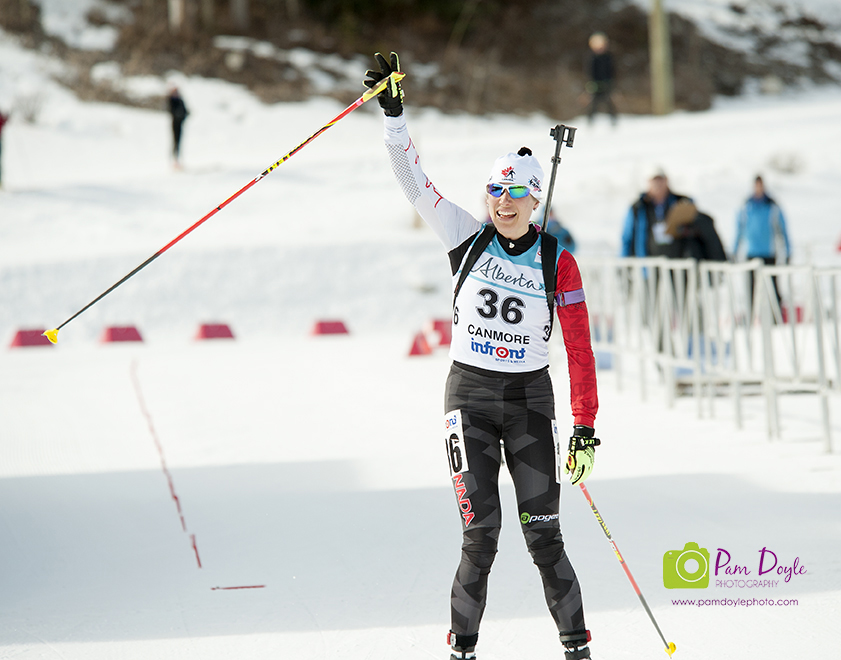
After being bounced from the World Cup mid-season, Kocher returned to Canmore, where she finished second in an IBU Cup sprint. (Photo: Pam Doyle.)
For Kocher, the dispute is over whether national team status is tied directly to carding. Kocher says that carding should automatically confer national team selection.
“I was in the exact same situation as Scott Perras, so now there’s an inequality issue,” Kocher said.
But according to Biathlon Canada High Performance Director Chris Lindsay, even if an athlete is carded, they still have to meet national team selection criteria to be nominated to the national team.
“It is related, but it is not directly linked,” Lindsay explained. “Being named to a squad in many situations will then get you into the carding list. But it doesn’t work the opposite way. If you are carded but you haven’t met our squad criteria, then we are not obligated to give an athlete a position on a training squad.”
Biathlon Canada has no specific injury/illness provision for its national teams; that was only relevant for Sport Canada and carding. Athletes can be named to the “A” or “B” squads by the High Performance Working Group, which includes Lindsay and the coaching staff, by discretion if they do not meet one of three potential objective criteria. Reasons for inclusion by the working group are listed in the squad criteria:
“A single or multiple exceptional performance(s) internationally in the current season; Near achievement of the WC Performance Standard at the end of the season; Significant than average fitness testing results from standardized tests during the training season; Exceptional circumstances.”
Injury or illness might certainly be considered an exceptional circumstance, but these issues are not mentioned explicitly. While Biathlon Canada’s carding and national team requirements are listed in one document, that document is divided into two parts. The requirements for an injury/illness provision are listed under the carding requirement section, but not mentioned in the national squad criteria section.
Perras and Scott Gow, who contributed to a fifth-place World Cup relay result this season, were named to the “B” team through the High Performance Working Group. In Kocher’s case, despite her documented illness, she was not named.
“The deliberation by the High Performance Working Group was that based on the principles of selection and the objectives for training squad members, Scott Perras was going to have a greater opportunity to contribute towards World Championships medals next season than Zina,” Lindsay said.
Biathlon Canada indicated in a press release that Lindsay will soon be leaving the organization to work as a High Performance Advisor for Own The Podium, the Canadian sports funding agency. Kocher believed that after his departure, other team staff would add her name to the national team roster.
“To sum it up, we’re all in discussion,” Kocher said on Saturday. “As Chris is resigning, it’s now going to our team manager [Andy Holmwood]. It’s in our team manager and coaches’ hands, and I’m waiting til the end of the weekend so we can sort things out.”
There’s not much evidence of discussion, though. Kocher said that the coaches told her to talk to Lindsay; Matthias Ahrens, the head coach of the national team, also declined to comment for this story and referred all questions to Lindsay.
“It is my belief that there was strong consensus that she not be nominated to the Training Squad,” Lindsay wrote in a follow-up email. “This is based on the selection principles outlined in the Squad selection document and is supported by the goals outlined in our strategic plans.”
Kocher does not dispute that her performance in the 2014-2015 season was subpar. She knew about her medical situation in September, but did not tell coaches or adapt her training because she did not think it would be a major problem. Looking back, she says, it’s clear that it was.
“I think it would have changed how I was training in September, and the amount of rest I needed before the World Cup season started, and maybe not have started racing right away,” Kocher said. “I just think that I should have modified things earlier and taken more rest. But at that time, you think, oh, I’m not feeling that bad. You just keep pushing through it.”
Kocher said that she hasn’t developed a plan other than making the national team.
“I haven’t figured out a second option because I thought that this option would work,” she said. “I can’t say that I would go back to Richard Boruta and Biathlon Alberta Training Center. I think that would be my next option, but I haven’t spoken with Richard yet.”
Lindsay also didn’t have a plan for Kocher, but was confident she would land in a good spot.
“Where she decides ultimately to go for training is entirely up to her,” he said. “As a mature athlete who has been doing this for a number of years, certainly we trust her judgment on where she feels she would be best fit. Should she require any assistance finding a place, we have encouraged her to ask us any questions. But, she is not a member of the national training squad for the 2015-2016 season.”
What is Carding?
Although carding itself is not the issue under dispute – both Perras and Kocher received their carding after submitting injury/illness appeals – it’s hard to understand the source of Kocher’s conflict without also addressing carding.
There are several different types of “cards” available through Sport Canada’s Athlete Assistance Program. Some (SR, SR1, and SR2) confer monthly payments of $1500. Others (C1, D) confer monthly payments of $900. This is intended to allow the best Canadian athletes to train full-time without having to find a part-time job.
(There’s other benefits too, like funding for childcare, moving expenses to centralize with a national team, and a fund to pay for university tuition after retirement.)
Millions of dollars are spent by the Canadian government each year on this program, which supports Olympic disciplines and a few non-Olympic teams with major World Championship events. Sports receive different amounts of carding depending on the number of disciplines and potential medals, and must allocate this into “cards” based on their own internal standards.
There’s one exception: top-eight finishes at Olympics and World Championships events, including relays. Across all sports, that confers an SR1 card the following season, and an SR2 card the next season. After the 2014 Olympics in Sochi, Russia, all eight Canadian relay members (four men and four women) received SR1 cards because they had finished in the top eight in the men’s or women’s relay.
The catch is that national federations can add additional requirements to SR2 funding.
“A NSO may adjust a criterion or include sport specific requirements to the senior international criteria specific to their sport in order to strengthen the criteria,” the Sport Canada AAP guidelines read.
“Other sports would put in, you must have a 10 k running time of sub-[some time] in the next season, or you must do so many appearances on TV,” Lindsay said. “You can put in just about anything. For a long time Biathlon Canada had no maintenance criteria at all.”
That aligned them with several other major sports federations. For instance, speed skating, figure skating, and several other major winter sports federations appear to give SR2 carding as long as athletes maintain basic requirements like Canadian residency and signing a contract with the organization.
But other teams do attach additional requirements to receive an SR2 card. For instance, Cross Country Canada requires that to receive an SR2 card, athletes must continue to meet the eligibility standards, which include being part of the national team or a national development center. Swim Canada requires athletes to “have maintained a performance level within a threshold of 1% of the time they performed to earn the SR1”. Track and field requires that an SR1 athlete “achieves prescribed performance targets and benchmarks over the course of the two years” to continue receiving carding money.
This season, Biathlon Canada added an SR2 maintenance requirement for the first time. Kocher asserts that as a result, she and Perras did not realize that the second year of post-Olympic carding was contingent on any maintenance criteria.
“We thought that it was just going to go into effect the following year since the six of us that continued on had made the criteria in Sochi,” Kocher said. “Then in December at Christmas, Scott Perras and I found out that we hadn’t had a top 30 yet and we needed to do this if we were to get carding for the next year.”
On September 3, 2014, the carding criteria for the 2015-2016 season was posted online; the document header read, “Effective September 1st, 2014.”
At the bottom of the third page, the maintenance criteria for the second year of carding (SR2 status) is listed:
“The second year is subject to the athlete meeting the minimum National A Training Squad Priority 1, 2, or 3 performance standard, being re-nominated by Biathlon Canada, submitting a training and competitive program approved by Biathlon Canada and Sport Canada, and signing an Athlete NSO Agreement, and completing the AAP application form for the year in question.”
Those three “Training Squad Priorities” are listed on page eight.
“It is the responsibility of the athletes to review carding and selection documents,” Lindsay wrote in an email. “In an effort to assist them we have our website set to provide twitter and facebook updates when new material is published… Any athlete who has any questions is always welcome to come to my office for answers.”
Biathlon Canada initially nominated both Kocher and Perras for carding money, but Sport Canada rejected the nominations because they violated Biathlon Canada’s own internal procedures. Kocher and Perras had to appeal to Biathlon Canada. The substance of the appeal was that it was unfair for them to have to meet maintenance requirements.
“Scott Perras and I both appealed on that basis that we had made our S1/2 AAP carding criteria at the 2014 Olympics with the top 8 relays (criteria set by Sport Canada), and that is suppose to be a guaranteed 2 years of carding,” Kocher wrote in an email. “… We argued that we had already signed our 2014/15 Athlete Contract and 2014/15 AAP contract before the [September] changes, plus had made the criteria prior to the changes.”
Biathlon Canada rejected these appeals, perhaps because Sport Canada was now looking closely to see whether they followed their internal policies – awarding carding outside of the established criteria would make Biathlon Canada noncompliant with Sport Canada’s quidelines.
So Kocher and Perras tried a new tactic.
“A few weeks before that, Scott Perras found out what was wrong with him,” Kocher explained. “He was ill, and it had been going on since July. He had medical references and stuff. So he applied for an illness provision, which is a totally different process. You tell Biathlon Canada and then they send that to Sport Canada. At the end of April he won that appeal and provision.”
That provided a path for the reinstatement of Kocher’s own carding.
Nathan Smith celebrates after becoming just the second Canadian man to ever win a biathlon World Cup, after winning Saturday’s 12.5 k pursuit in Khanty-Mansiysk, Russia. (Photo: Biathlon Canada/NordicFocus.com)
When Nathan Smith crossed the finish line of Saturday’s 15 k mass start in Khanty-Mansiysk, Russia, he became just the second Canadian man in history to win a World Cup biathlon competition.
Smith had already had a record-breaking season. He won silver in the 10 k sprint at World Championships in Kontiolahti, Finland, making him the first Canadian man ever to medal at a Championships. It was the first podium of his career, but certainly not the last.
So when he finished fifth in the sprint in Khanty-Mansiysk, 34 seconds out of the win, Canadian staff knew that something special might happen in the following pursuit.
“I think he actually had a better opportunity for a good race in the [Khanty] pursuit versus after the second place after the World Championships,” Biathlon Canada High Performance Director Chris Lindsay said. “I think that the excitement and the novelty of what was an incredibly important result [at World Champs]… really didn’t set him up well for being able to carry through on the second day of racing.”
But in Khanty-Mansiysk, Smith was able to rely on a season’s worth of near-podium experiences, and he raced like someone who belonged at the top. That netted him a 24-second win.
“It feels really good to have a second medal on the results,” Smith said after the race. “It gives a little bit more credibility to my World Champs medal, like it wasn’t just a fluke. I can consistently put down medal-potential results.”
Plenty of North American biathletes have shown the ski speed needed to win a World Cup, but it takes more than just speed to actually do it. By coming so close a few times this season, Smith learned to do what it took on Saturday – for instance, leading Martin Fourcade and Anton Shipulin around the course.
Canadian head coach Matthias Ahrens cheering from the range during Saturday’s race. Because of budget concerns, Biathlon Canada only sent two staff members – Ahrens and head service tech Tom Zidek – to support the team in Khanty-Mansiysk.
“The more time that you can play up at the front of the pack, the more you realize that there’s not so much difference between what the top athletes are doing on the ski trail compared to what guys in the top 30 are doing,” Lindsay said. “When you need to step in front of somebody and take the lead, you don’t second-guess the choice to do it. Whereas the first time you’re up at the front of a pack skiing with athletes who are your peers but also in some ways your heroes, it can be difficult to assert yourself.”
Watching the win happen already had direct consequences for the team: Rosanna Crawford said that it immediately motivated her to do better, and later the same day she went out and climbed from 28th place to 13th in the women’s pursuit, her best result in weeks.
“Not only is a big step forward for him to prove to the World that he can be a consistent podium contender, but it’s also great for our team and will be a big motivator for us all when we start training again this spring,” said Smith’s teammate Brendan Green, who finished 23rd in the pursuit. “Nathan and I have been training together since we were 14 years old and it’s been awesome to see his progress over the years and especially in the last couple of seasons.”
Funding… Or Not
While earning a win instead of only a second-place finish might seem like an even bigger boost in the profile of Canadian biathlon, the national team’s biggest funding partner doesn’t see it that way.
Own The Podium (OTP), and public-private partnership which determines high performance funding for Canadian sports, focuses only on medal-worthy results at World Championships and Olympic Games, and does not consider podiums in regular season races as criteria for funding a sport.
“Medals at the World Championships and the Olympic Games are really what counts,” Lindsay said. “Our funding partners and our performance partners love to see that we are getting those medals at the critical competitions and are happy other evidence of success. Certainly medals and top-5’s, top-8’s consistently are signs of other success, but if that success can’t translate into success at the World Champs and Olympic Games they aren’t counted with the same weight.”
Luckily, Smith won that silver medal at World Championships. If Biathlon Canada sees an increase in OTP funding next year, it’s likely thanks to that – and that might be why Smith’s finish there was so exhaustingly significant. When he got the medal, he knew what it meant to his team, which has not had a World Championships or Olympic medal since the time of Myriam Bédard in the early 1990’s.
Biathlon Canada has a miniscule budget, with $1.1 million for 2013-2014 for high performance including salaries. Not only is the sport not massively popular in the country – a North American problem also faced by U.S. biathlon – but without any of those championship medals to call on, it seemed to fall at the bottom of OTP’s priority list.
Last February, the Banff-based Crag and Canyon reported that the federation has been running a deficit for the last five years, and wrote that “This year’s deficit amount falls somewhere between $100,000 and $150,000.”
While budget problems plague North American biathlon, Canada has it harder in some ways. For instance, according to the U.S. Biathlon Association’s 2013 990 Form, USBA paid over $368,000 to its three highest-paid employees combined (head coach Per Nilsson, High Performance Director Bernd Eisenbichler, and shooting coach Armin Auchentaller); Biathlon Canada had just $375,000 (which translates to less than $300,000 U.S.) for all its high performance staff combined, including the director, coaches, and technical staff.
That leads to situations like the team had last weekend, when it sent only its top three athletes to the far-flung Siberian venue of Khanty-Mansiysk instead of a full team. And to support them, only Ahrens and head service tech Tom Zidek were flown to Russia.
“Tom was up until 11 last night at the site testing, and then the shuttle service stopped before he got to the bus,” Smith said after his winning pursuit. “So he had to walk an hour back to our hotel. That’s the level of commitment that can make a big difference in the end for our results.”
It’s satisfying to win when other countries have ten times the staff and orders of magnitude more money available for high performance.
“It feels kind of good,” Smith said. “It’s like we’re right in their faces. Some of those teams have guys who basically just stand around and hold jackets and I don’t know, keep seats warm. On our team, even when we have a full support squad, like at World Champs, everyone is pretty busy doing stuff. We’re still a small team even then.”
But it’s also frustrating. What might be possible with a bigger budget? Ahrens wish he could find out.
“I definitely would say it is frustrating, mainly because the competitiveness of the biathlon World Cup,” Ahrens said. “It is just amazing how strong the field is, both on the men’s and the women’s side. You have thirty athletes really fighting for the podium and compared with other sports, where you really have maybe five contenders fighting for a podium. It’s gone to such a high level that there is no country out there not doing this very professionally. It’s getting tighter and tighter. If you just look at the results from yesterday in the sprint, the top 60 were within two minutes. A year ago or two years ago, that was usually around 2:30, so it’s amazing how the sport is developing.”
That’s why the hope is so strong that OTP will recognize Smith’s results and reward the team that helped him get there.
“The fact that he medaled at World Championships in Finland is huge and I really hope this will help boost our federation’s funding a bit,” Jean Philippe Le Guellec, the last (and first) Canadian man to win a World Cup, wrote in an email. “The next step is to have others follow his footsteps.”
Le Guellec was an obvious choice to be the guy to finally do it for Canada. He had already notched a best-ever result for a Canadian man at the Olympics in Vancouver in 2010, finishing sixth; in Sochi, Russia, in 2014, he upped that mark to fifth place.
It was with appreciation but also dismay that the biathlon community said goodbye to Le Guellec when he retired after the Sochi Games. But the gold the team had been mining was still right there in the team he had been part of, the Quebecois star explained.
“Funny, because I was told it was the end of an era when I retired,” Le Guellec wrote in an email on Sunday. “But this is simply, and clearly, the start of a new one… I was ecstatic but not surprised. With the season he had last winter and the effort he puts in training, I had hopes that he would do well this season. He’s the most consistent of us all as well. Knocking at the door often in the beginning of the season was making it a question of time until he climbed on the podium. I’m just pumped for him it happened sooner rather than later AND repetitively!!”
Smith isn’t the only Canadian who might be showing up on the podium next year. Rosanna Crawford came close this year, finishing fourth and fifth at the beginning of the season; Megan Heinicke had four top-15 performances; and Brendan Green was one of the most consistent performers after Christmas, having only two results out of the top 30 and finishing in the top 21 in every race at World Championships.
“It’s the same with Brendan [Green] and Rosanna [Crawford],” Smith said. “They are pretty consistently at the level where if they have a really good race, they could podium too.”
Lindsay and Ahrens agreed that Canada’s pipeline is in better shape than it often has been in the past.
“I’m really happy and not just by those two senior athletes who have really gone to the top of the pack, but also our upcoming younger athletes like the two Gow brothers, Macx Davies,” Ahrens said. “They have put a lot of effort of course in training, but they are part of our achievements. I look at the two Gows as being a really important part of our relay team…. If I look at this, it’s actually the younger athletes now, they’re coming in at a higher level then the young athletes came in ten years ago.”
Ahrens has personally seen the long-term development it took to get Smith to the top of the podium. Despite being hired as head coach only in 2010, he has known Smith much longer.
“I must say for me, it’s just an amazing experience,” Ahrens marveled. “Especially Nathan and Brendan, I started coaching them 10 years ago when they were still juniors, when I took the position for junior national team coach. So I really appreciate that I could grow with them and they could grow with me, and it has been an amazing journey up to this point.”
He hopes that means that some of the newer team members will eventually follow in Smith’s footsteps.
“That is always my hope, and I believe in that,” said the head coach. “Hopefully they stay with the sport and they can be supported enough that they can afford staying in the sport. That’s always a challenge for us. I think too often, athletes drop out too early. We know the highest performance age is, while it’s getting younger, it’s still around 27 years of age.”
Smith is 29 years old, and he was 26 when he watched Le Guellec climb to the top step of the podium on a windy afternoon in Sweden.
He hopes that his own success can do the same thing for the younger members of his team.
“You can make surprises happen,” he said. “[JP] surprised everyone that week; I surprised everyone last week. Neither of them should have been surprises, because JP had been close to the podium many times, but it really sinks in when someone actually does it. Then you see, oh yeah, I train with him. I can beat him in time trials sometimes. There’s no reason why I couldn’t podium either.”
Canada’s Nathan Smith at his first-ever awards ceremony after placing a career-best fifth on Sunday in the IBU World Cup 12.5 k pursuit in Nove Mesto, Czech Republic. (Photo: Biathlon Canada/NordicFocus)
No part of Sunday could be described as “easy” for anyone racing the IBU World Cup pursuits. A little new snow and some wind had been in the forecast for the last day of racing in Nove Mesto, Czech Republic, and that seemed manageable.
Overnight, nearly half a foot of snow fell. Then, on Sunday afternoon, came the snow squalls, sporadically and unforgivingly, with increasing blizzard-like conditions making for a miserable-looking women’s race.
Heavily falling snow jammed rifles, and some women crossfired, like Germany’s Franziska Hildebrand, who was in the top five until shooting at the wrong targets in the final stage. She then skied the wrong number of penalty loops and was penalized six minutes, relegating her to 50th out of 51 finishers.
Meanwhile, the Czech Republic’s own Veronika Vitkova desperately tried to get the attention of race officials to reset her targets — the ones Hildebrand shot at. The technical delegate for the weekend, Max Cobb (also US Biathlon’s CEO) explained that video cameras in the range revealed Vitkova lost 52 seconds amid the confusion, and the jury deducted that from her final time, which put her in 11th overall.
And all that happened before the men’s race even started.
Canada’s Nathan Smith was ready for an equally slow-and-painful 12.5-kilometer men’s pursuit. He had seen blue skies during zero shift to snowfall during his warmup, amounting to a centimeter or so on the ground before the gun went off.
Fortunately, it lightened up to “a medium snowfall” for most of the race, he explained, up until the another big squall blew through on Smith’s final lap.
“Thankfully, I only had to deal with that for half a lap,” he wrote in an email.
But what a half a lap it was. After starting seventh, 38 seconds behind Saturday’s sprint winner Jakov Fak of Slovenia, Smith leapt to fifth with a clean first prone. Fak cleaned as well, as did France’s Martin Fourcade, who started fourth, Germany’s Simon Schempp, who started second, and the Czech Republic’s Michal Slesingr, who started fifth, respectively.
Smith, who posted a career-best seventh on Saturday, established himself behind them in fifth after the first shooting, 40.7 seconds after Fak. The top-12 men to leave the range all came out with perfect shooting.
Conditions were initially more favorable than the women’s race, with light snow and a slight-yet-variable wind.
But the weather gradually intensified, and with each passing shooting stage, the pressure picked up as well.
The 29-year-old Smith handled it like never before — cleaning all four stages for 20-for-20 shooting and keeping himself squarely in the top-six throughout the race.
“I was pretty nervous on the last standing, but channelled my previous fails to make sure I diligently aimed at the targets,” he wrote.
He focused on relaxing his left arm in prone and his left hand in standing — which worked.
After the last standing, Smith headed into the final lap in fifth, 5.2 seconds behind Ukraine’s Sergey Semenov in fourth and 22.7 seconds behind Fak, who was still in the lead despite a single miss on the last stage.
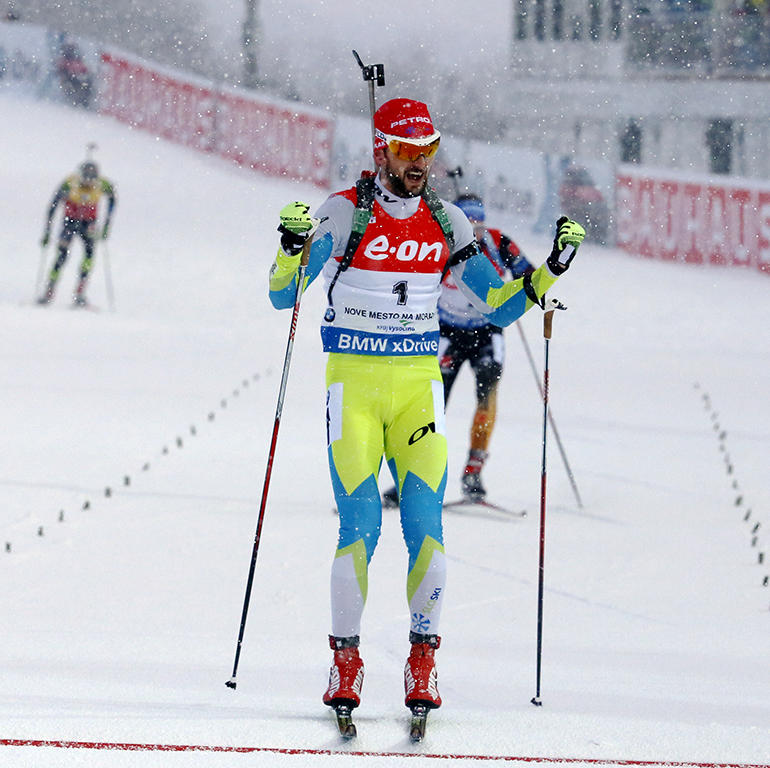
Slovenia’s Jakov Fak celebrates his second-straight win with a victory in Sunday’s 12.5 k pursuit at the IBU World Cup in Nove Mesto, Czech Republic. He held off Simon Schempp of Germany and France’s Martin Fourcade, respectively. (Photo: IBU/Květoslav Frgal)
(Fak completed his penalty loop just as Fourcade was leaving the range after cleaning his fourth-straight stage. Fak led the Frenchman into the last lap, where he extended his gap on him over the next 2.5 kilometers.)
Meanwhile, Smith simply needed to hold his position to set new World-Cup best, but that wasn’t easy, either.
“The Ukrainian [Semenov] and I had been skiing pretty similarly whenever I saw him,” Smith explained. “I tried my best to gain time but was a lot more concerned that someone might come up from behind.”
With 20.6 seconds separating Smith from sixth place (with Germany’s Erik Lesser) after the last stage, the Canadian skied the fifth-fastest course time on the last lap to secure fifth. He crossed the line 24.1 seconds after Fak, who proved untouchable on Sunday with a winning time of 37:24.9.
“I never started a pursuit in first and won so I am happy that I did that,” Fak told the IBU. “I wanted to shoot clean but do not have much experience shooting on lane one, so maybe next time I can do it.”
Fak’s 19-for-20 shooting and second-fastest overall course time was enough to hold off Fourcade and Schempp, who missed one on the second prone, by 4.4 seconds. Fourcade hit each one of his and was in contention for second until the last climb, where Fak attacked to drop both him and Schempp. The German proceeded to pass Fourcade about halfway up, accidentally stepping on Fourcade’s ski to leave the Frenchman staggering for a moment — a moment he couldn’t get back.
Fourcade let up and casually finished third, 8.9 seconds behind Schempp and 13.3 seconds after Fak. Semenov hung on to fourth, another seven seconds later, and Smith finished 3.8 seconds behind him in fifth.
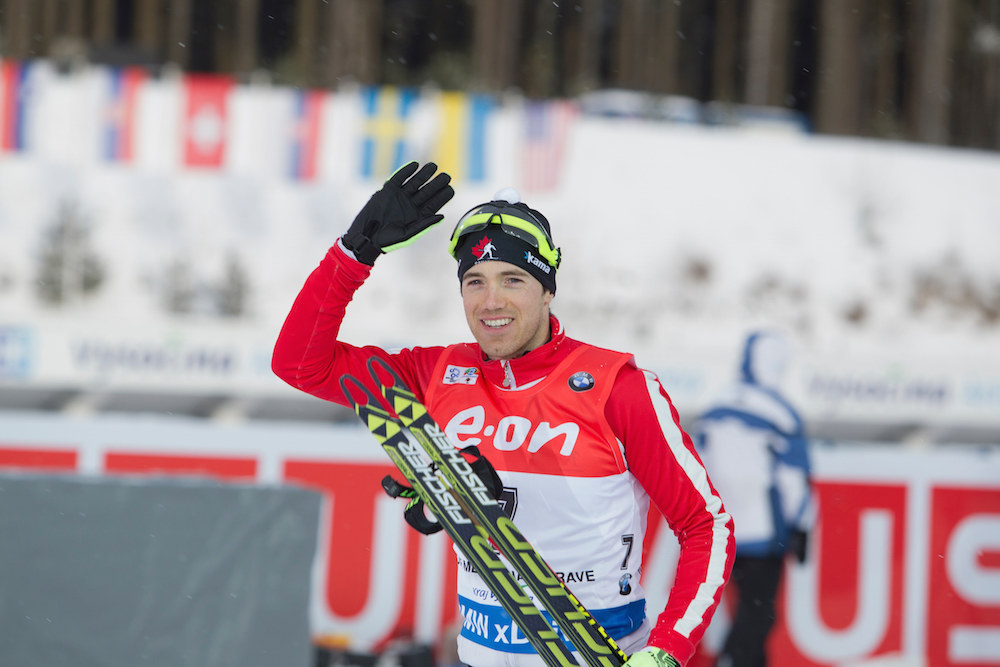
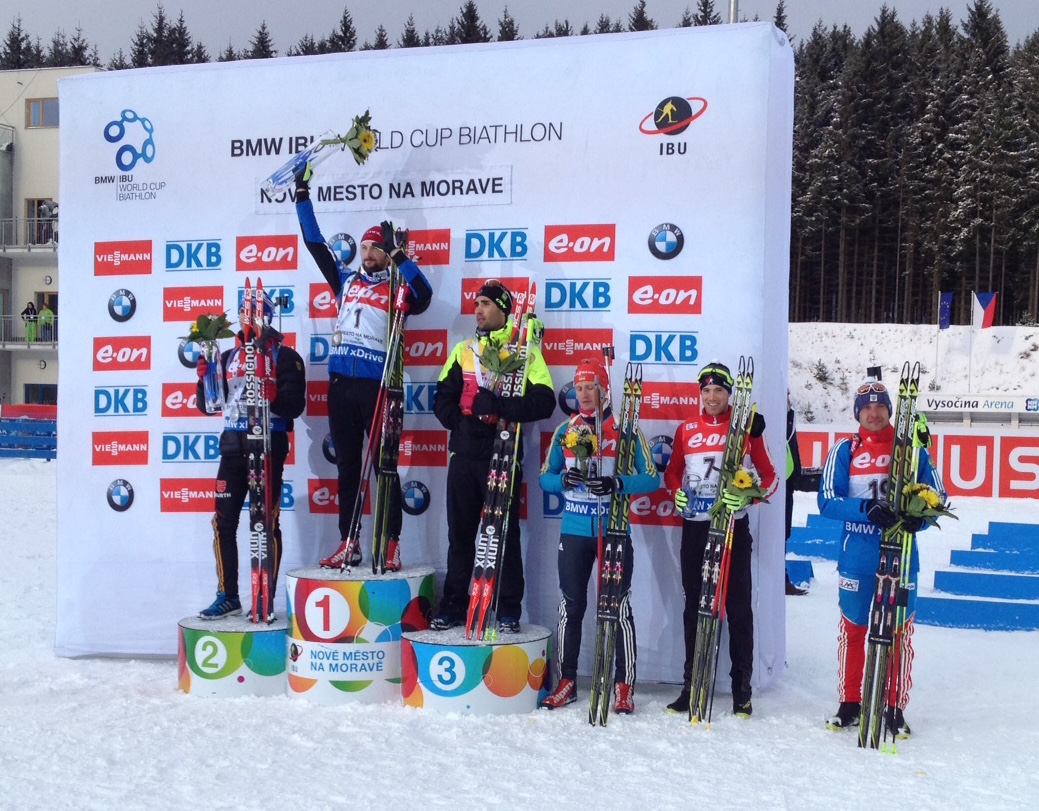
Canadian Nathan Smith (second from r) after placing fifth in Sunday’s IBU World Cup pursuit in Nove Mesto, Czech Republic, for his first-ever flower ceremony. Slovenia’s Jakov Fak (second from l) won the race, Germany’s Simon Schempp (l) placed second, and France’s Martin Fourcade (third from l)made the podium in third. (Photo: Matthias Ahrens/Biathlon Canada)
With Russia’s Evgeniy Garanichev in sixth (+45.6), the top-six men walked together to the following flower ceremony, where Fourcade patted Schempp on the back, indicating no hard feelings.
“It was not easy on the tracks; there was only one spot that was fast,” Schempp later told the IBU. “I had no other chance to pass him. We talked it over and it is okay.”
For Smith, the ceremony itself marked his season-long goal.
“It feels awesome to achieve that and especially when the other guys up there are the perennial biathlon top dogs,” Smith explained of his new career high.
In addition to a bouquet and a glass vase Smith estimated weighed 20 pounds, “It won’t be so great for travelling with,” he joked, Smith also received 3,500 Euros for sixth, roughly $4,000 U.S. dollars.
On any other day, with 20-for-20 shooting, he felt he could have been on or certainly closer to the podium. Fourcade and Semenov also cleaned all four stages just ahead of him.
“Today was a little unlucky for me as the top-three men were basically the Overall World Cup leaders,” Smith told Biathlon Canada, referring to Fourcade, Schempp and Fak, who rank first, second and fourth in the overall standings, respectively. “If a couple of them faltered I could have been there, but it is tough to beat the best when they are on 100 per cent. I know though if you’re only a couple of places off the podium enough times, one day it will happen.”
Canada’s Nathan Smith at his first-ever awards ceremony after placing a career-best fifth on Sunday in the IBU World Cup 12.5 k pursuit. (Photo: Biathlon Canada/NordicFocus)
For the first time in his career, the Canadian also notched back-to-back clean races. He came close last year at the Sochi Olympics, with 29-out-of-30 shooting between two races, but completed the feat on Saturday and Sunday, knocking down 30 consecutive targets.
“Today is extra special because it is the first 20/20 clean of my biathlon career,” Smith added. “It feels awesome to have that success. It makes skiing less of a chore, and you’re excited to get back to the range after the next lap.”
In an email, Canada’s head coach Matthias Ahrens observed that Smith was more mentally prepared for the pressure situation he faced on Sunday, than when he found himself in third coming into the last shooting earlier this season in Östersund, Sweden, and ended up 16th.
“He keeps it cool, he is a pretty quiet guy but lots of thinking in his preparation,” Ahrens wrote.
“The skill and control he demonstrated is exactly what we expect to see from an athlete hungry for medals at world cup and world championship competitions,” wrote Chris Lindsay, Biathlon Canada’s high-performance director, in an email. “Both he and Brendan [Green] have taken on the leader roles within the team now that more of the younger athletes are being introduced to the World Cup. This leadership is most important when it is expressed though performance like we saw today.”
The second of three Canadian men in the pursuit, Green started 22nd and finished 30th (+3:13) with three penalties, one on his second prone and two more in the last stage.
“For me the hardest part today was the skiing,” Green wrote in an email. “It’s a tough 2.5km course to begin with and the conditions today made it a really slow grind. I had some tough luck with my skis today. It wasn’t an easy day for the wax techs in those conditions and I ended up on a pair of skis that just didn’t want to glide.
“We’re all still a little baffled as to why that pair wasn’t gliding well but after chatting a bit we have a few ideas,” he added. “It’s a lesson learned and we’ll get it right in these conditions next time!”
In the range, he recalled a “fairly consistent wind” each time he shot.
“I think I managed it well,” Green wrote. “I would have been happier with one less miss in my last standing bout but 17/20 was decent for today.”
Canada’s 22-year-old Macx Davies started 54th and finished 54th (+9:01.5) with nine penalties (2+3+2+2).
Nordgren 20th for Career-Best Pursuit
Coming off an all-time best 16th on Saturday, Leif Nordgren again led the U.S. in 20th on Sunday. He finished 2:37.9 behind the winner with three penalties, one on each prone stage and one more in the last standing.
“I felt pretty good today, definitely tired from 3 days of racing, but not bad,” Nordgren wrote in an email. “One nice thing about starting the pursuits a little higher up is that there’s always someone to ski with and catch a good draft. I think for almost every loop I just skied behind whoever I happened to exit the range with.”
Nordgren started 1:05 after Fak with Russia’s Matey Eliseev. With an initial prone miss, the American slipped to 21st, then was 25th leaving the second prone. He worked his way back to 21st with a clean standing, and was 19th leaving the range after one last penalty on the final shooting. Overall, Norgren posted the eighth-fastest range time.
“I was sort of welcoming these conditions,” he explained. “Anytime there are these types of winds in a pursuit race is a really good opportunity to move up in a pursuit race, much like last week in Otepaa [where he skied up from 51st to 19th in the pursuit].
“I was pretty happy with where I ended up, but it should have been better,” Nordgren added. “I made 3 mistakes on the shooting range, 2 of them were really stupid mistakes that I shouldn’t have made, and two more hits would have put me a few places higher. … It’s my best ever pursuit result, but knowing it could have easily been better makes it bittersweet.”
Tim Burke (US Biathlon) on his way to 37th in the men’s 12.5 k pursuit at the IBU World Cup in Nove Mesto, Czech Republic. (Photo: USBA/NordicFocus)
After Nordgren, Tim Burke started 38th and placed 37th for the U.S., 3:37.8 back with four penalties (1+2+1+0). Nineteen-year-old Sean Doherty started 57th and finished 45th (+5:02.1) with four misses as well (2+1+0+1).
“I think the best days of the season are still ahead of us,” Cobb wrote. “Just under a month to go until the World Champs.”
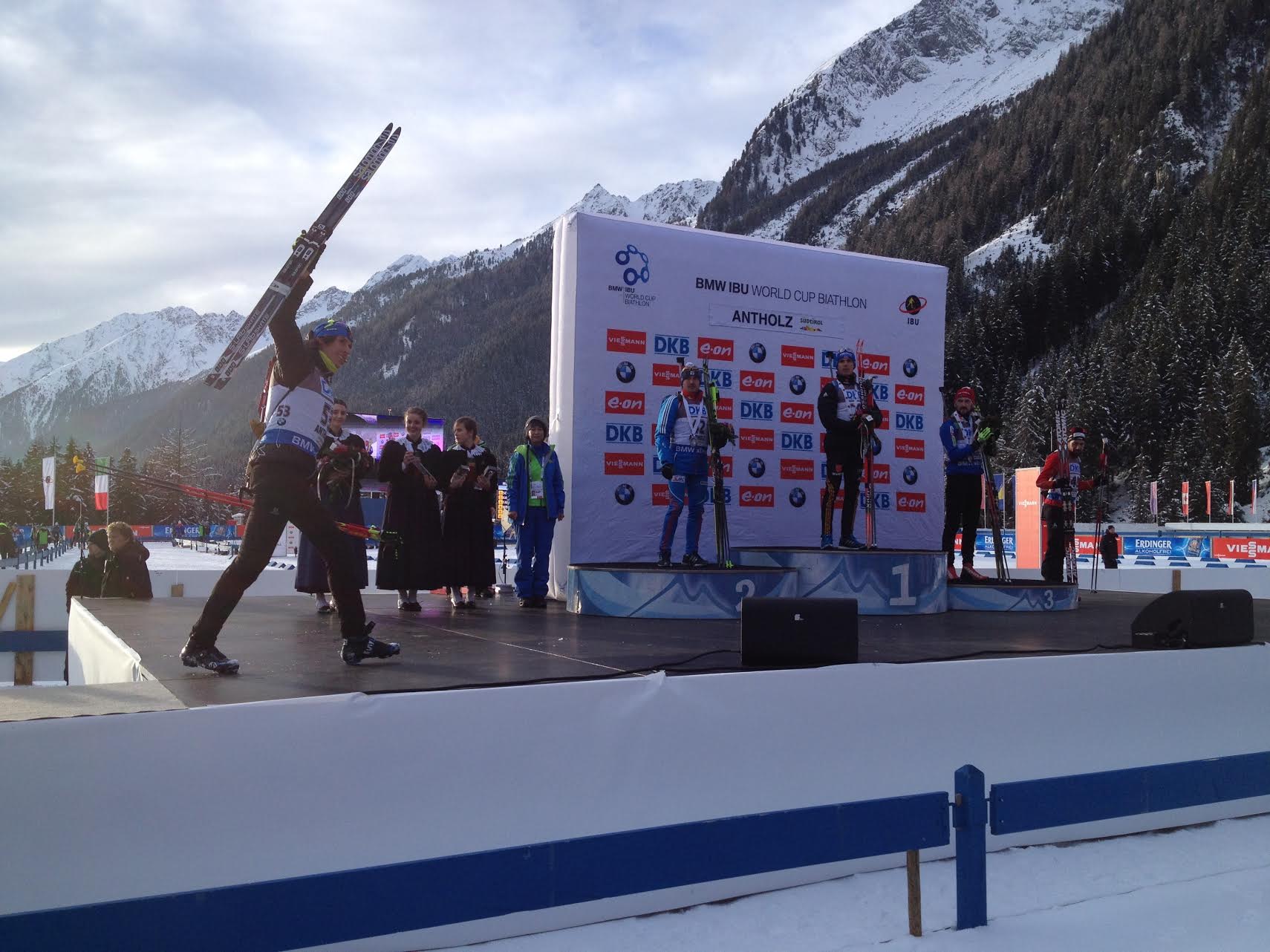
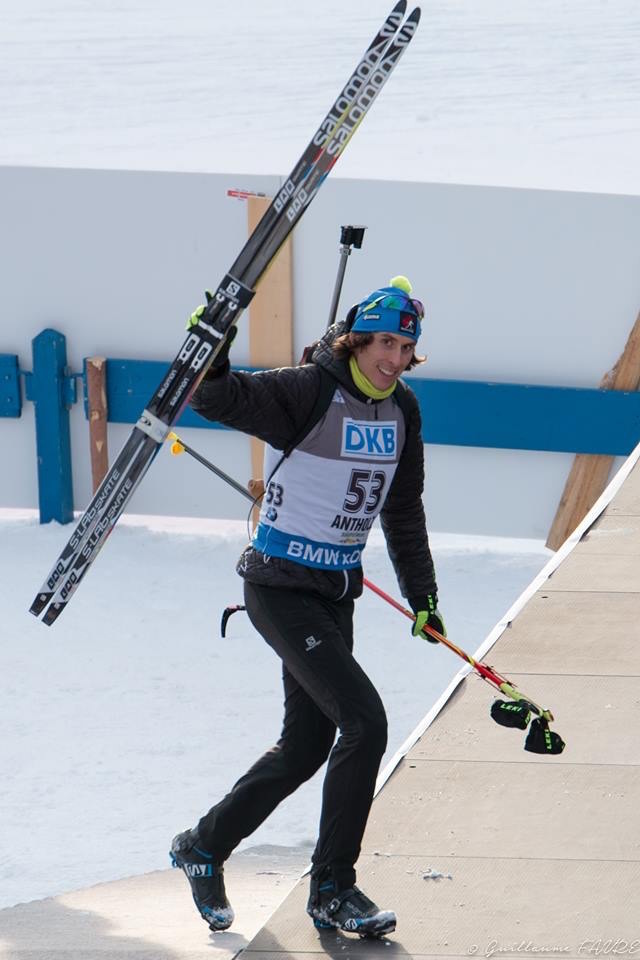
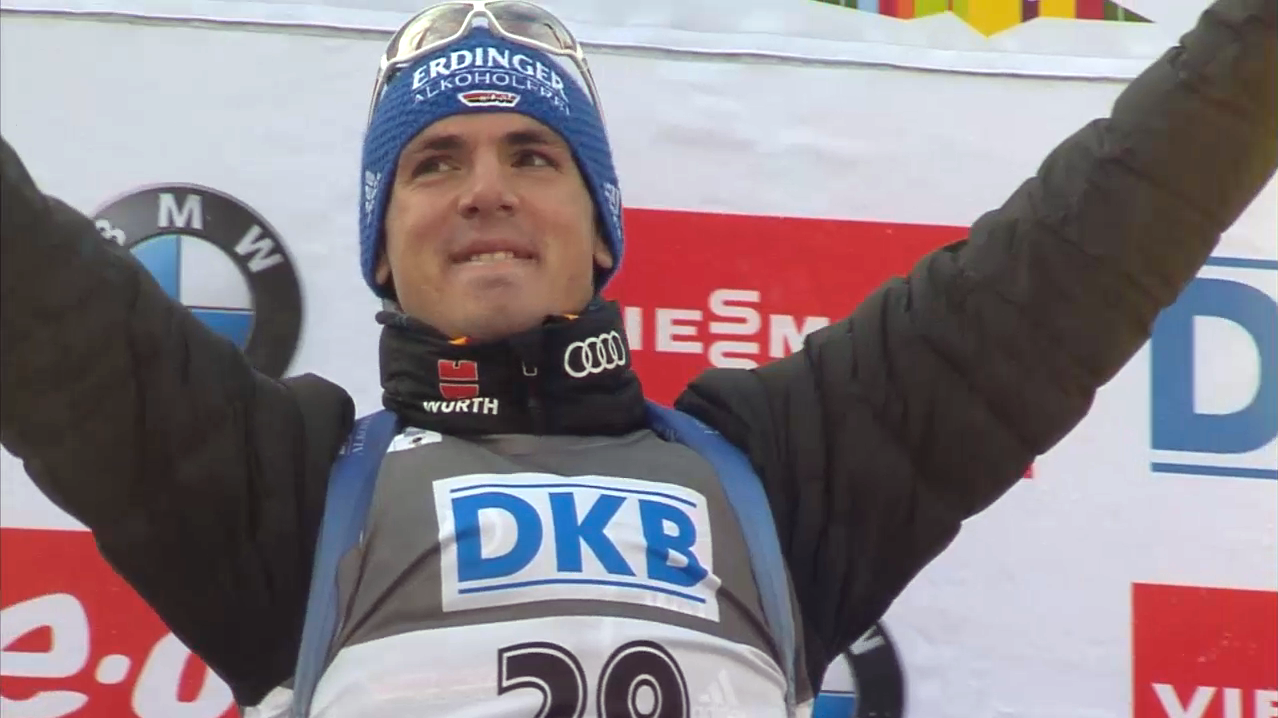
Biathlon Canada’s Brendan Green (l) acknowledges the crowd, including his parents, during his first appearance in an IBU World Cup awards ceremony on Thursday in Antholz, Italy. He placed fifth in the men’s 10 k sprint for a career best. (Photo: Matthias Ahrens)
Brendan Green couldn’t put his finger on it after the men’s 10-kilometer sprint in Antholz, Italy, but whatever it was, he was hoping it kept up.
The 28-year-old Canadian rolled to his fourth-straight flawless IBU World Cup race on Thursday — flawless in the sense that he didn’t miss a single shot, and perhaps the most perfect of all four given that he achieved a career-best fifth place in doing so.
“I’ve always loved racing here in Antholz and it is definitely my favourite stop on tour,” Green wrote in an email. “It’s hard to say exactly why I’ve been able to find success here. It’s a fun venue to race, the atmosphere and fans are awesome, the weather is almost always perfect, and the course is one that maybe plays a little more into my strengths.”
Just over a year ago, Green recorded his previous career-best World Cup result of eighth in the Antholz sprint. On Thursday, he broke an IBU record for the longest clean-shooting streak of any man on the circuit in the last two years, according to RealBiathlon.
Brendan Green (Biathlon Canada) celebrating fifth place in the men’s 10 k sprint on Thursday at the IBU World Cup in Antholz, Italy. It topped his previous career best of eighth, which he previously achieved in the Antholz sprint last year. (Courtesy photo)
As of last Sunday, Green was the first biathlete to clean a three-race weekend in 2014/2015, closing out the races in Ruhpolding, Germany, in 18th in the mass start.
And on Thursday, he became the first male in the last two seasons to notch 50-for-50 shooting, matching Belarusian female biathlete Nadezhda Skardino, who did so in Ruhpolding last season.
“It’s been awesome to have had such success with my shooting since Christmas,” wrote Green, who hasn’t missed a target in a race so far this second World Cup trimester. He returned to the circuit in Ruhpolding, starting with a relay on Jan. 15.
“After the first trimester of racing I came home with some specific changes in mind that I needed to address before I continued back on the World Cup circuit,” he explained. “No major changes or revelations, but I did make a few small positional adjustments and then from there fine tuned a few areas in my approach to shooting. So far it seems to be working and I really hope that I can continue on in the season with strong shooting.”
But no pressure.
“At the moment I’m trying not to overthink it too much and focus more on each race day to day,” he added.
With his fifth-place result, Green will start Saturday’s 12.5 k pursuit in fifth, 24 seconds behind sprint winner Simon Schempp of Germany. On Thursday, the Canadian finished 24.4 seconds behind Schempp and 3.5 seconds off the podium.
Schempp, who tied Italy’s Lukas Hofer for first in last season’s Antholz sprint, won it outright on Thursday in 23:18.8, 14 seconds ahead of Russia’s Evgeniy Garanichev. It was the German’s second-straight victory and fourth ever since he won the Ruhpolding mass start four days earlier.
Germany’s Simon Schempp on the podium after his second-straight IBU World Cup win (and fourth overall) in the men’s 10 k sprint on Thursday in Antholz, Italy.
Schempp cleaned his third-straight race with the second-fastest course time. Switzerland’s Benjamin Weger was fastest on course in the three-lap race, but missed one prone target to place fourth, 30.9 seconds behind Schempp and 0.8 seconds off the podium (behind Slovenia’s Jakov Fak in third).
“This is crazy. The last three races were really good for me,” Schempp told the IBU. “I think I made good progress in my training over Christmas. I am really happy about January.”
Green’s overall course time ranked ninth and his range time was 31st-fastest among 102 finishers. The 42nd starter, Garanichev cleaned with the third-fastest range time and skied to second with the sixth-fastest course time — coming closer than anyone but still 14 whole seconds away from Schempp, who started in bib 29 ahead of him.
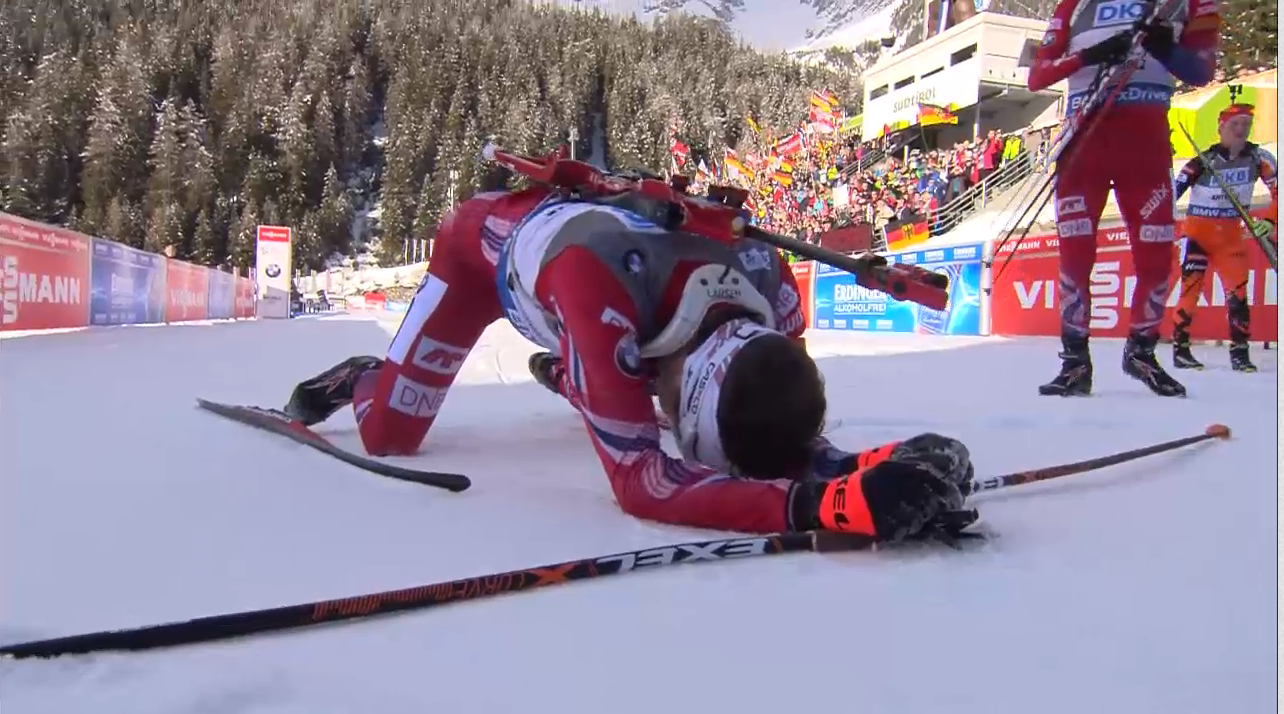
An early leader, Norway’s Ole Einar Bjørndalen exhausted at the finish of the IBU World Cup men’s 10 k sprint on Thursday in Antholz, Italy. He ended up ninth.
Fak started 48th, and with the fourth-fastest ski time and sixth-ranked range time, the Slovenian was headed for first with one shooting stage and one lap to go, but missed his final shot (his lone penalty of the day) to finish 20.1 seconds behind Schempp.
“The pressure on the trigger was not quite right and I missed by a small amount,” Fak told the IBU. “I was shooting really well in zeroing — no misses. That probably gave me too much confidence. It is better to miss a few and then you work harder to make sure you hit in the race.”
However, for Green, who started 53rd and jumped from 15th after prone to fifth after standing, it was about keeping his momentum going.
“Brendan always seems to get into race shape in skiing and shooting after Christmas, it takes him a while to gain the right pacing and shooting confidence in race intensity,” Biathlon Canada Head Coach Matthias Ahrens wrote in an email.
“We worked a little bit on his zeroing pending on what type of race related to how the pace is being pushed, i.e. individual compared to sprint, mass start, relay, etc.,” Ahrens explained. “Historically he also has quite good races in Antholz with fast ski times, maybe it is the combination of the altitude with the course profile which suits him.”
Green compared it to his training base in Canmore, Alberta, in terms of “weather, snow, and terrain,” he wrote. “I’m sure training and living at 1400 meters [4,600 feet] in Canmore would also be another factor. The fact that I have had some of my better results here, like my sprint race last year is definitely a motivator as well.”
Brendan Green after finishing a career-best fifth in the men’s 10 k sprint at the IBU World Cup in Antholz, Italy.
He also had his parents to race for and in front of, after they traveled three days from the Northwest Territories to watch him race for the weekend. They arrived in Antholz on Wednesday night.
“I think the most special part of today was having my parents in the crowd,” Green wrote. “They’ve dedicated so much time and energy towards my career and for them to see in person what I spend my winters doing and experience the World Cup atmosphere was awesome for them. It was really special to be able to share my result today with them and I think that’s what I’ll remember most from today — seeing my parents smiling and waving a flag from the grande stand during the prize ceremony.”
From the start, Green knew his skiing already felt stronger than last week. And after his first shooting stage, he realized he was on track for a top result if he stayed on the same unblemished path.
“I tried not to take any risks shooting and focus more on a steady and consistent race,” he wrote. “I think if I can race in control with a process that I know I can trust, that will be the key factor to good results for me.”
Leaving standing with 10-for-10 shooting behind him, he looked up at the big screen to see his split time: fifth. From there, the Canadian staff gave him splits on the final lap.
“I did all I could on my last lap, I knew it was tight and that the podium was close, there really wasn’t too much else going through my mind,” Green wrote.
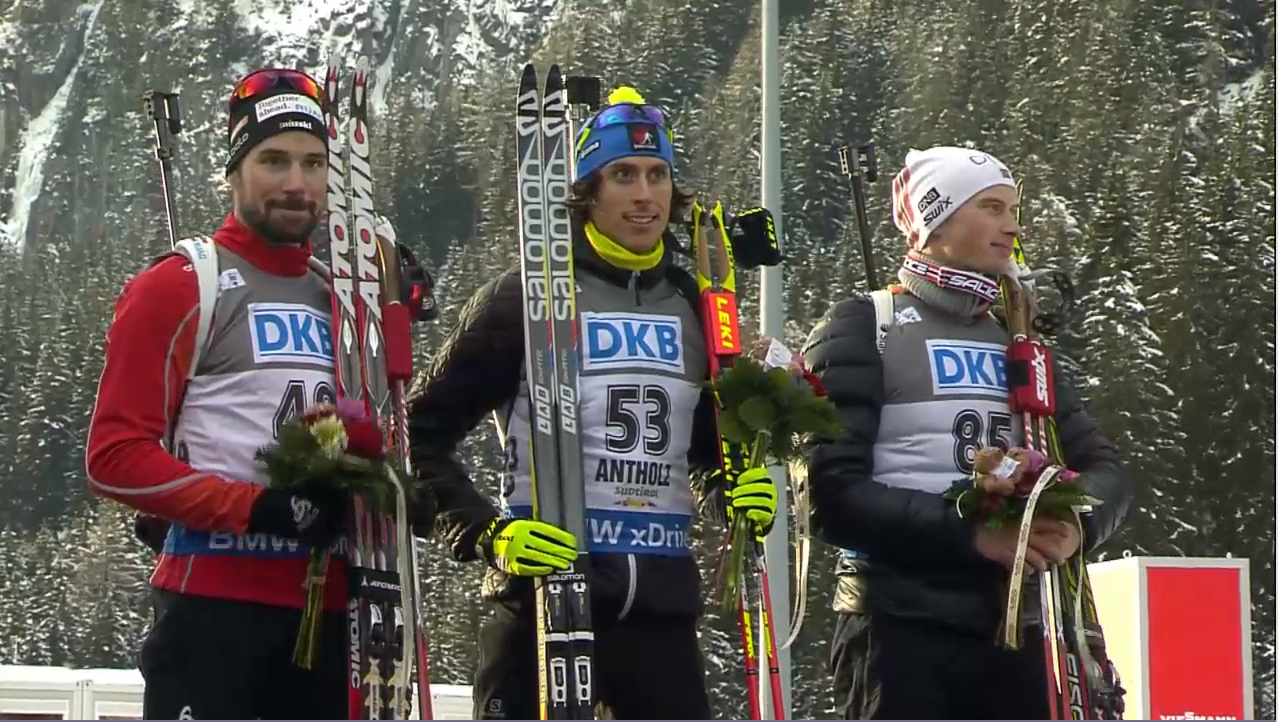
Brendan Green (c) in fifth stands between Swiss fourth-place finisher Benjamin Weger (l) and Norway’s Henrik L’Abee-Lund, who was sixth, at the 10 k sprint awards ceremony in Antholz, Italy.
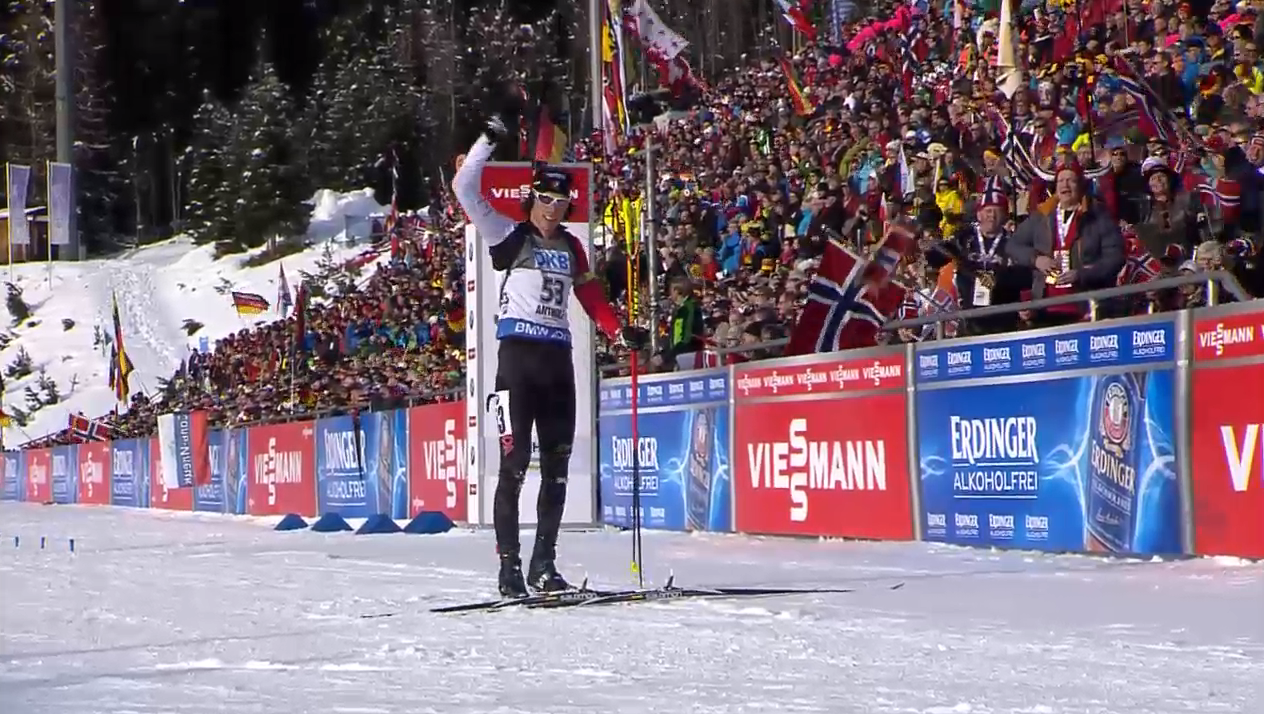
When he finished, he looked up again, confirmed he had held onto fifth and turned his attention to the stands. Still standing at a time when most other racers collapse to catch their breath, he raised one arm to celebrate.
“Today was a great result for me,” he wrote. “I’m sure I’ll think about those 4 seconds to the podium eventually, but for now I’m especially happy with the race I executed and the end result.”
According to a tweet from Biathlon Canada, Green will receive “clean shooting pins” for his last several performances.
Former US Biathlon racer Sara Studebaker explained in an email that the national-team coaches used to reward her teammates for clean-shooting races with “Fika” — coffee and pastries.
“It really is pretty cool that Brendan cleaned the whole weekend! If that had been me, I probably would have celebrated with a couple glasses of wine with my team,” Studebaker wrote after his Ruhpolding performance. “But at the same time, it’s your job to shoot well … so you can’t go too crazy. It’s awesome, but also kind of like, ‘yeah, that’s what I’m SUPPOSED to do.’ ”
“ I probably would have celebrated with a couple glasses of wine. … It’s awesome, but also kind of like, ‘yeah, that’s what I’m SUPPOSED to do.’ ” — former US Biathlon member Sara Studebaker on clean shooting
Biathlon Canada High Performance Director Chris Lindsay noted that Green’s progression and shooting success has been in line with the team’s expectations.
“Brendan has consistently been a very strong shooter for a number of seasons,” Lindsay wrote in an email. “The change in the past two years following his [back] injury has been that the ski speed has improved. I think that the work that our physiologists, physiotherapists, and strength coaches did to rebuild his fundamental movement skills has been paying off and serves as a lesson for young athletes. You have to get the basic fitness correct before working on the things that will shave the final seconds off your time. It’s a similar philosophy to shooting — hit the targets first, then worry about speeding up.”
Lindsay also pointed out that Green is following a similar pattern to last season, “where December laid the foundation for the success around the Olympics,” he wrote.
But Green explained that he had hoped to start this season stronger than he did.
“It was never really the plan to follow a similar trajectory as seasons past,” he wrote. “I would say almost the opposite, this year I was really hoping to start off the season and first trimester with a bang. I’m not sure why I historically get better as the season progresses but it’s starting to seem more and more like a very difficult trend for me to change.”
Lowell Bailey (US Biathlon) racing to 32nd in the IBU World Cup 10 k sprint in Antholz, Italy. (Photo: USBA/NordicFocus)
With his first-ever appearance in the flower ceremony (top six), Green led three teammates, including Christian Gow, who qualified for Saturday’s pursuit in 52nd (+2:03.9). Scott Gow finished 74th (+2:38.5) with three penalties (2+1), and Nathan Smith ended up 78th (+2:43.3) with four misses (2+2).
Two Americans made the top-60 cutoff for the pursuit as well, with Lowell Bailey placing 32nd (+1:31.2) with a single standing miss, and Tim Burke finishing 48th (+2:02.1) with three penalties (1+2).
Also for the U.S., Sean Doherty placed 63rd (+2:19) with three misses (1+2), and Leif Nordgren missed four for 80th (+2:49.5).
Johannes Thingnes Bø of Norway celebrates his IBU World Cup sprint victory on Saturday in Ruhpolding, Germany. He cleaned both stages and posted the fastest-overall course time to win by nearly 25 seconds. (Photo: Fischer/NordicFocus)
“It’s hard to escape Ruhpolding without racing in the type of conditions we had today,” Brendan Green wrote in an email on Saturday, following the IBU World Cup men’s 10-kilometer sprint in Ruhpolding, Germany.
One day, it’s pristine — like men’s relay on Thursday — with clear skies and fast, firm conditions, and little-to-no wind. Other days, it’s not, like the women’s relay on Wednesday, when rain pelted the stadium, or Saturday, when soft, heavily falling snow refused to let up as the men’s race wore on.
Some of the top-ranked competitors, like France’s Martin Fourcade and Germany’s Simon Schempp, opted to start later in the 102-man field, anticipating that the course would speed up with each passing skier. That didn’t exactly pan out.
If anyone, earlier starters seemed to have the benefit, but it was hard to say. The sprint was a slog-fest and most felt slow on their skis. Among those who found the most success were the ones who shot clean: eventual-winner Johannes Thingnes Bø of Norway, who started 25th and led from start to finish, and Schempp, who started some 23 minutes later in bib 71 and came within 24.5 seconds of Bø’s winning time of 23:59.2 to place second.
Germany’s Arnd Peiffer racing to third in the men’s 10 k sprint on Saturday in Ruhpolding, Germany.(Photo: Fischer/NordicFocus)
Germany’s Arnd Peiffer started 37th and placed third with a single penalty, 57.9 seconds behind Bø, with the fourth-fastest overall course time. His podium secured his spot on the German team at IBU World Championships in March.
And then there were two Canadians — Green and Scott Gow — who knocked down all their targets for flawless shooting, and despite not feeling fast, notched season and career bests, respectively.
Green started 79th and ended up 16th, 1:30.2 behind Bø, with clean shooting through two stages. After prone, his time ranked 38th, and he moved into 14th after hitting all five of his standing targets as well.
“It was really hard for me to judge how my skiing was going,” Green explained. “The conditions were frustrating to ski in for sure with deep slushy snow, but I did what I could to ski smooth and not let the conditions get the better of me. I opened up my race much slower than I would have hoped, but my speed and how I felt progressed steadily as the race went on.”
Canada’s Brendan Green on his way to his best Olympic result of 21st in the 20 k individual race at the 2014 Olympics near Sochi, Russia.
Starting later, he wasn’t able to warm up as much as he would have liked on the small, congested warmup loop, but Green wasn’t sure that had an impact on how he opened his race.
What matters is how he ended it, and he closed out his last lap with the 22nd-fastest time to place 16th for his best result of 2014/2015. It was the second-straight race he shot clean following the men’s relay.
“It’s hard to say exactly why my shooting has been so solid over the last two races, a bit of luck for sure, but I think I’m finally able to commit to a few small changes that I was working on over Christmas and fully trust my current position and mental approach,” Green wrote. “Any day you shoot clean it’s a bonus and I’m glad I was able to capitalize on that today and make it into the Mass Start tomorrow.”
Green was the lone North American male to qualify for the mass start, which kicks off Sunday with the women’s 12.5 k at 12:30 Central European Time (CET) and the men’s 15 k at 15:40 CET (9:40 EST).
He’ll start in bib 29 of 30. “I think I’m still capable of better results and tomorrow will be another good opportunity,” Green wrote.
“Brendan’s result is in line with our expectations,” Biathlon Canada High Performance Director Chris Lindsay said in a press release. “He has a pattern of success later in the season and this is a planned step on the way to peaking at the World Championships in March.”
Two years ago, Gow notched his previous World Cup career best of 29th in Ruhpolding, also in the sprint. While he explained that memory was “definitely in the back of my mind,” he added that he tried to keep it there to avoid distraction on Saturday.
Given the conditions, he knew he was going to need all the focus he could muster.
“I knew that good skiing and shooting could put me into the top 30, and that it was important to be focused on the entire process,” the 24-year-old Gow wrote in an email.
He ended up cleaning both stages to put himself in 31st overall heading out on his last lap, and he tied Green for the 22nd-fastest last-lap time to finish 27th (+1:53.5). He was just 1.8 seconds behind Fourcade in 26th, who had two misses and the 18th-ranked overall course time.
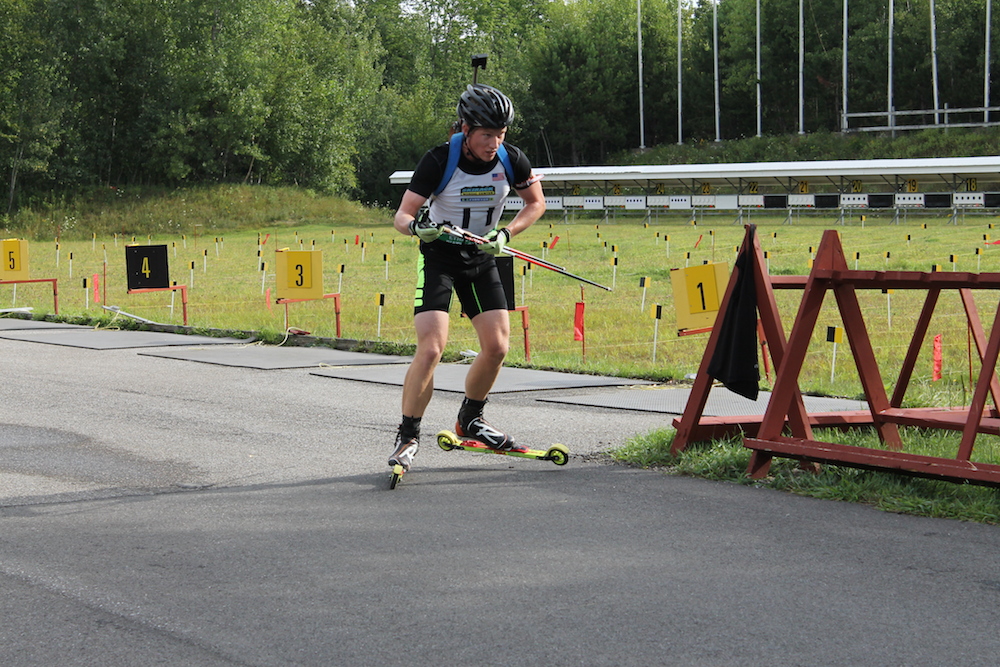
Canada’s Scott Gow leaves the range in the men’s 10 k sprint at the 2014 North American Rollerski Championships in August at the Ethan Allen Firing Range in Jericho, Vt.
“My main focus for the race was my skiing,” Gow explained. “I don’t always fare well in deeper, slushy snow, so concentrating on achieving the best glide possible was my biggest goal for the race. Of course shooting is also a priority, but it was definitely secondary to my skiing.
“I would have liked to ski a little better and end up in the top 20, but I will have to wait for that result,” he added. “I managed to finish the race with relatively strong last lap which I was very happy with. … This performance was important to me because it is a validation of my training this past summer, and shows that I have the potential to be a more consistent top 30 athlete.”
Lindsay said he was excited to see the depth of the Canadian men’s field starting to show, with Nathan Smith placing 35th (+2:06.9) despite three penalties.
“Three men in the top-40 is a metric that shows our status as a top-eight nation in the world,” Lindsay said. “Now we need to see more consistency, and work on getting all four men in the top-40.”
Gow’s younger brother, Christian, 21, raced through illness to place 81st with a single penalty.
Smith, who started 33rd, wrote in an email that he found the conditions to be fair given the weather.
“For sure the guys who were still out there at the end of the race were at a disadvantage when the newly fallen snow was being skied in less and less,” he wrote.
At the end of the day, he wasn’t sure what went wrong with his shooting, especially with two prone penalties, but he explained he was “definitely disappointed” with that first stage.
“It’s been feeling so natural and easy. Two misses was a bit of a shock,” he wrote.
Despite dropping to 48th after the second stage, Smith posted the 19th-fastest overall course time to end up 35th, 2:06.9 back from the winner.
“I actually didn’t realize my skiing was quite fast,” Smith wrote. “My end result is pretty good for having three misses. But this is biathlon and you need to have perfect or near perfect shooting to get top results. Today was one of those days where I did 50% of the sport really well.
“I was really hoping to get back into the top-25 overall with a strong result today,” Smith added, which is what he would have needed to guarantee himself a start in Sunday’s mass start. He’s currently 29th in the overall World Cup. “Unfortunately that didn’t happen … I’ll have to wait until Antholz next week to redeem myself.”
Lowell Bailey on his way to 41st in the IBU World Cup 10 k sprint on Saturday in Ruhpolding, Germany, with US Biathlon High Performance Director Bernd Eisenbichler at right. (Photo: USBA/NordicFocus)
Lowell Bailey was the top American in 41st (+2:22), with a single standing penalty, which he referred to as simply a bad shot.
“The conditions were deep and slow,” Bailey, who started 65th, wrote in an email. “It was a tough race and I definitely didn’t feel like I could get everything out of my skis. … There’s only so much you can when it’s changing so frequently. I might have done better by picking a different pair of skis. But there really was no way of knowing. All in all, not my best day. I hoped to be better.”
Tim Burke placed 50th (+2:46.3) with three misses, all in standing, and while Bailey and Burke remain in the overall World Cup top 30 (in 27th and 30th, respectively), they didn’t qualify for the mass start.
“Every day is different on the World Cup,” Bailey wrote. “There are so many variables that come into play; fitness feeling that day, weather, wind, shooting, skis, wax, crowds, etc. Some days are better than others. It’s been a bit up and down lately but I’ve been around this sport long enough to know that you just need to appreciate the good days, and learn what you can when things don’t go perfectly, then move on.”
Also for the U.S., Sean Doherty started last in his first individual World Cup of the season and finished 80th with one miss.
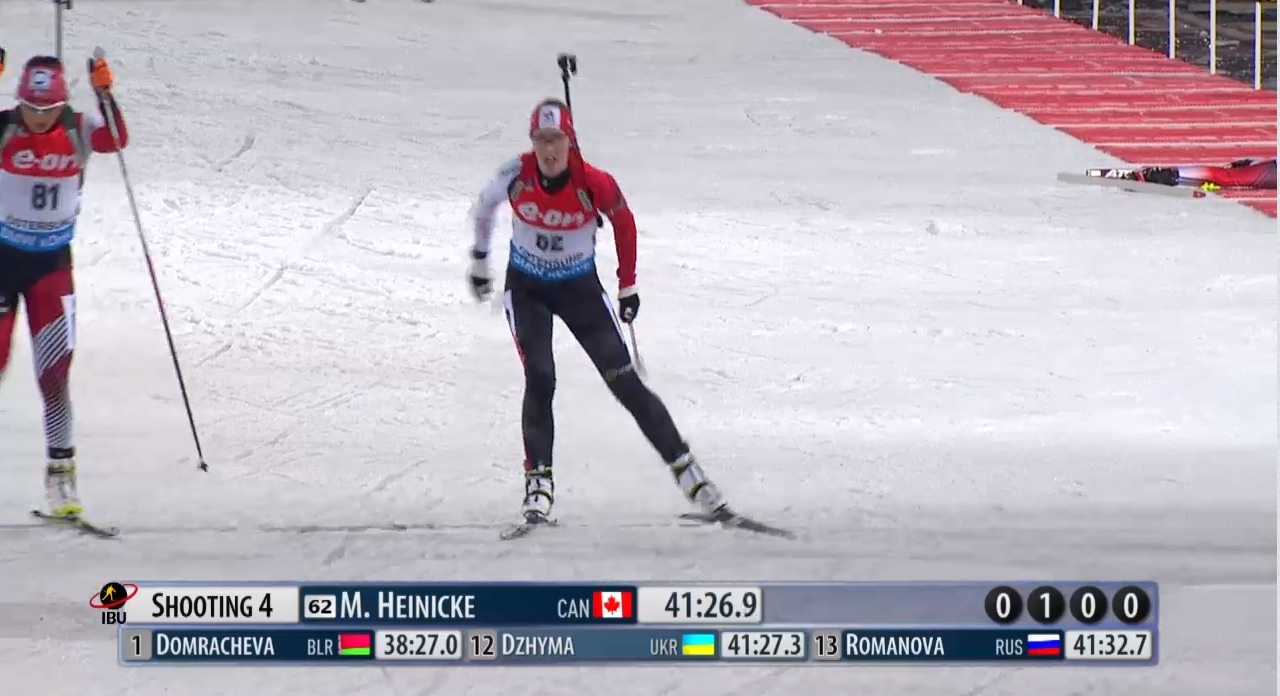
Canada’s Megan Heinicke after cleaning her final stage in Thursday’s 15 k individual in Östersund, Sweden. She went on to place a career-best 12th.
Note: This article has been updated to include comments from Megan Heinicke, obtained via email.
Last weekend, Megan Heinicke raced a couple IBU Cup tuneup races in Beitostølen, Norway, both of which were 7.5-kilometer sprints. She placed 16th in the first with two misses, and 48th the next day with five total penalties.
Day 1 was indicative of what the 26-year-old national-team veteran was capable of, Biathlon Canada High Performance Director Chris Lindsay said on the phone Thursday night from Canmore, Alberta.
Day 2 was not.
Still, it got what coaches and athletes like to call the “cobwebs” out.
Megan Heinicke (Biathlon Canada) makes her way around the stadium during the 2014 Olympic 7.5 k sprint in Sochi, Russia, in which she placed 59th.
“[The IBU Cup last weekend] gave me a chance to test the waters and get the feel for racing again,” Heinicke said in a Biathlon Canada press release after Thursday’s first individual World Cup race of the season.
In the women’s 15 k individual start in Östersund, Sweden, Heinicke broke out with a career-best 12th, with a single penalty putting her 3:31.1 behind winner Darya Domracheva of Belarus. Even Domracheva had two penalties, and just three women out of 93 finished the day with perfect 20-for-20 shooting.
Heinicke’s previous World-Cup best was 15th in sprint last season in Kontiolahti, Finland. She started 62nd on Thursday, and Lindsay said that while the snow didn’t look like it broke down too much by the time she raced, challenging conditions often play to her favor anyway — at least on the range.
“She has the ability to be an extremely strong shooter and with difficult conditions,” he said, noting she paid attention to the wind flags and her coaches’ cues en route to her personal best. She also had the benefit of getting helpful splits off top contenders who started before her.
Heinicke cleaned her first prone then missed one on the first standing, but knocked down every target in the last two stages to catapult herself into 11th at the finish. There, she sat down shortly after crossing the line, breathing heavily and smiling. Heinicke fell one spot to 12th when Russia’s Ekaterina Glazyrina finished eighth ahead of her, but held that position for the rest of the race.
“The key to success was being relaxed, not feeling any external pressure and truly being focused on a few key factors shooting,” Heinicke said. “I took my time in the shooting range, and just had one of those days where I was able to block out everything except for my keyword when I was standing on the mat. I’m heading into this season more relaxed and just thankful I’m able to pull together good performances.”
While Heinicke spent most of her offseason training in Germany, Lindsay explained the national team received regular reports from her, including time-trial results.
“This is not surprising she’s been able to do quite well in the early season,” he said. “What we’re very happy about this year is she seems to have been able to maintain her health … When she’s healthy, she can put these things down.”
“I have had a really tough summer and fall this year and I went into the race motivated, but with low expectations and feeling no external pressure to perform,” Heinicke wrote in an email. “My day was pretty relaxed too — I even had a mini nap before I left for the race site which is unusual for me.”
She explained she felt great at the start of the race and focused on her shooting tasks at hand. Above all else, her goals were task-oriented rather than dependent on results.
“I have never started the season so relaxed and feeling so little pressure,” Heinicke wrote. “I wasn’t even sure if I should start this season and I think the low expectations (from myself and others) really helped me lose that nervous ‘I have to hit’ feeling. I was careful on the range: my shooting was very controlled and not rushed in any way.”
“I have never started the season so relaxed and feeling so little pressure. I wasn’t even sure if I should start this season and I think the low expectations (from myself and others) really helped me lose that nervous ‘I have to hit’ feeling.” — Megan Heinicke, after achieving career-best 12th in Östersund 15 k on Thursday
She felt sharper in the IBU Cup races the weekend before, but was pleased to be able to pick up her pace on her last loop.
“I felt a bit dull during the whole race but I think the better lap times at the end are a result of a good base,” she wrote. “I often feel good at the end of longer races. I was certainly motivated on my last loop!! I was a bit disappointed with my ski feeling compared to last weekend, but it was tough conditions so it is a bit hard to judge. Overall, my first loop was a bit too slow but I feel ok about the rest.
“Of course I am happy with the result,” she added. “Starting the season with a PB — what more could I ask for! It does get my season started in a positive way and I will certainly go into my next races a bit more confident than I would have without this result.”
Rosanna Crawford (Biathlon Canada) racing to her second-straight victory of Canada’s World Cup/IBU Cup trials three weeks ago in Canmore, Alberta. (Photo: Justin Brisbane)
Canada’s early starter who also ended up in the top 20, Rosanna Crawford finished 16th (+3:52) with three penalties. Despite the misses, it was her career-best 15 k result by one place over her 17th two seasons ago in Nove Mesto, Czech Republic.
“I’ve never been a big fan of Individuals, but it’s a great race for good shooters to be in the top,” Crawford wrote in an email. “I wasn’t nearly as nervous as I was for the mixed relay. Sunday’s race was a good indicator of where my ski speed is, even though we were just 3 days off the plane, and that shooting is also there.”
She opened for the mixed relay and put Canada in fifth after the first leg.
“My zero wasn’t great today and that got some extra nerves coming before the start,” she explained of Thursday. “But things came together in the range.”
Crawford, 26, missed one in her first prone and proceeded clean her first standing and second prone. Her last time in the range, she missed two.
“I tried not to get too ahead of myself for the last shooting bout, reminding myself that I’ve hit my last 5 targets many times in a race,” she wrote. “Unfortunately my legs were pretty tired and I missed my first two shots. But was able to pull it together and hit the last 3.”
She tried to pace herself throughout the five-loop 15 k in soft-and-slushy conditions paired with what Crawford called, “sketchy downhills.” Knowing she needed to save some kick for the finish, she ended up with the eighth- and ninth-fastest course times on her last two loops. Her course time ranked 12th overall.
After leaving the range for her fifth loop in 22nd, she improved to 16th by the finish. Crawford couldn’t recall if she had ever left the range for the last time in a worse position than she finished in.
“Of course I was shaking my head a bit at my shooting, but I knew that a lot of spots can be gained on last loops. Especially in a 15km when some women might have gone out too hard,” she wrote.
With a goal of 90-percent shooting and a top 25, she was halfway there. “Top 16 is above my expectation,” she wrote.
Not Biathlon Canada’s.
“Rosanna’s ski speed and her ability to put down targets has always been strong, but it is looking like she’s legitimately a top-16 athlete in our goals this year,” Lindsay said. “I think everyone should expect we will see more of her at this level.”
Eighty-five percent shooting was nothing to scoff at either, he said, even though it was easy to speculate where she might have ended up with one fewer 1-minute penalty.
“The reality is, individual racing is challenging,” he said. “We’re really looking forward to seeing her in some of the shorter races. We saw with the mixed relay, she has the ability to mix it up at the front of the pack and not be intimidated by the other girls. She enjoys leading, she enjoys being up there, and she handles the pressure well.”
“The reality is, individual racing is challenging.” — Biathlon Canada High Performance Director Chris Lindsay
“Hopefully these past two races are a good indicator of whats to come this year,” Crawford wrote. “I’ve worked really hard this summer and [coach] Roddy [Ward] has told me he wants a lot of TV time 🙂 !”
Also for Canada, Zina Kocher finished 76th (+9:36.0) with seven penalties (2+3+1+1), and Audrey Vaillancourt was 81st (+10:14.7) after what Lindsay described as an uncharacteristic five misses (1+1+3+0).
“I know Zina was not happy with her race; she has very high standards for herself, and we know when everything clicks for her, she’s one of the fastest skiers in the field,” he said. “We just needed to focus getting that shooting down and that’ll come.”
He noted that Vaillancourt’s ski speed has improved throughout the training season. “The first [15] k of the year is a difficult race … I don’t see this as a pattern at all,” he said. “I think we’re going to see in pursuit racing, some very strong results out of there because she has the ability to push herself and put down the targets.”
What’s going on in those wax tents? Depending on the race, ski prep could be a lot less fluoro-intense for some Eastern racers.
For most racers, the night before a race is synonymous with ironing in and scraping off base layers of wax for the next day’s competition. Race morning means testing skis and wax, trying different structure, and then watching puffs of fluorocarbon-laden steam roll off their skis as coaches apply expensive powders in the last few minutes before race start.
Some North American nordic associations, though, have decided that it’s better if this whole process is simplified some of the time. Nobody’s going into a championship event on CH10, but clubs are increasingly agreeing to leave powders out of the equation for regular-season racing – or even to have every skier on the very same wax.
Their reasons vary widely. For the U.S. Biathlon Association, a “same-wax” protocol is in place at trials so that coaches can accurately compare skiing speed. Biathlon Canada has the same protocol, but besides the benefit of giving a level playing field a big factor is to reduce stress on athletes and coaches.
The Eastern Intercollegiate Ski Association agreed to stop using powders in regular-season classic races, and they are moving towards implementing the policy in skate races as well. For the EISA, it’s mostly about health: college venues rarely have wax cabins, so there’s not a ventilation system – or if so, it’s the natural variety provided by a cold wind coming off the Saint Lawrence Seaway.
The three organizations have something else in common in terms of how they implement their wax protocols: once championship events roll around, it’s gloves off and clubs can, and should, do whatever ski preparation they can in order to win. The role of ski preparation in success as a nordic athlete is not eliminated entirely. It’s simply minimized at the times of year that the organizations feel best aid in athlete selection and development.
All three organizations said that they have had almost entirely positive reviews of their policies, and in two cases are looking to go further. Here’s why.
EISA
The EISA agreed in April of 2012 to ban fluoro powders in regular-season classic races. From their 2013 Policies and Procedures Manual:
“For Nordic classic races, relays and sprints the use of pure flouro powder, liquid or block is prohibited. Maximum HF waxes only. LF cold powders are acceptable.”
University of Vermont head coach Patrick Weaver, a two-time Olympian, told FasterSkier that he had brought the proposal to the EISA coaches.
“At the time we decided classic only,” he wrote in an e-mail. “This year we voted to include some skate races as well… I have to say though, the monetary part of it is probably at the bottom of the list. Health is at the top with a bunch of other reason in-between.”
He also clarified that not only are powders off the table, but high-fluoro liquids and blocks are also not to be used.
Weaver was particularly interested to know if other groups around the country are making a similar decision. Interestingly, however, the two other major North American groups with policies explicitly say that health is nowhere near the top of their own list of concerns.
USBA
USBA has two different wax protocols, both of which apply only to trials racing – which happens several times a year for World Cup, IBU Cup, World Youth and Junior Championships, and every four years for Olympic teams. One protocol is for domestic trials and the other is for trials which happen during other races, for instance IBU Cup races used to select World Cup or Olympic teams. But both require that all the competitors have exactly the same wax on their skis.
“The main reasons are to be as fair as possible competition between all athletes and for us to see the best pure performances,” USBA Chief of Sport Bernd Eisenbichler wrote in an e-mail. “Still ski brand, flex and grind can make big difference, but like this, you can get it at least as close as possible. It’s also to save money for the regions and clubs, and so athletes learn to understand their skis and learn how to test skis and make decisions on their own. Health is an added benefit.”
At domestic trials, athletes are allowed to select two pairs of skis for race waxing. The coaches from the various clubs competing are told by a USBA representative what the wax choice will be, and then all the staff work together to prepare all the skis in one large batch.
At an IBU Cup race, athletes are allowed 45 minutes to test up to four pairs of skis, and then have to pick their one race pair and hand them over to the wax techs an hour before race start. Rather than an easy-to-use wax like might be selected at a domestic trials event, at an international competition the techs are going all out – it’s not just a trial, but also a chance to represent the U.S., and for the team to collect Nations Cup points.
Eisenbichler emphasized that ski testing is up to the athletes.
“What I found beneficial is there, that athletes have to really get familiar with their skis and test them alone and get experienced with that, before they enter the WC and everything is taken care for them,” he explained. “The athletes input in the ski selection before grinding in summer or at a race day is crucial, and the athlete has to understand her/his skis for that.”
Biathlon Canada
Biathlon Canada uses an identical system for its World Youth and Junior Championships trials races.
“We think it’s a key part of the selection process, to have everyone on same wax],” Biathlon Canada High Performance Director Chris Lindsay explained in a phone interview. “The main reason for that is that we’re trying to take away not really one of the variables that can affect individualized performance, but we’re actually trying to take away one of the stressors on athletes and coaches during selection processes. Because when we’ve got them racing internationally, they don’t have to deal with that.”
No matter how good a skier’s support team is at home – or conversely, if they’re more or less on their own and don’t have anyone to help test skis or apply powders – they will all be in the same boat once they get to Europe. For Lindsay, it’s important to remove wax-related stress from the trials process and start moving young athletes towards the working environment they will find once they reach a higher level of competition.
“The comments that we get back on our yearly surveys tend to be extremely positive about this,” he said. |It is most positive from athletes from lesser programs or who typically don’t have robust support available to them, which is not surprising. The most critical feedback that we get is from programs and coaches who feel that they could provide some sort of advantage to their athletes [through superior waxing].”
More?
Lindsay said that his organization is looking into next steps towards an extended waxing protocol. But what would a next step actually look like?
“We haven’t come up with what the next level is, because of the complication of ski structure and ski compatibility with athletes is a much more significant problem,” Lindsay said.
One possible direction is something that is already in place in Sweden, according to Kevin Cutts, a former top U.S. junior skier who now coaches a ski gymnasium in Sundsvall.
“Every kid up to a certain age here – maybe 15 or 16 – is only allowed to have one pair of skate skis and one pair of classic skis that are their race skis,” he told FasterSkier this summer. “They get a sticker that goes on their skis to identify which ones are their race skis, and they can’t have more than that. It’s a good thing, I think, because then it doesn’t come down to, well, John has Fischer Carbonlites, but I don’t. Yeah, you’re going to have kids who have better equipment than others, but you’re not going to have 12-year-olds showing up to a race with 30 pairs of test skis and a full wax team.”
Do you know of other North American ski associations with interesting wax policies? Let us know in the comments.
Targeted testing based on data from the IBU’s Athlete Biological Testing program led to the suspension of Irina Starykh, above, and another Russian biathlete for blood-doping. The IBU will now no longer do the biological passport tests at all future Olympic Games.
At the most recent Executive Board meeting in Going, Austria, the International Biathlon Union voted to discontinue blood testing as part of antidoping efforts at all future Olympic Games.
“Based on the experience of the last two Olympic Winter Game editions for which the IOC has sole testing authority, the IBU EB decided: In the future the IBU will conduct no own blood screens at OWG, but assist the IOC [International Olympic Committee] with expert advice for their test plan,” read the minutes of the Executive Board meeting, which were given to FasterSkier by three separate sources.
No further explanation has been given to the federations regarding the reasoning behind the decision, and IBU President Anders Besseberg has not responded to FasterSkier’s requests for comment. However, internal Executive Board documents show that IBU Secretary General Nicole Resch advocated for the change in her presentation to the board.
The IOC is responsible for much of the antidoping testing at the Olympic Games. In Sochi this winter, the IOC administered over 2,400 tests across all sports. At first blush, this would indicate that the additional independent testing done by individual sports federations may be redundant.
At issue, however, are blood tests which are used for Athlete Biological Passport (ABP) programs, a scheme which tracks levels of different markers in athletes’ blood over many years. This allows medical administrators to detect spikes in oxygen-carrying capacity or other physiological parameters which may be due to prohibited substances for which there is no analytical test.
The ABP model was developed by WADA and adopted by its Executive Board in 2009. The blood “module” of the ABP has been approved by the Court of Arbitration for Sport, and the international federations for track and field and cycling have brought ABP cases to CAS.
The IBU uses several passport-type approaches in its blood tests.
“The first is to do a blood profile for the WADA blood passport,” IBU Vice President for Medical Issues Dr. Jim Carrabre told FasterSkier. “The second purpose is for our own internal program called Arietta, which allows us to identify athletes at higher risk for blood manipulation.”
The IBU also has a combined system of cutoff values for hemoglobin levels and the off-model score (hemoglobin value – 60√reticulocyte value) and does not allow athletes to start competitions when they are above both these cutoffs, but does not use this system at the Olympics.
The IBU has championed its passport program and its ability to target specific athletes for additional testing. This led to the suspension of Russian biathletes Irina Starykh and Ekaterina Iourieva this winter after targeted testing led to positive tests for recombinant erythropoietin, a common blood-doping drug.
Carrabre said that biological passport data belongs to the federations and that the IOC would not be able to catch athletes using this technique at the Olympic Games.
“We would grant them permission to have [the data] they wanted to have that,” Carrabre explained. “However, the IOC as a testing authority, the length of time at the Games, it’s not enough for them to develop a passport that is positive. Not enough time to get enough tests. So you will never see a positive passport come out of the [IOC at the] Olympic Games. It has to be from the federations.”
Dr. Arne Ljungqvist, the outgoing head of the IOC Medical Commission, confirmed that the ABP program has never led to a suspension at an Olympic Games. But he said that the IOC’s testing was sufficient. He explained that federations dropping “no-start” testing was a direction he urged to move in, and had discussed with Besseberg. However, Ljungqvist was not familiar with the IBU’s Arietta and ABP testing.
And inside a biathlon community which has seen four positive tests from World Cup athletes this past season, limiting the amount of testing done at the Olympics seemed to be a perplexing move. Nobody else contacted by FasterSkier had the same reaction as Ljungqvist, that this was a “logical step because of the WADA ABP.”
That begins with Carrabre. The IBU did not appear to have consulted its own medical committee, which is responsible not only for health of the athletes but also for antidoping work, before taking the decision. Carrabre was not present for the vote although he is a member of the Executive Board due to a family health emergency. A longtime antidoping advocate, Carrabre said that he was not contacted regarding the proposed change. He also said that Resch’s internal board memo was never sent to him, not even after the meeting.
Carrabre is running for the IBU Presidency this fall against incumbent Anders Besseberg of Norway, on a broad platform that includes, among other things, improving antidoping efforts and transparency.
Dr. Fabio Manfredini, an Italian doctor who is also a member of the medical committee, wrote in an e-mail to FasterSkier that he had no comments on the decision. Dr. Pierre Jeannier of France, another member of the committee, confirmed that the Executive Board had not sought his opinion, either.
“I am not sure that is a medical problem – as you probably know there is an important IBU Congress in September, and maybe there are some fights before this,” he wrote in an e-mail to FasterSkier. “I had no contact with any members of IBU board. Jim Carrabre is our chairman. He is VP for medical issues, and I trust him. For me the political problem is the main problem.”
However, as neither indicated that they had been contacted before or during the deliberations, it appears that the Executive Board excluded all medical committee opinions, not only those from Carrabre, the candidate against Besseberg for President.
“It just blew my mind,” Carrabre told FasterSkier. “Like, where did it come from? We had a Medical Committee meeting a few weeks before in Prague, and Anders Besseberg and [Secretary General] Nicole Resch were at that meeting and had a chance to discuss that topic if it was an issue for them.”
Adding to the confusion, the issue was not placed on the Executive Board agenda before the meeting. This was among the issues addressed by Carrabre in a letter that he sent to all of the national federations after he saw the decision in the minutes. According to Carrabre, he has still not been able to reach President Besseberg to discuss the reasoning and execution of the decision.
The whole board was not present for the vote. In addition to Carrabre’s absence, Vice President for Special Issues Nami Kim was not in attendance. Vice President for Development Václav Fiřtík died unexpectedly this spring, and his position has not yet been filled. That left seven of an intended ten-member voting body to decide the change. It is not clear which Executive Board member proposed the change.
The decision and its lack of explanation have left many members of the biathlon community confused.
“I am as mystified about that as anybody,” U.S. Biathlon Association CEO Max Cobb, who is the chair of the IBU’s Technical Committee but not a member of the Executive Board, told FasterSkier. “I obviously don’t understand it. I can tell you that the feedback that we had at the Games was that the nations really wanted blood testing and blood screening to be done at the Olympics, because it’s an integral part of IBU’s antidoping effort.”
Cobb said that the only way he could imagine this to be an appropriate decision was if some other body was taking over the testing responsibilities, but “that seems hard to imagine.”
Biathlon Canada High Performance Director Chris Lindsay also saw the decision in the Executive Board minutes, and said that while his organization has not yet contacted the IBU about the issue, Biathlon Canada is likely to do so because “there is some fallout from this Executive Board meeting that we have some concerns about.”
His was particularly interested in the fate of the Athlete Biological Passport program, which he said was important in ensuring clean sport.
“Biathlon Canada is a signatory to a Canadian program called True Sport… and while the process of testing for people who are trying to manipulate the system may be inconvenient, it is well-accepted and well-understood amongst everyone – the athletes, the coaches, and the officials in Biathlon Canada – that we need to do everything that we possibly can to support initiatives that insure clean sport,” Lindsay said. “And I would suggest that that is a primary driving force behind behind Biathlon Canada as we seek clarification on the decisions made by the Executive Board.”
The U.S. Biathlon Association (USBA) has hired Jean Paquet as its Head Coach for Development. Formerly a national team coach for Biathlon Canada, Paquet will be responsible for both USBA’s “D” and “X” teams as well as for coordinating regional development programs across the U.S.
“We’re very, very excited,” USBA CEO Max Cobb told FasterSkier. “We had five really qualified candidates. We’ve been impressed with all the progress that the Canadian men’s team has made recently. [Paquet] has been directly working with the men’s national team and of course in the last few years coaching JP Le Guellec. We had great interviews with him and felt like he would be a great fit with the rest of the staff, which is a really important part of creating seamless transitions between developing athletes and the national team.”
Paquet was a regional coach in Quebec as well as serving as a coach for the Canadian team on World Cup tours, and was also the personal coach for Jean Philippe Le Guellec, the Quebec native who set a best mark for a Canadian man when he placed sixth at the 2010 Olympics, then went one better with fith place in Sochi.
But in part due to cuts from Own The Podium after Le Guellec’s retirement, Paquet was pushed out of Biathlon Canada.
“The new job is exactly what I was looking for, and coaching talented development athletes,” Paquet wrote in an e-mail to FasterSkier. “And Lake Placid is a training center I have always liked to go to for training. It is gonna be a transition for me, but I know most of the coaches and people involved in US biathlon, so it should be a fun challenge.”
Paquet represented Canada at World Championships spanning more than 15 years, and also competed in the 1992 Olympics in Albertville, France.
Cobb said that Paquet’s experience both on the development side in Quebec and with Canada’s top-level biathletes was a big selling point, and that USBA will hope to profit from some extra knowledge of the Canadian system.
“We’re really excited to have someone who has good North American background but at the same time comes with some different experiences,” he said. “Having [someone who] worked with Biathlon Canada and grew up through that system, we feel like it’s a great opportunity for us to benefit from all the things which are done so well up in Canada, and incorporate some of those into our own development programs.”
Chris Lindsay, the High Performance Director for Biathlon Canada, told FasterSkier that his organization was happy to see Paquet with a good-fitting job, even if it wasn’t in his home country.
“We’re of course at the same time saddened that we did not have a position for him, but Jean is an excellent friend of our program, and a member of the biathlon family,” he said. “We’re extremely happy that he will be able to continue his work in the sport and be able to work on the next generation of athletes.”
Paquet’s hiring is part of a development push by USBA, which has focused most of its budget on World Cup athletes in the past few years. But now, they are devoting considerable resources to the development pipeline to try to pad their roster and develop young athletes to rely on in the years to come.
“We’ve been talking and planning for over a year now to do more for athlete development,” Cobb said. “This is not the first step, but it’s the biggest step I would say, besides getting our plan together. It’s nice to see that finally moving forward. We know how much it’s needed, and we’re very very optimistic about the positive effect that this will have.”
Jean Philippe Le Guellec of Canada leading the Olympic 12.5 k pursuit after 6 kilometers, before being undone by a crash. His 5th-place finish in the sprint was the best-ever by a Canadian man at the Olympics.
When Own The Podium (OTP), one of the two main funding sources for Olympic sport national governing bodies, released their funding numbers to the sports last Monday, Biathlon Canada was in for both good news and bad news.
The good news: they are set to receive more money for the 2014-15 year than they had for the previous year.
“[It’s] $250,000 in high performance enhancement money, as opposed to $200,000 last season,” Biathlon Canada High Performance Director Chris Lindsay told FasterSkier. “We received an increase, which we are thankful for, and which we certainly feel we deserved – the performance of the athletes makes it clear that we deserve an increase.”
The bad news: it still wasn’t close to the amount of money that they requested. While Lindsay noted that not once has OTP ever matched their full request, it was potentially a surprise based on the last time Biathlon Canada went through this process in a post-Olympic year.
“In the beginning of this quad, I would have preferred to see a number that was more in line with what we received at the beginning of the previous quad, when we received $430,000 in performance enhancement money,” he said.
It’s notoriously tough to parse OTP decisions. For one thing, the organization almost certainly has a smaller overall budget to work with compared to when they were coming off a home Olympics with huge public enthusiasm for winter sports in particular. And funding priorities have shifted for plenty of other sports too, for instance, he said, from sports like speedskating and figure skating towards freestyle skiing and snowboarding.
But despite the acknowledged challenges for OTP, Lindsay wasn’t entirely pleased with the decision.
“I base my concern off of what I see as better results coming out of the Sochi Olympics than what we were able to achieve out of the Vancouver Olympics, and also the prospect for having multiple athletes capable of winning medals at World Championships and, with appropriate support 4 years down the line, at Olympic Games, is greater than the long-term prospects that we had post-Vancouver,” he explained.
In Sochi, Jean Philippe Le Guellec re-set his own best mark for a Canadian man by finishing 5th in the sprint, and Brendan Green and Nathan Smith notched finishes of 9th and 11th. On the women’s side, Megan Imrie became the first Canadian woman to qualify for the 30-racer mass start competition since the format was introduced to the Olympics. After the Games, Zina Kocher and Megan Heinicke finished 13th and 15th in World Cup races, while Rosanna Crawford collected her first top-10 in the last race of the season.
Of that group, only Le Guellec and Imrie have retired. The rest of the team is already back training toward 2015 World Championships in Kontiolahti, Finland.
For OTP, though, only championship medals matter. And Canadian biathlon didn’t find any of those, despite some close calls.
Methods vs. Vision
The decision highlights a common issue faced by Nordic sports in North America: whether it’s cross country or biathlon, Nordic combined or jumping, in the U.S. or Canada, major funding bodies, be it OTP or, in the case of U.S. Nordic combined, the U.S. Ski and Snowboard Association, don’t always see these programs as good investments.
And like many, Lindsay sees that as a problem for countries who set goals like winning the overall medal count or the gold medal count.
“If the goal is to really be on top of the podium, we need to be constantly re-evaluating where we are going to get our next medals,” he said. “I see great potential in the Nordic sports where a single athlete who is at that level – similar to where we had JP, where we have Nathan Smith and Brendan Green – can win multiple medals.”
He noted that there are 11 Olympic medals available in biathlon, and a similar number in cross country. Furthermore, athletes in both sports have shown that they have the potential to be on the podium, even if they haven’t done it at the Olympics yet.
“They can show up on the first day of competition and be legitimately in the hunt for a medal,” Lindsay asserted. “And then the next day of competition they can be legitimately in the hunt for a medal. On the fourth day of competition, they can legitimately be in the hunt for a medal. And also on the relay days. This seems to me like a multiple opportunities for an athlete to be on a podium, as opposed to some other sports where it’s all one shot, and potentially it’s over one day where if they have a bad day on that day, there’s no getting that day back.”
At the moment, OTP is not prioritizing that possibility, despite the fact that Jean Philippe Le Guellec was in the hunt for medals in two different races and the men’s relay team was also at the front of the pack for part of the race.
“I don’t think that anyone disagrees with the goals of Own the Podium,” Lindsay said. “The goals are clear: we want to win the Olympics. Or, that we want to have Canadian athletes on Olympic podiums. Nobody has a problem with this. The execution of those goals, and the side goals that pop up from time to time, are not quite as clear.”
As he perceives it, less popular and historically successful sports are not being seriously supported in working towards that goal.
“I think we’re going to get to a point eventually where Canada is going to put an athlete on every single sport’s podium at the Games,” he asserted. “But if we continue down the path we’re on, we’re potentially going to be missing out on a bunch of those podiums. That’s a significant chunk of the Games that we’re not putting as a priority… [and] the potential is there. All it takes is one superstar, and the resources dedicated to creating one superstar, to potentially have multiple medals at the Games. We saw this back in 1992 and 1994 where Biathlon Canada was able to put together the resources for Myriam Bédard, and this payed off tremendously for us with one bronze and two gold medals over those two Olympics.”
Other Options
OTP is not the only funding source for Biathlon Canada, and there’s actually more money available. While OTP has made its decisions on high performance funding, they are still dividing up research and development money, which Lindsay hopes will help.
“The focus of R&D money for this next quad has moved away from the Nordic consortium model where each of the Nordic sports would be able to benefit from this technology and projects if they chose to, and has moved to a system where the R&D money will be allocated directly to the sports project by project again,” he said.
Biathlon made the most of the Nordic consortium going into Sochi, and had noticeably fast skis at the Laura stadium. If the organization can use this to appeal for more money from this pot, then their high performance budget will loosen slightly.
There’s also support from the other major funder in Canada, Sport Canada. One of its main methods for funding is to provide money for “carding” athletes, basically giving them a salary which allows them to train and travel without having to worry about having a job. Unlike OTP which focuses on podiums at championship events, Sport Canada considers top-8 finishes as well as other subjective factors.
In the previous season, Biathlon Canada had carding money for eight athletes. After the Olympics, Sport Canada recognized their strong performances and gave them an additional card. And this week, they confirmed that they would bring the total up to 11.
Because a governing body can also divide cards into smaller pools and give the amount of money from two full cards to three developing athletes as smaller amounts, Biathlon Canada will now be able to fully salary its “A” and “B” teams, which it has never done before. That’s a total of 13 athletes. Lindsay still estimated that his team lags behind cross country in carding money, while a sport like track and field might receive 80 or more full cards.
And finally, Lindsay hopes that biathlon might eventually be considered along with the other, medal-winning, sports for higher OTP funding. At the moment OTP has placed the sport on a 1-year “probational” funding scheme, since it doesn’t “fit” into any of the categories the organization has created depending on how many medals have been won in the last three Olympics.
“But OTP does recognize the potential that we have, and we will be working out with OTP a set of goals that we will try to achieve over the next season to continue proving that we have potential for medals in 2018,” Lindsay said. “I have absolutely no concerns that we will be able to meet whatever goals which are put up for us.”
Jean Philippe Le Guellec waves to the fans as he finishes 30th in the Olympic mass start in Vancouver in 2010. In 2014, he broke his own record for a Canadian man, finishing 5th in the Olympic sprint. His longtime coach Jean Paquet has been let go by Biathlon Canada.
Note: After some miscommunications based on bad email addresses, we got in touch with Jean Paquet. We’ve apologized for the problems which prevented us from including his comments in our original story about the closure of Biathlon Canada’s Eastern National Team Center in Valcartier, which you can find here.
With Biathlon Canada’s closure of its national-team center in Valcartier, Québec, Jean Paquet’s position as a national-team coach was eliminated. The 1992 Olympian had worked with top biathlete Jean Philippe Le Guellec since 2007, but said that he saw the writing on the wall that his job wasn’t going to exist after the 2014 Olympics.
“They have been wanting to centralize in Canmore for quite a while,” Paquet said in an interview regarding Biathlon Canada. “Actually I can recall for at least five years they were working hard to centralize and bring Jean Philippe to Canmore. Every year from that time, I had to go a meeting in Calgary with Own the Podium [OTP] and Biathlon Canada to explain why it was good to keep Jean Philippe in Québec, because he didn’t want to move. I had to justify it every year.”
Much like Alex Harvey in cross-country skiing, Le Guellec was in more of a position to make those demands than others might have been. He turned in Canada’s best Olympic peformance by a male biathlete in 2010, finishing sixth in the sprint, and also became the first Canadian man to qualify for an Olympic mass start. In December 2012, he also became the first Canadian man to win a World Cup competition.
Le Guellec confirmed as much in an earlier email to FasterSkier, stating that he had insisted on staying in Québec, where he had bought a house with his (then-future) wife.
“So I knew that when Jean Philippe was done in 2014 that it would be impossible for me to justify it, even if Audrey Vaillancourt kept going I knew it would be impossible to keep the center, and to keep a coach here,” Paquet said.
A provincial team will still run out of Valcartier, coached by Martin Tremblay. Vaillancourt will train with that group when she is not in Canmore with the national team.
Paquet explained that he had still hoped to have a role with the organization, albeit in a different position. Le Guellec achieved finishes of fifth and 10th at the Games, which no doubt contributed to Paquet feeling that he was qualified.
“Chris [Lindsay, Biathlon Canada’s High Performance Director] told me at the Games that there could be a job opening in Canmore, for the second coach,” Paquet said. “I knew that they were going to keep only two coaches and that my position was eliminated. So I knew that. But I thought that there would be an opening in Canmore and that I could have the opportunity, if I wanted to, to apply for it.”
As of this spring, Biathlon Canada is only planning to have two coaches (Lindsay wrote in an email that OTP may grant them funding for a third coach; the OTP budget for biathlon will be revealed this summer). Current head coach Matthias Ahrens would retain his position. Paquet thought he could at least apply for the second position.
But in reality, current assistant coach Roddy Ward would be keeping that role.
“When I came back from the Games, a couple of days later Chris invited me to a year-end meeting in Canmore,” Paquet said. “I thought we were going to discuss something about the plans, but when I looked I realized that I was not in the plan. At all. So there was no future for me in the organization. That’s when I found out, when I realized, okay, what are the other options?”
Unemployment aside – Paquet said that after a grueling Olympic season, he needed a break and only just began looking for jobs – he is troubled by Biathlon Canada and OTP’s vision of centralization in Canmore. He thought it was a mistake to close the Valcartier national team center.
“If you don’t have that in the East, you know it takes a lot from the people from the East part to move to Canmore,” he said. “It takes a lot of money and a lot of effort. Québec is a great place for [finding talent]. It is a city of 750,000 people and it’s a great city to have training stuff there. I think that they are losing a big opportunity there…. Canmore, don’t get me wrong, it’s a good center and they have invested a lot in it. It’s a great center. But I think it would be good to have two centers.”
Paquet acknowledges that currently, Québec has few top senior biathletes. Only Vaillancourt met the national-team criteria this year, which was part of Biathlon Canada’s justification for closing the Valcartier training center: it didn’t make sense to have a training group of just one athlete.
“For sure, if you look now we are in a downturn,” Paquet said. “We only have Audrey and the other athletes are quite young. So there is a lot of time to go before we get a team or some other good athletes.”
But among other things, he said, having a national team coach to scout out talent is a big plus. And due to the cultural differences between Québec and English-speaking Canada, as well as the sheer distance between Valcartier and Canmore, retaining that talent might be more difficult in a fully centralized system.
“You know, Jean Philippe came from a program that went forward eight or nine years ago with Daniel LeFebvre, who went to recruit athletes,” Paquet said. “We got Jean Philippe from that initiative that was taken years ago. So you need to take some initiative, you need to turn some rocks … You are going to lose a lot of athletes along the way who would have been great potential. There won’t be the possibility to uncover them.”
However, Biathlon Canada has been pushing the centralization strategy for several years, as Paquet had previously explained. He described the interactions at the end of the season as not open to any possibility of maintaining the Québec center.
“It’s not, can we work something out, it’s not can we find some partnership,” he said. “For example when I was hired in the beginning, there was a partnership between Biathlon Québec and Biathlon Canada, they paid half and half and then we worked on the project with some other people. This is a thing that maybe could have been talked about. But there was absolutely no willingness to even talk about this.”
Although Biathlon Canada staff like Lindsay and Ahrens discussed the hope that Paquet might continue working with them on a contract basis for World Cup and IBU Cup tours this winter, Paquet seems to consider his relationship with the national team over. Looking back, he said he can be happy with the past, even if his future is uncertain.
“I’m really happy with the work these last few years,” he said. “I feel really blessed to be able to work with an athlete like Jean Philippe. He was honest, and faithful – he never looked anywhere else, he never questioned about the training. We always did it together. For me it was not a dictatorship, it was all about getting him on board and about discussion. I thought that was the only way to get him to buy into it, and it showed that it worked … I have no regrets.”
Jean Philippe Le Guellec of Canada headed in for fifth place in the 10 k sprint at the Olympic Games in Sochi, Russia, this winter. His longtime coach and training center have both been defunded by Biathlon Canada.
Biathlon Canada is closing its Eastern training center at Valcartier and has so far not renewed the contract of Jean Paquet, a coach with the team since 2007.
During the Sochi Olympics Paquet speculated that he might not have a job after this season. Biathlon Canada High Performance Director Chris Lindsay confirmed last week that the position Paquet formerly held has been eliminated, although Paquet did not respond to repeated requests for comment (Edit: he now has; see the interview here).
“Following our high performance plan, the program that we had been running under Jean Paquet will no longer continue,” Lindsay said. “With JP [Le Guellec]’s retirement, and with only one Québec athlete making any of our national team criteria, we do not feel that we can justify, unfortunately, having a full-time coaching position there.”
While Lindsay said that the board of directors and Executive Director Joanne Thompson had been involved in the decision, Thompson declined to comment, writing in an e-mail that decisions on staffing and training centres wouldn’t be finalized until after April 28th.
However, national team head coach Matthias Ahrens also confirmed the changes.
“It is correct that the Jean’s National Team Coach position was not renewed based on that we closed the National Training Centre in Quebec which was primarily based on Jean Phillipe LeGuellec who retired this season,” Ahrens wrote in an e-mail.
According to Lindsay, Biathlon Canada will at the moment function with two coaches, a reduction from the three-man staff of last season. Matthias Ahrens will remain head coach and Roddy Ward will stay as an assistant coach. As with all things Canada, funding relies on Own the Podium, a non-profit which allocates money based on its assessment of a sport’s medal potential.
“We find out our 2014-15 funding levels this summer, and we are hopeful that OTP will see the benefits of a third coach in the program,” Lindsay later wrote in an e-mail, although he did not elaborate on whether that would be Paquet.
Paquet’s Work
Paquet led the training group of senior Québec athletes out of the Centre d’Excellence Myriam Bédard, in Valcartier. The site also houses Québec’s provincial team of junior biathletes and seniors who are not part of the national team, coached by Martin Tremblay.
Paquet is perhaps best known for his role as the day-to-day coach of Jean Philippe Le Guellec, who owns Canada’s best Olympic finishes by a man with sixth place in Vancouver and fifth place in Sochi. Le Guellec was close to doing even better, but while leading the 2014 Olympic pursuit he crashed on a dangerous corner and broke a ski. He had long planned to retire after the Sochi Games.
“In the last two years, we covered immense ground to be able to achieve the best performances possible at the Games,” Le Guellec, who had not heard about Paquet’s contract, wrote in an email. “We literally worked on many aspects even up until the last day before the first race. With the way that I was able to ski along the fastest in the world and outshoot the field in many races, it felt like I was at the top of my game.”
Two other mainstays of Québec biathlon, 2010 Olympian Marc-Andre Bédard and Claude Godbout, did not meet national team criteria after this season. Their plans are not yet concrete, but Bédard told FasterSkier earlier this spring that “we still want to race and we plan on doing a different approach this year, we’ll both do what we want more then what we’re suppose to, so that might be interesting.”
That leaves Audrey Vaillancourt as the lone Québec athlete on the national team. The Open European Champion at 15 k this season, Vaillancourt wrote in an e-mail from Peru, where she’s spending her spring break from training, that she was unsure what was happening with the Québec center.
“I don’t know all that much about the ‘official’ status of the training center for next year, but I know for sure that it won’t affect the support I get since my provincial coach/team will still be training there, and I will also spend a lot of time in Canmore with the rest of the national team,” she wrote.
Vaillancourt and Le Guellec were recently honored as Biathlon Canada’s Athletes of the Year.
Meanwhile, Paquet – an eight-time World Championships competitor and 1992 Olympian – was nominated for Gala Sports Québec’s international coach of the year award, up against cross country ski coach Louis Bouchard and canoe/kayak coach Frédéric Jobin.
That underlies the respect he has earned for his athletes’ performances, which Le Guellec elaborated on.
“Jean retired from racing in 2005,” he explained. “I could imagine making the leap to coaching World Cup athletes is quite the learning curve when he took us up in 2007. He’s very reserved, so he never was one to speak from a first person point of view, or to impose his own point of view as being gospel truth, which I really respect. But I have no doubt a lot of his own experience and learning as an athlete was transferred to his teachings as a coach. I would say he definitely had a big role in my approach to training and psychology of training.”
Centralization Push
According to Lindsay, the loss of Paquet’s position is due at least in part to OTP.
“Jean’s position was funded by OTP for the sole purpose of coaching JP,” Lindsay wrote in an email. “With JP retiring the funding has ended.”
However, Lindsay also told FasterSkier that closing the Québec training center (and with it Paquet’s position) was not a financial decision.
“I would characterize this as a performance-based decision,” he said. “We have been over the past two seasons working at centralizing our training system as much as possible in order to provide the best opportunities for success for our athletes, and a significant part of that has been trying to get as many of the athletes centralized as we possibly can.”
One of the hallmarks of Lindsay’s tenure has been the push for centralization: having all of the country’s athletes together in one place, in this case Canmore, and on one training program. He says is the best ways to make a small group of geographically disparate athletes faster.
“We’re not dealing with a huge number of athletes period, so having all of our national team athletes together and able to train together on a daily basis, we feel is an important part of continuing to provide a challenging environment,” he said.
But for Le Guellec, Paquet may have provided some of that fire.
“He was always slightly more demanding towards me than I was with myself,” Le Guellec wrote. “Which simply showed he really believed in my ability. Being able to see that shared ambition year in and year out really helped me grow … He’s really helped me work even harder and harden up!”
Lindsay said he believes in the value of a daily group training sessions for athletes at the international competition level – and that group, he finds, may no longer exist in Québec.
Lindsay said that the organization’s high performance plans for the last two years have been moving in the direction of eliminating the Valcartier center. Some resources, like electronics and equipment, will be transferred to Tremblay’s provincial team, where Vaillancourt will train when she’s away from Canmore and which supports a strong junior community.
“If we were in a situation where we were in, say, central Europe, we would have the ability to meet up with other athletes on a regular basis, and unfortunately this just doesn’t happen,” Lindsay said. “Centralization can provide that. And the choice of Canmore as the place to do that is pretty easy.”
Le Guellec does not agrees that centralization is the right approach.
“Biathlon Canada approached me a few times to move out West,” Le Guellec wrote. “I had already bought a house with my -[future] wife at the time and I wasn’t going anywhere after making that commitment … Too many variables outside of training environment have to be also considered and [I feel] to not consider them is short sighted on the elements that create the big picture. Which is why I chose to train at home.”
However, there may yet be a role for Paquet with the organization next year. For instance, Paquet was a mainstay on the World Cup circuit, and may be able to gain a position as a coach there if not as a coach of a daily training group. Lindsay wrote that the goal was to have two coaches at each weekend of racing, but that Ahrens and Ward should not have to attend every race through the entire grueling World Cup season and that the organization would be looking for “relief” coaches.
“Since he was a valued staff member on our World Cup tours, we still hope to have him as a contracted coach on the IBU Cup and some World Cup tours,” Ahrens said of his longtime co-coach on the circuit.
Le Guellec, for one, also hopes that Paquet can find another meaningul role in the organization.
“That is really a shame to put someone like him aside,” Le Guellec wrote. “It’s not like we have tons of resources of his level in Canada. Although, this could also be of his own decision. In which case, I feel the same way, but I also respect his decision.”
Rosanna Crawford leaves the range after a clean standing stage en route to the first World Cup top-10 of her career, in the 12.5 k mass start at Holmenkollen.
OSLO, Norway– Rosanna Crawford wasn’t even sure she was going to start today’s 12.5 k mass start, the final competition of the World Cup biathlon season.
Yesterday, she was knocked down by a Russian coach during the pursuit competition, and at the time she said she re-injured a sprained thumb. With a little more time to assess the injuries, she realized that she had now hurt the other thumb, and re-aggrvated a back injury as well.
“She is bothered a little bit with that crash from yesterday,” Canadian head coach Matthias Ahrens said while watching Crawford battle out the final loop of the mass start, which she eventually decided to compete in. “The physio was working on her, but she feels it. Hopefully now the adrenaline keeps it out.”
That seemed to be the case, as Crawford had a penalty in the first prone stage but then cleaned all the rest of her targets and skied to the best result of her career: ninth place. She had been waiting for a top ten all season, and come close in the sprint here on Thursday when she placed 11th.
“To finally achieve the goal of top ten, and 19 for 20, I’m very happy,” Crawford said. “It’s a good way to end the season, especially when I was debating not starting this morning.”
As it turned out, the injuries didn’t hamper her too much.
Zina Kocher at the start of the 12.5 k mass start.
“Normal,” she said with reference to her skiing. “I think that it almost kind of helped. It took off so much pressure. I thought, okay, whatever, you just have to go out there and survive and make it to the finish line. So that kind of helped things along.”
While he was clearly nervous about whether Crawford would be able to ski at her usual level, Ahrens was also distinctly unworried, because he knew she had the mental aspect down.
“She definitely was worried,” Ahrens said. “But she has a good attitude. She can put the hammer down and go.”
Crawford said that the miss in the first prone stage did not concern her, and the information she got next actually made her more confident.
“They showed me my group on the board, and it was perfectly centered, I just yanked the last shot,” she said. “So I knew to just keep it smooth to the next ones. And then to just take it slow in standing. I find when there’s other girls around me, I kind of get caught up with hearing all the shots and thinking that I need to fire my shots off, so I really took it nice and slow and smooth.”
Teammate Zina Kocher was the one grabbing attention in the beginning of the race. After cleaning both prone stages, she was skiing in second place, chasing Laura Dahlmeier of Germany and getting lots of TV time.
“That was really solid,” she said of her prone shooting. “My strategy was to just stay in control and stay calm, and it worked for half of the race.”
Once she hit standing, things began to deteriorate as she missed three shots in each stage.
“Then I just, I don’t even know what happened,” she said. “I think I got excited. And then I took too long. Then I started shaking. I just got really nervous.”
Kocher dropped to 29th place out of 30 racers after the final stage, but climbed back up to 21st by the finish. Despite the disaster in standing, she was able to take positives away from the race and hopes to put herself in the same position next year.
“It was really exciting,” she said. “I hope that I can repeat that next year and successfully mentally stay there.”
Plus, having two Canadian women in a mass start race is a first. Both Kocher and Crawford have competed in mass starts before, but they have never been racing well enough at the same time to qualify together.
“It’s really exciting and it shows such a lot of development in our team,” Kocher said of Crawford’s result. “Two of us in the mass start to begin with, that’s a huge improvement in the entire program in many many years.”
“Rosanna and Zina have had great seasons,” Biathlon Canada High Performance Director Chris Lindsay wrote in an e-mail. “The goal was to be fast for the Olympics and they were able to achieve this goal. The confidence achieved in Sochi, despite a few disappointments, has clearly carried through to the final World Cup races. Obviously the physical preparation has worked – but we are also seeing a level of maturity and mental toughness that has allowed them to legitimately fight among the best biathletes in the world. Nothing about today’s performance, last week’s performance, or this season’s performance is a surprise.”
Like Kocher, American biathlete Susan Dunklee also had six penalties. She placed 18th.
“In the mass start, I struggled with the shooting and had one particularly poor standing stage,” she said in a United States Biathlon Association press release. “But I finished with a clean stage and strong fight on the last loop. I had a good run of things at the end of the season and will be headed into the summer with a lot of good motivation.”
Rosanna Crawford en route to 25th place in the Olympic sprint last month.
OSLO, Norway– There have been a lot of strange things about the World Cup races so far at Holmenkollen: snow, wind, penalties on the range.
But hands-down the most bizarre was on the last loop of today’s 10 k women’s pursuit, when Russian head coach Vladimir Korolkevich ran into Canada’s Rosanna Crawford, sending her sprawling across the ski trail.
“He was cheering a girl on the other side of the course on the two-way spot, and I started yelling at him because he was right in my way,” Crawford told FasterSkier. “I went to go around him and he stepped out, and we smashed into each other. My sunglasses and headband went flying off and I landed right on my back on my rifle. I landed on my sprained thumb again. And then a lot of people caught me on my last loop. My legs were so fried.”
Crawford finished 19th, but before the race was even over, the Canadians filed a protest.
“I was here at the range, but our wax tech saw it and so did a few other coaches,” head coach Matthias Ahrens said. “She yelled, but he made the move towards her and stepped between her skis. He made her crash, she fell back on her rifle. Her hat and glasses flew off. It took time of course to get up. Her momentum was gone and she was a bit under shock. Lactic acid, adrenaline and so on. Unfortunately that happened. She was in 13th place at that point, pretty much on her own. And then six other athletes passed her.”
At the finish, Crawford was angry about the incident and also worried that it would cost her a spot in the 30-woman mass start competition on Sunday – 13th place versus 19th could make the difference in the points standings.
“That was the main concern and the main reason that we did the protest,” Ahrens said.
The jury decided to deduct 14.1 seconds from Crawford’s time, based on splits from intermediate checkpoints before and after the spot where the incident happened. They calculated that she had lost roughly 14 seconds during the crash and in getting up. That left her in 17th place, in a tie with a Swedish athlete.
“I think that was a fair way to deal with it,” Ahrens said.
But it didn’t make up for the time she lost on the final loop due to her concentration being completely disrupted, the aggravated thumb injury, and other factors.
“Even though I was only on the ground for 15 seconds I lost about another 30 seconds in ski speed, loosing about 45 seconds on that last loop,” Crawford wrote in an e-mail later in the afternoon.
“Obviously it doesn’t make up for all the other stuff involved, but for her being a bit under the shock and losing momentum and maybe motivation too to sprint at the end, or whatever,” Ahrens agreed, noting however that it would be impossible for a jury to predict where she would have placed in a sprint finish further up the field.
The 17th-place points were enough to qualify Crawford for the mass start, calming some of her fears.
The incident was nearly unprecedented in World Cup memory.
“I’ve, well, actually, yes,” Ahrens said, thinking over whether he could remember another coach-athlete collision. “It happens. But, you know, it should not. What are they doing out on course?”
That is a valid question, made all the more strange by the fact that Korolkevich is a veteran coach who has led several national teams. He has recently come under fire because two of the athletes in his training group, Ekaterina Iourieva and Irina Starykh, tested positive for erythropoietin (EPO). He was nonetheless promoted to head coach of the Russian women’s team.
Besides the time adjustment, additional sanctions have been placed against Korolkevich.
“The access to the course is being pulled, and there is also a penalty of 500 Euro for the association,” Ahrens said. “For sure the measurement that his access is pulled, it’s a good measurement. The money, I mean…”
Max Cobb, the president of the U.S. Biathlon Association who is working as the IBU Technical Delegate this weekend, confirmed that there were no guidelines or precedent for the jury to follow as they decided how to rectify the situation.
“I’m happy to see that the jury acknowledged that an unfair situation occurred and that an attempt was made to remedy the situation,” Biathlon Canada High Performance Director Chris Lindsay wrote in an e-mail. “No one wants to see unfair situations occur and we hope that this is a reminder that everyone needs to be vigilant to ensure that the field of play is level and equal for all athletes.”
Crawford’s Canadian teammate Zina Kocher finished 16th for the second competition in a row, and also qualified for the mass start.
Sarah Beaudry (CAN) racing in the pursuit earlier this week, where she earned bronze. Photo: Katrina Howe.
After finishing third and fourth in the junior women’s pursuit a few days ago, Canadians Sarah Beaudry and Julia Ransom knew what they were capable of come individual day at World Youth and Junior Championships in Preque Isle, Maine.
“I moved up in the pursuit to 4th and was so excited to find my teammate beside me in the flower ceremonies in 3rd,” Ransom – a medalist at previous World Youth and Junior Championships – wrote in an e-mail.
And so on Wednesday, the women delivered. Beaudry missed three shots in the 12.5 k race and skied the third-fastest course time of the day to place sixth, while Ransom missed only two shots to finish 12 seconds behind in seventh place – despite a relatively weak skiing day.
“Unfortunately, I just didn’t have it in the legs and wasn’t feeling myself on the course,” Ransom wrote.
The ability to bounce back after the sprint races impressed Canadian development coach Roddy Ward. Ransom also wrote that just before the Championships began she learned that her grandmother, who had helped raise her, had passed away, making the week that much more difficult.
“Julia and Sarah have been consistent throughout the week, which shows their mental strength,” Ward wrote in an e-mail to FasterSkier.
“Seeing the strong skiing performances of the girls was really fantastic,” agreed Biathlon Canada High Performance Director Chris Lindsay.
Both Beaudry and Ransom are members of the Biathlon Alberta Training Center, and have already spent time competing in Europe this season. Ransom has collected five top-20 finishes on the IBU Cup so far and also earned her first World Cup start in Oberhof, Germany. Beaudry, a year younger, also attended two weekends of IBU Cup racing – her first tour as a senior.
“I was really happy to head over to the IBU cups in early January to remember how to ski at the faster international pace,” Beaudry wrote in an e-mail. “After that Julia and I came back to Canmore for a solid training block which I felt was very useful- not only did I get some good hours in I made some huge improvements on my technique.”
From there, Beaudry traveled to northern Maine where she had a somewhat disappointing start to the championships, placing 29th in the sprint. Strong shooting enabled her to earn bronze in the pursuit, though, with Ransom close behind. And the pair took it from there.
“The last few days have been really good and really exciting,” Beaudry wrote. “The races here have been really good and I think that is thanks to a few things… I have really been able to execute good efficient technique here in Presque Isle. I have also been able to become more consistent with my shooting thanks to another year of training with lots of range time.”
Ward credited the pair’s teamwork for their success in Maine so far.
“They are great training partners and competitors so they have spent the whole year chasing each other,” he wrote. “That training environment has clearly helped them develop.”
In the junior men’s 15 k individual, Canada put another athlete in the flower ceremony with Christian Gow, who finished sixth with just one penalty in a very strong-shooting field. Gow had also competed in both IBU Cup racing and Open European Championships earlier this winter.
“Christian came to these Championships with high goals and was today able to deliver,” Ward wrote. “He is now satisfied and can go home happy.”
Overall, it was another strong day for Canada, just after Alexandre Dupuis and Jules Burnotte finished fifth and sixth in the youth men’s individual races on Tuesday. So far, the Championships, which Canada had been strongly targeting for results, have been a big success.
“We recognized that this was the year that we wanted to start off the next generation of athletes in as strong and as forceful a way as possible,” Lindsay told FasterSkier.
With the event in nearby Maine, rather than across the ocean in Europe, they could do so.
“Everybody has been so friendly and welcoming here,” Beaudry wrote of racing in the County. “It is also nice because it is so close we have a very large cheering squad.”
Trials were held close to the actual event dates, enabling athletes to focus on a single peak. The organization also focused on making the trip a positive experience for both newcomers to championship racing, and its top athletes out to win medals.
“We wanted to be able to build up the sense of camaraderie and sense of a team immediately at trials,” Lindsay said. “We also stacked as many staff as we possibly could on this tour. We sent four coaches and five wax techs, and a few extra helpers showed up partway through the week to fill in the holes.”
The strategy worked, according to Ward, who is on the ground in northern Maine.
“We have had a very positive and supportive team environment here,” he wrote. “The athletes have stepped up with great attitudes and now I know they are motivated for the team relays coming up in the next two days.”
Both men are excited about what the week of racing shows for the future of Canadian biathlon.
“We do have performance-oriented goals for some of our junior athletes,” Lindsay said. “For Christian, Carsen [Campbell, who has finished in the top 20 in every race], Julia and Sarah, they were sent there with a job to do. And I think it’s pretty clear that they have achieved it.”
Ward was impressed with the depth shown by his Canadian team, which bodes well for the athletes’ transition into the senior field.
“We are all quite proud of the team depth we have shown this week with 6 different Canadian athletes scoring top 10 results,” he wrote. “We also have 4 provinces represented in the top 6 results with British Columbia, Alberta, Ontario and Quebec all producing. Clearly these athletes have demonstrated that there is good development going on in Canada, which is exciting for the future.”
This is Ransom’s last year as a junior, and finishes of fourth and seventh at this year’s Championships indicate that she’s on track for a good senior career.
“I’m excited to leave my Junior years on a high,” Ransom wrote. “Being in the top 5 gives me confidence that I am on the right path to a successful senior career. I have both a cross country and biathlon World Cup under my belt so I am excited to tally up a few more in the years to come!”
Nathan Smith of Canada secured seventh place for his relay team, besting Martin Fourcade of France at the finish.
FasterSkier’s coverage is made possible through the generous support of Swix.
KRASNAYA POLYANA, Russia – Usually when you’re trying to fend off Martin Fourcade at the end of a race, it’s for the win.
But today’s Olympic men’s relay – the last biathlon event of the Games – didn’t go quite the way it usually does for France, who had seven spare rounds but was more undone by slow ski times. And it certainly didn’t go as planned for Canada. Jean Philippe Le Guellec led part of the race but then got shaky in his standing stage and ended up skiing a penalty loop, dropping the team to 16th. He gained back a few spots with strong skiing by the time he tagged off to Scott Perras, and the team continued to climb through the rest of the relay.
So there they were: by the anchor leg of the relay, Canada’s Nathan Smith left the range in seventh place, and French anchor Martin Fourcade 11 seconds behind in eighth.
“We were watching Nathan go up the last hill, and we had [wax tech] Tom Zidek on top of that hill. “The feedback from Zidek was that Nathan was pushing as hard as he can, and this is good. Then the radio went silent. Then the radio came back on again and said, oh shit, Fourcade is going.”
Brendan Green moved the team from eighth to sixth.
Partway around the loop, Fourcade – who won two gold medals at this games and is a several-time overall World Cup champion – caught Smith. But from then on, it was even. In fact, Fourcade seemed to be playing tactical.
“It seemed like he was holding back a little bit – he was drafting me a little bit on the last lap,” Smith said. “He didn’t want to pass me on the last uphill. So I saved a little bit too for the end. To be sure that he wouldn’t outsprint me.”
Smith led on the downhill into the stadium, and wouldn’t let Fourcade past as they cruised across to the far end.
“Nathan was not going to let it go without a fight,” Lindsay said. “Whether it’s by an inch or a mile, it’s all that counts.”
It was a battle coming back down the finishing stretch, but Smith emerged victorious to salvage seventh place for Canada, a best-ever finish in an Olympic relay. The team finished a minute and a half behind the winning Russians, with one penalty loop and ten spare rounds compared to eight spares by Russia and even fewer by the other podium teams, Germany and Austria.
So did Smith think he was going to win that sprint against the best biathlete in the world?
“I thought I had good chances,” Smith said. “I’m usually pretty good at sprint finishes.”
After Le Guellec’s shooting woes, Scott Perras took over and skied a flawless leg, using one spare in prone and none in standing and skiing his way up to eighth place. He made an impressive move leaving the range after standing, passing a group of racers on the inside of a corner and leading them to make up time on the leaders.
“I knew we were fairly close to the top three so I didn’t care what position I was in,” Perras said. “I just wanted to close down that time to the top three even if it meant they were going to pass me later on.”
From there, Brendan Green used a spare in each stage to move up to sixth before Smith took over for the final anchor leg.
On one hand, the result was a bit disappointing based on what the Canadians thought they were capable of.
“Last year we were top eight at World Champs, to do that again, it wouldn’t be our potential but it would show some really good consistency,” Perras said. “I definitely woke up this morning thinking a top three was possible, probably third more than first, but just after the mixed relay I knew Nathan and JP had rested and they’re already in good shape and their shooting has been so solid this year so I was pretty confident.”
But it was still a best-ever result, and carried all the accolades that come with that.
“This is redefining where the new basement on performance has to be for the Canadian squad,” Lindsay said. “Eighth is the new norm. If we’re getting less than eighth, we’re doing something wrong.”
Zina Kocher collapsed at the finish line of the women’s 4 x 6 k relay after giving on of the best ski performances of any athlete all day. Unfortunately, she was not able to match that on the range.
FasterSkier’s coverage is made possible through the generous support of Swix.
KRASNAYA POLYANA, Russia – Zina Kocher brought Canada both the most exciting and most frustrating moments of yesterday’s women’s biathlon relay.
To be sure, the whole team contributed to getting her to that moment. Rosanna Crawford, Megan Imrie, and Megan Heinicke had skied strong legs to bring Canada from fifth to sixth and then up to fourth. Canadian head coach Matthias Ahrens described his feeling as “overexcited” watching the early stages of the relay.
When Heinicke tagged off to Kocher, Canada’s habitual anchor, she was just 40 seconds from the lead, and 15 seconds from second-place Russia and third-place Norway. Late in the game, Canada was in a place it had never been in Olympic relay racing before. At a World Cup in Annency, France, earlier this season, they had finished fourth. But their previous best Olympic relay was 15th.
What Kocher did next was nothing short of inspirational: she skied so aggressively that she caught both Tora Berger of Norway – no small feat – and Olga Vilukhina of Russia, and led them onto the range. Canada was in second place.
“I was really excited,” Kocher said. “I was really trying to focus on what I did in [Annency] and the thing was that I knew I was in fourth, and that my skis were really fast. And that I was suddenly with the top. I lay down in second place, and all of a sudden I was fighting for a podium.”
That’s where things started to go off the rails for Kocher. In prone, she used two spares rounds while Berger and Vilukhina cleaned. She lost time, but still had almost 30 seconds on fifth place. It seemed very possible that Canada would tie their World Cup result, which was a best-ever.
But in standing things continued to unravel. Kocher missed shots again, but also lost count of how many spare bullets she had used. Athletes are only allowed three in each stage, but she also had one left over from the prone stage, which she would have been penalized for using. Kocher had to stop and count her bullets.
“I was so close and but I think I really spent myself in that first lap trying to catch up and I paid for it in the standing,” she said. “I was really struggling to actually stand (laughs). I was a little bit out of it when I went to my spare bullets, I lost count of how many I had left and almost gave us a penalty by putting in an extra one until I started counting.”
She avoided the penalty, but kept missing shots. Kocher spent a painful 50 seconds on the shooting range – up from the 25 to 30 in a clean shooting bout – and then had to ski two penalty loops. She went from being 25 seconds away from a bronze medal to being almost two minutes behind.
Despite the heartbreaking mistakes, Kocher went back out on the trails and skied another hard loop, to turn in the fourth-fastest last-loop time.
“Thank God she did take the extra time to go through, because if she’d shot the extra round, that would have been it,” Biathlon Canada High Performance Director Chris Lindsay said. “And she came out of it in ninth, immediately was able to pass the Swiss, and put us back in the top eight.”
The mood of the Canadians oscillated between pride and disappointment even long after the race was over. The same four women had placed 16th in the relay in Vancouver, and late-stage mistakes and all, they were thrilled to see how far they had come.
“It was a tough ending but Zina skied her heart out that last loop,” Heinicke said. “This is the same four girls [as Vancouver in 2010] so that’s a really cool way to see how much progress we’ve all made as individuals and as a team in four years. We’re halfway closer to the top then we were then. With the two penalty loops it also shows us what our potential would be if we were all to have that day on the same day.”
And there were other moments of brilliance. Crawford, for example, skied aggressively out of the start and was actually leading the relay for the first few hundred meters. Seeing Canada at the front of an Olympic relay was a goosebumps moment for many.
“It’s certainly wonderful to watch,” Lindsay sighed.
And Heinicke had perhaps the most brilliant performance of the day, shooting fast and perfectly cleanly in both stages while skiing the fifth-fastest course time of her leg.
“I think that I can be a good shooter, and I have been a good shooter in the past,” she said. “I feel like I put myself under more pressure than I even realized for these individual races and coming into the relay, we were in a good position so it’s not that there was nothing to fight for, but I still sort of felt like the pressure’s off. You know you have those three spare bullets there and you’re just like, OK, this is that confidence booster. I think that helped me kind of put on the blinders and do my job.”
Despite losing spots at the end, Ahrens was still incredibly proud of his squad.
“I must say, I applaud all of them, because it’s long [weeks], and this is a very tough course here,” he said. “They have had some tough conditions at times. And to pull it together at the end, I really applaud them.”
But in a race where there were even more strange results, with strong teams like Germany, France, Poland, and Belarus removing themselves from contention early, there was an even more tangible sense of what might have been.
“The reality is that we were given a few bonuses today with the unfortunate incident off the top for the Germans, and I really hope that girl from France is okay,” Lindsay said, referring to Marie Laure Brunet’s collapse on the course following a vasovagal reaction, requiring her to be carried out in a stretcher. “But [in competition] you have to be able to capitalize and unfortunately we weren’t able to capitalize. This is a relay we could have medaled in. Flat out. And it’s a good result at the end of the day, but it’s not the result we were capable of.”
“Unfortunately it ended with two penalties, which of course you can’t have in a relay,” Ahrens said.
“We were looking for a podium,” Lindsay added. “Like I said, it was within our grasp, but we weren’t able to grab it.”
“It’s a hard one to swallow,” Kocher lamented.
“Top eight is still a great result for us,” Crawford concluded. “The thoughts of ‘what could have been’ will linger for a while, but we have come a long way from 2010!”
— Alex Matthews, Seth Adams, and Nat Herz contributed reporting.
Brendan Green (CAN) leading Tim Burke (USA) in the Olympic men’s mass start. Green went on to place 9th, the best Olympic result of his career.
FasterSkier’s coverage is made possible through the generous support of Swix.
KRASNAYA POLYANA, Russia – When three Canadian went to the start line of today’s 15 k mass start, they were already doing something big. Never before had so many Canadian men qualified for the format, which is limited to 30 racers, and definitely not at the Olympics.
Like much that has happened to the Canadian team this week – Jean Philippe Le Guellec’s crash that broke a ski while he was leading the Olympic pursuit comes to mind – things didn’t work out perfectly. In a strange version of déjà vu, teammate Nathan Smith got tangled up with two other racers and crashed, also ripping a binding off his ski just as Le Guellec had.
Neither Smith nor Simon Fourcade of France, also in the crash, finished the race. So while Canada may have started three men, they only finished two.
But what a pair it was: Brendan Green passed Le Guellec on the final loop to finish ninth, while Le Guellec placed tenth (stay tuned for a separate story on Le Guellec later).
“I think for the men, this is the best result [ever at the Olympics],” said Biathlon Canada Head Coach Matthias Ahrens. “I’m pretty sure.”
It was particularly gratifying because it was the last individual race at the international level for Le Guellec, who is retiring at the end of this season. To finish in the top ten, along with a teammate, was one the best ways he could end – besides a medal, of course.
“This is JP’s last hurrah, his last individual race,” Green said, adding that he gave Le Guellec a “big hug” in the finish pen. “So to finish in the top ten together, that’s special. And he has been a great role model for me, an inspiration. I’ve learned a lot from him over the years. It’s a nice way for him to go out.”
The Canadian men have showed potential for top finishes throughout the Games so far. In the opening race, a sprint, Le Guellec placed fifth and Smith 13th. In the pursuit, Smith moved up to 11th. They knew, they said, that there was the opportunity to place several men in the top ten – or even better.
“For sure that was our hope,” said Le Guellec’s coach, Jean Paquet. “Once we got in and we saw that we had one in the top five, and the other guys were skiing very well, well enough to finish in the top ten, yes, we were confident.”
Jean Philippe Le Guellec pushing through “nightmare conditions” in today’s mass start to finish 10th.
Today, though? Maybe not. After having this race delayed for two days straight due to heavy fog that obscured the targets, the men woke up to see snow falling outside – heavy, wet snow. That didn’t make anyone particularly excited. Le Guellec later described them as “nightmare conditions” that don’t suit his technique.
“After the races last week I knew my form was good,” Green said. “I knew the potential was there to have a better race. To be honest, I didn’t think it would come today with these conditions. I usually have a really tough time when the snow is deep and slushy, and that sort of thing. Usually this isn’t my game.”
Yet he soon found himself right in the thick of things. Despite starting in bib 28, in the very last row of the mass start, and getting pinched in the first corner, Green started moving up.
“Just the way the trains worked out, I was able to get in the mid pack early on,” he said. “There was a crash on the first downhill that took out Nathan. I was able to get around that okay. So I just tried to slowly work my way through.”
With a penalty in each of the first two stages, Green was hovering around 20th. But he cleaned each of his standing stages to move into 17th, then 11th, and finally skied the sixth-fastest last loop to pass Le Guellec and Anton Shipulin of Russia, securing ninth place and the second-best international result of his career.
Yet for Canada, there is a distinct sense of what might have happened. Just as in the pursuit, Le Guellec was skiing in the top six for a large chunk of the race. He was derailed by a penalty, but also by getting snow stuck in his rifle sight during the third stage, which required some work and gave him a 45-second shooting stage. Fast shooting is usually Le Guellec’s key to success. One stage earlier he had come in with a large pack, and cleaned his targets faster than anyone to move into second place.
“It’s always a mixed feeling because they knew they were good, but they also knew they were close,” Paquet, a former athlete himself, said of Le Guellec and Green. “So they are disappointed about the small mistakes they did, like missing one shot too many. That’s what they are disappointed about. It’s a mixed feeling because they are so close, and they know they were right there.”
Biathlon Canada is in serious need of medals, as its funding from Own the Podium is contingent on performance. Today was yet another might-have-been day.
Brendan Green skied the sixth-fastest last loop to move into ninth place.
“I knew that we needed clean shooting,” Paquet said. “When I heard Brendan missing one and one, no. And I knew JP needed to be clean all four stages, and nice and fast. He had a shooting time of 45 seconds. We knew it needed to be a perfect race. It wasn’t there completely. Top ten is great, but we knew what we needed to have to finish even better.”
But everyone involved was able to look at the positives of the men’s strong races.
“Brendan’s performance today was just outstanding,” Biathlon Canada High Performance Director Chris Lindsay said after the race. “His ski speed was fantastic, especially for him with his history of weakness this season in standing shooting in the later part of the races. Seeing him be able to really tighten it up at the end was a clear indicator that the whole team is ready and set for the relay.”
(Le Guellec and Smith have opted to sit out the mixed relay and rest up the men’s relay, which will be a priority race for Canada. After a time trial among the women today, Canada has selected Megan Imrie and Rosanna Crawford to team up with Green and Scott Perras in tomorrow’s mixed relay.)
With Le Guellec retiring at the end of this season, it was particularly gratifying for the Canadians to see Green’s performance. He spent almost a year and a half recovering from a serious back injury, but has proved himself on the biggest stage in biathlon. That makes it easier for Green to guess that he’ll stay in the sport a few more years.
“This season I had a lot of question marks with the back, and how the body would respond and feel, and that sort of thing,” Green said. “But I seem to be back in my old form and racing well. And when you’re racing well it’s a lot of fun. There’s a World Cup in Canmore in 2016. So I think if I’m healthy I’d like to race that, and bring my career full circle and probably end there.”
And even though Smith didn’t finish the race, the very fact that he made it into the mass start in his first Olympics was a positive sign for Canada’s development pipeline. Smith had never made the top 30 in a World Cup race before this season, but had racked up seven such results before the Olympics even began. From the outside he would not have been a good pick to finish twice in the top 15 in this year’s Games.
“We were not worried about Nathan’s performance at the end of last year, even though it was not on par compared to the season before with his three wins on the IBU Cup,” Lindsay said. “But everyone’s allowed to have an off year. We look forward to him being one of the role models and leaders for the next two years.”
In fact, Lindsay said, having a mix of performances at this Olympics both from veterans like Green and Le Guellec and from newcomers like Smith is a strong advertisement for the federation’s development strategy.
“It shows that the program is working, and that we need to continue putting efforts in the same way that we have been and not radically change what we’re doing,” Lindsay said. “The approach with one unified training center, a lot of focus in what the coaches are doing, and a lot of control given to those coaches, is what’s getting us the results. The longer we do this, the more results we’ll get.”
Regardless of how the team got to where it is, Green is just happy to be part of a best-ever day.
“We made some history today I guess,” Green said. “It’s so awesome. It’s a sign that we are strong and have some depth. And hopefully our future is bright.”