From the FasterSkier archive — posts syndicated from athletes’ and coaches’ own blogs between 2004 and 2012, kept online as published. Current coverage is at fasterskier.com.
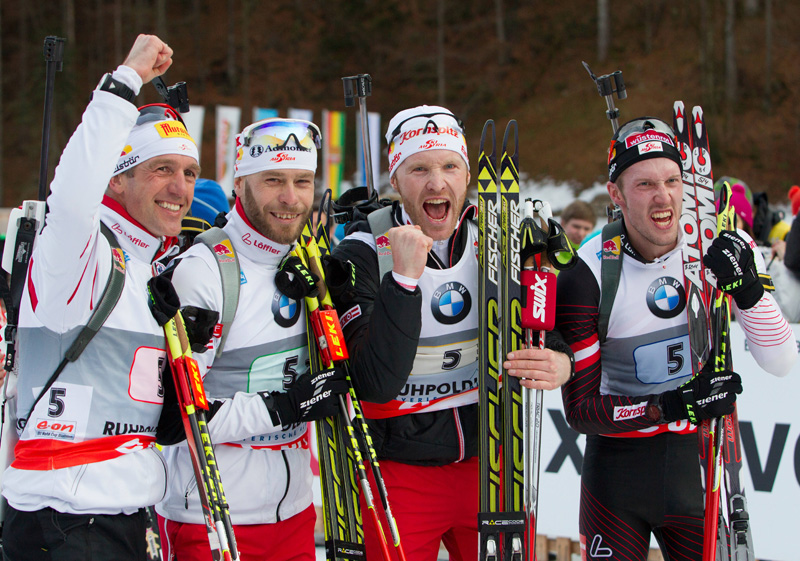
Team Austria celebrates their IBU World Cup biathlon relay victory in Ruhpolding (GER). (l to r) Christoph Sumann (AUT), Daniel Mesotitsch (AUT), Simon Eder (AUT), Dominik Landertinger (AUT) . Photo: Fischer / Nordic Focus.
RUHPOLDING, Germany – Remember when Austria was one of the best biathlon teams in the world?
The Austrian men do, too. All four members of today’s 4 x 7.5 k relay team were also on the team that finished second in the Nations Cup standings in 2009, and won a silver medal in the relay at the 2010 Olympics.
In the last few years, it has seemed unlikely that the Austrians would be able to match that feat in Sochi. For various reasons, their stars were no longer shining so bright. They underperformed and only returned to the podium three times since Vancouver, all third-place finishes.
Today, though, they signaled that they are back in the most dramatic fashion: outsprinting the host team Germany in a showstopper of a relay competition here at one of the biggest venues on the World Cup. For Germany, this loss in its heartland must have been like a stab in the heart – especially after Russia did the same thing to the women’s team, more or less, yesterday.
It was Dominik Landertinger, the best-ranked Austrian last season who ended up third in the World Cup Total Score, who did the heaviest damage, although the entire Austrian team was smooth throughout the race. Landertinger, though, shot a calm and clean final standing stage, leaving along with Anton Shipulin of Russia.
When Simon Schempp of Germany caught them, making up the five-second deficit he had accumulated by using a spare round, he must have thought he had a chance at the win. He almost did: Landertinger took off on the last uphill and got a small gap, but in an impressive show of determination, Schempp caught up and led the way down the hair-raising downhill for the last time.
Landertinger had the last laugh, though, dueling Schempp all the way to the finish for a 0.1-second victory for his team.
Just how big was that win? Ask Christoph Sumann, the anchor in Vancouver who skied leadoff today.
“This was our first win ever in Ruhpolding so that alone is a very big deal,” he said in a press conference. “[And] winning 30 days before the Olympics makes us one of the favorites.”
Sumann had the fastest course time of all the leadoff skiers, but had to use three spare rounds in standing. Despite the scare, he was still in third place when he tagged off.
“We saw the relays have been close in every competition; it was a good day for us and we are absolutely lucky,” Sumann said.
Daniel Mesotitsch used a total of four spare rounds to drop the team to fourth place, before Simon Eder used just one to move back up again, handing off to Landertinger in second, five seconds behind Germany. For all the things that the Germans did right, they did collect one more spare round than Austria – which is enough of a difference in a relay race.
As much as the German fans felt robbed, the Russians were even more deflated. With seven spare rounds – one less than Germany and two less than Austria – the Russian men had been in the lead for several points during the race, including coming out of the very last shooting stage. But Shipulin was unable to find his legs, and was left behind as the Germany-Austria duel intensified.
Sweden settled for a distant fourth place after being in podium position for much of the race. A penalty loop by Fredrik Lindstöm kept them out of the top three. With a remarkable two spare rounds over the entire relay, the Czech Republic finished fifth.
Two favorites were out of the running. Norway climbed back to ninth after a disastrous first leg by Johannes Thingnes Bø, who missed all five of his targets on his first try in prone. Even after using spare rounds, he had to ski three penalty loops. That left him in 24th place – last place. His teammates worked hard to make up the gap, with both his older brother Tarjei Bø and anchor leg Emil Hegle Svendsen shooting perfectly.
France, often a relay podium finisher, placed one spot behind in tenth. Martin Fourcade did not race, and in his absence, his teammates all had fine races – the team had just five spare rounds over the course of the whole race – but none of the spark that often elevates them to the front.
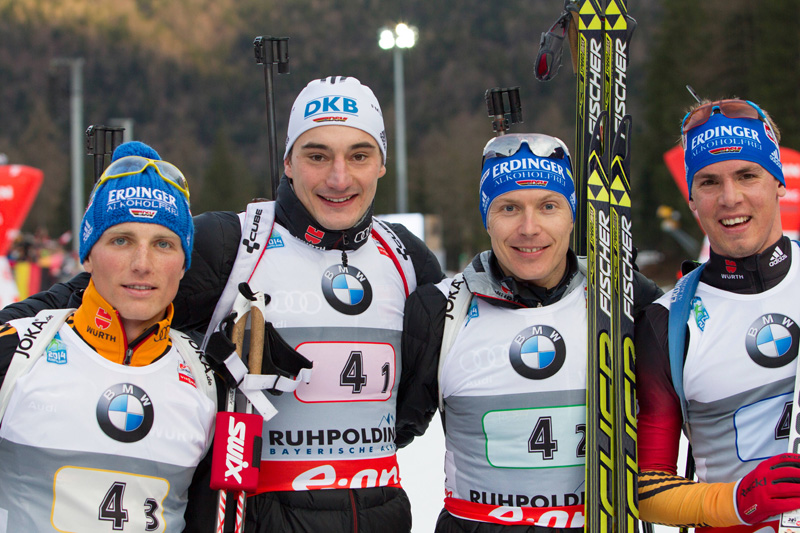
The German team gathers after the World Cup relay in Ruhpolding, Germany: Eric Lesser (GER), Christoph Stephan (GER), Andreas Birnbacher (GER), Simon Schempp (GER). Photo: Fischer / Nordic Focus.
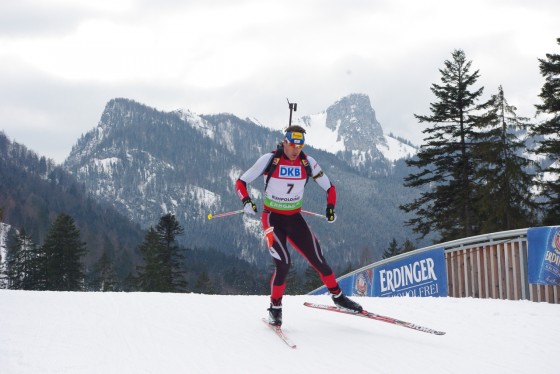
Christoph Sumann at last year’s World Championships in Ruhpolding.
Invincible? Meet vincible.
Down on your luck? Meet winner.
Just one day before the World Cup 12.5 k pursuit in Khanty-Mansiysk, Russia, Martin Fourcade of France showed once again why he is the best biathlete in the world when he took a 39-second win in the 10 k sprint. He shot clean; so did the next three finishers. It’s the combination of shooting and fast, fast skiing that has made Fourcade so unstoppable all season, and he showed no signs of letting up.
But in the pursuit, it was like a different Martin Fourcade showed up to the race. He missed at least one shot in each stage and five total, and didn’t have the fastest ski time. On the last lap he found himself chasing down older brother Simon, who had started a minute and a half back in 22nd place and is recovering from compartment syndrome surgery.
The younger Fourcade, the one in the yellow bib of the overall World Cup leader and the red bib of the Pursuit discipline leader, couldn’t do it.
Instead, Simon was second and Martin third. In first? By a huge margin – about the size of Fourcade’s from the day before – was Christoph Sumann of Austria. Like Simon Fourcade, he had cleaned all twenty targets, but starting from fourth position he had a bt of an advantage.
36-year-old Sumann, an Olympic and World Championship medalist with five prior career victories, hadn’t been on the podium since the very first World Cup weekend in Ostersund, Sweden. In the meantime, he had been left off his country’s World Championships roster for all but the relay.
Just two weeks ago, he was at home in Austria, competing in ski races. Not even skating ones – he placed second in a 15 k classic mass start FIS competition, his first since 2001.
Luckily for Summann, luck can change. He found himself back in his own sport and, today, at the top of the podium.
“This is a big surprise because I had a lot of troubles in the last weeks,” he said in the post-race press conference. “I started on the podium in Östersund and everything in between was not so good. I was thinking about quitting. It is a big surprise! It is big motivation to train hard one more year and then finish after Sochi.”
Despite Martin Fourcade’s woes on the range, it was a great day for France as the brothers were reunited again.
“This is the second time that Martin and I are on the podium together and the second time I am in front of him; that is great,” Simon Fourcade said. “But it is a great pleasure to be up here with him…I had really good feelings warming up today. I came back from 22nd place to the podium which I did not expect.”
Martin Fourcade actually tied for third, thanks to a disaster not of his own making. The race was marred by a cross-firing by Germany’s Andi Birnbacher, who was in fourth place in the third stage. But he fired on the wrong targets, instead knocking down those in lane three, which should have been Michal Slesingr’s. That left Birnbacher with five penalties for the stage, and Slesingr with problems of his own.
“The official had a very slow reaction to my raised hand,” Slesingr said. “The target needed to be cleared. Then he asked me what was wrong; ironically it was the Czech referee. I lost lots of time, probably more than the 25 seconds. I lost contact with the group when I spent such a long, long time standing. That affected my skiing. I felt my legs were more tired as soon as I left the shooting range.”
It undeniably affected the race to have Slesingr delayed on the range; he likely would have been a force in the fight for the win, although of course nobody knows for sure. In subtracting seconds from his race time, officials finally decided just to award him joint third place with Fourcade.
“The decision is fair for both of us,” Fourcade said.
Racing resumes tomorrow with mass start competitions.
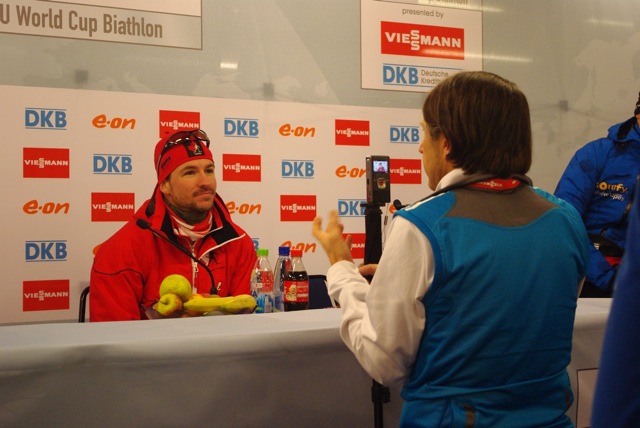
Jean Philippe Le Guellec of Canada does a video interview after claiming his first World Cup win, an 18-second victory in Ostersund, Sweden.
ÖSTERSUND, Sweden – The way some people look at it, today definitely didn’t present ideal conditions for biathlon. With gusty, raging wind that flapped at the international collection of flags here in the stadium and chilled athletes and spectators alike, shooting was a challenge.
Emil Hegle Svendsen of Norway and Martin Fourcade of France, who dueled through last season in pursuit of the overall World Cup crown, each missed three shots. Lowell Bailey of the United States missed two, but said that unlike any other race, he wasn’t disappointed – he was actually happy.
Then there was the cold, which only arrived recently to Sweden. The temperature was officially listed as around 15 degrees Fahrenheit, but with the wind it felt much colder. While that would be tough enough for skiers, biathletes can’t wear mittens or thick gloves because it impedes their trigger fingers, and they have to raise their glasses to shoot.
“It is [hard on] the fingers and the eyes, the feet, everything,” said Alexis Boeuf of France. “So we have to find a solution.”
But rather than consider the difficulties presented here in Östersund, Jean-Philippe Le Guellec of Canada looked at the conditions a little differently.
“When it’s windy, it’s always a window of opportunity,” he told FasterSkier after finishing the World Cup10 k sprint. “Luckily that arose today.”
The Quebec native seized the bull by the horns and shot clean, one of only two men in the 103-athlete field to do so. Not only that, but he skied well – well enough to land in first place, with a sizeable 18.1-second lead over Boeuf.
“If this hangs on, it’s going to be a huge day,” Le Guellec told FasterSkier when there were still racers finishing.
Le Guellec was just the 38th starter, but the 2/3 of the field that started after him was unable to match his performance. Alexis Boeuf of France, who finished just a minute before, was able to come close – he skied faster – but had collected a penalty in standing and was left in second. Christoph Sumann of Austria, starting back in bib 75, also had a penalty in standing, but was able to eke out third place, 6.7 seconds behind Boeuf.
As Le Guellec related in the press conference, he didn’t actually know he was in the running; through two laps his coaches only told him “good job” and that he was having a good race.
“I didn’t know actually, leaving the range,” he told FasterSkier at the finish. “When I passed my coach over there after the range, Tom was saying – I didn’t hear the position, but he said something about five seconds. And then when I was near the top a bit further, he said, ‘You’re in first, you’ve got five seconds!’ And then…”
Despite only having five seconds early in the 3.3 k loop, he managed to extend that lead significantly – perhaps because Florian Graf of Germany faded. After being in podium position, Graf slipped to fourth place. Boeuf, on the other hand, put in a hard charge like Le Guellec’s and moved from being ranked sixth leaving the range to finishing as the runner-up.
“Today it was windy,” Boeuf said in the press conference. “I decided before the race to be as calm as I could be, and I worked really hard to put the bullet in sight. To finish with four and five, I’m okay with this.”
It was just the fourth World Cup podium for the 26-year-old Frenchman, whose sole victory came at lightly-attended races in Fort Kent, Maine, in 2011.
A decade older and the owner of an Olympic silver medal, Sumann seemed even happier than Boeuf to be on the podium. Over both the short and long term, his results have been bouncing around: last season was a disappointment for the entire Austrian team, and on Wednesday he placed 34th in the 20 k individual, despite shooting the same score as the winner, Martin Fourcade of France.
“I had a quite good relay on Sunday, good skiing, and then a really disgusting performance on Wednesday that I couldn’t explain,” Sumann said in the press conference. “It was horrible from the beginning on, the shooting was good but the skiing… not. But today was better than the days before. And the speed was good. It was more than I expected.”
Along with teammate Dominik Landertinger’s second-place performance on Wednesday, the Austrian team is off to a much better start this year, which is a relief for everyone involved.
“It’s very important,” Sumann said. “We had a really, really bad season last year. The whole season was not the best we’ve had, but there were a lot of changes this summer. A new coach, a new system with just one team, so we’re going hard. But every year you don’t know where you are at the beginning, and it’s a good feeling that you’re back.”
But the day belonged to Le Guellec, who earned Canada its first ever win by a male biathlete. The previous best, according to Biathlon Canada, was a sixth-place finish by Glen Rupertus back in 1993.
And Le Guellec was showing some relief of his own to finally be having a good season, much like Sumann. He contracted mononucleosis after the Vancouver Olympics – where he finished sixth in this same event – and as he told FasterSkier this spring, he’s finally feeling like he’s 100 percent again, two seasons later.
“Physically – how can I put this – the strain feels the same [now],” Le Guellec explained at the finish line. “I’m pushing just as hard as I did last year, as I did two years ago. But the speed that you’re going, that’s different. It’s like comparing a Ferrari to a Hyundai Accent. They’re both going at 3,000 rpm, but one is going 200 miles an hour. So that’s the difference.”
That’s how he managed to gain so much ground on the last loop – a feeling he is not familiar with from the last few seasons.
“I don’t know what happened there!” Le Guellec laughed.
As for how he managed to knock down all ten targets, the Canadian shrugged. He just tried to pretend it was practice, he said.
“I stayed totally relaxed through my standing,” he reported. “Especially since I had struggled in standing in [Wednesday’s] individual, so I thought, just do what you usually do in training. Stay relaxed and just shoot ‘em down. I was still trying to ski really relaxed on the last lap. At that point it’s a definite good race, and so I wanted to get in there and work hard, and get into the finish having given everything.”
Stay tuned for more on Le Guellec’s race and the significance for the Canadian team.
There’s one way to guarantee yourself a good result in a biathlon race: hit all the targets.
In the men’s 15 k mass start World Cup in Oslo, Russia’s Ivan Tcherezov was the only one of 30 starters to do so, and he won, by 26 seconds, over Austria’s Christoph Sumann and Norway’s Emil Hegle Svendsen.
From the first loop and first shooting stage, Tcherezov was in the hunt, ensconced in a big group and trailing only Svendsen, Simon Fourcade (FRA), Austria’s Daniel Mesotitsch, and Germany’s Arnd Peiffer.
By the end of his third clean shooting stage, he was alone—the nearest competitor was Germany’s Andreas Birnbacher, some 20 seconds back.
Tcherezov never blinked, and never gave his rivals a chance to get back in the race. He said he was struggling on his skis on the “very wet and soft” course, but since nobody else could muster fewer than two misses, the Russian skied to the line essentially unchallenged.
Sumann had a decent-sized gap over Svendsen, but the latter had to work for his podium place over Birnbacher—the only one collected by a Norwegian male this week. The two left the range for the last time with Birnbacher leading by a few seconds, but Svendsen managed to close the gap and pass the German before the finish to claim third by a few seconds.
Tim Burke (USA) was with the leaders through two shooting stages, then faltered with two misses in the third round and three in the fourth, ending up in 23rd, nearly two and a half minutes down.
He said the huge effort to stay with the leaders left him unsteady in the range.
“I skied with the group up front there, but that was completely out of my league,” he said. “I tried every tactic I had. Nothing worked. I was just too tired in my legs to really hit the targets….That was probably one of the worst standing shootings in my career.”
While the rest of the U.S. team heads home from Norway, Burke will travel to Khanty-Mansiysk, Russia, for the final World Cup weekend. Currently 14th in the World Cup overall standings, he’ll be looking to maintain that position, or move up.
Canada’s Jean-Philippe Leguellec was one spot behind Burke in 24th, with two penalties.
Hauswald Hits the Triple
While Tcherezov demonstrated one way to win, Germany’s Simone Hauswald took her victory the hard way in the women’s 12.5 k.
Single penalties in each of her first two shooting stages put her more than thirty seconds off the lead, behind a train of her German teammates led by Andrea Henkel.
After the two misses, Hauswald said, “I kept my focus, knowing that the race is over after the third and fourth shooting [stages] are over.”
Hauswald is the fastest woman on the biathlon circuit right now, and even though there were a handful of her competitors who shot clean today, none of them could stop the German from winning her third race in a row. She cleaned both of her standing stages, wresting the race from Henkel after the latter had a miss in her last shooting round.
Hauswald held on to win by 15 seconds over Vita Semerenko (UKR) and 22 over Magdalena Neuner (GER).
“I cannot believe what I have done in the last three races,” she said. “Maybe it is the perfection of doing biathlon: body, mind, and soul together.”
Zina Kocher of Canada was the only American starter, and she had a nightmare day. Nine penalties left her just over seven minutes back.
Whistler, British Columbia – Evgeny Ustyugov (RUS) won the first biathlon Olympic men’s gold for Russia in 16 years, skiing away from bronze medalist Paval Hurajt (SVK) in the final lap.
Martin Fourcade (FRA) overcame three misses, including two in the first prone stage to take the silver.
Emil Svendsen (NOR) and Simon Eder (AUT) set the pace early, leading the pack that still numbered 16 strong after the first shooting stage.
Fourcade was not part of the group however. With his two early misses, he was 50 seconds back. Usually it can be very hard to reach the podium with three misses, so it was not looking good. But he proceeded to couple fast skiing with clean shooting over the next two stages. And his final miss came in conjunction with misses from a number of his competitors.
“I told myself, ‘It’s impossible, I don’t understand,’” said Fourcade of his two early misses. “I looked at my coach and I got back in the race.”
Ustyugov and Hurajt both shot clean, skiing in the lead pack the entire race. At each shooting stage, more skiers would drop off as they missed shots.
Heading out for the fourth ski lap, a pack of four, led by Hurajt, held a gap on the field. Daniel Mesotitsch (AUT), remained in striking distance just 7 seconds back, and Svendsen, with a single miss was also in range, 20 down.
But as is often the case, it all came down to the final shooting stage. Only Ustyugov and Hurajt cleaned, with Vincent Jay (FRA) and Bjorn Ferry Sweden missing one and two shots respectively.
It appeared to be a two-way race for gold, but Ustyugov attacked out of the stadium, and was clearly the stronger skier at this point. He quickly left Hurajt behind.
Fourcade missed a shot in the final stage, but was on fire on skis. He quickly caught and passed Christoph Sumann (AUT), a pre-race favorite, who sat in 3rd, and appeared to have the best chance of catching Hurajt.
Fourcade did not settle for bronze and continued to attack, rapidly closing on the fading Slovakian. He made the pass with authority, and quickly opened a safe cushion.
“I felt tired [on the last lap],” said Hurajt. “And Evgeny is a better skier than I am. I was also expecting a challenge from Sumann and I was surprised to see Fourcade come by.”
Pavel Hurajt (SVK) on the range.
His bronze was the first Olympic medal won by a Slovakian biathlete, and the first Slovakian Olympic bronze ever.
Ustyugov, meanwhile, cruised down the homestretch to his first Olympic medal.
“I only started to think about the gold when I got to the stadium and could see the line.”
Hurajt was happy to hold on for the bronze. “This is the biggest sport achievement of my life, and it feels fantastic!”
He continued, “I knew before the start it would a fast race and that I would have to hit 20 of 20 shots to do well. When I hit all 20 targets I was very happy and I knew I had a chance for a medal.”
For Ustyugov, on the other hand, his victory had not fully registered. “It hasn’t sunk in yet. I still don’t understand that I have won the gold. Honestly, after the last Olympics, I wouldn’t have even dreamt that I would be here.”
According to Tim Burke (USA), the pace was relatively slow, and several athletes mentioned that the field seemed tired. This was the fourth race of the Olympics, and the last individual format. Only the relay remains.
The Russian champion knew heading into the race that the crux would be the final shooting stage. He shot deliberately, taking especially long on the last target. “I can’t remember what I was thinking,” he said following the race. “I just shot…It was the most important part of the race.”
Ustyugov leading Tim Burke (USA)
The strong Austrian and German teams were shut out of the medals again. They only have one medal to show between the two this Olympics – Sumann’s silver in the pursuit.
Fourcade blows kisses toward his coaches in the homestretch.
Norway also had a tough day. The great Ole Einar Bjorndalen struggled out of the gate, missing one shot on the first stage. That was just the beginning as he went on to accrue seven total penalties.
“On some days it is just not working,” said Bjorndalen. “Today certainly was a horrible day. These Olympics have been very disappointing. Horrible.”
He does have a silver medal to show for his efforts, from the 20km individual.
Svendsen was in the race until the final shooting stage where two more misses sent him out of the top-10.
Canadian Jean Philippe LeGuellec, who has had a stellar Olympics thus far, had a tough day. After cleaning the first shooting stage, he missed four shots the next time around. He cleaned again, but then missed three more.
His struggles did not deter the home crowd. Another warm and sunny day made for a festive atmosphere. Each time LeGuellec came through the stadium he was greeted with a boisterous roar. The hill above the range was packed, multi colored flags of all nations waving, noise-makers and a marching band providing energy to the excellent stadium commentary.
LeGuellec waves to the fans.
LeGuellec good-naturedly waved to his supporters as he cruised down the finish stretch in last place. Only 30 men start the mass start, limited by the number of targets in the range. So despite bringing up the rear, the lone male Canadian biathlete here picked up 11 more World Cup points, capping the best week of his career.
“This race is…a bonus,” said LeGuellec’s coach Jean Paquet. “He did what he can.”
After several athletes in the men’s 12.5k biathlon pursuit started early, Swedish coaches were seen yelling at event officials, trying to get them to stop the race.
You can bet they’re glad nobody listened, as one of their athletes, Bjorn Ferry, caught and passed France’s Vincent Jay on the final loop to take gold.
Ferry become the first Swede in 60 years to win Olympic gold in biathlon, coming out on top in a race featuring starter errors, numerous changes in the top-3, and some great comebacks.
The biathlon pursuit format is one of the most exciting events in endurance sports. With athletes starting based on finish time from the sprint, and four shooting stages, the 12.5km race is a nonstop extravaganza of excitement. Each shot can change the race, and with five 2.5km ski laps, there is plenty of time on course to make up ground.
Christoph Sumann (AUT) took silver, the first Olympic medal for the Austrian veteran, and Vincent Jay, the gold medalist in Sunday’s sprint, held on for the bronze.
The story getting all the attention, however, was the error by race officials that allowed American Jeremy Teela and Canadian Jean Phillippe LeGuellec to start 30 seconds early. A full report on this issue can be read here.
Ferry, wearing bib 8, at first looked confused as he watched Teela at number 9 take to the course ahead of him, then started arguing with the starter and pointing at the video monitor counting down start times. But once he was on course, he focused on the task at hand.
Jay, who won the sprint, in part aided by a mid-race snowstorm, led out, closely followed by Emil Svendsen of Norway. Svendsen closed the 12-second gap by the first shooting stage, and LeGuellec, aided by his 30 second “bonus,” was not far behind. All three athletes shot clean and with several others missing shots, LeGuellec headed back on course just ahead of Svendsen, buoyed by a roaring crowd unaware of the 30 second time penalty.
From this point on, Jay was the only constant in the top-3. The chase was on, and the rest of the field gunning for the medals.
Emil Svendsen (NOR) on the range for prone.
Jay skied away from Svendsen on the third lap when the Norwegian missed a single target in the second prone stage, while a number of the usual big guns, starting further back due to the funky conditions on Sunday, started climbing in the standings.
Simon Eder (AUT), Sumann, Micahel Greiss (GER) and the amazing Ole-Einar Bjorndalen, all starting outside the top-10, moved consistently through the field with a combination of solid shooting and fast skiing.
Ferry started slowly, posting just the 42nd fastest time for the first loop, but from there on he turned on the jets, and paired with flawless shooting in the first three stages, put himself in medal contention. His big move came in the range during the first standing stage. With his nearest competitors, including Jay, missing at least one target, the tall Swede suddenly found himself in 2nd, just 5.5 seconds back.
That is the allure of biathlon. So much can change so quickly. Ferry entered the range for the third time, even with Sumann, and 25 seconds down on Jay. But both Sumann and Jay missed a shot and it was a whole new race.
His skis were running well, and he was able to ski relatively relaxed for the first half of the race. With Jay now in his sights, he wasted no time closing the gap
“It was in the 4th loop that I began to think ‘now I can win this race,’” Ferry said while describing his day.
The Frenchman held on for that lap, and the two were even for the final standing shooting. With the crowd nearly drowning out the pop of the rifles, and the smell of gunpowder strong in the air, the two men shot for the gold. Ferry missed first, but Jay was unable to take advantage. They headed out, still together, for a penalty lap.
“In the penalty loop I saw that he [Jay] was tired, so I went full speed directly from the start on the final loop,” said Ferry.
And Jay could not hang. Ferry skied away, opening a large gap, and the only question was whether Jay could hold on to the silver.
Christoph Sumann (AUT)
Sumann was coming fast. He ended the day with the second fastest ski time, and he easily made up the 16 seconds, blowing by Jay and skiing clear to the silver. The race ended just in time for Jay, who crossed the line 2.8 seconds ahead of Eder.
Sumann was helped a bit by an unlikely choke by Bjorndalen. The Norwegian was in third entering the final shooting stage, 7 seconds up on the Austrian. But Bjorndalen, who had shot clean all day, missed two shots to Sumann’s one, and was out of medal contention.
“It wasn’t a great day for me physically,” Jay told media at the post-race press-conference. “After my gold medal, there were many demands on my time. But that is to be expected, and I tried my best to stay on the podium. I am perfectly satisfied with the bronze today.”
Ferry, who was part of the Swedish relay team that barely missed a medal in 2006, didn’t see his performance as any sort of redemption. “That was also a great race. Our goal was always to make the medals, and then we were so close, and that showed we could make it. My goal remained to make a medal…you have to believe in yourself, and today I did it.”
Sumann overcame a stomach bug that has bothered him for some days. “I went straight from the toilet to the start line,” he laughed, but not joking. It didn’t seem to affect his performance or his enjoyment of the experience.
“Of course I am” he said in response to a question of whether he was having fun. “I wasn’t so depressed after the sprint. I did not have a good race, but I had a good result – 12th place at the Olympic games was my third best ever. The expectations for today were not that big as I was 1:30 down. I tried to be calm and do my best, and I had really good skis today.”
He was also impressed with Bjorndalen, who just missed a medal, after starting in 17th. “I think he did a good job, since he came down from 17th. But I could hear him on the range next to me, crying, after his two misses,” he said laughing. “I had one, so I said to myself ‘I am good shape to be in front of him at the finish line.’ But he did a very good job. Obviously 17th in the sprint was not good for him – he is a 5-time Olympic medalist – and he did much better today, and 7th from 17th is very good.”
Ole Einar Bjorndalen (NOR) at the finsih.
LeGuellec continued to shoot very well, and ended the day with just two penalties. Each time he left the range, the crowd greeted him with a roar. But unfortunately he was not really in the running for the medals, due to the starting error. He still ended the day in 11th, and coupled with his 6th on Sunday, is off to a great start at his home Olympics.
“I came out of the start gate a little early, but whatever, it is still fun to be in that pack,” LeGuellec said. “And I kept it together for the standing, which is really the turning point of the race. I wasn’t feeling all too peppy in the skiing like in the sprint, but I was always around fast people that kept me in the game.”
LeGuellec on course.
His skiing time was just the 46th best on the day, but he still scored another 30 World Cup points – unlike cross-country, biathlon Olympic races do count toward the World Cup standings.
Teela had a different perspective on the starting issue. “In this race you race head-to-head, not against the clock. So when you hear you are going to get a time addition, it really changes things. At that point it is a different strategy. If I knew I was racing against the clock from the start I would have played it a little differently.
Teela coming through the stadium.
“This never happens,” he continued, clearly upset and baffled. “Maybe some guy will push out a second or two early, but when they let you out a complete person ahead, that never happens.”
Teela skied up as high as 7th in terms of physical place, buoyed by clean shooting in prone, but his actual place was somewhere just out of the top-10. Two misses on each of the standing stages ended his chances at the top-10 though he finished a still solid 24th.
“I didn’t feel as good as Sunday, and when this happened [found out about his time penalty], it just zapped the energy out of me.
“It’s a real big bummer. For each athlete it happened to, we will be upset, but this will blow over by tomorrow morning, but for me, I will hang on to it for a couple more days.”
Lowell Bailey (USA) maintained his position, starting and ending in 36th. He had three penalties and the 33rd fastest ski time.
“I was happy with my performance. I stayed in it until the end, and happy to be here fighting it out.”
Bailey shot clean in the sprint, but was foiled by the mid-race snowstorm.
Tim Burke continued to struggle on the range, missing five targets. He was treating the race as a training run given he started back in 46th. His ski time was still 26th best. “I really had no expectations for this one, but I will be looking for the podium in the mass start.”
The final American starter, Jay Hakkinen, missed six shots and finished 57th. “Just a really bad day,” he said at the finish.