From the FasterSkier archive — posts syndicated from athletes’ and coaches’ own blogs between 2004 and 2012, kept online as published. Current coverage is at fasterskier.com.
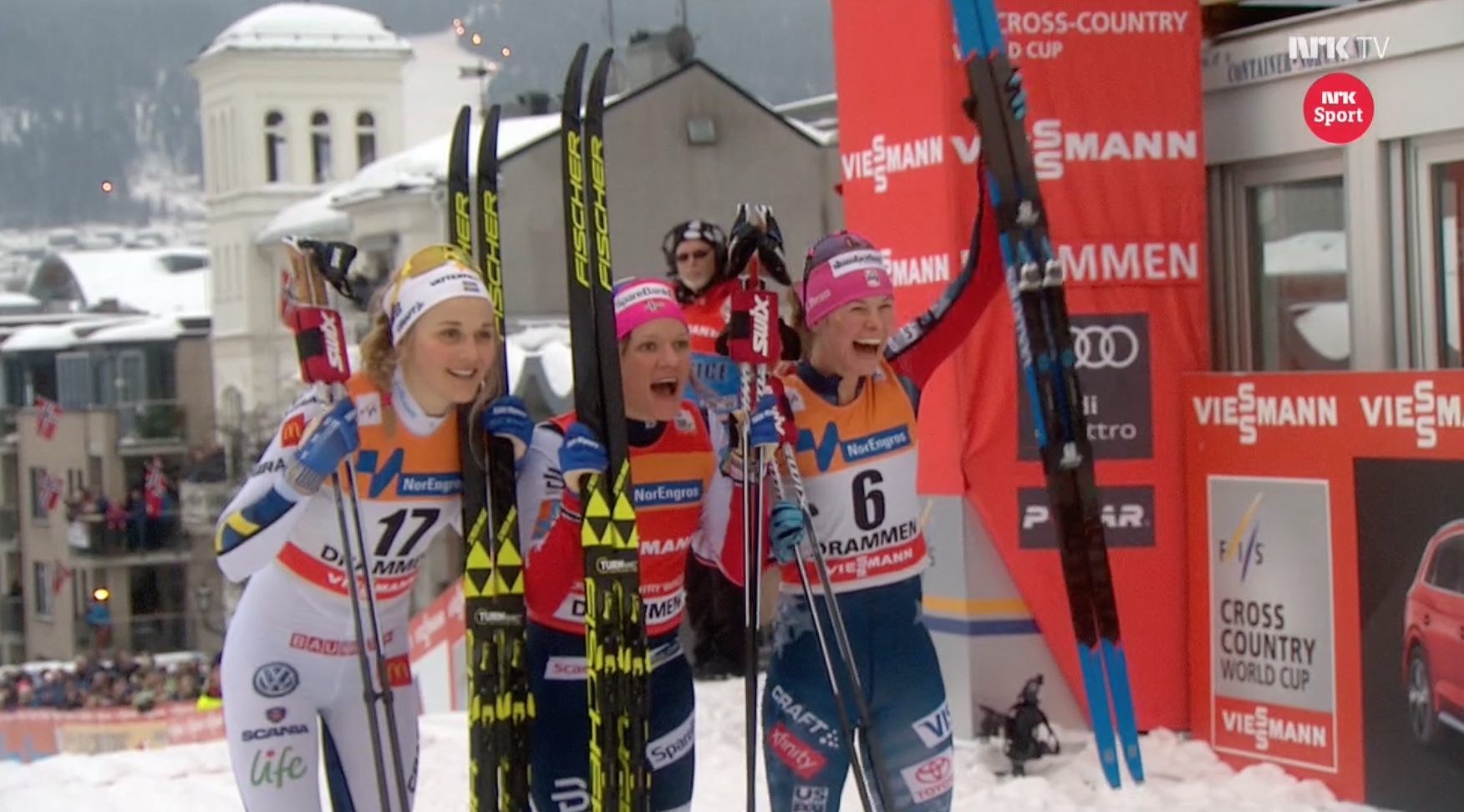
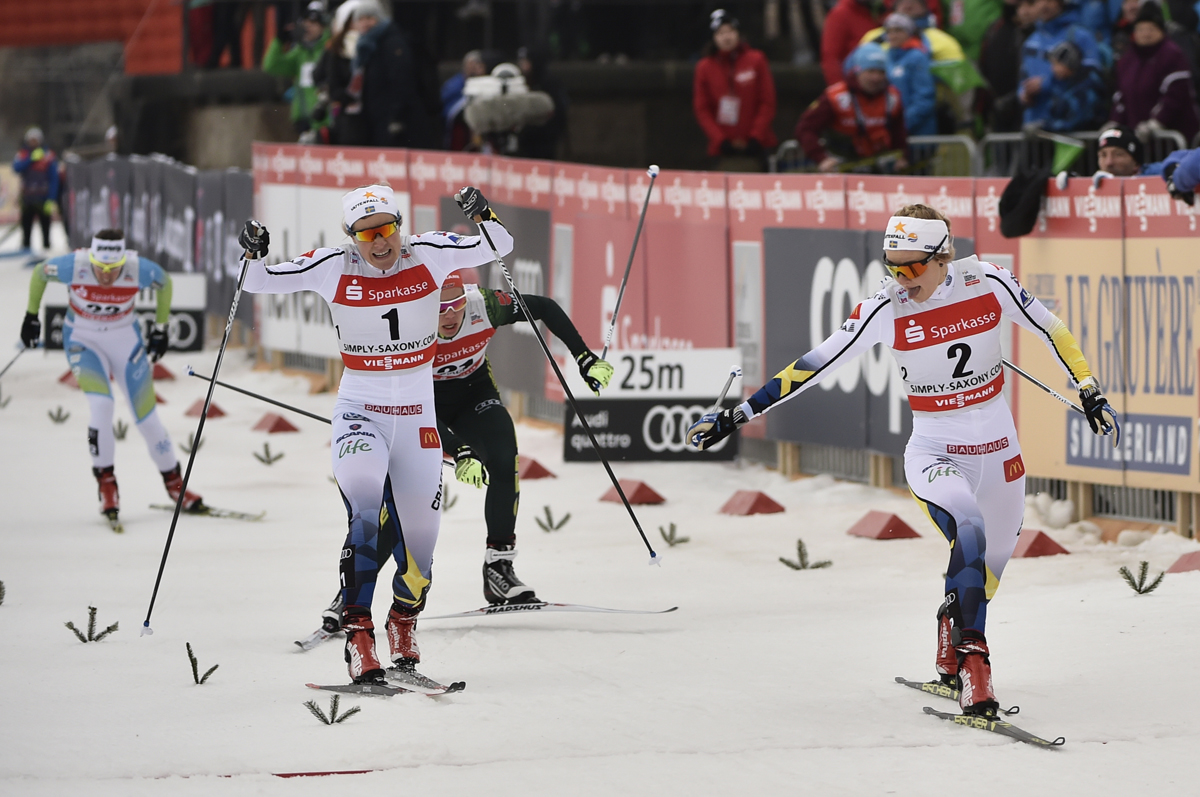
Maiken Caspersen Falla of Norway (center) won the classic sprint in Drammen and all but wrapped up the Sprint Cup. Stina Nilsson of Sweden (left) was second and Jessie Diggins of the United States third. (NRK screencap)
FIS Cross Country World Cup (Drammen, Norway): Classic sprints
The cross-country World Cup hit the city on Wednesday, with classic sprints contested in the Oslo suburb of Drammen on snow which had been trucked onto the streets. And the crowd was rewarded with wins by two Norwegian favorites: Maiken Caspersen Falla in the women’s sprint and Johannes Høsflot Klæbo in the men’s race.
In the women’s final, Falla and Natalia Nepryaeva of Russia battled at the lead for much of the race, but Falla pulled away from the field on the last climb to the finish. Stina Nilsson of Sweden and Jessie Diggins of the United States pulled past Nepryaeva in the final few hundred meters to claim spots on the podium; Krista Parmakoski of Finland was fifth and Katja Visnar of Slovenia sixth.
With the win, Falla all but wrapped up the World Cup’s Sprint Cup crystal globe: she is just two points from having it clinched, with one sprint remaining on the calendar. In Falun, Sweden, in ten days, she more or less just has to make the heats to earn her third Sprint Cup in a row.
Also racing for the United States, Sadie Bjornsen and Sophie Caldwell made the quarterfinals, but did not advance past that round. Bjornsen ended the day in 21st and Caldwell in 27th.
Ida Sargent and Rosie Brennan were 47th and 48th in qualifying, followed by Kikkan Randall in 50th and Kaitlynn Miller in 53rd.
For Canada, Emily Nishikawa finished 52nd and Dahria Beatty 55th.
Great Britain’s Nichole Bathe, who raced for the University of Alaska Fairbanks, finished 58th.
In the men’s final, Russia’s Alexander Bolshunov set the pace for most of the heat. Klæbowas on his ski tails, and drew even on the course’s on downhill, where Norwegian teammate Eirik Brandsdal also caught up to them. Skiing back up to the finish, Klæbo ramped up to a furious tempo and was uncatchable. Brandsdal passed Bolshunov to claim second by a healthy margin. Sindre Bjørnestad Skar finished fourth, Kasper Stadaas fifth, and Emil Iversen sixth, all for Norway.
The lone North American to make the heats, Erik Bjornsen, qualified in 26th and finished the day in 18th. Teammate Andy Newell just missed the quarterfinals after finishing 33rd in qualification. Logan Hanneman and Kevin Bolger finished 49th and 50th, and Reese Hanneman 56th.
For Canada, Julien Locke placed 51st in qualifying, Alex Harvey 54th, and Andy Shields 58th.
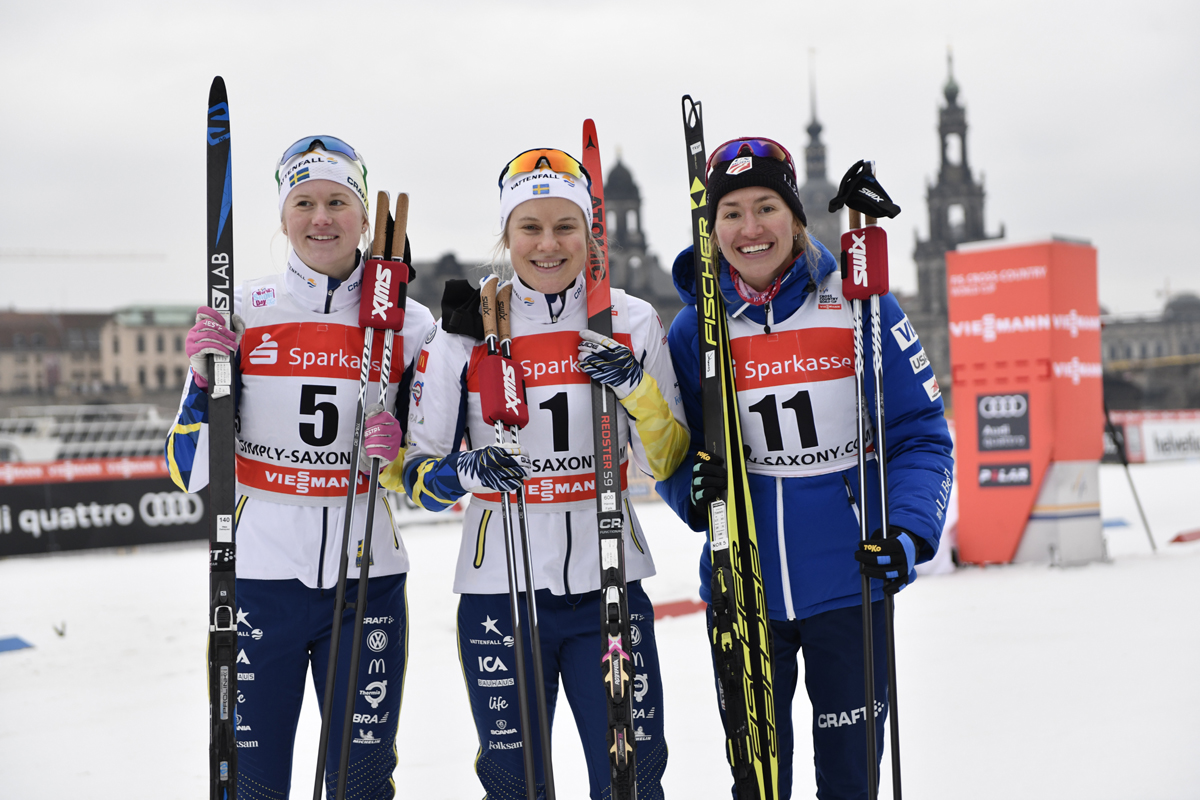
The women’s freestyle sprint podium on Saturday at the World Cup in Dresden, Germany, with Sweden’s Hanna Falk (c) and Maja Dahlqvist (l) in first and second, and American Sophie Caldwell (r) in third. (Photo: Fischer/Nordic Focus)
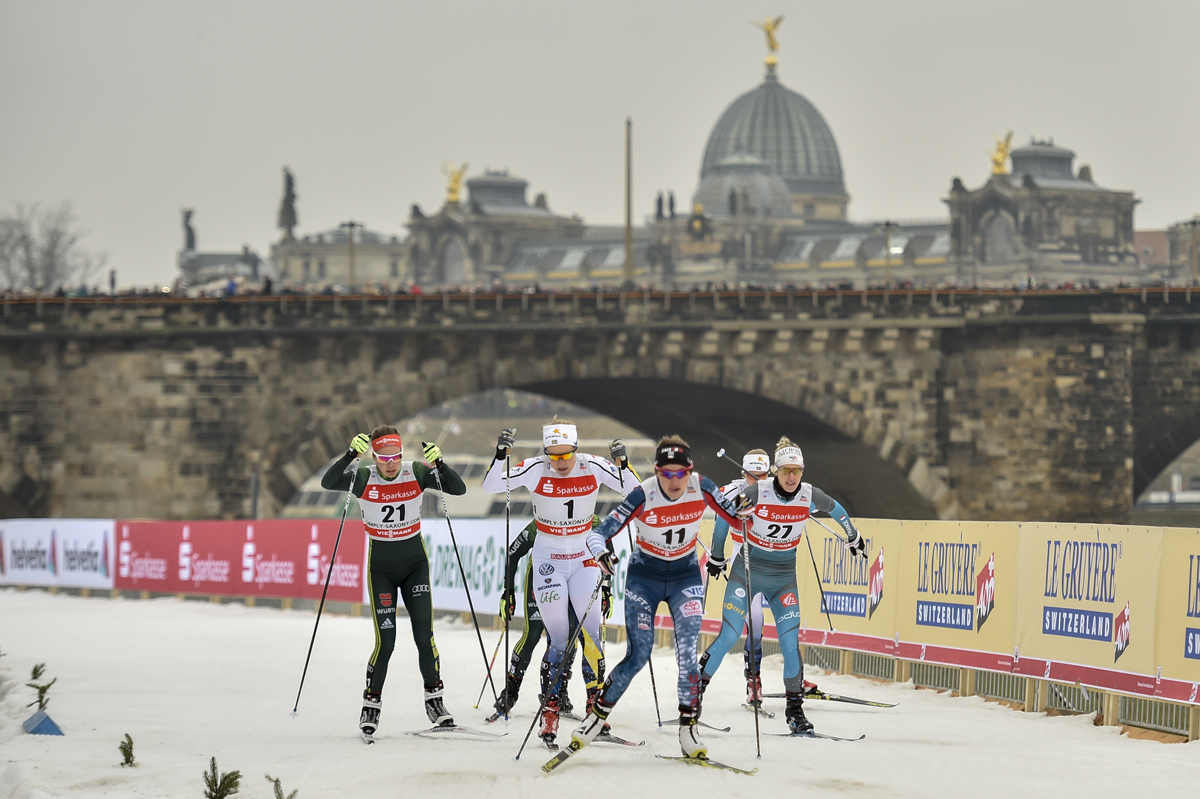
In Sophie Caldwell’s quarterfinal heat of the World Cup skate sprint in Dresden, Germany, she led from start nearly to finish. In the final 200 meters she was passed by Sweden’s Hanna Falk, but won a photo finish for second place and advanced to the semifinals.
In that quarterfinal heat, the U.S. Ski Team member had finished just 0.24 seconds behind Sweden’s Falk.
As the racing got even tighter in the semifinals and final, it became more difficult to shoot off the starting line and into first place. Caldwell spent much of those heats boxed in the middle or even the back of her six-woman heats, partly on purpose, but advanced to the final as a “lucky loser” anyway.
American Sophie Caldwell (11) leads Sweden’s Hanna Falk (1), Germany’s Hanna Kolb (21), France’s Aurore Jean (27), and others during their 1.2 k freestyle sprint quarterfinal on Saturday at the World Cup in Dresden, Germany. (Photo: Fischer/NordicFocus)
“Sophie really executed the way she wanted to all day,” U.S. Ski Team Head Coach Chris Grover said. “She was in control of her quarterfinal, and then when she got to the semifinal, she purposely wanted to relax a little bit… same thing in the final. She was not going to, like, burn a match early. She was going to relax, be in the draft, save a little bit of energy early, and look to make a move.”
By the end of the final, despite skiing from the back instead of the front, Caldwell’s margin to Falk was almost the same as it had been in the quarterfinal, this time 0.30 seconds.
Falk took the win while Caldwell finished third, earning her second podium of the year.
“It was pretty frantic, and in the final I didn’t have a great start,” Caldwell said. “I found myself in the back and it’s easy to waste a lot of energy being in the back and trying to move up, so I tried to be patient and pick people off when I could. But you also kind of have to capitalize on those opportunities when they come, so I just tried to be patient and pick people off. There was a fall that I dodged, which worked to my advantage, and so I am really happy with it.”
The crash belonged to Sweden’s Stina Nilsson, the favorite to win the final even though Falk had the fastest qualifying time. Near the end of the race loop Nilsson tripped and went down, with Caldwell and Switzerland’s Laurien van der Graaf splitting to go around her, one of each side.
“The crash happened right in front of me,” Caldwell said in a U.S. Ski & Snowboard press release. “But I managed to avoid it and then put in a big push to maintain contact with the leaders.”
That liberated Caldwell from the back of the field, although she still had work to do to get near the front. From the beginning of the heat, Falk, Nilsson, and Swedish teammates Anna Dyvik and Maja Dahlqvist had controlled the pace.
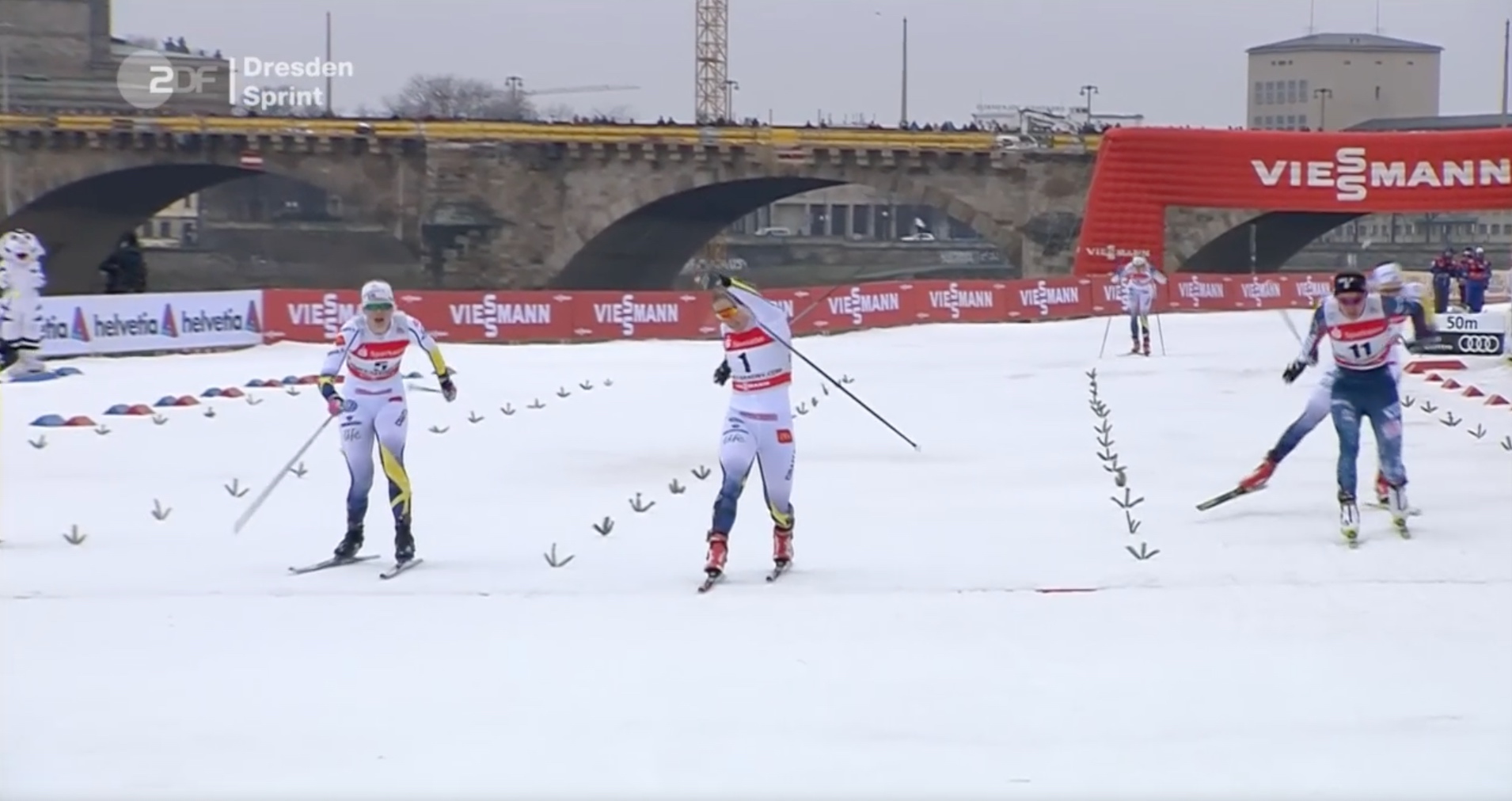
Sweden’s Hanna Falk (1) edges her teammate Maja Dahlqvist (l) and American Sophie Caldwell (r) in the women’s 1.2 k freestyle sprint final on Saturday at the World Cup in Dresden, Germany. (Screenshot: ZDF broadcast)
As the meters ticked down to the finish, Caldwell finally was able inch towards the lead.
“Where she ended up making that move, under the bridge, was a targeted strategy of hers,” Grover said.
Coming into the finish, everyone except Nilsson was still in it, and the five women all crossed the line within 0.68 seconds of one another. Falk, though, managed to stay clear of the pack and take her first win since 2010.
“I think I was a little unfocused in the start in the semifinal, so in the final I really tried to focus on the start,” she said in a finish-line interview with FIS’s Jeff Ellis. “Then I took the front, and it was just to push hard… I really like this kind of city sprint. It was a good day for me. I have all my family and fans from Ulricehamn here cheering for me here, so it was a good day.”
Dahlqvist claimed second (0.23), van der Graaf fourth (+0.58), and Dyvik fifth.
Sophie Caldwell’s last podium came just two weeks ago, where she finished second in the 1.5 k sprint in Lenzerheide, Switzerland. (Photo: Fischer/NordicFocus)
While pursuing a completely different strategy from Falk in the final, Caldwell proved that there are many ways to the right position, as long as you play your cards right.
“I am really psyched to be here,” Caldwell said. “ I’ve never had great results in Period 1 in the past, so I was really happy to have made the semifinals in all three of the sprints. I considered it a really strong start, but I was left wanting more.”
She is following up a second-place finish in the skate sprint in Lenzerheide, Switzerland, which kicked off the Tour de Ski. But Caldwell fell ill partway through the Tour, and didn’t start the (later-canceled) classic sprint in Oberstdorf, Germany.
“I woke up sick the morning of the sprint in Oberstdorf, so I was sick for a week,” she explained. “I am actually still clearing things out, but energy-wise I felt good the past few days. Today was going kind of be a test to see how I felt, and I guess I was well rested. It felt good.”
She is now third in the Sprint Cup behind Nilsson and Norway’s Maiken Caspersen Falla, who did not race in Dresden.
Sweden’s Stina Nilsson (2) winning the second semifinal just ahead of her teammates Hanna Falk (1) and Maja Dahlqvist (not shown) and American Sophie Caldwell (not shown). Dahlqvist placed second, Caldwell third and Falk fourth in that heat. (Photo: Fischer/NordicFocus)
City sprints aren’t so unusual; they have been held in Drammen, Norway, for many years straight, with other venues like Stockholm, Dusseldorf, Milan, and Quebec City coming and going from the schedule.
But even for a city sprint, this course was particularly flat, short, and fast, which played to some athletes’ strengths and left others just trying to do their best to get by.
“It was a really funny course a lot different than anything we have ever done — by far the shortest I have ever done and flattest,” Caldwell said.
Her American teammate Ida Sargent qualified in 14th position, a new experience on such a course.
“It’s a weird course,” she said. “It’s fast and flat. Not at all my favorite kind of sprint race. I just went into it looking at it as a challenge and an opportunity to improve on some of the things that are not really my strengths. So I’m pretty psyched with the qualifier to be right up there, on a course where I feel like a year or two ago I definitely wouldn’t have qualified on. That was exciting.”
Like Caldwell, Sargent led out her quarterfinal heat. And like Caldwell, she got swept up at the end of it, with her competitors using a small uphill and a subsequent downhill to shoot into the finishing straights. She couldn’t hang on to the top two and finished fourth in the heat, 0.43 seconds behind Sweden’s Ida Ingemarsdotter.
That put her 17th on the day.
“Coming into the finish, it was pretty fast and I wasn’t quite ready for that,” she said. “I should have switched to V2 sooner, and I felt like it was all over the place. So I’m kind of kicking myself.”
“Ida had a great start, took control, skiing how she wanted to ski, just ran out of gas at the end,” Grover said. “And I think it was a course where there’s no rest, it’s continuous effort – if V2’ing hard, V2 alternate-ing hard, if that isn’t your deal, then you could run out of gas at the end.”
Both Sargent and Caldwell thought it was important to start well on this course, even though in the semifinal and final Caldwell managed to succeed without ever leading.
“It’s really narrow and hard to pass,” Caldwell said. “It was pretty easy to sense when people were coming up, so I think people were guarding their space. That made it even harder to pass. When I was leading my quarterfinal I got to do some of that, and then when I wasn’t leading it was frustrating sometimes — you would see people bouncing around out there trying to make moves.”
“There’s room to move up, but it’s definitely big decisive moves,” Sargent agreed. “I just got out fast [in the quarterfinal] and tried to stay in my rhythm at the beginning. I could feel the others coming up and I would just try to increase the pace whenever I could feel someone coming up so I could keep control.”
Kikkan Randall (U.S. Ski Team) racing to 34th in the 1.2 k freestyle sprint qualifier on Saturday at the World Cup in Dresden, Germany. (Photo: Fischer/NordicFocus)
Also starting for the U.S., Kikkan Randall narrowly missed qualifying for the quarterfinals in 34th, 6.57 seconds behind Falk’s time and 0.6 seconds behind 30th-place Giulia Stuerz of Italy.
Randall, Caldwell, and Sargent are now looking forward to the Olympic Games, which begin in less than a month. Sargent sealed her qualification with that 17th-place finish, as she is now ranked 13th in the Sprint Cup, well within the top-50 designation required by the U.S. Ski Team.
“I am looking forward to the Olympics,” Caldwell said in a post-race press conference. “It has been a strong year for me, and especially for my whole team. We are going to compete as a team to win the first medal for the U.S. women in Olympics, and I am proud to be on the team.”
Julia Kern (U.S. Ski Team/Stratton Mountain School) racing to 38th in the women’s 1.2 k freestyle sprint qualifier at the World Cup in Dresden, Germany. (Photo: Fischer/NordicFocus)
Julia Kern finished 38th (+7.78) and Caitlin Patterson 40th (+8.56).
“We had an uncharacteristically poor qualification,” Grover said. “I have a feeling it was a combination of things… Just over two minutes for women and men a minute fifty, I think that might have been a little bit of a shock to the system. I couldn’t tell if our group was a little flat, or [this race is] just so uncharacteristic, something that we don’t really prepare for because it’s that much more on the anaerobic side instead of a mix of aerobic and anaerobic like we’re used to for a sprint.
“Anyway, to have Erik Bjornsen just miss the qualification, to have Kikkan just miss the qualification, to have the four athletes who did go in not have the best qualifications, something was a little bit missing,” he concluded.
In Sunday’s team sprint, Sargent and Caldwell will team up, with Randall and Patterson forming the second U.S. team in a field of 20 entries.
Caitlin Patterson (Craftsbury Green Racing Project) racing to 40th in the women’s freestyle sprint qualifier at the World Cup in Dresden, Germany. (Photo: Fischer/NordicFocus)
Justyna Kowalczyk (POL), who also won the classic sprint in Drammen, Norway, last week, cruised to another victory on Wednesday in Stockholm, Sweden, at the World Cup Finals opener. Photo: Fischer/Nordic Focus.
Before the women’s classic sprint final got underway on Wednesday in Stockholm, Sweden, Justyna Kowalczyk (POL) had won the last three races in the classic discipline on the World Cup calendar. Apart from World Championships, where she was shut out of a gold medal in every event, the 30-year-old Polish star had already established herself as an odds-on favorite whether the race on tap was a sprint or distance event. Sometimes she has to fight for her wins, and for others it looks almost looks easy for her.
The latter was true in front of the Royal Palace in Stockholm, where she won her fourth World Cup classic race in a row by 2.2 seconds on a 1.1 k course. She made no bones about it after finishing: it had been a piece of cake.
“It was a relatively easy victory today,” Kowalczyk told the FIS interviewer. “I had great skis. I like such cold conditions. I felt very strong.”
Clearly. After a reserved start in the qualifying round, where she placed fifth behind Anne Kyllönen (FIN), Kowalczyk proceeded to demolish her quarterfinal and semifinal heats, leading from the first hill and never relinquishing the position despite a strong headwind on the back half of the exposed waterfront course. She would increase her lead both on climbs and descents, blessed with fast skis and a strong diagonal stride. Kowalczyk won her quarterfinal by 1.7 seconds against Ingvild Flugstad Oestberg (NOR) and her semifinal by a closer 0.7 seconds over Katja Visnar (SLO), who was the only one that came close to pushing Kowalczyk all day.
Even Marit Bjørgen (NOR), who took a break from racing for the Oslo 30 k in order to recover from a cold, couldn’t match her Polish rival’s pace. Bjørgen looked more mortal than usual in the heats on Wednesday and barely made it into the final as a lucky loser. Despite feeling fresher than those who competed in Holmenkollen, her hopes to challenge Kowalczyk were quickly dashed in the final when an early fall from Kyllönen forced the back of the pack to maneuver around her, slowing Bjørgen’s progress as Kowalczyk began her typical surge off the front.
Bjørgen moved up from her position near the rear as the group neared the last gradual climb to the finish, passing two Finns, but Kowalczyk’s lead was already too great. Bjørgen took second, 2.2 seconds back, and Kerttu Niskanen (FIN) held on for third (+3.1) for her first individual World Cup podium.
As Kowalczyk’s win was not a surprise and Bjørgen’s failure to stop it was likely a disappointment, Niskanen appeared to be the happiest person on the podium.
“A really great day,” she told Hevoskuuri.fi “I got to the podium in the end, and this is indeed expected.”
Kyllönen, at a loss to explain exactly how she tripped herself up on the 180-degree turn, was generally happy with how the day turned out for her team. There were three Finns in the final despite two crashes from Krista Lähteenmäki and Aino-Kaisa Saarinen in the quarterfinals, and in the qualifier Kyllönen posted the fastest time by 1.7 seconds.
“Today was a really super day,” Kyllönen told Hevoskuuri.fi via translation. “If I would have stayed upright… I got a Sprint Cup fifth place, which is a very important achievement. I’m still in a position to improve the condition of the end of the season, I’ve been waiting all the time. This is great to go to the last three races.”
Stockholm is the very last sprint on the World Cup calendar, so in addition to the regular podium ceremony the end-of-season sprint leaders were awarded their crystal globes. Kikkan Randall (USA) and Emil Jönsson (SWE) locked down these respective titles in Lahti, Finland, two weeks ago, but “World Cup Sprint Champion” became official for each of them on Wednesday.
As the opening event of World Cup Finals, the mini-tour that constitutes the last four races of the season, Kowalczyk next heads to Falun as the series leader. She has already secured the overall World Cup title and merely widened her margin of victory on Wednesday, so the drama yet to play out in the women’s field is essentially limited to who will take the mini-tour title. With bonus seconds from her most recent victory taken into account, Kowalczyk leads by 7.1 seconds after the first stage.
Kikkan Randall (USA) reached her first classic sprint final of the season on Wednesday in Drammen, Norway, placing fifth overall to lead the U.S. women. Photo: Fischer/Nordic Focus.
With the season winding down and only World Cup Finals remaining on the calendar for sprinters, Kikkan Randall produced her best classic result of the year on Wednesday with a fifth-place finish in Drammen, Norway. She led the American women in the city sprint; Sadie Bjornsen also qualified for the heats and finished 30th.
Randall in another sprint final — it may seem like well-worn territory for an athlete whose list of season accomplishments already includes World Championship gold and a crystal sprint globe. Yet fifth is still somewhat of a season milestone for Randall — it marks first time she has made it to a classic final all season, and it was also the product of a bit of a lucky break. She scraped into qualification for the heats in 29th and subsequently moved on from the semifinals as a lucky loser in the heat that included eventual race-winner, Justyna Kowalczyk (POL).
“It’s my best classic result from this year for sure, and last year I had a fourth in Kuusamo, so this sits right in there with a better classic finish for me,” Randall said.
Ever the competitor, however, she looked back on the race wishing she had done a few things differently. Fitness-wise, she thinks her sprint form is getting stronger as the season comes to a close and in hindsight saw opportunities to have moved up that she didn’t take.
“I wish I had skied it tactically a little differently,” Randall said. “I knew Kowalczyk would set a fast pace and I knew I could tuck in and conserve energy early. That final finish stretch is so crucial every time and that’s where it was working really well for me. The mistake I made is I wasn’t aggressive enough around those final corners down at the bottom of the course. I kept trying to take a really wide line because I was trying to find faster snow, but I ended up skiing by myself and didn’t set myself up in a good enough position for that last bit to challenge for the podium. So I’m a little disappointed with that.”
Even so, Randall felt positive about the result as she left the Drammen venue.
“The feelings were good today and I think I’m feeling stronger and stronger now,” she said. “That’s a good sign, so I was pretty happy with it.”
The next race on her schedule is a low-stakes exhibition sprint on a snow-filled track & field stadium in Oslo. From there the World Cup season ends in Stockholm and Falun, Sweden, after which she and her teammates fly back to the U.S. for SuperTour Finals.
“I’m glad it’s at a point in the year when we can just race,” Randall said. “It’s a lot, like every other day. It’s been a long season and I’m feeling like it’s wrapping up just in time.”
The second and only other American to make the women’s heats on Wednesday was Bjornsen, who recently finished a career-high weekend in Lahti, Finland. In Drammen she didn’t expect to make it through qualification, even though she hoped to somehow earn enough points for World Cup finals. But make it to the heats she did as the 26th qualifier. Bjornsen later finished her day in the quarterfinals, placing sixth in her heat and 30th overall. The performance was good enough for a 54th overall World Cup ranking as of Wednesday, four places and 14 points shy of the top-50 cut-off for Stockholm and Falun.
“I’m happy because I haven’t qualified for a classic sprint yet this year, and it was an extremely challenging day of picking skis and finding the wax,” Bjornsen said. “I was quite happy to make it into the heats because I wasn’t expecting it. My quarterfinal wasn’t exactly as I would hope, but it was still fun.”
She went up against Aino-Kaisa Saarinen (FIN), Linn Soemskar (SWE), Nicole Fessel (GER), Dasha Gaiazova (CAN) and Hanna Kolb (GER) in the quarterfinals. At the top of the course Bjornsen led the five other women, but on the descent she lost ground to them and fell back to sixth, where she ultimately finished the heat.
“I think it was hard to pick the right ski today, I don’t know,” Bjornsen said. “I definitely didn’t do that do the greatest of my ability. It’s so sugary you feel like you want a lot of kick because it’s hard to find your kick, but then I think it maybe slows it down… I felt it as the whole pack went by. I was like, ‘Well, darn.’”
Ski selection for the sugary conditions in Drammen on Wednesday is a skill Bjornsen says she needs to work on for the future. Even though she didn’t make World Cup finals with her sprint result she wasn’t too discouraged, as reaching the cutoff only became a goal after her career-high weekend in Lahti.
“I went into this year having scored two World Cup points in my life; it wasn’t even a goal of mine to make World Cup finals,” she said. “After having a great weekend last weekend it’s like that confirmation to motivate me even more for next year, like hey: that is a possibility to make World Cup finals and that’s what I should be gunning for.”
Bjornsen’s next stop is OPA Cup finals, which take place in Italy on Friday, Saturday and Sunday.
Randall and Bjornsen were the only two American women to make the heats. Holly Brooks and Sophie Caldwell just missed qualifying in 34th and 35th, respectively. Ida Sargent was 48th, Rosie Brennan finished 52nd and Jessie Diggins was 55th.