From the FasterSkier archive — posts syndicated from athletes’ and coaches’ own blogs between 2004 and 2012, kept online as published. Current coverage is at fasterskier.com.
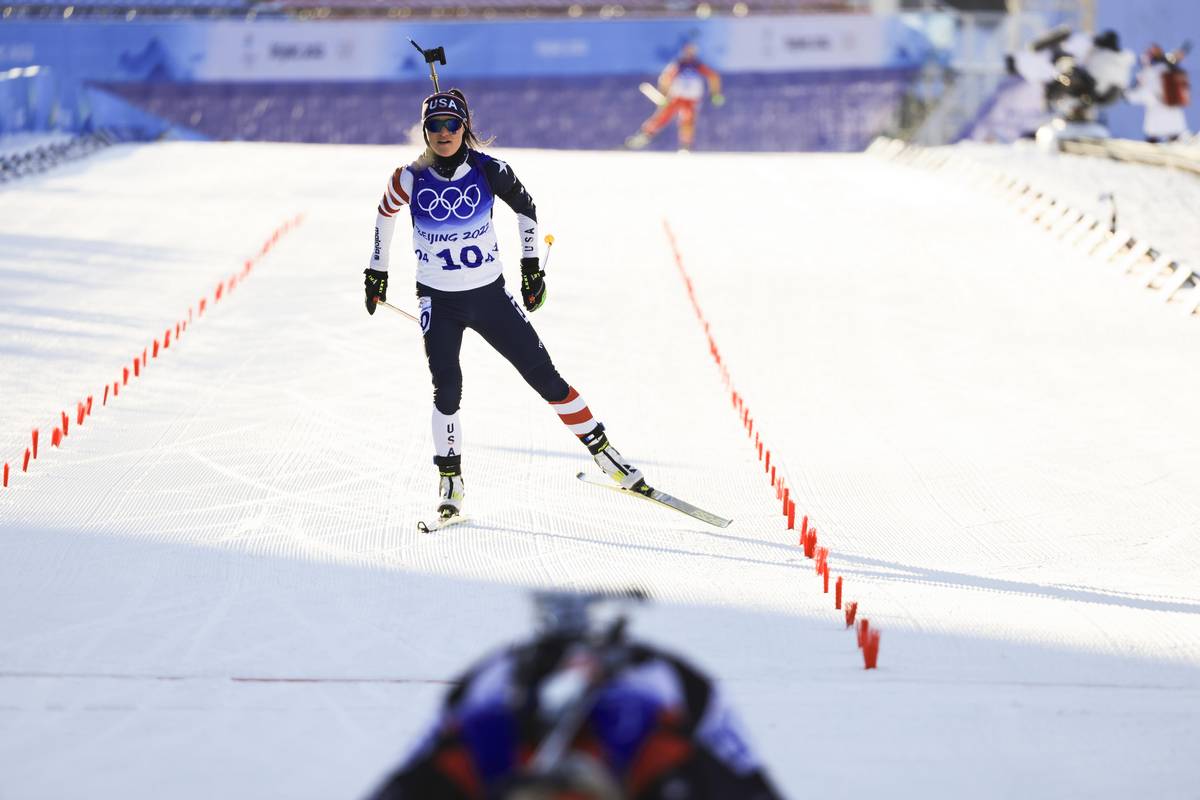
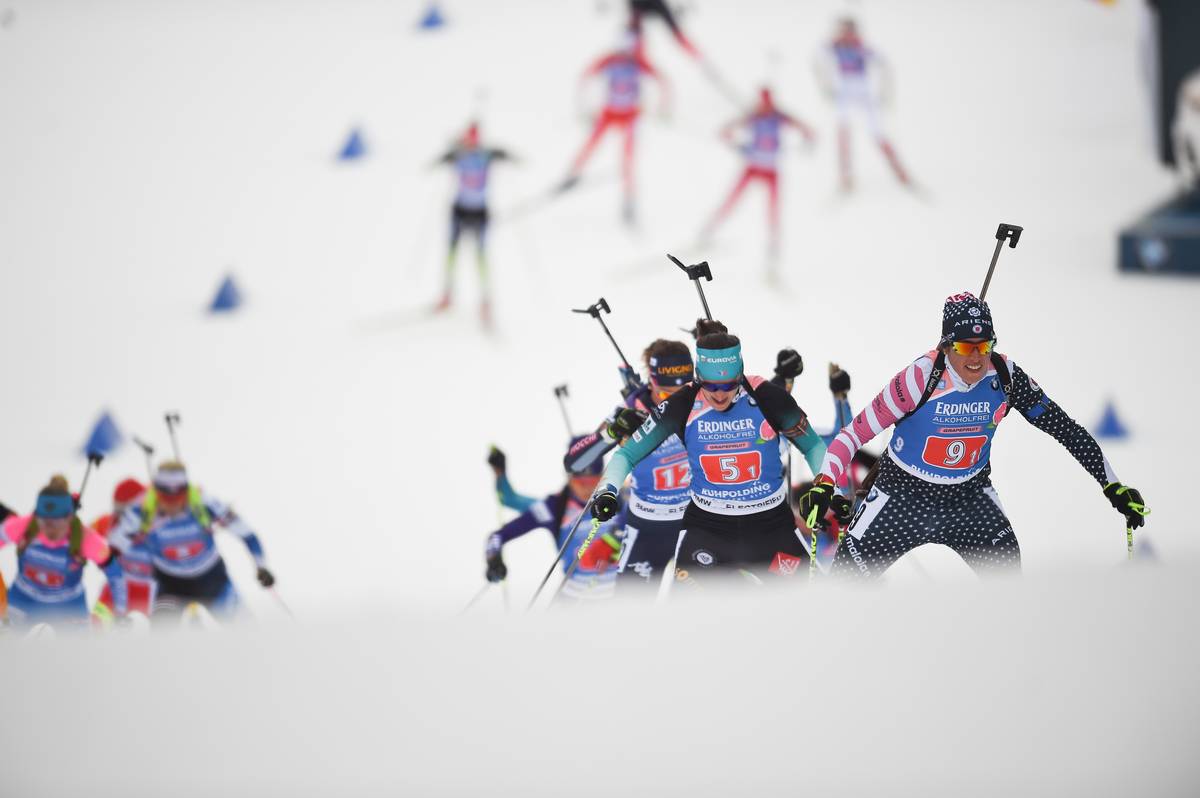
In the final Olympic race of their careers, Susan Dunklee (Craftsbury, Vt./Craftsbury Green Racing Project & USBA)and Clare Egan (Cape Elizabeth, Maine/Craftsbury Green Racing Project & USBA) helped guide the U.S. women to an 11th-place finish in Wednesday’s 4×6-kilometer relay at the Beijing 2022 Winter Games.
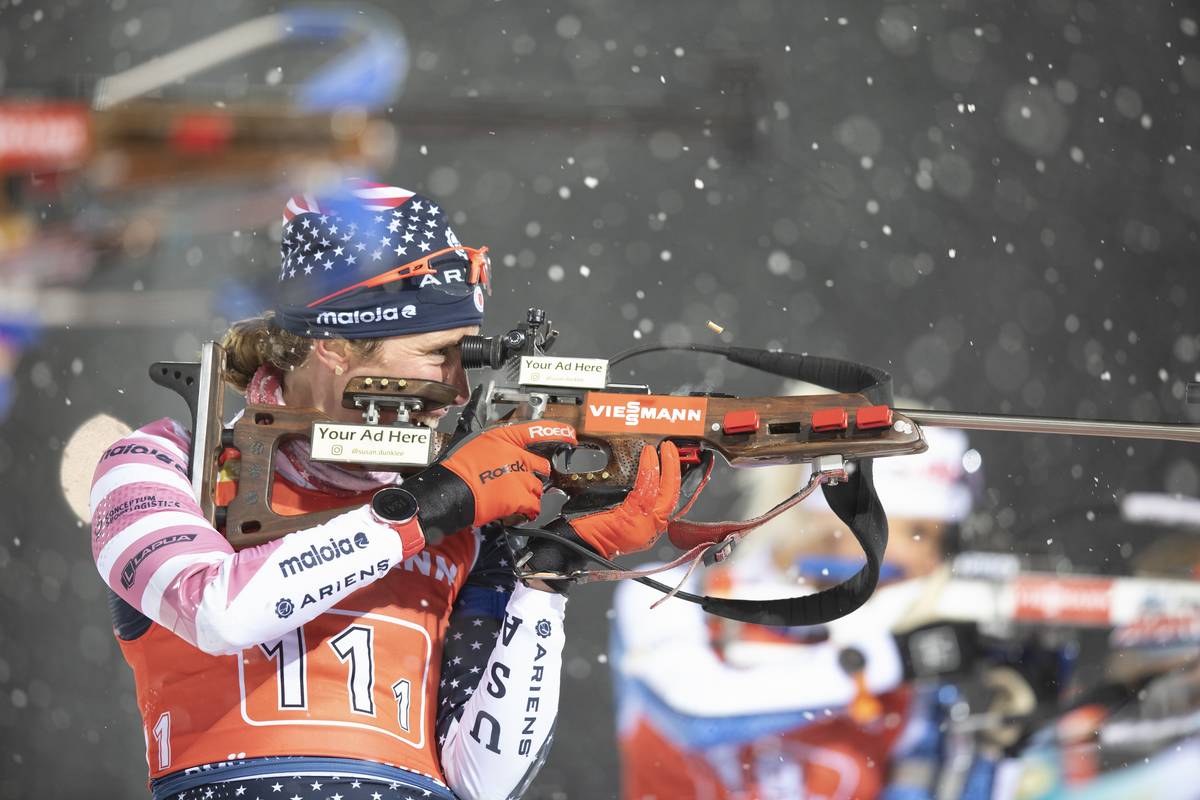
Three-time Olympian Dunklee was first out of the shooting range after prone, having cleaned all five targets. She also cleaned from the standing position but admittedly was sluggish on the skis and made the first exchange with Egan in 18th position.
“It was a beautiful day to be out here skiing and I was really excited for it,” said Dunklee. “I had a lot of fun in the first loop and put myself in it like I usually do. I got near the front and tried to play my normal game and shoot fast in prone. I got out first which was really satisfying for the first 100 meters. I did well in standing but the last loop my body just shut down. Today was one of those days. No matter how hard I was trying to force myself to go my body just wouldn’t go.”
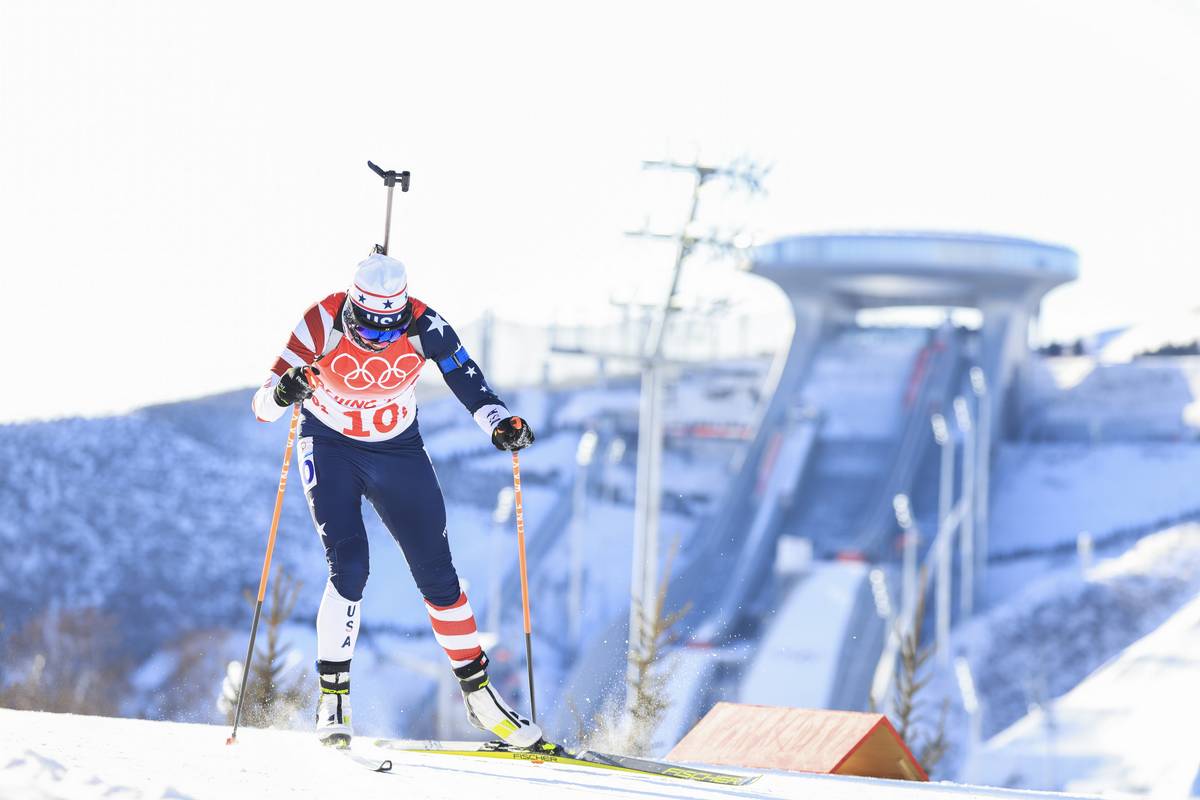
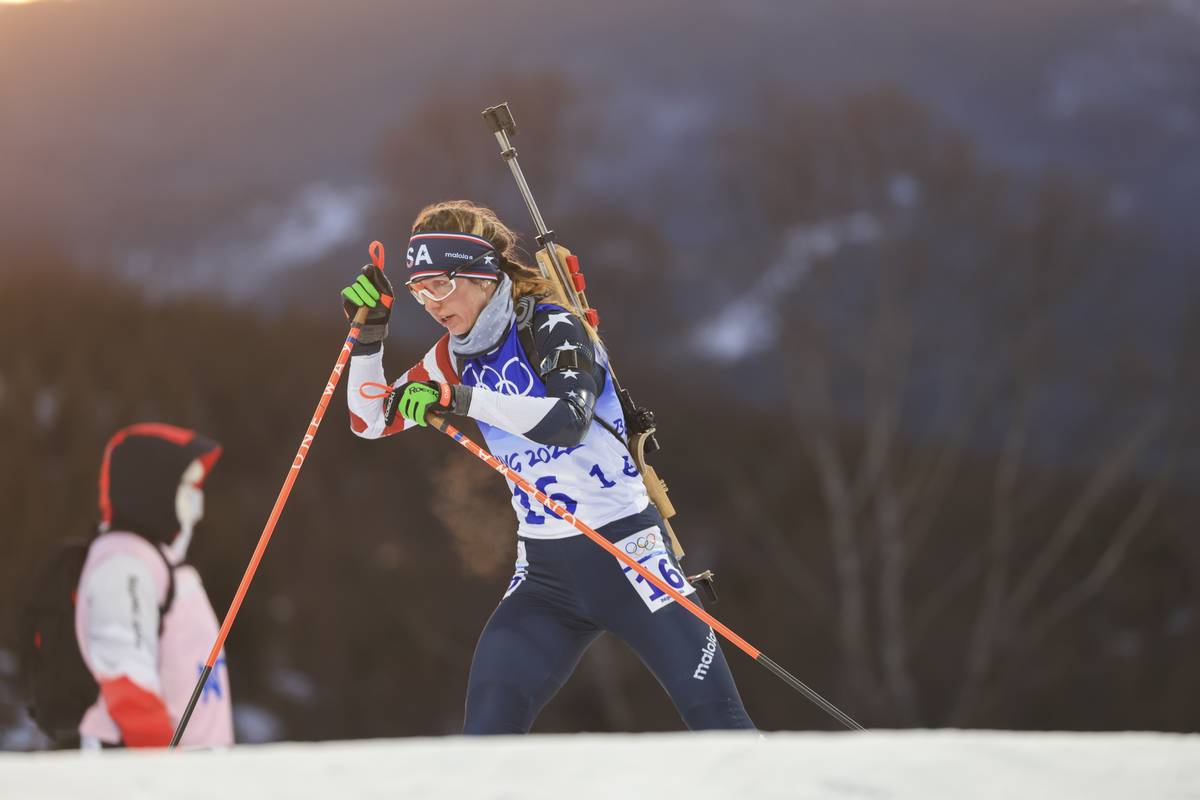
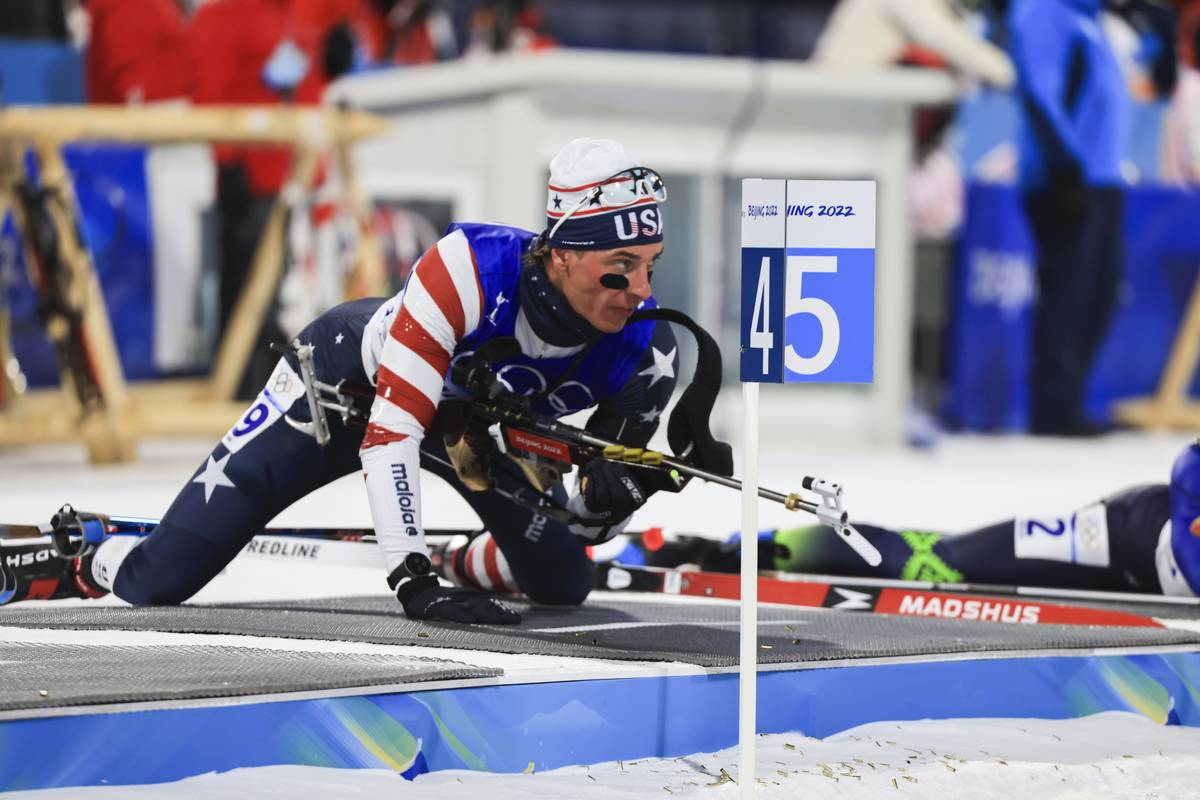
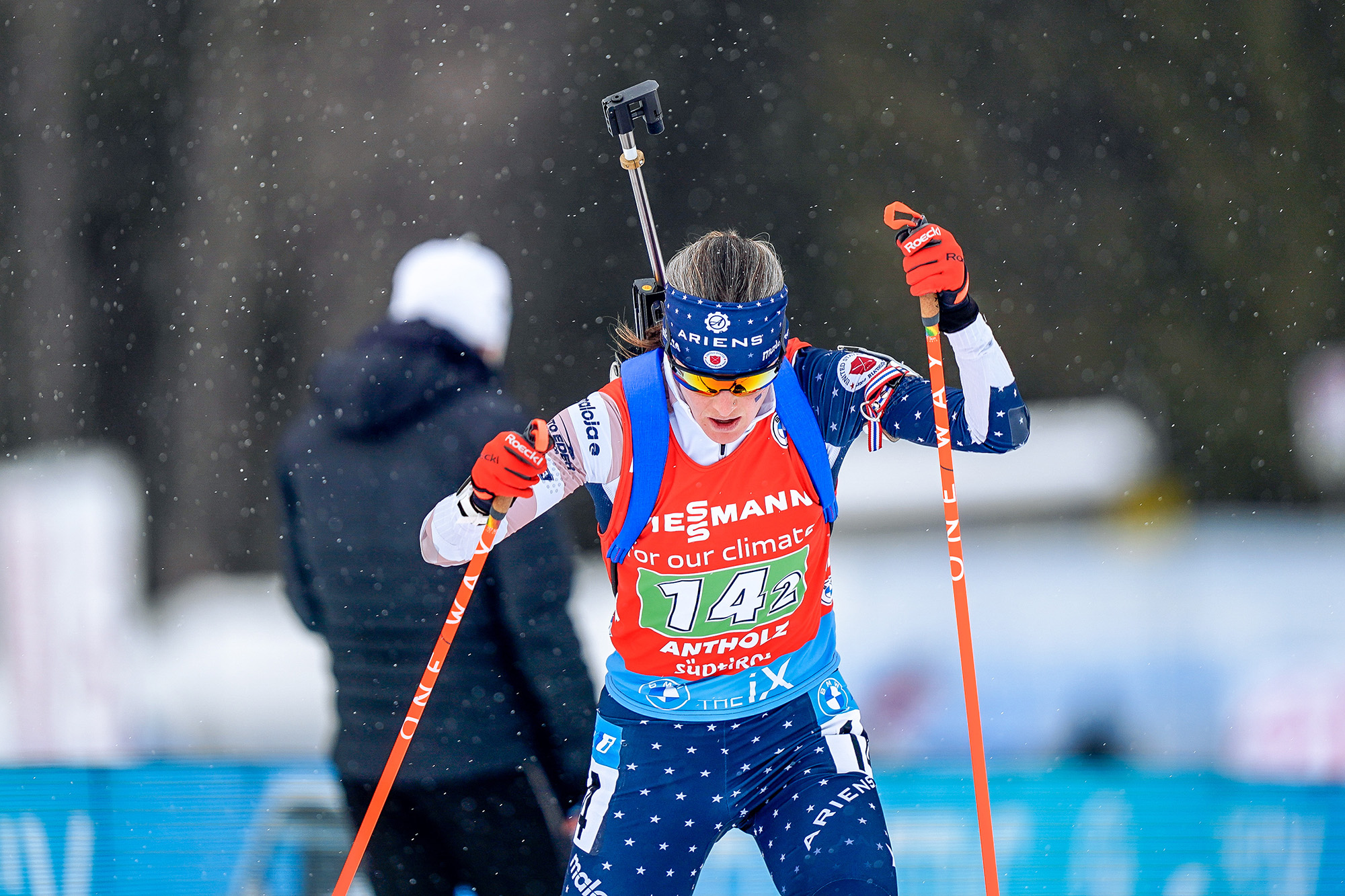
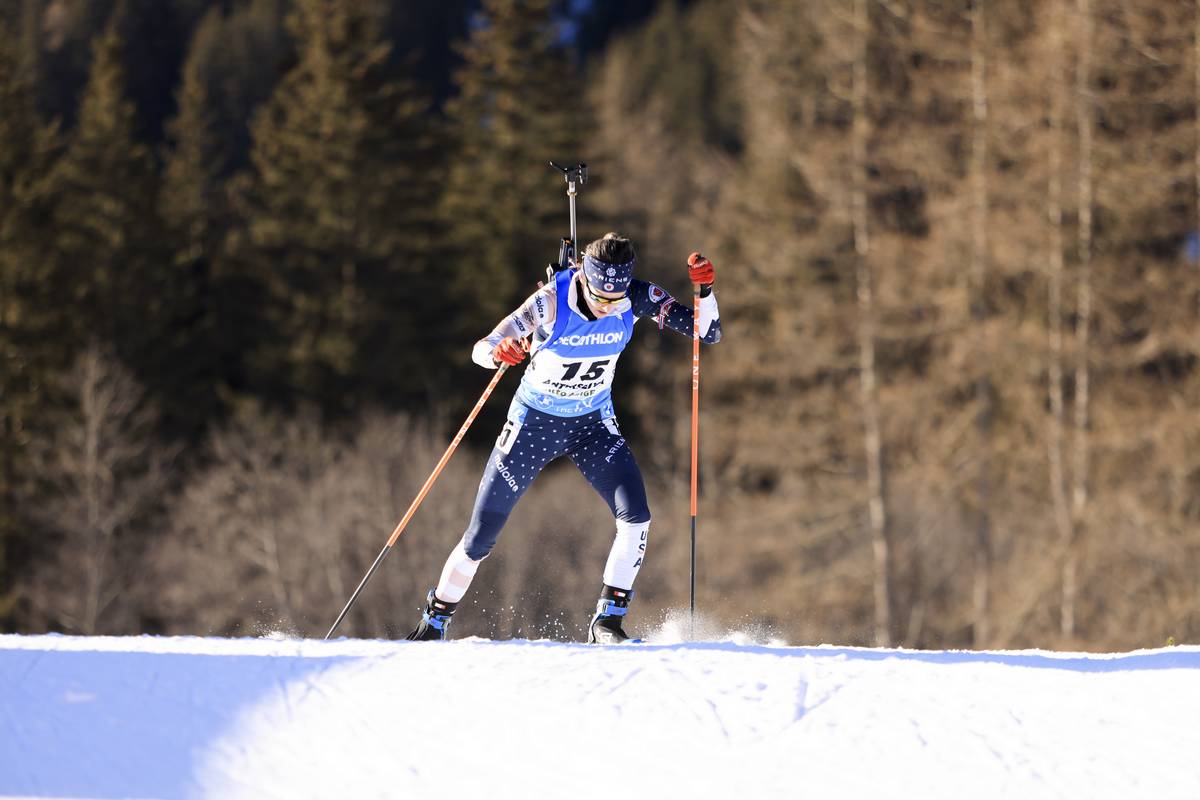
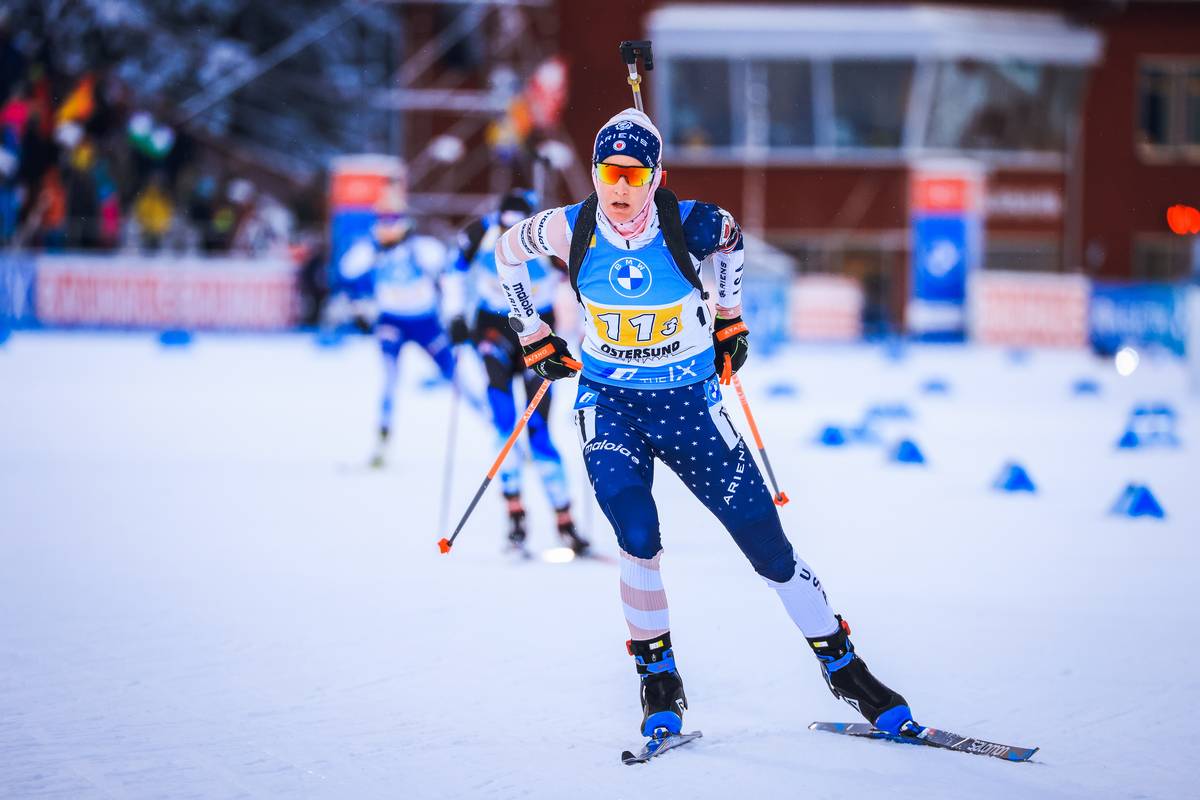
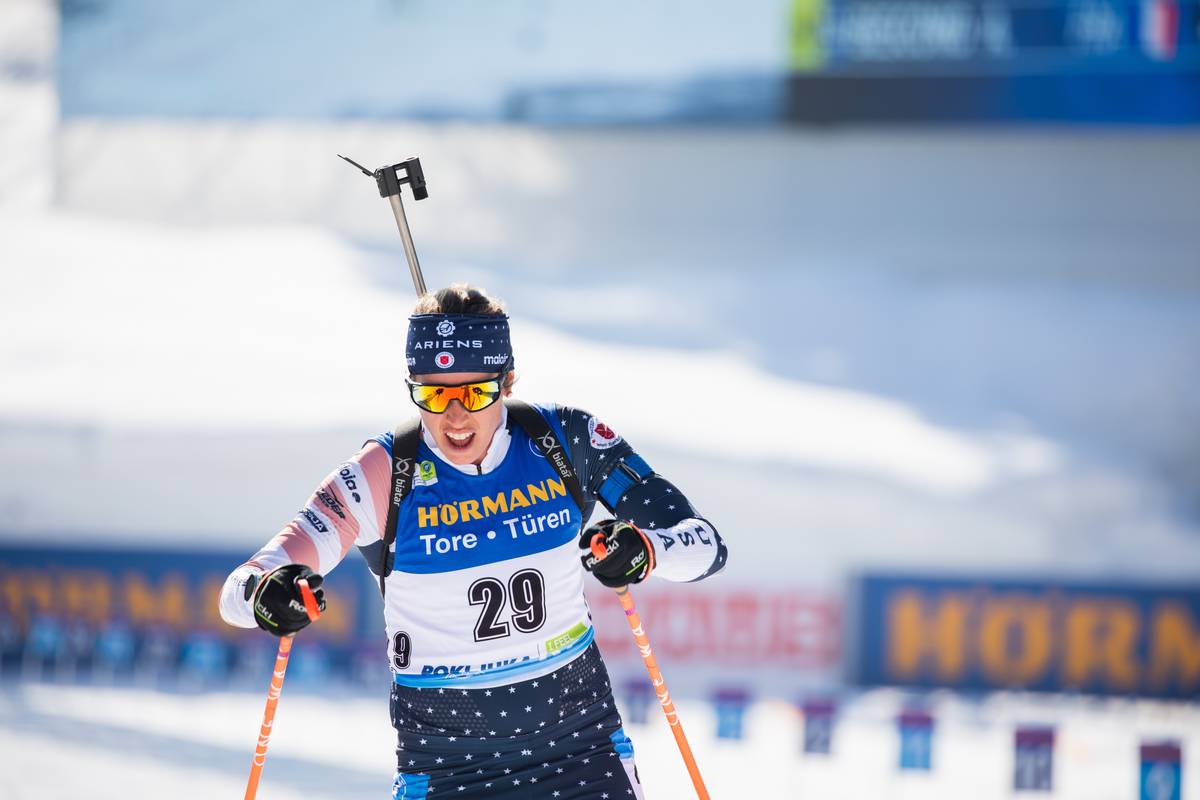
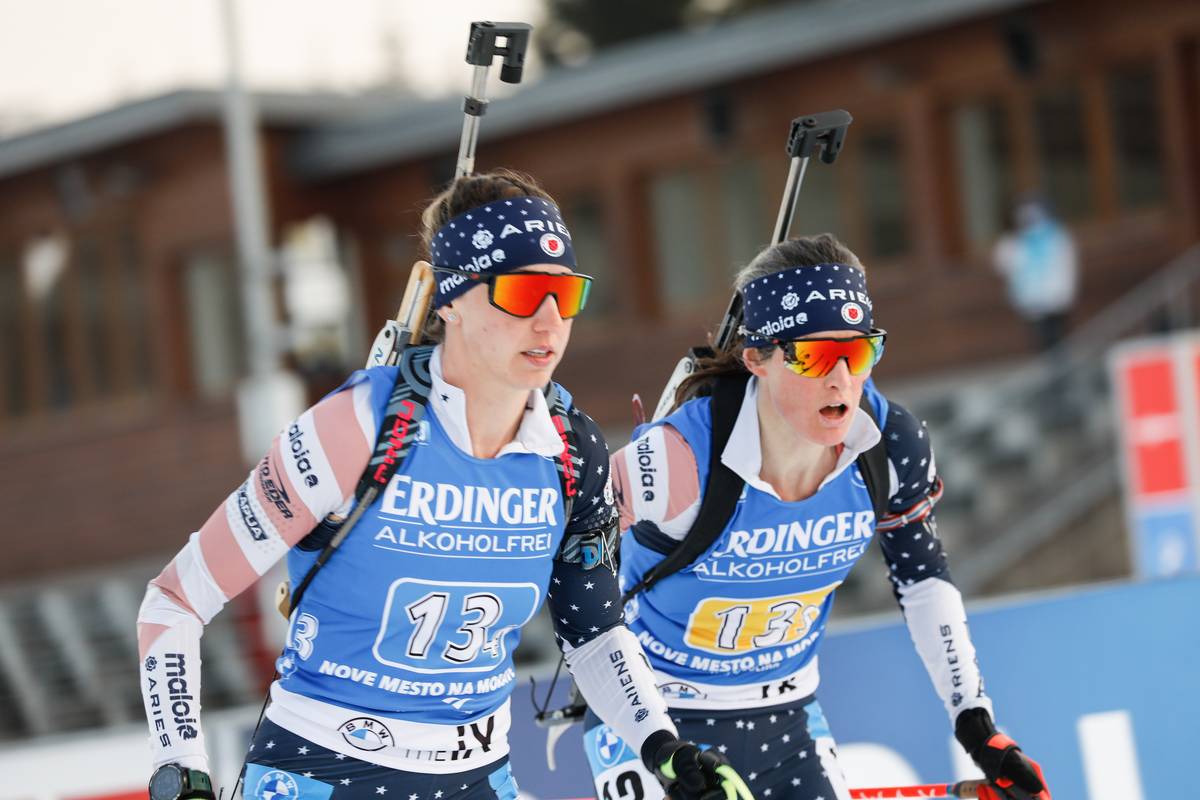
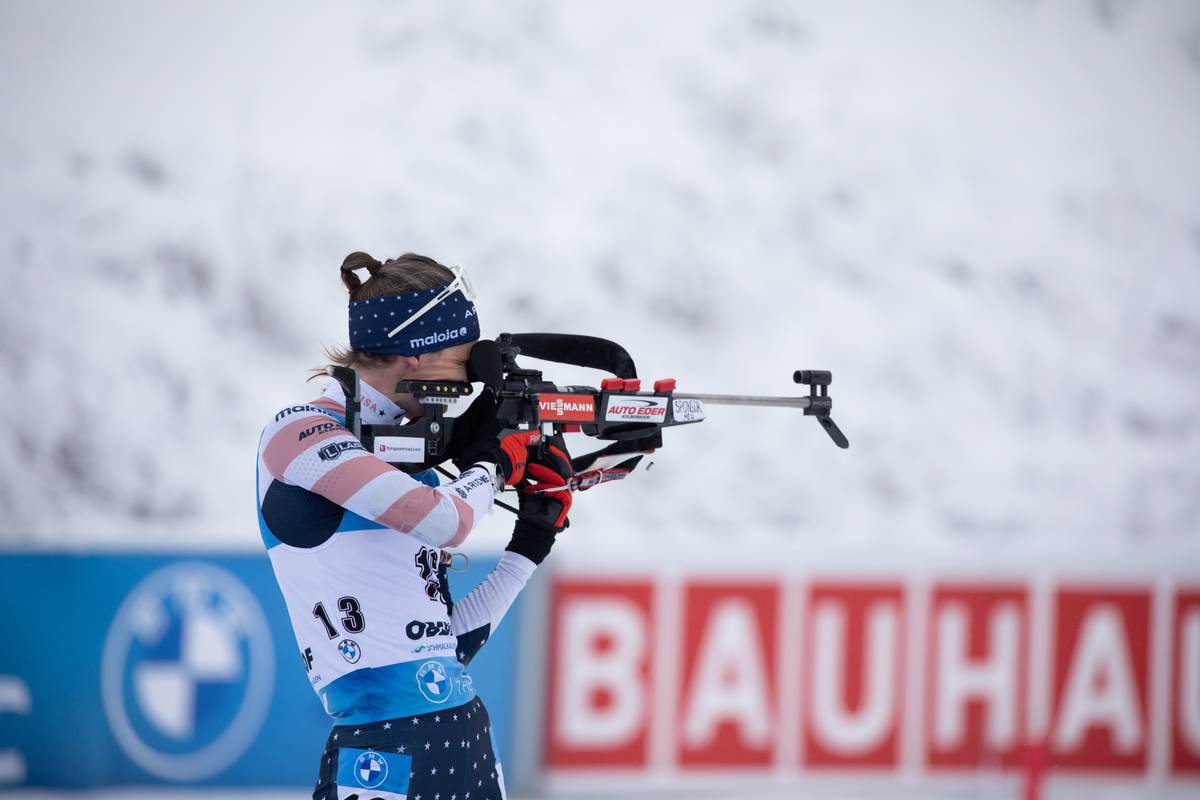
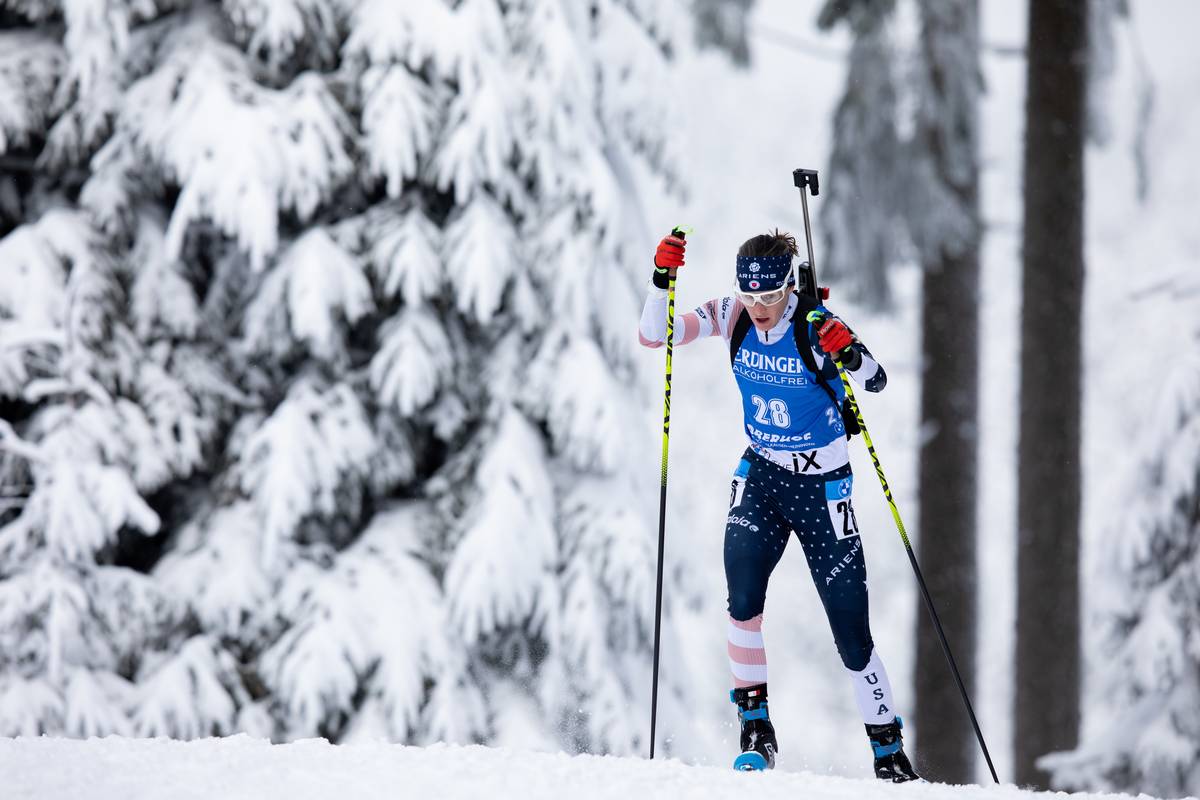
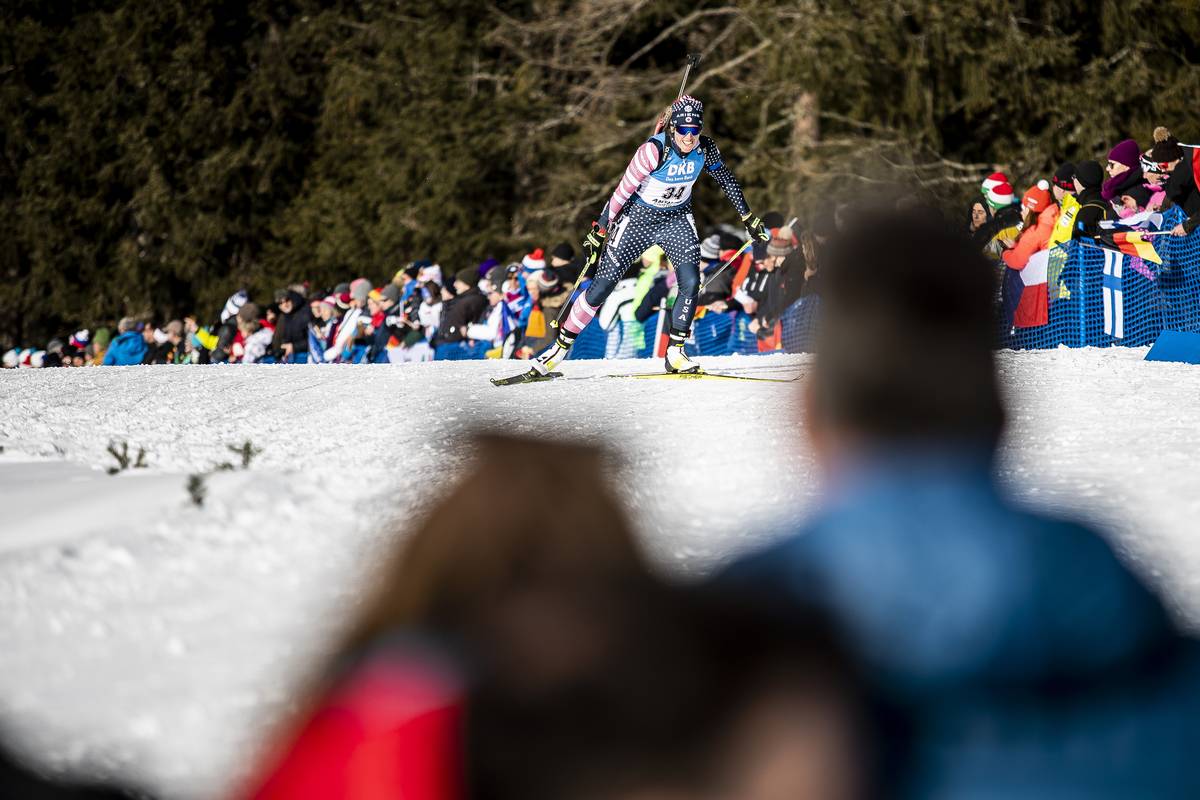
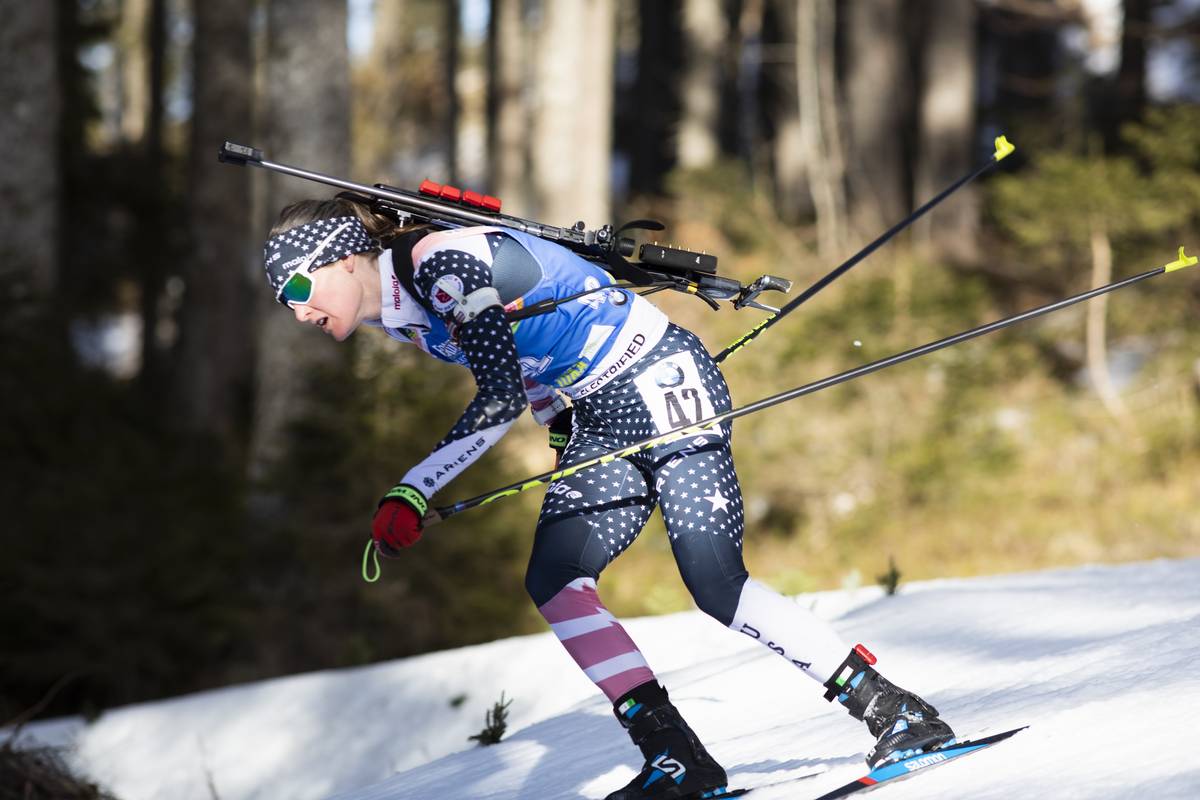
Clare Egan (USA) -(Photo: NordicFocus)
Egan, competing in her second Olympic Games, brought the U.S. team up to 15th place at the midway point despite using five spare rounds and incurring a penalty in standing. She tagged off to first-time Olympian Deedra Irwin (Pulaski, Wis./ National Guard Biathlon & USBA) who cleaned from prone and had a penalty and three spares in standing. Irwin made the final exchange to two-time Olympian Joanne Reid (Grand Junction, Colo.) in 13th position.
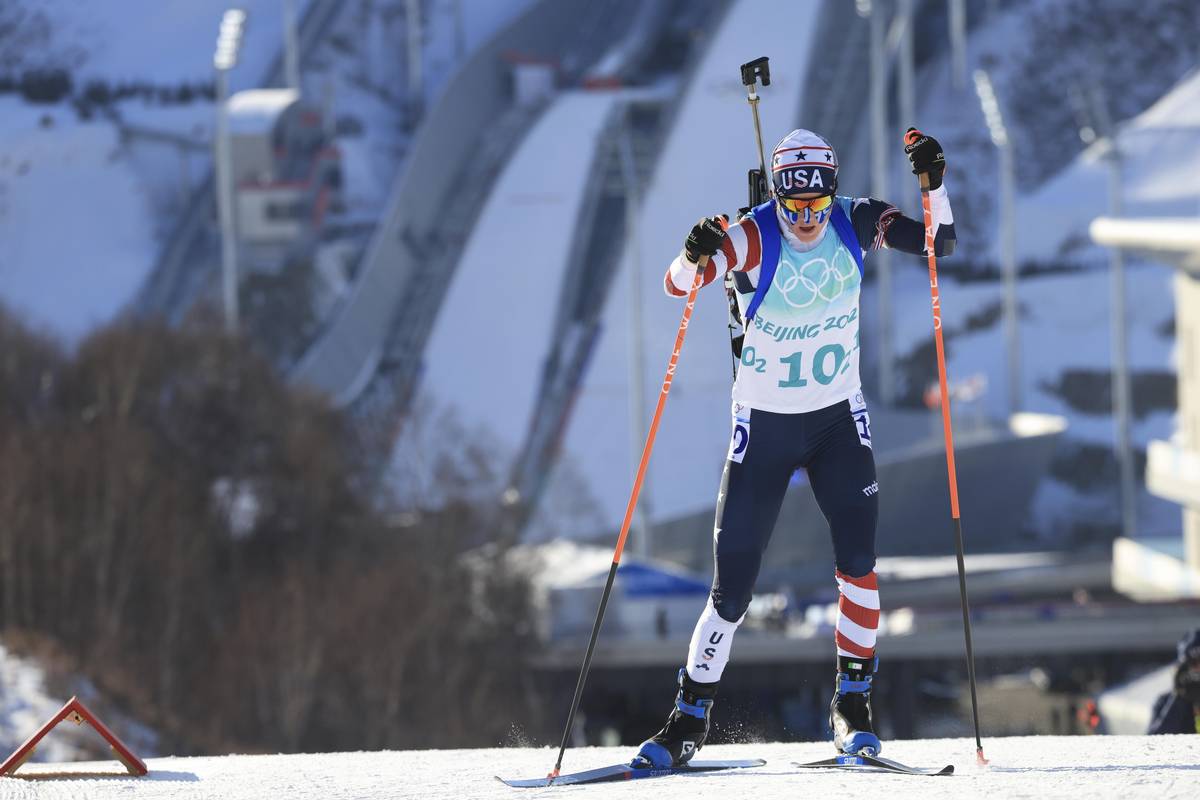
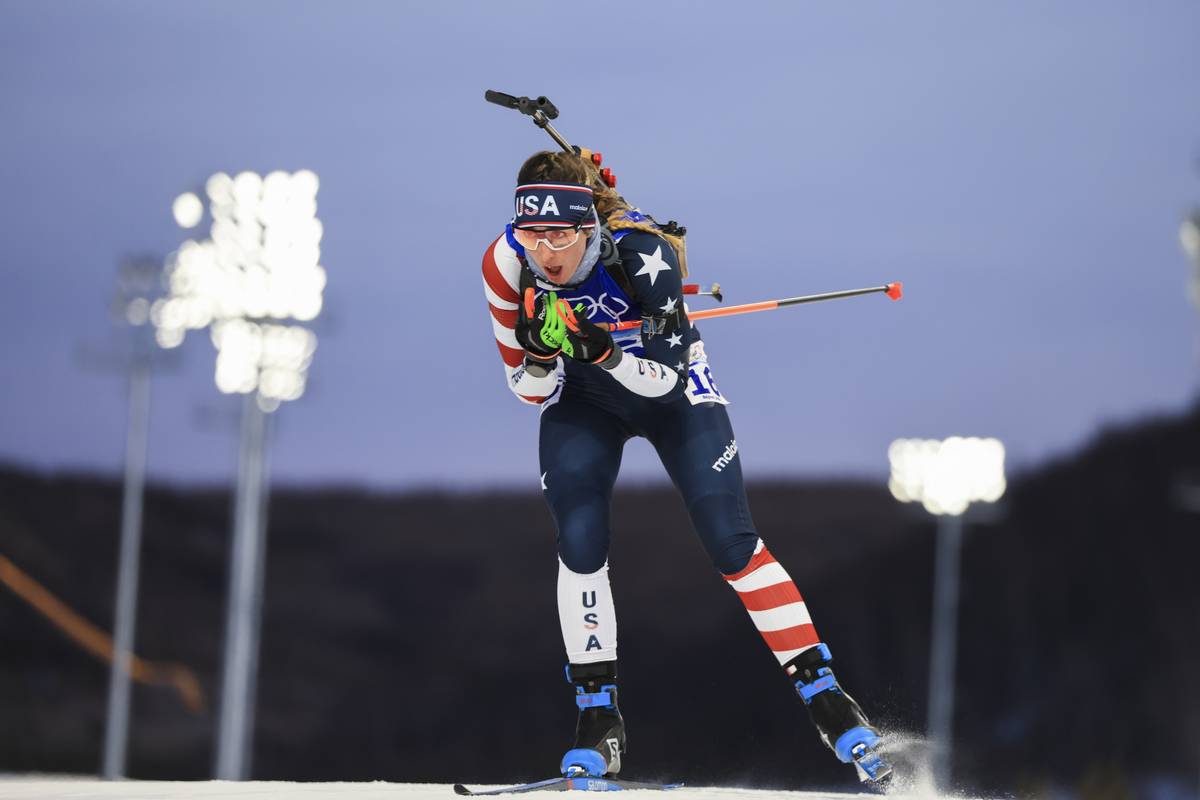
Deedra Irwin (USA) – (Photo: NordicFocus)
Reid turned in a fantastic final leg as she also cleaned prone and used just one spare in standing to move into 11th place at the finish, 4 minutes, 47.4 seconds back of the winning time.
After the race, Irwin spoke about the impact Dunklee and Egan have had on the sport.
“It was really awesome to see Susan clean the race and that was a good motivator,” Irwin said. “They’re just so inspirational…they’re trailblazers in U.S. Biathlon. I just hope to live up to the legacy they’ve created for this program. They’re definitely going to be missed in the future.”
Irwin now looks forward to Saturday’s mass start where she will toe the line with 29 other women in the 12.5km race, the final biathlon competition of the Beijing Games.
“I’m feeling a little better after how I skied today,” added Irwin. “I definitely was a little nervous after not feeling so hot in the sprint and pursuit with my legs, but today skiing felt really awesome and half of my shooting race went pretty well. I’m pretty excited to go into my first mass start ever. It’s going to be memorable to have it here and have my entire team out cheering me on.”
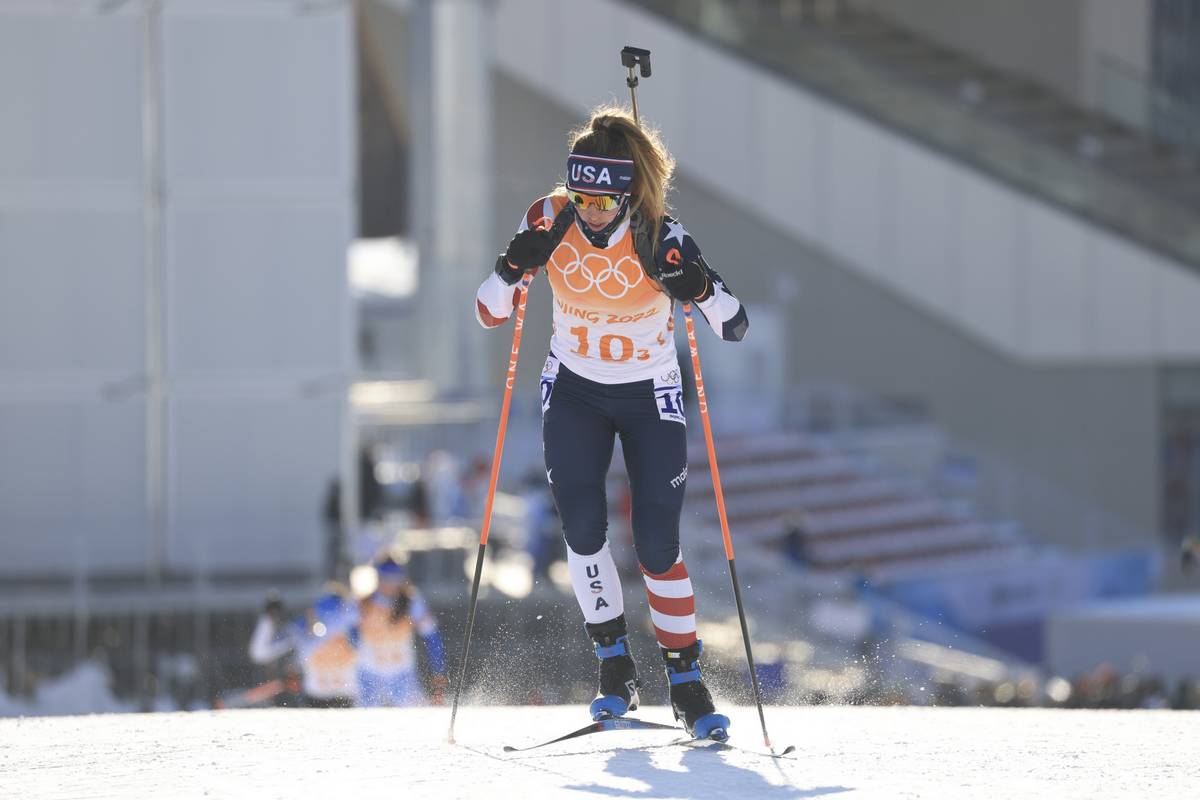
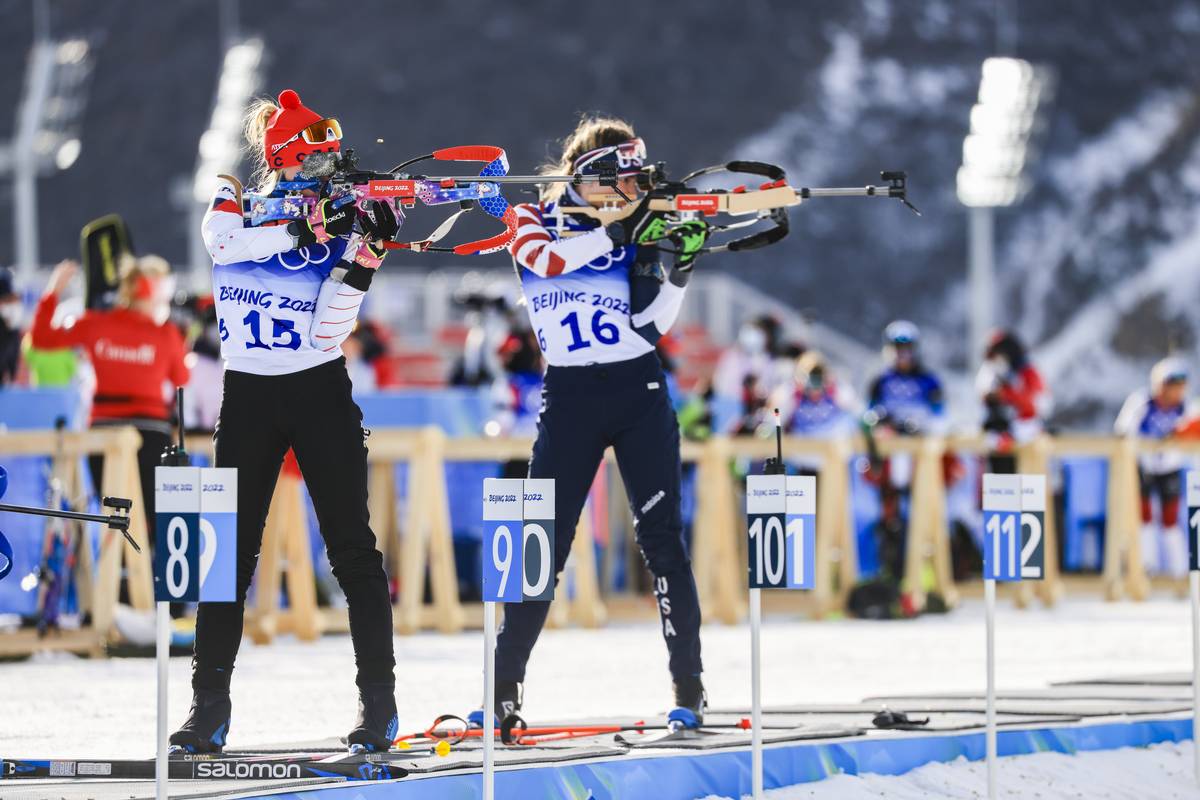
Joanne Reid (USA) -(Photo: NordicFocus)
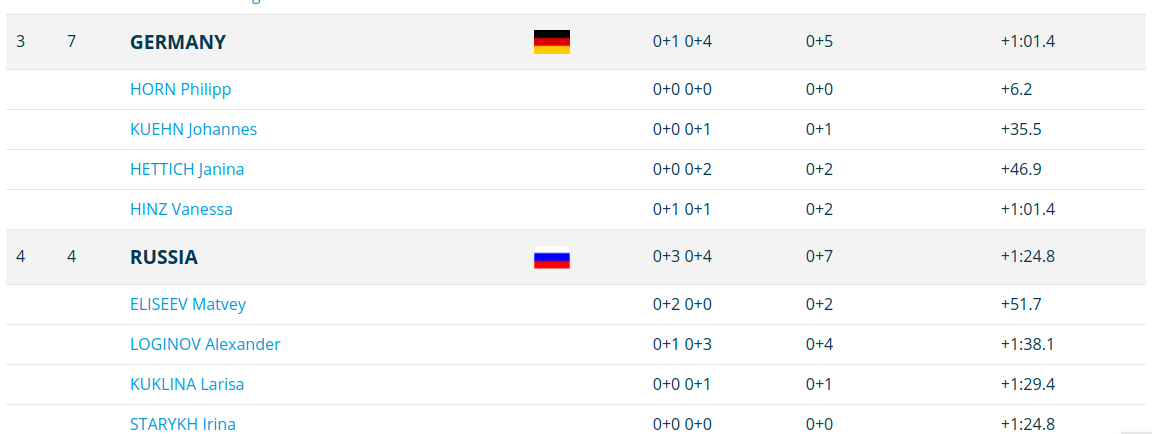
The Swedish quartet of Elvira and Hanna Oeberg, Mona Brorsson and Linn Persson used just six spare rounds to win the gold medal in 1:11:03.9. The silver medal went to the Russian Olympic Committee with one penalty and seven spares, 12 seconds back. Germany captured the bronze medal with six spare rounds, 37.4 seconds behind Sweden.
Check out the Watch Olympic Biathlon schedule for viewing options of all the races from Beijing. You can also follow all the action on the IBU app – download it today!
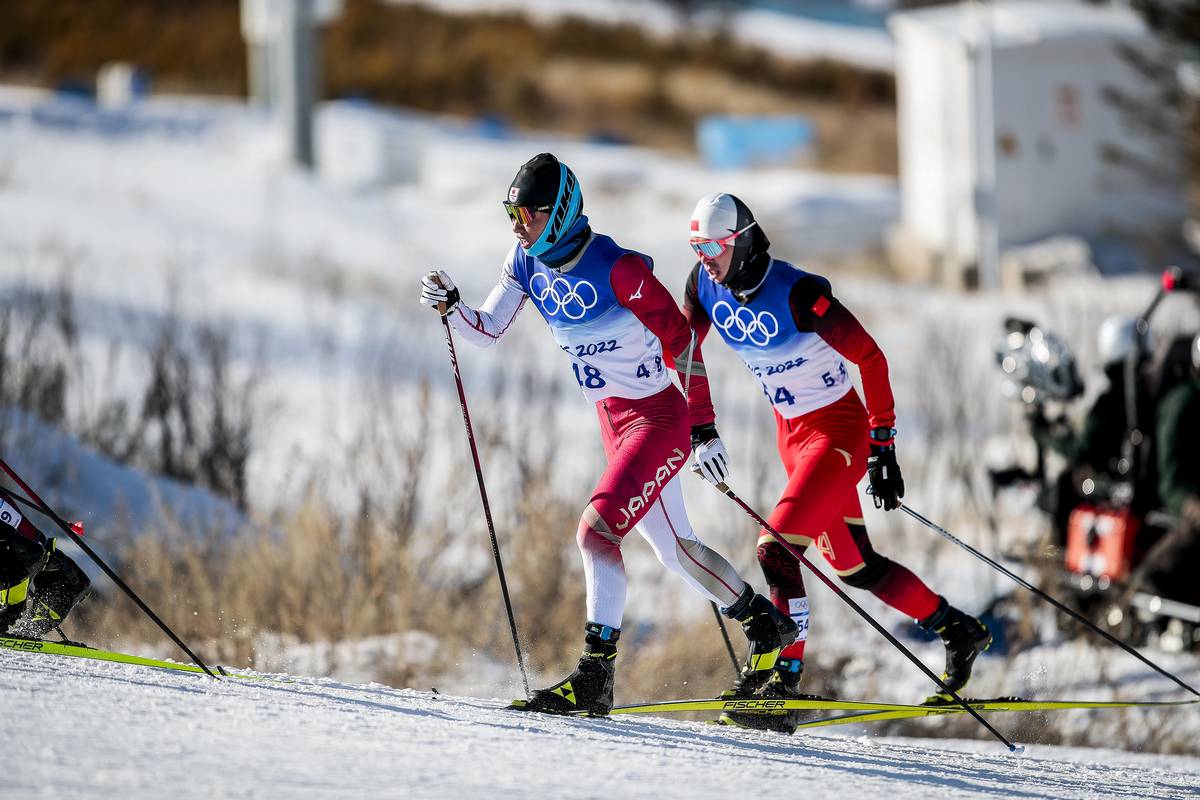
China’s Degen Chen races the men’s 30-kilometer skiathlon which opened the 2022 Beijing Olympic Winter Games. (Photo: NordicFocus)
Salmon for Skiing
Over the last four years China has undertaken perhaps the grandest experiment in cross country skiing history: can hundreds of athletes cherry picked from other sports and given seemingly unlimited resources be turned into Olympic medalists in nordic events?
Chinese athletes have never medaled in any of the nordic disciplines, and their teams head into the Olympics as the darkest of dark horses. Success, in the form of medals, is key to their aims of climbing up the medal table and becoming the protagonists of their own winter Games.
The Chinese nordic programs have aimed to rapidly become competitive with the best in the world. The urgency of the task was made clear at the 2018 PyeongChang Olympics where China finished fourteenth in the medal count, capturing a single gold medal, and just nine in total.
Despite this history, not everyone is dismissive of their chances.
“I said four years ago that I predict these guys will medal in Beijing,” said US biathlete Clare Egan in a call, “because I know that medals are important to China and that they basically will put any resources possible into making things happen like that. So nothing would surprise me.”
Even so, Egan conceded that, “It’s going to be hard for them, because they aren’t fast enough.”
The project of building a culture of skiing in China began in 2015 when Beijing was awarded the 2022 Winter Games. The government spurred into action: it would make 120 million of its citizens into recreational skiers by building 800 new ski areas, among them the world’s largest indoor center in Harbin that cost $4.5 billion.
Cross country skiing also benefited from the investment rush, with an 1.3 k indoor ski tunnel built in Beishan, a joint Finnish-China project that cost $148 million. Another cross country ski tunnel is planned to be placed inside an unused coal mine shaft on the outskirts of Beijing. Liu Bo, a former ski coach, told Reuters in 2018 that he was investing $318 million in the project.
Bo explained in the interview that the goal for Chinese skiing, aimed at the Olympics, was clear: “China spends big money setting up the stage, and the performers are all foreigners,” said Bo. “President Xi will not allow this to happen.We have to be the leading actor in 2022.”
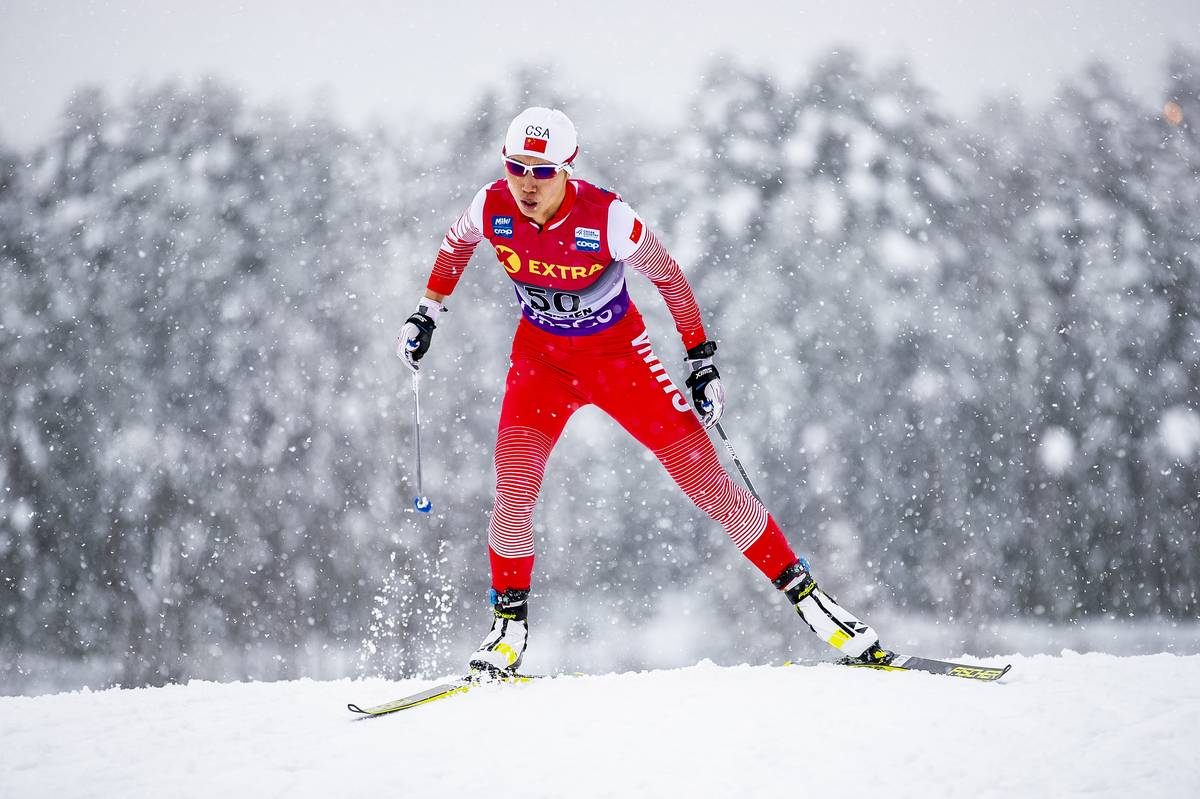
Xin Li (CHN) races a freestyle sprint qualifier in Konnerud, NOR in March, 2020. (Photo: NordicFocus)
While the ski resort boom was mainly aimed at creating a ski culture in China, taking on a starring role in Beijing meant that expertise would be needed from abroad. For guidance, officials looked to the top of the medal table: Norway.
Initially, it was impossible for China to work with Norway. When the Olympics were awarded to Beijing in 2015 the two countries were still embroiled in a diplomatic crisis that had severed official contact between the nations and frozen trade negotiations. The rupture occurred in 2010 when the Nobel Peace Prize was awarded in Oslo to Li Xiaobo, a Chinese human rights activist who was then imprisoned in China. At the Nobel ceremony, Xiaobo was evocatively symbolized by an empty chair on the stage.
In response, China all but severed diplomatic ties with Norway, despite the government’s lack of control over the Nobel committee. Two months later China halted the importation of fresh Norwegian salmon – a significant industry – over what was generally regarded as a politically motivated concern over a fish-borne virus.
The ban, as well as other restrictions, are believed to have cost Norway between $780 million to $1.3 billion between 2010 and 2017. At the time of the contentious Nobel ceremony, Norway had enjoyed a virtual monopoly over the Chinese salmon market, and the country’s fisheries had to watch as Chinese demand for salmon increased by thirty percent, while their share plummeted by two thirds.
Years of cautious steps by the Norwegian government followed, including its first ever refusal to meet with the Dalai Lama during his 2014 visit to Norway. Norway’s socialist left party leader Audun Lysbakken criticized this move in The Guardian, saying, “We can’t be dictated to by China in the sense of exchanging human rights for salmon.”
That fall, Oslo – the favorite for the 2022 Games – dropped out, paving the way for Beijing to win the bid the following summer. With the Games in hand, the calculus changed, and the rift with Norway became an awkward obstacle to their objectives.
A subtle indication of rapprochement came in an unusual way: Gerhard Heiberg, a Norwegian businessman headed the IOC’s Marketing Commission, and was offered a meeting on a 2016 trip to Beijing with the Chinese Minister of Sport, Gou Zhongwen.
The minister marveled at Norway’s success in skiing, Heiberg recounted to NRK, “He said that those at the top in China had agreed that they would like an agreement with Norway on a sports collaboration. And from the Chinese side, there was a desire to use Norwegian leaders, coaches, universities and so on who worked with winter sports.”
Heiberg recognized the moment. “I saw that here we have a fantastic opportunity to approach China.” Not wanting to waste the favorable winds, Heiberg left the meeting and “went straight to [Ambassador] Svein Sæther. And he lit positively on all the plugs.”
With some quiet maneuvering, relations thawed, and Norway and China signed a bilateral agreement to resume diplomatic relations in December 2016. The agreement conceded that Norway would not challenge China on its “core interests and major concerns” — a diplomatic term for avoiding involvement in sensitive issues, including human rights.
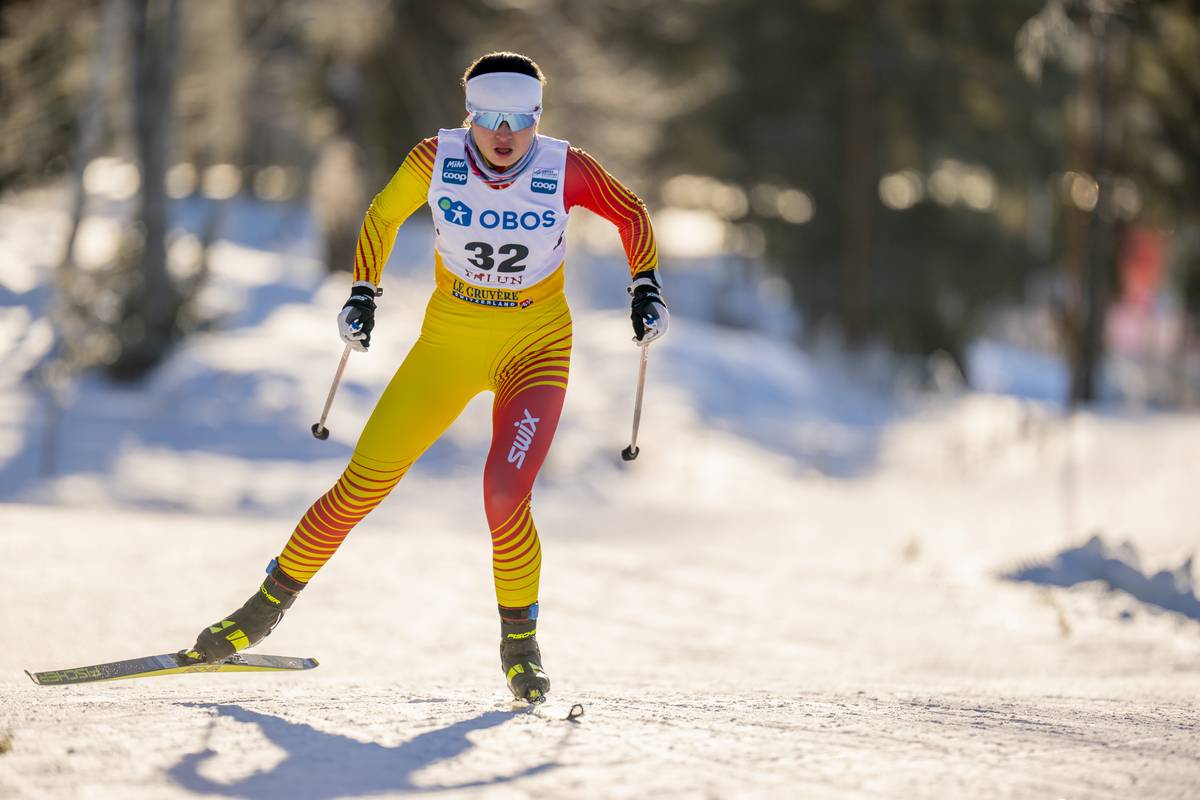
Dinigeer Yilamujiang (CHN) races a 10 k freestyle in Falun, Sweden in January, 2021. (Photo: NordicFocus)
That winter the Norwegian Ski Association was asked to help look for coaches to work in China and offered salaries of 1.1 million kroner (equivalent to $120,000) per year. China also wanted to send its athletes to Norway, but to do so, it would need to put to rest their feud.
In April 2017, Norwegian Prime Minister Erna Solberg visited Beijing, officially ending the freeze. Solberg reestablished the relationship in part by signing an agreement with China to support their sporting endeavors, particularly in nordic sports, through to the Beijing Olympics. The agreement would provide China with Norwegian ski coaches, training opportunities, as well as sporting development and snow making expertise. In return, Norway received the opportunity to optimize“Norwegian preparations for the Olympics.”
This deft piece of ski diplomacy helped to seal a seafood trade agreement with China the following month that planned to see Norway export $1.4 billion worth of salmon alone to China by 2025. The long awaited reentry to the Chinese market had arrived, and if there were any lingering questions about human rights, Per Sandberg, Norway’s Minister of Fisheries wasn’t having it. He told Aftenposten that “Norway addresses human rights in very many contexts… this time it’s fish.”
Ski diplomacy started with Stolberg’s agreement with China, and was reaffirmed the following year when King Harald visited China, signifying the complete normalization of relations while taking in a rollerskiing race at Beijing’s Olympic Park.
Despite the apparent connection between the sporting pact and the trade deals, the Norwegian Prime Minister denied the two items were related. In any case, the agreement caught the Norwegian Sports Confederation by surprise. Oddvar Jenssen, the former VP of the organization, said in an interview with Aftenposten that the decision “…came terribly fast, and a lot was in place before we knew anything. When the agreement came up, we had no choice.”
Misgivings aside, for Norwegian ski coaches, wax techs, and sport scientists, the Chinese agreement would turn into a major employment opportunity, with around 40 coaches and techs working for Chinese training groups, and around 60 more occasionally hired for short stints. No longer were the job opportunities going to be contingent on moving to China, the athletes would now be coming to Norway.
Arrival in Norway
The sporting agreement between Norway and China took on new force after China’s dismal performance in the 2018 Olympics. Afterward, the Chinese Ministry of Sport went looking for coaching help abroad. Many nations vied for contracts, but Norway was the first stop for Gou Zhongwen.
In May of 2018, Zhongwen met with Johannes Klæbo on his tour of Trøndelag – the region that has won more Olympic medals than any other – and solidified the agreement to bring athletes to Norway.
In July, ten of China’s core World Cup athletes arrived in Trondheim, Norway to begin training for the World Cup with former Montana State University skier Bernhard Rønning.
It was the prelude to an influx of more than 200 young Chinese athletes to Norway in the late summer and fall of 2018.
In addition to the Trondheim group, another was set up in Meråker, under the leadership of former Canadian National Team Coach Tor-Arne Hetland. In Lillehammer a group was led by Kristen Størmer Steira (wife of FasterSkier podcaster Devon Kershaw) and finally one in Trysil led by the mother/daughter combo of Anita Moen and Karoline Moen Guidon.
Anita Moen’s experience illustrates the slapdash nature of the project. In mid July of 2018 she was on vacationing on a beach when her phone rang. It was an offer to coach Chinese skiers until the 2022 Games.
“It was only two weeks until they were to arrive,” Moen told NRK “… I did not quite know who was coming, but I was told they had never skied before, never seen snow.”
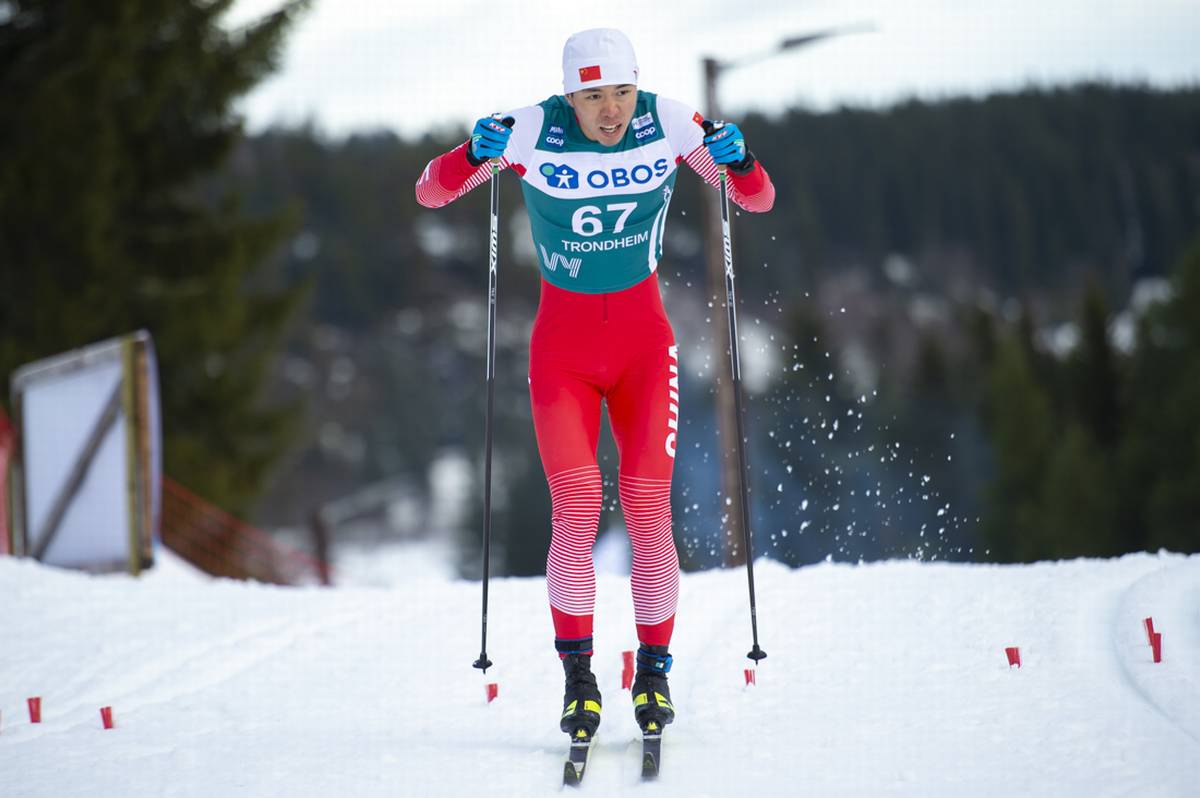
Jincai Shang (CHN) races a classic sprint qualifier in Trondheim, NOR during Ski Tour 2020. (Photo: NordicFocus)
While China mobilized to send loads of athletes to Norway, their plans didn’t stop there. After Minister Zhongwen left Norway, he flew with his entourage directly to Finland. Waiting for him at the airport was Veiko Hallonen, the CEO of the Vuokatti Sports College.
Vuokatti offered excellent training opportunities: a long winter, a ski tunnel, knowledgeable coaches, and sophisticated technology that impressed the officials. Perhaps Zhongwen was also mindful of the warmer diplomatic climes in Finland. Ni Huizong, the Director of the Winter Sports Administrative Center told Yle, “Relations between Finland and China have a long and warm history.”
Chinese athletes had been training in Vuokatti since 2016, but the agreement established a permanent Chinese presence at the Vuokatti center and increased the total number of athletes that would stay in Finland.
The head cross country coach in Vuokatti at that time was Glenn Lindholm, who met with the Chinese delegation and was asked directly whether four years were enough to turn novices into Olympic champions. Lindholm’s response was neither yes nor no.
Lindholm must have understood the unlikely prospect of delivering medals by the next Olympics. Still, the project may have seemed crazy enough to work. Vuokatti was about to get more than 130 hand picked Chinese athletes, an almost unlimited pot of money to work with, and just under four years to produce a medalist.
It was audacious, and too bold to resist. As Lindholm and others would learn, realism, a pandemic, and decisions made in the halls of power of Beijing would frustrate their plans.
Deedra Irwin competes in the Women’s 15km Individual race during the 2022 Beijing Olympic Games. (Photo: Nordic Focus)
BEIJING, China (Feb. 5, 2022) – Things don’t always go according to plan, but occasionally someone can exceed even her wildest expectations.
Such was the case for Deedra Irwin of Pulaski, Wisconsin, who on Monday turned in the best Olympic performance ever by an American biathlete, finishing seventh in the women’s 15-kilometer individual event at the Zhangjiakou National Biathlon Centre northwest of Beijing.
“I was trying to focus on just working on everything I’ve worked on this week,” said Irwin, who is competing in her first Olympic Winter Games, “really skiing the course well and staying calm on the range and being ready for anything — with wind or whatever.
“I had a good game plan, and I was able to execute it. Everything came together. I had no idea how I was doing, and I was just in my zone, and it worked — what the heck.”
Deedra Irwin competes in the Women’s 15km Individual race during the 2022 Beijing Olympic Games. (Photo: Nordic Focus)
What the heck, indeed. Irwin skied and shot with the world’s best biathletes, ultimately finishing just 1 minute, 1.4 seconds behind gold medalist Denise Herrmann of Germany. Anais Chevalier-Bouchet of France claimed the silver medal, and Norway’s Marte Olsbu Roeiseland took the bronze medal.
Irwin’s American teammates, Clare Egan, Joanne Reid and Susan Dunklee, placed 39th, 57th and 63rd, respectively.
Irwin’s stunning performance also came two days after the U.S. biathlon team of Dunklee, Egan, Sean Doherty and Paul Schommer posted the best-ever American finish in the 4×6-kilometer mixed relay event. The U.S. placed seventh in 1:08:58.3.
Nothing Monday seemed to faze Irwin, who moved up to fifth place at the 9-kilometer mark. Not even a miss during the event’s final shooting range.
“It’s something I’ve been working on all week because of the wind, just really trying to focus on one shot at a time,” Irwin said. “What was really nice is it wasn’t windy today. It was actually really calm.
“So even though I missed that shot, I still had that mentality of just one shot at a time, make good shots.”
Deedra Irwin (right) competes in the Women’s 15km Individual race during the 2022 Beijing Olympic Games. (Photo: Nordic Focus)
That enabled Irwin to finish strong.
“To be able to hit those last two, I was just really happy that I was able to keep the focus and concentrate,” Irwin said. “(It’s) something I’ve definitely been working on a lot since last year, to just in general increase my shooting percentage.”
The 29-year-old Irwin, a member of the Vermont Army National Guard, had a skiing and running background but didn’t try biathlon until 2017, when she attended a talent identification camp at Lake Placid, New York.
*****
Check out the Watch Olympic Biathlon schedule for viewing options of all the races from Beijing. You can also follow all the action on the IBU app – download it today!
Bob Reinert spent 17 years writing sports for The Boston Globe. He also served as a sports information director at Saint Anselm College and Phillips Exeter Academy. He is a contributor to TeamUSA.org on behalf of Red Line Editorial, Inc.
The American team of Susan Dunklee, Clare Egan, Seah Doherty, and Paul Schommer took seventh in the mixed relay to match the best U.S. Olympic result in the event. (Photo: NordicFocus)
BEIJING, China (Feb. 5, 2022) – The American quartet of Susan Dunklee Craftsbury, Vt./Craftsbury Green Racing Project & USBA), Clare Egan (Cape Elizabeth, Maine/Craftsbury Green Racing Project & USBA), Sean Doherty (Center Conway, N.H./National Guard Biathlon & USBA) and Paul Schommer (Appleton, Wis./Team Crosscut & USABA) finished seventh in the mixed relay Saturday as the Beijing 2020 Winter Games biathlon competition got underway at the Zhangjiakou National Biathlon Center. The result tied the best-ever finish for Team USA in an Olympic mixed relay, equaling their seventh place at the Sochi 2014 Winter Games. The U.S. finished 15th four years ago in PyeongChang, Korea.
The race began under clear skies but with gusty winds cutting across the shooting range.
Starting toward the back of the field in the 19th position, Dunklee used three spare rounds in prone and another two spares in standing but moved the U.S. into 10th position as she made the first exchange with Egan.
“This is one of the coldest races we’ve seen in a few years,” said Dunklee. “Just keeping your hands warm enough to be able to handle the rifle and magazines is really tough. And we’ve got some crazy winds and I think that’s throwing a lot of people off. The important thing was I stayed out of the penalty loop and I tagged off enough in the mix that Clare was really able to take it and run with it.”
Egan turned in the second-fastest second leg with just one spare in prone and clean shooting in standing. She left the range in third place just ahead of Sweden Elvira Oeberg and made the tag for the third leg to Doherty in fourth place, 29 seconds back of the leader France.
“This is certainly a great way for me to start the 2022 Olympics,” Egan said. “Our skis were excellent. Our wax techs have really been working hard. They’ve come here twice in preparation for the Olympics, getting some research done on the snow and how they can best prep our skis, and that really paid off today. I worked really hard to stay with people out on the track to be able to draft which is really important when there’s this much wind, and I managed on the shooting range really well so I’m really satisfied with my race.”
Clare Egan helps the Americans to seventh place in the opening mixed relay during the 2022 Winter Olympics. (Photo: NordicFocus)
Doherty mirrored Egan’s marksmanship on the range, needing just one spare in prone and cleaning standing in just 53.8 seconds of range time, the fastest time in the field for the third leg. His performance maintained fourth position for the Americans as he made the final exchange to Schommer, just 18.5 seconds back of the lead and a mere 1.2 seconds out of medal contention.
“I wasn’t that close to second place when I came into shooting,” Doherty said of his standing stage. “The focus was all on the target and I came out there and I was like ‘Let’s see how fast we can get this last lap done.’ It was fun to have made that great stage and make those shots count.”
Schommer, in the first Olympic competition of his career, ended up with a penalty in prone but finished strong with two spares in standing to bring the team home in seventh, 2 minutes, 12.7 seconds back.
“It’s always a bummer to do loops in the relay,” said Schommer of his penalty in prone. “It’s always a goal to stay out of the penalty loop but at the end of the day, it’s still biathlon. The wind switched on me in the last shooting and it just made it difficult. The same luck for us that we got early on seems like the other teams got at the end. I think we’re in a really great spot as a team. I think we’re fit. I think our shooting is really good. We’ve had a lot of good work here in the wind at this venue and there’s a lot of chances still to have that success that we’re really hoping for.”
Paul Schommer competes in the Mixed Relay during the 2022 Beijing Olympic Games. (Photo: Nordic Focus)
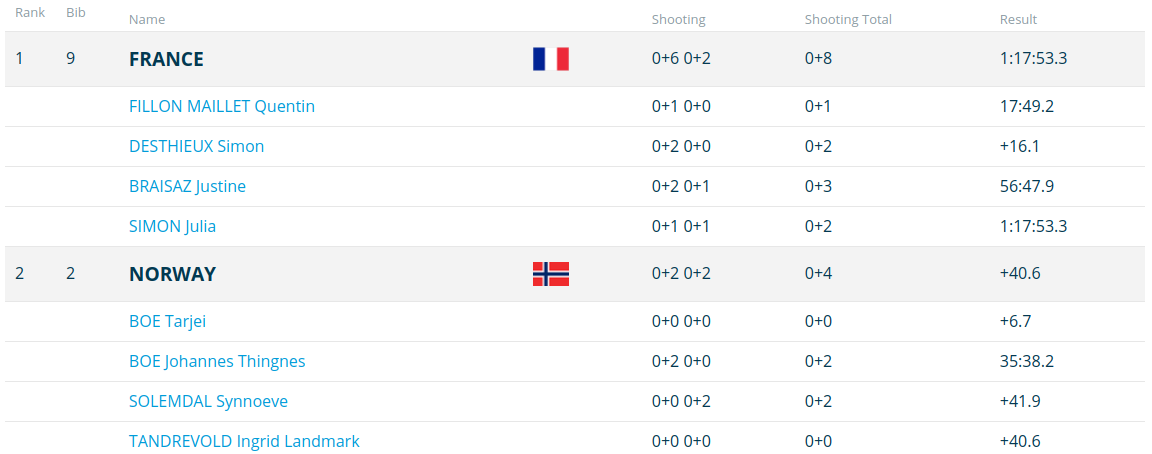
Norway’s Johannes Thingnes Boe sprinted past Russian Olympic Committee’s Eduard Latypov in the final 100 meters to give Norway the first biathlon gold medal of the Games. Boe teamed with Marte Olsbu Roeiseland, Tiril Eckhoff and his brother, Tarjei Boe, for a time of 1:06:45.6, with three penalties and 13 spare rounds. France, the 2018 gold medalists, also moved past the ROC team to take silver, just 0.9 seconds back, with the ROC claiming bronze, 1.5 seconds behind Norway.
After a rest day on Sunday, the biathlon competition will resume Monday with the women’s 15-kilometer individual beginning at 4:00 a.m. EST.
Mixed Relay results
1.
Norway (Roeiseland, Eckhoff, J.T. Boe, T. Boe)
1:06:45.6/3+13
2.
France (Chevalier-Bouchet, Simon, Jacquelin, Fillon Maillet)
+0.9/3+11
3.
ROC (Nigmatullina, Reztsova, Loginov, Latypov)
+1.5/1+13
7.
USA (Dunklee, Egan, Doherty, Schommer)
+2:12.7/1+12
Check out the Watch Olympic Biathlon schedule for viewing options of all the races from Beijing. You can also follow all the action on the IBU app – download it today!
Biathlon Event Schedule for Beijing 2022 Olympic Games (all times EST)
Saturday, Feb. 5
4:00 am – Mixed relay
Monday, Feb. 7
4:00 am – Women’s 15km individual
Tuesday, Feb. 8
3:30 am – Men’s 20km individual
Friday, Feb. 11
4:00 am – Women’s 7.5km sprint
Saturday, Feb. 12
4:00 am – Men’s 10km sprint
Sunday, Feb. 13
4:00 am – Women’s 10km pursuit
5:45 am – Men’s 12.5km pursuit
Tuesday, Feb. 15
4:00 am – Men’s 4×7.5km relay
Wednesday, Feb. 16
2:45 am – Women’s 4x6km relay
Friday, Feb. 18
4:00 am – Men’s 15km mass start
Saturday, Feb. 19
4:00 am – Women’s 12.5km mass start
About US Biathlon
US Biathlon is an Olympic sports organization that fosters the growth of the biathlon community in the U.S., developing athletes with integrity and achieving international and Olympic success. US Biathlon’s vision is to stand atop the international biathlon stage and be a leading organization for supporting athletes and clubs, prioritizing athlete well-being, and acting with integrity.
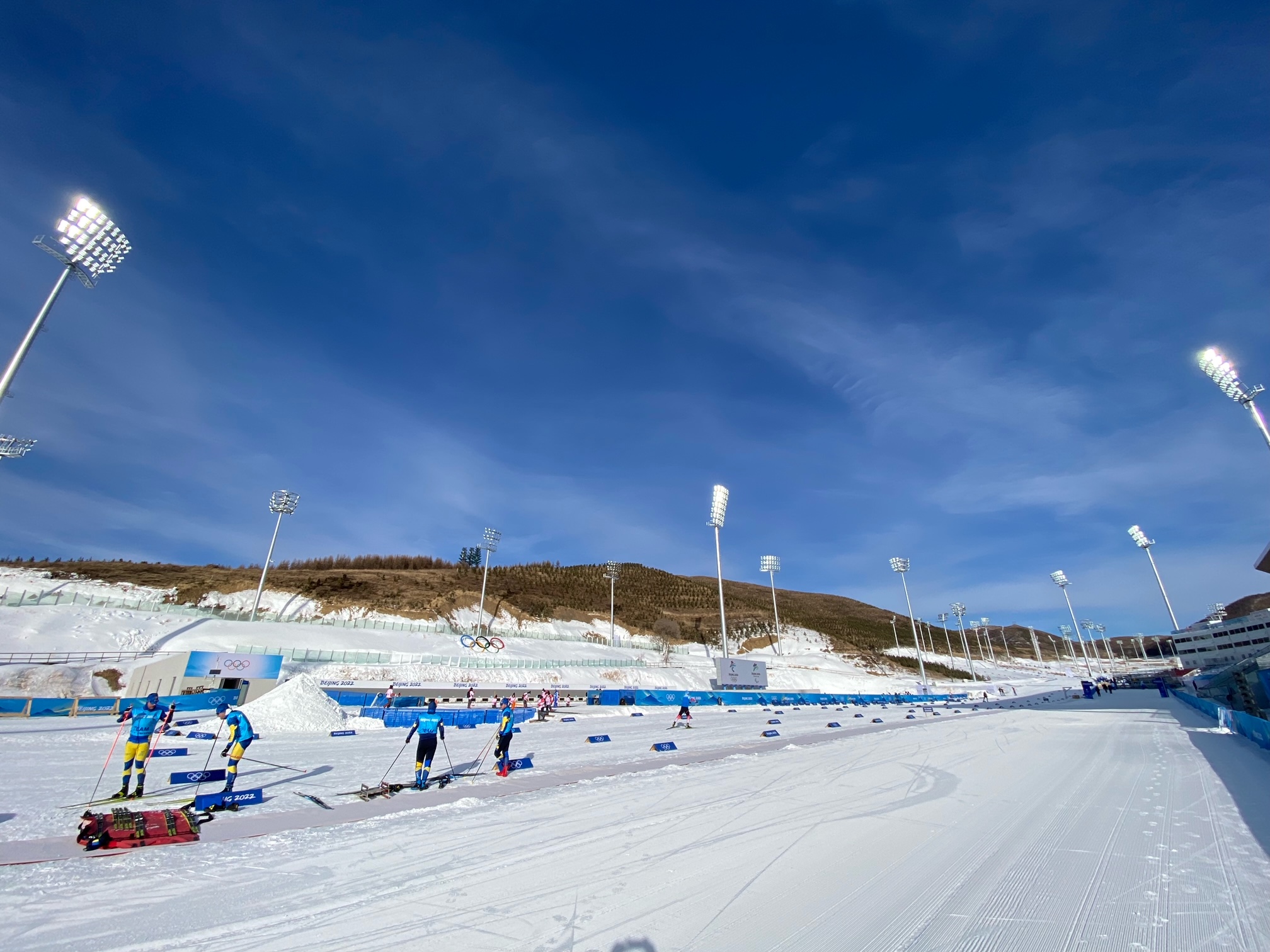
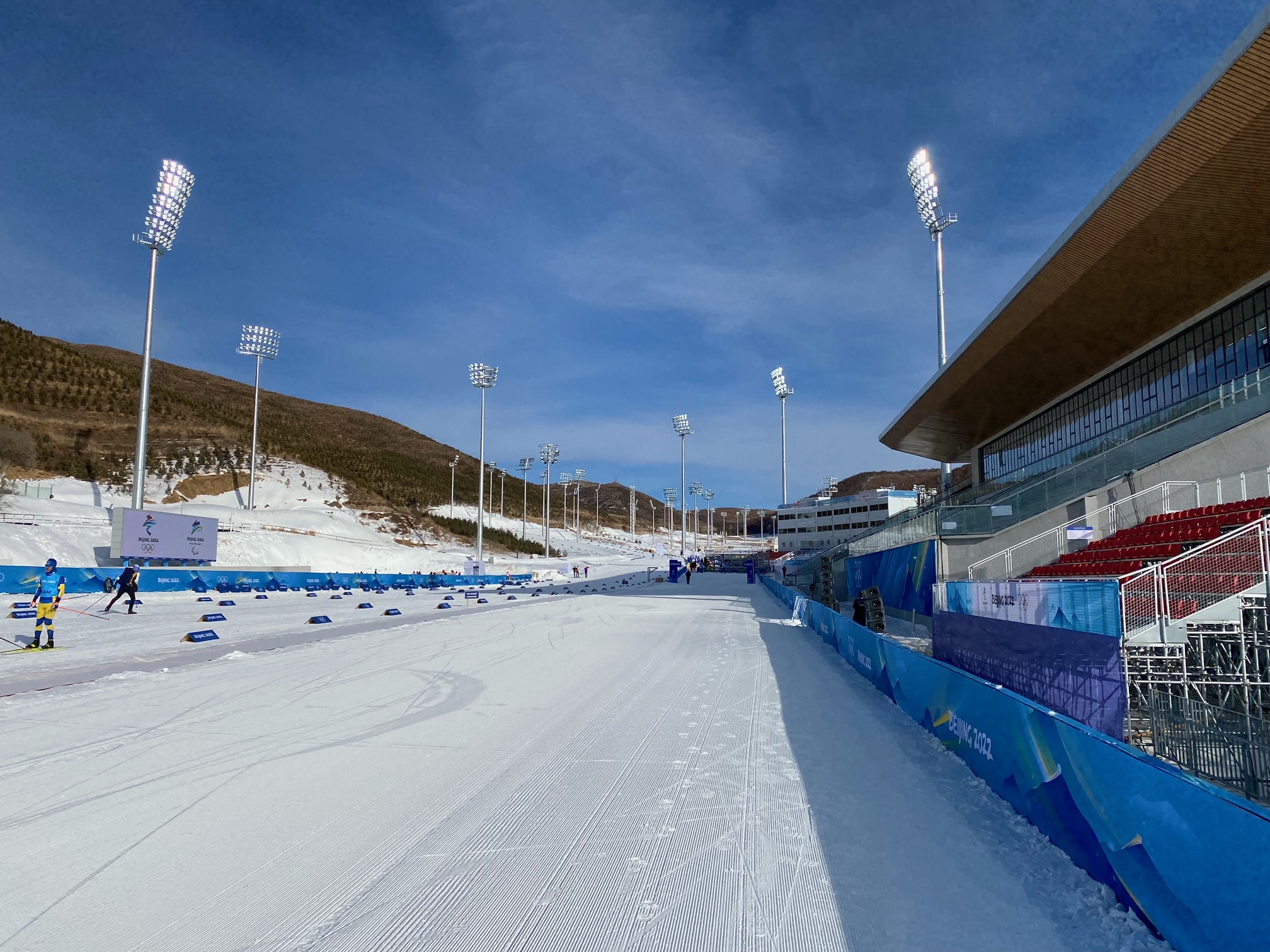
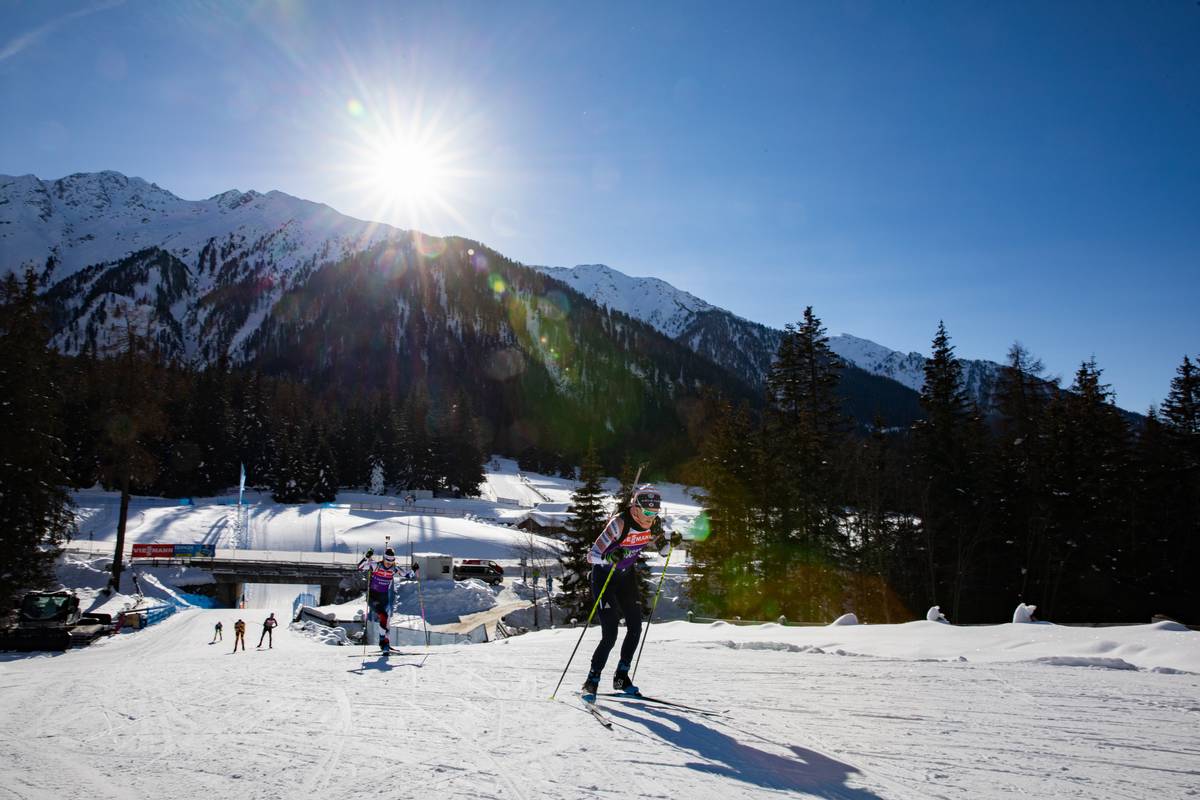
A scene from the biathlon stadium in Zhangjiakou. (Photo: Federico Fontana, US Biathlon)
The ski trails at the Zhangjiakou Olympic venue – completed during the pandemic – will be seen with fresh eyes for most athletes and service staff as they arrive ahead of the 2022 Games. For service teams that often prepare years in advance of an Olympics, the uncertainty surrounding Zhangjiakou, from its weather to its snow, is a new phenomena. What is certain is that climatically, there is the potential for some very interesting conditions.
Clare Egan of the US Biathlon Team said, “we know it’s going to be really cold and really windy, and pretty bad conditions generally for biathlon, but we’re gonna make the best of it, I guess.”
Ole Einar Bjørndalen, Head Coach of the Chinese Biathlon Team who spent all of last winter with the team in China, told NRK that it was a struggle to manage training during weeks of thirty below temperatures. Then, in March and April, three sandstorms blew through, filling the sky all the way to Beijing with a thick ocre haze of desert particulate.
Meteorologically, Zhangjiakou is not situated in an enviable position. The ski trails are nestled in an open valley within a high arid plateau. This mountain range is the first barrier in the path of Siberian winds that blow out of the Lake Baikal Basin—one of the coldest areas on earth—and across the Mongolian Steppe and the desert of Inner Mongolia. If the winds are strong enough, they pick up sand and grit and deposit their cargo along the way.
A sandstorm, should one occur, would be a dramatic twist at the Olympics. Anders Högberg, coach of the Swedish men’s national team, has experienced sand snow while racing in China. “I have, in Inner Mongolia, skied when sand colored the snow yellow,” Högberg said in an interview with the Swedish publication Aftonbladet. “…If there is a sandstorm in the middle of a competition, it will probably be canceled or moved forward, but I can imagine that [there] will still be a mixture of sand in the snow.”
Former Danish skier Troels Hein Bünger raced in China during his career and described the snow as being so dry “that you cannot make an honest snowball. If sand is added, the quality of the substrate will only get worse.”
Bünger said the effect was the same as rubbing sandpaper across the skis. He believed that the Games have the potential to be “the slowest Olympics in recent times,”comparable only to races in the wooden ski era.
While dirty snow will certainly be a concern among service crews, plans are in place to tackle the problem, built on experience from previous sandy championships such as PyeongChang 2018 and Oberstdorf 2021.
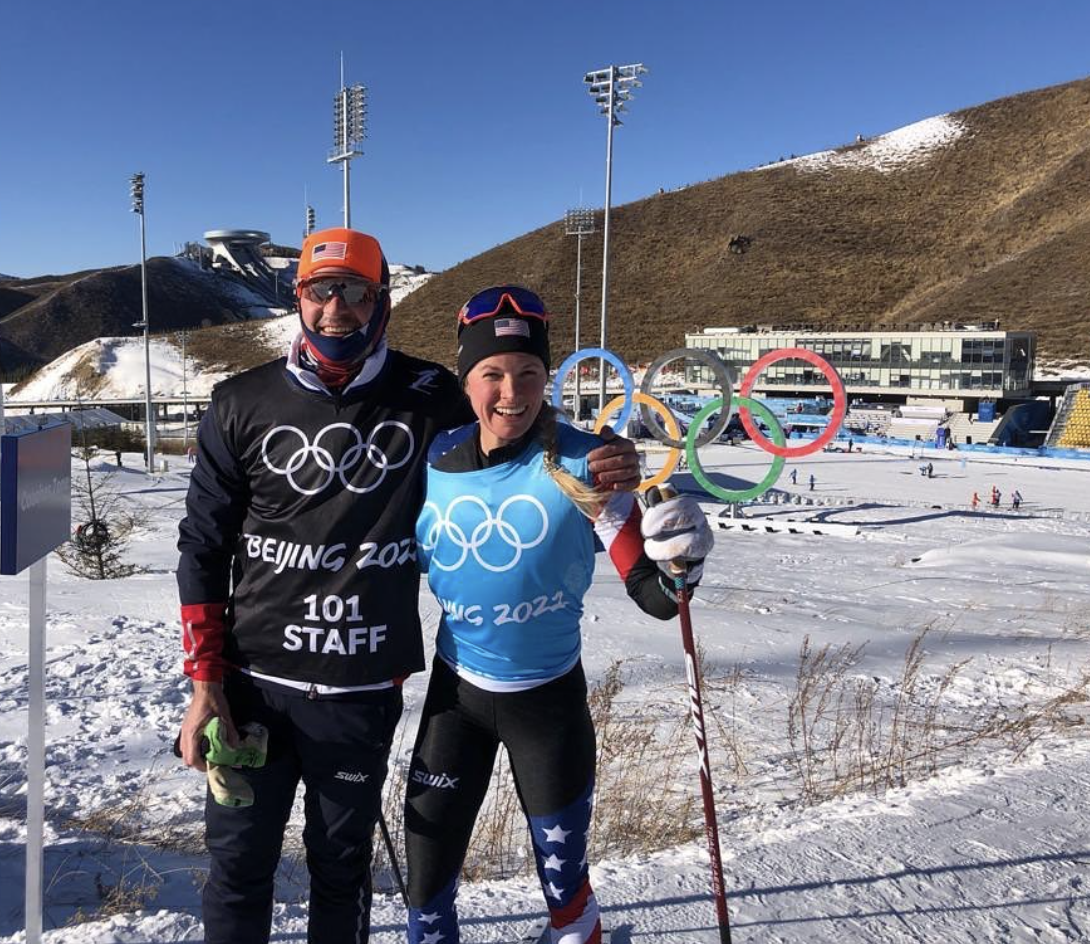
Jessie Diggins and her coach and wax tech Jason Cork snap a photo in front of the Olympic rings after a first intensity session at the Olympic venue in Zhangjiakou. (Photo: Instagram @jessiediggins)
US Ski Team Coach Jason Cork said in an email that the team is not “especially worried about the ‘sand’ at the venue. We’ve gotten reports that it’s similar to PyeongChang – snow which is dirty with fine particulate, rather than large grains. We’ll deal with it the same way we deal with dirty snow all over the world: Good cleaning of the skis after they’ve been used, and a lot of testing to identify waxes and structures which repel the contamination as much as possible.”
Staff on the Finnish ski team went a step further during their reconnaissance trip in late December. The Finns took snow samples to be melted and carried home for analysis. “I don’t know how much it will ultimately benefit, but everything possible needs to be done,” Logistics Manager Matti Haavisto said to Yle. “We want to know what particles are in the snow, what kind of contaminants. The snow is dirtier here than in Europe.”
Tobias Dahl Fenre, head of ski service for the Norwegian Biathlon team, suggested to NRK that the procedure at the Beijing Olympics for his team would be much the same as in PyeongChang: Daily grinding of skis.
For nations without a grinder on site, this could pose a problem.
One way to address the problem is to send over a vast quantity of skis. This is the method embraced by the Norwegian alpine team, according to NRK. Due to the labor of grinding and tuning alpine skis, they have opted to send as many as 70 pairs per athlete, a number Norwegian skier Aleksander Aamodt Kilde calls “completely crazy.”
While Zhangjiakou may be known for biting cold snaps, brisk sand laden winds, and almost no natural snowfall, that is not always the rule. Conditions may also be ideal, with sunny warm days and cold nights. In an interview with a Finnish news outlet, Teemu Lemmettylä, a biomechanist who visited the site in December on behalf of the Finnish Ski Association, described perfect conditions: overnight temperatures fell to 14 Fahrenheit and warmed in the day to around freezing.
In any case, to the service teams’ advantage is the likelihood the snow will be entirely artificial. Zhangjiakou receives only a few centimeters of natural snow per winter, meaning the trails will have a uniformity not always seen at other sites where natural and artificial snow meld. The consistency of the snow has allowed Norway to look for solutions at home.
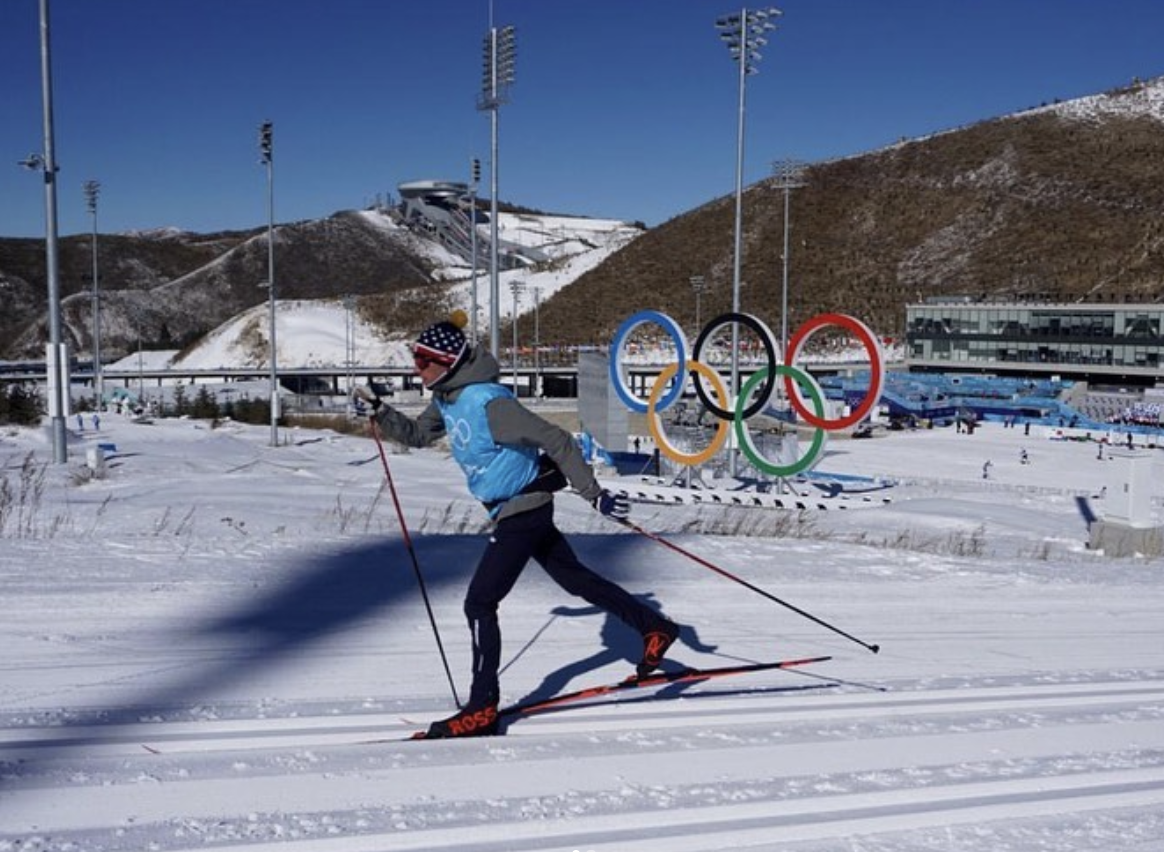
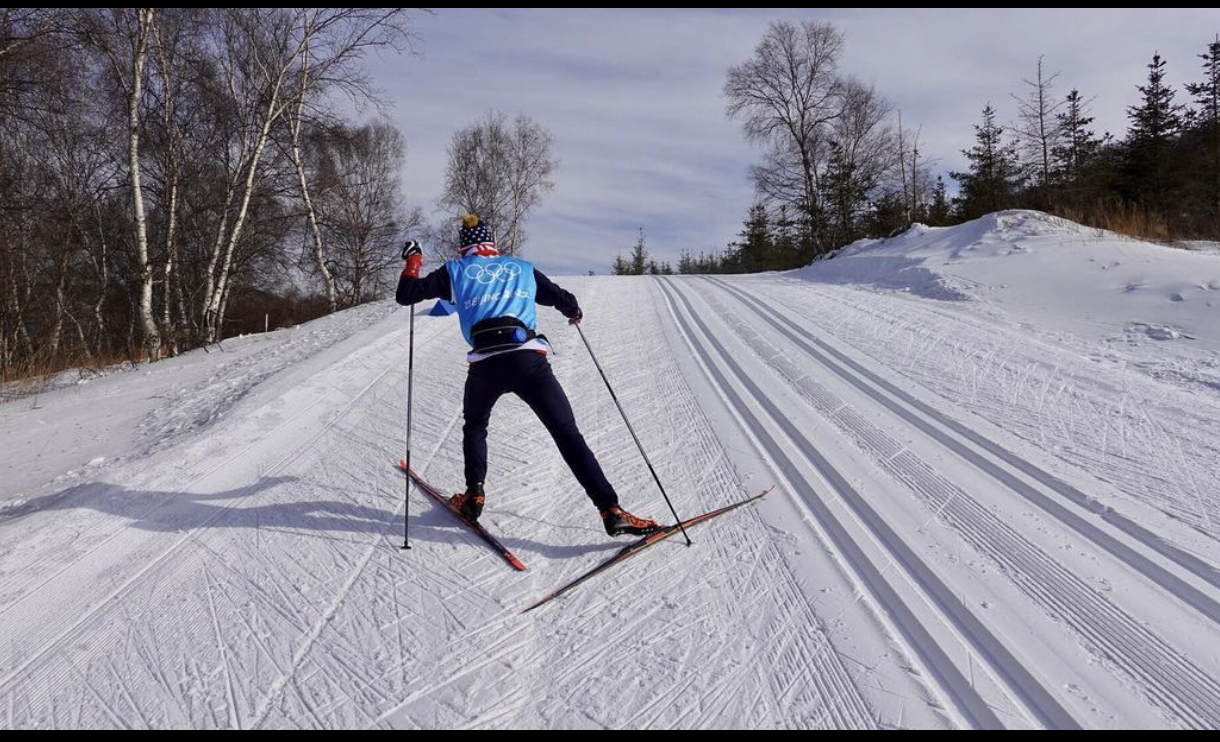
Scott Patterson trains on the Olympic courses after arriving in Zhangjiakou. (Photo: Instagram @scottgpatterson)
This poses an odd conundrum for wax teams, as the ‘unthinkable scenario is not necessarily a sandstorm, but natural snowfall,’ as Norwegian Cross County Director Espen Bjervig put it to Aftonbladet.
Bjervig also outlined his most dire service concern at the Olympics: “What we fear most is that there is some natural snow and that it can blow sand into the track. We have no experience [with] that. It’s new.”
Yet all is not easy with snow making at Zhangjiakou either. Reuters interviewed Jacques Fournier, a Swiss snowmaker working at the cross country venue. “The main challenge is to make the snow as wet as possible in the drier local conditions to keep it on the track,” Fournier said, along with controlling “the evaporation during the snow production and [making] sure to store it in the track as compactly as possible.”
Snow that is made too dry will either disappear, or fail to bond together, and allow the winds to blow it away. The solution is wet, sticky snow that is heavily compacted by grooming to withstand the winds.
As a result, snowmaking in the local conditions requires more water than usual. The ground must be soaked first to freeze the ground, and much water is lost to both evaporation and winds.
The reliance on snowmaking at the 2022 Olympics, which is essentially being held in a cold desert, has been criticized from an environmental standpoint. Staging the Games will reportedly require estimates of between 49 and 528 million gallons of water over the various venues. If the later estimate is accurate, it would be enough water to blow snow on a twenty foot wide trail for more than 4,000 kilometers — a use of water resources that has been questioned considering that the region relies in part on water pipelines and desalination plants to supply its needs.
For athletes, the altitude of Zhangjiakou has been a priority for preparations over the last two years. The trails are at an elevation between 5,419 feet to 5,643 feet. The venue is strikingly similar in design and setting to Soldier Hollow in Utah, and designed by the same person: John Aalberg. In terms of elevation, Soldier Hollow trails average 100 feet higher than Zhangjiakou.
In an email to FasterSkier, John Aalberg noted the resemblance of the two venues: “Of all the [Olympic] courses in the last 24 years (since I have been involved in Games courses), the 2022 courses are most similar to the Soldier Hollow courses. Perhaps this is because I designed/co-designed both of them, but the terrain, elevation, and climate are also quite similar. Both courses are very spectator friendly, have ‘skiable’ uphills (good for diagonal striding), etc.”
If anything, Aalberg improved upon the course design of Soldier Hollow, writing, “I was able to design an even better finish for these 2022 courses, with both a long uphill (similar to Hermod’s Hill), an exciting downhill right above the stadium, and a small uphill coming into the stadium (the high speed coming into the Soldier Hollow stadium is not optimal).”
Aalberg also listed the features that he thought made the upcoming Olympic venue unique: “a ‘velodrome’ downhill corner coming back down towards the stadium leading up to the final 500 meters,” as well as wide and “fair” uphills, a “quite easy sprint course” that is the same for both men and women, and the “tens of thousands of trees planted adjacent to the courses.”
Scott Patterson trains on the Olympic courses after arriving in Zhangjiakou. (Photo: Instagram @scottgpatterson)
For ski service crews, mundane issues may be the most pressing. In an interview with ABC News in Norway, Fenre, the head of Norway’s biathlon team, said “snow conditions are definitely what worries me the least. I am most concerned about logistics and that we get wax and equipment through customs. If we are in China at the right time with the right equipment, I am very happy.”
To that end, Finland sent a grinder and wax supplies to China in October, and teams have acknowledged that a resupply during the Games may not be possible.
In December many teams, including US Biathlon, sent service staff to investigate the venue in China for the first time. Prior to that, the only information available to athletes was a video taken by the team that installed the biathlon targets last winter. The snowmobile video “circulated quite a bit,” said Clare Egan. “Between that and the course map and profile map you can get an idea.”
In Finland, preparations went further. The Vuokatti Ski Team built a virtual race track with expertise from local universities. Katri Lylynperä skied the virtual track so many times she told Yle that she “already knows the track…”
Information on the course has arrived in the US Biathlon camp after the team’s wax techs traveled to China the week after Christmas and “took a [ton] of pictures and video,” Egan said.
That course intel was shared with the US Ski Team, according to Jason Cork, who wrote, “We’ve spent a lot of time looking at the course homologation maps to help identify training courses that come close to the climbs we’ll see there.”
Weather conditions are also on the mind of US Ski Team coaches. “Of course, we’re watching the weather reports and forecasts a lot,” wrote Cork. “We’re going into the venue with about as much information as every other team (barring the Chinese), so I don’t think we’re at any disadvantage.”
Federico Fontana, the head of race service for the US Biathlon Team described the biathlon trail in an email to FasterSkier from the Olympic venue. “The course is technical, and challenging, we don’t really have long and extremely steep climbs, but a lot of transition and false flat parts.” Fontana added, “In my opinion a very crucial part of the course is the part behind the range before the fast downhill [heading to] the final 200m or range entrance.” It is there, Fontana thought, that many races will be decided.
A scene from the biathlon stadium in Zhangjiakou. (Photo: Federico Fontana, US Biathlon)
Wind will be a key factor in biathlon, “not just for shooting but for skiing as well,” wrote Fontana, who described a consistent wind blowing through the valley. In the first half of the course biathletes will enjoy a tailwind, but when they turn back to the stadium and range there will be a strong headwind.
“In December when [we were] here testing skis we “had every day [a] strong wind,” wrote Fontana, adding, “and it‘s a very cold wind! Skiing alone back to the stadium can be a problem. It’s a very challenging course, not for everyone.”
While many teams placed a premium on an early reconnaissance of the Zhangjiakou, Stein Olav Snesrud, head of Norway’s cross country service team told ABC News in Norway that he doubted the early tests would be very relevant to the conditions the athletes will experience in February. “What we have learned is that a lot happens… throughout January,” he said. “It has been shown… that the conditions you test long before a championship are not necessarily the ones that apply when the Olympics are held. There was a big difference [in conditions] before the Olympics in [PyeongChang]… and then it was completely different [at] the Olympics.”
Whatever the conditions occur at the Zhangjiakou venue over the course of the Olympic Games, surprises are likely to await.
Joanne Reid (USA) celebrates historic relay result in Antholz (ITA). (Photo: NordicFocus)
In the final women’s relay competition before the Beijing 2022 Olympic Games, the 14th ranked U.S. Women’s Biathlon Team raced to a fifth-place finish in Saturday’s 4×6-kilometer event at the BMW IBU World Cup in Antholz. It marked the best relay finish for the women’s team in a World Cup since 1994 when the U.S. took the silver medal in Canmore, Alberta, Canada. However, today’s performance bettered that race 28 years ago in terms of time behind as they finished 50.1 seconds back of first place today compared to 57.3 seconds behind in 1994.
“I’ve dreamed of a top-5 women’s relay for over a decade,” three-time Olympian Susan Dunklee (Craftsbury, Vt./Craftsbury Green Racing Project & USBA) said after the race.
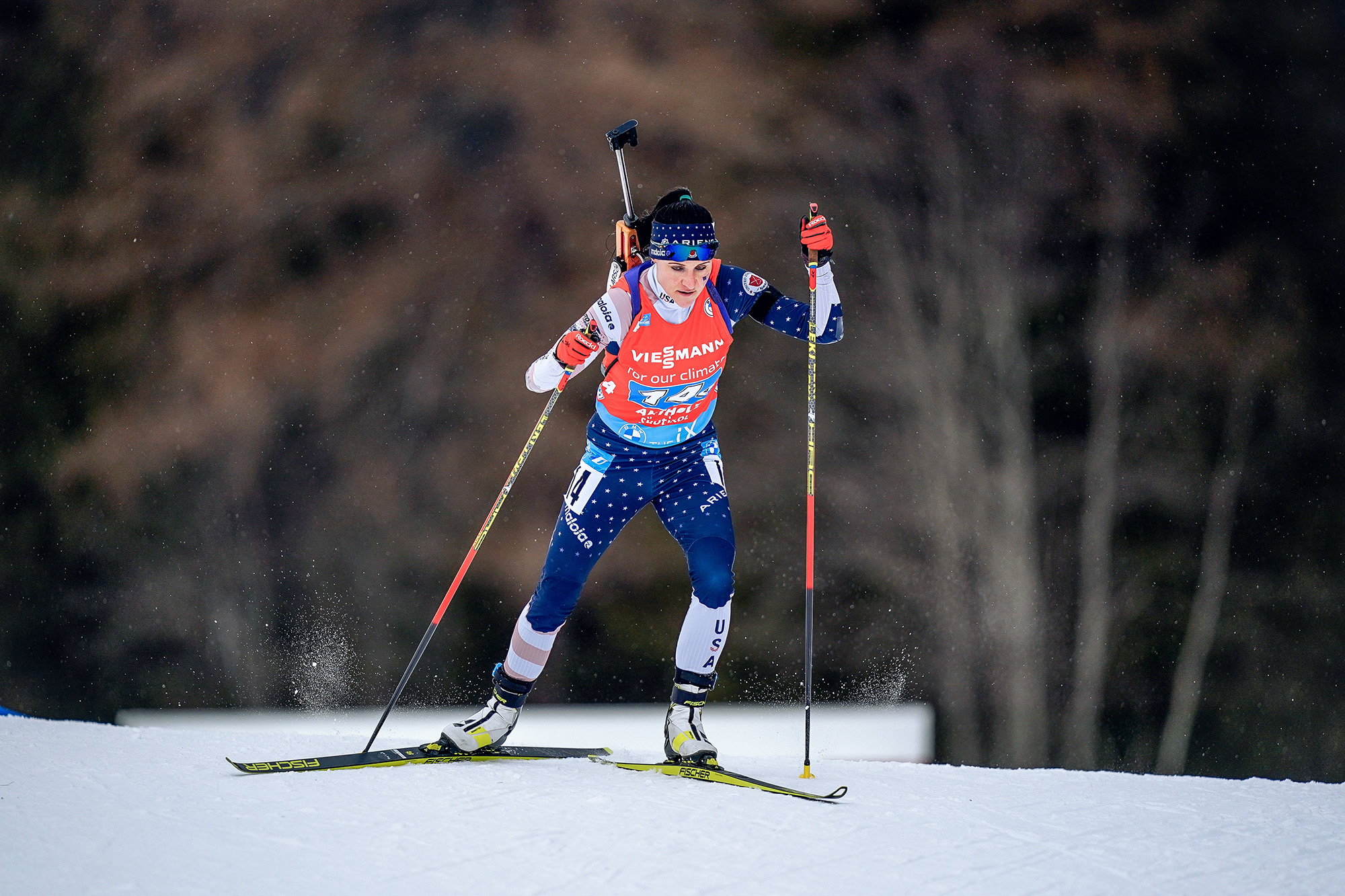
Susan Dunklee (USA) keeps the United States in it during the first leg of the relay in Antholz (ITA). (Photo: NordicFocus)
Dunklee kicked off the relay using one spare round in prone and two spares in standing. She made the first exchange with 2018 Olympian Clare Egan (Cape Elizabeth, Maine/Craftsbury Green Racing Project & USBA) with the U.S. team in 12th place, 41.6 seconds back of the leader.
Clare Egan (USA) holds strong during the second leg of the relay in Antholz (ITA). (Photo: NordicFocus)
Egan, heading into her second Olympic Games, brought the American squad up to 10th place after needing three spares in prone and two in standing on her second leg.
“It’s great to improve on our sixth-place from last winter as we head into the Olympics,” said Egan, referring to last season’s World Cup relay performance in Nove Mesto, Czech Republic.
Deedra Irwin (USA) keeps the US team within striking distance during the third leg of the relay in Antholz (ITA). (Photo: NordicFocus)
Deedra Irwin (Pulaski, Wis./National Guard Biathlon & USBA), the lone rookie on this year’s Olympic team, went clean in prone and used three spare rounds in standing to vault the team into medal contention at the final exchange. Irwin tagged off the anchor leg to Joanne Reid (Grand Junction, Colo.) in seventh place, a mere 27.6 seconds out of first.
Joanne Reid (USA) anchors the US to 5th place in Antholz (ITA). (Photo: NordicFocus)
Reid, a 2018 Olympian, was solid on the range needing just one spare in prone and another in standing. She brought the team home in fifth place, 50.1 seconds back of gold-medal winning Norway. Russia took second and France edged Italy for third in a photo finish.
“I think it’s really encouraging that we were within 20 seconds of Italy and France – two of the top teams – with the same shooting,” added Egan.
Joanne Reid and Deedra Irwin (USA), (l-r) celebrate at the finish in Antholz (ITA). (Photo: NordicFocus)
Earlier in the day, Paul Schommer (Appleton, Wis./Team Crosscut & USBA) finished 22nd in the men’s 15km mass start, the first mass start of his career.
The World Cup in Antholz wraps up Sunday with the men’s 4×7.5km relay followed by Egan competing in the women’s 12.5km mass start on the heels of her fourth-place finish in Friday’s 15km individual.
Catch the action live on Peacock with Chad Salmela and USBA President & CEO Max Cobb commentating live from Antholz. Download the IBU App to keep track of all your favorite athletes! BMW IBU World Cup – Antholz, Italy (all times Eastern)
Sunday, Jan. 23
6:15 am – Men’s 4×7.5km relay
9:15 am – Women’s 12.5km mass start
Clare Egan races to fourth place in the 15km Women’s Individual competition in Antholz, Italy. (Photo: NordicFocus)
Antholz, ITA – US Biathlon Team and Craftsbury Green Racing Project athlete Clare Egan (Cape Elizabeth, Maine) grabbed the second-best finish of her career with a fourth place in Friday’s 15km Women’s Individual competition in Antholz, Italy. The result comes after Egan went home for Christmas and skipped the Oberhof World Cup to prepare for the Beijing Games.
“The biggest challenge with my preparation has been staying positive and patient while I try to get my physical shape up to speed after a tough start to the season,”said Egan. “But I’m well-supported by the team around me so I never stop believing. I think my plan to go home for Christmas and then skip the World Cup in Oberhof to train here in Antholz at altitude has worked well for me.”
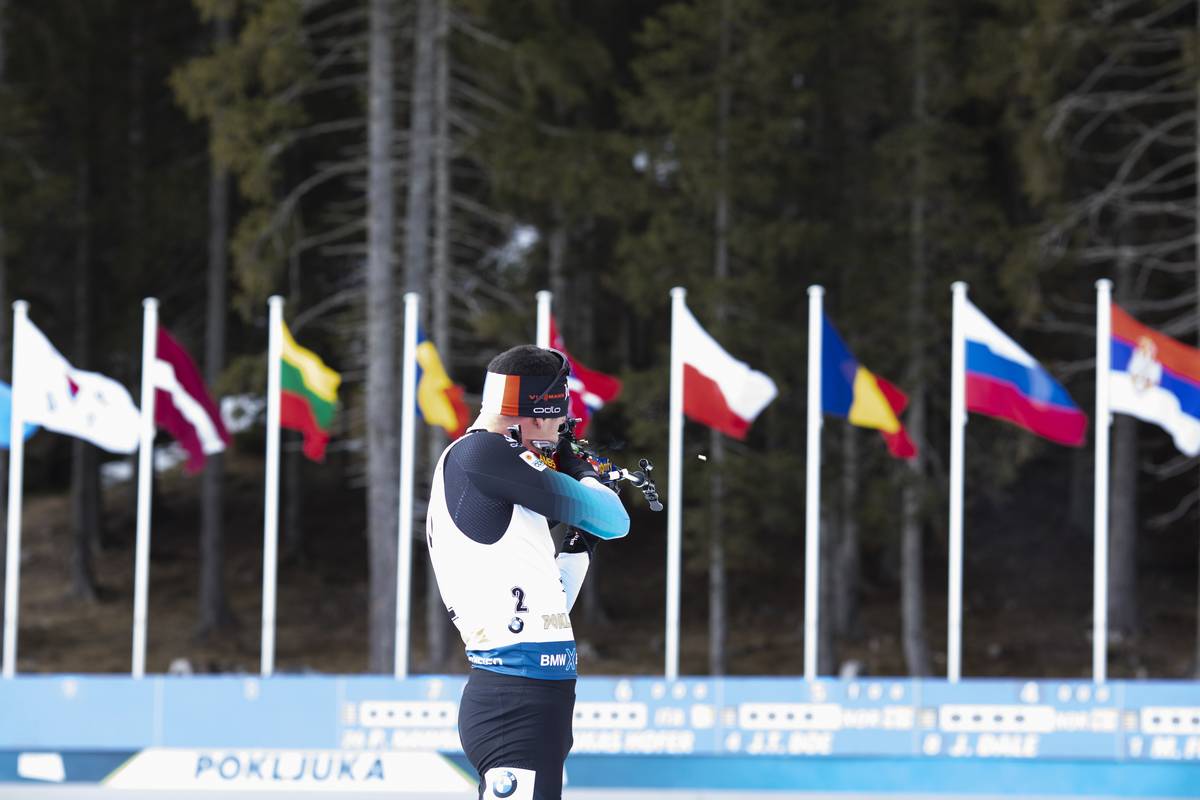
The last time Egan participated in the flower ceremony was in the same event in 2020 at the Pokljuka World Cup where she placed 6th. Being back in top form showed her she was on the right track after a disappointing 76th place last week in the Ruhpolding World Cup 7.5km Sprint race. Egan was inspired by Paul Schommer’s 9th place finish yesterday, and hopes her 4th can inspire the rest of her team to know they are on the right path ahead of the Olympics.
“Biathlon is a very difficult sport and the great thing about Clare is that she is resilient and perseveres,” said Women’s Head Coach Armin Auchentaller. “Hard work always pays off, the biggest thing is to believe in what you are doing.”
Egan certainly allowed the plan to play out in her favor, and her fourth place finish qualifies her for the Women’s 12.5km Mass Start on Sunday. But first, she’ll join forces with the rest of the US Biathlon Olympic squad for the Women’s Relay on Saturday.
“I am really looking forward to our relay tomorrow and my first mass start of the season on Sunday,” she said. “I just need to focus on recovering well now because it’s a lot of kilometers in three days!”
Rounding out Team USA’s finishes today were Deedra Irwin in 55th, Joanne Reid in 73rd, and Susan Dunklee in 88th.
Catch the action live on Peacock with Chad Salmela and USBA President & CEO Max Cobb commentating live from Antholz. Download the IBU App to keep track of all your favorite athletes!
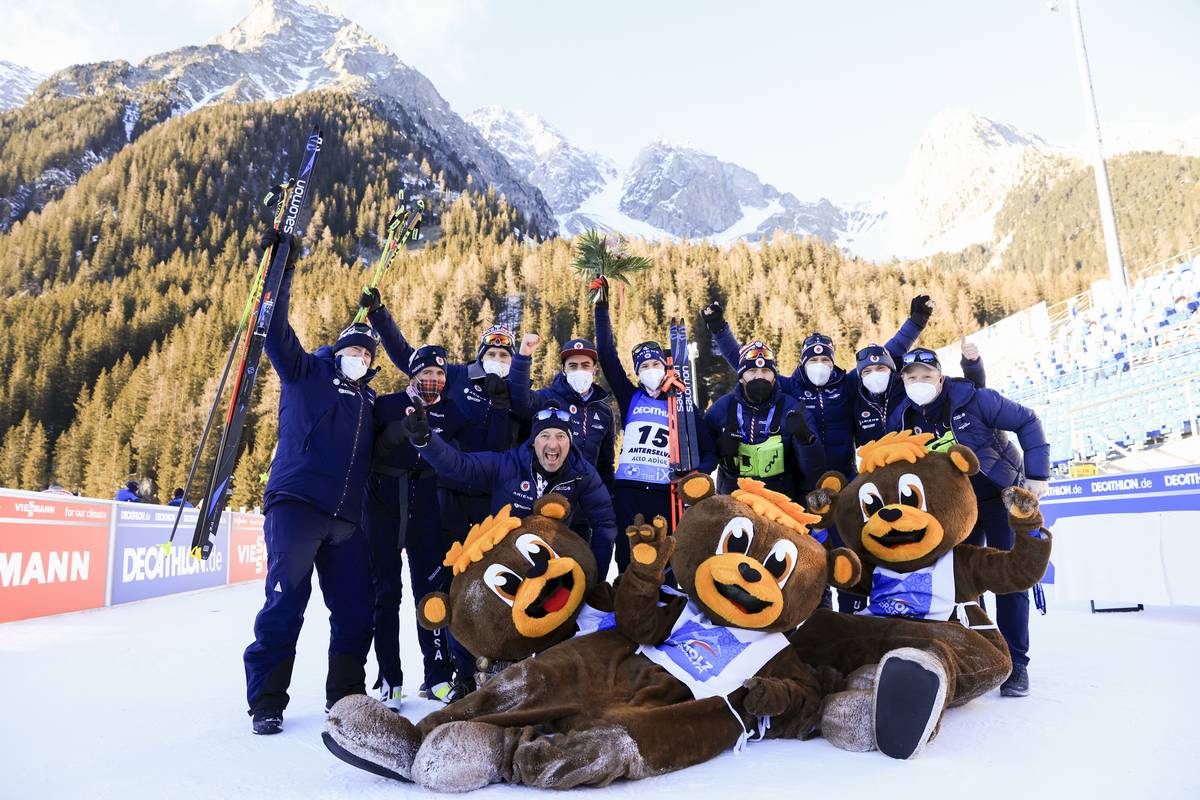
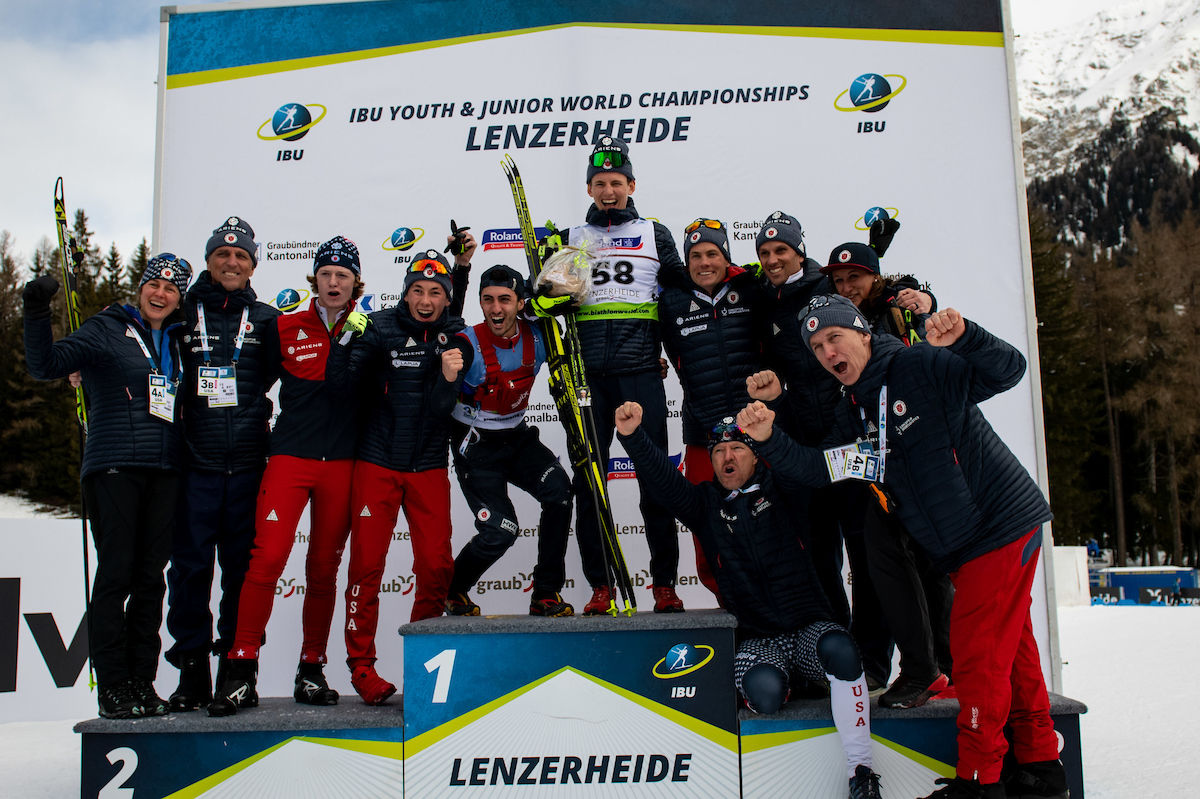
The US Biathlon team and staff (with a few mascots) celebrate a successful string of races in Antholz, Italy. (Photo: NordicFocus)
BMW IBU World Cup – Antholz, Italy (all times Eastern)
Saturday, Jan. 22
6:50 am – Men’s 15km mass start
9:00 am – Women’s 4x6km relay
Sunday, Jan. 23
6:15 am – Men’s 4×7.5km relay
9:15 am – Women’s 12.5km mass start
Sean Doherty (USA) – IBU World Cup Biathlon, sprint men, Oestersund (SWE). (Photo: NordicFocus)
Sean Doherty (Center Conway, N.H./National Guard Biathlon & USBA) became the fifth biathlete to qualify for the Olympic Winter Games Beijing 2022. The discretionary selection was announced by the U.S. Biathlon International Competition Committee on Monday following Doherty’s dominating performance in the sprint and pursuit races at the U.S. Biathlon Olympic Trials held in Arber, Germany, Jan. 2-3.
“Sean performed really well and kept his focus during two really challenging races,” said U.S. Biathlon Director of High Performance Lowell Bailey. “The weather has been windy and warm, making for tricky racing. He clearly showed he deserves the spot and will be a great addition to the U.S. team in Beijing.”
Doherty, 26, will be competing in his third straight Olympic Games in Beijing. He is the all-time leader in individual medals at the IBU Youth/Junior World Championships and became the first American biathlete to reach the podium three times at a single world championship when he did so at the Youth/Junior Worlds in 2016, bringing his career medal total to 10. Doherty was the youngest member of the 2014 U.S. Olympic Biathlon Team at the age of 18 and last season teamed with fellow three-time Olympian Susan Dunklee (Craftsbury, Vt./Craftsbury Green Racing Project & USABA) to win the bronze medal in the single mixed relay at the IBU World Cup in Nove Mesto, Czech Republic.
“I am very happy to be named to the Olympic Team,” Doherty said. “I am looking forward to representing Team USA. I think the previous Games have prepared me well for more cold and windy night races, so we will see what I can make of the opportunity.”
Clare Egan (USA) competes in the IBU World Cup in Östersund, Sweden. (Photo: NordicFocus)
Doherty joins Jake Brown (Saint Paul, Minn./Craftsbury Green Racing Project & USBA), Paul Schommer (Appleton, Wis./Team Crosscut & USBA), Dunklee and Clare Egan (Cape Elizabeth, Maine/Craftsbury Green Racing Project & USBA) as early qualifiers for the 2022 U.S. Olympic Biathlon Team.
The final team selection for biathlon will be announced on Jan. 9 following completion of the IBU Cup event in Brezno-Osrblie, Slovakia, and will include one additional selection for the men’s team and two additional selections for the women’s team. All selections to the 2022 U.S. Olympic Team are subject to approval by the United States Olympic & Paralympic Committee.
Coaches: Pepa Miloucheva (head coach); Michael Gibson (biathlon coach); Nick Brown (assistant coach and wax tech); Ethan Dreissigacker (assistant biathlon coach)
Current roster (skiing and biathlon): Braden Becker, Adam Martin, Akeo Maifeld-Carucci, Caitlin Patterson, Michaela Keller-Miller, Margie Freed, Annika Landis, Alex Lawson (skiing); Jake Brown (Luke’s brother), Raleigh Goessling, Hallie Grossman, Susan Dunklee, Kelsey Dickinson, Tara Geraghty-Moats, Clare Egan, Luke Brown (Jake’s brother) (biathlon)
Who’s new: Luke Brown joins the team for biathlon, coming from Crosscut; Carsen Campbell joins the team for biathlon, coming from Rocky Mountain Racers; Tara Geraghty-Moats rejoins the team for biathlon, coming from nordic combined; Annika Landis joins the team for skiing, coming from Sun Valley; Alex Lawson joins the team for skiing after graduating from Middlebury this spring
Who’s still on this team, or otherwise involved in American skiing, from when we did this in 2012: Caitlin Patterson (athlete, skiing); Susan Dunklee and Clare Egan (athletes, biathlon); Maria Stuber (head nordic coach, St. Scholastica); Patrick O’Brien (head coach, SMS Elite Team); also, former CGRP teammates Pat O’Brien and Ida Sargent got married this summer
Susan Dunklee in Pokljuka, Slovenia, February 2021. (photo: Manzoni/NordicFocus)
Top results last season: Starting with biathlon: The redoubtable veteran Dunklee finished last season on a strong note with two individual eighth-place finishes in Nové Město, one in sprint and one in the pursuit. She teamed up with Sean Doherty for the country’s first single mixed relay World Cup podium since Lowell Bailey and, well, Dunklee, in 2017. Egan had a pair of top-10 finishes, 9th and 10th in Hochfilzen, and was a member of two sixth-place relay teams. Dunklee and Egan are both already qualified for the Beijing Olympics. Jake Brown was on a sixth-place mixed-relay team in Nové Město and had a season’s best of 12th in individual races, in the sprint in Pokljuka.
Moving on to nordic combined: Geraghty-Moats won the only regular-season women’s noco race that was able to be held last year, in Ramsau, to take the inaugural overall title, while garnering praise as a trailblazer for women’s sports. She was fifth at World Champs in Oberstdorf.
And finally, on the nordic trails: Patterson raced on the World Cup from Ruka through the end of January, including finishing 34th overall in the Tour de Ski. She was on a fifth-place relay team in Lahti, and had individual World Cup bests of 27th, 29th, and 30th. Martin had three World Cup starts in distance races, with a best of 44th in Davos. Lawson was 24th at World Juniors in the 10 k skate.
Tara Geraghty-Moats racing at World Champs in Oberstdorf, February 2021. (photo: Modica/NordicFocus)
Coach’s comments: Pepa Miloucheva writes, “Summer and fall training for GRP was good and mostly went as planned. This spring we officially added Alex Lawson, although she was here last year too and the only other addition was Annika Landis, who joined us after a year in Sun Valley.
“The whole team stayed and trained in Craftsbury through August. Waverly Gebhardt and Rena Schwartz trained with us as part of the summer U23 program and with our GRP biathletes here we had a really solid training group.
“Michaela had a setback early summer, broke her ankle and had to have surgery, but she kept really good fitness by spending hours on the SkiErg and was able to join the rest for the ski camp in September.
Adam Martin racing in Davos, December 2020. (photo: Modica/NordicFocus)
“Early September we went to Oberhof, Germany, for just over two weeks of training in the ski tunnel. This was our first trip since the pandemic, so I was little nervous, but everything worked out really well. The first few days the focus was on technique, transferring on-snow improvements athletes worked on during the summer. Second part was a solid speed block. Luckily there ware only a few other skiers [in the tunnel] at this time so we ware able to have really high quality intensity sessions.
“After a few weeks training at home and having incredible fall weather we packed up bags again and went to Park City for two weeks of elevation training. First part of the camp was lots of volume, some L3, a few athletes even hopped in a rollerski race at SoHo for fun. Second week we lowered the volume, had a couple mellow days, and finished the camp with a couple solid TT efforts to gain some experience racing at this elevation in preparation for Nationals.
“Back home athletes took a few easy days post-Utah. I did some testing, where a few records were broken, which was exciting to see, and now we are concentrating on race prep. Caitlin Patterson left for Europe [on Nov. 17], she will race the first WC period and in less than two weeks we all are about to hit the road for a month and a half.
Caitlin Patterson racing in Lahti, January 2021. (photo: Vianney THIBAUT/NordicFocus)
“Last year we were totally sheltered here at the center, didn’t travel at all, didn’t go to any camps, didn’t go to any races outside Craftsbury. Although we had everything we need here and the outdoor center staff was incredible, taking really good care and keeping us safe and healthy, it was mentally very hard on the athletes not to be able to race against the other regions. So this year I’m excited for this team to have a more normal race season and to see what they can do, as they worked really hard for it.”
This press release, written by Bill Kellick, was originally posted at TeamUSA.org.
Oct. 27, 2021, 8:47 a.m. (ET)
(NEW GLOUCESTER, MAINE) – US Biathlon has announced the roster for the Pre-World Cup On-Snow Camp in Obertilliah, Austria, as well as the roster for the first two IBU Cup competitions of the 2021-22 season.
The Pre-World Cup Camp will begin November 11 with athletes joining National Team Coaches Armin Auchentaller and Vegard Bitnes for on-snow training ahead of the first BMW IBU World Cup races in Oestersund, Sweden, beginning November 27.
The women’s roster is led by 2022 Olympic Team qualifiers Susan Dunklee (Craftsbury, Vt./Craftsbury Green Racing Project & USBA), Clare Egan (Cape Elizabeth, Maine/USBA), 2018 Olympian Joanne Reid (Grand Junction, Colo.), Deedra Irwin (Pulaski, Wis./National Guard Biathlon Team & USBA) and Kelsey Dickinson (Winthrop, Wash./Craftsbury Green Racing Project).
Susan Dunklee racing to 8th in Nové Město’s sprint. (Photo: NordicFocus)
The men’s roster includes two-time Olympians Leif Nordgren (Hinesburg, Vt./National Guard Biathlon & USBA) and Sean Doherty (Center Conway, N.H./National Guard Biathlon & USBA). They will be joined by Paul Schommer (Appleton, Wis./Team Crosscut & USBA), Jake Brown (Saint Paul, Minn./Craftsbury Green Racing Project & USBA) and Vasek Cervenka (Grand Rapids, Minn./National Guard Biathlon & USBA). Brown is pre-qualified for the World Cup team.
The final roster for the first two BMW IBU World Cups of the season will be announced at the end of the camp.
Named to the Team USA roster to compete at the IBU Cup events in Idre, Sweden (Nov. 25-28) and Sjusjoen, Norway (Dec. 1-4) are Chloe Levins (Rutland, Vt./USBA), Hallie Grossman (South Burlington, Vt./Craftsbury Green Racing Project) and Lina Farra (Heber City, Utah/National Guard Biathlon Team) on the women’s team, and Max Durtschi (Ketchum, Idaho/Team Crosscut & USBA), Vincent Bonacci (Salt Lake City, Utah/Team Crosscut & USBA) and Luke Brown (Saint Paul, Minn./Team Craftsbury Green Racing Project).
Leif Nordgren during the IBU World Cup 4 x 7.5 k relay in Ӧstersund, Sweden in December, 2019. (Photo: NordicFocus)
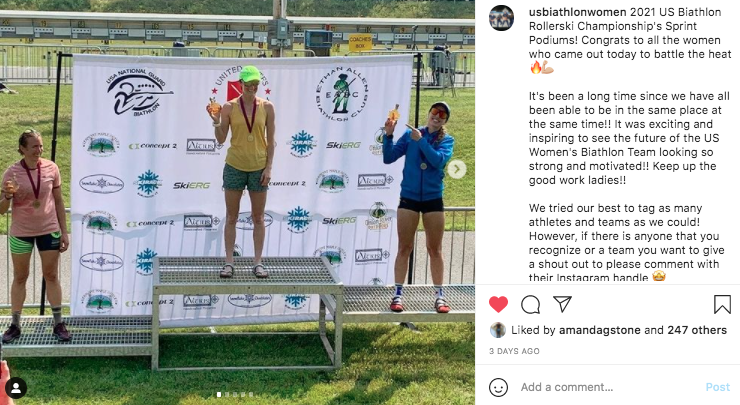
The women’s podium from the 7.5-kilometer sprint competition at USBA Rollerski National Championships. Clare Egan led the way ahead of Deedra Irwin (right) and Susan Dunklee (left). (Photo: Instagram @usbiathlonwomen)
This post will be updated with men’s comments as available.
As the annual event was held in a virtual format in August 2020 due to COVID-19 safety restrictions, the weekend marks a welcome return to public national level biathlon competition. Participants from clubs throughout the U.S. made their way to Northern Vermont to race a sprint on Saturday, followed by a mass start on Sunday.
Apart from the elite senior men and women’s fields, the races saw nearly 50 participants from the U15 youth level to the senior veteran age class. These athletes competed in a 10/12.5-kilometer pursuit stage on Sunday rather than the mass start.
“It was great to see athletes and coaches from across the country get back together,” commented US Biathlon team member Clare Egan in an email. “I was also happy to see an increase in numbers of participants — in the past we have had similar numbers, but almost half the field was Canadian. This year without the Canadians we hit those same numbers, so that was exciting. It’s a reflection of the growth happening at the club level in places like Bozeman, Craftsbury, Soldier Hollow, Truckee, Anchorage, Grand Rapids MN, Lake Placid, and others, where there are good facilities, coaches, and training groups now.”
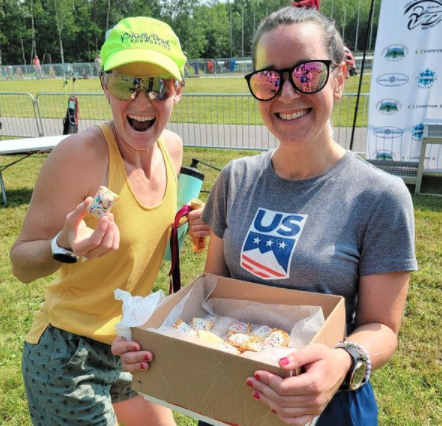
Clare Egan celebrates a double at the USBA Rollerski National Championships with a homemade poptart, courtesy of team dietitian Megan Chacosky. (Photo: Instagram @clareeganbiathlete)
Egan posted strong results this weekend, winning both the sprint and mass start events — and lots of maple syrup, the Vermont classic podium award. In the 7.5-kilometer sprint, she missed one target while shooting prone to finish with a time of 20:33.6. She finished 33 seconds ahead of Deedra Irwin of the National Guard Biathlon Team who missed one target per stage (1+1), with USBA teammate Susan Dunklee one second behind in third (1+2).
In the 12.5 k mass start, Egan again missed only one target, this time standing (0+0+1+0), leading her to double up on her victories with a finish time of 37:08.1. Dunklee missed three targets during her standing stages (0+0+1+2) and skied to second place in 38:03.8. Kelsey Dickinson of the Craftsbury Green Racing Project (CGRP) took the third podium spot in 39:22.2 (1+1+2+2).
“I was satisfied with my racing this weekend, especially the shooting,” Egan wrote. “I only missed 2 targets out of 30. That’s an excellent percentage for me and definitely what I am aiming for as I head into the World Cup and Olympics season. I had a really hard time on skis, but I think that it was entirely due to the intense heat and humidity.”
Both days saw temperatures in the upper 80’s with high humidity — which makes for hot radiating pavement and very sweaty ski boots.
“My training has been going well and I’m confident about where I’m at and the direction I’m headed,” Egan concluded.
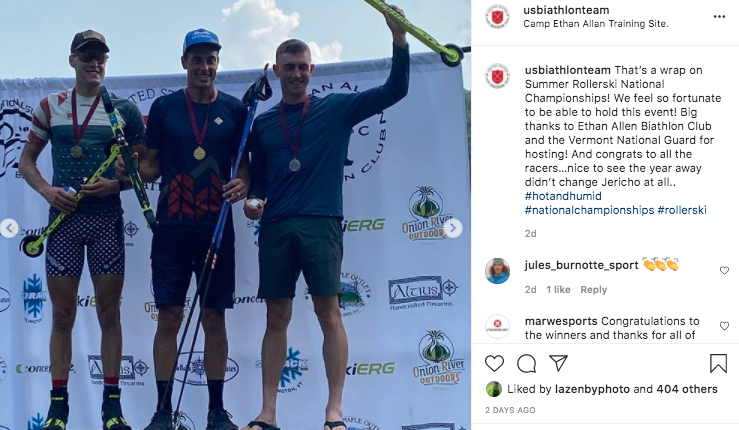
The men’s 15k mass start podium at the USBA Rollerski National Championships. Paul Schommer took the win ahead of Sean Doherty and Leif Nordgren. (Photo: Instagram @usbiathlonteam)
On the men’s side, Sean Doherty of the National Guard Biathlon Team shot clean in the 10 k sprint, skiing his way to the top spot on the podium on his home course in a time of 24:33.3. Doherty was followed by Leif Nordgren of the VT Army National Guard who missed two targets (1+1) to finish in 25:24.8. Paul Schommer of the Crosscut Team in Bozeman, MT, rounded out the podium with two misses (1+1) and a time of 25:45.1.
The men’s podium rearranged itself in Sunday’s 15 k mass start. Schommer improved his shooting percentage, missing one shot in two of the four stages (0+1+1+0) and crossed the line in 38:15.6 for the win. Doherty followed 40 seconds behind with four missed targets (1+2+1+0) and a final time of 37:55.7. Nordgren took the third podium spot with a time of 38:36.8 with five misses (2+0+1+2).
“I have been working on some new things this summer and having them come together in Sunday’s race was a huge confidence boost,” Schommer wrote in a post-race email. “I still know there is a lot to work on, but it’s always great to see improvement. As I continue into the fall, I hope to keep the level of focus I have had thus far in the training year and continue to identify and address areas where I can improve. I don’t want to think about the next races, I just want to focus on becoming the best biathlete I can be.”
Schommer also reflected on the experience of being back on the tracks and range in Jericho with the broader biathlon community, and the contrast in his ability to adequately prepare for biathlon last summer versus the present.
“Coming back to Jericho after a year off was great! Last year at this time I hadn’t been at a range with a roller loop yet, so to be here this year is a real blessing. It also was great to see the biathlon community with a large turn out. Lots of young biathletes coming up which is great to see!”
NOVE MESTO, Czech Republic (March 4, 2021) – In the final women’s 4×6-kilometer relay of the BMW IBU World Cup season, Team USA turned in a performance for the ages. The team’s sixth-place finish in the field of 21 teams on Thursday was the best since 1994 and just 40.1 seconds off the winning time turned in by Sweden. The U.S. quartet’s time was also a mere 12.3 seconds from the bronze medal. By comparison, the United States’ 1994 silver-medal performance at a World Cup was over 57 seconds back of the winning time.
Susan Dunklee (USA), Irene Cadurisch (SUI), Federica Sanfilippo (ITA), Kinga Zbylut (POL), (l-r) – IBU World Cup Biathlon, relay women, Nove Mesto (CZE). (Photo: NordicFocus)
Susan Dunklee (Barton, Vt.) opened the race with fast and clean prone shooting, needing just 22.6 seconds and leaving the range in the lead, 1.8 seconds ahead of Switzerland’s Irene Cadurisch. Dunklee held the lead into the standing shoot but fell back fifth place after needing two spare rounds. She tagged off to Joanne Reid (Grand Junction, Colo.) in sixth position, just 11.5 seconds from first place.
Joanne Reid (USA) – IBU World Cup Biathlon, relay women, Nove Mesto (CZE). (Photo: NordicFocus)
Reid needed just one spare round in prone and another in standing and matched Sweden’s Hanna Oeberg stride-for-stride over the final lap to keep the American squad in sixth position as she tagged off to Clare Egan (Cape Elizabeth, Maine), 41.7 seconds back of the lead.
“Just wanted to go out there and have one last good relay, hold onto the momentum Susan gave me, and gift it forward to Clare and Deeda,” said Reid. “Recently, relays have gone from making me extra nervous to making me less nervous, since I know my team has my back and they’re giving me an opportunity, not a burden of stress. Happy to hang onto the back of Hanna Oeberg’s skis the last lap.”
Hanna Sola (BLR), Clare Egan (USA), (l-r) – IBU World Cup Biathlon, relay women, Nove Mesto (CZE). (Photo: NordicFocus)
Egan proceeded to move the team into medal contention with a clean round from prone, exiting the range in second place, just 31.9 seconds back of leader Norway. She kept the medal hopes alive with just one spare in standing and skied the U.S. team into second place at the final exchange with Deedra Irwin (Pulaski, Wis.), 6.6 seconds back of leader Sweden and just seconds ahead of both Italy and Belarus.
“Today’s race was great from start to finish, which is what it takes for a World Cup relay top-6,” Egan said. “There are so many pieces…four fit and focused athletes, eight perfectly prepped skis, 24 kilometers of fast skiing, 40 shots which need to be fast and almost all hits, plus many coaches and support staff working behind the scenes. It was really satisfying to put together a total team effort today.”
Irwin, competing in her first full World Cup season, was spectacular in the final leg. She used just one spare in prone and another in standing, then raced to a photo finish at the line with Norway and Italy. Noway’s Marte Olsbu Roeiseland was credited with fifth place, while Irwin nipped Italy’s Michela Carrara for sixth.
“I just wanted to make the team proud,” said Irwin who collapsed to the snow at the finish after giving it everything she had. “I’ve believed for years that this team could get a top-6 and I wanted to be a part of that. The team gave me an amazing handoff and I just tried to do my best with it. I’m glad everything came together today. It was really a ‘trust the process’ and ‘don’t do anything special’ kind of day for me. Being so new to this sport, the pressure sometimes gets to me on the World Cup and I’ve learned so much this season from my teammates and coaches. I’m grateful for their patience and I’m happy we were able to make this last one really count.”
Deedra Irwin (USA), (l-r) – IBU World Cup Biathlon, relay women, Nove Mesto (CZE). (Photo: NordicFocus)
The Swedish team of Mona Brorsson, Hanna Oeberg, Linn Persson and Elvira Oeberg claimed the gold medal with a winning time of 1 hour, 3 minutes, 26.6 seconds, using six spare rounds. Belarus, with nine spares, finished second, 1.2 seconds back. France, with a penalty and eight spares, placed third, 27.8 seconds back.
The BMW IBU World Cup in Nove Mesto continues Friday with the men’s 4×7.5-kilometer relay featuring the U.S. team of Sean Doherty (Center Conway, N.H.), Jake Brown (Saint Paul, Minn.), Paul Schommer (Appleton, Wis.) ad Leif Nordgren (Hinesburg, Vt.). The race can be seen live on Peacock TV starting at 9:20 a.m. EST.
Clare Egan during training in Antholz, Italy. (Photo: NordicFocus)
Press Release from US Biathlon: By Bill Kellick
After back-to-back IBU World Cup events in Oberhof, Germany, the U.S. Biathlon team and the rest of the world’s best biathletes are headed for Antholz, Italy, for the final World Cup races before the IBU Biathlon World Championships. This week’s BMW IBU World Cup event, running Jan. 21-24, will consist of individual races, mass starts and relays.
Antholz played host to last year’s world championships and the U.S. team enjoyed a banner competition with Susan Dunklee winning a silver medal in the women’s sprint, adding to her silver medal in the mass start three years earlier. Other Team USA highlights from last year’s world championships in Antholz were an eighth-place finish in the men’s relay, and a career-best eighth place on 20-for-20 shooting by Leif Nordgren in the men’s 20km individual.
“Oberhof took a lot out of the athletes these past two weeks,” said U.S. Biathlon Women’s National Team Coach Armin Auchentaller. “These first days in Antholz we have been taking it pretty easy to recover from the past two weeks. We hope for some good races here in Antholz which historically fits us pretty well.”
If anyone should know Antholz, it’s Auchentaller, who resides in the northern Italian town. And through him, the U.S. Biathlon team has come to know the trails of Antholz well through off-season training sessions there.
“It feels like my home course more than anywhere else and I’m looking forward to using that experience to my advantage,” says Clare Egan who trained in Antholz the entire month of September as well as 10 days over the recent holiday break.
“The team has spent a lot of time there over the years because of the fact that Armin lives there,” added U.S. Biathlon Director of High Performance Lowell Bailey. “We’re looking forward to this virtual home-course advantage. Antholz is a great place, a great course, and it is sure to produce some exciting racing.”
Coming off two weeks of racing on the difficult tracks of Oberhof, which had been altered to host the world championships in two years, U.S. team members are looking forward not only to racing in the familiar confines of Antholz this weekend, but also to the sunshine that usually accompanies competition in the Antholz valley.
“Oberhof suits my climbing prowess but Antholz suits my altitude soul,” noted Joanne Reid. “I had a really great time racing in Oberhof, and I’m also looking forward to racing here.”
“I’m looking forward to sunshine,” said Jake Brown. “Through Armin I think we all feel some sort of special connection to this valley.”
Added Paul Schommer: “I really like the course here with longer gradual climbs and some rolling transitions. That, coupled with some cold hard tracks, and I think it provides a great opportunity for great race results.”
This week marks roughly two months on the road for most of the U.S. Biathlon team. A long stretch by any means but made significantly longer due to all the necessary COVID precautions and safety measures put in place by the IBU around the World Cup competitions.
“Bubble life has been going really well,” said Deedra Irwin. “The IBU has done an amazing job containing active cases. Our team guidelines have been very effective against COVID. Also, no one on the team has gotten any major ‘normal’ sicknesses either.”
Most of the team’s feelings around the restrictive protocols can best be summed up by Brown, who says, “I like racing, so the more I race the more sane I feel.”
The Antholz World Cup offers the final tune-up before the IBU World Championships begin in Pokljuka, Slovenia, on Feb. 10, and coaches and athletes alike are keen on fine-tuning their efforts this weekend in Italy.
“My advice going forward, as always, is to be proud of and continue doing the things that are good, target and improve the things that can be better,” said Shooting Coach Matt Emmons. “Champions pick themselves up and commit to improving.”
“I think the men’s team has been building some momentum in the relay and I would love to see us have a great performance here,” added Schommer.
Following this week’s racing in Antholz, the team will enjoy some well-deserved rest days before beginning the world championships pre-camp in Antholz. The team will head directly to the world championships in Pokljuka on Feb. 7.
The BMW IBU World Cup events in Antholz run Jan. 21-24, with the following schedule (all times Eastern):
Thursday, Jan. 21 8:15 am – Women’s 15km individual
Friday, Jan. 22 7:15 am – Men’s 20km individual
Saturday, Jan. 23 7:10 am – Women’s 12.5km mass start
9:05 am – Men’s 4×7.5km relay
Sunday, Jan. 24 6:45 am – Women’s 4x6km relay
9:05 am – Men’s 15km mass start
All events will be streamed live on Peacock with some events on the Olympic Channel and NBCSN. Find full schedule HERE.
Clare Egan is 19th overall on the IBU World Cup. (Photo: NordicFocus)
Clare Egan of the U.S. Biathlon team has wowed this season.
Through December and most of January, Egan popped steady and consistent reults on the IBU World Cup. Currently, she is ranked 19th on the IBU World Cup, ceding two spots to the top-ranked North American, Canada’s Emma Lunder in 17th.
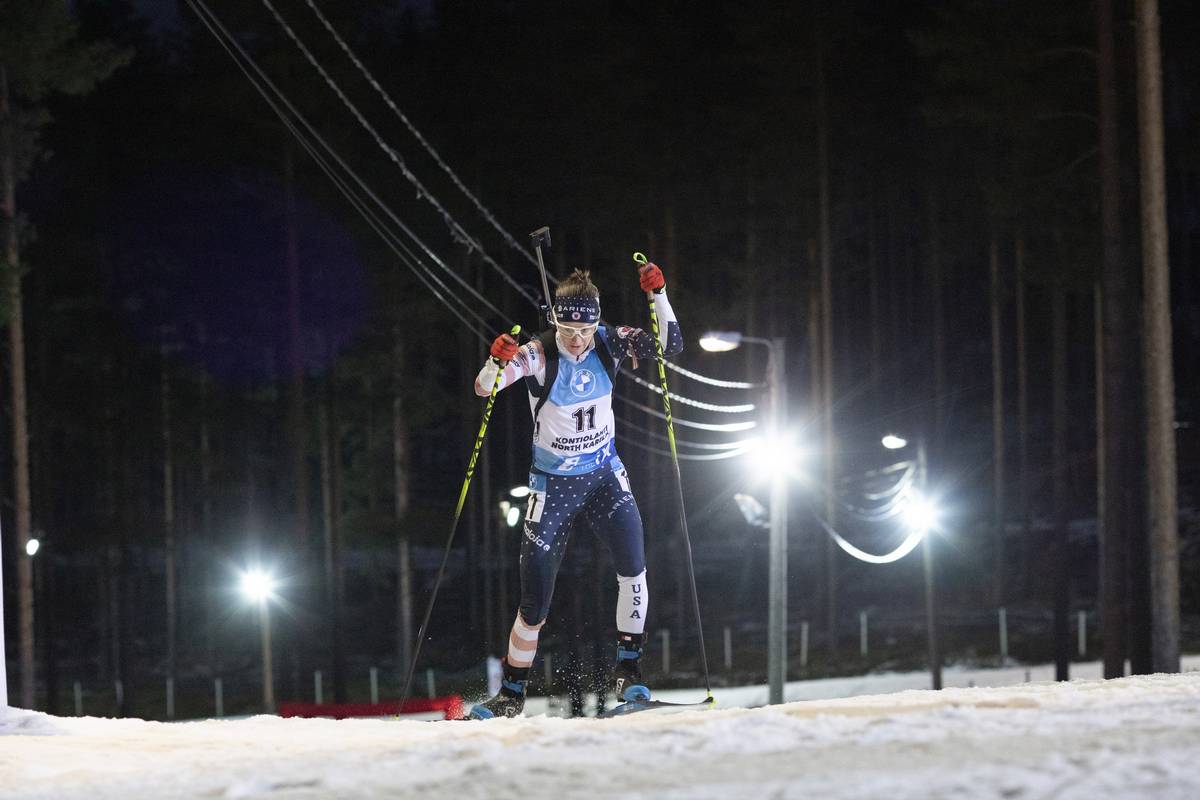
Clare Egan racing the individual in, Kontiolahti, Finland. (Photo:NordicFocus)Under the lights, Clare Egan racing the Dec. 3 sprint on IBU World Cup in Kontiolahti, Finland. (Photo: NordicFocus)
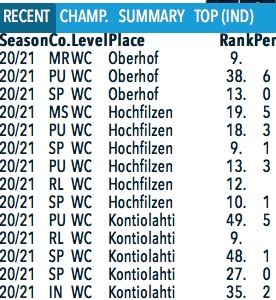
Highlights of her season thus far are a 10th in a Hochfilzen, Austria sprint, 13th in a Hochfilzen pursuit followed by a ninth place in another Hochfilzen sprint. (Due to Coivd-19, the IBU calendar has scheduled several back to back race weeks at the same venue.)
Most recently in Oberhof, Germany during the first week of racing at the venue, Egan was 13th in the sprint.
Focusing on the target in Oberhof, Germany during the pursuit. (Photo: NordicFocus)Clare Egan during the Oberhof, Germany sprint in which she placed 13th. (Photo: NordicFocus)
She is ranked 14th overall in the sprint standings, 26th in the pursuit, and 19th in the mass start.
Racing continues on the IBU World Cup on January 13th with the men’s 10 k sprint. You can also view the IBU World Cup on Peacock.TV and the Olympic Channel with Chad Salmella commentating.
Egan’s World Cup results for the current season. (Biathlonworld.com)
We have covered Egan before here at FS. Here are a few links of interest.
Egan on our Nordic Nation Podcast discussing life during the pandemic.
Susan Dunklee (USA), Lisa Theresa Hauser (AUT), Marte Olsbu Roeiseland (NOR), (l-r), racing at the 2020 IBU World Championships mixed relay in , Antholz, Italy.
As coronavirus cases spike worldwide, biathletes are preparing for a modified start to the 2020-2021 World Cup season. The schedule emphasizes less travel than would be the norm on the IBU World Cup circuit. At the end of September, the International Biathlon Union (IBU) announced that the first four races of the winter would be held at two venues. Kontiolahti, Finland, will host the first two events on consecutive weekends, starting 27 November. Hochfilzen, Austria will have two race meets on succeeding weekends, starting 7 December.
In normal times, the schedule would have migrated to three different race sites over the same period of time. Last season, the IBU World Cup held events in Östersund, Sweden, Hochfilzen, Austria, and Annecy-Le Grand Bornard, France during the first trimester.
To continue limiting travel this year, the IBU subsequently revised their schedule to hold events on consecutive weekends at Oberhof in Germany, followed by the regularly scheduled event in Antholz-Anterselva, Italy. The Biathlon World Championships will continue to be held from 9 to 21 February in Pokljuka, Slovenia. The IBU will announce any changes to the third-trimester schedule by the end of November.
We know about the ever-changing nature of Covid-19 trends. For now, Finland is seeing 274.8 covid-19 cases per 100,000 persons, Austria is tallying 990.5 cases per 100,000. Germany, where the IBU World Cup features from 4 January to 17 January, is reporting 559 cases per 100,000; Italy is reporting 935 cases per 100,000 persons. Both France and Germany have reinstituted lockdown measures to slow the spread of disease.
Data aggregated by U.S. states are easier to find than cases per capita for the U.S. as a whole. As an example, New Jersey, where this reporter lives, has 2604 cases per 100,000 persons. This provides some context to how some European governments are mitigated community spread. It also remains uncertain how lockdowns in places where IBU World Cups are scheduled would impact those events.
Lowell Bailey (USA) celebrates with Max Cobb after winning the gold in the 20 k individual at the 2017 IBU World Championships in Hochfilzen, Austria.. (Photo: NordicFocus)
Speaking to FasterSkier earlier in October, Max Cobb, President and CEO of US Biathlon and Executive Board Member of the IBU, reflected on steps the IBU is taking to hold races this winter.
Cobb prefaced the conversation by stating that he was part of the working group that developed the changes. “I’m really satisfied with them,” said Cobb. “It was a sensible decision to make sure we’ve got our procedures down in the first race series before we try and implement it in more than one series at a time. I think it also gives every national federation the opportunity to have their athletes racing closer to home.”
Cobb stressed the IBU’s commitment to a safe racing environment. “If we’re uncomfortable with [covid infection levels], and if our medical advisory group is uncomfortable, then we’ll definitely change plans and cancel if need be.” He added that the IBU has asked their other calendared venues to be prepared in case events need to be relocated.
“Our hope is to be able to, as some other sports have done already, provide an environment in which we’re confident the risk of transmission is very low,” Cobb said. “That testing is robust, and athletes will have a chance to compete. [We are ] really sensitive to regional outbreaks, and obviously we’ll comply 100% with any local requirements.”
In a follow-up email, Cobb detailed the regimen the U.S. team would follow. Team members and staff will be tested for coronavirus before traveling to Europe, and then again 72 hours after arriving in Europe. During the race season, they’ll be tested at least twice per week.
Cobb estimated the cost of coronavirus testing to be approximately $30,000. Some of the testing costs for athletes, however, would be covered by the US Olympic & Paralympic Committee (USOPC) elite athletes’ health insurance.
It’s not just testing though: “Testing is one part of the budget impact but there are a lot more mitigation efforts,” Cobb wrote. “More single rooms, extra rooms, more transportation capacity to allow for distancing, it all adds up to more than $100,000 for the season.”
In an email, biathlon veteran Clare Egan responded to questions about the revised schedule. North American teams are used to long and taxing stints away from home when based in Europe.
“The obvious benefits of reduced travel are reduced fatigue and lower risk of exposure to COVID and other illnesses,” she wrote when asked if less travel would be an advantage for the U.S. squad. “These are the same advantages for everyone. I don’t think it offers me or my team any unique advantages over other teams. Perhaps the Finns and Austrians will feel an advantage being 2 weeks at home.”
Of travel arrangements, Egan wrote, “We will all travel on a charter flight from one venue to the next in order to reduce our exposure even further.”
Clare Egan of the U.S. during the 2020 women’s 15 k individual in Pokljuka, Slovenia. Egan placed 6th. (Photo: NordicFocus)
Egan is prepared for the challenges this season presents. “I feel comfortable traveling,” she said. “In the past few weeks, Europe’s cases have been double those in the U.S. But the worst outbreaks are in places where I will not be traveling. I understand the risks and also the easy ways I can lower my risk of exposure: wearing a mask, social distancing and washing my hands. Elite winter sport athletes like me have been doing this for years so I don’t think my behavior this winter will be that different from the past! I’ve been wearing a mask on planes for a decade.”
Cobb stressed the interdependence of athletes, support staff, and race organizations to ensure the season’s success. “The behavior of everyone matters for the success of the season,” he said. “I think that’s a really interesting sociological state to be in. I’m very optimistic that the athletes and everyone on the teams will behave in a way that lets us have a season. But it will be demanding to do that.”
Martin Fourcade racing last season at the 2020 IBU World Championships. (Photo: Nordic Focus)
Thirty two years old and wise as wise can be. Clare Egan brings a calm intellect to the sport of biathlon. Speaker of many languages and head of the International Biathlon Union’s athlete committee, Egan is respected by her peers for on-snow performances as well as her leadership in the IBU board room.
U.S. Biathlon’s Clare Egan on her way to 29th in the women’s 10 k pursuit in Annecy-Le Grand Bornand, France. (Photo: NordicFocus)
We spoke to Egan earlier this month as she was training in Antholz, Italy with U.S. women’s head coach Armin Auchentaller. The real gist of the conversation was to determine how she had been coping with the pandemic and making a go of it as the race season nears. Like many of us, there have been ups and downs…but mostly ups. You can hear more on the podcast.
Clare Egan crossing the line in Oslo for third place in the 2019 12.5 k mass start. (Photo: ARD screenshot)
Susan Dunklee of the U.S. during the 7.5 k sprint in Östersund, Sweden in December 2019. (Photo: NordicFocus)
Success in biathlon can be fickle. With so many added variables, many outside an athlete’s control, the results page does not always align with the quality of the effort or performance. In an interview after a career best result in the 15k individual event in Pokljuka, Slovenia, Clare Egan explained that it is essential for a biathlete to differentiate between the two.
“We learn early on in biathlon to distinguish between [results and performance] because you can go out and say, ‘I felt great skiing and I thought I executed my shooting plan perfectly, but it just didn’t work.’ Maybe you had four shots that were really really close, but they were all misses, so you end up with a bad result and that result doesn’t reflect how you feel about your own performance.”
After eleven years on the national team and eight years of World Cup racing, Susan Dunklee understands this better than most. The 33-year-old Vermont native has weathered several dips in rank, and this season has been no exception. She placed 32nd with two penalties in her first sprint event in Ӧstersund, Sweden, followed by 73rd with seven penalties the following day and dipped to 95th in the next sprint event in Hochfilzen, Austria.
A mid-December shooting bout in Östersund, Sweden for Susan Dunklee. On the IBU World Cup circuit, Dunklee has of late been finding her form. (Photo: NordicFocus)
Dunklee has since rebounded to solid results in Ruhpolding, Germany and Pokljuka, Slovenia, where her shooting and skiing clicked for strong relay legs and a 10th place result in the pursuit.
Reflecting on her season in a call on January 29th, Dunklee shared that though she felt she was in good shape and had good focus during those early season races, she struggled with her shooting, particularly with standing.
“When you stand on the start line, you have a race plan in your head and after the race, rather than just looking at the results sheet, you ask yourself, ‘Did I do what I set out to do? How good was I about keeping my focus on what I was planning on doing?’ A lot of those races in December, I felt like I was doing a great job of that. I was very disciplined about how I approached the race and it was a little frustrating not to have the results come along.”
She continued that in order to succeed in biathlon, one needs to be patient and maintain self-belief even when you go through “funks” in results. Resilience and a process focus are also essential traits, since many variables are outside one’s control.
Dunklee also explains why the recent events have suited her strengths and preference for head-to-head racing and relays. She continues by illuminating the “electric” experience of racing in front of the roaring crowds in attendance at many venues and sharing how she is recharging during the break before the 2020 World Championships kick off in Antholtz, Italy.
Checking in with Susan Dunklee on January 29th.
Susan Dunklee (bib 9) during the 2020 IBU World Cup women’s relay in Ruhpolding, Germany. (Photo: NordicFocus).
A team effort: Maxime Germain (bib 58) placed third in the World Junior’s Youth 7.5 k sprint. (Photo: Weymuller Photography)
A compelling aspect of international biathlon is the diversity of nations represented at the highest level, the International Biathlon Union World Cup. Last week in Pokljuka, 25 five teams from 25 different nations were represented in the 4 x 7.5 k mixed relay. It speaks to the broadening global appeal for the sport. All those nations are tasked with developing athletes. Not to say there will be 25 different approaches, but each team espouses it’s own values. The same can be said of U.S. Biathlon.
From the top-down, this crew speaks to fair and hard driving sport. Max Cobb, for example, US Biathlon’s CEO and President works behind the scenes at the IBU for clean competitions. Clare Egan, an athlete representative on the IBU Board speaks truth to power. Several athletes took a training hiatus this summer to join the Army National Guard. And behind the scenes, Danika Frisbie has focused on strategic programming and Tim Burke has jump-started a development program. Part of Burke’s responsibilities includes guiding US Biathlon’s Junior National Team.
Danika Frisbie of US Biathlon in Lenzerheide, Switzerland at the IBU 2020 Junior World Championships. (Photo: Weymuller Photography)
Tim Burke of US Biathlon in Lenzerheide, Switzerland at the IBU 2020 Junior World Championships. (Photo: Weymuller Photography)
With all this energy, not to mention the team has been splashed in the most stylie uniforms on the circuit, the U.S. Junior men had a collective proud day at the 2020 Lenzerheide, Switzerland Junior World Championships in the Youth 7.5-kilometer sprint.
Max Germain on his way to a third place in the World Junior’s Youth 7.5 k sprint. (Photo: Weymuller Photography)
Two U.S. skiers landed in the top-10, a third was top-25. Max Germain of Anchorage, Alaska was third overall, 11.3 seconds from first after shooting 1+0. Russia’s Aleksai Kovalev won in 19:53.0 while shooting clean.
Bjorn Westervelt of Craftsbury, Vermont during the Youth 7.5 k sprint at World Juniors in Lenzerheide, Switzerland. (Photo: Weymuller Photography)
Bjorn Westervelt of Craftsbury, Vermont placed ninth (+24.0; 1+0), and Sam Stertz of Grand Rapids, Minnesota finished in 21st (+1:05.8; 0+0). Timothy Cobb of Vermont, the fourth American in the race, placed 83rd (+4:22.6; 4+2) after a tough day on the range.
Sam Stertz during the Junior World’s Youth 7.5 k sprint. (Photo: Weymuller Photography)
It was a good day for those clad in the U.S. Lycra.
Let’s catch up with the IBU World Cup and the action from Saturday and Sunday in Pokljuka, Slovenia.
Emma Lunder and Christian Gow, (l-r) during the IBU World Cup biathlon, single mixed relay, in Pokljuka (SLO). The team placed fourth overall. (Photo: NordicFocus)
First up, the single mixed relay, in which teams of two are paired with each skier racing two legs and shooting two stages per leg. France took the win in 38:33.4 minutes shooting 0+5. The big news from the relay for North America, was Canada’s fourth place result. Christian Gow and Emma Lunder were 16 seconds back from first place France after shooting 0+6.
Jake Brown and Joanne Reid for the U.S. placed 23rd (+4:15.1; 0+14).
And it is worth mentioning, 26 different nations comprised the 26 team field. Which brings to mind a cool post on Twitter from the International Biathlon Union, and it speaks to the exciting nature of the sport. The Estonian team included Rene Zahkna, who placed 101st in last Thursday’s 20 k individual race. Two days later it was podium time.
Next up, the 4 x 7.5 k mixed relay, which France won in 1:17:53.3 making it a clean sweep for the nation on relay day.
The U.S. team of Leif Nordgren, Sean Doherty, Susan Dunklee, and Clare Egan placed 12th (+4:10.6; 2+12). Canada’s Jules Burnotte, Scott Gow, Emily Dickson, and Megan Bankes raced to 18th (+6:47.5; 4+10).
The relay had 25 teams from 25 different nations represented.
France’s Quentin Fillon Maillet won Sunday’s 15 k mass start in Pokljuka, Slovenia. (Photo: NordicFocus)
And… on Sunday in Pokljuka, the racing began with the men’s 15 k mass start. No Johannes Thingnes Bø or Martin Fourcade on the podium’s top step: France’s Quentin Fillon Maillet placed first in 36:21.5 shooting 0+0+1+0. Germany’s Benedikt Doll placed second (+10.0 0+1+0+0), and yes, Johannes Thingnes Bø was on the podium in third (+10.3; 1+0+0+1).
Fourcade retains the IBU World Cup’s leader’s bib with 601 points. Fillon Maillet is second with 532 points, and Bø is third with 482. Bø sat out much of January’s racing for the birth of his first child.
No North American men qualified for the mass start race.
Egan raced to 26th (+3:31.8; 0+1+1+1) and Lunder to 29th (+4:12.5; 2+1+1+0).
Norway’s Tiril Eckhoff still leads the World Cup overall with 524 points, Dorothea Wierer of Italy is in second with 509 points, and Öberg sits in third with 456 points.
Racing on the IBU World Cup takes a hiatus for a bit. The 2020 IBU World Championships begin in Antholz, Italy on February 12th.
So we will leave on a light note as we piggyback on Egan’s Instagram account. She noted that U.S. Biathlon’s women’s coach Armin Auchentaller made a bet that he would “jump in the lake if anyone gets a top-10!”.
He took the plunge after Egan’s 6th place. Auchentaller may be onto something, The New Yorker recently called cold plunges a subversive joy.
The cold plunge. (photo: from @clareeganbiathlete on Instagram)
The traveling IBU World Cup roadshow stops in Pokljuka, Slovenia this week and began the individual races. The women’s 15 k individual ran on Friday. The individual race format places a heightened premium on clean shooting; each missed shot amounts to an automatic minute penalty.
Tiril Eckhoff of Norway had been dominating the circuit recently. Yet, Friday, she fell in the standings to place an uncharacteristic 18th. In first place was former German cross-country skier Denise Herrmann. It was Herrmann’s first win of the season and her second podium. She won in 41:33.4 with no misses on the range. Sweden’s Hannah Öberg was second (+59.2; 0+1+0+0) and France’s Anais Bescond third (+1:15.7; 0+0+0+0).
Denise Herrmann of Germany celebrating the 15 k individual win in Pokljuka, Slovenia. (Photo: NordicFocus)
Two North Americans raced into the top-10. Clare Egan for the U.S. had a career-best race in the individual format with a sixth place. Egan shot clean and stopped the clock 2:10.4 back. Prior to Friday’s result, Egan’s best performance in the 15 k individual had been a 22nd at the 2017 World Championships in Hochfilzen, Austria. Last weekend, Egan placed 16th in Ruhpolding, Germany’s 10 k pursuit. And at this same venue a bit over a year ago in Pokljuka, Egan placed sixth in the 10 k pursuit.
Clare Egan of the U.S. during the women’s 15 k individual in Pokljuka, Slovenia. Egan placed 6th. (Photo: NordicFocus)
Post-race interview with Clare Egan
Emma Lunder of Canada finished in 10th, 3:06.8 back while shooting 1+0+0+0. This was Lunder’s second top-10 of the season. She placed 7th in Oberhof’s sprint. Both Lunder and Egan qualified for Sunday’s 12.5 k mass start competition. The top-25 women in the overall IBU standings auto-qualify. Egan and Lunder fell outside that criteria, but qualified due to their results in Friday’s individual race.
Canada’s Emma Lunder racing to 10th in the women’s 15 k individual in Pokljuka, Slovenia. (Photo: NordicFocus)
For the U.S., Joanne Reid was 45th (+6:11.3; 0+0+1+1), Susan Dunklee 55th (+7:04.2; 1+2+1+1), and Emily Dreissigacker 84th (+10:12.7; 1+0+1+2).
Canada’s Nadia Moser finished in 79th (+9:30.6; 1+2+0+1), Megan Bankes 80th (+9:46.2; 1+1+0+3), and Emily Dickson 83rd (+10:07.4; 1+1+1+1).
On Thursday in Pokljuka, Johannes Thingnes Bø, on leave from the race scene for the first part of racing during the second trimester to be home for the birth of his first child, was back in play. Last week, in the absence of the Norwegian phenom that is Bø, France’s Martin Fourcade reclaimed the World Cup’s overall yellow leader’s bib.
Johannes Thingnes Bø on his way to winning the men’s 20 k individual in Pokljuka, Slovenia. (Photo: NordicFocus)
Fourcade’s leader status might be tenuous. The two superstars went 1-2 on Thursday with Bø taking the win in 47:54.3 with no misses. Fourcade finished second, 11.4 seconds back while also shooting clean. France’s Fabien Claude placed third (+25.6; 0+0+0+0).
Martin Fourcade of France remains in the overall leader’s bib after his second place in Pokljuka’s 20 k individual. (Photo: NordicFocus)
For Canada, Scott Gow raced to 26th (+3:36.7; 0+1+0+1). Christian Gow was 41st (+5:20.0; 0+2+0+0), Jules Burnotte 88th (+8:39.1; 1+2+1+1), and Aidan Millar 107th (+13:27.7; 2+2+0+3).
Scott Gow (CAN) railing a corner during the 20 k individual in Pokljuka, Slovenia. (Photo: NordicFocus)
Leif Nordgren was the top American in 27th. Nordgren finished 3:38.3 minutes back after shooting 1+1+0+0. Jake Brown placed 52nd (+5:54.9; 2+1+0+0), Sean Doherty 74th (+7:28.8; 1+0+1+3), and Paul Schommer 85th (+8:32.9; 2+0+0+2).