Snow is the first question anyone asks about a ski trip. It is rarely the one that decides whether the trip was any good.
Plenty of skiers have booked a week somewhere with a meter of base and come home flat, because the grooming was inconsistent, the trail network was a single 5-kilometer loop repeated until it went stale, or the lodging was a forty-minute drive from the tracks. The destinations people return to year after year get a handful of less obvious things right at the same time.
Here are seven worth checking before you book. Winter travel outfits likeAlpine Elements build packages around most of them, but the list applies whether you are booking through an operator or piecing a trip together yourself.
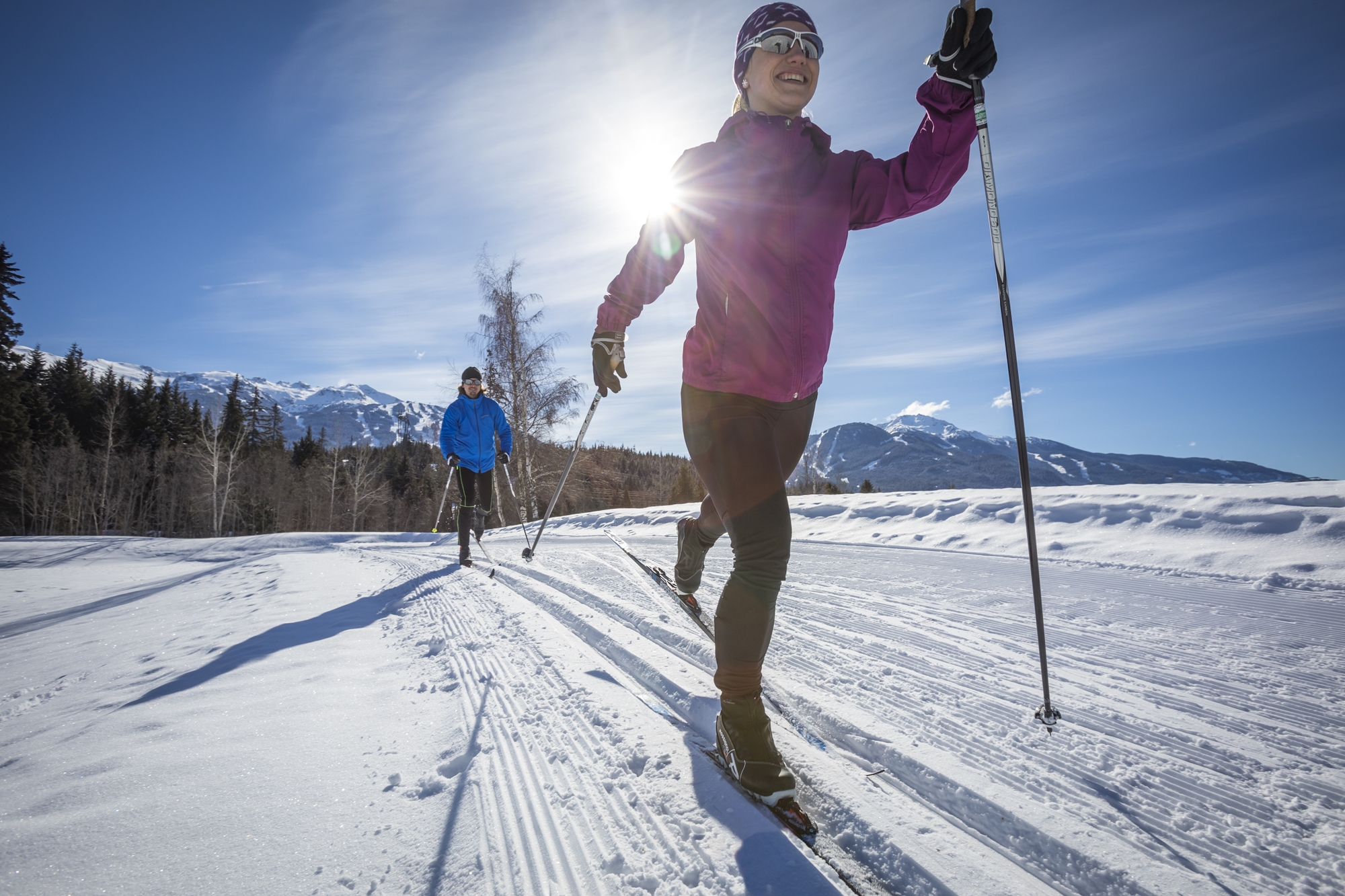
Photo: Tourism Whistler
1. Snow reliability, not just snowfall
The quality of any cross-country skiing holiday depends heavily onsnow conditions. Average annual snowfall is the number resorts advertise. It is not the number that matters most. What matters is how consistently a place holds skiable snow through the window when you can actually travel.
Altitude does a lot of the work here. Higher trail systems stay cold enough to keep a base intact through a February thaw that wipes out valley tracks. So does snowmaking. A growing number of Nordic centers now blow snow on a core loop, typically 3 to 5 kilometers, which guarantees you something to ski on even in a bad year. That loop will not carry a full week on its own, but it is real insurance.
Look up the last five seasons rather than the thirty-year average. Early December and late March are the risky bookings. Mid-January is almost always safe.
2. Grooming you can count on
Scenery does not save a badly groomed track. Nothing does.
The questions to ask are specific ones. How often does the center groom, and does it groom after a storm or wait for it to settle? Are classic tracks set on both sides of the skating lane, or does the skate deck take priority when the cats are short on time? Is there night grooming, so morning corduroy is a given rather than a coin flip?
Most serious centers post a daily grooming report. Read a few weeks of them before you commit. A center that logs conditions honestly, including the days when things were icy, is telling you something useful about how it operates.
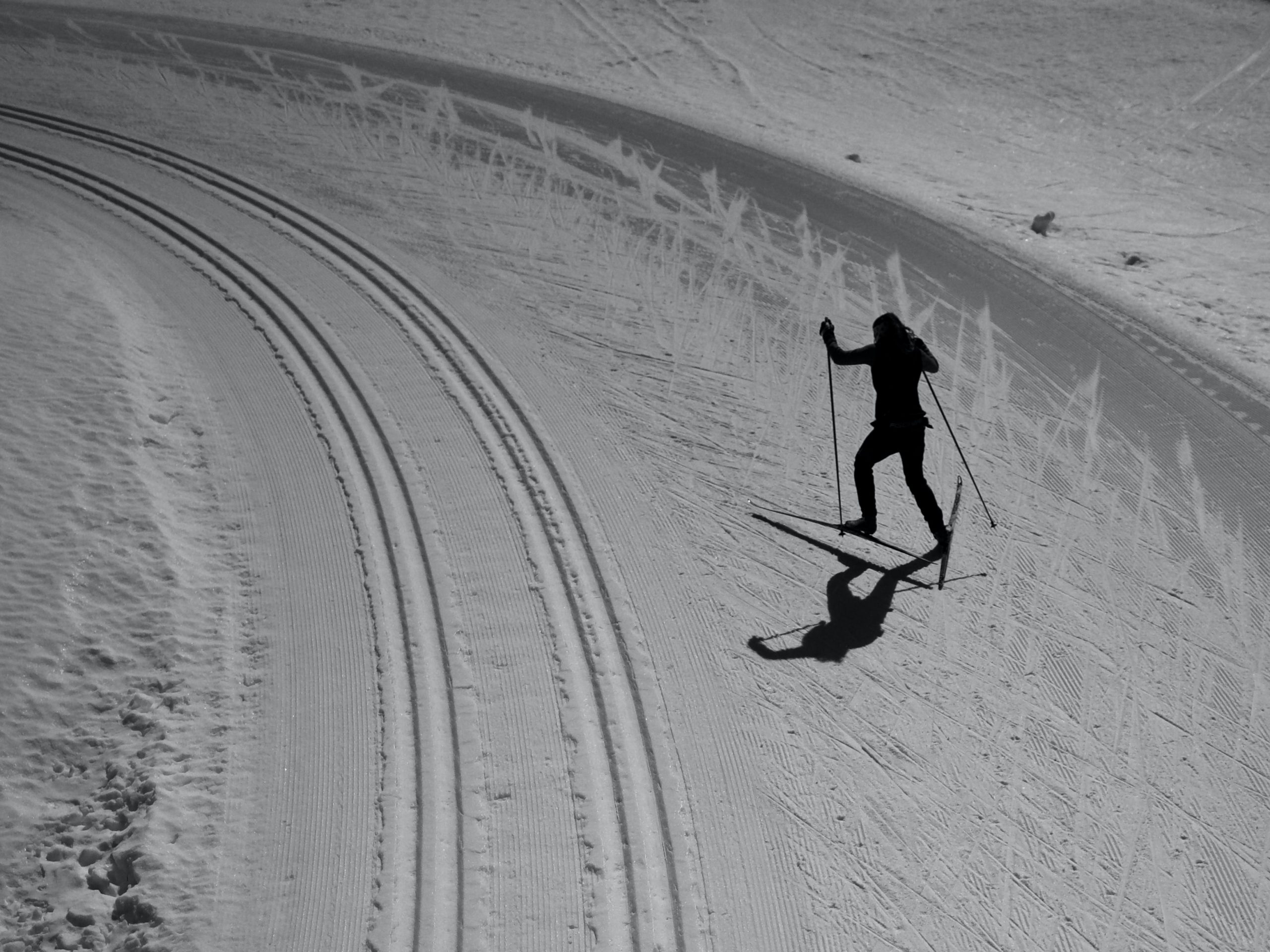
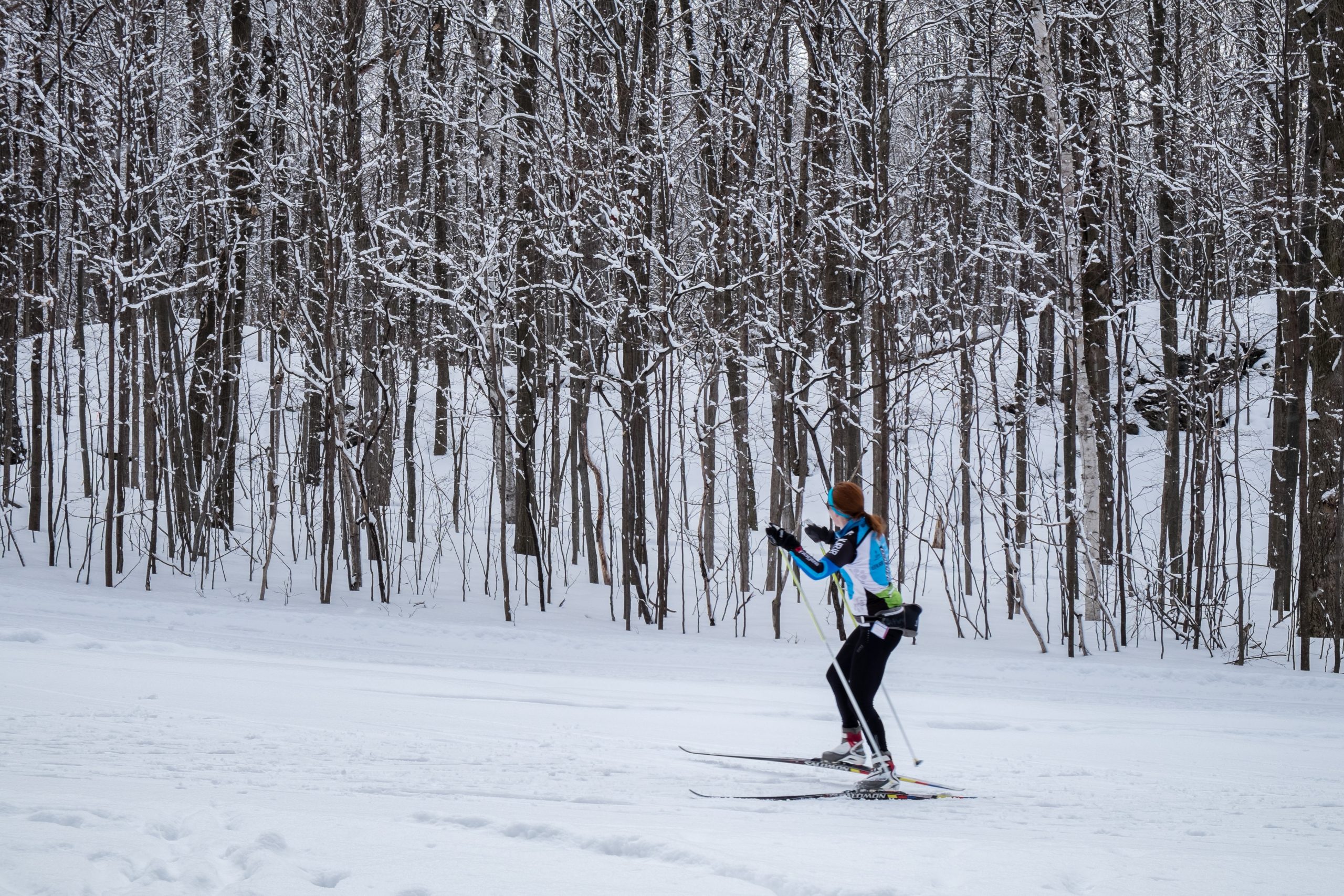
Skating has been shown exacerbate CECS, even more than classic skiing. (Photo by Thomas Dils on Unsplash)
3. Terrain that matches the skiing you actually do
Cross-country skiing is unusually welcoming across ages and ability levels, which is exactly why destinations vary so much in who they suit.
A newer skier wants gentle, wide, well-signed terrain and a lesson program worth taking. Someone comfortable on skis wants 40 or 50 kilometers of connected trail with real climbing and descending, so a full day out does not mean skiing the same loop four times. A racer or a distance skier wants a network that supports a three-hour effort and, ideally, a hill they can do intervals on.
Beginners often benefit from gentle terrain, dedicated practice areas and professional tuition, whileintermediate skiers may prefer destinations offering longer routes with a mixture of climbing, descending and varied scenery. Experienced skiers and endurance enthusiasts are likely to appreciate extensive trail systems that provide technical challenges and opportunities to cover greater distances.
Groups complicate this. If you are traveling with a partner who skis twice a year and a kid who wants to go hard, a center with one difficulty band will frustrate somebody every day. Trail maps are free and they answer this question in about two minutes.
4. Where the trails go
Skiing is the rare winter sport that moves you through a landscape rather than down it. You cover ground at a pace that lets you see it.
That makes the setting a genuine part of the product, not a marketing photo. Trails that thread through old-growth forest, cross a frozen lake, or open onto a valley floor at the right hour give you something a treadmill of a loop through a parking-lot perimeter never will. Light matters more here than people expect. Low winter sun on fresh snow at nine in the morning is most of the reason skiers get out of bed on vacation.
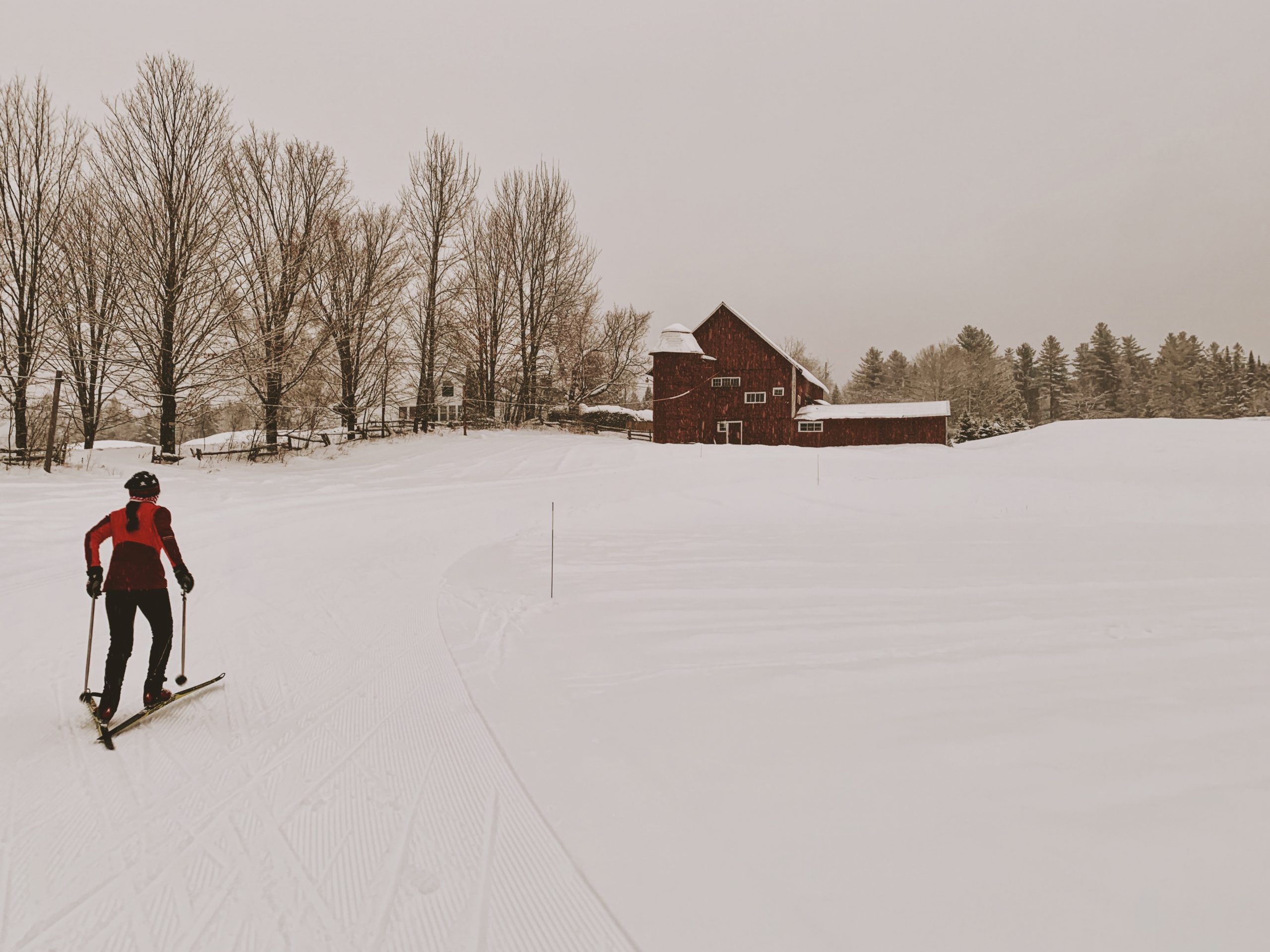
Recreational skate. (Photo: Phillip Belena)
5. Lodging close enough to matter
Ten minutes from the trailhead and thirty-five minutes from the trailhead are different trips. The second one costs you an hour a day and quietly kills the second ski.
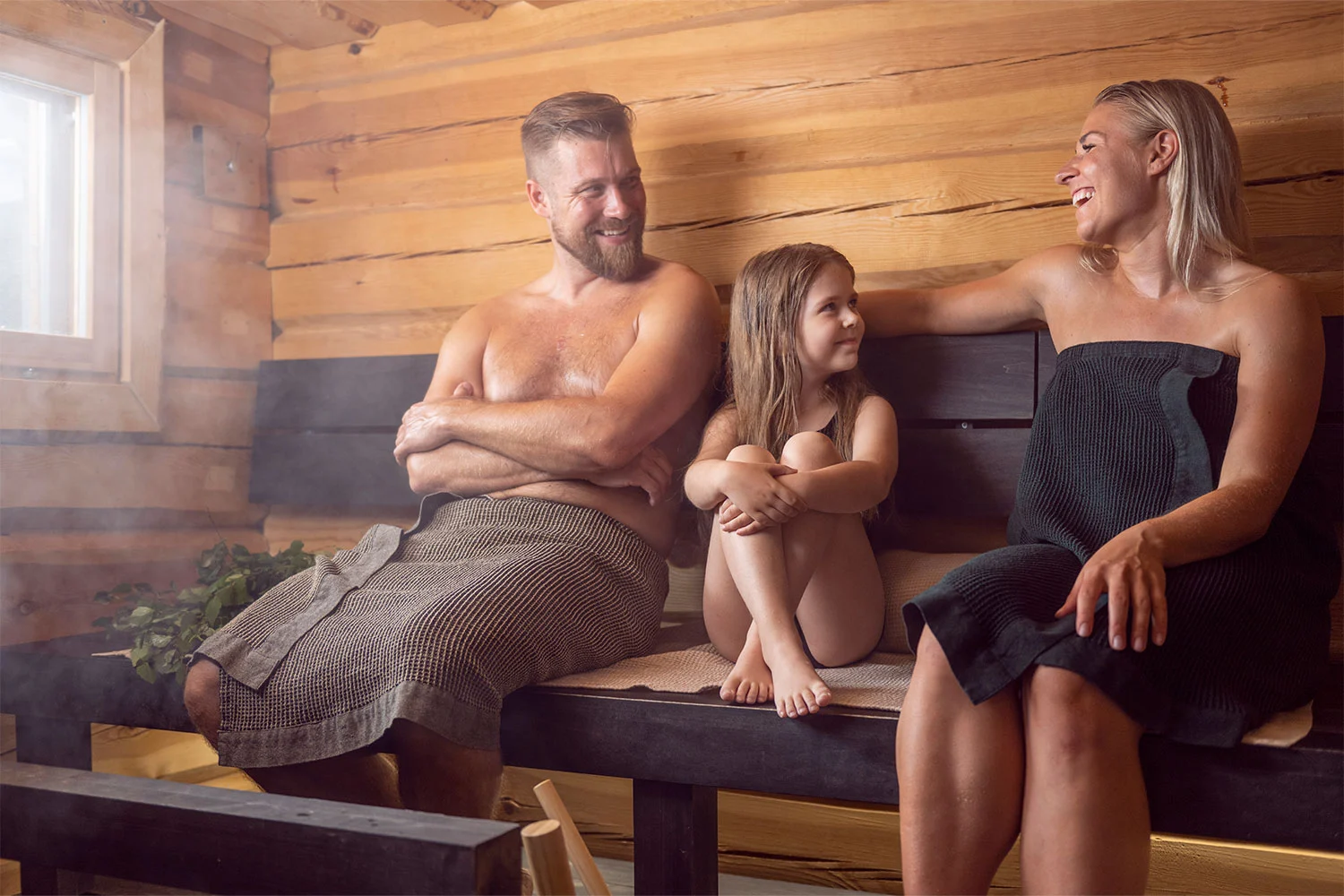
Beyond distance, the practical stuff is what separates a place that understands Nordic skiers from a place that rents rooms. Heated wax and boot rooms. Somewhere to dry gloves. A kitchen or a breakfast that runs early enough to eat before you go out. A sauna, which is not a luxury after four hours in the cold so much as a piece of recovery equipment.
6. What happens when the skiing stops
You are probably skiing three or four hours a day. That leaves a lot of day.
Towns with something going on, a bakery, a decent restaurant, a bar where people who ski actually go, turn the rest of the day into part of the trip instead of downtime in a rental. It also matters if you are traveling with someone who does not ski every day. Snowshoe trails, winter walking paths, a market, a hot spring, all of that keeps a group happy without forcing everyone onto the same schedule.
7. Getting there and getting outfitted
Logistics are boring right up until they eat a day of your trip.
Check the transfer time from the nearest airport or rail station honestly, including the last leg, which is often the slow one. Check whether you need a car once you arrive or whether a shuttle connects the lodging to the trails. If you are flying with skis, check the airline’s oversize policy before you buy, not after.
Rental quality is the other one people underestimate. A center with a real shop, current skis, a waxing service, and staff who ski themselves will get you on decent equipment in twenty minutes. A center without one will hand you a pair of rock skis from 2009 and wish you luck.
Recreational skate. (Photo: Pierre Jarry)
The right destination is the one that fits how you ski
Some skiers want distance and a network big enough to get lost in. Some want a quiet loop through the woods and a long lunch. Neither is looking for the same trip, and neither is served by picking whichever place claims the most kilometers.
The places worth returning to are the ones where reliable snow, honest grooming, terrain that suits you, and lodging you can walk to from the tracks all show up in the same week. Get those four right and the rest of it, the light on the snow, the pace, the quiet, takes care of itself.
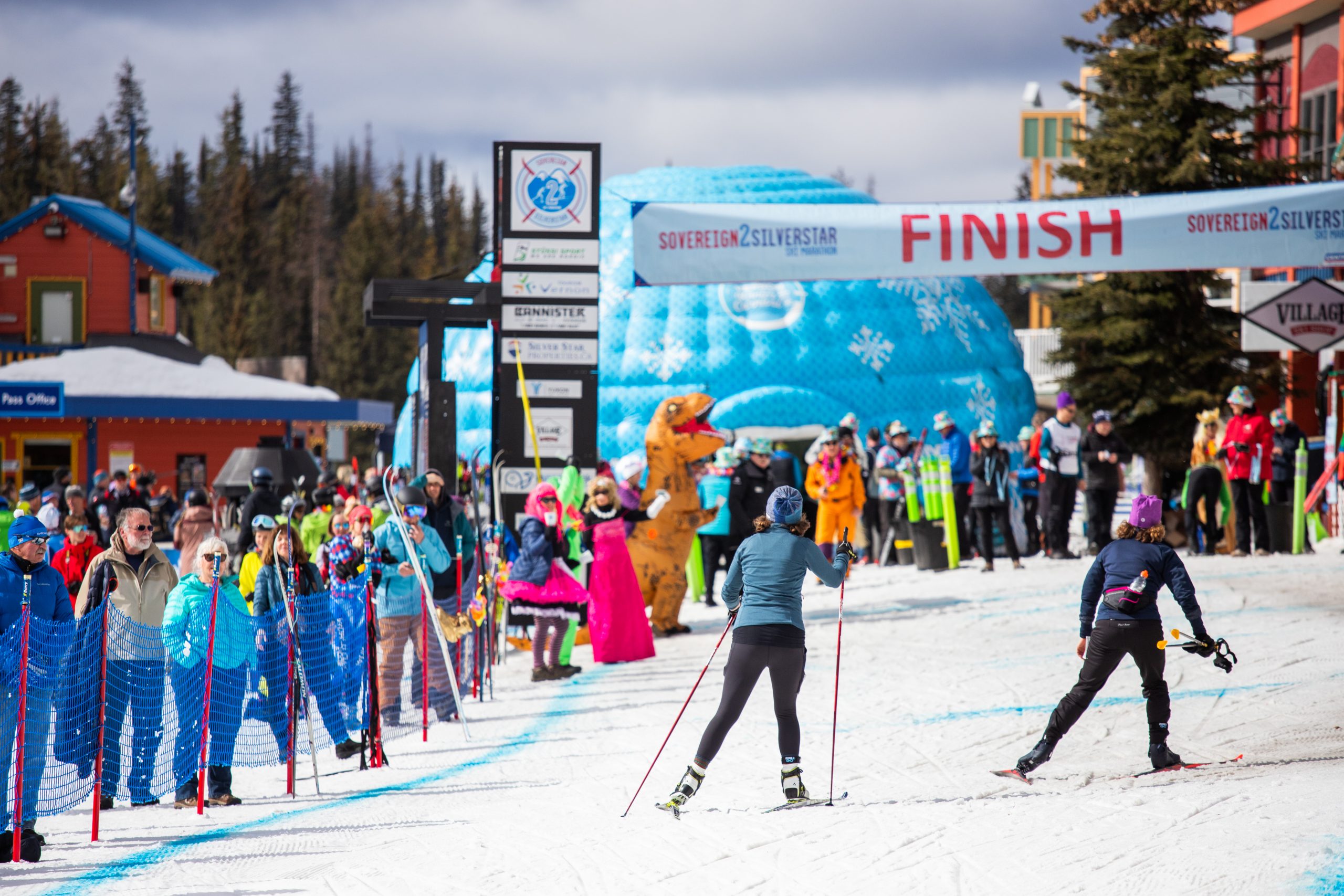
LAST CALL for an Incredible Nordic Weekend at Sovereign 2 SilverStar Ski Marathon, Vernon, BC
April 4-5, 2026 | Stussi Night Sprints April 2
Registration Closes 6pm (local) Sunday, March 29th
You don’t want to miss out on the 5th annual S2S! Sovereign Lake Nordic Club and Silver Star Mountain Resort — the two world-class venues co-hosting the event — have had new snow and colder temps over the past week, and the groomers have been doing a great job. (The picture below is for real.) Classic Saturday and Skate Sunday, with 21km and 41km distances available both days.
Stussi Night Sprints — The Best Way to Get Ready for the Ski Marathons
April 2 @ 4pm
If you’ve ever wanted to try out the exciting event of sprint skiing, now’s your chance. On a fun, fast, and spectator-friendly 1.1km course, this is a great opportunity for Masters and Development athletes to give it a go. And after you’re done racing, stick around to watch Elite racers compete for $3,400 in prize money. Come out and enjoy an exciting evening of head-to-head racing.
The race was ON from the gun: We recap the women’s 20-kilometer pursuit, which was a rough go for Jessie Diggins and a tight fight between the Scandinavian heavyweights.
Alaskan Holly Brooks, the retired Olympic World Cup racer, joins us after watching the race in person. We hope to get proof of life from Devon soon.
In the mean time, reach us at devon[at]fasterskier.com and nat[at]fasterskier.com. We’ll be back tomorrow.
Help Support Our Olympic Coverage!
FasterSkier will have our own Nat Herz on the ground at the Olympics, which, to be honest, is a very big financial lift for us. If you value the thoughtful work and access FasterSkier provides at championships like this one, please consider becoming a Voluntary Subscriber. Your support directly fuels the work we do to cover the people, places, and moments that make our sport special.
Jack Young and Bernie Nelson testing in Toblach for this year’s Tour de Ski – they have a lot of fun. (Photo: Courtesy Photo)
At some point before every race, there is a moment when the conversation ends.
The skis are ready. All the questions have been answered. The athlete has described, more than once, how the ski felt through the camber, how it released, and how it held when needed. Their part is done. Then, they leave the wax truck.
“There’s sort of like a Venn diagram of what the athlete controls and what the tech controls,” Bernie Nelson said. “And once the athlete leaves the room, that part is on us.”
There is nothing dramatic about the exit. No speeches or big gestures. Jack Young doesn’t hand over responsibility; he simply sets it aside. But the change is instant. The skis, once a shared object, now become a problem to solve, a risk to manage, and a promise to keep.
“They’ve done their part,” Nelson said. “They’ve told us what they need. And then they kind of have to let go.”
Letting go is one of the least visible but most important exchanges in cross-country ski racing. Athletes are judged by what happens after the race starts, but long before that, control has already shifted. The responsibility for speed, traction, and how the ski handles changing surfaces moves to someone else.
Nelson takes a selfie during the podium ceremony in Davos, Switzerland, from this year’s Tour de Ski when both Jack Young and Ben Ogden finished in the top six. (Photo: Bernie Nelson)
For Nelson, that responsibility comes from familiarity, not theory. She works closely with Young, and their partnership is built on a shared language developed through repeated experience, not just formulas or measurements.
“It’s a lot about feel,” she said. “Like, I know what Jack is looking for because we’ve spent so many hours testing together.”
Here, testing isn’t about collecting data points. It’s about building a shared vocabulary. Over many training sessions and race weekends, Young has described what he feels underfoot—how the ski responds to pressure, how it releases as speed builds, and how it acts when conditions change. Nelson listens, tests, and learns these sensations until they become her own reference.
“At this point,” she said, “I can get on a ski, and I know if it’s right or not for him.”
This knowledge can’t be easily passed on or turned into a checklist. It comes from shared experience—hours spent skiing the same loops, talking about small differences, and learning what matters. Nelson isn’t trying to copy Young’s race; she wants to understand his expectations well enough to meet them when he’s not there.
That is especially true in classic racing, where the margin between enough and too much is thin.
“With classic, especially,” she said, “it’s about that balance. You want enough kick so it’s there when you need it, but you don’t want it to feel draggy.”
The goal is not perfection, but confidence. When Young steps onto the start line, he needs to believe that the skis under him will do what they are supposed to do. That belief begins hours earlier, in the wax truck, where decisions are made quietly and are completely owned by someone else.
It all started in the driveway for Bernie Nelson. As Nelson says, she has been playing outside in the snow ever since: Just part of growing up in Tahoe. (Photo: Courtesy Photo)
Nobody Owns the Speed Alone
It might seem like the hand-off is a solitary moment—one technician, one set of skis, one athlete’s result. But Nelson quickly rejects that idea.
“I think of it like a chain,” she said. “You know, you can replace any link in the chain, and it still works, as long as everything’s connected.”
The metaphor is important because it shows how responsibility can be shared without becoming fragile. Nelson may be Young’s main contact, but she doesn’t work alone. Every decision she makes is shaped by a system that spreads out knowledge, work, and accountability.
“Someone else can wax Jack’s skis,” she said, “and that’s totally fine, because we’re all communicating the same thing.”
This is one of the quiet changes in modern service work. The old image of a single tech guarding secrets and working alone late at night has been replaced by a more collaborative and, surprisingly, more resilient approach. In the U.S. Cross-Country Ski Team’s service operation, having backup isn’t wasteful—it’s a form of insurance.
The chain is made up of people with different specialties and overlapping skills. Some focus on glide, others on kick. Some handle structure decisions, while others work on wax application and testing. Information moves constantly between them—about snow, about feel, and about what worked earlier in the day and what didn’t.
What holds it together is communication. Not just the volume of it, but its consistency.
When the athlete leaves the room, the system doesn’t get smaller—it grows. Decisions that might seem individual from the outside are actually the result of many conversations layered together.
Some of the US Service Team, including Jason Cork, Chris Hecker, Bernie Nelson, Tim Baucom, Eli Brown, and Paul Choudoir (l-r) in Ruka, Finland, this year. (Photo: Courtesy Photo)
Ten People, One Direction
The rhythm of that system becomes most visible at the end of the day.
“At the end of every day, we all sit down and talk about what worked and what didn’t,” Nelson said.
It happens whether the races went well or not. The format doesn’t change. The expectation doesn’t either.
“The meeting looks the same whether it was a great day or a terrible day,” she said.
There are no major celebrations on good days and no blame on bad ones. Each technician shares what they saw, what they tried, and what they would change. The goal isn’t to assign blame, but to build a clearer picture of the conditions and the choices that followed.
“It’s never about pointing fingers,” Nelson said. “It’s about figuring out what we can do better.”
Being curious instead of defensive is what helps the chain work under pressure. Speed in cross-country skiing depends on many factors, most beyond anyone’s control. What the service team can control is how they respond: how they share information, admit mistakes, and carry lessons forward.
The meetings turn the day’s work into preparation for the next. They also reinforce trust—not just between techs, but between the system and the people who depend on it.
Because tomorrow, another athlete will leave the wax truck. Another set of skis will change hands. And the chain will tighten again, ready to carry the weight.
The US Service Team in Engadin, Switzerland, last year on the porch of their wax truck, Yolanda. (Photo: Courtesy Photo)
Question the Skis, Not the People
Pressure has a way of revealing culture.
In a service room, pressure can show up as defensiveness, silence, or people sticking to their roles. But it can also appear as humor, rituals, and a shared understanding that mistakes will happen, but negative reactions are a choice.
Over time, the U.S. team has built its own mechanisms for navigating that pressure. They are small, almost absurd on their face, but they carry real weight.
“We have this thing called the Try Hard Trophy,” Bernie Nelson said. “And it’s basically for whoever just put everything they had into the day.”
The trophy, one of many, isn’t for perfect decisions or the fastest skis. It’s for effort—for staying engaged when conditions are tough, when answers aren’t clear, and when the work is demanding. In a job where results depend on many things no one can control, effort is the only steady measure.
There are other objects, too.
“If someone messes up,” Nelson said, “there’s an ‘I’m Sorry’ mouse. You own it, you apologize, and then we move on.”
The ritual is deliberate. The mistake isn’t ignored or softened. It’s acknowledged publicly, quickly, and without spectacle. The apology clears the air so the work can continue. There is no dragging of guilt into the next race.
“We say brothers and sisters fight,” Nelson added, “but you still have to come back together.”
These rituals aren’t just about morale. They’re about making things work. In a system where speed relies on teamwork, unresolved tension isn’t just personal—it’s a risk to performance. The culture is there to keep the chain strong when pressure rises.
And pressure always spikes.
Bernie Nelson in Lillehammer, Norway, in 2025. Course bibs are a finite resource, but FIS provides two red bibs, which can only be used by women. The US Cross-Country Ski Team takes full advantage of them, and the team even shared and coordinated the women’s bibs for this race, with more than 2 female staff on site (AWESOME). The Team bib is purple under the radio harness. (Photo: Gretchen Powers)
When the Skis Aren’t Fast Enough
Not every race goes well. Sometimes the skis aren’t competitive. Sometimes the margin is so small that you question everything.
What happens next matters more than what went wrong.
“We question the speed,” Nelson said. “We don’t question the effort or the intent.”
That difference is key to how the service team gets through a long season, especially during the Olympics. Speed can be questioned. Decisions can be reviewed. Processes can be improved. But questioning intent damages trust, and once trust is lost, the hand-off becomes fragile.
After a difficult race, the work looks much the same as it does after a good one. The team sits down. They talk through what they saw. They compare notes. They stay curious.
“You still have to be curious,” Nelson said, “even when it didn’t go well.”
Curiosity keeps the system open. It lets technicians adjust without becoming defensive or making enemies. It also means that when responsibility is shared and the chain works, failure is handled together, not blamed on one person.
For the athlete, that matters. The race may already be over, but the relationship isn’t. Trust has to survive the bad days if it’s going to mean anything on the good ones.
Nelson with her partner, Dakota Blackhorse-von Jess, in Falun, Sweden, in 2015 for World Champs. Dakota was racing in the sprint for Team USA. Qualified in 30th and was trending on Twitter/X in Sweden because of his last name. (Photo: Courtesy Photo)
This Isn’t CPR
Nelson hasn’t always worked in ski service. For a while, she left the sport and became a nurse. This decision was partly influenced by losing her mother and wanting to understand pressure in a new way.
“I worked as a nurse for a while,” she said, “and it really changed how I think about pressure.”
The comparison isn’t rhetorical. Nursing recalibrated what urgency looks like, what stakes feel like, and what consequences truly mean.
“At the end of the day,” Nelson said, “this isn’t CPR. It’s ski racing.”
The line isn’t meant to dismiss the sport. It’s a reminder to stay grounded. Cross-country skiing at the Olympic level is intense, career-changing, and deeply important to those involved. But it’s not a medical emergency. No one’s life depends on picking the perfect ski flex or structure.
That perspective doesn’t lessen commitment; it makes it sharper. Without panic, Nelson can stay focused when conditions change and quick decisions are needed. Calm is an advantage, not a sign of not caring.
Leanne Bentley, the team’s Press Officer, reinforces that calibration.
“Leanne always says, ‘It’s just ski racing,’” Nelson said. “And that really sticks with me.”
The phrase circulates not as a joke, but as a reminder: urgency without clarity helps no one.
Dakota and Bernie in Falun for the World Cup in 2025. Exactly 10 years after the previous photo. (Photo: Courtesy Photo)
No Home Runs in February
The Olympics compress everything.
“They’re career-changing for athletes,” Nelson said. “There’s no getting around that.”
Four years of preparation come down to just a few races. Weather windows get smaller. Snow conditions change by the hour. In that environment, it’s tempting to look for something extraordinary—a new structure, a wax combination, or a last-minute change that makes everything certain.
The service team resists that impulse deliberately.
“You don’t want to be trying something totally new on race day,” Nelson said.
At the Olympic level, restraint is a strategy. Big changes bring risk, and risk adds up fast when conditions are already unstable. The goal isn’t perfection, but to be consistently competitive.
“We’re not looking for home runs,” Nelson said. “We’re looking to be competitive.”
That approach comes from experience, including in Italy, where the team has usually felt confident in its preparation. But confidence isn’t the same as complacency. Every race still needs attention, testing, and communication. Past success doesn’t replace current effort.
The chain is strongest at times like these. Decisions are double-checked. Ideas are discussed. No one person carries all the weight, even when the responsibility feels heavier than ever.
Dakota, Bernie, Bernie’s late mom, Noelle. Noelle was a longtime coach for Stanford Field Hockey and played goalie for the US Field Hockey Team. Bernie credits many of her life (and coaching) lessons to her mom. The Nelsons were a big sports family – always outside playing games. (Photo: Courtesy Photo)
Tomorrow, It Happens Again
After the race, the skis come back. They are cleaned, evaluated, and re-prepped. Notes are taken. Meetings happen. The process resets.
“The process doesn’t really change,” Nelson said. “You just do it again the next day.”
Trust isn’t earned once and saved. It’s built again and again through consistency and follow-through.
“That trust gets rebuilt every single race,” she said.
Tomorrow, another athlete will sit in the service room. Another conversation about feel will take place. Another set of skis will be chosen. And at some point, quietly, control will change hands again.
“You show up,” Nelson said. “You do the work, and you hope you gave them what they needed.”
The athlete will leave the truck. The chain will hold. And the work—unseen, essential, and rarely recognized—will go on.
Help Support Our Olympic Coverage!
FasterSkier has our own Nat Herz on the ground at the Olympics, which, to be honest, is a very big financial lift for us. If you value the thoughtful work and access FasterSkier provides at championships like this one, please consider becoming a Voluntary Subscriber. Your support directly fuels the work we do to cover the people, places, and moments that make our sport special.
Eli Brown gave Nelson this shirt. Feel the Burn. Frequent in the rotation. “It’s an honor to share a bench with Eli Brown, he’s full of stories,” Nelson says. “We have a blast together. His feet still hit the floor with the same level of enthusiasm every day.” (Photo: Courtesy Photo)Service Truck snack haul – Oslo, Norway, edition. Nelson says, “This is a weekly event, we ski a lot!” (Photo: Courtesy Photo)
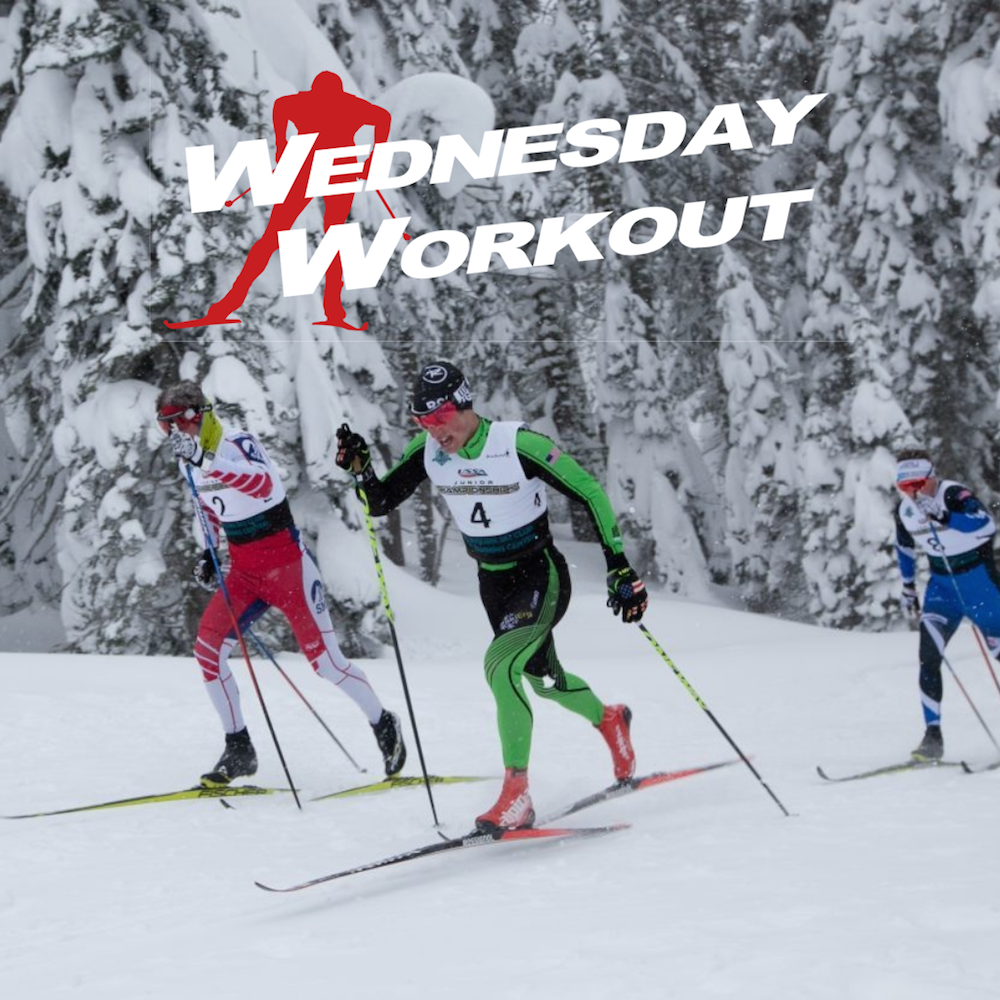
Craftsbury’s Ben Lustgarten (4) dueling with Stratton’s Ben Saxton (l) during the men’s classic sprint final at the SuperTour at Auburn Ski Club on Jan. 21 near Truckee, Calif. Lustgarten won the race, ahead of Saxton in second and and APU’s Reese Hanneman (r) in third.
For much of the U.S. nationals men’s 30-kilometer classic mass start on Jan. 11, Ben Lustgarten of the Craftsbury Green Racing Project (CGRP) seemed very much in control. Never too full-throttle, never too tempered; not a quick-strike performance but a methodical, boa-like squeeze with a sizable result: an off-the-front solo win. A few weekends later, the Vermont native struck again at the Truckee SuperTour. There, Lustgarten revealed his mastery of up-tempo classic sprinting as he won the day.
Before we get to Lustgarten’s ski-imitation workout prescribed by CGRP Head Coach Pepa Miloucheva, here’s a questions-and-response with Lustgarten. FasterSkier reached out to the 24-year-old Lustgarten via email to get his thoughts on how he’s developed and raced with powerful and economical classic skiing.
FasterSkier:Can you describe how you managed to keep such fluid and smooth technique during the 30 k classic at U.S. nationals?
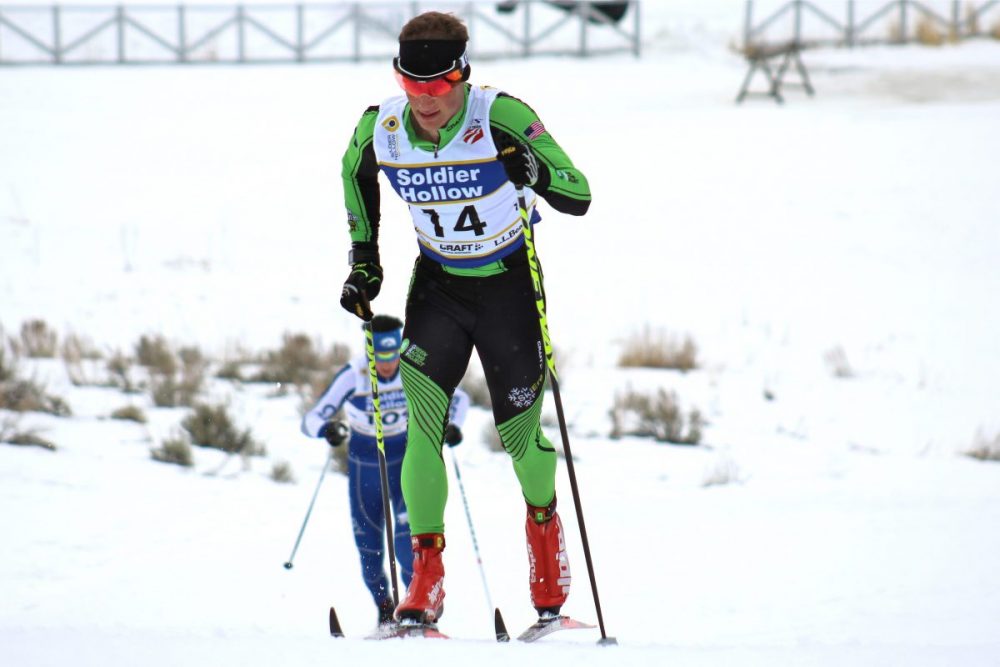
Craftsbury Green Racing Project’s Ben Lustgarten on his way to winning the 30 k classic mass start at U.S. Cross Country Championships on Jan. 11 at Soldier Hollow in Midway, Utah.
Ben Lustgarten: I focused really hard on skiing smooth and not wasting any energy in the 30km classic. To be honest, I did not feel amazing during my warm up, so I figured I shouldn’t waste any energy during the race until I absolutely needed it. I wanted to feel out the race, and see what people would do. My kick was very good around the whole course, but a bit slick on the first 1/4 mile climb (the track was a bit more glazed there). I focused on transfering my weight completely over each ski, and throwing my foot out in front of me and kicking sharply but smoothly in order to get full purchase from the ski and not wasting energy slipping. I also tried to relax my arms, swing them naturally, which helped to lengthen my stride and combined with throwing my foot forward, getting more glide. The steeper hills I tried to have a good short impulse and also throwing my foot ahead of me and running lightly. Staying light and smooth was key, and I saved a lot of energy for the last two laps.
FS:How might you attribute your consistent classic technique during something like the 30 k classic to the workout you will describe?
BL: I think that ski imitation, or skipping with poles, trains the body to mimic and be able to handle the impulse and load that goes with classic skiing. When I got tired my muscles still remembered and could have a good sharp impulse without even thinking about it. Ski imitation also mimics the timing of classic skiing, so my arms would swing in time with my kick, and there is a glide phase (or when you are in the air skipping). Focusing on staying relaxed really helped keep my skiing consistent. My skis and great kick also kept my skiing consistent. I did not have to alter my technique too much throughout the race because my skis kicked well the whole time. I think my increased endurance, strength, and technique work along with my consistent skis allowed me to keep a solid relaxed technique for the whole 30k. Saving energy through technique allowed for increased energy expenditure for the last 7.5km.
FS:Do you have an internal mantra or a physical cue you use to maintain your classic technique at race pace?
BL: I do not necessarily think too hard during my best races. However, I personally use a lot of positive self talk, especially when things hurt. I tell myself “I can do this,” “I can keep going,” “I can hurt more than this,” “I can go faster,” or “I got this” over and over again. But as for skiing smooth, I just focus on technique and kicking the skis well and getting as much glide as physically possible. Sometimes I think about trying to get even just another few inches more with each glide, which helps keep my technique long and relaxed. Of all of the best races of my life, I usually can’t remember what I was thinking about because I was just so focusing on skiing as fast as possible.
FS:In Truckee, you were exposed as a classic sprinter as well. What are the connecting points between maintaining good classic technique at 30 k pace and sprint pace? And how might this be associated with Pepa’s ski imitation?
BL: We did a speed workout a few days before the sprint including an uphill running speed. The video analysis looked almost comical as I had such incredibly high tempo but wasn’t really moving that fast. Pepa told me to bound as long as possible and stay long, which is what I did in the sprint. I brought the intensity down from 100% to 90% and skied longer and smoother, and I ended up winning the race! I think technique is truly important for speed at sprinting or distance. I probably used about 70% of the energy with a long bound up steep hills in the sprint than going as fast as I could running with high tempo. On skis technique means you ski faster, longer, and more relaxed. More watts does not directly correlate to faster speed in skiing, unlike other sports. Obviously being fit and strong is useful, but applying proper technique with less energy can make you go much faster. I saved a ton of energy during the sprint day just staying relaxed, punching it a few times where I needed some speed, staying long and getting good glide and distance. The ski imitation trains the impulse and timing, on skis the glide phase is longer than skipping, but the impulse is there. The quick second step during a skipping motion is when you kick the ski into the snow, followed by a bound or glide phase. That really helps with classic skiing.
***
Remember Lustgarten’s ski-imitation workout is a dryland endeavor. Even though it’s full-on winter in most places, keep this workout in your back pocket when you’re thinking about how to improve the classic striding as hard wax morphs to klister morphs to rock skis morphs to rollerskis — it’ll happen.
And here’s a direct disclaimer from Lustgarten to differentiate bounding from ski imitation: “Ski imitation trains endurance and motion good for distance skiing while explosive ski bounding more accurately represents the long bound technique of classic sprinting up steeper hills.”
And what is classic “ski imitation”?
“Classic ski imitation is essentially skipping with poles,” he wrote. “While using short bounding-length poles, the upper body mimics a classic stride rhythm in sync with the skipping motion of the lower body.”
The Workout: Classic-Ski Imitation with Lustgarten
Throw speeds in maybe every 10 minutes if you feel good, but it’s not mandatory. Mostly, try to maintain good Level 1 distance training.
Find terrain similar to a ski-race course such at the Craftsbury 5 k race course. Get ready for many laps of ski imitation on a hilly course
The workout just takes the place of a standard distance workout, usually between 1.5 – 3 hours in the summer and fall, instead of just doing a run or rollerski or bike ride.
On the hills you can continue to skip or do uphill lunges with good depth to load the muscles more. Lustgarten worked up to skip all the flats and downhills, but because of the demand on the calves from the impulse, some people may want to start with jogging the downhills. Lustgarten also recommends adding in a skate specific version where you jump side to side and use your poles in a V2 style of poling on the uphills — on his 5 k Craftsbury loop, Lustgarten sometimes mixes in 30m of classic imitation followed by 30m V2 imitation.
Lustgarten explained the workout won’t feel incredibly taxing. But be warned. “A few hours later you will feel more drained than just a bike ride or distance run, similar to the first on-snow ski workouts of the year because it takes more energy. Expect your calves to be sore the next day or two,” Lustgarten added.