From the FasterSkier archive — posts syndicated from athletes’ and coaches’ own blogs between 2004 and 2012, kept online as published. Current coverage is at fasterskier.com.
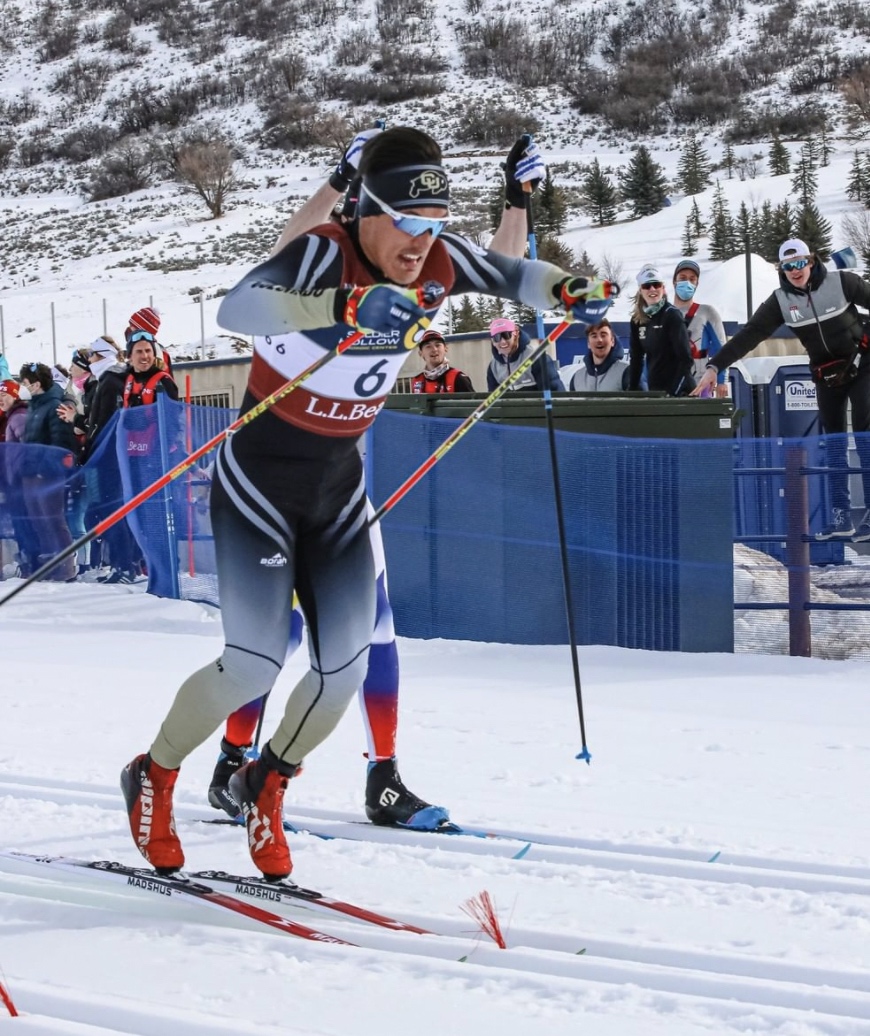
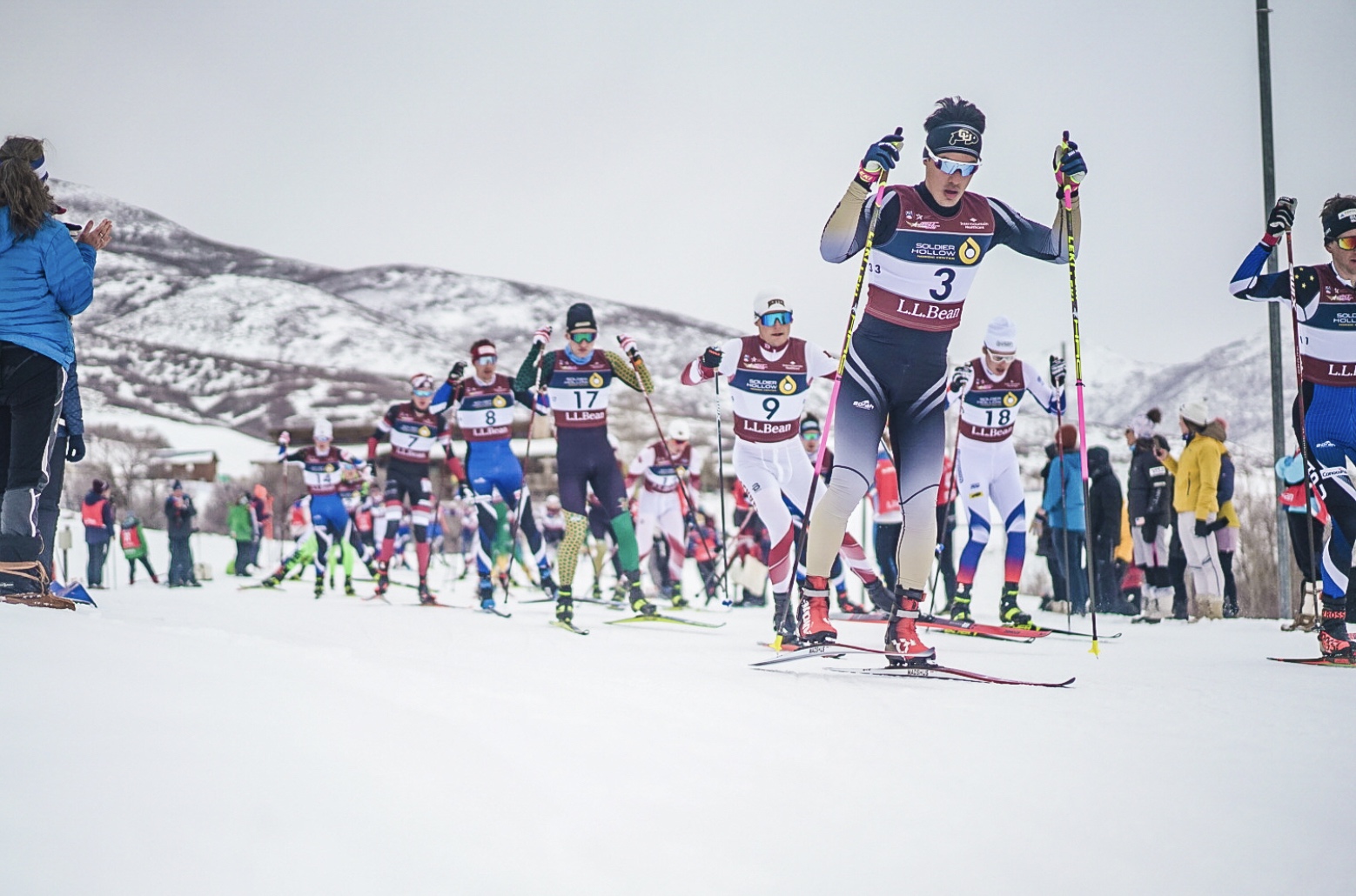
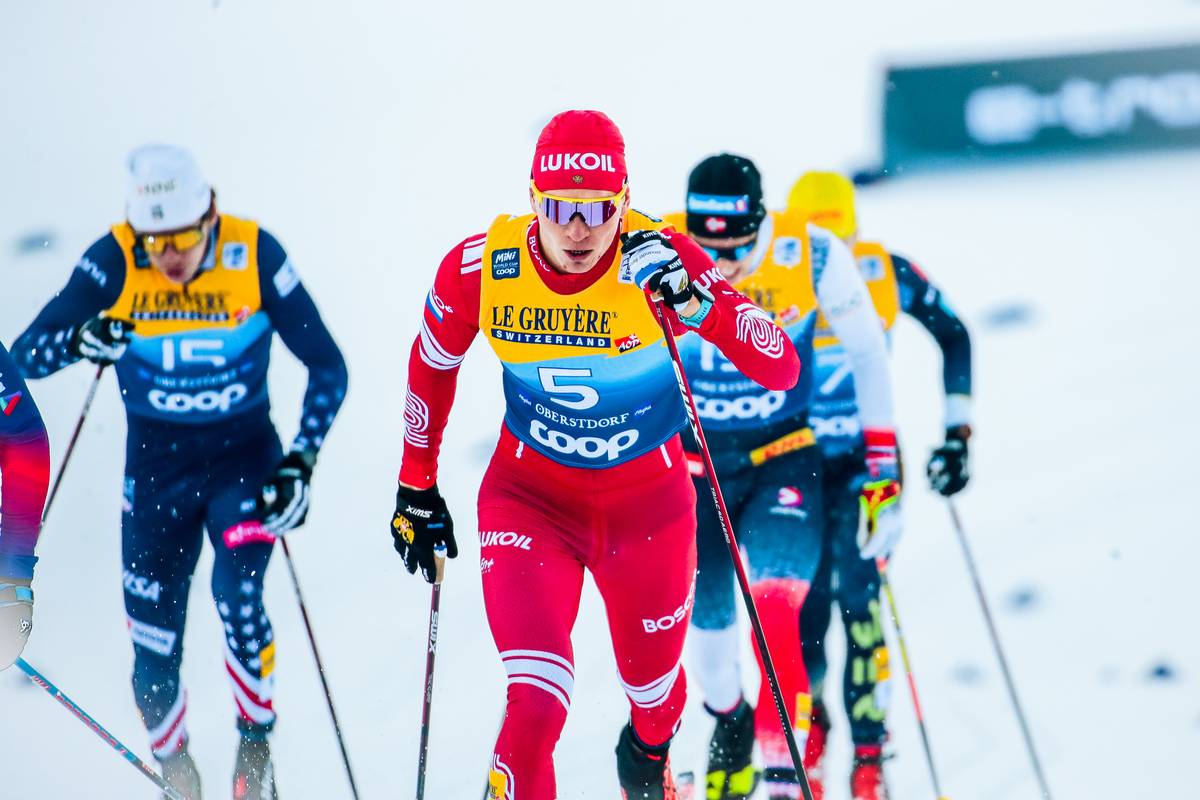
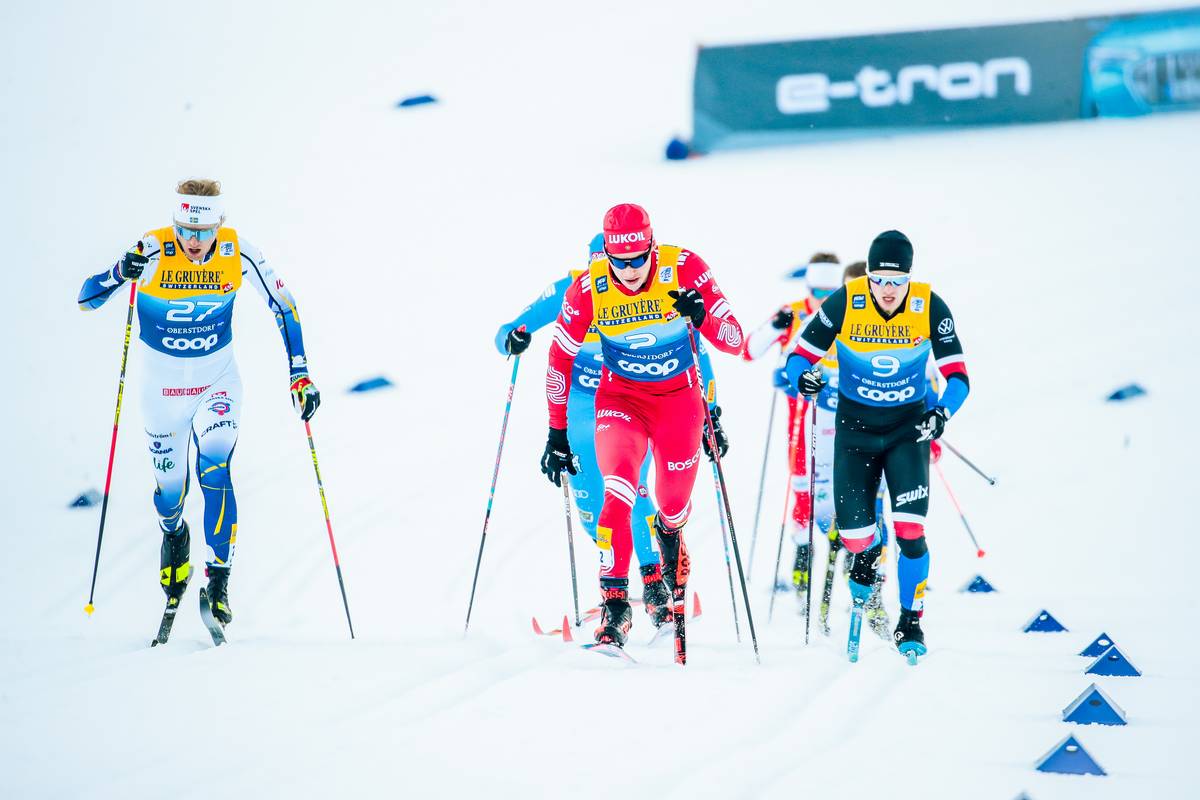
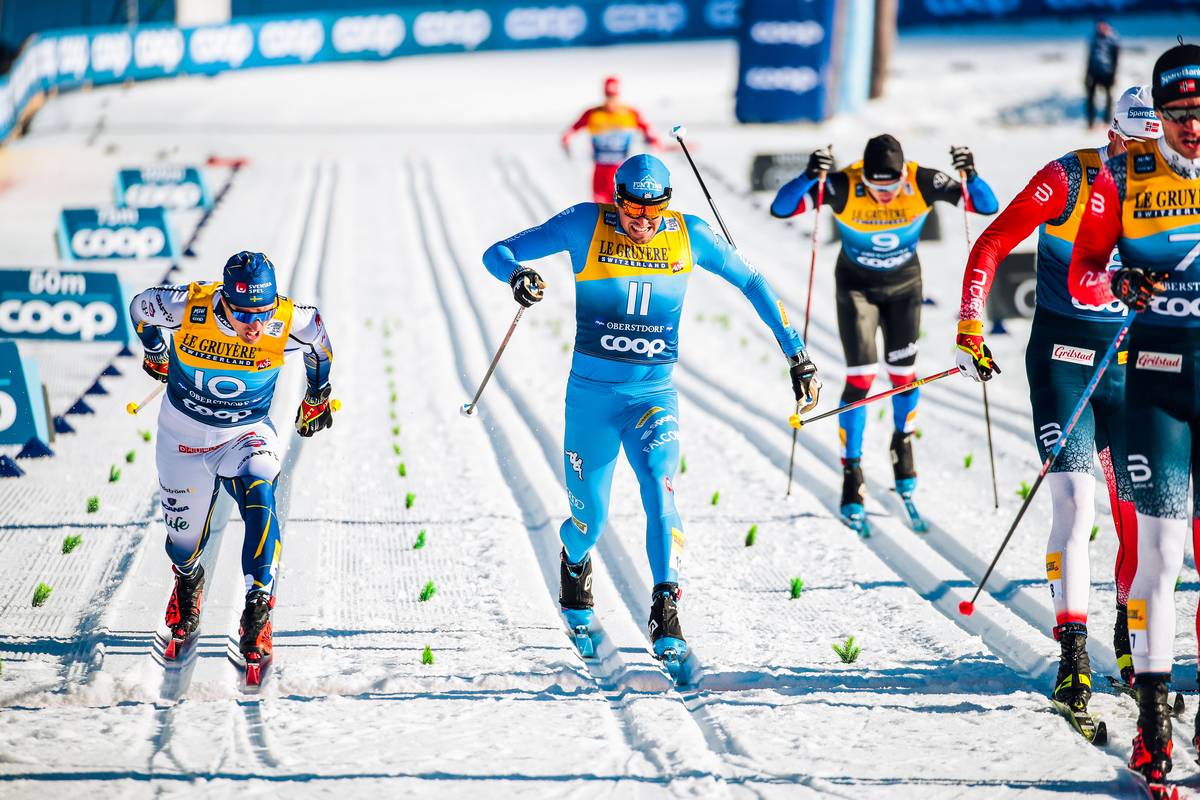
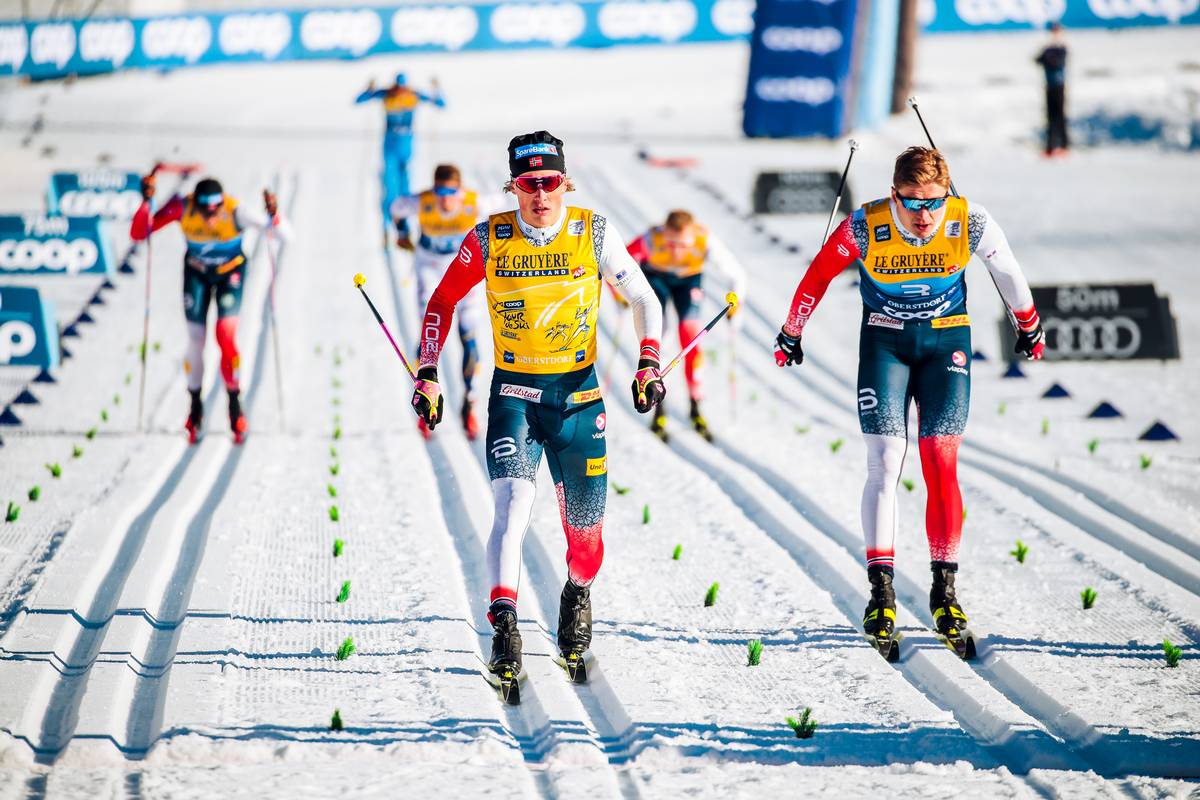
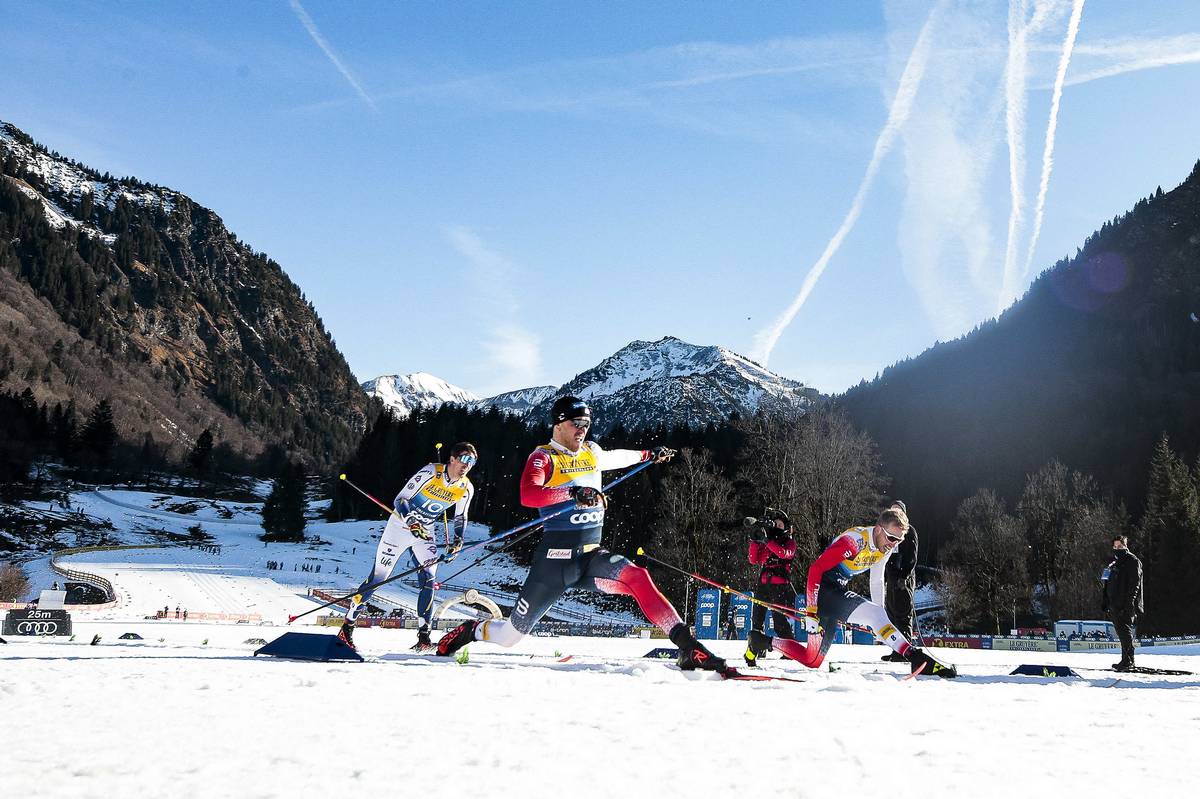
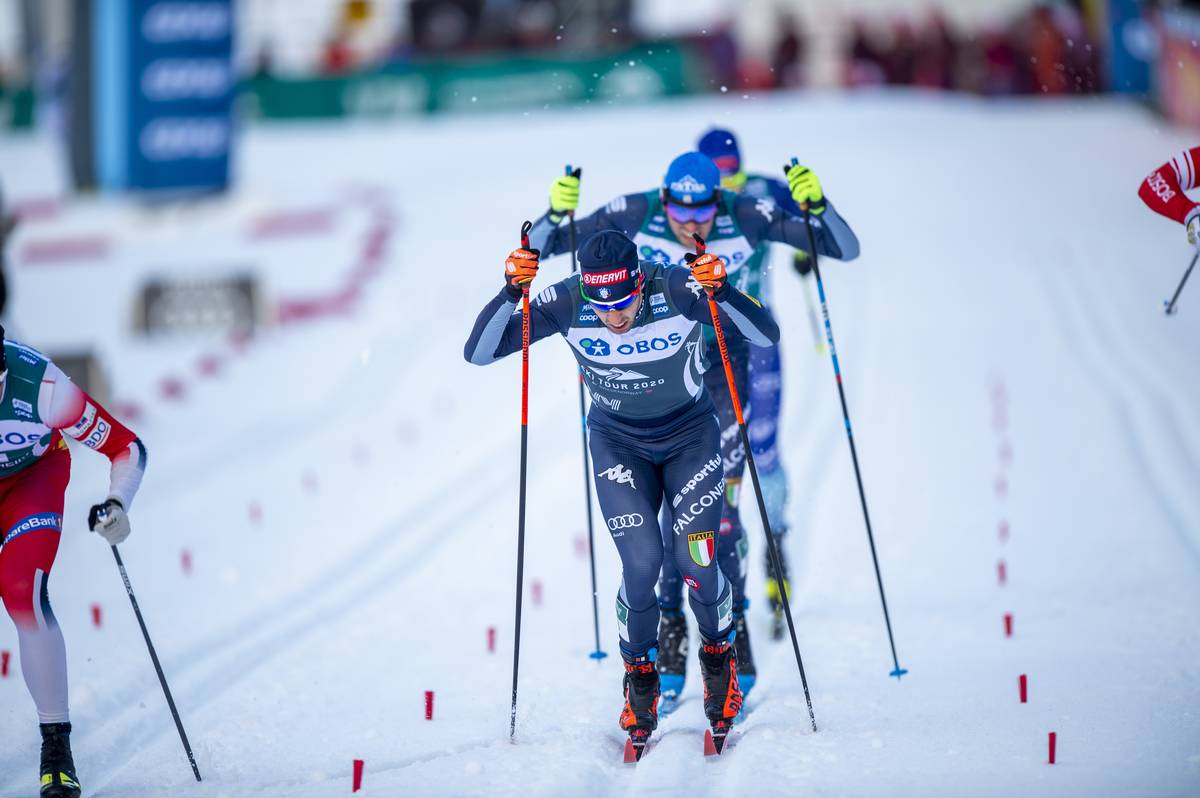
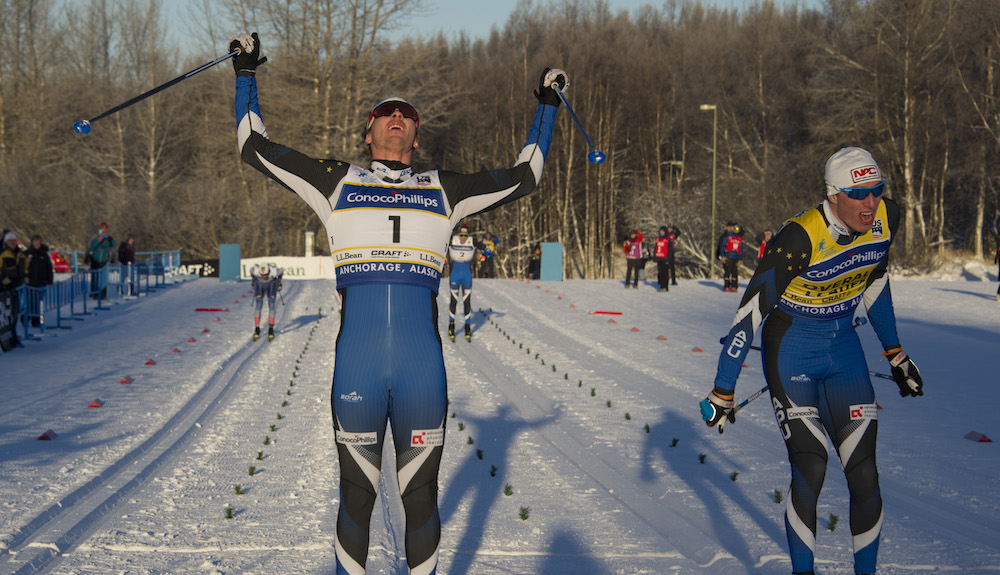
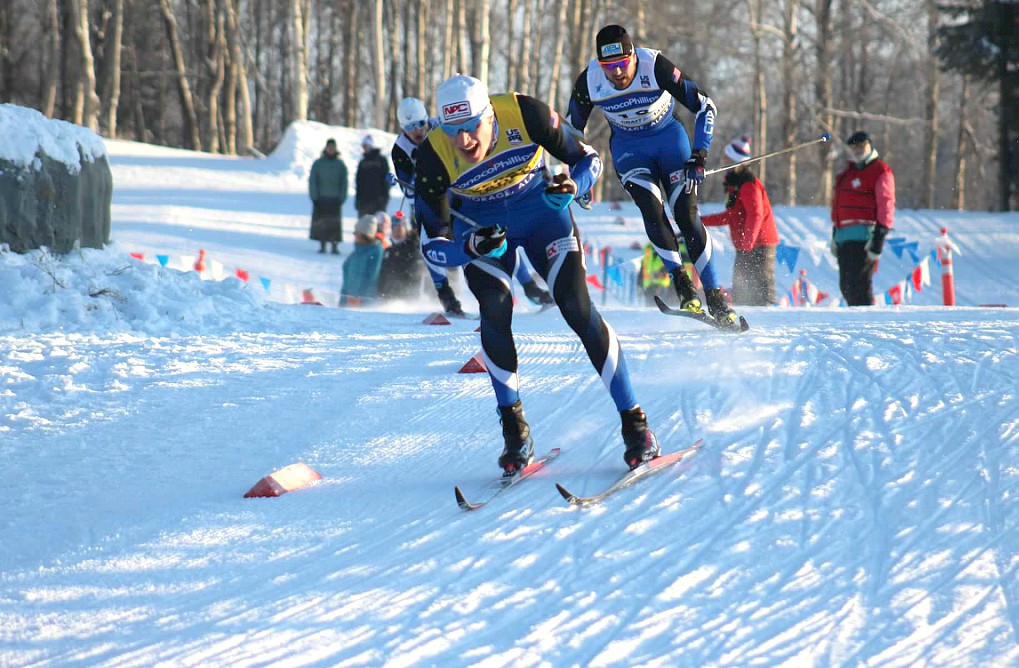
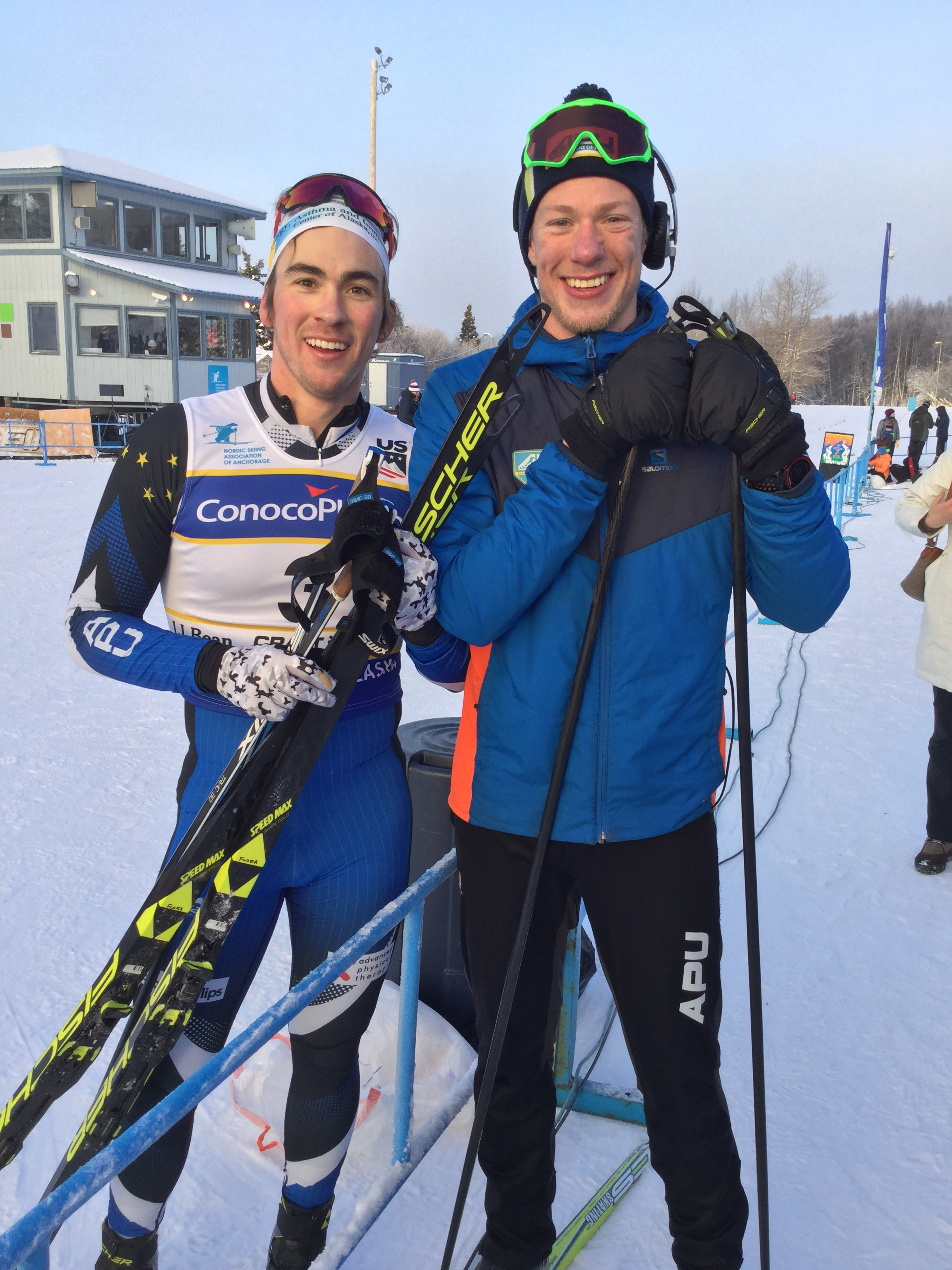
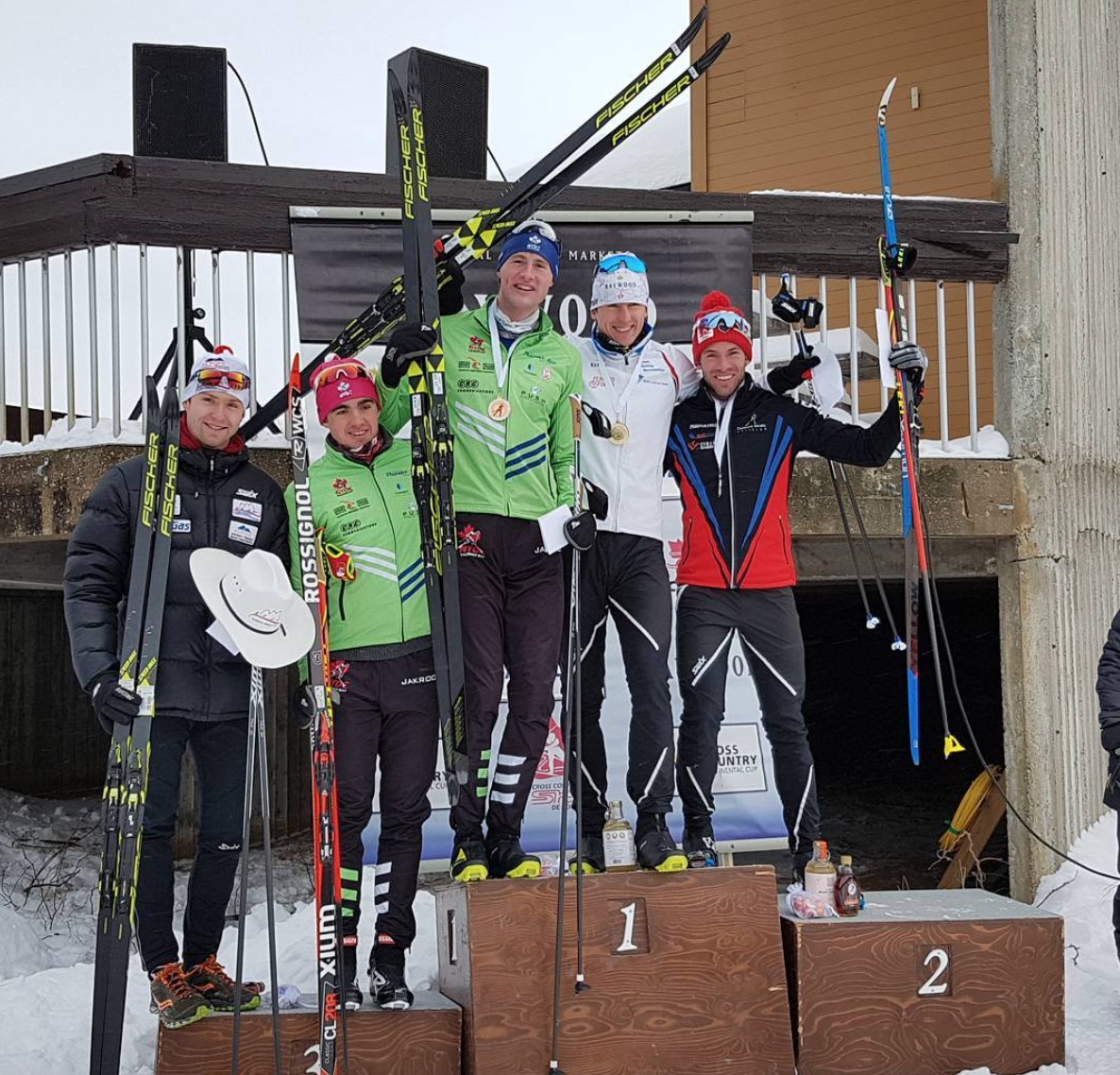
Ben Ogden, the Vermonter, taking the cake in the men’s sprint final. (Photo: Tryg Solberg / FasterSkier)
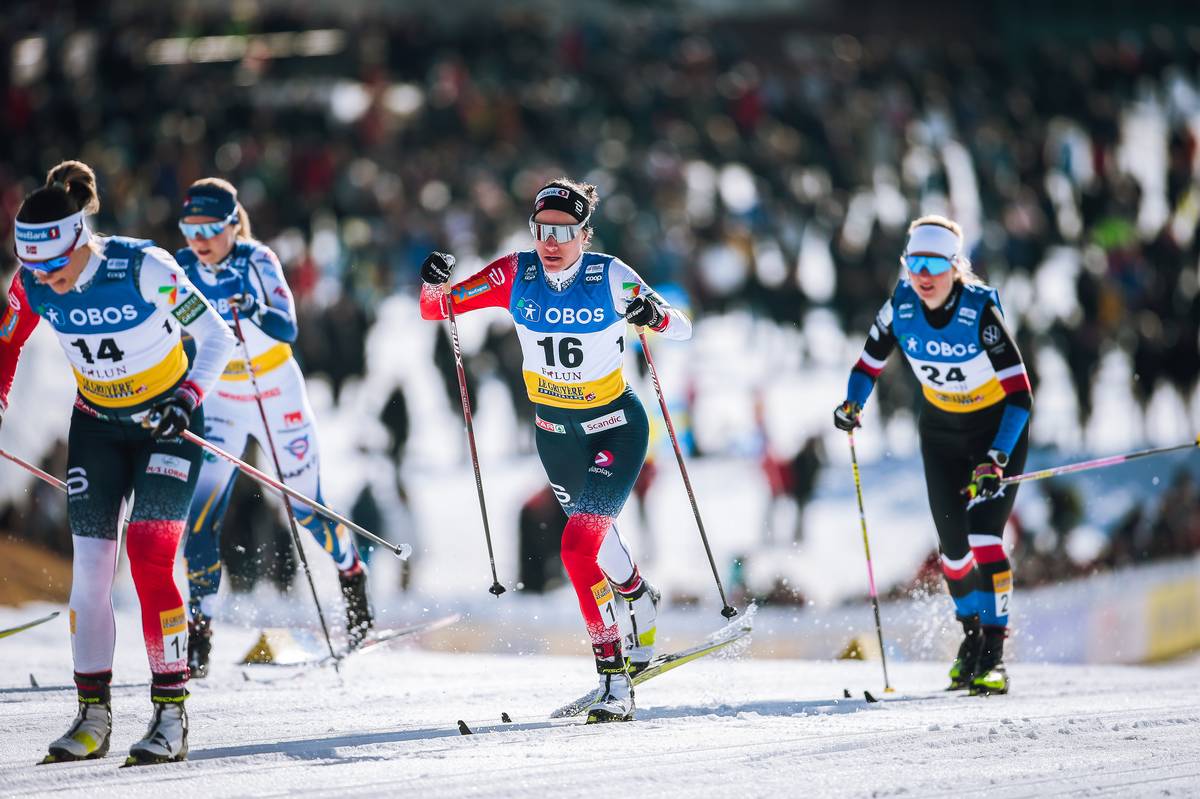
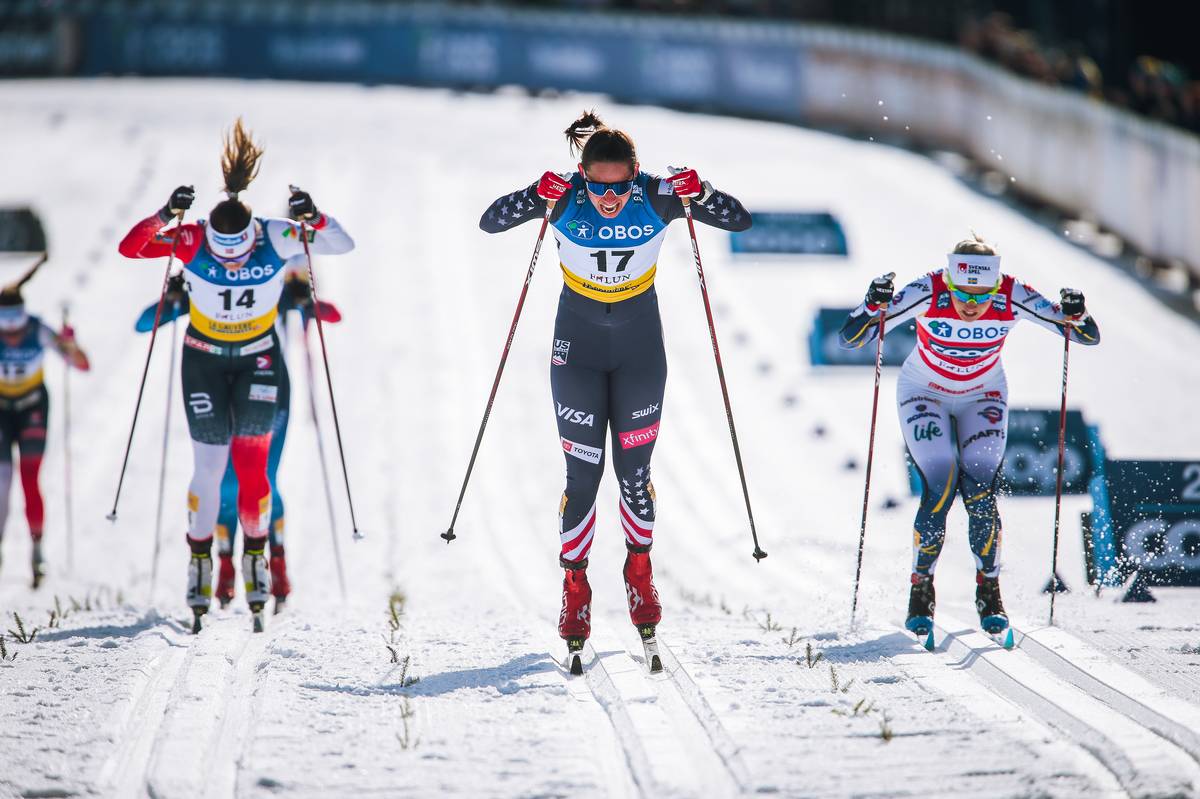
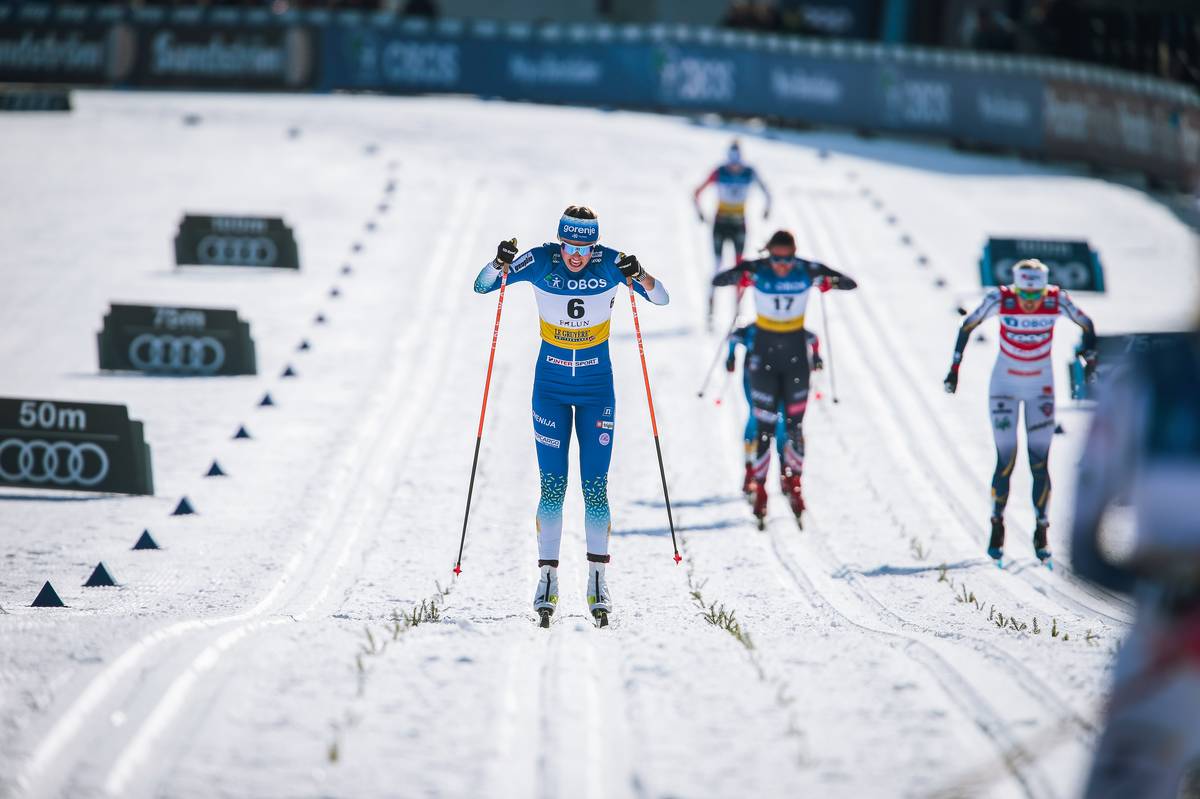
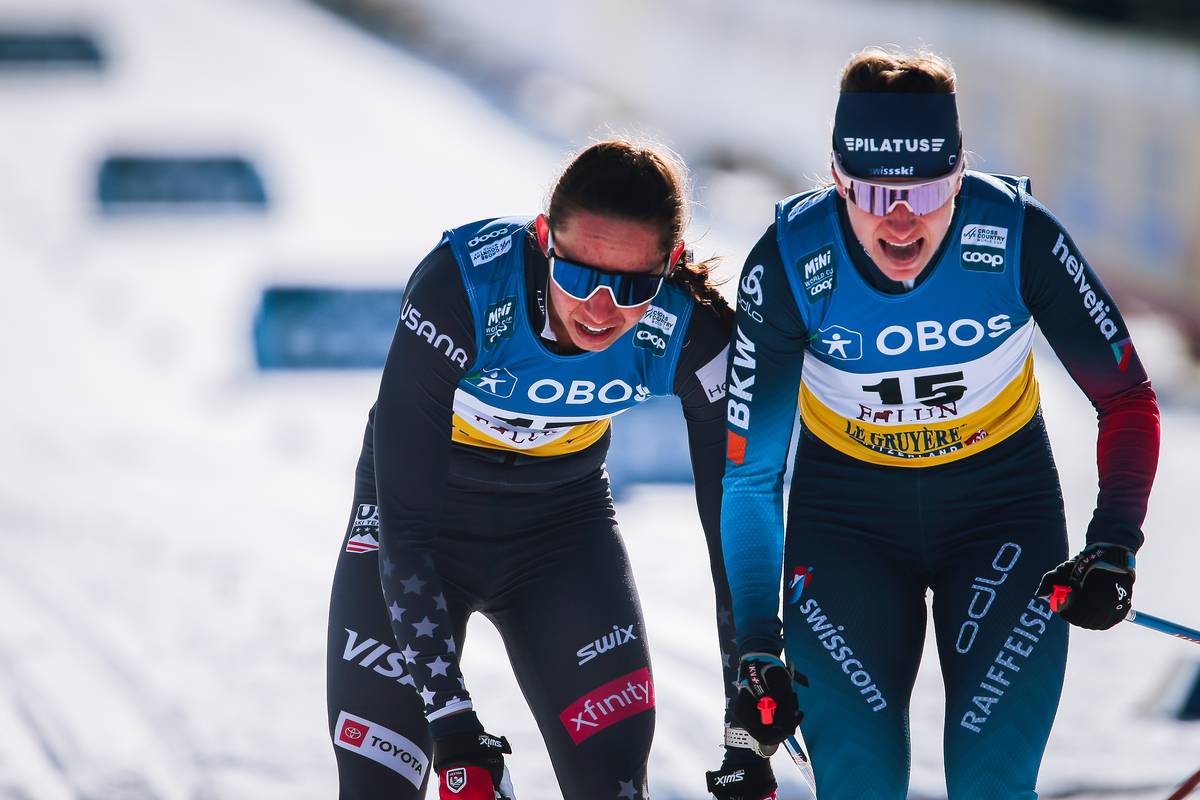
CRAFTSBURY, Vermont — Craftsbury Outdoor Center kicked off the first of the SuperTour Finals races with a classic sprint on Friday. Yesterday’s weather brought gnarly, foggy, and temperatures in the 50s. Craftsbury’s grooming crew has been putting in long hours over the last few weeks to ensure that conditions would hold on through a warmup. Overnight, they prepared the 1.5-kilometer course that baked under the strong spring sun, creating saturated spring conditions even with temperatures below freezing.
Most of the top American competitors came to cap off their long race season, many of whom are freshly off the electric World Cup Finals. Following up huge events like the 2026 Olympics and the World Cup Finals in Lake Placid, one might think that races in the quaint Northeast Kingdom of Vermont would be a quiet, less competitive affair. Today’s competition couldn’t compete with the 10,000+ fans across the state border last weekend, but it proved to be a tight and fierce battle for sprinters to finish off their season.
85 men and 63 women started the qualifier, representing an array of professional domestic teams, Canadians, Eastern Intercollegiate Ski Association (EISA), and junior racers.
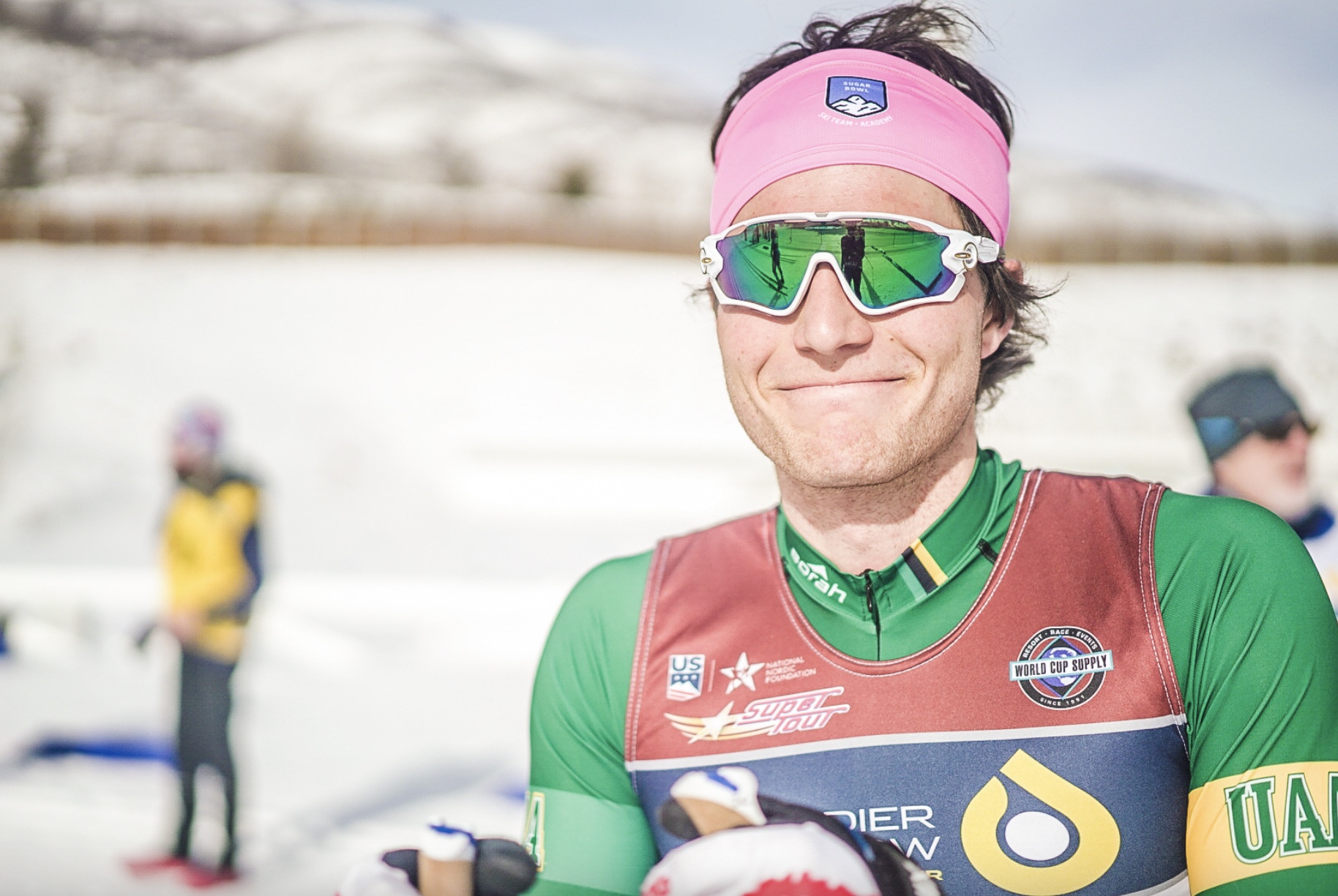
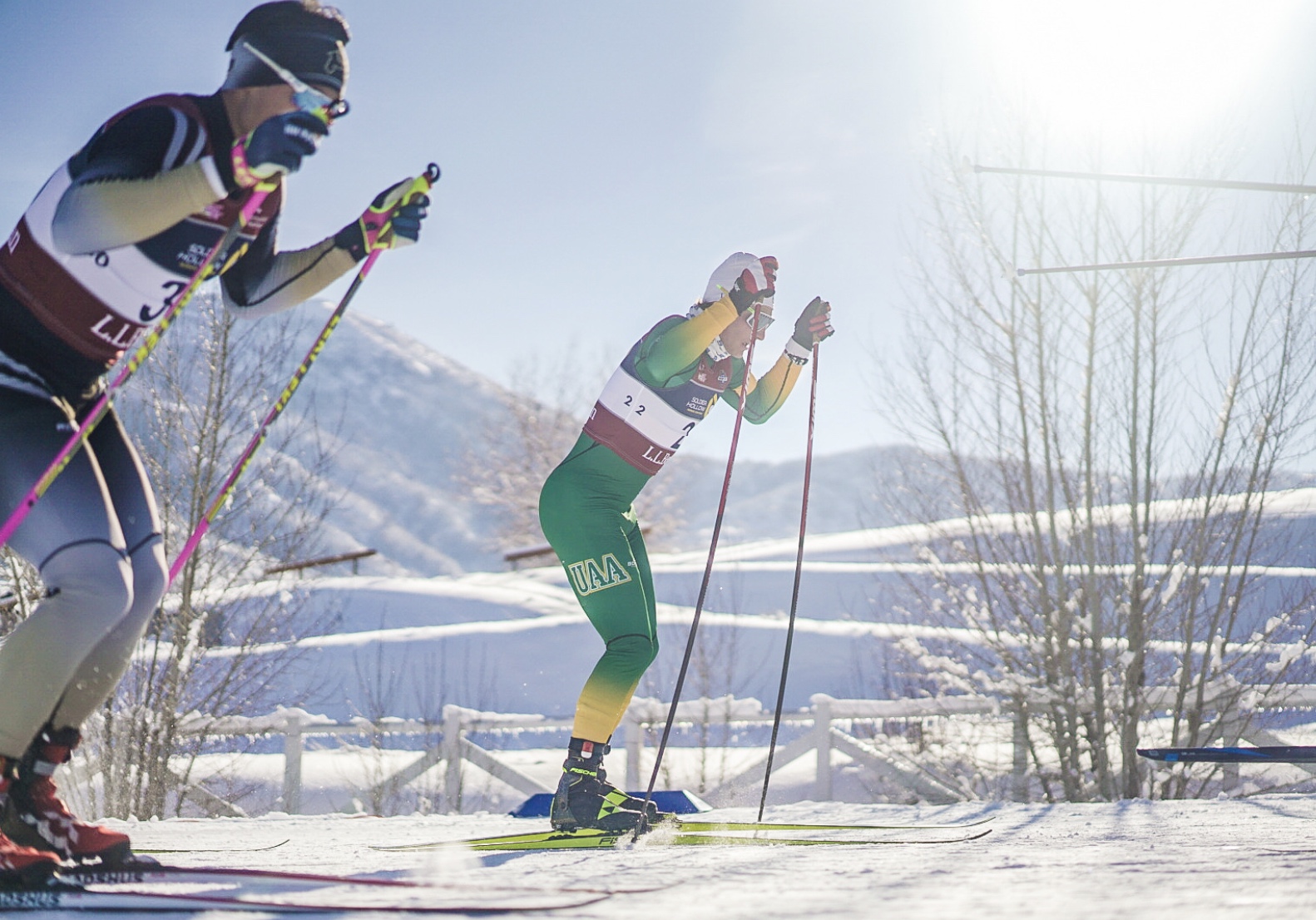
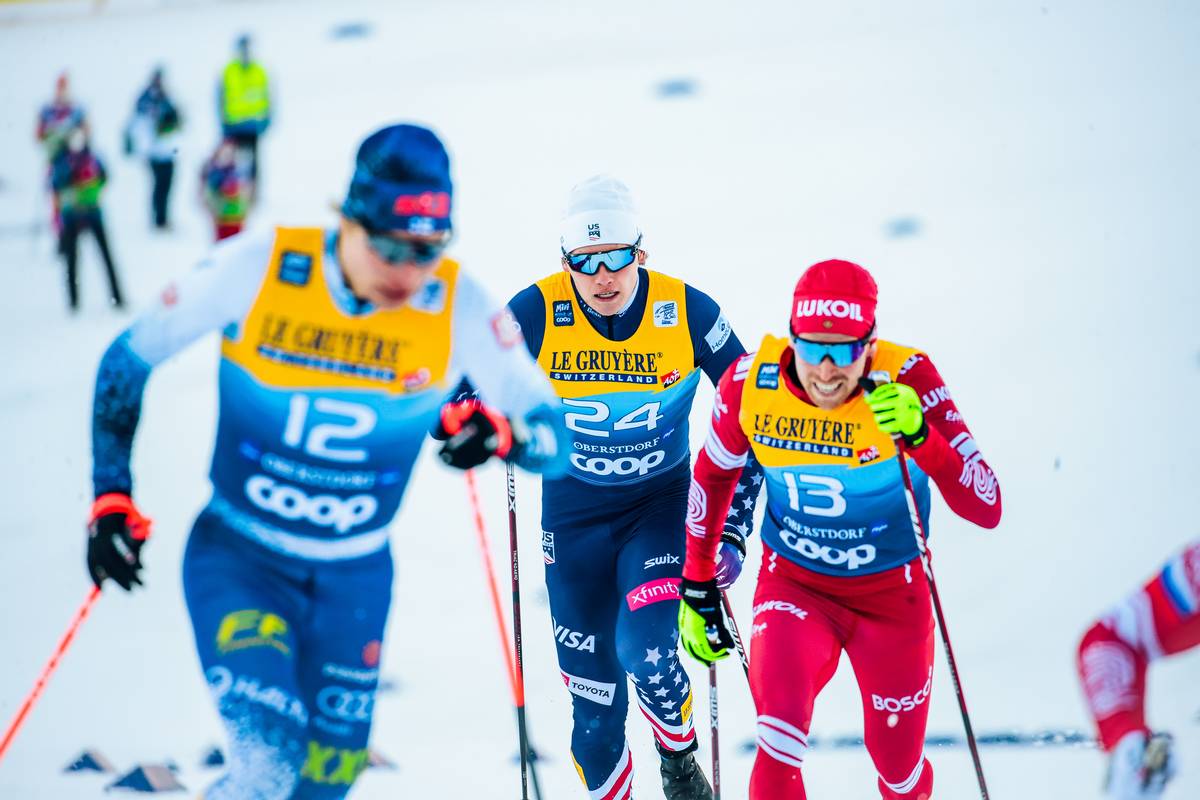
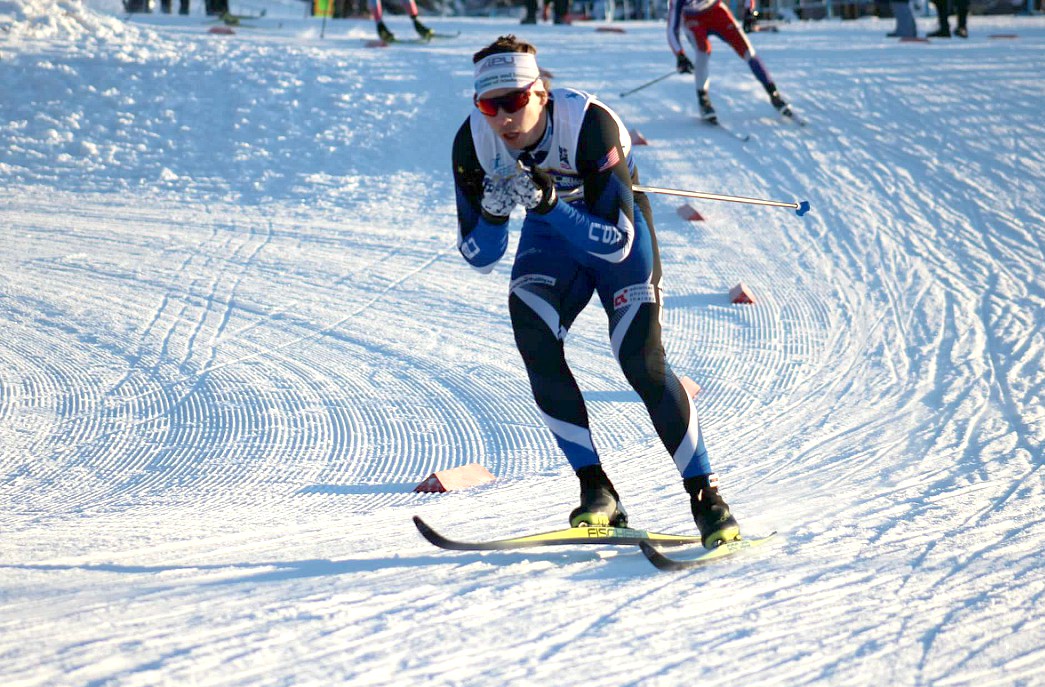
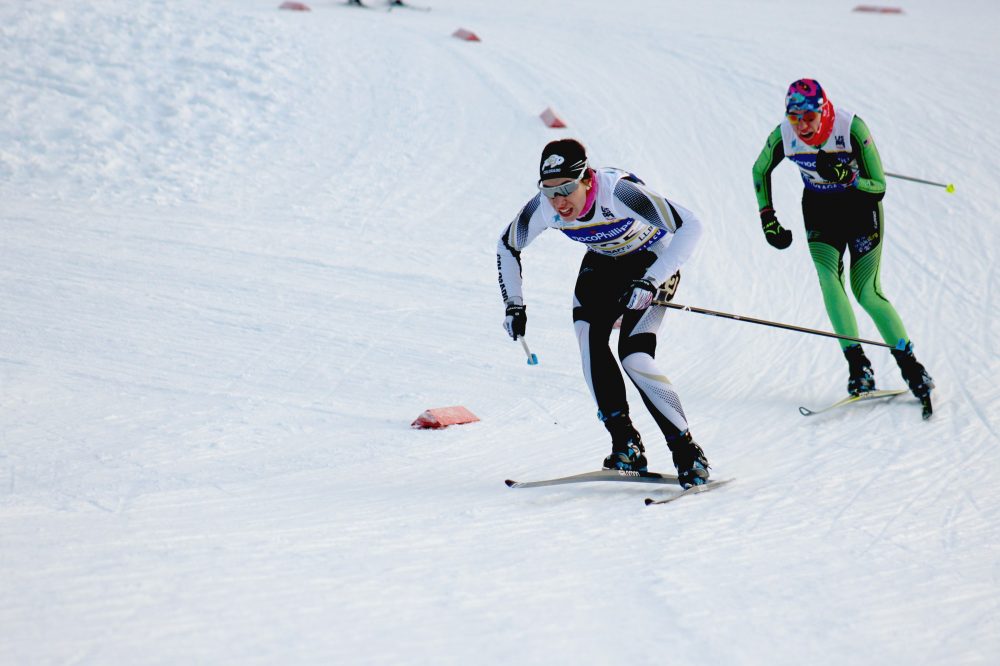
Ben Ogden of SMS T2 won the men’s qualifier with nearly 3 seconds over Gus Schumacher of APU. Murphy Kimball, the 19-year-old sophomore at the University of Alaska – Anchorage, qualified in an impressive eighth, only getting beaten out by elder World Cup regulars.
U20 Murphy Kimball heading to an 8th place in the qualifier. (Photo: Tryg Solberg / FasterSkier)
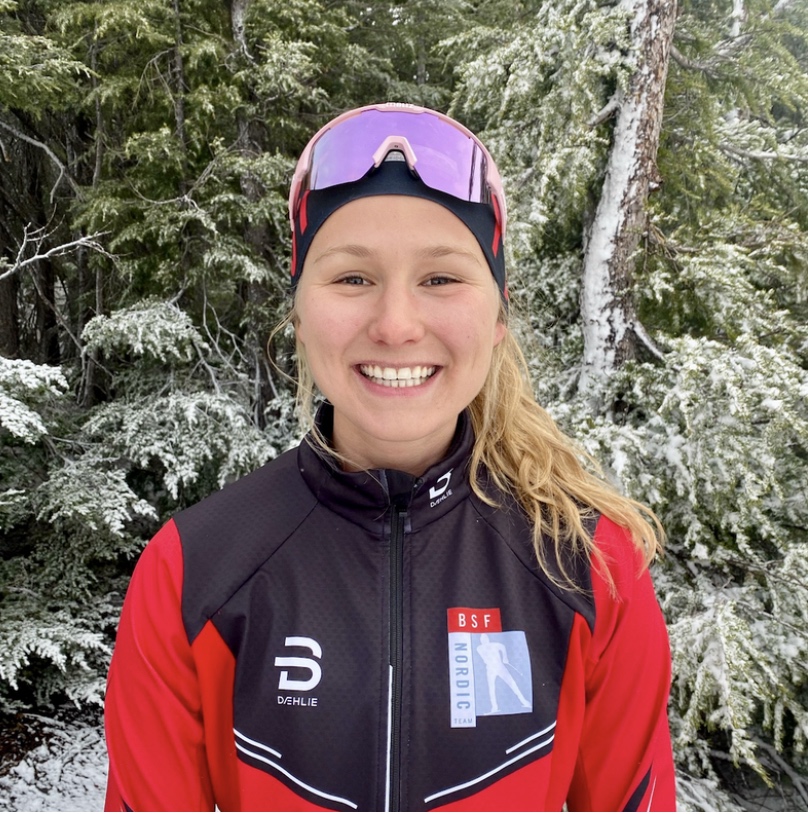
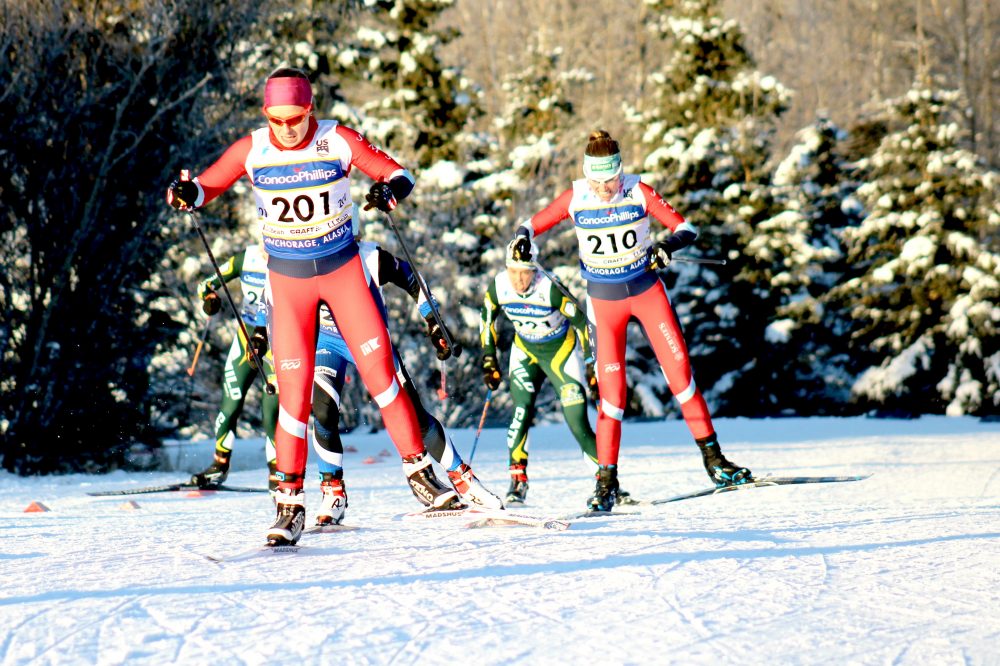
Erin Bianco of BSF won the women’s qualifier by over 3 seconds over second-place Canadian and Alberta World Cup Academy athlete Katie Weaver. Mia Gorman is a U16 athlete for the neighboring Mansfield Nordic Club who finished the qualifier in 27th, beating out all other junior women and making the heats with the big dogs.
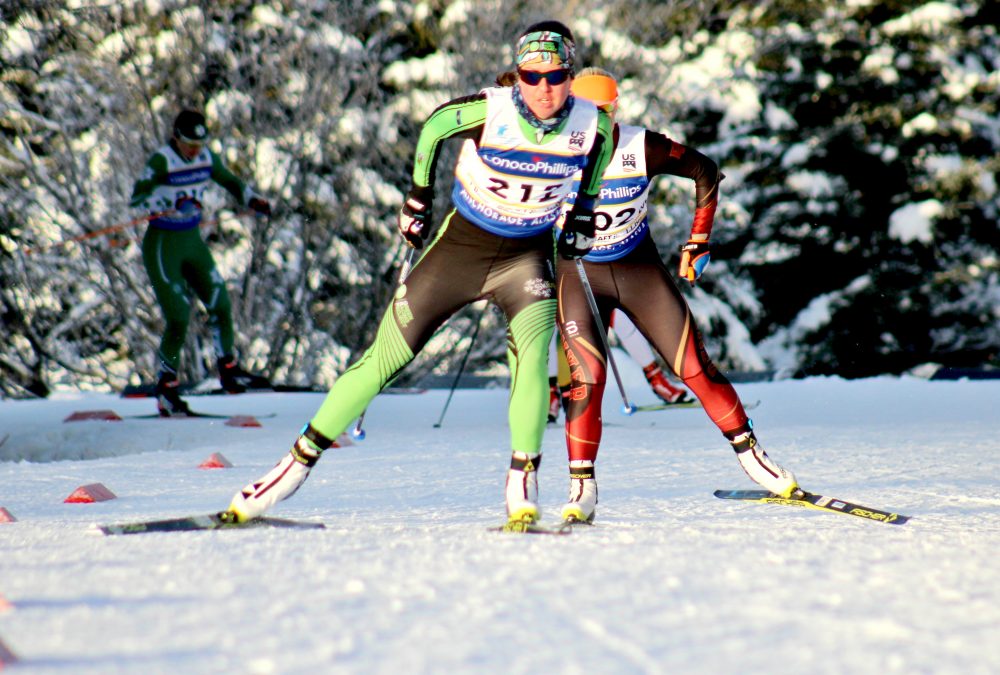
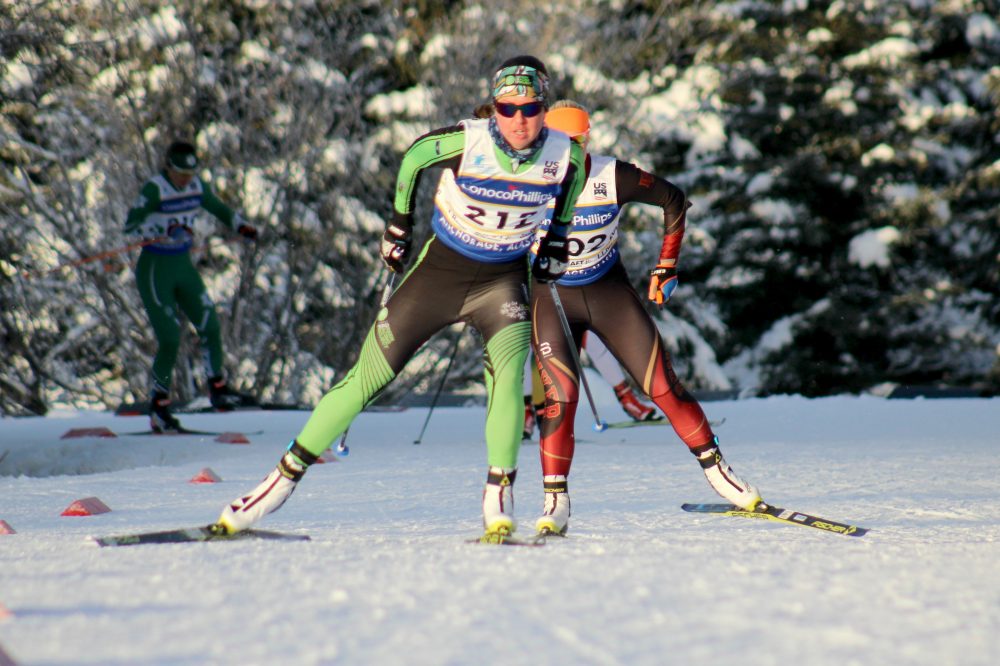
Erin Bianco winning the qualifier by over 3 seconds. (Photo: Tryg Solberg / FasterSkier)
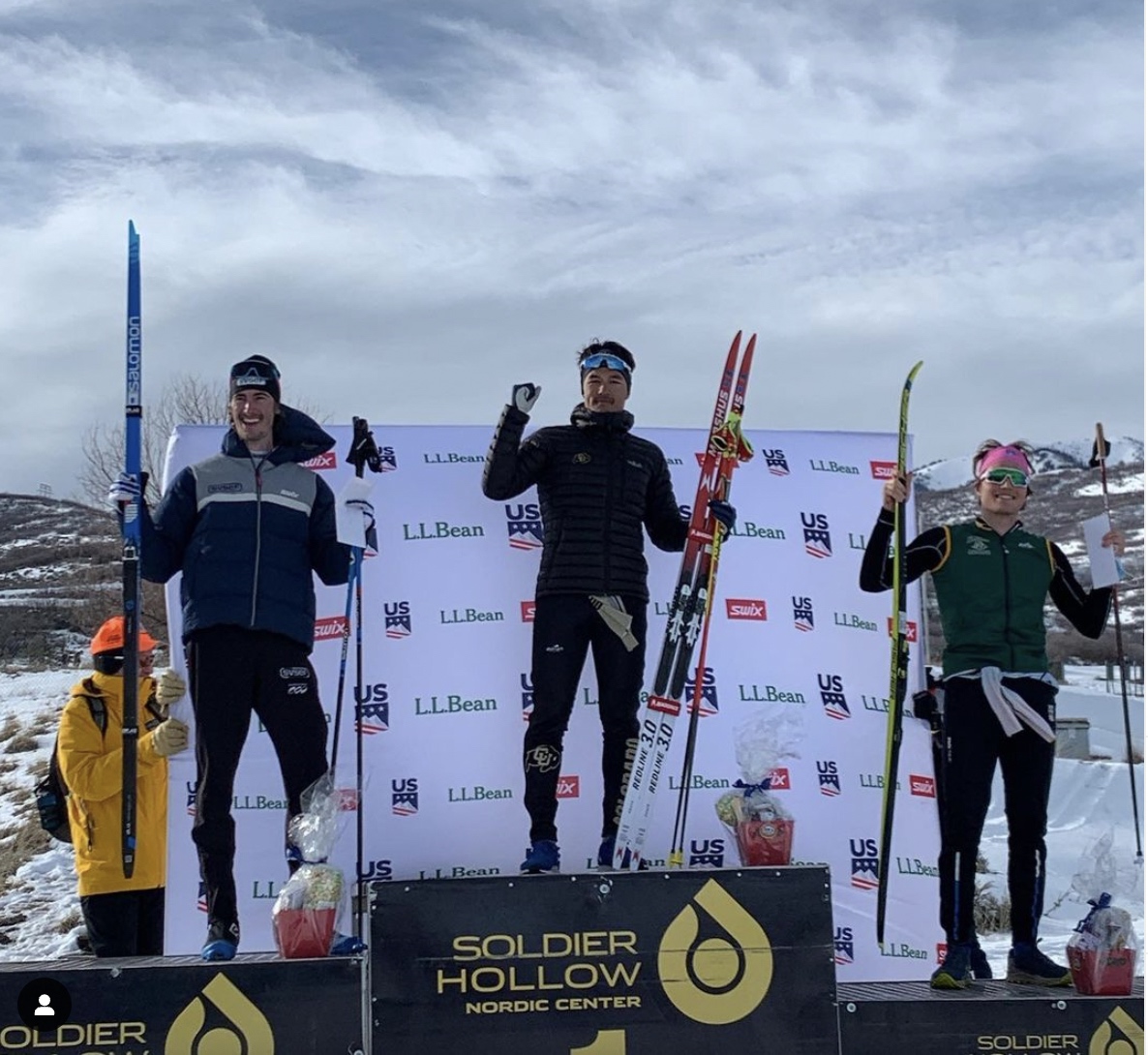
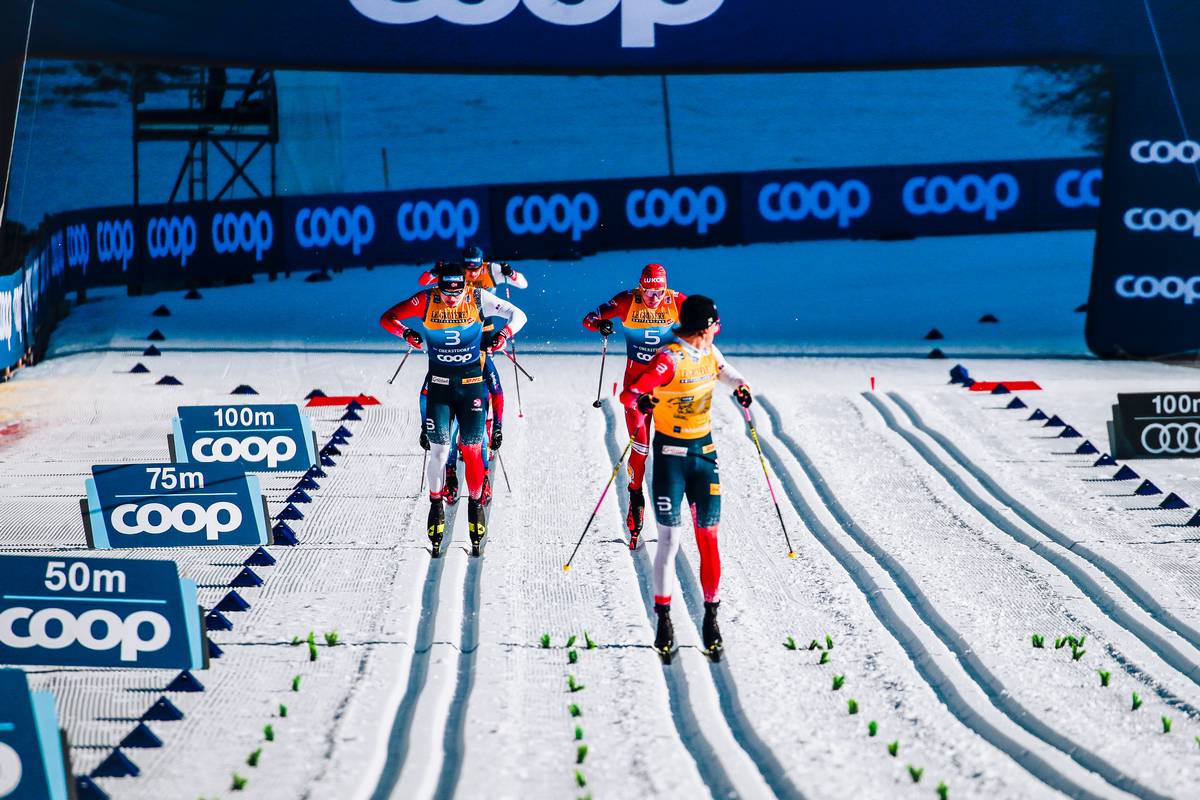
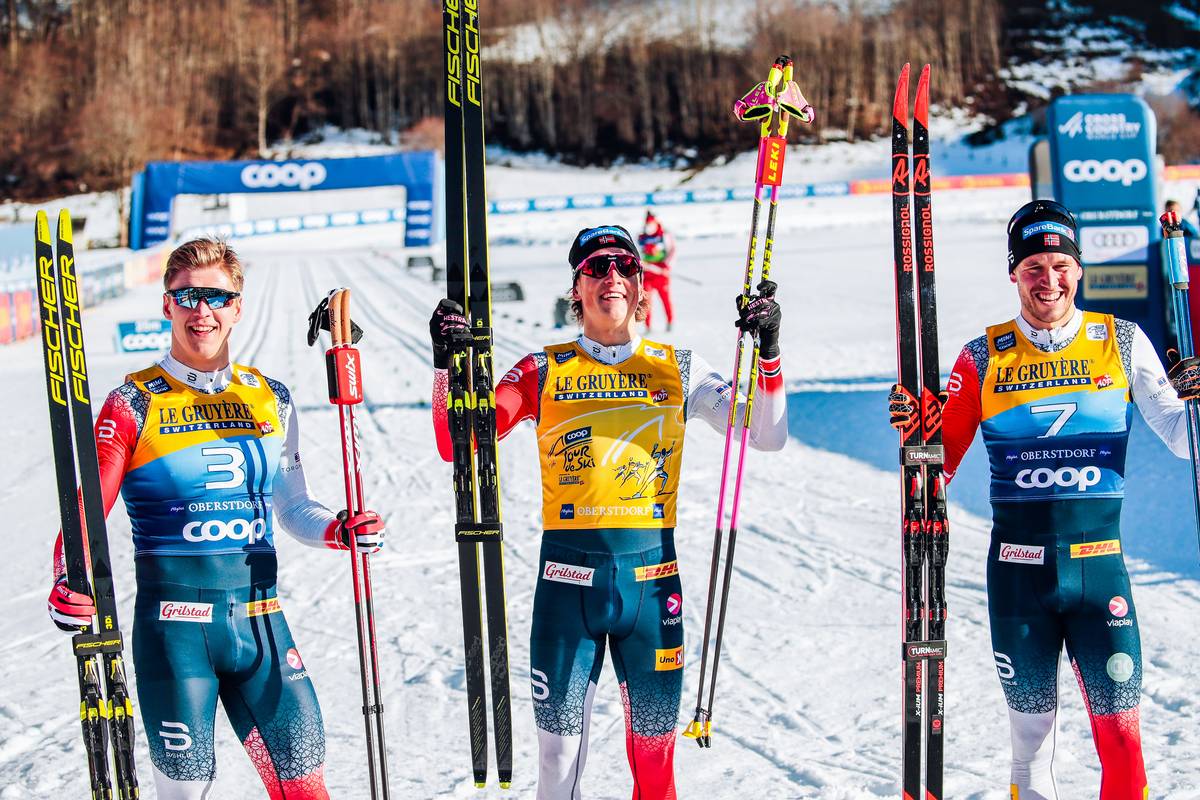
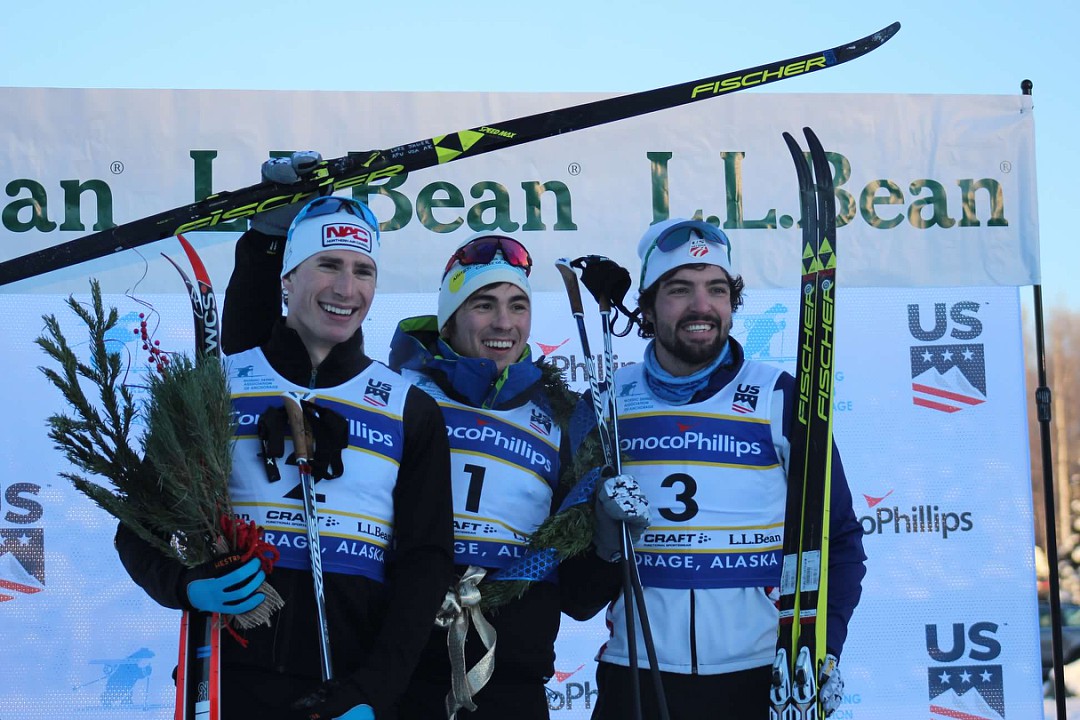
Ogden moved comfortably through the heats, eventually winning the men’s final over APU teammates JC Schoonmaker and Gus Schumacher, who finished in second and third, respectively.
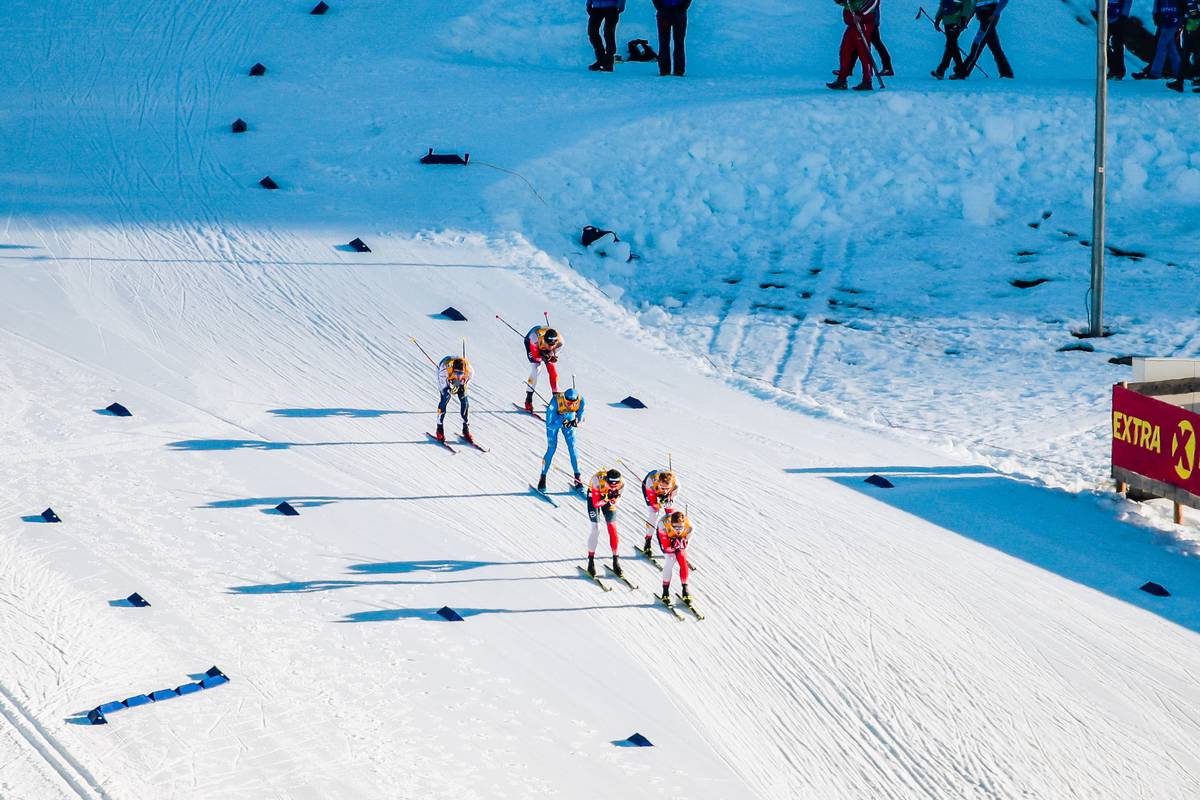
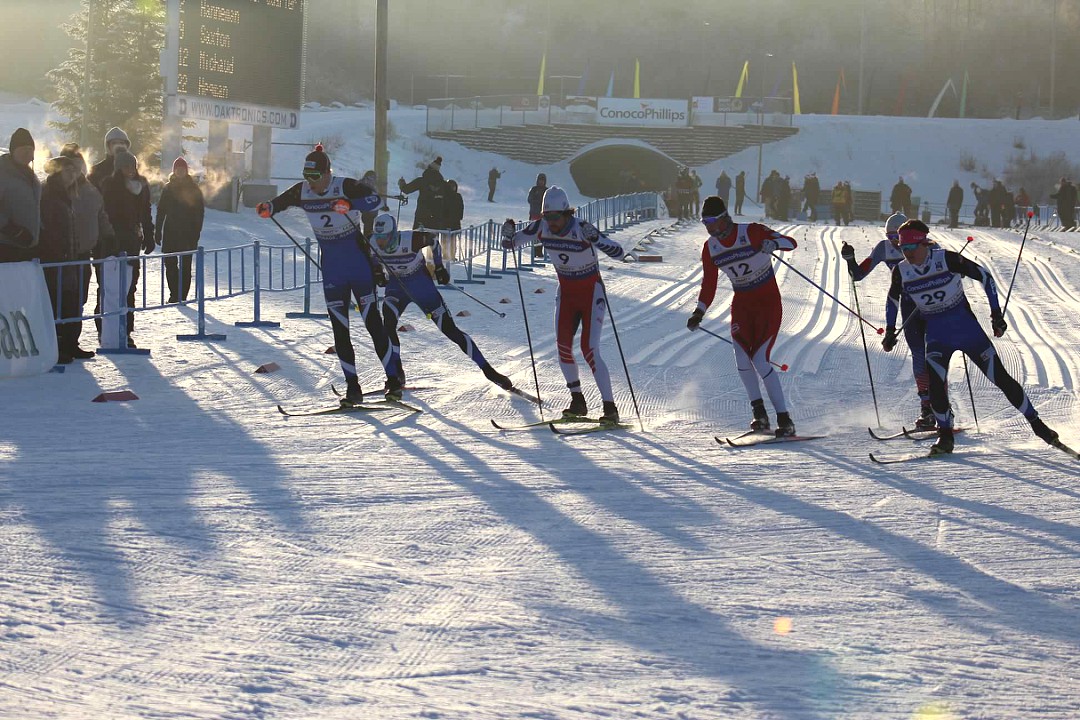
Men’s final starting at Craftsbury Outdoor Center. (Photo: Tryg Solberg / FasterSkier)
Ben Ogden of SMS T2 was very happy about racing in his home state. “It’s a bit more chill” he said in comparison to the World Cup and Olympic stages that he’s been prominent on this season. Ogden also mentioned that, even though the race environment was low-key, the competition was stiff with the U.S.’s top skiers duking it out for the top of the podium.
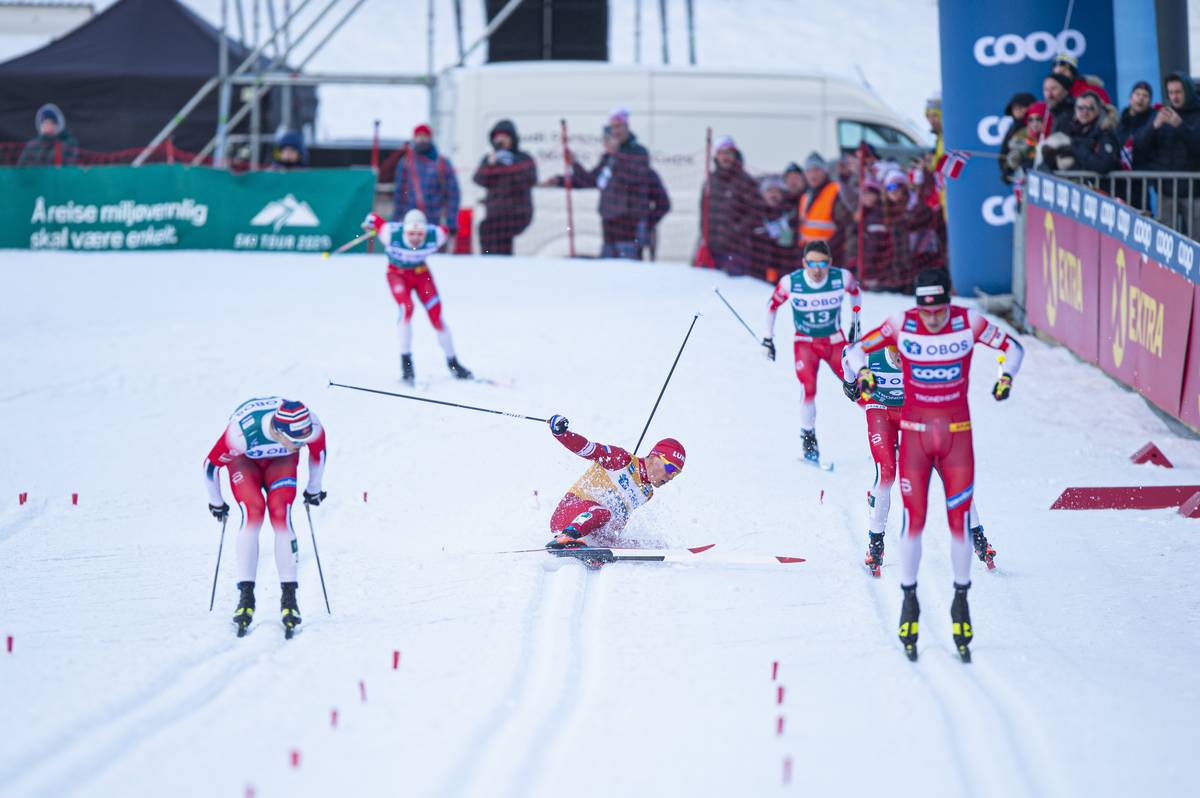
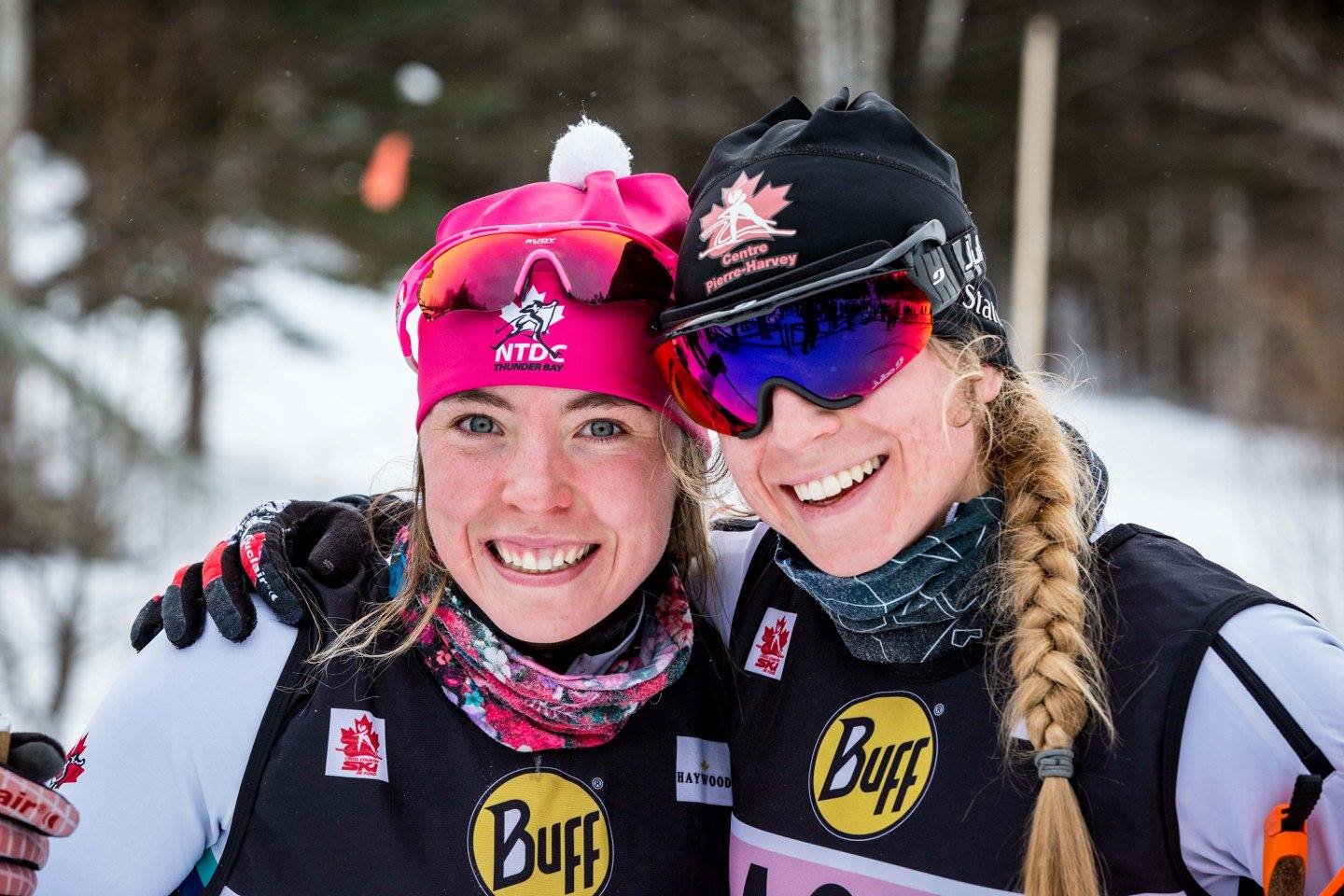
In addition to representation from many different clubs throughout the heats, the women’s side saw a shake-up in the competition when the third qualifier, Lauren Jortberg of Mansfield Pro/NCPH, fell in the final. Canadian Katie Weaver and her Alberta World Cup Academy teammate Olivia Bouffard-Nesbitt finished first and second. In an interview after the race, Weaver said “conditions were fun, crazy and a bit hectic.”
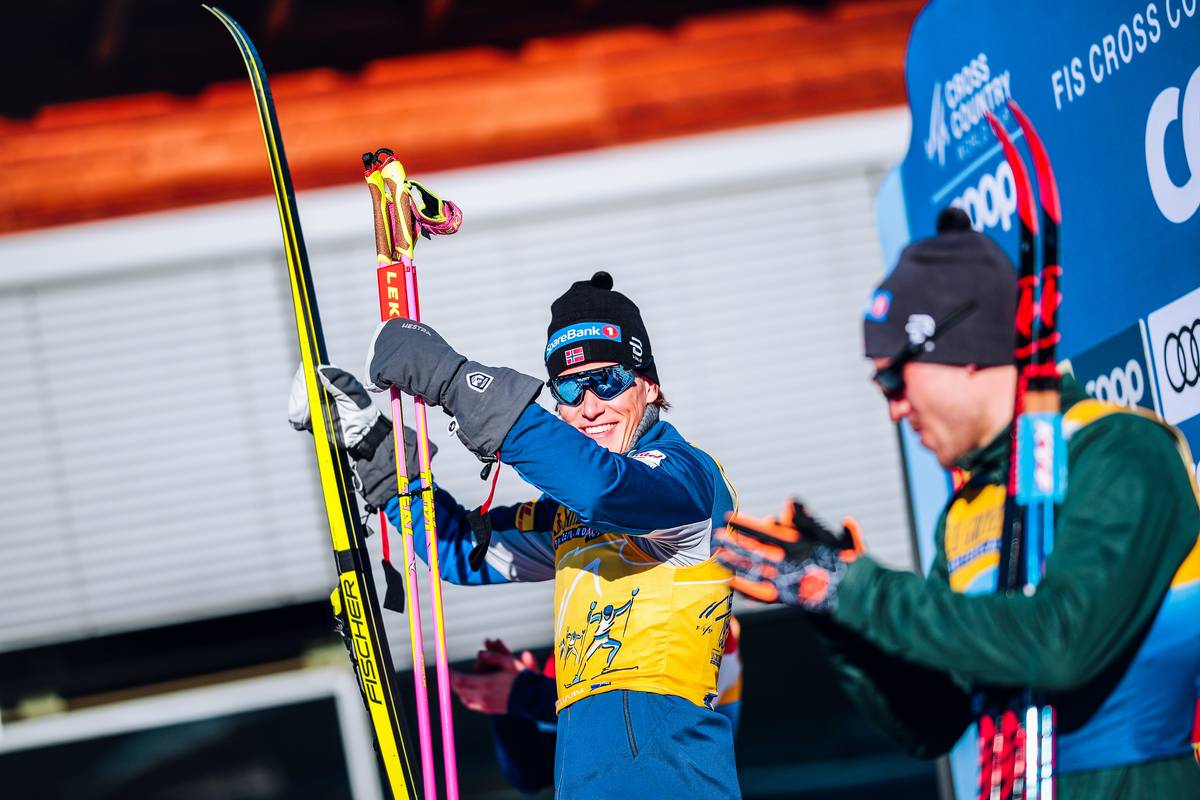
Canadians Katie Weaver and Olivia Bouffard-Nesbitt embrace after their strong finish for first and second overall. (Photo: Tryg Solberg / FasterSkier)
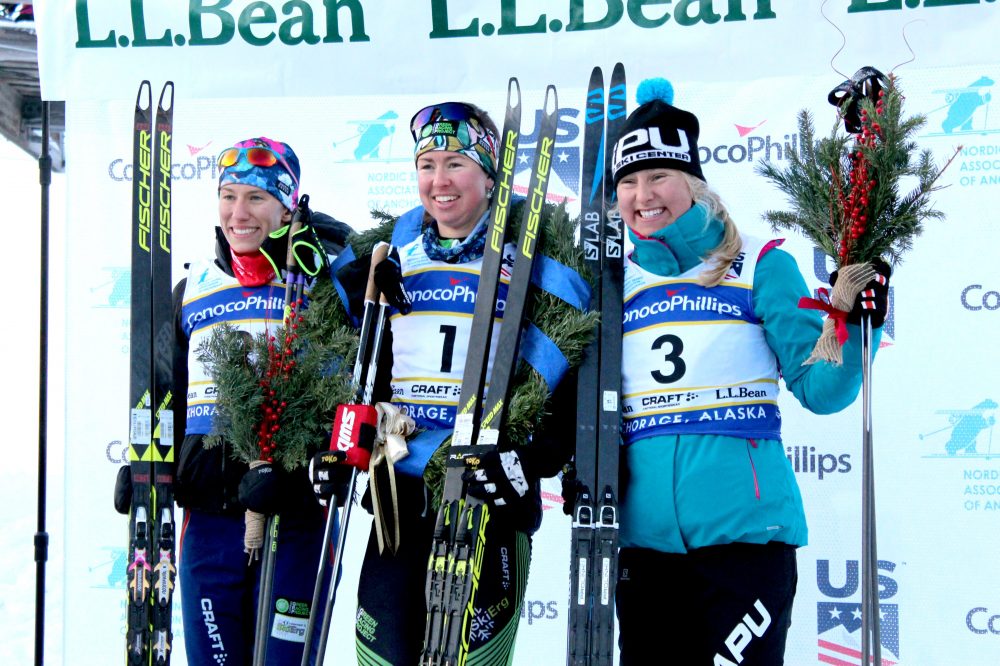
Emma Albrecht took the top domestic position in third place with her first Supertour win in a sprint race. Erin Bianco of BSF and Alayna Sonnesyn of Team Birkie rounded off the domestic podium.
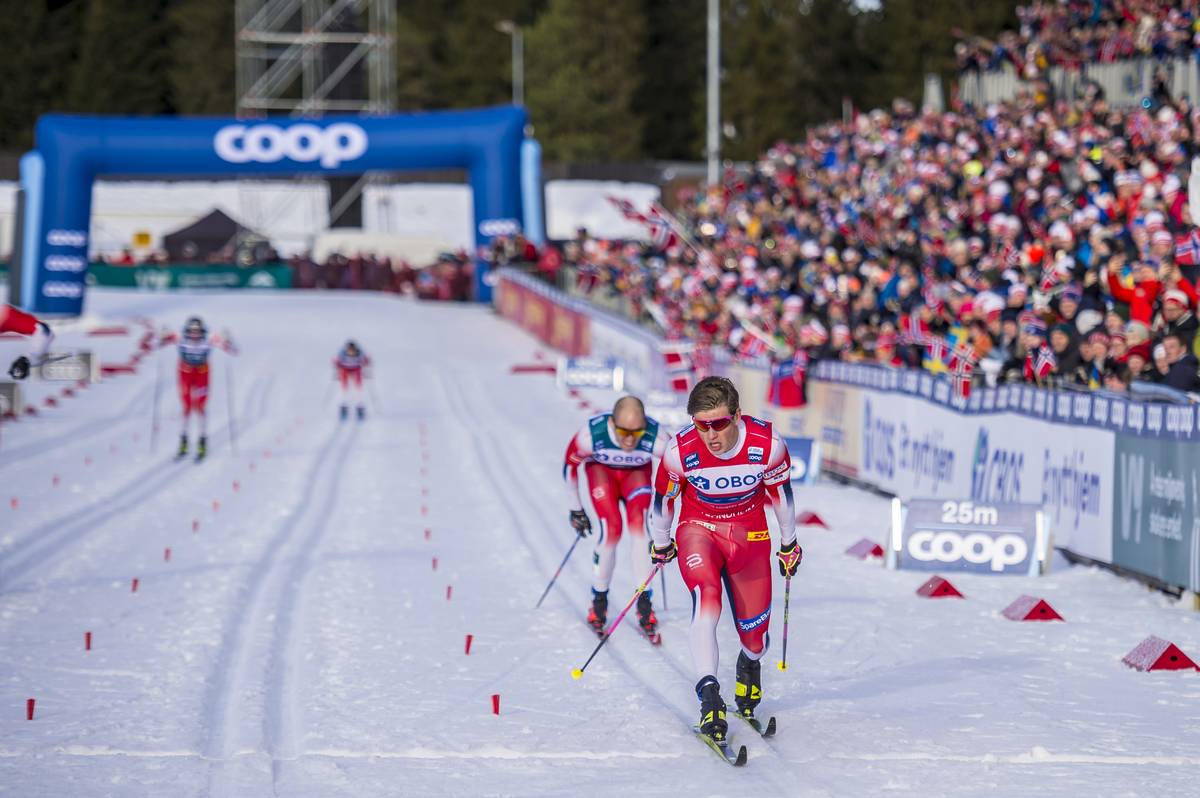
Albrecht crossing the finishing line as the first American and 3rd overall. (Photo: Tryg Solberg / FasterSkier)
Albrecht was very happy with her racing throughout the day: “The biggest feat for me is being competitive this late in the season.” When asked about her tactics in the heats with the warm spring sun softening the track, she said that she had to “find a rut and see it through.”
Logan Drevlov of Loppet Nordic Racing and Claire Serrano of Craftsbury won the junior heat finals.
Temps are forecasted to drop into the single digits overnight before 4 x 5 km team sprint competitions throughout the day. Tune in for more pictures and results tomorrow.
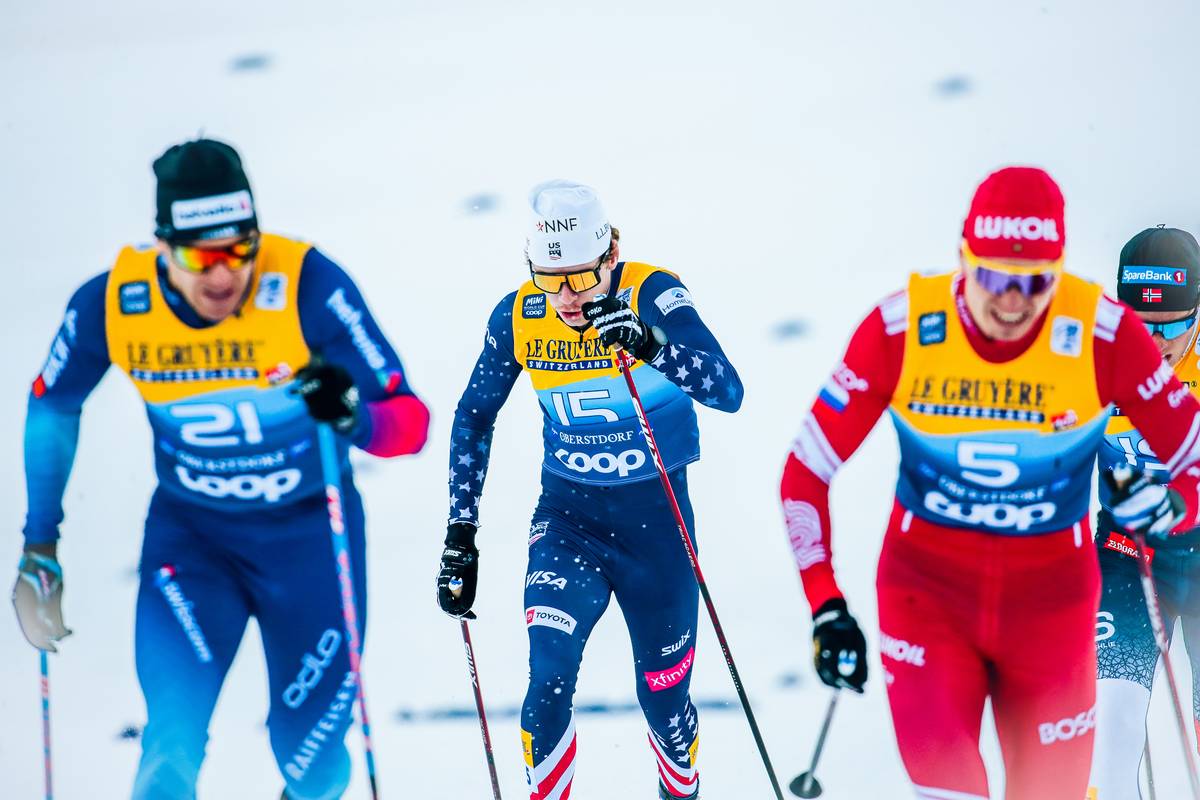
JC Schoonmaker (APU) and Kevin Bolger (Team Birkie) side by side in the heats. (Photo: Tryg Solberg / FasterSkier)
Help Support Our Olympic Coverage!
FasterSkier will have our own Nat Herz on the ground at the Olympics, which, to be honest, is a very big financial lift for us. If you value the thoughtful work and access FasterSkier provides at championships like this one, please consider becoming a Voluntary Subscriber. Your support directly fuels the work we do to cover the people, places, and moments that make our sport special.
This coverage is made possible through the generous support of Marty and Kathy Hall and A Hall Mark of Excellence Award. To learn more about A Hall Mark of Excellence Award, or to learn how you can support FasterSkier’s coverage, please contact info@fasterskier.com.
Ben Ogden (USA) and Johannes Hoesflot Klaebo (NOR), (l-r) moments after their Semifinal crash in Drammen, Norway. (Photo: Nordnes/NordicFocus)
The greatest cross-country skier in history was lying on the snow, his arms wrapped over his face, his hands holding the back of his head, and the city of Drammen — where the man-made course magically appears on top of the streets, and Norwegian children crane from balconies to watch the racing — went very, very quiet.
Johannes Hoesflot Klaebo did not finish on Thursday. Neither did Ben Ogden. The gold and silver medalists from the Olympic sprint classic in Milano Cortina just last month, the two men who have defined this event all season, were tangled together on the hard-packed final downhill before the hairpin, while the semifinal raced on without them.
After the chaos of the semi-final, which took down the two fastest qualifiers, a 25-year-old Norwegian named Ansgar Evensen — who had changed into Skiathlon boots between the quarterfinals and semifinals because he felt so unsteady on his feet — surged from sixth place in the final to cross the line first.
Evensen won ahead of Jiri Tuz, the 21-year-old Czech who earned a career-best second place. Kristian Kollerud of Norway, racing in his very first World Cup start, took a remarkable third, and Harald Oestberg Amundsen, the 2024 overall World Cup champion, finished fourth.
It was the kind of day that maybe only Drammen — with its icy hairpin, its drafting effect, and its knack for producing chaos at precisely the wrong moment — could deliver.
Johannes Hoesflot Klaebo (NOR), Bernat Selles Gasch (ESP), Theo Schely (FRA), Ludek Seller (CZE), and Vili Crv (SLO), (l-r) in the first Quarterfinal. (Photo: Nordnes/NordicFocus)
Qualification and Quarterfinals
Klaebo’s dominance was apparent from the opening qualification. He posted a 2:24.88, nearly three seconds faster than Ogden’s 2:27.47, with the next 28 qualifiers separated by less than five seconds. That kind of gap on a world-class field in sprint qualification puts his dominance in perspective.
Klaebo, as he always does, chose the first quarterfinal heat. He won it easily — clocking 2:37.14 — compared to his qualifier, a notably conservative time that suggested he was managing his energy for the rounds ahead.
Simone Mocellini (ITA), Ben Ogden (USA), and Aron Aakre Rysstad (NOR), (l-r) in the second Quarterfinal. (Photo: Nordnes/NordicFocus)
Ogden, the lone American in the top 30, qualified second and chose Quarterfinal 2 alongside Italy’s Simone Mocellini and Norway’s Even Northug. He entered the bottom of the final climb up to the iconic finish on the steps of the Neo-Gothic Bragernes Church behind the leaders, but unleashed a powerful double-pole to charge into second place, advancing comfortably.
The quarterfinals also produced some early drama. Northug, who had been enjoying a strong sprint season, was disqualified from Heat 2 after receiving his second written reprimand of the season, this time for a classical technique infraction.
And quietly, in Heat 3, Evensen advanced as a photo-finish second behind Sweden’s Alvar Myhlback.
Ben Ogden (USA) and the medical team check on Johannes Hoesflot Klaebo (NOR). (Photo: Nordnes/NordicFocus)
The Crash
The first semifinal will be remembered for the crash.
Klaebo had won his quarterfinal from the front and appeared to be cruising. Ogden, too, looked comfortable. But on the icy final descent heading toward the hairpin around the fountain behind the start gates, the pack compressed. Klaebo held tight to the inside along the fencing, leaving him vulnerable when the skis began to cross. Contact was made. Ogden’s feet swept out from under him and fell right in front of the Norwegian. Klaebo had no place to go, skiing right into Ogden, which launched him into the air, spinning backward, ultimately hitting the back of his head on the hard-packed snow.
Ben Ogden (USA) walks off after the crash in the Semifinals. (Photo: Nordnes/NordicFocus)
Listening to the broadcast, the silence in Drammen was palpable. Ogden scrambled to his feet with only one ski still attached; Klaebo did not immediately follow. Replays showed Klaebo had not only hit his head on the hard snow, but may also have been struck in the head by a trailing ski as he fell. Both men would be listed as DNF — a designation almost never seen next to Klaebo’s name in a decade of dominance.
Anton Grahn of Sweden, who had been near the front, took the semifinal win. Tuz advanced automatically in second. Alvar Myhlback of Sweden finished third but would not be fast enough to advance as a lucky loser. The crash all but guaranteed that the top four finishers from Semifinal 2 would all advance to the final.
After the crash in Semifinal 1, Semifinal 2 with Harald Oestberg Amundsen (NOR), Kristian Kollerud (NOR), Jules Chappaz (FRA), Ansgar Evensen (NOR), Noe Naeff (SUI), and Davide Graz (ITA), (l-r) race for the finals. (Photo: Nordnes/NordicFocus)
Semifinal 2 and the Path to the Final
The second semifinal, then, was a race with diminished stakes but no shortage of quality. Chappaz drove the pace from the front and never relinquished it. Kollerud, the 21-year-old in his club racing suit, making his World Cup debut, finished an impressive second.
Behind them, Amundsen and Evensen advanced as lucky losers, separated by just hundredths of a second. The final would feature three Norwegians, a Frenchman, a Czech, and a Swede — but no Klaebo and no Ogden.
Entering the finish stretch. (Photo: Nordnes/NordicFocus)
The Final
Half the final field was under 23 years old. Tuz, Kollerud, and Grahn — all 21 — represented a generational shift on a day when the established order had been upended.
Tuz, perhaps emboldened by his semifinal crash survival, went hard from the gun, leading over the opening climb. It was a brave tactic from a young racer in only his second World Cup final. Behind him, the more experienced campaigners — Amundsen, Evensen, Chappaz — bided their time, trusting that the Drammen draft would bring them back and leave them well rested for the final climb.
It did. The group had reformed as they skied behind the fountain. As they navigated the icy turn, Grahn — who had been skiing near the front all day — lost his footing on the hairpin and crashed, his race effectively over. He would finish sixth on the day.
The final dash for the line. (Photo: Nordnes/NordicFocus)
Grahn’s fall opened a lane on the outside. Evensen, who had been sitting sixth, saw it and calmly worked his way around the dicy turn.
“When Anton fell in the last corner, I had every opportunity,” Evensen said afterward. “So I took it from fifth place to first on the final.”
What followed was one of the great finishing surges in Drammen’s long sprint history. Amundsen and Kollerud were locked in their own battle, focused on each other. Chappaz was charging. But Evensen — who had finished fourth on this same course back in 2023, who knew exactly how the final 50 meters of this city sprint played out — found a gear that nobody else could match.
Harald Oestberg Amundsen (NOR), Jiri Tuz (CZE), Kristian Kollerud (NOR), Jules Chappaz (FRA), and Ansgar Evensen (NOR), (l-r) had an exciting finish in Drammen. (Photo: Nordnes/NordicFocus)
He crossed the line first, fist clenched, pounding his chest. Tuz nipped Kollerud for second by four hundredths of a second. Amundsen was fourth, just 0.43 seconds off the win.
“It was super cool and I love to ski in Drammen,” Evensen said in a post-race interview with FIS, still catching his breath. “I had to change boots to my combi boots because I felt so unbalanced in the quarterfinal. But that’s how it is. Have to stay on your feet to win. And unfortunately for Johannes and Ben, they weren’t as stable today.”
Kristian Kollerud (NOR) waits for final confirmation of his podium. (Photo: Nordnes/NordicFocus)
Kollerud’s Debut
The feel-good story of the final belonged to Kollerud, who stood on the podium in his club racing suit — not the Norwegian national team uniform — soaking in a result he could not have imagined when he woke up that morning. A podium in your first World Cup start doesn’t happen. Except when it does.
He picked up a written reprimand for a classical technique infraction during the semifinals, but it was his first of the season and carried no further consequence. What will carry forward is the confidence of knowing he can compete with the best in the world.
Tuz, too, earned a career milestone. The Czech U23 athlete had made the final in Milano Cortina but never stood on a World Cup podium before Thursday. He now has a silver medal from Drammen.
Jiri Tuz (CZE) celebrates his podium in Drammen, Norway. (Photo: Nordnes/NordicFocus)
Standings and What’s Next
Klaebo’s DNF stung, but his World Cup position remains commanding. He leads the overall standings at 2,071 points (636 points more than Amundsen in second), the sprint standings at 835 points (283 points in front of Lars Heggen), and the distance standings at 936 points (128 points in front of Amundsen).
Barring further incident, Klaebo will sweep the overall, distance, and sprint crystal globes for the season.
Whether he gets the chance to race for them this weekend, however, is now in question. Norwegian national team doctor Ove Feragen told TV2 that Klaebo was taken to the hospital following the crash for precautionary testing related to the head impact. Feragen said Klaebo was conscious, in stable condition, and not believed to be seriously injured, but the severity of the fall warranted evaluation. His status for Saturday’s 50 k Freestyle Mass Start at the historic Holmenkollen in Oslo remains uncertain.
The season concludes with World Cup Finals in Lake Placid, New York, March 20-22, where Ogden and the American men will race in front of a home crowd. With four races left, a lot of exciting racing remains.
Feature stories like this one take time, access, and care to produce. If you value thoughtful storytelling and independent ski journalism, please consider becoming a Voluntary Subscriber. Your support directly fuels the work we do to cover the people, places, and moments that make our sport special.
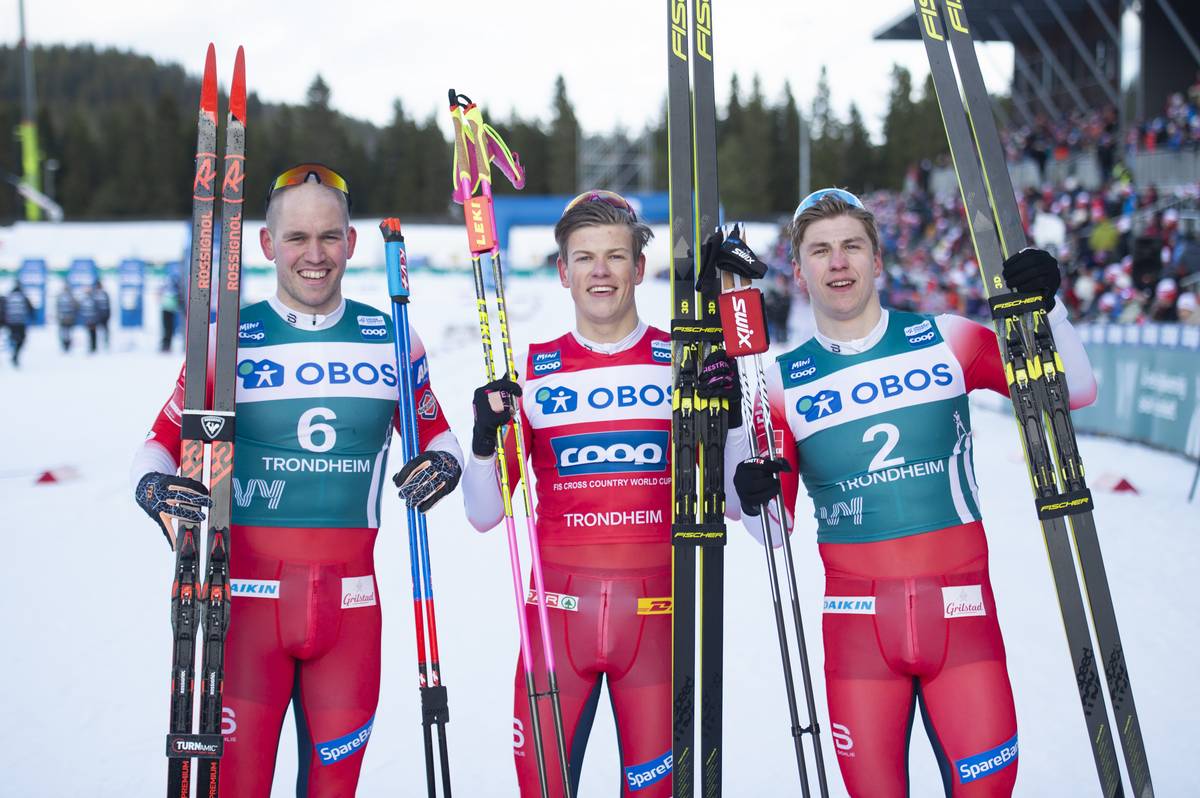
Jiri Tuz (CZE), Ansgar Evensen (NOR), and Kristian Kollerud (NOR), (l-r) share the Classic Sprint podium in Drammen, Norway. (Photo: Nordnes/NordicFocus)
This coverage is made possible through the generous support of Marty and Kathy Hall and A Hall Mark of Excellence Award. To learn more about A Hall Mark of Excellence Award, or to learn how you can support FasterSkier’s coverage, please contact info@fasterskier.com.
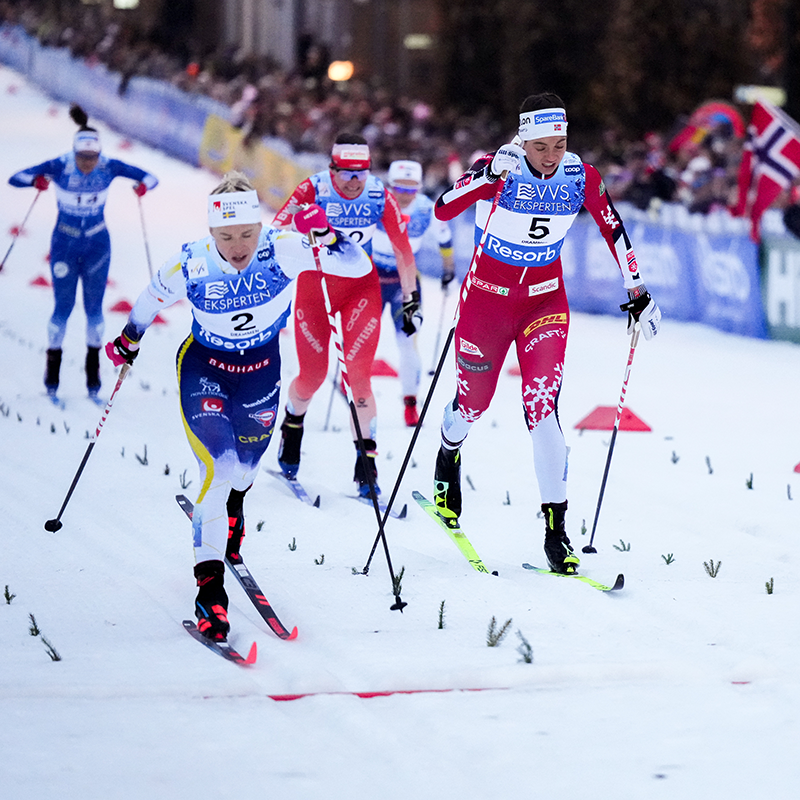
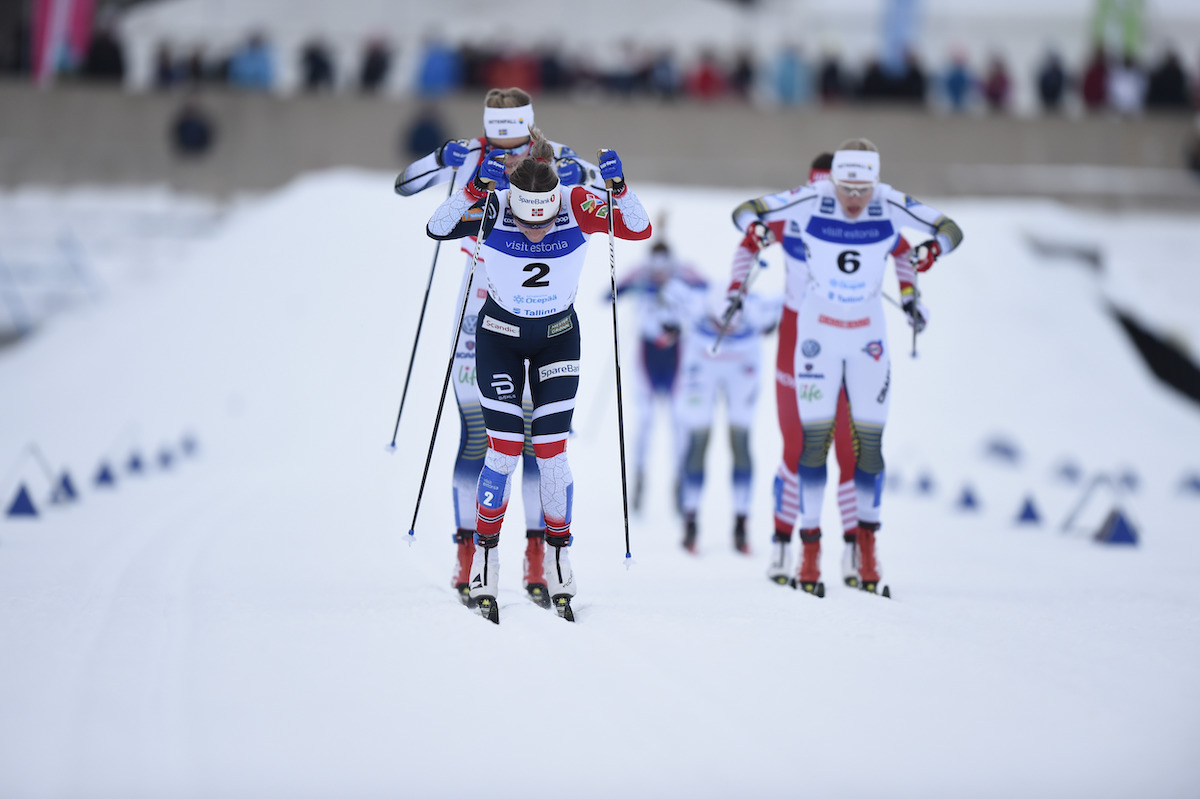
The women’s sprint final comes into the finish in Drammen, Norway with: Laura Gimmler (GER), Ane Appelkvist Stenseth (NOR), Jonna Sundling (SWE), Nadine Faehndrich (SUI), Johanna Hagstroem (SWE), and Kristine Stavaas Skistad (NOR), (l-r). (Photo: Nordnes/NordicFocus)
The snow was trucked in, the rock band was playing near the finish, and Norwegian children cheered from second-story windows along the course. On a rare midweek World Cup race day in Drammen — a small city just southwest of Oslo where the sprint course loops through the streets, wraps around an old fountain, and finishes on the snow-covered steps of an iconic church — Jonna Sundling of Sweden took home another World Cup sprint victory.
Sundling won the women’s classic sprint, going stride for stride with Norway’s Kristine Stavaas Skistad before pulling away in the final meters. Switzerland’s Nadine Faehndrich, racing her final classic sprint before retirement, earned the bronze.
It was Sundling’s fifth individual World Cup victory of the season and the latest chapter in an intensifying rivalry with Skistad that has captivated ski fans, especially Scandinavian ones, for the last few seasons. From the World Championship final in Trondheim last year to the Olympic final in Milano Cortina, Sundling, with the rest of the Swedish sprinters, and Skistad have been locked in a tactical chess match. On Thursday in Drammen, it was Sundling who played the final move.
Quarterfinal number one heads up the first climb with: Barbora Antosova (CZE), Mathilde Myhrvold (NOR), Jessie Diggins (USA), Melissa Gal (FRA), (l-r). (Photo: Nordnes/NordicFocus)
Qualification and Quarterfinals
Sweden’s Linn Svahn, the reigning Olympic sprint champion, posted the fastest qualification time at 2:41.87 — nearly three seconds clear of Sundling’s 2:44.39. But qualification speed, as World Cup sprinting always reminds us, is only the entry ticket.
Two Americans advanced to the heats. Jessie Diggins, the overall World Cup leader wearing the yellow bib in what she called a “full circle moment,” qualified 17th in 2:50.91. Rosie Brennan, seeded 28th, also made the top 30.
Diggins chose Quarterfinal 1 alongside Sundling and Skistad — a loaded heat. Skistad took the win with Sundling second via a photo finish, just 0.18 seconds separating them. Diggins fought hard for third, advancing as a lucky loser after finishing just 0.22 seconds behind Sundling.
Rosie Brennan (USA) said after the race, “Drammen is one of my favorite races, it’s a fun course and always has a lively atmosphere.” (Photo: Nordnes/NordicFocus)
Brennan’s day ended in the quarterfinals. Racing in Heat 3, she bobbled heading into the downhill and lost the draft, which was a costly moment on a course where the slipstream effect was enormous all afternoon. She finished fifth in her heat.
“I was happy to get a chance in the rounds, but the conditions were very tough,” Brennan said. “They salted the course, and it was skiing great in the qualifier and then got really icy for the rounds. Anyway, I bobbled into the downhill and lost the draft and then just don’t have the power I need to pass that many people up the finish stretch, so I was disappointed to not be more in the mix.”
Meanwhile, Svahn survived a scare of her own… as her quarterfinal rounded the fountain that anchors the bottom of the course behind the start gates, five of the six athletes ended up in a pile and Svahn seemingly had the most bodies and equipment to navigate as she got back out on the course, but somehow recovered to advance. The Olympic champion’s troubles, however, were only beginning.
Maja Dahlqvist (SWE) and Jessie Diggins (USA), (l-r) during the second semifinal. (Photo: Nordnes/NordicFocus)
Semifinals
The two semifinals told entirely different stories, and the contrast between them shaped the final.
In Semifinal 1, Skistad took the win with Sundling second, just 0.20 seconds back. Both advanced automatically. Behind them, Svahn finished third and would not advance.
Semifinal 2 was a different race entirely. Johanna Hagstroem and Ane Appelkvist Stenseth pushed the pace from the gun, stringing the field out over the first climb. But on the long downhill, the draft did its work. Faehndrich and Laura Gimmler of Germany surged past, using the slipstream to slingshot into the lead.
Nadine Faehndrich (SUI), who is planning to retire after the season, found a little extra Drammen magic today as she finished on the podium in third. (Photo: Nordnes/NordicFocus)
Faehndrich won the heat decisively. Gimmler was second. The fast overall times meant Hagstroem would advance along with Stenseth, who just out-lunged Diggins for fourth and the second lucky loser position.
For Diggins, the day ended in 10th. But she left Drammen at peace.
“This was really cool because the Drammen area was my first ever World Cup start and it was a skate sprint,” Diggins said. “So it’s kind of a very full circle moment to close it out with a classic sprint here as the last classic sprint of my career.”
She had tried something new in the heats, sitting in the draft instead of going to the front, a departure from her usual aggressive approach. “Normally, because literal strength is not my strength, I usually just try to go really, really hot and try to go off the front,” she said. “I was like, nope, I don’t think that’s gonna work for me here with the crazy draft and slingshot effect. I was taking a lot of notes in warm-up, and in the quarterfinal, I had the smallest tuck of my life. It was just really fun to try to believe in myself as more of a pure sprinter and to try to be a little more tactical.”
She acknowledged she ran out of power in the semifinal, but had no regrets. “I still felt like I executed my plan to the best of my ability, and that’s always a cool feeling.”
Jonna Sundling (SWE) crosses the finish line just ahead of Kristine Stavaas Skistad (NOR) for the win in Drammen, Norway. (Photo: Nordnes/NordicFocus)
The Final
Six women lined up for the final: Sundling and Hagstroem for Sweden, Skistad and Stenseth for Norway, Faehndrich for Switzerland, and Gimmler for Germany. Svahn and Maja Dahlqvist, the Olympic gold and bronze medalists in the sprint classic, were both absent.
On the opening climb, Skistad sat behind Sundling in a familiar posture — patient, conserving, waiting for the right moment. As Kikkan Randall mentioned on the broadcast, Skistad almost never leads into a downhill. She baited Gimmler into taking the front position, then tucked into her slipstream.
Coming off the descent and around the final hairpin, Faehndrich made her bid, surging past Gimmler and into third. But the race was between the two women everyone expected.
Sundling and Skistad skied side by side on the final climb, and what followed was a scene that encapsulated their rivalry. Stride for stride, shoulder to shoulder, neither yielding a centimeter. Sundling’s transition from double pole to striding was fractionally sharper — she carried more momentum through the final meters — and she crossed the line with a small advantage.
“It is usually very tight in Drammen, but today it was extremely tight,” Sundling said on air afterward. “Till the last meter. I was like, okay, I need to continue all the way over the finish line. It was tough, but I’m happy that I was the first person over the line.”
For Faehndrich, the bronze was a fitting farewell. The 30-year-old Swiss racer, who announced her retirement this season, now sits third in the sprint World Cup standings at 700 points — just behind Hagstroem (708) and within striking distance of leader Dahlqvist (720) heading into the final sprint of the season in Lake Placid next weekend.
Jessie Diggins (USA) gave her fans something to cheer about during her quarterfinal when she charged to the finish line. (Photo: Nordnes/NordicFocus)
Looking Ahead
Diggins continues to lead the overall World Cup standings with 1,961 points, 275 points ahead of Sweden’s Moa Ilar, a margin that appears insurmountable with four races remaining. The distance globe, too, seems firmly in her grasp. But the sprint crystal globe race is wide open: Dahlqvist, Hagstroem, and Faehndrich are separated by just 20 points at the top of the standings, and the final sprint in Lake Placid could decide everything.
For Diggins, there’s another milestone ahead — she’s only a few nights away from sleeping in her own bed before racing in front of an American crowd at the World Cup Finals. “Very, very, very excited about that,” she said.
The World Cup moves to the historic Holmenkollen venue in Oslo on Saturday for the Women’s 50 k Freestyle Mass Start, before the season concludes in Lake Placid, New York, March 20-22.
Feature stories like this one take time, access, and care to produce. If you value thoughtful storytelling and independent ski journalism, please consider becoming a Voluntary Subscriber. Your support directly fuels the work we do to cover the people, places, and moments that make our sport special.
By the time Lauren Jortberg made the U.S. Olympic Cross-Country Ski Team, the achievement arrived not as a burst of disbelief or relief, but as something quieter and stranger: a moment that required processing.
“It is a lot to take in,” she said, speaking from Seefeld, Austria in the middle of a pre-Olympic training block. “It’s been a big goal. But it’s one of those big goals that I’ve tried not to think about too much and just really focus on being my best self.”
The phrasing matters. Jortberg did not describe the Olympics as a finish line or a culmination. She spoke about it as something she had to learn how to hold — something earned, yes, but also something that could overwhelm if mishandled. “Now,” she said, “I’m trying to put aside the completion of the goal and really focus on performing. And performing really well.”
That distinction — between achievement and performance, between arrival and presence — has come to define her career. It is also the reason her story resists easy telling. Jortberg was not a prodigy. She was not a junior star. She did not dominate early or move cleanly through the system. She took the long way around.
The Long Way Around
Jortberg grew up in Boulder, Colorado, a town dense with endurance athletes and outdoor ambition. “I’m super fortunate to have been born and raised in Boulder,” she said. “It has one of the highest percentages of Olympians for cycling and running.”
Her parents were athletic — her mother was a professional runner, her father competed in multiple sports — and movement was woven into daily life. There was mountain biking, trail running, hiking, time spent at a family place in Winter Park. But skiing, she noted, was not central to Boulder’s identity. “If you’re familiar with Boulder, it’s not really a winter place. We had to work hard to get to snow.”
Her earliest athletic identity was split. She loved soccer deeply and still wonders what might have happened had she stayed with it. “I do kind of wonder what I could have done if I had pursued soccer,” she said. Her father spent hours training with her, and she took pride in improvement more than outcome.
The turn toward skiing came, in part, through her older sister — six years ahead, a steady presence, someone to chase. When her sister tore her ACL playing soccer and pivoted fully to skiing, Jortberg followed. “I really looked up to my sister,” she said. “She went to U18 Scandinavian Cup, Junior Nationals, skied at the University of Denver. Seeing her do all these cool things with skiing really felt like, well, I can do that.”
But progression was slow. In high school, Jortberg struggled. She did not make Junior Nationals her first year — a moment she still remembers clearly. “I was devastated,” she said. “It was one of the first big adversities in my career.”
She never cracked the top ten at Junior Nationals until she was a U20. “I had a lot of 11th places,” she said. “I could never crack that top ten.”
It is difficult, in hindsight, to overstate how thoroughly unremarkable her junior results were by Olympic standards. This is not revisionism; it is the point. There was no obvious through-line, no early validation to cling to.
After high school, she took a gap year at Stratton Mountain School. It did not go smoothly. She fractured her arm in a parking lot crash. The season was disrupted. Progress stalled again.
What she had, instead, was a willingness to stay.
Dartmouth and the Work of Becoming
At Dartmouth, something shifted. Not overnight, and not magically — but structurally.
“I think it was a big surprise starting at Dartmouth,” Jortberg said, “the level I was at and the level the team was at.” She majored in environmental science and found herself inside a women’s program that emphasized individual growth within collective intensity.
Under coach Cami Thompson Graves, the team culture was demanding but non-coercive. “She’s really amazing at coaching athletes to really know what is good for them,” Jortberg said. “She’s incredibly good at getting athletes to become very independent with an amazing team culture.”
The women’s team was deep, competitive, and internally driven. “We were going one through five, or one to four, five, eight, ten,” she said. “It was insane.” NCAA spots were scarce; no one could coast.
Crucially, Dartmouth supported international racing alongside collegiate commitments. Jortberg went to World Juniors, U23s, OPA Cups — sometimes twice in a season. “Having that support was super helpful,” she said. “Not just to perform in a green suit, but to perform later on.”
For the first time, development felt cumulative.
The women’s final of the 2021 Keys to the Castle rollerski sprint in Lake Placid, NY. From left to right, Lauren Jortberg (BSF Pro), Julia Kern (SMS T2/USST), Jessie Diggins (SMS T2/USST), Alayna Sonnesyn (SMS T2). (Photo: Reese Brown RDB Marketing)
The Bubble Years
Post-collegiately, Jortberg entered what many American skiers know intimately: the bubble.
She moved through programs, spent time with Bridger Ski Foundation Pro and later SMS T2, and began working with coach Perry Thomas. She earned World Cup starts, lost them, re-earned them. Progress was intermittent. Confidence, fragile.
“It was a lot of back and forth,” Thomas said. “Getting starts and not getting starts. Proving herself again in the U.S. and then getting those World Cup starts again.”
Thomas had recruited Jortberg as one of his first athletes when he began coaching at the professional level. Their early years together were not seamless. “Our first year together, there was a lot of figuring things out,” he said. “There were ups and downs.”
What mattered was not immediate success but shared patience. “We were both willing to make it work,” Thomas said. “And work through difficulty together.”
During this period, Jortberg made a deliberate choice that would shape the rest of her career: she doubled down.
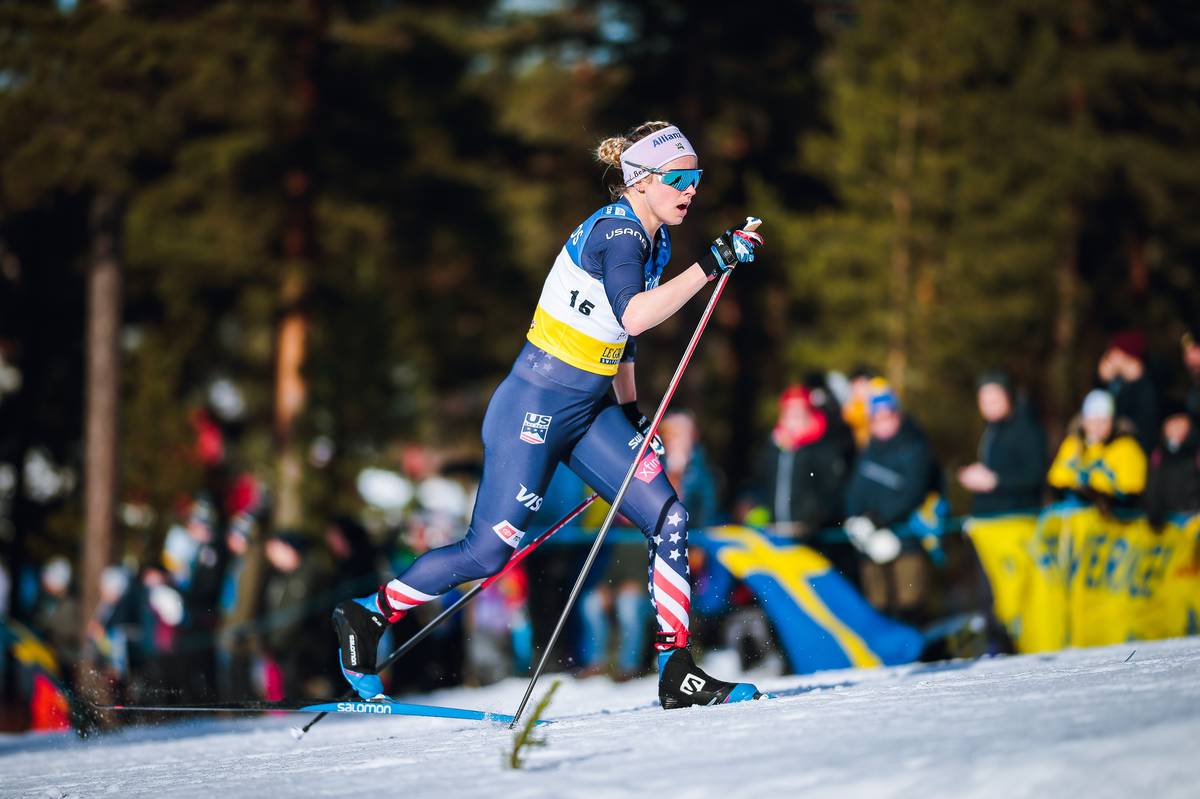
Lauren Jortberg (USA) training in Tignes, France, last June. (Photo: Authamayou/NordicFocus)
Choosing One Thing
Sprinting had always been her strength — particularly skate sprinting. Classic sprinting lagged behind. Rather than attempting to become broadly better at everything, Jortberg and Thomas made a narrower decision.
“Let’s spend one day a week, every week, for an entire summer and fall, working on classic skiing,” Thomas said. “Double pole. Thirty to sixty minutes. Just consistently.”
It was not glamorous work. It was not optimized for social media or immediate payoff. But Jortberg committed fully. “She was like, ‘Hell yeah, let’s do this,’” Thomas said.
Even when they were no longer formally affiliated with the same team, she continued the work remotely. “She continued that work on her own,” he said. “From afar.”
At the same time, something else was happening — something less visible.
Lauren Jortberg (USA) during the qualification of the World Cup Individual Skate Sprint in Oberhof, Germany, two weeks ago. (Photo: Authamayou/NordicFocus)
The Mental Turn
Jortberg began working seriously with a sports psychologist. She and Thomas independently immersed themselves in books, podcasts, and writing about mental performance. They traded recommendations. They talked openly about processing failure.
“I don’t care how pretty your technique is,” Thomas said. “If you don’t have control over the on-off switch in your brain, you’re not going to get to the line fastest.”
What Thomas noticed later, during Period 1 Super Tour in Alaska, was a change. “That was a different Lauren than even a year ago,” he said. “In such a good way.”
Jortberg describes it less as a breakthrough than a reframing. “Everyone is going to have setbacks,” she said. “It’s about how you respond. Chipping away little by little. Not letting setbacks impact how you see yourself.”
She learned to loosen her grip on outcomes. “Often when we think things have to happen a certain way,” she said, “that’s when they don’t.”
Lauren Jortberg with boyfriend Antoine Cyr (CAN). (Photo: Courtesy Photo)
Two Places at Once
In the fall, Jortberg moved to the Mount Sainte-Anne area of Quebec. The decision was partly personal — she is dating Canadian skier Antoine Cyr — but also practical.
She began training at the Pierre Harvey Training Centre, known for its demanding terrain and extensive roller-ski infrastructure. “The terrain is really hard,” she said. “I think it’s been awesome for intensity. Especially my classic skiing.”
Her coaching arrangement became hybrid: remote communication with Thomas, daily training in Quebec. “We text pretty much every day,” Thomas said. “Or we’re on the phone.”
Jortberg chose not to maintain two residences. “That’s just not something that financially would be feasible,” she said. More importantly, she valued stability. “I really prioritize my personal life. That’s what allows me to perform at the highest level.”
It is an unromantic truth of elite skiing: stability is performance.
Alaska and Leadership
When Jortberg declined early World Cup starts to focus on Super Tour and U.S. Nationals, she rejoined Coach Thomas and the rest of the Mansfield Nordic Pro team in Alaska. What stood out was not just her skiing.
“I was so impressed with her as a leader,” Thomas said. “We used her a ton in team meetings. Tactics. Pacing. Course preview.”
After Alaska, the decision to formally add her back to the team was unanimous. “It was an easy decision,” Thomas said. “She just wanted to be part of the team and demonstrated awesome leadership.”
Kendall Kramer, Samantha Smith, Lauren Jortberg, and Julia Kern (l-r) will join Jessie Diggins, Rosie Brennan, Novie McCabe, and Hailey Swirbul to represent the United States in Val di Fiemme, Italy, from Feb. 6–22, 2026. (Photo: Authamayou/NordicFocus)
Not Jaded
Jortberg will arrive at her first Olympics as one of three women on the U.S. team making their Olympic debut. She sees that as an asset.
“I want to bring non-jaded energy,” she said. “Just that first-time excitement.”
She wants to be present — not consumed by outcome. “I want to look back and be grateful that I was even there,” she said. “And really appreciate the experience.”
It is not a rejection of ambition. It is a different relationship to it.
Forward
Jortberg plans to continue racing. She hopes for 2030, in the French Alps — a place she loves, a skate sprint on a stage that suits her. She is considering an online master’s program in sustainability and renewable energy, thinking carefully about how to prepare for the life that will follow skiing without rushing herself toward it. For the first time in her career, she feels no urgency to escape the present.
“I feel the most stable I’ve ever felt in my career,” she said. “And it’s showing.”
Stability, for Jortberg, has never been accidental. It is something she built deliberately, after years of motion without certainty — years of chasing snow from a town where Olympians ran past her on bike paths and reservoir loops, where excellence was ambient and ordinary at the same time. In Boulder, she grew up watching greatness move casually through public space, learning early that world-class athletes were not mythical figures but people who showed up every day and kept going.
She was not the fastest junior in that environment. She was not the one with the early results or the easy narrative. She lingered on the edges, finished just outside the frame, learned patience in a place that celebrated inevitability. And still, she stayed.
Lauren Jortberg (USA) anchors the relay for the United States in Toblach, Italy, in 2023. (Photo: Modica/NordicFocus)
Now she is an Olympian — not because she followed the shortest line between promise and performance, but because she learned how to endure the long arcs in between. She learned when to narrow her focus, when to loosen her grip, when to trust work that did not announce itself right away. She learned how to live inside uncertainty without mistaking it for failure.
There is something quietly astonishing about that return: a young woman who grew up surrounded by Olympians, never quite believing she was one of them, becoming one anyway — not by force or speed, but by accumulation. By choosing stability when chaos was easier. By learning how to stay.
For an athlete who never arrived early, this moment is not a surprise step so much as a natural one. The long way around, it turns out, still leads somewhere.
Help Support Our Olympic Coverage!
FasterSkier will have our own Nat Herz on the ground at the Olympics, which, to be honest, is a very big financial lift for us. If you value the thoughtful work and access FasterSkier provides at championships like this one, please consider becoming a Voluntary Subscriber. Your support directly fuels the work we do to cover the people, places, and moments that make our sport special.
This coverage is made possible through the generous support of Marty and Kathy Hall and A Hall Mark of Excellence Award. To learn more about A Hall Mark of Excellence Award, or to learn how you can support FasterSkier’s coverage, please contact info@fasterskier.com.
Erik Valnes (NOR) and Johannes Hoesflot Klaebo (NOR), (l-r) crest the final climb before descending into the stadium during the World Cup Classic Sprint in Trondheim (NOR). (Photo: Modica/NordicFocus)
Johannes Høsflot Klaebo’s 100th World Cup win did not arrive with the roar he’d grown used to on this course.
Granåsen last March had been a cauldron—tens of thousands of fans in plastic ponchos, rain pouring sideways, the World Championships turning Trondheim into a temporary capital of the sport. Eight months later, on the first Friday of December, the same stadium felt smaller. The sky was already dim by early afternoon, the floodlights casting a clean, blue-white glare across sugary tracks. The weather had finally cooperated—no rain, firm snow, kick wax that actually bit—but the crowd was thin enough that you could hear individual cowbells and specific voices when the finalists swung into the stadium.
Still, the stakes were anything but small. Norway flooded the start list with a full Nations-Group, 12 men in red suits, all chasing the same thing: an Olympic ticket to Milano–Cortina. Russia’s return to the World Cup had been confirmed in principle earlier in the week, adding long-term uncertainty to an already cutthroat season, but there were no Russian suits on the start line in Trondheim.
And in the middle of it all, on the same course where he’d taken six gold medals at Worlds, Klaebo lined up for a classic sprint with 99 World Cup victories to his name and the chance to round the number off in his own backyard.
By the end of the afternoon, the number would be 100. The route there was messier—and more revealing—than the record book will show.
Ben Ogden (USA) on his way to posting the fastest qualification time. (Photo: Modica/NordicFocus)
A qualifier that flipped the script
The first jolt of the day came from the American side of the results sheet.
Ben Ogden, the 25-year-old Vermonter who has been quietly (and sometimes not so quietly) remaking the U.S. men’s sprint profile, didn’t just survive the qualification round—he beat the entire Norwegian armada on their home snow. Ogden set the fastest time of the morning, ahead of Johannes Hoesflot Klaebo in second and a 19-year-old Swede, Alvar Myhlback, in third.
For U.S. head coach Matt Whitcomb, the signal was as much about skis and process as it was about the scoreboard.
Norway had sent out its complete Nations-Group—extra men beyond the regular quota—12 in total, and every one of them qualified for the heats. To outski so many Norwegians in a Norwegian sprint, Whitcomb later pointed out, is not an accident. It takes real form and excellent skis.
Ogden’s own description of the qualifier sounded almost deliberately un-dramatic, as if he were trying to file the moment under “routine” before the day had even finished.
“They all feel the same for me, for the most part,” he said afterward. “I definitely knew I was having a good one, skiing pretty fast, but you never know till you cross the finish line. In the middle of the race, I don’t think about that too much—I just sort of think about the next hurdle… At the bottom of the hill, I think about getting to the top, at the top, I think about pushing hard into the downhill, and on the downhill, I think about skiing the corner at the bottom of the hill well. That’s kind of the way it goes mentally for me. I definitely felt good, felt strong. I just felt like I could push and push and push and still have some energy, so it’s a good feeling for sure.”
Behind him, the margins were tight everywhere. Gus Schumacher and Jack Young both hovered just outside the top 30; Kevin Bolger lurked not far behind.
JC Schoonmaker, representing APU and still the same powerful sprinter who has lived on the brink of significant breakthroughs for several seasons, slid into the heats in 24th.
If Ogden’s run lit the American side of the results board, Myhlback’s qualification told a different kind of story—a long-distance skier breaking into the sprint world by almost ignoring one of its foundational assumptions.
Alvar Myhlback (SWE) double poling the qualification (and heats) on skate skis in Trondheim (NOR). (Photo: Modica/NordicFocus)
The double-poling kid from Bjursås
On the face of it, a 1.4-kilometer classic sprint in Trondheim is not where you’d expect to see the aftershocks of Vasaloppet.
Myhlback, a 19-year-old Swede from Bjursås, arrived in Trondheim already something of a legend in a different corner of the sport. In March, he had become the youngest winner in the hundred-year history of the Vasaloppet, staving off the best of the Ski Classics field over 90 kilometers of classic racing and double-poling his way under the blue arch in Mora.
His recent résumé reads like a long-distance syllabus: victories at Vasaloppet, the Klarälvsloppet, Alliansloppet, and the Blink Classics roller-ski race, all in the three-hour-plus universe of Ski Classics racing.
Yet in Trondheim, he and the coaches around him made a choice that felt deeply rooted in that marathon background. While almost the entire field stuck to traditional classic setups—grip wax underfoot, long diagonal-stride climbs—Myhlback rolled to the start on skate skis, no kick wax, no plan to stride. His day would be decided on pure upper-body power and glide.
He stuck with that choice all afternoon. In qualification, he was third, just 0.24 seconds behind Klaebo and less than half a second behind Ogden, double-poling up the long climb where others were striding. In the heats, he doubled down, literally: double-poling on skate skis in a classic sprint, in a World Cup final, on a course where the kicks of Norwegian diagonal stride have defined the past decade.
That he advanced at all would have been a story. That he finished the day on his first World Cup podium, sandwiched between Oskar Opstad Vike (second place) and Lars Heggen (fourth place) in a final dominated by Norwegians, turned it into something else.
It also sharpened an old talking point: Norway’s legendary wax trucks versus a kid who effectively opted out of grip wax altogether, trusting that his marathon-honed double-poling engine could hang on a course built for diagonal stride.
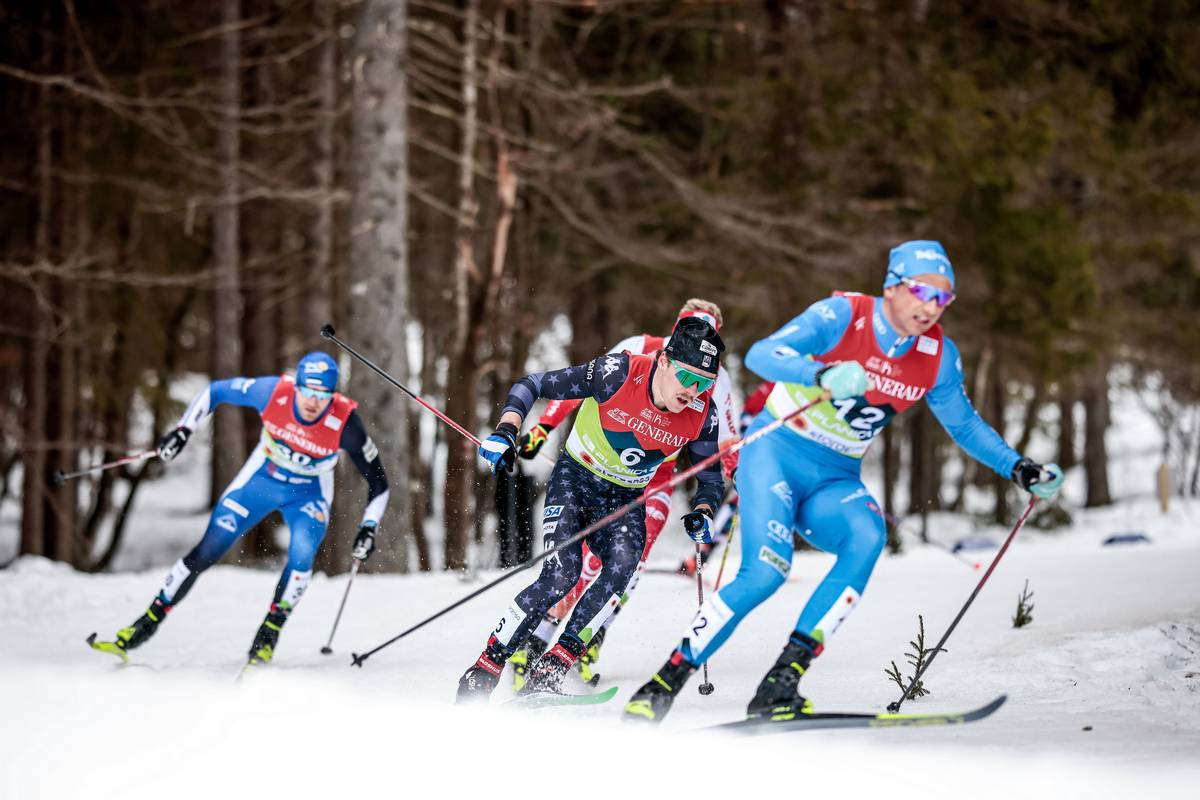
Oskar Opstad Vike (NOR), JC Schoonmaker (USA), Amund August Korsaeth (NOR), Alvar Myhlback (SWE), (l-r) during their quarterfinal. (Photo: Modica/NordicFocus)
The corner that wouldn’t let go
If qualification belonged to Ogden and the chemistry of Norwegian wax trucks, the afternoon’s defining feature was a corner—and the way it kept finding Americans.
Granåsen’s men’s sprint course climbs from the start to a right-hand turn that looks elementary on a map and on television. It’s not an overtly decisive feature: no off-camber sweeping change of direction, no opportunities for bold attacks, just too early on the course to gain a significant advantage. Yet, over and over again, as head coach Matt Whitcomb later put it, “that corner“ has become a problem spot.
In the men’s quarterfinals, Schoonmaker arrived there in a good spot, charging with what Whitcomb described as “gas to burn.“
Then he tangled with Italy’s Simone Mocellini at the top of the climb, went down, and his day ended with a broken pole and a replay that U.S. coaches will be watching for years.
“Today was definitely a step in the right direction,“ Schoonmaker wrote afterward. “It builds some confidence for the next races and for the season. I feel good and feel like I’m skiing pretty well, but it’s just not quite coming together the way I would like. I’m happy with the spot I’m in at the moment.”
Italy’s Simone Mocellini and JC Schoonmaker (USA) crest the final climb before descending into the stadium, but they were out of contention to advance. (Photo: Modica/NordicFocus)
In an Olympic year, that kind of tempered optimism reads differently. Under the U.S. selection procedures for Milano–Cortina, an individual top-eight finish in one of the Olympic events—sprint classic, 10 k skate, 20 k skiathlon, 50 k classic—can lock in an athlete’s nomination through objective criteria. For sprinters like Schoonmaker and Ogden, these early-season classics are more than just race days; they’re auditions with permanent consequences.
Ogden’s quarterfinal, by contrast, looked like the blueprint for surviving that fraught middle of the course. He surged early, stretched his heat into a line, and controlled the race in a way that kept him clear of chaos. He won his quarter almost casually, looking like a man who had solved Granåsen’s puzzle.
Then the semifinal brought him back to the same corner.
Ogden selected quarterfinal five—the last men’s heat in the rotation, the one where recovery time before the semifinal is shortest. By the time he lined up again, he could feel the effort in his arms; the plan, he said, was to sit in the pack early and save his move for the big climb.
Instead, the day tightened around a single moment.
“In the semifinal, I was kind of feeling the quarterfinal in my arms a little bit,“ he said. “So I thought, all right, I’ll just sort of sit in the pack here and wait until that big climb and try and do what I do on that. But I kind of paid the price early on, getting tangled up in that corner. I don’t think Harald [Østberg Amundsen] obstructed me or anything of the sort—he just happened to step on my tip. And when that happens, people who have ski raced will know that your ski comes to a stop, and you can’t really move it. And then that kind of caused me to get spun around, and we both went down.”
Harald Oestberg Amundsen (NOR) and Ben Ogden (USA), (l-r) cross the line in their semifinal heat after the two tangled on the courses first corner. (Photo: Modica/NordicFocus)
“Definitely [a] frustrating way to end the day, especially when I was feeling so good. But these things happen. And there’s always tomorrow.”
Whitcomb, who has coached through more sprint generations than most of the field has been alive for, sounded almost exasperated with that stretch of trail.
“This is probably the most competitive sprint we’ll race all year, until Drammen,“ he said, noting that every team—not just Norway—is living with Olympic selection pressure this winter. “For us, that corner is not an important part of the race, but it keeps becoming one… It’s a place where you should be skiing stable, defending your space, not trying to drop into the stadium with maximum speed.“
The Americans, in other words, left Trondheim with film to study as much as with results to celebrate. Ogden’s ninth-place finish—best in the U.S. men’s camp and agonizingly close to that top-eight Olympic criterion—is both a milestone and a marker.
Alvar Myhlback (SWE), Lars Heggen (NOR), Johannes Hoesflot Klaebo (NOR), (l-r) battle down the finish stretch of the individual classic World Cup sprint final in Trondheim (NOR). (Photo: Modica/NordicFocus)
Five Norwegians, one Swede, and a milestone
By the time the men’s final lined up, the race had distilled into a different kind of pressure.
Norway had put five men into the last six: Klaebo, Oskar Opstad Vike, Erik Valnes, Lars Heggen, and Ansgar Evensen. The lone non-Norwegian was Myhlback, the kid on skate skis, bib 3 set alongside four pairs of Fischer classic boards and one more pair of Atomics.
On paper, the stakes were layered. For Klaebo, it was win number 100 and the chance to keep an almost absurd streak alive: seven straight wins in Granåsen sprints, counting Worlds.
For Vike and Evensen—both already rising up the sprint standings—a podium here, in the hardest sprint of the season and on home snow, would strengthen an Olympic case in front of national coaches who did not have unlimited roster spots to hand out. Under IOC rules, each nation can take a maximum of eight men and eight women in cross-country; FIS allows only four athletes per gender per event.
From the gun, it was clear this would not be one of Klaebo’s processions.
Vike drove the pace early, taking the field up the major climb and over the top with a small gap. Heggen, just 20 and already a three-time junior world champion, looked at home in the front half of the pack. Valnes hovered near Klaebo, doing what he has done for seasons now: protecting his status as Norway’s most consistently useful classic sprinter.
Klaebo, for once, did not look invincible on the climb. He came over the top under pressure, with Vike controlling the line, and Myhlback momentarily buried deeper in the pack.
Then, on the descent back into the stadium, the familiar pattern snapped back into place.
Whitcomb described what happened there with a kind of forensic appreciation: “Klaebo’s signature move, popping out of his tuck to give two short, almost invisible pushes, gaining just enough speed to own the entry into the turn.”
From there, the physics feels pre-written: better speed into the corner means better speed out of it, and better speed out of it means that when the straightaway arrives, the race belongs to him.
Vike held on for a second. Behind them, Myhlback produced one last, pulsing double-pole assault, hauling himself from sixth off the final corner past Heggen and Valnes to grab third—the lone white and blue Swedish suit in a sea of red, and his first World Cup podium.
The official result sheet will show a clean column of numbers: Klaebo first in 2:59.89, Vike +0.31, Myhlback +0.34, Heggen, Valnes, andEvensen rounding out the six. The messy part—the decisions that got them there—was already being replayed on screens in wax trucks and team vans before the snow had stopped squeaking.
Johannes Hoesflot Klaebo (NOR) celebrates his 100th World Cup victory in front of his home crowd in Trondheim (NOR). (Photo: Modica/NordicFocus)
“Number 100. I’m taking it here.”
When the stadium interviewer finally put a microphone in front of Johannes Hoesflot Klaebo, the question almost wrote itself: had he, as some had suggested, deliberately eased off in last weekend’s distance race in Ruka to engineer his 100th win on home snow?
Klaebo, grinning, swatted the idea away.
“Number 100. I’m taking it here,“ he said. “To take it and to also do it in a sprint—it’s special… I wish I could say that. But no, I didn’t. I just feel like it was a perfect place, and doing this at the start of the weekend is really good. Now we can really just enjoy the weekend and hopefully some more good racing the next couple of days.“
At 29, he is now the first man to reach 100 World Cup wins and only the second athlete overall, joining fellow Norwegian Marit Bjørgen, who finished her career with 114.
Whitcomb, who has been on the circuit for the entirety of Klaebo’s rise, sounded as if he were still trying to convince himself the story was real.
“It almost doesn’t seem like a true story,“ he said. “Given that he won every race at World Championships in his backyard, given that he won his 100th World Cup in his backyard… and yet he does it. And that’s, I guess, the point of this whole thing.“
Today’s win, he noted, was not a walkover. Klaebo was genuinely under pressure on the climb. He had to make the pass on the descent. For an athlete whose dominance can sometimes feel inevitable, that mattered—it turned the milestone into a race rather than a coronation.
Johannes Hoesflot Klaebo (NOR) jumps for joy after his 100th career World Cup victory. (Photo: Modica/NordicFocus)
Norway’s sprint cauldron—and everyone else inside it
For the Norwegian men’s team, Trondheim’s result sheet reads less like a celebration and more like a spreadsheet.
The host nation deployed its full quota: twelve athletes, all of whom qualified into the top 30.
Seven Norwegians made the semifinals. Five made the final. The internal competition for Olympic places—which Norwegian media routinely describe as more cutthroat than the Games themselves—tightened another notch.
Evensen, who podiumed in Ruka and again came close here, is building what looks suspiciously like a “you can’t leave me home“ dossier. Vike’s second place gives him a marker race in front of home coaches. Heggen, not long removed from the junior ranks, now has “World Cup final in Trondheim“ on his resumé. Valnes remains what he has been for several years: the quiet constant, who makes every relay debate harder.
All of it plays out under the exact challenging numbers that govern every other nation: eight men, eight women total; four start spots per event. In a year when Russia’s gradual reintroduction will eventually change World Cup standings, and when nations like Sweden are suddenly finding new men’s sprint stars in unlikely places, no Norwegian result feels expendable.
For the Americans, the lens is different but just as sharp. U.S. selection procedures put heavy weight on top-eight finishes in events that mirror the Olympic schedule; Ogden’s ninth today falls just outside that automatic tier but lands him firmly in the heart of the conversation as the season unfolds. Schoonmaker’s “step in the right direction,“ as he put it, is also a reminder that sometimes the key line on a selection sheet is not a single result but a trend—of qualification, of speed, of that “look in his eyes“ Whitcomb referenced.
And somewhere beyond the World Cup bubble, Myhlback’s coaches and sponsors in the Ski Classics universe are waking up to a fact they probably already suspected: the kid who won Vasaloppet isn’t only a marathoner. His decision to show up in Trondheim, on skate skis, for a classic sprint, and walk away with a podium is going to complicate every conversation about where he belongs.
Ben Ogden (USA) although a tangle during the first corner of the semifinals left him wondering what might have been there was a lot of positives today for Ogden in Trondheim (NOR). (Photo: Modica/NordicFocus)
A quieter Granåsen, and a long season ahead
As the stadium emptied on Friday evening, Granåsen sounded more like a training venue than a World Championships site: a few kids sliding around on the outrun, the soft hiss of sprinters cooling down, coaches trudging back to wax trucks under a sky already leaning toward night.
Inside those trucks and team rooms, the day’s big moments were already being analyzed into data points. For Klaebo, the milestone win will sit at the top of his personal mythology, another chapter in the story of a hometown kid who has somehow bent the sport around his own arc. For Norwegians like Vike, Evensen, Heggen, and Valnes, the Trondheim sprint will live on as Exhibit A, B, C, and D in Olympic selection debates that will stretch deep into January.
For Ogden and Schoonmaker, the corner that took them down will become homework—grainy replay clips, course maps, and, eventually, new lines in the U.S. sprint “playbook“ the team keeps for every World Cup venue.
And for Alvar Myhlback, who insists he is still a long-distance skier first, Trondheim may end up feeling like an interruption: a single day on a familiar course in Norway when he parked the marathon skis, rolled out on skate boards, and proved that his double-poling engine works just fine in the cramped, chaotic, oxygen-starved world of classic sprinting.
The World Cup moves on quickly—20k skiathlons on Saturday, 10k skate starts on Sunday, Davos and the Tour de Ski looming just ahead. But for one early-winter afternoon in Trondheim, on a course that is beginning to feel like the sport’s central stage, the story belonged to a corner, a kid on skate skis, and a 29-year-old Norwegian who somehow made history again in his own backyard.
Feature stories like this one take time, access, and care to produce. If you value thoughtful storytelling and independent ski journalism, please consider becoming a Voluntary Subscriber. Your support directly fuels the work we do to cover the people, places, and moments that make our sport special.
Oskar Opstad Vike (NOR), Johannes Hoesflot Klaebo (NOR), Alvar Myhlback (SWE), (l-r) take the individual classic sprint podium in Trondheim (NOR) – Klaebo’s 100th World Cup victory. (Photo: Modica/NordicFocus)
Bang! We’re off and running with a recap of the classic sprint, the first of six medal events at the World Championships in Planica, Slovenia. American sprint sensation Ben Ogden joins us.
We’ll be podcasting after each race day in Slovenia. Get at us with questions at devon@fasterskier.com and nat@fasterskier.com.
Ben Ogden races in the quarterfinals of the individual classic sprint during the 2023 World Championships in Planica, SLO. (Photo: NordicFocus)
This World Cup coverage is made possible through the generous support of Marty and Kathy Hall and the A Hall Mark of Excellence Award. To learn more about A Hall Mark of Excellence Award or to learn how you can support FasterSkier’s coverage please contact info@fasterskier.com.
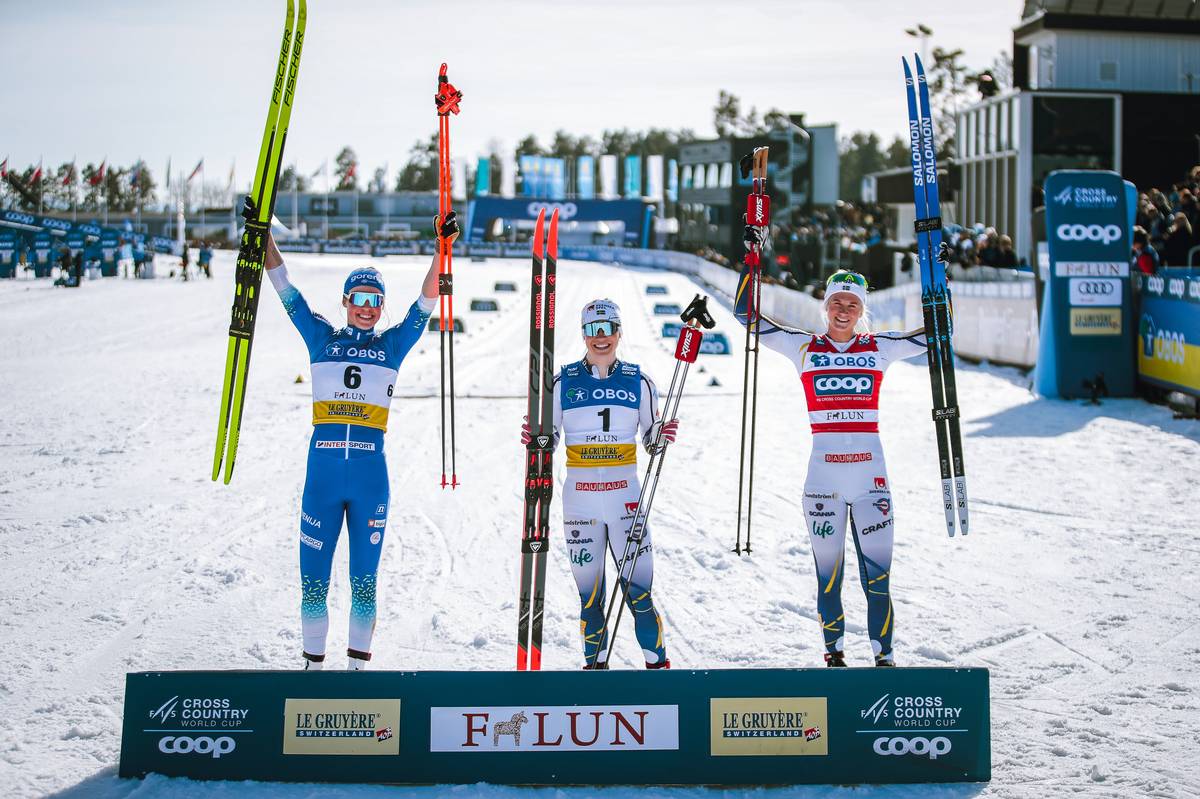
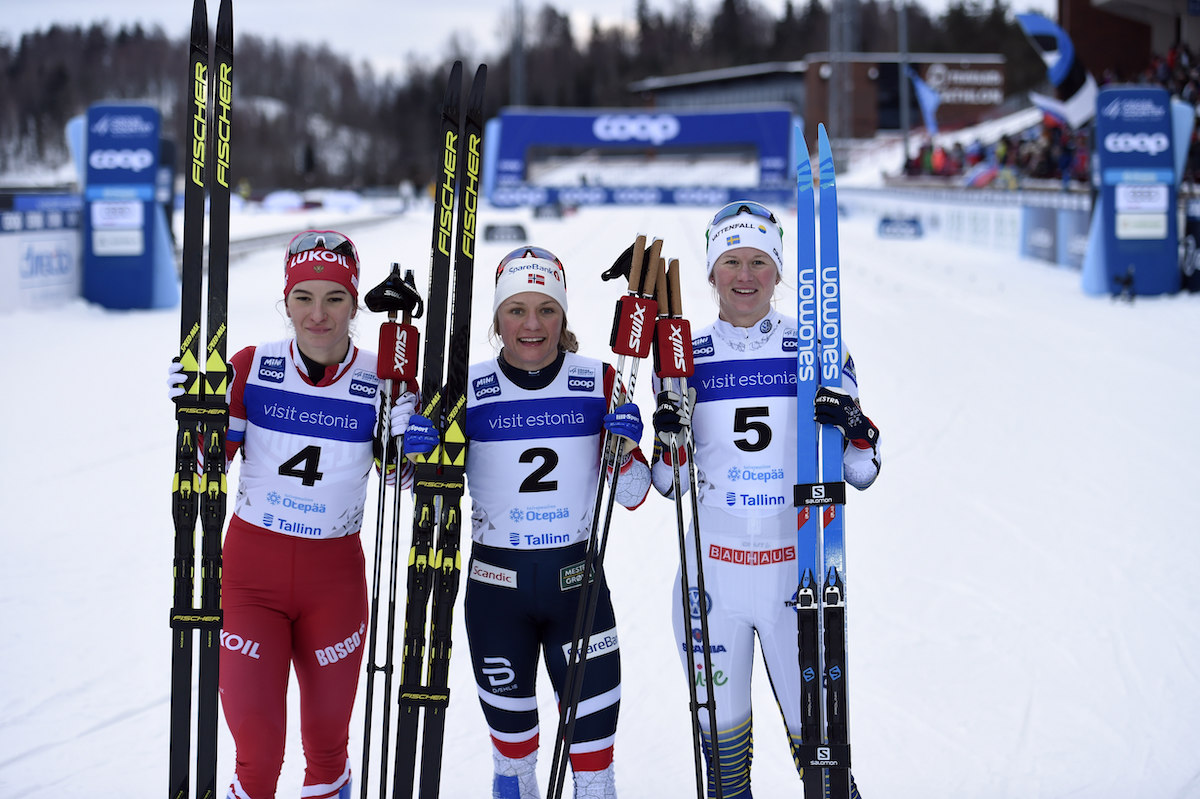
Women’s 1.4 k classic sprint podium in Falun, Sweden: Jonna Sundling (SWE) took the win ahead of Anamarija Lampic (SLO) and Maja Dahlqvist (SWE). (Photo: NordicFocus)
We’ve arrived at the final weekend of World Cup racing. After the cancellation of the finals scheduled to take place in Tyumen, Russia and the difficulty of finding a last-minute replacement, these three days of racing in Falun, Sweden will be the culmination of the 2021/22 World Cup season. On a warm sunny day, in full spring conditions, the women executed an exciting classic sprint on the familiar 1.4 k Falun sprint course. With this being the last sprint of the season, it was also a day to cement the places in the running for the overall women’s sprint globe (none of the team events happening Sunday will influence the rankings).
Starting with a bang, Jonna Sundling of Sweden won the qualifier by an astonishing margin of +8.41 seconds, ahead of runner up Jasmi Joensuu of Finland. The American’s put three women into the quarter-finals, led by Rosie Brennan in 7th (+9.61). Julia Kern qualified in 17th position (+12.30), followed by her teammate and roommate, Jessie Diggins in 18th (+12.49).
Jessie Diggins on her way to 18th place in the qualifier. Diggins ultimately ended her day 19th. (Photo: NordicFocus)
These were the only three American women competing today as unfortunately some late-stage positive covid tests barred the rest from competing. Having made it through a winter of international travel, living, and competing during the Omicron surge, Hailey Swirbul and Katherine Ogden announced on Monday that they had both tested positive in Norway. Lauren Jortberg, who had her World Cup debut in Lahti, Finland two weeks earlier, came directly to Falun to prepare for this weekend, only to test positive on Wednesday.
No Canadian women made it into the top thirty, their first finisher was Olivia Bouffard-Nesbitt in 32nd (+17.54). Katherine Stewart-Jones led a string of fellow country-women, finishing 37th (+19.49), followed by Dahria Beatty in 38th (+19.75) and Jasmine Drolet in 39th (+20.08). After competing at World Juniors in Lygna, Norway, Drolet joined the senior women and made her first World Cup appearance in the Holmenkollen 30 k last weekend where she finished 42nd.
Dahria Beatty (CAN) racing to 38th in the classic sprint qualifier on Friday (Photo: NordicFocus)
As crowds of fans gathered, the women’s quarterfinals kicked off at 12:15 local time. In the first heat, a fast pace bought three women tickets to the semi finals, led by Anna Svendsen of Norway. After winning the classic sprint qualifier in Drammen, Norway last week only to fall in the quarter finals, Johanna Hagström (SWE), skiing on a home course, made it safely through in second. Kerttu Niskanen of Finland took third but with a fast enough time to snag a lucky loser position.
Heat two was controlled entirely by Sundling as she skied easy out front, spreading the rest of the field. Behind her came Johanna Matintalo of Finland and Julie Myhre of Norway who made it to the semis as the second lucky loser. Brennan (USA) finished fourth, +3.39 behind Sundling, ending her day in 16th overall.
Rosie Brennan races the quarterfinal after qualifying 7th. (Photo: NordicFocus)
“It was warm and wild out there today,” wrote Brennan after the race. “This course is quite technical and has some challenging downhills which has made it a tough course for me in the past so I was ready to make some progress today. I had a good qualifier and that gave me some confidence for the heats. I had a very stacked heat which can go either way for me. I struggled finding space to move on the uphills which is my strength and that ultimately cost me moving on to the semi-finals by less than a second. In the bigger picture, I do think I made some strong progress on some of my weak spots on this course and I am really excited about that. I am also still feeling good and excited to race which bodes well for the rest of the weekend.”
In heat number three, Anamarija Lampic of Slovenia took on the lead, as Diggins and Moa Lundgren of Sweden chased. Entering the final straight Nadine Fähndrich of Switzerland employed her blistering finish speed to surpass both Diggins and Lundgren, and nearly overtake an unsuspecting Lampic. This left Diggins in fourth place in a heat that was not quick enough to make lucky loser. Diggins ends the sprint season in fourth place in the overall sprint standings with 351 points; having entered the day in third with 339 points, she was bumped off the podium by Sundling.
Jessie Diggins races in heat number three in the 1.4 k classic sprint in Falun. (Photo: NordicFocus)
Heat four saw an easy pace from the gun, with the pack largely staying together. With all six athletes still in touch as they crested the big climb, Kern navigated into third place on the ensuing tight downhill corner. An injection of speed from Maja Dahlqvist (SWE) over the next rise split the pack as Lotta Udnes Weng (NOR) shadowed, followed by Kern still in third. In the long downhill glide-out, Weng overtook the Swede, entering the final corner in first. Right with her were Kern, Dahlqvist and Laura Gimmler of Germany. A close finish saw Kern out double-pole Dahlqvist to take the win, with Weng coming second. However, a disqualification for Weng bumped Dahlqvist into second and thus have her a ticket to the semi-finals.
Jasmi Joensuu (FIN) and Maiken Caspersen Falla (NOR) duke it out in the quarter-final (Photo: NordicFocus)
After a redeeming win in Drammen last week, Maiken Caspersen Falla of Norway charged off the startline for heat five. Joensuu (FIN) and Heidi Weng (NOR) took up the chase and eventually overtook Falla on the long descent back into the stadium. Together the two Norwegians pulled away from the Finn as Joensuu faded slightly. Falla finished first and Weng, with a scream of satisfaction, crossed in second.
Heidi Weng (NOR) racing in quarterfinal heat number five (Photo: NordicFocus)
Echoing her moves from the quarter-final, Sundling (SWE) approached semi-final number one in the same manner, skiing smooth and easy out front. Lampic (SLO) followed with some occasional slips on a mushy course. Those front two continued to pull away, Sundling making it look easy as she found herself well clear of the rest of the competition. Lampic maintained second position and Matintalo (FIN) came in third, though was not quick enough to move onto the final.
In the second semi-final, Falla (NOR) took the lead, again trailed by Weng (NOR). Once again, Kern (USA) moved into third position on the tight middle downhill portion, setting herself up well. A fall from Weng on the next hill took her out of contention as Dahlqvist (SWE) moved into second position, Kern still in third. Switching tracks, Dahlqvist stumbled but managed to stay on her feet as Kern took the lead into the final corner. Kern held onto first position with some strong double poling and behind her Dahlqvist, Falla and Fähndrich all qualified for the final in second through fourth positions respectively.
Julia Kern, closing out fast (Photo: NordicFocus)
Making her first sprint final since a stage race in Lenzerheide, Switzerland in December, Kern was all smiles on the start line as the athletes lined up for their final round. Right away, Sundling and Lampic began to pull away from the rest of the field. Up the A-climb, Sundling broke into a herringbone, clearly moving fast as she increased her lead. Dahlqvist who had been in third was overtaken by Kern who topped the hill in third. Lampic was holding strong in second, though being chased by Kern. Navigating the remaining corners and descents, Sundling cruised easily to the finish with enough of a lead to give a celebratory wave before crossing the line.
No challengers around, Jonna Sundling cruises to victory. (Photo: NordicFocus)
Coincidentally, Sundling won by the same margin over Lampic (+8.41 seconds) as she had on second-place qualifier Joensuu (FIN) earlier this morning. “I don’t know what is behind this result today, but the last weeks I’ve been feeling really good and it’s nice to keep the shape still,” said Sundling after her dominant victory. She added, “I didn’t compete so much in the beginning [of the season] because of injury but my motivation is on top and so is my shape, and it’s just fun to ski right now.”
Behind them, Dahlqvist was finding a second wind in the finish straight and overtook Kern to finish in third. Kern finished fourth, matching her season personal-best from Lenzerheide where she also finished fourth, in a skate sprint.
Anamarija Lampic (SLO) heads towards a silver medal as behind her Maja Dahlqvist (SWE) overtakes Kern (USA). (Photo: NordicFocus)
“[Kern] was really smart through the quarters and semis,” reflected coach Matt Whitcomb, “where she would ski really smooth through the first climb, and position herself really well. And normally what was happening is she was both being smart tactically and feeling very good today and that just led to a break between positions 3 or 4 and allowed her to get away. And her doublenpole punch at the end was as good as I’ve ever seen her today.”
Julia Kern after fending of Nadine Fähndrich (SUI) to finish fourth in the 1.4 k classic sprint. (Photo: NordicFocus)
Regarding the final in which Kern seemed to have a lock on third but lost out in the closing stages Whitcomb said, “We talked about if there was a big mistake she made and we decided she could do the same thing 10 times and maybe land on the podium four or five times. She had some stumbles, had those things not happened, it would have been a little bit closer between her and Maja [Dahlqvist], but I don’t want to discredit Maja, she had all kinds of fire in the finish today.”
He added, “It was cool, Julia’s parents are out here today, she has raced well when her parents are watching. It’s important to point out that she was fourth and not fifth, she fended off a hard-charging Fähndrich and we’re really happy with her performance today.”
Listen to the full interview with U.S. Ski Team Head Coach Matt Whitcomb here.
Julia Kern races through the heats in Falun. (Photo: NordicFocus)
Kern has put together a string of strong performances in the final period of World Cup racing, placing in the top-10 in each of the last three sprints. These results come on the tails of a first Olympic appearance that left her wanting more, after having rebounded early-season from a 2020/21 season she had described as challenging.
“It’s a bit of a bittersweet ending,” Kern said in a call. “We’ve been on the road for so long now that, after the Olympics, especially, I was feeling excited to go home. But now when things are going well and I’m feeling really good, I don’t want to go home and I don’t want the season to end. I’m happy to end on a high note and find my stride after a frustrating Games. It’s just kind of reminded me how important having some sense of normalcy is, and I’ve kind of embraced that more after the Games. I think that’s paid off, plus some hard work, and I’ve had a little extra fire from the frustration after the games. Happy to end the season this way, and [we have] another shot tomorrow, so I’m excited for that race.”
Commenting on how these strong results and better energy feed momentum, Kern discussed a mid-week training session she felt primed her for today’s sprint.
“Now that I’ve been having really good energy in training… I have to give a big shoutout to our staff. On Tuesday this week, I did an interval workout here on the courses. I had Matt, Kate [Barton], and [tech] Chris Hecker out there with me, racing me around the course doing speeds, throwing elbows, pulling tactical moves, practicing the slingshot. Those types of sessions are super valuable for me when I put the energy to put in a good interval session. I learned so much from that session, and it gave me the confidence here today to ski well in the heats and be ready for anything.”
Kern continued with a laugh that her family is her fourth place good luck charm, as they also watched her race to fourth in Lenzerheide, SUI during the Tour de Ski, ending with a comment on the American team as the season draws to a close.
“I think our team has done a really incredible job, working through all the different colleges this season has brought. When things get tough, we bring out humor and come together. I just feel more and more appreciation for the team. My wax tech Eli and I have worked really hard all season together to start linking together some classic performances. We’ve had four classic races in a row now, and pretty much all personal bests, so that’s been a really fun relationship to build and [I appreciate] all the hard work the wax team puts in.”
Full post-race interview with Julia Kern. Apologies for the bad echo — working through the kinks as we work our way along the audio learning curve.
Julia Kern edges out Maja Dahlqvist (SWE) in the classic sprint semifinal in Falun. (Photo: NordicFocus)
Dahlqvist already had the sprint globe on lock, but her third place finish today only reinforced her strength in sprint racing this season as she racked up 638 points throughout the year. She began the season with four straight wins and earned a silver medal in the Olympic skate sprint last month. A fourth place finish in Drammen was the only time this season in which she did not finish on the podium in a sprint event.
“It feels really really, super duper good,” said Dahlqvist about taking home the globe. “I’m super happy with that.”
Sweden’s Maja Dahlqvist is the 2022 World Cup sprint champion. (Photo: NordicFocus)
Last year’s sprint globe winner, Anamaria Lampic (SLO) finished second this year with 506 points. After today’s victory, Sundling (SWE) overtook Diggins (USA) to move into third in the sprint standings with 442 points. Delaying her start to the season after sustaining an injury in an early-season FIS race, Sundling’s first World Cup start was Dresden in mid-December where she finished second in the individual skate sprint. She did not take part in the Tour de Ski, but returned to the World Cup circuit in dominant fashion, after collecting three Olympic medals, one of each color, and taking fourth place in the 30 k.
In the final three weekends of World Cup racing, Sundling landing on the podium in four out of the five races she entered, including a third place finish in the legendary Holmenkollen 30 k classic last weekend.
Anamarija Lampic (SLO) congratulates the days winner, Jonna Sundling (SWE) (Photo: NordicFocus)
Racing continues tomorrow with a 10 k skate interval start for the women. Sunday will feature two new team events, with a mixed relay happening in the morning followed by a mixed team sprint in the afternoon.
Precipitation was no longer a threat for the final day of racing in Soldier Hollow on Friday, a 1.5-kilometer classic sprint offered alongside the 2022 U.S. Cross Country Championships, yet classified as SuperTour only. However, athletes still faced unseasonably warm weather as blazing sun brought temperatures into the low 50’s on course during the midday heats.
Howling wind and rippling bibs could be heard as background noise as Adam Verrier called the event on the livestream, creating extra work for the athletes who would fight through degrading course conditions throughout the heats. This extra work showed in the times on course; with the combination of freestyle technique and significantly faster course conditions, Sunday’s sprint races featured times over a minute faster on average. A similar difference was seen even between the qualifier today at 9 a.m., when temperatures were still colder and tracks firmer, and the heats which began at 12:30 p.m.
Warm temperatures, degrading tracks, and loose granular spray set the stage for a challenging classic sprint in Soldier Hollow. (Photo: Tobias Albrigtsen / @untraceableg)
“Sprint” seemed to perhaps be a misnomer, as times in the women’s heats climbed over five minutes and were well above four minutes in the men’s heats. Combined with a qualifier, this meant athletes who raced through the final saw between 16 and 20 minutes of racing, testing their endurance and fitness differently from the average sprint event.
Women’s Race: Katharine Ogden on Top from Qualifier to Final
On the heels of a second place finish in yesterday’s 15k classic, Katharine Ogden (USST/SMS T2) set the bar in the qualifier, finishing in 3:51.79.
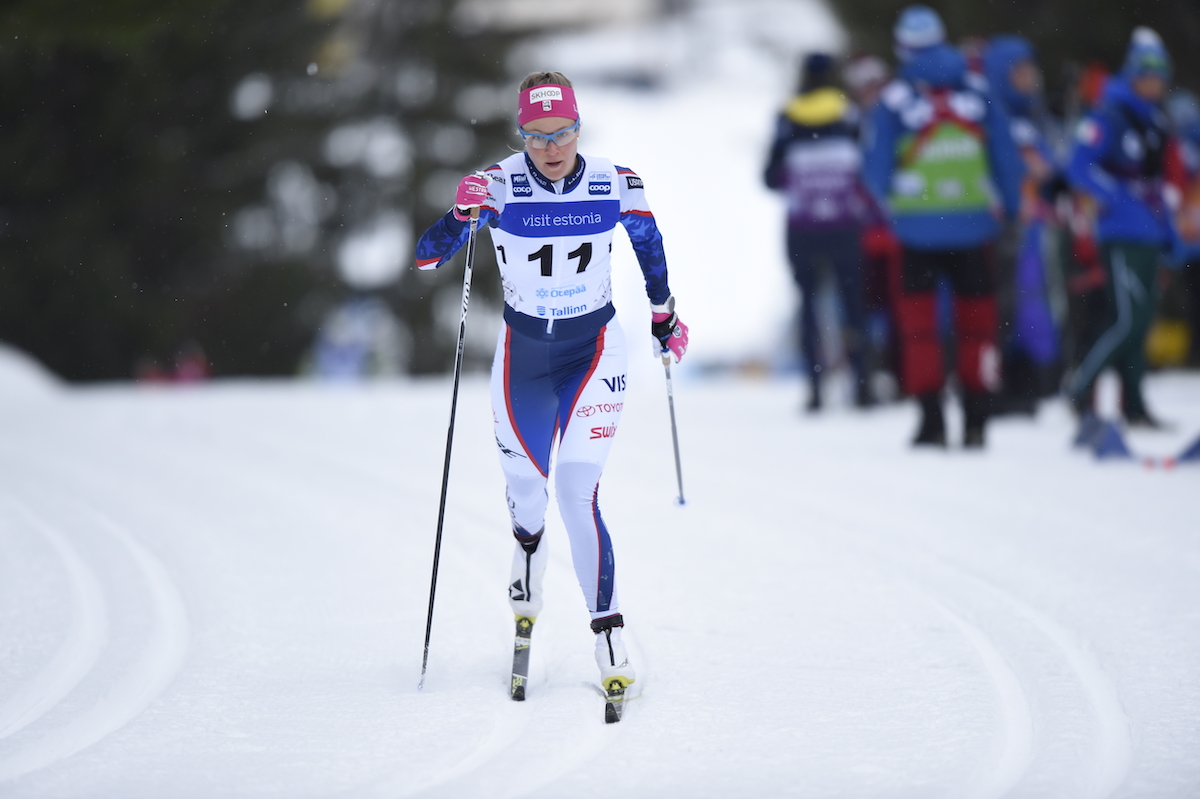
Julia Richter (U of Utah) was the second fastest qualifier (+0.77), ahead of Lauren Jortberg (BSF Pro) in third (+1.48). Both Ogden and Jortberg won their quarterfinal to advance comfortably into the semis, however, Richter took fifth in Heat 4 and did not advance.
In the first semifinal, two Craftsbury teammates Annika Landis and Caitlin Patterson led the way in the opening climb, with Ogden and Sydney Palmer-Leger (USST/U of Utah) sitting in third and fourth a few strides behind. Descending from the high point, a third Craftsbury racer, Michaela Keller-Miller, had pulled to the front, but was quickly overtaken by Patterson and Ogden as the pack headed into the final short herringbone climb before the long descent toward the stadium. Patterson and Ogden sat in low tucks, letting their fast skis glide as long as possible before transitioning to doublepole as they headed over the bridge and into the finish.
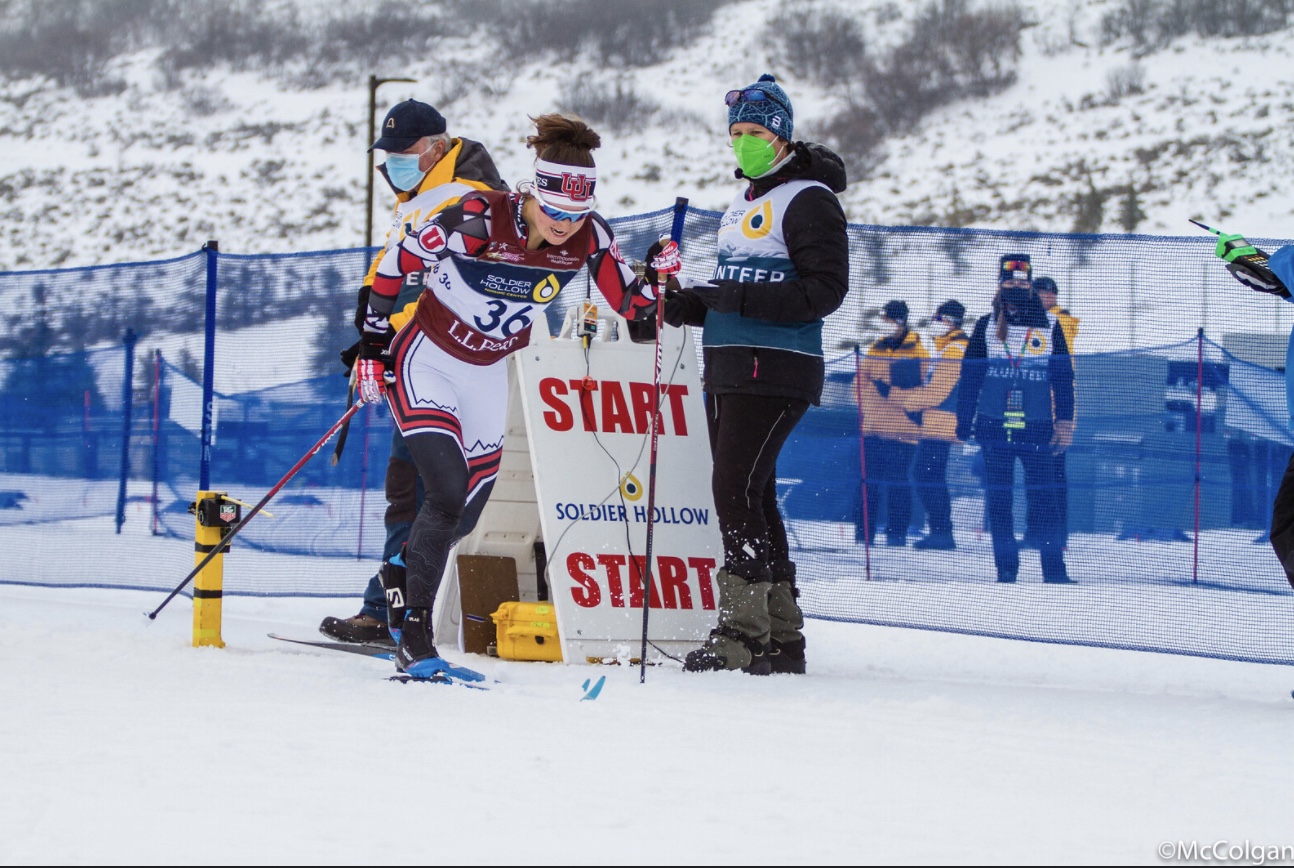
Sydney Palmer-Leger heads out for the 10k interval start classic race during the 2022 U.S. Cross Country Championships in Soldier Hollow. (Photo: John McColgan)
Upping the power in the final 200m, Palmer-Leger accelerated to make contact with Patterson as the women crossed over the bridge, but Patterson had better glide in the quick descent from the bridge’s exit, maintaining an advantage as they headed into the final stretch. Patterson tucked in on the tails of Ogden in the left-most track to go one-two in the heat, with Palmer-Leger not quite in the fight for an automatic qualifier spot finishing 1.5 seconds behind Patterson in third.
In the second semi, Bridger Ski Foundation (BSF) Pro Team members, Lauren Jortberg and Hannah Rudd lead the charging, looking as if their skis were gliding well as they pushed the downhills, perhaps with compromised kick as both showed signs of slipping in the final punchy climb.
In the long glideout, Lauren Jortberg moved from the far left side of the course outside of the track into the second track, losing some time on Rudd who had stuck with the second track from the start. Nevertheless, both held a significant gap over the remainder of the heat as they doublepoled over the bridge and into the finish lanes. Rudd took the win in 4:55.52, roughly +0.7 seconds ahead of Jortberg in second.
A few meters behind, Craftsbury teammates Margie Freed and Alexandra Lawson raced side by side to third and fourth, and as the heat proved to be seven seconds faster on average than the first, both advanced to the final.
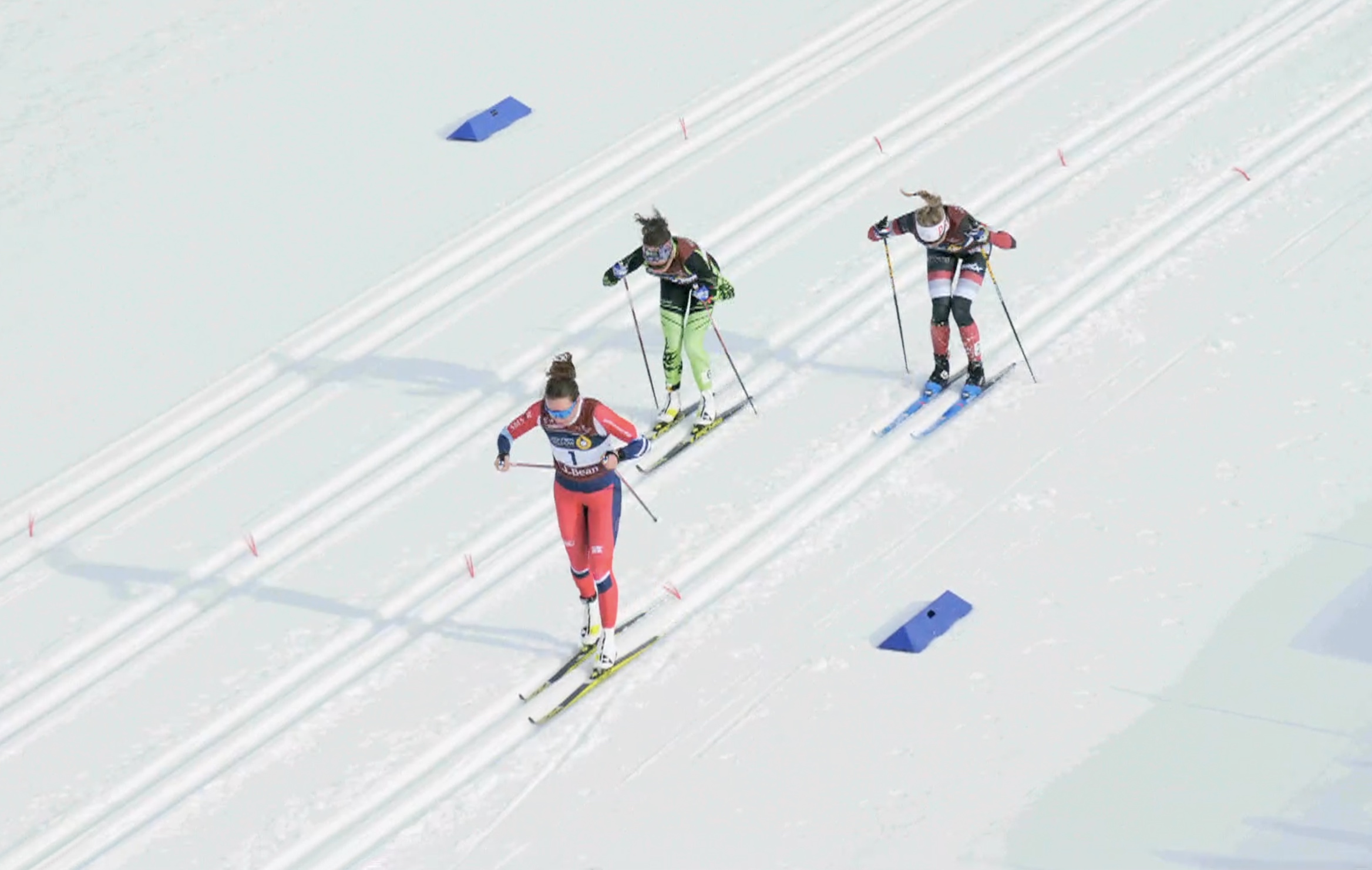
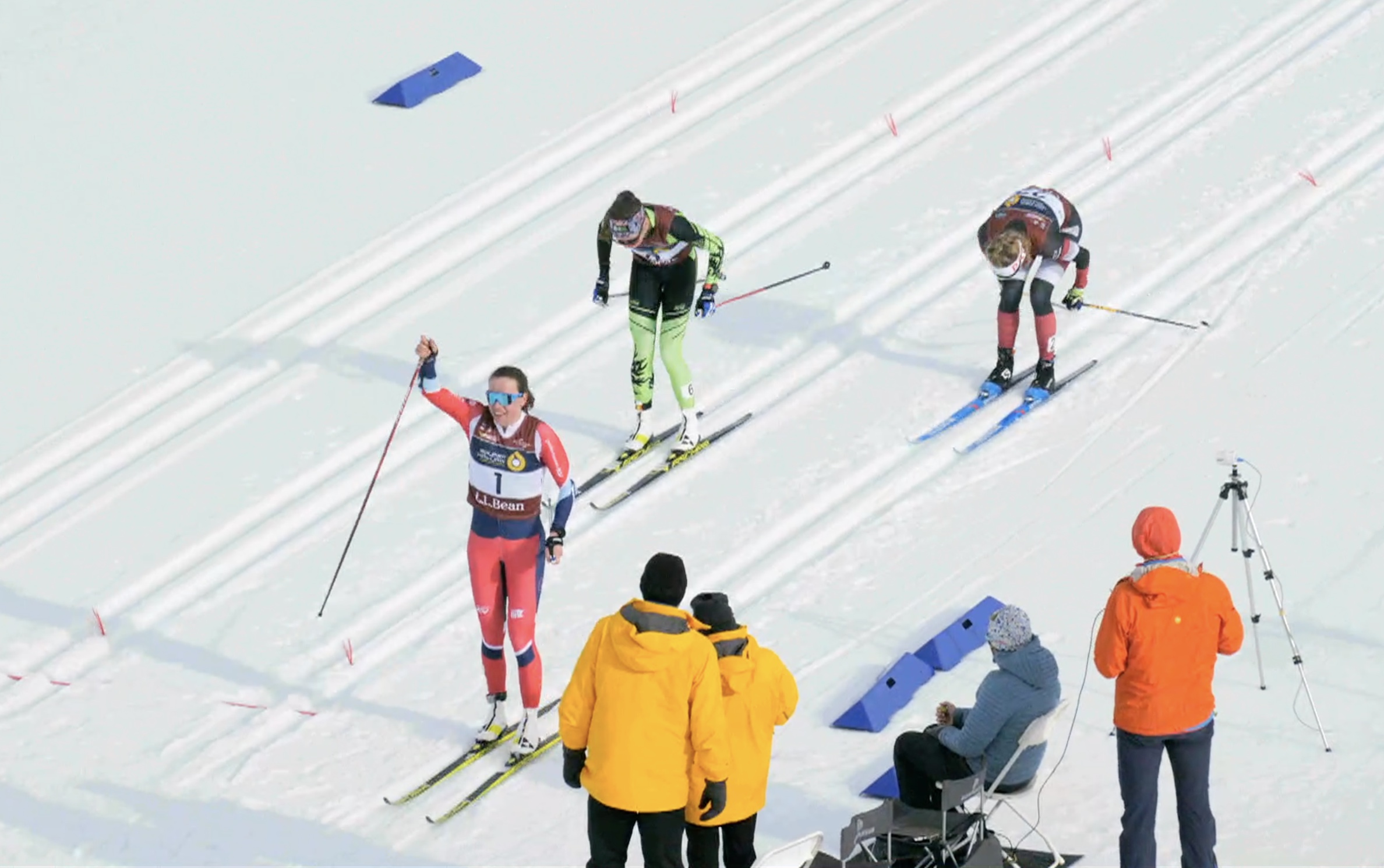
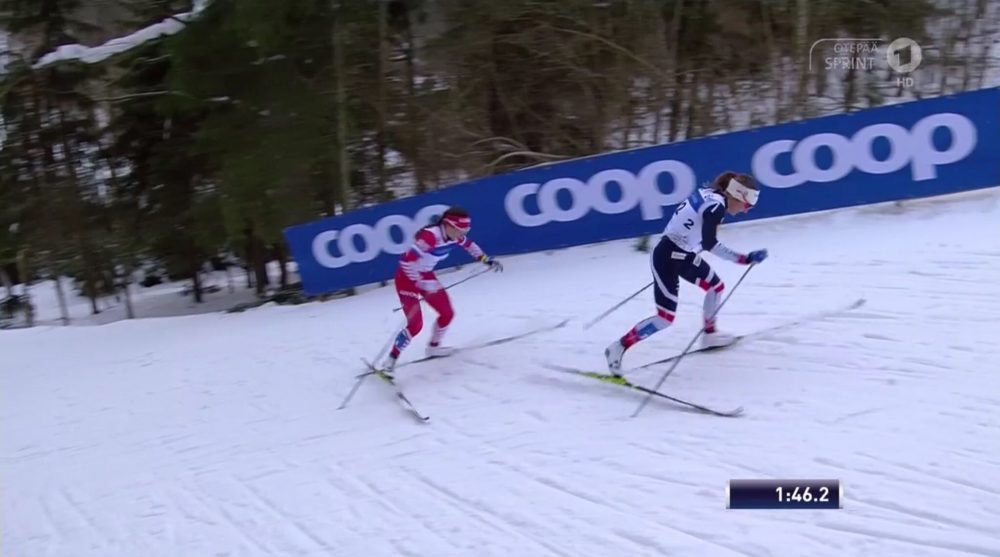
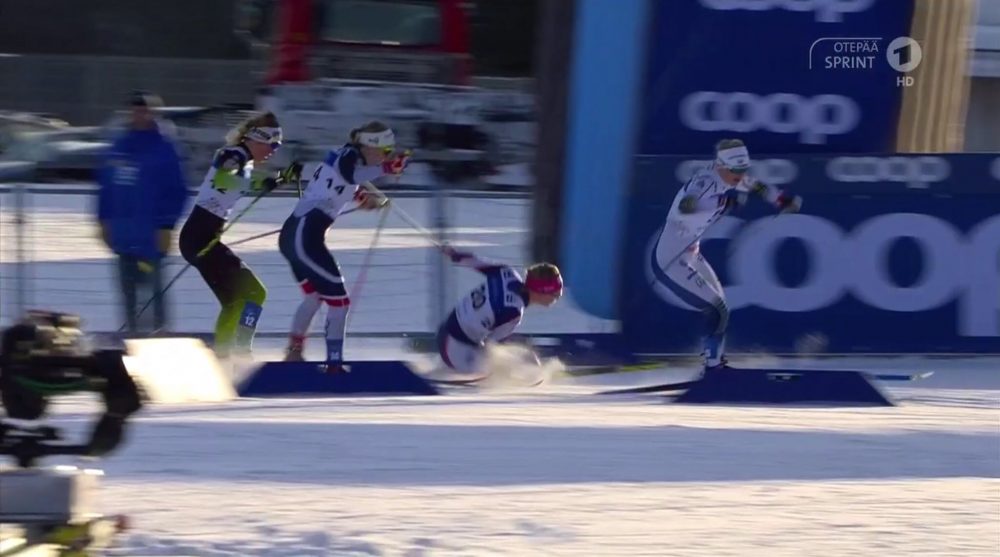
As the women’s final headed out of the stadium and toward the first climb, Lauren Jortberg who was the first in a train of two BSF skiers, had her ski stepped on as she was switching from doublepole to a run outside the track. This caused Jortberg to stand up, spin sideways and crash in slow motion. Rudd, who was just behind, quickly moved around Jortberg without going down, soon taking the lead charging up to top of the first climb with Patterson, Freed, and Ogden close behind.
Patterson looked strong with solid kick as she chased a slipping Rudd up and over the final long climb, but it was Ogden on fast skis who quickly moved into second on the subsequent downhill.
Over the last punchy climb the women ran. Heading into the long glideout, Ogden was off the front in the left-most track, but Rudd and Patterson remained within reach a few ski lengths behind. Descending off the bridge, the top three accordioned together, all choosing the same track with Ogden confidently leading the way to the finish. Patterson, who was in third, moved into her own lane to the right, slowly gaining ground on Rudd as they headed to the line.
Katharine Ogden leads Caitlin Patterson and Hannah Rudd to the line during the SuperTour classic sprints in Soldier Hollow. (Photo: Livestream Screenshot)
Ogden maintained her lead to stop the clock in 5:01.63, while Patterson edged out Rudd for second (+0.98) and third (+1.53), respectively. After regaining contact with the pack following her crash, Jortberg finished fourth (+6.64), with Lawson fifth (+7.11), and Freed sixth (+21.55).
“I was having a lot of fun out there today!” Ogden wrote to FasterSkier after the race. “The sprint was definitely on the long side, especially late in the day, but that did not significantly affect my strategy; I am confident in my endurance as well as my short duration power. I was really excited to have fast skis from Pat [O’Brien] and it was fun to experience the high level of sprinting in the U.S. currently. I also haven’t really done a full sprint day in a while so that was a lot of fun! It was also so impressive to see Caitlin get her fourth podium in as many races and to see Hannah Rudd have an incredible breakout performance today!”
Katharine Ogden celebrates her win in the classic sprint while Caitlin Patterson edges out Hannah Rudd for second and third. (Photo: Livestream Screenshot)
In a post-race email, Patterson reflected on her experience racing through the heats.
“My racing today went fairly well, and it was a beautiful day to be out skiing and spectating,” wrote Patterson. “The sun-warmed snow became quite wet and broken apart for the heats, and combined with the wind, it certainly made a long sprint with plenty of herringbone and some sloppy tracks. I tried not to really think about the time duration much, it was mostly about getting from start to finish, however long it would take. All of the heats required some scrappy skiing, moving around through the slush and timing the length of the tuck. Now I’m really looking forward to some recovery after a good week!”
Patterson also spoke to the week of racing in Soldier Hollow, where she finished on the podium four times in as many races, including wins in both the 10k individual classic and the skate sprint. But she was not the only person in a green suit putting together a successful week. Yesterday, she shared the distance classic podium with teammate Adam Martin. On Tuesday, Crafstbury went 3-4-5 in the 20k skate, with Lawson and Freed leading a chase group behind Frankowski and Patterson. And today, five CGRP women raced in the semis, with three advancing to the final.
“Everyone at Nationals is really feeling the fatigue, and myself and my team were no exception out there today. The race coughs are becoming quite terrible from so many days of racing at altitude, which is not the most fun to be coughing uncontrollably in this time of COVID. However, I was really proud of our whole team, with 5 women in the top 10! We have a really strong group, as evidenced by the performances in the distance races too; it came as no surprise to me that the women were awesome today, because training and doing intervals all summer and fall we’ve been neck-in-neck and pushing each other.”
The women of Craftsbury with coach Pepa Miloucheva. CGRP put five women into the semifinal and three into the final of the SuperTour classic sprint in Soldier Hollow. (Photo: Facebook Crafsbury Green Racing Project)
For Rudd, this was her first career SuperTour podium. Originally from Plymouth, MN, she graduated from University of Alaska Anchorage (UAA) in May, 2020 before heading to Bozeman to join the newly minted BSF Pro Team. Placing in the top-10 in each of the three stages of the 2022 U.S. Cross Country Championships, Rudd has steadily worked her way up the results list, finishing 10th in Sunday’s freestyle sprint, 8th in the 20k mass start free, and 6th in the 10k interval start classic. She ends her week in Soldier Hollow on a podium high note.
Hannah Rudd is a member of the BSF Pro Team based in Bozeman, MT. (Photo: bridgerskifoundation.org)
“Yesterday was a pretty exciting day for me!,” Rudd wrote to FasterSkier after the race. “The sprint course at Soldier Hollow this year was very challenging as it included three solid climbs. During the qualifier, the course remained very firm and fast. However, the temperature quickly began to rise throughout the day, and by the time the quarterfinals began, the sun was baking the course, the wind was blowing, and temps were nearing 50 degrees. This made the snow begin to transform and slow down and turned the tracks into mashed potatoes in some sections.
“I woke up in the morning feeling quite tired from the past week of racing so I was not sure how the day was going to play out,” Rudd continued. “I ended up qualifying in 22nd, so it was clear that I had some work to do in the heats. I felt like I was able to gain momentum and energy throughout the day, and progressed through the quarters, and semis and onto the final. Going into the final, I knew that my team’s skis were running really well so I tried to ski big and relaxed and put myself in a good position for the last downhill. It was pretty neat to be in a final with my BSF teammate Lauren Jortberg, who is an incredible sprinter and someone that I have learned a lot about sprint racing from over the past few years. I was extremely excited to land myself a spot on the podium and think it will help me to continue building momentum and confidence for the rest of the season!”
The podium ceremony for the women’s final following the SuperTour classic sprint in Soldier Hollow. Katharine Ogden took the win ahead of Caitlin Patterson and Hannah Rudd, with Lauren Jortberg 4th, Alexandra Lawson 5th, and Margie Freed 6th. (Photo: Facebook Craftsbury Green Racing Project)
Men’s Race: Colorado’s Magnus Bøe Upsets Schoonmaker in the Final
In qualifying, JC Schoonmaker (USST/UAA) showed why he has been the U.S. Ski Team’s most reliable fixture of World Cup Classic heats this season, winning the qualifying with a time of 3:08.43, 6.42 seconds ahead of 2nd place Peter Holmes (Sun Valley SEF). Andreas Kirkeng (University of Denver) rounded out the top 3 (+6.57), in a field where the top 30 were all within 20 seconds of each other.
With a dominant performance in qualification, the racing throughout the day always seemed to have one eye on where Schoonmaker was in the field. In his quarterfinal, Schoonmaker looked to start conservatively from the back of the field, which led the whole heat to sit back as well. When he moved to the front at the beginning of the first climb, the race surged forward with him. No one could match him, however, and he finished with a comfortable lead, with Kjetil Bånerud (NMU) taking the 2nd semifinal spot (+1.02).
JC Schoonmaker prepares for a sunny and warm classic sprint in Soldier Hollow. (Photo: Tobias Albrigtsen / @untraceableg)
The following two quarterfinals also previewed the competitors, and their preferred way of attacking the course, that would define the semifinal and final racing later on.
The second heat set a stark contrast in pace to the previous heat, with Noel Keefe (U of Utah) and Bill Harmeyer (SMS T2) leading the field out hard from the gun. Hunter Wonders (APU) and Johnny Hagenbuch (SVSEF) were able to keep with the pair though, and ended up out-sprinting Keefe and Harmeyer going into the finish. Still, the duel between Keefe and Harmeyer led to a blistering pace for the heat overall, and they would claim the lucky loser spots for the semifinals.
Then came the 3rd quarterfinal, featuring winner of today’s most aggressive racer award (unofficially handed out here, by Fasterskier), Ian Torchia (SMS T2), who in every heat he was in today would hammer out to the front of the pack while others seemed content to let the field play out. He was joined in the heat by Magnus Bøe (U of Colo.), who made his move on the first climb, stayed out in front, and came through in first place. Torchia, meanwhile, held onto second to advance automatically to the semifinal.
The semifinals marked more an amalgamation of race strategies than anything unique. But it was an amalgamation – which requires multiple parts. And indeed, on a course known for rewarding smart-racing, and in conditions – above freezing, on man-made, wind-swept snow – that reward smart waxing as well.
Magnus Bøe and JC Schoonmaker are off the line during the 2022 U.S. Cross Country Championships freestyle sprint stage. (Photo: Tobias Albrigtsen / @untraceableg)
The first semifinal featured Schoonmaker and Bøe, both of which stayed back in the back during the early part of the course. Going into the first climb, Bøe took a look back, saw Schoonmaker and Harmeyer were sitting in fifth and sixth place, respectively, and decided to attack. He led over the top, into the downhill, and up the final climb. Schoonmaker successfully did maneuver through the pack to counter the move, and on the final climb took the outside line up, cutting in to tuck behind Bøe going into the final downhill. When they came up, Schoonmaker had used the draft to put himself out front, while Bøe held off a late-surge from Hunter Wonders (APU) to take the second qualifying spot into the finals.
The second semifinal was again led out by Ian Torchia, who was then followed by former sprint National Champion Tyler Kornfield (APU). Kornfield seemed content to sit behind Torchia until the first climb, when he put in a burst of speed and broke open the field. The smartest racer, however, may have been Karl Schulz (SVSEF), who rode Kornfield’s attack, and then drafted, to go into the final climb with speed. By the time he hit the downhill, he had a gap which would remain unclosed. Kornfield, who had gone into the downhill in second, found himself joined by Noel Keefe and Ian Torchia into the final sprint for the second spot. As it would happen, all three would make it through to the finals, with Kornfield in second, and Keefe and Torchia being rewarded for their efforts early in the race by claiming the two lucky loser spots to the final.
The A-final then looked like this: JC Schoonmaker, Magnus Bøe, Karl Schulz, Tyler Kornfield, Noel Keefe, and Ian Torchia.
JC Schoonmaker races the qualifier during the SuperTour classic sprints in Soldier Hollow, UT. (Photo: Tobias Albrigtsen / @untraceableg)
With memories of Schoonmaker’s dominating qualifier in mind, it seemed like the field orbited around him off the line. Schulz found himself in front, but not going full bore to open the field up. Even Torchia, when he did make a move to the front, didn’t seem to do so with the same force that had marked his quarter and semifinal attacks. Schoonmaker waited until the first climb to move to the front, and then the final really was on. Schultz seized on the attack, and then put an extra-push into the downhill to try and open up an unclosable gap like he had in his semifinal. It was a good move, but one that didn’t prove to have the same force as his previous attack, and going into the final climb he was joined up with Bøe and Schoonmaker.
Then, Schoonmaker’s pace seemed to drop-off, with a few noticeable slips that progressed into a herringbone. Bøe, meanwhile, went for the herringbone from the get-go. He was the one that made contact with Schulz before the course gave way to a final downhill on the day. Schultz held a gap on the field through the glideout and over the bridge, but it proved not to be enough of a margin to feel comfortable in the final stretch. Meanwhile, Schoonmaker had fallen back to fifth.
Utilizing his dominating doublepole sprint, when they hit the final 100m it was all Bøe, who closed a significant gap to catch Schulz in the final 50 meters. Looking as if he was leaping forward with each push, Bøe switched lanes, overtaking Schultz just before the line and letting out a fist pump as he realized a SuperTour – and collegiate – victory in a time of 4:08.28. Pushing to the line, Schulz was a close second (+0.35). (Video clip here.)
Magnus Bøe overtakes Karl Schultz just before the finish of the men’s classic sprint final. (Photo: Instagram @cubuffs)
After a gap, Schoonmaker, who was fighting for the final podium spot alongside Kornfield and Torchia, crossed the line outside of the track in third place (+4.53). Kornfield was a half second back from Schoonmaker for fourth (+5.10), with Torchia fifth (+5.64), and Keefe sixth (+11.02).
After the race Bøe explained that he changed his tactics in the heats relative to Sunday’s freestyle sprint, though he joked he thought it wise not to reveal everything.
“Today was a windy and slow-condition day,” Bøe wrote in an email. “There was headwind in the first half, and tailwind in the second half. Hence, pulling during the first half would be pointless. Furthermore, the second half, particularly for the last downhill there was very little to gain on the slipstream, due to the low speed and the ‘suctiony’ snow (cold conditions create better glide for the person coming behind on ‘heated tracks’). Therefore during all my heats I pretty much went all out from the top of the last uphill all the way to the finish, which on sunday would’ve been a suicide.”
Bøe walked through the final, including how he reacted to lead changes and adjusted his strategy when the race began to play out differently than anticipated.
“The final started off very slow, but then the positioning battle developed gradually from under the bridge. My main focus was to keep my eyes on JC, since he was clearly the favorite of the day, and I knew I would do well if I laid it up to beat him. Hence I never fell for the temptation of passing him, even though I had many chances of doing so. However, he did get tired during the last climb and tried to get others to pass him. This is when Karl took off and gained a massive gap that at first seemed too late to close. As soon as I realized that JC might not be able to catch up, I committed to catching Karl by myself. I made sure to put in a great push before the downhill straight, and did the ‘supertuck’ to gain every single inch I could. Once I started double poling towards the last bend it was just heads down and maximum effort. Was never certain I would catch Karl, I thought maybe he’d have something left at the very end. But lucky for me he didn’t and I had just enough to pull it off.”
University of Colorado’s Magnus Bøe heads out for the men’s 30k mass start free during the 2022 U.S. Cross Country Championships in Soldier Hollow. (Photo: Tobias Albrigtsen / @untraceableg)
A dual citizen of Korea and Norway, 23-year-old Bøe has already built a robust resume in international ski racing, including competing for Korea during the 2018 Olympics in Pyeongchang. Earlier this week, Bøe was fifth in Sunday’s freestyle sprints and finished 11th in the 15k classic. His only down race of the series happened in the 30k mass start freestyle, where he finished 43rd (+12:30.9).
“This week of racing has been up and down, from a miserable 30km where I got lapped, to today’s win. It’s been a lot of fun, and not least has been helpful for my shape. Next up is the Super Tour in Sun Valley, which I am looking forward to. Think I would be able to build on top of what I gained during this week.”
For Schultz, today also marked a career-first SuperTour podium. The 23-year-old Lake Placid, NY Native raced for the University of Vermont (UVM) until graduating in May, 2020, then heading to Sun Valley. Schultz had a podium just-miss earlier this year in a freestyle sprint where he finished fourth during the opening weekend of SuperTour racing in Duluth, MN.
“I was pretty fatigued from the three races prior,” Schultz wrote after the race. “I knew there was a decent headwind on that first climb, so I decided I’d tuck in behind up and over the first climb. I figured I’d need to save my strength for the final climb and long finishing straight, so I played my cards well and pushed where I needed to, and it just worked perfectly. I’ve learned sprinting is about preserving energy for critical parts of the course, it couldn’t have gone better.”
“And I won’t lie,” Schultz continued. “The spectators and everyone cheering allowed me to find another gear, especially up the last climb. I dug deeper than I have before.”
The men’s podium of the SuperTour 1.5k classic sprint in Soldier Hollow: Magnus Bøe took the win ahead of Karl Schultz and JC Schoonmaker. (Photo: Instagram @nysefnordic)
Writing to FasterSkier after the race, Schoonmaker explained how changing conditions forced athletes to make tough decisions about skis as well as tactics.
“It was a pretty crazy difference from this morning to the afternoon,” Schoonmaker explained. “The morning was icy and fast and the heats got really sloppy and slow. I had amazing skis in the morning and in the heats I struggled a bit with choosing whether to go for more kick or glide. I ended up asking for less kick to free the ski up a bit and I’m still not sure what was the right call. It was just really challenging conditions.”
Schoonmaker also explained that he had made fewer adjustments to the technique he had found such success with in Sunday’s skate sprint, however, the final proved to break the mold of what has historically proven to be the recipe for Soldier Hollow sprint racing.
“For this course I tried to take a somewhat similar approach as in the skate race by respecting the draft on the last downhill and trying to be careful about the guys behind me there. In the quarterfinal I felt I was able to ski away and create a big enough gap so that I couldn’t get sucked back in by the draft. In the semifinal, I tried to stay more in the pack and use the draft for myself. The final was tricky because I was going to try and use the draft again but Karl put in a really good move on the last hill that I couldn’t match. Then I was leading the rest of the pack and I decided to push over and try to catch Karl rather than go to the back to find the draft. It ended up not working out so great, but I’m happy with the day and the tough effort.”
We conclude a week of racing at Soldier Hollow, then, with a race that highlighted the strength and depth of the domestic circuit of U.S. skiing at present. Variable conditions on a technical course, which racers approached with tactics as diverse as the regions they hail from, indicated that this is a field that represents top-level racing. It was a testament to the development and growth of the sport in this country that a top-level racer like Schoonmaker can come off the World Cup and find a field where every heat is raced with closeness and intensity in his own country. That bodes well, and is a great place to leave the last national gathering of the US ski racing community before its best representatives look to take a crack at the Olympic Games in Beijing next month.
The spirit of the sport captured at the finish line as Alaska Winter Stars athlete Meredith Schwartz embraces her coach at the finish of the classic sprint in Soldier Hollow. (Photo: Tobias Albrigtsen / @untraceableg)
FasterSkier extends congratulations to all athletes who competed in Soldier Hollow this week, commending their efforts in a fiercely competitive field through a variety of race formats and course conditions. Also, a big thank you to Tobias Albrigtsen and John McColgan, who generously shared their photos with us throughout the week. Stayed tuned for an upcoming gallery highlighting many of the fantastic images that were not included in our reports.
This World Cup coverage is made possible through the generous support of Marty and Kathy Hall and the A Hall Mark of Excellence Award. To learn more about A Hall Mark of Excellence Award or to learn how you can support FasterSkier’s coverage please contact info@fasterskier.com.
As we begin Stage 4 of the Tour de Ski, the first classic sprint since the opening race of the season in Ruka, Finland on November 26th, we look back to the last time athletes raced the event on the tracks in Oberstdorf, Germany.
During the2021 World Championships, Johannes Høsflot Klæbo (NOR) took command of the gold medal from the qualifier on a 1.5-kilometer course seemingly designed for his racing style. A quick double pole start from the stadium leads to a long steady first climb where he skied long, strong, and steady, usually in second or third position. After a winding descent, athletes encounter a second short but steep climb of roughly 18 vertical meters, where Klæbo would begin his signature run. Stomping his way to the lead as he crested the top of the climb, stepping around a left-hand curve, and dropping into a tuck on the final descent leading into the stadium, Klæbo was repeatedly in position to advance through each round comfortably, eventually winning the final by several ski lengths. (Video highlights here.)
Alexander Terentev races to second place in qualification during Stage 4 of the Tour de Ski in Oberstdorf. (Photo: NordicFocus)
Winning today’s qualifier in 2:55.78, Klæbo looked to be on track for a repeat victory in Oberstdorf, however, it is worth noting that he did not win the aforementioned other classic sprint this season. In Ruka, it was 22-year-old Alexander Terentev who took hold of the event in qualification and looked to, well, out-Klæbo Klæbo throughout the heats. We saw familiar tactics with a power move on the final climb, paired with impressive acceleration over the final meters to capture the win, but this time, the athlete employing these tactics was in a Russian race suit. While Klæbo has won each of the sprints he has entered since, with Terentev eliminated in the semis, Stage 4 would be a rematch both were eyeing.
Setting the stage, Terentev was second in qualification, +1.5 behind Klæbo, with Erik Valnes (NOR) in third (+2.37), Federico Pellegrino 4th (+3.53), and Alexander Bolshunov 5th (+3.61). Ben Ogden was the top American qualifier today, finishing 15th (+8.08), while Luke Jager finished 24th (+10.83). The American selected heats two and five, respectively.
Johannes Høsflot Klæbo and Erik Valnes take the lead in the final climb of the quarterfinal, with Ivan Yakimushkin (bib 23) and Iivo Niskanen (bib 29) chasing. (Photo: NordicFocus)
In the first wave of the quarterfinal, Finland’s Iivo Niskanen, winner of the Stage 2 15k classic, pushed the pace heading up the first climb, perhaps looking to ensure an opportunity for a fast rather than tactical heat, knowing he was up against Valnes and Klæbo and likely would only have the opportunity to advance as lucky loser. However, the Norwegians, unphased, chose not to respond, waiting patiently mid-pack to use the same tactic described at World Champs. In the second climb, both created enough room to look as if they had begun their cooldown as they skied through the finish lanes, with Klæbo addigng a lackadaisical boot slide at the line that put him just ahead of his teammate. Behind them, Niskanen and Ivan Yakimushkin (RUS) sprinted to the line to chase the clock, with the Russian finishing ahead of the Finn. However, their times did not hold up through subsequent rounds and their day had ended.
Alexander Bolshunov leads the quarter final during Stage 4 of the Tour de Ski, with Ben Ogden racing in bib 15. (Photo: NordicFocus)
In the second heat of the quarters, Ogden lined up alongside Bolshunov, who took control out of the gate. Staying in the pack through the first climb, Ogden found himself in fifth as athletes exited the second and began descending toward the stadium. In the final curves, Ogden couldn’t quite maintain the position needed to contend for a spot as lucky loser, finishing 5th in a fast heat, +1.52 behind Bolshunov.
Terentev looked as though his day might be over before he could face Klæbo head-to-head. Federico Pellegrino (ITA) stepped on his pole as lanes decreased in the opening stretch, causing it to snap. Terentev calmly accepted a replacement, steadily working his way back into the mix. Running out of the tracks in the final climb, Terentev accelerated around the left-hand curve and into the downhill in the lead, continuing through the finish for the win ahead of Mikal Novak (CZE) to advance comfortably.
Alexander Terentev leads his quarterfinal during Stage 4 of the Tour de Ski in Oberstdorf. (Photo: NordicFocus)
In the fifth heat of the quarters, Jager maintained contact with the pack through the first climb, but found himself off the back as he left the second. Jager’s legs wobbled as he found his footing in the descent. Perhaps too flooded to ski as aggressively as was needed to put himself in contention for higher placement, he crossed the line sixth in the heat, +6.88 behind the winner.
Luke Jager raced in the fifth quarterfinal during Stage 4 of the Tour de Ski in Oberstdorf. (Photo: NordicFocus)
On we go to the semifinals.
In a stacked first heat, Bolshunov and Terentev set the pace at the front heading up the first climb. Striding metronomically, they held Valnes and Klæbo temporarily at bay. As the men charged into the final climb, Klæbo advanced at a run up the outside, rounding the left hand bend with Terentev at the front before beginning the sweeping downhill side by side.
Terentev began to move across the track behind Klæbo, looking to finding a line that might be optimal for using the Norwegian’s draft to slingshot into the final lanes at high speed. Not waiting long enough, Terentev caught his tips on the Norwegian’s tails, losing his footing and crashing with a slide into the v-boards. No chance to recover what was lost, Terentev stood up, taking a defeated swing at the ground with his pole, before slowly continuing through the final meters to the finish, now well off the back.
As the two had created a small gap to their chasers, Valnes and Bolshunov navigated around the crash easily, racing to the line for second and third. Pulling ahead with his double pole, Valnes snagged second with Bolshunov less than half a second back, hoping for a lucky loser spot in the final.
With a comfortable lead, Johannes Høsflot Klæbo looks over his shoulder as Erik Valnes and Alexander Bolshunov race to the line in the semifinal. (Photo: NordicFocus)
Terentev later received verbal warning for a classical technique infraction.
In the second and less-eventful semi, Pål Golberg and Even Northug attempted to take control of the race in the final climb, but they remained matched by Italy’s Francesco De Fabiani and Sweden’s Calle Halfvarsson as they crested the top. Goldberg picked up the most speed in the descent, accelerating out of the final curve with a sizable gap to his three chasers. Laying off the gas before the line, Goldberg took the win ahead of Northug, who left De Fabiani and Halfvarsson fighting for lucky loser spots on his tails.
Calle Halfvarsson and Fracesco de Fabiani take it to the line in the semifinal. (Photo: NordicFocus)
De Fabiani and Halfvarsson crossed in a photo finish, both just 0.02 seconds ahead of Bolshunov’s mark, allowing them both to advance to the final and ending the Russian’s day.
With four Norwegians in the final, they were guaranteed at least one spot on the podium.
Norway were 1-2-3 coming out of the first climb, with Klæbo sitting in second position. Doublepoling into the next climb, Klæbo matched Valnes as the two ran at the front, Klæbo out of track and Valnes in the inside lane.
Johannes Høsflot Klæbo leads into the final descent in the last round of the Stage 4 classic sprint in Oberstdorf. (Photo: NordicFocus)
Klæbo accelerated into the curve at the top stepping in front of Valnes and leading him into the downhill. Klæbo powered into the final stretch still in the lead, with Valnes a ski length back but closing fast with a strong doublepole. Valnes changed lanes, knowing it was his only opportunity if he wanted to try for a win, but there was not enough real estate left and this cost him speed as they came to the line. No time to celebrate this time, Klæbo pushed his boot over the finish to stop the clock at 2:54.77, roughly 3.5 seconds faster than any other rounded, with Valnes 0.3 seconds back for second place.
Johannes Høsflot Klæbo takes the win in Stage 4 ahead of teammate Erik Valnes, while Pål Golberg, Even Northug, and Calle Halfvarsson fight for the final spot on the podium behind. (Photo: NordicFocus)
Behind the duo, the remaining two Norwegians sprinted to the line for a photo finish, with Goldberg edging out Northug for third by just 0.02 seconds. Halfvarsson, still in contention for the podium in the final stretch, crossed 0.5 seconds behind the Norwegians to end his day in 5th, while De Fabiani seemed to have accepted his fate, crossing the line casually +11.71 behind Klæbo.
Determining third place, Pål Golberg (center) edges out Even Northug, wit hCalle Halfvarsson just off the mark in fifth. (Photo: NordicFocus)
Another all-Norway classic sprint podium in Oberstdorf, and a second consecutive win for Klæbo.
“It’s amazing to start a new year with a victory and also to have two of my best friends coming onto the podium as well,” Klæbo told FIS at the finish. “I am really satisfied with today’s race, and also to start, hopefully, a good new year.”
After four races in five days, Klæbo was asked whether Tour fatigue had begun to set in.
“For sure, I am getting a little bit tired, but still, when the weather is like this and the conditions are pretty nice, it gives you a lot of energy. So it’s just trying to push hard, looking forward to a rest day tomorrow, and trying to push hard in the last two legs.”
The all-Norwegian men’s podium after Stage 4 of the Tour de Ski: Johannes Høsflot Klæbo took his fourth win of the Tour ahead of Erik Valnes in second and Pål Golberg in third. (Photo: NordicFocus)
After the final results were determined, Ogden ended his day in 22nd.
“I took the qualifier out really hot, hoping to be in the top 3 in qualification,” Ogden told U.S. Ski & Snowboard cross country communications manager Tom Horrocks at the finish. “I was a little flooded at the end, but not the end of the world. I chose heat 2, which is not always what I do, so I tried something different, and I think I skied well in the heat. It’s been a lot of racing for me early, so I’m a little tired, and wasn’t the smartest out there… but I’d say I’m learning a lot and making progress, so one day I’ll put it together.”
Full audio clip with Ben Ogden, interviewed by Tom Horrocks.
Ben Ogden races in heat 2 of the quarterfinals in Oberstdorf. (Photo: NordicFocus)
It was Jager’s second time qualifying for the rounds in a classic sprint, and his second-best overall World Cup result. Jager was 18th in the opening classic sprint in Ruka, and finished 27th today.
“I was trying to be competitive, in second, third, or fourth, somewhere where I could potentially get in a draft and have a good finish, hopefully,” Jager told Horrocks post-race. “It didn’t work out that way… Hindsight is 20/20, so maybe I wish I had picked a different lane and just gotten out and ran earlier, but at the end of the day, the pace was just really, really fast. I was and am, chronically and acutely, pretty tired right now, so I just didn’t really have it and wasn’t as aggressive as I should have been going over the top. I like to think if I had another shot in that exact same position, I could make fourth or fifth, but an objective qualification in that [heat] probably wasn’t going to happen for me today.”
Luke Jager races to 27th in Stage 4 of the Tour de Ski in Oberstdorf. (Photo: NordicFocus)
Looking to the bright side, Jager expressed how grateful he has been to have had excellent skis in every race he’s competed this season, which provides confidence even on the days when the body doesn’t want to cooperate. At 21-years-old, Jager’s career is still nascent, and it’s easy to understand how progress at this level may not be linear.
“I’m super thankful for the opportunity [to race on the World Cup this season]… It feels often like it’s one step forward, four steps backward over here, just because it’s so brutal. The last month, especially, has been pretty tough and pretty demoralizing at times for me. I’m going home today, so it’s pretty nice to end with a glimmer of hope for what is to come. It’s the real deal. Sometimes it’s easy to forget that because so many Americans are doing well, but it’s pretty damn hard over here.”
Full audio clip with Luke Jager, interviewed by Tom Horrocks.
Kevin Bolger races to 33rd in qualification during Stage 4 of the Tour de Ski in Oberstdorf. (Photo: NordicFocus)
Outside the Top-30, Kevin Bolger and Zak Ketterson were just shy of making the heats, finishing 33rd (+13.10) and 34th (+13.39), less than a second off the time needed to advance. Logan Hanneman was also a near-miss, finishing 37th (+14.08). Gus Schumacher rounded out the American starters in 45th (+16.51) of 73 starters.
Looking at the overall Tour de Ski standings with four of six stages complete, Johannes Høsflot Klæbo tops the list for both cumulative time and points after winning three of four events. By time, he sits 1:03 ahead of teammate Pål Golberg and 1:19 ahead of Alexander Bolshunov. With a 15k mass start classic and 10k freestyle hill climb to go, Klæbo is in good standing, but cannot be complacent, as the hill climb, in particular, has historically favored Bolshunov.
By points, which favor sprint stages and intermediate sprints in distance races, Klæbo leads with 81 points ahead of Erik Valnes, who holds 50, and Goldberg with 41.
After a rest and travel day, racing continues Monday in Val di Fiemme, Italy.
With three wins in four stages, Johannes Høsflot Klæbo leads the overall Tour de Ski standings by both cumulative time and points. (Photo: NordicFocus)
Oskar Svensson of Sweden with his first career World Cup win. (Photo: NordicFocus)
This World Cup coverage is made possible through the generous support of Marty and Kathy Hall and their A Hall Mark of Excellence Award. To learn more about A Hall Mark of Excellence Award or to learn how you can support FasterSkier’s coverage please contact info@fasterskier.com.
In the men’s 1.5 kilometer classic sprint in Val di Fiemme, Italy – Stage 7 of the Tour de Ski – it was an overcast day for skiers with enough snap and stride remaining for a bit of podium glory.
Seven stages into the 2021 Tour de Ski and the exhaustion is palpable. The qualification began like it has many times before in sprinting, with Italy’s Federico Pellegrino, leader of the World Cup sprint globe, topping qualification in 3:14.48. Coming into Saturday’s stage, Pellegrino had won three straight sprints, which included Stage 1 of this year’s Tour, all of which were freestyle. Of his16 World Cup sprint wins, one is in classic technique. Drilling further, of his 32 World Cup podiums, two are in classic, one in 2013, the other in 2016.
We can hear Kershaw now, “the Norwegians reign supreme in the classic sprint.” That much is true. Of the last 14 World Cup classic sprints, 13 were won by Norwegians. The only exception in that run was Alexander Bolshunov’s win in Ruka in 2018. Yet, with the Norge kick and glide posse in Norway, the door was left open for Pellegrino to take a bow at the finish in Val di Fiemme.
Gleb Retivykh (RUS), Federico Pellegrino (ITA), Maurice Manificat (FRA), (l-r) during the third heat of the TdS Stage 7 classic sprint. (Photo: NordicFocus)
Atop the final hill on the 1.5 k sprint course, up to which Pellegrino had looked right in the hunt and the Tour’s yellow-bibbed overall leader, Russia’s Alexander Bolshunov, chest-puffing up front for most of the race, things nearly came to a standstill. The pace lulled. The overthink ensued.
Included in the six-skier final were Pellegrino, Sweden’s Oskar Svensson, Russia’s Artem Maltsev, Gleb Retivykh, Bolshunov, and France’s Valentin Chauvin.
Of the six, the twenty-five-year-old Svensson seized the moment when the pace became sleepy. He stepped to the inside of the left-hand corner and pushed with considerable speed over the hilltop and into the long glide-out downhill trending finish. Pellegrino was caught off guard, as were the Russians. Svennson gained enough momentum and meters to win in 3:19.83 for his first World Cup win.
Although next closest to Svennson’s tails entering the glide out, Pellegrino was swallowed up by Retivykh in second (+0.24), and Bolshunov in third (+0.32). Pellegrino, denied his fourth straight sprint win, was fourth (+0.70). Chauvin placed fifth (+0.76) for his first World Cup top-10, and Maltsev sixth (+3.15)
The men’s finals – Bolshunov in yellow, Svennson in bib 8 awaiting his moment. (Photo: NordicFocus)In front and in control: Oskar Svensson of Sweden during the Stage 7 sprint finals. (Photo: NordicFocus)Oskar Svensson (SWE), Alexander Bolshunov (RUS), (l-r) during heat 1 of the Tour de Ski’s Stage 7 classic sprint. (Photo: NordicFocus)
Svennson won the first quarterfinal over Bolshunov and the first semifinal on his way to clinching the finals. Pellegrino, as noted, not a classic specialist, but was a silver medalist in the 2018 Olympic classic sprint, did not win his quarter-final or semi, on his path to the finals. Bolshunov advanced out of the faster first semi as a lucky loser.
Stage 7 TdS podium: Gleb Retivykh (RUS) second, Oskar Svensson (SWE) first, and Alexander Bolshunov (RUS), (l-r). (Photo: NordicFocus)
Kevin Bolger for the U.S. was the top American qualifier in 20th (+9.76), with Gus Schumacher 24th (+10.79), and Scott Patterson 51st (+24.21). Simi Hamilton, a venerable U.S. sprinter, pulled out of the Tour earlier in the week.
Bolger, in the second heat, fell off the pace on the last hill to place fifth (+2.66) in a heat won by Russia’s Alexander Terentev. Bolger finished in 23rd.
Alexander Terentev (RUS) pacing the heat during Stage 7. Bolger, in bib 20, was the 20th fastest qualifier. (Photo: NordicFocus)
U.S. skier Kevin Bolger placed 23rd in Stage 7 as the top U.S. finisher. (Photo: NordicFocus)
“Its been a grind- Matt [Whitcomb] and I mapped out a pretty good plan in Toblach really trying to ski those stages hard- and then once we arrived here in Val Di Fiemme- not trying to load the distance race- ski the first few laps hard [in Stage 6] then settle in so I don’t drain the batteries any more than they are,” Bolger emailed. “But keeping up with the snappiness- throughout the last 1-2 years I’ve developed with the help of Matt and my strength coach Tschana a really good Neuromuscular type warm up- which really helps get things firing before big days like today and after the 5 15k load.”
The Tour traditionally is not a sprinter’s game. Some pure sprinters remain for the duration – most often the race schedulers load the sprints towards the beginning of the multi-stage grind, providing an easy opt-out once the low-hanging fruit of sprint points are gobbled up. Bolger has remained this year.
“All in all, up until now this tour has been a grind of 5 15ks in a row and this is no joke- The sprint stages were my focus but I wanted to be able to put together a distance race or two,” Bolger explained. “I was quite excited heading into today’s tour stage but am feeling unsatisfied with how things played out- I felt really good in my Quarterfinal today carrying a lot of momentum up the last climb but a Finnish skier made a pretty stupid move- stabbing my ski and tried to move in on me, which caused me to lose a lot of momentum. At the end of the day, that’s sprinting and the way this goes on the World cup- no room to take any shit. I’m excited to take what I’ve learned from this day and build on it as we move forward, and absorb this monster of a tour once we are done! The best part about it all though is seeing Gus just beast his way through this tour like a pro – big props to him and I’m excited for the whole men’s team to get back together in a few weeks!”
Schumacher, in the third heat, pulsed into the final straight carrying sufficient speed, but lost meters in the double pole section and ended his day fifth (+1.35) in the heat won by Russian speedster Retivykh. Schumacher was 24th overall. Schumacher’s efforts come a day after a career-best eighth place in the Stage 6 mass start 15 k classic.
Gus Schumacher, in 24th today, is 18th overall in the Tour. (Photo: NordicFocus)
For the overall, no shock here, Bolshunov is on pace to win back-to-back Tours. He comes into the Stage 8 hill climb with a 3:22 minute lead on the second-place skier France’s Maurice Manificat. Russia’s Ivan Yakimushkin, who placed 13th in the sprint, is third overall (+3:27). Russia controls six of the top-10 spots and seven of the top-12.
Swiss skier Dario Cologna is listed in seventh, despite pulling from today’s sprint after the qualification. The competition rules state that Cologna may start the final stage. He is listed as 30th in the standings despite not contesting the heats.
Schumacher is placed 18th overall and is pacing for a best-ever U.S. men’s overall result at the Tour de Ski.
Final finishing position for American men who have completed the Tour de Ski, through 2019/2020 season.
The 2021 Tour de Ski concludes tomorrow with the Stage 8 mass start Alpe Cermis hill climb.
Norway’s Johannes Høsflot Klæbo crossing the line first for the last time of the day on Saturday to win the men’s 1.5 k classic sprint final, Stage 5 of the Ski Tour 2020, ahead of his teammate Pål Golberg, in his hometown of Trondheim, Norway. (Photo: NordicFocus)
Takeaways from Stage 5 (of 6) of the Ski Tour 2020? Alexander Bolshunov no longer has his minute-plus cushion to Pål Golberg in the overall, and Johannes Høsflot Klæbo is rounding into G.O.A.T. (Greatest-Of-All-Time) form.
The 23-year-old Bolshunov, a Russian powerhouse who won the Tour de Ski last month, ranks first in the overall World Cup standings, and has landed on the podium in four out of five races so far this month (before Saturday’s classic sprint), crashed and burned in Saturday’s semifinal. He took himself out while switching tracks with 100 meters to go, clipping his left leg with his right ski and falling out of contention (from fourth to sixth) in the finishing straight. That was the end of his day, and his 1:05-minute lead in the Tour standings was reduced to 34 seconds on Golberg, who kept himself in prime position by finishing second to Klæbo in the final.
Russia’s Alexander Bolshunov (center) takes an untimely tumble with 100 meters to go in the first men’s semifinal of the 1.5 k classic sprint at the Ski Tour 2020 on Saturday in Trondheim, Norway. Up front, Norway’s Johannes Høsflot Klæbo (r) skis to first in the heat. (Photo: NordicFocus)
Then there was Klæbo, also 23, second in the overall World Cup standings and a Norwegian celebrity in his hometown of Trondheim, who did what he does best — dominate a sprint race — in front of a slew of familiar faces. He had never won a race at home in Trondheim before, and he did so Saturday in the men’s 1.5-kilometer classic sprint for his 14th straight World Cup individual win and 49th World Cup podium.
“I’ve been dreaming about this since I knew we were coming here,” Klæbo said of his latest victory in a post-race interview with the International Ski Federation (FIS) on Saturday. “So to be able to win here is just amazing, and I’m really proud to be able to win here today.”
He started the day by winning the qualifier by more than 2 seconds (over fellow Norwegian Erik Valnes +2.42 in second), and later advanced comfortably out of the quarterfinals and semifinals to the final. In the first quarterfinal, Klæbo cruised to second place behind Golberg, after Golberg set the pace up front for the bulk of the nearly 3-minute race, before decisively winning his semifinal (after passing Golberg on the last climb) by 1.2 seconds.
That semifinal saw five Norwegians — Klæbo, Golberg, Valnes, Finn Hågen Krogh, and Simen Hegstad Krüger — pinned against Bolshunov. They finished in that order after Bolshunov, who had qualified fourth and advanced in second behind Valnes in their quarterfinal, went down in front of the stands while Krogh and Krüger passed him by. Klæbo, who had the luxury and time to ease way off before the finish line, moved on to the final along with Golberg, Valnes, and Krogh. Bolshunov, who crossed the line nearly 17 seconds after Klæbo, did not, and he ended his day in 12th.
Powering up in Trondheim: Federico Pellegrino of Italy, followed by teammate Francesco de Fabiani . (Photo: NordicFocus)
The second semifinal was more diverse with two Italians — Federico Pellegrino and Francesco de Fabiani — going head to head with Norway’s Emil Iversen, Russia’s Gleb Retivykh, Finland’s Lauri Vuorinen, and Sweden’s Johan Haeggström. Wet snow that had begun in the later men’s quarterfinals had mostly stopped falling, and the sun began to poke through on the +3 Celsius afternoon.
On an early climb, Haeggström fell to his knees and broke his pole while skiing at the back of the pack. He quickly received a replacement, but wasn’t able to regain contact with the group while Pellegrino took charge up front. Despite leading into the stadium, Pellegrino lost some steam in the finishing stretch while Iversen came from behind to cross the line first, 0.3 seconds ahead of Pellegrino and 0.6 seconds ahead of Retivykh. Iversen and Pellegrino advanced to a nearly all-Norwegian final, with five men in red against the Italian in dark blue.
From there, it was another Klæbo jam sesh as the local hero set the tone in the final. Valnes initially led up the first climb while Klæbo, Golberg and Iversen followed closely. By the next uphill, Klæbo used his ferocious double pole to outmatch his teammates, who were still striding. Meanwhile, Pellegrino fell off the pace and into sixth. Klæbo kept the lead for the rest of the race, getting a gap on Valnes and Golberg on the descent into the stadium before running away with the win in 2:52:07. Golberg placed second, 1.2 seconds back, Valnes third (+1.6), Iversen fourth (+5.79), while Krogh, who also faded when Klæbo kicked into high gear, pulled some theatrics at the line and stalled before crossing 18.91 seconds back. Pellegrino finished last for sixth on the day, 22.78 behind Klæbo. That secured Klæbo’s spot as the men’s sprint champion for the Ski Tour 2020, while Pellegrino placed second, 13 points back, and Golberg was third, another 26 points back.
“It was an amazing day for us Norwegians,” Klæbo told FIS. “We had really good skis today, and I think we have done something right. It was a really fun race, and I think it’s an amazing to see how many people that actually come here and cheer for us. It’s something we really appreciate.”
The all-Norwegian, Ski Tour 2020 Stage 5 men’s 1.5 k classic sprint podium on Saturday in Trondheim, Norway, with Johannes Høsflot Klæbo (c) in first, Pål Golberg (l) in second and Erik Valnes (r) in third. (Photo: NordicFocus)
In the overall Tour standings, Klæbo is up to sixth (+2:00.0) with one race — a 30 k classic pursuit — remaining on Sunday. Golberg will start 34 seconds behind Bolshunov, while Krogh in third overall will start just over a minute later (+1:35), ahead of Sjur Røthe (+1:40) and Martin Løwstrøm Nyenget (+1:46), also from Norway. In fact, eight of the top 10 men in the overall Tour standings are Norwegian. The other two are Russian: Bolshunov and Andrey Melnichenko (9th place).
American Logan Hanneman (APU) racing to 34th in the men’s 1.5 k classic sprint qualifier at Stage 5 of the Ski Tour 2020 in Trondheim, Norway. (Photo: NordicFocus)
No North Americans qualified for the heats on Saturday, with Alaska Pacific University skier Logan Hanneman coming closest in 34th, 0.9 seconds out of 30th and 14.38 seconds behind Klæbo. Fellow American Kevin Bolger placed 48th (+17.28) while Canada’s Russell Kennedy followed in 49th (+17.43) in the qualifier. American Ben Lustgarten finished 57th (+18.81) while Canada’s Alexis Dumas, Evan Palmer-Charrette and Ricardo Izquierdo-Bernier placed 59th (+19.6), 61st (+20.54) and 62nd (+20.74), respectively. American David Norris was 69th (+23.81), while Simi Hamilton did not start and is thus out of the Tour.
According to U.S. Ski Team coach Matt Whitcomb, Hamilton and Bolger have mild head colds, and Bolger and Hanneman, who rank 64th and 71st, respectively, out of 73 still in the Tour, will not start Sunday’s final stage.
The women’s 1.3 k classic sprint podium from Otepää, Estonia. From left to right, Russia’s Natalia Nepryaeva in second, Maiken Caspersen Falla of Norway in first, and Sweden’s Maja Dahlqvist third. (Photo: Fischer/Nordic Focus)
Some proverbs hang in there. From situation to situation they simply capture, in the moment, how best to move forward.
“Patience is a virtue,” has an etymology going way back. Yet the timeworn saying and it’s wait-wait-wait underpinnings helped dictate the outcome of Saturday’s World Cup 1.3-kilometer classic sprint in Otepää, Estonia. That is until Maiken Caspersen Falla broke up the final. But we’ll get to that in a moment.
It was the modern course with its punchy ups and technical s-turn descents that kept patience in play. Fire too early on the demanding course and a fade would certainly follow. Temper the effort a bit, saving fuel for the later half of the effort, and good things might follow.
Sweden’s Stina Nilsson laid down the day’s fastest qualifying time in 3:07.62 minutes. A time mark illustrating the race was no 2.5 minute blast. In other words, much of how the day played out on course would come down to the moments after the two minute mark.
Two minutes into the race, the course kicked up with a 30-meter long herringbone section that often separated the pack. Athletes who conserved enough energy, positioned themselves near the front, kept a light yet robust herringbone, and pushed over the top were the ones most often positioned to advance in the heats.
The descent from the herringbone-hill eventually took the sprinters into a swooping left hand corner and then into a 100-meter double pole straightaway parallel to the finishing straight.
Those with the stamina to hammer out a double pole fared best in the closing 20 seconds of the sprint heats.
Powering up: Norway’s Maiken Caspersen Falla (bib 2) during the 1.3 k classic sprint in Otepää, Estonia. (Photo: Fischer/Nordic Focus)
In the women’s final Falla went up against Russia’s Natalia Nepryaeva, the Swedes Maja Dahlqvist and Jonna Sundling, and Slovenia’s Katja Visnar. The day’s fastest qualifier Nilsson, who advanced to the final as a lucky loser (there was a three-way photo-finish in her semi-final) did not start the final. According to the International Ski Federation (FIS) Nilsson fell after her lunge for the line and came up with a small yet unspecified injury. Out of precaution, she chose not to contest the final.
Unlike many of the day’s heats which featured a cluster of skiers approaching the herringbone hill together, Falla and Nepryaeva began to separate as they threw down deep powerful strides on the course’s first major climb. At 45 seconds, the duo began forming a 10-meter gap on the remaining three finalists.
Over the top of the hill, Sundling fought to stay within a breath of Nepryaeva’s draft — Falla glided down alone five meters ahead. The two skiers further behind, Dahlqvist and Visnar, were markedly off the pace.
As the course pitched left on a step-around corner, Sundling tumbled. From then on it was a two-skier affair.
Norway’s Maiken Caspersen Falla making her move on the herringbone hill to outdistance Russia’s Natalia Nepryaeva. (Photo: ZDF screenshot)
Falla fired on the herringbone hill and gapped Nepryaeva enough to secure the win. Falla won in a time of 3:05:16 minutes with Nepryaeva 1.40 seconds back for the podium’s second step. Dahlqvist placed third (+5.78) with teammate Sundling recovering after her fall to nab fourth (+8.12). Visnar faded to finish fifth (+23.22).
It was Falla’s second World Cup podium of the season. She currently sits third in the sprint cup standings behind Nilsson in first.
With the final a symbolic outlier when it came to the patience game, the U.S. Ski Team’s (USST) Jessie Diggins played the wait and wait philosophy. Diggins qualified in 18th and moved onto the semis after placing second to Falla in the second quarterfinal.
In her quarter, Diggins shadowed the pack until the the mandatory herringbone hill when she moved towards the front and ultimately scored a semi spot.
In her semi, which needless to say was primed with top-tier talent, Diggins bowed to the high pace to finish sixth and place 12th overall.
“Today was a lot of fun, and I was really happy with how I skied,” Diggins expressed in an email to FasterSkier. “I ran out of gas a little in the second half of my semifinal, but given how stacked semifinal one was, I’m taking a lot of confidence from today and in how my classic sprinting is coming along! We also had great skis in the heats today and I was psyched with how our team was able to keep changing things up on the fly to improve the speed. The steep herringbone technique has always been a challenge for me, and I still have some work to do, but I was happy with the progress I’ve made over the years in these conditions.”
Ida Sargent (USST) had a season best result after qualifying in 27th. Sargent skied in the third heat where Sweden’s Ida Ingemarsdotter set the tempo. Sargent looked strong in the opening moments as she matched the striding pace. Into the herringbone hill she fended off the charge of Finland’s Krista Pärmäkoski.
“I usually feel like striding was my strength,” Sargent emailed. “This course had all the striding in the beginning so I tried to take advantage of that and push the pace or ski near the front in the striding and do my best on the herringbone hill.”
Pärmäkoski cleverly sucked into Sargent’s draft to eventually pass the U.S. skier and place second in the heat. Sargent finished in third and did not advance as a lucky loser. Sargent’s 15th overall was her best World Cup result of the season.
“My strategy was to ski near the front but maybe not lead, but I just lost contact with Ida [Ingemarsdotter] on the herringbone hill and lost her draft but had Pärmäkoski in my draft so she zoomed by me coming out of the downhill. It was probably the best I felt sprinting all year so I’m excited to be moving in the right direction.”
The U.S. Ski Team’s Sadie Bjornsen during her qualifier in Otepää, Estonia’s 1.3 k classic sprint. (Photo: Fischer/Nordic Focus)
Also for the U.S., Sadie Bjornsen advanced int0 the heats after qualifying in 20th (+5.71). Skiing in the fifth heat, Bjornsen was the epitome of patience, waiting until the final two double pole sections to make a move. With only the last right hand turn and the final straight to navigate, Bjornsen fell among a pack of skiers. She was given a yellow card for obstruction.
“Bittersweet ‘day one’ of the classic weekend,” Bjornsen wrote in an email to several news outlets. “After a qualifier that seemed a bit off, I went into the heats excited to find a better place. I am thinking I maybe chose a little bit too much kick in the qualifier, but it is hard to tell.”
Bjornsen was matter of fact when it came to her fall — knowing sprints are rife with close-quarters positioning.
“For the heats, I tried to hang in a smart position through the whole heat,” she wrote. “I knew I was feeling really strong in the double pole, so my goal was to save some energy for a good final second half, and sit in a smart place for the first half. The plan played out well, and I pushed super hard over the top of the course allowing me to have a lot of speed into the bottom corner. As I came into the final corner of the course, the tails of my skis got a little clicked by the Slovenian, which caused me to lose balance and find myself on the ground…. not the way I had expected it. … Sprint racing is ‘sprint racing’. It doesn’t always go as you hope and dream. At the end of the day, I am really excited to feel some better form than the last couple of races, so I am looking forward to tomorrow!”
Sadie Bjornsen of the U.S. Ski Team taking a fall in the last corner of her quarterfinal heat in Saturday’s 1.3 k classic sprint in Otepää, Estonia. (Photo: ZDF screenshot)
The next opportunity comes for Bjornsen and the women’s World Cup field in tomorrow’s 10 k classic.
Also for the U.S., Rosie Brennan (USST) finished 45th (+15.81).
Dahria Beatty was the only Canadian entered. She placed 44th overall (+15.79)
Canada’s Julien Locke with the overall win in the men’s classic sprint at the 2019 U.S. Cross-Country Ski Nationals in Craftsbury, Vermont. (Photo: John Lazenby)
With the thirty men who qualified for the men’s classic sprint heats on Friday in Craftsbury, VT. winnowed down to six in the final, Ben Saxton had already made made his mark in the quarterfinal.
The SMS T2 skier laid down the fastest qualifier in 3:18.58 minutes. He won his qualifier ahead of second place skier Zak Ketterson (who eventually made the finals as a lucky loser) and faced down with fourth fastest qualifier, Logan Hanneman (APU) in the second semi. Hanneman bested Saxton by less than one tenth of a second as they moved on to the final.
The second semi was won by Canada’s Julien Locke. Locke began his day qualifying in ninth, then won his quarter and semi as he advanced. He also established a pattern of skiing faster as the day transpired. He won the quarter in 3:21.79; his semi in 3:17.84.
In the final, Locke notched up his speed enough to beat both Saxton and Hanneman for the win. He stopped the clock in 3:15.46. Saxton placed second, Hanneman third.
Peter Holmes (SVSEF Gold Team) placed fourth, Canada’s Dominique Moncion-Groulx (Team R.A.D.) was fifth, and Zak Ketterson (NMU) sixth.
“I actually wasn’t feeling so great this morning so I wanted to be a bit calm in the heats,” Locke said. “And it was pretty obvious after the quarterfinal that that strategy was working because same thing there, I was a bit back at the start and then I could close down to the finish and I think a lot of guys were tying up because you know if you do a three minute sprint it’s a lot harder than doing a two minute sprint with a one minute warm-up, that’s kind of what I was doing today. I think it was just reinforcing that the first half of the course wasn’t very important.
“The final was fun,” Locke continued. “I started a little bit slow the other guys were really pushing off the line and I was dropped by a bit, but I just hung in there and stayed within contact. And then I knew that I was stronger on the climb so I just waited until the technique zone and then I put the hammer down and skied harder into the finish.”
The American podium from the men’s classic sprint at the 2019 U.S. Cross Country National Championships at Craftsbury, VT. From left to right, Logan Hanneman (APU) in second, Ben Saxton (SMS T2) first, and Peter Holmes (SVSEF Gold Team) in third. (Photo: John Lazenby)
Saxton claimed the U.S. national classic sprint championship as the first American across the line, with Hanneman in second, and Holmes third.
For Saxton, it was his fourth U.S. nationals sprint podium but his first national championship. Saxton placed second in 2014 and 2015 nationals, a skate and classic sprint respectively. Last year, at nationals in Anchorage, he placed third in the classic sprint.
“The final was really fun, the sun was out for most of the heats so we were all in a pretty good mood,” Saxton said to FasterSkier in Craftsbury. “It was a good clean race, everybody came through the technique zone pretty tight. The Canadian Julien Locke grabbed a meter or two at the end. And I couldn’t quite grab him at the end but I had my hands full running from Logan Hanneman anyway. He’s one of the fastest finishers we’ve got.”
In past nationals, Hanneman has qualified high in the rankings, yet Friday was his first career national’s podium. (In 2015, Hanneman was second in the skate sprint qualifier; first in the 2018 national’s skate sprint qualifier; second in the 2018 national’s classic sprint qualifier.)
“The final was pretty similar to the semi in that Ben and Zak Ketterson really took it from the gun,” Hanneman said after the race. “They controlled it out of the start, but after the quarterfinal, I kind of decided to hang back until the uphill because there’s a lot of time to be made over that uphill and into the finish. Those guys went out hot [in the final] and I was just behind them and Julien was behind me somewhere and we all came into the uphill kind of four abreast. I was in the far right track, then the striding came and yeah we closed that gap up to Ben and Zak [Ketterson]. Julien made his move kind of over the top of the uphill on the inside and I was far outside and there were people in the middle — he made it at the right spot. It was a fun race. Coming up here into the finish with all the crowd right here on the side and the sun, it was pretty nice.”
Holmes was the third American as he earned his first career U.S. national’s podium. The twenty-two-year-old Holmes graduated from the University of New Hampshire last year and is in his first year with the SVSEF Gold Team.
Pre-race favorite Andy Newell qualified in third after double poling the classic course on skate skis. Newell did, however, stride on his skate skis through the required technique zone.
Newell initially placed second in the fifth quarterfinal but was later suspended for interfering with a competitor causing them to fall.
Yulia Belorukova (4) of Russia after winning the men’s 1.4-kilometer classic race on Saturday in Kussamo, Finland. (Photo: Fischer/Nordic Focus)
If there is anything Russia’s Yulia Belorukova, took away from the 2018 Pyeongchang Olympic Winter Games, besides an individual bronze medal in the classic sprint, it’s that she is capable of sprinting with the best in the world.
Leading up to the Games in Pyeongchang, the 23-year-old had yet to land on a World Cup podium. Even post-Pyeongchang, a World Cup win remained unchartered waters for the recent Olympic bronze medalist.
But with the opening World Cup classic sprint on Saturday in Kuusamo, Finland, Belorukova, is making a statement for the upcoming season. She raced to her first individual World Cup victory, besting Sweden’s sprint star Stina Nilsson–who crashed during the final corner before the finishing stretch–and last year’s overall sprint leader, Maiken Caspersen Falla of Norway.
Left to right: Sweden’s Stina Nilsson, Russia’s Yulia Belorukova Norway’s Maiken Caspersen Falla and Swedes Maja Dahlqvist and Ida Ingemarsdotter during the final of the women’s 1.4-kilometer classic sprint on Saturday in Kuusamo, Finland. (ZDF broadcast screenshot)
Belorukova had shadowed Nilsson during much of the final, but as they cornered toward the final 100-meters, a missed pole plant caused Nilsson to fall. Belorukova maneuvered around the Swede and crossed in a time 2:52.62 of for the win. Unable to recover from the fall in time for a shot at the podium, Nilsson crossed 12.33 seconds behind the Russian in sixth.
“On the last meters I was very strong …I hope. And today was a very good feeling,” Belorukova told FIS after the race. “And thank you so much for this great atmosphere. I am so happy to start here in Ruka, it is [a] happy place for me. Today I am lucky and happy.”
Also lucky for the blue and gold, not all podium prospects were riding on Nilsson. Twenty-four year old Maja Dahlqvist of Sweden, who placed second in last year’s freestyle sprint in Dresden, Germany, advanced to Saturday’s final and claimed her second individual World Cup podium, crossing 1.12 seconds back from Belorukova.
Following Dahlqvist, Sweden’s 33-year-old Ida Ingemarsdotter crossed third, 1.51 seconds back from the winner. The last time Ingemarsdotter landed in the top-3 individuall was in 2016, when she placed second in the freestyle sprint in Lenzerheide, Switzerland.
The finish was hard-earned, with Ingemarsdotter outlunging Falla by 0.1 seconds in a photo finish. Falla ended the day in fourth (+1.52) and Finland’s Krista Pärmäkoskiin fifth (+4.71).
Sadie Bjornsen racing the women’s qualifier on Saturday in Kuusamo, Finland. (Photo: Fischer/Nordic Focus)
Earlier in the day, Russia’s Natalia Nepryaeva won the qualifier in a time of 2:56.50. Behind her, three Americans qualified for the heats, with Sadie Bjornsen leading the charge in 5th (+3.01), Sophie Caldwell in 22nd (+6.97), and Ida Sargent in 24th (+7.23).
Both Caldwell and Bjornsen were slotted into quarterfinal 1. The heat went to Falla, with Bjornsen snagging an automatic advance spot in second. Caldwell, who crossed the quarterfinal in third, did not advance to the semifinals, She ended the day in 16th.
“It sure was fun to fire the engine for day 1 of World Cup racing this winter!” Bjornsen wrote in an email after Saturday’s sprint. “I always think of the first races as a Christmas gift… a total mystery, but completely exciting!
“I was really stoked on a 5th place qualifier, and felt like I had more to give for the heats to come,” Bjornsen continued. “I am a huge fan of the final climb on this course, and I love attacking it, so I was just excited to take it on. My quarterfinal went well, and I was able to move on just barely in a photo finish with Sophie.”
Sargent raced quarterfinal 3, which was won by Ingemarsdotter. Sargent crossed sixth and did not advance to the semifinals, ending the day in 27th.
Bjornsen moved into the first semifinal, lined up against Falla, Nilsson, Ingemarsdotter, Belorukova and Nepryaeva. Ultimately, she crossed sixth and ended the day in 11th.
“The semi final got off to a good start, and then as I was approaching the final big climb, I was on a desperate search for an open lane to put my move on the big climb, but unfortunately burned a few too many flares chasing it, and didn’t have the power to advance.” Bjornsen wrote. “I think that was one of the more stacked semi-finals I have been part of, so I still have a lot of hope and belief for what is to come.”
“Tomorrow is our first World Cup Distance race of the season, with a 10k classic, so I look forward to putting my distance engine to the test,” Bjornsen added. “It was a great warm up last weekend, and fun to stand on the podium to get my confidence and excitement going.”
Bjornsen raced last weekend’s FIS 10 k in Beitostølen, Norway and placed third behind Norwegians Ingvild Flugstad Østberg and Therese Johaug in second and first, respectively.
Finishing outside of qualification for the U.S. on Saturday was Jessie Diggins (USST) in 33rd (+9.05), Rosie Brennan of the Alaska Pacific University in 38th (+10.74), Kelsey Phinney of the Stratton Mountain School in 46th (+13.49), and last season’s overall SuperTour leader, Kaitlynn Miller of the Craftsbury Green Racing Project in 58th (+18.06).
The women’s sprint bracket from Saturday’s 1.4-kilometer classic sprint in Kussamo, Finland. (Photo: FIS Live Timing screenshot) Click the image to enlarge
Maiken Caspersen Falla of Norway (center) won the classic sprint in Drammen and all but wrapped up the Sprint Cup. Stina Nilsson of Sweden (left) was second and Jessie Diggins of the United States third. (NRK screencap)
FIS Cross Country World Cup (Drammen, Norway): Classic sprints
The cross-country World Cup hit the city on Wednesday, with classic sprints contested in the Oslo suburb of Drammen on snow which had been trucked onto the streets. And the crowd was rewarded with wins by two Norwegian favorites: Maiken Caspersen Falla in the women’s sprint and Johannes Høsflot Klæbo in the men’s race.
In the women’s final, Falla and Natalia Nepryaeva of Russia battled at the lead for much of the race, but Falla pulled away from the field on the last climb to the finish. Stina Nilsson of Sweden and Jessie Diggins of the United States pulled past Nepryaeva in the final few hundred meters to claim spots on the podium; Krista Parmakoski of Finland was fifth and Katja Visnar of Slovenia sixth.
With the win, Falla all but wrapped up the World Cup’s Sprint Cup crystal globe: she is just two points from having it clinched, with one sprint remaining on the calendar. In Falun, Sweden, in ten days, she more or less just has to make the heats to earn her third Sprint Cup in a row.
Also racing for the United States, Sadie Bjornsen and Sophie Caldwell made the quarterfinals, but did not advance past that round. Bjornsen ended the day in 21st and Caldwell in 27th.
Ida Sargent and Rosie Brennan were 47th and 48th in qualifying, followed by Kikkan Randall in 50th and Kaitlynn Miller in 53rd.
For Canada, Emily Nishikawa finished 52nd and Dahria Beatty 55th.
Great Britain’s Nichole Bathe, who raced for the University of Alaska Fairbanks, finished 58th.
In the men’s final, Russia’s Alexander Bolshunov set the pace for most of the heat. Klæbowas on his ski tails, and drew even on the course’s on downhill, where Norwegian teammate Eirik Brandsdal also caught up to them. Skiing back up to the finish, Klæbo ramped up to a furious tempo and was uncatchable. Brandsdal passed Bolshunov to claim second by a healthy margin. Sindre Bjørnestad Skar finished fourth, Kasper Stadaas fifth, and Emil Iversen sixth, all for Norway.
The lone North American to make the heats, Erik Bjornsen, qualified in 26th and finished the day in 18th. Teammate Andy Newell just missed the quarterfinals after finishing 33rd in qualification. Logan Hanneman and Kevin Bolger finished 49th and 50th, and Reese Hanneman 56th.
For Canada, Julien Locke placed 51st in qualifying, Alex Harvey 54th, and Andy Shields 58th.
Sweden’s Stina Nilsson (center) won gold in the classic sprint at the 2018 Olympics on Tuesday in PyeongChang, South Korea, with Norway’s Maiken Caspersen Falla (left) taking silver and Russia’s Yulia Belorukova bronze. (Photo: FlyingPointRoad)
PYEONGCHANG, South Korea — Tuesday at PyeongChang’s Alpensia cross-country venue, the site of the Olympic Games women’s 1.25-kilometer classic sprint, Sweden’s Stina Nilsson took gold. On an evening when athletes were already challenged by an aerobic capacity testing course, shifting winds and falling snow, another factor made the challenge debilitating.
Nilsson came into the Games well-rested and well-primed to take her first individual Olympic medal. The 24 year old had come close before; at her first Olympics, the Swede placed 10th in the freestyle sprint in Sochi, Russia. There, she went on to claim bronze in the classic team sprint with teammate Ida Ingemarsdotter.
A year later in Falun, Sweden, at World Championships, Nilsson placed second in the individual classic sprint. When you are close, you begin to think more about achieving a singular goal and less about overall season-long outcomes.
Nilsson last raced a World Cup the weekend of Jan. 20-21 in Planica, Slovenia, where she raced to 13th place in the 10 k classic. The day before, on Jan. 20, Nilsson took a small prize: a World Cup classic-sprint win.
In her run up to PyeongChang, Nilsson explained she was able to focus on her training and block out distractions.
“Not so much pressure the last weeks, because I have not been on the Internet so much,” Nilsson said at the post-race press conference. “And not on Instagram. So the most pressure comes from myself, and that’s the pressure that I have to deal with. But today I managed to control those feelings and just ski so fast as I can.”
With temperatures hovering around 25 degrees on Tuesday evening, Nilsson was unstymied by the gusting winds or falling snow in formulating the answer to her success equation. Starting with Tuesday’s qualifier in PyeongChang, Nilsson marked the fastest time, stopping the clock in 3:08.74 minutes. With Nilsson pushing the pace, she also scored a win in the quarters. Again in her semifinal, Nilsson placed first after dualing with the 2014 Sochi skate-sprint champion, Norway’s Maiken Caspersen Falla (who also won the skate sprint at last year’s World Championships), in a photo finish.
“I had a really good day,” said Nilsson, a 2015 World Championships classic-sprint silver medalist. “I felt strong already in the prologue, and I felt also strong in the quarterfinal, and in the semifinal. I felt like I had some energy saved for the final.”
Sweden’s Stina Nilsson and teammate Hannah Falk (4) embrace after Nilsson won the classic sprint gold medal at the 2018 Olympics in PyeongChang, South Korea. (Photo: FlyingPointRoad)
Lining up in the final trying to prevent Nilsson’s clean sweep on the day were Falla, Nilsson’s Swedish teammate Hannah Falk, American Jessie Diggins, and Russians Natalia Nepryaeva and Yulia Belorukova.
The energy Nilsson stated she had saved for the final was more than sufficient. Off the line she set the pace up the course’s first climb — a climb not steep enough to create big gaps and string out the field. The group stayed together with two skiers in the inside lane, three in the adjacent lane, and Diggins skiing outside the tracks and closing on the outside.
Topping out on the hill and taking a sharp 180-degree turn, Nilsson led but no skier pulled away. Down the hill, the six skiers tucked and glided and double poled into the course’s decisive climb with Belorukova then Falla the closet skiers to challenge.
The final hill is where Nilsson seized the day.
“I just wanted to cross the finish line totally tired, so I just went for it in the last uphill,” Nilsson said about her race tactics in the final. She carried considerable speed over the final climb and the gap grew to the two closest chasers, Falla and Belorukova.
“My plan was to save the most of the power until the last part of the [final] climb,” Falla, 27, said at the press conference. “But when the two others got a little gap in the first downhill, I used too much power in the first part of the climb. So in the top where I was planning to use all my power, there wasn’t that much left.”
Nilsson still had power to spare. She soloed off the front to win the final in 3:03.84 minutes. Falla took silver (+3.03), Belorukova, a 23-year-old Olympic rookie, bronze (+3.37).
In the post-race press conference, Belorukova was asked about the tense relationship between the International Olympic Committee (IOC) and the Russian Ski Federation. The IOC banned numerous Russian skiers from PyeongChang for doping violations. Those Russian athletes competing at the 2018 Winter Olympics are not competing under the Russian flag, but as Olympic Athletes from Russia (OAR).
“Good question,” Belorukova said through an interpreter. “There is nothing that will break us, there is nothing that will instill fear into us, we are strong and we will fight until the end.”
Nepryaeva ended up fourth (+9.14), Falk fifth (+11.16), and Diggins sixth (+11.23). FasterSkier will post an additional report on the U.S. women’s results.
Sweden’s Stina Nilsson (center) won gold in the classic sprint at the 2018 Olympics, with Norway’s Maiken Caspersen Falla (left) taking silver and Russia’s Yulia Belorukova bronze. (Photo: FlyingPointRoad)
After winning the sprint qualifier by 0.39 seconds over defending gold medalist Maiken Caspersen Falla and then besting the Norwegian by 0.03 seconds in her semifinal, Sweden’s Stina Nilsson captured Olympic gold in a dominating performance in the classic sprint final, ultimately besting Falla by 3.03 seconds.
Falla had to fight to even keep silver, as Olympic Athlete of Russia Yulia Belorukova pushed the pace on the final uphill and came close to outsprinting Falla in the finishing straight. However, the 23-year-old Russian couldn’t quite sneak past and settled for bronze, 0.34 seconds behind Falla.
Jessie Diggins of the United States after finishing sixth in the classic sprint in PyeongChang. (Photo: FlyingPointRoad)
Her teammate Natalia Nepryaeva finished fourth (+9.14 in the final), Sweden’s Hanna Falk fifth (+11.16), and the United States’ Jessie Diggins sixth (+11.23).
Diggins’s teammate Sophie Caldwell finished unlucky number eight, and based on time was the last woman not to make the final after finishing a close fourth behind Nilsson, Falla, and Falk in her semifinal. Both semifinal heats were fast, with one lucky loser coming from each, and Caldwell was 0.18 seconds off that time.
Also for the United States, Sadie Bjornsen finished third in her quarterfinal heat, 2.46 seconds behind Belorukova and also behind Norway’s Heidi Weng. That put her 14th on the day.
In the men’s final, it was a fight to the final uphill when 21-year-old Norwegian phenom Johannes Høsflot Klæbo ran away from the field over the top of the climb and sailed to the finish to become the youngest ever gold medalist in cross-country skiing at the Olympics. Alexander Bolshunov of Russia had matched Klæbo for most of the race but ran out of steam at the top, allowing Italy’s Federico Pellegrino to catch onto his tails before the downhill. While Klæbo widened his lead, Bolshunov and Pellegrino battled to the finish line and Pellegrino ultimately won in a photo finish, securing silver (+1.34) while Bolshunov took bronze (+1.36).
Johannes Høsflot Klæbo won the men’s Olympic sprint in dominating fashion while Federico Pellegrino just edged Alexander Bolshunov for silver. (Photo: FlyingPointRoad)
Norway’s Pål Golberg finished fourth (+3.81 in the final) and Sweden’s Oskar Svensson fifth (+7.73). Top qualifier Ristomatti Hakola of Finland didn’t have it in the final, finishing sixth (+20.72).
Canada’s Len Valjas finished third in his semifinal, but well off the pace (3.98 seconds behind Hakola) and did not advance as a lucky loser to the final. That put him seventh overall, Canada’s best result in two Olympic cycles.
Both American men, Erik Bjornsen and Simi Hamilton, were eliminated in the quarterfinals. Hamilton’s quarterfinal was marred by a crash involving nearly the entire group, and he ended up fourth with a slow time as a result, and landed 20th on the day. Bjornsen finished fifth in his heat, 1.63 seconds behind Klæbo in one of the tightest quarterfinals of the day, good for 25th overall.
Norway has now won both men’s gold medals in cross-country skiing, while Sweden has swept the women’s gold medals.
Sprint racing at the PyeongChang Olympics kicked off on Tuesday, with Sweden’s Stina Nilsson setting the pace in the women’s qualifier just 0.39 seconds ahead of defending Olympic champion Maiken Caspersen Falla of Norway.
The rest of the field couldn’t touch those two. Krista Parmakoski of Finland, the bronze medalist in the 30 k skiathlon, came closest, notching a time 3.56 seconds slower. Sweden’s Hanna Falk qualified fourth (+3.80), Slovenia’s KatjaVisnar fifth (+6.50), Olympic Athlete of Russia Natalia Nepryaeva sixth (+6.91), American Jessie Diggins seventh (+7.02), Sweden’s Ida Ingemarsdotter eighth (+7.32), American Sadie Bjornsen ninth (+7.38), and Norway’s Heidi Weng tenth (+7.54).
For the United States, Sophie Caldwell also qualified for the quarterfinals in 12th position (+8.32). Ida Sargent, who recently had surgery on her thumb, did not, notching the 33rd-best time of the day – 17.06 seconds off the pace and 1.78 seconds out of the heats.
For Canada, Emily Nishikawa led the team in 34th, 2.73 seconds out of quarterfinals. Dahria Beatty finished 42nd (+21.03) and Cendrine Browne 51st (+25.56).
CU student Petra Hyncicova of the Czech Republic finished 45th (+23.29). APU’s Jessica Yeaton, racing for Australia, finished 48th (+24.27), and Aussie teammate Casey Wright (University of Alaska Anchorage) 63rd (+41.06). Canada-based Mathilde Petitjean of Togo finished 59th (+37.19).
In the men’s sprint qualifier, Ristomatti Hakola of Finland turned heads by posting a time that last year’s Sprint Cup champion Johannes Høsflot Klæbo of Norway could not beat. The Norwegian posted a time 0.19 seconds slower than the Finn.
The men’s field was much closer than the women’s, with just 9.51 seconds separating the top 30 finishers who would move on to the quarterfinals. The third qualifier was young Olympic Athlete of Russia AlexanderBolshunov (+1.66), with Italy’s MaicolRastelli a surprise fourth-place finisher (+2.78). Sweden’s Teodor Peterson qualified fifth (+3.01), Olympic Athlete of Russia Alexander Panzhinsky sixth (+3.09), Sweden’s OskarSvensson and Viktor Thorn seventh (+3.48) and eighth (+3.65), and Italy’s FedericoPellegrino ninth +4.64. Calle Halfvarsson notched the tenth-best time (+4.73) and gave Sweden four qualifiers in the top ten, while Klæbo was the lone Norwegian in the top ten.
For the United States, Simi Hamilton and Erik Bjornsen made the quarterfinals, qualifying in 19th (+7.59) and 29th (+9.15) respectively. Bjornsen actually tied for 29th with France’s Richard Jouve, making him the last man to make the cut, so to speak. Canada’s Len Valjas will be the lone representative of his country in either the men’s or women’s heats after qualifying 26th (+8.57).
Alex Harvey just missed the quarterfinals in a tie for 32nd (+9.41), with Canadian teammate Jesse Cockney close behind in 35th (+10.00). Russell Kennedy rounded out the Canadian team in 54th (+14.83).
For the U.S., Andy Newell was also on the outside looking in, placing 37th in the qualifier (+10.82). So was Logan Hanneman in 42nd (+12.20).
Left to right: Tyler Kornfield (APU), Reese Hanneman (APU) and Ben Saxton (SMS) as the top three finishers in the men’s 1.6 k classic sprint final on Monday, the last day of 2018 U.S. Cross Country Championships in Anchorage, Alaska.
ANCHORAGE, Alaska — No two races are exactly alike, the saying goes, and there’s a lot of truth to this cliché. But if you step back just a little bit, two race days can start to look awfully similar to one another.
For example, for the second time this week, a Hanneman brother won the sprint qualifier, Reese Hanneman won the final, and Alaska Pacific University (APU) put three athletes in the final and two on the podium on a perfect day for sprinting at Kincaid Park. That was the story on Monday, when Reese Hanneman led teammate Tyler Kornfield and Ben Saxton of the Stratton Mountain School (SMS) Elite Team across the line in the men’s classic sprint at 2018 U.S. Cross Country Championships. But it was also the case on Friday, when Reese was first and Kornfield was third in the freestyle sprint. It’s been a good week for the Hanneman family.
The classic sprint, the final race of this year’s U.S. nationals, had a slightly more subdued feel than the three that preceded it.
The fields were 50 percent smaller; a combined 160 athletes skied in the qualifier on Monday compared to 337 on Friday, as many juniors opted out of a race whose results did not bear on qualification for international trips and championship teams, and some athletes had already left town. The spectator numbers were smaller, measuring in the dozens rather than the hundreds after three days of packed parking lots and raucous crowds, as the first day of school following winter break sent local students back to the classroom. And the athletes were tired, too, after a full week of racing.
“I was just running on fumes out there, especially after the 30 k yesterday,” fifth-place finisher Kevin Bolger, of the Sun Valley Ski Education Foundation (SVSEF) told FasterSkier after the men’s final.
But cross-country skiers are nothing if not resilient, and so, just after 10 a.m., Dakota Blackhorse-von Jess (Bend Endurance Academy) once again led 95 men out onto the qualifying course at 15-second intervals. The temperature was 10 degrees Fahrenheit, according to the display on the stadium scoreboard. The sun had yet to rise and start burning off the morning’s dense fog. It felt cold.
“It’s a very quintessential Alaskan day,” women’s domestic podium bronze medalist Becca Rorabaugh (APU) said after. “It’s like an Alaska temperature, and I feel like a lot of the Alaskan teams have great skis, it’s hard-wax skiing, and it’s just a classic race day. It’s very Alaskan.”
Hanneman Brothers Headline Qualifier
https://www.instagram.com/p/BdsyQTkB945/
APU skiers did very well in the time-trial portion of the morning, which has added, if not exclusive, significance for Olympic qualifying purposes slightly a month before the 2018 Winter Olympics begin in PyeongChang, South Korea.
Reese Hanneman, 28, who grew up in Fairbanks, covered the brand-new, 1.6-kilometer sprint course in 3:21.93, a time good for the fastest qualifying mark on the day. And he did so by nearly three seconds. Next best was his APU teammate and younger brother, Logan Hanneman, 2.84 seconds back. Third was his APU teammate Tyler Kornfield, 4.23 seconds off Reese’s mark.
Alaska Pacific University’s Reese Hanneman during the men’s 1.6-kilometer classic sprint heats on Monday at 2018 U.S. Cross Country Championships in Anchorage, Alaska. Hanneman won the qualifier and eventually, the final for the national title.
In light of the bonus points awarded for U.S. nationals podium performances, FasterSkier’s unofficial calculations put Logan first on the 2018 Olympic Winter Games domestic sprint qualifying list, with 80 points (45 for first at U.S. nationals and 35 for second), and Reese second, with 71 points (45 for first and 26 for third).
In Monday’s classic sprint, Benjamin Ogden (SMS) was fourth in qualifying, 5.12 seconds back. Blackhorse-von Jess was fifth (+5.16), Zak Ketterson of Northern Michigan University sixth (+7.56), Cole Morgan (SVSEF) seventh (+7.61), David Norris of APU eighth (+7.85), Saxton ninth (+7.88), and Bolger tenth (+9.09).
Just like the skate sprint, Brian Gregg, of Central Cross Country (CXC), Loppet Nordic Racing (LNR) and Team Gregg, was the final athlete to make the heats, 16.53 seconds back in 30th.
“I would say all the top sprinting guys, everyone’s focusing kind of on the qualifier, more so than normal,” Reese said on Friday after he had qualified third in the skate sprint. “There’s no margin for error, and you just have to ski it absolutely as fast as possible. It’s definitely different tactics than in the heats… but if you’re fast, you’re fast.”
Reese Hanneman Wins Everything En Route to Final
On Monday, Reese was pretty darn fast. He won his quarterfinal, the first of the day, as well as his semifinal, the first of the day, to make the final with the maximum amount of rest possible. And then, of course, he won the final as well for his fourth national title — and second of 2018 nationals.
In the day’s first quarterfinal, Reese was in the lead by the first turn at 200 meters, followed closely by Bolger. The two of them had a big lead by the time they were coming off Gong Hill. The rest of the field caught up to them somewhat by the finish, but Reese and Bolger still took the top two spots with relative ease.
In the second quarterfinal, U18 skier Ogden led the field into the first turn, with Morgan and Bill Harmeyer, of the University of Vermont, right behind. Ogden was still into the lead coming back into the stadium, but Kris Freeman (Caldwell Sport) had caught up into third. Coming into the finish, Freeman won a four-way lunge for second over Thomas O’Harra (APU), Ben Lustgarten (CGRP), and Harmeyer. O’Harra’s third place in a fast heat was good enough to send him on to the semifinals with the day’s first lucky loser spot.
In the third quarterfinal, Andrew Egger (Colby College) took the lead out of the stadium, but it was Blackhorse-von Jess in the top spot by the time they came back. Blackhorse-von Jess entered the finishing stretch with a 10-meter lead. Ketterson took second, 1.2 seconds back, with Egger another second back by the finish.
From left to right: Logan Hanneman (APU), Like Jager (APU), Ben Saxton (SMS Elite Team) Nick Michaud (BSF), Scott Patterson (APU), and Jack Hegman (SVSEF) at the start of their quarterfinal in the men’s 1.6-kilometer classic sprint on Monday at 2018 U.S. Cross Country Championships in Anchorage, Alaska.
In the fourth quarterfinal, Saxton and Logan Hanneman left the stadium with the early lead, alongside a quick-starting Luke Jager (APU), one of three U18 skiers who made the senior heats. It was Saxton in the lead coming back to the stadium two minutes later, with Logan leading Jager. Saxton came into the finishing stretch with a healthy lead, but Logan made a powerful move to pull around him and come alongside. Saxton won the heat by 0.37 seconds over Logan. Yesterday’s medalist, Eric Packer (APU), was out in third.
The fifth quarterfinal was heavy on local pride, with three APU skiers and a fourth from University of Alaska Anchorage. Erik Axelsson (Montana State University) led Kornfield and Logan Diekmann (University of Utah) into the first uphill. But two minutes later it was all APU, with Kornfield, David Norris and Forrest Mahlen with a sizeable lead on the rest of the field. Kornfield took the win; Mahlen came around Norris for second, but Norris moved on with the day’s other lucky loser spot. Axelsson was nearly five seconds back of Norris in fourth.
In the first semifinal, Blackhorse-von Jess flashed his ski speed and momentum by dropping into a tuck within the first 200-meter straightaway in the stadium, then still led the field over the top of the first, smaller climb. Ogden and Reese Hanneman were nearby. When they returned to the stadium, Reese had a 20-meter lead over Ogden on the downhill. As happened throughout the day, though, that lead shrank to half that size by the time the skiers entered the finishing stretch. But Reese still had the lead, which he held to the finish. Bolger was second, 0.32 seconds back. Ogden was relegated for obstruction.
The second semifinal featured a predominantly blue color scheme, between four suits from APU and the blue accents on Saxton’s SMS suit. Saxton again led out of the stadium, with Ketterson and Kornfield close by. By the time they came off Gong Hill two minutes later, it was Kornfield in the lead, with Ketterson close behind him. Kornfield led into the finishing stretch, but Ketterson overtook him to place first in the heat.
Behind them, Logan Hanneman made a strong push for third. He closed down Saxton, edging him by 0.04 seconds for third behind Ketterson and Kornfield. In practice, both Logan and Saxton advanced to the final as lucky losers; Norris’s fifth place in this heat would have won the day’s first semifinal by nearly a second.
Reese Hanneman Wins Final, Again
Slightly after 2 p.m., six men lined up in the south end of the Kincaid Stadium. From racer’s left to right, it was Logan, Kornfield, Ketterson, Reese, Bolger, and Saxton in the starting blocks. The sun was out, the temperature was in the high teens, and the course was firm and fast. There was no wind. Conditions were once more basically perfect.
The field had a clean start at the sound of the starter’s pistol, double poling in six separate lanes over the first 200 meters slightly downhill through the stadium. As the racers turned right to go up the first hill it was the Hanneman brothers in the lead, with Kornfield immediately behind them and Ketterson to Kornfield’s right. The pack double poled up the first part of the climb, then strode up and over the top of the hill.
A quick descent followed, then a high-speed, double-pole section leading to the start of the course’s main hill. Reese pushed the pace going up the hill, and not everyone was able to respond.
“I basically started at the base of the big climb,” Reese recalled of the 24-meter vertical gain B-climb in the middle of the sprint course. “I just kind of led in the climb and then just threw down the hammer and just tried to drop everyone going up that thing, and just continue to pound it over the top and take it all the way home.”
The largest climb on the course is “tough for classic skiing,” Bolger explained. “That hill definitely adds a different dynamic to your whole approach to every heat you do. To be able to ski up that hill four times, strong, it’s a challenge.” (Bolger added that he didn’t think anyone would have attempted to double pole a hill of that size, saying that “it’s a challenging enough hill to where it’s going to rule out double poling for anyone.” But just to be sure, race organizers placed a no-double-pole technique zone up the entire length of the climb for both the qualifier and the heats.)
By the time the field descended the waterfall downhill back into the stadium, Reese had a substantial gap over Kornfield, who in turn had a sizeable lead over Ketterson.
Kornfield made up some of this gap going down and around the final 180-degree turn, but Reese still entered the final straightaway with a sizeable lead. Saxton had moved into third, ahead of Ketterson, by the time they reached the 100 meters to go mark.
Reese Hanneman (1) of Alaska Pacific University celebrates his second sprint title of the 2018 L.L.Bean U.S. Cross Country Ski Championships on Monday with a win in the classic sprint final, just ahead of teammate Tyler Kornfield (r) in Anchorage, Alaska. Ben Saxton (SMS Elite Team) rounded out the podium in third. (Photo: Michael Dinneen Photography)
Kornfield barreled down the slight uphill of the finishing straight with grace and fury, closing in on Reese with each extension of his lanky frame. But he was still in the same finishing lane as his APU teammate, getting closer to Reese, but still immediately behind him. With roughly 20 meters to go, Kornfield moved one lane to his left, then lunged as he approached the finish. But Reese’s lead was still too much, and he crossed the finish with his second sprint national title of the week.
Reese’s time for the final was 3:20.62. Kornfield was 0.2 seconds back in second.
Some distance behind them, Saxton crossed the finish line in third, 4.78 seconds back of Reese, with a slight lead over Logan and Bolger. Ketterson finished sixth, 6.83 seconds back, in his second sprint final of the week.
“He is obviously on super-good form right now,” Reese continued. “I just have to know that I have a little more speed than he does. … But he’s really cranking right now. He is skiing great, but it definitely motivated me to know to just drive that thing so hard in the final.”
The second national title in as many races was “an answer to a lot of prayers from this morning and in the heats,” Reese said. “I just feel really lucky and stoked that I could put it together and be in such good form right now in January. It was a great day, an amazing day.”
Tyler Kornfield leads his APU teammate Forrest Mahlen in the men’s 1..6 k classic sprint on Monday at 2018 U.S. Cross Country Championships in Anchorage, Alaska.
Although Kornfield was second today, he “probably got the all-around performance of the week for the men,” Reese said of his teammate. Kornfield reached the podium in every race this week save the opening 15 k freestyle individual start, where he was 14th.
Kornfield’s race series was “a dream come true a little bit,” Kornfield told FasterSkier, “a little unexpected, but I knew I had it in me. The start of the season didn’t go as planned, I got sick for a month before it started, I also sprained my wrist for another month and so I was pretty frustrated with the lack of performances, but I knew there was something there and it was just a matter of time.”
“In this sport there are a lot of ups and downs,” he continued, “and it’s really easy to get caught up in the downs and not realize that just because you have a few bad races doesn’t mean you lose your ability to succeed, so just have to keep your head up and keep trying and hoping for the doors to open.”
When it comes to possibilities for potential Olympic selection, “I don’t know anything,” Kornfield said. “I can let you know in a couple weeks.”
Mathematically speaking, Kornfield currently ranks second to APU teammate Scott Patterson on the most recent version of the Olympic selection distance points list, which reflects both distance races from U.S. nationals.
For now, Kornfield plans to leave Alaska on Tuesday (that is, today) for a previously planned trip to Austria. He plans to work out precisely what races he will contest soon; he had planned on racing a Ski Classics marathon, but is currently uncertain where he will be racing next.
While Kornfield’s week at U.S. nationals exceeded his expectations, Monday’s third-place finisher, Saxton, didn’t have the week he was hoping for.
“I came here, like many people, with goals of heading to Korea and representing the country racing in the Games,” Saxton said after the final. “I fell short of that this week and that’s nothing to be ashamed of, but I was really disappointed I wasn’t in the mix as much as I would have hoped to be. This week was difficult because I don’t feel like I put forth a representative effort.”
Saxton was quick to offer sincere congratulations to the skiers who had had more success this week.
“I am incredibly proud to know and am happy for Logan and Scott and Reese and all of the other champions from this week,” he said, “and incredibly happy that those are going to be the skiers going to over to represent us. I think it’s just, from a personal standpoint, people can understand I was disappointed not to feel like I had my absolutely best days out there, but I am really proud to end the day on a podium, representing the hard work that all my teammates and my coach and the program at Stratton have done all year, and to reward them for that work and that effort is a great feeling.”
Saxton also enjoyed the “playground mentality” of the sprint day.
“I think a lot of the times racing we can get lost in the technical aspects of it,” he mused, “but one of the reasons I love racing heats so much is, it just kind of reminds me of being back in elementary school and pointing to something in the far end of the playground, basketball hoop, or whatever it is, and just saying, ‘Let me race you there.’ And there’s no rules, there’s no anything, it’s just the feeling of you and the other person just going all out, and that’s a beautiful way to live and that’s a beautiful way to compete, and sprints are a wonderful thing like that.”
Strong Alaska Performances Throughout the Week
What a difference a year makes. One year ago this week, in the classic sprint at Soldier Hollow, APU didn’t put any athletes into the heats for the first time in at least a decade, done in by a combination of illness, seeding, weather conditions, and wax choice. This time around, head coach Erik Flora’s squad sent eight men through to the heats, six to the semifinal, three to the final, and two to the podium.*
The classic sprint capped a successful week for APU, and for Alaskan skiers more generally. Caitlin Patterson, who skis for CGRP, took all four gold medals for the women. Then APU skiers took all four golds on the men’s side, between Scott Patterson on Wednesday, Reese on Friday and Monday, and Kornfield on Sunday. Chelsea Holmes, Kornfield again, Hannah Halvorsen, Rosie Frankowski, Eric Packer, Becca Rorabaugh, and Kornfield again also stepped on the domestic podium for APU. All told, that’s 15 out of a possible 24 medals going to athletes who hail from or ski in Alaska.
(Although if you slice the data another way, there were also seven out of 12 possible medals in women’s races won by CGRP, between Patterson’s quadfecta and Kaitlynn Miller’s trifecta.)
This week’s results “just show the depth” of the team, Reese told FasterSkier after his race. “It speaks to the hard work of our coaches, especially Erik Flora. That guy will not be outworked, he just puts so much into us. I’m just really happy that we can have a week like this and go four for four in the men’s with APU, just to show that what he is doing works and how hard he works for us. … To get to this point that we can do that and crush all week and just give them a good show is really rewarding.”
“We’re all Alaska born-and-raised,” Reese added of the APU men. “Can’t beat that.”
*(Full disclosure, this reporter skis on the APU Masters team, and receives direct coaching from Flora roughly once a year at Masters Camp.)
Caitlin Patterson of the Craftsbury Green Racing Project leads Jasmi Joensuu (University of Denver) during their semifinal of the women’s 1.5-kilometer freestyle sprint on Friday at the 2018 U.S. Cross Country Championships in Anchorage, Alaska.
ANCHORAGE, Alaska — For the throng of spectators who lined up along the colorfully flagged sprint course at Kincaid Park on Friday, Mother Nature had donned a new look: an earl-gray sky and a rising sun, making the white snow-dusted base of the state’s Tordrillo Mountains (known locally as the “Ghost Range”) if ever so faintly distinguishable to the southwest.
Less than 48 hours had passed since the opening race of the 2018 U.S. Cross Country Championships at Kincaid Park, but the slushy trails and snowy skies that had prevailed Wednesday were tucked away in the closet.
The second day of racing found athletes and onlookers embracing the end of the sun’s bereavement; a few blinking in wonder and questioning if it was indeed, the same place they had ventured to two days before.
While the weather had transposed into an alter ego, one competition-day facet remained virtually unchanged: the name of the eventual winner.
Caitlin Patterson, who races for the Craftsbury Green Racing Project (CGRP) and grew up in Anchorage, is proving herself a force to be reckoned with this week; the event weather and discipline may change, but her desire to finish first apparently does not.
From left to right: Kaitlynn Miller (Craftsbury Green Racing Project), Caitlin Patterson (CGRP) and Hannah Halvorsen (APU) on top of the American women’s 1.5-kilometer freestyle sprint podium on Friday at the 2018 U.S. Cross Country Championships in Anchorage, Alaska.
The 27 year old won Friday’s 1.5-kilometer freestyle sprint final in a time of 3:20.9 minutes and now holds four U.S. national titles. One of those came in Wednesday’s 10 k freestyle and the other two from 2016 U.S. nationals, in the 10 k classic individual start and 20 k freestyle mass start races. Friday’s victory was her first sprint national title.
Though she has been on a U.S. nationals sprint podium once before — she finished third in the 2016 freestyle race — Patterson was slightly surprised with the margin by which she won Friday. She finished the final with a definitive win, the next closest finisher 3.56 seconds behind.
“I expected, especially in the final, that someone would really have a push on the top of that hill, but maybe everyone was getting a little bit tired or maybe I just went for it a little harder than I realized I could,” Patterson reflected after.
But she was especially wary of Finland’s Jasmi Joensuu, the University of Denver junior who had finished second right behind Patterson in both the quarterfinal and semifinal.
“In our quarterfinals [Joensuu] was extremely strong at the top of the major uphill, hop skating, really putting a push over that I could barely match,” Patterson said.
Joensuu, 21, had been punching the pace in the front through the first climb for most of the day, leading Patterson out during both their quarterfinal and semifinal. In the early heats, the CGRP skier tended toward the back through the first third of the course.
“I was really strong in the uphill. That’s what I think was my strength today,” Joensuu said after.
“I’m a slow starter,” Patterson explained. “In the semifinal I found myself in the very back of the heat.”
It was in the downhill returning to the stadium and the final uphill hook back toward the finish that Patterson tended to regain ground; that is how she held off Joensuu in the finish of both the quarterfinal and the semifinal (they went one-two in both heats, respectively).
The final was not much different. Joensuu was still at the front of the charge off the start, but this time alongside the University of Colorado Boulder (CU) senior Petra Hynčicova, a 2017 NCAA double champion, who hails from the Czech Republic.
The University of Colorado Boulder’s (CU) Petra Hynčicova leads Craftsbury Green Racing Project (CGRP) skier Kaitlynn Miller back into the stadium during their semifinal of the women’s 1.5-kilometer freestyle sprint on Friday at the 2018 U.S. Cross Country Championships in Anchorage, Alaska.
“The first part was definitely the best part for me,” Hynčicova said after. I knew I had really good skis … I tried to go in the beginning. I think it was the right move.”
The two international college skiers continued in the front through the first descent running along the backside of the course. There, Patterson made her move. Tucking for speed, she slungshot her way from fourth to second, moving around Joensuu and her CGRP teammate Kaitlynn Miller, heading into the major climb side-by-side with Hynčicova.
Through the climb, Patterson tried to stay as quick as possible, reaching the top before the rest of the finalists. Pressing to keep up were Joensuu, Hynčicova, Miller, Hannah Halvorsen, of Alaska Pacific University (APU) and the U.S. Ski Team D-team, and Kelsey Phinney of the Sun Valley Ski Education Foundation (SVSEF).
“I was pretty tired by the final and didn’t have the legs to vie for a top spot but so it goes sometimes,” Phinney wrote in an email.
“I’ve still got to work on getting my extra sprint gear,” Phinney continued. “But it was great to have a really competitive final with everyone holding their own and jockeying for spots at different parts of the course, that’s always fun!”
As Phinney and the rest raced to catch up, Patterson focused on maintaining a gap. Now that she was in front, there was no turning back.
“I could feel people behind me but I was never looking back,” Patterson said. I knew that since I was going to be in front, I was not going to be drafting anyone on the downhill, so I better get out of there as fast as I could and then I just sent it on the downhill.”
Patterson cruised down back toward the stadium, Joensuu now the only one within proximal striking range, about five meters behind. Following Joensuu was Hynčicova and Halvorsen, then Phinney and Miller. The group looped into the final incline to the finish Patterson still leading the way, Miller having moved around Halvorsen during the course of the corner.
“I think you can always look at where you can improve and a lot of those girls were skiing that final U-turn a lot better, carrying more speed out of it than I did, so I’d like to work on that in the future,” the 19-year-old Halvorsen said.
Joensuu and Hynčicova had carried speed, but not enough to catch Patterson. The Finn claimed second 3.56 seconds behind, while Hynčicova earned third, 4.19 seconds back. In fourth, was Miller as the second American, 4.35 seconds out of from the win and 0.16 seconds out of third.
“It’s always exciting in the heats to keep moving up, especially when you feel like you gave it your all in the qualifier,” Miller said after the final.
Stratton Mountain School (SMS) Elite Team member Anne Hart (201) leads her teammate Erika Flowers during their quarterfinal of the women’s 1.5-kilometer freestyle sprint on Friday at the 2018 U.S. Cross Country Championships in Anchorage, Alaska.
“I definitely tend to have better results in classic, so for me, I just like to see improvement in my results, feel like I’ve done well,” added Miller, who was the 2016 classic sprint national champion and placed third in last year’s classic sprint. She also placed second in the 2016 classic 10 k individual start.
“I’m pretty happy with it,” she added of earning her first freestyle podium as the second American woman across the line.
Just missing the final and the winner of Friday’s qualifier was Anne Hart of the Stratton Mountain School (SMS) Elite Team in seventh. Earlier this season, Hart raced the opening International Ski Federation (FIS) races in Beitostølen, Norway, where she finished in the top 20 in the 10 k freestyle. She also won this year’s opening SuperTour freestyle sprint in West Yellowstone, Montana.
“I’m feeling overall good about the race, with a little bit of regret for what could have been.” Hart wrote in an email. “I had a really disappointing 10 k skate race for me — I had been hoping for a much better result, but unfortunately the course and conditions ended up not suiting my style of skiing.
“Both Pat O’Brien (SMS coach) and Max Lipset (strength coach) were talking to me after the 10K, and encouraging me to bring my best possible self to today’s effort, and throw a metaphorical punch that I would be proud of,” Hart continued. “With that mindset, some good energy, and great skis I was able to put together probably my best qualifier to date. I’ve never won a high-level full field qualifier, so while they don’t give flowers for that I am counting it as a definitive personal victory, and an affirmation in the training I’ve done.”
Hart won the qualifier in a time of 3:22.10 (Patterson qualified in 12th, 5.76 seconds back, and later won in a time of 3:20.9). The SMS skier advanced to the quarterfinals before getting eliminated in her semifinal after finishing third behind Miller and Hynčicova.
“My quarterfinal was good, although in retrospect I think I may have burned a little too much energy early on leading from start to finish,” Hart wrote. “I took a different tact in the semi-final to try and utilize the draft into the finish, but unfortunately followed the wrong person up the big hill and got a little further back than I would have liked to be.”
“So I put in my best effort to close the gap to the top two women, and came up less than a hundredth of a second short.” Hart continued. “So that stings a little bit to be so close to the final on a day when I know I could have been competitive in that last effort, but that is ski racing— for better or for worse— and I’m excited for the two races yet to come!”
Two races remain with a 20 k classic mass start on Sunday and a classic sprint on Monday.
In the junior women’s freestyle sprint on Friday, the win went to Sydney Palmer-Leger (SVSEF) in a time of 3:36.05. Callie Young of the Craftsbury Nordic Ski Center claimed second, while Kathleen O’Connell skiing for Montana State University took third.
Also in the junior’s final was Annika Hanestad in fourth, Sarah Morgan of Wasatch Nordic in fifth, and Kelly Koch of Loppet Nordic Racing in sixth.
The Hanneman brothers after Friday’s skate sprint at 2018 U.S. Cross Country Championships in Anchorage, where they live and train with Alaska Pacific University. Reese Hanneman (l) won the men’s final and younger brother Logan (r) won the men’s qualifying round.
U.S. Cross Country Championships (Anchorage, Alaska): Freestyle sprints
Caitlin Patterson racked up her second-straight national title at this year’s 2018 U.S. Cross Country Championships and Reese Hanneman topped the men’s freestyle sprint final on Friday at Kincaid Park in Anchorage, Alaska.
In the first of two sprints at 2018 U.S. nationals, Patterson, the Craftsbury Green Racing Project (CGRP) skier who won the women’s 10-kilometer freestyle on Wednesday, posted a 3.56-second win in the women’s 1.5 k freestyle sprint final on Friday.
After qualifying 12th, 5.76 seconds back from Anne Hart of the Stratton Mountain School (SMS) Elite Team, who won the qualifier in 3:22.10, Patterson won both her quarterfinal and semifinal, both times ahead of University of Denver (DU) junior Jasmi Joensuu in second.
The two advanced to the final, where Patterson reached the finish line first once more in 3:20.93, about 3 1/2 seconds ahead of Joensuu in second and 4.19 seconds ahead of Petra Hyncicova, a senior at the University of Colorado Boulder, in third. Craftsbury had two in the final with Kaitlynn Miller placing fourth (+4.35). U20 skier Hannah Halvorsen of Alaska Pacific University (APU) and the U.S. Ski Team (USST) finished fifth (+7.66), and Kelsey Phinney of the Sun Valley Ski Education Foundation (SVSEF) placed sixth (+9.78).
Hart won her quarterfinal then placed third in the first semifinal, behind Miller, who won that heat, and Hyncicova in second, to miss advancing to the final. Hart had won the qualifier by 1.78 seconds over Joensuu in second.
In the men’s 1.6 k skate sprint, Logan Hanneman (APU) won the qualifier in 3:07.4. Kevin Bolger (SVSEF) qualified in second (+0.48), and older brother Reese Hanneman (APU) was third (+1.13).
In the quarterfinals, Reese won his heat by 0.19 seconds ahead of his teammate Tyler Kornfield, and Logan finished second, 0.42 seconds behind U18 skier Gus Schumacher (Alaska Winter Stars), as the winner of the first quarterfinal. Bolger won the fourth quarterfinal.
Reese raced to another win in the second semifinal, 0.17 seconds ahead of Bolger in second. APU’s Eric Packer won the first semi, 1.66 seconds clear of Zak Ketterson of Northern Michigan University (NMU) in second. Logan finished fifth in that semifinal, 4.48 seconds out of first, trailing Dakota Blackhorse-von Jess (Bend Endurance Academy) in third and Schumacher in fourth.
In the final, which included three APU athletes out of six total, Reese nipped Bolger by just eight-hundredths of a second for the win in 3:11.33. APU had two on the podium with Kornfield in third (+0.88). Ketterson finished fourth (+1.92), Packer was fifth (+2.34), and DU sophomore Eivind Romberg Kvaale was sixth (+14.08).
U.S. nationals racing continues Sunday with the 20/30 k classic mass starts.
The men’s classic sprint podium at 2018 Canadian NorAm Trials on Friday at Mont Sainte-Anne, Quebec, with Julien Locke (second from r) in first, Russell Kennedy (r) in second, Bob Thompson (c) in third, Evan Palmer-Charrette (second from l) in fourth, and Dominique Moncion-Groulx (l) in fifth. (Photo: Canmore Nordic Ski Club/Instagram)
Canada’s NorAm Olympic trials opened Friday at Mont Sainte-Anne in Beaupré, Quebec, with Dahria Beatty (Canadian World Cup Team/Alberta World Cup Academy) winning the women’s 1.35-kilometer classic sprint and Julien Locke (Canadian U25 Team/Black Jack) topping the men’s 1.35 k classic sprint final. While Beatty has already secured her spot at the 2018 Olympics in PyeongChang, South Korea, Locke has not — but the win didn’t ensure he’ll be selected to the team. In a tiebreaker, it looks like he is second on the men’s sprint list at trials to Russell Kennedy, of Canmore Nordic/Team R.A.D.
Based on its published nomination procedures for the 2018 Olympic Games, Cross Country Canada (CCC) will consider both qualifying and final results in its “sprint selection ranking process”. In the men’s qualifying round on Friday, Kennedy qualified first (in 3:02.81 minutes) and Locke followed in second (3.06 seconds back). Kennedy later placed second to Locke in the men’s final. Effectively, that meant they were tied, should CCC select another male sprinter to its Olympic team. But the tiebreaker is the qualifying round, which Kennedy won.
To reach the final, Kennedy placed second in his quarterfinal, behind Ricardo Izquierdo-Bernier of the Pierre-Harvey National Training Centre (CNEPH), and Locke was second in his quarterfinal as well, behind Andy Shields of Lappe Nordic. All four automatically advanced to the semifinals, where Kennedy posted a 1.12-second win over Bob Thompson, of the National Team Development Centre (NTDC) Thunder Bay, and Locke edged Jess Cockney (of the Canadian World Cup Team, who prequalified for PyeongChang) by 0.34 seconds.
In the final, Locke notched a 1.17-second win over Kennedy, crossing the line first in 3:04.16. Thompson took third (+2.49), Evan Palmer-Charrette (NTDC Thunder Bay) was fourth (+5.74), Dominique Moncion-Groulx (AWCA) was fifth (+7.2) and Cockney sixth (+55.97). Len Valjas, who is recovering from a shoulder injury and is prequalified for PyeongChang, won the men’s B-final for seventh overall.
In the women’s race, Beatty qualified first in 3:41.55, then won both her quarterfinal and semifinal before topping the final as well in 3:45.02, 0.64 seconds ahead of Maya MacIsaac-Jones (U25 Team/Rocky Mountain Racers) in second. Katherine Stewart-Jones (U25 Team/NTDC Thunder Bay) finished third (+1.2) in the final, Cendrine Browne (U25 Team/CNEPH) was fourth (+4.58), Annika Hicks (AWCA) fifth (+10.21), and Andrea Dupont (RMR) sixth (+12.18).
Browne posted the second-fastest qualifying time, 3.13 seconds back from Beatty. Olivia Bouffard-Nesbitt (RMR) qualified third (+8.08), but was disqualified in her quarterfinal. MacIsaac-Jones qualified fourth (+8.49), putting her total points for the day — based on CCC’s selection ranking — at 6. Browne scored 6 points as well (for qualifying second then finishing fourth overall), but with the better qualifier, Browne is expected to be deemed the winner of that Olympic sprint spot. Laura Leclair (CNEPH) qualified fifth (+10.57), and Stewart-Jones ranked fifth (+13.8) in the qualifying round.
NTDC Thunder Bay’s Katherine Stewart-Jones (l) and CNEPH’s Cendrine Browne, both the Canadian U25 Team, after the NorAm Trials classic sprint at Mont Sainte-Anne, Quebec. (Photo: Mario Walker/NorAm MSA 2018 Facebook)
Browne won her quarterfinal by 1.5 seconds over Hicks, and the two met again in the semifinal, which Browne also won, this time by 2.81 seconds over Hicks. MacIsaac-Jones posted a 0.25-second quarterfinal win over Dupont, then finished second in her semifinal, 0.22 seconds behind Beatty.
Fresh off racing Period 1 of the World Cup, Browne, 24, is best known as a distance skier, but she’s been on the NorAm sprint podium before. She last won a sprint qualifier and finished second overall at two years ago at the Canmore NorAm in December 2015.
In an email, CCC High Performance Director Thomas Holland confirmed Browne and Kennedy were the sprint-selection winners next in line for Olympic quota spots.
“Cendrine has officially been named the winner of the Olympic sprint selection event.
The only catch is that Cross Country Canada’s official selection cannot be announced until FIS (the international ski federation) announces its final quota re-allocation at the end of January.
The most recent version of the FIS quotas, dated yesterday morning (Friday) allocates only eight quotas for Canada. IN THEORY, that quota could be lowered further still, in which case certain named athletes could be left out.
Which is why Cendrine will have to wait until late January to shout her news from the rooftops!
Her victory in the sprint selection is doubly important as it puts her in the Number 3 spot on the women’s team, behind Dahria Beatty and Emily Nishikawa, according to Amendment #2 of Cross Country Canada’s Olympic selection criteria.
If the FIS quota were to be lowered to 7, for example, it would be the women’s distance winner who would lose out.”
The NorAm trials for Olympics as well as Junior and U23 World Championships resume Monday with skiathlons, followed by skate sprints on Tuesday. Sunday’s 10/15 k classic individual starts were postponed to Wednesday.
Tim Burke shooting clean in standing for his second-straight stage en route to a fourth-place finish in the men’s 10 k sprint on Friday at the IBU World Cup in Oberhof, Germany. (Screenshot: ARD broadcast)
In his first race of the new year, Tim Burke raced to fourth — his best result in four years — in the men’s 10-kilometer sprint at the International Biathlon Union (IBU) World Cup in Oberhof, Germany.
The 35-year-old American started 22nd out of 103 and shot clean to cross the finish line in third, 20.1 seconds behind France’s Martin Fourcade, who also shot clean and finished in 25:03.3 minutes — a time that would hold up against the entire field as the fastest and give the Frenchman his second win of the season.
Fourcade had bumped early race leader Norway’s Johannes Thingnes Bø to second, after Bø missed two targets on his initial prone stage then cleaned standing (2+0), but skied the fastest overall course time to reach the podium. Burke’s time was 9.9 short of Bø’s.
Ultimately, Norway’s Emil Hegle Svendsen as the 58th starter bumped Bø to third and Burke off the podium, finishing second, 8.1 seconds behind Fourcade, also with clean shooting.
Canada was led by Scott Gow in 32nd (+1:48.7), who had a single standing penalty (0+1), and his brother Christian Gow finished 36th (+1:50.3) with one standing miss as well (0+1). Brendan Green was 57th (+2:30.4) with three penalties (1+2), and in his first European World Cup race, Carsen Campbell finished finished 94th (+4:05.3) with two misses (2+0).
The U.S. started two men on Friday, with Sean Doherty finishing 84th (+3:24.4) with four penalties (3+1).
The Oberhof IBU World Cup continues Saturday with the men’s and women’s pursuits.