From the FasterSkier archive — posts syndicated from athletes’ and coaches’ own blogs between 2004 and 2012, kept online as published. Current coverage is at fasterskier.com.
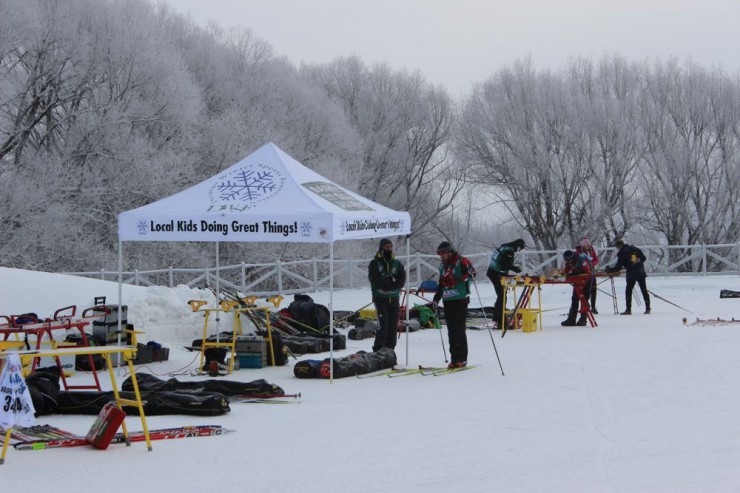
Teams make wax adjustments the morning of the classic sprint at Soldier Hollow. The first starter gets on course at 10:00 am MST.
FasterSkier’s coverage of the 2013 U.S. Cross Country Championships is brought to you through the generous support of The Memory Clinic in Bennington, Vt.
MIDWAY, Utah — Less than an hour remains until the first event of U.S. Nationals begins. Athletes arrived at Soldier Hollow Wednesday morning to brisk temperatures, overcast skies and a light dusting of new snow. Despite all the skate ski chatter that’s gone on, many athletes were warming up on classic equipment.
There are 221 men and 155 women on the classic sprint start list; qualification begins at 10:00 am and heats start at 1:00 pm MST. While you wait for results to start coming in this morning, here’s a snapshot of the scene in the stadium.
IMGP7539
IMGP7535
IMGP7533
IMGP7532
IMGP7531
IMGP7524
IMGP7536
IMGP7526
IMGP7525
IMGP7516
IMGP7517
IMGP7519
IMG_1812
IMG_1813
Teams make wax adjustments the morning of the classic sprint at Soldier Hollow. The first starter begins at 10:00 am MST.
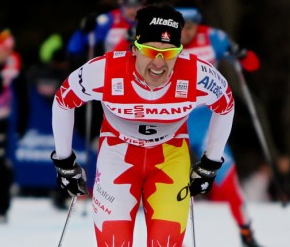
Cologna in early action during the 2012 Tour de Ski.
From the qualifier through to the A-final, recently crowned Tour de Ski champion Dario Cologna (SUI) skied a “perfect” sprint day by all accounts in Otepää, Estonia on Saturday.
The current overall World Cup points leader made a statement from the word get-go, posting the fastest qualifying time by an unbelievable 4.2 seconds in a 1.4 k classic. He then went on to decisively win his quarter, semi and final heats. Ola Vigen Hattestad (NOR) and Eirik Brandsdal (NOR), who finished second and third, both said that runner-up was the best they could hope for.
“It was a perfect day for me,” Cologna said in a press conference after the race. “I had a good qualification and I got self-confidence for the heats.”
Self-confidence may have been a factor in his victory, but the sheer force behind every plant of Cologna’s double pole was not to be messed with. If his tempo looked moderate, it was only because each stroke generated so much forward momentum.
“I did not have a chance against Dario,” Hattestad said.
Canada’s Alex Harvey lunged for the finish line in an effort for third, but crossed it just shy of the podium for fourth.
While the women’s race featured a high-profile showdown between the two of the biggest names in cross-country, the men’s became, quite literally, an arms race. The compact, slow snow made for finicky kick conditions, and prompted a large majority of the men’s field to swap their classic skis for slicker skate equipment.
If Cologna’s 4.2-second gap in the qualifier on skate skis didn’t prove that double poling was the way to go on Saturday, the first round of heats certainly did.
Ola Vigen Hattestad (NOR) in action during the Tour de Ski earlier this month. He was second on Saturday.
In the first quarterfinal, Cologna started off trailing Russia’s Anton Gafarov, but quickly closed the gap in the first few hundred meters. Several Russians decided to stride, and the mistake became apparent on the first uphill. Cologna gapped Gafarov with his double pole as the Russian’s kick faltered. Cologna’s strength may have been superior in any case, but throughout the heats, striders repeatedly lost time — on the uphills, no less — to those powering through with their upper bodies.
For those who knew their arm strength was lacking, however, the choice to go with skate skis was more of a gamble. The third quarterfinal, which included Harvey and teammate Lenny Valjas (CAN), exposed those who had the muscle to efficiently push through an entire sprint course more than once and those who had spent everything they had in the qualifier.
Peeter Kummel (EST) led Valjas up the first climb, with Harvey skiing just off their back. Going into the second hill, Harvey made up time on the front, and skied beside Kummel and Valjas. Down the other side, it looked as though fast skis might propel both Canadians onto the next round, but somewhere in the final straight, Valjas’s arms ran out of gas. Harvey double poled away to advance comfortably along with Kalle Lassila (FIN), while Valjas suffered through the finish on fumes in fourth, ending 21st overall.
“I’ve never felt that way in a race before,” Valjas said of the pain he’d just experienced.
The next quarterfinal featured the second-fastest qualifier, Gleb Retivykh (RUS) and Andy Newell (USA), who had the ninth-best qualifying time. Retivykh burst from the gate fast and led with a strong stride up the first hill with Igor Usachev (RUS) and Sami Jauhojaervi (FIN) in the chase. Newell skied off the back, but managed to gain ground steadily coming up the final hill, as striders lost ground to the double-polers. Retivykh developed an unbeatable gap down the other side, and Newell moved into third behind Johan Edin (SWE).
In the final 300-meter straightaway, Newell’s stronger finishing tempo moved him through to the semis, his first shot past the quarters this season.
“I’ve been feeling good all year, so it’s nice to have a clean quarterfinal,” Newell said.
The fifth quarterfinal was the closest yet — Oeystein Pettersen (NOR) led out of the gate, and all six skiers double poled for the whole heat. Nikita Kriukov (RUS) slowly edged up on Petterson, and it came down to a photo finish between the two, with Kriukov barely nosing by. Anders Gloeersen (NOR) failed to make up the gap in time and was 0.1-seconds off the pace in third.
As expected, racing got more furious in the semifinal round. Cologna continued to demonstrate his control, skiing from the front for most of the heat. Gafarov once again took the lead for a brief time, but Cologna led the takeover pack and put impressive distance between himself and the rest of the field on the second big climb. The real race was the one for second; Brandsdal eventually bested his teammate Hattestad.
Harvey during the final climb of the Tour de Ski. He just missed the podium in Otepää, finishing fourth.
Harvey, Pettersen, Kriukov, Newell, Alexander Panzhinskiy (RUS) and Gleb Retivykh (RUS) took to the line for the second semifinal — it was seemingly anyone’s race. Kriukov led the Russian trio out of the stadium, with Harvey just behind Petterson and Newell off the back.
Up the first climb, Harvey clearly wanted to move by, but couldn’t immediately find an opening. Petterson shifted and Harvey moved through the hole, and from then on out steadily gained on the striding Russians — his real advantage came on the final downhill, as his skis were clearly faster. Harvey and Petterson went 1-2 through the final straight, with Kriukov in a close third.
Behind them, Panzhinskiy and Retivykh tangled up and crashed right in front of Newell, who slipped by without falling, but not before getting his ski skewered by an errant pole. Momentum lost and base dragging, Newell crossed the line five seconds off the pace in fourth, but still finished a season-best seventh overall.
The A-final featured a stacked lineup: Cologna, Harvey, Pettersen, Brandsdal, Hattestad and Kriukov. All six men were on skate skis, and double-poled their way up, down and around the course. The group remained virtually as one pack, Cologna always in the front, until the second climb, when the top four put a gap on Kriukov and Petterson.
Cologna, Hattestad, Harvey and Brandsdal remained close down the final hill and into the stadium, drag racing out of the right-hand corner into the straightaway. All four turned on the backburners, and Cologna opened up just enough of a gap to comfortably raise his hands in triumph over the line. Harvey, who had been skiing even with Brandsdal and Hattestad, finished fourth despite a lunge for the finish.
Brandsdal, 3rd in Otepää, shown qualifying in Milan last weekend.
“It was a great day for me,” said Cologna of his execution. “I’ve been in good shape and recovered well from Tour de Ski.”
The runner-up, Hattestad was complimentary of his competitor. “Second place is the maximum what I could achieve today,” he said.
Harvey, though pleased with a top five, was disappointed to have just missed out on the podium.
“That was a close one today,” he said in a press release. “Fourth is awesome, but it is a little heartbreaking too. … Pure sprinters train a lot more for double poling than distance skiers so I was a little nervous today because it is a really hard course.”
Men’s competition resumes Sunday with a 15 k classic.
Alex Harvey (CAN) double poling the final climb of the Tour de Ski. Harvey led the way for North America in fourth in the Otepää classic sprint on Saturday.
After winning the Tour de Ski, Dario Cologna (SUI) took a much-needed break from racing and skipped last weekend’s city sprints in Milan, Italy. His return to the World Cup on Saturday in Otepää, Estonia, left little doubt that the overall points leader is on top of his game.
He owned the classic sprint from the qualifier to final. Cologna’s qualifying time was more than 4 seconds ahead of the next-fastest skiers, and he handily won the subsequent heats throughout the afternoon.
One of the most notable aspects of the men’s classic race on Saturday was the prevalence of double poling. The weekend features an unusual double header in the classic discipline, yet you wouldn’t have known it from the number of skate skis that took to the 1.4 k course.
With the collective decision that skate skis were the way to go, the strongest double polers controlled the day. Leading the way for the North American men was Alex Harvey (CAN) in fourth, who was edged out of the podium by Eirik Brandsdal (NOR) despite a lunge for the line.
Harvey skied a near-perfect day, winning his quarterfinal and semifinal with a run of smart racing. When it came time for the sprint to the finish for the final time, he just didn’t have the energy in him.
Though he said he was a little “heartbroken” to have missed a medal by such a slim margin, Harvey was happy to be feeling fast in his first race back since the end of the Tour de Ski. The Canuck is not a sprint specialist, and noted after his race that to hang with powerhouse skiers like Cologna for as long as he did was reason to be satisfied with his race.
“I skied in tact with the leaders and just fell out of the medals at the end,” Harvey said in a Cross Country Canada press release.
For the Canadian and American men, making the call on whether to go with skate gear was a mix of predetermined and last-minute decision making. The Canadian National Ski Team (CNST) exhaustively tested double poling against striding Friday before the race, and techs waxed both sets of skis for athletes to choose from on race day.
“The classic skis were ready, and skate too; we just saw what the majority of people went with,” said Canadian national team coach Eric de Nys.
He figured 23 out of the top 30 men went with skate skis for the heats. The Russian team were the notable outliers, and were struggling to kick all the way up the hills. De Nys described his athletes’ decision to follow suit as simply a choice to stay on the same playing field.
Andy Newell (USA) skied to seventh on Saturday.
Andy Newell led the way for the U.S. in seventh, his best finish of the winter thus far after a series of unlucky quarterfinal crashes. Had he not been held up by Gleb Retivykh (RUS) and Alexander Panzhinskiy (RUS) crashing in front of him in the final straightaway, Newell might have made it to the finals. He didn’t go down, but he lost significant time getting around them.
When he skied clear of the tangle, Newell realized a stray pole plant from one of the Russians had punched a hole clean through his ski, and he had a five-inch chunk of base material dragging through the snow.
“I thought for a minute my ski was broken, but it was just my base dragging,” said Newell afterwards. “I was kind of just in survival mode then for the last few hundred meters.”
Despite the bad luck, Newell said he was happy to have finally performed as well as he felt he could.
“It was nice to have a clean quarterfinal — nothing crazy happened,” he said. “I was able to move around in the pack well and put myself in a position for a strong finish.”
The final 300-meter straightaway came directly after a fast downhill leading into the stadium, which certainly played a factor in the skate-ski trend in the men’s field. Though he switched to skate skis for the heats, Newell was one of the few men lining up for the qualifier on classic gear.
“I decided to save my arms a little bit,” Newell said of his decision to go against the grain.
As he got ready for the qualifier and everyone around him was clipping into skate equipment, Newell said he was a bit nervous.
Ultimately, he qualified with the ninth-fastest time. “I knew I was going to be one of the few to stride the qualifier,” he said. “I decided to do it anyway because I knew I could do it either way.”
For Lenny Valjas (CAN), who made it to the quarterfinals and placed a 21st overall, the double poling was an added element to contend with, both mentally and physically. In the days leading up to Otepää, he expected to stride during the sprint.
Len Valjas (CAN), who finished 21st in the classic sprint.
“This whole year, I’ve been thinking this race is the one where I’d want to make it to the final,” said Valjas. “Everything was thrown into the trash when we had to double-pole it.”
Valjas put forth his best effort, but could feel that his triceps were fried before the heats even started. By the end of his quarterfinal, they were burning.
“My arms totally died,” he recalled. “It was almost comical for me, I was so tired. It was awesome to feel that kind of pain in the last stretch.”
Simi Hamilton, the next North American, finished just outside the top 30 in 33rd. He said he was frustrated with coming so close, but took it as a learning experience.
“Every time you get to race at this level, you learn a lot about what you need to work on, especially when you’re just outside the cusp there,” he said.
“With Oberstdorf, being barely out, then again today, you look at all the places you could have made up that second and it starts to make sense,” Hamilton continued.
Like Newell, Hamilton went with striding in the qualifier. In hindsight, he said he might have played with double poling on Saturday, something he’s never done on the Otepää course before.
“It’s really hard to change your mindset in the last few minutes there to totally switch it up,” Hamilton explained. “Now I have that experience in my head, hopefully next year I can draw on that.”
Devon Kershaw (CAN) ended his day in the qualifying round thanks to a shattered pole. He had to ski a good way without one before finding a replacement, said de Nys. Kershaw ended up in 40th; de Nys thought he could have qualified in the top five.
“He’s upset, but he’s also professional,” de Nys said. “He realizes it’s a part of racing.”
Mike Sinnott (USA), in his penultimate World Cup race before heading home, finished in 56th — a “moderate” result, he said.
Sinnott also went with striding after testing the alternative during his warm-up.
“It would have been a better decision to double-pole, but I didn’t want to … make a drastic switch, make a silly, hotheaded move, “ he explained.
Kris Freeman (USA) and Noah Hoffman (USA) completed the North American men’s lineup in 59th and 63rd, respectively.
Men’s competition resumes on Sunday in Otepää with a 15 k classic individual start.
Torin Koos (BSF/Rossignol), Skyler Davis (SMS/USST) and Reese Hanneman (APU) skiing up the first hill in the semifinals. Photo: Flying Point Road.
RUMFORD, Maine — The major story to come out of the final race of the 2012 U.S. Cross Country Championships was Torin Koos’s disqualification for obstruction of competition (which he plans to appeal). But in addition to the drama, an entire classic sprint day went on at Black Mountain.
When the A-final field took the line Sunday afternoon, it was difficult to know what to expect. Koos seemed like the only safe bet to be first through the finish, as he’d handily won his quarterfinal and semifinal and his experience with high-stakes sprint racing was difficult to ignore.
Ryan Scott (MSU/Team HomeGrown) leading his semifinal. Photo: Flying Point Road.
Ryan Scott (MSU/Team HomeGrown) and Mike Sinnott (SVSEF) went 1-2 in their semi and had also skied strong throughout the day, and Tyler Kornfield (University of Alaska Fairbanks), who was third in their heat, looked like he was on fast skis.
Fresh off his bronze medal from Friday’s 30 k mass start, Eric Packer (Dartmouth) was a hard classic skier to bet against. Skyler Davis (SMS/USST) had a slow start to the week, but won both his quarter and semi in the classic sprint and seemed to have found familiar form.
The snow on the course at Black Mountain on Sunday was fast and icy in spots. As the day wore on, athletes said uphill parts of the trail in the shade became almost impossible to stride up, and in the men’s A-final, nearly everyone was slipping in those areas.
In sprint racing, anything can happen. At first it seemed as if Koos was the clear-cut victor, but as the top three athletes in Koos, Kornfield and Sinnot waited by the podium, Koos learned he was disqualified for his second infraction in two races at nationals. The bumped Kornfield to first, gave Sinnot second place and Packer third.
Tyler Kornfield (UAF) finishing the classic sprint A-final. Photo: Flying Point Road.
Though it was by default, the victory was Kornfield’s second-career nationals sprint title. Coincidentally, his first in Alaska two years ago was also by default, as the winner was his UAF teammate, Erik Melin-Soederstroem of Sweden. Non-American podium finishers at nationals races are awarded prize money (unless he or she is an NCAA athlete), but not given medals.
“It’s definitely not the way you’d want to win your national title,” Kornfield said in a phone interview on Sunday evening. “I mean, in the first place I was excited with second.”
With a few hours to have processed the day’s events, Kornfield still wasn’t sure how to interpret the outcome of the race but, “overall I’m pretty excited,” he said.
“Before this week, I hadn’t had the best start to the season, so I didn’t have great confidence,” he said immediately after his race. “I was pretty happy with the sprint at the beginning of the week, and the 30 k definitely gave me confidence. This is tied with the best result that I’ve gotten at Nationals, so I’m pretty excited about that.”
When he still thought he’d placed third, Sinnott said he was generally pleased with his performance.
“I’m pretty happy,” Sinnot said. “Obviously you always want the win, but I can’t really complain about a podium at nationals.”
Following Koos’s disqualification, Packer unexpectedly found himself on the podium. Though he believed Koos to have deserved the gold medal, he added that he was happy to have ended up with a top-three at Nationals for a second time this year.
Torin Koos (BSF/Rossignol) crossing the line in first in the A-final of the men's classic sprint at U.S. Nationals. While waiting to take to the podium, he found out his win was in question. Photo: Flying Point Road.
FasterSkier talked to the contenders afterward — Sinnott and Kornfield before they learned of Koos’s disqualification, and Packer, Davis, Scott, Koos and Kornfield again afterwards. Here’s how the A-final unfolded in their eyes:
(Note: Quotes from Koos as told to Glenn Jordan of the Portland Press Herald)
Kornfield: “I hadn’t been getting very good starts [in earlier heats]. I was fifth or sixth coming out of the stadium [in the final]. I stuck with the pack beter than in the first two heats; that was definitely my weakness, so I wanted to change that a little bit. I was with the pack, and I was about fourth going down the hill to the switchback.”
Sinnott: “It didn’t start off as quick as I’d wanted; there were a lot of strong double polers in that heat … I got into a place where I wanted to after that first big hill.”
Packer: “I tried to take it easy out of the start — I didn’t want to expend too much energy, since it’s a long course. A 3:30 sprint is pretty long, so I tried to conserve energy up the first hill and really push the second.”
Kornfield: “A lot of people were slipping on the step big hill, and I kind of got boxed in and that’s where Koos got away from us. He was slipping too — everybody was slipping — but he just got a few more strides in and he broke away.”
Sinnott: “I just kind of pulled up right behind Torin, and felt like I was skiing well. Then it’s kind of icy there, I started sipping, and Torin made his move and that was kind of the end of the race for the rest of us and it was just a scramble to see who could hold on for second.”
Koos: “I took the lead on the second climb, which was pretty difficult because it’s in the shade, so it’s not as soft as the rest of the course. It’s a little more glazed, so skis play a big factor there.”
Scott (4th place): “We were all pretty tight in the group going down the hill … The heat was pretty aggressive, and how it worked out in the bottom there, everyone was tight on the turn.”
Kornfield: “We were all double poling, and Torin was about one boot length in front of Ryan, and it seemed like he had a clear shot on what lane he wanted to choose. Right after he moved on Ryan there was a break in the tracks, so you had to pick another track. Torin tried to pick the inside track, and he moved onto Ryan’s skis, and it knocked Ryan off balance. It seemed like it took a while to get back his balance.”
Koos: “My plan for the final was to stay in the top three … but if I could decide the race before [the final stretch] then, why not?”
Sinnott: “[It was] really great racing by Torin to make a strong move while people were struggling … It’s just a tough pitch because they washed out the tracks, and because it’s in the shade, it’s hard to get kick there. I had trouble there in the qualifier as well, and it’s just kind of a tough, off camber, steep little slick place and tough to go fast there. Torin made the most of it so that he attacked right at the top when everyone else was still in the middle of it. It was a smart move.”
Packer: “I personally didn’t see anything that merited disqualification … I think [Koos] deserved the win today. He skied away from everybody.”
Kornfield: “I was in third, then Ryan Scott moved over and I was able to double pole and make a gap with the downhill. My skis were running wicked fast. [I] just double poled to the finish.”
Davis (5th): “The back hill kind of got really icy, and I slipped really badly. I started herring boning for the first time, and by that time I was like, [groans]. So with sixth, I obviously wanted to be on the podium, but that’s probably pretty good for how the season’s been going. It’s definitely good to be feeling strong.”
(Note: Davis initially thought he placed sixth and was later moved to fifth with Koos’s disqualification. Karl Nygren won the B-final, which would have put him in seventh, but his place improved to sixth.)
Torin Koos (BSF/Rossignol) crossing the line in first in the A-final of the men's classic sprint at U.S. Nationals. While waiting to take to the podium, he found out his win was in question. Photo: Flying Point Road.
After crossing the finish line in first in the U.S. Nationals classic sprint A-final, Torin Koos (BSF/Rossignol) was disqualified for moving into a lane in front of Ryan Scott (MSU/Team HomeGrown) before completely clearing Scott’s skis, which resulted in contact between Koos’ tails and Scott’s tips. A course controller saw the pass, and after the conclusion of the race, reported a violation to the jury.
Per International Ski Federation (FIS) rules, the competition jury deemed the move to have been an obstruction of competition, which results in competition suspension and relegates the skier at fault to the back of the sprint heat. Tyler Kornfield (University of Alaska Fairbanks) thereby took the top of the podium, Mike Sinnott (SVSEF) moved into second and Eric Packer (Dartmouth College) finished third. Scott wound up in fourth, and Skyler Davis (SMS/USST) in fifth.
Had this been the only rule infraction Koos had been docked within the current competition period, Koos would have placed sixth in the classic sprint and been issued a written warning and competition suspension. However, due to a mix-up at the start of Friday’s 30 k mass start classic race, he had also been given a written warning for lining up in the wrong starting position.
Koos wore the blank green sprint leader bib on Friday, and in his explanation to the jury on Sunday, was told by his coaches to go to a start position turned out to be incorrect. Koos said he went to the spot he thought he’d been assigned, only to find someone already there. With only a few minutes to go before the race began, Koos said he tried unsuccessfully to find someone with a start list to figure out where he should go. With the clock ticking down until the gun went off, he moved to the first open spot he could find—position 29, which ended up being two rows ahead of where he should have been in position 43.
“I couldn’t find anybody with a start list. This was right before the start,” said Koos on Sunday.
According to jury member Eileen Carey, she and several other volunteers were in the starting pen with a grid of lane assignments. She said she witnessed no confusion in the start area in the last few minutes before the beginning of the race.
The jury ruled after the 30 k that Koos’s start in the incorrect position did not affect the race outcome, and his fifth place finish remained on the results. But the written warning he was issued for Friday’s offense meant that his competition suspension on Sunday automatically defaulted to a disqualification. The ICR states that a competitor must be disqualified if he or she “receives a second written reprimand in the same season” (392.7).
According to Koos’s account of the A-final on Sunday, which his competitors corroborated, the move in question occurred just after the men’s 1.6 k course split from the women’s 1.4 k loop, on a flat section that veered to the left after a substantial downhill, which had skiers carrying a lot of speed. The tracks went from four across to three, with a break in between for skiers to maneuver into the new track. Koos was skiing on Scott’s right-hand side just before the break in the tracks, and made his move to get on the inside, left-hand lane at the break, clipping Scott’s skis in the process.
“I told Ryan right after the race—I apologized,” said Koos. “It was not deliberate, stuff like that happens all the time, so it’s interesting that this one time I’m called out.”
The most recent version of the FIS Precision Rules, which are essentially updates made to the FIS International Competition Rules (ICR) in between the publication of a new ICR every four years, states that:
In all competitions obstruction is defined as deliberately impeding, blocking (by not following best line), charging or pushing any competitor with any part of the body or ski equipment. When overtaking occurs, competitors must not cause any obstruction. The responsibility for a correct passing without obstruction is on the overtaking skier. The overtaking skier must have his/her skis in front of the skis of the overtaken skier before skiing his/her best line. (340.1.4)
Koos and his Bridger Ski Foundation coaches protested the disqualification on the grounds that the obstruction was not intentional.
The necessary steps for juries to take in the case of a rule infraction are outlined in the ICR, and more comprehensively in a separate document, the FIS Cross-Country Guidelines for Jury Work. According to the procedure outlined in item 7 of the guidelines, “Prior to the imposition of a penalty the person accused of an offence shall be given the opportunity to present a defense at a hearing orally or in writing” (also stated in ICR, 224.7).
The jury informed Koos and his coaches in timing headquarters that he had committed a competition violation, and according to Carey was given the chance to defend himself. The jury then decided to disqualify him, and told Koos he could collect additional evidence in his defense to protest the disqualification. Koos then returned to the main lodge, where most of his competitors from the A-final were inside getting warm, and asked them to write down their version of what had happened during the race. At least three of them—Kornfield, Sinnott and Packer—were seen submitting their testimonials to Koos, which he brought back to the jury in the timing building as evidence, and awaited its verdict.
After about twenty minutes of deliberation, the jury told Koos his disqualification remained unchanged, and that he could appeal their decision to FIS if he so chose. Early Sunday evening, Koos said he planned to submit an appeal on Monday morning, which would go through the U.S. Ski and Snowboard Association (USSA) to FIS. He would not specify if he would appeal Friday’s warning, Sunday’s suspension, or both.
Asked after the jury’s final decision if anyone had seen the contact between Koos’s and Scott’s skis firsthand, USSA’s jury representative Allan Seranno said, “Yes: a controller who was put in place for that purpose. He gave that information to the jury, and then the jury made its decision based on that [evidence].”
Back in the lodge, Scott explained what happened from his point of view. “We were all pretty tight in the group going down the hill,” he said. “The heat was pretty aggressive, and how it worked out in the bottom there, everyone was tight on the turn.”
Asked if he thought Koos’s move interfered significantly with his race, he said, “You have to be aggressive in a sprint race to stay in there and stuff. It was [the jury’s] call that it was an obstruction.”
Tyler Kornfield (UAF) finishing the classic sprint A-final. Photo: Flying Point Road.
Kornfield, the eventual winner, had one of the best vantage points of the move during the race, as he was skiing in the tracks directly behind Scott. He said Koos was skiing level with Scott, double-poling in the track to the right of Scott and Kornfield.
“It happened pretty quickly,” said Kornfield. “We were all double-poling, and Torin was about one boot length in front of Ryan, and it seemed like he had a clear shot on what lane he wanted to choose.”
There was a break in the tracks around the corner, and the lanes went from four abreast to three.
“Right after he moved on Ryan there was a break in the tracks, so you had to pick another track,” said Kornfield. “Torin tried to pick the inside track [on the left], and he moved onto Ryan’s skis, and it knocked Ryan off balance… It seemed like it took [Scott] a while to get back his balance.”
Kornfield characterized the move as “unfair” on Koos’s part. “According to the rules, it was legal for them to disqualify him. I don’t know what to think about it,” he concluded. “It’s definitely not the way you’d want to win your national title.”
Packer, who wound up in third, thought it was unfortunate that Koos had been disqualified, as in his mind it was clear that Koos had been the fastest skier out on the course, and that aggressive moves happen all the time on the World Cup that don’t result in disqualification.
“I personally didn’t see anything that merited disqualification—I’m really bummed for him,” said Packer. “[Koos] is a great guy and I think deserved the win today—he skied away from everybody.”
“It did not materially affect the outcome of the race,” said Koos after the jury’s final decision. “I’ve had a lot of people come up and be like, ‘Dude, I can’t believe that.’ And I don’t think they’re just talking.”
From here, Koos can appeal the jury’s decision within 72 hours, which goes to an Appeals Commission at FIS.
Carey said the FIS rules are unclear as to how to go about an appeal. “He can present whatever [evidence] he chooses, I’ve never been through this process,” she said. “It’s really unclear in the FIS rulebook. I supposed he can submit additional information if he gets any more. There’s not a specific appeal form, or a script process that’s outlined in the rulebook.”
U.S. Nationals Chief of Competition Carlie Casey said that in the case of an appeal, the head TD, Kent Slaughter, could be contacted “if the FIS Appeals Committee wants more information.”
As of early Sunday evening, Koos said he was just trying to figure out what he had to do to appeal. After he submits it on Monday, “Then it’s out of our hands,” he said, adding that at least “I can leave here and know there’s no doubt who the strongest athlete was.” Koos flies to Trondheim, Norway on Monday, where he will begin renting an apartment with his girlfriend to train and race with the club team there for the rest of the season.
A national title, the $1,200 winner’s purse and Koos’s sponsor win schedule money are not the only things at stake in the outcome of the appeal. He wore the green sprint leader bib when he crossed the line on Sunday. The sprint leader after January 30, 2012 is awarded World Cup start rights, and if the disqualification remains, he won’t be able to hang onto it. If it comes down to it, Koos said he hopes USSA will make a discretionary decision in his favor regarding the start rights.
Torin Koos – all alone in the A final. Photo: Toko.
Tested and picked glide waxes yesterday as was the plan as I anticipated that today’s kick solution could be a demanding one. It did some freezing raining last night before they groomed. Still, the tracks got an ice glaze on them which made things a bit tricky this morning. We tested kick waxes, straight base green, straight klisters, and klisters covered. Before qualifying, our best wax was Nordic Green Klister covered by Nordic Red Klister. It kicked better than straight Base Green binder, especially on the hard ice sections on the climbs. It glided better than Red Klister covered with Nordic Grip Red. It was our best wax this morning and was also used to success. After qualifying, it got progressively colder, the wind blew a bit more, and the tracks dried out. The snow became more of a dry granular sugar. We rewaxed the test skis and checked it out again. This time the “Base Green Trick” was the best. This is where a short thick layer of Base Green Binder is applied, heated in, and smoothed. After it cools, add subsequent layers of Base Green trying to keep it as smooth as possible. Make the layers shorter working toward the middle. It is important to keep this application short – klister zone.
It was a great week. I was grateful for the super job Steve Bedard did testing and giving feedback. He is a new Rossignol (and Toko) Tech Rep for New England. I look forward to working with Steve in the future.
Also, a huge congratulations to all of the athletes, but especially to our Jessie Diggins and Torin Koos for taking 6 US national titles between them this year!
(Turns out Torin was DSQed. This was a strange occurrence. Here’s how FasterSkier covered the story. Anybody who has witnessed World Cup sprints knows that as Eric Packer said, this type of thing happens all the time without incident or comment. In fact, I saw other athletes do the same thing during Nationals including one of the top women 300 meters before the finish. Nobody said a thing except “that’s racing” Good luck with your appeal Torin!)
Visit the official event page here to see more photos.
Jessie Diggins (CXC) comes out of her tuck and free skates into the stadium in the A-Final with teammate Jennie Bender just behind. Photo: James Doucett.
RUMFORD, Maine – Following a nail-biter of a skate sprint to open the U.S. Cross Country Championships, the athletes contesting Sunday’s classic sprint can be expected to finish out the week with another great race. And with important U23 Championship qualifying points still up for grabs, the younger skiers especially will be looking to fight to the top spot on the podium.
Athletes have been racing and training on the 1.4 and 1.6 k sprint courses all week and finally know exactly what to expect, where to make the move, and perhaps even the strengths and the weaknesses of the competitors they have been observing throughout the week.
However, there is one athlete on the start list that has shown no weakness this season, and certainly not this week. Jessie Diggins (CXC/USST) has taken all three U.S. Nationals titles this week and is looking to win the classic sprint to cap off a flawless week of racing. It is hard to bet against her, with a grand total of 12 wins this season between the SuperTour, NorAms and nationals.
After coming so close to victory on Tuesday’s opening skate sprint, Diggins’ CXC teammates Jennie Bender and Caitlin Gregg appear to be the contenders with a chance of knocking Diggins off the top step. Bender in particular is a strong classic sprinter, and has her eye on snatching her first gold medal of the week. Look for the two CXC stars to battle it out on Sunday.
Following an untimely pole break in the freestyle sprint, Ida Sargent (USST/CGRP) will be out for redemption. With three top results so far this week, including a second place in Thursday’s 20 k mass start classic, the strong classic skier will look to break free from the pack in the A-final.
Kate Fitzgerald (APU), fresh off a top five in the 20 k classic, should be shooting to climb onto the podium for the first time of this year’s nationals. Her teammate Rosie Brennan could also be a threat—her powerful technique will be an advantage in the long final straightaway.
Canadian star Dasha Gaiazova (RMR/CNST) enters her first sprint of the week. Known as an excellent sprinter on the World Cup, Gaiazova enters the race a favorite for the win. With numerous World Cup starts to her name, she may certainly use her speed and experience to outpace the field.
As of Saturday morning before training, Sadie Bjornsen (APU/USST) hadn’t decided if she would take to the line on Sunday, but if she ends up feeling well enough to put on a bib, it’s hard to count out a World Cup silver medalist.
Predictions:
Steve:
Jessie Diggins
Dasha Gaiazova
Ida Sargent
Jennie Bender
Kate Fitzgerald
Becca Rorabaugh
Matt:
Dasha Gaiazova
Jessie Diggins
Jennie Bender
Ida Sargent
Sadie Bjornsen (if racing) or Sophie Caldwell
Eliska Hajkova
Audrey:
Jessie Diggins
Jennie Bender
Dasha Gaiazova
Ida Sargent
Sadie Bjornsen (if racing) or Eliska Hajkova
Kate Fitzgerald
The men's A Final enters the stadium, Torin Koos (BSF) leads Dakota Blackhorse-von Jess (Bend Endurance Academy), Lars Flora (APU), Sylvan Ellefson (SSCV/Team Homegrown), Karl Nygren (CXC) and Tyler Kornfield (UAF). Photo: James Doucett.
Men:
The favorite coming into the event has to be Torin Koos(BSF/Rossignol), now with three straight U.S. Nationals sprint titles to his name. With a plethora of experience, Koos will look to capitalize on a course that has provided him with so much success over the years.
Aiming to end Koos’ stronghold on the sprints will be a number of elite racers. Sprint specialist Dakota Blackhorse-von Jess (Bend Endurance Academy) stands a good chance of ending Koos’ streak. Blackhorse-von Jess was able to ski behind Koos in the freestyle sprint earlier in the week and should now have a good idea of what to expect from the Olympian in the critical final few hundred meters of the stadium.
Mike Sinnott (SVSEF) will be looking to recapture the speed he had earlier in the season. Despite a sub-par U.S. Nationals so far, don’t count Sinnott out of the mix. Known as a strong sprinter, Sinnott will certainly be a threat. Sun Valley teammate Matt Gelso will look to improve upon his 30 k classic mass start, where he placed sixth.
The youngest U.S. Ski Team member, 20-year-old Skyler Davis (SMS/USST) will be looking to prove his berth on the national team. In 2011, Davis placed third in the event and will be looking to once again step onto the podium. Fellow USST D-team athlete Erik Bjornsen (APU/USST) also was on the podium in 2011 and will also be looking for a top result, though recent sickness may hold him back.
Eric Packer (Dartmouth) will return to Black Mountain on Sunday following a podium placing in Friday’s 30 k classic mass start. A strong sprinter, Packer will most definitely be in the mix. Tyler Kornfield (Alaska Winter Stars/University of Alaska Fairbanks) will be looking to make his second podium of the week. Sylvan Ellefson, (SSCV/Team HomeGrown) will hope take back the mere centimeters the eluded him in the week’s opening sprint.
Following a fourth place in the distance mass start, Lars Flora (APU) appears to be back to his old self. A veteran of the pack, Flora will look to use his years of experience to land yet another national podium spot.
The win is a great start to the season. Torin Koos trained hard this summer and was not surprised by his fitness when he spoke with press post-race.
“I had great training this fall, went to Europe and had some good races over there. It should keep get better and better,” said Koos.
Torin Koos at the 2011 US Nationals in Rumford, Maine. (Photo courtesy of Rossignol)
Torin races on Rossignol’s X-ium Classic package, including X-ium NIS Classic Ski, XCelerator Skate NIS Binding, X-ium WC Classic Boot, and Oneway’s DS 10 pole. It is the lightest weight classic race package Rossignol has ever offered.
The X-ium Classic ski offers a great compromise between kick and glide using the sure-kick concept. The X-ium boot’s seamless lace cover and more accurate heel hold results in better envelopment of the foot and weight reduction. The XCelerator binding has a flexbit system, closure system and unnecessary material has been removed to decrease the weight.
Oneway’s DS 10 Titanium pole is 100% Carbon reinforced with titanium making the pole stiff and ultra light weight. The rabbit strap allows for twice the adjustment of a regular strap and the cork grip provides warmth, comfort and anti-slip grip.
Watch for Torin and the rest of Rossignol’s Nordic Team throughout the season on the X-ium Race packages.
With their wins in today’s classic sprints, Phil Widmer and Rebecca Dussault both swept the Madison SuperTour weekend. Both the men and women chose to double-pole the soft course around Madison’s Capital Square.
In a repeat of yesterday’s dominating performance, Dussault qualified first, won her semi-final looking relaxed, then skied away from the rest of the women in the A final. After her the results sheet was identical to the day before, with Maria Stuber (CXC Team Vertical Limit) narrowly edging teammate Audrey Weber for second. Hannah Dreissigacker (Craftsbury Green Racing Project) was fourth. The six-woman field made for an odd format, with a 4-woman A final and 2-woman B final. In the B final MWSC’s biathlete Beth Ann Chamberlain edged out Craftsbury’s Chelsea Little for fifth.
The men’s qualifier was more hotly contested affair than the women’s, if only because out of the twenty one starters, only eight moved on to the heats. Canadians Phil Widmer and Sean Crooks led qualifying, followed by teammate Julien Nury. After Nury was Steinbock Racing’s Chris Cook, CXC’s Matt Liebsch and Brian Cook and Craftsbury’s Tim Reynolds. SuperTour distance leader Bryan Gregg grabbed the coveted eighth spot, leaving Salomon/Far West’s Ian Case on the outside with unlucky number nine.
The semi-finals were hotly contested. Pre-race favorites Chris Cook and Sean Crooks both missed spots in the A final. CXC was well represented, with Bryan Gregg and Brian Cook joining Widmer and young Julien Nury, who coach Eric Bailey called one of Canada’s best sprinters. In the end Widmer and Nury broke from a hard-charging Brian Cook to take first and second, with Cook again settling for third. Gregg followed in fourth. In the B final Matt Liebsch and Sean Crooks battled all the way to the line, with Crooks narrowly beating the CXC skier. Tim Reynolds took home seventh overall and Chris Cook eighth.
Eric Soederstrom (UAF) can't believe his victory in the U.S. Nationals classic sprint. Photo, Rob Whitney
One by one, the favorites crumbled in the men’s classic sprint. The first to go was Garrott Kuzzy, who went down coming into the backstretch in his quarterfinal. Illness quashed Simi Hamilton’s hopes. And as he led his semifinal heat, Chris Cook took himself out on a downhill corner.
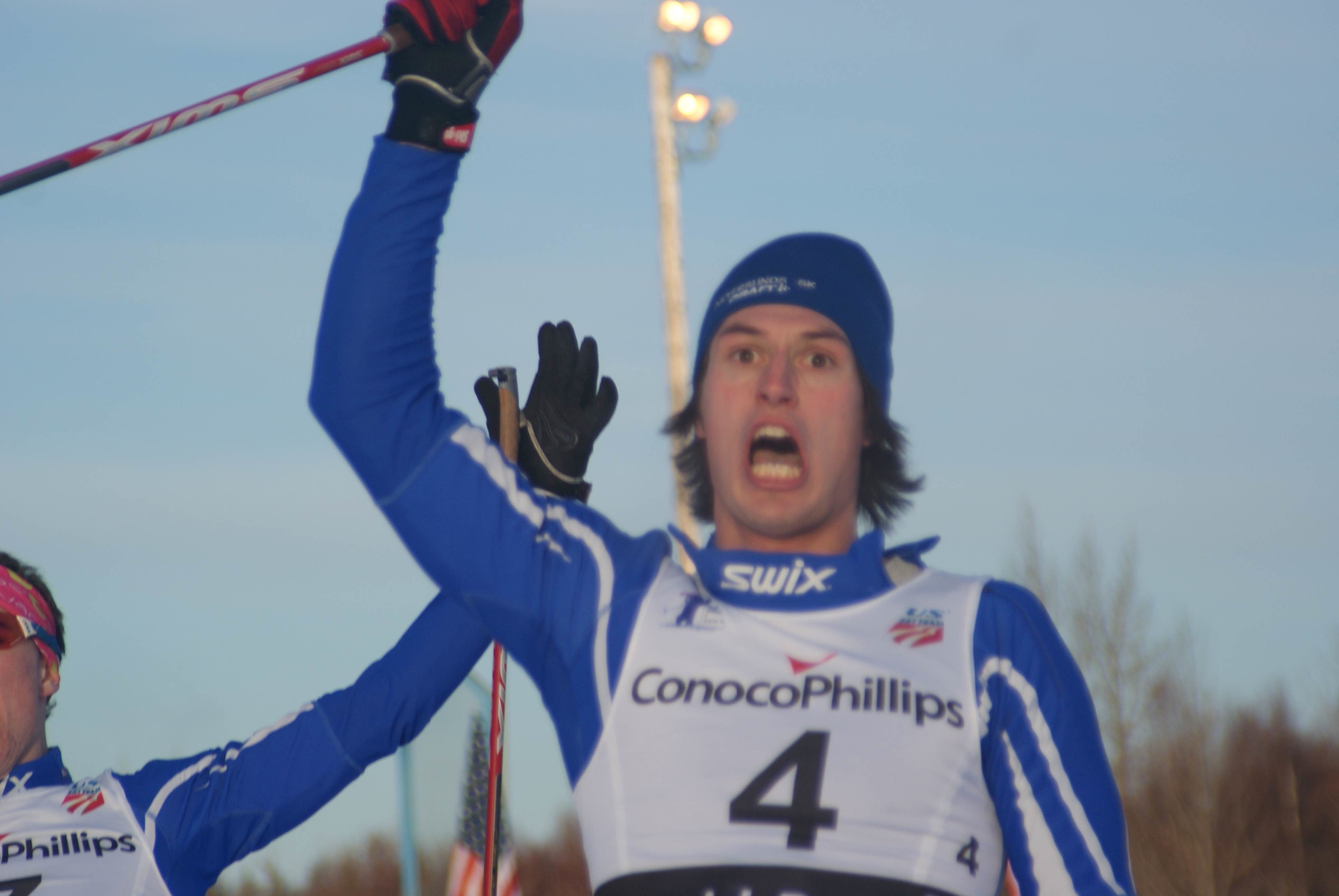
When the snow finally settled, it was a Swede, Erik Soederstrom, who remained standing. A sophomore at the University of Alaska, Fairbanks (UAF) hailing from Ostersund, Soederstrom passed APU’s Mike Hinckley on the final downhill before the homestretch and never looked back. He crossed the line with his arms in the air and his jaw hanging, gliding all the way through the crowd and out of the finish pen before finally coming to a stop.
Second place went to Tyler Kornfield, the nineteen-year-old UAF freshman who shocked himself and his home crowd with a fourth place in the freestyle sprint last Saturday. By beating out Hinckley by a boot at the finish, he actually became national champion—Soederstrom, as a Swede, is ineligible.
Kornfield had no idea that he’d won until a reporter informed him at the finish. After the race, he seemed almost incredulous as Soederstrom.
“I don’t know what to say. Pretty overwhelming,” he said.
Soederstrom’s finish ended a messy day of sprinting in Anchorage. Leading his quarterfinal heat, Kuzzy fell trying to re-enter the tracks on the backstretch after a corner.
“I don’t really know what happened—I had one or two opportunities, as I was flailing around, to catch it, and just couldn’t get things back together,” he said. “The track started really close to the corner, and they were just there before I expected to see ‘em.”
Hamilton, who won both qualifying and the heats in the freestyle sprint, has been sick for the past few days, and last night he was kept awake by stomach problems, according to his coach Travis Jones. Today he didn’t have the pop to make it out of the quarterfinals.
Illness has taken a particularly large toll at the championships here: a number of skiers were under the weather today, and the U.S. Ski Team lost a number of their staff.
Cook struggled here all week, but he seemed to have finally pulled things together today. He was leading his semifinal heat when he crashed coming off the top of the course’s major downhill.
That left “a very unusual A-final,” as USSA Nordic Director John Farra put it. All the skiers in the heat were under 25 years old, two were Europeans, and all six had Alaska connections.
After two second-places in sprints here in the last two years, Hinckley seemed to finally have one in the bag with a few hundred meters to go. Passing through the stadium in the middle of the heat, he moved into the lead by the time the pack started climbing the penultimate hill on the course.
But the opening he’d established wasn’t quite enough to stay away on the final downhill, where both Soederstrom and Kornfield used their blazing skis to close the gap to Hinckley. On the flat finishing stretch, the tall, lanky Swede managed to hold off his UAF teammate by two-tenths of a second.
“Double poling is my specialty,” Soederstrom said.
With the third place finish, Hinckley earned the American silver medal, while Fairbanks’s Reese Hanneman ended a strong day with the bronze by taking fourth.
The finish by Soederstrom and Kornfield capped a stellar day for UAF, who had three in the top five, with Einar Often rounding out the group.
Coaches Scott Jerome and Matt Dunlap clearly nailed the wax. Dunlap said that they stayed with the same kick wax throughout the day, and used a special spray version of Cera F—“Rocket”—for glide.
“Going down that [last] hill…the skis were just flying, and that’s probably what boosted us past Mikey,” Kornfield said.
Soederstrom said that he’d never managed better than tenth in the Swedish junior championships, but his speed proved to be just enough today.
“This is my best discipline—classic sprint,” he said. “I just felt so good—I never got tired today.”
Garrott Kuzzy (USST) on his way to the win in the classic sprint qualifier at U.S. Nationals. Photo, Rob Whitney.
After a disappointing first two races here at Nationals, Garrott Kuzzy scratched from the classic distance event on Wednesday to prepare for today’s classic sprint. It’s looking like that was a pretty good idea.
In the qualifier this morning, Kuzzy topped the men’s field by almost two seconds, besting a pair of top domestic sprinters Mike Hinckley and Chris Cook, who were 1.73 and 2.31 seconds down, respectively.
Using his lanky technique to stride all the way up the major climb on the course, Kuzzy gave a major boost to his Olympic qualifying hopes, as his nearest rival—fellow Middlebury College alum Simi Hamilton—finished five seconds down in sixth.
For the men, the course was a little bit of everything. Skiers split down the middle on the biggest hill, with half opting to stride and half going to a herringbone. The rest of the course was mostly double-poling, with a couple more short climbs to break things up.
Wax didn’t seem to be an issue, with temperatures holding a few degrees below freezing.
Check FasterSkier this afternoon/evening for reports from the heats. We’re usually posting first to Twitter, and also uploading videos on our YouTube page.
Ida Sargent (Craftsbury Green Racing Project) on her way to a second-place finish in the classic sprint qualifier. Photo, Rob Whitney
It’s business as usual for the women at Kincaid Park, as Kikkan Randall again skied her way to a sizable victory in the classic sprint qualifier.
21-year-old Ida Sargent had a spectacular morning as the only woman to get within four seconds of Randall’s time, and Anchorage’s Holly Brooks slotted into third, just under six seconds back. The other frontrunners for women’s Olympic berths, Rebecca Dussault and Caitlin Compton, finished sixth and 13th, respectively, 11 and 13 seconds down.
After some soft skiing yesterday, the tracks solidified overnight for the qualifier. But with many athletes herringboning the major hill on the course, success in the heats will require some agility and quick feet to make it over the fluffy snow on the climb, in addition to the power that will be needed to make it the rest of the way around the course. The race won’t be won on the climb, but it could be lost.
Today’s race is especially important in determining the Olympic team, because the classic sprint on the schedule in Whistler, unlike last Saturday’s freestyle event. But while today’s ranking points are based on the qualifier, there’s still some pride on the line for the heats.
Check FasterSkier this afternoon/evening for reports from the heats. We’re usually posting first to Twitter, and also uploading videos on our YouTube page.