From the FasterSkier archive — posts syndicated from athletes’ and coaches’ own blogs between 2004 and 2012, kept online as published. Current coverage is at fasterskier.com.
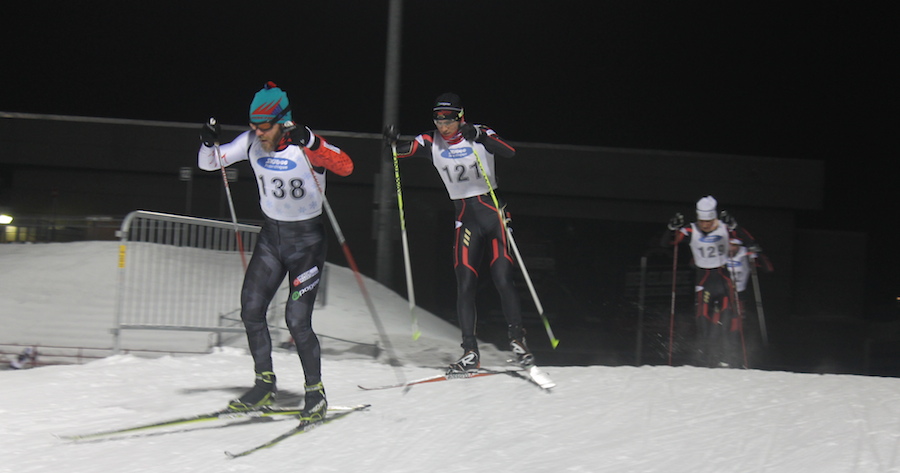
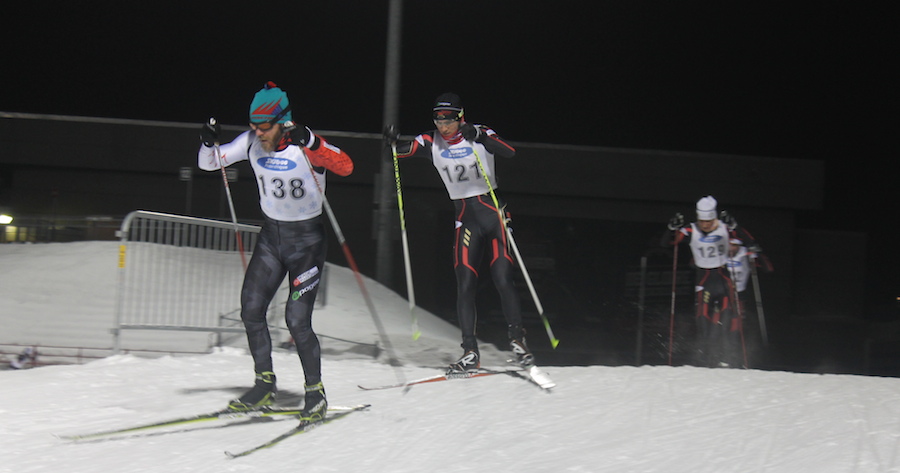
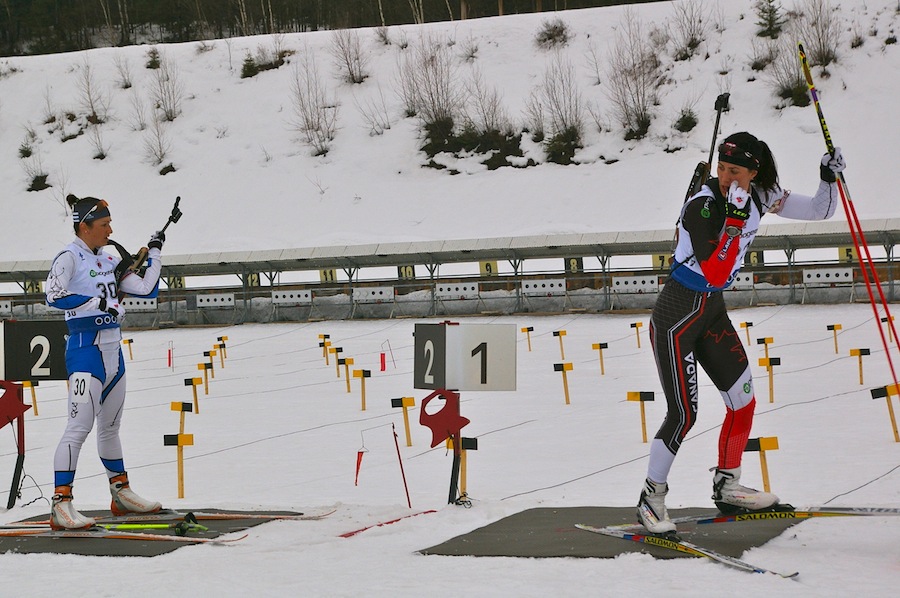
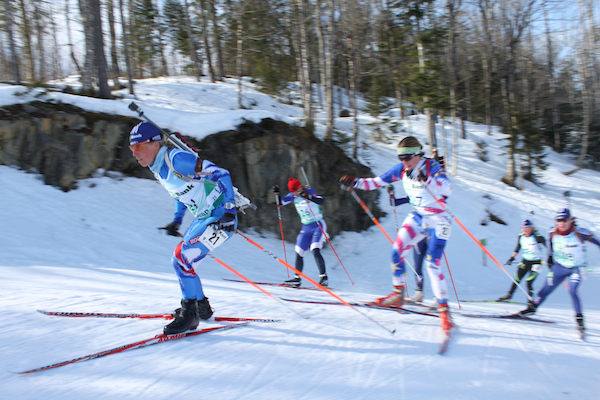
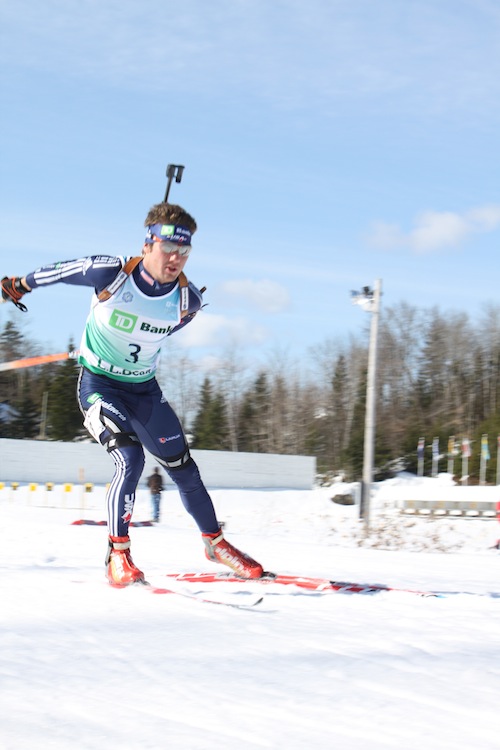
Marc-André Bédard (l) leads David Grégoire (second from l) in the first-ever Sprint Rouge et Or on Jan. 28 at Laval University’s football stadium. Grégoire went on to win the lap-by-lap elimination sprint, in which skiers rounded a 400-metre course designed by Pierre Harvey and tried to stay in the top six.
QUEBEC CITY — After the World Cup sprints took place in the historic part of the city last year, Quebec City recently saw another spectacle in cross-country skiing, with Laval University bringing the action even closer to the crowd. With the help of local Olympic skiing hero Pierre Harvey, organizers created Sprint Rouge et Or with a “last-to-go” formula, a new event on the athletics track at the Rouge et Or football stadium.
This past Tuesday night, close to 125 athletes participated in the inaugural race on manmade snow at the Laval University campus. The cold temperature didn’t stop the enthusiasm of skiers from ages 7 to 54, and a couple of “retired” skiers even put their skis on.
Harvey, the father of Quebec’s current nordic-skiing favorite Alex Harvey, designed he 400-metre track complete with several bumps — some as high as 10 meters — to challenge the skiers. On Tuesday, it was well-groomed with hard-packed snow.
Compared to other urban sprints, the biggest difference and advantage was that spectators could visually follow racers from start to finish, seeing all of the action. The big screen at the opposite end of the field was great for zooming in on the expressions and emotions of skiers as they passed by the camera.
With a friendly atmosphere, good vibes filled the stadium as well-known commentator Randy Ferguson gave the play-by-play. The evening started with a sprint prologue for all 11 categories. The beauty of the event was that anybody could enter it.
“We had a great participation of skiers in the region but also outside,” event director Martin Guay said in a Rouge et Or press release, according to a translation. “The course was world-class through the snow HKD Turbo and the work of the groomer Printoh, Inc., not to mention the efforts of volunteers and field staff of the Department of Sports Laval University.”
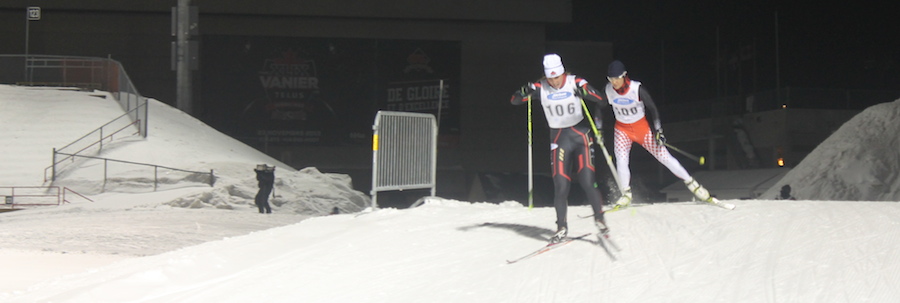
Camille Pepin leads Claude Godbout (r) in the women’s race at the inaugural Sprint Rouge et Or on Jan. 28 at Laval University’s snow-covered athletics track in Quebec City. Godbout went on to win and Pepin placed second.
Last-to-go
The big show started at 21:00 [9 p.m.] with the last-to-go: eight laps for the women and 10 for the men. Racers had two laps to position themselves in the pack before elimination started, after which the last four skiers on each lap were pulled out. The idea was to have six or seven skiers remaining for the final lap.
The women separated quickly after Canadian national-team biathlete Claude Godbout broke away at the beginning of the second lap. Only Camille Pepin of Laval could match her pace. There were a couple of good battles at the end of the pack to stay in the race. Godbout ended up winning, Laval’s Pepin and Myriam Paquette finished second and third, respectively.
The men’s race was closer to the finish with a pack of 20 fighting sticking together. After 10 laps, Laval’s David Grégoire outsprinted biathlete Marc-André Bédard and Frédéric Touchette (Laval) to take the win. Bédard placed second and Touchette was third.
Overall it was a great evening despite some delays; most everyone seemed to really enjoy the moment. After expecting a smaller turnout for its first event, organizers are planning future sprints there and hoping to one day fill the 15,000-capacity stadium.
While the spectacle drew participants from various regions in Quebec, organizers are considering inviting athletes from other Canadian universities as well as the U.S. According to the release, the Rouge et Or team already participates annually in about half a dozen of NCAA races in the northeastern U.S.
“We’re already thinking about next year!” Guay said.
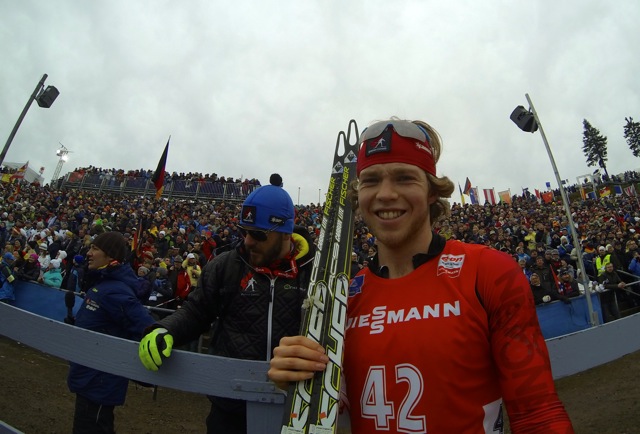
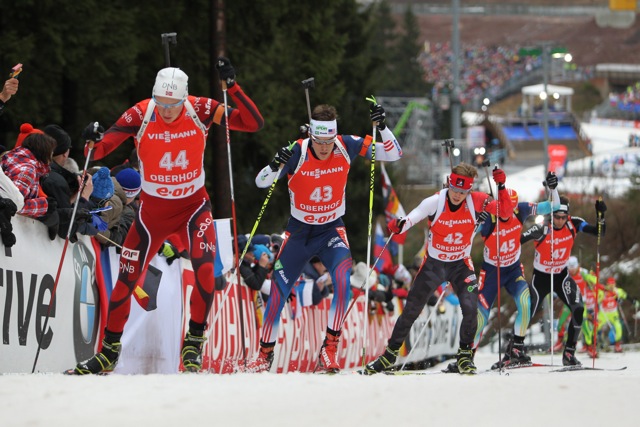
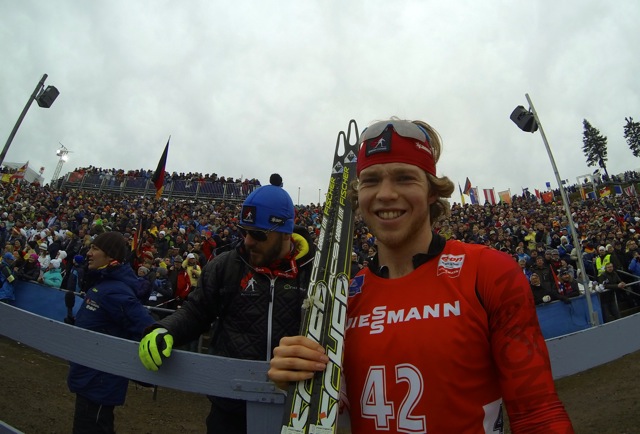
Macx Davies (bib 42) in the thick of things in Saturday’s World Cup pursuit, behind Leif Nordgren (USA). Photo: USBA/NordicFocus.
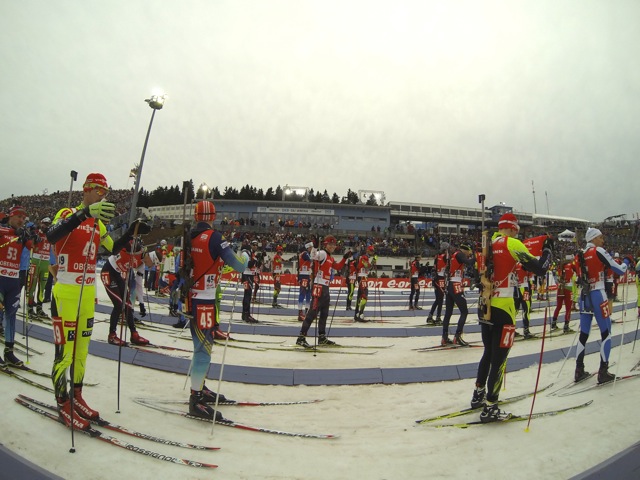
Of all the places to make your World Cup biathlon debut, Oberhof, Germany, isn’t one of the easier ones. It’s known for it’s bad conditions: fog, wind, rain, and no snow. And being in Germany, the heartland of biathlon, the fans are many, and they are loud.
It’s a particularly big adjustment if you’re from North America, where there are basically no fans for this sport at all.
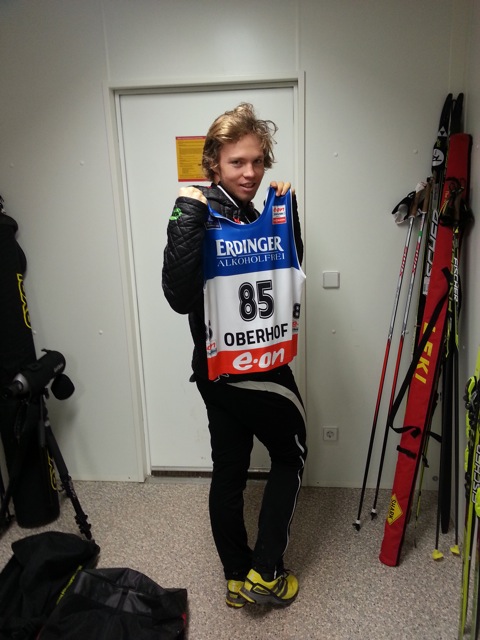
“On the finishing loop I kept thinking there was someone behind me because the cheering was pretty loud, but it was cheering for me, and I was not expecting that,” Canada’s Macx Davies told FasterSkier about Friday’s World Cup sprint in Oberhof, his very first start at the sport’s highest level. It was quite a debut, as he missed two shots and placed 42nd, earning a spot in the next day’s pursuit.
With the newly-nominated Olympic team sitting out this weekend of racing so that they can gain some extra training time at home, Biathlon Canada had a unique opportunity with this weekend’s competitions: they gave the starts to their current second-tier squad, earning a few IBU Cup veterans a consolation glimpse of the big stage and, more importantly, introducing some rookies to the circuit for the first time.
Davies showing off his first World Cup bib. Photo: Roddy Ward.
“The purpose of the tour was to create experience at the World Cup level, in particular those athletes we are grooming for 2018 and beyond,” development coach Roddy Ward wrote in an e-mail. “We believe it is important for our athletes to know where they are against the athletes at the ‘next level’, when they are ready. This helps them develop and improve, maybe even as important as training itself.”
Hence, Davies – who just turned 21 and placed eighth in the individual race at World Juniors last season – was out there connecting with the German fan base.
The group wasn’t entirely without leadership: Marc-André Bèdard is a 2010 Olympian with a wealth of World Cup experience, and his girlfriend Claude Godbout has a much more extensive IBU Cup resumé of IBU Cup racing than her younger teammates, along with World Cup starts from Maine back in 2011.
“It was great to have Marco here with the team,” Ward said of Bédard. “Marco has raced here before and has had many WC starts. He provided a lot of good insight and mentorship to the young athletes.”
Rookie Breakthrough
Bédard, however, didn’t get the chance to show his best stuff. He crashed in the sprint and was out of the pursuit, a tough blow after top-10 IBU Cup performances earlier this season.
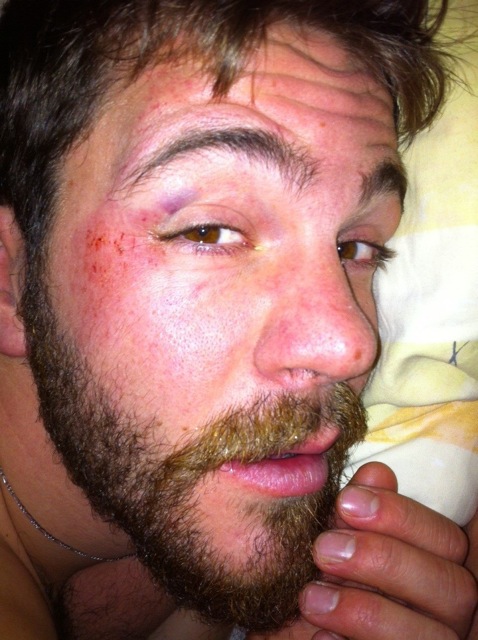
“I crashed hard, breaking, my ski, pole, ripping my suit and my face… and my ego… I was seeking redemption here but it crashed my face instead,” he wrote in an e-mail. “I’m not sure about [whether it was a] concussion, but I’ve had them in the past and this time I did not lose memory, so that’s a good sign.”
Bedard showing off his bruises…
So, with Bédard out of the picture, it was up to Davies to represent the Canadian men (Matt Neumann was also on the squad, but did not start Friday’s race). He quickly found himself in the thick of things.
“I started the sprint in front of [German star] Andreas Birnbacher, so there was a lot of noise coming into my first shooting because he was 15 or 20 seconds behind me,” Davies said. “So there was that, and then a very loud cheer when he shot clean and left the range, for sure. Besides that, I just caught glimpses of him throughout the race. It was nice to know that I was skiing somewhat on par with him.”
Davies had a good feeling about his ski speed, based on Olympic trials before the squad left the country. Although he hadn’t shot well in those races, his skiing kept him in the mix and compared well with the men who had just come off the World Cup, like Brendan Green.
Ward called Davies’s skiing “particularly impressive”, and the result was thanks in large part to an aggressive last lap, with the 33rd-fastest time over the final 3.3 kilometers out of anyone in the field.
In Saturday’s pursuit, however, Davies had a good start but couldn’t turn in anything quite as fast. It was also a very different type of racing.
“It was less than ideal to miss a couple on the first bout, for sure,” Davies said of missing two shots right off the bat. “That makes it hard to come back. It was challenging, just trying to stay with everyone on the skis and knowing that where I could make the most improvement on placing was on the range – it definitely put a bit more pressure on the first shooting.”
Davies ended up with four penalties total and a 54th-place finish.
“Macx delivered a solid first World Cup pursuit,” Ward wrote. “It really is a very different race environment than anyone is used to who are not World Cup regulars.”
Getting the Picture
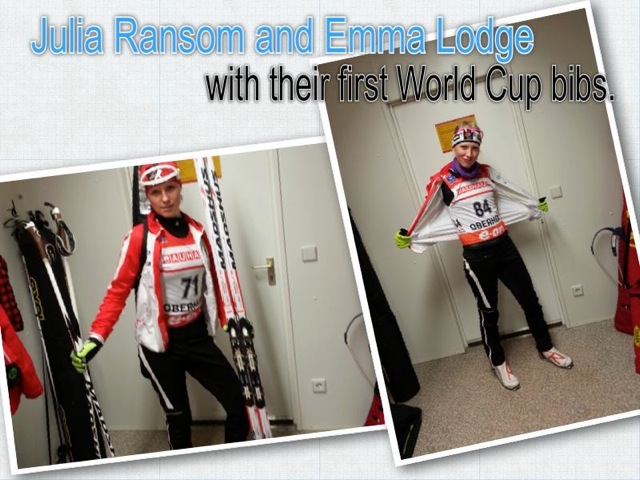
Lodge and Ransom with their bibs. Photo: Roddy Ward / Eat Sleep Train.
In the women’s races, Godbout showed her experience and led the women with 52nd place in the sprint, going on to place 55th in the pursuit. Audrey Vaillancourt, a member of the 2013 World Championships team, placed a heartbreaking 61st in the sprint, missing the pursuit by one spot.
Emma Lodge and Julia Ransom had their first World Cup starts in the sprint, and were unable to turn in Davies’s kind of success.
“The race wasn’t really what I had hoped for – I was excited and ready to go but struggled with shooting,” Ransom wrote in an e-mail. A World Juniors silver medalist in 2012, she missed two shots in prone and three in standing for 50% shooting overall and 82nd place.
“While it certainly wasn’t the race that I wanted to have, it was an excellent learning experience and I am looking forward to my next start,” agreed Lodge, who missed four shots total and placed 83rd just behind Ransom.
But even if these rookies didn’t stun with their results, they accomplished the other goals that Ward set out: seeing what level they need to be at when they hit the World Cup for real, and learning how to deal with the trappings of the big stage.
“Racing my first world cup in Oberhof was an amazing and inspiring experience that I won’t soon forget!” Lodge wrote in an e-mail. “Although the crowds were loud, especially when the Germans were around, I tried to use that energy to my advantage instead of being intimidated but I’ll admit to being a little starstruck at times… I kind of feel like I’ve been preparing for this start since I started biathlon when I was a little kid.”
Ransom echoed her sentiments.
Davies at the pursuit. Photo: Marco Bedard.
“It was such an amazing experience!” she gushed. “This race was truly a step up in professionalism and excitement.To race along side the world’s best was very humbling. What struck me the most were the fans. I knew Oberhof was popular venue, but I had never before heard 30, 000 people cheer all at once before! And if you happened to come in with a German athlete, the crowd would become louder with each shot, or make a disappointed sigh for each miss. A good test of focus.”
The athletes had clearly thought about how to deal with all of the sensory overload, and how to keep it from interfering with their races.
“I guess that going into it, it came into my mind that, well, this is the World Cup,” Davies said. “It was making me nervous and excited, and a lot of emotions. But getting down to it I was thinking of it as just a race to do, and not who I’m racing and where I am.”
For Ransom, it wasn’t that tough to block out individual cheers. It was more the wall of noise that was new.
“I thought the crowd would be a distraction for me but it was so loud that it turned into white noise,” she wrote.
After a Taste, Back to Work
Next weekend in Ruhpolding, the regular World Cup squad will hit the trails again and this squad will have to make do with IBU Cup starts. It will be a letdown in some ways, but a relief in others.
“I think it will seem very, very, very quiet,” Davies laughed. “I still can’t get over how loud the fans were here. But I think it will be good because it’s not too much of a step down in competition, but enough that it makes it more exciting to be fighting for top 20 or top 10 rather than just making the pursuit.”
Ward, who had actually never coached at a World Cup before, believes that this weekend’s races gave his athletes a little more motivation to deliver results at the second-tier race series.
“It was a lot of fun and a great experience,” Ward wrote. “I don’t think I could ask for a better introduction than Oberhof. All the fans and noise is really something to see and hard to describe…. I’m quite certain everyone will be working hard to get back to the World Cup sooner rather than later!”
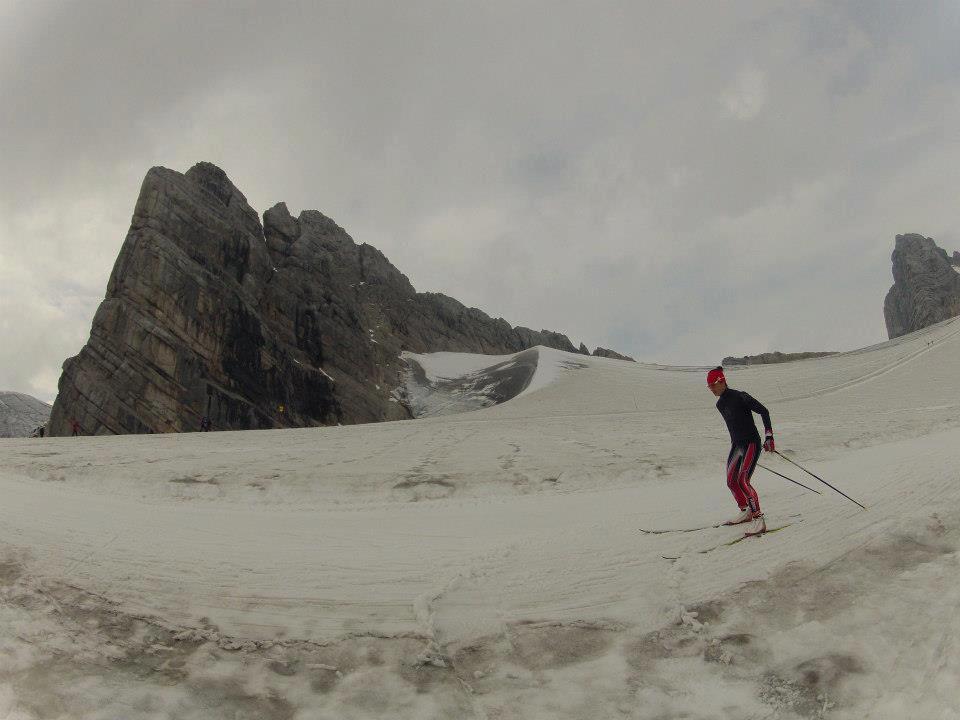
Canadian biathlete Claude Godbout, who has won two of the four Spartan races she has entered, training on the Dachstein glacier in Ramsau, Austria. Her training camp is being facilitated by Spartan organizers, who flew her and boyfriend Marc-André Bédard to Slovakia to compete. Courtesy photo.
As FasterSkier wrote last summer, Canadian biathletes Marc-André Bédard and Claude Godbout joined the Spartan Race craze almost on a whim, albeit a whim that hinted at the possibility of a payout.
A year later, the partners have competed in three more of the notoriously brutal obstacle races, and neither has missed the podium yet. In June in Montreal, Bédard placed second among men and Godbout third among women. A month later in Pennsylvania, Bédard was again second while Godbout won the women’s race, and last weekend in Slovakia, both Quebec natives won the first-ever Spartan event held in continental Europe.
So: running over hill and dale, crawling through mud and barbed wire, climbing fences, jumping over fire, dodging blows from gladiators … is this going to become a second career for the 2010 Olympian and his girlfriend, who also has World Cup experience?
Godbout and Bedard after their double victory in Slovakia. (Courtesy photo)
Probably not. After all, both are aiming for the Sochi Olympics, which are just a year and a half away. Earlier this summer, Godbout told FasterSkier that the 2014 Games were her main focus.
“This is pretty much as big as it can go for me,” Bédard said in an interview from Ramsau, Austria. “We’re biathletes so we need to focus on that. This is fun for us and it’s good cross-training, but we’re not training at all to be good at it. It just happens that way, cross country skiers are good overall physically, so for us it’s easy to perform well.”
National-team coaches were not initially pleased when the pair mentioned heading to Slovakia for a race (their trip was paid for by the organizers). But the biathletes are set on making Spartan racing work for biathlon and tried to think outside the box.
“We were able to negotiate to get a training camp while we were in Europe, since they were sending us anyway,” Bédard said. “Instead of just sending us for five days and doing the one race, we get to stay here for longer [until the end of the week]. We’re having a good training camp right now in Dachstein. Our coaches were pretty happy about that, because otherwise we wouldn’t have gone to the Dachstein this year.”
Bedard climbing a rope, one of the obstacles in the Slovakian race. (Courtesy photo)
Spartan organizers helped the Canadians get a car, and they are staying in some apartments owned by Fischer, Bédard’s ski company. Bédard has been to Ramsau several times before, so it’s easy for him to get around; the duo also has several contacts in town and regarding the glacier.
“We get a free trip to Europe and a free training camp, so that’s amazing,” Bédard said.
Why would organizers go so far out of their way to help a few biathletes? According to Bédard, it has a lot to do with publicity. While more than 400,000 people have participated in Spartan races so far, the bulk of those entrants are in the United States. The franchise is already successfully expanding into the Canada, but it wants to go farther.
And not just geographically: organizers dream of a day when Spartan racing is a competitive, more or less professional sport. Already in the U.S., some races put up prize money and there are bigger purses for end-of-season points leaders. In order to encourage that development race promoters need top athletes to show up to the starting line. And with their records, Godbout and Bédard definitely qualify. For the Pennsylvania event, Godbout was even featured on a poster advertising the top women who would be competing.
And in Slovakia, organizers offered up $10,000 to anyone who could beat Bédard. They also arranged for the pair to go on the country’s equivalent of Good Morning America to introduce Slovakia to the concept of Spartan Racing and demonstrate how they conquer some of the typical obstacles. According to Bédard, it was as a “very weird” experience.
“Really we don’t even know what happened!” he laughed. “They filmed us doing a bunch of stuff and asked us a bunch of questions, but it was funny because it was all in Slovakian so in between the questions in English they were just talking, talking, talking in Slovakian. We still haven’t seen the footage.”
Godbout readying herself for the “spear throw” in Slovakia. (Courtesy photo)
Since the champions are putting in their time to do publicity for the franchise, it’s worth the organizers’ effort to keep them racing, even if it means subsidizing a few more days in Europe.
And while the training camp in Austria is an exciting development, it’s not the only way that Spartan racing is helping out the Canadians’ biathlon careers. In Pennsylvania, the two combined for over $2,000 in prize money, which Bédard said was more than either had ever won in a biathlon race. Becoming part of the Spartan world has gained them sponsors, too.
“It’s not only that we get the checks from them, but those people are really into sports and love competition, so they want to help us,” Bédard said. “There’s a lot of contacts [to be made] … they have brought us a couple of sponsors already, and I’m sure these races this weekend can help. We got good money out of this and it will definitely help us for the winter.”
He and Godbout use their appearances as a platform to tell people about their day-to-day job as athletes, too.
“People know that we train for biathlon, and we put that at the front, that we are biathletes, and this helps our sport,” Bédard explained. “Especially in the states, people don’t even know what this is, so it’s really in a lot of different ways that we’re trying to get the most out of this.”
But while plenty of Spartan participants are interested in biathlon, Bédard said there was a big difference between his attempts to promote his “real” sport career and his experience when he talks about Spartan races. He may be raising awareness about biathlon, but he doubts that he is gaining the sport any new athletes.
“We talk about our sport to people and they are happy to hear about it, they even want to hear more, but they’re not going to go out and buy some cross-country skis and a gun,” he said. “It doesn’t really touch them personally because they don’t see themselves doing that. These races are more people-friendly. With all the videos and stuff they make it seem like it is hell, but really it just challenges people physically, and getting people off their couches is huge.”
Although Bédard is unlikely to defend his original title from the 2011 Spartan Beast in Killington, Vt., on Sept. 22 — he has already done three of the races this year and his coaches aren’t keen on losing him to another, despite the allure of $4,000 in prize money — he and Godbout said that they’d do a few of the races next summer if they could fit them into their regular national-team training schedule, and particularly if the organizers keep catering to their needs as biathletes. One key to their participation is removing the cost of competing.
“We’re not ready to put money into it, because we are already struggling to be able to race in our sport,” Bédard said. “But if we’re able to do more training camps like this, like doing one race and then being able to do a sweet training camp, then that’s a really good deal, to my ears. If it happens that they still want us next year, and I think they will, then I think, why not? It’s good cross-training and it’s fun.”
Bedard denying his challengers the $10,000 they were offered to beat him in Slovakia. (Courtesy photo)Godbout waiting to demonstrate some Spartan skills on Slovakian television. (Courtesy photo)
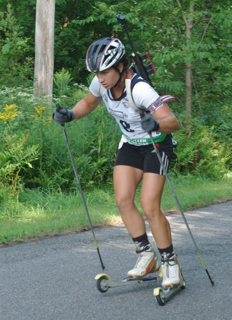
Lanny Barnes powering her way to a sprint victory at the North American Rollerski Biathlon Championships on Saturday in Jericho, Vt.
JERICHO, Vt. – If one thing is constant in summer biathlon races here at the Ethan Allen Firing Range, it’s the sight of Lanny and Tracy Barnes near the top of the results sheets. Since 2009, only one of the sisters, Tracy, has been off the podium – and it was just once. Lanny has won the majority of the races.
And the 2012 edition of the North American Rollerski Biathlon Championships was no different. Lanny Barnes won Saturday’s 7.5 k sprint by almost 20 seconds, and then doubled down to take the 10 k pursuit title by over a minute.
Tracy Barnes placed third in the sprint, behind Claude Godbout of Quebec, before moving up in the pursuit to finish second behind her sister.
The key for both of the Durango-based twins was shooting: over two days and a combined total of six shooting stages, or 30 shots, Lanny missed two targets and Tracy three. The other women in the race had at least four penalties in the pursuit alone.
Neither Barnes was available for comment.
Godbout approaching the range on Saturday.
Godbout, a native of Valcartier whose only World Cup experience was at the 2011 races in Fort Kent and Presque Isle, Maine, was happy with her podium finish on Saturday, but hesitated to draw conclusions about how she would stack up against the U.S. national team women she beat once the races moved to snow.
“It’s different, seeing that we all have different rollerskis and even if you have the same brand, sometimes the wheels are just used,” Godbout said after the race. “So yeah, you can compare with each other, but it’s never the same from the summer to the winter.”
Nevertheless, she appreciated the chance to race against some more experienced Americans.
“Susan [Dunklee] passed me on the second loop, and you see how she skis, and she’s really fast so you try to stay with her,” Godbout said. “And that’s fun because I’m training with three younger girls in Quebec City, so to be here training with older people who are super strong is always fun.”
Godbout is in the midst of a major increase in volume, as part of her bid to make the Olympic team in 2014; Sochi, she said, is her main focus. As a result, she didn’t feel like she had her top gear with her this weekend. But that wasn’t the point.
“It’s been a while that I’ve been training and always doing the same things,” she explained on Saturday. “So I’m trying this year to change my training a little bit and to do a lot of training, a lot of volume, and see how it goes. If it doesn’t work, then at least you tried and you still have one more year. So we’ll see how it goes. Right now I’m happy with today.”
Dunklee, like many of her national team teammates, was undone by shooting in the sprint: along with Sara Studebaker, Hannah Dreissigacker, and Corinne Malcolm, she shot one penalty in prone and four in standing, for an overall total of fifty percent. But despite five penalties to Tracy Barnes’ two, Dunklee was just nine seconds behind her in fourth place.
Tracy Barnes approaching the range on Saturday.
“I just didn’t feel very settled,” Dunklee said of her standing stage. “Sometimes if I miss the first two shots I’ll kind of reset, put my head up, look at the targets and start over again, but I’m not really sure why [that didn’t help].”
She did have one idea to explain her poor performance on the range. A fierce competitor, Dunklee had gotten wrapped up in trying to keep up with the men once they started the race a few minutes after the women.
“On that second loop I got excited because they guys had started, and they began passing us and I’d say, ‘I’m going to stick on this one,’” she explained. “So I did these little miniature sprints all over the loop. I didn’t pace myself very well. I just really like trying to ski behind people who are faster, and trying to pick up on their technique… [skiing with the men] when we’re going hard doesn’t happen very often.”
U.S. women’s coach Jonne Kahkonen wasn’t quite sure why his athletes struggled on the range on Saturday, but hypothesized that the first real races of each summer are always much more difficult than training. He also mentioned the heat and humidity, which sapped athletes’ energy this weekend.
“I don’t know what reason, but it always seems like the first tough effort here takes some adjusting,” Kahkonen said. “For us coming from Lake Placid, it’s just a little bit different approach, maybe [the uphill into the range] and the different terrain. So it seems like that plays a role, but they can adapt pretty quickly now. I’m expecting a little bit better for tomorrow.”
He was right: none of the women in the field shot fifty percent or worse in the pursuit, although none attained the Barnes standard of perfection, either.
Studebaker competing in Saturday’s sprint.
In part because she is pre-qualified for a training camp in Sweden in November, which these rollerski races serve as trials for, Dunklee skipped Sunday’s pursuit.
“I feel like the last couple years every single race I’ve been in has been a trials race of some sort, and it was so nice to not have to deal with that,” she laughed.
Instead, it was the other pre-qualified athlete, Studebaker, who broke into the top three when Godbout faltered with eight penalties. Studebaker had placed a disappointing seventh in the sprint, and started the pursuit about 80 seconds behind Godbout.
“It’s always nice to move up in a pursuit, and today was no different,” Studebaker wrote in an e-mail this morning. “Going into the last loop Annelies [Cook], Claude, Yolaine [Oddou] and I all left the penalty loop right near each other so I had a good time chasing people down and trying to end on a high note. It was definitely nice having the Quebec biathletes come down and add some depth to our field since we get to race each other all the time.”
Kahkonen said that he had been chatting with Jean Paquet, the Quebec-based Canadian men’s team coach, about how to have more joint race opportunities and even training camps.
“I think it’s always good [to have them],” he said of the Canadian athletes. “I always say that there’s only so many of us, so we should try to get the North Americans together. I hope we can do this more in the future.”
Rosanna Crawford (r) looks back at Claude Godbout before leaving the range to ski one penalty lap on the last stage of the 10 k pursuit at the Canadian Biathlon Championships in Valcartier, Quebec, on Sunday. Crawford went on to win by 11.6 seconds over Godbout.
VALCARTIER, Québec – As she rounded the penalty loop at Myriam Bédard Center on Sunday, Rosanna Crawford looked up and threw down her headband.
Winning the pursuit wasn’t going to be a walk in the park at the Canadian Biathlon Championships, and the 23-year-old from Alberta needed all the firepower she could muster.
Rosanna Crawford soaks up her 10 k pursuit victory at the 2012 Canadian Biathlon Championships in Valcartier, Quebec, on Sunday.
But the shooting portion was over; Crawford missed one shot in each of the last three stages for three total misses. The final one proved to be the most crucial.
A few seconds behind, Claude Godbout of Québec had worked her way from starting fourth, 15 seconds after Crawford, to skiing in second in the 10 k pursuit. After shooting clean on the last standing stage, she was in contention for first.
Watching Godbout emerge from the range, Crawford sped up to exit the penalty and skied out in front of her. The two raced together for about half of the 2.5 k loop, then Crawford capitalized on the long downhill and secured an 11.6-second victory over Godbout.
“Halfway around the penalty loop, I hear the range go crazy so I knew that she had shot clean,” Crawford said. “Right when I heard them cheer I was like it’s on! … She led up the hill and then over the last little bump, I just hammered ahead of her. I had amazing skis today so I was able to rocket down the downhills and get to the finish line first.”
Crawford was pleased with making 17 shots, although she would have liked to have matched her performance on Thursday, when she made 18 to win the 12.5 k mass start. She went on to win Saturday’s 7.5 k sprint.
Canadian pursuit champion Rosanna Crawford (r) congratulates runner-up Claude Godbout on Sunday.
“Skiing has really felt amazing these past four days,” Crawford said after sweeping each race at nationals. “I’m really happy with it and shooting was really good, too.”
As for the psychological aspect of starting first in a pursuit with competitors staggered 5 seconds behind, Crawford said she focused on her own race. She successfully dropped Yolaine Oddou (Québec), who started 5 seconds back in second and finished third (+2:16.9) with four missed shots.
“I just try to … take it one shot at a time, one loop at a time, never really getting ahead of myself,” Crawford said. “It’s just another race but there’s people that are really close behind you.”
Godbout was the biggest threat, closing the gap on Crawford on each lap on her home course. She knew her skis weren’t as fast as Crawford’s and compensated by challenging her on the climbs.
“I knew that to win, I had to gain so much time in the uphill and hope that she wouldn’t catch me on the downhill,” Godbout said. “I was pushing really hard to try to stay with her, but then she beat me at the end.”
Godbout was especially happy to start strong and shoot clean on the first and last stages.
“Yesterday, I missed three standing, and I was with [Crawford] and she cleaned. At the mass start, same thing happened, she missed one and I missed three,” Godbout said. “Today was exactly the same and I was like, ‘Don’t screw up.’ ”
After the race, Godbout said her sports psych congratulated her for keeping it together. She said racing 15 minutes from home helped.
“It’s always fun to race in your hometown,” she said. “We train so hard here and we know the trails perfectly. Just to sleep in your bed is awesome. I think I’m spoiled to do it in my home.”
2012 Canadian Biathlon Championships women's pursuit podium: 1. Rosanna Crawford (center) of Alberta; 2. Claude Godbout (left) of Quebec; 3. Yolaine Oddou (right) of Quebec
Bédard Completes Men’s Sweep
In the men’s 12.5 k pursuit, Marc-André Bédard of Québec started in front and stayed there – but not without a little excitement.
Bédard missed one shot on the first prone, which would have been fine if Scott Gow (Alberta) wasn’t right behind him. Last year’s national pursuit champion, Gow shot clean on the first stage pass Bédard and force him to play catch up after his penalty.
2012 Canadian Biathlon Championships men's 12.5 k pursuit podium: 1. Marc-André Bédard (center) of Quebec; 2. Scott Gow (left) of Alberta; 3. Vincent Blais (right) of Quebec
He did and the two skied together into the second stage, where both cleaned. Fresh off the World Championships in Ruhpolding, Germany, Bédard proceeded to put the hurt on and created a gap that culminated into a runaway victory.
Bédard beat Gow by 1:46.1 to win the pursuit in 40:57, capping off a perfect showing at Canadian Championships. After flying to Canada last Monday, he won every race from Thursday on. Considering the jet lag, he wasn’t sure how he’d fare.
“I was expecting to win, but I was definitely trying to do my best,” Bédard said. “I saw from the first race on that I was faster and I felt good, so from there I wanted to bring them all home, I guess.”
Bédard missed four total shots, including two on the last standing.
“On my last shooting, I was shaky and I was pretty tired,” Bédard said. “That was kind of playing with fire, but I did my loops quick. I didn’t know where Scott was, but I knew if I was with him or in front of him that I should be all right because I still had some energy to fight.”
Gow, who fell behind on the third of five laps, missed one shot on the first standing and three on the second. That gave Bédard even more room to breath after opening hard.
“I had already a good lead so that was fun to be able to finish so easy and enjoy it on the last lap,” he said.
The best shooter of the day with one miss, Vincent Blais (Québec) finished third, 2:29.8 behind Bédard.
Gow said it was beneficial to start closest to Bédard (5 seconds behind) and chase him. Even when he built a significant lead, it helped Gow secure second.
“It kind of just kept me in the race from the get-go,” Gow said. “I think if that hadn’t happened, the race could have been totally different, if I didn’t have him to ski with. When he got really far ahead, I had to push even harder to catch up so it was still good.”
After his penalty lap on the third stage, Gow realized Bédard might be out of reach. He needed to clean the last standing to come close, and he missed three. Regardless, Gow was happy with his effort in his last biathlon race of the season and pleased with his fitness overall.
“Second place is still really good so I’m happy to end it with second,” Gow said. “That’s still fine for me.”
Note: Many of the senior men and women will next head to the nearby Canadian Ski National Championships at Mont-Sainte-Anne, Quebec, and participate in strictly cross-country races.
Bédard was excited to race against Alex Harvey in the 15 k freestyle individual start on Tuesday and the skate sprints on Thursday. Gow will finish his season with the 15 k skate and skate sprints.
Crawford said she would do Thursday’s 10 k skate race, the skate sprints and the 30 k classic mass start. She looked forward to racing against her older sister and Canadian National Ski Team member, Chandra, for the first time.
In early July, Marc-André Bédard’sbrother called him up, urging him to try a Spartan Race.
Simon Bédard, of Montreal, had just finished one the 5 k trail challenges in Ottawa. He had heard of a $20,000 reward for outrunning the series’ reigning champ, Hobie Call, and figured his brother, Biathlon Canada’s 2008 athlete of the year, could beat him.
Nuvision Action Image — Canadian biathlete Marc-André Bédard runs through the gladiator pit before winning the Spartan Beast Race at Killington Mountain in Killington, Vt., on Aug. 6.
While training with the national team in Canmore, Alberta, the 2010 Olympian looked into it.
“I was like, ‘This is no joke,’ ”Bédard said after researching the Spartan Beast Race in Killington, Vt. “I’ve done races where if you win, you get big money, but never that big.”
He convinced his girlfriend, Claude Godbout, also on the Canadian biathlon team, to sign up with him. Their coach, Jean Paquet, knew they registered, but they spared him the details.
“He was fine with it,” Bédard said in a recent phone interview between training sessions in Jericho, Vt. “It was like, ‘No problem, but don’t go crazy with it because it’s not our sport; it’s not what we train for.’ ”
After watching videos on the Spartan Race website, Bédard had an idea what was coming: several obstacles over a long mountain course. The challenges, however, were kept secret, as was the distance of the race. They could expect to run 10-12 miles over rugged terrain and alpine ski trails, swim across a pond and dodge blows in a gladiator pit.
The two 25-year-olds drove seven hours from Quebec City for the Aug. 6 race, setting clear intentions before the start. Above all, they didn’t want to get hurt. They aimed to have fun, and in the end, “compete: but only if goal number 1 and 2 are achieved first,” Godbout wrote on the Spartan Race blog.
Fewer than three hours after the elite mass start, after jumping fires and covering some 13 miles of trails, Bédard emerged as the overall race winner. Muddy and cramped up, he was second to cross the finish, but the first man – a Montreal triathlete named Julien Dorais – missed a few obstacles and had to go back.
Following Bédard’s winning time of 2:56.09, Godbout was the second female in 3:53.51. Both received Spartan helmets from the film “300,” Bédard said, with his valued at $500. There wasn’t any prize money for beating Call, who fell behind with an injury, since Call dropped out of a previous race. Regardless, Bédard gushed about his award being his best yet and both were pleased with their success.
Nuvision Action Images — Canadian biathlete Claude Godbout crawls under barbed wire during the Spartan Beast Race at Killington Mountain in Killington, Vt., on Aug. 6.
“I’ve being doing races since I was six years old,” Godbout said. “That was the hardest one I’ve done.”
“We weren’t used to … (the) swimming and the obstacles and all this,” she added. “Everything was new. It was fun from the beginning until the end.”
Bédard said he raced as fast as possible, especially on the downhills, while being careful enough.
“We’re not supposed to do anything extreme,” he said of their national-team obligations. “We’re lucky in a sense that nothing happened. It’s a thin line between too dangerous and too tough. I had trouble walking after that for four days, so it was tough to come back to training.”
Two days after the race, they jumped into biathlon-specific workouts with the team. Bédard said their coach wasn’t overly sympathetic to their soreness, yet they managed to log some 15 hours of training that week.
Rollerskiing with the Canadian cross-country ski team in Jericho, Bédard said the race’s effect had not yet worn off. The Spartan series gave them free race entries and invitations to the Spartan championship and next year’s Death Race.
While tentative to commit, Bédard said he hoped to do more races like it in the future. “It’s something you have to do in your life,” he said. “Not always as a competition, but just to finish that thing is really mentally and physically relieving.”
Courtesy photo — Marc-André Bédard, left, and Claude Godbout pose with their awards after Bédard won the Spartan Beast Race in Killington, Vt., and Godbout was the second woman.
For him, the training wasn’t especially different. He worked out at the gym for several hours each week and supplemented ski training with long trail runs. Out in the woods, he tossed sticks at targets to prepare for the anticipated spear throw. It turned out to be one of the last challenges, which he aced.
“I’ve been on the national team for a long time,” Bédard said of his tenure with the team since 2000. “I need, at least once a year, to race something else. Even if I do a kayak race, it will be good for me.”
But the Spartan Race was a beast of its own. “It was one of those things that I didn’t know what I was getting into and it looked like it was less tough,” he said.
“It’s really big because it’s not our sport … (but) it’s something people can relate to,” he added. “It’s easier to understand the level of training that we do. To say that we finished in the 20th in the (biathlon) training that we did today; they don’t get it. “We’re not doing this for the fame or anything, but really, it gives good publicity for the biathlon.”
Sara Studebaker (USA) on her way to 27th in Saturday's 12.5 k pursuit. Photo, flyingpointroad.com
Germany’s Andrea Henkel skied to her second straight World Cup win on Saturday in Fort Kent, besting her teammate Magdalena Neuner by 25 seconds in the 10 k pursuit.
Neuner and Henkel came into the final shooting stage together, and Neuner, a stronger skier, looked to have the race wrapped up when she hit her first four targets. But her last round went awry, and she couldn’t overcome the 25-second deficit she accumulated in the penalty loop—not with Henkel going clean.
France’s Marie Dorin was third, moving up from bib number seven as one of just three women to hit all 20 of her targets.
Sara Studebaker (USA), meanwhile, was the top North American in 27th, using a solid 17-for-20 shooting to collect her fourth top-30 in as many individual races. The result helped her become the last woman to qualify for Sunday’s mass start—her first ever—despite struggling on course.
“Out on the tracks, it was not my day,” she said. “On the range, three penalties, with the way I was feeling today skiing—I think it was a good result for me…To not have your best day and still be in the top 30 is pretty good.”
Three Canadians started, in Rosanna Craword, Claude Godbout, and Zina Kocher, but all of them struggled on the range and were lapped.
Germany's Andrea Henkel racing to the win. Photo, flyingpointroad.com
At the front, it was a battle between Henkel and Neuner—the first and third starters—for the latter part of the race.
Their teammate Miriam Goessner, the second starter, was in the mix until the second shooting stage, when she came apart and missed four shots.
Goessner typically struggles with her rifle, but she had held together in Friday’s sprint and raced to second place with just two penalties. Her seven total misses in Saturday’s pursuit knocked her back to 10th, but at just 20 years old, she’s still got plenty of time to figure things out on the range.
“I know if I was 19 or 20 years old, I’d have to collect experience, too. I think it’s normal—when she’s 24, I think she’ll be a really, really good biathlete,” Neuner said.
Neuner herself isn’t known for her prowess in shooting, and indeed, she missed two shots in her first stage on Saturday. It took her two more loops with no misses to draw even with Henkel, who hit 14 of 15 in her first three trips to the range.
When the two came back to the stadium for their final shooting stage, Neuner knew that if she hit all her targets, she’d likely win. But a hiccup on her last shot cost her the race.
“I was thinking, and this was not very good,” she said.
With a third place from Friday’s sprint and a second place on Saturday, Neuner will get one last crack at a win in Fort Kent in Sunday’s mass start. But to do it, she’ll have to scale the course’s massive climb—which she called the “Mount Everest of biathlon”—five more times.
She’ll also have to contend with Henkel, who is on a tear here after less impressive results last week in Presque Isle, where she was still on the mend from an illness.
In two races in Fort Kent, Henkel has won both, hitting 29 of 30 total shots. And over the 10 kilometers of skiing on Saturday, she was just 30 seconds off Neuner, who had the best course time of the day.
To win on Sunday, Neuner can likely afford just one more penalty than Henkel—not to mention the fact that there will be 28 other women gunning for the victory.
“I think it will be a tough race tomorrow,” Neuner said. “But I think my chances are good.”
Germany's Andrea Henkel on her way to the win in Friday's 7.5 k pursuit in Fort Kent. Photo, flyingpointroad.com
Northern Maine is best known for its ties to Scandinavia—both New Sweden and Stockhom are within striking distance of the biathlon venues in Fort Kent and Presque Isle.
But in the raw conditions for Friday’s 7.5 k World Cup sprint, it was the German women who felt more at home in Fort Kent. Battling through frigid temperatures and a swirling breeze, Andrea Henkel led her country to a sweep of the top three, with Miriam Goessner in second and Magdalena Neuner in third.
“It’s cold, it’s windy—I think it’s the German conditions today,” Neuner told FasterSkier afterwards.
American Sara Studebaker put together clean shooting for her second straight sprint race, and with serviceable skiing, finished 17th, for the second-best result of her career. Claude Godbout was the top Canadian finisher, in 48th.
Wind and snow, especially in the latter stages of the race, made things tough. Photo, flyingpointroad.com
Temperatures on Friday were a bit warmer than on Thursday—the mercury hit nine degrees F during the women’s race—but the gusty wind made up for it. It was a tough day for biathlon, and just as tough for the spectators—Studebaker said that she probably wouldn’t have come out to watch.
Consequently, the crowd in Fort Kent wasn’t much larger than Thursday’s, which numbered no more than 500. But with some area schools cancelled for the day, there was a smattering of fervent, flag-waving supporters.
The Fort Kent community is heavily invested in the races here—volunteers have taken full weeks off work—and at least one business owner, Carl Theriault, sent up a half-dozen workers from his car dealership to watch, on the clock.
All three of the medal-winning Germans opted to start in the first seed, and they went out within in eight-minute span. (Like on Thursday, Friday’s start interval was 40 seconds, to help turn the racing from small Fort Kent fields into a full television program.)
Neuner, in bib one, and Goessner, in bib four, each missed two shots, but made up for the errant bullets with fast skiing.
Henkel, at 33 the elder stateswoman of the German team, had been recovering from illness over the last week, and she was still missing a gear on Friday. But she made up for it by shooting clean, and ultimately finished 11 seconds up on Goessner, and 16 ahead of Neuner.
As the girlfriend of American biathlete Tim Burke, Henkel has spent some time training in the U.S. over the past few years. The travel is undoubtedly long, but according to Neuner, crossing the Atlantic is like taking a vacation,
The Germans on the podium. L-R Miriam Goessner, Andrea Henkel, and Magdalena Neuner. Photo, flyingpointroad.com
since in America, the Germans don’t have to contend with their country’s rabid fans and press.
“It’s really relaxed here,” Neuner said. “In Germany, we have a lot of people, and a lot of media.”
Neuner, 24, and Goessner, 20, are of a different generation from Henkel, and Goessner, especially, is a relative newcomer to the German squad.
An erratic shooter, Goessner didn’t qualify for the nation’s Olympic team for biathlon last year. But she’s so fast on her skis—on Friday, she had the best course time by 14 seconds—that she ended up going to Vancouver with the German cross-country skiers.
She has a silver medal in her closet from the relay to show for it, but returned to the biathlon circuit this season and promptly racked up two podiums in the opening World Cups in Sweden.
Her accuracy deserted her through January—a month in which Goessner finished no higher than 17th—but it was sufficient again on Friday.
In the press conference, Goessner said that she benefits from training with Neuner and Henkel, “because they shoot faster and better.”
But Jan Wuestenfeld, the German team doctor, said that the German women also benefited from good conditions on course—unlike Norway’s Tora Berger, the fourth-place finisher, who had to contend with snow flurries that blew in towards the end of the race and slowed the course.
According to reporters from NRK, the Norwegian national broadcaster, the conditions cost Berger some 10 seconds on her last of three 2.5-kilometer loops, which would have pushed her down from second place.
“Obviously, we were lucky,” Wuestenfeld said. “Tora, she had absolutely no chance on her last lap.”
Studebaker, on the other hand, started in the middle of the field. She, along with her teammate Laura Spector, was sporting glove liners to keep her hands warm, but other than that, she had nothing special to say about the weather.
American Haley Johnson on the range. She had two penalties, and finished 43rd. Photo, flyingpointroad.com.
For Studebaker, the 17th place was another example that she’s stepped her racing up a notch. Prior to this season, she’d never finished higher than 34th; this year, she already has five top-30s.
“It has definitely been a breakthrough,” she said. “A little bit shocking, but at the same time, it didn’t feel like anything unattainable when we were training this summer and fall.”
With a month to go until the 2011 World Championships in Siberia, Studebaker’s shooting can’t get much better than it was on Friday—she shot clean, and was 29th-fastest getting into and out of the range.
She said that her skiing still has a little bit of room to improve, and her coach, Jonne Kahkonen, said that on a perfect day, Studebaker could break into the top 10 in Russia. The real target, though, is the 2014 Olympics in Sochi, he said.
“For sure, it’s not realistic for a medal right now,” said Kahkonen. “We have to remember where we started from, in the beginning of the season…Sochi—that should be the goal.”
Women’s racing continues on Saturday with a pursuit. All six North Americans who started Friday’s sprint qualified, in part thanks to a field that was a mere 56 athletes. (The top 60 athletes in sprints make the cut for the ensuing pursuit.)
With her eighth-place finish, Finland’s Kaisa Makarainen retook the yellow bib of overall World Cup leader from Sweden’s Helena Ekholm, who had wrested it away after last week’s races in Fort Kent. Makarainen now leads by eight points over Ekholm, but Henkel’s finish on Friday helped her creep back into contention–she now has 639 points to Makarainen’s 664. Berger is fourth, with 609.
Susan Dunklee (left) and Tracy Barnes-Colliander sprint for the line
Seven penalties would normally be enough to take a biathlete out of a race. Not Susan Dunklee.
In the North American Biathlon Championships 12.5 k mass start, Dunklee overcame some sketchy shooting to win a sprint finish with Tracy Barnes-Colliander, who was deprived of her third straight victory.
It was the first North American championship for Dunklee, and it looked impossible after she missed six of her first ten shots—three penalties in each of the first two rounds.
“It throws yourself—you get pretty much last place or pretty much close to it when you do something like that on the first stage,” she said. “You’ve really got to have the attitude that you’re hunting people down, and that can be a lot of fun.”
Surprisingly, the only woman that Dunklee wasn’t hunting after her first three misses was Barnes-Colliander herself.
Tracy Barnes-Colliander leading at the tail end of the first lap
Barnes-Colliander is normally a very accurate shooter, and Sunday was no different. In her first round, she still put all her bullets in a tight cluster—it just happened to be low, to the right, and off the target.
After getting a correction from her coach, she proceeded to reel off 15 hits in a row. But the damage was done: Instead of leading the race, Barnes-Colliander was now struggling to get back into it.
She and Dunklee both cleaned their third round of shooting, and that, combined with some key misses by leaders Claude Godbout and Annelies Cook, gave them an opening.
On the loop before the final stage, Dunklee got a gap on the rest of the field. She was first into the range, but that was no guarantee—especially the way she’d been shooting this week. She missed eight of ten in Thursday’s sprint, and twelve of twenty in Saturday’s pursuit.
“My last two races, I’ve missed more than I have all season,” she said. “Ridiculous, poor shooting.”
Saturday, though, she performed when it counted, missing just one shot in that final stage. But that still left Dunklee with a twenty-second gap to Barnes-Colliander, who cleaned.
Dunklee’s coach let her know just how much time she had to make up, and she said she knew it would be tough.
Susan Dunklee leading Tracy Barnes-Colliander out of the range
She closed quickly, though, and on one of the short, steep hills just before the stadium, she finally reeled Barnes-Colliander in, taking the lead with a few hundred meters to go.
Barnes-Colliander said that she had been trying to save some energy in order to stay in front of Dunklee in case she got caught, because the descent into the finish doesn’t leave much time for passing.
“But she put a little time on me on [the] last hill,” Barnes-Colliander said. “After that, I kind of saved a little bit for the sprint, but it’s tough having this downhill [finish].”
Dunklee led down the hill onto the finish straight, and in a frantic sprint, she just managed to hold off Barnes-Colliander, by 0.2 seconds. Cook trailed in for third, just over a minute back, with six penalties.
The two American Olympians in the race, Haley Johnson and Laura Spector, finished fifth and eighth respectively, hampered by their shooting. Each had nine misses.
Casey Simons skiing to victory in the men's 10k sprint at the North American Biathlon Championships
Neither Tracy Barnes-Colliander nor Casey Simons got what they really wanted this winter, which was a trip to Vancouver to compete in the 2010 Olympics.
But after today’s 10/7.5k sprint in Fort Kent, those two have pretty good consolation prizes: a North American biathlon title. Pushing through mushy trails, Barnes-Colliander and Simons were the winners of the first event of the three-race championships here, overcoming fields that included Olympic competitors in both genders.
While Barnes-Colliander had to shoot clean to win her race, Simons found himself still in the thick of things despite threemisses in his first of two stages.
There were just six elite competitors in the men’s race, and none of them shot well in their first round, either. In fact, out of all of them, only one, Russell Currier, could knock down even four targets. (Currier squandered his chances with three misses in the final stage) Everyone else had a couple of penalties, and the race was still tight as the skiers left the range.
There’s no scoreboard in Fort Kent, so Simons had no idea where he stood after those misses. All he knew was what he could see, which was a few of his competitors chasing him out on course.
Then, in his second stage, Simons cleaned, hitting all five targets standing, which he said gave him a big boost on his final lap.
Hot on his heels, though, was Walt Shepard. Starting a minute behind, Shepard came into the range for his last shooting stage only to see a stoked Simons leaving—without a single penalty.
Walt Shepard skiing to second place
“I needed to shoot fast, trying to have a chance to ski with him in the last loop,” Shepard said.
With retirement on the horizon at the end of the year, Shepard went for broke, squeezing off five rounds, machine-gun style, in the space of about ten seconds. Amazingly, it almost worked, as he hit four of five targets.
“Not too many races left—gotta go for it,” he said.
But that one miss left Simons with just enough of an opening, and he held off Shepard by nine seconds for the victory. Bill Bowler was third, 26 seconds back, with two penalties.
The two Olympians on the start list, Wynn Roberts and Marc-Andre Bedard, were neutralized, respectively, by poor shooting and the U.S. Department of Homeland Security.
Bedard, a Canadian, was stopped at the border, and without the necessary paperwork to bring his rifle into the U.S., he had to turn around. He still hopes to compete in the races on Saturday and Sunday, according to Pierre Pepin, one of the Canadian coaches.
Roberts said that he never felt good skiing, and as a result, tried to pick things up in shooting.
He emerged from the prone stage relatively unscathed, but then felled himself with four penalties in standing, ending up nearly a minute and a half off Simons’ time.
Tracy Barnes-Colliander on her way to victory in the women's 7.5k sprint. Photo courtesy of Andy Shepard, Maine Winter Sports Center
The women’s race also came down to a two-person duel, between Barnes-Colliander and Claude Godbout, a 23-year-old Canadian who skis for the country’s national development team. Out of nine senior women in the race, they were the only two who could hit more than six targets.
Barnes-Colliander’s clean shooting was enough to put her seven seconds ahead of Godbout, who had one penalty in the standing stage. But while that lone miss quashed Godbout’s chances for a win, she had problems during the prone shooting, as well.
A couple of shots in, the breezy wind that blew all morning picked up into a strong gust. Rather than force her last few rounds and risk missing, Godbout waited patiently until the blowing subsided, then knocked down the rest of her targets.
The time she took may have cost her the race, but Pepin said Godbout didn’t have any options. While there might not have been a way to beat Barnes-Colliander today, a miss might have cost her third place over Haley Johnson.
“It’s either [being patient], or spend more time in the penalty loop,” Pepin said. “I think it was a very good move.”
While there’s no money to be won at the races here, Barnes-Colliander did actually have more on the line today than just bragging rights. She said she has a bet with her twin sister Lanny, who’s currently competing in Europe, about who will miss fewer targets over the last races of the season.
The competition is called “don’t waste a bullet,” Barnes-Colliander said, and the loser has to buy ammunition for the fall elk hunt.
Lanny put the pressure on by shooting well at the Olympics (impressively, she hit all 20 targets in the 15k individual race). But now Tracy is firing back.
“It will be tough [to win the bet], but it motivates both of us,” she said.
Johnson, in third, was clearly was the fastest skier on the day. She said that she likes the tricky courses in Fort Kent, which aren’t “highway skiing” like
Haley Johnson skiing to second. Photo courtesy of Andy Shepard, Maine Winter Sports Center
some others. But she couldn’t overcome her four misses.
While Johnson wasn’t complaining about the trails here, she was one of few who didn’t struggle. Temperatures here stayed above freezing last night, and the loops were quickly chopped up as 128 athletes made their way around three times each.
“Really tough conditions out there. It was getting really deep, and so that made the skiing portion really slow and really tough,” Barnes-Colliander said–though she made it clear that it was through no fault of organizers or volunteers. “It was just kind of pushing yourself through it.”
A few wondered whether the race start could be moved earlier for the next set of races, when the courses might be more firm, but Patrick Coffey, a jury member, said that without a hard freeze at night, a time change won’t make a difference.
Caitlin Compton, who raced cross-country at the Olympics, struggled through six misses to finish seventh today. Straight off the plane from Norway and using a borrowed rifle, Compton said that the last time she picked up a gun was this summer.
“I definitely came in a little bit shakey in the range…I’d never seen a rifle shake quite that much,” she said. “But once I settled down, I hit the last two of each stage, so 40 percent isn’t bad for not my rifle, and coming over from Europe, I guess.”
Numerous other classes raced here today; full results were not yet available. FasterSkier will post a link on the Continental Cup blog as soon as possible. Maine Winter Sports Center CEO Andy Shepard has a photo gallery from the race, available here.