From the FasterSkier archive — posts syndicated from athletes’ and coaches’ own blogs between 2004 and 2012, kept online as published. Current coverage is at fasterskier.com.

Tag: Climb to the Castle

  • Rollerskiers in the  Mist: Patterson, Brown Win Foggy Climb to the Castle

    Rollerskiers in the Mist: Patterson, Brown Win Foggy Climb to the Castle

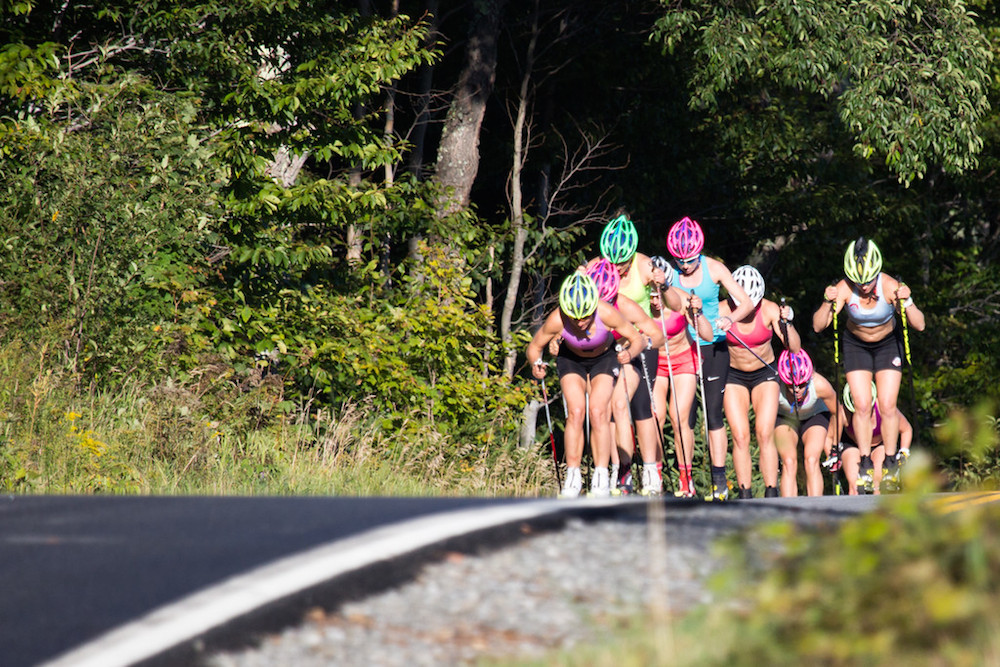
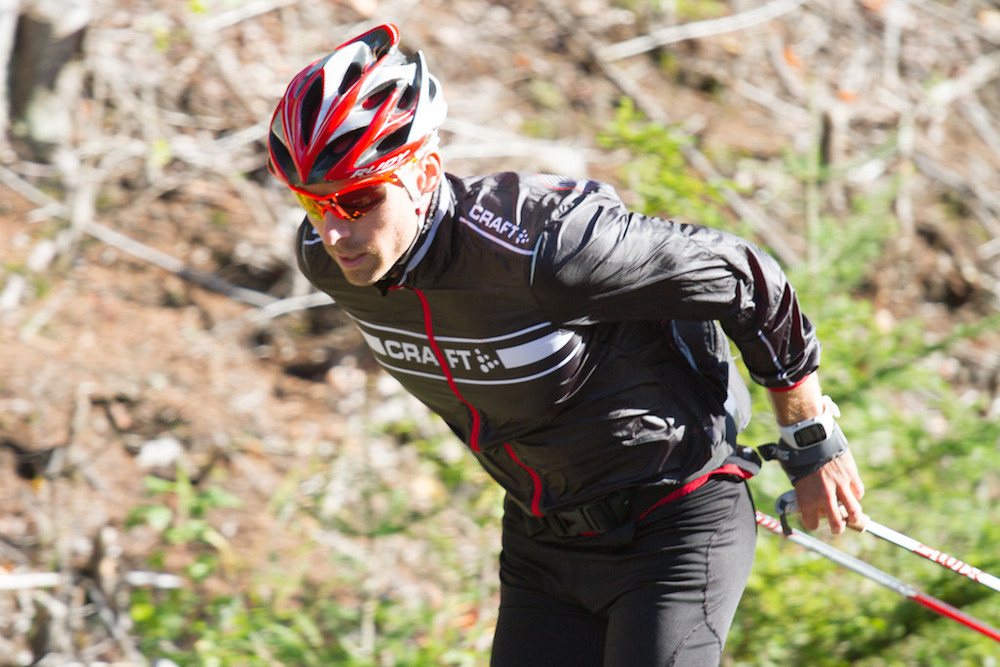
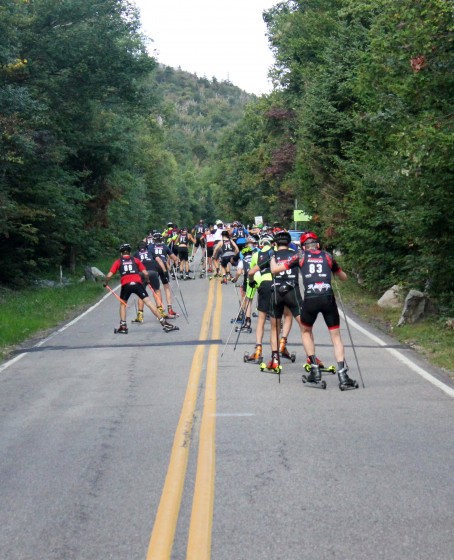
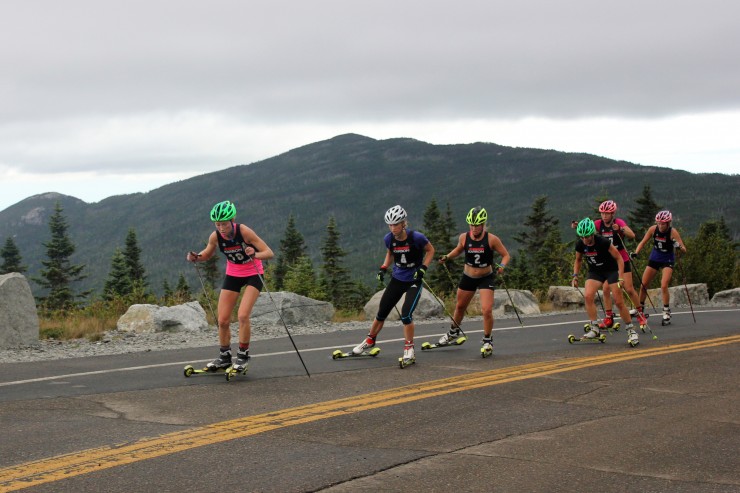
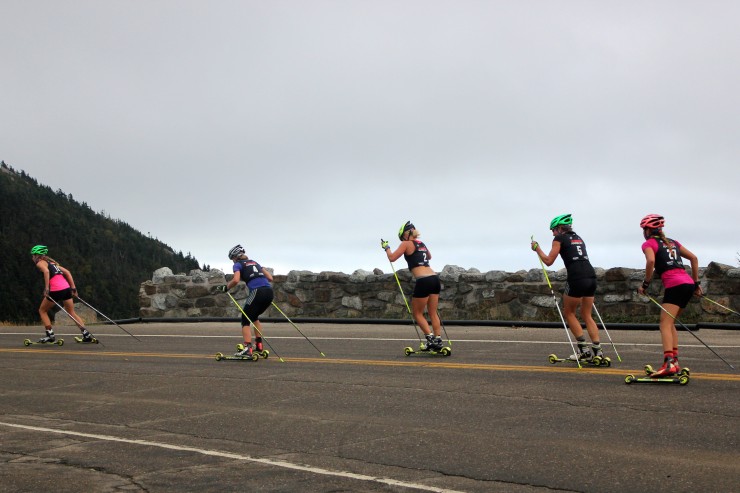
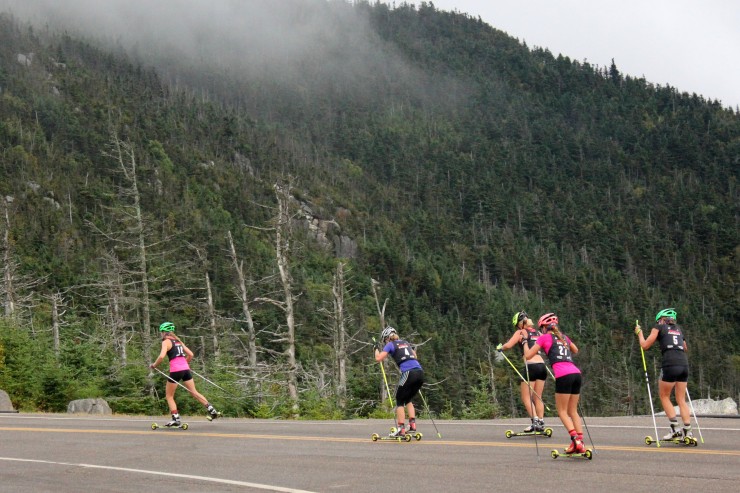
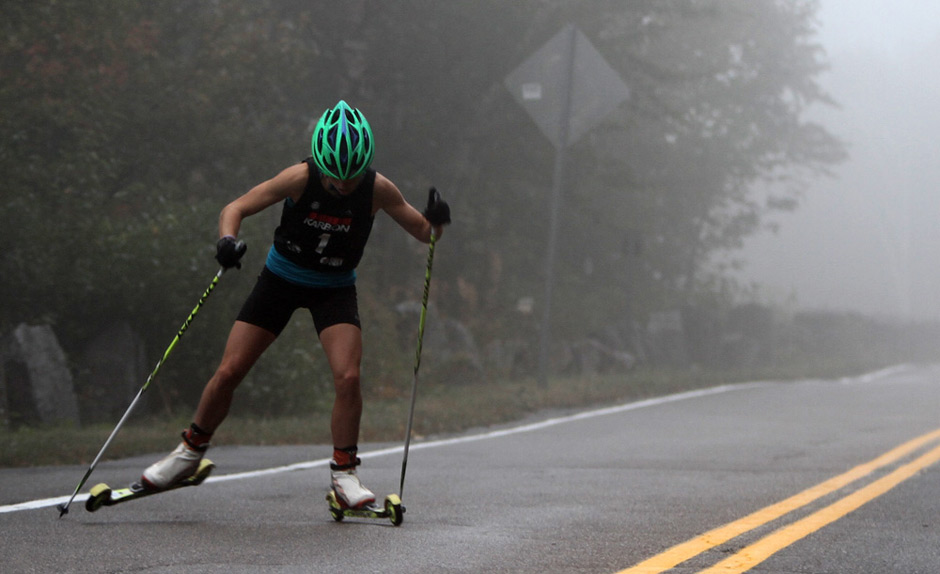
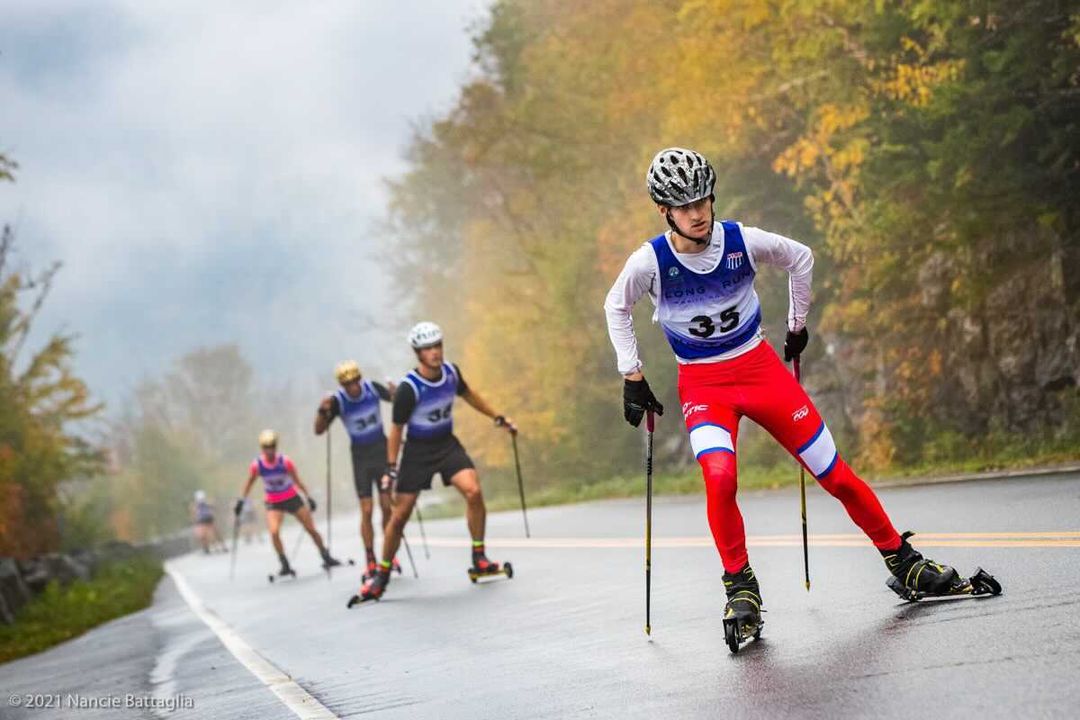
    Racers climb the Whiteface Veteran’s Memorial Highway during the 2021 Climb to the Castle. (Photo: Nancie Battaglia/NYSEF)

    The rain stopped just long enough for Caitlin Patterson and Jake Brown to savor their wins at the 2021 edition of the Climb to the Castle last Saturday in Wilmington, NY, near Lake Placid. 

    Craftsbury Green Racing Project (CGRP) swept the women’s podium; Caitlin Patterson edged Margie Freed for the win in 46:48.8, with her teammate just .7 second back in 46:49.5. Tara Geraghty-Moats placed third in 47:35.0.

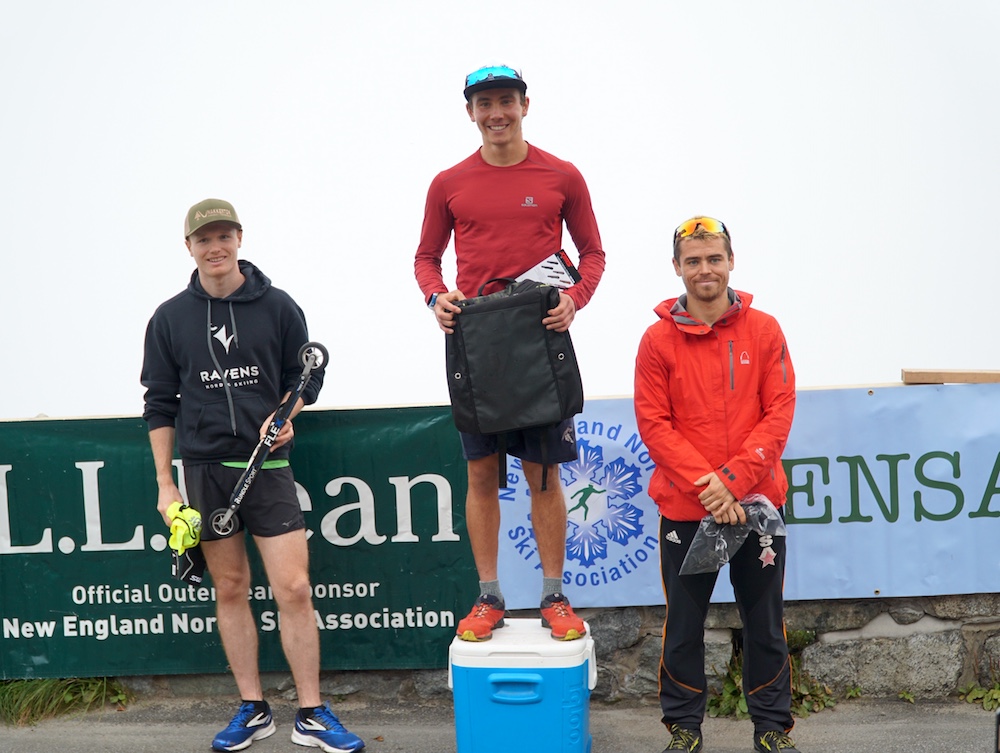
    Brown, skiing for US Biathlon / CGRP, took the men’s win in a time of 38:04:00. CGRP teammate Akeo Maifeld-Carucci came second in 39:34:9, and Junior athlete Tabor Greenberg, a U16 athlete out of the Green Mountain Valley School (GMVS), interrupted CGRP’s command of the podium in third place at 41:24.7.

    After taking 2020 off due to the pandemic, the Climb to the Castle returned to the Northeast roller ski calendar, co-hosted by NENSA and NYSEF. The race leads skiers five miles up the Whiteface Veteran’s Memorial Highway at an average eight percent grade. Whiteface is the fifth highest mountain in New York’s Adirondacks; start too hard, and you’ll never recover. This author can attest. 
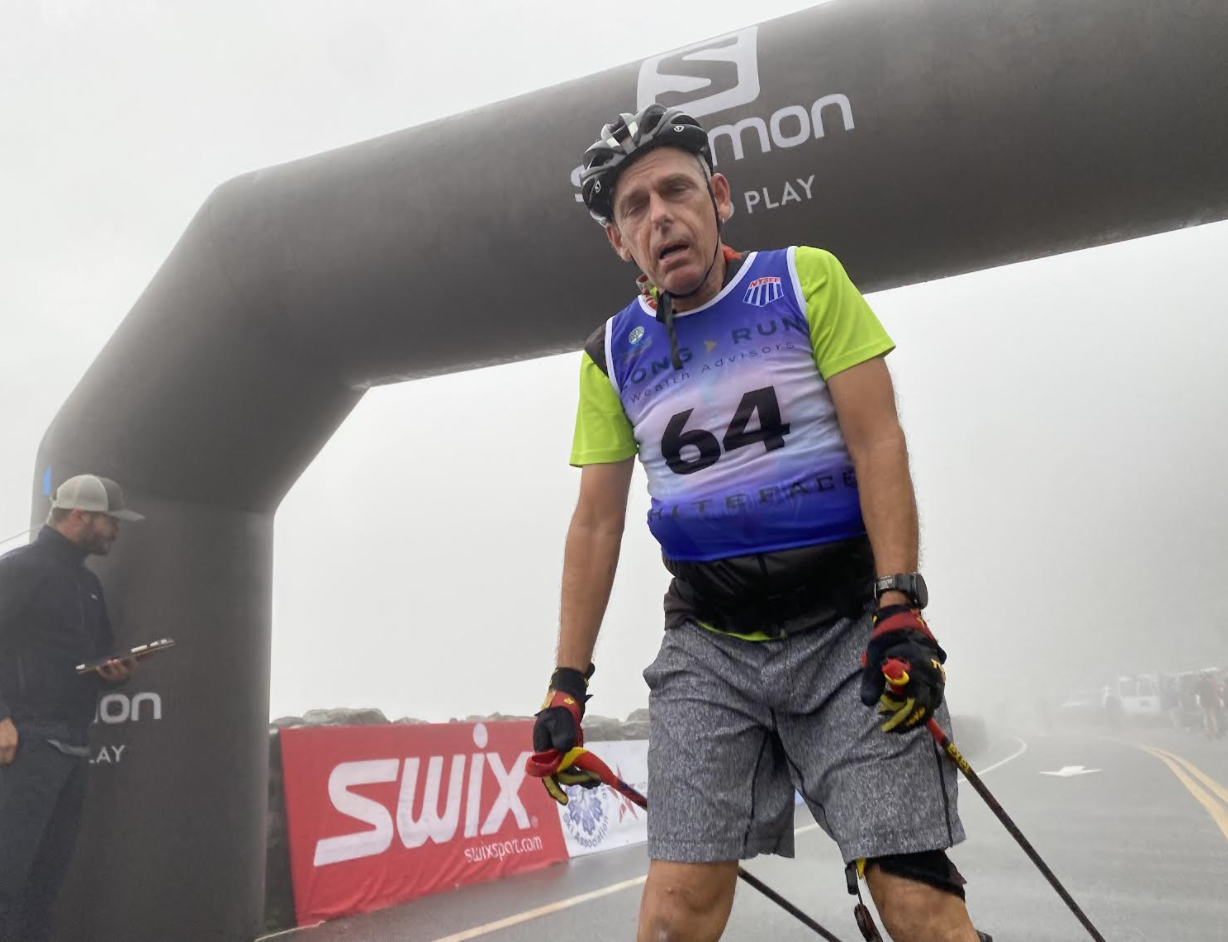
    The author completes his Climb to the Castle. (Photo: NENSA)

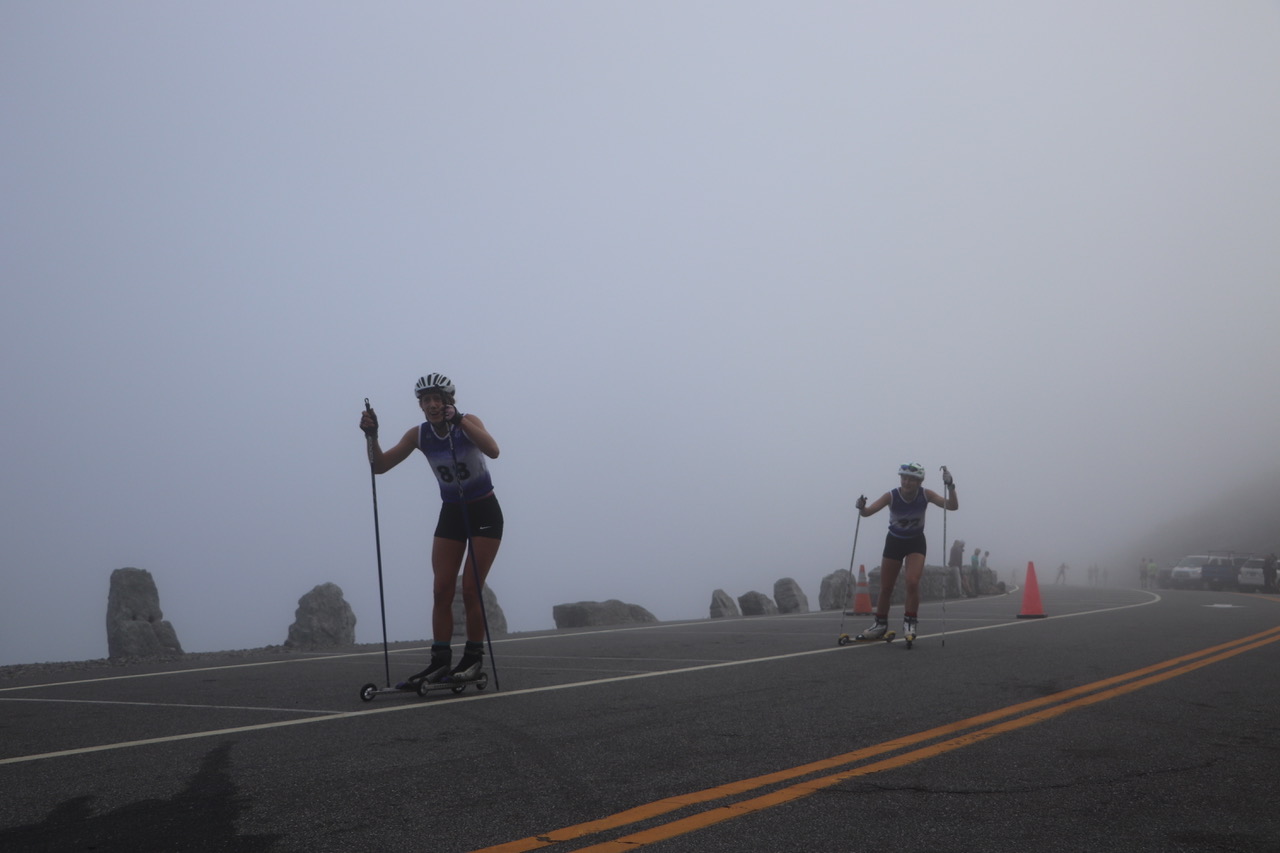
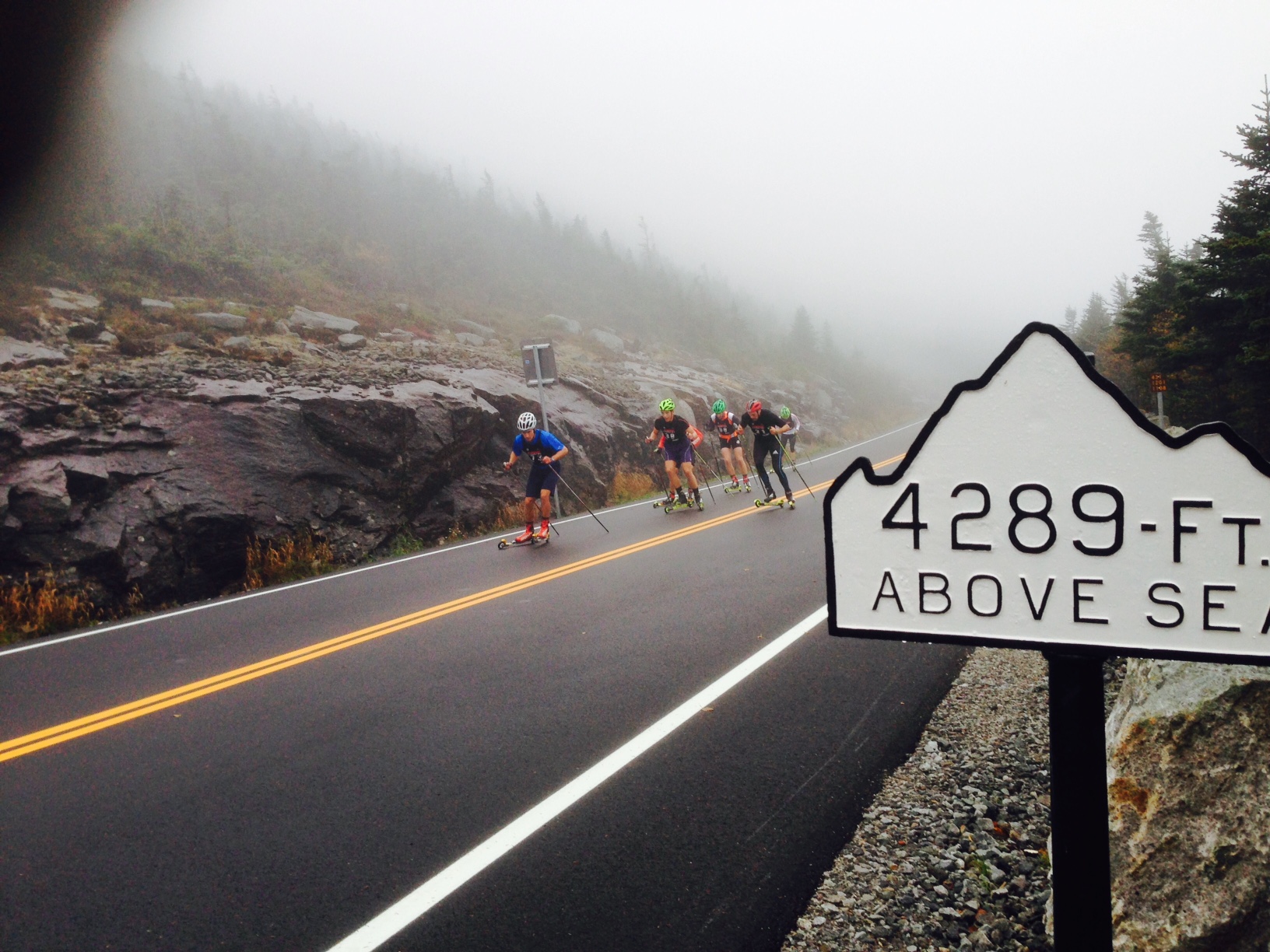
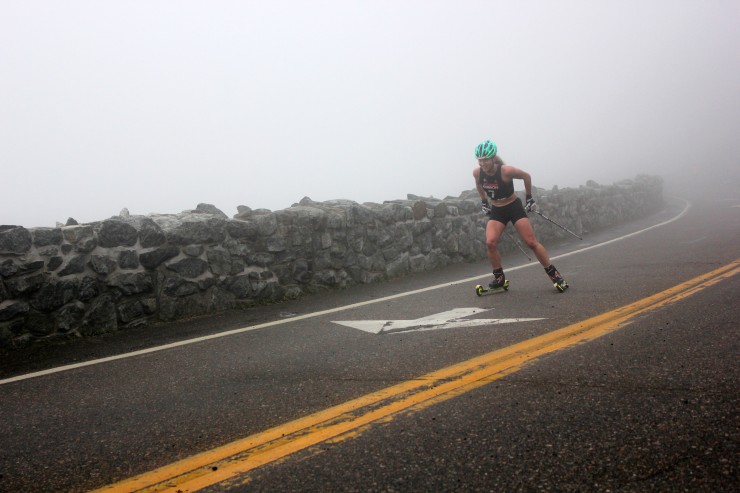
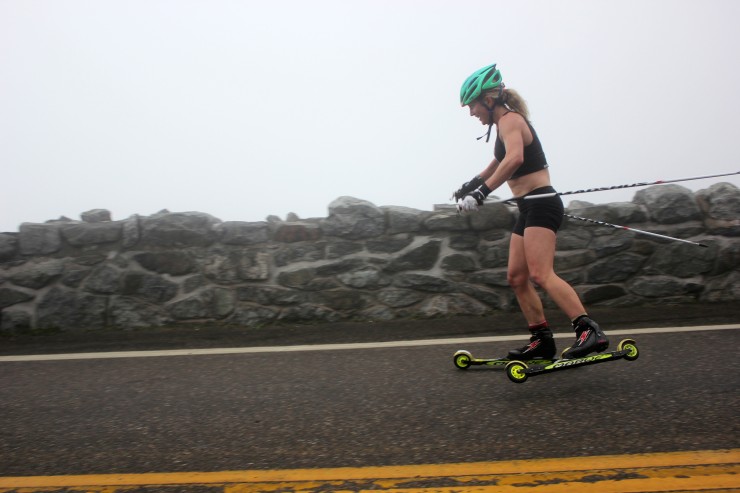
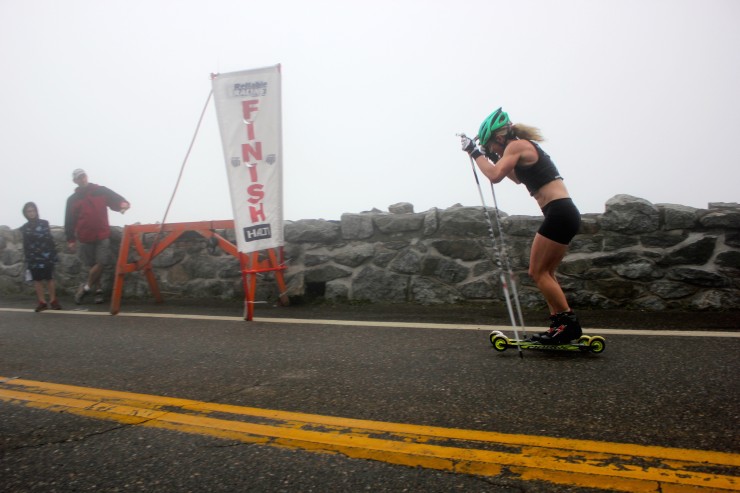
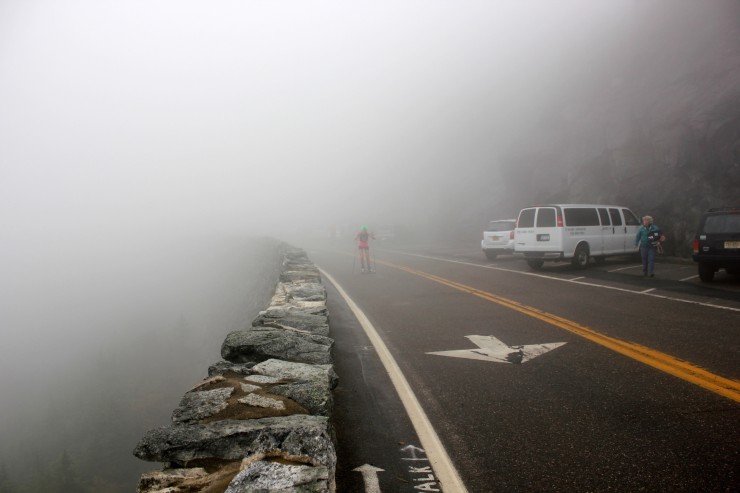
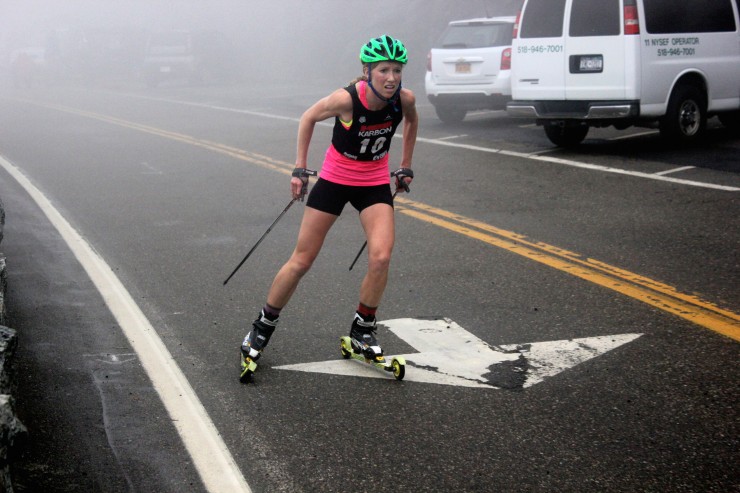
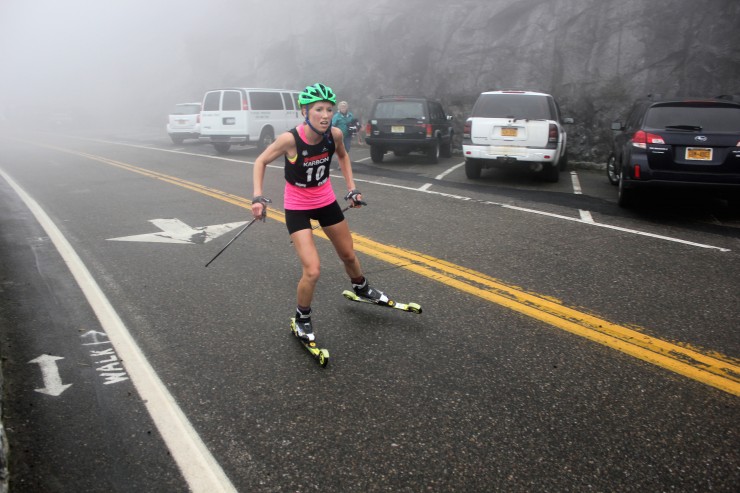
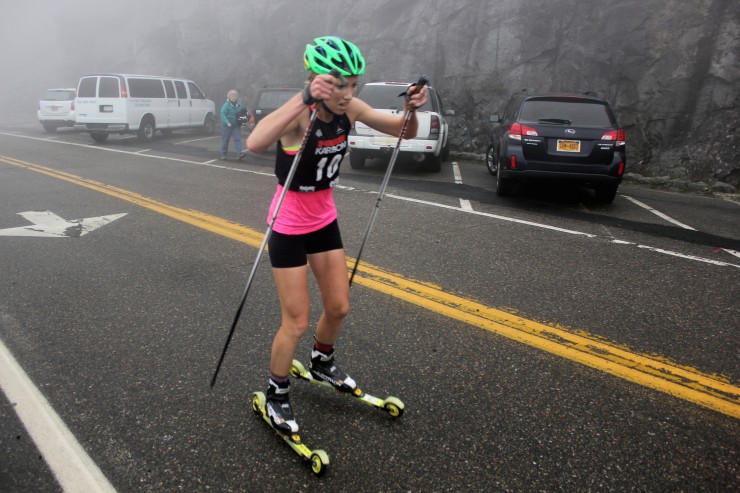
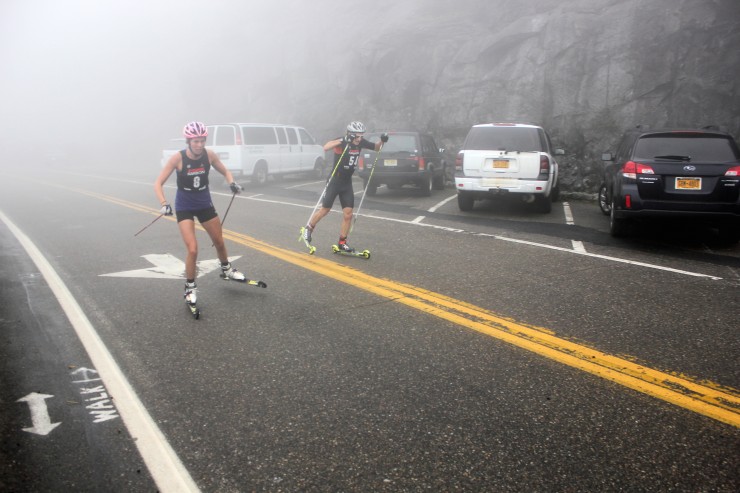
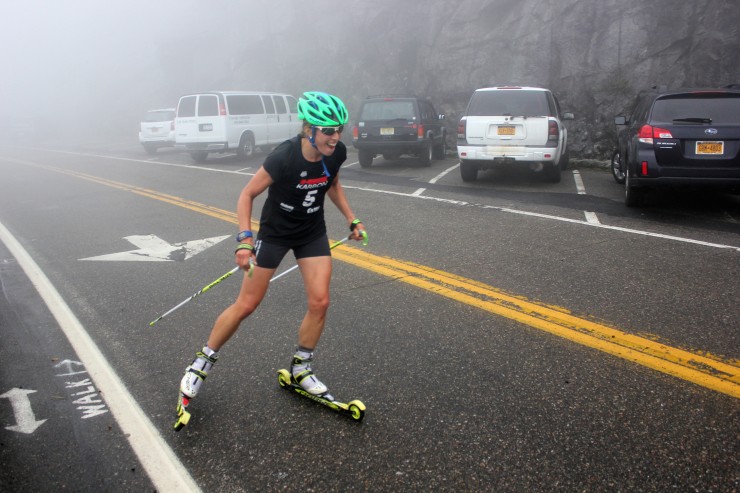
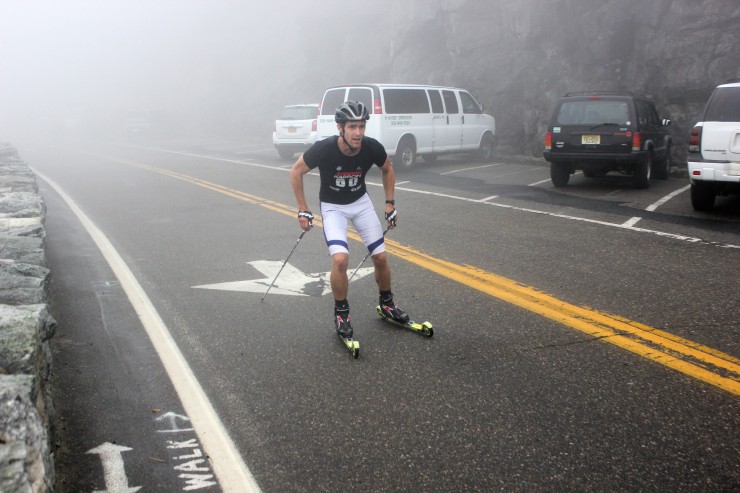
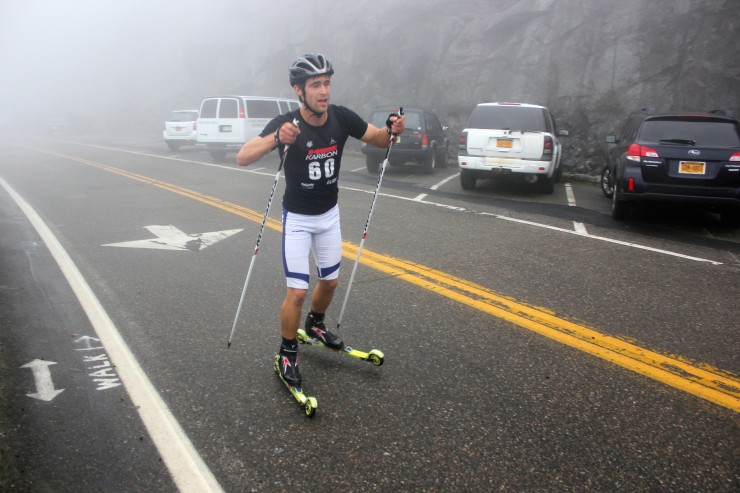
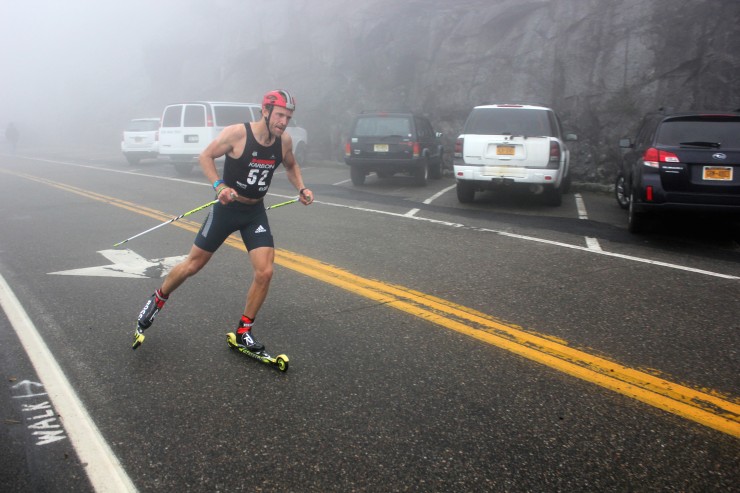
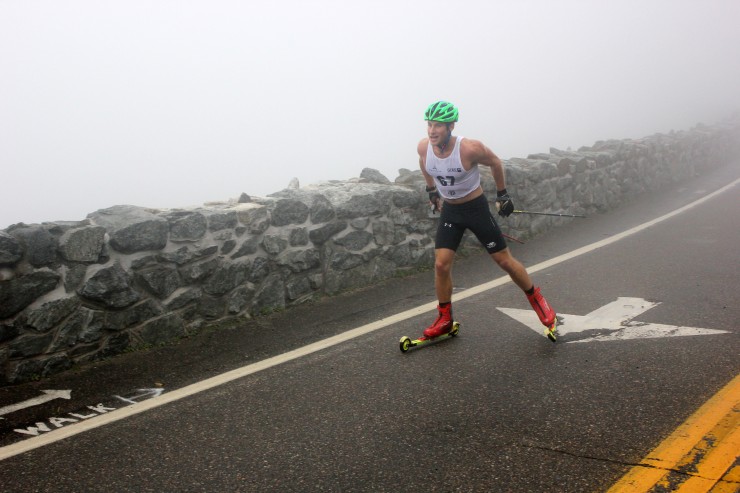
    As is often the case, weather made the race…. interesting. Light overnight rain tailed off about an hour before the start. Although the temperature hovered in the low 50s, the humidity made it feel warmer.  Clouds and fog obscured vision throughout the day.  In some places, one was lucky to see a hundred feet. For a change, there was little wind, even at the infamous Windy Corner and chute, 800 meters or so from the finish.

    For COVID safety, organizers started five waves of skiers, each two minutes apart. Competitors wore masks at bib pickup and on the summit after finishing their race.
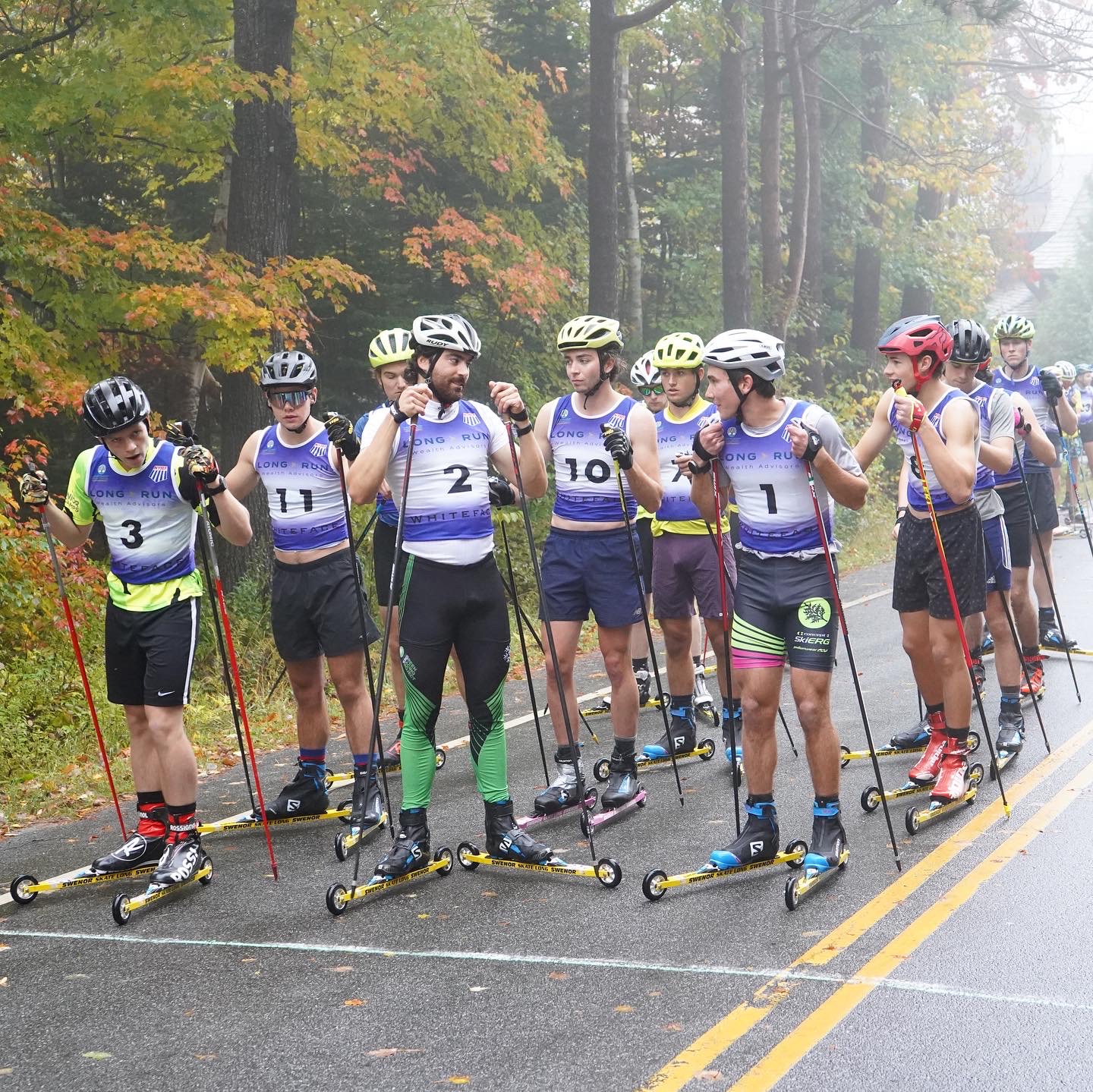
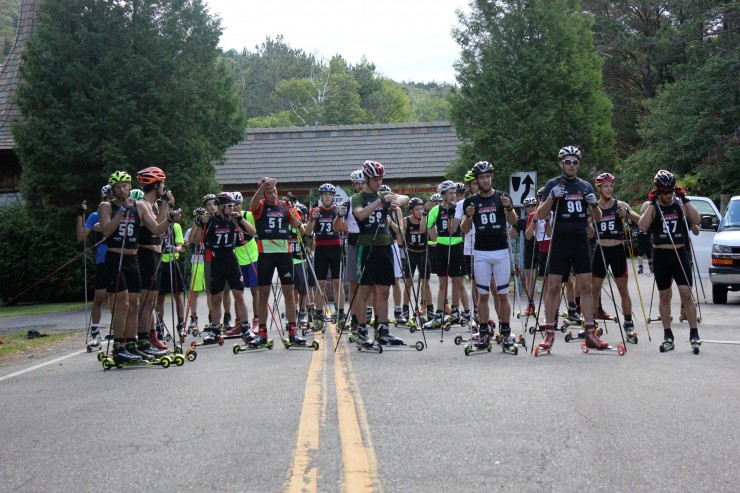
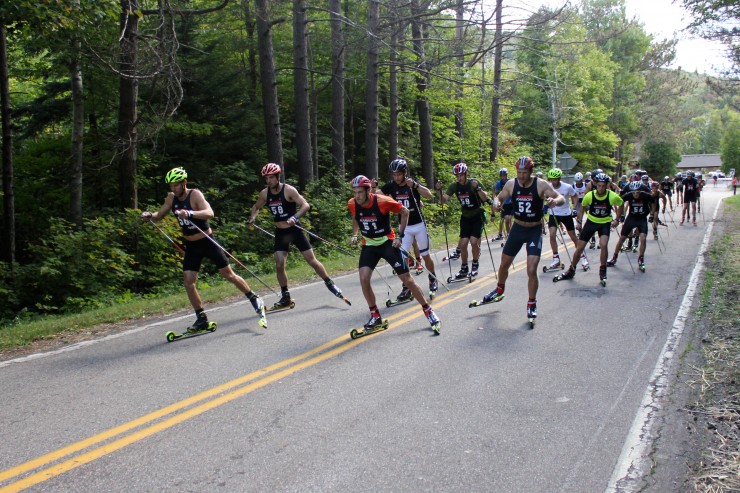
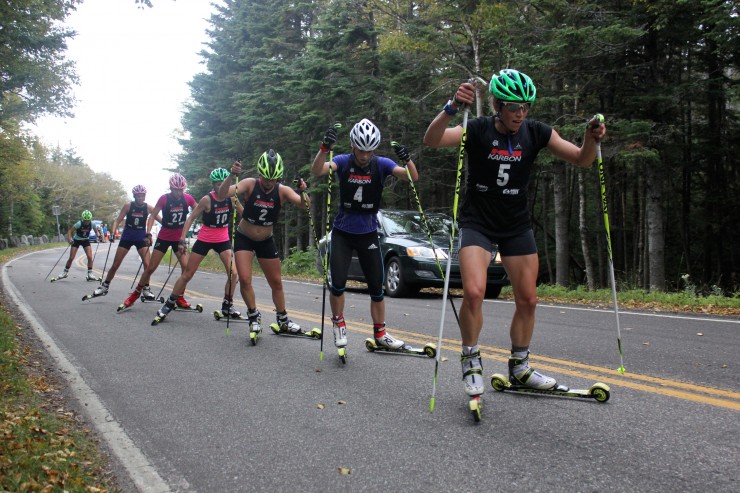
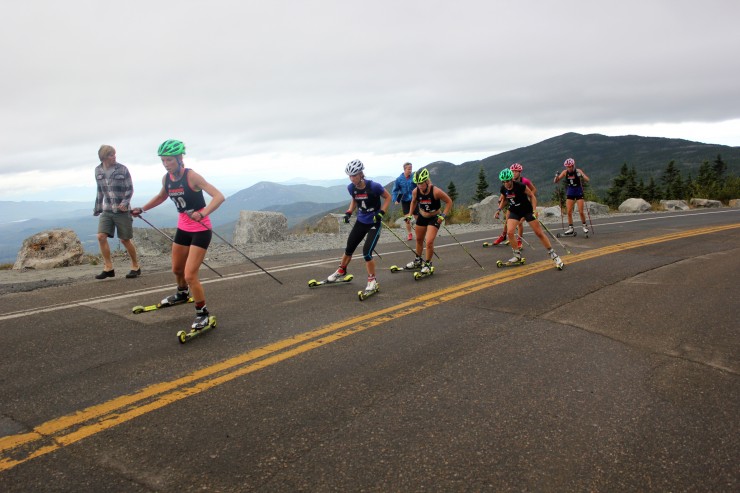
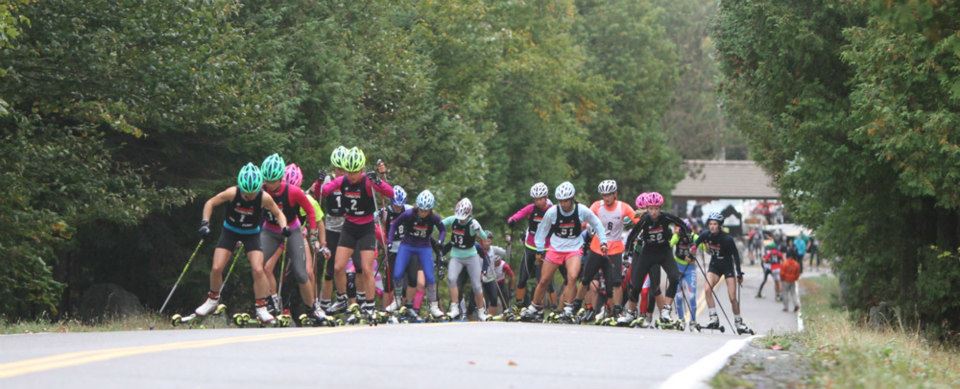
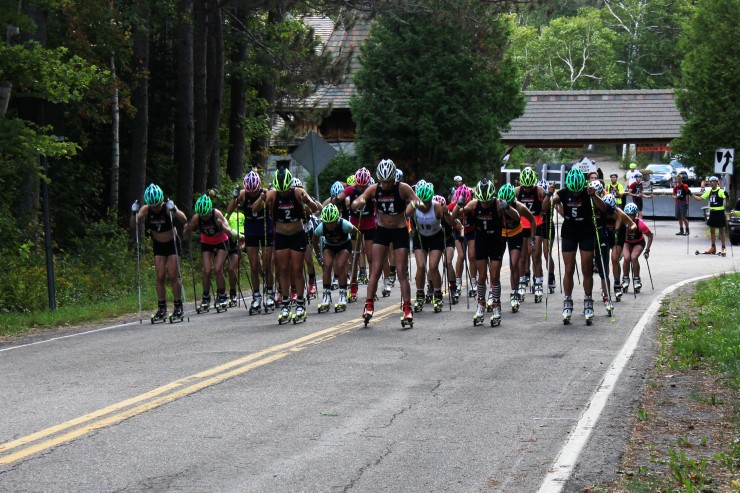
    Visibility low, energy high: a wet start for the men’s wave in the 2021 Climb to the Castle. (Photo: NENSA)

    The women’s race was high drama as Patterson, Freed, and Geraghty-Moats worked together up the road.

    “Tara and Margie and I knew we wanted to work together, especially with the way the Climb can be pretty windy at the top. It was just gonna be: ski smooth, work together, and shuffle around the leads, which is what we did. I definitely wanted to make sure not to start too fast.  I did that well, though I certainly had some rough moments in the middle.”

    From the start, Patterson said that she and Geraghty-Moats took turns in the lead, trading off about every kilometer.  “Towards the upper part, Margie was taking some really strong leads. I was suffering a bit,” Patterson added.
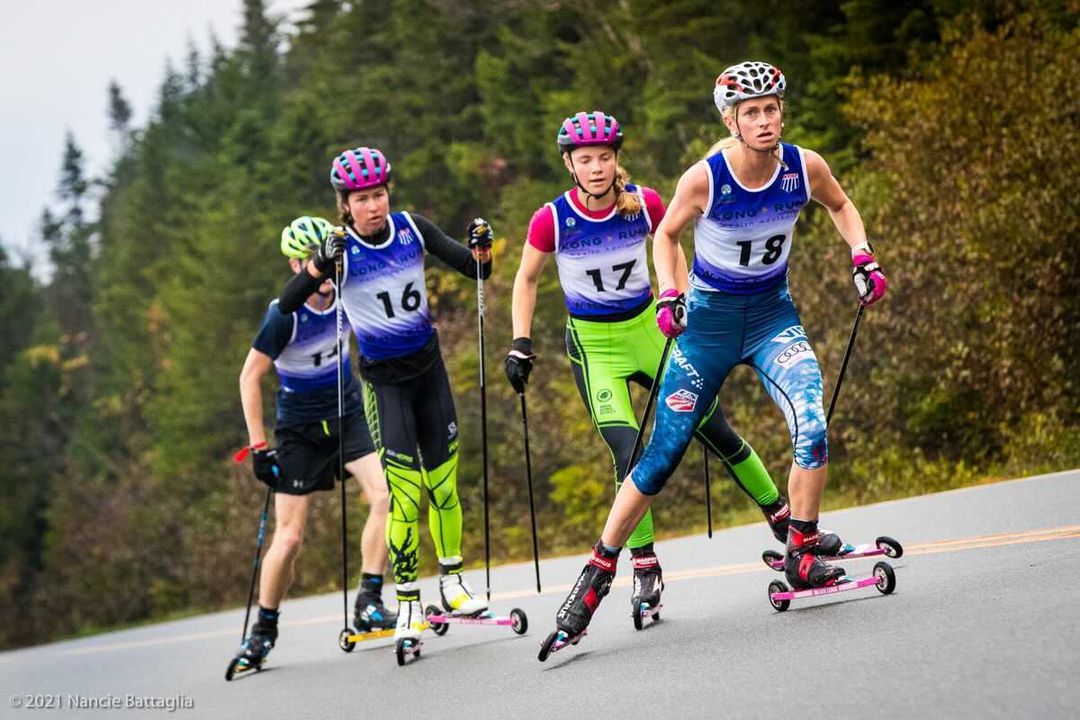
    With two kilometers left, Freed opened a gap from Patterson and Geraghty-Moats. Patterson said it took a few minutes for her to regain contact.  At that point, Patterson and Freed pulled away from Geraghty-Moats, skiing to the finish.  

    “Maybe 30 seconds out, I passed [Margie],” Patterson said. “It was really strong work by both of them. It was great to ski with people because it was as tough a course as ever.”

    Of her finishing kick, Patterson said, “I know that I can tap into a late surge. We were working together for most of it, and as the finish line was drawing near, it was definitely every person for themselves.”
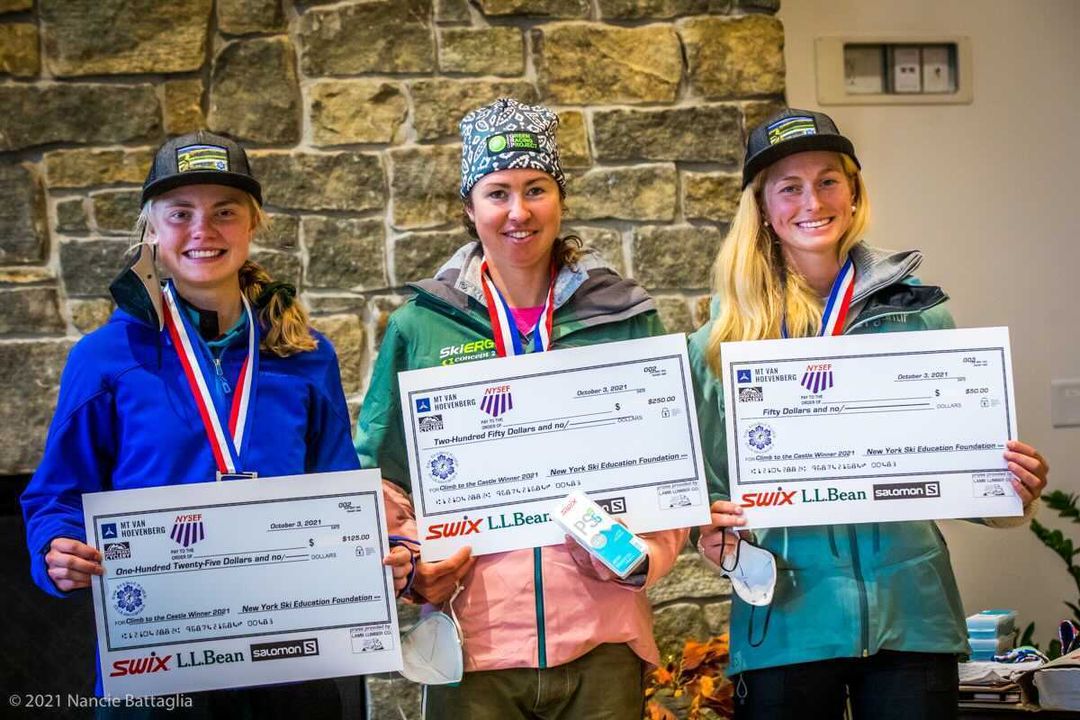
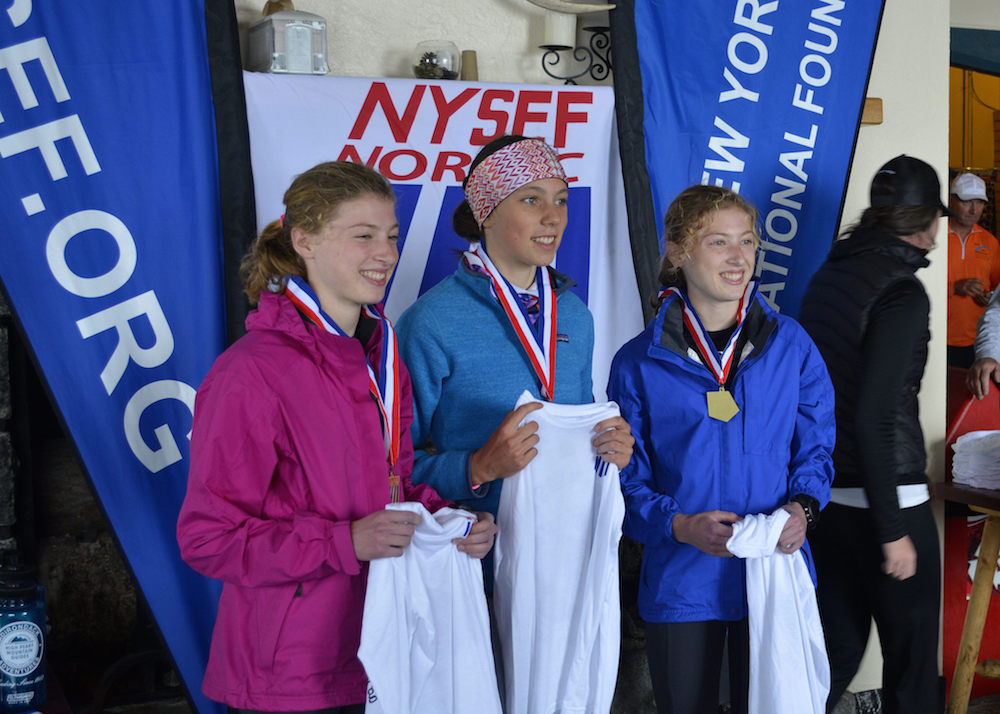
    Craftsbury women clean up at the 2021 Climb to the Castle. Caitlin Patterson took the win ahead of Margie Freed (left) and Tara Geraghty-Moats (right). (Photo: Nancie Battaglia/NYSEF)

    “It went pretty well today,” said Freed of her race. “It was awesome to ski with Tara and Caitlin for so long. I don’t think I could have kept up that pace if I was alone.

    “I’ve never done this race before, so it was exciting to have every step be something new for me,” Freed continued. “Even though I didn’t quite know where the finish was, or when it was coming.  I couldn’t quite see it because it was so foggy.  It was an awesome day out there, and I was glad it wasn’t as windy or rainy or cold as I was thinking it was going to be.”

    This past winter, Geraghty-Moats won the first ever crystal globe for FIS Women’s Nordic Combined.  She also won the Climb in 2018. After the race, she wrote, “It was really nice to go all out with my teammates. We skied together really well. We all had moments of fading and then climbed back on. I dropped back about half a k after the Lake Placid turn — I just kind of ran out of  gas. I’m pretty happy with how I felt and it was a really fun race.”

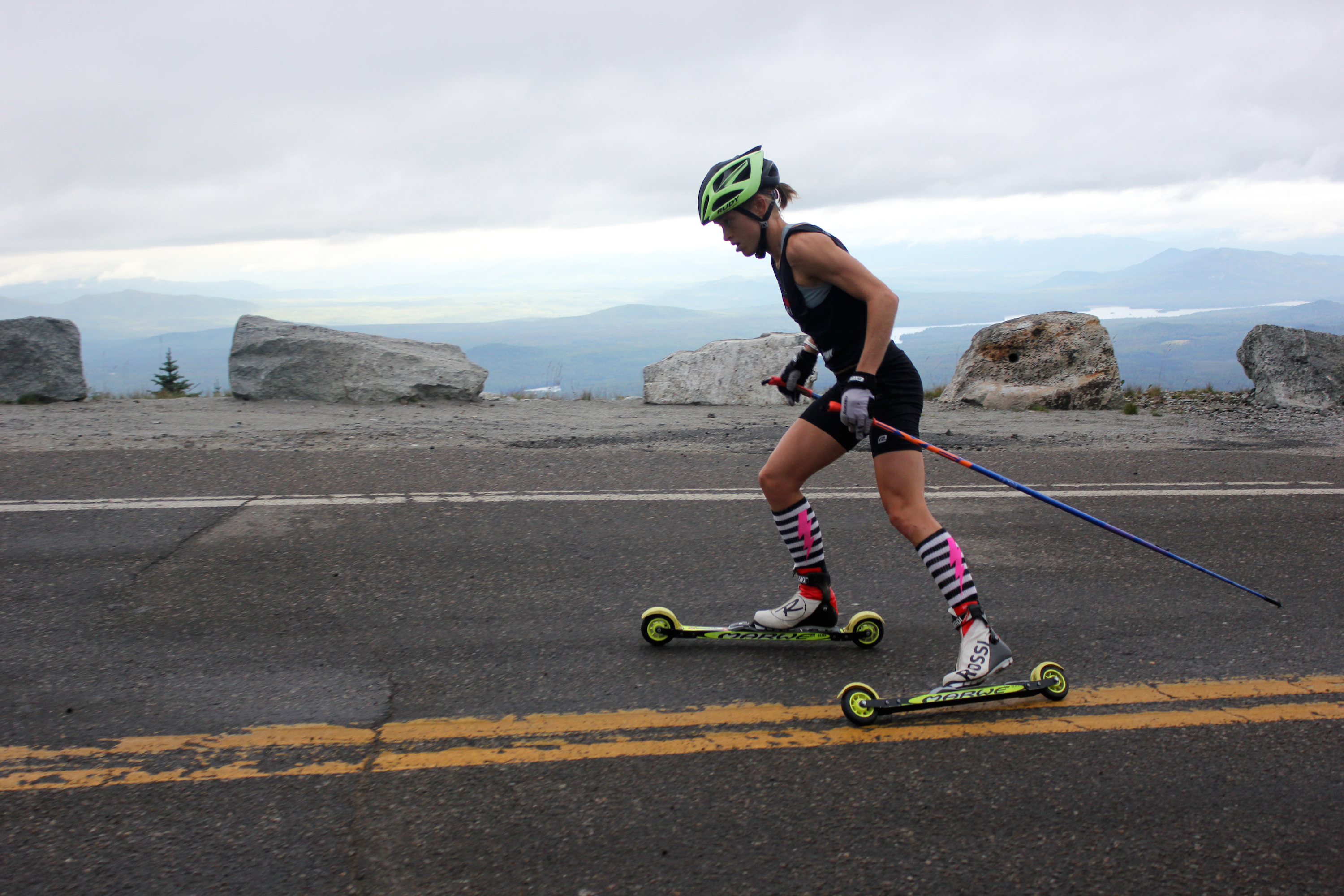
    Jake Brown wins the 2021 Climb to the Castle in a long solo effort. (Photo: Nancie Battaglia/NYSEF)

    For Brown, this was his third win at Climb to the Castle, his previous two coming in 2017 and 2018.

    “I wanted it to be a good, solid effort,” Brown said. “I knew that I couldn’t sprint too hard off the line, but I wanted to get into that high heart rate zone and stay there as long as I could.”

    Asked about race strategy, Brown said, “I was with Akeo [Maifeld-Carucci], my Craftsbury Green Racing Project teammate. He led for the first 3 minutes or so.”

    At that point, Brown said, he took a turn pulling and developed a gap. “I was hoping we could work together a little bit more, but we ended up with an awkward 20-meter gap between us that we  held for maybe half the race. Then I slowly pulled away and was by myself.”
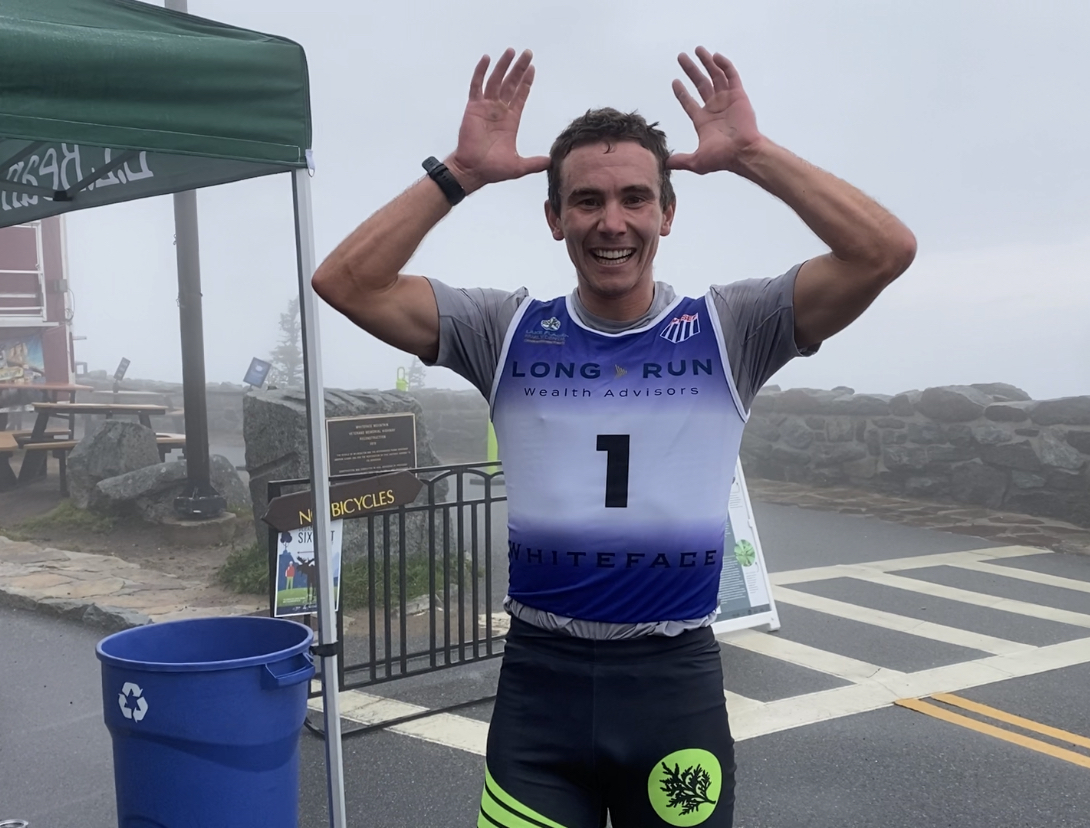
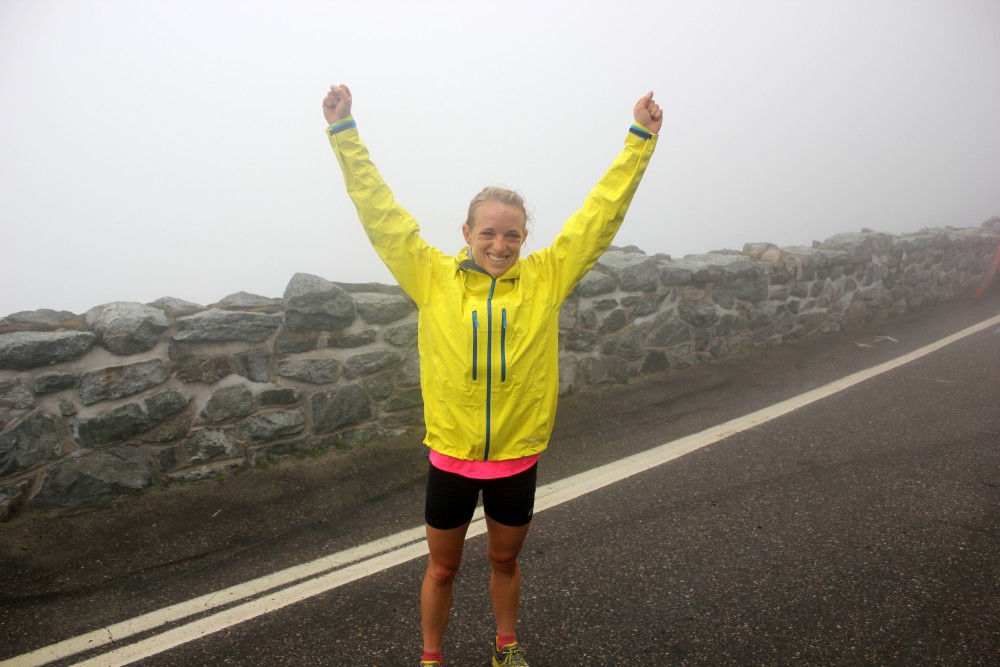
    Jake Brown wears the moose-antler crown after winning the 2021 Climb to the Castle. (Photo: NENSA)

    Asked if he could use this as a fitness benchmark, Brown said, “This was my fourth time doing the race. This was a bit of a slower year; I’m hoping it was just because of the weather. Maybe a little later in the year and a little colder pavement. It was kind of warm today, but maybe the pavement was a little colder.  Maybe my fitness isn’t where it was.  We’ll find out when the winter comes — that’s what matters.” 

    For Maifeld-Carucci, “It was a sweet day. I wanted to do this race for a long time, since early in college. So it was great to actually be here and do it.  The weather was way better than we expected. It was a little wet and a little cloudy at the top, but there were moments when it opened up and it was super pretty. Constant great climb, hard skiing — it was definitely a hard race and a really good effort.”

    Commenting on the men’s pacing and tactics, Maifeld-Carucci echoed Brown’s explanation of the duo’s ability to collaborate. 

    “Jake and I were hoping to ski together and trade leads,” Maifeld-Carucci explained. “He was feeling a little stronger than I was so I fell off early and we were dangling 20 meters apart for a long time. Then he started to open it up.”
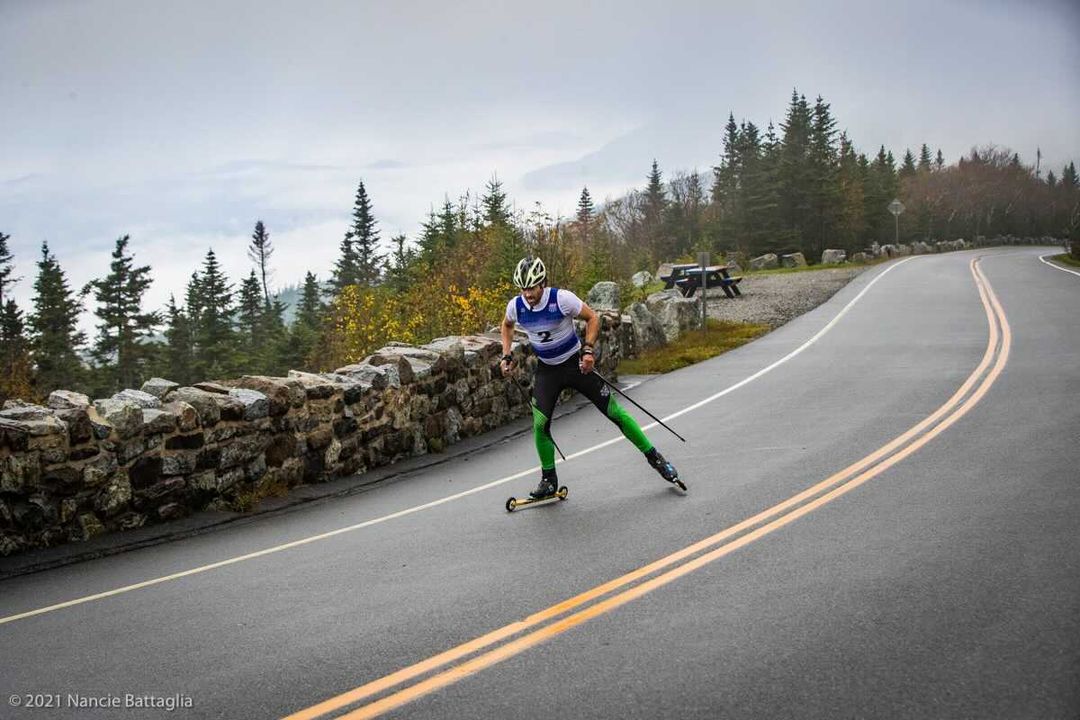
    Akeo Maifeld-Carucci skis to second place at the 2021 Climb to the Castle. (Photo: Nancie Battaglia/NYSEF)

    In addition to Greenberg nabbing third place overall, the GMVS boys swept the junior podium. 

    Responding to an email, GMVS head coach Colin Rodgers said that his skiers didn’t taper for the race. “Tabor actually trained a lot in the past week including a 120 mile bike ride to raise money for the Kelly Brush Foundation.”

    Commenting on the preparation for this event, and how it fits into the season preparation, Rodgers explained:

    “We spent some time recently working on climbing technique. When we were recently on snow on the Stelvio glacier we were working on standing well (balanced and forward) on our skis. We did not discuss any mass start race tactics for today — I really just wanted the crew to focus on pacing the effort properly and being consistent throughout the duration of the climb. [Having] a dialed warm up and trying to keep good form when tired were also a few other things we were honed in on today.”
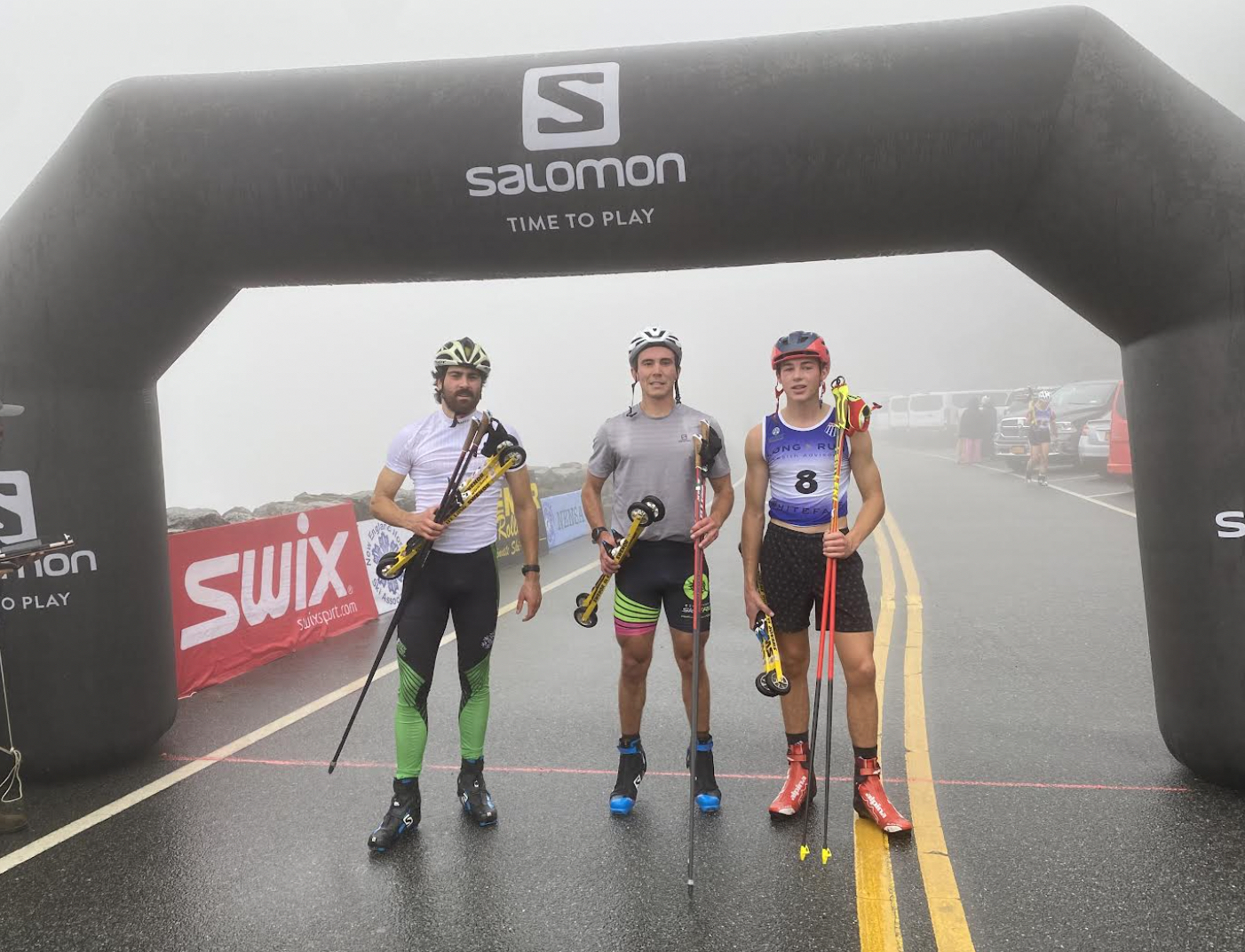
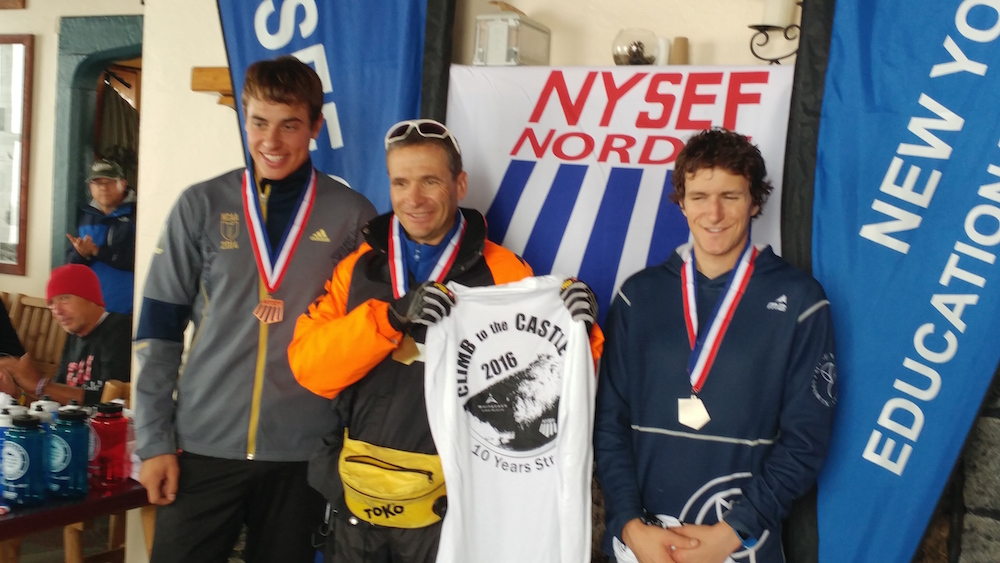
    The men’s podium at the 2021 Climb to the Castle. Jake Brown (CGRP) took the win ahead of Akeo Maifeld-Carucci (CGRP) and Tabor Greenberg (GMVS). (Photo: NYSEF)

    Did Rodgers have an inkling that Greenberg might podium? 

    “We were not focused on the podium, we were just focused on executing a solid race effort. We are primarily focused on competitions in March, so all of this is just trying to build momentum towards the end of the race season.”

    Although COVID border closures prevented Canadian clubs from driving across the border, many clubs and colleges still showed up to throw down.  

    According to Sara Falconer, a coach at Mansfield Nordic (MNC) in Vermont, “It’s a good opportunity for [MNC junior athletes] to race other high school athletes and college athletes that are here.  It’s also a chance for them to compare their times to last year and see the results of all the work they put in over the summer.  They can see a lot of dramatic improvement.  It’s a really motivating thing for them.  And it’s also a good workout.”

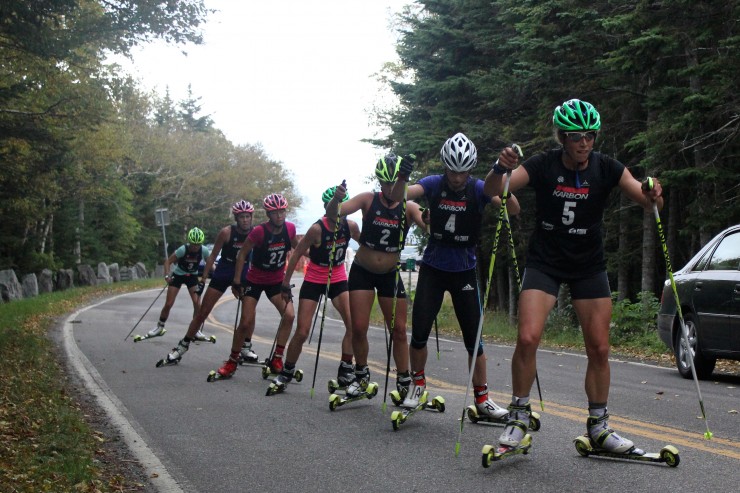
    From juniors to collegiate to masters, racers ascended Whiteface during the 2021 Climb to the Castle. (Photo: Nancie Battaglia/NYSEF)

    Ethan Townsend, Saint Lawrence University’s (SLU) head nordic ski coach, planned a training weekend for his team. SLU athletes also roller skied the new loop at Mount van Hoevenberg on Friday.

    “Saturday morning, we got up early and did a run/hike” said Townsend. “They had the option of going up Algonquin or Wright or Marcy. A lot of them took the option of going up Marcy. A few of them went up Phelps and Tabletop. Probably an average of five hours.” 

    Mount Marcy is the highest Adirondack mountain at 5,344 feet and Algonquin, the second highest, stands at 5,114 feet. The remaining peaks named are also among the 46 Adirondack High Peaks, which are all above 4000 feet. 

    After coming out of the woods, the SLU team reconvened for an afternoon double pole roller ski session.

    “We weren’t concerned about performance, necessarily, in this race,” Townsend said. “It’s a training race. Something to do as a group. I told them, ‘Don’t worry about the results so much.  It’s great that we can come here and do this. If you just stay in level three the whole time and you’re not feeling it to go super hard, I think that alone would be worthwhile.’”

    You can find more footage of the 2021 Climb to the Castle on NENSA’s YouTube channel.
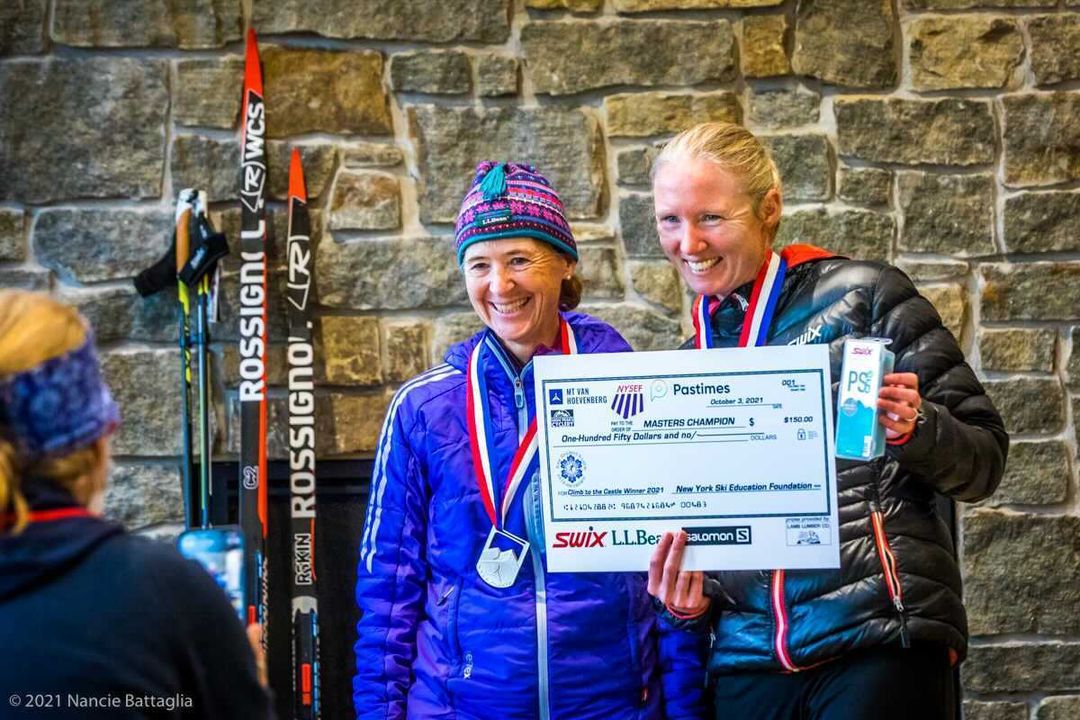
    From Juniors to Collegiate to Masters; a broad scope of rollerskiers ascended Whiteface during the 2021 Climb to the Castle. (Photo: Nancie Battaglia)

    Women’s complete results

    Men’s complete results

  • Audio short with Marty Hall and NENSA’s Justin Beckwith

    Audio short with Marty Hall and NENSA’s Justin Beckwith

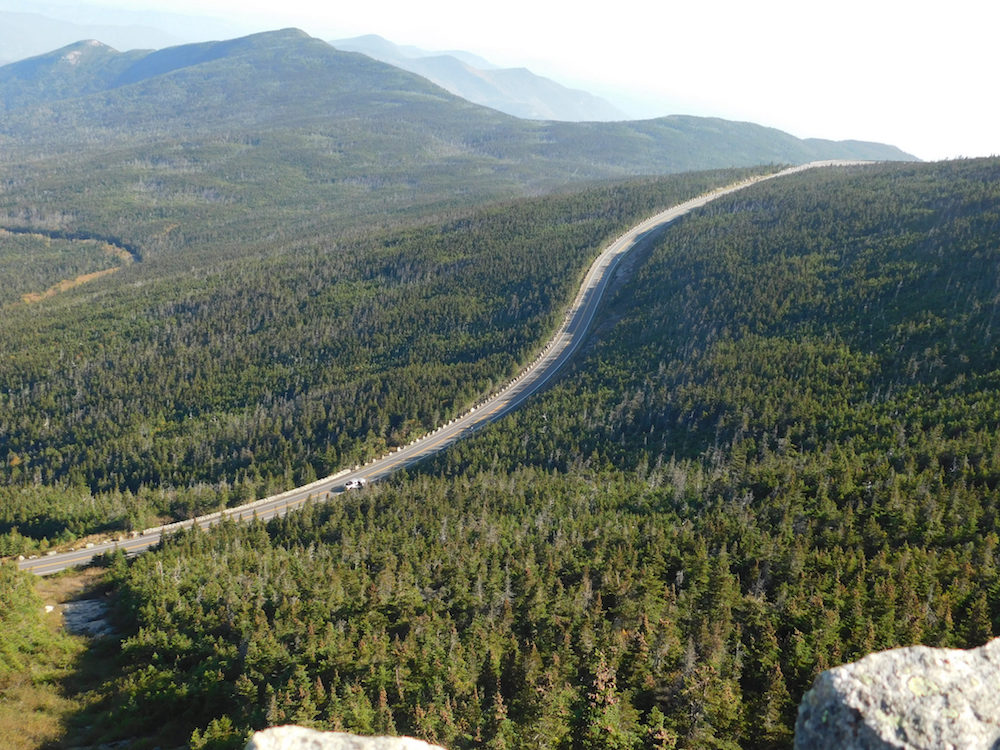
    Looking down at the Whiteface Veterans Memorial Highway, a five-mile toll road to the top of Whiteface Mountain in Wilmington, N.Y., as seen on Sunday, Sept. 24, for the 2017 NYSEF Climb to the Castle rollerski race. (Photo: NYSEF)

    On the eve before a full weekend of rollerski racing in Lake Placid, New York, we spoke with NENSA’s Justin Beckwith and cross-country ski supporter Marty Hall about their involvement with developing rollerski races in the Northeast.

    Here’s an audio short of the interview with two people making things happen.

  • Brown, Geraghty-Moats Win 2018 Climb to the Castle; Doubleday Race Format Unveiled

    Brown, Geraghty-Moats Win 2018 Climb to the Castle; Doubleday Race Format Unveiled

    Jake Brown (Craftsbury Green Racing Project/US Biathlon) racing to a sizable win at the 2018 Climb to the Castle on Saturday, Sept. 15 in Wilmington, N.Y. (Photo: Heloise Rolland)

    On a humid fall Sunday in northern New York where temperatures reached an uncharacteristic 80 degrees, Jake Brown of the Craftsbury Green Racing Project and US Biathlon Development Team and Tara Geraghty-Moats of USA Nordic won the 2018 Climb to the Castle.

    Brown’s time was 35:40.7, while Geraghty-Moats finished in 45:03.

    Big Gaps and Clear Wins

    On the men’s side, Brown’s Craftsbury teammate Raleigh Goessling finished second in 38:16.6, and Erikson Moore of the Fondeurs-Laurentides team in Quebec was third in 39:00.3.

    Among women, Jackie Garso of Saint Lawrence University was second, in 49:24.1, and Nakkertok’s Zoe Williams third in 49:40.6.

    This year was a high water mark for attendance, with 102 athletes finishing.

    The overall women’s podium at the 2018 Climb to the Castle at the top of Whiteface on Sept. 15 in Wilmington, N.Y., with winner Tara Geraghty-Moats (c) of USA Nordic, Jackie Garso (l) of St. Lawrence University in second, and Zoe Williams (r) of Nakkertok in third. (Photo: Colin Delaney)

    While a few degrees cooler than last year, dank humidity settled like a blanket over the five-mile climb, with athletes moving through a couple of patches of dense fog on the higher reaches of the mountain.

    “It was a hard one today,” Brown said following the race. “Last year, I felt like I went a little too hard off the line, and kind of buried myself early. So I wanted to be a little more conservative and finish strong today. I tried doing that and it felt a lot better, and I skied a little faster. I was on different rollerskis, so it’s hard to be able to compare it to last year. I was happy with my effort and it was a good push today.”

    This year was Brown’s second consecutive win, and he beat his 2017 time of 39:01.9.

    “It’s always a tough race, but I’m happy with how my summer training has paid off,” Geraghty-Moats said. “I felt strong and I had a good race.”

    Asked if the race was part of her training plan, she replied, “I just finished competing in the Ski Jumping Grand Prix in Russia, so I’m still pretty jet-lagged. I love this race, NYSEF puts a lot of energy into putting it on every year, so I figured I’d make the trip over. It’s really fun and I enjoy racing with a good crew.”

    A ski jumper winning a cross-country ski competition? For those not in the know, Geraghty-Moats is one of the pioneers of the developing women’s nordic combined.

    The overall men’s podium at the 2018 Climb to the Castle at the top of Whiteface on Sept. 15 in Wilmington, N.Y., with winner Jake Brown (c) of the Craftsbury Green Racing Project (CGRP)/USBA Development Team in first, Raleigh Goessling (r) of the CGRP in second, and Erikson Moore (l) of Fondeurs-Laurentides in third. (Photo: Colin Delaney)

    “I’m on the women’s ski jumping team and I’ve been to a World Championship in 2015 and on the World Cup team for the past 4 years,” she explained. “Before that, I was a biathlete, so nordic combined was sort of a natural step for me. FIS has put in a lot of resources to developing women’s nordic combined. This year, they’ll have a Continental Cup circuit; next year, there’ll be a World Cup circuit; and the following year after that, there’ll be a World Championship. I’m starting to learn how to compete in nordic combined and I’m really enjoying it.”

    Zoe Williams, along about 60 other athletes, had participated in the previous day’s Doubleday events at the Intervale Ski Jump. (for more on the Doubleday, keep reading!)

    “I felt a bit tired in my warmup,” Williams said. “By the time I got to the start line and the race started, I didn’t feel as bad as I could have. My legs for sure felt tired in the first kilometer, but after the first k, I started settling into that rhythm and I ended up feeling pretty good for the rest of the race. Climb to the Castle, you just have to find that gear and grind away.”

     In 2017 she was fourth overall, five seconds behind biathlete Deedra Irwin.

    Meredith Stetter (88) leads her Mansfield Nordic Club teammate Jennifer Wilbraham during a foggy Climb to the Castle rollerski race on Sept. 15 in Wilmington, N.Y. They finished 19th and 20th, respectively. (Photo: Heloise Rolland)

    “This year, I ended up leading the group that I was with, which was kind of a fun change,” Williams said. “But the whole time I was thinking ‘what did Deedra do here? We one-skated [V2’ed] here. I can one-skate here!’”

    Asked if Climb to the Castle was a good fitness benchmark, Williams said, “Because the next couple of months are where you start getting the really high intensity zone four, this is a really  good indicator of the base level fitness that you have, because of the endurance focus of the race.  But I’m for sure looking to find my top end gear in the next couple of months.”

    Full Climb to the Castle Results

    Doubleday Takes Off: New Events Added to the Climb to the Castle weekend

    On Saturday, the New England Nordic Ski Association (NENSA) and the New York Ski Education Foundation (NYSEF) collaborated on a new event held on the rollerski loop at the Intervale Ski jumps.

    Quincy Massey-Bierman won the junior women’s 3 k prologue. (Photo: Heloise Rolland)

    The Lake Placid Doubleday started with a three-kilometer prologue; after a break, there was a 1.5 kilometer sprint time trial. The results of the two races were aggregated to determine winners.

    Nicholas Clifford of Carleton University in Ottawa, Ontario, was the open men’s winner, while Nakkertok’s Williams was the open women’s winner before going on to be the runner-up in the Climb to the Castle.

    “We’ve had the  Climb to the Castle for 11 years, and this year we wanted to expand it to a full weekend,” NYSEF head coach Shane McDowell said. “We started talking with Justin [Beckwith, NENSA Competitive Program Director] ] in the spring and he proposed the idea of trying [NENSA’s] new format of the doubleday, which will be used at the Eastern Cup scheduled for 23 February at the Dublin School.”

    “The format came out of discussions this spring,” Beckwith said. “Three kilometers is a national junior relay distance and we were valuing shorter, sprinting efforts in the results because we were usually a little heavy on the distance qualifications for our Junior National team in New England. When partnering with Shane and ORDA [the Olympic Regional Development Authority] to make it a reality, for us to test out the event which has a physiological effect of doing the 3k prologue in the morning and do a prelim in the sprint, the 1.5, would be the timing of a typical quarter final.”

    The roller ski loop at Intervale is serpentine and narrow, with fast downhills. In the pre-race meeting, Beckwith admonished the athletes to be conservative as they warmed up. As they warmed up, the rollerskiers gradually became more aggressive in their approach to the course.

    buy diflucan online, buy bactrim online

    Taking a corner on the Intervale Ski Jump loop during Doubleday. (Photo: Heloise Rolland)

    The race started and finished at the biathlon range located midway through the long climb from the lowest to the highest sections of the course.

    Clifford is the coach of the Carleton University ski team, located in Ottawa, Ontario.

    “It was really exciting,” he said. “It was the first time I’ve skied at [Intervale]. I’ve heard a lot about some of the sketchier downhills but it was actually really well done. It was just like ski racing.”

    Asked how he planned his races, Clifford said, “Not so much. I’m not a shorter distance guy, so the Climb to the Castle tomorrow is the real show and this was just a bit of a tuneup to get some speed in the legs.”

    Of the Doubleday format, the consensus was that it was tough.

    “The course here… It’s pretty much straight up and then you go down and come back up,” CSU’s Alex Burt said. “For the 3 k, you do it twice. It’s a lot more brutal. I had to actually pace it. For the1.5 k, my strategy was to go out as hard as I can and just keep it up.”

    But it was also fun, many participants agreed.

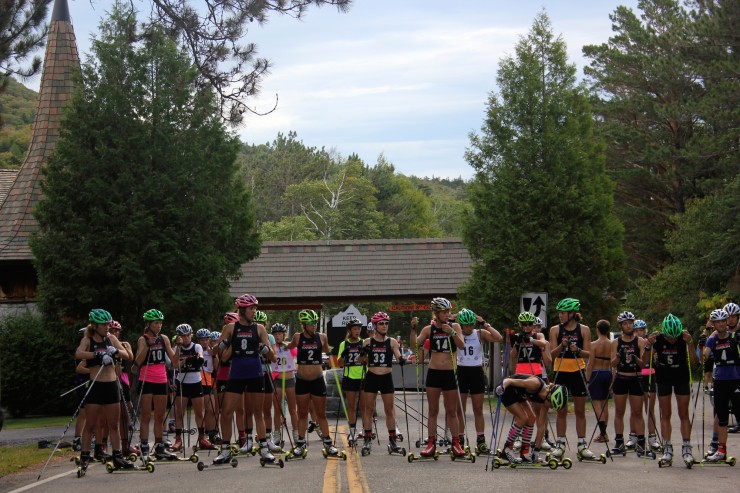
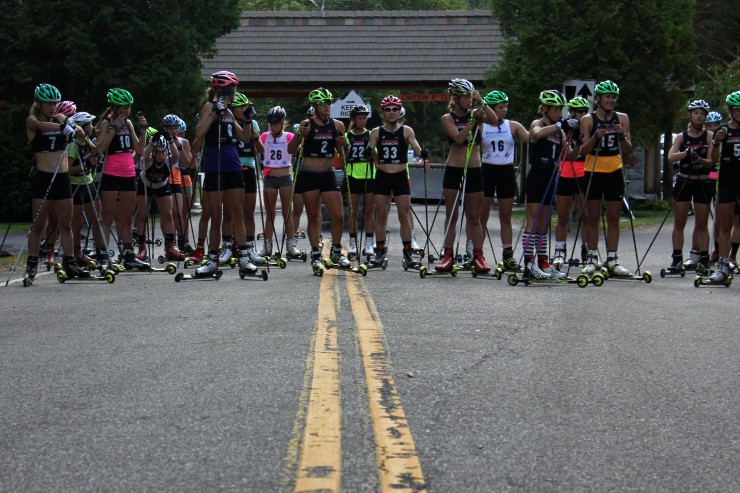
    Racers lined up at the start for a Doubleday competition. (Photo: Heloise Rolland)

    “It was fun,” said Williams of the Doubleday. “The course here was super awesome, because it was like actually skiing, whereas a lot of roller ski races are on roads. It’s so twisty and turns up and down, it’s a lot like actually ski racing.”

    On getting used to the downhills, Williams said, “It took me through mid warm up, to get used to the corners. In the race itself, I didn’t even think about it. It was super nice. I worried about it in the warmup, because there are some really gnarly corners, but when you’re racing, all your focus is on going fast.”

    Amy Duclos of Saint Michael’s College in Burlington VT, was the third overall female finisher at the Doubleday.

    “I wasn’t really sure about the course going into it, because of the turns, the hills, but it was a lot of fun,” she said. “I thought today was a good warmup to get the legs moving for tomorrow. It’s definitely a different type of race.”

    Laura Appleby, of Cambridge Sports Union (CSU), won the junior women’s division at Doubleday and was the fifth junior woman finisher at Climb to the Castle.

    “They went really well,” she said of the Doubleday races. “It was super fun. I liked the downhills… The first race was a little bit longer, so I was definitely pacing it a little bit slower. But generally just go out and ski the course, ski the transitions.”

    Shilo Rousseau, Chandra Rousseau, and Zoe Pekos, all of Barrie [Ontario] Cross-Country, sat for an interview in a downtown Lake Placid coffee shop following the Doubleday.

    ethings

    “It was a little scary at first with the safety meeting,” said Shilo, who finished third junior woman both at the Doubleday and C2C. “After skiing the lap a few times, you realize it’s not that bad.  As you go on, your laps get faster. You really have commit on roller skis.”

    Did she save energy for the C2C?

    “Full send every day,” Shilo replied. “I’m not leaving anything in the tank.”

    Chandra Rousseau said, “The last downhill was bad. The prologue wasn’t as good as I wanted it to be.  I probably could have pushed a little harder on the downhills. On the sprint, I was more used to the course.”

    Recovering in a bench outside the Castle, a reporter asked the Rousseaus and Pekos, so, did you go full send?

    In unison, they replied, “Full send!”

    Full Doubleday results

  • NYSEF Rollerski Race Weekend Sept. 15-16

    (Press release)

    RACE WEEKEND WITH A 360-DEGREE PANORAMIC VIEW OF THE ADIRONDACKS, NEW ENGLAND AND CANADA

    WILMINGTON, NY – The New York Ski Educational Foundation (NYSEF), the New England Nordic Ski Association (NENSA) and the Olympic Regional Development Authority (ORDA) invite athletes to a rollerski race weekend, September 15-16 in the Adirondacks. We are excited to make this a two-day race series and to take advantage of the Olympic venues in our region.

    On Saturday, September 15, there will be a Lake Placid Doubleday consisting of a 3-kilometer freestyle prologue rollerski with an interval start followed by a 1.5-kilometer freestyle preliminary sprint. The Doubleday will take place at 9:00AM at the rollerski loop located at the Lake Placid Olympic Ski Jump.

    On the Sunday, September 16, the Climb to the Castle Skate Race will begin at 8:00AM. The course will start at the Whiteface Toll Booth, climbing for 5 miles with an average 8% grade up the Memorial Highway to the summit of Whiteface Mountain– New York’s 5th highest peak with an elevation of 4,867 feet.

    Following the race events there will be a brief award ceremony for Junior, Senior and Masters Classes.

    Participate, volunteer and/or cheer on Nordic athletes from around the country!

    To register or volunteer go to nysef.org/news.

    A detailed schedule of the weekend events will be posted shortly.

    Questions? Contact Shane MacDowell at shanem@nysef.org.

  • NYSEF Climb to the Castle on Sept. 24

    NYSEF Whiteface Climb to the Castle Rollerski Race

    Sunday, September 24, 2017

    Climb to the top of Whiteface, New York’s 5th highest peak for a 360-degree panoramic view of the Adirondacks, New England and Canada

    NYSEF.org

    REGISTER HERE

    Race notice (PDF)

    REGISTRATION

    • $30 online registration entry fee
      • Online registration at SkiReg.com – closes Friday, September 22 at 5 PM
    • $40 day-of race registration entry fee
      • Day-of race registration from 6:30-7 AM at the Whiteface Toll Booth Bib pick-up from 6:30-7:30 AM at the Whiteface Toll Booth

    START TIMES

    • 8:00 AM Women’s Start (all age groups)
    • 8:10 AM Men’s Start (all age groups)

    Race will be timed for 2 hours

    Competitors not able to finish in this time window will be picked up before the finish

    RACE DIVISIONS

    Women’s and Men’s race divisions for the following age groups: Junior (U16/U18), U20/U23, Senior, Master (30+)

    EQUIPMENT: SAFETY HELMETS ARE REQUIRED!

    All rollerskis must be inspected by competitor and be in proper working order

    COURSE DETAILS

    Freestyle Technique. 5-mile hill climb with an average 8% grade up the Whiteface Memorial Highway. Course: start at the Whiteface Toll Booth in Wilmington and finish at the Castle on the summit of Whiteface Mountain (elevation 4,867 ft)

    Disclaimer: Inclement weather may limit the race distance. Course is closed to rollerskiing before the start. Pre-race warm-up on rollerskis can only occur in a designated area. All post-race cooling down must be done on foot.

    VEHICLE TRAFFIC AND POST-RACE INFO

    Please carpool to the race start, parking will be limited. Whiteface Memorial Highway will be closed to the general public during the race. Coaches and spectators who will be watching the race will be able to drive up and park off the road before 7:50 AM. All traffic must be parked off the road from 7:50-9 AM. There will be no moving traffic allowed during the race. All competitors will be shuttled back to the race start. No athletes will be allowed to ski back down after the race. Competitors may place a bag in the NYSEF van with post-race clothing that will be driven to the finish line.

    AWARDS

    Awards at the Whiteface Castle immediately following the race at 10 AM

    RACE CONTACT

    Margaret Maher margm@nysef.org

    Interested in volunteering? Click here.

  • Climb to the Castle Archive: Top Results from the Last 10 Years

    Climb to the Castle Archive: Top Results from the Last 10 Years

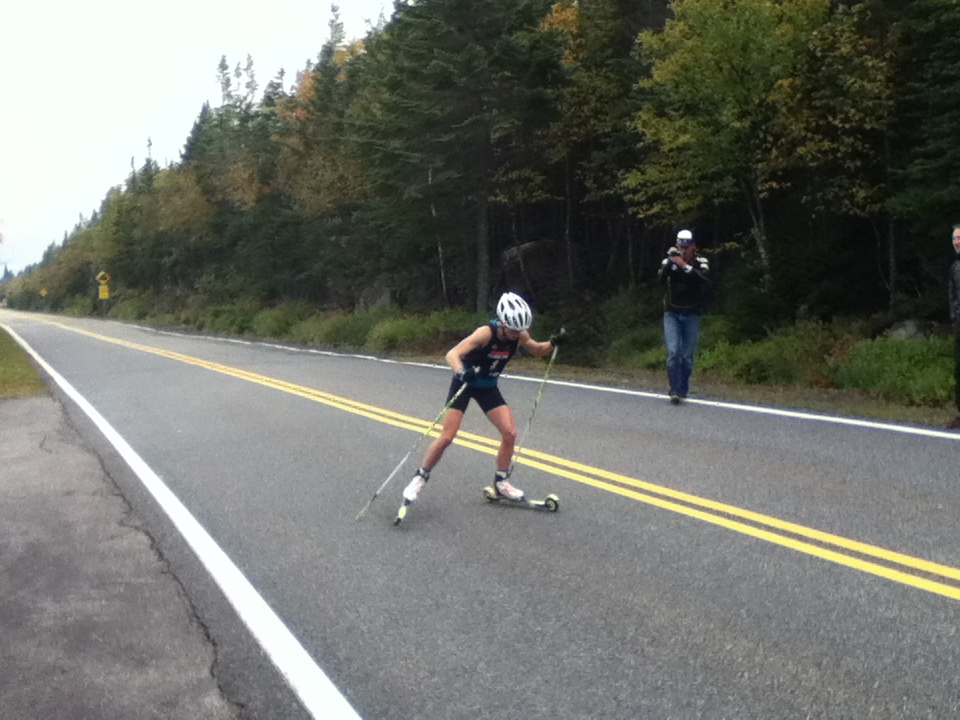
    Liz Stephen celebrates her win and new course record at the 2014 Climb to the Castle. Stephen clocked her fastest time and fifth win at Whiteface Mountain despite a strong headwind and exhaustion at the end of the U.S. Ski Team's training camp in Lake Placid, N.Y.
    Liz Stephen celebrating her win and new course record at the 2014 Climb to the Castle. Stephen has the most women’s wins in 10 years of the Climb, winning five of those races, and also holds the women’s course record.

    For the last decade, the Climb to the Castle has been a fall staple in northeastern New York. It’s been a circled on the calendars of the U.S. Ski Team and US Biathlon national team almost every year since its inception and attracts 75 to 100 no-joke skiers to Wilmington (near Lake Placid, N.Y.) each year.

    Following the 10th annual rollerski race up Whiteface Mountain’s toll road, a five-mile grind with an average 8 percent grade, we thought it would be worth looking at course records and some of the climb’s legendary winners.

    ***

    Most wins: Liz Stephen (5), Duncan Douglas (3)

    Course records: Duncan Douglas (34:56.6) 2007, Liz Stephen (41:50) 2014

    ***

    Paddy Caldwell (black shirt, yellow helmet) of the U.S. Ski Team D-team and SMST2 Team chases Rogan Brown (l) around mile four of five in  Sunday’s Climb to the Castle up Whiteface Mountain in Wilmington, N.Y. Caldwell won the race, followed by biathletes Russell Currier and Tim Burke in second and third, respectively. Brown (SVSEF) placed fourth and Kyle Bratrud (CXC) was fifth. (Photo: Tim Cowan)
    Paddy Caldwell (black shirt, yellow helmet) of the U.S. Ski Team D-team and SMST2 Team chases Rogan Brown (l) around mile four at the 2015 Climb to the Castle. Caldwell won the race, followed by biathletes Russell Currier and Tim Burke in second and third, respectively. Brown (SVSEF) placed fourth and Kyle Bratrud (CXC) was fifth. (Photo: Tim Cowan)

    2007:

    Date: Oct. 13

    Notes: sunny/cold; 25 degrees F

    Men’s top 3:

    1. Duncan Douglas (34:56.6)
    2. Kris Freeman (37:09.1)
    3. Noah Hoffman (38:38.9)

    Women’s top 3:

    1. Liz Stephen (47:22.9)
    2. Morgan Arritola (47:48.8)
    3. Dorcas Wonsavage (49:12.7)

    Complete results


    2008:

    Date: Oct. 6

    Notes: *Shortened course; athletes did not reach summit because of snow.

    Men:

    1. Duncan Douglas (32:26.44*)
    2. Kris Freeman (34:22.90*)
    3. Noah Hoffman (36:56.87*)

    Women:

    1. Caitlin Compton (45:19.91*)
    2. Morgan Arritola (45:27.89*)
    3. Liz Stephen (45:52.83*)

    Results: Men | Women

    Video


    2009: 

    Date: Oct. 7

    Men:

    1. Taylor Fletcher (39:11.54)
    2. Nick Hendrickson (39:25.40)
    3. Kris Freeman (39:49.97)

    Women:

    1. Morgan Arritola (50:54.85)
    2. Liz Stephen (51:09.57)
    3. Ida Sargent (51:23.85)

    Results: Men | Women

    Report | Video


    2010: 

    Date: Oct. 8

    Notes: Clear weather

    Men:

    1. Kris Freeman (38:37)
    2. Noah Hoffman (39:16)
    3. Ben Sim (40:32)

    Women:

    1. Laura Spector (46:58)
    2. Morgan Arritola (48:02)
    3. Liz Stephen (48:43)

    Results: Men | Women

    Women’s report | Men’s video


    2011:

    Date: Sept. 17

    Men:

    1. Kris Freeman (36:18)
    2. Tim Burke (36:29)
    3. Noah Hoffman (37:03)

    Women:

    1. Liz Stephen (44:50)
    2. Ida Sargent (46:14)
    3. Tara Geraghty-Moats (47:43)

    Results: Men | Women

    Womens’ report | Men’s report | Video | Photos


    2012: 

    Date: Sept. 15

    Men:

    1. Tad Elliott (39:28)
    2. Pat O’Brien (39:38)
    3. Julian Dorais (39:46)

    Women:

    1. Liz Stephen (43:33)
    2. Jessie Diggins (48:38)
    3. Ida Sargent (48:55)

    Results: Men | Women

    Women’s report | Men’s report | Notes & Quotes


    2013:

    Date: Sept. 15

    Men:

    1. Tim Burke (37:13)
    2. Simi Hamilton (39:59)
    3. Karl Nygren (40:04)

    Women:

    1. Liz Stephen (42:04)
    2. Caitlin Gregg (45:21)
    3. Ida Sargent (47:19)

    Results: Men | Women

    Report


    2014:

    Date: Sept. 6

    Men:

    1. Tim Burke (38:19)
    2. Russell Currier (39:02)
    3. Welly Ramsey (40:01)

    Women:

    1. Liz Stephen (41:50)
    2. Caitlin Gregg (45:25)
    3. Katharine Ogden (48:12)

    Results: Men | Women

    Report


    2015: 

    Date: Sept. 20

    Men:

    1. Patrick Caldwell (37:05.2)
    2. Russell Currier (37:10.2)
    3. Tim Burke (37:16.7)

    Women:

    1. Mary Rose (45:15.1)
    2. Annelies Cook (45:47.1)
    3. Hannah Dreissigacker (47:21.0)

    Results: Men | Women

    Report


    2016:

    Date: Sept. 18

    Men:

    1. Duncan Douglas (37:15.6)
    2. Russell Currier (37:23.9)
    3. Paul Schommer (40:18.2)

    Women:

    1. Hannah Rieders (55:03.1)
    2. Anna Lehmann (55:18.8)
    3. Madeline Rieders (56:26.4)

    Results: Men | Women

    Report

  • Win #3 for Duncan Douglas, Hannah Rieders Top Woman at Wide-Open Climb to the Castle

    Win #3 for Duncan Douglas, Hannah Rieders Top Woman at Wide-Open Climb to the Castle

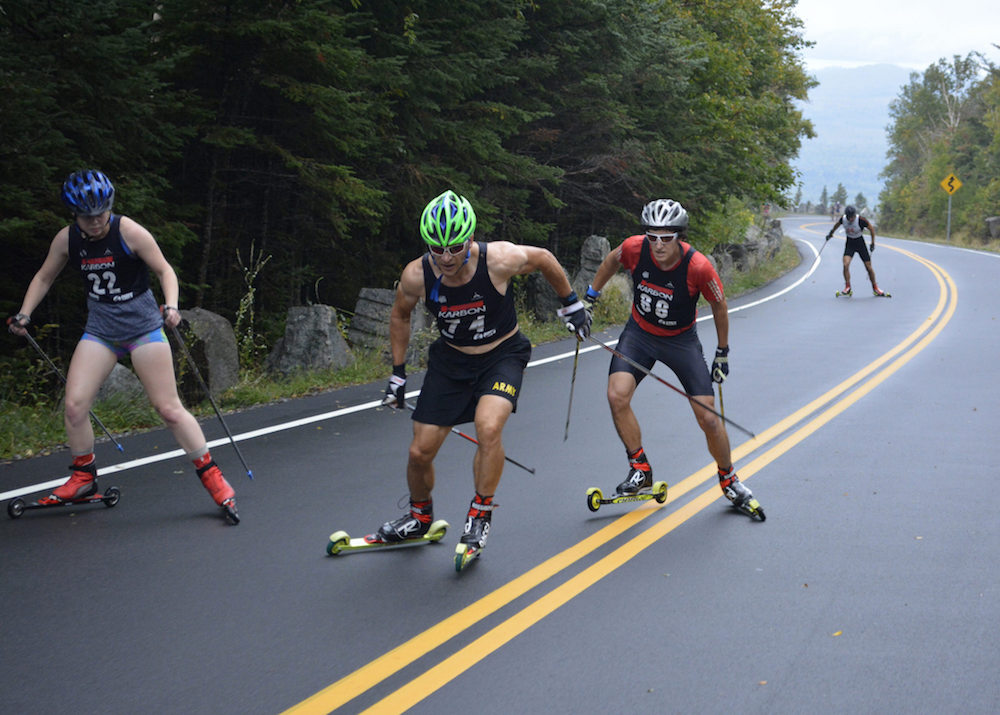
    Duncan Douglas (74) leads biathletes Russell Currier (in red) and Paul Schommer (behind) in Sunday's Climb to the Castle rollerski race up Whiteface Mountain. Douglas held off Currier by eight seconds for his third victory in four times racing the Climb and Schommer finished third. (Photo: NYSEF/Flickr)
    Duncan Douglas (74) leads biathletes Russell Currier (in red) and Paul Schommer (back right) in Sunday’s Climb to the Castle rollerski race up Whiteface Mountain, while Clarkson’s Jenevieve Broadwell (22) looks on. Douglas held off Currier by eight seconds for his third victory in four times racing the Climb and Schommer finished third. (Photo: NYSEF/Flickr)

    (Note: This article has been updated to include comments from third-place finisher Paul Schommer and NYSEF’s cross-country head coach Margaret Maher.)

    WILMINGTON, N.Y. — Four appearances and three wins is an enviable record. On Sunday, 50-year-old Robert Duncan Douglas, the “Jacked Up Old Man” from Honeoye Falls, N.Y., won his third Climb to the Castle (C2C) rollerski race, a five-mile freestyle hill climb up the Whiteface Memorial Highway.

    Douglas previously won the race in 2007 and 2008, with a personal-best time of 34 minutes, 56.6 seconds in 2007 (he was 2 1/2 minutes faster on a shortened course in 2008, when racers were unable to reach the summit because of snow). 

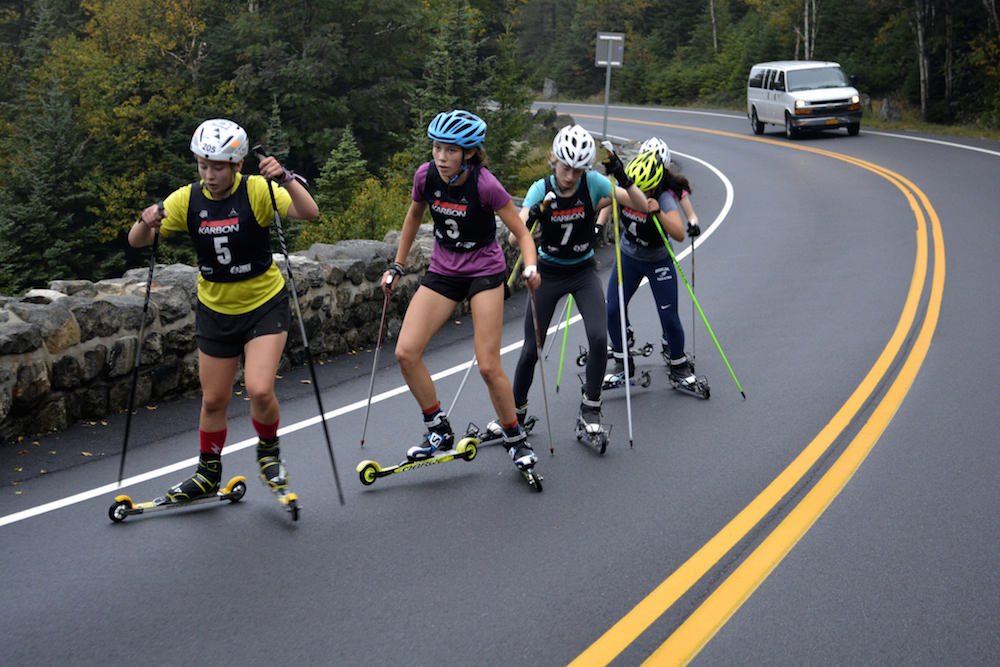
    St. Lawrence's Jackie Garso (5) leads Stratton's Anna Lehmann (3) and CSU's Hannah Rieders (7), Gabby Vandendries (4), and Madeline Rieders (in back)  during the women's Climb to the Castle rollerski race up Whiteface Mountain on Sunday in Wilmington, N.Y. (Photo: NYSEF/Flickr)
    St. Lawrence’s Jackie Garso (5) leads Stratton’s Anna Lehmann (3), and CSU’s Hannah Rieders (7), Gabby Vandendries (4) and Madeline Rieders (in back) during the women’s Climb to the Castle rollerski race up Whiteface Mountain on Sunday in Wilmington, N.Y. (Photo: NYSEF/Flickr)

    Hannah Rieders, a 17-year-old Cambridge Sports Union (CSU) skier whose initial goal was an age-group podium, won her first C2C, on the race’s 10th anniversary.

    Finishing in 37:15.6 this year, Douglas was 8.3 seconds ahead of runner-up Russell Currier, a biathlete who trains with the Outdoor Sports Institute in Maine. Paul Schommer, a senior member of US Biathlon’s National Development Group, placed third overall, 3:02.6 minutes behind Douglas.

    Rieders, a high-school senior from Wellesley, Mass., was the first woman across the line in 55:03.1. She beat Anna Lehmann, a ninth grader representing the Stratton Mountain School (SMS), by 15.7 seconds, and Rieders’s twin, Madeline (also of CSU), finished 1:23.3 minutes back in third.

    “I kind of thought maybe Anna would beat me,” Hannah Rieders said in a post-race interview. “At the start, I just wanted to pace it well. I stayed behind other people for the first three miles.”

    Overnight rain left the road damp. At the toll-booth start in Wilmington, temperatures hovered around 65 degrees under cloudy skies, with sultry humidity. Low clouds at the start turned dense up high near the summit. Unless you were really close to skiers in front of you, it was hard to gauge how far up the road they were, and how much energy one should expend to attack.

    (Story continues below)

    With the U.S. Ski Team wrapping up its New Zealand training camp in New Zealand, and thin representation from elite biathletes, the race was wide open.

    Margaret Maher, head coach of the New York Ski Educational Foundation (NYSEF) cross-country program, explained in an email that she learned in April that the U.S. Ski Team would not be comping to Lake Placid for its usual dryland camp this year. To accommodate the US Biathlon team, she originally scheduled this year’s Climb for next weekend, Sept. 25, but that date conflicted with other races NYSEF’s skiers planned on competing in.

    Maher had to move the race up one week in order for her athletes to attend. Regardless, 85 athletes registered this year, which was on par with the “73-108 athletes” that the race has previously attracted.

    Of the top-five female finishers on Sunday, four were under the age of 18, and Lehmann is a U16. With Jackie Garso (St. Lawrence University) placing fourth and Gabby Vandendries (CSU) finishing fifth, CSU had three in the top five.

    “First time [at C2C] for all three girls,” CSU coach Rob Bradlee wrote in an email. “All three also ran Mt. Washington for the first time in June. Tough kids! I don’t have them do any special prep for this race. Their regular six-days-per-week training clearly is enough to get them ready. All three are very hard workers and have been training hard all summer. I think their results show that.”

    Hannah Rieders explained that five women formed the lead pack. Around mile three, the eventual top three broke away.  They skied together until mile four, “then I went ahead,” Rieders said.

    The women's podium at the 10th Climb to the Castle rollerski race up Whiteface Mountain's Memorial Highway on Sunday in Wilmington, N.Y. With all of the top five under 18, Hannah Rieders (CSU) placed first, Anna Lehmann (SMS) was second, and Madeleine Rieders (CSU) was third. (Photo: NYSEF/Flickr)
    The women’s podium at the 10th Climb to the Castle rollerski race up Whiteface Mountain’s Memorial Highway on Sunday in Wilmington, N.Y. With all of the top five under 18, Hannah Rieders (CSU) placed first, Anna Lehmann (SMS) was second, and Madeleine Rieders (CSU) was third. (Photo: NYSEF/Flickr)

    Madeline Rieders said she skied in the pack until mile three, then pulled away with Hannah and Lehmann. While she lost contact with them on the road, which has an average grade of 8 percent, she maintained a steady gap to the finish and held off fourth place by 50 seconds.

    For the men, it was down to three from the start, according to Currier.

    “Paul, Duncan and I all took turns leading,” he wrote in an email.

    “I’m in better shape this year, but not rollerski shape,” Douglas said.

    For most of the summer, Douglas focused on bike racing, winning his 50-59 age group and placing 25th overall at the Leadville Trail 100 mountain-bike race. He said he just started rollerskiing two weeks before the Climb.

    Douglas, a two-time Olympian who will be 51 in November, had a simple race plan. “Go out, ski hard, have fun,” he reflected.

    For most of the race, Douglas skied with Currier. He dropped Currier once, but the 29-year-old former national-team biathlete regained contact. Douglas said that at the Lake Placid corner – a hard left where the grade eases and one can transition to V2 strides – he broke away to the finish.

    “Once the flat section towards the end started, I wasn’t able to match Duncan’s speed,” Currier wrote. “He was never very far out but enough to make a difference at that point in the race.”

    Of his race, Currier described it as “a solid effort. I really tried to use good technique. For a race that’s nothing but uphill, there’s not much else you can do.”

    In an email, Schommer explained this was his first Climb to the Castle.

    “I went into it with an open mind, knowing that if I killed myself in the first half the second half would be a death march,” the 24-year-old Wisconsin native wrote. “I would say it went decent for me as I was able to stay pretty strong most of the way, despite losing Russell and Duncan about 1.5 miles into the race.”

    The men's podium at the 10th annual Climb to the Castle rollerski race up Whiteface Mountain's Memorial Highway on Sunday in Wilmington, N.Y. Duncan Douglas (c) won, Russell Currier of the Outdoor Sports Institute (r) placed second and Paul Schommer (USBA National Development Group) was third. (Photo: Peter Minde)
    The men’s podium at the 10th Climb to the Castle rollerski race up Whiteface Mountain’s Memorial Highway on Sunday in Wilmington, N.Y. Duncan Douglas (c) won, Russell Currier of the Outdoor Sports Institute (r) placed second and US Biathlon development skier Paul Schommer (l) was third. (Photo: Peter Minde)

    Is the Climb to the Castle a data point for winter fitness?

    “It’s a good, effective workout, really good training,” Currier explained, adding that he didn’t think it was a good indicator of fitness in December or February.

    “I was really happy with how it turned out,” said Adam Glueck, a Ford Sayre U18 skier who finished seventh (+7:52.4) in his first C2C. “I didn’t want to go too hard out of the start. I followed some friends and threw in some double pole to rest my legs.”

    Glueck skied in a small group he eventually lost contact with about halfway through.

    “I managed to catch them on the V2 straight [the Lake Placid corner]. After that, my friend Henry McGrew [eighth overall] was right behind me,” he said. “I had to push hard through the headwind [the last 500 meters] to beat him. I was basically in agony for the last three or four minutes.”

    Agony and clouds: good metaphors for the Climb to the Castle. When athletes returned to the base, the sun was breaking out.

    Results: Men | Women

    Photo gallery

  • NYSEF Whiteface Climb to the Castle on Sunday, Sept. 18

    NYSEF

    Sunday, September 18, 2016 

    Climb to the top of Whiteface, New York’s 5th highest peak for a 360-degree panoramic view of the Adirondacks, New England and Canada

    WILMINGTON, NY – The New York Ski Educational Foundation and the Olympic Regional Development Authority invite athletes to the NYSEF Whiteface Climb to the Castle Rollerski Race on Sunday, September 18 at 8 AM. The course starts at the Whiteface Toll Booth, climbing for 5 miles with an average 8% grade up the Whiteface Memorial Highway to the castle on the summit of Whiteface Mountain, New York’s 5th highest peak with an elevation of 4,867 ft. The race is freestyle technique and athletes will be greeted at the finish with a 360-degree panoramic view of the Adirondacks, New England and Canada.

    This is the 10 year anniversary!

    Please see PDF with race details

    Link to race registration: SkiReg

    Online registration closes Friday, September 16 at 9 AM

    Click here to sign up to volunteer

    Please email margm@nysef.org with questions

  • Wednesday Workout: Quality Level 3 and 4 for the Working Class

    Wednesday Workout: Quality Level 3 and 4 for the Working Class

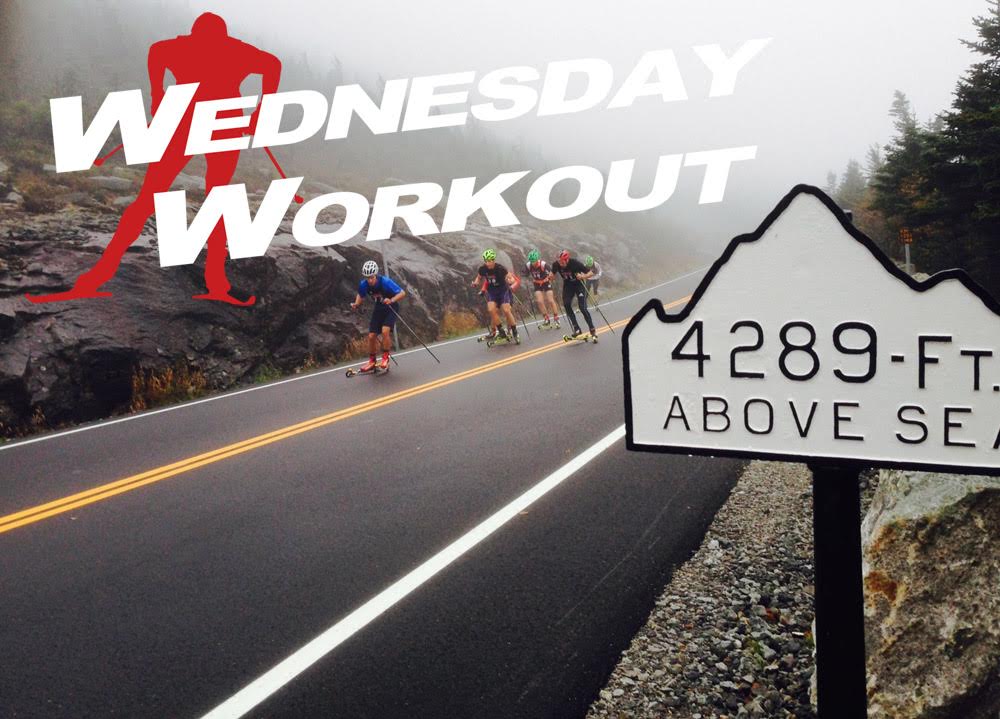
    The leaders in this year's 2015 Climb to the Castle rollerski race up Whiteface Memorial Highway in Wilmington, N.Y. Rogan Brown of the Sun Valley Ski Education Foundation (SVSEF) leads around mile four of five. (Photo: Tim Cowan)
    The leaders in this year’s 2015 Climb to the Castle rollerski race up Whiteface Memorial Highway in Wilmington, N.Y. Rogan Brown of the Sun Valley Ski Education Foundation (SVSEF) leads the top men around mile four of five. (Photo: Tim Cowan)

    On the day after my 58th birthday, I raced the Climb to the Castle. Again. It’s an incredible thrill to be on the same starting line as the best skiers in the U.S., even if I finish towards the back. This year, I finished within 6 seconds of my best time. And for the first time, instead of being totally gassed for the final half mile, I had good energy all the way to the finish.

    Peter Minde nears the finish of the Climb to the Castle in 2011.
    Author Peter Minde nears the finish of the Climb to the Castle in 2011.

    During the dryland season, my goal is to do one Level 4 and one Level 3 workout each week. I hate to admit it, but now there are now some days when my body revolts and says, “Enough! You’re not finishing this interval session.” To that end, I try to make sure I’m really rested.

    I take into account my work and my family commitments as well as the stuff in the training log. I hate conceding workouts, but nowadays, I’d rather do one really good interval workout rather than two mediocre sessions.

    Although I have good terrain for dryland training, I don’t have super long hills. For a Level 4 workout, either running or rollerskiing, I’m going up a hill, back down and repeat. The recovery time is always a little longer than the actual work period. Not best practice, but possibly beneficial at my age.

    “I hate conceding workouts, but nowadays, I’d rather do one really good interval workout rather than two mediocre sessions.” — Peter Minde, FS contributor and annual Climb to Castle competitor

    Workout 1: 5 x 5 Minutes Level 4, Uphill Running

    My bread-and-butter Level 4 workout is five repeats, five minutes, going uphill.

    I do this either running or rollerskiing. It’s OK if the pitch varies, but the final few hundred meters should be the steepest. Generally, I run in the woods, and I use trails that aren’t excessively technical.

    Warm up with dynamic stretching, then run 15 minutes at Level 1 in rolling terrain.

    Then go 5 minutes up your hill at Level 2. Return downhill, and repeat with 5 minutes in Level 3. Finish that, go down, and you’re ready for the main event.

    In the Level 4 section of the workout, I focus on starting in the lower end of my heart-rate range and increase the intensity over each interval. At the base of the hill, I moose hoof the first 30 meters before settling in to a run. During each repeat, I focus on positive self talk.

    Workout 2: 5 x 5 Minutes Level 4, Rollerskiing

    As with the running intervals, look for a long hill. It’s OK if there are rolling or short downhill sections; however, the final section of the hill should be steep enough that you have to check speed – snowplow, traverse, whatever – to return downhill safely.

    Warm up as above. Fifteen minutes in Level 1, followed by 5 minutes of Level 2 and five minutes of Level 3.

    As with running, my goal is to start conservatively and make the last interval the hardest. In addition to positive self talk, I focus on skiing transitions smoothly. If I’m classic rollerskiing, I’ll double pole a flat section and the base of the climb before changing to striding. If I’m skating, I try to V2 as much of the uphill as I can, or V1 the steep bits and switch to V2 where the grade is easier.  Don’t forget the warmdown and stretching.

    Workout 3: 3 x 15 Minutes, Running

    While I do this on rollerskis, I prefer to run, because I’m able to keep recovery times to 3-5 minutes between hard work periods. Find a loop in the woods that takes approximately 14-16 minutes to run.  It should be rolling with some long uphills.

    Warmup: Similar to the Level 4 workouts above. Begin with dynamic stretching, followed by 15 minutes of easy running.

    Ramp up your heart rate to Level 2 for five minutes, then head onto your loop and crank it up to a controlled pace.  In downhills, I pick up the pace to keep my heart rate in the zone.  At the end of 15 minutes, a short connector gives me around five minutes of recovery before the next repeat.

    Then I run easy back to the car, for 15-20 minutes warming down.

  • USST Turns Up the Intensity in Placid, Skipping Sunday’s Climb to Castle

    USST Turns Up the Intensity in Placid, Skipping Sunday’s Climb to Castle

    The women at the USST camp in Lake Placid push each other during some double pole. (photo: Reese Brown)
    The women at the USST camp in Lake Placid, N.Y.,  push each other during some double pole intervals on the rollerski track earlier this week. (Photo: Reese Brown)

    The fall season means many things to the cross-country skiing community. It means the temperatures decrease, the training intensity ramps up, and excitement for winter begins stirring in the soul.

    For well over a decade now, fall for the U.S. Ski Team (USST) has also meant a training camp in Lake Placid, N.Y. Although the team has had camps in New Zealand and Norway not long ago, it still manages to squeeze in a one-week intensity camp before heading to another dryland camp in October in Park City, Utah.

    The national team coaches were already in Lake Placid after hosting the National Coaches’ Education Symposium last weekend, and with half of the USST athletes training with the Stratton Mountain School T2 Team (SMST2) fewer than three hours away, it made sense to have a quick camp at the Olympic Training Center in Lake Placid.

    “We wanted to give them the chance to come to a different venue, get on the rollerski track, and kind of have a check in with them to make sure things are going well technically and recovery wise and everything else,” said USST head coach Chris Grover in a phone interview.

    But the eight national team athletes from the SMST2 Program, Jessie Diggins, Sophie Caldwell, Katherine Ogden, Julia Kern, Andy Newell, Simi Hamilton, Ben Saxton, and Patrick Caldwell, account for a small fraction of the nearly 30 athletes at the camp. Joining the USST is the rest of the SMST2 team, the Sun Valley Gold Team, the National Elite Group (NEG), and the National Training Group (NTG).

    The NEG is made up of the best junior athletes from each region (East, Central, West, Alaska) while the NTG consists of the best U24 and U20 athletes in the United States, based on domestic and international results from last season. The SMST2 domestic team and the Sun Valley Gold Team are made up of elite American skiers not on the national team.

    “The athletes in those clubs are the athletes that are just below the national-team level and aspiring to the national team level,” Grover said. “They are the ones that are knocking on the door and pushing everyone along. It’s really fantastic to have them all here.”

    For all of the non-USST athletes, the camp represents not only an opportunity to train at the Olympic Training Center (OTC), but also the chance to live along side some of the national-team members and see how they train, refuel, and recover. They also receive some technique and training feedback from the national team coaches.

    Andy Newell rollerskis in the colder weather at the USST camp in Lake Placid. (photo: Reese Brown)
    Andy Newell rollerskis through the colder weather. (photo: Reese Brown)

    Because the camp is one week long this year, the group is trying to fit in as much training as possible to get the most out of the venue and one another. On top of a good number of hours, the plan is to have five intensity sessions throughout the week.

    “Obviously if were having a longer camp, 10-day, 12-day, 14-day camp, we have to build in a little more recovery and here we’re just jamming through it and training all seven days. People are taking a break afterwards,” Grover explained.

    In order to fit everything in, the USST is skipping what usually is the highlight event of its camp, the Climb to the Castle rollerski race up Whiteface Mountain in Wilmington. The race goes five miles up the Whiteface Memorial Highway to a castle at the summit and has an average incline of 8 percent. However, this year, the USST coaches felt the race didn’t quite align with the goals of the camp.

    “The Climb to the Castle, as hard as it is to miss it because it is a fantastic event, it just didn’t play well athletically for the needs of the group,” Grover explained. “We wanted to do more sprint specific training and short intensity as opposed to giving up a whole workout or two to do the Climb to the Castle.”

    Also contributing to the decision is the fact that many of the national-team members on the SMST2 team are more sprint-oriented, so the potential benefits of an uphill time trial are not as pronounced for those athletes.

    Meanwhile, many US Biathlon team members will be racing the Climb.

    “Obviously it is unfortunate especially for the organizers that the [U.S. cross-country] ski team is not doing it this year,” US Biathlon women’s coach Jonne Kähkönen wrote in an email. “For us and our athletes; it is one hard session at the end of the test week and in the middle of a tough block of fall training and the goal is always to go all in for these types of sessions — so in terms of that it doesn’t really change anything. We would have liked to have the tough competition there, but understand that it didn’t fit in their plans this time.”
    “As for us; we will have all the athletes that are in 100% health in the race,” Kähkönen added.

    In terms of the differences between this week’s camp and the U.S Ski Team’s two-week camp in Norway, the Lake Placid camp has about three times as many athletes in attendance and the domestic venue really makes for a different approach. In Norway, the group was exploring a new area, but in Lake Placid, the group is back to an old standby.

    “This is obviously a very familiar place to us,” Grover said. “We know all the roads here and all the trails here and that sort of thing. So it’s really easy for us to plan where we are going.”

    So while they had a good time training on new roads and paths in Norway, the group is taking advantage of the more familiar territory in Lake Placid, at least for a week. Next week, the athletes will head home to recover. But for the USST members, the time at home will be short. They have less than a month until their next camp begins in Park City on Oct. 12.

  • NYSEF Whiteface Climb to the Castle Rollerski Race on Sept. 20

    Sunday, September 20, 2015

    Climb to the Castle

    Climb to the top of Whiteface, New York’s 5th highest peak for a 360-degree panoramic view of the Adirondacks, New England and Canada

    NYSEF

    WILMINGTON, N.Y. — The New York Ski Educational Foundation  and the Olympic Regional Development Authority invite athletes to the 9th annual NYSEF Whiteface Climb to the Castle Rollerski Race on Sunday, September 20 at 8 AM. The course starts at the Whiteface Toll Booth, climbing for 5 miles with an average 8% grade up the Whiteface Memorial Highway to the castle on the summit of Whiteface Mountain, New York’s 5th highest peak with an elevation of 4,867 ft. The race is freestyle technique and athletes will be greeted at the finish with a 360-degree panoramic view of the Adirondacks, New England and Canada. Athletes will have excellent road conditions with all new pavement to the summit.

    NEW this year is a team event! Fastest 3 times will be added together to name a Women’s Team Champions and Men’s Team Champions

    Link to race details: 2015 Climb to the Castle

    Link to race registration: AlpineReg

    Online registration closes Friday, September 18 at 9 AM


    Looking to help out at the awesome C2C race? sign up to volunteer here

    Questions? Email Margaret Maher margm@nysef.org

    Countdown to race day has started…watch the preview video here


    Awards by Mt. Borah

    MT Borah

  • Despite Post-Olympic Blues, Stephen Motivated to Conquer the ‘Next Step’

    Despite Post-Olympic Blues, Stephen Motivated to Conquer the ‘Next Step’

    Liz Stephen celebrates her win in the finish area of the 2014 Climb to the Castle. Stephen clocked her fastest climb yet despite a strong headwind and exhaustion from the U.S. Ski Team Lake Placid Training Camp.
    Liz Stephen celebrates her win in the finish area of the 2014 Climb to the Castle. Stephen clocked her fastest climb yet despite a strong headwind and exhaustion from the U.S. Ski Team Lake Placid Training Camp.

    Liz Stephen was expected to win the 2014 Climb to the Castle just as she has been for the previous three years. So when she crossed the finish line over three-and-a-half minutes ahead of the next competitor with her fastest time to date, it was no surprise.

    The 27-year-old has built a resume of impressive results in hill climbs – both domestic and abroad. Apart from her many Climb to the Castle wins, Stephen’s most notable finishes include a podium in the final climb of the 2014 Tour de Ski and a win in the 2014 rollerski hill climb of the acclaimed Norwegian Blink Festival.

    The U.S. women's first skate leg, Liz Stephen holds onto ninth in the Olympic 4 x 5 k relay on Saturday in Sochi, Russia.
    Liz Stephen holds onto ninth in the Olympic 4 x 5 k relay in Sochi, Russia.

    For the East Montpelier, Vt. native, hill climbing has always been always natural.

    “As a kid I loved doing the hardest thing you could think to do,” she told FasterSkier. “For me that was running up a hill.”

    Not much has changed since her childhood days. Now living in Park City, Utah, Stephen can run, ski, or bike for hours without having to descend.

    As her results suggest, Stephen’s challenge-oriented mindset and an inclination toward skating boosted by a small physique and boundless energy have led her to be near unstoppable when it comes to an incline.

    But Stephen is so much more than a hill climber. She’s a teammate. This fact has been recognized throughout her career on the national scene with U.S. Ski Team women’s coach Matt Whitcomb calling her the “glue” of the team in a 2013 ESPN article.

    But even the “glue” of a team can find difficulty in the aftermath of a highly anticipated Olympic year.

    “The Olympics were certainly a let down and it took some extra time to recover from them,” she said, referring to her state of mind after the season ended in March.

    For Stephen it has been challenging to separate her season long results from the Olympics – where she felt both she and her team underperformed.

    “It’s hard to not base a whole season on the Olympics because the year revolved around them,” she said.

    While Stephen noted several remarkable highlights from Sochi, including Sophie Caldwell’s sixth and Jessie Diggins’ eighth place finishes, she said that both she and the team walked away from Russia knowing that things could have gone differently, especially in the women’s relay in which the U.S. placed ninth.

    Liz Stephen practices her bounding technique at the 2014 USST Lake Placid Training Camp.
    Liz Stephen practices her bounding technique at the 2014 USST Lake Placid Training Camp.

    “We had high goals that were legitimate goals for the first time ever,” Stephen explained. “Going into any other Olympics it’s been a ‘if the best case scenario happens then we may have a chance’ where as this year we had results leading up to the Olympics that made our goals a very real possibility.”

    In terms of her personal performances, Stephen was pleased to find success during the Tour de Ski but noted that her results from the season were comparable to the previous year of racing.

    “You always want to make that step up, but sometimes you don’t make it to that next level. There are certainly a lot more steps for me to go, but it wasn’t a year where I made any big ones,” she said.
    Despite a disappointment in her team performance at the Olympics and self-proclaimed stagnation in her personal results, Stephen is not one to remain frustrated. In fact, she believes that disillusionment with results from the Olympics will only boost her personal and team success this season.

    “If you are always getting what you set out to achieve it’s way too easy,” She said. “[Last season] has motivated me, and the team is definitely motivated to go out and kick some butt.”

    Stephen’s “kick butt” strategy includes more than just personal training – an unsurprising fact given her status as the team’s “glue”.

    She hopes that she and the rest of the U.S. Ski Team can use each other’s strengths to progress as a whole. This was apparent at the 2014 USST Lake Placid Training Camp where Stephen was constantly asking teammates like Andy Newell or Ida Sargent for technique advice.

    “An athlete can be the best teacher because we’re actually doing the motions” Liz Stephen explained. “A coach can see it and they can know exactly what to say but for some reason I sometimes can’t compute it.”

    Stephen also hopes to expand this mentality to the international community, which she believes has already begun with recent international exchanges such as Norwegian Celine Brun-Lie’s visit to Alaska earlier this year.

    “I think there’s a big understanding from everybody on the World Cup that everyone can get better,” she said. “Let’s all get better – what’s the worst that can happen? We get pushed harder and get faster.”

  • Gallery: 2014 Climb to the Castle

    Gallery: 2014 Climb to the Castle

    WILMINGTON, N.Y. — Saturday’s Climb to the Castle was a success for both organizers and participants. Despite strong winds, the weather held and skiers were able to ski a challenging 5-mile climb on roads that had been paved just the day before. Take a look at our photo gallery to see the race for yourself.

    Want to read about the action? Check out Saturday’s 2014 Climb to the Castle recap.

  • Diggins Already Back in Action After Straining Foot in Lake Placid

    Diggins Already Back in Action After Straining Foot in Lake Placid

    Jessie Diggins keeps on her strength routine despite a foot injury she suffered while trail running Sept. 14 in Lake Placid, N.Y. Fewer than two weeks later, she was out of the boot and pain free while recovering the muscle strain. (Courtesy photo: jessiediggins.com)
    Jessie Diggins keeps on strength training despite a foot injury she suffered while trail running Sept. 14 in Lake Placid, N.Y. Fewer than two weeks later, she no longer needed the boot and was pain free while recovering the muscle strain between her third and fourth metatarsals. (Photo: jessiediggins.com)

    Jessie Diggins couldn’t recall exactly what happened two weeks ago when she was trail running in Lake Placid, N.Y. Maybe she hit uneven ground, misstepped and rolled her ankle, she couldn’t remember.

    But for the record, the 22-year-old U.S. Ski Team (USST) and Stratton Mountain School T2 Team member reiterated that she didn’t fall. Not this time.
    Regardless, the pain in her right foot was unsurmountable. Diggins had to cut her workout short on the second-to-last day of the USST’s dryland training camp – the day before the culminating Climb to the Castle – and limp back to the car. Fears of a stress fracture swirled in her head.

    Within two hours, Diggins was at the hospital in Lake Placid. Doctors sent her in for an X-ray of her foot, and two hours later, a specialist examined the initial findings – which didn’t show much. The good news: no broken bones as far as the X-ray detected.

    “It was amazing how fast they responded,” Diggins said in a phone interview on Sunday.

    “Our team has kind of a history of dealing with injuries so it was like, woah, let’s just really be super careful,” she added. “They knew it wasn’t a break, but until we got the MRI, we weren’t sure exactly what was going on.”

    Diggins took the cautious route and hobbled around on crutches for the next few days, wearing a boot on her right foot until she could get an MRI in Park City, Utah, her next stop on the training circuit.

    The night of her hospital visit, Diggins reunited with her teammates in the dining area at the Lake Placid Olympic Training Center.

    “I came in on crutches and everyone was like, ‘Oh, what did you do?’ ” she said. “And I was like, ‘I didn’t do that much. Don’t worry, it’s fine.’ I think the worst part was not knowing and worrying that I’d have to take serious time off training.”

    Fortunately for Diggins, who explained she typically pushes through pain and sometimes even injuries – like the bone spurs on her heels early last season – this foot mishap was not something that was going to derail five months of dedicated training.

    In Park City, the MRI revealed that she had strained the muscle between her third and fourth metatarsals, two of five long bones in her foot. USST physical therapist Adam Perrault advised that she prepare for a six- to eight-week recovery. She laughed and told him she could do it in four.

    Last week, Diggins met with a foot specialist in Park City, where she’ll be through the upcoming USST camp from Oct. 7-28 (then she and the team fly up to Canmore, Alberta, for on-snow training). The doctor told her that other than this injury, she has “perfectly good feet.”

    “Anyone who runs has pretty strong bones; it seemed to be just an out-of-the-blue thing,” Diggins said. “I don’t know that much about sprains or how they happen, but before then I felt absolutely no pain. I actually had no warning. … I think somehow, before I felt the pain, I stepped on a root and kind of torqued my foot. I don’t remember doing it, but it certainly could’ve happened.”

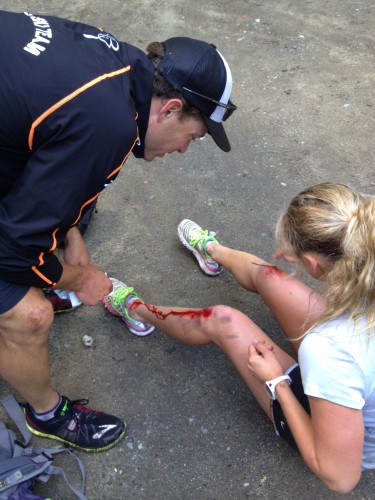
    Jessie Diggins (Stratton Mountain School T2/U.S. Ski Team) with some bloody knees after tripping on an OD trail run in the Adirondacks near Lake Placid, N.Y., in early September. USST women's coach Matt Whitcomb (l) inspects the damage.
    Jessie Diggins (Stratton Mountain School T2/U.S. Ski Team) with some bloody knees after tripping on an OD trail run in the Adirondacks near Lake Placid, N.Y., in early September. USST women’s coach Matt Whitcomb (l) inspects the damage. (Photo: Erika Flowers/jessiediggins.com)

    Earlier in the Lake Placid camp, Diggins had a bloody mishap when she tripped and fell on another trail run in the Adirondacks.

    “In my self-defense, we found this natural waterslide,” she explained.

    Diggins slid headfirst into a pool of water and lost one of her contacts. With blurred vision for the return run back, it was only a matter of time before crashed and burned, she reasoned. Fortunately, the scrapes on both knees weren’t too debilitating.

    “Hopefully I got all my accidents out of the way at that camp,” she said.

    Out of the boot for a while now, Diggins was recently cleared for classic skiing and has been pain free for nearly a week. She never missed a day of training – one if you count the Climb to the Castle – when she did a light session on the spin bike instead.

    “The only thing I hate more than the Climb to the Castle is not doing it,” she said of the grueling rollerski race up Whiteface Mountain’s toll road.

    This year, her roommate and training partner in Park City, Liz Stephen won the race for the third-straight time and set a new course record in the process.

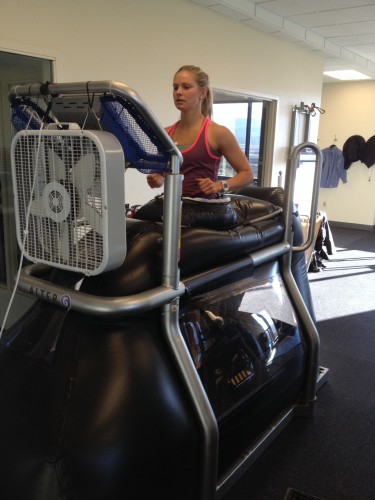
    Over the last two weeks, Diggins has spent plenty of time indoors on the bike, but hasn’t missed much on the skating side of training and could double pole as well. Since the motion of pushing off her toes was most troublesome, she stayed away from bounding and running outdoors, instead taking her striding to the Ultra-G treadmill, which allowed her to run with 70 percent of her body weight.

    “You basically wear these shorts that you zip into the bubble over the treadmill, and the bubble inflates and lifts you up so that you can run at much less than your real body weight,” she explained on her blog. “You can be cruising along at a 6 minute mile pace and barely break a sweat! It’s pretty fun. Especially when Gilmore Girls comes on the TV.”

    On Sunday morning, Diggins went out for a 3 x 20-minute Level 3 rollerski skate workout. The week before, she and Stephen endured two days of blizzard-like conditions and did speeds in a hail storm. The snow quickly melted.

    Jessie Diggins running with 60 percent of her body weight on the Ultra-G treadmill at the Center of Excellence (COE) in Park City, Utah. (Photo: jessiediggins.com)
    Jessie Diggins running with 60 percent of her body weight on the Ultra-G treadmill at the Center of Excellence (COE) in Park City, Utah. (Photo: jessiediggins.com)

    Regardless of the weather, Diggins was glad to be back outside for most of her workouts. She anticipated bounding would have to wait until November, but in the meantime she’ll do classic intervals, and plyos in the pool and on a TumblTrak trampoline at the U.S. Ski and Snowboard Association’s Center of Excellence (COE).

    “I don’t feel derailed at all by it,” Diggins said. “If anything, it gave me a little more motivation. Generally classic striding isn’t something I love so much, but now I’m excited to get out and do it.”

    Above all else, the setback has taught one of the USST’s most promising skiers to roll with the punches and rely on the work she’s put in.

    “The time trials have showed really positive results,” she said. “We found a number of technique things that we’ve improved on and worked on. Every year, I just gain a little more confidence.

    “I’m training hard and I can’t possibly train any harder than I am now,” she added. “Looking back at the summer, I don’t think I could’ve done any more than I did. I’m feeling really happy with that.”

    According to Diggins, her last significant injury came at the beginning of last season when she pushed through the pain of bone spurs on both heels. Doing so caused angst and major discomfort at the December World Cup races in Kuusamo, Finland, where she placed 12th in the 5-kilometer skate race and 24th in the overall mini tour, and Quebec, where she and Kikkan Randall won the freestyle team sprint.

    Her sponsor, Salomon, cut holes in her boots to ease the pain.

    “It was one of those things where it was this annoying thing on my heels, but then you can work through it and then you’re really in trouble,” Diggins recalled. “Suddently right before the race you’re in tears.”

    In Quebec City, she and her coaches determined she needed backless shoes for relief between races. Diggins ventured around town to find some and bought a pair of pink Crocs. So there she was, running around the course and through slush in pink sandals.

    “I had very cold feet,” she said.

    Now that the bumps on her heels are no longer an issue (despite the small remaining lumps), Diggins said she’s more apt to recognize problematic pain.

    “Obviously there’s never a good time to get injured, but that said, if you had to strain your foot sometime, this is like the perfect time,” she said. “I’m at the COE with all these people here to help and I’m getting as much help as I possibly can. That’s a good feeling so I’m right on track.”

  • Convincing Climb to the Castle Wins For Stephen, Burke

    Convincing Climb to the Castle Wins For Stephen, Burke

    Liz Stephen receives encouragement from U.S. Ski Team women's coach Matt Whitcomb while leading the Climb to the Castle rollerski race on Sunday.
    Liz Stephen receives encouragement from U.S. Ski Team women’s coach Matt Whitcomb while leading the Climb to the Castle rollerski race on Sunday.

    WILMINGTON, N.Y. — It didn’t matter that this year’s Climb to the Castle rollerski race fell on the last day of the U.S. Ski Team’s exhausting two-week intensity camp in Lake Placid, N.Y. Liz Stephen (USST/Burke Mountain Academy) was still able to shave a minute and a half off of her winning time from a year ago.

    It took Stephen just over 42 minutes to wind her way up five miles of an eight-percent average grade to the summit of Whiteface Mountain (4,867 feet) Sunday morning. It’s the third straight year Stephen has claimed the title.

    “In these kind of races, the conditions change so much,” Stephen said. “I was just pushing myself today and trying to go as hard as I could.”

    It wasn’t the five-minute margin from last year, but Stephen beat runner-up Caitlin Gregg (Methow Olympic Development) by a commanding 3 minutes and 17 seconds. Stephen strung out the train immediately, seemingly unfazed by the steady wind. Gregg hung on through two miles, but a mile later Stephen had opened a 300-meter gap.

    “My goal was to try and stay with Liz as long as possible,” Gregg said. “I was really impressed. I think Liz was really comfortable V2ing up those steeper sections.”

    Caitlin Gregg tries to keep her technique intact while chasing Climb to the Castle race leader Liz Stephen.
    Caitlin Gregg tries to keep her technique intact while chasing Climb to the Castle race leader Liz Stephen.

    Gregg last competed in the Climb five years ago, when she won on a modified course due to snow on the road in higher elevations. A crisp but dry Sunday gave Gregg her first look at the iconic castle at the finish line.

    “I just didn’t know how long the race was and I got kind of nervous about V2ing all of that,” Gregg said.

    Gregg flew in from Minnesota for the weekend, wanting to gauge her fitness against some of the nation’s best. She said USST women’s coach Matt Whitcomb sent her a copy of the team’s workout plan for the camp, which Gregg wanted to follow to ensure an accurate comparison to her competitors based on fatigue levels.

    “I’ve definitely been training really, really hard,” Gregg said. “It feels really good to get out here and put in a good effort.”

    Ida Sargent (USST/Craftsbury Green Racing Project) pulled away from biathlete Annelies Cook (U.S. Biathlon Association/Maine Winter Sports Center) late to finish third, two minutes back of Gregg. Sargent said she lost sensation in her feet during the race, possibly due to lacing her boots too tight.

    “I was having trouble V2ing, so I just kept trying to take one step after the next,” Sargent said. “It wasn’t exactly how I was hoping it would pan out, but it was a good, hard workout and that’s all that counts.”

    Whitcomb watched the women’s race unfold out the back of a support van.

    “It’s a unique race for us, because it always falls in a different part of the camp,” Whitcomb said. “I was expecting, honestly, to see a little bit more loose ends and ragged technique out here. People kept it together pretty well.”

    Tim Burke’s (USBA) dominance of the men’s race became evident when he had caught nearly all of the women, who started 10 minutes before him, and second place finisher Simi Hamilton (USST) was nowhere in his wake. Burke (37:13) beat Hamilton by 2 minutes and 46 seconds. Karl Nygren (CXC) nearly chased down Hamilton and finished third.

    “I kind of tucked in for the first couple minutes, then wanted to put in a little attack and try to string it out a little bit,” Burke said. “When I attacked, I ended up getting a little break, so I decided to just try and go with it.”

    Video of women’s race by Matt Whitcomb and Steven McCarthy

  • NYSEF Climb to the Castle Rollerski Race

    C2C_logo_2013Sunday, September 15, 2013

    WILMINGTON, NY — The New York Ski Educational Foundation and the Olympic Regional Development Authority host the 7th annual NYSEF Whiteface Climb to the Castle Rollerski Race on Sunday, September 15 at 8:00 am. The course starts at the Whiteface Toll Booth, climbing for 5 miles with an average 8% grade up the Whiteface Memorial Highway to the castle on the summit of Whiteface Mountain, New York’s 5th highest peak with an elevation of 4,867 ft. The race is freestyle technique and athletes will be greeted at the finish with a 360-degree panoramic view of the Adirondacks, New England and Canada. Attendance is expected from the US Ski Team, the US Biathlon Team, the National Elite Group and many top senior and junior racers from around the country.

    See the attached flyer for race details

    Link to online registration (closes Friday 9/13 at 9 am ): https://www.alpinereg.com/EVENTS/store/XC.cfm

    Check out the NYSEF XC webpage for updates: http://www.nysef.org/x-c-biathlon/
    Questions? Email Margaret Maher margm@nysef.org or call the Nordic office at (518) 523-1900


    Climb to the Castle flyer 2013

  • Notes and Quotes: Climb to the Castle Edition

    Notes and Quotes: Climb to the Castle Edition

    The women at the start of Saturday’s Climb to the Castle.

    WILMINGTON, New York — Ahh, September in the Adirondacks. Even when it rains, nothing quite beats a camp featuring long runs in the High Peaks, cliff jumping at the Flume and, most importantly, a five-mile suffer-fest up Whiteface Mountain.

    In case you somehow missed what happened in the Climb to the Castle, Liz Stephen (U.S. Ski Team) demolished the women’s field by over five minutes on the five-mile climb, setting a significant personal record for the course. In the men’s race Tad Elliott (SSCV/USST) played a more tactical game, biding his time in the lead pack until making a break in the second half of the race to win by 10 seconds over Craftsbury’s Pat O’Brien.

    As usual, there were some bits and pieces from our post-race interviews that didn’t make the initial race reports. For your entertainment, we’ve compiled them below.


    On pre-race jitters:

    This is one of those races every year that I get pretty nervous for. Uphill races in general are ones I can do well in and they really hurt — so the combination of all that makes for some stress. The goal today was not to stress about the end but think about all the things I can control and I think I did that pretty well. Joking around at the start was kind of a good thing for me to be doing. I just relaxed because I always have fun when I’m enjoying it.

    I think one of the main things I’m working on is to relax more before races. I tend to get pretty stressed and amped and I think it takes away from a good performance. I’ve thought back to the races where I’ve had my best performances and there’s always been — like at Spring Series — when I’m joking around and enjoying it, enjoying the people around me, enjoying the atmosphere… That’s why I’m doing it, and if I can cannel it on race day, whether the body shows up or not it’s good to have the mind in the right spot.

    — Liz Stephen (1st place)

    On Stephen’s winning margin:

    Liz just took off from the start and was V2ing pretty steep sections. We just couldn’t hold that pace; it was too soon to even think about going that fast for me. I was pretty impressed with her. It’s really awesome to see her skiing so fast at this time of year.

    — Ida Sargent (CGRP/USST, 3rd place)

    Stephen skiing alone.

    On skiing with the group:

    I’ve done this race a couple times and I can’t remember a group of guys staying together that long. It’s pretty nice to see that everyone’s skiing well.

    Most of the guys were [taking turns pulling]; I was not… With two miles to go [Andy] Newell put in a really hard pull. Everyone was kind of looking around and I knew it would be a good place to make an attack.

    — Tad Elliott (1st place)

    It was hard, as usual. I felt like it started pretty fast…personally I was doing more V1 than I typically do.

    We got a group of six to eight out front hammering, taking turns leading. I had a big pull at the front for a while and as soon as I pulled off Tad put on a big attack. And then I pretty much blew up with a mile to go. Pretty similar to what I did last year.

    — Andy Newell (SMS T2/USST, 5th place)

    We were pretty much at Lake Placid corner before I knew it, and I knew it was going to be windy and I didn’t want to be in a group if it was, pushing wind for other people.

    — Pat O’Brien (CGRP, 2nd place)

    The plan was to not lead at all and I ended up leading for two miles, probably… [When] Tad made a move a couple of other guys went with them. It was a bit too quick for me; I dropped off a little bit.

    — Sylvan Ellefson (SSCV, 4th place)

    Elliott emerging from the fog.

    On the weather:

    The conditions were surprisingly good. I thought we’d get a lot of rain and people’s skis would be popping out. But the wind wasn’t as bad as I thought it was. Of course, you come through the notch and you’re just fighting with your head down. There’s that brutal headwind and you’re doing a slow V1 into the finish.

    — Pat O’Brien

    It was a little wet, but I don’t think it really hurt us any. It wasn’t too cold so it wasn’t too bad. It definitely wasn’t last year’s weather, I think the times were probably a little slower because of the water.

    — Sylvan Ellefson

    On skate vs. classic skis:

    Last year I did it classic, but it’s a whole difference race [on skate skis]. And being on skate skis passing people you don’t get quite the looks you do on classic skis.

    — Sylvan Ellefson

    On technique goals:

    I was really trying to think about skiing light and quick. It’s easy to get bogged down in this race since there’s no recovery. You want to keep it light and not build up a lot of lactic acid, keep it controlled and — yeah, just get it over with.

    — Ida Sargent

    Sargent and Diggins look back.

    On the finishing stretch:

    I always think that this stretch is shorter than it is. I was like, “Sweet, I’ve got 200 meters!” And then I started hammering and I was like, “Oh, not sweet.”

    — Jessie Diggins (SMS T2, 2nd place)

    On the Climb, and camp in general:

    The hill climb, for me, has always just been a full-on fitness test. I never play around too much with how I warm up, I don’t do anything fancy. It’s just a hill climb, we don’t do too many of those.

    This is a good time for us to shove each other around a little bit and get ready for the season. All these intensity sessions this week have given us a chance to do that.

    — Sylvan Ellefson


    Results: men and women.

    View our full Climb to the Castle photo album here.


    Related articles:

    Elliott Takes Over Castle Crown

    Stephen Trounces Field in Climb to the Castle


  • Stephen’s Climb to the Castle Margin

    Liz Stephen destroyed the women’s field this weekend in the annual Climb to the Castle rollerski race. The margin, just over 5 minutes in a race that took the leaders between 40-45 minutes is certainly impressive. But I think that margin doesn’t provide much useful information.

    Time trials that are most useful as gauges of performance trends are the ones that have the most stable, repeatable conditions. I believe Climb to the Castle has everyone using identical roller skis (at least that’s my recollection) and that helps. But as noted in the coverage, road and weather conditions can pretty severely impact times. In that light, the fact that Stephen covered the course more than a minute faster than last year in worse conditions is certainly a more reliably good indicator.

    But even then, it’s sort of crucial to note how the race dynamics played out. Stephen skied alone basically the whole way this year. Last year, it sounded like she skied alone for over half the race. That will tend to make those efforts more similar to those produced by a interval start race, which are easier to compare, I think. For example, it’s hard to read much into the fact that Sargent skied around 2.5 minutes slower this time around, since once Stephen was off the front it’s easy for “group racing” mentalities to take over common in mass start events that slow the pace.

    Even if we ignore all that, consider than Sargent and Diggins were around 12.3% and 11.7% behind Stephen. Looks at their head-to-head results from recent history, it’s hard to believe that Stephen really is that much faster than Sargent and Diggins:

    Diggins was actually frequently faster than Stephen last season, and even then it was unusual for the margin between them to be more than 2.5% in either direction. Even Sargent, who had somewhat of a rough season, was almost never more than 10% behind Stephen.

    As a data guy, I’d love to see Climb to the Castle run as an interval start race, which would somewhat improve it’s use as a benchmark, but you’d still have a hard time accounting for differences in weather, particularly wind. But obviously, that’s logistically more complicated.

    Related posts:

    1. <Beitostølen FIS Race Recap: Women
    2. <Climb To The Castle – Men
    3. <Climb To The Castle – Women


  • Stephen Trounces Field in Climb to the Castle

    Stephen Trounces Field in Climb to the Castle

    FasterSkier would like to thank the Mirror Lake Inn for providing lodging and meals in Lake Placid this weekend.

    Liz Stephen (USST) on her way to winning the 2012 Climb to the Castle up Whiteface Mountain in Wilmington, N.Y.

    WILMINGTON, N.Y. — One thing was clear to the women’s field racing the Climb to the Castle on Saturday morning: Liz Stephen (U.S. Ski Team) was not messing around. Her competitors expected a hard effort from the traditionally strong climber, but her half-mile gap on the rest of the field just three miles into the 5-mile race up Whiteface Mountain left no room for doubt that Stephen was in good shape.

    She won the climb just over five minutes ahead of Jessie Diggins (SMS T2/USST) on a cool, windy and misty morning. Last September, the weather on race day was warm and calm by comparison, and yet Stephen beat her own winning time from a year ago by over a minute.

    The Climb to the Castle has come to mark a fall transition for skiers; a switch from high volume training to more focused intensity, an early test against other top U.S. athletes to measure how well summer work is paying off, and a reminder that the racing season is just around the corner. Stephen’s dominant performance sends a clear message: she’s ready for winter.

    USST head coach Chris Grover was surprised at how fast Stephen skied.

    “She’s had one great time trial after another this summer,” he said. “It’s really good for her to know her training’s going so well.”

    Stephen herself didn’t sound surprised at the finish as much as excited. Her plan at the base of the climb had been to not stress about the end result and enjoy the race.

    “I went into it without so much of a plan, I just wanted to ski hard the whole time,” Stephen said at the top. “This race is uncomfortable no matter how you ski it and I was just picturing someone right in front of me. I thought I heard poles the whole time. It’s good to play tricks with your mind because on the World Cup there’s always someone there and every second matters.”

    Stephen hadn’t realized she’d created such a huge lead and kept skiing as if someone would catch up to her at any moment.

    “I was getting some updates, but the fog was heavy. And I’ve seen Jessie come back from minutes back before, so I knew the race was not locked up until the finish line,” she said.

    Diggins knew the fight for the win was over the moment Stephen made her first breakaway.

    Diggins powers through the fog on her way to second place.

    “Liz took off and we were like, ‘Sweet, see ya! Maybe one day we’ll be a climber like you but not today,’ ” Diggins said.

    With Stephen out of reach, the race for second unfolded between Diggins, Ida Sargent (CGRP/USST), Sophie Caldwell (SMS T2), Hannah Dreissigacker (CGRP/USBA) and Clare Egan (CGRP). A fairly strong wind forced skiers to take turns pulling from the front.

    “It was fun to have someone to ski with this year, last year I was by myself,” said Sargent, who finished third. “This year skiing with Jessie was really fun, taking turns leading and just making it to the top as fast as possible.”

    A climb like Whiteface is practically designed to inflict as much pain as possible, so the goal for many skiers on Saturday was to simply maintain it at a manageable level and hope their legs were there for the finish.

    “I think the technique held on until the last five minutes, so I’m pretty happy with the process goals,” Diggins said. She focused on keeping her skiing “light and quick and not bogged down,” but also on practicing her mental approach to racing.

    “When the going gets tough, instead of thinking about, ‘Wow, this hurts, this sucks,’ [I was] thinking about ‘OK, how can I keep my technique together, just keep moving?’ ” Diggins said.

    As hard as the climb was, there is no rest for the weary. The U.S. team had a strength session to look forward within a few hours of finishing the race.

    “That’ll be fascinating to watch,” Diggins said.

    Official Results: NYSEF Climb to the Castle Women

     — Matt Voisin contributed reporting