From the FasterSkier archive — posts syndicated from athletes’ and coaches’ own blogs between 2004 and 2012, kept online as published. Current coverage is at fasterskier.com.

Tag: clostebol

  • Why 18 Months? Inside the Johaug Decision

    Why 18 Months? Inside the Johaug Decision

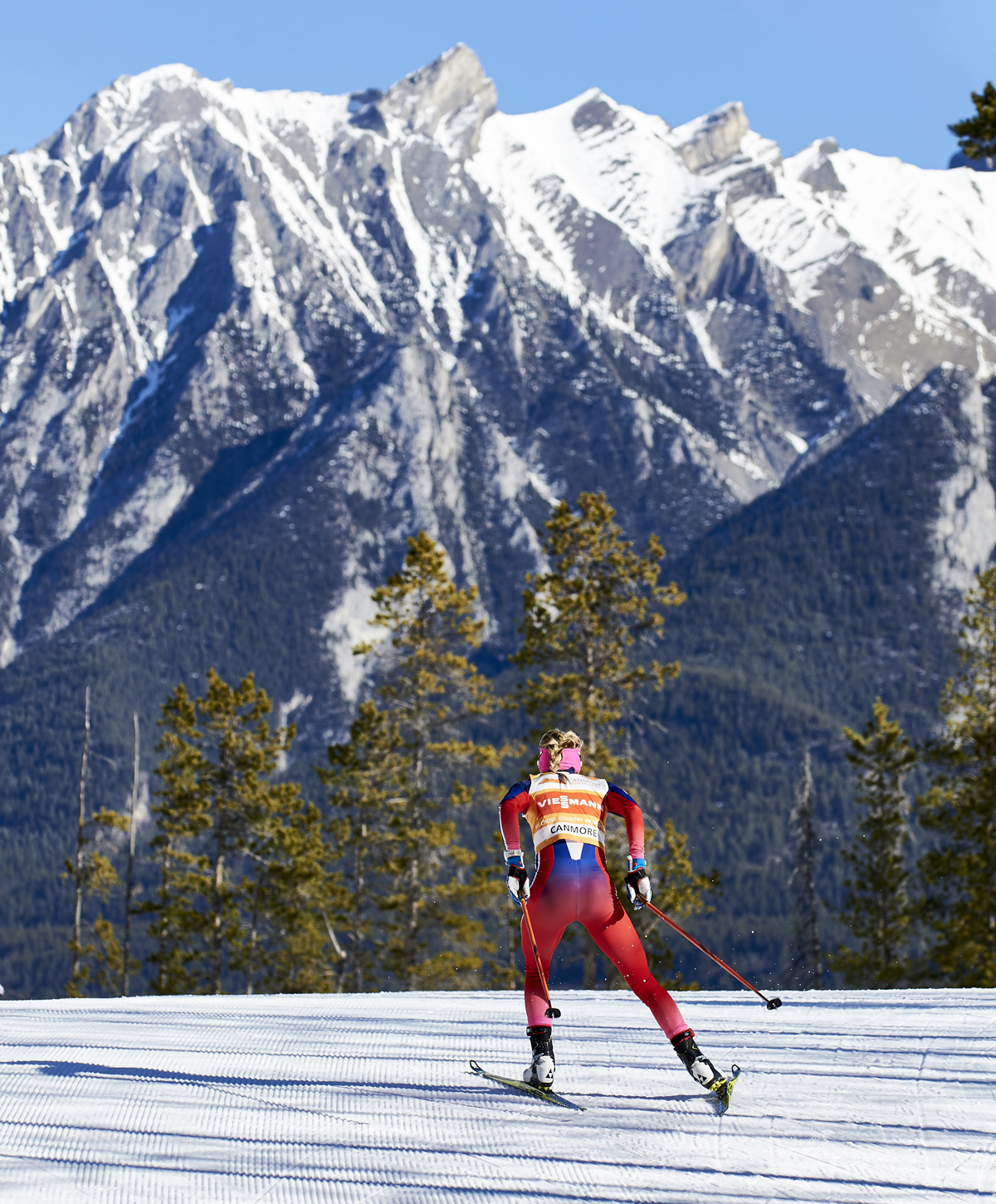
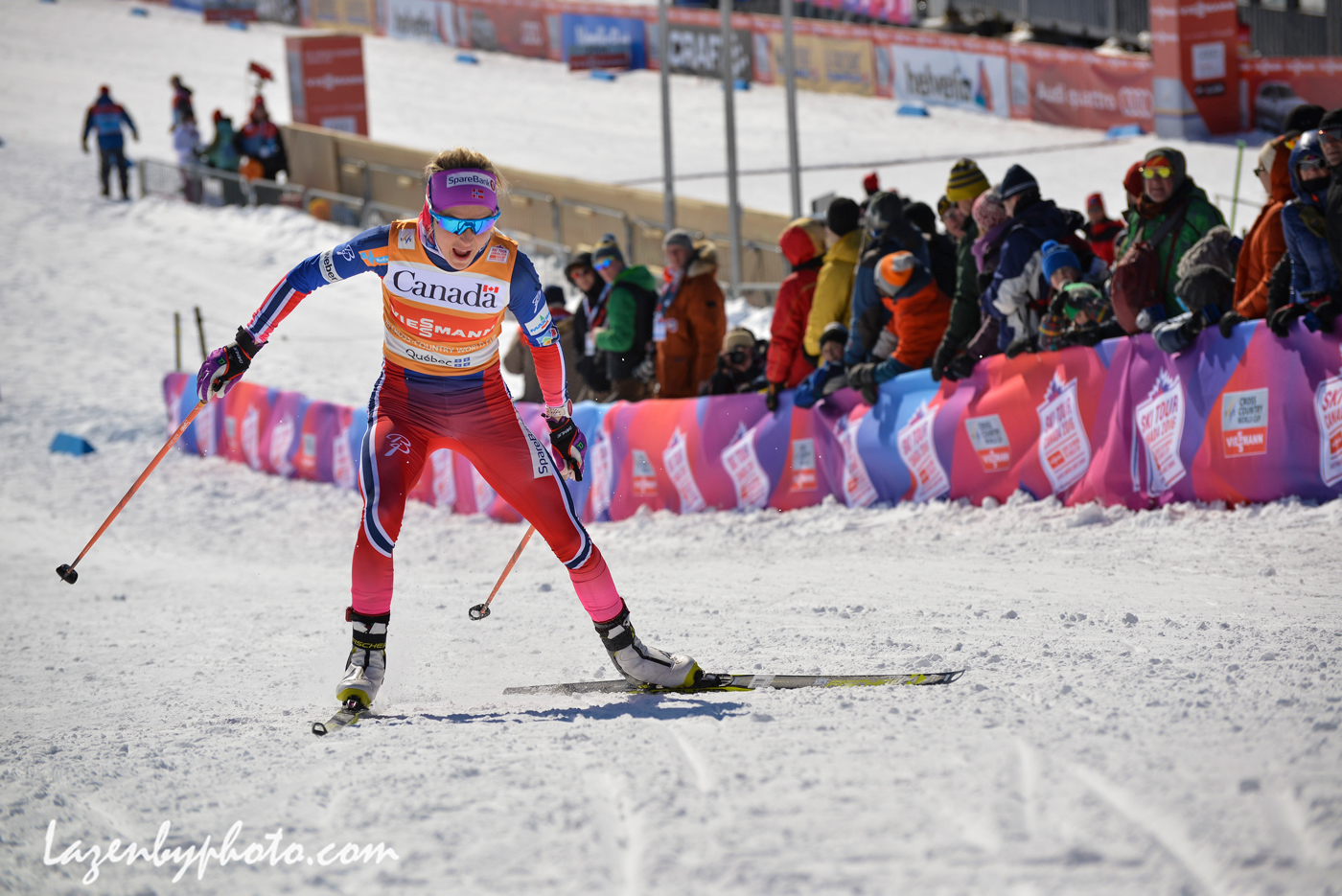
    Norway’s Therese Johaug in the 2016 Ski Tour Canada leader’s bib after two stages of racing. She went on to win the overall Tour. (Photo: John Lazenby/Lazenbyphoto.com)

    As previously reported on FasterSkier, Norwegian superstar Therese Johaug recently saw her suspension increased to 18 months following a ruling from the Court of Arbitration for Sport (CAS) that overturned the 13-month suspension previously imposed by Norwegian anti-doping authorities.

    The math is obvious to any fan of the sport, if absent from the CAS decision: A suspension start date of October 2016 plus 18 months equals April 2018. Johaug will miss the next Winter Olympics in February 2018.

    FasterSkier separately addressed the factual question of what happened that led to Johaug testing positive for the steroid clostebol. That article did not consider the question of why 18 months was the suspension chosen. This piece tries to fill in that gap, by exploring the legal analysis of the CAS decision and the principles that the court applied in reaching this decision.

    This analysis begins by looking at how criminal sentencing usually works, then applies these general principles to Johaug’s case specifically.

    (Wonkish aside: This approach necessarily elides somewhat the distinction between criminal sentencing and a period of ineligibility from sanctioned athletic performance, which is closer to a civil remedy. It is worth emphasizing that Johaug has not been charged with breaking the criminal laws of any country, and is extremely unlikely to face criminal charges. However, the use of the basic principles of criminal sentencing is helpful here by analogy, as a way to think about set ranges of punishment, degrees of fault, and mitigating and aggravating factors.)

    Sentencing Law 101

    Criminal sentencing in American courts follows a basic three-step process. First, what is the crime of which someone has been found culpable, following either a jury trial or (more frequently) the entry of a plea as part of a plea-bargain?
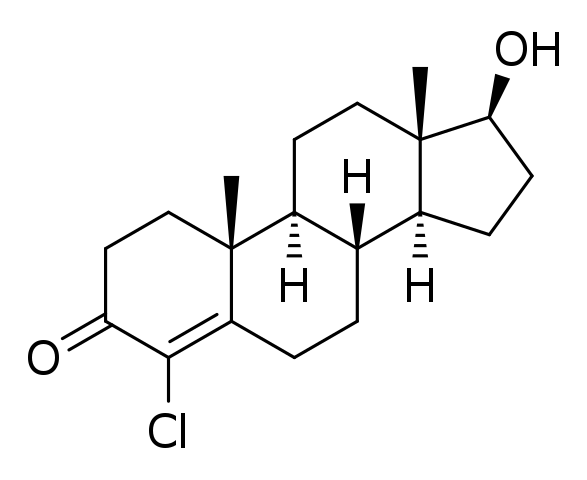
    The chemical structure of clostebol, a synthetic anabolic androgenic steroid. (Photo: Wikimedia Commons)

    Second, what is the sentencing range set for this crime? In state courts, this is a matter of state statute. In federal courts, the federal sentencing grid controls. In either sovereign, there is a gradation of offenses, and different sentencing ranges for more or less serious versions of each crime. For example, there may be a presumptive range of 3-6 years for first-degree assault, 1-3 years for second-degree assault, or 0-1 years for third-degree assault, with the ability to go much higher or lower depending on the specifics of each crime and a defendant’s criminal history.

    And third, once the relevant sentencing range is known, what is the appropriate sentence within that range? And/or is there something so remarkably serious, or not-serious, about this offense that the sentence imposed should be above or below this range?

    Presumptive sentencing ranges represent a compromise between uniformity and discretion. The elimination of unjustified disparity is a central goal of sentencing; within reason, the same people who commit the same type of crime should receive the same type of sentence. But it is also important that the system be able to adapt itself to any particular defendant, and the especially sympathetic or damning facts of a specific case. The law, as they say, is a human enterprise.

    Turning to Johaug: What is the offense?

    Applying these principles to Johaug’s case, Step 1 is easy. The relevant facts about what happened are effectively undisputed.

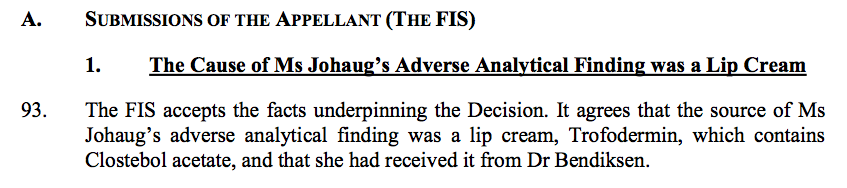
    Here’s the CAS, in its recent written opinion, summarizing FIS’s view of the lower-court decision from the Adjudication Committee of Anti-Doping Norway:
    Excerpt from CAS decision in Therese Johaug case.

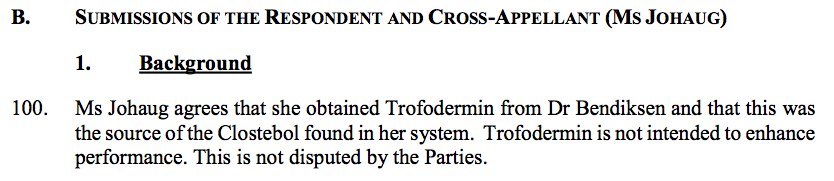
    And here’s Johaug’s view of the facts:
    Excerpt from CAS decision in Therese Johaug case.

    And here’s the court’s take:

    Excerpt from CAS decision in Therese Johaug case.

    Not much to argue about here – however much Johaug was at fault for what happened, everyone agrees that this is what happened. The often-tortured threshold question of how a prohibited substance entered an athlete’s body (think tainted meat, spiked supplements, the chimeric twin theory, etc.) was not an issue here. (See here for more on the facts.)

    What is the appropriate suspension range for this offense?

    Figuring out the baseline range for this offense immediately requires a resolution of the athlete’s mental state (or mens rea, to use the official Latin phrase that literally translates as “guilty mind”). This is because the presumptive suspension range depends on Johaug’s mental state.

    Therese Johaug during an Oct. 2016 press conference on Thursday announcing her positive doping test. (photo: screenshot)

    The central legal question in this case was whether Johaug acted with “No Fault or Negligence” or whether she acted with “No Significant Fault or Negligence.” Johaug argued for the former; FIS argued for the latter. (Spoiler alert: the court agreed with FIS.)

    Fault is defined by the World Anti-Doping Code (WADA Code or Code) as “any breach or duty or any lack of care appropriate to a particular situation.” This is very similar to the definition of this concept in American criminal and civil law.

    No Fault or Negligence, meanwhile, requires the athlete to “establish[] that he or she did not know or suspect, and could not reasonably have known or suspected even with the exercise of utmost caution, that he or she had used or been administered the Prohibited Substance or Prohibited Method or otherwise violated an anti-doping rule.” (Capitalized phrases are defined elsewhere in the Code. The Prohibited Substance, in this case, was clostebol.)

    Notably, the middle clause of that definition, about not being able to know this even after exercising utmost caution, means that “no fault” is another legal term of art. That is, the term has a specialized legal meaning beyond the plain meaning of the normal English words “no fault.”

    In this case, the WADA Code definition of “No Fault or Negligence” is a more difficult standard for an athlete to meet than simply the general, non-legal concept of “no fault” — an athlete has to establish not only that she did not know or suspect something, but also that she could not reasonably have known or suspected this even if she exercised the utmost caution. This is a harder standard to meet than the normal meaning of “no fault.”

    The commentary to Article 10.4 of the WADA Code shows how hard this really is: this article “will only apply in exceptional circumstances, for example, where an Athlete could prove that, despite all due care, he or she was sabotaged by a competitor.” By contrast, the Code notes by way of example, the No Fault standard would not apply in a situation involving “the Administration of a Prohibited Substance by the Athlete’s personal physician or trainer without disclosure to the Athlete.” As the commentary cautions, “Athletes are responsible for their choice of medical personnel and for advising medical personnel that they cannot be given any Prohibited Substance.”

    And finally, No Significant Fault or Negligence adds some degree of culpability to the No Fault standard, but not a significant amount: “The athlete or other Person’s establishing that his or her fault or negligence, when viewed in the totality of the circumstances and taking into account the criteria for no fault or negligence, was not significant in relationship to the anti-doping rule violation.”
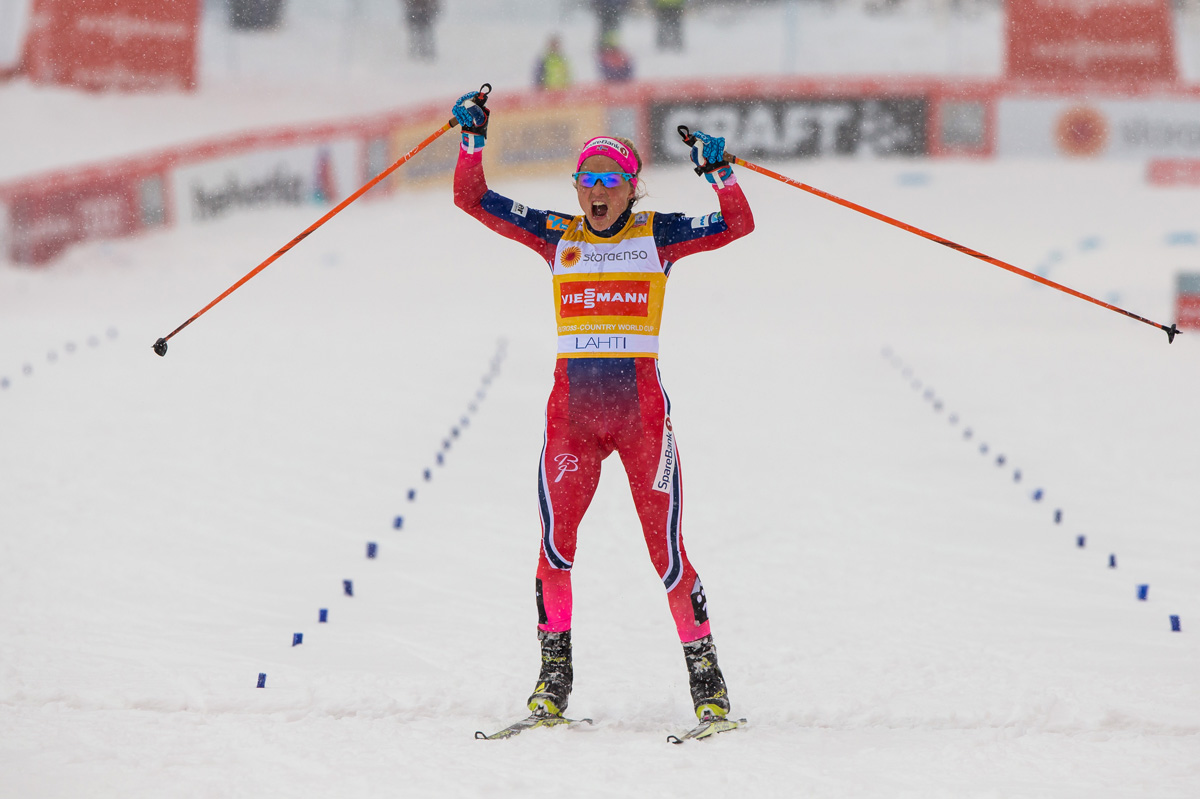
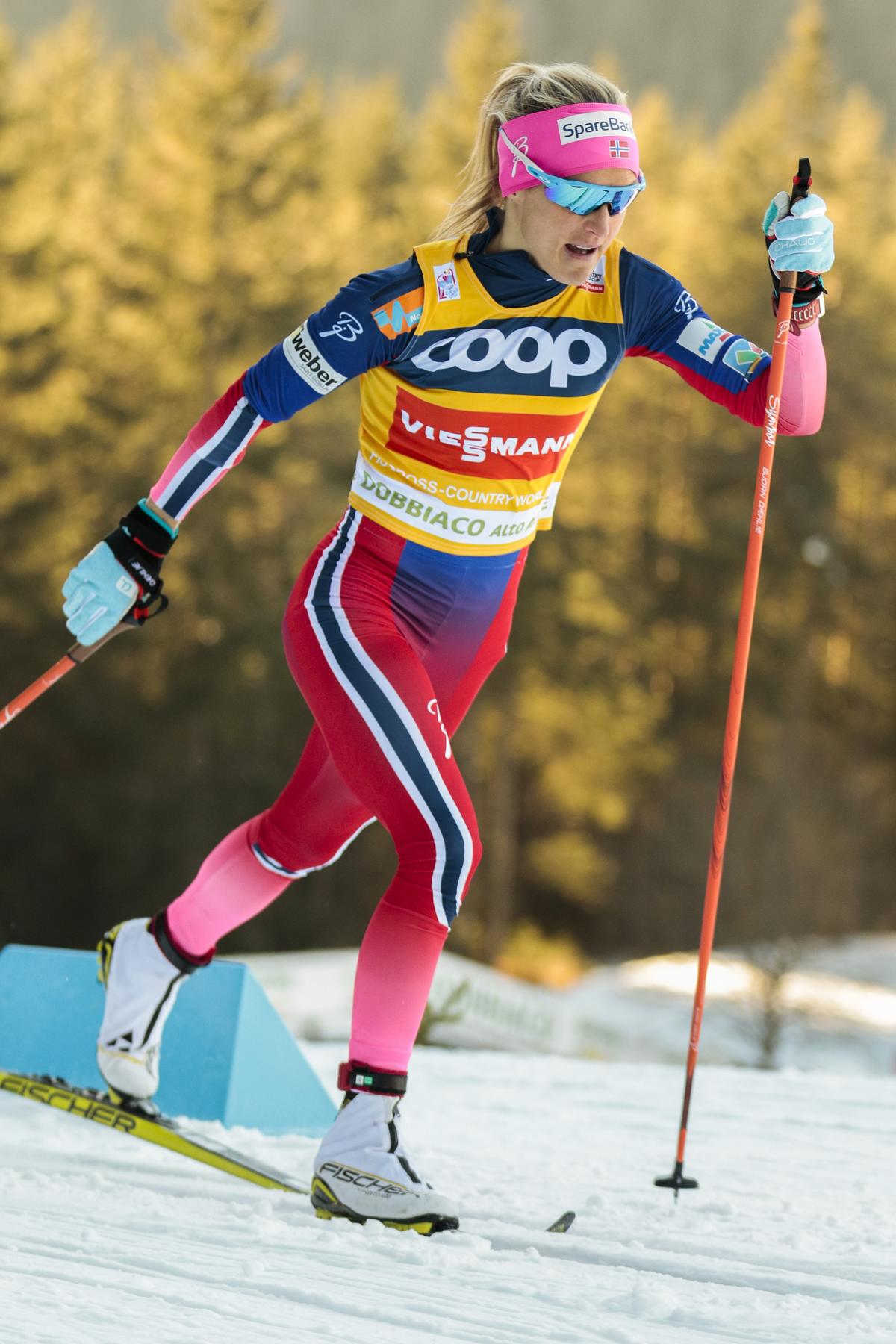
    Norway’s Therese Johaug winning a 15 k skiathlon in Lahti, Finland, for her 15th World Cup victory during the 2015/2016 season. (Photo: Fischer/NordicFocus)

    (“Totality of the circumstances” is a common legal phrase that means, well, exactly what those English words sound like. The emphasis is on everything going on in a case rather than on one thing in particular – a court is directed not to apply a single test to one part of a set of facts, but rather to consider everything that is going on when it makes its decision.)

    Johaug’s arguments about her degree of fault

    Johaug, through her lawyers, argued first that she had acted with no fault. (CAS opinion paragraphs 122-32.)

    She argued, among other things, that she was contractually bound to follow her doctor’s advice, that she had suffered lip sores before and had no reason to suspect that treatment of the same issue would present any risk this time, and that it was very reasonable for her to believe that her doctor had done any necessary checks on the medicine’s legality in the ca. 24 hours that he had it in his possession before he passed it on to Johaug.

    Johaug argued in the alternative that, even if she had acted with some degree of fault, it was so minimal that it should be classified as no significant fault rather than as anything more serious.

    The difference between No Fault and No Significant Fault is hardly academic. The differing levels of culpability translate to vastly different potential suspension ranges.

    If Johaug were able to establish that she bore no fault, then no suspension would be imposed. See WADA Code art. 10.4.

    If, by contrast, she had even the relatively small amount of fault that rose to the level of no significant fault, then she faced a maximum suspension of two years, which could be reduced by no more than half, or down to one year. See WADA Code art. 10.2.1, 10.2.2, 10.5.2.

    And this range (1-2 years) is down from a baseline suspension of four years, the presumptive range for an intentional anti-doping violation (everyone involved in this case agreed that this was not intentional). See WADA Code art. 10.2.1. As we all learned on the elementary school playground, intentions matter.

    (And this will be visited later, but it’s also worth pointing out that the four-year baseline suspension was implemented in 2015; before then, intentional doping offenses earned a two-year suspension. Times change.)

    FIS’s arguments about Johaug’s degree of fault

    FIS had a different view of the significance of Johaug’s doctor’s involvement in this case, and of Johaug’s ability, or lack thereof, to delegate any portion of her anti-doping responsibilities to a third party. FIS highlighted several portions of Johaug’s contract with the Norwegian National Team that seemed to suggest that Johaug retained a personal duty to refrain from using substances that may violate WADA rules.
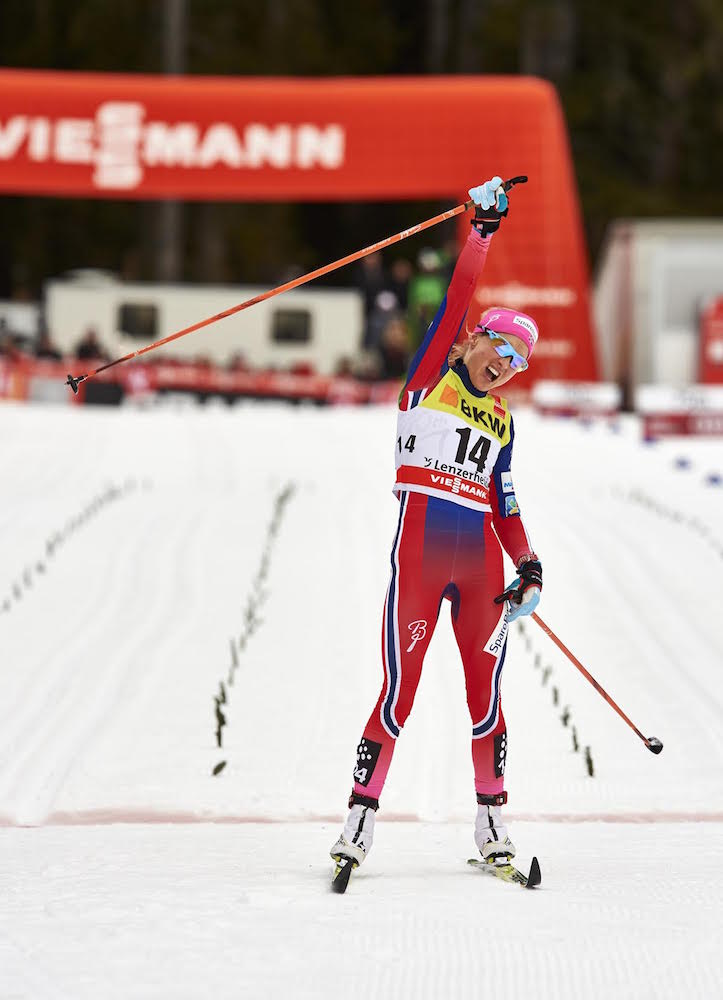
    Norway’s Therese Johaug celebrates at the finish of the 15 k classic mass start in Lenzerheide, Switzerland. She won the race by nearly 38 seconds to take the lead in the 2016 Tour de Ski after the second stage. (Photo: Fischer/NordicFocus)

    As FIS argued, “The duty of care to avoid doping is personal and remained with Ms Johaug at all times.” (para. 155) FIS continued, “The athlete’s personal duty of care may include asking a medically trained person about doping risks of a certain product, but that is only one of several precautions that must be observed. An athlete may not blindly rely on a doctor’s answer, especially when the doping risk is so obvious, as in the present case.” (para. 156)

    FIS outlined several additional steps that it argued Johaug could have taken on her own, such as reviewing the patient information from the Trofodermin package, searching for information about this medicine online, or checking the active ingredients of Trofodermin against the WADA prohibited list. (para. 165) FIS also critiqued Johaug for not completing a required anti-doping education program until after this violation came to light. (para. 173)

    FIS argued that Johaug’s culpability was in the middle range of No Significant Fault, meaning that a suspension of 16-20 months was appropriate. (para. 167-74)

    The court’s decision about Johaug’s degree of fault

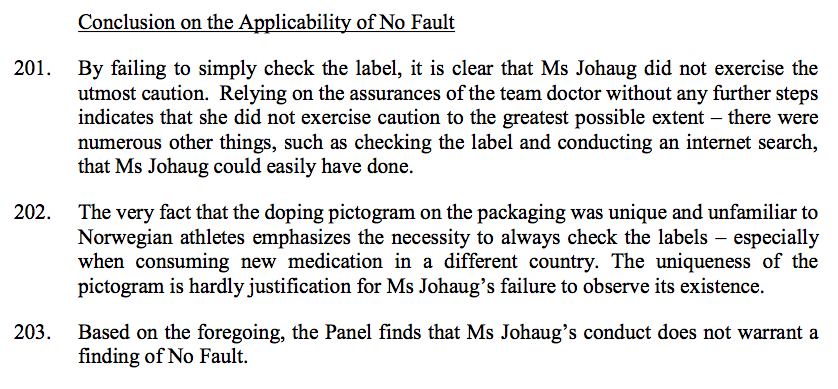
    CAS ultimately found that Johaug had not acted with No Fault. In reference to the “utmost caution” standard in the WADA Code, discussed above, the court noted:
    Excerpt from CAS decision in Therese Johaug case.

    The court based this conclusion on several of its prior decisions, as applied to the facts of Johaug’s case.

    For example, in one case, the athlete applied Trofodermin without checking its content; the CAS panel found that an athlete fails to fulfill his duty of diligence when he or she could have learned that a medicine contained a prohibited substance by reading its packaging or notice of use. In another case, the CAS underscored that an athlete has the personal responsibility to check assurances given by his or her doctor. And in many, many other cases, the court previously held that an athlete has a personal duty of care to comply with anti-doping regulations, and cannot delegate away those responsibilities to a third party such as a team doctor.

    From a policy standpoint, the court observed: “The Panel remarks that if athletes were allowed to escape their personal duty by passing it on completely to an expert in anti-doping (such as a specifically qualified doctor), this could create a more advantageous position for wealthier athletes who have more resources to engage experts, leading to potentially unequal treatment in assessing compliance.” (para. 212)

    What is the appropriate length of suspension within the established range?

    The conclusion that Johaug had acted with no significant fault (or “NSF”) meant that the relevant suspension range was from 12 to 24 months. Within this range, the court made further distinctions as follows: “within the NSF category, a greater degree of fault may lead to a sanction of 20-24 months, a normal degree of fault may lead to a sanction of 16-20 months, and a light degree of fault may lead to 12-16 months.” (para. 208)

    The court found that a normal degree of fault was present in this case, which made for a range of 16-20 months. The court ultimately imposed a suspension at the middle of this range, or 18 months. Johaug would not be going to the Olympics.

    Tangent: About those Olympics, anyway

    We’ll get to what the CAS considered in its decision in a second. But here’s something it officially did not consider: The fact that an 18-month suspension would keep Johaug out through the 2018 Winter Olympics, while a 13-month suspension would not. It begs credulity to suggest that the CAS panel was unaware of Johaug’s Olympic aspirations or the implications of this timing. But the 2018 Olympics appear nowhere in the court’s explanation of its reasoning, and were officially given no weight in its decision.
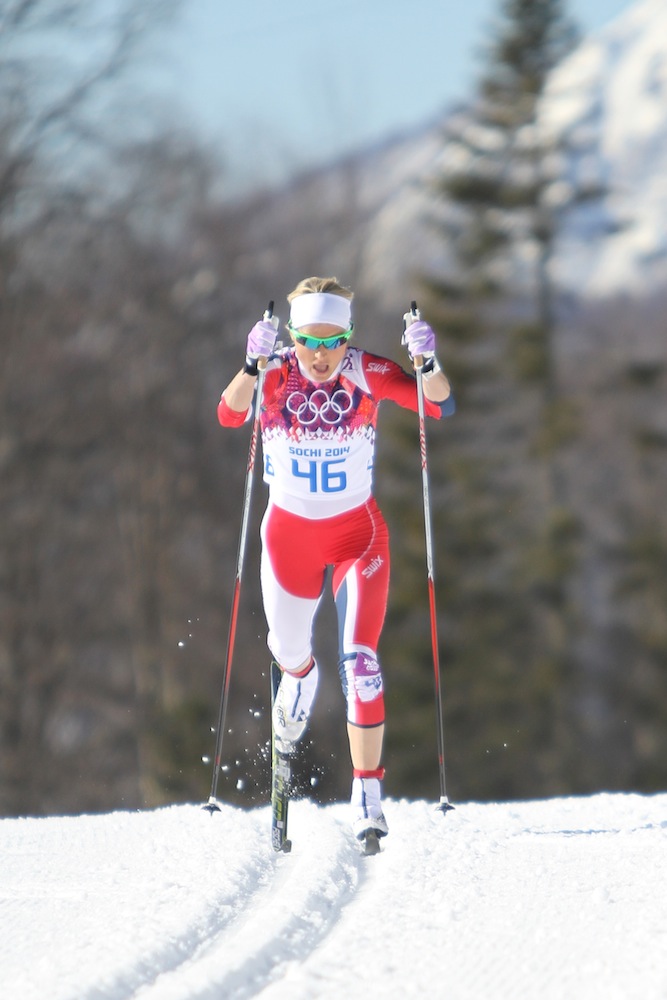
    Norway’s Therese Johaug pushes for bronze in the women’s 10 k classic individual start at the 2014 Olympics in Sochi, Russia.

    This is consonant with the WADA Code. The document makes clear that the determination of an appropriate suspension length should be an abstract one, free from considerations of the implications of a given suspension length: “the fact that the Athlete only has a short time left in his or her career, or the timing of the sporting calendar, would not be relevant factors to be considered in reducing the period of Ineligibility under Article 10.5.1 or 10.5.2.” (WADA Code App. 1)

    Johaug’s attorneys were undeniably aware of issues surrounding the timing of the sporting calendar, and so understandably mentioned this in their appellate arguments. As the CAS summarized, Johaug argued in part that an extension of her suspension period past November 2017 “would negatively impact her chances [of] being selected for the Norwegian Olympic team due to the timing of the race season which starts in November. She explained the importance of the 2018 Olympics for her as she has never won a personal Olympic gold medal.” (para. 223)

    But the CAS found that this was not a “relevant consideration[]” with respect to the appropriate sanction. (para. 224)

    The court cited the WADA Code excerpt given three paragraphs above. It also noted a case from 2010 in which the CAS declined to consider the fact that a cyclist would have difficulty obtaining a contract with a professional cycling team during the 2011 season.

    Back to the appropriate length of suspension

    So what did the court consider? It adopted a suspension scheme from an earlier decision (a 2013 case involving Croatian tennis player Marin Čilić) suggesting that a “normal degree of fault” merited a sanction of 16-20 months. The panel, or at least a majority of it (that is, two out of three members), found that this range applied, “Given Ms Johaug’s overall circumstances.” (para. 208)

    This conclusion was based in part on Johaug’s long experience as an international athlete subject to anti-doping protocols, including taking roughly 140 doping control tests. While the panel was sympathetic to Johaug’s lip injuries and training stress, the court found that she should have been aware of her personal requirements, and should not be allowed to completely delegate her duties to a team doctor.

    Finally, the court considered, but ultimately rejected, Johaug’s argument that a longer suspension would be disproportionate. (The principle of proportionality, the notion that the punishment should fit the crime, is present in both “normal” criminal cases and in CAS cases involving suspensions from athletic competition.)

    Specifically, the court noted Johaug’s claim that punishing her with a suspension of any length would be disproportionate to her fault in this instance, where she simply “did as all athletes are always told to do and as she was contractually obligated” by consulting with her doctor and following his advice.

    But the court reiterated its conclusion that “athletes are required to perform their anti-doping obligations with utmost care, which in practice includes reading labels and packaging as a basic minimum. Further, delegation to a third-party, even to a highly qualified sports doctor, is not an acceptable justification.” (para. 220)

    The court’s conclusion

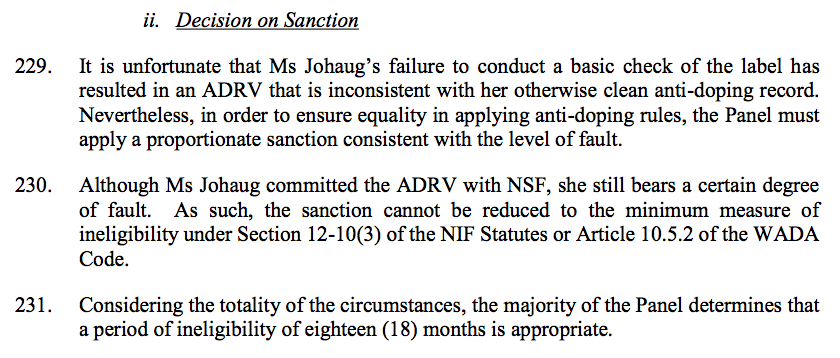
    The final CAS decision reflects a direct application of the WADA Code and a concern for proportionality. As the court concluded:
    Excerpt from CAS decision in Therese Johaug case.

    (“ADRV” means “Anti-Doping Rule Violation.”)

    The court’s conclusion analyzed

    The most important determination in this case, legally speaking, was the conclusion that Johaug had acted with some fault, rather than with no fault. This took the no-suspension provisions of WADA Code Article 10.4 off the table, and meant that the best that Johaug and her lawyers could hope for was the one-half-reduction provisions of WADA Code Article 10.5.2.
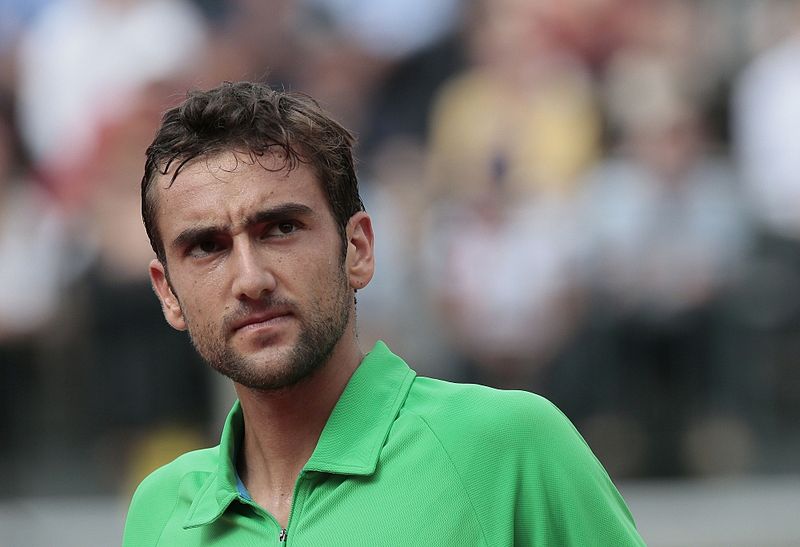
    Croatian tennis player Marin Čilić, shown here in 2012. (Photo: Wikimedia Commons)

    Even within the 12- to 24-month range that was then applicable, the precedential value of the Čilić decision left Johaug’s lawyers with a tough row to hoe. As the Čilić opinion noted, with regard to objective elements of fault, an athlete should take particular care when it comes to the potential ingestion of substances that are prohibited at all times, as was the case here. The Čilić court also called for a higher duty of care when an athlete takes “a medicine designed for a therapeutic purpose,” on the ground that “medicines are known to have prohibited substances in them.” These facts obviously weigh against Johaug on the facts of her case.

    The Čilić decision is potentially more helpful to Johaug when it comes to the subjective element of fault. It lists, for example, language or environmental problems and high levels of stress as mitigating factors, both of which seem favorably applicable to Johaug and her facts.

    But the Čilić panel also noted that the objective element “should be foremost” in distinguishing between significant, normal, and light degrees of fault, with the subjective element then “used to move a particular athlete up or down within that category.” That is precisely what Johaug’s panel did; that took her to 16-20 months, and then to precisely the middle of that range, or 18 months, for a “standard” normal degree of fault.

    Two final thoughts:

    One, even with the exact same initial facts and subsequent legal conclusions, the outcome would have been different three years ago – the Čilić case actually discusses a “normal” fault range of 8-16 months, with a “standard” normal degree of fault meriting a suspension of 12 month. This is because, at the time, a possible sanction for someone in Johaug’s position was 0-24 months, not 12-24 months.

    The increased lower end of the range reflects a revision to this part of the WADA Code effective January 1, 2015. Had all this occurred in the leadup to Sochi, a finding of no significant fault would have led to a suspension of not 18 months but rather 12 months, or obviously less than the 13 months that Anti-Doping Norway originally imposed in Johaug’s case. Revisions to laws (or, literally, to the World Anti-Doping Code) often mean that proportionality in sentencing exists synchronically, but not diachronically.

    And two, everyone involved in this case – not only Johaug, but also the International Ski Federation that sought to see her suspension increased and the CAS panel that decided the case – agreed that the drugs in Johaug’s body were there inadvertently, that Johaug did not intend to cheat, and that she did not gain any competitive advantage from taking this substance. (para. 206)

    And yet, once a finding of no fault was off the table, Johaug was subject to a suspension of at least 12 months, and as much as 24 months. Whether or not this seems like a fair and appropriate outcome, these facts and conclusion illustrate the implications of a strict liability scheme for doping violations.

    * * *

    Disclaimer: The analysis set forth in this article is intended as general news analysis rather than as specific legal advice. While the author is a licensed attorney and a member of the Bar of the State of Alaska, he gives legal advice only following an initial consultation and the formation of an attorney–client relationship. Anyone seeking legal advice specific to their situation is advised to consult with an attorney practicing in that field.

  • After Jamaican Doping News, Johaug (and Others) Should Be Mad

    After Jamaican Doping News, Johaug (and Others) Should Be Mad

    Usain Bolt after winning a gold medal at the 2008 Olympics in Beijing, China. Several Jamaicans tested positive for the steroid clenbuterol at those Games, but the International Olympic Committee hid the cases and they have never been investigated. (Photo: Wikimedia Commons)

    In the beginning of April, news hit that a group of athletes had tested positive for a banned steroid at the 2008 Summer Olympics in Beijing, China. The group had never been investigated or suspended for doping.

    The drug in question? Clenbuterol, a steroid. Its name might be familiar to cross-country skiers because it is often used in inhalers to treat asthma outside of the United States. But even for asthma, its use is prohibited for competitive athletes.

    The positive findings for clenbuterol, which were present in samples from athletes of several nationalities and multiple different sports, included some from the Jamaican track and field team, according to Germany’s ARD television channel.

    The findings were made in a 2016 re-testing scheme of the 2008 Olympic samples. They were never reported by the International Olympic Committee (IOC), and only brought to light by ARD many months later.

    The IOC apparently decided that the traces of the drug in the urine samples were so small that they did not merit follow-up. The World Anti-Doping Agency (WADA) signed off on this decision.

    One problem: like almost all of the drugs on WADA’s Prohibited List, there is no allowable minimum concentration of clenbuterol in a urine sample.

    “Clenbuterol is a prohibited substance and there is no threshold under which this substance is not prohibited,” WADA writes on its own website in a Q&A about the Prohibited List. “At present, and based on expert opinions, there is no plan to introduce a threshold level for clenbuterol. It is possible that under certain circumstance the presence of a low level of clenbuterol in an athlete sample can be the result of food contamination… Under the World Anti-Doping Code, result management of cases foresees the opportunity for an athlete to explain how a prohibited substance entered his/her body.”

    Explanations were apparently never solicited from the athletes in question, and the IOC simply buried the cases.

    Scores of athletes have claimed in the past to have unintentionally ingested banned substances, arguing that the concentrations were so low that they couldn’t be performance-enhancing. It is an argument that has rarely been successful.

    Among the athletes who were punished for unintentional ingestion are Norwegian skier Therese Johaug, who tested positive for clostebol, a steroid contained in a lip cream she used; and German biathlete Evi Sachenbacher-Stehle, whose tea was contaminated with the stimulant methylhexanamine – the same drug Carter was disqualified for – at the 2014 Olympics.

    Therese Johaug has portrayed herself as a victim unfairly punished for using a medication she did not realize was banned. Strict liability mandates that it doesn’t matter if she used clostebol intentionally or not, but that same standard is not being applied to certain Summer Olympic athletes.

    The Jamaican athletes in Beijing never went through the scrutiny that Johaug or Sachenbacher-Stehle did, and are unlikely, at this point, to ever serve penalties. Which begs the question: do the rules apply to everyone?

    Or is it better to take a banned substance at the Olympics than at a training camp?

    The Specter of Tainted Meat

    There is no minimum concentration of clenbuterol allowable in the WADA Prohibited List. So the decision not to confirm the doping cases was not made in accordance within the workflow of anti-doping rules, but instead subjectively.

    This is how it worked: ARD reported that IOC Medical Director Richard Budgett had instituted a policy that any positive analytical tests be cleared with him before being ‘confirmed’, the first step towards proceeding through the anti-doping investigation. These cases were reported to Budgett, and he said not to confirm them.

    The normal procedure is that such positive analytical tests are considered violations and the athlete is given the opportunity to explain how the substance came to be in their body. They can argue that they ingested it accidentally, for example.

    In this case, such an investigation and dialogue never took place. Because the cases were never ‘confirmed’, the IOC did not even confront the athletes.

    According to the IOC, this was because of the risk of the drug entering an athlete’s body after they ate contaminated meat. The steroid is used to promote livestock growth in some countries, and China – the site of the 2008 Olympics – is one of them.

    “It has been scientifically established that an athlete can test positive for clenbuterol at low levels following ingestion of contaminated meat,” WADA wrote in a press release after the documentary aired. “There have been hundreds of cases – limited to a number of countries where contamination is known to be an issue and where the athletes would have resided, trained and/or competed.”

    Another athlete in Beijing – a Polish canoeist – tried to use contaminated meat as an explanation for why he tested positive for clenbuterol. In Adam Seroczyński’s case, the IOC didn’t buy it and punished him anyway.

    “The behavior of the IOC is shameful,” a surprised Seroczyński told ARD after the news of the Jamaican tests came out. “They didn’t handle my case this way, I wasn’t as important.”

    If the IOC had tried to conduct follow-up to establish whether contaminated meat was the most likely explanation for the positive tests, they may have been disappointed. Fearing exactly this situation, the Jamaican sprint team had flown its own meat to China from home, and their food was prepared by the team’s own cook, according to ARD.

    After the fact, WADA explained their decisionmaking process.

    “Effectively, when the circumstances of a positive case indicate that the athlete has been in one of the identified countries where clenbuterol meat contamination is significant, the anti-doping community views it as unreasonable to put the burden of proof on the athlete, i.e. to prove that the meat, which he or she had consumed, was contaminated; in particular, eight years after the fact,” the organization wrote in their press release. “However, before a case is closed on the basis of low clenbuterol levels consistent with contamination, WADA recommends investigating such things as meat intake and whether there was exposure to a geographical area where contaminated meat is known to be prevalent.”

    As noted above, there does not seem to have been much investigation and this policy is directly at odds with WADA’s own policy as posted on its website.

    Are Low Levels Really Accidents?

    To justify the process, the IOC reported that in all of the 2008 clenbuterol cases which were not ‘confirmed’, the concentrations of the drug were below 1 nanogram per milliliter.

    Other athletes have been banned for less; Spanish cyclist Alberto Contador lost his 2010 Tour de France title over a finding of just 0.05 nanograms per milliliter, despite also arguing that he had ingested contaminated meat.

    In fact, in Contador’s case the Court of Arbitration for Sport wrote that “considering that clenbuterol is a non threshold prohibited substance, the fact that the concentration is extremely low does not have any effect on the result.”

    And in the same ruling, the arbitrators ruled out that contaminated meat could possibly be a source for the drug. Noting that that Spain is not a country known to have a problem with clenbuterol contamination, they concluded that “no established facts that would elevate the possibility of meat contamination to an event that could have occurred on a balance of probabilities has been established.”

    Thus, jurisprudence has established that concentrations of the drug can be found in very low concentrations in urine samples even where meat contamination is not a possible explanation.

    Of course this makes sense: as a substance is metabolized, its concentration will decrease. The concentration in a sample is simply a product of the amount ingested, and time. A longer time since ingestion means a low concentration.

    To get back to Therese Johaug: her urine sample, collected by Anti-Doping Norway, contained 13 nanograms of the steroid clostebol per milliliter. While that’s a lot higher than 1 nanogram of clenbuterol, it’s not particularly high.

    In banning her for 13 months, the disciplinary panel did not dispute her explanation that the substance entered her body from a lip cream, rather than an injection or some other more shocking route.

    The public will likely never know whether, in fact, she was using it on purpose; the accidental explanation has been used by many an athlete who later admits that yes, they were doping. But the point of strict liability actually gets exactly to that: it deals with the fact that when you rely on someone’s word, you can never be certain of what actually happened.

    Strict liability is strict liability. WADA’s explanation of its Anti-Doping Code specifically notes that an athlete should be suspended “whether or not the athlete intentionally or unintentionally used a prohibited substance or was negligent or otherwise at fault.”

    Part of the issue of the Russian doping scandal is that for athletes in some parts of the world, strict liability was being applied. But for some in Russia, it wasn’t just that unintentional positives were being forgiven – rather, intentional doping was protected.

    In this new scandal, the IOC – which is charged with ensuring fair competition at the most prestigious sports events in the world, the Summer and Winter Olympics – strict liability only applies sometimes.

    If you were an athlete working hard to stay clean, or even Therese Johaug or Evi Sachenbacher-Stehle, that must not feel great.

  • FIS Appeals Johaug Decision, Seeking Longer Sanction

    FIS Appeals Johaug Decision, Seeking Longer Sanction

    Norway’s Therese Johaug leads teammate Heidi Weng up a climb during the women’s 10 k freestyle pursuit in Quebec City in 2016. Johaug is currently serving a 13-month doping suspension, but the duration of the ban may yet change. (Photo: FlyingPointRoad.com/NNF)

    The International Ski Federation (FIS) is appealing the suspension of Norwegian cross-country skier Therese Johaug. The organization asks for a longer sanction than the-13 month ban she was initially served by the Norwegian Olympic Committee.

    Johaug tested positive for the banned steroid clostebol, which was an ingredient in a lip cream she used to treat a combination of sunburn and cold sore. The Norwegian Olympic Committee had decided that this merited a 13-month suspension, which would see Johaug returning to team training in September and then cleared to compete in the 2018 Olympics.

    The standard penalty for a positive test is a four-year ban, but the length may be reduced if there is deemed to be no significant fault by the athlete. As FasterSkier noted at the time, even considering reductions, 13 months is an unusual duration for a suspension. Many suspensions are in one-year increments, or else in three-month increments for shorter suspensions.

    The concept of strict liability applies to doping cases.

    “The principle of strict liability is applied in situations where urine/blood samples collected from an athlete have produced adverse analytical results,” WADA writes on its website. “It means that each athlete is strictly liable for the substances found in his or her bodily specimen, and that an anti-doping rule violation occurs whenever a prohibited substance (or its metabolites or markers) is found in bodily specimen, whether or not the athlete intentionally or unintentionally used a prohibited substance or was negligent or otherwise at fault.”

    The Norwegian Olympic Committee had decided that Johaug bore reduced fault. In her hearing testimony, she said that a team doctor had given her the medication and told her that it contained no prohibited substances.

    FIS found this claim insufficient to mitigate Johaug’s responsibility, and the federation is heading to the Court of Arbitration for Sport. The World Anti-Doping Agency (WADA) may still also decide to join the appeal.

    “The Committee, when issuing the 13 month suspension, found that Therese Johaug had committed an Anti-Doping Rule Violation and held that she acted not without no fault, but rather with no significant fault,” FIS wrote in a press release. “The evidence before the Committee established that the use of the banned substance was unintentional and based upon the advice of a trusted and reputable doctor. However, the FIS Doping Panel has found that the sanction imposed is on the low end of the range of reasonable sanctions and fails to adequately reflect the fact that the athlete Therese Johaug failed to read the doping warning label printed in red on the package despite the fact that the medication was unknown to her and was purchased in a foreign country.”

    Johaug’s lawyer, Christian Hjorth, told Norwegian broadcaster NRK that Johaug was “disappointed and sad” with the move by FIS.

  • Johaug Receives 13-Month Ban for Positive Doping Test

    Johaug Receives 13-Month Ban for Positive Doping Test

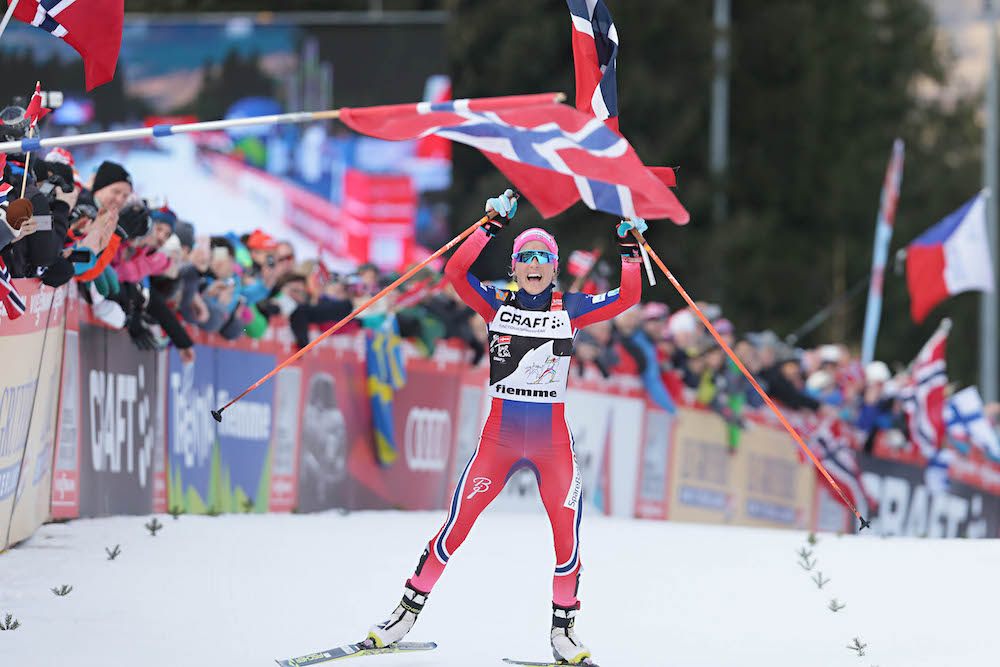
    Norway’s Therese Johaug approaches the finish of the 9 k final climb at the last stage of the 2016 Tour de Ski with enough time to grab a Norwegian flag and celebrate her win. The Norwegian is now serving a 13-month ban for doping. (Photo: Fiemme World Cup)

    The Norwegian Olympic Committee today issued its ruling on Therese Johaug, the cross-country ski star who tested positive for the steroid clostebol.

    “Therese Johaug… loses the right to participate in competitions and organized training, and the right to be an elected or appointed officer, for a period of 13 months, effective from the date the suspension was imposed, 18 October 2016,” the Committee posted in a statement on its website, according to a translation

    Johaug, Anti-Doping Norway (the organization which collected the doping sample), the International Ski Federation, the International Olympic Committee, and the World Anti-Doping Agency could each appeal the ruling to the Court of Arbitration for Sport if they find the penalty to be inappropriate.

    The standard penalty for a positive test is a four-year ban. This length may be reduced in cases where no significant fault by the athlete is identified: athletes have “strict liability” for any prohibited substance which enters their bodies, but the length of the punishment is somewhat adjustable.

    Johaug used a lip cream containing clostebol to treat a severe sunburn. Anti-Doping Norway recommended a 14-month ban.

    Martti Uusitalo, a board member of the International Ski Federation, told Finnish paper Ilta Sanomat that while the federation has not yet made a decision, he thinks they are likely to appeal.

    “This 13-month penalty doesn’t come from the WADA or CAS rules for how decisions should be made,” he said, according to a translation. “Therefore it is best for all parties that the [Court of Arbitration for Sport] professionals examine the process.”

    If the 13-month ban stands, the timeframe would see Johaug ready to compete for the 2017-2018 World Cup season and the 2018 Olympics in PyeongChang, South Korea. While she has not participated in any official national team activities during her suspension, Johaug did go to PyeongChang to train around the time that the World Cup swung through last weekend.

    Suspended athletes are allowed to return to official training two-months before their bans are complete. Norwegian team head Vidar Løfshus told NRK that it will be beneficial for Johaug to be able to rejoin the team starting next September.

    She had been hoping to be able to compete in this season’s World Championships in Lahti, Finland, a scenario that now seems impossible.

    https://www.instagram.com/p/BP8m2bYBHG-/

  • Anti-Doping Norway Seeks 14-Month Suspension for Johaug, Case Ongoing

    Anti-Doping Norway Seeks 14-Month Suspension for Johaug, Case Ongoing

    Norway's Therese Johaug racing to a 28.2-second win in the Toblach World Cup 10 k classic in December 2015. (Photo: Fischer/NordicFocus)
    Norway’s Therese Johaug racing to a 28.2-second win in the Toblach World Cup 10 k classic in December 2015. (Photo: Fischer/NordicFocus)

    The doping case of Norwegian cross-country skier Therese Johaug has come to at least a temporary conclusion, with Anti-Doping Norway recommending a suspension of the star athlete for 14 months.

    Johaug tested positive for the steroid clostebol in a urine sample taken in mid-September. She explained in a press conference that she had been using a lip cream to treat a severe sunburn, and the drug — purchased and provided to her by a team doctor from a pharmacy in Livigno, Italy — contained the banned medication, which is a common ingredient in skin treatments.

    “We have recommended a 14-month ban and that will be sent to the disciplinary panel of the Norwegian Olympic Committee,” Anti-Doping Norway official Niels Kiaer told Reuters. “I expect they will have a hearing in February.”

    The proposed ban would be retroactive to Oct. 18 and last until Dec. 18, 2017, two months before the Winter Olympics in PyeongChang, South Korea.

    NRK reports that the casefile and the recommendation from Anti-Doping Norway will be sent to the Norwegian Olympic Committee, and that Johaug has three weeks to provide her own comment and defense to the disciplinary panel.

    Until that panel issues a decision, Johaug will retain her provisional suspension. It is appearing increasingly unlikely that she will compete at World Championships in Lahti, Finland, in February.

    Johaug had tried to defend herself by saying that she had trusted the judgement and knowledge of the team doctor, Fredrik Bendiksen, and thus had not felt the need to check the ingredients of the medication against the World Anti-Doping Agency (WADA) Prohibited List herself.

    But Anti-Doping Norway was not convinced that she was blameless. Kaier told the Associated Press that “she could have avoided the case by checking the medicine,” since the product is required to be marked with a sticker indicating that it contained a banned substance in order to be sold in Italy. The World Anti-Doping Code has a requirement of ‘strict liability,’ meaning an athlete is responsible for whatever enters their body, whether it is intended to enhance performance or not.

    However, Anti-Doping Norway didn’t completely reject Johaug’s story. The 14-month ban they recommend is a reduction compared to the four-year ban which is standard in intentional doping cases. Anstein Gjengedal, the head of Anti-Doping Norway’s prosecution panel, told NRK that the reduction was because they believed Johaug had not intended to dope.

    Johaug indicated in a Norwegian Ski Federation press release that she will fight the recommended suspension.

    “I take this with a heavy heart, but I accept the circumstances as they are right now,” she said. “I am focused on whats most important, which is working toward a full acquittal. I look forward to a thorough and full treatment of this case as quickly as possible.”

    Anti-Doping Norway wrote that the Bendiksen might be guilty of “negligence,” and that the investigation against him would proceed.

    “So far in this process I have focused on being thorough and honest,” Bendiksen said in the Norwegian team press release, noting that he had been expecting an investigation. “I have already given a detailed statement both to Anti-Doping Norway and during the Ski Federation’s press conference last Thursday. I will continue to be available for Anti-Doping Norway so that all sides of the matter receive adequate attention.”

    The Associated Press translated a reaction from Poland’s Justyna Kowalczyk on Twitter, saying she looked forward to responses from the International Ski Federation (FIS) and WADA, and ending with a hashtag that translates to opening a bag of popcorn.

  • FIS President: Johaug Should Get Four-Year Ban

    FIS President: Johaug Should Get Four-Year Ban

    Therese Johaug celebrates her decisive victory in the second stage of the Ski Tour Canada, the 10.5 k classic mass start in Montreal, Quebec, in 2016. (Photo: Flyingpointroad.com/NNF)
    Therese Johaug celebrates her decisive victory in the second stage of the Ski Tour Canada, the 10.5 k classic mass start in Montreal, Quebec, in 2016. (Photo: Flyingpointroad.com/NNF)

    Interviewed by Norway’s Dagbladet newspaper at the Alpine World Cup opener in Sölden, Austria, International Ski Federation (FIS) President Gian Franco Kasper said that Norwegian cross-country skier Therese Johaug should likely get a four-year ban.

    “It is first a foremost a national case now and it is up to the Norwegians to find a solution,” Kasper said. “After that FIS or WADA may appeal, and we must do so if nothing happens or whatever happens isn’t enough.”

    He said that after receiving a four-year ban, Johaug could appeal to the Court of Arbitration for Sport and perhaps negotiate her suspension down by 12-18 months.

    Johaug tested positive for the anabolic steroid clostebol on September 16, 2016. She has said that the drug was in a lip cream given to her by a team doctor to treat a severe sunburn at a training camp in Italy; Anti-Doping Norway has provisionally suspended her for two months while they investigate the case.

    A final decision on whether and how to suspend Johaug will be taken by the Arbitration Committee of the Norwegian Olympic Committee. While Johaug could appeal the case to the Court of Arbitration for Sport if she feels the suspension is unfairly harsh – and she has signaled that she likely would, as she considers herself completely innocent – either the World Anti-Doping Agency (WADA) or FIS could also appeal the case if they believe that the World Anti-Doping Code has not been correctly applied by the arbitrators.

    While admitting that he had seen no details of the case, Kasper said that FIS would do just that.

    “Normally, if she is guilty, it is very clear that she should receive a 4-year ban,” Kasper said, according to a translation. “There really is no question about that. And then she can appeal to the courts, and normally she would then have her punishment reduced to 2 and ½  or 3-years, but that’s really just speculating.”

    Christian Hjort, Johaug’s lawyer, found it inappropriate for Kasper to comment on the case without having seen documents from the investigation, which is headed by another governing body and is not associated with his own organization.

    “I reacted strongly to FIS boss’s statements in advance of a pending case… This shows an alarming lack of understanding of [organizations’] roles and little confidence in their own judging bodies,” Hjort told Norwegian newspaper VG. 

    Kasper also said that he didn’t totally buy Johaug’s explanation that Trofodermin, a lip cream, caused her positive test.

    “Listen, I haven’t seen the evidence,” he said. “That’ll be up to the medical experts to determine, but I have my doubts. Now, doubt doesn’t necessarily mean anything so we need to get all the facts on the table.”

    Norwegian team doctor Fredrik Bendiksen – who has since resigned his position – allegedly bought Trofodermin at an Italian pharmacy and told Johaug that it did not contain anything banned by WADA.

    Medications which contain prohibited substances are required to be labeled in Italy. Multiple sources have traveled to Italy to buy the drug, and all reported that the cardboard packaging contains a label warning of doping. The label is not visible on the front (display side) of the package, but is prominent on the back: “If the packets that there are pictures of now are the same as what Johaug’s doctor purchased, one can’t know what to believe,” TV2’s Mads Kaggestad said. “You would have to be blind not to see it. It is not possible not to see it.”

    Nevertheless, Bendiksen says that he cannot remember seeing the warning, and the ski federation no longer has the cardboard packaging to determine whether the label was in fact lacking. There is no labeling on the tube of medication itself. However, Norwegian Olympic Committee statutes require that athletes investigate any medication they take to make sure that it does not contain prohibited substances.

    Antidoping Norway has stated that the concentration of clostebol found in Johaug’s urine sample was low enough to be consistent with use through a skin cream, although that does not rule out other possible mechanisms of use.

    FIS had previously expressed frustration regarding how Norway handled the case. Antidoping Norway did not notify FIS before the case was made public, which happened while Kasper and FIS Secretary General Sarah Lewis were at meetings in Finland.

    “I wasn’t happy about the way I was informed of the case,” Kasper said. “I was in a room full of journalists in Lahti and in the middle of my speech this guy raises his arm and calls out that Johaug had tested positive. And I’m giving a speech about doping, it was strange time to be informed.”

    And that weekend, Lewis had told the media that “the Norwegian Ski Federation is facing some major challenges.”

    Kasper agreed in the new Dagbladet interview, and said that he hoped the Norwegians would undertake the case with care.

    “They’re doing what they can, but luckily they haven’t got much experience from similar cases,” he said of Anti-Doing Norway. “Up until now there’s no discussion about that but it really depends on what they do in the next couple of months. If they acquit the poor girl without any disucussion we will of course take action. If they can prove that she is innocent that would be nice but we’ll see.”

    FIS was directly responsible for the case of Johaug’s teammate Martin Johnsrud Sundby. In that case, the ski federation did not issue a four year ban and let Sundby appeal. Rather, FIS concluded that Sundby had not broken any rules by using high doses of the asthma medication salbutamol. WADA appealed the case to the Court of Arbitration for Sport, and Sundby ultimately served a two-month ban.

    Kasper now appears to be calling for a ban more than ten times as long for Johaug.

    “We’ve had a year full of other doping cases so this is just two more cases that have appeared,” he continued. “I hope that it is a coincidence that they appear now because Norway has alays been a great example to us when it comes to dealing with doping. It is clear that they may have been unfortunate, but I never trust anyone in doping related matters. You never know what happens behind closed doors.”

  • Johaug News Stuns U.S. Women’s Team; Saarinen Takes to Social Media

    Johaug News Stuns U.S. Women’s Team; Saarinen Takes to Social Media

    American Jessie Diggins (r) with Norway's Therese Johaug (c) and Astrid Uhrenholdt Jacobsen (l) all smile after placing third, first, and second, respectively, in the women's 10 k freestyle individual start on Saturday in Nove Mesto, Czech Republic.
    American Jessie Diggins (r) posing for a podium photo with Norway’s Therese Johaug (c) and Astrid Uhrenholdt Jacobsen (l) after the women’s 10 k freestyle in January 2016 in Nove Mesto, Czech Republic. Johaug won, Jacobsen was second and Diggins placed third.

    The morning news broke about Norwegian cross-country skier Therese Johaug’s positive drug test last week, emails circulated among the U.S. women’s ski team. Most of its athletes were stunned.

    “Johaug’s positive test hit our women’s team pretty hard. We got a group email going first thing that morning so everyone had a good balance of information to wake up to,” U.S. women’s coach Matt Whitcomb explained in an email to FasterSkier on Sunday. “There has been a combination of disbelief that a mistake like this could happen again from Norway, but for the most part, our athletes are sympathetic to Therese. They know how easy it would be to take the wrong cold medication when your head is pounding and you haven’t slept in three days, or to take the wrong cream when you just want your lips to stop bleeding. Therese will continue to be a role model and friend to our team. She is not a cheater.”

    That was the overarching message of Whitcomb’s 1,000-word email in response to the news about Johaug, a two-time overall World Cup champion and Olympic and World Championships gold medalist. She used the banned steroid clostebol in the form of a lip cream to treat her badly sunburned lips and was visited by doping control officers on Sept. 16. She told the officers she was using the lip cream Trofodermin, which she obtained from an Italian pharmacy while training in Livigno, but apparently did not realize it contained a banned substance. Her doctor bought the medication and reportedly assured her that it didn’t contain anything on the World Anti-Doping Agency (WADA) Prohibited List.

    But it did — clostebol — and Johaug was informed of her positive test on Oct. 3. Today, Anti-Doping Norway, the first to handle the case, issued Johaug a two-month provisional suspension from competition and organized training until Dec. 18. Her case is now in the Norwegian Olympic Committee’s hands.

    Is that fair? This past weekend, we asked three U.S. women’s team members previously sponsored by Johaug’s clothing line (they wore her gloves for two seasons, but switched to other companies this spring for reasons unrelated to this case), what they thought.

    Jessie Diggins, who now wears Swix gloves for reasons outlined below, requested that her email response be used in its entirety. On Sunday, she wrote:

    “I believe that this was an honest mistake, and I feel really badly for her [Johaug]. Everyone in the world has had the experience of trusting someone when they perhaps shouldn’t have, and and it makes you realize how lucky most people are that any simple mistake they make won’t cause them to be eviscerated in international press. And they’re lucky as hell not to have their medical history up for debate by people like the ones who comment on FasterSkier.

    Even answering questions for this article will open me up for criticism, because people feel they have a right to pass judgement immediately on situations that they’ve never been a part of, and will never know all the details about. It’s one of the hardest things about being an athlete – giving up the right to defend yourself against people who will hate you because you’re good at your job, and then hate you for not being good at your job all the time.

    But if I can say something directly to the people so quick to attack Johaug? Leave her alone. Let it go. It was an honest mistake, and guess what? She doesn’t win races by MINUTES because of any lip cream, she wins because she’s an amazing skier and very good at racing, and she works incredibly hard. I’ve seen how hard she trains and how much she cares about her teammates and I have a lot of respect for her.

    I got to know Therese a little bit over the past year and she’s a pretty amazing person. I used to race on her gloves before switching to Swix gloves – not because of anything personal, simply because her ‘Johaug’ brand was focusing more on the clothing and Swix offered me a chance to make a fun design for myself on their gloves. And when I switched to Swix poles, I wanted to go in 100% and do the gloves, too. I loved that Therese donates a percentage of every glove sold to Active Against Cancer (I’m sure I’m not spelling it correctly when translated to English) and all the great things she’s done for sport shouldn’t be overshadowed by recent events.

    I don’t think Therese should be banned from racing, because I believe that it was an honest mistake. When I toe the line in a World Cup, I want to race against the best in the world, and it won’t be the best unless she’s there racing. I don’t believe that the amount of clostebol she may have accidentally ingested through her lips would give her an advantage, and as a fellow athlete racing the World Cup I feel like I have just as good a chance at racing her as I did last year. If an athlete knowingly dopes and gains a serious advantage from it, well, that’s another story, but in this case I firmly believe she should be allowed to compete.

    This is any athlete’s worst nightmare. According to an article by FasterSkier, the drug Therese tested positive for is amazingly sensitive ‘and there are documented cases of test subjects who had never taken the drug having it show in urine samples after eating meat from animals raised on the substance.’ So, as an athlete, it really makes me paranoid to do something as simple as eat a steak. I went back and re-checked all medications I’ve ever taken, even something as simple as vitamin C. Staff members have advised me on what to take when I’m sick on the road and in a foreign country, for example, but I always look it up on globaldro.com, a site where you can check (for US athletes, at least), the status of medications. But when you’re sick and tired and it’s someone you trust handing you an aspirin pill? Yeah, you want to just take it right away. The instinct to be suspicious and not trust people just isn’t there. And it’s definitely not something most people ever have to think about. It feels wrong to train the instinct to go and fact-check your doctors whom you know care about you and support you 100%, but that’s what you have to do.”

    Sophie Caldwell and Liz Stephen both switched to Toko gloves this spring, with Caldwell explaining that it had “nothing to do with the recent news, just because Johaug is moving into more products than just gloves and looking to support athletes who can also wear the clothing and Toko seemed like a better fit for me…”

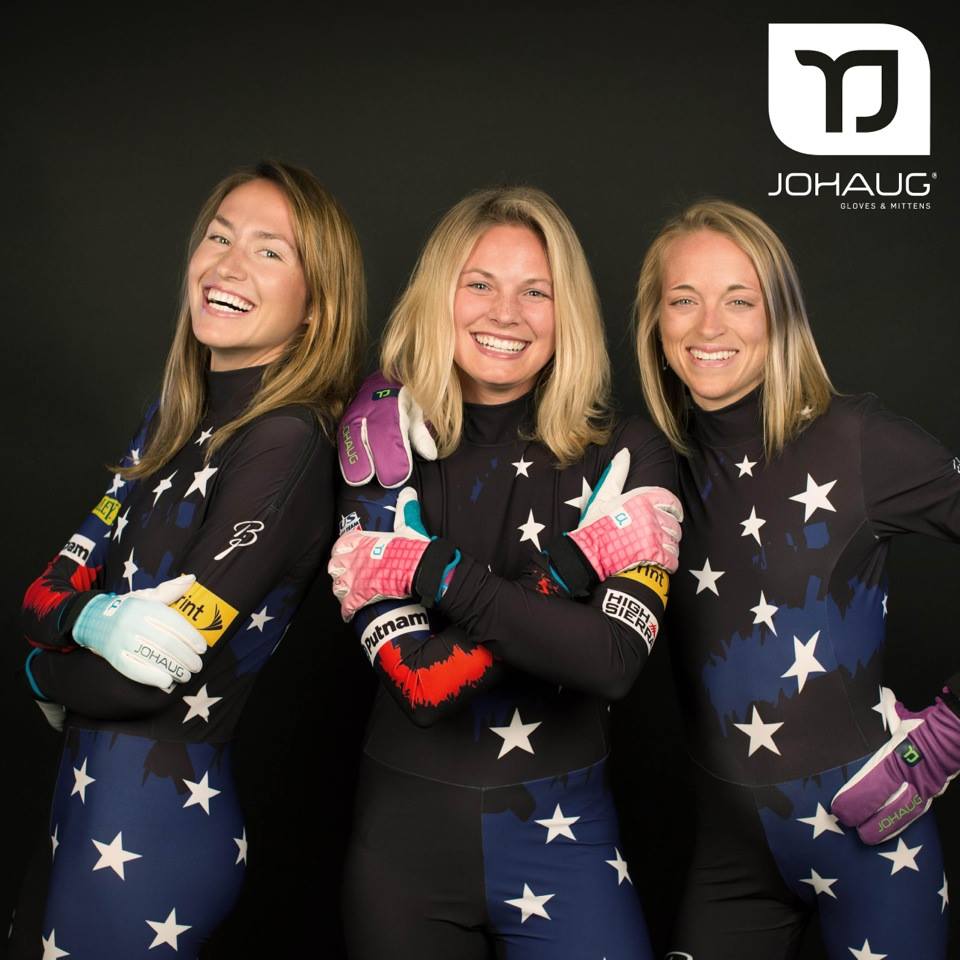
    In December 2014, three U.S. Ski Team members, Sophie Caldwell (l), Jessie Diggins (c) and Liz Stephen (r), signed an agreement to wear Johaug® gloves and did so until this spring of 2016. (Photo: Outthereshop.com/http://outthereshop.com/tag/johaug/)
    In December 2014, three U.S. Ski Team members, Sophie Caldwell (l), Jessie Diggins (c) and Liz Stephen (r), signed an agreement to wear Johaug® gloves and did so until this spring of 2016. (Photo: Outthereshop.com)

    Caldwell added, “I personally feel very badly for Therese. I choose to give people the benefit of the doubt until given a reason not to. I am a strong advocate of clean sport, but I am also in no place to be accusing anyone of anything. I believe that it was an honest mistake and can’t imagine the pain she is going through right now. It is a wake up call to everyone to be double and triple checking any supplement or prescription we take.”

    Whitcomb emphasized that the U.S. Ski Team (USST) tries to use medications and supplements as minimally as possible.

    “But we all still have our medical needs from time to time,” he wrote. “When possible, we use familiar medications that we bring from the U.S. We never take any prescription medications without consulting our team doctors, who are all well-educated by USSA [U.S. Ski & Snowboard Association] in the WADA code. We’re not impervious to mistakes, but our athletes, doctors, and coaches are very respectful of and educated in the WADA code. We take a lot of pride in competing cleanly.”

    During a given race season, the USST is accompanied by a medical pool of six to eight volunteer doctors for half the winter.

    “When we don’t have a doctor with us, we always have our medical director on call in Park City, as well as any of our other team doctors,” Whitcomb explained. “Occasionally, one of our doctors will be asked to help a skier from another team that isn’t traveling with one that week, and vice versa.”

    In a phone interview on Friday, Stephen explained that while she and her teammates expect their doctors to be up to speed on what’s legal and what isn’t according to WADA and U.S. Anti-Doping Agency (USADA) standards, the onus is ultimately on the athletes themselves.

    “There’s never something that we just take without looking at it ourselves,” Stephen said. “If a doctor gives you something and he thinks it’s right, he could legitimately think it’s right as what I think has happened with this case, which is so sad for Therese, and for the doctor — I’m sure he feels absolutely terrible. But I think ultimately, the doctor isn’t who’s going to be remembered here, you know? This is a huge, huge thing for Therese and her career … because like it or not, whether it was an honest mistake or not, if you have your name and doping next to it, it’s a done deal…

    “That’s why it’s so so important that with supplements and with whatever you are taking and rubbing on your skin or whatever, you are looking it up for yourself every single time because it is this kind of thing that is our worst nightmare as athletes,” she added.

    Stephen sympathized with Norway for having its clean record in cross-country skiing tattered by two doping violations in the last three months, with Martin Johnsrud Sundby serving a two-month suspension for violating asthma-medication rules this summer.

    “I see them very differently than I see the Russian violations, which were so obviously a violation of the anti-doping rules. EPO is such blatant cheating, it’s black and white,” Stephen said. “Perhaps I am just naive, but I see what happened with Sundby and certainly with Therese as very different. Therese is taking full responsibility for not checking Global DRO herself and just trusting her doctor. When you are in pain, or sick and all you want to do is feel better, sometimes you skip a step, and this is a terrible misfortune for Therese. I hope that it does not end up overshadowing some of the more severe doping violations that have gone on in the past year.”

    Whitcomb also separated the cases of Johaug and Sundby, explaining that he believes the story told by Johaug and her doctor.

    “I trust that it was a stupid mistake and I’m sad for them,” he wrote. “I am not a conspiracy theorist, and I’m not one of those guys that suspects doping every time someone does a little better in a race than normal. We witness those ethical bumps in performances on our team. With a few exceptions, I think women’s skiing is very clean these days. If I’m proven wrong, then I’ll be burned by it down the road. For now, my ability to trust lets me sleep at night, and it lets me focus during the day.  The same is true for our athletes.  We don’t get caught up in the unknown.”

    On Sundby, Whitcomb wrote:

    “I have less sympathy for the abuse of asthma medication. For starters, it’s not fair to asthmatics who are prescribed medicine and use it ethically. They now feel self-conscious when they take their medication, and their health requires it. What also bothers me about the Sundby case is the amount of medicine that was being ingested. But he got busted and has paid for it, mostly in the currency of credibility. His actual suspension was pretty short. I trust that he and Norway will not do this again, and I’ll still cheer for him on the course this winter.

    “What bothers me most about this all is that it’s a major distraction from a larger issue,” he added, echoing Stephen’s remarks on Russia. “The timing of Norway’s troubles could not be worse for skiing. The skiing world, through the pending results of Richard McClaren’s report, is trying to solve the allegations that Russia cheated in the Olympics they hosted.”

    At the end of the day, Whitcomb explained that the penalty for doping infractions “at the extreme end of the doping continuum” should be much more firm. He is an advocate for lifetime bans, when appropriate.

    “Because the current penalties for cheating are so soft, the most serious deterrent at this point, in my opinion, is shame,” he wrote. “Unfortunately, I don’t think all cheaters have that emotion. Even a four-year ban doesn’t seem like it adequately penalizes someone that uses EPO. It’s not like they go into a prison cell for four years, like when someone steals a couple cars.  They just can’t ski race for a little while.  That’s too light.”

    Whitcomb recommended splitting the banned list in two for less severe and more severe infractions.

    “I have no problem with what happened to Evi Sachenbacher-Stehle in Sochi, or to Sundby this year, and what is likely to happen to Johaug. You make a small mistake, you get a small penalty,” he wrote. “But when it comes to EPO, anabolic steroids, human growth hormone, or other drugs that are so clearly used to cheat, I never want to see them in a race again. Since doping is in the news now, I think it’s time to talk about how a lifetime ban would help solve our problems. The stakes are currently too low.”

    Saarinen Goes Straight to the Source

    Last Thursday, Aino-Kaisa Saarinen, a 37-year-old Finnish world champion who sat out last season while pregnant with her first child, tweeted a photo of herself at a Livigno pharmacy. She took a close up of the Trofodermin packaging, which displayed a red circle with a slash through it over the word “DOPING”.

    Aino-Kaisa Saarinen Twitter Oct. 13

    “Kävin uteliaisuuttani Livingon apteekissa katsomassa miltä pakkaus näyttää. Voiko tästä paketista lääkäri erehtyä sopingin suhteen?” Rough translation: “Out of curiosity, I went to a Livigno pharmacy to see how the packaging looks. Can this package be mistaken by a respectful doctor?” pic.twitter.com/hK7JXYtjs5

    — Aino-Kaisa Saarinen (@Aino_Kaisa) October 13, 2016

    “For me it seemed very clear,” Saarinen wrote in an email to FasterSkier on Monday. “At least symbol like that should ring the bell, because you never see such symbol in anything you take. I understand that one can make a mistake about that symbol, but if you are a doctor, I think it should be impossible to misunderstand that.”

    She was “almost shocked” when she heard the news about Johaug and had a hard time believing it, adding that she had never been suspicious of Johaug.

    “Therese is lovable and awesome personality and I always had great respect towards her,” Saarinen wrote. “Great athlete and great person. I actually had little bit similar feelings as I had as young athlete in 2001 when a lot of Finns were catched [sic] for doping. Could not believe that either, at first.”

    What does Saarinen hope becomes of the investigation on Johaug? “Careful inspections, which follow the common rules and the punishment should be in the scale what is written on WADA rules,” she wrote. “All nations and athletes must be committed to follow those same rules. That’s fair play. Otherwise the whole system is not credible at all.”

    Saarinen has previously been outspoken on social media and in the news for her anti-doping sentiments.

    “After Finnish skier Tero Similä got banned, I started an antidoping campaign, where the slogan was: ‘Today’s top athletes are responsible of future stars and future of clean sport’,” she wrote. “The idea was that athletes would go to talk about antidoping work together with National Antidoping agency to spread to word and idea that antidoping work is good for us and for our sport. I still do these sessions, they are really popular and other athletes have done it also. After Sundby case I tried to throw that challenge internationally as well.

    “I [voice] my opinions on social media, because I think that talking about these things is also antidoping work,” she added. “These cannot be taboos. I would like to see other active athletes to [voice] their opinions as well, but I understand very well why it is not easy. It has been a taboo for a long time in history and for sure not all people will like those opinions, whatever they are. You will get some love and some hate, but that’s freedom of speech as well.”

    A World Cup competitor since 1998, Saarinen believes cross-country skiing at the highest level is getting cleaner.

    “I tend to trust that system works all the time better and better and people [who] do doping will get caught,” she wrote. “… There is always different opinions. One extreme example is one Finnish reporter which claims that it is not possible to be on the podium in world championships or in Olympics in individual sport without doping. I personally know that it is not true. That’s also one reason to talk about these things, so that the youth understands to not believe anything the reporters claim.”

  • Johaug Handed 2-Month Provisional Suspension While Investigation Ongoing

    Johaug Handed 2-Month Provisional Suspension While Investigation Ongoing

    Therese Johaug during a press conference on Thursday announcing her positive doping test.
    Therese Johaug during a press conference last week announcing her positive doping test.

    Norwegian cross-country ski star Therese Johaug has been handed a two-month provisional suspension over her use of the banned steroid clostebol.

    Anti-Doping Norway, who ordered the out-of-competition doping test on Sept. 16, has completed its initial assessment of the case and confirmed that Johaug’s ‘B’ sample also showed the presence of the steroid. It has referred the case to a Norwegian Olympic Committee hearing panel, and in the meantime issued Johaug a two-month provisional suspension.

    Johaug, the winner of two overall World Cup titles as well as several Olympic and World Championship gold medals, had initially declined a voluntary provisional suspension. Her lawyer said at the time that she was completely innocent.

    Johaug admitted to using a lip cream containing the drug to treat a sunburn, but said that she had asked her team doctor whether it contained any banned substances and that he had replied ‘no’. Thus she felt that the blame should be on the doctor, not herself.

    Her refusal to take a voluntary suspension signaled that she would be fighting the charges completely.

    Anti-Doping Norway, however, disagreed with her assessment of blame. The head of its Prosecution Committee, Anstein Gjengedal, said in a press release that Johaug “cannot be said to have acted without fault.”

    Though the team doctor, Fredrik Bendiksen, apparently gave her faulty information, athletes are completely responsible under the World Anti-Doping Agency Code for all substances which enter their body.

    “She has ingested a banned substance,” Genjedal told state broadcaster NRK. “And an athlete has a rather strict liability for it… It’s in the [Norwegian Olympic Committee] statutes that one is obliged to investigate what one takes…. And we believe that should have been done better than it was in this case.”

    Because the Prosecution Committee decided that Johaug bore some of the responsibility for using the medication, she is subjected to a provisional suspension while the investigation is ongoing.

    “The suspension means that the athlete can not participate in competition and organized training,” Gjengedal said in the Anti-Doping Norway’s press release.

    The role of the Prosecution Committee, according to the press release, is only to decide whether a case should be shelved or be sent to a hearing panel. Gjengedal, the head of the committee, served as a prosecutor before becoming Oslo’s chief of police for 12 years. Also on the committee are a professor of endocrinology and a professor of pharmacology.

    Gjengedal asserted in the press release that the Prosecution Committee had no position on the ultimate suspension which should be given, and would wait for the adjudication committee to submit its recommendation. He told NRK that he hoped the Norwegian Olympic Committee investigation would be completed by the time the provisional suspension expires, on Dec. 18.

    But sports lawyer Gunnar-Martin Kjenner told Norwegian state broadcaster NRK that because of the complexity and high profile nature of the case, the final recommendation may take months. He predicted that it would not arrive until the new year. Until then, Johaug may be issued further provisional suspensions, two months at a time.

    Johaug will be able to appeal the suspension to the Norwegian Olympic Committee’s appeals board.

    Meanwhile, Anti-Doping Norway has also opened a case against Bendiksen, as it is also against their code for doctors to prescribe banned substances to athletes.

  • Johaug Tests Positive for Anabolic Steroid After Using Sunburn Cream Recommended by Team Doctor

    Johaug Tests Positive for Anabolic Steroid After Using Sunburn Cream Recommended by Team Doctor

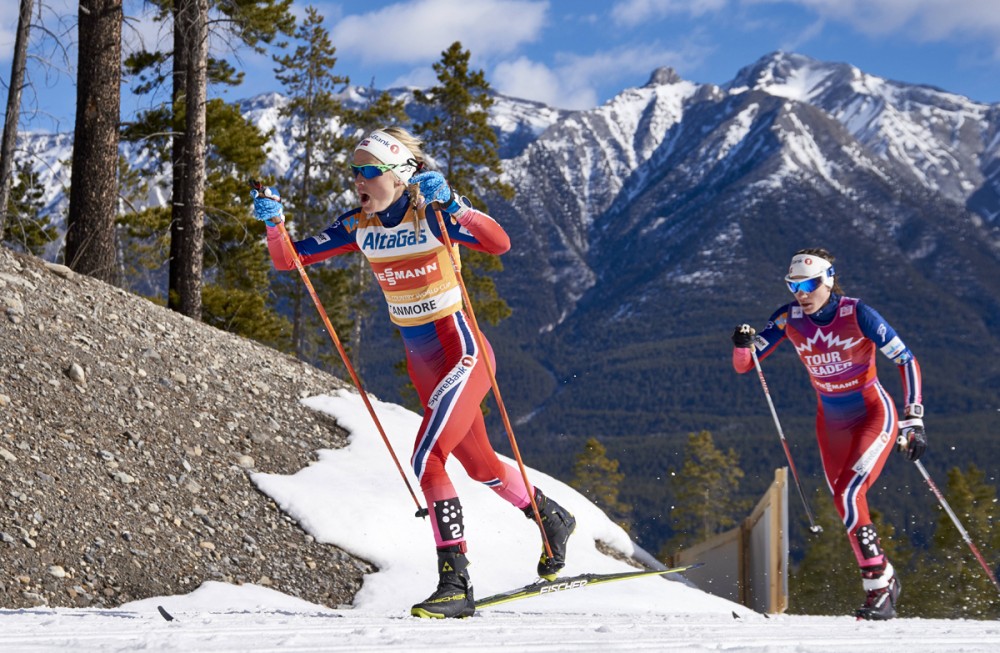
    Therese Johaug and Norwegian teammate Heidi Weng during the women's 15 k skiathlon  in Canmore, Alberta. The competition was part of the Ski Tour Canada, one of many World Cup events Johaug won last season. (Photo: Fischer/NordicFocus)
    Therese Johaug (l) and Norwegian teammate Heidi Weng during the women’s 15 k skiathlon in Canmore, Alberta. The competition was part of the Ski Tour Canada, one of many World Cup events Johaug won last season. (Photo: Fischer/NordicFocus)

    The Norwegian Ski Federation has announced that cross-country skier Therese Johaug, an Olympic and World Championships gold medalist and two-time winner of the overall World Cup title, has had a positive drug test.

    According to the federation, Johaug had severely sunburned her lips while training at high altitude in Seiser Alm, Italy, in August.

    The damage can still be seen in a photo she posted to Instagram over the weekend.

    Tok med jordbærpikenes kyllingsalat hjem til Dalsbygda #minfavoritt #høst #makeitpossible #huaweinorge

    A photo posted by Therese (@johaugtherese) on

    After the team moved to nearby Livigno for a mid-elevation camp, team doctor Fredrik Bendiksen noticed Johaug’s condition. He bought two creams at an Italian pharmacy and assured Johaug that neither contained substances on World Anti-Doping Agency’s Prohibited List.

    The first cream she used did not help her sunburn. So she switched to the second. It helped – but it also contained clostebol, an androgenic anabolic steroid which is in fact banned.

    Johaug was visited by doping control officers on September 16 – where she declared the lip cream, called Trofodermin, on a form listing what medications she was using – and was informed of her positive test on October 3. The test was ordered by Anti-Doping Norway, which will proceed with her case.

    Therese Johaug during a press conference on Thursday announcing her positive doping test.
    Therese Johaug during a press conference on Thursday announcing her positive doping test.

    The news was made public by the ski federation on Thursday morning. Johaug had a live press conference on NRK, Norwegian state television, around noon (Norwegian time) on Thursday.

    In the statement released Thursday morning by the federation, Johaug described her feelings.

    “I am completely devastated and in despair to have ended up in this very demanding and to me unreal situation,” she said, according to a translation by the International Ski Federation.” I see this as unfair and totally undeserved, even though I am obviously aware of the liability that I have as an athlete for the medication that I use.”

    In the press conference, she said that this had been “the worst week of my life.”

    Clostebol is commonly used to treat skin conditions. But it is also performance-enhancing. Clostebol was initially developed in East Germany and used by athletes there to gain an athletic advantage. It is a derivative of testosterone, but is considered a weak anabolic agent compared to some other steroids.

    A number of athletes across nationalities and sports – ranging from professional baseball and soccer to international Olympic sports like track and field, weightlifting, and beach volleyball – have tested positive for the clostebol.

    The test for clostebol is fairly sensitive, and a number of athletes have tested positive despite never taking the drug as a medication. For instance, the drug is also used to promote growth in livestock (particularly in countries where the use of growth hormones is prohibited) and there are documented cases of test subjects who had never taken the drug having it show in urine samples after eating meat from animals raised on the substance.

    Clostebol also has applications for gynecological care, and there are other documented cases where an individual has tested positive after having sexual intercourse with a partner who is using the drug in a medication.

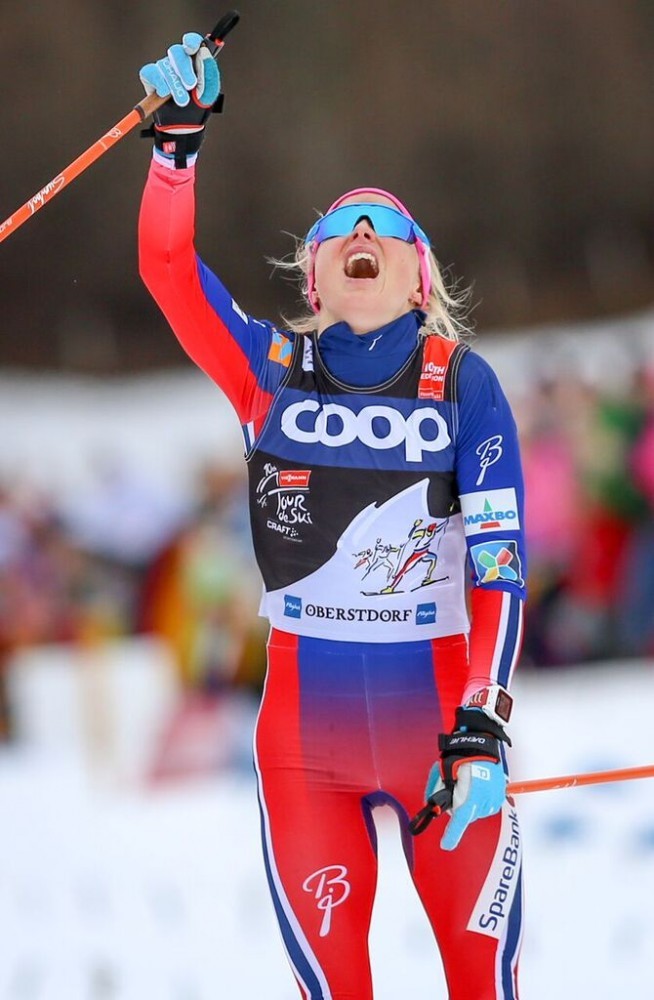
    Norway's Therese Johaug after winning the 10 k classic mass start at Stage 5 of the Tour de Ski in Oberstdorf, Germany, in January. (Photo: Marcel Hilger)
    Norway’s Therese Johaug after winning the 10 k classic mass start at Stage 5 of the Tour de Ski in Oberstdorf, Germany, in January. (Photo: Marcel Hilger)

    But a number of cases have been the result of athletes simply using topical skin creams without checking to see whether any of the ingredients were prohibited. In this case, it is clear that Bendiksen made a mistake in obtaining the medication. A simple online search would have revealed that clostebol was an active component of Trofodermin.

    Bendiksen has taken complete responsibility for the mistake.

    “Therese is an amazing, conscientious person and performer who is careful and precise in everything that she does,” he said, according to a translation. “The most important thing for me to do now, is to do everything I can to make sure she is not punished for using a cream which I assured her was legal to use.”

    At the same time, Johaug said that she took responsibility for following Bendiksen’s recommendation. She explained that she had asked whether the cream had any prohibited substances in it, was told that it did not, and trusted her team doctor.

    She tried to strike a balance by saying that she was responsible for the decision not to check the drug’s contents against the WADA list herself, she also “has zero guilt.”

    “To get an undeserved positive test, it’s an athlete’s worst nightmare,” Johaug said.” But I will fight everything I can and show that I am innocent in this matter.”

    Norwegian team doctors believe that Johaug would not have had enough of the substance in her system to affect her performance anyway. The case is ongoing and a suspension has not been issued, but a case from 2005 before the International Swimming Federation (FINA) resulted in a reduced sentence for a 15-year-old swimmer who had used the medication in a skin cream and successfully argued that she did not gain any performance advantage from it.

    The federation reportedly canceled a major season kickoff event scheduled for Thursday. Instead, the cross-country committee is meeting to decide how to handle the situation.

    For Norway, the news comes after a long summer of doping controversy. Several-time men’s World Cup winner Martin Johnsrud Sundby was suspended for two months for using a too-high dose of the asthma medication salbutamol.

    When that made news – 18 months after the positive tests had taken place, generating widespread outrage – several other Norwegian athletes came forward to say that they had been instructed to take the same doses of medication despite the fact that they did not even have asthma.

    The ski federation is clearly trying a different crisis management strategy this time around. Rather than delaying, Johaug held the press conference soon after learning the news herself.

    Whether that is due to the preferences of the federation or the athlete is unclear. The federation had reportedly urged Sundby to go public earlier in his appeals process, but he had refused.

    Now, after months of denying responsibility for the high doses of asthma medication he had been prescribed by a team doctor, Sundby has apologized and said he was “100% responsible”.

    The ski federation, meanwhile, is facing a nightmare. President Erik Røste said in the press statement that he was “concerned that Norwegian cross country have again ended up in such a demanding situation.”

    And once again, it appears that the doping violation was the result of an athlete following advice of a team doctor. Røste said that the federation would look into how to prevent the problem from continuing.

    The news also comes at a bad time for Norway as their Minister for Culture, Linda Hofstad Helleland, is bidding to become the vice president of the World Anti-Doping Agency.

    For Johaug, Seiser Alm has become quite a significant place for her, and not in a positive way: in 2015, she broke her hand while running there.