
From the FasterSkier archive — posts syndicated from athletes’ and coaches’ own blogs between 2004 and 2012, kept online as published. Current coverage is at fasterskier.com.

Tag: cloth masks

  • Cloth Masks the Skida Way

    During some conversations, there’s a moment of clarity. Talking to Corinne Prevot, the founder and CEO of Vermont based Skida Headwear, I had such a moment. Like many other companies skilled in prototyping and working with fabrics, Skida — an advertiser with FasterSkier —  has retooled to make cloth masks. That’s the story to tell – but the fact that Skida is positioned to help Vermonters acquire masks has as much to do with the legacy of Prevot’s positive energy as anything else. No Prevot – no Skida. Joy, positivity, beauty, and commitment to community were words Prevot used with precision and earnestness.

    Corinne Prevot: founder and CEO of Skida. (Photo: Skida)

    Times such as they are, the drumbeat of good vibes was good to hear. I had to interrupt Prevot during our call in mid-April to state that now I understood why her company has been a success.

    Here’s the Skida origin story in 20 words: make hats at Burke Mountain Academy, craft more hats at Middlebury, build a burgeoning business in Burlington, Vermont upon graduation. Having never spoken to the under-30 entrepreneur before, I was struck by her sunny disposition. We were, after all, discussing how Skida went from hats to masks; part of our new Covid-19 avoidance protocol.

    There was something there in Prevot that made you believe in the beauty of things. If a mask can be beautiful in the context of a pandemic, then Skida has pulled that off.  

    “For this project, every single team member on our staff has been a part of it which has been really fun to be able to pull this together really quickly,” said Prevot. “And do it in a way that is very Skida — we wanted the design of the product to be something that we feel is comfortable but still reflects the same joy and beauty that we fill our products with in our existing line.”

    Skida prides itself on its in-house pattern design. Those thoughts-of-spring floral patterns or a whimsical fish-eye print are sourced from artists whose designs are then exclusive to the company. The masks they eventually brought to market are pure Skida. Which, when you consider it, might do wonders to the collective spirit if a mask projects joy rather than the clinical world we now inhabit.

    Initially, as the pandemic worsened, Skida’s staff adjusted to working from home. Provet said she began drilling down on the new economic climate when the State of Vermont sent out a survey on how the pandemic was impacting businesses. 

    “You can imagine retailers are closing, ski resorts are closing, people aren’t going skiing,” said Prevot. “Events are being canceled, 5 k runs aren’t happening, marathons are canceled, fundraisers, any social gathering. So, very quickly all of our sales prospects for the spring faded away. That was happening at the same time as a lot of outreach and demand for PPE was being discussed. Originally, I really wanted to create a product that would be useful for what was being articulated as what was needed on the front lines.” 

    Front line PPE proved a vexing pivot. Skida settled on the concept of a cloth mask. Prevot spent time researching best practices when it comes to using cloth masks and sought out expert advice to determine if the fabrics Skida traditionally uses would be of benefit. What she came to learn, and this is critical, cloth masks should be washed after each use. 

    Skida has this advice posted on their website:

     RECOMMENDED USE:

    • Wash mask after every use with hot water and soap
    • This mask is a step towards personal protection, but cannot ensure total protection from airborne particles.
    • Please continue to practice social distancing, avoid touching your face, and wash your hands often.
    • For additional information about how to wear a mask, please visit: www.cdc.gov/coronavirus


    Skida masks. (Photo: @skidagram IG account)

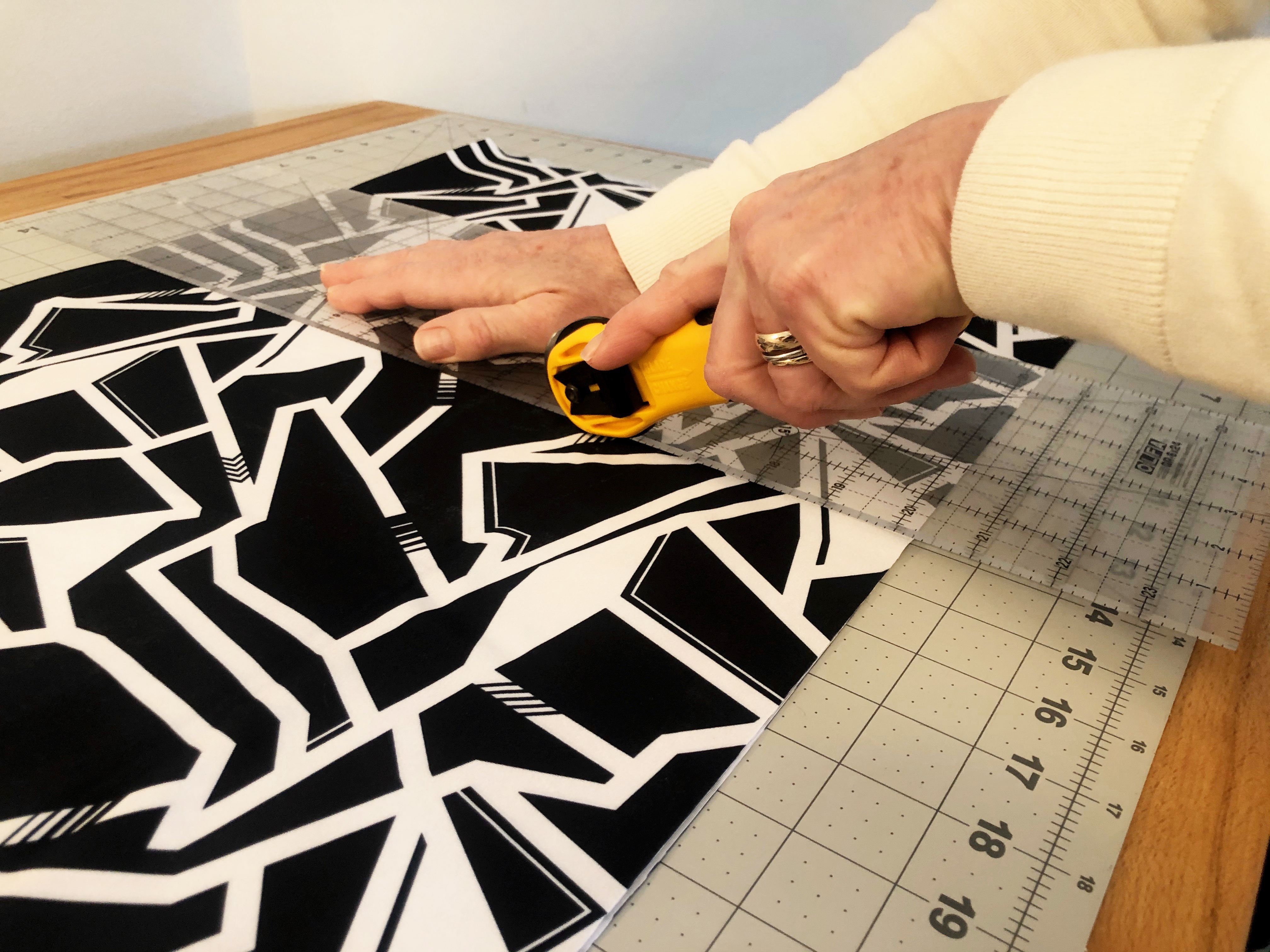
    The supply chains for sourcing raw materials were similar to what Prevot and her colleagues knew. They also began surmising how to incorporate their near zero-waste philosophy when it came to cutting mask patterns. 

    “We have maxed out our production bandwidth,” said Prevot.  

    The masks came online and the initial run sold out: their next production run comes to market Thursday, April 23. Along with online sales Skida is part of a community effort to donate free masks to non-medical essential front line workers — like employees we interface with at grocery stores. 

    One of Prevot’s concerns is employing her staff – who in turn have their own families to support. She understands her role in the greater business ecosystem where her employees can take care of themselves and support other aspects of the local economy. It’s all a part of Skida’s commitment to community. 

    “Initially, it felt like scrambling, we were pulling together fabric from different years and different places, and we’ve seen it all come together,” said Prevot. That scramble included a product shoot in her backyard Prevot called “total triage photo mode.” Yet despite the blustering wind and her white bed sheet as a backdrop, she nailed it.

     

  • BeFAST Sportgear: From Hats to Masks

    BeFAST Sportgear: From Hats to Masks

    Masks or no masks for the general public? The messaging pivoted like a sailboat running downwind then upwind. All along states reported a scarcity of masks approved by the Centers for Disease Control (CDC) and The National Institute for Occupational Safety and Health (NIOSH). The type of masks needed by health care workers on the front lines of the Covid-19 pandemic. 

    In early April, the CDC reversed course —  that 180 degree pivot — and began recommending the use of cloth masks in areas where the community transmission of Covid-19 was possible. Many of us are now heeding the CDC’s recommendation and wear cloth masks in public spaces. The CDC is not recommending everyday use of medical grade masks — surgical masks or N95 masks — since they remain scarce. Those masks, it is suggested, should be set aside for use by medical professionals. 

    Enter the hat-makers.

    The hyper-local mask making assembly line at BeFAST. (Photo: BeFAST)

    St. Paul, Minnesota based BeFAST Sportgear (an advertiser with FasterSkier) executed a pivot of their own. BeFAST has been in business for nine years and specializes in winter headwear: hats, headbands, and neckbands. They sell online, at retail outlets, and produce small batch custom orders for teams and organizations. 

    According BeFAST founder Diane Schember, the company is small with the ability to scale up or down when market pressures dictate a change of course. “I use manufacturing facilities to do the bulk of our main product line — we do a factory run once a year. That provides the base of our products, the basic black and white units, things that are staples in our inventory we produce on a larger scale.”

    When a small quick-turnaround-batch is produced, Schember relies on a cadre of local sewers to fulfill the order. Small size companies like BeFAST remain an asset when considering evolving market needs and designs. If tastes in hat design evolve mid-season, BeFAST can change course and ramp up. They are nimble. Product development, prototyping, and market introduction, even on short notice, is not a disruption to their bottom line. 

    “A lot of times our customers have creative ideas more so than us,” said Schember. “So we will follow that and create a product and get it in their hands and get them using it. And then if the feedback is positive, then we will launch it. And that may be in the middle of the season, it may be in June, it may be whenever. We have got the ability to react pretty quickly to customer demand.”

    During the current pandemic, Schember and BeFAST possess in demand skill sets: the ability to design soft goods and work with fabric to produce masks.  

    For the past six weeks, beyond consuming Covid-19 news, Schember prepped next season’s production run. She shipped raw materials and finalized patterns. Concurrent with those demands, customers began asking if BeFAST was going to produce non-medical grade face coverings,.  

    “So Covid is creeping and creeping and creeping in, my customers started to ask me, ‘oh so are you going to do anything, are you going to make masks?’ I was like, ‘Oh no, you know, I don’t know that I can gear up to do that.’”

    As each day passed, the news was the same: more Covid-19 infections and health care workers without N-95 masks available. And the questions about BeFAST’s roll in the mask supply chain persisted.  

    Schember felt compelled to help. She reviewed the CDC’s recommendations and fashioned a mask combining ease of use while maximizing facial coverage. BeFAST masks feature a malleable wire nose piece for a custom fit, a spandex blend for snugness across the face, with elastic fasteners behind the ears. The masks are washable and reusable.  

    Schember explained that BeFAST is not profiting from its masks sales – they are covering their costs while still manufacturing locally with the use of local sewers. The intent is to sell cloth masks to the public while getting the available supply of medical grade masks to hospitals and first responders. 

    For now, BeFAST is positioned to remain open for business despite the lack of profits and the global economic downturn. “I am fortunate that we are in a situation where I feel that this is my contribution to the healthcare community right now, and that we can do it,” Schember said. “We are using fabric that has been in our warehouse that we have not been using. We are also using remnants from this season, we have a lot of colors, a lot of options. From that side of it, I feel like I am doing an environmentally sound thing where I am using the materials I have to meet a need, meet a demand.”

    An ABC News/IPSOS poll published on April 10, finds nearly half of all Americans leaving home use a face mask or face covering. Masks are not a  Covid-19 panacea; they play a role in a trifecta of protocols to minimize community spread that includes fidelity to social distancing and regular hand washing.

    BeFAST is one of several soft goods manufacturers in the outdoor space making a difference. True to their racing roots, Schember said she is channeling an at-the-start-line singular focus to help problem solve.  

    “We are all about attitude, we like to say we sell attitude,” Schember said of BeFAST. “And I think with this type of situation everybody has a feeling about how we got to where we are today. Some are angry, some don’t understand it, everybody has an attitude about it. And I feel like it aligns with our core values: that if you are facing the challenges and you are at the start line, you have got to have some attitude to get out there and do stuff.”

    You can find BeFAST masks online.

    BeFAST masks ready for packaging. (Photo: BeFAST)