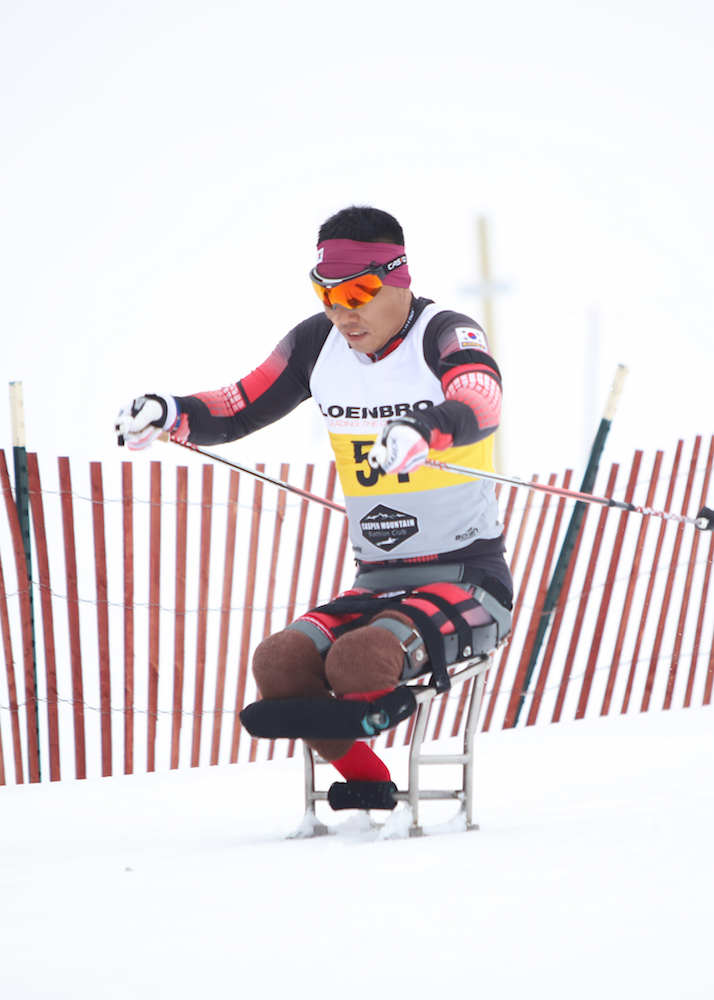
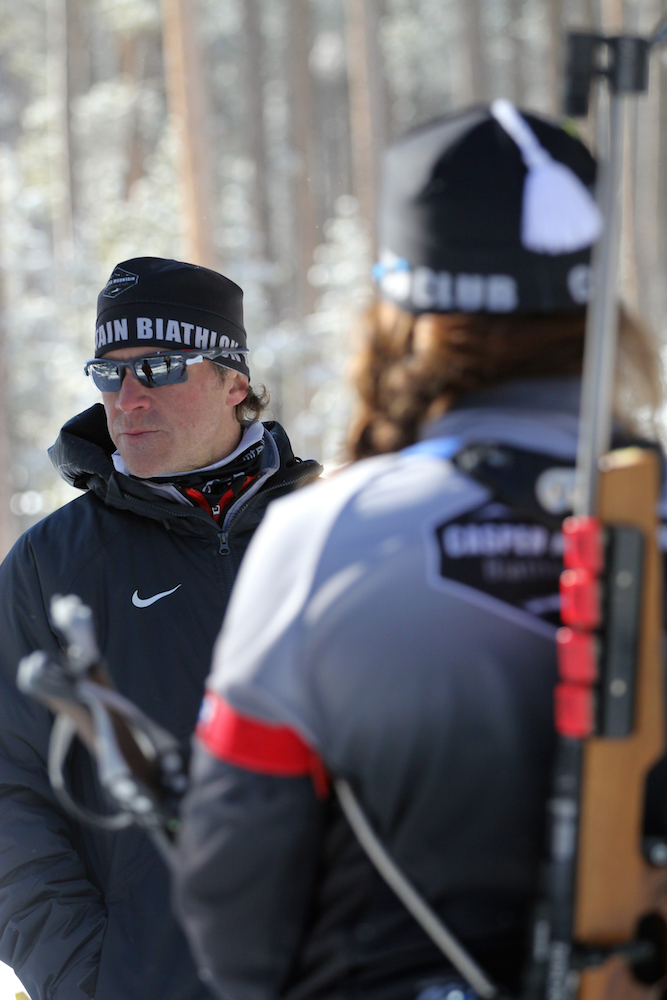
South Korea’s Eui Hyun Sin swept both biathlon races at U.S. Paralympics nationals earlier this month and placed third in the cross-country sprint and short-distance races in Casper, Wyo. The South Korean Para-Nordic team is training in Casper until May 9. (Photo: Pearson Photography)
Winter closed with a bang at Casper Mountain Biathlon Club (CMBC) in Casper, Wyo., as the nordic center hosted World Para Nordic Skiing NorAm & U.S. Paralympics Nordic Skiing Biathlon Nationals with four races in three days earlier this month.
“Although the event was small, the competition was quality,” CMBC Managing Director Cathy Rosser wrote in an email.
On March 31, the day before the first event, athletes trained as a foot of snow fell on an already deep base. Biathlon races took place April 1 and 2, with middle-distance biathlon races on Saturday, 12.5 kilometers for men and 10 k for women, and four shooting stages for each. Men raced on a 2.5 k loop; the women skied a 2 k loop on trails designed by John Morton. The weather warmed to 36 degrees, making for a firm track.
On Sunday morning, biathletes raced a sprint, 7.5 k for men and 6 k for women, on the courses noted above. That afternoon, 1.2 k cross-country sprint qualifiers and finals were held. Fog descended during the sprint A-final, giving athletes just about 100 meters of visibility.
On Monday, the three-day series wrapped up with short-distance classic races.
Oksana Masters of the U.S. and South Korea’s Eui Hyun Sin dominated the biathlon events. On both days, American Andy Soule finished second by narrow margins, according to a CMBC press release. Canada’s Derek Zaplotinsky won the men’s sprint qualifier and final, and on the final day, Soule won the short-distance sitting cross-country race, as did Masters in the women’s sitting division.
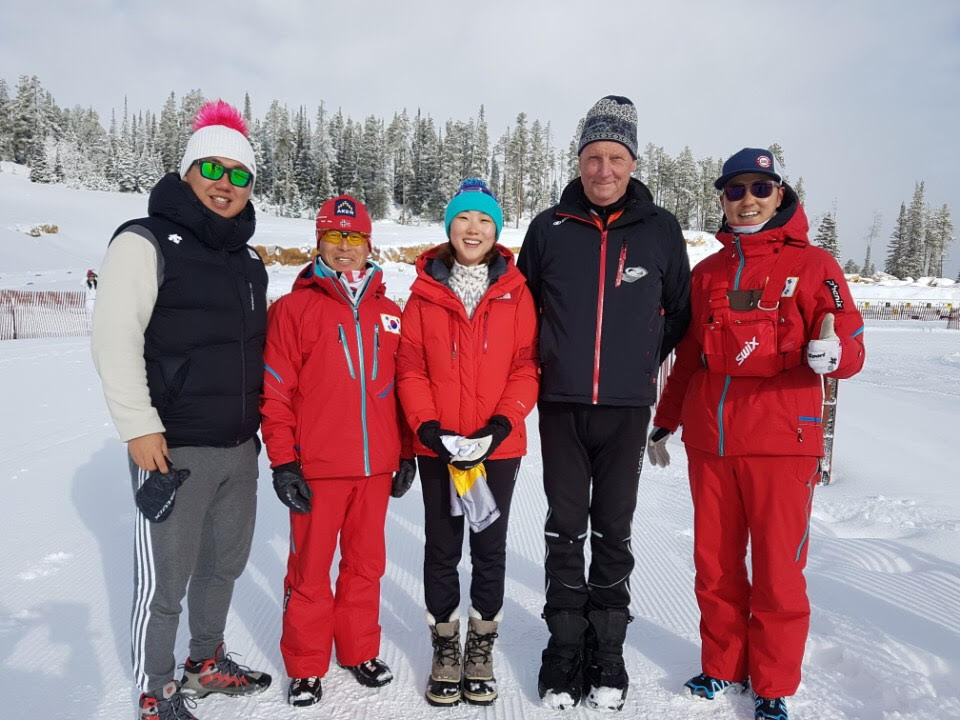
The South Korean Para-Nordic coaching staff at the Casper Mountain Biathlon Club earlier this month in Casper, Wyo, including (from left to right) trainer Ki Won Yoo, cross-country coach Jong In Choi, team manager Joo Yeon Han, and head coach Kaspar Wirz. (Courtesy photo)
The South Korean team planned to continue training in Casper through May 9. According to coach Kaspar Wirz, the team’s primary goals are to “work on technique and [accumulate] snow kilometers,” he explained on the phone. “This is more than just doing the races.”
Canada’s head para-nordic coach from 1996 to 2010, Wirz took the opportunity to coach the Korean Para-Nordic team in the months leading up to the 2018 Olympics in PyeongChang, South Korea. When he started coaching the Korean team in January, he checked out CMBC. His athletes had never trained at high altitude, Wirz explained, and he chose Casper because of its elevation (above 5,000 feet) and reputation for promising spring conditions.
“We could have gone to Finland to put some kilometers in but decided to come here and I’m very happy.”
Coming off the IPC World Cup Finals in Sapporo, Japan, the team returned home for a few days before traveling to Wyoming.
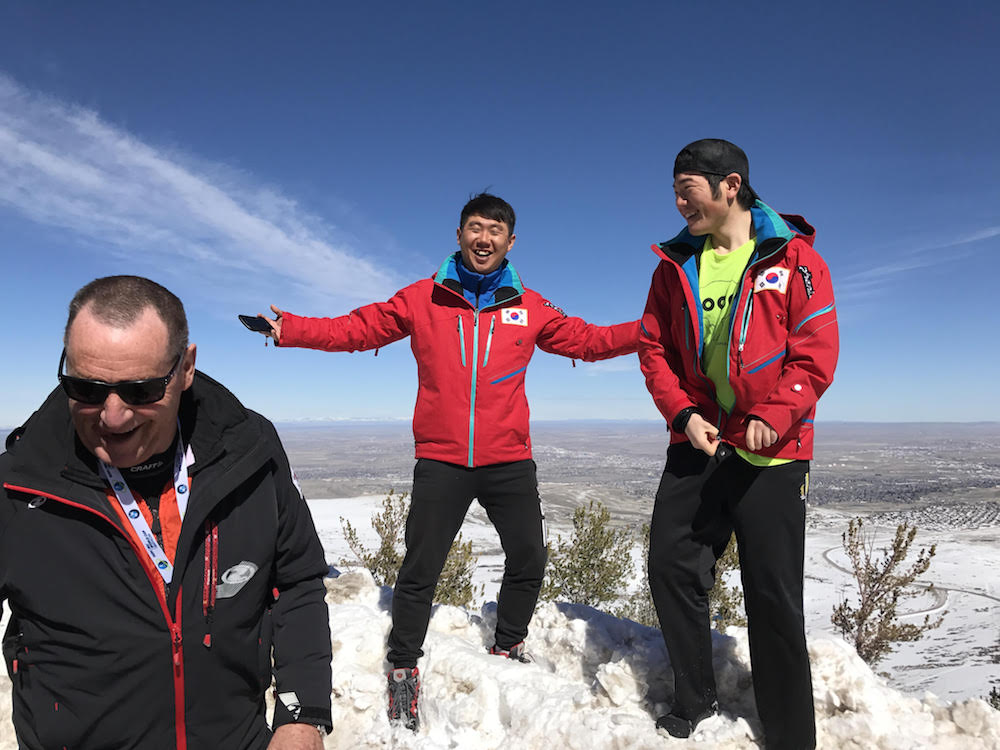
South Korean Paralympic skiers Ki Won Yoo and Sang Hyun Kwon having some fun after a morning training session in Casper, Wyo., with coach Kaspar Wirz (left). (Courtesy photo)
“The conditions are excellent,” Wirz said. “The adjustment to the altitude and jet lag are not a big deal. I’m happy I made the move to come here.”
The training camp caps a successful season for the Korean team, which competed at all five stops on the IPC World Cup circuit. “We went to all the World Cups, we had people on the podium, but if the Russians come back, the deck would be re-shuffled a little bit,” he said, referring to the indefinite suspension of Russian Paralympic athletes from IPC-sanctioned competitions.
Six weeks makes for a long training camp, but Wirz said his athletes were up for it. The team’s original plan had been to train in Wyoming for two weeks, go home for a break and fly back to Bend, Ore. But that would have meant two additional 13-hour travel days and recovery from jet lag.
Asked about funding for the overseas camp, Wirz said that in January he met with the secretary general of the Korean National Ski Federation for the Disabled, who was incredibly supportive.
“So far I don’t have a budget. I just have to request to go somewhere, and they say yes or no,” Wirz explained. “So far, we haven’t had any budget restrictions. There were no questions asked because they want to perform at their home Olympics.”
Contract/Seasonal Position: The position could start as early as Nov. 20 and go through mid April.
Casper, Wyoming, is home to over 50 km of amazing trails and a newly constructed Nordic and Biathlon Training & Competition Center. CMBC is seeking an energetic and enthusiastic individual to coach and/or lead growing U8 – U20 programs, Nordic Rocks Elementary programs and Paralympic/Adaptive programs.
Advanced Skiing and competition experience required.
Adaptive experience not required, but a willingness to learn is a must.
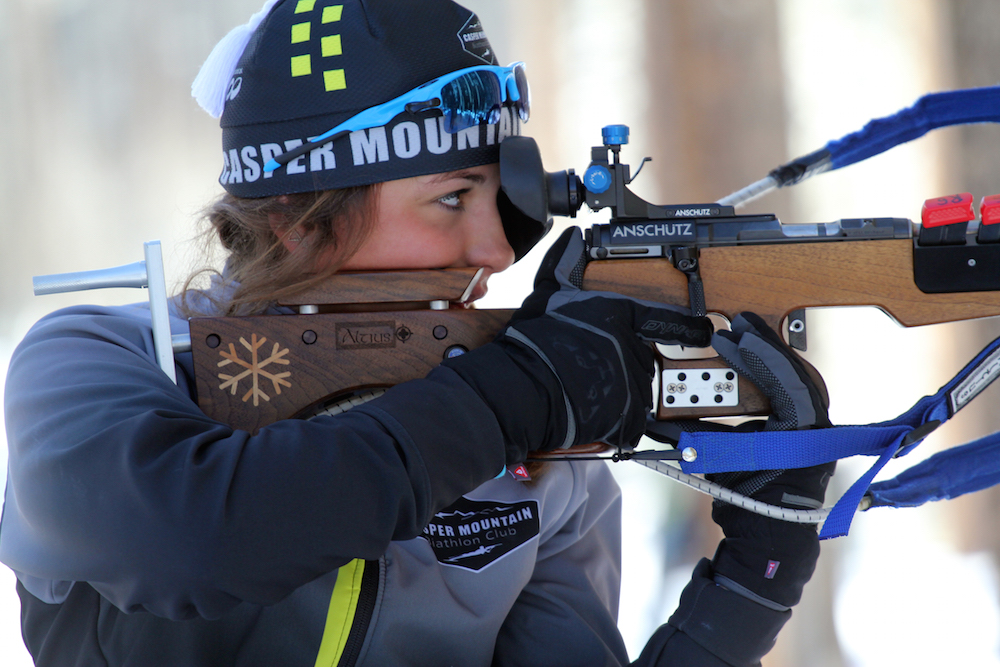
Casper Mountain Biathlon Club athlete Rylie Garner, 16, takes aim. Garner is one of six juniors training with the CMBC year round. (All photos: CMBC)
Where there’s a will, there’s a way. Without a range of its own, Wyoming’s Casper Mountain Biathlon Club (CMBC) has put athletes on the podium in the junior division at biathlon national championships.
But with donated land and the purchase of new targets, the club awarded a $728,307-dollar contract to build what might be the highest-altitude biathlon range in the U.S.
On Aug. 13, CMBC chose the Casper-based Wayne Coleman Construction to build a range on donated land abutting the Natrona County-run Casper Mountain Trails Center. Construction started late last month, and the range is expected to be complete by early November.
“It will be the only venue dedicated to both adaptive and able-bodied skiers,” CMBC’s president, Rob Rosser, said in a phone interview. Also a U.S. Paralympics Nordic and Biathlon development coach, Rosser competed in biathlon at the 1998 Winter Olympics and won multiple national and North American titles in the sport.
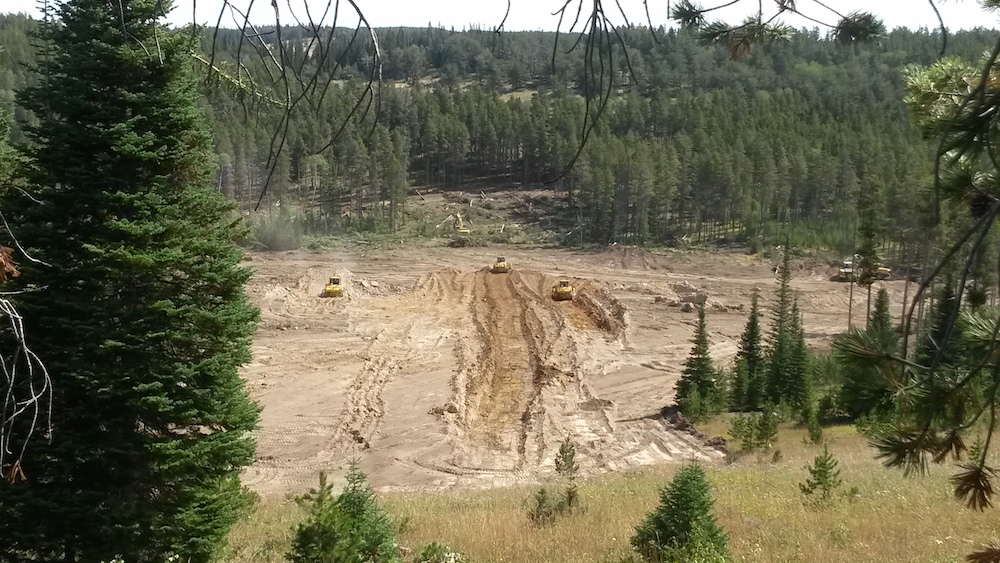
Construction on the Casper Mountain Biathlon Club range began last month.
Founded in 2008, CMBC gained nonprofit status in 2010. Its athletes ski at the Casper Mountain Trails Center, eight miles outside of town. The ski center includes 42-kilometers of winding trails on public land, but there’s no biathlon range.
In Casper, there’s a shooting range where CMBC athletes can practice, but it’s not biathlon-specific.
“We’ll shoot on paper, and then we’ll set up a metal target as well, just so they can shoot at an actual biathlon target,” Rosser said. “That’s the best we can do for now. We’ve managed to get some decent results in less-than-perfect training venues.”
To shoot at an actual biathlon range, CMBC athletes have to drive to a five-lane range in Lander, Wyo., 150 miles away.
“The best range close to us is Soldier Hollow, which is six hours away,” Rosser said. “That’s the closest one with both rollerskiing and shooting.”
They also train indoors with electronic rifles.
“Since about 2010, we’ve trained kids with electronic rifles,” he explained. “CMBC has had quite a few podiums at Nationals – Junior category – with the kids doing a combo of live shooting and training with the electronic systems.”
In a follow-up email, Rosser explained that Kyle Rutar, one of the club’s athletes, placed fourth in a Junior World Trials race after training exclusively with an electronic rifle.
“There’s nothing like doing it firsthand, skiing up to a rifle range, hearing lead hit on metal,” said Rutar in a phone interview.
It was “definitely an adjustment” to go to from an electronic rifle to the real deal, he added.
“The thing about the infrared rifle – everything’s dumbed down. There’s no wind, no temperature, no ballistics. All those things come in to play when you start doing it for real. … Infra-red is top notch for core shooting skills, but in race setting, you have to learn to adjust to the shooting environment in general.”
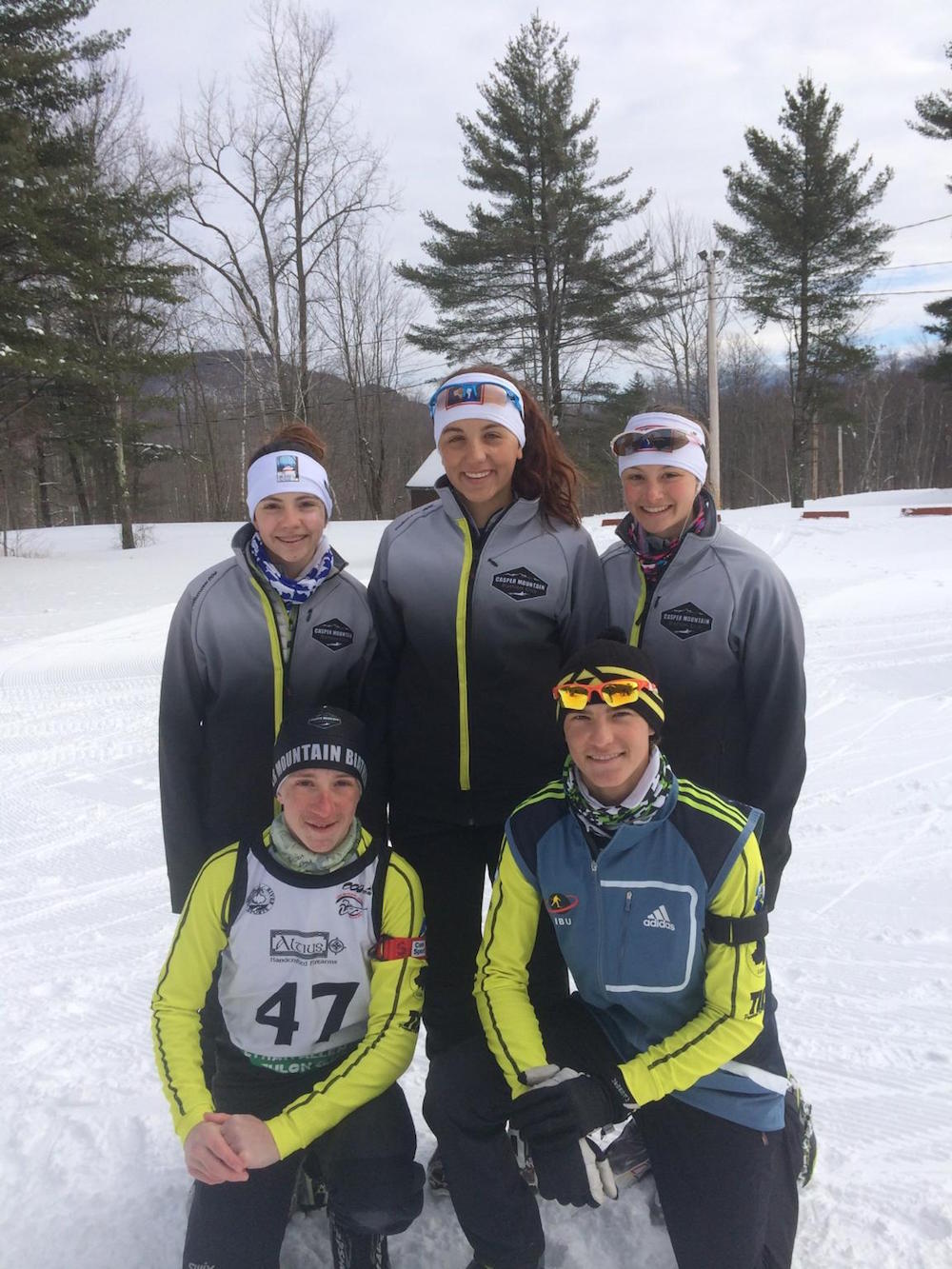
The Casper Mountain Biathlon Club team at 2014 U.S. biathlon nationals in Jericho, Vt. (from left to right, back to front): Madison Tinker, Rylie Garner, Katherine Gruner, and Christian Bjorklund and Jake Pearson.
Presently, CMBC has six junior skiers ages 10 to 16 in a year-round training program: Jake Pearson, Rylie Garner, Katherine Gruner, Garrett Aune, Lu Elder, and Mac Elder.
“Jake, Rylie and Katherine have been doing biathlon for 4 years now,” Rosser’s wife Cathy wrote in an email. “Garrett is going on his second year and Lu and Mac just started this year.”
Cathy is CMBC’s managing director, a title with a jack-of-all-trades job description including club administration, bookkeeping, grant writing, marketing and communications and some program planning. In addition, Ken Miech is a part-time program coordinator and assistant coach. A member of the Wyoming National Guard Biathlon Team, Miech started as a volunteer coach and now assists with program planning and execution.
“In 2014, we had 530 people come through our program,” Cathy explained.
Of those participants, 485 were juniors, 27 were adaptive athletes and 18 were masters. Most of the adaptive athletes are disabled veterans.
“Without a range, we’ve focused on youth and adaptive programs,” she wrote. “Once the range is built, we will continue this emphasis and also begin to put energy into the masters program.”
“Obviously we’re excited about having a natural range and seeing a great amount of growth because it’s a lot more fun shooting the real thing,” Rob said.
Land for Range Donated
According to Cathy, a local family — the McMurrys — donated 40 acres to Natrona County specifically for the range. They also donated a second 200-acre tract that surrounds the range to the city for ski trails.
Crediting the McMurry family’s generosity, she added, “They recognized the economic impact a biathlon venue could have on the community. They don’t have a specific interest in nordic skiing or biathlon, but they wanted to see the land used for the public good and recreation.”
According to Cathy, the 40-acre plot where the range will be built was appraised at $318,000 dollars. She estimated the value of the additional 200 acres at $1.3 million.
“I worked with [Rob] a little bit on the stadium design,” US Biathlon President and CEO Max Cobb said on the phone. “It’s a very impressive plan that he’s put together out there.”
“It’s going to be the only biathlon range that I know of at 7900-feet altitude and the only one dedicated to both adaptive and able-bodied athletes,” Rosser said.
“It’s going to be the only biathlon range that I know of at 7900-feet altitude and the only one dedicated to both adaptive and able-bodied athletes.” — Rob Rosser, Casper Mountain Biathlon Club president
The CMBC currently owns nine electronic targets up to International Biathlon Union (IBU) standards, with plans to buy 21 additional mechanical targets. For adaptive athletes, the International Paralympic Committee (IPC) mandates 10 audio targets for visually impaired athletes, and 10 for sitting or standing athletes. CMBC’s goal is to offer 24 targets for adaptive skiers.
Casper Mountain Biathlon Club president and coach Rob Rosser with athlete Rylie Garner.
“We’re a viable site for an IPC World Cup,” Rosser said.
Although they’re above the IPC’s 5900-foot altitude limit, Cathy explained that “based on preliminary conversations, a waiver would be likely” to hold an IPC World Cup there.
And while Casper Mountain is above the legal altitude limit for a biathlon or cross-country World Cup, Rosser expects to bid for Continental Cup races. In addition, between the long snow season and the altitude, he believes Casper Mountain will be a desirable training-camp venue.
In addition to building the range, the Rossers will also modify part of Casper Mountain’s trail system. Last November, trail designer John Morton flew to Wyoming to homologate trails to IBU, FIS and IPC standards.
Morton helped the Rossers plan two five-kilometer loops that meet standards for all three governing bodies.
“While [Rosser’s] top priority is biathlon with a special emphasis on Paralympic biathlon, it also makes sense to configure the trails to comply with FIS [International Ski Federation] cross-country homologation guidelines,” Morton wrote in an email.
“We have a big puzzle with overlapping course requirements for FIS cross-country, IBU biathlon and Paralympic biathlon and cross-country. The trick is to design courses that are fun and technically challenging to ski, are great for spectators in terms of giving them plenty to see, and still fulfill the course requirements for the various governing bodies,” he added.
Cathy explained that Wayne Coleman will be doing the earthwork and grading for the 30-point range, 10 new kilometers of homologated trails and two pedestrian underpasses.
“It’s a very impressive plan that [Rob] put together out there,” Cobb said. “Rob asked me to weigh in on some questions and I worked with him a little bit on the [range] design.”
U.S. Paralympics Nordic team member Omar Bermejo liked Casper Mountain so much that he moved there.
“One of the Paralympic camps was here in Casper. When I came to train, I fell in love with the town,” he said in a phone interview.
Of the skiing, he said it was a challenging course, especially Rosser’s homologated course, which is still being developed.
When the range is complete, the CMBC will aim to add a paved 5 k rollerski loop leading into and out of the range. Cathy explained they’re expecting at least half of that to be complete by next summer “and the full 5 kilometers if funding allows.”
“That’s going to make it one of the most attractive biathlon ranges in North America,” she added.
Cobb referred to biathlon in the West as a “growing community,” pointing out that the Bridger Biathlon Club in Bozeman, Mont., recently rebuilt its range.
“We’re seeing growth in the Rocky Mountain region, and that’s terrific,” he added.