From the FasterSkier archive — posts syndicated from athletes’ and coaches’ own blogs between 2004 and 2012, kept online as published. Current coverage is at fasterskier.com.
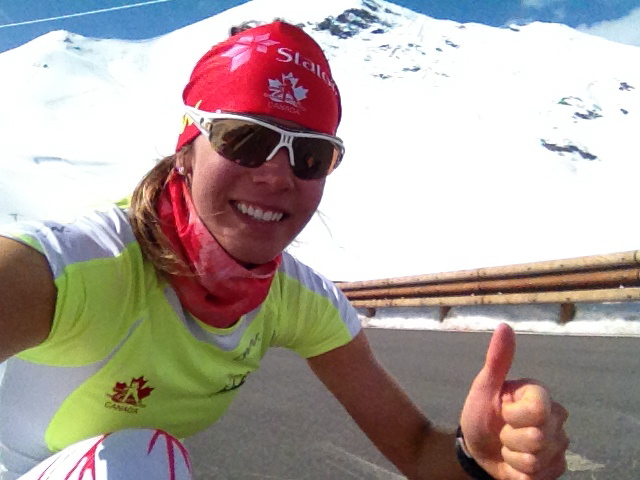
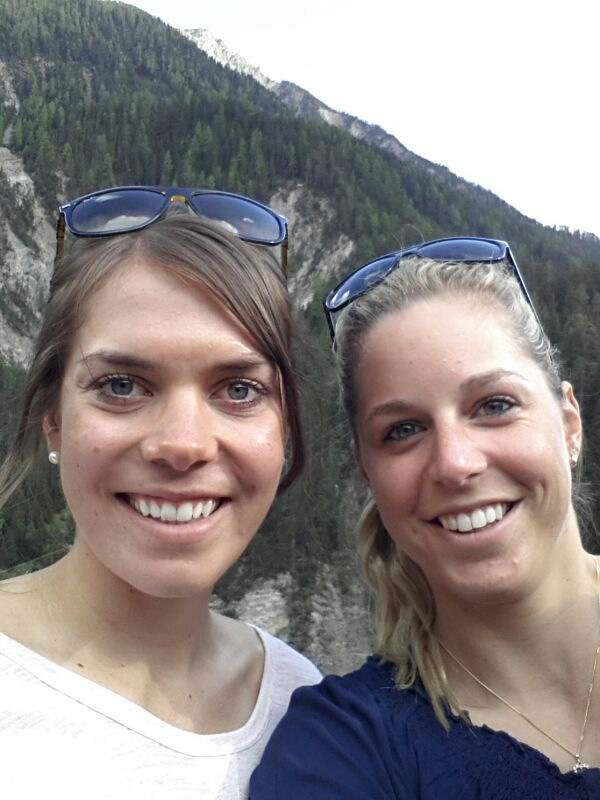
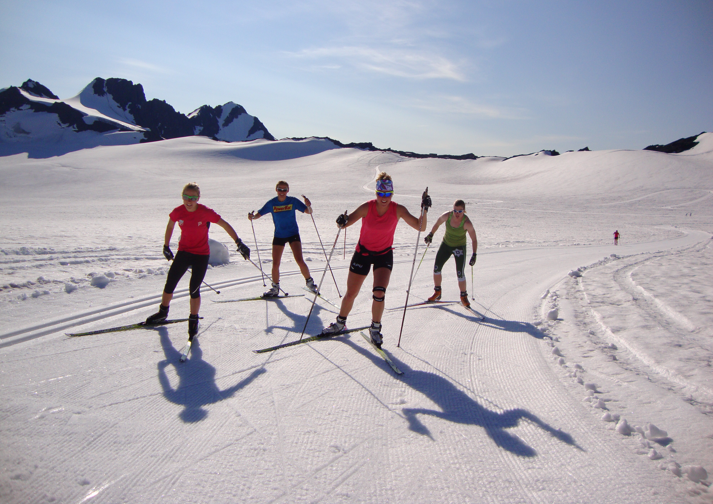
A happy Heidi Widmer on a bluebird day at Stelvio Pass in Switzerland. She spent five days there at a Swiss national-team training camp near the Italian border in early June. Widmer, 22, made the Canadian Senior Development Team in April. (Courtesy photo)
Editor’s Note: This is a continuation of our recently relaunched ‘Pros of Tomorrow’ series, which highlights some of the most notable up-and-coming athletes around the world. See also: Cendrine Browne.
***
Fresh off her last races of the season at Canadian Nationals in Whistler, British Columbia, Heidi Widmer plunged into the backcountry in early April for some ski touring in Callaghan Valley.
There, the 22-year-old Banff native knocked off the 1,275-metre (nearly 4,200-foot) Mt. Cayoosh and headed to a lodge in the Selkirk Mountains for more touring. Even with all the physical activity capping a long season, Widmer considered the trip relaxing amid beautiful scenery.
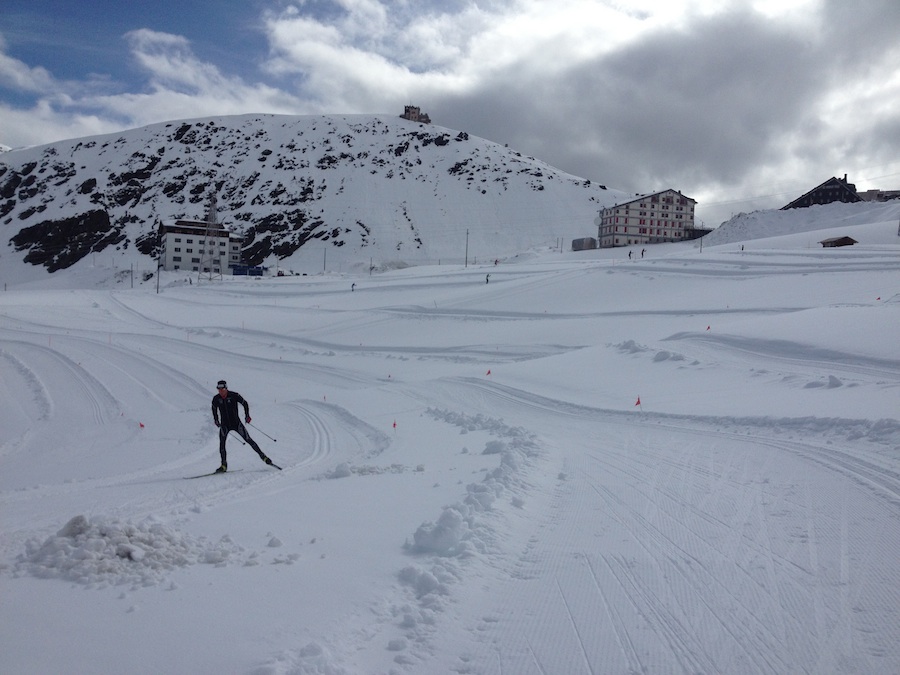
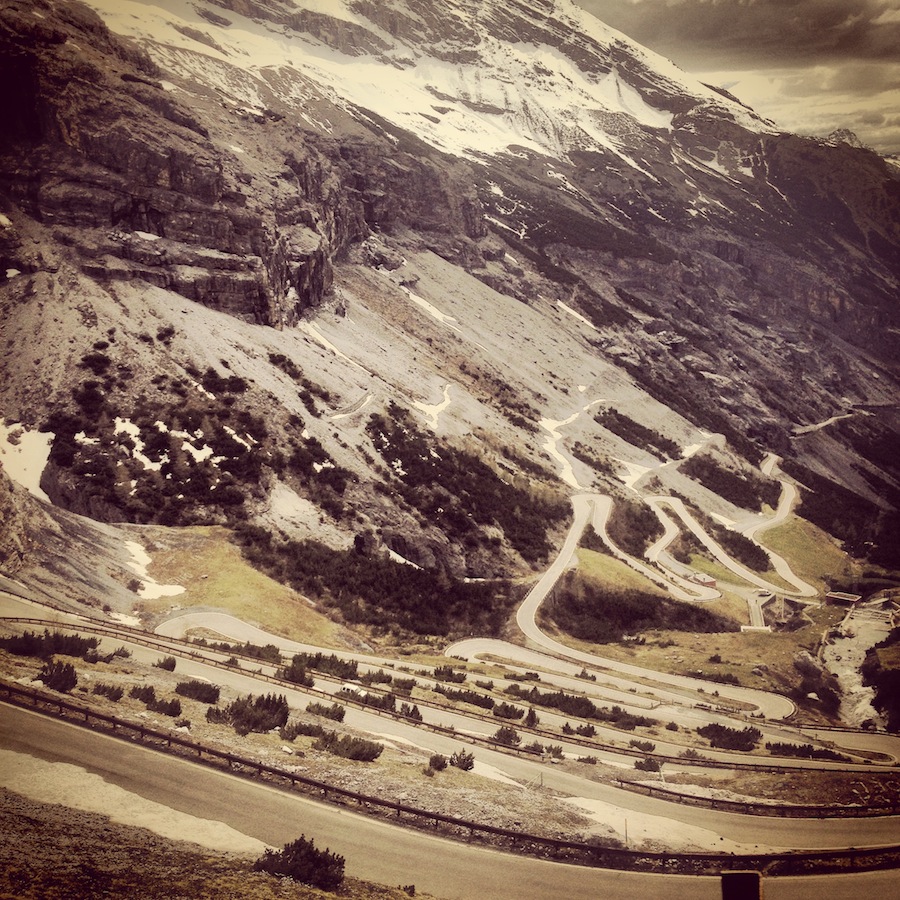
The Stelvio Pass ski track and hotel Widmer stayed at earlier this month 2,700 metres above sea level in Switzerland. (Courtesy photo)
“It’s really a huge mental break,” she said on the phone Sunday from Switzerland, where she’s training with the Swiss national team. “It’s really a good chance for reflection because you’re out for hours on end, most of the time slogging around.”
Now in Davos, Switzerland, Widmer also visited El Salvador (for surfing) and New Orleans (for a music festival) for a total of two weeks in late April. Then it was back to training, first with the Alberta World Cup Academy (AWCA) for five days in Canmore, Alberta, then for a weeklong camp in Vernon, B.C.
Widmer spent another five days back in Canmore before flying to Switzerland on May 25, and she’ll be there until June 24.
Doesn’t she get tired?
“Surprisingly not,” Widmer said with a laugh. “I have to take my downtime when I can get it. I really enjoy traveling, but I maybe enjoy it too much. I really got after it in the spring.”
With a list of trips lined up, Widmer was uncertain about Switzerland, arranged through former AWCA head coach Christian Flury, now in charge of the Swiss women’s team. She knew if she received the call up to Canada’s Senior Development Team, which she had been working for her entire junior career, her schedule would depend on the national team’s.
Lucky for her, it all worked out.
“I’ve been working toward getting on the national team for a couple years and the fact that it all fell together, it just kind of means that the work is just beginning,” Widmer said. “It’s gratifying knowing that I’m doing something in the right direction.”
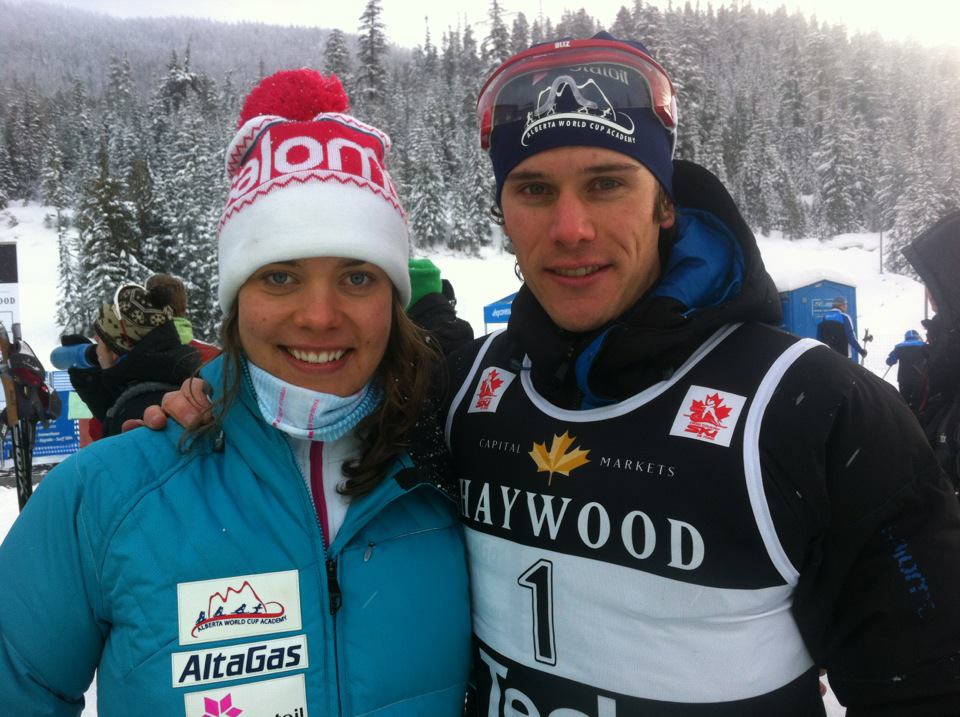
Siblings Heidi and Phil Widmer sharing the podium at a NorAm in January. (Photo: Mike Cavaliere)
She heard the good news soon after emerging from the backcountry during an April meeting with AWCA women’s coach Chris Jeffries. Her initial excitement came with some apprehension: did her brother Phil make it, too? Jeffries couldn’t say, so she waited to hear from her older brother, who was in the backcountry away from reliable cell service for another week.
While making pizzas with friends one night, Widmer got a phone call from her mom, who was crying. Phil, 29, left a message about being renominated.
“My mom was so happy,” Widmer recalled. “It’s really cool being able to accomplish something together. … I think that says a lot about persistence. He’s been for sure inspiring, to watch him take the setbacks in stride and keep working towards getting where he wants to go.
“I don’t know where I would be if I didn’t have him to follow in the sport,” she added. “I remember when he qualified for Torino [Olympics in 2006]. I was at an influential age where you’re like, ‘My older brother can do this, so can I.’ ”
Last season, Widmer tallied two podiums at nationals in the 5- and 30-kilometer freestyle races. At U23 World Championships in Liberec, Czech Republic, she placed 28th in a 10 k skate. There, she spoke with Flury about her dream of coming to Switzerland, where her father was born and she and her siblings have citizenship.
Also in Liberec, Widmer saw online that The Gypsy Kings and Fleetwood Mac were playing in New Orleans. Taking a short detour to Louisiana on the flight back from El Salvador was a no-brainer, and so was going to Switzerland.
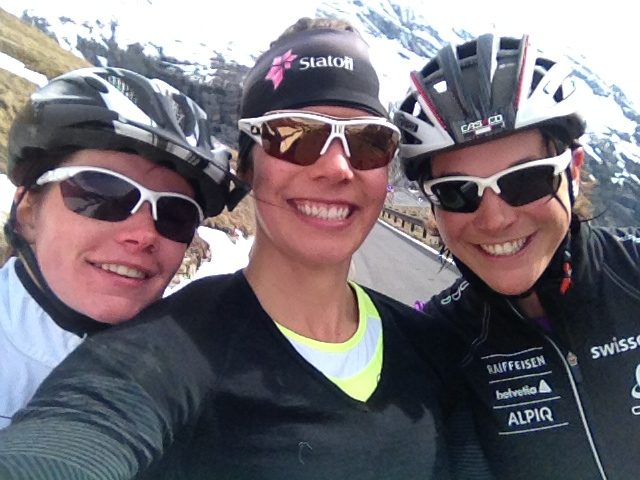
Heidi Widmer (c) with Swiss skiers Nathalie von Siebenthal (l) and Christa Jäger after rollerski intensity on Stelvio Pass in Switzerland. (Courtesy photo)
Flury assured Widmer it was possible and spoke with Jeffries about her training plan.
“Through email and conversations with him, I knew that he was really open to it and I felt extremely comfortable coming over to train with him,” Widmer said. “The rest of the team being so welcoming, I was optimistic it was going to work out, but they definitely exceeded my expectations.”
After visiting her grandmother in Zurich, Widmer met up with the Swiss team at the national-sport centre headquarters in Magglingen, Switzerland. She spent the next week adjusting to the time difference and recovering while the national team did baseline testing.
Widmer then spent few nights in Davos with Tatjana Stiffler, originally her Facebook friend, before heading to a training camp on Stelvio Pass at a glacier some 2,700 metres (8,850 feet) above sea level.
“It’s been amazing,” Widmer said. “I always wanted to come over here and train but I didn’t really know what to expect. … Right away the team was super inclusive and everyone was really supportive of me being there, and I felt like part of the team instantly. It was pretty awesome.”
Widmer (l) and Davos skier Tatjana Stiffler (Courtesy photo)
She didn’t speak much Swiss-German, but was learning thanks to Stiffler. The dialect and vocabulary were much different than the High German she knew, but Widmer said she was having fun catching on and chatting with Swiss skiers when she could.
“I always felt, ‘My name’s Heidi Widmer … and I’m not super connected with Switzerland,’ ” she said. “I know they had a strong team to train with and the environment seemed like it would be a good fit and a good experience. I’m always interested in learning how different teams are approaching ski racing so that was also a draw.”
So what’s different about Switzerland, in terms of its national-team training methods and glacier? According to Widmer, not much on the philosophical front, except for a few technical points she’s been working on.
“It’s been very similar to what we do in Canada,” she said. “You’re doing longer hours and more hours when you’re at altitude on the glacier and similar approach to the training speed and … not just going out and hammering at altitude.”
As for the glacier itself: “I’m trying to think of another word besides pimped,” Widmer said with a laugh. “It was a lot more comfortable living than our [Haig] glacier camp, let’s put it that way.”
The road up Stelvio Pass, the highest paved mountain pass in the Eastern Alps, with 42 hairpin turns and 14 percent grade in some parts, according to Heidi Widmer. “We did classic intensity up this road starting at 1900m,” she said. (Courtesy photo)
From the hotel, one can cross the road and immediately access the 4 k ski loop, which starts with a brief descent before winding back up to the top of the glacier.
“Then you go back to your hotel and all the meals are cooked for you,” she said. “All the teams are there, and it’s a really cool atmosphere.”
Widmer spent five days with the team on Stelvio before heading back to Davos last week. She’ll be dryland training there for the rest of her stay with Stiffler and a few U23s, like Nathalie von Siebenthal and Christa Jäger. World Cup skier Bettina Gruber, 28, is also in Davos, and the two planned to meet up for some intensity.
Looking ahead, Widmer said she’s most focused on peaking for her last year of U23’s – and making the Olympics if possible. Number one on her list: the skate sprint at U23 World Championships in Val di Fiemme, Italy.
“What I did last year is working; I don’t think I have to do anything drastic to change my training approach,” she said, adding that she’s boosted her strength training.
Naturally a sprinter, Widmer didn’t rule out her potential in distance events, especially with a 10 k classic Olympic qualifier in January in Canmore.
“My classic skiing in distance and sprinting has to step it up a notch so I’m putting my focus on that as well,” she added. “I haven’t had a breakout international performance yet so I’m really looking towards that.”
***
Have an idea for a skier you’re itching to read more about? Email info@fasterskier.com with the subject line: Pros of Tomorrow.
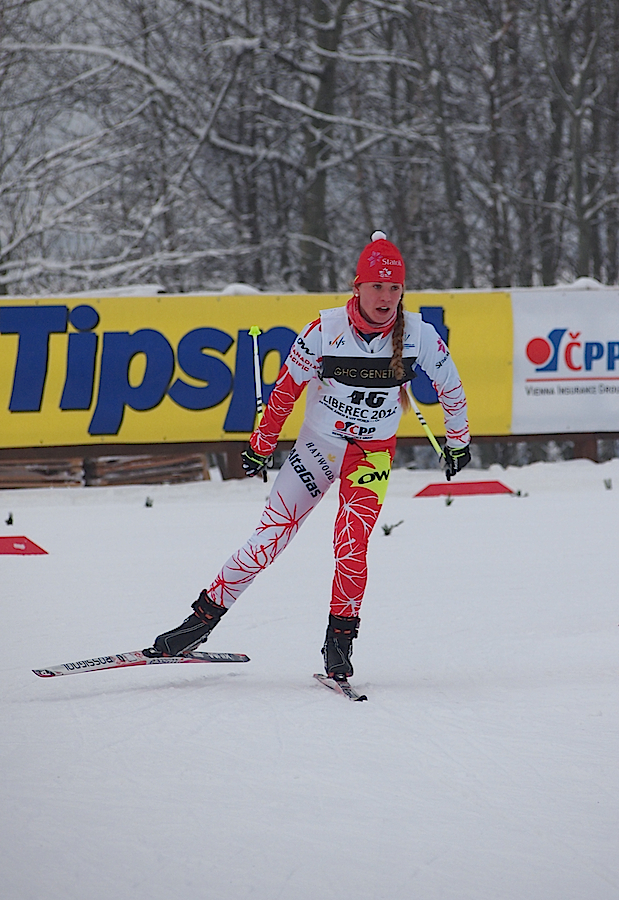
Cendrine Browne (CNEPH) racing to a personal best 15th in the 5 k freestyle individual start at the 2013 Junior World Championships in Liberec, Czech Republic. (Courtesy photo)
It’s BACK! FasterSkier is excited to relaunch its ‘Pros of Tomorrow’ series, which highlights some of the most notable up-and-coming athletes around the world. Have an idea for a skier you’re itching to read more about? Email info@fasterskier.com with the subject line: Pros of Tomorrow.
***
Four years is nothing in the cross-country ski world – a couple good winters, some not-so-snowy ones, and for elite racers, tons of competitions and countless training sessions in between.
But four years ago, Cendrine Browne was just starting out.
“I skied when I was young, like in the forest with my family,” the 19-year-old said on the phone from her home in Saint-Jérôme, Québec. “I had no technique and I had no good skis; it was just for fun. I started doing competitions when I was 15 years old.”
At the same time, Browne was also dabbling in triathlons and excelling at the Québec Cup level.
“I really liked that sport and I still do, but I prefer skiing,” she said. “If I wasn’t cross-country skiing, yes, I would probably still be doing triathlons. But I don’t think I would be as far in triathlons as I am today in skiing.”
A fast-rising star within the Fondeurs Laurentides ski club, Browne earned a spot on the Pierre-Harvey National Training Centre (CNEPH) in Québec. She joined the ranks of the National Ski Team (NST) Junior Development squad, and at her first Junior World Ski Championships last season, Browne notched Canada’s best individual performance in Liberec, Czech Republic: 15th in the 5-kilometer freestyle individual start.
NST Senior Development Team Coaches:
Mike Cavaliere, Chris Jeffries (AWCA); Louis Bouchard (CNEPH) Athletes:
Cendrine Browne (CNEPH)
Raphael Couturier (CNEPH)
Jess Cockney (AWCA)
Graeme Killick (AWCA)
Alysson Marshall (AWCA)
Emily Nishikawa (AWCA)
Graham Nishikawa (AWCA)
Kevin Sandau (AWCA)
Michael Somppi (AWCA)
Heidi Widmer (AWCA)
Phil Widmer (AWCA)
It was a result that not only instilled confidence; it essentially bumped her up to Canada’s Senior Development Team. Last month, a Cross Country Canada announcement confirmed Browne was nominated to the NST senior team, an achievement that comes with prestige, more training support and a financial boost from Canada’s Athlete Assistance Program.
“There’s also another training camp that I’m going to do with the senior team,” she said. “We have more health services provided (physio, etc.) … and we get fun stuff like more clothes and a paid cellphone. So let’s say this is all pretty exciting!”
“It wasn’t expected,” she added. “I didn’t know I needed a top 15 [at Junior Worlds] to be on the senior team, but it wasn’t really an objective for me. … It’s kind of a surprise.”
In fact, what she needed was a top 20. Now the only one under 20 on Canada’s 11-person senior team, Browne’s focused on making the Olympics in Sochi, Russia.
“I might have some chances to qualify for the Olympics next year, so if I qualify, I’m certainly not going to stop,” she said. “I’m going to ski longer and try to qualify for the next Olympics in 2018.”
As for the events she’s focused on, Browne said 5 and 10 k skate races are usually her best. She spent most of the spring studying human sciences at a university in Saint-Jérôme and is almost done. Next, she’ll pursue a degree in kinesiology.
But first, she’ll reunite with her CNEPH teammates in June, driving three and a half hours to train near Québec City for the rest of the summer.
“It’s going to be even more motivating training with these girls,” Browne said of her teammates, including top juniors like Anne-Marie Comeau, Frédérique Vézina and now Maya MacIsaac-Jones.
“We’re so close to each other, like when we do intensity and stuff, so it really pushes us to train harder and faster.”
Another reason for sticking with CNEPH: having Dasha Gaiazova as a teammate. This summer, Browne will again try to keep up with the World Cup team skier and 2010 Olympian.
“I’m really happy when I’m able to follow her,” Browne said. “It’s really motivating for me.”
***
Note: Cendrine Browne joins the ranks of several FS ‘Pros of Tomorrow,’ including Canadian World Cup skier Lenny Valjas, U.S. Ski Team member Ida Sargent, British World Cup skier Andrew Musgrave, and U.S. Biathlon’s Leif Nordgren.
Canadian World Cup Team members Chandra Crawford (r) and Perianne Jones duking it out to the finish of the inaugural WinSport Frozen Thunder Classic sprint Oct. 26 in Canmore, Alberta. Crawford won by 0.2 seconds. (Cross Country Canada/James Cunningham photo: cccski.com)
Without a doubt, the Canadian World Cup team faced some challenges last season even though its results didn’t really show it. Sure, every team has its ups and downs and occasional tizzy, but Canada generally kept it under wraps.
Devon Kershaw continued to podium one weekend after the next and ended up second overall in the World Cup. Simultaneously, most of his teammates also notched personal bests: Alex Harvey finished sixth overall, Lenny Valjas tallied three podiums in a month and each of the three women (Chandra Crawford, Perianne Jones and Dasha Gaiazova) finished the season with career-best sprint rankings.
According to head coach Justin Wadsworth, it was a successful season by all measures, but they needed to make some changes at the end of it. Before the start of the 2012/2013 training season, the Cross Country Canada (CCC) coaching and high-development staff decided to split the team in two – into men and women – to devote more resources and attention to each.
“When things go pretty well you don’t want to make radical, radical changes,” Wadsworth said in a phone interview from Canmore before the team left for Sweden last week. “At the same time, we had a good season, but I think we can do better.”
Wadsworth remained head coach, but also took the role of men’s coach. He hired Louis Bouchard of the Pierre-Harvey National Training Centre as the assistant men’s coach, and former assistant Eric de Nys became the women’s coach. Torbjørn Karlsen came on as a consultant to the women’s team.
Then, they got to work. Above all, Wadsworth and de Nys said they tried to instill a sense of professionalism in their athletes. If they wanted to keep improving and be the world’s best, they had to believe it. Moreover, they had to get along.
“We’re becoming, as a team, more respectful of each other and more professional,” Wadsworth said on the phone from Canmore before leaving for Sweden last week. “The results are great, blah, blah, blah, but the team itself, we’ve had our share of difficulties and challenges, and I think our team has continued to keep rising above those and be professional. A good example is Devon and Chandra’s breakup last year and stuff, those are really hard things to internalize as a team when we’re traveling together and we’re in the same hotel and same vans all the time.”
For North American skiers and staff, it’s especially tough to spend most of November through March overseas without much alone time.
“It’s a lot different when you’re with a team from Sweden or Switzerland that are racing for a week or two weeks together and then they go home and everyone takes a break and it’s kind of fun to be back on the road with each other,” Wadsworth said. “We’re more or less on the road with each other for five months out of the year. I think that managing that is a lot harder than it might seem on the outside.”
Yet once again, they’re heading into the season full-steam ahead, and Wadsworth said the athletes’ overall spirits are as high as ever. With that final piece in place, they should be able to top last season’s results, he reasoned.
“We just have to be smart, but I think every weekend could provide us an opportunity,” he said. “Last year, there was only one weekend we didn’t have a top five and that was a weekend where Devon scored more World Cup points in Nove Mesto than he would’ve if he would’ve finished second. Essentially we scored a top five every weekend, and if we do that again this year I’d be really pleased. It just shows consistency and kind of depth.”
Goals
With a series of what Wadsworth called “peaks” on the race schedule to look forward to, there’s one big event the team is emphasizing: FIS World Championships from Feb. 20-March 3.
“I’ll just say I’ll be disappointed if we don’t come away with a couple medals there,” he said. “I think we have so many opportunities between our men and our women and some of the different races there that I expect more than that. With that said, though, it’s one 10-day period out of the year where you’ve got to be firing on all cylinders.”
Beyond that, he wants to increase the team’s tally of 15 World Cup podiums last season to 20. That’s why they’ve been focusing on individuals. On the women’s side, de Nys has made a point to push his three skiers – specifically Crawford and Jones, who train together in Canmore – harder than ever. He asks that all his athletes show up to work ready to go and he’s tried to explain what it takes to be the best.
“It’s not necessarily that we want to be as good as, we want to be better than whoever’s leading the charge,” de Nys said in a phone interview from Canmore two weeks ago. “We have a good idea of what we have to do and we’re gonna try damn hard to get there, and if we fail in our attempts at least we know we tried really, really hard.”
But failure doesn’t exactly fit in their agenda. De Nys said he’s expecting at least one medal at World Championships from his group of veterans, most of which made measurable strides in testing this summer and fall.
“Everyone had a pretty good season, but we want to really build on the consistency so we’re not having so many peaks and valleys in performance,” he said. “We want to get some medals on the World Cup.”
The women’s training group has been effective, but also presented unique challenges with varying levels of experience, de Nys said. Two Senior Development Team members from the Alberta World Cup Academy, Alysson Marshall and Emily Nishikawa, joined the team at camps.
“So we have Emily who’s 23 and has very limited World Cup experience to Chandra Crawford who has a gold medal at the Olympics,” de Nys said. “It’s a very diverse dichotomy, I guess, of skiing talent and trying to bring those five ladies together to work hard and build off of each other’s strengths and weaknesses, and at the same time, challenging them to do things and push themselves to places they’ve never been before. That’s been the real focus.”
About 90 percent of the time, Crawford and Jones trained together with one of their close friends, Amanda Ammar of the Canmore Nordic Centre. De Nys considered those three the core training group in Canmore, which he’d like to see grow to at least half a dozen next year. Gaiazova followed a slightly different plan in Québec with Bouchard as her personal coach, but when they all got together, the overarching goals were the same.
“In July we were already way further ahead then we were last year in October,” de Nys said. “Really encouraged by what we’ve done, and we’ll just have to see how it plays out on the snow.”
Women’s World Cup Team
Chandra Crawford
Age: 29 on Nov. 19
2011/2012 World Cup sprint rank: 7th (tied best-ever in 2008); 29th overall
Number of World Cup podiums last season: 2 (second at Rogla skate sprint, 3rd at Milan team sprint)
Personal best: Olympic gold medal (2006 in skate sprint)
Personal goal: Podiums at Canadian World Cups in mid-December and World Championships
“I would like to stand on some of those podiums they’re building over in Québec and one in Canmore,” Crawford said. “But it is early season so we’ll see what can happen. Then there’s world champs in Italy; I love racing in Italy. My classic sprinting is feeling better than ever, and Val di Fiemme is pulling me, I’m already feeling how good that finish line is going to feel to cross after a sweet classic sprint.”
Dasha Gaiazova
Age: 28
2011/2012 World Cup sprint rank: 26th (personal best); 46th overall
Number of World Cup podiums last season: 0
Personal best: 8th in two World classic sprints (Drammen and Otepää) and 9th at Rogla skate sprint last season; 20th in skate sprint at 2011 World Championships
Personal goal: Canada World Cup sprints and World Championships
“I’m really looking forward to racing in Québec, it’s a sprint so it’s going to be perfect for me,” Gaiazova said. “It’s always such a treat to be back in Canmore and race in front of old friends and supporters and family. … And then of course the World Championships, the sprint and the classic. I love classic skiing and I love Italy so it should be a good match for me.”
Perianne Jones
Age: 27
2011/2012 World Cup sprint rank: 47th (personal best); 72nd overall
Number of World Cup podiums last season: 1 (3rd at Milan team sprint)
Personal best: 12th at Milan World Cup skate sprint (2012); 29th in skate sprint at 2011 World Championships
Personal goals: “World championships and the Canadian World Cups are the focus,” Jones wrote in an email. “We are now an even stronger women’s team so we are looking forward to sprint relaying together. I have some more distance goals after a couple 30th places last year I’d like to be more solidly in the points while sprinting will still be my main focus.”
Spoiler alert: “I think you’re going to see different things from the women this year,” she said after placing second to Crawford at last month’s Frozen Thunder sprint time trial.“We’ve done different training and I think more effective training than in the past, and I’m excited to see our distance results also, not just our sprint results.”
***
Men’s World Cup Team
Devon Kershaw
Age: 29
2011/2012 World Cup overall rank: 2nd
Number of World Cup podiums last season: 6
Personal best: 2011 world champion in classic team sprint; won Szklarska Poreba World Cup skate sprint and Rybinsk 15 k skate (2012); 5th in 50 k classic at 2010 Olympics
Personal goal: Primarily World Championships, where he hopes to defend the team sprint title he won with Alex Harvey in 2011
“Last year everyone was going for the overall, everyone was going for the Tour de Ski, but this year World Champs will be the bulk of the focus,” he said in an October interview. “It’s been a dream of mine for ten years now to be on the podium at a championship with our men’s relay. We were close in 2009 [Canada was fifth], and I believe if we are all healthy and in decent shape that 2013 could pose a great chance to show the skiing world on the big stage what we are capable of as a team. That’s a dream I’d like to see accomplished before I retire.”
While he’s not focused on an overall World Cup title this year, he didn’t rule out trying to win the Tour di Ski.
“The Tour is my favorite race of the season, one that I hold so close to my heart,” Kershaw said. “But Alex and I and the North Americans will be the only skiers that will be racing in Canada, nobody else that’s of any note will come over, so I don’t know how the Tour will go, but I’m hoping good.”
Coach’s comment: When Kershaw spoke to FasterSkier last month, he talked about the team flying under the radar, with the exception of Alex Harvey in Québec. But after Kershaw finished second overall on the World Cup last year, are they still the underdogs? Sort of, Wadsworth said.
“We just do our own thing,” he said. “We’re so far out of the mix with the world media and the attention that’s on the rest of the ski world, it’s kind of nice. … If you look at anything on the FIS website, there’s very few things on our team for the level of the team we have. I think it’s a good place to be. I still don’t think people respect, maybe, our team like they should, but we’re only going to keep getting better and winning more races so it’s a good place to be.”
Alex Harvey
Age: 24
2011/2012 World Cup overall rank: 6th
Number of World Cup podiums last season: 3
Personal best: 2011 world champion in classic team sprint; won 2012 World Cup Finals 3.3 k skate prologue and 2nd in 15 k skate pursuit in Falun; 3rd at Lahti World Cup skiathlon (2012)
Personal goal: More than one medal at World Championships
“We wanted to defend our world championships title, that’s in the team sprint, but also we want individual medals,” Harvey said. “The team sprints will be huge, and after that I think I’ll do [most] all the races unless things change dramatically this year. Fifteen-kilometer skate hasn’t been my strength so … that’ll be the event that I probably skip.
“After that, I think there’s a good shot at all the other races: the 50 k, I like the course there, the last two years have been really good for me. I was second last year and fifth the year before on that course in a classic race. The 30 k should be good, too, and we’re looking forward to the relay. I think we’re going to be firing at all the races. I think they’re all good opportunities.”
Lenny Valjas
Age: 24 on Nov. 21
2011/2012 World Cup sprint rank: 12th (28th overall)
Number of World Cup podiums last season: 3
Personal best: 2nd at Drammen World Cup classic sprint, 3rd at Stockholm classic sprint, 3rd at World Cup Finals 15 k classic in Falun (all in March 2012)
Personal goal: “The main goal is World Champs,” he said last week, two days after breaking a bone in his hand near his pinky finger. “That’s so far away, I’m not worried about that at all. The goal would be to get on the podium there, is the team goal for everybody, just get a few podiums at that championship.”
In an email update on Tuesday, Valjas said the swelling had gone down, but he would continue to train with one pole for at least another week.
“It is still pretty tender but the good news is the pole strap does not sit close to the broken part of my hand,” he wrote. “I can’t wait to use two poles again. Uni-poling sucks!”
Coach’s comment: “He won’t be racing in the first races in Bruksvallarna,” Wadsworth said. “But I think after two weeks in the place it is, it should be fairly stable and I think with the way the ski strap goes around his wrist it shouldn’t bother him too much. After we give it a little period of time here it should be good to go. I don’t think he should have any problems with it.”
As for all his training leading up to the fluke injury, which occurred when Valjas tried to catch a football last week, Wadsworth said he had taken it to the next level, bumping up the quality and workload at camps.
Ivan Babikov
Age: 32
2011/2012 World Cup distance rank: 34th (52nd overall)
Number of World Cup podiums last season: 0
Personal best: Won Tour de Ski stage (10 k skate pursuit) in 2009; 5th in 30 k pursuit at 2010 Olympics; 4th in 15 k skate at Canmore World Cup (2005)
Personal goal: Alberta World Cup, Tour de Ski and World Championships
“For me, it’s a pretty exciting season. First of all it’s a pre-Olympic season and it’s pretty cool to see how much I’ve done [since] the year before,” Babikov said. “But also, we have a World Cup in Canmore this year and there’s a pursuit race that I love and I’m really looking forward to. The Canmore trails are my favorite in the world. The uphills are really hard and the altitude and stuff, and it’s home, of course; friends and family are going to be there. That’s kind of my goal, to do well here.
“For the second part, the Tour is always big for me, and this year it’s shorter. There’s one less sprint race, which is good for me. I think it’s going to be tighter this year. For the end of season, there’s the World Championship in February in Val di Fiemme where I won my only World Cup so far at the hill climb. I love those trails, they’re hard, and I love Italy. Our team’s been so strong and the relay and the individual races, of course, it’s gonna be awesome.”
Coach’s comment:“We definitely tweaked [Ivan] harder than anybody else because the first part of the year was really good for him, but he kind of faded after that,” Wadsworth said.“And his wife did have a baby and stuff so it was a lot of stress at home and traveling back and fourth. This year we tried to learn from the things that worked well for him last year, and now we’re trying to increase them and get him to ski fast all year. Right now all the indicators are really that he’s made probably the biggest jump up of anyone on the team.”
***
Also racing Period 1 on the World Cup: last season’s NorAm winners
Alysson Marshall
Team: Alberta World Cup Academy/Senior Development Team
Age: 24
Number of individual World Cup starts: 11
Personal best: 33rd at Otepää World Cup classic sprint(Jan. 2011)
Personal goal: “The major events that I am focusing on this year are the Canadian World Cups and World Champs,” Marshall wrote in an email. “I am hoping to race well in the Scandinavian WCs but my main focus is to perform in Canada. After Christmas my goal will be to qualify for the World Champs and set myself up for good results there.”
Kevin Sandau
Team: Alberta World Cup Academy/Senior Development Team
Age: 24
Number of individual World Cup starts: 6
Personal best: 37th in 35 k mass start at World Cup Finals in Falun (March 2012)
Personal goal: “I hope to apply what I learnt from last seasons WC trips in terms of travel and race preparation as I start transition to racing more and more world cup races. I want to be racing at a speed in Gällivare and Kuusamo to what I think will progress to a top-12 in Canmore. I think a good start would be a PB finish in one of these races.”
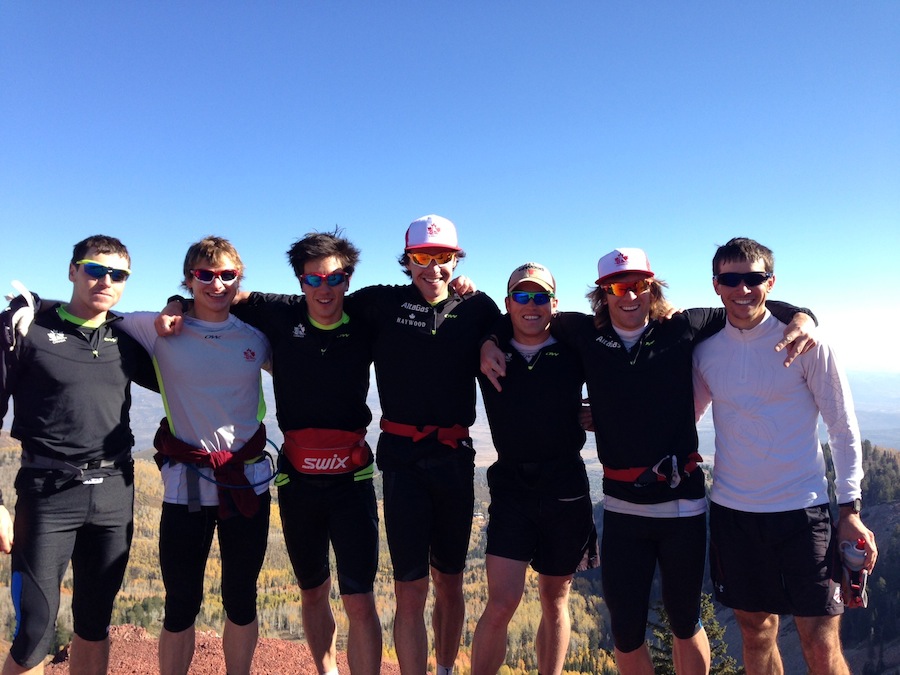
The Canadian men’s national ski team during a training camp in Park City. From left to right: Mike Somppi, Kevin Sandau, Graham Nishikawa, Alex Harvey, Brent McMurtry, and Devon Kershaw with U.S. Ski Team member Noah Hoffman. (Graham Nishikawa courtesy photo)
It’s safe to say the Canadian cross-country teams enjoyed their stay in Park City, Utah. Between their tweets and Instagrams of bluebird days and college football games, it’s not hard to see why.
While the Canadian women headed south on Saturday for a few days of training in St. George, Utah, the men’s World Cup team and senior-development skiers remained at a higher altitude at Park City during their second week of camp. On Tuesday, the men flew back to Canmore, Alberta, where they would likely get on snow at Frozen Thunder by the end of the week.
In all, six women and 10 men participated in the Canadian National Ski Team’s final dryland camp of the season. Women’s World Cup team members Perianne Jones, Chandra Crawford and Dasha Gaiazova trained with development and Alberta World Cup Academy (AWCA) athletes Alysson Marshall and Emily Nishikawa, and Amanda Ammar (independent). The men’s World Cup team (Devon Kershaw, Alex Harvey, Ivan Babikov and Lenny Valjas) did every workout with the development/AWCA skiers: Graham Nishikawa, Kevin Sandau, Jess Cockney, Graeme Killick, Michael Somppi, and Brent McMurtry.
The Canadian men during a dryland camp in Park City, Utah. From l to r: development-team members Kevin Sandau and Mike Somppi, and World Cup athletes Devon Kershaw and Alex Harvey. (Graham Nishikawa photo)
“The camp overall has been amazing,” Nishikawa wrote in an email. “The weather has great – bluebird everyday and not too hot. The camp was super smooth … and the energy was always high.”
One of his highlights was going to see the University of Utah football host the University of Southern California Trojans last week.
“It was the first college football experience for all of us and it did not disappoint,” Nishikawa wrote. “People get into it. Go Utes.” (The Utes lost 38-28.)
On Sunday, the men’s team celebrated Canadian Thanksgiving with dinner at the hotel. The next day, they ascended 1,600 meters (5,250 feet) on a four-hour rollerski up Mirror Lake Highway east of Park City, reaching 3,300 meters (11,000 feet) above sea level.
Head coach Justin Wadsworth wasn’t able to make it to the workout; he had to fly to Calgary on Sunday after his father-in-law fell and went to the hospital. He was stable and recovering, Wadsworth said Monday, after taking his kids to see their grandfather in the hospital before heading back to the airport.
“I’m taking the kids to Oregon just for a little seven-day break,” he explained.
While his two youngsters meowed “London Bridge” in the backseat, Wadsworth reflected on the Park City camp.
“We’ve done this camp now three years in a row and this one was great,” he said.
***
FasterSkier:What were some of the highlights of training around Park City?
Justin Wadsworth: We did some new routes for some long workouts and revisited probably one of the most challenging workouts, which is the back way from Soldier Hollow up to Deer Valley [in Park City]. They used it in the Tour of Utah cycling race, and I think a few of the pro cyclists who have ridden extensively on the circuits in Europe said it was the toughest climb they’ve ever done. We did it on rollerskis last year and then they repaved it this year so it was a bit better. It’s an amazing workout. The climb [up Guardsman Pass] is from about 1,600 meters and then they go out to about 2,800 meters … and we did it skating this year just to keep the emphasis on steep uphill skating.
I think that’s still, as a team, an area where we need to keep improving. Steep uphills are where everybody in the world have a hard time so I think it’s just good to be really efficient at climbing.
The Canadian men’s team rollerskiing near Park City, Utah. (Stefan Kuhn courtesy photo)
FS:What were some of the objectives for this camp?
JW: It was a volume camp. Just being at altitude was the main goal, and getting through a lot of the workouts and not coming out of this camp too tired. [We wanted] a lot of the athletes to go easy on the longer workouts and be fresh coming out of this camp so we can really train well the next three weeks before we go to Europe.
FS:Were there many joint sessions with other teams?
JW: There were a couple intensity workouts where we were joined by a bunch of our biathletes and I think [one or two of the American women]. We had a group of 13-14 women for some of the interval sessions.
FS:What about with the men? Was U.S. Ski Team member Noah Hoffman the only one that hopped in some workouts?
JW: Yeah. We would’ve enjoyed having the other guys around, but he was the one that was in town and ready to train at altitude.
FS:How was your men’s training group with the AWCA and development-team skiers?
JW: That worked out really well. We try to get our development-team guys exposure to our World Cup team as much as we can, and I think as a development group they’re in a pretty good place. They’re strong and fit. It’s really good when you have athletes like Devon, Alex, Ivan and Lenny that are proven world’s-best on any day. It’s always good to have your development-team guys have a marker like that, like, ‘OK, if you’re going to get Devon in this interval workout, you can probably bet he’s top-five in the world that day for his fitness,’ so it’s really good to see how they compared and stacked up against the World Cup team guys.
FS: How is everyone health-wise?
JW: Everyone’s doing really well. Ivan had a little bit of an ankle problem. It’s quite strange it wasn’t an acute injury so he had a couple days where he couldn’t classic ski. But besides that, I would say everyone was doing extremely well. I’m pretty happy where the team is and the same on the women’s side. The women looked great, and I really saw a remarkable change in actually all three of the World Cup women. I think they’re doing great.
FS:Was that your first time really observing or working with the women this season?
JW: [After] we split the [men’s and women’s] teams this year, we’ve been at a lot of different camps so it’s been hard to see them. I’ve been at a few workouts where it’s just been Peri and stuff, but to see the women all together and especially with Dasha in that group as well. … It’s good to see that everything’s been going really well with that program and [women’s coach] Eric [de Nys] is doing a really good job.
FS:How and when do you use V02max or similar tests to measure progress?
JW: For the women’s team, they’ve been testing periodically through the summer and we’ve continued with them just like we did last year as well. We’ve been trying some different strategies with the women, so we do want to monitor what changes are happening to their physiology, so that’s been going on and I believe they have one more set of testing before they go to Europe.
With they guys, we haven’t been doing any testing at all. We haven’t really changed our training philosophy that much, and I’m pretty confident through other ways, intervals that we measure and whatnot, that everything’s going well. Testing, for me, you really need to garner something out of it and to make it worthwhile. I think a lot of people test just for the sake of testing and I think for our women, we have been trying some new training methods with them and we do want to see what changes are happening, but with the guys it’s pretty stable.
At the workouts I’ve been to [with the women], you can see the changes. When you can actually notice the changes it’s pretty exciting, but it’s good to back it up with numbers just to make sure we’re seeing what we want to see with them.
The Canadian men’s team during peak season in early October near Park City. (Stefan Kuhn photo)
FS:Park City marked the first joint camp between your men’s and women’s teams this year. What did you do together and how did that go?
JW: We had a bunch of dinners together, which was really good, and interval sessions, we kind of crossed paths; we did the women first one day and the men second just because the groups were so big.
It’s always amazing, this team, they interact super well and they’re all really close. It’s fun to get everybody together again and it was a good check up. We all had a team meeting with our sports psychologist, too, during the camp and just made sure everyone has the same goals in mind as far as working as a team professionally.
I think having that team meeting and having the team together for a few meals was really important and it showed everybody that we all are on the same page. It’s really important to have that team dynamic. It’s easy when you’re tired and stuff to get a little lazy with making sure you’re being a good teammate and being respectful, so it’s always good for coaches and athletes to be reminded of that.
FS:What’s the plan for training in Canmore at Frozen Thunder?
JW: They roll out Frozen Thunder on [October] 13th I believe. We’ll be on snow pretty quickly and … just skiing quite a bit. With Frozen Thunder, you don’t want to go too nuts on it because it is only a couple k’s [about two] so you can kind of get burned out on it, but the goal is definitely to just do some of the easy shorter, distance workouts on there and then do a lot of the intensity workouts there and then we’ll still rollerski a lot. You don’t want to crank out a three-hour workout at Frozen Thunder, it’s just too repetitive.
FS: And you’ll see the U.S. Ski Team there again, too?
JW: The U.S. will be joining us so that will be fun. We’re having a classic sprint race on Friday the 26th of October so that’ll be a full-blown, timed, bibbed event so it should be quite competitive. In North America, we have ten of the world’s best sprinters roughly, so it’s pretty exciting to get everybody together – our guys and Simi and Newell and Kikkan and Chandra – it’s just a really competitive field for sprinting so it should be a fun race to see.
Devon Kershaw (CAN) sprints down the homestretch to win the Rybinsk 15 k. Photo: FIscher/Nordic Focus.
For a World Champion like Devon Kershaw, who has hundreds of World Cup starts to his name, there aren’t many personal bests yet to accomplish 10 years into a career. Yet on Saturday in Rybinsk, Russia, he checked another one off the list: his first official World Cup victory.
The Canuck skied a smart race in the mass start 15 k freestyle, biding his time in the lead pack and making his move in the final few hundred meters. He passed Ilia Chernousov (RUS) around the final corner in the stadium, putting on a decisive gap and finishing 0.9 seconds ahead of the Russian. Tobias Angerer (GER) took third, +1.6 behind Kershaw.
As the pack crested the final hill and the finish line approached in the final 500 meters, Kershaw said he made a decision to go for the gold.
“I got to the top of that last climb in third and I looked around and said ‘I’m going to take this one,” he said in a Cross Country Canada press release.
Kershaw breaking out the air guitar at the podium ceremony. Photo: Fischer/Nordic Focus.
“I felt so comfortable today in the pack. I just knew at the top of that hill I was going to win. That is a really good feeling.”
That confidence was helped, no doubt, by his recent string of World Cup podiums, including a third in the Moscow sprint on Thursday and third in the 15 k classic in Otepaa.
For Chernousov, his second-place showing was his first podium of the season, and he gave the surprising number of Russian ski fans who turned out for the race a reward for braving the cold.
The temperature was a barely-legal -19C at the start; the men lined up in the chevron employing various bundling methods to stave off frost bite. Most had a combination of neckwarmers, tape and sunglasses covering their faces, so that no inch of bare skin showed through.
Angerer’s bronze almost didn’t happen for the Germans, as the team had initially decided not to contest the Rybinsk races due to the frigid temperatures.
“The coaches changed their mind because the athletes wanted to race here and it proved a right decision,” said Angerer.
Several top athletes were missing from the lineup on Saturday, including current World Cup leader Dario Cologna (SUI) and Norwegian star Petter Northug.
This was Kershaw’s tenth World Cup medal, but as it was his first international distance gold, Kershaw was thankful to have finally achieved another standard of skiing success.
“Since I’ve been in the game a while, I know these days don’t happen every time, so it’s good to be able to savor the victory,” said Kershaw in a phone interview after his historic win.
The 15 k freestyle, at such a relatively short distance, made for an incredibly close mass start race. Not even the two sprint preems at the 6 k and 11 k marks blew the race open. The difference between the lead pack and the entirety of the field was a small number of skiers that fell off the back, even going into the final lap.
“The race itself was pretty tactical; the pace wasn’t too bad,” said Kershaw. “I didn’t know before, but I was kind of banking on it being a sprint finish, so I tried to save as much energy as I could in case that happened, and it did.”
Though he conserved energy, he sat in the top six or so for most of the race. The lead position changed hands frequently, and the Russians made their presence known at the front, their blue suits prevalent in shots of the pack from Eurosport’s broadcast.
Roland Clara (ITA), Alexander Legkov (RUS), Maurice Manificat (FRA) and Tobias Angerer (GER) were among those who took turns in the top spot, but Kershaw and Harvey consistently skied a few paces behind, biding their time.
The Canadians’ plan before the race began had been to only go for the sprint preems if they were in a decent position to do so, and when they found themselves in a good spot on the third and fifth laps, they went for it. Alex Harvey (CAN) was third at the 6 k, with Kershaw just a second behind in sixth.
Close quarters. Photo: Fischer/Nordic Focus.
By the fifth lap, Kershaw had moved up a few places, and put on a surge for second at the 11 k mark, good for twelve extra points.
“We all talked before and decided if we were near the front, we’d play into them a bit,” said Kershaw. “It just kind of happened on lap three and five.”
A group of five skiers finally separated from the group on the final downhill, Kershaw in third and Harvey in fifth. By the time they entered the stadium, Kershaw was in second, setting himself up to slingshot around Chernousov on the final corner before the straightaway.
As he crossed the line with a clear victory, Kershaw went on one ski and pumped the air in triumph, the long-awaited gold finally his.
Kershaw was quick to emphasize that the team energy amongst the Canadian men played a big role in his historic finish.
“It’s so corny to talk about it, but team dynamics matter,” said Kershaw.
Harvey, who’s had his own share of World Cup success this season, was fifth (+5.5), and skied even with Kershaw throughout the shuffling around in the men’s lead pack. Until the last uphill before the finish, Ivan Babikov was skiing right with the other two Canadians, but got tangled up with another skier and ended up in 17th (+13.6).
“On the last hill I thought we’d have all three in the top five,” said Canadian National Ski Team head coach Justin Wadsworth.
Canada’s combined effort this winter has brought them a top-five in every single stop on the World Cup this season, including Tour de Ski stages.
Kershaw celebrating his victory in Saturday's 15 k freestyle. Photo: Fischer/Nordic Focus.
“To reach the podium in every World Cup discipline and distance is a pretty powerful message,” said Kershaw. “It is a testament to the work our program has done as a whole, the support team we have in place and the great athletes on our entire men’s and women’s team. The work we have all done together is something that I’m most proud of.”
Wadsworth agreed. “For the whole team it’s a huge boost,” he said. “It’s a cliché—‘we all win together and lose together’—but everyone on this team is pretty tight. It’s big for the staff, and everyone in Canada, and obviously big for Devon.”
As the World Cup enters the later part of the winter, Wadsworth noted that his team’s strong results at this point in the year were an improvement from the late-season trend they’d demonstrated in the past.
“It really gives us some momentum in the last part of the season, which for us has been a stumbling block in the past,” he said. “Hopefully we’ve prepared ourselves for that better.”
Kershaw now sits in fourth in the overall World Cup standings, only 29 points behind Sweden’s Marcus Hellner, who is not in Rybinsk this weekend.
Jessie Diggins (CXC/USST) on her way to winning the U.S. Nationals 10k. Photo: Flying Point Road/NNF.
RUMFORD, Maine — On a comfortably cold day at Black Mountain, Jessie Diggins (Central Cross Country/USST) extended her winning streak to 11 this season—her second national title of the week at the 2012 U.S. Cross Country Championships. Dasha Gaiazova (Canadian National Ski Team/Rocky Mountain Racers) finished second, while Diggins’ teammate Caitlin Gregg (CXC) landed on the podium for the second time this week in third.
Despite her dominance of the domestic circuit so far this year, Diggins took to the line with something to prove.
Diggins (CXC) grimacing after the finish. Photo: Flying Point Road/NNF.
“I wanted to prove I could win a race without anyone tripping or breaking a pole or falling—I wanted to prove that to myself more than anything,” she said afterward.
Diggins certainly made a statement with her 73.6-second victory over Gaiazova. On the focal point of the course, the intimidating High School Hill, her pace was noticeably quicker than the pack she was skiing in.
After the first of three laps, Diggins was about 30 seconds ahead of Gregg, who skied in second for the early part of the race. But some of the feedback she got from coaches left out how much of a lead she had, so she never let herself start coasting.
“A lot of splits just read ‘race leader,’ but I was like, ‘By how much?’” Diggins said. “It occurred to me that maybe I should pace it somewhat to save a bunch for tomorrow, but then I thought, well, what if there was something wrong with the timing system? I better just leave it all out there.”
When she did find out how much she was leading by, Diggins decided to keep her tempo high and go hard through the finish. Her significant winning margin over Gaiazova, who is a solid distance skater, is a good indicator of her fitness as she looks to racing in Europe next weekend.
Dasha Gaiazova (CNST) climbing the lap lane hill. Photo: Flying Point Road/NNF.
Gaiazova, who is coming off World Cup racing earlier this season, entered the race with a similar plan—stay light on the feet and ski well on the uphills. She described the unique challenge of skiing an individual race on such fast snow.
“It’s a bit tricky to race—everyone is moving so fast, you always have to go in this over-speed mode where you’re pushing even harder to go faster,” she said. “Normally in the race when you’re moving fast on slow snow, it means you’re racing really well, but here it was important to keep pushing and pushing even though you … have so much speed.”
The snow was sugary in spots, and on High School Hill athletes said it was important to stay light and quick to avoid fishtailing on the icier surface just below.
“My strategy was to ride a flat ski as much as possible,” said Gaiazova. “I also tried to look for icy spots on the downhill to get more speed.”
Gregg, who finished 12.8 seconds behind Gaiazova, who came off a second-place sprint finish on Tuesday, was especially looking forward to the skate distance, her strongest discipline. But the course was relentless, the rolling terrain and big featured climb never giving skiers a break.
“You’ve just gotta keep moving the whole time,” Gregg said.
Her game plan involved trying to ski with someone lapping through, in the hopes that the timing would work out and put her with another strong skier.
Caitlin Gregg (CXC) free skating into the stadium on her way to third. Photo: Flying Point Road/NNF.
“Last night I looked at the start list and guessed who I’d come through the lap lanes with, and I hoped it would be Alexa Turzian (University of Colorado),” she said. “I was pretty stoked coming through and she was there; she looked pretty peppy.”
With Turzian and Becca Rorabaugh (APU), Gregg was able to ski in a group for her remaining laps, which she said definitely helped her race through the finish.
Of the two races completed at U.S. Nationals so far, CXC has taken five out of six women’s podium spots, which head coach Jason Cork is happy with.
As for Diggins’ winning streak, he thinks the notable upside is her level of confidence going into Friday’s mass start.
“She kind of gets to dictate the pace tomorrow,” he said. “I could be totally wrong on that, but I know if I was racing her, I wouldn’t be [attacking] her.”
U.S. Ski Team women’s head coach Matt Whitcomb had a similar take with Diggins’ departure for the Milan World Cup coming up next week.
“She set a goal of placing in the top 30 in a distance race [on the World Cup], so she tried to go out there and have a performance on par for that,” he said. “She’s really excited; this is good for her confidence heading over to Milan.”
Alaska Pacific University’s Kate Fitzgerald skied to a strong fourth place less than a second behind Gregg (+1:27.2), and echoed her competitors’ comments on the difficulty of skiing this course.
“It’s an always-working course,” Fitzgerald said. “It seems like there’s a lot of places to rest but there’s really not at all.”
Fitzgerald said she focused on the transitions and flats rather than think too much about High School Hill.
USST development coach Bryan Fish, who observed the races from the high point of the course, was complimentary of the 3.26 k loop.
“It’s a legit course, and there conditions were really good today,” he said. “Even though there were laps, it’s a pretty long lap, so it was a good championship course.”
If you’ve ever had one of those days where nothing seems to go right, you should be able sympathize with the Canadian men, because things could probably not have gone much worse for the first two legs of Canadian mens’ 4×10 k relay team Sunday in Sjusjeon, Norway.
Devon Kershaw, a veteran of the Canadian National Ski Team (CNST) who is known for his skill and love for the 10 k classic opening-leg of the 4×10 k relay, was hampered by a disastrous turn of events – at the end of the first lap, his ski popped off.
Then Kershaw tagged off to team mate Ivan Babikov who only managed to get a few kilometers before snapping a pole, and changing it twice to get the right one.
“It was really frustrating,” said Kershaw in an interview with FasterSkier after the race.
Kershaw Saved By Fan
Kershaw, who said he was “feeling good, and skiing well right at the front of the pack” was just ending the first of his four 2.5 k laps when he got mixed up in traffic as the pack passed through the stadium.
“Right at the lap lane on the end of first leg, I cut off, and my ski popped off,” said Kershaw.
“My binding lifted up, and my ski went shooting under the barrier [which separates the course from the spectator area].”
Now on one ski in icy fast conditions, Kershaw fell hard out, sliding off the course onto the uncovered pavement in the stadium.
As he slid across the pavement, he collected some road rash.
“My fore-arm is pretty scraped up,” he said, but other than that the Canadian star assured FasterSkier that he was fine.
As for his ski, which he saw disappear into the crowd; “A fan ran, grabbed it, and gave it back to me,” Kershaw said.
After hopping back onto the course, putting his ski on, Kershaw said that he was “at least 30 seconds down, and well out of the race.”
While he didn’t give up, he said the entire experience was “really, really disappointing,” as he felt as though his day was going much better than Saturday’s 15 k freestyle, where he finished a disappointing 37th.
If Kershaw losing a ski sounds familiar, that’s because it has happened to him before. During Oslo World Championships in the Team Sprint, Kershaw lost his ski in the semi-final, but was able to put it back on and get through to the final to become World Champion with team mate Alex Harvey.
And Kershaw isn’t alone with the problem – Ivan Babikov had a binding pop open last year during the Tour de Ski.
But Kershaw is still confident that despite his ongoing struggles, it is still a freak accident.
“You could honestly go out and try it a thousand times, specifically trying to pop it up, and it won’t,” he said.
But there has been discussions of trying to make some adjustments.
“We talked about filing them [the bindings] down or something, but in a pursuit you would never get them up,” he explained.
Even before he lost his ski, Kershaw was struggling a bit with the wax, as he wasn’t able to get any kick in what he described as “skating rink icy” conditions in the tracks.
With his skis slipping, and losing time continuously, he tried outside the tracks, and found his skis were able to get some purchase.
As well, he considered skiing outside the tracks an advantage, as he was always able to take the best line around the corners. In some relay races, the courses are distinctively marked as classic zones, and you aren’t allowed to cross the lines, but no such lane markers were in evidence Sunday.
Despite his fall, and corresponding blood loss, Kershaw had high praise for the organizing committee of the first World Cup race of the season.
“It was great job by the Sjusjoen organizers,” said Kershaw.
“They put together a beautiful course, and racing in Norway is always special.”
Pole Problems Plague Babikov
After receiving the tag in 13th place, Babikov set out to try and repair some of the damage.
Similar to Kershaw, Babikov felt like his race was going well.
“I started pretty good I thought,” he said in an interview with FasterSkier.
“The group in front of me wasn’t pulling away from me.”
But around 2 k into the race, Babikov found himself in trouble. He called the flat sections “really icy”, and said that there were big, deep holes in the tracks from the heavy use.
“I just stuck my pole in one and it twisted in there, and I broke off the end just above the basket,” he said.
“I kind of started panicking.”
In hindsight, Babikov said that he probably could have kept skiing with the broken pole until he was able to get around to the Canadian staff who had the right size of pole ready for him, right before the big uphill on course.
Instead, he took one from another coach, and it was too long. He skiied with the oversize pole for a few more kilometers until the Canadian staff was able to get to him.
“I pretty much changed my pole three times, and that was it,” he said.
“I just couldn’t find the rhythm after that.”
And it showed on the results sheet, as Babikov had the 16th second-leg time, and tagged off to Graham Nishikawa in 17th, or last place.
It was a little surprising to even see Babikov out on the classic leg. A skate specialist, in recent history he has been the go-to man skiing the third leg.
However, Babikov said that the Canadians didn’t feel like they had a full team, and that they “wanted to try a few different things.”
He also mentioned that getting in a practice classic race before the World Cup next weekend in Kuusamo, Finland, was important, calling his leg of the relay on Sunday a “test.”
“I need some racing for sure, I need as many races as I can to get back into shape,” Babikov said, in reference to his traditional slow start to the season.
Nishikawa Has “Tough Go”
After the equipment malfunctions of his first two team mates Nishikawa wasn’t left with a lot of optimism for his leg.
“I kind of thought that skiing with Devon and Ivan, I would get the tag right into the mix,” said Nishikawa, something that he was looking forward to.
Instead, he received the tag in last place, over two minutes behind, changing his race plan.
“It was tough to go out at the end of the relay, but it was good training for me,” he said.
While conditions played a factor in both Kershaw and Babikov’s racing, Nishikawa described the skiing as “great,” saying that it was “just perfect for skating.”
Nishikawa, who also had a tough day yesterday finishing 71st, has already switched his focus to the World Cup in Kuusamo next weekend.
“I thought I would be a lot better this weekend,” he said.
“I’m looking forward to having a good result in Kuusamo.”
At the end of Nishikawa’s leg, the Canadians opted to sit their fourth skier, sprinter Len Valjas, instead of sending him out almost four minutes behind the leader.
As for the relay, the Canadians are likely done for the year in the event. There is just one more on the schedule, in Nove Mesto, Czech Republic, and according to Kershaw it’s unlikely that Canada will field a team, as just he and Alex Harvey are slated to travel to that weekend at the moment.
“That was the end of it [their relay for the year],” Kershaw said. “It’s not a focus whatsoever for this year.”
All the Canadians now look forward to mini-tour in Kuusamo, Finland. FasterSkier caught up with the team in the airport in Oslo, where they were flying out to Helsinki, Finland, for a quick overnight stop before heading up to Kuusamo.
There they will be joined by the CNST women Perianne Jones and Chandra Crawford, as well as Senior Team member Dasha Gaiazova, and convergence trip Development Team athletes Drew Goldsack, Kevin Sandau and Alysson Marshall.
CNST women model their new suits L-R are Perianne Jones, Chandra Crawford and Development Team member Alysson Marshall (Photo: Devon Kershaw and Len Valjas)
With anticipation for the first bit of racing in Europe and North America reaching a fever pitch, attention has turned to attire.
Specifically, the Canadian National Ski Team (CNST), and the digs they’re going to be sporting this winter.
CNST member Chandra Crawford in Ostersund, Sweden (Photo: Devon Kershaw and Len Valjas)
When the Canadians inked a deal earlier this year with OneWay Sport, the nordic equipment manufacturer, the announcement raised some eyebrows. OneWay has a history of making some exciting suits, including the intense Slovenian neon, and the more questionable black-and-yellow French garb.
Friday, after a much-anticipated wait, FasterSkier received pictures and feedback on the suits courtesy of the entire team.
“I think OneWay did a good job,” wrote Devon Kershaw in an e-mail. “The important thing is that they feel good to train in. (The material they are made of is comfortable and moves well.)”
Kershaw did say that while the women were racing in the two-piece, most of the men wouldn’t be racing in that version. Instead, they’ll be using a one-piece, which may sport slightly different graphics.
While Kershaw was excited about the new gear, he added that the current near-tropical conditions in Europe haven’t given him a chance to test all of it.
“The rest of the gear seems really good too – although it’s been so damn warm out that we haven’t been able to use it a ton,” he said. “I mean, how many clothes do you need for skis in 10 degrees Celsius?!”
The Canadians have also spruced up their European vehicle fleet, adding some larger-than-life decals of World Cup Team members to the sides and back of the vans.
Kershaw and Harvey celebrating their World Championship win are now emblazoned on the side of the van. (Photo: CCC)
As I approached Len Valjas for an interview during a recent junior training camp at his home club in Southern Ontario, I couldn’t help but think something was a bit off – I caught him in the middle of the buffet line, about to load up his plate with pizza. The newest member of the Canadian National Ski Team (CNST) World Cup team was wearing baggy shorts, a big t-shirt, and sunglasses perched atop his head – which at 6’6, was considerably above my own.
After asking if I could chat with him over lunch, he grinned and said “sure, just let me grab my pizza, and I’ll meet you in a minute.”
Here I was interrupting a guy who finished 9th in the World Cup in Drammen, Norway, last season, and has out-gunned some of the best sprinters in the world as he was slumming it in the buffet line with juvenile boys and washed-up former-athletes turned coaches, all the while politely thanking the volunteers passing out food.
Almost exactly a minute later, he folded his lanky frame into a chair next to me, setting down a plate towering with pizza and a big pile of salad, greeting me casually.
The first thing he said? “Man, I was nervous about that presentation last night.”
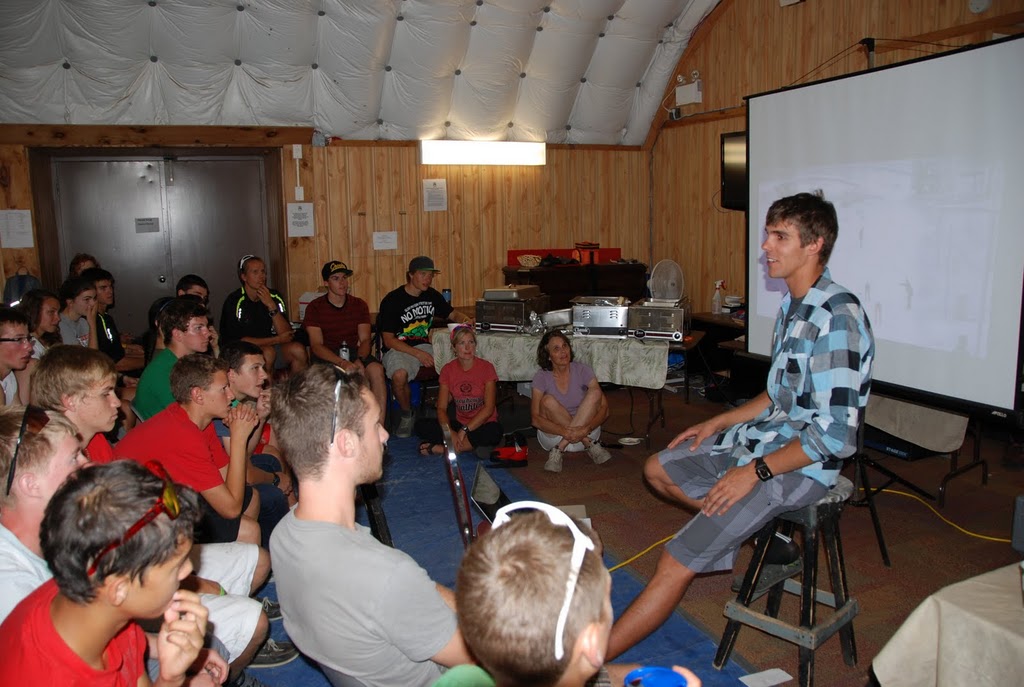
The previous evening he had given a presentation to the hordes of camp participants about his rise through the Canadian skiing system, and his previous season on the World Cup – I heard via the grapevine it was his first such appearance, and the previous day had heard him joke; “if it goes bad, I’ll just put up some windsurfing video from Hawaii, or something.”
Len Valjas capturing the attention of the crowd in his presentation at the recent SOD Camp (Photo: Graham Longford)
It was far from bad; Valjas, who I have known for the better part of ten years as being a bit of a quiet guy, but you wouldn’t have guessed it from his public-speaking demeanor. He was calm, concise, and had timing that stand-up comedians would kill for.
But the first feeling you get from Valjas (or ‘Lenny’, to most) isn’t one of extreme confidence, or cockiness, which he has probably earned. Valjas’ down-to-earth, earnest attitude was obvious during the aforementioned presentation, particularly when he played the start of his heat at World Championships in Oslo.
The clip shows him doing one double-pole, and then face-planting hard into the snow in front of hundreds of thousands of spectators. During the presentation, he then immediately rewound it, and ran it again in slow motion, unable to keep from laughing as he told the story. (For the record, it earned him the biggest laugh and applause of a very entertaining night.)
And right off the bat, Valjas makes it clear that he comes from modest beginnings as a ski racer, growing up in the suburbs of Toronto, and commuting out to Hardwood Ski & Bike to compete for Team Hardwood.
“I got cut from Team Hardwood’s Devo Squad [junior racing team] as a 12 year-old by Jack Sasseville,” he recalled in his presentation, a story I have heard from him in previous interviews. “I wasn’t serious enough; he was probably right.”
Valjas’ rise to World Cup success has been meteoric. At his first World Cup in 2009 at Whistler Olympic Park he finished 46th, or dead last (“I was dead last by ten seconds; I thought there was a timing error or something,” he quipped); he is now on the CNST World Cup team, and the most striking thing about him is his humble attitude.
“It was kind of unexpected,” he said of his World Cup season, “I was really happy with how it went.”
And obviously so – it was a season most skiers can only dream of. The young Canuck recorded his first World Cup top 30, his first World Cup top 10 (and the corresponding prize money), his first World Championship starts, and to top it all off, even managed to defend his title as Canadian National Sprint Champion in Canmore, Alberta, at Canadian National Championships.
“That was one of the prouder points of the season for me,” he said.
“I was really stoked to defend that [National sprint title].”
Valjas' slide of the results from his first Canadian National Championship classic sprint, where he finished 41st, demonstrating how far he has come (click to enlarge).
While Valjas may be the current National Sprint Champion, and Canada’s fastest pure sprinter, he hardly lords it over people. Instead, he almost seems to revel in fact that he has worked his way up from practically the bottom. In his presentation the day before, his third slide was of his first classic sprint at Nationals in 2004 – where he finished 41st, over 15 seconds behind now-teammate Alex Harvey.
If Valjas was excited about his success Canadian Nationals, the highlight of the season was without a doubt his trip to World Championships in Oslo, Norway.
“I’m not going to forget that ever,” he said. “It’s a totally different atmosphere than I’ve ever been in and I’ll probably never be in an atmosphere like that again.”
Valjas was just happy to be there, to take in the experience.
“To be there just as an alternate I would have been happy – it was nuts.”
And he almost was there ‘just as an alternate’ – the Canadian team used the skate sprint World Cup in Drammen, Norway, the week before World Championships to determine which of their three pre-qualified sprinters (Valjas, Stefan Kuhn, and Phil Widmer) would join Harvey and Kershaw on the start list at the World Championship sprint.
“The pressure was on for sure for all three of us,” said Valjas. “It went by so fast – I one-skated the whole thing. I went across the [finish] line, and I was in the top three for a while.”
Valjas was eventually out-qualified by one other person (less than a tenth of a second behind one Andy Newell) but qualifying in fourth was a shock.
“After finishing fourth I honestly thought there was some kind of timing error again,” he said, laughing, referencing to his first World Cup experience.
“The coaches and staff were all freaking out after I crossed the line – it kind of took me by surprise for sure. Sometimes you need those races just to tell yourself you’re just as good as those guys.”
And Valjas wasn’t just a one-shot wonder on the day; he punched his way through to the semi-final, where he ultimately ended up just missing the A-Final and finishing ninth on the day.
“Going into the heats I kept it going,” he said.
“I had a low bib number, and I’ve never had that, it kind of felt like I fit in, and I knew I could ski the course faster than almost everybody.”
Valjas chalked some of his success up to tactics.
“Everyone else kept shooting out on the [last] turn and I could get inside and make up a few positions there. It kind of worked until the semi, when I ran out of gas,” he said.
For Valjas, the biggest boost he gained from his result in Dramman was confidence – less than six months previous he had been looking up at the top World Cup sprinters in awe, and now he knew he could ski with the best of them.
“Those guys, they’re pretty intimidating,” Valjas said of the men he competes against on the circuit.
“The whole year I kind of walked by them and I would try and name them – you know who they are, but they have no idea who I am. I mean, hopefully now they are starting to know, but I don’t think we should be all intimidated by them.”
Len Valjas (bib #4) on his way to a career-best ninth at the Drammen, Norway World Cup sprint.
And Valjas truly believes that the top level of skiing in Canada is extremely close to that of Europe.
“Our Canadian guys are as fast as those guys,” he said.
“I think Canada is one of the best ski nations now, we just don’t have as many people racing compared to countries like Norway. For the amount of guys we start and the amount of medals we bring in it is amazing.”
Valjas built his confidence up slowly, starting from the moment he set foot in Quebec, and began training with Alex Harvey.
As soon as he started doing workouts with Harvey, he recognized the value in having one the top World Cup skiers doing intensity next to him. He gradually found himself working up to Harvey’s speed, and trying to match him in sprints.
“In training I knew I could be close to Alex, and in races I knew I could do the same thing,” Valjas said.
“A lot of our workouts were replicating sprint races, or sprint heats, and I just knew I had to learn the tactics pretty quick as well.”
And tactics are something Valjas has made an effort to learn, and understand. He called the tactical aspect a “big difference” from North American to European sprint heats.
“Guys are caught surprised,” he said.
“There’s not too much contact, but it’s close quarters, and if you’re not aware of your skis and poles you’re going to get stepped on and tripped.”
“You have to ski small sometimes, you can’t just assume someone is going to be nice and give you space. I’ve always done that, even in NorAm races. I’ve just tried to make sure I stay on my feet, not be super aggressive.
“Once you get better at staying on your feet, you can start being the aggressor, but as soon as you figure that out, it helps, guys aren’t going to start passing you when they aren’t supposed to. If you feel a guy coming up the side, just drift right over, shut the door. Say no, not here,” Valjas explained.
But Valjas hasn’t started being the aggressor quite yet – he still has a lot of respect for his World Cup competitors, and isn’t in a hurry to “piss them off”.
Valjas (l) teaching sprint-start technique to Junior athletes (Photo: Graham Longford)
“I also don’t want to be the guy that everyone wants to beat out there, at least not yet,” he said.
Despite the gains he has made tactically in sprinting, he still had some rookie growing pains to go through last season.
Specifically, his trip to World Championships.
Valjas started off his sprint day well, qualifying 21st. As he stood on the start line of his quarter-final, he was soaking up the atmosphere of the thousands of fans as he thought about how proud he was to be a Canadian at that moment.
And then he made a huge mistake – he missed his second pole plant out of the gates, and went crashing onto his face in the tracks.
“The first thought that came into my head was ‘oh crap, this sucks. That’s not how it’s supposed to be. I look like an idiot,’” he said.
But his next thought was a lot more productive – “I just relaxed,” said Valjas, “that was the fastest push-up of my life.”
Luckily, Valjas was able to stay in control and ski smooth to catch up to the group without wasting too much energy. Despite the start, when Valjas crossed the line, he was happy with how the race went.
“It was one of my favourite races, even though it didn’t go as I planned, and my whole game plan was totally blown out the door when I wiped out in the start gate,” he said.
And Valjas has learned from his mistakes – he and the entire Canadian team have dedicated a large portion of time this summer to working on start gates, and sprint starts, something he now feels very confident with.
Valjas was lucky enough to start a second race at World Championships, but it wasn’t without a little controversy.
When Alex Harvey opted out of the relay, it opened the door for some of the other skiers to jump in, albeit with a different mindset.
“It is his decision, that’s what it came down to. Definitely the other teammates didn’t fully agree with it at the time, but that’s his call, he’s got his own goals too,” Valjas said of Harvey’s decision to sit out the relay to save himself for the individual events.
“We didn’t let it bother us, we were going out to race as fast as we could.”
Len Valjas skiing the second leg for team Canada, in Oslo, Norway at World Championships last March.
The relay is something Valjas is keen on being a part of on a regular basis – and with the retirement of George Grey, it has become a real possibility, as there is one spot available.
“I would love it to be me,” said Valjas. “It’s one of the most exciting events to race. There’s not so many team events in cross country skiing, so it’s cool to be a part of.
He has switched up his training a little to try and improve his endurance and his distance skiing, and hopes to start a few distance World Cups this season. Last season he started five distance races in total, a number he is convinced is doing little to improve his distance-skiing ability.
“I get better at distance racing by doing more distance races. It’s good training; you can figure out all the pacing and stuff,” said Valjas.
But for Valjas, this season his focus is still sprinting – he hopes to crack the top 30 in the Sprint Cup, and top 50 in the World Cup overall.
He is also thinking about the Tour de Ski – he has a deal with CNST Head Coach Justin Wadsworth where if he notches two top 12’s before the registration deadline, he can decided to race the event or not.
“I’m in no rush to race the Tour,” Vlajas admitted. “I’m still not in the distance and endurance shape that I probably should be to enter that kind of stage race.”
Valjas is feeling confident with the work he has done this summer, as he has been working closely with Wadsworth and Louis Bouchard on improving his fitness and his technical ability.
“I hope this year goes well again, I think I’m in the best shape I’ve ever been in this summer,” said Valjas.
While he may be in the best shape physically, as I wrap up the interview, and Valjas and I collect our dishes and head for the door, I can’t help but notice one thing – he has left his salad untouched. There’s still work to be done.
Say what you will about the Canadians, but the country with the Team Sprint World Champions aren’t resting on their laurels.
A week after returning from a camp in Park City, Utah, Canadian National Ski Team (CNST) Head Coach Justin Wadsworth had the athletes packing up again and headed for Whistler, B.C. for a short intensity-filled camp before heading back to Canmore, Alberta, for Canadian Thanksgiving.
While it may seem unusual that the Canadian team would travel to Park City for a camp, Wadsworth felt that it fit best in the schedule at the end of September.
According to Wadsworth, Park City was a volume-based camp, where the athletes were able to take advantage of some training opportunities not present in Canmore – including a long rollerski on freshly paved roads from Soldier Hollow to Deer Valley.
In addition, most of the training at Park City was done at altitude, before coming home to Canmore for a quick rest week.
The second part of Wadsworths’ sequence is the switch to intensity, which he aims to do at lower altitude at Whistler.
And Wadsworth has a lot to fit into the fall schedule – he is also planning on taking advantage of ‘Frozen Thunder’, a program whereby the Canmore Nordic Center stores snow under a mountain of sawdust, and rolls it out onto the trails in mid-October.
Kershaw in action at World Championships in Oslo
“I don’t want to be somewhere else doing dryland training when we can be on snow here [in Canmore],” said Wadsworth.
“We’re going to get three kilometers of skiing on October 15th right outside our door, and it’s one of the only places in the world that offers that.”
After a Park City camp with little intensity, Wadsworth is has tabbed Whistler as his intensity camp due to the great training opportunities and ideal altitude.
“You get 100% O2 saturation for recovery – it’s basically like being right at sea level,” Wadsworth said.
Wednesday the Canadian men did a 15 k skate individual start Time Trial, while the women did four sprint qualification rounds.
Graeme Nishikawa earned top spot ahead of Kershaw, while Kevin Sandau of the CNST D-Team who trains with the Alberta World Cup Academy (AWCA) finished third.
All of the men on the Canadian World Cup and Development Team are present, with the exception of Alex Harvey, who has headed home to Quebec to train with the Pierre Harvey National Development Center (CNEPH).
“We feel like Alex coming out to Whistler would be a couple more trips across the country, and we feel like he’s got a stable training program [in Quebec],” Wadsworth said of Harvey’s absence.
Convergence Trip Possibility
There is an additional element to the camp as well – with the Canadian early season convergence trips coming up shortly, the Development Team athletes have a chance to show the coaching staff how much they have improved over the summer in person.
Drew Goldsack (AWCA) during the 15 k skate at Sovereign Lake Nordic on the NorAm circuit in 2011
While Wadsworth was quick to say that athletes would not be selected based solely on their training camp performance, he did admit that the athletes knew that selections for the trip had to be made.
“We’re going to see them all under some hard workouts this trip,” he said.
That being said, if someone is skiing spectacularly, they will have a head start.
“We know Devon is in good shape, so if you’re consistently beating him – not just in one interval, but the entire week, then we know you’re going well.”
Athletes from all four of the Canadian Development Centers are present. The veterans present include Drew Goldsack (AWCA), Graeme Nishikawa (AWCA), and Brent McMurtry (AWCA) while the next generation is represented by young guns Kevin Sandau (AWCA), Mike Sompii (NDC T-Bay), Harry Seaton (NDC T-Bay), Jess Cockney (AWCA), Graeme Killick (AWCA), and Fred Touchette (CNEPH).
Chandra Crawford and Perianne Jones have also been joined by the two younger women of the Development Team, as Alysson Marshall (AWCA) and Emily Nishikawa (AWCA) are both present as well.
Upcoming Season Improvements
In terms of team performance, Wadsworth is happy with what he has seen over the course of the whole summer.
“This year I’ve seen Devon and Alex still improve,” he said. “When you can make noticeable improvements at their level, that’s impressive.”
If Wadsworth is enthusiastic about his two World Championship-winning team members’ improvements, he sounded even more impressed with Ivan Babikov.
Len Valjas (CNST), 2011 Canadian Sprint Champion (photo Bill Thompson)
“He’s made big jumps forward with his double poling, general fitness, and strength,” Wadsworth said.
As well, he mentioned that Babikov will be taking a different strategy this season in order to ski well at the beginning of the season, something the distance specialist has struggled with in the past. Babikov has also committed to spending large chunks of time in Europe this season in order to stay on track, also a departure from previous seasons.
As for the women, Wadsworth noted that Perianne Jones has made some of the biggest improvements he has seen, and the whole team has made some big steps forward.
The youngest member of the team, Len Valjas, a 23-year old breakout sprinter from last season, has also been making improvements.
“If you just look at what Lenny can handle in training, it’s like a man,” said Wadsworth.
“He can handle them [the CNST training camps] without having to be nursed through them.”
As per usual, Wadsworth didn’t shy away from making some bold predictions.
“It may be greedy, but three guys in the top 5 at the Tour de Ski is possible,” he said.
With summer in full swing in North America, many cross country skiers have opted for the winter conditions of the Southern Hemisphere, including the Canadian National Ski Team (CNST).
While the women of the CNST recently spent time in Alaska with a large crowd of American women, the men have travelled to the traditional summer hang-out spot: the Snow Farm, in Wanaka, New Zealand.
The World Cup team of Devon Kershaw, Alex Harvey, Ivan Babikov and Len Valjas are spending two weeks in New Zealand, getting in some quality on-snow time, and are targeting the three cross country races at the New Zealand Winter Games, happening August 13, 14 and 16.
In a recent e-mail to FasterSkier, Head Coach Justin Wadsworth stated that the main focus of the camp is volume, but that the Canadians will maintain a solid level of strength and intensity as well.
In terms of technique, Wadsworth said that each athlete had an individual focus to work on for the week. However, they are also targeting improvement in a very specific area.
“We are paying some extra attention on steep uphill technique,” wrote Wadsworth. “It’s good for everyone, but especially the guys who are focusing on the Tour de Ski this year.”
“We know we can be there at the start of the last stage of the Tour de Ski,” he wrote, “but we want to move up to the podium this year on Alpe Cermis.”
While Wadsworth is thinking ahead to the Tour de Ski, the men will be racing much sooner – the end of their second week in New Zealand will feature three races against some stiff competition – especially the sprint.
The men's 15 k classic mass start podium from New Zealand last year: L-R Ivan Babikov, Devon Kershaw, and Kris Freeman – all three will be present again this year
The U.S. Ski Team World Cup squad is also in New Zealand for summer training and racing, with top sprinter Andy Newell present, as well as Kris Freeman and Simi Hamilton.
According to Wadsworth, the two North American teams will continue their collaboration, doing a few speed sessions as well as getting in some solid distance training.
In addition to the strong North American contingent, a large group of Russians have made the trip to New Zealand, with 2010 Olympic sprint champion Nikita Kruikov and team sprint bronze-medal winner Alexei Petukhov headlining the list.
All of the Canadian men will start at least two of the three races, and are taking the chance to face off against top competition seriously.
“Of course it’s not the Olympics,” wrote Wadsworth, “but if you’re going to bother to put a bib on, you need to race hard.”
While the training load in New Zealand is always high, the country also seems to offer great recreational possibilities – in the past the Canadians have passed rest days with surfing, biking, and have even visited a winery.
However, this time the group had just a single off day, and Wadsworth wanted to make sure they avoided any strenuous activity – despite several of the athletes hoping for a surf session.
Instead, they opted for some go-karting, and a trip to ‘FergBurger’, where Alex Harvey downed the ‘Big Al’, which the website touts as “a double serving of prime New Zealand beef (1/2 lb), lashings of bacon, a whole lotta cheese, 2 eggs, beetroot, lettuce, tomato, red onion, relish & a big wad of aioli.”
According to Wadsworth, “We must be training enough because he pushed it down like it was a ¼ pounder from McDonalds.”
Ida Sargent, Sophie Caldwell, Sadie Bjornsen, and Rosie Brennan enjoying freshly groomed snow on Eagle Glacier last week. Photos courtesy of Sadie Bjornsen and Jessie Diggins.
About 15 women and their coaches from the U.S. Ski Team (USST), the Canadian National Ski Team (CNST), Alaska Pacific University (APU), and select elite juniors and U23s recently finished up two weeks of training in Anchorage, AK for the first ever “North American Women’s Training Alliance” camp.
FasterSkier caught up with former Dartmouth College teammates Rosie Brennan, now at APU, and Sophie Caldwell, a U23 in her senior year, in the days following their return from Eagle Glacier, where the camp stayed in its final week for some on-snow training.
FasterSkier: This camp was really unique in bringing the top skiers from both the U.S. and Canada together to train. How do you think it went overall?
Rosie Brennan: It was really good—it was a lot of fun and everything went smoothly, so I think it was very successful overall. It was the first of its kind, especially with the Canadians [Chandra Crawford and Perianne Jones] there, so it was really an all-inclusive women’s camp.
The group after a rollerski near Anchorage. Photo by Matt Whitcomb.
Sophie Caldwell: It was a lot of fun having the Canadians there, because I didn’t know them well before. With them, the APU girls, and the USST girls there were probably 15 of us, and a lot of them are the best in the country, some the best in the world. It was a really good experience, training with them and to have these two countries come together.
I’ve trained with a bunch of those girls before in college, at USST camps, and at World Juniors, but I’d never been to a camp with Kikkan [Randall], Chandra or Perianne before, so it was fun to hop behind those girls and see what they’re doing.
FS: What sort of training did you get in?
RB: For the dryland in Anchorage, we did a lot of rollerskiing. We had two interval sessions, a time trial, and a speed session. There was a lot of distance, and running and strength in the afternoons.
[APU coach] Erik Flora wrote the training plan and organized the whole thing. I’ve been to a handful of USST camps before, but I haven’t done one in a couple of years. This one was different because it was at APU, and it was more just a camp, for anyone.
Matt Whitcomb, Erik Flora, and Chris Grover enjoying some sun.
SC: The coaches [Flora, USST coaches Matt Whitcomb and Chris Grover, and CNST coach Eric De Nys] worked together to figure out the workouts, but we were doing what APU usually does on the glacier, and the U.S. coaches gave their input as needed.
RB: And you could alter the plan to fit your needs, but in general we followed Erik’s plan.
FS: How were the conditions?
SC: We had great weather in Anchorage for the dryland portion, and when we went up to the glacier we had pretty good weather there too. Its not always like that, so we were pretty lucky. It really made for a successful camp.
RB: You fly in a helicopter from Girdwood, AK. It’s a five or so minute ride, and the glacier is just under 6,000 feet. It’s really cool.
The first few days on the glacier the weather was iffy—it was rainy, snowing, and pretty windy. Then the weather got better, so I guess that’s a better progression. When the sun comes out, its really beautiful up there; just unbelievable skiing.
[APU] just got a new piston bully, and this was the first time we used it. You could skate two wide, and then set good classic tracks for the afternoon. I was using klister, a few were using zeroes or harries, but klister is pretty much what you use up there.
FS: Submissions to the Women’s Video Contest were coming in while you were up there. Did you get to contribute to the judging of those at all?
RB: Not to the judging, but we all watched the submission up there together. It was cool to have it going on at the same time, and we all had a meeting and talked about what it meant to have our big group of girls training together.
SC: There were a lot of ideas going around; it was the first time the U.S. and Canada had come together to train, so we were just trying to think of ways to involve girls of all ages all over.
Even though we’re all competitors we were still able to get along, have fun, and have a successful camp.
Some of the girls, ecstatic to be on snow together.
RB: All of us were a little nervous before the camp, since the glacier is such tight quarters. A week is a long time to spend in that small a space with 15 girls, but we all had a lot of fun. The success we had got us even more passionate about getting girls to keep training in groups.
FS: What sort of ideas came out of this meeting?
SC: We didn’t decide on anything for sure, but we were thinking of things like posters and calendars, and using social networking. I think the video contest [which used Facebook for promotion and voting] was really successful. It’s a work in progress.
Chandra and Kikkan were thinking of using Fast and Female to promote more women’s training, and I’m sure we’ll continue to be in touch once everyone gets settled in back home.
RB: I really believe that this camp will happen again, and because of its success I think there will be a lot more girls interested in coming next time.
If you’re female and a fast skier, Anchorage, Alaska is the place to be.
Chandra Crawford during the World Cup skate sprint in Drammen this past winter
A group of approximately 20 women is currently residing in the northern state during a female-only training camp. Members of the United States Ski Team (USST), the USST Development Team, Alaska Pacific University (APU), and Perianne Jones and Chandra Crawford of the Canadian National Ski Team (CNST) have gathered in Anchorage for two weeks of quality training.
Headlining the American contingent at the camp are USST athletes Kikkan Randall, Liz Stephen, and Ida Sargent, as well as a number of locals from APU.
After taking a couple of days to rest and orient themselves, the Canadians have joined up with the large group of American women to train.
According to CNST coach Eric De Nys, the opportunity was one the top Canadians could not afford to miss.
“Being with a like-minded large female contingent is great for both Peri and Chandra,” he said in an interview. “They don’t get the opportunity to socialize and train with that large of a group of women very often.”
The group has several training sessions planned around Anchorage before heading up to the Eagle Glacier for a week to get some time on snow.
For the Canadians, the goal of the camp is to build on the training they conducted in Hawaii in the spring. The hours are big, but there is some intensity built into the schedule as well.
“We’re at sea level, so we’ll be working on some intensity down here, and then when we get up on the glacier we will do more distance, and mix in a bit of intensity,” said de Nys.
The Canadians are also getting some high-quality Alaskan hospitality, according to de Nys. They’re eating fresh Pacific salmon, absorbing scenic mountain runs, and being “shown the good places to train.”
De Nys is the only coach traveling with Crawford and Jones, but he is collaborating with the USST coaches Matt Whitcomb and Chris Grover, as well as APU coach Erik Flora.
While it’s an all-male staff for an all-female camp, the coaches are still a major part of the group. So much so that when Kikkan Randall made up sweatshirts with the slogan ‘North American Women’s Training Alliance,’ she made sure to include de Nys, Grover, and Whitcomb.
While the women are in Alaska, both countries’ male teams are headed to New Zealand for the traditional summer stint at the Snow Farm. Previously, the full Canadian and American national teams would head south, but this season, they opted for a change.
Perianne Jones racing on the World Cup this past winter
“Chandra was invited by Kikkan, and the U.S. had this on their plan for the year, so we joined them. It seemed to be a natural fit,” de Nys said.
The two groups collaborated in Bend,Oregon, for their first camp of the year, and the Canadians said that the resulting atmosphere made for some excellent training.
However, the current Canadian contingent in Alaska is quite small, with just Jones and Crawford making the trip.
“The camp was open to [the development team athletes], but it wasn’t in the cards,” said de Nys. “They have team camps that they are trying to do, as well. Emily [Nishikawa] and Alysson [Marshall] will come to our Whistler Camp in October.”
Following the camp, Jones will leave for a short vacation at home, while Crawford plans to stay in Alaska for an extra couple of weeks, in order to train with Randall.
The Canadian National Ski Team (CNST) escaped Canada for their second training camp of the year – to the islands of Hawaii.
“When we came out of the Haig Glacier last year, about a year ago exactly, it was pouring rain, we had been snowshoeing out for numerous hours, and people were kicking around other places to train at this time of year,” said Head Coach Justin Wadsworth in a recent interview with FasterSkier.
Somehow Hawaii came up, and Wadsworth promised that if the team could collectively produce more than four World Cup podiums, they would have a camp on the islands.
By the end of the season, the team had produced six, including a gold medal in the team sprint at World Championships, and in turn, Wadsworth delivered, getting them out of “monsoon June,” in Canmore, as several local athletes have nicknamed it.
True to form, the entire time the team was in Hawaii, Canmore was rainy and cold. Wadsworth said escaping Canmore to train elsewhere had been really good, as “the athletes like it, the pavement is great, and the weather has been good.”
For the Canadians, the main goal of the camp was to get some high-quality altitude training.
The athletes stayed at high altitude on Mt. Halaekala, a volcano on the island of Maui, and were doing a lot of long rollerskiing and running workouts, as well as working on efficiency at high altitude.
“We’re working on nailing the same technique for a long period of time,” said Wadsworth.
The Canadians were able to rollerski from the town of Paia, at sea level, up to around 7,000 feet, where the park officials asked them to shelve rollerskis in favour of running or biking the rest of the way up to 10,000 feet.
If you think the Canadians were vacationing in cushy style, think again. Gaining 10,000 vertical feet in a day is a serious workout – Wadsworth said that the long grinding uphill workouts took around four hours to complete. Additionally, the athletes were camping high on the volcano, and were put through 30-hour training weeks.
However, Wadsworth did allow them to come down and sample some of the things Hawaii is more known for: on rest days and evenings, they managed to surf and hit the beach.
But they didn’t have a ton of time – over the course of the first 10 days of the camp, the team had one rest day, and “really good, really hard intensity and strength training.”
Wadsworth described the entire team as “excited and motivated” by the new terrain and location.
“The quality of camp that you just couldn’t get anywhere else because of the intangibles,” he said. “It’s easily one of the best camps we’ve ever had.”
While the team usually trains at the Beckie Scott High-Performance Training Center, at the Haig Glacier just outside of Canmore, at this time of year, Wadsworth said that financially the Hawaii camp was not a major difference.
The team reduced costs by camping, found cheap flights, and overall Wadsworth said he felt they were receiving plenty bang for their buck.
“Our objectives were to have a high altitude training site with good rollerskiing, running, and biking,” he said, “and Hawaii was one of the only places we could have it.”
Wadsworth also mentioned the number of professional athletes who choose Hawaii as a training location, including Canadian cyclist Ryder Hjesdal, downhill skiers Julia Mancuso and Aksel Lund Svindal, as well as plenty of elite triathletes.
Justin Wadsworth (l) giving instructions to Lenny Valjas (r) at a CNST training camp last fall
The entire team was present at the camp, with the notable exception of Dasha Gaiazova.
“Dasha has been excluded from the World Cup Team training camps at this time, and is currently pursuing alternative training options,” said Wadsworth.
“We expect to have Dasha’s training program finalized over the next couple of weeks.”
Wadsworth declined to comment further on the situation.
The camp wrapped up last weekend, when the team flew back to Canmore for a little time at home.
And what is Wadsworth going to use for motivation next year?
“I’ve told them, next year they need 10 podiums if we’re even going to consider coming back,” he said.
Devon Kershaw (L) and Alex Harvey (R) with their World Championship gold medals
Canadian Devon Kershaw has risen steadily through the ranks of the cross-country skiing world, to the point where he is now considered one of the best skiers on the World Cup circuit. Last season, he finished seventh in the Tour de Ski, after standing on the podium four times during the event – including a win. Along with teammate Alex Harvey, he also became Canada’s first World Champion in cross-country skiing, winning the team sprint event in Oslo, Norway, in March. Finally, over the course of the season, he earned himself an eighth place finish in the World Cup overall rankings – the best finish of his career.
In the second part of this two-part interview, FasterSkier caught up with Kershaw what worked in his training last season, Justin Wadsworths’ outspoken goal-setting, and the return of World Cup cross-country skiing to Canada in 2012.
FS: The World Championships gold medal, the Tour de Ski medals, the eighth place finish on the World Cup overall – this year was without a doubt your best yet. What really clicked? What changes did you have to your training program that made it so successful?
DK: Every year, I have had to make some significant changes. Every year there has been a new coach – every year for six years. This is the first year I have had the same coach, two years consecutively, in a long time.
The biggest thing that changed last year was that I was so motivated. Yeah, the Olympics were great – I had personal bests, and our whole team had personal bests – but I didn’t hit the international podium once in 2010, and I was frustrated. I knew I was better than that.
I had come close so many times that season; it kind of pissed me off. I just had that extra little bit of motivation. The top 10 just wasn’t good enough. I had that bitter taste. I just worked that extra little bit harder – sometimes you have great seasons. Also, we have a really, really, solid staff and a positive environment, which I really enjoy.
FS: You mentioned this is the first time you have had the same coach for consecutive springs in quite a while. What does Wadsworth do specifically for you that works so well?
DK: I just get along really well with Justin! It’s an interesting mix, because I knew Justin as [Canadian ski legend] Beckie Scott’s husband, but then we became friends. I raced against him – his last World Championships was my first. He was around the team a lot, with Beckie, and I got to know him well.
When he came in as our coach, the dynamic changed a little bit, but I feel really familiar and comfortable around him. He’s really open, and we have really good discussions about training. He brings a really good perspective to my training. He has helped Beckie a lot in her career, he had his own career, and he has the experience of coaching the U.S. team for four years.
It’s not like I had to do with all the other coaches, where I had to stick out my hand and say, “Hi, I’m Devon. This is what I do.” He has a very good understanding of what it is to be a Canadian ski racer, and that has really helped.
FS: Wadsworth has set some pretty big goals for the team this year: top three in the Tour de Ski, and top three in the World Cup overall. Are there major changes happening to the plan and preparation?
DK: He’s pretty bold. We have a bit of a joke, that he’s pretty “American” with that stuff. He has set some lofty goals for us. But for me, performance goal-wise, I can’t control my competition. I can only control my preparation. You can only control what you can control. I don’t pay much attention to the hard numbers, because there are so many variables.
Alex Harvey (R) and Devon Kershaw (L) celebrating their World Championships gold.
FS: Is there a specific area you are targeting for improvement this off-season?
DK: The blatant one was inconsistency. My sprinting was the best it has been – ever. Coming first and second in the sprints on the Tour de Ski was great. When I was on, I was the best in the world, but when I was off, I was horrible. I was not able to qualify. I qualified in maybe half the sprints I went in last year, and that’s unacceptable. In past years, I would qualify for almost every sprint, but get knocked out in the quarterfinals. We have to work on my qualifying speed.
My double-poling has come a long way, but there is still a lot of work to go. My skating, as well, needs to improve. When I’m in good shape, I can be competitive, but when I’m a little bit off, I’m further back. I can’t afford to be coming 25th to 30th in skate races if I want to be contending for the World Cup overall.
FS: The International Ski Federation (FIS) recently announced that they were lengthening the Tour de Ski by a day and a race. They are adding a third race in Toblach, Italy, an individual start 3 k for women and 5 k for men. What’s your take on the extra day and race?
DK: I don’t think it changes the dynamic too much. Just throwing in a single individual start, like that, is fine. If they started adding travel days, like a few years ago when we went to Prague, then it gets tough.
But adding races in the same venue – I have no real problem with it. You’ve traveled all that way, you might as well do an extra race! I’m cool with it. I think the Tour is getting more and more prestige, and viewership is rising. And people will still drop out when they get sick. If you’re not in the top 10, you don’t get paid for the overall, and the points fall away quickly. If you get sick and you push through, you risk the rest of your season. And lots of people always drop out, but with that style of race, it’s always going to happen. I don’t see how to fix it.
FS: In 2012, the World Cup returns to Canada, in both Canmore, Alberta, and Quebec City, Quebec. Are you excited to race in Canada again?
DK: Yes and no. I’m super, super psyched to be racing in back in Canada. It’s how we have the depth we do in Canada, with the young guys coming up getting a chance to race against the best in the world. But the races are usually pretty skate-heavy in Canmore, and that’s the worst course in the entire world for me in skating.
The other thing is that it’s in December, and I think it’s too bad that that’s where [FIS] put it. I don’t really know who is going to come over. If people are gunning for the Tour de Ski, and it’s a championship year, are people really going to want to get on a plane, stop in Quebec, and then head to western Canada? Is it going to be like the Rybinsk World Cup [a Russian World Cup weekend with typically poor attendance] in Canada? If it’s like that, then I think it’s tragic, because it’s not a World Cup. I don’t think it’s the best place to put it, but it’ll be good for Canada! We’ll have good results! But as far as competitiveness, it’s too bad.
We’ll have to see when that year comes, but even for us, do we go to Europe to prepare for the Tour de Ski? I don’t know exactly how close it is right now, but if it’s really close, what are you going to do? In a championship year and [with] the Tour de Ski, I think we have to look at it.
But I’m psyched, racing in Canada rules!
FS: Does adding the new Quebec City venue get you pumped up?
DK: A new venue is all positive! Hosting World Cup races in Canada is the number one reason that Canadian skiing is getting better and better. I don’t hesitate to make that call. Having international races in Canada is the best thing to bring our level up.
FS: What do you have planned for the summer training season?
Devon Kershaw (bib 8), and his teammate Ivan Babikov (bib 28) at World Championships, Oslo 2011
DK: We’re heading to New Zealand, which is great. It’s some of the best skiing I do all year down there, so that’s fun. Then, we’re headed to Park City in the fall, and then I’m going to Montreal to train with Alex in late August, and at some point, I’ll do a Share the Road event in Sudbury, which is an organization that’s pretty close to my heart. Other than that, I’m finishing up some renovations in my house right now, and hopefully I’ll get those done soon.
FS: Finally, this year saw the departure of two fixtures from your days on the team, George Grey and Stefan Kuhn. What’s it like?
DK: The biggest thing for me was that last year I trained probably 85 percent of my workouts with Stef, so I felt that for sure. Every year, a couple people drop, and they seem to be the ones I train with, but Babs [Ivan Babikov] is still around, and will be around long after I’m done, so there is stability there. I’m still able to train with Alex at almost every camp too, so that’s good. Of course it’s sad to see people move on and step away from ski racing, but it’s also exciting because they both seem to be doing really well. Our team dynamic changes a little bit, but there are some new guys coming up that will make training fun as well.
Kuhn on his way to qualifying 10th during the classic sprint at the 2010 Vancouver Olympics (Photo: Brad Jones)
If you’re a male looking for a spot on the Canadian National Ski Team (CNST), you may be in luck, because this season there may be a few open spots.
In addition to George Grey retiring, veteran sprinter Stefan Kuhn has opted to step away from his ski racing career.
“When I made my comeback, my goal was always the Olympics,” said Kuhn in a recent interview with FasterSkier.
“To have succeeded in that goal, going to the Olympics, having a 15th place at the Olympics, and then having a World Champs in Norway, is better than I could have imagined.”
Kuhn in his younger ski-racing days
Kuhn has been to just about every event one can hit as a Canadian cross country skier – World Juniors, a home Olympics, two World Championships, and has seen it all.
One of his most rewarding memories is his comeback. At the end of the 2000 season, at just 20 years of age, he moved away from the sport, and went to school to become a chef. But Kuhn couldn’t resist the call of ski racing, and four years later, he was back.
“It was extremely hard,” he said of making the transition back into a high-performance athlete.
“It was so motivating each year getting better. The lifestyle you live as a National Team athlete is amazing. I was lucky enough to have a group of guys who made it fun in and outside of skiing.”
But you can’t have a career without some moments of a disappointment as well – and for Kuhn, the hardest hurdle to overcome was in 2009.
In just the second race of the 2008-2009 World Cup season, Kuhn sprinted to 15th place in Lahti, Finland, qualifying him for World Championships in Liberec, Czech Republic, later that season.
He then returned home before Christmas, and followed a normal training routine leading up to the selection races, when he broke his shoulder while playing hockey. While recovering, he found out that Cross Country Canada (CCC) had decided not to send him to World Championships, as they weren’t prepared to risk the chance he wouldn’t be fully recovered.
However, Kuhn traveled to Europe, and aimed at gaining race experience on the OPA Cup circuit. Less than a week before World Championships, he recorded one of the first ever
Kuhn takes the silver medal during the 50 k at 2006 Canadian Nationals behind Chris Jeffries
Canadian victories on the OPA circuit, winning a classic sprint ahead of top Italian sprinters Loris Frasnelli and Fulvio Scola. Kuhn knew he was in good shape, and his results indicated it – Scola later went on to finish 13th at the classic sprint at World Championships.
“It was really tough mentally,” he said.
For now, Kuhn is trying to settle into a life without full time training. In April he hopes to relax, go ski touring, and finally figure out what do when May rolls around and he no longer swings into full time training.
He has some interest in coaching, and has been approached by a few teams, and it is something he is seriously considering.
“The amount of time we have spent on the World Cup, and racing as a junior, racing through your life, and your life experience – that’s all valuable experience,” said Kuhn.
“You think about all the money that’s been spent on us, and the knowledge we have. It’s quite valuable to use, for those that have the interest.”
Kuhn is aiming at the developmental level of coaching, and hopes to find a way to help out at a training center.
Over the course of his career, Kuhn has seen the level of skiing in Canada rise steadily, and he feels as though he can contribute to its continuing success.
Kuhn during the sprint in Sun Valley this spring
“The first year George and I were seniors, we were the top two guys at Senior National Championships. We were first and second by like a minute,” he said. “Now it’s a lot more difficult just to crack the top 10 at a NorAm event.”
Outside of skiing, he will be going back to cooking, but not full-time. Kuhn hopes to work something out with Sara Renner and Thomas Grandi, the owners of the Paintbox Lodge in downtown Canmore, Alberta.
But is there any chance of a comeback? He has done it once before…
“There is no way,” said Kuhn, laughing. “When I was 24 it made sense. Now, if I do any comeback, I am going to the US Open for tennis. There is one spot that is a free-for-all, and I heard Bode Miller tried out for it last year, so I’m thinking of giving it a shot.”
When Canadian National Ski Team (CNST) member Dasha Gaiazova finished her season a little less than a month ago, it ended a hectic run of racing for the emerging star.
In two years, Gaiazova had notched her first Olympic experience, earned her first World Cup medal, qualified for 5 of 7 World Cup sprints, finished 20th at the World Championships sprint in Oslo, Norway, and finished 31st in the Sprint Cup standings.
“It feels good to be done the season,” she said in a recent interview with FasterSkier.
“It seems like the last two seasons have been really hard, with so many important races and so many expectations.”
For Gaiazova, the Olympics in Vancouver was a massive focus, and immediately following her success last season, she began targeting World Championships in Oslo, Norway.
The first race at World Championships was the individual skate sprint, an event which Gaiazova had excelled in over the course of the World Cup season, finishing in the top 30 three times.
After qualifying 27th, Gaiazova managed to move up into 20th, but still below where she had hoped to end up.
“I would rate the sprint as a B+,” she said. “There were a few mistakes I made that cost me a better result.”
Gaiazova felt the biggest mistakes were tactical, and aims to improve on them heading into next season.
“It seems sprinting has become so much more tactical, which for me is an area where I can get a lot better,” she said.
Dasha Gaiazova (r) battles Madoka Natsumi of Japan in the thick fog of Oslo during the relay.
After finishing 37th in the 10 k classic, Gaiazova lined up for the Team Sprint with Perianne Jones, a member of the CNST who narrowly edged out Olympic gold-medalist Chandra Crawford for the spot on the two-person relay.
“I was really pumped to race it with Peri – she had such an amazing race in 2009 [at World Championships in Liberec, Czech Republic] with Sara [Renner], so I knew she was going to be on her game,” said Gaiazova.
The two combined for a 6th place finish, equal to that of Jones and Renner at the 2009 World Championships in Liberec.
“I thought we did amazingly well,” Gaiazova said. “When I crossed the line Peri was waiting there, and the first thing I said was ‘This is the hardest race of my season, possibly my life,’ so it doesn’t get much better, at least in terms of effort.”
World Championships in Oslo was the third Championships for Gaiazova, and like many other athletes, she was blown away by the experience.
“When you’re in Norway, it has to be over the top amazing,” she said. “It’s almost like the Las Vegas of cross country skiing – everything is high stakes, glamorous, and the King of Norway is there.”
“I doubt if any future competitions will ever come close to rivaling the atmosphere we had at World Champs,” she said, “I’m glad in my lifetime, and in my generation of cross-country skiers we were able to go there, because it’s just such a rare treat.”
Following her strong World Championships, Gaiazova headed to Lahti, Finland, for a World Cup weekend, and a chance at finishing in the top 50 in the World Cup Overall standings, thus qualifying for the World Cup Final in Sweden.
However, Gaiazova struggled, failing to find the form she had displayed earlier in the season.
She finished 48th in the classic sprint, and 66th in the 10 k pursuit, far back of her previous bests on the World Cup over the course of the season.
But Gaiazova wasn’t discouraged by the results – she was realistic.
“It’s been my pattern this year,” said Gaiazova. “In December I spent five weeks in Europe, and the last World Cup weekend in Davos [Switzerland] was really tough.”
“But it was a good chance for me to try and make the World Cup Finals. I knew that I could peter out, and that possibly it could not go well.”
For Gaiazova, just having a shot to go to the World Cup Finals was a big step. And she tried some new tactics in an attempt to grab those much-needed points.
In collaboration with CNST Head Coach Justin Wadsworth, Gaiazova came up with a strategy for the pursuit to snag a few extra points. Gaiazova hit the start line with one goal – “ski super hard for the first four kilometers.”
As it turned out, four kilometers was a tall order against the fastest women in the world, and Gaiazova only managed to ski fast for the first two, and then “the wheels came off.”
However, Gaiazova felt the strategy was worthwhile considering her situation, and what she learned from the experience.
“For future, with proper training and proper planning, it could be good. I didn’t expect to be fighting to just get there – I went out at my sprint pace, which was a pretty gutsy move.”
And she followed it up with another pretty gutsy move – hopping on a plane in Europe and making a bee-line for Canmore, Alberta, and Canadian National Championships.
Originally, like her team mate Chandra Crawford, Gaiazova had planned to try and race within 12 hours of landing, but instead opted to take a day off.
It was Gaiazova’s second attempt at racing extremely jet-lagged, and she doesn’t recommend it.
“It’s not a pleasant feeling, I can tell you that much,” she said.
Dasha Gaiazova striding up the first climb during the 10 k classic at World Champs
However, Gaiazova felt that her presence at Canadian Nationals was important.
“Just to race in Canada, having all the best Canadian up and coming racers there, and giving them a chance to race with us, I think was really important,” she said.
“For the development of the sport in the country and the ski community, it was good to have Chandra and I race.”
And Gaiazova gave the kids something to see, winning the classic sprint, and then finishing as the top Canadian in the 30 k freestyle, out-sprinting fellow World Championship veteran Brooke Gosling to the line.
With the end of Canadian Nationals, Gaiazova switched gears to relaxation mode. But she hasn’t gotten far from a pair of skis – she has taken the opportunity this spring to try her hand at another type of skiing – she has been trying to learn how to telemark ski.
She has also already begun a little bit of training for next season, as for the whole month of April, she will be doing some basic strength, balance, and core muscles exercises.
“Apparently last year Justin wasn’t impressed with our level of fitness in May,” she said, laughing.
And as for the CNST training camp in Hawaii?
“I’m excited, but I’m cautious,” said Gaiazova.
“We are going for a training camp, and we’re supposed to go to high altitude.”
And according to Gaiazova, the team will be camping, an experience she is excited about. “For me, camping equals adventure, and adventure equals fun!”
Alex Harvey during the 30 k Pursuit at the Vancouver Olympics (Photo: Brad Jones)
Along with the rest of the Canadian National Ski Team (CNST), Alex Harvey opened his season this past weekend in Bruksvallarna, Sweden. In two races, the promising youngster with two World Cup medals to his name finished 16th and fifth.
In Harvey’s first competition of the year, a sprint race, he qualified for the rounds in a strong seventh place. “It was a really good day,” Harvey said in a recent phone interview with FasterSkier.
However, despite feeling strong, he ran into some trouble in his quarter-final heat. Skiing in second place for most of the race, Harvey was limited by the narrow course, which he described as “sketchy.” The racer in front of him was aggressively holding onto the lead, and while Harvey made a few attempts to pass, he didn’t try to force his way by the other skier, opting to hang back in second. And when the leader crashed, breaking a pole, three skiers went around while Harvey was stuck, leaving him out of the race in 16th place.
“I should have been more aggressive,” said Harvey. “I didn’t qualify for many heats last year, so I lost a bit of that‘heats aggressiveness, and [Saturday] was a good reminder of that.”
Indeed, Harvey did struggle with sprinting during the 2010 season, making it past the qualification round just twice at the World Cup level – and he said that his result from the early season sprint race was encouraging.
“Last year, I was always a little more tired than I should have been,” he said. “I was a tiny bit slower than I usually am, and it makes a big difference in sprints. It’s that half a second or a second that will help you make the rounds a little more often.”
While Harvey felt he could have gone little further in the sprint, he was happier with his fifth place in the 15 k skate on Sunday.
However, Harvey, who described himself as a traditionally slow starter to the season, called the competition “100 percent a training race,” and cautioned
Harvey leads Norway's Petter Northug at the Olympics last year.
that people shouldn’t read too much into early season success. “I was still over a minute back of [Marcus] Hellner,” he said.
Since getting off the plane from Canada a week ago, Harvey has done just over 20 hours of training, and Sweden was his first time on skis since the CNST’s trip to the Snow Farm in New Zealand in August.
And Harvey will keep his nose to the grindstone all the way up to the World Cup opener this weekend, in Gallivare, Sweden. He’ll train twice a day all week, and while the first World Cups are important, Harvey maintained that World Championships in Oslo is his primary target. For the early season, he said hopes to maintain his form, get in lots of hours on snow, and prioritize recovery.
As far as results, Harvey is targeting World Cup points in his early-season starts, which go to the top 30 finishers. That’s slightly better than this time last year, when Harvey tended to place just outside the points. He hopes to be in the top 10 by the Tour de Ski in early January, and then be within reach of the podium for World Championships in February, and for the rest of the season.
The other piece of news Harvey offered was that the Canadian men’s relay team may switch up their order this year. The relay has often started with 10 k classic specialist Devon Kershaw, who is known for his opening leg speed. However, this year, it may change, as the team is rethinking their strategy.
“We’ve noticed that the second leg seems to have a lot of heavy hitters – the Czechs went with [Lukas] Bauer at the Olympics and it worked,” said Harvey. “We’re safe on the third leg, because no one is ever going to be able to drop Ivan [Babikov].”
The Canadians will play their relay selections by ear in Gallivare, going with whoever seems to be having the best results. George Grey has typically been the fourth member of the team, but he and Babikov flew into Sweden this week, and their fitness has yet to be tested.
The sheer amount of injuries and setbacks the Canadian team endured this season, especially at the Tour de Ski. The World Cup circuit had barely kicked off when former head coach Inge Braten slipped and fractured his hip, then refused to stay home, using crutches to continue in his role. George Grey slipped off a corner at the Tour and crashed into an icy field, aggravating a previous spinal injury and forcing him to abandon. Finally, Devon Kershaw inexplicably lost a ski midway through a great race in the 10 k classic.
Even outside of the Tour, the Canadians were not immune to misfortune – at the World Cup on their home soil, they went down like bowling pins off an Italian bowling ball in a heat during the sprints in Canmore.
What You Should Know For This Season
The Canadian men should be able to build on their impressive Olympics. With all four of the team’s core members returning – and sprinter Stefan Kuhn receiving reinforcements in Phil Widmer and Len Valjas for the first World Cup period – the Canucks’ depth is at an all-time peak.
On the flip side, the women’s team has been significantly reduced, and should struggle as a result. Sara Renner, the second-most decorated Canadian cross-country skier of all time, retired after a stellar career. Similarly, Madeleine Williams opted to exit the sport after competing at the Olympics. Those departures leave a gaping hole, especially on the distance side, which will be impossible for the team’s sprint-oriented women to fill.
However, reports on Chandra Crawford have her back firing on all cylinders, and a return to her previous form would reduce the impact of Renner’s retirement, at least in terms of World Cup points.
And, after four years of upheaval, in which the team hired a new head coach each season, the Canadians poached American Justin Wadsworth to run their program, ushering in a new era of cooperation between the two North American ski countries.
Who You Should Watch
While FasterSkier would love to take the easy way out and pick the men’s 4×10 k relay at World Championships, that would be cheating. Instead, look for the up-and-coming Brent McMurtry to make a jump to the big time. McMurtry earned the Continental Cup spot for the pre-Christmas World Cup period, so despite the glut of talented Canadian males filling their World Cup quota most race weekends, he will still get starts and experience. McMurtry’s 24, he can skate, classic, sprint, and distance ski, and with the quality of the top Canadian men right now, he has all the motivation he needs to keep getting faster.
Some of the Canadian coaching staff taking up a new sport at the recent CNST camp in Park City, Utah
Chandra Crawford double-poles during the recent CNST Camp in Quebec City
In North American cross-country skiing, there are few bigger names than Chandra Crawford. The 27-year-old Canadian National Ski Team (CNST) member has an Olympic gold from Turin, Italy in 2006, multiple World Cup medals, is the brains and face for her own organization, Fast and Female, and was featured on an episode of MTV’s Cribs.
Yet despite her high profile, at the recent CNST camp in Quebec City, Chandra Crawford was generous enough to allow FasterSkier to ride shotgun while she made a trip to the grocery store. For those curious about Crawford’s eating habits, she was making salsa and fajitas for herself and her housemates, and proved she was human by purchasing coffee like the rest of us.
FasterSkier: You now have two trips to the Olympic Games under your belt – can you compare your experience in 2006 to 2010?
Crawford Crawford: I feel like things happened in the reverse order. In 2006 I went with the goal of getting experience for 2010. My goal, since it was announced that the Olympics would be in Canada, was to win at the 2010 Olympics, and I wrote it on my goal sheets and journals. Since I won in 2006, I had an experience in 2010.
In 2010, since it was classic sprinting, I thought, ‘that’s fine, I’ll work on it.’ Then I got crazy injured during preparation, and I continued to try and stay positive and get through it. Then, while I was injured, the sprints were lengthened a bit, so that triple whammy made it extremely hard. At the same time, I did the absolute best I could, while constantly sensitizing the media and people to the whole situation so they weren’t putting unrealistic expectations on me. I felt like I succeeded in that when I went into the Olympics and read a big headline in the Globe and Mail that said something like ‘Take it easy on Crawford’ or something. Finally I thought ‘Okay, so everyone gets it, it’s classic, I won in skating – it’s not the same in both.’
That being said, I had a great time at the 2010 Games; I enjoyed the Olympic experience. In 2006, there was nothing Olympic about it. We were just in our little house on the ski trails, there were some rings on the hill, but otherwise, it was a very normal-looking race. In 2010 it was totally different. I went to both the opening and closing ceremonies, I went to the athletes village and checked it out– all things that I didn’t do in 2006.
You never get that first time back and people were keeping an eye on me. I wasn’t going in there to get a medal for Canada, I was going in there to do my best, and try and get a top 30. At times I was really nervous about that prospect. There was just so much stress involved with getting to the Olympics – I had to re-qualify, and that made it all really stressful. I felt that once I got there and I was healthy, I was relaxed and just ready to do my best in the sprint. To enjoy the experience was the best thing I could do.
Chandra Crawford during the sprint qualifier at the Olympics in Vancouver 2010
FS: What has your post-Olympic spring and summer contained?
CC: The most important thing to me following the Olympics was creating an environment where I had everything I needed to succeed. I looked at leaving Canmore. I looked at joining other teams. I basically took a really hard searchlight to what was holding me back, and decided it was the injuries. The inability to get the training done was hurting me the most, so I was looking at ways to get those resources in place and to get some consistency in the coaching. I didn’t want to change the coach every year for the next four years. I was almost immobilized by the oppressive aftermath of the Olympics. My thoughts were ‘If I start training again, it’s going to be a mess with the coaches – I’m going to get injured.’ It was a serious low there, which is not my normal self. Then the national team hired Justin Wadsworth, and everything has been great. It’s amazing how much he’s been able to change the atmosphere on the team.
FS: And how are things going with Wadsworth? You mentioned the constant coaching changes – are you happy with where things are now?
CC: I’ve often wondered whether we were just a group of seriously whiny individuals, but seeing the transformation we’ve been able to make, when we have people listening and adapting things to what the best in the world are saying they need, that all goes away, and we can have a really positive environment.
FS: How about injuries? Are you completely injury free?
CC: Everything is under control with my ankle tendons. As you can see [shows her ankle], this is a really prominent tendon – it sticks out more than anyone that I’ve known. Most peoples’ ankle tendon stays behind their ankle bone, but mine pops out. I’ve seen a lot of physiotherapists and no one has ever seen it subluxing that much onto the bone. What have been amazing are my new Fischer boots (which Crawford received last October], which have tons of padding and are really comfortable. I’ve also managed to get into the right groove with three or four hours of therapy a week – everything is totally great.
FS: You’re still doing therapy – so there is still work to be done?
CC: Oh yeah. I have extensive strategies. The main thing is getting hands-on work from massage therapists and physiotherapists three times a week to loosen them up before they get too tight. As an athlete, my job is to go out and smash my body up and get everything all tight, and then I make a big commitment to come back and get worked on. The trick is when we go to camps and trips that we have these people available. So in addition to the national team making it a priority to bring therapists on the road, I’ve joined the team B210, which Devon and Alex are a part of, and they’ve covered message therapy for our last two camps. They have a great relationship with Justin, where they supply therapists for the whole team. While the only athletes are Devon, Alex and I, the whole team benefits from it.
FS: How were the two big camps you have had so far this year – New Zealand and Bend?
CC: New Zealand was so beautiful! It was my third time on a ski trip, and fourth time ever. The skiing was amazing, and it was a really nice treat to ski with the Americans. Their team is really strong, and they have a great vibe going on right now. We really enjoyed working together with them.
Bend was cool – we had bad weather, but we were happy to be there! You hear so much about Bend as a training location, so it was great to finally get to check it out.
We have been just hammering on technique. I thought the biggest thing in both Bend and New Zealand was that we did so much skiing, with Justin just drilling us. We would be in the van driving home with the laptop on his knees telling us what he wanted. You can tell that he has spent a lot of time on it.
FS: What specifically was he working on with you?
CC: I think it’s pretty cool to still make big gains in my strength areas. I always say ‘ah, I’m good at skating,’ but that’s not the way it is. You have to constantly be improving – it’s a lifelong thing. For me, double-poling is so hard! How is this movement so freaking hard? So, my big gains in technique are in double poling. I’m so committed to double-poling that sometimes I get so intense that I can’t even double-pole at all. That’s how much I want to make the changes, but it’s a process.
FS: I’ve heard you guys have started using [the computer program] DartFish?
CC: Yeah! It was always rumored to be a part of our program, but I had never seen it in action. In my last year and a half, I had to get away from a few things to focus with my injuries, so maybe if I hadn’t been injured, I would have had more time to seek that out, but I have not seen it used as well as Justin does now.
FS: What about workouts? Has Wadsworth shaken things up in that department?
CC: The one advantage of having so many coaches is that I’ve experienced a few different philosophies and styles. I feel like his [Wadsworth’s] style is closest to, say, in 2008, when I was working with Steinar [Mundal, then National Team Head Coach], and I managed to win a few World Cups. It’s always building, never really totaling your body. Always building an upswing, rather than constantly going for volume, or effort. Really making sure that each time you do something it is with a purpose, and you bounce back from it faster than before and challenge yourself with something else. I think that’s different. I think a lot of us at this level really want to embrace the work, and get digging. So sometimes you’re digging yourself into a hole, or not even a hole, but flat-lining.
FS: What’s new on Fast and Female, your other project?
CC: Today we come out for our workout – Me, Perianne [Jones], Dasha [Gaiazova] – the last couple of days, Peri was sick, and it was down to just Dasha and I. Yet there were twenty dudes! You can assemble twenty dudes like a flash mob any second of any day, it seems. The guys are going for it, and it’s something cultural in our society right now, and it’s one-sided. There’s a definite need [for Fast and Female], we recognize that.
We’re going to have 14 events in three months over the winter! Fast and Female is slamming! We’ve managed to hire someone [Marie-Helene Thibeau], who was working part time for Fast and Female, who is now working almost full time. Also, Kikkan [Randall] is on board now doing great stuff!
FS: Speaking of Kikkan Randall, I’ve heard she is coming to Park City to train with you guys.
CC: I love Kikkan! She’s so amazing! We just work together so well! She’s an amazing athlete, an incredible trailblazer for the Americans, and really fun to work out with. On top of that, she’s involved with Fast and Female – she’s on our board of directors, her mom is on our board of directors, so we’re really working on that.
We have a great relationship. She for sure wears the pants in the relationship – I just do what Kikkan’s doing, a lot of the time. She’s really confident in what she is doing, and that’s great, we work together and make little adjustments where we can. Whenever we’re training, I just try and hang with her. We were doing 30 second intervals in New Zealand, and we got to the end of the workout, we said ‘one more’ and we just couldn’t stop – we kept going! Finally, the coaches were like ‘okay you guys…’
FS: You’re headed over to do the first World Cups, sprint and distance? What do you need to do to be successful for those first few races?
CC: Yeah, super stoked for World Cups! We’re starting in Bruksvallarna, will race Kuusamo, and then Gallivare. I really don’t think if you had told me four years ago that I still wouldn’t be hitting up distance races, I would be happy. I think I’ve missed so much training that I just need to stay in my strength area and be patient. I’ll do it [distance racing] whenever the chance arises, and my long term goal is to be good at it, I just have to pick the right time to throw myself at it. Right now I’m just coming back from injury, so I just want to be successful rather than taking risks. And sprints are longer now, so the training is pretty similar. I mean, a girl who wins a sprint race for sure can win 10 k as well. We’re training in a pretty normal style, just with a sprint mindset.
FS: What are your main goals for this season?
CC: World Champs is number one. I want to get in that final! I like the course, I like the venue. In terms of other goals, there are a few races I have goals to get to the finals, a few races I’m going for the podium, and I have other races I really just want to make the top 30. I really want to make the Top 30 in Kuusamo and Davos. The main ones I have targeted for good results are Dusseldorf, Liberec, Oslo, and then the spring tour.
FS: Lastly – what was the deal with that Cribs episode? What was that like?
CC: The whole Cribs situation could be described by the word weird. When Devon [Kershaw, her boyfriend and CNST member] and I filmed that, in the summer of 2008, we were renters in that place, which is entirely – floors, walls, door, and trim – beige. We agreed to it because we were stoked about Devon’s handiwork making storage in the garage for our ski gear. We were training super-hard and put in a minimal effort the night before filming just to have the place clean but if we’d known it would air a million times, we would have had some friends hanging out and planned more to make it funny. In the end, we haven’t watched it, as we’ve derived a satisfactory amount of embarrassment and cringing from the stories people tell us about it (if you think hearing your own voice is weird…) – and we don’t have cable. However, it was the most exposure I got around the Games, and tons of people seem to recognize me from it, so that’s kinda fun. And any amount of promo for Fast and Female is good news – which is why I still wore a pink shirt even though it totally clashed with my red Ducati [her motorbike].