Tag: COC

  • Innovation and the Science of Over Summer Snow Storage at the Craftsbury Outdoor Center

    Innovation and the Science of Over Summer Snow Storage at the Craftsbury Outdoor Center

    The Craftsbury Outdoor Center (COC) in the Northeast Kingdom of Vermont has emerged as a premier year-round cross country ski training venue. The COC has also been a leader in embracing and promoting sustainability and environmental stewardships through their own day to day operations and educating their customers. They have invested in energy efficient buildings, a wood-burning central heating system, solar energy, and an abundant garden which allows them to grow much of their produce on site. 

    Following this ethos, the COC has partnered with the University of Vermont (UVM) on a project to develop an innovative over summer snow storage system. The system aims to guarantee one to three kilometers of skiable snow by Thanksgiving each year. 

    “Storing snow over the summer enables us to make the snow at the coldest times in winter, when the snowmaking is most efficient, rather than in November when the temps may be marginal,” wrote COC owner Judy Geer. “[It also] assures skiers will be able to will be able to stay home in Vermont or New England over Thanksgiving and be able to get in good training, rather than spending money and increasing their carbon footprint on trips out west.”

    Snow storage systems are used in several locations throughout Europe and were responsible for making the cross-country venue at the 2018 Olympics in PyeongChang viable. So why does this development at the COC require a team of university scientists?
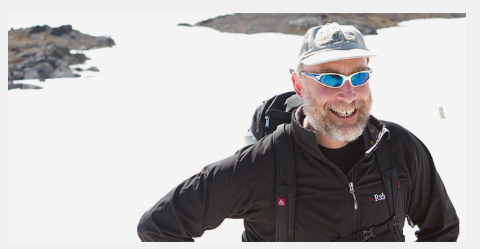
    Paul Bierman, Ph.D is a professor of Geology and Natural Resources at the University of Vermont. (Photo: uvm.edu)

    Paul Bierman, professor of Geology and Natural Resources at UVM, project leader, and nordic ski enthusiast, explains that the project is unique because Craftsbury is the lowest in latitude and elevation of any snow storage site. The majority of cross-country venues with snow storage systems are located in high latitude Scandinavia or in mountainous high altitude areas in Central Europe. Craftsbury Common, on the other hand, sits at about 44.6 degrees north latitude and about 353 meters in elevation. 

    “No one has ever tried [snow storage] in the worst of all possible combinations: low altitude, humid, low latitude. This was really an interesting merge between university science and engineering, and a center that is committed to trying new things as well as sustainability. Maybe that’s why it worked,” Bierman said with a laugh. 

    Bierman explained that the impetus for the project was born a few years ago around Thanksgiving when temperatures in Vermont were too high for snowmaking and no natural snow had fallen. A dismal combination for a skier. he COC could only produce a 100 meter lollipop on their soccer fields. While out on a ski, Geer and her husband and co-owner Dick Dressigacker began chatting with Bierman about the concept, knowing his interest in snowmelt and snowmelt hydrology. 

    A conic map of snow storage facilities. The Craftsbury Outdoor Center sits at the lowest combined elevation and latitude. (Photo: Optimization of over-summer snow storage at mid-latitude and low elevation, H. Weiss et. al. Click to enlarge)

    Bierman spearheaded the project with a scientific lens. He recruited his undergraduate assistant Hannah Weiss who has continued with the project as a graduate student, and a colleague in mechanical engineering began with a feasibility study. They found inspiration from old fashioned Vermont ice houses, which predated modern refrigeration. Ice house technology consisted of ice harvested from the surface of rivers and lakes during the winter. It was then covered with straw and sawdust and preserved in a partially underground building to keep perishable food cool in the summer. 

    The team identified a storage site in a pond that no longer held water and instrumented the ground at varying depths to measure temperature. 

    “We wanted to make sure that the ground was not so warm that we were just going to melt the stored snow from below.”

    The team monitored the temperature variation over the course of a year.

    “What we realized is because of how far north Craftsbury is, ground temperatures weren’t doing all that much and there really wasn’t going to be that much flux of heat from the ground into the snow pile. So that got us thinking, ‘Okay, maybe this is going to work.’”

    Next, with the help of the Craftsbury grooming team, they created two test piles at the end of the 2018 season in order to determine an optimal system for insulating snow through the summer. They covered the piles with roughly 25 cm of wood chips which were instrumented with thermometers. They tested a variety of covers including foams of different densities, concrete curing blankets, space blankets, and reflective mylar over the top to deflect solar radiation.
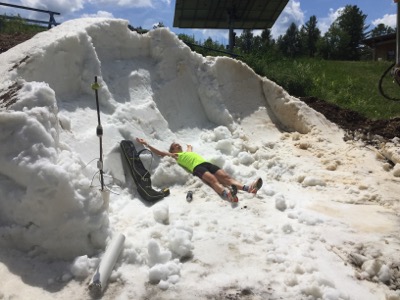
    Susan Dunklee (USA Biathlon/CGRP) cools off from a mid-summer workout in a 2018 test pile. (Photo: Paul Bierman, UVM)

    After monitoring the piles through the summer, they identified the optimal setup. On top of the manicured snow pile, a concrete curing blanket was laid primarily to protect the snow from debris. The blanket also adds some insulation. Next, a layer of wet wood chips 20 to 30 cm deep was spread, providing the majority of the pile’s insulation. Finally, a white mylar space was stretched across to reflect thermal energy from the sunlight. This system proved highly effective. 

    “When you monitor the temperature underneath that concrete curing blanket, it basically doesn’t change. No matter how hot it is outside, it basically stays at zero.”

    With a scientifically-backed storage plan, the UVM and Craftsbury collaborators went into the 2019 season ready to give snow-storage a go. The pond site was improved and a road was built to improve access. 

    Keeping in line with its mission of sustainability, the COC purchased new energy-efficient airless snow guns which use between a quarter and a third of the power than older model fan guns. These new guns ran for a week in February, blowing roughly half the COC’s annual water allotment into a large pile. 

    “The beauty of it is that they don’t have to power fans anymore, so it was a lot less energy,” explained Bierman. “And they did it in the middle of their high season, and because they generate their own electricity for these guns, they have a heat recapture unit on the generator, so a significant part of the energy that would have gone up the chimney as waste heat, was now heating dorms that were full of people.”

    He added that were the snow blown in November, as is the case in most snowmaking operations, the COC would have been mostly empty, meaning the heat would have been wasted that way as well. 

    Groomers ran a pistenbully back and forth over the pile to pack it more densely: dense snow melts more slowly. The pile was shaped with an excavator, then the team waited as it transformed into corn snow in the spring. Then the pile was covered with wood chips and the white reflective covering. 

    Though the storage method was tested the year before, the scale of the pile had increased dramatically. 

    “This was a big logistics year,” Bierman explained. “How do you do this? How do you shape a pile? How do you put chips on it? How do you put a cover on it? How do you keep the cover from blowing away in a big spring wind storm? Which it did the first time,” he laughed.

    Once the pile was tucked neatly under its multilayer covering, the team sat back and monitored it regularly throughout the summer using a new style of survey equipment called terrestrial “LIDAR”, which stands for light detection and ranging. This allowed the team to track changes in the 3D surface of the pile, thereby measuring the change in volume. 

    “It became pretty clear by mid-July that this pile wasn’t shrinking very quickly. By the last scan in October, we had about 65% left by volume of what we put in there. And that is pretty much what Europeans in the Alps get.”
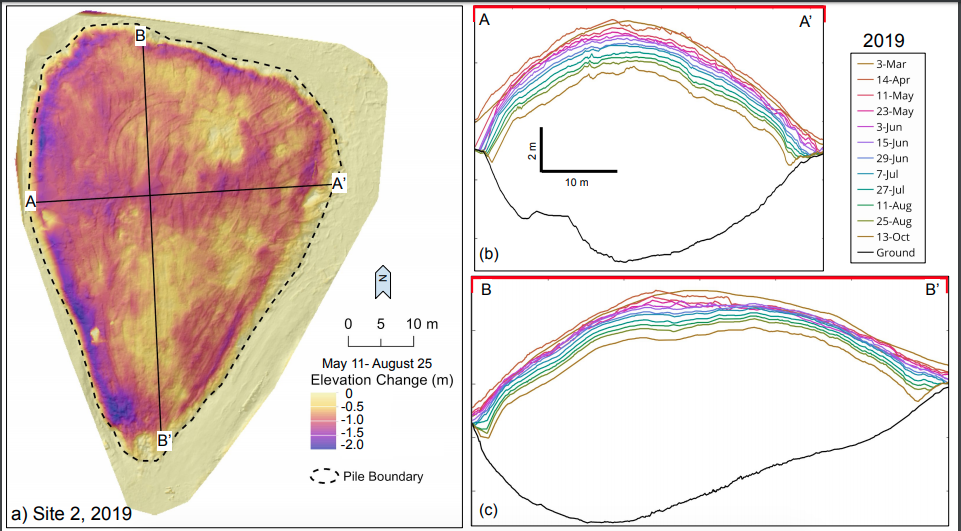
    A LIDAR map of the 2019 stored snow pile at the Craftsbury Outdoor Center. Click to enlarge. (Photo: Optimization of over-summer snow storage at mid-latitude and low elevation, H. Weiss et. al.)

    He explained that the limited existing data suggests that the average retention by volume of other snow storage sites is between 60-70% on average. 

    By their measurements in early November, the pile contained 5-6000 cubic meters of usable snow, which translates to 2-3 km of coverage at 50 cm deep and a few meters wide.

    “In any normal November, that would be a godsend. Most of the early November skiing at Craftsbury is a big lollipop in the upper soccer field and down the hill in the lower soccer field, where people are going in one direction on maybe a 200 meter course around and around and around.”

    He added that the preserved snow would allow “more interesting” terrain to be opened early, such as “Lemon’s Haunt”, a 1.6-kilometer blue square trail which rolls through the woods. 

    Feeling confident that the COC could provide a few k of skiing by its projected opening day on November 16th, the team began scraping off the layers of wood chips in early November. Then, in an unforeseen plot twist, the first snowfall of the year arrived, coating Craftsbury with a thick layer of natural snow. This interrupted the original plans of spreading the pile, but allowed the COC to open 25 kilometers of trail on opening day. 

    “The pity is that it didn’t work out as everybody anticipated, which was to lay a couple k of base down with this icy stuff, then have the natural snow sit on top of it, which would preserve the natural beautifully.”

    He laughed that no one would want klister snow laid on top of their blue wax conditions.

    So how would the pile have been transformed into ski trails had Mother Nature not trumped the scientist’s plans? 

    Bierman explained that during the summer, the snow transforms into “firn”, a term used most commonly with glaciers to describe an intermediate stage between snow and ice. Though icy and dense, the substance maintains its granular quality.

    He explained that without the world-class groomers and equipment at the COC, making this into skiable terrain would not be possible. 

    “The beauty of Craftsbury is how well they groom. Their grooming is spectacular, they’ve got three piston bullies, they’ve got this.” 

    Prior to the natural snowfall, the grooming team had been meticulously cleaning an excavator and dump truck to ensure that dirt was not introduced into the clean snow pile, as the sun on the dark-colored dirt increases melting. Dirt in the base would be further mixed into clean natural snowfall, creating a problem from the get-go. Not to mention skiing in dirty snow is not recommended for your bases.

    With clean equipment, the team would begin trucking snow to the furthest point, working their way backward toward the pile. Once the snow is laid out, groomers can work their pisten bully magic to create a surface that is pleasurable to ski. 

    The COC is developing a plan for how the stored snow will be used, which will be dependent on weather and natural snowfall. Some stored snow may be kept in order to patch holes in the event of a warm spell. 

    Next year, the team intends to again create as large a pile as possible and continue to fine tune the storage methods. 

    “This is just the first year, so we have a lot to learn–both in terms of process, and also environmental and cost-effectiveness,” wrote Geer. 
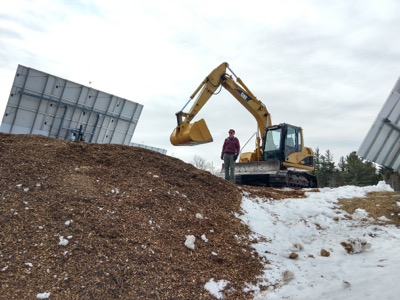
    An excavator layers wet wood chips onto the 2019 snow storage pile at the Craftsbury Outdoor Center. (Photo: Paul Bierman, UVM)

    Bierman explained that the logistics of properly covering the large pile requires practice, but a lot of pitfalls have been flushed out in the first two rounds of the experiment. The COC staff will be refining their method of covering the surface with an adequate layer of wood chips which does not crack or slump, and overlapping layers of the white reflective cover to reduce the chance of exposure and rapid melting. 

    “Nature is going to help us because now the ground underneath that pile is cold. It has had cold melting snow on it all summer, so presumably the ground underneath there is 0 degrees C and saturated with 0 degrees C water, and it’s only going to get colder this winter.”

    Bierman continued that other snow storage facilities have experienced improvement in retention each year over the first few years. 

    Depending on what winter has in store, the COC may increase the volume of snow that is blown into the pile in 2020. 

    “If we have a good snow year and they still have water left in February, they’re just going to blow it into the pile,” said Bierman. 

    He continued that they could scale up by an additional 50% over last year’s volume. 

    Overall, the project has been a great opportunity for the COC to improve upon existing snowmaking methods and to guarantee snow for Green Racing Project athletes, the local junior teams, and recreational skiers alike.  

    “It gives the place an insurance policy. It doesn’t matter when you put that snow away, by putting it away, Craftsbury can reliably say that they can open in November. We don’t even have to wait for snowmaking weather.”

    What would it take for over summer snow storage to be implemented by other ski areas? Bierman explained that the recipe is outlined in great detail on the project website and also in a technical paper written by the UVM science team, which is currently under review (full citation below). 
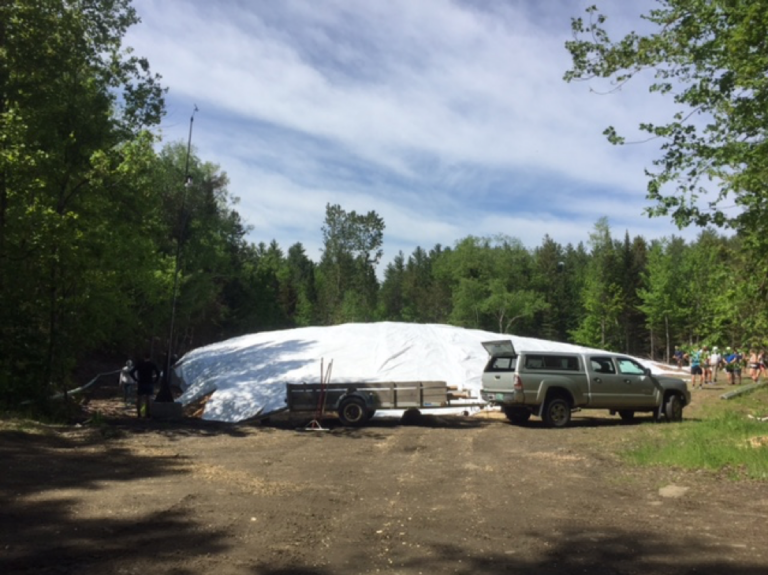
    A white reflective space blanket is the final layer on the top of the snow storage pile. (Photo: Paul Bierman, UVM)

    Clearly, the project requires significant resources: a place to store snow, an excavator, snowmaking equipment, pistenbully, coverage supplies, not to mention man-power. It is not, perhaps, readily accessible to small family run ski areas, but Bierman expressed that many major cross country centers could consider it.  

    Apart from the superficial benefits of early season skiing, Bierman imparted the importance of the underlying reason for the project. 

    “We’re on a trajectory of global warming unlike anything we’ve ever seen, and this is a Band-Aid. It’s a Band-Aid that might hold us for 10, 20, 30 years, but it’s not getting at the root issue here which is decarbonizing the global energy system. Unless we do that, all winter sports in these mid-latitudes are going to be extinct. We can’t save enough snow to have a nordic season if it doesn’t get cold anymore. If you look at the Vermont climate assessment, if we don’t change how we’re doing business — sort of the business as usual scenario, how we operate — we’re going to look something like the Great Smoky Mountains of Tennessee by 2090.

    “So this is a fun thing, extend the season, that’s all great, but we have to take some serious action as a global community to deal with climate change and the use of carbon fuels.” 

    Overall, both Bierman’s team and the folks at the COC are pleased with the results produced by the project and the many benefits it has provided in its nascence. The large pile of preserved snow stands as a testament to creativity, dedication to sustainability, and the power of problem-solving. 

    “The takeaway is that it works,” concluded Bierman. “And actually, it’s a lot of fun and it’s been a great way to share what we know about climate change, and not only about climate change adaptation, which is what you’d call this project, but also climate change mitigation which is ‘how do we get on the front of this?’ 

    “It’s a great educational tool about ‘climate change matters, and let’s see what we can do about it.’ We’re being forced to do things in New England that 20 years ago you wouldn’t have thought about doing.”

    To bring this article to life, check out this video created by Bierman’s daughter, Quincy, who is a member of the junior program at Craftsbury. 

    References: Weiss, H. S., Bierman, P. R., Dubief, Y., and Hamshaw, S.: Optimization of over-summer snow storage at mid-latitude and low elevation, The Cryosphere Discuss., https://doi.org/10.5194/tc-2019-56, in review, 2019.

  • Sovereign Lake NorAm/SuperTour: Photos, Notes & Quotes

    Sovereign Lake NorAm/SuperTour: Photos, Notes & Quotes

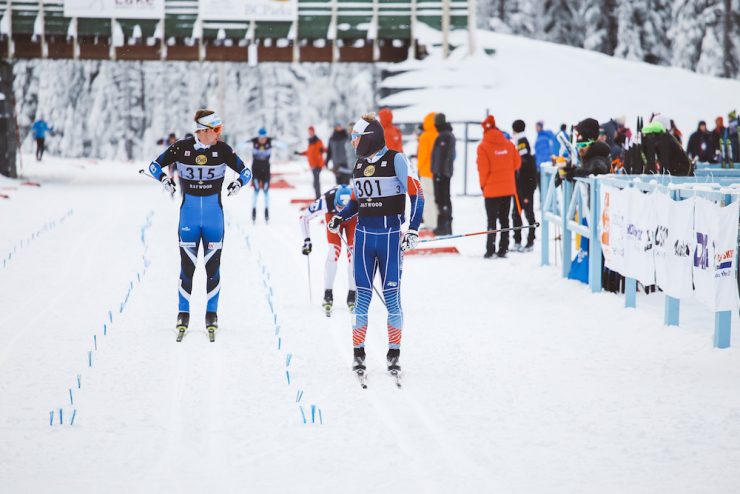
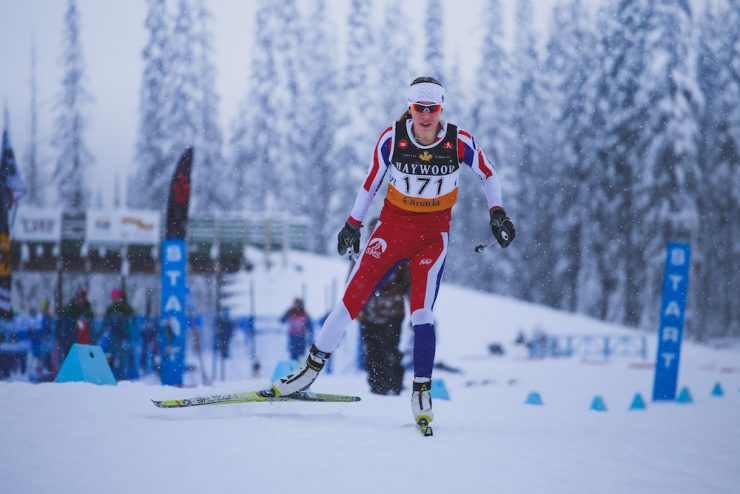
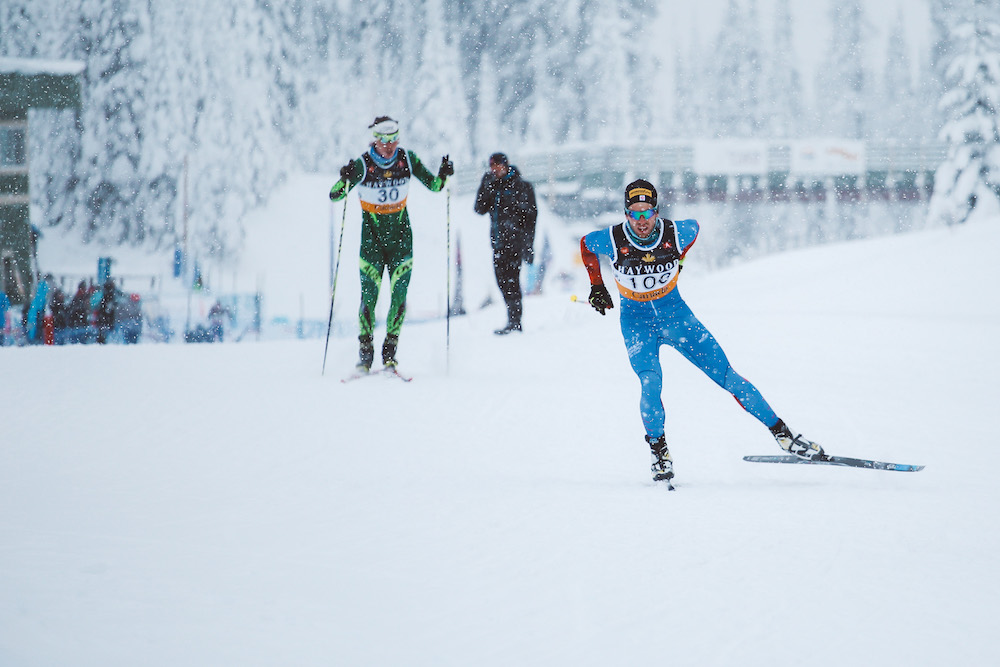
    Team RAD's Russell Kennedy powering through the snow to be top Canadian in the 15 km. (Photo: Marie-Éve Bilodeau-Corriveau)
    Team R.A.D.’s Russell Kennedy (r) powering through the snow to finish at the top Canadian in ninth in the men’s 15 k freestyle on Sunday, Dec. 11, at the Sovereign Lake NorAm/SuperTour. (Photo: Marie-Éve Bilodeau-Corriveau)

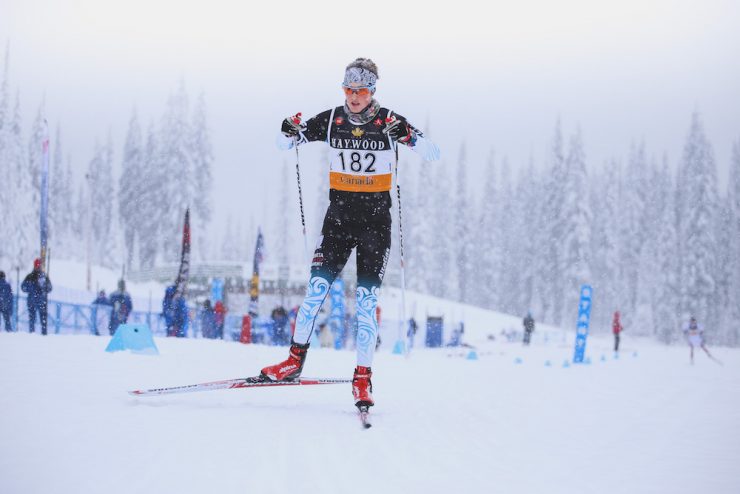
    VERNON, B.C. –The combined Noram/SuperTour last weekend at Sovereign Lake, British Columbia, produced some exciting skiing and some challenging photography conditions with almost non-stop snowfall both days. Some of our best photos that didn’t make the two-day race recap are included below, but first, a little background and feedback:

    The NorAm circuit has not been a fully North American circuit since 2006. This year, Canada and the U.S. planned two combined NorAm/SuperTour events in Bozeman, Montana, and Sovereign Lake, B.C. With the relocation of the Bozeman event to West Yellowstone, Sovereign Lake became the only combined event of the season.

    While many athletes dream of a return to the glory days of this series, the 2006/2007 birth of the SuperTour coincided with a second Continental Cup quota spot, allowing each country to send one “COC” leader of each gender.  Effectively, each country became a “continent” in the eyes of the International Ski Federation (FIS). Combining the two series could reduce North America to one COC position per gender.

    FasterSkier asked athletes and organization leaders what they thought of the 2016 combination of the early season NorAm and SuperTour:

    “I think what became very clear last year [in] the discussion with the coaches and the Canadian people, instead of trying to send to our athletes East to West, maybe it’s better to send them North to South. In terms of saving cost, obviously, and more competition between better athletes, [this] is better to improve the quality of our athletes in Canada and the US.”Robert Lazzaroni, U.S. Ski & Snowboard Association (USSA) nordic domestic program director

    “If you back to the NorAm races, when we used to do them with the U.S., when Devon Kershaw was racing Justin Wadsworth … ‘x’ number of years later, the one guy is coaching the other guy. Crossing over generations is very important.”Thomas Holland, Cross Country Canada (CCC) high performance director

    “The altitude at West Yellowstone is too high to use it as a selection race for the Canadian team.” — Holland, on applying the FIS limits to selection races.

    “I think it’s an incredible opportunity. I think we as North Americans don’t get the opportunity to have such a competitive field and I think coming together and making each other better is super important and think there’s just so much more to learn.”Julia Kern, Stratton Mountain School (SMS) Elite

    I really like it. This has been a very well-run, well-organized event. It’s really fun to race against other athletes, more people than the usual SuperTour field. It would be awesome to have more.”Kaitlyn Miller, Craftsbury Green Racing Project (CGRP)

    I can’t express to you how much I love it and how happy I am. I’ve been telling everyone I run into that I absolutely love it, and I would wish that the entire circuit could be combined the way it is today. I know that logistically, that’s not totally possible, but it’s so good for us, it adds such a depth of field. It’s just so much more fun, I love it. Yeah, I love it.”Olivia Bouffard-Nesbitt, Alberta World Cup Academy (AWCA)

    “I think it’s awesome. I think we should do more of these, for sure. Rossland and Silver Star and Canmore, it’s always beautiful snow and great grooming, and a really hilly, challenging course. I think all three of those have some really good terrain; it’s always fun to come up here and get a little bit different than our usual back courses back home.”Jennie Bender, Bridger Ski Foundation (BSF)

    It’s been great. I’ve been amazed at the professionalism here. They’ve put on an amazing event. For us in North America, we have it unique that we are separate from Europe and it’s cool to be able to challenge each other against the Canadians, and I think we should have more of it.”Heather Mooney, CGRP

    It’s just great. In sport and in skiing, I always believe that you need to race against the best.  That’s why we’ll be racing in Europe in February. It’s a super good idea, and I don’t know why we didn’t do it earlier.  They’re so close to us, so we need to race against them, and they need to race against us.”Antoine Briand, Pierre-Harvey National Training Centre (CNEPH)

    I think it’s incredible. Last year at our athlete meeting at Canadian Nationals, I made that point very strongly a couple times. I raced U.S. nationals in Houghton last year. That was an awesome event, I thought. Having a higher level of competition benefits everyone and then when we get to racing deeper fields in Europe, we’re not caught quite as offguard.”Evan Palmer-Charrette, Thunder Bay National Team Development Centre (NTDC)

    I think it’s awesome. I think it’s better for both the Americans and the Canadians. Everybody that I’ve talked to likes it. It raises the level of competition, we’re still competing for SuperTour points and NorAm points respectively. It just makes a deeper, faster field.”Reese Hanneman, Alaska Pacific University (APU)

    It raised the level of competition a lot, brings everyone’s game up, I think it’s good for North American skiing.”Cole Morgan, Sun Valley Ski Education Foundation (SVSEF)

    “It’s the best, we need to do this all the time. It’s so good to mix it up and see all of our best racers. I think if you look back generations, guys like [Chris] Jeffries and [George] Grey and Kersh [Devon Kershaw], like [Ivan] Babikov, they cut their teeth on a combined circuit. I think their success on the world cup is definitely in part due to that. I hope we get a couple more opportunities to keep racing each other.”Ben Saxton, SMS Elite (Note: Jeffries is the AWCA head coach, Grey placed eighth in the skiathlon at the 2010 Vancouver Olympics, Kershaw was second overall in the 2012 World Cup,  and Babikov is one the Canadian World Cup coaches.)

    I think it’s a great idea. It’s really nice to get some deeper fields, to get the Americans and Canadians racing together. It wasn’t so fun to watch the podium here, to watch it filled up with Americans, but when all the Canadians go down in the semi, that was happens. We’ll be down at US Nationals for sure.”Angus Foster, NTDC Thunder Bay

    It’s really good, because the level is really high with the U.S. Good for us to see other skiers, and other fast guys.”Alexis Dumas, CNEPH, the second Canadian and 15th overall in the men’s 15 k

    I love it! I think it’s like the best thing for our sport. The camaraderie, and also you learn so much from your peers, it’s super important and so valuable.”Chelsea Holmes, APU

    I love it, I hope we do more. I think it’s awesome for everyone involved.”Katharine Ogden, SMS Elite

    I love it. It’s fun having a bigger field and a new venue. I love Silver Star, this place is hard to beat.”Erika Flowers, SMS Elite

    More photos: XTS Photography | Team Gregg


  • NoCo: Solid WC Weekend Bodes Well for Oslo

    Todd Lodwick was eighth in Sunday’s World Cup competition in Chaux Neuve (FRA), after jumping to start the cross-country in third place. Bryan Fletcher could easily have been top 10 on Saturday if the margins were on his side, Johnny Spillane is consistently jumping better and returning to race shape, and Bill Demong is showing promising colors. This was the final World Cup weekend before the World Championships in Oslo next month.

    “Four guys in the top 30 is always a good day, for sure we wanted to be in the top half with everyone too. Things are coming together more and more,” said US Nordic Combined head coach Dave Jarrett after the competitions in France.

    Jarrett’s conclusion on the weekend’s events is that things are on track.

    “Todd jumped well but didn’t finish the race strongly. He was out of gas the last lap. Bryan had a great trial jump but his comp jump was a bit below his average. The good thing is that he now able to score points in a full-strength World Cup with a below average day. Johnny had a better day, jumping is coming slowly each jump and racing is coming around too. Billy is still looking for the loving feeling on the hill. Skiing is coming too,” Jarrett said to FasterSkier, summarizing the weekend in France.

    Now the team is returning to base in Park City, Utah, to make sure all their i’s dotted and their t’s are crossed before heading back across the pond for the Worlds.

    “We are going home now to get ready for Oslo and show up with our full Mojo,” said Jarrett.

    Confidence-builder

    Bryan Fletcher, who has moved in, established and defended his position in the top 30 on the World Cup this season, is excited about the upcoming championships. This last World Cup weekend helped his confidence.

    “The weekend was a success, not on any huge level for me, but I am happy with my results. Things felt good this weekend my jumping was on par with what I was hoping for and my cross-country felt strong,” Fletcher said in an email to FasterSkier.

    “The first day I surprised myself and was able to ski up to 13th place only to hit a wall on the last hill and lost my pack falling back to 21st place. However I was happy with my race over all it was a solid step to build some confidence,” the 24-year-old said.

    Jarrett is also encouraged by Fletcher’s performance, and points out that his preliminary jump was particularly good, landing him an 18th place. Saturday Fletcher was 24th in the jumping and 21st overall.

    “With just a few more meters he could have been top 10 again today.  Anyway, he jumped well and skied well.  He was in a group with some fast guys so it was hard to make up places. Solid nonetheless,” Jarrett noted.

    Sunday Fletcher ran into bad conditions on the jump hill but still pulled off a decent jump and started the cross-country in 34th place, two minutes behind Jason Lamy-Chappuis (FRA) who went ahead and won the competition on home turf. Solid performance on the course landed him in 27th place overall, securely within his own season goal of consistent top 30 results on the World Cup.

    “The second day I had some adverse conditions on the jump hill. However was able to put an OK jump together and had another solid race. I didn’t feel quite as good as the first day, but I was able to ski into points, which is tough from my starting position. I ended up 27th place,” Fletcher explained.

    Prep time

    From here it’s all about getting ready for the World Championships.

    “There will be lots of training to gear up (for the Worlds),” Fletcher said, adding that he is looking forward to the process.

    “I will be focusing on fine-tuning the things that are limiting me from being in the top 10. I will also be taking the time to gain some much needed rest and relaxation,” Fletcher said to FasterSkier.

    Fletcher is also planning on racing into shape by participating in some races on home turf and some longer efforts, including the 32-kilometer Boulder Mountain Tour in Sun Valley, Idaho.

    “I plan on doing a couple races as well when I am home. The biggest race will be the Boulder Mountain Tour. The BMT has always been a fun race for me, and having missed it last year I am looking forward to being able come back and ski this year. I find it’s always fun to mix it up a little bit with the other skiers,” Fletcher concluded.

    The first Nordic Combined race at the World Championships in Oslo is on February 26.

    Complete results from Saturday’s World Cup in Chaux Neuve here.

    Complete results from Sunday’s World Cup event here.

    Taylor Fletcher: COC in Harrachov (CZE)

    Bryan Fletcher’s brother had a job to do with the US Nordic Combined team on the Continental Cup circuit and executed according to plan.

    “It was a very successful trip for me! Not only did I score World Cup points, but I am now three for three on COC podiums this year,” Taylor Fletcher in an email to FasterSkier. The 20-year-old has raced with the World Cup crew for much of the winter. Just like his brother, Taylor Fletcher found the final major event weekend before the Worlds to provide extra confidence.

    “I felt like this weekend was a very motivating weekend. I told (head coach) Dave Jarrett what I wanted to do, and went and did just that. It is a major confidence-builder as we are heading to Oslo,” Taylor Fletcher said.

    Leading up to the Worlds, he will be paying attention to the details and honing his peak, as well as just getting some more raw volume under his belt. Taylor Fletcher is also trying to dial his match weight for optimal performance, something that matters more on the hill than on the course.

    “I’ll be training a lot building up my intensity making sure I am the fastest I possibly can. I will do at least one race and possibly the Boulder Mountain Tour. But I will also slim down a little more and try to get to 65 kilos before Oslo to optimize my performance on the jump hill,” Taylor Fletcher said.

    Complete results from the COC Friday here and Saturday here

  • NoCo: Taylor Fletcher Podiums at COC, Secures Extra WC Spot

    Park City, UTAH – “It was definitely a hard day on the jumping hill with tail winds and soft conditions,” Taylor Fletcher said, admitting that this was not his best jump ever.

    But once on the course, Fletcher was in control.

    “I’ve skied well on this course before and I knew I could do it again,” Fletcher said, explaining that going balls to the wall was not an option. He had to ski smart. “It was almost 50 degrees so we were skiing in about a foot of slush, It was very important to go out at a very moderate tempo and not too hard, If you were to go too hard you would certainly blow up in the second lap out of five laps,” Fletcher said.

    “I didn’t pull too hard to start with, just followed them. Then I started picking off people, and by the third lap I was in fifth place. I followed the Norwegian guy who was in second place pretty well, but when we came up to the finish I just couldn’t outsprint him, and I had to settle for third place,” Fletcher said.

    Geoffrey Lafarge of France won, clocking in at 26:52.9, with Joergen Graabak (NOR) in second place (27:23.9) and Taylor Fletcher in third (27:30.4).

    Looking back, Fletcher thinks he could have placed higher had he made his move earlier.  “Maybe I could have stayed ahead of the French skier and dropped the Norwegian,” he theorized.

    Regardless, Fletcher is satisfied with the day and considers it mission accomplished.

    “It was a big confidence booster. This helped secure another World Cup spot for us, and that was the goal of the competition today,” Fletcher said. By shutting the top Austrian and German racers out of the podium, Fletcher secured an extra spot for the next two rounds of the World Cup.

    While Taylor Fletcher landed a podium finish, US Nordic Combined Head Coach Dave Jarrett said there were plenty of highlights for the US team Sunday. He is particularly happy to see Brett Camerota both jump and ski well.

    “Brett Camerota won the jumping and had a good race until the last lap when the pack containing the eventual podium winners caught him. Fortunately, Taylor Fletcher was in that pack,” Jarrett said, noting that Camerota managed to stay in the top ten overall.

    Additionally, Jarrett was happy to see the developing skiers deliver solid races.

    “Brett Denney had a good race and moved up to 23rd, while Nick Hendrickson was a bit tired today and didn’t have it for the race,” Jarrett said, adding that Hendrickson did a good race Saturday when he was 15th.

    “The young guys had a great period. Cliff Field scored points in three out four completions. Erik Lynch scored his first points in Steamboat and Michael Ward scored his first points today,” Jarrett said.

    Fletcher and the rest of the US team left for Austria on December 13. They will arrive on the 14th, then do an easy day on at the venue, hammer out some intervals on Wednesday, take Thursday off to prepare for the official training Friday, and then let it rip for the races starting Saturday. The group defending the Stars and Stripes for the World Cup in Ramsau, Austria, consists of Todd Lodwick, Eric Camerota, Nick Hendrickson, Bryan Fletcher and Taylor Fletcher.

    Complete results from Sunday.

    FIS Cup standings.

  • Demong 5th in Nordic Combined Continental Cup

    Park City, Utah – Dave Jarrett, US Ski Team Nordic Combined Head Coach, is content with Demong’s result and glad to see him returning from his early-season jumping funk. Despite a less than stellar jump this morning, Demong has delivered some promising jumps since returning from Europe last weekend. And he is generally reliable on the cross-country.

    “We definitely had difficult racing conditions today. Bill was leading going into the stadium, but it was so soft he didn’t have a chance to sprint,” Jarrett said.

    Demong, who was 18th after the jumping, had quite a job to do on the cross-country course. After a less than stellar day on the hill, Demong started 1:40 behind Sebastian Reuschel (GER), who had the best jump and proceeded to win the competition.

    “Bill came back from pretty far behind and caught the leaders on the first lap. He tried to make a move on the top of the last hill, but he just couldn’t drop anyone. They all came in together, but when they lined up to sprint it was just too soft,” Jarrett said.

    “I was definitely in it to win today,” Bill Demong said. But he is not disappointed with fifth place. “I got what I wanted out of this, and it was a good hard race,” he said, noting that the conditions on the hill in the morning were difficult. At first, there was not much wind at all, while those jumping later had more wind.

    “I started out behind, but I put my head down and caught everyone. I wanted to not be following anyone, so when we got to the sprint, the others were definitely going to be a bit fresher,” Demong explained.

    Decent and difficult

    “It was a pretty good day,” Jarrett said of the US team after Saturday’s event.

    Friday’s trial round was marred by rain, and conditions didn’t set up over night, so both the hill and the cross-country course featured soft, saturated conditions.

    Eric Camerota also had a good race, and landed himself a ninth place, as the only other American in the top 10.

    The COC continues tomorrow in Park City/Soldier Holllow. Taylor Fletcher and Brett Camerota, who didn’t compete Saturday, will be in that event, while Demong takes the day off. Jarrett hopes that Brett Camerota can get back in business on the jumping hill. For Taylor Fletcher, the Sunday race is merely an opportunity to stay sharp and get a race in on a weekend off before he heads back to the World Cup in Ramsau (AUT) next weekend.