From the FasterSkier archive — posts syndicated from athletes’ and coaches’ own blogs between 2004 and 2012, kept online as published. Current coverage is at fasterskier.com.
The highs were high and the lows were low in the Olympic team sprint in Italy, with the Ogden-Schumacher men’s team claiming silver and the Diggins-Kern women’s pair finishing out of the medals. Devon and Nat break the whole thing down.
We’ll be back after Saturday’s men’s 50 k. Reach us at devon[at]fasterskier.com and nat[at]fasterskier.com. We’re really grateful for all the support during the Olympics — thanks for notes and encouragement.
A reminder: This is a homegrown podcast done by two guys working long hours and late nights. We’re also paying real money to be here in Italy. If you can, support the show and FasterSkier’s ongoing coverage with a voluntary membership. We’re also offering a bonus during the Olympics: a WhatsApp group with notes on Nat’s experiences in Italy, the food he’s eating, interview transcripts and more.
Send nat[at]northernjournal[dot]com a confirmation of your voluntary membership and the number he should use for WhatsApp and we’ll get you signed up. You can also Venmo him directly at @nat-herz if a membership isn’t for you. We’re suggesting a minimum of $10, but we also won’t turn anyone away who wants to join because of an inability to pay.
Help Support Our Olympic Coverage!
FasterSkier will have our own Nat Herz on the ground at the Olympics, which, to be honest, is a very big financial lift for us. If you value the thoughtful work and access FasterSkier provides at championships like this one, please consider becoming a Voluntary Subscriber. Your support directly fuels the work we do to cover the people, places, and moments that make our sport special.
This article was made possible through the generous support of our voluntary subscribers who have helped us put our Nat Herz on the ground reporting at the Olympics. If you value coverage like this, please support FasterSkier with a voluntary subscription.
Jonna Sundling (SWE) follows Jessie Diggins (USA) during the Olympic Women’s Team Sprint in Tesero, Italy. (Photo: Vanzetta/NordicFocus)
PREDAZZO, ITALY — Eight years ago, on a different continent, the words “Here Comes Diggins!” by Chad Salmela vaulted American cross-country skiing into a new era. On Wednesday in Val di Fiemme, the event that changed everything for the United States returned to the Olympic stage.
The Women’s Freestyle Team Sprint has long been one of the Americans’ signature races. In the PyeongChang 2018 Winter Olympics, Kikkan Randall and Jessie Diggins delivered the nation’s first Olympic gold medal in cross-country skiing. Last March in Trondheim, Diggins and Julia Kern claimed World Championship silver.
On Wednesday, Diggins started the race in the first leg, handing off to Kern for the anchor leg, as they had in their previous medal run. They hoped for one more shared championship moment.
It was not to be. The Americans finished fifth, in a race that required not just fitness but flawless execution. Sweden’s Jonna Sundling and Maja Dahlqvist took gold. Switzerland’s Nadja Kaelin and Nadine Faehndrich secured silver. Germany’s Laura Gimmler and Coletta Rydzek won bronze after a late-race crash by Finland opened the door in the final turn.
For the Americans, the margin was not dramatic. But close, at this level, does not bring home a medal.
Jessie Diggins (USA) and Jonna Sundling (SWE), (l-r) come through the stadium during the Olympic Women’s Team Sprint. (Photo: Vanzetta/NordicFocus)
“Honestly, left it all out there.”
The Team Sprint is one of the sport’s most punishing formats. Two skiers qualify individually; their times are combined to determine which 15 nations reach the final. In that final, the athletes alternate laps — three each — on a course that offers no reprieve.
Often, one skier brings distance strength, and the other sprint speed. For the United States, Diggins and Kern blur those categories. Both are capable of driving pace. Both can finish.
From the gun, Diggins did what she has done throughout her career: she went to the front.
She and Sundling stretched the field immediately, driving into the Zorzi Climb, the race’s defining ascent. The early order — Sweden, the United States, Norway, Canada — hinted at the nations prepared to dictate terms.
Jonna Sundling (SWE) stretches her lead. (Photo: Vanzetta/NordicFocus)
When Sundling surged later in the race, Diggins expected it.
“I knew she was probably going to do that,” Diggins said afterward. “And I was like, just do the best that you can do. You know, like, you can’t control anything except your effort and your heart. And I was like, skiing out of my body, and I just did everything that I could, and I’m proud of that.”
That theme — control what you can — carried through her reflections.
“Honestly, I almost passed out like four different times,” she said. Then, clarifying: “No, from going that hard, no regrets. Honestly, left it all out there. I feel like we did everything we could, and that is the only thing you can control at the end of the day.”
Julia Kern (USA) and Jessie Diggins (USA), (l-r) gather in the finish area after the race, Diggins racing in the US team’s relay socks for the final time. (Photo: Barbieri/NordicFocus)
One final lap with ‘Relay Socks’
By the last exchange, Sweden had carved out daylight. Switzerland began clawing into Finland’s hold on silver. Behind them, Germany, Norway, the United States, and Finland battled for bronze.
On the final descent, Finland’s anchor, Jasmin Kahara, lost her balance in the sweeping right-hand turn and fell, sliding out on her stomach. Germany and Norway slipped past in their tucks. Kern, just meters behind, fought to the line, but the podium had narrowed to two.
Coletta Rydzek (GER) brings home the bronze medal for Germany with Norway’s Julie Bjervig Drivenes just off camera. (Photo: Vanzetta/NordicFocus)
As they drove for the line side by side, aerodynamically no-pole skating with everything they had, it was clear this was going to be close. Germany claimed bronze while Norway left empty-handed in fourth. Just behind, Kern brought the United States to the finish in fifth.
For Diggins, the moment carried a different weight. It was, by her admission, her last Olympic relay leg.
“I love racing with this girl. I’m so, so proud of her,” she said of Kern. “And, yeah, it’s emotional to feel like I’m never gonna pull on those relay socks again.”
When asked whether there was a sense of handing the event forward, she reflected on the arc of her career — from her first team sprint world title in 2013 to the growth of youth programs back home.
“It’s just really cool to be part of the evolution of American skiing,” she said.
Julia Kern (USA) and Nadine Faehndrich (SUI), (l-r) find their lines around a tricky corner. (Photo: Vanzetta/NordicFocus)
Whitcomb knows they can win
For Head Coach Matt Whitcomb, the analysis was candid and clear-eyed.
“Yeah, it was a good race,” Whitcomb said. “Of course, this is an event that we know we can win, and we didn’t today.”
In a format this tight, small imperfections are decisive.
“For even a bronze medal to happen, both legs have to be firing exquisitely,” he said. “We swung as hard as we could. We did our best. We were prepared to win today, and we just didn’t.”
Of Kern’s anchor leg, Whitcomb offered both empathy and affirmation.
“Julia is an incredible performer, and one thing you can always trust from her is that you’re gonna get her absolute best,” he said. “We saw it on the final climb. I was happy with how she climbed. Just didn’t quite have the entire thing today, and that’s okay.”
Jessie Diggins tags Julia Kern (USA), while Jonna Sundling tags Maja Dahlqvist (SWE), (l-r) in the exchange zone between laps. (Photo: Vanzetta/NordicFocus)
Diggins in the best fitness of her life
Diggins has raced these Games managing injury concerns, including rib pain after a fall in the opening Skiathlon. But when asked whether her fitness was lacking, she pushed back.
“I feel like I’ve come into this with the best fitness in my life,” she said. “And that’s one of the only things I could control.”
There is comfort, perhaps, in that certainty — in knowing preparation was not the missing piece.
“I was skiing out of my body,” she said. “And I just did everything that I could.”
In Olympic-level team sprinting, that is sometimes enough. On Wednesday, it was not quite.
But the American women did what Diggins described as the only thing you can in cross-country skiing: you have to leave it all on the course without regret.
FasterSkier will have our own Nat Herz on the ground at the Olympics, which, to be honest, is a very big financial lift for us. If you value the thoughtful work and access FasterSkier provides at championships like this one, please consider becoming a Voluntary Subscriber. Your support directly fuels the work we do to cover the people, places, and moments that make our sport special.
This article was made possible through the generous support of our voluntary subscribers who have helped put our Nat Herz on the ground at the Olympics. If you value coverage like this, please support FasterSkier with a voluntary subscription.
Linn Svahn (SWE) has long looked like the best sprinter in the world, but she has only rarely had the chance to prove it. After years of injury and delay, finally she earns Olympic gold. (Photo: Barbieri/NordicFocus)
PREDAZZO, ITALY — Checking today’s ESPN home page makes it clear that the Olympics don’t seem to occupy the American imagination like they once did. I remember the Olympics as being a bigger deal—a set of events that captured the imagination of the world, an international spectacle that occupied the media spotlight. Life magazine, Time magazine, Sports Illustrated: all devoted their covers and countless pages to Olympic events when they were upcoming, to the results when they became available, to the impact that these performances had on the viewing public. There was something bigger about it, something that seemed to separate it from mere sport, something that seemed to elevate it above mere commercialism. These weren’t just athletes; these were Olympians.
They still are . . . Over in Italy, the Olympians are parading in ceremonies and competing in events and collecting medals while national anthems resonate in the crisp mountain air … but ESPN covers only the sports that matter to most Americans: NFL Football and NBA basketball and NHL hockey and MLB baseball and PGA golf, followed by men’s college basketball and women’s college basketball and college softball and MLS soccer and WCW Wrestling and the lingering stories surrounding Super Bowl commercials and Super Bowl halftime shows. And waaaaay beneath all that, we find a mention of the American gold medal in Team Figure Skating and the final helicopter flight of Lindsey Vonn’s legendary career. Thus far in Milano-Cortina, Olympic performances haven’t proven sufficient to capture the attention of a jaded viewing public. The only story American’s are likely to follow in cross-country skiing is that of reigning World Cup Champion, Jessie Diggins. Even with that accolade in hand—even being a defending medalist in the Olympic Sprint—Diggins does not find herself appearing often in the daily conversation that dominates column inches over at ESPN.
Strength and grit, tactics and tenacity: Julia Kern (USA) earned her way through to the Olympic Sprint final. (Photo: Vanzetta/NordicFocus)
And it really is too bad that ESPN may overlook another tremendous story that unfolded in the Women’s Classic Sprint, as the long-suffering Linn Svahn—whose history of injury and ill-fortune has repeatedly interrupted what could’ve been a legendary career—finally grabbed the medal that has always appeared to be within her reach. Svahn led a Swedish sweep of the podium ahead of Olympic and World Champion, Jonna Sundling and the ever-crafty veteran, Maia Dahlqvist. Svahn delivered a performance that cements her place in the history of cross-country skiing. After a long, long wait, Linn Svahn is Olympic champion.
Though it appeared that Americans were still struggling with waxing issues in the soft snow of Val di Fiemme, Team USA saw four skiers advance through qualifying: Jessie Diggins (20th), Sammy Smith (26th), Julia Kern (28th), and Lauren Jortberg (30th). Those qualifying placings did not inspire a tremendous amount of confidence in what was likely to be a lightning-fast day of sprinting. Ultimately, it was Kern who would ski with power and grace in advancing to the Olympic Sprint final where she would finish sixth. Diggins may still be suffering the effects of her crash in Saturday’s Olympic Skiathlon; Diggins skied bravely, but could be seen clutching her injured ribs after placing fourth in her quarterfinal. She would finish the day in 17th.
“My qualifier didn’t go as well as planned,” said Kern. “But it was enough to qualify, and I always get stronger in the rounds. And I had really good skis and played to my strategy and knew I had a strong finish and really never gave up and was hanging really tough when I was pretty tired. And so I went the lucky loser route today, which was my strategy. And that obviously has a cost. So come the final, I was completely spent, but I didn’t know it, and I really gave it my all, tried to be in the mix, and I had left everything on the course to get to the final. And I don’t have any regrets about that. I think that’s what I needed to do to get there. And that’s where I’m skiing right now.”
“Obviously it was 30th, but I think it still wasn’t really, like, my best qualifier,” said Jortberg. “I think there’s still a lot of room to move there, which is cool. And I think had it not been in such a stacked heat, I think it would have maybe been a slightly different quarterfinal for me, but we’re still really proud of how I skied. I think I made a couple tactical errors out there.”
Ultimately, the final American placings were Kern 6th, Diggins 17th, Smith 19th, Jortberg 30th.
“Really exciting to have my Olympic debut,” said Smith. “And I wish I would have done a few things differently in that heat. Like what? I mean, I think I tried to make a move on the left side on the hill. I could have potentially been able to make more time over the top, but it’s pretty incredible opportunity and just excited to be out here and racing.”
Smith explained the challenge and the complexity of competing in the Olympics while simultaneously enrolled at Stanford: “I’m taking material science and engineering. I’m taking environmental law class. I’m taking a creative nonfiction class, doing an independent study as well with a psychology professor,” said Smith. “And then I’m also taking physics. Stanford probably has more Olympians per capita than most places. It’s actually pretty cool. We have four winter Olympians from Sanford this year. So Eileen Gu is competing for China in big air and slope style, Zoe Atkin in half pipe and big air, and then Brandon Kim in speed skating. So it’s pretty cool that there’s four of us. The school’s been incredibly supportive, and I’m excited for all of us to compete.”
Sprint Quarterfinals
Jortberg and Smith lined up together in a quarterfinal that was packed with stars and contenders including Sundling, Kristine Stavass Skistad (NOR), and 2025 World Cup Sprint champion, Jasmi Joensuu (FIN). Sundling went to the front, setting the pace ahead of Skistad, providing a possible preview of the tactics likely to define the Sprint final. Jortberg and Smith dropped to the back where they appeared incapable of overcoming the blistering pace set by Sundling. Over the top of the ultimate downhill, Sundling led Joenssu as Skistad appeared to struggle. But the finish line lies at the far end of a straight downhill, and Skistad’s fast skis and gliding ability were able to dismantle Joensuu. Skistad would follow Sundling across the line to claim automatic spots in the semifinal. Smith would finish fourth to sit in a lucky loser position after the first quarterfinal.
Quarterfinal 2 included Kern, Nadine Faehndrich (SUI), and the day’s top qualifier, Svahn. Faehndrich and Svahn made the pace in the heat, though Faehndrich would fade from contention in the late stages. The suprising Italian, Caterina Ganz, would drive forward to claim the second spot to advance to the semifinal behind Svahn; Kern was able to hold her position in the pack moving forward into third place, a status that would allow her to claim a lucky loser spot in the semifinal.
Johanna Matintalo (FIN) took the third quarterfinal ahead of Laura Gimmler (GER). Julie Bjervig Driveness (NOR) would move into the fastest lucky loser, spot pushing Kern down a spot, but allowing her to remain in contention with two heats remaining.
Still sore from a crash in Saturday’s Skiathlon, Jessie Diggins (USA) gave her all in her Olympic Sprint quarterfinal. (Photo: Vanzetta/NordicFocus)
Diggins started in the fourth quarterfinal alongside Maia Dahlqvist (SWE). They appeared to be the strongest in their heat, and Diggins sprinted directly to the front to set the pace. But the snow in Val di Fiemme was unusually slow, which did not favor the leaders, especially with the course profile that descended steadily to the finish line. Diggins paid the price for leading early, finding herself passed by the field, and unable to improve her position in the finishing straightaway. Diggins would end her day with a fourth place finish in the quarterfinal from which Dahlqvist and Federica Cassol (ITA) would advance.
“I didn’t realize it right after it crashed, when I bruised my ribs,” said Diggins. “But then afterwards, you feel it; right now they really hurt. So I’m doing the best I can. I know I’m in good shape and I really want to make the team proud and I’m just trying the best I can . . . I needed to figure out how to manage this for Thursday. I hope that my body’s feeling better, but my energy is good and I’m excited to be here. I think I’M not a best shape in my life. I just need everything to come together in the right moment. But I know there’s possibility there. So I’m going to keep coming and bring my best.”
Sprint Semifinals
Kern found herself in a semifinal crowded by the résumés of Svahn, Sundling, and Skistad. Sundling and Svahn would claim hte automatic qualifying spots, while Kern would overcome a mid-race loss of speed to finish fourth (behind Skistad) to reside in a lucky loser spot (behind Skistad) with one semifinal remaining. Ultimately, the second semifinal involved fewer stars, and a field that seemed less likely to produce fast times and lucky losers. Driveness and Dahlqvist advanced out of the second semifinal, allowing lucky loser spaces for Skistad and Kern.
Linn Svahn (SWE) streaking toward her Olympic Sprint gold medal. (Photo: Barbieri/NordicFocus)
Olympic Classic Sprint Final
Six months ago, FasterSkier’s Editor-in-Chief made a bold and confident confident call, predicting that Julia Kern would qualify for the Olympic Sprint final. While that early prediction may have been a reflection of the proud Massuchessetts roots he shares with Kern, it also reflected his knowledge of World Cup and Olympic skiing, and his understanding of just what it takes to ski and compete at this level. The Editor knows his stuff, and Kern has proven herself entirely deserving. That Kern advanced to the Olympic Classic Sprint final came as no surprise to Fasterskier.
But Kern was not alone in the final. The cast of characters in this Sprint drama was one that left no room for pretenders or understudies. Kern lined up alongside Skistad, Sundling, Svahn, Dahlqvist, and Driveness. At the crack of the starter’s pistol, Team Sweden began to assert itself as Sundling drove straight to the front. This has been the tactic that has earned Sundling World and Olympic championships, and it came as no surprise to see her at the front. She was followed by Svahn as Skistad appeared overcome by the early pace. At the mid-race point, Dahlqvist eased her way past Skistad, and Team Sweden headed for the podium. At the finish, it was the power of Svahn that drove across the line ahead of Sundling and Dahlqvist. Linn Svahn’s long path had finally delivered her to the destination that fans had always imagined. After years of injury and disappointment, after seasons of patience and impatience, Linn Svahn finally wears the Olympic gold medal.
Julia Kern (USA) used all her experience and every bit of her energy to advance to the Sprint fFinal. (Photo: Barbieri/NordicFocus)
“I am really happy with today,” said Kern. “It’s been a challenging season. I haven’t made it out of the quarterfinals this year. So to make it to the finals of the Olympics Is a huge accomplishment, and I’m really proud of it because I fought really hard today.
The typical ESPN viewer may find other events to be more compelling, but the thrill of competing in an Olympic Games is not lost on the athletes: “I’ve never raced with the rings on my bib,” said Jortberg. “There’s a lot going on, which is super cool, and I feel like I just feed off that.”
On the ground reporting by FasterSkier’s Nat Herz.
Help Support Our Olympic Coverage!
FasterSkier has our own Nat Herz on the ground at the Olympics, which is a significant financial lift for us. If you value the thoughtful work and access FasterSkier provides at championships like this one, please consider becoming a Voluntary Subscriber. Your support directly fuels our work to cover the people, places, and moments that make our sport special.
This coverage is made possible through the generous support of Marty and Kathy Hall and A Hall Mark of Excellence Award. To learn more about A Hall Mark of Excellence Award, or to learn how you can support FasterSkier’s coverage, please contact info@fasterskier.com.
Jonna Sundling (SWE) and Laura Gimmler (GER), (l-r) during the heats of the World Cup Freestyle Sprint in Oberhof (GER). (Photo: Authamayou/NordicFocus)
By the time the stadium lights fully took over in Oberhof, the snow had begun to change its mind.
What started as a pliable winter surface—the kind that both softens and creates mistakes—tightened as the temperature dropped, and each pass of a ski left a polished, glistening trail under the lit German night. The Thuringian Forest, quiet by geography but loud by reputation, had settled into one of those evenings that reward certainty. Edges held if you trusted them. Hesitation showed immediately. And in an Olympic season, there was very little room for either.
Saturday’s women’s Freestyle Sprint marked the World Cup’s return after the Tour de Ski, but the pause had not dulled the stakes. For several nations—and particularly for the United States—Oberhof represented the final sprint in the window that matters most for Olympic selection. That context did not announce itself loudly. It rarely does. Instead, it threaded through the day in subtler ways: in heat selection, in how aggressively athletes protected space, and in the quiet tension between racing for today and building the version of yourself you’ll need in February.
At the front, the results followed familiar lines. Jonna Sundling (SWE) qualified near the top and then won every round she entered, finishing the job decisively for her 15th individual World Cup victory. Coletta Rydzek (GER), fed by a home crowd that never stopped leaning forward, closed hard for second. Maja Dahlqvist (SWE) completed the podium in third, another entry in Sweden’s sprint abundance—a luxury that, paradoxically, can complicate Olympic selection rather than simplify it.
But Oberhof was not only about dominance. It was about positioning, intent, and the quieter victories that occur well outside the top three—where a season can tilt not with a trophy, but with a single, well-timed decision in a quarterfinal.
Hailey Swirbul (USA) take the first corner during her quarterfinal in Oberhof (GER). (Photo: Authamayou/NordicFocus)
A Course That Punishes Drift
Oberhof’s sprint course is deceptive in its simplicity: an out-and-back layout, one major climb, a technical descent, and a finishing stretch that arrives already under load. What separates it from more straightforward sprint venues is how early it demands decisions. The opening stretch funnels athletes into a tight corner almost immediately, compressing the field before it has a chance to stretch. The central climb—long, steep, and increasingly rutted and churned as the day progresses—forces skiers to declare themselves sooner than they might like.
There is little room to hide here. Miss the first corner, and you’re fighting for oxygen before the race has found its rhythm. Drift into the wrong line on the climb, and the surface punishes you. Get boxed entering the final turn, and momentum disappears instantly. Oberhof rewards skiers who are decisive without being reckless, aggressive without being impatient.
Those dynamics shaped the day for the Americans in distinctly different ways, producing four very different American stories inside the heats—plus one clarifying, unfortunate footnote that mattered for selection math and for morale: Alayna Sonnesyn (USA) did start, but crashed and did not finish.
Jessie Diggins (USA) during qualification in the World Cup Freestyle Sprint in Oberhof (GER). (Photo: Authamayou/NordicFocus)
Before the Racing: Compassion, and a Reminder Not to “Try Harder”
On paper, the Olympic selection criteria reads like a legal document—because, in many ways, it is one. It is also, inevitably, a psychological environment: a room everyone lives in, even when no one speaks about it.
U.S. Head Coach Matt Whitcomb described the team’s internal emphasis heading into Oberhof in terms that had nothing to do with points or spreadsheets.
The first message, he said, was simple: have compassion—for yourself and for your teammates.
“This is a stressful job,” Whitcomb said. Some athletes may feel safely “inside” the team; others may feel perched on the edge; others may already feel disappointment. And the team, he stressed, needs to remember that everyone is absorbing the same pressure in different ways. “Read the room,” he said, especially if you have a great race—take care of each other through a stressful period.
His second point was the one that, in a sprint weekend like this, can save an athlete from the most common selection-week mistake: mistaking urgency for a new identity.
Because “this may be one’s last opportunity,” Whitcomb said, it’s tempting to believe you can manufacture something extra—try harder, ski differently, do something dramatic. But that instinct is usually the trap.
“You can’t try something dramatically different,” he said. “What you have to do… is you ski the way that got you here.”
In Oberhof, Whitcomb felt the athletes largely did that. The plans were executed; warm-ups and routines stayed intact. “We qualified a bunch of people,” he said. The day simply didn’t convert into the results they wanted.
That, too, is sprinting: sometimes you do many things right, and the course—plus the speed of the other nations—still asks for more.
Jessie Diggins (USA) during qualification in the World Cup Freestyle Sprint in Oberhof (GER). (Photo: Authamayou/NordicFocus)
Racing as Training: Jessie Diggins
For Jessie Diggins (USA), Oberhof was never meant to stand alone.
Coming off the Tour de Ski, Diggins framed this weekend not as a test of peak form, but as a carefully placed piece of a longer arc: racing as a training stimulus, not a destination.
“Essentially, I’m using these races as training stimulus,” Diggins said. “It’s a chance to get more reps—working on the tactics, working on communication, just working on all the little things that you really can’t practice any other way unless you’re racing World Cup.”
That philosophy has long guided Diggins’ career. She has rarely spoken about “peaking” the way outsiders want athletes to: as a clean line on a calendar, a simple on/off switch. For her, form is something you keep building in public, in the only environment where it truly exists—under the clock, in contact, with consequence.
“So [I’m] keeping the training load really quite high,” she explained, “but just recovering enough that I can still punch some hard race efforts and have that be part of the training and the lead-up. And for me, that’s always been a really important thing.”
She added a line that sounds like personal preference until you watch her career and realize it’s closer to a blueprint: “I think I race well when I am racing pretty often. I might not do every single race, but just enough that I feel like I’m using them as a really helpful part of my lead-up.”
Diggins’ day ended in the quarterfinals—13th overall on the official results sheet. But that early exit doesn’t necessarily conflict with the way she described the weekend. In an Olympic season defined less by accumulation than timing, Diggins tends to measure progress in subtler signals than finish position: how quickly the body responds, how efficiently it recovers, whether the details are sharpening rather than dulling.
Oberhof, in that sense, fits neatly into the plan. Not every race has to be a verdict. Some are simply data—hard efforts taken at speed, recorded by the body, filed away for February.
Samantha Smith (USA) during qualification in the World Cup Freestyle Sprint in Oberhof (GER). (Photo: Authamayou/NordicFocus)
A Wild Arc, Embraced: Samantha Smith
If Diggins arrived in Oberhof as a veteran calibrating form, Samantha Smith (USA) arrived by a far less conventional route—one that still feels almost implausible when you say it out loud.
The last couple of months, Smith said, have been “wild.” She helped Stanford reach the NCAA soccer final. She put her skis on for the first time this season in December. She raced into shape at U.S. Nationals. And suddenly, she was back on a World Cup start line—aware of the stakes, but determined not to let the stakes steal the experience.
“I’m so grateful for the opportunities that I’ve had,” Smith said. “To have a chance to play for Stanford has been such an incredible journey… and now to be back skiing, it feels great to be out here and competing with everyone.”
Smith kept returning to the same theme: presence. She likes the work itself—the daily process—whether it’s skis or soccer.
“I really enjoy the process,” she said. “I love to train, I love to race, I love to play soccer games. So [I’ve] just been trying to focus on enjoying every moment… embracing the opportunities that I have and just trying to be very present.”
That presence mattered on a day when nerves were unavoidable.
“Coming in today, I was definitely nervous,” Smith said. “I feel like the first World Cup races of the year are a bit nerve-wracking, especially when you haven’t had a ton of time on snow or a ton of opportunities to really gauge fitness.”
So she narrowed her goals to what she could actually execute: ski clean; work transitions; be diligent in the “working sections” where Oberhof can hand you time or take it away quietly.
“I didn’t really have an outcome goal,” she said. “It was just to ski hard, do what I could, and if I got into heats, to really compete.”
And then, in her quarterfinal, came the moment that extended her day—and changed, materially, what this weekend could mean.
Smith described herself as not being in the position she wanted over the first big hill. She could see the risk: that the heat would compress into a pure sprint finish, where you either have the lane or you don’t. And then—briefly—she did.
“Into the last climb before the finish, I saw a window on the inside,” Smith said. “I saw the space open up, and I just tried to take it. To be honest, I wasn’t really expecting that it was going to open up.”
It did. She went. And she made the move that sprint racing requires: the one that looks obvious in replay and feels like a gamble in real time.
“I was worried it was going to come down to a complete sprint finish at the end,” she said, “but I think I got pretty lucky… There was a bit of open space, and I was able to make my way up.”
The reward was tangible: Smith advanced to the semifinals and finished 12th overall. Just as important—at least in the language of selection criteria—she also climbed to 42nd on the women’s Sprint World Cup standings after Oberhof.
In a season where criteria can hinge on ranking thresholds, that is not a small detail. It is the kind that turns a good day into a consequential one.
Whitcomb’s reaction captured the strange emotional geometry of selection weekends: elation, paired with an awareness that someone else is hurting.
“We’re absolutely ecstatic with Sammy,” he said—and then, almost immediately, he acknowledged the other side of it: “It’s always bittersweet because on literally every race I’ve ever been to, there have been people that have good races and then people that are really disappointed.”
In sprinting, the margins are often only a few meters. In Olympic selection, those meters can echo.
Hailey Swirbul (USA) during qualification in the World Cup Freestyle Sprint in Oberhof (GER). (Photo: Authamayou/NordicFocus)
Joy Without Illusion: Hailey Swirbul
For Hailey Swirbul (USA), the day began with something rarer than confidence: uncomplicated joy.
“I was genuinely excited just to be back racing and to make the rounds today,” Swirbul said. “It felt like a treat. Honestly, I wasn’t expecting it. I was hopeful that I might have that opportunity, but getting to be in the heats was really fun.”
What stood out wasn’t that she smiled—it was why.
“My smiles were genuine out there,” she said, “and I felt an excitement and joy to get to be part of it, rather than a fear or pressure… to live up to some expectation that I might set for myself.”
Swirbul approached qualifying with a clear-eyed strategy built around her own technical history. She identified the steep jump-skating (V1) section that had dominated the day’s conversation and made a choice.
“There’s a lot of pressure, a lot of expectation around that steep V1 hill in the middle of the course,” she said, “and that’s just historically not my strength… I felt like I was able to do the working sections well.”
The plan worked. She advanced into the heats and finished 22nd overall.
In the quarterfinal, the course delivered its blunt lesson: once you lose contact, you often don’t get it back.
“I maybe tried to ski my own race a little too much,” Swirbul said. “Once you’re off the main pack, it’s really hard to get back on… I was excited to have a strong finish… but it’s just not enough at this level.”
The sentence contains both honesty and optimism—because Swirbul wasn’t treating Saturday as an endpoint. She was treating it as preparation for what, in her case, may be the weekend’s more natural opportunity: Sunday’s 10-kilometer classic interval start.
“I’m excited—really looking forward to the classic 10 k tomorrow,” she said. “I’ve had a couple of good ones this year, so [I] hope I can keep the momentum going.”
And then she said something that explains why so many distance skiers quietly enjoy sprinting before a 10 k: it’s a way to wake the system up.
“I do actually really like racing a sprint, especially a qualifier plus a quarter right before a 10 k,” she said. “I think that’s kind of ideal race prep for 10 k. So I’m hoping that can help power me through tomorrow’s race.”
Swirbul’s mindset for Sunday, she said, would be built on a simple distinction: what she can control, and what she can’t.
“Every course and every day has so many variables… out of my control,” she said. “So I just want to try to control what I can and do my best at those things.”
It’s a professional skier’s sentence. It’s also, in an Olympic season, a survival skill.
Lauren Jortberg (USA) during qualification in the World Cup Freestyle Sprint in Oberhof (GER). (Photo: Authamayou/NordicFocus)
Boldness, Not Regret: Lauren Jortberg
Lauren Jortberg (USA) did not set out to lead her quarterfinal. It happened anyway, fast and almost accidentally—the kind of start that changes your entire heat because it changes your options.
“I took control early… wasn’t necessarily on purpose,” Jortberg said. “I just had a really fast start, and there’s a big corner right away, so I wanted to have good positioning there.”
She connected that early positioning to what she sees as a strength: the major climbs. In Oberhof, you don’t get to drift into those climbs. You arrive either with space or without it.
“I wanted… good positioning for the major climbs,” she said. “I feel like that’s one of my strengths.”
Late in the heat, the day turned on a familiar sprint mechanism: contact and congestion at exactly the wrong time.
“I got a bit of a tangle… into the final turn,” Jortberg said. “I lost all my speed there.”
Importantly, she rejected the clean narrative that would blame her early assertiveness for the late cost.
“I don’t necessarily think that leading… came at a cost,” she said. “I just think… I lost all my speed when we got tangled.”
And then she said what, in an Olympic-selection sprint, many athletes think, but not all athletes will say out loud: she did not come to Oberhof to hide.
“With the Olympic implications, I don’t really want to sit in the back and just chill,” Jortberg said. “That’s not really how I like to race heats.”
She described her approach as an attempt to avoid the passive sprint fate: getting boxed in, stuck behind, hoping someone else would make a mistake.
“I just really want to try to ski well,” she said. “At least [I] tried to move… and try to ski my best out there rather than just… getting boxed.”
Jortberg finished 29th overall. But what she took from the day was not despair—it was proof of belonging.
“A lot of my confidence is just knowing that I really can ski with these women who are really strong,” she said. “That’s important for confidence moving forward.”
Even in a heat that didn’t break her way, she will leave Oberhof with something World Cup weekends can either confirm or erase: the belief that she belongs on this stage.
Maja Dahlqvist (SWE), Jonna Sundling (SWE) and Iris De Martin Pinter (ITA), get set to start their semifinal in the Freestyle Sprint in Oberhof (GER). (Photo: Authamayou/NordicFocus)
The Final, and the Moment That Changed It
The women’s final unfolded at speed—and then, briefly, at the mercy of chance.
Sundling drove the pace as expected, forcing the field into single-file. Dahlqvist tracked smoothly. Rydzek hovered, patient and dangerous. Behind them, Iris De Martin Pinter (ITA) skied with poise well beyond her years, positioned to contend.
And then she wasn’t.
De Martin Pinter fell, fracturing the race at the worst possible moment—the kind of incident sprinting produces with brutal efficiency. Sundling’s growing gap became decisive. In a course that rewards momentum and punishes disruption, the fall functioned like a door closing: abruptly, unfairly, and permanently.
Sundling closed the remaining distance with authority. Rydzek surged for second. Dahlqvist held on for third.
Jessie Diggins (USA), Hilla Niemela (FIN), Nicole Monsorno (ITA), Milla Andreassen (NOR), Samantha Smith (USA), Alina Meier (SUI), (l-r) come around the first corner of their quarterfinal. (Photo: Authamayou/NordicFocus)
Skis, Speed, and the Truth You Can See on a Downhill
No sprint weekend exists in a vacuum. Equipment matters, and in Oberhof, that reality was visible in the most unforgiving place: the downhills where small gaps become facts.
Whitcomb, careful about specifics because he had not yet been fully able to review the race video, acknowledged what many observers sensed: the U.S. skis were close, but not quite at the level of the very best nations on the day.
“I think that’s a safe and fair assessment,” Whitcomb said. He emphasized that the team was competitive—but in sprinting, “competitive” is often not enough.
“You need the best skis to go up against other teams that have the best skis,” he said, citing nations that, on this day, appeared to have exceptional speed.
It’s the part of sprinting that can feel cruelest to athletes: you can execute your plan, hit your cues, make good tactical decisions—and still watch a gap open on a downhill you skied correctly. In Oberhof, where the course magnifies drift, ski speed is not a luxury. It is oxygen.
Samantha Smith (USA) for the first time advanced into the semifinals in the World Cup sprint in Oberhof (GER). (Photo: Authamayou/NordicFocus)
Selection Without Ceremony
For the United States, day one in Oberhof didn’t resolve Olympic selection questions. It narrowed them.
U.S. Ski & Snowboard’s selection language ties nomination, in part, to World Cup standings thresholds, with specific mention of Top 50 (or Top 45 under certain conditions) in the Sprint or Distance World Cup standings on January 18, 2026.
Inside that structure, Saturday’s most significant American movement belonged to Smith.
With her semifinal, she, in just one World Cup race, vaulted to 42nd in the Sprint World Cup standings. That is the kind of number that changes the texture of a season, because it moves her into the zone where the objective criteria has been met.
The other Americans’ days mattered in quieter ways. Diggins stayed on her February-focused arc, treating racing as stimulus and sharpening. Swirbul used the sprint as both a joyful return to the rounds and a deliberate set-up for Sunday’s classic 10k, a race she believes suits her. Jortberg confirmed her willingness to race with intent rather than hide from consequence, even when the margin for error is razor-thin.
And Sonnesyn’s crash—real, abrupt, and emotionally expensive—served as a reminder that selection seasons do not always give you clean data. Sometimes they give you a fall, a DNF, and the long work of resetting.
Jonna Sundling (SWE) comes to the line for the win in the finals. (Photo: Authamayou/NordicFocus)
What Remains
By nightfall, the snow had hardened completely. The course no longer absorbed uncertainty. It reflected it.
Some athletes left with podiums. Others left with confirmation, calibration, or unfinished business. In an Olympic winter, not every race is meant to answer questions outright. Some exist to refine them—to strip them down to what actually matters.
Whitcomb’s framing, in that light, felt less like a coach’s speech and more like a survival manual for the next month: be compassionate; don’t weaponize the criteria against each other; and when the moment arrives, resist the temptation to become someone new out of panic.
You can’t “try harder” into an Olympic team. You can only ski the way that got you here—cleanly, boldly, and with enough self-trust to hold your line when the window opens.
In Oberhof, Samantha Smith did exactly that. And for one night in the German cold, that single choice—one inside lane, one late move—was the difference between a good day and a consequential one.
Feature stories like this one take time, access, and care to produce. If you value thoughtful storytelling and independent ski journalism, please consider becoming a Voluntary Subscriber. Your support directly fuels the work we do to cover the people, places, and moments that make our sport special.
This coverage is made possible through the generous support of Marty and Kathy Hall and A Hall Mark of Excellence Award. To learn more about A Hall Mark of Excellence Award, or to learn how you can support FasterSkier’s coverage, please contact info@fasterskier.com.
Coletta Rydzek (GER) used the day’s best tactics—and the field’s fastest skis—to claim her first World Cup Sprint victory in Lahti, Finland. (Photo: Modica/NordicFocus)
Back in 2021-2022, Slovenia’s Annamarija Lampic won the Sprint World Cup while having stepped onto a World Cup Sprint podium only three times that season (2 x third, 1 x second). No victories on the season, but Lampic claimed the Crystal Globe. It was a career-defining achievement, but one that continues to be listed with a bit of an asterisk denoting a season without a World Cup win. We’ve become so accustomed to World Cup champions dominating their events that we can find ourselves with jaded views of someone who claims a championship without appearing consistently at the top of the podium. That’s the situation in which Jasmi Joensuu (FIN) finds herself.
We cant blame Joensuu for racing the way he does—full speed, full gas, at the front, making everyone else pay dearly if they want to beat her. Joensuu doesn’t often win her heats—and she is yet to claim a World Cup Sprint victory—but she is amazingly consistent in being able to advance to semifinals and finals, so often, in fact, that Joensuu claimed the World Cup Sprint Crystal Globe a few days ago in Talinn, Estonia even in advance of this double-points Sprint finale in Lahti. On the men’s side of World Cup competitions, Johannes Hoesflot Klaebo (NOR) is a truly dominant sprinter, but not even he had claimed the season’s top Sprint prize so quickly.
Still without a World Cup win on the season—and with only one podium performance—Jasmi Joensuu (FIN) rode a wave of consistent tactics all the way to the World Cup Sprint Crystal Globe. (Photo: Modica/NordicFocus)
Whatever Joensuu is doing, it’s definitely working. It’s just that we find ourselves wishing she’d do it differently. But the Sprint course in front of her her home crowd in Lahti was not the place to experiment. Ultimately, Joensuu would not get her victory in Lahti, either, as the win was earned by the fast skis an exemplary tactics of Germany’s Coletta Rydzek. Rydzek was joined on the podium by a disappointed Kristine Stavaas Skistad, and the always-fast Nadine Faehndrich (SUI).
Coletta Rydzek (GER) was joined on Lahti’s Sprint podium by Kristine Stavaas Skistad (NOR), and Nadine Faehndrich (SUI). (Photo: Modica/NordicFocus)
Women’s Freestyle Sprint
Conditions had been described as “variable” in Lahti, with the possibility that the steep course could become icy as the sun went down. Kern and Smith found themselves eliminated in the third quarterfinal, where Victoria Carl (GER) and Maja Dahlqvist (SWE) maneuvered easily into qualifying positions in a slower, more tactical heat.
Diggins headlined the fifth quarterfinal, but was eliminated behind Johanna Hagstroem (SWE) and Coletta Rydzek (GER).
In the Sprint semifinal, finally Joensuu eased up. Skistad had gone out fast, presumably hoping to control the race and clog the front against the always-go tactics of Joensuu. but this time it Joensuu did not take the bait. Both stood straight up at the top of a mid-course hill, waiting for someone else to set the pace. It looked like a whole new Jasmi Joensuu . . . though in the end, it seemed evident that the reason Joensuu doesn’t attempt to ski tactically is because that’s just not the way she’s likely to excel. Others showed greater abilities to accelerate, and Joensuu even stumbled briefly in the homestretch. She would finish the heat out of contention in fourth, well behind Skistad and Mathilde Myhrvold (NOR). Joensuu would finish her season without a Sprint win, but she would go home with the Sprint Crystal Globe held gingerly and dearly in her grasp.
Coletta Rydzek (GER) exults as she crosses the finish line for her first World Cup victory in Lahti, Finland. (Photo: Modica/NordicFocus)
Women’s Sprint Final
Skistad remained consistent in her tactics, driving quickly to the front and standing up at the top of the first hill. The field wandered along fo a while at a medium pace with Skistad still controlling the front. Skistad led lackadaisically around the hairpin turn midway up the final uphill, then she hit the gas, accelerating away from the the field with the finishing downhill in sight. But it was the fast skis and tactical brilliance of Rydzek that blazed down the finishing straightaway for the win. Skistad was forced to settle for second ahead of Faehndrich in third.
“Unbelievable, really,” said Rydzek. “It’s hard to describe. I didn’t think I ever can achieve this!”
American Julia Kern (second from r) chasing Russia’s Polina Nekrasova (r) in the first semifinal of the women’s classic sprint on Monday at 2017 Junior World Championships at Soldier Hollow in Midway, Utah. While the Russian won the semifinal (and ultimately the final), Kern finished fifth after a crash for ninth overall. (Photo: FlyingPointRoad.com)
Germany, Germany, Germany. That was the way the women’s 1.3-kilometer classic sprint started on Monday at the first day of Junior World Championships at Soldier Hollow in Midway, Utah, with Antonia Fräbel putting down the fastest qualifying time in 3:40.83, a full 6.15 and 8.03 seconds faster than her German teammates Coletta Rydzek and Julia Richter, who qualified in second and third, respectively.
The 10th woman to qualify (out of 30), Russia’s Polina Nekrasova, was nearly 13 seconds slower than Fräbel around Soldier Hollow’s new sprint course at the 2002 Olympic venue.
But the qualifier is the qualifier; the heats are what ultimately matter.
There, in the quarterfinals, the 18-year-old Nekrasova won the first quarterfinal in 3:38.13, a time that bested Fräbel’s qualifier by more than two seconds, while American Julia Kern crossed the line 0.19 seconds later in second. Fräbel was in that quarterfinal, too, and finished third (+0.91).
Kern, in her third Junior World Championships, explained that her strategy for that heat had been to stick to Fräbel like glue.
“I knew I didn’t want to lead on the downhills since the draft set up really well today and I knew I would be strong coming into the finish,” the 19-year-old Kern, a member of U.S. Ski Team development team (D-team) and Stratton Mountain School (SMS) Elite Team, wrote in an email.
Fortunately for her, the plan worked. Kern followed Fräbel up the first two climbs before Fräbel and Nekrasova gapped her slightly on the final uphill.
“I pushed really hard off the top and my skis were rockets (thanks to our awesome techs!) so I skied right up to them by the turn,” Kern wrote. “I held my ground and took the inside on the 180 turn, pushing the German to the outside and then all three of us double poled hard into the finish head to head.”
The fourth-place finisher in that heat, Italy’s Veronika Broll, finished nearly 14 seconds later. The top three advanced to the semifinals, which Nekrasova and Fräbel both went on to win. A crash caused Kern to finish fifth in the first semifinal, 28.05 seconds behind Nekrasova in first.
American Julia Kern (Stratton Mountain School Elite Team/U.S. Ski Team D-team) during her semifinal of the women’s classic sprint on Monday at 2017 Junior World Championships at Soldier Hollow in Midway, Utah. (Photo: FlyingPointRoad.com)
“I didn’t have a great start in the semi final but that didn’t worry me,” Kern reflected. “I knew my skis were fast and that the second part of the course played to my strength.”
She followed the pack up the first hill, pushing hard over the top and put herself in a position to start passing people on the final climb.
“There was definitely some pushing and shoving by other girls as we crested the top,” Kern wrote.
The California native (who grew up outside Boston) began the final descent toward the stadium in fourth, “right where I wanted to be to hang in the draft,” she wrote.
Coming out of it, the three women ahead of Kern lined up in the second lane while Norway’s Marte Maehlum Johanson moved to the third lane.
“My skis were feeling awesome and I was gliding into the other girls quickly so I made a move to the fourth track to set up wide for the 180 turn,” Kern wrote. “Unfortunately, as [Johanson] switched to the 3rd lane, she placed both skis in one track and started to fall. I hopped into the fourth lane but as she fell, I think her pole flung out into my track and my ski went over it, stopping the ski and sending my momentum forward and onto one ski. I almost saved it with a funky one-leg balance drill but my momentum was flying so fast forward that I went for the straight penguin dive for 10 feet across the snow.
“I quickly hopped back on my feet in hopes that I could make a miracle come back but I soon realized I was at a complete stop at the highest speed part of the downhill and the pack was already rounding the corner,” Kern continued. “I still wanted to get top 10 (my goal for the day), so I quickly started to ski until I rounded the corner and realized the Norwegian was still lying on the ground. I decided then to ski it in easy and soak up the amazing atmosphere of my family and friends cheering me on, on home soil with the sun shining and beautiful hard track classic skiing.”
While Kern didn’t advance to the final, she ended up ninth on the day for her first individual top 10 at Junior Worlds.
“It is pretty bittersweet,” Kern wrote of her result. “It is easy to get caught up on the ‘what if’s’, especially since I was exactly positioned how I wanted to in the last downhill and I was in the mix to fight for the A-final spot I have always dreamed of. However, today I skied exactly how I wanted to and I didn’t leave anything out there and that is all that matters; an unlucky crash out of my control is just part of sprint racing and I don’t think that should put a damper on what is still my best ever sprint result at World Juniors!”
Russia’s Polina Nekrasova looks back after decisively gapping two Germans for the win in the women’s classic sprint on Monday at 2017 Junior World Championships at Soldier Hollow in Midway, Utah. Germany’s Antonia Fräbel placed second (+3.56) and Coletta Rydzek was third (+4.58). (Photo: FlyingPointRoad.com)
Meanwhile, Nekrasova and Fräbel met in the final, along with Rydzek, Finland’s Anita Korva, Norway’s Mathilde Myhrvold, and Sweden’s Emma Ribom. There, Nekrasova outlasted the two Germans for the win in 3:34.6, crossing the line 3.56 seconds clear of Fräbel in second and 4.58 seconds ahead of Rydzek, the younger sister of German nordic-combined standout Johannes Rydzek, in third.
“I trained and prepared for this only this; all year I prepared for this start,” said Nekrasova, a two-time Junior Worlds competitor, in a post-race interview with the U.S. Ski Team media. “So that is why I’m here.”
The Russian had been on the podium before, taking bronze in the junior women’s relay at 2016 Junior Worlds in Rasnov, Romania. But this was her first individual podium (after placing 18th in last year’s freestyle sprint) and first gold medal.
Fräbel in second was ecstatic about silver.
The women’s classic sprint podium on Day 1 of Junior World Championships at Soldier Hollow, with Russia’s Polina Nekrasova (c) in first, Germany’s Antonia Fräbel (l) in second and Germany’s Coletta Rydzek (r) in third. (Photo: FlyingPointRoad.com)
“I haven’t got any words, I’m unbelievably happy and so happy that my friend Coletta is with me on the podium,” she told the U.S. Ski Team media. “I can’t say any more, my feeling is so strong.”
Asked specifically about the course, Fräbel said it was “so hard.”
“The height is 1800 meters, so hard for us Germans,” she said of Soldier Hollow’s elevation, nearly 5,900 meters above sea level.
For someone like Hannah Halvorsen, who hails from Truckee, Calif, and trains with the Sugar Bowl Academy 7,000 feet above sea level on Donner Summit, the air in SoHo was thicker than at home. Halvorsen, also a U.S. Ski Team D-team member, raced to 13th in Monday’s qualifier, 13.32 seconds behind Fräbel, and went on to win her quarterfinal.
“Being that we got to ski this course at senior nationals a couple weeks ago I felt confident I could ski it well and was hoping for a top five in the prelim,” wrote the 18-year-old Halvorsen, who finished 11th in the senior freestyle sprint at U.S. nationals earlier this month.
While she competed at 2016 Youth Olympic Games, this marked her first Junior Worlds.
“My strategy [for the quarterfinal] was to ski smart and come into the final downhill in second. Our skis were running really fast so this pulled me into first for the final straightaway,” she explained.
In the fifth quarterfinal, Halvorsen led two Russians across the finish, with Olga Kucheruk in second (+0.75) and Mariya Istomina in third (+1.25). The third-fastest qualifier, Germany’s Richter finished 2.21 seconds back in fourth and did not advance to the semifinals.
American Hannah Halvorsen (Sugar Bowl Academy/U.S. Ski Team D-team) racing to 13th in the women’s classic sprint qualifier on Monday at 2017 Junior World Championships at Soldier Hollow in Midway, Utah. She finished sixth in her semifinal for 11th overall. (Photo: FlyingPointRoad.com)
With the win, Halvorsen guaranteed herself a spot in that next round and she raced in the second semifinal with Fräbel, Rydzek, Ribom, and Myhrvold, and Kucheruk, the first four of which would continue on to the final (Kucheruk in fifth did not). Halvorsen finished sixth in that heat, 8.14 seconds behind Fräbel, for 11th overall.
“I felt confident that I skied tactically well in the quarter and that if I did the same and still felt strong I could move on from the semi. Unfortunately the pace was just too fast for me,” Halvorsen wrote. “I am really happy with my first world junior race. I have been looking forward to this race for a long time and I dreamed of a podium. However I skied my best and I wasn’t fast enough today.”
Three U.S. women reached the heats, with Lauren Jortberg (Dartmouth College) qualifying in 27th (+20.12) then finishing fourth in the second quarterfinal, 4.4 seconds behind Norway’s Kristine Stavås Skistad in first. That put Jortberg 20th on the day at her first Junior Worlds. The fourth U.S. woman racing on Monday, Taeler McCrerey (University of Denver) finished 40th, also in her Junior Worlds debut.
Canada entered four women as well, with Claire Grall-Johnson (Nakkertok) leading them in 39th, followed by Natalie Hynes (Whitehorse) in 42nd, Annika Richardson (NTDC Thunder Bay) in 44th, and Lisle Compton (NTDC Thunder Bay) in 45th.
Photos from Monday, Day 1 of the 2017 USANA Nordic Junior World Championships at Soldier Hollow in Midway, Utah, which kicked off with the junior women’s and men’s classic sprints. All photos: FlyingPointRoad.com. Click images to enlarge.
American Bill Harmeyer doing a tele turn on his way back to the stadium after a broken pole took him out of contention in the first men’s semifinal on Monday at 2017 Junior World Championships at Soldier Hollow in Midway, Utah. He finished sixth in the semifinal. (Photo: FlyingPointRoad.com)
FIS Nordic Junior World Championships (Midway, Utah): Classic sprint
[UPDATED] On the first day of Junior World Championships at Soldier Hollow in Midway, Utah, three U.S. women, four U.S. men and two Canadian men finished in the top 30 to qualify for the heats in the women’s and men’s classic sprints.
Of those nine North Americans, three reached the semifinals: Julia Kern, Hannah Halvorsen and Bill Harmeyer, all representing the U.S.
Germany’s Janosch Brugger beat out four Norwegians and a Finn in the men’s final, finishing in 3:43.00 minutes, just 0.04 seconds ahead of Petter Stakston of Norway. Norway had two on the podium with Herman Martens Meyer in third (+3.83).
Harmeyer reached the semifinal after qualifying in 11th and placing fourth in his quarterfinal. He advanced with a fast-enough time after finishing 1.13 seconds behind Staktson, who won that first men’s quarterfinal. In the first semifinal, Harmeyer stumbled on the course’s biggest climb, broke a pole and ended up sixth, 23.23 seconds behind Stakson, who also won that heat.
Also for the U.S., Kam Husain qualified 27th and finished sixth in the second quarterfinal, 1.5 seconds behind Norway’s Jo Svinsås, who won the heat.
In the third men’s quarterfinal, Canada’s Reed Godfrey finished fifth, 7.59 seconds behind Russia’s Vladislav Vechkanov in first, after Godfrey qualified in 25th.
American Lance McKenney qualified in 29th and went on to finish fourth in the fourth quarterfinal, 2.02 seconds behind Russia’s Egor Kazarinov, who won that heat.
Two North American men raced in the fifth quarterfinal, with Canada’s Étienne Hébert finishing fourth (+1.43) and American Logan Diekmann finishing sixth (+3.98) behind Norway’s Thomas Helland Larsen in first. Hébert qualified in 13th and Diekmann 23rd to start the day.
In the women’s final, Russia’s Polina Nekrasova won decisively, beating out two Germans, Antonia Fräbel in second (+3.56) and Coletta Rydzek in third (+4.58).
Kern, of the U.S., qualified in 11th then placed second in the first quarterfinal, just 0.19 seconds behind Nekrasova, to automatically advance to the semifinals. In the first semifinal, Kern fell and ended up fifth, 28.05 seconds behind Nekrasova, who won that heat as well.
Halvorsen qualified 13th then won the fifth quarterfinal by 0.75 seconds. She went on to place sixth in the second semifinal, 8.14 seconds behind Fräbel in first.
American Lauren Jortberg qualified 27th and placed fourth in the second quarterfinal, 4.4 seconds behind Norway’s Kristine Stavås Skistad, who won that heat.
World University Games (Almaty, Kazakhstan): 5/10 k classic
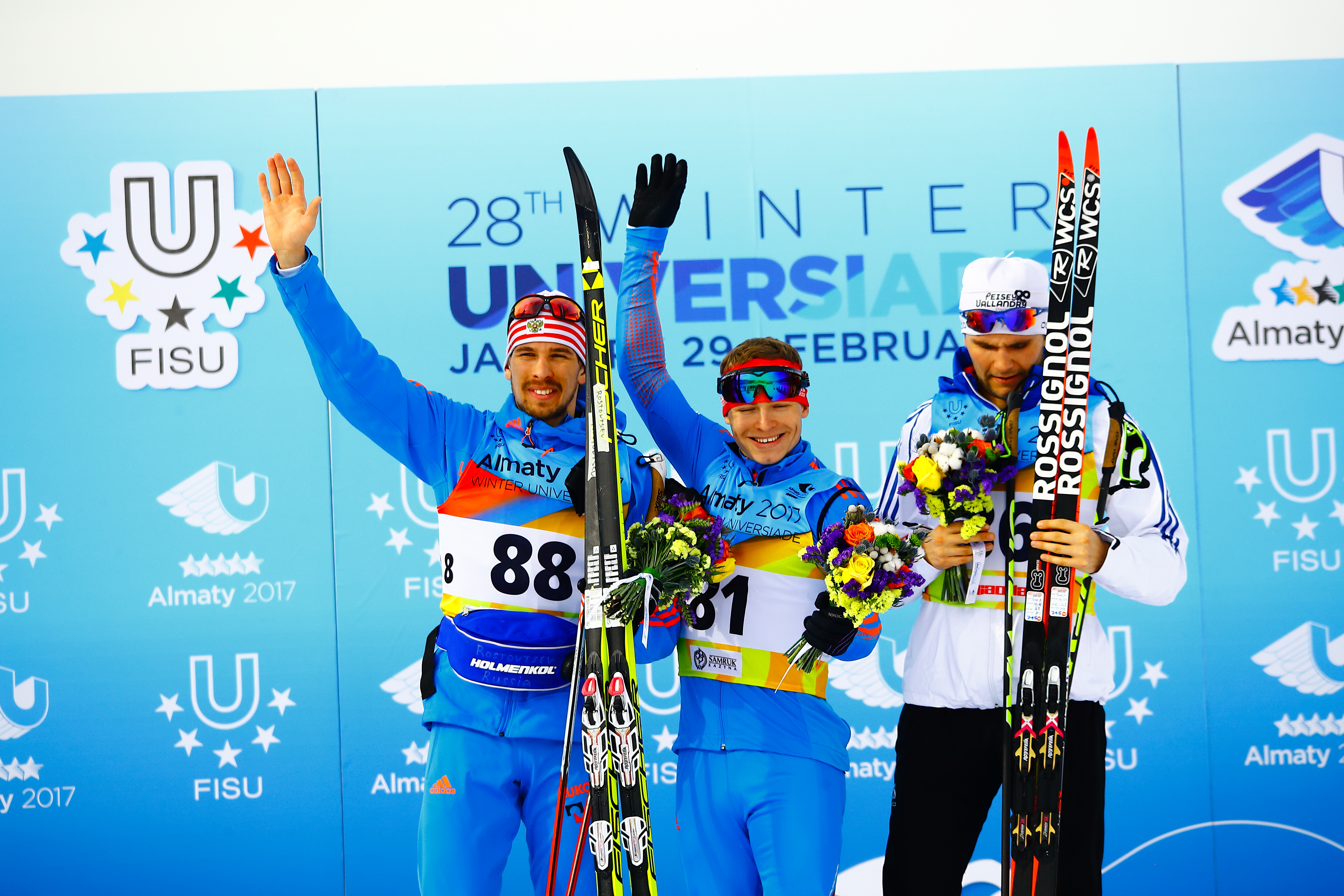
Dmitriy Rostovtsev and Valeriy Gontar of Russia (l, c) and Alexandre Pouye of France on the podium for the men’s 10 k classic at 2017 World University Games in Almaty, Kazakhstan. (Photo: Almaty2017.com)
Russia took four of the six available podium spots in the opening day of nordic racing at the World University Games in Almaty, Kazakhstan.
In the 10 k classic, Valeriy Gontar took an 8.9-second win over Russian teammate Dmitriy Rostovstev. It was an upgrade for Gontar, a student at Penza State University, who was third in this event at the 2015 Universiade. Rostovtsev is a former podium finisher at U23 World Championships. Alexandre Pouye of France was third, +21.8.
Vincent Mason of the University of Wyoming had the best U.S. finish, clocking in at 44th (+2:54.0). Teammate Will Timmons finished 73rd and Sam Wiswell 80th, Mitchell Hollman (Air Force Academy) 82nd, Kevin Geisen (Western State)84th, and Cameron Moore (Western State)85th.
For Canada Jordan Cascagnette (Team Hardwood) finished 49th, +3:12.3. Conor Thompson (Université Laval) finished 53rd, Carrington Pomeroy (Nakkertok) 57th, William Dumas (Skinouk) 58th, Gavin Shields (Lappe Nordic) 59th, and Alexis Morin (Université Laval) 77th.
In the women’s 5 k classic, Lilia Vasilieva earned a 13.3-second victory over Russian teammate AnnaNechaevskaya, a podium finisher at last year’s Russian National Championships.Anna Schevchenko of Kazakhstan – who started the season on the World Cup and finished 32nd in the La Clusaz 10 k – was third, +15.2.
Elise Sulser led the United States in 23rd place; the University of Wyoming skier was 1:58.4 off the pace. Teammate Meghan Kent was 48th and Yara Thomas 49th. Emma Malmqvist (Colorado Mesa University) placed 50th, Sierra Jech (State University of New York) 60th, and Sierra Foster (Oregon State University) 61st.
For Canada, Christel Pichard-Joliceur (Université Laval)was one spot behind Sulser in 24th (+2:02.5). Emma Camicioli (Rocky Mountain Racers)placed 40th, Shelby Dickey (Highlands Trailblazers) 43rd, and Kyla Vanderzwet (Nakkertok) 47th.