Tag: colin abbott

  • Into the Yukon Wild: Johnsgaard Retires from Skiing at 25

    Into the Yukon Wild: Johnsgaard Retires from Skiing at 25

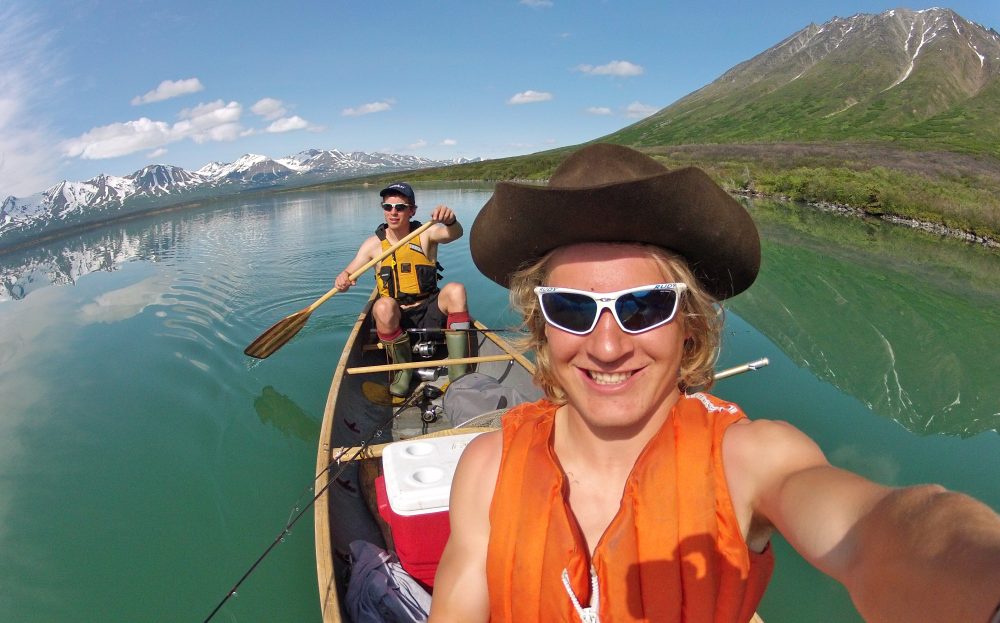
    Former Canadian World Cup skier Knute Johnsgaard snaps a photo during a canoe trip. (Courtesy photo)

    One hundred and fifty kilometers from the city of Whitehorse, if you are adventurous enough to hike through the troves of white spruce and over the two mountain passes to get there, you may come across Knute Johnsgaard’s family trapline. Traverse the 100 square kilometers of land where his family holds the rights to trap, and you may even catch a glimpse of Johnsgaard himself.

    Johnsgaard, a native of the Yukon Territory’s Mount Lorne community, plans to spend most of next winter hunting on his family’s remote patch of land in northwest Canada. He will set traps for lynx, wolverines, foxes, and wolves. He will drop a few fishing lines into the land’s frozen lakes. He will sport cross-country skis as he travels from trap to trap.

    He will not, however, train as he once did. That kind of work is a thing of the past (he will, incidentally, get in a few nordic over-distance workouts, as he plans to ski the 60-kilometer stretch of snow-covered land from snare to snare).

    At 25, Johnsgaard has been a member of Cross Country Canada’s senior national team for the past three seasons (first on the U23+ Development Team, then on the U25 Team, and finally on the World Cup A-team last season). He represented Canada at this year’s Winter Olympics in PyeongChang, South Korea. And as of this spring, he is officially retiring from professional skiing.

    ***

    Looking at the 2018 Olympic and Paralympic team rosters for Canada and the U.S., the pattern of athletes with the same last name is tough to miss. The Bjornsen siblings. The Patterson siblings. The Nishikawa brother-sister duo.
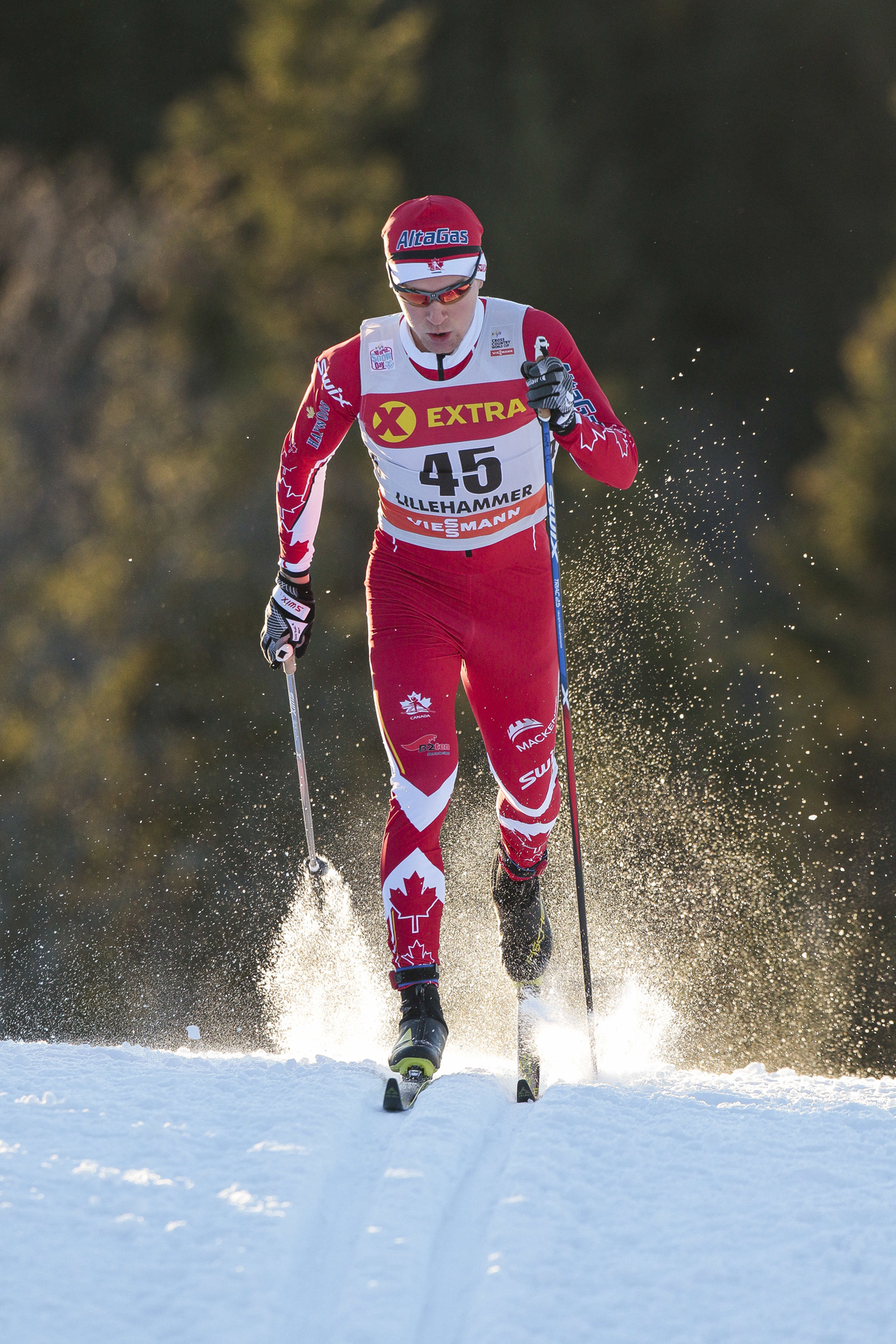
    Knute Johnsgaard racing a 2016 World Cup in Lillehammer, Norway. (Photo: Fischer/Nordic Focus)

    Johnsgaard is not one of those. He does not come from a family of athletes. Most of his relatives, he explained, had never followed his skiing or cross-country in general until the two weeks he competed at the PyeongChang Winter Games. What Johnsgaard did have growing up was a family who encouraged him to be outdoors and access to it. A lot of it.

    The Yukon Territory spans an area of nearly 500,000 square kilometers, and includes Canada’s tallest mountain, Mount Logan. The region is, as Johnsgaard puts it, “one of the world’s last true wilderness areas.” It was within this last wilderness area that the Canadian began his cross-country journey.

    He first started skiing on the ski trails of Mount Lorne. In between skiing adventures, he would join his father for trips to the family trapline. At the age of 13, Johnsgaard’s father suffered an accident that left him paralyzed, which halted their trips together.

    Around that time, Johnsgaard and his mother moved to Whitehorse, the Yukon’s capital and only city, where Johnsgaard joined the Whitehorse Cross Country Ski Club. Johnsgaard remained active with the club through his high-school years. Following graduation, he moved to Quebec to train with the Pierre-Harvey National Training Centre, where he spent two years.

    “I enjoyed my time in Quebec, but I really missed the Yukon,” Johnsgaard explained. “I felt it was kind of silly, I guess, to be training on the other side of the country when we had better snow conditions and so much available to us right here at home [in Whitehorse].”

    ***

    Scroll through the photos Johnsgaard has posted on his blog and a few anomalies crop up. The first being that many of the shots feature Johnsgaard, proudly smiling, while kneeling over the hulking form of a freshly fallen carcass (the seamless transition between shots of Johnsgaard sporting camouflage then spandex also seems slightly unorthodox for the average cross-country skier).
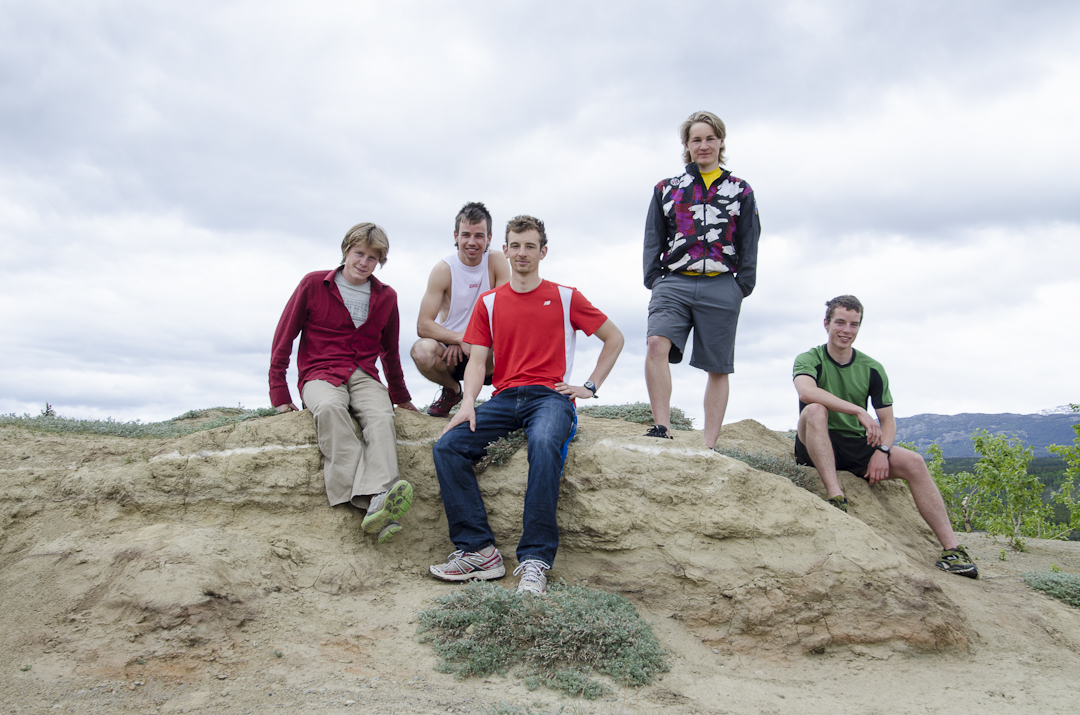
    Knute Johnsgaard (standing) with the Yukon Elite Squad during a cliff-climbing trip. (Courtesy photo)

    Yet to those who are familiar with Johnsgaard, there is a reason hunting appears in tandem with his athletic pursuits. Hunting was more than a hobby outside of ski training. For Johnsgaard, hunting was also how he trained.

    “The type of hunting he was doing, it’s not like weekend-hunter-type skier, it was a lifestyle,” said former Canadian national-team head coach Justin Wadsworth, who coached Johnsgaard during his first season on the team, during a recent phone interview.

    “I think he drew a lot of his confidence from that kind of upbringing and those kinds of experiences,” Wadsworth said.

    Following his two years in Quebec, Johnsgaard returned to the Yukon. He and four other Yukon skiers started a training group called the Yukon Elite Squad (YES). The five men had no formative coach, which permitted them to train when and how they wanted. For Johnsgaard, it also meant a hunting trip could count as training, if he wanted.

    buy tretinoin online

    “There was nobody to tell us we couldn’t skip training to leave and go moose hunting for a week,” Johnsgaard said.

    According to Johnsgaard, the squad met about four times a week and tried to coordinate one training camp a year with Alaska Pacific University (APU), an American elite ski team located about 1,000 kilometers west in Anchorage, Alaska. YES also competed at Canadian nationals, “throwing cash” to any team’s wax technicians who were willing to help out.

    “We were in a unique situation where we recognized that the Yukon was a great place to ski train and we all wanted to pursue skiing,” Johnsgaard said. “We made the best of it, and that’s how I made it onto the national team, training in the Yukon with just a few other teammates. I was pretty proud of that.”

    After two years with YES, at age 22, Johnsgaard was nominated to the senior national team in 2015. In his rookie season as a member of Canada’s under-23 development team, Johnsgaard scored his first World Cup points in 30th place in the freestyle sprint in Gatineau, Quebec.  

    The following spring, he was renominated to the team, which changed its name to the U25 (under-25) Team. He started that winter of 2016/2017 on the World Cup circuit in Europe, competing in Finland, Norway, Switzerland, and France. During that World Cup Period 1, his top finish was 51st in a classic sprint.

    Then came Period 2. While his World Cup teammates Len Valjas, Alex Harvey and Devon Kershaw were overseas competing at World Cups, Johnsgaard was at home in the Yukon training. He was also looking at the World Cup calendar, with one race in late January in particular focus: the 4 x 7.5 k relay in Ulricehamn, Sweden.
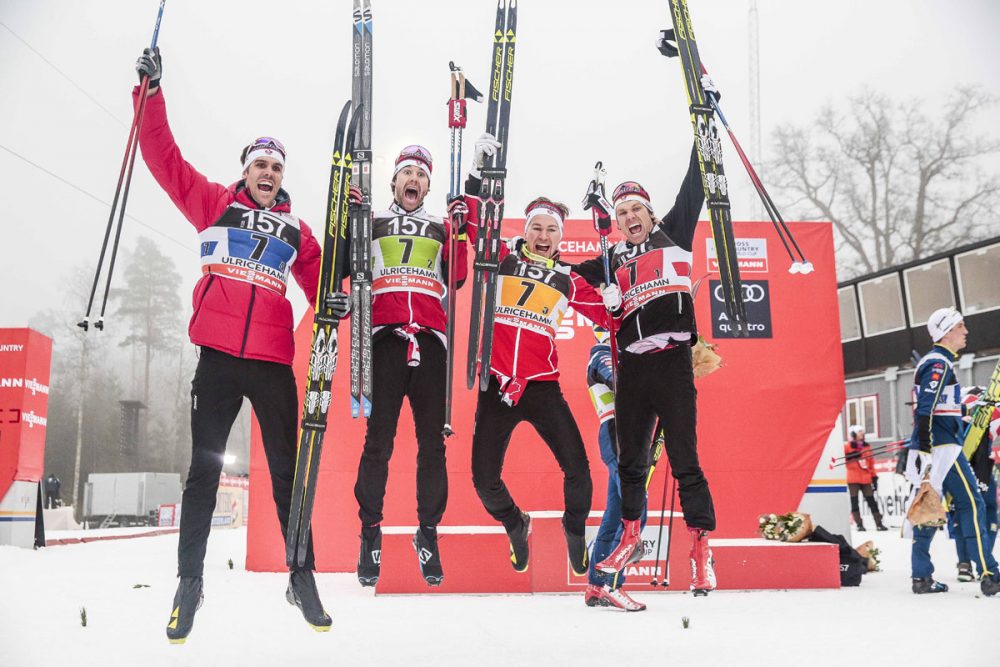
    Left to right: Canada’s Len Valjas, Alex Harvey, Knute Johnsgaard, and Alex Harvey after their historic third place finish in the men’s 4 x 7.5-kilometer team relay on Jan. 22, 2017 in Ulricehamn, Sweden. (Photo: Fischer/Nordic Focus)

    “They actually weren’t going to start a relay team because they didn’t have a fourth guy,” Johnsgaard said. “I had a meeting with our high-performance director [Thomas Holland] and begged him to send me over there to race that race.”

    Holland consented and Johnsgaard flew to Ulricehamn to start in the relay. He arrived a few days before the race and was told he’d ski the third leg (first skate portion) of the relay.

    On the day of the relay, Kershaw led off the first classic leg, putting the Canadians in third and just 0.7 seconds out of third at the first exchange. Harvey skied the second classic leg, holding onto the front pack of skiers before tagging to Johnsgaard in fifth, 3.5 seconds back. Despite being a little jet-lagged, Johnsgaard explained having a “weird confidence” that day on the trails.

    He maintained his team’s position in the pack through his leg, handing off to Valjas in seventh, just 5 seconds out of first. After a smooth handoff, Valjas stayed streamlined in the group to the finishing stretch, sprinting to the line for third place. The result was historic for Canada. It also secured Johnsgaard’s spot on the 2018 Olympic team the following year.

    “That was probably the highlight of my sporting career, that weekend in Sweden, qualifying for the Games there, and making World Cup team history for Canada at the same time,” Johnsgaard said.

    The fact that the race pre-qualified him for the Olympics was a surprise to Johnsgaard.

    “I always imagined getting a phone call after a stressful weekend at trials or something like that, but instead it was just one of my wax techs telling me over beer that evening, going, ‘Hey, I think you made the Olympic criteria,’ ” Johnsgaard said. “It was a pretty funny way to find out.”

    Just over a year later in PyeongChang, Johnsgaard competed in the 15 k freestyle, 30 k skiathlon and 4 x 10 k relay. His best individual result was 69th in the 15 k skate, and he skied the anchor leg of the relay, which placed ninth as Canada’s second-best Olympic relay.

    He started 12 individual World Cup races last season, with a top finish of 51st in a skate sprint in Seefeld, Austria.

    “Since I started skiing at a young age, the Olympics were the ultimate goal,” Johnsgaard said. “To have finally accomplished that, I guess I feel fulfilled and I don’t really see incentive to keep going. I met my goal that’s all I ever wanted and now I’m moving on to new goals.”

    In a blog post late last month, he noted how he finished every race he started.

    “There has never been a ‘DNF’ next to my name,” he wrote. “I’ve never backed down, never not finished a race without laying it all out on the line. … Exploring my limits has always been something I loved doing. Results are inconsistent and out of your control, giving 100% effort, however, is attainable every time you’re on course.

    “The world of sport is cruel in that I was always left wanting more,” he continued. “When you believe anything is possible, then everything less than perfect is not good enough. I always found myself striving for the next step that I could only hope would bring satisfaction. Instead, it brought only desire for greater success, which only got exponentially harder to achieve as I climbed the ladder. The final step was hard for me, and near the end of my career I began to struggle with anxiety and depression. It took so much energy that I didn’t have anything left over for ski races anymore, and I wasn’t happy.

    “Now that I’m retired, I’m finally satisfied,” Johnsgaard added. “I’m able to step back and see for the first time this giant mural that I’ve painted, rather than focusing on the many imperfect brush strokes. I feel a cool breeze of fresh air bringing relief with each breath. I’m calm and content.”

    ***

    All of the animals Johnsgaard traps are, in his words, “put to good use” for clothing, etc. In order to spend his winters living off the grid on his family’s trapline, Johnsgaard plans to work for a construction company through the summer and fall. Construction work is nothing new for Johnsgaard. It is also how he funded his skiing career.   

    “I did have to work a lot to afford to ski race before I was carded,” Johnsgaard explained in an email. “Even with working, I never could have pursued skiing without Cathy Wood of RyanWood Exploration. Cathy anonymously donated enough money for me to go to a training centre after high school and then supported me again in just my last two seasons on the World Cup.”
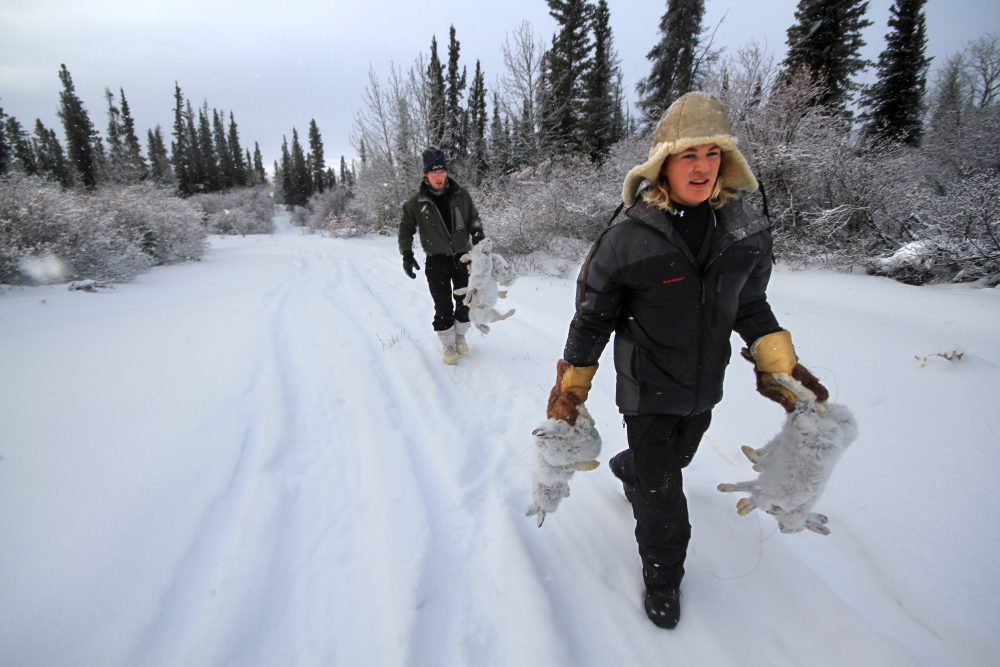
    Knute Johnsgaard (front) after checking on rabbit snares on his family’s trapline. (Courtesy photo)

    He will continue to organize and run the Father Mouchet Loppet in Old Crow, which he and friend/former YES teammate Colin Abbott helped create. Johnsgaard also hopes to do some coaching with the Whitehorse Cross Country Ski Club. Other than that, his connection to skiing will remain a lifestyle choice, and no longer a career one.

    “I’ve always had quite a number of other hobbies and interests, so I’m not at all worried or stressed about what I might do,” Johnsgaard said of his retirement. “I’m just excited for new things, whatever they may be. It’s kind of exciting to be free.”

    Johnsgaard is particularly excited about being able to do what he wants, when he wants.

    “I hope people understand my decision and I hope that it’s not a question mark of why Knute is retiring at age 25 and he might not even be at his peak yet or this and that,” Johnsgaard continued. “It’s just that I’m satisfied with how far I’ve taken it and I feel fulfilled and I’m excited to do new things.”

    Some do wonder whether he might have taken it further. Wadsworth described Johnsgaard as a “physiological talent”, his non-traditional ascent to the World Cup level an attestment in itself.

    “He had a lot of natural strength and physical ability, and I think my guess is he would have had a much longer career had he had that upbringing of the traditional cross-country ski training,” Wadsworth said. “But Knute did it his way and for me to say, ‘Oh, he could have been better, had he taken the traditional method,’ that’s not for me to say. That’s purely a speculation on just what I’ve seen.”

    For now, the reality is Johnsgaard’s skiing will stay in the Yukon — where he hopes to acquire land and build a home — which is exactly how he wants it.

    “I would describe it like getting a wild mustang,” Wadsworth said of working with Johnsgaard. “Wild mustangs are used to running around out in the field and not being told what to do.”

  • Ski Tour Canada: A Look at Likely Starters for the U.S. and Canada

    Ski Tour Canada: A Look at Likely Starters for the U.S. and Canada

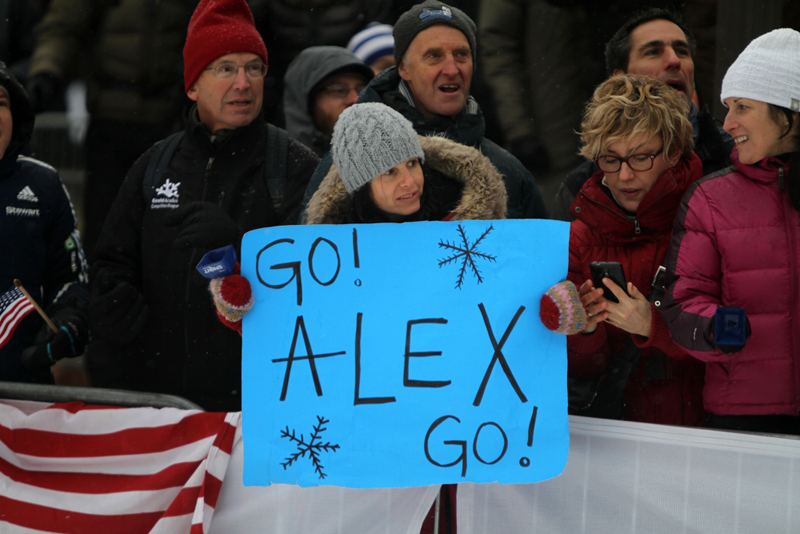
    One of many Alex Harvey cheering sections at the Canadian World Cup in Quebec City, which took place Dec. 7-8, 2012.
    One of many Alex Harvey cheering sections at the Canadian World Cup in Quebec City, which took place Dec. 7-8, 2012. The World Cup is returning to Quebec City and Canmore, Alberta, for the first time in four years early next month, with Ski Tour Canada stages also planned for Gatineau and Montreal.

    The Ski Tour Canada starts on March 1 and we have a good idea of who will be on the start line for the two North American teams. As Canada is hosting the new World Cup tour, both Canada and the U.S. get an increased quota on top of the normal (larger) tour quota.

    Canada planned to select 12 women and 14 men, and the U.S. can take up to 13 women and 11 men.  With roughly 175 international athletes expected to start the eight-stage tour on March 1 in Gatineau, Quebec, the 50 North Americans will play a big role in the event.

    Canada

    Alex Harvey and Ivan Babikov will have their last chances in the 50 k skate.
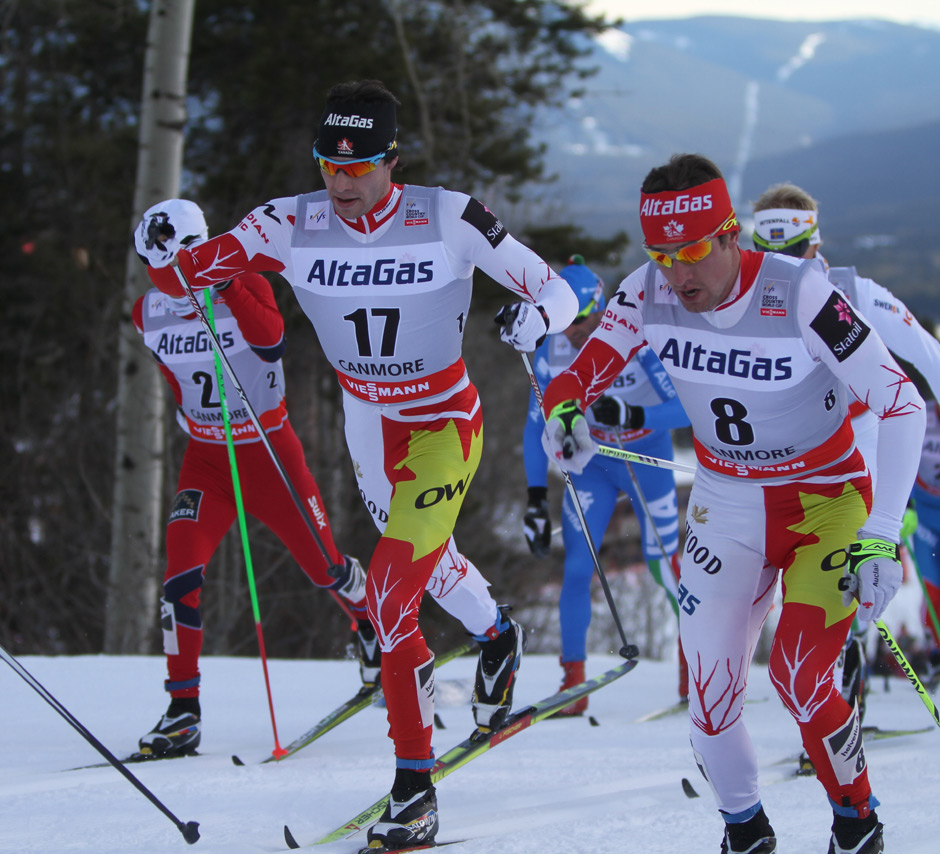
    Canadian World Cup Team members Alex Harvey (17) and Ivan Babikov (8) racing at the last World Cup in Canmore, Alberta, in December 2012.

    Canada has chosen not to use discretionary picks and is using an entirely rule-based selection system.  To oversimplify it, skiers with top-30 finishes this season on the World Cup are automatically selected, as are the Continental Cup (NorAm) leaders in overall, sprint and distance. The remaining places are chosen using a series of ranked rules using CPL (Canadian Points List) points, which are a variant of the FIS points list. World Cup races, U23 World Championships, and Continental Cup events from November to Feb. 21 all count towards the CPL rankings used. 

    The provisional selections are based on results up to Feb. 17, changes are possible from Western Canadian Championships this weekend in Prince George, B.C, and U23 World Championships next week in Rasnov, Romania.

    The selection rules are a bit complicated and there is a defined selection order, making it difficult to be mathematically certain how much this could change before Feb. 22. More detail is available on the Cross Country Canada (CCC) website.  The athlete order below is from CCC, but it doesn’t appear to be ranking order.

    For the women, it is fairly likely that only one name will change, but there could be significant shuffling of the selection reasons, including the partially funded spot as NorAm overall leader.

    Name Affiliation Selection Reason
    Cendrine Browne NDST/CNEPH NorAm overall leader
    Andrea Dupont Rocky Mountain Racers NorAm sprint leader
    Dahria Beatty NDST/AWCA NorAm distance leader
    Sophie Carrier-Laforte CNEPH 4C1
    Jennifer Jackson NDC Thunder Bay CPLS2
    Frederique Vezina CNEPH 4C5
    Olivia Bouffard-Nesbitt NDST/AWCA CPLD2
    Marie Corriveau NJST/CNEPH 4C4
    Maya MacIsaac-Jones Rocky Mountain Racers CPLS1
    Alannah Maclean NDC Thunder Bay 4C2
    Emily Nishikawa NDST/AWCA CPLD1
    Katherine Stewart-Jones NDST/NDC Thunder Bay 4C3


    *Code:

    • CPLD#: Rank on the best 5 distance CPL
    • CPLS#: Rank on the best 3 sprint CPL
    • 4C#: Best 4 distance +2 sprint CPL


    For the men, the selection situation is more fluid, with more changes likely.  As of Feb. 18, the provisional selection was:

    Name Affiliation Selection Reason
    Alex Harvey NST/CNEPH WC top 30
    Devon Kershaw NST WC top 30
    Ivan Babikov NST WC top 30
    Lenny Valjas NST WC top 30
    Graeme Killick NDST WC top 30
    Kevin Sandau AWCA NorAm overall leader
    Andy Shields CNEPH NorAm distance leader
    Julien Locke Black Jack NorAm sprint leader
    Knute Johnsgaard NDST/AWCA CPLS1
    Brian McKeever Para-Nordic ST CPLD2
    Russell Kennedy Canmore 4C1
    Colin Abbott Whitehorse 4C2
    Michael Somppi NDC Thunder Bay CPLD1
    Jess Cockney NDST/CNEPH CPLS2


    It is likely that only a few names will change based on the CPL, but there are at least five athletes that could find their way in.

    Most of the World Cup team and some of the development team will be doing an elevation camp in the Lake Louise area.  Ivan Babikov is doing the American Birkebeiner as final preparation.  A number of athletes will race at Westerns this weekend, either to defend their selection, gain selection, or final intensity before STC.

    Daria Beatty, Olivia Bouffard-Nesbitt and Kevin Sandau will race the first two days at Westerns and return to Canmore, Alberta, on Sunday. Carrier-Laforte, Jackson, Locke, Maclean, and Vezina all chose to attend U23’s in Romania, with a training stop in Austria on the way. Johnsgaard is choosing to train instead of race as his final preparation, as he did on the European B tour in January.  

    “The plan is to skip the Lahti World Cups this coming weekend,” Kershaw wrote in an email earlier this week from his home in Canmore. “The plan now is to train at altitude between Lake Louise, Canmore and up at a lodge up above Canmore [Engadine Lodge] for 10 days and then have some days at home here in Canmore before flying back to Ottawa two days before the whole SkiTour Canada begins!”

    None of the Canadians planned to race in Lahti this weekend.


    USA

    The American team used a combination of discretion and criteria to select athletes, with only one spot still open.

    Name Affiliation Selection Reason
    Jessie Diggins  USST/SMST2 Top-30 Sprint and Distance World Cup
    Sadie Bjornsen  USST/APU Top-30 Sprint and Distance World Cup
    Sophie Caldwell  USST/SMST2 Top-30 Sprint World Cup
    Ida Sargent  USST/CGRP Top-30 Sprint World Cup
    Liz Stephen  USST Top-30 Distance World Cup
    Caitlin Gregg  USST/Team Gregg Discretion
    Anne Hart  SMST2 Discretion
    Caitlin Patterson  CGRP SuperTour Overall Leader
    Chelsea Holmes  APU Distance Leader 2 after Nationals
    Katharine Ogden  SMS/USST Distance Leader 3 after Nationals
    Jennie Bender  BSF Sprint Leader 1 after Nationals
    Kaitlynn Miller  CGRP Sprint Leader 2 after Nationals
    Rosie Brennan  USST/APU Objective Crit. (WC Points Jan. 16-Feb. 21)


    U.S. Ski Team Head Coach Chris Grover explained the selections in an email.

    “Adam Martin was the 3rd man on the distance list post Nationals but has declined his start spot due to the conflict with NCAAs,” he wrote of the Northern Michigan University junior. “We have left one position open on the men’s side for an outstanding performance at the U23 Champs.  If we don’t have that, Matt Liebsch will be the next athlete named via the post-Nationals ST Distance CAN-Selection list.  We’ll make a decision on the 25th (last day in Rasnov).”

    Name Affiliation Selection Reason
    Simi Hamilton  USST/SMST2 Top-30 Sprint World Cup
    Andy Newell  USST/SMST2 Top-30 Sprint World Cup
    Erik Bjornsen  USST/APU Discretion
    Noah Hoffman  USST/SSCV Discretion
     ??? Discretion
    Eric Packer  APU SuperTour Overall Leader
    Scott Patterson  APU Distance Leader 1 after Nationals
    Brian Gregg  Team Gregg Distance Leader 2 after Nationals
    Reese Hanneman APU Sprint Leader 1 after Nationals
    Dakota Blackhorse-von Jess  BEA Sprint Leader 2 after Nationals
    Tad Elliott  SSCV Distance Leader 4 after Nationals


    Of the U.S. Ski Team members, Andy Newell, Liz Stephen, Rosie Brennan, and Caitlin Gregg returned to the U.S. early, skipping the Lahti World Cup, to prepare for the tour.

    “Many of the sprinters will travel home on Sunday from Helsinki,” Grover explained of the rest of the team in Lahti. “Those doing the skiathlon will travel home on Monday.  For the Alaskans, most will go to New England (Craftsbury) rather than going back to AK in a short window.”


    Cost Estimates

    The Continental Cup (NorAm or SuperTour) leaders have a quota spot, with accommodation and some costs covered by the organizing committee.  Red Group members get the same cost reduction and most have additional financial support from their respective national team.

    For the rest of the nation’s group skiers, at least in Canada, the costs have been estimated by CCC. Note that this information was published in November and was subject to change. U.S. dollars reflects the conversion rate.

    Item Note Original currency cost $ CDN $ US
    Mandatory FIS charter flight, Montreal to Calgary Athletes will be transported from Quebec City to airport. 895 euro $1362 $995
    FIS food and accommodation This is 14 days, optional in Canmore only. 125 swiss francs $173/night $126/night
    Waxing Canadian team price $30 CDN/race $240 $176
    Shipping classic skis from Montreal to Canmore Both Quebec City races are freestyle $35 CDN $35 $26
    Total for Canmore residents Only 7 nights food and accom. $2848
    Total for non-Canmore residents $4059 $2961
    Flight to Ottawa varies by athlete
    Flight from Canmore Or location where the athlete leaves the tour. varies by athlete


    If an athlete drops out of the tour, through elimination, illness or disqualification, they pay their own way home from the last location they raced and will not be refunded for food and accommodation.

    Two weeks out from the event, there was still some uncertainty on final costs and support levels for individual Canadian skiers.

    We didn’t receive any information yet,” Browne wrote in an email on Wednesday. “I think it will be pretty expensive though. But if I’m still noram leader after Westerns it’ll be less expensive for me.”

    “We got a quote from the CCC administrator yesterday that the Eastern part of the Tour — including accommodation, the charter flight, and all race service fees will be just over $2000,” Jenn Jackson wrote on Friday. “Most people will be staying with friends and family in Canmore to reduce costs, but if not it’ll be about another $1000.”

    “The fee does not, however, include the costs of travelling to Ottawa for the start of the Tour or back home from Canmore after – so another several hundred dollars there…” Jackson added.

    In an email, Colin Abbott, of Whitehorse, explained that he will skip Westerns despite not knowing for sure whether he had qualified.

    “I decided that in order to be rested for the tour I needed to take a break after Easterns,” he wrote. “I will race the tour if I qualify, hopefully I can survive the whole thing! Final costs are likely to be $3000-$4000 but haven’t been finalized yet.

    My guess is between $2500 to $3000,” Alberta World Cup Academy Head Coach Chris Jeffries wrote of the total cost. “Western athletes in Canmore do not have to stay in the race hotel.”

  • For Aspiring Skiers, World Championships Qualifier Much More Than a Race

    For Aspiring Skiers, World Championships Qualifier Much More Than a Race

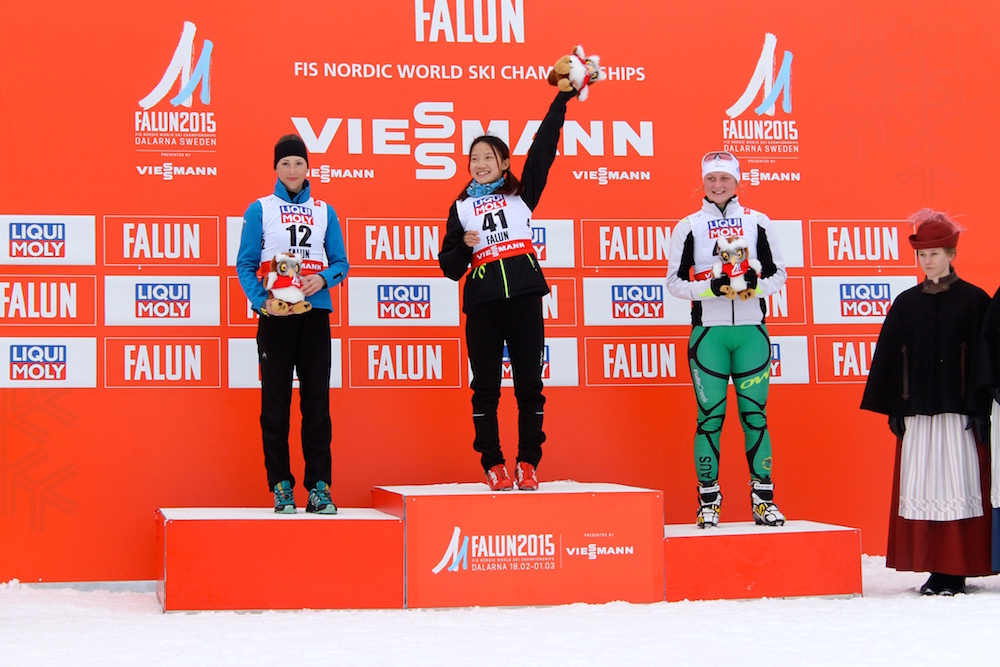
    Seventeen-year-old Chi Chunxue celebrates her qualifying win on Wednesday in the women's 10 k freestyle, which advanced her along with the top 10 to the remaining distance races at 2015 FIS Nordic World Ski Championships in Falun, Sweden.Bosnia and Herzegovina's Tanja Karisk placed second (+49.3) and Australia's Casey Wright was third (+1:07.5).
    Seventeen-year-old Chi Chunxue (c) celebrates her qualifying win on Wednesday in the women’s 10 k freestyle, which advanced her along with the top 10 to the remaining distance races at 2015 FIS Nordic World Ski Championships in Falun, Sweden. Bosnia and Herzegovina’s Tanja Karisk (l) placed second (+49.3) and Australia’s Casey Wright was third (+1:07.5).

    By Colin Abbott

    FasterSkier’s coverage of the 2015 FIS Nordic World Ski Championships in Falun, Sweden, is brought to you by the generous support of L.L. Bean, now featuring a complete line of Kikkan Randall training wear.

    FALUN, Sweden — The buzz is building at the 2015 FIS Nordic World Ski Championships with the completion of the first races in Falun. Wednesday saw the individual-start distance qualification races take place with 45 women and 69 men and women skiing 5 kilometers and 10 k, respectively.

    These initial races did not crown world champions, but they have another purpose that is just as important to the athletes racing. These races offer the opportunity for skiers that have not in the past year made the minimum International Ski Federation (FIS) point standard for men (90 points) and women (120 points). The top-10 men and women in these races qualify for the remaining distance races at World Championships (the skiathlon, individual start and mass start).

    Athletes selected with these races are part of a nations quota of starts. Most countries with a regular presence on the World Cup have athletes with low FIS points and select teams long before the start of the World Championships. This leads to lesser-known ski nations concentrating on these races as an opportunity for athletes to qualify and participate in World Championships.

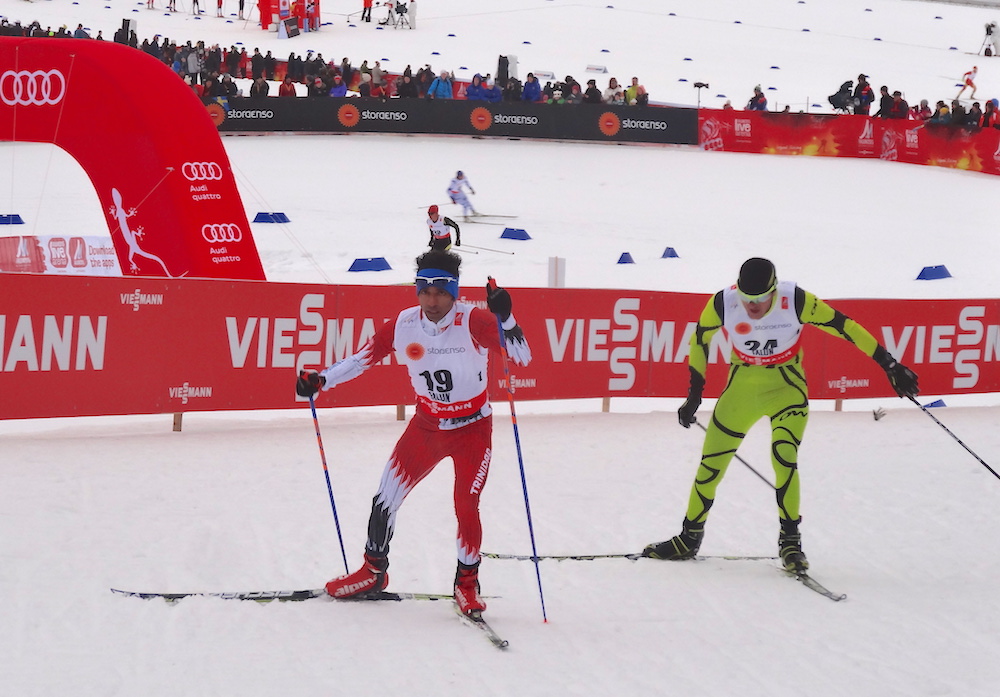
    Mark Rajak racing for Trinidad and Tobago in Wednesday's 10 k freestyle individual start qualification race on the first day of 2015 World Championships in Falun, Sweden.
    Mark Rajak (19) racing for Trinidad and Tobago in Wednesday’s 10 k freestyle individual start qualification race on the first day of 2015 World Championships in Falun, Sweden.

    After the races on Wednesday, FasterSkier caught up with skiers hailing from countries where many citizens will never see snow. Trinidad and Tobago, Iran, Australia, and Brazil offered us a glimpse into the role of skiing in their nations.

    The Australian ski program has grown into a World Championships team that includes 11 athletes and six support staff. Central to their success as a nation is a development program termed the “Victorian squad” — an inclusive, tiered learn-to-ski program focused on teaching children how to ski and supporting athletes who want to race. Those young racers have athletes such as Callum Watson and PK Kovacs to look up to now which, according to 22-year-old skier Mark Pollock, is key to motivating and developing high-performance skiers.

    At a certain point, the lack of snow makes it difficult to progress as an athlete in Australia. Their best skiers are seeking out options to continue skiing in other places. Last summer, Pollock trained with the Bridger Ski Foundation in Bozeman, Mont., while his teammate Jessica Yeaton trained with Alaska Pacific University in Anchorage, Alaska. These training initiatives taken by Australian athletes have allowed them to improve their depth and competitiveness internationally, with Yeaton qualifying for the nation’s full-fledged World Championships team outright.

    Fabrizio Bourguignon racing for Brazil  in Wednesday's 10 k freestyle individual start qualification race on the first day of 2015 World Championships in Falun, Sweden.
    Fabrizio Bourguignon racing for Brazil in Wednesday’s 10 k freestyle individual start qualification race on the first day of 2015 World Championships in Falun, Sweden.

    Brazil was represented by three national team members on Wednesday: one woman, Mirlene Picin, and two men. Leandro Lutz, 33, and Fabrizio Bourguignon, 38, have both been skiing for a number of years. Like Yeaton and Pollock, Lutz decided that in order to optimize his training, an on-snow location was necessary for part of the year. Lutz chose to spend the first half of this winter in Denver, Colo., to train on snow in order to prep for three months of racing in Europe. And like Australia, Brazil is experiencing a growth in the popularity in skiing. According to Lutz, there are seven Brazilian junior racers currently in Europe — three racing the IBU Youth/Junior World Championships in Belarus and the remainder racing FIS junior races in Scandinavia.

    Racing the sprint on Thursday is another Brazilian, Leandro Rubella. Two years ago, Rubella started a social project in Sao Paulo to help children from impoverished families escape violence and poverty and establish the skills needed to live a good life. This project took the unlikely form of a learn-to-rollerski program. A key message of this initiative is that “anything is possible.” The hope is that a citizen from a country with no snow can make it to the Nordic World Championships, a child born into poor circumstances will see that it is possible to overcome the most difficult challenges.

    The birth of a similar program may soon occur in another tropical country, Trinidad and Tobago. Mark Rajack, 33, toed the start line Wednesday afternoon in Falun to compete for the Caribbean island nation in his first international race. Even though Rajack, who has lived in Ottawa, Ontario, since a young age, has only been skiing for two years, he sees the potential for skiing to bring positive changes to his native country.

    Rajack sees benefits similar to those envisioned by Rubella in Brazil. In addition to teaching important life skills, Rajack sees a rollerski program as a way to teach citizens a skill that would allow immigrants from Trinidad and Tobago to easily integrate with societies in the Northern Hemisphere, should they choose to leave their country. This vision originated with the positive experience Rajack has had with the ski community in Ottawa.

    Seyed Sattar Seyd of Iran (l) with his coach after the men's 10 k freestyle individual start qualification race on the first day of 2015 World Championships in Falun, Sweden.
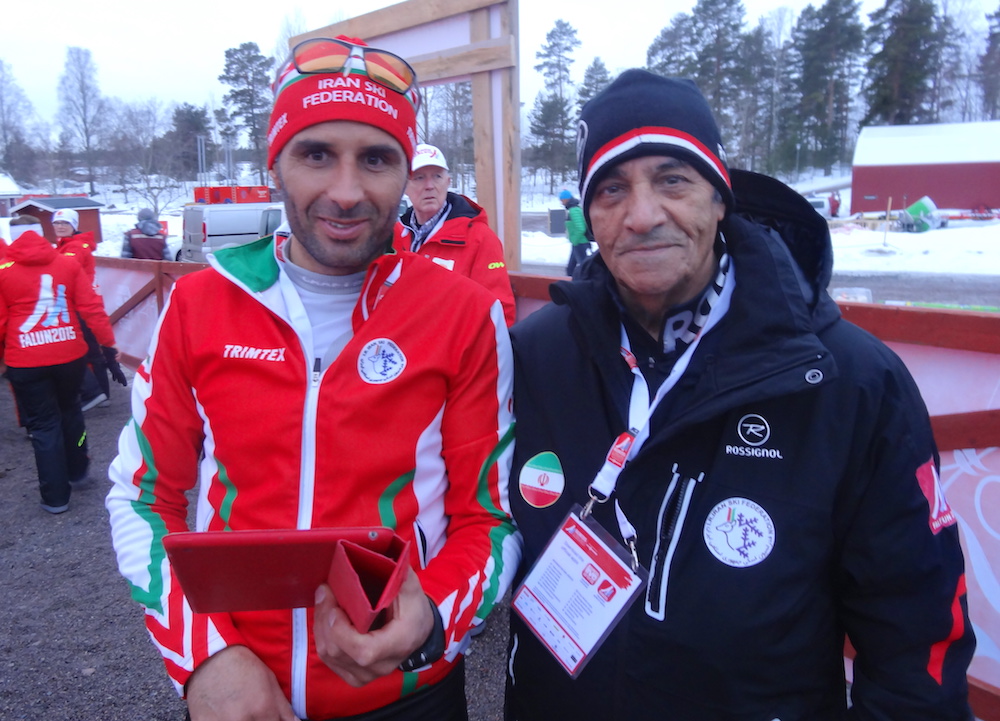
    Seyed Sattar Seyd of Iran (l) with his coach after the men’s 10 k freestyle individual start qualification race on the first day of 2015 World Championships in Falun, Sweden. He placed eighth to qualify for the remaining distance races at the championships.

    Seyed Sattar Seyd posted one of the best Iranian cross-country skiing results ever on Wednesday after finishing eighth in the men’s qualifying race. Seyed, 27, is an experienced racer, having competed in both the 2010 and 2014 Winter Olympics.

    Iran now has a FIS-homologated race site at Knoor, approximately 60 k outside its capital of Tehran. Much of the training done by Iranian athletes happens within the borders of Iran and it appears that the current government will assist in keeping it that way. The addition of a biathlon range is planned for the Knoor facility in the near future and the Iranian contingent here in Falun sees a bright future for the sport.

    Below are the top-10 competitors that qualified for the remaining distance races at 2015 World Championships. Those who did not qualify have the opportunity to race Thursday’s 1.4-kilometer classic sprint qualifier.

    OFFICIAL RESULTS 

    Women’s 5 k freestyle

    1. CHI Chunxue 1998 CHN 13:33.8
    2. KARISIK Tanja 1991 BIH +49.3
    3. WRIGHT Casey 1994 AUS +1:07.5
    4. TRNKA Anna 1994 AUS +1:07.8
    5. MUIZHNIECE Anda 1991 LAT +1:09.7
    6. PASHKOVSKA Inga 1992 LAT +1:37.3
    7. PAPP Ildiko 1982 HUN +1:39.1
    8. KIROSKA Rosana 1991 MKD +1:44.9
    9. KLAUZA Laima 1969 LAT +1:47.0
    10. GALSTYAN Katya 1993 ARM +1:49.2

    Complete women’s results

    Men’s 10 k freestyle

    1. BELOMAZHEV Stanimir 1988 BUL 23:56.8
    2. PLAKALOVIC Mladen 1991 BIH +16.6
    3. KONYA Adam 1992 HUN +31.4
    4. HULGAARD Lasse 1991 DAN +47.6
    5. SLOTINS Roberts 1991 LAT +54.5
    6. SMRKOVIC Rejhan 1991 SRB +57.8
    7. PAIPALS Janis 1983 LAT +1:05.1
    8. SEYD Seyed Sattar 1987 IRA +1:11.4
    9. HADZIFEJZOVIC Dzevad 1991 SRB +1:23.3
    10. ANGELIS Apostolos 1993 GRE +1:30.9

    Complete men’s results

    About the Author: Colin Abbott hails from the Yukon Territory where he learned to ski and race from a young age. Years later his life mostly revolves around skiing. At the moment, Colin is racing for the Yukon Elite Squad and the Carleton Ravens university team. He sits on the board of directors for Cross Country Canada and is involved in the education and womens committees there. He has also started writing ski-related articles for XCOttawa and FasterSkier and for the next week is supporting the Trinidad and Tobago team at FIS Nordic World Ski Championships.

  • EISA Racing Begins in Rumford

    EISA Racing Begins in Rumford

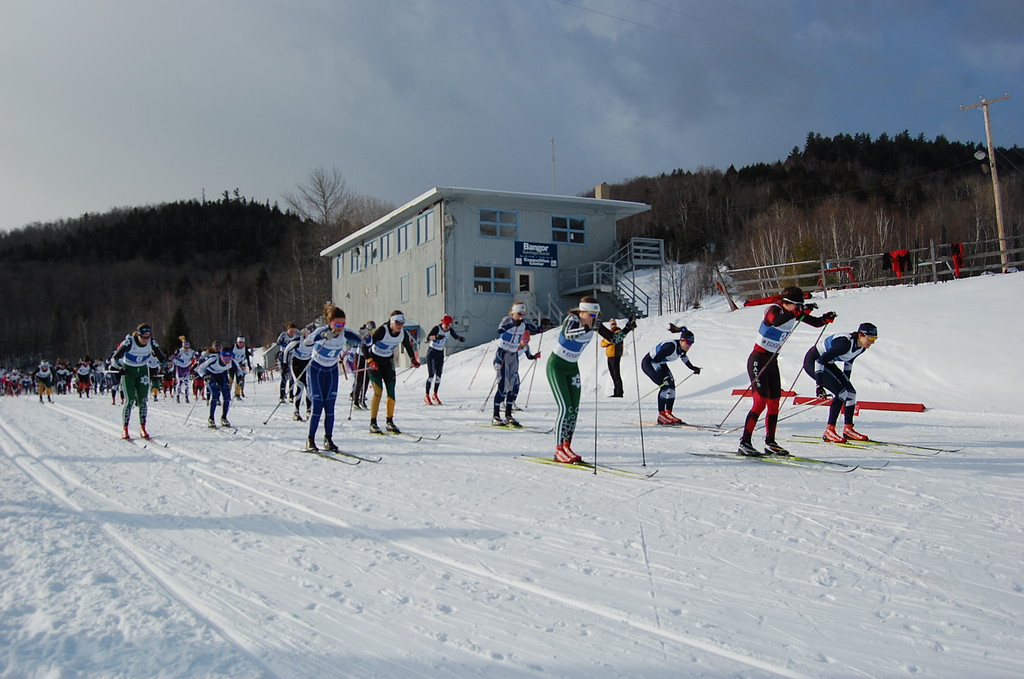
    Competitors begin the 20k classic mass start at the Bates Carnival (photo: Silke Hynes)
    Competitors begin the 20k classic mass start at the Bates Carnival (photo: Silke Hynes)

    Editor’s note: We’re seeking collegiate contributors from across the U.S. If you’re interested in seeing your collegiate region and circuit represented with similar articles, and would like to contribute or know someone that would be interested in submitting recaps and photos, please email info@fasterskier.com.

    ***

    Most New England ski racers are familiar with the courses at Black Mountain of Maine, perennial host of events ranging from the high school level up to the National Championships. Most of those racers are also familiar with the old New England weather adage, “if you don’t like the weather, wait five minutes.” In classic East Coast fashion this first EISA competition, hosted by Bates College, featured a little bit of everything: cold, wind, sun and snowstorms…sometimes all within a single race.

    Despite marginal coverage in places thanks to a January thaw, snowmaking, shoveling and other enthusiastic volunteer squads combined to create fair and exciting courses. All events were able to take place on full 5-kilometer loops. On Friday, “Chummy’s Loop” played host to 15 and 20-kilometer mass-start classic races. On Saturday, “Ray’s Loop” was the scene of 5 and 10-kilometer freestyle events.

    Friday: 15/20k Classic Mass-start

    A fast first kilometer of flat and downhill terrain caused both the women’s and men’s races to string out quickly. In each case, a lead pack of 10-15 skiers became established by the beginning of the second lap, with chasers eagerly battling for positions inside the top-30 and coveted points toward the NCAA Championships this year in Lake Placid, NY.

    For the women, much of the lead pack consisted of racers from UVM, Dartmouth and Middlebury. Along various portions of the course leads would change, though there were no significant breakaways until the final lap.

    Only a week removed from successful races at US National Championships in Houghton, MI, it was Heather Mooney of Middlebury and Annika Taylor of UNH who entered the final downhill into the stadium together with a clear gap to eventual third-place finisher Alayna Sonnesyn of UVM.

    The women's field heads out of the start during the 15k classic race
    The women’s field heads out of the start during the 15k classic race (photo: Silke Hynes)

    Taylor trailed slightly heading into the flat section and may have had an eye to slingshot into the lead down the final stretch, but once the double-poling ensued it was clear that the tall, powerful frame of Mooney would be too much to overtake.

    Mooney sealed an individual victory for the Panthers, while the Catamount women of UVM topped the team score thanks to the podium by Sonnesyn (in her first EISA race), as well as sixth and eight-place finishes by Mary-kate Cirelli and Marion Woods, respectively.

    The men’s race saw a similar situation form by the midpoint in the race, with a small pack of skiers breaking away from the rest of the field. A mid-race snow squall made conditions interesting, but did little to dramatically affect the outcome of the race.

    One notable exception to the tactical skiing of the lead pack was Carleton racer Colin Abbott, who pushed away from the field early in the race and skied alone for much of the first three laps. At first glance, the name Carleton may be unfamiliar to some readers: located in Ottawa, the university was a guest of the Bates Carnival this season. Along with Universite Laval from Quebec City, the welcome addition of Canadian teams to the EISA circuit has added a new level of excitement and unique depth to the carnival events.

    As the kilometers ticked away with Abbott still alone in front, the movement within the lead pack became more tense. Based on his recent success in distance and mass-start events, many spectators and coaches were likely all wondering the same thing: when was Paddy Caldwell (Dartmouth/USST) gonna chase this guy down?

    Sure enough, the Sophomore from the Big Green made his move in the later stages of the race, catching up to Abbott and skiing with him up the brutal stretch of striding that encompassed the rear slope of the infamous “High School Hill”. Despite his push for the lead, Caldwell wasn’t able to surpass Abbott in the finish, crossing the line a few seconds behind.

    The podium was completed by another racer from north of the border, Laval skier and former Canadian National Team member Frederic Touchette.

    The Dartmouth men were able to take top honors in the team score, with Caldwell leading his teammates Fabian Stocek and Silas Talbot into fourth and sixth place, respectively.

    Saturday: 5/10k Freestyle

    After frigid temps the night prior and a windy morning with bitter wind chill values, the freestyle races on Saturday were postponed slightly. The wind barely died down for the women’s race, however, and competitors battled gusts in the stadium area strong enough to knock an unsuspecting racer off balance.

    That was no problem for the Middlebury women’s team, who looked in absolute control of their technique and pacing on Saturday. Heather Mooney repeated her top performance on Friday to earn a sweep of the weekend, while her teammates Kelsey Phinney and Stella Holt crossed the line in sixth and tenth position, respectively. All three of Middlebury’s scorers looked particularly smooth, snappy and energetic despite the cold snow and wind.

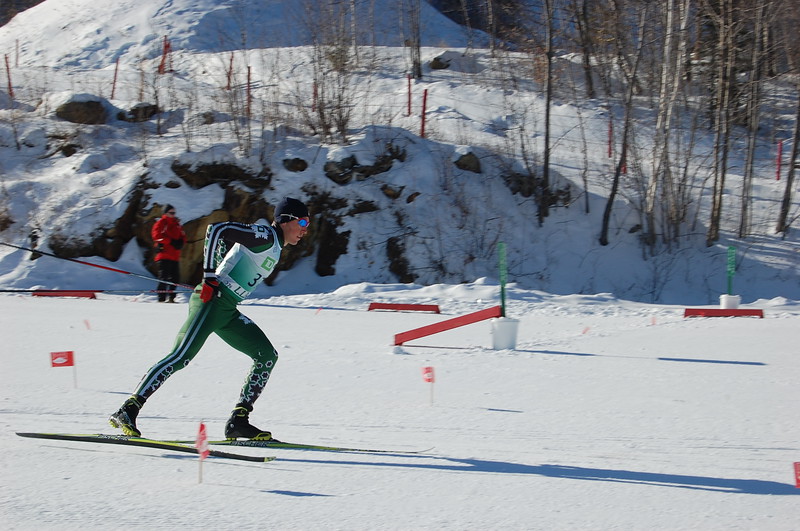
    Paddy Caldwell laps through during the men's 10k freestyle (photo: Silke Hynes)
    Paddy Caldwell laps through during the men’s 10k freestyle (photo: Silke Hynes)

    UNH skier Annika Taylor also continued a great opening carnival weekend, finishing just over two seconds behind Mooney for her second podium in as many days. Dartmouth skier Corey Stock rounded out the top three.

    The wind began to die down and conditions sped up slightly for the men, who raced two laps for 10 kilometers. In his preferred technique, it was Paddy Caldwell’s race from start to finish. Using a smooth, efficient tempo on the climbs and breaking into his unmistakable and deadly-effective V2 on flatter sections, Caldwell powered to a 46-second victory over Harvard’s Akeo Mayfeld-Carucci.

    Mayfeld-Carucci earned his top EISA finish with his second-place result, while the ever-consistent Silas Talbot of Dartmouth claimed third to give Dartmouth a strong presence on the podium.

    The third racer from Dartmouth, Fabian Stocek, placed seventh to give the Big Green another team victory.

    EISA racing continues next week at Trapp Family Lodge in Stowe, VT with host UVM.

    RESULTS


  • Marshall Back on Top; Widmer Notches Another Classic Sprint Win at Easterns

    Marshall Back on Top; Widmer Notches Another Classic Sprint Win at Easterns

    Alysson Marshall (AWCA/NST) racing at the 2012 World Cup finals in Falun, Sweden, last March.
    Alysson Marshall (AWCA/NST) racing at the 2012 World Cup finals in Falun, Sweden, last March.

    Alysson Marshall could feel it coming, and she couldn’t believe it was happening.

    Burdened with a cold the night before the Eastern Canadian Championships, she thought back to all the other times she hadn’t felt well this season. She started the season in Europe and had to sit out the first races over there because of a cold.

    Upon returning back to Canada, jet lag took a major toll on the Alberta World Cup Academy (AWCA) and Senior Development Team skier. Last year’s NorAm winner, Marshall couldn’t find those good vibes at the Canadian World Cups and struggled to get back on top of the NorAm podium.

    Friday morning, she wasn’t even sure she was going to race the 1.6-kilometer NorAm classic sprint at Nakkertok Ski Club in Cantley, Quebec. She decided to see how she felt warming up and proceeded to try her luck in the qualifiers. There, Marshall was second to teammate Kate Brennan by 1 ½ seconds. Not bad, she thought.

    Marshall, 24, went on to win her quarterfinal and semifinal, refining her tactic of dropping her competitors on the course’s two major climbs. In the final, she did more of the same, tucking behind Brennan out of the flat start then finding an open lane up the first hill.  She created a gap and kept pushing, lengthening her lead for a comfortable victory – her first of the NorAm season.

    “It wasn’t a full-on sprint to the finish,” Marshall said on the phone Friday. “I knew I had it a little ways out.”

    Three of her AWCA teammates raced for second, with Rebecca Reid slipping by on the downhill ahead of Brennan in third and Emily Nishikawa in fourth, respectively. Amanda Ammar (Canmore) was fifth and Alannah MacLean (NDC-Thunder Bay) placed sixth in the final.

    “Twenty-four hours ago I was pretty upset and not very impressed with how things were going so I was really happy to get a good result in,” Marshall said. I’ve had some bad luck and just tired, just haven’t had a break yet this season, so today was really nice.”

    Second in the Thunder Bay classic sprint and third in the same race in Duntroon, Ontario, at Canada’s World Championships trials last month, Marshall narrowly missed a trip to Val di Fiemme, Italy. Team selections were announced earlier this week, and Marshall resolved to move on and learn from her experiences.

    “I don’t really have any opportunities to go to Europe now so I’m going to focus, restart, figure out what I need to do to be fast the rest of the season,” she said. “Figure out what I need to work on, what’s going on and try to have a good [Western Championships] and nationals. … I’m going to do some training, figure out my weaknesses and hopefully finish off the season better than it started.”

    Thinking about ways she could improve as well, Reid, 20, placed second for her best NorAm result and second career podium, which she sought at the World Championships trials last weekend.

    “I got inched out of a podium last weekend in Duntroon where I was fourth in the classic sprint and I really wanted to build on that result this weekend,” Reid wrote in an email.

    After qualifying in seventh, she was happy with her position but continued to strive higher. Reid went on to win her quarterfinal and finished second to Brennan in the semifinal.

    “I was ranked fourth going into the final and it went smoothly for me. I was feeling confident and I knew I had wicked fast skis on my feet so I was patient and came through in the finishing straight,” she wrote. “I was pretty excited that it wasn’t just a good day for me, having the Academy girls take the top-4 spots in the final made for a really fun day!”

    AWCA racing director Mike Cavaliere was pretty impressed.

    “Rebecca has been skiing stronger and stronger,” he wrote in an email. “I think she is starting to settle into life as a senior and getting more comfortable and aggressive.”

    Brennan and Nishikawa sprinted to the finish for the third podium spot, which Brennan narrowly took. After sitting out last Sunday’s NorAm distance race in Duntroon, Nishikawa wrote that she was still recovering from a cold.

    “I’m still not 100% but all things considering I was happy with how things went today,” she said, describing the final as fast to start with the four Academy women skiing together before Marshall gapped the field. “Feeling better everyday, so I’m looking forward to tomorrow!”

    Saturday features 10 and 15 k freestyle interval starts on the second of the three-day Eastern Championships. Racing ends Sunday with 15 and 30 k classic pursuits.

    Women’s results

    AWCA Men Also Take Top 4

    Friday’s 1.6 k men’s sprint results looked similar to the women’s with the AWCA sweeping the top four. Phil Widmer led the group in first with his second victory in the last three NorAm classic sprints.

    Phil Widmer (AWCA) at the Québec City World Cup sprint on Dec. 7.
    Phil Widmer (AWCA) at the Québec City World Cup freestyle team sprint on Dec. 7. He and teammate Brent McMurtry placed 20th.

    Widmer crossed the line first last weekend in the Duntroon final as well, but was relegated to sixth for an infraction before the finish. Without the penalty, he would’ve swept the last three NorAm sprints. Regardless, he had won the qualifier in both sprint trials to secure a trip to the upcoming World Championships.

    However on Friday, Widmer wasn’t first, at least not initially. The 29-year-old was third in the qualifier behind Academy teammates Brent McMurtry and Patrick Stewart-Jones. That didn’t sit well with Widmer, and he resolved to do better in the heats.

    He did, winning his quarterfinal and placing second to Stewart-Jones in the semi. In the final, the two dueled to the finish, where Widmer outlunged Stewart-Jones in a photo finish. McMurtry was third after leading early.

    “Neither Patrick or I were sure who won,” Widmer said. “After we crossed the line, the announcer thought Patrick won, but I guess after reviewing the photo, I got it.”

    Widmer opted to follow McMurtry and Stewart-Jones up the herringbone climbs, conserving energy on the steeper terrain.

    “I knew my strength was in the finish with the double pole,” he said. “My climbing on that steep stuff isn’t amazing. I was just trying to hang with the stronger guys like Brent and Patrick and hope that I could out-doublepole them.”

    The three broke away from the pack when Jess Cockney (AWCA) and Colin Abbott (Yukon Elite Squad) fell about halfway through the final. With Abbott’s teammate, Knute Johnsgaard, the three finished behind the leaders with Cockney in fourth, Abbott in fifth and Johnsgaard in sixth.

    For Abbott, it was a career-best finish in his first NorAm final just a few days after flying back from the Junior World Championships in Liberec, Czech Republic.

    “I didn’t know what to expect,” Abbott wrote in an email. “I was back in Canada two days ago and I only got one real ski in before racing today. I felt like today was my best day of racing all year which was a nice surprise.”

    Incident-free up front, Stewart-Jones explained that he made a point to lead early and keep the pace high.

    “I was leading coming into the end but ran out of juice in the last 15 meters and Phil got me on the lunge,” the Chelsea, Quebec, native and Nakkertok club member wrote. “I’m happy with second and very happy with my qualifier yet a part of me is disappointed I didn’t pull off the win on my home course.”

    McMurtry, who won the qualifier by 2.7 seconds over Stewart-Jones, knew he was off to a good start in what isn’t always his signature event. “I haven’t won many qualifiers in my career so I was pretty happy with how that went,” he wrote in an email.

    He went on to win both his quarterfinal and semi, and tried to lead the final as well.

    “I didn’t have the energy that I was hoping to,” McMurtry wrote. “I was able to stay at the front but just didn’t have the power for the double pole sprint to the line. Climbing was definitely a strength of mine today so I think it was a bit of a disadvantage for me that it was all herringbone.”

    Behind him in fourth, Cockney described his crash as a “small tangle” shortly after catching up to the three leaders.

    “There was a full 180 corner and I got tangled with Colin Abbott and we both fell,” Cockney wrote. “I lost contact with Phil, Patrick and Brent and never caught them again. I felt great in the final and it was a real waste of good shape but on to the next one.”

    Coming into Easterns, Cockney explained that he struggled with some disappointing news.

    “I’ve been down mentally after the decision to not bring me to World Champs,” he wrote a few days after being named the sprint alternate. “I was really hoping to make today a day that I could make the selection committee regret not taking me but it was pretty far from that.”

    Outlined in the decision, Cockney was granted some World Cups starts in March.

    “I really can’t wait to get back to Canmore and start a small training block for the spring World Cups,” he wrote. “It’s a great opportunity to race the World again even if it’s not on the World Championship stage.”

    Even for someone like Widmer, who qualified for worlds, being mindful now is more important than ever.

    “My goal is always to try to win but it’s also about finding ways to improve, which for me today was in the qualifying round,” Widmer said. “Plan is for me [to race] tomorrow and not do the 30 k just because we don’t have a ton of time at home in Canmore.

    “I think we’ve only got five or six days of training before I fly to Europe so I would rather, instead of doing a 30 k race, channel that energy into some good training, stay healthy and head to Europe with good energy.”

    Men’s results

  • Skiathlons Prove a Frustrating Finish for Canadian Team at U23s

    Skiathlons Prove a Frustrating Finish for Canadian Team at U23s

    Rossland NorAm
    Annika Hicks (AWCA) racing last December; today, she led the Canadian team at U23 World Championships by placing 32nd in the 15 k skiathlon. (Photo by Dan Roycroft/AWCA)

    As an ending to the U23 World Championships in Liberec, Czech Republic, the Canadian team had hoped for more for the 15/30 k skiathlons. While the juniors get one last crack at the competition on Sunday, in relays, the older racers had to leave it all out on the course on Saturday.

    Yet it was also the first start for Thunder Bay racer Andy Shields, his lone chance to make a mark on a Championships where he came down with a stomach bug that left his body without much fuel.

    “The classic leg was rough because it marked my first race effort in more than a week,” Shields, who sat out both the sprint and 15 k, told FasterSkier. “I definitely had trouble finding my normal power and lactate flushing during the first part of the classic and had a general feeling of being stale.”

    Stale could describe the whole team’s feelings; Russell Kennedy, for instance, flew to Liberec but never even got to compete. But even those who had been racing all week were less than thrilled with how things turned out.

    In the men’s 15 + 15 k skiathlon, the best Canadian finish came from Patrick Stewart-Jones of Nakkertok, who placed 47th, 5:21 behind the Russian 1-2 punch of Sergey Ustiugov and Evgeniy Belov. Stewart-Jones was in contact with the top 30 at the transition, but faded in the skate portion. He wasn’t satisfied and said the race was typical of the whole week for him.

    “I have been having a bit of a rough time over here in Liberec,” he wrote in an e-mail. “My distance racing has not been great since Christmas and today was a definite step in the right direction. The result is ok sure it’s nothing amazing but after the 15 k I’ll take it.”

    After trying to stay relaxed in the classic leg, Stewart-Jones said that the fourth lap of the skate leg began to exhaust him.

    “In the end it was probably 5 k further than my body could handle,” he explained.

    Nevertheless, he said that the skiathlon was probably the highlight of the trip for him, after finishing 39th in the sprint and 71st in the 15 k skate. Well, that and one other thing.

    “Also seeing my sister [Katherine] finish 25th in her first World Juniors race (the sprint) was pretty cool,” he said.

    While Stewart-Jones wishes his race had been better, he knew he was lucky compared to his teammates who were sick. Besides not feeling their best, Shields and Colin Abbott were lapped and pulled from the race.

    “I was incredibly frustrated with my result,” Abbott wrote in an e-mail. “Getting lapped and not being able to finish a race is not a good experience. For most of the skate portion of the race I could see the top two Russians gaining ground on me. Once it became apparent that they would lap me it became a fight for every kilometer before they passed me. It was some consolation knowing I was one of a number of people that got lapped and couldn’t finish today.”

    Abbott had previously placed 47th in the sprint and 63rd in the 15 k, and was looking to improve on those results. But he knew from the start that things wouldn’t change drastically.

    “I felt pretty similar today to how I’ve felt all week – not a lot of snap in my legs and some trouble settling into and maintaining a race pace I’m happy with,” he wrote. “I felt like today I asked more out of my body than it was willing to give and I paid for it. I couldn’t recover that well on easier sections of the course and generally felt fatigued.”

    After struggling in the classic portion, Shields felt like he was getting back into things on skate skis. Unfortunately, he was left with the same feeling as Abbott.

    “The skate was going quite well and I was making up some good time but then I got lapped and had to abandon,” he explained. “I’m pretty disappointed I wasn’t allowed to finish today, and I’m pretty unhappy with how this trip went for me as a whole. These races were the first races I missed because of sickness since my Juvenile days, so to have that happen at World Champs is really unfortunate… I thought a top 30 was achievable if I had a great race but having exceptional races in Europe are hard to come by even if you’re good shape.”

    Annika Hicks led the Canadian women by placing 32nd, 3:40 behind Ragnhild Haga of Norway. Heidi Widmer placed 39th, another minute back, then Marlis Kromm and Andrea Lee finished 43rd and 46th.

    “My classic skiing felt really strong and thought I would have a better chance to pick girls off in the skate, but unfortunately I was doing more surviving than attacking,” Widmer wrote in an email. “The actually number result, 39th, may not be the best looking one on the board but I’m proud of where I have come with my distance racing compared to last year in Turkey where I was lapped out! I have made a lot of progress and will keep this positive momentum moving forward.”

    Results: men / women

    International race report

    — Gerry Furseth contributed reporting.


  • Widmer Tallies Top 30 in U23 Distance Race; Canadian Men Struggle with Numbers

    Widmer Tallies Top 30 in U23 Distance Race; Canadian Men Struggle with Numbers

    The Canadian junior women's team at the U23/Junior World Championships in Liberec, Czech Republic. (Courtesy photo)
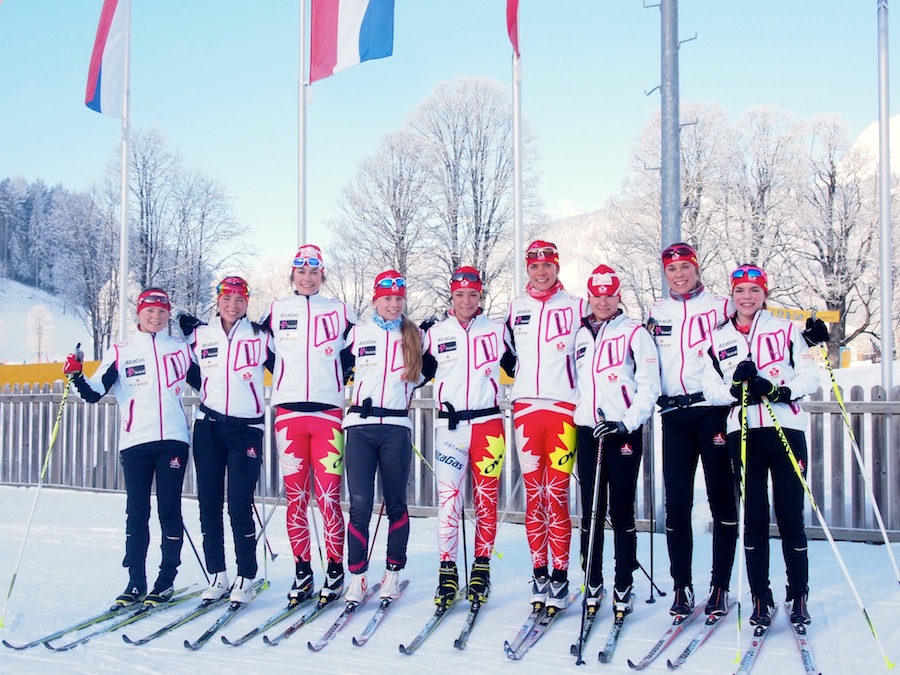
    The Canadian junior women’s team at the U23/Junior World Championships in Liberec, Czech Republic. From left to right: Annika Hicks, Katherine Stewart-Jones, Marlis Kromm, Cendrine Brown, Frederique Vezina, Heidi Widmer, Anne-Marie Comeau, Maya MacIsaac-Jones, and Andrea Lee. (Courtesy photo)

    Once again, the women led the way for the Canadian team in Liberec, Czech Republic, this time in the U23 freestyle individual-start distance races in fresh, falling snow on Thursday.

    Heidi Widmer (Alberta World Cup Academy) rebounded from what she considered a disappointing result in Tuesday’s sprint to place 28th in Thursday’s 10 k.

    “I am really happy for a top 30 in a distance race,” she wrote in an email after placing 34th on Tuesday. “It is a personal best for me and really encouraging.”

    Widmer was 3 minutes and 5 seconds behind race winner Ragnhild Haga of Norway, who won in 27:50.4. Last season, Haga placed third in the 10 k freestyle at Canadian Nationals, well ahead of the other U23-eligible skiers present.

    Widmer was a little surprised by her good day. “I had pretty low energy yesterday but after a good warmup this morning I tried to shake it all off and just focus on the moment and having the best race possible for the day,” she explained.

    Widmer felt the course was in good condition, adding “there was sun in the forecast for today which I was super excited about but we got some nice fluffy snowflakes and clouds instead.”

    “My skis felt really good,” she wrote. “The Canadian wax techs here are really experienced with these conditions and [with] the Liberec site so we are very lucky.”

    Annika Hicks (AWCA) was the second Canadian in 37th (+3:29.3).

    “I’m not too happy with my result because I know I’m capable of more,” Hicks wrote. “Unfortunately, I started feeling strong a little too late in the race, but hopefully that means good things for [Saturday’s] pursuit!”

    Hicks was also pleased with the course and her skis. “There was a little bit of fresh snow accumulating on the track, and we thought it’d be sunny,” she wrote. “The main race line was pretty skied in, but if you were off that you were skiing through about an inch of powder. My skis were really fast! I was passing people on the downhills (which doesn’t happen very often … I’m pretty small!). The course was great, it suits me really well. Lots of tough climbs and fast downhills.”

    Andrea Lee (NDC-Thunder Bay) finished 40th (+3:45.4), nine seconds ahead of Marlis Kromm (AWCA) in 43rd.

    “Today was a so-so day for me,” Kromm wrote. “I was really thinking about skiing smooth and relaxed, and skiing my own race, but felt like I was missing that top gear.”

    Kromm was also happy with the work of the support team. “The conditions were good and we had awesome skis today,” she wrote. And she’s also looking forward to the pursuit. “I like the mass start races, they’re exciting and you can really get in there and fight.”

    As for the Canadian men, two of the team’s stronger skate skiers – Russell Kennedy (AWCA) and Andy Shields (NDC-Thunder Bay) were unable to race because of illness, which also kept them out of the sprint. That left just two men to represent Canada on Thursday. Colin Abbott (Yukon Elite Squad) was 63rd, 4:31.4 back from Russia’s Sergey Ustiugov, who won in 35:44.1. Patrick Stewart-Jones (AWCA) was 71st (+5:16.6).

    Abbott described his experience of U23 World Championships best. “It was a pretty average day for me,” he wrote, “And that just isn’t good enough against the best in the world.”

    “While I wasn’t happy with how my body felt today I was happy with how I raced mentally,” he added. “I skied smart and efficient and did what I could with what my body gave me today. I’m still confident I can put together a good race for the skiathlon on Saturday.”

    He echoed what other Canadians said about the venue and the skis. “The course is a challenging one with steep climbs, fast downhills and deceptively hard gradual climbs,” Abbott wrote. “Joel and Graham (the Canadian wax techs) nailed the skis today.”

    Women’s results | Men’s results

    International recap

  • Canadians Left Wanting More After U23 Worlds Opener; Kromm Closest to Top 30 (Updated)

    Canadians Left Wanting More After U23 Worlds Opener; Kromm Closest to Top 30 (Updated)

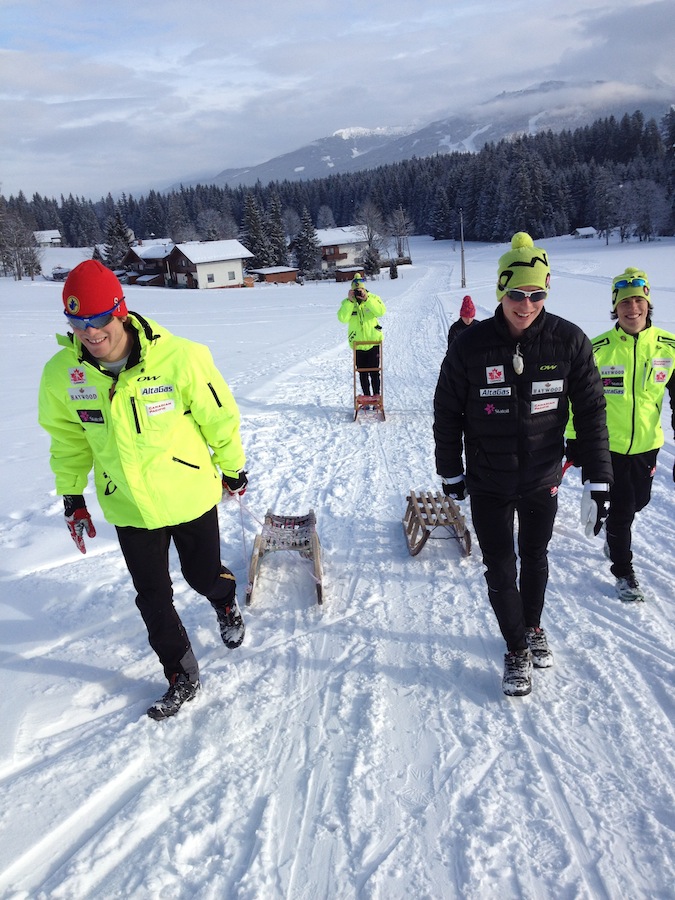
    Patrick Stewart-Jones, Colin Abbot and Andy Shields drag some sleds on Jan. 14 in Ramsau, Austria. The Canadian Junior/U23 World Championships team spent about a week training there leading up to the event in Liberec, Czech Republic. (Photo: Heidi Widmer)
    Patrick Stewart-Jones (l), Colin Abbott and Andy Shields drag some sleds on Jan. 14 in Ramsau, Austria. The Canadian Junior/U23 World Championships team spent about a week training there leading up to the event in Liberec, Czech Republic. (Photo: Heidi Widmer)

    (Note: This recap has been updated with comments from Heidi Widmer.)

    Tuesday didn’t go exactly as the Canadians at the FIS Nordic U23 World Championships in Liberec, Czech Republic, had planned. Starting the week off with classic sprints, many had hoped to make the rounds. Out of five, none did.

    But several were close. Canadian team leader Lisa Patterson told Cross Country Canada that it wasn’t their best day of racing – but they were also going against the best in the world.

    “At the Under-23 World Championships you can’t get away with an average day,” Patterson said in the press release. “We are looking for some better results over the next two days when we hit the short distance freestyle events.”

    Marlis Kromm (AWCA) racing at the Sovereign Lake NorAm in Vernon, British Columbia, last season. (Photo: Jesse Winter/jessewinterphotography.com)
    Marlis Kromm (AWCA) racing at the Sovereign Lake NorAm in Vernon, British Columbia, last season. (Photo: Jesse Winter/jessewinterphotography.com)

    One of the team’s highlights, Marlis Kromm, 22, of the Alberta World Cup Academy finished 32nd in the women’s 1.3-kilometer sprint qualifier, just 1.06 seconds outside qualifying in the top 30. Kromm could not be reached for comment on Tuesday.

    Not far behind, teammate Heidi Widmer (AWCA) was 34th, 1.74 seconds from qualifying and 18.75 seconds behind top qualifier Elena Soboleva of Russia, who went on to win her quarterfinal, semifinal and final. Last year, Widmer qualified in 16th in the freestyle sprint at U23 World Championships in Erzurum, Turkey. She ended up 27th overall (while Kromm was 36th).

    “I definitely expected to qualify and had a goal of a top 12 result, so angry and confused are my first reactions,” Widmer wrote in an email. “I know that I am capable of these results and believe in my ability, so when it doesn’t pan out the way I had hoped, it is hard to understand why. I felt I skied the course the way I had intended and did everything in my power to have a good race, but I just didn’t have the fitness to back it up today.”

    Less than three weeks ago, Widmer, 21, suffered a mild concussion in the NorAm Junior World/U23 trials classic sprint. Her head was fine Tuesday, she explained.

    “I had better energy [while training] in Austria, but maybe that was more to do with the sunlight!” she wrote. “We had really good preparation leading into today’s competition and although I didn’t feel like I had my top form, I thought that I put together the best I was capable of, but came up short.”

    Andrea Lee, 22, of the Thunder Bay National Development Centre (NDC) placed 47th (+29.28) in her U23 debut.

    Of the Canadian men, Patrick Stewart-Jones (AWCA) posted the best result in 39th. He was 12.97 seconds behind top qualifier and eventual winner Frederico Pellegrino of Italy, and about five seconds out of qualifying.

    One of two Canadian men to race, Stewart-Jones, 21, wrote in an email that he was fortunate to avoid various ailments that have been affecting his team. Andy Shields (NDC-Thunder Bay) was unable to start because of sickness, and Russell Kennedy (AWCA) was also ill, according to Colin Abbott (Yukon Elite Squad), who was 47th on Tuesday.

    “Andy has either food poisoning or gastroenteritis,” Abbott explained. “He hasn’t eaten much in the last two days. Russell has been in bed for most of the past 4 days with a fever, cough and upset stomach.”

    “Despite being healthy I felt like I missing a couple of gears and just couldn’t get in the right zone for racing,” Stewart-Jones wrote. “I felt flat warming up and hoped I would feel better racing but unfortunately I didn’t.”

    With a mix of manmade and natural snow, the conditions were good and course suited him, he explained.

    “Unfortunately the sprint was the race I was really looking forward to,” Stewart-Jones added. “Now I’ll just try to prepare the best I can for the next two races. I suppose the pursuit is my best chance left for a good result.”

    Abbott, 22, who was 16.86 seconds behind the leader, explained in an email that he lost time in the final stretch.

    “I felt snappy and strong up the first big climb, unfortunately my body let me down in the last 300 meters,” he wrote. “While I was hoping to qualify today, this is my first European race experience and I’m trying to keep expectations on results to a minimum. I really have no idea where a good race would put me in the standings so I’m focusing on trying to have good races and figuring out what a ‘good result’ is later.

    “The 30km pursuit is the race I’m most looking forward to,” Abbott added. “I’m excited to race head to head with this field!”

    That said, he feels for his teammates.

    “It’s been hard seeing two of my team-mates unable to race here so far due to illness,” Abbott wrote. “Andy and Russell worked their butts off to make it here and I know that no matter how hard a race hurts, it always hurts more to not be able to race.”

    Women’s complete results | Men’s complete results

    International report