From the FasterSkier archive — posts syndicated from athletes’ and coaches’ own blogs between 2004 and 2012, kept online as published. Current coverage is at fasterskier.com.

Tag: Colin Rogers

  • Rooted in Vermont: Tabor Greenberg’s Steady Rise from the Mad River Valley to the U.S. Ski Team

    Rooted in Vermont: Tabor Greenberg’s Steady Rise from the Mad River Valley to the U.S. Ski Team

    The hills above Moretown are the kind that teach you to move without thinking about it: long grades through maple and birch, a tangle of dirt roads, a thousand sneaky rollers perfect for running shoes or a classic stride. From the valley floor, you can see Sugarbush and Mad River Glen, their lifts still in October and their trails crisscrossed by hikers who’ll be skiers in a few short weeks. This is the terrain that shaped Tabor Greenberg, and it’s never been far from him. He grew up here, learned to love motion here, and now—a few towns and a handful of highway exits away—wears UVM green while settling into his sophomore year and his first season as a member of the U.S. Cross-Country Ski Team.

    He smiles about the small details—like the tiny airfield that doubles as the local ski area where he first wore Nordic skis—and shrugs at the big ones, the ones that make headlines. He’s Vermont in that way: spare with words, long on work. “I’ve been skiing my whole life,” he says, recalling the first slip-on-your-boots skis and the BKL weekends that threaded winters together.

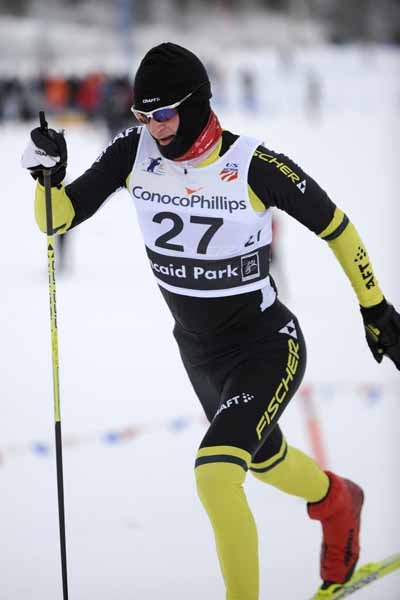
    Tabor Greenberg at the 2024 Junior Nationals in Lake Placid, New York.  (Photo: courtesy of Olympic Regional Development Authority / Phillip Belena)

    His dad was an alpine racer who transitioned to Nordic skiing after sustaining injuries; the family kept everyone in motion, engaging in hiking and running in the summer, as well as soccer and lacrosse.

    By seventh grade, Greenberg had joined GMVS, stepping into a team culture that combined high standards with a sense of play. Older athletes, such as Brian Bushy and Josh Valentine, became the big brothers who made training feel like a privilege rather than a chore. “Their enthusiasm always made the workouts more fun,” he says. “Seeing them go to U18s in Estonia or Youth Olympics, I didn’t even know what those things were at first. I just saw them going to Europe to do these bigger races and thought, ‘That seems fun.’ I want to do that.”

    That is as close to a “secret formula” as you’ll get from him. There’s no magic threshold session in his story; it’s a years-long accumulation of good days outside with people he liked being around. “Most of my motivation comes from that,” he says of the lifestyle—then adds, almost apologetically, that he’s built the discipline to do the work even when motivation lags.

    A tough first year—and a reset

    College arrived with promise and some hard lessons. Greenberg’s first season at UVM was marred by extended illness. He red-shirted, raced sparingly, and spent too many days horizontal. “I struggled being sick all season,” he says. “So this year it’s mainly been just trying to stay healthy—good recovery, sleeping a lot, staying hydrated, having a good connection to doctors if something does come up.”

    UVM’s Head Coach, Patrick Weaver, doesn’t sugarcoat it. “Tabor’s first year was undoubtedly a tough transition, as he came in dealing with an extended illness that he struggled with throughout the year, so he essentially ended up not racing for UVM at all,” Weaver says. “This year he has come back in great shape and stayed healthy so far, so that’s been great—to see what he can do as a healthy person.”

    Weaver sees something else, too: a young athlete who changes the room simply by how he works. “He works extremely hard, and it’s his work ethic that’s been a valuable asset to the team,” says Weaver. “Leading by example like this helps bring up the overall level of the team.”

    And there’s the local angle that still means something in Burlington. “Having a Vermonter on the team is super important for the program. Having a fast Vermonter on the team is even better,” Weaver says. “We felt very fortunate that Tabor wanted to stay in Vermont and represent UVM and the state. This is something he’s super proud of, which is really fun to see.”

    Engineering the comeback

    Ask Greenberg about academics, and he answers as matter-of-factly as he does about training. He’s a mechanical engineering major, plotting a five-year path that allows the academic load to align with travel and race blocks. “I can do 12 credits a semester instead of 15 or 16 for the most part,” he explains. “It should ease the load a bit… hopefully manageable while traveling.”

    If the men’s U.S. Ski Team has a surprising number of engineers, Greenberg doesn’t read much into it. The field simply makes sense to him, a way to invest time in “quality concepts” while keeping a door open for life after skiing. But it’s easy to see the overlap when he talks technique: leaning farther into the hill in both V1 and V2, getting the arms forward, experimenting with double-pole positions, learning to find “forward without actually getting the feet up,” and keeping his shoulders relaxed while playing with different hip-drive patterns. He’s not obsessing over new lifts in the weight room—”not really,” he says when asked about special gym work—so much as building a better mental model and then holding those shapes during long skis.

    And there’s a plan behind the plan. Greenberg still consults with longtime coach Colin Rogers while working daily with Weaver. “Especially when I’m not at school, my plan is I kind of run it by both Colin and Patrick,” he says. “Going into races, I’ll make a plan that makes sense to both of them.” The dual-mentorship model mirrors the arc of other Vermonters who’ve succeeded after leaving UVM, and it’s part of why Weaver talks about schedules and guardrails. The U.S. Ski Team opens doors—camps, resources, broader input—but also adds travel and volume. “With all the other opportunities available, it is challenging to create a schedule that ensures a student-athlete does not overextend themselves,” Weaver says. “We’re working on it to ensure he can excel academically and still maintain a high level of performance in skiing.”

    The day the D Team call came

    The call confirming his spot on the U.S. Ski Team didn’t arrive with a trumpet solo; it found Greenberg on a beach in Mexico. He was decompressing after a winter that had felt like a dead end. “I was pretty unhappy with skiing at the moment,” he admits. Then teammate Murphy Kimball texted to say his points might have slipped him under the sub-400 distance-racing criterion. “Later, Kristen [Bourne] called me,” Greenberg says. He already knew by then, and his reaction was classic Tabor—pleased but unsentimental. “It’s cool to be on the national team, but it’s not really, like, a game-changer. On the D Team, now you race World Cups and see there is still work to do.”

    That pragmatism tracks with how the spot was earned. Last year, sick more often than healthy, he raced only eight or nine times. But when he did line up healthy, he made it count—most notably at the Cable SuperTour 20k classic mass start, where he finished fifth in a front group on a good points day. Those points, stacked with a handful of other starts, slid him inside the threshold.

    U.S. Head Coach Matt Whitcomb sees a different kind of threshold in Greenberg, one that’s about temperament and fit. “This kid, he’s a really special kid,” Whitcomb says. “He takes a little bit to get to know. He’s a little quiet, but what I learned from his coaches is that he is always listening. You might be having a meeting with him, and he’s kind of looking off to the side a little bit, and you think you’ve lost him. And then there’s this little pause, and he’ll come right back at you with just the most on-point question.” Whitcomb calls that attentiveness a key to belonging on a team where the banter never stops. “Our guys rip on each other all day—in the right way, the loving way—and I see Tabor instantly plugging into the men’s team already.”

    It’s not just the ear; it’s the engine. Whitcomb points to Greenberg’s anchor leg on the 2023 U18 relay—”he came from way behind and caught Norway in the stadium”—as a marker of racecraft and mindset. “Tabor’s that kind of competitor,” Whitcomb says. “He’s a hunter, both literally and figuratively.” The literal part showed up at the team’s Utah camp; the figurative part is the one that matters in March.

    Vermont pride, Vermont places

    Greenberg didn’t choose UVM because he was unaware of other options available. He did the homework, looked West, and still chose home. “Growing up in Vermont, we’d go to an Eastern Cup that overlapped with Carnival, and it was always the UVM guys winning,” he says. “When I was younger, I was like, these guys are the best there is then… I really enjoyed the venues here more than out West. I kind of just had a gut feeling this was the right place.”

    Ask him where he’d send an out-of-state friend to understand his Vermont, and he has a ready list: Trapp Family Lodge when the snow is deep; Mad River Glen on a powder day; the Long Trail from Lincoln Gap to Appalachian Gap and on to Waterbury when the leaves go red and gold. He’s not performing here; this is simply the life that restores him. Between classes and training blocks, he’ll thread in a bit of fishing, the occasional bow-hunting session if the calendar allows. In Utah, he saw a pair of bucks at 250 yards and later walked to within 80 before choosing—wisely—not to take the shot; he hadn’t practiced enough. “It’s definitely peaceful,” he says of being in the woods, then stops short of over-claiming the performance benefits. “I don’t know if there’s that much of a correlation.”

    Maybe he doesn’t have to draw the line. Anyone who’s tried to race well knows that a happy athlete is a better one, and his habits read like a local’s guide to contentment: early bedtimes, long skis, ridge-line hikes, a few casts before dinner.

    Goals, set quietly

    Greenberg’s target list for the season is crisp: Junior Worlds, NCAAs in Bozeman, and—if the form and selection break right—a World Cup start in Lake Placid. “Same game plan no matter what,” he says. “Ski fast.” The sequencing matters: peak well for Nationals and you put your Junior Worlds case on solid footing; hold fitness and you can ride the rhythm into March.

    For now, he trains with the UVM group and will tweak the plan as winter approaches. “Right now it’s pretty similar to everyone else,” he says. “In the winter, I’ll try to work in a few bigger weeks or blocks that’ll help me get ready for that March racing period.” If the path sounds simple, that’s the point. When you’ve just dug yourself out of a year of being sick, you don’t complicate success.

    What coaches see

    Whitcomb’s portrait is of a listener who processes information quickly and competes more intensely. “Thoughtful,” “very funny,” “great technician,” “great competitor”—words that land differently because they’re delivered with the caution of a coach who doesn’t over-praise. Whitcomb is equally quick to underscore the growth curve ahead. Greenberg absorbed a challenging year, he says, and handled the reset maturely. “He was very smart in his buildup this year, and he’s brought himself back to a very high quality level of training,“ Whitcomb says. “It’s going to be a fun career to watch.”

    The thing about top-30s

    The U.S. men’s program now has a new normal—medals and crystal-globe chases—but Whitcomb is adamant that the sport’s middle rungs still matter. A first World Cup top-30 for a young American is still a scene, a bus-wide celebration. “When a guy like Tabor or Lucas Wilmot gets their first top-30, it will be just as exciting for the team as someone, on that same day, on the podium,“ Whitcomb says. That’s the context for Greenberg’s ambitions: real, reachable steps on a ladder that’s higher than it used to be.

    The Vermont through-line

    It’s not nostalgia to suggest that place still matters in American skiing; it’s simply observation. Vermont has sent a steady stream of athletes into the national team pipeline, and UVM is a key contributor to that current. Greenberg is another link in that chain, one who still resembles the kid who ran those ridges, played those pickup games, followed older teammates into bigger arenas, and filled in the knowledge with discipline.

    Then there’s the image that may say more about him than the résumé line: a kid in Utah walking a buck into 80 yards and passing on the shot because the practice wasn’t there yet. It’s not caution; it’s calibration. It’s someone who knows the difference between wanting and being ready.

    If you’re looking for a template, that might be it. A Vermont upbringing that made movement a joyful experience. A high school program that made hard work fun. A first college season that reminded him that things can go sideways. A reset that prioritized health and attention to detail. Two coaches who trade notes and coordinate calendars so a student-athlete can keep a broader life in balance. And an athlete who understands he needs to put in lots of hard work to be ready to take the shot when it presents itself.


    Love Stories Like This? Help Keep Them Coming.

    Feature interviews like this one take time, access, and care to produce. If you value thoughtful storytelling and independent ski journalism, please consider becoming a Voluntary Subscriber. Your support directly fuels the work we do to cover the people, places, and moments that make our sport special.

    Join the FasterSkier community.


  • The Energy Equation: Julia Kern’s Formula for Olympic Success

    The Energy Equation: Julia Kern’s Formula for Olympic Success

    On a late-October morning, Julia Kern sat in San Diego, sunlight spilling through the window after cradling her infant nephew. “He’s a cutie for sure,” she laughed. In a few short weeks, she’ll trade baby giggles for the squeak of ski pole baskets on the cold Finnish snow, but the warmth in her voice already says a lot about where she is mentally this Olympic year: grounded, grateful, and still having fun.

    “It’s been a really good lead-up this year,” Kern said. “I’ve been able to stay healthy. I’ve done a lot of physical therapy on my back from my injury last year, and that’s finally going well. So being able to link consistent training together without major disruptions has been the biggest difference this year. That makes me really excited to see what will happen this season.”

    Cycling gives Julia Kern a place to turn her mental rhythm and flow into motion. (Courtesy Photo)

    The Year of Steady Rhythm

    After an injury-plagued 2024 season, Kern’s return to full health has been both physical and psychological. She’s worked closely with physical therapist Brie Beckwith and coaches Kristen Bourne and Colin Rogers to rebuild her movement patterns and ski technique. “A lot of what I’m doing from my back rehab is retraining movement patterns—learning to actually use my glutes, push through the right way, fully transfer weight,” she explained. “Part of it is having less pain, which lets me move more fluidly. But it’s also about translating that from the gym to skiing.”

    For the first time, she spent a full three-week training block with Bourne in New Zealand, where daily feedback deepened their connection. “That was really cool because I’ve never had that before,” Kern said. “It’s one thing to text once a week; it’s another to work together every single day. We built a real rhythm.”

    That word—rhythm—is perhaps the throughline of Kern’s 2025 Olympic campaign. Rhythm in training, in recovery, in how she manages a long World Cup season without burning out. Her “don’t reinvent the wheel” approach to the Olympic year reflects a maturity hard-won through injury and experience. “You do what’s working well,” she said. “Changing things is always a risk.”

    Jessie Diggins and Julia Kern flank their US Ski Team coaches Jason Cork (kneeling) and Kristen Bourne (standing) at their annual on-snow training camp in New Zealand. (Courtesy Photo)

    Learning the Language of the Body

    If Kern’s early career was marked by her ability to push, her recent evolution is defined by knowing when to pull back. “Recovery is a big one,” she said. “Not just lying in bed—but mental recovery, physical therapy, fueling, hydration. As I get older, I spend more time on that. I’ve learned what works and what doesn’t, and how to read cues—whether I’m ‘good tired‘ or ‘bad tired.’“

    Her typical week includes two or three intensity sessions, distance training, and strength work, but with flexibility to fit around life: weddings, visits home, mountain-bike trips. “Working around the life schedule is what makes it rewarding,“ she said. “You’re excited to go do it, and you also feel like you can do all those fun life things too.”

    That balance shows in how she approaches her mental game. Kern has worked with the same sports psychologist for over five years, meeting weekly or monthly. Together, they’ve developed what she calls a “good energy“ framework: a way to make decisions rooted in joy rather than obligation. “It doesn’t mean bouncing off the walls,“ she explained. “It means asking: What makes me feel good in skiing? If I’m dreading something because I’m missing an important life event, that probably isn’t bringing me good energy. So I make decisions based on that.”

    Patience, she says, has been her greatest teacher. “Everyone has their bumps in the road,“ she said. “Taking those as learning experiences rather than failures is huge. Setbacks force you to approach things differently, and you can actually learn a lot about yourself that way.”

    Spending time being active and relaxing with friends and family is a cornerstone to Julia Kern’s success. (Courtesy Photo)

    A Culture of Team First

    If there’s a single quality that defines Kern, according to U.S. Ski Team Head Coach Matt Whitcomb, it’s her blend of positivity and perseverance. “She’s had a hard road,“ Whitcomb said. “Even as a junior, she battled compartment syndrome, mono, back troubles, shoulder troubles, nerve issues—you name it. That would defeat most athletes. But despite it all, Julia goes on to win World Cup and World Championship podiums.”

    Whitcomb sees her as both a survivor and a student. “She had incredible leaders to follow—Sophie, Liz, Kikkan, Sadie—and she was always listening, always learning,“ he said. “Julia’s a scholar. Her parents are scholars, her sister’s a scholar. She comes from a learning family. And now she’s the sum of all those experiences. She reminds me so much of Kikkan Randall—so driven individually, but without a team to celebrate it with, she’d quit skiing. Julia’s the same way: such a team-oriented person.”

    That team ethos is something Kern now passes along to younger teammates, such as Kate Oldham. “I really appreciated when older athletes just showed by doing,“ Kern said. “Now I try to do the same. When we do race prep, anyone who wants can join. Like at World Champs—Kate, Jessie, Rosie, and I practiced that final corner together. It was so slushy and tricky, and Kate ended up being the best one out of all of us. So we said, ‘Okay, we’re learning from her here.‘ Everyone has value on this team.”

    It’s a culture built not on hierarchy, but on collaboration—crafting beaded bracelets during camps, sharing meals, and creating ways to connect off the snow. “It’s easy to be isolated in hotel rooms,“ Kern said. “We make time for activities that bring us together. Everyone brings something.”

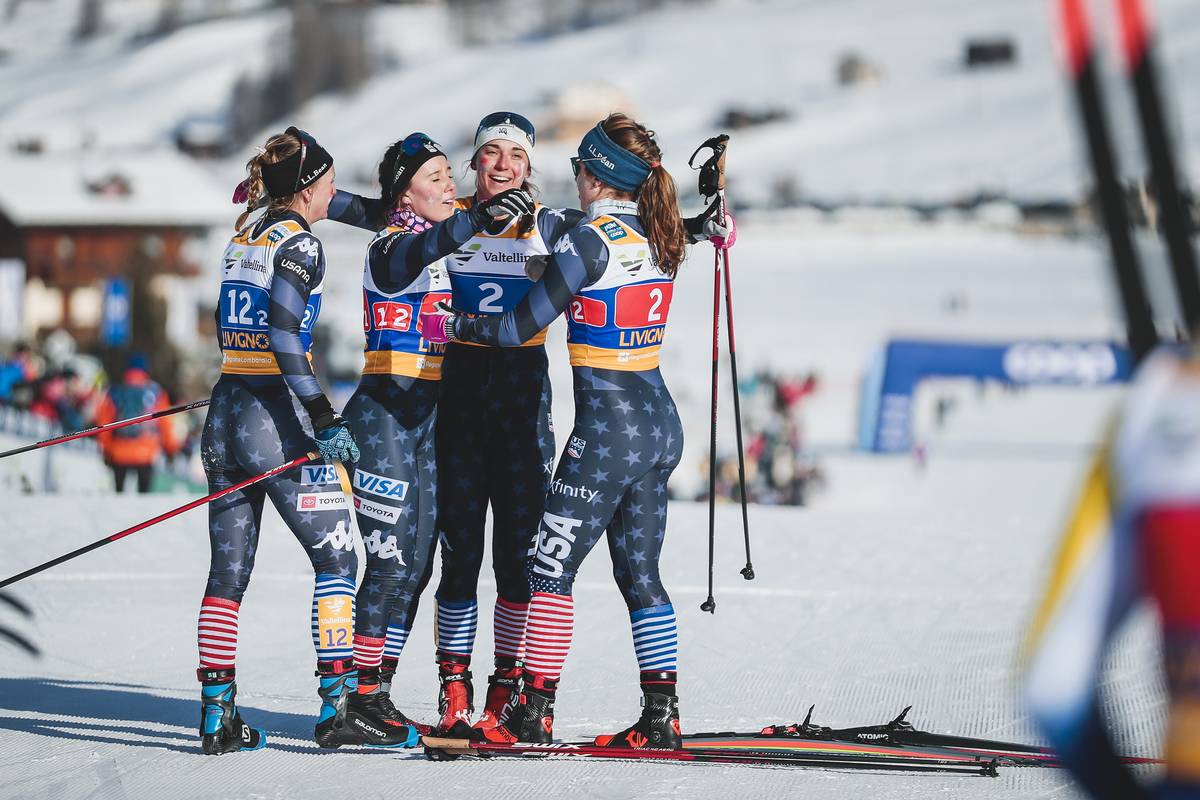
    The American women celebrate after United States I – Rosie Brennan and Julia Kern – finished 3rd in a Team Sprint in 2023. (Photo: Nordic Focus).

    Learning from Leaders, Leading by Example

    When asked what she’s learned from her longtime teammates Rosie Brennan and Jessie Diggins, Kern doesn’t hesitate. “Rosie’s been such a great example of someone who’s had more adversity than maybe anyone I know and still shows up for the team,“ Kern said. “When I was first named to the team and had compartment-syndrome surgery, Rosie—who I didn’t even know—emailed me. She told me it would be tough but that I’d get through it. That stuck with me.”

    From Diggins, Kern learned the art of curiosity. “Jessie never goes around thinking, ‘I’m the fastest in the world, I know everything,‘” she said. “She’s always got a growth mindset—always wanting to follow someone, to learn something. That’s really rare for someone at the top.”

    Whitcomb has noticed the same instinct. “Julia’s evolved from someone who needed guidance into someone others now look to,“ he said. “She embodies that positive feedback loop of mentorship that defines this team.”

    Mental Toughness in the Grind

    On the World Cup circuit, there’s little room for reflection. Races pile up; travel blurs weeks together. Kern’s approach to a long season is both pragmatic and optimistic. “I love to race,“ she said. “The World Cup is part of the bigger plan. Early season, we’re still training on the road. You’re not trying to peak at Ruka. It’s about understanding where you are in the load of the season.”

    She deliberately builds in breaks—two weeks at home after the Tour de Ski, Christmas with her boyfriend, family visiting during the Olympics. “Those resets make all the difference,“ she said. “They help you stay excited.”

    You’re probably already following Kern on Instagram, but if you aren’t, you are missing out on a lot of delicious food inspiration. Cooking has become another activity for her to recover and connect with her friends and family. (Courtesy Photo)

    Her outcome goals are clear: make sprint finals consistently, push into the top-10 in distance races, and—if everything lines up—fight for a team-sprint medal at the Olympics. “That’s what I think about during hard intervals,“ she admitted. “The team sprint is a big goal of mine.”

    But Kern’s definition of success extends well beyond medals. “A successful season for me,“ she said, “is staying healthy, enjoying the process, and feeling good about how I carried myself. Pressure is a privilege. I want to soak up the experience and make it fun again.”

    Beyond the Podium

    For Kern, the sport’s meaning has broadened. As an athlete representative to FIS and an advocate with Protect Our Winters, she’s become a voice for climate responsibility and athlete well-being. During the 2025 World Championships, when environmental protests threatened to disrupt races, Kern helped mediate between activists and organizers. “We agreed that protesting during the race wasn’t the way to send a strong message,“ she said. “Now we have an open dialogue. These things take time, but they’re moving.”

    Her motivation, she said, “is less about results and more about impact.“ She wants younger athletes to know that skiing fast can be both a platform and a privilege. “I feel grateful that I had such an active childhood and want that for the next generation,“ she said. “Clean air affects everyone. Being outside isn’t something we can take for granted anymore.”

    Using her success as a platform to make a lasting impact on children has become a priority for Kern. (Courtesy Photo)

    The Joy of Motion

    Talk to Kern for long enough, and you realize skiing is just one part of her athletic identity. She’s an all-around mover—mountain biking, surfing, beach volleyball. “I’ve always loved doing every sport imaginable,“ she said. “Even as a kid, I just wanted to move. There’s so much value in being active and having fun. You don’t have to specialize too early. Playing lots of sports keeps it fresh and helps you avoid burnout.”

    Cooking has become her creative outlet. “My boyfriend and I love to cook together,“ she said. “We have a CSA, so we get creative with whatever veggies we have. It’s like art—making the food look pretty, connecting with what we eat. It’s a kind of recovery, too.”

    From the Gym to the World Stage

    Whitcomb sees this blend of drive and joy as Kern’s secret strength. “Julia’s positivity isn’t surface-level,“ he said. “It’s a choice she makes every day despite setbacks. That’s what makes her such an anchor on this team.”

    For her part, Kern sees the season ahead not as a culmination, but as another chapter in a long-term process. “Fourteen-year-old me would be surprised I’m still ski racing,“ she said, laughing. “Back then, I thought junior nationals were the pinnacle. I didn’t even know what the World Cup was. I think she’d be proud that I’m still doing this—and still having fun with it.”

    Enjoyment is what keeps Kern chasing perfect rhythm through the snow, trusting that good energy leads to good skiing, and that joy and excellence can, in fact, coexist.

    Kern seems fully ready to send it this season. (Courtesy Photo)

    Love Stories Like This? Help Keep Them Coming.

    Feature interviews like this one take time, access, and care to produce. If you value thoughtful storytelling and independent ski journalism, please consider becoming a Voluntary Subscriber. Your support directly fuels the work we do to cover the people, places, and moments that make our sport special.

    Join the FasterSkier community.


  • ‘Turning August Into February’: Sun Valley Gold Team Spends Month in Australia

    ‘Turning August Into February’: Sun Valley Gold Team Spends Month in Australia

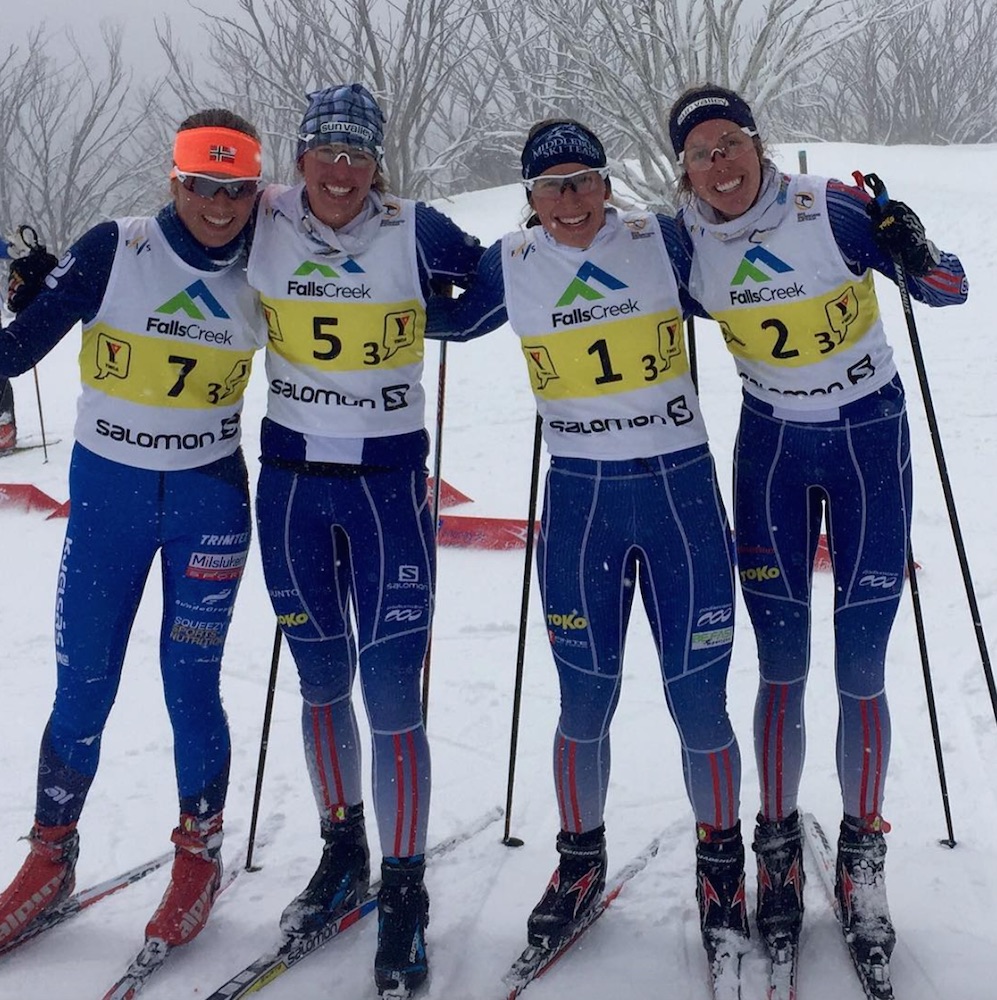
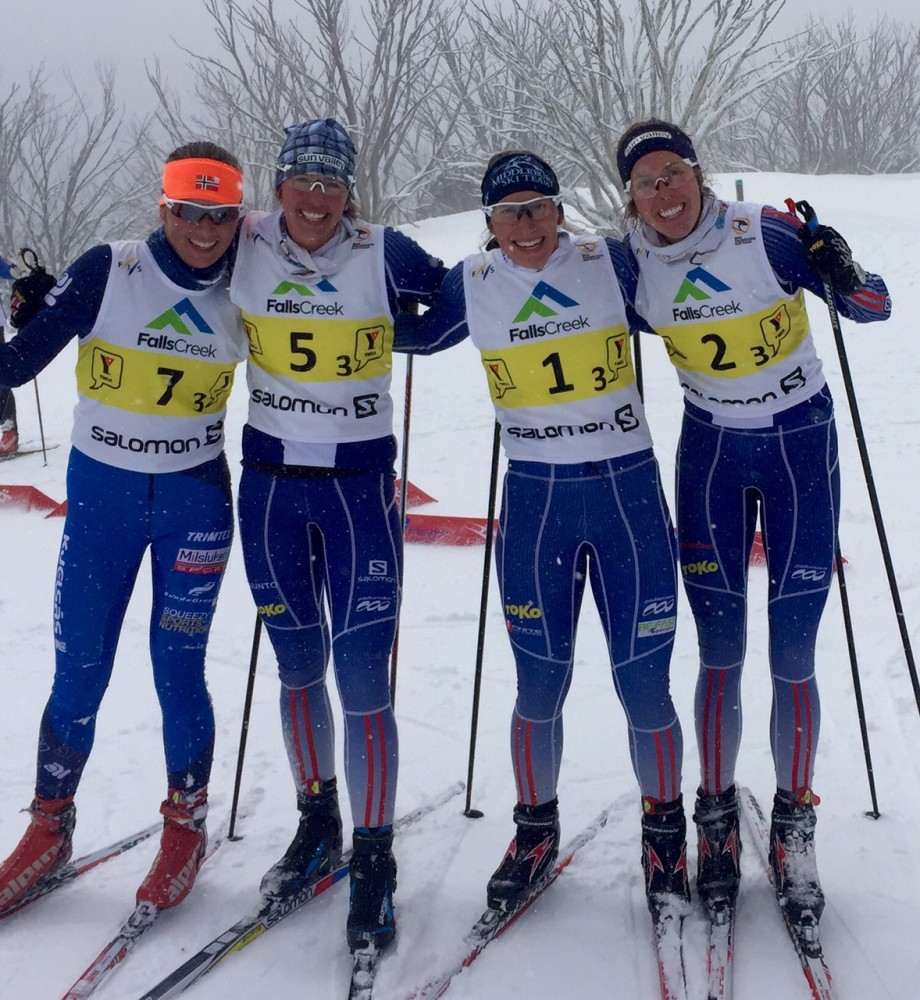
    Sun Valley Ski Education Foundation Gold Team members Kelsey Phinney, Annie Pokorny, Mary Rose, and Deedra Irwin skiing at Falls Creek Resort in Victoria Australia in August. (Photo: Mary Rose)
    Sun Valley Ski Education Foundation Gold Team members Kelsey Phinney, Annie Pokorny, Mary Rose, and Deedra Irwin skiing at Falls Creek Resort in Victoria, Australia, earlier this month. (Photo: Mary Rose)

    Getting there means 24 hours are lost somewhere in limbo and layovers that are more than cause for lethargy. But even with a disappearing day and assured hours of drowsy adjustment, traveling to the Land Down Under presents a unique opportunity for any western traveler, especially those who nordic ski. That’s because in the state of Victoria in southeastern Australia, nearly a four-hour drive north of the country’s second-most populated city, Melbourne, Falls Creek boasts accommodations, trails and most importantly, a winter season with snow.  
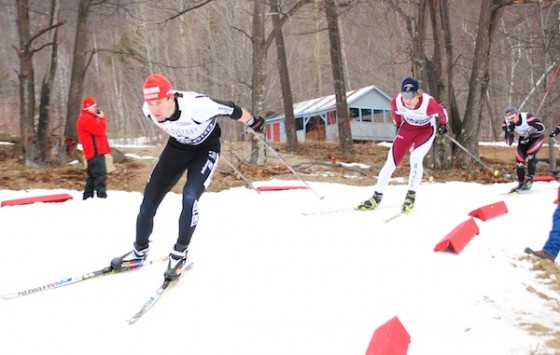
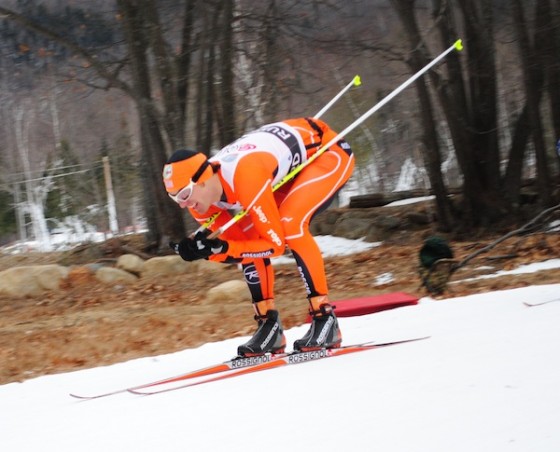
    For those of us in the Northern Hemisphere, the months of June, July and August often bring heat waves rising off the blacktop, but in Falls Creek, this the season for a mixture of snow flurries and sun.

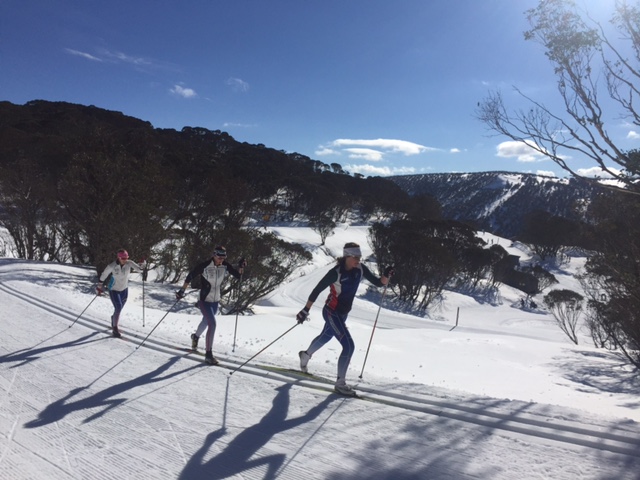
    Right to left: Sun Valley Ski Education Foundation Gold Team members Annie Pokorny, Mary Rose, and Kelsey Phinney during a classic ski at Falls Creek Resort in Victoria Australia in August. (Photo: Colin Rogers)
    SVSEF Gold Team members (right to left) Annie Pokorny, Mary Rose and Kelsey Phinney classic skiing at Falls Creek Resort in Victoria, Australia. (Photo: Colin Rodgers)

    With the promise of the latter from early June to late September — the peak season taking place in July and August — and a decent deal on plane tickets, several Sun Valley Ski Education Foundation (SVSEF) Gold Team members decided that when it came to the month of August, Falls Creek was where they wanted be.

    “The team has never been here before, but one of our SVSEF coaches, Tom Smith, spent a summer coaching down here and told us how great the training was,” Colin Rodgers, SVSEF Gold Team head coach, wrote in an email from Australia. “We decided we had a great opportunity to come here and train this year because the airline tickets were quite inexpensive from the Western USA. Overall the skiing has been great so far!”

    Along with Rogers, five Gold Team skiers made the trek to Falls Creek on Aug. 1, including Annie Pokorny, Kelsey Phinney, Mary Rose, Deedra Irwin, and Matt Gelso. The crew planned to remain in Australia for on-snow training until the end of the month, returning to the U.S. on Aug. 29.

    This past weekend, the Sun Valley women swept the freestyle-sprint podium at Australian Cross-Country Ski Championships on Saturday, with Phinney winning the International Ski Federation (FIS) Australia/New Zealand Cup race, Rose placing second and Irwin taking third. Norway’s Nora Ulvang finished fourth just ahead of Pokorny in fifth.

    On Sunday, Rose and Irwin again reached the podium in the 10 k classic, finishing second and third, 14.9 seconds and 30.5 seconds behind winner Chisa Obayashi of Japan, respectively. Pokorny repeated in fifth.

    The women's skate sprint podium at Australian national championships in Falls Creek, Victoria. 1st Kelsey Phinney, 2nd Mary Rose, 3rd Deedra Irwin, 4th Nora Ulvang (Norway). (Photo: XCGoldTeam/Instagram)
    The women’s skate sprint podium at 2016 Australian Cross-country Ski Championships on Saturday, Aug. 20, in Falls Creek, Victoria. Kelsey Phinney (1) placed first, Mary Rose (2) took second, Deedra Irwin (5) was third, and Norway’s Nora Ulvang (7) was fourth. (Photo: XCGoldTeam/Instagram)

    “The races this past weekend were a very unique experience,” Rose wrote in an email. “Not often do you have a chance to race in the middle of August. The conditions were very challenging for everyone. I took this weekend as a great opportunity to practice skiing through all the sprint heats as well as learning to deal with less than ideal race conditions. Living in the West, I don’t get much opportunity to race in the pouring rain. This was a great learning experience!”

    The men’s freestyle sprint and 15 k classic results were not available at press time. Due to a cold, Gelso did not race this past weekend.

    While much of the Gold Team’s camp revolved around logging hours and kilometers on snow, Rodgers also anticipated his group would jump into a few races, including the Kangaroo Hoppet 42 k skate marathon on Aug. 27.

    According to him, the opportunity to travel to Australia and compete was largely due to the international relationships the SVSEF has fostered.

    “Our club has hosted several Australian skiers over the past few seasons (Kat Paul, Casey Wright, Mark Pollock- to name a few) so we have established a good relationship with many of the athletes,” Rodgers wrote. “They have all always told us we should come to Australia to ski. It seemed like a far off dream, but then we started looking at the details and all of a sudden we realized we could make it happen without breaking the bank. The Australian Jr and U23 team is coming to prepare for the Soldier Hollow World Jr/ U23 World Championships in Sun Valley this winter. They will be in Ketchum for about 8 weeks leading into those Championships so we have a nice partnership growing.”

    “This is not spending a week on a glacier in summer. This is turning August into February.” — SVSEF Gold Team member Matt Gelso on training on snow in Australia

    New to the SVSEF Gold Team, Pokorny reflected that the chance to travel to Australia to train has been somewhat surreal. This year marked one of her first summer snow-skiing experiences.

    “This year, with support from SVSEF and the Australian race organizers, I’m able to get my first summer skis AND do it during one of the biggest training blocks of the year,” Pokorny wrote in an email. “I’ve gotten to work on technique and put in big hours while exploring a part of the world I’d never thought I would get to visit, which has made this trip incredibly valuable to me both athletically and personally.”

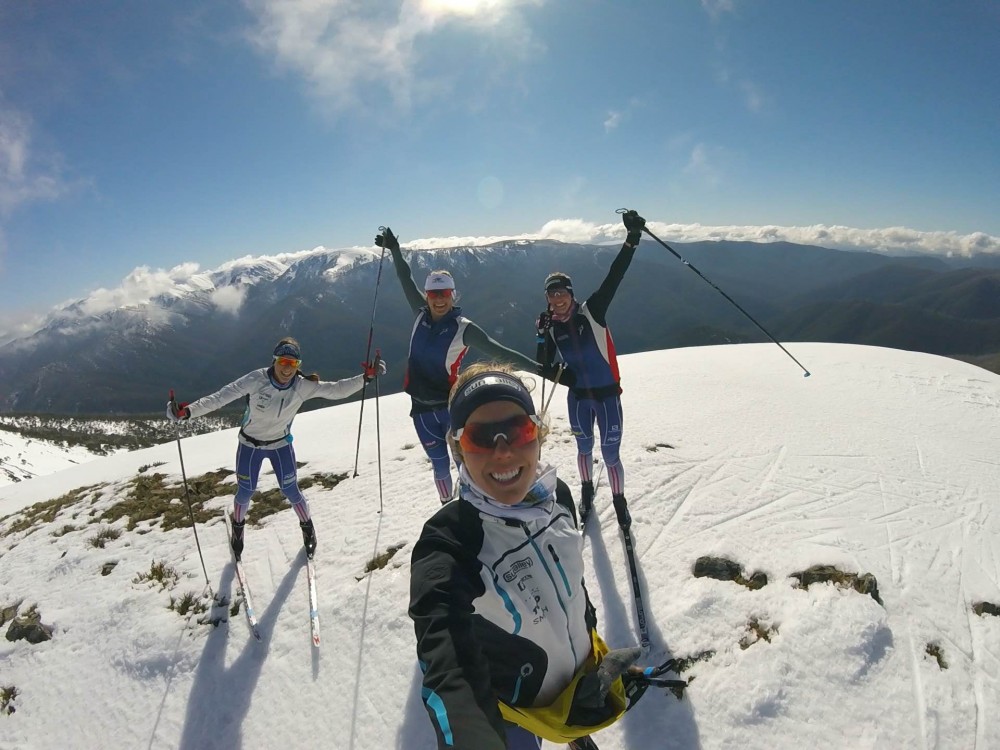
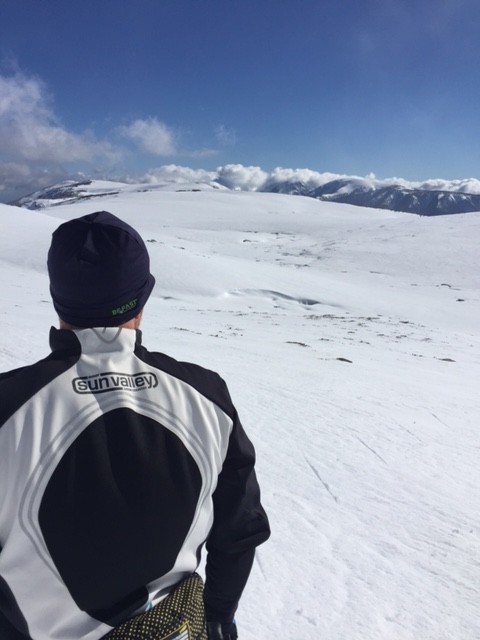
    Sun Valley Ski Education Foundation Gold Team member Matt Gelso takes in the view during a ski at Falls Creek Resort in Victoria Australia in August. (Photo: Colin Rogers)
    Sun Valley Ski Education Foundation Gold Team member Matt Gelso takes in the view during a ski at Falls Creek Resort in Victoria Australia in August. (Photo: Colin Rodgers)

    In his sixth year with the SVSEF Gold Team, Gelso remarked that this camp was much bigger than an average week on snow.

    “This is not spending a week on a glacier in summer, this is turning August into February, and it is a new experience for me, but a very positive one for ski training,” Gelso wrote in an email. “Not only getting on snow and getting the feel for skis, but being here for long enough that I can actually make gains is huge.”  

    Both Pokorny and Gelso pointed out that spending a month skiing in Australia is a memory they won’t forget.

    “I have been wrapping my head around the sun being in the northern sky, and the north slopes being the warm, sunny side…. Pretty different,” Gelso wrote. “Also the trees, they have these Snowgum trees that don’t lose their leaves, it feels like the coast, it has taken some time to get used to it all.”

    “My favorite part, by far, has been the landscapes we see on our long skis,” Porkorny wrote. “Snow capped mountains over green jungles, burned and growing gum trees, and violently changing weather have kept every training session interesting.”

    With less than a week left, the crew continues to adventure and can be followed on the SVSEF Gold Team’s Facebook page or Instagram.

    — Alex Kochon contributed reporting

  • Liebsch Triumphs at Yellowstone SuperTour Opener

    Liebsch Triumphs at Yellowstone SuperTour Opener

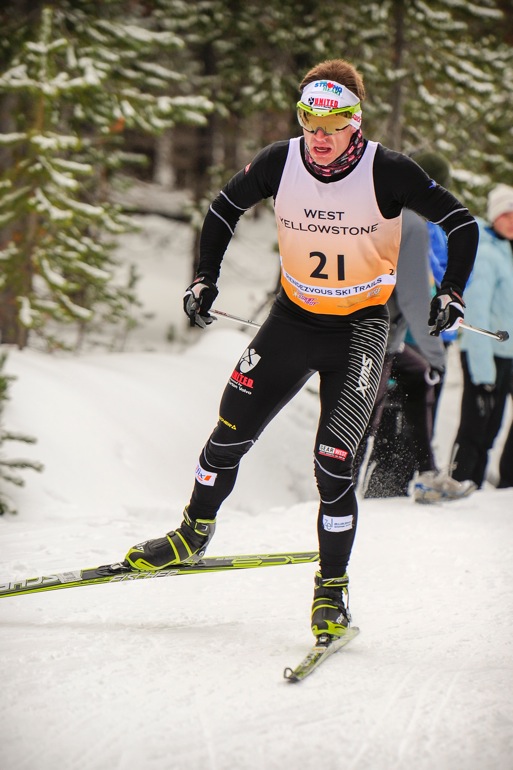
    Matt Liebsch (Borton Volvo XC United) leaving it all on the course in the SuperTour 9 k freestyle in West Yellowstone. He won by 5.5 seconds over Matt Gelso (SVSEF).

    WEST YELLOWSTONE, Mont. — Weeks of altitude training clearly paid off for Matt Liebsch (Borton Volvo XC United) in the first race of the year. The pride of the Midwest won the SuperTour 9 k freestyle on Friday morning on a fast but challenging point-to-point course looking like he had gas left in the tank. Matt Gelso (Sun Valley Ski Education Foundation) followed him by 5.5 seconds and Mike Sinnott (SVSEF) came through 8.4 seconds back for bronze.

    “I felt like I just raced really well. It was a fun day,” Liebsch said.

    It was one of those races that left athletes alone with nothing but the pain of 7,000 feet to keep them company. If you’d forgotten what race pace felt like in the months since March, you were reminded in full force on Friday. The corduroy was crisp and the course winding; most skiers coming up the final hill of the Whisky Trail looked pretty blown out from 20-odd minutes of gradual to steep climbing.

    A few, however, — Liebsch, Gelso and Sinnott among them — kept their pacing under control and skied impressively strong V2s into the final chute. Prior to starting, Liebsch’s plan had been to get out quickly, then conserve, and have something left for the end.

    “The first two kilometers were pretty fast and flat, so I wanted to ski that really big and eat up some seconds there and then take it easy on that first little climb,” Liebsch said. “Then cruise, notch it back for that middle climbing section and then, off the top, really hammer until the final climb.”

    As the first starter in the A-seed, splits were essentially meaningless to Liebsch when he was able to hear them.

    “I really didn’t listen for anything, I was just kind of in the zone,” he said. “I just went as hard as I could.”

    The race was a major focal point of Liebsch’s season. His goals include returning to the international circuit and qualifying for the Canmore World Cup in December, and if he has a comparably strong result next weekend in Bozeman, he’ll be going.

    “I already have lodging and a flight booked up there,” he said. “It’s not to be like, ‘I’m going to make it,’ but it’s on my list of things to make. I figured the only way I wasn’t going to go was if I’d gotten sick out here.”

    How’s he feeling after Friday’s result? “I’m excited,” Liebsch said.

    Not far behind him, Gelso had similarly high expectations for the first race of the year.

    “I was expecting to be up there in the top five — I didn’t want to be fourth, that’s for sure,” Gelso said. “I thought if I was able to get my race gear going then I definitely should be up there.”

    Which is just what he did. On brand new skis, Gelso thought he had the “right tempo and right technique,” to put together a good first result. The race was over before he knew it, as Friday’s cooler temperatures made the snow faster than it had been all week.

    “I heard people say so many times today that they thought there was one more hill… People were coming up the last hill thinking there was one more pitch, and then: oops, this is it. Then it was: go really hard into the finish,” Gelso said.

    Sun Valley time trialed the course on Tuesday, and Sinnott said he, too was surprised to find himself at the end so quickly.

    “I still thought I had another hill; I just didn’t have it well memorized,” he said. Still, Sinnott felt strong and fit, and thought the race went well.

    “Any kind of podium is a good start,” he said. “[World Cup] qualifying is going to be tight and every race matters, so I’m happy to have a good start to the year.”

    SVSEF coach Colin Rogers said his athletes were right where he thought they should be, as his whole team is aiming for Canada.

    “I always have high expectations for my team because they’re all good athletes, so I’m psyched they could have good efforts today,” Rogers said. “My whole team for sure has high expectations for trying to make the teams [in Canada]. All you can do is race as fast as you can, but I think everybody’s in a pretty good place.”

    The top three put a sizeable gap on the rest of the field. Erik Bjornsen (Alaska Pacific University/U.S. Ski Team) skied to a fourth-place finish (+32.0) and felt his performance was a “pretty good” start to the season.

    “I didn’t push it quite hard enough in the middle; I guess I was trying to stay relaxed and the finish came before I was ready,” Bjornsen said.

    On the uniquely challenging terrain he wanted to get out in a comfortable V2. “It’s altitude so I can’t do what I normally do when I’m racing and punch it over the tops. I have to stay consistent and get in a rhythm; do what feels comfortable,” he said.

    Less than a second behind Bjornsen, University of Denver skier Andrew Dougherty posted the top collegiate result in fifth (+32.8).

    Fourth through tenth place finished a close 7.5 seconds within each other. Brian Gregg (Central Cross Country) took sixth overall (+33.1) and was satisfied with his race given that he was sick earlier this week.

    “Matt [Liebsch] started right ahead of me and he was way up, so it was kind of hard to tell what was going on,” Gregg said. “I’ve always liked climbing, but there’s a fair amount of V2 up here if you’re skiing strong. Liebsch V2ed the whole thing; I had to bust out some V1.”

    SuperTour racing will resume on Saturday with a point-to-point sprint prologue on the Plateau. (The race won’t count for World Cup qualifying).

    Complete results.

    Alex Matthews contributed reporting.

  • Naryshkina, Thyli Win Elite Sprints to Kick off Birkie Week – With Photos

    Naryshkina, Thyli Win Elite Sprints to Kick off Birkie Week – With Photos

    Vetle Thyli (NOR) starting the final alongside teammate Martin Andersen.

    Last year, the Birkie Elite Sprints, held on Main Street in Hayward, Wisconsin, two days before the Birkie, were a mostly American affair. Morten Pedersen of Norway won the men’s race, but most of the other top finishers were natives – including Audrey Weber, then skiing for CXC, who won the women’s heats.

    This year, things changed.

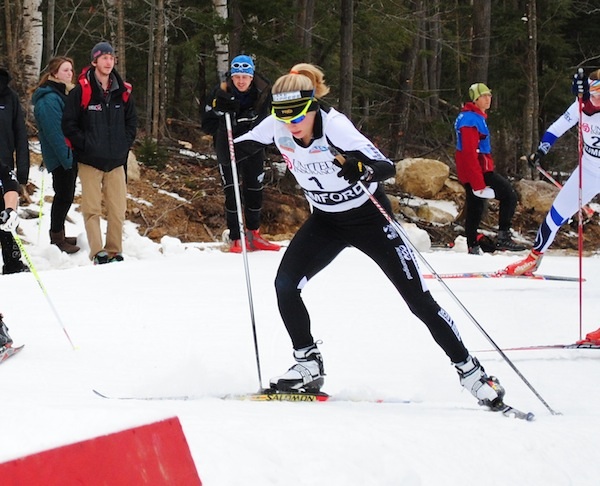
    Rogers leading Andrey Tyuterev of Russia.

    The men’s final on Tuesday came down to a battle between Norwegian teammates Vetle Thyli and Martin Andersen. Before the gun went off, the two trash-talked over the PA system: Andersen said that although he had never beaten Thyli in practice, “this would be the first time.”

    In the end, it didn’t turn out that way. Thyli had a lead going into the 180-degree turns around a pair of cones – one for each skier – and only lengthened his lead coming into the finishing stretch. He was able to celebrate well before the finish line, victory – and a $500 check – ensured.

    Colin Rogers (Sun Valley) was the top American, besting Sylvan Ellefson (Vail) in a race for third place. Along the way, both faced a number of impressive comptitors. Rogers topped teammate Mikey Sinnott as well as Andrey Tyterev of Russia before losing to Thyli in the semifinals, while Ellefson had to beat out top Wisconsin high school skier Dylan McGarthwaite and the always formidable Chris Cook (Steinbock Racing).

    In the semifinals, Ellefson took a tumble about a quarter of the way through the race. By the time he was back on his feet, Andersen had rounded the cone and was on his way back to the start/finish. As a joke, Ellefson skied toward him and the two played a game of chicken, much to the amusement of the crowds lining Main Street.

    Naryshkina outsprinting Bender.

    In the women’s final, Natalja Naryshkina of Russia defeated CXC’s Jennie Bender by a slim margin to take home the check.

    It was Bender’s first time at the Elite Sprints – and, she said, her first time racing on a city street or around a traffic cone.

    “I didn’t worry too much about the first part of the race,” she told FasterSkier. “As long as I was close going around the cone, that was good enough. It was really fun with the Russians and other European racers here, because you really don’t know anything about the person you’re racing against – you’re just kind of like, ‘well, let’s do this!’”

    And do it she did, besting Sun Valley’s Nicole DeYong and Ursina Badilatti of Switzerland en route to the final.

    “I felt like Batman flying down the street,” she said.

    In the B-Final, Badilatti beat out Weber, last year’s champion who is now racing for Go! Training.

    The women’s field was small, with just ten starters, but talented: it included 2010 Olympian Caitlin Compton (CXC), 2010 top-10 Birkie finisher Evelyn Dong (XC Oregon), and Morgan Smyth of APU, who recently collected two podium finishes at U.S. Nationals. All three lost their quarterfinal heats.

    The men’s race had a much larger field – 22 – with racers from APU, CXC, Craftsbury, Vail, Sun Valley, VTXC, Steinbock Racing, and two European countries competing.

    All of the athletes who sprinted down Main Street today will do so again on Saturday – albeit at a slower pace – at the end of the 2011 American Birkebeiner.

    Sinnott at the end of his heat against teammate Rogers.
    Smyth and Badilatti exiting the traffic cones halfway through their quarterfinal heat.
    Smyth and Badilatti exiting the traffic cones halfway through their quarterfinal heat.

    Ellefson and McGarthwaite starting out a heat as Scott Wilson shoots the gun.
    Sinnott and Schulz duking it out on Main Street.
    Ellefson after he won a toe slide with Chris Cook, which sent him into the snow in the finish chute.
  • Photos from US Nationals Sprint Heats

    Photos from US Nationals Sprint Heats

    Photos from the heats at US Nationals.  Full report to come.

  • Rogers Rocks US Nationals Men’s Freestyle Sprint Qualifier

    Rogers Rocks US Nationals Men’s Freestyle Sprint Qualifier

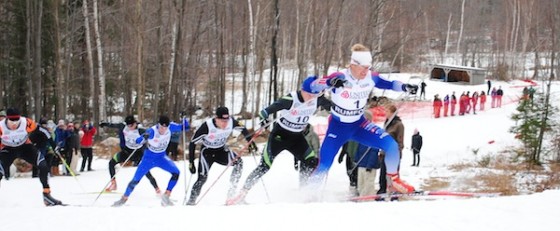
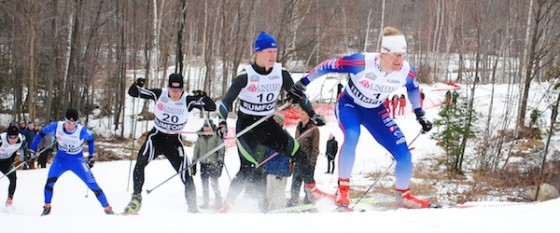
    Colin Rodgers (SVSEF) rocking the freestyle sprint qualifier. Photo: Hallie Herz.

    Sun Valley’s Colin Rodgers lost his shot at the 2010 Olympic team after a battle with compartment syndrome last year. But in Saturday’s skate sprint prelim at the 2011 U.S. championships in Rumford, he showed that he still has his speed.

    With the men’s qualifier concluded, live timing showed Rodgers edging CXC’s Garrott Kuzzy by a tenth of a second, with Simi Hamilton (USST) in third. Torin Koos (Methow ODT) was fourth, and Tim Reynolds (Craftsbury) fifth.

    After a sparkling 2009 season, Rodgers finished no higher than 22nd on the domestic circuit last year, then missed the entire second half of the season before undergoing surgery for compartment syndrome in March.

    He finished third in the classic qualifier-only sprint in West Yellowstone in November, but has yet to ski through to a sprint final this season, so his win Saturday comes as something of a surprise.

    Same with Kuzzy’s second-place. The lanky Minnesotan dominated the domestic spring circuit in 2010, but thus far this year, his speed was yet to show up.

    Hamilton has as much quickness as anyone in the world, though he has struggled through an up-and-down fall with an injury. He wasn’t far off Rodgers’ time, though—just six-tenths of a second down.

    Hamilton said that the course was “pretty straightforward,” and the men didn’t seem to have too much of a problem with a sketchy corner just before the loop’s main climb. Organizers had four volunteers shoveling new snow onto a spot that became icy during the women’s race; they were working even during the 15-second gaps between men.

    APU’s Lars Flora was seventh, and he said he was still feeling the effects of Thursday’s 30 k interval start.

    “I hope that blew it out—it was kind of rough,” he said.

    On a scary-fast 1.4 k course, a number of other distance specialists appeared to suffer the same fate—Noah Hoffman (USST) was all the way back in 62nd, while James Southam (APU) was 57th.

    The rounds will likely favor speed over fitness, with Rodgers’ time just under two minutes and 44 seconds.

    “You can just hammer out there the whole time, and not feel too much,” Koos said. “I think it’s going to be really fast. Per k, it’s going to as fast as any race you’re going to see all year.”

    FasterSkier will have post updates from the race on the Continental Cup blog, and updates on @FasterSkier on Twitter.

    Complete results.

  • Fischer Reflects on US Nationals

    Fischer Reflects on US Nationals

    At the recently completed 2009 US Cross Country National Championships in Anchorage, Alaska, Fischer skiers won 3 out of the 4 races held during the bitterly cold week.  Originally scheduled for 8 races, cold temperatures below the FIS minimum standard forced the cancellation of the Men’s and Women’s distance classic race and the Men’s and Women’s team sprint competition.

    On Monday, January 5th, both the Women’s 5km freestyle and the Men’s 10km freestyle races were held.  In the Men’s race, Fischer Athlete Kris Freeman won the race by 50 seconds over the field.  In the Women’s race, Fischer Athlete Kikkan Randall placed 2nd only by 3 seconds, but was by far and away the fastest skier over the second half of the race.

    -press release continues below photos-

    Kris Freeman, 10k Freestyle at US Nationals, Photo courtesy of Chris Hall, Fischer Sports USA
    Kris Freeman, 10k Freestyle at US Nationals, Photo courtesy of Chris Hall, Fischer Sports USA

    Kikkan Randal, 5k Freestyle at US Nationals, Photo courtesy of Chris Hall, Fischer Sports USA
    Kikkan Randal, 5k Freestyle at US Nationals, Photo courtesy of Chris Hall, Fischer Sports USA

    David Chamberlain, 10k Freestyle at US Nationals, Photo courtesy of Chris Hall, Fischer Sports USA
    David Chamberlain, 10k Freestyle at US Nationals, Photo courtesy of Chris Hall, Fischer Sports USA

    Colin Rogers, 10k Freestyle at US Nationals, Photo courtesy of Chris Hall, Fischer Sports USA
    Colin Rogers, 10k Freestyle at US Nationals, Photo courtesy of Chris Hall, Fischer Sports USA

    Brayton Osgood, 10k Freestyle at US Nationals, Photo courtesy of Chris Hall, Fischer Sports USA
    Brayton Osgood, 10k Freestyle at US Nationals, Photo courtesy of Chris Hall, Fischer Sports USA

    On Thursday, January 8th, the classic sprint competition took place for both the Women and Men.  Once again in the Men’s race, Kris Freeman found himself at the top of the podium, winning his first National Championship Sprint title.  In the Women’s race, Kikkan returned to her familiar spot at the top of the podium, winning the Women’s National Championship Sprint title.

    -press release continues below photos-

    Kris Freeman, Classic Sprint at US Nationals, Photo courtesy of Chris Hall, Fischer Sports USA
    Kris Freeman, Classic Sprint at US Nationals, Photo courtesy of Chris Hall, Fischer Sports USA
    Kikkan Randall, Classic Sprint at US Nationals, Photo courtesy of Chris Hall, Fischer Sports USA
    Kikkan Randall, Classic Sprint at US Nationals, Photo courtesy of Chris Hall, Fischer Sports USA
    Colin Rogers, Classic Sprint at US Nationals, Photo courtesy of Chris Hall, Fischer Sports USA
    Colin Rogers, Classic Sprint at US Nationals, Photo courtesy of Chris Hall, Fischer Sports USA
    Brayton Osgood, Classic Sprint at US Nationals, Photo courtesy of Chris Hall, Fischer Sports USA
    Brayton Osgood, Classic Sprint at US Nationals, Photo courtesy of Chris Hall, Fischer Sports USA

    At the end of the championships, the US Ski Team named the qualifiers for the following international trips, the J1 Scandinavian Cup, the World Junior Championship team and the U23 Championship team.  For the J1 Scandinavian Cup team, a total of 12 athletes were named, 6 boys and 6 girls.  Of these 12 athletes, 6 out of the 12 are athletes using Fischer skis and 3 out of these 6 are also using Fischer boots.  For the World Junior Championship team, a total of 10 athletes were named, 5 boys and 5 girls.  Of these 10 athletes, 6 out of the 10 are athletes using Fischer skis and one athlete also uses Fischer boots.  For the U23 Championships, a total of 10 athletes were named, 5 men and 5 women.  Of these 10 athletes, 7 out of the 10 are athletes using Fischer skis.  Fischer sends its congratulations to these athletes and wishes them good luck in these upcoming championships.

    During the championships, Fischer was the overwhelming choice of ski during the week.  In the men’s field for the 10km skate race, 51% of the athletes who started the race came to the start line with Fischer skis.  Likewise in the women’s field for the 5km skate race, 47% of the athletes who started the race came to the start line with Fischer skis.  Clearly, Fischer skis were the choice of ski, not only for the winners, but also for the majority of the athletes racing at the championships.

    YELLOW IS THE COLOR OF SUCCESS

  • Colin Rogers

    Colin Rogers

    Colin Rogers

    Colin Rogers began skiing in the Bill Koch Youth Ski League in Northwestern Vermont, and the highlight of his young ski career was getting a lollipop every time he crossed the finish line. He continued his training at Middlebury College from 2000-2004, graduating with a degree in Environmental Geology. “I knew I wanted to go to college,” Rogers says, “so it was not a hard decision to make.”

    In 2004 Rogers placed 5th in the sprint at US Nationals, and in 2005 he took 6th in the sprint at US Nationals and 10th Overall in the SuperTour. Rogers is currently living in Ketchum, Idaho and training with the Sun Valley Ski Education Foundation, hoping to be at the start line in the 2010 Olympics.

    Whether or not Rogers makes the Olympic Team, he believes that the spring of 2010 will be a reassessment time for his training. “I will ski for as long as I am passionate about the sport and improving,” he says. When Rogers is not skiing, he enjoys backcountry skiing, learning to surf, and collecting US quarters.

    Colin Roger, West Yellowstone

    Birthdate: May 8, 1981
    Hometown: Westford, VT.
    Current Residence: Ketchum, ID
    Ski Club: Sun Valley Ski Education Foundation
    Team: Fischer/ Craft
    Height: 5’ 9”
    Weight: 160
    Sponsors: SVSEF, Fischer/Craft, Alpina, Idaho Nordic, Vasa Trainer, Ski Tek, Rovers North, Westford, VT.

    Full Interview:


    When did you start ski racing, and what were some highlights of your young skiing career?

    I started ski racing when I was about 7 or 8 years old.  I grew up skiing in the Bill Koch Youth Ski League in Northwestern Vermont.  Highlights were getting a lollipop whenever I crossed the finish line.

    Who has been the most influential person for you, whether as a skier or a person?

    There have been many people that have influenced my life in positive ways.  There is no way I can name them all.  I try to take advice from all types of people and learn from what their personalities offer- both the positive and negative.

    Where is your favorite place to ski, where is your favorite place to race, what is your favorite part of the season, what are your favorite ski conditions?
    I can’t name favorites.  I love to cross country ski- that means training and racing in all different places, different conditions and at different times of the year.  You have to enjoy where you are when you are there.  I think that is the most important.

    What drives you to succeed at the highest possible level, and what are your long-term goals as a skier?

    It sounds a little cliché, but I like the challenge.  Cross country ski racing is definitely one of the most physically and mentally demanding sports.  There is no doubt it is hard for me, but everyday I wake up and try to improve.  Sometimes that means I need to rest and do something other than ski, other days that means I need to push my body to its limits in intervals or a race.
    In terms of goals- I strive to push my body to see what it is capable of.  I want to test myself on the ultimate stage- at the World Championships and the Olympics in 2010.

    What are your favorite race formats/distances, and do you try to specialize for these events?

    This year I will be competing in all types of distances- sprint, 10k, 15k, 30k and 50k.  In the past I have had my best results in sprinting.  I do incorporate several sprint focused workouts into my training, but I would say that my overall training plan is pretty traditional.

    What are your overall goals for this season?

    Podium at US Nationals in sprint and team sprint.
    Top 10 in all of the distance races at US Nationals.
    Qualify top 30 in the Cl sprint at the World Cup in Whistler.
    2009 World Championship Team member.
    Win 08/09 SuperTour Sprint Title.

    Do you have any consistent training partners? Do you prefer training alone or with others?

    I train with my team- SVSEF.  I train alone some too.  I think it is important to balance both.

    What is your favorite on snow workout and favorite dryland workout?

    On snow workout: Interval training in transitioning terrain.
    Dryland workout: Natural intervals on foot with bounding poles- 1 hour on time on loop format.

    What do you enjoy doing besides skiing?

    I have a mountain bike that I like to use and a motorcycle that is broken right now, but is really fun to ride!  I am trying to learn more about fixing it up.  Hopefully it will be rolling again this spring.

    I really like backcountry skiing too.  The powder in the West is pretty sweet!  I still want to learn more about traveling in the backcountry and avalanche safety as well.

    In terms of employment, are you a 100% full-time athlete, or do you have another job besides training/racing? If so, what do you do?
    I paint/stain houses as well as do a lot of other odd jobs.  I also cut wood in the fall.

    How long do you think you will ski at the elite level? What do you see yourself doing after you finish your ski career?
    I will ski for as long as I am passionate about the sport and improving.  I hope to make the Olympics in 2010.  No matter if I am going fast in 2010 or not that spring will be a reassessment time and I will go from there.  Right now I am just focused on the present and getting faster each day I go out the door to train.

    Do you or did you ever attend college? How did you make that decision?

    I went to Middlebury College from 2000-04 and graduated with a degree in Environmental Geology.  I always knew I wanted to go to college so it was not a hard decision to make.

    Do you enjoy racing/competing in other sports during the offseason? Did you play other sports as a kid? What are some of your favorite non-skiing competitions?
    I usually do a few mountain bike races and running races in the off season.  I competed a lot as a kid for sure- mountain biking, alpine skiing, running, playing soccer, basketball, rock climbing and of course ski racing.

    What do you do with any spare time at training camps or on race trips?

    Hang out.  You get pretty good at killing time when you are an athlete.  Resting is important.  I watch some movies, read a bit, check out the town that we are staying in etc.  Trying to keep a balanced life is important even when you are on the road.

    What does your diet consist of? Do you have a favorite pre-race dinner and breakfast?

    I eat a pretty healthy well rounded diet.  I am not too particular about what I eat the night before I race. For breakfast I usually eat oatmeal or some toast and eggs.

    What’s one thing people would be surprised to know about you?

    I collect US quarters.  I still have a few states I have not found yet- like Pennsylvania?  I know that one came out a long time ago but I still have not found it.

    How do you spend your weeks off?

    I have gotten into backcountry tele-skiing since I have moved out west which is kick ass.  You have all of the powder you want and don’t have to be around tons of people waiting in line.

    Last April a crew of skiers went down to Costa Rica and I learned to surf a bit which was really fun.  I don’t get to warm places like that too often so I got a little toasted from the sun.  It felt good though to be somewhere warm after ending the racing season in a cold Fairbanks, Alaska.

    This fall I had a few easy weeks and I spent most of them cutting firewood for the stove this winter.  I enjoy doing physical work so I have to be careful not to do too much when I am supposed to be taking it easy.  It has definitely taken me awhile to learn this lesson.

    What is the best race or workout you have ever done?

    The best ones are yet to come.  I don’t think I have reached my potential yet.

    What race events are in your plan for this season, and which races are you are looking forward to the most?

    I am doing most of the SuperTour competitions along with some of the early season Canadian NorAms, US Nationals and hopefully the World Cups in Whistler.  After that the season is up in the air except for Canadian Nationals in March.  We will definitely be there.  The dream goal this season is to go to Liberec, Czech Republic for the 2009 World Championships.

    I am looking forward to US Nationals at Kincaid Park this January and towards the competitions held on the Olympic courses in Whistler- both the NorAms in December and the World Cup races in January.

    What else do you want to say?

    Lay it all out there and don’t be afraid to follow your dreams.  That is the only way to turn them into reality.