This article was made possible through the generous support of our voluntary subscribers. If you would like to see more collegiate coverage like this, please support FasterSkier with a voluntary subscription.
By: Francesca Kitch
The Central Collegiate Ski Association (CCSA) is composed of six competing schools spanning the Midwest. Each season there are four CCSA invites–weekends full of racing–and this year, these competitions are set to begin this Saturday. The first three US Nationals races in Anchorage, Alaska, also counted towards CCSA competition; the skate 10k was scored as an NCAA qualifier, while the classic sprint and 20k classic mass start served as an opportunity to accumulate points toward team standings. Although the CCSA is a small conference, it doesn’t lack enthusiasm. Spectators travel all over the Midwest–and even to Alaska–to watch their athletes race.
Across all NCAA conferences–the CCSA, Eastern Intercollegiate Ski Association (EISA), and Rocky Mountain Intercollegiate Ski Association (RMISA)–distances and techniques are standardized. Every two years, the distance races at NCAA Championships alternate between skate and classic, and the races at the invites reflect this change. This year, the 20k mass start at NCAA’s will be skate and the 7.5k will be classic, so the CCSA qualifying races will consist mostly of 20k classic mass starts and 7.5k individual classic races. From the points earned in these races, skiers will be ranked within the CCSA, and the top 6 athletes of each gender will qualify for the NCAA Championships to compete in Hanover, New Hampshire, this March.
Women lining up for a 20km classic mass start last season. (Photo: Tryg Solberg)
The CCSA invite this weekend will be hosted by the University of Wisconsin at Green Bay. The Green Bay team has undergone an impressive transformation from 4 years ago when head coach Sam Meyers started the job. With a full roster of 3 men in 2021, Meyers has built up the program to now carry 17 athletes (9 men and 8 women) for the 2025 season. “This is the first year that we’ve had an upperclassmen-heavy roster…it feels like everyone has a really good understanding of how we operate as a team.” Meyers is encouraged to see how helpful the team captains have been in the seamless running of the team and how this has aided the overall maturity of the team. “We work really hard, we have big goals. But we also remember that skiing is fun.” Meyers adds, “One of the big things I look for in recruits is someone that just simply loves the sport of nordic skiing, and that’s a big factor in creating the culture that we like….not only good skiers but love working hard and being outside.” Meyers predicts strong performances from senior Ryan Themie and Junior Noah Erikson, the two top finishers on the men’s team from last season, finishing in 15th and 23rd, respectively, in the CCSA rankings. On the women’s side, Sophomore Lily Franzen is looking to improve on her performance from last year as the leading women’s skier for the team, and Meyers is excited to see what freshman Hedda Samuelsson has to show.
Men from Michigan Tech enthusiastically cheering on the women in a CCSA invite last season. (Photo: Tryg Solberg)
Michigan Tech Head Coach Tom Smith looks forward to another season with his team, excited by individual standouts and a promising team as a whole. Michigan Tech finished 13th at NCAA’s last year, the highest rank of the central conference, despite being hindered in the rankings by its lack of an alpine team to supplement the nordic team’s scores. “I’m proud to say we have an amazing team, and that’s because we have amazing people that make it what it is!” Smith stresses the importance of the balance between student and athlete as well as competition and fun. “We have two overarching goals for our team: to always work for improved performance…and above all, for our student-athletes to love their experience as a member of the team!” 3 time NCAA Championship qualifier Colin Freed is having a standout Senior season so far with top 15 finishes in the Cable Supertour and a CCSA win in the 10km skate race at US Nationals. On the women’s side, Smith highlighted Marie Wangen, Alice McKnight, and Greta Hansen as promising this season. Wangen skied into the semi-finals of both the skate and classic sprints at US Nationals as the top CCSA finisher and skied similarly well at the Super Tour in December with a top 6 performance. Of McKnight, Smith says she has “really made a performance jump in her senior season” with the first CCSA podium of her career in the 10km skate race at US Nationals. Hansen has been consistent all-around with CCSA podiums in distance races so far this season and finished as the 5th U23 American in the skate sprint at US Nationals.
St. Olaf’s team has come into new leadership this year with head coach Tor Hanson, a recent graduate of St. Olaf himself (‘23) who stayed on as an assistant coach last season. Hanson describes that “working from the team Brochman provided and now laying down my own foundation, I’m incredibly encouraged by the development seen amongst our team.” The team has indeed been making their mark on the local and international stage: Senior Lily Hubanks and Sophomore Amaeli Kam-Magruder are currently in Italy for the World University Games after impressive performances at the Cable Supertour. Hansen is encouraged by the incoming speed of the first-year class on both the men’s and women’s teams, and combined with the experience of older members of the team, it will be interesting to see how the season progresses.
Jason Kask, Head Coach for the College of St. Scholastica (CSS) team, started his job in the fall of 2023. “With an excellent freshman class and our veterans in great form, it’s shaping up to be a fun winter,” Kask remarks. Senior captains Chase High and Mae Whitcomb have bright seasons ahead after a great year of training and some promising early-season results. Freshman Leevi Tarjanne and junior Greta Leitheiser also look promising after the Supertour, Leitheiser coming home with multiple top 20 finishes and Tarjanne with top 30 performances. “We are excited to see their hard work in the off-season shine this winter.”
Northern Michigan University men’s team is all smiles after winning the conference title last season. (Photo: Tryg Solberg)
Northern Michigan University is consistently a top school in the CCSA, and last year their men’s team won the conference title. Sophomore Henriette Nilssen was last year’s highest-ranked CCSA woman and currently leads the standings after a CCSA win in the 10km skate at US Nationals. Her teammate, Senior Victoria Dybwad, was the third CCSA finisher last season and finished second in the 10km at US Nationals. Junior Luke Fricker was last year’s top men’s skier and finished second place in the US Nationals 10km skate. Sophomore Adrik Kraftson finished the podium off in the skate 10km at nationals in 3rd place.
St. Cloud University will also participate in these invitationals, but currently only has one member of the women’s team, and no men. Head coach Mike Schroden was unavailable for comment.
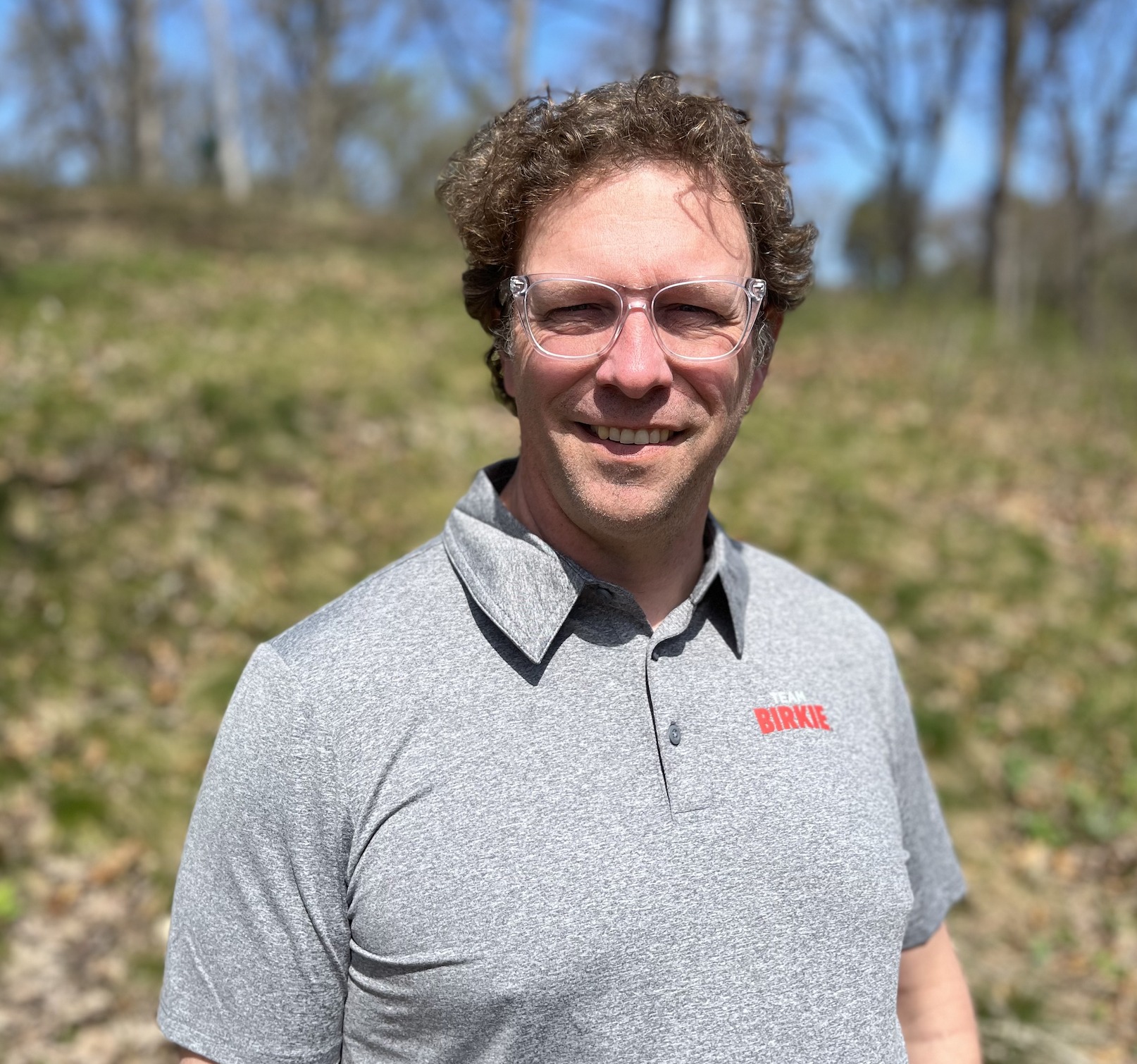
Newly appointed Team Birkie Head Coach, Chad Salmela. (Photo: Team Birkie)
Chad Salmela has a gift for pinpointing the critical characteristics of a moment and building something special from it. See “Here Comes Diggins,” the emphatically shouted announcement of an historic performance in American skiing, one that defined the careers of Olympic champions Jessie Diggins and Kikkan Randall, and of Salmela, himself. When it comes to Nordic skiing, Salmela knows what to say, how to put analysis into a context that audiences will understand, how to involve both enthusiasm and nuance. Now, as he takes on a new role deeply rooted in the Midwest ski community, he understands the nuance through-and-through.
Salmela has been named new Head Coach of Team Birkie, marking the latest milestone in his long and varied journey as one of American skiing’s renaissance characters. He has been a top junior, US Biathlon team member, US Biathlon coach, successful college program-building coach at St. Scholastica in skiing and (in his current day-job) running, Thresholdpodcaster (current side gig), American Birkebeiner finish-line announcer (current side-side-gig), a Duluth nordic skiing fixture, sometime Fasterskiercontributor, occasional pop culture zeitgeist, and yes, “the voice of the Olympic cross-country skiing on NBC.” The ski community possesses a special commitment, passion, and thoughtfulness towards the sport, but rarely does a single individual in it have all those dials turned to the max. Chad does. And so, when people go looking for all those things that make the sport great, they find them reflected in Chad.
At his core, though, Chad Salmela is a coach; one stepping back into skiing seven years after his last coaching job. During the interim, he has been a full-time running coach. In fact, in his new role at Team Birkie, he will still be a full-time running coach. Salmela is stepping in as Head Coach with Team Birkie part-time. Which begs the question, what is Team Birkie going to look like?
It’s all part of the plan to innovate and develop the elite club model: more coaches, enmeshed in the wider Midwest ski community, with backing from Central Cross-Country Skiing (CXC), the Loppet Foundation (the Loppet), and the American Birkebeiner Ski Foundation (the Birkie). All of it is going towards a “commitment to the idea of elite team in the Midwest.”
The plan will require some hammering out: that’s where Chad Salmela steps in, thinking through—and putting into action—much of what goes into US Skiing. Which made for an opportune time for FasterSkier to catch up with Salmela for a conversation that captured his thoughts on the vision for Team Birkie, how coaching philosophy has developed over the years, and what excites him about jumping back into practicing as a coach after years spent analyzing an evolving sport.
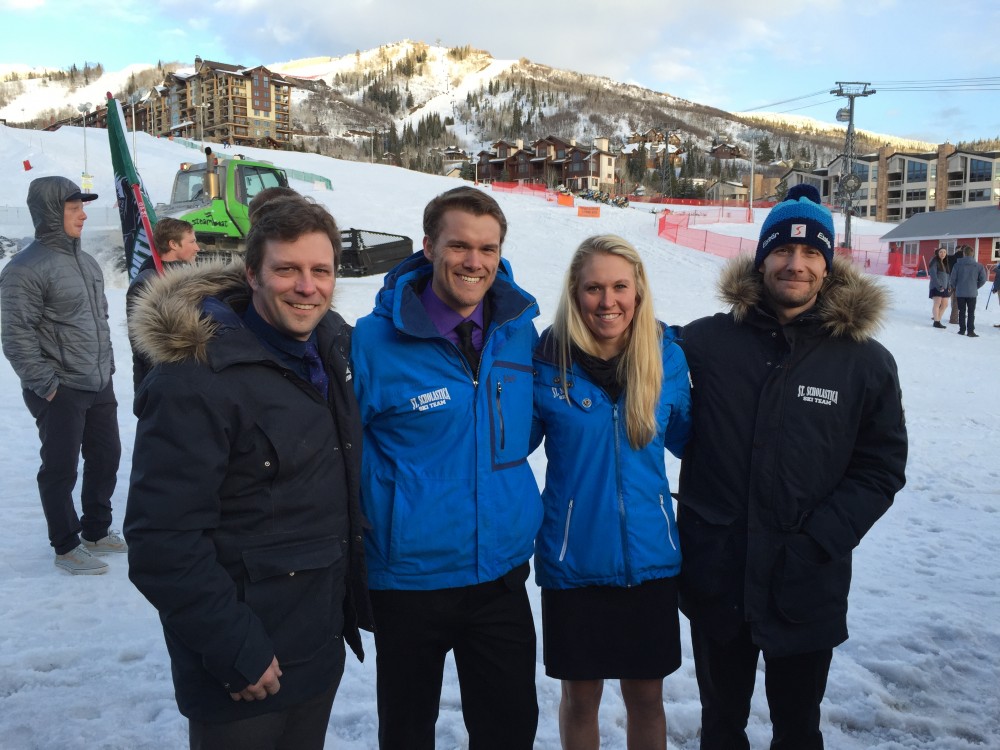
Chad Salmela (far left) at the 2016 NCAA qualifiers with College of St. Scholastica (CSS) skiers Reitler Hodgert and Kelsey Dickinson as well as assistant nordic coach, Josh Tesch. Seven years on, Salmela is stepping back into coaching skiing with Team Birkie. (Courtesy Photo)
This interview has been edited for length and clarity.
Ben Theyerl/FasterSkier (FS): How did you end up in the role of Head Coach for Team Birkie?
Chad Salmela (CS): It’s been a long process. I told Yuriy Gustev (CXC Skiing Executive Director) flat out no when he first approached me. But as most people who know Yuriy know, he has a good way of getting you to say yes.
I quit coaching skiing seven years ago at the St. Scholastica for a lot of really good personal reasons. Skiing is uniquely demanding to coach on any level. The deciding factor to go ahead here was that I can manage Team Birkie time-wise, from Duluth, and I do not have to leave my job coaching running at St. Scholastica. That is not something I could not have done when I first switched from coaching skiing to coaching running. My training plans are templated, recruiting systems are in place, the budget is workable year-to-year.
When it comes to why Team Birkie? It isn’t something that the Midwestern ski community really wants to see fizzle out again.
I think I see stepping in as stepping into a positive trend in program development for US Skiing. I think we’ve got away from “guru-ism,” where one coach has all the answers. I used to want that as an athlete. We all want that. But the idea here is that athletes won’t be working with one coach, they’ll be working with a whole bunch of coaches. At its core, we are looking to do this collaboratively.
FS: Before we dig into the details of that structure, what are the aspects of nordic skiing that you’ve missed?
CS: Coming back to a sport you’ve spent a lot of your life in is a joyful experience on its own. I still am not ready to hop into a wax trailer or follow the circuit, but I’m at a stage as a coach where I’ve not only gone through being an athlete and then coming back to the sport as a coach, but have also gone through the sport as a coach, left, and am now coming back again. That’s quite the journey.
I also have really missed the technical aspects of this sport. Which is funny, I used to get dinged as a ski coach because my athletes felt like I didn’t spend enough on technique. The technical complexity of skiing tough; it’s been ingrained in me as an observer of skiing. I got my start coaching when I was brought in to the US Biathlon program in 1998 to work with their athletes on technique, because at the time, there was a perception that we were way behind the Europeans. Back then, I was essentially pulling from stuff I was seeing watching Thomas Alsgaard or Ole Einar Bjørndalen in Europe, and back here it called into question some of the really common things we were talking about in America. I guess that’s when I got a reputation for being a coach with an opinion.
Fast-forward to today. I’ve been following skiing as a commentator, and the appeal is still the same. In the last seven years, freestyle technique has changed a lot. Where power is going and when has changed a lot. That is all stuff I’ve gotten to watch, but not work with athletes on. Last week, Zak sent over some of his clips from Bend Camp and it was really fun to start digging in on.
FS: Is the structure of Team Birkie going to undergo any wholesale changes?
CS: I don’t entirely know what it is going to look like yet. I don’t have any plans to make wholesale changes to the program, but I think those decisions will emerge as the we start to get going.
It’s a decision not to change. Like Zak; I don’t really want to mess with what Zak is doing. I don’t have a lot of experience coaching elite athletes at his stage of development. I have a lot of experience developing them to the elite level. Zak already has a system that has got him 98% of the way to where he wants to be. His best friend, Leo Hipp, has been writing his training plan, and it has worked. I see my job as coming in and just seeing if there are little things to poke at in his process and provide an extra person to review what went well and what went bad. I hope I can help him find the 2%, right? At his level, that is the difference between being hoping to qualify for a sprint heat and putting yourself in the mix to make the Final every week.
Coaching is always a mix of art and science. I recognize that I am not the answer. I am a possible collaborator to get to an answer. That’s the important tone that I’m trying to set as a coach.
FS: There is a diverse set of coaching talent working with Team Birkie. What value do you see in pulling together a lot of coaches from across the Midwest together, versus, say, you doing it all yourself?
CS: I think it’s primarily out of necessity. The constraints on my time made me open to the the idea that putting a good group of people together would make the team stronger.
I feel really fortunate to have younger coaches to work with who I think all have great experiences, but maybe aren’t ready to take on a whole program like this. I feel like I want to approach this role as more the “high performance director” or whatever you want to call it. Let the younger coaches who are excited to be on the circuit be at the races, living and breathing the coaching experience, and I can help them put all those things into a perspective that will create a cohesive program for our athletes to follow throughout the training year.
FS: Do you feel like the profession of ski coaching is any more complicated these days than it was when you first started?
CS: No, I just think we understand more than we did thirty years ago. Back then, we didn’t know what we didn’t know.
I think we’ve all come into a tighter orbit around some basic truths about training that we can abide by. To pick things up as a coach has gotten simpler as a result. You need to work hard. You need to be consistent. You need to be focused. You need to do a lot of it. Do that, and you are 95% to the elite level. The extra 5% is technical knowledge and experience. That is what coaches can bring to the table. It also happens to be where the difference is on the international stage.
FS: When it comes to implementing the vision you have for Team Birkie with the coaching staff you have, what does it look like day-to-day?
CS: It still is kind of impossible to tell because we haven’t started the programs yet. I would describe it as “fuzzy but coming into view.” I am ok leaving it there at this stage. I’d rather design the program in a way that is going to work for what we have. I don’t want to retrofit. Most of our athletes have a way and a place they’re comfortable with training right now as it is. So like Zak, right, is probably going to end up training mostly in Norway this summer. We have athletes who are coaching or working with Loppet Nordic Racing. Again, we don’t want to be intrusive into the basic building blocks of what they are doing.
FS: You’ve returned a couple of times to Zak Ketterson in talking about getting this program rolling. He has been a strong advocate for Team Birkie and the idea of professional skiing while based out of the Midwest. Does it feel like he is a kind of co-creator in what Team Birkie is going to look like in the future?
CS: The elite program as it stands is basically Zak. If he hadn’t said that we should keep this going, I don’t know if it would. His desire has brought us Midwesterners into focus though. Simply, he is a good example that we are not doing all we can to support developing athletes here. If they don’t have a place to ski after college, then we can’t expect them to stay in the region. If Zak wants it, then others probably do too, and we should be stepping up and doing it. Our collective commitment is to the idea of an elite team in the Midwest. That is what we want to create going forward.
As for the coaching, based on our first interactions over the past couple of weeks, I think we’re off to a really good start. Zak is probably more respectful of what I have to say than I feel I’ve earned with him, which is a testament to his character.
FS: There have been a few iterations of an elite Midwest team in the past, and you’ve been around to see them all. There was the original Team Birkie (which existed ~1990-95) and then notably, the CXC Elite Team that included Jessie Diggins, Adam Martin, Bryan Fish and Jason Cork, among others. When you look back at those, are there any lessons learned about creating something that is truly sustainable for a longer period of time?
CS: It’s a great question that I’m not sure I have a clear answer to. I wasn’t really around for the original Team Birkie idea, but I was very familiar with the CXC Elite Team. Why did that go away? It was a victim of its own success, mostly. Bryan Fish and Jason Cork both went from CXC directly to the US Ski Team, and US Skiing has benefitted immensely from it. There was talented coaches who could have continued that CXC Elite Team, but the timing just kind of snapped the whole thing. You have to develop key people before they become your key people.
If you wanted to identify why the Midwest has had a harder time re-establishing something since the CXC Team, I think there is a kind of paradox at play. Our strengths, when they aren’t focused, become weaknesses. The Midwest has more developing athletes racing than any other region in the country, but we have always been more dispersed than other regions. We have a lot of talent in a lot of different places and different programs. Once we focus some of that energy, good things happen. We’ve also had kids growing up here and having to leave to do the next level of skiing for a long time. Whether it was college or club, we would keep a relatively small portion of the talented skiers from the Midwest staying in the Midwest. They were, and still are, going to New England, Alaska, or the West. That is a pretty large logistical hiccup in supporting our homegrown skiers. So, if anything, what we’re now trying to do is focus up our energy again. We want kids from the Midwest to feel like we have their backs.
FS: At the “elite” club level, there are a lot of different models to make things sustainably successful. Is there something about the challenge of coming up with that which is exciting to you, versus, say, a college program?
CS: I think it’s more about where the program is and where I can take it. That’s been a fixture of my coaching career. I’ve always walked into “underdog” programs. I’ve never inherited the Green Bay Packers, you know?
FS: (As a Packers fan) I don’t know if you would want that mess right now…
CS: Yes. But like, the Scholastica program didn’t exist when I was hired. US Biathlon was on the fringe of the sport when I was there. There are a lot of challenges that come with picking up a kind of fixer-upper, but there are also a lot of opportunities to do things creatively.
FS: Are there natural strengths for Team Birkie that you can see building on?
CS: I think those are really clear. This is the only ski program in a major metropolitan area. For some, that is an absolute turn-off, but for others, it is really exciting. There is a draw; there’s a reason why the World Cup is coming here next year, right? Our athletes who have left still feel connected too. Jessie Diggins has been based out of Vermont for a decade and she is still gunning relentlessly for a World Cup here. That is something genuinely special, and so for me, is the energy in which a program like Team Birkie needs to exist in. The Midwest, especially this year, is the hub of American excitement around skiing, and that gives us a platform to build on that draw.
FS: Has the excitement around the recent milestones in American skiing, a lot of which you have been the voice for, motivated you to return to coaching at all?
CS: I really don’t know. I think the key thing is that I wasn’t looking to get back into coaching. I understood why Team Birkie reached out to me though, and so now, I am willing to give it a shot. The most telling thing was when I laid it out to my wife, she just shrugged and went, “yeah, it sounds like the perfect thing for you.”
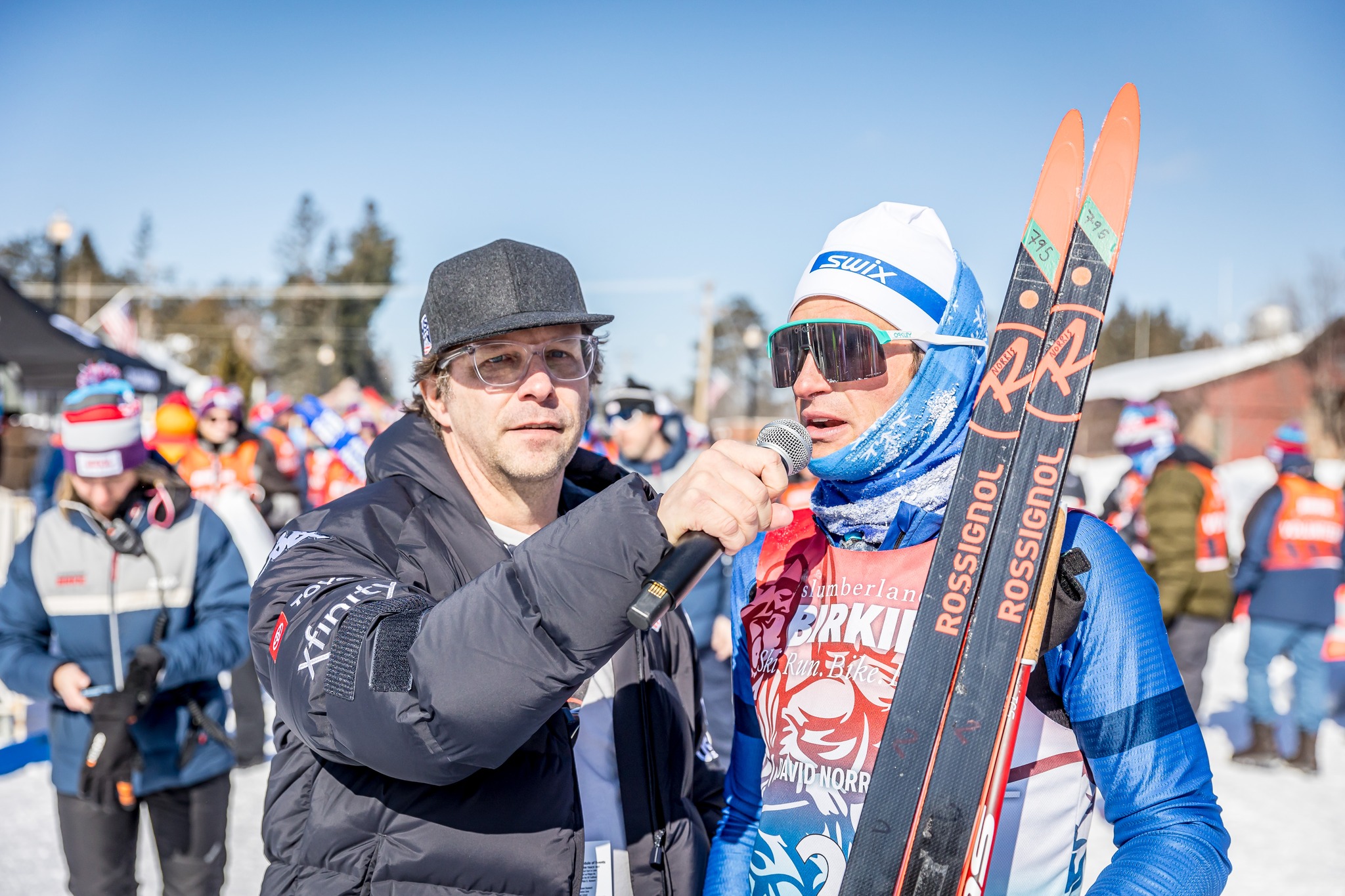
Chad Salmela in another of his varied roles, interviewing David Norris after his win in the 2023 American Birkebiener. (Photo: (c) 2023 American Birkebeiner Ski Foundation)
FS: I suspect a lot of our readers know you first and foremost through your commentary work for NBC and Ski and Snowboard Live. Both there, and in this conversation, we’re hearing from a guy who has been thinking about this sport for a long time in a thoughtful, sustained, and focused way. As you hop into coaching and developing the sport again, how do you think we are doing on that front?
CS: I think the US is doing a relatively good job. The biggest thing we are doing now compared to thirty years ago is keeping talent in the sport long enough to make the decision that they truly want to go for the top level. We have never done that at as high a hit rate as we are now. That speaks to a huge amount of time and focus by a lot of people to get the sport in the United States organized. You couldn’t even list all the names that were important, it was a huge effort. There are old timers and people younger than me who have all contributed.
FS: Where do think the domestic circuit you are stepping into plays in that?
CS: I think the pro teams are a good thing. Strong investment in the circuit they compete in is good too. It’s not all straight-forward. As the US Team on the World Cup has become one of the best programs in the world, the gap between the two circuits has grown. There’s also, the, for lack of a better word, “pay-to-play” problem. I think the clubs provide a way to help mitigate that slightly, we have to provide a way for the people who want to pursue the sport to the highest levels to afford it.
CS: I have had to learn and develop, for sure. I was a brash kid when I was say, a 20-year-old kid. When you are brash, you are hiding insecurities. Age and attitude go hand-in-hand. I think as I matured, I found ways to manage my insecurities better, and in that respect, have become a better coach.
Improving as a coach requires you to ask what you are missing in your own motivations. The need to be competitive comes naturally. Thinking about the science and philosophy around being competitive does not always. A lot of growth comes simply because the ultimate arbiter in a sport like this is performance. You are kind of, what I call, scrubbing yourself on the washboard of the sport, physically and emotionally, and there is a lot of value to that. What I worry most about as a coach is that you might lose the meaning of doing the sport in just focusing on winning. That is so easy to do when you are in your 20s or 30s, and now as a father, it is the biggest thing I think about getting my kids into the sport.
Coaching-wise, when you first start out a program, you aren’t as preoccupied with winning, but more so performing at a level that people are going to want to be part of the program going forward. That can cause you to hold on too tight. I definitely said things that were a little more callous than needed to be said because if you are putting everything into it, you will get tired, and you will get frustrated. You learn from making mistakes like that. For every two athletes who like what I have done as a coach for them, there are probably a dozen that do not feel that way. That is one of the laws of coaching. It is not because you are setting out to make someone upset. It’s that you are a little too focused on the wrong things with that athlete.
That, if anything, is what has helped me grow as a coach. I have gotten better at really focusing on what matters to everybody on a team, so that people get something out of it that isn’t frustration. This sport is hard enough that there will be plenty of frustration over the course of your career, no matter who you are.
More than anything, I want people to get a great experience from being on a team. They should have a great experience that makes their lives better. You are not going to get good out of bad. You are going to get good out of good and finding that tone from everyone involved is how the strongest programs are built.
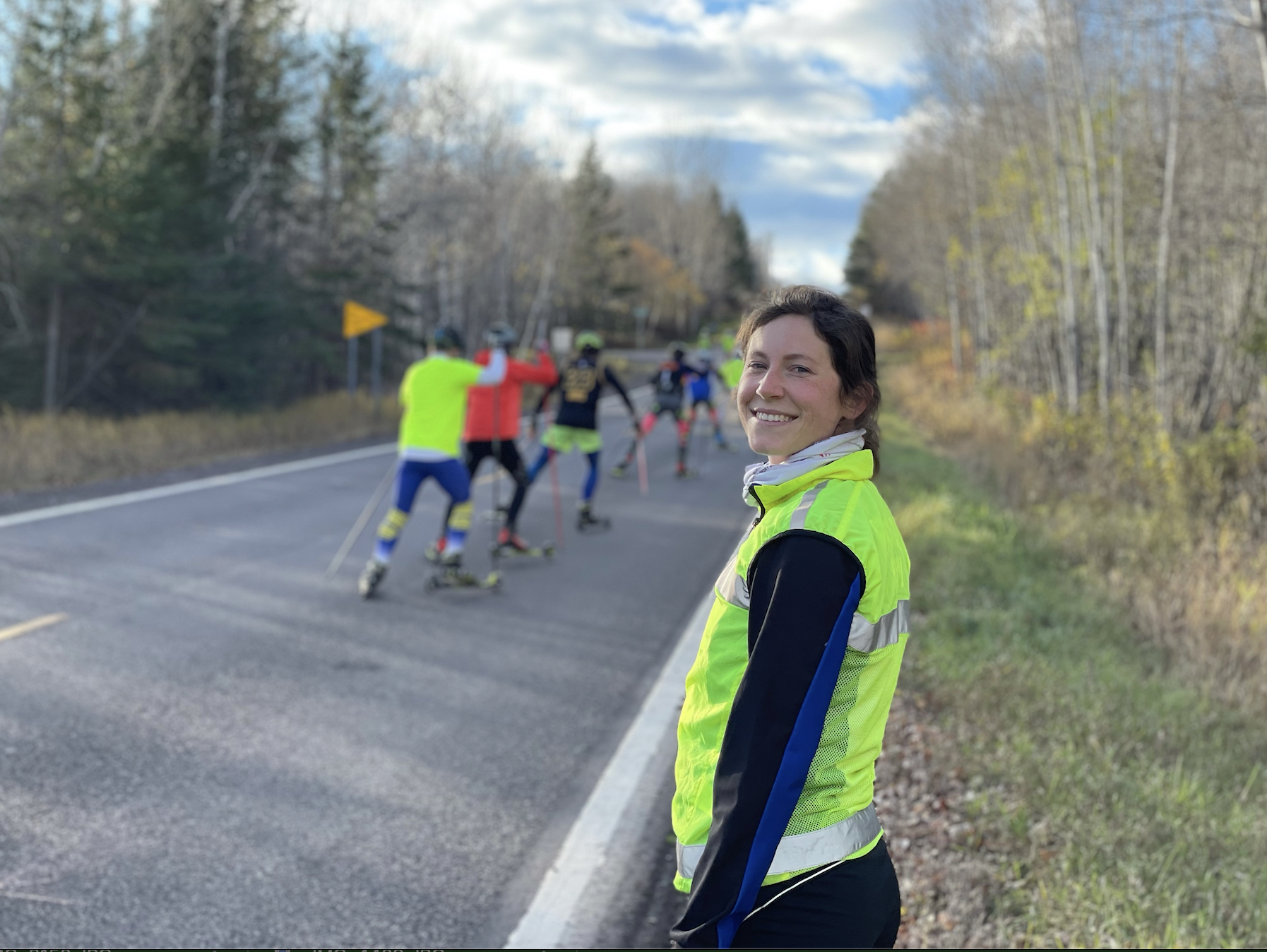
CSS assistant coach Kristen Bourne was awarded the Women’s Sports Foundation VanDerveer Fellowship for the advancement of women in coaching. (Photo: Maria Stuber)
Kicking off her second year as assistant coach at the College of St. Scholastica (CSS) in Duluth, MN, Kristen Bourne was recently named one of ten recipients of the Women’s Sports Foundation VanDerveer Fellowship. The program, named for revered Stanford University Basketball coach, Tara VanDerveer, aims to increase representation of women in coaching at the collegiate level through the development of the rising generation. This is the first time that the award has been granted to a cross country ski program.
According to the WSF, “this pioneering program provides grants, paid fellowships and mentorships for aspiring female coaches. Emphasizing hands-on training for female coaches in all collegiate sports, from basketball and volleyball to water polo and fencing, it is a salute to the extraordinary compassion, optimism and leadership that its namesake has shown over the years.”
Along with opportunities to collaborate with coaches across a variety of sports nationwide, the program offers institutions $15,000 to use in support of their fellow, along with $2,500 that goes directly to fellow to put toward additional professional development opportunities. FasterSkier connected with Bourne to learn more about the fellowship, her path to coaching, and how this opportunity will support her growth and long term goals in cross country ski coaching.
Originally from Lake Elmo, MN, on the eastern side of Minneapolis, Bourne attended Northern Michigan University (NMU), where she graduated with a degree in Sport Science in May, 2018. While racing for NMU, Bourne raced on four NCAA championship teams, and was a member of the 2015 U.S. World Junior Championships team and the 2016 U23 World Championships team. Post-college, she headed to Norway to train with Lyn Ski and Team Obos in Oslo, while competing in numerous FIS races throughout the country.
CSS assistant coach Kristen Bourne spent time in Norway after college training with Lyn Ski / Team Obos. Bourne is pictured here racing in a Norwegian Cup race in Gålå. (Photo: Martin Riseth)
Bourne returned to the US in December, 2019 to finish her racing career at the 2020 U.S. National Championships in Houghton, MI. It was there that she met Maria Stuber, head coach at CSS and the founder of the Women Ski Coaches Association (WSCA), who recognized Bourne’s potential as a coach and recruited her to the CSS program.
“I was just deciding that my ski career was about done and trying to figure out what to do next,” Bourne explained in a call. “I was at U.S. Nationals, I was leaving a parking lot, and Maria drove up and essentially slammed on the brakes, and yelled out the window, ‘Hey! My name is Maria. I heard that you’re interested in potentially coaching. You’re gonna get an email from me sometime soon.’”
Bourne went on to explain that Stuber emailed her the next week asking if she would be interested in joining her as the assistant coach at CSS. Tying the fellowship opportunity into the offer, Stuber knew about the VanDerveer grant and would help oversee the school’s application on Bourne’s behalf. CSS was not chosen after the first year of application, but they were selected this year on the second attempt.
Bourne explained how receiving the VanDerveer fellowship allows her to pursue a number of development opportunities beyond her role at CSS.
“Right now I have a few things in mind that I’m going to put that money towards. I would really like to go to the NCAA Women Coaches Academy, which happens every May. They have a bunch of super awesome female speakers and head coaches that all talk, and it seems really valuable. I think Maria did it a few years ago. Then the other professional development opportunity would be: I’m currently working on a trip over to the World Cup this winter.”
Though her education and wealth of experience lends itself well to coaching, Bourne did not always see this as a path she would choose.
“People were always telling me that I would probably end up being a coach, and I didn’t want to do what everyone thought,” she laughed. “And then, you come to this realization: I love the sport, and I want to learn more about it, and I’m really passionate about it. I can take my personal experiences from being in Norway and seeing how they work over there, I can apply what I learned there, and through college, my own [time as an athlete]… Right now I’m also working on my master’s in exercise physiology. So being able to take all of that experience and knowledge and be able to apply it as a coach, I think it’s kind of a no brainer.”
Though improvement is trending, women remain underrepresented in leadership roles in the ski community. According to the 2020-2021 Women in College Coaching Report Card issued by the Tucker Center for Research on Girls & Women in Sport, only two of nine NCAA Division 1 cross country ski coaches are women.
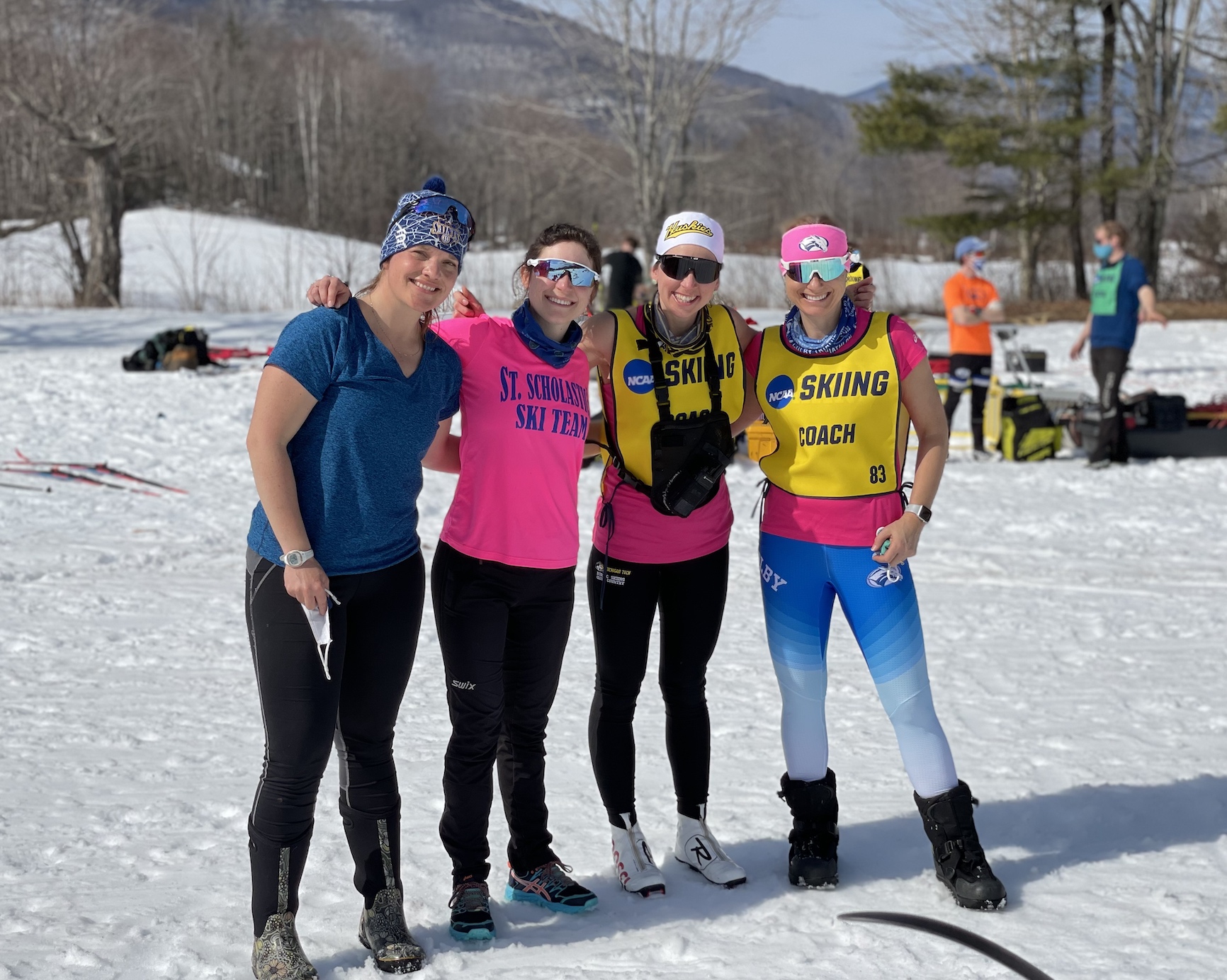
A few of the female coaches represented at the 2021 NCAA championships. From left to right, Maria Stuber, Kristen Bourne, Kristen Monahan-Smith of Michigan Tech, and Tracy Cote of Colby College. (Courtesy photo)
Stepping into this realm without significant experience in coaching, Bourne spoke to the importance of having a strong mentor and role model in Stuber, who has helped her realize her potential in the role.
“The other [factor influencing my transition into coaching] has been working for Maria. She has just taken me on and put me under her wing, and really gets me to do things that I wouldn’t normally do. It has boosted my confidence in myself knowing that I can do this and that this is what I want to do for the rest of my life. That was a huge piece of it, too.”
Expanding on Stuber’s formal role as a mentor for the VanDerveer Fellowship, Bourne explained that both she and Stuber will have the opportunity to connect with the other fellows and mentors involved in the program, which spans a variety of sports from basketball to water polo to track & field. This collaboration allows the women to discuss their successes and challenges in their respective sports, and learn from each other’s experiences.
In a 2019 presentation at the U.S. Ski & Snowboard annual meeting on the importance of women in coaching, Dr. Nicole LaVoi of the previously mentioned Tucker Center explained the importance of women in leadership roles to inspire the next generation of coaches and improve the experience of developing female coaches.
“When you see women being successful, it inspires people,” LaVoi said. “‘Oh, I could do that. That seems cool, she seems cool, I want to do that.’ And in they come. It’s the same thing with women in positions of leadership.”
Bourne emphasized that this concept rings true for her in working with Stuber, who has stoked her fire to become an example for future women in the sport.
“She said so many times that the Women’s Ski Coaches Association and empowering women — this is her passion. I just feel so honored that I get to be right alongside her. She’s so powerful, and she has such a strong impact, and she’s doing this incredible thing that I think quite a few people are scared to do. She just says, ‘No, I’m doing it. We’re gonna change some things here.’ And I think that’s just — it’s pretty dang cool.”
Looking to the future and the role she hopes to play, Bourne aspires to be a head coach at or above the college level. She enjoys the environment of collegiate programs, but remains open-minded. Reflecting on the dearth of female coaches in her own athletic experience, she concluded with her intention to be part of the solution in the slow progression toward gender equity in sport leadership.
“When coming to the decision of becoming a coach, there is this thought of, ‘Well, I’ve never really experienced anyone like me in that position before. Can I do that? Can I have the same impact on a team as a man would? But really it’s [lack of] representation. There’s also the concept that women are proven to improve work environments — having more women is better. And being able to support female athletes — and being able to support male athletes — with a different perspective is super important. There’s a lot of pieces — it’s a huge question. I just hope I can be a role model for more women coming up who want to get into coaching and stay in the sport.”
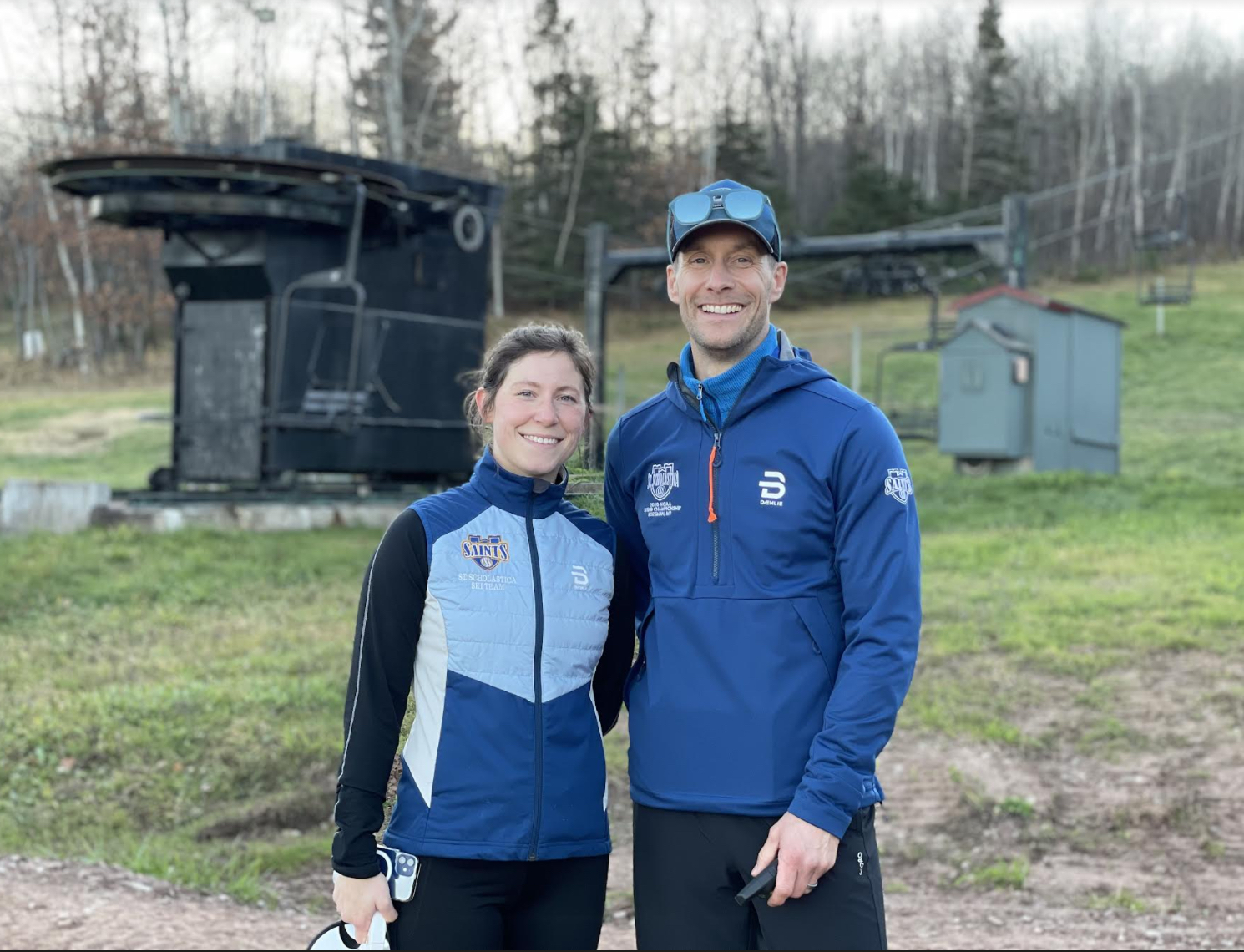
The CSS Assistant Coaches: Kristen Bourne (left) and Joshua Tesch (right). Stuber explained that Tesch has bee coaching at CSS for 15 years and has been a mentor for both herself and Bourne. (Photo: Maria Stuber)
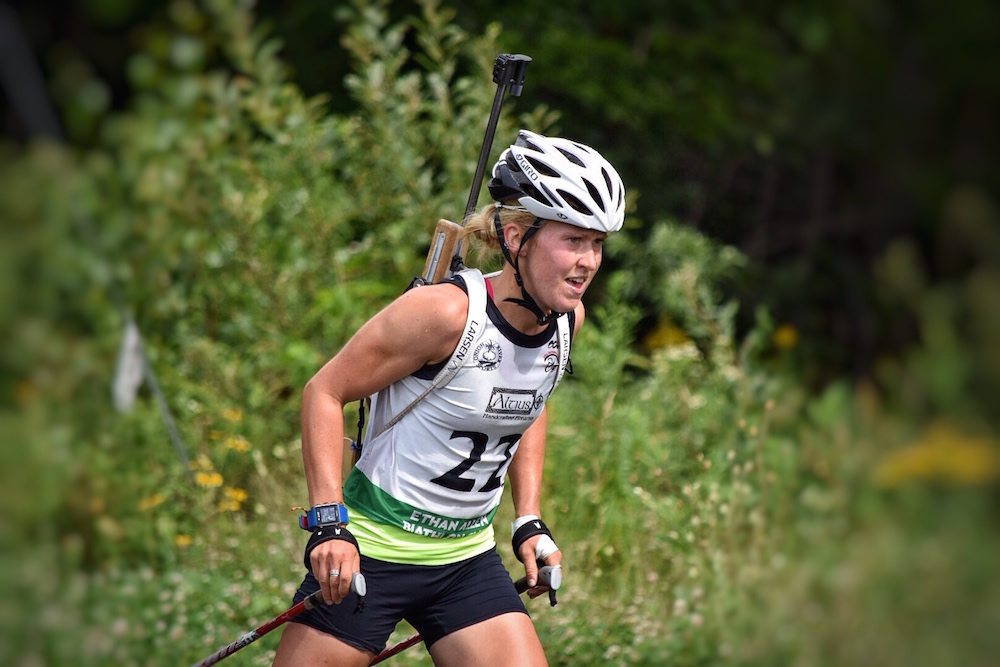
Kelsey Dickinson during the women’s mass start at the 2016 US Biathlon National Rollerski Championships on Aug. 14 in Jericho, Vt. (Photo: Katrina Howe)
The Washington native had been training at the Maine Winter Sports Center (now the Outdoor Sports Institute), and had been a member of the U.S. Biathlon Association’s development team. But when team nominations came out in the spring of 2015, she wasn’t on them. At the same time, the Maine Winter Sports Center cut most funding to its senior teams.
With few options, Dickinson headed back to the College of Saint Scholastica, where she had done one year of college already.
“When I left biathlon, part of it was because I just wasn’t skiing fast enough,” Dickinson said in an interview this month. “So I asked how I could keep skiing, one, but also how could I get faster. I realized that going back to college was going to be the best way to do that, but I wasn’t going to be able to go back to college, and do biathlon, and get better at skiing. I decided that I would just ski in college and finish out my eligibility.”
Dickinson still has one year of that eligibility left, but her biathlon career has come back sooner than expected. After strong college results last season, she was accepted into a summer training program at the Craftsbury Outdoor Center in Vermont. This summer, she spent time training with some of the country’s best cross-country skiers as well as having dedicated biathlon training and easy access to a shooting range.
“Our goal for her this year is to make that Olympic team, for sure, but she’s really four years ahead of schedule with it,” Dickinson’s ski coach at Saint Scholastica, Maria Stuber, said.
“Nothing about what’s going on right now is what I expected to happen,” Dickinson, a double-major in philosophy and natural science, said. “I thought that I would make it through this semester and not have to be traveling that much. I’m just going by communicating with my professors on a day-by-day basis and playing it by ear.”
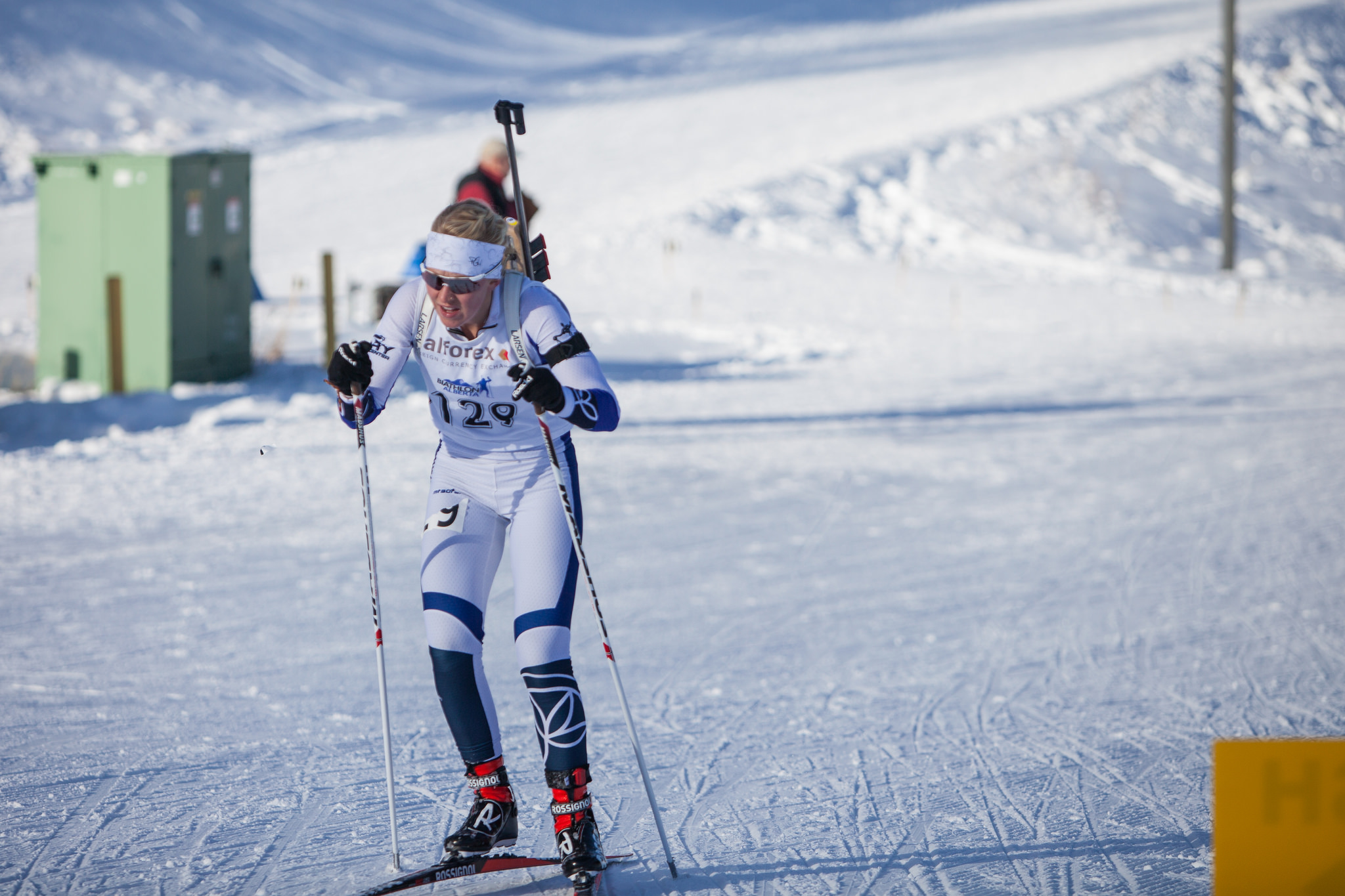
Kelsey Dickinson (St. Scholastica) racing to 26th in the women’s 15 k freestyle mass start at 2017 NCAA Skiing Championships on March 11 at the Jackson Ski Touring Center in Jackson, N.H. (Photo: flyingpointroad.com)
Stuber had only positive things to say about Dickinson’s work ethic and professionalism.
“She was really clear about her goal to be a biathlete, and she has not wavered on that at all,” Stuber explained. “We said, okay, if you want to be a biathlete at the end of college, what needs to happen for you to be in the top few women, not a bubble skier but someone who is going to be on the World Cup? The bottom line was that she needed to ski a lot faster.”
The work Dickinson put in paid off, and last season she ended up ranked sixth in the Central Collegiate Ski Association rankings, the top woman not from perennial powerhouse Northern Michigan University. She has now represented her team at NCAA Championships twice.
“She made some big technical improvements last winter,” Stuber said. “But she was sick from early January, for over a month. She had some really good races but I don’t know if either of us felt like she really got to show her stuff last winter like we thought she could… I think mainly we just made it apparent that she had it in her to go even faster.”
That was enough to get her to Craftsbury. Dickinson had applied to the summer training program the previous year but not gotten in.
“I had a really good summer of training,” Dickinson said. “I’m really grateful to be able to have gone to Craftsbury and trained with the team there. That made all the difference for me, just to be around a lot of high-level athletes.”
At Saint Scholastica, she is the one leading the team. One of the big focuses of going to Vermont was to get Dickinson used to seeing how more efficient technical skiers moved.
Kelsey Dickinson representing the Maine Winter Sports Center at NorAms in Canmore in December, 2014. Her last international biathlon races were at IBU Cups in Canmore in March, 2015, where she twice finished 28th.
“She could sit behind someone and try to figure out how to make skiing easy, instead of always trying to think in intervals of how to make it hard, and how to go harder,” Stuber said. “There’s this awesome mindshift when you’re going hard but trying to make it easy, which you don’t get to do when you are leading so much.”
Stuber herself was a senior athlete at Craftsbury at one point, so she knew head coach Pepa Miloucheva well and was not worried that there would be any problems with Dickinson adjusting to the training approach. (“She was my coach before and I have a ton of respect for what she is doing there — so to be able to work with Pepa as a peer was really cool for me,” Stuber said.)
In addition, Dickinson knew Sam Dougherty, the biathlon coach at Craftsbury.
“Sam and Pepa work together to build the plan depending on what the biathlon schedule requires and what the cross-country athletes are doing,” Dickinson explained. “They try to make it comprehensive so people can train together… I have known Sam for a while because of we overlapped racing a little bit back when I was a junior. And Pepa, her philosophy is very similar to Maria’s. I get along great with Pepa and she has been an amazing coach. I’m lucky that the transition was really easy.”
Dickinson turned in two third-place finishes at rollerski biathlon races in August.
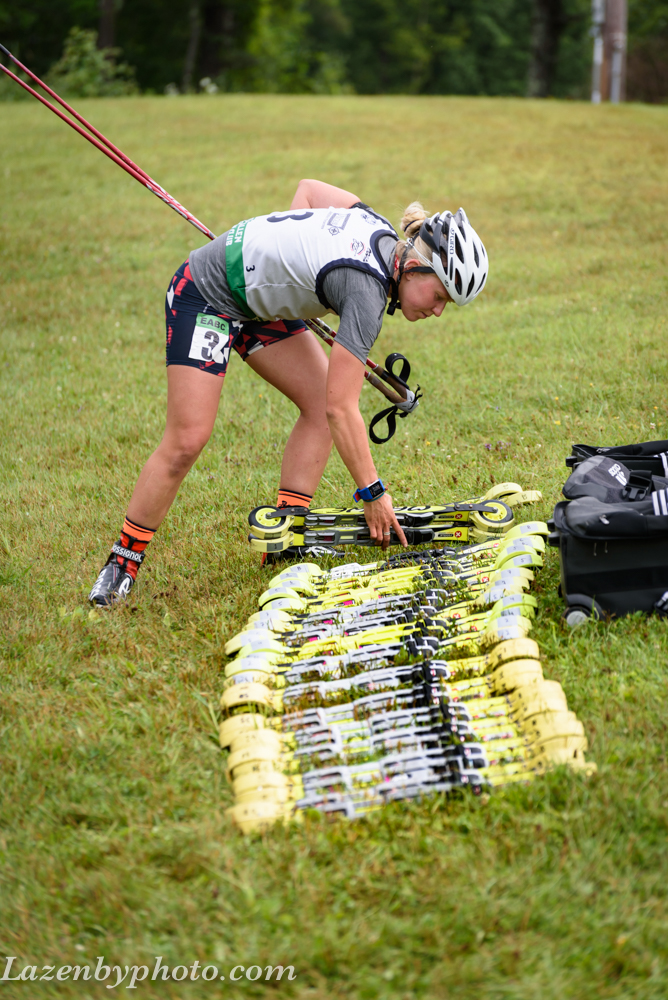
Kelsey Dickinson (Craftsbury Collegiate Summer Team) picking out rollerskis for the women’s mass start on Aug. 13, at USBA Rollerski Championships in Jericho, Vt. She placed third on both days of the two-day championships. (Photo: John Lazenby/Lazenbyphoto.com)
“I knew I was feeling good and that if I put all the pieces together then things could go well, but I wasn’t quite expecting that for sure,” she said.
That put her in a good position to fight for a World Cup spot. Susan Dunklee, who was pre-qualified for the World Cup, had won both races. Dickinson could even afford one less-stellar race when the qualification series wrapped up with two more competitions in October.
Because she was still in school and had options for how to spend her race season – including competing domestically in December, in an attempt to qualify for the IBU Cup in January and from there trying to make the Olympics – she didn’t feel pressure.
“I think actually having school was a little bit helpful in that way,” she said. “I just was looking at the weekend as an opportunity. If things went well then that would be great, but if things hadn’t gone well then I still had a lot of great things going on back at school with the team there… I was in a good place emotionally, just happy to be there.”
At those last two trials races, Dickinson finished second and fifth, and locked up the World Cup spot.
Her goal is still the Olympics. As such, when she gets to the World Cup later this month – she has to first go to the second-tier IBU Cup in Sjusjøen, Norway, and score qualification points – she will focus mainly on process.
While at least one more woman will be added to the Olympic roster based on December World Cup results, the team won’t be filled until January, when several athletes will be sent to the IBU Cup to fight for the last spots. That means that Dickinson can focus on performing well in January, when the season is in full swing and she has some races under her belt, and fight for an Olympic berth there.
“Her process is going to be the most important thing,” Stuber said. “I don’t think she needs to be concerned with what her results are at those first World Cups… if she can use these World Cups to get a really good process dialed in, then when she goes to the IBU Cup she will be really ready to do what she needs to do there to secure an Olympic spot.”
“It was such a huge goal just to get to this point,” Dickinson agreed. “Looking forward I’m just going to approach things as an opportunity. It’s an opportunity for learning, it’s an opportunity to race, to do what I love to do. So I think that in that sense, I obviously want to do well and I want to hold myself to a high standard. But I am just very grateful that I can have this opportunity and I’m very open to what it will bring.”
In the past two seasons, Dickinson bought into college racing completely.
“She tries really hard to be a good captain and sometimes I think that adds to her stress level,” Stuber said. “She just tries to do everything that she commits to, to do it really well.”
But now, she’s back to biathlon.
“If I could come across saying anything, I just want to express how grateful I am to all the people who have supported me,” Dickinson said. “Like Maria and Chad [Salmela], and Pepa, and everyone thoughout the years who have allowed me to get to this point. Because it has been a really long journey.”
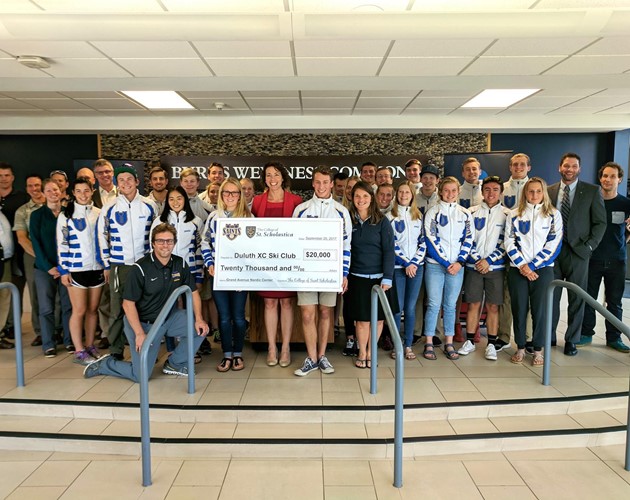
DULUTH, Minn. (csssaints.com) – The College of St. Scholastica will invest in the city of Duluth’s Grand Avenue Nordic Center project; the school announced on Wednesday.
The College will contribute $20,000 to the Duluth XC Ski Club’s capital campaign toward the project. The center is a city project in conjunction with Spirit Mountain and DXC to bring state of the art snowmaking for cross country skiing to Duluth. It will be a 5+ kilometer trail development with 3.3km of snowmaking infrastructure and lights at the base of Spirit Mountain.
“This project really captures a modern development in cross country skiing infrastructure the likes of which the city hasn’t addressed since the 1980s,” said current St. Scholastica cross country coach Chad Salmela, an ex-board member of Duluth XC ski club. “In supporting the project, the college acknowledges its role as a community player and the role healthy lifestyles for a winter city plays in the lives of their students. It aligns the college with meaningful community initiatives of the city and its civic organizations. It’s a win-win.”
St. Scholastica has the only varsity college ski team in the area, and this project will make it the only Midwestern NCAA ski program with snowmaking near campus, and one of less than a handful nationally. The guarantee of snow for at this facility will change the game for skiing in the city, and subsequently be a huge draw for the college’s competitive ski team.
“World class athletes walk through these doors and now they will have a world class facility to call home,” said St. Scholastica Nordic Ski Coach Maria Stuber. “The GANC partnership between the City of Duluth, DXC and the college makes us feel like we are a major part of the community, something we cherish. Together, we are raising the bar for our sport with this facility and we have raised it higher than most DI and DII ski teams with bigger budgets. We are so proud of this project.”
Stuber said she plans on using the Grand Avenue Nordic Center as a centralized ski hub that will allow CSS student-athletes to interact with community members and youth skiers on a regular basis.
Project construction is slated to begin this winter with completion in fall 2018.
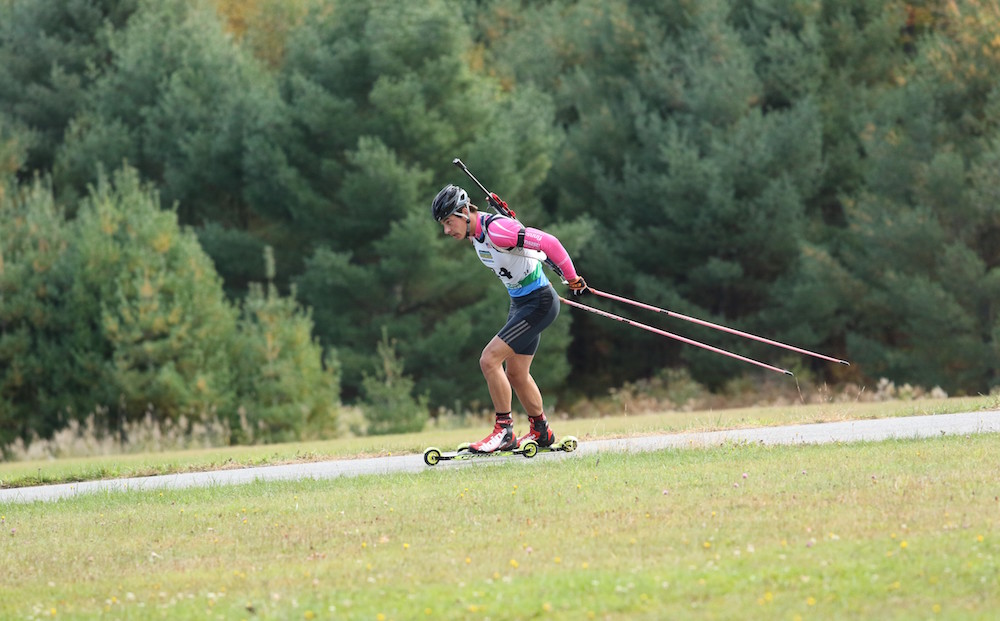
Paul Schommer, of US Biathlon’s National Development Group, shooting in Jericho, Vt., at rollerski trials this fall. (Courtesy photo)
Welcome to “17 Questions for 2017″, where we are catching up with American and Canadian national-team members before the beginning of the winter season.
***
After graduating from the College of St. Scholastica in 2015, Paul Schommer was identified as a potential biathlon talent by the US Biathlon Association. He has been going full bore in his new sport ever since and was recently invited to the national team’s pre-World Cup camp in Canmore, Alberta. Part of US Biathlon’s senior national development group, the 24-year-old Schommer was on the short list for a World Cup starting spot which he ultimately lost out on to Russell Currier, but proved that he’s getting close to the top level of American biathlon just a short time after switching sports.
1. Biggest change in your life in the last five or so months since the ski season ended?
I would have to say the biggest change in my life has been moving out to Lake Placid full time. Training in Hayward was great, but coming out to Lake Placid and having all the resources here has been an amazing opportunity. The staff here really makes it possible for us to concentrate on becoming a better athlete by taking care of simple daily tasks. For example, I step out the door and roller ski to the range, which is already set up by all the coaches, and do my workout. When I return back my room has been cleaned by a housekeeping staff member and I head to the cafeteria where food is hot and ready. To me, that’s just amazing and it’s because of all the awesome people here at the OTC that make it happen. It’s also incredible to have world class coaching day in and day out. It really makes a huge difference and am stoked to be able to be here training with the team.
2. Biggest change in your training?
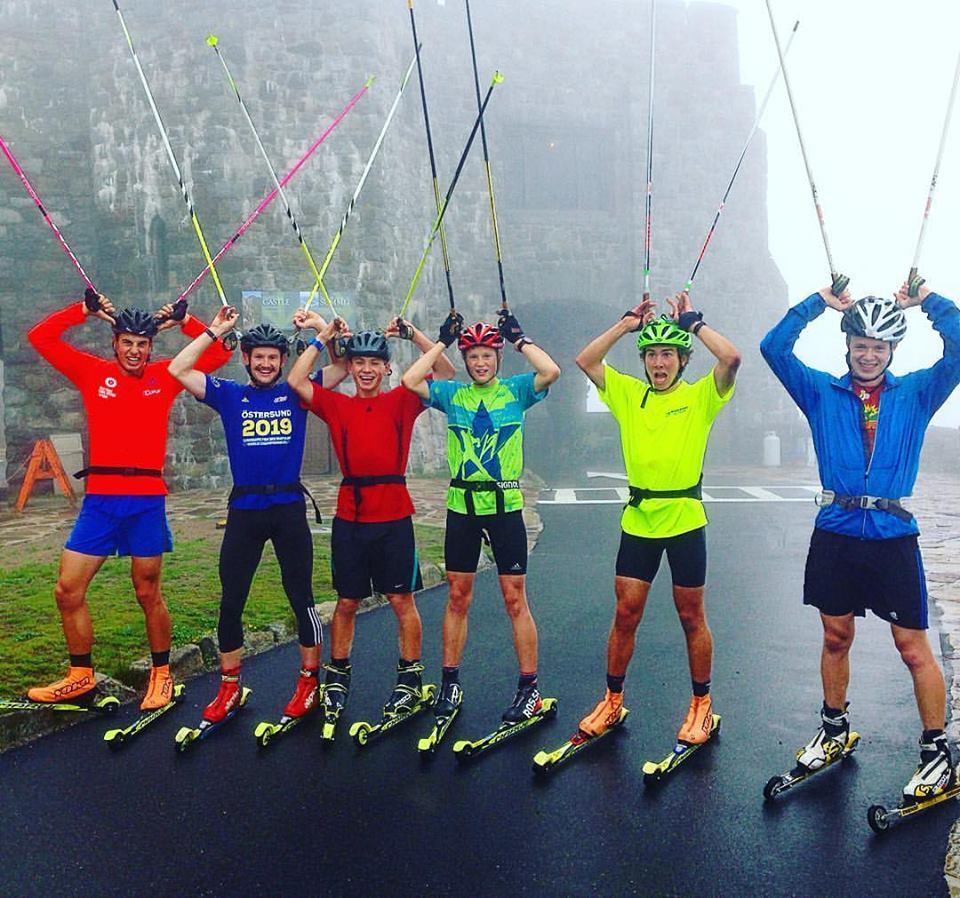
Paul Schommer (left) after the Climb to the Castle rollerski race in September, where he placed third, in Wilmington, N.Y. (Courtesy photo)
I would say sheer volume and intensity has increased in the past year. My coach at St. Scholastica Chad Salmela and I have been working on increasing my aerobic efficiency ever since I got to Duluth, and I am now starting to reap the benefits of that training. My ability to come back day after day and train at a higher level has allowed me to increase my quality training. In conjunction with this, I have not been working a part-time job like in years past. Due to my financial situation in the past, I have always had to work a part-time job to support myself. However, this year I decided if I was going to do biathlon, I would have to do it right. Money is always tight but thankfully God has put a lot of people in my life that have helped out a ton. The increase in training is definitely a result of the work done with Chad while at St. Scholastica, but being able to recover properly between workouts also makes a huge difference.
3. Major areas of improvement you’ve seen so far?
I touched briefly on my physiological improvement in the previous question, but biathlon is two sports in one. As my ski performance has continued to improve, so has my shooting performance from day to day. The first year of biathlon is an up and down roller coaster, have good days only to be followed by terrible days. The key is to find consistency, which is coming around more and more. As I have become more and more comfortable on the range, I am able to hit more targets consistently. A lot of this has come from lots of dry fire in the past year and shooting more rounds this summer than last year.
4. Whom you’ve been working closest with this offseason (coaches or training partners)?
Schommer competing at rollerski trials in Jericho, Vt., this fall. (Courtesy photo)
While I was in Hayward this summer, I was all by myself. It was awesome to have that time to myself, work through things on my own and not have to rely on anyone else. However, being able to come to Lake Placid for camps made a huge difference and always helped keep me stay motivated. When in Lake Placid, I worked with Jean Paquet most the time, the head Development Coach at USBA. Working with Jean has been great and I’ve always jived well with him. For a training partner, Jake Brown and I do most of our workouts together. We have a really healthy competitive relationship with each other which allows us to push each other in workouts but still have fun. We are great friends and having him in Lake Placid makes things enjoyable both during and after training.
5. Best trip in the last five months (and why)?
Most my traveling is for training purposes, and I don’t have much expendable income for travel beyond that. So when I do have a few days off, I tend to use it to see those I love, whether that be heading home to see family or meeting up with friends. It’s hard to pick on specific trip that means more than another as each one holds its own special meaning. I mean, The Bjorn Bakken Ski Championships of America are a huge deal, the biggest deal, and I had a blast, but also moving my younger brother into college this fall was also awesome, but in a totally different way. So simply put, I’ve had a lot of awesome trips in the past five months and I can’t really say one was better than the other. And what made them all awesome wasn’t because of where I went, but because of the people that were there.
6. Favorite cross-training?
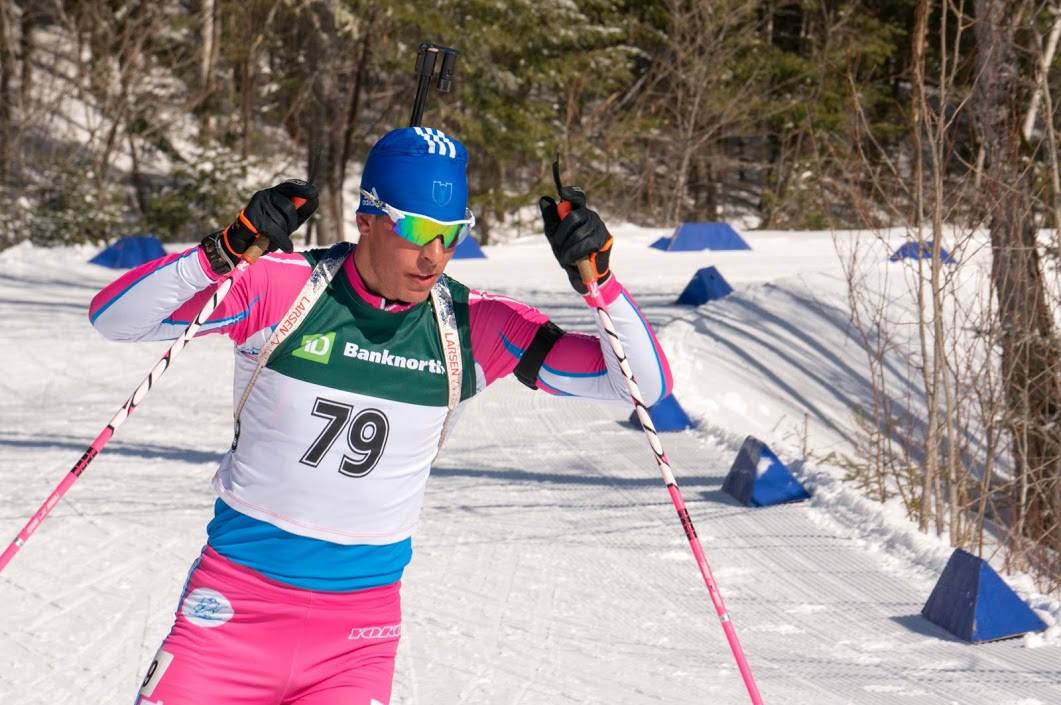
Schommer competing at U.S. National Championships in Maine in March. (Courtesy photo)
Normally I would say mountain biking but this summer I did a lot of paddling in a surfski and really grew to love it. There are so many lakes in the Hayward area and I had a blast going and exploring these on days where it was too hot to double pole, or just wanted a break from the usual training grind. I had a few evenings where I was the only one on the lake with the sunset reflecting of the glassy water and all seemed right in the world.
7. Favorite non-athletic activity or pastime this summer?
Probably the exact opposite of that, just sitting around doing nothing. Where I live this summer I didn’t have internet or phone service so I spent a lot of time just sitting around reading and praying, and it was awesome. When I would be in Lake Placid and have internet, I would start to miss the disconnected life I had back in the woods of northern Wisconsin. I loved just hanging out on the porch in the evening just chilling. It was so peaceful and relaxing. It makes me sound old and boring but I loved it.
8. Song that was your jam this summer?
King of My Heart by Steffany Gretzinger. There were a lot of times I was out skiing or doing a workout and this song would just be playing in my head and would just bring a smile to my face.
9. All-time favorite race moment?
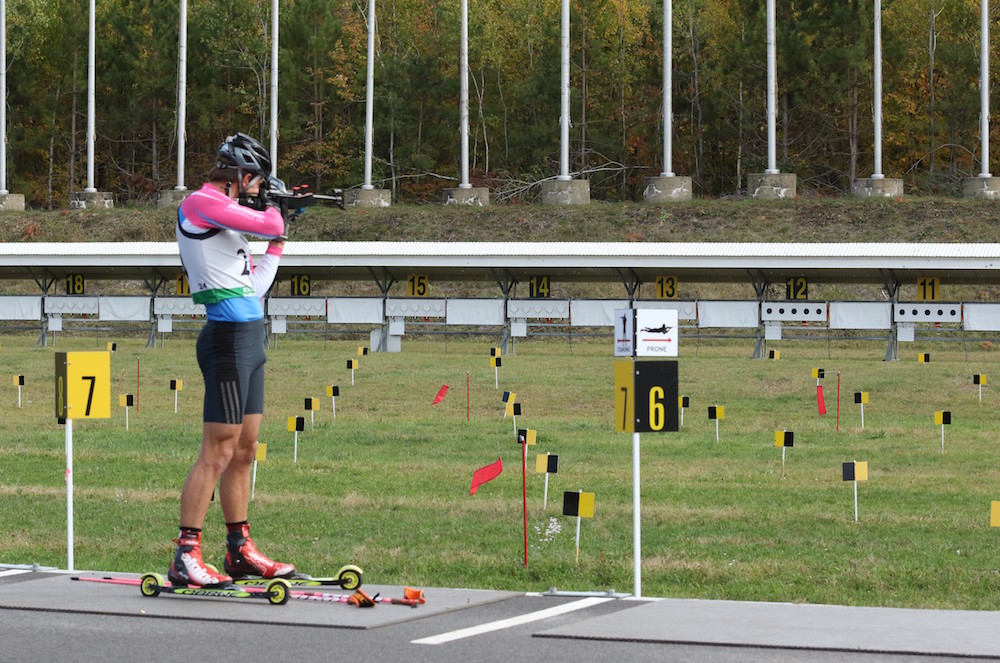
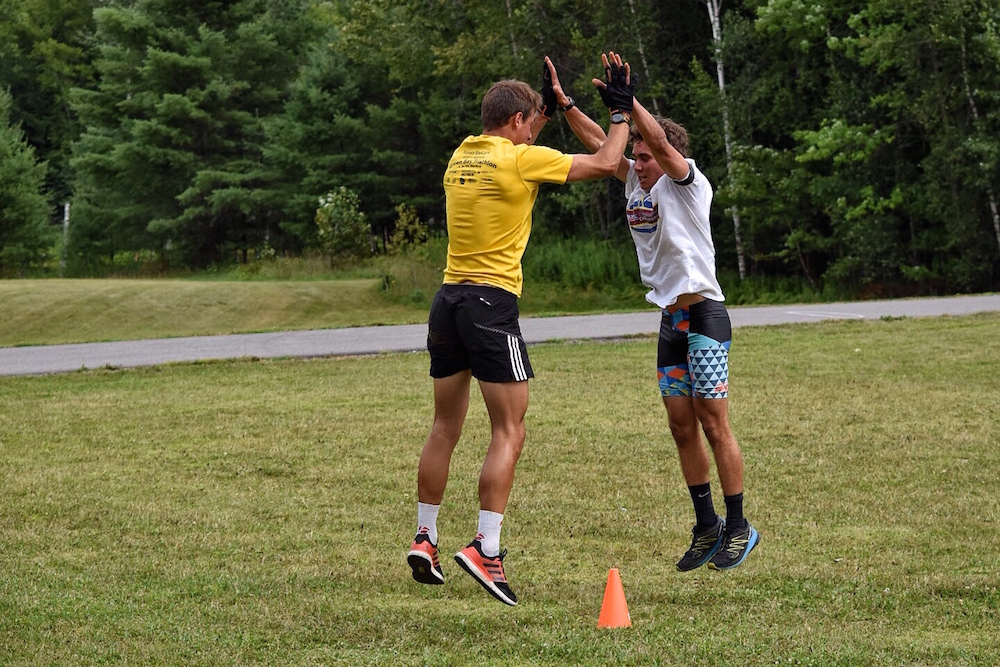
Paul Schommer (l) and Jake Brown doing high-five partner burpees during a strength workout at the U.S. Biathlon development camp in Jericho, Vt. Find their workout here. (Photo: Katrina Howe)
I would have to say the Minneapolis SuperTour at Wirth in 2010. I was a senior in High School and it was my first year ski racing competitively. I was having a bit of a rough season and was having trouble putting together a good race. Before the race my older brother Philip told me, “Paul, if you’re flowing keep it going, if you’re pressin’, you’re messin’.” I took his advice and for the first kilometer or two just tried to flow. As the race continued, I just kept passing people so just kept it flowing. At the finished I was the fastest J1 of the day, which even took me by surprise as my best finish prior to that had been 12th. The best part was at this time absolutely no one knew who I was as I just started competing. When I was looking at results a kid next to me turned to his friend and asked, “Who the heck is Paul Schommer?”
10. First thing you pack in your bag when you leave for Europe?
Positive attitude.
11. Venue/event you’re most excited to visit this season?
Anywhere I get to race and haven’t been to already. I love going to new places and meeting new people so I hope I have the opportunity to go to new places and meet new people this season. When the season concludes, I always look forward to heading back to the Ski Haus for the Bjorn Bakken Ski Championships of America, the greatest backyard ski race on the planet. They always have a great course to really test the skills.
12. Who will win the men’s and women’s World Cup titles this year?
On the women’s side I’d have to go with Marie Dorin Habert. On the men’s side, I think it’s going to be a tight race between Martin Fourcade and Johannes Thingnes Boe.
13. Biggest sacrifice you feel you’ve made choosing this career path?
I don’t really feel like I have sacrificed much. Right now, I am thankful to have this opportunity and don’t have any regrets.
14. If you could change one thing about your sport, what would it be?
Have people know what it actually is. Haha, this is a blessing and a curse at the same time. Not many people in the US know what biathlon and right off the bat guess it is biking and running. However, this also gives me an opportunity to introduce people to the sport and in turn help grow it. Biathlon is a very spectator friendly sport, which is evident by the fact that it is the most watched winter sport in central Europe. Talking with some people of USBA it sounds like they are going to be doing a few things in the coming year to help bring biathlon to Americans which is pretty exciting.
15. What did you have for breakfast this morning?
I’m on this new diet so I had an orange peel, half a banana, and a peanut. I’m only kidding, I had oatmeal.
Maria Stuber has spent the last three years coaching at the Aspen Valley Ski and Snowboard Club in Colorado. (Courtesy photo)
Ever since the College of St. Scholastica began its NCAA ski team, the face of the program has been one man: head coach Chad Salmela. Over the last decade, his squad notched its first men’s and women’s team wins and saw its first NCAA Skiing Championship qualifiers. And on the way, he changed the lives of dozens of young athletes.
Now Salmela is shifting roles at the college and will coach the cross-country running team. Taking the reins of the ski team is a new coach coach who is just as excited to build on the program’s burgeoning legacy in Duluth, Minn.
Maria Stuber, a Wisconsin native, has developed her coaching chops over several assignments, most recently in Colorado with the Aspen Valley Ski and Snowboard Club (AVSC). In three seasons with the club, Stuber increased the size of the team and worked with a variety of athletes, from those who just picked up skiing in high school to those who competed in Europe.
“At AVSC, coaches made sure we were encouraging brand new skiers to jump into the sport at any age,” she wrote in an email. “If you decided to join our high school team you get to train right alongside the best athletes in the country… This environment gives every athlete the opportunity to make a quick jump and be the best skier they can be. It can be so fun when it works, as our top male skier last year didn’t get into the sport until he was a sophomore in high school.”
Stuber (second from left) with AVSC athletes. (Courtesy photo)
That attitude seems to be a perfect match for the College of St. Scholastica (CSS), a school which sent two men to NCAA’s in 2012 and two women in 2015 – but which also has a development team and provides growth opportunities for skiers coming in with a variety of backgrounds.
“Chad didn’t really impact my ski career, he started it,” Paul Schommer, an NCAA All-American in 2014 now pursuing elite biathlon, told FasterSkier this spring.
“CSS is unique in that it has a development team serving this purpose at the college level,” Stuber wrote. “Kids with college skiing aspirations that are not quite ready to make that jump can come and work hard, get faster, and have the opportunity to reach the same level as the top junior national athletes we recruit.”
Taking athletes from those two tracks, Saint Scholastica has built teams that compete with the best in the NCAA Central division.
“CSS wants to be a competitive team in the Central Collegiate Ski Associaion conference,” Stuber explained. “In order to do that, we need to be competitive at the national level. What’s really cool about skiing in 2016 is that you need to have international ambitions to be competitive at the national level.”
Salmela used sports science and lab testing to make that happen, and it’s one of the opportunities that drew Stuber to the program. She received a masters degree in exercise science from Northern Michigan University and relishes a data-based approach.
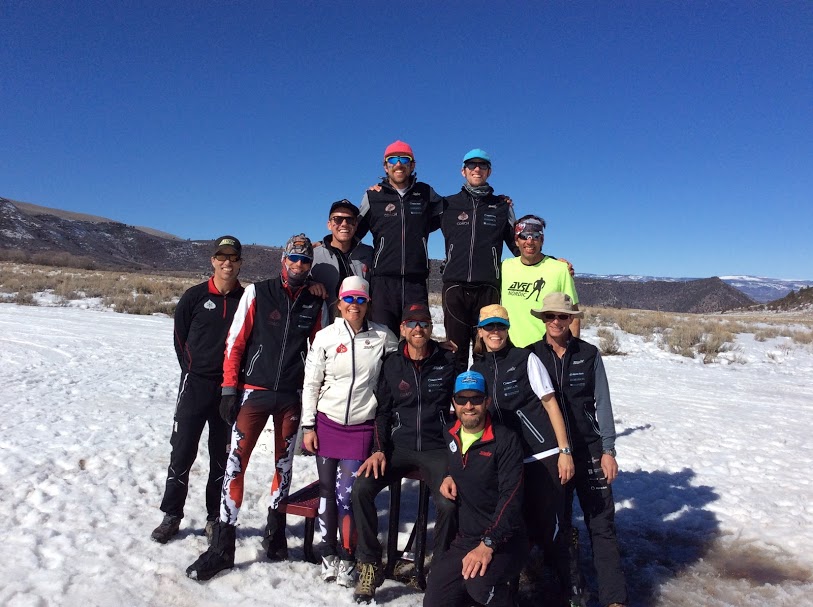
Stuber with the rest of the AVSC staff last year. “I love these people!” she wrote. (Courtesy photo)
“I love that St. Scholastica’s training is all based on science and sound research,” Stuber wrote. “The college has an exercise science lab and the professors are willing to share the space and knowledge with coaches to give the student-athletes more opportunities for success.”
But more than anything, she is pleased to be part of a framework which will make it possible to integrate running and skiing into a cohesive college athletic career. In explaining his job shift, Salmela was clear that he wanted to see more – and smoother – crossover between the two sports at St. Scholastica, for those athletes who have dual ambitions.
“The biggest program draws for me at CSS are Chad & Don Olson’s (athletic director’s) vision to create a collegiate endurance sport epicenter where student-athletes can choose to pursue xc running, skiing or both at a very high level,” Stuber wrote. “Linking endurance sports together will create well rounded, big picture athletes that have the support of a bigger peer group and more coaches and resources. I think CSS is on the verge of something huge.”
Stuber has seen how a variety of teams achieve success. First, as an athlete: she captained the Northern Michigan University (NMU) ski team for three years.
“My time at NMU had a huge impact on my life path and decision to pursue a career in ski coaching,” Stuber explained. “The running and skiing coaches there, Sten Fjeldheim and Jenny Ryan, have both contributed significantly to my coaching philosophy, training methodology and personal values. They have continued to be mentors, advocates and references for me as I find my way. I will feel extremely proud to consider Sten and Jenny peers and to go up against the Wildcats in December and I hope that they feel like a part of our success at CSS. They both know me well enough to not expect any mercy from us on the trails.”
Hailey Swirbul of the Aspen Valley Ski Club races the anchor leg while guiding the American team to eighth place in the 4 x 3.3 k relay at the Junior World Championships in Almaty, Kazakhstan, in 2015. (Photo: Logan Hannneman)
After college, Stuber raced for the Central Cross Country (CXC) Elite Team and then the Craftsbury Green Racing Project. In her senior career, Stuber was a runner-up at U.S. National Championships in 2009.
But since retiring from competition, Stuber has been consumed by coaching. She began her career at Alverno College in Wisconsin, before taking over as head men’s and women’s cross-country running coach for Southern Vermont College for two years. Under her leadership, the men’s squad had their best team results ever.
At AVSC, where the roster eventually neared 200 skiers, Stuber led a team of other coaches. Every year the club sent skiers to Junior National Championships as well as to World Junior Championships or the J1 Scandinavian Cup trip.
“I will never forget our amazing coaching staff at AVSC that welcomed me to the community that they had carefully built over the past 20+ years,” Stuber wrote. “There is no other ski club in the country with the amazing mix of background, knowledge, energy, perspective and compassion. Working with this group of people will be a life-long career highlight for me… I am so proud of the club’s growing numbers and participation in Carbondale, Glenwood Springs and Aspen. The way these three communities work together towards a common goal in Nordic skiing is phenomenal.”
AVSC runs summer training programs and last season organized an end-of-winter race event called Tour de Sea which drew junior skiers from all over Colorado, as well as rave reviews.
Stuber and Cook (second and third from right) with AVSC staff at a competition this winter. (Courtesy photo)
It was difficult for her to decide whether to uproot herself from the Roaring Fork Valley, where she and husband Bryan Cook had just bought a condo. They had been “very happy” in the Elk Mountains.
“We were not feeling 100% certain that we had made the right call until Monday when the CSS announcement was made,” Stuber wrote. “For days straight my phone and email were pinging and beeping non-stop with messages from friends, family, former teammates, fellow coaches and upcoming Midwest skiers and parents from clinics past. The Midwest ski community is a truly special group of people that we are incredibly proud to be a part of. During our racing careers, we leaned on this community for support and they delivered for us big time. I think we missed the Midwest ski culture more than we knew.”
The couple will move in the first week of September and Stuber is looking forward to getting started with her new team; Cook will enter an MBA program at St. Scholastica.
And besides the general homecoming, Stuber knows that the athletes she will be working with in Duluth – as well as those on the teams her skiers compete against – embody the same characteristics of the community which is welcoming her back.
“The CCSA is definitely a powerhouse Nordic conference…. consistently dominating at the US National Championship and NCAA Championship,” Stuber wrote. “The CCSA attracts down-to-earth athletes that want to be great skiers and are willing to work hard to get there. This intrinsic motivation is a recipe for making fast cross country skiers. Midwest kids are tough and they are backed by outstanding club coaches that are looking at the big picture. I can’t imagine a better atmosphere for athlete development.”
Getting a little bit tired of your rollerskis? Feeling bogged down by heat? Yearning for snow? The St. Scholastica team has found the answer we’ve all been waiting for. The only problem is the airfare to Sweden.
Lead by coach Chad Salmela, members of the College of St. Scholastica Nordic team, based out of Duluth, Minnesota, headed out to Scandinavia on July 28th, and will spend two weeks training at a ski tunnel in Torsby, Sweden, and its surrounding area.
Skiing in the tunnel. (Photo: Chad Salmela)
The Fortum Ski Tunnel, completed about three years ago, provides athletes with a 1.3km loop following the natural terrain, filled with preserved snow and groomed daily. “The skiing is remarkably good, as is the terrain, considering it’s a tunnel,” Salmela reported in a recent e-mail to FasterSkier.
Because of the expense of the trip, only five athletes, all men, were able to make the journey. Salmela says that the team will try to fundraise the next time around, three years from now, so that more of the team can share the experience. (NCAA rules allow a training trip out of season once every three years).
“This trip was designed to be a cultural awakening to the sport these kids are training for, while delivering a top-level training environment,” said Salmela. He said the idea for the trip came after a visit to Finland last summer in which he was blown away by the country’s training infrastructure.
“I also reflected on my times traveling as an athlete and seeing the world, particularly other countries who take nordic skiing seriously, and I wanted my athletes to have the opportunity to see and feel it as I did,” he said.
Some dryland training (Photo: Chad Salmela)
This is the first trip to Scandinavia for all five athletes, and the group has made tourist expeditions to Oslo, Norway, to see the Holmenkollen ski jump, as well as a trek through the city of Karlstad, Sweden. But sight-seeing has taken a backseat to training, as the team puts in its highest ten days of volume while all other responsibilities are on hold.
“These guys are trying to be as good at ski racing as they can be, with the resources available to them,” said Salmela. “The trip has been successful in achieving all of our goals.”
Members of the St. Scholastica team in Oslo. (Photo: Chad Salmela)