From the FasterSkier archive — posts syndicated from athletes’ and coaches’ own blogs between 2004 and 2012, kept online as published. Current coverage is at fasterskier.com.
The University of Wisconsin-Green Bay is hiring a Head Nordic Ski Coach to lead its men’s and women’s programs. The school’s goal is to build the premier program in the Central Collegiate Ski Association and send multiple student-athletes to NCAA Nationals each year, and it has backed that goal with scholarships, a full-time head coaching position, and graduate assistant support.
The head coach recruits, develops, and retains student-athletes, directs training and technique, and manages the program budget. The role also carries responsibility for fundraising, alumni engagement, and public relations for UW-Green Bay Athletics and the Phoenix Nordic program.
Responsibilities
Oversee the ski program budget.
Plan and run in-season and out-of-season practices, both team and individual.
Recruit and retain student-athletes in accordance with NCAA and UW-Green Bay rules.
Monitor academic performance to keep athletes eligible under University and NCAA standards.
Provide technical expertise and sound coaching methods to improve athletic performance.
Oversee the conduct and performance of the Nordic graduate assistant.
Comply with all NCAA, UW System, and UW-Green Bay rules and regulations.
Fundraise and take part in promotional and special events for the program.
Build alumni connections and engagement to generate financial support.
Promote positive public relations for the Department of Athletics.
Qualifications
Working knowledge of NCAA and Horizon League rules and regulations.
Strong interpersonal and communication skills working with a diverse community.
Sound judgment, including discretion with personal and confidential information.
Professional, sportsmanlike conduct at athletic events.
Conditions of Appointment
This is a full-time limited appointment based at the Green Bay campus, with occasional travel to the Marinette, Sheboygan, or Manitowoc campuses. The schedule varies and includes nights, weekends, and travel with the program. UW-Green Bay does not offer visa sponsorship for this position, so candidates must be legally authorized to work in the United States.
Compensation and Benefits
Compensation is competitive and commensurate with qualifications and experience. The position includes the Universities of Wisconsin benefits package, which covers health, dental, and vision insurance, participation in the Wisconsin Retirement System with immediate employer contributions, supplemental 403(b) and deferred compensation options, and paid holiday, personal, sick, vacation, and parental leave.
How to Apply
Apply through UW-Green Bay’s Workday portal with a cover letter addressing the essential job functions and a resume. Applications will be reviewed as they are received, and the posting will remain open until the position is filled. Questions can be directed to UW-Green Bay Human Resources at (920) 465-2390 or jobs@uwgb.edu.
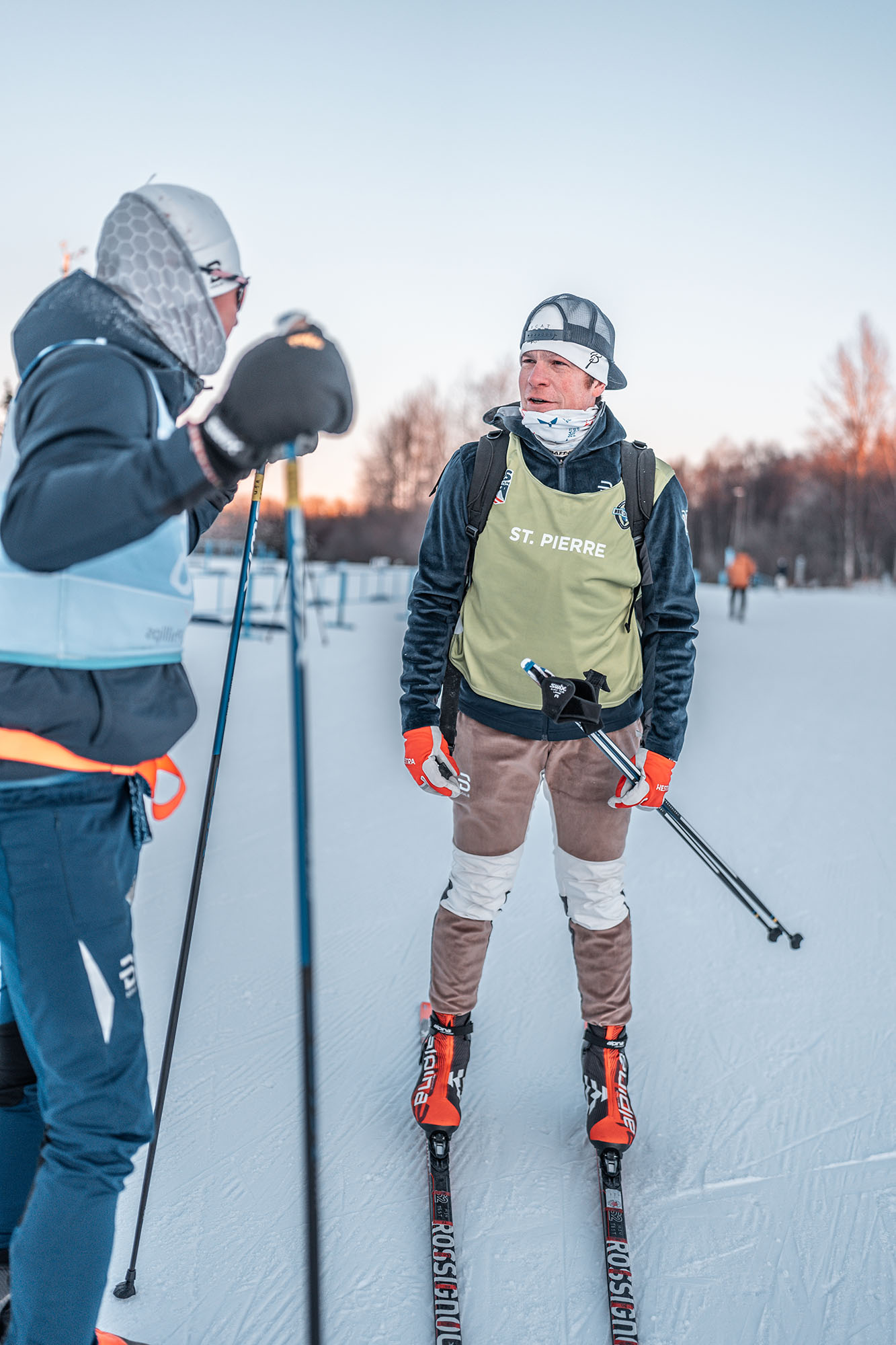
Adam Coaching at US Nationals in Alaska. (Photo: Tobias Albrigtsen)
Adam St. Pierre finished second to last in the first cross-country ski race of his life. The one skier he beat had crashed into a tree.
He was a sophomore at Fall Mountain Regional High School, a rural school in Charlestown, New Hampshire, and he tells the story with the flat delivery of a man who has told it before and enjoys it every time. “Charlestown doesn’t really have a claim to fame,” he said. Forty-five minutes due south of Hanover, close enough to know Dartmouth was up the road, far enough that the world of club skiing might as well have been on another continent. He had never heard of it. What he knew was soccer, basketball, and track, in roughly that order, and he had no intention of adding a fourth sport that involved falling down in the cold.
Then his freshman year fell apart. He hurt his knee playing soccer. He slogged through a basketball season he had come to hate. And in the spring, his track coach, who happened to also coach the ski team, made him an offer that sounded reasonable at the time. Come out for skiing next winter, the coach said. It will get you in better shape for soccer and track.
So he showed up. That first race was a classic race, and he had only ever skated. He survived it, barely, ahead of the kid who met the tree, and somewhere in the weeks after, the thing that has kept a lot of people in this sport quietly got its hooks into him.
Fall Mountain was not a fancy place, and that turns out to be central to the story. It was a working rural school with a barn, animal husbandry classes, agricultural mechanics, a metal shop, and forestry classes that maintained the trails and tapped the maple trees where the team ran and skied. The ski coach was the metal shop teacher. When the program needed grooming, the metal shop and ag-mechanics kids bought an old PistonBully and kept it running themselves. St. Pierre came up through a program held together by shop-class ingenuity and a snowbank at the edge of the football field, and he has never once been snobbish about it.
“I have a high respect for high school skiing, because it is an entry point,” he said. “Otherwise I wouldn’t have found the sport.”
A team that needed a fifth man
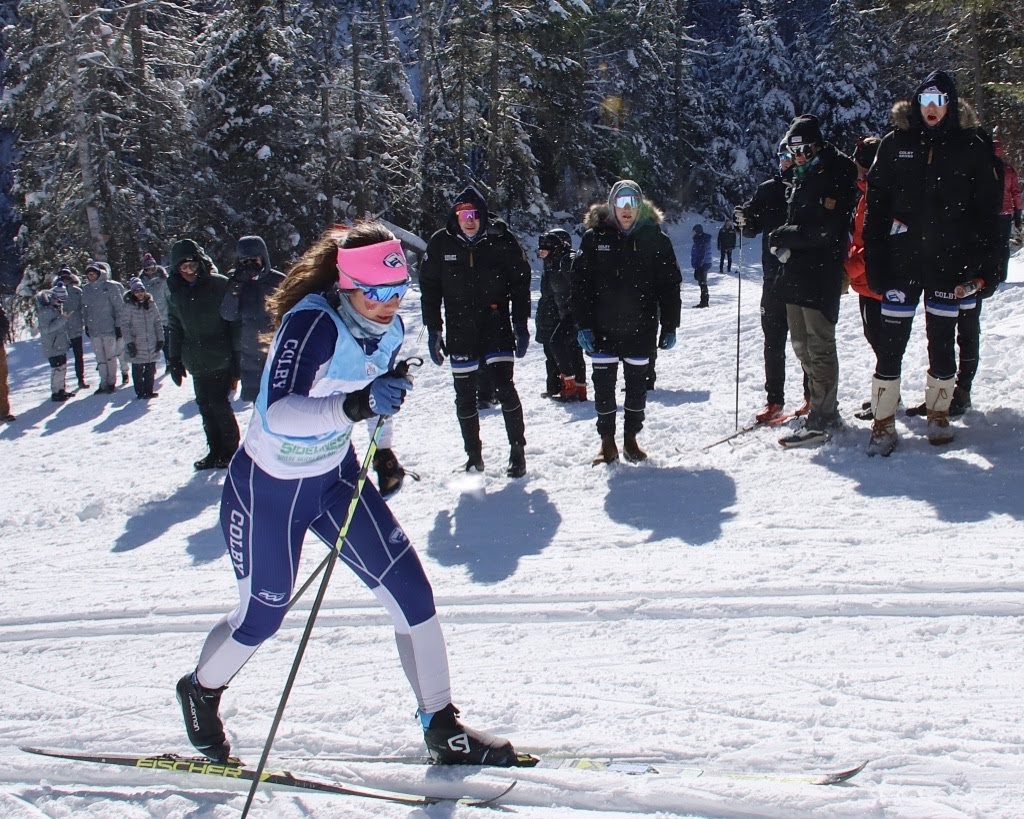
He nearly didn’t find the next part either. Right before he graduated, his coach, Larry Sayers, told him that Colby College’s ski team wasn’t very good and that St. Pierre could probably walk on. He filed it away and didn’t think much of it. He had his sights on soccer and track. But once he got to Colby and started running into the skiers at various events around campus, something clicked, and it had nothing to do with the skiing.
“These are the kind of people I like,” he remembered thinking.
The timing was almost comically good. The coach, then Tracey Theyerl, now Tracey Cote, was 29 and in her second year running the team. She had just cut most of the upperclassmen, which left her with four men and an opening. St. Pierre walked on as the fifth. His introduction to roller skiing came shortly after, when Cote put him on a pair of classic roller skis and sent him out for a time trial. “I survived,” he said. From that point on, he was in, and again, the pull was the people as much as the training.
Adam St. Pierre (left) and former Bowdoin skier and BNJRT coach Sam Shaheen at the start of the 2019 American Birke. (Photo: courtesy Adam St. Pierre)
From the lab to the wax room
He majored in physics at Colby and minored in biochemistry, and when he graduated, he had no clear idea what came next. He looked at teaching jobs. Nothing landed. Then a skier friend from high school told him about a graduate program at the University of New Hampshire where, as St. Pierre understood it, they paid you to study exercise. That sounded like a good deal. He enrolled in a master’s program in kinesiology and exercise science, working under a UNH physiologist whose research centered on hydration and thirst. His thesis was, in his words, pretty brutal to run: sensations of thirst in dehydrated subjects in cold versus ambient environments. “A little bit of everything when it comes to making people uncomfortable,” he said.
It was during those UNH years that the sport handed him his first coaching job, and it did so in the roundabout, relational way that his whole career seems to follow. He had started dating a Bowdoin College skier while he was at Colby. She was a year behind him, still racing, and he was driving up to Brunswick most weekends to see her. Her coach was Marty Hall.
Anyone who knows North American skiing knows the name, yet St. Pierre’s version of a Marty Hall story is smaller and more human, and it starts with the legend sizing up the kid who kept turning up in his wax room.
“I need an assistant coach,” St. Pierre remembers Hall telling him, and he does a passable Marty voice when he gets there. “And you’re up here every weekend anyway. You want the job?”
He took it. He thinks he was paid around 1,500 dollars total, which covered the gas. He coached under Hall for two years, and it confirmed something he had already begun to suspect: he wanted to spend his life doing this.
Adam and his family out for a ski.
Building from the bottom in Boulder
When his wife got into law school at the University of Colorado, the two of them moved to Boulder, and St. Pierre walked into the next accident of his career. He had been hired to be the head coach of the Boulder Nordic Junior Racing Team, replacing Eric Pepper. Then Pepper decided to stay. Rather than lose St. Pierre, the club invented a role for him and made him its first development coach, responsible for the youngest kids, the u14s and u12s, or as they were then called, the j3s and j4s. Many of them were the little siblings of the older racers. His whole job was to grow the program from the bottom.
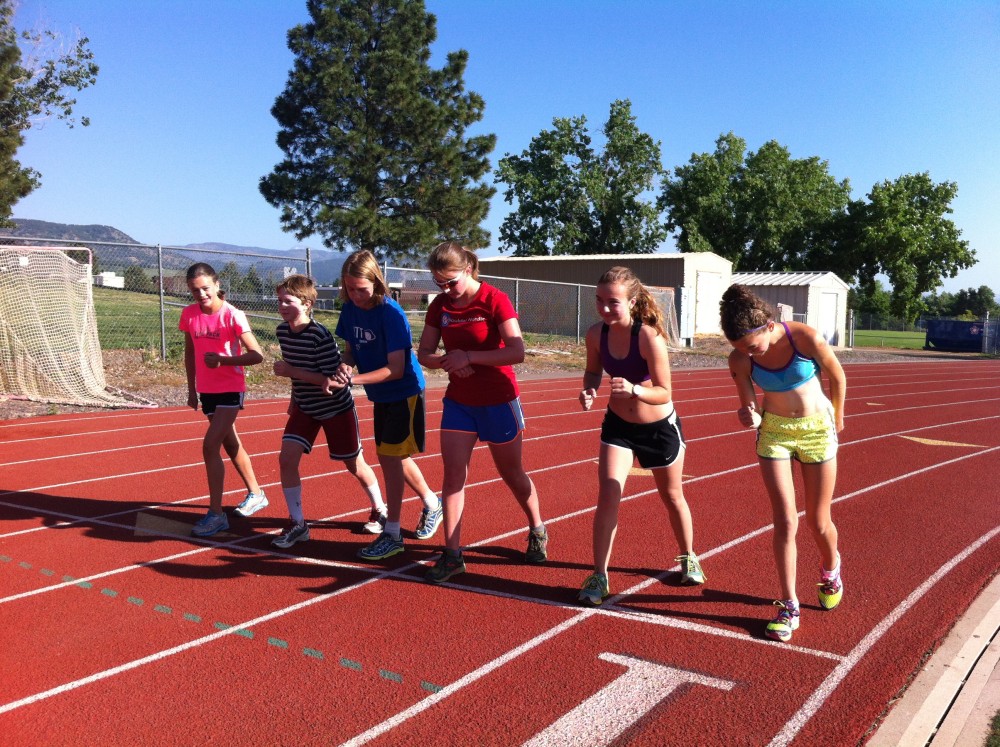
Boulder Nordic Junior Racing Team athletes prepare for the start of a 3,000 kilometer running time trial on the track in 2013. (Photo: Adam St. Pierre)
He did. When Pepper eventually moved on and St. Pierre took over as head coach and program director, he watched the club climb from 15 or 20 kids to nearly 70 at its peak, in a place he is quick to say is a genuinely hard town to be a skier. There is no snow in Boulder itself. You drive for it, and it is expensive, and the parents who commit anyway earn their real respect.
One of those little kids was Lauren Jortberg. St. Pierre started working with her when she was six or seven, and he coached her through high school. She was, by his telling, agonizingly consistent at exactly the wrong number: four straight Junior National Championships and 11th place in what felt like every race. “All she wanted was that top 10,” he said. She had setbacks. She stuck it out.
Years earlier, in his first season of coaching in Boulder, St. Pierre had said out loud that one of his goals was to someday coach a kid who would reach the Olympics. This past February, Jortberg made the U.S. team for the Milano-Cortina Games and qualified for the quarterfinals of the Olympic sprint, the culmination of a long and interrupted road that ran through back surgery, ankle surgery, and a lost senior season at Dartmouth. St. Pierre is careful not to claim more than his share.
“I can’t take responsibility for much,” he said, and then, a beat later, “Goosebumps. Proud of her.”
Boulder was where the rest of his professional life took shape, too. He worked at the Boulder Center for Sports Medicine as a clinical physiologist, running lactate thresholds and VO2 max tests and metabolic evaluations, and working alongside physical therapists on running biomechanics, teaching and reteaching people how to run without breaking. He got into ultrarunning and knocked off a number of 100-mile races, mostly for the pleasure of being out in the mountains all day. Around 2016 or 2017, he left the Boulder Nordic team and hung out his own shingle as an online coach. The flexibility made sense with two young kids and a wife commuting to Denver. But he missed the in-person part, the standing-in-the-snow part, more than he expected to.
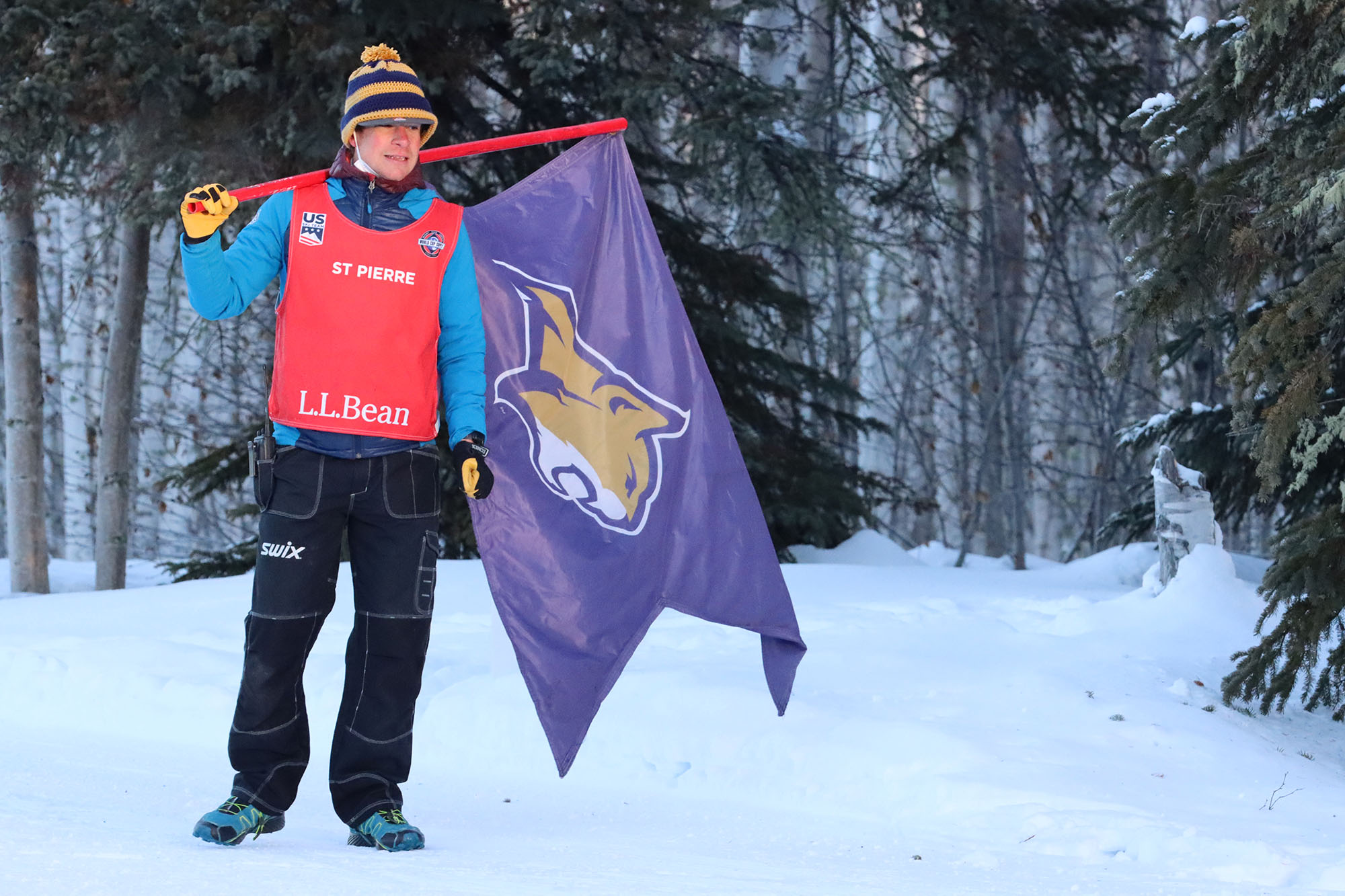
Adam repping the MSU team flag in Houghton, Michigan. (Photo: Tobias Albrigtsen)
The job he had been aiming at
He had known for a long time where he wanted to end up. College coaching had been the goal since around 2009. The appeal was simple: at the junior level, a coach spends a lot of energy convincing kids they might want to be ski racers, keeping every other door open in case they choose running or mountain biking instead. At the college level, the athletes have already decided. “They’ve decided they are cross-country ski racers,” he said. “I wanted to coach ski racers.”
The Montana State job had come open once before, in 2015, and he had applied and been the runner-up. When it opened again during the strange fall of 2020, he jumped. He was hired that November and moved to Bozeman alone that winter while his wife and kids finished out the year in Boulder, riding out the online-school chaos he credits her with surviving. The family joined him the following June. Bozeman had been near the top of the short list of places they wanted to live anyway, a real ski town with snow in town, Crosscut 20 minutes up the road, and Bridger Bowl close enough to grab powder runs before cross-country skiing in the afternoon.
Which is to say, the kid who finished second to last, who backed into the sport to get in shape for soccer, who took a coaching job largely because he was already driving to Brunswick every weekend, ended up exactly where he had been quietly aiming for a decade. The path was accidental in its particulars and not accidental at all in its direction. He kept following the people, and the people kept turning out to be skiers.
What he does with those skiers once he has them, and why he thinks so much of American training gets the easy days wrong, is its own story. That is part two.
Help Support Our Coverage!
If you value the thoughtful work and access FasterSkier provides, please consider becoming a Voluntary Subscriber. Your support directly fuels our work to cover the people, places, and moments that make our sport special.
Where do High School and USCSA programs fit into our development.
In a recent article, I laid out the disconnect between what we say about long-term development in Nordic skiing and what we do and the rewards. “Long-Term Development in Nordic Skiing: What We Say vs. What We Actually Do”. Most people that I talk with agree with the premise of long-term development and keeping youth in sport longer. None of this is particularly controversial. We all understand that endurance development, technical skills and learning how to race takes years. We now see this statement across virtual all endurance sports world, that early results are a poor predictor of long-term success.
So, if we assume there is a consensus then we must ask why the system seems to act in the opposite way. Because systems don’t reflect what we say. They reflect what we reward through early selection, for competition and training opportunities. That’s really the question sitting underneath all of this.
We’ve reached a point where there’s broad agreement on philosophy. Long-term development matters. Early results don’t predict long-term success. Endurance, technique, and racing ability take years to build. You hear that all endurance sports now, not just skiing.
None of that is controversial!
But if that’s true, then we have to be honest about what follows. Because systems don’t reflect what we say. They reflect what we reward. And right now, the system is still rewarding something very different.
The incentives tell the story.
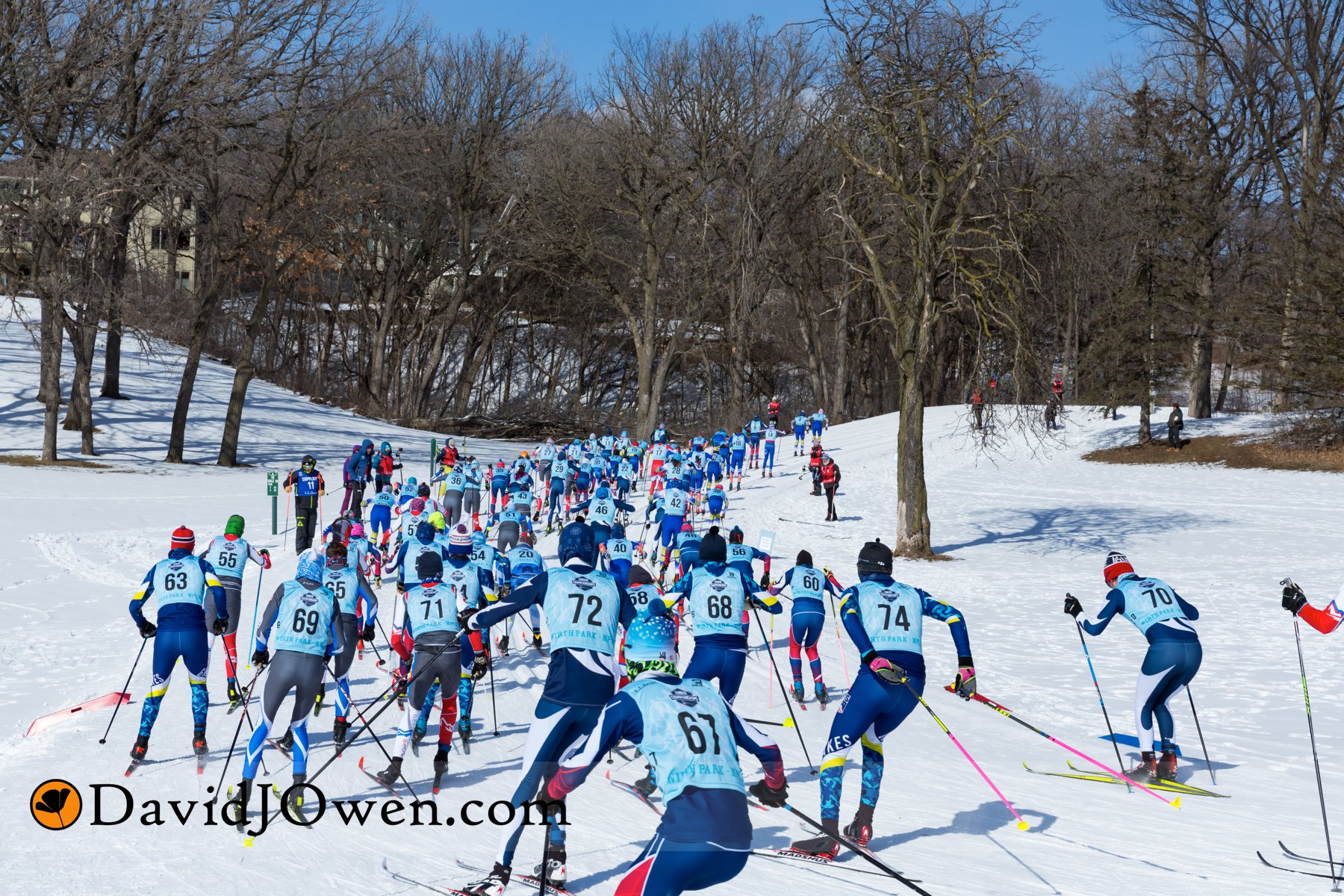
Skiers from all over the country round the first corner of the Theodore Wirth Park course in the U16 Boys 5 k Classic at Junior Nationals in Minneapolis in 2022. (Photo: David J Owen Photography)
Junior skiing in the U.S. is quietly organized around early selection. Qualification for Junior Nationals, especially at U16 and younger, carries weight. Rankings matter. Opportunities follow results. No one would say that’s the goal. But it’s the outcome.
Athletes see it. Parents respond to it. Coaches feel it. And none of that is inherently bad. But when those forces align around early results, the system starts to tilt. Short-term performance carries more weight than it should. And over time, that shows up in participation. The fields in USSS junior races get smaller as the age groups progress. We can debate why, but we can’t ignore that we’re losing athletes along the way.
The earlier we start selecting, the earlier we start excluding, selecting out athletes. And in a sport like skiing, that’s a problem. Development is long-term, non-linear, and tied to maturation in ways we can’t reliably predict. So, when we sort athletes at 13, 14, or 15 years of age, or younger, we’re making decisions on incomplete information, and treating those decisions as if they’re meaningful. They’re not!
What we’re really doing is narrowing the pathway at the exact point where it should be widest. If we believe in long-term development, early stages should include more athletes, not filter them out. We don’t lose athletes because they lack talent. We lose them because they stop seeing a path or opportunities forward.
That loss doesn’t always show up at the top. At the elite level, we can always point to success and say the system works. And in a narrow sense, it does. Every system produces some high performers. But that’s survivorship bias. But even with the perceived success, it is clear that most of those who step onto the World Cup are not prepared and developed for that level of competition, or we see an erosion of their performances over several years.
What matters more is what happens in the middle. Over time, that middle erodes. Fewer athletes stay. Fewer develop later. Fewer are still around when their best years should begin. And once they’re gone, they’re gone. So, how do we grow the sport and improve the development system? Following are a couple of ideas for the integration of high school and college skiing.
Stillwater senior Jessie Diggins, right, finishes ahead of St. Paul Academy senior Annie Hart in the 2010 edition of the Minnesota State Meet. (Photo: MSHSL Archives)
This is where the high school system should come into focus. Whether we acknowledge it or not, it’s one of the most influential environments in the entire pathway. We’re talking about roughly 6,500 high school athletes, compared to about 2,100 in the USSS junior system. That alone tells you something. Most athletes are not in the club pipeline. And there’s very little overlap between the two, in some regions more than others.
So now you have two systems, often operating in parallel, sometimes in conflict, shaping the same athlete. The club system is year-round, often very expensive, which creates barriers, and it is tied to rankings, qualifications, and progression. Ideally, at least in theory, it is long-term focused. The high school system is seasonal. Compressed. Built around immediate competition, conferences, regional, and state.
Both have value. But they’re not aligned. And when systems aren’t aligned, the athlete’s abilities are often put in difficult positions. High school seasons are short. That compresses everything. Training, racing, recovery, all of it gets stacked into a three-month season.
And yet, high school skiing also gets something right that the system needs more of. It creates a connection. It lowers barriers to entry. It brings athletes into sport who might never join a club. It makes skiing social. It makes it fun. Those values matter!
Athletes who feel connected to a team stay in the sport longer. That alone makes the high school system one of the most valuable pieces of the entire pathway. The issue isn’t that it exists rather it is not integrated, where do those high school skiers go after high school, an assumption may be many go into the non-integrated USCSA programs.
If that gap exists in high school, it becomes even more obvious at the college level.
Because this is where the pipeline either tightens or disappears. On one side, you have NCAA skiing. Roughly 20–25 programs. Maybe 300–400 athletes. Small, but structured, providing consistent coaching, clear expectations, and daily training environments that align with the demands of sport.
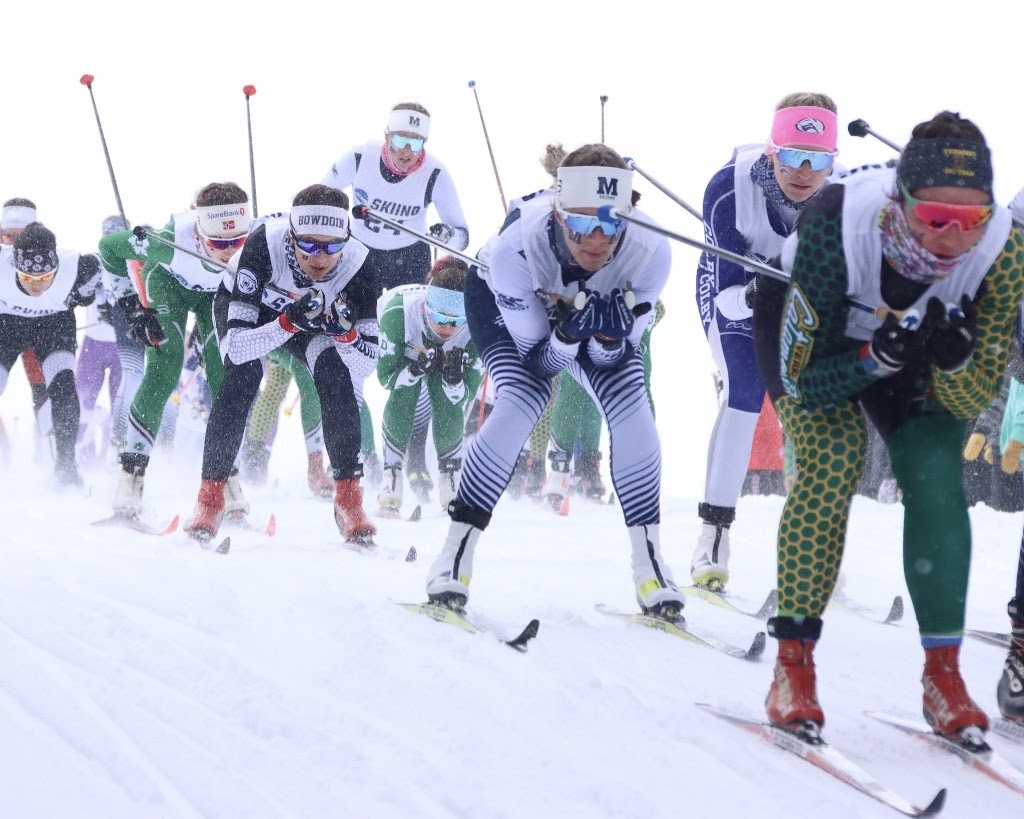
On the other side, you have USCSA. Thousands of athletes. Hundreds of active racers. A much broader participation base. So yes, USCSA is far bigger. But the NCAA is more efficient. In NCAA programs, a higher percentage of athletes improve year over year. More reach FIS relevance. More stay on a performance trajectory. That’s not because they’re inherently more talented. It’s because the environment supports development. Training is consistent. Coaching is present. Progression is clear.
USCSA shows the opposite. It’s not only a talent problem. It’s a structural problem. You have hundreds of athletes still in the sport. Many have endurance backgrounds. Many are still within a trainable window. But training is inconsistent. Coaching is variable. Development isn’t systematized. And there’s no clear bridge to higher performance levels. So, the conversion rate stays low.
This is where the pipeline argument starts to fall apart. We tend to focus on the front end, getting more kids into the sport. But at the USSS level that has been ineffective at best. And missing the fact that we already have athletes in the system that aren’t welcome or integrated. High school skiing, USCSA, represents a large participation pool sitting right in the middle of the development pathway. What we don’t have is a system that consistently integrates and develops them.
So, what actually needs to change? Not the philosophy, it seems we already agree on that. What needs to change is how the system behaves across the junior and collegiate level, it means recognizing where the opportunity is not just in the NCAA pipeline, but in the larger, under-structured USCSA system that already exists.
Even if we integrated the high school athletes and the USCSA athletes into the USSS system, the sport is still tiny. But it seems growing the sport significantly beyond this level is unlikely so we should be looking for ways to include these athletes in the system as much as possible for those who have an interest.
There are athletes in the system right now, thousands of them, who could or have the potential to improve dramatically beyond high school. Some who could enter the sport late and still become competitive.
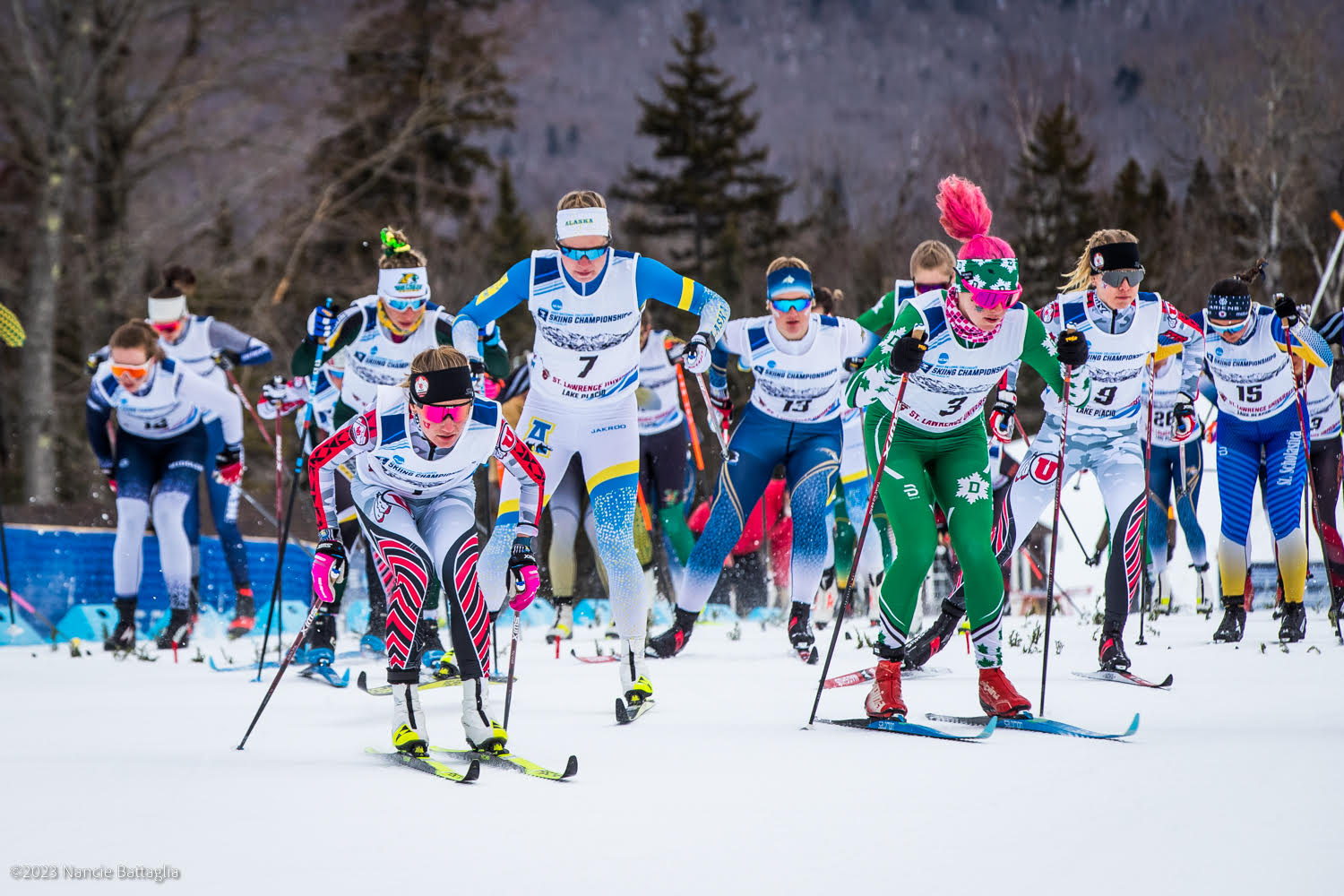
Novie McCabe controlled the pack for much of the 20-k mass start at the 2023 NCAA Championship in Lake Placid, New York. McCabe became just the fifth three-time NCAA Women’s Champion with her win. (Photo: (c) 2023 Nancie Battaglia)
At some level, this comes down to a simple choice. Do we want a system that identifies and benefits early performers? Or one that develops athletes over time? Right now, we say the second. But too often, we operate like the first. And the differences are real; we can see it by who improves, who stays in the sport, and when athletes exit the sport.
We don’t need to overhaul everything. There’s a lot in the system that works. High school brings athletes in. NCAA shows what structured development can look like. Even USCSA shows us how much untapped potential is sitting there.
But without alignment, those pieces don’t add up. So the question isn’t whether we understand long-term development. It’s whether we’re willing to build a system that actually supports it. Because if we are, the path forward should be clear.
And if we’re not, we should at least be honest about what we’re choosing instead.
Help Support Our Olympic Coverage!
If you value the thoughtful work and access FasterSkier provides, please consider becoming a Voluntary Subscriber. Your support directly fuels our work to cover the people, places, and moments that make our sport special.
On an ordinary winter afternoon in Fairbanks, before NCAA titles and World Cup bibs and FIS profiles, there was just a loop—eight hundred meters of snow and one long, unforgiving hill.
Middle-school Kendall Kramer skied it after class, day after day, with her dad. Birch Hill. Blue Loop. One big climb, same as yesterday, same as tomorrow. What changed was how it felt.
“We would just go for, like, 30 minutes after middle school every day,” she remembers. “And I remember really liking the feeling of this specific loop in Fairbanks at Birch Hill called Blue Loop. It’s like 800 meters, but it has this really big, steep, long hill. And we would do that every day. And I became really addicted to feeling like the hill was easier to get up every single day.”
Kramer didn’t start as the kid who loved hard things. She started as the kid who had to be bribed—stickers, money, chocolate, extra iPad time—just to go outside with her very active dad, a former Washington State runner who picked up skiing when he moved back home to Fairbanks.
“I really didn’t like hard things. I didn’t like pushing myself. I didn’t like going outside. I didn’t like athleticism,” she says now, half amused, half incredulous. “I was into theater, and I went to art camps, and I went to fashion designing and sewing camps, and I was just doing a bunch of art stuff until seventh grade.”
The shift did not come from some early, noble desire to maximize her potential. It came from middle-school social dynamics: her best friend and the “cool, funny kids” were in the local ski club, FXC. They were getting strong; she wanted in.
“All of the cool, funny kids, and my best friend, were on the ski club FXC,” she says. “I noticed that she was getting really muscular. And, I want to get muscular too. That was literally my motivation. I wanted to spend more time with my friends.”
So she flipped the script. The kid who once needed bribing was suddenly begging to ski. “In middle school, I asked [my dad] to take me skiing every day,” she says. “I liked the feeling of the work I was putting in quantifying to something. You don’t get that with everything in life.”
That tiny addiction—to feeling the hill get easier—would quietly rewire the course of her life.
Running Into an Identity
Before she thought of herself as an athlete, there was one race that hinted at what might be possible: a local 5K in eighth grade.
“There was this one race,” she says. “There was this local 5K, and I won that. And I beat a UAF girl. And I was in eighth grade. And so then I thought, oh, I could start training for another level at this.”
It’s a funny hinge moment: a middle-schooler passing a college athlete on a random Fairbanks course—”I think it was the Chena River Run 5K”—and suddenly reevaluating what “participation” might mean.
From there, skiing and running braided together. Everyone in her circle seemed to do both—cross-country in the fall, cross-country skiing in the winter, track in the spring. The sports gave structure to adolescence. They also gave her a first glimpse of what high-level results feel like: she made Junior Nationals, then Junior Worlds, and at 16, in her first year there, she finished fourth.
It looked, from the outside, like a linear rise.
It wasn’t.
Kendall Kramer on her way to fourth place in the U20 15 k classic mass start at World Juniors in Lahti, Finland. (Photo: Doug Stephen)
Burnout at the Top of the Podium
The breakout year rolled into something heavier. Right as college coaches were calling and scholarships were appearing, Kramer’s relationship with skiing began to fracture.
“After my breakout year, I went through a large burnout of skiing,” she says. “Looking back, maybe kind of predicted with how huge a jump it was… but I went through a huge burnout that happened to coincide with my senior year of high school.”
She was in the rare position of being heavily recruited and deeply ambivalent about the thing doing the recruiting.
“I didn’t want to do any athletics,” she says. “I wanted to go to school. I just wanted to do academics. I only applied to Ivy League colleges, [but] I didn’t get into them.”
The plan, as she saw it then, was to walk away from elite sport altogether. No more ski clubs, no more interval sessions, no more World Juniors. She would be a student, full stop.
But mid-winter, another pivot arrived. Running, with its promise of a single daily practice and a more contained lifestyle, began to look like a compromise.
“I was like, I’ll run,” she recalls. “I really feel like I could have a balanced life if I just ran in college. I might as well do something athletic.” She started talking “very seriously” with Northwestern—”for quite a few months,” she says, laughing at how she kept mixing it up with Northeastern.
Still, skiing lurked in the background. Friends were planning official visits. There were trips to New England—Dartmouth, UVM—to meet both ski and running coaches. “We worked out a plan for me,” she says of Dartmouth, “like what days I would go to running practice, what days I’d go to ski practice, how I would do all of that.”
In those conversations, UAF—her hometown university in Fairbanks—barely registered as a serious option. If anything, it was the anti-option.
“There’s a FasterSkier article where [Jason Albert] interviewed me my senior year of high school,” she says. “I did say, ‘Oh, I’m definitely not going to UAF.’ Because I need to get away. Just like every high school senior.”
The only reason she even agreed to visit was for social reasons. “I had a bunch of friends at that time… they were also going on an official visit, and I wanted to hang out with them at UAF for that weekend,” she says. “I was like, ugh, okay, fine, I’ll go to UAF for the weekend.”
That reluctant trip changed everything.
Choosing the “Wrong” School
UAF did not look like the kind of program that impresses strangers in an Instagram bio. It looked like something else: a coherent life.
Kramer noticed first what happened away from intervals and wax benches.
“The team I felt really… not only got along just at practice, and practice was fun, but they chose to hang out with each other as people outside,” she says. “They really felt genuine about it. They are really friends with each other. They actually care about each other. They’re having fun. They’re all a little bit weird.”
The second revelation was structural. At UAF, running and skiing weren’t two programs negotiating over a dual-sport athlete’s time. They were one.
“At UAF, it’s literally one program,” she says. “We share a locker room and a team room, and the coaches have their offices in the same room. Like, it’s really the same program, cross-country running and skiing.” While coaches at other schools were willing to coordinate, the Fairbanks setup was seamless. “I barely had to, like, go out of my way. I didn’t have to change my training at all with UAF, and that was really valuable.”
There was also something less tangible: the sense that staying close to home might be protective at a time when she was “really… sensitive mentally.”
“This is really a tumultuous time for me,“ she recalls thinking. “I can stay close to home. I don’t have to change too much while I’m in this mental state. I can see my family every single week. I think that would be a really good move for me.“
From the outside, it didn’t fit the script; hometown program, Div. II running, and a school she had publicly ruled out. She knew people would talk.
“Of course, people, you know, judge me for staying in my hometown,“ she says now. “People still are like, ah, you needed to finally leave Fairbanks. You need to get out. But I know that didn’t sound the best, that I’m going to UAF, because it’s not ‘the‘ program. But I’m really glad that I let what things ‘sound like‘ go, because it gave me a lot of happiness, and it made me feel like it was my choice.“
Reverse Podiums and the Slow Build Back
UAF didn’t magically solve everything. Her first years there were heavy.
“My first two years, not only was I recovering from burnout and not wanting to go to practice at all and really trying to get back into sport my whole freshman year of college,“ she says, “I was also super overtrained, and I could not go fast for the life of me. I think that I was getting a ‘reverse podium’ in my Western college races.“
The COVID year wiped out her first NCAA running season entirely—”there’s just no running races held,“ she notes. In skiing, she salvaged an All-American by the end of winter, but the trajectory felt nothing like her high-school ascent.
If her junior years had been a rocket ship, college was more like a slow climb back onto the trail.
“Luckily, I feel like one of my strengths athletically, besides that, blip, is consistency,“ she says. “I did feel like it was a gradual buildup leading up to my last year at UAF, where both [sports] were progressing from that low burnout point.“
On the running side, her NCAA results tell the story: 170th in her first nationals, then 8th—”because it was cold and super late, so I was already in ski form”—then 20th, then runner-up in Sacramento. She says, simply, “That was really cool.”
In skiing, she went from anonymous trips to the NCAA Championship to a national title. Before that win, she says, “I don’t think I got better than seventh at other NCAAs.“ Last March, she finally broke through and won.
It wasn’t a straight line. But it was, in its own way, a larger version of the Blue Loop lesson: keep showing up, let the hill get fractionally easier, trust that one day you crest the top.
Two Degrees, One Classroom
Through all of this, Kramer was not just an athlete. She was building an intellectual life, too.
“Yes. Biology, specifically, arctic ecology, which was cool. And psychology,“ she says, almost offhand, when asked about her majors.
The combination sounds eclectic until she explains her real career ambition.
“It seems unrelated to both of them,“ she says, “but it is actually related to both of them, as I want to teach.” She’s not yet sure about age group—”I am leaning towards high school”—but the vision is clear: “I want to teach high school science and high school psychology. I think [that] is a way to be still involved with both of my subjects.“
This is not a vague, post-sport idea. She’s already testing it. This year, while racing and training out of Anchorage, Kramer has been substitute teaching.
“I’ve been substitute teaching, actually, this year in Anchorage,“ she says. “That’s been really cool. That’s exposed me to that, and I have really confirmed that it’s something that I enjoy going into, and I feel fulfilled after I do the job, and I really enjoy it, and it’s something new every day.“
The logistics fit surprisingly well with elite training. Kramer logs into the Anchorage School District’s database, looks a week ahead, and drops half-days into the white space between sessions.
“You can go into the online database every week,“ she explains. “You’re like, oh, I don’t have training Monday, and it’s on your own Wednesday, and we have our afternoons off on Thursdays, so I could do all those days. And then you just sign up for what you can do.“ Elementaries offer half-days—”like 11:30 to 2:30″—which sit perfectly between morning and afternoon workouts. “It’s really good pay,“ she adds, “and that’s completely in between the two sessions, so it’s really been perfect.“
There is also a deeper satisfaction. “I think it’s a really respectable career,“ she says of teaching. “I think that it’s… one of the pillars of society. And so I would feel really fulfilled every day doing that.“
It makes the future feel less contingent on a result sheet.
“In my personal life aspect,“ she says, “to know that I have a career available for me at any time that I want to take it, that I really am passionate and excited about, not just something that pays a bill… I’d be perfectly fine if I were doing that.“
The Type-A Gap Year
Kramer did not grow up assuming she would ski professionally.
“I still am… it was a surprise to me that I am even skiing past college,“ she says. “I really was planning on, you know, doing my absolute best through college, but ending on a high note.“
This season, now that she’s graduated, is something different: “an experimental year in the first place of just trying out professional skiing, giving myself, like, a gap year of sorts and seeing how it plays out.“
She is grateful that the experiment is optional, not existential.
“I’m really grateful to have some educational and career stuff that I really am also passionate and fulfilled by to fall back on,“ she says. “If along the lines [skiing] becomes not what I’m enjoying anymore… I really am enjoying it right now, so that’s what I’m finding in my gap year, I guess. But yeah, I really am taking it year by year.“
It’s an outlook that sits a little oddly with the logistics of the World Cup, where you can’t plan a life too far in advance. Her personality wants spreadsheets; the selection system gives you “we’ll tell you Sunday.“
“I’m extremely Type-A,“ she says, laughing at herself. “I packed my ski bag for this Europe trip, like, two weeks before I left. And everyone I was asking what skis they’re bringing, they’re like, ‘I haven’t even thought about it.‘ I like to plan months in advance for things.“
Right now, as she races into mid-winter, that Type-A planner is bumping against the uncertainty of World Cup selection. Tour de Ski rosters, for example, are announced three days after Davos.
“I haven’t necessarily done something that makes it, like, super obvious that I’m going to Tour de Ski,“ she admits. “I haven’t gotten a top 30 or 20 or whatever. And so I’m actually completely unsure. I’m definitely having a freak-out situation where on Sunday night, when I finish my Davos race, I don’t know where I’m going.“
She’d love to do the Tour—”I would take the opportunity… if it’s granted to me”—but she’s honest that she hasn’t hit the automatic criteria, and that there may be Lake Placid nationals in her near future instead. “There are no bad options,“ she says, sounding like someone who has practiced this perspective.
Kendall Kramer (USA) racing the 10 k Freestyle this past weekend in Trondheim (NOR). (Photo: Modica/NordicFocus)
Racing in the Deep End
On paper, her World Cup results this year might make casual fans nervous: numbers in the 30s and 40s, no breakthrough into the top 20—yet. From inside the bib, it feels very different.
“I feel like I have done really good races,“ she says. “I felt like I could push every second. I feel like I’m recovering really fast. I feel strong in my skiing. I’m really liking how I’m taking the races, and I’m going absolutely as hard as I can.“
What’s changed, she says, is her understanding of context.
“I think that it’s opened my eyes to… how things look on paper on a ski race,“ she says. “People back home have maybe been watching, and they’ve seen placement numbers near my name that they haven’t seen before… And I don’t think that people understand the context of the strength of these athletes that we’re against here.“
Everyone is there in Period 1. Everyone is fit. Everyone is fighting for the same 0.3 seconds.
“Even though we are strong and fast as well,“ she says, “that’s just where we’re ending up in this pool of really… the strongest and fastest in the world.“
Kendall Kramer (USA) on her way to 18th place in the 10km Freestyle iin, Cogne (ITA) last February. (Photo: Authamayou/NordicFocus)
Still, the goals are clear. “I definitely go into any World Cup wanting a top 30,“ she says. “That opens a lot of doors for the national team… I have reached that level before,“ she adds, noting her 18th in a World Cup 10K skate last year. “Top 30 is a pretty sweet spot.“
She is also honest about the practical stakes. “Top 30s will get you nominations for more things,“ she says. “That’s a really good number.“
On the Olympic question, she doesn’t dodge.
“Yeah,“ she says when asked if making the team is a big goal. Then she pauses. “I’m trying to… so far, I could just take it weekend by weekend. I really hope that by doing my best every single time and making the correct decisions, it can build up to that, and I can do well enough to earn a spot there. But I’m not going to define if my season was worthwhile or if I’m a talented athlete or whatnot on that.“
It’s not that she doesn’t care. It’s that she refuses to let a quadrennial selection meeting be the sole judge of her life.
Kendall Kramer (USA) – racing the Mixed Relay in Engadin (SUI) last January. (Photo: Authamayou/NordicFocus)
Process Over Podiums
If you want to understand how she’s trying to get there, you don’t look at the results sheet. You look at the small, specific things she’s attacking.
“I’m trying to be braver on downhills,“ she says. “I’ve always been very cautious because I think I’ve just had too many instances where I’ve tried to be crazy on something, and then I break something, and it ends up costing more time than if I just skittered a little bit.“
She’s working on classic technique so she doesn’t feel like she’s “just flailing around and fighting my kick all the time.” She’s learning to lean into the brutality of World Cup individual starts, where a tenth of a second can be the difference between important FIS points she is chasing.
She is, perhaps unsurprisingly, an individual-start partisan. Mass starts have burned her before.
“In every Junior World mass start race, I’ve had somebody knock into me and break my pole, and then I’m out of it,“ she says. “Or I fall, and I’m out of it… Your race was defined by someone else.“ On the World Cup, she loves that an individual start feels like “how I ski the course against how other people ski the course, as opposed to if you’re in the right place at the right time.“
She also wants something simpler: volume.
“I really want to take every opportunity presented to me,“ she says. “I really like to race, and I like being in the thick of race season. I want to race a lot, and I feel like I’ve built up now a tolerance to building on a lot of races.“ For the first time, she’s planning to carry a full season through the SuperTour Finals. “I want to have a real ski season like the rest of the skiers who start racing in December instead of August… and keep myself together through the end of Spring Series.“
It’s a small, quiet ambition. It’s also a radical one in a sport where so many seasons end in March with more relief than joy.
Kramer racing the World Cup 10 k Freestyle in Minneapolis (USA). (Photo: Modica/NordicFocus)
The Hill, Again
These days, Kramer spends more time on World Cup courses than on the Blue Loop. The hills are longer now. The stakes are higher. There are TV cameras, FIS points, and spreadsheets full of criteria that will determine who gets a call before the Olympics.
But if you strip all of that away—if you put her on a snowy climb and ask what she’s chasing—it doesn’t sound all that different from the middle-schooler trying to make it to the top without stopping.
“I like the feeling of bettering myself,“ she said of those first, shaky loops at Birch Hill.
This fall, between substitute teaching shifts and Type-A packing lists, and this winter between Tour de Ski uncertainties and top-30 dreams, she is still chasing that feeling: the knowledge that the hill is getting a little easier, and that the life she’s building, with two degrees, one dream, and a classroom waiting, makes sense no matter what the result sheet says.
Love Stories Like This? Help Keep Them Coming.
Feature stories like this one take time, access, and care to produce. If you value thoughtful storytelling and independent ski journalism, please consider becoming a Voluntary Subscriber. Your support directly fuels the work we do to cover the people, places, and moments that make our sport special.
On a bright March afternoon at Dartmouth’s Oak Hill, with a soft and slow course under his skis and a band he himself had organized blasting in the stadium above, John Steel Hagenbuch approached the final climb where he learned something that would shape the early years of his career far more than any podium ever could.
He had come into the NCAA Championships with the weight of a thousand private dreams — a home championship crescendo and an entire community behind him. Then, with Utah’s Joe Davies charging to the finish line waving the Utes flag and Peter Graves’ voice echoing through the trees, Hagenbuch realized he was not going to win.
“I got dropped, and it just wasn’t gonna happen,” he says. “I told myself, you’ve got until the top of this hill to be upset about it.”
John Steel Hagenbuch was all smiles after crossing the 20k Freestyle finish in second place at the 2025 NCAA Championship where he represented Dartmouth College on their home course at Oak Hill. (Photo: Courtesy Photo)
What happened next wasn’t the reaction of an athlete who had just been beaten in the race he’d been thinking about, talking about, training for, and dreaming about for three years. It was something quieter. Something older. Something that didn’t look like the scripted champion he’d imagined — but ended up becoming the cornerstone of the athlete he is now.
“I stopped poling,” he says. “And I just kind of skated through the stadium… smiling, waving, like the Penguins of Madagascar — smile and wave.”
He remembers the sunshine, the thousands of people lining the stadium, the Stripers — Dartmouth’s biggest student band, coaxed back from post-graduation life because he wanted the place to feel alive — and the thrum of friends, professors, fraternity brothers, and family in the crowd.
“Did I win the ski race? No. But it actually didn’t matter,” he says. “I was just so grateful… all the amazing things in my life that had led me to that point.”
Every day since, he thinks about that race. “But not for the reasons you’d expect.”
John Steel Hagenbuch (USA) racing the World Cup opener in Ruka (FIN) in 2023. (Photo: Modica/NordicFocus)
Muonio, Finland: The Final Quiet Before the Season Begins
Eight months later, Hagenbuch is sitting in a small room in Muonio, Finland, speaking over a fickle internet connection. Outside, winter is closing in; inside, the early-season nervous energy is beginning to hum.
“It’s been a good way to start the season,” he says of the classic sprint and 10k skate he raced the previous weekend. “Hopefully more to come.”
He will likely stay on the World Cup through the Tour de Ski. His primary goal, stated simply and without ornament, is clear: “Primary goal is to go to the Olympics. Everything else is secondary.”
He’s 24, still at Dartmouth — technically a senior, though he took this fall off to focus on training. When winter term begins on January 7, he’ll be back in class, shifting between World Cups and essays, navigating the dual life of a college student and a professional skier the way only NCAA athletes truly understand.
But he is not rushed. Not impatient. Not gripping the rail of his career with white knuckles.
He learned something on that hill at Oak Hill, something that has become his ballast. “It reminds me why I do this,“ he says. “And why this sport is so special.”
Before he was an NCAA champion, skiing on the World Cup, and a trying to qualify for the Olympics, John Steel Hagenbuch was just a kid who loved skiing around on the trails of Sun Valley, ID. (Photo: Courtesy Photo)
The Long View: Three Olympics and a Full-Moon Ski
Hagenbuch surprises you with the distance of his vision.
When asked about the future, he doesn’t talk only about Milano-Cortina in 2026. He talks about three Olympics — a decade of life sketched out in calm, confident lines.
“I would love to go to the next three Olympics,“ he says. “Milano-Cortina, then the French Alps, and then retire at the Salt Lake City 2034 Games.”
Soldier Hollow, where he has raced “probably 50 times,“ would be the perfect ending. But it’s not the race he imagines most clearly. Not the ceremony. Not the result.
It’s the lead-up.
“What will be the crown jewel of my ski career,“ he says, “is having the 2034 Olympic pre-camp in Sun Valley. At my house. With all the fellows.”
He can picture it already: the team skiing at Prairie Creek under a full moon, crispy tracks at 15 degrees after a sunny day, the quiet of the Sawtooths pressing close.
“That’s what I’m gonna remember when I’m 75,“ he says. “That Prairie Creek ski.”
In this way, Hagenbuch does not think like most 24-year-old athletes. He thinks like someone who has already lost something, already gained something, and has made peace with what remains.
A Training Philosophy Built on Feel (and a Fearless Lack of Overthinking)
In an era where professional endurance athletes run lactate strips daily and analyze heart-rate drift with the devotion of day traders, Hagenbuch stands apart.
“Do you do lactate testing?“ I ask him.
“Maybe like once a year.”
He trains primarily by feel—not just how his body feels, but what he feels like doing: long backcountry days, ridge runs, mountain biking, skiing deep into the mountains around Sun Valley. There is structure, but only when he believes it should exist.
“Not taking it too seriously,“ he says, “and kind of just going by what I would like to do and what I think is going to be fun.”
June and July? “Absolutely not“ analytical. Fall? Yes, that’s when he “locks in a bit.”
And if it ever stops being fun, he says, “I will not stick around.”
He has seen athletes grind themselves into dust out of fear of what’s next. “I respect the grit,“ he says, “but… I’m incredibly grateful to have had experiences and opportunities in my life that that’s not the case for me.”
He isn’t clinging to skiing. He’s choosing it — every day — until it no longer feels right.
That clarity is rare. Maybe even elite.
Being cheered up a climb in Soldier Hollow by one of his SVSEF coaches, Rick Kapala, John Steel Hagenbuch proves athletes like him aren’t built by themselves or through the guidance of one coach, they are lifted by a community. (Photo: Tryg Solberg/Courtesy Photo)
The Consortium: Osgood, Whitcomb, Kapala, and Holmes
Though he trains by feel, he is not without guidance. His coaching structure is more like a board of advisors — four voices, each offering a different vantage point.
“I talk with Brayton at Dartmouth, and Matt on the U.S. team, and Rick — my high school coach — and Peter Holmes on the Gold Team,“ he says. “I get input from all of those guys.”
When deciding to come to Muonio early, he called all four. Not for permission — for perspective.
“When I’m at Dartmouth, I do Brayton’s plan,“ he says. “But if I feel like I need to do something different, he’s totally cool with that.”
And contrary to what a young elite athlete might hope to hear, most of what they tell him is not “do more.“
“Oftentimes,“ he says, “it’s settled down.”
Dartmouth College’s John Steel Hagenbuch skied to a 15-second victory on his home trails in the 7.5 k Classic at the NCAA Championship. (Photo: Tobias Albrigtsen)
The Place That Built Him
If you want to understand why Hagenbuch thinks the way he does — why gratitude flows so naturally through him, and why he measures life through moments rather than medals — you have to understand Dartmouth.
“NCAA skiing is a really special thing,“ he says. “People are going to roll their eyes… but there aren’t a lot of places that have the components Dartmouth has.”
The social component is not a distraction — it’s a pillar. “Last year, every single guy on the team was in a fraternity,“ he says. “Different fraternities.”
He explains the structure: students join Greek life in their sophomore year, after they’ve already found their people, their communities, their balance.
“Everything acts as a complement,“ he says. “And providing that much balance… makes everything greater than the sum of its parts.”
The feeling at NCAAs captured this perfectly. “Anyone who was there,“ he says, “left thinking two things: college skiing is [so] sick and Dartmouth is [so] sick.”
He means it.
And he knows it won’t come again — not in this form.
Luke Allen, one of his closest friends, once asked an older alumnus if life ever gets as good as Dartmouth skiing. The man looked him straight in the eye and said, “No.“
There was lots of great energy at Oak Hill for the final day of the 2025 NCAA Championship. (Photo: Tobias Albrigtsen)
The Beauty of Losing
Here is the strange and elegant truth of Hagenbuch’s current career: his most important athletic memory is a loss.
He doesn’t hide from that. He doesn’t twist it into “motivation“ or pretend it fuels some internal fire for revenge.
Instead, he carries it like a compass.
“I think about that race every single day,“ he says. “But not because I lost… It reminds me to be grateful for these amazing people, places, and things in my life.”
He printed 150 photos at CVS the night before leaving Hanover in August — family, friends, the Haig Glacier, Sun Valley, Dartmouth — and plastered them across his fridge at home.
“Think how many times a day you walk by your fridge,“ he says. “All my friends are right there.“
It’s his daily reminder of what matters.
The Thursday classic race at NCAAs, the unexpected great day, the team’s move from fifth to first — these have become larger in his memory than the race he thought he wanted most.
“What was the special day at NCAAs?“ he says. “It was Thursday. I wasn’t even thinking about Thursday. I didn’t care how that one went.”
And yet: “I had probably my best classic race ever… it was such a culmination of a lot of hard work and belief.”
This is the philosophy he now lives by: you learn more from your losses, and sometimes the thing you didn’t expect becomes the thing you carry forever.
John Steel Hagenbuch, who won the 7.5k Classic, celebrates with his teammates after the three raced Dartmouth into the NCAA Championship lead. (Photo: Courtesy Photo)
The Advice Only Someone Who Has Lived It Can Give
At the Haig Glacier last summer — years after his last high school camp there — Hagenbuch offered a piece of advice that caught the younger kids off guard.
They were expecting training insight. Intensity zones. Technique tweaks.
Instead, he told them the thing he wishes someone had told him at 15:
“Be a kid more.”
Growing up in Sun Valley, he had an idyllic childhood — but he wishes he’d stayed on the high school soccer team after freshman year. Wishes he’d allowed himself to do more of what felt right, not what looked right.
“Don’t try to do what you think you should do,“ he says. “Do what you feel you should do.”
And if your friends are doing something slightly reckless, something that wouldn’t make the parental brochure?
“Maybe… F-it, do it,“he says, laughing. “You’ll figure it out for yourself.”
Because that, too, is how you learn.
John Steel Hagenbuch (USA) racing the individual sprint at the Minneapolis World Cup. (Photo: Modica/NordicFocus)
A Career Just Beginning, with the Wisdom of One Already Lived
Hagenbuch is young — young enough to dream of three Olympic Games, young enough to talk about walking onto the Dartmouth lightweight rowing team or running the 5k or 10k for the track team “as a fun challenge“ in his final spring on campus.
But he is also old in the ways that matter. Not jaded — never that. But precise in what deserves his attention, and ruthless in discarding what doesn’t.
He knows what a good race feels like: “When you finish and think, damn, I could have gone a little harder.”
He knows what a good life feels like: something filled with people and place, community and joy, full-moon skis and carnival tailgates and the band you recruited yourself playing you through the stadium after a loss.
And he knows — already — that the real currency of this sport isn’t medals, nor money, nor even wins.
“If you wanted to have glory or make money in sports,“ he says, “we’re all doing the wrong sport.”
So what is it about?
“It’s about the things I’ve talked about,“ he says. “It’s the parking lot tailgates. The little antics in the van. The dumb jokes with your boys. The feeling of being part of something bigger.”
And that’s why the NCAA hilltop moment carries him into this World Cup season — a season he hopes travels through Italy, under Olympic lights, wearing the colors he’s dreamed about.
Because that hill taught him the thing every great athlete eventually learns:
Sometimes the race you don’t win becomes the story you never stop telling.
Sometimes the best version of your career begins the moment you stop being upset… and start taking in the view.
Love Stories Like This? Help Keep Them Coming.
Feature interviews like this one take time, access, and care to produce. If you value thoughtful storytelling and independent ski journalism, please consider becoming a Voluntary Subscriber. Your support directly fuels the work we do to cover the people, places, and moments that make our sport special.
As the largest NCAA circuit in the nation prepares for a return to a full schedule, anticipation, anxiety, and lessons from a pandemic year abound in New England.
Carnival, as a noun, has perhaps had its moment. We’ve been building towards ennui, not excitement, for nearly two years now. Maybe it’s time to dispel the anticipation, let the moment fade, and let “Carnival” go along with it.
But then again, calling a collegiate race circuit a “carnival” has always been a bit old-timey. One of those New England-isms – like calling your town park a “common.” My alma mater Colby College hasn’t had a winter carnival, festival, ball, or snow sculpture on its grounds in years. Those memories are confined to dusty old photographs hung in student unions throughout New England — all distractions from another time. Nonetheless, in January eleven New England schools will gather at Colby to start the NCAA collegiate racing season, and it will be all jubilation, camaraderie, and competition. There will be the return of the possibility to mark time by the traces of human emotion that linger on in memories, rather than case counts and travel restrictions.
All-too-well then, that Colby will still call it a Carnival.
The Eastern Intercollegiate Skiing Association (EISA) Carnival circuit is set to return to a full calendar on January 14th-15th, 2022 after a season that saw heavy modifications in response to the COVID-19 pandemic. With it comes lessons learned, appreciation, and excitement from both athletes and coaches across New England.
The 2021 Carnival Circuit
The EISA last year could, at its best, be described as disjointed. Each team was subject to individual state COVID-19 policies — in a region with a lot of states — on top of their own institutional policies. Vermont teams couldn’t travel outside their state for competition due to state restrictions. Colby couldn’t travel out of Maine per school policy. Many of Harvard and Bowdoin’s skiers weren’t on campus at all for the fall or spring semester. Some skiers were being tested daily, others twice a week. The means and ends were shifting constantly.
Athletes responded in different ways. Some pressed on with their education and their athletic career. Some re-evaluated and decided that enjoyment in skiing could be found elsewhere. Others chose to compete in their home regions towards skiing goals separate from the NCAA ranks.
For one, Foss Kerker, who is serving as Colby College’s team captain this year and will graduate in January, the missed season was serendipitous. A shoulder injury left him unable to race what was set to be his senior year, and so he decided to focus on recovering, training, and looking forward to this season. After taking the semester off, he returns this year feeling renewed, saying in an interview with FasterSkier that “On the whole, I am more grateful for skiing and ski racing. Not being able to ski or race last winter has made me refreshed and just excited to get out and race in the fun and competitive environment of the EISA, whatever the results might be.”
Foss Kerker attacks a climb at the last Colby Carnival, held at Quarry Road in Waterville, ME in Jan. 2020. (Photo: Gary Solow)
Gratitude for Skiing and Ski Racing
Kerker extends this newfound sense of gratitude to how he is helping prepare the Colby team to race. It has been an anecdote to the quick and rapid changes precipitated by the pandemic in skiing, in the world, and in life. As Kerker reflected:
“[Coach] Tracey has talked a lot about this recently – not knowing what is going to happen with schedules, conditions, or travel was something that was really hard to deal with before. That has sort of become the default now and being able to go with the flow and continue to perform is something that is only going to help us in the long run.”
Colby head coach Tracey Cote also touched on how the return of the traditional run-up to the EISA carnival season has helped her team build off of the flexibility that was required in training last season, saying in a response to the author via text that “I’m really excited about my team as we’re off to great start with our Canada training camp and the first Eastern Cups on our home course at Quarry Road.”
As other coaches look back at their own takeaways from last year, the lessons all point back to a re-centering of their roles around the joy of skiing.
Becky Woods, head coach at Bates College in Lewiston, ME, said her team now has a sense of how “important [it is] to embrace opportunities when they are put in front of you, and we see this season as a great big opportunity to come together, race fast and have fun on skis!” While Molly Peters, head coach at St. Michael’s College in Burlington, VT stated that “we appreciate every day we can practice and every opportunity we can race!”
Peters also added that this re-found joy has seeped into her team’s race preparations. “The team spent a lot of time backcountry skiing and having fun on skis last year. We will definitely keep these fun days this winter to take a step back and remember what it’s all about. Fun!”
In a way then, the year off from the carnival circuit looks only to have added to its carnival spirit. With that sense of joy, the EISA looks ready to maintain its traditions and do as its skiers have always done, make the sport fresh and exciting.
The women’s field, headed by (from L to R) Katharine Ogden (DAR), Margie Freed (UVM), Annika Landis (MID), and Alexandra Lawson (MID), heads out on course at the last Harvard Carnival, held in Craftsbury, Vermont in February 2020. (Photo: Gary Solow)
A New Field with New Faces
That strong spirit though, is accompanied by a sense of anxiety. This is, after all, a different group of skiers than the one that finished the last full EISA carnival at Middlebury in February of 2020.
As Williams College Assistant Coach Annika Martell responded to the question, “How do you think the carnival circuit will look differently this year than it did before the pandemic?”:
“Besides half the field being new to the eastern racing circuit?!? There will be a lot of new faces for sure!”
She has a point.
Martell is uniquely positioned in the EISA. She finished the last full Carnival in 2020 as an athlete with Colby, and now will start the first full Carnival in 2022 as a coach with Williams.
Annika Martell, Colby alumnus and current Williams Assistant Coach, racing at the Williams Carnival, held in Lake Placid, New York in 2020. (Photo: Gary Solow)
Two classes of graduates since the pandemic began, along with athletes like Kerker who have remained on the circuit longer than the traditional four years, mean a shakeup in who is on the circuit, and how familiar they are with one another.
Martell thinks that while this doesn’t change the way that athletes have prepared themselves for the season – the training hours are still high, the periodization the same – but it does change how an athlete might evaluate their performances.
“I’m excited because all sense of expectations have been dismantled with two new class years and a year of not being able to really race each other,” Martell said.
That lack of preconceived order in the field – which individuals and which teams fall where – provides opportunity, but also a unique variable. As Bates coach Becky Woods stated, “[This] brings some challenges as we’ll really have to evaluate performances from a new perspective. Relying on past results is not a method we can really use this year because so many had to take time away from racing.”
That leaves the forecasted results nearer to an unknown than they have been in past seasons. Without continuity comes a chance for individuals to reach with tenacity, grit, and discipline for top placings, without the hesitation that might come from lining up next to more experience collegiate racers whose resume’s have been followed. This combination promises to introduce new characters into the mix of the top collegiate ranks.
Still Not “Normal”
Of course, amidst overcoming many of the obstacles the pandemic has presented looms the reality that we haven’t yet overcome it. The EISA returns not because COVID is gone, but because the organization has been able to put into place substantial measures to control the spread of the virus while engaging in competition.
Martell reflected on this, pointing out that some of the energies that add vibrance to the Carnival circuit will still have to be subdued.
“Prior to the pandemic, I think there was a lot of organic inter-team bonding,” Martell explained. “Athletes had their home, region and team friends that all got to socialize in a unique way that other sports don’t experience. But out of an abundance of caution and in order to keep everyone safe and healthy, there may be slightly less mask-less mingling than previous years.”
That will leave a Carnival with its core intact, but with less of the frills that tend to animate the EISA from week-to-week.
The energies will still be there in some form. There will still be the warmth of seeing friends from far-and-wide all together in the New England woods, the glimpse at the future of US skiing that the top-end of the Carnival circuit consistently provides year-after-year, and of course, the good ol’ fashioned collegial competition whose atmosphere can be best described as, well, collegial.
They may come attached to signs of the time though. Masks to keep each other safe, shouts from slightly further off the v-boards along the sides of the trail, and Carni Crushes (an annual Valentine’s Day tradition whose details will be left fuzzy here) that this year will no doubt include a couple of really bad puns regarding something about social distancing.
Scenes from the sidelines at Bates Carnival in 2020, with Bill Kerker making sure no one lets hunger get in the way of the festivities. (Photo: Gary Solow)
All of those involved, especially those that have spent the most time on the EISA carnival circuit — the coaches — are adjusting to this world in a way that will keep the timeless camaraderie of the circuit alive. As Becky Woods says, “Health and safety first. Always. We certainly focused on that in the past but it has taken on a new level of urgency.”
The best summary though, of what has carried the Carnival Circuit through the pandemic and into its return this year may come from the coach on the EISA Circuit who’s had to transition and grow along with it. Martell ended her reflections by saying that she “[feels] well-equipped to empathize and connect to athletes and what they have been dealing with over the last few years.”
And what we’ve all been dealing with. It’s a poignant message that anticipates the jubilee — the Carnival — that ski racing brings.
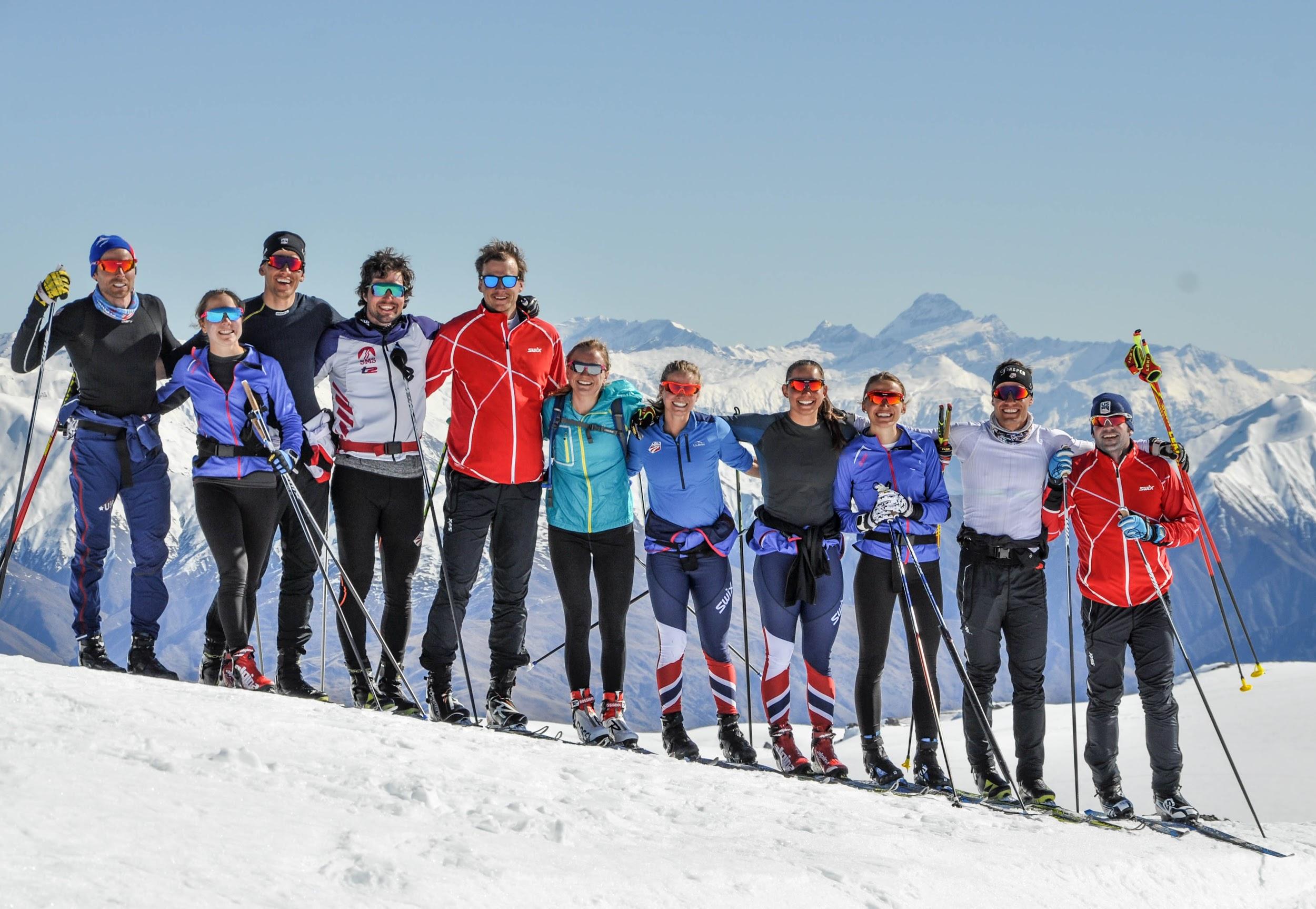
2018 U.S. Ski Team camp at the Snow Farm in New Zealand, with author Alayna Sonnesyn (teal jacket) in the middle of the group shot. (Photo: Matt Whitcomb)
The following was written by Alayna Sonnesyn, a new member of the Stratton Mountain School (SMS) T2 Team who graduated from the University of Vermont (UVM) this past spring.
Originally from Plymouth, Minnesota, Sonnesyn, 22, raced on the UVM Ski Team for four years and qualified for four NCAA Skiing Championships teams. She placed second and third in two races at 2017 NCAA Championships, and in her senior season, won the first five Eastern Intercollegiate Ski Association (EISA) races and went on to reach the podium in 10 out of 11 EISA races. Sonnesyn expressed an interest in exploring the dilemma many of the nation’s top skiing talents face out of high school: whether to attend college or get an early jump on a pro-racing career. She plans to post this two-part series on her blog as well.
***
For the first time in 17 years I will not be going back to school this fall. Saying that out loud is more daunting than I had anticipated. For the most part, the classmates that I graduated with can say that they are “going to grad school,” “starting a new job,” or “taking a year off to travel,” but I still don’t know where I lie. I am not taking any classes this year, I am not working anywhere consistently, and I am doing more than just traveling to explore, I’m traveling to race!
I am wrapping up a three-week training camp in New Zealand with the SMS, Craftsbury, and US Ski Team. When I walked through customs I had to write down my reason for visiting New Zealand: Was I a student? Was I visiting a family or friend? Was I working? What was my job? In the rush of the moment and due to habit, I wrote that I was still a student and continued on my way. I later had a few reflections; I still haven’t reached the point yet where I can say I have a job. I don’t have a salary and there are no company benefits. Yet, I work 24/7 toward my job — my job is ski racing. But why is this so hard for me to admit to myself? Is it because, for my entire life, I’ve been a student? What if I hadn’t taken this route? How do others make this decision?
National Training Group (NTG), summer 2013, in Park City, Utah.
Racing throughout high school, I was given a number of perspectives about picking skiing versus school. My friends were all preparing to go to college and I always assumed I would go to college, too. My parents and older sister went to school, why wouldn’t I go as well? But then I thought about skiing. I never had the most outstanding results in high school (never qualified to race internationally), but I was good enough to qualify for regional and national level camps like REG, NEG and NTG. I traveled to these camps and trained with other high-level athletes, getting more and more motivated by each skier or coach that I met. Then the thought came to me… what if I didn’t go to college? I could focus on training, make those vital steps toward international racing, and continue along the “pipeline” that so many Olympians had followed. Maybe I would make bigger jumps and improve my skiing exponentially? I was entering the unknown and I was unsure how to pick the right choice for me. Looking back on this four years later, I realize that I was far from alone in this predicament.
I have since had the opportunity to talk to a wide variety of skiers and competitors and have learned so much that I wish I knew in high school. It’s OK to be confused. It’s OK to make your own path. Every athlete is in a different situation, comes from diverse athletic and academic backgrounds, and has various goals that they hope to achieve post-high school.
“I’ve always believed that the most important thing to remember when discussing the decision to go to school or not (or when to go to school) is that is it a completely individual decision and the right decision for one person might not be the right decision for the next.” — Sophie Caldwell
Personally, I finally decided that taking a gap year might be too big of a jump for me. I wasn’t ready to focus on skiing and I had a lot of goals for myself academically. I decided to attend the University of Vermont and upon reflection, can admit that this was one of the best decisions of my life. Similarly, SMS teammate, Kelsey Phinney, went from high school in Boulder, Colorado, directly to Middlebury College.
“The reason I chose Middlebury College was simple: I went to visit and I was ready to unpack and stay for good. I loved the people, the area, the ski team, and the classes I sat in on.” — Kelsey Phinney
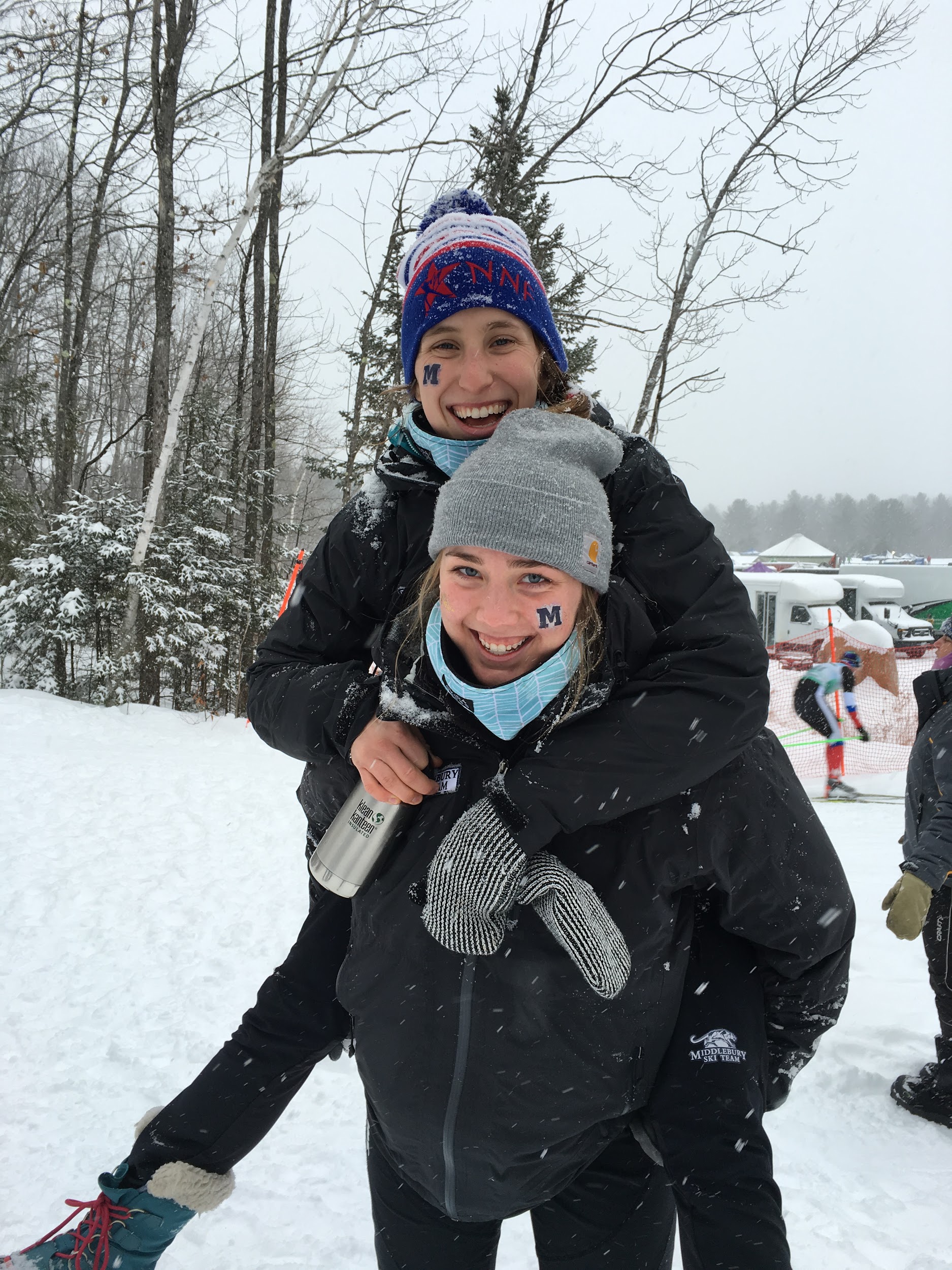
Carnival love, with Kelsey Phinney (top) and Katie Feldman.
Kelsey and I both fell in love with our schools from the start and knew we were where we belonged. We took these college experiences as learning opportunities; maybe we wouldn’t have been ready to jump right into the professional circuit but we both determined this was the right path for us.
“I loved the experiences I had on the Carnival circuit. Both good and bad times taught me a lot about life and skiing, and I felt like the balance of school and sport made me better at both,” Kelsey reflects.
Similarly, Sophie Caldwell had her mind made up without the need to hesitate over a gap year or jumping into full-time skiing.
“I chose to go to college right out of high school, and it was something I had always known I wanted to do. I knew there was a good chance I wanted to ski professionally at some point in my life, but when I was 18, I wasn’t ready to 100% commit to skiing,” Sophie, a Dartmouth graduate, explains.
With academic goals in mind and the confidence to pursue skiing in the long run, sometimes there’s no need to question it. Going directly to college might challenge you more than you think and it might make you question what you’re doing. The balance of school and skiing is great, but it’s TOUGH! At least you worked through those challenges and figured out where you want to be though.
“I definitely had my ups and downs throughout college and at times I considered not pursuing skiing after college, but by the time I entered my senior spring, I knew I wanted to give skiing professionally a shot and knew it was because it was what I wanted to do, not what I had to do,” Sophie notes.
Over the course of four years, we were able to say goodbye to our homes, grow into adults and develop as skiers, allowing a much smoother transition into the professional racing circuit post-college. This decision to go right to college made sense for Kelsey, Sophie and me — it was simple; but I recognize that this choice isn’t as straightforward for everyone.
***
“I loved my time at Burke and wasn’t quite ready to leave. I also didn’t know where I wanted to go to college as part of me wanted to go out west while part of me wanted to stay closer to home.” — Ida Sargent
The conflict of picking a school, a place we are willing to spend at least four years of our lives at, can be intimidating to anyone. Taking a year off to think and explore what motivates you once the structure of school is taken out of the picture can be extremely vital to one’s skiing longevity. Other times, this year off can be done to test out what skiing professionally is actually like.
“I wanted to test out whether I could do only professional skiing.” — Katharine Ogden
A feat that might sound easy to accomplish — ski, eat, sleep, repeat — can’t be THAT hard! But what happens when you suddenly put all of your time and energy into one goal?
“Ironically, my gap year did not turn out even close to how I had planned or imagined!” reflects Julia Kern.
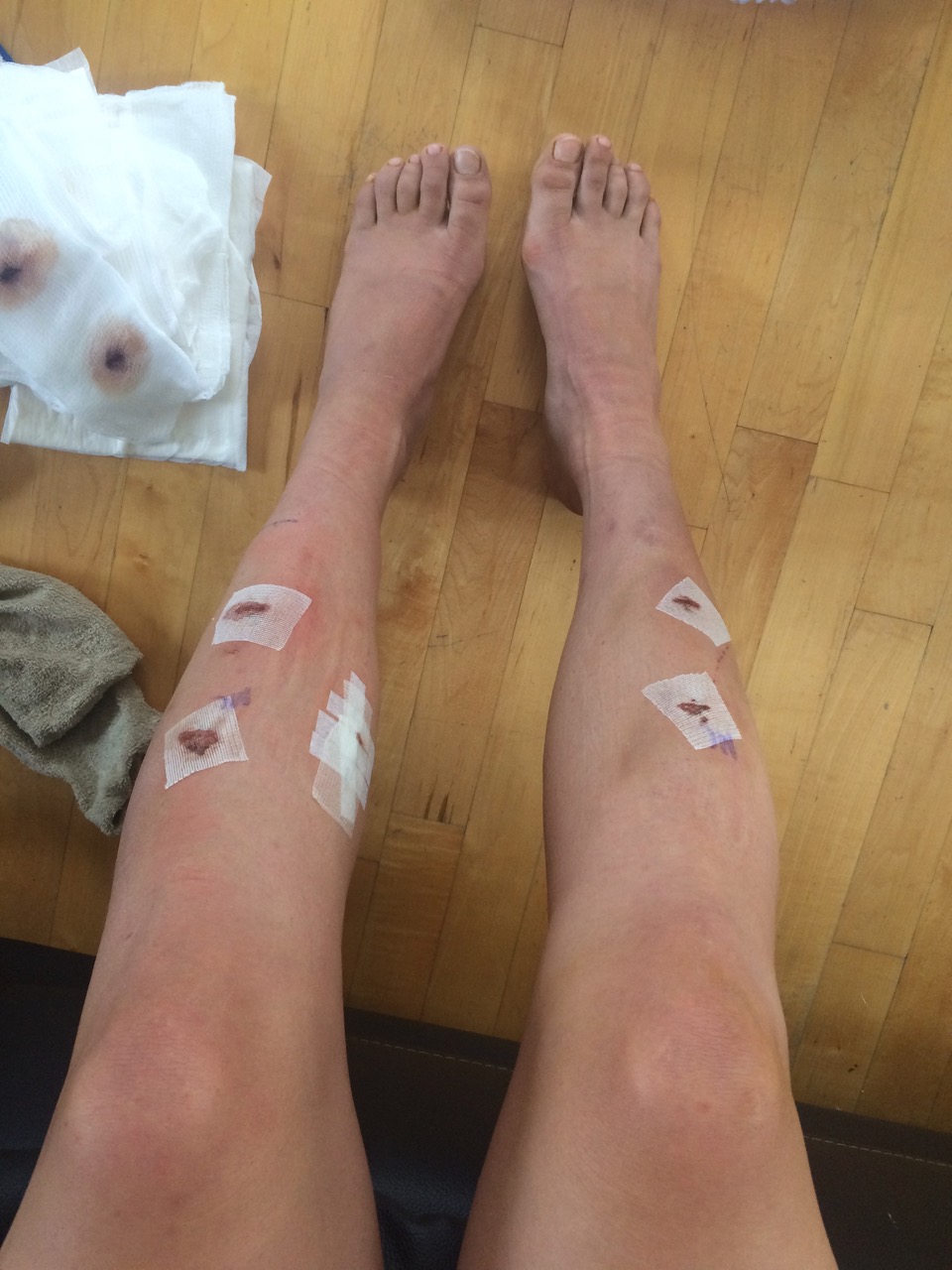
Julia Kern with swollen legs after surgery, requiring A LOT of physical therapy during the summer.
After facing an early summer surgery for compartment syndrome and then an untimely back injury in the fall, Julia notes that her gap year was extremely tough with plenty of lows and setbacks.
Ida Sargent offers, “My PG year was a bit of a disappointment as I wasn’t as happy as I was expecting and I also didn’t feel like I made as big of a jump with my results as I had hoped.”
“I think in hindsight it was a good philosophy but I think I approached it wrong. I didn’t do a good job securing other things to do besides training and was thus pretty bored, which led to me putting a lot of stress on skiing and racing,” says Katharine Ogden.
Maybe taking a gap year isn’t as easy as it sounds? Coming face-to-face with this type of ski-focused intensity as an 18 year old can be challenging.
“It showed me how much I really wanted to go to college,” offers Katharine.
It can also be validating, as it can prove to oneself where they really belong at that point in their life.
“It made me realize that I wasn’t ready to ski full time and I still needed balance in my life,” reflects Ida.
What might be the most beneficial aspect of taking a gap year are the lessons you learn throughout. How to deal with the pressure, free time, potential obstacles, and how to respond when you’re suddenly put in an unfamiliar situation.
“My gap year turned out to be far from ideal from a training/fitness standpoint, but I became very in tune with my body, learned how my body responds to training, became mentally tougher, and learned that I love the skiing lifestyle (even if it is tough sometimes) and that I want to ski at the highest level possible,” says Julia.
Some things you just can’t learn in a classroom.
Julia Kern (on table) still smiling!Julia Kern taking the time to think about something other than skiing during her gap year. (Photo: Julia Kern) How to pass the time away, when you have so much of it. (Photo: Julia Kern)
After taking a gap year to figure out what skiing was like full-time; Ida, Katharine, and Julia attended Dartmouth College (via various routes):
Ida states, “I started by going to school full time and I raced for Dartmouth for three years and then made the National team so I took my senior winter off to race for the USST and then I went back for a spring term my fifth year.”
“One year in [as a traditional student], I am very happy at Dartmouth and racing the collegiate circuit last year reignited my love for the sport,” adds Katharine.
While Julia contributes, “I chose Dartmouth because I wasn’t sure what skiing and school balance I wanted to have, but I did know that I wanted to be able to take terms off to race internationally.”
Regardless of which Dartmouth plan they followed, all three skiers seem to have enjoyed the choices they made. Whether taking a gap year is or isn’t part of your plan, the most important takeaway is that you should TAKE SOMETHING AWAY! Learn something new about yourself, about skiing, or about classes you want to study.
So what about other options for pursuing a ski career? Jessie Diggins and Andy Newell both chose to skip college and go straight into skiing. Stay tuned for my next post when I’ll include input from both of them as well as what U.S. Ski Team coach Matt Whitcomb has to say on this topic.
Dartmouth's Eric Packer (center) with teammates Nils Koons (right), Ben Koons (background), and Burke Mountain Academy's Sam Tarling (left), at an Eastern Cup sprint in Rumford, Maine. Photo by FlyingPointRoad.com
As a freshman at the University of Anchorage, Amy Glen skied to a fourth place finish in the skate sprint at the 2009 U.S. National Championships. She only raced two other sprint races that whole winter: one at the World Junior Championships, and the other at a local race series in Alaska.
Her story is a common one at the college level—with most programs focused on the distance races that will qualify their racers for the NCAA championships, athletes have little time to dedicate to sprint racing.
Of the three NCAA skiing conferences—the Rocky Mountain Intercollegiate Ski Association (RMISA); the Central Collegiate Ski Association (CCSA); and the Eastern Intercollegiate Ski Association (EISA)—only the EISA has a sprint event on its race calendar. There is no sprint at the NCAA Championships.
Two years ago, University of New Hampshire Coach Cory Schwartz brought a proposal to the NCAA skiing committee to bring sprinting to the collegiate championships once every other year. That proposal failed, and despite the discipline’s growth both domestically and internationally, Schwartz says that there hasn’t been a change in attitude among college coaches.
“I’m sort of spinning in the snow,” he said.
Embracing the sprint?
According to U.S. Sprint Coach Chris Grover, while some of the best domestic sprinters are currently attending or have graduated from college, NCAA skiers are not getting enough opportunities to focus on sprinting.
“I would love to see the NCAA skiing community embrace the sprint,” Grover said. “As long as we don’t, we’re going to be missing that key age group in terms of the development of sprint athletes.”
Right now, he continued, most of the country’s juniors and U-23 competitors aren’t getting enough experience in the event.
“Two or three chances a year is not giving you a chance to come back next year and do something better,” he said.
University of Utah Head Nordic Coach Eli Brown said that for college skiing, sprinting is a natural fit because the athletes are busy, and can still excel at sprinting on slightly less training. And, given the growth of the discipline at the elite level, he said, it makes sense.
“There are things that we can do as college coaches and programs to better develop athletes, and one of them is make our events fit what’s happening on the world scene,” Brown said.
Barriers
Schwartz said that when he presented his proposal at the NCAA skiing committee meeting, none of the three conferences supported it.
One major obstacle to adding a sprint to the NCAA championships is that in order to do so, it would most likely have to drop one of the two distance races that currently make up the event, in order to preserve the balance between alpine and nordic.
In conversations with Schwartz, Joe Haggenmiller, and Bruce Cranmer, who were representatives at the NCAA committee meeting from the EISA, CCSA, and RMISA, respectively, the coaches cited a number of other hurdles to incorporating sprinting into college competition, including team scoring, venues, and recruiting.
“At the NCAA championships, the team race is a really big factor,” said Haggenmiller, who is the head coach of the Michigan Tech University nordic ski team.
“Sprint racing can be quite a bit more unpredictable than individual starts, or even a 20 and 15k mass start,” he said. “Those events [the 20 and 15 k’s] are not going to have some really fluky results—you’re not going to have someone who’s won every race of the season break a pole and be out in 30th place.”
As for venues, Hagenmiller continued, NCAA championships are already limited to locations with both good alpine and nordic areas. If the nordic site required a good sprint course in addition to a distance course, that would further restrict the number of options.
Schwartz said that one other problem was that some colleges with limited scholarships might not want to use one for an athlete who could only be competitive in sprint races.
As opposed to the NCAA championships, the individual ski conferences could more easily incorporate a sprint race into their existing race calendars, since each one has five or six race weekends.
However, Cranmer said that since sprints at a regional meets wouldn’t count towards NCAA qualification unless the event was introduced at the NCAA championships, schools would be reluctant to travel to competitions where there was only one NCAA qualifying race.
“When schools are spending a lot of money, they want the best opportunities to qualify,” he said. “Right now we’re kind of pressed as far as budgets are concerned—we’re just hanging on.”
Cranmer said that he thinks coaches are open to the idea of scheduling more sprint races, but right now, “it’s not a priority.”
Getting creative
Brown said that those financial problems are exactly the reason that collegiate skiing should consider introducing more sprint events.
“With [University of] Nevada on the rocks, with Western State [College] getting cut last year, we’re going to be forced pretty soon here to have to be more creative,” he said. “I think sprinting is going to be one of the things that’s going to help us out.”
According to Brown, the problems of venues, team scoring, and race format are smaller issues that could be worked out by coaches and the NCAA skiing committee.
In fact, he added, sprinting actually opens up new venues, at alpine areas, which in turn creates opportunities for more programs.
“I think college skiing does have to be about fitting into the pipeline, so that we can develop athletes,” Brown said. “Therefore we need to be progressive and look at different events, and in my book sprinting fits really well.”
Schwartz said that the excitement of sprint racing would attract more fans to the sport, and that the growing importance of the discipline on the national and international level is another reason to consider adding more events.
Sprinting probably shouldn’t be an NCAA championships event every year, Schwartz added, but including it even once every three or four years would allow collegiate skiers to get more experience and improve.
Hagenmiller said that most regions already have opportunities for athletes who are interested in the discipline. He cited U.S. National Championships, Junior Olympic Qualifying Races, and the SuperTour as places where collegiate athletes could get experience.
But Mike Hinckley, who graduated from Denver University last year and placed second in the sprint at U.S. Nationals in Anchorage, said that he had only been able to enter two or three sprint races each year.
“Maybe one or two of those was against national people who were actually focused on sprinting,” he said.
Glen, fourth at the U.S. National Championships last year, said that she also was not getting enough opportunities.
“It’s definitely hard on kids who have sprinting talent…to do college skiing, especially in the west, because they don’t have any races,” she said. “It’s hard to get experience when you’re just doing those 15ks.”
Nonetheless, Glen said that she still tries to train specifically for sprinting, and that her coaches have been supportive of her preference.
Next year, Glen will be skiing for the University of Vermont in the EISA, where, she said, it will be good to have “just that one sprint.”