Tag: college workout

  • The College Workout: Stair Repeats with Denver University

    The College Workout: Stair Repeats with Denver University

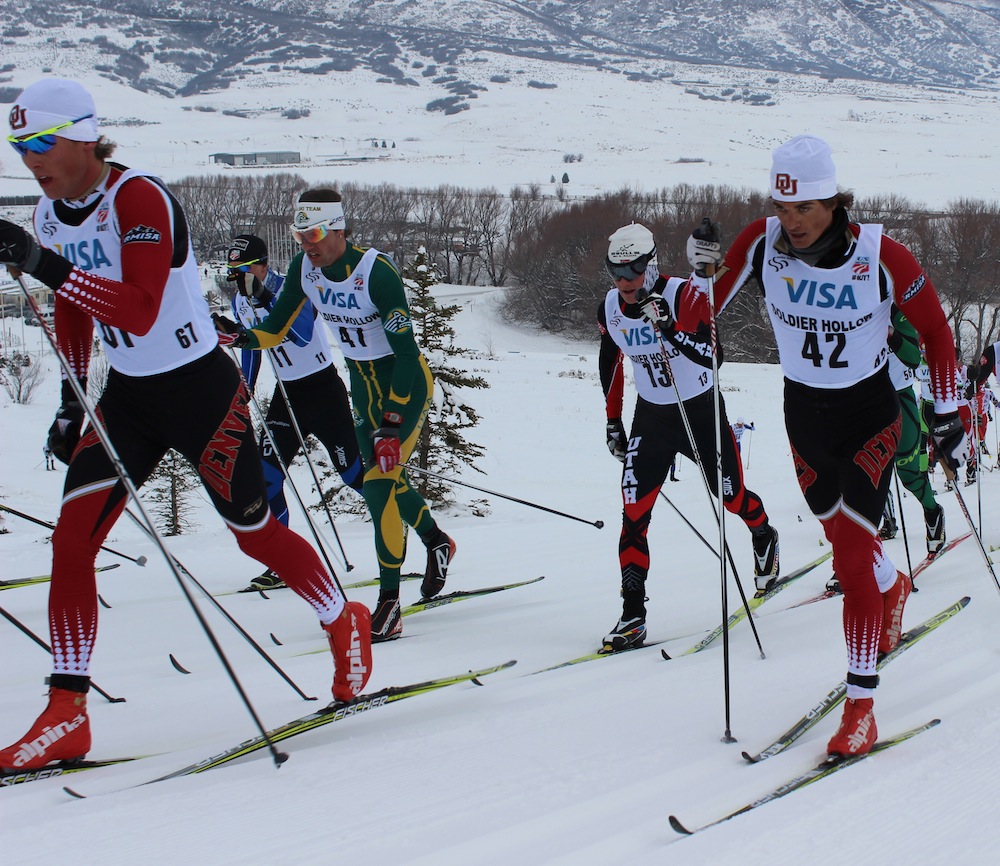
    University of Denver athletes climbing Hermod's Hill at Soldier Hollow this January at U.S. Nationals.
    Joergen By Brevik and Trygve Markset of the University of Denver climbing Hermod’s Hill at Soldier Hollow this January at U.S. Nationals.

    There is a 300-step staircase that leads from below the stage at Red Rocks Amphitheater in Morrison, Colo., to the very top of the stadium seating. Thousands of people climb them every weekend in the summer months to enjoy live music, but on Saturday and Sunday mornings the steps are crowded with hundreds of elite and recreational athletes alike running up and down them. Few activities lead to the pain cave as efficiently as stair repeats, and as a result the massive rock formation has become a popular spot for training.
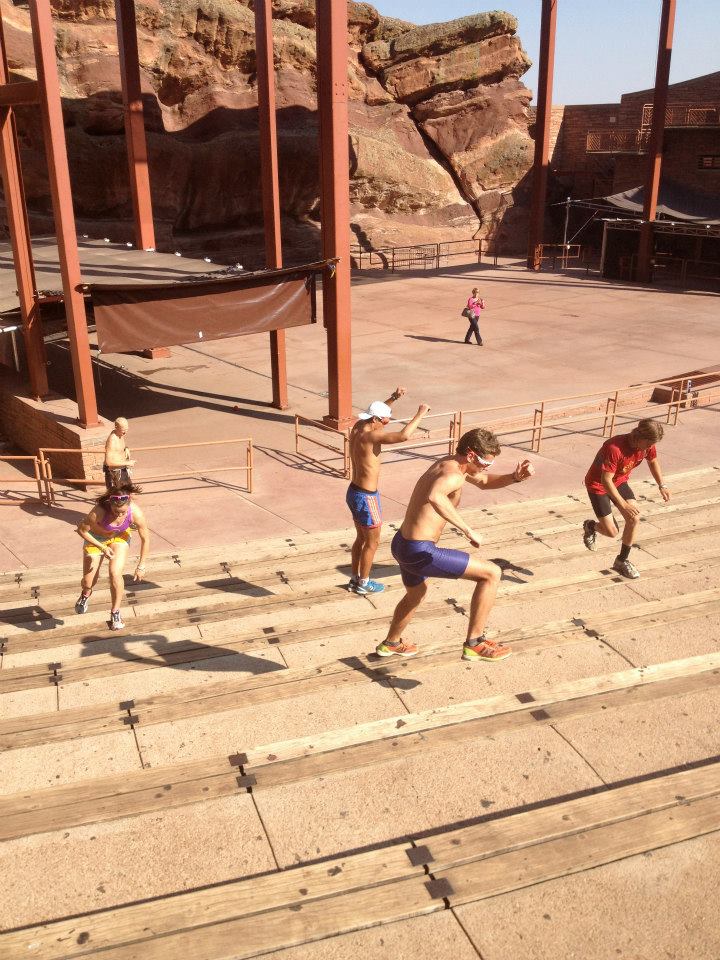
    DU athletes doing spenst drills on the stadium bleachers. (Courtesy photo)
    DU athletes doing spenst drills on the stadium bleachers. (Courtesy photo)

    The University of Denver Ski Team makes a trip to Red Rocks a few times every fall and spring to do a combined workout of specific strength and intervals on the stairs. Head coach Dave Stewart likes the amphitheater because it presents his athletes with the hardest terrain they will ever see —once they’ve conquered 300 stairs a bunch of times, A-climbs are a piece of cake.

    “I think it’s as much mental preparation as a good physical training session,” Stewart says. “It’s so challenging and so steep and so relentless that…Hermod’s Hill at Soldier Hollow doesn’t seem so tough any more.”

    The atmosphere at the amphitheater also keeps things interesting. Hundreds of people flock to the stairs in the summer to make themselves suffer, a kind of presence that nordic skiers don’t often have in the off-season.

    “One of the cool things about it is that other people are doing it at the same time,” Stewart says. “For nordic skiers, a lot of the training we do on rollerskis — you’re definitely the only people doing it. But you go to Red Rocks and there’s a handful of people running the stairs or running the bleachers or doing pushups, so it’s a really cool atmosphere… It’s kind of inspiring.”

    For this edition of the college workout, we’re doing stair repeats.  On top of being a good mental challenge it works the specific leg muscles you use to push of your skis, and will also increase lactate tolerance. DU does this workout in the off-season, but the average nordic enthusiast can do stair repeats at any time of year, weather permitting. Don’t live in Denver? Look to your nearest skyscraper!

    The workout:

    20 minute warmup

    15 minutes of spenst on the stadium bleachers. (These are done on deeper steps than the stairs. Spenst is a set of high-workload, low-repetition Plyometric exercises.)

    5 or 6 reps of ~2 minutes up the stairs at Level 4 (do the same distance each time and try to keep your time the same throughout the workout), with 4 minutes rest in between

    Cool down
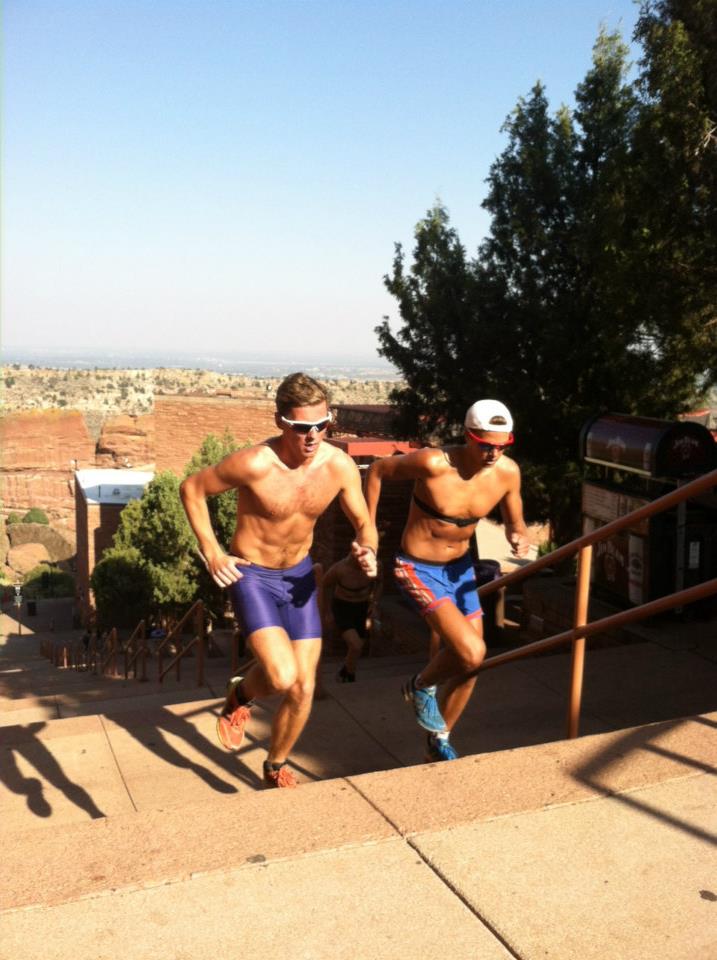
    One of six intervals on the stairs (Courtesy photo).
    One of six intervals on the stairs (Courtesy photo).

    The short spenst session at the beginning of the workout works on lower body explosiveness, and is best done  before the intervals destroy your legs.

    “We’ve found that including the spenst early on, doing the more explosive shorter bounds early on, is a really good warm-up for doing the stairs afterwards,” Stewart said.

    As for the intervals themselves, make a point of keeping your time the same on every repetition. Stewart says the 300-step set of stairs takes his men between 1:45 and 2:00 minutes, and his women 2:00 to 2:30.

    How do you know you’re doing it right?

    “Your legs are shaking like crazy by the end,” Stewart says. “I used to do it with them and I don’t think I’ve ever done it without throwing up. So it’s pretty tough…it’s definitely the thoughest one we do.”



  • Post-Holiday College Workout: Endpoints

    Post-Holiday College Workout: Endpoints

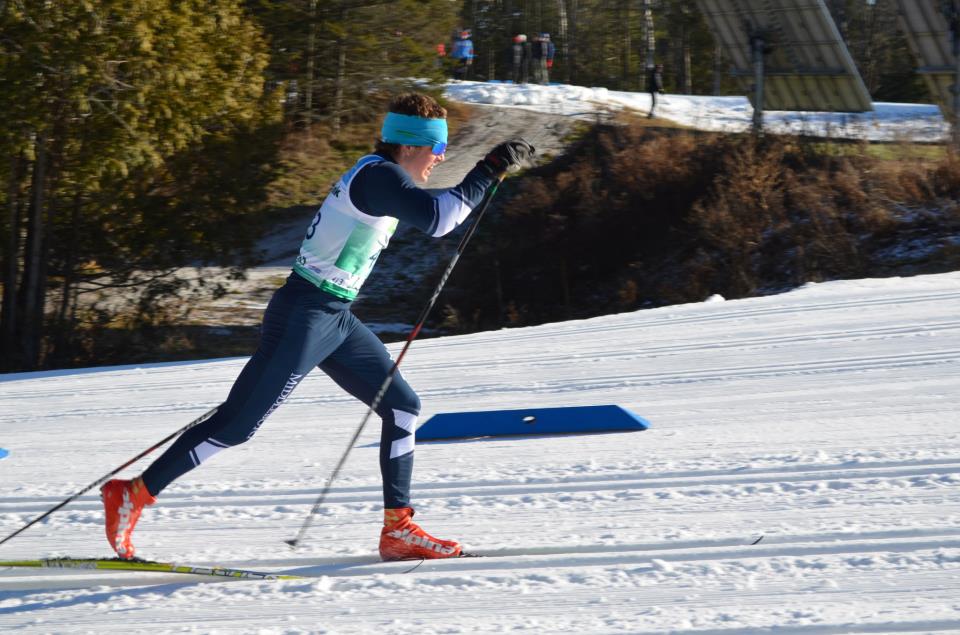
    Middlebury freshman Jack Steele hitting endpoints in Craftsbury, Vt. (Photo: Andrew Gardner)
    Middlebury freshman Jack Steele hitting endpoints in Craftsbury, Vt. (Photo: Andrew Gardner)

    By Andrew Gardner, Middlebury College head coach

    Tasked with the charge of finding a light-hearted post-holiday workout, I was tempted to include some of the most relaxed days of training for the Middlebury Ski team in this space. These were workouts that included on-snow games of “stuck in the mud,” a team photo scavenger hunt using iPhones and near-by landmarks, or a game of dodgeball with our alpine team. (Which, in fact, wasn’t so light hearted.)

    The most important post-holiday workout, however, the piece that I think would be the most useful to share might also be the most straight-forward and the least revolutionary seeming. It’s a workout that I call “endpoints.” It is, basic, no-poles skiing. Here’s the rub.

    All coaches, worth their coffee, prescribe no-poles skiing. Countless high school students can be seen on trails throughout the country waddling dutifully sans poles. The trick is, from junior to professional, to hit the end points.

    Endpoints are the sharp ends of ski technique, the places where, if you’re a photographer, you try to capture in the frame. Most easily seen in V2 alternate (especially the well-known, hyper-extended, gradual downhill type, the arms extend back and forward as the legs fully complete a push off.) The force of the endpoints of technique are what define how fast a skier moves. In good no-pole skiing, there are no middling movements in the center of the stroke, no place to sit and rest. A skier hits the endpoints, driving from leg to leg in skate or classic technique. Arms are connected to the movement as though they had poles. Many junior coaches suggest skiing with poles held in place in front and while this is a fine basic teaching technique, it should evolve to clean arm movements as the skier progresses beyond learning basic upper body stability. The best place to employ no poles skiing: late in a workout. Deep in the space following a long ski that includes some depleting efforts.

    As a workout it is harder than it appears to do really well.

    Warm up: 30 minutes

    Threshold efforts: 2 x 15 minutes with 10 minutes rest in between

    Continue skiing: 30 minutes

    No poles with a focus on hitting the endpoints: 30 minutes

    Cool down: 15 minutes


  • The College Workout: Race-Pace Intervals with Colorado University

    The College Workout: Race-Pace Intervals with Colorado University

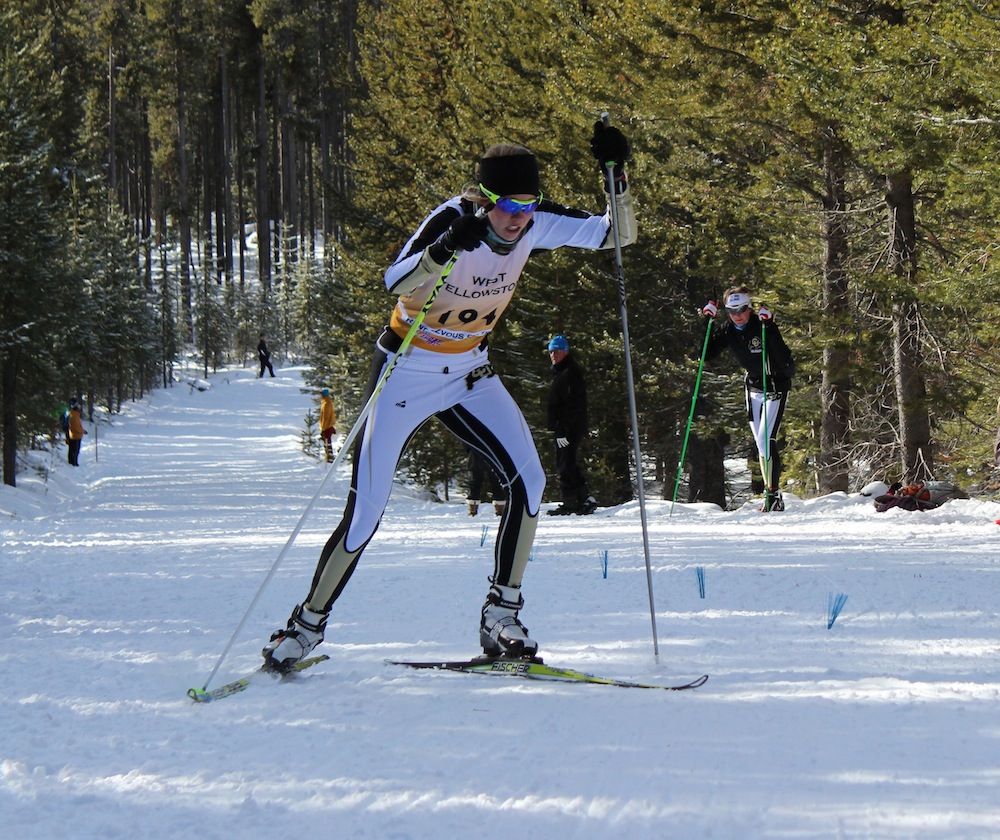
    Colorado Univeristy skier Mary Rose skiing in the West Yellowstone 9 k freestyle.

    If you live and train at high altitude, one of your biggest concerns probably centers on how to log sufficient intensity work without becoming overly tired. It’s easy for an athlete’s heart rate to escalate at even a moderate pace when skiing at or above 7,000 feet; try to do intervals and you’ll find yourself maxed out well below race pace. But scale them back too much and it’s hard to race fast.

    Colorado University Head Coach Bruce Cranmer has to come up with creative solutions to this dilemma, as the Buffs’ nearest training ground at Eldora Mountain begins at 9,200 feet and climbs to 10,800. He is loath to overtire his athletes, but because the NCAA circuit often takes the Buffs to sea level races, Cranmer is careful not to let their fast-twitch languish.

    To that end, the interval workouts he’ll have his team do this time of year take place closer to the CU campus in Boulder at 5,400 feet. As the college season approaches, Cranmer’s training plan starts to include less over distance and more workouts at race pace. Whether there’s snow down in Boulder or not, the harder workouts takes place as low as possible.

    Colorado University Head Coach Bruce Cranmer.

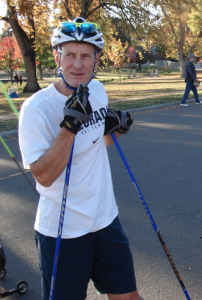
    For one such workout, the Buffs will either run with poles near the fabled Mt. Sanitas or find a good hill to rollerski back and forth on.

    “Often it’s required on rollerskis, but a lot of people prefer running. Some feel you get a better workout running with poles,” Cranmer said.

    The workout begins with a set of 2 x 4 minutes at race pace. The next set is 4 x 2 minutes at a slightly faster pace, and the workout ends with 5 x 1 minute above race pace.

    “We’ll do that to get ourselves up to race pace and get that feel of going faster,” Cranmer said.

    Once the season arrives there’s plenty of weekly intensity to be had from the races themselves. Come January, Cranmer will cease the race-pace workouts and make sure his athletes continue quick speeds no matter where they’re skiing in between competition.

    “Once we’re back in school, we’re racing on the weekends and we don’t do many intervals during the week. During the season we might do 30 seconds to 1 minute of speeds the day before the next race,” he said.

    In addition to the pre-race tune-up, the Buffs will also throw pickups into their distance sessions, at Eldora or otherwise. If his athletes are feeling good, Cranmer has them do 12 x 15-20 second speeds, “to keep the quickness going and not just ski at a slow pace.”

    Speed work is especially important this season, with the NCAA Championships taking place down low in Middlebury, Vermont. Bottom line, Cranmer says, “we do as much intensity as we can at lower elevation.”