Tag: College

  • Exclusive Interview: Maurice Manificat, Skier and Student, ‘Able to Manage the Two, and Do So Very Well’

    Maurice Manificat of France competing in the 15 k pursuit at World Cup Finals in March in Falun, Sweden.

    As Vincent Vittoz’s career drew to a close in the late 2000’s, French skiing needed a breath of life – and it found it in a group of young racers led by Maurice Manificat. A several-time junior national champion and a member of the bronze-medal relay at 2005 World Junior Championships, Manificat stepped up to earn another bronze medal in the U23 30 k in 2008 and his first World Cup podium a year later.

    Since then he has been constantly hovering near the top of the World Cup, with one win, six other podiums, and similar results in the Tour de Ski and mini-tours; he has also finished sixth in both the Olympics and World Championships. In 2012, Manificat finished the World Cup season ranked eighth overall. For the upcoming season he has said that his biggest focus is the World Championships in Val di Fiemme, specifically the 15 k skate race.

    But skiing isn’t the only thing on the Frenchman’s plate: he’s also a student, currently enrolled in a Masters program in biology at the University of Grenoble. After taking five years to complete his License (the equivalent of an American bachelor’s degree), Manificat is working through a new program called Inter’Val, which is designed specifically for high-level skiers of various disciplines. Not only does it feature a schedule optimized for “asynchronous” student-athletes, it also specializes with tutoring and distance learning courses. Inter’Val currently has about 40 students, all of whom are required to compete at the highest level of international sport in order to qualify for the program.

    Manificat in the prologue at World Cup Finals.

    FasterSkier snagged Manificat for an interview over e-mail about what it’s like to be a French skier and how he balances school with a successful athletic career. The following has been translated and condensed.

    FasterSkier: You were very successful at the junior level. After that, did the national team offer you a place, or how did you decide what to do?

    Maurice Manificat: I basically finished as the top junior in France and I won the junior classification of the OPA Cup, so I obtained a place on the French “B” team for the 2006-2007 Continental Cup season. I was unfortunately the only first-year senior in the national team group that year. I was a freshman at the University during my last season as a junior, having made my return in September 2005 after passing my baccalaureate.

    FS: Did other top skiers go to University? What did other skiers and coaches think of that decision?

    MM: I wasn’t the first skier at University. Most of my fellow junior racers entered University like other people our age. For several years at the University of Annency there had already been a class specially arranged for top-level skiers and snowboarders, but it was a specialized DUT in the beginning. [Note: DUT is a Diplôme Universitaire Technologique, an intense, two-year degree that can be quite selective and involve more lectures than a normal university course.]

    At Premanon, there were correspondence classes. But at Grenoble, in the faculty of science, there wasn’t any special arrangement for skiers. I was the first cross country skier to be able to benefit from having the courses arranged as they were with Inter’Val. Specifically at Grenoble, we have face-to-face courses where we saw the professors. I integrated into the Université Joseph Fourier for the Licence Sciences et Technologies program along with an alpine skier who had gone to the same ski academy as me. The program wasn’t as significant then – this is just the second year since “Inter’Val” began. Now, other cross country skiers followed as well.

    Manificat at the Tour de Ski.

    Certain skiers thought I was crazy. The coaches thought it was good to be able to take advantage of the new program.

    FS: When you went to University, did you have a coach there? Were there other skiers for you to train with?

    MM: There aren’t coaches at the University. Our trainers are the national team coaches, but they aren’t at the University. Most of the skiers there are autonomous, and each has his own training plan made with national team coaches. Each of the student-skiers has a different course to follow, and different teachers, so the schedules and time constraints are different. As a consequence, we train alone, but in the past few years more and more students were grouped into the same year and the same course, so they can train together. For my part I often train alone. I like to train alone because when I am with the national team, we train together.

    FS: How much time did you actually spend at the university from 2006 to 2011, when you were getting your bachelors degree? You must not have had the same calendar as other students.

    MM: I’m at school from the beginning of September to the beginning of November, just before the first World Cups. Then from April to the beginning of June. So I am free for the summer training period, which is very intense, and for the winter competition season. It’s an arrangement “à la carte.”

    FS: Did your professors understand what you wanted to do, or was it difficult to explain to them why you weren’t always there?

    MM: It’s always complicated to clearly explain to professors how I train and my constraints. Despite that, the majority were understanding. After all, the faculty members themselves have very busy schedules, so we understand each other. We often actually find them to be lions of sympathy. Because we have private lessons, we have more time to be casual with them and to talk about what we are doing, them about their research and us about our sport. It’s very enriching for both sides.

    FS: When you began competing on the World Cup, or for instance when the Olympics were approaching, did you have to change your study plans or even reconsider your path? Did any of the national team staff suggest that you leave your studies?

    MM: None of the coaches or the federal staff asked me to quit University. They saw that I was able to manage the two, and more than that to do so very well. Moreover, in the year of a big event like the Olympics or the World Championships, I try to alleviate my University commitments. Basically, when we are planning my course at the university with the professors and tutors, the main focus is my sport. So in the years of the Olympics or the World Championships I take a lighter course load.

    FS: Today, are you completely with the national team, or do you have a personal trainer?

    MM: My coaches are the national team coaches; it’s with them that I make my training plan, and select what areas I work on. And more than that, as I accumulate years of experience I know what I have to do. Sometimes I do ask the advice of my club coach or other trainers that I have had in the past. But I’m mostly someone who likes my independence.

    FS: How does the national team work – do you only train together at camps?

    MM: At a camp, we train together, that’s the point: so that each one progresses, and can push his limits while inspiring his teammates. On the other hand, we don’t all live in the same place, and when we aren’t at a camp we train alone or with other skiers who live nearby.

    FS: Why a masters degree – what are you hoping to do when you finish with sports?

    MM: My masters is the next logical step after my License (a Bachelors in America, I think). I don’t want to stop my studies and a License won’t open very many doors down the road. When I finish my athletic career, I’m still not quite sure what I will do. It’s whether that I will join the operational service of French Customs (who is my actual employer now) in a capacity that corresponds to by studies in biology, for example in the Customs laboratories, or whether I will become a national team coach, whether I will work in a laboratory as an extension of my studies in biology, or some other career in biology.

    FS: In the U.S., one must complete a “thesis” for their masters, which is more research-oriented and less classes. Is this the same in France? Will this be easier or more difficult to coordinate with your athletic schedule?

    MM: In France, a masters is two years: mostly courses in the first year with a seven-week stage at the end of the year; the second year there are courses in the first half, and then six months in which you can effectively do a research project (depending on what kind of masters, “pro” or “recherche”, you choose); at the end you must make a report and pass an oral defense. I’m in the first year of my masters right now so I’m not confronting this problem yet, but it will be difficult to arrange. It’s in discussion with the teaching staff.

    FS: How do you finance your career? Is there much funding through the national team, or must the athletes provide their own support?

    MM: I’ve been employed by French Customs as part of the Customs Team of France since 2009. Thus I have the salary of a Customs officer which permits me to contribute to my retirement, because in France high-level sports is not recognized like that. To that I’ve added contacts for with companies for skis (Fischer), poles and gloves (Swix), glasses (Uvex), and my ski station (Grand Massif-Agy). As for the budget of the national team, the budget isn’t sufficient, we have the bare minimum to function professionally, but we are clearly lacking in money. For example: this summer, we didn’t have the benefit of a physiotherapist at our camps, which was very detrimental to our recover and injuries if we had any.

    FS: So what do you have to do with Customs, and how to you balance that with your training? Are many skiers part of Customs or maybe the military?

    MM: As I said, my contract with Customs allows me to have a salary so that I can be autonomous, since until 2009 it was my parents who financed the majority of my career and gave me some financial aid. On the other hand, I’m completely detached so that I can practice my sport and not the job of a Customs officer, just like in the military. Sometimes the administration asks us to be present at events with our bosses, like in Paris, but it’s rare. These contracts with the French administration are a real support for athletes on the national team in the nordic disciplines. Almost all of the athletes have a contract with either Customs or the Army. It is very important for us and a point of pride.

    FS: Finally, for North American fans, will you compete in the World Cups in Canada? How does a trip across the Atlantic fit into your goals for the season, the Tour de Ski, World Championships, etc?

    MM: In effect you have asked a question for which I don’t have a response. The calendar is again very complicated this year. I would love to return to Canada, the last time I was there was for the Olympics, but I still don’t know Canmore or Quebec. I would love to be able to race with our “cousins” from across the Atlantic. But unfortunately the calendar of races over there is not very advantageous with the Tour de Ski just afterwards. Jet lag is something that is hard to digest, the distance races were placed at the end of the race block, and thus it is complex. But I haven’t decided anything yet. Val di Fiemme is much later in the season, and it’s the big goal.

    Manificat in the final climb up the Alpe Cermis, 2012 Tour de Ski.
  • A Veteran At Age 24, Spector Calls It Quits On Biathlon, Focuses on Academics

    Laura Spector warming up for a race in 2009. Photo courtesy of U.S. Biathlon Association.

    HANOVER, NEW HAMPSHIRE – When Laura Spector left the East and drove to Bozeman, Montana, this spring, she knew she was headed for school, but she wasn’t sure what was going to happen after that.

    The 2010 Olympian and national team biathlete had finished up her first full year of training and racing since graduating from Dartmouth College, and it wasn’t what she had been hoping for. After starting the early-season World Cups she struggled, ending up overtrained and trying to rest up while simultaneously competing on the second-tier IBU Cup.

    At the time, Spector told FasterSkier that she would “plan to not ever in the future be just solely an athlete,” but remaining in her sport was still a very real possibility. Despite moving to Bozeman to do an intensive summer course of organic chemistry at Montana State University, Spector brought all of her training gear with her and thought she might rejoin the team in some capacity in the fall.

    After a few more months, her plans have solidified, and biathlon isn’t in them. Spector has a job working in a biology lab here in Hanover.

    “I’m not planning to compete this year,” Spector told FasterSkier. “I’m not going to have time because I’ll be working full-time for a whole year, so biathlon is not in the plan for this winter. Except maybe for fun if there’s something local.”

    Instead of skating her way around Europe and knocking down targets with a .22-caliber rifle, Spector will be working for Dr. Sharon Bickel, a Dartmouth College professor, looking at DNA replication and meiosis in fruitflies.

    “I am really excited,” Spector said. “It should be a lot of fun. I finally get to do something with my degree, and it’s something I’m really interested in. It will keep me busy most of the time. So I’m very excited to have it.”

    Just Getting Started

    Laura Spector racing to 19th place in the World Cup sprint in Oberhof, Germany, in 2011. Photo: nordicfocus.com courtesy of USBA.

    For U.S. Biathlon, Spector’s decision leaves the women’s team down a veteran competitor.

    “As a team, for sure it’s a big loss,” U.S. women’s coach Jonne Kahkonen said in an interview. “Two years ago she made a couple of mass starts already and was on her way up. And I can definitely see that there’s more there. But that’s just the way life goes – not everybody can do this forever, or even until the next Olympics. So that’s just part of this game.”

    Spector, who will turn 25 this fall, grew up in Lennox, Massachusetts, and skied the state’s high school circuit as well as NENSA’s Eastern Cups for several years before moving to the Green Mountain Valley School in Waitsfield, Vermont. Under the tutelage of Jon Arne Enevoldsen, she made her first trip to biathlon’s World Junior Championships in 2005.

    The following year, she enrolled at Dartmouth, where she competed in a few college races and finished third at the Williams College carnival. But she also kept going in biathlon, making another trip to World Junior Championships and finishing ninth in the sprint. After that season, Spector turned to biathlon fully, making two more trips to the junior races and qualifying for senior World Championships in 2008. The next year, she spent about half the season on the World Cup.

    Although she made the Vancouver Olympic team, her performances there didn’t knock anyone’s socks off – it wasn’t until the next season that she had her big breakthrough, scoring a World Cup top-20 in Oberhof, Germany, and competing in several of the prestigious 30-woman mass starts, which an American had last done six years before.

    That 2010-2011 season was Kahkonen’s first on the U.S. staff, and he remembers Spector’s performances as having allowed the U.S. women to build towards higher and higher levels of success.

    “That was just the ball rolling in the right direction, and a lot of times that’s something that the team needs,” Kahkonen said. “The work is there, the potential is there, but you need someone who can actually get the results, or at least a little taste of the results, and then the others realize that it’s possible, that it’s out there. And for sure Laura was a big part of that.”

    And that’s what Spector is leaving behind: despite a subpar string of results in 2012, everyone at the U.S. Biathlon Association (USBA) was certain that the team’s young veteran could return to the sport’s biggest stage, and be shooting alongside the world’s best in Europe.

    “We will miss her on the team, but we wish her well,” USBA President Max Cobb wrote in an e-mail. “We were of course sorry to hear the that she would not continue to train and compete, but these are the hard choices every athlete has to make.”

    For Spector, it wasn’t as hard of a choice as she might have imagined.

    “I’m sure I’ll miss the race season a little bit,” she admitted. “It will be weird to know that my teammates are competing and I’m not. But I’m also really excited about the choice I’ve made and I’m very happy, so I don’t have any regrets about it.”

    Back to School

    Spector’s insistence on finishing up at Dartmouth rather than focusing on biathlon full-time was sometimes a frustration for her coaches on the national team. And Spector, the consummate multi-tasker, needed something else to occupy her mind after she graduated. In her only year as a full-time resident at Lake Placid’s Olympic Training Center, she wanted more – and coaches could tell.

    Laura Spector in a sprint in Atholz, Italy, in 2011. Photo: nordicfocus.com courtesy of USBA.

    “It’s kind of a surprise, but not really,” Kahkonen said of Spector’s decision. “Just talking to Laura, she was not quite there, exactly – not to say that she was not motivated, or not fit, but I could tell last winter that something was a little off, so maybe it was in the back of her head that she wanted to go on and take some more school and pursue that. So by then I could tell that she wanted to figure some other things out in her life.”

    In meetings this spring, the two tried to work through their plans for Spector’s career.

    “I said that to me, as a coach, I want results, and I want from the athletes 100 percent commitment,” Kahkonen said. “If you’re not sure about it, then you should take some time off and figure out whether this is what you really want to do. So that was the discussion at the meetings in the spring. I didn’t know if I should say it.”

    Spector took that idea and ran all the way to Bozeman with it. In part because of her busy schedule as a biathlete when she was at Dartmouth, she had skipped a few classes that are traditionally required before graduate school, and she wanted to fill out her coursework so that she could get another degree in the future. She also wanted to test out going back to school.

    “It was very fast-paced because it was two terms of organic chemistry in twelve weeks, but I did really well and I enjoyed being able to study again and keeping my mind busy,” Spector said. “And I was also working part-time in a fly lab, studying fruitflies, and that was my first lab experience – and I really liked it. So I was hoping that would work out and it would be a step towards taking a job in a lab for a full year.”

    Now certain that school and biology are the right route, Spector knows that she needed to gain more experience in the lab. She plans to apply to graduate school at the end of the fall and begin next September. Until then, she’ll be working with fruitflies.

    The door is still open, however, if Spector changes her mind – or finishes school.

    “In a way, I think it’s good, because if she decides that she wants to come back and start competing again, when that’s all done, she can have a full focus on biathlon,” Kahkonen said.

    And Spector, a notoriously hard worker, isn’t exactly slacking. If she decides to return to the sport, she’ll definitely be fit.

    “I’m still biking and running every day,” she said. “I’m still really active, especially in Bozeman because it’s a really great place to do all that, and I still plan to be working out every single day.”

    What she’ll miss most about her sport, she said, is her team.

    “I’m planning to go watch the rollerski nationals [in Jericho, Vermont], and I’m really excited to see everybody and say hello,” Spector said. “We’re all practically a family and I really want to see them and talk to them face to face, and really let them know what I’m doing. It will be good, because I’ll be out East for a while when they are, so maybe we’ll cross paths a little bit more.”

    And as for her coach? There seem to be no hard feelings.

    “She’s going to be in Jericho, and I said that if she brought her rifle, I’d zero her,” Kahkonen laughed.


    Laura Spector all by herself toward the top of Whiteface Mountain en route to winning the Climb to the Castle rollerski race in 2010.
  • NCAA Nordic Championships in Steamboat Springs, CO

    NCAA Nordic Championships in Steamboat Springs, CO

    Racers preview the course at Howelsen Hill – the alpine hill of Steamboat Springs in the background

    The 2010 NCAA Nordic Ski Championships are set to begin tomorrow at Howelsen Hill in Steamboat Springs, Colorado, hosted by the University of Colorado.  It is appropriate to be in “Ski Town USA” at this time, and especially at this location.  As the oldest ski area in continuous use in Colorado, Howelsen Hill has sent more skiers to international competition than any other area in North America.  This ski club takes pride in its rich history of Nordic skiing and the large number of athletes from its programs that have attended Olympic games, among those the recent Nordic Combined Olympic medal winners Todd Lodwick and Johnny Spillane.

    There are 78 collegiate racers representing 21 teams who have qualified for this competition: 15 from the Central Region, 24 from the Eastern Region, and 39 from the Western Region.  Thursday’s race will be a 5 and 10 kilometer individual start classic race, and Saturday’s race will be a 15 and 20 kilometer mass start freestyle.  All races will be run on a 5 kilometer loop, which is mapped below.  The course provides a tough climb out of start, the first kilometer being a series of steep uphills. Then the slope backs off, but keeps climbing steadily uphill until reaching the high point at around 3 kilometers. From there it is downhill, with several uphill blips, to the stadium. The stadium is set around the Romick Rodeo Arena that is adjacent to the Howelsen Hill ski center.  The races were meant to start inside the arena, but due to ease of wax tent access they will now start just outside the arena.

    The outermost part of the course is shown looping back toward the high point at 3km

    As the race courses start at 2044 meters in elevation and climb to 2118 meters, some teams – especially from the central and eastern divisions –  have been in town for over a week, trying to get acclimated to the thin air.  The temperatures have been warm, climbing into the mid-40’s and mostly sunny the last couple days, with a dusting of snow overnight.  There is a solid base of snow, the top of which has been continuously melting in the day and freezing overnight.  The snow is granular and wet, and the classic waxing has been mildly difficult. Tomorrow’s forecast calls for a good chance of light snow and temperatures ranging from 29 degrees F at the women’s 9:30am start to 33 degrees F at the men’s 11:30am start.

    The field will be small, but very competitive, as the athletes of each region have raced a series of 4-6 weekends in order to be one of the few who qualify for this culminating event.

    LINK TO LIVE TIMING

    Here is a look at the top competitors in each region, the schedule of events, and a course map.

    First Teams (top 5 ranked individuals after all qualifying races are scored)

    Western Region (RMISA) First Team:

    Martin Kaas (photo credit: Trond Flagstad)

    Men:

    Martin Kaas (UNM) – 389

    Matt Gelso (CU) – 374

    Jesper Ostensen (CU) – 363

    Vegard Kjoelhamar (CU) -362

    Harald Lovesnkiold (DU) – 335

    Martin Kaas has been a dominant racer for the West, winning 5  out of 8 races and only missing out on the podium once. Matt Gelso won two races and was on the podium 4 out of 8 races.

    Antje Maempe, DU (Photo: flyingpointroad.com)

    Women:

    Antje Maempel (DU) – 397

    Eliska Hajkova (CU) – 380

    Maria Graefnings (UNR) – 367

    Polina Ermoshina (UNM) – 366

    Kate Dolan (DU) – 359

    Maeampel was never outside of the podium in any qualification race this year, winning 5 out of 8 races and taking 2nd in the other three.  Hajkova was a close competitor, winning one race and taking four second place finishes.

    Central Region (CCSA) First Team

    Men:

    Santi Ocariz, UWGB

    Santiago Ocariz (UWGB) –  221

    Oskar Lund (MTU) – 152

    George Cartwright  (NMU) – 144

    Kevin Cutts (NMU) –  111

    Jens Brabbit (GAC) –  104

    Ocariz is a senior from Spooner, Wisconsin who will be competing in his fourth championships.  Last year he placed 27th and 29th and is looking to be a stronger contender this year.

    Christina Gillis (NMU)

    Women:

    Christina Gillis (NMU) –  159

    Laura DeWitt (NMU) –  157

    Aurelia Korthauer (UAF) –  150

    Henna Riikonen-Purtsi  (MTU) – 133

    Carolyn Freeman (UWGB) –  130

    Junior Christina Gillis missed qualifying for NCAA’s by one tenth of a point last year, and this year came back with a vengeance in order to be the region’s top qualifier, with teammate and senior DeWitt right behind her.

    Franz Bernstein (photo: Lincoln Benedict)

    Eastern Region (EISA) First Team

    Men:

    Franz Bernstein (UVM) – 380

    Nils Koons (DAR) – 340

    Patrick Johnson (MID) – 300

    Patrick O’Brien (DAR) – 250

    Dylan McGuffin (UNH) – 244

    A strong racer in the classic technique, Bernstein won 5 of the 10 qualifying races, 4 of which were classic. The rest of the top field was very competitive, and the top 5 was variable in every race.

    Ida Sargent, DAR (photo: Lincoln Benedict)

    Women:

    Ida Sargent (DAR) – 400

    Caitlin Patterson (UVM) – 340

    Rosie Brennan (DAR) – 300

    Katie Bono (DAR) – 265

    Erika Flowers (DAR) – 229

    Ida Sargent won all but one race that she entered, often by a sizeable margin, and captured a perfect score for the season.  Unlike the men’s division in the east, the women’s division often saw the same three at the top of the charts, Patterson and Brennan rounding out the podium in many races.

    2010 NCAA Men’s and Women’s Skiing Championships – Schedule of Events

    University of Colorado; Steamboat Springs, Colorado

    Tuesday, March 9

    6:15 p.m. – 8 p.m. Championship Banquet – Champagne Powder Room at the top of Mt Werner

    Thursday, March 11

    Nordic Schedule Howelsen Hill

    9:30 a.m. Women’s 5-km Classical – Howelsen Hill

    11:30 a.m. Men’s 10-km Classical – Howelsen Hill

    Awards/Flower Ceremony (immediately following)

    Saturday, March 13

    Nordic Schedule Howelsen Hill

    10 a.m. Men’s 20 km Freestyle (mass start) – Howelsen Hill

    12 p.m. Women’s 15-km Freestyle (mass start) – Howelsen Hill

    Awards/Flower Ceremony (immediately following)

    1:30 p.m. Team awards Ceremony & Barbecue – Howelsen Hill

    12 p.m. – 5 p.m. Race Headquarters – Olympian Hall, Howelsen Hill

    A Complete Listing of Athletes by Region and team:

    Central Region –

    Chris Bowler, Northern Michigan

    Laura DeWitt, Northern Michigan

    Christina Gillis, Northern Michigan

    Monica Markvardsen, Northern Michigan

    Kevin Cutts, Northern Michigan

    George Cartwright, Northern Michigan

    Jens Brabbit, Gustavus Adolphus

    Carolyn Freeman, Green Bay

    Santiago Ocariz, Green Bay

    Theresia Schnurr, Alaska Fairbanks

    Aurelia Korthauer, Alaska Fairbanks

    Tyler Kornfield, Alaska Fairbanks

    John Parry, Alaska Fairbanks

    Oskar Lund, Michigan Tech

    Henna Riikonen-Purtsi, Michigan Tech

    East Region –

    Wyatt Fereday, Colby

    Lucy Garrec, Colby

    Caitlin Curran, Vermont

    Jennie Bender, Vermont

    Caitlin Patterson, Vermont

    Franz Bernstein, Vermont

    Eric Wolcott, St. Lawrence

    Benjamin Knowles, St. Lawrence

    Zachary Wetherell, St. Lawrence

    Dimitri Lüthi, Williams

    Alice Nelson, Williams

    Claire Egan, Wellesley

    Patrick Johnson, Middlebury

    Lauren Fritz, Middlebury

    Patrick O’Brien, Dartmouth

    Ida Sargent, Dartmouth

    Rosie Brennan, Dartmouth

    Nils Koons, Dartmouth

    Katie Bono, Dartmouth

    Eric Packer, Dartmouth

    Dylan McGuffin, New Hampshire

    Natasha Kullas, New Hampshire

    Anya Bean, New Hampshire

    Natalie Ruppertsberger, Bates

    West Region –

    Elias Bucher, Nevada

    Maria Graefnings, Nevada

    Charlie Smith, Nevada

    Kristin Ronnestrand, Nevada

    Michael Schallinger, Alaska Anchorage

    Jaime Bronga, Alaska Anchorage

    Tor Christopherson, Alaska Anchorage

    Steffi Hiemer, Alaska Anchorage

    Lex Treinen, Alaska Anchorage

    Laura Rombach, Alaska Anchorage

    Kate Dolan, Denver

    Andrew Dougherty, Denver

    Mari Elden, Denver

    Harald Loevenskiold, Denver

    Antje Maempel, Denver

    Kristian Soerlund, Denver

    Matt Gelso, Colorado

    Eliska Hajkova, Colorado

    Vegard Kjoelhamar, Colorado

    Jesper Ostensen, Colorado

    Joanne Reid, Colorado

    Alexa Turzian, Colorado

    Polina Ermoshina, New Mexico

    Tor-Hakon Hellebostad, New Mexico

    Martin Kaas, New Mexico

    Linn Klaesson, New Mexico

    Pierre Niess, New Mexico

    Miles Havlick, Utah

    Sarah MacCarthy, Utah

    Rose Kemp, Utah

    Martin Liljemark, Utah

    Didrik Smith, Utah

    Zoe Roy, Utah

    Kaelin Kiesel, Montana State

    Casey Kutz, Montana State

    Tyler Reinking, Montana  State

    Bernhard Roenning, Montana  State

    State Mellie Park, Montana State

    Ryan Scott, Montana State

    Links:

    NCAA skiing

    Live Timing

    Western Region RMISA

    Central Region CCSA

    Eastern Region EISA

    The 5km course at Howelsen Hill – to be used for both classic and skate races

    This video was taken in slow snow – in fast conditions a skier is able to get air on this stomach dropper of a downhill.

  • Sargent, Bernstein, Packer post top results in EISA Williams Carnival

    Sargent, Bernstein, Packer post top results in EISA Williams Carnival

    Ida Sargent, Dartmouth, won back to back 5km races at the Williams Carnival
    Ida Sargent, Dartmouth, won back to back 5km races at the Williams Carnival (photo: Lincoln Benedict)

    The last EISA carnival before Regionals was hosted by Williams College this weekend.  There were already several feet of base snow on the race courses at Prospect Mountain in Woodford, VT, but that didn’t stop more snow from falling overnight and into the morning of Friday’s classic races.

    Despite soft conditions on Friday, the snow stopped and temperatures stayed below freezing, making for hard wax conditions in the classic tracks and a solid base for the skate races.

    In the women’s races, Dartmouth’s Ida Sargent made a strong statement. She absolutely crushed the field in the 5km classic, winning by 48 seconds in a race which only took fifteen and a half minutes to complete. Caitlin Patterson of UVM was the second finisher, with Sophie Caldwell of Dartmouth in third.

    When asked which aspect of racing was allowing her to gain so much time on her competitors, Sargent said, “Definitely transitions are one of my strong points – there’s a lot of ups and downs on this course, especially at the end there’s a bunch of shorter hills, there’s not any really long ones, and so that’s one of my strengths.”  Sargent also thought it helped to pace herself, even though it was only a one lap race, “to just be able to have something left at the end, because that’s where most of the hills were on this course.”

    In the 5km skate, Patterson started after Sargent and made a valiant attempt to race down her competitor’s split times, but though she came within 3 seconds out on the course, Patterson crossed the line 11.4 seconds off Sargent’s winning time, for another second place finish. Friday’s podium was replicated when Caldwell again secured third place.

    Dartmouth women, headed by Sargent and Caldwell and backed by 4th place finishes from Katie Bono in the classic race and Erika Flowers in the skate race, continued their domination of the women’s team scores.  UVM took second  both days, with Patterson’s teammate Jennie Bender taking 6th and 5th in the races.

    Franz Bernstein (UVM) keeps the classic yellow jersey (photo Lincoln Benedict)

    Franz Bernstein of UVM, in the yellow leader’s jersy,  also had a decisive victory in the 10km classic race.  He looked strong and smooth as he cruised to a 30 second lead over the rest of the field, making this his third first place classic finish in as many weeks.  Patrick Johnson of Middlebury took second and Patrick O’Brien of Dartmouth took third.

    Only O’Brien stayed on the podium for the skate race,  and on the same 10km course  as the day before the skate times were 2 minutes faster, but the time gap for the top three finishers was only 4 seconds.  Eric Packer of Dartmouth was the surprise win of the day, edging Wyatt Fereday of Colby College – another fresh face to the podium – by just .9 of a second.  O’Brien finished third, 3.2 seconds behind Fereday.   Up to this point Fereday, who is much stronger in skating, had a season’s best finish of 6th.

    Eric Packer (DAR) on his way to a winning the 10km skate (Photo: Ruff Patterson)
    Eric Packer (DAR) on his way to a winning the 10km skate (Photo: Ruff Patterson)

    Packer has had several 6th place finishes, but his best race this season has been a 5th place skate at the first carnival.

    “I was actually really surprised,” said Packer of his win, “because I woke up this morning feeling like I was kind of getting a cold and I wasn’t sure I would race.  I spoke with Ruff [Patterson, Dartmouth men’s coach] and he recommended that I go out, but just go out and just take it really easy on the first lap, and so I did that, and I ended up feeling much better than I have in the last couple weeks.”

    Packer said this feeling sparked his realization that he had “probably been starting too hard” in races for the majority of the season and that “taking it slow on the first lap was just the right pace.”   Packer started in the middle of the start list, so when he got a split after the first lap that put him in third he knew it probably didn’t mean anything, as none of the top competitors had been by the checkpoint.  It wasn’t until the second 5 km loop that he picked up the tempo, after being surprised at how strong he felt.

    “I had good legs in the last 3k, so that’s when I really went hard, when I realized that I could still ski fast.”

    Dartmouth also won the men’s team scores on both days, although UVM and Middlebury came close in the classic race.  Colby College was a new challenger to Dartmouth’s top score in the skate race, headed by Fereday and backed up by Sam Mathes in 8th and Jake Barton in 13th.

    Although they took no podiums, Williams showed that they, like the Canadians in the Olympic 30km pursuit held Saturday, could benefit from a home-course advantage.  Led by 5th and  8th place finishes by Alice Nelson and Kirsten Johnson, the Williams women took 3rd on Friday, while Dimitri Luthi and Keith Kantack placed  4th and 9th respectively in the men’s classic race. The Williams men took 3rd in the skate race, again led by Luthi in 4th place and followed by Alex Taylor in 5th place.

    The piles of snow at Prospect Mountain were a welcome sight to many teams who have been dealing with thin or no snow at their home training areas.  Sargent said that the toughest part of training was having to travel to skiable snow or – as in last weekend at Stowe – stay an extra day at courses that had good tracks.

    Packer summed up his feelings after his exciting first place finish on the last day of the Williams Carnival by saying, “The trails were awesome, the snow was really awesome, good grooming, fun day.”

    Results

    EISA page (with media by Lincoln Benedict)

  • The Road to Whistler: Noah Hoffman

    The Road to Whistler: Noah Hoffman

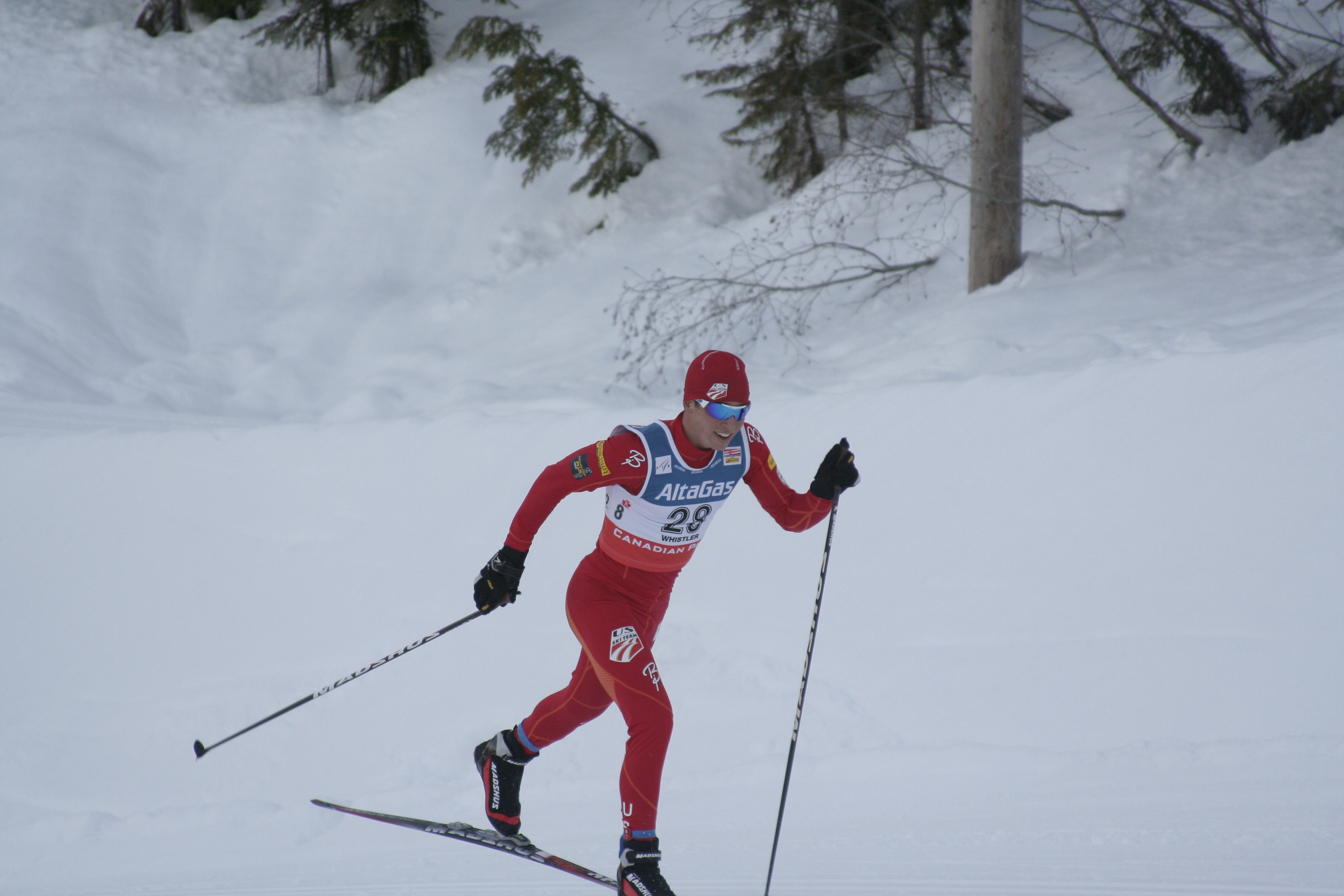
    At just 19 years old, Noah Hoffman is brimming with potential.  He followed 2008’s 12th place in the 10k classic at the World Junior Championships with a 17th and a 14th this year, but then emerged from a month off to take a solid fourth place (second American) at Distance Nationals in Fairbanks. Hoffman is currently training with the U.S. Ski Team in Park City, Utah.

    Hoffman striding it out in the pursuit at the Whistler World Cup in 2009.
    Hoffman striding it out in the pursuit at the Whistler World Cup in 2009.

    FasterSkier: Before we start talking about what you’re doing this year, I’ve got a question about last year. You had some disappointing results and took a month off in the middle of the season, then came back and did very well at distance nationals. What was going on?

    Noah Hoffman: I think the general consensus between my coaches-and they convinced me-was that I was just tired at World Junior’s and in the middle of the season in general. I think all the way from after the first couple of races of the year, I just needed a break. And I got sick at the end of World Junior’s as well, and that just reinforced our belief. We didn’t skip anything really big-I’d hoped to make World Championships last year, and with the way I was skiing I wasn’t even close then. I went to Arizona for a long weekend, then went back to Sun Valley where I was training and just trained really lightly and hung out, and I think it was really good for me.

    FS: So now you’re in Park City, training with the U.S. Ski Team. Is it tough being the youngest person there?

    NH: The National Training Group is in Park City right now, and there are actually 4 juniors that are here training for eight weeks. And so, we’ve been combining workouts with them as well, and we see them quite a bit. There’s maybe a bigger gap on the team on the guys’ side, but the girls are closer to my age. Liz is the youngest-she’s only two or three years older than me. I don’t think it’s a big deal-at USST camps and stuff I don’t feel like I’m the youngest one there necessarily. I definitely look up to those guys and really respect what they’re doing, and the opportunity to train with [Andy] Newell and [Kris] Freeman and Torin [Koos] is awesome. It’s really nice to be able to train with them, but I don’t feel like they think of me of the younger kid necessarily.

    FS: How has the training been going this year? And what races are you shooting for? Are you trying to qualify for the Olympics, or are you focusing on U-23’s?

    NH: The training’s been going really well. I’m really psyched and the situation in Park City has been just awesome, really high quality. The coaches here are providing an incredible amount of support, more than I expected by far. In terms of the focus for my training this year, we have two really big goals that we want to do way better than we did last year, and that’s making tech gains, which is off to the right foot, and also energy management-making sure that what happened last year doesn’t happen this year.

    In terms of results goals and the focus for next year, definitely the U-23 World’s are the big focus of the year-those are in Germany and that’s the level I’m at. I want to get a podium there, and I think I can do it if I’m skiing really well.

    If I go to Canada for the pre-Olympic World Cups, that would be a bonus-it would be so fun and so awesome to be in Whistler, but I think U-23’s is where it’s at this year.

    Hoffman racing at a SuperTour in Soldier Hollow
    Hoffman racing at a SuperTour in Soldier Hollow

    FS: You mentioned you’re working on your technique-what are you doing specifically?

    NH: We’re building from the beginning, we’re looking at body position first and foremost, and then really getting my hips forward and getting myself into position for the whole stride, both skate and classic, so I’m not having to climb out of a set back hips position. We’re trying to just get me more efficient. From the get-go nobody’s ever told me I have good technique, and there’s a lot of ground to make up there. It could be really high-quality and hopefully result in some faster skiing here.

    FS: You chose to defer from college for a few years-what’s you’re status with school?

    NH: I only deferred one year and then I let the admission lapse, so when I go back to school I’m going to have to reapply. It’s my third year not in school.

    FS: How did you go about making that decision?

    NH: It was a tough decision for sure. I thought a lot about it and I talked to a lot of different people about it. I got advice and ultimately it came down to a conversation between myself and my coach and my parents. The reason my coach was in on that conversation was because I knew I valued skiing and I wanted it to be a big priority. We looked at three ideas: going to school right away, taking a year off and going to school, and basically waiting for school until I’m done skiing. My coach ruled out the possibility of taking a year off and going to school afterwards, because he thought that just pushed school back to the time when I really wanted to be skiing.

    It was ultimately my decision, and I decided that I wanted to focus on skiing. If I was going to go to school with the expectation that I was going to be a full-time ski racer afterwards, then I wasn’t going to focus on school very much. I wanted to just focus on skiing, and when it’s time to focus on school, I’ll focus on school.

    Hoffman before the race start at the pursuit in Whistler
    Hoffman before the race start at the pursuit in Whistler

    FS: Are you going to go back to school when you’re done?

    NH: I’m absolutely going to go to school when I’m done skiing-I want to be an educated member of society. Maybe math, maybe some technical theater, like lighting design for on-stage, Broadway-type productions. I did some of that in high school and really enjoyed it. Maybe broadcast journalism-I’m not sure exactly.

    FS: A number of people have mentioned that they have a tough time with the singular focus on skiing, and that they need something to distract them. Does it work for you?

    NH: It works for me-I’m taking one class right now at Westminster College and it feels like a distraction from skiing for me, and I felt like I’m just overwhelmed with the class and full-time skiing. I know that’s ridiculous in terms of time management skills and being able to multitask, but at the same time it doesn’t feel like a relief to me.

    It’s going to be a little bit of a discussion, I should say between my parents and I, whether I will take another class or not. They like me to stay academically involved, and I feel that I want to focus solely on skiing, so I do not need something else to focus on. I feel like skiing takes up as much time as you want it to, and there’s always more to do. I’ve always got stuff on my to-do list.

    FS: It seems like sometimes the expectations of you younger guys on the U.S. Ski Team are huge, compared to those of your peers in college, for example. Do you ever feel like you’re being asked to do too much?

    NH: No. Not at all. I know that I put more pressure on myself than anybody else puts on me. And it doesn’t matter to me what the outside expectations are, because I don’t think they’ll match my own. I expect a lot from myself. As far as the college thing goes, I really miss Gelso and Rosie and Alexa at the camps and stuff-it was fun to hang out with them, and I know it was a really tough decision for the ski team. It doesn’t affect me as much-I go about my business as usual.

    I couldn’t see Gelso skiing full-time-I feel like he just likes having other stuff going on, and he loves it at college, and it’s awesome. He’s having a great time-I’m happy for him. Same goes for Alexa and Rosie.

    FS: As for pressure, do you feel any more pressure being pretty much the only male distance skier on the team, aside from Kris Freeman?

    NH: No, I don’t. It’s the same thing-I provide the pressure for myself. I think Kuzzy does want to be a great distance skier and he has the potential to be a great distance skier. I do look up to Freeman, and he’s kind of my role model on the team. I’ve been talking with Zach Caldwell a little bit, hoping to learn from his experience working with Kris. Zach is a great guy and has so much to offer-working with him is an honor. Definitely Kris is kind of who I’m looking up to at this point, but Andy Newell has been in town, and it has been great to train from him.  There’s so much I can learn from him as well. The more I can become a sprinter, the more it will help my skiing. Getting to chase Andy Newell around in 100-meter speeds is an unbelievable opportunity. It’s so much fun to watch him ski-he’s so smooth and technically sound.

    FS: If Andy Newell’s distraction from skiing is skateboarding, what’s yours?

    NH: I already mentioned a couple. I love to read just for fun, and watching sports. I had Liz record Wimbledon so I can go to her house and veg out and watch the TV. I really enjoy doing other sports-I’ve been doing weekly tennis matches against my strength coach, and have yet to win one. One of my good friends who grew up with me in Aspen is on the US Alpine B Team, and we like to throw the Frisbee around.

    The social opportunities here in Park City are innumerable-any time you want to go do something, there’s people to go do it with. It has been an experience having to cut back and not do everything, Here it’s always happening, especially with Liz [Stephen] around, because she is the social queen.