From the FasterSkier archive — posts syndicated from athletes’ and coaches’ own blogs between 2004 and 2012, kept online as published. Current coverage is at fasterskier.com.
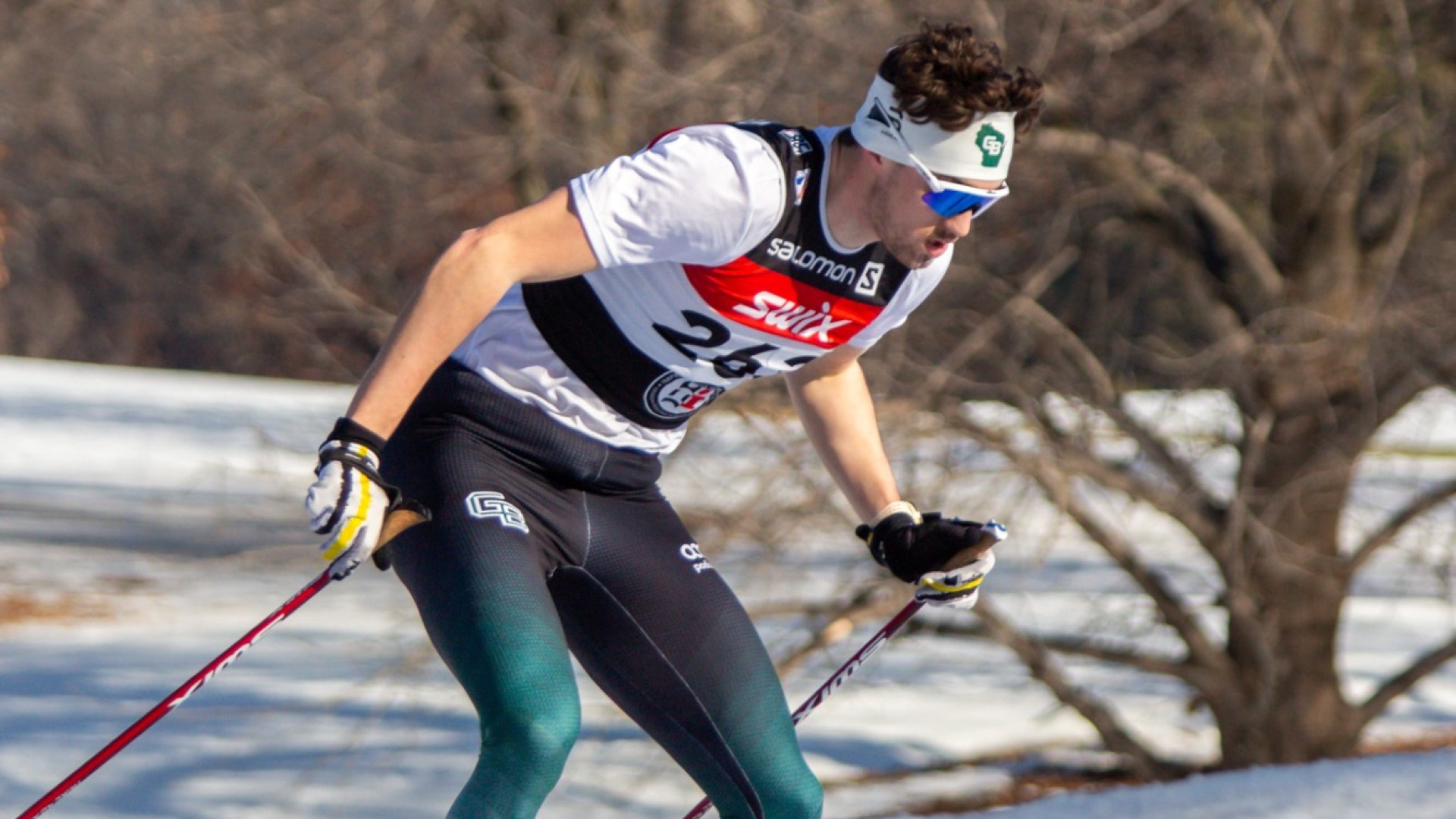
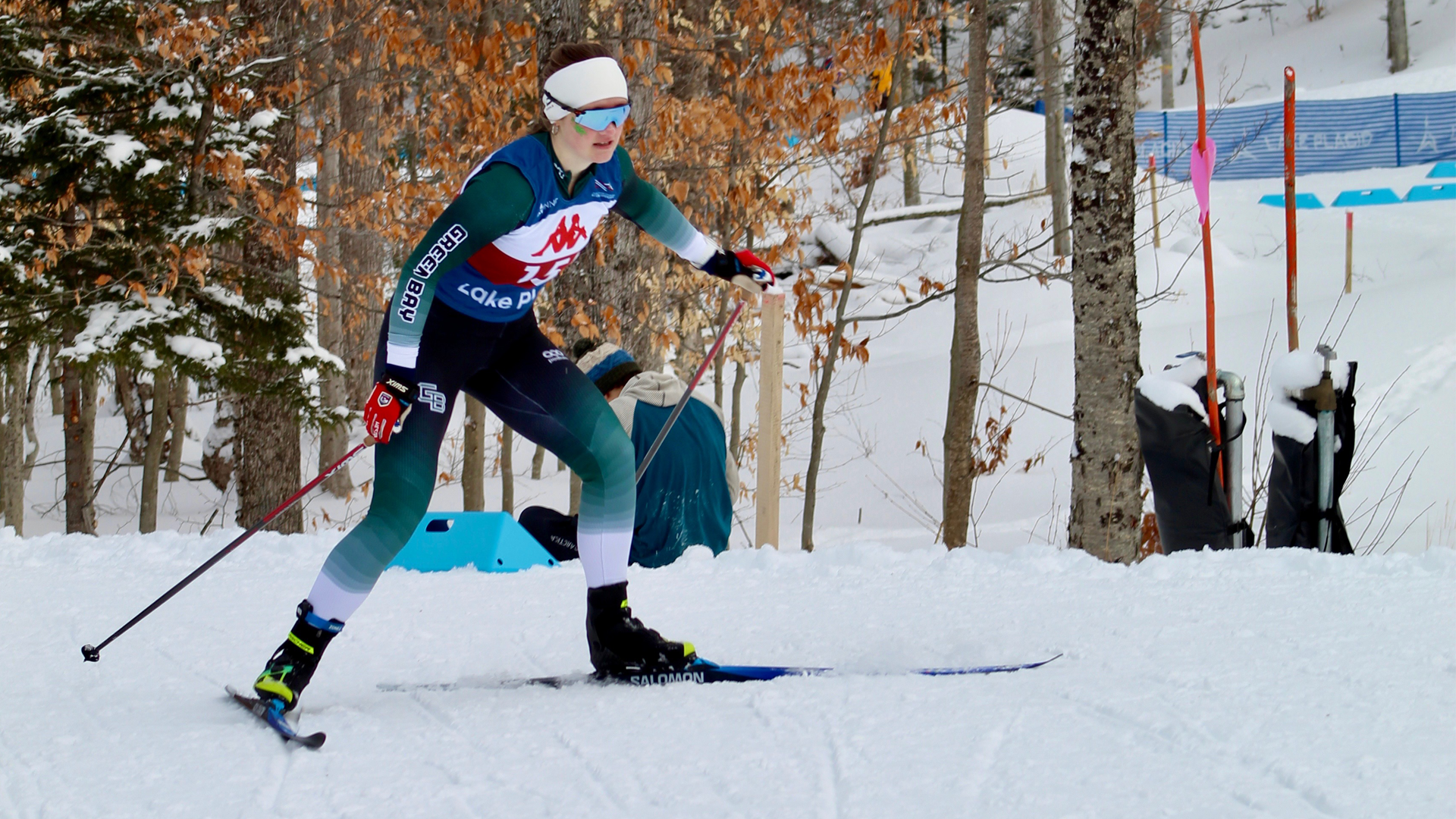
The University of Wisconsin-Green Bay is hiring a Head Nordic Ski Coach to lead its men’s and women’s programs. The school’s goal is to build the premier program in the Central Collegiate Ski Association and send multiple student-athletes to NCAA Nationals each year, and it has backed that goal with scholarships, a full-time head coaching position, and graduate assistant support.
The head coach recruits, develops, and retains student-athletes, directs training and technique, and manages the program budget. The role also carries responsibility for fundraising, alumni engagement, and public relations for UW-Green Bay Athletics and the Phoenix Nordic program.
Responsibilities
Oversee the ski program budget.
Plan and run in-season and out-of-season practices, both team and individual.
Recruit and retain student-athletes in accordance with NCAA and UW-Green Bay rules.
Monitor academic performance to keep athletes eligible under University and NCAA standards.
Provide technical expertise and sound coaching methods to improve athletic performance.
Oversee the conduct and performance of the Nordic graduate assistant.
Comply with all NCAA, UW System, and UW-Green Bay rules and regulations.
Fundraise and take part in promotional and special events for the program.
Build alumni connections and engagement to generate financial support.
Promote positive public relations for the Department of Athletics.
Qualifications
Working knowledge of NCAA and Horizon League rules and regulations.
Strong interpersonal and communication skills working with a diverse community.
Sound judgment, including discretion with personal and confidential information.
Professional, sportsmanlike conduct at athletic events.
Conditions of Appointment
This is a full-time limited appointment based at the Green Bay campus, with occasional travel to the Marinette, Sheboygan, or Manitowoc campuses. The schedule varies and includes nights, weekends, and travel with the program. UW-Green Bay does not offer visa sponsorship for this position, so candidates must be legally authorized to work in the United States.
Compensation and Benefits
Compensation is competitive and commensurate with qualifications and experience. The position includes the Universities of Wisconsin benefits package, which covers health, dental, and vision insurance, participation in the Wisconsin Retirement System with immediate employer contributions, supplemental 403(b) and deferred compensation options, and paid holiday, personal, sick, vacation, and parental leave.
How to Apply
Apply through UW-Green Bay’s Workday portal with a cover letter addressing the essential job functions and a resume. Applications will be reviewed as they are received, and the posting will remain open until the position is filled. Questions can be directed to UW-Green Bay Human Resources at (920) 465-2390 or jobs@uwgb.edu.
Position: Assistant Men’s and Women’s Nordic Ski Coach Employer: University of Alaska Fairbanks Location: Fairbanks, Alaska Type: Full-time, 11-month, term-funded, exempt Priority Application Review: May 20, 2026 (open until filled)
About the Position
The Assistant Men’s and Women’s Nordic Ski Coach plays a key role in supporting one of the nation’s premier collegiate ski programs. Working alongside the Head Coach, this position helps foster a high-performance environment grounded in growth, development, and teamwork. As part of the UAF Athletics Department and the broader Fairbanks ski community, the assistant coach will mentor student-athletes both on and off the trails, helping them excel in competition while preparing for success beyond college.
Success in this position comes from being an excellent communicator who inspires and guides college-aged athletes to reach their highest potential. The right candidate will mentor with patience and confidence while bringing out the best in both individuals and the team as a whole. On race days, the ability to stay calm, make quick decisions, and adapt under pressure will be essential. Creativity in problem-solving, flexibility in coaching approaches, and a balance of working effectively within a team while taking initiative independently will help the assistant coach excel in this role.
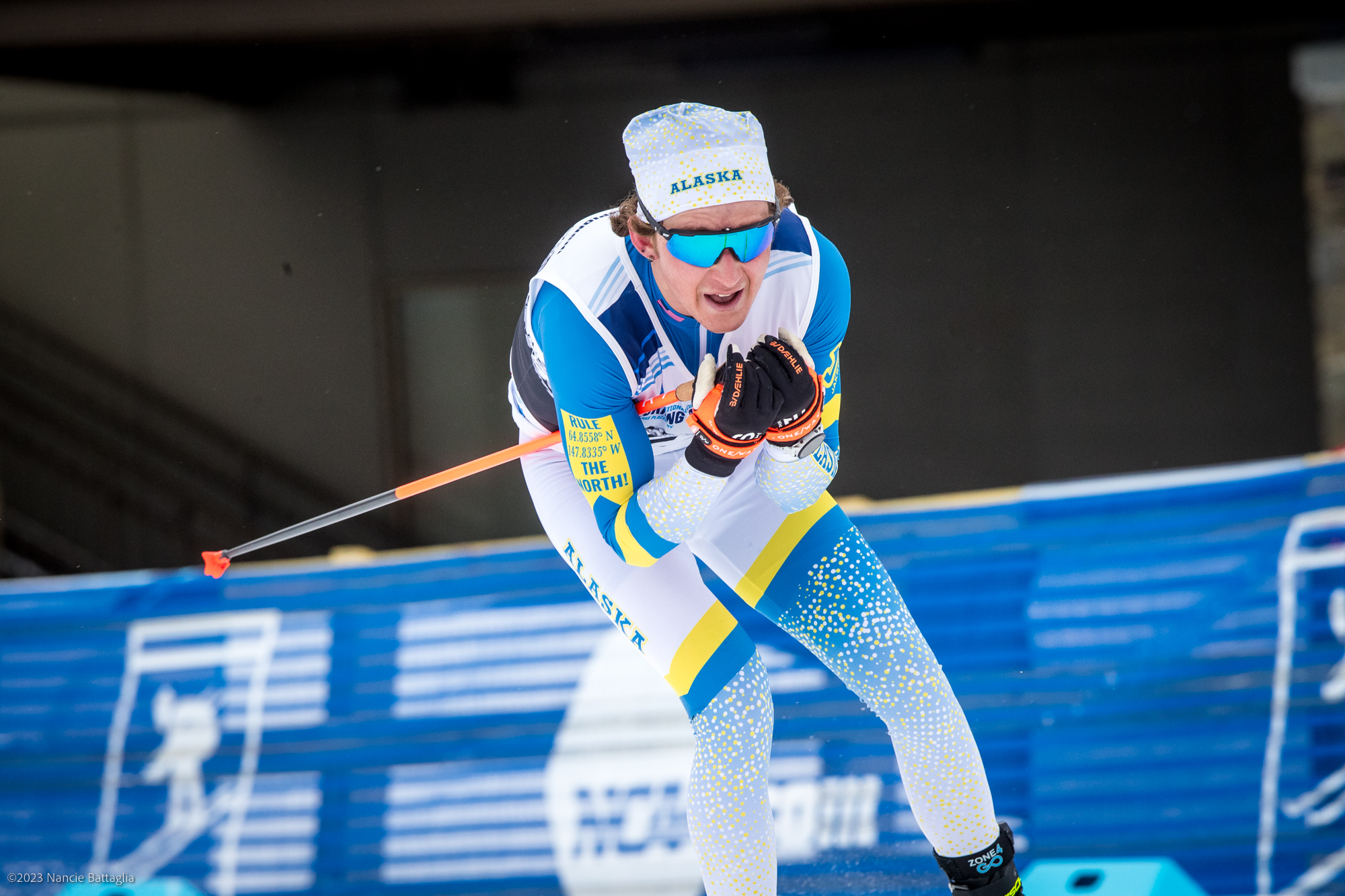
Joe Davies (UAF) during his NCAA Championship-winning performance in the 10 k skate in Lake Placid, New York, in the 2023 championship. (Photo: (c) 2023 Nancie Battaglia)
Minimum Qualifications
Bachelor’s degree in a related field and three years of relevant coaching experience at the collegiate level, or an equivalent combination of training and experience.
Cross-country ski racing experience.
A valid Alaska Driver’s License and a clean driving record in compliance with UA Safe Driving Criteria.
Preferred:
Degree earned while participating as an athlete at the candidate’s institution.
B.A. or B.S. in Physiology, Biology, Physics, or similar — though other majors are not excluded.
USSS Coaches Education L-100 certification, or equivalent.
Further ski- and NCAA-related education will be provided as part of the position.
Position Details
This is a full-time, 11-month, term-funded, exempt staff position with a competitive salary and a comprehensive benefits package. UA provides a generous compensation package that includes retirement options, annual leave, 12 paid holidays per year, tuition waivers for employees and family members, and affordable medical, dental, and vision care coverage. New hires will be placed on the UA Staff Salary Schedule, Grade 79, based on education and experience.
The University of Alaska reserves the right to require employees to work on-site at UA facilities. Hybrid and remote work may be approved for employees based in Alaska at the University’s discretion. Remote work for employees based outside the State of Alaska may be approved only in exceptional circumstances or when required by the position’s job duties.
This position is term-funded and is reviewed annually for contract renewal at the University’s discretion.
Eventually, Kendall Kramer (UAF – right) skied to a 35-second victory for the individual Women’s 20 k Freestyle NCAA Championship in 2025. (Photo: Tobias Albrigtsen)
Application Timeline
Application review will begin on May 20, 2026. Applications received by this date will receive priority consideration; however, the recruitment will remain open until filled.
Rosie Fordham 2x NCAA Champion and Olympian this past season. (Photo: Lexi Pline)
Additional Information
To be eligible for this position, applicants must be legally authorized to work in the United States without restriction. Applicants who now or may in the future require visa sponsorship to work in the United States are not eligible.
The University of Alaska is responsible for providing reasonable accommodations to individuals with disabilities throughout the applicant screening process. For assistance with this application or any phase of the interview process, contact the ADA team at ua-ada@alaska.edu.
The University of Alaska is an Equal Opportunity/Equal Access Employer and Educational Institution. The University is committed to a policy of nondiscrimination against individuals on the basis of any legally protected status.
The successful applicant is required to complete a background check. Any offer of employment is contingent on the background check. All employees at the University of Alaska are expected to uphold the highest standards of ethics and professionalism when conducting university business. Applications submitted to the University of Alaska are subject to public disclosure under the Alaska Public Records Act.
Each university within the University of Alaska system publishes an Annual Security and Fire Safety Report containing campus safety information and crime statistics for the three most recent calendar years. Reports are available online: UAA | UAF | UAS. Paper copies are available upon request.
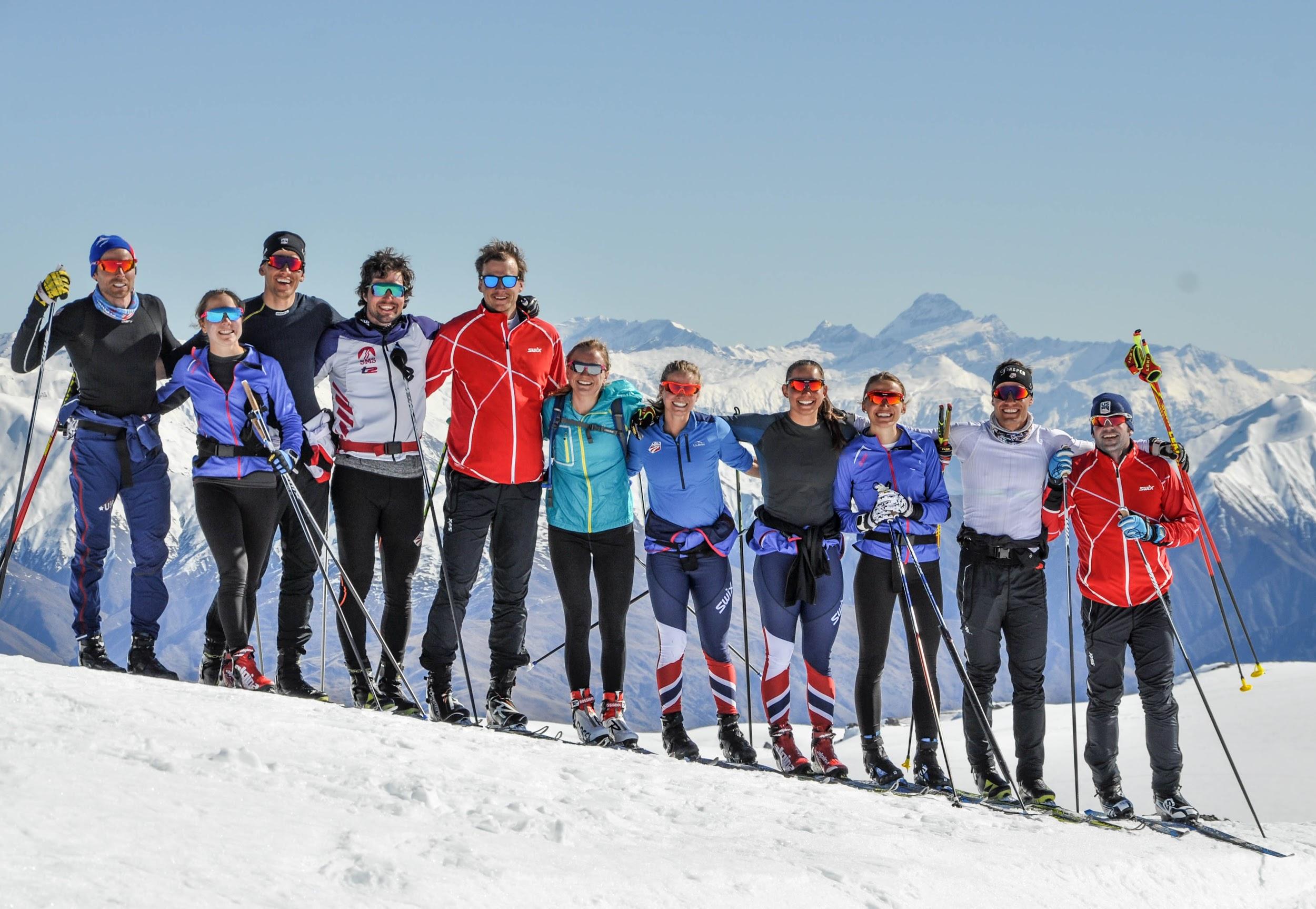
2018 U.S. Ski Team camp at the Snow Farm in New Zealand, with author Alayna Sonnesyn (teal jacket) in the middle of the group shot. (Photo: Matt Whitcomb)
The following was written by Alayna Sonnesyn, a new member of the Stratton Mountain School (SMS) T2 Team who graduated from the University of Vermont (UVM) this past spring.
Originally from Plymouth, Minnesota, Sonnesyn, 22, raced on the UVM Ski Team for four years and qualified for four NCAA Skiing Championships teams. She placed second and third in two races at 2017 NCAA Championships, and in her senior season, won the first five Eastern Intercollegiate Ski Association (EISA) races and went on to reach the podium in 10 out of 11 EISA races. Sonnesyn expressed an interest in exploring the dilemma many of the nation’s top skiing talents face out of high school: whether to attend college or get an early jump on a pro-racing career. She plans to post this two-part series on her blog as well.
***
For the first time in 17 years I will not be going back to school this fall. Saying that out loud is more daunting than I had anticipated. For the most part, the classmates that I graduated with can say that they are “going to grad school,” “starting a new job,” or “taking a year off to travel,” but I still don’t know where I lie. I am not taking any classes this year, I am not working anywhere consistently, and I am doing more than just traveling to explore, I’m traveling to race!
I am wrapping up a three-week training camp in New Zealand with the SMS, Craftsbury, and US Ski Team. When I walked through customs I had to write down my reason for visiting New Zealand: Was I a student? Was I visiting a family or friend? Was I working? What was my job? In the rush of the moment and due to habit, I wrote that I was still a student and continued on my way. I later had a few reflections; I still haven’t reached the point yet where I can say I have a job. I don’t have a salary and there are no company benefits. Yet, I work 24/7 toward my job — my job is ski racing. But why is this so hard for me to admit to myself? Is it because, for my entire life, I’ve been a student? What if I hadn’t taken this route? How do others make this decision?
National Training Group (NTG), summer 2013, in Park City, Utah.
Racing throughout high school, I was given a number of perspectives about picking skiing versus school. My friends were all preparing to go to college and I always assumed I would go to college, too. My parents and older sister went to school, why wouldn’t I go as well? But then I thought about skiing. I never had the most outstanding results in high school (never qualified to race internationally), but I was good enough to qualify for regional and national level camps like REG, NEG and NTG. I traveled to these camps and trained with other high-level athletes, getting more and more motivated by each skier or coach that I met. Then the thought came to me… what if I didn’t go to college? I could focus on training, make those vital steps toward international racing, and continue along the “pipeline” that so many Olympians had followed. Maybe I would make bigger jumps and improve my skiing exponentially? I was entering the unknown and I was unsure how to pick the right choice for me. Looking back on this four years later, I realize that I was far from alone in this predicament.
I have since had the opportunity to talk to a wide variety of skiers and competitors and have learned so much that I wish I knew in high school. It’s OK to be confused. It’s OK to make your own path. Every athlete is in a different situation, comes from diverse athletic and academic backgrounds, and has various goals that they hope to achieve post-high school.
“I’ve always believed that the most important thing to remember when discussing the decision to go to school or not (or when to go to school) is that is it a completely individual decision and the right decision for one person might not be the right decision for the next.” — Sophie Caldwell
Personally, I finally decided that taking a gap year might be too big of a jump for me. I wasn’t ready to focus on skiing and I had a lot of goals for myself academically. I decided to attend the University of Vermont and upon reflection, can admit that this was one of the best decisions of my life. Similarly, SMS teammate, Kelsey Phinney, went from high school in Boulder, Colorado, directly to Middlebury College.
“The reason I chose Middlebury College was simple: I went to visit and I was ready to unpack and stay for good. I loved the people, the area, the ski team, and the classes I sat in on.” — Kelsey Phinney
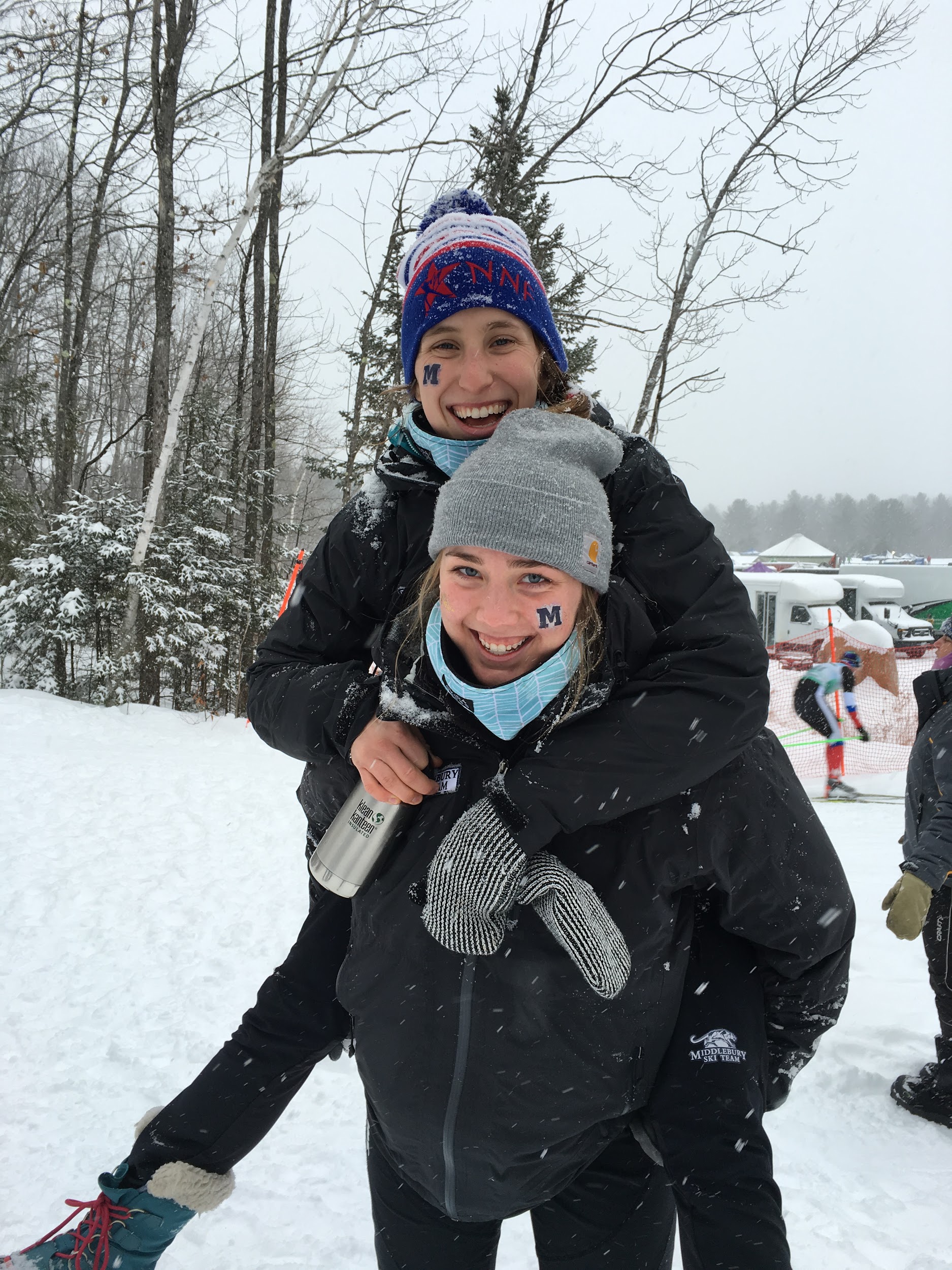
Carnival love, with Kelsey Phinney (top) and Katie Feldman.
Kelsey and I both fell in love with our schools from the start and knew we were where we belonged. We took these college experiences as learning opportunities; maybe we wouldn’t have been ready to jump right into the professional circuit but we both determined this was the right path for us.
“I loved the experiences I had on the Carnival circuit. Both good and bad times taught me a lot about life and skiing, and I felt like the balance of school and sport made me better at both,” Kelsey reflects.
Similarly, Sophie Caldwell had her mind made up without the need to hesitate over a gap year or jumping into full-time skiing.
“I chose to go to college right out of high school, and it was something I had always known I wanted to do. I knew there was a good chance I wanted to ski professionally at some point in my life, but when I was 18, I wasn’t ready to 100% commit to skiing,” Sophie, a Dartmouth graduate, explains.
With academic goals in mind and the confidence to pursue skiing in the long run, sometimes there’s no need to question it. Going directly to college might challenge you more than you think and it might make you question what you’re doing. The balance of school and skiing is great, but it’s TOUGH! At least you worked through those challenges and figured out where you want to be though.
“I definitely had my ups and downs throughout college and at times I considered not pursuing skiing after college, but by the time I entered my senior spring, I knew I wanted to give skiing professionally a shot and knew it was because it was what I wanted to do, not what I had to do,” Sophie notes.
Over the course of four years, we were able to say goodbye to our homes, grow into adults and develop as skiers, allowing a much smoother transition into the professional racing circuit post-college. This decision to go right to college made sense for Kelsey, Sophie and me — it was simple; but I recognize that this choice isn’t as straightforward for everyone.
***
“I loved my time at Burke and wasn’t quite ready to leave. I also didn’t know where I wanted to go to college as part of me wanted to go out west while part of me wanted to stay closer to home.” — Ida Sargent
The conflict of picking a school, a place we are willing to spend at least four years of our lives at, can be intimidating to anyone. Taking a year off to think and explore what motivates you once the structure of school is taken out of the picture can be extremely vital to one’s skiing longevity. Other times, this year off can be done to test out what skiing professionally is actually like.
“I wanted to test out whether I could do only professional skiing.” — Katharine Ogden
A feat that might sound easy to accomplish — ski, eat, sleep, repeat — can’t be THAT hard! But what happens when you suddenly put all of your time and energy into one goal?
“Ironically, my gap year did not turn out even close to how I had planned or imagined!” reflects Julia Kern.
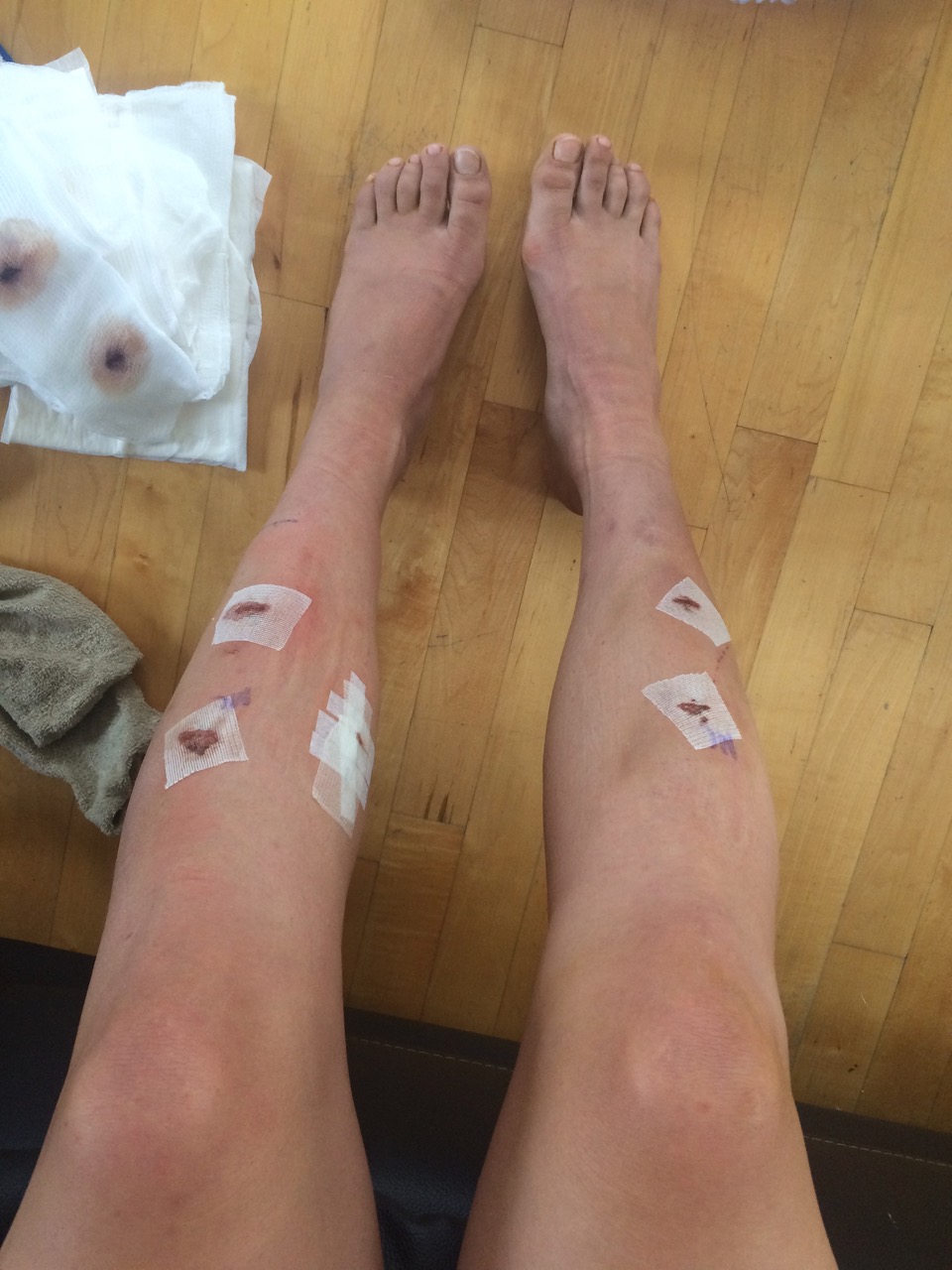
Julia Kern with swollen legs after surgery, requiring A LOT of physical therapy during the summer.
After facing an early summer surgery for compartment syndrome and then an untimely back injury in the fall, Julia notes that her gap year was extremely tough with plenty of lows and setbacks.
Ida Sargent offers, “My PG year was a bit of a disappointment as I wasn’t as happy as I was expecting and I also didn’t feel like I made as big of a jump with my results as I had hoped.”
“I think in hindsight it was a good philosophy but I think I approached it wrong. I didn’t do a good job securing other things to do besides training and was thus pretty bored, which led to me putting a lot of stress on skiing and racing,” says Katharine Ogden.
Maybe taking a gap year isn’t as easy as it sounds? Coming face-to-face with this type of ski-focused intensity as an 18 year old can be challenging.
“It showed me how much I really wanted to go to college,” offers Katharine.
It can also be validating, as it can prove to oneself where they really belong at that point in their life.
“It made me realize that I wasn’t ready to ski full time and I still needed balance in my life,” reflects Ida.
What might be the most beneficial aspect of taking a gap year are the lessons you learn throughout. How to deal with the pressure, free time, potential obstacles, and how to respond when you’re suddenly put in an unfamiliar situation.
“My gap year turned out to be far from ideal from a training/fitness standpoint, but I became very in tune with my body, learned how my body responds to training, became mentally tougher, and learned that I love the skiing lifestyle (even if it is tough sometimes) and that I want to ski at the highest level possible,” says Julia.
Some things you just can’t learn in a classroom.
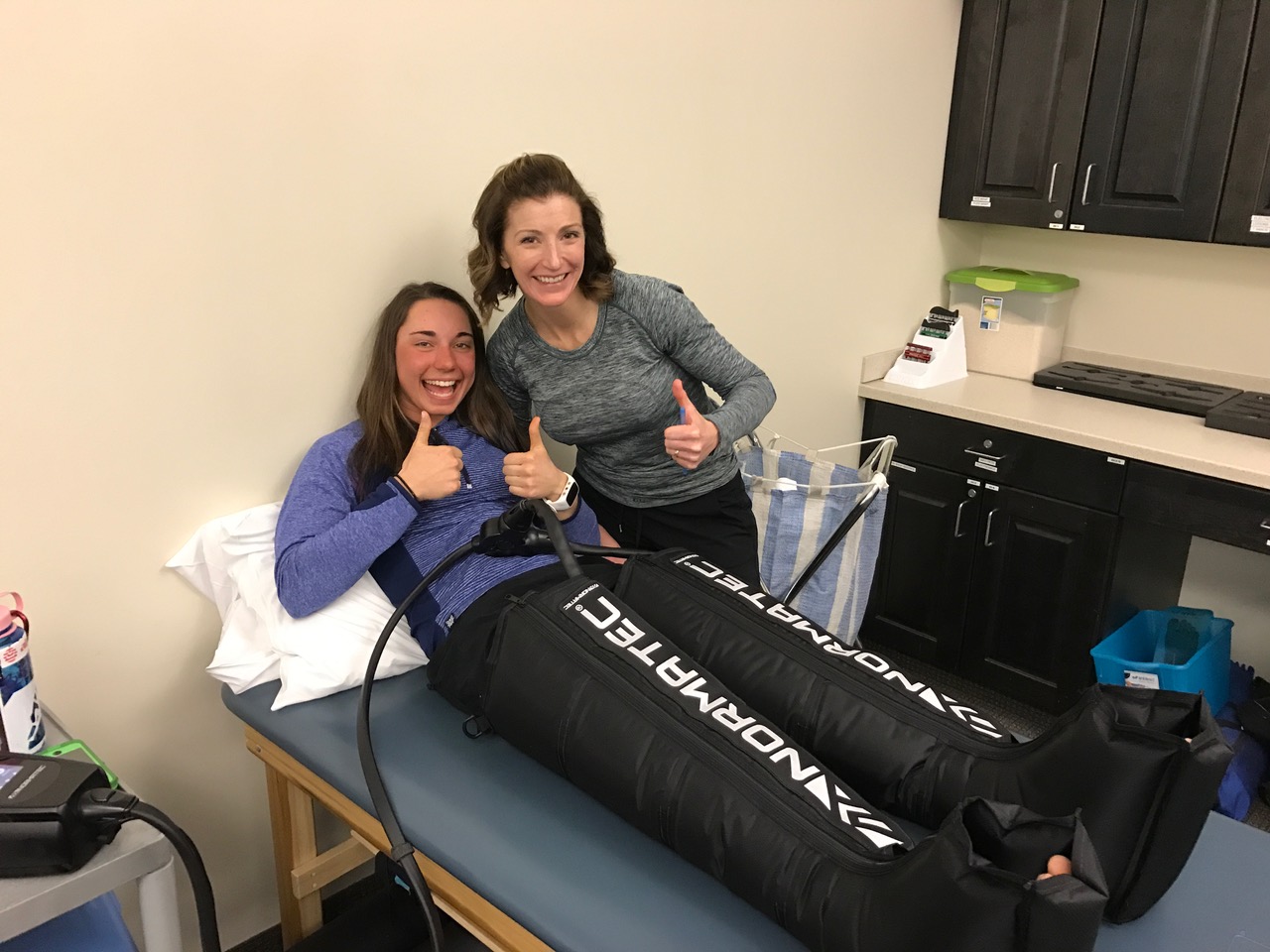
Julia Kern (on table) still smiling!Julia Kern taking the time to think about something other than skiing during her gap year. (Photo: Julia Kern) How to pass the time away, when you have so much of it. (Photo: Julia Kern)
After taking a gap year to figure out what skiing was like full-time; Ida, Katharine, and Julia attended Dartmouth College (via various routes):
Ida states, “I started by going to school full time and I raced for Dartmouth for three years and then made the National team so I took my senior winter off to race for the USST and then I went back for a spring term my fifth year.”
“One year in [as a traditional student], I am very happy at Dartmouth and racing the collegiate circuit last year reignited my love for the sport,” adds Katharine.
While Julia contributes, “I chose Dartmouth because I wasn’t sure what skiing and school balance I wanted to have, but I did know that I wanted to be able to take terms off to race internationally.”
Regardless of which Dartmouth plan they followed, all three skiers seem to have enjoyed the choices they made. Whether taking a gap year is or isn’t part of your plan, the most important takeaway is that you should TAKE SOMETHING AWAY! Learn something new about yourself, about skiing, or about classes you want to study.
So what about other options for pursuing a ski career? Jessie Diggins and Andy Newell both chose to skip college and go straight into skiing. Stay tuned for my next post when I’ll include input from both of them as well as what U.S. Ski Team coach Matt Whitcomb has to say on this topic.