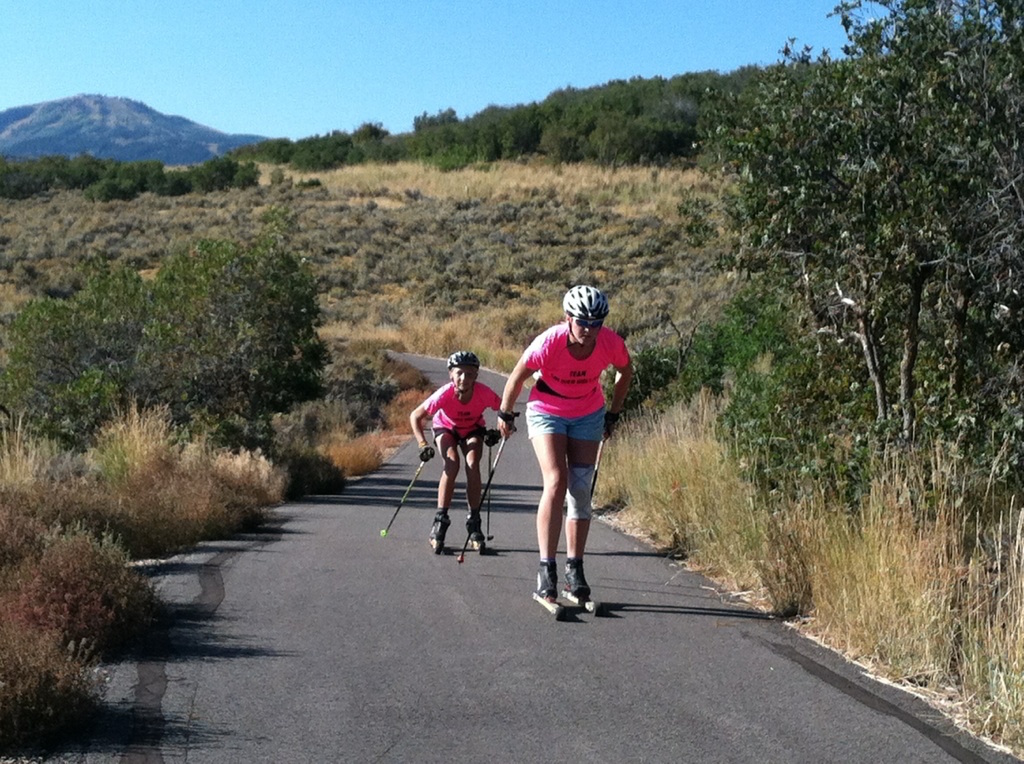
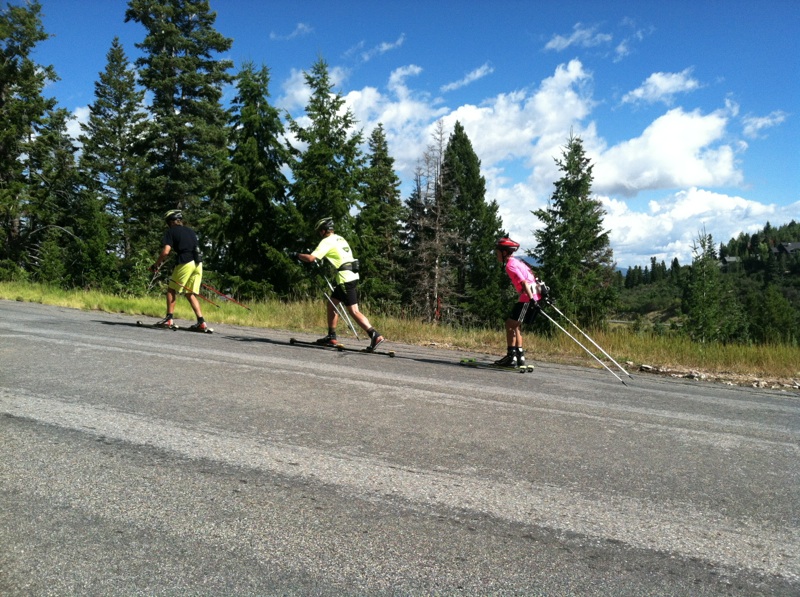
Team Soldier Hollow athletes Ingrid Norton and Pearl Harvey. during a rollerski workout near Heber and Park City, Utah. (Photo: Morgan Smyth)
This week’s workout comes from Team Soldier Hollow coach Morgan Smyth, a former World Cup racer and Alaska Pacific University skier, and caters to cross-training needs. Team Soldier Hollow trains out of Midway, Utah.
***
Many high school skiers are multi-sport athletes. This can be a challenge for athletes who have spent most of the summer ski training and working on their upper-body and ski-specific muscles. How do you participate in fall sports and not lose all those big summer gains?!
Team Soldier Hollow’s Xander Burkemo, Spencer Brosnahan and Mason Heimburger during a rollerski workout near Heber and Park City, Utah. (Photo: Morgan Smyth)
Note: Most of the Team Soldier Hollow athletes run cross-country, but this is a great ski workout to balance with most fall sports.
Since it is race season for cross-country running, most of the speed and interval workouts are done with the running team. We then add two easy rollerski workouts that focus on technique and maintaining ski specific strength.
One of our key workouts is a combo classic rollerski and a mini general-strength session in the gym.
Rollerski Workout:
Easy 20 min double pole warm up
3 x 3 minute easy single pole
Technique drills
Rollerski Total: 45-60 min
The rollerski workout ends at the gym.
For the general strength portion, the goal is to maintain the general upper-body strength gained during the spring and summer. The running team does a plyos workout once a week so we don’t do much lower-body strength. However, depending on your sport, some could be added especially to prevent muscle imbalances.
Strength Workout:
Dynamic stretching – 10m each.
Butt Kicks
High Knees
Side Lunges
Front Lunge
Alligator Crawl
Inch Worm
Strength:
Pull Ups 2×10
Balance Clock Touch (this is a balance drill that can be done on the ground or an inflatable disc or other unstable surface)
Push Ups 2×20
Classic Arm/Leg Swing (this is a technique/balance drill that can be done on the ground or an inflatable disc or other unstable surface)
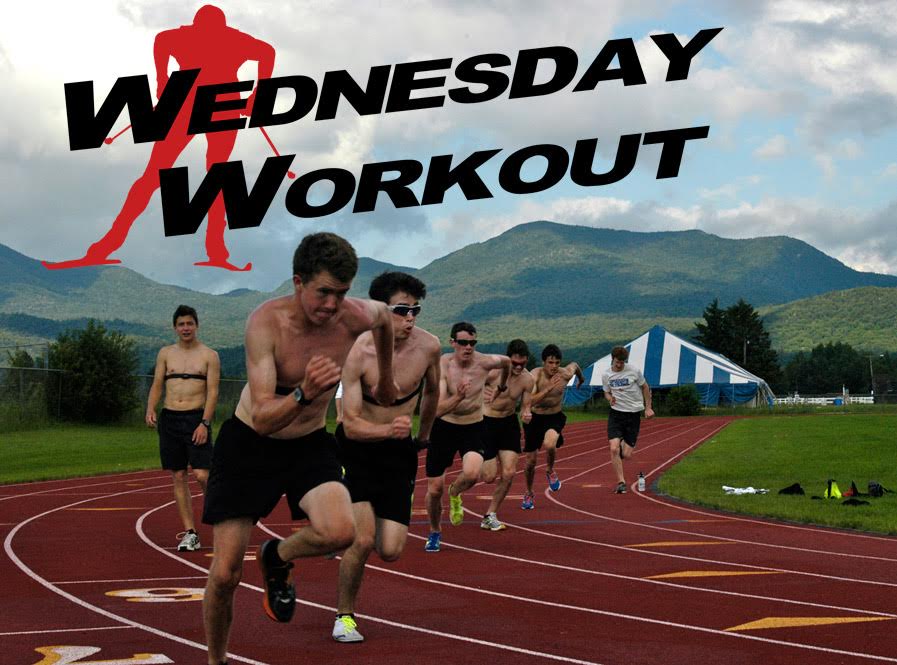
Nakkertok skiers hard at work during a track workout in 2013. Read more about their team and Level 3 running loops workout. (Photo: Jesse Williams)
FS Editor Alex Kochon submitted the following, adapted from a Combo Track Workouts article by Runner’s World, as a sort of self-help, get-back-into-shape-with-limited-time article, but the workouts can be suited to super-fit athletes as well.
***
We know the reason you ski is your love for variable terrain, ever-changing scenery and snow, but sometimes, you’ve just got to get a workout in. And in the summer, those feeling a lack of “me-time” might find they can work up one heck of a sweat in minimal time at a local track.
At least I have.
As a new mom, I’ve been struggling with the idea of training. I set a loose goal for a race I wanted to do in September, and stupidly picked a triathlon. Now, one week out from the big event I have yet to swim more than a few floppy freestyle strides, done mostly to cool off.
Needless to say, I’m not racing next weekend. But I have been running. And at least a couple times, I revisited the track after a LONG hiatus, and I did speed work.
The best thing about track workouts is you can easily measure progress. I’m not suggesting that skiers need to do this frequently or even regularly, but an occasional speed session measured by mindless laps around a 400-meter track and a trusty stopwatch (and headphones, if you’re running solo and could use the extra motivation) can give an added boost to your endurance training.
I recently tried some combo workouts, adapted from Runner’s World (RW).
“Your training should be diversified and well-balanced,” RW contributor Kristin Barry wrote. “It should have a mix of different types of workouts and pace variation — V02 max intervals, tempo runs, progression runs and near maximum speed intervals. Each of these is an important piece in a balanced program.”
Barry gave some ideas for incorporating a variety of paces into a single workout: thus, the combo workout, which are great for saving time as well (i.e. if you can’t get a two-hour workout in most days). Some of these I’ve cut short or abbreviated for the purpose of saving time — and easing back into shape.
Workout #1: 20-minute tempo, 3 X 1,000M at 5 k pace or faster
(Total: 20 minutes at half-marathon pace + 3 kilometers of faster 1,000-meter repeats, with 6-9 total minutes of recovery in between)
How: Begin with an easy 15-to 20-minute jog. After warming up and doing a few strides, run for 20 minutes at approximately 10-mile or half marathon race pace. Jog 400m and then go immediately into 1,000m repeats at 5K pace or just faster. Take 2-3 minutes rest between each 1,000m repeat.
When: This workout is best performed well into a training schedule when your fitness is relatively high, as it’s a fairly demanding, challenging workout.
Why: In addition to targeting lactate threshold, this workout allows you to practice running goal 5K pace on fatigued legs and simulates what the last mile of a 5K feels like. It’s a great confidence booster and good workout to go back to mentally when your legs begin to tire in the last third of a 5K.
Workout #2: 2 X 6:00/5:00/4:00/3:00/2:00/1:00
(Total:42 minutes + 15 minutes recovery in between)
How: After an appropriate warm-up, run each timed interval followed by a minute recovery jog; take a 5:00 recovery jog between the two sets. Run the 6:00 interval at marathon pace, the 5:00 interval at half marathon pace, the 4:00 interval at 10K pace, the 3:00 interval at 8K pace, the 2:00 interval at 5K pace and the 1:00 interval at 3K pace.
When: This is a great early season workout, a rust buster of sorts. It allows you to become familiar again with faster running without hammering 1200m repeats right away.
Why: This workout touches upon many different paces and encourages Hudson’s notion of keeping all systems fit and not neglecting any particular component of running fitness. It provides tremendous variation in both pace and intensity. As mentioned, Hudson believes it’s important to have a high level of non-race-specific fitness before beginning race specific workouts, and this workout addresses all the fundamentals.
Workout#3: 2 X 3,000M/2,000M/1,000M
(Total: 12 k + 16 minutes recovery in between)
How: After warming up, run 3,000m at tempo pace, or approximately half marathon pace. Take a 2:00 recovery jog and then run 2,000m a bit faster. Take another 2:00 recovery jog and then run 1,000m at 10K pace or faster. Then jog for 4:00 and repeat the set.
When: This workout can be used at various points during the season. Hudson has his athletes run 10K pace for the 1,000m interval earlier in the season and has them bring it down to 5K pace later in the season as their fitness improves. The key is that as fitness advances, the intervals-particularly the 1,000m interval-become progressively faster.
Why: This workout is designed to bolster power endurance, which Hudson defines as long intervals that support the specific endurance needed to run your best in a goal race. Hudson says specific endurance is “the type of endurance that is needed to maximize performance at a particular race distance. It is the ability to resist fatigue at your goal pace long enough to reach the finish line without slowing down.”
Workout #4: (5 X 400M)/MILE + (5 X 300M)/1200M + (5 X 200)
(Total: 7.3 k, or 4 1/2 miles, with 37 minutes recovery in between)
How: After warming up, run 5 x 400m at approximately 3K pace with a minute rest between each repetition. Jog for 5-6 minutes and then run one mile at approximately 10K pace. Take another 5:00 jog and then run 5 x 300m at about mile pace with a minute rest between repetitions. Jog 5:00 again and then run 1200m at 5K pace. Once again, jog for 5:00 and then run 5 x 200m at mile pace or faster with a 2:00 recovery jog between each repetition.
When: Performing this workout in the final few weeks before a goal race accomplishes a bit of sharpening and also aids the neuromuscular coordination needed to run at goal pace.
Why: This workout provides a solid measure of speed training, which boosts neuromuscular fitness and running economy. Work done at near maximal speed-the 200m repeats at the end of the workout at faster than mile pace-makes all other running paces more economical. Furthermore, this workout helps you practice maintaining strong running mechanics while under great stress.
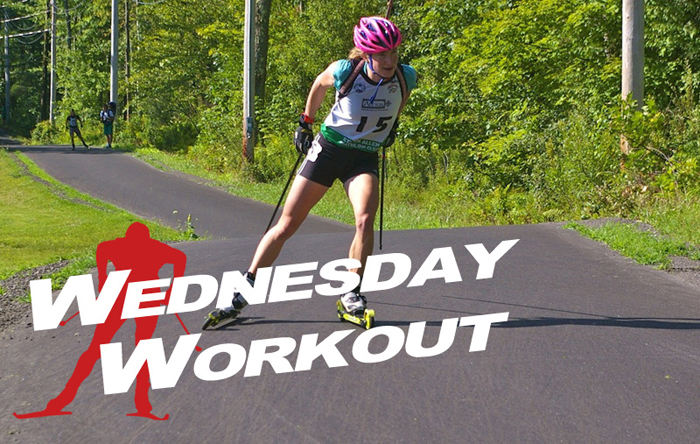
Hannah Dreissigacker (Craftsbury Green Racing Project/US Biathlon) closing in on a 31-second win in the 7.5 k sprint on Aug. 10 at North American Biathlon Rollerski Championships in Jericho, Vt.
Welcome to Wednesday Workout, where we provide and break down training ideas on a weekly basis. This week, Hannah Dreissigacker, a 26-year-old member of the Craftsbury Green Racing Project who made the US Biathlon A-team this year, talks about how she’s made strides in her sport — specifically in shooting — and why combo workouts are some of the best ones biathletes can do.
***
As I’ve transitioned from being a Nordic skier who dabbled in Biathlon to what I like to call a “real biathlete,” it has been a constant learning process. One of the biggest obstacles I had to overcome was my own hope that if I just trained with my Nordic teammates most of the time, and then worked on shooting as much as I could on the side, that would transfer to good biathlon performance. Unfortunately, that sort of training only gets you so far in biathlon.
So although I know that most of you FasterSkier readers are not biathletes, this “Wednesday Workout” will be a little peak into what its like to really train specifically for biathlon. This workout could also be done without shooting—each shooting stop only takes about 30 seconds, but it’s really designed to be about both the physical and shooting-specific training.
Shooting with intensity is what it’s all about. From the point of view of getting better at shooting in a race-like situation, it would be good to shoot with a high heart rate all the time. But since you can’t do intensity every single day, it’s really important to take advantage of the days that you are doing intensity by turning the interval workout into what we call “combos” in biathlon. Since you stop between intervals anyways, you might as well be shooting during that time! And even if the goal is a continuous intensity workout, a 30-second stop to shoot does not have much effect.
This is the workout that I feel has been my “bread and butter” this summer—I’ve done it more times than I can count and I think that doing it consistently has helped improve both my fitness and shooting skills.
Zero the rifle (shooting on a paper target to make sure that my group of 5 shots is centered in the middle of the target).
20-30 minute warmup. I like to warm up nice and easy.
8 x 10-15 second “impulses,” also known as pickups. After each impulse, I quickly put my rifle on my back and shoot while my heart rate is still high and my body a bit jittery from the short speed. This is great practice for trying to calm myself down, and also for shooting with a pounding pulse. I try to use a mix of techniques for the impulses, to spread the love. A minute or two of easy skiing between each impulse is good.
6 x 5-7 minutes Level 3 intervals. I really like the new rollerski loop in Lake Placid for this because it’s a real ski course with variations in terrain, a few technical downhill turns, and some hard uphills. This gives the Level 3 training a lot of variety. On the uphills, I have to hold back a bit and focus on relaxed technique and good glide. But on the transitions and flatter parts I can really push and go for lots of power. I like to end each interval on an uphill approach to the shooting range, so that my heart rate will be high when I come in to shoot. And despite being tired, or hot, or sweaty or thirsty, I try to just focus on shooting quickly, efficiently, and normally every time I come in. I think about my breathing and about pulling the trigger gently. Then after that I can get a drink and take a short break while I put my rifle on the rack again. After successive intervals, I usually alternate prone and standing shooting. And I also try to put a little pressure on myself when I come in to shoot—I imagine that I’m in a race, and think about how well I need to shoot to do well, or how many or few misses I’ve made so far in the day.
20-30 minutes continuous Level 3 skiing on the road, usually going for a total time of 1 hour of Level 3 work. Occasionally we’ll do more L3 with shooting, and so we’ll skip the road part, but often we finish the workout out on the roads. For one, this gives us some time to just ski continuously without shooting. But it also generally gives us faster, flatter terrain. It feels very different both physically and mentally to ski L3 continuously on a flat road than it does to be going up and down big hills all the time.
Short cooldown. This workout can get long, so I keep my cooldown short and easy.
For biathletes, it’s relatively easy to focus on either skiing or shooting. What’s harder is to focus on both at the same time, as is necessary in a race setting. Enter the “combo” workout, where athletes alternate running, skiing, or rollerskiing with shooting.
“The idea is simple,” said Tracy Colliander. “It’s to mimic our race conditions with the shooting, and to get an elevated heart rate with the shooting.”
She would know: Tracy and her twin sister Lanny Barnes have arguably done more combo workouts than any other women in the country. Their biathlon careers started in earnest at 2001 Junior World Championships in Khanty-Mansiysk, Russia, and haven’t slowed down since. At the same event in 2002, they joined with Carolyn Bramante to win a silver medal in junior women’s relay.
As seniors, Lanny has competed in five World Championships and Tracy in four. Both sisters raced at the 2006 Olympics in Torino, Italty, and Lanny also represented the U.S. at the Vancouver Olympics last season, where she shot clean to notch a 23rd-place finish in the individual race. It was the best finish for an American woman in 16 years.
So needless to say, the Barnes twins have done a few combos in their day.
“Combos can differ in the physical aspect ranging from running, to rollerskiing (skiing), biking or strength,” they said. “Most combo workouts are done rollerskiing or running. If a rollerloop is available at a biathlon range, then rollerskiing can be done, if not, athletes mostly run.”
That’s not the only way athletes can adapt the almost infinitely flexible structure of the combo workout.
“Combos are done at just about every pace, from level one to level five,” they said, although they noted that most combos were reserved for intensity sessions, meaning that they were performed closer to race pace.
How do they keep combos exciting after more than ten years of practice? The sisters suggested naming the workouts. For instance, if they had eight clips (five bullets each) to shoot in a workout, they could use the first two as a sprint race (one prone stage and one standing), then the second as a pursuit (two prone and then two standing) and the third as a relay (one prone, one standing) and call the whole thing “World Championships”.
“That way you kind of visualize the race when you come into shoot and try to put a little pressure on it,” the sisters said.
Here are a few examples of combo workouts that are staples in the sisters’ training plan.
Race Pace Combos
Lanny Barnes at the start of the women's sprint at North American Rollerski Biathlon Championships in August; she finished third. Photo: Elizabeth Geraghty.
Just as “four-by-four” intervals are a staple for skiers seeking to improve their ability to work at full capacity, level five combos are essential for biathletes who want to practice shooting at race pace. The Barnes sisters said that level five combos are one of their favorite workouts.
“You come into the range as hard as you can, to the point where you are on the edge of control with your shooting,” they said. “During this workout, shooting is incredibly tough and you have to work for every shot. But after doing a workout like this you’ll find that your normal race pace shooting becomes a lot easier and it gives you the confidence to come into the range pretty hard.”
Tracy and Lanny said that most of their intensity workouts were combos, although sometimes they did not add shooting to their hard days, for instance if there was better, harder terrain to be found away from the shooting range.
Easy Combos
Athletes obviously can’t do race-pace work every day; the rest of the time, they often incorporate easier combo workouts into their training. While they aren’t quite as valuable as their harder relatives in terms of learning how to shoot under stress, even adding shooting to a recovery workout gives a greater benefit than working on shooting and skiing separately.
The Barnes said that the key to adding shooting practice into a recovery workout was to find ways to keep the skiing easy.
“Most of the time if people are doing level one combos, then most of the shooting is done in the beginning of the workout or at the end of the workout with short loops, so that you are getting the heart rate up with shooting, but you aren’t spending the entire level one workout at the range,” they said. “You’ll shoot eight clips with short loops (maybe range loops) and then finish your workout with a more continuous workout without stopping to shoot.”
Strength Combos
Tracy Barnes in an IBU Cup sprint race in Altenberg, Germany last season. Photo: Viktoria Franke.
In a strength combo, rather than running or skiing, athletes focus on resistance exercises and plyometrics, and shoot after every exercise.
“We personally really like this workout, because it get’s your heart rate up a bit, but it really makes your arms and legs a bit shaky when you shoot,” the sisters said. “Often times you’ll get this same shaky feeling during a race, so the more you practice it, the more it isn’t a big deal to shoot with your legs shaking during a race.”
Ladders
To work more specifically on shooting, the Barnes do “ladder” workouts. Other athletes should take note, because the sisters are some of the fastest and most accurate shooters on the World Cup circuit.
To attain this level of speed and precision, they designed workouts to learn how to shoot quickly.
“You have a progression in shooting, and in order for you to move on to the next step on the ladder, you have to “hit” or complete that step,” the sisters explained. “For example, the first step might be you have to hit five targets on paper in the prone position in under 28 seconds. If you get that you move on, if you don’t you shoot it again. Then, the next one is five hits on paper for the standing position in under 25 seconds. Then you’d shoot prone on metal in under 23 seconds, five standing hits on metal in under 20 seconds, and so on.
“Each step or stage of the ladder is more difficult than the previous. The targets either get smaller or the time gets shorter, or both. Either way it gets progressively harder and with more pressure; the goal is to get through the progression with the allotted number of clips.”
As an added bonus, the sisters said, ladders are “tough and so much fun.” With a group, ladders can become a competitive event to see who can get through the workout with the fewest clips, which means getting stuck at the fewest number of stages.
“It helps to keep combos from getting monotonous,” said Tracy and Lanny.