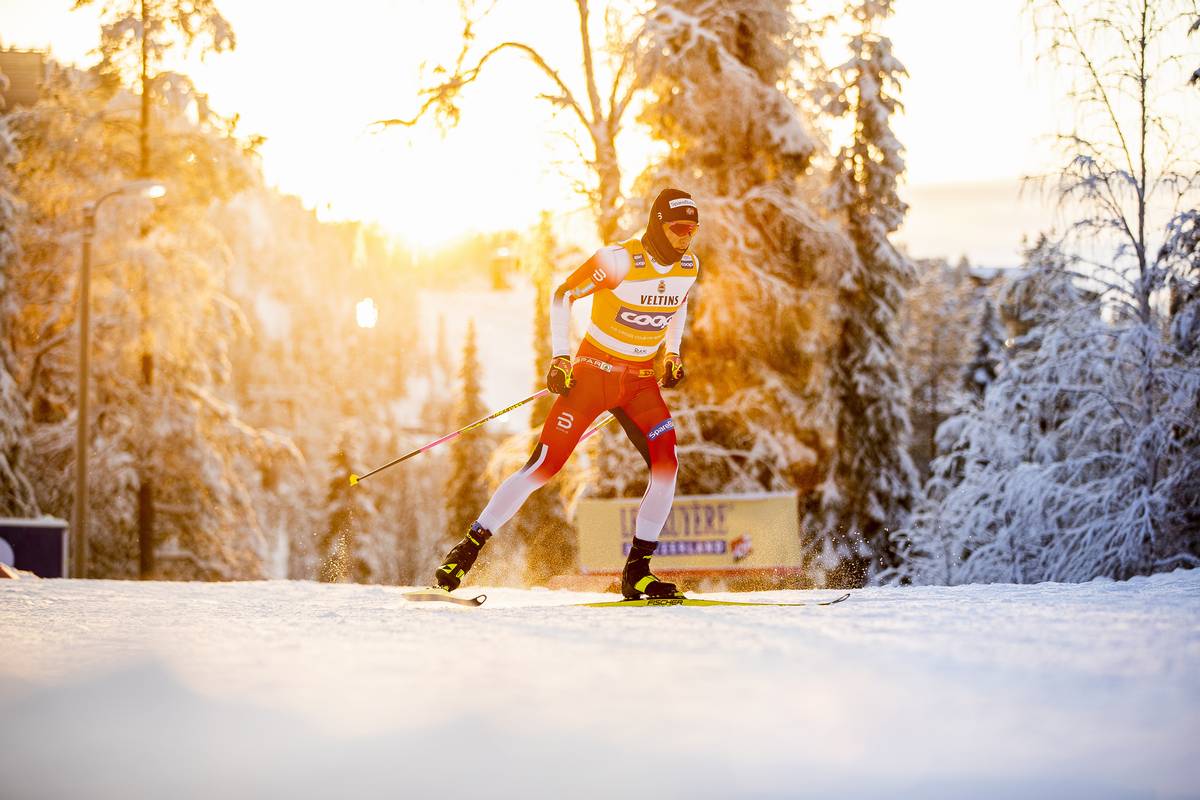
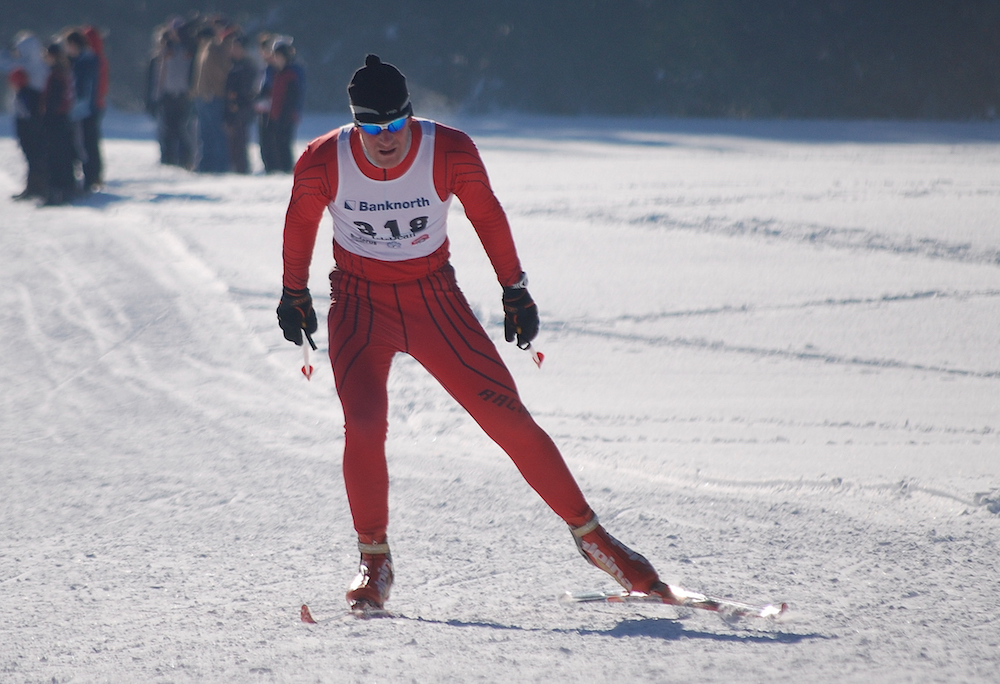
Johannes Høsflot Klæbo on course with fading December light in Ruka, Finland. (Photo: NordicFocus)
A new reality is setting in. As a nation, we are isolating ourselves at home, minimizing our contact with others to flatten the curve. Depending on your geographical location, you may still have access to scarcely populated nearby ski trails, routes to run, or bike paths to ride while still socially distancing. However, with schools closed, gyms shut down, and the challenges of working remotely, you may be finding that maintaining your usual exercise routine is challenging.
To help those looking for a quick strength routine that can be completed from home, Johannes Høsflot Klæbo went live on his YouTube channel this morning to lead a workout that can be completed without any special equipment. Klæbo addresses the audience in Norwegian, but he models each exercise, making it easy to follow. The full body workout includes familiar moves like sit ups, burpees, push ups, toe touches, mountain climbers, and planks, among others.
The following strength and performance tips come from one of our resident experts, Stuart Kremzner, MS, CSCS, FMSII, OS, RN, an exercise physiologist who has coached and raced in nordic skiing for over 20 years. Kremzner has trained/consulted with college athletic programs, elite teams, and athletes with the goal of improving athletic performance and injury prevention. When not working, he is running and skiing on the trails in New Hampshire or writing wax tips for the TOKO Tech Team. Kremzner can be found at e3sportsperformance.com.
***
In my recent article, “Back to Basics: How to ‘Reset’ for Nordic Performance”, I discussed how to prime our nervous system and core muscles in an optimized firing pattern. This article will delve into how to strengthen the core muscles now that they are more active and firing in an improved pattern. The goal of these exercises is to strengthen the core muscles in a reflexive dynamic pattern. The primary muscles targeted are the deep pelvic floor, transverse abdominal and gluteus medius muscles. Many other muscles are still very active as well.
Additionally, we learned how the reflexive core discussed in Original Strength is driven by three pillars: Vestibular stimulation, midline crossing or contralateral movement and diaphragmatic breathing. If what you are doing doesn’t satisfy these criteria then it is not reflex driven as far as the core is concerned, (Shropshire, 2018). The exercises below encompass these criteria.
When we read fitness books, articles or see YouTube videos about core training, it can be overwhelming and spark the questions– what do I need to do? What is most relevant for improving my Nordic skiing performance?
This is where having an assessment by a trainer certified in Original Strength or Functional Movement Systems will pay off in dividends, as the exercises will be targeted for you, versus a general starting point that is presented below. That said these are exercises that address the majority of deficits in a wide range of athletes from 10-year-old soccer players to skiers on the national team.
Consider the exercises below as a starting point, this is one of many potential good core exercise sets. Every athlete’s needs are different. If your reflexive core is already well developed then progress the exercises. Essentially, to keep developing and stimulating an adaptation you need to challenge yourself. Start with the basic exercises below. If you can do three sets of 10-12 repetitions with excellent technique then progress the exercise to a point where on your 8th-10th repetition your perfect body position, technique or muscles fail. This is the point of ideal adaptation for you.
Many of the exercises below are based on the Original Strength system of training. To learn more and really develop the knowledge to challenge yourself, I would recommend getting one of Original Strength’s books or check out more of their website videos.
Core Exercise Routine
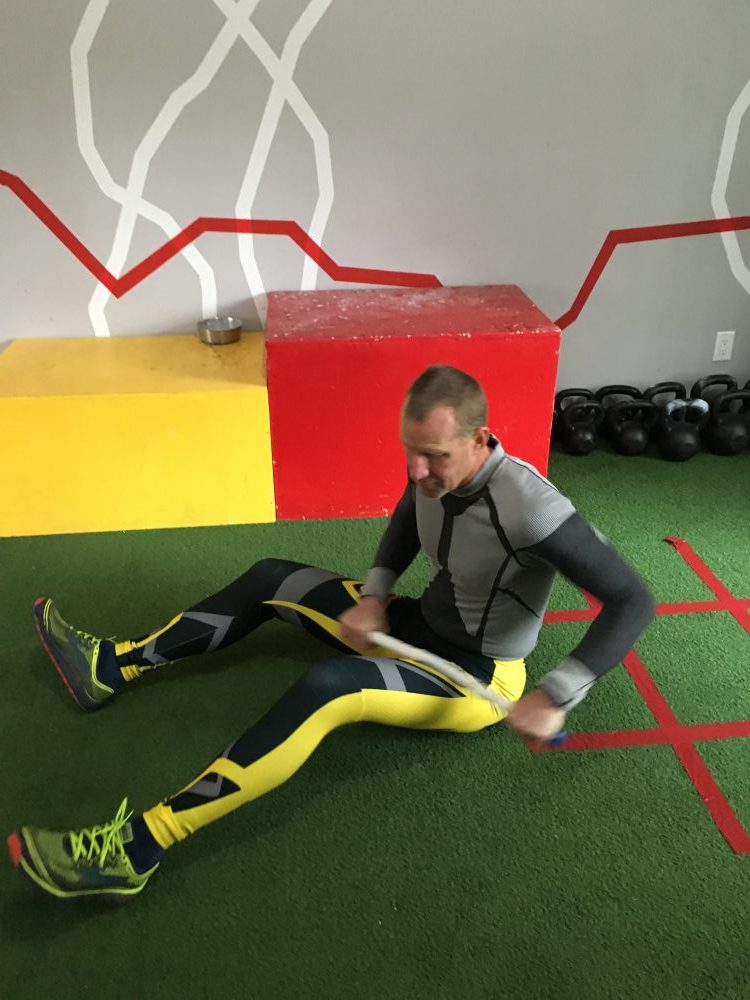
Start with rolling out and doing some myofascial release. Then move into resetting and activating your nervous system with the Original Strength activation/warm-up discussed in last week’s article, this will prime your nervous system and accelerate your adaptation to the core exercises.
Myofascial release. (Photo: Stuart Kremzner collection)
Important Points:
-These exercises can be done as an individual workout or added into an existing strength routine.
-For rapid adaptation, you should do these every day, or at a minimum 3 times a week.
-Maintain a good body position, continue to diaphragm breathe with good depth and rhythm.
-Execute the exercise with perfect technique. Remember 1-2 seconds with perfect technique is far more effective than compensated movement patterns (twisting, breaking position, holding your breath). This compensated movement will keep reinforcing a dysfunctional motor program and feeding into the same problem.
-As with the reset exercises described last week, continue to diaphragm breathe. Belly breathe deeply in and out through your nose. Your exhale should be 2x as long as your inhale. The tongue should be pressing on the roof of your mouth just behind your teeth. On the inhale push your belly button up as much as possible. The belly should always rise before shoulders.
-To advance these exercises, you can add load, (gravity or weight), pushing or pulling a load, create a less stable platform, or distraction (resistance pulling you in another direction, with a band or opposite limb movement).
For example to progress dead bugs, add a weight to the hand or ankle, or flip around and convert the exercise to a super dog. To progress super dog, put a dynadisk under the weight bearing hand or knee, then both. Then you can further progress the activity with knees off the ground about 1-2 cm.
The Workout
EXERCISES
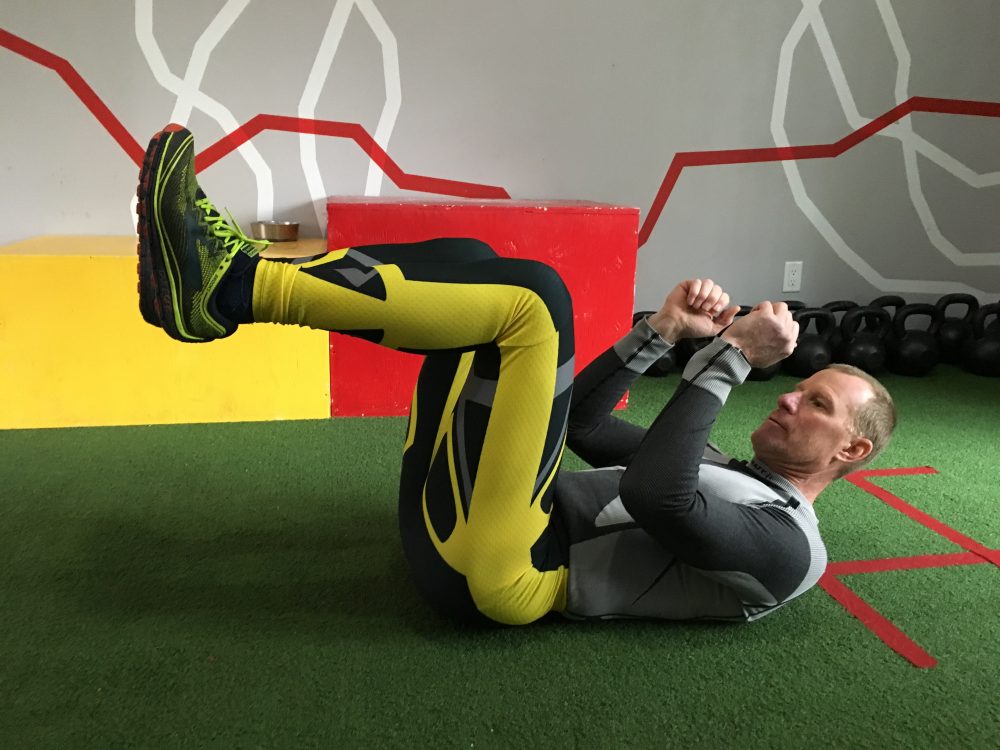
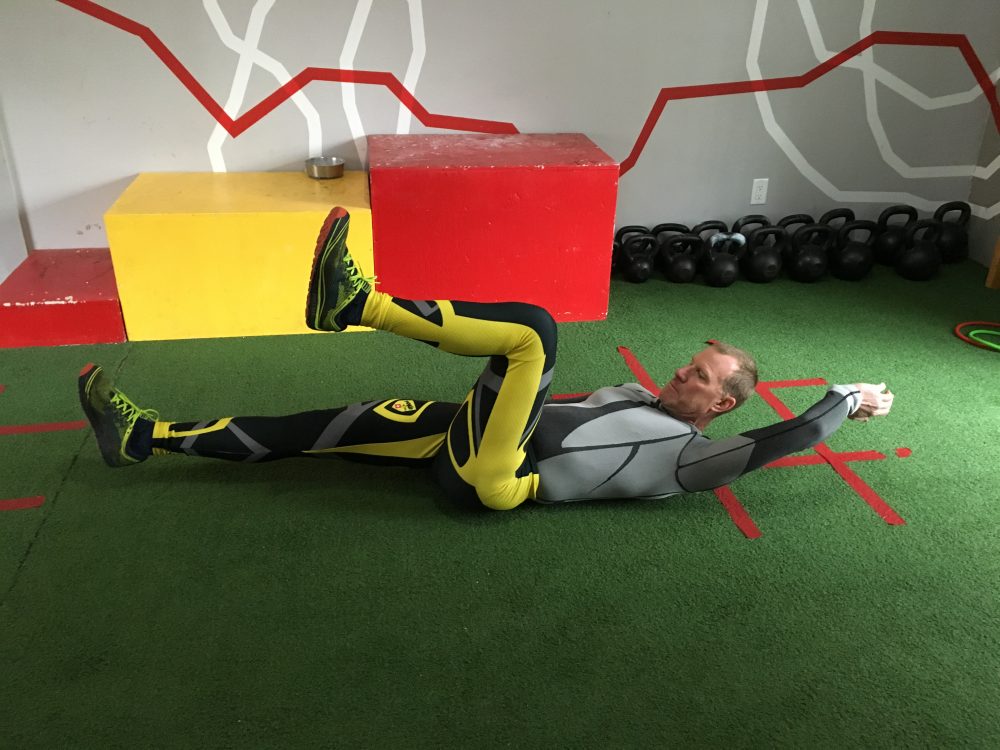
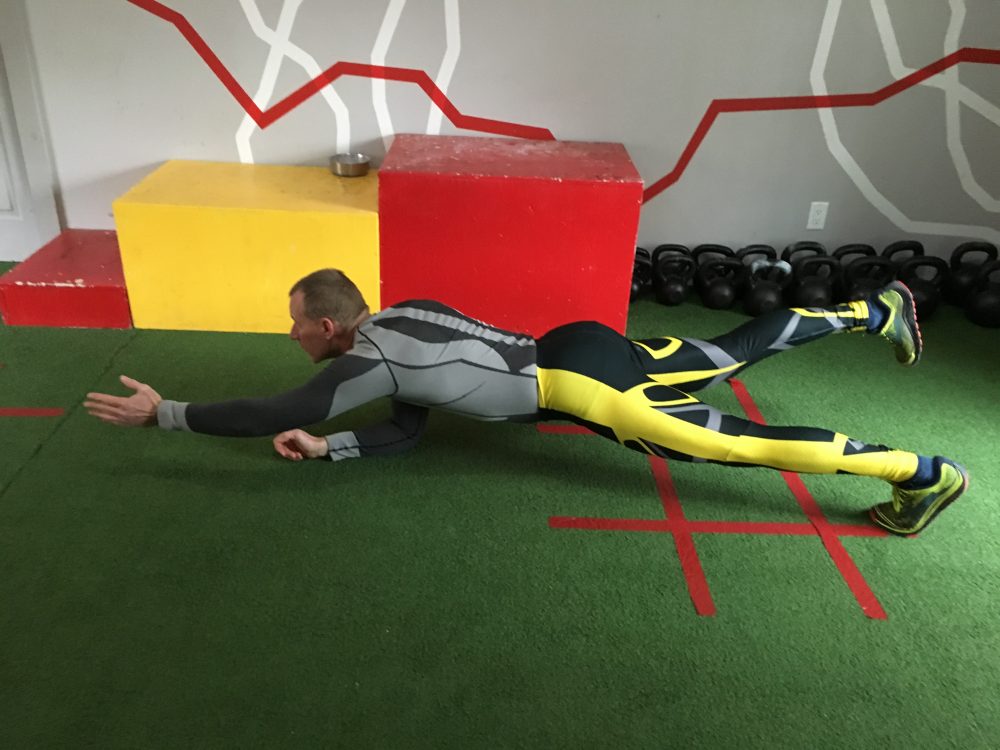
Dead Bugs- Lay on your back. Starting position arms and legs extended, 90 degrees to the ground. Elevate head, extend leg and opposite arm position just above the ground but not touching, hold 5-10 seconds (or to fatigue), return to start position, repeat opposite side.
Deadbug start. (Photo: Stuart Kremzner collection)
Dead bug finish. (Photo: Stuart Kremzner collection)
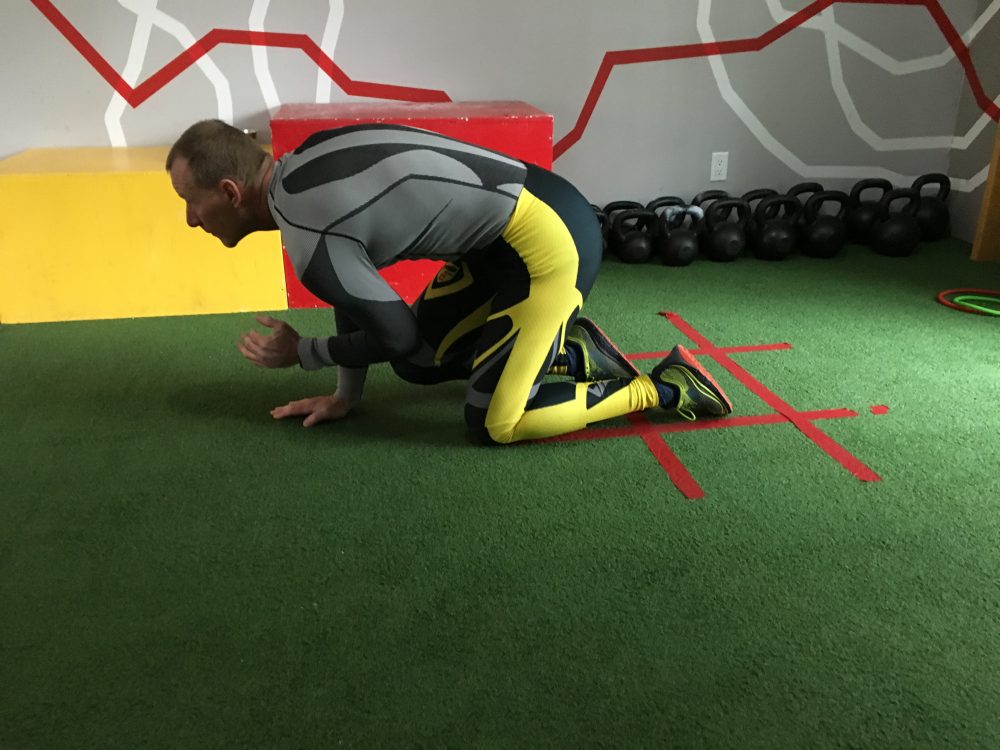
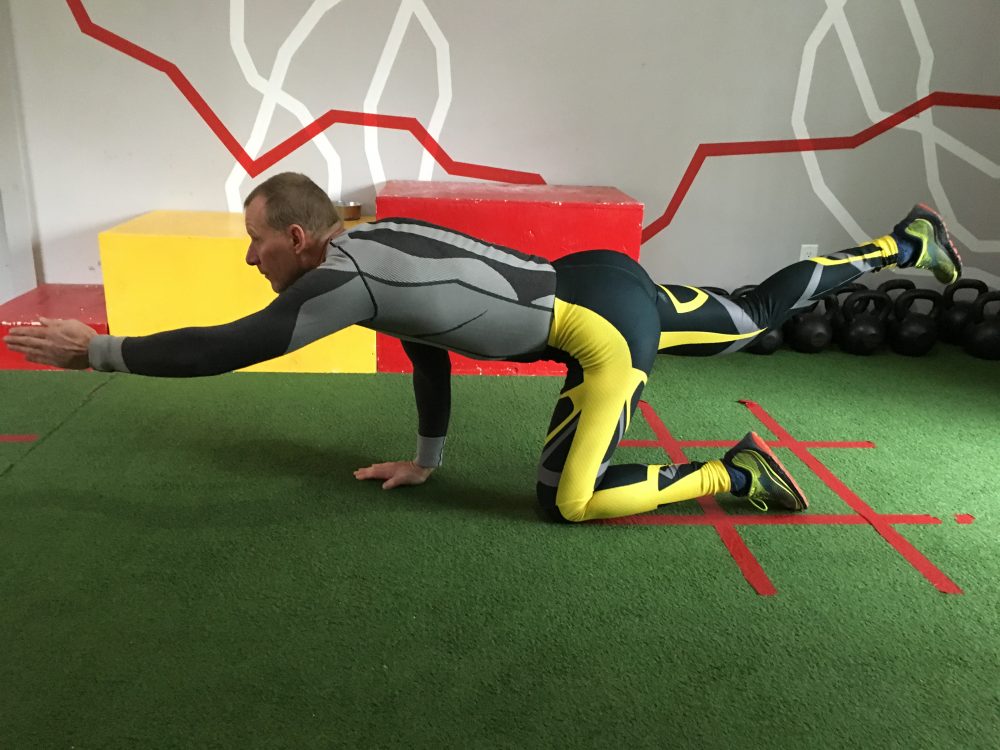
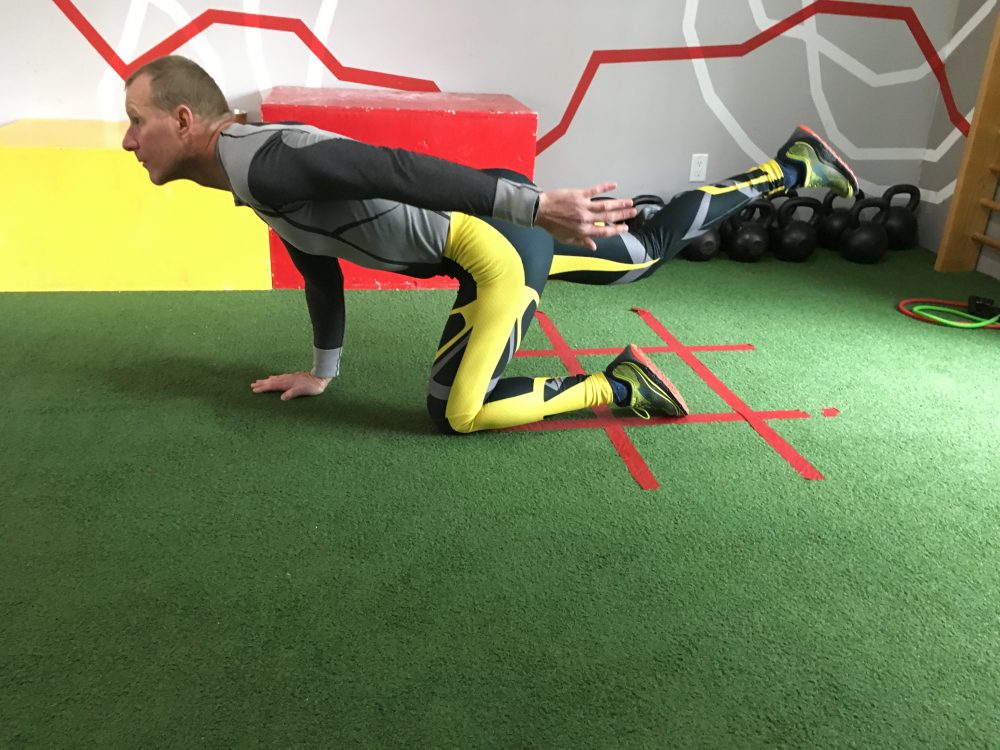
Bird Dogs/Speed Skaters– Begin on all fours, hands under shoulders, knees under hips, with a neutral spine. Brace your midsection and extend your opposite arm and leg. Hold for 2-10 seconds. Concentrate on contracting your glutes without extending your back. Keep your head up throughout the exercise. Repeat opposite side. To progress, add load, or try the quadraped lift off with hip extension as presented in Gus Kaeding’s 8/31 Wednesday workout article.
Bird dog start. (Photo: Stuart Kremzner collection)
Bird dog finish. (Photo: Stuart Kremzner collection)
Speed Skater. (Photo: Stuart Kremzner collection)
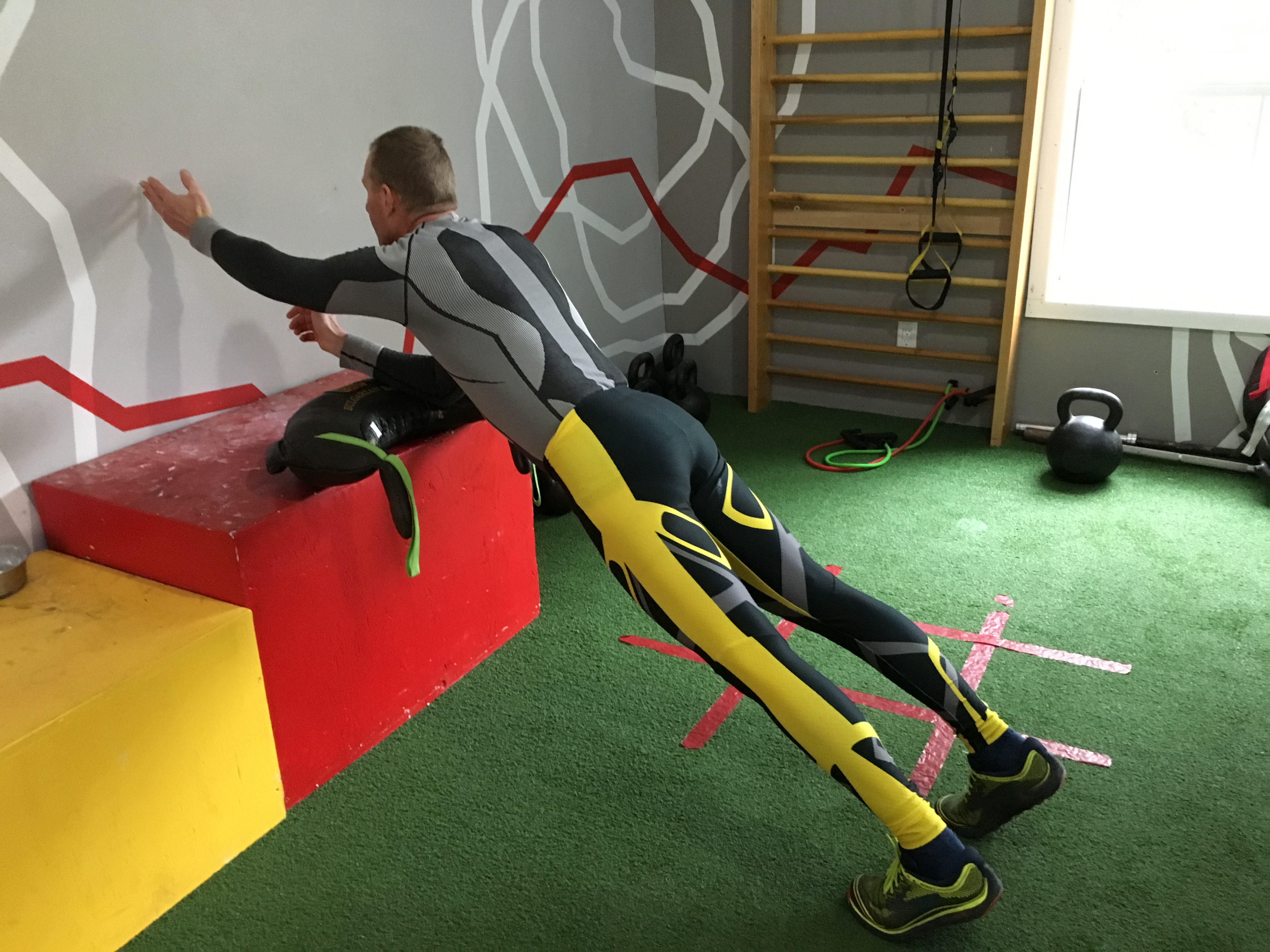
Incline Dynamic Plank- Start with an elevation of 24”-28”, have elbows on the box, and body extended with hips pressed forward, contract glutes to help with this. It is important to keep the torso, hips, and legs extended, and level with no twisting or compensation. Extend an arm and hold to fatigue for 2-10 seconds, then another arm, then each leg. Repeat 2-3 times. Remember, perfect body position is the key, twisting, or pushing your butt back just to get 10 seconds does not achieve the goal of the exercise. You will just end up skiing with the same compensated pattern come snow time.
Beginner Plank. (Photo: Stuart Kremzner collection)
To progress exercises- increase time first to 10 seconds, then decrease incline to lower box, then lift arm and leg, increase the time to 10 seconds, and decrease incline to flat. Once flat, you can add load, distraction, or instability.
Advanced plank. (Photo: Stuart Kremzner collection)
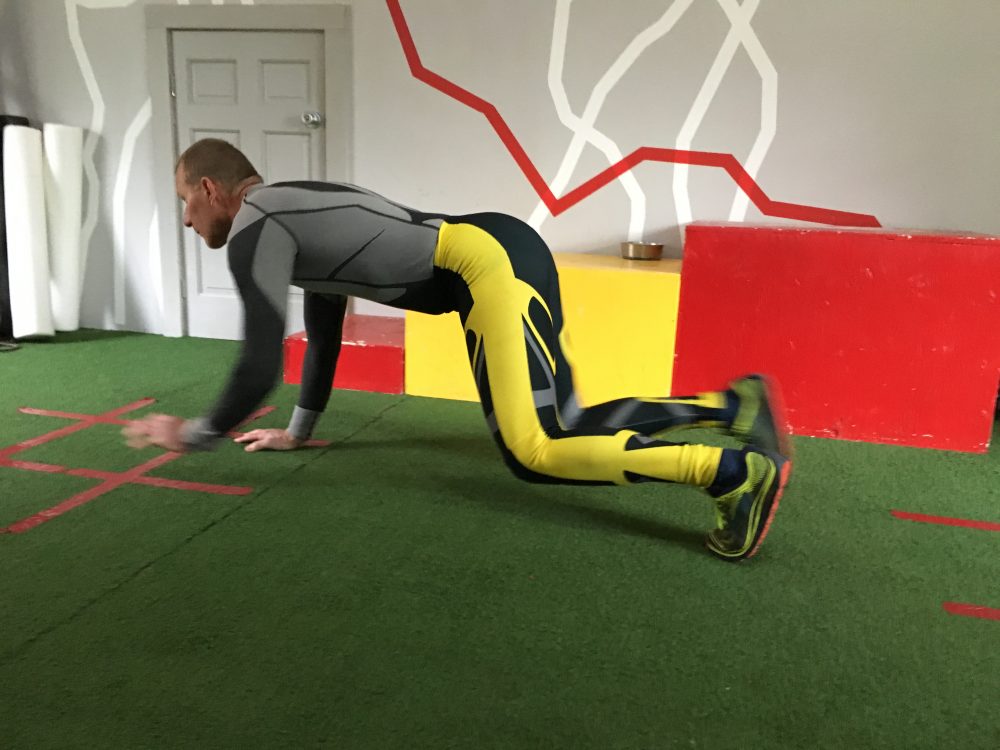
Baby and Elevated Forward and Lateral Crawls– These are baby crawls with more resistance. Focus on keeping a neutral spine and head up. To increase load, advance to Leopard Crawls by elevating knees 1-3 cm off the ground. Keep the same rhythm and technique as baby crawls.
Elevated crawls. (Photo: Stuart Kremzner collection)
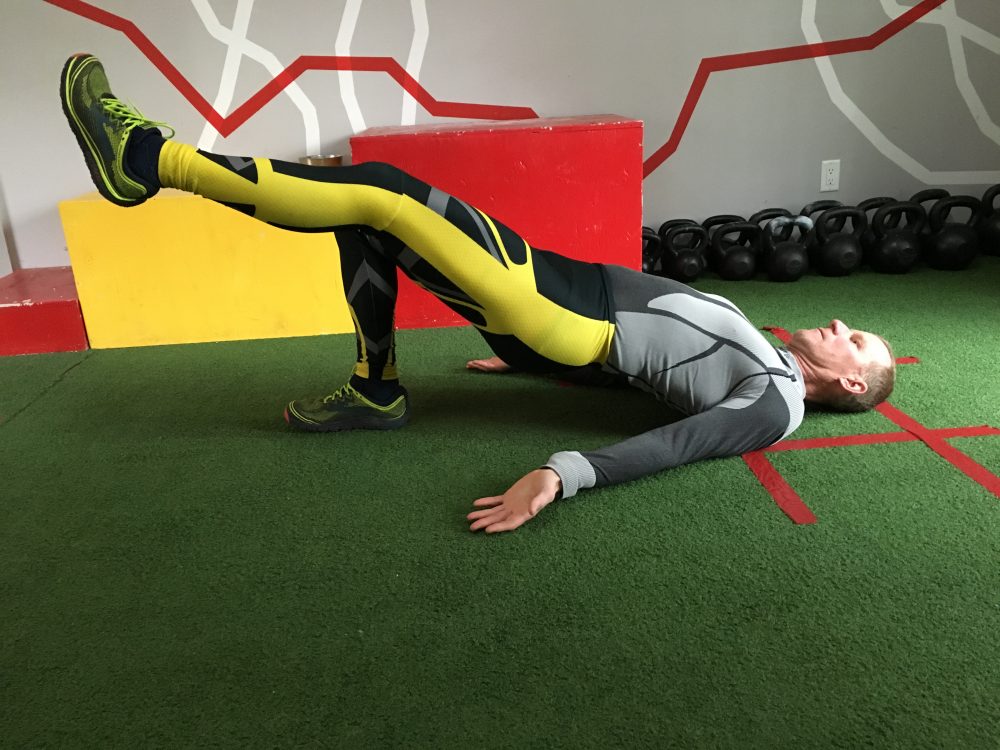
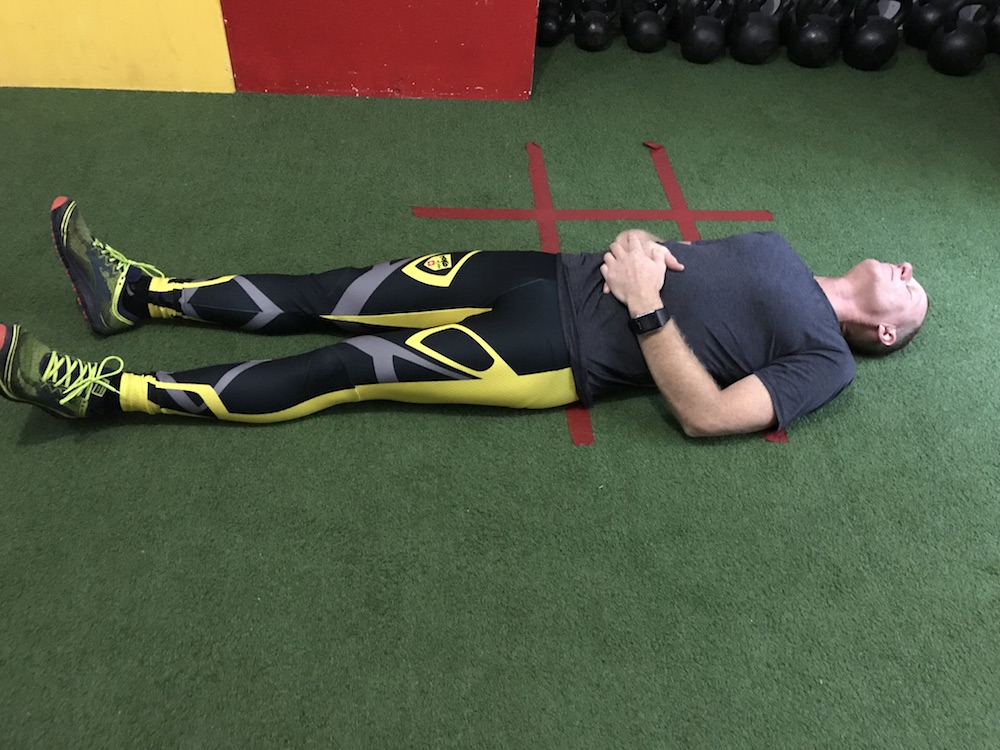
Static Single Leg Glute Bridge- Lay on your back, draw one heel up 6” from buttock, lift hips up with opposite leg extended. Hold 2-10 seconds. To advance exercise, cross arms across chest, use distraction or increased load on opposite leg.
HS bridge. (Photo: Stuart Kremzner collection)
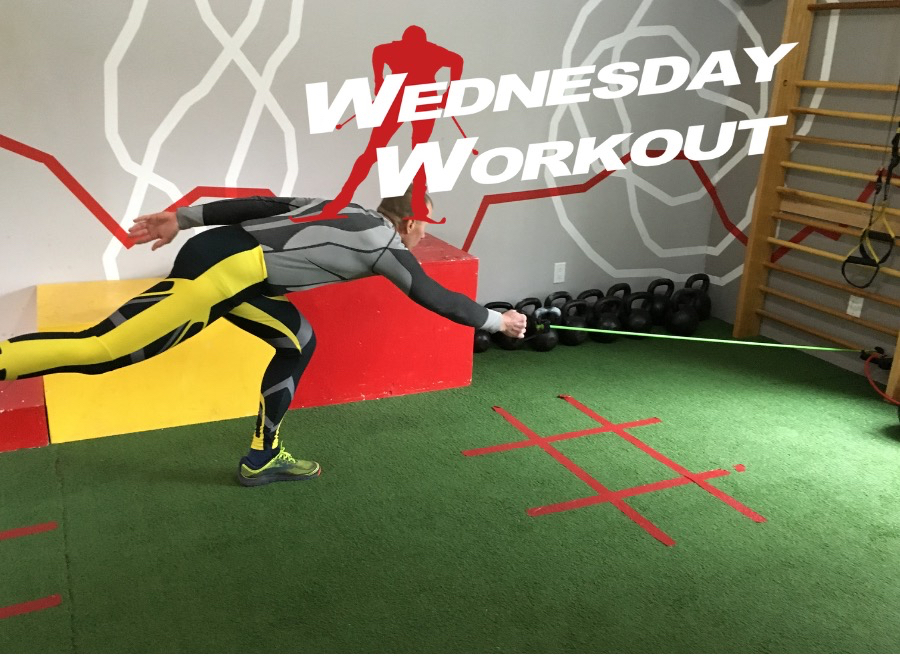
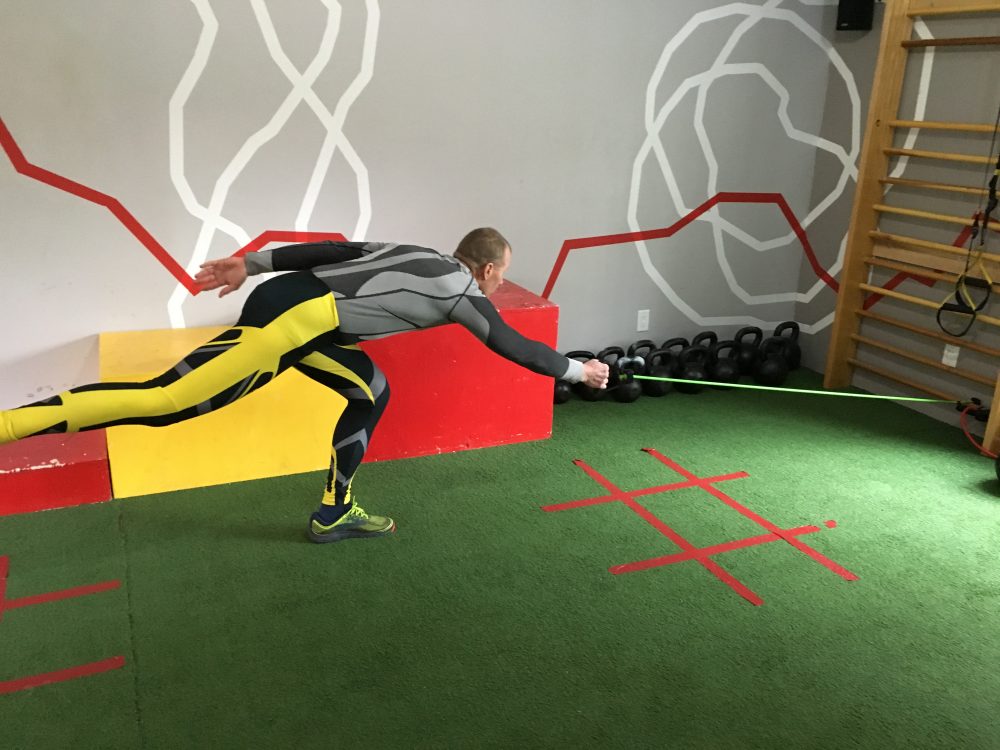
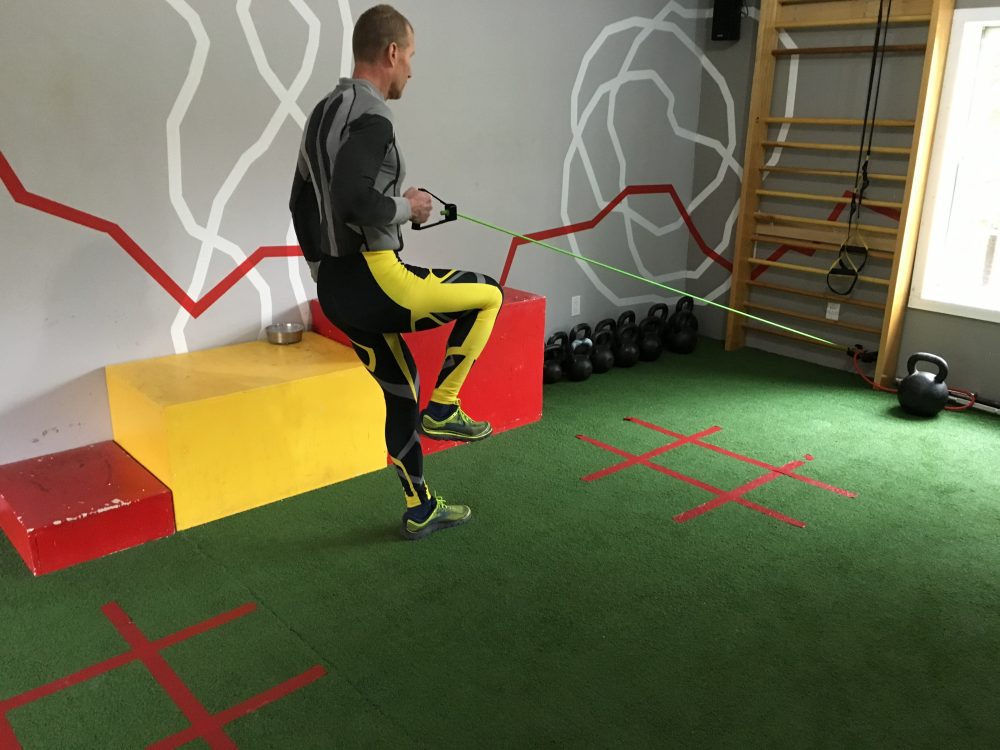
Glute Pulls– This exercise was developed by Mark Shropshire. This is a more advanced method of strengthening the glute-hamstring complex. Have a resistance band or chain with minimal initial load-but with some resistance-attached to a fixed sturdy object. Hold resistance band in right hand, and standing on right leg while extending down and forward, towards the ground, hinge at hips while bending knee, extend left leg, hold, then return upright while lifting the right knee and pulling back with the right arm. Switch sides, repeat.
Glute pull. (Photo: Stuart Kremzner collection)
Glute pull finish. (Photo: Stuart Kremzner collection)
Author Stuart Kremzner demonstrates diaphragmatic breathing, the baseline exercise for reseting the neuromuscular system and optimizing strength in sports like nordic skiing. (Courtesy photo)
The following strength and performance tips come from one of our resident experts, Stuart Kremzner, MS, CSCS, FMSII, OS, RN, an exercise physiologist who has coached and raced in nordic skiing for over 20 years. Kremzner has trained/consulted with college athletic programs, elite teams, and athletes with the goal of improving athletic performance and injury prevention. When not working, he is running and skiing on the trails in New Hampshire or writing wax tips for the TOKO Tech Team. Kremzner can be found at e3sportsperformance.com.
***
Like most coaches, I have been on the eternal quest to get the most out of an athlete’s performance. Not all of us are born with VO2maxes in the 80’s so we need to do lots of tuning to get the most out of our motors. When a skier comes by on the course, I do the quick checklist of what is holding this skier back. More often than not, I see the inability to maintain an efficient body position, transfer weight and balance as the limiting factors. The fundamental commonality between all these elements is reactive core strength. This element is one of the most important for technical efficiency for all skiers.
Author and exercise physiologist Stuart Kremzner putting his “Original Strength” to the test. (Courtesy photo)
Many skiers from beginner to elite can improve. Beginners often lack the balance; elite skiers can have compensated movement patterns from over-specialization or injuries. Most people right now are thinking, “I can do a plank for 2 minutes and I still have trouble balancing.” A four-point plank is static core, i.e. not reflex driven, and not effective training for dynamic balance. Core strength exercises must be dynamic to transfer over to be effective for sports performance. Most important, we need to prime our nervous system prior to the core exercises to get the most out of them. Without this step we are addressing only half the problem.
In 2003, physical therapist Gray Cook introduced and expanded the importance of mobility and stability in the performance hierarchy. Without this solid foundation of the ability to control movement and have a full range of movement, everything else we add on for fitness and performance development will not be optimal. Cook touched on an area of primitive patterns that has gotten much greater recognition. Tim Anderson and Geoff Neupert expanded on the concept in their book, Pressing Reset: Original Strength Reloaded. In it they describe the concept of “Resets” patterned after the neuro developmental movement sequence – the sequence of movement that infants use to develop enough core stability to stand on two feet and walk.
In Original Strength Performance: The Next Level, the concept was applied to the performance realm. The authors learned that resetting the nervous system prior to dynamic core exercises yielded exceptional results in redeveloping and maintaining efficient core strength and movement patterns. Resets are like wiping your hard drive for your neuromuscular system. If we don’t erase the dysfunctional pattern, it will continue to delay development.
Neurophysiologically, we are born with a blueprint for optimal, efficient movement patterns, and our foundational core is developed through a sequence of breathing, head movement, rolling, and crawling. After about 4-6 years, if we don’t use our core we start to lose it, we are seeing this more and more given lifestyle changes. How many of the kids we coach are doing manual labor these days and spending hours outside running and playing? Our movement pattern’s base-level functioning is dictated by the dominant motor programs we use. Our bodies were designed to be up and mobile 8-10 hours a day. Put us in a chair for 6 hours a day (like with school kids) or a desk-jockey job, and we have global changes in the detuning and functioning of our neuromuscular system. Primary core muscles develop dysfunctional firing patterns and weaken. Hip flexors shorten, and posture changes (we get more stooped). Core muscles stop firing optimally in their original motor program; they are not turning on at the right time or not at all. This leads to altered/decreased muscle-firing sequences, compensated movement patterns, power leaks, injuries, and for may of us, decreased athletic performance.
Resets are like wiping your hard drive for your neuromuscular system. If we don’t erase the dysfunctional pattern, it will continue to delay development.
For years as coaches and physiologists, we have been focused on more speed, power, strength and endurance. However, all this work is not optimized if we don’t have the fundamental ability to generate power, transfer it effectively between joints then into the ground, and have optimal mobility to use the full length of all of our muscle fibers effectively.
Reflexive core strength is the foundation of efficient all movement patterns. Hip stabilization and coordinating segmented movements between the upper and lower body is primarily mediated/controlled by our deep pelvic floor and transverse abdominal muscles. The key is to keep the core exercises dynamic and reflexive (as reflexes drive the optimal functioning of the deep reflexive core). Good skiing technique does not consist of doing static planking for 5 minutes. The exercise needs to be dynamic, hence you need to lift an arm, leg, or both (with proper body alignment) to keep the a plank reflexive. It is important to use perfect technique. It is far more effective to use perfect technique for 3 seconds vs. poor technique for 30 seconds (this just keeps reinforcing the dysfunctional muscle firing pattern!)
What follows are some ideas and the very basic science behind activating and training your reflexive core. Think of this as your “quick start” guide. For individualized/targeted training you need to have a good evaluation with an Original Strength certified coach who can develop a program that is most effective for you. At the very least this will help get you started. These exercises were developed by Anderson and Neupert of Original Strength.
Before and after each exercise, grab a 10-20 kilogram weight and do a deep squat, then a toe touch. Pay attention to how it feels, range of motion and “snap” you have going down and coming up.
To start, you need to reset and “overwrite” the dysfunctional movement programs in your nervous system. These exercises are called “resets”.
“Resets are the ABC’s of movement. When you can put all the letters together you can begin to make words, then before you know it you can make sentences. Sentences become paragraphs and eventually master pieces of literature! Movement is a lot like this – it starts out simple and messy and through practice becomes a thing of beauty. It starts with the resets of Original Strength.” (Shropshire, 2018)
This is achieved through systematically activating the muscle firing patterns as we developed them when we were infants/toddlers. These recruitment patterns originate in the more primitive part of our brain (brainstem, medulla oblongata pons, cerebrum); this is the foundational center of our most basic movement patterns. Through aging, injury and dysfunctional pattern overrides (sitting 8 hours a day), these fundamental patterns are overridden by altered muscle firing patterns that are not efficient.
The fundamental resets are diaphragmatic breathing, head nods, rolling, rocking and crawling. Each exercise has a video link to view excellent technique. If your squat or toe touch feels better and you can move with more depth and ease, that is a good reset for you.
It all starts with diaphragmatic breathing. Diaphragmatic breathing is critical to resetting and activating your core. The diaphragm, along with the transverse abdominis and pelvic floor, form the basic reflexive core. Intentional breathing using the diaphragm activates the other muscles of the reflexive core via neural and fascial connections – hence it is the gateway into the reflexive core. Head nods and rolling help reset and stimulate your ocular-vestibular system, which is integrally related to developing proprioception and balance.
Diaphragmatic breathing (restores muscle proprioceptive reactivity, also shifts CNS from sympathetic to parasympathetic): Lay on stomach (or back), forehead resting on flat hands, legs extended. Belly breathe deeply in and out through your nose. Your exhale should be twice as long as your inhale. Tongue should be pressing on the roof of your mouth just behind your teeth. On the inhale, push your belly button into the ground and push it up as much as possible. Belly should always rise before shoulders. Breathe for about 2-3 mins, then flip over on your back and hold your knees up with hands and keep focusing on deep breathing for another 1-2 minutes. Video (The key with all these exercises is to maintain the same tempo and depth of diaphragmatic breathing.)
Head nods: Lay on back with arms at 45-degree angles, palms up, legs extended. Have eyes look back, extend neck and head rotating to point where forehead is touching floor, then roll eyes down flex neck forward to look between heels. Repeat 10 times (keep same breathing depth and rhythm). Video
Rolling: There are many types of rolling variations, different type of rolls are more effective for improving various movement patterns. Start with Egg Rolls then move to segmental rolling.
Egg Rolls: Rotate eyes, head body. Use eyes then head to initiate roll use as little energy as possible, should feel relaxed and easy, keep rotating head all the way though for complete range of motion. Video
Rocking: On hands and knees, keep head/neck extended, rock back and flex neck. Keep back in level alignment and elbows locked out with body/neck extension and flexion. Rock slowly forward and backward, maintaining breathing pattern. Video 1 | Video 2
“Rocking”, a basic movement for reseting the neuromuscular system.
Baby Crawls (3 x 30 meters): Keep head up, diaphragm breathe as you move, lift hand and opposite knee off ground as you move forward. Pay attention to keeping hips level. Once you can do this perfectly progress to keeping knees off the ground (about 2-3 cm, no more). Video
It’s not juvenile: baby crawls can help “reset” the neuromuscular system.
How to apply these exercises:
The resets are the ideal warmup prior to your workouts. When these exercises are complexed with individualized core strength and strength exercises, overall strength and balance will be further improved. Future articles will discuss some great core and strength exercises focused towards developing an improved strength foundation for nordic.
Tim Burke (US Biathlon) racing the men’s sprint at the 2016 US Biathlon National Rollerski Championships in August in Jericho, Vt. (Photo: Katrina Howe)
Here’s a modified acronym: KIS. Intentionally left out is the final S, as in KISS; “Keep It Simple Stupid”.
Let’s give ourselves the benefit of the doubt. It’s been a long summer and dryland season. We’re all in a place to learn more, not denigrate. Keeping things simple and positive may tilt the cost-benefit scales in our favor.
“Keep it simple” is a basic mantra for building upper body, ski-specific strength.
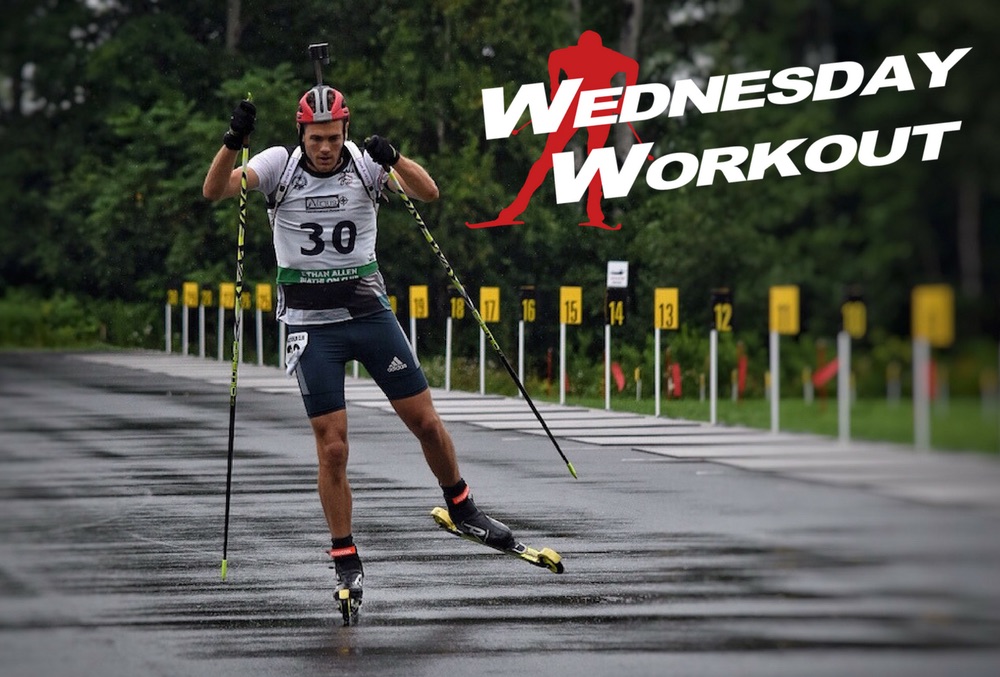
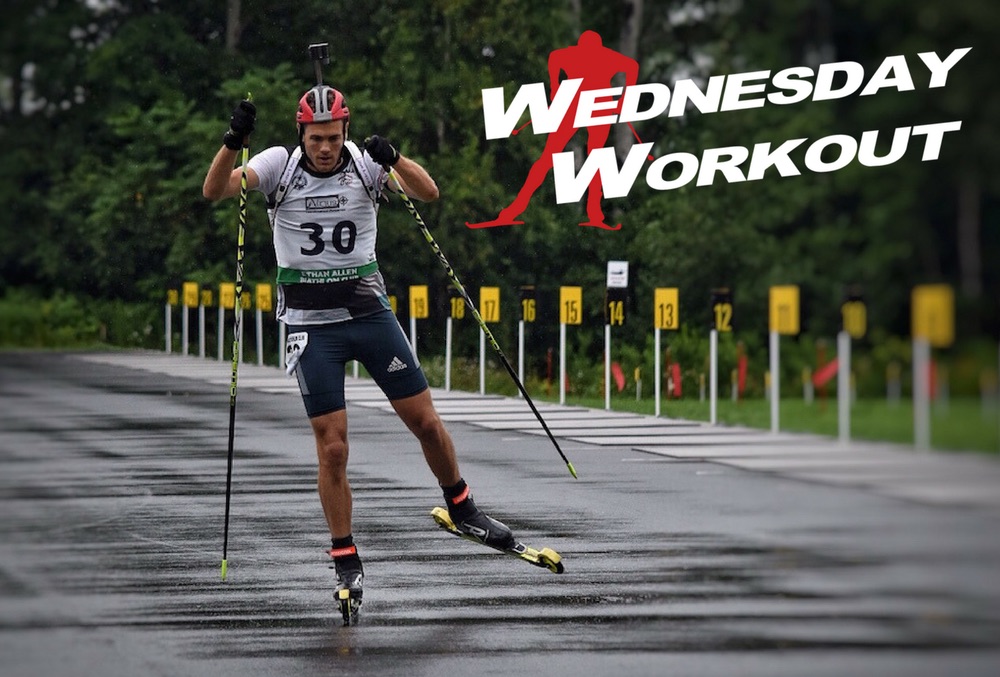
If you thought biathletes had enough to worry about with the skate skiing, ski selection and shooting as they prep for the International Biathlon Union (IBU) World Cup, you’d be right. Maybe race-day nerves are a bit mellower for biathlon wax techs on race day — there’s no kick wax snafu’s to tiptoe around — but that doesn’t mean US Biathlon’s Tim Burke doesn’t use double-pole workouts in his offseason training.
Yeah, you heard that right. Noah Hoffman and his now quotidian five-hour double pole rollerski sessions, they’re not just for nordies. Although it should be noted, Burke does partake in the double poling, it’s just a much shorter workout in duration than Hoffman’s epics.
This Wednesday Workout might best apply to the cross-country skier who only associates the word “classic” with things like cars, music, clothing, and say Coke. And if you’ve ever blurted out this: “Klister and Extra Blue are nothing to me!”, then keep reading. If Burke does it, the logic may follow that you should, too.
Burke’s Simple Double-Pole Workout (as written by Tim Burke):
“Here is a short but extremely effective double pole workout … the whole thing is pretty simple. I start in the weight room with 30 minutes of pretty continuous core work. You can be creative with the exercises here but I prefer to do most of my work with a redcord. I mostly focus on the core and other muscle groups used during double pole. The goal here is to fatigue these muscles for the second part of the workout.
After 30 minutes is up, I head over to the roller ski treadmill and double pole for up to an hour. I start at 6% grade and gradually work up to 15% by the finish. Of course you don’t need a roller ski treadmill, but it definitely makes the workout more challenging. I also always use skate poles in my double workouts because I am most interested in the crossover to my skate skiing.”
Part I: 30 minutes in the weight room, continuous core work
Part II: 1-hour double pole, up gradually increasing incline (like a moderate-to-steep hill)
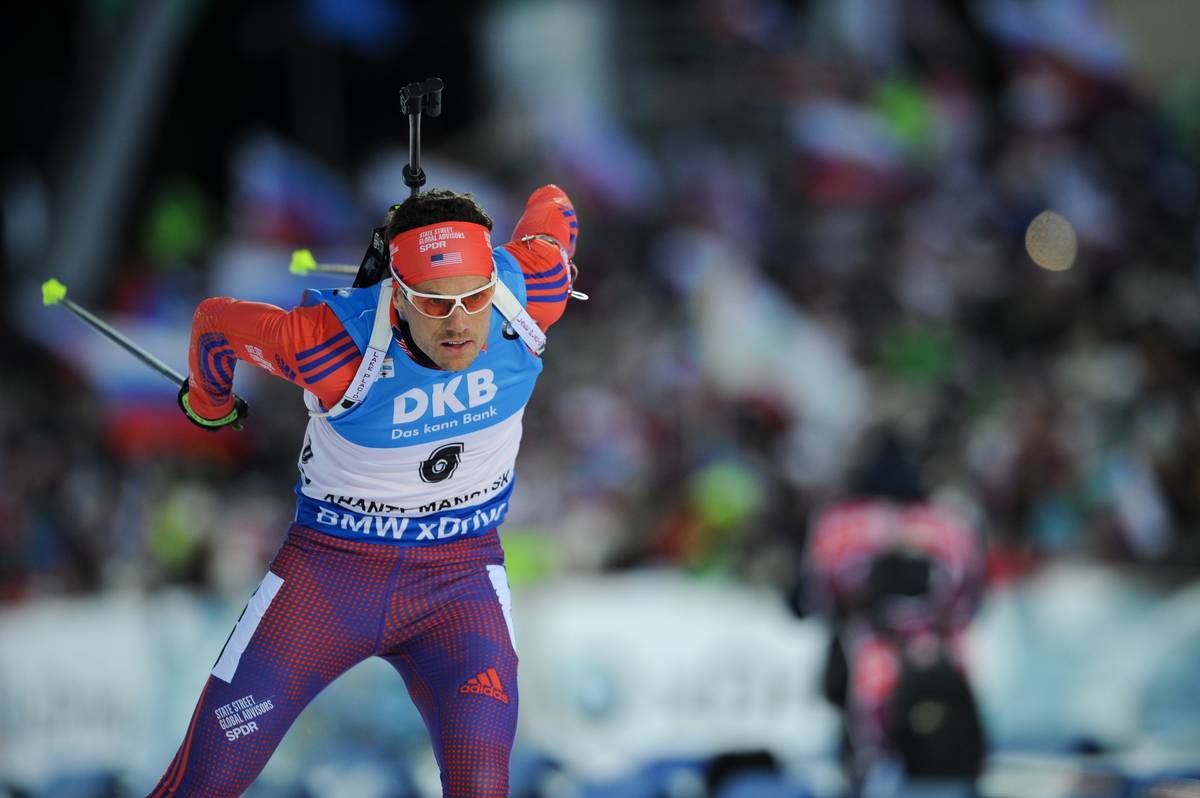
Tim Burke (US Biathlon) racing to sixth, which tied his season best, in a 2016 IBU World Cup pursuit in March in Khanty-Mansiysk, Russia. (Photo: USBA/NordicFocus)
True enough, it’s rare for skiers to own or have access to a rollerski treadmill. But that doesn’t mean that creativity cannot win out. Find that long, gradually getting steeper and steeper hill and presto: the resourceful person’s rollerski treadmill but with clean air, trees, and hopefully minimal traffic.
For those wanting to dive a bit deeper into the specific muscle groups used while double poling, here’s a link to a useful 2010 Journal of Applied Physiology paper. (Note: the red coloration in the images denoting muscles groups used indicate greater glucose uptake. All that means this: the red muscles are used more intensely.)
According to skate technique expert Torgeir Bjørn, Petter Northug is best during the last ten minutes of a race. Bjørn, who is the technique coach with the Norwegian national biathlon team, explains that this is the part of the race where technique matters the most.
Petter Northug agrees with Bjørn, and says that basic core strength is a determining factor in being able to finish ski races on top.
“Up until 2008 I wasn’t particularly diligent with that kind of training, and my upper body sort of collapsed. I was hanging too far forward. While I was able to maintain the speed, it cost me a lot more,” Northug explained.
By focusing heavily on building core strength, Northug argues that you can maintain solid technique all the way through long races, even at times when you’re not peaking.
Important at average fitness
Northug celebrates his victory in the Olympic 50 k while Germany's Tobias Angerer and Canada's Devon Kershaw lunge for the line.
“It’s important to have a strong core, inner abs, back and lower abs. This kind of strength helps maintain posture even when you are fatigued, which is particularly important in races that you’re not peaking for. When you’re peaking, nothing is a problem, but nobody is peaking throughout the season,” Northug said.
“Core strength training is crucial to build stability and maintain solid technique toward the end of almost all race distances. This is in addition to all the strength you build over the hours of skiing and roller skiing,” he said.
– Torgeir Bjørn says it looks like you don’t care about the opening phases of a race?
“It might look like I don’t care about the start, but I think that might be because there’s usually more energy flowing toward the end of a race. I feel like I ski technically fairly well throughout the race. However, I see that it might look like it flows better toward the end. But I don’t change my technique focus during races.”
– Your surges have earned you several Olympic and World Championship gold medals. How much do you practice these surges?
– Ski like H”#!¤ even when you got lactic acid coming out your ears.
“I spend a lot of time practicing accelleration when your body is tired, while at the same time maintaining good technique. I do a lot of little surges during my distance workouts. You have to practice how to ski like h”#!”, with proper technique, even when you got lactic acid coming out your ears,” Northug said.
The star skier also says you need to be aware of technique now, in the transition period from dryland/ roller skiing to on snow training.
“I use video a lot to make sure I don’t carry little roller ski-specific issues onto the snow,” Northug said.
From Langrenn.com, October 28, 2010 By Ola Jordheim Halvorsen, translation by Inge Scheve