From the FasterSkier archive — posts syndicated from athletes’ and coaches’ own blogs between 2004 and 2012, kept online as published. Current coverage is at fasterskier.com.
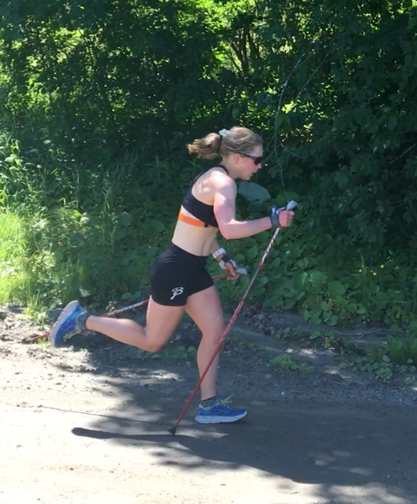
Craftsbury Green Racing Project nordic skiers and biathletes doing uphill running intervals on a dirt road in Craftsbury, Vermont. (Photo: Pepa Miloucheva)
For a mid-summer Wednesday Workout, we reached out to Craftsbury Green Racing Project head coach Pepa Miloucheva. In addition to sharing a running workout, Miloucheva told us what and who is new to the team based out of Craftsbury, Vermont.
“All is good here in Craftsbury, everyone is healthy and training is going well,” she wrote in an email in early July. The nordic team joined last month’s U.S. Ski Team (USST) training camp in Lake Placid, N.Y., and also plans to attend the USST’s on-snow New Zealand camp in late August.
Ida Sargent, of the Craftsbury Green Racing Project and U.S. Ski Team, during dirt-road running intervals in Craftsbury, Vt. (Photo: Pepa Miloucheva)
Craftsbury’s roster additions include Corey Stock and Akeo Maifeld-Carucci. Returning to the nordic squad are Ida Sargent (U.S. Ski Team), Caitlin Patterson, Kaitlynn Miller, Liz Guiney, Adam Martin, and Ben Lustgarten.
The workout itself, one Miloucheva explained the team does this time of year, is 6-8 x 10-minute running intervals with poles. They do so on a gradual, mile-plus-long hill on a dirt road in Craftsbury. To replicate, find a climb that takes at least 10 minutes to run up, and repeat six to eight times.
“This is a lactate threshold workout, important for improving our sustainable speed,” Miloucheva wrote. “Threshold workout improves both lactate production/recruiting more fast twitch units and lactate removal, ability to minimize the negative effects of lactate while having the benefits.”
“Athletes run with poles up and I drive them down as quickly as possible to shorten the time between the interval,” she explained. “Goal is to maintain speed for all intervals and keep lactate between 3-5mmol/l, depending on the athlete.”
Male and female athletes all start at once, just at different starting points so they finish in the same place. Miloucheva recommends focusing on controlling speed during this workout to ensure a productive 50-plus-minute workout at Level 3.
Upon repeating the workout later in the training season, athletes are instructed to push the pace at the end of the interval to Level 4.
The workout: 6-8 x 10-minute running intervals with poles
Need: A hill that takes at least 10 minutes to run up, poles.
Warmup: 30 minutes easy running, with a few accelerations and functional movements
Then: Run uphill for 10 minutes at Level 3, return to starting point, repeat 6 to 8 times. Pace at end of interval can be increased to Level 4 later in the season.
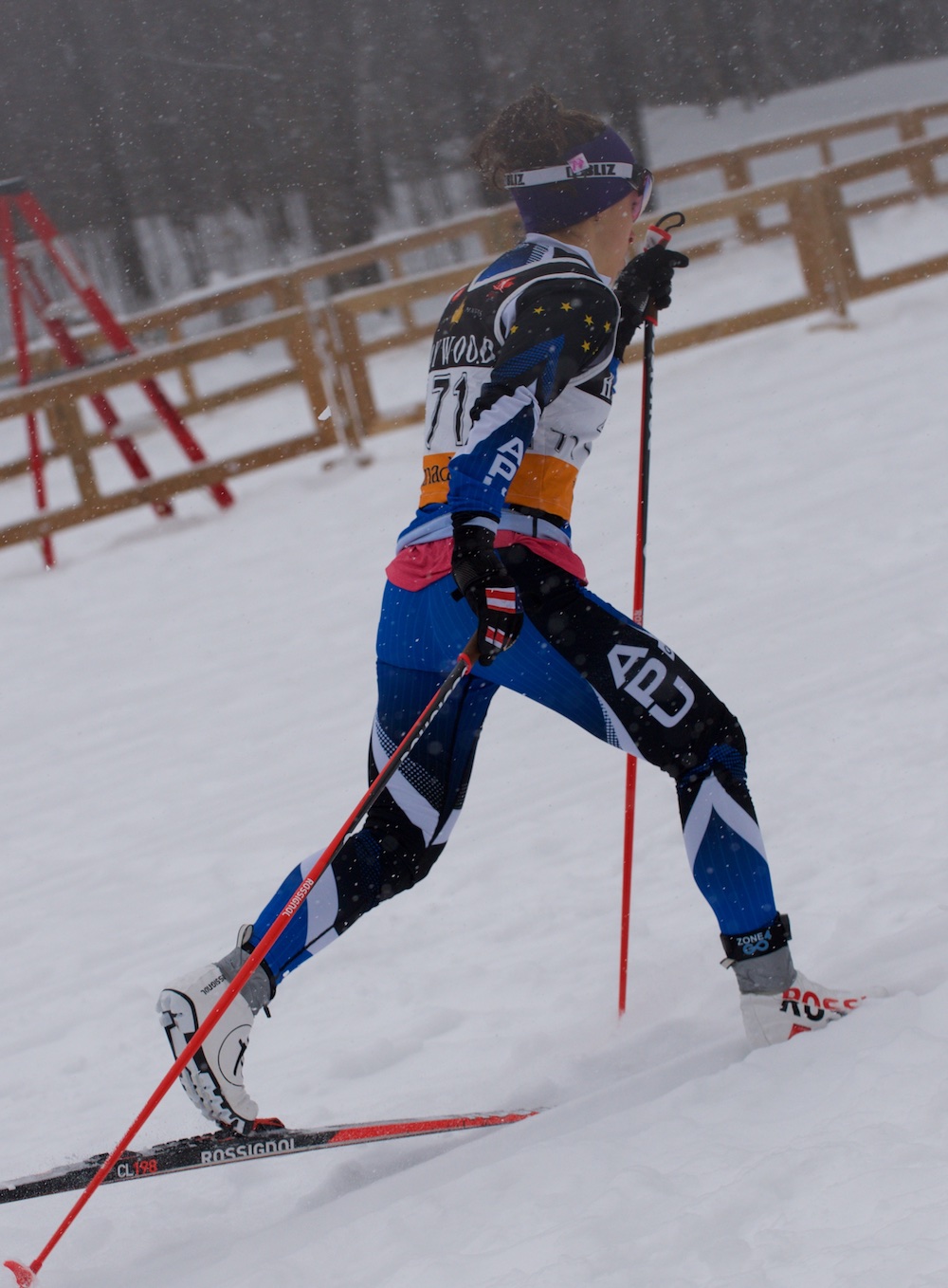
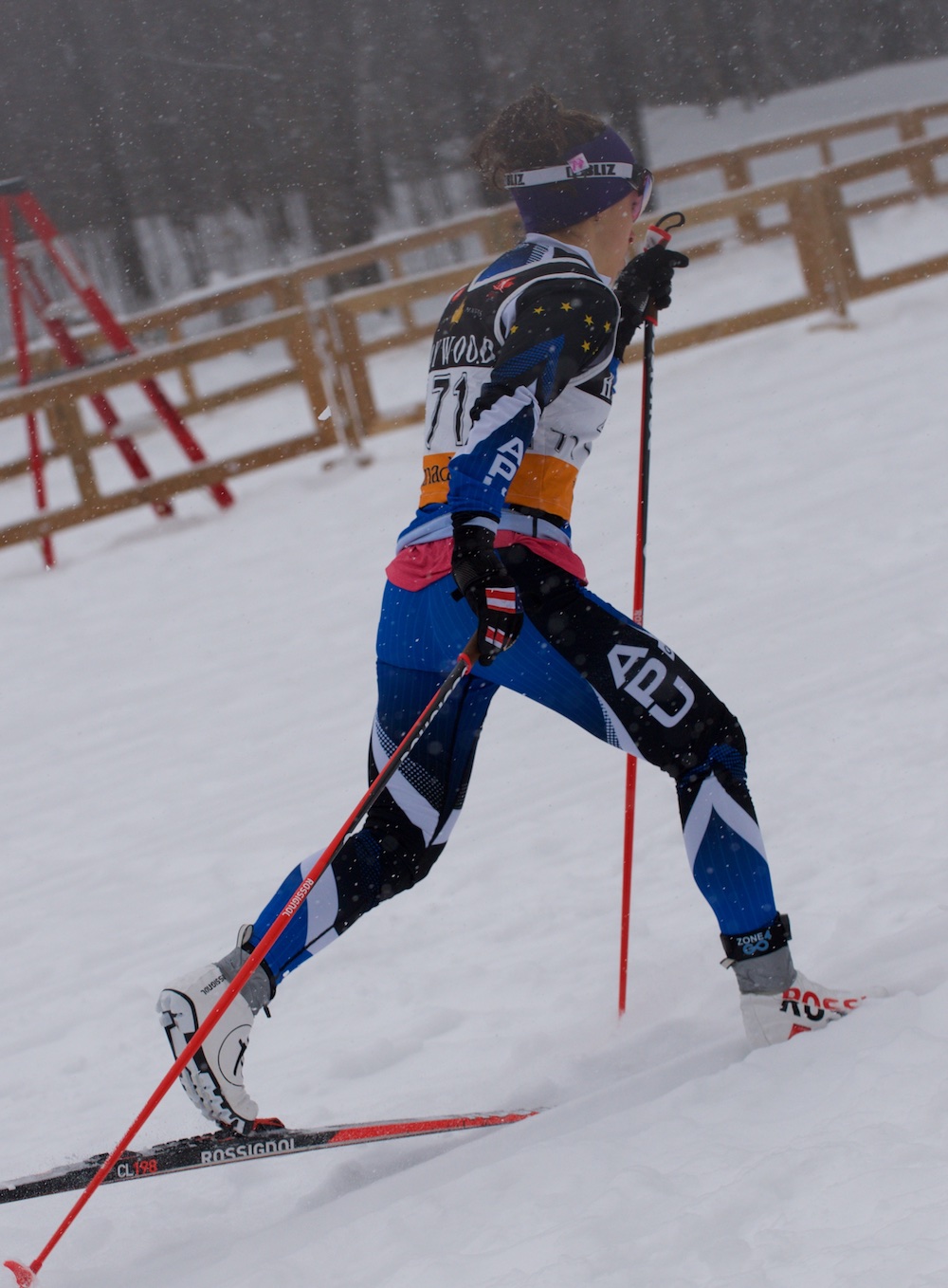
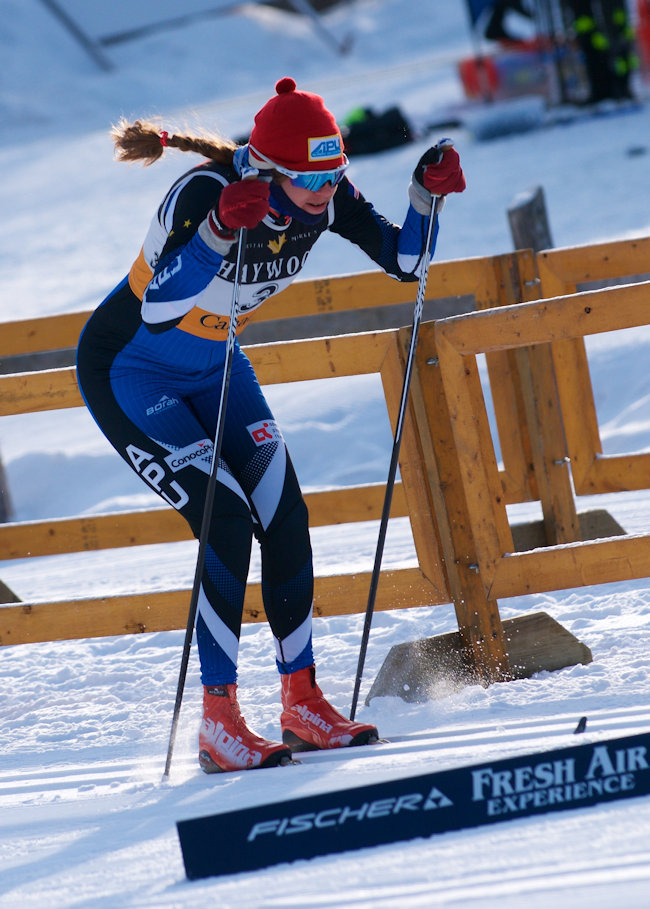
Rosie Frankowski (APU) racing to a 2-second win in the women’s 10 k classic pursuit on Sunday, the final day of 2018 Eastern Canadian Championships in Gatineau, Quebec. (Photo: Rob Smith)
NorAm Eastern Canadian Championships (Gatineau, Quebec): 10/15 k classic pursuits
Rosie Frankowski defended her lead and tallied her second-straight win on Sunday, the final day of Eastern Canadian Championships, both a NorAm and a SuperTour. Meanwhile, David Norris overcame a 10-second starting deficit to make it all Alaska Pacific University (APU) atop the podium in the classic pursuits.
Frankowski started the women’s 10 k pursuit 47 seconds clear of her APU teammate Becca Rorabaugh in second and held Rorabaugh off by 2 seconds at the finish, crossing the line first in 1:00:32.6 hours on a warmer day around 0 degrees Celsius with heavy snow in Gatineau. Kaitlynn Miller of the Craftsbury Green Racing Project (CGRP) was the third American on the podium, racing up from seventh to third, 21.3 seconds behind Frankowski.
Olivia Bouffard-Nesbitt (Rocky Mountain Racers) led the Canadians in fourth (+3:09.2), up from sixth at the start, and Frédérique Vézina, of the Pierre-Harvey National Training Centre (CNEPH), followed in fifth (+3:15.2), after starting fourth.
Another 4.6 seconds back was Liz Guiney (CGRP) in sixth (+3:19.8). Felicia Gesior (CXC Team) finished seventh (+4:05.6), Corey Stock (Bridger Ski Foundation) placed eighth (+4:05.8), Annika Hicks of the Alberta World Cup Academy (AWCA) was ninth (+4:40.8), and Alannah Maclean of the National Team Development Centre (NTDC) Thunder Bay finished 10th (+5:25.9).
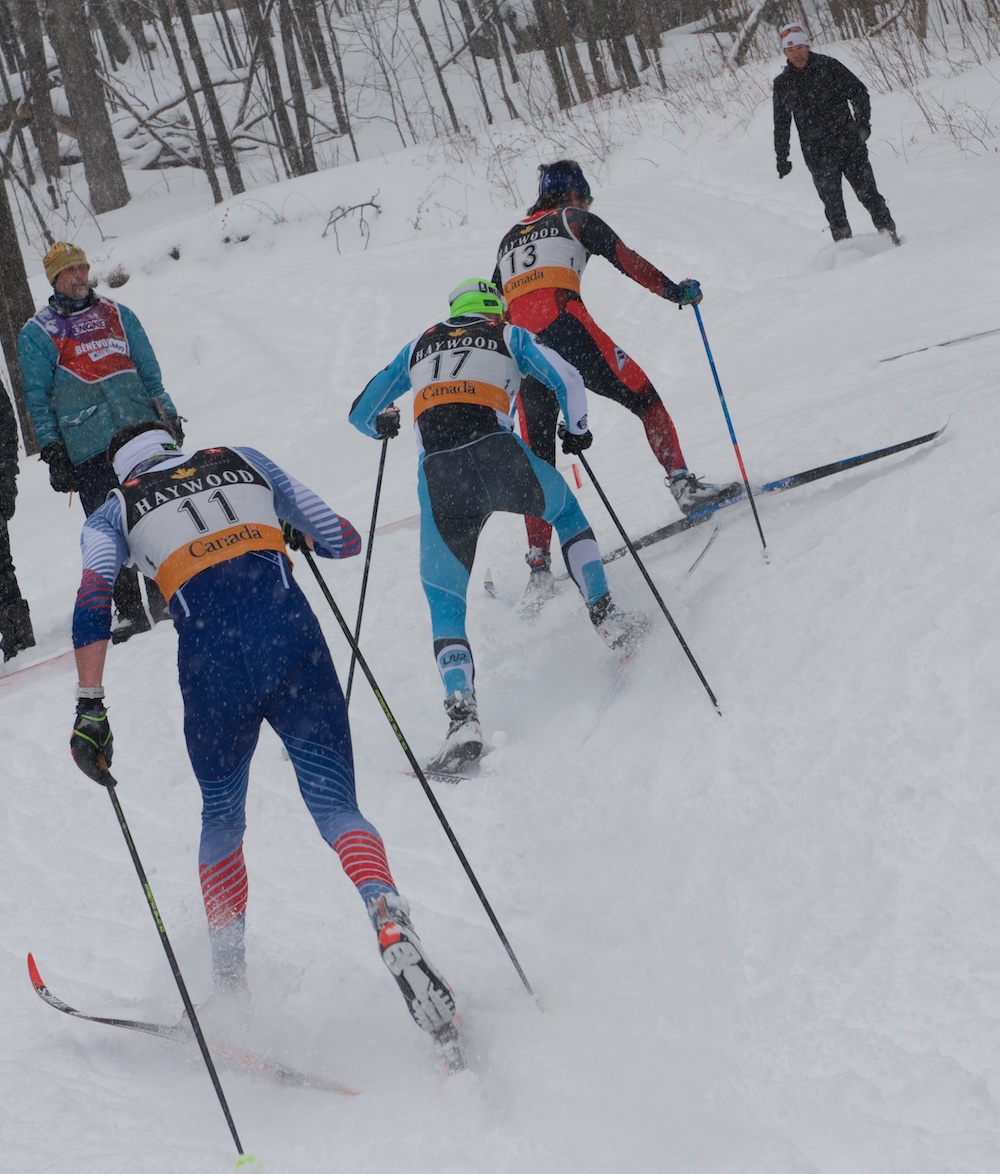
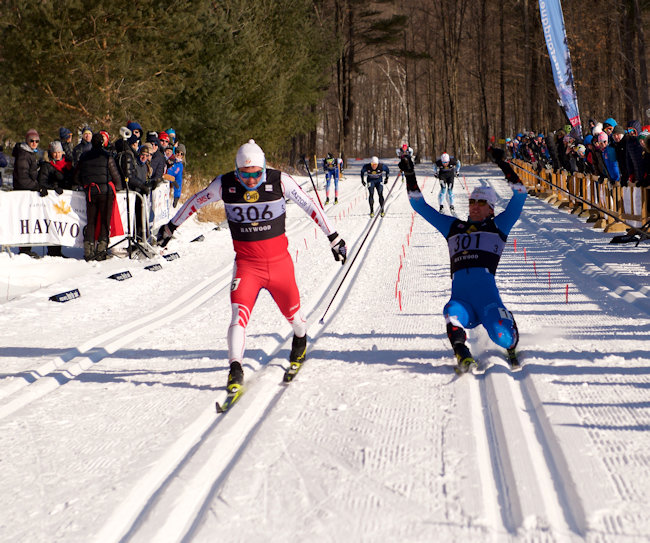
Tad Elliott (13) leads Brian Gregg (17) and Jack Hegman (11) up a climb during the men’s 15 k classic pursuit on Sunday at 2018 Eastern Canadian Championships in Gatineau, Quebec. Gregg went on to edge Elliott in a photo finish for third and Hegman followed in fifth. (Photo: Rob Smith)
In the men’s 15 k, Norris started second and caught leader Jack Hegman, of the Sun Valley Ski Education Foundation (SVSEF) early then raced alone to the victory in 1:19.26, while Ben Lustgarten (CGRP) followed 1:17.8 minutes later in second. Lustgarten started the race in sixth and Brian Gregg (Team Gregg/Loppet Nordic Racing/CXC) started seventh, with Gregg edging Tad Elliott (Ski Club Vail) by less than a tenth of a second in a photo finish for third (+1:38.5). Elliott had started third.
Hegman finished fifth (+1:42.6), his Sun Valley teammate Kevin Bolger was next across the line in sixth (+1:59.1), Adam Martin (CGRP) finished seventh (+2:01.2), Rogan Brown (SVSEF) was eighth (+2:02.9), Scott Hill (Barrie Cross Country) was the top Canadian in ninths (+2:22.5), and Jack Carlyle (AWCA) finished 10th (+2:44.2).
Nordic Combined World Cup (Hakuba, Japan): Large hill/10 k Gundersen
In the final nordic combined World Cup competition before the Olympics, Norway’s Jan Schmid came from 1:14 minutes behind at the start of Sunday’s 10 k to win the individual large hill/10 k event by 6.6 seconds in 25:36.5.
Schmid started the race in seventh, based on his competition jump, 1:14 behind Estonia’s Kristjan Ilves in first. Ilves had jumped to first and started the race 13 seconds ahead of Japan’s Yuto Nakamura in second, but while Nakamura dropped to 18th (+2:21.2) at the finish, Schmid moved all the way up to first with the fourth-fastest course time.
Japan’s Akito Watabe, who won Saturday’s large hill/10 k competition, took the final spot on the podium after a photo finish with the Czech Republic’s Tomas Portyk. They finished 11.1 and 11.2 seconds behind Schmid in third and fourth, respectively.
American Adam Loomis achieved his best individual result in three years, placing 24th (+3:03.4), after jumping to 30th and starting 3:20 out of first. Loomis skied the eighth-fastest course time.
His USA Nordic teammate Ben Berend placed 31st (+4:28.4) after ranking 28th in the jump.
Nordic Combined Continental Cup (Planica, Slovenia): Saturday and Sunday
Meanwhile on the Nordic Combined Continental Cup, Americans Bryan and Taylor Fletcher reached the podium on both Saturday and Sunday in Planica, Slovenia.
Bryan won back-to-back individual large hill/10 k Gundersen starts, while Taylor placed second on Saturday and third on Sunday.
On Saturday, Bryan jumped to third on the 139-meter large hill and started the 10 k race 22 seconds behind Germany’s Anton Schlüter in first. Taylor jumped to 14th and started 1:35 minutes out of first and posted the fastest course time in the 10 k to finish second to his older brother, 59.4 seconds back.
Bryan skied the third-fastest 10 k to take first in 26:24.1 minutes. About a minute behind Taylor, Austria’s Martin Fritz placed third (+1:58.8). Schlüter ended up 15th (+3:51.5).
Also for the U.S., Jasper Good raced from 26th in the jump to eighth overall (+3:08) with the fifth-fastest course time. Grant Andrews did not finish after posting the 38th-ranked jump.
Canada’s Nathaniel Mah placed 28th (+5:41.5) after starting 27th based on his jump.
On Sunday, Fritz jumped to first and finished between the Fletcher brothers in second place, 39.7 seconds behind Bryan, who repeated in first.
Bryan had jumped to second and started the 10 k just 9 seconds back. He skied the fourth-fastest course time en route to the win in 25:01.6.
Taylor’s jump put him in 15th and 1:40 back at the start of Sunday’s race, and he passed 12 competitors to claim third (+1:25.0) with the second-fastest course time.
Good finished 17th (+3:12), up from 23rd in the jump, with the ninth-fastest 10 k time, and Andrews placed 22nd (+3:38.2), up from 24th.
Mah finished 34th (+5:38.7) after jumping to 21st.
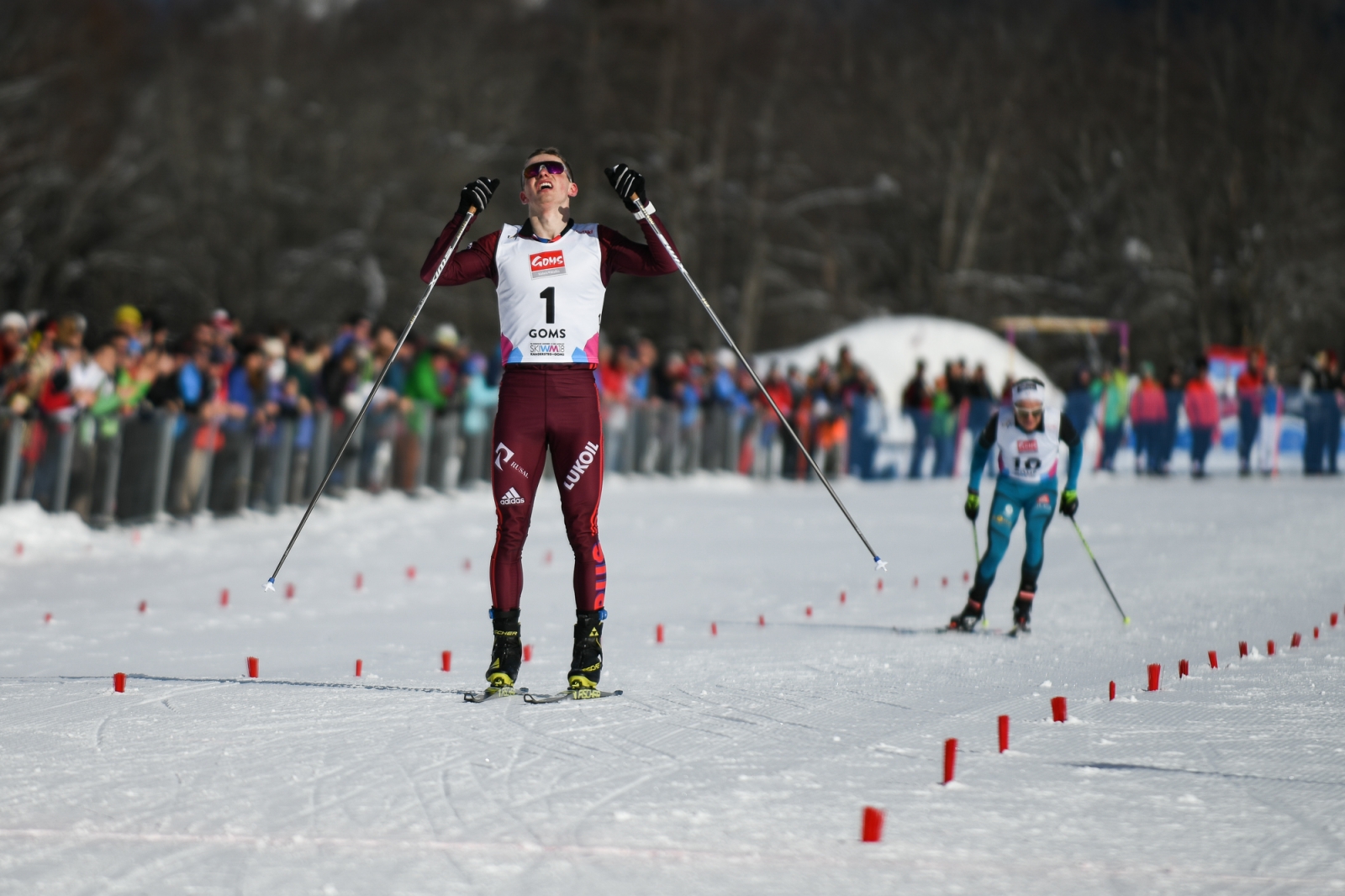
Russia’s Denis Spitsov celebrates his first U23 World Championships gold on Friday ahead of France’s Jules Lapierre in the men’s 30 k skiathlon in Goms, Switzerland. (Photo: JWSC2018.ch)
(Note: This article has been updated to include comments from Americans Lauren Jortberg and Ian Torchia.)
U23 World Championships (Goms, Switzerland): 15/30 k skiathlons
On the final day of U23 World Championships racing in Goms, Russia stole the show in the women’s and men’s skiathlons.
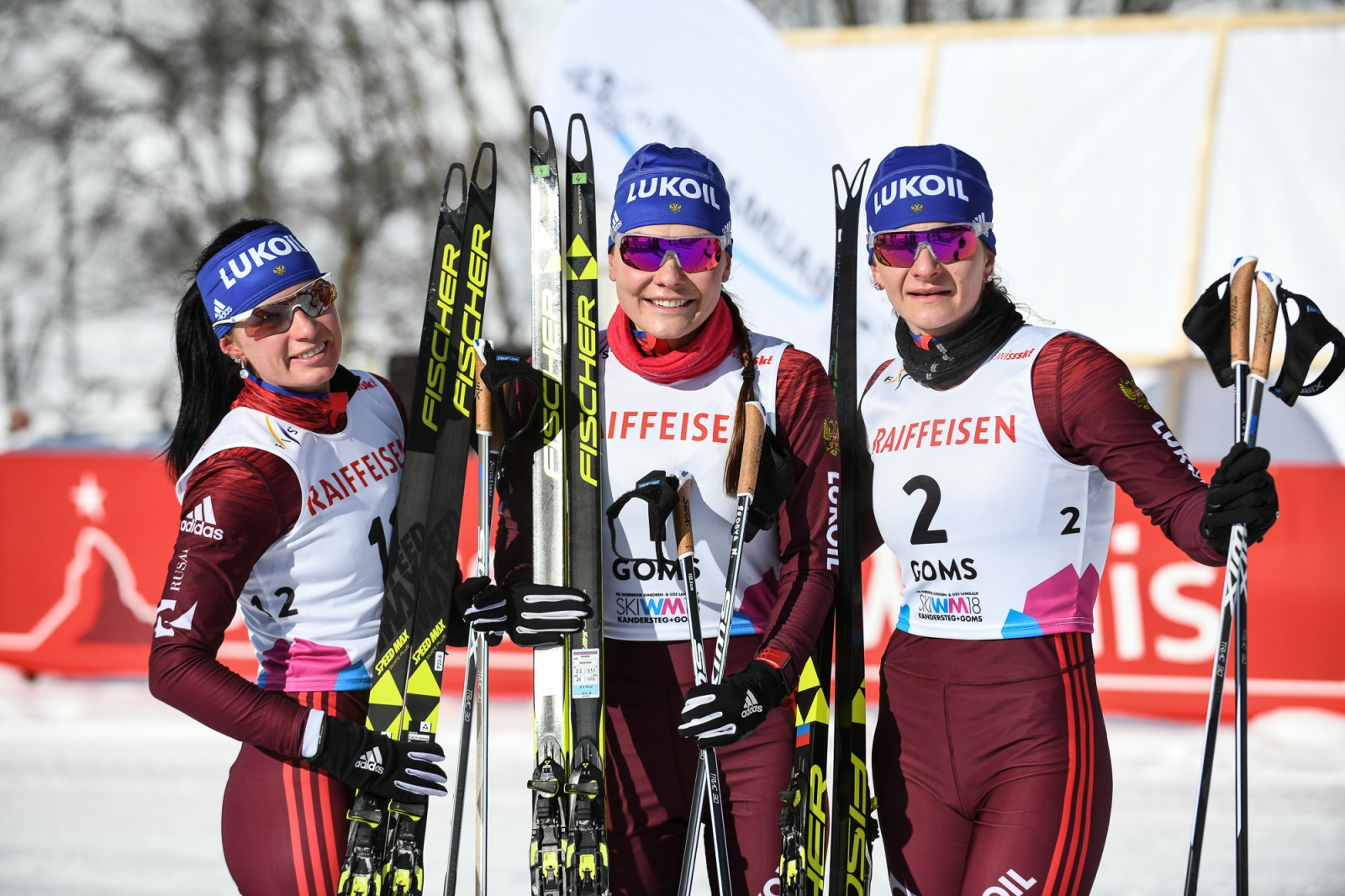
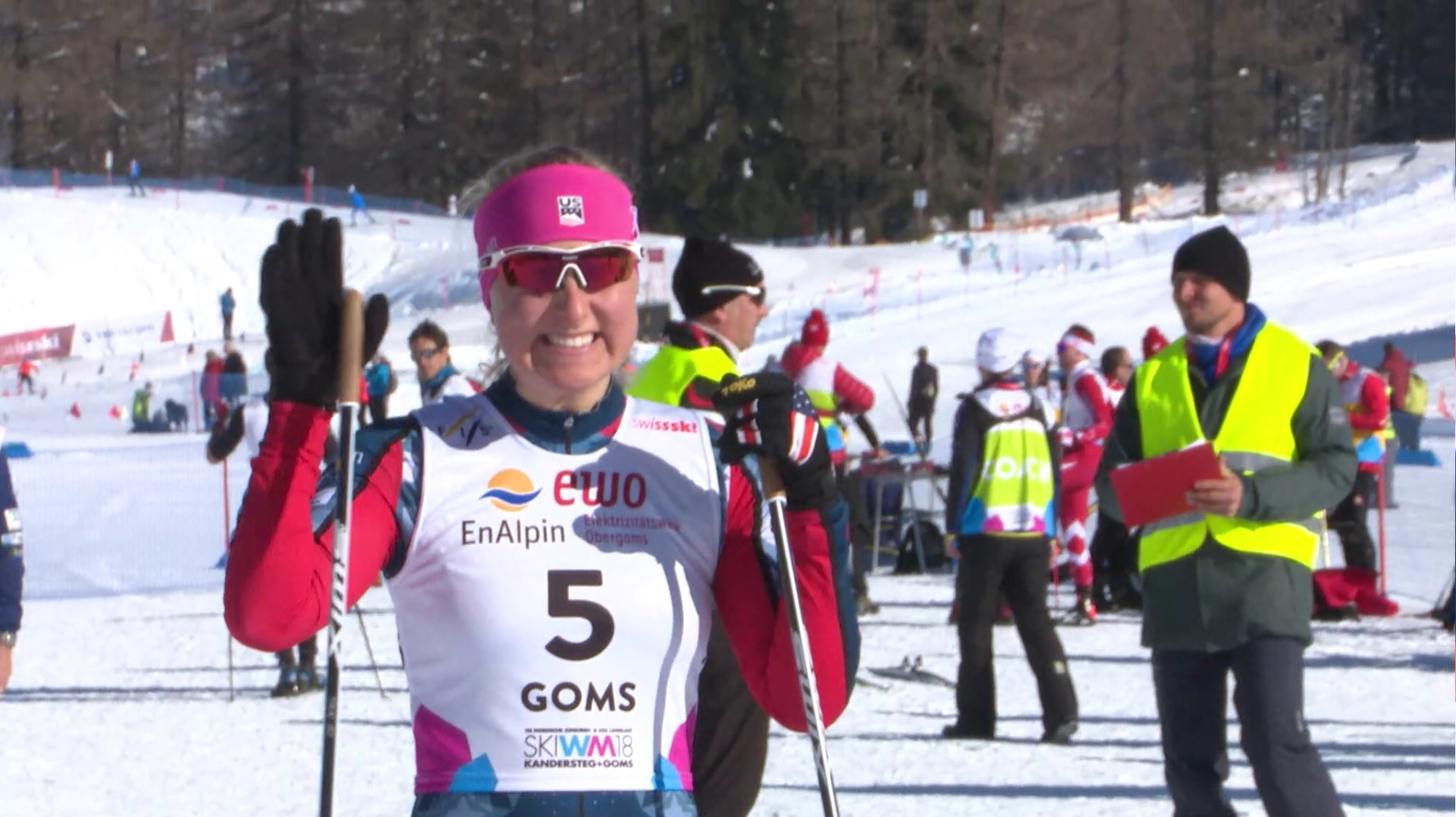
The all-Russian women’s 15 k skiathlon podium at U23 World Championships on Friday in Goms, Switzerland, with Anastasia Sedova (c) in first, Natalia Nepryaeva (l) in second and Yulia Belorukova (r) in third. (Photo: JWSC2018.ch)
Anastasia Sedova led them in the first race of the day on Friday, the women’s 15-kilometer skiathlon, which she won in 44:03.6 minutes. Russia swept the podium and had four in the top five with Natalia Nepryaeva in second (+10.7) and Yana Kirpichenko in third (+37.2), and Yulia Belorukova in fourth (+1:58.0). Germany’s Pia Fink placed fourth (+1:33.5).
The race was the first of the week for the 22-year-old Sedova, a World Cup regular, and it was her second individual gold medal at her second U23 World Championships (she won the 10 k classic in 2016).
“Good preparation for the Olympic Games,” Sedova said during an in-arena interview after the race. “I am very lucky today. Good atmosphere, good weather today.”
Kirpichenko won the 10 k classic earlier this week and Nepryaeva placed third in the freestyle sprint in Goms.
“It’s hard to say how to describe the race, but Anastasia is a really good skier,” Nepryaeva said after. “She was really good today. So for me it was hard to support her during the race. Today she was much better than me.”
American Lauren Jortberg (Dartmouth Ski Team) led the North Americans in 29th (+5:29.9) for her best distance result at the Junior/U23 World Championships level.
“Early in the race I was right over 30th place, and I was trying to maintain contact with the big group ahead of me,” Jortberg, a Dartmouth sophomore from Boulder, Colorado, wrote in an email. “The pace of the classic leg was really fast. A couple of the girls in the race are heading to the Olympics in a few days so it was a really hot start!”
She came through the transition at the race’s halfway point in 31st, about 3:47 behind the leaders.
“I am a much better skater so I felt like I really put the hammer down on the skate leg and moved up a lot,” Jortberg wrote. “The skate course was much easier than the classic course, but I feel like I skied the massive climbs better than the girls around me. I focused on having a really high tempo over the hills and skiing the downhills technically well because there was no rest on the course.
“I’m pleased with my performance today, and I’m excited about my results this week as a whole,” she added. “I’m definitely leaving here hungry for more because I don’t think it was my best week, but I think it was really solid. This is the most competitive field I’ve ever raced against so it feels really good to know that I’m not too far off their level!”
Also for the U.S., Lydia Blanchet placed 38th (+7:11.1) and Nicole Schneider was 40th (+8:04.3). Julia Kern did not finish.
Canada’s Katherine Stewart-Jones (Canadian National U25 Team/NTDC Thunder Bay) placed 31st (+5:39.0) and Maya MacIsaac-Jones was 42nd (+8:08.8), while Laura Leclair and Sophie Carrier-Laforte were lapped.
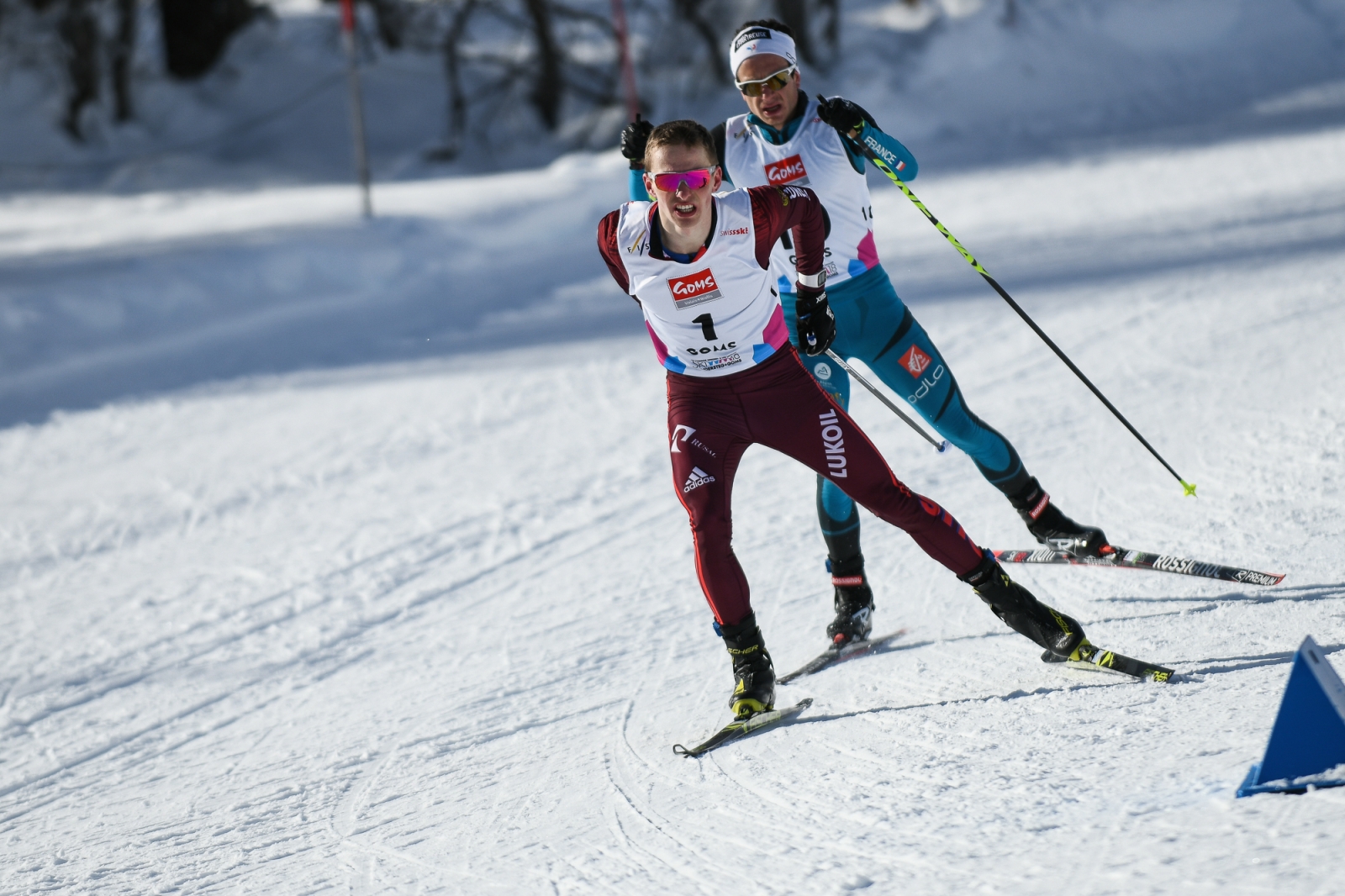
Russia’s Denis Spitsov leads France’s Jules Lapierre during the men’s 30 k skiathlon on Friday at 2018 U23 World Championships in Goms, Switzerland. Spitsov went on to win by 2.9 seconds over Lapierre. (Photo: JWSC2018.ch)
In the men’s 30 k, Russia’s Denis Spitsov took the win in 1:18:14.9 hours, just 2.9 seconds ahead of France’s Jules Lapierre. Norway’s Ole Jørgen Bruvoll placed third (+21.5), ahead of Russia’s Ivan Yakimushkin in fourth (+23.2), and Andorra’s Irineu Esteve Altimiras in fifth (+36.4).
The gold was the first for Spitsov, 21, who previously placed second in the 15 k classic earlier this week. He has two individual bronze medals from last year’s U23 Worlds (in the 30 k skiathlon and 15 k freestyle).
American Ian Torchia (U.S. Ski Team/Northern Michigan University) placed 27th on Friday (+6:05.7). Only 33 men finished, and he was the only North American that didn’t get lapped.
“Between the 3700 feet of climbing, a 2.5km loop, and the top dogs having World Cup podiums…half the field got lapped,” Torchia wrote in an email. “Definitely added some motivation in the final 2 laps to see Spitsov and Lapierre slowly catching up.
“I felt I skied technically better in skate and struggled on the classic leg,” Torchia explained. “Took a hard tumble halfway through the classic leg and had to take half a lap to recover from that. Found a hole in my suit close to my groin afterward which was a little unnerving!”
At the end of the week, he noted that he felt “more fired up than coming in. Funny how being 6 minutes back can do that,” he wrote. “It was an eye-opening experience to get back on the international stage after 2 years and I will take these lessons of racing to the rest of the season in the Ishpemimg Super Tour, Steamboat NCAA’s, and Craftsbury Spring Series. Also already thinking of ideas on how to change and optimize my training to make the jump to the top level.”
Americans Andrew Egger, Zak Ketterson and Thomas O’Harra also competed, as did Canada’s Alexis Dumas, Gareth Williams, Philippe Boucher, and Ricardo Izquierdo-Bernier.
Stratton’s Ben Saxton (l) edging Julien Locke (r) by eight-hundredths of a second for the win in the men’s 1.4 k classic sprint A-final on Friday at Eastern Canadian Championships in Gatineau, Quebec. (Photo: Becca Rorabaugh (APU) on her way to winning the women’s 1.3 k classic sprint qualifier on Friday at 2018 Eastern Canadian Championships in Gatineau, Quebec. (Photo: Rob Smith/CCC)
NorAm Eastern Canadian Championships (Gatineau, Quebec): Classic sprints
Eastern Canadian Championships opened in Gatineau on Friday with classic sprinting, and Americans Becca Rorabaugh and Ben Saxton ended the day with wins in the women’s and men’s A-finals, respectively.
Becca Rorabaugh (APU) on her way to winning the women’s 1.3 k classic sprint qualifier on Friday at 2018 Eastern Canadian Championships in Gatineau, Quebec. (Photo: Rob Smith/CCC)
For Rorabaugh, the win is her second straight after the Alaska Pacific University (APU) skier won the women’s 5-kilometer freestyle at last weekend’s SuperTour in Craftsbury, Vermont. She edged last weekend’s classic-sprint winner, Kaitlynn Miller, of the Craftsbury Green Racing Project (CGRP), by 0.41 seconds for the win in 3:23.15 minutes in Friday’s 1.3 k classic sprint final. It was an all-American podium (and all-American final) with Erika Flowers, of the Stratton Mountain School (SMS) T2 Team, just another three-hundredths of a second back in third (+0.44). Liz Guiney (CGRP) followed in fourth (+2.51), Rosie Frankowski (APU) was fifth (+3.88), and Corey Stock (Bridger Ski Foundation) placed sixth (+6.1).
Rorabaugh had started the day by qualifying first in 3:26.95, then won both her quarterfinal and semifinal. Miller qualified third and won her quarterfinal and semifinal as well.
In the men’s 1.4 k classic sprint, Saxton (SMST2) nipped Julien Locke (Canadian U25 Team/Black Jack) at the line by 0.08 seconds for the win in 3:04.54. Patrick Stewart-Jones (Alberta World Cup Academy) placed third (+5.53), Kris Freeman (Caldwell Sport) was fourth (+5.94), Kevin Bolger (Sun Valley Ski Education Foundation) fifth (+7.42), and Julian Smith (NTDC Thunder Bay) sixth (+11.63).
Locke initially won the qualifier in 3:08.37, then won the first quarterfinal and first semifinal as well. Saxton qualified sixth, then advanced in second in his quarterfinal about a second behind Smith, and Saxton won the second semifinal.
Easterns continue Saturday with 10/15 k freestyle races and conclude Sunday with 10/15 k classic pursuits.
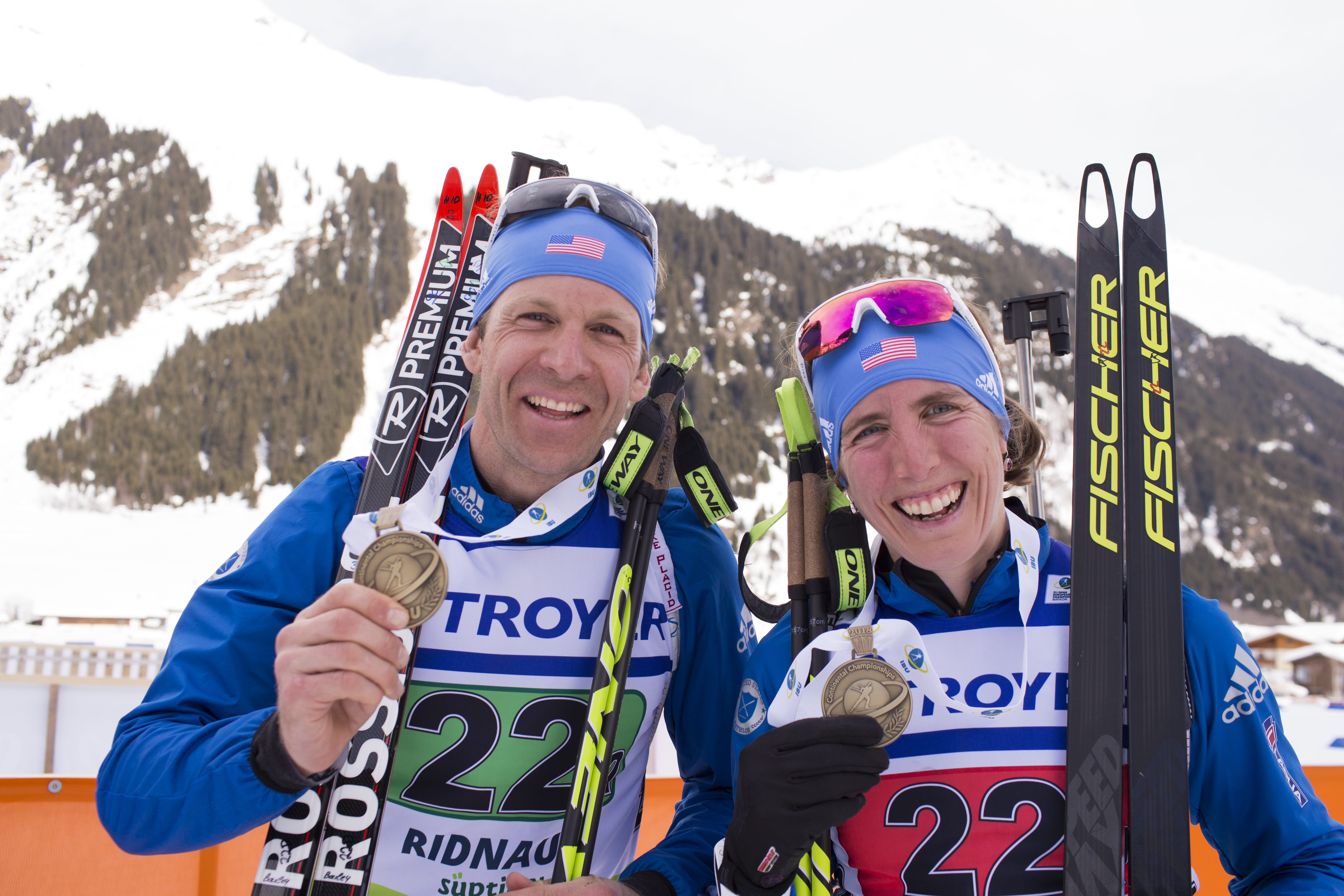
US Biathlon’s Lowell Bailey (l) and Susan Dunklee after teaming up for bronze in the single mixed relay at 2018 IBU Open European Championships on Sunday in Ridnaun, Italy. (Photo: Manzoni/NordicFocus)
IBU Open European Championships (Ridnaun-Val Ridanna, Italy): Single mixed & mixed relays
Susan Dunklee and Lowell Bailey teamed up for the final day of the 2018 International Biathlon Union (IBU) Open European Championships in Ridnaun, Italy, and raced to a bronze medal in the single mixed relay.
The American duo, both of which earned individual medals at last year’s IBU World Championships, finished just 9.1 seconds out of first, which went to Norway’s Thelka Brun-Lie and Vetle Sjåstad Christiansen. The Norwegians won in 35:39.6 with zero penalties and six spares. They took the lead after Brun-Lie’s second leg, where she cleaned both stages without spares.
France placed second, 8.6 seconds back, with Julia Simon and Emilien Jacquelin, who combined for no penalties and 11 spares. They led the first half of the race, but slipped to second behind Norway on Simon’s second leg.
Dunklee put the Americans off in second on her first leg, which she cleaned with a spare in each stage, then they slipped one place to third on Bailey’s first leg, where he cleaned as well and used three spares. In all, they used 10 spares and avoided the penalty loop, and finished half a second out of second place.
“Over Christmas, we trained a little bit with the French athletes, including Jacquelin,” Bailey said, according to a US Biathlon press release. “So I know that he has quite a fast finish, and I thought I am kind of an old man here, I should maybe try to go harder on the first part of the lap. But he stayed with me all the time and had me in the end.”
“It was a good opportunity to tune up the race shape, build some confidence and find that sharp feeling heading into the Olympics,” Dunklee told US Biathlon. “The single mixed relay is one of my favorite race formats and today was a blast!”
Canada’s Sarah Beaudry and Carsen Campbell placed eighth of 24 teams in the single mixed relay, finishing 1:03.6 out of first with just eight spares and zero penalties. In 11th after the first leg, they moved into eighth on Campbell’s first leg, which he cleaned with one spare. Beaudry then cleaned her second leg without any spares, and Campbell anchored them to eighth.
The U.S. entered a team in the mixed relay that followed, with Chloe Levins, Deedra Irwin, Paul Schommer, and Alex Howe placing 17th (+5:55.5) of 19 teams with no penalties and 12 spares.
Ukraine won the mixed relay to conclude the championships, with Yuliia Zhuravok, Iryna Varvynets, Artem Pryma, and Dmytro Pidruchnyi combining for zero penalties and six spares and finishing in 1:11:40.1.
Russia placed second (+11.7) with Victoria Slivko, Anastasia Zagoruiko, Evgeniy Garanichev, and Alexander Loginov combining for zero penalties and nine spares.
Norway followed in third (+33.2) with Emilie Ågheim Kalkenberg, Kaia Wøien Nicolaisen, Håvard Gutuboe Bogetveit, and Fredrik Gjesbakk combing for no penalties and just four spares.
U.S. SuperTour (Craftsbury, Vermont): 5/10 k freestyle
Two Alaska Pacific University (APU) athletes topped the podium on Sunday at the SuperTour in Craftsbury, Vermont, with David Norris winning the men’s 10-kilometer freestyle individual start in 21:54.9 and Becca Rorabaugh topping the women’s 5 k freestyle in 12:06.4.
Norris won the men’s race by 6 seconds over Canada’s Andy Shields (Lappe Nordic) and Kevin Bolger of the Sun Valley Ski Education Foundation (SVSEF) placed third (+15.8). Kris Freeman (Caldwell Sport) was the third American in fourth overall (+23.7), and three Canadians took fifth through seventh with Michael Somppi (Lappe Nordic) in fifth (+27.9), Evan Palmer-Charrette (NTDC Thunder Bay) in sixth (+37.5) and Scott Hill (Barrie Cross Country) in seventh (+37.6), ahead of Brian Gregg (Team Gregg/LNR/CXC) in eighth (+39.4), Tad Elliott (Ski Club Vail) in ninth (+44.3) and Jack Hegman in 10th (+50.4).
Rorabaugh won the women’s race by just 2.2 seconds over her APU teammate Rosie Frankowski in second, and Erika Flowers of the Stratton Mountain School (SMS) T2 Team placed third (+4.6). Two Craftsbury Green Racing Project (CGRP) skiers finished fourth and fifth, with Kaitlynn Miller in fourth (+12.1) and Liz Guiney in fifth (+22.5), Kelsey Phinney (SVSEF) was sixth (+25.8), and Canadians Olivia Bouffard-Nesbitt (Rocky Mountain Racers) seventh (+26.4) and Frederique Vezina (Pierre-Harvey National Training Centre) eighth (+36.0). Corey Stock, of the Bridger Ski Foundation (BSF) placed ninth (+39.9), and Felicia Geisor (CXC Team) was 10th (+44.4).
On Saturday, the Craftsbury Outdoor Center hosted its 37th annual Craftsbury Marathon, with Nils Koons winning the 48 k men’s race in 2:28:51.0 hours and Hannah Dreissigacker winning the 48 k women’s race in 3:01.48.7.
Hannah Halvorsen of the U.S. Ski Team and APU on the start line in Ulrichen, Switzerland, after finishing fifth in the sprint qualifier. (FIS screencap)
FIS Cross Country World Junior Championships (Ulrichen, Switzerland): Freestyle sprints
World Junior Championships kicked off today with freestyle sprints in Ulrichen, Switzerland. Moa Lundgren of Sweden claimed with women’s title by 1.89 seconds over Kristine Stavås Skistad of Norway in the final, with Sweden’s Frida Karlsson finishing third (+1.89).
Hannah Halvorsen of the United States qualified in fifth place before skiing to second in her quarterfinal heat. Halvorsen hovered around third or fourth place through much of her semifinal and was unable to snipe any spots in the finishing straight, ending up fourth in the heat and eighth on the day.
Fellow Americans Margaret Gellert and Sofia Shomento also made the quarterfinals, finishing 18th and 23rd, and Canada’s Hannah Mehain wound up 29th on the day.
The new men’s junior world champion is Tom Mancini of France, who nipped Norway’s Jørgen Lippert by just 0.10 seconds to take the win. Valerie Grond gave the Swiss crowd a thrill by making it all the way to the final and taking home bronze, despite qualifying in just 21st position. The Swiss junior narrowly edged France’s Vincent Buiatti for the final step on the podium.
Canada’s Graham Ritchie finished second in his quarterfinal after qualifying in 28th position, earning an automatic spot in the semifinals. There he finished sixth (+9.30 behind Mancini), winding up 12th on the day. Teammate Antoine Cyr also made the quarterfinals where he had an impressive crash, slinging off the trail and into the infield, finishing 30th on the day. For the U.S., Gus Schumacher was the lone qualifier for the heats. He finished fourth in his quarterfinal and was just 0.22 seconds away from a “lucky loser” spot in the semifinals. Schumacher finished 19th on the day.
In the junior women’s race, Hannah Rudd of the United States finished 35th in qualification, +18.15. For Canada, Annika Richardson finished 52nd (+24.09), Catherine Reed-Metayer 56th (+28.25), and Alexandra Racine 69th (+37.27).
In the junior men’s sprint, Canada’s Reed Godfrey finished a tough 31st, just 0.21 seconds out of making the quarterfinals. Etienne Hebert rounded out the Canadian finishers in 36th place (+11.81) in the qualifier. Canyon Tobin was 41st in qualification for the U.S. (+13.46), followed by Karl Schulz in 54th (+16.90) and Luke Jager in 60th (+18.15).
FIS Nordic Combined World Cup (Seefeld, Austria): Individual normal hill/15 k
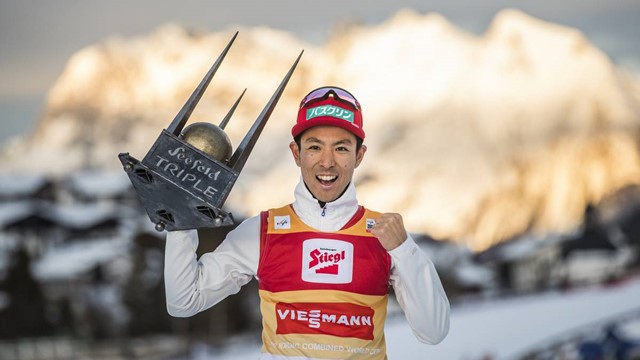
Japan’s Akito Watabe after winning the 2018 Seefeld Triple Nordic Combined World Cup. He is the only athlete besides Germany’s Eric Frenzel to win the event. (Photo: FIS Nordic Combined)
On the final day of the Seefeld Triple, Japan’s Akito Watabe completed his sweep of the three-day weekend and Norway’s Jarl Magnus Riiber reached the podium for the third-straight day, placing second. Germany’s Fabian Rießle placed third for his second podium in the last two days.
Watabe jumped to first on the normal hill and started the 15 k Gundersen 48 seconds ahead of Riiber in second. He went on to win the race by 1:14.9 minutes in 34:58.6, becoming the only man besides Germany’s Eric Frenzel to win the Seefeld Triple in its five-year history.
After jumping to fifth, Rießle won a photo finish for third (+1:57.9), edging Germany’s Vinzenz Geiger by less than a tenth of a second. Geiger moved up from ninth in the jump to fourth overall (+1:57.9).
Norway’s Jørgen Graabak followed in fifth (+2:02.4),Frenzel placed sixth (+2:07.4), Norway’s Jan Schmid was seventh (+2:09.8), Finland’s Eero Hirvonen eighth (+2:13.5), Norway’s Espen Andersen ninth (+2:28.0), and Austria’s Mario Seidl 10th (+2:42.1) out of 28 finishers.
No Americans contested the final day of the Triple, the last World Cup before the 2018 Winter Olympics in PyeongChang, South Korea.
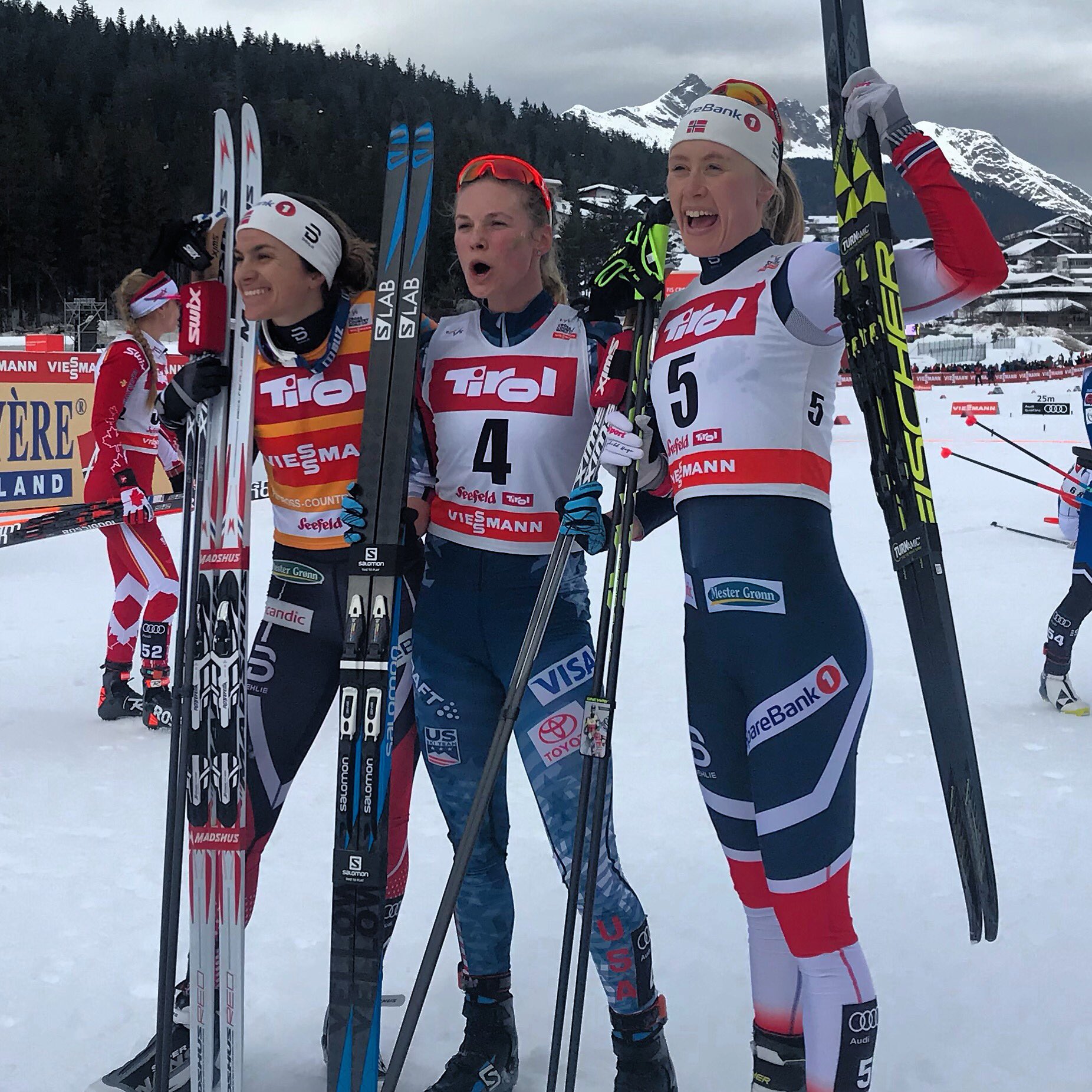
Jessie Diggins of the U.S. Ski Team (center) celebrates after winning the 10 k mass start freestyle in Seefeld, Austria, over Heidi Weng (left) and Ragnhild Haga of Norway. (Photo: FIS Cross Country/Twitter)
FIS Cross Country World Cup (Seefeld, Austria): 10/15 k mass start freestyle
In the final World Cup race before the 2018 Olympics, Jessie Diggins achieved the ultimate goal to give herself the utmost confidence heading into PyeongChang — winning the women’s 10-kilometer freestyle mass start at the World Cup in Seefeld, Austria, on Sunday.
The win was her first of the season and fourth individual victory of her career. Diggins, a 26-year-old U.S. Ski Team member, pulled it off by attacking on a long climb and leaving Norway’s Heidi Weng, Ragnhild Haga and Ingvild Flugstad Østberg chasing. While Diggins was several seconds ahead over the top and all alone on the long descent that followed, Weng and Haga worked to close the gap — and nearly did in the finishing stretch. But Diggins held them off, winning by 0.7 seconds over Weng in second place and 1 second ahead of Haga in third, and threw her fists down in celebration as she crossed the line first in 23:08.5 minutes.
“I just put my head down and it wasn’t pretty, but I just hammered,” Diggins told the International Ski Federation (FIS) in a televised post-race interview.
She was the only non-Norwegian in the top five, with Østberg in fourth (+8.7) and Marit Bjørgen in fifth (+16.7). Austria’s Teresa Stadlober placed sixth (+16.9), Norway’s Kari Øyre Slind was seventh (+19.1), and American Sadie Bjornsen placed eighth (+20.5), ahead of Switzerland’s Nathalie von Siebenthal in ninth (+30.3).
The U.S. had three in the top 15 with Kikkan Randall (U.S. Ski Team) in 14th (+48.5), and two more women in the top 30, with Caitlin Patterson (Craftsbury Green Racing Project) in 23rd (+1:00.7) and Liz Stephen (USST) in 29th (+1:18.2). Rosie Brennan (USST) finished 53rd (+2:26.9).
Emily Nishikawa led the Canadians in 35th (+1:36.5), followed closely by teammate Cendrine Browne in 37th (+1:36.6). Dahria Beatty finished 45th (+1:58.9).
Dario Cologna of Switzerland (center) won the men’s 15 k skate mass start in Seefeld, Austria, over Alex Harvey of Canada (left) and Martin Johnsrud Sundby of Norway (right). (Photo: FIS Cross Country/Twitter)
The Olympics are nearing and so Switzerland’s Olympic legend Dario Cologna is ramping up: after winning the Tour de Ski, he took another win in the 15 k mass start skate in Seefeld, Austria, on Sunday.
With much of the field staying relatively close together until the finish, Cologna nabbed the win by 1.4 seconds over Canada’s Alex Harvey, who took his second podium of the season in addition to also finishing third in the overall Tour de Ski.
Norway’s Martin Johnsrud Sundby was third (+2.9), then teammate Didrik Tønseth in fourth (+5.9) and France’s Maurice Manificat in sixth (+7.5).
The U.S. Ski Team’s Erik Bjornsen had a breakthrough day finishing ninth (+9.3), followed by Simi Hamilton in 12th (+12.4). Behind them, Scott Patterson placed 27th (+23.4), then Patrick Caldwell 49th (+1:26.2), Ben Lustgarten 55th (+1:42.7), and Tyler Kornfield 77th (+3:00.0).
Canada’s Devon Kershaw and Graeme Killick finished 30th (+26.5) and 31st (+27.4), respectively. Len Valjas placed 58th (+1:53.1), Knute Johnsgaard 82nd (+3:23.1), Bob Thompson 87th (+4:27.5), and Julien Locke 92nd (+4:56.9).
The Russian men finishing in unison to take first, second and third in the men’s 30 k skiathlon, the final race of 2017 U23 World Championships at Soldier Hollow in Midway, Utah. Alexander Bolshunov (8) was deemed the winner, Alexey Chervotkin (1) was second, and Denis Spitsov (11) third. (Photo: FlyingPointRoad.com)
FIS Nordic Combined Junior World Championships (Park City and Midway, Utah): Normal hill/5 k
American Ben Loomis (6) leads Norway’s Lars Ivar Skaarset (7) during the third leg of the nordic-combined 4 x 5 k team event on Thursday at 2017 Nordic Junior Worlds at Soldier Hollow in Midway, Utah. Loomis brought the U.S. from ninth to seventh, and his team ultimately finished seventh. (Photo: FlyingPointRoad.com)
[UPDATED] In the individual normal hill/5-kilometer Gundersen on Saturday, the last nordic-combined competition of 2017 Nordic Junior World Championships, American Ben Loomis captured his first top 10 in his third Junior Worlds in ninth place.
Eighteen-year-old Loomis jumped to 10th then picked off one place in the 5 k to finish ninth, 1:22.3 minutes behind the winner, Germany’s Vinzenz Geiger.
Geiger led after the jump and started the ski race 4 seconds ahead of Japan’s Yuto Nakamura in second. Geiger was able to hold off Finland’s hard-charging Arttu Mäkiaho, who raced from ninth to second, by 22.6 seconds. France’s Laurent Muhlethaler raced from fifth to third (+23.9) for the final spot on the podium, while Nakamura slipped to fourth (+42.8).
The U.S. had two in the top 15 with Stephen Schumann in 15th (+1:44.3), up from 20th after the jump. Grant Andrews placed 33rd (+2:40.0) and Tucker Hoefler finished 46th (+3:56.9).
FIS Nordic U23 World Championships (Midway, Utah): 15/30 k skiathlon
It was a Russian affair and a head scratcher for the photo-finish crew at U23 World Championships on Saturday, with three Russians putting enough time on the rest of the field in the men’s 30-kilometer skiathlon that they had time to slow to a stop and inch across the line in unison.
The jury ultimately had to decide who won, awarding it to Alexander Bolshunov in 1:15:31.5 hours, 0.2 seconds ahead of Alexey Chervotkin in second. Denis Spitsov was listed as third (+0.5). France’s Jules Lapierre came closest to the Russians in fourth, finishing 11 seconds later.
The field was considerably strung out by the end of the race, with Switzerland’s Jason Rueesh finishing 14.3 seconds out of first in fifth and Norway’s Gaute Kvaale crossing the line in sixth (+33.0), ahead of France’s Valentin Chauvin in seventh (+49.1), and Andorra’s Irineu Esteve Altimiras in eighth (+56.8).
American Paddy Caldwell (SMS/USST) placed ninth for the second-straight race at U23s, finishing 1:24.4 behind the winner.
The U.S. men had three in the top 15 for their best day of the championships, with John Hegman (SVSEF) placing a 11th (+1:53.5) and Adam Martin (NMU) 15th (+2:23.3) for their best results at U23 Worlds.
Evan Palmer-Charrette (NTDC Thunder Bay) led the Canadian men in 26th (+5:44.6). Alexis Dumas (CNEPH) finished 33rd (+9:02.7) out of 36 finishers. Several North Americans did not finish, including Canada’s Julien Lamoureux and Julien Smith, and American Cal Deline.
In the women’s 15 k skiathlon, Lotta Udnes Weng achieved her first gold of U23 Worlds, holding off Finland’s Johanna Matintalo by 3.8 seconds and crossing the line in 40:50.9 minutes. Russia’s Yana Kirpichenko reached the podium in third (+13.9), fewer than two seconds ahead of Weng’s twin sister, Tiril Udnes Weng in fourth (+15.6).
Dahria Beatty, of the Alberta World Cup Academy and Canadian National U25 Team, led the North Americans in 19th (+2:18.1), and teammate Katherine Stewart-Jones (NTDC Thunder Bay/NST U25 Team) was 21st (+2:29.3) for her best U23 Worlds result.
The Czech Republic’s Petra Hyncicova (University of Colorado-Boulder) followed in 22nd (+2:30.7), and three Canadian women finished in the top 30 with Frederique Vezina (CNEPH) in 29th (+3:36.2). Jenn Jackson did not finish.
Jesse Knori (University of Colorado-Boulder) was the top American in 30th (+3:40.1), Alayna Sonnesyn followed in 31st (+3:42.5), Nichole Bathe (University of Alaska Fairbanks) in 33rd (+4:36.9), and Corey Stock (Bridger Ski Foundation) in 36th (+5:42.1).
Mathilde Petitjean, who races for her native Togo but trains with the Quebec-based CNEPH, finished 38th (+6:04.8) of 38 finishers.
FIS Cross-Country World Cup (PyeongChang, South Korea): 15/30 k skiathlon
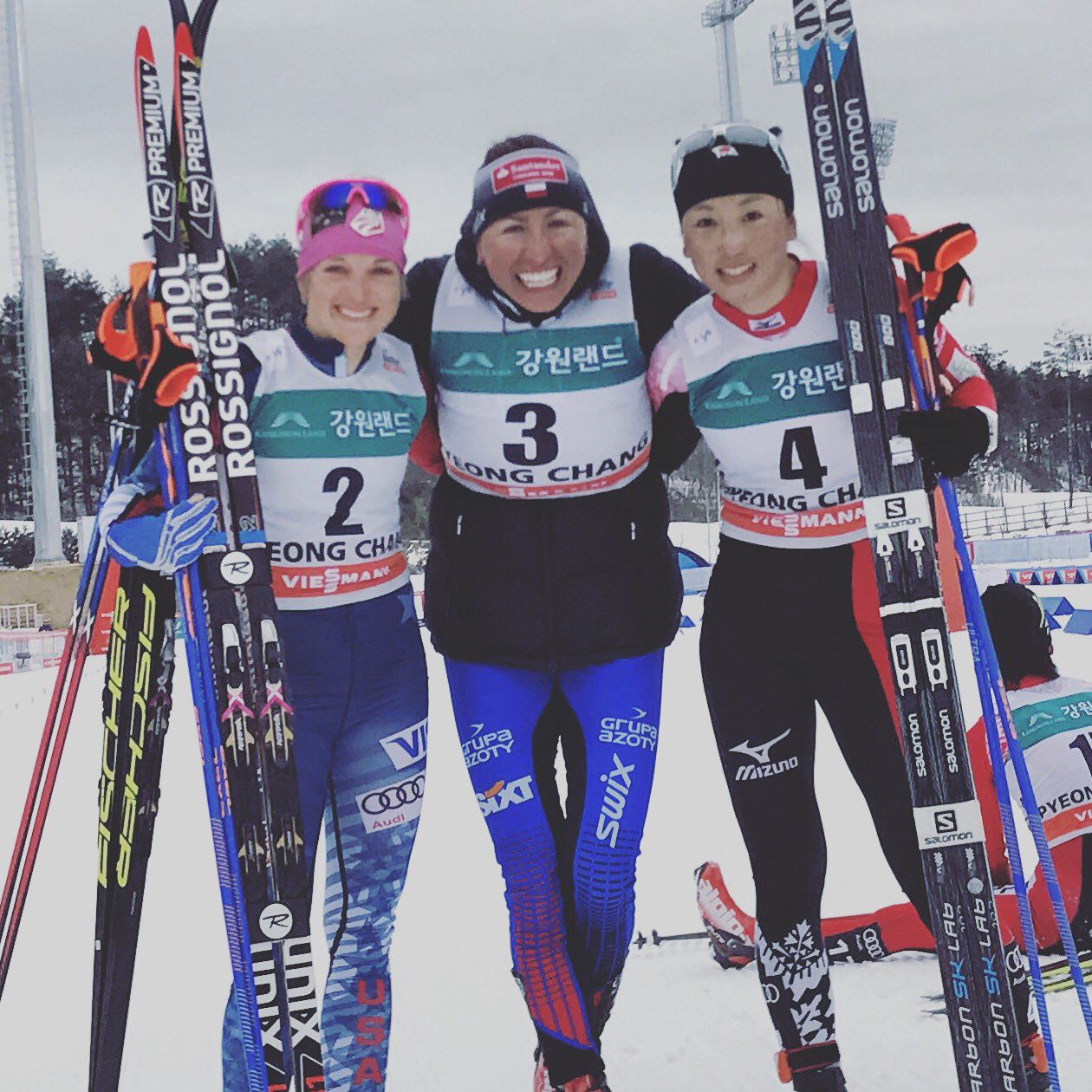
The women’s 15 k skiathlon podium at the PyeongChang World Cup in South Korea, with Poland’s Justyna Kowalczyk (c) in first, American Liz Stephen (l) in second, and Japan’s Masako Ishida in third. (Photo: FIS Cross Country/Twitter)
The second day of World Cup racing in PyeongChang, South Korea, took place this Saturday, with a skiathlon event for both genders. The women raced a total of 15 kilometers, the first 7.5 k leg classic and the second 7.5 k leg freestyle. Poland’s Justyna Kowalczyk came away with the women’s win (her first in three years), getting back to her old ways of breaking away from the pack to finish first in 43:54.7 minutes. Liz Stephen of the U.S. Ski Team (USST) claimed second place (+56.0), while Japan’s Masako Ishida took third (+1:14.8).
For Stephen, second matched her best individual result in a from two years ago, when she placed second in a 10 k freestyle in Rybinsk, Russia. This year at the Tour de Ski, Stephen posted the second-fastest time up the final climb in Val di Fiemme, Italy. For Ishida, it was her first podium since 2009.
Caitlin Patterson, racing for the U.S., finished just off the podium with a career-best fourth (+1:21.4) for her first top 20 on the World Cup, and American Liz Guiney placed 13th (2:21.7) for her first top 20 as well. Jessica Yeaton, who trains with Alaska Pacific University and races for Australia, came in 24th (4:58.6).
Two Canadian women competed with Annika Hicks leading the team in 26th (+5:17.8) followed by Sadie White in 29th (+6:54.7) for their first World Cup top 30s.
In the men’s 30 k skiathlon that followed, Russia’s Petr Sedov broke away during the skate leg to take a decisive victory over Norway’s Daniel Stock and Mathias Rundgreen, finishing in 1:18:49.6 hours, 22.5 seconds clear of second place. It was Sedov’s first World Cup win and podium, and the first individual podiums for Stock and Rundgreen as well.
Rundgreen edged Russia’s Konstantin Glavatskikh for the final spot on the podium, with both being listed as 42.1 seconds behind Sedov.
While Rundgreen held off three others for third place, including Sweden’s Gustav Eriksson in fifth (+46.8), Japan’s Keishin Yoshida in sixth (+47.1), and Russia’s Alexander Utkin in seventh (+49.0), American Noah Hoffman kept his distance ahead of the second chase group to finish eighth (+1:06.2) for his best result in a non-World Cup stage since placing eighth in a 2012 skiathlon in Canmore, Alberta. (Hoffman won the time of day in the 15 k pursuit four years ago in Kuusamo, Finland.)
Also for the U.S., Scott Patterson was next across the line in ninth (+1:28.4) for his first World Cup points, and Matt Gelso finished 19th (+5:00.8) for his first top 20.
Brian McKeever of Canada’s Para-Nordic Ski Team was the lone Canadian finisher in 29th (+8:48.9). Bob Thompson was listed as placing 32nd of 37 after being lapped, and Simon Lapointe did not finish.
NorAm Eastern Canadian Championships (Cantley, Quebec): Classic interval start
The NorAm mini tour at the Nakkertok Nordic Centre continued on Saturday with Eastern Canadian Championships with classic individual start races.
In the men’s 15 kilometre, Lappe Nordic’s Andy Shields took a lead in the first lap and held on to win in 39:14.7, just 0.7 seconds ahead of CNEPH’s Ricardo Izquierdo-Bernier. Team R.A.D.’s Russell Kennedy collected his second bronze of the weekend, 24.7 seconds back.
SMS Elite’s Anne Hart won the women’s 10 k in a reversal of Friday’s sprint podium. Hart’s 30:03.3 finish gave her a 9.3 second edge on CNEPH’s Sophie Carrier-Laforte and 20.0 seconds on AWCA’s Maya MacIsaac-Jones.
For the 123 men and 77 women doing the full distance, the weekend is a mini tour. For the younger categories, it is three separate events allowing the kids who couldn’t skip school on Friday to race Saturday and Sunday.
There should be over 700 finishers today with 768 on the start list. The volunteers will have more hours of work even after the open categories have finished.
Results will update continuously as more categories start.
Canada’s Dahria Beatty (8) chasing Norway’s Thea Krokan Murud (3) in the fifth quarterfinal of the women’s classic sprint on Tuesday at U23 World Championships at Soldier Hollow in Midway, Utah. Beatty finished 12th on the day while Murud went on to place second in the final. (Photo: FlyingPointRoad.com)
A year ago, Canada’s Dahria Beatty had eight World Cup starts to her name. Not too shabby considering she was 21, but now another year older, the Whitehorse, Yukon, native has more than doubled that amount with a grand total of 21 World Cup starts — one of which included her 15th-place breakthrough at the Ski Tour Canada classic sprint in Canmore, Alberta.
Beatty lives and trains in Canmore as a member of both the Alberta World Cup Academy (AWCA) and Canadian National U25 Team. She led the NorAm (Continental Cup) standings at the end of last season, reiterating her position as one of Canada’s top talents. Just under a month ago, she won the freestyle sprint prologue at U.S. nationals at Soldier Hollow in Midway, Utah.
Then on Tuesday, on the same 1.3-kilometer sprint course at Soldier Hollow, Beatty notched a career-best individual result at her second U23 World Championships, placing 12th in the classic sprint. She started the day by qualifying in eighth, 3.85 seconds back from the fastest qualifier, Sweden’s Anna Dyvik, who rounded the course in 3:39.4 minutes.
“My qualifier was pretty solid. I skied well, I made one small tactical mistake on the last climb but the rest of the race went smoothly,” Beatty reflected in an email. “This is a really taxing course and by the finish shoot my legs were pretty exhausted … it was a fight to get across that line. I was happy to qualify 8th and to post another consistent qualifier. Overall my qualifying speed has improved this year which I am very happy with.”
She was one of three Canadian women to qualify in the top 30, with Jenn Jackson (Lappe Nordic/Team Hardwood) posting the 22nd-ranked time (+12.99) and Katherine Stewart-Jones (NTDC Thunder Bay/NST U25 Team) qualifying in 28th (+16.61).
Maya MacIsaac-Jones, Beatty’s teammate on the AWCA and national U25 Team, missed advancing to the heats in 32nd (+20.68), 3.7 seconds out of 30th.
American Kelsey Phinney (6) racing alongside Norway’s Lotta Udnes Weng (5) during their quarterfinal of the women’s classic sprint on Tuesday at U23 World Championships at Soldier Hollow in Midway, Utah. (Photo: FlyingPointRoad.com)
All four of the U.S. women qualified, with Kelsey Phinney (Sun Valley Ski Education Foundation) leading them in sixth (+2.77), followed by Nichole Bathe (University of Alaska-Fairbanks) in 14th (+8.8), Jesse Knori (University of Colorado-Boulder) in 19th (+12.07), and Corey Stock (Bridger Ski Foundation) in 26th (+15.11).
Out of those seven North Americans, Beatty was the lone woman to advance to the semifinals, which had been her “base” goal to start the day. She finished third in her quarterfinal (the fifth and final quarterfinal) and advanced as a lucky loser with a fast-enough time.
“My quarterfinal was going well, but I had a stumble cresting the last hill and l lost contact with the top 2 women,” Beatty reflected in an email. “My heat was really fast and I was able to recover from the stumble and move onto the semis as lucky loser. When I finished I had a feeling it was a fast heat but you always have to wait and see.”
Norway’s Thea Krokan Murud won her quarterfinal in 3:35.2, which would hold up as the fastest time of the day until the final. Germany’s Pia Fink took second in that heat (+1.25) and Beatty was third (+2.45), ahead of Russia’s Yana Kirpichenko in fourth (+7.13) and Stewart-Jones in fifth (+12.63).
Without much time to recover before the second semifinal, Beatty explained that she was still pretty tired by the start of it. She ended up sixth in that semifinal, 8.04 seconds behind Murud, who won it in 3:37.42.
“Overall it was great to be in the semi finals and I learned a lot about tactics and where my weaknesses lie,” Beatty wrote. “I just didn’t have enough in the tank today to contend for the final but I am happy to have race my first international semi final and am looking forward to the 10k skate Thursday.”
With a previous U23 best result of 20th in the 2015 classic sprint in Almaty, Kazakhstan (and 15th in the 5 k classic at 2014 Junior Worlds the year before), 12th was Beatty’s best ever at a world championship.
“Racing well on the World Cup had definitely helped my confidence in myself and race knowledge. I feel I am right in the mix with these top women and on the perfect day I could be on that podium,” she wrote. “Going into today I had set base goal (I would be happy with the day if I achieved this) at making the semi finals. My target goal was making the final and my dream goal was being on the podium. My goals will stay pretty similar for the distance races. There are two more races and we’re at altitude so you never know what can happen.”
Jesse Knori (University of Colorado-Boulder) leading Estonia’s Anette Veerpalu during their quarterfinal of the women’s classic sprint at U23 World Championships at Soldier Hollow in Midway, Utah. Knori finished third in that heat (while Veerpalu was sixth). While she didn’t advance to the semifinals, Knori was the top U.S. woman in 15th on the day. (Photo: FlyingPointRoad.com)
While Beatty reached the semifinals, the two other Canadians and four Americans were eliminated in the quarterfinals. Knori led three U.S. women in the top 20 overall, placing 15th on the day after finishing third in her heat, 7.18 seconds behind Norway’s Tiril Udnes Weng (who won that heat by 1.07 seconds over another Norwegian Lovise Heimdal).
Canada’s Jackson raced in that same quarterfinal and finished fifth (+8.72), behind Italy’s Caterina Ganz in fourth (+7.56), for 21st overall.
Both fourth in their quarterfinals, Phinney ended up 16th and Bathe 18th overall. Phinney finished 3.81 seconds behind Weng’s twin sister, Lotta Udnes Weng, in first. Bathe finished 7.14 seconds behind the winner of her quarterfinal, Germany’s Sofie Krehl.
American Corey Stock (Bridger Ski Foundation) leads Australia’s Casey Wright (University of Alaska Anchorage) in the third quarterfinal of the women’s classic sprint at U23 World Championships at Soldier Hollow in Midway, Utah. They finished fifth and sixth, respectively, in that heat. (Photo: FlyingPointRoad.com).
Stock ended up 22nd after finishing fifth in Phinney’s quarterfinal, 10.08 seconds behind Lotta Weng. Also in that quarterfinal, Australia’s Casey Wright, of the University of Alaska Anchorage Ski Team, finished sixth (+12.37). Wright qualified in 25th and ultimately placed 29th overall.
Canada’s third woman, Stewart-Jones placed 24th after finishing fifth in the same quarterfinal as Beatty.
In the first quarterfinal, the Czech Republic’s Petra Hyncicova (Knori’s teammate at the University of Colorado-Boulder) finished fourth, 4.33 seconds behind Sweden’s Maja Dahlqvist in first. Hyncicova qualified in 21st and ended up 20th overall.
Sweden’s 22-year-old Anna Dyvik celebrates her win in the U23 World Championships women’s classic sprint on Tuesday, nearly 3 1/2 seconds clear of second place. (Photo: FlyingPointRoad.com)
Dahlqvist and Murud won the first and second semifinals, respectively, then took a back seat to Dyvik — the qualifying winner who finished second in both her quarterfinal and semi — in the final. Dyvik took control early and avoided a crash near the back to win the final in 3:32.40, the fastest time of the day. She won by more than three seconds for her first U23 Worlds medal, after earning gold in the relay and bronze in the skiathlon at 2014 Junior Worlds.
Behind her, Murud claimed silver (+3.42), edging Dahlqvist, the second Swede on the podium in third (+3.76).
Norway’s Heimdal took fourth (+6.03), while Krehl and Lotta Weng, who fell, finished fifth (+33.34) and sixth (+1:13.17), respectively.
Junior Worlds racing continues on Wednesday with the 5/10 k freestyle individual starts.
The women’s classic sprint podium on Tuesday at U23 World Championships at Soldier Hollow in Midway, Utah, with Sweden’s Anna Dyvik (c) in first, Norway’s Thea Krokan Murud (l) in second, and Sweden’s Maja Dahlqvist (r) in third. (Photo: FlyingPointRoad.com)
Norway’s Fredrik Riseth (4) celebrates his win in the men’s classic sprint at U23 World Championships on Tuesday at Soldier Hollow in Midway, Utah. He beat out Russia’s Alexander Bolshunov (1) by 1.05 seconds for the victory and Norway’s Joachim Aurland followed in third (+2.3). (Photo: FlyingPointRoad.com)
FIS Nordic U23 World Championships (Midway, Utah): Classic sprint
[UPDATED] All four American women and three Canadians qualified for the women’s classic sprint heats on the first day of U23 World Championships on Tuesday, and in the men’s qualifier, three Americans finished in the top 30 to advance to the quarterfinals at Soldier Hollow in Midway, Utah.
Kelsey Phinney led the Americans in sixth in the women’s 1.3-kilometer qualifier, clocking in 2.77 seconds off the fastest women’s qualifying time of 3:39.40, set by Sweden’s Anna Dyvik.
Canada’s Dahria Beatty qualified eighth (+3.85), followed by Nichole Bathe (USA) in 14th (+8.8), Jesse Knori (USA) in 19th (+12.07), Jenn Jackson (CAN) in 22nd (+12.99), Corey Stock (USA) in 26th (+15.11), and Katherine Stewart-Jones (CAN) in 28th (+16.61).
In the men’s 1.5 k qualifier, American Cole Morgan claimed with the 11th-fastest time, 8.19 seconds behind Russia’s Alexander Bolshunov, who topped the qualifying round in 3:36.52.
Also for the U.S., Paddy Caldwell qualified 20th (+14.68) and Jack Hegman 23rd (+15.59), while Cal Deline missed the top 30 by 0.14 seconds in 31st.
In the quarterfinals, Morgan finished second by 0.85 seconds to Bolshunov, and both automatically advanced to the semifinals. There, the Russian finished second to Norway’s Fredrik Riseth while Morgan took fifth, 9.67 seconds out of first. Overall, Morgan placed ninth on the day for his best result at a Junior or U23 World Championship.
The top North American woman on Tuesday, Beatty finished third in her quarterfinal, 2.45 seconds behind the winner of her heat, Norway’s Thea Krokan Murud. Beatty advanced to the semifinals as a lucky loser, where she ended up sixth, 8.04 seconds behind Murud, who won that heat as well. Overall, Beatty placed 12th for her first top 20 at U23 Worlds.
Meanwhile, Stewart-Jones raced in the same quarterfinal as Beatty and finished fifth (+12.63) for 24th overall.
Knori was the top U.S. woman in 15th overall after placing third in her quarterfinal, 7.18 seconds behind Norway’s Tiril Udnes Weng, who won that heat.
Phinney was right behind in 16th overall after finishing fourth in her quarterfinal, 3.81 seconds behind Weng’s sister, Lotta Udnes Weng, in first. Stock also raced in that quarterfinal and finished fifth (+10.08) for 22nd overall.
Petra Hyncicova, who skis for the University of Colorado-Boulder but is representing her native Czech Republic at U23s, took 20th on Tuesday. She qualified in 21st then finished fourth in her quarterfinal, 4.33 seconds behind Sweden’s Maja Dahlqvist in first.
Dahlqvist went on to win the first semifinal and Norway’s Murud won the second semi. Both met in the final, where Dyvik — who had placed second from the first semifinal — dominated throughout to take the win in 3:32.40. Murud finished 3.42 seconds back in second, and Sweden had two on the podium with Dahlqvist in third (+3.76).
On the men’s side, Caldwell ended up 18th after placing fourth in the same quarterfinal as Morgan, finishing 6.17 seconds behind Bolshunov in first.
Hegman placed 28th on the day after finishing sixth in his quarterfinal, 5.71 seconds behind Norway’s Chrisander Skjoenberg Holth in first.
Norway’s Riseth won his quarterfinal and semifinal before taking the victory in the final, by 1.05 seconds over Bolshunov with a winning time of 3:32.78. Norway had two on the podium with Joachim Aurland in third (+2.3).
FIS Nordic Combined Junior World Championships (Park City & Midway, Utah): Individual normal hill/10 k
Finland’s Arttu Mäkiaho winning the normal hill/10 k competition on Tuesday, the first day of Nordic Combined Junior World Championships, at Soldier Hollow in Midway, Utah. He won by nearly 22 seconds. (Photo: FlyingPointRoad.com).
[UPDATED] On the first day of Nordic Combined Junior Worlds, with the jumping taking place at Utah Olympic Park in Park City, Utah, and racing at Soldier Hollow in nearby Midway, Stephen Schumann achieved his first top 10 in the individual normal hill/10 k.
Schumann jumped to 28th then clocked the fifth-fastest cross-country time to place 10th overall, 55 seconds behind Finland’s Arttu Mäkiaho, who won in 25:54.5 minutes.
Mäkiaho started the 10 k in ninth, based on his jump, with a 35-second starting deficit to jump leader Laurent Muhlethaler of France. While Muhlethaler dropped to 17th in the 10 k, Mäkiaho clocked the third-fastest ski time to win the first nordic-combined competition of the championships.
Austria’s Mika Vermeulen finished 21.6 seconds back in second, after picking off 27 places in the ski race. He jumped to 29th and skied the fastest 10 k in 24:48.1.
Germany’s Martin Hahn rounded out the podium in third (+25.6), moving up from 26th in the jump with the fourth-fastest ski time.
Four Americans competed, with Ben Loomis landing in the top 20 in 18th (+1:38.5), Koby Vargas in 37th (+3:44.0) and Grant Andrews in 44th (+4:25.6).
Junior/U23 World Championships continue Wednesday with the junior 5/10 k freestyle individual starts, plus women’s and men’s ski jumping. Complete schedule
World University Games cross-country skiing (Almaty, Kazakhstan): 5/10 k freestyle pursuits
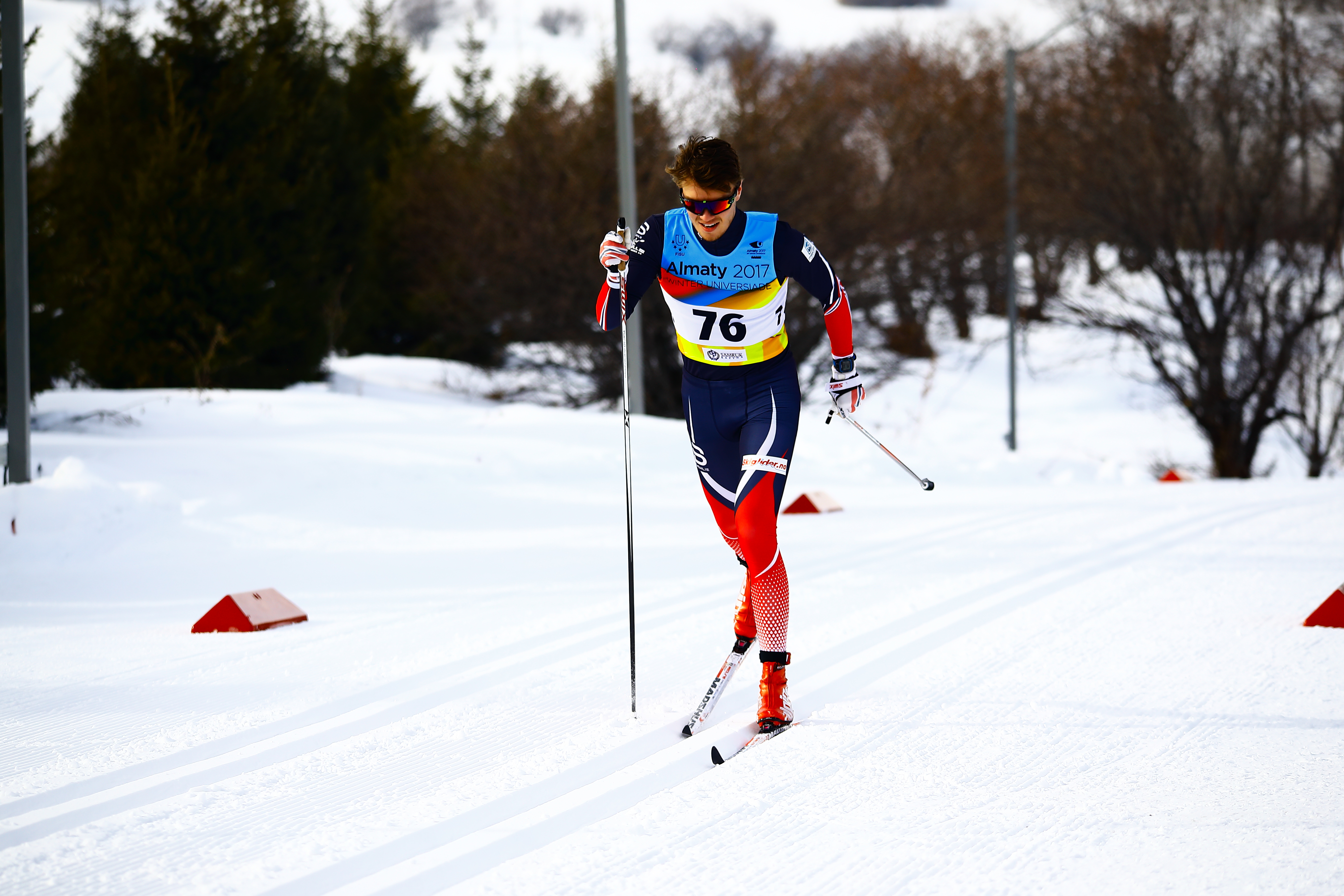
Jørgen Grav of Ford Sayre competing for Norway at the World University Games in Almaty, Kazakhstan. (Photo: Almaty2017.com)
Cross-country ski competitions continued at the World University Games on Tuesday with pursuit races based off the finish times from Monday’s 5 and 10 kilometer classic races.
In the men’s 10 k pursuit, Dmitriy Rostovtsev overtook Russian teammate (and yesterday’s winner) Valeriy Gontar to win by 14.7 seconds. Armenia’s Sergey Mikayelyan moved from fourth up to third place (+52.0) to claim the final podium spot.
Jørgen Grav of Norway, a former University of Vermont skier now in graduate studies at Dartmouth College and competing for Ford Sayre, placed 36th, +5:14.4.
For Canada William Dumas (Skinouk) skied from 48th all the way up to 40th to lead the team and finish +5:26.0. Carrington Pomeroy (Nakkertok) moved from 57th up to 48th (+6:01.2), Conor Thompson (Université Laval) finished 52nd (+6:33.3), Gavin Shields (Lappe Nordic) 58th (+6:54.6), Jordan Cascagnette (Team Hardwood) 62nd (+7:24.8), and Alexis Morin (Université Laval) 68th (+8:44.1).
Vincent Mason of the University of Wyoming had the best U.S. finish, clocking in at 55th (+6:36.6). Teammate Will Timmons finished 63rd (+7:29.9) and Sam Wiswell 71st (+9:27.9). Mitchell Hollman (Air Force Academy) 74th (+10:25.1), Kevin Geisen (Western State)78th (+12:07.6), and Cameron Moore (Western State)79th (+12:50.0).
In the women’s 5 k skate pursuit, Anna Nechaevskaya of Russia moved up and stole the lead from Russian teammate (and yesterday’s winner) Lilia Vasilieva (+18.1). Anna Shevchenko of Kazakhstan kept her hold on third place (+21.3).
Elise Sulser of the University of Wyoming againled the United States, slipping one spot to finish 24th (+3:47.1). Her teammate Meghan Kent was 47th (+6:39.9) and Yara Thomas 50th (+7:20.0). Emma Malmqvist (Colorado Mesa University) placed 53rd (+8:04.7), Sierra Jech (State University of New York) 55th (+8:26.9), and Sierra Foster (Oregon State University) 61st (+10:00.3).
For Canada, Christel Pichard-Joliceur (Université Laval)finished 31st (+4:35.9). Shelby Dickey (Highlands Trailblazers) followed in 41st (+5:35.9), then Emma Camicioli (Rocky Mountain Racers)in 44th (+5:53.0) and Kyla Vanderzwet (Nakkertok) 45th (+5:54.8).
World University Games biathlon (Almaty, Kazakhstan): 15/20 k individual
In the women’s 15 k individual, the first biathlon competition of the Universiade, Kazakhstan took four of the top five places with much of their World Cup team competing on home turf. Alina Raikova won over Galina Vishnevskaya by 2:21.1 thanks to just two penalties to Vishnevskaya’s four. Ukraine’s Nadiia Bielkina was third, +2:23.6 with five penalties.
The lone Canadian finisher was Jessica Paterson of the University of Alberta, who finished 23rd (+13:06.1) with eight missed shots.
In the men’s 20 k individual, Baptiste Jouty of France came out on top by 41.0 seconds over Sergey Korostylev of Russia, with two penalties for each racer. Third place went to Semen Suchilov, also of Russia, +1:05.5 with three missed shots.
Seamus Boyd-Porter of Memorial University led Canada with a 36th-place finish, +13:33.1 and eight missed shots. Taij Isaac Mann of MacEwan University finished 42nd with two missed shots (+19:37.2), and Sasha Eccleston 45th with seven missed shots (+23:07.8).
Former Dartmouth skier Corey Stock racing at the 2015 UVM Carnival two years ago. (Photo: Silke Hynes)
In an effort to showcase the North Americans competing at this week’s International Ski Federation (FIS) 2017 USANA Nordic Junior World Championships and U23 Cross Country World Championships at Soldier Hollow in Midway, Utah, we asked those qualifying athletes several questions about themselves — actually, we had them fill in the blanks. Here we have 22-year-old Corey Stock, of the Bridger Ski Foundation, who’s representing the U.S. at her first U23 Worlds Championships after competing at Junior Worlds in 2012 and 2013.
***
“My full name is Corey Stock, but you can call me Corey. I was born in Lincoln, Mass., raised in Lincoln, and one thing you should know about my hometown is it is the town where Paul Revere was captured.
I started cross-country skiing when I could walk, thanks to trails my brother would tromp down in our backyard (back when it snowed in Boston). I currently train in Bozeman, Mont., with BSF [Bridger Ski Foundation].
If I’m not skiing, you might find me listening to NPR podcasts while remarking on what a gorgeous day it is. If I had to pick a favorite book, it would be ‘Green Eggs and Ham’ by Dr. Seuss.
One of the things I’m most excited about for U23/Junior Worlds at Soldier Hollow is hosting the rest of the world in the USA! One race I’m especially targeting there is the classic sprint.
The best advice anyone ever gave me about skiing or racing was when Sophie Caldwell told me that I will race fastest when I am happy! One of the best race memories I have is Soldier Hollow JNs 2012.
If I could meet one World Cup skier, it would be Anna Haag.
12. If I don’t end up being a professional skier, I’ll probably be… turns out that I am a professional skier! Hopefully I’ll go to business school post-skiing.
MIDDLEBURY, Vt. — Cold temperatures have been the norm for this season of EISA racing. The Middlebury Carnival was no exception, as some of the coldest predicted temps of the season lead to changes in race schedules in hopes of maintaining a safe and fair event. New snow also came along with the cold temperatures, creating slow and grueling conditions for both Friday and Saturday’s competitions. The Tormondsen Family Race Course, site of action at the 2013 NCAA Championships, featured plentiful natural snow and pristine conditions. A 10-kilometer classic race was held on Friday for both men and women, while 5 and 10-kilometer freestyle races were contested on Saturday.
Friday: 10 k Classic
Eirik Fosnaes (UNH) and Hugo Fontaine (LAV) round a corner in the men’s 10k classic at Middlebury (photo: Silke Hynes)
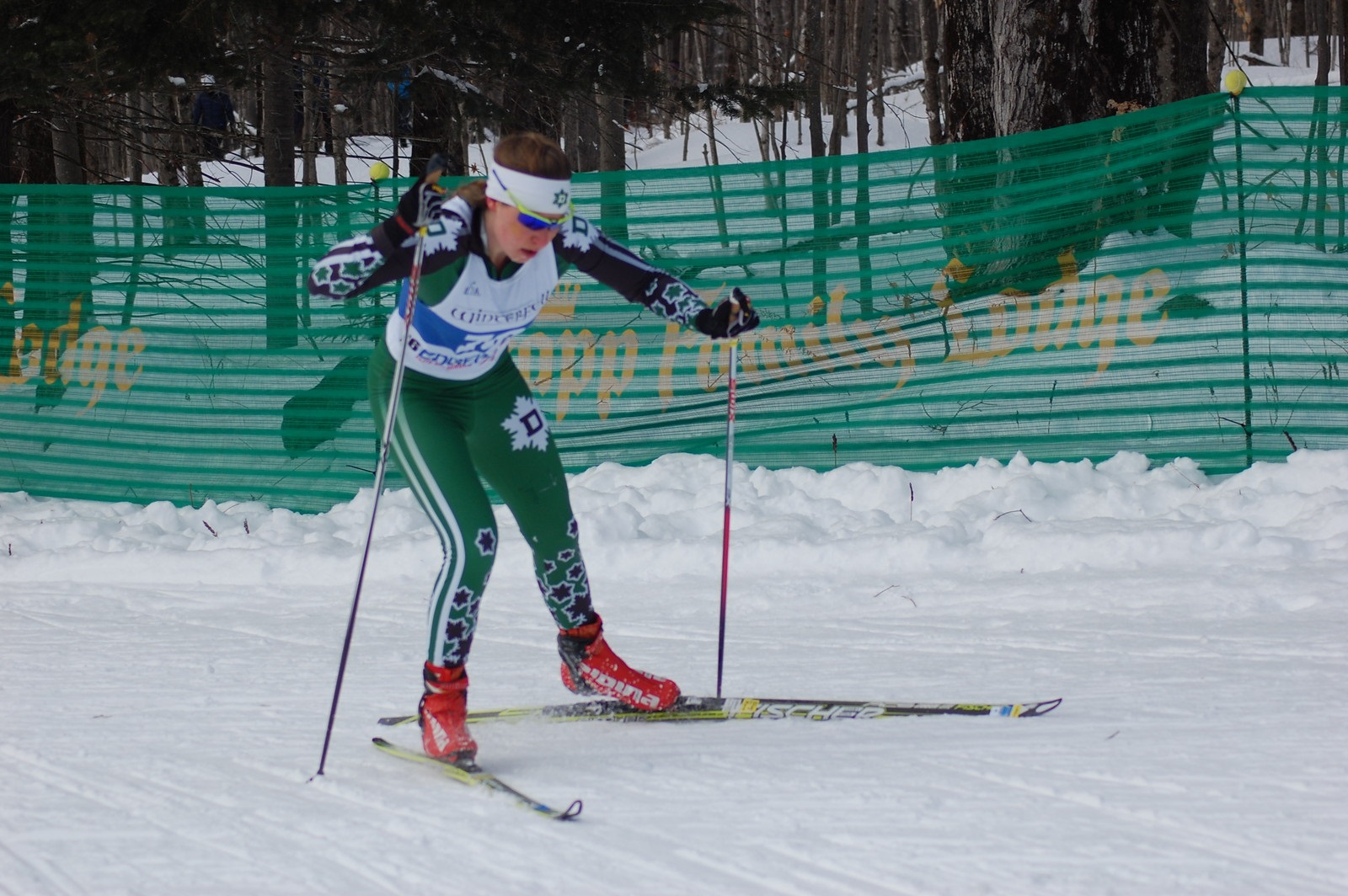
A familiar scene took place in the women’s race on Friday: three racers battling it out for the win, while others chased for fourth. Despite the individual-start format, it was once again the trio of Heather Mooney (Middlebury), Annika Taylor (UNH) and Corey Stock (Dartmouth) claiming the podium. The Panther cheering squads were out in force, and on her home course Mooney prevailed by 10 seconds over Taylor. Stock settled for third, another 23 seconds back.
With the exception of occasional appearances by other strong racers, the top of the women’s field has been relatively consistent this season. Mooney, Taylor and Stock have finished on the podium in many of the past few races, with Mooney and Taylor taking the lion’s share of the wins.
Mooney led the Panthers to a win in the team score, though the women of Bates College were the only team to put three racers in the top 10 en route to second place. Hallie Grossman, Sadie James and Tara Humphries finished in fifth, eighth and 10th place, respectively, helping the Bobcats edge the UVM women by one point.
The men’s podium was a much closer affair, with the top three men separated by a mere eight seconds. Jorgen Grav of UVM took the top spot, with Dartmouth’s Silas Talbot taking second.
Not far behind was Laval’s Frederic Touchette, who ended up less than three seconds behind Talbot. The first three men had a clear gap to fourth, as classic specialist Per Lindgren picked up his third top-10 of the season in 4th, 26 seconds back.
Saturday: 5/10 k Freestyle
Annika Taylor skates to a win in the Middlebury 5km freestyle (photo: Silke Hynes)
While the thermometer may have read a little warmer than the low single-digits of Friday, a damp day and some wind made Saturday’s freestyle event feel quite frigid. Most racers, accustomed to such conditions after multiple weeks of battling the cold, were well-prepared with buffs, face-tape and overboots.
Through the cold snow it was Annika Taylor of UNH who took the win for the women, swapping places with Friday’s classic champion Heather Mooney of host Middlebury. Mooney nearly earned a sweep of the weekend, finishing less than three seconds from the win.
For the second day in a row Dartmouth racer Corey Stock took third, and the women’s podium players remained consistent for both days of competition.
In the men’s race, Rogan Brown of UVM continued an impressive streak of freestyle performances with a win over Dartmouth’s Paddy Caldwell. Recently returned from strong results at the U23 World Championships in Almaty, Kazakhstan, Caldwell was unable to match Brown’s pace and settled for second place.
Finishing on the podium for a second day in a row was Catamount Jorgen Grav who, along with Jack Hegman in fifth, gave UVM a decisive hold on the team score for the event. In fourth was Laval’s Frederic Touchette.
The EISA will take a break this coming weekend. The EISA Regional Championships will be held February 27th and 28th in Lake Placid, New York. Saint Lawrence University will host the events on the 1980 Olympic trails of Mt. Van Hoevenberg, and will also play host to the 2015 NCAA Championships two weeks later.
An NCAA banner hangs at the 2013 NCAA Skiing Championships in Vermont. The 2014 Championships are set to begin Wednesday in Park City Utah. Photo: Flyingpointroad.com (All proceeds benefit NNF)
FasterSkier’s coverage is made possible through the generous support of Madshus.
One-hundred and forty-eight. That’s the number of skiers who have descended upon the ski town of Park City, Utah, to participate in the 2014 NCAA Skiing Championships. The championships will be hosted by the University of Utah, who last had the honor in 2000. The four day event, which consists of two alpine and two nordic races, begins Wednesday and continues through Saturday.
The cross country portion of the event will take place at Soldier Hollow in Midway, Utah, the site of the 2002 Olympic Games and many national events, including the 2014 U.S. Cross Country Championships.
The weather in Utah looks to be warm and wet with highs in the mid 40s to lower 50s and precipitation expected on Thursday and Friday, making for tricky waxing and racing conditions.
Given the nature of course, sloppy conditions, the field, and the stakes, the competition is set to be fierce. Several schools will be in the hunt for the title of america’s fastest skiing school, but only one will walk away with the championship title.
Last year at the 2013 NCAA Championships in Ripton, Vt., it was the University of Colorado that came out on top followed by the University of Utah and the University of Vermont. Colorado’s chances in Utah seem a more slim in 2014, as they were unable to win a collegiate weekend all season. However, with a strong showing for men’s nordic, the Buffs may be able to make up for their other weaknesses.
The University of Utah is hungry to break a three-year-streak of finishing second at NCAAs. After winning last weeks Rocky Mountain Intercollegiate Ski Association (RMISA) Championships, Utah goes into this week’s races with confidence and energy. Having the home advantage should certainly help Utah as well. However, if they want the title that’s slipped out of their hands the past three years, they’ll have to rely less on their alpine team and see better results from their nordic squad.
It would be asinine to discount the University of Vermont, whose skiers have been looking especially strong this year. In the 2012 Championships they demonstrated that they could tackle western altitudes with ease in Bozeman, Mont. And with Soldier Hollow looking to be warm and wet this week, the conditions may favor eastern skiers who are used to rough easter weather.
The East
The eastern skiers are as strong as ever this year with the undefeated University of Vermont setting its sites on another NCAA victory. The 2012 champions have a strong team in both alpine and nordic which has contributed to their uncontested dominance this season.
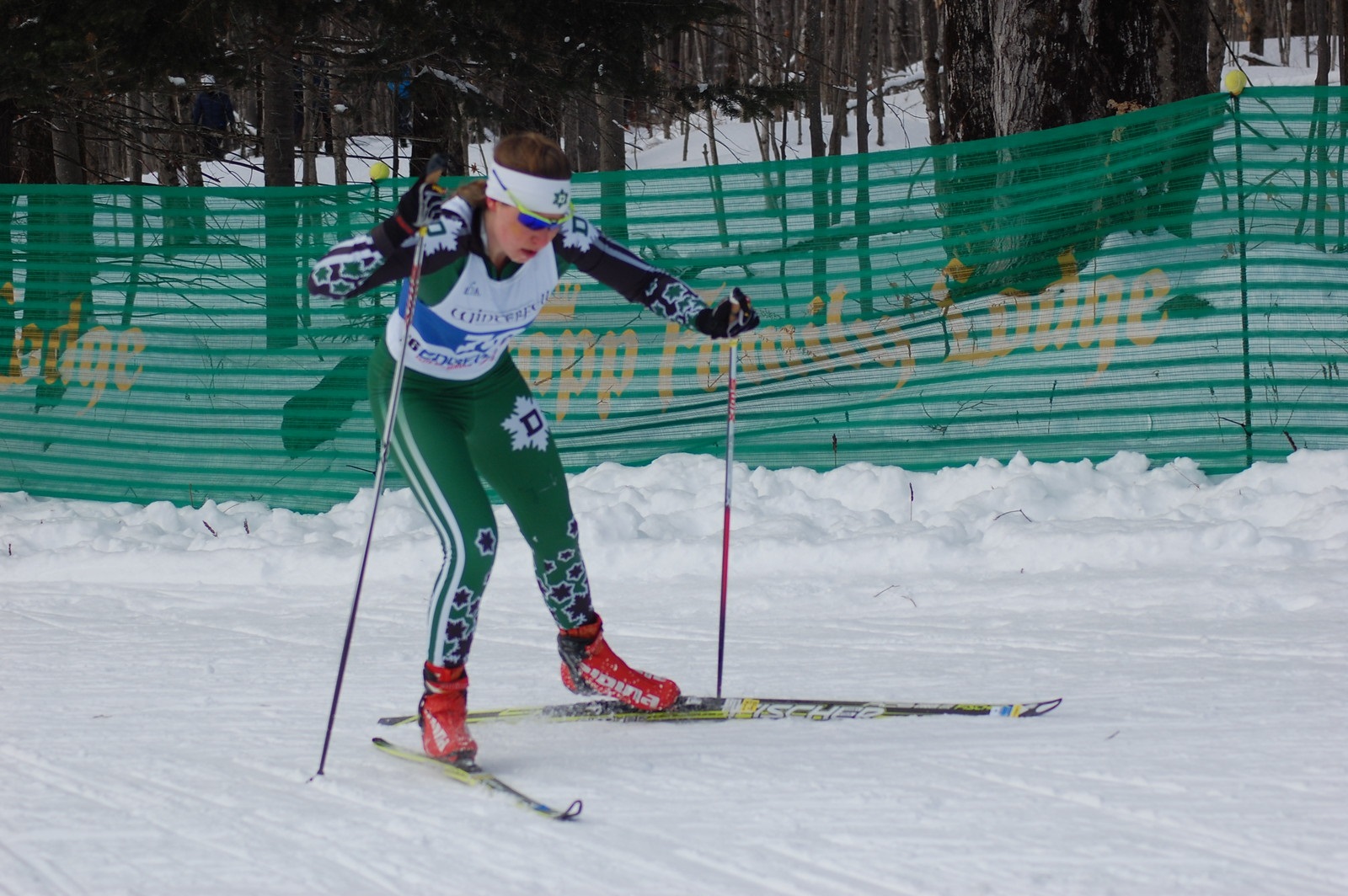
Anja Gruber (University of Vermont) racing to fourth in the 10 k classic mass start at Soldier Hollow for her best U.S. nationals result by more than 20 places. (Photo: Bert Boyer/http://bertboyer.zenfolio.com/) All proceeds from photo sales will be directly donated to NNF.
The east finds its greatest strength in its women. Anja Gruber, a native of Germany, has been UVM’s shining star this year, and finishes the regular season as the top-ranked skier in the Eastern Intercollegiate Ski Association (EISA). Last year’s NCAA 5 k classic champion, she placed fourth at the 2014 U.S. nationals at Soldier Hollow on the same course where the NCAAs are being held. Throughout the season the senior has been a top contender in the EISA circuit, consistently winning all but one classic race and finishing in the top three in every freestyle race.
UVM’s talent doesn’t stop there, with sophomores Linda Danvid-Malm of Umea, Sweden and Stephanie Kirk of Anchorage, Alaska, showing that Gruber isn’t the only catamount with claws. Danvid-Malm has been dominant in freestyle, winning three out of six EISA races this season. Kirk, who competed in Italy as part of the U23 World Championships, has been a consistent performer as well highlighted by a spectacular win in the 15 k skate mass start at the EISA Championships at Middlebury College last weekend.
Annie Hart of Dartmouth College has been the only real threat to Vermont’s dominance all season, having been the only non-UVM woman in the east to win a scored collegiate race this season. Consistently on the podium in classic races, Hart finally saw her hard work pay off at the EISA championships when she won the 5 k classic. With the same event being held on Thursday, Hart is hungry for a national championship title. Corey Stock, also of Dartmouth, has had a decent season as well, ranking fifth in the eastern points standings.
While not as dominant as their women, the UVM men shouldn’t be taken lightly. Their lead skier, Scott Patterson of Fairbanks, Alaska, has won three of the six collegiate races he’s participated in this season. Patterson made the headlines earlier this year when he riskily tried to break away from the men’s field in the 30 k mass start. Unsurprisingly, the move failed on the national level, but a similar move with in a collegiate field may be what Patterson needs to secure a title..
Sophomore Jorgen Grav is another UVM skier to watch in Soldier Hollow. The Oslo, Norway native finished fifth in the EISA rankings, followed by teammate Rogan Brown of Durango, Colo., in sixth.
Silas Talbot of Dartmouth racing in the 2013 NCAA Championships at Middlebury, Vermont.
Two Dartmouth College skiers have the chance to dethrone the dominant catamounts. Paddy Caldwell and Silas Talbot have both been atop the results this year both winning multiple carnival races. Caldwell skied to a convincing win in the men’s 20 k freestyle at the ESIA Championship and was named 2014 rookie skier of the year for the region.
A notable emission from this year’s NCAA Championships will be Ben Lustgarten of Middlebury College. Lustgarten had a spectacular year which started with strong skiing at the 2014 U.S. National Championships, continued with racing at the U23 World Championships, and finished with a win in the 10 k classic (by 50 seconds!) at the EISA Championships. Lustgarten would have been a top contender in Soldier Hollow this year but due to an knee injury he sustained in the 20 k mass start at the EISA Championships the senior will be on the sidelines.
—
The West
Unlike the east, there has been no clear contender for the top spot in the west. At the beginning of the season it looked as if the University of Denver might be ready for another NCAA Championship, but by the time the RMISA Championships was over last week, Denver had finished fourth, roughly 60 points behind the winner, the University of Utah. Despite the end-of-season falter, Denver still held the top spot in the regular season standings demonstrating their potential.
Sylvia Nordskar of the University of Denver racing in West Yellowstone, Montana earlier in the 2013/2014 season.
Sylvia Nordskar of Bærum, Norway, is the most-likely woman from the West to capture an NCAA title. The University of Denver freshman has either won or placed second in every collegiate race that she has competed in this season and has no signs of stopping.
Senior Makayla Cappel, a Sun Valley native skiing for Denver, became a late-season standout after winning the 5 k classic and taking third in the 15 k freestyle mass start at the RMISA Championship in Minturn, Colo. After dealing with illness upon her return from the World University Games in Italy, Cappel recovered from a slow start to her season to rocket herself onto the first team All-RMISA. Rounding out the Denver women is Silje Benum, who has also had many top finishes this season.
Only two non-Denver skiers have been able to top Nordskar this season. The first is Marine Dusser of the University of Alaska Anchorage, who was third in the women’s 15 k in 2013 and has had several wins in the RIMSA circuit this year. The second is Slovenian Eva Severrus of the University of New Mexico, a freshman who has helped New Mexico improve its standings in the west.
Sloan Storey of the University of Utah is another western woman to watch. Storey joined the U.S. contingent at the Junior World Championships in Italy earlier this year and made first team All-RMISA after and exemplary collegiate season.
Rune Ødegaard racing in the West Yellowstone Super Tour.
Like its women’s team, the Denver men were the top team in the west during the regular season. The trio of Moritz Madlener, Pierre Guedon and Trygve Markset made the Pioneers proud in 2014 and hope to continue the trend into the NCAA Championships. However, they’ll need to have a better performance than they did at the RMISA Championships, where they garnered only 46 points compared to the University of Colorado’s 93.
Norwegians Rune Ødegård and Mads Strøm, a junior and freshman, have been the top skiers from Colorado throughout the latter half of the 2014 collegiate season. After sitting out the first two weekends of collegiate racing the duo has consistently been in the top five. Ødegård won last year’s 10 k classic at the 2013 NCAA Championships and looks to continue that success into 2014.
The University of Utah men have shown that the best skiers in the west aren’t just based in Colorado. Niklas Persson, Oscar Ivars, and Noe Bellet have all performed well this season, garnering spots on the second team All-RMISA. However, all three will need to up their game if they want to outpace the Catamounts and the Buffs.
Colorado, Denver, and Utah have had steady competition from the 2013 RMISA skier of the year, Lukas Ebner of the University of Alaska Anchorage. The senior, who hales from Germany, hopes to build on a season that has included multiple podiums.
—
Central
The Central Collegiate Ski Association (CCSA) has traditionally trailed the east and west in terms of results at past NCAA Championships, which is reflected in the small numbers of qualifiers from the region. Despite that fact, there are several top performers who have a chance at an NCAA podium in Utah.
Rosie Frankowski of Northern Michigan University in the 20 k freestyle mass start at U.S. Nationals at Soldier Hollow.
RosieFrankowski, a senior of Northern Michigan University, has had an excellent season and looks to continue her speed into her time in Utah. Frankowski finishes her regular season as the top skier in the CCSA.
Freshman Nicole Bathe of University of Alaska Fairbanks has turned out to be quite the powerhouse in classic races. Bathe has had excellent start to the season after finishing third in the classic sprint at the 2014 U.S. Cross Country Championships.
Fellow Fairbanks teammate Logan Hanneman looks to be the top male competitor for the CCSA in Utah. The junior finished fifth in the freestyle sprint at U.S. Nationals earlier this season.
—
Whether Colorado can reclaim its title, Utah can snap its second place curse, or Vermont use the sloppy conditions to their advantage, the NCAA Championships will be an exciting display of talent from the fastest skiers in the country.
The 5 k and 10 k classic will take place this Thursday at 10 a.m. and 12 p.m. MST. The Championships will conclude with the 15 k and 20 k freestyle mass starts on Saturday, also at 10 a.m. and 12 p.m, MST. Watch the action unfold live on the NCAA site and check FasterSkier for reports.
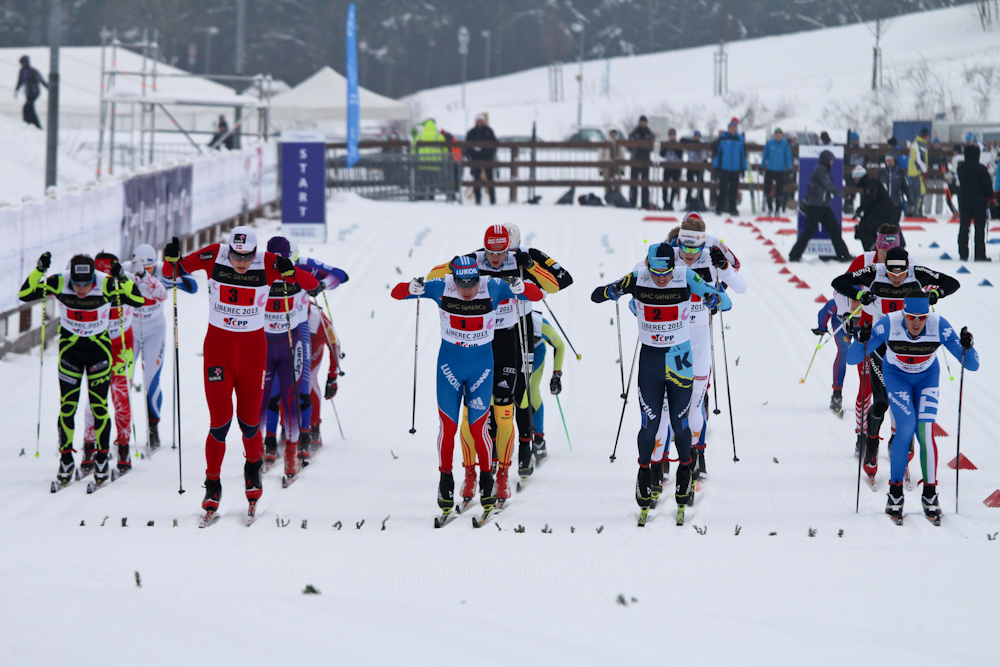
The junior men’s relay gets underway on the last day of competition at the 2013 Junior World Championships in Liberec, Czech Republic. Photo: Eric Packers.
Ask any athlete what their favorite race is, and nine times out of ten their answer will be: “relays.” The four-person event fittingly caps off the World Junior Championships every year — the preceding individual races identify new world champions, but the relay is where athletes go to truly ski for flag and country.
It was with awareness of this fact that the American 4 x 5 k and 4 x 3.3 k relay teams lined up together for their final races of the week on Sunday in Liberec, Czech Republic. On a fast, hard track the U.S. women placed tenth, matching their 2012 performance in Turkey, and the men finished twelfth.
Heather Mooney (Middlebury College) scrambling for the U.S. in the 4×3.3 k relay at World Junior Chamionships. Photo: Eric Packer.
Is it what they were hoping for? Yes and no. A few standout individual legs highlighted the group performance while a mishap or two dashed greater team ambitions. But sometimes racing is a mixed bag, and at the end of a week of high profile skiing most athletes were riding the high of competing against the best in the world.
One of the standout performances came from Heather Mooney (Middlebury College) in the women’s relay. She scrambled for the U.S. on classic skis to put the team in ninth at the first exchange and within nine seconds of third place.
Skiing in her favorite relay position, Mooney held on to the leaders for a good while. Russia’s team led the pack through the first leg, and Mooney kept the blue suit within her sights for longer than she expected to.
“My skis were really fast, so I’d gain a lot on the down hills, and also on the double pole parts I was able to pick up some time,” she wrote in an email. “3 k races are always the most difficult for me, definitely the most painful races out there. Coming up the big hill, about three minutes to go, I was hurting a lot, and just out of contact with the pack.”
Through the pain Mooney noticed the Russian scrambler, Alisa Zhambalova, not too far away, and the sight gave her a second wind.
“I really wanted to give our team a chance, so tried to really dig deep to tag off in that pack,” she said.
Mary O’Connell (Dartmouth College), U.S. leg number two. Photo: Eric Packer
She nearly succeeded, and came through the tag zone just behind the Norwegian team at the back of the chase group.
“Knowing your teammates are counting on you, it makes it a little easier to find the truly painful gear,” Mooney said. “My goal was to get there today, without blowing up, so although I wasn’t able to bring it in with the pack, I’m happy I was able to ‘roll my eyes back,’ as Pepa [Miloucheva] tells me!”
Mooney tagged off to Mary O’Connell (Dartmouth College) 29 seconds behind the leaders, and from there O’Connell sought to reel the Norwegian team in.
“Heather had a great leg,” O’Connell said. “I left the exchange zone and saw Norway right ahead of me and tried to bridge the gap. But then I sorta just died.”
She gave everything she had, but felt tired during her leg.
“I just felt…a little off my game,” O’Connell said. “I was pretty disappointed with my leg. Relays are hard because you’re not just racing for yourself but for your team, but I can say that I gave everything I had all the way.”
She posted the 11th-fastest split to hand off to Emily Hannah (Harvard University) in tenth place, 1:23 down to the leaders. The U.S. would hold the position for the remainder of the relay. Hannah and Corey Stock (Dartmouth College), the American’s anchor, skied the rest of the race by themselves and finished 2:43 off Sweden’s winning time.
Hannah also said she felt off after a week’s worth of racing.
Emily Hannah (Harvard University) skiing the third leg for the U.S. Photo: Eric Packer.
“I did not feel very good today, I just felt flat and tired, like I didn’t have anything extra to give,” she said. “Even though it wasn’t my best race, though, I had a lot of fun… I am really glad that I got to see the level that international skiers my age are at; it gives me a more definite sense of where I need to be.”
At the end of the day, the team focused on positives from the team camaraderie and a hard-working support crew.
“Again, the team is great here,” O’Connell said. “Everyone is so supportive and the coaches and wax techs just did an amazing job.”
Mooney agreed, adding that it was eye-opening simply to be in Liberec against the best U20s in the world.
“It is really motivating to be here, to see what the best looks like,” she said. “I’m excited to go home, into the rest of the season and next year, really knowing what I need to try and get there.”
Cory Stock (Dartmouth College) bringing it home. Photo: Eric Packer.
Junior Men’s Relay
Like the women, American men’s squad approached the race on Sunday with an extra sense of higher purpose. On top of all the usual relay excitement they wanted to redeem themselves of disappointing individual results from earlier in the week, and to it together on the dramatic team stage.
The Americans’ second man, Ben Saxton (F.A.S.T. Performance Training), put it this way: “We were super mentally ready to hang with the big dogs, to suffer and hurt and be in the hunt.”
Logan Hanneman (University of Alaska, Fairbanks) closely tailing the leaders in the first leg of the relay before an unlucky fall. Photo: Eric Packer.
Such a mentality can be powerful, and perhaps it was that desire to suffer with the leaders that propelled Logan Hanneman (University of Alaska, Fairbanks) to position the American team just behind the leaders early in the scramble leg, right around fourth place.
Things were looking good for the U.S. until bad luck struck on Hanneman’s second lap. He fell on an inopportune downhill and the pack got away from him with the lost momentum. The race suddenly became a matter of catching up for the remaining three and a half legs.
“My leg was going really well, until I fell on the second lap on this huge downhill,” Hanneman said. “So I lost a lot of places. So that wasn’t so great, but I was right with the leaders until then.”
He tagged off to Saxton in 14th, 34 seconds behind Russia at the front of the pack. Hanneman was, understandably, frustrated with the end result, both from his relay and from earlier in the championships.
“The week was interesting. I know I can ski better, however I played the cards I was dealt,” he said. “That’s racing. It was another great experience though.”
Out on the course, Saxton did his best to catch back on to the pack. He skied the seventh-fastest split out of the second-leg skiers to do it, passing five teams along the way to bring the U.S. back in the hunt for a top-10. Though happy with that kind of feedback, Saxton noted that attempts to ski well from that far back were difficult.
Ben Saxton (F.A.S.T. Performance Training) on the second leg. Photo: Eric Packer.
“I went pretty hard out of the start and tried to relax on the hills the first lap,” Saxton said. “The problem wasn’t the fitness, it was that when we weren’t in the top group the pace was just slower and we proceeded to lose time. Trying to bridge that gap was suicide, but we were losing time staying there so it was a weird situation.”
In addition to the physical challenges of closing the deficit, it was a tough spot to ski from mentally, particularly because the team had been so fired up before the start.
“That fall could’ve happened to anyone, it was just a very unfortunate fall,” Saxton said. “Everyone just went their hardest. It was really just such a bummer because we were more mentally ready than I’ve ever seen us.”
Saxton tagged off to Kyle Bratrud (Northern Michigan University) in ninth, who skied the first skate leg on “pretty tired” legs. He skied with a Japanese athlete for most of the 5 k and handed the race off to Sawyer Kesselheim (Bridger Ski Foundation) in 11th, 1:22 down from the leaders.
Kesselheim skied with Japan’s Tomoki Sato skied and caught up to another skier on the last climb before the finish, only to get passed again in the final stretch.
“I pushed hard up the last hill and created a gap but got out-sprinted in the finishing zone,” Kesselheim said. “I wish I could have saved more for the end but it was fun and a good experience.”
Though unhappy with their result on paper, the team was able to focus on highlights from the week at the conclusion of the race. They’re more motivated than ever, and for at least one athlete the best part of the week was that the individual competitors came together as a team by the end of the week.
“The greatest part of the week was the people,” Saxton said. “The friends I got to know better from America and those new ones I met just this week will never really leave and in cross country skiing, which is a sport that’s incredibly people-driven, that’s quite the gift to take from any trip, especially this one.”
Heather Mooney (USA) led the U.S. at World Juniors on Friday with a 26th-place finish in the 10 k skiathlon. Photo: Sawyer Kesselheim.
At a race as big as Junior World Championships, a lot of factors go into turning a race into a great day. A personal best. Fast skis. Bluebird skies. For Heather Mooney (Middlebury College), it was some combination that helped her towards her 26th-place showing in the women’s 10 k skiathlon in Liberec, Czech Republic, a performance that led the Americans at the championships on Friday.
“I’m definitely very happy with my race today,” Mooney wrote in an email. “My real goal was to try and stay relaxed and not waste any energy through the classic leg, getting in a good position, not getting pushed around by anyone, and then in the skate I hoped just to ski smooth and stomach as much pain as I could. I think I did those things really well, so I’m happy with that.”
Mooney and two teammates, Sloan Storey and Corey Stock, started next to each other in the narrow, five-lane chevron with bibs 41, 42 and 43. The trio, along with Mary O’Connell in bib 35, was able to ski close to each other in some fashion through the classic leg. The Americans expected a chaotic mass start and for the most part made it through the first few kilometers unscathed and in control of their own races.
“The course starts up a steep hill before dropping down a big downhill over a bridge with a big corner, so we were all expecting there to be a lot of crashes, but it ended pretty hassle-free for most of us,” Mooney said. “Getting through the first lap was a bit nerve wracking, but the girls in front took it out really fast, so it spread out reasonably well.”
Mooney working through the skate leg. Photo: Sawyer Kesselheim.
Mooney came through the pit in 31st at the halfway mark and picked people off in the skate leg to finish 26th overall with the 28th-best freestyle time. As someone who is historically a better classic skier Mooney was particularly excited with the second half of her race.
“I’m generally not as strong of a skater, but it’s something I’ve been working a lot on this year, so I’m really excited to have a solid skate result, especially here!” she said.
Two years ago in Estonia, Mooney was 50th in the pursuit. On the heels of a 19th-place showing in the classic sprint, the skiathlon marks her new best in a distance race at World Juniors.
On top being happy with a PR, Mooney said having good weather for the first time all week made a great day even better.
“Thanks to the wax techs, our skis were really fast, and I was able to glide up a lot of the beginnings of the hills where other people were already skiing, so that was really fun!” she added. “It was a bit colder this morning, so the tracks were firm and fast.”
Storey finished 32nd, 13.2 seconds behind Mooney. The University of Utah freshman characterized her skiathlon experience as “crazy,” “hectic,” and “very fun.”
“Every aspect of it — coaches having to have to wax two pairs of race skis versus just one, racers having to have stay on their feet and not crash or break a piece of equipment during the many collisions in the mass start…and half way through the mass start we had [to] switch all of our gear from classic to skate. It was hectic to say the least, but very fun,” Storey said.
She and Mooney worked together to move up through the pack, and Storey also caught rides with athletes she was able to pass by the end of the race. Like Mooney, she attributed a big part of her success to great skis.
“My skis were BOMB!” Storey said. “One of my highlights was being able to run and not slip up one of the steepest pitches and pass a group of girls who began herringboning… All in all the race was super fun and another great new experience here in Liberec! I’m so proud of all of my teammates for all of their success as well as myself.”
O’Connell finished 35th, 8.6 seconds behind Storey. The Dartmouth College freshman was hoping for a top 30 on Friday had a hard time being too disappointed with 35th in spite of a few trip-ups in the classic leg. For the first kilometer she felt she skied smart and relaxed, but was unable to avoid colliding with another girl that went down in front of her shortly into the race.
“At about 1 k, a girl in front of me fell and I just skied right into her, and then some people behind me skied into me, I think maybe a few US girls too,” O’Connell said. “That was a bit chaotic for a second. After that, I sorta lost my composure and sorta panicked and wasn’t able to kick my skis real well. Going up one of the steep hills in the classic leg, I just tripped again and took a face plant. At this point I was just trying to make it to the skate leg, trying to keep it together.”
O’Connell came through the classic leg in 38th. She made it through the transition to freestyle with no mistakes and began to work her way back to the teammates ahead of her, posting the 30th-fastest skate split as she did so.
Though she didn’t think it was her best race, O’Connell was inspired by the skiing she saw around her on course.
“Being here is so fun, and cool to see all these really fast kids racing around you,” she said. “It’s really inspiring. It lets me know what I need to do from this point on to be able to compete at the top level in the future.”
Corey Stock (Dartmouth College) finished 40th overall in 29:56.8. She had the 49th-ranked classic split at the halfway mark and moved up nine places by posted the 23rd-fastest freestyle time.
Kyle Bratrud (USA) competing in the freestyle race earlier this week. Photo: Logan Hanneman/Corduroy AK.
Kyle Bratrud (Northern Michigan University) led the Americans in the junior men’s 20 k skiathlon in 34th. With the 28th-fastest classic time and 40th-ranked freestyle split, he finished 3:06 behind the Russian leaders at the front of the pack.
“I am pretty satisfied,” Bratrud said. “I started with bib 47 so I knew I was going to have my work cut out for me getting in to it.”
By the end of the first 10 k the field had begun to string out. Bratrud said he “really laid down the hammer” in the classic portion in order to move up and he came through the first half in 28th, about one minute down to the leaders.
“The change was not nearly as bad as I thought I just tried to relax,” he said.
The 19-year-old hadn’t competed in a skiathlon since his freshman year of high school, so Friday’s race was a “rather new experience” for him.
“I think it’s definitely an interesting format,” he said. “It’s a really grueling race since you work both sets of muscles, so there was a lot of pain experienced in that race.”
Like his teammates, Bratrud noted that sunny skis and hard tracks made for a more enjoyable day of skiing than competitors have yet seen this week under Liberec’s overcast skies.
“[There were] very challenging courses so they really tested me… I was able to see my weaknesses so I’m very excited to train this summer and fix those!” he added. “Overall [I’m] pretty pleased. Feels great to wear that uniform and look down and see USA on my leg — living the dream.”
Logan Hanneman skiing in a pack. Photo: Josh Smullin.
Logan Hanneman (University of Alaska, Fairbanks) was the second American to come through in 39th. Ever the competitor, Hanneman had high expectations for the skiathlon and in the first few kilometers of the race he led the field for a few laps.
“After the sprint qualifier, I thought that I definitely had a top ten in me,” he said. “The first few laps of the classic portion were great. I was right up there and feeling great.”
The wheels started to come off after the second 2.5 k lap.
“I was leading the race on the second lap of the classic portion. Then I seemed to find reverese,” Hanneman said. “It really felt like I ran into a brick wall. The muscles just began cramping and I don’t really know what happened. So from there on out, I was in survival mode, as dumb as that sounds. In the skate, I was just barely skiing.”
Hanneman came through the exchange in 23rd at 10 k and went into damage control in the second half. His skate leg was the 61st-best time in the field.
“I am not realy that excited about my result,” he concluded. “I hope the relay goes much better.”
Forrest Mahlen (Alaska Pacific University) and Tucker McCrerey (University of Utah) came in 70th and 71st, respectively, just under six minutes behind the winning time. Like Hanneman, they were not happy with the placing but looked forward to a shot at redemption in the relay.
Mahlen thought he may have suffered from mild food poisoning from dinner the night before and felt his stomach clench throughout the race.
“I don’t know if it really affected my performance other than to make the race a little more painful than usual,” he said, adding that “the race itself was super exciting; 92 of the best junior skiers in the world all trying to fit into two classic tracks on a 2.5 kilometer loop lets you know how you stack up real quick.”
McCrerey echoed the sentiment. “I love the skiathlon because it tests your form in both disciplines,” he said. “I’m really bummed that I did not have a good race because I thought I could really do some damage in this field. There will be another time in the future.”
The American athletes at Junior World Championships in Liberec, Czech Republic, this week started things off with a bang in the classic sprint on Monday, qualifying four athletes for the heats. Two men and two women made it as far as the quarterfinals; Ben Saxton (F.A.S.T. Performance Training) and Logan Hanneman (University of Alaska, Fairbanks) headlined the day in 14th and 16th, respectively. Heather Mooney (Middlebury College) led the way for the U.S. in the women’s heats in 19th and Corey Stock (Dartmouth College) took 24th. For a team that didn’t qualify anyone at the championships last year, it was a big step up for the group overall.
Ben Saxton (F.A.S.T. Performance Training) competing at U.S. Nationals earlier this month. His 14th place finish was the top American result at World Juniors in the classic sprint on Monday in Liberec, Czech Republic. Photo: Bert Boyer.
“I’m super excited about the result,” Saxton said. “A top-15 at World Juniors was definitely one of my goals and to do it emphatically and show I belonged there was really important.”
U.S. Ski Team development coach and trip leader Bryan Fish was also pretty pleased with the first competition day in Liberec.
“I thought today was a very strong start,” he said. “This is a huge step forward and they skied well. It was a pretty tough course with tricky conditions; we had some new snow this morning… So although it was a tricky day, it was definitely a good day.”
Saxton, who turned heads at U.S. Nationals earlier this month by making the A-final in the classic sprint, had big ambitions for the opening event of the week. In the qualifying round he started in the spot 15 seconds in front of Hanneman, and it must have helped both athletes, as Hanneman qualified 10th and Saxton 11th, just four seconds off Vadim Korolev’s (RUS) top time in 2:54.
“We rocked that qualifier,” Saxton said. “They read our names with a plus 4 seconds I did a double take and it was so cool!”
In the quarterfinals Saxton and Hanneman met again. The sprint course consisted of three climbs followed by descents, with the last hill feeding into the finishing stretch. Saxton and Hanneman finished third and fourth in the heat and didn’t advance.
“I skied like such a fool on that opening climb and cost myself a lot of energy, I’m still kicking myself for that,” Saxton said.
For the athletes, the improvement in team results was cause for excitement as well as a desire for more. Fourteenth and sixteenth out of the best U20s in the world is not too shabby — it’s Hanneman’s best Junior Worlds result and Saxton’s first one on the books — but in another sign of how far the juniors have come, neither was perfectly happy with the results.
“I’m not totally satisfied,” Saxton. “To show myself and the world that I was supposed to be there and then get bounced from the quarters really doesn’t sit well with me. I loved today and I’m not sad, but I know I’m capable of more and I’m disappointed I didn’t get to show it.
“I think Logan kind of feels the same way, really wishing we could’ve thrown down our absolute best and not made certain decisions in our quarter.”
In his writeup for the National Nordic Foundation, the non-profit providing a significant amount of funding for the Liberec trip, Hanneman essentially concurred.
“Unfortunately, we both raced slightly chaotic races in the heat and failed to move on,” he wrote. “We were close though… This was a great showing for us. It showed that we were right in the hunt, but just need a little more experience when it comes to head to head racing.”
Outside the top 30, Tucker McCrerey (University of Utah) was 42nd, less than four seconds out of the rounds, and Sawyer Kesselheim (Bridger Ski Foundation) finished 45th a fraction of a second behind McCrerey.
“I was excited for all the races but the 10 k skate is the one I believe I can do the best in,” Kesselheim said. “This is my first trip to Europe for racing and I came into it not knowing where I stand. Given that, I am hoping to be top-20 in the skate race.”
Heather Mooney (Middlebury College) training with U23s Annie Pokorny and Annie Hart in Ramsau, Austria last week. Mooney was 19th in the classic sprint. Photo: Eric Packer.
On the women’s side, Mooney came into the sprint with plenty of international experience to her name. She competed in the Youth Olympic Games in Austria last winter and at World Juniors in Estonia in 2011, and she took pride on Monday in no longer being intimidated by foreign turf and unknown competition.
“I’m definitely excited with the day!” Mooney wrote in an email. “I knew if I had a perfect day I maybe could make the semi finals, so I just focused on the details I could control, my skis, my warm up, and skiing the course well, and it turned out pretty well.
“There are definitely things to improve on, but I’m happy that I felt comfortable with the racing scene here, and didn’t feel like the idea of racing in Europe threw me off this time. It was cool to see USA qualify 4 people for the heats, we’re definitely contenders over here, so it’s fun see us holding our own. Proud to be an American!”
Mooney described the sprint course as “really hard, definitely the hardest I’ve ever raced,” and likened it to Black Mountain in Rumford, Maine — “crazy, but it makes it comfortable I guess!”
The classic sprint is one of her favorite events but she also has high hopes for the pursuit, and if she skis well there, the relay, too.
Stock’s 24th was also a personal improvement from her first Worlds appearance last year, where she was 41st in the freestyle sprint. The Dartmouth freshman qualified in 25th and moved up a place in her quarterfinal.
Sloan Storey (University of Utah) was 45th, 9 seconds out of qualifying, and Anika Miller (Payette Lakes Sports) finished 52nd, 11 seconds out of 30th.
The athletes that didn’t make the heats said they were looking forward to the distance races throughout the rest of the week and felt more motivated to improve upon Monday’s result.
Anika Miller (USA) skiing the qualifier. Photo: Bryan Fish.
Storey and Miller also made first-time World Juniors performances in the sprint. Storey considers herself to be more of a distance skier and was perfectly happy with her result.
“Today was a pretty great day,” she said. “My result was 45th so I didn’t qualify for the heats, but I was fine with that considering sprinting isn’t my best event and these girls are insanely fast!”
Miller was disappointed not to move on in the sprint, which she considers one of her stronger events, but is looking forward to another shot in the 5 k.
“I didn’t quite perform to expectations today and I struggled a little bit out there, but I think I have a better chance to perform in a skate race so hopefully Wednesday will go well,” she said. “I am a much stronger and more consistent skate skier so hopefully I can represent the team well on Wednesday and put down a big result.”
All told, she was excited to be part of the American group on a successful day.
“So far we’re off to a good start as a team and I am very excited to see what team USA can bring to the table for the rest of the week because this is a very talented team,” Miller said.
The individual improvements on Monday combined to make for a big step up for the U.S. showing as a whole, and the amount of international experience on this year’s team reinforced the idea that experience leads to success. According to Fish, fourteen out of the 22 juniors and U23s on the team have raced internationally before.
“That’s the biggest thing,” Fish said. “Fourteen of these guys are returning in some fashion from international experience and the more they get that opportunity and experience the better they are. I attribute it to their preparation and a good camp, and they’re working well together.”
The Bates College cheering section on Saturday during the Quebec World Cup 1.6 k men’s and women’s skate sprints.
QUEBEC CITY – There were a lot of North Americans milling around the downtown World Cup sprint venue this weekend, but the ones inside of the fence were doing the most work.
That’s not to say cheering doesn’t take energy, too. It just taxes different muscles.
Either way, many racers found the support of thousands of spectators invaluable during the 1.6-kilometer individual sprint on Saturday – even if they didn’t make the top 30 to qualify.
“It was a tunnel of noise,” said Patrick O’Brien of Vermont’s Craftsbury Green Racing Project (CGRP) after placing 53rd in the prelim. “The closest thing I can think of for me was Dartmouth Carnival at home times one hundred. Everywhere out there people were screaming your name and that was just awesome to have everyone come out. It is good for nordic skiing in general. I think everyone would say that this event was a huge success.”
That positive feeling was echoed by most competitors regardless of their results.
“I can’t get over how awesome the crowd is,” said Sylvan Ellefson (Ski & Snowboard Club Vail/Team HomeGrown), after placing 57th. “The Bates [College] crew being out here again, my alma mater, that was just so loud so powerful going through there. We are in Canada, I’m from the United States, but it still feels like we are on home territory.”
Eighteen-year-old Corey Stock of the Cambridge Sports Union, who placed 47th in her first World Cup, had a feeling a lot of people would come out for the event, but she had no idea what it would be like.
“I just feel so lucky to have this be my first World Cup, a city sprint in Quebec with all these Americans cheering,” Stock said. “It was just really cool. My parents are here, my brother is here and the whole Dartmouth Ski Team is here so it is so awesome hearing them cheer on the side of the course. … I couldn’t have asked for a more exciting atmosphere.”
As for the snow conditions, many North Americans used words like “sugary,” “soft,” and “mushy” to describe them – at least for the qualifier (organizers firmed it up for the heats).
Jesse Cockney (AWCA) en route to placing 32nd in the Quebec World Cup individual sprint qualifier, 0.25 seconds outside the top 30.
“Your tips were just cutting through mounds of sugar on all the turns so you tried to keep [them] up on top,” said Reese Hanneman of Alaska Pacific University (APU), who was 61st. “You were trying to hammer, but you’re also doing preventative damage control.”
“I’m a bigger guy, but I’m a really bigger guy,” said Skyler Davis of the Stratton Mountain School T2 Team (SMS) and U.S. Ski Team (USST) after ranking 69th. “A big guy is like 180, and 25 pounds more … With this stuff, any little movement your legs die a little bit, it was just so squirrelly.”
Any experience on similar conditions mattered. Thomsen D’Hont of the Yellowknife Ski Club placed 65th in his first World Cup because of that.
“I train in these conditions all the time in Whistler [British Columbia] so like the harder the conditions are, the better I am,” he said. “It was hard, but for sure, pretty fun … You can’t just focus on going hard, you have to focus on skiing well.”
“I definitely went harder than I ever have before,” said APU skier Lauren Fritz, who was 55th in the qualifier. “My feet and shins were pretty tense, which I don’t think helped. … But the energy, oh my God, it’s so exciting. It’s easy to go harder.”
“It was really tough; I just tried to ski as smooth as possible,” Canadian National Team member Perianne Jones said after placing 38th in her first race since tying her personal-best of 12th in a World Cup sprint in Kuusamo, Finland.
“I know the course really well, but it’s never been as mushy as this,” she said.
In his first individual World Cup, Russell Kennedy of the Alberta World Cup Academy (AWCA) placed 45th.
“I like harder conditions,” he said. “I’m a bit bigger of a guy and the soft isn’t usually good for me, but I thought I skied it good all things considered. I don’t know, it was super fun.”
Ryan Scott (SSCV/Team HomeGrown) wasn’t so comfortable on the course.
“Just because we’ve been rollerskiing so much I haven’t had a lot of on-snow time, especially soft snow, not my thing so I’ll definitely be looking for a harder track in Canmore,” Scott said.
Several skiers would remember the highlights of their weekend, which ranged.
“I was really excited to race the team sprint,” said Andrea Dupont (Rocky Mountain Racers), who ranked 48th in the individual race after placing 20th in the team sprint with Kate Brennan (AWCA).
“I hadn’t had an opportunity to do that before on a World Cup so that was really a positive experience,” Dupont added. “The weekend before we got to race with some of the Swiss girls in Canmore and they were actually the team right in front of us and we got to play cat-and-mouse with them which was a lot of fun.”
While the two hail from different teams, Dupont and Brennan were really looking forward to the Canmore World Cup at home later this week.
“There’s a lot of tactics on it and I am itching,” Dupont said. “I really, really want to make the top 30 there. This is super fun though. This is an amazing atmosphere and I hope it does something good for North American and Canadian skiing.”
“I learned a lot just skiing in the different conditions,” said Brennan, who was 54th on Saturday. “Canmore’s been rock-solid this year so we haven’t had a chance to work in slush like this or just the deep pellets. It was cool, Quebec City put on quite a show.”
“There’s a lot to take away from it,” said Jesse Cockney (AWCA), who just missed qualifying in 32nd. “I mean, just being ready for everything and just being able to go with the flow. The events are so big that things go wrong with them and you’ve got to just roll with the punches and just be relaxed, that’s the big thing.”
He’s noticed how Canada’s top national-team racers Devon Kershaw and Alex Harvey usually adjust and tried to mimic them.
“They’re pros at adjusting to jet lag, traveling long days, eating weird food, sleeping in weird rooms,” Cockney said. “I’m getting to the at point but I’m not quite a professional yet. Training with them in the summer helped a lot to see how they live every day. Training is above and beyond everything else for them.”
That raises the question: what does it take to get to the next level? Holly Brooks (APU/USST), who was 36th said she didn’t have it.
“It was hard to push it so I was really hoping to come in with a better qualification than that,” Brooks said.
Ida Sargent (CGRP/USST) charges ahead in bib 1 to start things off in the 1.6 k Quebec World Cup individual freestyle sprints on Saturday. She was 44th in the qualifier. (Photo: FlyingPointRoad.com)
Ida Sargent (CGRP/USST) placed 44th after being the first starter out on the course and wasn’t satisfied, either.
“I just was, like, frantic, never found any flow out there and was just really rushed,” Sargent said. “It was tricky conditions. I couldn’t really go hard and get it going. I was struggling out there and I think skiing first I couldn’t focus. I felt like I was just being chased down.”
Simi Hamilton (Sun Valley Ski Education Foundation) was another USST member who finished short of his expectations in failing to make the rounds. He placed 33rd.
“I didn’t feel very good, but I just tried to stay light on my feet and just tried to stay upright,” he said after the qualifier. “It’s still early in the season and I never historically skied that fast early on. I was able to qualify in Kuusamo last weekend which is a good sign and hopefully I’ll just keep climbing throughout the whole season.”
Phil Widmer (AWCA), who was 55th, said he felt like he skied the qualifier “reasonably well,” yet he had to reflect back and figure out where he lost time.
“I’m not sure if my body was a little bit off or I didn’t technically execute,” Widmer said. “I might have been missing a little snap, but I need to be able to ski through those sorts of efforts. You train all year for it.”
Dakota Blackhorse-von Jess (Bend Endurance Academy), who ranked 38th, felt much differently with positive feelings throughout the day.
“This is the first time I felt good this season,” he said. “I’m a big up-and-down guy. When I’m high, I’m really jacked up. [Saturday] morning I wanted to race so everything was perfect. If I was the best in the world, that’s how I think I would feel. It just wasn’t enough today, I guess.”
Caitlin Gregg of Central Cross Country (CXC), who was 49th, reflected on her race and tried to pick up tips from others.
“It was tough to decide whether or not it was a high-tempo or a high-power day,” Gregg said. “I think somehow giving good powerful strokes, but obviously not bogging down, it’s a finessing of the ski. I could definitely tell some girls were pretty good at that.”
One of her highlights was watching Kikkan Randall, whom she placed sixth with in a team sprint at the 2010 Olympics, win the team sprint in Quebec City.
“That team is destined for big things,” she said. “That was sweet to watch.”
Personally, she said the experience was great and an affirmation that her training was working.
“This is why we do it weekend after weekend in the states to earn our berths over here,” she said. “Every time I come to these I’m reenergized for the next training or the next race cycle or whatnot. This is what you think back to when you’re training in the summer time and in the nasty fall weather. This is the best.”
“Oh my God, it’s like a dream,” said APU skier Kate Fitzgerald, who was 52nd. “Especially to watch Jessie and Kikkan win. I was like, ‘I just watched history and I got to be here in person, too.’ ”
“I went to bed last night and I was like, ‘Wow this is incredible what I’m getting to do,’ ” Kennedy said. “Especially downtown Quebec with all the spectators and stuff, it’s the first time I’ve been to a nordic race and felt like it’s a real sporting event, almost like a football game or something. It’s an unbelievable experience.”
The Quebec City sprint course is practically designed to make competitors feel like rock stars this Friday and Saturday during the much-anticipated World Cups. Photo: Ryan Scott.
A rare opportunity presented itself this season for a higher than usual number of American athletes to compete in the two World Cups in Canada this December. For many of the best domestic-level athletes in the country, it was the chance to break into the next level and compete for the U.S. on the biggest stage there is in cross-country skiing. Earning one of those start rights became the focal point of the season for SuperTour athletes who thought they had a shot at making it.
For American athletes in Quebec City about to compete in their first World Cup, that dream became a reality last week in Bozeman, Mont. Two hard-fought sprints later and just like that: they’re here. Hello, World Cup.
“It was certainly stressful having such important races right off the bat this season,” said Alaska Pacific University’s Kate Fitzgerald “Had a few restless nights wondering how things were going to turn out.”
Athletes learned they had made it in fittingly dramatic fashion: while lining up for the final race in Bozeman last weekend. U.S. Ski Team Head Coach Chris Grover emailed successful qualifiers the morning after the classic sprint, but at the remote, service-less Bohart Ranch the day of the mass start event, some athletes didn’t see it before departing for the venue.
“When I heard…I was absolutely floored,” said Crafsbury Green Racing Project’s Pat O’Brien. “I got the news from some of the other athletes that had made the team right before the distance race. Needless to say it was a huge relief going into the last race in Bozeman!”
The APU contingent found out from a teammate at about the same time.
“Brent Knight came running up to us ten minutes before the 10 k classic and told us the list,” said APU’s Becca Rorabaugh. “It was a great boost to hear about it before we started; it certainly took the pressure off!”
“I started yelling and whooping and giving all the girls high fives,” Fitzgerald said. “I was so excited! I knew it was going to be close so it was all the more exciting when I found out that I made it.”
The cold, hard math of the selection criteria made the last few available spots heart-breakingly close. A single SuperTour point separated the last female who qualified from the first one that didn’t. Two points made that difference in the men’s field.
“I was ecstatic upon hearing that I had officially made the World Cup team,” said Ryan Scott (SSCV Team HomeGrown). “I had such a disappointing classic sprint race in Bozeman that I thought for sure that I had lost my only opportunity to qualify with that one poor performance.”
Now that they’ve made it, however, the real work begins. Simply wearing a World Cup bib is not enough; these athletes want to compete. In the words of Reid Pletcher, “TIME TO THROW DOWN!”
Presenting the Americans who fought tooth-and-nail to make their first Eurosport appearance this Friday and Saturday — their hopes, dreams and aspirations. (For the full list of Americans competing in Quebec this weekend, look over here.)
Get your cowbells ready.
__________
Erik Bjornsen (APU)
The Methow Valley native has been on the U.S. Ski Team development squad for over a year, but this will be his first World Cup appearance. With a second and third-place showing in the Bozeman sprints, he was pretty clearly going to be on the Quebec roster. Still, Bjornsen said it was satisfying to officially meeting the season-long goal.
“I was so excited to be named,” Bjornsen said. “It has been my goal since the beginning of the summer.”
The 21-year-old turned down World Cup start spots last season because he didn’t think he was quite ready. “Now I think I should have a pretty good shot of mixing it up with some guys and I hope that in a couple years I will be a full time World Cup athlete,” he said.
Bjornsen is approaching the Quebec races like he would any other.
“I’m doing my usual training leading up to the races,” he said. “I’m sure I will start getting more nervous tomorrow but for now I’m just really excited to be here experiencing it. Quebec City seems really cool and it’s nice to be back with some of the USST crew.”
__________
Reid Pletcher (Sun Valley Ski Education Foundation)
This is his first year out of college, but the Hailey, Idaho, native has already skied twice on the World Cup before: first in Canmore in 2008 at the age of 19 and again in Whistler in 2009. Quebec won’t be his first rodeo, but Pletcher is just as excited about the prospect of racing there as anybody else.
“I would say I am most excited for the crowds and cheering,” he said. “There is nothing like hitting the last 100 meters and you can’t even focus because the noise is so overwhelming.”
Pletcher was 35th and 37th, respectively, in Canmore and Whistler. He skied to his best SuperTour sprint result in Bozeman last weekend, and coming off the confidence of the win he wants to see action in the rounds in both Quebec and Canmore these next two weekends.
“My goals for the next two weeks are to qualify for the heats and be in the mix of things,” he said. “My goals this season were to prove to myself and my competition that I have what it takes to be very competitive in professional skiing. Last week I had my best SuperTour result ever, and the World Cup makes it even more amazing.”
__________
Reese Hanneman (APU)
With his classic sprint victory on Saturday, Hanneman all but guaranteed himself a ticket to Canada. It won’t be his first time on the World Cup stage, having competed in Canmore in 2010, but that didn’t make the moment he realized he was going any less meaningful.
“When I actually saw my name on the list, it was a mix of excitement and calm,” Hanneman said. “It’s something that I had as a goal for such a long time, and I have spent so much time and energy trying to actually do it, and so to complete that objective gives you a sense of completion.”
Like Bjornsen and Pletcher, Hanneman has moved past the initial excitement and says he’s ready for World Cup action — “Now I’m just so amped up!”
In Canmore in 2010, where he was 70th, Hanneman was “inevitably nervous and star-struck,” he said. “Now I feel like I will be in a much better place mentally, having a lot more international racing experience and just more high level racing. My goal is to be able to just keep myself calm and go about business like its just another race, albeit an important one.”
__________
Skyler Davis (SMS T2/USST)
Davis’ World Cup debut in 2011 didn’t go as planned thanks to mono, but it’s a different year and different season now: with a new coach and new team, Davis is feeling good about where he’s at.
A slight cold held him back in Bozeman, but now Davis says he’s back to feeling 100% headed into the big show, and has a top-30 in his sights.
“My biggest goal is to make it into the rounds,” Davis said. “I believe I’m capable, just have to put it together.”
__________
Pat O’Brien (CGRP)
Craftsbury went to more training camps this summer in order to push its intensity with people from around the country, and for Pat O’Brien, the work paid off.
“Obviously being my first World Cup, I am simply excited for the experience,” he said. Other than a few FIS races in Europe this will also O’Brien’s first significantly international race.
“So much of ski racing is seeing that higher level and figuring out how to get there. The US girls have shown this year that there is no reason the American skiers can’t succeed on the big stage. It’s just a matter of hard work and believing in it.”
He has performance goals, but believes the World Cup exposure will be more valuable than anything. The atmosphere will probably be pretty cool, too.
“You know that everyone will be showing up and cheering like mad, especially for Alex Harvey. If he had a helicopter following him at Canadian nationals, imagine how nuts it’s going to be for a World Cup city sprint! I think this is great for the sport, to show Europeans that yes, skiing may not be the biggest sport here in the US or Canada, but it is a sport on the rise and something people care hugely about.”
__________
Ryan Scott (SSCV Team HomeGrown)
The Boulder, Colorado, native spent a lot of time working on his skate sprinting this summer specifically for the purpose of competing in Quebec. “My emphasis all fall was to develop true speed for flat terrain,” he said.
A few man-made bumps represent the only climbing on the city street course, which suits Scott just fine. “I do think this course…suits my skiing skyle and so I know that I will be prepared for a good performance. The first SuperTour races of the season were a great warm-up for these races.”
Like his countrymen, Scott has high expectations — merely qualifying is not enough, he’s looking for a top-20.
“Racing at such a large venue as in Quebec will be unparalleled to anything I have experienced in the U.S.,” he added. “The crowds provide great motivation so that will be something that I look forward to most. The team sprint will be an excellent chance to test my fitness and stay competitive with the rest of the field.”
Blackhorse-von Jess found out a little bit after everyone else that he would be going to Canada, as a new spot became available when Torin Koos declined the trip. He and coach Ben Husaby thought for a moment whether they’d be able to make it work, but realized “there aren’t any drawbacks to going and this is living the dream the way we all envision it,” Blackhorse-von Jess said.
The Bend native has been to the big show before. In the Whistler World Cup in 2009, he was 34th in the classic sprint. As the last name on the qualifying list this year he has just the individual race to turn in the performance he wants: a top-30. In 2009 he says he let the whole production get to him; this time he knows what to expect.
“I’m here to compete. You don’t get a lot of opportunities (they are few and far between with a lot of talented athletes competing for them) so when you get a chance like this, you have to do everything with it you can,” Blackhorse-von Jess said.
“From watching Simi [Hamilton]’s career as a World Cup skier, it’s pretty clear that being off even a little can end a day early, but also that there is a completely reasonable expectation for success, even with little or no World Cup experience. So the plan is to go out there and qualify as fast as I can. It’s time to quit being a little conservative during qualifying and push deeper. Find that extra bit I’d normally save and push it as far as I can. This field isn’t looking like the normal weakened North American field of the last few years, so every hundredth could make the difference.”
__________
Sophie Caldwell (SMS T2)
With numerous Junior World Championship trips under her belt, Caldwell is no stranger to high-profile international skiing. But this is the big-leagues, and as it will be the first World Cup of her career, she was thrilled when she heard she’d made her biggest early-season goal.
Now that she’s here Caldwell is not sure where she’ll stack up, but is looking forward to turning in the best race she can.
“I’m really looking forward to racing in the city,” she said. “Sadie [Bjornsen] told me the city sprint is the most I’ll ever feel like a celebrity in my life! I have a lot of family and friends coming up so it will be fun to see everyone and hopefully I’ll have some good races.”
__________
Lauren Fritz (APU)
Fritz has seen Alpen Cup and OPA Cup-level skiing before, but this will be her first World Cup experience.
“I’m pretty psyched to be here,” she said. “It took a while to process that I actually made the cut, but it was exciting to get the news with my teammates who also made it. There were a lot of high fives.”
Once she takes to the snow in front of the Parliament building, Fritz says she’s going to go out and ski the best race she can.
“Hopefully the results will be good. I have a tendency to do pretty well when I have no real expectations because I’m just psyched to be skiing and I’m more relaxed,” she said.
“I think Quebec is going to be awesome because there are going to be a lot of fans here cheering for the Americans — family, friends from the East coast driving up, etc — and i’ve never done a race that is packed with fans the entire way.”
__________
Corey Stock (Dartmouth/Cambridge Sports Union)
The 18-year-old from Massachusettes has done it again, and skied much faster than where her experience level would have predicted. It must be time to get used to it.
The Dartmouth freshman focused her training this summer, spending time with APU on Eagle Glacier to give herself competitive training partners and quality on-snow time. Based on her third-place finish in the Bozeman classic sprint, which was thisclose to being a place or two higher, Stock clearly knew what she was doing. Now she’s in Quebec for her first World Cup races.
Stock is a fierce competitor, but once the bib comes off after a race she’s all happy excitement, and makes a point of soaking in every part of her experience. It’s just a hunch, but we’ve a feeling the World Cup scene will be a commonplace one for her down the road.
__________
Becca Rorabaugh (APU)
The Alaskan competed in the Canmore World Cup in 2009, where she was 59th in the classic sprint. Though she says she’s been a bit more tired than usual this fall, she’s worked more recovery into her preparation to be ready for Quebec. Rorabaugh certainly has a handful of international races under her belt, so she knows what she’s in for.
“I was really relieved to hear that I was going. I knew I must have been close,” she said. “I really hope to improve on my last sprint place in Canmore, and I am so excited to be around a city sprint atmosphere!”
__________
Kate Fitzgerald (APU)
It’s always thrilling to watch Ftizgerald race because every time she puts on a bib, she pushes herself just a bit further over the edge than those around her. Her reaction to finding out she’d made the Quebec team demonstrates why: it means that much.
Now that she’s in Canada for her World Cup debut, Fitzgerald is taking in every part of the event.
“The whole experience is so new to me so I do not really have many expectations,” she said. “My plan is to enjoy this incredible experience, soak it all in and see what it is like to be a World Cup skier! And on race day I plan to approach it like I do any other race- work hard and try my best. Only in these races I get the unique opportunity to see where I stack up with the best skiers in the world!”
__________
Caitlin Gregg (CXC)
Unlike the rest of the Quebec qualifiers from the SuperTour, Gregg has seen her fair share of World Cup, World Championship, and Olympic-caliber racing. She was on her way to making the switch to post-skiing life this summer when she realized, after taking four months off of training to go to school, that she missed the sport too much to leave it quite yet.
“With such a short amount of time to prepare I feel very fortunate to have skied as well as I did in Montana and to be heading to the World Cup,” she said.
Her goals now are simple: to ski the best she can.
“The US women are so strong right now on the World Cup and that excitement and enthusiasm is contagious,” she said. “I fell like I am racing in the company of celebrities and they are from the USA! The atmosphere of the City will bring an amazing amount of energy to the races.”
Sadie Bjornsen (APU/USST) sneaking her foot over the line just ahead of teammate Lauren Fritz (left) and Corey Stock at the conclusion of the classic sprint at Bohart Ranch.
BOZEMAN, Mont. — There are days when multiple teams can share the glory of a race well done, and days where a lone set of athletes shines above all others. In the case of the women’s classic sprint at Bohart Ranch on Saturday, the latter scenario played out like it has many times before. Led by Sadie Bjornsen’s consistently strong skiing, Alaska Pacific University pretty much cleaned up.
Bjornsen won a three-way photo finish with teammate Lauren Fritz and Dartmouth’s Corey Stock, who wound up second and third, respectively. The fourth, fifth and sixth place finishers — Rosie Brennan, Kate Fitzgerald and Becca Rorabaugh —were all in APU’s blue and black. For those five women, the final was basically a team workout.
The final lineup: APU, plus Stock.
“It was fun to start on the line with all my teammates; it was just like training,” Bjornsen said. “When you’re with teammates you’re not as timid and you can really get after it.”
“The finals were just: ‘Hey, intervals!’” Fitzgerald added.
The final, as finals usually are, was a harder fought battle than any of the other rounds. Finishers in the quarters and semis were spread out by the time they came through the line, but the desperate lunges from Bjornsen, Fritz and Stock at the end was the product of a very competitive sprint between athletes familiar with each others’ style of skiing.
“It was definitely the scrappiest round out of all of them,” Fritz said, whose second-place was a SuperTour career best for a true sprint.
“We were just hitting each other with poles; Sadie and I almost took each other out a couple times. It was just — not dirty, but being teammates, we’re friends but not afraid to push each other.”
Bjornsen appeared to be the clear favorite when lined up against her teammates. She had skied in control for the rounds, winning her quarter and breezing through in second to Stock in the semis. A near-stumble in the stadium put her off the front for the beginning of the final, however, and she was forced to ski a different kind of race: from the back and aggressively, as there were only 1.3 k of track to make up the time.
On the backside of the hill she tried to make moves around the first corner, but choppy snow made gaining ground difficult. Around the final corner before the finish, Bjornsen finally made progress.
“I took the outside lane and just double poled by and we were all just going for it from there. I’m glad we did so much double-pole work this summer.” she said.
Bjornsen’s pass then spurred on Fritz, who was leading with Brennan, and increased her tempo to keep up.
“It definitely made me take it up a notch,” Fritz said.
Bjornsen won the final lunge, but noted afterwards that Fritz’s strength came as a surprise.
“I didn’t train with [my teammates] as much this summer so I didn’t realize how strong she was; I was really impressed,” Bjornsen said.
Fritz said she was “pretty psyched” with the result given that she hasn’t had the results she’s wanted so far this winter. She placed tenth in the freestyle sprint two days ago and 42nd in the West Yellowstone 9 k.
“It’s pretty cool to be in there with all your teammates,” she said. “Hopefully this’ll bump me up for the World Cup [qualifying] rankings.”
Stock in the qualifier.
The U.S. Ski Team will announce its Quebec and Canmore World Cup teams by December 3.
Equally as impressive as APU’s 1-2 punch was Stock’s navigation of a stacked final to third place. The Dartmouth freshman trained with APU over the summer and did not appear intimidated as she lined up for the final.
“It was a great day,” Stock said. “We were basically all together switching positions throughout, then all six of us came down the last double pole field before the finish… It was so fun to be able to race with them.”
While Bjornsen and Fritz enjoyed racing against their teammates, the back half of the pack found the scenario challenging.
“I have a hard time racing my teammates because I want us all to do well,” Brennan said, who placed fourth after skiing in the lead earlier in the race. Her plan was to get out front and stay out of trouble, which worked until the course started going up.
“Then everyone passed me. I guess I didn’t have as much left as I thought I did,” Brennan said. “[Bozeman] is the first time I’ve gone through the rounds this year. It’s tough to get back into that mode of skiing between each heat, so it was good practice.”
Of note:
The most vulnerable part of the course on Saturday was the first climb out of the stadium. Mud started to show through as more skiers moved over it.
— The fact that athletes had the chance to practice heats at all in Bozeman was significant. Rain soaked the course on Friday, forcing the venue to be moved to higher ground. Volunteer shoveling efforts managed to adequately cover the trail, though as the day progressed snow got sloppier. Overall, athletes said the conditions exceeded their expectations and the races were fairly run.
“I was very surprised this morning; I was expecting far more mud,” Brennan said. The first climb got steadily muddier as more people traveled over it, but “it was the first one so if you didn’t have your best shot up that hill, you still had time and the rest was fine,” she concluded.
— Though the top athletes agreed the racing was clean, there were some complications to the overall race production. University of Utah athletes Rose Kemp and Parker Tyler, who qualified in 20th and 17th, respectively, were originally left out of the top 30 due to an accidentally tripped starter’s wand that went unreported. The resulting confusion, compounded by circumstances of the modified venue, required timers to reissue bibs and delay the start of the heats.
“You just have to go with it,” Bjornsen said of the delay. “Everyone’s in the same boat, everyone’s standing in the cold with you as well so it’s no big deal… You just have to learn to be patient so it wasn’t so bad.”
— Once again, APU’s successful day began before dawn with strong World Cup performances from Kikkan Randall and Holly Brooks in Kuusamo, Finland. APU head coach Erik Flora’s day began, again, with a lot of cheering. With the rest of his team’s results in Bozeman, it ended with more cheering.
“Five lades in the A final is something to be really happy about,” he said. “It was a very strong day, and everybody skied well.”
Corey Stock (New England/Cambridge Sports Union) climbing to the top of Hermod's Hill at Soldier Hollow on Friday. She won her third straight race at Junior Nationals with the conclusion of the 5 k classic.
All 2012 Cross Country Junior Nationals coverage is brought to you through the generous support of The Memory Clinic, in Bennington, Vt., committed to caring for the mind since 1987. Currently conducting clinical research on the Alzheimer’s disease vaccine.
MIDWAY, Utah — On yet another bluebird day at Soldier Hollow, the last 2012 Junior Nationals individual titles were decided with the conclusion of the classic distance races. Corey Stock (NE/Cambridge Sports Union) kept her streak alive with a 24.8-second win in the J1 girls’ individual start 5 k over Heather Mooney (NE/Stratton Mountain School). Marion Woods (AK/Alaska Winter Stars) took home the bronze (+29.9).
The J1 girls' 5 k classic podium.
Since her first gold medal as a first-year J2, Stock has now won nine career national titles in total. But for the Dartmouth-bound Lincoln-Sudbury senior, winning still isn’t getting old — every victory is just as sweet as the last.
“Everyone is so supportive of one another, it’s great,” Stock said as she waited to take the top spot on the podium for the third time this week.
“This is such a fun week,” she added. “I definitely like to win, but it’s also just a ton of fun.”
As if she needed any advantage, Stock prefers the 5 k classic to other distances. While she was out on the course in a race against the clock, she couldn’t help but enjoy herself.
“It was a fun, really fast course,” she said of the 2002 Olympic venue trails.
The 5 k loop featured plenty of variation: gradual climbs, screaming descents, and fast double-pole sections. For the early-starting J1 girls, the snow was also still icy and fast.
“I was just maximizing speed as much as possible,” Stock said.
With Stock as the probable anchor for New England’s A-relay on Sunday, and several teammates who have also consistently placed near the top this week, the blue, green and white-clad skiers are the clear favorites for the 3 x 3 k.
“We’re definitely going for the win,” she said. “Yeah New England!”
Morgan Rebounds To Win 10 k Classic By Huge Margin
Cole Morgan (Intermountain/Sun Valley SEF) skiing to a win in the J1 boys' 10 k classic.
After his 22nd-place showing in the 10 k skate on Wednesday, Cole Morgan (Intermountain/Sun Valley SEF) had decided to take Friday’s 10 k classic out slowly. When he kept getting splits that he was in the lead, he just put his head down and upped the tempo.
“I just kept feeling good the whole way, and pushed it at the finish,” said Morgan. “Yeah, it was a good one…the season is winding down and I thought I was kind of done, so it’s nice knowing I can still go.”
Morgan’s shins had bothered him on Wednesday, but he put the pain behind him on Friday to ski to a 45.3-second victory over Paddy Caldwell (NE/SMS). Cal Deline (Rocky Mountain/Ski and Snowboard Club Vail) took home the bronze (+46.0).
Caldwell was an early starter on Friday, and after crossing the finish line in the top spot, he held onto the position as more skiers came through. For a time it appeared as though the Vermonter had won his second race in a row, but Morgan finished by an untouchable margin a few minutes later, and the race was all his.
“Today everything felt good; everything felt loose,” Morgan said.
Though Hermod’s Hill is plenty intimidating, Morgan said the toughest part of the course for him was the first climb out of the hollow, which is long and gradual.
Overall, the snow was still fast for the J1 boys.
“I double-poled a lot that I wouldn’t have if it had been slower,” he said.
His victory marked the first in the J1 category not won by a New Englander this week. Though it’s not Morgan’s first gold medal from Junior Nationals, it was perhaps a bit more meaningful to him.
“I had a couple [wins] when I was a J2, but this one feels a lot better,” he said. “More legit, I guess.”
All 2012 Cross Country Junior Nationals coverage is brought to you through the generous support of The Memory Clinic, in Bennington, Vt., committed to caring for the mind since 1987. Currently conducting clinical research on the Alzheimer’s disease vaccine.
MIDWAY, Utah — Watch Paddy Caldwell (New England/Stratton Mountain School) breeze to victory in the Wednesday’s J1 boys’ mass start 10 k (above) and Corey Stock (NE/Cambridge Sports Union) move her way up to take the girls’ race (below).
Corey Stock (r) and Sloan Storey (l) lead the J1 girls 10 k freestyle mass start to the top of the final climb at the 2012 Cross Country Junior Nationals at Soldier Hollow in Midway, Utah, on Wednesday. Stock (NE/Cambridge Sports Union) made her move on the hill and edged Storey (IM/Sun Valley) for first.
All 2012 Cross Country Junior Nationals coverage is brought to you through the generous support of The Memory Clinic, in Bennington, Vt., committed to caring for the mind since 1987. Currently conducting clinical research on the Alzheimer’s disease vaccine.
MIDWAY, Utah – As Corey Stock glanced up Hermod’s Hill, the grueling climb at Soldier Hollow made famous by the 2002 Salt Lake Winter Olympics, she thought about the three racers in front of her.
The 17-year-old from New England couldn’t get over how good they looked.
2012 Junior Nationals J1 girls podium after the 10 k freestyle mass start at Soldier Hollow on Wednesday: Bib 1. Corey Stock (NE/Cambridge); 2. Sloan Storey (IM/Sun Valley); 3. Marion Woods (AK/Alaska Winter Stars)
That’s Stock for you. After winning eight Junior Nationals titles, including Wednesday’s J1 10-kilometer freestyle mass start, she still shifts the focus to others.
Yes, she caught up to Sloan Storey (IM/Sun Valley), Marion Woods (AK/Alaska Winter Stars) and Emily Hannah (RM/Steamboat Springs) on that hill and took a permanent lead.
Yes, hills are one of her strengths, which is partly why the Cambridge Sports Union skier has achieved two titles in as many races at the 2012 Cross Country Junior Nationals.
But Stock, who won Wednesday’s mass start in 29:20.6, said she went into the race without expectations. Initially second then fourth by the second of two laps, she hoped she get back in the mix.
“They had a gap on me for a lot of it so I was just trying to stay as close to them as I could,” Stock said. “But it was really cool watching them. They’re such strong climbers.”
Stock finished 6.3 seconds ahead of Storey, who was second after leading most of the last climb. Four girls converged at the bottom of the hill, and Storey started them up it.
“Corey Stock caught back up to the lead group and then I decided to try to go for it,” Storey said. “They all stayed along and it was just a fight all the way until the finish.”
As the two met near the top of Hermod’s Hill, named after the course’s Norwegian designer Hermod Bjorkestol, Stock took off.
“I realized I needed to start making a move to stay on the podium,” Storey said.
Unable to catch Stock, she successfully held off Woods by 0.9 seconds. Woods finished third (+7.2).
Smiling after the race, Stock, who won Monday’s classic sprint, talked about how much she liked the course and the girls she raced against.
“It was a great race,” Stock said. “It was a really hard one, but it was really fun. Really fun.”
Hannah finished fourth (+12.5) after mostly skiing in second. Sarah Freistone (AK/Alaska Nordic Racing) was fifth, Jesse Knori (IM/Sun Valley) was sixth, and Canadian Maya McIsaac-Jones (Rocky Mountain Racers) placed seventh.
Kelsey Phinney (RM/Boulder Nordic) was eighth, Margaret Pope (IM/Sun Valley) was ninth and Rachel Hampton (RM/Durango Nordic) was 10th.
Paddy Caldwell knew exactly who was trailing him and by how much in the J1 boys 10 k freestyle mass start on Wednesday. Hearing splits from his New England coaches throughout the race, Caldwell was aware of his 5- to 10-second gap as he neared the end of the first loop.
Patrick Caldwell (NE/Stratton) about 30 seconds in front of the pack on the last lap of Wednesday's 10 k freestyle mass start at the 2012 Junior Nationals in Soldier Hollow in Midway, Utah. Caldwell won by nearly 30 seconds.
With one lap to go and four New England teammates working together behind him, Caldwell (Stratton Mountain School) said he had a surge of inspiration.
He not only felt good; he knew was setting the pace for a potential team sweep.
“Coming through the lap lane, I started to put the hammer down and really pushed through the transitions as much as I could,” Caldwell said.
His skis proved they were fast as he rode them to the front of the pack on a gradual downhill before a massive climb. On the backside of Hermod’s Hill – the Whale’s Tail – he soared ahead and decided to keep pushing the pace.
With four kilometers to go, Caldwell heard four of his teammates were about 20 seconds behind him. That was great news, he thought, and soon Caldwell was 30- to 45- seconds ahead.
He crossed the finish line in 24:39.3, nearly 30 seconds ahead of anyone else. For Caldwell, it was his second individual victory at Junior Nationals and third including a relay.
“It’s huge,” Caldwell said. “It’s been a long season and this is championship time, and it’s really fun and exciting to have it all come together.”
Behind him, Eli Hoenig led a pack of New Englanders to the finish. Hoenig (Cambridge Sports Union) was second (+27.9), Fabián Stocek (NE/Holderness) was third (+28.2), and two others on the team – Sean Doherty (Mt. Washington) and Gino Pastore (Stratton) – rounded out the top five.
Four New Englanders chase teammate Paddy Caldwell (not shown) in the J1 10 k freestyle mass start at Junior Nationals on Wednesday. From left to right: Sean Doherty, Eli Hoenig, Fabian Stocek and Gino Pasatore
Monday’s classic sprint winner, Hoenig said it was a great feeling to be part of a New England sweep. On Tuesday night, he said one of their coaches told them to work cohesively if they found themselves in a pack ahead of the 80-plus racers.
While they were a chase pack of their own, the four maintained the momentum in an effort to catch Caldwell, switching the lead every 500 yards or so.
“We might have been slowly gaining, but we were definitely slowly breaking away from the pack,” Hoenig said.
Unsure if they’d close the gap, they tried anyway. On the final downhill, Hoenig as the group’s leader realized he needed to work for second.
“I thought [Stocek] was gonna shake-and-bake me, like, slingshot ahead,” Hoenig said. “It was a close one.”
After Doherty (+39.6) and Pastore (+41.6), Cal Deline of RM/SSC Vail finished sixth (+1:07.4). Jackson Hill (RM/Summit Nordic) was seventh, Max Scrimgeour (RM/Steamboat Springs) was eighth, Patrick McElravey (FW/Auburn) was ninth and Christian Shanley (RM/SSC Vail) was 10th.
All 2012 Cross Country Junior Nationals coverage is brought to you through the generous support of The Memory Clinic, in Bennington, Vt., committed to caring for the mind since 1987. Currently conducting clinical research on the Alzheimer’s disease vaccine.
MIDWAY, Utah — Not only did New England and Cambridge Sports Union sweep the top spots in both J1 sprints on Monday, the same high school can claim two new national champions. Corey Stock and Eli Hoenig, of Lincoln-Sudbury High School in Massachusettes, knocked off two of the first gold medals of the week in Soldier Hollow. Check out our video footage from the heats.