From the FasterSkier archive — posts syndicated from athletes’ and coaches’ own blogs between 2004 and 2012, kept online as published. Current coverage is at fasterskier.com.
Though the FasterSkier team would select other highlights from the 2022 Beijing Olympic Games, one of the most read articles we produced featured the responses of members of the ski community to a story published on February 8th by the New York Times, which included the following quote:
“In a sport that has so many women with massive shoulders and thighs, Diggins looks like a sprite in her racing suit, and it’s not clear exactly where she gets her power. But the power is there, as she flies up hills, and comes off climactic turns with a burst. On the downhills, she tucks low and cuts through the air.”
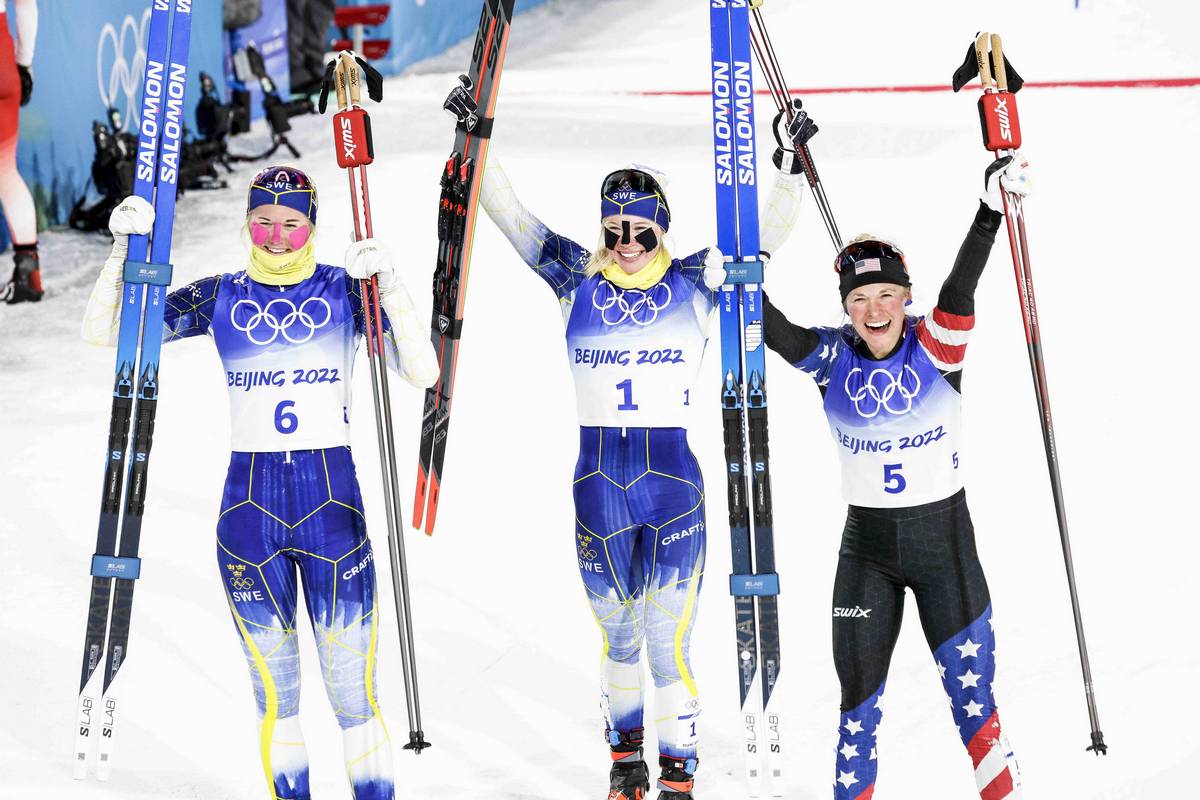
The women’s Olympic 1.5-kilometer freestyle podium: Sweden’s Jonna Sundling took gold ahead of teammate Maja Dahlqvist and American Jessie Diggins. (Photo: NordicFocus)
Following the initial backlash sparked by the quote has prompted a number of insightful conversations – and questions – on how athletes, men and women, are portrayed by the media, whether there is room for descriptions or comparisons of athletes’ bodies to narrate a scene for a reader, and how the landscape of sports media has shifted with time.
For this discussion, FasterSkier brought together a panel that spans both the athlete and media perspective on the issue.
Perhaps needing the least introduction for this audience, the first voice you’ll hear belongs to Rosie Brennan. In addition to her role as one of the top American cross country skiers for more than a decade, Brennan is also an advocate for the organization Voice in Sport which provides mentorship for developing female athletes across all sports. And she was a member of the women’s Olympic skate sprint final in Zhangjiakou, taking fourth place just behind Diggins, the race which sparked the discussion in the first place.
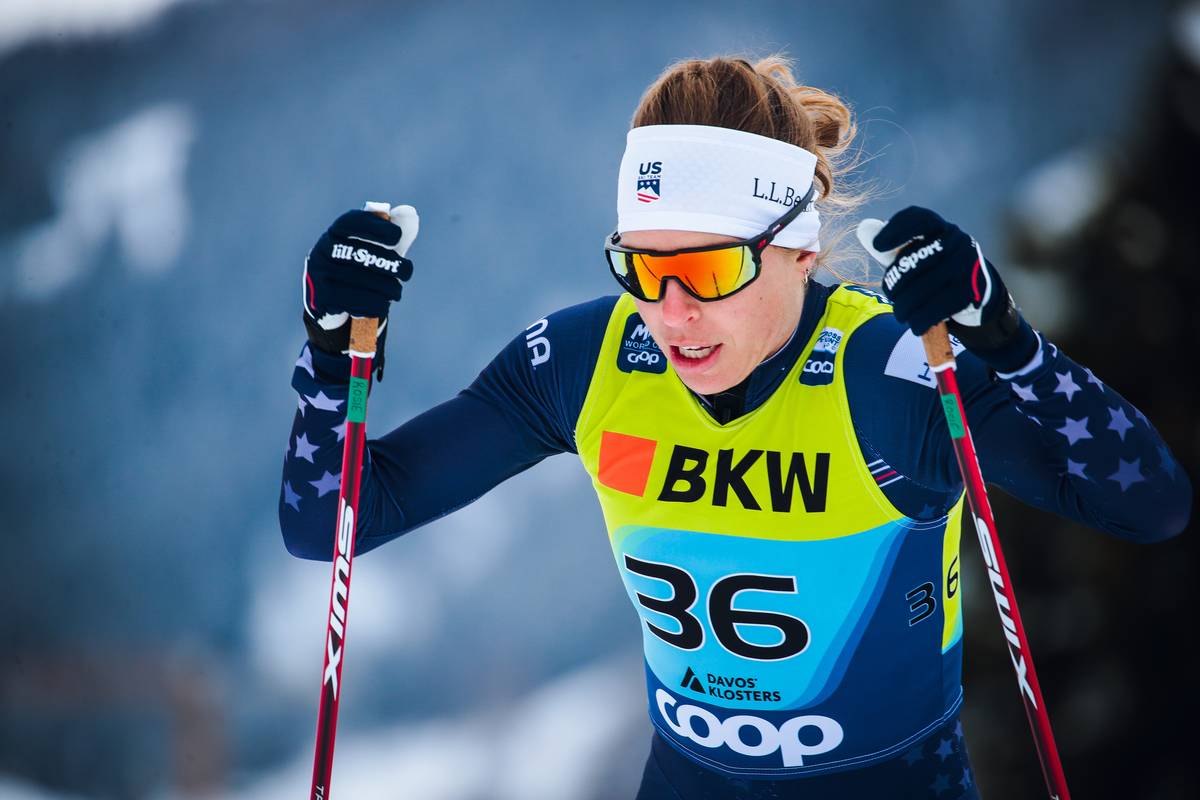
Putting together another highlight weekend in Davos, Rosie Brennan skis to 4th in the 10k individual start skate. (Photo: NordicFocus)
The second belongs to professional trail and ultra runner Corrine Malcolm, whose first go at professional endurance sport was in biathlon, from which she retired in 2014 after experiencing overtraining syndrome, likely coupled by relative energy deficiency in sport (RED-S). Alongside her athletic career, Malcolm has become a coach for other endurance athletes, while also becoming an advocate for women in sport, and has also engaged with this topic from the media side of the coin while calling some of the top ultra running events worldwide, including the Western States Endurance Run in California and the Ultra Trail du Mont Blanc (UTMB) which begins and ends in Chamonix, France. She’s also the co-host of an engaging podcast called Trail Society, which dissects challenging topics in the trail and ultra-running space.
Biathlete turned professional trail and ultra runner Corrine Malcolm discusses body comments in the media on the Nordic Nation podcast. (Courtesy photo)
We’ve also got Brian Metzler, an award-winning veteran journalist and author in the endurance space who currently writes for a number of publications including Outside, Competitor, Women’s Running, Triathlete, and Trail Runner magazines. Writing with perspective from his own athletic career, Metzler is Colorado Running Hall of Fame inductee (2015) who adventures on foot, ski, and sometimes alongside a burro, throughout the high country of Colorado.
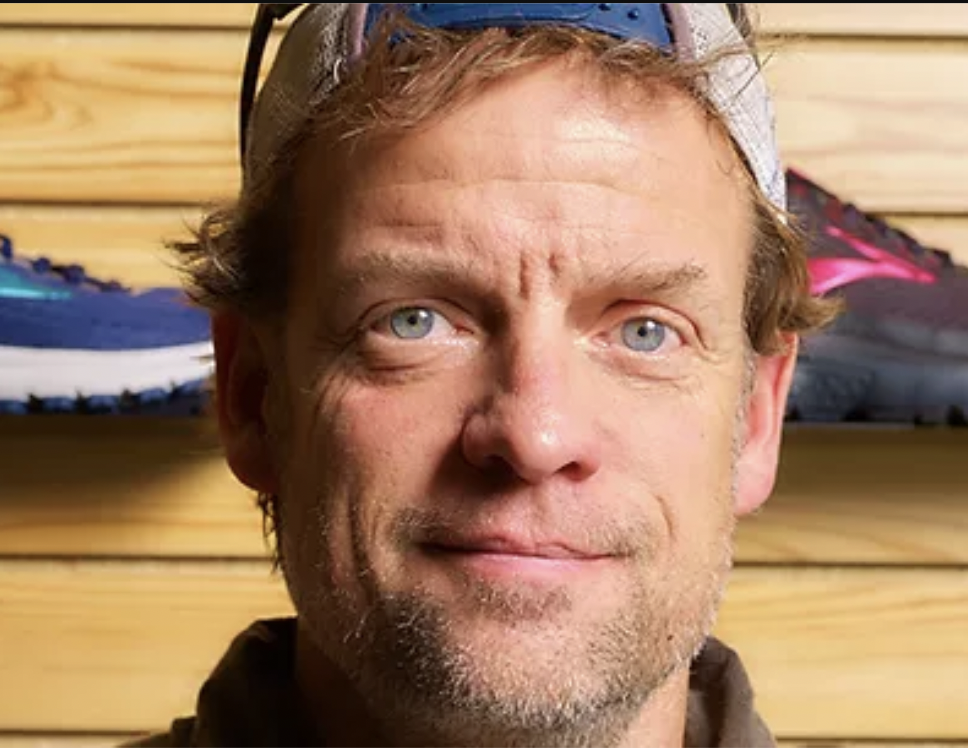
Long-time sports journalist and author Brian Metzler joins FasterSkier’s panel to discuss body comments in the media. (Photo: brianmetzler.com)
Lastly, you’ll hear a cameo from our own Nat Herz, on lunch break from his “real job” as a full-time reporter for the Anchorage Daily News. Having written for FasterSkier from 2009 through 2015 before making a return this year as our 2022 Olympic Correspondent and co-host of the Devon Kershaw Show, Herz shares insights from his time covering cross country skiing paired with those from behind a very different desk.
Some of the talking points discussed include:
Initial responses to the NY Times story
A writer’s responsibility to be informed on the sport being covered, in addition to the physical and/or mental health challenges that may be pervasive in that setting
Differences between American and European media, and shifts in focus, norms, or trends in sports media
Differences, or lack thereof, of covering athletes of different genders
Please note that the Craftsbury Green Racing Project Ski and Biathlon teams and U23 summer programs are currently accepting applications for the upcoming training year, which will close on April 10th. Click here for more information.
Jessie Diggins (USA) and Rosie Brennan find their position in the early moments of the women’s freestyle sprint final. (Photo: NordicFocus)
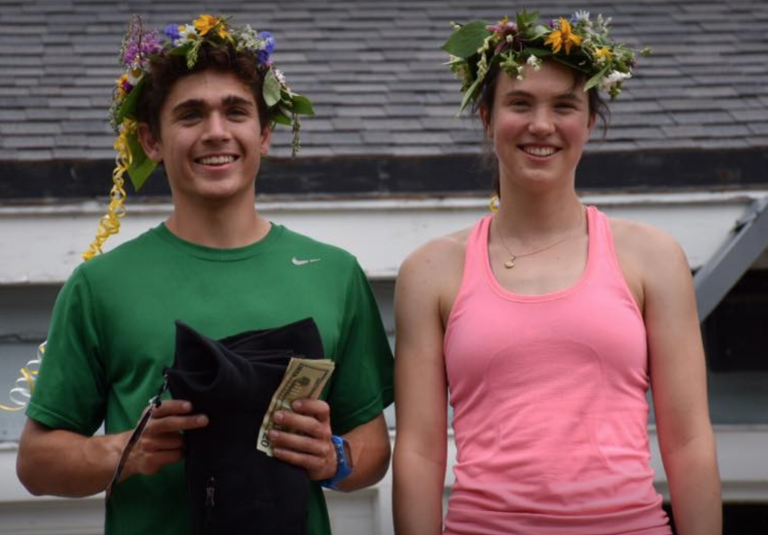
The winners of NENSA’s 2017 App Gap Challenge rollerski race, Kam Husain (who set a course record) and Alex Lawson, at the awards ceremony at Mad River Glen in Fayston, Vt. While Husain was awarded $100 cash for breaking the course record, he explained in an email that he donated it to NENSA to comply with NCAA rules. (Photo: Dave Priganc)
FAYSTON, Vt. — This past Sunday, July 23, Kam Husain and Alex Lawson won the 2017 App Gap Challenge and set some of the fastest times on the grueling course in the process. Husain, a 19-year-old Vermont native and former Stratton Mountain School skier, set a new men’s course record of 30 minutes, 28 seconds. Lawson, a Craftsbury Nordic skier coming off her senior year at St. Johnsbury Academy, was the second-fastest woman ever on the course, winning in 26:58 and coming within 21 seconds off Corrine Malcolm’s record.
Competitive cyclists refer to the individual time trial as the race of truth. It’s just the athlete against the course and the clock, and there’s no pack to hide in. On the steeps leading up to Vermont’s Appalachian Gap, men raced 7.5 kilometers and the women raced 5 k in Fayston, near Waitsfield, Vt. Since Vermont Route 17 was left open to traffic, the race was an individual start. App Gap may be the only rollerski skiathlon in the U.S. (if there are others, email peter (at) fasterskier.com), with the flip-flopped format of skate technique followed by a transition to classic.
(Article continues below)
“Last time I did it, I was only a J2, so I wanted to beat that,” said Husain, who will be a freshman at Dartmouth College this fall. “I’ve been working on my skate skiing, so I wanted to take my skate skiing out hard and see if I could hold it through the classic. And it worked out pretty well.”
“I was definitely trying to gun for it, because I was feeling pretty good,” Husain reflected. “I’ve been really trying to work on my fitness, especially in a race like this. I’m glad my work has been paying off.”
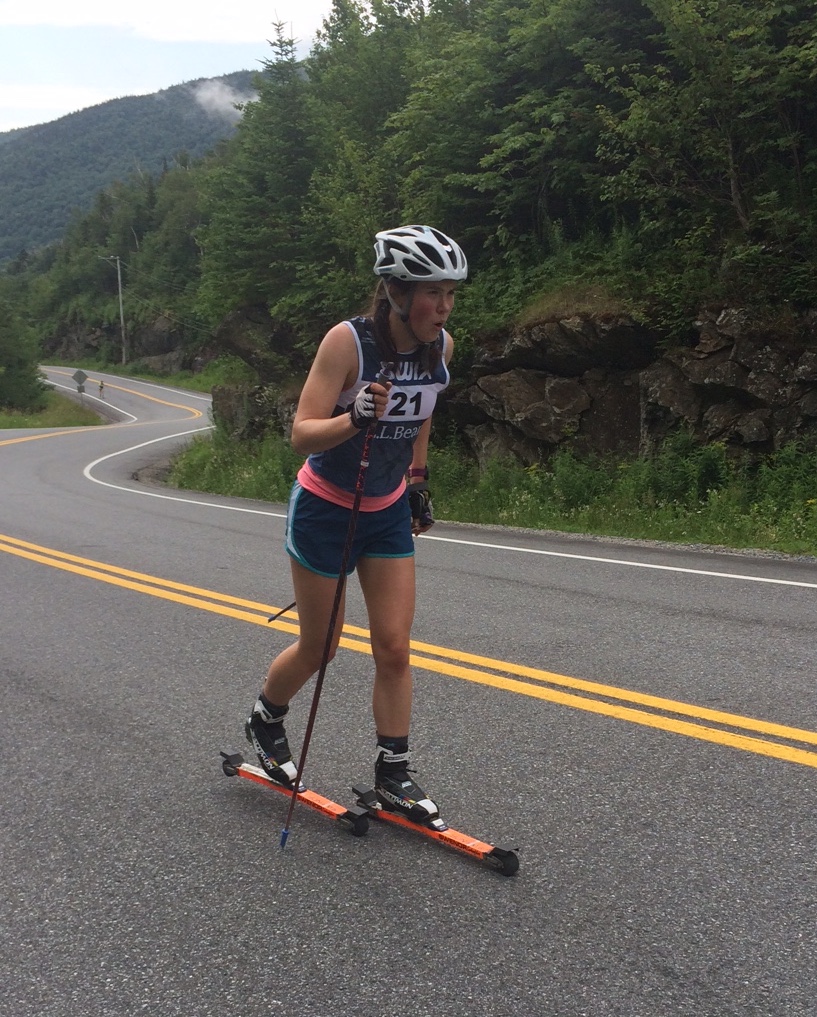
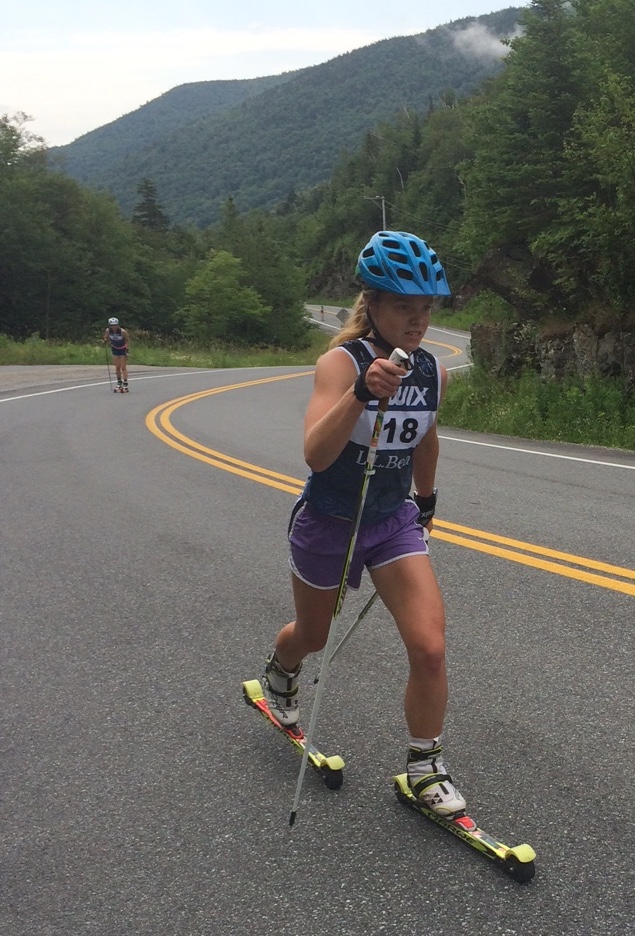
Alex Lawson (Craftsbury Nordic) with her game face as she approaches the summit and first place in the 2017 App Gap Challenge on July 23 in Fayston, Vt. (Photo: Laurel Minde)
Lawson, of Bethlehem, N.H., explained that while she was new to the race, she was familiar with the territory and terrain.
“I’ve never raced the App Gap before, but I’ve skied parts of it at a few camps that I’ve done at GMVS [Green Mountain Valley School],” she wrote in an email. “I didn’t really have too much of a plan for how to ski it, but I definitely took the skate part pretty conservatively and just tried to ski smoothly.”
Her time was the second fastest of any woman in the race’s nearly 10-year history (Malcolm set the record of 26:37 in 2012). The race started in 2007 and was held every year thereafter, except last year, according to Justin Beckwith of the New England Nordic Ski Association (NENSA). Beckwith started the race as a finale to his junior camps at GMVS, where he was previously a coach and nordic director. After it went on hiatus for a year in 2016, Beckwith, NENSA’s new competition director, decided to revive it.
“I think [the race] went really well and the event was a lot of fun,” Lawson wrote. “I haven’t really done many rollerski races before, but this one was a blast and certainly makes me want to do more in the future.”
The second-overall woman, Callie Young, of Newport, Vt., finished 1 minute and 31 seconds behind Lawson. She was also unfamiliar with the course, but received some advice from a friend who had done it before.
Callie Young, of Newport, Vt., racing toward the summit and second overall in the women’s race at the 2017 App Gap Challenge in Fayston, Vt. (Photo: Laurel Minde)
“‘ Hammer the skate leg and just walk the classic section,’ ” she recalled. “I definitely didn’t want to take that advice … but decided to go out pretty hard for the skate leg then once I transitioned just focus on good technique and smoothness for the classic section. The only thing I had to know when I was close to the top was when I got to the record time I knew I was pretty close. At that point, I was going to try to push a little harder if I had anything left.”
In retrospect, Young wished she had driven the course before the race.
The Mad River Glen ski area served as race headquarters and also the transition zone.
“My goal was to bring cross-country skiing to an alpine hill,” Beckwith said, adding that he wanted to recreate the vibe of European rollerski events like Norway’s Blink Festival. “The biggest clubs are so strong, they’re having their own time trials. Hopefully we’re creating more excitement for cross-country skiing and also rollerski races. Having this community event, it’s not just about who had the fastest time. You get together with your buddies.”
Fifty-seven starters lined up Sunday under cloudy skies with temperatures in the low 60s. Right around the start, it began raining lightly, which continued for about 25 minutes. The terrain is markedly different from the Northeast’s other major uphill-rollerski race. Whereas the Climb to the Castle, up Whiteface Mountain’s toll road outside Lake Placid, N.Y., is a steady 8-percent grade, Route 17 from the men’s start teases you with mainly easier sections below 5-percent grade.
Strava lists Route 17 to Appalachian Gap as a 5-percent grade, but that’s deceiving. As you get closer to Mad River Glen, the road pitches upward, with a 15-percent ramp right below the ski area to soften you up. Starting 2.5 k closer to Mad River, the women had maybe a kilometer of relatively easy grade before the steeps. The pavement is slow and you need to watch for cracks. There’s also the odd pothole that you wouldn’t notice while driving, but that would take you out on rollerskis.
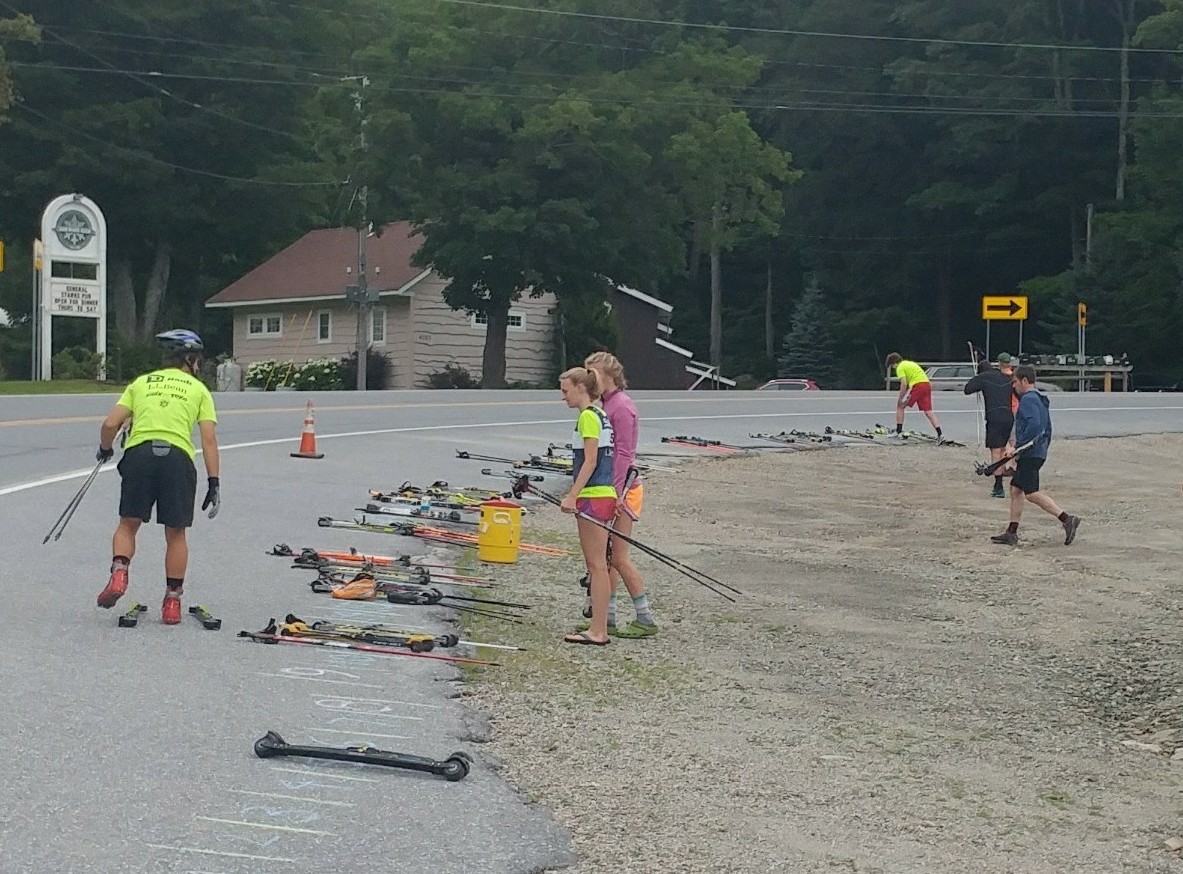
Pre-race at the 2017 App Gap Challenge in Fayston, Vt.: skiers setting up their classic gear in the transition area. (Photo: Peter Minde)
From the exchange, there’s no relaxing, with regular grades over seven percent and several over 15 percent. The killer is a 20-percent incline right below the finish. At least the pavement is new and faster than the pavement for the skate segment.
As with any other race, being familiar with the course helps.
“I live right in the valley. I know this road,” said Elliot Ketchel, a four-time App Gap racer who won the junior men’s race in 31:18. A GMVS graduate, he’s headed to Bowdoin College this fall.
At the finish, 1,509 vertical feet above the men’s start, skiers loaded their boards and boots into a sag wagon and changed into dry shirts and sneakers for a hike down the ski trails. With perfect timing, the sun came out for the barbeque and awards.
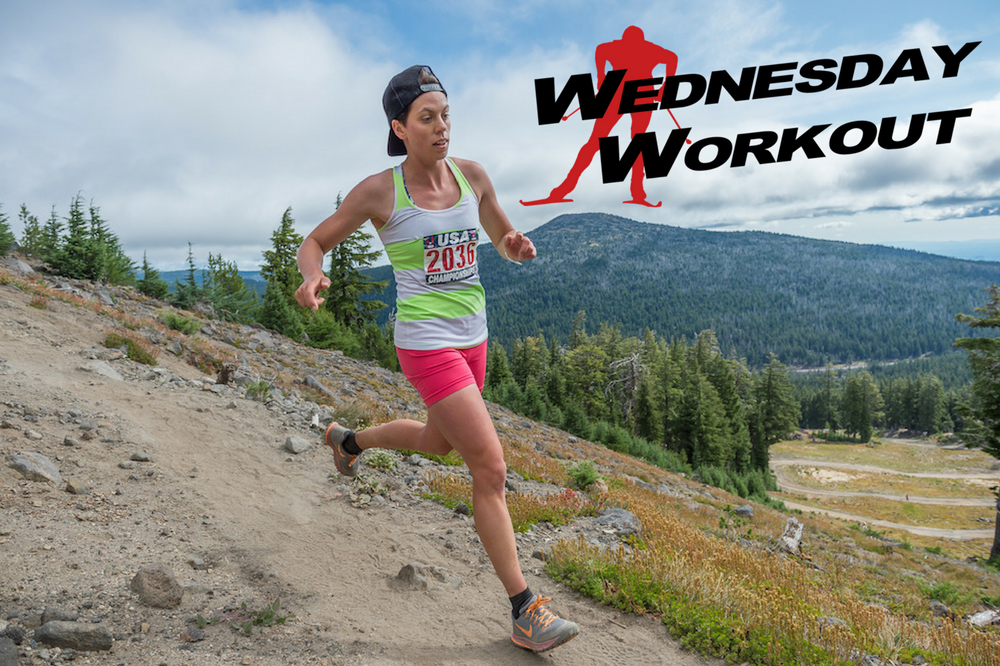
Corrine Malcolm at the 2015 USA Mountain Running National Championships in Bend, Ore. Malcolm, of Bozeman, Mont., placed 18th in the women’s open race. She won this year’s 50-mile trail running championship in Ithaca, N.Y. (Photo: corrinemalcolm.com)
After winning the 2016 Cayuga Trails 50-mile running race in Ithaca, N.Y. and qualifying for the 2016 Trail World Championships in October in Geres, Portugal, all while balancing graduate school, former U.S. national-team biathlete and current U.S. trail running champion Corrine Malcolm offers up a workout sure to sure to whip you into trail-running shape.
***
While biting into a deep-fried, jelly-filled doughnut is not what every athlete daydreams about during interval workouts, the reigning U.S. 50-mile trail running champion Corrine Malcolm doesn’t take issue with digging deeper for dessert.
Neither does her trail-running coach, David Roche. After Malcolm finished first in this year’s Cayuga Trails 50 (USA Track and Field’s 50-mile trail championship race), the two found their foolproof workout to dominating the trails: sweets and hill repeats.
2016 National Trail Champion, Corrine Malcolm savoring a doughnut during a recovery meal. (Courtesy Photo)
“Over the last year, Corrine has done some variation of this workout 20 times as her key weekly effort (mixing in other workouts on some weeks). Using VO2 hills, she won the Cayuga Trails 50 Miler, the 2016 National 50-mile Championship race. Here’s some math for you: 20 VO2 hills workouts + hundreds of donuts = 1 national champion,” Roche wrote in an article for Trail Runner Magazine.
As Malcolm explained, the workout or a similar version to it, is one that does not go missed during her weekly running routines.
“I do a variation of this workout most weeks, and in that sense it’s the staple of my weekly running training,” Malcolm, 26, wrote in an email. “This is generally my last big tune-up workout about 10 days before a big race in the hills.”
The Workout
– Warmup: 30-minute run
– Intervals: 10 x 4 minutes of uphill with 2 minutes downhill in between
Malcolm indicated the target heart rate and pace should be around threshold.
“Instead of easing up and slowly moving back down the hill I try to keep my turnover really high and move down the hill quickly for two minutes,” she wrote. “This is a quad pounder but it prepares my legs to handle the turn arounds that get thrown at you repetitively in trail and mountain racing.”
– Cool down: 30-minute run
Total estimated time: 2 hours
Malcolm’s Top-Two Workout Takeaways:
Plug in to plug on. Malcolm suggests listening to podcasts during warm up and cool down, then switching to a faster paced song playlist during interval sets. “Right now I love the new seasons of Radiolab Presents: ‘More Perfect‘ and ‘Invisibilia‘, and upbeat music like Elle King’s ‘Love Stuff‘,” she wrote.
Direct attention to the downhills. With training, Malcolm indicates that it can be easy to get lost during the downhill recovery portions, though these are the most crucial for practicing transitions. “I find that often times the races I’m doing have very little flat ground and so nailing the transitions between uphill to downhill to uphill again becomes really important. No one like jello legs mid-race!” she wrote.
Corrine Malcolm celebrates her win at the Cayuga Trails 50 in May in Ithaca, N.Y. (Photo: Corrinemalcolm.com)
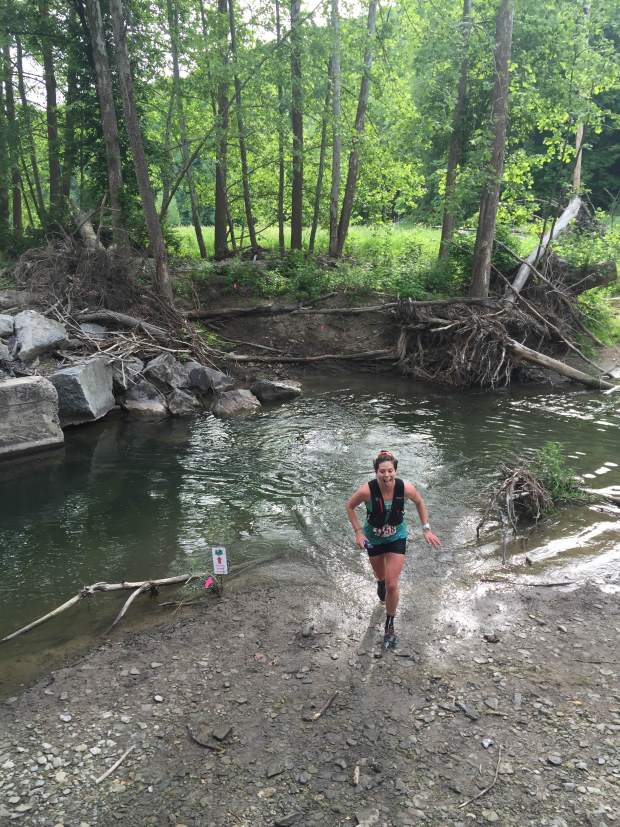
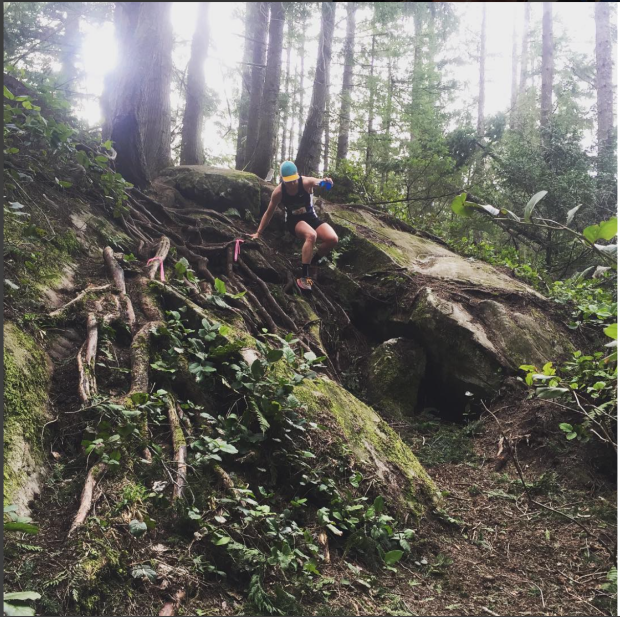
With more than 9,000 feet of elevation gain and an estimated minimum of six to eight hours on course, the Cayuga Trails 50 (a trail running race in Ithaca, N.Y.), leaves many racers questioning the location of their quads and searching for an IV by the finish line. Racers scramble up gorges and single track trails, careen down stone staircases and slosh through creeks as part of the out-and-back 50-mile lollipop loop. For many, the constant change of scenery is welcome break from the monotony of nonstop running.
Elite and experienced trail runners are particularly drawn to the ultra event. After its inaugural race in 2013, it served the next three years as the USA Track and Field (USATF) 50-mile trail championship race. Entrants thereby earned the opportunity to qualify for international competitions if their results warranted.
While many of the top names on the 2016 start list were repeats from previous years, Corrine Malcolm wasn’t one of them. Malcolm, best known as a former member of the US Biathlon women’s team, had only competed in one other trail race longer than 50 k.
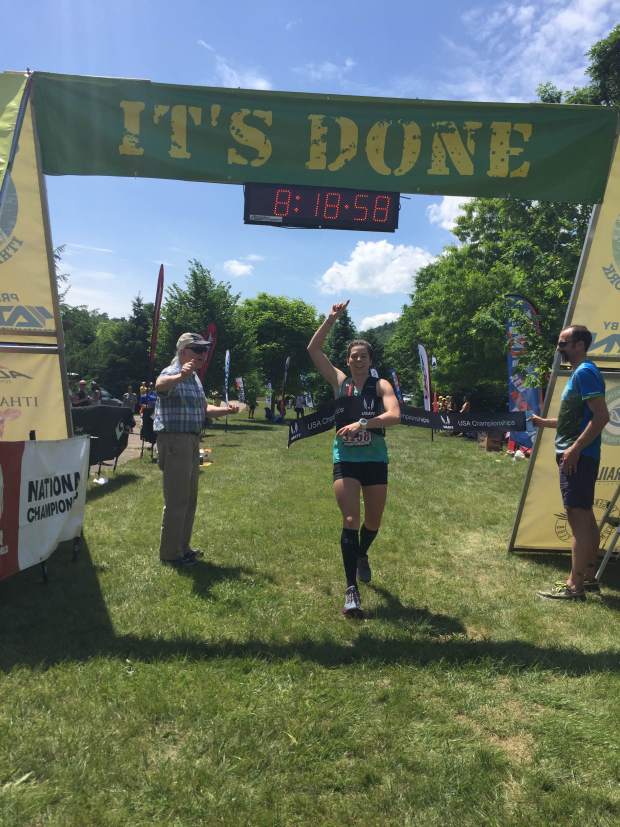
Corrine Malcolm crossing one of eight creeks during the Cayuga Trails 50, a 50-mile trail run she won in 8 hours, 18 minutes. (Photo: corrinemalcolm.com)
This April on her 26th birthday, she completed the Gorge Waterfalls 100k in Columbia River Gorge, Ore. As she put it in a blog post, in the Cayuga Trails 50, she was “a little fish” in a big pond.
“I knew that I could survive the distance after running Gorge 100 k,” Malcolm said in a phone interview. “I feel like ultra running is really similar to nordic skiing in that it really rewards the people who are willing to suffer … It’s going to hurt because you’re running for a long time and so if you’re willing to accept the fact that it’s going to be painful and not be surprised by that, you’re going to be rewarded in your effort. So I knew that even though I was inexperienced competitor, I’m really good at suffering.”
Malcolm did more than just survive and suffer, she succeeded in pulling away from the field and crossed the finish line in first. She completed the 50 miler in 8 hours, 18 minutes, which stood as the second-fastest female time ever recorded in that race. Along with prize money and post-race pie, she also earned a spot on the USATF team trip to the 2016 Trail World Championships in October in Geres, Portugal. Malcolm indicated that this year, USATF will cover most athlete travel and accommodation expenses for Trail World Championships.
“Because I won the national title, I was given some extra funding from USA Track and Field to make the trip feasible … which is cool as a poor graduate student,” Malcolm explained. “I definitely plan to go [to the Trail World Championships]. Biathlon was fun because we got to travel and I haven’t gotten to travel for a race in a really long time. Some I’m totally looking forward to making the big flight across to Euro-land.”
Though Malcolm is a relatively new name to look out for in trail-running competitions (Ed. note: Trail Runner magazine featured her in 2012), she’s a longtime competitor. She ski raced for Montana State University for two years before leaving school to train full-time with Maine Winter Sports Center and focus entirely on biathlon. She qualified for Junior World Championships and European World Championships in 2011 — racing to a sixth at European World Championships — and later that spring, she was nominated to the US Biathlon senior women’s team. She raced for the national team from 2011-2013, but after two years, Malcolm felt the pressure to perform and her performances weren’t lining up.
“That’s how I felt on the national team, even though the coaches were wonderful and my teammates were wonderful, I felt like I was in a fishbowl,” she said.
In her ‘about‘ page of her blog, Malcolm described feeling “fast tracked” upon moving to the Olympic Training Center in Lake Placid, N.Y.
“Unfortunately it was easy to forget how much younger I was [than my teammates], the coaches forgot, I forgot, and eventually it took it’s toll on my health,” she wrote. “I was part of a select group that the 2014 Olympic team would be chosen from, but I was ultimately too sick to compete.”
“I had to perform,” she recalled in the phone interview. “I had to keep up and the finish line just kept moving further and further away. And I don’t feel like that now with running. My level of stress is so much lower.”
Running became Malcolm’s new competitive outlet. She began working with David Roche, a coach, lawyer, Trail Runner columnist, and member of the Nike Trail Elite Team. After skiing for so many years, Malcolm found the switch to having a weekly mileage quota versus hours almost easy, despite also currently working on her master’s degree in biomedical physiology and kinesiology at the Simon Fraser University in Vancouver, British Columbia. She indicated she may even find time to return to coaching–she spent this past winter coaching the Bridger Biathlon Club in Bozeman, Mont.–potentially with a biathlon club in Whistler, Bristish Colombia.
“I had to keep up and the finish line just kept moving further and further away. And I don’t feel like that now with running.” — Corrine Malcolm on her transition from biathlon to ultra trail running
“Being a runner is really sweet because you don’t have to train 20 plus hours a week,” Malcolm said. “And as a graduate student–not that that’s like super time consuming, I’m probably not the best graduate student in that regard, mostly I just read journal articles until my eyes bleed. Then I go for a run and it’s great–I only have to run like 7-15 hours a week..so the time commitment [for running] is really manageable with a job or with school, just because the time commitment isn’t nearly as big for me as it was when I was skiing.”
Being a former skier also helped Malcolm transition to full-time trail running. Though she says she’s had a few “imbalances” she’s had to work on–her right side tends to be tighter than her left–she’s remained injury free, thanks to ski-structured strength, off days and recovery workouts.
“Compared to the trail runners that come from road running, I feel like I can take a hit a little bit more,” she said. “I still do strength a couple times a week — very skier-ish strength. I feel like that protects me in someway from developing an overuse injury. … I think from ski training, I think I’m also really good at eating. I remember going to junior REG camps with Garrott Kuzzy and he’d pull out birthday cake on our long runs. I mean, I did that in northern Maine, too, I’d bring pecan pie on long training runs. So I’m really good at just putting down food consistently.”
During her ultra races, Malcolm generally consumes a packet of gel every 30 minutes and 32 ounces of water every hour. Most of her weekly miles have been in the 40 to 60 range, although she put in an 85-mile week and a 104-mile week in April. The biggest change for Malcolm wasn’t dietary or mileage or hours a week, it was pace.
“Like 9:30-10:00 minute miles are the nordic skier’s jam,” she said. “You know, like 10:00 miles all day long … I’ve had to get used to running my workouts quite a bit quicker than that. Just because my legs were like, whoa, we can run 7:00 minute miles really efficiently? This is crazy.”
Malcolm’s training plan was effective. With her second ultra run behind her, her first ultra win and plenty of trail trekking in store, Malcolm sees running as her new “sustainable hobby.” A sport she finds not only success, but happiness in doing.
“My coach told me the day before [the Cayuga Trails 50], ‘OK, my goal for you is to be the Steph Curry of smiles,’ ” Malcolm explained. “Like that was our goal going into the race was just to smile more than anyone out there, be so happy at every aid station that they insist on giving you caffeine-free gels. So when you have that kind of attitude, you work really hard on being happy the whole time and you don’t think about how bad your quads hurt.”
Corrine Malcolm (standing in Nuun hat) with some of her athletes after a Bridger Biathlon Club practice this summer. (Photo courtesy of Corrine Malcolm)
Corrine Malcolm has one word to describe the Bridger Biathlon Club: momentum.
“It has gained a lot of momentum,” she said of the fledgling program based in Bozeman, Montana. “It’s a really big ball of energy and momentum. It’s pretty cool to be part of.”
Malcolm, a former national team biathlete who just finished her bachelors degree at Montana State, was hired as the club’s first paid coach this summer. That represented another big step for a program which began less than three years ago.
“It started when two boys came home from school when they were eight years old and told their parents they wanted to be biathletes,” Malcolm explained. “I think the parents were like, okay, what is that? But it was great. These two dads said, all right, let’s ask some questions and figure this out and start something.”
The two boys are now 11 and have recruited a lot of friends into biathlon; the two dads, Eric Love and Jim Sites, are the club’s directors.
The Bridger Biathlon Club boasts 32 kids enrolled in Malcolm’s summer program this year. She runs three practices a week, some based at a gym and others on the shooting range.
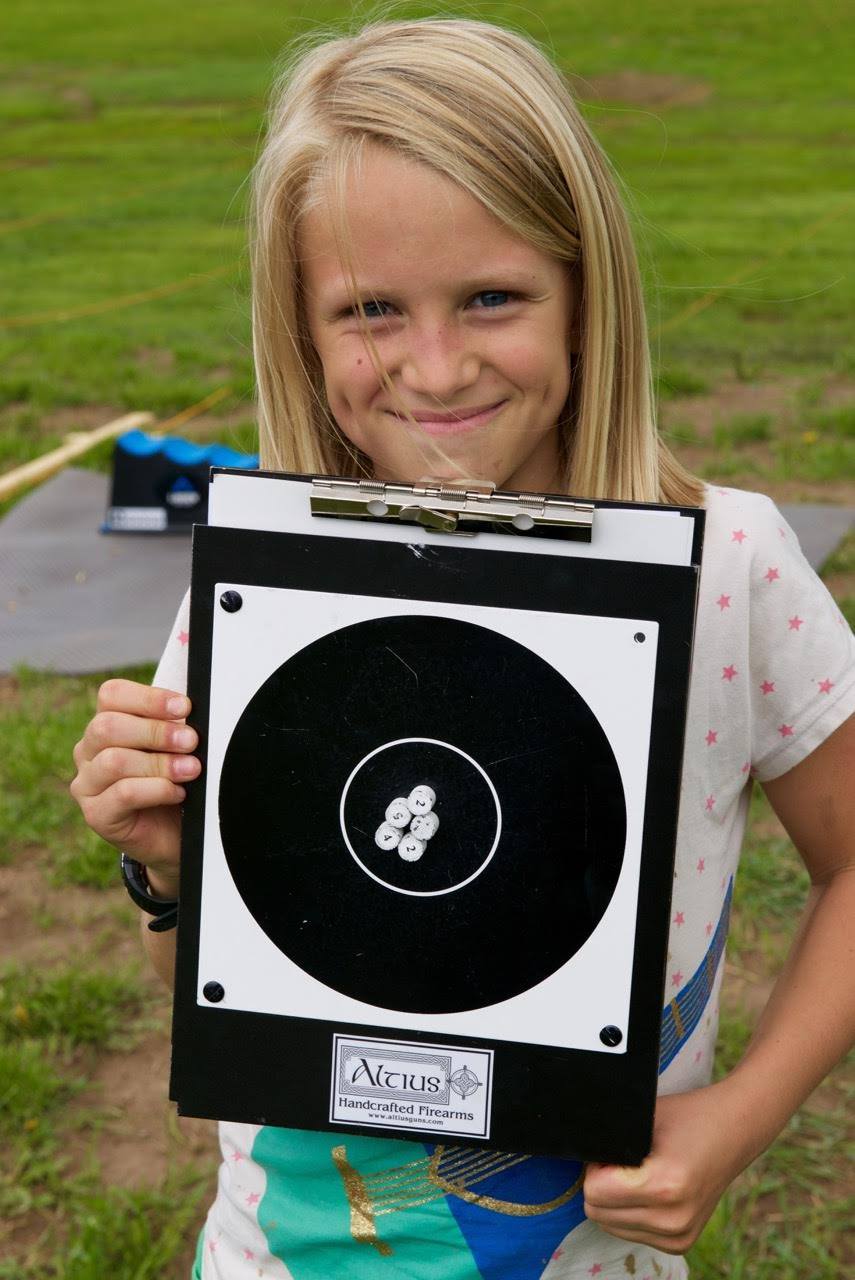
A happy young biathlete with very precise shooting. (Photo: Doug Hartnett)
The athletes have a variety of different backgrounds, from some who are more interested in simply biking farther than they’ve ever gone or hiking a seemingly unattainable peak, to others who are keen to race in biathlon. Malcolm’s goal is to motivate them all.
“It’s definitely a program that’s designed to be inclusive and welcoming and not to weed out all the kids that aren’t competitive,” she said. “Although the program is inclusive, ultimately we want to prepare the kids who want to race, to be ready to race. Kids that might not want to race right now, we want to make sure that if that changes they are comfortable in that situation.”
Already she has seen success and growth from some of her young charges. Two weeks ago Bozeman hosted the Big Sky State Games, and most of the kids participated in not one but two biathlon races.
“It’s been cool in the last six weeks to have kids who in other programs would probably be considered unathletic or uncoordinated or uncompetitive, who would be weeded out because they don’t want the competitive pressure,” she said. “We had a summer biathlon race and almost all of them raced. It was so cool to watch them grow and really go for it… The kids did a running biathlon race in the morning and a mountain bike biathlon race in the afternoon, and just didn’t want to stop. It was pretty sweet.”
With some as young as nine years old and others in the J2 category for skiing, there’s a variety of skill levels in the group. One of the oldest athletes, Ariana Woods, went to U.S. National Championships in Truckee, California, in March, and won a silver medal in the girls’ sprint.
That can make it challenging to match ability levels. Malcolm tries to put groups together as best she can at practice and relies on the club’s still-strong volunteer crew to make it work.
The start of a bike biathlon race in West Yellowstone, Montana, this summer. (Photo courtesy of Corrine Malcolm)
“I have parent volunteers helping, board members who are former biathletes, and also a former high-level competition shooter helping,” she said. “We do a really good job of herding 20 kids with rifles. It’s good to limit the number of kids on the range at one time, maybe only six to eight kids. The others run or bike and we rotate them through.”
Looking Ahead
Malcolm will start an accelerated PhD program at Simon Fraser University in Vancouver, British Columbia, in 2016, studying biomedical physiology and kinesiology. Until then, she’s on board as the club’s coach and plans to run fall and winter training programs that are more robust than the Sunday practices the club offered the previous year.
What shape those programs will take is still up in the air. As an athlete who came from a running and cross-country skiing background herself before starting biathlon, Malcolm doesn’t want to demand one-sport fidelity from athletes. And having competed in biathlon at a high level, she knows that it’s also crucial to be a strong cross-country skier.
“By no means is biathlon big enough for junior athletes to only be racing biathlon,” Malcolm said. “And if those kids want to be competitive, they need to be great nordic skiers too.”
Ariana Woods is one of the first athletes who has had to navigate this question of how to train for both skiing and biathlon, simply because she’s the oldest. She has been part of the Bridger Ski Foundation’s large and successful junior program, and Malcolm sees no reason for that to change.
Ariana Woods on her way to second place in the girls’ sprint at 2015 U.S. Biathlon National Championships. (Photo: Mark Nadell/Macbeth Graphics)
Woods plans to go to World Youth and Junior Championship Trials in December to try to represent the U.S. abroad, and to do so she’ll need to ski fast. So Malcolm hopes that the biathlon offerings can complement Bridger Ski Foundation’s program, and that the two clubs can share some athletes who have diverse athletic interests.
“My vision is that it’s part of the mountain culture and the ski community here, which does mean that it’s a joint effort,” Malcolm said. “Bozeman doesn’t need two ski teams… I have no intention to steal or poach children. It should be about the kids, and everyone should do what’s best for the kids and the ski community. So we need to come together in the ski community.”
Progress So Far
An expanded winter program will be the next step in what is looking like a very fast evolution of the Bridger Biathlon Club. Last winter, the club ran an all-volunteer program, mostly on Sundays at Bohart Ranch. The previous autumn, they offered a gun safety certification program that is part of the U.S. Biathlon Association’s curriculum, again staffed by volunteers, this time including some former high-level competition shooters.
There have been infrastructure changes, too. Last year the club installed new targets that made biathlon training truly viable at Bohart Ranch for the first time in nearly a decade. And the club has now launched a $10 million fundraising campaign to buy Bohart Ranch and the adjacent Crosscut Ranch and merge them into one nordic center for the Bozeman community to use.
Young athletes competing at the Big Sky State Games. (Photo courtesy of Corrine Malcolm)
“There’s twelve really good points on the range,” Malcolm said. “When I was here starting to get into biathlon in 2010 or so, all we could use were two targets tucked up above Jane’s Gate, and you had to cross a giant gully to get to the targets and pull ropes.”
Although biathlon took a dive in popularity in the Big Sky mountain town in the 2000’s, it actually has a rich biathlon legacy. World Championships medalist Kari Swenson is a member of the board, along with fellow former U.S. biathletes Brian Wadsworth and Stuart Jennings. Other past top-level competitors like Clarissa Werre also help out with the club.
Those former biathletes, as well as other volunteers, were initially the whole coaching and support network for the club. This spring they began to think about hiring a coach, and Malcolm happened to contact them at the same time. Until this spring, she said, she had been so buried in school that while she always meant to help out with the club it just didn’t happen.
“I actually reached out to them this spring when I realized that I would be graduating in May instead of August,” she explained. “I was wondering if they wanted a coach. I think I was hired on the spot, which was pretty fun. I sat down with a couple of their board members and all of a sudden we had a summer program.”
With the progress from two kids coming home from school three years ago and mentioning biathlon to their parents, through the club’s incorporation as a nonprofit in February 2014, to infrastructure improvements and the hiring of its first coach, the trajectory is looking impressive.
As she tries to put together a fall and winter program, Malcolm thinks that things will only get bigger.
“It’s a program that has monumental potential for growth,” she concluded.
Karl Nygren (l) and Dmitriy Ozerskiy working Level 3 skate intervals during one of three CXC elite camps this summer near Hayward, Wis. (Photo: Bill Pierce)
Note: This is the 11th preview in our U.S. elite-team series, the “The 12.” We asked coaches to tell us what’s new and whom to look out for this season, and we’ll publish the final U.S. preview as well as Canadian training-centre profiles in the coming weeks.
Team: CXC Team
Coaches: Bill Pierce (elite head coach), Yuriy Gusev (executive and athletic director), Igor Badamshin (high-performance advisor, CXC Team head coach), Andrew Keller (development coach), Andrew Poffenberger (sports manager).
Roster: Karl Nygren, Eric Wolcott, Tom Bye, Dmitriy Ozerski; Corrine Malcolm
Eric Wolcott, Scott Johanik and Andrew Nadler during Level 3 running/ski walking intervals at a CXC Team camp earlier this summer near Hayward, Wis. (Photo: Bill Pierce)
Who’s new: Bye, who raced for Eden Prairie High School and is taking a post-grad year before skiing for the University of Utah, according to Pierce.
Ozerski, a Russian, joins the team as a marathon skier and trained with CXC for nearly 2 1/2 months this summer in Cable and Hayward, Wis. He’s back in Russia now, but Pierce says he’ll return for the opening SuperTour races in November in West Yellowstone, Mont.
Previously on the US Biathlon national team, Malcolm had to do some soul searching this spring when she was not renominated. She moved back to her college town of Bozeman, Mont., to finish her degree at Montana State University. Upon visiting her hometown of Hayward for the CXC Regional Elite Group (REG) camp earlier this summer, Malcolm signed on with CXC, but will continue to train in Bozeman.
Who’s missing: Jennie Bender (now with the Bridger Ski Foundation in Bozeman), Brian and Caitlin Gregg ( joined the Methow Olympic Development team in Washington while continuing to live and train in the Twin Cities), Nichole Bathe (University of Alaska Fairbanks freshman), Adam Martin (Northern Michigan University freshman), Doug Debold, who “went on with life,” according to Pierce.
Top results last season: In a phone interview, Pierce said the team’s in a rebuilding year and moving on after some less-than-stellar results in 2012/2013. Nygren, 26, went from second on the overall U.S. SuperTour standings in 2011/2012 to 19th last season, logging his best results in sprint qualifiers at the SuperTours in Minneapolis and Madison, Wis.
A CXC junior development coach from 2007 to 2010 who went on to lead his own F.A.S.T. Performance Training team, Pierce became CXC’s elite coach in May and started off by meeting with his athletes, including returners Nygren and Wolcottt.
“A lot of them are in flux and weren’t satisfied where they were, Karl especially,” Pierce said. “He has the gifts and the talents to do that, and we’ve already been making big steps in the first three months of training.”
Wolcott, 26, “felt fatigued and not recovered from his workouts,” Pierce explained. “We’re in a rebuilding year with him, too.” He was sixth in the freestyle sprint qualifier at U.S. nationals in January in Midway, Utah, and went on to tie Nygren (and Ozerskiy) for second in the freestyle sprint qualifier in Madison.
Coach’s comment: Coming into the CXC picture in May, Pierce said he didn’t have a chance to recruit, but that’s already on his radar. This season, he said each of his athletes have set realistic goals — not necessarily Olympics-oriented — because there are so many other races and objectives to focus on throughout the winter.
“We’re looking at the top SuperTour spot,” he said. “Our goal is to get athletes to the top of the SuperTour, to get them to the World Cup, to get them to the OPA Cup, and as times goes on we hope [the unit] steps up.”
According to Pierce, “Corrine was about to give up on biathlete and I didn’t think she should do that yet. … She’s got to put in some training and we’ll see what happens when she does some cross-country racing.” He asked her to compete at the North American Biathlon Rollerski Championships (which doubled as US Biathlon overseas camp trials) last month, “just so she stays engaged in biathlon,” he said. After two days of racing in Jericho, Vt., she ended up 14th.
This week, Nygren will join the U.S. Ski Team (USST) and National Training Group (NTG) in Lake Placid, N.Y., then meet CXC in Park City, Utah, for the beginning of another USST camp in late September. CXC will then travel north as a unit to Canmore, Alberta, for some on-snow training in October on Frozen Thunder.
As for the transition, Pierce said he’s impressed with guys like Nygren, who have stuck with the team through several coaching changes in the last few years.
“They’re resilient and they’re patient,” Pierce said. “Karl’s first year was [USST Development Coach Bryan] Fish’s last year and my last year at CXC. He’s seen four coaches in six years. Good or bad people have left for different reasons.
“I look at Karl and I see what he’s got to tweak,” he added. “Physically he’s one of the biggest and strongest there is, but why isn’t he the fastest and why did he decline last year? I think at first, [the athletes] were skeptical to listen to me because they’ve heard this before and results have ebbed and flowed, but I think they’re willing to give it a chance.”
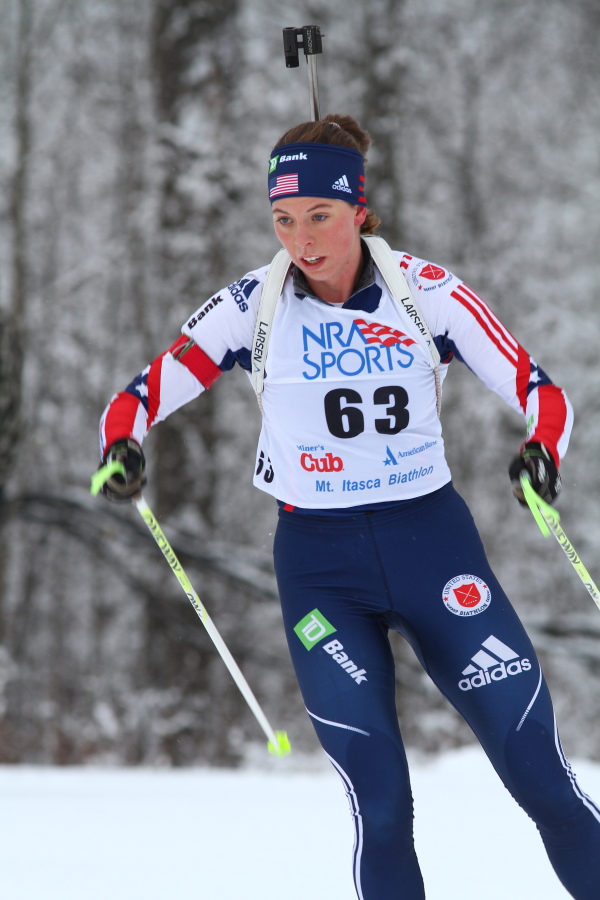
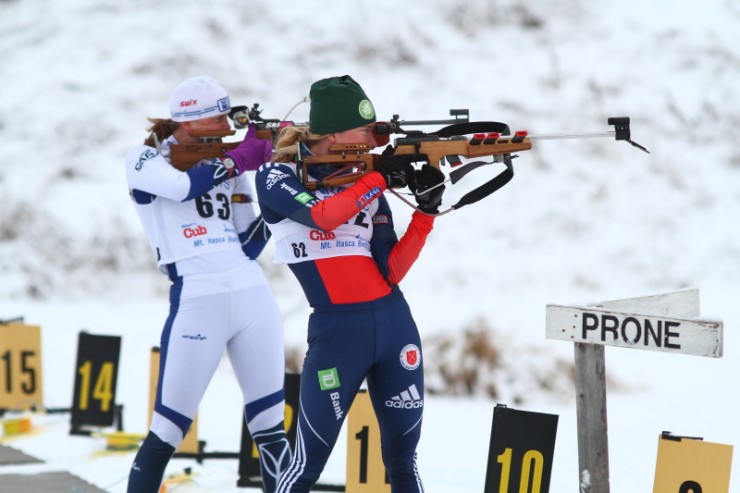
Corrine Malcolm racing at trials in Mount Itasca, Minn., last December. (Photo: Gregory Haugen/HaugenPhoto.com)
By all accounts, it’s been a rough few months for Corrine Malcolm. In her second year on the U.S. national biathlon team at just 23 years old, she narrowly missed getting selected for an IBU Cup race tour to Europe – and consequently fell into a limbo that developing senior athletes are all too familiar with in North America: the only racing option was NorAms, where the fields are tiny (sometimes just two or three women) and opportunities for real development few and far between.
With few options left, Malcolm decided to move back to Bozeman, Mont., where she had attended Montana State University (MSU) for two years before taking up biathlon full time. She jumped in some ski races for the rest of the season, hit up the spring biathlon weekend in Mammoth, Calif., and had fun – but there was always the question, what next?
“My spring was pretty high on the anxiety side of things,” she said on the phone last week.
Malcolm was not invited back to the shrunken national team and declined to move to the Maine Winter Sports Center (MWSC), one of the only senior biathlon programs in the country. Instead, she was determined to stay put in Bozeman and try to figure out a way to be a biathlete on her own.
“I really like the athletes at MWSC and got to travel with them this spring and had so much fun with them,” Malcolm explained. “But for me at a personal level, going up to Maine isn’t really an option. I feel the most settled and at home having chosen to move out West. I’m trying to get more balance.”
What does that mean? After a year in northern Maine at the start of her biathlon career and then two years in Lake Placid, N.Y., where the national team is based, Malcolm wants a different life for herself and believes that it will help her succeed as an athlete, too.
“I feel like I have a real life here in a lot of ways,” she said of Bozeman. “I live in a house with three incredible guys and we barbecue and eat dinner on our back deck every day, and we have a garden and a greenhouse. In Lake Placid, I was a weird segment of the population – I was 22 at the time. At the training center you were either 16 or you were 27, it felt like. The local population is mostly young professionals with pretty definite futures. Bozeman is probably as transient as a functional city can get.”
And so those rough few months have also, in many ways, been a happy few months – even happier than she was before.
“When you make an effort to have a normal life and have friends outside of your sport or activity of choice, there’s just a lot more offerings,” she said. “It feels like home. When sport is your job, it’s really important to have time to turn off and just be a human. Not that athletes aren’t human, but most people when they come home from their nine to five jobs, they don’t still talk about accounting or what kind of checks they deposited that day.”
After the move back to Bozeman, there were two resources at her disposal: Biathlon Elite, the loose club team of college-age athletes started by MSU skier and several-time World Junior Championships biathlete Sam Dougherty, and further north, the Biathlon Alberta Training Center in Canmore.
Malcolm started out the spring with a trip to Canmore to work with Richard Boruta, the coach there, and his athletes. It was a great week – she described everything as “phenomenal” – but soon, the reality of being a self-supported biathlete hit home.
“I was trying to buy ammunition and could easily need to come up with $5,000 just for that for the year,” Malcolm said. “That’s terribly anxiety-provoking.”
Indeed: Malcolm is working 20 to 30 hours a week as a nanny in Bozeman to pay the bills and chase her dreams, but even that doesn’t leave a whole lot of cash lying around. She hasn’t sold her rifle and still plans to do biathlon and try to qualify for the Olympics, but training full-time seemed financially overwhelming.
Since this realization, Malcolm has had a crazy and confusing month of negotiations. She was interested in skiing with the Bridger Ski Foundation (BSF) and talked to the coaches about joining the program. She says she has a good relationship with them and is a close friend of Jennie Bender, so would love to join the team. But BSF said they couldn’t support her financially, which led to more anxiety as she contemplated training camps that would cost the equivalent of four months of rent.
When she headed home to Hayward, Wis., and visited the Central Cross Country (CXC) Regional Elite Group camp, she found a new option: CXC was willing to support her and cover her expenses even if she remained in Bozeman, which she feels is important not just for her happiness, but so that she can re-establish her residency and finish her degree at MSU.
“I was really surprised that CXC was okay with me being in Bozeman, but Bill Pierce was one of the guys who got me into skiing to begin with,” Malcolm said. “CXC was the first program I ever raced for when I started racing my senior year of high school. There’s a lot of history there.”
So, at last, she has a plan. Sort of. Saying that she feels as fit as ever, Malcolm is planning to race the early-season SuperTours in West Yellowstone and Bozeman, head to U.S. National Championships at Soldier Hollow, race the Boulder Mountain Tour in Sun Valley and Birkie in Wisconsin, and see where else the season takes her from there.
As for biathlon? She hasn’t given up on her goal of making the Olympics. But it’s getting harder to envision that happening.
“Financially I can’t afford to fly out East [to Jericho, Vt.] for the first round of trials in August,” Malcolm said. “I had resigned myself to saying, ‘Well, I can’t afford to go in August, but I can go to the trials in Utah because they are almost in my backyard in a way and I can drive there.’ But I just got sent the criteria recently only to find out that it’s best three out of four races.”
With two races each in Jericho and Utah, skipping one race series would necessarily leave Malcolm out of the running for a berth, which hit hard.
“I understand that it makes certain athletes maybe have to come to the U.S., or show up for both sets of races, and holds athletes more accountable,” she said. “But I was a little disappointed to see that.”
At the moment, she still doesn’t plan to go to the first set of trials in August, but hasn’t given up on trying to make the team, either. It’s a stalemate.
“At the same time as this was going on, I got the e-mails from U.S. Biathlon and U.S.O.C. with me on the list of athletes who needed to file Olympic paperwork,” Malcolm said. “So it’s like I am supposed to be pursuing this, but I don’t know if financially I can pursue it to its fullest extent.”
As Malcolm looks at the next year and into the future – she could start taking classes at MSU again as early as the spring, and definitely by the summer – these seem to be recurring questions.
“It’s been a really interesting experience in that regard – are these your new circumstances, and do you have to accept those circumstances?” she asked rhetorically. “Working 30 hours a week is not ideal, so will I perform at a lesser level? Am I setting myself up to be disappointed because I’m not taking that time to rest and recover, and I’m definitely loading my non-working days with as much training as possible?”
She insists that she won’t change her goals, and she will probably never stop racing.
“I’m a super-competitive person by nature. I don’t see that changing, but I think that there’s a great chance that I might have to – not necessarily change my goals, but I should change my expectations. I always think going in to any race that it’s anyone’s game. I never go in to a race thinking that I’d like to be top 10. You go for it no matter what. But maybe my expectations aren’t so high this season in terms of personal, internalized stress.”
And despite everything, she feels ready to excel. Her training and racing is now based largely on fun and happiness, and she feels like her fitness is improving because of it. She’s looking forward to doing some running races, including the XTerra Trail Championships in September in Ogden, Utah, and the U.S. Half-Marathon Trail Championships in November in Moab, Utah, something that was difficult to do within the confines of the national team.
All in all, as Malcolm tries to blaze a new path for herself, she’s simply shifting the things that a coach might see as most important – and setting her own rules to live by.
“I definitely still have my skis and hopefully race them fast and have a lot of fun doing it,” she laughed. “High levels of fun are on the priority list this year, and a lot of happiness training, and a large consumption of cookies are basically my plan at this point. Being happy and well-balanced is the most important right now.”
Bridger Ski Foundation elite and post-grad team members Jennie Bender (front) and Akeo Maifeld-Carucci (l) celebrate the fruits of their training session with coach Andrew Morehouse (r) near Bozeman, Mont. (Photo: Anya Caldwell Bean)
Note: This is the fifth preview in our series on U.S. elite teams, which we’ve dubbed the “The 12.” We asked coaches to tell us what’s new and whom to look out for in the coming season and will publish additional previews in the coming weeks in no particular order.
Team: Bridger Ski Foundation (BSF) Nordic Elite Team
Coaches: Dragan Danevski (program director/head coach), Andrew Morehouse (competitive team/elite/post-grad coach, service tech), Tim Baucom (competitive team/junior coach, service tech)
A BSF skier working hard in the offseason near Bozeman, Mont. (Photo: Anya Caldwell Bean)
Post-grads: Sawyer Kesselheim (Montana State University), Patrick Madden (MSU), Will Meyer (University of New Hampshire), Akeo Maifeld-Carucci (Harvard), Ketchum Wilt (formerly of Sun Valley Ski Education Foundation);
Natalie Flowers (Dartmouth), Lizzie Gill (UNH), Katie Gill (University of Denver), and Cambria McDermott (MSU junior, red-shirting to pursuit some non-NCAA skiing goals)
Who’s new: Reinking (MSU Master’s student), Bender (formerly of Central Cross Country, a.k.a. CXC), Bean (2013 UNH graduate), Malcolm (former US Biathlon member)
Top results last season: Seasoned veteran Torin Koos, who turns 33 on Friday, pulled out impressive performances in January at Soldier Hollow, winning two national titles in the freestyle sprint and 30-kilometer classic mass start in Midway, Utah. A couple weeks later, the U.S. Ski Team did not name the former Olympian to its World Championships squad, stirring up some controversy, but you can expect Koos, who’s nearly finished with his Master’s in communication at Westminster College in Salt Lake City, to be back this season – hungry for his fourth Olympics.
Torin Koos celebrating his overall Tour de Twin Cities win in late January.
Later last season, Koos won the Tour de Twin Cities (five stages of SuperTour races) and led the overall SuperTour standings for World Cup Period 3. He traveled to Whistler, British Columbia, in late March and won the 50 k freestyle mass start before coming down sick at SuperTour Finals in California.
Newcomers to the BSF elite team, Bender won the classic sprint at SoHo for her first national title and Bean achieved All-American status at NCAA Championships in Ripton, Vt., where she was sixth in the 15 k freestyle mass start.
At age 19, Kesselheim cracked the top 30 at the Junior World Ski Championships in Liberec, Czech Republic, placing 29th in the 10 k skate.
Coach’s comment: In an email, Morehouse explained that most of the elite team has been at their base in Bozeman, Mont., since May. “With the combination of a good group of college skiers, energy has been high and there has been a great atmosphere for training,” he wrote.
Jennie Bender (l) working out with her new team, the Bridger Ski Foundation, in Bozeman, Mont. (Photo: Anya Caldwell Bean)
BSF opted out of its annual training camp in Bend, Ore., because of a lack of snow, but is off to Canmore, Alberta, on July 25 for about two weeks of dryland training. In September, the team plans to head back up to Alberta, about a nine-hour drive, for an on-snow camp on the Haig glacier.
According to Baucom, the team is excited to expand its elite and post-graduate programs (from the three elite-team members last year, all of which were men). The post-grad team has yet to be finalized, but a large group of college skiers have been training with BSF this summer.
“With the opportunities that Bozeman has to offer, I think the potential for growth is huge,” Baucom wrote. “We have a great community of skiing enthusiasts here who are excited to support these athletes. … With Montana State University in town, BSF also gives athletes the opportunity to develop as postgraduate skiers and gain in-state status before pursuing a college ski career.”
In terms of goals, Baucom expects his athletes to commit to long-term individual objectives and BSF aims to create a positive atmosphere to make those possible.
“Individual goals range from medaling at international championships, to qualifying for junior and U23 worlds,” he added.
Audrey Vaillancourt (Quebec) completed her set of three titles at 2013 Canadian Biathlon Championships on Tuesday with a photo-finish victory over Megan Heinicke (Biathlon BC) in the 12.5 k mass start in Whistler, B.C.
“We both deserved to win today,” Vaillancourt wrote in an email. “I’m just glad I managed to have a better stretch.”
Vaillancourt shot clean at Whistler Olympic Park to finish in 34:54.0. Heinicke was just 0.2 seconds behind and missed one shot (0+0+1+0).
“Today skiing didn’t feel as good as during the weekend,” Vaillancourt wrote, “So I focused more on shooting and it worked very well; I had a perfect day on the range.”
Vaillancourt enjoyed her first mass start of the season: “On the last lap we came out of the range together, so I knew this was going to be a really tough one,” she wrote. “We both tried to drop each other at different places on the course, but we were both dead tired and ended up together for the final sprint! It has been a photo finish for the win!”
Corrine Malcolm (U.S. Biathlon) took third place in 36:38 (1+0+1+0), 30 seconds ahead of Julia Ransom (Biathlon BC) in fourth.
“Today was actually the best I’ve ever shot in a race,” Malcolm wrote. “Unfortunately I lost a little bit of time when I accidentally started to ski onto the 2km cut off on our second loop. Luckily [Canadian biathlete] Rosanna [Crawford] saw me veer off and was able to yell to me to turn around. By the time I made it back to the right trail Julia was coming by and I was able to get in with her and ski nice and relaxed. Julia and I stayed together until the last shooting stage where I cleaned and she missed her final shot.”
Ransom’s time of 37:08 (2+0+1+1) was good enough for third Canadian, but shooting was perhaps not surprisingly the difference for the 20 year old who started her first Cross Country World Cup earlier this season in Canmore, Alberta.
In the men’s 15 k mass start, Nathan Smith (Alberta/Biathlon Canada) struck back after Sunday’s starting error by dominating the day. He won by 44 seconds in 37:53 despite missing three shots (1+0+0+2) during what he described as ideal shooting conditions.
“I missed that first shot prone and was a little concerned, but after that I felt comfortable and in control,” Smith told Biathlon Canada. “I know I didn’t win the pursuit race, but I feel like I’m in great shape and accomplished what I came here to do.”
Marc-André Bédard (Quebec) was second in 38:37 with four misses.
“Shooting was perfect 3 out of 4 times,” he wrote in an email. “[I] missed 4 at my first standing!”
Although disappointed by his shooting, that should not be a problem next week when Bédard competes at Canadian cross-country nationals. “I’m hoping to repeat or do better than my 4th at the 15 free last year!” he wrote.
Bill Bowler took third place to lead a large American contingent with his second podium. He finished 43 seconds behind Bédard, and also had four penalties (0+1+2+1).
“I felt good on the skis,” Bowler wrote. “Definitely better than in the races earlier this week.”
He agreed that the conditions weren’t a problem. “It was a perfect day for racing with fast tracks,” he wrote. “The weather in Whistler can be volatile so it was nice to have sun and solid conditions.”
Kurtis Wenzel (Alberta) grabbed the Canadian bronze with 39:31 (0+0+1+1), good for fourth overall.
Biathlon wraps up Wednesday with the relays. The Sea to Sky Nordic Festival continues with cross country nationals (March 23 to 29), nordic combined (March 28 to 30) and ski jumping (March 28 to 30).
Hannah Dreissigacker (Craftsbury GRP/U.S. National Team) and Katrina Howe (Maine Winter Sports Center) dueling on the range. Both were selected for IBU Cup races in Otepaa, Estonia, and Ostrov, Russia. Photo: Gregory Haugen/HaugenPhoto.com.
MOUNT ITASCA, Minnesota – After a winter which had already seen below zero (F) temperatures in Minnesota, no one really expected 33 degrees with rain for Saturday’s Sprint competition at the US IBU Cup Selection Trials, but that’s exactly what they got.
It rained for hours prior to the start, and only turned to huge, wet flakes of snow mid-way through the race. Conditions were predictably slow, but Wynn Roberts (National Guard) didn’t let that keep him off the top step of the podium. He finished the 10k course with a time of 23:35.0 after shooting clean in the prone stage, and only missing one in the standing.
Mark Johnson (Mt. Itasca Biathlon) was hard on his heels however, and if he had not missed one prone shot and another standing, the podium could have looked different as he was only 15 seconds behind (23:50.1).
Bill Bowler (Biathlon Alberta) was third at 23:54.7 after missing two prone and two standing.
Corrine Malcolm (US National Team) set the pace for the women as the wet snow continued to fall, with three total misses (2 prone, 1 standing), finishing the 7.5k course in 21:45.3.
1.1 seconds separated her from second-place Hannah Dreissigacker (Craftsbury GRP/US National Team), which was a great result considering she had one more miss in the shooting stage than Malcolm.
Also with four total misses, coming across the line in 22:06.3, was Katrina Howe (MWSC).
The snow continued into the night, and conditions for the Pursuit on Sunday were much more satisfying for athletes and coaches alike, as well as the Mt. Itasca course volunteers. Several inches of new snow had been worked into the trail surface for significantly faster conditions, and morning temps in the low 20s felt perfect.
Hannah Dreissigacker would be fastest for the women as she covered the 10k course in 31:36.4 and shot the best of any of the seniors, men or women, with only 4 misses over 4 shooting stages. Katrina Howe and Corrine Malcolm joined Dreissigacker on the podium again, with 5 and 7 misses respectively.
Bill Bowler stood on the top step Sunday with Wynn Roberts in second and Raleigh Goessling (MWSC) in third. Bowler had 7 misses to Robert’s 8 and Goessling’s 10, and finished the 12.5k course in 32:12.
Monday was make-or-break for the athletesm, as anyone who wanted to travel to Europe as part of the IBU Cup team for race 4 would likely need to notch the win today. Anyone lagging too far behind the first place finisher might be out of the running for a discretionary selection. The overall points winners for the weekend’s three races could count on a spot at the starting line for IBU Cup 4 in Otepaa Estonia on January 4th.
The format was a 15k Mass Start for the men and 12.5k for the women. Bill Bowler would be the victor today, shooting two better than Roberts, who missed 7 total. Wynn Roberts skied well though, and even with two more penalty loops than Bowler, only finished approximately 30 seconds off the pace. Mark Johnson followed him, with Michael Gibson (Vermont Biathlon) and Raleigh Goessling next.
Hannah Dreissigacker managed to hang on to first place and finish 8 seconds ahead of Katrina Howe, even with 3 misses compared with Howe’s exceptional results of only 2 misses over 4 stages. Corrine Malcolm joined them on the podium again in third but had a disappointing day on the range with 8 shots outside the black.
Based on results from all three events, USBA announced later Monday afternoon that the primary selections for the US IBU Cup Team would be Bill Bowler and Hannah Dreissigacker, with Wynn Roberts and Katrina Howe named as discretionary selections. Those athletes will join Jeremy Teela and Tracy Barnes, who qualified for the December period of IBU Cups, and Jay Hakkinen and Lanny Barnes, who raced the first period of World Cups but are moving down to the second tier of racing.
USBA announced that seven athletes will remain on the World Cup, based on results from the first period of racing: Tim Burke, Lowell Bailey, Russell Currier, Leif Nordgren, Susan Dunklee, Sara Studebaker, and Annelies Cook.
Full results for the weekend’s races, including Masters, Juniors, and Youth are available at www.minnesotabiathlon.com.
Mark Johnson (Mount Itasca). Photo: Gregory Haugen/HaugenPhoto.com.
Katrina Howe (MWSC) in hot pursuit of Hannah Dreissigacker (Craftsbury GRP/USBA). Photo: Gregory Haugen/HaugenPhoto.com.
Hannah Dreissigacker (Craftsbury GRP/U.S. National Team) and Katrina Howe (Maine Winter Sports Center) dueling on the range. Both were selected for IBU Cup races in Otepaa, Estonia, and Ostrov, Russia. Photo: Gregory Haugen/HaugenPhoto.com.
Athletes on the range in the sprint race. Photo: Gregory Haugen/HaugenPhoto.com.
Wynn Roberts (National Guard Biathlon). Photo: Gregory Haugen/HaugenPhoto.com.
Bill Bowler (Biathlon Alberta), Wynn Roberts (Natinoal Guard Biathlon), Raleigh Goessling (MWSC), and Mark Johnson (Mount Itasca) rounding a corner. Photo: Gregory Haugen/HaugenPhoto.com.
Hannah Dreissigacker (Craftsbury GRP/USBA) and Katrina Howe (MWSC) dueling on the range. Photo: Gregory Haugen/HaugenPhoto.com.
Women’s podium in the sprint: Corrine Malcolm (USA) gets a high five from Petra Cervenka after winning, as Hannah Dreissigacker and Katrina Howe look on. Photo: Gregory Haugen/HaugenPhoto.com.
Leif Nordgren (l/back) follows Bjorn Ferry of Sweden in the World Championships individual race last week.
U.S. Biathlon Nationals might not actually feature all the best biathletes in the country, but so far it has proved one thing: the team selected to compete in Europe is really, really fast.
Saturday didn’t seem auspicious for anyone, with rain blanketing the West Yellowstone course and every biathlete winding up soggy. But for the second time in as many races, the two World Championship team members who decided to compete at U.S. Nationals took big wins, this time in 10 and 12.5 k pursuits.
In the men’s race, Leif Nordgren skied to a minute and a half victory over Mark Johnson; Nordgren had four penalties to Johnson’s six.
“It’s certainly fun to have Leif here to race against,” Johnson wrote in an e-mail. “He’s a great teammate and someone I hope to learn from this week.”
Even though Nordgren had won the sprint by a minute, the two did have a chance to go head-to-head thanks to a decision to modify the pursuit format. While racers did start in the order that they finished the sprint, as usual, the time gaps were replaced by five-second start intervals.
“I actually wasn’t alone for too much,” Nordgren told FasterSkier. “They started the only junior, Casey Smith, right in front of our group. I skied the first loop with him, then I missed two and he cleaned and moved ahead a little bit, as well as Mark Johnson. I had to play a little catchup on the next two loops, then in the standing stages I started to get a gap on those two and it only grew until the end.”
In fact, Nordgren was never alone – and neither was anyone else. With all of the different age divisions starting back to back, there were dozens and dozens of racers on course at all times, racing different distances and intermixing on the range.
Johnson was happy to finish second just as he had in the sprint, but said that he’d been expecting better performances, and maybe to be closer to Nordgren, who had a mixed bag of results at World Championships and anchored the U.S. relay team to tenth place.
“While I’ve managed two second placed finishes thus far, the performances have left me hoping for more,” Johnson wrote. “I haven’t been able ski at the speeds I’ve come to expect this season. I do need to remember, however, that it is late in the season now. For tomorrow’s mass start competition, I’m hoping to continue to shoot well and find a new rhythm skiing.”
Johnson didn’t seem to be too bothered by his inability to find his highest gear, however, and said he was enjoying Nationals to the fullest. He’d been helping out with a junior development camp and done some spring skiing before the weather turned rainy. Overall, he was impressed with the event.
“Despite the consistent heavy rain over the last few days, the organizing committee has done a great job preparing and maintaining the course for these competitions,” he wrote. “While I’m currently having a tough time staying dry, I can certainly attest that West Yellowstone can deliver some perfect spring skiing conditions.”
Michael Gibson of Vermont Collegiate Biathlon finished third, 2:21 behind Nordgren.
Can Nordgren go for the three-peat in tomorrow’s mass start? He hopes so, but the rain has him doing just that – hoping.
“I wasn’t feeling super great today,” he admitted. “I think skiing in the rain for the last four days is getting to me, with a little sore throat and chest congestion. But whatever – looking forward to the pursuit tomorrow, then out of the rain!”
* * *
Cook leaving the range for the U.S in the women's World Championships relay.
In the women’s 10 k, Annelies Cook was even more dominant, picking up an almost four-minute win over fellow national team members Laura Spector and Corrine Malcolm.
In an interesting twist, exactly how much she won by was not clear until after the race, when Spector and Malcolm saw their times adjusted.
“The range was sort of a mess,” Malcolm explained. “There are only 20 lanes here instead of 30, and at any given time there were 75 of us out on course. With four shooting stages overlapping, you get the picture! There was some yelling. Some frantic activities. In biathlon, hunting for a point to shoot at isn’t part of our normal race procedure, but you just have to roll with it.”
Spector and Malcolm had been going back and forth for much of the race – unlike Cook, who was out on her own – and in the end, Spector was awarded a 19-second credit and Malcolm five seconds after national team coach Patrick Coffey, who had been using a stopwatch on the range, tallied up how much time each had spent looking for a place to shoot. Although the results placed them less than a second apart, with Spector in second +3:53 and Malcolm in third +3:54, Malcolm had finished first, and there had been no sprint to the line.
“I didn’t know how much time they would give either one of us,” she told FasterSkier. “And with one more penalty, faster skiing just didn’t cut it in the end. I think it’s kind of silly that it came down to 0.3 seconds without getting to actually duke it out.”
Still, Malcolm didn’t begrudge Spector her time adjustment. After sitting out part of the training season with injuries and then much of the winter with illness, she was just happy to be racing.
“Truthfully, I’m happy to share the podium with Annelies and Laura,” she said. “These gals are more or less veterans on the team with years of World Cup, World Championships, and Olympic experience. If anything, getting to rub shoulders with them is fine with me.”
Ahead of them, Cook was in a league of her own, not only skiing fast but accruing a single penalty over four stages compared to seven for Spector and eight for Malcolm. It was some of her best shooting of the entire season.
“I wish I could have done that in all of those pursuits I got lapped in on the World Cup,” Cook lamented.
Her secret? Cook said that she sung “Row, Row, Row Your Boat” in her head to avoid thinking about shooting.
Because she started first, she was never sure whether her teammates were about to catch her, and so didn’t let up even though she actually had a large lead.
“It is definitely exciting to start as number one and knowing that everyone is chasing you,” she told FasterSkier. “I had no idea where the other girls were the whole race, so I just kept thinking if I clean, then I will be okay. I think I am skiing pretty well right now and that is a good confirmation of the whole winter for me!”
Cook is at the stage in her career where she is clearly strong enough compared to the American field to race in Europe, but it’s not always easy to place in the fifties and sixties week after week on the World Cup. She said that races like U.S. Nationals were hugely valuable.
“It is always fun to win a race, especially when you don’t get that all winter and your goals have to be very personalized,” she explained. “I didn’t have any pressure and on top of that, it is a very low key atmosphere here. I always like to come to U.S. Nationals. I think it is really important for as many people to come as possible because the sport is so small here in the U.S., and it is good to be around everyone you don’t see all winter and who support you from here.”
And what of coming straight from Ruhpolding, where biathlon is anything but small? First, she had to deal with the time change, which she said also lowered her expectations. But aside from that, “a race is a race.”
“It’s like comparing New York City to Saranac Lake, New York,” Cook said, invoking her hometown. “But in the end…. you go as hard as you can.”
Ida Sargent demonstrates classic striding body position.
Mansfield Nordic (MNC) has wrapped up its summer training program with special “celebrity guest coaches” in recent weeks.
U.S. Biathlon Team members Susan Dunklee and Corrine Malcolm shared technique and strength drills they hope will propel them to the 2014 Olympic team. MNC skiers also got to do a biathlon clinic with the Ethan Allen Biathlon Club to test their shooting and skiing skills.
Skyler Davis made “sprint day” a highlight of the summer with some of the most dynamic speed and power drills MNC skiers have ever done! The 2 hour session culminated with drop in sprints, then athletes had a chance to go head-to-head with Skyler in a 100 meter dash. Because Skyler is a former MNC BKL skier, his stories of racing in Scandinavia and Europe, processes for goal setting and preparations for the U.S. Ski Team trip to New Zealand really hit home.
Skylar Davis sets up for head-to-head sprints.
Ida Sargent packs a lot of energy and power into a little frame and her clinic with the MNC women’s group was a hit! After technique and power drills she has learned at Craftsbury, Dartmouth and the US Team, Ida led a series of intervals in which the girls got to ski right behind her, feeling the tempo and power that makes for fast racing. The 2 hour clinic culminated with Ida’s demos for power pushups and double digit pullups, highlighting the importance of power in today’s ski racing world.
Three key points were emphasized by each celebrity guest coach…
set clear goals, keep a log, monitor progress
strength and power are critical
focus on 1-2 key technique points every minute you are on your skis
While each of these Vermont grown skiers was impressive in their speed, power and fitness, their passion, joy and love for skiing and training also came through. They were inspiring, exciting and gracious in giving back to their ski communities and made a lasting impression on the young MNC skiers.
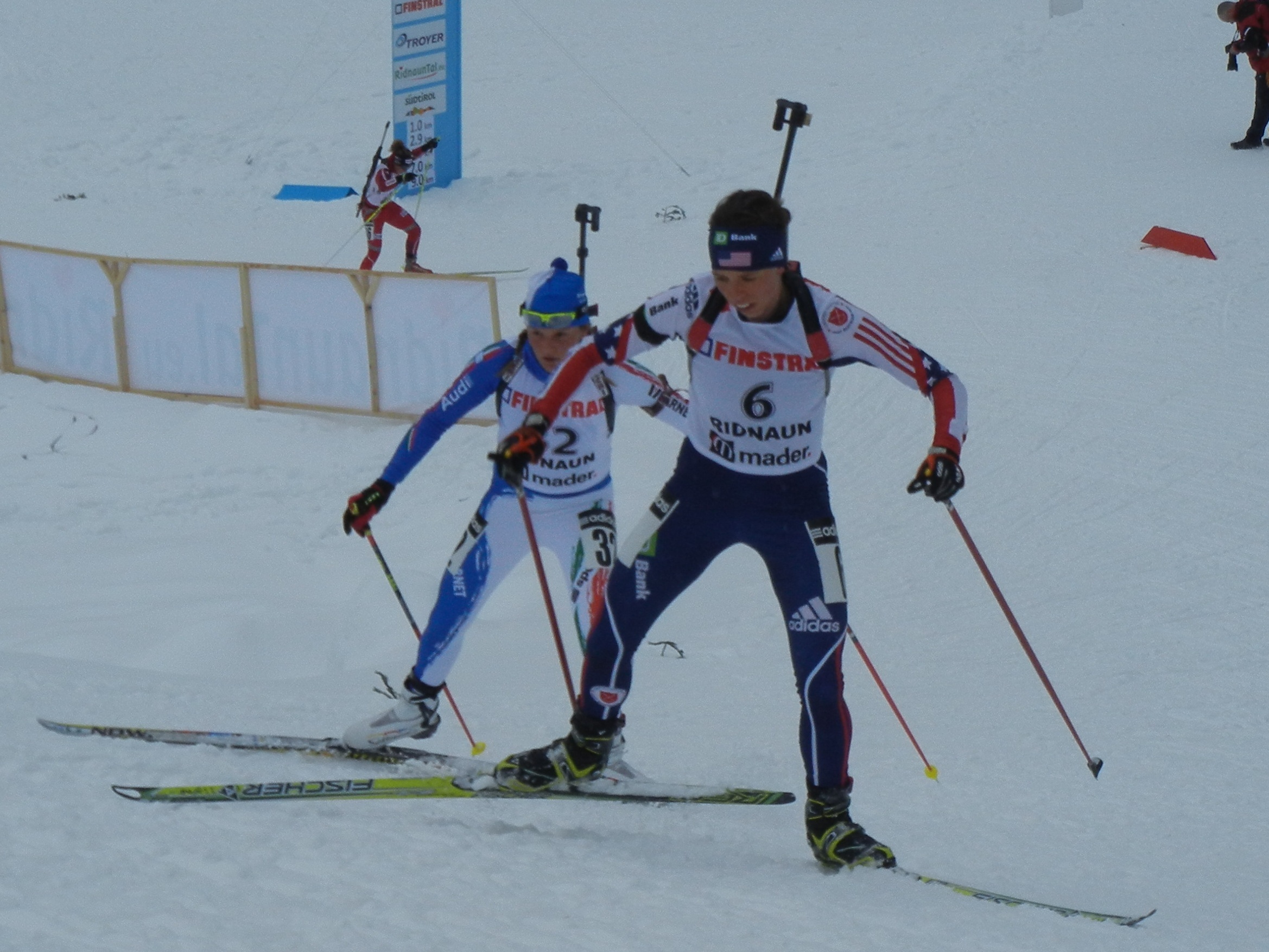
Corrine Malcolm (USA) in the junior pursuit at U26 Championships, Ridnaun, Italy. Photo: Susan Dunklee.
Last year, Susan Dunklee’s top finish at U26 Open European Biathlon Championships was 17th place in the sprint. At the time, she was pleased with the performance, but this year, she’s eclipsed that success – twice.
In the open individual race at this year’s U26 event, which took place in Ridnaun, Italy last week, Dunklee finished 15th – an auspicious start to the week for the only senior U.S. woman nominated for the races. Then in the sprint, she upped the ante, finishing ninth. She only missed two shots, skied the sixth-fastest course time of the day, and finished under a minute behind the winner, Juliane Doll of Germany.
How big is this step for Dunklee?
“Last year, my best result of the season was a 17th place at U26’s with 90% shooting and that felt like a huge achievement at the time,” she told FasterSkier in an e-mail. “This year, I progressed to the top ten with only 80% shooting, and I know that when I shoot clean, I can be a contender to win at this level.”
In the pursuit, Dunklee missed eight shots and lost a few places, but still finished 19th. With three top-20 finishes in three starts, and quite a few ski laps that were among the ten fastest on the day, Dunklee was “psyched”.
“The pursuit was a lot of fun, especially the first lap,” she said. “There were three girls that started within two seconds ahead of me, so I tucked in behind them and focused on skiing smooth and efficiently- it felt easy. Unfortunately I lost ground doing penalty loops.”
U.S. women’s head coach Jonne Kahkonen was impressed with Dunklee’s performances at the Championships.
“I’ve seen Susan’s training and racing now for about half a year and it seems like she has some good potential and she has also proven that on international competitions – more than once,” he said.
But he also warned that she still had a lot of work to do.
“There are a lot of things, very basic biathlon skills that Susan can still improve, which means that there’s quite a lot of room for improvement in general,” Kahkonen said. “To be able to take the next step, Susan will have to commit to the hard work even better and work even more. Taking the next step will be tougher, and the next one after that even tougher and so on.”
Dunklee’s success bodes well for the chances of other U.S. biathletes who were left behind on this trip. Katrina Howe of the Maine Winter Sports Center (MWSC) and Hannah Dreissigacker of the Craftsbury Green Racing Project both attended trials races, where they finished behind Dunklee. Dreissigacker and Howe had competed at the U26 Championships and maintained the same time differences, they would have finished in the high twenties or low thirties.
A trio of U.S. junior women made the trip to Ridnaun as well, and their finishes were just as encouraging as Dunklee’s. Corrine Malcolm (MWSC) had the top result, racing to an impressive sixth place in the junior women’s sprint.
“This whole past week was pretty incredible,” Malcolm said. “After having the second-fastest ski time in the individual I knew that I could have good races later in the week. Sprints are the best format for me right now because there are less shooting stages.
“My standing shooting has been pretty horrendous all season and so going into these races the coaches and I decided it would be best for me to ski more conservatively before my standing stages,” she explained. “It has to be one of the strangest pacing strategies ever- when I think of racing I don’t commonly think of having to hold yourself back. But it paid off on Saturday when I only missed two targets! I had to work really hard to earn time back during my final loop but it makes me really excited for when I don’t have to be so cautious.”
Malcolm is just finishing her first season as a biathlete, and the switch has clearly been successful – and beneficial for the team.
“Corrine proved that she is a serious contender in the junior races,” Dunklee said of her younger teammate. “We’ve taken some large steps forward as a team this year and I’m fired up to see where it will take us in the future.”
In the pursuit, Malcolm suffered from cramping and had to drop out. She said that it was the first time she had ever dropped out of a race, and she hoped not to repeat the experience.
Grace Boutot, a MWSC teammate of Malcolm’s who has been one of the top U.S. juniors for several years, had finishes of 22nd and 34th this week.
The last member of the junior women’s squad, Kelly Kjorlien, has been in the U.S. junior pipeline for a few years now, like Boutot. But unlike Boutot, she is still technically a youth – so for her, competing in the junior races at the U26 event represented a jump in the level of competition.
“I was definitely a little overwhelmed going in to the races in Ridnaun because I’m younger than most of the field,” Kjorlien said. “But once I started racing I was much more comfortable. I just had to remind myself that it was just like any other race or training day, just skiing and shooting.
“I was really glad to have the opportunity to do some more big races this season,” she continued. “I learn something new with every race which is really valuable, because it’s not something that can be recreated in training. The trip really accelerated my excitement about my future in biathlon.”
The senior men’s squad – which unlike the women consisted of four men until Leif Nordgren left for senior World Championships – had some strong finishes of its own in the concluding sprint and pursuit races.
Russell Currier led the team in the sprint, finishing 25th. While it was a solid result, Currier was still frustrated- he missed five shots, or fifty percent.
“The goal was a top ten,” he told FasterSkier in an e-mail. “I could have done that with almost three misses in the sprint. The podium was within reach all things considered! But since biathlon is such an inconsistent sport I probably shouldn’t be making any excuses. Over all I’m kind of disappointed with U26s.”
He was frank about his difficulty shooting.
“My shooting still wasn’t up to potential. I felt comfortable with it leading up to the race and was shooting well during intervals and time trials, but wasn’t able to demonstrate the same when it mattered. Most of my struggle in shooting has nothing to do with the mechanics, but more so just head case issues.”
Nevertheless, there were definite bright spots for Currier, who had the second-fastest ski time on one of his laps in Ridnaun.
“I was pleased to see my ski speed come back around,” he said. “I did some peaking work the week prior at sea level and I responded well enough to hold my own at altitude.”
Currier’s teammates Bill Bowler and Wynn Roberts finished in the 40s in both the sprint and pursuit.
American junior men Raleigh Goessling and Ethan Dreissigacker finished 43rd and 48th in the sprint, and in the pursuit Dreissigacker moved up to 39th and Goessling to 42nd.
Grace Boutot (USA) competing in the junior women's 7.5 k sprint. All photos by Judy Geer.
The single most dominating performance on the first day of Biathlon World Youth and Junior Championships came in the second race on Saturday, the junior women’s 7.5 k sprint. Dorothea Wierer of Italy shot clean to win the race by over a minute.
It wasn’t an entirely surprising result: Wierer has contested every Junior Worlds series since 2007, and won a gold medal in Ruhpolding in 2008 and one in Canmore in 2009. And of all the starters in the junior women’s field, she has the most and best World Cup experience, including a 24th place finish in Ruhpolding this year.
Malcolm.
Still, the size of her victory was impressive.
“This was a perfect competition,” Wierer told IBU News. “The tracks are prepared well and the wind was no problem for me. At the beginning, I had a strange feeling because I am used to the very high level at the World Cup. So I was surprised.”
Behind her, Canadian Emma Lunder and American Corrine Malcolm each missed two shots and finished six seconds apart in 31st and 33rd places.
For Malcolm, it was the first World Juniors race of her career, and this is also the first year she has trained as a biathlete. Usually, skiing is her stronger suit, but two penalties was an impressive accomplishment for her.
“For the first time ever my shooting saved my butt,” she told FasterSkier. “It’s kind of an odd sensation to have my best shooting race ever at World Junior Championships! Skiing felt pretty terrible today, I didn’t feel like I could be very aggressive out on course. I like to feel that I can attack sections of trail and today the trail was attacking me and I was along for the ride. I felt strong on the bigger climbs out on course but the transitional sections are crucial and I just didn’t have it in me this morning.”
But to finish 33rd with tired legs is a huge accomplishment.
Kjorlien.
“A little disappointing for sure, but all in all, 33 is not a bad place to be at my first big European show. I’d like to be top 30 and came close today, and I’m happy about where I sit going into the pursuit tomorrow. It will be my first true pursuit format race in biathlon and should be really exciting!”
The top 60 athletes from each race will contest the pursuit on Sunday. Joining Lunder and Malcolm will be American Grace Boutot, who finished 47th with two penalties, and both other Canadian starters: Audrey Vaillancourt, who finished 44th, and Yolaine Oddou, who was 48th. While none of the women had the best days, all five still made the pursuit, and have the chance to improve tomorrow.
In the youth women’s 6 k, Kelly Kjorlien of the United States brought home the best women’s result of the day, finishing 27th with a single penalty.
“I felt pretty good today,” Kjorlien said in an e-mail. “We had perfect conditions. I am really happy about having early races because that means the course is in flawless shape and hasn’t been trampled by all of the boys yet. My race went well, after missing the first shot I was able to calm down enough to hit the rest. I’m proud of my teammates for some nice racing today and am looking forward to the pursuit tomorrow since shooting is my strong point. It should be a fun race.”
Ransom.
Her teammates Carly Wynn and Tara Garaghty-Moates also qualified for the pursuit with 53rd- and 58th-place finishes. Unlike Kjorlein, shooting is not their strong point: in two shooting stages, Wynn missed six shots and Garaghty-Moates seven. However, they had the 14th- and 23rd-fastest ski times of the day, which enabled them make up some ground.
The last American racer, Silke Hynes, just barely missed the pursuit. She finished 62nd with three penalties. Although she was only two places out, her time was twenty-three seconds away from the magic 60th place.
Rose-Marie Cote led the Canadians with a 44th-place finish, thanks to three penalties. Julia Ransom was next in 51st, followed by Sarah Beaudry in 52nd and Danielle Vrielink in 55th. Their teammate Scott Gow indicated that the women were not pleased with their races, but with all four earning a start in the pursuit, they were optimistic about moving up in the rankings.
When the World Youth and Junior Biathlon Championships kick off in Nove Mesto, Czech Republic on Saturday, both the U.S. and Canadian teams will have high hopes.
How high?
Grace Boutot (USA) racing in Nove Mesto this weekend. All photos courtesy of Judy Geer.
In 2010 in Torsby, Sweden, Canadian Rose-Marie Cote won a bronze medal in the youth 10 k individual. In 2009 in Canmore, Canada, American Grace Boutot won silver in the same event, and Canadian Yolaine Oddou was one spot behind her. That was a banner year for the home team: Audrey Vaillancourt won bronze in the youth 6 k sprint, and the youth men took silver in the relay. That’s to say nothing of the multiple top-10 finishes by these and other athletes in the last two years.
The good news is that all of the medal-winning athletes are returning this year except for Canada’s Kurtis Wenzel, who is focusing on skiing with the Alberta Ski Team.
And they’d better not rest on their laurels, because their own teammates are gunning for the podium as well. For instance, Boutot finished second at the U.S. trials, behind Corrine Malcolm, a freshly converted skier who is in her first year of training as a biathlete.
To understand the event, if you’re a ski fan, think of the youth division as more like World Juniors for skiing (athletes are born in 1992 or later) and the junior division more like Under-23 Championships (athletes are born in 1990 or 1991). The junior division is incredibly competitive and often includes a significant number of World Cup athletes.
For instance, Leif Nordgren, the top American junior last year, recently contributed a stellar relay leg to the 9th-place relay at the Antholz World Cup. And in Canmore just two years ago, podium finishers included Miriam Gossner and Simon Schempp of Germany and Benjamin Weger of Switzerland – all of whom have stood on the World Cup podium – as well as current overall World Cup leader Tarjei Boe of Norway.
This year, it may be slightly less competitive because the World Cup circuit has moved across the pond to Aroostook County, Maine. As a result, it will be hard for top juniors to split their time between the World Cup and World Juniors.
The Americans
Juniors
Goessling.
Boutot (Maine Winter Sports Center/Fort Kent ME) is the most successful of the American biathletes, but she’s joined by Ethan Dreissigacker (Craftsbury Nordic Ski Club/Morrisville VT) and Raleigh Goessling (Maine Winter Sports Center/Esko MN) in having the most experience: the trio has been teammates since the 2008 Championships in Ruhpolding, Germany.
“I’ve been on teams with Ethan for a couple of years, and I think that both of us have the potential for some very respectable results,” Goessling told FasterSkier after the trials races in Jericho, Vermont in December.
As noted, Boutot has some competition in Malcolm (Maine Winter Sports Center/Hayward WI). Last year, Malcolm qualified for NCAA Championships racing for Montana State University, and she was on the podium in the sprint at junior nationals for the past two years. At the end of last winter she jumped in a biathlon race and never looked back.
This weekend, the athletes had a chance to race on the Nove Mesto trails in a series of warm-up races with a few of the other junior national teams. Malcolm and Boutot each raced once: Malcolm finished seventh in Saturday’s sprint race and Boutot eighth in Sunday’s relay-format sprint.
For Malcolm, the experience was quite valuable.
Malcolm.
“As far as my first international race goes, I kind of gave myself a pep talk at the starting gate that went something like this, ‘Corrine Malcolm settle the f&*! down…” and then the lady started to count me down in German,” she said in an e-mail.
“The last few days going into a big race kind of reminds me of studying for college exams. I always felt like if I didn’t know it the night before I wasn’t going to get any smarter in the next eight hours anyway, so I’m trying to stay relaxed. The work is done. We put in the hours all summer and fall and knowing that I worked really hard is all I have to rely on. I’m excited and it’s only going to amp up as we get closer to the weekend. I really have no idea what to expect… I just expect myself to ski hard and shoot just like I’ve practiced. That’s all I can really ask for.”
Boutot didn’t need the experience as much, as she had raced in Nove Mesto before.
“I knew what to expect this year coming into World Juniors since I was able to race in Nove Mesto in the IBU Cup last year,” Boutot told FasterSkier. “I had a top 30 finish in the IBU Cup, and that has encouraged and motivated me for this upcoming weekend.
Dreissigacker.
“I wasn’t able to train very well [this year],” she continued. “Because of that my expectations are not quite as high as I had previously set, but I know that I am still capable of having some good finishes. My goal now is to get a few top 20 results and qualify for Under-26 Championships in Italy in February. I’m excited, I’m going into these races to have fun and with no pressure on my shoulders.“
In the junior men’s division, Dreissigacker and Goessling are joined by Ben Greenwald (Maine Winter Sports Center/Saint Paul MN). The three have been very competitive with each other so far: Greenwald and Dreissigacker both won races at junior trials, but Goessling was never far behind.
This weekend it was the same as ever. Greenwald and Dreissigacker finished 15th and 16th in the men’s sprint race, separated by only 0.3 seconds, and Goessling was 23 seconds back in 18th. In the relay format, they opted to race as juniors, and improved their placings. Dreissigacker led the way in eighth, followed by Greenwald and Goessling in 11th and 12th.
Youth women
Silke Hynes (Vermont Collegiate Biathlon/Burlington VT) and Kelly Kjorlein (Mount Itasca/Grand Rapids MN) are returning for a second year representing the U.S. as youths. In Torsby last year, Kjorlein moved up from 58th place in the sprint to finish 40th in the pursuit. And in Sunday’s relay-format race, Kjorlein led the group with a tenth-place finish.
Kjorlein.
“I’m feeling pretty confident going into the races,” Kjorlein said in an e-mail. “Unfortunately I just came down with a pretty nasty cough but hopefully it will clear up by Saturday. But it was really nice to have the chance to get used to the trails and venue before the important races. I’ve been lucky enough to have plenty of time to get adjusted to the new surroundings. The trails here are fantastic, the crew out at the venue has been doing a wonderful job laying down snow and keeping things groomed nicely.”
Hynes has experience, but she is more of a shooter than a skier. Her best chance of a good result will be in the individual race, where each missed shot comes with a one-minute penalty.
Hynes and Kjorlein are joined by a pair of newcomers. Carly Wynn (Saratoga Biathlon/Queensbury NY) was the top qualifier at junior trials, and undoubtedly the fastest skier on the squad. Just before leaving for Europe, she finished 13th in the Lake Placid SuperTour 10 k skate – the top result by a high school skier. Wynn has good shooting days and bad shooting days, so she’s something of an unknown quantity.
But her unpredictability is nothing compared to the other newcomer, Tara Garaghty-Moates, a former medalist at the junior national sprint. Shooting isn’t Garaghty-Moates’ strong point – in the races this weekend she shot 30% and 25% – but if she has a good day on the range, she could have a very good day indeed. As it is, she beat Kjorlein by 35 seconds in the sprint on Saturday, so despite a few trips to the penalty loop she’s capable of leading the team.
“Even though our youth team is a little less experienced, I’m looking forward to seeing what kind of results we can post,” Kjorlein said. “Carly and Tara are both very experienced in the nordic world, so they’ve been doing a great job transitioning over to biathlon.”
Smith.
Youth men
The youth men’s squad features only one returning member – Casey Smith (Methow Valley/Winthrop WA), who finished 32nd in the sprint last year in Torsby. There, he was the junior member of the team behind Dreissigacker and Goessling. But now, he is undeniably the leader of a young, inexperienced squad. In the races this weekend, he finished fourth and fifth.
“I felt that my races this weekend went well,” Smith told FasterSkier. “They were for sure not perfect, but that is okay because there is still a few more days before the world junior races start. Those races were very beneficial to help prepare for World Juniors.
“I feel prepared for the upcoming races,” he concluded. “I am adjusting pretty well, I have finally adjusted to the time difference, and the food is good so I don’t have to worry about that. The trails are nice.”
But Smith’s experience is the only reason he is the squad’s leader. He was actually the fourth qualifier at junior trials, which were won by a pair of young biathletes with similar names: Sam Dougherty (Alaska Biathlon/Anchorage AK) and Sean Doherty (Saratoga Biathlon/Conway NH). And Doherty bested Smith in Sunday’s relay-format sprint, finishing fourth.
Doherty.
They are joined by Dougherty’s teammate Ray Wonders (Alaska Biathlon/Anchorage AK).
“I think that the youth men’s team will be able to hold their own as long as the shooting stays good,” Smith said.
The Canadians
With five returning medalists, it’s hard to pick out just a few Canadian athletes to focus on.
One athlete, however, has already had some experience racing in Europe this year. Scott Gow, who has competed in four Junior/Youth World Championships already and has three individual top-10 finishes and one relay medal, was part of Canada’s IBU Cup squad in December. His top finish was 15th place in the individual in Martell, Italy.
“I am confident going into Worlds after racing the IBU Cup earlier this season,” Gow told FasterSkier. “I had good results before Christmas and I know that if I can put out a good race I will be able to place within the top twenty and hopefully within the top ten. I am still very focused on making sure my skiing is in good form and that my shooting is still on target.”
In the junior men’s division he is joined by David Gregoire, Aaron Gillmor, and Vincent Blais. Gillmor has the next most international experience: it’s his third trip to the Championships, and he joined Gow on the silver-medal relay team in Canmore. Gregoire competed in Torsby last year with a top finish of 30th in the individual.
The youth men’s squad also has a Gow on it – Scott’s brother Christian.
“Christian and I started biathlon at the same time around ten years ago at a summer camp at Canada Olympic Park,” Scott Gow said. “We both did a biathlon demo and loved it, so we signed up for the biathlon bears program and soon after joined Rocky Mountain Racers. Christian and Stuart [Harden] will be good ones to watch in the Youth Men category.”
Christian Gow finished 16th in the sprint in Torsby last year. He is joined by Harden, Macx Davies, and Albert Bouchard.
The youth women’s squad is led by Cote and Julia Ransom, who finished 11th in the individual in Torsby and was part of the fourth-place relay team. They are joined by Danielle Vrielink and Sarah Beaudry.
And finally, the junior women are led by former medalists Oddou and Vaillancourt, and rounded out by Emma Lunder, who competed in Torsby last year with a top finish of 30th in the individual.
“Look out for the Quebec girls: Yolaine, Rose Marie, and Audrey,” Gow advised.