Our spring sale is live now, including low prices on alpine line paraffins (Soft Base and Extra Soft Base are our favorite storage waxes) and base cleaner. Now through May 15, enjoy 50% off retail prices for brushes, scrapers, and corks. Get those skis cleaned and put to rest for the summer! Check out Maplusskiwaxusa.com.
Maplus had a great year with Olympic results and continued innovation in fast-race skis on the World Stage. We just came home from Italy with even more respect for the research and development at Maplus—and with some excellent new test products specifically formulated for the damp and transformed snows they saw in Val di Fiemme, Cortina, and Stelvio.
Here in the US, Maplus continues to amaze as we use the products in our everyday training and racing. We particularly like the Arctic Green and Soft Base Liquids for durability and everyday ski conditioning, and have found that BP10 Cold liquid speeds up almost every wax application. Thanks to our wide network of Elite partner clubs, we can offer products this season that have been specifically developed for North American conditions. Our first World Cup Reserved product, developed here at home, BP10 Violet M (moly), is now in production and available on our order form. It has consistently performed as the top solid paraffin underlayer in our testing across the U.S. and Canada.
For cost-effective ski conditioning, buying the paraffin waxes by the kilogram (4x250g individually packaged blocks) is a must for shops and clubs. And, our local ski shop cannot keep the eco-touring cream in stock. We prefer the liquid ourselves (it is even easier to apply). These 12-piece boxes are a neat, self-contained display and have an easy retail price point at $19/each.
Clubs and Teams interested in our Club Pricing or Elite Partner programs should contact us for details.
Our spring sale is live now, including low prices on alpine line paraffins (Soft Base and Extra Soft Base are our favorite storage waxes) and base cleaner. Now through May 15, enjoy 50% off retail prices for brushes, scrapers and corks. Get those skis cleaned and put to rest for the summer! Check out Maplusskiwaxusa.com
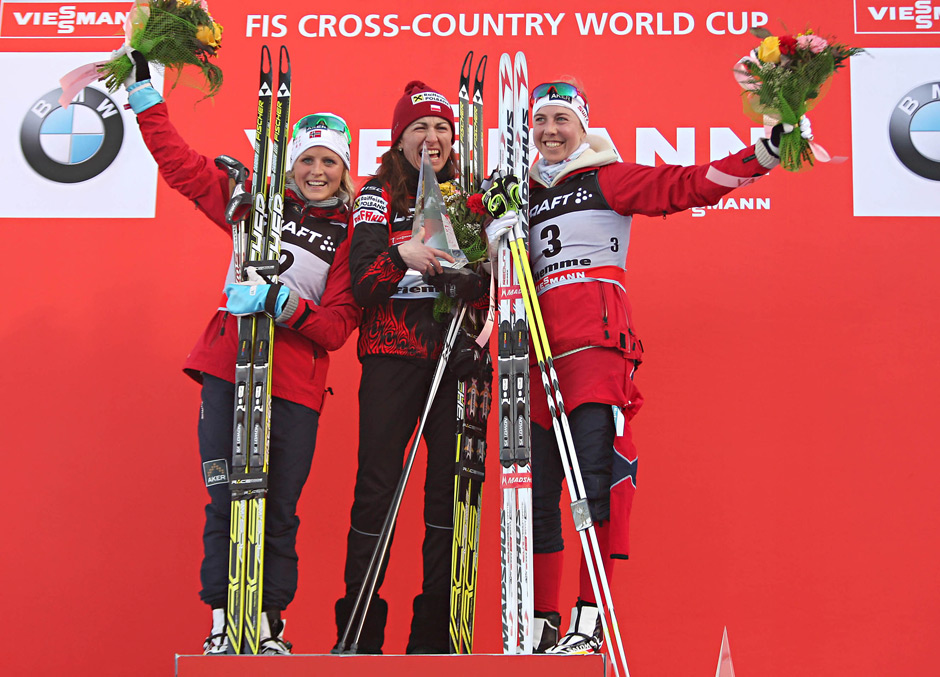
Poland’s Justyna Kowalczyk (c) celebrates her fourth-straight Tour de Ski victory last year in Val di Fiemme, Italy. She shared the 2012/2013 Tour de Ski podium with Norwegians Therese Johaug (l) in second and Kristin Størmer Steira in third (r). (Photo: Fiemme2013)
With the eighth-annual Tour de Ski starting 24 hours from 8 a.m. EST, we thought we’d give you a rundown of what’s happening when and who’s racing.
The short-and-simple: TdS
The stages: seven in nine days
The places: Oberhof, Germany (Dec. 28-29), Lenzerheide, Switzerland (Dec. 31 & Jan. 1), Cortina d’Ampezzo-Toblach, Italy (Jan. 3), Val di Fiemme, Italy (Jan. 4-5)
Dec. 28: 3/4.5 k freestyle prologue (women at 14:00/men at 15:15 CET), Oberhof. Start lists:women | men
Dec. 29: Freestyle sprint (heats start at 14:30 CET), Oberhof
Dec. 31: Freestyle sprint (heats at 14:45), Lenzerheide
Jan. 1: 10/15 k classic mass start (men at 13:00/women at 15:45 CET), Lenzerheide
Jan. 3: 15/35 k freestyle pursuit (women at 10:30/men at 12:15 CET), Cortina to Toblach
Jan. 4: 5/10 k classic individual start (men at 11:00/women at 15:45), Val di Fiemme
Jan. 5: 9 k freestyle pursuit/final climb (women at 13:30/men at 15:00 CET)
The players:
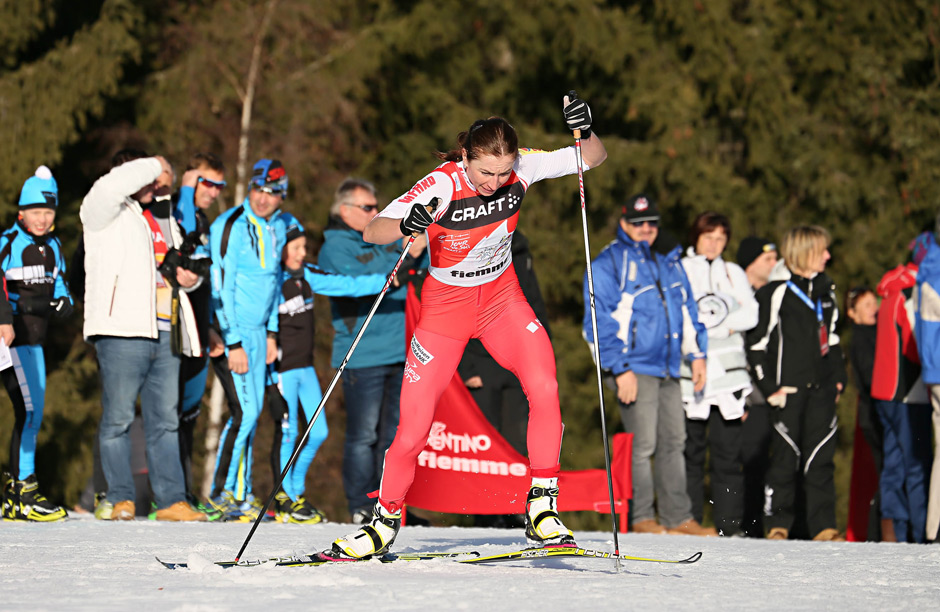
Poland’s Justyna Kowalczyk powers to the top of the Alpe Cermis and her fourth Tour de Ski victory last season. (Photo: Fimme2013)
221 athletes from 26 nations
Justyna Kowalczyk: four-time defending champ from Poland. She’s one of three women to have completed all seven Tours to date, with Finland’s Riitta-Liisa Roponen and Ukraine’s Valentina Shevchenko
Marit Bjørgen: the Norwegian powerhouse is back after skipping last season’s Tour because of a heart scare. The three-time Olympic gold medalist and 12-time world champion has yet to win the Tour, but finished second twice (in 2007 and 2012).
Petter Northug: the Norwegian runner-up in three straight Tours (2009-2011), who has yet to win overall andone of three men to finish all seven editions of Tour. Germany’s Jens Filbrich and Italy’s Giorgio Di Centa are the others.
(Not racing: Dario Cologna: Swiss skier who won three Tours in 2009, 2011 and 2012. Recently started skiing again after tearing an ankle ligament and having surgery in November. Hopes to race Alpen Cups Jan. 10-12 in Chamonix, France.)
The point: $$$, World Cup points (overall winners get 400 World Cup points and half of the regular World Cup points will be awarded per stage), and a tune-up for the Olympics in February
U.S./Canadian lineup (tentative):
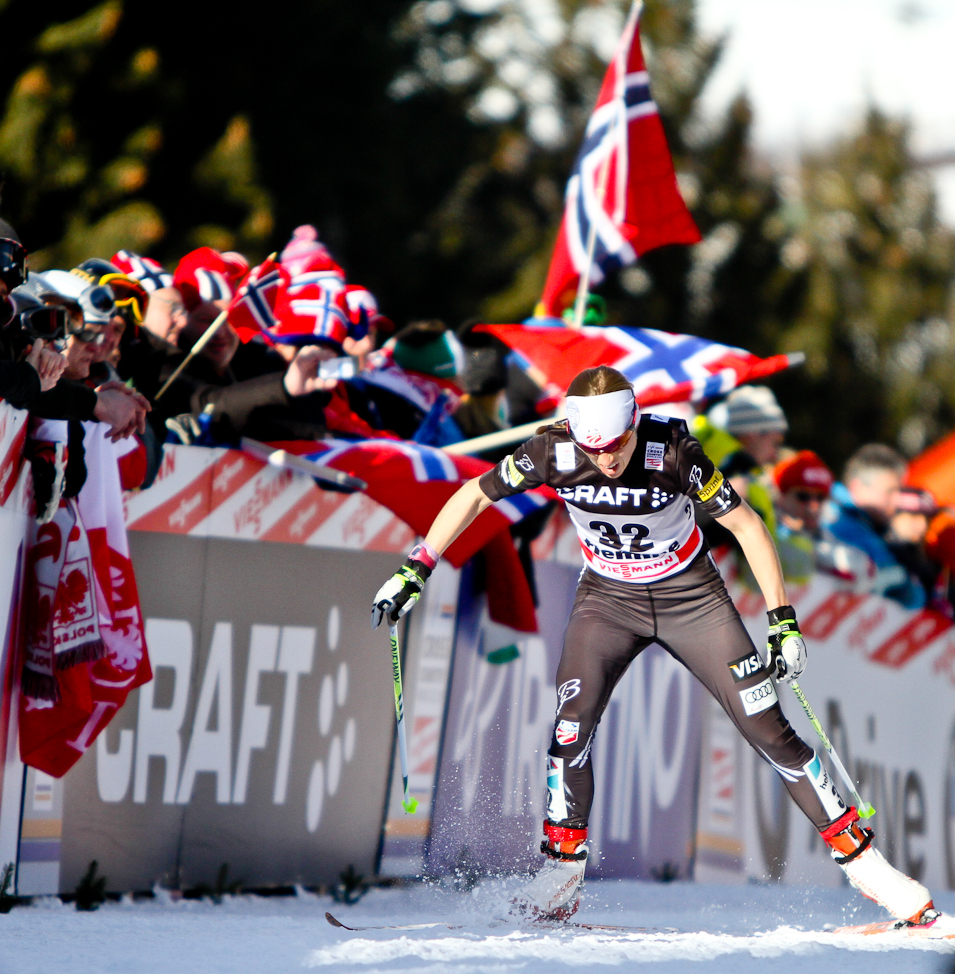
Liz Stephen racing the final climb up the Alpe Cermis in the 2011/2012 Tour de Ski. Last year, she had the second-fastest time in the 9 k freestyle pursuit, and finished 15th in the overall Tour.
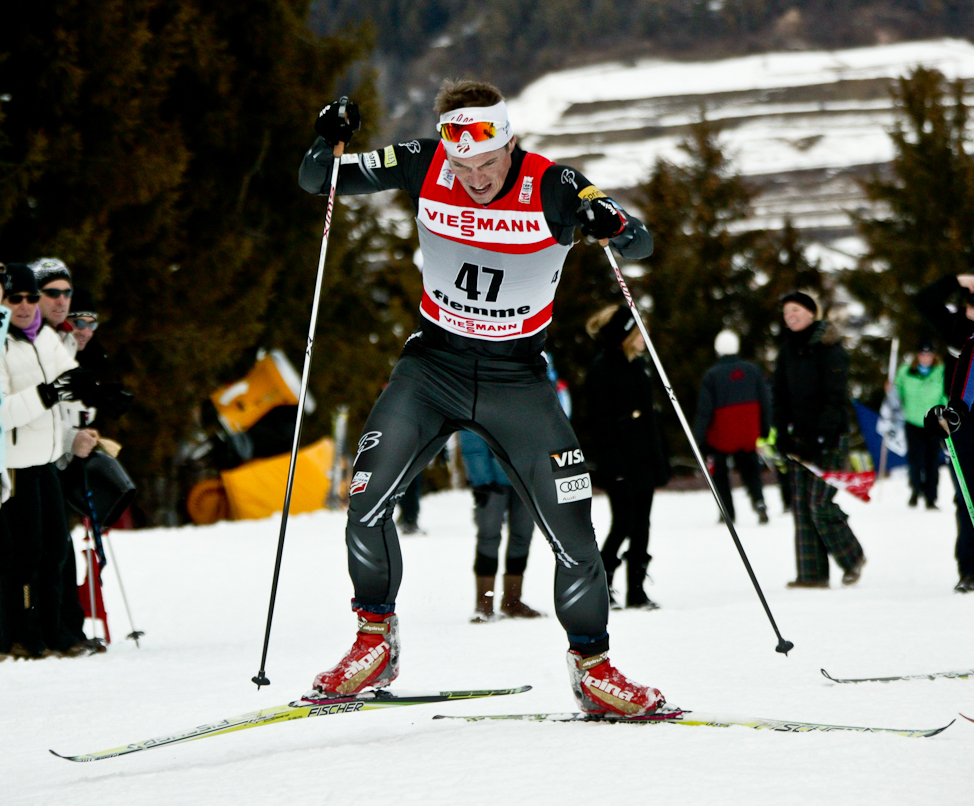
Kris Freeman (MWSC/USST) ascending the final climb of last year’s Tour de Ski up Alpe Cermis near Val di Fiemme, Italy. He placed 32nd for 43rd overall.
Starting 52 spots back and just over four minutes out of first, U.S. Ski Team member Kris Freeman wasn’t too worried what was going on up front. But he did wish he hadn’t crashed into that fence on the second day of the Tour de Ski.
The 32-year-old, who also races for the Maine Winter Sports Center, was thinking about the resulting position he had been dealt – falling from 35th to 57th during the single pursuit race. The next stage – a sprint – he placed 41st to rank 52nd overall.
So on Thursday, during the grueling 35-kilometer freestyle pursuit from Cortina to Toblach, Italy, Freeman was thinking about what he could realistically do. And the group he was skiing with wasn’t doing it for him.
“I wasn’t in a group that was interested in doing a lot of work,” Freeman said. “So we just kind of faded as we went along.”
Hovering in the 40’s for most of the race, he ended up leading his pack to try to get them to pick it up. Without much luck, Freeman settled for 43rd, 5:51.9 minutes back from Tour leader Petter Northug (NOR).
“It wasn’t a great day by any means,” he said. “The Tour has been a pretty big disappointment for me thus far, but the next three days are all good individual races for me.”
And that’s all that remains in the Tour de Ski, with one more stage in Toblach on Friday (5 k classic individual) and the last two in Val di Fiemme, Italy (20 k classic mass start on Saturday and 9 k pursuit hill climb on Sunday).
Two years ago, Freeman placed seventh in the same hill climb up Alpe Cermis. He ended up 28th overall.
“I’m so far out of the top 10 now that that [top-30] goal is pretty far behind me,” he said. “Just trying to stay focused and move forward.”
Starting exactly 10 spots behind Freeman, 4:37 out of first, teammate Noah Hoffman (Ski & Snowboard Club Vail/Team HomeGrown) moved up to 57th, but is now 8:12 behind the leader.
Disappointed with his result after crashing around 20 k on the downhill into Toblach, Hoffman said he had been skiing well, skiing alone then leading a group up the climb until the 16-kilometer mark. A few kilometers from the top, another pack caught his group, including Great Britain’s Andrew Musgrave. The two groups combined and all was going well for Hoffman until he fell.
“Unfortunately on a road crossing about three or four kilometers down the other side towards Toblach, it was like 6 or 8 inches of sugary, really sugary snow, and I just lost my balance and crashed pretty hard and lost contact with the group,” Hoffman said. “Once that happened, it was really, really difficult to ski that downhill on your own anywhere as close to as fast as you could ski it in a group.”
The group he lost sight of ended up catching Freeman’s pack. Hoffman skied alone again and was caught by another group with a kilometer or two to go.
“So I would say, encouraging signs, but disappointing result,” Hoffman said. “I would say that top 30 in the Tour as a whole would be pretty hard to come by at this point, but I’m really glad that the next three races are all scored individually and I feel like there’s still a lot for me to race in. Basically I can get as many World Cup points in the next three races as I could in three individual world cups.
“Tomorrow might not suit me super well, being a short race,” he added. “I’m hoping certainly for a better result than the opening prologue, and I think I can actually do decently in a race like tomorrow. But I’m really looking forward to the mass start on Saturday and the hill climb.
The third American in the Tour, sprint specialist Andy Newell (Stratton Mountain School T2 Team) hung in for the duration, starting 61st (+4:30.9) and finishing 67th (+11:55.5).
“Long skate races aren’t my thing, I was actually surprised at how [good] I felt,” Newell said. “But I lost a ton of time just because of some bad mistakes out there. I broke a pole right out of the start.”
Because of the nature of the point-to-point race, he couldn’t find a coach for the first five kilometers and skied with the broken one for that long.
“[My pole] was big enough that I was able to use it,” he said. “The one pole was down at my waist, it was kind of a stub of a pole and then I had a normal size skate pole so I skied the first five k like that and obviously dropped a bunch of places.”
Once he got a pole around five or six kilometers in, Newell skied ahead and successfully caught a pack, but broke another one when he kicked it near the top of the climb. He skied another kilometer or two with a broken one, and was unable to catch the group on the downhill.
“I skied the whole descent by myself, which sucked, but I felt good so I’m not too disappointed,” Newell said. “It was a good experience to do that race and I’m looking forward to do it again in the years to come.”
Looking ahead, he expected to be tired on Friday – but that’s his last race of the Tour and “kind of the one I’ve been focusing on in the last few days so I’m going to hopefully go ski fast,” he said. “My goal is to be in the points tomorrow, that’s all I’m working on doing, and then I’ll be done.”
Canadian Alex Harvey in Sunday’s Tour de Ski pursuit; after a longer skate pursuit today, from Cortina to Toblach, Italy, Harvey sits in sixth place in the overall Tour rankings, 1:40 from leader Petter Northug. (Marcel Hilger photo)
The Canadian men had an inauspicious start to today’s Tour de Ski pursuit from Cortina to Toblach, Italy: they got locked out of their bus.
Ivan Babikov tweeted that he had to borrow a Craft shirt and race tights from his wax tech. Alex Harvey reported that he had his suit, but not his long underwear, and said in a Cross Country Canada press release that “I got really cold.” Devon Kershaw was seen racing in a decidedly non-official bib – someone else’s turned inside out.
But at the end of the day all three, as well as Lenny Valjas, were sitting in the top 25 of the overall standings, so they can’t really say that things went wrong.
“It wasn’t a super day, but not bad either given we were super stressed out,” Harvey said.
Starting in bib number five, the highest hopes rested on Harvey. He immediately got to work, starting with Alexander Legkov of Russia, who took off out of the start. Harvey followed and the pair quickly made up the 27-second gap to the leader, joining together with Dario Cologna of Switzerland, Norway’s Petter Northug, and Russia’s Maxim Vylegzhanin.
“Legkov went super hard for the first two kilometers,” Harvey said. “I knew I had to go with him, but the pace was just too fast for me. I knew I was going to get dropped so I tried to save some energy as the next group caught up to me.”
He pulled aside when he finally gave up, and double-poled easily on the side of the trail until he was caught by a chase pack of Marcus Hellner of Sweden, Lukas Bauer of the Czech Republic, and Ilia Chernousov of Russia. Regaining some energy, Harvey was able to fight it out and narrowly lost to Chernousov in a sprint finish. He dropped one place to sixth in the overall standings, but lost over a minute; he now sits 1:40 behind Northug.
The other three Canadians all eventually joined the giant group that formed behind Hellner’s pack. For Lenny Valjas, who had bib 13 after a podium earlier this week, he simply waited and got swept up by the field. But for Babikov and Kershaw, who started in bibs 21 and 22, they were right in the thick of things, and trying to make up time.
“The plan for me was pretty simple,” Kershaw told FasterSkier. “I just wanted to stay with Ivan. He’s so strong on the uphill, and then I’m strong on the downhill and I knew at the loop on the end I’d feel pretty good, if I’m there, so I just forced myself to stay with Ivan, who was charging really hard. He was making up a ton of time on everybody.”
At the top of the 15 kilometer climb, Babikov and Kershaw were sitting in 14th and 16th. Valjas was just behind, in 22nd with virtually the same time. Both he and Kershaw were happy – Kershaw, that he had held onto Babikov despite moments where he felt “on the ropes”, and Valjas that he had simply stayed with the pack.
“It was cool to be in that giant group that formed early on,” Valjas said in a phone interview from Italy. “The plan was just to stay with them as long as possible. If I had gotten blown off the back I would have just cruised it in and gotten ready for the next two races, but I felt good. I got to the top of the hill and once it started going downhill I recovered a bit and made it in just fine in the big group.”
Kershaw agreed, saying that he felt better and better as the race went on. The large pack never broke up, and Kershaw was able to finish reasonably close to the front of the field sprint, good for 12th place. Babikov stayed put in 21st and Valjas was just behind in 23rd. All had more or less the same time, just over two minutes from the leaders.
The group had mixed feelings about the result. Valjas, for example, hadn’t even planned to stay in the Tour this long, or compete in a 35 k race.
“I thought I’d be done after the sprint,” he said. “I’m happy for this long of a race – I haven’t done this long of a race in probably four or five years. So I can’t complain. I’m happy with the result.”
For Kershaw, he was pleased to be feeling better than he has at any point so far this season, but he can’t shake the memories of the last two Tours, where he finished seventh overall and then, last season, fourth. It’s hard for him to see this edition as anything disappointing, but he is managing to find the positives.
“Today was the best feelings I’ve had in the body all season,” he said. “It still wasn’t amazing, but it was definitely a step in the right direction finally, So if I can continue to improve a little bit every day or continue to feel as good as I felt today, it’s not what I was looking for, for sure, but it’s better than how I was feeling in Oberhof.”
As for the mystery of how a skier can actually feel better as the grueling Tour progresses, Kershaw didn’t have much of an answer – just that what he did before the season started was, arguably, even harder. Every day gives him more time since he finished the fall training cycle, and in terms of performance on race day, that’s a good thing.
“I think I just did so much training and was under a really heavy load coming into the season,” Kershaw said. “It was too much and then with the travel to Canada and the racing I did there, it took a while to digest. Now, I feel much better sitting here right now talking to you than I did in Oberhof after the 15 k classic, which is traditionally a way better race for me… and it’s still not there. I’m still feeling like I’m at 70 percent.”
The whole team wasn’t quite sure what to expect in the next few days; this was the first of four races in a row, with no rest days, and recovery will play a huge role in which skiers find success as the Tour winds down.
““There are no rest days now,” Harvey said in the CCC release. “It is whoever can recover overnight will be in the best shape. I’m going to eat, rest and do the right things to fill the tank so I can empty it again tomorrow.”
Valjas agreed, saying that he was “pretty beat down” but wanted to stay in the Tour as long as his body held up, now that he had completed the longest stage.
Kershaw expected changes and surprises in the coming days as some skiers are sure to succumb to exhaustion.
“I think the 15 k classic in Val di Fiemme could be pretty blown open,” he said. “This race, it was long. Tomorrow is not a big deal, as far as effort goes. It’s only five k, it’s hard, you have to go really fast, but it’s only twelve minutes of work. But then you have to travel and change locations yet again. So I think the 15 k is going to depend on who is feeling better.”
Will team tactics again come into play in the mass start? Kershaw again wasn’t sure, but hoped that they might, noting that Valjas was “super strong” over that distance and technique, so the potential for several of them to work together is definitely there.
“Hopefully we can keep all four of us in the top 30 in the overall Tour, which is looking okay right now,” Kershaw concluded. “It could happen. That would be pretty sweet.”
Petter Northug (NOR) and Dario Cologna (SUI) fighting during last year’s Tour de Ski; in Italy today, they skied together for 35 kilometers before Northug emerged on top.
At the beginning of today’s 35 k freestyle pursuit from Cortina to Toblach, Italy, three men were separated by less than ten seconds atop the Tour de Ski standings: Maxim Vylegzhanin of Russia, Dario Cologna of Switzerland, and Petter Northug of Norway.
The three quickly joined together, but within a matter of a few kilometers, their group had almost doubled in size. With the pursuit format the winner of the race would take over leadership of the Tour, and all of a sudden, as the men left Cortina, the possibilities seemed to have grown.
Starting from 27 and 28 seconds back, Alex Harvey of Canada and Alexander Legkov of Russia had worked their way into the mix. The five men skied fast but easily towards the top of the 350-meter climb that separates the two Italian towns, with Cologna doing the bulk of the work.
In terms of rankings, it was a situation almost identical to last year’s Tour pursuit on this same course: Cologna had started with a 13-second lead on Northug, with a large gap back to Legkov, Devon Kershaw of Canada, and Vylegzhanin. Harvey now skied in the place of Kershaw, but the faces were all the same.
And in this pursuit last season, Cologna had cultivated that initial small lead into a 1:20 advantage by the end, turning the Tour de Ski into a tour de force and never giving up his lead for the rest of the race.
Today, it was clear it wouldn’t be so easy. Northug, for one, is in much better form for this year’s Tour – and has the advantage now of having done it once before, so he knows what he’s up against.
“It was hard, but it was much harder here last year,” he told Norwegian broadcaster NRK. “I didn’t flow very well for the first five kilometers, but after that it got better and things went quite well.”
Constantly leading was clearly not a situation Cologna was happy with: by the seven kilometer mark, for instance, he was pulling over to the side of the trail and waving his arms, motioning for one of the other men to take over. Vylegzhanin did, for a while; but soon it was back to Cologna at the front. Northug would lead occasionally, but never for more than a few hundred meters.
Of course, that’s not how Northug saw things.
“I tried to help all the way,” he told Norwegian broadcaster NRK. “When I took the lead it was easier to pick up the rest of the group, and it didn’t cost me anything.”
With Marcus Hellner of Sweden and Lukas Bauer of the Czech Republic having made up a third of their 1:35 gap in the first few kilometers, Cologna evidently felt that he couldn’t sit back and allow the lead group to linger too long playing games. Again and again, he found himself at the front, driving the pace.
Northug reported that the men tried to work together to avoid being caught, but it was difficult to communicate about how big the gap was.
“There were a lot of languages,” he said. “The Russians were getting some seconds back in Russian, but I didn’t get much information even though I tried to ask them. Then Dario got some seconds back information, and I learned that it was a minute.”
As the group neared the top of the 15-kilometer climb, the repeated accelerations as Northug took the lead and then gave it up proved too much for one member of the group: Harvey. Several times, he let the pack go and then caught back up when they decelerated. But eventually, he was broken and literally shut things down, double poling in the classic tracks on the side of the trail.
While it looked like Harvey had hit a wall, he was simply playing smart: knowing that he had no chance of catching the first four, and that skiing alone was a waste of energy, he took a rest until Hellner, Bauer, and Ilia Chernousov caught him, and then embedded into their chase group. At that point the gap was about 1:35, and it stayed that way until the finish, when Chernousov beat Harvey in a sprint for fifth.
But at the front, the leaders were embarking on a well-earned downhill. Passing between the ragged peaks of Geierwand, Durrenstein, and Birkenkofel – the trail even went through a long tunnel beneath the mountains at one point – the skiers were nonetheless unable to fully enjoy views of Tre Scarpari, or “three scars”, just to the east.
Instead, they were focused on tactics and gamesmanship. The downhill was fast and nobody could get a gap, but the lead kept shifting between Cologna, Legkov, and Northug. Vylegzhanin was never dropped, but was visibly fatigued and rarely took his turns at the front. Although it would have been a great time to try to spring him loose, fourth place in the draft of three skiers on a downhill is a pretty safe place to be in a ski race, and the Russian, wearing the bib of the Tour leader, was pulled along.
“We worked together well in the lead and got a good break on the second group,” Cologna told NRK. “I hope that it is one of us four who is the winner in the end.”
As the kilometers ticked past, Cologna and Legkov doubtless began to worry not about the man currently wearing that leader’s bib, but who would have it at the end of the day. One figure loomed over the group, and that was Northug. Nobody in the pack was a slouch when it comes to finishing sprints, but Northug has bested all of them repeatedly.
And yet Cologna and the Russians were unable, or unwilling, to take the risk of a big push in the pace to shake the Norwegian. As they entered the stadium – not to finish, but to head out on a several-kilometer loop before the end – Northug was sitting in fourth, just coasting along. He looked all around, assessing the layout of the finish, and ominously kneaded his quadriceps with his fists, getting his legs ready for a big effort.
“I was just saving gunpowder for the end,” Northug later smirked to NRK.
That should have been a signal to the others that they had better scram, now, if they wanted to avoid getting schooled by the Norwegian in the last hundred meters. But instead the pack slowed down. Northug moved to the front and commanded the pace, almost daring someone to go ahead and pass him, but nobody did.
And so, on the last small hill before the finish, he took off, the Russians in pursuit and Cologna stuck behind them; things didn’t look up for the Swiss defending champion as they rounded the last several corners. Northug was untouchable, taking a 0.7-second win over Legkov, while Cologna was able to surge past the tired Vylegzhanin to claim third just 0.2 seconds back.
“I should have beaten Legkov by more with a pickup like that,” Northug said, noting that he didn’t feel quite 100 percent. “There should have been a little more to go on.”
One the bonus seconds were tallied – 15 for the win, ten for second place, and five for third – Northug had a slightly greater advantage at the top of the rankings: 5.7 seconds over Legkov, 10.9 over Cologna, and 16.6 over Vylegzhanin. Chernousov, Harvey, Hellner, and Bauer are roughly 1:40 behind Northug.
Tomorrow’s stage, a 5 k classic prologue in Toblach, doesn’t faze Northug, who is sure it is an opportunity to extend his lead going into Saturday’s 15 k classic mass start.
Finn Hagen Krogh of Norway and Curdin Perl of Switzerland were the first skiers from a large chase pack to cross the line, finishing ninth and tenth, +1:46.