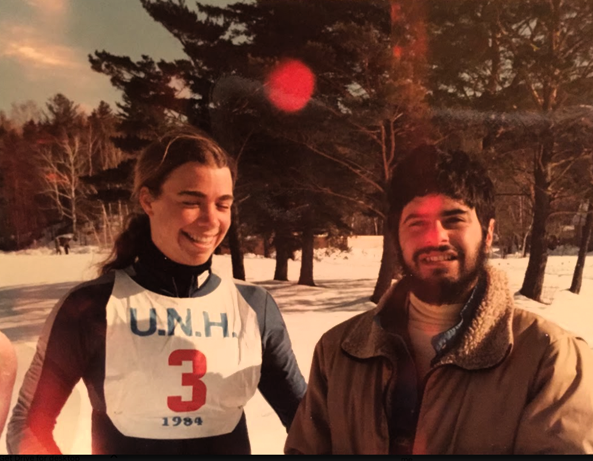
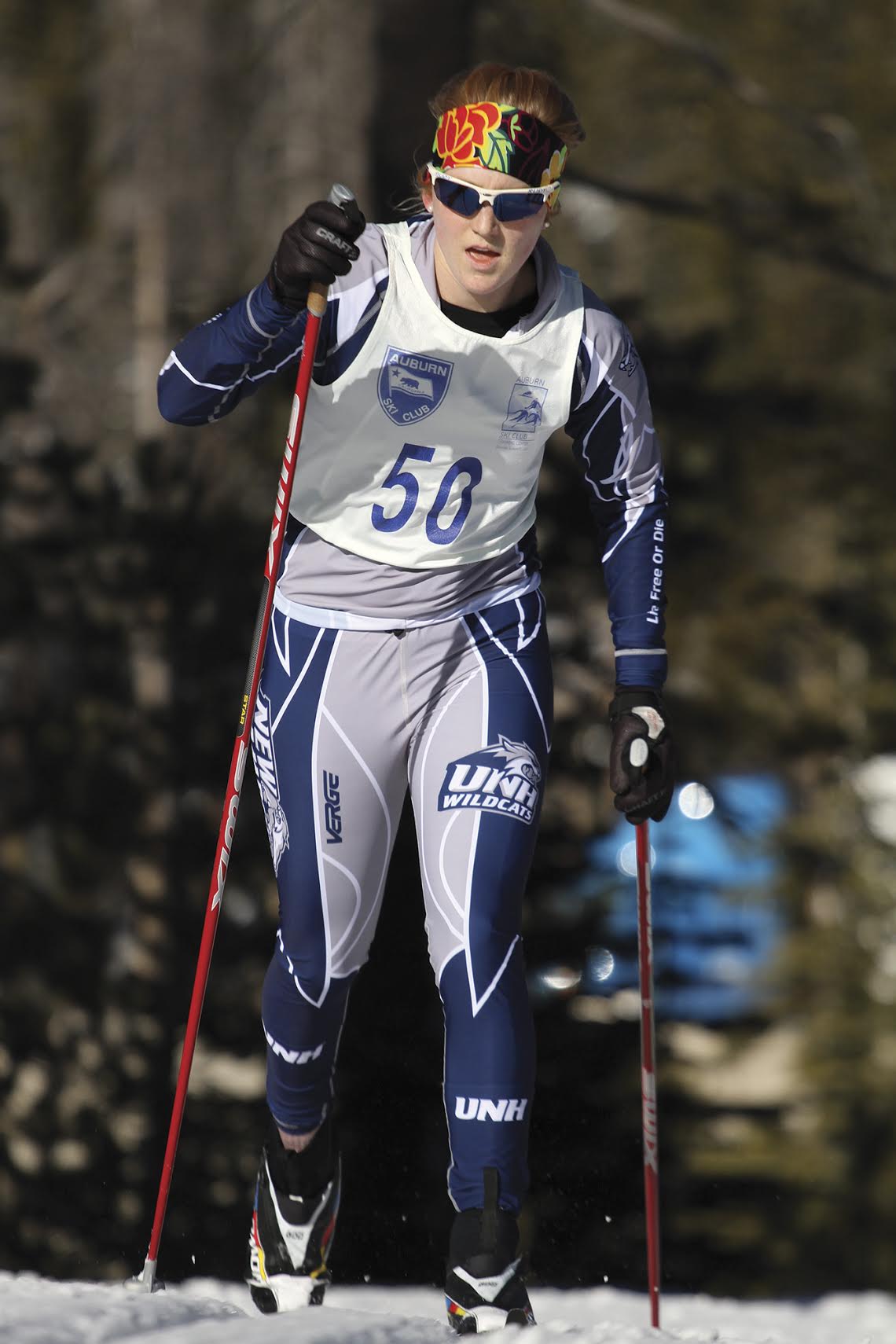
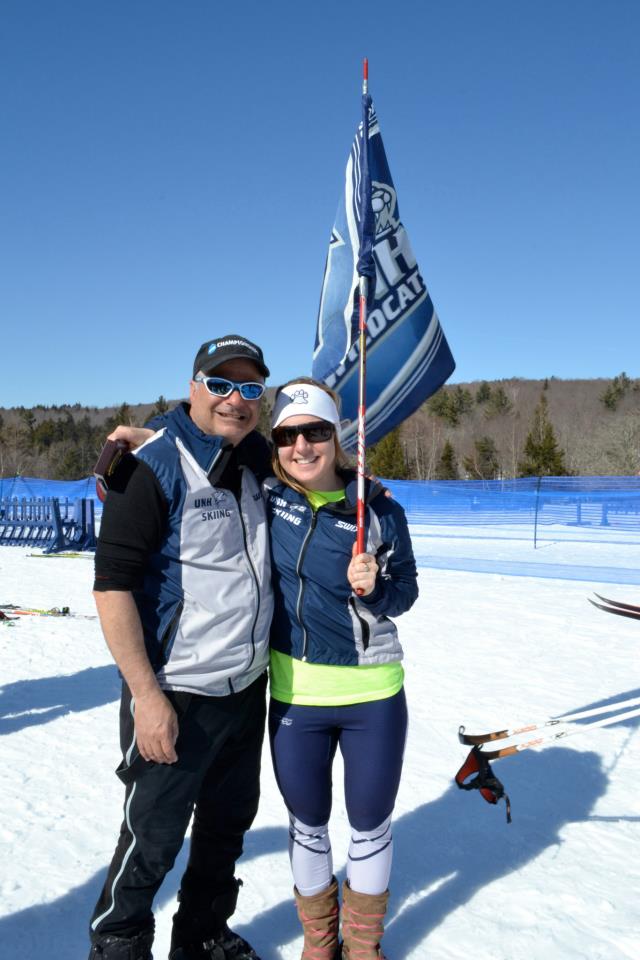
Cory Schwartz with his wife Julie when they raced for U.N.H. (Photo: Cory Schwartz)
Let’s jump into our FasterSkier time machine and go back to 1982. Ronald Reagan was President, the internet hadn’t been invented, and social media wasn’t even a concept. The Berlin wall would still be standing for another seven years, and therefore East Berlin and the Soviet Union were still a thing. Americans were looking back fondly at the 1980 winter Olympics in Lake Placid, New York, where the miracle on ice—the U.S. hockey team winning the gold medal—was still a fresh memory, Bill Koch had represented the U.S. in cross-country skiing and would go on to become the first American to win a medal in a world championship when he took home the bronze in the 30-kilometer race in 1982. No designation for Freestyle or Classic had yet been developed! Enough of the historical perspective, just accept it was a long time ago.
It was during this bygone era that a recent graduate from the University of New Hampshire (U.N.H.) accepted an assistant coaching position at his alma mater, becoming the head coach of the cross-country ski team soon thereafter. A mere 42 years later, that man, Cory Schwartz, has decided the time has come to retire after spending his entire career at U.N.H.
42 years is a long time to stay in one place in any profession. In coaching, it’s almost unheard of. The basketball world was recently agog during March madness when Oakland University’s coach of 40 years—Greg Kampe—won his first round tournament game. The legendary George Halas of the NFL lasted 40 years as a coach. Schwartz has them both beat. He’s tied for longevity with a fellow named Mike Krzyzewski who coached Duke basketball for a minute or two. There are a handful of people who have had coaching careers in one place longer than Schwartz, but you can literally count them on one hand—Connie Mack— who managed the Philadelphia Athletics for 50 seasons— probably holds the unofficial record, and he didn’t beat Schwartz by much.
Schwartz didn’t set out to become a coaching icon. Like so many major accomplishments, much of it was serendipitous. Schwartz’s career began when he started skiing for U.N.H. as a student in 1977. He ended up being asked to coach and rose to the rank of the head cross-country coach and ski coordinator—which includes Alpine— for the University. Along the way, his athletes notched 31 top ten NCAA finishes, including skiers who accounted for 64 All American team selections.
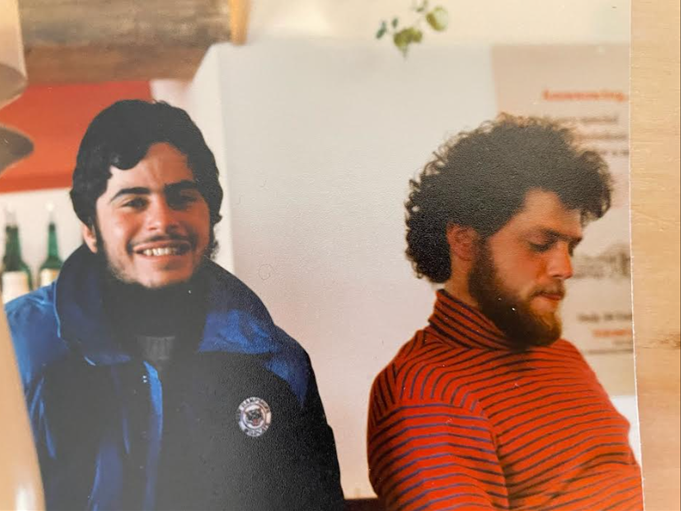
Cory Schwartz (left) and teammate Nat Lucy when Schwartz race for U.N.H. (Photo: Cory Schwartz)
It was those early, rough-hewn days in the late 1970’s at U.N.H. that laid the foundation for Schwartz’s coaching philosophy—team building. The team was very small then, and they had to support and help each other to make it through a season. The necessity of that era led to Schwartz’s hallmark: creating a great team atmosphere. That was something for which Schwartz was always known throughout his career. He was a trailblazer in this philosophy long before it became so popular on national teams, and well before the U.S. national team became famous for it. You can trace the philosophy’s roots back to the early days of fighting for skiing survival in the late 1970’s.
Schwartz entered the coaching business when he was asked by his coach, Buzz Davis, to assist him. He was assistant Nordic coach during his fifth year in college in 1982, and a short two years after college he was the coach for the Nordic team.
The Coach
There was no guide book on how to do the job. “I learned by making mistakes and making some good decisions,” Schwartz told FasterSkier. I wasn’t much older than my team. I was 23. I observed a lot of other coaches at U.N.H. to see how they communicated.”
One might think that being just a few years older than his students might have created problems with respect and authority, but it didn’t. “I don’t think it was an issue, but it was a concern of mine,” said Schwartz. “You’re in charge and you want to make sure that nothing (bad) happens. I was their coach, but also felt I was a trusted friend.”
Fast forward 42 years and Schwartz’s official title is ‘Ski Coordinator/Head Coach Nordic’.’ His duties include not only coaching the cross-country team but managing administrative duties for the downhill team as well. “I oversee the whole program: Alpine and Nordic, men’s and women’s.” But true to his team first philosophy, he doesn’t really separate the two disciplines. “We’re trying to create a whole team here, not just a Nordic team and an Alpine team. We’re one team.”
It’s fair to say that life at U.N.H. has been the sun of Schwartz’s solar system. Not only did he ski there as an undergraduate and coach there his entire career, but he also met his wife, Julie, at U.N.H. when she was a freshman on the ski team, and Schwartz was still racing for the team. “46 of my years have been either as a student or coach here at U.N.H.”
During Schwartz’s first year of skiing, the team was almost cut. It was an issue that would repeat throughout Schwartz’s career. But the adversity of fighting for survival created a bond between the small team with collaboration becoming essential. This bonding created the template that Schwartz would rely on and expand throughout his entire coaching life.
Clare Egan (USA) credits her one year at U.N.H. with an outsized impact on her skiing career. Here, she represents the U.S.A in the Olympics. (Photo: NordicFocus)
When you speak with some of Schwartz’s many well-known alumni one of the first things they all mention is what a great team atmosphere he created. U.S. biathlon team member and Olympian Clare Egan raced at U.N.H. for one year and told FasterSkier that, “it played an outsized role in my athletic career.” She continued that, “what stands out most about my year at U.N.H. is the team environment Cory cultivated. Cory’s biggest strength, in my view, is his extraordinary ability to bring a team together.”
Patrick Weaver, coach for the University of Vermont’s cross-country ski team and two time Olympian also skied for Schwartz. “The team environment that Cory creates extends beyond skiing,” Weaver told FasterSkier. “He wants his skiers to be successful, but also has high expectations for their character and wants the athletes to feel a responsibility to something larger than themselves, and I think that is a major factor in the success of his program.”
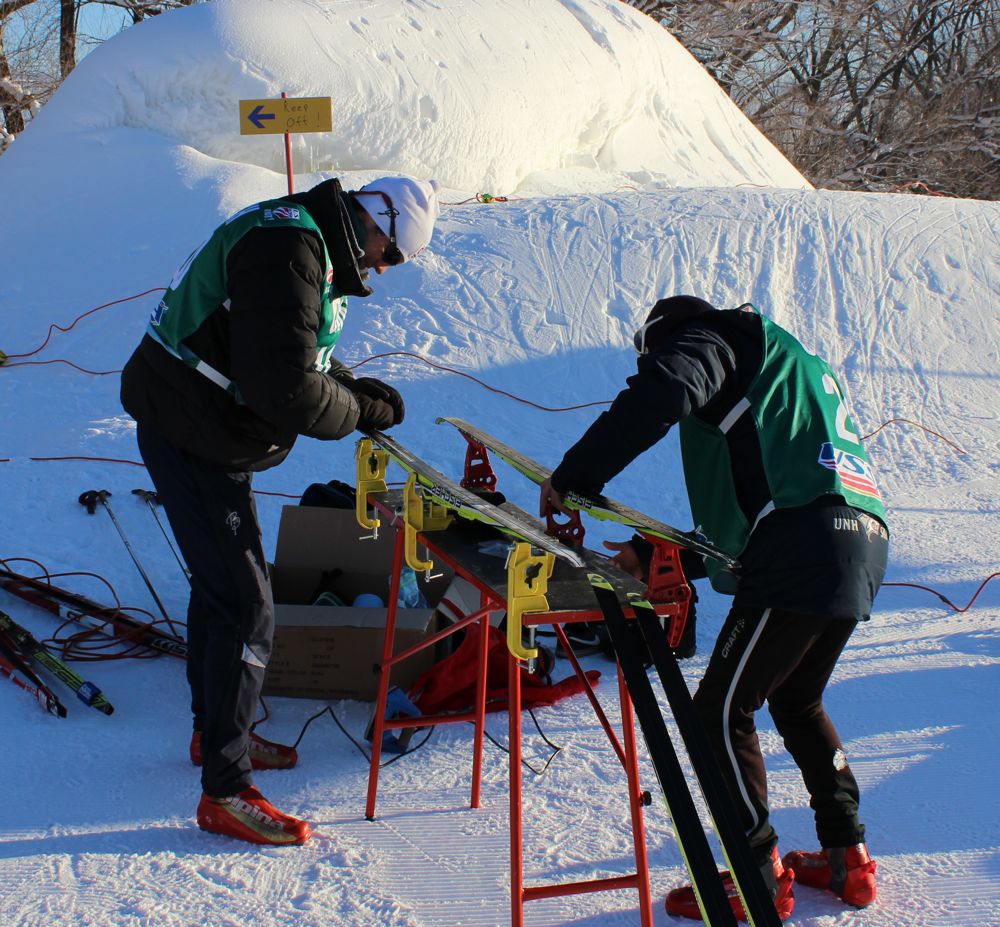
University of New Hampshire coaches Dan Guiney and Steve Monsulick prepping skis. Monsulick worked with Schwartz for 13 years.
Another branch of the Schwartz development tree is Williams College cross-country ski coach Steve Monsulick. He worked with Schwartz for 13 years at U.N.H. and credits him with having a large influence on his coaching approach. “I learned how to create a supportive, focused, and fun team environment,” said Monsulick. “I learned how to cultivate personal relationships with athletes. Cory is truly interested in them; he cares about them both inside and outside of the scope of skiing.” Monsulick observed that the relationships Schwartz builds last a lifetime. “He gets really excited to hear that former athletes got into grad school, got a new job, had a baby or got engaged. He has been to so many of his athletes’ weddings (Nordic and Alpine), which goes to show the type of role he plays in his skiers’ lives. He knows the right buttons to push to get you fired up, but he’s also there for you whenever you need him.”
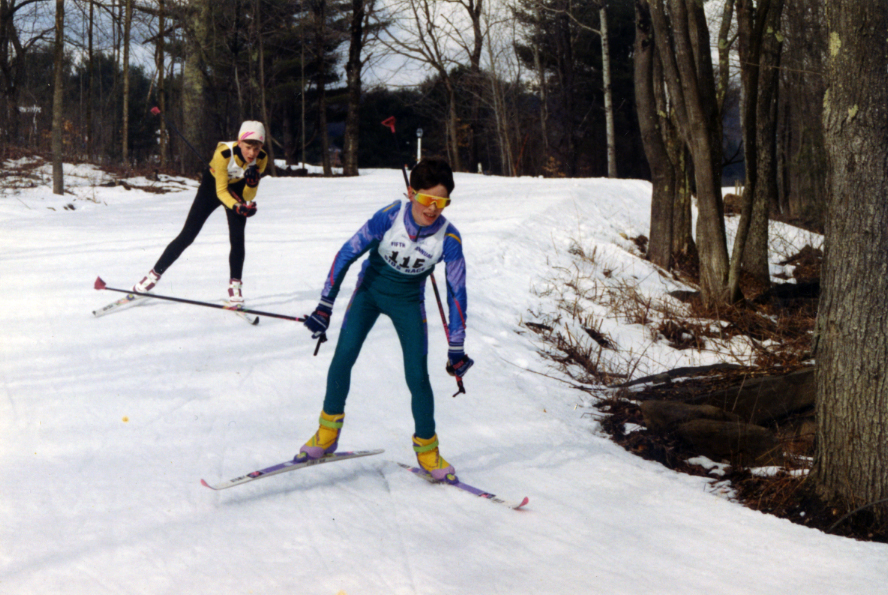
FasterSkier’s Matthew Voisin racing with now USST Coach Matt Whitcomb at Swift River in Cummington, MA, circa 1992. (Photo: FasterSkier)
Another one of Schwartz’s alumni is Matt Voisin, the owner of this publication. “Cory created an atmosphere that was fun to be around and made all of us connected immediately,” Voisin commented. “That was so much more than just sport. I never felt that I was there as an individual, but that I was there to represent U.N.H., and working together as a team for a common team goal.” Schwarz shared some potentially embarrassing anecdotes about Voisin’s days at U.N.H., but those will be kept locked in the FasterSkier vault…for now.
Schwartz’s easy recollection of Voisin’s antics a quarter century ago reveals one of the more remarkable things you notice when speaking with Schwartz: his keen ability to remember minute details. The flood of memories over four decades hasn’t dimmed his ability to talk about events from 40 years ago like they happened yesterday. He appears to have the ability to discuss a race from the middle of last season with the same detail and ease with which he can discuss one from the 1980s.
It was through adversity that the team dynamic really began to blossom. “There were only two or three of us on the men’s team (in the late 1970s), so we tried to work together to help each other.” Schwartz credits his team building approach to those early days of scraping by on a small team and fighting for the team’s survival. “I think it started there, without us knowing. It was something we all tried to do to support each other not knowing where it was going to end up.”
Return to FasterSkier for Part II of our interview with Cory Schwartz.
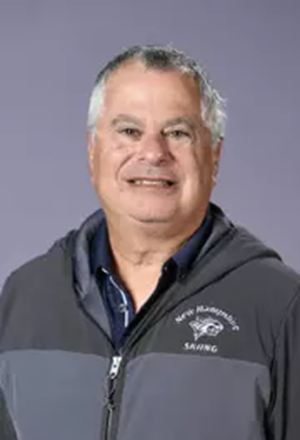
Cory Schwartz (Photo: University of New Hampshire).
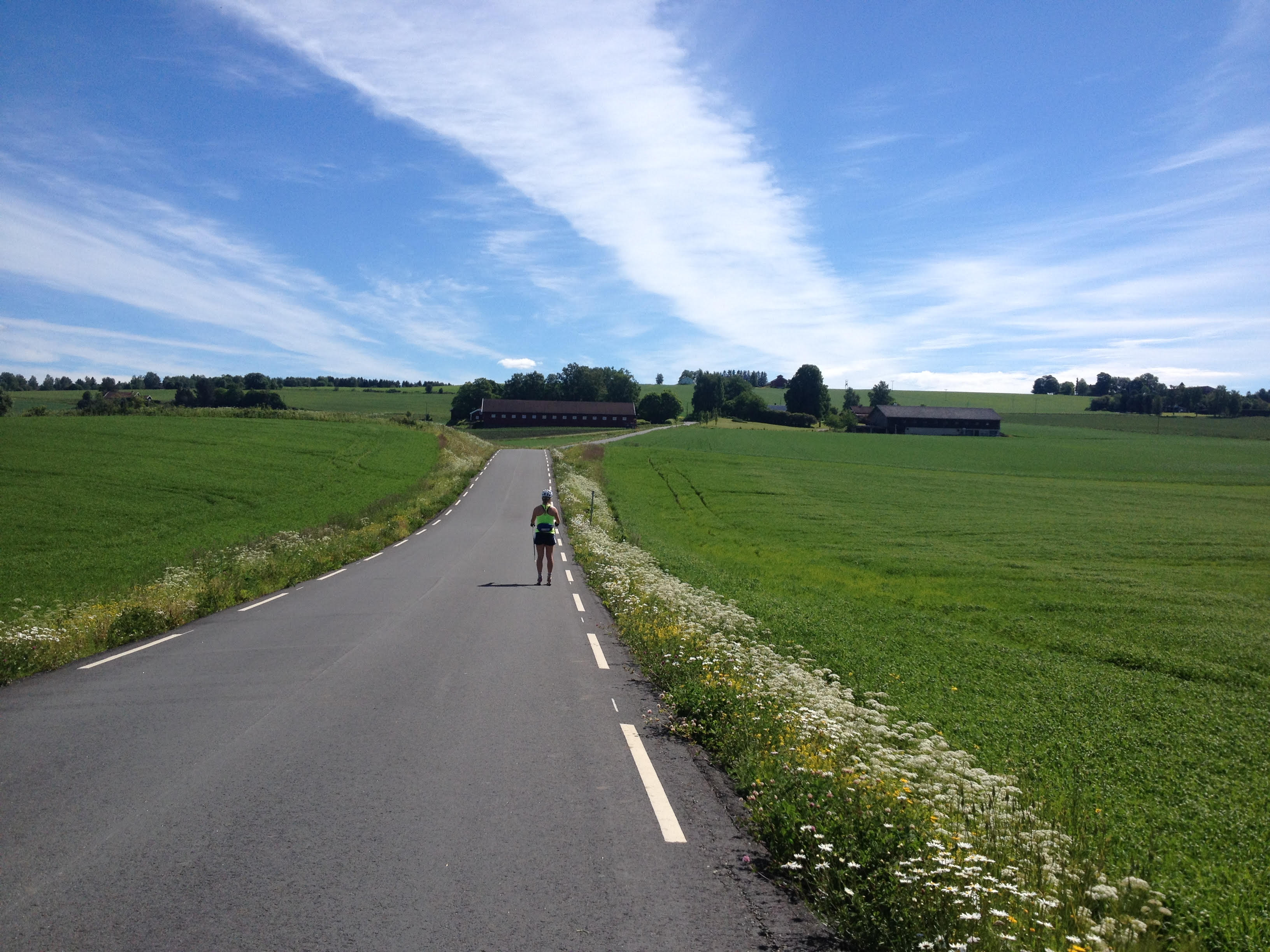
Rollerskiing around Hamar, Norway. (Photo: Annavitte Rand)
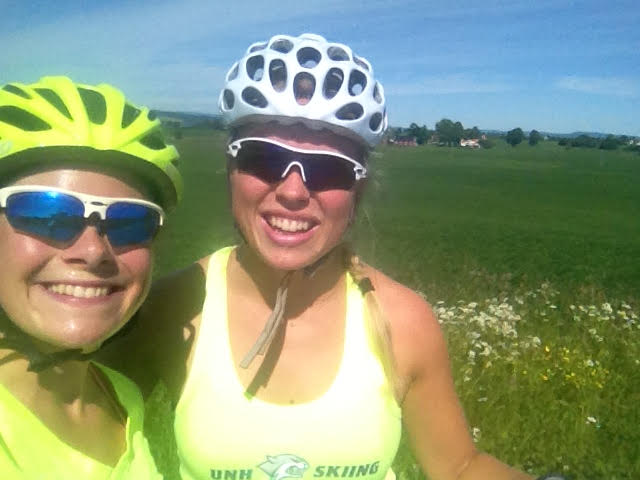
Talking about their summer plans, University of New Hampshire (UNH) skiers Annavitte Rand and Silje Wilson suddenly had what they called a crazy idea.
Wilson hails from Hamar, Norway, and Rand from Vermont. They both wanted something new out of this summer: Wilson wanted to train with other college skiers (and not just Norwegian club teammates), and Rand wanted to go somewhere new.
“Given that this is the summer before my senior year, I knew I wanted to make ski training with other racers a big focus in hopes of reaching some new goals during my final year at UNH,” Rand wrote in an email. “I was considering heading west after hearing great things about Bend and Sun Valley from friends and my cousin (a UVM skier). Silje and I had chatted a bit… and then we had a crazy idea of me going to Norway to live in Hamar with her and train together!”
And so she did. The pair have been palling around not only Hamar, but plenty of other places, too.
Silje Wilson en route to a win in the sprint at UVM Carnival this winter. (Courtesy photo)
“I’m so lucky to have one of my American teammates here, Annavitte, to train with and to explore Norway,” Wilson wrote in an email.
As with most training trips to new places, it’s not all about training. Rand took several weeks to go hiking with her sister, and is also considering the general lifestyle in Norway as she contemplates graduate school programs.
“Navigating unfamiliar roads and trying to integrate into a new culture while only having a few people I know in town has been awesome,” Rand said.
Rand is a former top-10 finisher at USSA Junior Nationals who had trained with the Green Mountain Valley School before heading to UNH, where she represented the Wildcats at four carnivals this season.
Wilson finished fourth in the 5 k classic at Dartmouth Carnival this season and anchored the winning 3 x 5 k relay the same weekend. She also won the sprint at the UVM Carnival – a non-NCAA qualifying event – and placed fourth in the 10 k classic there. Wilson was a member of UNH’s NCAA Championships team, which finished ninth.
Wilson and Rand answered a few questions about what it’s like to train in Hamar, just south of Lillehammer, during the summer. The following interviews have been edited and condensed.
FasterSkier: Silje, Where are you based this summer, what part of Norway? Is this the same area you grew up in, or is your training base away from your family home?
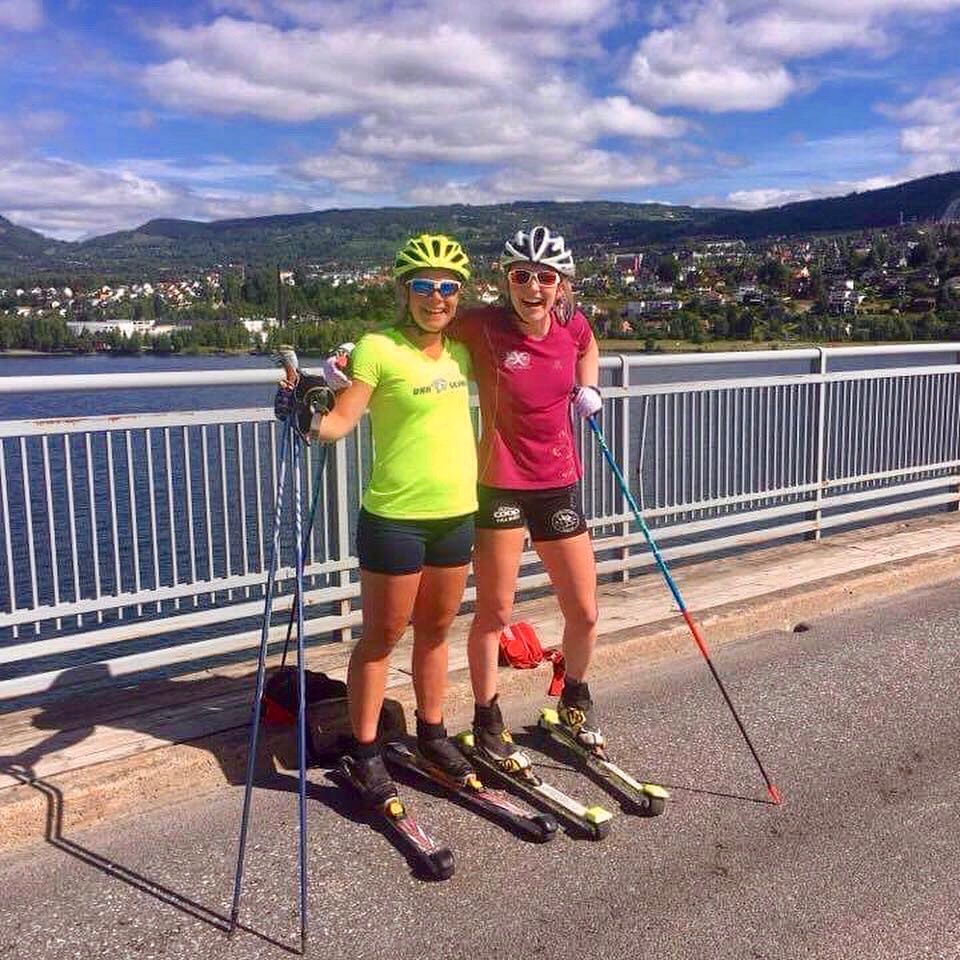
Annavitte Rand (left) and Silje Wilson out for a rollerski. (Photo: Annavitte Rand)
Silje Wilson: I am based in Hamar, which is 50 minutes by car from Lillehammer, and 90 minutes by car from Oslo. I grew up in Hamar, so it is very nice to train in a familiar area.
FS: For Americans who maybe only saw Oslo or Lillehammer on TV when watching World Cup races, what is your part of Norway like?
SW: Hamar is very much like Lillehammer. Parts of the Winter Olympics were held in Hamar, for example ice skating in the Vikingship (a huge athletic building that resembles a Viking ship lying upside down). Hamar has lots of farms, fields, a cute but small downtown, and Hamar lies by Norway’s largest lake, Mjøsa.
FS: Do you have a team that you are training with, or are most of your training sessions alone? How well do you know the other athletes and are they at a similar level to you?
SW: As I am the only senior women still competing and skiing on a high level here in Hamar, most of my workouts are by my self or with younger skiers. There are a couple senior boys here, but their level is pretty high, so I am closer to the 16-18 years old girls’ level. This summer I am lucky to have Annavitte here to train with.
Annavitte Rand (left) and Annika Taylor rollerskiing outside of Lillehammer. (Photo: Annavitte Rand)
Annavitte Rand: So far I have not trained with a specific group here in Hamar, though I am hoping to maybe join Silje’s ski club for some workouts in the future. Mostly I have been training with Silje or by myself (Silje has been a little sick these past few weeks). I actually just got back from a few days in Lillehammer training with former UNH teammate Annika Taylor [ed note: Taylor is now racing for Great Britain and based in Lillehammer]. In comparison to back home, I definitely feel there is more timidness in meeting new people here, so I can imagine that integrating into a new group may be a bit more difficult if I had no previous connections.
FS: How do you design your training – is it based on a plan from Cory at UNH? Are you adapting it at all to be able to match with other people/groups you might have opportunities to join?
SW: For the most part I follow the UNH ski team’s summer training plan, but I make some adjustments to make the training fit with how I feel and other summer plans.
AR: I have been following Cory Schwartz’s plan for the most part, though when I was in Lillehammer training with Annika, I joined her workouts. I think it may be hard for me to compare summer training groups, as I have never really been part of a bigger training group during the summer months.
FS: What’s different between American training and Norwegian training – or just between more “junior” and “senior” level training?
The Olympic ski jumps in Lillehammer, Norway. The region is a hub for elite competitors. (Photo: Annavitte Rand)
AR: I have noticed there is more focus on doing speeds during medium distance workouts. Just in the four days of training I had with Annika, two of our rollerskis included short speed work. And it is very focused speed work, not just a few 10-second pieces here and there. We analyzed how we felt with our technique after each speed. We have done some speedwork during the fall at UNH, but not in this same format, so I am excited to bring this back to the team.
FS: What’s the hardest workout you have done so far this summer?
SW: The hardest workout I’ve done so far this summer is running intervals up the steepest hill in Hamar that we call “Hell hill” among us skiers in the area (hælvetesbakken in Norwegian). It is so steep that it is hard to even walk/jog up the last and steepest part.
FS: Are there any absolute favorite places to run or bike or rollerski? Where were you most excited to show Annavitte?
SW: I was most excited to show Annavitte the beautiful rollerskiing around Furnes and Stange. The asphalt is great, the view over the lake Mjøsa is beautiful, and the peaceful farms and fields everywhere makes the long skis go by so fast.
AR: Yes, one of my favorite training sessions was a long rollerski with Silje from Hamar towards a town called Stange. We did a big loop that took us through many farm fields and along the large lake Mjøsa. It was a super sunny day and the pavement was perfect. It was really nice to stride out, work on technique, take in the views, and explore a surrounding area! Felt like a summer equivalent of an extra-blue day back home!
FS: More generally, how to the training opportunities in Hamar compare to New England?
AR: There definitely seem to be more ski focused training areas here because this sport is so popular in the region. One large racing venue is just a short drive from Hamar, and in the summer it is a great spot for mountain biking, bounding, and running in the bog. While in Lillehammer, I saw so many people rollerskiing each day, most of them on the roads leading to the rollerski track. I have heard of several rollerski races that happened this summer in other parts of the country, and it seems that many people go to ski on Sognefjellet during May and June, and maybe even now! So definitely more training opportunities overall, but I think that is mainly due to the fact that the nordic racing community is significantly larger here than in New England. And because so many professionals in the sport are training in this area – we saw Martin Sundby and his family at the rollerski track the other day! So awesome!
FS: Silje, what do you do when you are not training? Do you need to have a job?
SW: I did two summer classes online this summer. My plan was to get ahead by getting some discovery classes done. I will also work as a ski coach at Hamar Summer Ski Camp, and after that I will be a camp leader at a mountain camp for children.
FS: Annavitte, what about you? How are you funding this trip?
AR: In the first month of summer before I came here, I was lucky enough to continue work for a local photographer. Helping shoot at a wedding and assistant editing during that month has definitely helped fund this trip. But overall, it is important to be frugal and just take in all that is around you. We have been training out of Silje’s backdoor, using longer workouts on rollerskis and bike to explore the surrounding area, and then taking walks downtown after training to get to know Hamar.
FS: Norway is expensive.
AR: So much of training and traveling in a new place does not need to require big expenses. Food is quite expensive here though. It has been very special to enjoy several traditional meals with Silje’s family. But it is very possible to still eat healthy meals for less. A few items I have been feasting on include Wasa cracker bread, oats and some simpler muesli mixes, and something called Stabur-Makrell (mackerel fillet in tomato sauce). These are all quite inexpensive. Also, there are often student discounts on many activities and transportations. I think student train tickets are about 2/3 of the regular price.
A scene from Helgøya, Norway. (Photo: Annavitte Rand)
FS: What is the best part of Norwegian summer, aside from training?
SW: I love the long daylight. It never gets totally dark at night during the summer here in Norway. I also love going out on boat trips at both Mjøsa and the beautiful fjords south in Norway.
AR: One afternoon last week Silje had a friend visiting, and the three of us took their motor boat across the lake to and island called Helgøya. At the southern tip is a beautiful old farmstead and small cafe. It is a really special place! There was beautiful afternoon light across the fields, and we walked around for a bit before setting up a game called “kubb” on a small lawn. I think it is an old viking game, and though rudimentary, it is great entertainment!
FS: Silje, Annavitte has been to Norway now – do you plan to spend a summer training in the U.S. at any time?
SW: I would love to stay in the states one summer to train with U.S. skiers. I have many great teammates at UNH who live out west, and I am very curious to explore that part of the U.S.!
Annika Taylor, formerly of UNH, on her way to winning the women’s 5 k at the 2013 Snowshoe Thompson Classic at the Auburn Ski Club in Truckee, Calif. (Photo: Mark Nadell/macbethgraphics.com)
Although much of the focus of World Cup racing is on the stars from powerhouse skiing countries, the World Cup fields are filled with skiers who are working towards goals that don’t necessarily entail a podium. Racing on the World Cup is not always about the pursuit of medals but the experience itself.
For Annika Taylor, the World Cup experience hasn’t quite sunk in yet. Just six months after graduating from University of New Hampshire (UNH), Taylor, 22, found herself on the starting line of her first World Cup race in Kuusamo, Finland, in late November as the sole female representative of Great Britain.
A native of Truckee, Calif., Taylor holds dual British citizenship as her father is originally from the United Kingdom (her family now lives in Truckee). As a junior, she skied for California’s Auburn Ski Club and the Far West Ski Association, winning three California State Championships and notching three top-10 finishes at Junior Nationals. Taylor continued her ski career at UNH in Durham, N.H., under the guidance of head coach Cory Schwartz.
Annika’s first taste of international racing came in 2014 when she raced with the British national team at U23 World Championships in Val di Fiemme, Italy. Although she had inklings of future opportunities to race for Great Britain at that time, she realized she would need to continue to see improvement to make competing post-collegiately worthwhile.
These gains were realized in a breakthrough season her senior year, highlighted by a seventh-place finish in the 15 k classic at 2015 NCAA Skiing Championships. Earlier last season, she placed ninth in the 20 k classic mass start at U.S. nationals.
Upon graduating in the spring of 2015, Taylor was armed with both a chemistry degree, and the opportunity to continue skiing for Great Britain. Racing for the British team would mean more international competition and the chance to compete with the best skiers in the world on the World Cup — an opportunity she couldn’t pass up.
In May, Taylor joined the newly established Sugar Bowl Academy Elite Team based out of the Truckee/Tahoe region. The 2015/2016 season is the team’s debut as it aims to fill the gap left by the recently dissolved Far West Elite team and provide financial support, coaching, and training opportunities to its athletes.
After a summer training with the Sugar Bowl Elite Team as well as the British team in Scotland, Taylor started her first World Cup season in November with British Cross Country Head Coach Roy Young. Britain’s other female skiers opted not to race in Period 1 of the World Cup, leaving Taylor as the sole woman on the team. She joined a men’s contingent on the circuit, including recent World Cup bronze medalist Andrew Young.
FasterSkier caught up with Taylor about her World Cup experience over the holiday break. She spent the holidays training in Davos, Switzerland, sharing an apartment with U.S. Ski Team member Caitlin Gregg. The two met several summers ago, as Gregg visits Truckee in the summer to train at altitude and visit family.
After the holiday break, Taylor raced the first three stages of the Tour de Ski in Lenzerheide, Switzerland, before traveling to Östersund, Sweden, to compete in Scandinavian Cup races.
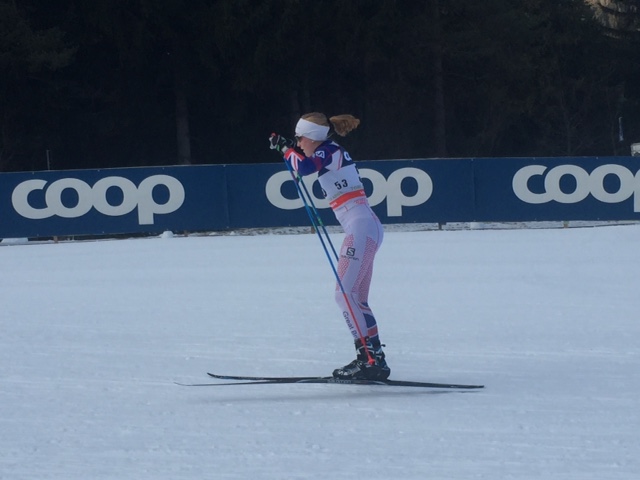
Annika Taylor racing for Great Britain in the World Cup freestyle sprint qualifier in Toblach, Italy. She placed 54th. (Courtesy photo)
FasterSkier: What is your favorite World Cup venue so far?
Annika Taylor: I really enjoyed Toblach [Italy]. They have a two-lap sprint course and I like V2 technique and I felt like it played to my strengths. And it was beautifully sunny so that always helps.
FS: What do you consider your best races so far on the World Cup?
AT: My best race was my first race: the classic sprint in Kuusamo [where she placed 50th in the qualifier]. It was best result so far and the whole experience came to fruition at that moment, too, so I’ll never forget that day. For everything to come together in the first race, I was really pleased with that.
The other races I was most pleased with were the opening races in Beitostølen, Norway. That’s where the Norwegian team started their season as well so it was World Cup caliber racing just with fewer countries. That was my very first taste of racing the best in the world so I was definitely a little star-struck that weekend.
FS:Do you prefer the sprints or the distance races?
AT: I would say distance has become my cup of tea. When I was a junior I was more of a sprinter but being at university for four years, I didn’t train much for sprinting. If I have a bit more sprint training in the next couple years I think I’ll really grow to enjoy it. Right now I do like distance racing a bit more. You can push yourself longer and harder and there is more time for tactical fixes. I like having that opportunity to turn things around.
FS: How is the intimidation factor racing the best skiers in the world?
AT: There’s definitely intimidation, but there’s also more a respect and awe for them. I am also just excited to be racing because I don’t have much pressure to perform this year. Obviously I want to ski fast, but I have to adjust to so many factors that I don’t have the energy to be nervous because I have to focus my energy on skiing the best I can technically, tactically, and physically in every race. But at the same time, there’s that moment that you think, “Woah, we are on the World Cup circuit, this is crazy.”
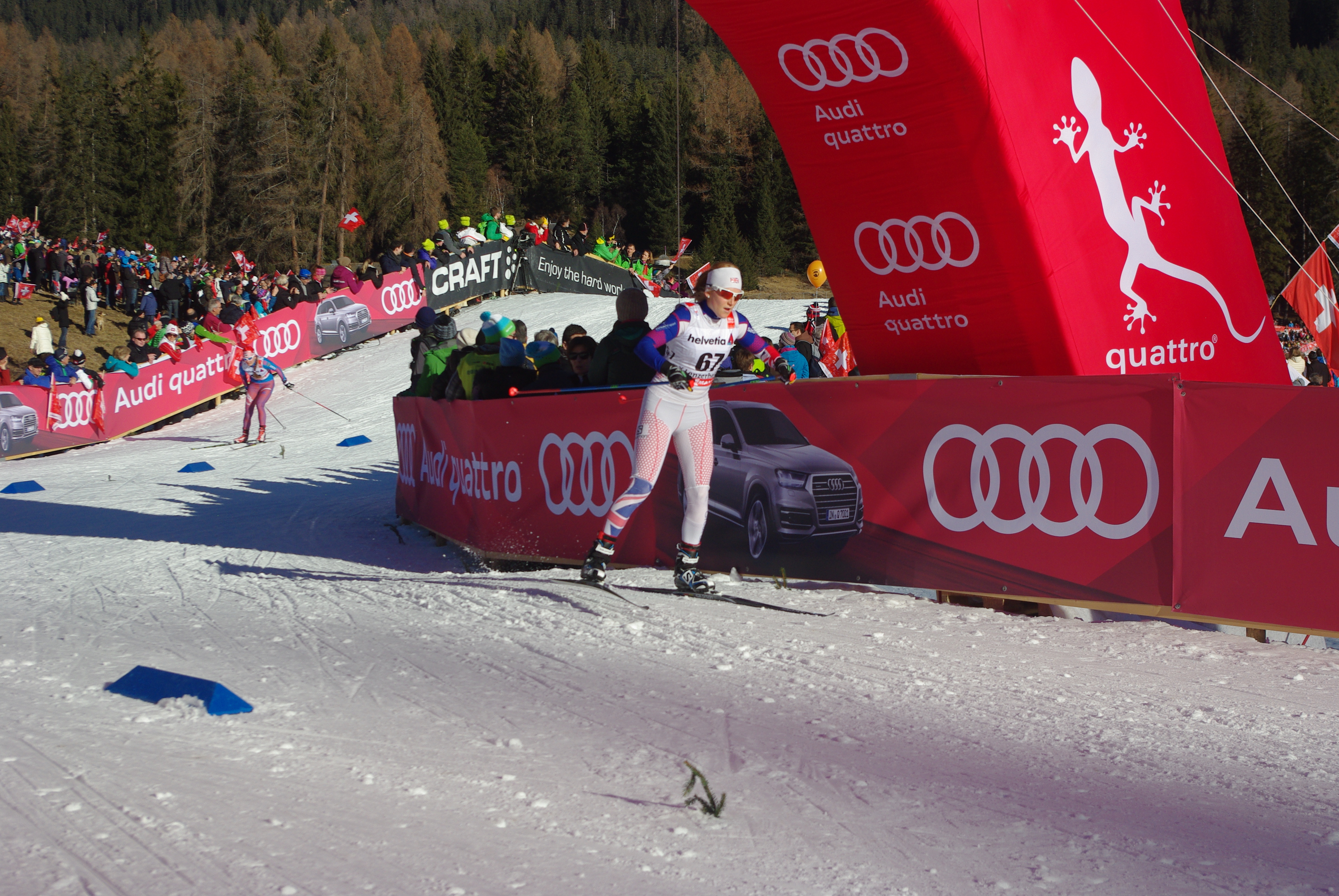
Annika Taylor (Great Britain) competed in the first three stages of the Tour de Ski In Lenzerheide, Switzerland.
FS: What was your favorite part of the Tour de Ski?
AT: My favorite part of the TDS has to have been the atmosphere and just the general excitement from both the fans and the athletes! You could sense the nervous energy bouncing around the wax cabins, and then going out to warm up on the race track with 12,000 fans (equipped with flags and cow bells) on the sprint day, with the sun shining down was a feeling I’ll never forget! Throughout the weekend fans and athletes enjoyed food vendors, opening ceremonies, performances from bands and dancers, and free swag. Cross-country skiing can feel a bit like an under-appreciated sport at times, but this was the polar opposite!
FS: What was the biggest difference racing the Scandinavian Cup races vs World Cup races?
AT: The Scandinavian cup races in Östersund were quite different from the World Cup races mainly in the sheer amount of racers competing in the Scandinavian cup (and the blisteringly cold -20 C temperatures compared with the mild temps felt at the World Cup venues recently). The level of competition is impressive in the Scandinavian cups as well, with the race leaders most likely fit enough to achieve a top-10 in a World Cup race.
FS: What race did you enjoy the most since the holiday break?
AT: I was quite pleased with how I skied the 10k freestyle race in Östersund! [She placed 21st.] Being back at low altitude made racing just that little bit “peppier,” and it was encouraging to be back in a field where I can be more competitive and “catch a ride” mid-race with the ladies racing around me.
FS: What are your goals for the season?
AT: My main goal this season is to race well at U23 Worlds because that’s where I can be the most competitive. But there are always goals week to week, even weeks I don’t have races I will focus on skiing technically well during each workout so that when my technique comes under pressure in a race, the foundation has been laid and I can ski technically well. I always have result based goals but this year is hard not really knowing what is going to happen competing against the best in the world. I can’t really measure success against them just yet.
At the Toblach 10 k classic Heidi Weng of Norway started behind me (in the interval starts) so my goal was to catch a ride with her when she passed me and match her technique, tempo and pace. The Norwegians know how to ski efficiently, ski fast and charge. That’s what I’m trying to learn this year is to find that extra level of intensity in a race necessary to do well at the World Cup level.
FS: Have you been enjoying the lifestyle?
AT: I wasn’t sure how I’d do because I chose not to go home for Christmas and I believe it will be a total of five and a half months on the road. I’m learning to be fine wherever I’m at with whomever I’m with, but also not feed into the ups and downs that go along with being an elite athlete. I’m actually addicted to the lifestyle because every weekend is a new experience. I’ve really enjoyed meeting new people and it has motivated me to learn bits of different languages.
FS: What is your schedule for the remainder of the season?
AT: Following the Scandinavian Cup, I will head to Ramsau, Austria to train for a few weeks. My next World Cup race in Lahti because Worlds will be there next year and I can get a feel for the course and the area. After that U23 Worlds in Rasnov, Romania then the day after fly out to Canadian Tour. Then I will race the Spring Series in Craftsbury, Vermont and finally home.
The scene from an Alaska Nordic Skiing State Championships mass start. In Anchorage, high-school nordic coaches recently agreed to ban fluorinated glide wax in non-championship races throughout the 2015/2016 season. (Photo: asaa.org)
Anchorage-area schools decided that it had gotten out of hand, so they called a truce.
“Anchorage region coaches agreed to not use fluorinated glide waxes during all non-championship races,” Anson Moxness, head coach at West Anchorage High School in Anchorage, Alaska, wrote in an email. “Because flouros are expensive and bad for your health. None of the schools really have adequate ventilation systems and many are doing waxing around the skiers.”
Such bans on fluorinated waxes are becoming increasingly common around the country. Moxness cited various divisions and regions around the country that had agreed to similar bans, including the Eastern Intercollegiate Ski Association (EISA).
Different coaches had different reasons for supporting the ban, but among coaches interviewed, support was unanimous:
“I am all for this for many reasons,” Cory Schwartz, head coach of the University of New Hampshire (UNH) nordic team, wrote in an email. “First is the health concerns around putting on powders — even though we all use masks and try to the best of our ability adhere to safety suggestions, none of the college teams have a ventilated wax truck. So we are using masks while ironing on and brushing but the powder gets all over the truck, our skis, and body.”
Evidence suggests that there are health risks associated with fluoro waxes. Fluorinated compounds are useful in waxes for their ability to repel water, making the skis faster. But they’re also much more expensive.
“We’re looking at an order of magnitude difference in per gram wax costs of CH and HF waxes,” Moxness wrote. “I don’t see a reason to be spending that much money on waxes for non-championship races.”
Tools of the trade: Anchorage-area high schools will have one less variable to worry about with the recent decision to ban fluorinated glide waxes for all non-championship races.
He added that the success of this rule depends on coaches’ compliance.
“If skiers choose to wax skis at home, which some of them do, we have no control over what they put on their skis. If we establish that it is cheating to use anything with fluorination and are consistent in our message, I think it will succeed,” Moxness wrote.
“Where this will fail is if the coaches aren’t fully behind the fluoro ban, which we all were at our preseason meeting. From what I’ve seen, my skiers realize what we’re doing and the reasons behind it and they respect the ban.”
“I think the success of the ban lies on the shoulders of the coaches and the parents,” South Anchorage High School Coach Sam Sterling wrote in an email. “If they advertise it as something that is good for the sport, I think it will succeed. If they give their athletes reason to doubt it … then, maybe it won’t. Hopefully, in a couple years the ban will just be a normal part of the AK high school ski scene and nobody will give it a second thought.”
Chugiak High School in nearby Eagle River is one of the schools involved in the truce. Head coach Cody Priest also supported the ban.
“Another reason it’s nice,” he wrote in an email, “is that I don’t have to ‘draw the line’ on my team on who gets what wax. With a competitive girls team I would want to use expensive wax on at least my first five, then maybe not the others. How do you explain that to the team?
“Plus on race day I wont be testing different top coats,” he continued. “I will be just ensuring that I have the correct hardness of base wax.”
The coaches contacted were also unanimous that the extra time spent testing skis with fluorinated wax was not time well spent.
“The main thing I see is that [the ban] allows the coaches to actually… coach,” Sterling explained. “The impact of the ban goes beyond the obvious benefits of decreasing exposure to fluoros and reducing overall expenses for high school programs. Each team ranges from junior national champions to foreign exchange students who have never seen snow until coming to Alaska. The more time coaches can spend working with these athletes, and not dealing with waxing, the better off the sport will be.
Sterling sees it as a simple misallocation of resources.
“There’s a lot of [coaching] experience and motivation in Alaska high school skiing,” he wrote. “It’d be great to see this resource going more to the development of the athletes, and less towards making a fast pair of skis. It’s a step in the right direction and it was great to see unanimous approval from the Region IV coaches in adopting the ban.”
Schwartz explained that in the East, there is some concern their region is falling behind others when it comes to testing wax in different snow conditions, “But I do not agree with that,” he wrote. “I actually am more excited to go to the race to see the race instead of being in a wax trailer all day.”
In addition to being better for individual families bottom lines, Sterling and Moxness explained it’s better for the sport as well.
“It also lowers barriers of entry into the sport,” Moxness wrote. “If a parent is interested in waxing their kid’s skis and they only have to invest maybe $50 in waxes to have skis that are competitive, instead of $300, they are much more likely to get and stay involved.”
“That means more growth of the sport and parents who may be more likely to invest that saved money in better quality equipment, which makes way more of a difference than wax.”
Cory Schwartz (r) is entering his 33rd year as head coach at the University of New Hampshire. (Photo: FlyingPointRoad)
When Cory Schwartz entered his final year of school at the University of New Hampshire, he had no idea that he would spend over three decades in Durham after his graduation in 1982.
The 2014/2015 season will mark Schwartz’s 33rd year with the Wildcats, where he has led his team to 24 top-ten places at the NCAA Championships as head coach.
In 1981, Schwartz was unsure where life after college would take him. In fact, he had never really considered coaching until the head coach at the time, Buzz Davis, asked him to be his assistant during his fifth year of school. Davis acted as the head of the women’s team and Schwartz did most of the heavy lifting for the men’s team.
The following year, Davis left the position and Schwartz took over as head coach. The rest is history.
Looking back at his coaching career, Schwartz, 55, says that several moments stand out to him.
One such moment is when his team earned its an all-American honor with Mike Hussey in 1985. Hussey along with several other skiers at the time helped the New Hampshire men’s program rival that of the top eastern-ski programs at the time, namely Vermont and Dartmouth.
“Those guys were competing against the powerhouse of that time which was Vermont,” Schwartz said. “The first time we beat Vermont, it was one of those special days that you remember.”
Another fond memory from his 33 years of coaching came in 2013 when senior Anya Bean earned an all-American honor at the NCAA Championships in Middlebury, Vt.
Cory Schwartz (l) and Anya Bean (r) pose with the University of New Hampshire flag. (Photo: Cory Shwartz)
While her placement was exciting for Schwartz, the moment was even more special because of the personal relationship he had developed with the New Hampshire skier. Bean, whose father had skied with Schwartz on the New Hampshire team some 30 years before, had suffered the loss of her mother the previous year.
“Just to see her finish that race and hug her dad was one of those moments that you are just going to remember for a long time,” Schwartz said.
When Bean’s mother, Jennifer Caldwell, passed away after a long battle with cancer in the winter of 2012, the UNH skiers were racing at Senior Nationals in Rumford, Maine. Schwartz drove the team down to Caldwell’s funeral to join Bean, despite the fact that they were racing the next day.
“That meant so much to me,” Bean said.
According to Bean, Schwartz creates a team dynamic that fosters growth as both a skier and as a person.
“The camaraderie that UNH establishes is unlike any other team,” she explained. “Everyone is really close and Cory does a really good job of creating that dynamic.”
Schwartz explained he likes to keep a close relationship with all his athletes and described himself as a hands-on coach. According to Schwartz, that’s what has kept him going for the past three decades.
“I think that’s what keeps me interested in coaching,” he said. “I can see that growth between myself and the athletes, whether it’s while they are on campus as an athlete or afterwards, it is fun to continue that relationship.”
He added that the uniqueness and camaraderie of the college ski community has helped make his time there incredibly rewarding.
“If you go to other athletic events, whether it is soccer lacrosse or football, I don’t think you see anything else like after a ski race,” he said. “Everyone puts on a bib and does their best job to represent their school and then afterwards it’s amazing to see the camaraderie between the teams and athletes. It’s just a fun atmosphere to be in. I think that’s what make’s all us older coaches young – we live of the energy of our skiers.”
As he gets older he knows that one day he’ll need to give the head-coaching reins to someone else, but according to Schwartz that day isn’t coming anytime soon.
“If I can continue to relate to the athletes and I can continue to enjoy the college competition atmosphere, I’ll keep on going,” he said. “Until I look in the mirror and say, ‘Hey it’s time to hand this off to someone younger.’ ”
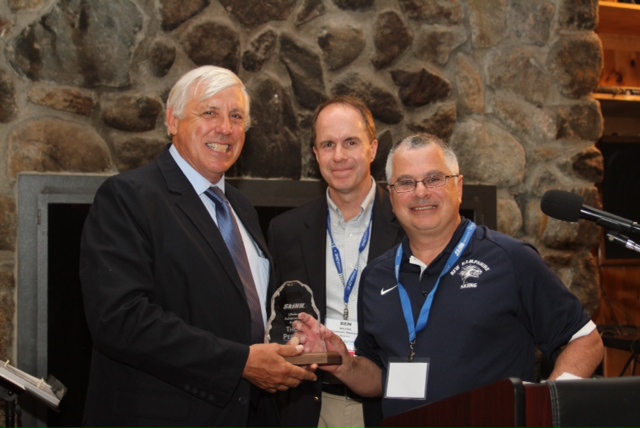
Thom Perkins of Intervale, NH, has been given the lifetime achievement award from Ski NH. The award recognized his contributions to Nordic skiing in New Hampshire. The award was presented by Cory Schwartz, the UNH Nordic Ski Team coach, and Ben Wilcox from Cranmore Mountain Resort.
As the Jackson Ski Touring Foundation Executive Director since 1976, Perkins was instrumental in transforming the village of Jackson, NH into one of the nation’s premier cross country skiing and snowshoeing venues. Passionate about the sport of Nordic skiing, Thom developed the trail system from a modest offering of trails to the present far-reaching network of 150 kilometers. Perkins’ retirement goals include increasing the number of great cross country ski facilities available to the public by using his extensive background to help small and midsized areas develop and grow through facilities design, business management and marketing. He has started a consulting company to do just that.
An active member of the cross country skiing community, a 2014 nominee to the U.S. Ski and Snowboard Hall of Fame and the 2010 winner of the Ski NH Al Merrill Award for outstanding contributions to cross country skiing, Perkins has provided training opportunities for skiers from school children, college teams, Paralympic and Junior National competitors to Olympic level athletes. During his time at Jackson, Perkins organized competitions ranging from local citizen races to World Championships. His expertise in facilities design and use was drawn on for the 2002 and 2010 Winter Olympic sites to help plan the use of the venues after the completion of their respective Olympic Games.
Cory Schwartz in his introductory remarks at the presentation ceremony spoke about one particularly challenging NCAA National Championship event when rain had washed away the snow from the competition venue, “Within minutes, Thom was developing a plan. … Ten hours later we held a national championship {at an alternative site}….something that no one else had accomplished and I am not sure if there are many people who could have.”
Thom Perkins is a founding member and Board Member Emeritus of the international trade association of Nordic ski areas – CCSAA. He was the recipient of the 2011 North American Ski Journalist Association Lifetime Achievement Award and was named one of 25 Nordic Heroes in the United States in a feature article in Cross Country Skier Magazine.
Ski NH is the statewide association representing 33 alpine and Nordic resorts and more than 200 lodging and guest service properties in New Hampshire. – See more at: http://www.skinh.com/
Middlebury Colleges assistant nordic coach and 1984 Olympian Patty Ross at her desk inside the college field house in November. Last year, the team celebrated Ross’s 25 years with the squad.
This profile is part of a ‘Where Are They Now’ series, made possible through the generous support of Fischer Sports. Learn more about their products at www.fischersports.com.
MIDDLEBURY, Vt. – Thirty-five years ago, Patty Ross couldn’t wait to leave town. Born and raised Middlebury, central Vermont’s cozy college community with a few thousand year-round residents, she grew up with everybody knowing her business, including her father – the business administrator at Middlebury College.
No way was she going to go there. Her grandfather offered her $100 to reconsider.
“I was like, ‘Gramps, you gotta up it a little bit!’ ” she recalled with a laugh. Sitting at her desk inside the Middlebury College field house, Ross, now 53, grinned about the irony of where she ended up.
One of five women to compete at the 1984 Sarajevo Olympics in nordic skiing, Ross went to the University of New Hampshire (UNH). Upon graduating in December 1982, she became a member of the U.S. Ski Team and jumped right into the World Cup circuit.
The youngest of three siblings, she was the only one that didn’t go to Middlebury. Yet one afternoon last fall, about an hour before the Panthers’ nordic team practice, there she was. In her 25th straight season as Middlebury’s assistant coach, she couldn’t get enough of that place. And she couldn’t imagine leaving, either.
With two kids of her own — Marley, who just finished up her first year at Barnard College in New York City and Bo, in the middle of his high-school years — Ross said she was perfectly content where she was. She also loved working at a college, assistant coaching cross-country running as well.
Ross at the 1984 Olympic Trials in Lake Placid, N.Y. She was sick at the time, missing the last race because of asthma, but qualified for the 1984 Sarajevo Games.
“I totally lucked into a great job that I love,” Ross said. “The love of the sport and the love of the skiers. It’s just so much fun, just to be around college skiers all the time.”
Reflecting on her career and involvement with the sport, Ross kept referring to her luck and knack for falling into things. In her eyes, timing was everything – from making the U.S. Ski Team fresh out of college, to anchoring the women’s relay at the 1984 Olympics, and later coming home to a full-time job at Middlebury.
Initially an alpine racer, Ross wasn’t interested in the cross-country skiing until her high-school coach and chemistry teacher insisted she try it.
“One practice, he said, ‘You’ve got long legs, you should try this,’ and I was like, ‘No way, that’s way too hard,’ ” Ross said. “I was into the glory and glamour of alpine skiing.”
She eventually followed the path paved by her brother, Peter, and sister, Lauren, who participated in both alpine and nordic. Once she got comfortable striding across flat ground, Ross decided cross-country wasn’t so bad and raced both disciplines in high school. On a given day, they’d have two downhill races in the morning followed by a cross-country competition in the afternoon.
Once she started college in the late ’70s, Ross committed to nordic alone, mostly relying on her natural talents and slapstick personality to carry her through.
According to current UNH head coach Cory Schwartz, one of her longtime friends and former college teammates, Ross brought fun to the team and focused more on skiing as her results improved.
“Patty is a very talented person and was good in so many things that as she learned how to harness that focus towards skiing, she became one of the best women in the country,” Schwartz wrote in an email. “She wants to be the best and enjoy what she is doing. At the same time Patty liked to question everything. This ‘rebel style’, I believe helped Patty learn what worked and what didn’t.”
The summer of her junior year, Ross learned about offseason training. Under the wing of her college and eventual U.S. Ski Team (USST) teammate, Kelly Milligan, Ross traveled to Moose, Wyo., to work at a deli and hike around Grand Teton National Park on her days off.
Milligan’s family lived close by and helped Ross find housing in the only private ranch inside the park. Ross referred to it as a dude ranch with dirt floors.
“It was awesome,” she said. “Kelly outfitted me with a bicycle so I biked to work, but we did these amazing hikes, like 17- to 23-mile hikes in the Tetons. … It was an amazing experience and sort of fooled me into training.”
After a few months of making sandwiches, Ross returned to UNH in Durham, N.H., where she found all that hiking paid off.
“I came back and did well and I was like, ‘Crap, training actually works so I’ve got to keep doing it,” she said.
On a partial athletic scholarship at UNH – with Middlebury paying half her tuition because of her father’s 37 years of employment there – Ross said she had “one or two good results” before she started training year round.
“Patty was very, very talented,” wrote Schwartz, who coached Ross her senior year as an assistant coach. “In a way that was her problem. It took her some time to figure out the training would take her to the next level and commit to the daily routine that was needed to compete with the best in the country. The training allowed her not only be faster, but it made her mentally more confident and even hungrier.”
The following summer, she returned to the Tetons, where then-USST women’s coach Peter Ashley lived in Jackson, Wyo. Not long after, the Wildcats’ team captain soared in her senior season, earning All-East collegiate honors and convincing the national team she was worthy of its ranks.
She made it and never really tried out.
Shortly after graduating college, Ross went to the 1983 World University Games in Sofia, Bulgaria, where she finished 17th in the 10 kilometer race (all classic technique back then) and 21st in the 5 k. That season, she also made her World Cup debut.
“I was in heaven,” Ross said of making the national team. “My eyes were, like, this big. It was amazing. This is funny, but getting the uniform was like, ‘All right, I’ve made it. I can die tomorrow because I’ve made it.’ ”
Ross smiled and related that to what first-year college skiers go through. At the beginning of each season, she and head coach Andrew Gardner laugh at the freshmen’s reaction to getting the Middlebury uniforms. But she knows what it feels like; it was a big deal.
A Moment in Time
Perhaps even bigger in Ross’s memory was her experience at the 1984 Olympics in Sarajevo, Yugoslavia (now Bosnia). Three weeks before, Ross qualified for the Winter Games at the U.S. Olympic Trials in Lake Placid, N.Y. Problematic asthma forced her to miss the last race, but Ross did well enough in three others to make the cut.
Before she could process what was happening, Ross and her Olympic teammates boarded a bus to Long Island, where they were completely outfitted at a large hotel. Every floor, they picked up something new – all of which was Levi Strauss – down to the underwear.
At the opening ceremony, she remembers organizers trying to usher the Americans in. They were all hanging around in cowboy boots, out of order and chatting up a storm. Every other team was arranged and ready.
“Finally we went in,” Ross said. “You’d walk through this tunnel and all of a sudden it was like, ‘Oh my God.’ I’m not a flag-waving patriotic person, but boy, right there, you’re just like, ‘I’m pretty proud.’ ”
While scanning the grandstand, she immediately spotted the parents of her teammate, Kelly Milligan.
“We thought we’d never see them, but they were there,” Ross said. “We were just like, ‘That’s unbelievable.’ ”
Once again, Ross was in the right place at the right time. Eight years later, Sarajevo fell victim to the Bosnian War for independence in 1992 and was under siege for nearly four years – the longest of any city in modern history. She saw the capital in its prime, and despite its gray decor because of burning coal, she said the people were anything but drab.
“They were so welcoming and just happy. That’s what breaks my heart now and I’ll probably start crying,” Ross said. “After that, it just went into a mess, but at the time it was such a celebration for them, at least that’s what we saw.”
1984 Olympian Patty Ross (r) in training. (Courtesy photo)
She remembered one bus driver who badly wanted to trade pins. Reaching over her office shelf, she found the one he gave her.
“He gave me this thing, a Firestone Tire [pin],” Ross said, laughing. “It ended up being my favorite pin because he was so thrilled.”
As for the races, Ross recalled her shining moment in the 4 x 5 kilometer relay. Leading up to the Games, she hadn’t felt much pressure, probably because she was so naive, she said. Her asthma morphed into full-on bronchitis in the weeks before, but despite being sick for the Olympics, she had a blast.
“Nothing could have brought me down,” she said.
Her team’s seventh-place finish in the relay was the highlight, especially with Ross as its rookie anchor.
“I was the weakest leg so they were just like, ‘If we go out hard, hopefully Patty can hang on,’ ” Ross recalled. “I was pretty nervous for that, mostly because Judy [Rabinowitz] and Lynn [Spencer-Galanes] were my heroes, my idols.”
Susan Long was also on the team, but like Ross, she was new. Rabinowitz and Spencer-Galanes had top-10 results on the World Cup.
“I was like, ‘Oh God, if I let them down, that would be bad. … I’d better go!’ ”
So she went for it, beating East Germany and coming within 10 seconds of Switzerland in sixth place.
“That was amazing; that was the best,” Ross said.
Perfect Fit
Ross laughs a lot. When she does, it’s whole hearted – her whole body moves and sometimes her eyes close. An assistant coach who has never wanted to take over the head responsibilities, she’s uncomfortable with talking about herself, but when she does, you wish she wouldn’t stop.
“The whole winter we stayed in Europe until April,” Ross said, starting into a story about the period after the Olympics.
She was sick and got sicker, but couldn’t get over how cool it was being on the World Cup. The U.S. team finished their season at the Polar Cup in northern Finland and Sweden, where some skiers first started using the skate technique.
Ross remembers being in disbelief that they skied an entire race without wax. She didn’t try it back then, but by the time she retired in 1986, skating was part of the nordic mainstream.
The equipment changed with it. Ross giggled when she recalled cutting off the ski tips and tails, and burst into laughter as she described the boots they raced in. No way could she ski in that stuff now, she said.
Going back to the 1984 Polar Cup, Ross had one heck of a story about a plane ride. All the teams traveled together to those races, similar to the U.S. version of Spring Series, but held in different countries. They took an overnight cruise ship, which Ross called a “love boat” from Helsinki to Stockholm, and shared a charted jet to Oslo, Norway.
On that flight, she asked the pilots if she could sit in the cockpit while they landed.
Ross in action (Courtesy photo)
“They said, ‘Yeah, come on in!’ and we’re in a 747 or whatever and buzzing the jumps at Holmenkollen,” Ross said. “The buzzers are going off to warn us that we’re going too close to things, and [the pilot’s] like, ‘Ah, shut up!’ ”
She watched them safely land and walked off the plane with the rest of the skiers. Two years later, Ross decided she’d reached the end of her ski career when her frequent asthma became too discouraging, ending her USST tenure the winter of ’86. She returned to Middlebury and less than a year later in the fall of 1987, she started as an assistant ski and running coach.
“I totally lucked into that,” she said. “It was full time, but I got paid $5,000 dollars for like nine months or something, but it was perfect, at the time anyway.”
The next year, the college offered Ross a true full-time position with a salary to match, and she was able to leave her job at a downtown sports store and focus solely on Middlebury’s athletes.
“I totally lucked out with all that timing,” Ross said. “I sort of lucked out all the way along.”
Terry Aldrich, the Panthers’ longtime head coach before Gardner, explained on the phone that Ross was hired to fill an open position. Before he coached Middlebury skiers for 31 years (and cross-country runners for 36), Aldrich started at UNH without any coaching experience. He remembered that when he selected Ross to help him.
“She was a former Olympian, and at the time, was one of the top female skiers in the country,” Aldrich said. “We knew her from the fact that she was a Middlebury girl, and the fact that her dad was a business manager of the college.”
Not to mention, her father was the starter for more than 40 consecutive Middlebury carnivals and events. He also helped develop the Bread Loaf Mountain Campus and Snow Bowl, the college’s cross-country ski area with 110 kilometers and 17 trails.
“Any time you have someone of Patty’s caliber come in, she brings in new ideas, new training methods, new ideas about waxing,” Aldrich continued. “That’s a good thing.”
He also stressed the value of her interpersonal skills and ability to relate with athletes of both genders. In 1985, Ross coached at the Special Olympics World Games and received a Distinguished Service award in the regional category.
She went to Italy as an assistant coach at U23/Junior World Ski Championships in 2008, and three years ago, brought the first adaptive sit-ski races the Rikert Nordic Center at Bread Loaf. The college has held such races at its annual carnival and citizen’s race every year since.
“I think Middlebury has been very fortunate, very lucky to have her,” Aldrich said. “Obviously she’s been great for the program. We’ve had some phenomenal skiers come out of the program … and that comes directly from her ability to support them.”
More Than a Coach
On the back of Ross’s office door is a life-size poster of Simi Hamilton, shirtless and jumping in a pair of jeans, with the words: “I get knocked down, but I get up again.”
Ross can’t read it all out loud without laughing. Before the current USST member and 2010 Olympian graduated Middlebury in 2009, one of Hamilton’s teammates made it as a joke, and Ross got it in a yankee swap.
“The Middlebury alums that I’ve had just make me very proud,” she said.
Photos like Hamilton’s and the framed ones that occupy her shelves are a tribute to the people she’s coached over the years. Upon listing some of them – including Vancouver Olympian Garrott Kuzzy, Bill Koch League directors Barney Hodges and John Ogden, and several coaches in Matt Whitcomb, Justin Beckwith, Kate Barton, Tim Weston and Chris “Flash” Clark – she didn’t want to leave anyone out.
She was proud of them all, many of which are still involved in skiing.
“That’s the beauty of the sport, you can do it forever in so many different forms,” she said. “It’s not just racing, there’s just so many ways to stay involved.”
The accomplishments of athletes like those also help prove what she and Gardner tried to tell prospective college skiers: You can go to school and become a high-level competitor. She did.
“There’s always been a controversy about college and ski racing, should you go to college or just focus on racing? Obviously, it’s very possible to go to college and be a good ski racer,” Ross said.
Patty Ross (l) during a pre-workout meeting with Middlebury College Nordic Team last November.
A few minutes before practice, Gardner walked into Ross’s always-open office and said they’d be explaining Middlebury’s J-term option – a semester’s worth of courses in one month – before heading out for a rollerski.
Mostly in charge of the team’s administrative duties, such as accommodating 25 skiers on a trip to West Yellowstone, Mont., Ross also drives the van and meets with athletes on a regular basis.
“As a person, Patty is pretty amazing,” Gardner said. “She’s one of the most honest, principle, kind people. … I’ve learned a ton from her.”
When he became head coach nearly seven years ago, Gardner said he wasn’t given an option of choosing an assistant. Ross came with the job, and he was fine with that.
“It was a big cultural shift for the program because Terry had driven the van for 31 years,” Gardner said. “There were elements of the transition made easier by having Patty there.”
To this day, said he writes the training plans, but lets Ross see them before moving forward. He values her input, especially in adding strength and complementary work, and knows she’s in tune with external factors that might affect an athlete.
“If a kid wants to sit down with her and talk about anything, she’s seen it all and been through that,” he said.
And when she does speak up in front people, they listen. Gardner enjoys watching her work at team races, inspecting skis and making keen observations about the day. He often wonders what she’s thinking.
In the lower-stress moments, which are common around Ross, she’s the one handing out packs of Bubblicious after a hard workout or at the top of a tough climb.
“Patty came into my office today and she had a mailman-revolving light to put on the van,” Gardner said. “In a sport we take so seriously, she understands how to find that fun, which is really great.”
Enjoying Every Minute
Last winter, the Middlebury nordic team – one of the largest in years – celebrated Ross and her 25 years of service with a collection of old photos and quotes.
She can’t believe how much time has gone by and doesn’t see it ending too soon.
“It’s funny, before I took this job I didn’t do anything in my life for more than a couple of years at a time,” she said. “I feel sort of bad for saying I don’t have any huge aspirations or anything. I just love it. … No matter if you’re having the worst day ever, when you go to practice everything gets better.”
She also can’t complain about the schedule. With summers off, she can spend time with her own kids and younger ones in need through Respite care, a short-term relief program for parents and foster parents. Last fall, Ross had a short list of children she took in regularly for overnights, weekends or sometimes just a few hours. She discovered the volunteer opportunity two years ago on a day off from practice.
“Everything got me like that,” she said. “The timing when I graduated college, I made the U.S. Ski Team. I never had those in between years like kids have now, like, ‘Where do I go? Who’s going to support me?’ Everything, the timing has been lucky.”
When she was in doubt after she stopped racing in ’86, Ross headed west to California for vacation. There, she let a friend talk her into buying a motorcycle. A few months later, she rode it to Mexico to get a leather jacket, up to Bend, Ore., for a training camp and then back across the country.
Ross sporting her Yamaha 650 motorcycle. (Photo courtesy of Andrew Gardner)
“I had short hair at the time so I think most people thought I was a guy, so that was sort of my protection,” she said.
To keep people guessing, she wouldn’t take her helmet off. At one truck stop, she had to remove it while paying inside and several men immediately swiveled on their stools to look at her.
“One guy goes, ‘It’s a chick!’ and I’m like, ‘Yep,’ ” Ross said. “But it was the best thing. [Riding across the country] was definitely the best therapy ever for just moving on.”
She later sold the bike when she had kids, but rekindled her two-wheeled fire two years ago, buying a Yamaha 650 on impulse while driving through Rutland, Vt.
“I love it,” she said.
It’s also something she can do with Gardner – a road cyclist – in their spare time.
“Last year, he did a workout and he was drafting behind my motorcycle. I had to go a certain speed,” Ross said, laughing as she remembered the sight. “I just don’t grow up. I think it’s partly this job.”
DURHAM, N.H. – University of New Hampshire ski program coordinator/Nordic head coach Cory Schwartz (’82) recently announced the establishment of the UNH Nordic Ski Team Scholarship Fund by Peter Chudy, II (’87) and paid tribute to Nelson Bennett (’40) for his contributions to the ski program and to his country during World War II.
The announcements were made during a gathering of ski team members, alumni, the Friends of UNH Skiing and Ski New Hampshire at the Whittemore Center Skybox Lounge on Nov. 4.
Bennett was a member of the elite 10th Mountain Infantry Division, which was a specialized ski infantry that was sent into critical battles in the Italian Alps and northern Apennines during World War II. Bennett traveled from Yakima, Wash., to take part in the celebration.
“This was a special night to celebrate the past and contributions by Mr. Bennett and other New Hampshire skiers in the 10th Mountain Division,” Schwartz said. “Likewise, the UNH Nordic Team Scholarship Fund will helps us in the future and enable us to recruit the top cross-country skiers to New Hampshire, as we strive to achieve a top 5 finish and eventual NCAA championship.”
Please contact Brenda Holt-Mullaney, Associate Director, Athletics Major Gifts at (603) 862-3942 or brenda.mullaney@unh.edu for more information about ways to support the UNH Skiing program.
The 2012 UNH ski season begins at the Bates Winter Carnival on Jan. 20, with alpine races originating from Sunday River and Nordic racing taking place at Black Mountain. For more information, visit www.unhwildcats.com or www.unhskiing.com.
FasterSkier had the chance to catch up with Corey Schwartz, Head Ski Coach of University of New Hampshire (UNH) to get some of his thoughts on skiing. Schwartz has been the head director of the UNH ski program for 25 years, during which he has mentored 27 student-athletes to 37 All-American team selections.
Corey Schwartz, Head Ski Coach at UNH
He himself skied as a Wildcat for three NCAA Championship teams, and as coach served for both the Eastern USSA Sr. Committee and Chairman of the NCAA Committee. Schwartz is a Level II Certified Coach and has been named Coach of the Year by the Eastern Intercollegiate Skiing Association four times.
FasterSkier: It seems that you went from a Wildcat skier to a UNH coach pretty quickly. What prompted your decision to stay at UNH and how has it been?
Cory Schwartz: It was my 5th year here – I had an internship at UNH when Buzz Davis [my college coach] asked me to help out with the men’s ski team. Back then, men’s and women’s programs were split, and I was asked to be on staff for the men’s side. I got involved because it was my goal to possibly keep ski racing. Paul Burton and Buzz then left soon after, so before I knew it, I liked what I was doing. You get rewarded with seeing your athletes grow over time, who they become. It also gives me time to tweak the men’s program.
FS: What are some of the biggest challenges your athletes face? They are making a big step/transition on deciding to compete on the NCAA level- how do they deal with that?
CS: I do not view it as a challenge, but more as the next step in progress. They have already made the step to become a student-athlete in high school. At home, you have parents to remind you about your training hours, your homework time, your engagements and appointments. When they leave the house and keep that student-athlete set up, they have made that decision. That’s their biggest challenge, of realizing their day-to-day decisions are important. If they decide to go out, that is their decision on how it impacts their training. They are adults now, and are expected to make adult decisions
FS: You have had some impressive skiers continue on after college- Patrick Weaver and Marcus Nash as Olympians, and most recently Dylan McGuffin of the Craftsbury Green Racing Project. How was it building those athletes to pursue professional skiing- what discussions did you have with them?
Dylan McGuffin of UNH finishing first in his first carnival win in 2010 at Lake Placid
CS: We have quite a number of Olympians come through UNH. Patty Ross [Middlebury Assistant Coach] and Marty Hall [former Bowdoin Head Coach] are two that came through our ski program. Robel Teklemariam was also one, although he was unique since he was the only non-American to compete in the Olympics [for Ethiopia]. I have had very good relationships with my alumni, and after 20 years it’s been very rewarding. Soon I’m going to visit two alumni that just had a baby. It was certainly harder in the 80’s with zero technology advantages in networking. Now there’s Facebook, Twitter and cell phones that can help keep track of people.
Anyone would think it’s no different to race professionally compared to then and now. During Pat’s era, he did not have it as easy. He didn’t have today’s opportunities of clubs, teams- he had his friends and family for support and that was about it. He would call me for help, and he even worked as an unofficial assistant coach- he would do training camps with us, come meet the team at race venues, all while trying to make the Olympics. That was nice, because Pat received so much as a UNH skier, and he was already giving back to the program. Dylan on the other hand has teammates and coaching, and full support essentially [from Craftsbury]. Pat on the other hand would pay out of his own pocket if he had to race in West Yellowstone- and to make the Olympic team, he had to. Compared to what Pat had to do to continue skiing, it’s like day and night.
Patrick Weaver racing at Hanover, NH in 2009 for the Salomon Factory Team
The best that I could do for Pat is to call his house and remind him that it’s a long road. The other thing is sometime after Pat in the late 80’s, NH Skiing and UNH created Friends of New Hampshire Skiing, a fund specifically for athletes pursuing that goal of post-collegiate skiing. Pat, Dylan and Mike [Cremeno from the alpine team] can all request some funds when they travel to help cover expenses. The biggest thing that [we coaches] can do to prepare skiers for that post-college gap is to help them grow in college. Particularly with Pat, it was not like I could call his cell phone or e-mail him.
FS: How do you approach training with your skiers? It’s a big question, but are there certain aspects that you emphasize to your athletes in your overall philosophy?
CS: That’s definitely a big question. The best thing that any coach can do is to press for consistency for a full year. The second item of importance is on summer training. That is biggest increase in a skier’s training hours. You can come to practice during the school year and get it done with your team, but it’s also really important what you’re doing when no one is watching. What we have learned adapted for training is how we do ‘focus’. If it’s a volume week, we will do less intensity and up the hours; if its intensity, we get the sessions done. Back in the 80’s we would get our 4×4 workout in for the day, but also try to throw in an extra hour for distance. Now when we do speed sessions with our athletes, we do not tell them to go ski for two hours after that. It’s a day by day task, but we have learned how to improve that weekly focus. Again, with current day technology, we also have more resources- Professor Dain Roche used to ski for UNH, and now offers some valuable knowledge. We are always tweaking our program, seeing results and getting feedback from our skiers- how training feels for them, working with academics on top.
FS: Thanks for your time! Good luck to your team this season.
DURHAM, N.H. – The University of New Hampshire ski program has announced that a new scholarship has been established in recognition of former UNH ski coach Paul Berton, commemorating his 33 years of service to the University’s ski program. The Paul E. Berton Scholarship Fund was created to provide meritorious scholarship support to members of the UNH men’s ski team.
The Paul E. Berton Scholarship Fund honors coach Berton’s commitment and dedication to the UNH ski team and his contributions to the sport of skiing in the state of New Hampshire and beyond. Berton served as the coach of the UNH ski team from 1976-90. Berton, hired by Director of Athletics Andy Mooradian after graduating from Plymouth State College with a degree in physical education, went on to oversee the alpine, jumping and Nordic teams in the early part of his career and later led the men’s and women’s alpine teams. Berton coached 12 All-Americans, eight UNH Hall of Famers, seven U.S. Ski Team members, three Olympians and a national champion. Coach Berton has also raised the profile of UNH skiing, especially during the four years the University hosted the NCAA Skiing Championships (1984, 92, 95, 2008) and the three years he served as the alpine “Chief of Race.”
“Paul Berton is the reason for our current success,” UNH ski coordinator and Nordic head coach Cory Schwartz said. “He stabilized the team in the late 70s and, through his leadership, grew the team into a Top-10 national contender. We are very proud that the alumni have honored Paul with the naming of his endowment fund that will allow us to recruit athletes who hopefully will help us meet our goal of moving UNH into the Top-5 nationally. I was proud to ski for Paul and to work beside him, and I cannot wait to award the first recipient of the scholarship in his honor.”
Coach Berton is an active member of the Friends of UNH Skiing Board of Directors. Since 1992, he has served as the chair of the Friends of Ski NH. He was also instrumental in establishing the UNH ski team’s endowment fund in partnership with the N.H. Ski Operators Association.
The Paul E. Berton Scholarship Fund was established by former UNH skier John LoMedico (’80), his wife Lisa, former UNH skier Gordy Hall (’79) and his wife Linda. The announcement was made Nov. 12 during a gathering of more than 80 UNH skiing alumni and friends at the Whittemore Center Skybox Lounge.
Dartmouth's Eric Packer (center) with teammates Nils Koons (right), Ben Koons (background), and Burke Mountain Academy's Sam Tarling (left), at an Eastern Cup sprint in Rumford, Maine. Photo by FlyingPointRoad.com
As a freshman at the University of Anchorage, Amy Glen skied to a fourth place finish in the skate sprint at the 2009 U.S. National Championships. She only raced two other sprint races that whole winter: one at the World Junior Championships, and the other at a local race series in Alaska.
Her story is a common one at the college level—with most programs focused on the distance races that will qualify their racers for the NCAA championships, athletes have little time to dedicate to sprint racing.
Of the three NCAA skiing conferences—the Rocky Mountain Intercollegiate Ski Association (RMISA); the Central Collegiate Ski Association (CCSA); and the Eastern Intercollegiate Ski Association (EISA)—only the EISA has a sprint event on its race calendar. There is no sprint at the NCAA Championships.
Two years ago, University of New Hampshire Coach Cory Schwartz brought a proposal to the NCAA skiing committee to bring sprinting to the collegiate championships once every other year. That proposal failed, and despite the discipline’s growth both domestically and internationally, Schwartz says that there hasn’t been a change in attitude among college coaches.
“I’m sort of spinning in the snow,” he said.
Embracing the sprint?
According to U.S. Sprint Coach Chris Grover, while some of the best domestic sprinters are currently attending or have graduated from college, NCAA skiers are not getting enough opportunities to focus on sprinting.
“I would love to see the NCAA skiing community embrace the sprint,” Grover said. “As long as we don’t, we’re going to be missing that key age group in terms of the development of sprint athletes.”
Right now, he continued, most of the country’s juniors and U-23 competitors aren’t getting enough experience in the event.
“Two or three chances a year is not giving you a chance to come back next year and do something better,” he said.
University of Utah Head Nordic Coach Eli Brown said that for college skiing, sprinting is a natural fit because the athletes are busy, and can still excel at sprinting on slightly less training. And, given the growth of the discipline at the elite level, he said, it makes sense.
“There are things that we can do as college coaches and programs to better develop athletes, and one of them is make our events fit what’s happening on the world scene,” Brown said.
Barriers
Schwartz said that when he presented his proposal at the NCAA skiing committee meeting, none of the three conferences supported it.
One major obstacle to adding a sprint to the NCAA championships is that in order to do so, it would most likely have to drop one of the two distance races that currently make up the event, in order to preserve the balance between alpine and nordic.
In conversations with Schwartz, Joe Haggenmiller, and Bruce Cranmer, who were representatives at the NCAA committee meeting from the EISA, CCSA, and RMISA, respectively, the coaches cited a number of other hurdles to incorporating sprinting into college competition, including team scoring, venues, and recruiting.
“At the NCAA championships, the team race is a really big factor,” said Haggenmiller, who is the head coach of the Michigan Tech University nordic ski team.
“Sprint racing can be quite a bit more unpredictable than individual starts, or even a 20 and 15k mass start,” he said. “Those events [the 20 and 15 k’s] are not going to have some really fluky results—you’re not going to have someone who’s won every race of the season break a pole and be out in 30th place.”
As for venues, Hagenmiller continued, NCAA championships are already limited to locations with both good alpine and nordic areas. If the nordic site required a good sprint course in addition to a distance course, that would further restrict the number of options.
Schwartz said that one other problem was that some colleges with limited scholarships might not want to use one for an athlete who could only be competitive in sprint races.
As opposed to the NCAA championships, the individual ski conferences could more easily incorporate a sprint race into their existing race calendars, since each one has five or six race weekends.
However, Cranmer said that since sprints at a regional meets wouldn’t count towards NCAA qualification unless the event was introduced at the NCAA championships, schools would be reluctant to travel to competitions where there was only one NCAA qualifying race.
“When schools are spending a lot of money, they want the best opportunities to qualify,” he said. “Right now we’re kind of pressed as far as budgets are concerned—we’re just hanging on.”
Cranmer said that he thinks coaches are open to the idea of scheduling more sprint races, but right now, “it’s not a priority.”
Getting creative
Brown said that those financial problems are exactly the reason that collegiate skiing should consider introducing more sprint events.
“With [University of] Nevada on the rocks, with Western State [College] getting cut last year, we’re going to be forced pretty soon here to have to be more creative,” he said. “I think sprinting is going to be one of the things that’s going to help us out.”
According to Brown, the problems of venues, team scoring, and race format are smaller issues that could be worked out by coaches and the NCAA skiing committee.
In fact, he added, sprinting actually opens up new venues, at alpine areas, which in turn creates opportunities for more programs.
“I think college skiing does have to be about fitting into the pipeline, so that we can develop athletes,” Brown said. “Therefore we need to be progressive and look at different events, and in my book sprinting fits really well.”
Schwartz said that the excitement of sprint racing would attract more fans to the sport, and that the growing importance of the discipline on the national and international level is another reason to consider adding more events.
Sprinting probably shouldn’t be an NCAA championships event every year, Schwartz added, but including it even once every three or four years would allow collegiate skiers to get more experience and improve.
Hagenmiller said that most regions already have opportunities for athletes who are interested in the discipline. He cited U.S. National Championships, Junior Olympic Qualifying Races, and the SuperTour as places where collegiate athletes could get experience.
But Mike Hinckley, who graduated from Denver University last year and placed second in the sprint at U.S. Nationals in Anchorage, said that he had only been able to enter two or three sprint races each year.
“Maybe one or two of those was against national people who were actually focused on sprinting,” he said.
Glen, fourth at the U.S. National Championships last year, said that she also was not getting enough opportunities.
“It’s definitely hard on kids who have sprinting talent…to do college skiing, especially in the west, because they don’t have any races,” she said. “It’s hard to get experience when you’re just doing those 15ks.”
Nonetheless, Glen said that she still tries to train specifically for sprinting, and that her coaches have been supportive of her preference.
Next year, Glen will be skiing for the University of Vermont in the EISA, where, she said, it will be good to have “just that one sprint.”