From the FasterSkier archive — posts syndicated from athletes’ and coaches’ own blogs between 2004 and 2012, kept online as published. Current coverage is at fasterskier.com.
In this episode, we have Matt Whitcomb back to debrief the 2021/22 Tour de Ski, including highs and lows, overcoming setbacks, and managing a circulating head cold. We also discuss the cancellation of the upcoming World Cup races in Les Rousses, FRA, covid safety in a critical window before the Olympics, and the racing happening in Soldier Hollow during the 2022 US Cross Country Championships.
Thanks for listening.
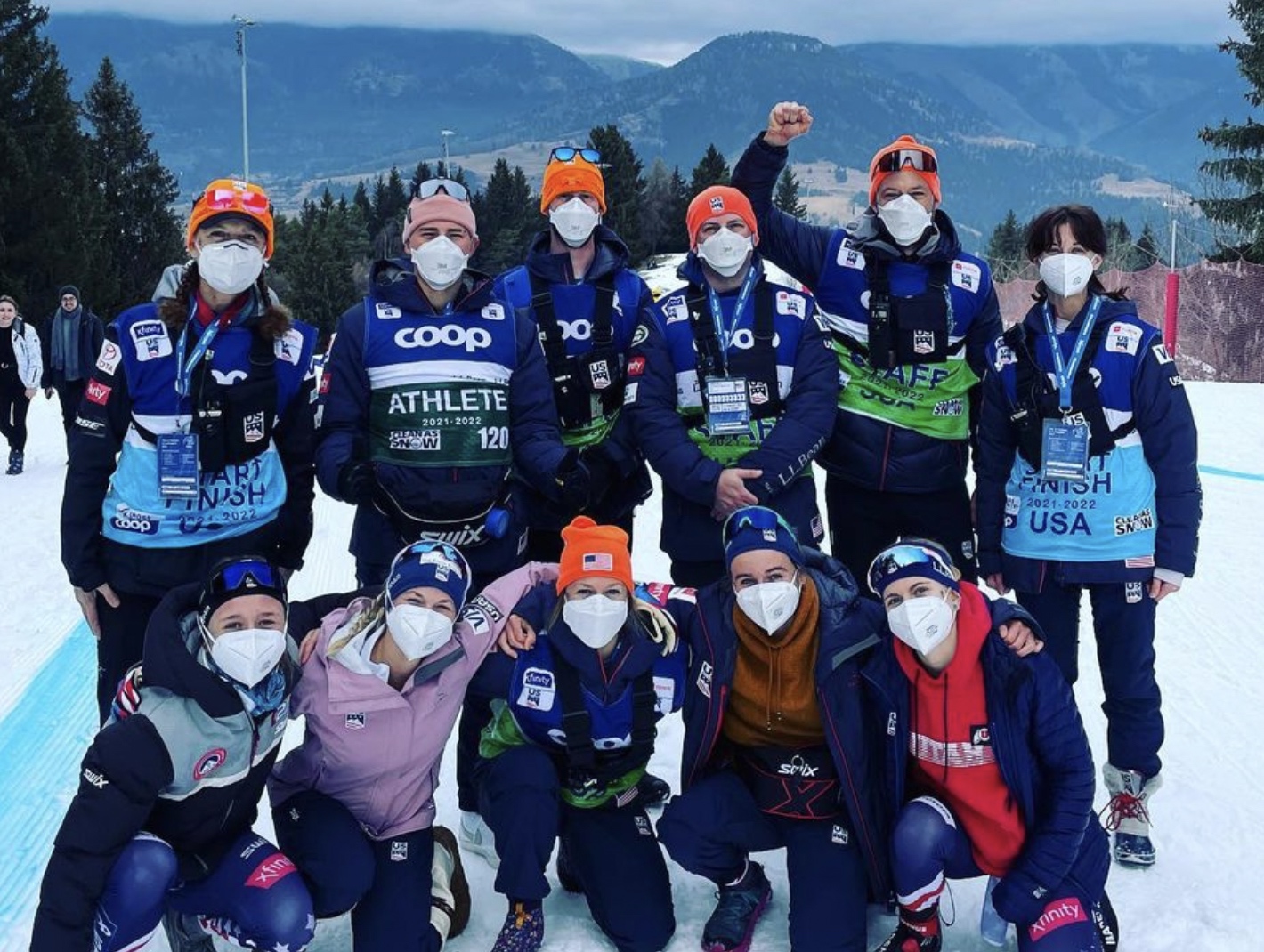
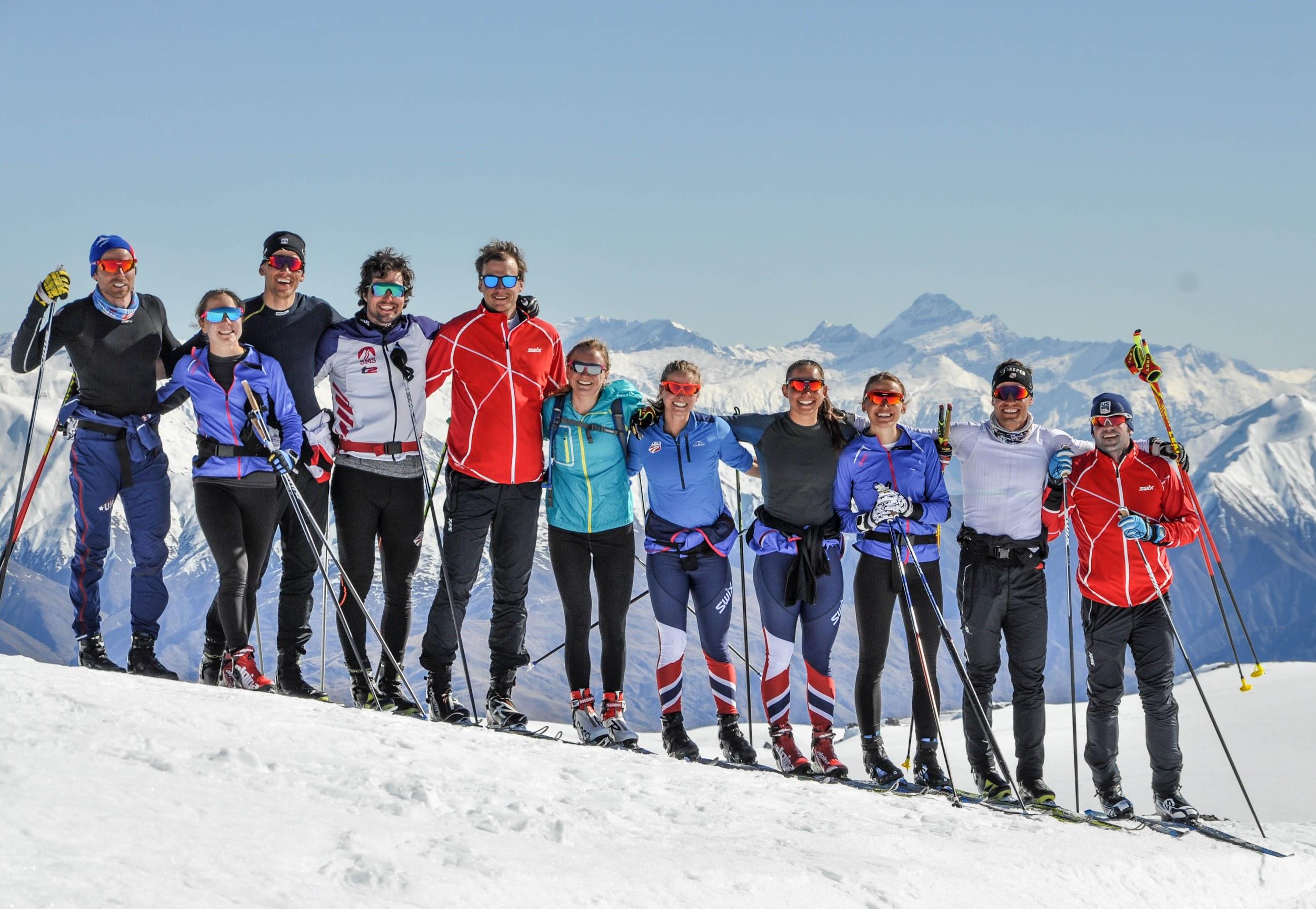
The American women who finished the 2021/22 Tour de Ski pose with coaches and support staff at the top of the Alpe Cermis. (Photo: Tom Horrocks / Instagram @jessiediggins)
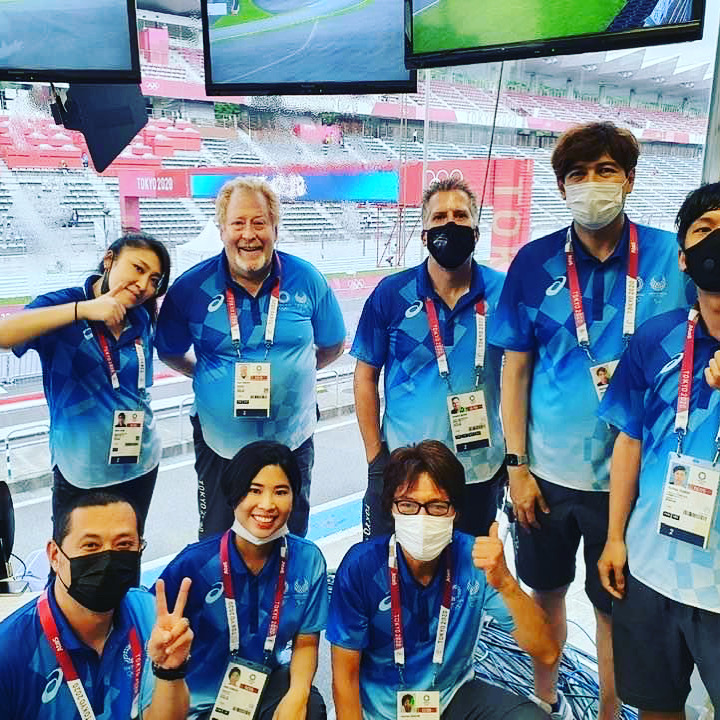
The cycling announcing/production team at the Tokyo 2020 venue near Fuji International Speedway (Courtesy photo.)
Most FasterSkier readers will be familiar with the name Peter Graves, also referred to as the voice of cross country skiing (and incidentally, the author’s uncle). This summer, Graves lent his voice to the cycling venues near Tokyo for the 2020-turned-2021 Olympic Games. For Graves, this marks his twelfth time announcing at the Games, including summer and winter appearances. Needless to say, he has a wealth of experience.
FasterSkier connected with Graves on a recent call to understand how the coronavirus pandemic may have affected this year’s games, and what insights the Tokyo Games might provide for the upcoming Winter Games in Beijing in February 2022.
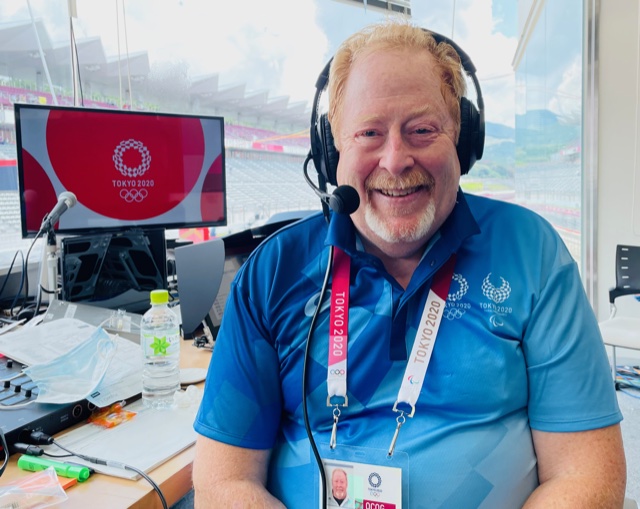
Peter Graves in the announcers booth, Tokyo 2020 (Courtesy)
Graves was quick to highlight the great announcing and production team he worked with and the graciousness of the host country, Japan. “They ran great events,” he said, “I think they did a truly remarkable job under a very difficult set of circumstances.” For context, the Tokyo Games drew roughly 11,091 athletes from 206 participating countries, and over 770,000 COVID tests were conducted from July 1st onward. Of those tests, the cumulative total of positive COVID cases (including airport tests for Games participants and Tokyo 2020 screening tests) came to 567, with three additional positives coming fourteen days after leaving Japan. Graves called this, “a very admirable record,” all things considered.
Graves was in Japan for ten days, announcing at the road and time-trial cycling events. To fans watching from home, a stark difference this year was the lack of spectators at most events. However, cycling was one of the three venues that allowed socially distanced spectating and particularly during the road race, Graves noted that there were lots of spectators along the road where he “saw a lot of joy of free people sharing the Olympic spirit.”
For Graves, this year’s games were a very different experience than past years, particularly socially. His first Olympic announcing appearance came in 1980 during the Lake Placid Winter Olympics, at the cross country skiing venue, which Graves describes as “the last of the smaller, more intimate games.” (Lake Placid at the time had a population of just 2,490.)
Reminiscing about the “joie de vivre” of the main street, which was turned into a pedestrian zone for the Games, Graves described the tradition of trading Olympic pins, another strong memory from Lake Placid and other games. “I have a collection of probably 3,000 pins from over the years and I love trading but I just didn’t see any of that [in Tokyo]” said Graves. “I brought a lot of pins to Tokyo and didn’t trade a single one because there was nobody to trade with!”
Being “in the bubble” meant that Graves and his team were tested for COVID everyday. Before departing the US, he needed two negative test results within 72 hours of departure and was tested again upon his arrival in Japan. The initial COVID testing procedures alone took six hours.
Peter Graves in the announcing booth at the conclusion of the cycling races (Courtesy photo.)
Graves was stationed at the Fuji International Speedway, about two hours from Tokyo, where the road race and time-trial events finished. Everyday the same car took the announcing team from the hotel to the venue, and everybody was masked. Their temperatures were taken daily as they entered, and they left the venue at the end of the day in the same car, with the same crew. Graves and his announcing crew were allowed approximately fifteen minutes to get their dinners to bring back to their hotel rooms. In contrast to other Olympics, there weren’t any nights of eating with friends or colleagues for Graves this time around. “The story of life in a bubble,” he said. There was virtually nobody out on the streets and while Graves said he can’t vouch for Tokyo, he thought it was the same sort of scene there.
“The Olympics are first and foremost about the athletes and their performances,” stated Graves, “[this year] gave me more respect for the athletes, most were in the Olympic village and that was quite secure as well, in terms of COVID.”
Usually, he is able to meet and interact with the athletes a bit but there was none of that this year, “I didn’t get the chance to speak to them personally or to take photos,” Graves explained. Nevertheless, he shared some personal highlights, including very tactical road races which were “fascinating.” “I enjoyed watching and commenting on them,” said Graves, “there was a vast amount of tactics, as there always is. The Tour de France had just ended the Sunday before and many of the same athletes were competing in Tokyo.”
Graves also emphasized the important messages about mental health that athletes such as Simone Biles shared. “I left with a great appreciation for people like Simone Biles who made, I think, a really important case to speak about mental health,” said Graves, “to make it okay to be truthful, to make it okay to say ‘I’m not feeling well, mentally or physically.’ I think those messages are really important cautionary tales to everyone. Those were the things I was impressed with by the athletes.”
Graves voiced his support for the Olympics going ahead, in spite of the arguments against them happening.
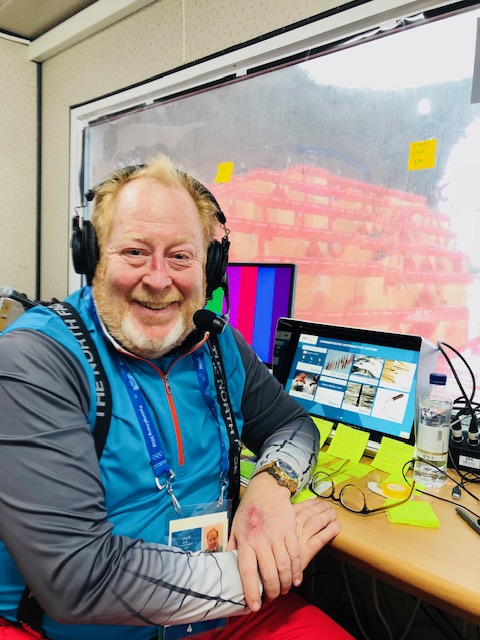
Peter Graves announcing alpine events at the 2018 Winter Olympic Games (Courtesy Photo)
“I’m glad they did the Games,” he said, “I’m well aware there were plenty of nay-sayers. It robs the athletes of an opportunity that may never come again. My hope is that the athletes found joy taking part in the Games, because the spirit is embodied by their humanity and enthusiasm. On TV, I saw countless examples of really great sportsmanship. I think the athletes should really be praised for how they managed themselves over there.”
Given the delay to the 2020 Games, we are now less than six months away from the Winter Olympics, scheduled to take place in Beijing starting February 4th, 2022. While Graves was clear that he can’t speak about Beijing per say, his experience in Tokyo may shed some light on what the upcoming Winter Games may look like. “One wonders, with the Beijing Games just six months away and the resurgence of the Delta variant globally,” pondered Graves, “I have to believe priority number one for Beijing will be keeping a good and tight bubble for those Games too.”
Original Post: Earlier today, Swedish team doctor Per Andersson announced that Linn Svahn, who won the first two stages of the 2021 Tour de Ski in Val Müstair, has tested positive for COVID-19 on an antigen test. (The antigen test is less sensitive than PCR testing.) Svahn did compete in both distance races in Toblach, though she finished well off the podium, 40th in the 10-kilometer skate and 23rd in the classic.
A champion in sprint and distance, Sweden’s Linn Svahn wins back-to-back stages of the 2021 Tour de Ski. (Photo: NordicFocus)
According to the Swedish new outlet SVT, two additional Finnish athletes were also notified after testing positive with an antigen test.
In the SVT interview, FIS Event Director and organizer of the Tour de Ski Pierre Mignerey was questioned about how these potential positive cases will be handled in terms of the impact to the remainder of the Swiss and Finnish teams and their eligibility to continue with the tour. Mignerey explained that this decision is outside of FIS jurisdiction and is left to the local and national governance.
“It is an answer for the authorities [whether the teams can continue the Tour],” Mignerey said according to translation. “I can not answer and I have no answer. There are many factors that need to be taken into account. We must leave that decision to those who have the competence, that means the doctors and the people in the authorities.”
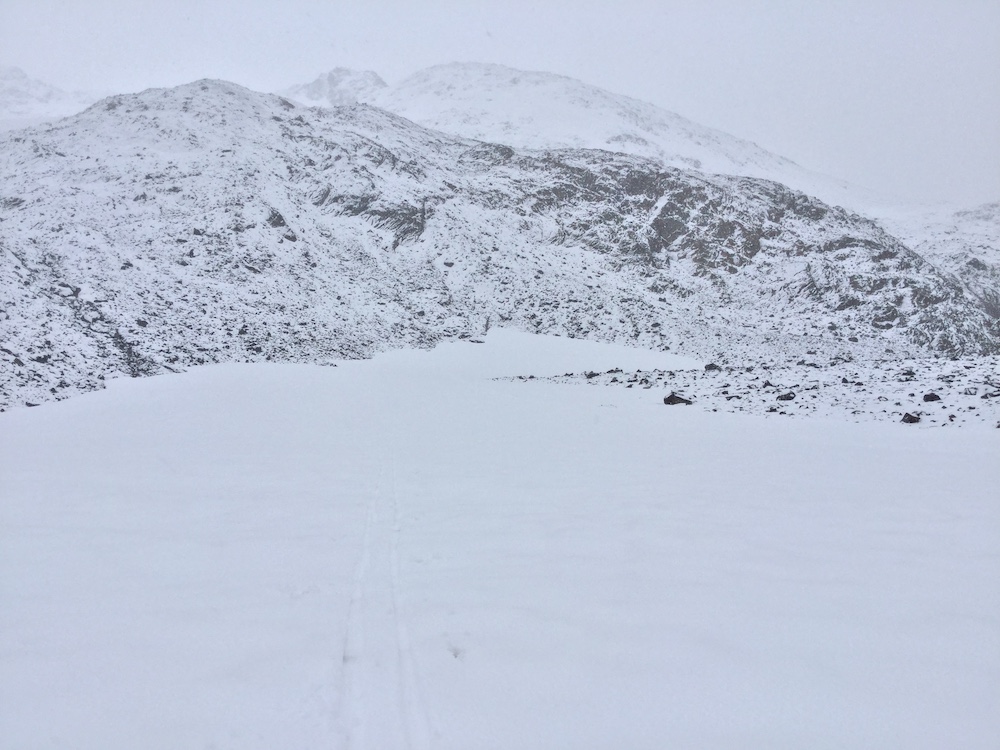
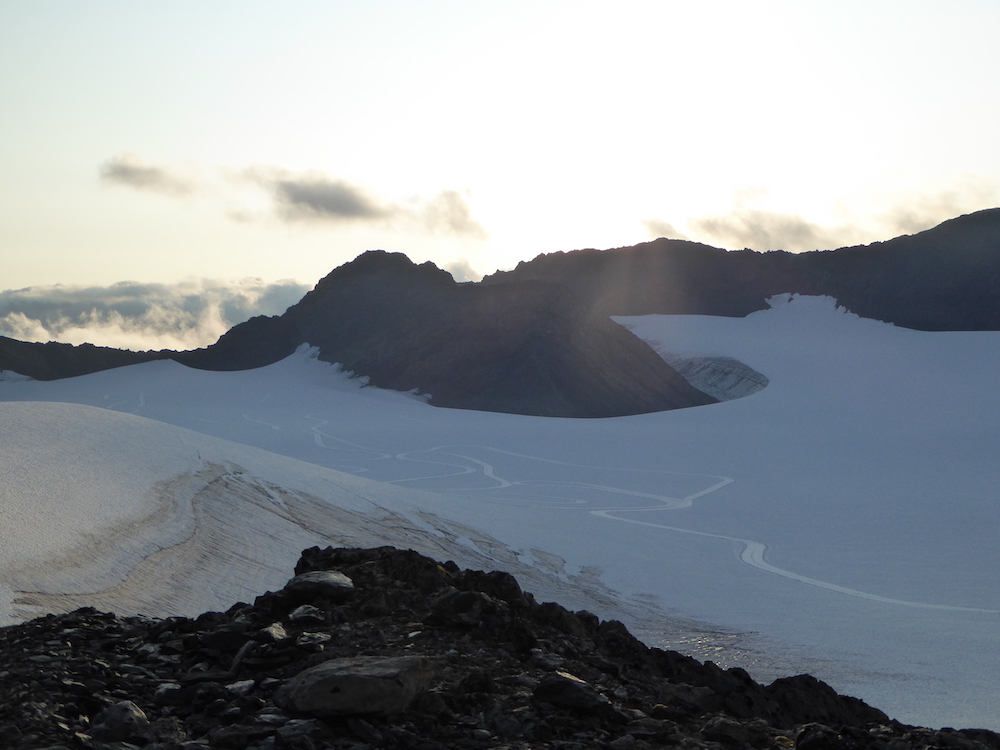
DIY Dachstein: September tracks on a snowfield in the Chugach mountains, Sept. 27, 2020. (photo: Gavin Kentch)
The koan that skiers are made in the summer has been around for longer than this website. The related truism, that summer snow time is necessary to effectively compete as a high-level skier come winter, also has a venerable history.
For example, here’s Luke Bodensteiner, writing in Endless Winter about why he had journeyed to a place where “the weather sucks all year long” to ski on the Sognefjellet snowfields in August 1993: “We all come to this spot simply to be able to ski a race faster than everyone else.” Or Billy Demong, discussing summer training on Eagle Glacier nearly 20 years ago: “In the late 90s and early 2000s, we were all working super hard, but we hadn’t quite broken through. I was on Eagle Glacier in 2002 because as a team we were committed to be the best.” Or Andy Newell, who first skied on Eagle the same year: “As the overall level on the World Cup continues to rise, summer training camps have become even more important. To be competitive at the very top level, you simply must get on snow at least once a summer.”
Bottom line, as Reese Hanneman wrote in an essay for a Boulder Nordic Sport catalog a few years ago, “All the best skiers in the world are on snow in the summer. Do you really want to try to be the best skier who wasn’t on snow?”
All well and good, but what happens when a global pandemic interrupts access to estival snow, for many athletes for the first time in a decade? More rollerskiing, of course, is the predictable and relatively simple answer. But bigger picture, it’s also a chance to introduce a new stimulus to long-established training patterns, and to replace travel and camps with increased consistency training out of a home base. Judging from conversations with three veteran athletes and two longtime coaches, high-level American skiers seem to be cautiously optimistic about how well this summer’s training will prepare them for the 2020/2021 World Cup season that starts in Ruka late next month.
(Disclaimer: It should go without saying that the global health toll of the coronavirus pandemic, and resultant inequality, are bigger problems than the inability of professional athletes to train on snow in the summer in the manner to which they are accustomed. Because this is a ski news website, the rest of this article focuses on the latter, but that is not intended to deny the existence and importance of the former.)
Background: In a normal year…
Here’s another saying you may have heard recently: These are uncertain times. In a normal summer, the Alaskan skiers would be on snow through at least mid-May, then all national-team skiers would meet in Bend for a two-week on-snow camp in the second half of May. Skiers with Alaska Pacific University Nordic Training Center, or APU, would then spend one week a month in each of June, July, and August skiing on Eagle Glacier, a short helicopter flight above Girdwood, Alaska.
Some national-team skiers – typically heavy on Stratton Mountain School and Craftsbury athletes, less so APU – would then spend two to three weeks in New Zealand in late August and early September, nearly all of it on snow at the Snow Farm. Groomed skiing returns to Independence Mine, about 75 minutes outside of Anchorage, in mid-October (probably), and to Frozen Thunder, in Canmore, about a week later (quite reliably). Arriving in Europe a few weeks ahead of the season’s first World Cup races typically affords athletes more on-snow time before first putting on a bib.
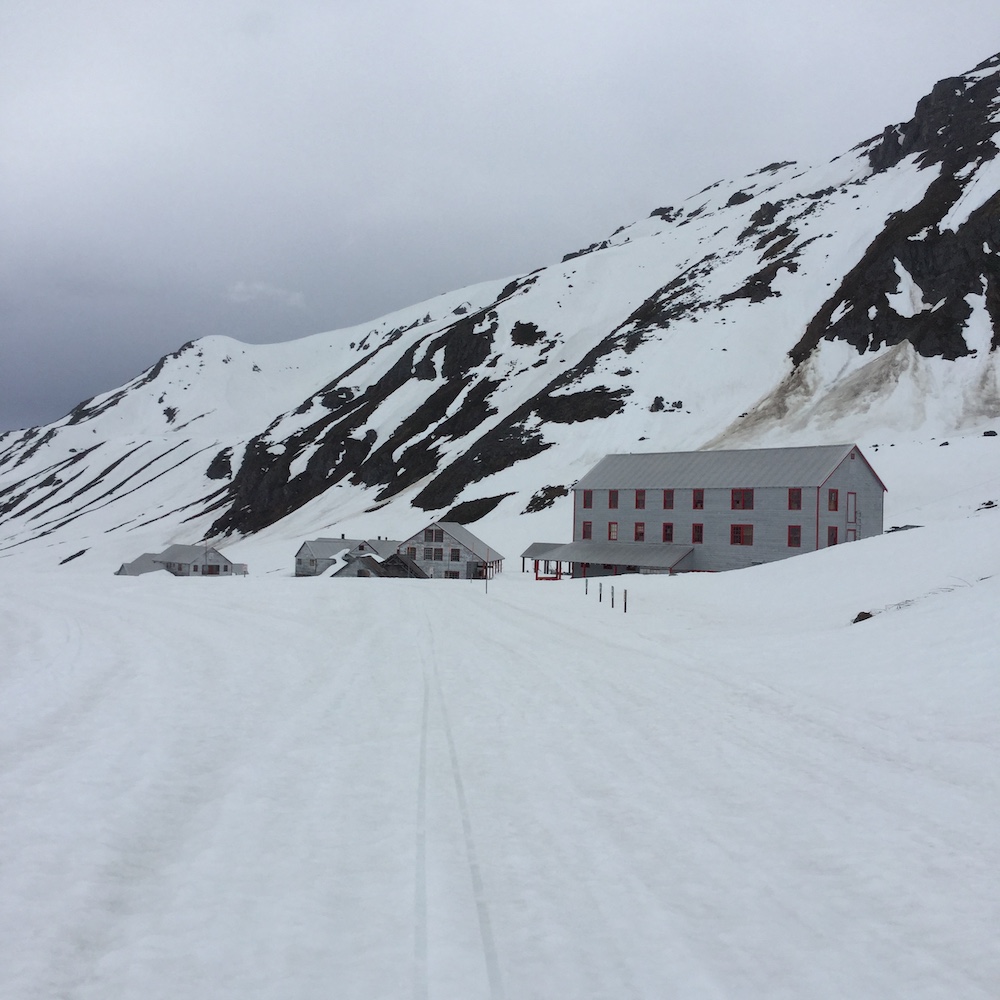
Summer skiing at Independence Mine, above Palmer, Alaska, May 30, 2020. (photo: Gavin Kentch)
This year, Independence Mine was skiable through the end of May, but everything else has been off the table. No Bend Camp; no Eagle Glacier; certainly no international travel to New Zealand, let alone to Canada for Frozen Thunder or Forêt Montmorency. It’s hard to survey the entire country, but this reporter’s cumulative four-plus hours of skiing since June 1, on snowfields in southcentral Alaska, may be among the highest on-snow summer nordic training loads in the nation, depending on how much time APU athlete Ari Endestad put in during a late-June (!) crust skiing trip in the Alaska Range. Until snow starts to accumulate at Independence Mine – the Mat-Su Ski Club’s historical first date of grooming there has recently been a tantalizingly close October 15 – American skiers’ collective summer snow drought looks likely to continue.
What all this means
So is this a problem when it comes to on-snow performance in the upcoming race season? Not really, according to multiple athletes and coaches.
“You can accomplish 95 percent of your technique goals, perhaps,” on rollerskis, U.S. Cross Country Team Program Director Chris Grover said in a late-May interview with Cross Country Skier magazine (22:54 mark of podcast), speaking at a time when summer training options were still unknown. “And so we’re in a good place; even if we never touch snow this summer, we’ll be ready to race when we get to next winter.”
“We’ve had many instances over the years with athletes who have missed on-snow opportunities in the preparation period, and gone on to have breakthrough winters,” echoed USST Head Coach Matt Whitcomb in a recent email to FasterSkier. “The dryland training is the cake, and the snow is the frosting. Americans will be frosting our cakes this fall when the snow flies, and this should lead to top performances during key mid-season international championships. I’m not one who attaches irreplaceable value to prep period on-snow training.”
2018 U.S. Ski Team camp at the Snow Farm in New Zealand. (Photo: Matt Whitcomb)
“The assessment period, that’s still ahead of us; that’s the race season,” echoed longtime APU Head Coach Erik Flora in a recent phone interview. “But … at least the athletes I work with, they’re in a good position right now heading into the winter.”
“Of course, we will have to see when the races hit,” APU and USST athlete Rosie Brennan wrote to FasterSkier, “but I feel very optimistic that the summer has had a positive impact on my training.”
“I’m hoping that some other training strategies – workouts that I normally won’t do because of the glacier, and a different strength routine – will have actually given me an advantage,” emailed APU skier Becca Rorabaugh to FasterSkier. “This is a good year to try new things and shake it up!”
(Against all this enthusiasm, Whitcomb did provide a more nuanced look at some potential disadvantages, while acknowledging a former athlete’s gentle chiding about his perennial optimism: “Since Holly Brooks once asked me to not always be so positive,” Whitcomb added, “I will start by saying that Norway will have an advantage in the early season. Many of them have found some snow. But Norwegians are often competing for start spots and racing very fast in period one, which allows us a window to catch up when their performance flattens. It all balances out. Beyond that, this is a global pandemic, and every team has been affected. Americans don’t have to do things better than we ever have, but just as good as we can. That will be good enough for this season. I’m confident in our preparation, and believe we’ll deliver great results to our fans.”)
What’s happened instead
“There is naturally more roller skiing” this summer than in prior years, Whitcomb noted, “since during an on-snow camp we will do little to no roller skiing. The sessions on roller skis versus on snow are similar.”
This is sensible enough. But everyone contacted for this article also discussed the broader implications of this year’s changes, be it for the overall training stimulus, travel schedule, training schedule, or all of the above.
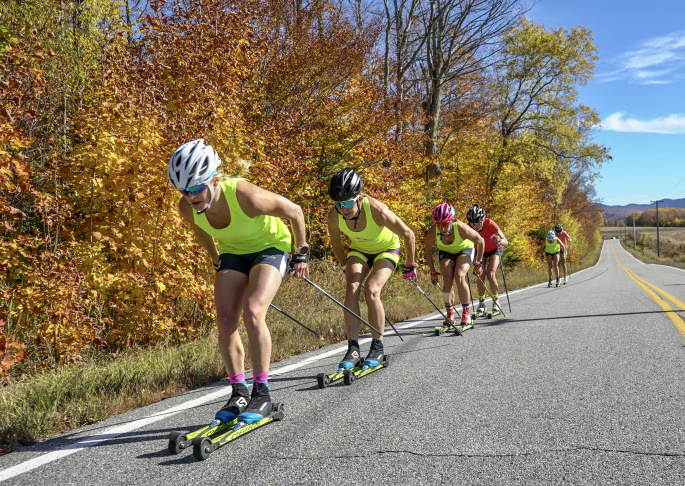
Pepa Miloucheva skates behind CGRP biathlete Casey Smith while at a training camp at La Forêt Montmorency in Quebec in early November 2015. (Photo: Caitlin Patterson)
Here’s Rorabaugh, for example, who as a longtime APU athlete has logged three glacier camps each year from 2007 through 2019, making for an impressive 39 cumulative weeks of summer glacier time. (Flora says that athletes typically log 20–30 hours of ski time in a week at Eagle Glacier. Taking the midpoint of this range, 25 hours, yields a healthy 975 total hours of summer snow time over the past 13 years.)
“2020 has been structured similarly to a normal summer of training,” Rorabaugh wrote. “The only difference is that where we would usually have a high volume week on-snow, we have done one in town. My overall training volume may have decreased slightly, since it’s hard to get quite as carried away with dryland training, but it’s also been more consistent week-to-week. We might be doing slightly more running than in the past, but the balance between rollerskiing and running is very similar. My joints and feet are actually the healthiest they’ve been in years though, probably because I’m not able to pound them into the ground with the expectation of a low-impact glacier camp for reprieve. Staying in town is forcing me to be a more responsible athlete, and I think my body appreciates it. Actually the biggest challenge for me this summer has been adapting to at-home strength training. Not having access to a weight room has definitely tested my creativity and self-motivation.”
Or here’s Scott Patterson, like Brennan also an APU and national team athlete, in an email to FasterSkier: “The big changes to my training have mostly been the consistency of time in Alaska and a few alterations for indoor training. We haven’t had any USST camps or APU glacier camps so there have been a lot of weeks just plugging away in Anchorage. It was nice that the snow held on fairly late so it’s only recently that the desire to get sliding on snow has really caught up to me. Not having camps definitely changes things and has its downsides, but I am also really appreciating having fewer obligations and travel days through the summer.”
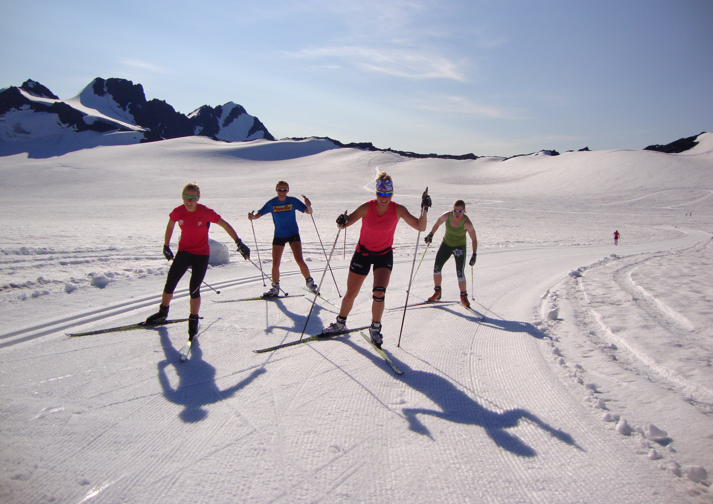
Ida Sargent, Sophie Caldwell, Sadie Bjornsen, and Rosie Brennan enjoying freshly groomed snow on Eagle Glacier in summer 2011. Photo courtesy of Sophie Caldwell.
And here’s Brennan, another veteran athlete with a long history of summer snow time: “It’s definitely been a bit of an experiment this year, but I have really chosen to look at the potential benefits. For one, as an older athlete it gets harder to introduce new stresses that create the adaptation needed to keep improving. This summer has certainly provided me a different set of stressors that I have had to adapt to. Travel also takes away training days and always comes with some sort of a need to adjust to the new training environment, so without travel, my training has been just so consistent.”
What about technique work?
As Grover said, “You can accomplish 95 percent of your technique goals” on rollerskis.
Others were a little less sanguine. As Patterson noted, “Those weeks of glacier time in the middle of the summer are a great opportunity to preserve the on snow feel even when in town rollerskiing. It’s easy to forget that skis don’t kick like ratchets, pole plants are much softer than pavement, and asphalt never turns to deep slush. I usually try to use the glacier weeks as high volume periods with fairly intense focus on the technical aspects of actually skiing. In town, it has definitely taken some adapting to not have the focus week or the on snow technique.”
And Rorabaugh, a Fairbanks native, sounded similar themes. (Relevant: Even in an era of climate change, Fairbanks, Alaska, reliably provides hard-wax skiing for at least four and probably five months a year, from early November through late March. Fairbanks skiers once started a spring marathon on the Chena River, in downtown Fairbanks, at temperatures of –12° F. On March 25.)
Audrey Kentch, 5, skiing in wet-snow conditions in Alaska, June 2020. (photo: Gavin Kentch)
As Rorabaugh wrote, “Summer on-snow training is a good time to work on technique and try new things, and to adapt to dramatically new ways of skiing. It’s also a vital opportunity to practice skiing in slushy conditions – something that an Alaskan skier might be unprepared for. At my first JNs in Lake Placid I remember being utterly shocked that people skied on sloppy trails, and having no idea how to do it! Thankfully I’ve had a lot of practice on Eagle Glacier since then.”
Looking ahead to the start of the season, Rorabaugh noted, “I don’t think I’ll change my approach when I get on-snow this fall because it’s a different time of year. Early season snow is a good time to transfer dryland fitness to skiing, but it’s not as much of a technical laboratory. It’s more about technical honing than totally revamping.”
No matter what the summer looks like, the first few times back on snow are necessarily different than rollerskis, and can potentially require some degree of transition. As Whitcomb observed, “It takes a few days for everyone; the skate skis feel long and awkward, and the greater hip area muscles get sore from slipping on classic skis. Our first few on-snow workouts in Finland each season call for short, easy training, and after that we’re good to go. I also think it is harder for juniors than for seniors, but neither case is a big deal.”
A more nuanced aspect of this issue involves the optimal application of summer snow time for working on ski technique. Flora is a firm believer in his seriatim method, which involves one week on snow at roughly one-month intervals from June through August.
The June camp is “usually the introduction of new ideas,” Flora told FasterSkier. “And the nice part about being on snow is that it’s real-time, real snow. So it applies 100 percent; you’re not adjusting for a rollerski kick, or, you know, road-style terrain; you’re on snow, and it’s World Cup-style terrain. And so, usually, June, we use to introduce ideas, and then July is kind of, refine and play with those, and then usually by August, you can see those changes kind of setting in. And so that’s a pattern that we’ve used for over a decade. And it’s an effective pattern.”
World Cup terrain: The groomed ski trails on Eagle Glacier gleam in this view from the training center on a late-July evening in summer 2019. (photo: Gavin Kentch)
When attempting to translate this pattern to an exclusively dryland paradigm, Flora explained, he found himself emphasizing more of a “steady amount of technique work in the summer” this year.
Has it worked? With the significant caveat that the race season has yet to begin, Flora is cautiously optimistic: “As far as which one is more effective? Hard to say; I think they both work. One thing right now seems to be we have a number of athletes that have made jumps this summer, you know, similar to in years past. But again, we’ll see as the on-snow time comes.”
Flora is similarly confident about an athlete’s ability to ski well in early-season races this year, even if they have transitioned from rollerski kick to hard-wax skiing at Independence Mine, only to be thrust into, say, a messy artificial snow, above-freezing, klister slopfest race in World Cup Period One. Flora expresses his hope that APU’s “style of coaching and education” has let the athletes “create an adaptable kind of platform to work from. And so when … they show up and it’s icy or soupy, or whichever it may be, that they’re ready just to jump on their skis and adjust.”
Finally, Flora also cites his athletes’ accumulative lifetime on-snow experience: “The athletes that I’ve worked with for a while, I’m confident that they’re ready to kind of jump into any kind of conditions, that those athletes also have thousands and thousands of kilometers behind them, of glacier soup, and spring-like conditions. … I think for my main group [of athletes], everyone is comfortable kind of moving forward. I don’t know that one summer has a huge impact into that. … I guess I’ll know more about that in a few months.”
Towards a philosophical understanding of summer snow
Flora’s observation about lifetime glacial kilometers skied raises a final point: What, perhaps in a more fundamental sense, does summer skiing mean? The final paragraphs of this piece on FasterSkier attempt to limn an answer, and Chelsea Little’s lovely, lyrical essay on summer skiing at Italy’s Passo dello Stelvio does much the same. But what do coaches and athletes have to say about it?
For Flora, summer skiing is, as discussed, an opportunity to install and ingrain technique changes relatively early, “so by the time they’re in the racing season it’s an automation or a natural movement, as opposed to trying to race and then also think about new movements.”
But it’s also a chance to, well, ski a whole lot. This may seem obvious, if not downright unremarkable for professional skiers who ski all winter long, but for Flora it stands in contrast to, perhaps counterintuitively, the relatively reduced amount of actual skiing that occurs during the World Cup season, which brings with it travel days and recovery days and multiple venues with limited snow on small loops.
https://www.instagram.com/p/CC2PpdbpXKD/
As Flora notes, “What’s really interesting about those numbers is that if you go up to a glacier camp, and you ski, say you ski 20, 25, 30 hours that week. And you take that across roughly 15 k an hour, or you can even just look at the pure hours. Most of the athletes in the wintertime are training anywhere from, you know, 30 to probably upwards of 60 hours a month, at most, during the race season. And so the amount of time you get at a camp – if you’re having 30 hours in a week of training up there, take two camps and you have over a month of skiing already. And so the time up there is different than the race season too, because a lot of times when you’re traveling and racing, you’re skiing once a day, jogging in the afternoon, where on Eagle, you’re skiing twice a day. And so that time has a huge impact on kind of turning the body into a ski body.”
All athletes and coaches also noted that summer skiing is some sort of change – a new physical stimulus, to be sure, but also just a change. Whitcomb spoke of the danger of “monotony,” and of the need to avoid not just an outright overuse injury, but also the “physical plateau” that can result from consistent use of one training mode. Brennan unconsciously mirrored Whitcomb almost verbatim, writing, “As for an overall approach, I have tried to remain very consistent all summer so no one activity gets into a level in which I’m risking overuse.” And Flora, similarly, said that he began the summer by telling his team, “the opportunity ahead of us is just the change in stimulus.”
It’s hard to discuss these changes, in this year, without trafficking in tropes, but here are a few more to end things: Every disruption is a chance for improvement. It’s not a challenge, it’s an opportunity. The only thing constant is change.
In all seriousness, though, in a sport where the increased sharing of information has led to high-level training looking relatively homogenous around the world, the unparalleled summer of 2020 provides a chance to see what winter results look like when traditional summer training is disrupted. As Flora said, he’s confident now, but we’ll all know more soon.
For skiers and race organizers, remaining nimble and realistic are keystone 2020 attributes as the global pandemic commands our attention. Amidst the disruption, the New England Nordic Ski Association (NENSA) remains committed to organizing races for the 2020-2021 season. Justin Beckwith, Competitive Program Director at NENSA, said the aim is clear during uncertain times: under-promise and over-deliver.
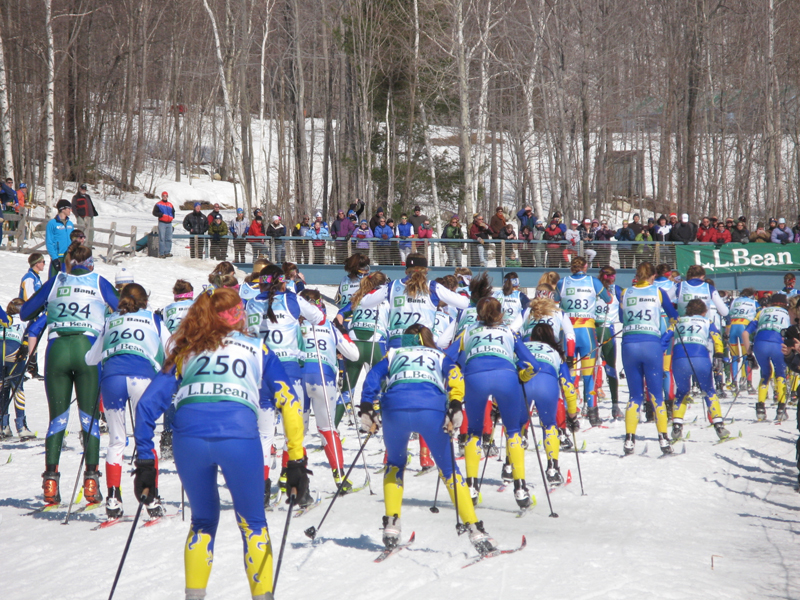
An older photo of NENSA athletes competing at the 2011 Eastern High School Championships in Rumford, Maine. This season will have a decidedly different look. (Photo courtesy Janice Sibilia.)
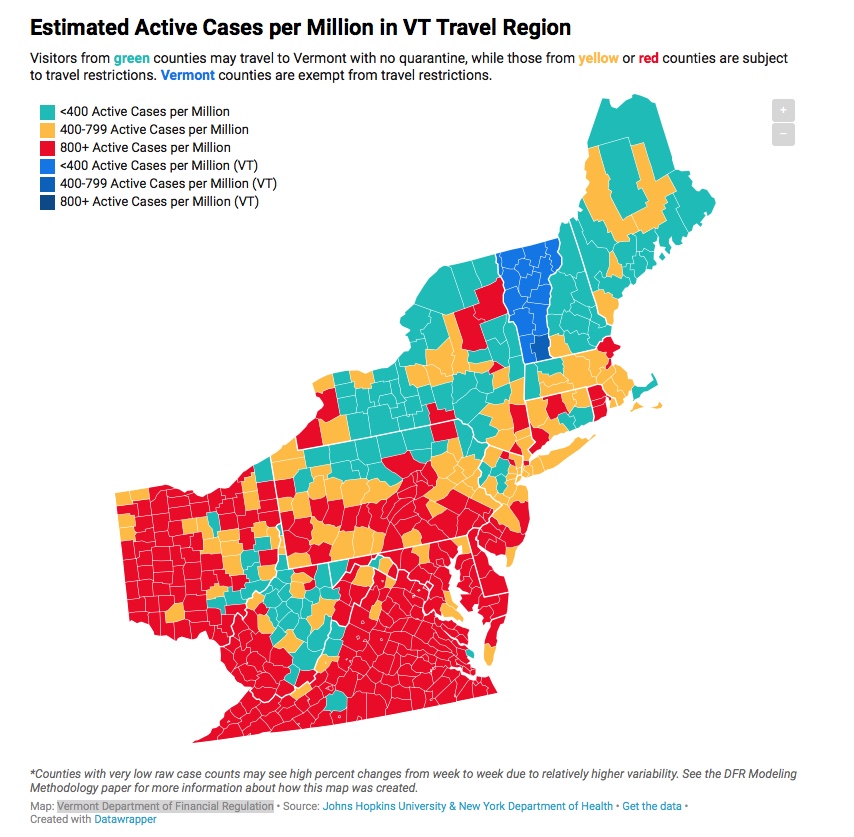
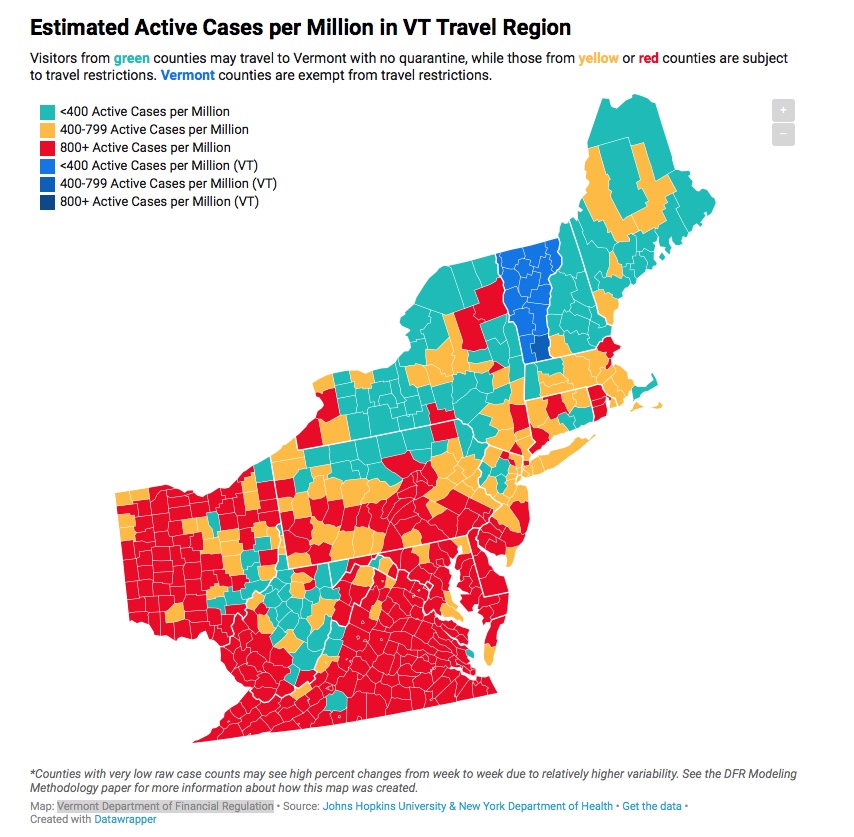
As a case study, New England poses several challenges. Geographically several states with differing Covid-19 mandates share borders or are within relatively close proximity to one another. In this piece, we’ll use Vermont as our Covid-19 focal point. Vermont’s Agency for Commerce and Community Development has posted criteria for those traveling from out of state along with a map to make travel decisions easier.
On the color-coded map depicting both state and county borders, it’s easy to determine who can travel to Vermont seamlessly with zero quarantine requirements. (There are no travel restrictions within Vermont.)
Hypothetically, using the current data, if you are a ski racer from a New England county and your county has between 400-799 active cases per million or greater, you are likely looking at a 14-day quarantine when entering Vermont, “or a 7-day quarantine followed by a negative test in [your] home state and enter Vermont without further quarantine restrictions.”
Currently, much of Massachusetts falls in the 400-799 active caseload category, as do several counties in Maine and a single New Hampshire county.
This all gets tricky for those crossing state borders to race.
Compounding the complexity, each state has unique caps on maximum group sizes for outdoor events. In Vermont, a state with favorable Covid-19 metrics relative to the nation as a whole, “outdoor organized events” are limited to 150 people. Skiers, coaches, spectators, volunteers, and officials — they add up quickly. The aim is to minimize the total number of individuals on-site for a race. That, said Beckwith, requires rolling race start times and the ability for racers to arrive promptly and leave the venue quickly post-race.
NENSA Competitive Programs Director Justin Beckwith at NENSA’s 2018 App Gap Challenge rollerski race, up the Appalachian Gap in Fayston, Vt.
“We are trying to really promote the local races, so we are saying stay home, try a popular race so to speak, that is a good step for a high school kid versus going to an Eastern Cup during a year where we would rather have slightly reduced field sizes to make it easier to pull events off,” said Beckwith. “Once you get to 100 competitors, that is pretty close with volunteers and coaches, if not over, to the cap here in Vermont.”.
Here’s our closer look at NENSA’s plan and how it may over-deliver. Regional will be the operative word as NENSA is encouraging skiers to minimize out-of-state travel.
“We are starting with the language of advising people to race within their region. Vermonters could go to the two Eastern Cups in Vermont, maybe they slide over to the one in Dublin, New Hampshire because it is not that far away,” Beckwith said. “Kids from Maine would do the Eastern Cup in Maine, they could slide over to New Hampshire and do those.”
On NENSA’s website, they have a dedicated page for COVID-19 considerations. There, interested racers can find specific contingencies for Eastern Cups, Eastern High School and U16 Championships, Women’s Day, the BKL Festival, and popular racing. Across the board, all NENSA races will be individual start (no mass start or sprint heats for the 2020-2021 season).
With the Eastern Cups arguably the most complex, we’ll focus on those contingencies. The streamlining and social distancing begins on October 1, when NENSA will open their portal for purchasing a bib and timing chip. The bib and timing chip remains with the skier for the season. Beckwith said NENSA plans for “touchless registration and timing” and no day of race registration.
Plan 1:
All races will be individual start with start times organized by age group.
On the Wednesday before the race, all athletes, coaches, athlete relatives attending the race, volunteers, timers, and staff must complete an on-line NENSA Event Health Screening Tool. This includes a temperature check.
Limited spectators will be allowed at the venue with the possibility of no movement beyond their personal vehicles.
No on-site indoor waxing will be available.
Likely limited coach access to the course.
Bathrooms will be assigned by state.
All present at the race site must wear a “face covering and cover their mouth and nose at all times. Athletes/coaches must cover their nose and mouth in the start and finish area and if they are within 6 ft of another individual on course.”
Plan 2:
Essentially, Plan 2 calls for eastern Cups to be moved to February or early March.
Plan3:
“Regional races within states in New England – states determine “Championship” Teams.
Plan 4:
This plan, the last on the list, appears to be a fall back in which even a semi-large gathering of people is untenable.
Races will be run over the course of nine days. Racers sign up for a start time and complete their race. NENSA makes clear in Plan 4 that during hours when racers will be present, NENSA timers and race marshals will officiate.
Beckwith added that no Eastern Cup races have been calendared with U.S. Ski & Snowboard, however, a schedule of events can be found on the NENSA site.
The most critical piece, reiterated numerous times by Beckwith, was safety. That tenant is front and center on the NENSA website: “Our first objective is to ensure the health of our community in New England,” reads the language.
“You have to think about this in the context of staying healthy and allowing everybody to participate,” Beckwith said. “Trying to deliver a little lower level event and do a really good job versus ‘oh yeah this is business as usual.’ We are probably going to have people go to all the races. I do not think we are going to prohibit that. But we might, for instance, format the Junior National criteria in a way so people feel like they don’t have to go to every race. It is again going to come down to education and messaging.”
Noah Hoffman (U.S. Ski Team) racing to 35th in the 30 k skiathlon at the Olympics in Sochi, Russia.
As we all know, the COVID-19 global pandemic has left the world scrambling to adapt to the many challenges of slowing the spread of the virus. In the world of Olympic sports, the ripple effect has disrupted the efforts of anti-doping agencies worldwide to conduct the athlete testing normally relied upon to hold athletes accountable to abiding by the rules surrounding banned and controlled substances. Most international antidoping agencies have halted testing since mid-March as the invasive and close-contact nature of collecting samples posed a threat to both athletes and testers.
This causes concern that athletes inclined to cheat might abuse the situation, taking advantage of the opportunity to use illegal substances to improve their performance potential when competition is able to resume.
To address the lack of testing, the US Antidoping Agency (USADA) rolled out a pilot virtual testing program called Project Believe 2020 where athletes could provide a urine sample and blood spot test with an antidoping agent present on a zoom or FaceTime call.
For further insight into this topic, FasterSkier connected with two-time Olympian and long-time US Ski Team Member Noah Hoffman, who has become involved with USADA’s antidoping education program since retiring from skiing. Hoffman also recently wrapped up his second year at Brown University and we discuss his academic interests and the experience of being a college student during the COVID shutdown. Thanks for listening.
The SMST2 squad led by Jessie Diggins pushes the pace in a double pole interval workout during a fall 2019 training camp in Lake Placid, NY. (Photo: Matt Whitcomb / smseliteteam.wordpress.com)
It’s May. Yes, really.
For most skiers, the new page on the calendar also marks the beginning of a new training year. Dust off your rollerskis, locate your heart rate strap and drink belt, and make sure your running shoes have plenty of life in them.
With the country still predominantly on public health orders to stay close to home, avoid groups, and keep at least six feet of distance from those outside your home, kicking off a new cycle is happening without hugging our training partners, post-workout high fives, or otherwise gathering to ring in the new season. There also remains abundant uncertainty regarding the feasibility of racing during the upcoming season from the World Cup level to the junior and collegiate circuits to popular skiing. Nonetheless, we open our training logs and carry on.
Last season ended abruptly and the off season may have looked different than anticipated. We may have put our energy into homeschooling children, sourdough baking, binge-watching Tiger King, connecting virtually with our family and friends, or otherwise remaining largely homebound and less active than we’re accustomed. On the flip side, maybe the change in schedule has freed up additional time for long adventures and you’ve logged more hours in April than ever before.
Either way, at the onset of a season, you may be interested in checking in on your fitness and strength, looking for metrics to track improvement over time and to guide your pacing or heart rate zones during future workouts. FasterSkier reached out to Pepa Miloucheva, head coach of the Craftsbury Green Racing Project, to discuss fitness testing that could be done without the support of a facility or coach, making it accessible to any level skier as they begin the new year.
Miloucheva provided the disclaimer that she relies on advanced metabolic testing with her athletes to determine VO2 Max and lactate threshold levels to assess fitness and heart rate zones, and then prescribes training based on this information. With that caveat, Miloucheva holds a masters degree in Sport Science with a focus on physiology and biomechanics and has been coaching for over 20 years, over a dozen of which have been spent with the CGRP elite program.
Before jumping into assessing fitness and blowing up trying to hit a new PR on the SkiErg, Miloucheva emphasized that the most important thing an athlete can do at the beginning of a new cycle is to have a training plan and to understand how the periodization targets different areas of athletic development. This might be a plan from a coach or one found online.
“If someone really wants to establish a baseline and monitor, then they have to have a training plan,” said Miloucheva in a call. “I think everything else is kind of pointless, because all of these tests won’t give you anything if you don’t know what you’re looking for. In general, everything starts with first having a good training plan.”
Once a clear plan is established and you have taken time to understand it, then decide which part of the training process you would like to test.
“If you have 2-3 months of high volume, you want to test your basic aerobic improvement. You do the test, you see if you’ve actually improved. When you start doing a little bit more speed, you want to see if you’ve improved your speed. So you really have to schedule these tests based on your training plan.”
As the typical periodization of the year for skiers focuses on aerobic development during the spring and summer, a good starting place could be an uphill run test, possibly combined with a rollerski or SkiErg time trial, if those are available to you.
Traditionally, a 3000 meter run on the track was commonly used as an aerobic benchmark, but the results can be skewed based on individual running economy. Athletes with more running experience and better form often fare better than those with comparable or potentially better fitness. As such, most ski programs have transitioned toward an uphill run test, as it tends to level the playing field in terms of the impact of running efficiency on results.
In addition to being a good indicator of aerobic capacity, Miloucheva explained that the test has the added benefit of being easily repeatable with relatively few outside variables that might impact performance.
“The uphill running test is probably the most standard around the world. Simply, it’s easier to repeat. It’s a little bit less affected by the weather, but there are still a lot of elements and it is hard to keep it consistent.”
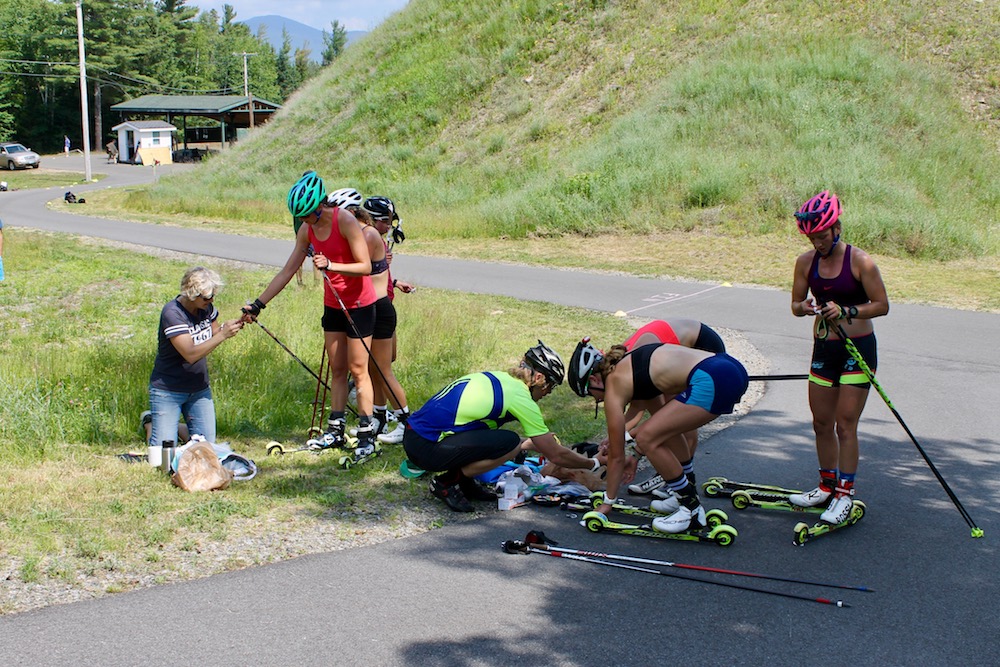
Craftsbury Green Racing Project Head Coach Pepa Miloucheva (l) and Stratton Mountain School T2 Team Head Coach Pat O’Brien (center) assist athletes with lactate testing after the U.S. Ski Team’s rollerski team sprint on July 15, 2018 in Lake Placid, N.Y.
If you’re looking to track your own progress on an uphill course, Miloucheva recommends finding a stretch of road or trail with little traffic that takes roughly 10-12 minutes. The effort should be steady throughout the test and you should finish feeling completely spent.
Be careful not to start out too fast as you want your heart rate to increase throughout the test, rapidly at first then gradually continuing to rise toward your lactate threshold heart rate, which can be estimated as the average heart rate sustained over the last five minutes of the test assuming it was well-paced. (TrainingPeaks has a deep dive on blood lactate and lactate threshold here, or you can read this description of lactate threshold training by Len Kravitz Ph.D., Exercise Science professor at the University of New Mexico.)
As for the course, you’re looking for terrain that is runnable, meaning you won’t need to resort to walking or hiking, and a relatively consistent grade.
Miloucheva later added that many veteran athletes have their own aerobic fitness test piece, which is also perfectly sufficient.
“I’m an old lady and I have this loop around the lake I do every year and I measure my time just for fun. So in general, everybody who has been training for years, they have a place where they can run the test.”
Miloucheva has also used a 1-kilometer uphill double pole test on rollerskis with some of her athletes. Her course starts relatively flat, climbs gradually, then levels off at the finish.
“The biggest thing is that [athletes] need to keep moving, so it cannot be very steep because strength and the resistance become the issue [rather than fitness].”
She has found this test harder to standardize than the run test, meaning results must be taken with a grain of salt.
“The problem using it year to year is that [the athletes] don’t always use the same rollerskis, they change wheels, cold weather and cold pavement changes a lot. So you have to consider all these details with the results.”
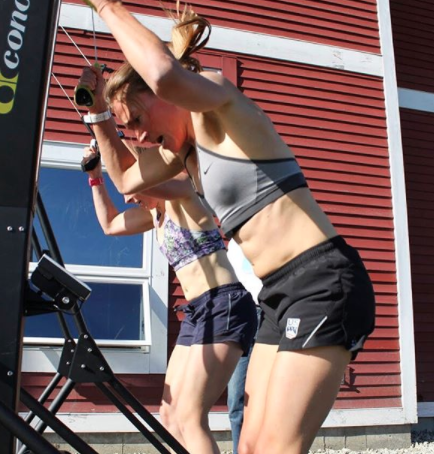
Sophie Caldwell and Annie Hart square off for a SkiErg time trial during a week of testing with the SMST2 team in 2017. (Photo: Instagram @sophiecaldwell(
Because of the ease of standardization, Miloucheva prefers using SkiErg time trials, as athletes can repeat the test indoors with a fixed resistance. Her junior athletes complete 1 and 2 k time trials, and her senior athletes additionally complete a 5 k test. The CGRP athletes complete the tests while hooked up to a VO2 Max testing equipment. If these are available to you, these tests could also serve as a benchmark for aerobic fitness with some ski specific strength indicators.
As for strength, Miloucheva is working on developing a test she feels is informative and can be standardized, as she is not satisfied with other tests used previously. She has historically used a version of the Canadian Strength Test (outlined here by Jackson Hole Ski & Snowboard Club), which counts the number of pull-ups, sit-ups, push-ups, box jumps, and dips an athlete can do in one minute with one minute rest between each exercise. Some differences in Miloucheva’s version include the use of single leg squats within a 30 second time period and measures pull-ups to exhaustion.
If you’re completing this test from home, ask a member of your household to help time, count, and keep your form honest so the data reflects your current strength accurately.
Okay, you’ve done an initial test of your aerobic fitness and/or strength. Now what? How soon should you repeat the test to check for improvement?
Miloucheva reiterated that it is essential to plan testing between training blocks to assess whether the block had the intended impact on fitness. She explained that her testing weeks are written into her general yearly plan for athletes at the beginning of the season.
When considering your own plan, space the tests out roughly 6-10 weeks to give the body time to absorb and respond to training. In addition to striving for a faster time, you can also consider trends in heart rate, as more time during the test spent closer to the lactate threshold heart rate is also an indicator of improved aerobic capacity.
To get the most information from a testing period, it is essential that each round is approached the same way, including how the training looks in the days prior and the warm-up performed before beginning the tests.
“You want to have a standard approach into the test, because you don’t want to do the first test after a very exhausting week and the second after an easy week, because it will affect the results.”
For CGRP athletes, this typically looks like one or two days of rest or easy training prior to a test.
There you have it. If you’re looking to assess and monitor progress in your fitness, first select and understand a training plan. Then, determine what factors of your fitness you’d like to assess and decide when a set of tests might fit best between different blocks within the training plan. Finally, do what you can to ensure that when the tests are repeated, the environment is as controlled as possible and your approach is the same so improvement (or lack thereof) between tests provides accurate insight into how your body is responding to training.
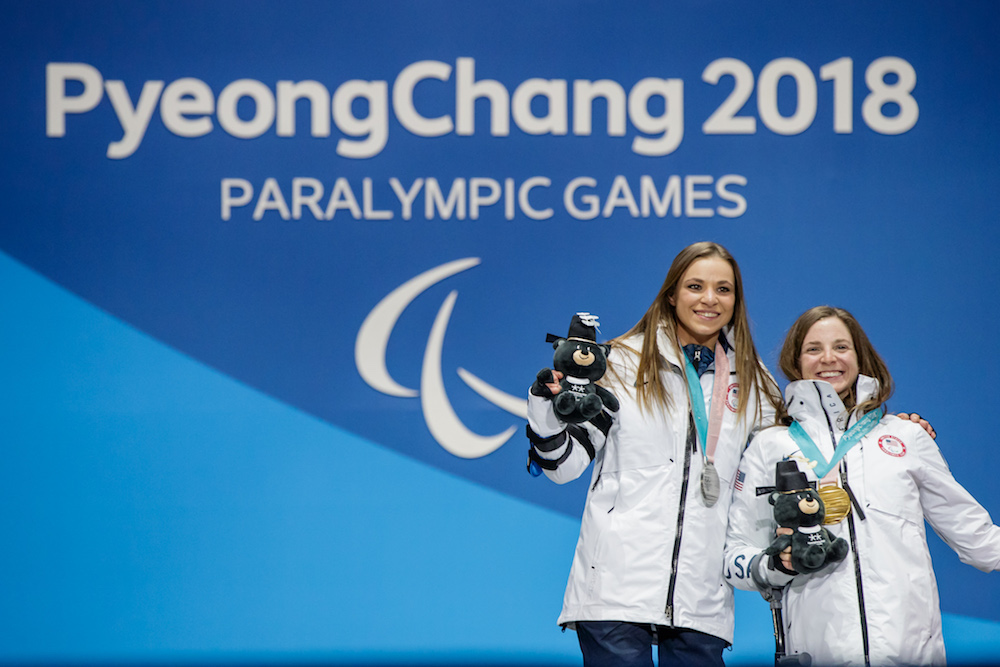
Kendall Gretsch (r) and Oksana Masters at the 2018 Paralympics medal ceremony for the women’s sitting 6 k biathlon sprint after winning gold and silver, respectively, on the first day of competition in PyeongChang, South Korea. (Photo: U.S. Paralympics/Joe Kusumoto)
Of the members of the U.S. Para Nordic team, more than half compete at the highest level in both summer and winter sports. Instead of quadrennial, their training is designed for biennial Paralympic cycles, oscillating between sports each year with an overall focus shift toward whichever Games is approaching fastest.
And the goal is not simply to compete in both rounds of the Games, it is to bring home medals.
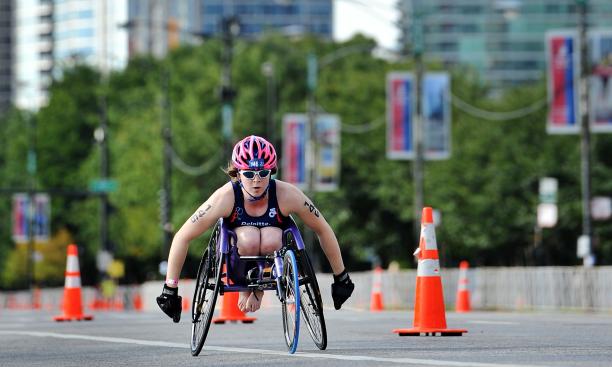
Oksana Masters is an elite multisport athlete who competes in hand-cycling, para nordic and para biathlon . (Photo: Screenshot teamusa.org)
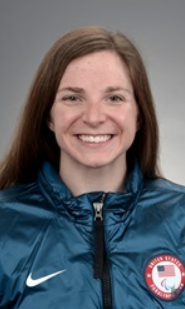
Illinois based Oksana Masters is a four-time Paralympian with eight medals; she earned two gold, three gold, and two bronze medals in cross country and biathlon, and a bronze medal in rowing — the first American medal in the trunk and arms mixed double scull category. After a back injury in 2014, she switched from rowing to cycling, and went on to qualify for the 2016 Paralympic Games in Rio de Janeiro, Brazil where she walked away just shy of the medals, finishing 4th and 5th and hungry for more.
Kendall Gretsch is an elite multisport athlete who competes with Team USA Paratriathlon, Para Nordic and Para Biathlon . (Photo: Screenshot teamusa.org)
Her teammate, Kendall Gretsch, took home two gold medals from the 2018 Paralympics in cross country and biathlon and is a three time world champion and five time national champion in paratriathlon, an event that was not part of the Summer Paralympics for her category until the upcoming Games in Tokyo. Gretsch has been living and training at the Olympic Training Center (OTC) in Colorado Springs since March of 2019.
Under normal circumstances, there would be an 18-month gap between the summer Paralympics in Tokyo and the winter Games in Beijing. However, on March 24th it was announced that the Tokyo Games would be pushed back to August of 2021 due to health and safety concerns surrounding the global COVID-19 pandemic. For athletes also competing in Beijing in February 2022, this leaves roughly six months to change gears and prepare to again be at peak fitness, which is no small challenge.
Let’s take a step back. In mid-March when the scope of the pandemic became apparent and Europe and the United States began to rapidly shut down, Masters was in Östersund, Sweden about to compete at the World Championships in biathlon. The team had arrived a few days prior to the start for training, but plans changed at the last minute.
“Instead of waking up to a message from your coach saying, ‘Hey, it’s race day!’ Instead, it was, ‘Bad News: Sweden is cancelling all events that are 500 people or more,’” Masters told FasterSkier in a call.
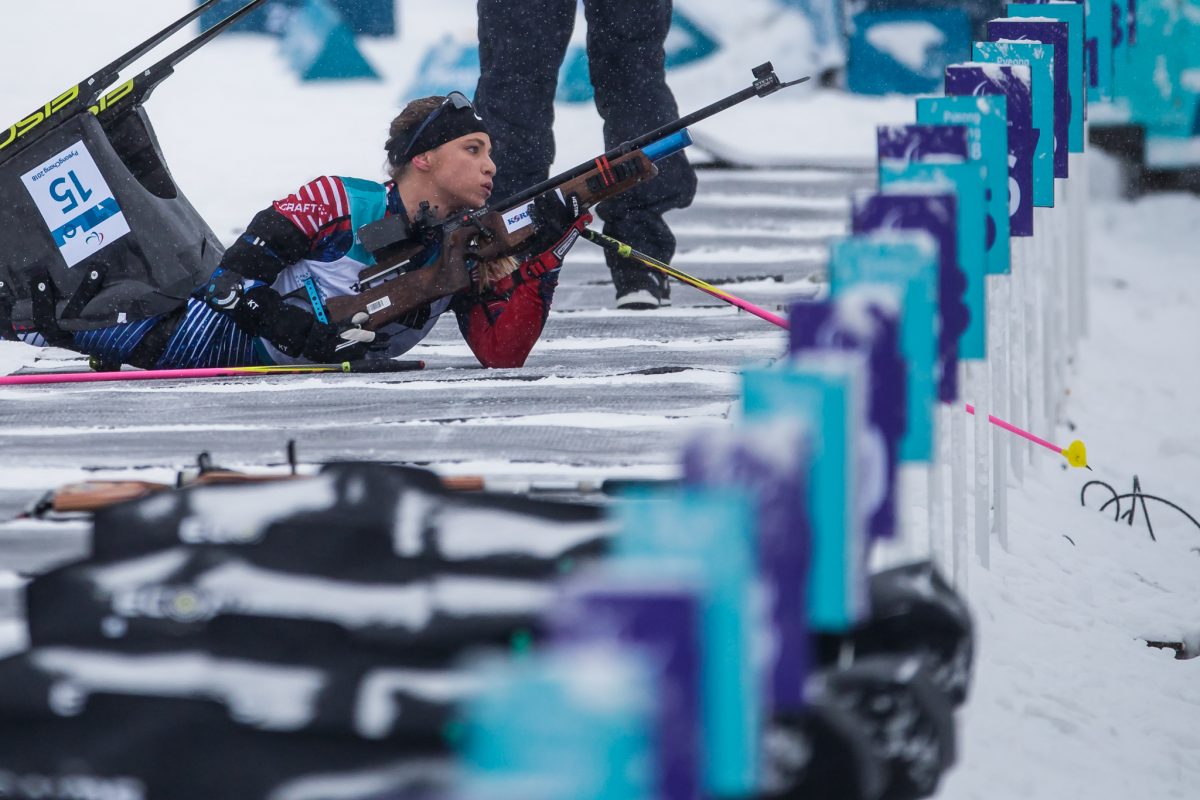
Oksana Masters focused and in the moment on the range during the 2018 Paralympics in PyeongChang, South Korea. (Photo: U.S. Paralympics/Joe Kusumoto)
She recalled feeling “shocked” as her season ended so abruptly. Her plan had been to leave halfway through the World Championships in order to head to an essential Tokyo qualifying event for cycling.
Her initial reaction was frustration that she had missed valuable training time for cycling by staying with the nordic team through mid-March, but with the understanding she now has of the scope and severity of the pandemic, her perspective has shifted. That said, she is also fully aware of the challenge she now faces to peak for two separate sports in such a short period of time.
“This is way bigger than sports and the Olympics… [The organizers] made the right call [to postpone] and I’m happy with that, but in my ideal world, I wish that this never happened. I’m sure a lot of people do. Because they postponed to 2021 and my focus is to make it to 2022 as well, it made that transition window from Tokyo to Beijing from over a year to basically six months. My sports are two separate sports — they do not go hand in hand, they are complete opposite motions and I have to basically start over with my fitness, minus the endurance.”
Finding the silver lining, she added that the Olympic postponement does allow her more time to prepare for cycling.
“The good side is that because I was competing full-time on the nordic side and did the World Cup season, I missed a lot of training time on the bike where my competitors were traveling to Spain and all these warm places to get on the road and spend those hours on their bikes. So now this is allowing me to work on my bike that I’m building and at the same time just get more time on the bike and get sport specific strength.”
Kendall Gretsch is a three time World Champion in the women’s PTWC classification. (Photo: International Paralympic Committee)
Because she too needed to qualify for Tokyo, Gretsch had ended her nordic season before the World Championships and was in Florida at the main triathlon qualifier when the country began to shut down. She was slated to compete on back to back weekends, both of which were cancelled the day prior to the first race. It is currently unclear what Gretsch will need to do in order to make the U.S. triathlon team for Tokyo.
“At this point, it’s kind of just waiting to see when we’ll be able to race again. Once that’s solidified more, the international triathlon union will have to come up with new qualification criteria and then, from that, the US will come up with new qualification… I’ll definitely have to compete in a couple more international events to solidify earning a country spot for the US.”
Aside from the uncertainty regarding travel and the seemingly impossible challenge of holding the 2020 Olympics and Paralympics without furthering the spread of the coronavirus, many athletes were also unable to access facilities and resources they depended on to practice skills and adequately prepare for their sport. For Masters, the inability to access a gym impeded her training routine.
“As a Paralympic athlete, in my two sports — especially for skiing — I rely on strength training,” Masters explained. “I lift three times a week. So that took a big toll.”
Her normal spring routine would include baseline metabolic testing and training camps with her coach, who is from Germany. Since he is currently unable to leave the country, Masters is not sure when she will be able to meet with him for these measures to evaluate her training. Overall, she is hitting reset on her plan and embracing the time to change gears at a more manageable pace.
“In my case, we’re kind of starting all over and making sure the base is good in cycling,” she said. “So it’s a lot of endurance riding, a lot of time on the bike, and just adjusting back to it the right way, as opposed to coming off the nordic season, trying to make the qualifiers in June, it was going to be shortcutting all that, which is really hard to do.”
Meanwhile, life at the OTC looks significantly different than Gretsch is accustomed to, with less than twenty people remaining on the campus. Apart from not being able to train in the pool or access the biathlon range, she is no longer able to get massage or other sports medicine treatments that she could previously. She does still have access to the OTC cafeteria, but meals are now take-out, meaning the remaining athletes on campus spend much of their day isolated in their rooms.
Not being able to swim has been the biggest impact on Gretsch’s training, as this would normally be a time of building volume for triathlon. She explained that she spends ten minutes per day on a stretch band swim trainer, but it is far from replicating the stimulus of the pool. She also borrowed some kettlebells and weights from the gym so she can do some strength training from her room.
“I think the good thing is that I’m still able to do two of the three sports in triathlon,” said Gretsch. “So even though I’m not swimming right now, I have been able to bike whether it’s inside on a trainer, or outside when the weather is nice here, and the same in the racing chair.”
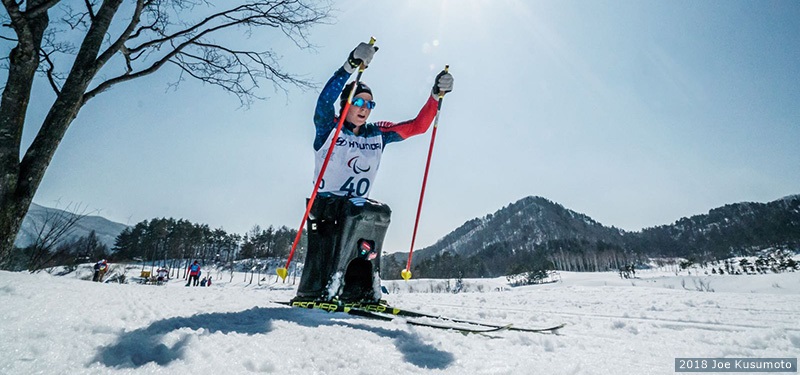
Kendall Gretsch racing to her second gold medal of the 2018 Winter Paralympics on Sunday in the women’s 12 k sitting cross-country race in PyeongChang, South Korea. (Photo: US Paralympics/Joe Kusumoto)
Both athletes are feeling uncertainty about what the 2020-2021 nordic season will look like and how cycling or triathlon qualifying events will fit into the mix. Currently, a cross-country World Championship and an Olympic venue test event in Beijing are scheduled for February and March. But, seasons may need to be cut short for Tokyo qualifiers. Both athletes have found solace in the partnership between their two sets of coaches.
“I think the really awesome thing is that both my sets of coaches for nordic and triathlon are really good about being open and communicating with each other about the situation,” said Gretsch. “It’s obviously a really unique situation that no one expected to be in, but in such an uncertain time, I have a lot of confidence about the situation going well just because I know that everyone just wants to work well together and are understanding that both of these sports are a priority to me.”
Interview with Kendall Gretsch following Tokyo 2020 Paralympics postponement.
Masters echoed the sentiment, adding that no one really knows how to handle the situation.
“They’ve been really flexible,” said Masters. “Knowing each of our different circumstances and just waiting to see what the new race schedule is going to be and what the key events and races are for me to go to before they start sending workouts. It’s a little bit playing it by ear and making it up as you go.”
Moving forward, she is staying positive and doing her best to adapt with the changes as they come.
“I try to keep it in perspective. For the most part, everyone is in the same boat… You can lose energy by focusing on all the things you cannot control. It is what it is. For me, I’m just trying to do my part for this whole coronavirus outbreak and just be home, be smart with my training, and just make each day count still and get stronger in some way.”
Interview with Oksana Masters following Tokyo 2020 Paralympics postponement.
American Oksana Masters reacting to her first gold medal in her third Paralympics, after winning the women’s 1.1 k sitting sprint in PyeongChang, South Korea. (Photo: U.S. Paralympics/Joe Kusumoto)
Masks or no masks for the general public? The messaging pivoted like a sailboat running downwind then upwind. All along states reported a scarcity of masks approved by the Centers for Disease Control (CDC) and The National Institute for Occupational Safety and Health (NIOSH). The type of masks needed by health care workers on the front lines of the Covid-19 pandemic.
In early April, the CDC reversed course — that 180 degree pivot — and began recommending the use of cloth masks in areas where the community transmission of Covid-19 was possible. Many of us are now heeding the CDC’s recommendation and wear cloth masks in public spaces. The CDC is not recommending everyday use of medical grade masks — surgical masks or N95 masks — since they remain scarce. Those masks, it is suggested, should be set aside for use by medical professionals.
Enter the hat-makers.
The hyper-local mask making assembly line at BeFAST. (Photo: BeFAST)
St. Paul, Minnesota based BeFAST Sportgear (an advertiser with FasterSkier) executed a pivot of their own. BeFAST has been in business for nine years and specializes in winter headwear: hats, headbands, and neckbands. They sell online, at retail outlets, and produce small batch custom orders for teams and organizations.
According BeFAST founder Diane Schember, the company is small with the ability to scale up or down when market pressures dictate a change of course. “I use manufacturing facilities to do the bulk of our main product line — we do a factory run once a year. That provides the base of our products, the basic black and white units, things that are staples in our inventory we produce on a larger scale.”
When a small quick-turnaround-batch is produced, Schember relies on a cadre of local sewers to fulfill the order. Small size companies like BeFAST remain an asset when considering evolving market needs and designs. If tastes in hat design evolve mid-season, BeFAST can change course and ramp up. They are nimble. Product development, prototyping, and market introduction, even on short notice, is not a disruption to their bottom line.
“A lot of times our customers have creative ideas more so than us,” said Schember. “So we will follow that and create a product and get it in their hands and get them using it. And then if the feedback is positive, then we will launch it. And that may be in the middle of the season, it may be in June, it may be whenever. We have got the ability to react pretty quickly to customer demand.”
During the current pandemic, Schember and BeFAST possess in demand skill sets: the ability to design soft goods and work with fabric to produce masks.
For the past six weeks, beyond consuming Covid-19 news, Schember prepped next season’s production run. She shipped raw materials and finalized patterns. Concurrent with those demands, customers began asking if BeFAST was going to produce non-medical grade face coverings,.
“So Covid is creeping and creeping and creeping in, my customers started to ask me, ‘oh so are you going to do anything, are you going to make masks?’ I was like, ‘Oh no, you know, I don’t know that I can gear up to do that.’”
As each day passed, the news was the same: more Covid-19 infections and health care workers without N-95 masks available. And the questions about BeFAST’s roll in the mask supply chain persisted.
Schember felt compelled to help. She reviewed the CDC’s recommendations and fashioned a mask combining ease of use while maximizing facial coverage. BeFAST masks feature a malleable wire nose piece for a custom fit, a spandex blend for snugness across the face, with elastic fasteners behind the ears. The masks are washable and reusable.
Schember explained that BeFAST is not profiting from its masks sales – they are covering their costs while still manufacturing locally with the use of local sewers. The intent is to sell cloth masks to the public while getting the available supply of medical grade masks to hospitals and first responders.
For now, BeFAST is positioned to remain open for business despite the lack of profits and the global economic downturn. “I am fortunate that we are in a situation where I feel that this is my contribution to the healthcare community right now, and that we can do it,” Schember said. “We are using fabric that has been in our warehouse that we have not been using. We are also using remnants from this season, we have a lot of colors, a lot of options. From that side of it, I feel like I am doing an environmentally sound thing where I am using the materials I have to meet a need, meet a demand.”
An ABC News/IPSOS poll published on April 10, finds nearly half of all Americans leaving home use a face mask or face covering. Masks are not a Covid-19 panacea; they play a role in a trifecta of protocols to minimize community spread that includes fidelity to social distancing and regular hand washing.
BeFAST is one of several soft goods manufacturers in the outdoor space making a difference. True to their racing roots, Schember said she is channeling an at-the-start-line singular focus to help problem solve.
“We are all about attitude, we like to say we sell attitude,” Schember said of BeFAST. “And I think with this type of situation everybody has a feeling about how we got to where we are today. Some are angry, some don’t understand it, everybody has an attitude about it. And I feel like it aligns with our core values: that if you are facing the challenges and you are at the start line, you have got to have some attitude to get out there and do stuff.”
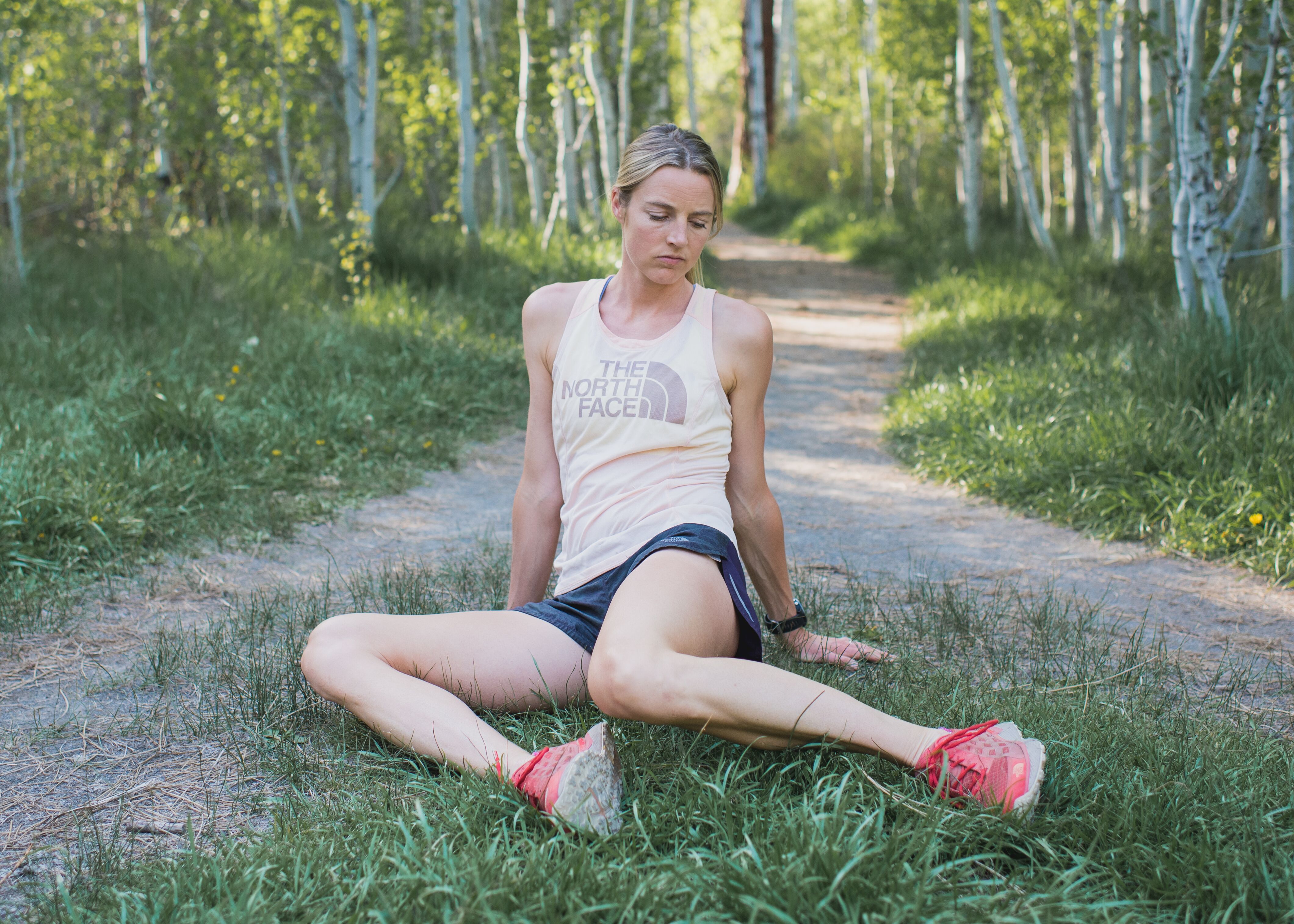
Erin Taylor, founder of Athletes for Yoga (A4Y), demonstrates a hip-opening pose. (Courtesy photo)
My relationship with yoga is very one-sided. Though I do not consider it in any way lesser, I ignore it most of the year when considering my options for exercise, choosing primarily running or skiing instead.
Then something crops up. A switch from skiing back to running in the spring makes my hips and IT bands cranky, causing pain in my knee. A couple ankle rolls on a trail run fire up my peroneal tendon. My elbow isn’t pleased about double pole intervals on pavement.
As if I hadn’t cast it aside, yoga welcomes me back with open arms, helping me improve body awareness and stability, and increase overall mobility and structural resilience.
Though local studios offer a variety of excellent classes, I consistently turn to an online resource: Athletes for Yoga. Started in 2010 by Erin Taylor, former collegiate basketball player turned runner, Athletes for Yoga (A4Y) is a unique resource designed to complement and support an active lifestyle or serious training.
Her message is this: “Don’t do yoga. Use yoga — right now, where you are, to get where you want to be.”
Stephanie Howe uses Athletes for Yoga to compliment her training as a professional mountain running athlete. (Courtesy photo)
Taylor has a true talent for teaching how to unlock tight muscle groups, access and recruit the correct muscle groups, and develop a better understanding of the relationship between muscle groups in the body. For me, A4Y has been an essential tool to feel, identify, and understand muscle imbalances and sources of injury,
The robust A4Y video series, which can be viewed on a cell phone, tablet, or computer, includes routines designed for pre and post workout, strength and balance training, and collections specific to triathlon, running, cycling, pregnancy, and more. There are also resources to quickly relieve tightness in the hip flexors, neck, and shoulders from too much computer time during the COVID-induced work from home grind. Your body will thank you on your aprés workout.
“Athletes for Yoga is home to the only athlete-led, on-demand yoga video platform and app, coach training, and global community of athletes using yoga to achieve their goals. We are here to help you use yoga, for real. That means putting yoga into the context of your sport and goals with functional strength, strategic injury prevention, and optimized recovery to make you a more balanced, resilient, and powerful athlete.”
While longer videos are also available, most of the resources fall between 10-20 minutes, allowing them to fit comfortably into your day.
The A4Y resources I use most frequently include the “5-minute resets”. These videos target specific areas such as hips, hamstrings, or shoulders, quickly yet effectively increasing circulation and range of motion to improve recovery and mobility. Given their length, it doesn’t feel daunting to tack one on at the end of a run, ski, or gym session. There is also a pre-run warmup routine of equal length to activate the glutes and hamstrings, promoting healthy running mechanics.
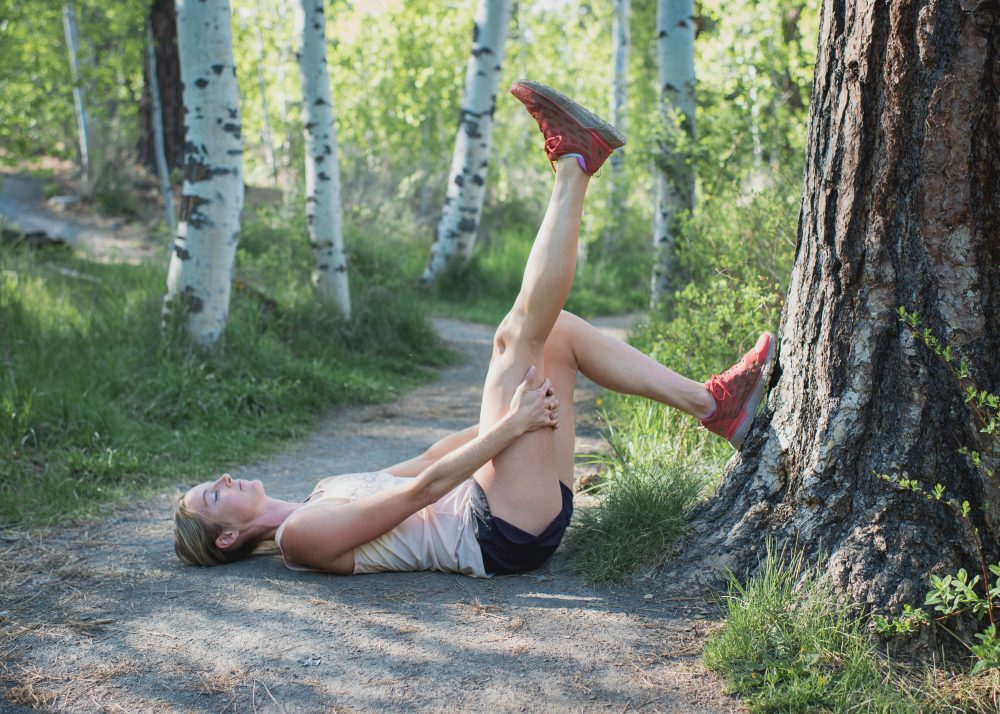
Stephanie Howe works through Athletes for Yoga’s “Booty Lock Mitigation” routine, designed to reduce tightness and promote mobility in the hips. (Courtesy photo)
When I have a bit more time, “Power Your Pushoff” (16 mins) is one of my go-to’s, which activates and strengthens the rear chain while mimicking the forward motion of running or skiing, adding power and stability to those movements. I also utilize “Booty Lock Mitigation” (19 mins) to loosen my hips after a workout, and “Standing Balance Flow” (10 mins) to improve body awareness for better glide on my skis.
“Full Body Core” and “Functional Core” are great strength training sessions that teach you to engage and develop inner core muscles, translating to improved strength and coordination in other activities.
If you’re looking to slow down, try the guided meditation series which includes specific practices to improve sleep, refocus, or visualize race performance.
For those averse to yoga, you may find A4Y challenges your presumptions. It is not “Yoga for Yogis”. You don’t need to wear Lululemon, drink golden milk lattes, or listen to Enya. The style is to the point and down to earth.
A4Y serves all active people, male or female, regardless of sport.
No studio needed. Stephanie Howe, member of the Athletes for Yoga team, demonstrates the versatility of the A4Y resources. (Courtesy photo)
To exemplify that athletes of all caliber have something to learn form Taylor’s approach, take a look at the list of athletes and alumni of the A4Y team, which includes Ironman Champion Ted Treise, professional track athlete Alysia Montaño, professional basketball player Desmond Simmons, and 4x national rowing champion Michaela Copenhaver.
In acknowledgement of the number of people currently looking for opportunities to exercise from home, A4Y is offering 50% off the first month with the code “HOMESTUDIO”, after which a subscription costs $9.99/month or $99.99/year. Subscriptions can be cancelled at any time.
We’ve all heard the phrase: “These are unprecedented times.” And it is true. What the world is facing during the Covid-19 pandemic is something that none of us have experienced before. We are all feeling it.
Uncertainty is ubiquitous and caused by a myriad of factors. We may be concerned about the health of ourselves and our families, or about the financial impacts of our country coming to a halt. We might be attempting to work from home without access to childcare, leaving little time to care for ourselves, or we may be struggling with isolation while distancing ourselves from others.
On March 21st, licensed professional counselor Holly Brooks shared the following on her practice’s FaceBook page:
“While the primary discussion revolves around physical health issues, my professional lens is set to think about people mentally and emotionally. This pandemic is going to be a marathon, but right now it feels like a sprint. Yes, we absolutely need to do everything possible right now to flatten the curve, but if we’ve flattened ourselves (burnt out, physically sick, emotional break down/panic attacks) then we cannot help ANYONE.
Here are three steps that I feel are crucial to help you survive (and even thrive) in this pandemic marathon:
1) Release the energy stored inside of you. This could come in the form of crying, a “thought download” aka journalling, dancing or exercise.
2) Engage in some form of safety/soothing technique. Work on your inner dialogue. Combine it with some diaphragmatic breathing. Use one of the many meditation apps.
3) Practice gratitude and VISUALIZE the FUTURE. Right now our minds are full of “what ifs” and literally worst case scenarios. Sure, we need to prepare and be smart about our preparation but make sure you’re balancing it with positivity. The same goes for the media. Balance the bad news with the good.”
For those unfamiliar with Brooks, she is a licensed professional counselor based in Anchorage, Alaska. Before starting her practice, Holly Brooks LLC, she was a U.S. Ski Team member and competed in the 2010 and 2014 Olympic Games.
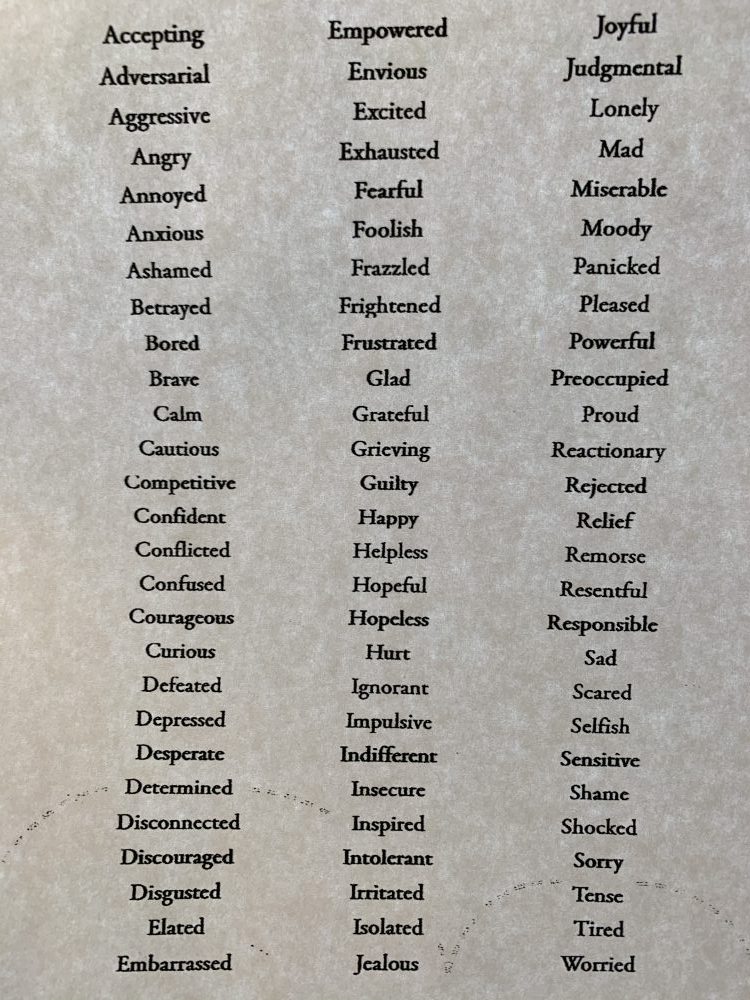
In this episode, Brooks unpacks the many sources of grief and anxiety that people are facing and expands on the steps she recommends to identify and manage the challenges of the times. She discusses the idea of naming and acknowledging feelings to help release energy around them and shares a practice she uses with her clients using the painted rocks in the photos below.
Licensed professional counselor Holly Brooks guides her clients through an exercise of identifying feelings and unpacking their sources. (Courtesy photo)
Holly Brooks explains that selecting rocks that resonate with the emotions that are felt and journaling or discussing each can help release energy around those emotions. (Courtesy Photo)
She leaves listeners with a meditation that can be used daily to soothe and ground themselves as we collectively settle in for the long haul.
For further information about Brooks’ practice or services, contact holly@hollybrooks.com or visit her FaceBook page.
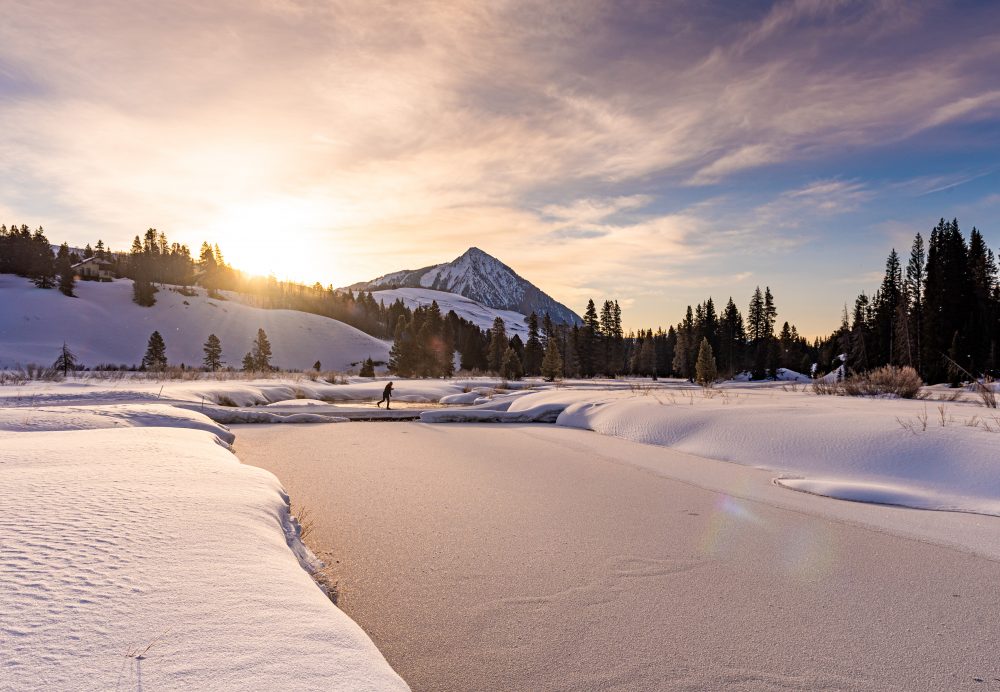
Sunrise skiing on “Mike’s Mile” in Crested Butte. (Photo: Xavier Fane/CB Nordic)
Disclaimer: This article is not intended to inspire anyone to travel to Crested Butte at this time. The county’s public health office expressly asks you not to do so even if you are a second home owner. The aim here is to highlight the familiar therapeutic role cross country skiing has played in the community thus far during the COVID-19 crisis.
Like many other small mountain towns, Crested Butte has been labeled a “coronavirus county hot spot” as Gunnison County ranked 6th on March 29th for per capita confirmed cases of COVID-19 throughout the country. The small rural hospital has limited resources and staff, insufficient to meet the demands of a large surge in the caseload. Of the roughly 17,000 residents of Gunnison County, there have been 90 confirmed cases, with 20 pending and 711 self-reported as symptomatic as of April 8th. There has been one fatality.
When it became apparent that the health of the community was at risk, the county swiftly rolled out stringent public health orders, shutting down all non-essential businesses and short-term lodging. A sleepy ski town community centered upon tourism sputtered to a halt.
The message was clear: stay home, isolate. Gatherings of more than one individual who do not live together are forbidden, with few exceptions. This means you are disallowed from meeting up with a buddy for a ski, even if you intend to remain at least six feet apart throughout the activity.
On March 14th, Colorado Governor Jared Polis issued an executive order closing all ski resorts. Because the Crested Butte Mountain Resort is no longer patrolled or managed for avalanche hazard, uphill access was also ended.
However, mother nature missed the message that winter activities were coming to an end. Nearly 5 feet of snow fell in March — roughly a third of the annual total — making it the snowiest month of the season. The accumulation also created instability in the Elk Mountain regional snowpack, raising avalanche danger, meaning safe backcountry skiing became limited.
A family enjoys a snowy March ski-break from quarantine in Crested Butte. (Photo: Xavier Fane/CB Nordic)
Enter the nordic trails.
With over 50-kilometers of pistenbully groomed trails wide enough to maintain a safe physical distance between passing skiers, the local non-profit nordic center, Crested Butte Nordic, was given the green light to continue grooming operations, providing the local residents a reliable opportunity to recreate outside. A little slice of normalcy and serenity to contrast the rapidly changing circumstances around the globe.
“Essentially, amidst an enormous public health and economic crisis, here in Crested Butte, nordic skiing has risen up as a critical resource for health and wellbeing,” wrote CB Nordic marketing director Laura Puckett-Daniels in an email to FasterSkier.
This sentiment was echoed by CB Nordic executive director Christie Hicks in an email to members.
“CB Nordic was founded on the principle that cross country skiing and snowshoeing are good for the health of our bodies, our minds, and our community,” wrote Hicks. “Never has this felt more true. While the COVID-19 pandemic rages around us and the snow continues to fall, it has become ever more clear to me that our mission is of vital importance for the health and wellbeing of our community.”
A skier enjoys a brief respite and sunrise along the Crested Butte nordic trails. (Photo: Xavier Fane/CB Nordic)
The phrasing is not hyperbolic. As skiers, we understand the positive impact the sport has on our mental health. The expanse of trails in Crested Butte have absorbed and dispersed a multitude of users over the last few weeks, from regulars to first timers, all expressing their deepest appreciation for the trails.
“We have seen an overwhelming response to our services in the last three weeks,” wrote Puckett-Daniels. “The trails are full of skiers. Our inboxes and social media feeds are full of gratitude and enthusiasm. In addition to our 1200 regular adult season passholders, we’ve issued over 135 new passes and over 400 rentals since the epidemic hit Gunnison County. CB Nordic has been praised for doing ‘hero work’ by the local paper,recommended by the County, and even designated as a Utility by the County so that we can continue our work.”
The team at the nordic center adapted operations quickly to abide by regulations without compromising access. They decreased their grooming staff to two, who worked in separate machines and always used the same machine, changed rentals from daily to weekly to reduce the number of exchanges and rolled out an online request system. They also graciously changed rentals and passes to a by-donation system to acknowledge the severe financial impact many residents, some suddenly jobless, are experiencing.
“We’ve made all trail passes and adult rentals ‘pay-what-you-can’, so literally everyone, no matter their financial circumstances, can participate,” explained Puckett-Daniels. “We have been able to continue with our services because, as you know, nordic skiing requires minimal infrastructure, is easily accessible, and allows for social distancing.”
With over 50-kilometers of wide trails, CB Nordic has remained open to support the health and wellbeing of the community during the COVID-19 crisis. (Photo: Xavier Fane/CB Nordic)
That is not to say that CB Nordic has not experienced set-backs during this time.
Like many other small businesses and nonprofits, CB Nordic is not immune from the economic impacts of the shut-down. They cancelled their biggest fundraiser of the year, The Grand Traverse backcountry ski race to Aspen, as well as all their remaining spring lessons, tours, and dinners at the ski-in-ski-out Magic Meadows Yurt.
They are optimistic that summer trail races and mountain bike events, which also benefit CB Nordic and its programming, will run as scheduled.
CB Nordic will continue to groom its trail system through Sunday, April 12, with a possibility of extension based on conditions. Puckett-Daniels reported that users have done well with respecting physical distancing recommendations and not congregating on the trails, so it is unlikely that the privilege will be revoked.
“It’s been easy to stay 6 or more feet away from other trail users, and everyone’s been very good and polite about that, but it’s been hard not to stop and chat with our friends,” Puckett-Daniels shared. “The smiles and waves are huge, and, especially when the sun’s shining, there’s an infectious joy to being out there. Like we’ve all been able to take a deep sigh of relief… there’s a strong sense of camaraderie and community out there.”
Again, we are not encouraging anyone to travel to Crested Butte, nor do we aim to proliferate a feeling of missing out if you are no longer able to ski. The message is simple: as the COVID-19 pandemic destabilizes our world, access to fresh air, exercise, and sunshine are of vital importance to our collective well being. Puckett-Daniels summed it up best:
“In a time with so much fear and uncertainty, we feel that this story of “the little sport that could” rising to serve residents’ needs — spreading joy and supporting mental and physical health — is one worth telling.”
With plenty of snow left to groom, CB Nordic continues to serve its community during the COVID-19 crisis. (Photo: Xavier Fane/CB Nordic)
On March 13th, the rapidly evolving situation with COVID-19 caused the World Cup to come to an abrupt halt. Quebec, Minneapolis, and Canmore: all cancelled. SuperTour finals: also cancelled.
For some U.S. athletes including Gus Schumacher and Katie Feldman, this meant missing their first ever World Cup starts. For others, like Andy Newell, it meant missing his last. Jessie Diggins was in sixth place in the overall standings, less than 300 points out of third with one of the women in front of her, Ingvild Flugstad Østberg, injured and unable to compete.
Yes, in the grand scheme of a global pandemic, ski racing is insignificant, but human emotion is natural, and disappointment and frustration in the lost opportunity is to be expected.
In the spirit of spreading a little levity and positivity to contrast the uncertainty of the times, FasterSkier reached out to a subset of the coaches and crew who would have raced in the North American tour to find out what their “silver lining” to the early end of the season has been.
Here are the responses they’ve shared over the last week.
Jessie Diggins (MN)
“Getting time with my dogs and my family that I otherwise wouldn’t have had!”
Jessie Diggins enjoys quality time with her parents newest addition, Lucy. (Courtesy photo)
Gus Schumacher (AK)
“My silver lining has been coming back to Alaska in its ideal state. So sunny and snowy and cold still, all making for amazing cross country and alpine skiing. Doing these outside activities help me keep my distance from people. I still get bummed when I think about how I’d be racing in Minneapolis right now but I’ve been distracted by doing fun things and seeing friends at home.”
Gus Schumacher shares a scene from Alaska in its “ideal state”. (Courtesy photo)
Gus Schumacher tours the Alaskan backcountry with friends. (Courtesy Photo)
Matt Whitcomb (VT)
“I’m feeling healthy, but put myself in quarantine immediately after returning from Quebec City, since I’d like to see my parents this spring. (Apparently there was a staff member from another team in QC with the virus.) Today is my 4th day in lock-down. I love it. Yesterday I skied 50k from my cabin door on a pair of Rossignols I hadn’t waxed in 15 years. They were great on the crust.
“I took a long break at 47k, and then limped it in to finish reading ‘Confederacy of Dunces.’ I fell asleep after one page. My only vehicle—at the moment—is a motorcycle, and with newly fallen snow, and only one potato and 75 ProBars remaining, I walked 4 miles into town to get groceries. I’m melting snow in a big pot for drinking water. So, the silver lining is that we all are forced to take the rest we need. The downside is that [my girlfriend] Steffi is stuck in Germany.”
A cozy scene from inside Matt Whitcomb’s Vermont cabin. (Courtesy Photo)
Simi Hamilton (VT)
“Sophie and I, along with a few other southern Vermont locals, have been taking advantage of these crazy times and great spring weather to explore our back yard here in Peru. Since the announcement of the World Cup cancellations we’ve gone on a couple pretty epic forest adventures on some really good crust. Even though you can’t cover quite as much ground as in the west when the crust is good, it’s pretty cool to be able to explore the woods and connect a lot of dots on the map that you can’t do in the summer in your running shoes.
“Although Bill Koch has explored probably every square inch of the thousands of acres behind where he lives and where the Caldwells live, it still feels like you’re skiing through land where no one else has ever been before when you’re out there. There are frozen lakes and beaver ponds you can ski across, glades you can make turns in, and countless thickets of buckthorn and hemlock to scrape your way through.
“Yesterday our crew consisted of Sophie, Sverre, and me, as well as John, Ben, and Katherine Ogden (who live 10 minutes down the road). We’re for sure taking all the recommended precautions with proximity and exposure to others, but it’s just been great to share conversations, laughs, and adventures with good friends during these challenging times.”
Sophie Caldwell shares a crust tour with her husband, Simi Hamilton. (Courtesy photo)
Sophie Caldwell tries to stay dry at a creek crossing while adventure crust skiing in Vermont with her husband, Simi Hamilton. (Courtesy photo)
Erika Flowers (MT)
“While I would have loved to be racing and traveling right now, being home has meant more backyard adventures with my sister, Natalie and husband, Andy. There’s a mountain about 20 minutes from our house called Little Ellis that has always been on my backcountry bucket list. It’s not particularly epic but it’s beautiful and when racing every weekend during the winter I’ve never found a good time to ski it. The spring the snowpack can be iffy so a few extra weekends at home in March meant we had the chance to tour up there earlier this week.
“All the local ski trails are still being groomed even though the lodges are technically closed. I may not have had the chance to wear my U.S. Ski Team suit at the World Cup but I suited up today for some fun intervals today in the sunshine!”
Erika Flowers suits up in her USA kit for some intervals in place of World Cup races. (Courtesy Photo)
Erika Flowers and husband Andy Newell enjoy the opportunity for backcountry tours near their home in Bozeman, MT. (Courtesy photo)
Kevin Bolger (WI)
“I am using this time to enjoy quality time with loved ones at home, finally reading the books I’ve been wanting to, and enjoying some northern Wisconsin spring days.”
Becca Rorabaugh (AK)
“I got to ski the Arctic to Indian traverse for the first time! Personally, I know I’ll never be this fit in Alaska in March with so much free time— I intend to make the most of it (sans carpooling). The route traverses the Chugach mountains from Arctic Valley Road to the Indian Valley Trailhead. It’s 20 miles — mostly gradual uphill terrain followed by a fun descent from Indian pass down to the trailhead. There are lots of boggy areas and creek crossings that aren’t fun in the summer, so late winder tends to be the time to do it.
“It’s been really fun this week to experience skiing in lots of different forms: doing so AT skiing, some nordic touring, and exploring places I don’t usually get to see this time of year.”
Becca Rorabaugh stops to take in a spectacular view while touring in Alaska. (Photo: Instagram @beccarorabaugh)