From the FasterSkier archive — posts syndicated from athletes’ and coaches’ own blogs between 2004 and 2012, kept online as published. Current coverage is at fasterskier.com.
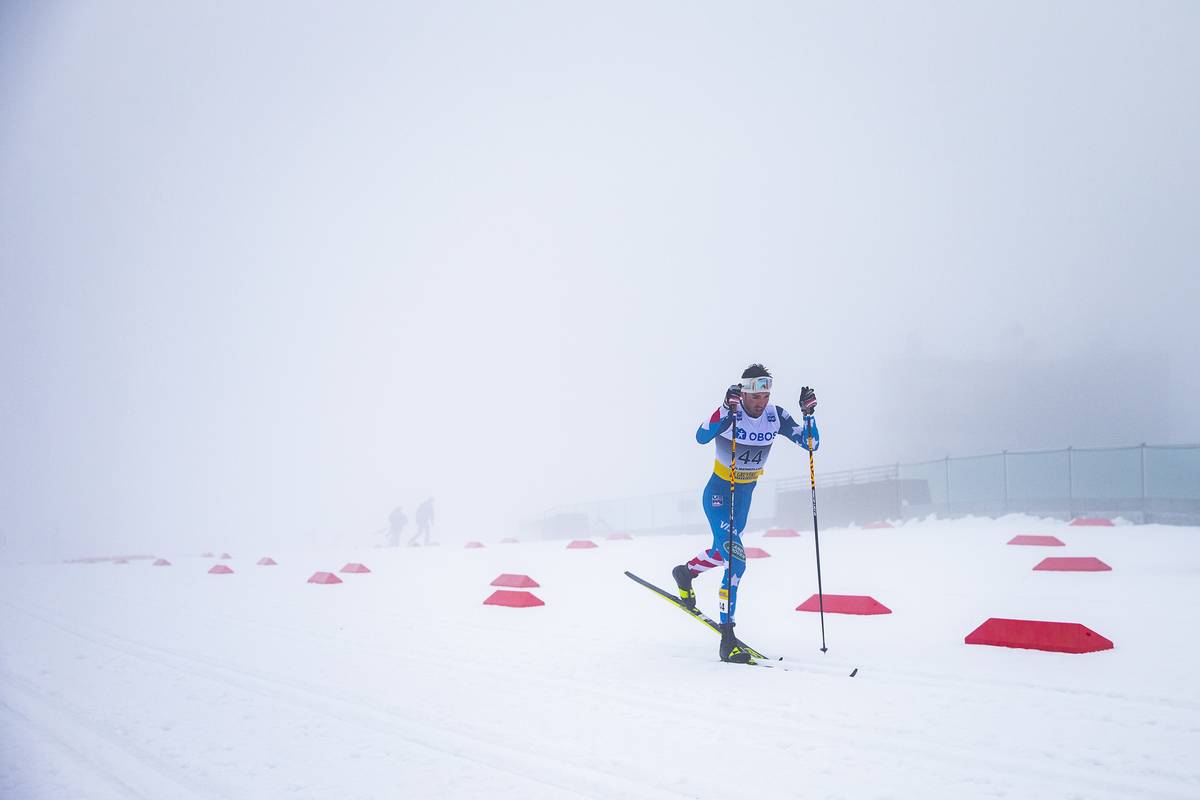
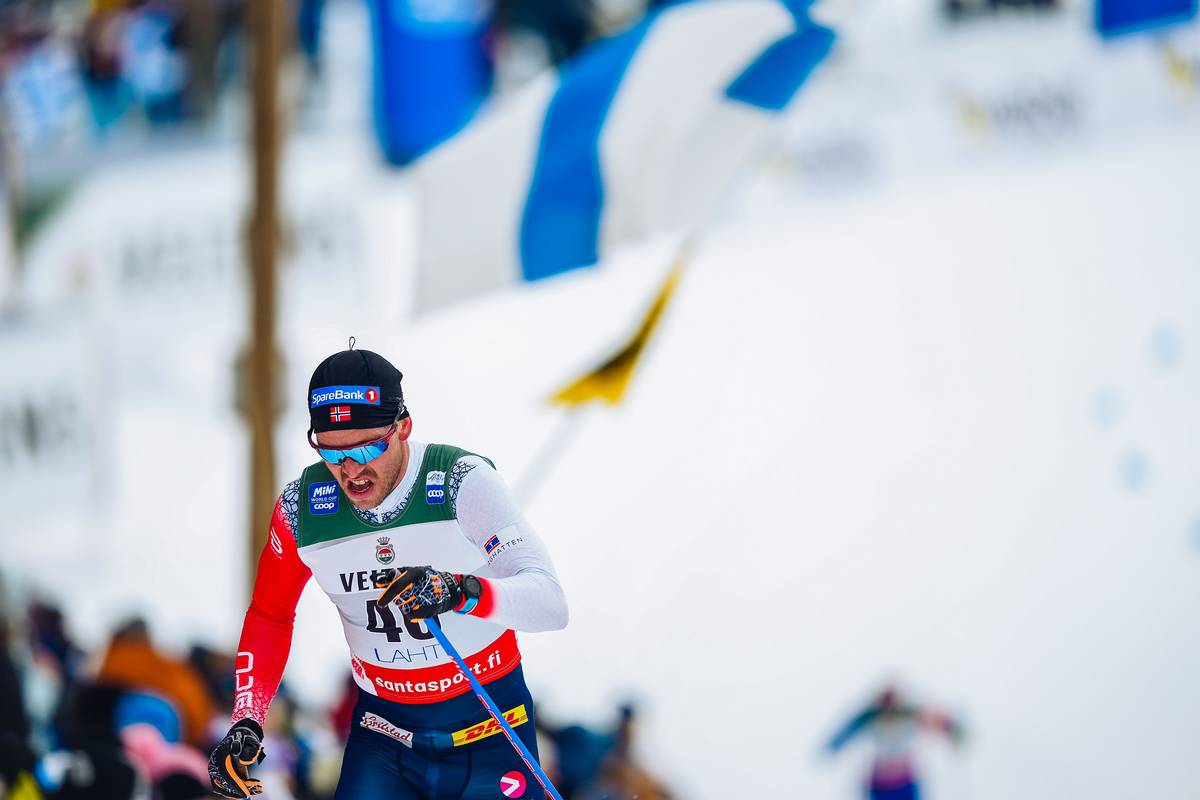
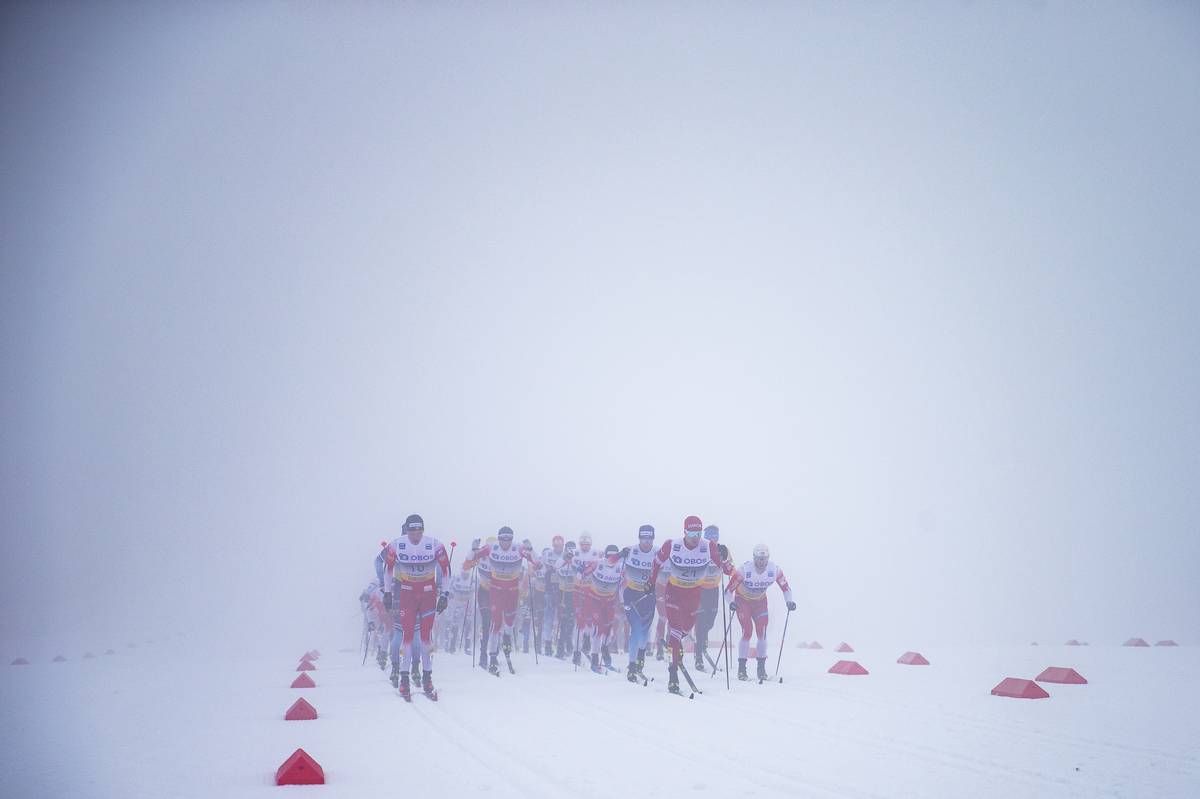
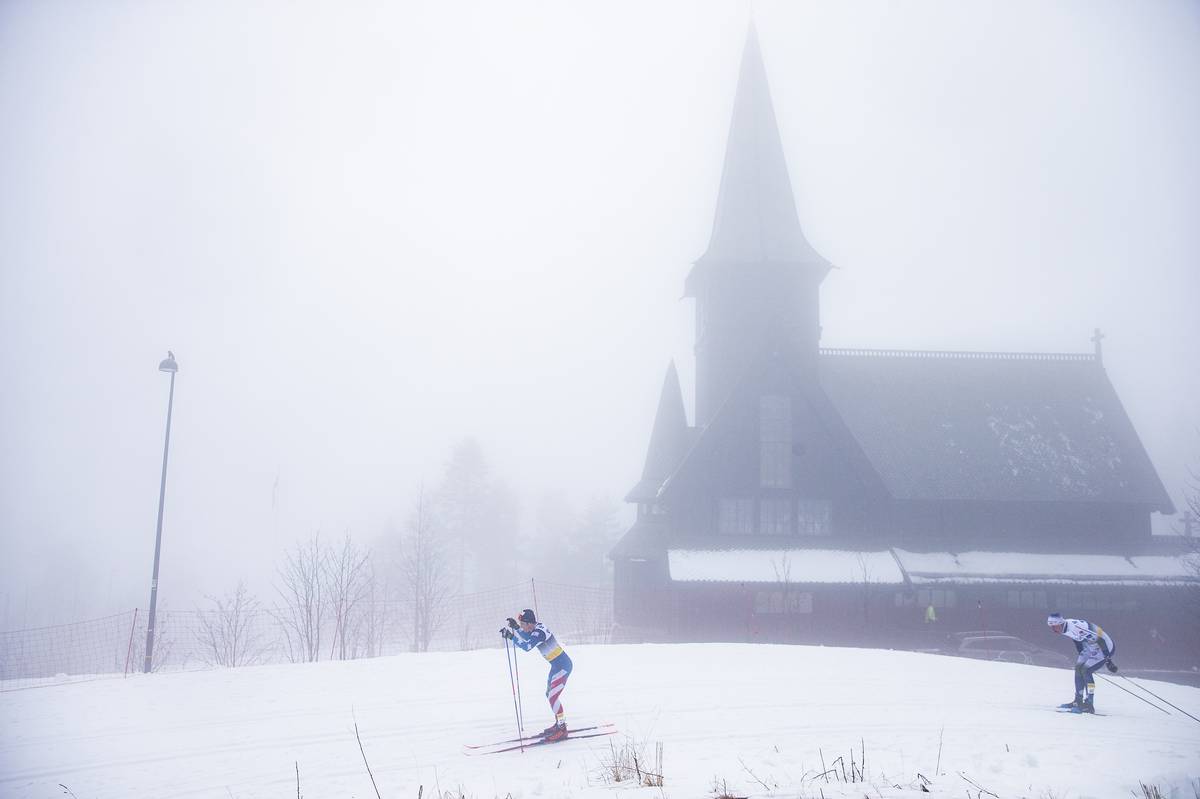
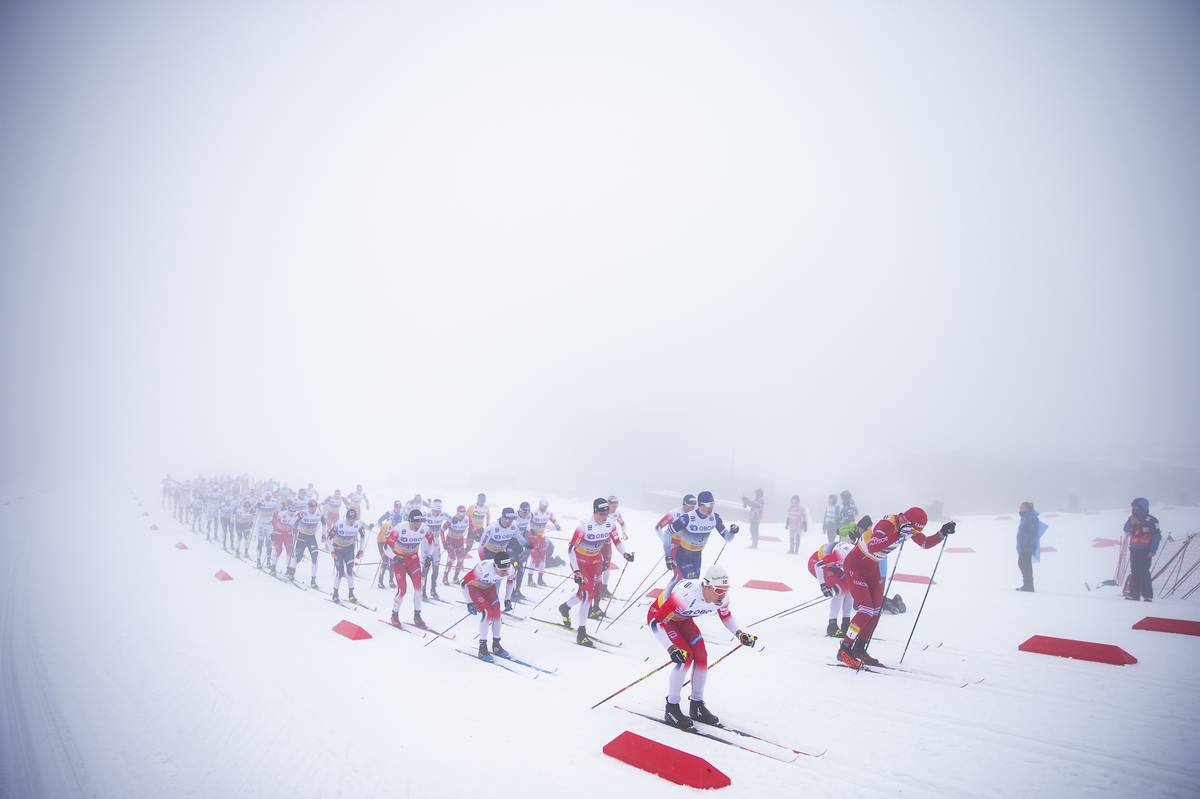
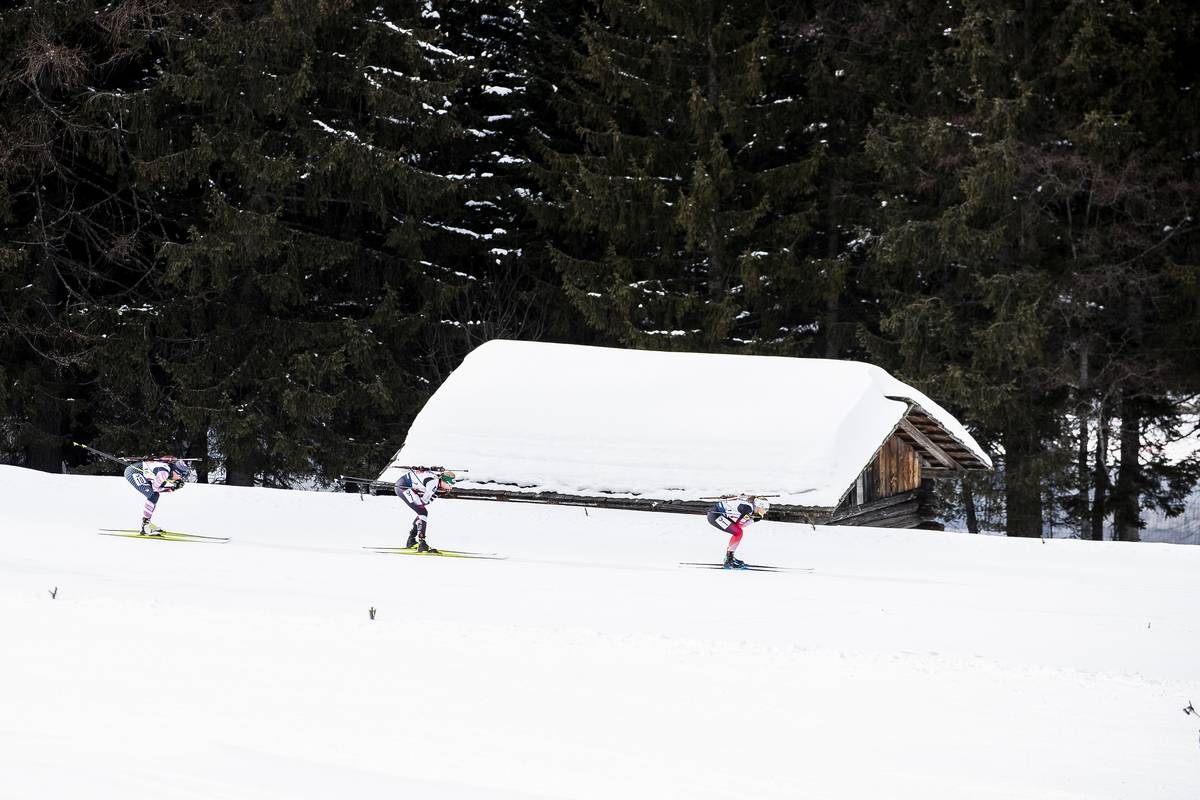
Ian Torchia (SMS T2) races through dense fog at the 50 k classic at Holmenkollen in March, 2020. (Photo: NordicFocus)
Click here to read an account of physical therapist Ned Dowling’s first stint overseas with the US Ski Team in March, 2020.
Holmenkollen, Norway. March 8, 2020 – Men’s 50k Classic World Cup. 33 degrees and raining. The ski jump was engulfed in clouds. Spectators were forbidden from attending the Super Bowl of cross country skiing due to the impending COVID pandemic. My first stint as a physical therapist traveling with the US Ski Team was ending in an Oslo fog.
Salt Lake City, Utah. Late March, 2020 – Buzz kill. In the week following my return from Norway, my son’s school was closed, my clinic was closed, people were fighting over toilet paper and hand sanitizer. It was the end of the world as we knew it. And we didn’t feel fine.
July 6, 2021 – I received an email from Chris Grover asking if I could travel with the ski team again in 2022. We were amidst the calm before the storm. People were getting vaccinated. COVID cases were dropping. We went on vacation. Delta had not yet jumped out from behind the grim reaper. The light at the end of the tunnel was getting brighter and brighter.
I had declined an offer to travel the previous winter. I knew I couldn’t get permission from either the boss at work or the boss at home. And I sure couldn’t tell my kid, who was still doing school remotely, “You keep up with those classes on Zoom while Daddy is off to Europe.”
But now things were looking up. By the time I’d be overseas in March, the COVID thing would be a distant memory. Hell yes! Sign me up Chris.
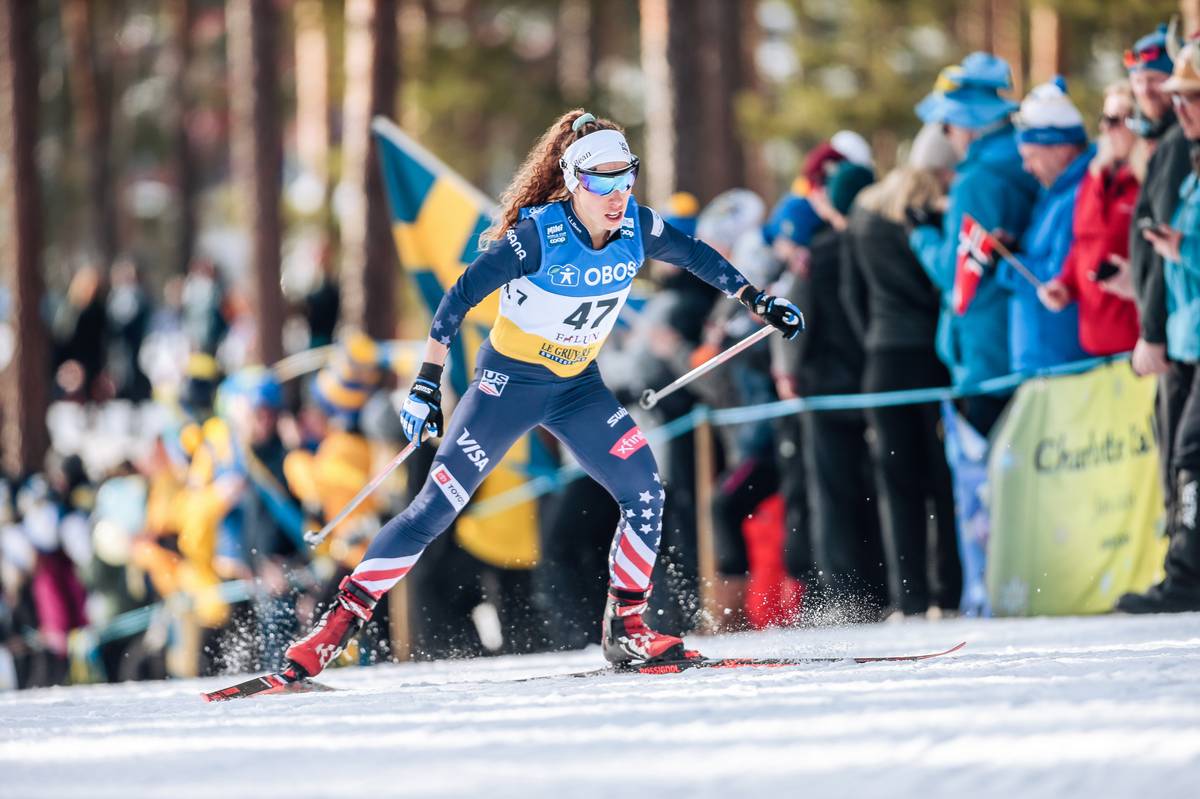
Rosie Frankowski races the 10 k freestyle in Falun, Sweden in March 2022. (Photo: NordicFocus)
Summer, Fall, Winter – We all know what happened next. The light at the end of the tunnel was an oncoming train and the shit hit the fan. Lots of shit hit lots of fans. First, the Delta variant, then Omicron. Through all of that, I did my best to stay optimistic about my opportunity to work the last two weekends of World Cup races in Falun, Sweden and Tyumen, Russia.
Falun was a bit of a known entity, or at least easily researched on the internet. The World Cup had been racing there for years. Trail maps showed a good network of tourist tracks (which is a good thing because the race course is no joke). Videos of old races on YouTube showed huge crowds, which were sorely missed at the pre-COVID Holmenkollen.
Tyumen, the Pearl of Siberia, was going to be much more of an adventure. Much to my relief, the plan was to have a chartered flight from Stockholm to Russia. I really, really didn’t want to fly (or crash) on a commercial Russian plane. With a lot of digging and Google Translate, I could glean some information about the race venue and its environs.
February 9, 2022 – Chris emailed me about getting a Russian visa. He told me to contact someone at the Russian Consulate in Washington: call this guy, do what he says, pay what he says, we’ll reimburse you. The next day I anxiously called Bogdan, to whom I would be entrusting my passport. “You send passport, extra photo, and $250. You complete visa application online and send password for application, so I fix your mistakes. You send postage to mail back.” I had him repeat that three or four times while I nervously scribbled notes to myself. I reminded him that I was flying to Sweden on March 6 and would very much need my passport back by then. “No problem. You get passport.”
The visa application was nerve racking. Employment history. List of all countries traveled to in the last 5 years. “Have you been trained in firearms, artillery, or nuclear warfare?”
With sweaty palms and my heart rate in L4, I mailed off my passport and hopefully everything else I was supposed to. Then I waited.
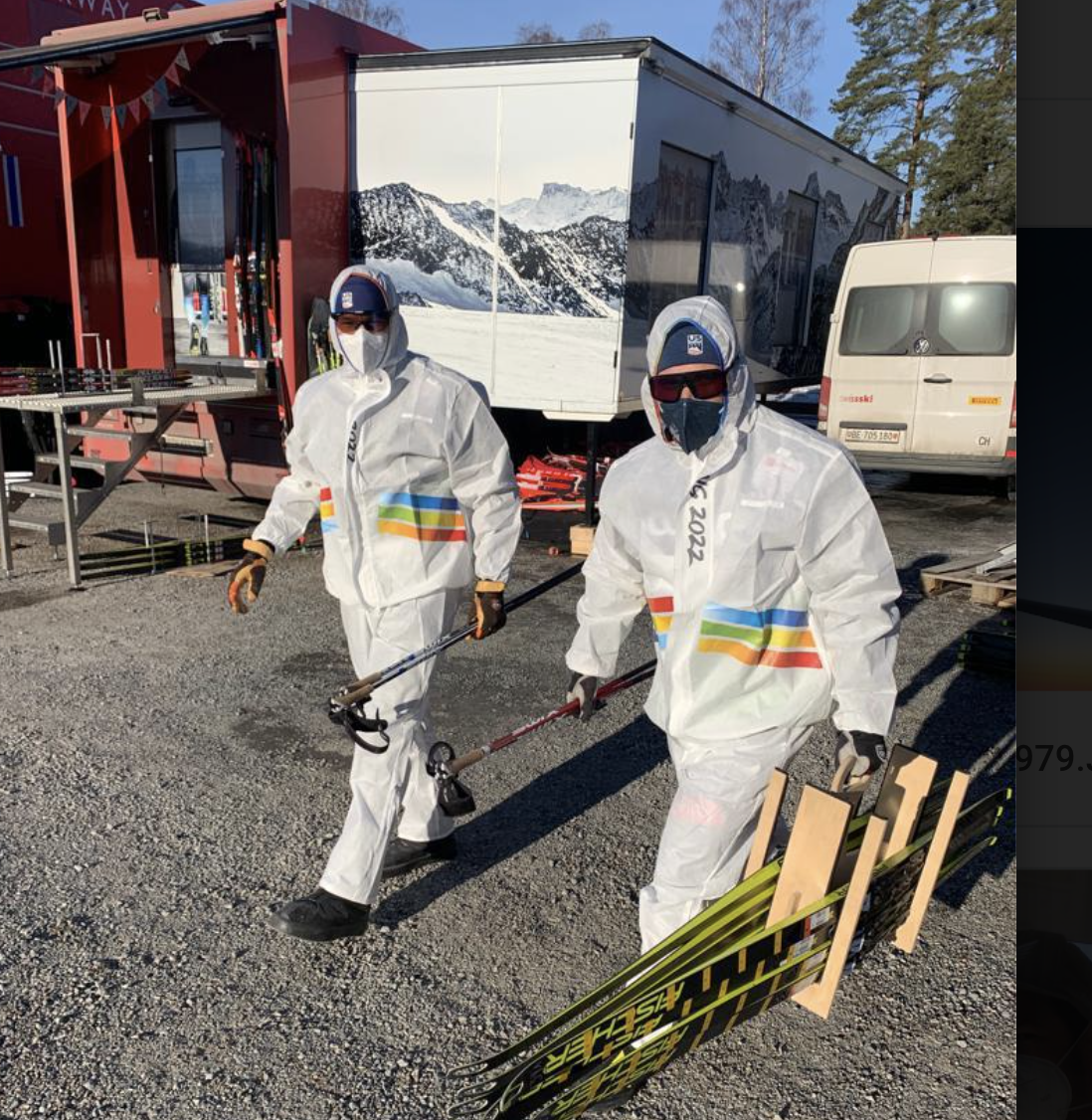
A different kind of Olympic suit: US wax techs take COVID precautions while testing and preparing skis in Falun, SWE. (Courtesy photo)
Thursday, February 24, 2022 – Russia invaded Ukraine. The world as we knew it ended once again. Chris texted me that the trip to Russia was canceled (the US team’s decision not to go to Russia preceded FIS’s decision to cancel the races). “Get your passport back right away.” I called Bogdan, my contact at the Russian Consulate. “We’ve had a change in plans, and I won’t be traveling to Russia. Can you please send my passport right away?” “No. I do not have your passport. Embassy has passport. I cannot get until finished with visa. But I mail it.” I could hear a toddler crying in the background. Bogdan apologized for the crying. I told him he shouldn’t have taken my call at home. He said, “Do not worry with passport. Visa will finish on Monday or Tuesday, then I mail. I call you when I mail.”
Friday, Saturday, Sunday, Monday, Tuesday – Nope. Not going to happen. I’m never going to see my passport again. They’ve all left the embassy. My passport is too low of a priority. They’re just going to be jerks and not send it back. So much for going to Sweden. COVID, war, what’s next?
9:21am, Tuesday, March 1, 2022 – Bogdan called. “Naatan, I mail passport. You get tomorrow.”
I thanked him profusely. And I said a little prayer. This man is living in America, raising a family in America. Yet he works for the Russian government. He is a Russian in a country that, overnight, hates Russians. I spent the last 5 days completely stressed because I didn’t have possession of a passport that would allow me to travel to Sweden for the sake of people skiing around in circles. This man, who must pay at least some attention to Western media, must have spent the last 5 days completely stressed over the safety and ultimate fate of his family and country.
(I do not mean to discredit ski racing or initiate some existential debate. As crazy as it seemed for the World Cup, and even Olympics, to carry on through this pandemic–and now war, I know I found great benefit from the distraction that racing provided. It was a slice of normalcy and vicarious living, which was invaluable to me as so much of what I took for granted was upended. But my little problems did seem very small compared to Bogdan’s.)
Wednesday, March 2, 2022 – Scott, our friendly (seriously, he waves to everyone) neighborhood mail carrier delivered my passport. Huge sigh of relief.
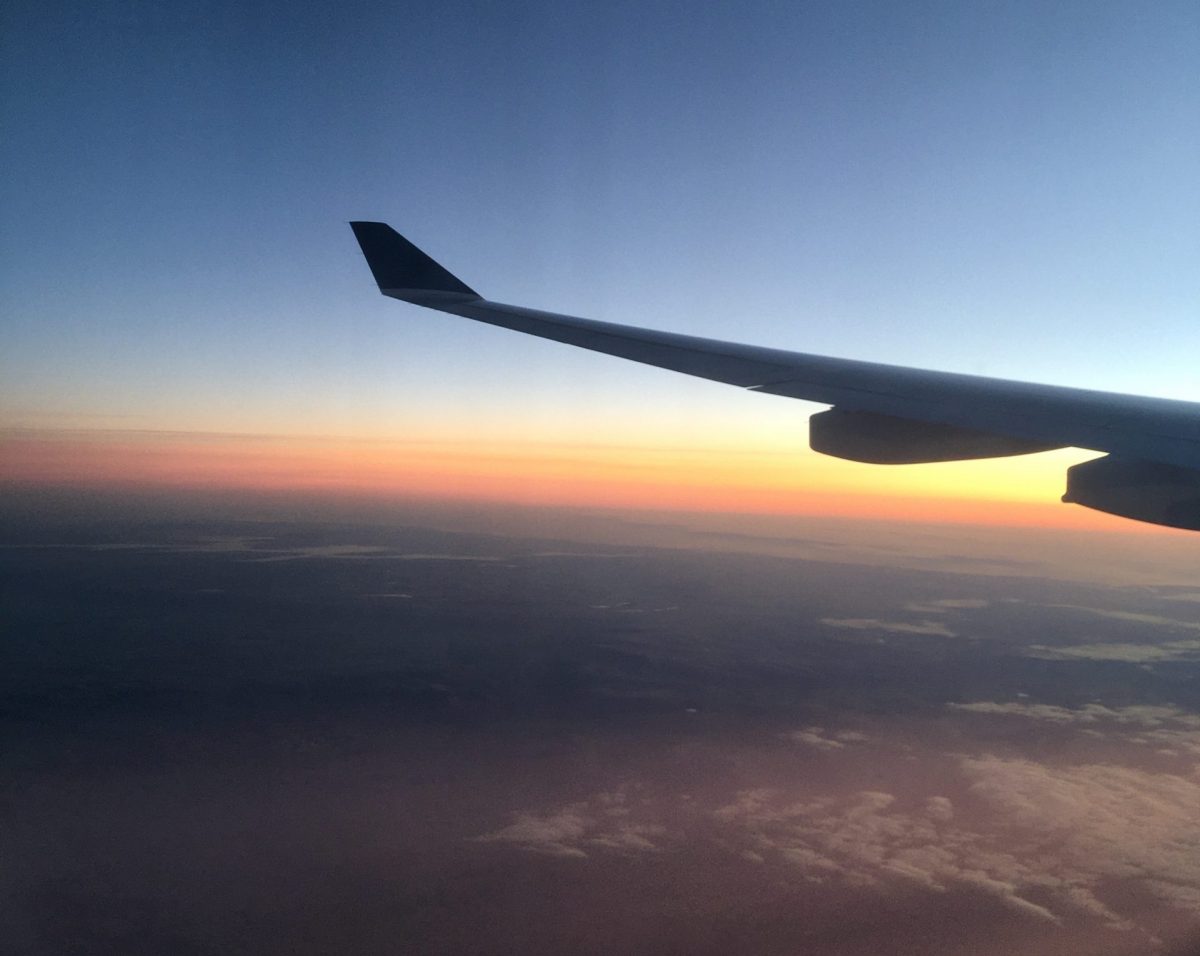
After a series of hurdles, Ned Dowling is wheels up on his way to Sweden. (Courtesy photo)
SLC International Airport. Sunday, March 6, 2022 – I hugged my son, kissed my wife goodbye, and donned my N95 mask which I wore for 18hrs straight. SLC direct to Amsterdam. Enough layover to grab a bottle of Scotch at the duty-free. A packed flight to Stockholm and a 2.5 hr bus ride to Falun. Jet lagged and sleep deprived, I met up with the team as they’d just gotten off their bus from Oslo. We all stood around in LL Bean team gear and N95s awaiting instructions on where to schlep our massive duffles.
Our accommodations for the week were not at the Scandic Hotel, the FIS-provided standard lodging for all of the teams. It was decided that the hotel and its buffet meals were too COVID risky. Instead we stayed two-each in a group of camping cabins equipped with bunk beds and a small kitchen. We were on our own for breakfast and lunch. Dinners were catered by restaurateur parents of Swedish sprint star Maja Dahlqvist (the World Cup circle is pretty close knit).
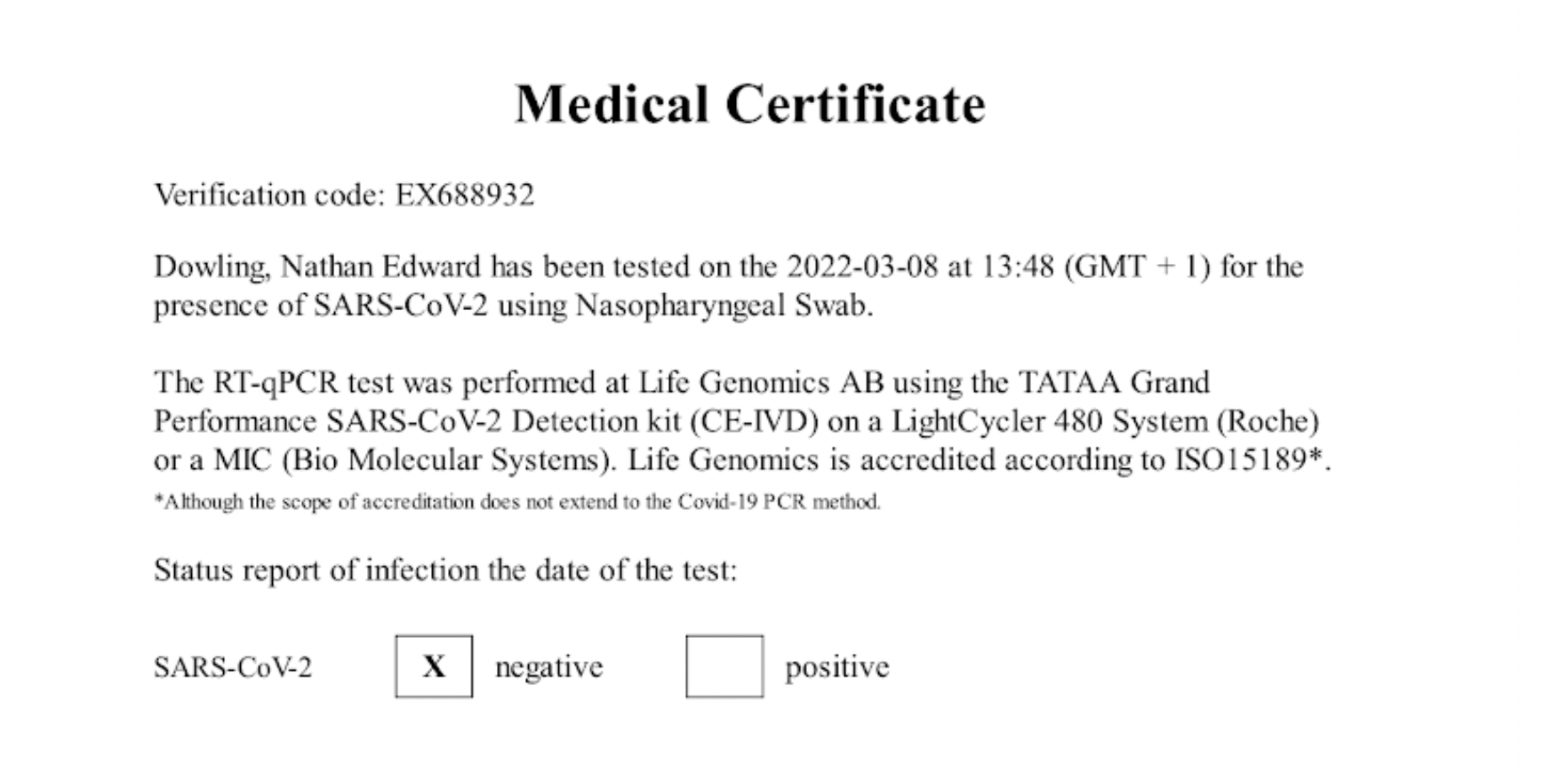
Cheers for negative COVID tests!
Falun, Sweden. Tuesday, March 7, 2022 – COVID testing. The team was shedding skiers and staff with positive tests. A few soldiers were left behind to wait out quarantine in an Oslo airport hotel. A couple more made it to Sweden but wouldn’t see a race bib. Anxiety was high. A positive test meant no racing, no human interaction, no trip home until the negative. One car load at a time we went to a testing center in Falun for nasal – very, very nasal – PCR tests.
“I think it touched my eyeball!” “I had 31 tests in China and that was the most aggressive one ever!” “Damn, that was legit!”
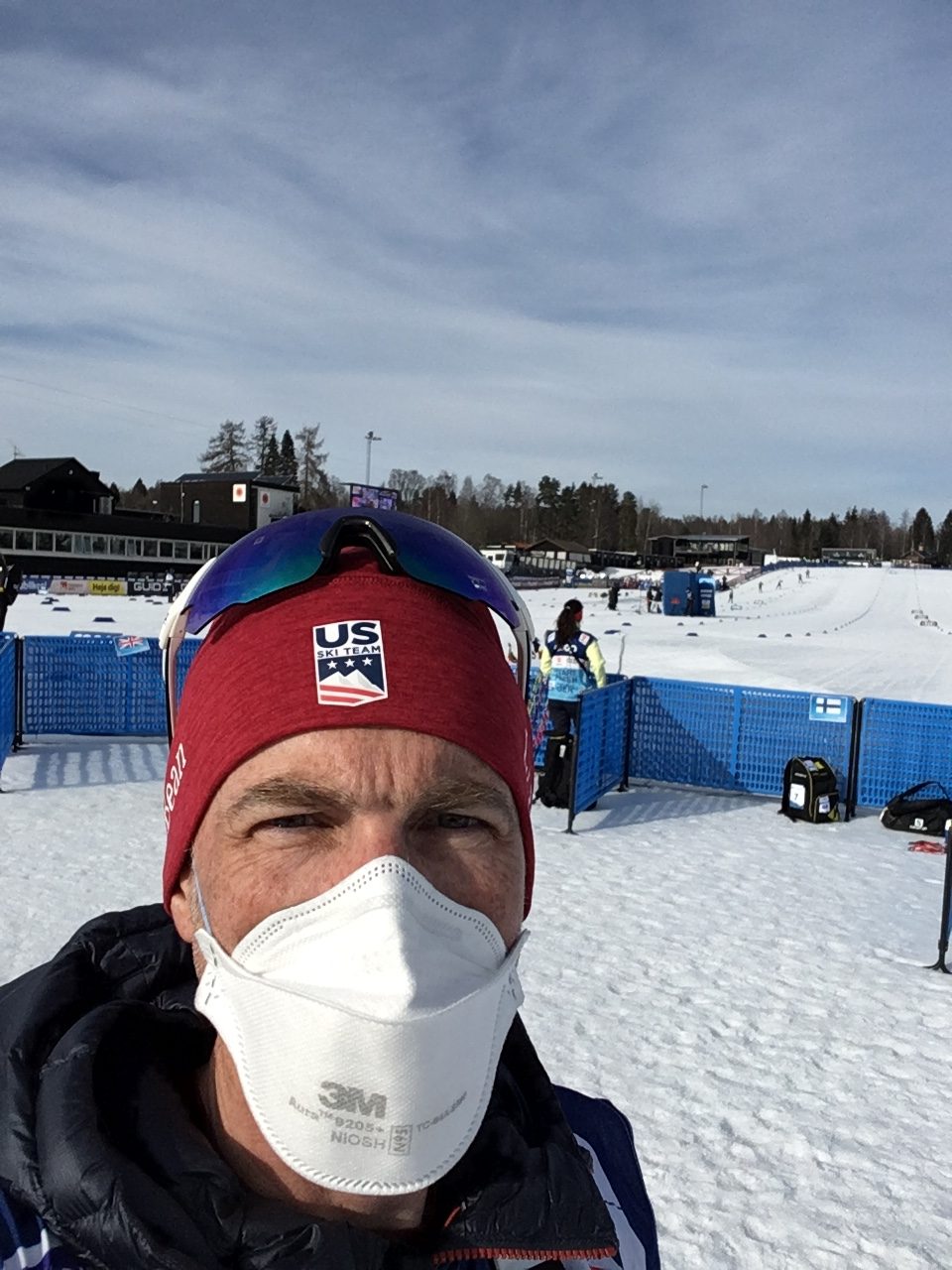
Physical therapist Ned Dowling snaps a masked selfie while supporting the US Ski Team in Falun, SWE. (Courtesy photo)
Wednesday, March 8, 2022 – All tests were negative. Collective sigh of relief. With that reassurance, I finally had some customers on the physio treatment table. Thankfully, everyone’s bodies were holding up reasonably well for being that late in the season. I felt guilty for being over there without much to do, but I figure that my boredom means they don’t need me and if they don’t need me it’s because they’re healthy, which is the goal (or they don’t want me because they’re COVID paranoid – there was plenty of that too, understandably so). So, until the racing began, I didn’t have much to do besides ski every day. Poor me.
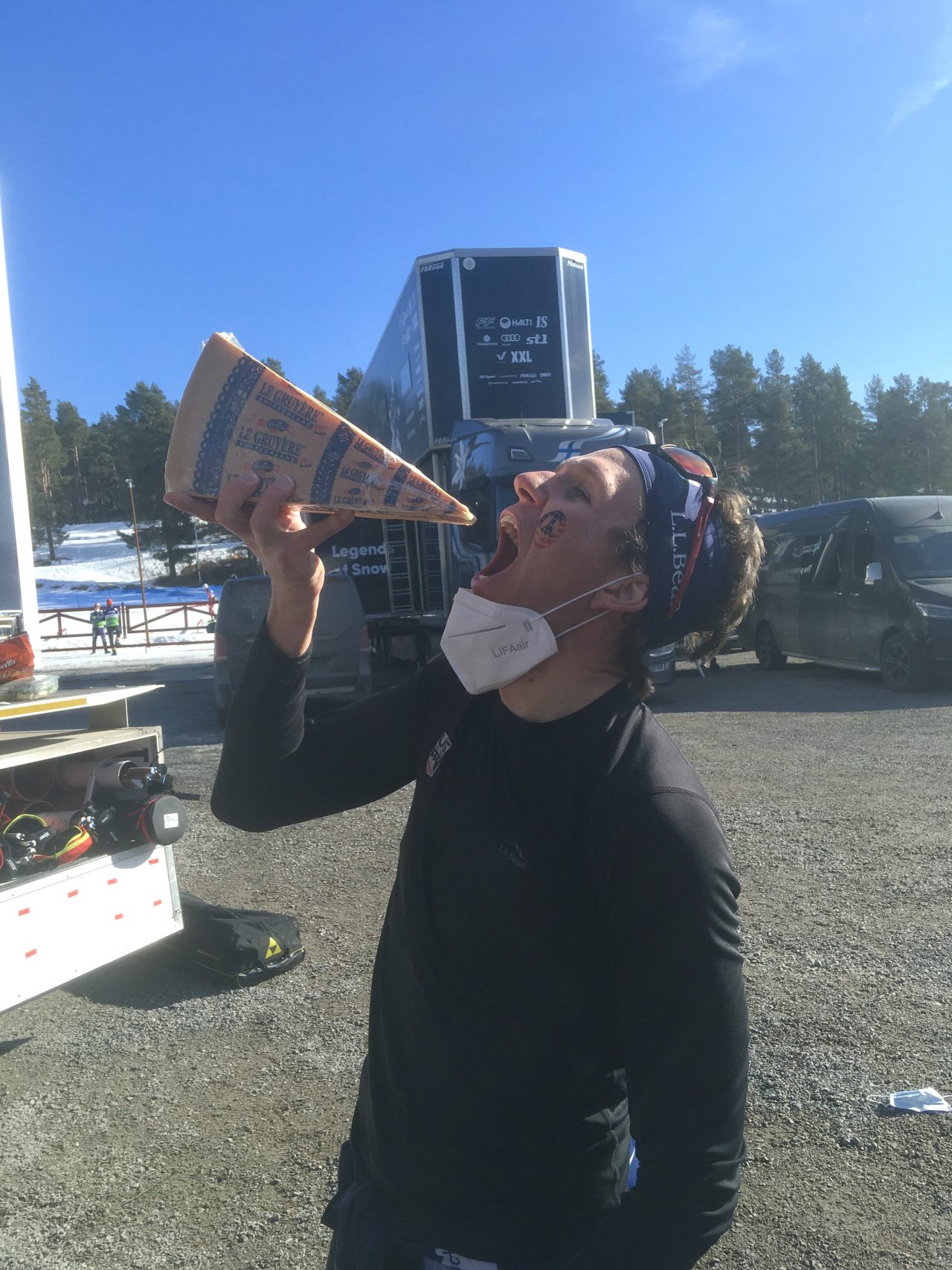
March 11-13, 2022 – Let’s go racing! My experience with the team is that they are always a great group of people to be around, but they’re even more fun with podiums. Lots of good results all around with some “first World Cup points” to some near-misses to some 5.5 lb chunks of Gruyere podium cheese.
Scott Patterson takes a bite of victory cheese after helping the USA 1 team to victory in the 4 x 5 k mixed relay in Falun, Sweden. (Courtesy photo)
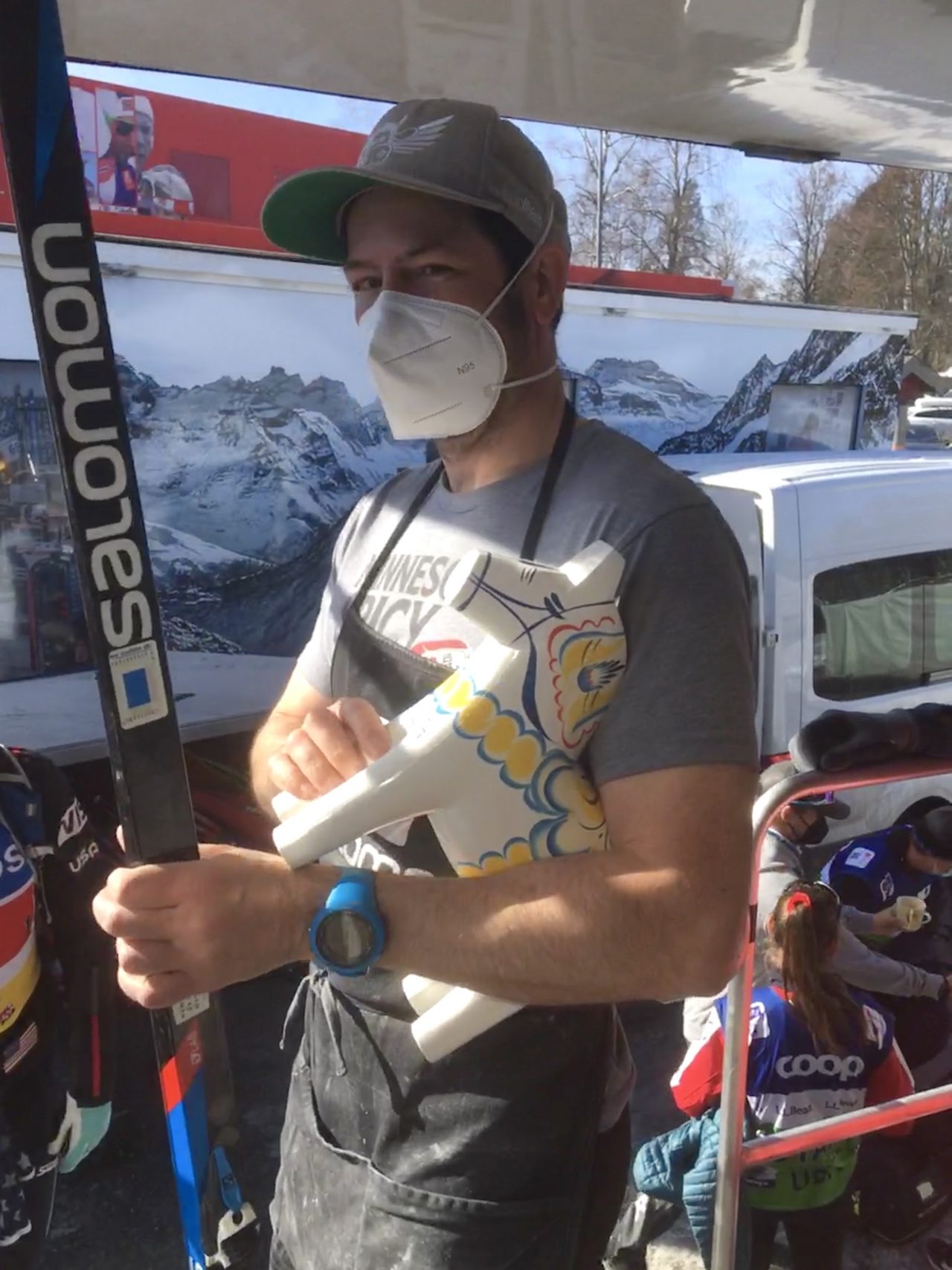
The man behind the fast skis: Jason Cork sports podium goods in Falun. (Courtesy photo)
4:30pm, March 13, 2022 – The final race: antigen testing for entry back into the US. Again, all negative. We’re going home! That night in the bar at a Stockholm airport hotel, I finally saw some faces that’d been hidden behind N95s all week. The poor bartender had a tough time keeping up with the drink orders. Elation, exhaustion, and simple relief that they’d survived another crazy race season and were finally heading home after four months of living out of suitcases, always masked, always nervous.
Maybe next year we can race without a pandemic or war or plague of locusts.
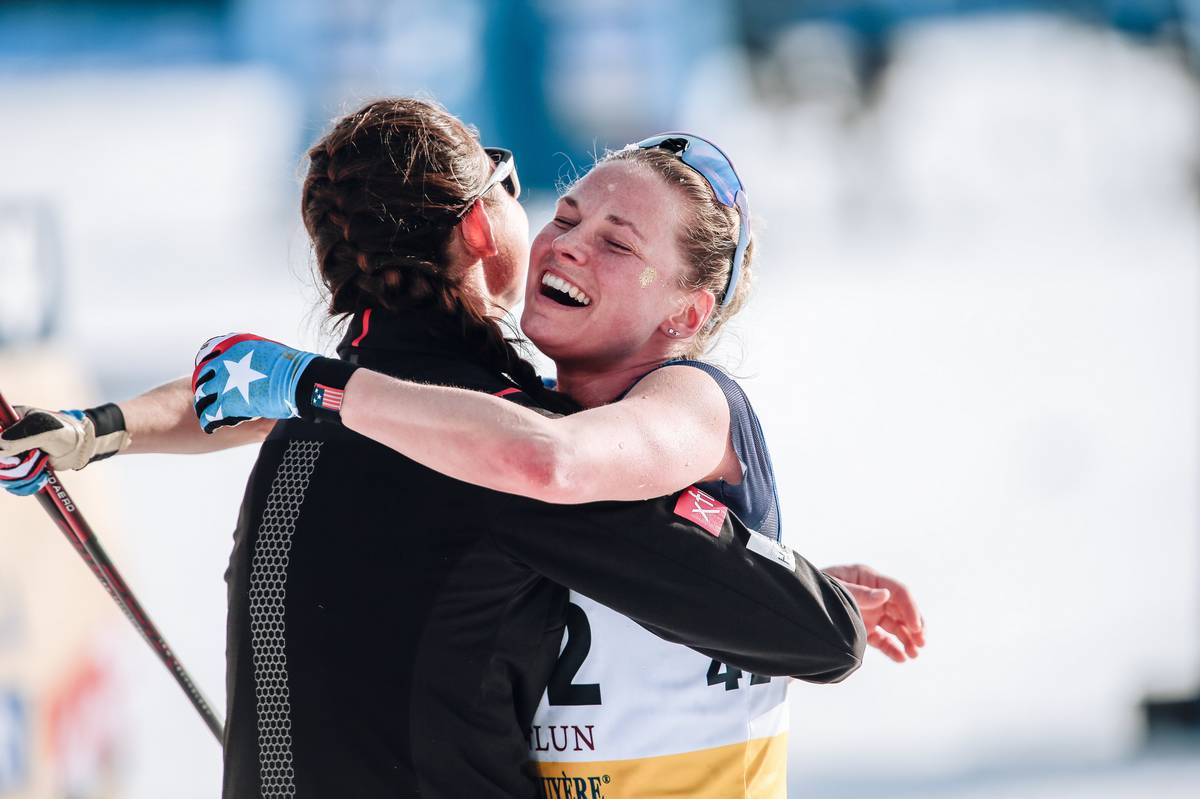
Jessie Diggins hugs teammate Julia Kern at the finish of the 10 k freestyle in Falun. (Photo: NordicFocus)
It doesn’t get much better than a weekend of full sun, epic skiing and meetings with the king of Norway. But that’s what we’ve got for you after another fun weekend of racing, at Oslo’s classic Holmenkollen venue. With help from Canadian retired Olympian Jess Cockney, we break down the 30 k and 50 k from Saturday and Sunday, touch on the COVID outbreak that’s hitting World Cup teams including the U.S. and take the International Ski Federation to task for canceling World Cup finals.
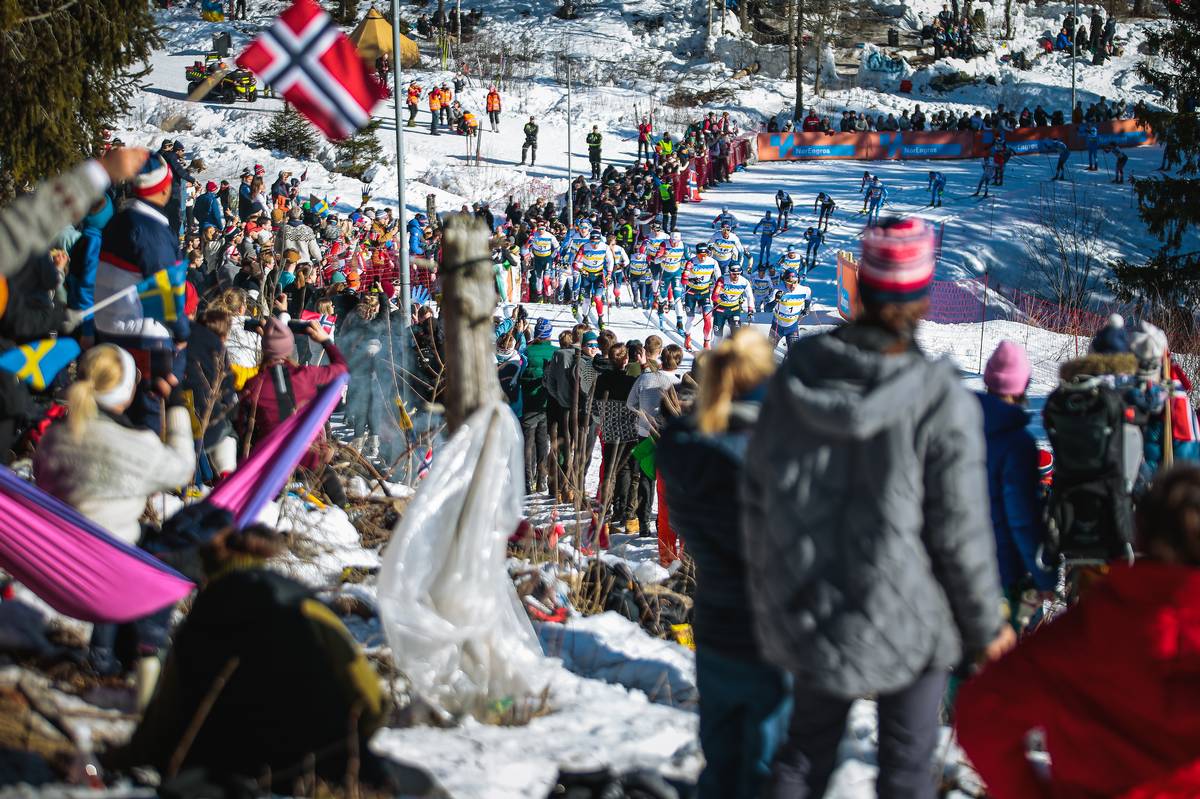
Crowds returned in droves to Holmenkollen for the men’s 50 k mass start classic. (Photo: NordicFocus)
Corresponding with a social media post from Johannes Høsflot Klæbo, the Norwegian news outlet NRK reported yesterday that each of the men’s national team sprinters who competed in Lahti last weekend has tested positive for COVID-19. Head sprint coach Arild Monsen told NRK that Håvard Solås Taugbøl was the first to test positive on Monday, followed by Erik Valnes, Pål Golberg, Sindre Bjørnestad Skar and Johannes Høsflot Klæbo on Tuesday. According to Trondheim regional newspaper Adresseavisen, the final Norwegian sprinter who raced in Lahti, Even Northug, has also been affected.
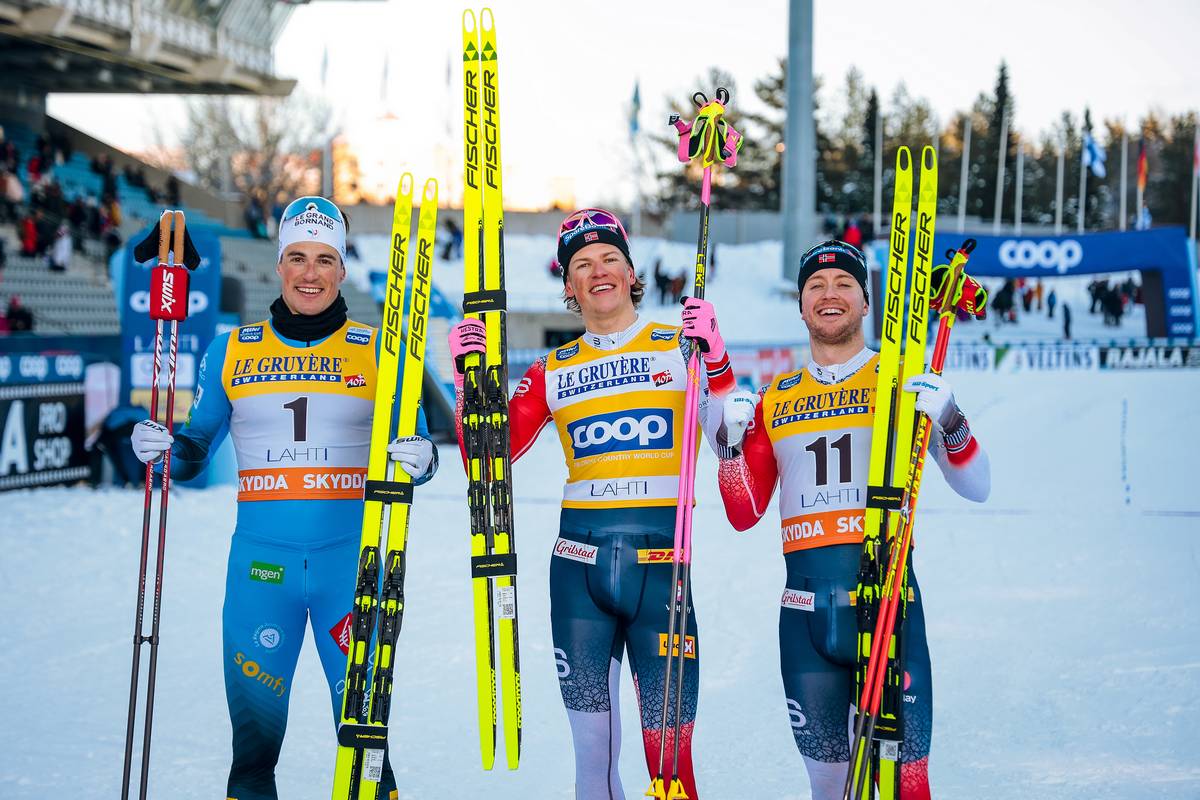
Johannes Høsflot Klæbo (NOR) takes the win in Lahti’s freestyle sprint ahead of Lucas Chanavat (FRA) and Sindre Bjørnestad Skar (NOR). (Photo: NordicFocus)
“It must have occurred in and around the stay in Lahti,” Monsen explained to NRK. “Håvard was the one who noticed symptoms on Monday. The others have little or no symptoms.”
Given the proximity to the upcoming sprint races in Drammen, Norway, Monsen indicated that these men would not be attending the competitions.
“What happens after that, we just have to look at. It’s boiling in many fields in the world now. This is smaller than other things, even though it is [disappointing] for those they concern,” Monsen continued.
At this time, no other athletes from the Norwegian program who attended the competitions in Lahti have tested positive. While the transmission link between the sprinters is clear, some athletes participated in both sprint and distance races, including Klæbo, who won the freestyle sprint and took second in the 15 k classic.
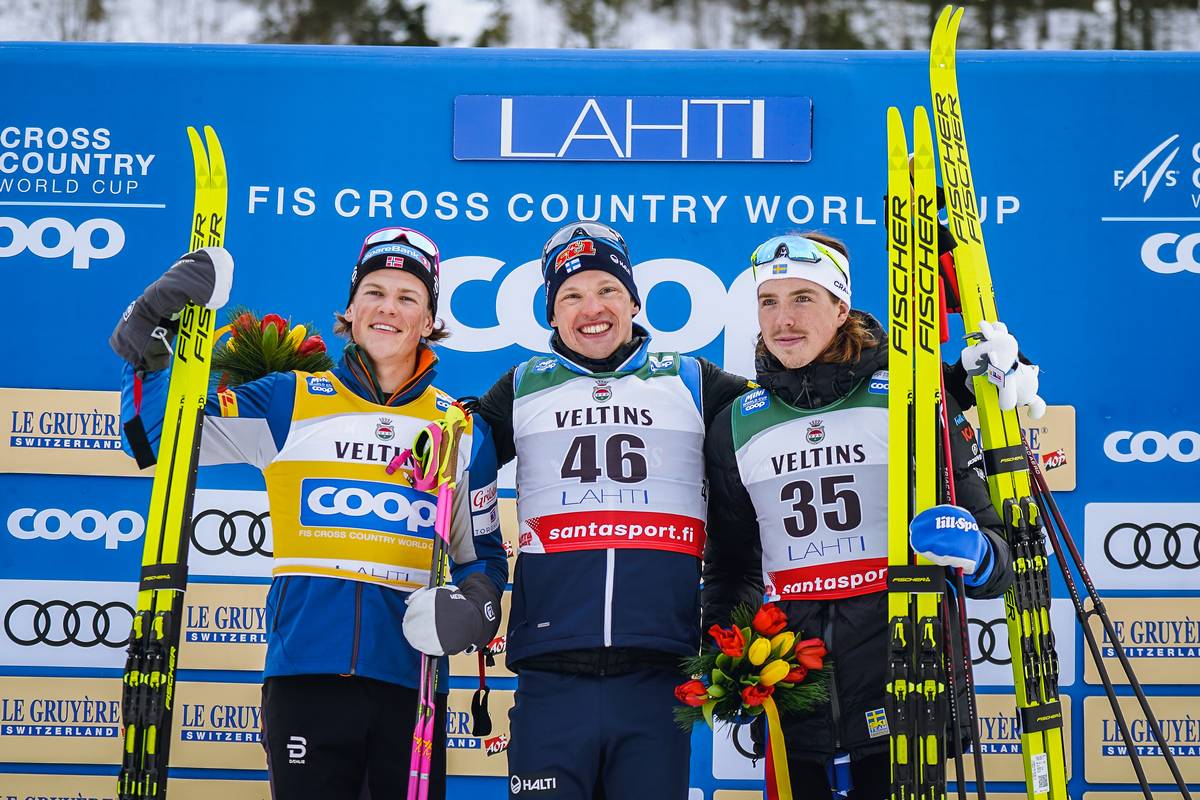
The men’s 15 k classic podium in Lahti: Iivo Niskanen (FIN) took the win in his signature event, ahead of Johannes Høsflot Klæbo (NOR) and William Poromaa (SWE). (Photo: NordicFocus)
Team doctor Øystein Andersen indicated to NRK that the original source of the outbreak remains unknown.
“It’s hard to say [how this began],” Andersen said. “Everyone came from their own bubbles before this race, after they returned home from the Olympics. We must now first map out whether there are more [positive cases] and conduct infection tracking, so that we avoid more infection.”
As the World Cup Finals slated for March 18-20th currently remain listed as “canceled” on the FIS calendar, it is unclear whether these athletes will be able to compete on the World Cup again this season.
Klæbo told NRK that “most indications are that the season is over,” however, the loss of competition would not significantly impact his season outcome. Klæbo currently leads the World Cup overall standings by nearly 500 points over Russia’s Alexander Bolshunov, who is also unable to compete as FIS banned athletes from Russia and Belarus from competition for the remainder of the season. The next closest athlete to Klæbo is Finland’s Iivo Niskanen, who sits nearly 800 points back with limited scoring opportunities remaining. As the Falun World Cups feature a mixed relay and team sprint, this leaves two sprints and two distance races, worth 100 World Cup points each, currently confirmed on the FIS calendar.
If World Cup Finals are held at an alternate venue, athletes could score a maximum of 50 points per day, with the opportunity for up to 200 bonus points should they win the three-day mini-tour.
This still leaves fewer than 800 points on the table, and as such, it looks like Klæbo will win the overall World Cup regardless of whether he competes again this season.
Klæbo also leads the World Cup sprint standings with a 210 point lead over Richard Jouve, and is 237 points of third-ranked Lucas Chanavat, both of France. Classic sprint events are scheduled for Drammen on Thursday, followed by another classic sprint in Falun on Friday, March 11th. If World Cup Finals take place, there will be a third sprint opportunity there, raced freestyle. This leaves 200 points available without the World Cup finals, and 250 including them.
Norway’s Pål Golberg tested positive for COVID following the weekend of World Cup racing in Lahti. (Photo: NordicFocus)
“There is nothing to do but take it easy,” Pål Golberg said to NRK. “It’s [disappointing] that it’s coming now, but we can be very happy that we managed to avoid more infection in the camp before the Olympics when people became infected in Seiser Alm.”
On what is next, Golberg continued, “If I do not develop symptoms, it may be relevant to go to Falun next weekend. And then there are many [domestic] races over the late winter. Then we will see if it is worth it.”
The Planica World Cup cancellations this month brought the skiing world to the perilous edge of what it feared most, but hoped wouldn’t happen – the central focus of this ski season, and the sport’s biggest moment, the Olympics – affected by the Omicron COVID-19 variant. Over the last week in the Italian Alps, the sport went over that edge. This Olympics, as with everything in the world right now, will have to deal with the frustration, confusion, and all around uncertainty that’s de rigueur during this pandemic.
On January 23rd, NRK first reported that Norwegian national team sprint coach Arild Monsen had tested positive while at the team’s pre-Olympic camp in Seiser Alm, Italy. That set into motion a close contact, self-isolation, and testing regime with the stakes very clear – if athletes tested positive, suddenly the Olympics would be up in the air.
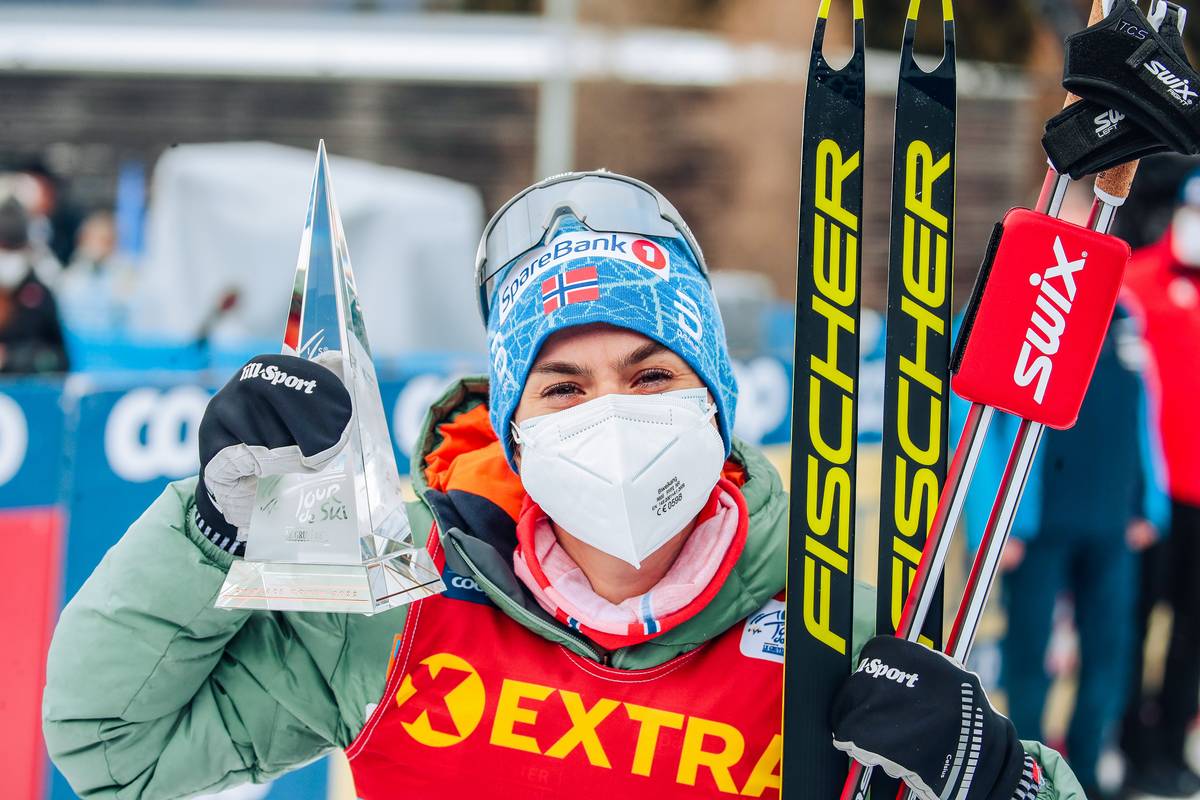
Aided by a win in the final hill climb, Heidi Weng took third place in the 2021/22 Tour de Ski overall standings. (Photo: NordicFocus)
On Tuesday the 25th, despite the best efforts of the team, Heidi Weng and Anne Kjersti Kalvå tested positive for COVID. Close contact tracing led to an announcement from the Norwegian Ski Federation that the scheduled charter flights for the Norwegian Men’s Team on today were canceled.
The story has since followed two lines of development. First, new cases that are still emerging from the outbreak at the Norwegian National camp in Italy, and second, the Norwegian Ski Federation’s plans to get athletes to Beijing in time for their first competition on February 5th.
On the former the latest update, as reported again by NRK today, is that Simen Hegstad Krüger has tested positive for COVID. Krüger’s test is the first within 10 days of the start of Olympic competition, meaning that the 2018 gold medalist of 30-kilometer skiathlon will not get the chance to defend his title. The news has hit the Norwegian team hard. In a statement to NRK, teammate Hans Christer Holund said “It’s terribly sad. A lot of hard work is behind getting to the Olympics, then it goes in the sink, and it is very sad for Simen.”
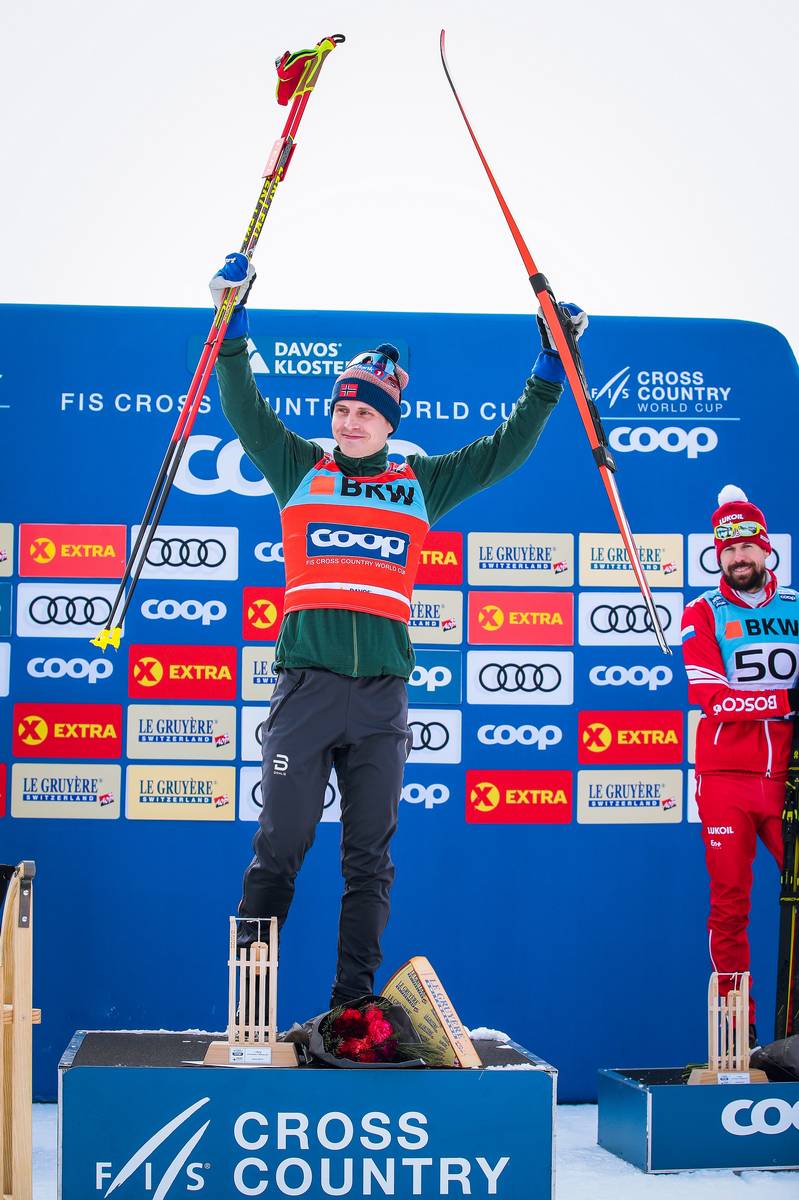
Simen Hegstad Krüger had a commanding win in the 15-kilometer skate in Davos in December, 2021. (Photo: NordicFocus)
As to travel plans, The Norwegian Ski Federation announced its updated plan to get their athletes to Ziangjiakou just hours ago. The men’s team will now fly direct from Verona, Italy to Beijing on a chartered flight on January 30th. The women’s team will follow suit out of Zurich, Switzerland on February 1st. That cuts out a trip back to Norway that was planned for the National Team before flying to Beijing. It also assumes no new infections in either the men’s or women’s teams. In NRK’s report, Espen Bjervig, National Team Manager, explained that the plan reflects “so many unknown factors. You never know what will turn up around the next turn. But you just have to cut through.”
Bjervig also pointed out that the plan is designed to move along with the COVID situation that is now underway in the Norwegian camp. “Fortunately, it is flexible with the girls. There are charter flights every day from Zurich between February 1st and 4th. The scheme for the boys presupposes that no infection appears.”
It is a big assumption, but one that allows there to be hope that for the individual athletes, and for ski fans alike, these Olympic games may be the exciting showcase of the world’s best skiers – many of whom are from Norway – that we have all looked forward to watching together.
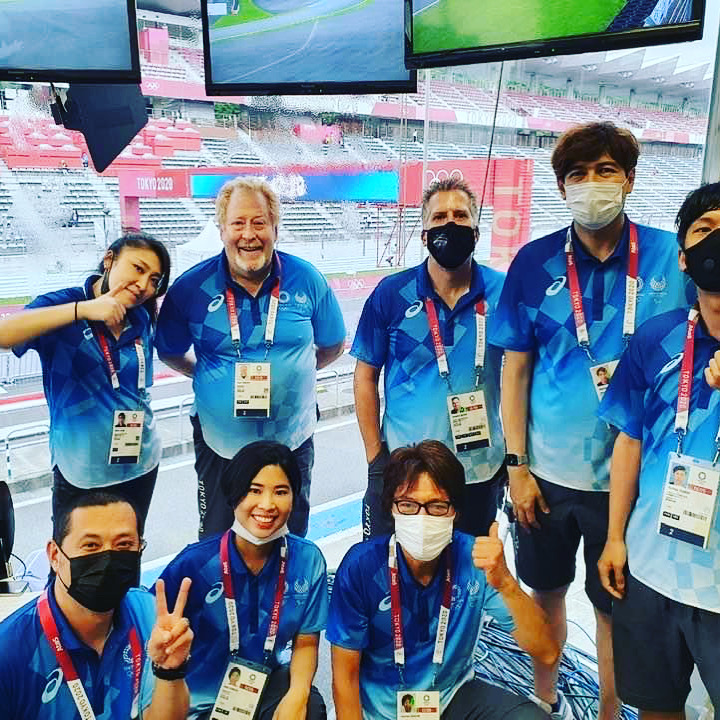
The cycling announcing/production team at the Tokyo 2020 venue near Fuji International Speedway (Courtesy photo.)
Most FasterSkier readers will be familiar with the name Peter Graves, also referred to as the voice of cross country skiing (and incidentally, the author’s uncle). This summer, Graves lent his voice to the cycling venues near Tokyo for the 2020-turned-2021 Olympic Games. For Graves, this marks his twelfth time announcing at the Games, including summer and winter appearances. Needless to say, he has a wealth of experience.
FasterSkier connected with Graves on a recent call to understand how the coronavirus pandemic may have affected this year’s games, and what insights the Tokyo Games might provide for the upcoming Winter Games in Beijing in February 2022.
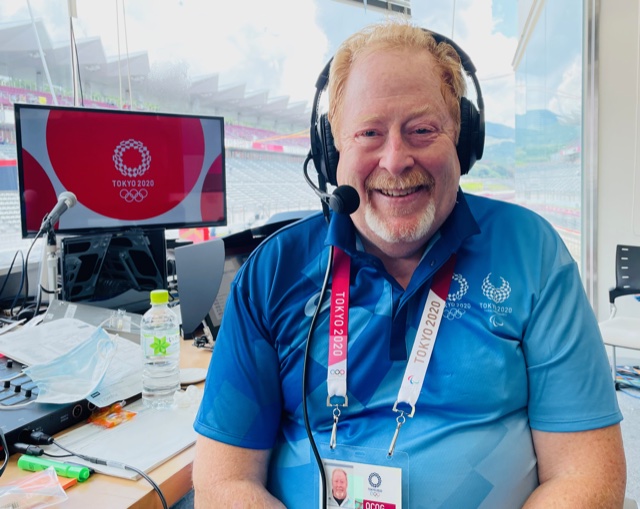
Peter Graves in the announcers booth, Tokyo 2020 (Courtesy)
Graves was quick to highlight the great announcing and production team he worked with and the graciousness of the host country, Japan. “They ran great events,” he said, “I think they did a truly remarkable job under a very difficult set of circumstances.” For context, the Tokyo Games drew roughly 11,091 athletes from 206 participating countries, and over 770,000 COVID tests were conducted from July 1st onward. Of those tests, the cumulative total of positive COVID cases (including airport tests for Games participants and Tokyo 2020 screening tests) came to 567, with three additional positives coming fourteen days after leaving Japan. Graves called this, “a very admirable record,” all things considered.
Graves was in Japan for ten days, announcing at the road and time-trial cycling events. To fans watching from home, a stark difference this year was the lack of spectators at most events. However, cycling was one of the three venues that allowed socially distanced spectating and particularly during the road race, Graves noted that there were lots of spectators along the road where he “saw a lot of joy of free people sharing the Olympic spirit.”
For Graves, this year’s games were a very different experience than past years, particularly socially. His first Olympic announcing appearance came in 1980 during the Lake Placid Winter Olympics, at the cross country skiing venue, which Graves describes as “the last of the smaller, more intimate games.” (Lake Placid at the time had a population of just 2,490.)
Reminiscing about the “joie de vivre” of the main street, which was turned into a pedestrian zone for the Games, Graves described the tradition of trading Olympic pins, another strong memory from Lake Placid and other games. “I have a collection of probably 3,000 pins from over the years and I love trading but I just didn’t see any of that [in Tokyo]” said Graves. “I brought a lot of pins to Tokyo and didn’t trade a single one because there was nobody to trade with!”
Being “in the bubble” meant that Graves and his team were tested for COVID everyday. Before departing the US, he needed two negative test results within 72 hours of departure and was tested again upon his arrival in Japan. The initial COVID testing procedures alone took six hours.
Peter Graves in the announcing booth at the conclusion of the cycling races (Courtesy photo.)
Graves was stationed at the Fuji International Speedway, about two hours from Tokyo, where the road race and time-trial events finished. Everyday the same car took the announcing team from the hotel to the venue, and everybody was masked. Their temperatures were taken daily as they entered, and they left the venue at the end of the day in the same car, with the same crew. Graves and his announcing crew were allowed approximately fifteen minutes to get their dinners to bring back to their hotel rooms. In contrast to other Olympics, there weren’t any nights of eating with friends or colleagues for Graves this time around. “The story of life in a bubble,” he said. There was virtually nobody out on the streets and while Graves said he can’t vouch for Tokyo, he thought it was the same sort of scene there.
“The Olympics are first and foremost about the athletes and their performances,” stated Graves, “[this year] gave me more respect for the athletes, most were in the Olympic village and that was quite secure as well, in terms of COVID.”
Usually, he is able to meet and interact with the athletes a bit but there was none of that this year, “I didn’t get the chance to speak to them personally or to take photos,” Graves explained. Nevertheless, he shared some personal highlights, including very tactical road races which were “fascinating.” “I enjoyed watching and commenting on them,” said Graves, “there was a vast amount of tactics, as there always is. The Tour de France had just ended the Sunday before and many of the same athletes were competing in Tokyo.”
Graves also emphasized the important messages about mental health that athletes such as Simone Biles shared. “I left with a great appreciation for people like Simone Biles who made, I think, a really important case to speak about mental health,” said Graves, “to make it okay to be truthful, to make it okay to say ‘I’m not feeling well, mentally or physically.’ I think those messages are really important cautionary tales to everyone. Those were the things I was impressed with by the athletes.”
Graves voiced his support for the Olympics going ahead, in spite of the arguments against them happening.
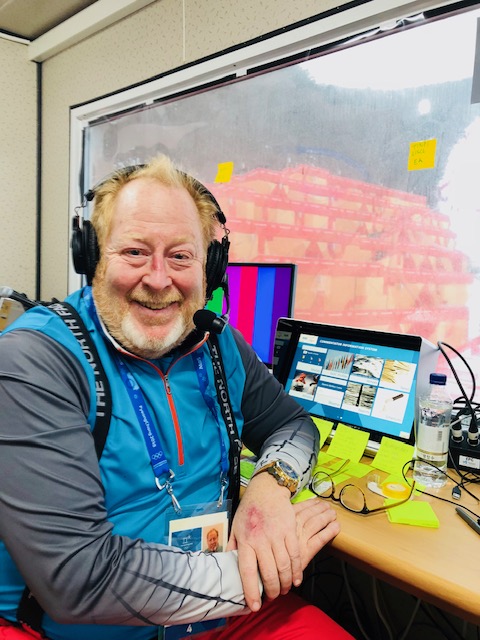
Peter Graves announcing alpine events at the 2018 Winter Olympic Games (Courtesy Photo)
“I’m glad they did the Games,” he said, “I’m well aware there were plenty of nay-sayers. It robs the athletes of an opportunity that may never come again. My hope is that the athletes found joy taking part in the Games, because the spirit is embodied by their humanity and enthusiasm. On TV, I saw countless examples of really great sportsmanship. I think the athletes should really be praised for how they managed themselves over there.”
Given the delay to the 2020 Games, we are now less than six months away from the Winter Olympics, scheduled to take place in Beijing starting February 4th, 2022. While Graves was clear that he can’t speak about Beijing per say, his experience in Tokyo may shed some light on what the upcoming Winter Games may look like. “One wonders, with the Beijing Games just six months away and the resurgence of the Delta variant globally,” pondered Graves, “I have to believe priority number one for Beijing will be keeping a good and tight bubble for those Games too.”
Part one of this series covered regional racing in Alaska and parts of the Lower 48. It surveyed multiple sources suggesting that the true health risk involved with ski racing is not what happens on the race course, perhaps especially in an interval-start competition, but rather what happens outside of it, in the process of traveling to the race, or eating or drinking or sleeping while doing so, or returning to a home community after traveling to somewhere else.
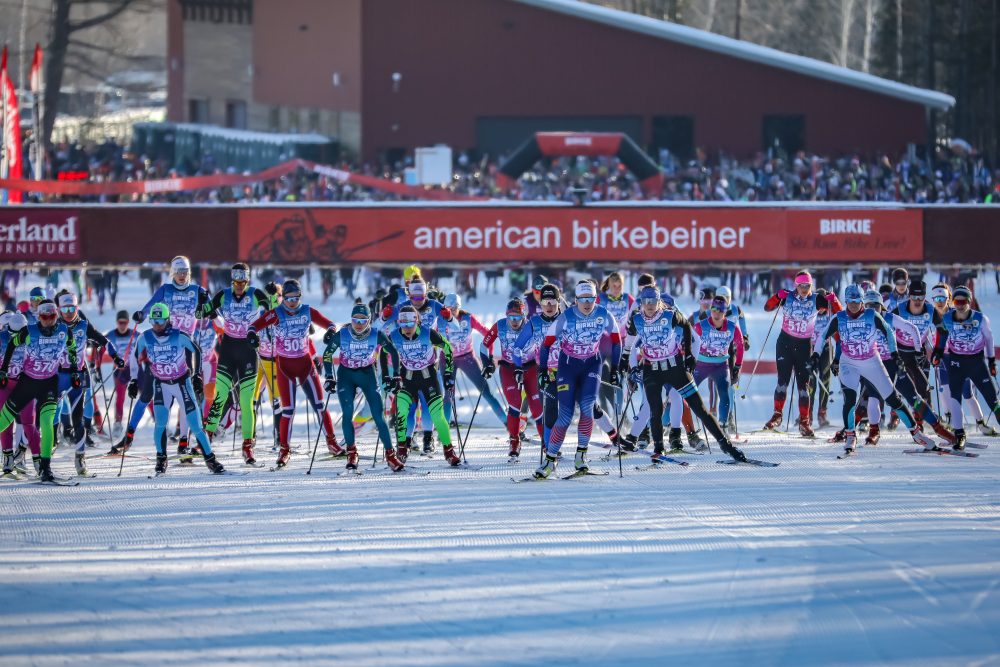
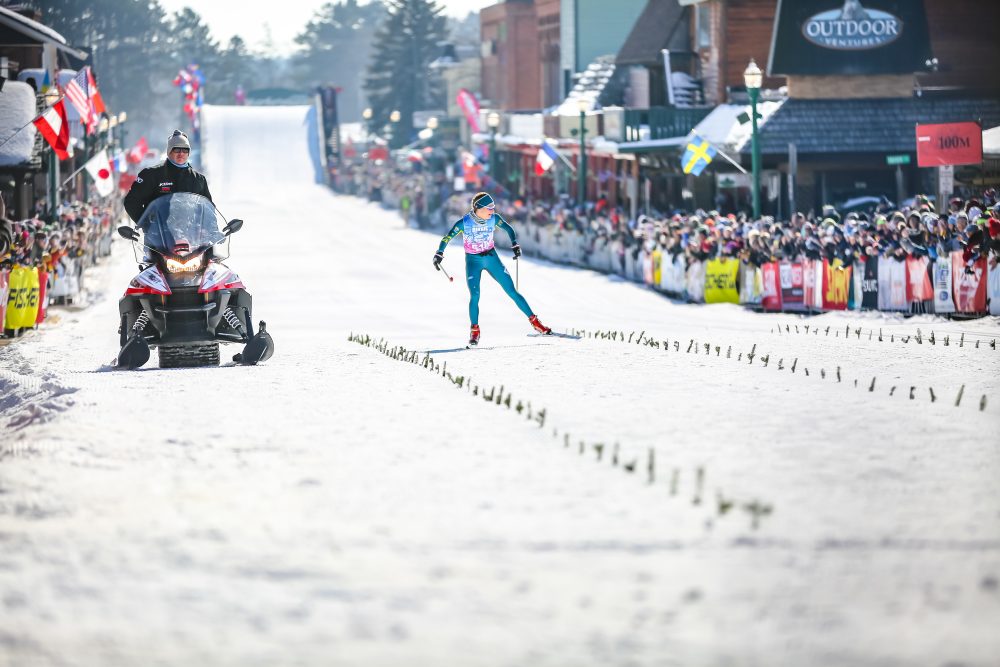
With this in mind, there is an elephant in the room, and it’s wearing birchleggings: the American Birkebeiner. The Birkie, which is scheduled to start on Wednesday, is perennially the largest ski race in the country, a multi-generation celebration of skiing that brings over 10,000 athletes and tens of thousands of spectators to rural Wisconsin. Only a tiny fraction of them live in the immediate area; in 2016, the last year for which detailed zipcode data is readily available, only 122 finishers in the longest skate and classic races came from the 54821 and 54843 zipcodes that include Cable, Hayward, and the surrounding areas. (Possibly relevant: the year-round population of Cable is roughly 825, and of Hayward, 2,300.)
The Birkie Trail itself is a delight to ski, and there is high-level competition at the front of the pack… but for many, many attendees, the point to the weekend, at least as much as skiing, is to see friends, to mingle in restaurants, to drink comically large beers, to eat brats on Main Street, and so on. These ancillary activities are a heck of a lot of fun. They are also, largely, contraindicated during the time of Covid; a “normal” Birkie experience feels discomfitingly like it has the potential to be the athletic version of the Sturgis motorcycle rally or the Boston biotech conference, in which people travel from a wide area, mingle with abandon, then return to their home states, in some cases bringing asymptomatic Covid cases with them.
Hindsight is, famously, 20/20, but that infamous Biogen conference at the Boston Marriott a year ago this week is estimated to have been responsible for over 300,000 cases in this country alone. The biotech conference had 175 attendees total, which is orders of magnitude fewer than the tens of thousands that typically travel to Birkieland.
So with all this in mind, is the Birkie going to happen this year? (Yes, assuming that nothing major changes between now and race day(s) regarding either trail conditions or public health.) What’s it going to look like? (A series of one-day 43-kilometer events, starting and finishing in Cable (read: no shuttle buses), spread out over five days, with virtual participation strongly encouraged and no inside spaces available.) Should it happen? Good question.
Here’s the argument against its happening, or at least against some aspects of its happening, from current Boston resident, 15-time Birkie finisher, and self-described “huge Birkie fanboy” Ari Ofsevit in an email to FasterSkier: “I think the Birkie is doing a good job of spreading things out, but the worry would be people in restaurants and bars and doing things they really shouldn’t do (being in a hotel room doesn’t seem like an issue, being in a restaurant does). If everyone drove to Cable, skied the race, and drove home (or to a hotel room, and got takeout, and went home the next day) that would be one thing. I can see the worry that people are going to be congregating outside the race area, although even if the Birkie went full cancel, people would probably still show up and ski together and otherwise spend time together.”
On his popular site BirkieGuide.com, Ofsevit, in a recent blog post, summarizes an update from the Birkie that sounds similar notes: “There are a lot of visitors coming, but not a lot of medical capacity. Follow all safety protocols: ski on the right day, get a negative test [organizers are recommending that participants receive a negative Covid test within five days of their race day], stay in your bubble, self-sufficiency, and avoid indoor spaces (get takeout!).”
In a conclusion that ably approximates a Covid-safe version of the traditional Main Street post-race gestalt, Ofsevit writes, “Post-race: Get in your car and drive home. If you’re hungry, get takeout. Buy some brats and Leinies and New Glarus and throw the beer in the fridge while you cook the brats up at home.” (Ofsevit would also appreciate it if you record some audio about your virtual experience and send it to him for his podcast: info (at) birkieguide.com. Full recording instructions here.)
Birkie representatives are not blind to these concerns. As Birkie Medical Director Dr. Dayle Quigley stated in a November video, “Realize, however, that the Birkie organization can control the safety of participants at the start and the finish. They cannot control what happens on the trail in terms of bunching of athletes, nor can they control the hotels, bars, restaurants, grocery stores, or hospital, where Covid exposure could occur.” After discussing other safety considerations and reduced levels of on-course medical support for this year’s race, Quigley concluded, “My recommendation is that all skiers seriously look at virtual options. It will make the 2022 Birkie Week that much sweeter.”
For athletes who are nonetheless traveling to northwestern Wisconsin to ski in person, the race “strongly encourage[s] skiers to get a Covid-19 test, receiving a negative result, before traveling” to the area. Skiers are also “asked to voluntarily self-quarantine for 7 days before they travel.” Finally, skiers are also “encourage[d]” to abide by the USSS no-fluoros policy (learn how to clean your skis here).
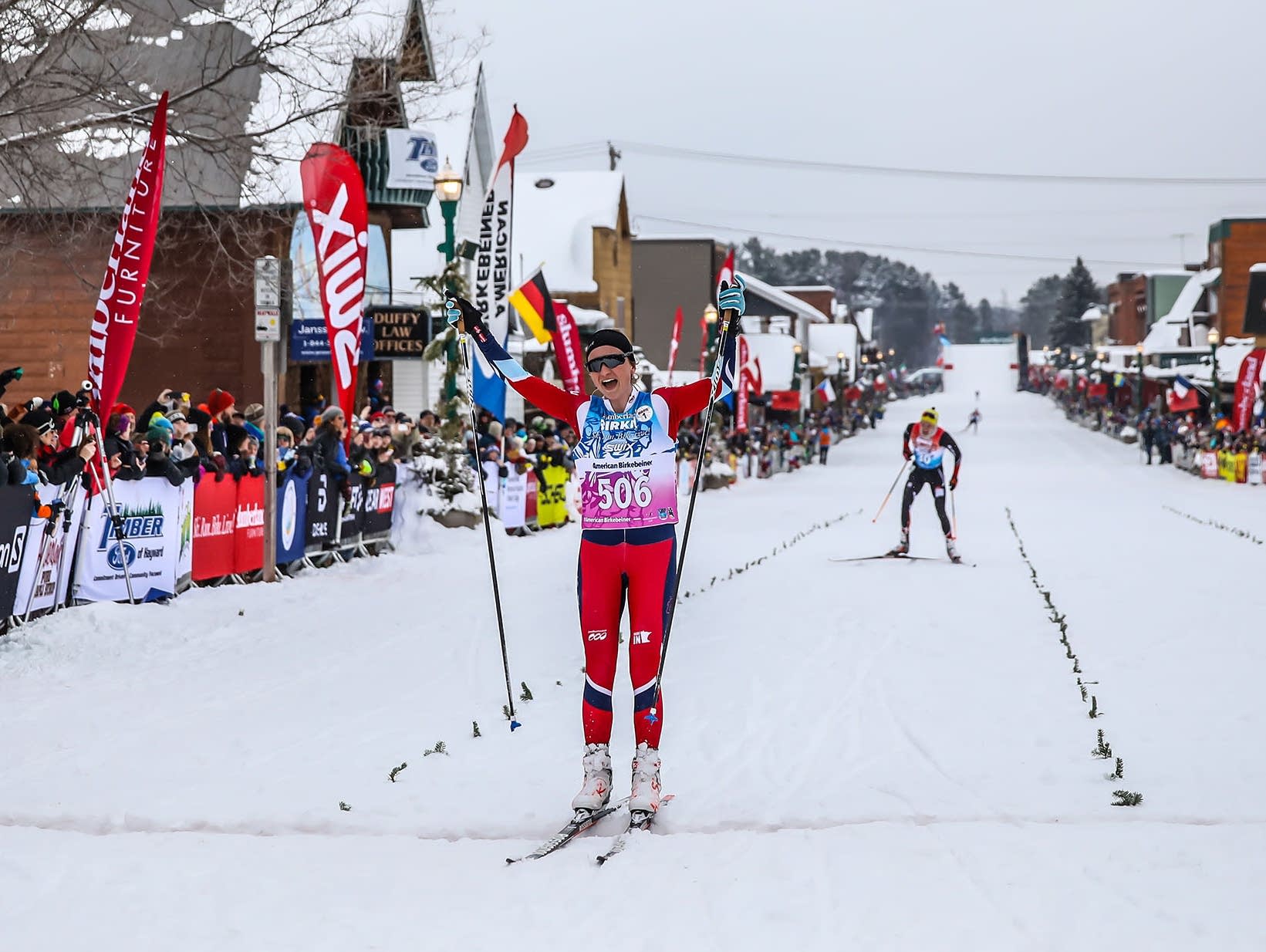
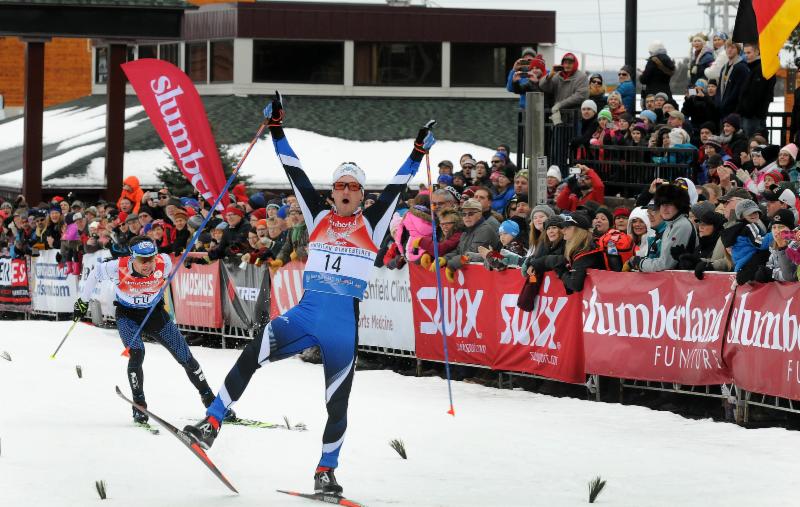
It’ll be like this, but with no spectators. Also, not in Hayward: David Norris winning the 2016 American Birkebeiner. (photo: Paul Walsh)
What will they find in Cable? Less than normal. As Birkie Executive Director Ben Popp told FasterSkier in a January phone interview, “And this year, there is no party. There aren’t any spectators, you’re not finishing on Main Street. So do what’s right for you and your Birkie. So that … you don’t compromise yourself.” Popp similarly noted the large numbers of people choosing a virtual option, suggesting, “there isn’t a one size fits all Birkie this year.” And he stated that the area had already been seeing such high skier numbers this winter, he wasn’t sure if formal Birkie activities would significantly increase the number of skiers on site.
Some locals are less sanguine. A press release from the Sawyer County Health Department in late January (this year’s Birkie starts and ends in adjoining Bayfield County, but “many of the participants and guests also are expected to be in Sawyer County [the Hawyard end of the course] visiting local stores, hotels, restaurants and bars”) noted that it was “fielding an increasing number of calls from local residents who are concerned about the potential negative impacts of hosting a large international event in our rural county during a global pandemic.”
Sawyer County Public Health Officer Julia Lyons wrote, essentially, that she saw the potential issue, but that her hands were tied: “We share many of those concerns; however, in Wisconsin, both local and state health officials have limited power to maintain and enforce public health orders.” She recommended that local residents not directly involved with the event “Limit your travel to public spaces and continue to follow recommended safety guidelines,” such as “Stay home as much as possible” and “Wear a mask in public spaces.”
Some locals did not appreciate being urged to stay home while thousands of visitors, and their tourism dollars, were welcomed into the area. The health department’s Facebook page features a robust discussion of this topic. One commenter noted, “If 5000 participants plus their spectators and volunteers from all over the world can be at an outdoor event I would imagine Julia Lyons would be fine with children in our community playing together on a playground without worrying about mixing with other classes. The hypocrisy is beyond ridiculous. She recommends this and that but when it comes to the BIRKIE has no recommendation? Ben POPPE [sic] is a hypocrite serving on the COVID panel…. he had one agenda. How do you expect the community to respect any of your recommendations when you aren’t consistent.”
Another observed, “I do find it ironic that schools can’t operate normally, restaurants can’t operate normally, stores have restrictions — but the birkie can go on as normal! $$$? Money for the town/county, not for the safety of the residents.”
(The money involved is significant. In 2017, Wisconsin’s governor, in declaring Birkie Week in late February, noted that the Birkie brings in 26 million dollars annually. “That’s nearly $1,000 per person for Sawyer and Bayfield counties!,” Ofsevit wrote.)
As of February 21, Covid case numbers in Sawyer County were at a seven-day average of 26.7 cases per 100,000, over twice the Wisconsin statewide average of 12.7.
FasterSkier spoke with Popp in late January about some of these issues. (The interview occurred four days before the issuance of the public health statement quoted from above, and so did not ask about the health department’s statement specifically.) The interview transcript follows below. Popp’s comments have been lightly excerpted, with elisions noted, for brevity and clarity. This reporter’s questions have been more heavily edited, to make the overall piece more readable and to provide better introductions to Popp’s answers.
FasterSkier: I’m writing about ski racing in the Covid era, and I’m looking at what different races are doing in different parts of the country. My working assumption by this point is that whatever happens on the course is, if not no-risk, at least low-risk – I’ve read the Birkie website, the discussion about buffs on at the aid stations and at the finish, smallish waves of racers starting throughout the day, five different days of racing, and so on. So let’s assume that there’s a low risk of health issues on-course. That said, it’s no secret that a lot of the appeal of the Birkie is what happens afterwards – I did it once, and yes the trail is great, but all my best memories are honestly about the awesome people I met in the bar before and after the race, and how much fun it was to be in a small town with 10,000 other skiers for a few days. So with all this in mind, assume that you’re keeping people pretty safe on the course, which I think is fair. Do you have concerns about everything that happens before and after those two or three or five hours of skiing?
Popp: I think if it was a normal year, I would say of course, you know, I think if we thought that Birkie 2021 on the ground was going to be like a normal Birkie, that then, of course, I think we’d have huge concerns. I think as we see it evolving now, we feel better and better about what’s not only happening locally and regionally, but sort of what we’re seeing happening on the ground.
And maybe to take a step back. I think we’re now – by going out and creating virtual options, we’re seeing a huge shift in people choosing virtual, because we’ve really started to message that, hey, there isn’t a one size fits all Birkie this year. What we’re seeing, I think – one of the largest percentage of people that are coming are people that are either going to make a day trip of it, or that they own a place here, and that they come here routinely. Or people that are here frequently.
In fact, we’re seeing literally record numbers of skiers and pass sales this year, out on the trails, and it’s the people that are coming up as training for the Birkie. And so I think the people that we’re going to see on the ground, or we know the people that we’re going to see on the ground based on just who we’re seeing switching to virtual, are the people that can travel there easily, or they’ve already been. Because again, right, if it is really going to be difficult to travel. The same reason there aren’t SuperTours all over the country is that – last weekend, for instance, we had a JNQ, we had 935 people through the venue – that was over 400 racers, and then parents, spectators, and coaches. We only know that because everybody had to check in after they did their e-screening. They do their Covid e-screening, and then checking in to get a wristband and get their face mask if they didn’t have one.
And so that part of it, and that was coming from a very similar, right, range of Michigan, Wisconsin, Minnesota, these people could easily make it. And so what we’re seeing is I think that again, in a normal year, yes, that would be like, Oh my god, we’re bringing all these people here. But first and foremost, we’re seeing that number coming down pretty significantly because of these virtual opportunities. And then the other thing is that and I think well, I shouldn’t say – this is not unique to here, but I think maybe unique to ski destinations.
Oftentimes ski destinations are very much tourist locations, right? People want to go there to do the fun things that they do. And so we are no different than that. People love to come snowmobile, cross country ski, icefish, do all the things you do in northern Wisconsin. And we’re seeing really record numbers of visitors coming to visit here right now. And so what that tells me as a community – even though we can only control what we can do on the ground in a ski race, our other community partners – restaurants, grocery stores, housing establishments – they’re all putting in similar protocols. Because right, they’ve been operating through this whole thing as well.
And now we’re seeing actually record low [Covid] numbers happening since our peak back in September. In the area, even as we’re seeing tourism really booming right now, because everyone wants to get out of the metropolitan areas and go snowmobiling or skiing and biking. So I think what we’re seeing, and the reason that we have confidence that the community will be safe, is that I get as I call our, quote unquote, community partners, like I said, whether it’s a grocery store, you know, and what the precautions are, restaurants are almost all doing takeout or pick-up, you know, the different cleaning protocols that they have to do now for housing. And I think, to your point, this year, the Birkie skiers aren’t going to be sitting at the bar for four hours drinking all night afterwards; it is going to be very different than that.
SMS T2 skier Alayna Sonnesyn with the 2019 American Birkebeiner win. (Photo: James Netz)
So I think all of those pieces as they come together now, are really part of it. And then the other part that we’re doing is that all of our staff, all of our race chiefs … they’ll be all masked with N95s. And, you know, we also likely will test all the staff beforehand, because they’re the ones interfacing obviously, with most people.
But, you know, when we were talking to one of the epidemiologists that we work without in the Twin Cities, talking about their protocols and taking a physician back to work after COVID, is they’re using an N95; they wear it all day, they don’t touch it, or take it off. That’s the level of safety an N95 brings, that having the staff and the volunteers that are interfacing with any of the skiers outside because we have no inside spaces being protected with an N95 felt like that’s going to even further enhance some of that. And so I think putting all those things together, we actually feel pretty good about it.
In terms of general numbers, do you currently have a sense as to how many people we’re talking about showing up in person?
My best guess at five weeks out [as of a late-January interview] is that we’re gonna have around 4,000 skiers total, that’s my best guess right now. … That’s looking at the current trend line of people going from in-person to virtual.
So that sounds like roughly 800 people per day over five days?
Yeah. And it’s, of course, not perfectly equal. More people want to show up on Saturday [the traditional race day, and the day that this year’s Birkie skate champions will be determined], so Saturday is gonna be like, probably, 1100ish. But again, that is, I guess, a little to be determined. But yeah, that’ll be the biggest day. And then I think our smallest day right now is around 500, which I think is Sunday. And those of course are switching a little bit or kind of shuffling a little bit, but not for the most part. Pretty, pretty close.
The Birkie media folks told me about the other events you’ve hosted, and cited your successes there. Roughly how many people are we talking about in those races?
So the Birkie Trail Run was around 1000. The Ascent was 250. Seeley Hills, Birkie Tour is going to be around 850 to 1000, we’ll see this weekend obviously. Gitchi Gami Games, with skiers or spectators, was 935 one day, and like 897 the other. And that was a little heavier on numbers, simply because obviously, when you have a youth event, you also have – you know, my kid’s 14 and can’t drive to the race, obviously. So you end up with – versus the Birkie, when we’re not allowing any spectators, then suddenly, you know, well, I’m just driving up, I’m going, racing, then coming home, so it’ll be – it’s a different dynamic of people, I think, obviously, for Gitchi Gami versus obviously more of an adult race, like the Birkie.
I know you have a sign-in app, and some degree of contact tracing potential, or at least knowing who was there. Can you tell me if you have had positive cases coming out of those events?
Knock on wood – no, we have not had any reported – anyone either report back to us or say that they had Covid. Again, somebody could not tell us, obviously, and we would never know, but we’ve not had anybody report back.
So just to clarify, you had all those events, and you have not had a single person affirmatively get back to you about a positive Covid test.
Correct. … But no, knock on wood. We’ve been very fortunate. We’ve not had any – no one’s reported any cases from the event or that they had it while they were at the event.
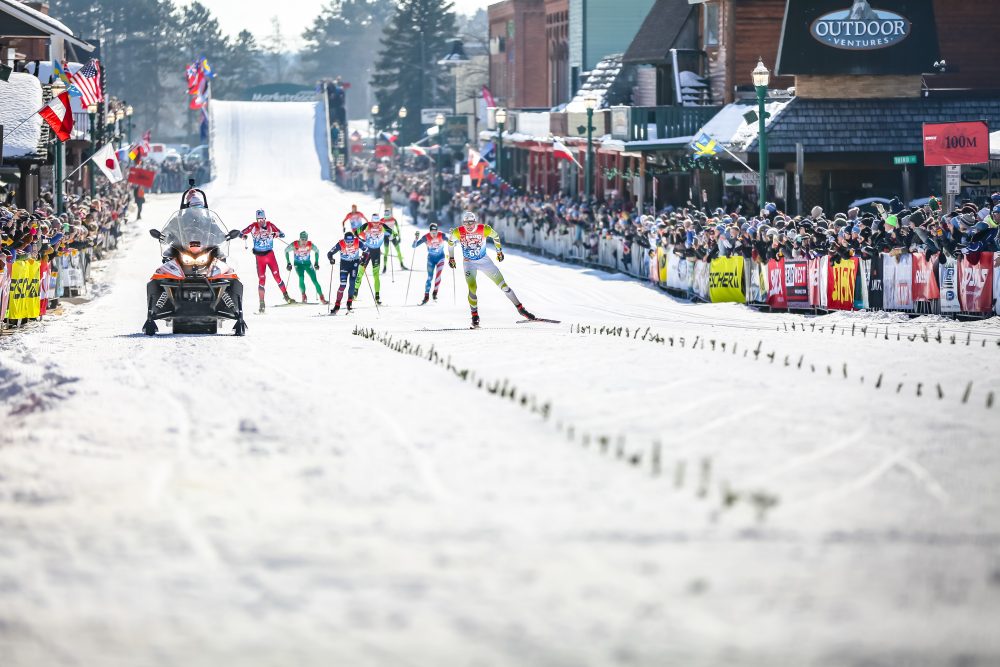
Akeo Maifeld-Carucci in green, Brian Gregg left, and Matt Liebsch right race down main Street in Hayward at the end of the 2019 race. (Photo:James Netz)
Again, as I’ve said, I’ve been looking at what the risk factors are. And from what I’ve seen, the on-course stuff really doesn’t seem to me to be the problem. Is that fair?
Yeah, I agree. And I think the other thing is now in all honesty, and it’s the reason other races are now opening up and starting to happen all over more and more, is that we understand the virus better, and we understand how it’s transmitted.
You know, initially, we weren’t sure of anything, right, my wife’s a physician, and every night was like, holy [cow], what is going on, what are we going to do? Now, as we learn more about the safety protocols and can further protect ourselves, even as a traveler or somebody that’s going somewhere. And all that, okay, I just got to carry my hand sanitizer, and I always got to be masked and those simple things, and keep my six feet. Boy, by doing those couple things, I am actually really, really, really very unlikely to get it. And gosh, I go to a place and I need to get food. Well, I’ll get takeout or curbside pickup or, you know, I’m gonna get a condo that’s a kitchen so I can make all my food indoors. And so I think what we’re finding is, as skiers, participants, just general travelers, we’re getting better at implementing safe protocols around how we travel or move around.
It was really interesting at Gitchi Gami Games, my job was one of the really fun ones to walk around, tell people to put their mask on. I think it was probably over the two days, less than a half a dozen times I had to ask somebody to do it. And then it was always like a, Oh jeez, yeah, sorry, type of thing. It wasn’t really, [makes angry noise] grrr. I think I was talking to some people afterwards, and I said, “Man, I don’t get it. People, you know, gosh, in the general population, we don’t see that kind of compliance.” And you know, somebody said, “Well, it’s because I think everyone really wants it to work.” And everybody, these families all want to go ski racing, they see how happy their kids are. … And so they really want to make it work. So they’re willing, and want to follow the rules, because they know how important it is as part of their lifestyle or whatever, which was really fascinating. I hadn’t really thought about that before.
And so I think that will carry over to the general, the greater Birkie crowd and the greater ski crowd, and that people want to do the things that they feel like are going to protect them and others because they value it, they want it to keep working and make sure that it does, because it makes them happy. And it makes them feel good. And so, I don’t know, maybe that’s just wishful thinking, or just we were making that up or something. But … I was like, wow, that resonated with me.
Norway’s Anders Gløersen winning the 2018 American Birkebeiner elite men’s 50 k skate race on Saturday in Hayward, Wisconsin. (Photo: American Birkebeiner Ski Foundation 2018)
So in terms of the local community that you’re in, clearly plenty of people travel for this. They travel from the Twin Cities, mostly, and other parts of Minnesota, Wisconsin, and Michigan; I traveled from Anchorage; in the typical year, tons of people travel. It’s sort of this magical Birkieland where there’s awesome grooming and very large beers. But in all seriousness, there are, as you know well, real people who live in Cable and Hayward year-round.
So my simple question about this is, are there currently public health orders that bar this event? It looks like if the race were being held the first weekend of January, it wouldn’t have been allowed under a Bayfield County public health order that was then in place. It’s after January 3, so that’s not relevant… but still, the simple question is, are there state- or county-level public health orders that bear on this? And the larger question is, how would you characterize local community views toward hosting this race, even in a five-day format? On the one hand, if you run a business in the area, you presumably have an incentive to have 4,000 people come through. On the other hand, I’m sure the local hospital is tiny. How would you characterize these views?
No, there aren’t any currently health orders barring it, because if there was, and we wouldn’t do it – couldn’t do it. Obviously Kristy Maki, our event director, works really closely with Bayfield County, Sawyer County health departments, as well as our local health provider, Hayward Hospital, and they meet, I think it’s every other week, looking at trends, looking at what can we provide, what can’t they provide, what are their thoughts?
And so yeah, I would say that we work very, very closely with the health departments and following their guidelines; they have helped us put in place some of these different ideas and modifications. So yeah, I would say at this point, they’re certainly supportive of what we’re doing. Because if they’re not, we wouldn’t be doing it. And what we’ve all said all along is things can change in a day – if a week from now, things suddenly skyrocket – you know, something happens or changes immediately, we often have said, Hey, we’ll absolutely on a dime switch, if that’s what has to happen, and say, you know what, things are skyrocketing, or this happened, we have to go completely virtual. We completely want to be transparent that if the health officials that we’re working with say that’s got to be the case, that will absolutely be the case.
And I think when you talk about local residents, I think you’re exactly right. It’s is no different than any other topic of debate these days. You know, some are like, There’s a lot of skiers, and a lot of business owners that are like, Absolutely, this is safe. One, to your point, there’s record numbers of people already coming to the area to recreate and ski; as I mentioned, our trail pass sales are up like 50 percent, over 50 percent in some instances, 100 percent month over month. And so, like we know, there’s already huge amounts of people coming here. So, arguably, by doing the Birkie weekend, I don’t know if there’s really going to be that many more people here. And so from the skier perspective and the businesses that are already seeing those people that are like, Well, why wouldn’t we, we’re already seeing those numbers of people here anyways.
On the flip side, I think there’s other community members that are more like the line of thinking of what you’ve said early on, what I think of is when I think of the Birkie, there’s going to be 40,000 people, bars packed, crammed in downtown, busy tents, stuck on buses, and then that is going to be a health disaster. And so I think there are definitely both perspectives and/or opinions on it within the community.
And, you know, like I said, we’re doing what we think is best – I mean, all of us live in this community. It’s not like we all live in the Twin Cities and commute here every morning – our kids, our kids go to school here, we go to the same churches, all those sorts of things. So we’re definitely ingrained within the community and want to do what’s right for the community. We’re not going to do something that is going to bring a superspreading event to the area.
So I would say that, yeah, the experts on that are our health officials, right. That’s why we don’t make that call; we rely on the health officials that are dealing with public health. Certainly one of the issues with the hospitals early on was they had people that were having to be quarantined, and so they were just working like dogs. However, as they get, you know, they’ve now all been vaccinated and are able to be back to work. So the healthcare force is regaining a fair amount of strength.
And so we have that dialogue with them and say, We’ll own the decision. Of course, the decision has to be ours. Absolutely. But we’re going to take your guidance, you’re the experts in the world of public health, and our local health care system. You tell us what you think. And that’s going to help us frame up and determine what’s right and what’s wrong, or what we can and can’t do.
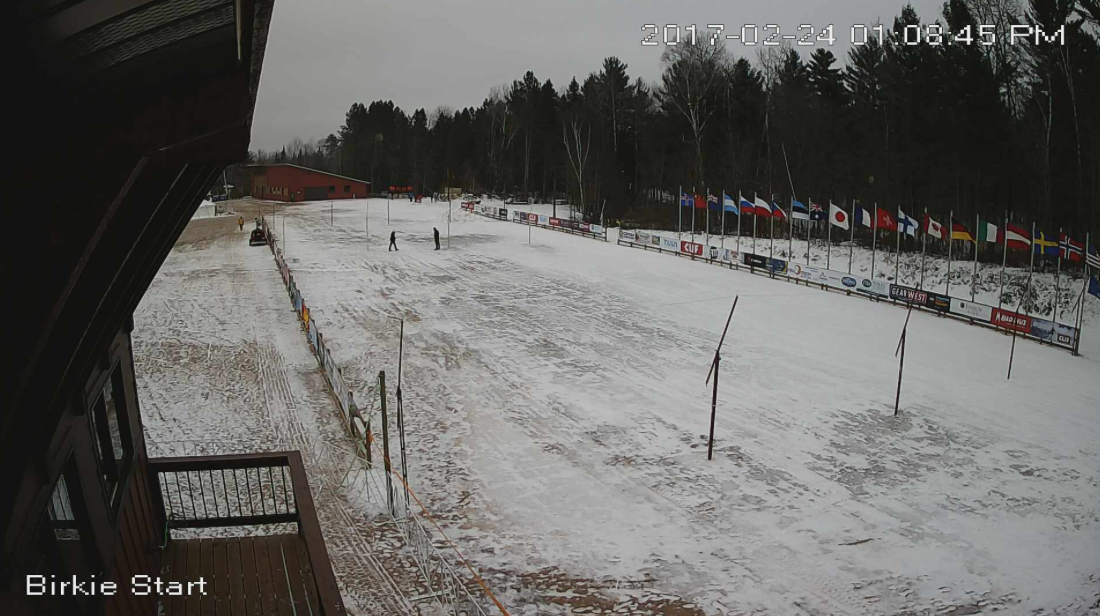
In this file photo, the new Birkie trailhead as seen on Friday afternoon before 2017 race day in Cable. The American Birkebeiner Ski Foundation announced that it was canceling that year’s race due to a lack of snow. (Photo: Birkie webcam)
I’m put in mind here of the run-up to the 2017 Birkie, which I’m sure you remember very well. Many people were struck by your openness and transparency while they were trying to decide if they should cancel plane tickets or make other plans. What did you learn from that experience that you’re bringing to bear on this year’s race?
We went, hopefully from the start this year of continuing to say, Hey, listen, things could change, I mean, not necessarily maybe overnight, but certainly over a matter of 10 days, you know, if there’s something that happens, and all of a sudden cases start to go on the rise hugely, or whatever. …
One of the reasons that we’re also, I think, very cognizant of keeping people updated is that, listen, whether you want to do your virtual Birkie in Madison, or Milwaukee, or Boston, or Steamboat Springs, or Royal Gorge, wherever you want, if that’s the right thing for you, you should do it, because you’re still gonna get credit for the Birkie. You know, a lot of people are like, Oh, I want to get credit, you know, I gotta get my 11th. … The message now is like, Listen, if it’s just about you coming to get credit, then do it wherever you want. There’s no difference.
And this year, there is no party. There aren’t any spectators, you’re not finishing on Main Street. So do what’s right for you and your Birkie. So that it – so that you don’t compromise yourself and put yourself in a place it. At the end of the day, if you come up, and we can’t do the Birkie, it’s all virtual? Well, you can ski it anywhere you want, you can still ski it if you’re here. That’s irrelevant. That is, you know, one of the reasons that, you know, frankly, like I mentioned, there’s already been nearly, I think, as many people here that we normally will have even at Birkie weekend, interestingly enough, just because the numbers are coming down by people choosing virtual and wanting to – obviously we’re not getting any Europeans, my guess is the elite field will be very, very, very small, probably a regional, right, Brian Gregg and Caitlin, etc., right? …
And so, you know, it’s the people that can be here that are in the area, you’re not going to, you know, fly across the country just to come , you know. In fact, the prize money has also been reduced greatly for that very reason. … One of the things we really want to do is disincentivize that you’re only coming to win money. [Popp then explained that the overall prize money has been substantially reduced. This year’s prize money amounts may be found here on page 14.]
So I think that as a group, I mean, I hate to overgeneralize, but the ski community is a generally smart group of people that often really use good judgment. Now, maybe not on the starting line, you know, but in general, I mean, really does use good judgment. And I think, this year, you know, sort of this mantra, that it’s not a one size fits all Birkie, is something that we continue to really push. … Because again, it’s easy if I live in Minneapolis or Madison to make a day trip. No problem driving four hours. Come home. But on the flip side, it’s very different if I’m trying to get here from Tampa, Florida.
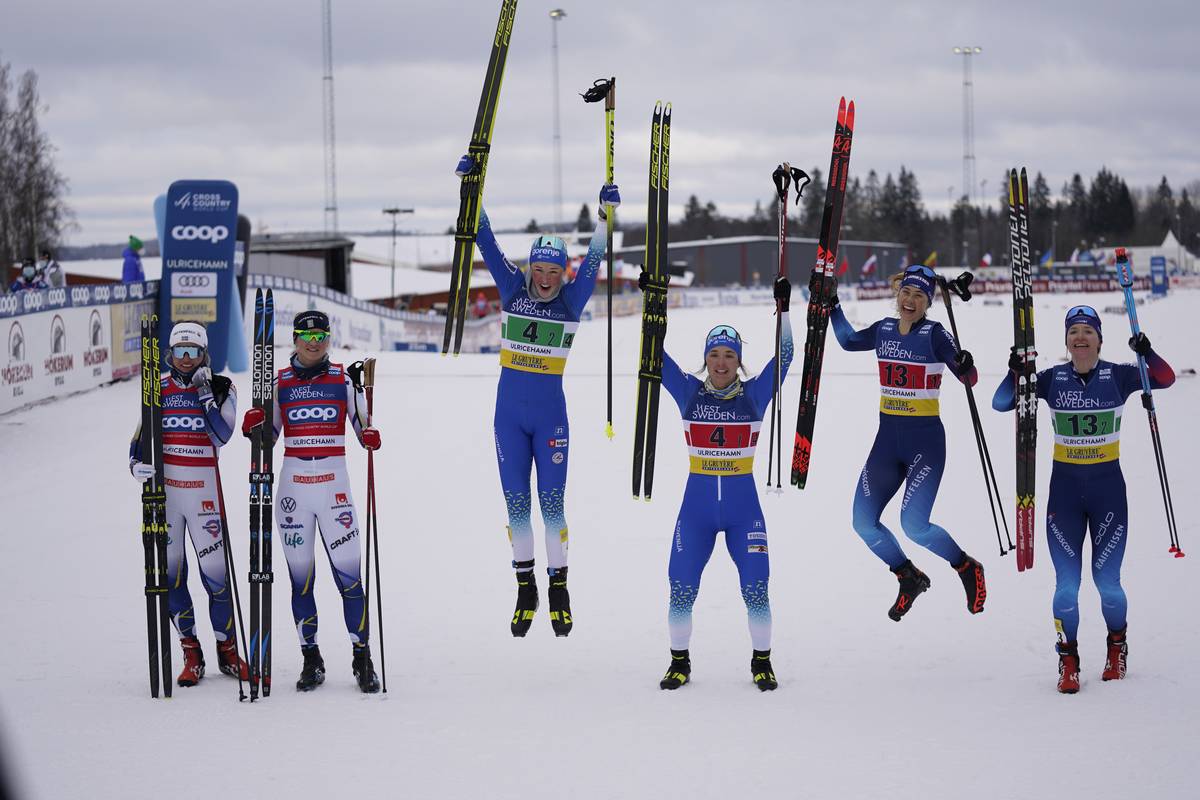
The women’s team sprint podium from earlier this season: Linn Svahn (SWE), Maja Dahlqvist (SWE) second, Anamarija Lampic (SLO), Eva Urevc (SLO) first, Laurien Van Der Graaff (SUI), Nadine Faehndrich (SUI) third, (l-r). (Photo: NirdicFocus)
One last question and this one’s actually from Jason Albert: On the World Cup, we’ve seen mixed fidelity to post-race mask wearing in the finish zone. Will the Birkie be more forthright in enforcing mask-wearing post-race?
Absolutely. Yeah, period. That’s a great question. And something that we’ve worked really hard on at the finish line, and actually the start line. So we tell you, you got to take your mask with you, because you’re gonna need it at the end, and show us how you’re going to take it with you, you know, don’t have a paper mask around your chin that you’re going to throw, because then you’re not going to have it at the finish.
And we will, I mean, we will have them at the finish. I’d rather not buy 10,000 masks, or 4,000 masks, we will have them at the finish for those that don’t. We’re not going to let them leave the little tunnel area – we built a separate stadium that they’re going to be finishing in. And so they have to walk out under a tunnel to get out of it. And we’re not going to let them leave out of that area, once they finish, where they kind of go back to get to their car and stuff, without it.
And so we’re going to be very diligent on the post-race. Because we’ve seen it now with the juniors, originally, we were like, We’re going to be really hard at the end. Well, it was too late. Because they got there, and they had nothing. So we’ve kind of learned now that you got to be really hard at the start. Show me how you’re going to be carrying this thing – like, is it a buff? What is it? What are you going to do with your mask, because the other thing is we’re going to require you to put it on in the aid station. So if you’re planning to stop at an aid station, you’re going to have to put it on, otherwise, sorry buster, there’s no stopping. And this year is very much self-serve anyways in the aid station. But if you want something, that requires a mask, so you gotta show us how you’re going to carry that with you. In other words, is it around your neck? Is it going to be – what, you tell us. And so I think that’s what the takeaway from us has been, be diligent at the start to ensure they have it with them at the finish. That’s been maybe our best – a little offense has been the best defense, if you will.
* * *
In-person events for this year’s American Birkebeiner start on Wednesday morning. The 2021 Birkie and Kortelopet skate champions will be crowned on Saturday, and 2021 classic champions on Sunday. Other than prize money for the top six finishers in the skate Birkie, and top three classic finishers in the classic Birkie, this year’s results will not be used for age group awards this year or for wave qualification or placement next year.
Last season’s Oslo 50 k classic. The last men’s race of the season was held without fans due to the pandemic. (Photo: NordicFocus)
The International Ski Federation (FIS) announced today that all remaining World Cups in Norway are canceled due to the ongoing pandemic.
“Due to new Covid-19 government restrictions announced today by the Norwegian government that the Norwegian Ski Association will be unable to host any further competitions through the end of the current World Cup season, due to the stricter travel and event-related restrictions,” stated the press release.
The mandate runs across the snowsport disciplines and includes cancellations for cross-country, nordic combined, and alpine skiing.
The announcement removes the storied Oslo races at Holmenkollen on March 12-14 and the Lillehammer World Cup Finals from march 19-21. Already, the Lillehammer races were postponed last year due to the government’s Covid-19 restrictions – they were originally scheduled for December 4-6.
The 2019 30 k skiathlon in Lillehammer, Norway. (Photo: NordicFocus)
The Norwegian Ski Federation held a tight grip on the cross-country national team this World Cup season. The federation pulled skiers from the World Cup after the opening weekend in Ruka, Finland. No Norwegians contested the Tour de Ski, and they returned to competition in Lahti, Finland on January 23 – a near two month hiatus from international racing. During that time, Norway’s biathlon team did travel and race on the IBU World Cup.
“To limit the risk of transmitting the significantly more contagious variant of the coronavirus, the Government is imposing far stricter rules on foreign nationals who seek entry to Norway,” states a government press release. “In general, only foreign nationals who reside in Norway will be permitted to enter.”
Last year on the World Cup, as the pandemic swept across the globe, the Norwegian federal government and the city of Oslo allowed the Holmenkollen events to go on without fans. The 2019-2020 World Cup finals calendered for Quebec-Minneapolis-Canmore were canceled.
According to FIS, they will announce if any replacement venues and dates are scheduled. For now, no cross-country World Cups are scheduled after the World Championships which begin on February 24. The last remaining World Cup still scheduled for this season is in Nové Město, Czech Republic on February 20-21.
Original Post: Earlier today, Swedish team doctor Per Andersson announced that Linn Svahn, who won the first two stages of the 2021 Tour de Ski in Val Müstair, has tested positive for COVID-19 on an antigen test. (The antigen test is less sensitive than PCR testing.) Svahn did compete in both distance races in Toblach, though she finished well off the podium, 40th in the 10-kilometer skate and 23rd in the classic.
A champion in sprint and distance, Sweden’s Linn Svahn wins back-to-back stages of the 2021 Tour de Ski. (Photo: NordicFocus)
According to the Swedish new outlet SVT, two additional Finnish athletes were also notified after testing positive with an antigen test.
In the SVT interview, FIS Event Director and organizer of the Tour de Ski Pierre Mignerey was questioned about how these potential positive cases will be handled in terms of the impact to the remainder of the Swiss and Finnish teams and their eligibility to continue with the tour. Mignerey explained that this decision is outside of FIS jurisdiction and is left to the local and national governance.
“It is an answer for the authorities [whether the teams can continue the Tour],” Mignerey said according to translation. “I can not answer and I have no answer. There are many factors that need to be taken into account. We must leave that decision to those who have the competence, that means the doctors and the people in the authorities.”
David Norris skiing in last season’s Tour de Ski. (Photo: Nordic Focus)
This is part one of a two-part story about U.S. skier David Norris who was recently diagnosed with Covid-19. Part-one explores how Norris experienced the illness, whereas part-two will look into some of the medical literature around athletes and COVID and how Norris plans to build fitness post-illness.
There’s been drama this season on the World Cup. The opening act was the superb racing in Ruka – it was exactly the fist-bump we needed. The closing act from Finland, a knee-buckle winnowing of the World Cup field as Norway, Finland, and Sweden pulled back from racing World Cups.
For the U.S. Ski Team, Ruka served, as is typical with the now podium-pedigree women’s team, as a warm-up for some and an exclamation point for others. Rosie Brennan skied to fifth overall in the series and popped a third-best time of day in the final skate pursuit. For the men, Gus Schumacher and JC Schoonmaker arrived sprint-ready with Schumacher proving at 20, he’s capable of moving into the top-30 in any discipline. And Scott Patterson, rebounding after a down year in 2020, raced to a 23rd fastest time of day in the 15 k skate pursuit.
Norris will be absent from the World Cup through at least December and most of January. He informed FasterSkier that he was confirmed positive for Covid-19 on November 13. Mask-wearing, social distancing, and handwashing were all part of his Covid-19 avoidance strategy.
Norris’s subtle symptoms began on November 7 with a low-grade stuffy nose.
“I had an interval scheduled for that day when I sensed something was up,” said Norris. “ I was up in Fairbanks training. It was subtle enough that each of those days I was stuffy, I contemplated doing intervals and I was like, ‘maybe I’m a little bit on edge.”
With his experience training through a virus and cratering, Norris now embraces caution. He pushed the intervals back a few days.
“This wasn’t even a COVID consideration,” he added. “Having a stuffy nose, I did not even think about COVID, I just thought I was training a lot. At the time I was simply living with my parents and going to Birch Hill to train and going back to the house. I just really didn’t think I had any exposures.”
On the morning of the 9th, Norris lost his sense of smell, something we know now is a hallmark symptom of a Covid infection.
“I woke up and ground coffee and didn’t smell it at all,” Norris said. “I’d heard from a friend of mine who contracted COVID that his red flag was that he could not smell his scented Chap-Stick as he applied it. Then I started running around sniffing everything in the kitchen. And so at that point, I knew I needed to go get tested. In my parent’s house, I began continually wearing a mask and keeping my distance from them.”
Norris ceased skiing mid-week on the 11th out of precaution. The confirmed positive came two days later, on Friday Novenber 13.
During those few days Norris continued skiing, he said those were the times he felt best. He skied easily, by sensation, during which he felt more himself. When not skiing, he endured headaches, mild fogginess, and occasional nausea.
He soon heard back from several doctors and academics affiliated with the APU program and was advised to cease all exercise. “They pretty much suggested that I should have stopped exercising the second I lost my sense of smell,” said Norris about the medical advice he received. “Once I received the positive I stopped exercising completely. My energy was OK. I think it was a good call. I felt better.”
According to medical literature, Covid-19 symptoms run the full gamut. Depending on the person and their underlying conditions, some experience no symptoms, while others suffer quick onset pneumonia and other devastating diagnoses. Norris was lucky.
“I never had an actual fever when I checked and I was able to sleep 10 or 11 hours and then still take a nap in the middle of the day and I wasn’t training at all,” he said. “And mostly I just had a bad headache for about a week straight. So, for me, I wasn’t concerned about prolonged risk or damage because it wasn’t the most severe cold, by far, that I have experienced compared to previous illnesses.”
David Norris racing at the Holmenkollen 50 k last season. (Photo: NordicFocus)
***
What follows is an interview with Norris on December 3.
FasterSkier: After your positive, what did your doctors recommend in terms of rest and exercise?
David Norris: They said I had mild to moderate symptoms. And so there was a recommendation for zero exercise until 10 days from the last symptoms. It’s hard to identify what my last symptom was because I guess I’m feeling good, but then periodically throughout the day, my chest might hurt. Then I think, is that a symptom or am I just this kind of sore from the lingering virus?
So with my stuffy nose, I think I gave it 12 days before I started exercising again just to give it the extra wiggle room and it seemed like there was no rush to do anything. I could do more harm than good by getting back to training. And the training – the recommendation was to just do 45 minutes of L1, very easy, nothing remotely hard.
FasterSkier: L1 recovering from COVID, does that look like you’re simply walking up any hill?
DN: Yeah, I guess in terms of skiing everything is pushed or dialed back. So if the terrain is flat I might be V1-ing across, and on a hill that I normally just ski right up, I might do the coach’s skate. But it wasn’t like I was straining to ski easily. I did that for a whole week, just one session per day for roughly 45 minutes to an hour. Right now, the second week, I do a morning session for an hour. In the afternoon I’ll ski 45 minutes to an hour. Easy again.
FasterSkier: Let’s circle back to the chest pain, since Myocarditis, or inflammation of the heart, can be one symptom of the virus. That condition is also associated with shortness of breath, chest pain, a decreased ability to exercise. I’m sure you have read about it. So is that something you are mindful of?
DN: I received feedback from different doctors and academics in the APU program. Some were very pro-testing and scans while others said that process usually just leads to more tests. I ended up getting an EKG and then did some blood labs that are specific to cardiac damage. The cardiologists told me that the echocardiogram was fine. The biggest risk of dying post-COVID, evidently, is sudden death in an athlete. The specialist said something about not being able to detect that in an echo. But, one of the results or complications from myocarditis would be sudden death.
They also explained if I was at risk I would have a reduced EF, which stands for ejection fraction. The cardiologist said that he told me he’s never heard of an athletic person with sudden death. And then they checked my troponin levels, and they said that would normally be high if you have myocarditis.
(According to the Mayo Clinic, ejection fraction refers to “the percentage of blood that’s pumped out of a filled ventricle with each heartbeat.” Troponin is a protein found in heart muscle cells. Troponin usually is not found in the blood. When the heart muscle is damaged, Troponin is released and diffuses into the bloodstream where it can be detected.)
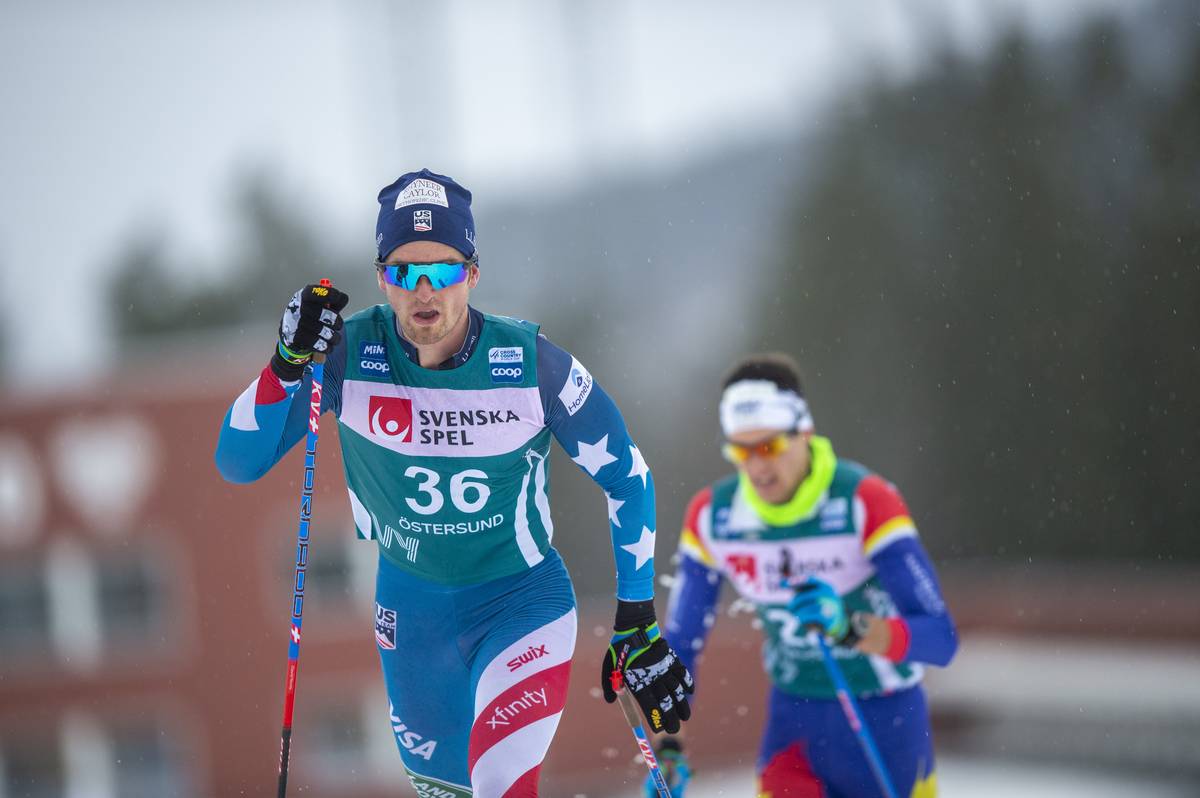
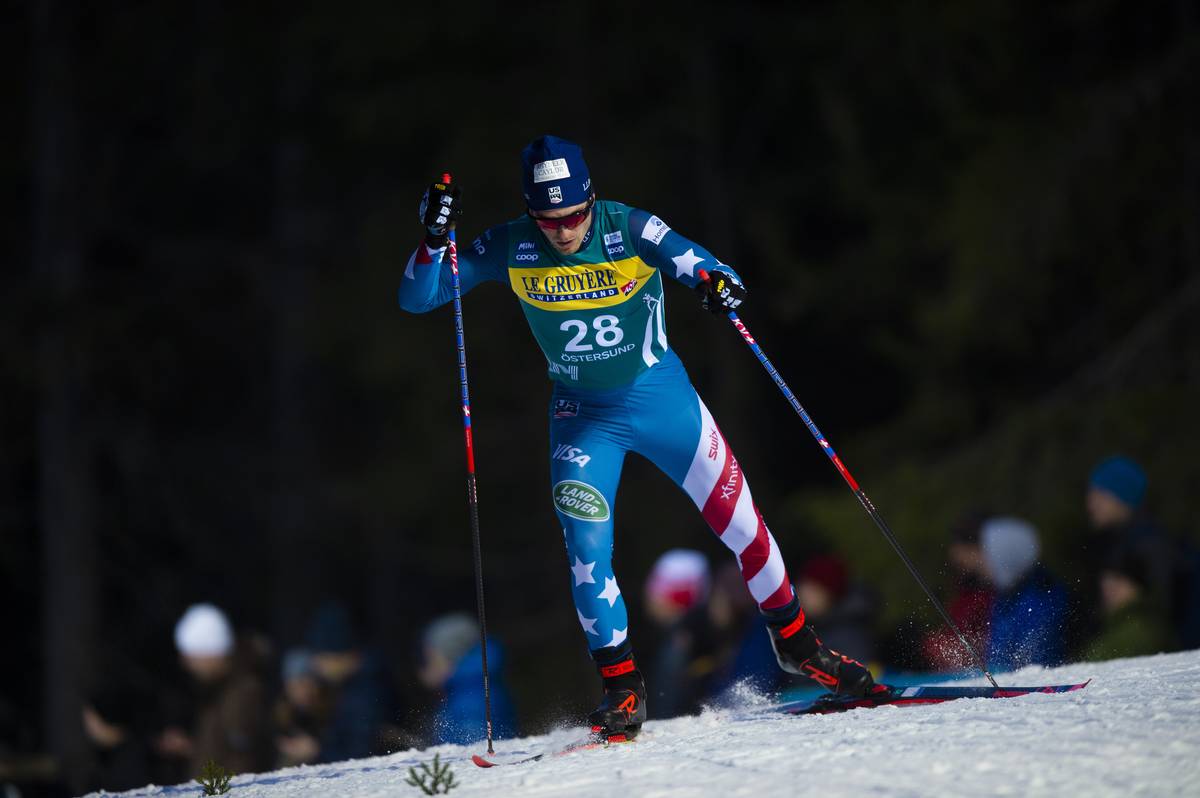
David Norris racing in the 2020 World Cup in Östersund, Sweden. (Photo: NordicFocus)
FasterSkier: It sounds like you are meeting all the benchmarks to be tentatively cleared?
DN: Yeah. And, any of the big red flag type concerns, none of my scans or pictures showed those. Without finding those red flags, we decided to just make a very controlled and conservative return to exercise. By doing a very gradual build-up, the thought is if there is something more to catch it, you’ll discover it during that gradual build-up versus just jumping back into intervals and time trials.
FasterSkier: How are your lungs or is that of concern to you? Maybe you have not had symptoms linked to lung function?
DN: I never had a cough. And I, I would say, I never felt anything like shortness of breath. And honestly, I haven’t secretly done three minutes hard to test myself. I haven’t done any formal tests to see what my lung volume is, so I don’t have any gauge, other than just when I have skied easy, nothing seems wrong.
FasterSkier: I’m sure you have been asked a million times – do you know how you might have contracted the virus?
DN: I don’t know of anyone COVID positive who I have been in contact with. It is possible I got it while traveling though. I flew from Anchorage to Fairbanks, and before I flew to Fairbanks I had a negative COVID test. But anytime I’ve been in public I’ve been careful with not touching stuff and keeping my distance from people.
FasterSkier: OK, some personal history that might relate to how conservative you say you are taking your recovery. Your senior year of college, in 2014, you trained through a lingering virus and were pretty much fried for about a year. If this is accurate, how are you informed by that experience?
DN: That’s pretty much accurate. I guess as a motivated athlete I could tend to ignore those chronic symptomatic things like a week or two of a stuffy nose or a sore throat. I would go for an entire month before I just said I need to bag it and get recovered. So my senior year of college, I ended up taking from about November 1 through February 1 off, and then by Spring Series, I raced to fourth place in the 15 k skate. And up to that point, that was my best 15 k skate result at the national level.
Having gone through that experience, it is nice to have that, because I know it gives me confidence that I can be patient and not stress about losing fitness. I just need to take care of my body and health and when everything seems to turn around, it doesn’t take that long to get back to race shape after so many years of training. I know that three months of low volume training doesn’t set you back that much.
FasterSkier: For a lot of people, not exercising can be a real stressor. And to take significant time to re-balance and heal is a non-starter for some, there’s the constant fear that you are de-tuning and will never be “fast” again. You know everyone has an athletics success window. But I can see how what you experienced in college can be valuable. That all said, I know you were given starts for at least Period I. What might the World Cup look like for you moving forward? But maybe I am getting ahead too much.
DN: I still have big goals for myself for individual World Cup performances and World Championships this season. That was the season goal, World Champs, but also to put me in a position to be on track for making the Olympics next year.
I mean getting good results would be great. That’s always great. But now my mind has shifted to just thinking about getting healthy, and building fitness this season, whether or not I race.
Erik Flora’s tentative plan, assuming I don’t have any negative side effects to training, has me building up to Christmas. After Christmas, I can build in high intensity and time trials. And if the World Cup selection committee decides to give me starts after the Tour de Ski, I would go to Lahti and Falun and hopefully, I would be selected for World Championships.
That being said, having contracted COVID and seeing that racing isn’t everything, it is just hard to know. Even by the end of January, maybe the right decision is to just stay home and try not to catch COVID for a second time.
I’m going to prepare and train to aim for those World Cups and World Championships. But then I’ll have to assess, assuming I get those opportunities and decide what is the best move.
David Norris of the U.S. during the 15 k skate, Stage 1 of the Ski Tour 2020. (Photo: NordicFocus)
FasterSkier: How were you feeling before all this? You are coming off a very solid year internationally.
DN: I felt good. I was confident. I had adjusted my training to try to come into Ruka a little hotter than in normal years with the plan to just come home for Christmas, and you know get through Period I with all the COVID stress and then come home and reassess.
I felt better than other falls, thinking that I wanted to be set for the first distance race in Ruka. I felt really good in early November, doing intervals and just all the training was really good. Through early October I intentionally trained through quite a bit of fatigue as I was carrying a lot of load. Fitness-wise, I was just coming around in early November where I was starting to get fresh and feel sharp. That was part of why I had the confidence to not do intervals on those days that I just had a stuffy nose because things were moving in the right direction. I know it’s not going to hurt me to do one less interval set in this 10-day block.
FasterSkier: What do you say to younger athletes who may get sick themselves? It sounds like you have a lot of patience but you also had an adverse experience when you were a senior in college.
DN: My junior coach in Fairbanks, he always said have the confidence to take a day off. I think that’s true. But at the same time, if you know that you’re training super hard when you’re healthy and you’re consistent with your training, as the fall approaches and you’re in the racing season, and knowing that I trained my ass off in the summer, all that gives me the confidence to take a day off and not stress about a small interval session.
My advice is that if you work hard when you’re healthy and when you’re supposed to train hard, then you should be confident that when you are sick, know you have the base to take a day off. When you feel like you might be catching a cold or even when you’re coming back from a cold and you feel ready to do an interval set, maybe, wait one extra day, and then do the interval set.
That was always the advice from the assistant coach, this Norwegian guy — he said in Norway when you showed up to practice and you told your coach you’re ready to do intervals after an illness, the coach would say, “Ok, you’ll do it in two days.”
FasterSkier: What type of medical follow-up might you do?
DN: I think I’ll do some more blood labs again, towards the end of December. Other than that, unless I get adverse effects from the increased training, I don’t think I would do extra scans.
Not two weeks ago, despite the pandemic, it appeared the FIS World Cup had dodged the proverbial positive-test bullet. The Ruka, Finland round of the World Cup went down with fantastic racing, and, as far as we know at the time of dropping this episode, no positive Covid-19 cases among the athletes in Ruka.
The cracks began to appear shortly after the racing in Finland concluded. Several of Norway’s star skiers independently withdrew from World Cup racing through December – they were the first to go. Then three major World Cup players, Norway, Sweden, and Finland collectively opted out. As we reported on the FasterSkier website, these teams felt the safety protocols and fidelity to those Covid-19 prevention measures in Ruka were insufficient.
We all know that race day is race day – you compete against those who wear the bibs. That said, we also know a World Cup race without Norway, Sweden, and Finland is like the Bulls without Jordan, a slalom race without Shiffrin, grooming with no classic tracks set.
Devon breaks it down and provides his thoughts on where this all goes from here.
Thanks for listening and here’s the disclaimer, this episode contains some un-beeped potty words.
Val di Fiemme settles in for another year. The 2021 TdS final stage awaits. (Photo: NordicFocus)
The Norwegian newspaper Dagbladet published a story Monday claiming the Norwegian Ski Federation would not send cross-country skiers to any remaining World Cups before the World Championships starting on February 23, in Oberstdorf, Germany. No official statement has been published by the Norwegian Ski Federation regarding a long-term Norwegian World Cup hiatus. Although, Dagbladet claims that is imminent.
It appears the rationale for a total withdrawal from World Cup races through February appears premised on rules applied to those leaving Norway and traveling to a “red zone” (regions where rates of transmission are high). Upon returning to Norway from a “red zone”, travelers must quarantine for ten days. The new governmental guidelines were posted on December 4, and extend until January 15. Such a lengthy quarantine, some have suggested, could impact an athlete’s preparations for the 2021 World Championships. (It is FasterSkier’s understanding that skiing/training would be allowed during the ten-day quarantine.)
According to the translated Dagbladet article, “The Norwegian Ski Association will not work to change the Norwegian quarantine provisions which in practice make it impossible to go international for Norwegian ski stars: The requirement for a 10-day quarantine with strict restrictions for training after a stay in so-called “red” countries, definitely puts Norway out of the World Cup.”
“This means that the Tour de Ski goes without Norwegian participation and that no Norwegian skiers will in principle go to any of the World Cup races that will be held before the start of the World Cup in Oberstdorf on 24 February,” claimed Dagbladet.
Dagbladet also reports that despite Norway’s pressure to reduce the number of races at the Tour de Ski, there was no compromise.
“Sweden, Norway, and Finland wanted to see changes in the Tour de Ski’s structure. They wanted the tour to be decided in one country, in a maximum of one or two places, to reduce travel. But that will not be the case,” explained the translated SVT Sport article.
Catching his breath while Norwegian flags are waved, Johannes Høsflot Klæbo takes the win in the 1.5-kilometer classic sprint during the 2020 Tour de Ski. (Photo: NordicFocus)
The Norwegian Ski Federation has released a statement explaining their reasons for not partaking in the Tour de Ski.“The health of athletes and support staff is our most important priority,” says cross-country manager Espen Bjervig according to a translation of the press release. “The risk involved in exposing a squad to Covid-19 weighs heaviest in the decision not to participate in the Tour de Ski. The main goal for cross-country skiing this season is the World Championships in Oberstdorf, continuds the cross-country manager who is concerned with being the best possible preparation for the championship with healthy athletes and support staff.”
FIS communicated Monday a statement clear in its intent, that the Tour de Ski goes on as planned: “Green light for FIS Tour de Ski,” was the FIS messaging.
“The FIS Tour de Ski remains as scheduled and was given green light as all health prevention plans of the local organizers in Val Müstair (SUI), Toblach (ITA) and Val di Fiemme (ITA) were approved by the respective governments,” wrote FIS.
In the FIS press release, the block quote below was attributed to Pierre Mignerey, FIS Cross-Country Race Director:
“All stakeholders have the responsibility to keep the World Cup stage a safe place. Overall, the organizing committees have done extraordinary work to fulfill special needs and a healthy work environment for the World Cup family. The coordination between the organizers of the Tour de Ski stages and FIS has been transparent from the beginning and therefore we are looking forward to go ahead as scheduled.”
Last week, it was reported that Norwegian star skiers Johannes Høsflot Klæbo, Emil Iversen, and Heidi Weng held serious concerns about the long-term adverse health effects if they were to contract the virus and the varying degrees of fidelity to the safety protocols in Ruka. Prior to Norway pulling away from the World Cup, Klæbo, Iversen, and Weng independently decided to take a break from international racing. Weng withdrew after the first race in Ruka; Klæbo and Iversen publicly announced their World Cup hiatus after the racing in Finland had concluded.
This past weekend, Rosie Brennan, bib 13, placed fifth overall in the Ruka, Finland World Cup mini-tour. (Photo: NordicFocus)
This article originally appeared in the Anchorage Daily News and is republished with permission.
Anchorage resident Rosie Brennan is a World Cup cross-country skier who trains with the Alaska Pacific University nordic team and is a member of the U.S. Ski Team. She’s an athlete representative for US Ski and Snowboard and is currently racing in Europe. She was one of the top racers at last week’s season-opening competitions in Finland.
We asked her about recent decisions by Norway, Sweden and Finland to skip December’s World Cup races due to COVID-19 risks. Those nations cited discomfort with a lack of social distancing and the failure of plans to create a “bubble” for the three-day race series in Finland.
Here is Brennan’s response, including her concern that the FIS — the governing body of ski racing — failed to create a competition schedule that considers the health of athletes.
It’s always a bummer to not have a full field in a World Cup, however, I think everyone needs to do what’s best for them right now so I am understanding of the decision.
I am, however, disappointed that those countries and some of their athletes that have the loudest voices didn’t express these concerns back in May when FIS holds their congress and works out the details for the season.
I do not feel that FIS made a schedule that has the teams’ health at the forefront and I don’t feel that they have taken strong leadership in their protocols. I think that if everyone had raised these concerns over the summer, we could have made a schedule that took more precautions and that made everyone feel better about the situation, but now we are in a situation in which everyone is having to make last-minute decisions about what they are comfortable with.
The situation is frustrating because the big nations like Norway have much less to lose from sitting out an event. Their athletes can still race televised races in Norway and fulfill sponsor obligations, get paid, etc. The smaller nations are dependent on the World Cup to make money so the pressure is so much higher. For the future of the sport, I think it’s important that all the nations work together to understand everyone’s differing situations and come up with schedules, plans, and rules that work for everyone.
It’s been difficult to navigate because FIS does not have overarching rules regarding COVID. It’s largely dependent on each local organizing committee, so the rules are changing every week. Luckily, US Ski and Snowboard has put an immense amount of effort into educating us and developing protocols for our team so we are following those while we try to navigate the changing rules in every location.
It’s clear that every team has different protocols, some being more strict than others, so there was definitely a range of behaviors in Ruka. It was an easy venue to stay safe, however, because we were staying in apartments next to the trail. We didn’t need to take any transport and meals were delivered so we didn’t need to go into any public places. This made me feel quite safe as I had more control over who I was around.
This is obviously not the case everywhere so it will be a dynamic situation as we move along. There were definitely some things I think they could have done better, like creating more space in the start/finish area to allow more distance and more one-way flow of people in and out of that area, but that was our first event so I hope FIS will take those recommendations forward to the future venues and we can continue to improve.
I made the decision to come (to Europe) for a number of reasons. It’s the only way I make money so I felt financial pressure, I love racing and it’s what makes me feel fulfilled. I was craving the challenge of the World Cup circuit, and my boyfriend received World Cup starts that he has worked really hard for so we felt that going together would be our best option.
Those reason’s tipped the scale to coming at the last minute, but I have no idea if it was the right decision or not, or if we should be having World Cups or not. I don’t believe anyone knows the answer as we are all experiencing this pandemic for the first time and still don’t have a full grasp of what is safe and what isn’t.
At this point, I made the big journey to get over here so I am going to stay and continue to race as long as it feels safe enough. There is obviously no such thing as zero risk so it’s all a balancing act and weighing the risks versus rewards daily.
The women’s podium of the 4×5-kilometer relay in Lahti, Finland’s during last season’s World Cup. Norway I took the win ahead of Finland I and Sweden. (Photo: NordicFocus)
Yesterday Norway announced it would cease sending skiers to the World Cups in Davos, Switzerland and Dresden, Germany due to Covid-19 concerns. Rumors swirled that Sweden would make a similar decision. Twenty-four hours later the Swedish Ski Federation announced they too would withdraw from December’s competitions.
“We learned some lessons about the implementation of a World Cup competition in Ruka. We have found that it went well. But we may also have been lucky. As it stands, we can not create an infection-free road to and from Davos or Dresden. If things go wrong, the disease can have potentially serious consequences for the person infected. None of us involved are willing to take that risk,” said Per Andersson, medical director of the Swedish Team, according to a translation of the press release.
Finland also decided the best move forward was step away from the World Cup. In a press release, the Finnish Ski Association explained the ongoing pandemic and concerns about compromising their athletes were to blame. The association also claimed safety protocols in Ruka, the site of last weekend’s World Cup in Finland, were insufficient.
“Unfortunately, at Ruka, we found that attitudes towards the coronavirus vary considerably between different people.When the Ruka World Cup was the first big event of the season, the organizers built a competition bubble according to the best knowledge, but due to the variability of the participants’ common understanding and commitment, the competition bubble did not materialize as required,” said Maarit Valtonen, Chief Physician of the Finnish Olympic Committee, according to a translation of the press release.
Along with Norway, both Sweden and Finland have not made a decision about participating in the Tour de Ski which Begins on January 1.
For those interested in the U.S. Ski Team, they remain in Davos preparing for the remaining December World Cups and the Tour de Ski. Chris Grover, Cross Country Program Director at U.S. Ski & Snowboard, provided the following statement regarding Ruka’s safety protocols and those nations electing to sit out the December World Cups:
“We respect any nation’s decision to protect the health and safety of their own athletes and staff. Our team is in Davos training and we are planning on racing here, and in Dresden later this month. Ruka did a great job hosting three disciplines – cross country, jumping and nordic combined – and showed what was possible. Our team felt quite safe in Ruka as we followed the guidelines the local organizer, FIS and our own National Governing Body had in place.”
The start of the 2020 Holmenkollen 50k. (Photo: NordicFocus)
Norway is pulling athletes from World Cup competitions through at least the holiday break. This was widely reported Tuesday in the Norwegian press.
The Norwegian race hiatus includes stops in Davos, Switzerland, and Dresden, Germany.
“We do not know the consequences of infection in a fitness practitioner, who is dependent on good lung capacity, yet. Therefore, it has been the number one priority not to get an athlete infected, because it can ruin the season and possibly the career,” said Norway’s Cross-country manager Espen Bjervig to Norwegian broadcaster NRK.
For now, NRK is reporting that Norway’s Ski Federation has not committed to sending athletes to the Tour de Ski, which begins on January 1. NRK writes, according to a translated article,”The Norwegian Ski Association adds that there are no plans for Norwegian participation in the Tour de Ski as the situation is now.”
Martin Fourcade (FRA) racing in Kontiolahti, Finland last season. Fourcade has since retired. (Photo: NordicFocus)
The International Biathlon Union announced on Wednesday that as part of their Covid-19 testing protocols, several teams had athletes test positive for the virus. Those positive tests were from Russian, Latvian, and Moldovan biathletes. The IBU stated it was the first of a series of PCR tests to be administered in Kontiolahti, Finland, the first stop of the IBU World Cup. In an email received Thursday morning, the IBU relayed news that athletes from France and Romania also tested positive.
The IBU also claimed in their brief statement that teams have been notified and the affected parties isolated.
This season’s IBU World Cup race schedule has already been modified due to the pandemic. In the past, for example, the IBU’s first race-trimester would include three stops over three weeks. Currently, the IBU plans on holding the first and second week of racing in Kontiolahti to reduce international travel. The second stop, in Hochfilzen, Germany, also includes two weeks of racing, with the intent, again, of minimizing travel during the pandemic.
According to the “IBU Event Guidelines Covid-19”, the following measures must be taken to isolate an infected person.
“ISOLATED SICK PERSONS
Isolation rooms on venue (People that have contact with the isolated, possibly sick persons should have need to wear access to proper protection (masks, eye protection etc.)
Isolation in hotels
Reduce double rooms and use single rooms
Reserve room(s) per nation “
The Team Guide, posted by kontiolahtibiathlon.com, states “special groups”, in this case, athletes and team staff, must present a certificate “of a negative COVID-19 test taken less than 72 hours prior to arrival to Finland, a certificate will be checked at border control by the Finnish Border Guard.”
The “model for entry of special groups” explains those presenting a certified negative test may train, and “no obligatory quarantine” is required. However, the guidelines state “self-isolation highly recommended.”
According to the entry guidelines, a follow up negative test within 72 hours after entry to Finland must also be presented to the proper authorities.
A 2016 photo from Frozen Thunder in Canmore, Alberta. (Photo: Matthias Ahrens)
Yesterday, RMOTODAY.com, reported 11 “active” cases of Covid-19 linked to Frozen Thunder, an early season on-snow event organized at the Canmore Nordic Centre. According to the news report, athletes, clubs, and national governing bodies like Nordiq Canada and Biathlon Canada were notified about the cases on November 17.
RMOTODAY contacted Chris Dornan, Nordiq Canada’s communications director, who emailed, “These individuals are in quarantine and following all of the required protocols in place to protect themselves and the community at large.”
Dornan added, “Contact tracing has also been initiated and those who have deemed to have been in close contact have been notified of their risk of exposure. These individuals have also been advised of steps that need to be taken.”
Susan Dunklee (USA), Lisa Theresa Hauser (AUT), Marte Olsbu Roeiseland (NOR), (l-r), racing at the 2020 IBU World Championships mixed relay in , Antholz, Italy.
As coronavirus cases spike worldwide, biathletes are preparing for a modified start to the 2020-2021 World Cup season. The schedule emphasizes less travel than would be the norm on the IBU World Cup circuit. At the end of September, the International Biathlon Union (IBU) announced that the first four races of the winter would be held at two venues. Kontiolahti, Finland, will host the first two events on consecutive weekends, starting 27 November. Hochfilzen, Austria will have two race meets on succeeding weekends, starting 7 December.
In normal times, the schedule would have migrated to three different race sites over the same period of time. Last season, the IBU World Cup held events in Östersund, Sweden, Hochfilzen, Austria, and Annecy-Le Grand Bornard, France during the first trimester.
To continue limiting travel this year, the IBU subsequently revised their schedule to hold events on consecutive weekends at Oberhof in Germany, followed by the regularly scheduled event in Antholz-Anterselva, Italy. The Biathlon World Championships will continue to be held from 9 to 21 February in Pokljuka, Slovenia. The IBU will announce any changes to the third-trimester schedule by the end of November.
We know about the ever-changing nature of Covid-19 trends. For now, Finland is seeing 274.8 covid-19 cases per 100,000 persons, Austria is tallying 990.5 cases per 100,000. Germany, where the IBU World Cup features from 4 January to 17 January, is reporting 559 cases per 100,000; Italy is reporting 935 cases per 100,000 persons. Both France and Germany have reinstituted lockdown measures to slow the spread of disease.
Data aggregated by U.S. states are easier to find than cases per capita for the U.S. as a whole. As an example, New Jersey, where this reporter lives, has 2604 cases per 100,000 persons. This provides some context to how some European governments are mitigated community spread. It also remains uncertain how lockdowns in places where IBU World Cups are scheduled would impact those events.
Lowell Bailey (USA) celebrates with Max Cobb after winning the gold in the 20 k individual at the 2017 IBU World Championships in Hochfilzen, Austria.. (Photo: NordicFocus)
Speaking to FasterSkier earlier in October, Max Cobb, President and CEO of US Biathlon and Executive Board Member of the IBU, reflected on steps the IBU is taking to hold races this winter.
Cobb prefaced the conversation by stating that he was part of the working group that developed the changes. “I’m really satisfied with them,” said Cobb. “It was a sensible decision to make sure we’ve got our procedures down in the first race series before we try and implement it in more than one series at a time. I think it also gives every national federation the opportunity to have their athletes racing closer to home.”
Cobb stressed the IBU’s commitment to a safe racing environment. “If we’re uncomfortable with [covid infection levels], and if our medical advisory group is uncomfortable, then we’ll definitely change plans and cancel if need be.” He added that the IBU has asked their other calendared venues to be prepared in case events need to be relocated.
“Our hope is to be able to, as some other sports have done already, provide an environment in which we’re confident the risk of transmission is very low,” Cobb said. “That testing is robust, and athletes will have a chance to compete. [We are ] really sensitive to regional outbreaks, and obviously we’ll comply 100% with any local requirements.”
In a follow-up email, Cobb detailed the regimen the U.S. team would follow. Team members and staff will be tested for coronavirus before traveling to Europe, and then again 72 hours after arriving in Europe. During the race season, they’ll be tested at least twice per week.
Cobb estimated the cost of coronavirus testing to be approximately $30,000. Some of the testing costs for athletes, however, would be covered by the US Olympic & Paralympic Committee (USOPC) elite athletes’ health insurance.
It’s not just testing though: “Testing is one part of the budget impact but there are a lot more mitigation efforts,” Cobb wrote. “More single rooms, extra rooms, more transportation capacity to allow for distancing, it all adds up to more than $100,000 for the season.”
In an email, biathlon veteran Clare Egan responded to questions about the revised schedule. North American teams are used to long and taxing stints away from home when based in Europe.
“The obvious benefits of reduced travel are reduced fatigue and lower risk of exposure to COVID and other illnesses,” she wrote when asked if less travel would be an advantage for the U.S. squad. “These are the same advantages for everyone. I don’t think it offers me or my team any unique advantages over other teams. Perhaps the Finns and Austrians will feel an advantage being 2 weeks at home.”
Of travel arrangements, Egan wrote, “We will all travel on a charter flight from one venue to the next in order to reduce our exposure even further.”
Clare Egan of the U.S. during the 2020 women’s 15 k individual in Pokljuka, Slovenia. Egan placed 6th. (Photo: NordicFocus)
Egan is prepared for the challenges this season presents. “I feel comfortable traveling,” she said. “In the past few weeks, Europe’s cases have been double those in the U.S. But the worst outbreaks are in places where I will not be traveling. I understand the risks and also the easy ways I can lower my risk of exposure: wearing a mask, social distancing and washing my hands. Elite winter sport athletes like me have been doing this for years so I don’t think my behavior this winter will be that different from the past! I’ve been wearing a mask on planes for a decade.”
Cobb stressed the interdependence of athletes, support staff, and race organizations to ensure the season’s success. “The behavior of everyone matters for the success of the season,” he said. “I think that’s a really interesting sociological state to be in. I’m very optimistic that the athletes and everyone on the teams will behave in a way that lets us have a season. But it will be demanding to do that.”
Martin Fourcade racing last season at the 2020 IBU World Championships. (Photo: Nordic Focus)
March 31st is the last day we posted a new episode. Depending on where you stand in the COVID time machine, that might as well be a light year. Or a nano-second.
From Oslo, Norway Devon chats about the time that was and the time that will be as we lurch into fall and then winter. In other words, it’s about time we rebooted this project.
On the list of topics discussed, staying put when the air quality is grim, a brief discussion of doping, altitude training, and the prospects for a World Cup season.
Thanks for catching up with the podcast and as always, if you have questions for Devon, you can send them to devon@fasterskier.com or jason@fasterskier.com.
Hailey Swirbul (USA) racing in Oestersund, Sweden. Photo: Nordic Focus.
Madshus athlete Hailey Swirbul (USA) shares her strategies for getting the job done and preparing for the upcoming season amidst the corona pandemic that has hit the United States harder than any other Western country.
“I’m trying not to stress out about it. The virus is out of my control. But of course, we are concerned. In our team, we no longer talk about what we will do if someone in the group gets infected with Covid-19. Now, we talk about when someone gets it,” Swirbul says.
“I feel like a lot of Americans don’t take the virus seriously. They totally ignore the restrictions, don’t wear masks in crowded public spaces, and act insanely irresponsibly, and that’s very frustrating for the rest of us. As elite athletes we are depending on staying healthy, so I avoid public places as much as possible,” Swirbul says.
The 21-year-old US Ski Team racer lives and trains in Anchorage, Alaska, where infection rates and restrictions have been less than many other places in the United States. But Swirbul and her fellow training buddies still have felt the impact of the devastating virus.
“Nobody knows if or how we will get to compete this fall and winter. We were not able to travel to the glacier for our usual on-snow summer training here in Alaska, and there haven’t been any training camps with the full US Ski Team,” Swirbul says.
Last winter, Swirbul posted her best ever results on the World Cup in Davos (SUI) in the beginning of the season, proceeded to win both the sprint and the 20-kilometer classic event at the 2020 US National Championship, and was preparing for a second peak toward the last part of the season. But then the corona pandemic hit and closed down racing, traveling and life as we knew it in March. As spring turned to summer, the United States topped the global statistics of corona infections and deaths.
Hailey Swirbul (USA) at the FIS World Cup in Falun (SWE) last winter. Photo: Nordic Focus
Up to 30 hours of training in a week “Fortunately, outdoor workouts have not been restricted in Alaska, and while we can’t easily travel or do camps with everyone, we have a strong group of skiers locally who train together. But we are careful to keep social distance. We only train alone or in small groups, and I have also been focusing on other things than I’ve been doing the past few years,” Swirbul says.
In a typical week, Swirbul does one interval session on foot and three roller ski workouts with the local team at Alaska Pacific University. Additionally, she does at least one long distance workout of about three to four hours, either alone or with some of the other local athletes, and several strength sessions.
For an average week, that adds up to about 20 to 22 hours of training. But on big weeks Swirbul can hit almost 30 hours. Occasionally, she also has recovery weeks where she drops the training volume to 12 to 15 hours.
Tweaking the training program
While outdoor training is fairly uncomplicated as long as the training groups are small, gyms have been closed for months. Accordingly, Swirbul has used the pandemic as an opportunity to tweak her strength and conditioning routines this summer and fall.
Normally, she would do three or four strength sessions per week, with at least two of them being longer workouts at the gym. This year, she’s done nearly all of it at home.
Instead of doing weights at the gym, Swirbul has focused on plyometrics and explosive strength. She found that a tree branch can be used for pullups. And she picks up her dog for extra weight when she’s doing squats.
“I look at this season as an experimental year. I keep doing what I can do and who knows, maybe it will pay off and I won’t be any slower. After all, there is no perfect recipe for training, and the most important thing is consistency,” Swirbul says.
With the ever-evolving nature of the pandemic, two months out from our article titled “Covid-19 Trends and Early Season World Cups“, we thought it an appropriate time to review Covid-19 trends in Europe. If the International Ski Federation chooses not to modify Period 1 and Period II on the World Cup, Finland, Norway, Germany, Switzerland, and Italy will host already calendared events. In early June, when we first examined Covid-19 in those countries, the overall trends in terms of community spread were negative, with Switzerland the lone outlier as it experienced a rise in newly confirmed cases.
Fast forward two months and the landscape looks less optimistic. In the below map, we see all Period 1 and Period II host countries have macro-trends indicating increased daily new confirmed cases. The FIS has yet to finalize a schedule for this winter, yet it is worth revisiting the context within which FIS and relevant stakeholders will make decisions.
Below, we see that in much of Central Europe, daily new confirmed cases have increased when compared to similar data presented on July 6. Finland remains in good shape, whereas Norway is experiencing a setback.
The final map depicting the biweekly change in confirmed cases presents a mixed bag of trends. Finland, Norway, and Germany are trending towards fewer cases. However, Italy reports a 91 percent biweekly change (increasing), while Swizterland reports a biweekly 36 percent increase.
One of the key regulations to keep an eye on as FIS finalizes its schedule is the cap on people attending organized events. The Norwegian Institute of Public Health updated its policy on August 21. Events with up to 200 people “in public places” are currently allowed. According to the policy, “employees or contractors who are responsible for the event are not counted in the number of participants at the event,” but those 200 people do include “participants, audience, parents/ siblings/ companions and others who are present.” Sporting events in Norway must adhere to these guidelines.
Digging deeper, the policy leaves some wiggle room for hosting a World Cup. For longer duration events, organizers are allowed to “replace” participants. So the prospect of a ski race where the men’s and women’s fields rotate on site once a race is completed appears plausible. The policy also states that “top athletes performing in sports events” are exempt from social distance requirements during the competition “if it is necessary for the activity to be performed normally.”