From the FasterSkier archive — posts syndicated from athletes’ and coaches’ own blogs between 2004 and 2012, kept online as published. Current coverage is at fasterskier.com.
U.S. cross-country skier Kevin Bolger and Swedish racer Maja Dahlqvist met during the COVID-19 pandemic. The virus kept them six feet apart during the Olympics — except one celebratory hug.
ZHANGJIAKOU, CHINA — American Olympic cross-country skier Kevin Bolger grew up in Wisconsin. His girlfriend, Olympian Maja Dahlqvist, is from Sweden.
During the Olympics, in China, they got to spend a couple of weeks in the same place. Among their options for dates:
• Go cross-country skiing together, but stay side-by-side, six feet apart.
• Eat meals at the Olympic Village dining hall, separated by head-high plastic dividers.
• Socially distant walks.
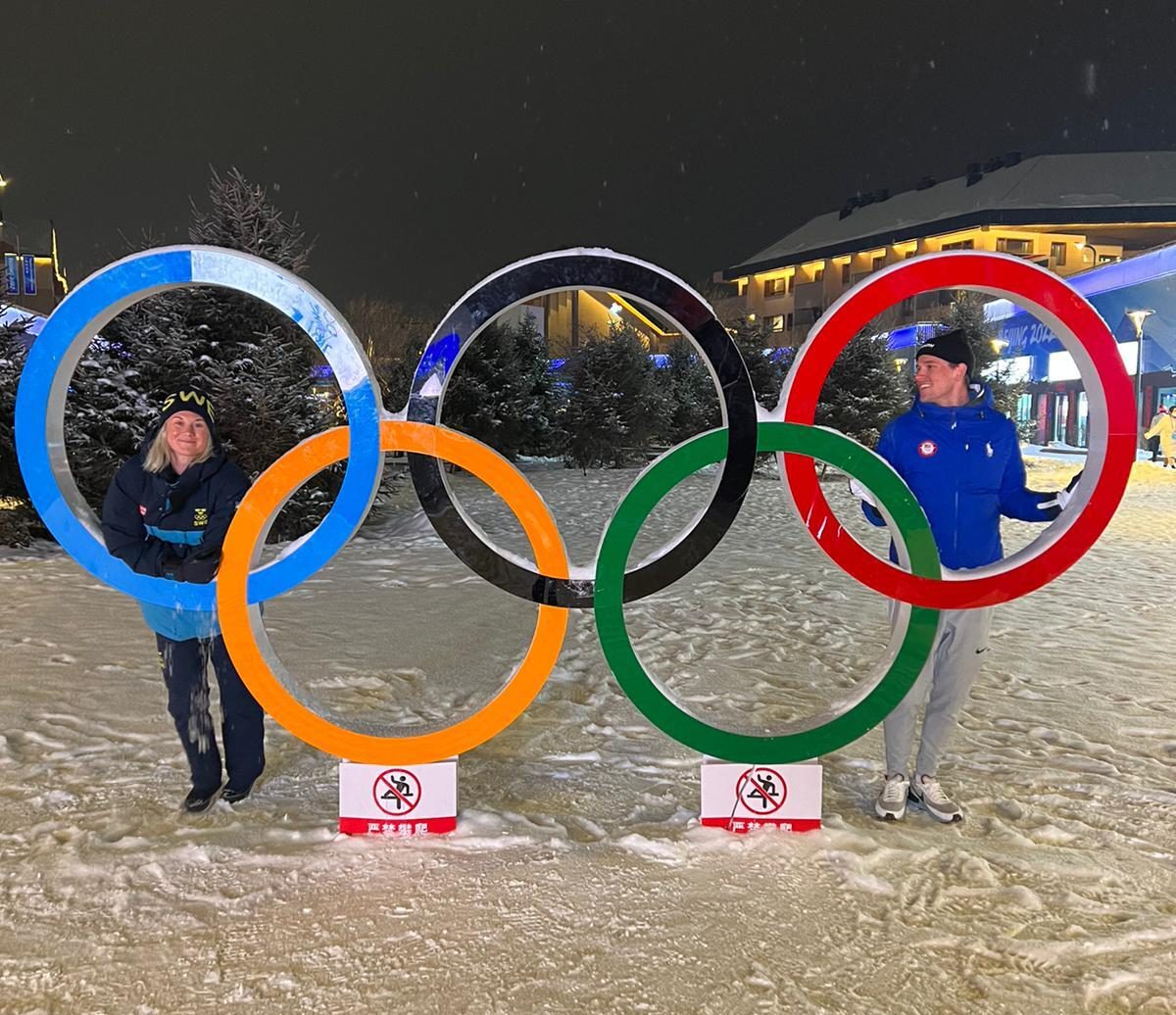
Welcome to the coronavirus Games, where parents and fans were banned, masks were mandatory indoors and out, and even couples like Dahlqvist and Bolger had to stay at respiratory droplet-safe distances.
Kevin Bolger and Maja Dahlqvist enjoy a masked moment together following Dahlqvist’s second place finish in the skate sprint. (Courtesy photo)
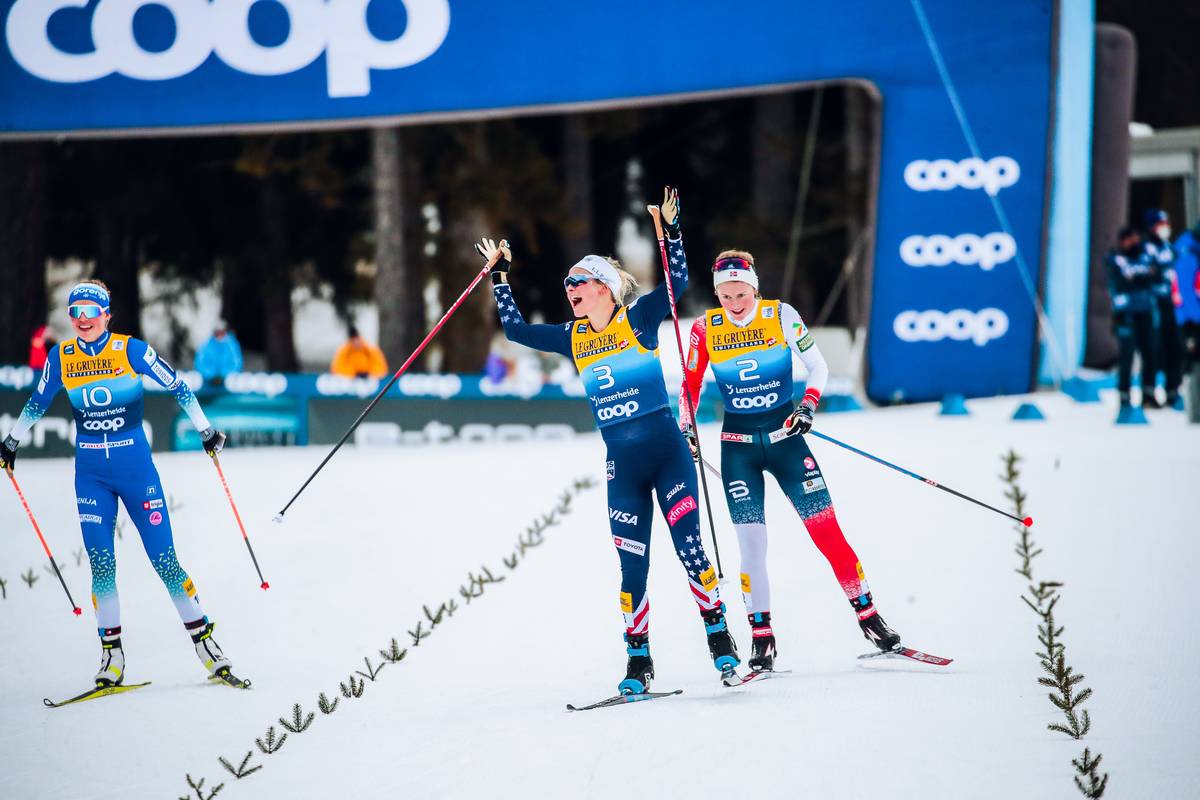
Okay: There was one moment of weakness — but only after Dahlqvist won silver in the individual freestyle sprint event, where she was heavily favored to take a medal. Afterward, there was a very satisfying hug.
“My team didn’t care. And his team didn’t care. It was just, like, to celebrate then,” Dahlqvist said in an interview later. “But I don’t think we should do that every day.”
Dahlqvist’s and Bolger’s Olympic romance is a neat kind of encapsulation of China’s Covid Olympics: It was making a decent time out of a difficult situation, but nowhere close to the real thing.
Matt Whitcomb, the U.S. team’s head coach, described their relationship like this.
“You still get to go for a walk, you get to go for a ski with each other. You still get 90% of the companionship,” he said. Asked to reconsider that figure, he added: “Yeah. I would actually say, 30%.”
Nobody on the American or Swedish ski teams got Covid during the Olympics, so we can chuckle now about what Bolger, 28, and Dahlqvist, 27, endured.
But the protocols were no joke, and the stakes were about as high as they get for Olympic athletes.
China’s strict coronavirus protocols meant that an infection during the Olympics, or in the lead-up to the Games, could cost athletes a shot at medals.
Six feet – or three Olympic rings – apart: Maja Dahlqvist and Kevin Bolger remain careful through the 2022 Olympics. (Courtesy photo)
Just before the Olympics began, several members of Norway’s team tested positive after an altitude camp in Italy.
One of Norway’s star men, Simen Hegstad Krüger, spent the first days of the Olympics pacing his hotel room in Italy after his own positive test.
Krüger recovered in time to get to China and win a bronze medal in the Olympics’ last men’s cross-country event. But Weng missed the Games altogether — underscoring what was at stake for Bolger, Dahlqvist and the teammates whose medal chances could also be jeopardized by a positive test.
“I think we both understood the risks — personally, for each other, and then, bigger scale, for the team,” Bolger said.
He and Dahlqvist, who both specialize in sprint races, started seeing each other last season, while their teams followed the elite-level World Cup circuit around Europe.
Bolger got to spend two months with Dahlqvist in Sweden over the summer. And during the early part of this winter, they could spend time together without too much coronavirus stress.
“Everyone had the vaccine. Omicron wasn’t a thing,” said Bolger. “We were still being smart about things. But it wasn’t a big deal.”
But the situation changed as the Olympics approached and omicron took off.
The Swedish and U.S. teams had simultaneous pre-Games altitude camps in Italy; Bolger’s and Dahlqvist’s accommodations were within shouting distance. But there was no canoodling.
“She’s like, ‘Come on, give me a hug!’” Bolger said. “I was like, ‘No — don’t even get near me until, like, maybe after the (Olympic) sprint.’”
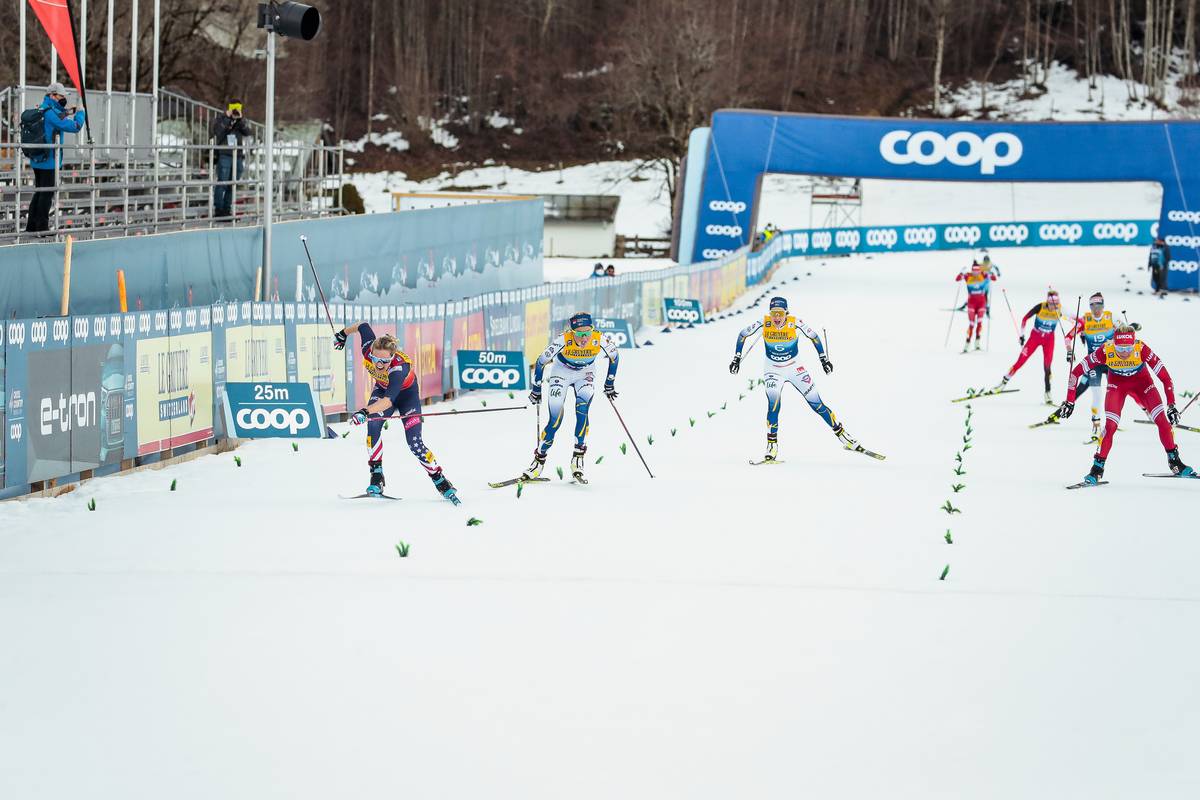
Sweden’s Maja Dahlqvist earns her first Olympic silver medal in the individual freestyle sprint. (Photo: NordicFocus)
Even on walks, the couple wore KN95 masks and stayed at least two meters apart. They’ve taken similar precautions during the Games.
“God knows what was happening on those walks,” quipped Bolger’s teammate Luke Jager, before adding: “We really trusted them. We were never concerned about it. We knew they hadn’t been sneaking off and smooching in the woods.”
Bolger and Dahlqvist were by no means the only couples contending with Covid-related relationship complications in the lead-up to Beijing. And athletes and coaches said that the steps the coronavirus forced them to take were painful.
Erik Flora, who coaches several Olympic cross-country skiers at Alaska Pacific University’s elite team, said one of his athletes wore masks around and slept in a different room from their partner.
Jessie Diggins, the star U.S. skier who won two medals in Beijing, has described skipping weddings and celebrations and spending four months on the road last year without any time with her family or fiancé, Wade Poplawski. That kind of emotional support can be especially important at high pressure events like the Olympics, she noted.
“You really want your family and your loved ones around you, right?” Diggins said in an interview. “I don’t have a choice. I don’t get to see Wade. But (Bolger and Dahlqvist) are right there, and they made the choice to protect the team. And that is so cool, and I can’t say thanks enough.”
To state the obvious: Going through the Olympics while socially distancing from your partner is hard. “Super hard,” said Dahlqvist.
“It was, like, so close, yet so far away,” Dahlqvist said. “It was just so annoying.”
The hug she got from Bolger, after winning her first of three medals, was such a relief, after facing intense pressure beforehand.
“I just cried,” she said. “It was so nice to have him there.”
Dating from a COVID-safe distance: Kevin Bolger and Sweden’s Maja Dahlqvist take careful measures to keep each other, and their teams, safe during the 2022 Olympics. (Photo: NordicFocus)
As the Games ended, Dahlqvist left Beijing before Bolger, who remained with the U.S. team through the closing ceremonies and then flew to Finland to continue the World Cup season. Dahlqvist is competing in Finland this weekend, as well.
Bolger said he thinks they can start relaxing their precautions now that the Olympics are over, if not entirely. But the couple will be able to truly let their guards down in a couple of weeks, when the World Cup circuit heads to Sweden and Bolger will get to stay with Dahlqvist — forming their own bubble of two. And then she may travel with him, back to the U.S.
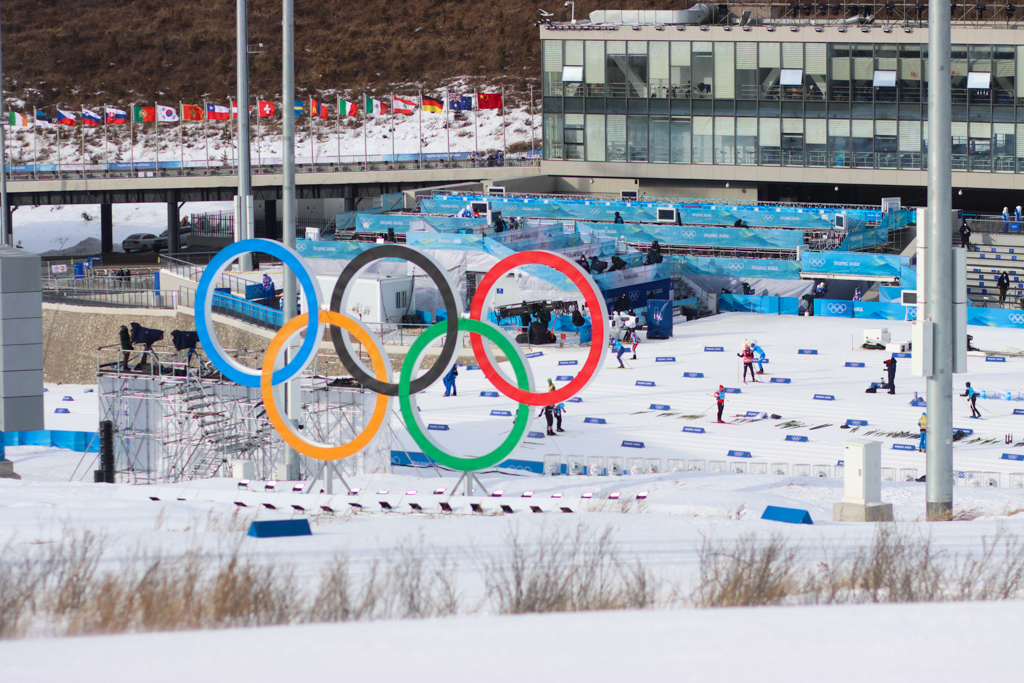
A view of the stadium Friday, February 4, 2022 at the Zhangjiakou National Cross-Country Skiing Center. (Nat Herz/FasterSkier-ADN)
ZHANGJIAKOU, CHINA — After months of headlines about coronavirus tests, travel logistics and geopolitics, Beijing’s Olympic cross-country skiing venue, on the eve of its first competition Saturday, has emphatically changed the subject.
To the winds of Zhangjiakou.
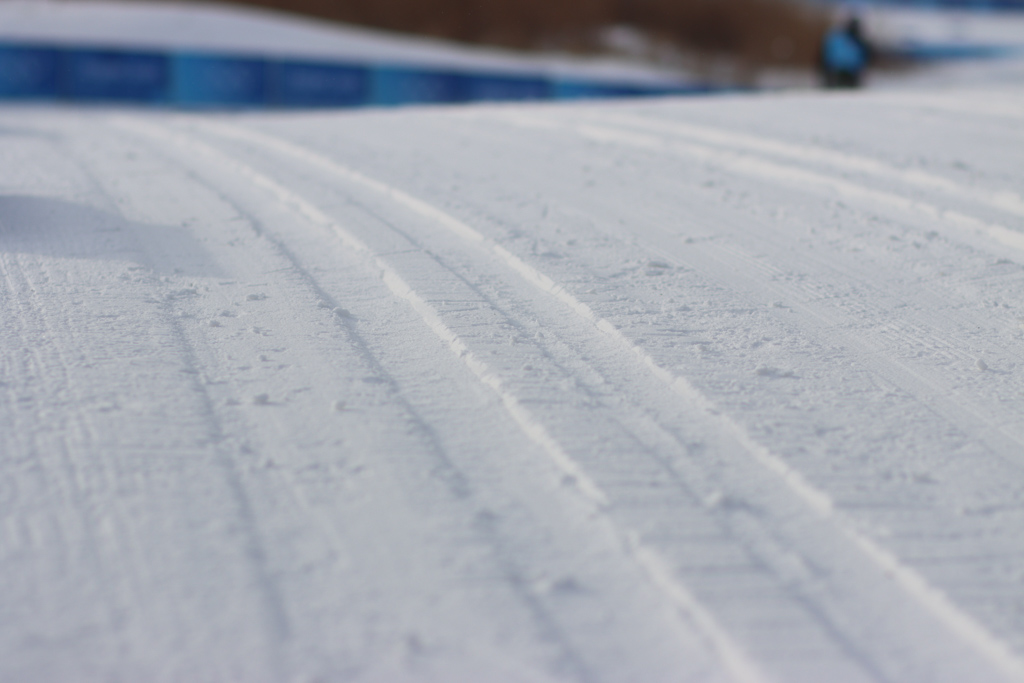
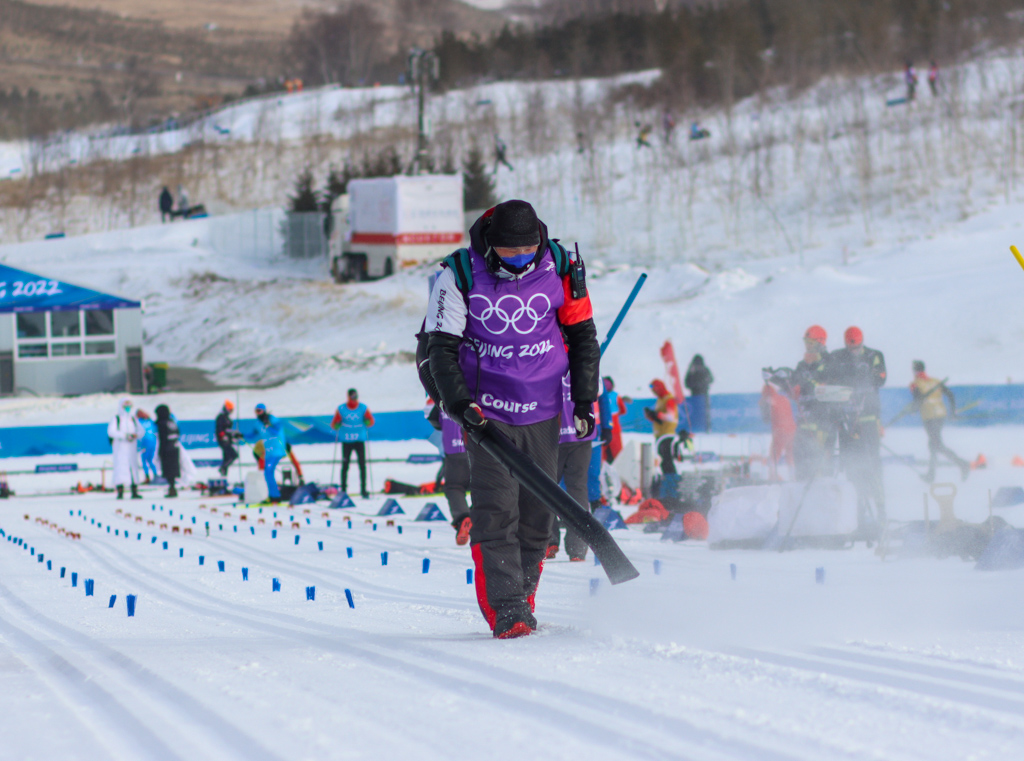
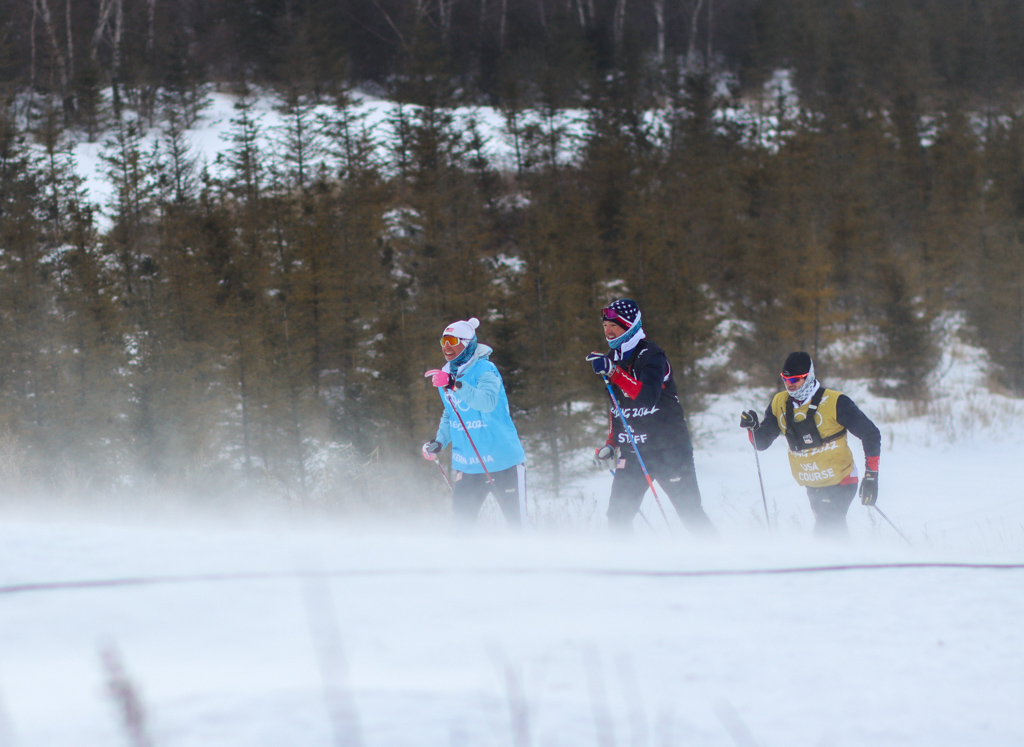
Icy gusts billowed athletes’ training bibs, filled the resort town’s immaculately groomed ski tracks with dry, squeaky powder and generally consumed everyone’s attention Friday — from the team members who shielded their faces with buffs and layers of tape to the course workers who used leaf blowers in an effort to restore a section of the course to presentable shape.
Windblown snow fills ski tracks Friday, February 4, 2022 at the Zhangjiakou National Cross-Country Skiing Center. (Nat Herz/FasterSkier-ADN)A course crew member attempts to clear windblown snow out of the ski tracks Friday, February 4, 2022 at the Zhangjiakou National Cross-Country Skiing Center. (Nat Herz/FasterSkier-ADN)
“This makes Fairbanks seem nice,” a slightly defeated sounding Luke Jager, the Alaska-born American sprint racer, said in a message after braving Zhangjiakou’s trails Friday, amid 25 mph gusts and a high of 5 degrees. “It’s kind of brutal though: All the spots on the sprint course where you want to carry speed into the climb, you just get blasted with wind and come to a halt.”
Athletes’ early impressions of the Beijing Winter Olympics have centered on China’s intense coronavirus mitigation measures, from daily testing to volunteers wrapped in layers of personal protective equipment.
But finally, after dodging the hyper-contagious omicron variant in the lead-up to the Games, athletes and coaches are finally able to narrow their focus on competitions — thanks in part to those protective measures.
American cross-country skier Julia Kern trains with U.S. team staff members Eli Brown, center, and Andrew Morehouse on Friday, February 4, 2022 at the Zhangjiakou National Cross-Country Skiing Center. (Nat Herz/FasterSkier-ADN)
That’s the thing about the Beijing Olympic bubble: Once you’re inside it, it’s a much more comfortable place for an elite athlete to be during a pandemic than outside.
“I would say China’s policy on COVID matches our team policy on COVID,” said Matt Whitcomb, one of the U.S. Ski Team coaches. “Even though athletes made the team, we weren’t sure they were actually going to make it to the Olympics.”
Positive tests sidelined other contenders ranging from Norwegian cross-country skiing stars to star U.S. bobsledder Elana Meyers Taylor to Alaska-based figure skater Keegan Messing.
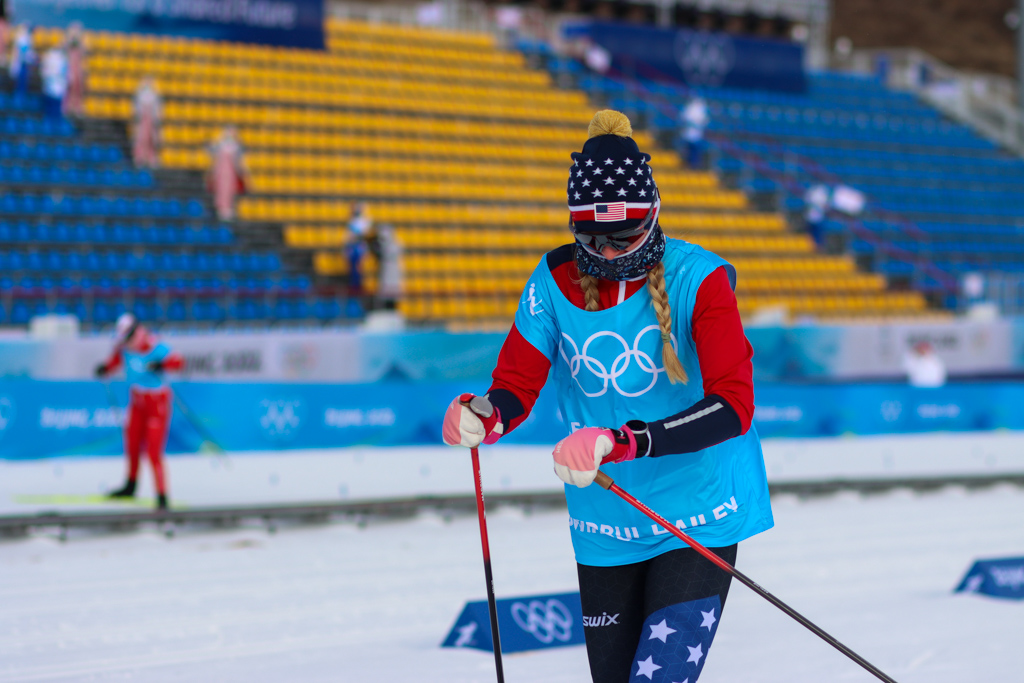
American cross-country skier Hailey Swirbul tries to stay warm during a race preparation training session Friday, February 4, 2022 at the Zhangjiakou National Cross-Country Skiing Center. (Nat Herz/FasterSkier-ADN)
But the entire U.S. nordic skiing squad has made it to Zhangjiakou, in the mountains some 100 miles northwest of Beijing, unscathed so far.
And while athletes and coaches said they’re still being vigilant, each day without news of many positives inside the Olympic bubble lends to the sense of security.
“Since we’ve all gotten here and settled in, we’re like, ‘All right, we made it.’ We’re still testing negative. We haven’t heard of people testing positive. So I think we’re feeling pretty good about it — and not thinking about it quite so much,” said Gus Schumacher, another Alaskan competing at the Games. “I think this is probably the COVID-safest I’ve been in a long time.”
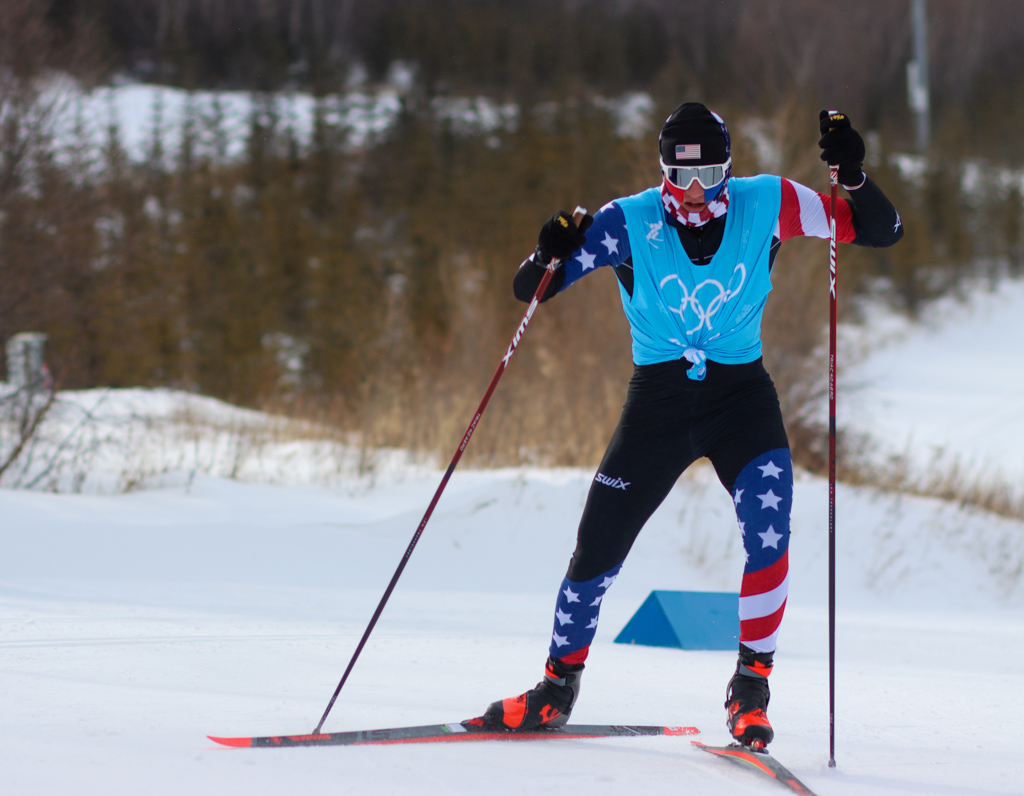
American cross-country skier Gus Schumacher trains Friday, February 4, 2022 at the Zhangjiakou National Cross-Country Skiing Center. (Nat Herz/FasterSkier-ADN)
That’s allowed athletes to think, and talk, about other things — namely the conditions on Zhangjiakou’s courses in advance of the Olympics’ first cross-country ski races.
Women will race 15 kilometers Saturday afternoon in the pursuit format, with the first half in classical technique and the second half skating. Men race the same format Sunday, skiing 30 kilometers.
Athletes spent Friday testing skis, practicing the changeover in gear — which happens while the clock is running — and fine-tuning both their bodies and cold-weather coping techniques.
Olympic team staff test skis and wax Friday, February 4, 2022 at the Zhangjiakou National Cross-Country Skiing Center. (Nat Herz/FasterSkier-ADN)American cross-country skier Gus Schumacher trains Friday, February 4, 2022 at the Zhangjiakou National Cross-Country Skiing Center. (Nat Herz/FasterSkier-ADN)
“Trying to figure out how to keep our faces warm,” Jager said.
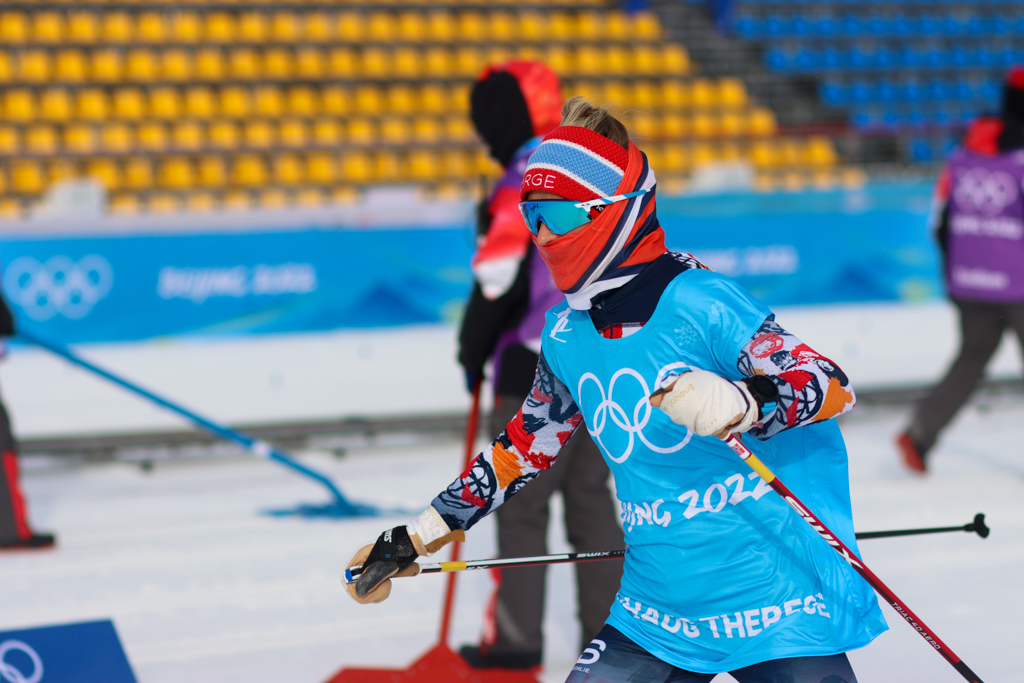
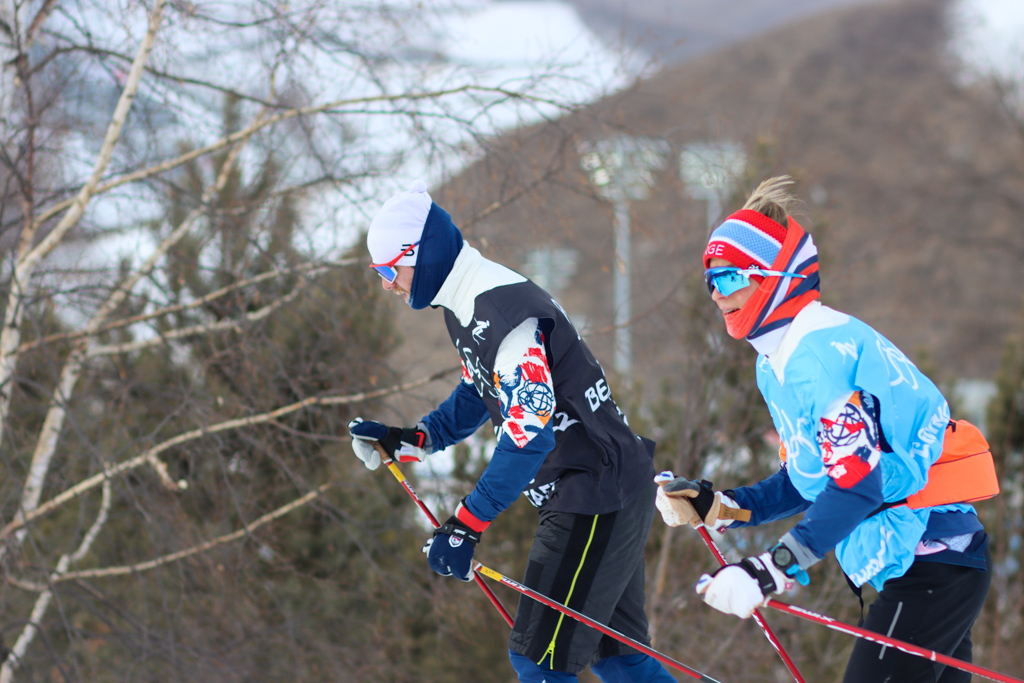
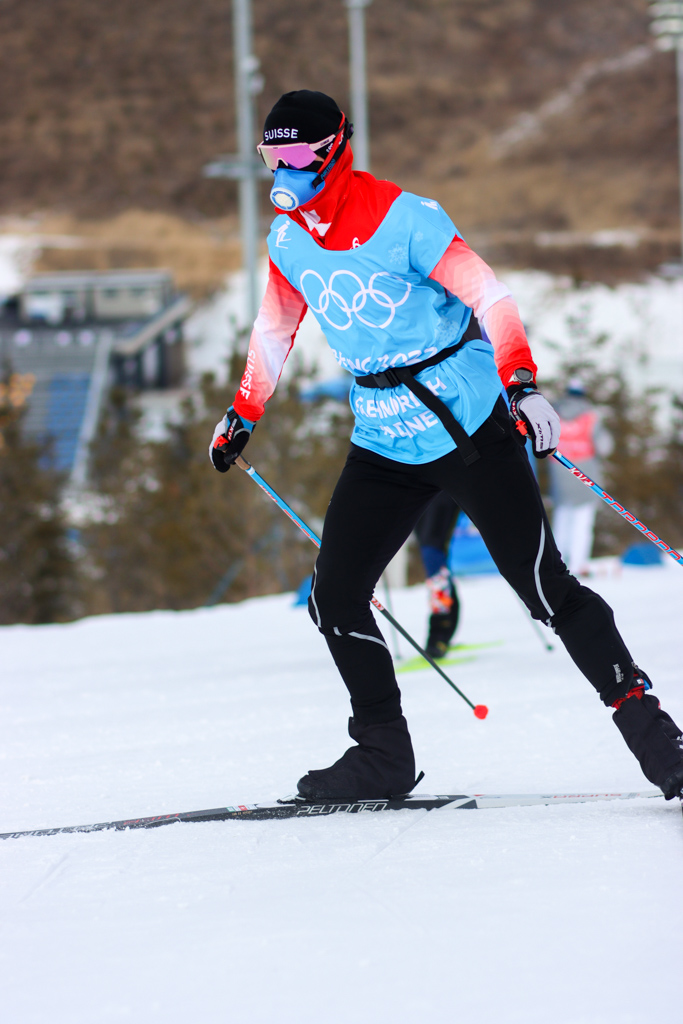
Schumacher skied with patriotic red and blue patches of tape on his cheeks, plus a striped red and white neck warmer. Other athletes trained wearing masks designed to shield their lungs from the cold air. Norwegian superstar Therese Johaug at one point skied through the stadium area with her neck warmer pulled over her mouth.
Norwegian superstar cross-country skier Therese Johaug stretched a neck warmer over her face to stay warm Friday, February 4, 2022 at the Zhangjiakou National Cross-Country Skiing Center. (Nat Herz/FasterSkier-ADN)Therese Johaug and her technician endure wind and cold as they prepare for the upcoming skiathlon. (Nat Herz/FasterSkier-ADN)
“Everybody has really fine-tuned what long underwear tops they’re going to need to wear, heated socks, heated vests for training,” Whitcomb said. “What puts the cold into an extreme sort of level is just the incessant wind — and it is really bitter. There’s one or two spots on the course where you can find a little respite from the wind, and it feels like the tropics when you step into it.”
Beyond devising ways to keep their bodies warm, athletes were also scheming with coaches about the fastest way to navigate Zhangjiakou’s wide, challenging trails, given the challenge of the windblown snow filling the tracks.
Skiing outside the tracks appears to be faster. But doing so invites the potential for disqualification, as athletes are required to follow strict rules about cornering when using the classic technique, Whitcomb said.
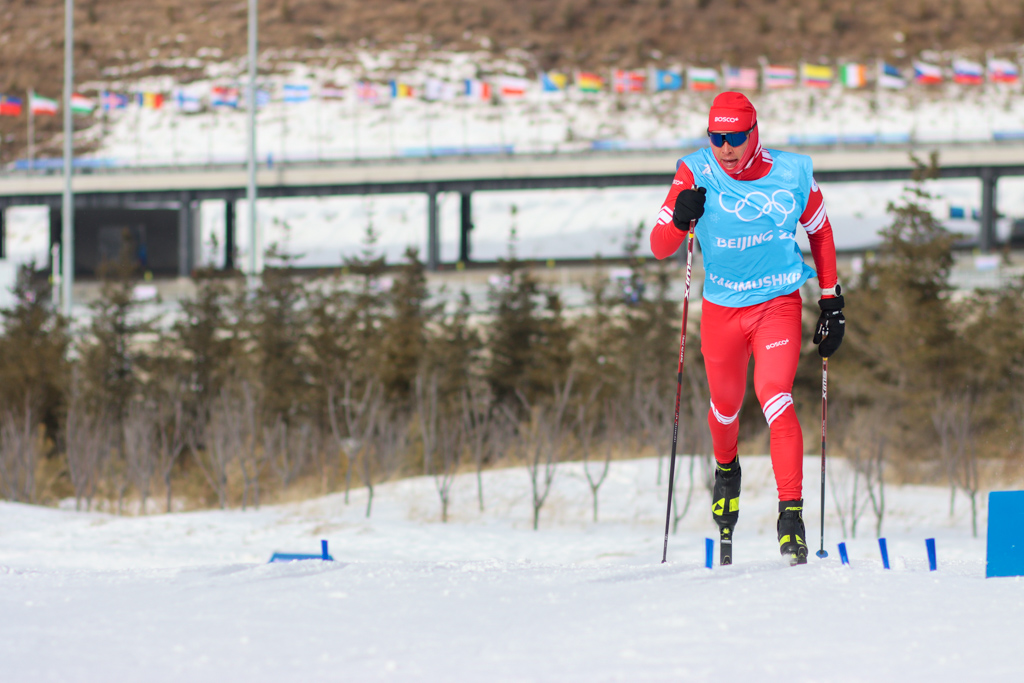
Swiss skier Nadine Faehndrich trains in a mask Friday, February 4, 2022 at the Zhangjiakou National Cross-Country Skiing Center. (Nat Herz/FasterSkier-ADN)Russian skier Ivan Yakimushkin trains Friday, February 4, 2022 at the Zhangjiakou National Cross-Country Skiing Center. (Nat Herz/FasterSkier-ADN)
Aside from the cold, though, athletes and coaches said they’ve had a warm welcome to China. The food is good, the logistics are uncomplicated and the Chinese volunteers have been warm.
“They’re doing an amazing job,” Jager said. “Everyone’s super friendly, and everything is pretty seamless.”
The coronavirus prevention measures also make sense, Schumacher said, given China’s low rates of illness and the much higher rates in countries that athletes, coaches and journalists are traveling from.
“It honestly seems like China’s probably one of the few places that can really pull this off well, right now,” he said.
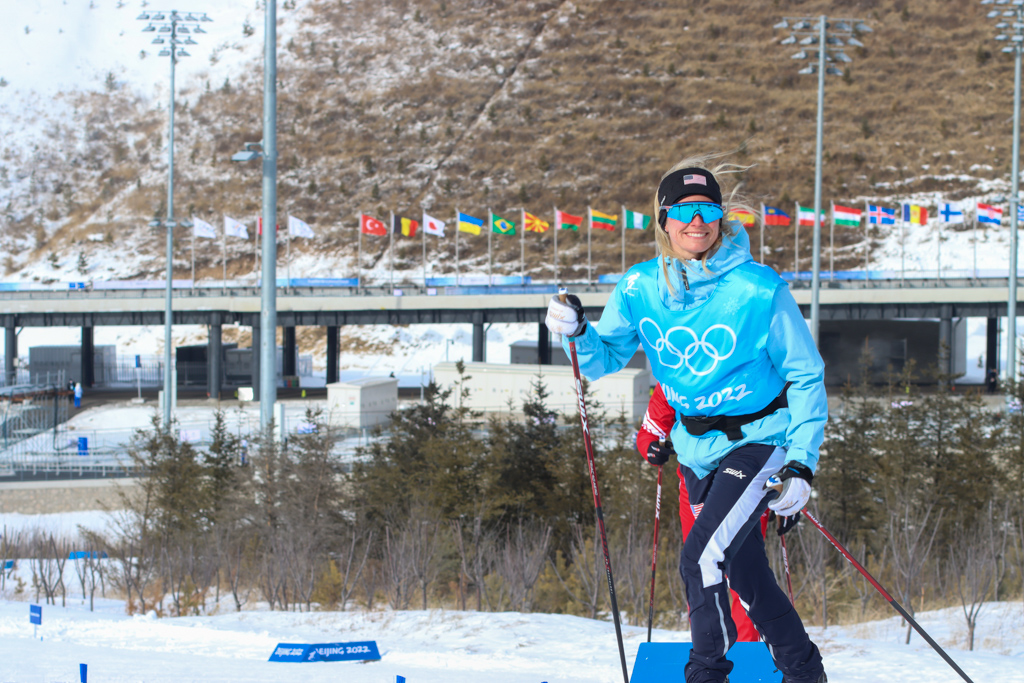
American cross-country skier Jessie Diggins smiles during a training session Friday, February 4, 2022 at the Zhangjiakou National Cross-Country Skiing Center. (Nat Herz/FasterSkier-ADN)
As January draws to a close, energy, excitement, and perhaps anxiety surrounding the rapidly approaching 2022 Olympic Games in Beijing is steadily building. In an effort to better manage her time and energy heading into these Games, Jessie Diggins offered a media conference facilitated by U.S. Ski & Snowboard cross country communications manager Tom Horrocks to answer questions about her preparation, outlook, and plans for the remainder of the time before the team heads to the athlete village in Zhangjiakou.
Diggins began the conference with a comment on the team that has been named. Of the fourteen athletes named to the Olympic cross country team, just four have competed in past Games. Diggins is headed into her third Olympics with ten total Olympic races under her belt, while Rosie Brennan, Caitlin Patterson, and Scott Patterson competed only in the 2018 Games. In Pyeongchang, Brennan competed in just the skiathlon, while Caitlin Patterson raced in the skiathlon and 30k classic, and Scott Patterson raced in each of the three individual distance events plus the men’s relay.
Six of the athletes were born in the year 2000 or 2001. Overall, it’s a relatively young crop of athletes, many of whom have very limited experience racing at the international senior level compared to veteran-dense teams like Norway.
Diggins emphasized that the age and experience of the team should not be associated with what fans of the sport should expect to see in competition, adding that she is individually very excited to see what her teammates will do at the Games.
“Everyone’s working so hard,” she said. “And staying really cool in what is a stressful time – with COVID, and with variants, and with all the different paperwork and all the things that you need to do headed into any Olympics, but especially this one, given the extra hurdles with COVID… I think everyone’s doing such a remarkable job of not only handling all the extra stressors very well, but also still being excited and still seeing this as, ‘Okay, we’re gonna find ways to make this fun. Obviously, it will be different from Games in the past, and probably different from future Games too…’
“I think we’re in a really good place, despite everything that’s happening in the world. And I think that’s kind of one of the things that the Olympics does for us is it lets us feel inspired and let go of all the stresses that we’re feeling in the moment. Or at least that’s what the Olympics I think is supposed to do.”
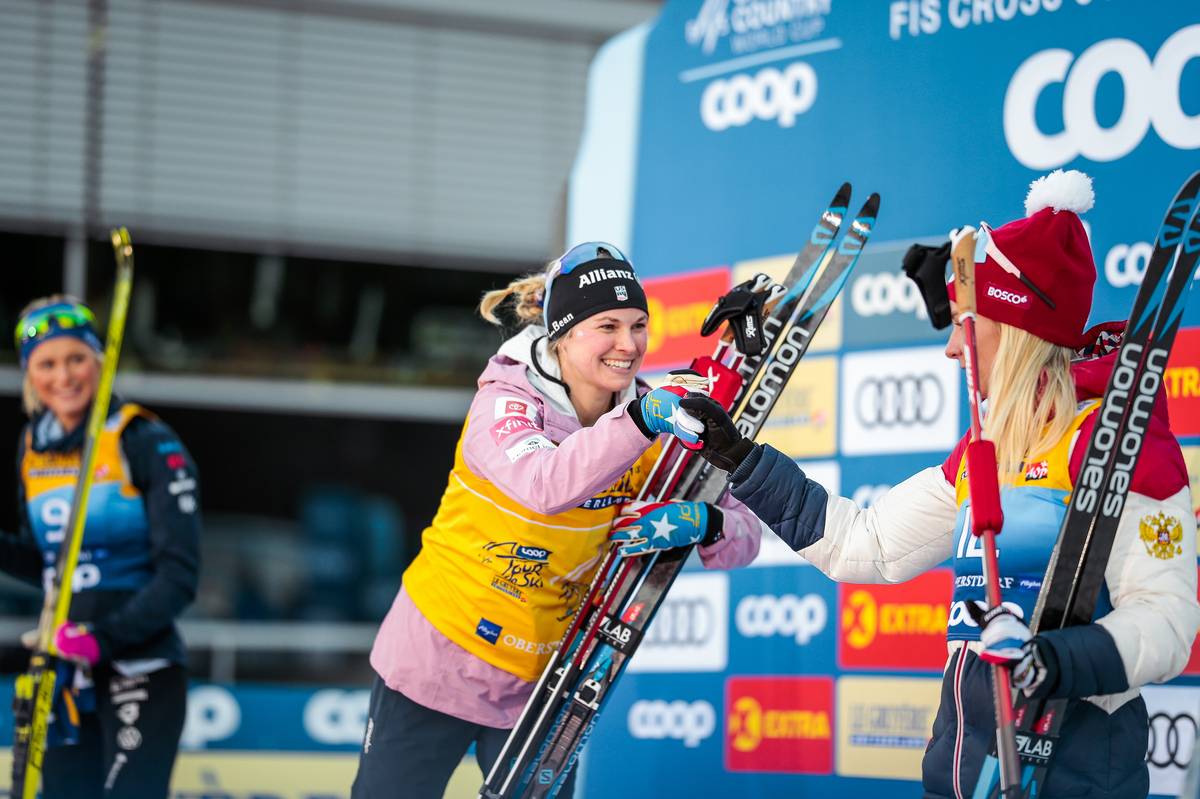
Jessie Diggins embraces team sprint partner Julia Kern after the pair took second place in the freestyle team sprint in Dresden, Germany in December, 2021. (Photo: NordicFocus)
Following the Tour de Ski, the members of the team who planned to remain in Europe began a recovery training block in Seefeld, Austria, which sits at roughly 3,800’, before moving to higher elevation to begin an altitude training camp. Having come down with a head cold during the final stages of the Tour de Ski, Diggins expressed the value of this recovery block, particularly in a location where her body was not further impaired by altitude-related physiological effects.
“Within two days after the tour, I was symptom free. Five days later, totally healthy and able to train totally normally again. So that was really, really nice to dip down in altitude and recover and feel like I absorbed everything that the tour brought in terms of training stimulus.”
With the cancellation of the final two World Cups before the Olympics, the team headed to Livigno, Italy earlier than originally planned, earning them extra time training at a venue that sits at a nearly identical elevation to the competition venues in Zhangjiakou. Diggins expressed that this has provided the team with a variety of excellent training options, from challenging race courses to flat valley skiing ideal for recovery, all supported by a team of staff that includes wax techs, a chef, and a physical therapist.
Acknowledging individual variation athlete-to-athlete, Diggins explained that overall the team’s preparations have looked “normal” in terms of how they would train and peak leading into another Championship. To account for the lack of races, the team has been building in simulations, including practicing events that have not been included in the World Cup calendar yet this season.
“Yesterday, Julia and I did a skiathlon simulation,” Diggins shared. “It was awesome. It was really hard. And I’m so glad we did it. We had coaches going nuts – taking video, cheering for us. We had bibs on, we had pits set up, we had everything to simulate it, which was really nice, because we don’t get to do very many skiathlons anymore. And it was really cool to practice that pacing at altitude. That was really helpful.”
With an epic free skate in the final meters, Jessie Diggins wins the thrilling 10-kilometer mass start freestyle in Oberstdorf, Germany during the 2021/22 Tour de Ski. (Photo: NordicFocus)
In previous press conferences, Diggins has emphasized the importance of frequent racing in helping her reach her mental and physical peak during the season. She had planned to race in at least the first World Cups after the Tour de Ski in Les Rousses, France before they were canceled. With this piece of her plan suddenly removed, what would she do to replace these stimuli to ensure her preparations were unaffected?
While Diggins shared that she loves racing in France and had been looking forward to the races in Les Rousse, she quickly found a silver lining to the cancellation. And to the many setbacks she faced in the second half of the Tour.
“[The cancellation was] kind of a huge blessing in disguise,” she stated affirmatively. “I was able to fully absorb the Tour and then build in a full training block and move up to altitude sooner. I felt like, ‘Whoa, actually, this is kind of perfect.’ This is how I would have designed it because I got in all the racing I needed to in terms of World Cups. Mentally, I felt like the tour was kind of the icing on the cake in terms of getting mentally strong. In terms of being able to push myself – being mentally there, being positive in any situation, all of that – that was the best preparation I could have ever asked for.”
In terms of replacing the intensity of World Cup racing, Diggins expressed her confidence both in the training sessions the team has put together, and the ability of her teammates to push themselves and each other.
“I feel really fortunate because my greatest strength has always been being able to push myself no matter what. And so I was like, ‘Well, this is totally fine, because even if there aren’t World Cups, that’s not a problem.’ I pushed myself in our time trials so hard that I couldn’t feel my legs and I was tasting blood. And that was in a time trial with just one other athlete.”
In year’s past, the Americans have collaborated with athletes from other nations when paths have crossed; for example, in December 2020, the Americans raced in a set of time trials with athletes from Russia, Italy, Switzerland and Germany while all were training in Davos following a canceled World Cup event in Lillehammer, Norway. In lieu of opportunities to face off on the World Cup, these collaborations have perhaps provided a measuring stick to see how an athlete’s fitness might compare at the international level. Did the lack of this type of opportunity affect Diggins mental preparation heading into her goal races in Zhangjiakou?
“In terms of the lack of international feel, that’s also been a blessing in disguise, because everyone’s worried about germs. When you get more and more people [together], then you’re exposing yourself to more and more people who aren’t in your bubble. I can’t speak for how other countries feel, but for me, it’s made me feel very safe from a COVID perspective to say, ‘Nope! We’re just gonna keep this as tight as we can, and run some very small time trials.”
Jessie Diggins wins the 10k mass start freestyle in Oberstdorf, Germany during the 2021/22 Tour de Ski. (Photo: NordicFocus)
Staying in the COVID-vein, Diggins also fielded questions from Matt Futterman of the New York Times regarding her fear level and the tension among the team about getting COVID, which remains rampant. A positive result would be a “nightmare scenario”, in his words, for an athlete as it could prohibit travel to Beijing, admission to the Olympic bubble, and/or the ability to compete in the Games?
“It would be silly to pretend that that’s not a stressor, right? I think it’s important to acknowledge that, COVID, especially the variants, are everywhere. It seems like every day, you hear about an athlete or somebody getting sick, and so that is hard. But I think one thing that we’ve done really well is created a bubble with really strict rules that we feel really safe within.”
Diggins explained that the team who is currently based in Livigno has minimal contact with those outside of their “bubble”. The chef is the only person from the group who goes to the grocery store, always while wearing a KN95. Otherwise, the small group only interacts with its members, not entering any buildings beyond the house they are staying in. Athletes who have recently flown over from the U.S. are staying in a separate apartment to quarantine for a week, before joining the larger team.
With reassurance from daily antigen testing and weekly PCR testing, they are living a monk-like lifestyle focused on heading out the door to train, and otherwise focusing on optimal nutrition, recovery, and logistical preparations for the Games.
“We’re trying really, really hard to make sure we protect each other. So even when we’re in this house, when we leave the room, we have our mask on. So you’ll be hanging out in the living room and everyone has KN95s on. So it’s a lot. And I think you hear the phrase ‘out of an abundance of caution’ everywhere now, but I think that is what we’re doing – taking all the cautionary steps that we can.”
Futterman acknowledged that for some, these protective measures can have an adverse effect on stress levels; rather than reassurance, the constant vigilance might leave an individual “freaked out”. Diggins affirmed that the decrease in risk relieved far more tension than the heightened awareness caused.
“It would be more stressful to feel like we’re just risking it… I think that wearing masks has actually lowered everyone’s tension level because you don’t have to wonder ‘what if?’ because we know that the masks work. So if you are wearing your mask, you don’t have to be stressed, because you’re doing everything that you can. I think that mentality of: ‘We’re going all in to protect not just ourselves, but each other’ is actually less stressful. Because if you’re the person who isn’t wearing masks and going into stores, and then you bring [exposure] into the team – that would be the actual nightmare scenario if you got someone else sick. So, for me, at least, and for the teammates here, so far that I can tell, it’s less stressful to just know that you’re doing everything possible.”
Jessie Diggins wins the opening stage of the 2021/22 Tour de Ski, a freestyle sprint in Lenzerheide, SUI. (Photo: NordicFocus)
While the team has carefully been collaborating in Livigno, it is unclear what the opportunities to be together and support one another will look like once they’re on the ground in China. Diggins shared her limited knowledge of what communication and time together might look like during the Games, responding to whether it might be more isolating than years past.
“I think some of that we’re just gonna have to feel out once we’re on the ground and see and feel, after a week, what’s the situation here? How safe do we feel? How good is the WiFi in terms of having team meetings over Zoom instead of needing to find a place where we can do it in person and all wear masks. I think our team has been really, really good about masking protocols, so I do feel like there might be opportunities there.”
In terms of lodging during the Games, Diggins shared that the team will be sharing a set of apartments with four athletes per unit, split between two bedrooms with a common area in between.
“So at least to be able to make a pod with three other people. Beyond that, we’ll just have to feel it out,” she concluded.
In terms of where we can expect to see Diggins on the start lists during the Games, that also remains to be determined, which is a slight shift from what Diggins shared following Period I, earlier this season.
“The original plan was to just race everything, assuming, of course, that I have start rights to do so. And then, earlier in the year, I was thinking, ‘I hear it’s really cool – which, yay! Love it. I hope it is cold. I want it to really be winter. But if it is incredibly cold, the way it was in Ruka, that becomes really draining, because you’re out there for so long. It’s not just the race; it’s the warm up, it’s the cool down. You’re outside going through the media zone, because you need to be outside because of COVID… But you’re out there for a while. So I think we’re going to look at the situation, once we’re on the ground and see, ‘What does the transport look like? How long does it take to get in and out of the venue? How cold is it? What kind of energy drain is this?’ And then we start making the plans on, ‘Does it make sense to do every single race? Or do I sit one out in the middle and sort of store [energy] up?’ That said, traditionally, it’s been great for me to simply keep racing, it kind of takes care of itself. So I’m really excited for every single race and all these opportunities ahead, and I would I would love to be able to do that if it makes sense.”
Diggins also fielded a variety of questions along the lines of comparing her feelings and preparations leading into these Games compared to the last two, given that she is both more experienced, and perhaps facing ever-increasing external expectations as she has steadily brought more attention to the sport. Diggins recently landed on the cover of both Sports Illustrated and Outside Magazines.
Jessie Diggins races the third leg of the women’s 4 x 5-kilometer relay in Lillehammer in December, 2021. (Photo: NordicFocus)
Many of these questions surrounded the pressure of being a defending Olympic Champion, who has since become a World Cup Overall Champion. Has this implied a steady building of pressure felt externally as more and more eyes will be focused on her in Beijing?
“I think the pressures and expectations are definitely different,” Diggins reflected. “Headed into Sochi, I was coming in as a World Champion, (Diggins and Kikkan Randall won the team sprint in Val di Fiemme during the 2013 Championships.) but I felt that I didn’t have any eyes on me. I didn’t have any pressure to medal. I felt that – it was sort of a wonderful flying under the radar feeling of: ‘If I have a good race, awesome.’ Nobody expects anything. If I have a bad race, they’re like, ‘Cool, you’re young, whatever.’”
With less focus on her first Olympic results, Diggins recalls a lighter atmosphere at the Sochi Games with more opportunities to explore a new place and attend competitions for other sport. This shifted as the internal and external pressure built to medal in 2018 in Korea.
“And I do remember getting to go down to the coastal village [in Russia]… And I remember getting to go watch some of the biathlon races, so I actually got to go see other events. Then, in Pyeongchang, it was different because I came in with a lot of eyes and pressure and expectations. I never got to go see a single other event, because I was racing every single event of ours. So it was like race, recover, race-prep, race, recover, race-prep – it was just this cycle. So I felt that for me – I never went and saw the coast, I have no idea what South Korea looks like, someday I want to go back and see it and experience it. But I felt like it was very, very focused. And I know that in that way. Beijing will be the same. So for me, it’s not a huge shift…”
While that focus may be a necessity for Diggins and other medal-favorite athletes at any Games, the pandemic and the resulting COVID-19 safety protocols that will be enforced in Beijing will likely make the isolated “race-prep, race, recover” cycle one all cross-country skiers will experience, regardless of how close their names will appear on results sheets.
“I am sad for my younger teammates, because I want them to have that first [Olympic] experience,” Diggins said somberly. “I know it will be a little bit different. At the same time they’re young and hopefully will have many Games in their future. So at some point, they’ll get that experience of getting to go and watch bobsled and hockey and figure skating and get a little bit of that feel of that huge team unity feeling, because I do think that was pretty cool. At the last two Games, you really felt connected to other sports. And one of my favorite things was like sitting in the Athlete Resource Center, watching a race with the bobsledders and hearing their reactions to our sport, and then watching their sport and then seeing how we react to their sport. It was so cool to feel really like the whole team USA was pulling together. So I hope that we find a way to still feel that, even though obviously, we’re going to be keeping our distance because keeping each other safe is paramount.”
A silver lining of having more eyes, ears, and attention focused on Diggins is a proportionally larger microphone. Since earning a gold medal in 2018, Diggins has found her voice as an advocate, speaking out on topics ranging from eating disorders to climate change.
“My goal all along was to try to grow the sport and to try to do as much good outside of the race track as I possibly could. With my work with the Emily Program, Protect Our Winters, and the Share Winter Foundation, the goal is, ‘Let’s make this about more than just skiing.’ Because that way – win, lose, or draw – you’ve taken this time that you are in the spotlight and actually did something with it. And that does feel good. So in that way, it’s great to be one of the stars of Team USA, because that brings attention to mental health and climate change. And these things that I’ve been shouting about for four years – people are really listening.”
With strong performances across all distances and race disciplines, Jessie Diggins is a medal favorite for the 2022 Beijing Olympic Games. (Photo: NordicFocus)
“The flip side is, yeah, it is hard not to feel like there’s a lot of external pressure. But that doesn’t mean that I have to feel it. I know it’s there, and again – sort of like COVID – it would be silly to not acknowledge it. It would be silly to pretend that it’s not a thing. Of course it is. But for me, it’s more of like, ‘Whoa, what a cool, privileged place to be in. 15 year old Jesse would be so psyched to learn that this is how I’m coming into my third Olympics, let alone any Olympics.’ So for me, the key has been flipping it around and reframing it as an amazing privilege to get to carry this amount of pressure and hopefully show that it’s totally possible to come in and still be yourself; to care about the things you care about; to be a good teammate; and to just focus on what you can control. And you’ve just got to let the rest go.”
Perhaps the size and variety of media publications present at her conference is evidence on its own that Diggins has been identified, outright or otherwise, as an athlete to watch at the 2022 Games. Since the Pyeongchang Games, she has been on the podium in ten freestyle sprints, winning two. She was second behind Marit Bjørgen at the 30k freestyle at the Holmenkollen in March, 2018, the last time she competed in the event.
Diggins has raced three 7.5k/7.5 skiathlons in the last Olympic Quad, taking second to Norway’s Therese Johaug in December, 2019 and fifth place, behind an all-Norway podium plus Sweden’s Ebba Anderson in fourth, in January, 2021. And then there are the relays, for which she has been known since the beginning of her career.
Perhaps the only event where Diggins may not be considered a medal contender is the 10k classic. While she just one podium in this event over the last Quad, third place in Val Müstair in the 2020/21 Tour de Ski with a Norwegian-free field, she has cracked the top-10 enough times not to be ruled out.
Jessie Diggins skis to 13th in the 10-kilometer mass start classic in Val di Fiemme, ITA during the 2021/22 Tour de Ski. (Photo: NordicFocus)
With these performances across all race disciplines and distances, it might be impossible for Diggins not to feel some amount of pressure heading into Beijing. She explained that managing this, for her, comes down to taking ownership and control over her definition of success.
“One thing to understand is that when it comes to pressure, there will never be a point where you are enough, if you start listening to it, right, because then it’ll be ‘Will you podium?’ to ‘Why didn’t you win?’ And at some point, it’ll be, ‘Why didn’t you win by more? Why wasn’t it more impressive?’ There’s no end point.
“So it’s better to not let my self-worth be determined by anyone other than myself. And that’s easier said than done. It’s something I’m obviously still working on with my sports psychologist, but I think it’s so important to say that I get to define what success looks like. And I’m the only one who gets to say that and nobody else. It’s important for me to [establish] ahead of time what that means. And so for me success at the Games means crossing the finish line with nothing left in the tank and knowing beyond a shadow of a doubt that I left it all out there. And that I feel confident I can do.”
Diggins also proposed a definition that was multi-faceted, shifting the focus away from the outcomes on the podium or results list.
“The other thing success means is being a good teammate, like, Who are you off the snow? What kind of person? Are you? What do you stand for? How do you treat the people around you? That’s really important. And the third thing is, how did you prepare? Did you do everything possible? And not just in the last week or the last month? Or even the last year? The last decade of training for skiing? Have I put everything I have towards this? So I don’t have to wonder what if I had just committed? And if I can do all those things, and cross that finish line and look back and go, that was it? That was my best effort. And that was everything I had, then that will be success? And it doesn’t have to be a medal? It’d be great if it is. It will be fine, if it isn’t. Because at the end of the day, I know that whether or not you earn a medal is not within your control. You can’t control anyone’s effort, but your own. So I think that’s been so important for me in trying to deal with that kind of pressure.”
Jessie Diggins takes second in the 10k free in Davos, behind winner Therese Johaug (NOR) and ahead of Frida Karlsson (SWE), both dominant distance skiers. (Photo: NordicFocus)
Diggins concluded by sharing a quote that resonated with her from two-time Olympian and former national team coach, Pete Vordenberg. He said, “Every time you do something, it’s for the first time. And even if you do it again, it will be different. And you will be different. So enjoy it.”
Unpacking this, Diggins explained, “I think that’s so important to remember because it’s not the same as Pyeongchang. And that’s okay. It’s going to be different. And it’s also going to be the first time I’ve ever been to this Olympics, because: different trails, different country, different year, different Jessie. So I think it’s important to remember that I don’t have to go in there defending anything. Nothing makes that medal and what I did four years ago disappear, and I won’t disappear if I don’t do it again.”
Stay tuned for a few additional insights from Diggins coach and wax tech, Jason Cork, who also appeared at the conference.
The Planica World Cup cancellations this month brought the skiing world to the perilous edge of what it feared most, but hoped wouldn’t happen – the central focus of this ski season, and the sport’s biggest moment, the Olympics – affected by the Omicron COVID-19 variant. Over the last week in the Italian Alps, the sport went over that edge. This Olympics, as with everything in the world right now, will have to deal with the frustration, confusion, and all around uncertainty that’s de rigueur during this pandemic.
On January 23rd, NRK first reported that Norwegian national team sprint coach Arild Monsen had tested positive while at the team’s pre-Olympic camp in Seiser Alm, Italy. That set into motion a close contact, self-isolation, and testing regime with the stakes very clear – if athletes tested positive, suddenly the Olympics would be up in the air.
Aided by a win in the final hill climb, Heidi Weng took third place in the 2021/22 Tour de Ski overall standings. (Photo: NordicFocus)
On Tuesday the 25th, despite the best efforts of the team, Heidi Weng and Anne Kjersti Kalvå tested positive for COVID. Close contact tracing led to an announcement from the Norwegian Ski Federation that the scheduled charter flights for the Norwegian Men’s Team on today were canceled.
The story has since followed two lines of development. First, new cases that are still emerging from the outbreak at the Norwegian National camp in Italy, and second, the Norwegian Ski Federation’s plans to get athletes to Beijing in time for their first competition on February 5th.
On the former the latest update, as reported again by NRK today, is that Simen Hegstad Krüger has tested positive for COVID. Krüger’s test is the first within 10 days of the start of Olympic competition, meaning that the 2018 gold medalist of 30-kilometer skiathlon will not get the chance to defend his title. The news has hit the Norwegian team hard. In a statement to NRK, teammate Hans Christer Holund said “It’s terribly sad. A lot of hard work is behind getting to the Olympics, then it goes in the sink, and it is very sad for Simen.”
Simen Hegstad Krüger had a commanding win in the 15-kilometer skate in Davos in December, 2021. (Photo: NordicFocus)
As to travel plans, The Norwegian Ski Federation announced its updated plan to get their athletes to Ziangjiakou just hours ago. The men’s team will now fly direct from Verona, Italy to Beijing on a chartered flight on January 30th. The women’s team will follow suit out of Zurich, Switzerland on February 1st. That cuts out a trip back to Norway that was planned for the National Team before flying to Beijing. It also assumes no new infections in either the men’s or women’s teams. In NRK’s report, Espen Bjervig, National Team Manager, explained that the plan reflects “so many unknown factors. You never know what will turn up around the next turn. But you just have to cut through.”
Bjervig also pointed out that the plan is designed to move along with the COVID situation that is now underway in the Norwegian camp. “Fortunately, it is flexible with the girls. There are charter flights every day from Zurich between February 1st and 4th. The scheme for the boys presupposes that no infection appears.”
It is a big assumption, but one that allows there to be hope that for the individual athletes, and for ski fans alike, these Olympic games may be the exciting showcase of the world’s best skiers – many of whom are from Norway – that we have all looked forward to watching together.
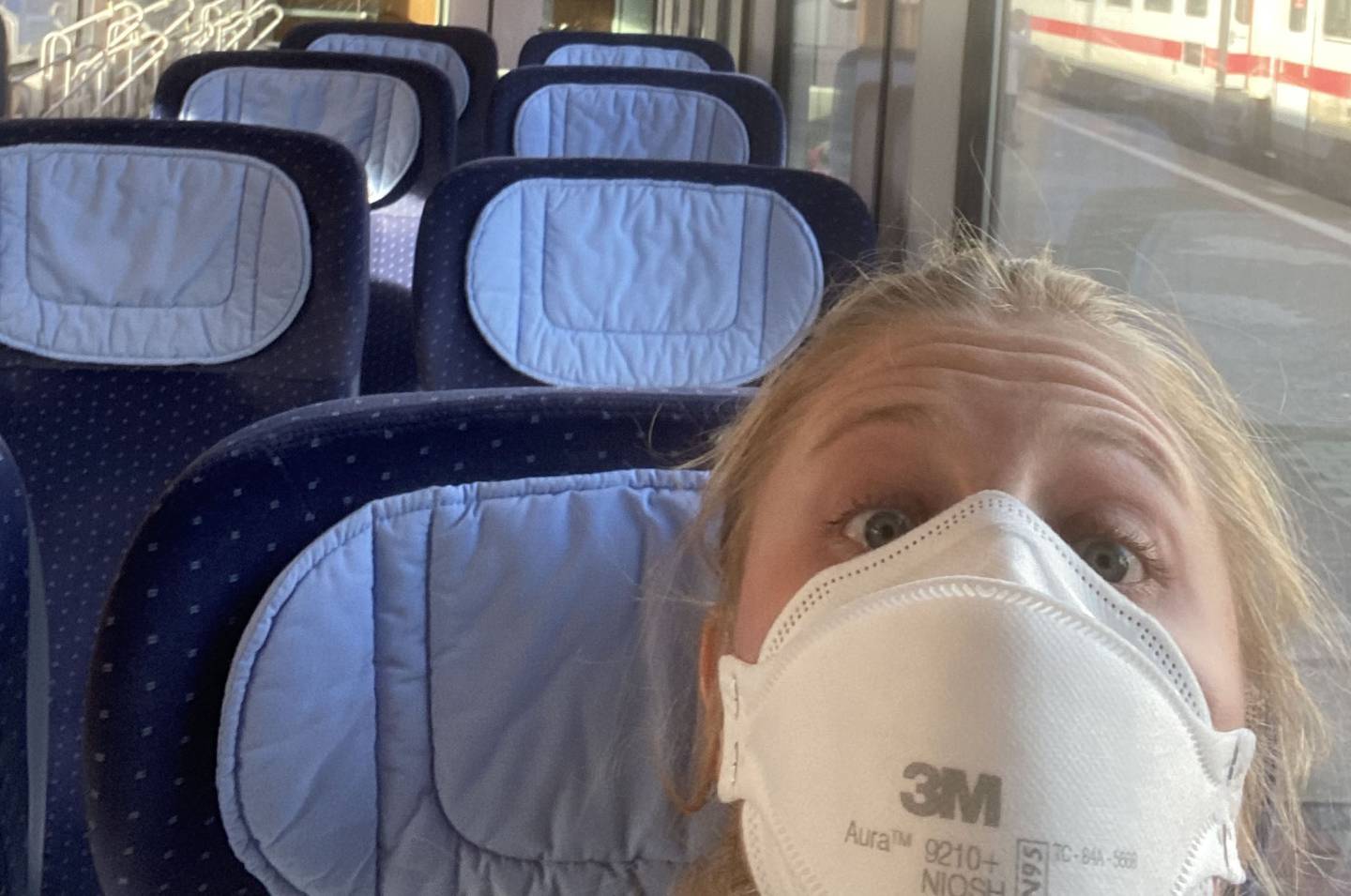
Hailey Swirbul searched out an empty train car to ride in while trying to avoid infection with the omicron variant on her way to a ski town in Austria this month. Swirbul is one of a number of Alaska athletes taking rigorous COVID-19 prevention measures to avoid derailing their hopes of competing in the Winter Olympics in Beijing. (Courtesy photo)
This article originally appeared on Wednesday January 19th, 2022 in the Anchorage Daily News. Reposted with permission.
The organizers of next month’s Winter Olympics in Beijing have imposed a rigorous regime of testing, quarantines and isolation for incoming athletes and staff.
Among the casualties is Steve Patterson’s pickleball game.
Patterson has two adult children, Scott and Caitlin, who grew up in Alaska and are both Olympic hopefuls in cross-country skiing.
They’re planning to prepare for the games from their parents’ home in Montana. Which means the whole family is being careful to avoid any contacts that could invite the coronavirus into their home — potentially derailing access to China for Scott, 29, and Caitlin, 31.
The Patterson siblings are two members of what’s currently one of America’s most COVID-conscious demographics: aspiring Olympians with plans for Beijing.
China, with its “zero COVID” policy, has draconian requirements for anyone flying into the country for the Games. They start with two negative lab tests just to get on the plane to China, followed by another immediately upon arrival at Beijing’s main airport.
A positive test would disrupt teams’ meticulously laid plans for travel and training, and even asymptomatic cases would almost certainly force athletes to miss flights and competitions for which they’ve trained for years.
As a result, Alaska athletes and others involved with the Olympics are going to great lengths to stay free of omicron as the variant spikes across the U.S. and the globe — even with training and competition schedules that include inevitable cross-country or intercontinental travel.
“This experience that I’ve dreamed of my entire life is sort of now just grounded in stress, more than anything,” said Luke Jager, a 22-year-old Anchorage cross-country skier likely to be named to the Olympic team. “I’m sure at some point, being over there, it’ll kind of set in. But right now, the challenge of not getting COVID feels just as big as the challenge of even qualifying for the Games did.”
Luke Jager starts a race at Anchorage’s Kincaid Park in 2020. (Loren Holmes / ADN)
Chris Grover, the Anchorage-raised program director for the U.S. cross-country ski team, recently returned home to Idaho from the European racing circuit.
He spent his first few days with his in-laws, rather than with his family, to avoid catching the coronavirus from one of his children who’d had a potential exposure.
Meanwhile, one of the athletes that Erik Flora coaches at APU, he said, has even been wearing masks around and sleeping in a different room from their romantic partner.
“That’s the commitment that probably tops just about everything,” Flora said. “You’re messing with the human spirit at that point.”
More than a half-dozen cross-country ski racers with Alaska ties have a good chance to make the American Olympic team when it’s named Thursday — joining two curlers, a hockey player and a figure skater as some of those destined for Beijing from the 49th state.
In interviews, the skiers and coaches describe taking Olympic-level anti-omicron precautions. But each faces a unique set of risks, depending on their circumstances.
Hailey Swirbul also trains with APU in Anchorage; she planned to return from European racing to Alaska for a pre-Olympic camp, where she could spend time with her boyfriend and dog.
But after catching a cold, Swirbul, 23, decided to stay in Europe and avoid two rounds of major international travel.
After three train rides — sporting an N95 mask, with no breaks for eating or drinking onboard — Swirbul arrived in Austria for pre-Olympic training. There, she and her teammates broke into smaller groups that don’t mix indoors.
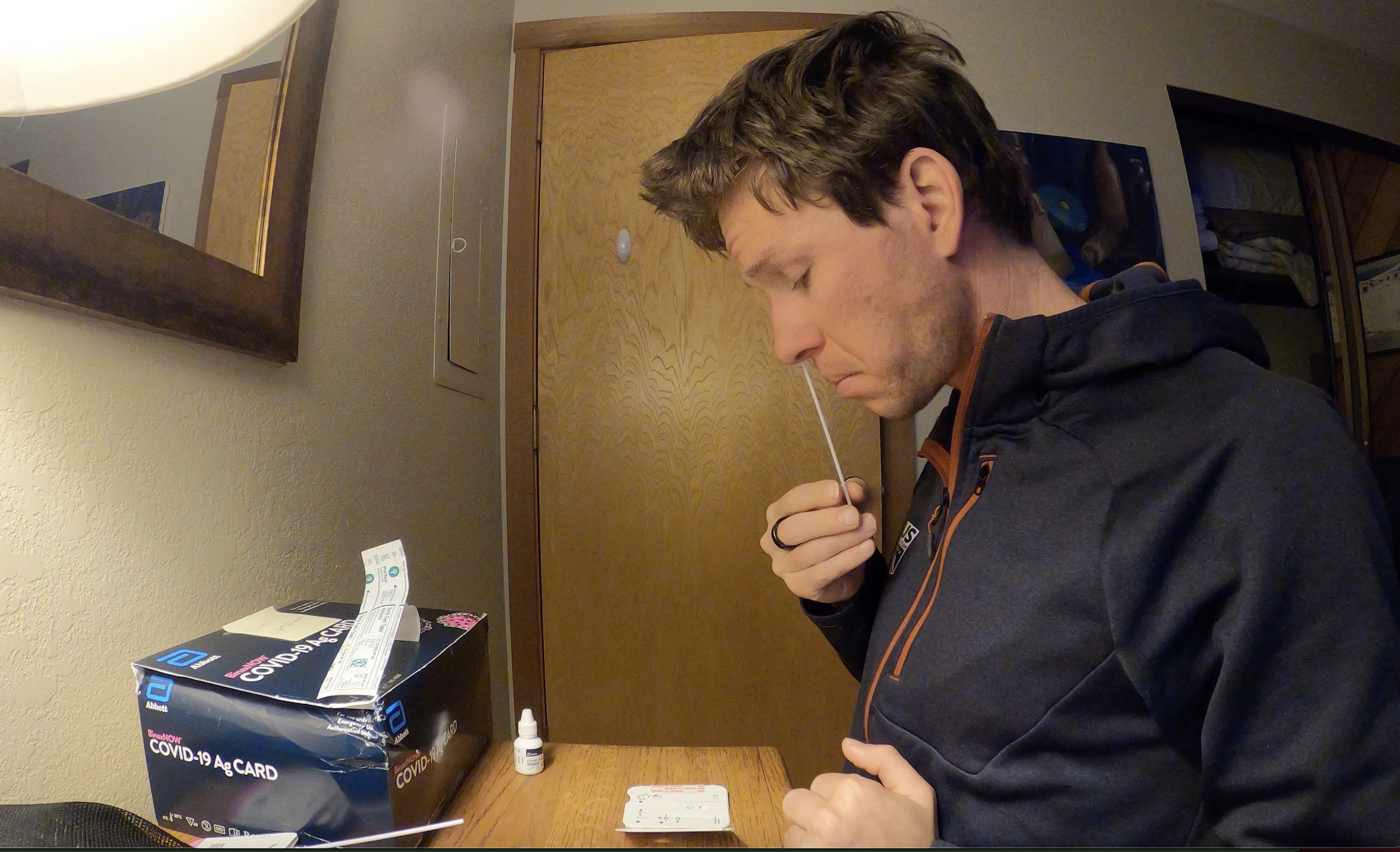
Scott Patterson self-administers a COVID-19 rapid test. (Courtesy photo)
The athletes take rapid antigen coronavirus tests every day, retrieve meals cooked by a team chef, bring them back to their living quarters and eat only after washing their hands. Swirbul got in the habit of climbing out a window to leave her apartment, rather than walking through a shared space that would require her to don an N95.
She also turned down an invitation to meet a friend, outdoors, for hot chocolate. And “definitely no grocery stores — we haven’t been in those since we’ve been here,” Swirbul said in a Zoom interview.
Jager has suffered through much more of a saga. Outside of international competitions, Jager races for the University of Utah, and he had to return from top-level European racing a few weeks ago to compete in collegiate events in the U.S.
When he arrived, the coronavirus was circulating among his team, so he couldn’t move back into his house. In a phone interview last week, he described staying in the vacant home of friends of his girlfriend’s parents before a race series in Idaho.
“They get back tomorrow night. So, we’re trying to find some other place to stay because we’re trying not to see anybody,” he said. “I’ve been nomading, pretty hard.”
Jager returns to Europe this week for a training camp in Italy with the American team, then will fly to Beijing from Switzerland.
JC Schoonmaker, another likely Olympic team member who competes for University of Alaska Anchorage, is on a similar program to Jager, except he traveled and lived with his collegiate team during races in the western U.S. this month.
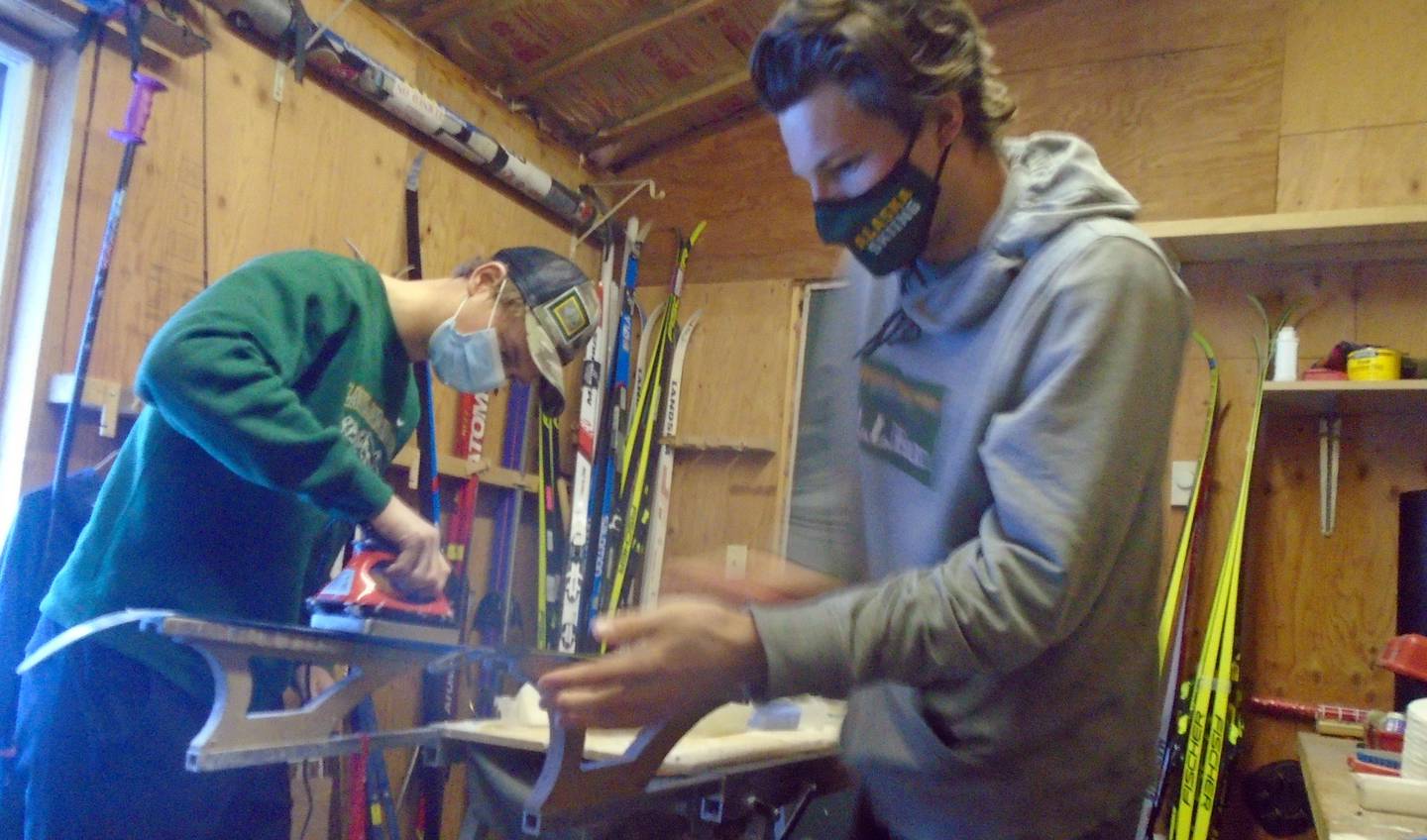
JC Schoonmaker, right, and a teammate tune skis Friday, January 14, 2022, before a weekend of racing in Idaho. Schoonmaker is one of a number of Alaskans taking rigorous COVID-19 prevention measures to avoid derailing his hopes of competing in the Winter Olympics in Beijing. (Adam Verrier)
Schoonmaker’s coach, Trond Flagstad, said the UAA coaches are doing all the shopping; they enter the athletes’ houses to drop off groceries only while wearing masks.
“It’s definitely risky, but I’m pretty confident,” Schoonmaker said. “And I really do trust my teammates — I think they’re doing a good job.”
Aside from presenting obvious logistical problems, the coronavirus has affected the skiers in subtler ways, too.
It’s forced them to keep their support networks at a social distance, whether that’s partners, family members or friends. And with coaches taking on more risks, like grocery shopping, it’s also harder for them to work closely with their athletes, or even to drive them to races in vans.
Added all up, it makes for an especially grueling, and isolating, build-up to what was one of the most pressure-filled experiences in athletics even before the pandemic.
“It really weighs on me,” said Rosie Brennan, a medal hopeful who trains with APU in Anchorage. “It’s honestly harder than preparing yourself to race.”
With the Games, and the negative tests required to enter China, approaching, each swab presents aspiring Olympians with a new reason to worry — especially with the awareness that omicron may present itself without symptoms.
“You know how it is when you’re a skier: You’ve got stuff coming out of your throat and you’re always blowing your nose and stuff,” said Jager. “You’re like at 7,000 feet, you’re like, ‘Maybe I’m a little tired today and I just blew my nose a couple extra times. Definitely could be low-level symptoms of COVID.’”
One silver lining for the Alaska ski racers, in the final days before the games begin: They’re not alone.
One of Norway’s top cross-country skiers, Heidi Weng, made tabloid headlines in that country when she said she wouldn’t be seeing her boyfriend before Beijing.
And Maja Dahlqvist, a Swedish cross-country superstar, has to stay at least 6 feet away from her boyfriend, American cross-country skier Kevin Bolger. That applies even as their teams hold separate pre-Olympic training camps on the same trails in Italy.
“I mean, of course we wish we could hold hands or hug,” Bolger said in an email. “But both knowing what is on the line, we will survive until after Beijing.”
We’re finally here with a long-promised mailbag episode for you this week. Devon takes us through questions from more than a dozen listeners; we cover World Cup competition formats, tactics, training, broadcasting and a bunch of other random fun stuff. We’ll be back soon with coverage of Olympic team selection and hopefully some more intel on the Olympic venue in Beijing.
Send us questions and feedback to devon@fasterskier.com and nat@fasterskier.com.
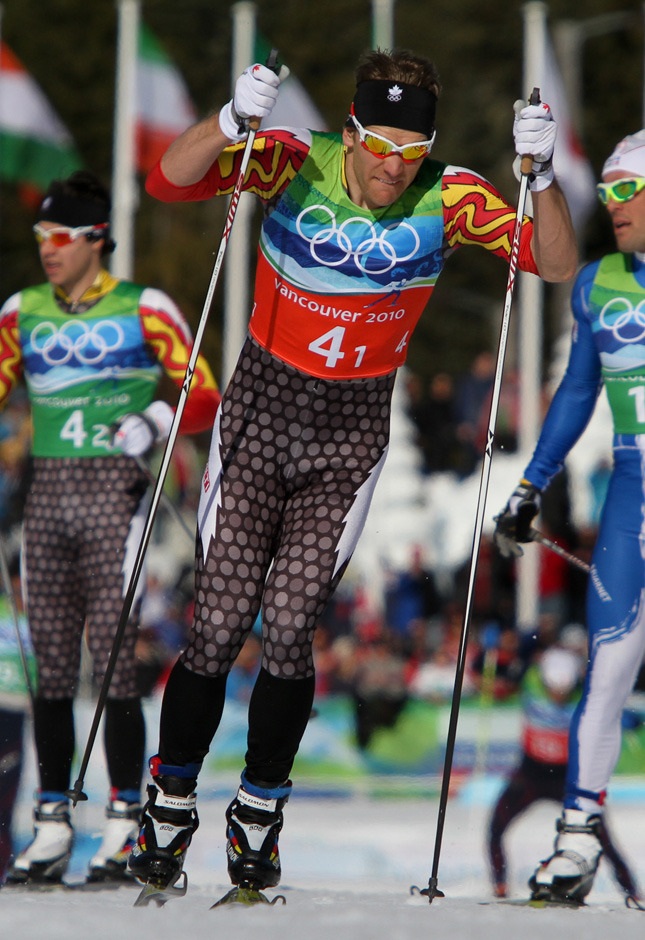
Devon Kershaw racing in the 2010 Olympics in Vancouver.
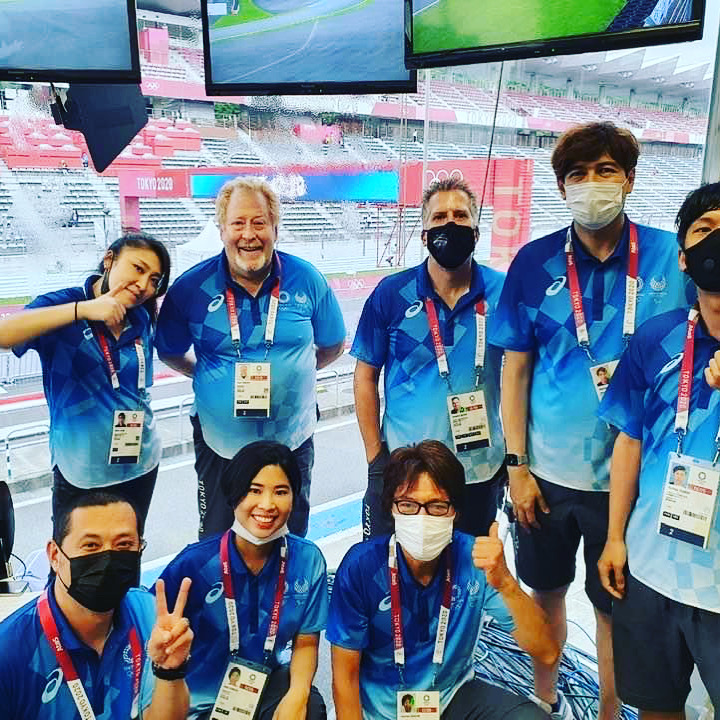
The cycling announcing/production team at the Tokyo 2020 venue near Fuji International Speedway (Courtesy photo.)
Most FasterSkier readers will be familiar with the name Peter Graves, also referred to as the voice of cross country skiing (and incidentally, the author’s uncle). This summer, Graves lent his voice to the cycling venues near Tokyo for the 2020-turned-2021 Olympic Games. For Graves, this marks his twelfth time announcing at the Games, including summer and winter appearances. Needless to say, he has a wealth of experience.
FasterSkier connected with Graves on a recent call to understand how the coronavirus pandemic may have affected this year’s games, and what insights the Tokyo Games might provide for the upcoming Winter Games in Beijing in February 2022.
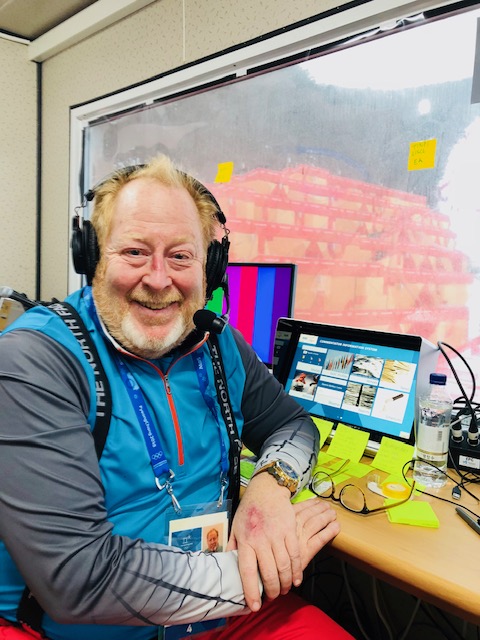
Peter Graves in the announcers booth, Tokyo 2020 (Courtesy)
Graves was quick to highlight the great announcing and production team he worked with and the graciousness of the host country, Japan. “They ran great events,” he said, “I think they did a truly remarkable job under a very difficult set of circumstances.” For context, the Tokyo Games drew roughly 11,091 athletes from 206 participating countries, and over 770,000 COVID tests were conducted from July 1st onward. Of those tests, the cumulative total of positive COVID cases (including airport tests for Games participants and Tokyo 2020 screening tests) came to 567, with three additional positives coming fourteen days after leaving Japan. Graves called this, “a very admirable record,” all things considered.
Graves was in Japan for ten days, announcing at the road and time-trial cycling events. To fans watching from home, a stark difference this year was the lack of spectators at most events. However, cycling was one of the three venues that allowed socially distanced spectating and particularly during the road race, Graves noted that there were lots of spectators along the road where he “saw a lot of joy of free people sharing the Olympic spirit.”
For Graves, this year’s games were a very different experience than past years, particularly socially. His first Olympic announcing appearance came in 1980 during the Lake Placid Winter Olympics, at the cross country skiing venue, which Graves describes as “the last of the smaller, more intimate games.” (Lake Placid at the time had a population of just 2,490.)
Reminiscing about the “joie de vivre” of the main street, which was turned into a pedestrian zone for the Games, Graves described the tradition of trading Olympic pins, another strong memory from Lake Placid and other games. “I have a collection of probably 3,000 pins from over the years and I love trading but I just didn’t see any of that [in Tokyo]” said Graves. “I brought a lot of pins to Tokyo and didn’t trade a single one because there was nobody to trade with!”
Being “in the bubble” meant that Graves and his team were tested for COVID everyday. Before departing the US, he needed two negative test results within 72 hours of departure and was tested again upon his arrival in Japan. The initial COVID testing procedures alone took six hours.
Peter Graves in the announcing booth at the conclusion of the cycling races (Courtesy photo.)
Graves was stationed at the Fuji International Speedway, about two hours from Tokyo, where the road race and time-trial events finished. Everyday the same car took the announcing team from the hotel to the venue, and everybody was masked. Their temperatures were taken daily as they entered, and they left the venue at the end of the day in the same car, with the same crew. Graves and his announcing crew were allowed approximately fifteen minutes to get their dinners to bring back to their hotel rooms. In contrast to other Olympics, there weren’t any nights of eating with friends or colleagues for Graves this time around. “The story of life in a bubble,” he said. There was virtually nobody out on the streets and while Graves said he can’t vouch for Tokyo, he thought it was the same sort of scene there.
“The Olympics are first and foremost about the athletes and their performances,” stated Graves, “[this year] gave me more respect for the athletes, most were in the Olympic village and that was quite secure as well, in terms of COVID.”
Usually, he is able to meet and interact with the athletes a bit but there was none of that this year, “I didn’t get the chance to speak to them personally or to take photos,” Graves explained. Nevertheless, he shared some personal highlights, including very tactical road races which were “fascinating.” “I enjoyed watching and commenting on them,” said Graves, “there was a vast amount of tactics, as there always is. The Tour de France had just ended the Sunday before and many of the same athletes were competing in Tokyo.”
Graves also emphasized the important messages about mental health that athletes such as Simone Biles shared. “I left with a great appreciation for people like Simone Biles who made, I think, a really important case to speak about mental health,” said Graves, “to make it okay to be truthful, to make it okay to say ‘I’m not feeling well, mentally or physically.’ I think those messages are really important cautionary tales to everyone. Those were the things I was impressed with by the athletes.”
Graves voiced his support for the Olympics going ahead, in spite of the arguments against them happening.
Peter Graves announcing alpine events at the 2018 Winter Olympic Games (Courtesy Photo)
“I’m glad they did the Games,” he said, “I’m well aware there were plenty of nay-sayers. It robs the athletes of an opportunity that may never come again. My hope is that the athletes found joy taking part in the Games, because the spirit is embodied by their humanity and enthusiasm. On TV, I saw countless examples of really great sportsmanship. I think the athletes should really be praised for how they managed themselves over there.”
Given the delay to the 2020 Games, we are now less than six months away from the Winter Olympics, scheduled to take place in Beijing starting February 4th, 2022. While Graves was clear that he can’t speak about Beijing per say, his experience in Tokyo may shed some light on what the upcoming Winter Games may look like. “One wonders, with the Beijing Games just six months away and the resurgence of the Delta variant globally,” pondered Graves, “I have to believe priority number one for Beijing will be keeping a good and tight bubble for those Games too.”