From the FasterSkier archive — posts syndicated from athletes’ and coaches’ own blogs between 2004 and 2012, kept online as published. Current coverage is at fasterskier.com.
There’s too much going on in the Tour de Ski for us to cover in just one episode — so we’re back to quickly hype up a breakout performance by Latvia’s Patrīcija Eiduka yesterday, and to break down a COVID crisis on the Norwegian team that’s erupted in the past 24 hours.
We’re at devon@fasterskier.com and nat@fasterskier.com; we’ll be back Sunday.
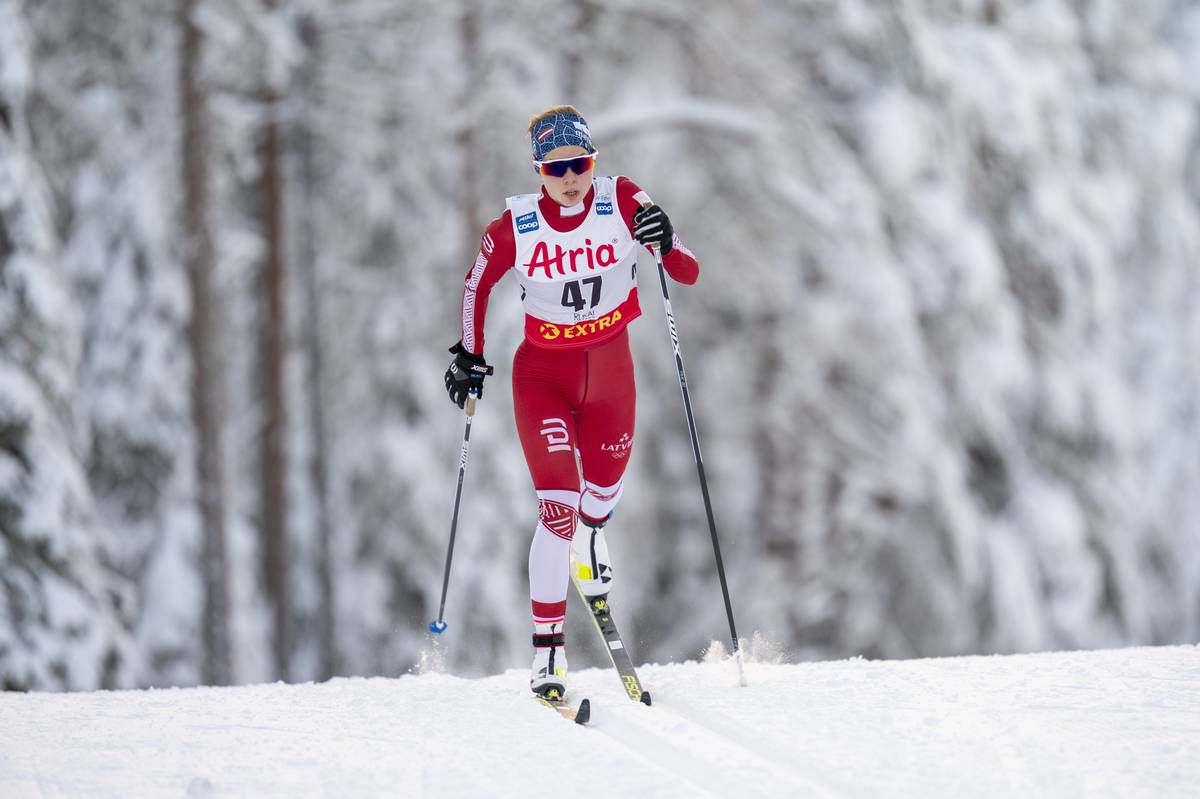
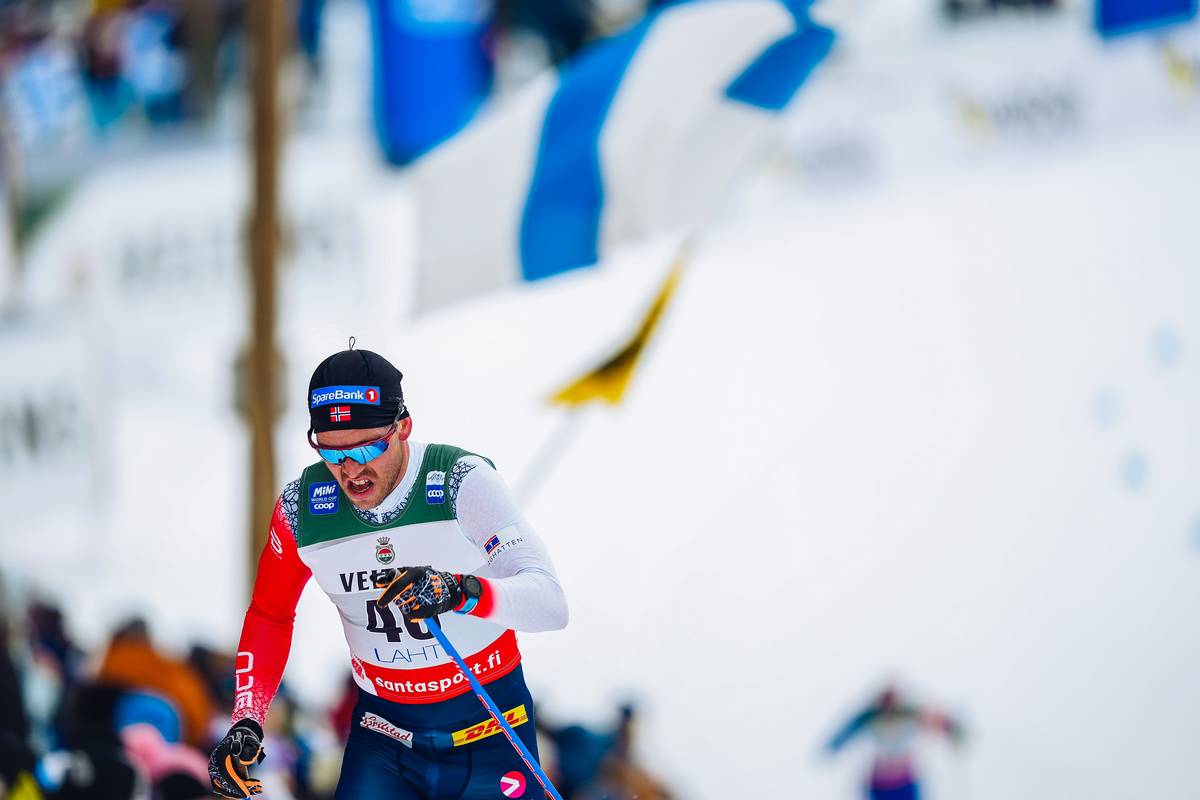
Latvia’s Patricija Eiduka races at a World Cup in Finland. (Vianney THIBAUT/NordicFocus)
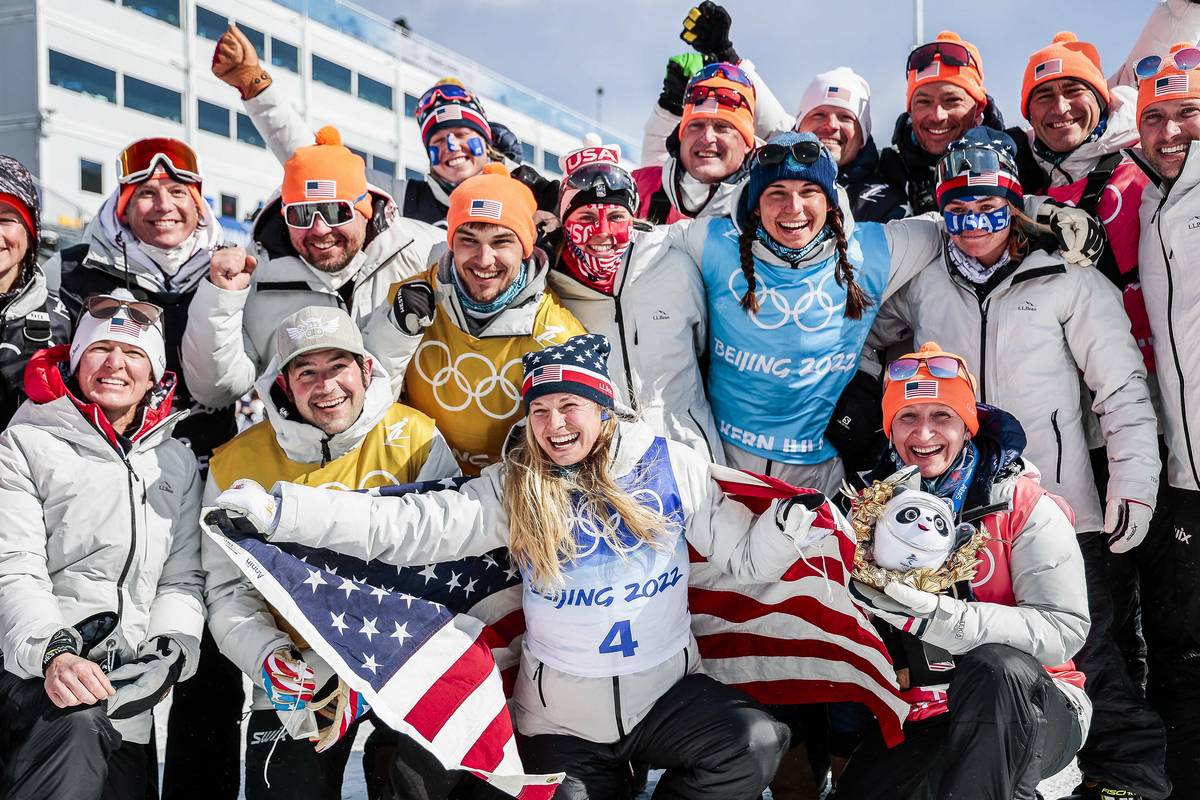
Celebration abounds following Jessie Diggins’ Olympic silver medal in the 30 k mass start skate in Zhangjiakou, CHN. U.S. Ski Team head coach Matt Whitcomb and cross-country program director Chris Grover wear orange hats near the top-right corner. (Photo: NordicFocus)
I think we can all agree that the last two years have been a wild ride.
For those at the helm of the cross-country program at U.S. Ski & Snowboard, added layers of COVID safety precautions and expensive testing have increased the otherwise mounting demands of preparing for an Olympic Games. There have been numerous domestic and international competitions canceled, including a full season of SuperTour racing in 2020/2021, numerous World Cups canceled, and three consecutive years where the World Cup finals were either rescheduled or canceled. Amidst ever-changing travel policies country to country, the U.S. Ski Team tested, masked, and problem solved their way through two race seasons.
U.S. Ski & Snowboard XC Program Director Chris Grover oversees training during a 2019 U.S. Ski Team camp in Bend, OR. (Photo: FS Archives)
Throw into the mix preparations for an Olympic Games at a brand new venue where teams would be arriving site unseen and COVID testing protocols were extreme, and cap the season with the invasion of Ukraine and subsequent ban of the Russian cross-country powerhouse – there’s simply been a lot of curveballs thrown.
But as the 2022/2023 season approaches, we also sit at a transition point for World Cup racing that perhaps marks a few steps forward with gender parity. Namely, a move toward equal distance racing and the adoption of an initiative proposed by U.S. Ski & Snowboard to the FIS to incentivize supporting and developing more women to become ski technicians at the World Cup level. In this proposal, an additional set of course access bibs which could be used to test skis and product at World Cup events would be available only to women; therefore, a country could increase the size of its service staff by investing in the development of women techs and utilizing these women at World Cups.
Though Grover explains this may best serve the nations with the biggest budgets – which does not include the United States – it’s greater purpose aligns with other grassroots initiatives at U.S. Ski & Snowboard to hire, develop, and support women in coaching and leadership to improve the balance of men and women representing all levels of the sport.
There’s also a recently-released 2022-23 roster of U.S. Ski Team athletes, featuring a bloom of young talent on the men’s side whose trajectory may enable a full field of men and women to race at the 2026 Olympic Games in Milano Cortina. And, there’s momentum building for a Minneapolis World Cup in 2024, followed by a trip to the Northwoods of Wisconsin for a super-Birkie – i.e., a World Cup sprint and 50k on the Birkie trails.
In short, there were no shortage of talking points for this insightful conversation with cross-country program manager Chris Grover, who joined us from his home in Hailey, ID upon returning from the U.S. Ski Team’s first training camp of the season at the Mt. Bachelor Nordic Center in Bend, OR.
Thanks for listening.
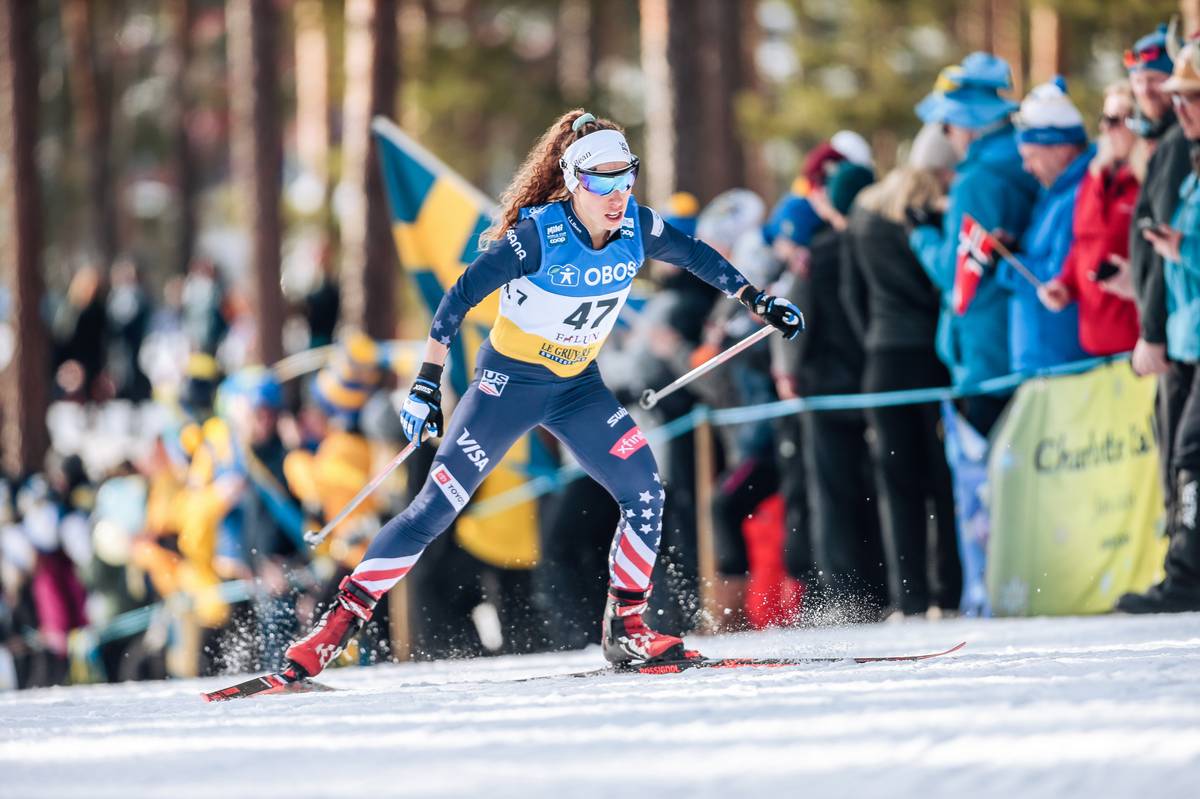
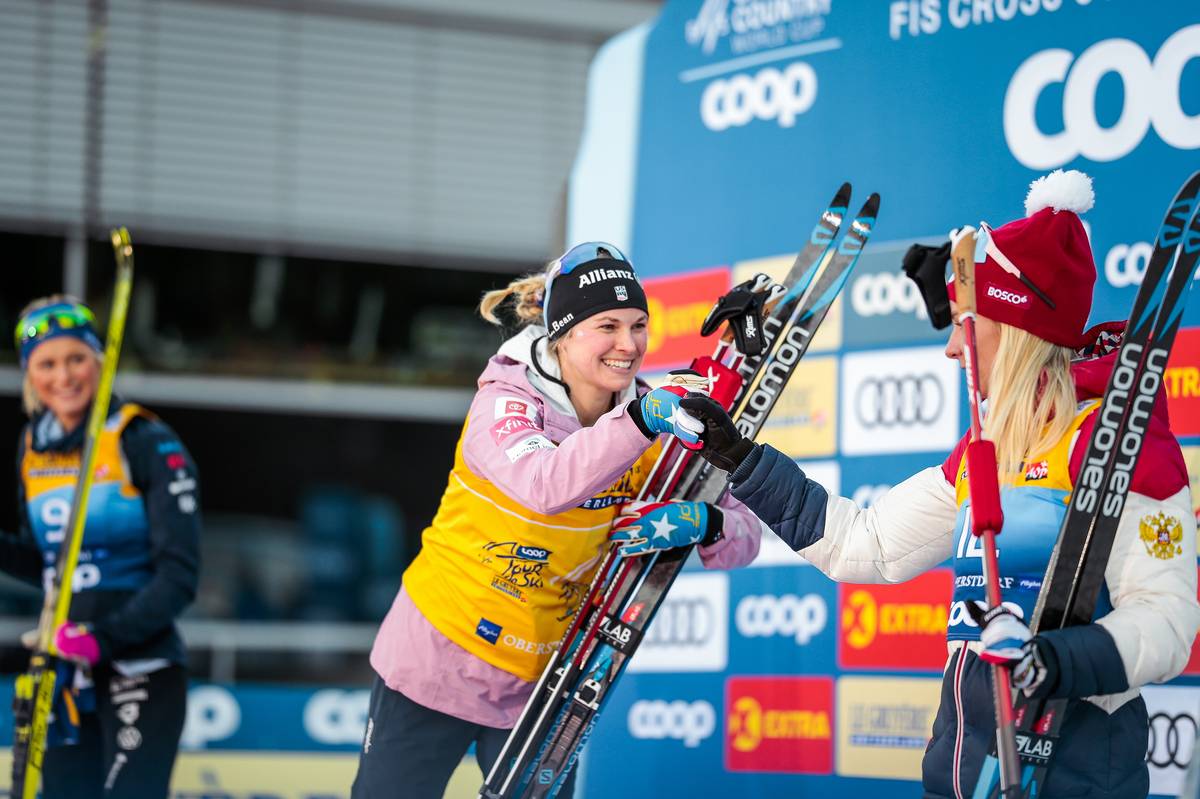
Masked up, Jessie Diggins and Ebba Andersson (SWE) congratulate one another on podium performances in the 10 k skate in Falun in Mar. 2022. (Photo: NordicFocus)
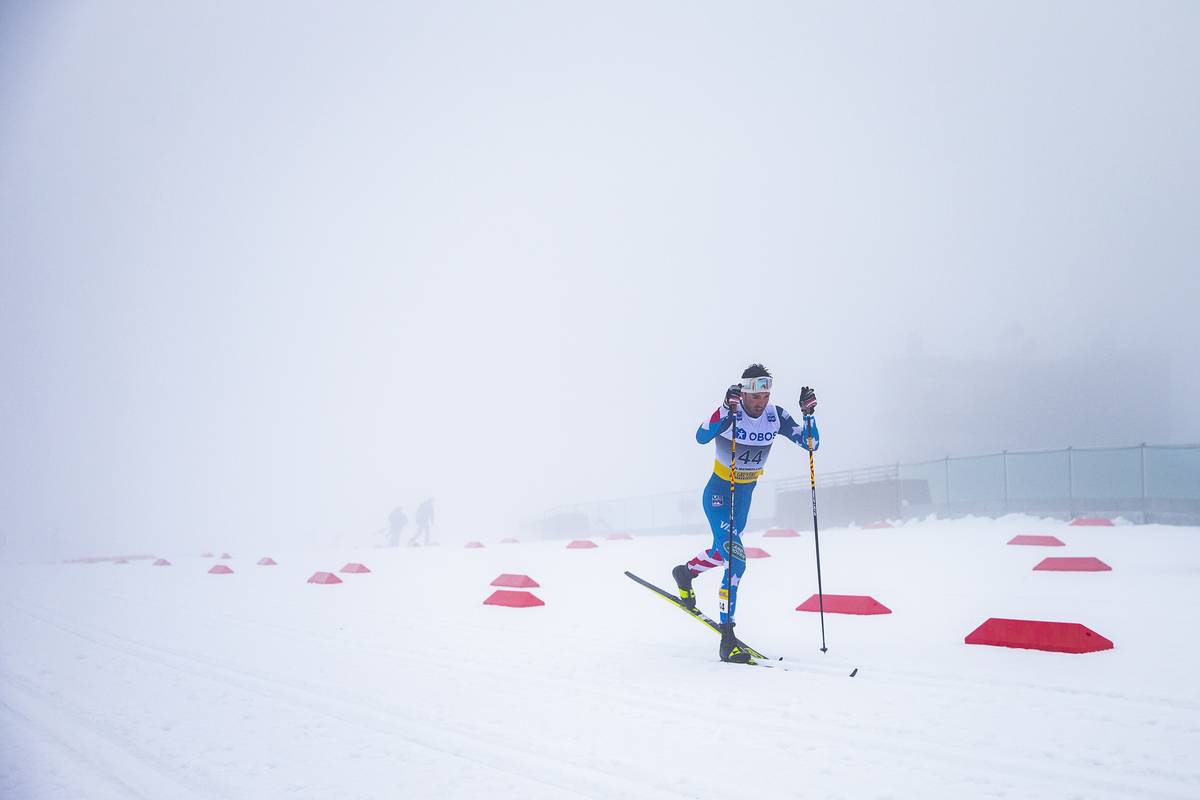
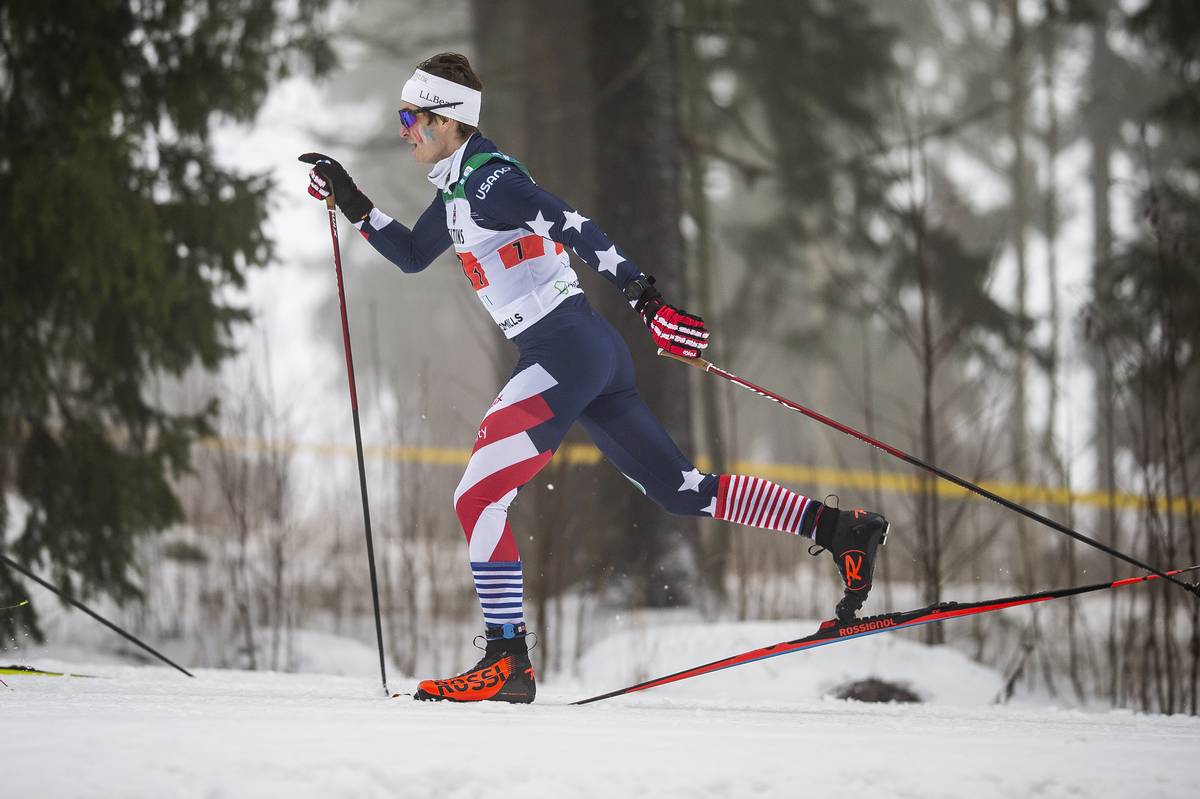
Ian Torchia (SMS T2) races through dense fog at the 50 k classic at Holmenkollen in March, 2020. (Photo: NordicFocus)
Click here to read an account of physical therapist Ned Dowling’s first stint overseas with the US Ski Team in March, 2020.
Holmenkollen, Norway. March 8, 2020 – Men’s 50k Classic World Cup. 33 degrees and raining. The ski jump was engulfed in clouds. Spectators were forbidden from attending the Super Bowl of cross country skiing due to the impending COVID pandemic. My first stint as a physical therapist traveling with the US Ski Team was ending in an Oslo fog.
Salt Lake City, Utah. Late March, 2020 – Buzz kill. In the week following my return from Norway, my son’s school was closed, my clinic was closed, people were fighting over toilet paper and hand sanitizer. It was the end of the world as we knew it. And we didn’t feel fine.
July 6, 2021 – I received an email from Chris Grover asking if I could travel with the ski team again in 2022. We were amidst the calm before the storm. People were getting vaccinated. COVID cases were dropping. We went on vacation. Delta had not yet jumped out from behind the grim reaper. The light at the end of the tunnel was getting brighter and brighter.
I had declined an offer to travel the previous winter. I knew I couldn’t get permission from either the boss at work or the boss at home. And I sure couldn’t tell my kid, who was still doing school remotely, “You keep up with those classes on Zoom while Daddy is off to Europe.”
But now things were looking up. By the time I’d be overseas in March, the COVID thing would be a distant memory. Hell yes! Sign me up Chris.
Rosie Frankowski races the 10 k freestyle in Falun, Sweden in March 2022. (Photo: NordicFocus)
Summer, Fall, Winter – We all know what happened next. The light at the end of the tunnel was an oncoming train and the shit hit the fan. Lots of shit hit lots of fans. First, the Delta variant, then Omicron. Through all of that, I did my best to stay optimistic about my opportunity to work the last two weekends of World Cup races in Falun, Sweden and Tyumen, Russia.
Falun was a bit of a known entity, or at least easily researched on the internet. The World Cup had been racing there for years. Trail maps showed a good network of tourist tracks (which is a good thing because the race course is no joke). Videos of old races on YouTube showed huge crowds, which were sorely missed at the pre-COVID Holmenkollen.
Tyumen, the Pearl of Siberia, was going to be much more of an adventure. Much to my relief, the plan was to have a chartered flight from Stockholm to Russia. I really, really didn’t want to fly (or crash) on a commercial Russian plane. With a lot of digging and Google Translate, I could glean some information about the race venue and its environs.
February 9, 2022 – Chris emailed me about getting a Russian visa. He told me to contact someone at the Russian Consulate in Washington: call this guy, do what he says, pay what he says, we’ll reimburse you. The next day I anxiously called Bogdan, to whom I would be entrusting my passport. “You send passport, extra photo, and $250. You complete visa application online and send password for application, so I fix your mistakes. You send postage to mail back.” I had him repeat that three or four times while I nervously scribbled notes to myself. I reminded him that I was flying to Sweden on March 6 and would very much need my passport back by then. “No problem. You get passport.”
The visa application was nerve racking. Employment history. List of all countries traveled to in the last 5 years. “Have you been trained in firearms, artillery, or nuclear warfare?”
With sweaty palms and my heart rate in L4, I mailed off my passport and hopefully everything else I was supposed to. Then I waited.
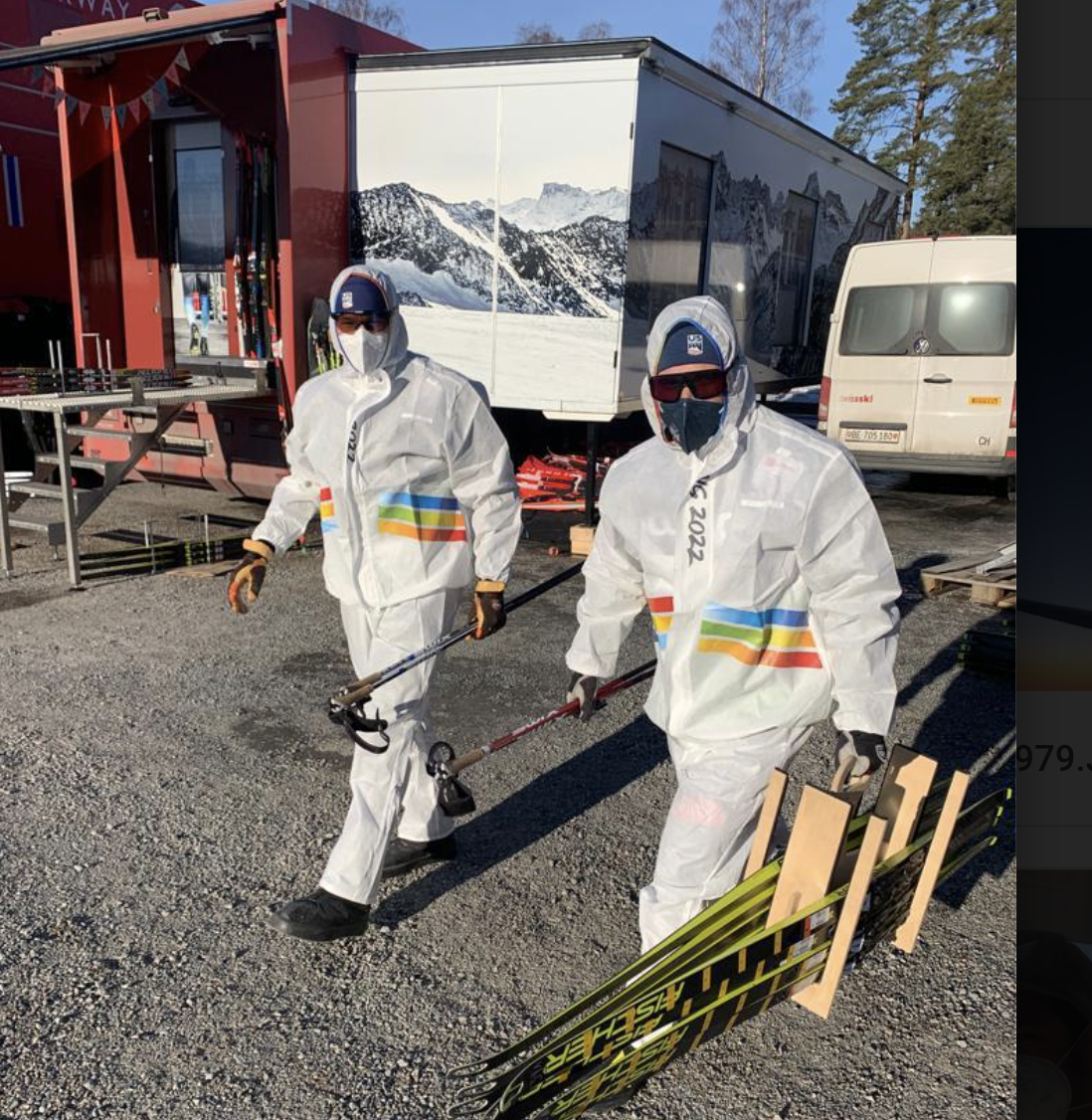
A different kind of Olympic suit: US wax techs take COVID precautions while testing and preparing skis in Falun, SWE. (Courtesy photo)
Thursday, February 24, 2022 – Russia invaded Ukraine. The world as we knew it ended once again. Chris texted me that the trip to Russia was canceled (the US team’s decision not to go to Russia preceded FIS’s decision to cancel the races). “Get your passport back right away.” I called Bogdan, my contact at the Russian Consulate. “We’ve had a change in plans, and I won’t be traveling to Russia. Can you please send my passport right away?” “No. I do not have your passport. Embassy has passport. I cannot get until finished with visa. But I mail it.” I could hear a toddler crying in the background. Bogdan apologized for the crying. I told him he shouldn’t have taken my call at home. He said, “Do not worry with passport. Visa will finish on Monday or Tuesday, then I mail. I call you when I mail.”
Friday, Saturday, Sunday, Monday, Tuesday – Nope. Not going to happen. I’m never going to see my passport again. They’ve all left the embassy. My passport is too low of a priority. They’re just going to be jerks and not send it back. So much for going to Sweden. COVID, war, what’s next?
9:21am, Tuesday, March 1, 2022 – Bogdan called. “Naatan, I mail passport. You get tomorrow.”
I thanked him profusely. And I said a little prayer. This man is living in America, raising a family in America. Yet he works for the Russian government. He is a Russian in a country that, overnight, hates Russians. I spent the last 5 days completely stressed because I didn’t have possession of a passport that would allow me to travel to Sweden for the sake of people skiing around in circles. This man, who must pay at least some attention to Western media, must have spent the last 5 days completely stressed over the safety and ultimate fate of his family and country.
(I do not mean to discredit ski racing or initiate some existential debate. As crazy as it seemed for the World Cup, and even Olympics, to carry on through this pandemic–and now war, I know I found great benefit from the distraction that racing provided. It was a slice of normalcy and vicarious living, which was invaluable to me as so much of what I took for granted was upended. But my little problems did seem very small compared to Bogdan’s.)
Wednesday, March 2, 2022 – Scott, our friendly (seriously, he waves to everyone) neighborhood mail carrier delivered my passport. Huge sigh of relief.
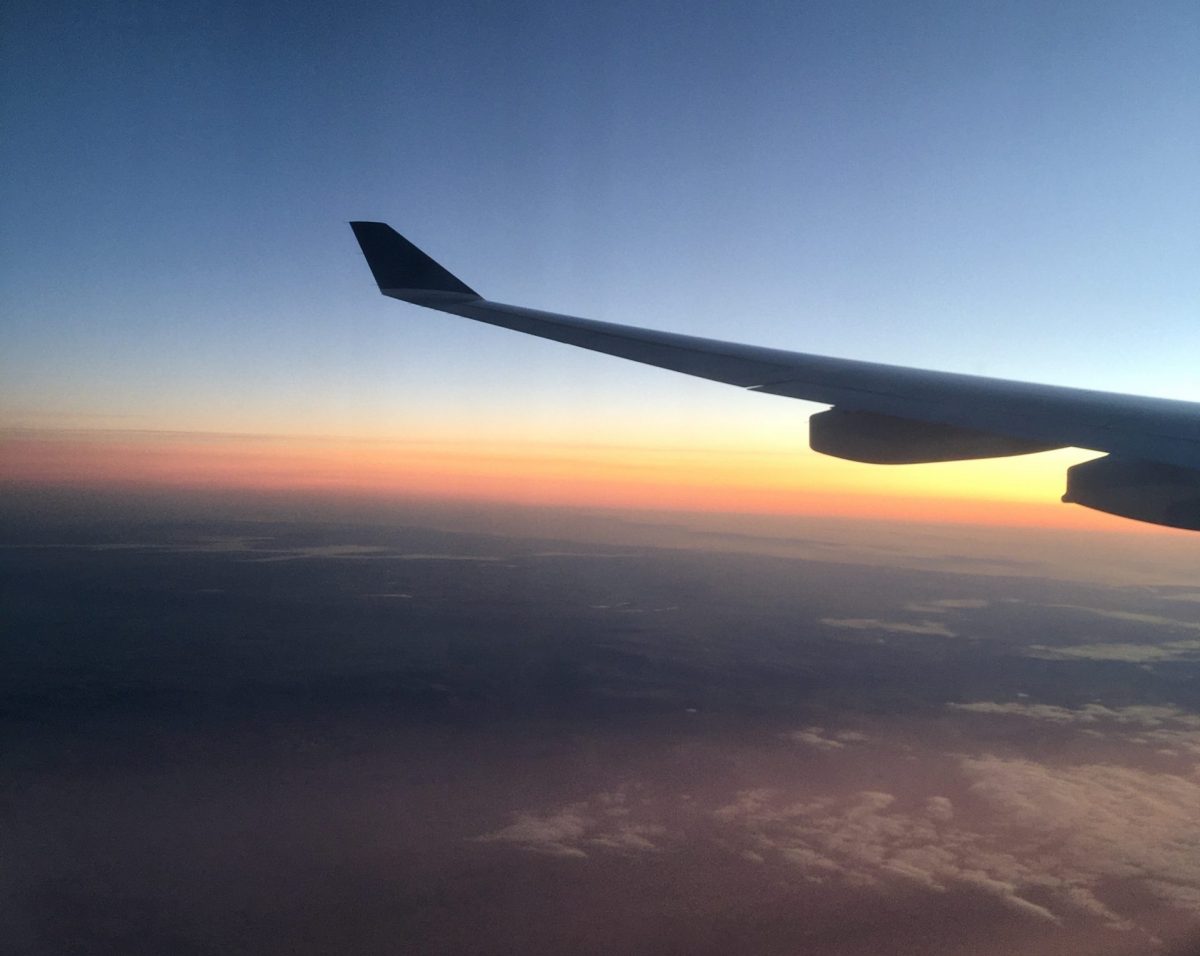
After a series of hurdles, Ned Dowling is wheels up on his way to Sweden. (Courtesy photo)
SLC International Airport. Sunday, March 6, 2022 – I hugged my son, kissed my wife goodbye, and donned my N95 mask which I wore for 18hrs straight. SLC direct to Amsterdam. Enough layover to grab a bottle of Scotch at the duty-free. A packed flight to Stockholm and a 2.5 hr bus ride to Falun. Jet lagged and sleep deprived, I met up with the team as they’d just gotten off their bus from Oslo. We all stood around in LL Bean team gear and N95s awaiting instructions on where to schlep our massive duffles.
Our accommodations for the week were not at the Scandic Hotel, the FIS-provided standard lodging for all of the teams. It was decided that the hotel and its buffet meals were too COVID risky. Instead we stayed two-each in a group of camping cabins equipped with bunk beds and a small kitchen. We were on our own for breakfast and lunch. Dinners were catered by restaurateur parents of Swedish sprint star Maja Dahlqvist (the World Cup circle is pretty close knit).
Cheers for negative COVID tests!
Falun, Sweden. Tuesday, March 7, 2022 – COVID testing. The team was shedding skiers and staff with positive tests. A few soldiers were left behind to wait out quarantine in an Oslo airport hotel. A couple more made it to Sweden but wouldn’t see a race bib. Anxiety was high. A positive test meant no racing, no human interaction, no trip home until the negative. One car load at a time we went to a testing center in Falun for nasal – very, very nasal – PCR tests.
“I think it touched my eyeball!” “I had 31 tests in China and that was the most aggressive one ever!” “Damn, that was legit!”
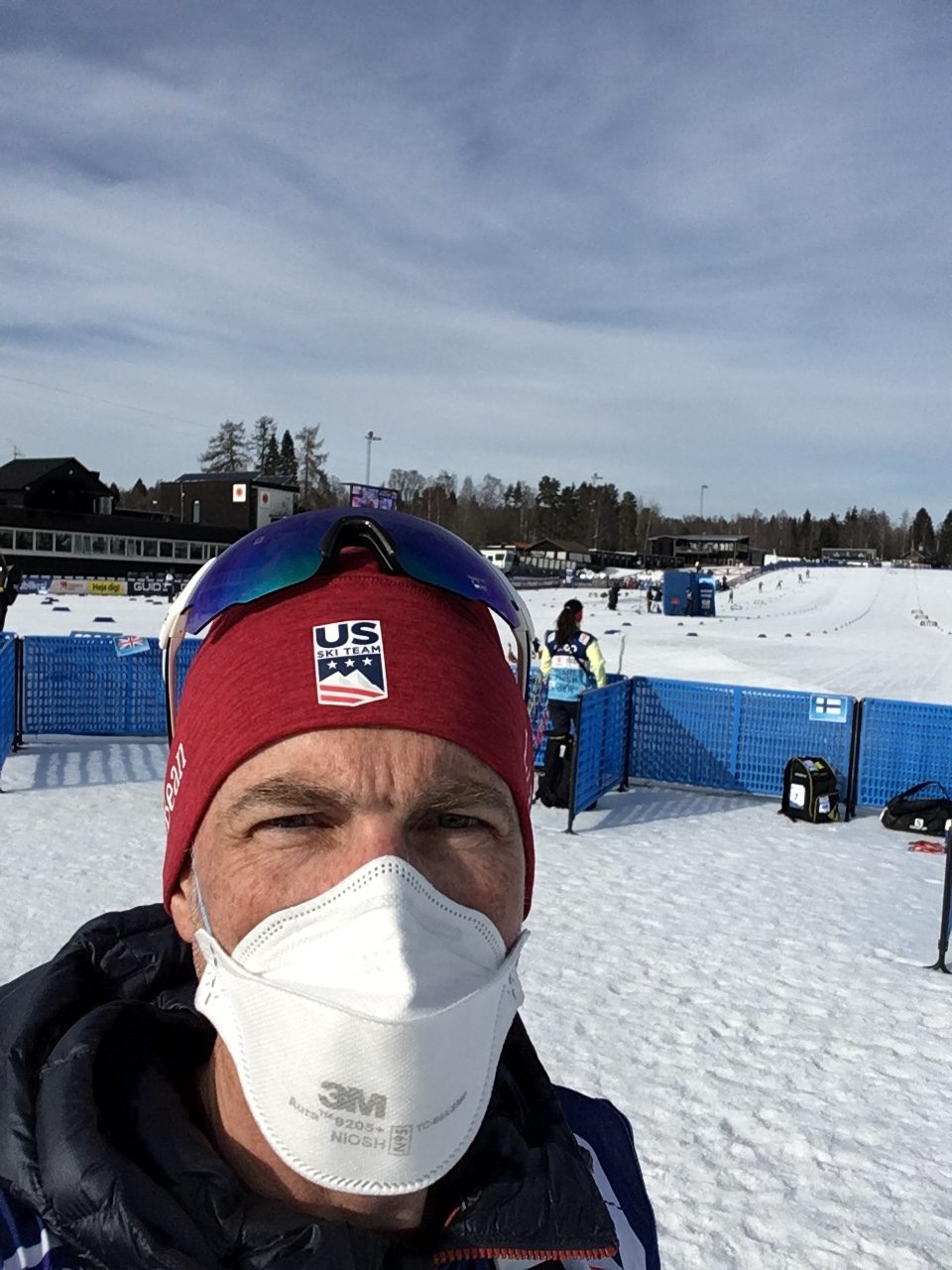
Physical therapist Ned Dowling snaps a masked selfie while supporting the US Ski Team in Falun, SWE. (Courtesy photo)
Wednesday, March 8, 2022 – All tests were negative. Collective sigh of relief. With that reassurance, I finally had some customers on the physio treatment table. Thankfully, everyone’s bodies were holding up reasonably well for being that late in the season. I felt guilty for being over there without much to do, but I figure that my boredom means they don’t need me and if they don’t need me it’s because they’re healthy, which is the goal (or they don’t want me because they’re COVID paranoid – there was plenty of that too, understandably so). So, until the racing began, I didn’t have much to do besides ski every day. Poor me.
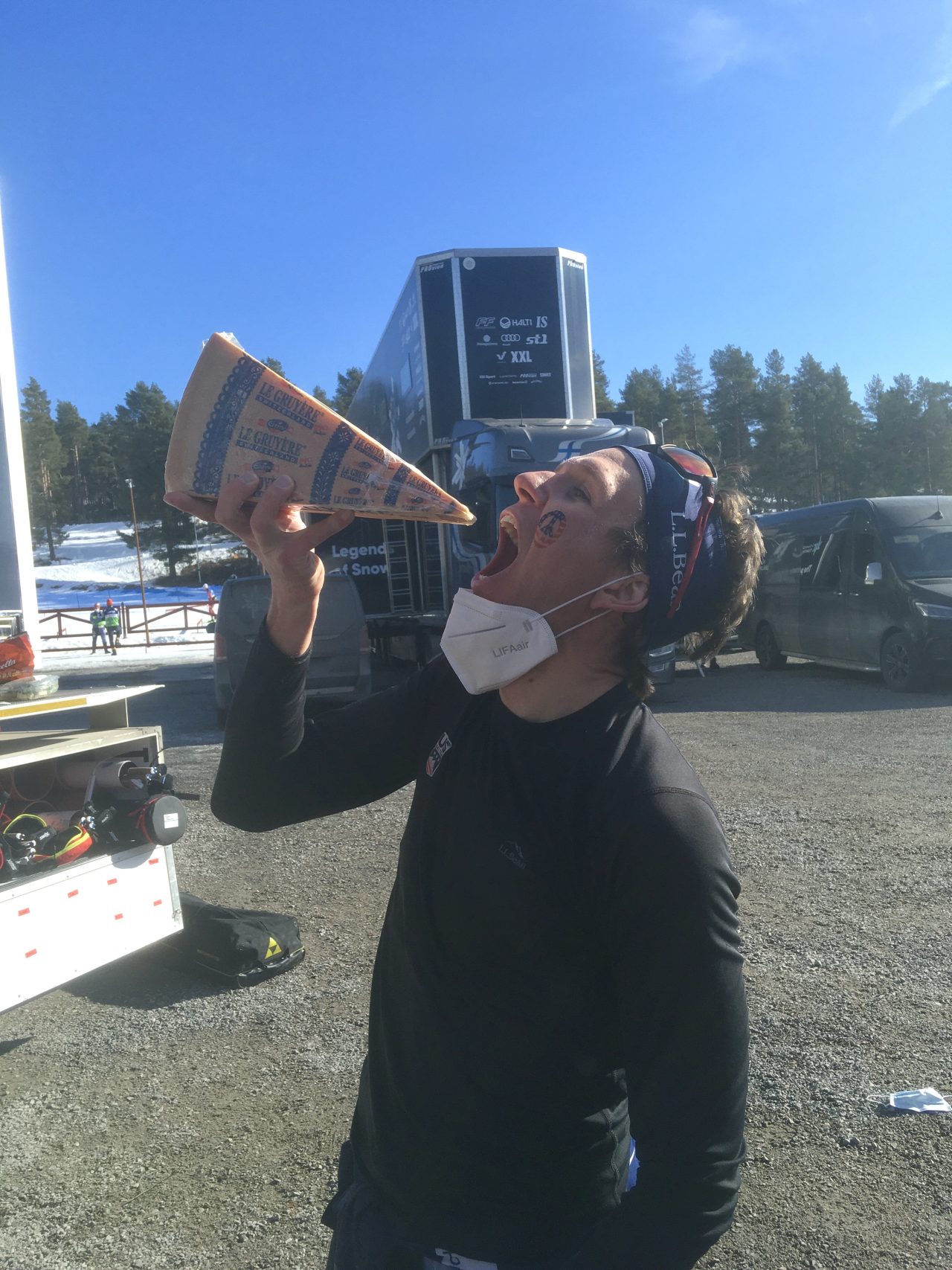
March 11-13, 2022 – Let’s go racing! My experience with the team is that they are always a great group of people to be around, but they’re even more fun with podiums. Lots of good results all around with some “first World Cup points” to some near-misses to some 5.5 lb chunks of Gruyere podium cheese.
Scott Patterson takes a bite of victory cheese after helping the USA 1 team to victory in the 4 x 5 k mixed relay in Falun, Sweden. (Courtesy photo)
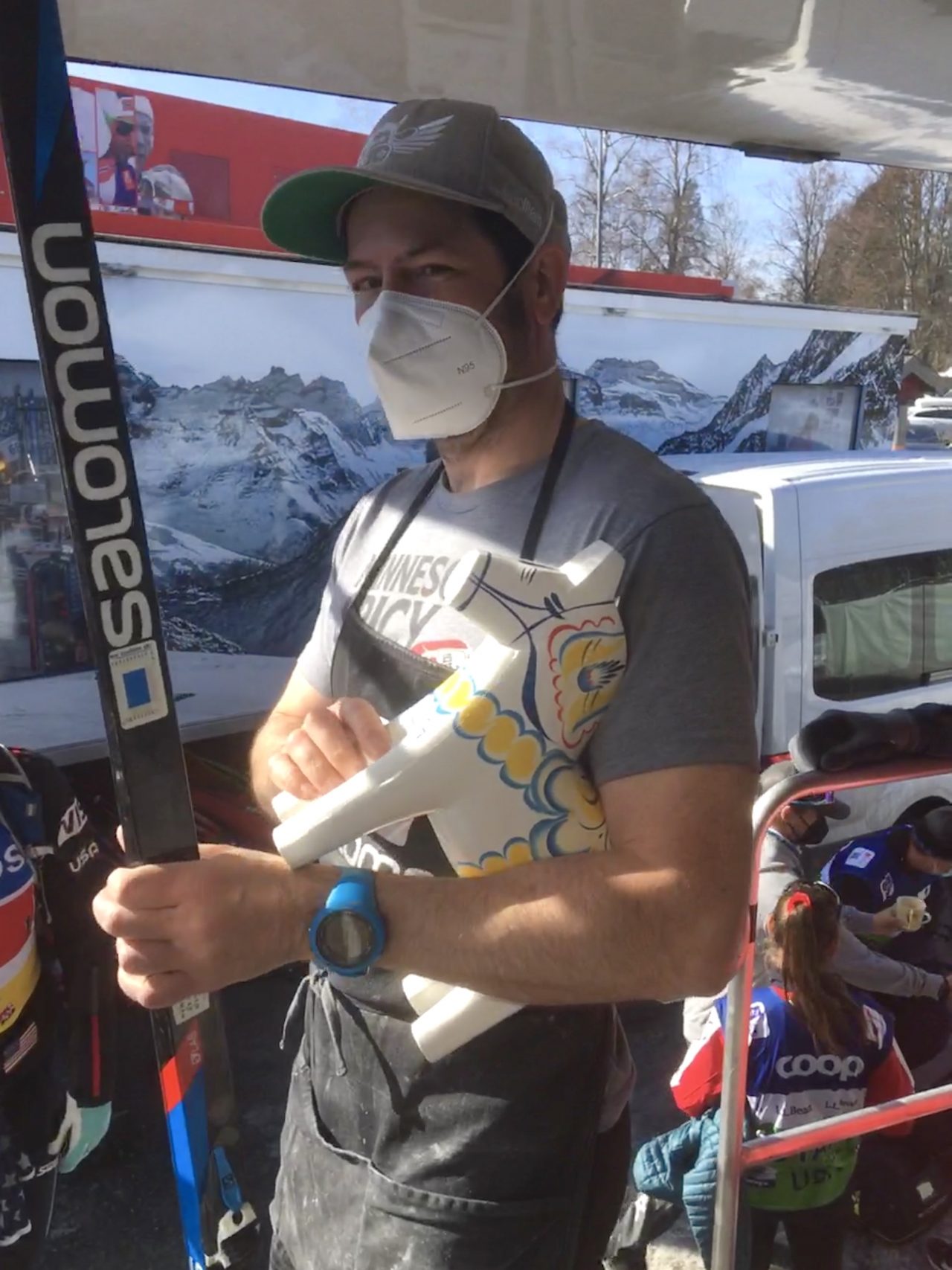
The man behind the fast skis: Jason Cork sports podium goods in Falun. (Courtesy photo)
4:30pm, March 13, 2022 – The final race: antigen testing for entry back into the US. Again, all negative. We’re going home! That night in the bar at a Stockholm airport hotel, I finally saw some faces that’d been hidden behind N95s all week. The poor bartender had a tough time keeping up with the drink orders. Elation, exhaustion, and simple relief that they’d survived another crazy race season and were finally heading home after four months of living out of suitcases, always masked, always nervous.
Maybe next year we can race without a pandemic or war or plague of locusts.
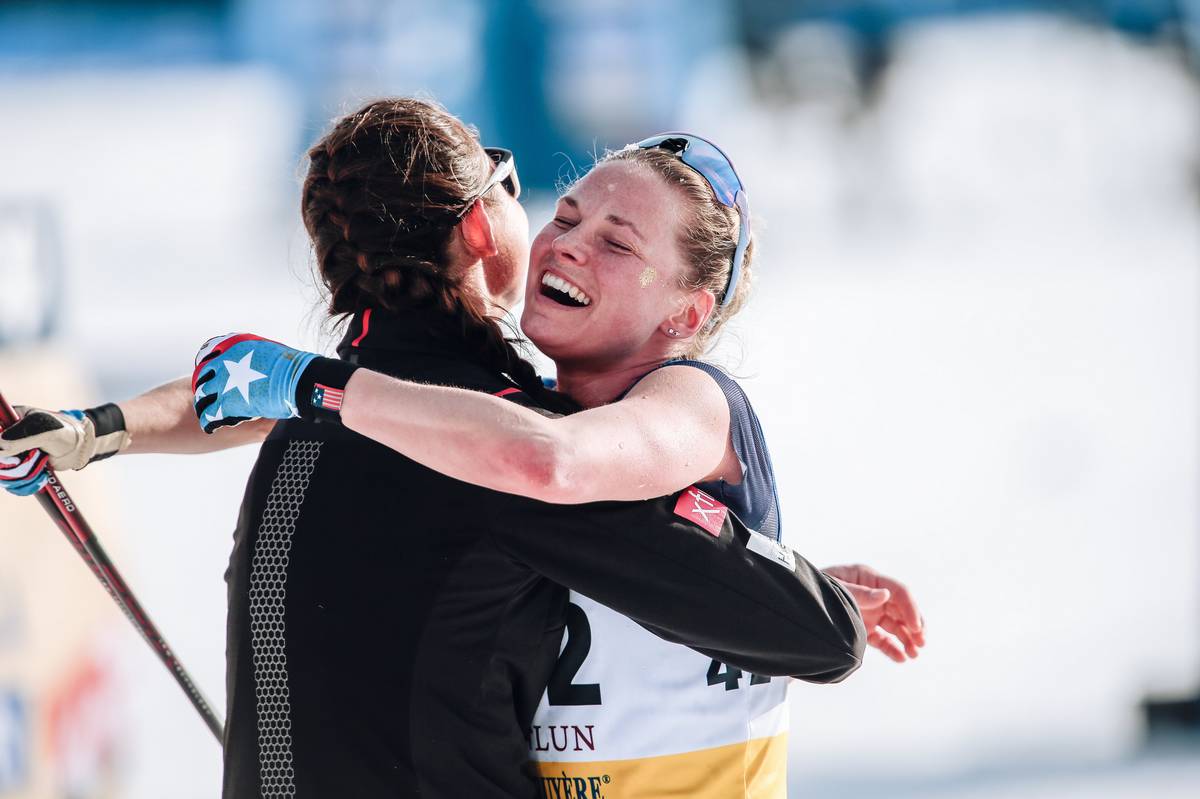
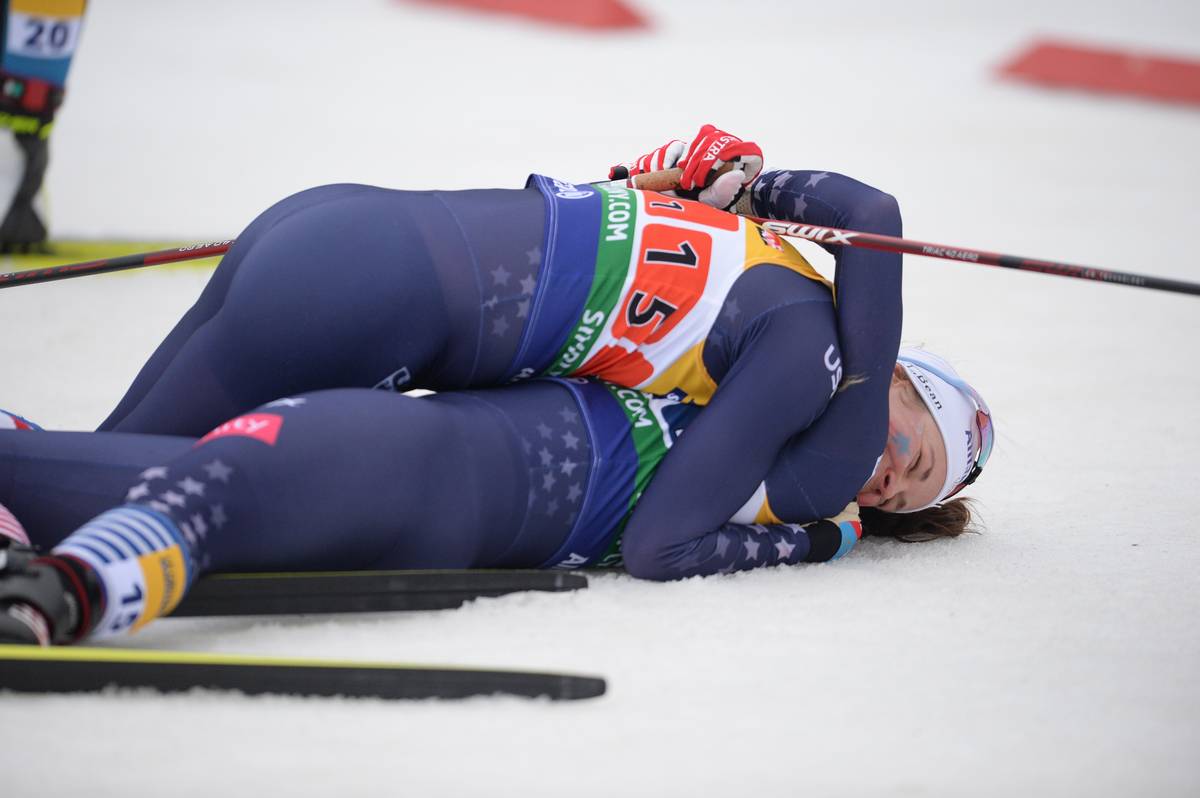
Jessie Diggins hugs teammate Julia Kern at the finish of the 10 k freestyle in Falun. (Photo: NordicFocus)
It doesn’t get much better than a weekend of full sun, epic skiing and meetings with the king of Norway. But that’s what we’ve got for you after another fun weekend of racing, at Oslo’s classic Holmenkollen venue. With help from Canadian retired Olympian Jess Cockney, we break down the 30 k and 50 k from Saturday and Sunday, touch on the COVID outbreak that’s hitting World Cup teams including the U.S. and take the International Ski Federation to task for canceling World Cup finals.
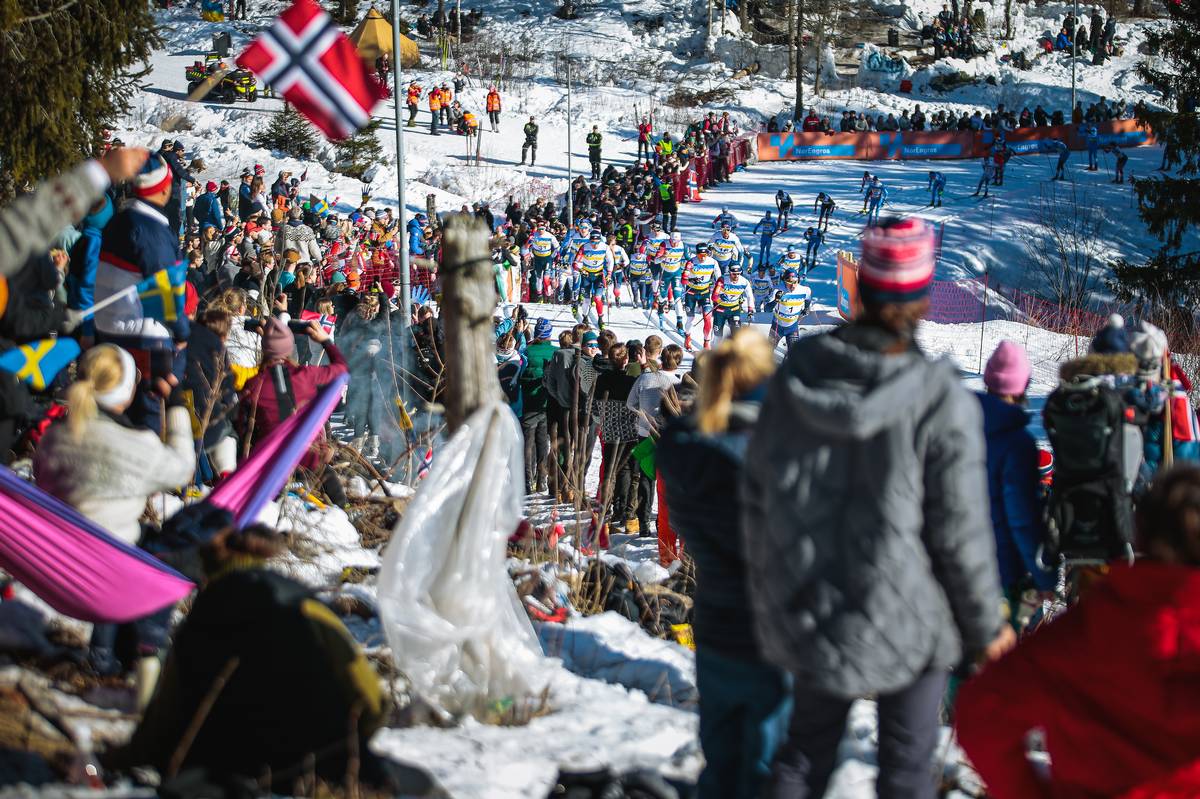
Crowds returned in droves to Holmenkollen for the men’s 50 k mass start classic. (Photo: NordicFocus)
Corresponding with a social media post from Johannes Høsflot Klæbo, the Norwegian news outlet NRK reported yesterday that each of the men’s national team sprinters who competed in Lahti last weekend has tested positive for COVID-19. Head sprint coach Arild Monsen told NRK that Håvard Solås Taugbøl was the first to test positive on Monday, followed by Erik Valnes, Pål Golberg, Sindre Bjørnestad Skar and Johannes Høsflot Klæbo on Tuesday. According to Trondheim regional newspaper Adresseavisen, the final Norwegian sprinter who raced in Lahti, Even Northug, has also been affected.
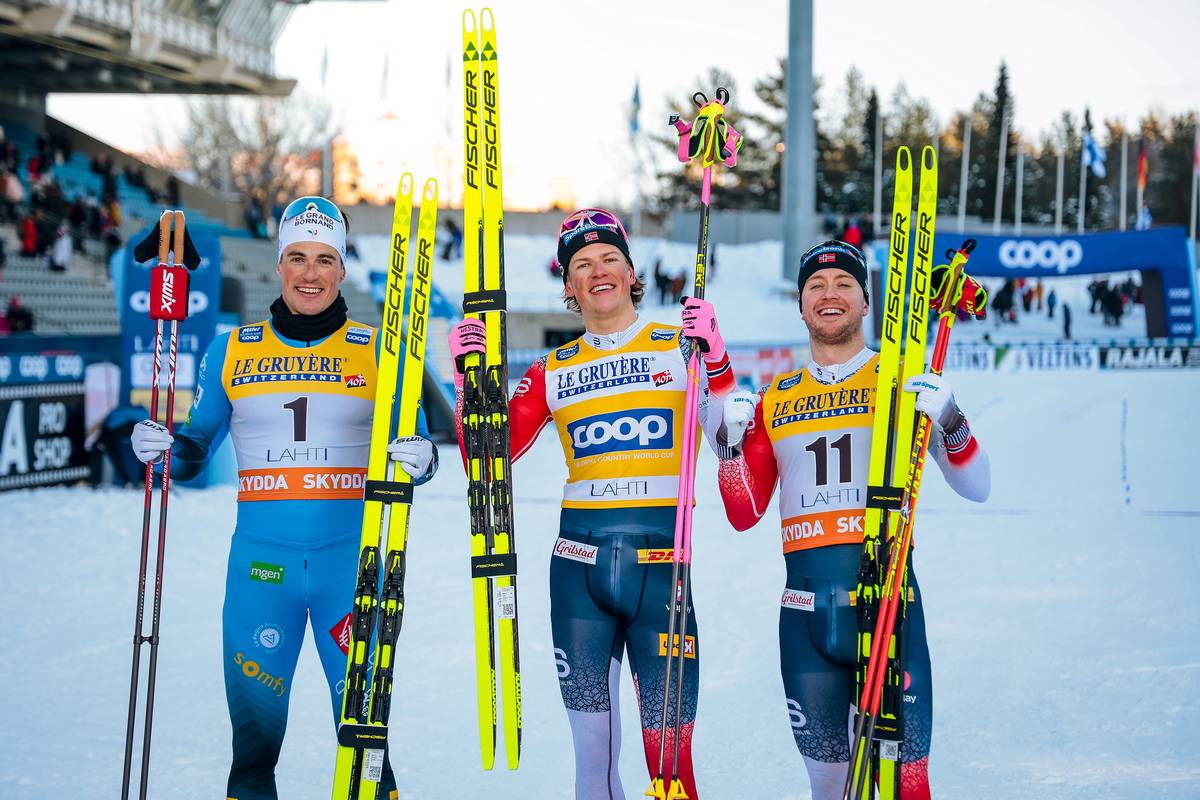
Johannes Høsflot Klæbo (NOR) takes the win in Lahti’s freestyle sprint ahead of Lucas Chanavat (FRA) and Sindre Bjørnestad Skar (NOR). (Photo: NordicFocus)
“It must have occurred in and around the stay in Lahti,” Monsen explained to NRK. “Håvard was the one who noticed symptoms on Monday. The others have little or no symptoms.”
Given the proximity to the upcoming sprint races in Drammen, Norway, Monsen indicated that these men would not be attending the competitions.
“What happens after that, we just have to look at. It’s boiling in many fields in the world now. This is smaller than other things, even though it is [disappointing] for those they concern,” Monsen continued.
At this time, no other athletes from the Norwegian program who attended the competitions in Lahti have tested positive. While the transmission link between the sprinters is clear, some athletes participated in both sprint and distance races, including Klæbo, who won the freestyle sprint and took second in the 15 k classic.
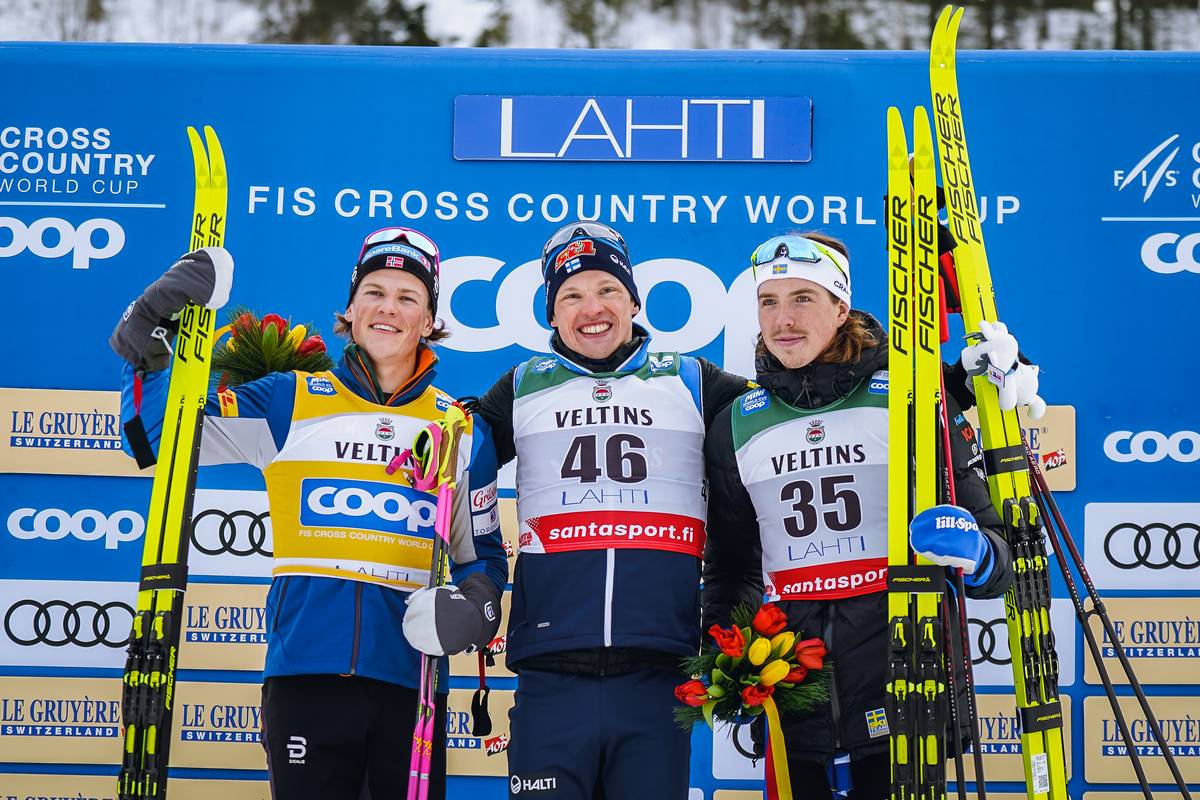
The men’s 15 k classic podium in Lahti: Iivo Niskanen (FIN) took the win in his signature event, ahead of Johannes Høsflot Klæbo (NOR) and William Poromaa (SWE). (Photo: NordicFocus)
Team doctor Øystein Andersen indicated to NRK that the original source of the outbreak remains unknown.
“It’s hard to say [how this began],” Andersen said. “Everyone came from their own bubbles before this race, after they returned home from the Olympics. We must now first map out whether there are more [positive cases] and conduct infection tracking, so that we avoid more infection.”
As the World Cup Finals slated for March 18-20th currently remain listed as “canceled” on the FIS calendar, it is unclear whether these athletes will be able to compete on the World Cup again this season.
Klæbo told NRK that “most indications are that the season is over,” however, the loss of competition would not significantly impact his season outcome. Klæbo currently leads the World Cup overall standings by nearly 500 points over Russia’s Alexander Bolshunov, who is also unable to compete as FIS banned athletes from Russia and Belarus from competition for the remainder of the season. The next closest athlete to Klæbo is Finland’s Iivo Niskanen, who sits nearly 800 points back with limited scoring opportunities remaining. As the Falun World Cups feature a mixed relay and team sprint, this leaves two sprints and two distance races, worth 100 World Cup points each, currently confirmed on the FIS calendar.
If World Cup Finals are held at an alternate venue, athletes could score a maximum of 50 points per day, with the opportunity for up to 200 bonus points should they win the three-day mini-tour.
This still leaves fewer than 800 points on the table, and as such, it looks like Klæbo will win the overall World Cup regardless of whether he competes again this season.
Klæbo also leads the World Cup sprint standings with a 210 point lead over Richard Jouve, and is 237 points of third-ranked Lucas Chanavat, both of France. Classic sprint events are scheduled for Drammen on Thursday, followed by another classic sprint in Falun on Friday, March 11th. If World Cup Finals take place, there will be a third sprint opportunity there, raced freestyle. This leaves 200 points available without the World Cup finals, and 250 including them.
Norway’s Pål Golberg tested positive for COVID following the weekend of World Cup racing in Lahti. (Photo: NordicFocus)
“There is nothing to do but take it easy,” Pål Golberg said to NRK. “It’s [disappointing] that it’s coming now, but we can be very happy that we managed to avoid more infection in the camp before the Olympics when people became infected in Seiser Alm.”
On what is next, Golberg continued, “If I do not develop symptoms, it may be relevant to go to Falun next weekend. And then there are many [domestic] races over the late winter. Then we will see if it is worth it.”
This episode of the Devon Kershaw Show breaks down the lead-up to the Olympics with special guest star Alex Harvey, the Canadian World Championships gold medalist. Harv and Kersh make their podium predictions for the six Olympic events; we discuss the nightmare scenario with COVID cases inside Norway’s national team; and Nat checks in from his quarantine in Los Angeles in advance of his flight to Asia.
We’ll be back periodically during the Olympics — send questions and comments to devon@fasterskier.com and nat@fasterskier.com. And you can follow Nat’s journey to Beijing here on FasterSkier, or on Twitter and Instagram at @nat_herz.
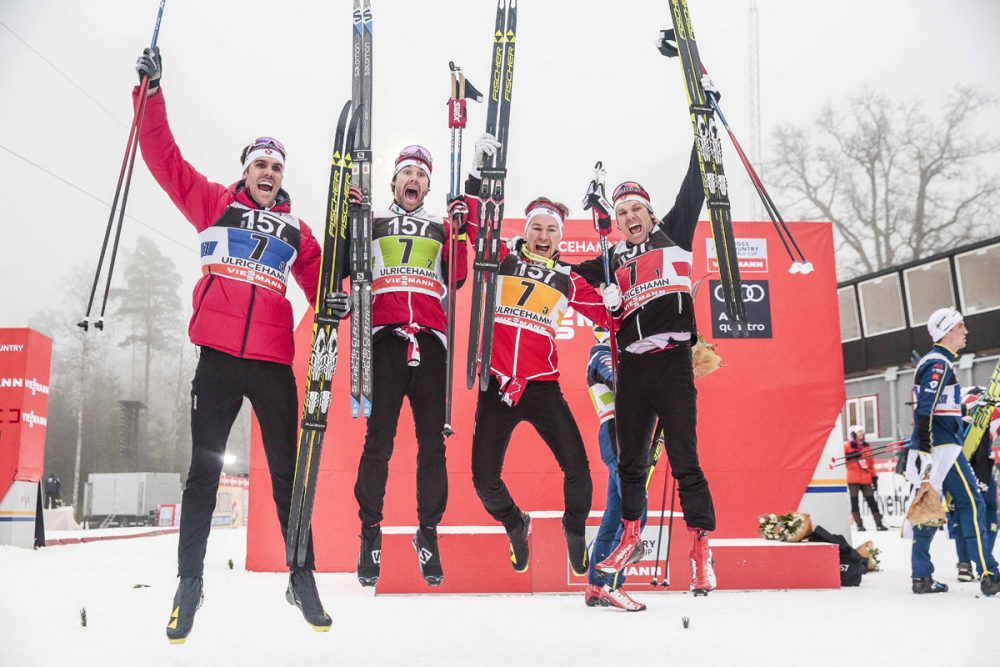
Left to right: Canada’s Len Valjas, Alex Harvey, Knute Johnsgaard, and Devon Kershaw after their historic third place finish in the 2017 men’s 4 x 7.5-kilometer team relay in Ulricehamn, Sweden. (Photo: Fischer/Nordic Focus)
As January draws to a close, energy, excitement, and perhaps anxiety surrounding the rapidly approaching 2022 Olympic Games in Beijing is steadily building. In an effort to better manage her time and energy heading into these Games, Jessie Diggins offered a media conference facilitated by U.S. Ski & Snowboard cross country communications manager Tom Horrocks to answer questions about her preparation, outlook, and plans for the remainder of the time before the team heads to the athlete village in Zhangjiakou.
Diggins began the conference with a comment on the team that has been named. Of the fourteen athletes named to the Olympic cross country team, just four have competed in past Games. Diggins is headed into her third Olympics with ten total Olympic races under her belt, while Rosie Brennan, Caitlin Patterson, and Scott Patterson competed only in the 2018 Games. In Pyeongchang, Brennan competed in just the skiathlon, while Caitlin Patterson raced in the skiathlon and 30k classic, and Scott Patterson raced in each of the three individual distance events plus the men’s relay.
Six of the athletes were born in the year 2000 or 2001. Overall, it’s a relatively young crop of athletes, many of whom have very limited experience racing at the international senior level compared to veteran-dense teams like Norway.
Diggins emphasized that the age and experience of the team should not be associated with what fans of the sport should expect to see in competition, adding that she is individually very excited to see what her teammates will do at the Games.
“Everyone’s working so hard,” she said. “And staying really cool in what is a stressful time – with COVID, and with variants, and with all the different paperwork and all the things that you need to do headed into any Olympics, but especially this one, given the extra hurdles with COVID… I think everyone’s doing such a remarkable job of not only handling all the extra stressors very well, but also still being excited and still seeing this as, ‘Okay, we’re gonna find ways to make this fun. Obviously, it will be different from Games in the past, and probably different from future Games too…’
“I think we’re in a really good place, despite everything that’s happening in the world. And I think that’s kind of one of the things that the Olympics does for us is it lets us feel inspired and let go of all the stresses that we’re feeling in the moment. Or at least that’s what the Olympics I think is supposed to do.”
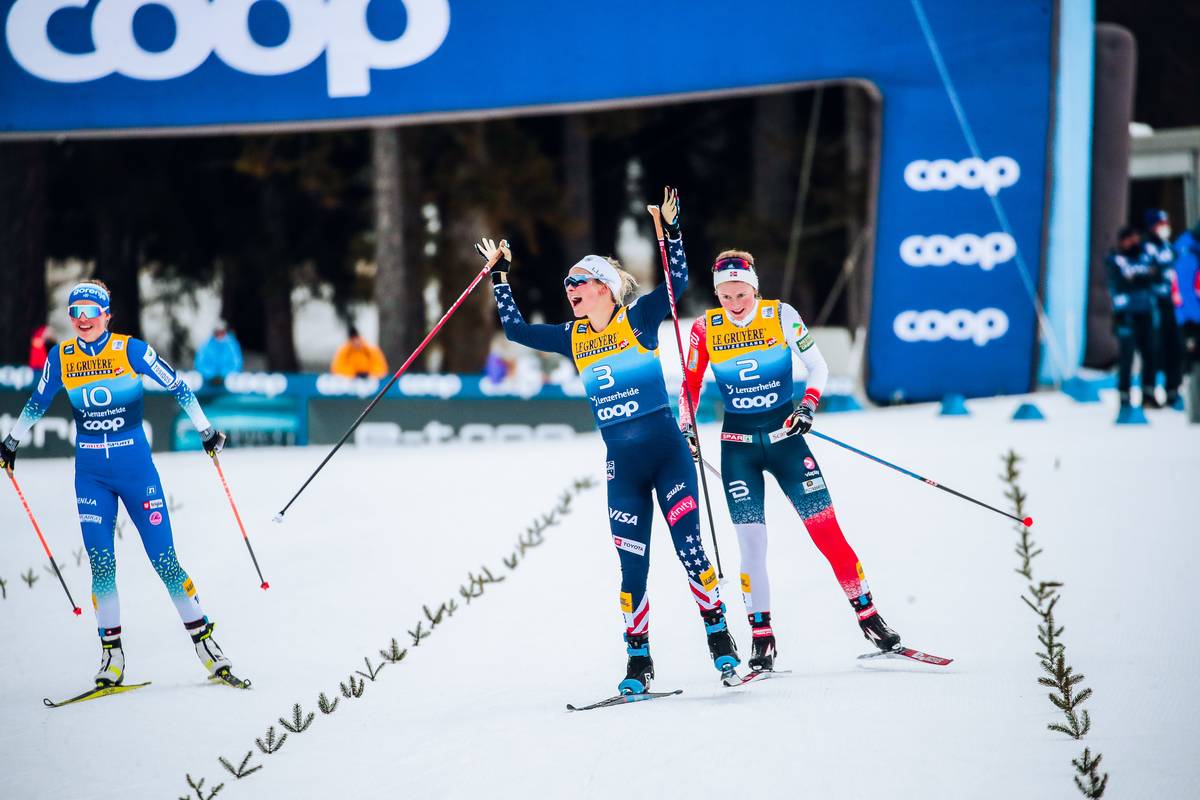
Jessie Diggins embraces team sprint partner Julia Kern after the pair took second place in the freestyle team sprint in Dresden, Germany in December, 2021. (Photo: NordicFocus)
Following the Tour de Ski, the members of the team who planned to remain in Europe began a recovery training block in Seefeld, Austria, which sits at roughly 3,800’, before moving to higher elevation to begin an altitude training camp. Having come down with a head cold during the final stages of the Tour de Ski, Diggins expressed the value of this recovery block, particularly in a location where her body was not further impaired by altitude-related physiological effects.
“Within two days after the tour, I was symptom free. Five days later, totally healthy and able to train totally normally again. So that was really, really nice to dip down in altitude and recover and feel like I absorbed everything that the tour brought in terms of training stimulus.”
With the cancellation of the final two World Cups before the Olympics, the team headed to Livigno, Italy earlier than originally planned, earning them extra time training at a venue that sits at a nearly identical elevation to the competition venues in Zhangjiakou. Diggins expressed that this has provided the team with a variety of excellent training options, from challenging race courses to flat valley skiing ideal for recovery, all supported by a team of staff that includes wax techs, a chef, and a physical therapist.
Acknowledging individual variation athlete-to-athlete, Diggins explained that overall the team’s preparations have looked “normal” in terms of how they would train and peak leading into another Championship. To account for the lack of races, the team has been building in simulations, including practicing events that have not been included in the World Cup calendar yet this season.
“Yesterday, Julia and I did a skiathlon simulation,” Diggins shared. “It was awesome. It was really hard. And I’m so glad we did it. We had coaches going nuts – taking video, cheering for us. We had bibs on, we had pits set up, we had everything to simulate it, which was really nice, because we don’t get to do very many skiathlons anymore. And it was really cool to practice that pacing at altitude. That was really helpful.”
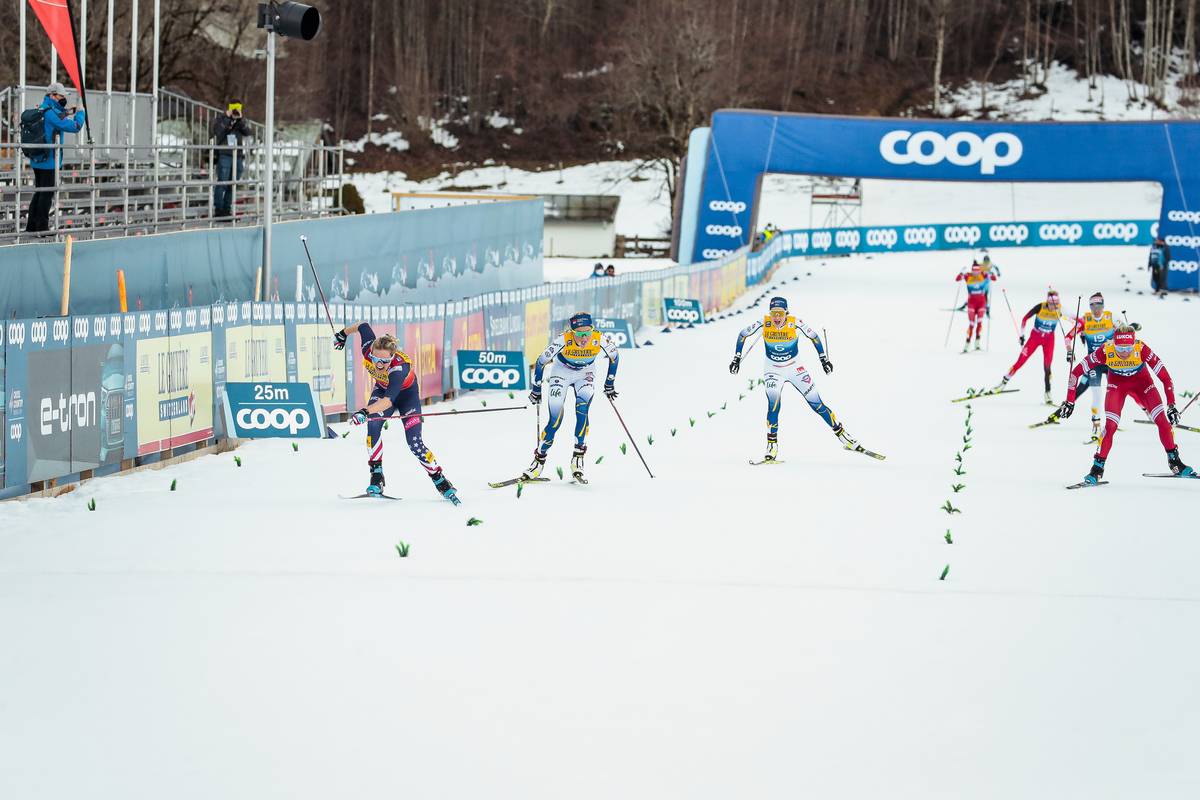
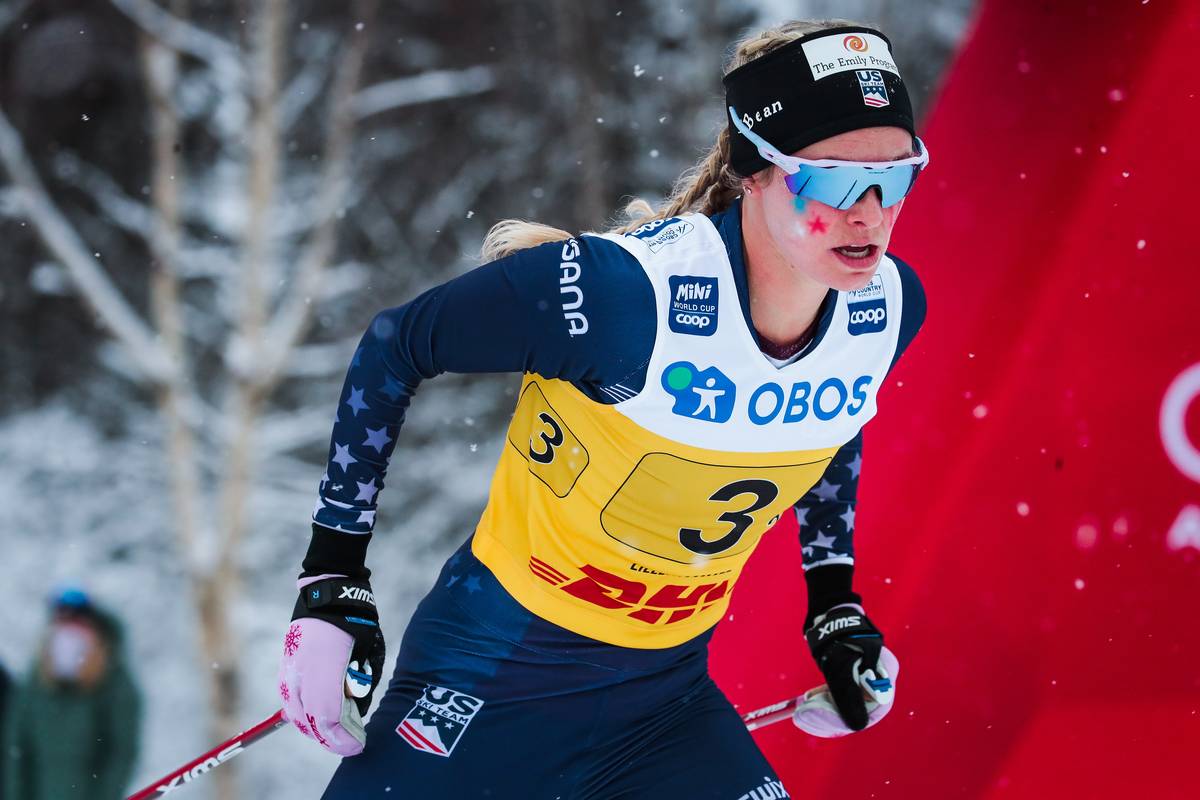
With an epic free skate in the final meters, Jessie Diggins wins the thrilling 10-kilometer mass start freestyle in Oberstdorf, Germany during the 2021/22 Tour de Ski. (Photo: NordicFocus)
In previous press conferences, Diggins has emphasized the importance of frequent racing in helping her reach her mental and physical peak during the season. She had planned to race in at least the first World Cups after the Tour de Ski in Les Rousses, France before they were canceled. With this piece of her plan suddenly removed, what would she do to replace these stimuli to ensure her preparations were unaffected?
While Diggins shared that she loves racing in France and had been looking forward to the races in Les Rousse, she quickly found a silver lining to the cancellation. And to the many setbacks she faced in the second half of the Tour.
“[The cancellation was] kind of a huge blessing in disguise,” she stated affirmatively. “I was able to fully absorb the Tour and then build in a full training block and move up to altitude sooner. I felt like, ‘Whoa, actually, this is kind of perfect.’ This is how I would have designed it because I got in all the racing I needed to in terms of World Cups. Mentally, I felt like the tour was kind of the icing on the cake in terms of getting mentally strong. In terms of being able to push myself – being mentally there, being positive in any situation, all of that – that was the best preparation I could have ever asked for.”
In terms of replacing the intensity of World Cup racing, Diggins expressed her confidence both in the training sessions the team has put together, and the ability of her teammates to push themselves and each other.
“I feel really fortunate because my greatest strength has always been being able to push myself no matter what. And so I was like, ‘Well, this is totally fine, because even if there aren’t World Cups, that’s not a problem.’ I pushed myself in our time trials so hard that I couldn’t feel my legs and I was tasting blood. And that was in a time trial with just one other athlete.”
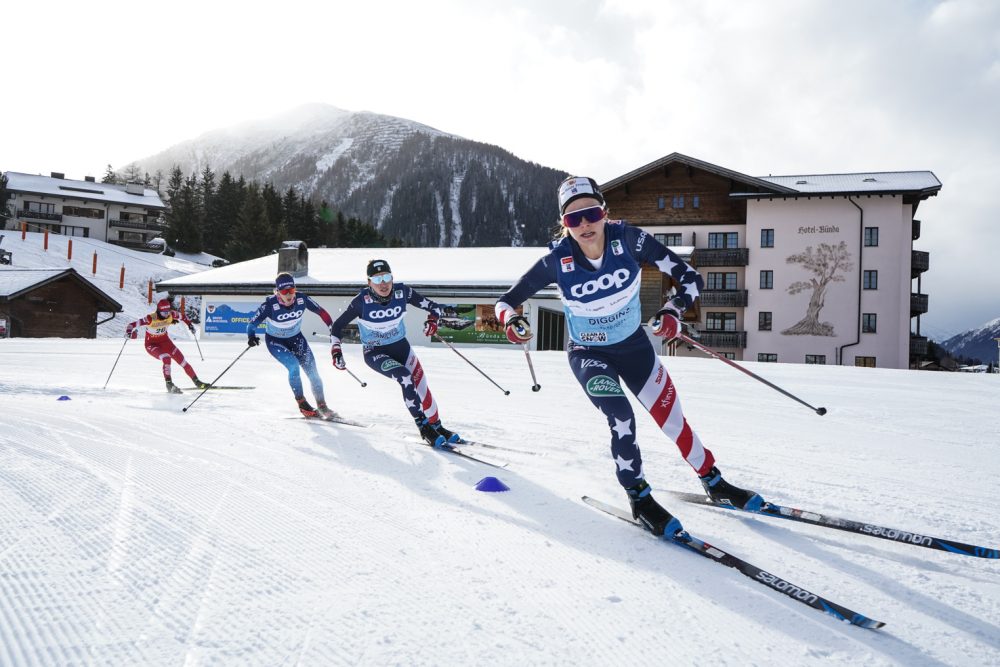
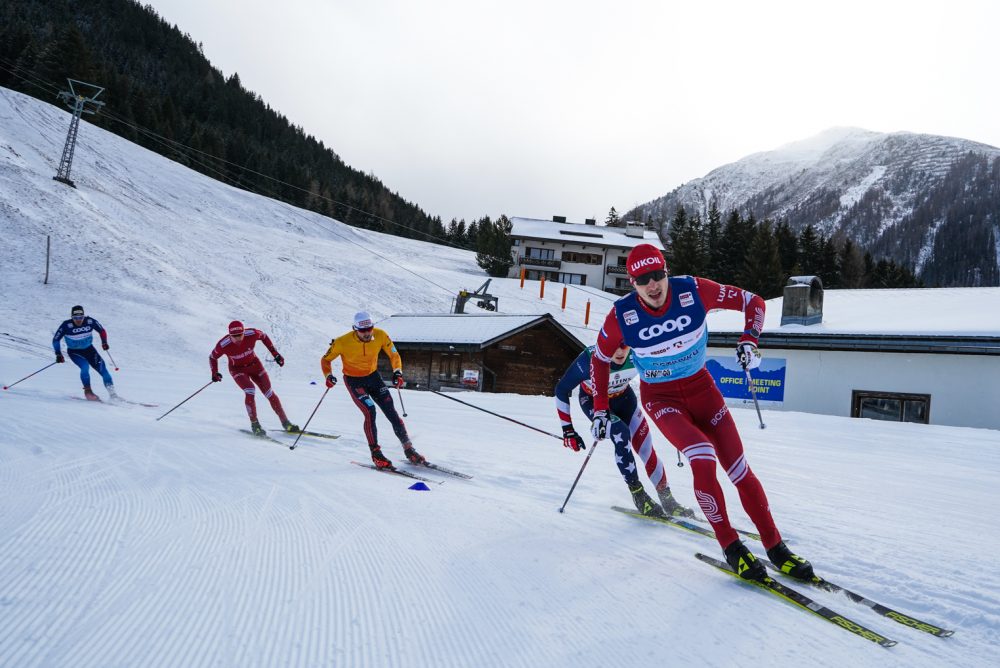
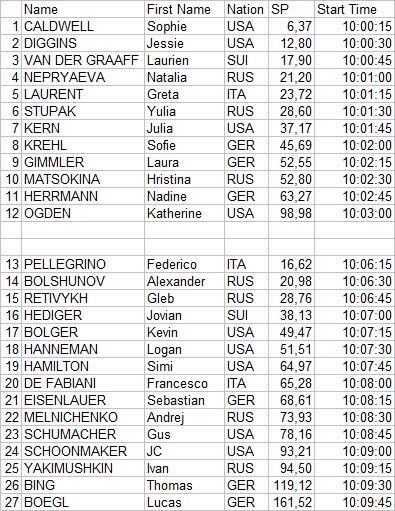
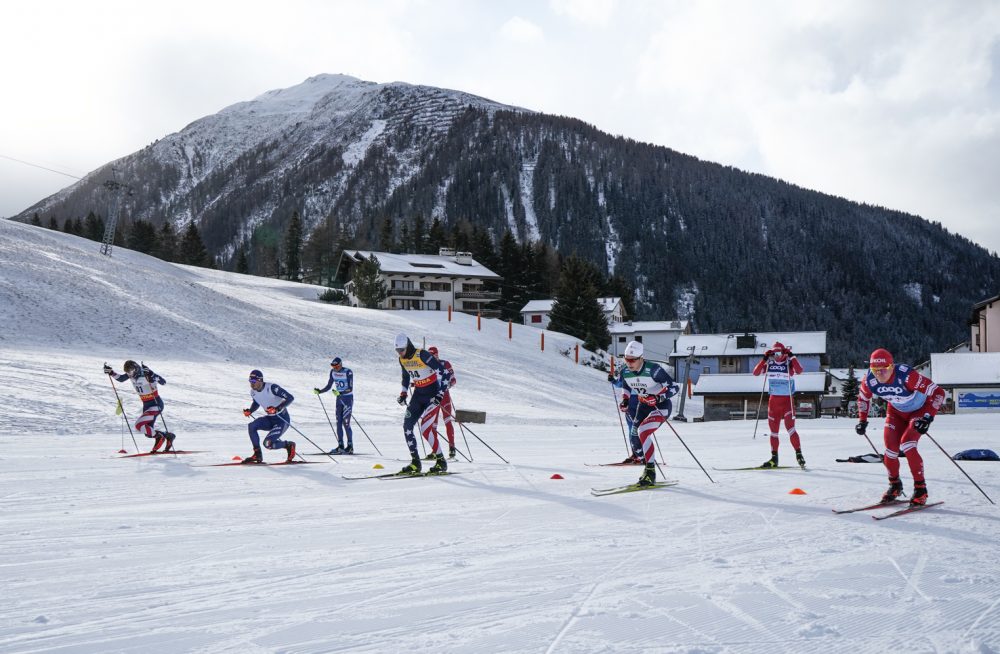
In year’s past, the Americans have collaborated with athletes from other nations when paths have crossed; for example, in December 2020, the Americans raced in a set of time trials with athletes from Russia, Italy, Switzerland and Germany while all were training in Davos following a canceled World Cup event in Lillehammer, Norway. In lieu of opportunities to face off on the World Cup, these collaborations have perhaps provided a measuring stick to see how an athlete’s fitness might compare at the international level. Did the lack of this type of opportunity affect Diggins mental preparation heading into her goal races in Zhangjiakou?
“In terms of the lack of international feel, that’s also been a blessing in disguise, because everyone’s worried about germs. When you get more and more people [together], then you’re exposing yourself to more and more people who aren’t in your bubble. I can’t speak for how other countries feel, but for me, it’s made me feel very safe from a COVID perspective to say, ‘Nope! We’re just gonna keep this as tight as we can, and run some very small time trials.”
Jessie Diggins wins the 10k mass start freestyle in Oberstdorf, Germany during the 2021/22 Tour de Ski. (Photo: NordicFocus)
Staying in the COVID-vein, Diggins also fielded questions from Matt Futterman of the New York Times regarding her fear level and the tension among the team about getting COVID, which remains rampant. A positive result would be a “nightmare scenario”, in his words, for an athlete as it could prohibit travel to Beijing, admission to the Olympic bubble, and/or the ability to compete in the Games?
“It would be silly to pretend that that’s not a stressor, right? I think it’s important to acknowledge that, COVID, especially the variants, are everywhere. It seems like every day, you hear about an athlete or somebody getting sick, and so that is hard. But I think one thing that we’ve done really well is created a bubble with really strict rules that we feel really safe within.”
Diggins explained that the team who is currently based in Livigno has minimal contact with those outside of their “bubble”. The chef is the only person from the group who goes to the grocery store, always while wearing a KN95. Otherwise, the small group only interacts with its members, not entering any buildings beyond the house they are staying in. Athletes who have recently flown over from the U.S. are staying in a separate apartment to quarantine for a week, before joining the larger team.
With reassurance from daily antigen testing and weekly PCR testing, they are living a monk-like lifestyle focused on heading out the door to train, and otherwise focusing on optimal nutrition, recovery, and logistical preparations for the Games.
“We’re trying really, really hard to make sure we protect each other. So even when we’re in this house, when we leave the room, we have our mask on. So you’ll be hanging out in the living room and everyone has KN95s on. So it’s a lot. And I think you hear the phrase ‘out of an abundance of caution’ everywhere now, but I think that is what we’re doing – taking all the cautionary steps that we can.”
Futterman acknowledged that for some, these protective measures can have an adverse effect on stress levels; rather than reassurance, the constant vigilance might leave an individual “freaked out”. Diggins affirmed that the decrease in risk relieved far more tension than the heightened awareness caused.
“It would be more stressful to feel like we’re just risking it… I think that wearing masks has actually lowered everyone’s tension level because you don’t have to wonder ‘what if?’ because we know that the masks work. So if you are wearing your mask, you don’t have to be stressed, because you’re doing everything that you can. I think that mentality of: ‘We’re going all in to protect not just ourselves, but each other’ is actually less stressful. Because if you’re the person who isn’t wearing masks and going into stores, and then you bring [exposure] into the team – that would be the actual nightmare scenario if you got someone else sick. So, for me, at least, and for the teammates here, so far that I can tell, it’s less stressful to just know that you’re doing everything possible.”
Jessie Diggins wins the opening stage of the 2021/22 Tour de Ski, a freestyle sprint in Lenzerheide, SUI. (Photo: NordicFocus)
While the team has carefully been collaborating in Livigno, it is unclear what the opportunities to be together and support one another will look like once they’re on the ground in China. Diggins shared her limited knowledge of what communication and time together might look like during the Games, responding to whether it might be more isolating than years past.
“I think some of that we’re just gonna have to feel out once we’re on the ground and see and feel, after a week, what’s the situation here? How safe do we feel? How good is the WiFi in terms of having team meetings over Zoom instead of needing to find a place where we can do it in person and all wear masks. I think our team has been really, really good about masking protocols, so I do feel like there might be opportunities there.”
In terms of lodging during the Games, Diggins shared that the team will be sharing a set of apartments with four athletes per unit, split between two bedrooms with a common area in between.
“So at least to be able to make a pod with three other people. Beyond that, we’ll just have to feel it out,” she concluded.
In terms of where we can expect to see Diggins on the start lists during the Games, that also remains to be determined, which is a slight shift from what Diggins shared following Period I, earlier this season.
“The original plan was to just race everything, assuming, of course, that I have start rights to do so. And then, earlier in the year, I was thinking, ‘I hear it’s really cool – which, yay! Love it. I hope it is cold. I want it to really be winter. But if it is incredibly cold, the way it was in Ruka, that becomes really draining, because you’re out there for so long. It’s not just the race; it’s the warm up, it’s the cool down. You’re outside going through the media zone, because you need to be outside because of COVID… But you’re out there for a while. So I think we’re going to look at the situation, once we’re on the ground and see, ‘What does the transport look like? How long does it take to get in and out of the venue? How cold is it? What kind of energy drain is this?’ And then we start making the plans on, ‘Does it make sense to do every single race? Or do I sit one out in the middle and sort of store [energy] up?’ That said, traditionally, it’s been great for me to simply keep racing, it kind of takes care of itself. So I’m really excited for every single race and all these opportunities ahead, and I would I would love to be able to do that if it makes sense.”
Diggins also fielded a variety of questions along the lines of comparing her feelings and preparations leading into these Games compared to the last two, given that she is both more experienced, and perhaps facing ever-increasing external expectations as she has steadily brought more attention to the sport. Diggins recently landed on the cover of both Sports Illustrated and Outside Magazines.
Jessie Diggins races the third leg of the women’s 4 x 5-kilometer relay in Lillehammer in December, 2021. (Photo: NordicFocus)
Many of these questions surrounded the pressure of being a defending Olympic Champion, who has since become a World Cup Overall Champion. Has this implied a steady building of pressure felt externally as more and more eyes will be focused on her in Beijing?
“I think the pressures and expectations are definitely different,” Diggins reflected. “Headed into Sochi, I was coming in as a World Champion, (Diggins and Kikkan Randall won the team sprint in Val di Fiemme during the 2013 Championships.) but I felt that I didn’t have any eyes on me. I didn’t have any pressure to medal. I felt that – it was sort of a wonderful flying under the radar feeling of: ‘If I have a good race, awesome.’ Nobody expects anything. If I have a bad race, they’re like, ‘Cool, you’re young, whatever.’”
With less focus on her first Olympic results, Diggins recalls a lighter atmosphere at the Sochi Games with more opportunities to explore a new place and attend competitions for other sport. This shifted as the internal and external pressure built to medal in 2018 in Korea.
“And I do remember getting to go down to the coastal village [in Russia]… And I remember getting to go watch some of the biathlon races, so I actually got to go see other events. Then, in Pyeongchang, it was different because I came in with a lot of eyes and pressure and expectations. I never got to go see a single other event, because I was racing every single event of ours. So it was like race, recover, race-prep, race, recover, race-prep – it was just this cycle. So I felt that for me – I never went and saw the coast, I have no idea what South Korea looks like, someday I want to go back and see it and experience it. But I felt like it was very, very focused. And I know that in that way. Beijing will be the same. So for me, it’s not a huge shift…”
While that focus may be a necessity for Diggins and other medal-favorite athletes at any Games, the pandemic and the resulting COVID-19 safety protocols that will be enforced in Beijing will likely make the isolated “race-prep, race, recover” cycle one all cross-country skiers will experience, regardless of how close their names will appear on results sheets.
“I am sad for my younger teammates, because I want them to have that first [Olympic] experience,” Diggins said somberly. “I know it will be a little bit different. At the same time they’re young and hopefully will have many Games in their future. So at some point, they’ll get that experience of getting to go and watch bobsled and hockey and figure skating and get a little bit of that feel of that huge team unity feeling, because I do think that was pretty cool. At the last two Games, you really felt connected to other sports. And one of my favorite things was like sitting in the Athlete Resource Center, watching a race with the bobsledders and hearing their reactions to our sport, and then watching their sport and then seeing how we react to their sport. It was so cool to feel really like the whole team USA was pulling together. So I hope that we find a way to still feel that, even though obviously, we’re going to be keeping our distance because keeping each other safe is paramount.”
A silver lining of having more eyes, ears, and attention focused on Diggins is a proportionally larger microphone. Since earning a gold medal in 2018, Diggins has found her voice as an advocate, speaking out on topics ranging from eating disorders to climate change.
“My goal all along was to try to grow the sport and to try to do as much good outside of the race track as I possibly could. With my work with the Emily Program, Protect Our Winters, and the Share Winter Foundation, the goal is, ‘Let’s make this about more than just skiing.’ Because that way – win, lose, or draw – you’ve taken this time that you are in the spotlight and actually did something with it. And that does feel good. So in that way, it’s great to be one of the stars of Team USA, because that brings attention to mental health and climate change. And these things that I’ve been shouting about for four years – people are really listening.”
With strong performances across all distances and race disciplines, Jessie Diggins is a medal favorite for the 2022 Beijing Olympic Games. (Photo: NordicFocus)
“The flip side is, yeah, it is hard not to feel like there’s a lot of external pressure. But that doesn’t mean that I have to feel it. I know it’s there, and again – sort of like COVID – it would be silly to not acknowledge it. It would be silly to pretend that it’s not a thing. Of course it is. But for me, it’s more of like, ‘Whoa, what a cool, privileged place to be in. 15 year old Jesse would be so psyched to learn that this is how I’m coming into my third Olympics, let alone any Olympics.’ So for me, the key has been flipping it around and reframing it as an amazing privilege to get to carry this amount of pressure and hopefully show that it’s totally possible to come in and still be yourself; to care about the things you care about; to be a good teammate; and to just focus on what you can control. And you’ve just got to let the rest go.”
Perhaps the size and variety of media publications present at her conference is evidence on its own that Diggins has been identified, outright or otherwise, as an athlete to watch at the 2022 Games. Since the Pyeongchang Games, she has been on the podium in ten freestyle sprints, winning two. She was second behind Marit Bjørgen at the 30k freestyle at the Holmenkollen in March, 2018, the last time she competed in the event.
Diggins has raced three 7.5k/7.5 skiathlons in the last Olympic Quad, taking second to Norway’s Therese Johaug in December, 2019 and fifth place, behind an all-Norway podium plus Sweden’s Ebba Anderson in fourth, in January, 2021. And then there are the relays, for which she has been known since the beginning of her career.
Perhaps the only event where Diggins may not be considered a medal contender is the 10k classic. While she just one podium in this event over the last Quad, third place in Val Müstair in the 2020/21 Tour de Ski with a Norwegian-free field, she has cracked the top-10 enough times not to be ruled out.
Jessie Diggins skis to 13th in the 10-kilometer mass start classic in Val di Fiemme, ITA during the 2021/22 Tour de Ski. (Photo: NordicFocus)
With these performances across all race disciplines and distances, it might be impossible for Diggins not to feel some amount of pressure heading into Beijing. She explained that managing this, for her, comes down to taking ownership and control over her definition of success.
“One thing to understand is that when it comes to pressure, there will never be a point where you are enough, if you start listening to it, right, because then it’ll be ‘Will you podium?’ to ‘Why didn’t you win?’ And at some point, it’ll be, ‘Why didn’t you win by more? Why wasn’t it more impressive?’ There’s no end point.
“So it’s better to not let my self-worth be determined by anyone other than myself. And that’s easier said than done. It’s something I’m obviously still working on with my sports psychologist, but I think it’s so important to say that I get to define what success looks like. And I’m the only one who gets to say that and nobody else. It’s important for me to [establish] ahead of time what that means. And so for me success at the Games means crossing the finish line with nothing left in the tank and knowing beyond a shadow of a doubt that I left it all out there. And that I feel confident I can do.”
Diggins also proposed a definition that was multi-faceted, shifting the focus away from the outcomes on the podium or results list.
“The other thing success means is being a good teammate, like, Who are you off the snow? What kind of person? Are you? What do you stand for? How do you treat the people around you? That’s really important. And the third thing is, how did you prepare? Did you do everything possible? And not just in the last week or the last month? Or even the last year? The last decade of training for skiing? Have I put everything I have towards this? So I don’t have to wonder what if I had just committed? And if I can do all those things, and cross that finish line and look back and go, that was it? That was my best effort. And that was everything I had, then that will be success? And it doesn’t have to be a medal? It’d be great if it is. It will be fine, if it isn’t. Because at the end of the day, I know that whether or not you earn a medal is not within your control. You can’t control anyone’s effort, but your own. So I think that’s been so important for me in trying to deal with that kind of pressure.”
Jessie Diggins takes second in the 10k free in Davos, behind winner Therese Johaug (NOR) and ahead of Frida Karlsson (SWE), both dominant distance skiers. (Photo: NordicFocus)
Diggins concluded by sharing a quote that resonated with her from two-time Olympian and former national team coach, Pete Vordenberg. He said, “Every time you do something, it’s for the first time. And even if you do it again, it will be different. And you will be different. So enjoy it.”
Unpacking this, Diggins explained, “I think that’s so important to remember because it’s not the same as Pyeongchang. And that’s okay. It’s going to be different. And it’s also going to be the first time I’ve ever been to this Olympics, because: different trails, different country, different year, different Jessie. So I think it’s important to remember that I don’t have to go in there defending anything. Nothing makes that medal and what I did four years ago disappear, and I won’t disappear if I don’t do it again.”
Stay tuned for a few additional insights from Diggins coach and wax tech, Jason Cork, who also appeared at the conference.
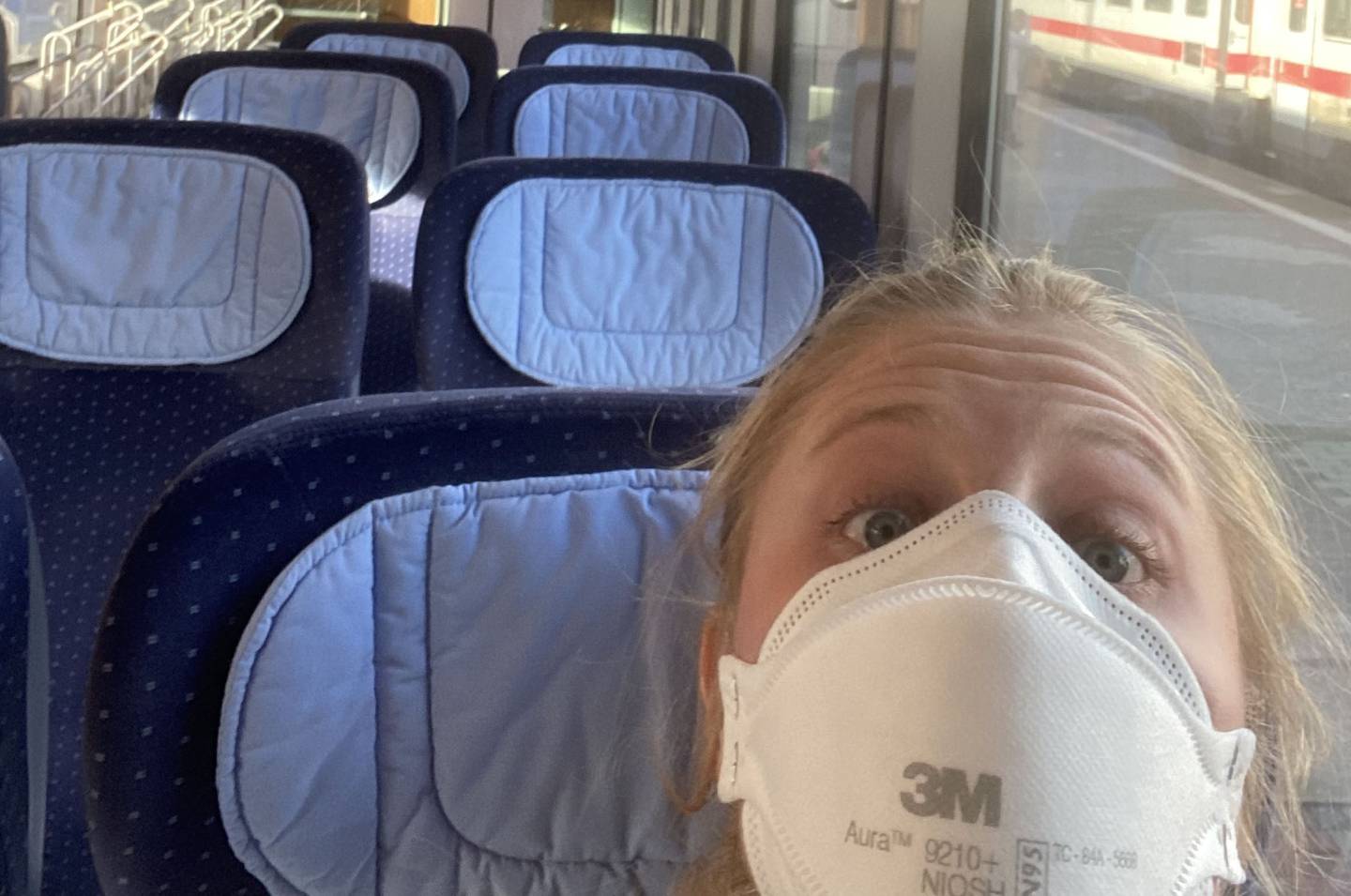
Hailey Swirbul searched out an empty train car to ride in while trying to avoid infection with the omicron variant on her way to a ski town in Austria this month. Swirbul is one of a number of Alaska athletes taking rigorous COVID-19 prevention measures to avoid derailing their hopes of competing in the Winter Olympics in Beijing. (Courtesy photo)
This article originally appeared on Wednesday January 19th, 2022 in the Anchorage Daily News. Reposted with permission.
The organizers of next month’s Winter Olympics in Beijing have imposed a rigorous regime of testing, quarantines and isolation for incoming athletes and staff.
Among the casualties is Steve Patterson’s pickleball game.
Patterson has two adult children, Scott and Caitlin, who grew up in Alaska and are both Olympic hopefuls in cross-country skiing.
They’re planning to prepare for the games from their parents’ home in Montana. Which means the whole family is being careful to avoid any contacts that could invite the coronavirus into their home — potentially derailing access to China for Scott, 29, and Caitlin, 31.
The Patterson siblings are two members of what’s currently one of America’s most COVID-conscious demographics: aspiring Olympians with plans for Beijing.
China, with its “zero COVID” policy, has draconian requirements for anyone flying into the country for the Games. They start with two negative lab tests just to get on the plane to China, followed by another immediately upon arrival at Beijing’s main airport.
A positive test would disrupt teams’ meticulously laid plans for travel and training, and even asymptomatic cases would almost certainly force athletes to miss flights and competitions for which they’ve trained for years.
As a result, Alaska athletes and others involved with the Olympics are going to great lengths to stay free of omicron as the variant spikes across the U.S. and the globe — even with training and competition schedules that include inevitable cross-country or intercontinental travel.
“This experience that I’ve dreamed of my entire life is sort of now just grounded in stress, more than anything,” said Luke Jager, a 22-year-old Anchorage cross-country skier likely to be named to the Olympic team. “I’m sure at some point, being over there, it’ll kind of set in. But right now, the challenge of not getting COVID feels just as big as the challenge of even qualifying for the Games did.”
Luke Jager starts a race at Anchorage’s Kincaid Park in 2020. (Loren Holmes / ADN)
Chris Grover, the Anchorage-raised program director for the U.S. cross-country ski team, recently returned home to Idaho from the European racing circuit.
He spent his first few days with his in-laws, rather than with his family, to avoid catching the coronavirus from one of his children who’d had a potential exposure.
Meanwhile, one of the athletes that Erik Flora coaches at APU, he said, has even been wearing masks around and sleeping in a different room from their romantic partner.
“That’s the commitment that probably tops just about everything,” Flora said. “You’re messing with the human spirit at that point.”
More than a half-dozen cross-country ski racers with Alaska ties have a good chance to make the American Olympic team when it’s named Thursday — joining two curlers, a hockey player and a figure skater as some of those destined for Beijing from the 49th state.
In interviews, the skiers and coaches describe taking Olympic-level anti-omicron precautions. But each faces a unique set of risks, depending on their circumstances.
Hailey Swirbul also trains with APU in Anchorage; she planned to return from European racing to Alaska for a pre-Olympic camp, where she could spend time with her boyfriend and dog.
But after catching a cold, Swirbul, 23, decided to stay in Europe and avoid two rounds of major international travel.
After three train rides — sporting an N95 mask, with no breaks for eating or drinking onboard — Swirbul arrived in Austria for pre-Olympic training. There, she and her teammates broke into smaller groups that don’t mix indoors.
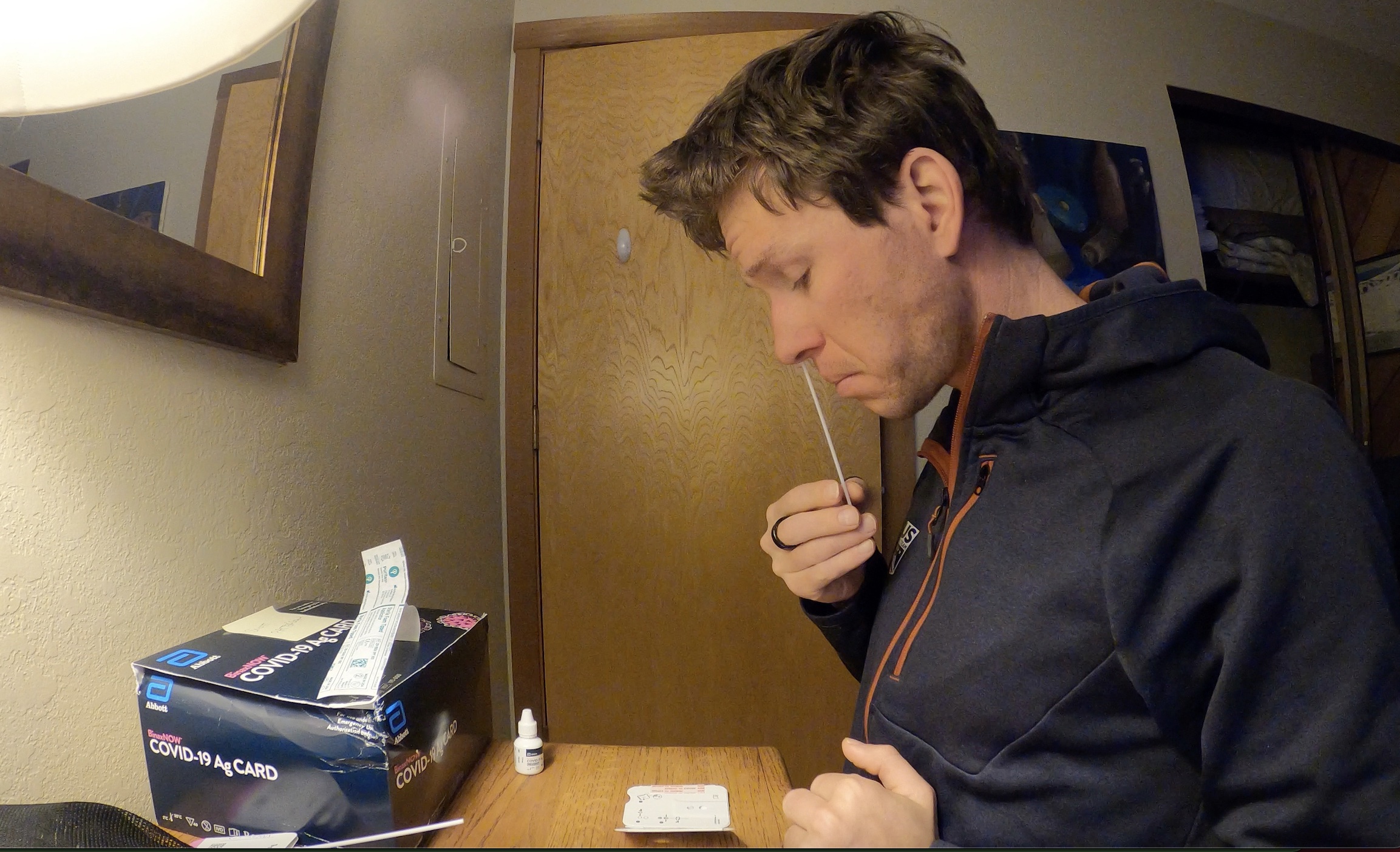
Scott Patterson self-administers a COVID-19 rapid test. (Courtesy photo)
The athletes take rapid antigen coronavirus tests every day, retrieve meals cooked by a team chef, bring them back to their living quarters and eat only after washing their hands. Swirbul got in the habit of climbing out a window to leave her apartment, rather than walking through a shared space that would require her to don an N95.
She also turned down an invitation to meet a friend, outdoors, for hot chocolate. And “definitely no grocery stores — we haven’t been in those since we’ve been here,” Swirbul said in a Zoom interview.
Jager has suffered through much more of a saga. Outside of international competitions, Jager races for the University of Utah, and he had to return from top-level European racing a few weeks ago to compete in collegiate events in the U.S.
When he arrived, the coronavirus was circulating among his team, so he couldn’t move back into his house. In a phone interview last week, he described staying in the vacant home of friends of his girlfriend’s parents before a race series in Idaho.
“They get back tomorrow night. So, we’re trying to find some other place to stay because we’re trying not to see anybody,” he said. “I’ve been nomading, pretty hard.”
Jager returns to Europe this week for a training camp in Italy with the American team, then will fly to Beijing from Switzerland.
JC Schoonmaker, another likely Olympic team member who competes for University of Alaska Anchorage, is on a similar program to Jager, except he traveled and lived with his collegiate team during races in the western U.S. this month.
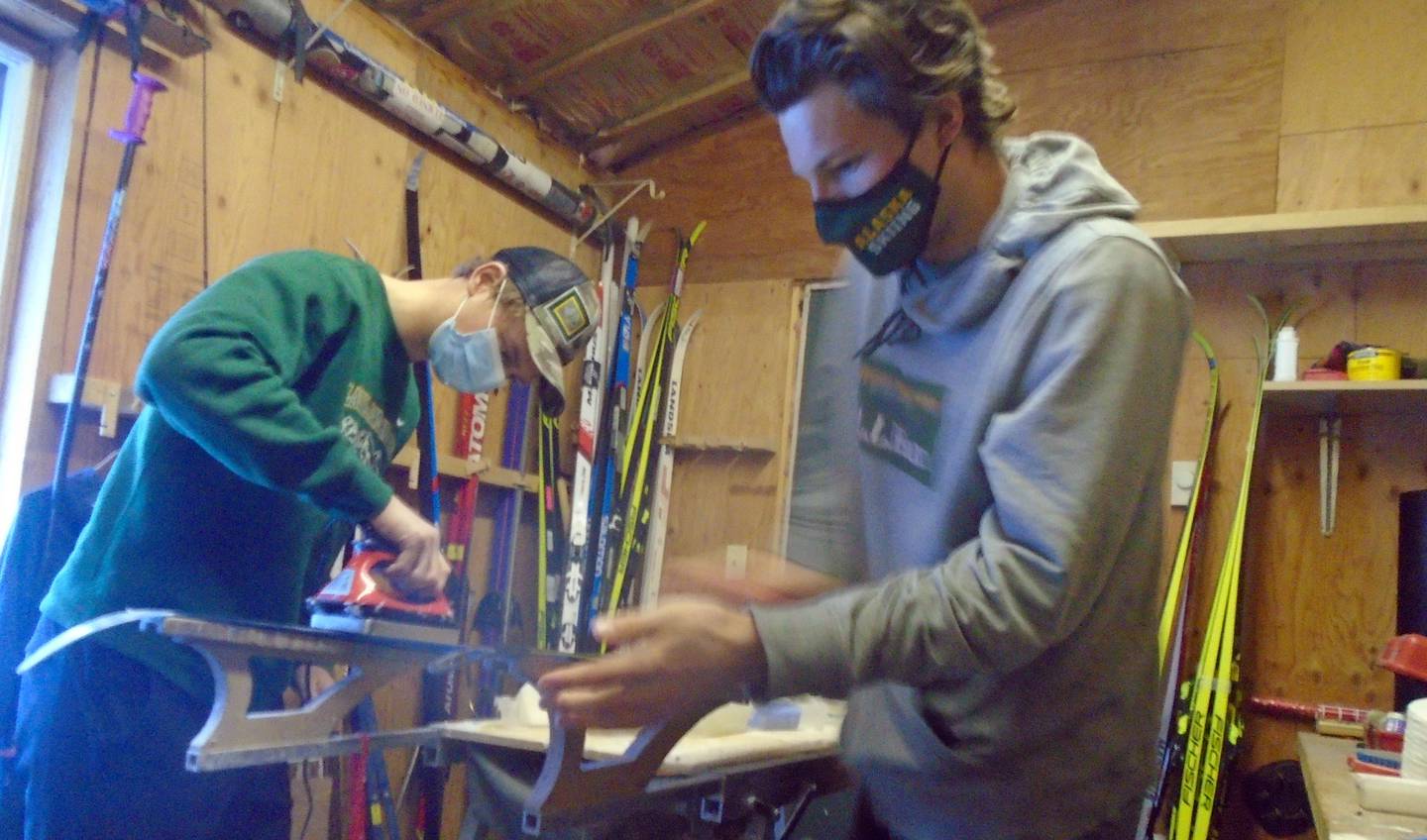
JC Schoonmaker, right, and a teammate tune skis Friday, January 14, 2022, before a weekend of racing in Idaho. Schoonmaker is one of a number of Alaskans taking rigorous COVID-19 prevention measures to avoid derailing his hopes of competing in the Winter Olympics in Beijing. (Adam Verrier)
Schoonmaker’s coach, Trond Flagstad, said the UAA coaches are doing all the shopping; they enter the athletes’ houses to drop off groceries only while wearing masks.
“It’s definitely risky, but I’m pretty confident,” Schoonmaker said. “And I really do trust my teammates — I think they’re doing a good job.”
Aside from presenting obvious logistical problems, the coronavirus has affected the skiers in subtler ways, too.
It’s forced them to keep their support networks at a social distance, whether that’s partners, family members or friends. And with coaches taking on more risks, like grocery shopping, it’s also harder for them to work closely with their athletes, or even to drive them to races in vans.
Added all up, it makes for an especially grueling, and isolating, build-up to what was one of the most pressure-filled experiences in athletics even before the pandemic.
“It really weighs on me,” said Rosie Brennan, a medal hopeful who trains with APU in Anchorage. “It’s honestly harder than preparing yourself to race.”
With the Games, and the negative tests required to enter China, approaching, each swab presents aspiring Olympians with a new reason to worry — especially with the awareness that omicron may present itself without symptoms.
“You know how it is when you’re a skier: You’ve got stuff coming out of your throat and you’re always blowing your nose and stuff,” said Jager. “You’re like at 7,000 feet, you’re like, ‘Maybe I’m a little tired today and I just blew my nose a couple extra times. Definitely could be low-level symptoms of COVID.’”
One silver lining for the Alaska ski racers, in the final days before the games begin: They’re not alone.
One of Norway’s top cross-country skiers, Heidi Weng, made tabloid headlines in that country when she said she wouldn’t be seeing her boyfriend before Beijing.
And Maja Dahlqvist, a Swedish cross-country superstar, has to stay at least 6 feet away from her boyfriend, American cross-country skier Kevin Bolger. That applies even as their teams hold separate pre-Olympic training camps on the same trails in Italy.
“I mean, of course we wish we could hold hands or hug,” Bolger said in an email. “But both knowing what is on the line, we will survive until after Beijing.”
We’re finally here with a long-promised mailbag episode for you this week. Devon takes us through questions from more than a dozen listeners; we cover World Cup competition formats, tactics, training, broadcasting and a bunch of other random fun stuff. We’ll be back soon with coverage of Olympic team selection and hopefully some more intel on the Olympic venue in Beijing.
Send us questions and feedback to devon@fasterskier.com and nat@fasterskier.com.
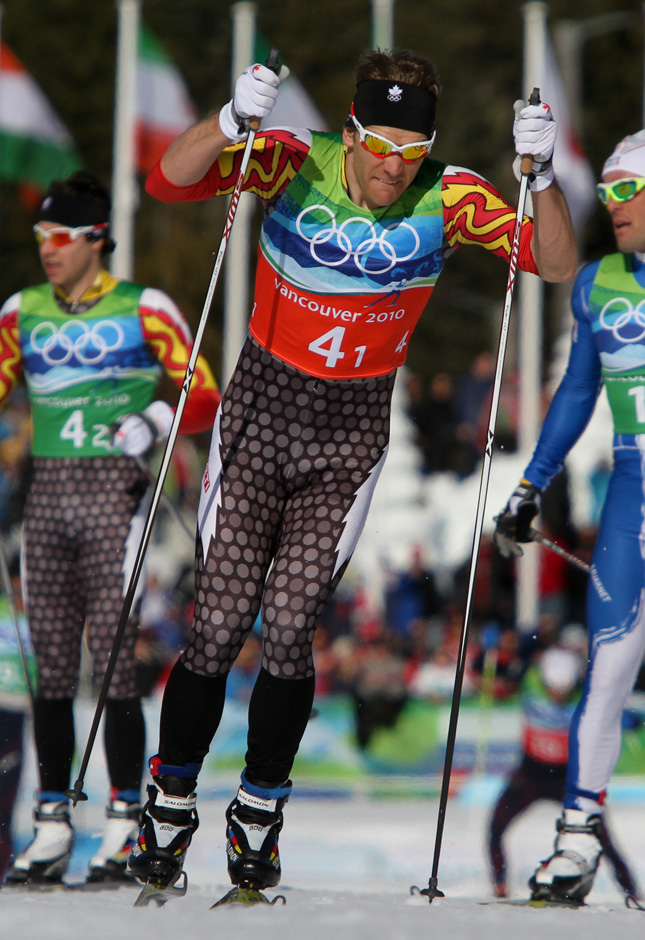
Devon Kershaw racing in the 2010 Olympics in Vancouver.
In this episode, we have Matt Whitcomb back to debrief the 2021/22 Tour de Ski, including highs and lows, overcoming setbacks, and managing a circulating head cold. We also discuss the cancellation of the upcoming World Cup races in Les Rousses, FRA, covid safety in a critical window before the Olympics, and the racing happening in Soldier Hollow during the 2022 US Cross Country Championships.
Thanks for listening.
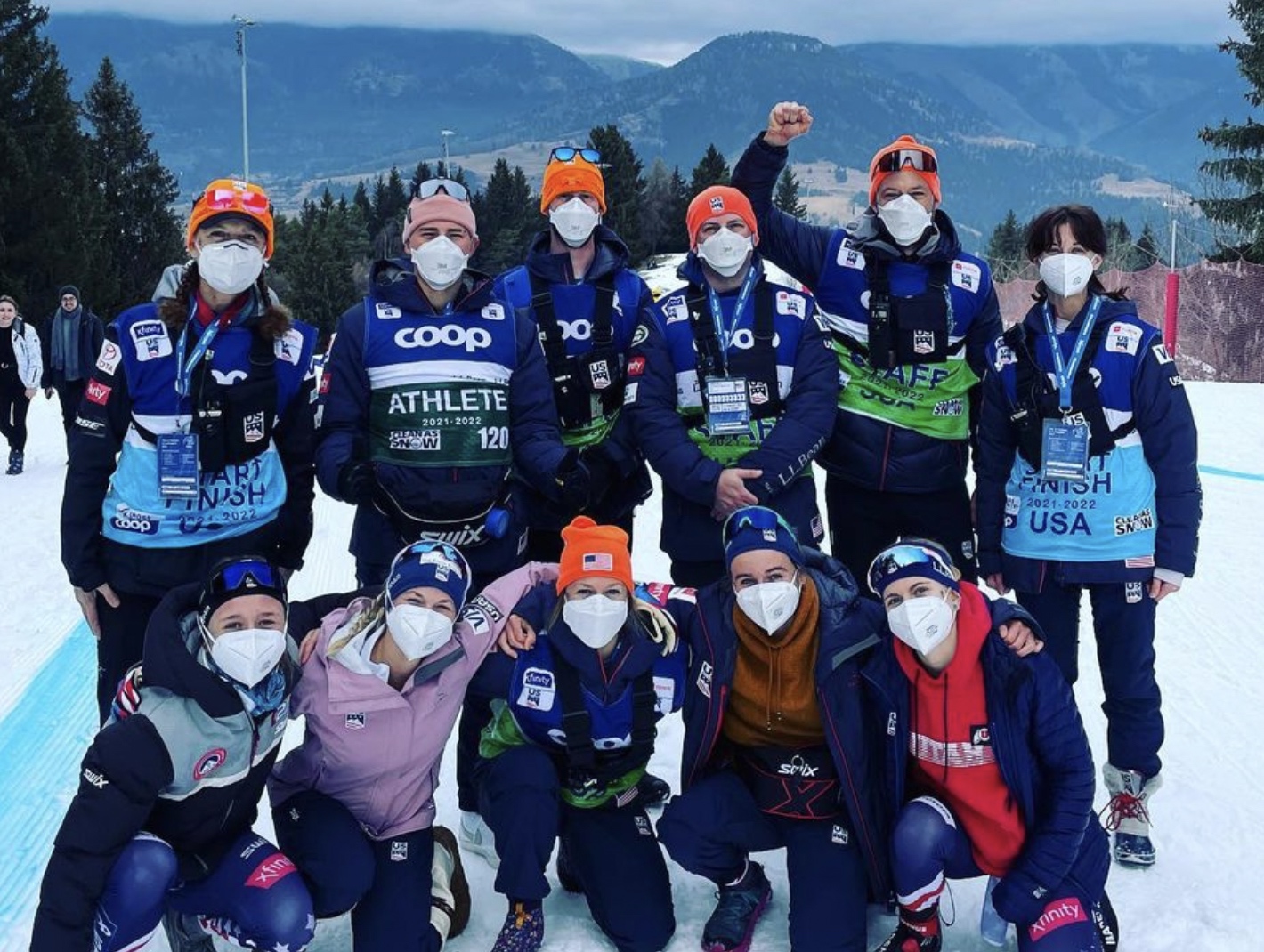
The American women who finished the 2021/22 Tour de Ski pose with coaches and support staff at the top of the Alpe Cermis. (Photo: Tom Horrocks / Instagram @jessiediggins)
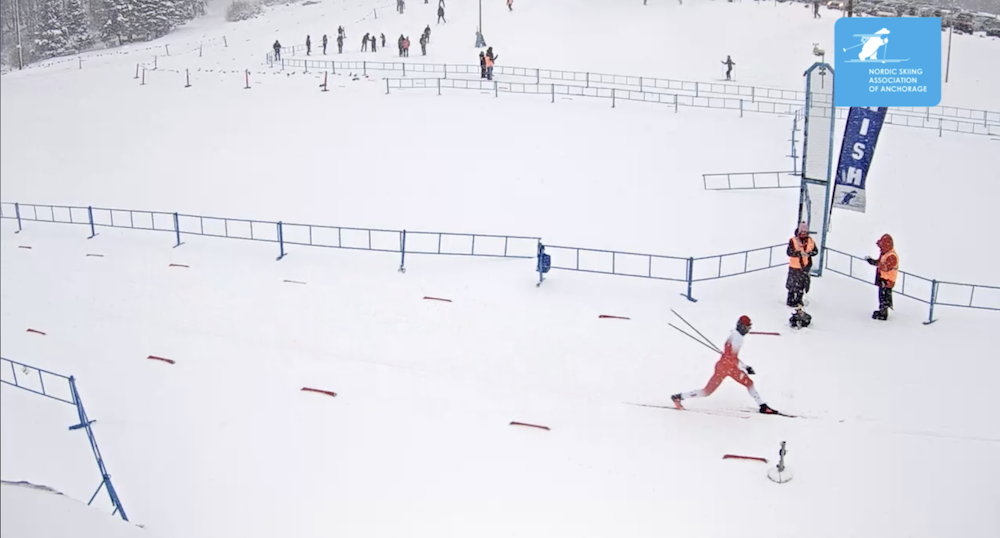
An athlete finishes the sprint qualifier-only event in a largely empty Kincaid stadium in Anchorage in a December 2020 FIS race. (Photo: NSAA webcam screenshot)
The winter of Covid continues. Most of the FIS races scheduled for this country this year did not happen. A few did. No one in Canada has done a single official high-level race this winter. No one in Vermont has, either. Some athletes from Canada and Vermont did not race and were chosen for international travel teams. Some athletes in Alaska raced a ton and were not. It’s been a tumultuous winter for everyone, for many reasons, skiing or otherwise.
After several months of hosting, or not hosting, ski races in this country, a few themes have emerged. In this article, part one in a two-part series, FasterSkier surveys some of the lessons learned and considerations informing race directors’ decisions about whether to hold a race, and if so with what safety measures in place. In part two, FasterSkier considers the case of the American Birkebeiner, which even in this year’s scaled-down format is once more poised to be the most popular ski race in the country, and to draw athletes from across a wide swath of the Midwest to rural Wisconsin.
This article begins with an attempt to quantify where the health risks in nordic skiing lie, then examines first regional racing in Alaska and then in portions of the Lower 48.
Methods of transmission
You’re doubtless familiar with the epidemiological basics by now: SARS-CoV-2, the novel coronavirus that causes the disease known as Covid-19, is largely spread through exposure to respiratory droplets carrying infectious virus, less so through touching fomites left on surfaces. Unventilated indoor spaces are, to paint in broad epidemiological strokes here, “bad”; outdoor spaces are “good.” From an outdoor recreation perspective, the message has been heeded; the rise in usage numbers for outdoor endurance sports over the past year has been well-documented, and you’ve very likely encountered crowded parking lots at your favorite trailhead in all seasons.
Early in the pandemic, the statement, “there have been no documented cases of outdoor transmission” was often repeated like an article of faith. This is, no longer, literally true. In Alaska alone, for example, the Alaska Department of Health and Social Services last summer documented cases of outdoor transmission among attendees of backyard barbecues and spectators at youth sporting events, perhaps where parents were relatively close to each other for extended periods.
As one scientist’s work in this area was summarized by FiveThirtyEight blog, “The situations he found where clusters were associated with outdoor transmission tended to be times when people were, as [the scientist] put it, ‘invited or required to break natural social distance.’ These event-specific behaviors might help explain why he found clusters associated with farmers’ markets, where people crowd around the stalls, but not with people just hanging out in the park.” Or, as another article summarizing the same research was headlined, “Catching coronavirus outside is rare but not impossible.” “Only about 10% of transmission events are linked to outdoor activities,” one lecturer in infectious diseases and medical virology recently told The Guardian.
So what does this mean for skiing? This reporter is no epidemiologist, but anecdata from the Anchorage cross-country ski community over the past several months suggest that the risk is relatively low. One unofficial case study comes from the Alaska Pacific University Elite Team, where Rosie Frankowski publicly announced in January that she had suffered from a mild case of Covid, and David Norris had it in November.
David Norris racing the scramble leg for the U.S. in a World Cup relay this January. (Photo: NordicFocus)
APU Head Coach Erik Flora told the Anchorage Daily News in January that all APU athletes who had caught the virus, four in total since the pandemic began, “were exposed somewhere other than training and there has been no internal spread among APU’s 30-member group.” (Most athletes on the APU Elite Team train together daily, most frequently men with men and women with women.)
In the specific case of Frankowski, meanwhile, Flora told the paper, “I skied with Rosie for a half-hour before she (tested positive). We did the proper spacing and when we weren’t skiing and all that good stuff, and I was negative. It made me really think how effective and important it is – the spacing and the mask-wearing.”
The experience of Anchorage School District (ASD) high school nordic teams suggests a similar conclusion. Although no ASD high school student has physically attended class since March 2020, many high school sports have proceeded with caution and new mitigation standards, including cross-country skiing. High school skiing in Anchorage is a big deal; the most popular teams can have over 100 athletes.
The ASD Nordic Ski Mitigation Plan states that athletes must maintain at least six feet of space at all times, and that “Face Coverings must be worn by Athletes.” (A separate provision in the same document states that “masks and face coverings during high intensity outdoor organized sports activities are encouraged, but not required, if athletes generally can maintain ten (10) feet physical distancing at all times,” tracking the language of the relevant municipal emergency order.)
Based on this reporter’s firsthand observations from local ski trails on weekday afternoons, there is a wide range of interpretations of this rule among Anchorage high school ski coaches and their teams. Some teams pass by with every single athlete wearing a mask, over both their nose and mouth. Some teams exhibit roughly half the athletes wearing a mask, with varying degrees of coverage of an athlete’s nose. Some teams present not a single athlete wearing a mask, with three athletes classic skiing side by side, or five or ten immediately behind one another in the tracks. As Rosie Brennan captioned a photo on her blog showing her racing in the middle of a train of skiers, “I hope no one has Covid…”
In late January, the Anchorage Daily Newswrote that, although the district had “dealt with a number of team quarantines during the fall sports season” (at one point last fall at least five volleyball teams at three different schools were in quarantine), “none have occurred this winter.”
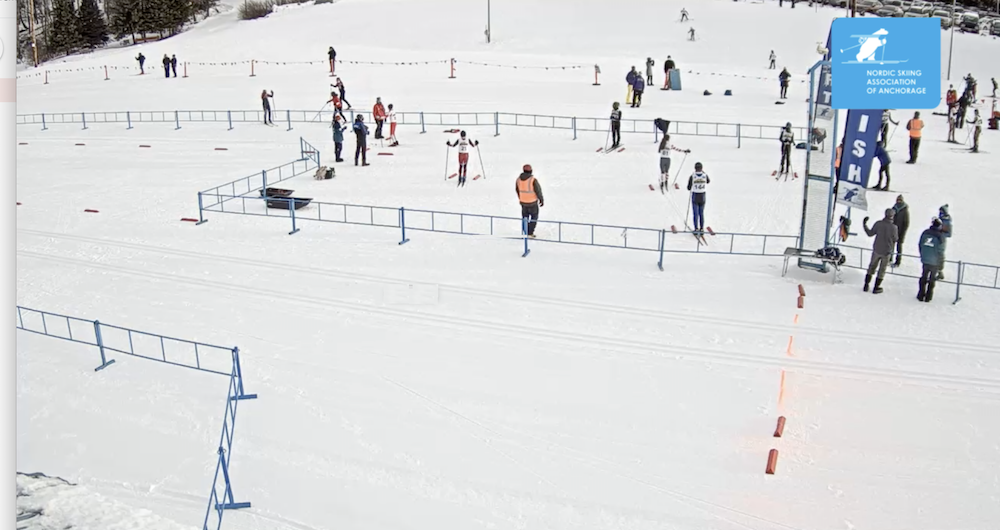
Skiers move through the “Z” starting formation lineup in this Anchorage citizens race in January 2021. (photo: NSAA webcam screenshot)
“We’ve not had any (team) quarantine situations thus far for skiing, basketball or cheer,” a district spokesperson told the paper. “We’ve had some isolated cases where an individual had to quarantine.” (Two weeks later, unmasked basketball practices would lead at least three large high schools to close in the nearby Matanuska-Susitna Borough School District, roughly an hour’s drive from Anchorage.)
FasterSkier has learned that some skiers on Anchorage High School ski teams tested positive for Covid-19. While it is unknown what mask-wearing practices were in place on the Anchorage ski teams that did experience cases – ASD representatives declined to identify to FasterSkier the teams involved or their safety procedures, citing student privacy concerns – the apparent lack of widespread intra-team transmission among nordic teams is anecdata that there is a relatively low risk associated with outdoor exercise.
(One person with direct knowledge of Anchorage high school skiing told FasterSkier something somewhat different, observing that they were personally aware of transmission occurring within ski teams, but noting that it occurred between students who carpooled together to practice. This would mean that the ASD administrator’s point about no within-team transmission is incorrect, but that points about the relative safety of outdoor exercise remain largely accurate.)
Other sports have suggested similar conclusions.
In football, for example, Sports Illustratedreported an NFL representative stating in early November, “We have seen zero evidence of transmission player-to-player on the field, either during games or practices, which I think is an important and powerful statement. And it also confirms what other sports leagues have found around the world. We regularly communicate with World Rugby, Australian rules football, European soccer leagues. To date, no one has documented a case of player-to-player transmission in a field sporting environment.”
“Somehow,” Kelsey McKinney wrote for Defector, summarizing this data, “every week, players are taking COVID-19 tests on Saturday and not being placed on the list (be it for positive tests or close contact) on Sunday. By Monday, they need to be on the list. Someone with a conspiratorial mind might take that as evidence that the league is pulling some number of strings to make sure that the Saturday tests are being administered in some way so as to ensure their results won’t endanger the next day’s games.”
The other sports leagues cited above have less of a checkered past in this regard.)
NFL representatives suggested to Sports Illustrated that more high-risk contacts occurred from “meeting, eating, and greeting” – that is, team meetings; eating together; and “when I say greeting, what I mean by that is social activity outside the building, people hanging out together doing things.” The last of these, extracurricular social activity, seems to be the greatest issue in the recreational ski context. Traveling for races raises the possibility of the second, as athletes have to eat somewhere. As for the first, local race organizers have consistently moved to Zoom for pre-race meetings this season, while the World Cup has featured memorable images of outdoor team meetings in single-digit temperatures.
Ski racing in Anchorage: Mostly local fields
A pair of December races in Anchorage, the first FIS races held on the continent this winter, were largely responsive to these concerns. There were a suite of mitigation measures that are by this point likely familiar to most racers: interval-start format; masks required up to the starting line and immediately upon crossing the finish line; paper bibs distributed by club coaches; no indoor facilities; leave the venue right after the race; spectators officially barred; etc.
The fidelity to the application of these measures was mixed. But rules were in place, and athletes likely had relatively little contact on course over a pair of interval-start races, at least while officially competing. (This reporter glimpsed multiple athletes from different teams skiing unmasked cooldowns together on trails away from the stadium. He also saw some spectators in the stadium, which violated both club policies and an official city emergency order in place at the time.)
So if the races themselves were presumptively fairly safe, was hosting them okay? Particularly when they had some of the best points profiles of any domestic races this season, and were held in a hotbed of American skiing? (At least nine athletes who were named to a 2021 World Juniors team competed in these races, and the results were used to help justify the discretion-based selection of at least five athletes to this year’s World Cup squad. Every Alaskan athlete who was named to an international team this year competed in these races, save for Gus Schumacher, who was already racing in Europe. Regarding these considerations, Caterinichio wrote to FasterSkier, “When you have an NRL race it isn’t only for points in fact points don’t mean much this year and there are no qualifications which has allowed a family to not have to come.”)
Opinions differ. Criticism about hosting the races focused on the fact of the races themselves, for the off-course behavior it could enable or incentivize, rather than any specific deficiency in safety measures on the part of Nordic Skiing Association of Anchorage, or NSAA.
As one local coach, granted anonymity to candidly discuss sensitive local issues within a small ski community, wrote to FasterSkier in late December, “I disagree with hosting any form of race right now in Alaska, including town series races. I do not doubt the efforts or the effectiveness of race day mitigation plans which are data driven and based on those designed by healthcare professionals. The issue is people’s ability to adhere to those plans, and what they do outside the race venue. Skiing is a social sport and carpooling to the venue, waxing as a team, or even congratulating your teammates on their performance poses a very serious health risk to racers and their families. Lastly, incentivizing travel of any kind at this point in time is absolutely unacceptable.”
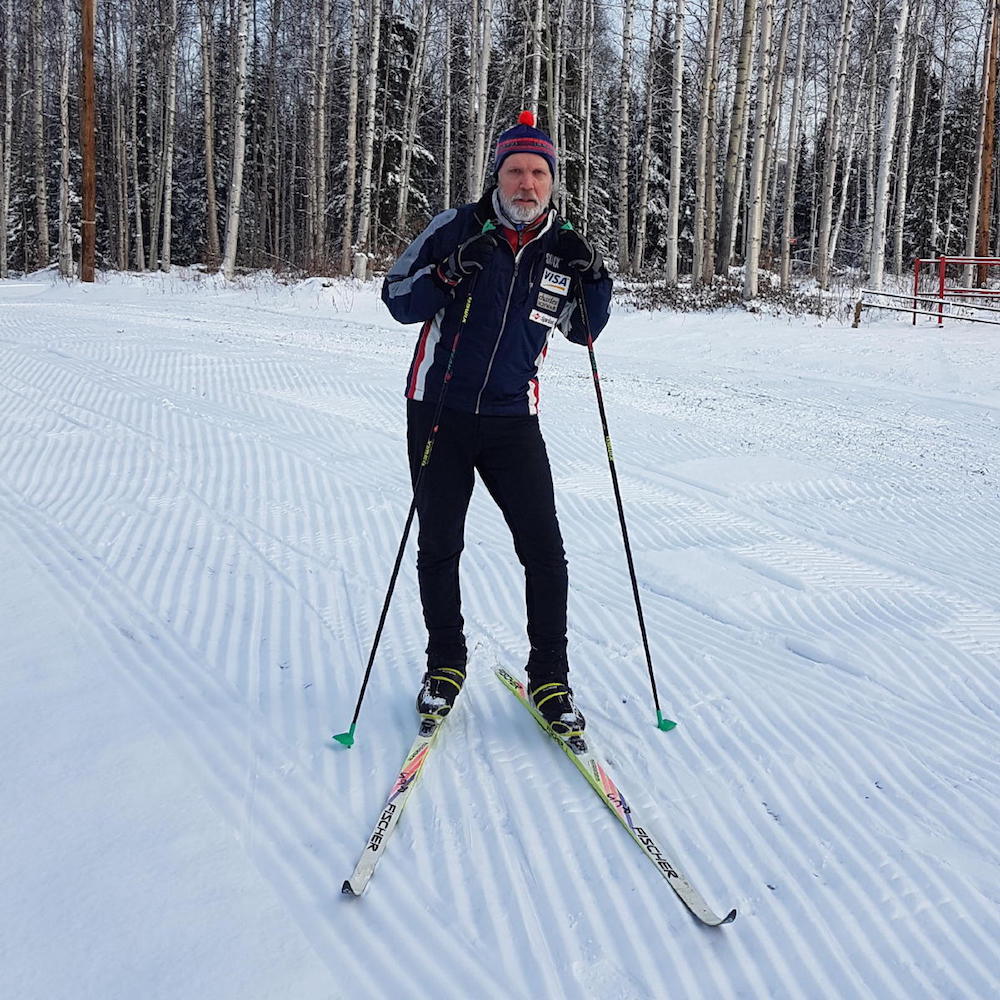
John Estle at Birch Hill Ski Area in Fairbanks, Alaska, on Oct. 19, 2017. (photo: courtesy John Estle)
Or as John Estle, the longtime doyen of Fairbanks skiing, wrote to FasterSkier, “Between our first and second meetings [of the Nordic Ski Club of Fairbanks advisory committee, which includes three local physicians], a patient from Bethel was sent to Fairbanks Memorial Hospital (FMH), due to a lack of ICU beds for COVID-19 patients in Anchorage. That fact, in addition to a still-climbing daily rate of confirmed cases were decisive factors in the Advisory Committee’s recommendation, and the NSCF BOD’s decision, not to host the first FIS races of the 2020-21 season on November 21-22 as scheduled.
“The decision was motivated by the knowledge that were NSCF to host a FIS race, it would likely draw skiers from other parts of the state. It is clear that travel contributes to the spread of the coronavirus – the people who travel to a community outside their own not only expose themselves to many more people than would be the case if they stayed home, but potentially could unknowingly (approximately 40% of coronavirus infections are asymptomatic) increase exposure to coronavirus among residents of the host community. In addition to the concern regarding travel, not holding the races would eliminate the possibility of members of our race crew being exposed to the virus.”
Estle continued, “I believe that it is possible for clubs to provide opportunities for competition during this pandemic which limit exposure of competitors, volunteers and officials in meaningful and effective ways. I believe the spectrum of formats where this can occur is fairly broad, but I believe a key component of safe competitions is that they be LOCAL in nature. I do not believe it is wise to organize an event which creates an incentive for people to travel from one geographic area to a fairly distant geographic area, thus increasing exposure both among the visitors and the hosts.”
He also noted, “One issue that I have not even mentioned is the risk to both the short-term and long-term health of young athletes. Although research is ongoing in this area, it is clear that young athletes who contract COVID-19, even those who have had only mild cases, can suffer long-term respiratory and cardiac issues post-COVID. I don’t advocate that young athletes abandon exercise and sit at home. However, it seems to me that concern for the health of young athletes would dictate that competitive opportunities make sense when they are offered within a structure which does nothing to INCREASE the exposure of the participants.”
Fairbanks racing in simpler times: left to right, Thomas O’Harra (APU), Paddy Caldwell (SMS), Eric Packer (APU) and Tad Elliott (SSCV) during the men’s 50-kilometer freestyle mass start in 2017 U.S. Distance Nationals in Fairbanks, Alaska. (Photo: Max Kaufman)
When Estle, and the NSCF board, decided to cancel the November FIS races, the average daily rate of Covid cases in Fairbanks over 14 days was 40 cases per 100,000. When the decision was announced on December 8 that the Anchorage races were going ahead, albeit with statewide participation discouraged, the rate in Anchorage was 90 per 100,000.
(Both rates are substantially lower now, 12.4 cases per 100,000 for Fairbanks and 14.5 per 100,000 for Anchorage as of February 16. This is, however, all quite relative; when Norway announced the cancellation of all remaining World Cup races in the country earlier this month, its rate was roughly 5 cases per 100,000, although Norway was also concerned with the emergence of new variants in addition to absolute case numbers.)
When asked about a difference between the two cities that could justify holding a race amidst the higher case numbers present in Anchorage, Caterinichio wrote, “A difference from Fairbanks vs Anchorage, could be that we have been running multiple events since June in Anchorage and we have had a mask mandate where other cities do not to include at our outdoor events. The experience of having multiple mitigated events and having the races removed from state-wide to local emphasis. The majority of the athletes live in Anchorage so travel to Anchorage is minimal where Fairbanks, more people would be traveling.”
The Anchorage case rate of 90 cases per 100,000 in early December came at a time of significantly reduced local hospital capacity. There were between two and four ICU beds available in Anchorage, out of 73 total, throughout the week leading up to the races, for a city of 300,000, potentially also for any rural area that would hope to medevac patients to Anchorage. A mobile morgue was parked outside of Anchorage’s Providence hospital, the largest hospital in the state.
The rate of 90 cases per 100,000 was over three times greater than the threshold of 25 cases per 100,000, defined by U.S. Ski & Snowboard as “high community spread,” which triggers a USSS recommendation that a race organizer should “speak with your local health authority regarding ICU bed utilization and ventilator availability in the location’s level 1 medical center catchment” and that decision-making be guided by “whether or not pre-competition COVID-19 testing and asymptotic [sic] COVID-19 screening during the competition are being conducted.”
The Anchorage races featured a series of self-assessment questions generally designed to screen for asymptomatic cases. It did not conduct formal Covid testing, as occurs on the World Cup. As noted, ICU bed availability was at two to four beds out of 73 for the entire city. In Southern California the same day, a drop of ICU beds to below 2% capacity led health officials to turn to “increasingly desperate measures to prevent the state’s coronavirus surge from killing more patients,” the Los Angeles Times reported. Anchorage was within one additional ICU bed occupancy of reaching this level.
When asked about any conversations with local health care authorities per the USSS recommendations, Caterinichio initially wrote, “I would hope that no person would be putting on an event in their city without permission from the local authorities. I also served on the USSS committee as the mitigation efforts and suggestions were being rolled out so I am aware of the suggestions.”
In a follow-up conversation, Caterinichio stated that she had worked with the Alaska Department of Health and Human Services, and had worked directly with Municipality of Anchorage representatives. She cited her professional experience running a medical business that is accredited by Medicare – she owns a home health care and hospital distribution company of medical and orthopedic products – as giving her experience in implementing a standard operating procedure to ensure health and safety. “We have procedures on how to clean equipment, whether it’s infectious disease, how to treat patients, so we never stopped our business,” Caterinichio told FasterSkier.
Caterinichio discussed the sporting events that she had been involved in hosting for several months now at the time of the December races, including swim meets and cross-country running. She said, of these events, “When you follow your mitigation plan, and you follow the CDC guidelines and your state guidelines, you realize that you can do it safely. It’s never a percentage of zero, but your goal is zero. If for any reason somebody did get it, the goal is not to have a spread. And I did, I will say there was, in some of my events one or two people that would end up positive weeks later, but there would be no spread.”
Caterinichio expressed her belief that there had been very little travel within the state of Alaska for these races. In advance of the race weekend, she wrote to FasterSkier that there were four entrants coming down from Fairbanks for the races. However, at the time of that estimate, race registration had not closed.
FasterSkier’s review of the results sheet from Sunday’s distance skate event suggests that finishers included eight athletes from University of Alaska Fairbanks and two additional athletes from Fairbanks, plus two athletes from Colony High School, one from Palmer, one from Soldotna, one from Kenai, and one who listed a local club but who had flown up from Outside shortly before the race. Some of these athletes were listed on the results sheet with team affiliations that could potentially be interpreted as concealing a location outside of Anchorage, such as listing an Anchorage-based club despite attending school in Fairbanks or simply leaving team affiliation blank.
Ski racing Outside: Regional fields drawn from several states
As the comparison between Anchorage and Fairbanks illustrates, even relatively nearby regions of this sprawling country can have divergent case numbers, public health regulations, and/or hospital capacity, by virtue of being in different jurisdictions at the state/county/city level.
The 2021 Alaska high school state nordic skiing championships, to be held later this week, are an instructive case study: They may not be held in Anchorage without requiring pre-competition Covid testing for all participants. They were ultimately instead moved to Government Peak Recreation Area, or GPRA, about an hour’s drive away in Palmer. Government Peak is a world-class venue, and the Mat-Su Ski Club has careful and conscientious volunteers – but the GPRA stadium, parking lots, and associated infrastructure are simply far smaller than those at Anchorage’s Kincaid Park, leaving less space for everyone at a venue that will draw hundreds of people over three days. As Caterinichio told the Anchorage Daily News earlier this month, addressing municipal organized sports requirements then in place, “We do want to host the state meet at Kincaid. It’s one of the safest venues and our crew is probably the most tenured as far as putting on a mitigated meet. Unfortunately, this particular event would have to move for it to happen.”
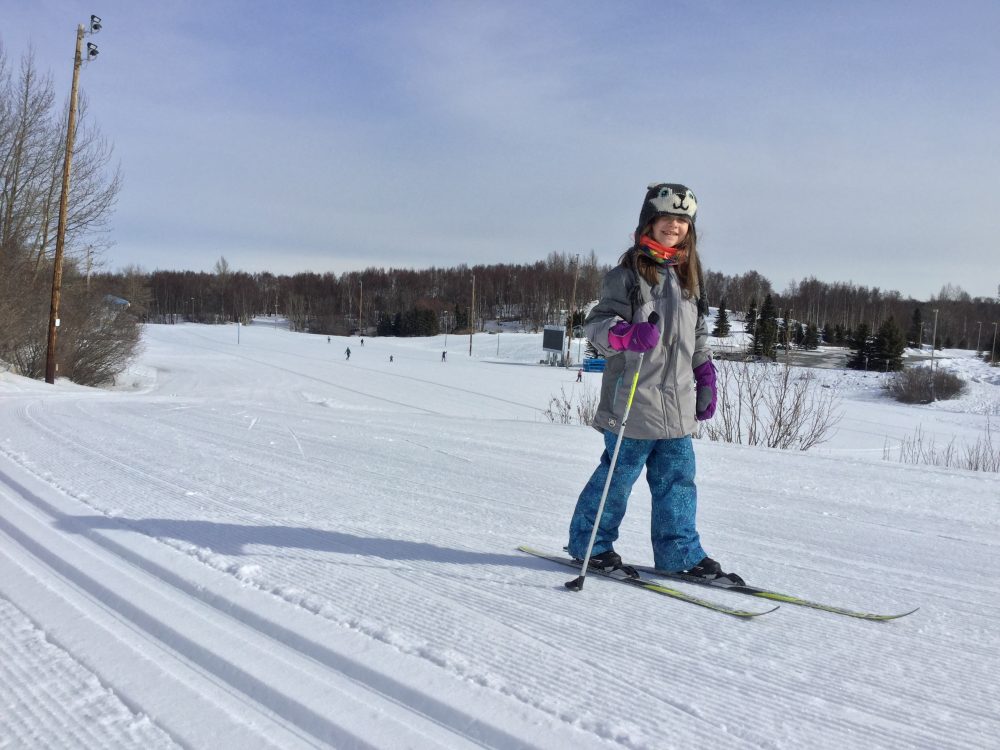
Basically, everything in this picture is the Kincaid stadium, seen here in this view from April 2020 with the author’s daughter in the foreground. (photo: Gavin Kentch)
Some people involved with high school skiing have raised to FasterSkier the specter of teams potentially carpooling from Anchorage out to the Valley, roughly an hour’s drive away. Indeed, the official state meet information form from the Mat-Su Ski Club states, “There will be no indoor facilities for teams. … If all athletes [from a school] are brought up to the venue via bus, athletes will need to use the bus as their warming area.” Moreover, travelling itself has some potential risk, as witness the athlete or athletes who contracted Covid while en route from this country to Finland for 2021 World Juniors, or Estle’s comments on this subject to FasterSkier.
(The Mat-Su Valley has consistently had laxer regulations than the adjoining Municipality of Anchorage, and for nearly a year now has hosted events that were barred in Anchorage. This past weekend saw a statewide indoor hockey tournament in the same jurisdiction, despite the documented health risks of such an activity. Multiple statewide high school basketball tournaments are following suit in Valley gyms. The current case rate in the Mat-Su Borough, 36.4 cases per 100,000, is 2.5 times that of Anchorage, and nearly 3 times that of Fairbanks. It is, by a substantial margin, the highest case rate of any region of the state on the road system.)
The Lower 48 has also exhibited the patchwork effect of different regulations in different jurisdictions. In the Midwest, for example, hundreds of athletes from around the region raced in Houghton, Michigan, in early January, including many from Minnesota – at a time when gathering for group exercise was barred in Minnesota, and high school ski teams could not hold even outdoor practices. Regardless of which state’s policy was “right,” they were clearly quite different.
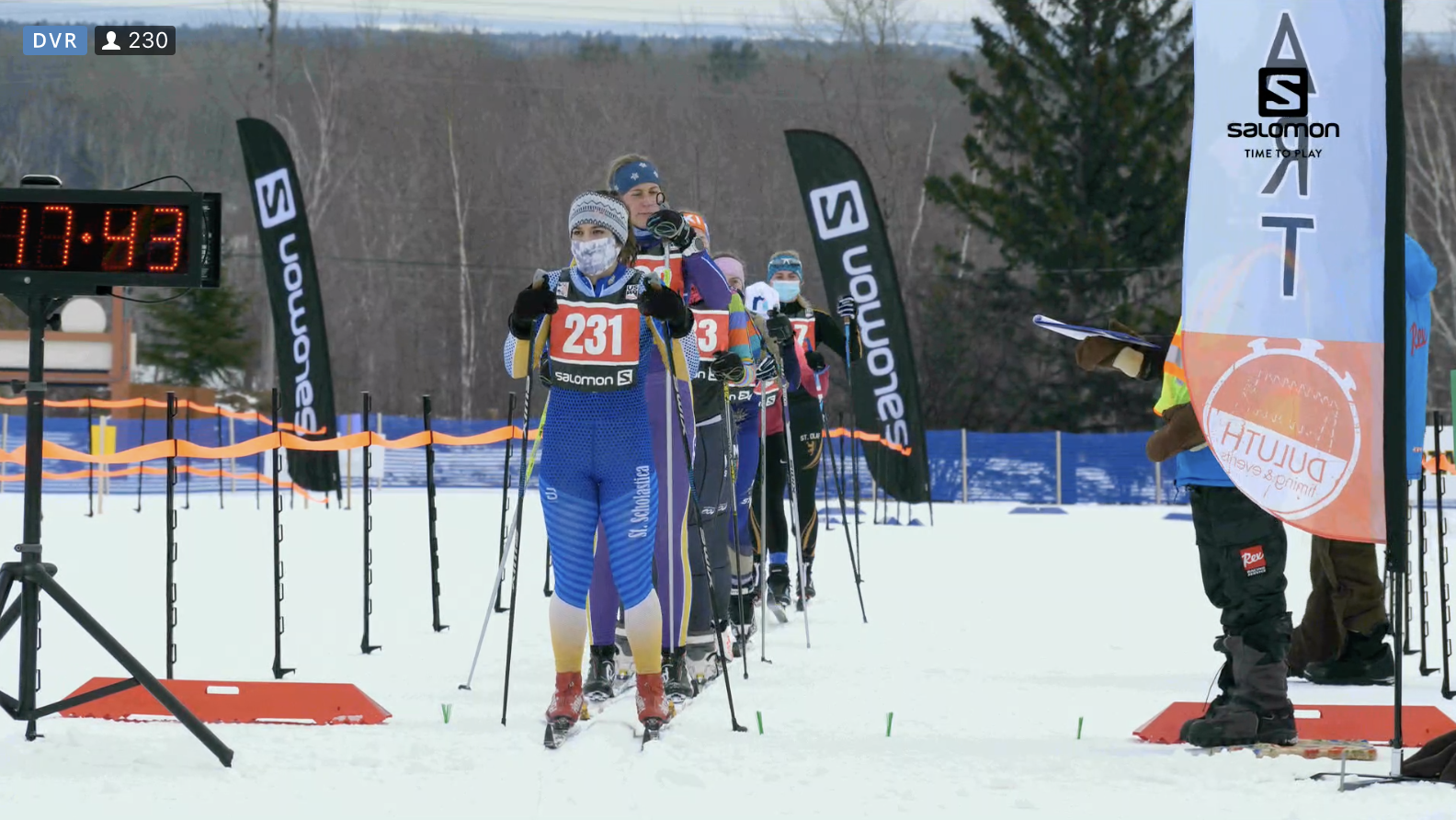
Athletes line up for an interval-start race in Houghton in January 2021. (photo: Livestream screenshot)
Underscoring the incentives involved with competitive races and team naming opportunities for aspiring young skiers, which even in this year could lead skiers to seek out high-level racing opportunities, not a single athlete racing in Houghton in early January qualified for World Juniors. The sole Midwestern athlete among the 30 skiers named to this year’s World Juniors/U23 teams “made the drive to Utah to take advantage of an opportunity to race” that weekend, SkinnySki wrote. Shetold SkinnySki, “the conditions were absolutely beautiful and I was happy with how well organized and Covid-safe the race was.”
Perhaps also relevant, her 8th-place finish in Soho was good for USSA points of, in round numbers, 100, with a race penalty for the winner of 54. Eighth place in Houghton was a 121-point USSA result, with a race penalty of 63. Lower numbers are better, i.e., the Utah race had a more competitive field. The math may become particularly persuasive when presenting oneself as a domestic skier seeking discretionary start rights for European racing.
(Caitlin Gregg, who won both Houghton races, was later given a World Cup start on the basis of “dominating competition in the Midwest and with her points profile from last season,” the Loppet Foundation wrote, though the Nové Město races were subsequently cancelled.)
Later in the month, hundreds of athletes raced at Soldier Hollow in mid-January. The event was still called a “Super JNQ” – critics alleged that it was potentially rather a “superspreader JNQ” – even though there are no Junior National teams to qualify for this year. Athletes travelled broadly from throughout the American West for these races, with clubs based in Utah, Idaho, Montana, Colorado, Oregon, Wyoming, Washington, and California, plus Ontario, Canada, among others, represented in the results. (Athletes from multiple RMISA schools also competed, so add Alaska to the list.)
Athletes line up for an interval-start race in Duluth in January 2021. (Photo: Livestream screenshot)
And the following weekend, Minnesota, just a few weeks removed from a full-on bar on group outdoor exercise, was holding mass start racing at the Skinnyski Santa Solstice Race outside of Minneapolis.
Meanwhile, the high school racing season continued in Anchorage with a steady stream of interval-start races, a decision mirrored in all Anchorage citizen’s races. The racing season in the Midwest proceeded in fits and starts, as different states cycled through different regulations, sometimes with interval-start races and sometimes with wave starts. In Vermont, athletes spent weeks doing unofficial time trials. For not the first time in this pandemic, different states’ restrictions led to different case numbers and different levels of permitted activity.
So, what about the Birkie?
Part two of this article series, coming soon, will examine the American Birkebeiner, and some of the considerations that have gone into the decision to go ahead with this year’s race, albeit in a significantly modified form. FasterSkier will set forth its interview with the race’s executive director, Ben Popp, in advance of the country’s largest ski race(s), currently scheduled to occur over five days starting on this Wednesday.
Sydney Palmer-Leger (front left) skis during the scramble leg of the relay at 2020 World Juniors. It is unconfirmed whether Palmer-Leger has tested positive for Covid at this year’s races or is simply a contact of someone who has. (Photo: Doug Stephen)
Three American junior women have been held out of competing at 2021 Nordic Junior World Ski Championships in Vuokatti, Finland, following a positive Covid test or potential exposure to a positive case, Skinnyski.com has reported.
Yesterday, American skier Michaela Keller-Miller wrote on SkinnySki, “Unfortunately, three members of the women’s US Junior team are in quarantine after one positive Covid-19 test and two possible exposures after contact tracing. As a result, American medal contenders Novie McCabe, Sydney Palmer-Leger, and Haley Brewster are unable to compete this week.”
The US Ski Team has not made a formal announcement regarding any athletes in Vuokatti. It is unknown which athlete or athletes may have tested positive, and which athlete or athletes was quarantined following potential exposure.
All American athletes competing at World Juniors were required to obtain a negative Covid PCR test within 72 hours prior to entering Finland, to take another PCR test upon arrival, and to quarantine at their hotel for up to 24 hours until results from the arrival PCR test were available. The three athletes mentioned above, and all their teammates, were presumably therefore negative when they began their travel to Finland.
Roughly a week ago, on February 4, Finland national public broadcasting station YLE published an article with the auto-translated headline, “Two corona infections detected in the US youth ski team before the Vuokatti World Championships.” The article stated, per Google Translate, “Two patients on the U.S. race team have been isolated. Four people in close contact in this context have also been quarantined. The international ski federation FIS informs about it. The tests were the first to be taken before the competitions.”
FIS also displays a statement dated February 4 that remains linked on their website, reading, “As part of the first period of pre-event testing of the FIS Junior and U23 World Ski Championships in Cross Country at Vuokatti (FIN), two Covid-19 positive test results were reported from the US delegation. The individuals who tested positive were put into isolation and four identified close contacts were put into quarantine. The tests were administered before the individuals obtained the accreditation and access to the field of play.”
Keller-Miller’s article, identifying three athletes who had registered a positive Covid test or counted as a close contact for quarantine purposes, followed a week later.
There were a total of six American women named to the World Juniors team (McCabe, Palmer-Leger, Kendall Kramer, Ava Thurston, Nina Seemann, and Brewster), and two alternates (Waverly Gebhardt and Garvie Tobin).
Through the first two races in Vuokatti, a classic sprint, and a 5-kilometer freestyle, only three athletes from this group have raced so far, Gebhardt, Seemann, and Thurston. There is no American team listed on the start list for Saturday’s women’s 4 x 3.3 km relay, which is potentially consistent with the fact that there are not four American junior women available to race.
Coming in hot! Jessie Diggins leads teammate Sophie Caldwell, Laurien Van Der Graaff (SUI), and Julia Stupak (RUS) during a sprint time trial in Davos. (Photo: Matt Whitcomb)
Lillehammer cancels World Cup events. Norway, Sweden, and Finland pull from the World Cup after the opening weekend in Ruka citing COVID safety concerns. To an outsider, these headlines paint a seemingly bleak picture of the start of the race season. However, an international time trial featuring a skate sprint day Friday and distance event Saturday sparked hope for the American team as they remain in Europe focused on the upcoming weekend of racing in Davos, Switzerland.
FasterSkier spoke with U.S. Ski Team head coach Matt Whitcomb to learn more about the event and its role in helping the American team gain on-snow race experience, sharpen their form and find their race gears amidst a stacked field of friendly competitors.
Taking a step back, Whitcomb shared that travel from Ruka to Davos felt both safe and easy. The team booked a flight through a FIS travel agent from Kuusamo, FIN to Munich, GER, then drove the remaining 3.5 hours to Davos. By reserving through FIS, they ensured that the only other passengers on the flight were other world cup athletes, coaches, and techs, who had been tested in order to participate in the opening World Cup events.
“It was probably the safest flight we’d ever been on and it made for a really easy day,” Whitcomb stated.
Athletes were required to obtain a negative test result within 72 hours prior to entering Finland per the country’s border control policies, then were tested a second time upon arrival at the venue in Ruka. This put them inside what Whitcomb called the “World Cup bubble”.
“FIS tracks our daily whereabouts all winter,” wrote Whitcomb in an email for clarification on testing and travel safety precautions. “We fill out a twice-daily questionnaire for U.S. Ski & Snowboard, as well. We did not need [a test 72 hours] before entering Switzerland. As a team policy, we got one anyway. We were tested again upon arrival to Switzerland, and now that we’ve been here one week, we will test the entire team over the next two days.”
In addition to this testing protocol, the U.S. team is operating an agreed upon team health policy regarding behavior, which Whitcomb outlines below.
“Travel and ride with your roommate. No indoor socializing, other than meals. No family visits, no friend visits. Our current hotel has a separate room and buffet line for our team to use. New athletes and staff arriving to the World Cup enter a ‘quarantine bubble’ until they’ve cleared a PCR test, so we eat in two shifts, and two locations.”
Back to the time trial. Whitcomb explained that the idea for the time trial was raised by one of the Italian coaches, who approached Whitcomb about getting together for some intensity in the week leading up to Ruka.
Gleb Retivykh leads JC Schoonmaker around a bend during the heats of the sprint time trial in Davos. (Photo: Matt Whitcomb)
“We’ve had some pretty good joint workouts and camps over these years with these teams, but I think this was probably the coolest where we had five nations with quite a few athletes entered,” he shared.
The start list for the King’s Court style skate sprint time trial in Davos. (Courtesy: Matt Whitcomb)
With names like Federico Pellegrino (ITA), who finished the 2019/2020 season ranked 4th in the sprint standings, Laurien Van Der Graaff (SUI), who has five World Cup podiums, and last seasons overall World Cup Champion Alexander Bolshunov (RUS) on the start list, the concept gained enough traction that some international athletes chose to stay put in Davos for the collaborative workout rather than travel to a nearby Opa Cup race in Goms, SUI.
Through a text thread, the coaches from each nation agreed upon both COVID safety plans and event format, creating an event that Whitcomb described as “easy-going” in terms of the level of planning and logistics required and the relaxed start time. Teams agreed to forgo fluoros, throwing on CH6 or an equivalent. Despite this seemingly casual atmosphere, putting together a group of fiercely competitive athletes ensured that the event would not be all fun and games.
“It was really nice because — you know, it’s low key and people are relaxed, but you show up and people are warming up har,” said Whitcomb. You just had to bring any bib, so everyone threw on bibs and was wearing their national team uniforms. As soon as you’re suited up, it’s game time, and there was not a lot of holding back out there. It was a really valuable day for us and for everybody. The coaches were all really excited at the end of it.”
Whitcomb explained that because the event was for training purposes, the results would not be released publicly. However, the USST Instagram account calls it a Pellegrino (1)–Bolshunov (2)–Schumacher (3) podium for the men. That said, Whitcomb shared that the effort and results of the athletes were universally positive and indicative that strong performances in true race events are on the horizon.
“Every day that we’re actually on snow doing intensity and in particular head to head racing or intervals is really elevating the level of performance on our team. We’re seeing that just in general comments on feelings in intervals, and this particular day — the skate sprint — I think was a good breakthrough for the team. People were starting to feel good. Conditions were really fast and firm — it was that hero snow that we all love to ski on. And people skied fast, so that was the first time that as a group that we skied at an elevated level rather than just having one or two people knocking one out of the park and the rest of the team skiing just okay at best.”
Some noteworthy results he was able to share include Sophie Caldwell winning the sprint qualifier, the American men keeping the time-back margin tight to top qualifier Pellegrino, and impressive performances by Jessie Diggins and Katharine Ogden in the two lap 10-kilometer distance race.
Katharine Ogden comes on form in the distance time trial in Davos. (Photo: Matt Whitcomb)
Gus Schumacher hammers during the qualifier of a sprint time trial in Davos. (Photo: Matt Whitcomb)
Caldwell’s result was especially encouraging to Whitcomb following what the coach called a “fluke” in Ruka. Finding the last time she had not qualified for the rounds in a sprint event required a lot of scrolling on her FIS athlete profile. Her last time outside the top-30 in qualification happened in Drammen, Norway on March 11th, 2015.
“I think it was a big weight off her shoulders to win the qualifier and just be aware that she’s still the same skier she has been and she’s not suddenly over the hill. I think she can now focus a little bit more without concern that ‘Wow, maybe I’ve overtrained or maybe I’ve really screwed something up here.’”
In her own words, Caldwell shared the following via email.
“I think it’s good practice to get in a race effort, especially when many of us have had so few this year. It was run King’s Court style, so if you won your heat you would move up and if you were last in your heat you would move down. As a result, all the heats were very competitive and well-matched and between three heats and a qualifier it ended up being a very hard day. I was psyched to do my first skate sprint effort on snow and mix it up with some of the girls we will be racing with next weekend.”
(Left to Right) Gus Schumacher (USA), Federico Pellegrino (ITA), Kevin Bolger (USA), JC Schoonmaker (USA), and Alexander Bolshunov (RUS) take to the course in the quarter-final of a sprint time trial in Davos. (Photo: Matt Whitcomb)
As the upcoming race weekends leading up to the Tour de Ski remain scheduled as planned, Whitcomb does not currently anticipate additional workouts like this taking place. He concluded by reflecting on the impact that the development of these international relationships has had on the growth of the American program and his optimism that it’s example will play for continued domestic development.
“For me, the coolest angle of this whole deal is that as unapproachable as the World Cup once seemed to me, that turns out to be not at all the case these days. It’s really a tight family,” said Whitcomb. “The amount of teams that are working together, even if it’s just transferring bags or borrowing wax, it happens on an almost daily basis when we’re in the same location. I just love seeing the same thing happening back in the US. It’s really going to be about partnerships for the US to succeed moving forward and this really left us with a good feeling.”
Interview with Matt Whitcomb following the international time trial in Davos.
Federico Pellegrino (ITA), Gus Schumacher (USA), and Jovian Hediger (SUI) in a trailside chat between the heats of a sprint time trial in Davos. (Photo: Matt Whitcomb)
This news round has an eye towards the International Ski Federation’s (FIS) move to mitigate COVID spread on the World Cup as it eyes a new racing season.
Before we delve into that, we wanted to raise some awareness to a most excellent non-ski related podcast. In short, it’s called TWIV. Longform, it’s “This Week In Virology: the podcast about viruses – the kind that make you sick.”
No, it’s not The Devon Kershaw Show. That has its place too. TWIV is, as it states, a podcast about viruses. The discussions are solid, deep, and require a small background in microbiology. That said, it’s easy to stop the podcast, google a term, and feel somewhat up to speed as world experts discuss viruses that make you sick. In normal times, which these are not, maybe learning about viruses before a new kick wax application technique would seem backward. Not so now.
That’s the plug. TWIV is informative and grounds the listener in current research and trends related to COVID. You can find their website here, or subscribe wherever you get your podcasts.
We mention TWIV because, well, all things at this point circle back to COVID. That’s as true for cross-country skiing as anything else.
Back in June, FIS established its first set of guidelines for World Cup events. The aim remains to produce World Cup caliber events safe for all stakeholders. It follows that FIS should have in place a person responsible to ensure those guidelines are in place and implemented. Rasmus Damsgaard is that person.
According to FIS, Damsgaard currently works with the UCI and CADF, the Cycling Anti-Doping Foundation. His UCI efforts involve establishing the UCI’s protocols for managing COVID. He also comes with important letters after his last name, MD and Ph.D. He is listed as a co-founder of Clearidium, a business focused on anti-doping services. He has published widely on a range of topics relating to doping and human performance. It appears from the FIS press release announcing Covid-19 antibodies test that it contracts with Clearidium for doping control work.
The second piece of COVID related news relates to FIS bundling Covid-19 antibody testing into their doping screenings. Here is some information from the U.S. Food and Drug Administration (FDA) regarding antibody testing for Covid-19:
“A COVID-19 antibody test, also known as a serology test, is a blood test that can detect if a person has antibodies to SARS-CoV-2, the virus that causes COVID-19. COVID-19 antibody tests can help identify people who may have been infected with the SARS-CoV-2 virus or have recovered from the COVID-19 infection.
“At this time, researchers do not know whether the presence of antibodies means that you are immune to the coronavirus in the future; or if you are immune, how long it will last.”
Again, antibody tests diagnose past infection, not necessarily an active infection. The UCI’s Covid-19 mitigation protocol relies heavily on PCR testing. PCR testing is best suited to diagnose an active case after which quarantine can be suggested.
FIS stated it will publish what it calls the “FIS Covid-19 Prevention Event Organisers Guidelines (winter edition)” in September.
An athlete training in Lillehammer, Norway. (Photo: NordicFocus)
With the summer solstice long and gone in the Northern Hemisphere, it’s true, the amount of available daylight wanes. Some are rollerskiing. Some stay fit through trail running or mountain biking. Behind the scenes, cross-country ski area operators are reimagining business practices during the pandemic as they prepare f0r the moment snow flies.
“Chances are we are not having anything quick-fix,” said Reese Brown of the Cross Country Ski Areas Association (CCSAA). “The new world is we need to learn to live with it. That is where we are now. And people are figuring it out.”
It is a world, as Brown mentioned, where new Covid-19 prevention measures have become the status-quo: Maintain proper social distance, wear a mask in indoor public places, and wash hands regularly. With the steep increase in U.S. cases, some states are reverting to even stricter regulations. (As of July 15th, the use of a mask outdoors in Oregon will be required where people cannot maintain six feet apart from non-family members.)
We have become accustomed to mask-wearing in the supermarket. We don’t dawdle and socialize as we may have just months ago. You go, you shop, you leave. Dare we say it feels strangely normal? By the time the ski season is near, many people will be well-versed in COVID avoidance.
As entities requiring cashflow to operate, cross-country ski area operators are envisioning what “normal” business might resemble. Brown explained that some cross-country ski areas are open nearly year-round serving a variety of outdoor-related functions. Those facilities open in the non-winter months, Brown said, are learning and adapting before the onset of winter and a potential crush of skiers.
“I have been calling our ski areas and they were initially saying there was a big fear about opening, the big fear was what are we going to do? What is it going to be like? Is anyone going to show up?” said Brown. “Everyone who opened said it was anticlimactic, people were psyched you were open, they were appreciative of anything that you were doing for them.”
For the nordic centers operating mountain bike trails and rentals, some have adopted on-line reservation and payment systems to minimize physical contact or proximity between the customer and employees. Brown explained that some businesses have a system where the bike is set outside at a specified time and is returned later to an outdoor rack where the gear is then sanitized.
But operating outdoors during the summer months is more manageable than renting cross-country ski gear when it’s frigid. Brown noted that ski areas with larger operating budgets are thinking of novel ways to build semi-permanent infrastructure to make the rental process more streamlined. In other words, minimizing the number of users who must enter a brick and mortar ski center to rent gear, purchase a ticket, and get out on the trails. One ski area in Utah has considered purchasing a yurt to house its rental fleet and reduce the flow of visitors inside the main day lodge.
Proprietors will have to balance what services customers can do without, and what should and will remain. That can be tricky. The bottom line for many cross-country centers relies on the financial padding from retail and food sales. Just how contactless retail and food sales are will determine how some centers navigate the Covid-19 business climate this ski season. We’ll likely see more masks, gloves, plexiglass shields, sneeze guards, and possibly a cap on the number of consumers in the lodge at one single time.
On a June 17 CCSAA round table discussion titled “Learnings from Recently Opened Summer Operations at Cross Country Ski Areas” Matt Sabasteanski, the outdoor recreation director at Pineland Farms in Fort Kent, Maine, was relatively bullish.
“I would think nordic is going to have a huge advantage because there are a lot less special issues, touchpoint issues than alpine,” Sabasteanski said. “You don’t have to ride a lift with anybody if you can come up with a common-sense way to get people paid and out on the trails without having to come into your nordic center. … People do not want to go into the store to buy. People want to get out and recreate, we have seen that with all of our season pass holders – they buy a season pass and they go. The catch point for us is rentals.”
A sign left on the door of the Frisco Nordic Center this spring. (Photo: Frisco Nordic Center Facebook)
On that same round table discussion was Pete Swenson, the Frisco Nordic Center and Trails Manager based in Frisco, Colorado. The Frisco Nordic Center is owned and operated by the town, so it is able to utilize community health resources as it evolves to meet the guidelines for virus prevention. One aspect of experimentation that Swenson noted are virtual solo Strava races. The Town of Frisco is promoting a virtual solo trail running series balancing the need for social distancing with those looking for a taste of competition. In this case, registrants have a 48-hour window to run the specified course and upload the segment to Strava.
Swenson explained during the round table that the race format made him realize this might be a useful way, COVID or not, to bring more masters skiers onboard. With scheduling conflicts and life, oftentimes even a half-day commitment to race is untenable. A solo Strava option or category, Swenson said, would make sense for those skiers with less flexible schedules.
Swenson also offered advice to those seeking to hold race events next winter. As he worked through the protocols for the virtual solo series Swenson said he learned it is best to be proactive.
“I would advise anybody if you want to do events, the more protocols that you bring to the table, with your entities, [the better],” Swenson said. “Because I have to do, I have three layers if I want to do anything. I need a permit from the town even though we are the town, the county, as well as the Forest Service. What we have learned is that if you wait for them to tell you how to put the event on, it will never happen.”
What normal looks like come winter will most certainly bend the concepts of the show-up-and-ski many have become accustomed to. But that does not necessarily mean a poorer experience given the context of a global pandemic. Cross-country ski centers are focused on defining a normal that meets health guidelines while also keeping the ski experience the least disruptive as possible.
The new winter season holds promise. One anticipated dynamic is whether or not the sport can attract new skiers, much as the biking segment experienced significant growth since the pandemic’s onset. Much of that growth, according to a June 16th piece in Bicycle Retailer, was in the “beginner” category.
One certainty remains for ski centers and those responsible for welcoming skiers and deriving the template for operating safely come winter: The customer brings their own level of what Swenson calls COVID-anxiety. It’s one thing if locals are conditioned in the same environment to accept limits on their ski experience. That can be tricky in tourist towns. Cross-country ski center operators will most likely be dealing with visitors from outside their immediate region.
“Something we have learned to live with here [in Summit County], you cannot predict the level of COVID-anxiety of the consumer, you just don’t know,” Swenson said of the climate in and around Frisco which includes the recreation mecca of Breckenridge. “It is all over the map from ‘I don’t care’ to ‘I have had it’ to ‘this is very dangerous’, so it is a huge spread.”