From the FasterSkier archive — posts syndicated from athletes’ and coaches’ own blogs between 2004 and 2012, kept online as published. Current coverage is at fasterskier.com.
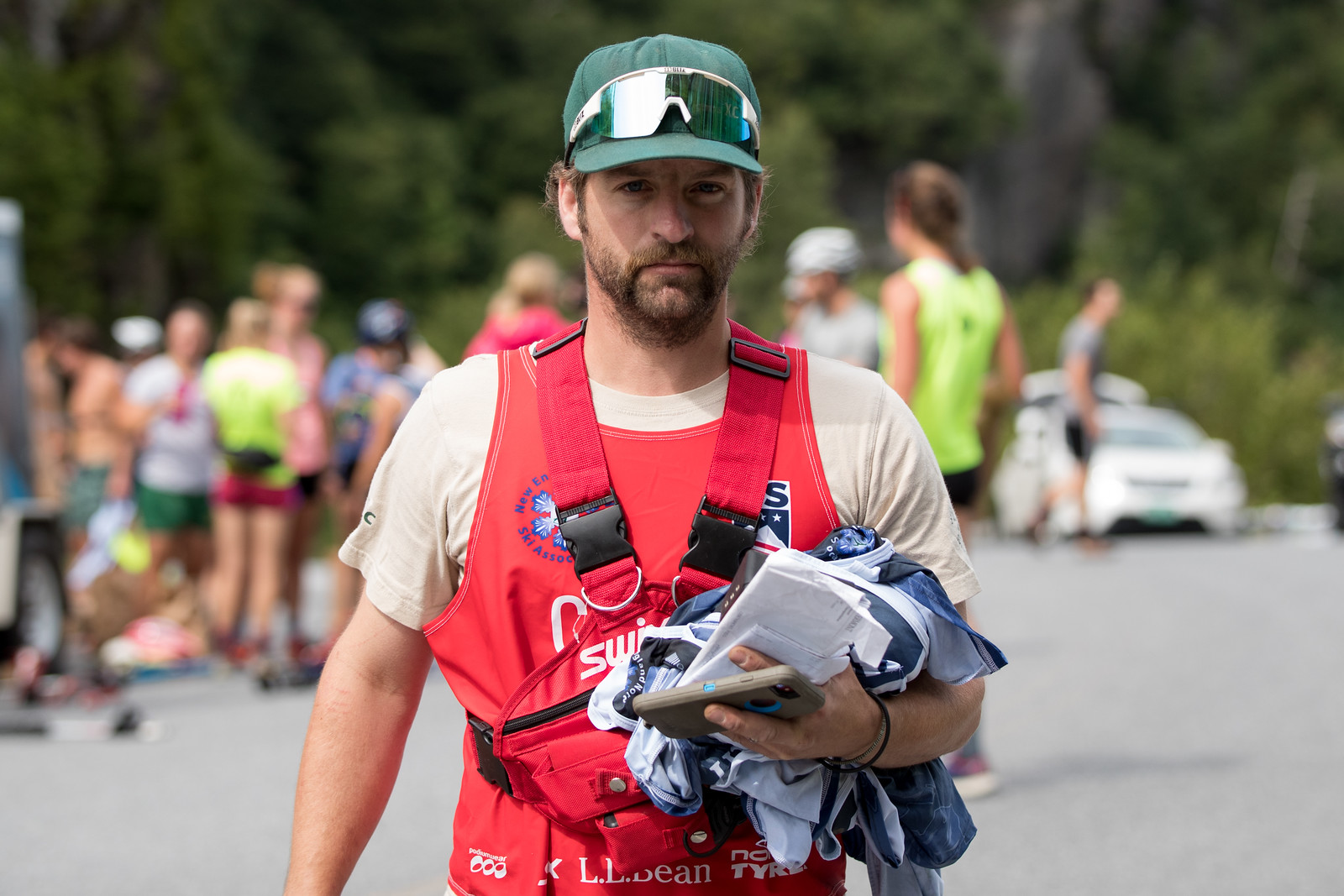
We’re happy to welcome Patrick O’Brien back to the ranks of the Craftsbury Ski Club, this time as the Assistant GRP Ski Coach. Pat, a native of Putney, VT, raced collegiately for Dartmouth before his stint as a professional ski racer with the Green Racing Project from 2010-2014.
While on the GRP, Pat competed in multiple World Cups and also became known to the Craftsbury community as a hardworking jack-of-all-trades with a deep love of skiing and the outdoors. Pat moved on from racing to become the head coach of the SMS T2 team from 2014-2022. Although he coached multiple athletes to international success, he’s most proud of the role he played in building a program that brought together athletes of all ages and rooted the team in its local community.
In recent years, Pat has supported various junior, college, and elite teams as a service technician, all while juggling a job as a builder and wrangling a growing young family. When not up to his eyeballs in ski wax or construction detritus, Pat can often be found outdoors with his wife Ida, who also has deep ties to Craftsbury, and their two kids. Welcome back, Pat!
The Craftsbury Outdoor Center (COC) is now accepting applications for an Assistant Coach with the Craftsbury Ski Club (CSC), supporting both youth and Masters cross country skiing and biathlon programs in northern Vermont.
The CSC is seeking an individual with a diverse coaching skill set to assist in developing our Bill Koch League (BKL)/Junior/Master cross-country skiing and biathlon programs. The CSC operates under the umbrella of the Outdoor Center and serves roughly 300 people aged 6-85 who are pursuing lifelong ski development. Our platforms range from learn-to-ski programs to highly competitive junior programs to recreational masters. The Craftsbury biathlon programs operate alongside ski programming and serve a smaller subset of the same athletes. During the off-season, most of our ski and biathlon coaches stay busy working with our mountain bike programs, particularly our Wheels On Wheels learn-to-ride program.
Major Duties & Responsibilities May Include:
Facilitate regular practices for ski and biathlon groups, ranging from BKL skiers to competitive juniors and Masters.
Travel to regional races to provide waxing and race support.
Help develop practice plans for each group.
Assist in managing and maintaining equipment.
Help organize and coach day and overnight camps.
Maintain biathlon rifles and the range.
Assist with weekly learn-to-ride bike groups on campus and at local schools.
Applications are now open. Full job details and application instructions can be found at craftsbury.com/jobs.
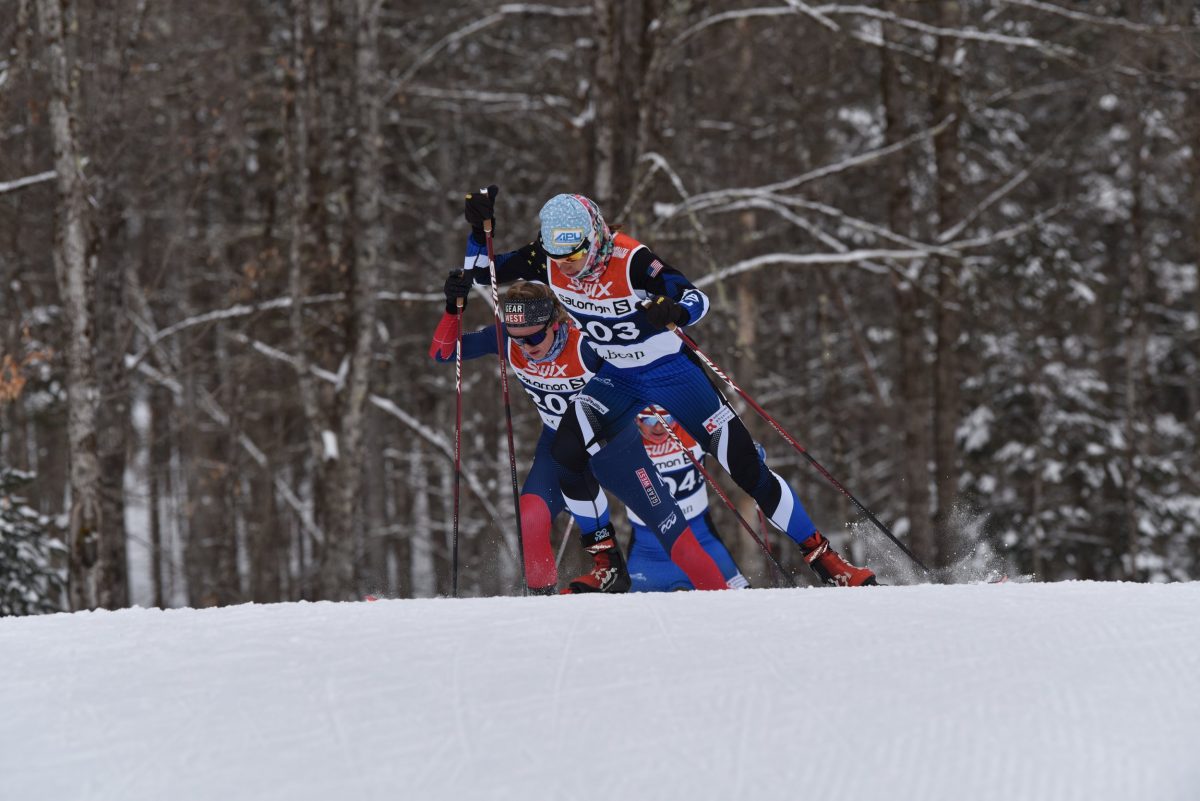
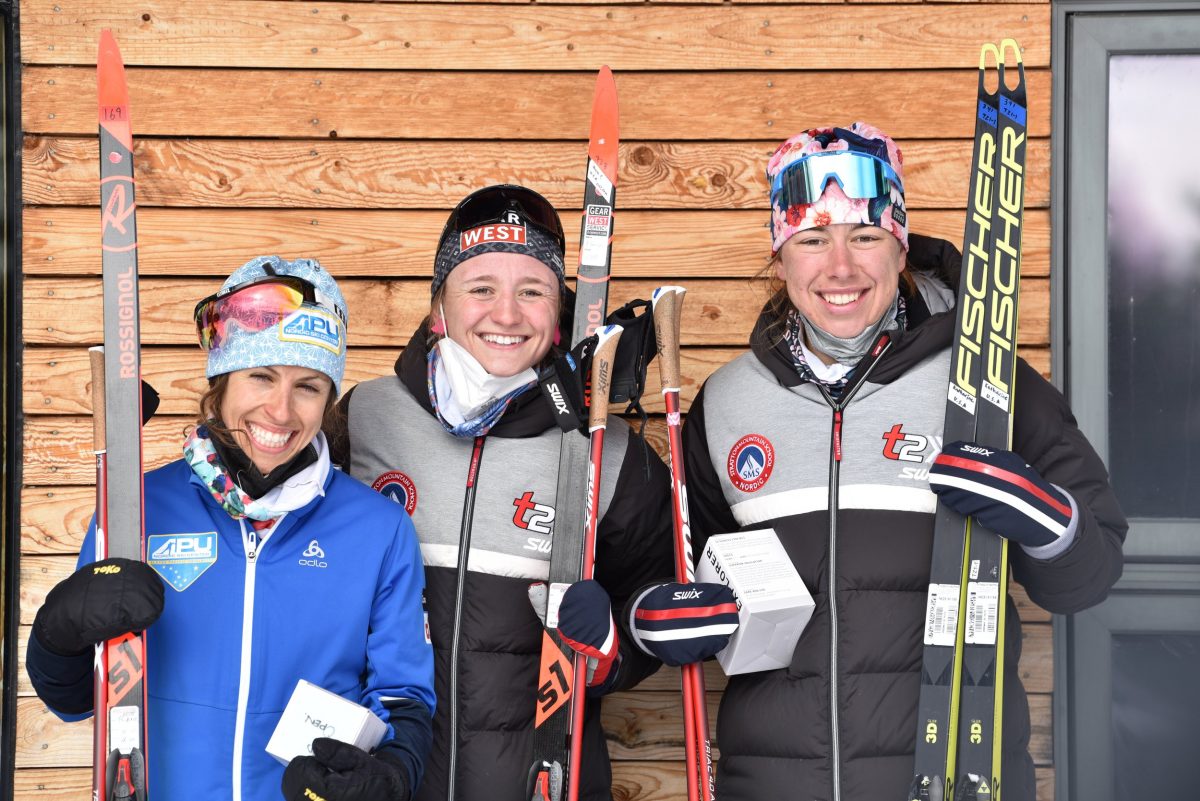
Novie McCabe of APU narrowly winning over Kendall Kramer and Alayna Sonnesyn. (Photo: Tryg Solberg / FasterSkier)
CRAFTSBURY, Vermont — Craftsbury’s SuperTour Finals 40k highlighted some awesome battles amongst the top American men and women. The women started off the day with some extremely fast conditions on the winding and punchy Craftsbury 5k loop. The men took on the course later in the morning and conditions were mostly firm besides the south facing hills.
The women’s race broke into a lead pack of 5 that held strong until a sprint finish. APU’s Novie McCabe narrowly took the win over Kendall Kramer of APU and Alayna Sonnesyn of Team Birkie. Luci Anderson of Team Birkie and Craftsbury’s own Margie Freed, both 2026 Olympic biathletes, finished 4th and 5th.
The early leaders of the women’s 40k heading up Screaming Mimi hill. (Photo: Tryg Solberg / FasterSkier)
In an interview with Craftsbury’s Sheldon Miller after the race, McCabe said that “it was really fun to ski with such a great group of girls.” In regards to her difficult last couple of seasons, McCabe said that “it’s nice to have these good days again. It’s super fun to be back racing this year.”
Margie Freed, mostly a biathlete in the last few seasons, said that “it was really nice to not carry an extra ten pounds on my back, but I was a little sad to not be able to lay down in the middle of my race.” She thanked her coaches for helping her keep track of the lap count.
Alayna Sonnesyn, the Team Birkie athlete that narrowly missed out on the Olympics, said that the top three broke away at the top of the Screaming Mimi climb. When asked how her race went, Sonnesyn said “it was great, it was so fun to be out here. Conditions were fast and furious, kind of like the Birkie this year.”
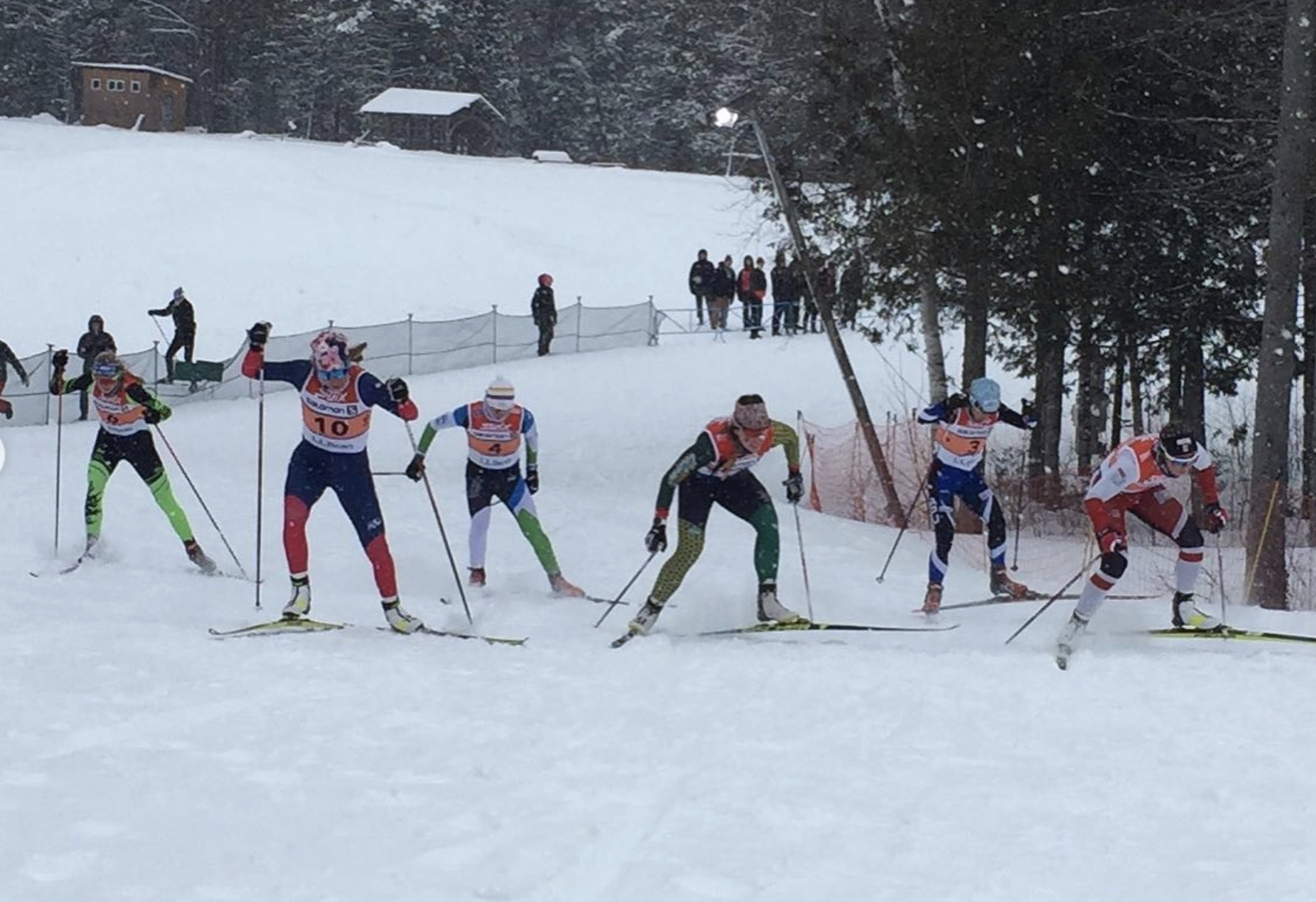
The men’s 40k leaving the stadium. (Photo: Steve Snider)
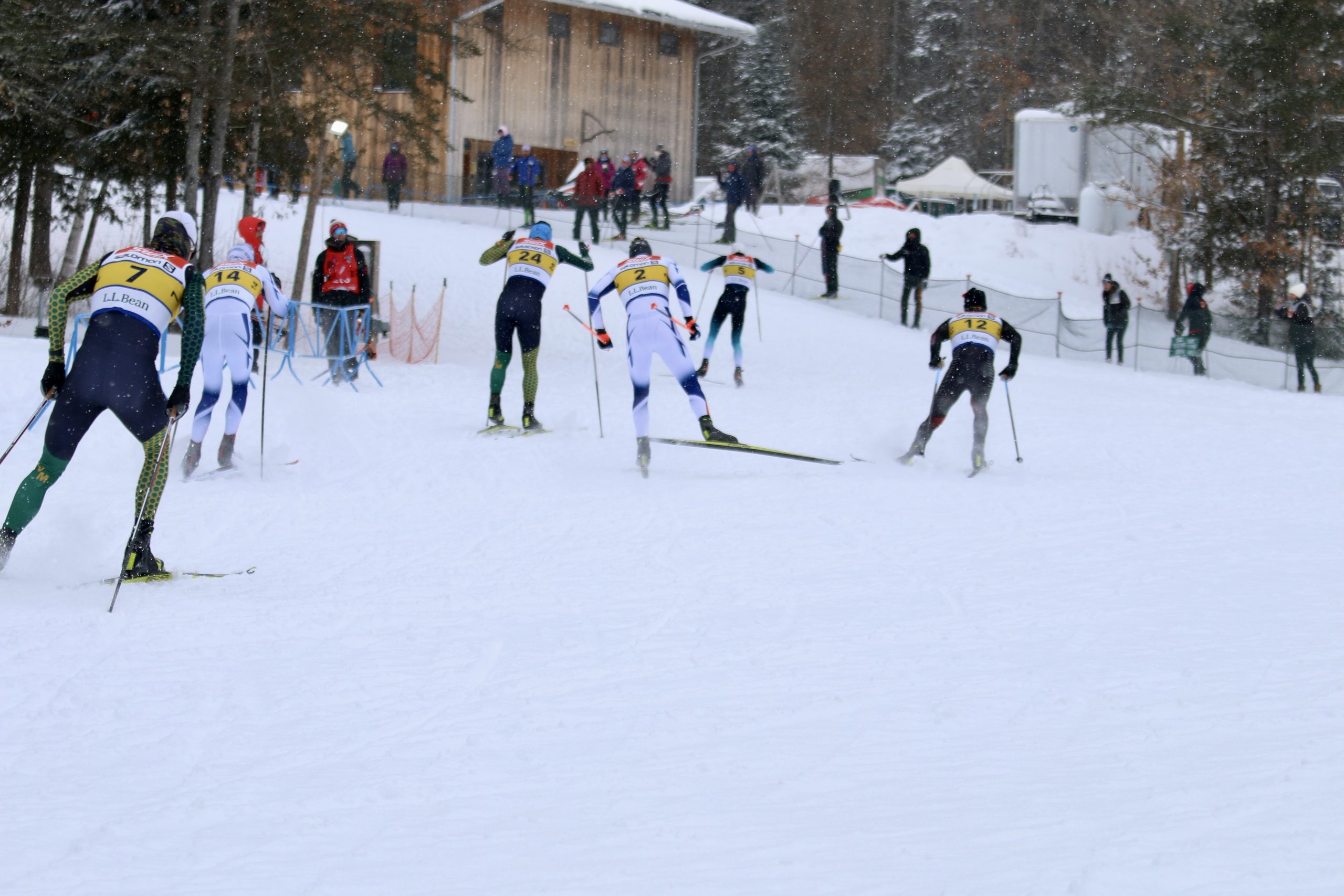
The men’s race was tight with the top 14 coming in less than 60 seconds behind the win. Gus Schumacher of APU ended up edging out John Hagenbuch of Dartmouth for 1st. Kevin Bolger of Team Birkie finished 3rd.
Jake Brown in his last race for Craftsbury Green Racing Project taking the lead up Screaming Mimi. (Photo: Steve Snider)
Hagenbuch said that he has been fighting through some illness since the Lake Placid World Cup Finals.“I didn’t win today, but I was still smiling out there and really just taking in what was my last race for Dartmouth.”
Gus Schumacher also said that the conditions were really fast and it was hard to get away from the pack. He and Zak Ketterson were pushing at the front when Zak had an unfortunate fall within the last few hundred meters: “I was given the first place position and just went for it from there.”
The award ceremony’s after the races highlighted the 40k, junior 20k and 2025-2026 SuperTour awards.
Thank you to Sheldon Miller of Craftsbury Outdoor Center for the post-race interviews with athletes.
FasterSkier will have our own Nat Herz on the ground at the Olympics, which, to be honest, is a very big financial lift for us. If you value the thoughtful work and access FasterSkier provides at championships like this one, please consider becoming a Voluntary Subscriber. Your support directly fuels the work we do to cover the people, places, and moments that make our sport special.
The SuperTour Relay start on Saturday afternoon. (Photo: Tryg Solberg / FasterSkier)
CRAFTSBURY, Vermont — The second day of racing at Craftbury’s SuperTour Finals brought on some hard-hitting team relays. The “Club Relay” had a diverse array of club skiers young and old, along with some college teams. In the afternoon, the “SuperTour Relay” featured the North American pro teams along with the top eastern college squads.
Craftsbury groomer, Eric Hanson, captured Anders Weiss of BSF and Jack Young of Craftsbury Green Racing Project skiing in front of the dump truck responsible for keeping the course open. The truck was stuck on course the d prior year and pushed off to the side with one of their Pistenbully groomers. (Photo: Eric Hanson)
The afternoon raced proved to be quite entertaining as conditions held firm. Team Birkie’s first relay squad won, upsetting APU’s first squad by 46 seconds. Alayna Sonnesyn, Kevin Bolger, Lucy Anderson, and Zak Ketterson held off the APU’s four 2026 Olympians that included Kendall Kramer, Zanden McMullen, Novie McCabe, Gus Schumacher. Craftsbury’s home team of Margie Freed, Brian Bushey, Michaela Keller-Miller, and Jack Young finished in 3rd.
Team Birkie, APU and Craftsbury’s relay teams filling the podium. (Photo: Tryg Solberg / FasterSkier)
Team Birkie was ecstatic with their win. Their second team also came within 6 seconds of the podium. BSF’s team came in 4th of the 33 teams.
Luci Anderson’s leg put on a significant gap to the APU team that they would keep through the race. (Photo: Tryg Solberg / FasterSkier)
In the morning, an additional 33 relay teams and 132 racers in total took on the 5 kilometer lap that Craftsbury staff worked hard to keep open through the recent warm spells. Hundreds of dump trucks and many more snowmobile sleds patched thinning spots on a sections of thinning snow. Eric Hanson, a Craftsbury groomer of 25 years, said that they’ve spent hundred of hours moving snow onto the race course over the last month.
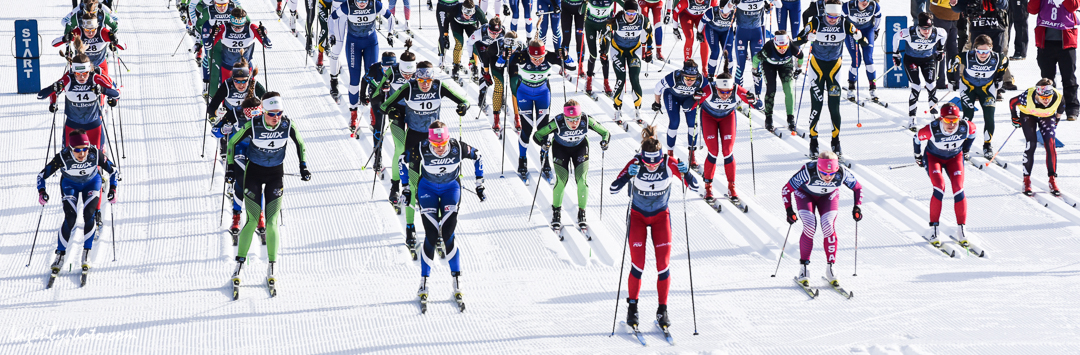
33 teams starting the Club Relay in the morning. (Photo: Tryg Solberg / FasterSkier)
The Club Relay showcased the often-mentioned perk of Nordic skiing: it’s a lifelong sport. With the youngest competitors in the single digits and the oldest many decades in, it was a celebration of the sport and the joy that comes from friendly competition. While most teams donned their spandex suits, some teams added some flair with outfits that surely boosted their speed.
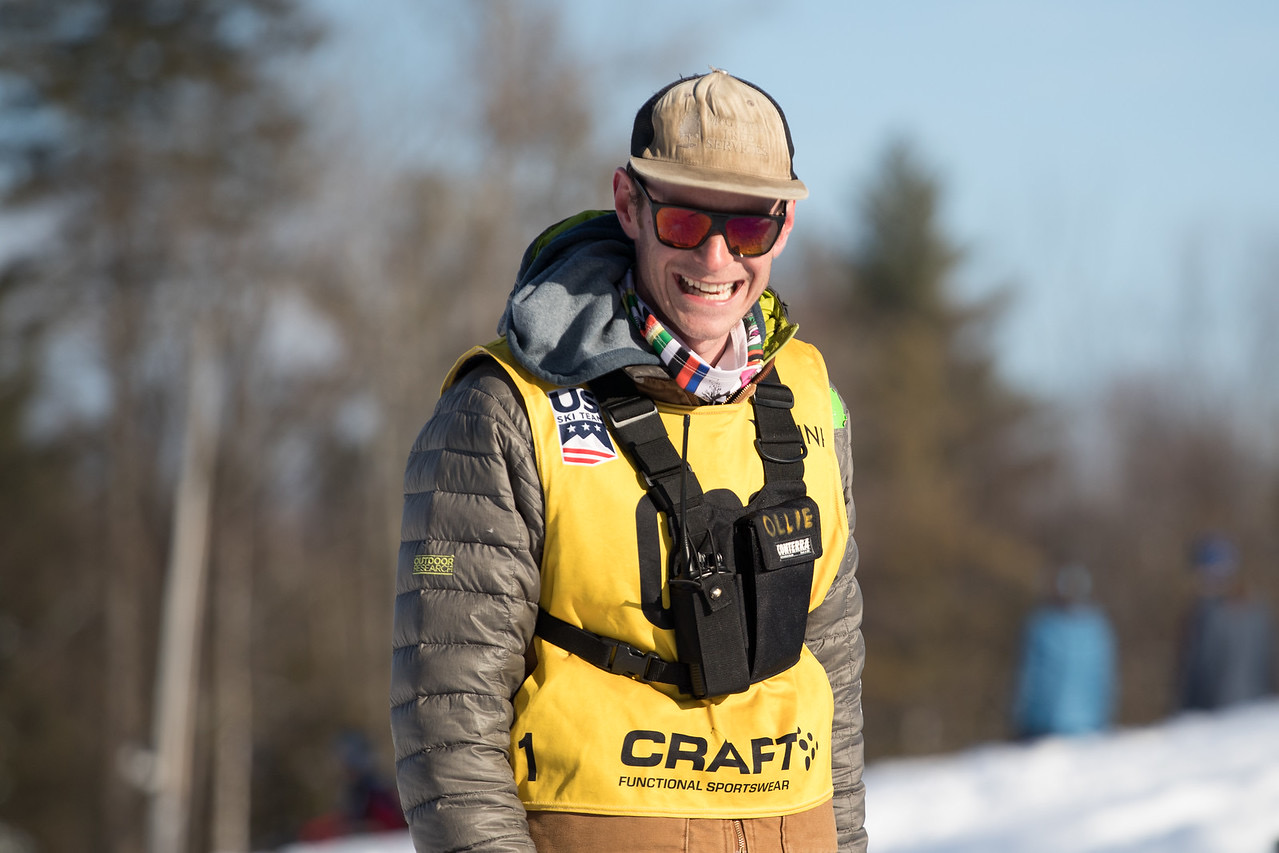
Ollie Burruss, Craftsbury’s Nordic Race Director, making the college skiers nervous with his lead in the first leg of the Club Relay. (Photo: Tryg Solberg / FasterSkier)
All but 7 relay teams were pairs of 2 women and 2 men. The mixed relay was won by “UVM Gold” with Owen Young, Molly Moening, Benon Brattebo, and Caleb Boyce throwing down to narrowly beat out their teammates on “UVM Green.”
Benon Brattebo of UVM leading the first leg of the Club Relay. (Photo: Tryg Solberg / FasterSkier)
If you value the thoughtful work and access FasterSkier provides, please consider becoming a Voluntary Subscriber. Your support directly fuels the work we do to cover the people, places, and moments that make our sport special.
Ben Ogden, the Vermonter, taking the cake in the men’s sprint final. (Photo: Tryg Solberg / FasterSkier)
CRAFTSBURY, Vermont — Craftsbury Outdoor Center kicked off the first of the SuperTour Finals races with a classic sprint on Friday. Yesterday’s weather brought gnarly, foggy, and temperatures in the 50s. Craftsbury’s grooming crew has been putting in long hours over the last few weeks to ensure that conditions would hold on through a warmup. Overnight, they prepared the 1.5-kilometer course that baked under the strong spring sun, creating saturated spring conditions even with temperatures below freezing.
Most of the top American competitors came to cap off their long race season, many of whom are freshly off the electric World Cup Finals. Following up huge events like the 2026 Olympics and the World Cup Finals in Lake Placid, one might think that races in the quaint Northeast Kingdom of Vermont would be a quiet, less competitive affair. Today’s competition couldn’t compete with the 10,000+ fans across the state border last weekend, but it proved to be a tight and fierce battle for sprinters to finish off their season.
85 men and 63 women started the qualifier, representing an array of professional domestic teams, Canadians, Eastern Intercollegiate Ski Association (EISA), and junior racers.
Ben Ogden of SMS T2 won the men’s qualifier with nearly 3 seconds over Gus Schumacher of APU. Murphy Kimball, the 19-year-old sophomore at the University of Alaska – Anchorage, qualified in an impressive eighth, only getting beaten out by elder World Cup regulars.
U20 Murphy Kimball heading to an 8th place in the qualifier. (Photo: Tryg Solberg / FasterSkier)
Erin Bianco of BSF won the women’s qualifier by over 3 seconds over second-place Canadian and Alberta World Cup Academy athlete Katie Weaver. Mia Gorman is a U16 athlete for the neighboring Mansfield Nordic Club who finished the qualifier in 27th, beating out all other junior women and making the heats with the big dogs.
Erin Bianco winning the qualifier by over 3 seconds. (Photo: Tryg Solberg / FasterSkier)
Ogden moved comfortably through the heats, eventually winning the men’s final over APU teammates JC Schoonmaker and Gus Schumacher, who finished in second and third, respectively.
Men’s final starting at Craftsbury Outdoor Center. (Photo: Tryg Solberg / FasterSkier)
Ben Ogden of SMS T2 was very happy about racing in his home state. “It’s a bit more chill” he said in comparison to the World Cup and Olympic stages that he’s been prominent on this season. Ogden also mentioned that, even though the race environment was low-key, the competition was stiff with the U.S.’s top skiers duking it out for the top of the podium.
In addition to representation from many different clubs throughout the heats, the women’s side saw a shake-up in the competition when the third qualifier, Lauren Jortberg of Mansfield Pro/NCPH, fell in the final. Canadian Katie Weaver and her Alberta World Cup Academy teammate Olivia Bouffard-Nesbitt finished first and second. In an interview after the race, Weaver said “conditions were fun, crazy and a bit hectic.”
Canadians Katie Weaver and Olivia Bouffard-Nesbitt embrace after their strong finish for first and second overall. (Photo: Tryg Solberg / FasterSkier)
Emma Albrecht took the top domestic position in third place with her first Supertour win in a sprint race. Erin Bianco of BSF and Alayna Sonnesyn of Team Birkie rounded off the domestic podium.
Albrecht crossing the finishing line as the first American and 3rd overall. (Photo: Tryg Solberg / FasterSkier)
Albrecht was very happy with her racing throughout the day: “The biggest feat for me is being competitive this late in the season.” When asked about her tactics in the heats with the warm spring sun softening the track, she said that she had to “find a rut and see it through.”
Logan Drevlov of Loppet Nordic Racing and Claire Serrano of Craftsbury won the junior heat finals.
Temps are forecasted to drop into the single digits overnight before 4 x 5 km team sprint competitions throughout the day. Tune in for more pictures and results tomorrow.
JC Schoonmaker (APU) and Kevin Bolger (Team Birkie) side by side in the heats. (Photo: Tryg Solberg / FasterSkier)
Help Support Our Olympic Coverage!
FasterSkier will have our own Nat Herz on the ground at the Olympics, which, to be honest, is a very big financial lift for us. If you value the thoughtful work and access FasterSkier provides at championships like this one, please consider becoming a Voluntary Subscriber. Your support directly fuels the work we do to cover the people, places, and moments that make our sport special.
The Craftsbury Outdoor Center is hiring for two coaching roles within its Green Racing Project (GRP), a year‑round elite Nordic ski program supporting post‑collegiate athletes pursuing national and international competition. These positions are in‑person roles based in Craftsbury Common, Vermont and are integral to the daily training, development, and competitive success of GRP athletes.
Head Ski Coach – Green Racing Project
The Head Ski Coach is responsible for leading the GRP ski program and overseeing all aspects of ski training and athlete development. This role works collaboratively with other GRP coaches and Craftsbury Outdoor Center staff to design and implement a comprehensive, high‑performance training program while fostering a healthy, sustainable, and athlete‑centered team culture.
Primary Responsibilities
Design and implement annual and daily training plans for GRP ski athletes
Lead on‑snow and dryland training sessions year‑round
Guide athlete development with a focus on long‑term performance and well‑being
Collaborate closely with other GRP coaches, support staff, and leadership
Plan and support domestic and international training camps and competitions
Uphold and model the mission, values, and community responsibilities of the Craftsbury Outdoor Center
Desired Qualifications
Significant experience coaching Nordic skiing at a competitive or elite level
Strong technical knowledge of training theory and athlete development
Excellent communication and organizational skills
Ability to work effectively as part of a collaborative coaching team
Commitment to sustainable living, community engagement, and shared responsibility
Assistant Ski Coach – Green Racing Project
The Assistant Ski Coach supports the Head Ski Coach in delivering daily training and competition support for GRP athletes. This role is hands‑on and collaborative, contributing to training sessions, athlete monitoring, and program logistics while gaining experience within a high‑level, professional Nordic ski program.
Primary Responsibilities
Assist with on‑snow and dryland training sessions
Support athlete monitoring, feedback, and communication
Help with training logistics, travel, and competition support
Contribute positively to team culture and daily program operations
Participate in the broader work and community life of the Craftsbury Outdoor Center
Desired Qualifications
Experience competing in or coaching Nordic skiing
Strong interpersonal and communication skills
Willingness to learn and work collaboratively in a high‑performance environment
Ability to take initiative and manage responsibilities independently
Alignment with GRP and Craftsbury Outdoor Center values
Compensation & Details
Position details including compensation, benefits, schedule, and start date vary by role and are outlined in the full job postings.
How to Apply
Please review the full job descriptions for full details and submit your application through the appropriate link below:
The Green Racing Project is a year‑round elite training program based at the Craftsbury Outdoor Center. GRP supports post‑collegiate athletes in Nordic skiing, biathlon, rowing and running while emphasizing excellence, sustainability, teamwork, and active participation in a mission‑driven community.
This article was made possible through the generous support of our voluntary subscribers who have helped us put our Nat Herz on the ground at the Olympics. If you value coverage like this, please support FasterSkier with a voluntary subscription.
Megan Chacosky hauling one of many loads of groceries for hungry skiers. (Photo: Megan Chacosky)
Megan Chacosky had just finished cleaning up from dinner when she hopped on the Zoom from the US Olympic Cross-Country Ski Team’s pre-Olympic training camp in Livigno, Italy.
“Yeah, that’s okay,” she said. “I appreciate you waiting for me to reply while I cook dinner.”
When Chacosky isn’t back in Vermont at the Craftsbury Outdoor Center, she’s often doing the unseen work that keeps elite endurance athletes moving: shopping, planning, cooking, adapting — and doing it in places where the grocery store might have four chicken breasts and a cart that doesn’t want to go straight.
“Especially with the Euro grocery carts,” she said, “because they, like, Tokyo, drift in each direction. So once you weigh them down at all, you’re just bumping into everything.”
Chacosky’s path to this role didn’t start with a lifelong plan to work in skiing. It started with kitchens — and with the realization that restaurant hours and athletic training don’t always coexist.
“I really liked it,” she said of her early restaurant experience, “but I recognized really early I was a two-sport athlete in college at the time that it was really difficult to be cooking for a full day, and then still try to be an athlete and move my body.”
She went back to school for nutrition, initially without much sense that sports nutrition was its own lane. “Thinking that sports nutrition didn’t even exist yet at that point,” she said. But at the University of Utah, she found herself in the right place at the right time: volunteering with the ski team, then stepping into a hybrid chef-dietitian role. “That was 2013, my first year with the team,” she said.
Chacosky stayed on full-time through the PyeongChang quadrennial, then spent four years at the U.S. Olympic and Paralympic Committee, overseeing sport nutrition for winter athletes. But she kept circling back toward cross-country skiing.
“Always throughout that time, I’ve tried to maintain a connection with cross-country and with this team in particular,” she said, adding that the athletes “really value nutrition and they value the staff who come in to support them in these contractor roles.”
She also didn’t romanticize what she saw when she first arrived at the highest level of sport.
“It’s easy to overclaim, maybe the Olympics, or what it looks like and feels like at the professional level,” she said. “And then you kind of see all these athletes who are footing their own bill for most of the season, or they are, you know, they’re really working to get more financial support, to get more resource support in general.”
When Chacosky talks about fueling athletes, she doesn’t talk like someone selling a single perfect plan. Her starting point is simpler, and harder: build meals that can work for many different athletes, training loads, preferences, and moods — even if she isn’t the primary dietitian guiding each athlete day to day.
“I have to assume that every individual from this team is going to walk into this room with a different goal for what they want, their nutrition, or their kind of fueling experience to look and feel like,” she said.
In those situations, she aims for variety and flexibility. “Really try to make it kind of as, you know, choose your own adventure as it can be,” she said. “So I try to make it feel like everybody walks in and they think, ‘Oh, this meal was made for me,’ even if there’s 20 people walking into the room.”
The job is equal parts logistics and psychology. Chacosky will ask athletes what they miss, then shape menus around those answers. It could be a “food from home that [they] really want to see, like, a specific hot sauce that I’m going to bring,” she said.
She’s found patterns. “Any Mexican food and Asian food is usually popular with anybody in the group,” she said, because in much of Europe those flavors can be hard to find — especially in the team hotels athletes rotate through during the winter. “Those are really difficult flavors to find,” she said.
She also tries to keep herself learning. “It’s been a goal of mine on every trip to try to pick a new meal that I haven’t made before,” she said. In Italy, that might mean leaning into where she is. “Maybe I’m going to try making fresh pasta or making gnocchi,” she said.
All of it, however, depends on what she can actually buy — and that’s where the day-to-day grind starts.
“I go to the grocery store at least once a day, every day, since I’ve been here,” she said.
The reason is scale. At altitude, with athletes stacking long training sessions, food disappears quickly. “It’s just a mental exception, like, I just need to accept I’m going to go to the store every day,” she said.
In Livigno, she’s had help. “[Coach] Jason [Cork] has been driving me to the store,” she said. “Very, very appreciative of his help.” When someone can share the errand, it changes the rhythm. “To be able to hand him a list, and just know he can go through the store and get some of those things and help me,” she said.
Even with help, the optics are what you’d expect: foreigners filling carts, locals watching. “And then we just fill up two carts, and we go online, and we get laughs and sneers from a lot of the people who are there,” she said. “It’s like, what are you doing?”
Sometimes it backfires. “Russia was probably the most,” she said, remembering an incident from years ago. “I accidentally dropped a container of blueberries… and they kicked us out of the store because I dropped the blueberries.”
Sometimes it works better if she can communicate ahead of time. “We can talk to the grocer and tell them, ‘Hey, we’re staying here for two weeks. I’m going to be buying this amount of food every single day,’” she said. “So… we can actually communicate and just let them know, ‘like I’m going to be eating all of the eggs that you have. So if you can get more from your supplier… that might help you out.’”
In Livigno, the constraints can be more basic, as in what the shelves can actually hold. Chacosky described walking into small Italian shops and finding limited quantities of meat. “There’s, you know, like four chicken breasts that are there,” she said. “Because that’s just what the butcher brought in. That’s what the farm was able to provide that day.”
That scarcity has an upside: the quality. “Just the quality of… the meat and dairy products here have been really, really good,” she said.
Then there are the unexpected windfalls — the strange currency of a long European winter: podium prizes and leftovers.
The U.S. team arrived with a trio of cheese blocks from recent success; Chacosky said she’d used Gruyère “at almost every single meal so far.” Athletes, she explained, treat it as a snack as much as an ingredient. “They’ve gone through almost a wheel… just in snacking,” she said. But she’s cooked with it too: “I did a bunch of the grilled paninis the other day… We did some pasta and meatballs.”
She’s also dealing with another inheritance: “There was, like, 20 bags of trail mix from Oberhof,” she said. Rather than let it sit, she’s been breaking it down. “I’ve been sorting the dried fruit and nuts from the trail mix to use for different things throughout the week.”
Her approach is shaped by her work back home. “My full-time role is with Craftsbury and the Green Racing Project,” she said, “and I think part of that too, I really like to bring this kind of degree of sustainability and resourcefulness when I go on the road.” The goal isn’t just abundance; it’s abundance without waste. “Trying to… get down to as little food waste as possible at the end [of a trip], has become kind of another project of mine,” she said.
That kind of planning gets more complicated when you add medical constraints — the things that can’t be solved by enthusiasm and another shopping trip.
“So we have one celiac allergy with us right now,” she said. “And celiac has such an easy cross-contamination zone.” Her response is immediate and practical. “I will travel with painters’ tape and Sharpie,” she said, “and I will just immediately… label them. Like, ‘this is gluten-free only.’”
There’s another allergy on the coaching staff side that changes everything. “Chris Grover (US Cross-Country Ski Team program director) is probably the weirdest,” she said. “He has a poultry allergy.” She described the implications plainly: “chicken is, like, only one of the best proteins that you can serve… and he can’t.” At a previous championship, she took extreme measures. “In Trondheim for World Champs,” she said, “I would cook chicken in the sports Med Room.”
These are details athletes sometimes mention in passing, but they define Chacosky’s work: building a kitchen that is fast, safe, flexible, and — somehow — comforting.
When asked what meals get the biggest reaction, she didn’t point to anything trendy. She pointed to the things that feel almost too easy.
“It’s probably ‘Brinner’,” she said, explaining: “the breakfast for dinner.” She laughed at herself a little. “I could make it every single day, and I don’t think anybody would complain.”
Then she offered another surprise: “the soup and sandwich day.” For her, it can feel like she’s cutting corners. For athletes, it can feel like exactly what they needed.
“It’s all of the meals to me that feel like I’m not doing my job,” she said. “Like I’ve just made a tomato soup and put some grilled cheese together with ham and a fruit and veggie tray. And I was like, ‘this is like, cheating.’” But then: “They just are out of their minds excited about it.”
The team’s appetite isn’t only for comfort. It’s also for familiarity — the branded products and specific flavors they’ve trained with for years, the stuff they don’t want to gamble on when the stakes rise. Chacosky is involved in that, too: the long process of shipping a slice of home across an ocean.
“I actually get to be a part of the process too, for all of the food that we ship over from the US to the games,” she said. This year, because Italy’s venues are spread out, cross-country skiing got something rare. “Cross-country, got to pick, we got our own budget to kind of pick our own pallet of food to send for just these athletes,” she said. “Which is such a huge benefit.”
The list is partly performance, partly preference. “We send a survey out to athletes,” she said. If someone needs a very specific bar flavor, she can put it on the pallet. “Jesse loves peppermint Luna bars,” she said. “I want two cases of those, and we’re going to put them on the pallet.”
The freight itself is a slow-moving, months-long commitment. “They… put them on a pallet, typically at the end of October,” she said. “To be shipped over.”
Some places require an absurd amount of paperwork. For Beijing, she remembered, “every product, including different flavors… had to have four pieces of paperwork.” Italy, she said, has been easier on packaged goods, though anything involving meat or dairy still brings extra scrutiny.
Her description of what they shipped this time sounded like a team trying to control the controllables: hydration mixes they already use, recovery drinks in familiar flavors, and enough real food for the staff who may be away from the hotel all day.
“We added a bunch of Maurten products,” she said. “We got a lot of Skratch product as well for hydration support.” And for the technicians: “We’ve got some ramen or like Annie’s mac and cheese cups going to them.”
She paused on that point — the staff. “Some of our focus, too, was very intentionally for the tech staff as well,” she said, because on race days they may be at the venue “from the morning till the night.”
On television, the sport is skiers, split times, a leaderboard, and a finish line. In the background, there are also shopping carts that won’t roll straight, a roll of painter’s tape, a curated pallet of food from home, and the daily decision to go back to the store again.
Help Support Our Olympic Coverage!
FasterSkier will have our own Nat Herz on the ground at the Olympics, which, to be honest, is a very big financial lift for us. If you value the thoughtful work and access FasterSkier provides at championships like this one, please consider becoming a Voluntary Subscriber. Your support directly fuels the work we do to cover the people, places, and moments that make our sport special.
When we spoke, Kristen Bourne was sitting on the couch in her living room in Truckee, California, a small ski town she now calls home. Tibetan prayer flags hung loosely behind her, shifting gently in the morning light that poured through the window. The room felt warm and calm — the kind of quiet space that comes from someone who spends much of her year on the move. Bourne smiled easily as she spoke, her voice’s cadence unhurried, like someone grounded in both her work and the mountain rhythm around her.
She had just returned from camp and was preparing to leave again this weekend to start the World Cup with the U.S. Ski Team. Between talk of travel logistics and packing lists, she mentioned the soundtrack that keeps her company on solo skis. “When I’m skiing by myself? Yes,” she said, grinning. “I really like skiing to Machine Gun Kelly… it kind of brings me back to the Blink-182, Sum 41 days. It feels almost like nostalgic, but newer age.”
That small confession says a lot about Bourne, now in her fourth season on the U.S. Cross-Country Ski Team coaching staff: rooted in rhythm, grounded in joy, and always blending the familiar with the fresh.
Joy, she’ll tell you, isn’t a garnish. It’s the point.
Kristen Bourne, Olivia Nesbitt Bouffard, and Jessie Diggins on an afternoon run in Wanaka, New Zealand. (Photo: Jessie Diggins)
“Happiness goes such a long way in professional sport… our secret weapon as a team is having fun. Our staff genuinely enjoys being together. The athletes genuinely enjoy being together. We love to all come together.”
The proof, for her, is a memory from the day Jessie Diggins won the 10 K at the World Championships in Planica. The scene isn’t what the public imagines. “You’d think everybody is stressed,” Bourne said. “We were ahead of schedule, and we all just sat down in [our wax truck], Yolanda, and made instruments out of whatever we could find for, like, 30 minutes.” The room filled with improvised drums and laughter. “It was so fun,” she said. “That’s the stuff people never see.”
Northern Michigan University’s Kristen Bourne (c) after the 5-kilometer classic race at the 2017 NCAAs in Jackson, New Hampshire. (Photo: Jackie Schneider)
Minnesota Roots, and a Goal Cut in Half
Bourne grew up just outside the Twin Cities, where endurance sport was a family language. “Our family vacations were going to [my dad’s] marathons and triathlons,” she said. She started by hopping into a mile here and there, handing him nutrition at the end of the driveway, learning the cadence and care that go into long efforts.
Skiing arrived as a nudge. A new high-school coach was recruiting runners to cross-country ski at Mounds Park Academy. The first season was rough: “I swore I was going to quit. Every single race I did, I cried after most races,” she said. In a 5k, Jessie Diggins (then a rival in the same section) beat her by 12 minutes. Bourne’s response was characteristic—specific, measurable, gritty: next year, get that down to six.
She continued to run and ski through high school, then headed to Northern Michigan University after spending a semester at the University of Colorado. She transferred mid-winter 2014 and skied at NMU through 2018, working under a rotation of assistants. Her path after graduation would tilt everything she thought she knew about training.
Kristen Bourne spent time in Norway after college training with Lyn Ski / Team Obos. Bourne is pictured here racing in a Norwegian Cup race in Gålå. (Photo: Martin Riseth)
Norway: Where Individual Plans Meet Shared Trails
Right out of college, Bourne moved to Norway for a year and a half. She intended to ski; illnesses complicated the plan. But a concurrent internship at the Norwegian School of Sports Science opened doors into a different coaching world. Back home, she was used to “show up and the coach tells you the workout and everybody does the same thing.” In Norway, she said, “you sit down with a coach and you generate your plan… It was the first time I was exposed to individual planning—thinking about what’s best for you, not necessarily the team.”
Interval days there could look like organized chaos: “Every single person… almost had a different workout, but people would sync up where they could.” At first, she struggled; she missed the mob grind. Then she looked around at a culture of success and realized what was happening: athletes were learning their bodies early, practicing agency. The lesson stuck. “Team workouts are also the way to go,” she said, “but giving athletes a platform to think for themselves—creating this athlete-coach collaborative experience versus coach telling athlete, ‘this is what you should do’—had a tremendous impact” on how she now works.
(l-r) WSCA members Maria Stuber (then CSS), Kristen Bourne (then CSS, now with the US Ski Team), Kristen Monahan-Smith (Michigan Tech), and Tracey Cote (Colby College) at the NCAA Championships in Jackson, New Hampshire, in 2021. (Courtesy Photo).
The Parking-Lot Pivot
Her return to the U.S. was abrupt. She lost her residence permit—”turns out it was under the seat of my roommate’s dad’s car”—and flew home with two days’ notice, arriving just as COVID was beginning to ripple into sport. She kept racing a little, then decided she was done.
That’s when a well-timed email—and a parking-lot shout—changed everything. Her dad reached out to Maria Stuber, who was building the Women’s Ski Coaches Association. “Maria found me in a parking lot at U.S. Nationals and yelled out her window, ‘I’m going to call you,‘” Bourne remembered. A call later, Maria offered her a position at the College of St. Scholastica and connected her with Pepa Miloucheva at the Craftsbury Green Racing Project. After two school years at Scholastica, with summers in Craftsbury, Bourne joined the U.S. Ski Team staff.
The transition was, by her own admission, intimidating. “It was this idea of, like, how am I here?“ she said. But Norway’s reminder—that fresh eyes are valuable—kept her steady. “Just because you’re newer and have less experience doesn’t mean your ideas aren’t valid,“ she said. “You’re maybe fresher out of a ski career, you relate with athletes in a different way. There’s a lot of value in that.”
She also learned to de-personalize the miss. “Technique feedback doesn’t always stick. That’s not a reflection of me as a coach or the athlete,“ she said. “We tried that idea; it’s fine. We’ll try something else.“ Each year, she felt more confident; more importantly, she built deeper connections.
Julia Kern—one of the athletes Bourne works with most closely—sees that same quality every day.
“Kristen is unique in the sense that she’s able to connect with just about any personality type on the team,“ Kern said. “One of her strengths is figuring out how to connect differently with different athletes. Every athlete responds differently and has different needs, and she just gets that. She’s very approachable and sees athletes as whole people.”
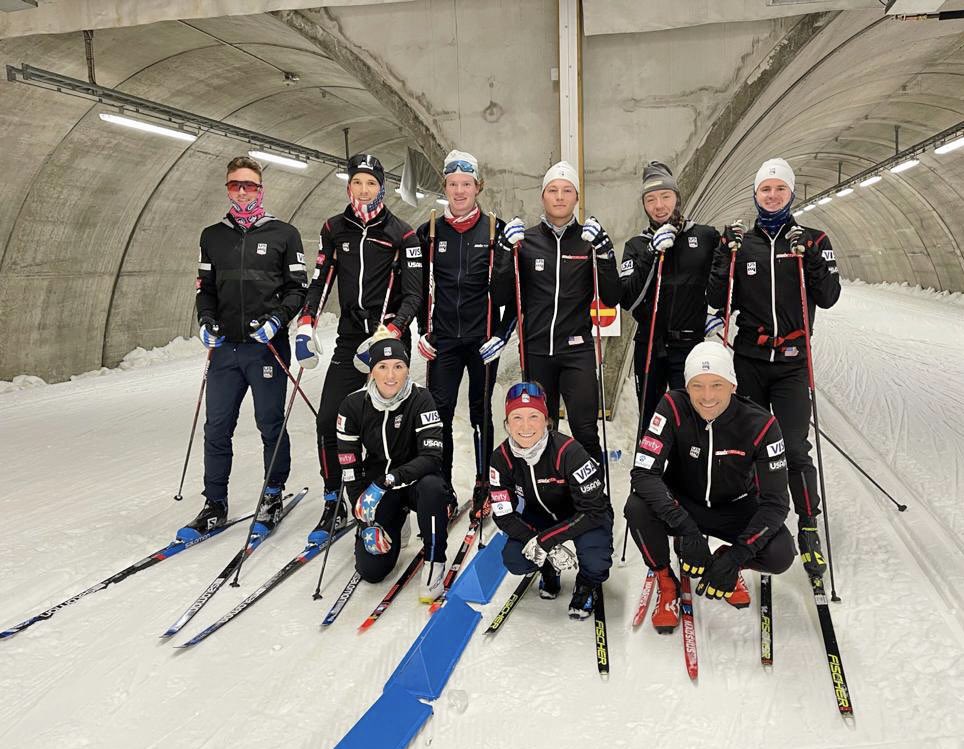
USST athletes and coaches in the Torsby Ski Tunnel, August 2022. Back row, from left: Johnny Hagenbuch, Kevin Bolger, Finn O’Connell, JC Schoonmaker, Ben Ogden, and Walker Hall. Kneeling, from left: coaches Greta Anderson, Kristen Bourne, and Matt Whitcomb. (photo: François Faivre)
Mentors and a Collaboration-First Culture
Ask Bourne about mentors and the names tumble out: Matt Whitcomb, Chris Grover, Jason Cork. “From the very beginning… incredibly supportive,“ she said. “Matt will answer his phone every time. He usually likes to FaceTime… we brainstorm ideas.“ The flow goes both ways: she calls when the connection is hard; he calls when he’s stuck on something.
Her women’s network is just as active. “Maria Stuber, hands down,“ Bourne said. “And Sam Benzing at Montana State—we coached together at Scholastica. She’s younger, but her perspective is so interesting.“ Group FaceTimes are common: Maria, Sam, Kristen, swapping angles and problem-solving. It’s not just helpful; it’s survival. “It would be really hard to be in this job and not have that,“ Bourne said. “The collaboration makes it so much more sustainable.”
That same approach underpins her work with athletes like Kern.
“Kristen’s helped me figure out what kind of training plan works well for me,“ Kern said. “We’ve tried some new things the last few years—different kinds of workouts, always thinking creatively. She’s open-minded, reads up on what other athletes are doing, but also thinks for herself. She’s got such a growth mindset.”
Julia Kern and Kristen Bourne in Sjusjøen at the 2025 pre-World Championships camp. (Photo: Matt Whitcomb)
Coaching Women, Coaching Men — and Being Seen
On the World Cup, visibility is progress measured in inches. FIS’s women-coach bibs created access (up to two additional bibs if teams have women on staff), but change is slow. “Every year, maybe there’s one or two new women… it definitely hasn’t blown up,“ Bourne said. Old assumptions linger. “I probably get asked a couple times a year from male coaches: ‘Are you the massage therapist or PT?’“
For Kern, Bourne’s presence is more than symbolic.
“It’s huge,“ Kern said. “She’s one of the few female coaches on the World Cup level, and she’s down to work hard and just have fun with it too. I hope the next generation of women who want to coach feel inspired that they can do it too. Kristen’s paving the way, even in ways people might not see from the surface.”
Bourne herself agrees that visibility matters. “You can’t be it if you can’t see it,“ she said. “It’s important for young men, too, to see women in leadership roles. Our men’s team has been incredible—they’ve never made me feel like I don’t belong.”
Her advice to aspiring women coaches is emphatic: build a robust support community. “Ask for advice,“ she said. “It makes a world of difference.”
Kristen Bourne and Sophia Laukli on the pre-race day at Val di Femme during the 2025 Tour de Ski. (Photo: Leann Bentley)
Athlete Work: Julia Every Other Day, Gus and Sophia on the Radar
Bourne’s primary day-to-day is Kern. “We’re talking basically every other day—texting or on the phone, training planning. We work very closely, very in depth,“ she said. She also monitors Gus Schumacher and Sophia Laukli.
Kern said that beyond the workouts, Bourne has shaped the team culture itself.
“She’s really good at encouraging athletes to bring their own sense of leadership,“ Kern said. “Not everyone is going to be outspoken—some are quiet leaders, some lead through training. She empowers people to be leaders in their own way. She creates a team atmosphere that’s a judgment-free zone. No idea is a bad idea.”
Gus Schumacher and Kristen Bourne after his 4th place finish in the Davos sprint during the 2023 Tour de Ski. (Photo: Leann Bentley
Season Outlook: Keep the Vibe, Chase the Team Moments
Last year’s long illnesses made for uneasy preseason reading. This year feels different. “People are in a pretty good place,“ Bourne said. “At our camp in Utah, I would assume there would be a little more stress—it’s an Olympic year. Not at all. People were so relaxed and chill and vibing and doing their thing.”
If there’s a metric she’d choose for success, it’s carrying that “happy momentum“ through everything—the Olympics, Lake Placid World Cup Finals. “In a year with so many eyes on cross-country skiing, that would be massive,“ she said.
Results still matter, of course. And she lights up talking about the collective ones. “It would be so awesome to see success in team events,“she said. “Relay and the sprint relay—those mean so much when it’s a collective team event. We want to do well there.”
Lucas Wilmot, Kristen Bourne, Murphy Kimball, Tabor Greenberg in Bend, Oregon 2025 after wrapping up the first L3 intervals at camp. (Photo: Leann Bentley)
Representation, Purpose, and the Long Run
There’s a moment near the end of our conversation when Bourne zooms out to the why. “We are very deeply intertwined in another person’s process and journey,“ she said. “What an absolute privilege to be part of that. It’s impossible not to come to absolutely love and care so much about these people.”
Kern echoed that sentiment from the athlete side.
“Kristen understands there’s life outside of skiing,“ Kern said. “She also knows what it takes to be one of the best in the world—and when it’s time to step away. She helps us stay grounded.”
Five years from now, Bourne hopes she’s doing exactly this, just deeper—”coaching, getting to know these athletes more and more.”
And she hopes the picture around her looks different: more women coaches on staff, on other staffs, in other sports at U.S. Ski & Snowboard; more women wax techs. “If I can have a tiny ounce of contribution into changing that,“ she said, “I’d be so, so happy.”
Kristen Bourne and Colin Rodgers out for a run during the OD run at Park City camp, 2025. (Photo: Matt Whitcomb)
Purpose, Rhythm, and Joy
As our conversation wound down, Bourne slightly rotated her position as the light spilling through the window shifted—yet still filtering across the prayer flags behind her. She laughed when she mentioned her must-pack item: heated socks for Finland. “I get cold fast,“ she said. “Those are my best friend.“
There’s rhythm in that, too: warmth, joy, and purpose, all braided into one.
Because for Kristen Bourne—and for the athletes who work with her—the secret weapon really is fun.
Leann Bentley, Kristen Bourne, and Bernie Nelson at Val di Fiemme the morning of one of the last stages of the 2024 Tour de Ski. (Photo: Matt Whitcomb)
Love Stories Like This? Help Keep Them Coming.
Feature interviews like this one take time, access, and care to produce. If you value thoughtful storytelling and independent ski journalism, please consider becoming a Voluntary Subscriber. Your support directly fuels the work we do to cover the people, places, and moments that make our sport special.
The first time you meet Patrick Weaver, you might not realize you’re talking to one of the most quietly influential coaches in American skiing. There’s no bravado, no self-promotion. Just an easy Vermont calm — a man who measures his words the same way his athletes measure their training: carefully, purposefully, with feel.
On a fall morning, the UVM Nordic team threads through the mist at the Craftsbury Outdoor Center, the quiet hum of rollerskis against asphalt echoing in the distance. Weaver watches from the side, hands in his jacket pockets, hat pulled low. He doesn’t bark instructions. He doesn’t need to. The rhythm of his teams speaks for itself.
Wilmington, Vermont’s Sophomore Luke Rizio. (Photo: Philip Belena/EISA)
“I always say it’s not the individuals that make the team fast — it’s the team that makes the individuals fast,” he says. “Once they believe that, the motivation takes care of itself.”
For nearly twenty years, that philosophy has shaped the University of Vermont into one of the most respected programs in NCAA skiing — not through hype or heavy recruiting, but through a culture of trust, humility, and balance.
Lessons in Motion
Weaver’s path to coaching wasn’t linear. It’s more like a relay through decades of ski mentors who left their fingerprints on his philosophy.
“I never had one coach through my whole career,” he says. “There were a lot of influential people — high school, Stratton, college, the national team. I just learned to take things from each of them.”
He spent a post-graduate year at Stratton Mountain School under Sverre Caldwell before skiing for Cory Schwartz at UNH — a relationship that would define his sense of what a team could feel like.
“Cory was probably the most influential,” he says. “The way he ran that program — it was a family. I took that with me when I came to UVM.”
After college, Weaver worked under a rotating cast of national and international coaches: Gordon Lange, Christer Skog, Sten Fjeldheim, Torbjørn Karlsen. Each brought a different rhythm to training. The mosaic of ideas shaped the adaptable style he’s known for today.
“There’s not one way to coach,” Weaver says. “And because of my background, I’m not a ‘my way or the highway’ coach. I’ve seen too many ways that work.”
Patrick Weaver racing in the 15 k Classic at the 2002 Olympics in Soldier Hollow, Utah. Weaver finished in 16th place. (Photo: UNH Ski Team)
The Season He Cut His Hours
In 2002, the year of his second Olympics, Weaver did something radical. He trained less.
After years of logging 800-plus-hour seasons, he realized the grind was killing his joy. So he cut down to 600 hours — just one session a day, mornings only.
“I was kind of burned out,” he says. “I’d dread the afternoon workouts. I loved the sport, but I wasn’t feeling good anymore. When I stopped doing the PM sessions, I felt better — I started looking forward to training again.”
It’s a story he still tells his athletes, not as dogma but as permission. Permission to rest. Permission to find balance.
“I’m never afraid to tell an athlete to train less,” he says. “Sometimes that’s the thing that gets them going faster.”
That season became a turning point — not just in Weaver’s career, but in his view of what performance really means. It was the seed of a coaching style rooted not in metrics, but in intuition.
Ben Ogden celebrates after sweeping the 2022 NCAA Championships in Midway, Utah. Ogden became 1 of only 4 skiers (alongside US Ski Team teammates Novie McCabe and Sophia Laukli) to win an NCAA Championship and represent the US at the Olympics in the same season. (Photo: Tobias Albrigtsen / @untraceableg)
Coaching Ben Ogden — and the Art of Listening
If Weaver’s name is not immediately known outside the NCAA world, it should be. One of his former athletes — UVM graduate Ben Ogden — is now one of the most dynamic racers on the World Cup circuit. Their partnership, built over seven years, is the epitome of Weaver’s coaching DNA: patient, collaborative, and deeply human.
“I’m not Ben’s day-to-day coach,” he explains. “He’s got great people at Stratton and the U.S. Ski Team. But we talk — a lot. Strategy, planning, recovery, the big picture. And it’s never me saying, ‘Do this.’ We talk it through and find what makes sense logically.”
That logic isn’t written in a spreadsheet. There are no lactate meters, no elaborate testing protocols.
“We’re very unscientific,” Weaver says with a grin. “Ben appreciates the go-with-the-flow training plan. It’s all feel-based. If it feels good, we go with it.”
The two share what they call the “Gus Workout” — a set of smooth, fast intervals inspired by Gus Schumacher. “It’s not about killing yourself,” Weaver says. “It’s about moving fast with good technique.”
It’s fitting that one of America’s most promising World Cup athletes traces his development back to a coach who believes that skiing, at its best, is about rhythm and relationship more than data and drive.
The UVM Way
Weaver took over the Catamount program with a straightforward goal: strip away the clutter.
“When I first got here, I just explored,” he says. “I found training venues close to campus — trails and loops that were right here. We stopped driving hours to ski. It simplified everything and gave athletes more time to recover.”
That ethos — local, focused, efficient — defines UVM’s identity. Training isn’t glamorous, but it’s deliberate. The team atmosphere is close-knit, even familial. “There’s nothing special about UVM,” Weaver jokes, “and that’s what makes it special.”
He points to the campus support network — trainers, nutritionists, sports psychologists, and strength coaches all under one roof — as one of the program’s hidden advantages. “It’s on par with professional teams,” he says. “The athletes can see everyone they need in one day.”
That infrastructure helps athletes stay healthy, grounded, and balanced — which, for Weaver, is the real key to longevity.
“We’ve had international athletes come in liking skiing, and they leave loving it,” he says. “That’s when I know we’ve done something right.”
Junior Owen Young (Anchorage, Alaska) and Sophomore Fin Bailey (Peru, Vermont). (Photo: Phillip Belena/EISA)
Through Change and Uncertainty
Weaver has been around long enough to see college skiing evolve from a regional stepping stone to a legitimate World Cup pipeline. He’s also watched it collide with new realities: NIL money, early recruitment, the escalating costs of youth development.
“When I was at UNH, I was training 500 hours a year and thought that was a lot,” he says. “Now I’ve got athletes training 700 or 800 hours — and managing school on top of it.”
That dedication, he says, is a sign of progress — but also a warning.
“Kids are training more and more at a younger age,” he says. “Sometimes it worries me. Are they doing it because they want to, or because they’re being told to?”
He worries, too, about the economic side. The college landscape, reshaped by NIL and revenue sharing, could make Olympic sports harder to sustain.
“We’re fundraising to pay athletes while big schools make $200 million a year off TV deals,” Weaver says. “It’s hard to see how that’s sustainable.”
He laughs softly when asked what NCAA skiing looks like fifteen years from now. “I hope we’re still here,” he says. “I really do.”
The Long Game
If the world of college skiing is shifting underfoot, Weaver’s motivation remains rooted in something simple: people. Every year brings a new roster, a new set of personalities, a new chance to start fresh.
“You do something long enough, it’s hard to stay motivated,” he admits. “But each fall I get new athletes, new relationships. First-year students I barely know become seniors I can’t believe are leaving. That cycle keeps it exciting.”
He pauses, then adds, almost to himself:
“Maybe that’s what success really is — watching them fall in love with skiing all over again.”
UVM Sophomore Rose Horning from Leadville, Colorado. (Photo: Phillip Belena/EISA)
Vermont’s Quiet Legacy
Weaver doesn’t measure his legacy in NCAA titles or Olympic appearances, though UVM has had plenty of both. He measures it in the quiet mornings at Craftsbury, Jericho, or Sleepy Hollow, where athletes rediscover why they started skiing in the first place.
He doesn’t see himself as a gatekeeper of results but as a caretaker of culture — one that prizes simplicity, joy, and belonging in a sport that often forgets how to slow down.
In a world obsessed with metrics, Weaver’s story is a reminder: sometimes the best architectures of success are invisible — built in the space between workouts, in trust, and in the quiet confidence that skiing, at its best, should always be fun.
“The best thing I can do,” he says, “is help people love the sport.”
Coach Weaver chats with his first-year from St. Paul, MN, Hanna Koch. (Photo: Philip Belena/EISA)
Craftsbury Outdoor Center hosts the Lost Nation Roll in Vermont Friday. (Photo: Ben Theyerl)
Any given day at Craftsbury Outdoor Center in the summer is a hive of activity. A sculling camp here, a group run there, and throw a rollerski race in too. Everyone though, comes back to the Center’s porch, eventually.
On Friday morning, a group of middle school-aged runners, containing more than a few skiers among them, went out for their morning group run. When they came back around, a few lit into the hushed, excited panic of recognition…“is that Ben Ogden!?”
Ah Vermont – where it’s over the fields and through the woods to where the Olympians go!
Ben Ogden at the Lost Nation Roll in Craftsbury, Vermont. (Photo: Ben Theyerl)
Ben Ogden was indeed back racing in his home state on Friday, as Craftsbury hosted the Lost Nation Roll. The Northeast Kingdom offering has become an unofficial soft launch of the new season in the East. And with that season being 2026, the presence of Olympic and Olympic-aspirant racers in cross-country and biathlon was noted. Overwhelmingly though, the Lost Nation Roll is characterized by the chorus heard around Craftsbury Friday morning: “it’s just nice to see everyone again!”
A field of 50 plus racers drawn mostly from the collegiate and pro ranks raced the 10 k skate individual start on the 2.5 k Craftsbury rollerski loop, which features a shallow, rolling set of hills capped by the “Dennis’,” a long twisting downhill which rolls into a transition-practice ready uphill pitch.
In the Women’s field, Craftsbury Green Racing Project (GRP) Biathlete Margie Freed got on course early in the field, and finished early over the field, skiing to a 1 minute 28 second gap over her closest competitor. That closest competitor was GRP teammate Michaela Keller-Miller in 2nd, with Dartmouth’s Amelia Tucker rounding out the podium in third place. Neve Gerard, training with Craftsbury this summer, was the top placing junior in 9th Overall.
Margie Freed skis to the win at the Lost Nation Roll. (Photo: Ben Theyerl).
“I ski this loop just about every day which means I know it pretty well…” said Margie Freed post-race. “I like to push up and over ‘Dennis,’ and I focused on pushing that section well today.”
Ben Ogden also got an early start in the Men’s race, and subsequently set the bar for the field. The field which skied out after him contained a deep, competitive set, with the top 5 finishing within 30 seconds of Ogden’s winning time of 21:29.30. That pack contained a pair of homecoming efforts from new college graduates, with Brian Bushey, back in Craftsbury after 4 years with the University of Utah, in 2nd, and Jack Young, newly graduated from Colby College, finishing 4th. Splitting the difference was US Army World Class Athlete Program (WCAP) biathlete Sean Doherty in 3rd. Tabor Greenberg scored the top junior placing in 6th.
“I really like this rollerski track, so it was fun to come out and crush it with everyone today,” said Ogden post-race.
Ogden also cued in on the more subtle differences rollerski race efforts offer compared to snow skiing (outside of, you know, much higher consequences for falling), “[this] was different than many of the courses I race in the winter in that the hills are short – overall, it’s flat, meaning you have to really work the downhills and flat sections well. I was tempted to charge so hard on the hill knowing they’re so short, but you must measure your efforts so you can push a V2 alternate for sustained amount of time.”
Ogden also reflected on where the rollerski race effort fit into the matrix of preparing for the upcoming winter, “[Today] was a perfect midsummer effort because you had to sustain a hard effort…that’s what is on the training menu right now.”
Leigh Niedick starts out on course. (Photo: Ben Theyerl)
Bringing everyone ‘round to the Craftsbury porch is done with the recognition, and hope, that connections will flow off it. Ogden ended his day up at Craftsbury with a reflection and some plans:
“I try to never miss an opportunity to race [at Craftsbury], just because I love the community. It’s so fun to catch up with so many people from over the years. Even though we’re [geographically] all close in Vermont, it takes something like this to get us all out again. Like, I just made plans to hop in with the GRP guys for a workout next week. That’s a successful day.”
The 2022 NENSA Summer Series hosted its first rollerski race of the season at the beginning of July. The Lost Nation Roll took place at the Craftsbury Outdoor Center on July 3rd, and by all accounts, was a huge success. Both men and women raced 10 k in an interval start format on the Outdoor Center’s paved rollerski loop.
Charging out of the start gate, Quincy Massey-Bierman (Middlebury College) heads out for 10 k (Photo: Paul Bierman)
Coinciding with the Eastern Regional Elite Group (REG) camp, around 40 top Eastern juniors boosted the race attendance numbers. NENSA’s Competitive Program Director, Justin Beckwith, explained that this year’s edition was the third open event they’ve co-hosted with Craftsbury and it was the best attended. Beckwith said, “It’s exciting to see the community out cheering and of course to have elites from CGRP (Craftsbury Green Racing Project) and SMST2 (Stratton Mountain T2), with three [U.S.] Ski Teamers in the mix, Ben [Ogden], Will [Koch] and Sydney [Palmer-Leger].” As Lost Nation Roll was the first race out of the seven in the NENSA series, it was also the debut moment for the podium cheese provided by Cabot, which was certainly a highlight.
Geo Debrosse of Mansfield Nordic Club gets underway in the open men’s 10 k (Photo: Paul Bierman)
On the men’s side, Ogden (SMST2) topped the podium, finishing in a time of 23:25.3. Brian Bushey (University of Utah) came in second, +11.9 seconds behind Ogden. Finn Sweet (Craftsbury Ski Club/UVM) completed the podium, in third place (+13). The 6 k U16 boys competition was won by Micah Bruner of SMS (13:04.9).
For the women, Margie Freed of CGRP took top honors, with a finish time of 26:29.6. Behind her, Evelina Sutro of SMST2 finished second (26:55). In third position, Kelsey Dickinson, also of CGRP, finished in 27:04.7. Ruth Krebs, skiing for Craftsbury Ski Club, won the U16 girls race in 15:39.3.
Margie Freed (CGRP) topped the podium in the Lost Nation Roll 10 k (Photo: Paul Bierman)
Beckwith extended thanks to the race hosts, saying, “Craftsbury’s track and their amazing community / race crew make hosting a race easy and fun.”
Up next in the series is the first of three hill climbs, the Rollins Roll up Mt. Kearsarge in Warner, New Hampshire on August 21st. About the upcoming event Beckwith said, “While we know we will have a strong junior showing we are really hoping to boost masters participation in our three hill climbs throughout the series (Rollins, Climb to the Castle, and Mt. Greylock).” As incentive, Beckwith explained that there will be a special overall prize for the best two of three placements for masters from Allagash Brewing.
Taking place the same day as the Lost Nation Roll, was NENSA’s second Learn-to-Roll event of the 2022 summer season. Spearheaded by NENSA Youth & Introductory Program Director, Kait Miller, the clinic provided an opportunity for any skier looking to try their hand at rollerskiing for the first time.
Kelsey Dickinson (CGRP) navigates course obstacles on her way to a third-place finish in the open women’s race (Photo: Paul Bierman)
Miller explained that over the course of the summer she hopes to add a few more Learn-to-Roll opportunities in combination with scheduled rollerski races. She said, “So far the Lost Nation Roll is the only event we’ve done this with and it seems to be a good format with some clinic participants showing up early to watch the races.”
Capping off an action-packed day, skiers headed to Craftsbury village for a little time on natural snow. Emerging from Craftsbury’s summer snow storage, the strip was fashioned into a jump course which saw some great aerial moves.
(Photo: Paul Bierman)
Catching air on the snow strip (Photo: Paul Bierman)
(Photo: Paul Bierman)
Full results from the Lost Nation Roll race can be found here. More information on upcoming NENSA rollerski events are available here.
In the wake of a winter storm, athletes found ideal race conditions for a weekend of distance racing at the Craftsbury Outdoor Center, which hosted the Henchey Memorial Carnival. (Photo: NENSA Facebook Page)
By Ian Tovell and Rachel Bachman Perkins
Find FasterSkier’s coverage of Friday’s freestyle sprints here.
Saturday: 10 k Interval Start Classic
After another 4+ inches of snow fell throughout the day on Friday, NENSA described the conditions for today’s 10-kilometer interval start race as a “banner day for classic skiing” on the two-lap course at the Craftsbury Outdoor Center. The weekend of racing, titled the Henchey Memorial Carnival, included athletes of all levels, was described as “a celebration of the type of ski racing that [the late Bill Henchey] loved.” All three stages scored points toward the U.S. SuperTour Standings, while Friday and Saturday encompassed the UVM Carnival, and Saturday and Sunday’s distance races were part of NENSA’s Eastern Cup race series that allows developing athletes to qualify for Junior Nationals.
Results from the 10 k classic stage on Saturday established the start order and deficit for Sunday’s 7.5/10 k freestyle pursuit. The women took to the course first on Saturday at 9:45, with the men following at noon.
As the women lapped through the 5 k checkpoint, a familiar name topped the standings. Friday’s sprint winner Katharine Ogden (SMS T2) came through the halfway point in a time of 15:23.5. Rosie Frankowski (APU) was in second, 5.3 seconds back, while Alayna Sonnesyn (SMS T2) came through in third (+9.4). Second alternate for the Canadian Olympic Team, Jasmine Drolet (DAR) came through in fourth (+14.9), with Becca Rorabaugh (APU) right behind in fifth (+15.0). Ava Thurston (Mansfield Nordic Club) was 8th (+36.2), as the first U18 skier through the 5k mark.
Over the second lap, Ogden held onto her lead, claiming her second victory of the weekend in a time of 30:59.8. Though she has won all three SuperTour sprint races she has entered, this is Ogden’s first domestic distance win of the season. She was second to Caitlin Patterson (CGRP) in the 10 k classic in the U.S. Cross Country Championships in early January, then took second to Rosie Brennan in the same event the following weekend in Sun Valley.
“The race today was a lot of fun,” Ogden wrote to FasterSkier after the race. “It was a gorgeous Vermont day. Sunny, new snow, perfect grooming. Basically, a wonderful time. I love racing in Craftsbury with so many people I love. I also had some awesome skis, which is always a blast. It was especially fun to have my mom and dad and sister there! In terms of pacing and tactics, this course really has a lot of constant output, so I was mostly just focusing on skiing well and smoothly, and taking advantage of swapping between doublepole and striding to get little bits of recovery where I could. I got to ski with a little pack of EISA people (past and present) at the very end, which was fun.”
SMS T2 went one-two, as Sonneysn was able to catch and overtake Frankowski, placing second (+26.6) and third (+26.8), respectively. Yet another Sonnesyn-Frankowski matchup…
The women’s 10 k classic podium after the second day of SuperTour racing in Craftsbury, VT. (Photo: Craftsbury Outdoor Center/John Lazenby)
Rorabaugh crossed in fourth (+29.3), with Drolet rounding out the top-five (+34.4). Thurston was able to stay in the top-10 placing ninth (+2:18.5).
As the first collegiate racer, Drolet (DAR) topped the EISA podium with a time of 31:34.2. Yesterday’s collegiate sprint winner, Anna Bizyukova (UVM) was second (+36.1) and tied for seventh overall (+1:09.5). Erin Bianco (CBC) placed third (+58.3) and took the final spot in the top-10 overall (+1:31.7).
In the men’s race, it was between two athletes through the 5 k mark; Adam Martin (CGRP) went through with a time of 13:18.6 with Zak Ketterson (Team Birkie) only 2.1 seconds behind. Johnny Hagenbuch (SVSEF) was third (+9.3) at the half, with teammate Peter Holmes (SVSEF) in fifth (+15.0). Sitting in fourth was Finn O’Connell (BSF Pro), but his split did not register as he crossed the checkpoint.
Adam Martin races the 10 k interval start classic during the Henchey Memorial Carnival in Craftsbury, VT. (Photo: Craftsbury Outdoor Center/John Lazenby)
Martin was able to hold on for the win, closing the race with the fastest second lap split. Taking the win at home, he stopped the clock at 26:56.9. Martin took second in last weekend’s 10 k mass start free in Lake Placid, and won the 15 k classic at both the U.S. Cross Country Championships in Soldier Hollow, and the second SuperTour race weekend in Cable, WI.
Yesterday’s sprint winner Ketterson held solidly onto his position, finishing in second (+12.4), while Hagenbuch came through in third (+24.4).
“I’m really psyched to win today,” Martin wrote in a post-race email. “Interval start classic races are my favorite, so racing today at Craftsbury was close to my ideal race. A big snow storm came through Thursday night into Friday, so today’s near perfect conditions are a testament to our incredible grooming crew. I started toward the end of the A-seed directly in front of Zak Ketterson. I believe Zak put some time on me in the first 3 or 4 k, but I was able to claw that back by the lap mark and narrowly increase my lead by the finish. It deserves mention in all races, but at home when I know many of the volunteers, I especially want to thank everyone who came out to help put the races on, and as always our incredibly hard working wax techs.”
The men’s 10 k classic podium after the second day of SuperTour racing in Craftsbury, VT. (Photo: Craftsbury Outdoor Center/John Lazenby)
O’Connell finished fourth (+29.5) in the men’s overall, with Karl Schulz of Sun Valley next to round out the top-five (+38.1). It was a strong day for the Craftsbury Green Racing Project and the Sun Valley Gold Team, as both placed three skiers in the top-10.
In the collegiate race, Finn Sweet of UVM took first in a time of 28:08.5 beating two fellow Vermonters. Peter Wolter (MID) was not far behind, coming in second (+1.7). Fellow UVM skier, Gregory Burt finished third (+3.7). These athletes were 11th, 12th, and 14th in the overall standings, respectively.
The final day of racing in the Henchey Memorial Carnival featured a pursuit start for the 7.5/10-kilometer freestyle races, with start order and time back from the first starter determined by the previous stage’s results. Switching the order of the previous day, the men took to the course first, with Adam Martin (CGRP) heading out 12 seconds ahead of Zak Ketterson (Team Birkie). Johnny Hagenbuch (SVSEF) left the gate 24 seconds back, with Finn O’Connell (BSF Pro) next (+29.0), and Karl Schulz (SVSEF) starting fifth (+38.0).
With live timing giving splits solely based on time of day, overall position was tough to track from afar. As racers lapped through the 5 k checkpoint, Schulz had skied the fastest first lap, coming through midway in a time of 12:29.4. Goble Reid of BSF Pro came through with the second fastest time (+9.5), just ahead of teammate O’Connell (+10.3). Reid had started 13th, 1:18 back from Martin. Sam Wood (+12.9) of Sun Valley came through with the fourth-fastest time after starting 12th overall, 1:14 back. “Retired” long-time Craftsbury Green Racing Project team member Ben Lustgarten rounded out the top-five fastest splits at the midway point (+ 13.6). Both Martin (+37.8) and Ketterson (+25.4) were outside the top-10.
As mentioned, lap splits only tell part of the story. As the overall winner of the pursuit is whoever crosses the line first, moves and countermoves at the front of the field tell the true story of the day. Wearing a target on his back, Martin was quickly chased down by yesterday’s podium athletes, Ketterson and Hagenbuch. Lapping through the stadium, all three athletes raced together, heading out what would be a tactical second half. In the hunt were O’Connell and Schulz, both of whom were also within reach of the podium.
In the final kilometer, Hagenbuch began to lead the charge toward the finish, creating a small gap to Ketterson and Martin who were evenly matched as the leaders headed into the finish lanes. Hagenbuch held his advantage through the finish to stop the clock in a time of 26:02.0, which would also be the third fastest time of day.
Johnny Hagenbuch (SVSEF) pulls away for the win in the men’s 10 k freestyle pursuit, while Adam Martin (CGRP) and Zak Ketterson (Team Birkie) fight for second and third. (Photo: Craftsbury Outdoor Center/John Lazenby)
Dead even through the finish, Martin and Ketterson both crossed 1.2 seconds behind Hagenbuch, with second place going to Martin and third to Ketterson. O’Connell was next to the line for fourth (+3.3), with Schulz skiing the fastest time of day to take fifth (+13.0).
“It was a really fun weekend of racing in Craftsbury!” Hagenbuch wrote in a post-race email. “This was the first time I’ve competed here since I was a junior in high school in 2019, and happily the courses are much less intimidating now than they were then… The conditions for the classic race were just about as perfect as it gets; we may have raced on Blue Extra kickwax.”
Hagenbuch also provided a detailed look inside the men’s race, adding his own approach to the day, recognizing his time deficit and strengths.
“Being only 24 seconds back from Adam Martin at the start of the pursuit, I was pretty confident that I could at least catch him. I started with some intent, and I was able to reel in Zak Ketterson and Adam as Finn O’Connell and Karl Schulz reeled me in. The level of exertion dropped a lot once I caught the leaders, and I just tried to ski as smoothly as I could for the remainder of the first lap and the first half of the second five-kilometer lap. I picked up the pace at the start of the long climb from the low-point of the course – the one that includes ‘Screaming Mimi’ – and tried to hold high power through the climb. I established a decent gap – something that I didn’t necessarily expect – but had to keep pushing to hold off the chase group. Fortunately, I was able to maintain the lead and relax a little bit into the finish.”
The men’s podium after the 10-kilometer freestyle pursuit in Craftsbury, VT. (Photo: Craftsbury Outdoor Center/John Lazenby)
This is Hagenbuch’s third consecutive 10 k freestyle win of the season; he also stood atop the podium after racing on his home trails in Sun Valley, then again following the 10 k free in Lake Placid two weeks later. Putting together a solid weekend in Craftsbury, the 20-year-old was also third in the sprint qualifier on Friday, which he described as “one of his bests”. A member of the 2022 Junior World Championships team, and a soon-to-be Dartmouth College student, Hagenbuch concluded with insight into what lies ahead for him over the next few months.
“I’ll stay in Craftsbury this week, and then I’ll go directly to the pre-camp for World Juniors/U23s in Norway, which will actually be my first time to the country. Post-World Juniors, I’d like to remain in Europe for whatever competitions are offered to me. I would then go directly to SuperTour Finals in Whistler. From Canada, I would leave on March 28th to miss the first day of school and start classes on Tuesday in Hanover. It will be a whirlwind, but I’m really looking forward to it!”
As only Friday and Saturday’s events were part of the UVM carnival, collegiate race numbers dwindled on Sunday. The top EISA skier for the second day in a row was Finn Sweet (UVM) with a winning time of 27:44.6. Going one-two for UVM, teammate Bjørn Westervelt was the second collegiate skier across the line (+3:04.4), while Bowdoin’s Carson Williams finished third (+3:59).
Katharine Ogden leads the women’s 7.5 k freestyle pursuit in Craftsbury. (Photo: Craftsbury Outdoor Center/John Lazenby)
In the women’s 7.5 k pursuit, Katherine Ogden (SMS T2) was first on course with a sizable gap to the next racer. Her teammate, Alayna Sonnesyn, and APU’s Rosie Frankowski of APU Nordic headed out at 26 and 27 seconds back, respectively. Becca Rorabaugh of APU was next out of the start gate at 30 seconds back, with Alexandra Lawson of Craftsbury beginning 42 seconds back as the fifth starter.
Working to close the gap to Ogden during the first lap, Frankowski skied the fastest split through the 3.75k checkpoint with a time of 9:27.0 with Sonnesyn skiing the second fastest split (+1.9). Their work proved effective, as they caught the leader and lapped through the stadium as a group.
Rorabaugh had the third fastest 3.75 k split at the half (+14.7), while Lina Sutro (SMS T2) of SMS T2 skied the fourth fastest (+16.7) and Lawson the fifth (+15.9).
In Craftsbury’s Day 3 recap video (embedded below), produced by Mountain X Media, Frankowski described the second lap as “cat and mouse” as each of the athletes took advantage of her individual strengths to push different sections of the course. Eventually, Ogden began to fall off the pace, while Sonnesyn and Frankowski stayed tight through the final kilometer.
Rosie Frankowski (APU) leads Alayna Sonnesyn (SMS T2) and Becca Rorabaugh (APU) up a climb during the women’s 7.5 k freestyle pursuit in Craftsbury. (Photo: Craftsbury Outdoor Center/John Lazenby)
In the end, Sonnesyn found the advantage, heading into the finish lanes with a gap over the other two women to take the win in 19:40.5. Frankowski crossed 3.5 seconds back for second place, with Ogden taking third after a 23.5 second gap. Rorabaugh was fourth (+31.3), with Lawson fifth (+57.5). U18 standout Ava Thurston (Mansfield Nordic Club) skied her way from 9th to 6th (+1:31.8).
“I felt really good today and am excited about that!” Sonnesyn wrote to FasterSkier after the race. “It’s been a lot of racing the last 10 days and I was feeling the fatigue start to accumulate, but I’m also feeling confident in my distance skate skiing right now, so I was pretty excited to work hard out there.”
Over those ten days of racing, Sonnesyn has raced in five events and only missed the podium once in Friday’s freestyle sprint. She also won the 10 k mass start freestyle last weekend in Lake Placid.
“It was really fun to do a pursuit race today! We don’t typically do pursuits in the U.S. and the last few years I’ve only competed in World Cup pursuits where I started in the wave, so it was a unique and exciting day. I knew Rosie, Becca and I would want to work pretty hard in the beginning to chase down Katharine and that’s exactly what we did (although we never outwardly spoke about this plan with each other). We charged pretty hard from the start and once we became a full pack we started playing a little more cat and mouse on the second lap. We were all trying to conserve energy for the final few kilometers while also keeping up the pace, which made for some tactical racing.
“The last 1.5k are pretty much all uphill. From the bottom Rosie started charging again and I hung on. Prior to reaching the super steep pitch on Screaming Mimi, I put in a surge so I could take the most direct route around the corner. From there, I put my head down and gave it everything I had left up the last bit of the climb and into the finish.”
The women’s podium after the 7.5 k freestyle pursuit in Craftsbury, VT. (Photo: Craftsbury Outdoor Center/John Lazenby)
A graduate of UVM and now a member of the Stratton Mountain School T2 team, Sonnesyn has perhaps spent more of her competitive ski career based in the Northeast than near her childhood home in Plymouth, MN.
“The Midwest will always be my home but Vermont has become my second home the past eight years. It was pretty incredible hearing so many people cheering my name this weekend and definitely kept me charging up those hills. Really fun to be around such a great ski community and feel the love for the sport. Makes me appreciate this sport and all of the people in it!”
Wrapping up with her next steps, the two-time American Birkebeiner champion (2019 and 2021) has her eyes set on the Midwest’s marquee event.
“I’m currently en route back to the Midwest to spend a few weeks at home training for the Birkie. I’m excited to be back and the fever is definitely setting in!”
In the collegiate standings, UVM’s Annie McColgan took the win as the Catamounts topped both the men’s and women’s EISA podiums. McColgan’s time of 22:57.0 put her in 14th overall in the women’s standings. The second collegiate athlete was Emma Strack of St. Lawrence University (+2:20.9), with teammate Charlotte Browne in third (+6:15.5).
*****
As Period III draws to a close, the SuperTour race calendar breaks for the remainder of the 2022 Olympic Winter Games. The next race event will be the 50 k American Birkie, kicking off on February 26 in Hayward, WI.
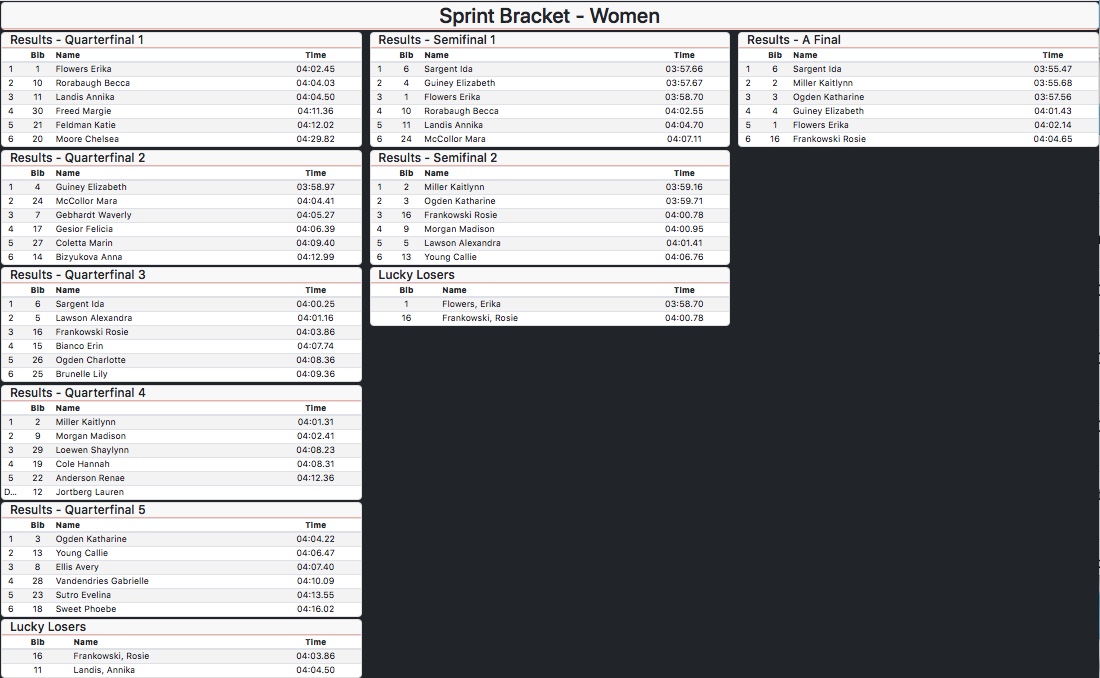
SuperTour racing continued on Friday in Craftsbury, Vermont, as part of the Henchey Memorial Carnival, which also included Eastern Cup and collegiate racing. The three-day event is presented by the Craftsbury Outdoor Center, NENSA, U.S. Ski & Snowboard, and the University of Vermont (UVM), the EISA carnival host school.
Racers were faced with snowy conditions for the opening 1.4-kilometer freestyle sprint as a winter storm made its way across the Northeast. Friday morning’s grooming report mentioned 6 inches of fresh snow, as more continued to fall throughout the morning.
On the women’s side, last weekend’s 10k freestyle winner, Alayna Sonnesyn (SMS T2), won the qualifier in 3:58.27, ahead of BSF Pro Team’s Lauren Jortberg in second and APU’s Rosie Frankowski in third. Perhaps a nod to the wintery conditions, these top three finishers were separated by over six seconds.
Sonnesyn advanced from the first heat of the quarterfinals into the semis, where she finished third in the first heat behind Katharine Ogden (SMS T2) and Ava Thurston (Mansfield Nordic Club), who crossed the line together, roughly 0.4 seconds ahead of Sonnesyn. As the second semi, which was won by Jortberg, was roughly four seconds faster on average, Sonnesyn did not earn a lucky loser spot in the final. Instead, Jortberg advanced with Anna Bizyukova of UVM, Frankowski, and Craftsbury’s own Margie Freed.
Despite the trend seen in the qualifier, the final featured tight racing, with the top five athletes finishing within two seconds of one another. Just 0.6 seconds separated second from fifth.
A scene from the women’s final of the 1.4k freestyle sprint in Craftsbury. (Photo: Instagram @nensa_nordic)
Coming out on top was Ogden, who won the final in 3:59.08. After racing on the World Cup from the opening races in Ruka through the midway point of the Tour de Ski, Ogden has gone three-for-three in SuperTour sprints since returning stateside, winning classic sprints in Soldier Hollow and Lake Placid before checking off a skate win today.
Just behind, Jortberg took second place (+1.30) with U18 athlete Thurston closing in third (+1.78). Bizyukova was next to the line in fourth (+1.86), with Frankowski less than a meter behind in fifth (+1.91). Freed rounded out the women’s final in sixth (+4.51).
“I think that the biggest thing to note about today was that it was blizzarding!” wrote Ogden in a post-race email. “The heavy falling snow made the heat racing very tactical and rewarded being very quick off of the line. There was one lane on the course that was packed down by traffic and the other areas were pretty soft!”
Ogden was just 11 points behind Caitlin Patterson on the Olympic qualification distance list, based on the athletes’ best two distance races on the SuperTour or at the U.S. Cross Country Championships, during which Ogden competed in only one race – the 10k individual start classic where she was second to Patterson. The following weekend in Sun Valley, she was second in one distance race and fourth in the other, behind three Olympians and ahead of Patterson in each. As the races at U.S. Nationals were scored at a higher point value, Patterson took the final Olympic spot, leaving Ogden on the wrong side of the cusp.
Nevertheless, Ogden has found silver linings in the additional time back east.
“It was a blast to be able to race with the EISA. I miss skiing for Dartmouth (Ogden graduated in 2021), so it was fun getting to ski with some of my old teammates and some new Dartmouth skiers. It was also pretty great to ski in lots of natural snow, we rarely get a snowstorm this big anymore and it was undeniably very fun.”
The women’s podium after the opening freestyle sprint race which kicked off a weekend of SuperTour, Eastern Cup, and EISA racing. (Photo: APU Nordic Ski Center / Instagram)
As Thurston is, remarkably, still in high school, Bizyukova was the top collegiate racer to earn today’s EISA sprint title. The second and third placed collegiate racers both hailed from Dartmouth College, with Callie Young finishing fifth in the first semifinal and 10th overall, and Jasmine Drolet taking sixth in the second semi for 11th overall.
The men of the Sun Valley Ski Education Foundation (SVSEF) Gold Team swept the top-three spots in the men’s qualifier, with Karl Schulz leading the way in 3:23.48. Peter Holmes was 0.33 behind in second, with Johnny Hagenbuch in third (+1.21).
Schulz carried momentum from the qualifier win into the first quarterfinal, which he won by half a second, but his day ended soon after in the semifinal. Racing in a fast first heat that contained two eventual podium winners and found both lucky losers, Schulz was fifth in the heat, +1.72 behind winner Matias Øvrum of UVM. Sam Wood (SVSEF) was second in the heat, ahead of last weekend’s sprint winner Zak Ketterson (Team Birkie) and Gregory Burt (UVM).
In the second semi, which was nearly three seconds slower, Canada’s Étienne Hébert (CNEPH) edged out Holmes by 0.1 seconds to go 1-2 and advance to the final round.
Zak Ketterson leads up the final climb in the men’s freestyle sprint final in Craftsbury. (Photo courtesy Zak Ketterson)
The top two spots in the final were decided by a close finish between Ketterson and Øvrum, with Ketterson crossing 0.28 ahead in a time of 3:22.57 to earn his third SuperTour sprint title of the season. Øvrum was second, though he was named the collegiate race winner for UVM, with Hébert crossing the line a few meters behind on his own in third (+2.17).
“I’ve always really liked racing at Craftsbury,” Ketterson wrote to FasterSkier after the race. “It’s an awesome place and this year Team Birkie has been lucky enough to stay right at the Outdoor Center. The race course is right out our back door!”
Ketterson also provided insights to the final round for those following from afar.
“The final was really close! I gave it everything I had at the top of the last hill but I definitely started to get tired and bogged down a bit into the finish. Matias skied a smart race and gave me a really good challenge in the last few meters but luckily I was able to fend him off. It was a tricky day with super soft fresh snow and I’m happy I was able to execute.”
Zak Ketterson races a snowy freestyle sprint qualifier in Craftsbury. (Photo courtesy Zak Ketterson)
Wood was fourth in the men’s final (+6.9), with Burt fifth (+7.17), and Holmes sixth (+10.82).
The men’s freestyle sprint podium after the opening day of SuperTour racing in Craftsbury. (Photo: Instagram @nensa_nordic)
As mentioned, Øvrum was the top collegiate racer, with Burt second, going one–two for UVM. Third place among college athletes was Allan Luke of Dartmouth, who finished sixth in the first semifinal and 12th overall.
Craftsbury’s Day 1 coverage of the the 2022 Henchey Memorial Carnival: SuperTour, NENSA Eastern Cup and UVM EISA carnival.
For true skiing connoisseurs, cross-country skiing is where it is at. Downhill skiing might be a little more glamorous, more flashy, and make for the best GoPro videos, but nothing can beat the glorious joy and aerobic challenge of cross-country skiing.
A far cry from the gravity-assisted ease of downhill skiing, your first attempt at strapping on cross-country skis might leave you baffled at the physics-defying skills required. But with a little perseverance (and a lot of perspiration) you’ll soon get into your stride, and suddenly a whole world of undiscovered trails and glorious, snow-covered treks (not to mention some of the best panoramic views in the world) will open up before you.
If the idea of trying a different form of skiing this winter appeals, or you are looking for a new challenge, check out the top 10 cross country ski resorts in North America and discover this awesome sport for yourself.
Devil’s Thumb Ranch Resort & Spa
Colorado boasts a significant number of the best cross-country skiing resorts in the US, and Devil’s Thumb Ranch Resort and Spa sits right on top of the pile.
The resort boasts over forty miles of glorious routes right through the Rocky Mountains, while the ranch and spa ensure that after a tough day of trekking you can rest and relax to your heart’s content, with hot tubs and fantastic dining options to seal the deal.
As the sun set, it was so cold that the battery in my camera froze into a non-working lump during this late afternoon masters’ training session at Craftsbury Outdoor Center last January. But the masters kept skating in the cold, squeaky snow and I was able to get this image before the battery went dead. (Photo John Lazenby)
Craftsbury Outdoor Center
With over 50 miles of magnificent trails through field and forest by the shores of Big Hosmer Pond in Vermont, Craftsbury Outdoor Center is a pretty special place for cross-country skiers. Home to the largest ski marathon on the East Coast, Craftsbury is a non-profit organization dedicated to promoting cross-country skiing, and has a wonderful focus on sustainability and environmentalism which adds to the lovely atmosphere. Lodging here is a great option, with luxury options and lakeside cottages available, as well as saunas and a fitness room available.
Mont-Sainte-Anne
Just a short drive from Quebec, Mont-Sainte-Anne Cross Country Ski Center is one of the best spots in Canada to get off-piste (literally) and try your hand at cross-country skiing. With over 110 miles of trails (and a 100 mile network for skating stride) it is one of the biggest cross-country ski resorts on the continent. Set amongst the gorgeous landscape of the Laurentia Forest, every trail is a picturesque ride from shelter to shelter, cabin to cabin, and gorgeous viewpoint to gorgeous viewpoint.
A trailside photo from 2015 SuperCamp at Sovereign Lake/Silver Star (Courtesy photo)
Silver Star Mountain Resort
Just across the US/Canada border, Silver Star Mountain Resort is a genuine cross-country skiing treat. Over 35 miles of trails (and access to the extra 30 miles at Sovereign Lake Nordic Center), there’s always a new stretch of snow to discover, and it’s a great place to dip your toe into the exciting world of cross country skiing.
For the best casino bonuses in Canada click here for a full review.
Sun Mountain Lodge
Washington State boasts some of the most outstanding scenery in North America, which makes it the perfect setting for a cross-country skiing resort. As a result, Sun Mountain Lodge is one of the best places around to try Nordic skiing, and offers an outstanding network of trails with diverse terrain, as well as great facilities to match.
Lone Mountain Ranch
Over 50 miles of Big Sky trails make up Lone Mountain Ranch, which is almost always in the conversation when it comes to discussing the best cross-country skiing resorts in the United States. A fantastic all-rounder, the resort offers trails for every level, from newbies just starting out to grizzled veterans. With a backdrop of deep pine forest and rugged mountain peaks, it is the perfect spot to get to grips with Nordic skiing.
November skiing at Snow Mountain Ranch in Granby, Colo. For the first time this year, a five-day camp was held for masters. (Courtesy photo)
Snow Mountain Ranch
Another awesome spot in Colorado about 85 miles west of Boulder, Snow Mountain Ranch boasts 75 miles of excellent cross-country trails through picturesque woods and along pretty mountain riverbanks. One of the best parts of Snow Mountain is the abundance of wildlife here – there’s a decent chance you’ll be sharing the trails with moose or elk!
Bretton Woods with the Presidentials as a backdrop. (Photo: Bretton Woods Nordic)
With around 62 miles of trails that wind their way through the White Mountain National Forest, this is one of the most beautiful Nordic skiing destinations around.
Mont Tremblant
Set in the heart of the Laurentians, Mont Tremblant is another fantastic cross-country skiing option in Quebec, just northeast of Montreal. The resort is year-round, although the ski routes are usually only available in the winter season. One of the best features of Mont Tremblant is that the cross-country ski trails all connect up with other trails in neighboring towns, making multi-day treks a real possibility.
New England’s Fabian Stocek (1) follows Rocky Mountain’s Jack Hill (6) in the U20 men’s 15 k freestyle mass start at Trapp Family Lodge in Stowe, Vt. Stocek went on to win the Junior Nationals race by 7.5 seconds.
Trapp Family Lodge
Claiming to be the first cross-country ski resort in the US, the Trapp Family Lodge is one of the most elegant and sophisticated Nordic skiing destinations you are likely to find. The trails are beautiful, of course, but the icing on the cake is the delightfully Austrian-inspired setting of the lodge itself, which makes a wonderful place to wind down after a tough day skiing!
The Chugach Mountains are seen from the Lekisch Loop, part of one of the homologated courses used for FIS races at Kincaid Park in Anchorage, Alaska. (Photo: Adam Verrier)
This article has been updated with additional information about the Birkie, about all races in Vermont, and about the current state of emergency orders in Anchorage.
FasterSkier has previously reported on the significance of FIS points, points earned in races sanctioned by the International Ski Federation that can be used to compare skiers to one another even when they did not engage in head-to-head competition. Under normal circumstances, an athlete’s FIS points are used for things like selection to the following season’s national team, while team selection for international competition is generally based more on an athlete’s performance in head-to-head racing in the current season.
In this year, with all national-level races having been cancelled, FIS points are poised to take on additional significance, as U.S. Ski & Snowboard leadership will necessarily be relying more on discretion to choose teams for international competitions such as 2021 World Championships, in Oberstdorf, and 2021 Junior World Championships, in Lahti.
As U.S. Ski Team Cross Country Program Director Chris Grover told FasterSkier this fall, when it comes to comparing American performance in domestic competitions held in different parts of the country, “We know the athletes so we can easily gauge the quality of the field. If the race is a FIS race or an NRL race, we also have points to use in determining field quality. Then we simply look for stand-out performances.” Regarding comparisons between Americans racing in Europe and Americans racing domestically, the calculus was similar: “As in the case of domestic racing, it’s easy to judge the quality of the race by seeing which athletes are in the race and what the FIS points look like.”
So, FIS points are going to be exceptionally important for American athletes this winter.
So where are the FIS races going to be held? The short version of this article is just a link to this page on the FIS website. Here are the American FIS races for the 2020/21 season. Click around and take a look at it. The end.
Kendall Kramer races in Lahti, Finland, on her way to fourth place in the U20 15 k classic mass start at 2019 World Juniors. (Photo: Doug Stephen)
But, like many things in life these days, these plans are subject to change. Due to the pandemic and public health considerations, to be sure, but also due to the catch-22 of fluoro use and FIS sanctioning. Accordingly, the rest of this article provides an annotated list of this winter’s American FIS races, organized by geographic region, with an attempt to include the most current information regarding race status. If, four months from now, public health considerations made it impossible to have a single FIS race in this country this winter (and there are already asterisks or outright cancellations around more than half of them), at least this article can serve as a historical artifact from a more optimistic time.
(As a brief aside, it is worth noting that athletes who are unable or unwilling to race this winter will not see their FIS points suffer, if they buy a FIS membership for this season. As USSS representative Adam St. Pierre wrote in an email to USSS members in October, “Each FIS and [national ranking list] Points list released in the 2020/2021 season will include all races since May of 2019. Your points can not get worse this season, but they can improve if you are able to race and achieve better results than you did in 2019/20. You must have an active FIS license for the 2020/2021 season in order to maintain your FIS points for the 2021/2022 season.” So if you’re sitting out this season of competition but intend to race next year, it may well be worth shelling out for a FIS license simply to preserve your standing.)
The opening weekends of racing in Fairbanks were cancelled by race organizers on Saturday, “in light of the current high rate of COVID-19 infections around the state, as well as local and statewide hospital/ICU bed capacity, and given Governor Dunleavy’s extension of the public health emergency through December 16,” according to a statement from the Nordic Ski Club of Fairbanks. In a more detailed follow-up statement posted Sunday, the ski club explained that it is moving all of its scheduled races to virtual events through the end of this calendar year. The advisory group that helped the ski club reach this decision included three physicians alongside the ski club’s race crew.
“We are disappointed to not be able to compete, though considering where Alaska is with COVID, it is a responsible decision and we support Fairbanks in their decision,” APU head coach Erik Flora told the Anchorage Daily News on Saturday.
“As coronavirus cases continue to skyrocket in the state, cracks are appearing in Alaska’s fragile health care system,” Alaska Public Media reported on Friday. Providence Alaska Medical Center in Anchorage, the state’s largest hospital, recently requested at least one mobile morgue, the Anchorage Press reported the same day. As of Saturday afternoon, two out of three civilian hospitals in Anchorage were sufficiently full that they were not accepting incoming ambulances.
The state’s next scheduled FIS race weekend, the December Besh Cups in Anchorage, does not seem to be barred by either the current Emergency Order governing the Municipality of Anchorage or its attachment covering organized sports specifically. However, the attachment explicitly bars spectators from attending sporting events, and states that “events that include participants from outside the Municipality [of Anchorage] should be postponed.” Anchorage Besh Cup races typically include multiple participants from Fairbanks and the Mat-Su Valley.
The state’s final two scheduled FIS race series, RMISA competitions in Fairbanks and Anchorage, will not be held in Alaska, but rather will be relocated to the Lower 48.
As of Sunday, Alaska as a whole ranked 14th in the country for daily reported Covid-19 cases per capita for the state overall, with 77 per 100,000 residents. A USSS document setting forth official guidance for domestic competitions advises event organizers to assess current case levels within the community, and defines “high community spread” as more than 25 new reported cases per day per 100,000. “In the event of high community spread,” USSS advises, “it is recommended you speak with your local health authority regarding ICU bed utilization and ventilator availability in the location’s level 1 medical center catchment.” Under this standard, every single venue discussed in this article is currently experiencing “high community spread,” save for those venues in Vermont.
Athletes leave the start area in a mass start classic race at Government Peak Recreation Area, Palmer, Alaska, on what is now a homologated course used for FIS races, in February 2020. (photo: Russell Hood)
As FasterSkier reported earlier this month, although some standard programming at the Yellowstone Ski Festival will continue, the biathlon race and FIS nordic race have been cancelled. As a representative of the ski festival told FasterSkier, “We took all of the factors in, gathered all our info, and based on the increase in [COVID] cases and what the county was recommending. With what is going on, we just felt the right thing to do for the community, and for the safety of everyone was to cancel the races.”
As of Sunday, Montana ranked 8th in the country for daily reported cases per capita, with 103 per 100,000 residents. Utah was 9th, with 99; Colorado was 13th, with 81; Idaho was 15th, with 76.
Bridger Ski Foundation athletes out for a first ski in West Yellowstone in 2015. (Photo: Courtesy Bernie Nelson)
Michigan Tech is among the American venues caught in a catch-22 following the relatively last-minute decision by FIS to postpone its long-announced ban on fluorinated waxes: FIS is no longer banning fluoros; U.S. Ski & Snowboard still is banning fluoros; Michigan Tech is a fluoro-free venue; in terms of jurisdiction and sanctioning, FIS trumps USSS.
In response, Michigan Tech representatives emailed FasterSkier earlier this month that they would remove the FIS status from their races in order to remain fluoro-free. “By removing FIS sanctioning from this event, this allows us to place a fluoro ban for this race event, and all race events we are hosting for the 2020-21 season,” wrote Michigan Tech head coach Thomas Smith. “As US Ski & Snowboard has banned the use of fluorinated waxes from all USSS sanctioned events for the 2020-21 season, we will still maintain USSS sanctioning for this January 2-3 event with a fluorinated wax ban.”
Moving to Wisconsin in late February, the race still listed on the FIS site as “50 km F Mst” likely needs no introduction; this particular 50-kilometer mass-start freestyle race is, historically, the American Birkebeiner, a point-to-point race from Cable to Hayward. But this year’s Birkie has already undergone substantial change, and currently takes the form of a five-day event over a 46-kilometer loop course, “with limited and staged start waves each morning” for five days in a row.
Birkie representatives stated by email that this year’s race will not be a FIS race: “We are not FIS sanctioned for the 2021 American Birkebeiner, but we are sanctioned by US Ski and Snowboard.” Regarding the status of a fluoro ban at a USSS-sanctioned Birkie, race organizers wrote, “the 2021 Birkie Events will be fluoro-free. We are working on determining how testing will be implemented and right now, our goal is to do testing on a limited number of skiers.”
As of Sunday, Wisconsin ranked 5th in the country for daily reported cases per capita, with 119 per 100,000 residents. Minnesota was 6th, with 110 cases per 100,000 residents. Michigan was 19th, with 67 cases per 100,000.
The Men’s podium from 2020 Senior Nationals in Houghton, MI. Ben Saxton in second, Gus Schumacher first, and Bill Harmeyer third (l-r). (Photo: Reese Brown)
In a November 13 announcement, the Craftsbury Outdoor Center stated that all ski races on its grounds are currently cancelled: “2. Races are on hold: similarly, all ski races at the Outdoor Center are canceled until further notice.” This update came in response to a new addendum to an executive order from the state’s governor. The order, which went into effect on November 14 and continues through December 15, at which point it will be reassessed, provides that multiple-household gatherings are suspended, and that all recreational sports programs are suspended, save for school-sponsored sports activities.
If these provisions remain in place in March 2021, the NCAA Championships would not be able to occur, as it is by definition a multiple-household gathering. Moreover, there is currently a quarantine requirement for visitors coming to Vermont from beyond its borders. Finally, Middlebury (the theoretical host) announced last month that it “will not hold any athletic competitions during the winter season.” So even if NCAA Championships happen, in any form, it seems unlikely that this will be within the state of Vermont.
(While the possibility of these championships occurring at all is outside the scope of this article, the fact that both the Ivy League and NESCAC (New England Small College Athletic Conference) have cancelled winter sports – that’s the ski teams at Dartmouth, Harvard, Bates, Bowdoin, Colby, and Middlebury, among others – poses additional challenges to the possibility of nationwide collegiate skiing competition.)
The start of the women’s 30 k classic mass start at 2018 U.S. Distance Nationals in Craftsbury, Vt. (Photo: John Lazenby/Lazenbyphoto.com)
On short notice in October, the International Ski Federation (FIS) reversed its fluoro wax ban for the upcoming season. Bryan Fish, Cross Country Sport Development Manager for U.S. Ski & Snowboard, explained this was termed a “delayed implementation”. What had been expected to be a fluoro-free racing scene at the FIS level, became a business as usual wax policy for 2020-2021. In short, fluoros, C8 or otherwise, are allowed at FIS sanctioned events. The FIS fluoro ban won’t come into effect until at least summer 2021. Stay tuned.
In the meantime, U.S. Ski & Snowboard will implement a fluoro ban for all disciplines at its sanctioned events this season. “We see the future and we know that for health concerns about the product, we have implemented a fluorocarbon-free policy,” said Fish.
The policies, though opposite in their allowances, are clear. But things get muddy when events are sanctioned by both FIS and U.S. Ski & Snowboard. Fluoros or no fluoros? Testing or not? Penalize an athlete for violating the rule or not?
These are not simply thought experiments.
As part of its E-blasts, TOKO sent emails last week that raised several of those questions. It also raised awareness for an upcoming dilemma for those seeking to earn FIS points and NRL points, or National Rankings List points used for U.S. Ski & Snowboard national rankings. The TOKO emails listed all the U.S. events where fluoros are allowed. This was a comprehensive FIS sanctioned race list that linked back to the FIS cross-country race calendar.
It’s easy to see how there might be confusion. According to Toko, three of the venues on the list of FIS sanctioned races are in fact fluoro free venues: Wirth Park, the Michigan Tech Trails, and the Craftsbury Outdoor Center. FasterSkier has reported on the Outdoor Center’s initiatives in the past.
Bryan Fish, U.S. Ski & Snowboard’s cross country sport development manager, delivering a presentation in Jackson, Wyoming. (Photo: Nancy Leon/Jackson Hole Nordic)
Last week, Fish said U.S. Ski & Snowboard is in the process of developing guidance on the differences between FIS and U.S. Ski & Snowboard sanctioned events. Fish also explained a document in the works would help clarify how athletes can, for example, can remove fluoros from ski bases and how skis might be tested this season at U.S. Ski & Snowboard races.
Here’s the thing: In the hierarchy of governing bodies, FIS trumps U.S. Ski & Snowboard. If a race were both FIS sanctioned and U.S. Ski & Snowboard sanctioned, a skier “caught” with fluoros on their bases could not be legally disqualified. FIS allows fluoros.
“We cannot force anybody to do anything,” said Fish. “We do sanction events and we ask people to follow the rules. … That means that in FIS events no repercussions can be handed down for an individual that competed in a FIS event and used fluorocarbon wax because that is policy.”
“We’ve been preparing for nearly a year to work in a fluoro free world,” said Ollie Burruss, nordic race director at the Craftsbury Outdoor Center. “And then we got a complete reversal handed down from the International Governing Body (IGB) at the 11th hour.”
In the recent past, as the culture shifted towards fluoro free waxing, the Outdoor Center made exceptions for using fluorinated waxes on its trails. This was the case when it hosted SuperTour events last year. Coming into this season, regardless of race and sanctioning body, no fluoros. According to Burruss, that is still the plan.
A common argument against policies banning fluoros is the lack of testing. Testing is expensive. The cost-prohibitive process often allows for only a few pairs of skis to be tested at any particular event. When delegitimizing fluoro bans, many ask why have a rule that cannot be enforced?
Burruss said in places like New England no quandary exists when it comes to using or not.
Ollie Burruss, chief of competition at the 2019 US Nationals in Craftsbury. (Photo: Craftsbury Outdoor Center)
“All summer, we weren’t planning on testing,” said Burruss. “And so the Outdoor Center had a policy that we wrote last year, you know about it, we made exceptions to that policy for the SuperTour that we hosted. So going into this year we still have this venue wide policy. We’re not going to test every pair of skis that come into the venue. We are going to make a set of guidelines and policies that we ask all of our guests to follow.
“We don’t have a community in New England where it’s fraught with suspicion, backstabbing, and people trying to one up each other. We really have, I think, a really tight-knit supportive ski community. And so when we planned on having FIS racing, we weren’t going to test. We were more concerned about how to safely hold an event during a pandemic. That was way more of my concern than whether or not someone was going to use fluoros.”
In Burruss’ estimation, racing at the Outdoor Center is de facto fluoro free. And for now, the Outdoor Center’s races are still listed on the FIS calendar. The Outdoor Center asks you not to use fluoros. That decision, according to Burruss, will be based on trust and a hardened value system relying on people doing the right thing, not necessarily the fastest thing.
“So basically what I’m what I’m getting at is if you violate that, if you go against that, you’re cheating,” Burruss added. “And so what we are telling people is, ‘we can’t stop you from cheating.’ We’re not going to make your cheating no longer cheating. That rubs me the wrong way. That is not the sport that I want to be a part of.”
The logic is not circuitous. It seems to trend from A to B, then C. As stated, the Outdoor Center did not have the capacity to suitably test for fluoros either way. Burruss has also not been informed by U.S. Ski & Snowboard that the ski governing body can police fluoro use at the Vermont venue with testing. So Burruss sees no contradiction for the Outdoor Center’s races remaining both FIS and U.S. Ski & Snowboard sanctioned.
Thomas Smith, Head Coach at Michigan Tech emailed that the races at the Tech venues would remain fluoro-free but would remove the FIS sanctioning.
“Through discussion and consultation amongst our MTU Race OC and US Ski Team staff, we have decided to remove the FIS sanctioning of our MTU January 2-3 Regional Championship ski race event. We will maintain US Ski & Snowboard (USSS) sanctioning of this event,” stated an email sent Wednesday morning.
“We believe the most important leadership stance for us to take as a public research institution is to ban the use of fluorinated wax at the Michigan Tech Trails to protect and promote a healthy competitive environment for our event participants, our trails, and our community. By removing FIS sanctioning from this event, this allows us to place a fluoro ban for this race event, and all race events we are hosting for the 2020-21 season. As US Ski & Snowboard has banned the use of fluorinated waxes from all USSS sanctioned events for the 2020-21 season, we will still maintain USSS sanctioning for this January 2-3 event with a fluorinated wax ban,” noted the email.
“What I will say is this, if a venue wants to be fluorocarbon-free, then we encourage them to host U.S. Ski & Snowboard sanctioned events because you can implement a fluorocarbon-free policy there and we can have a deterrent and test at that event,” said Fish.
Fish said he was concerned for athletes who might be competing at dual sanctioned events if the use of fluoros would incur no repercussions. Although Fish did not comment on this specifically, FIS events include points for scoring world rank, which is relevant in the run-up to the Olympics. And recently, U.S. Ski Team nominations have also been pinned to world rank. FIS points will matter. This only adds to the depth of the sanctioning morass.
Speaking on behalf of U.S. Ski & Snowboard, Fish was clear about the reasoning for implementing the fluoro ban now. “We want to focus on health, we want to focus on the safety of our environment and that is why U.S. Ski and Snowboard has implemented this policy and done it this year. … We want to move forward because we know it is the right thing to do. We know that fluorocarbon products that are used in some waxes are not healthy for humans and they are not healthy for the environment. We want to move forward on that piece sooner rather than later. It is clearly a hard decision to make. But I think it is the right decision.”
Fish continued that races sanctioned solely by U.S. Ski & Snowboard provide an enforceable and consistent playing field.
In Bib 104, SMS T2 skier Kyle Bratrud crests a hill during the men’s 30 k skate mass start at the 2019 U.S. Nationals in Craftsbury, VT. (Photo: John Lazenby)
The expectation that clubs, coaches, and skiers toss the fluoros may have been premature. Venues like the Craftsbury Outdoor Center are ahead of the curve. As it appears, so too is U.S. Ski & Snowboard when considering the timeline to wean racing off of speed chemicals. The FIS “delayed implementation” policy is a wrench in the U.S. fluoro free movement.
Buruss would like the following message to be loud and clear if people decide to race: “These are complicated times, pay attention to the rules at each venue.” One choice is to take the approach of faith in others that Burruss puts forth. Another is to wait for the threat of testing and punishment to force a behavior change.
This all comes down in an environment undeniably tenuous as urban and rural communities experience an increase in Covid-19 cases. Either way, according to the number of FIS sanctioned races in the U.S., opportunities to dip into the chemical speed-basket this season are plentiful.
This past fall, the Craftsbury Outdoor Center (COC) updated its wax use policy. The New England institution was one of the first and among the largest cross-country ski centers to implement a policy curbing the use of perfluorinated wax on its premises. The Craftsbury Outdoor Center supports values and practices that try to minimize its impact on the environment while still providing recreational opportunities for visitors.
The Craftsbury Outdoor Center hopes to help lead the way toward a transition away from fluorocarbons. As it stands today, we see no need for skiers to wax with fluorocarbons for day-to-day skiing at the Outdoor Center. Furthermore, the use of glide wax containing fluorocarbons will not be permitted in our public wax room at any time. This includes perfluorinated “topcoats” and paraffins containing fluorocarbons (colloquially “LF” and “HF” wax products). — From Craftsbury’s Wax Guidelines
This was no cold turkey move away from fluoros, when the SuperTour came to Craftsbury this winter, teams were allowed to apply and use fluoros in well ventilated ares. However, the day to day ethos at the COC was clear: fluoros use was frowned upon.
Ollie Burruss, chief of competition, during the classic sprint at the 2019 US Nationals in Craftsbury. (Photo: Craftsbury Outdoor Center)
We spoke with Ollie Burruss in March to discuss the policy and how it all played out over the winter. Among his many duties, Burruss is the nordic race director at the COC. He’s in the hot seat when it comes to piloting fluoro free policies and practices. Burruss was also the head of the organizing committee and the Chief of Competition at the 2019 US Cross-Country Nationals.
The US SuperTour kicked off the first races of the new year at the Craftsbury Outdoor Center with a classic sprint. The event, dubbed the 2020 Lost Nation Cup, brings together senior athletes, EISA carnival teams, developing NENSA skiers, and citizen racers for a weekend of racing in the Northeast Kingdom of Vermont.
“Retired” Craftsbury native Ida Sargent won the women’s race in a time of 3:55.47, followed by fellow CGRP athlete Kaitlynn Miller (+0.21), and Dartmouth Ski Team’s Katherine Ogden (+2.09). Erika Flowers posted the fastest qualifying time of 3:56.03; she finished fifth in the final (+6.67).
Breaking down the heats in Craftsbury. (Photo: BullitTiming.com)
On the mens’ side, Ben Saxton (SMST2) took the final in 3:19.0. He was followed by Canada’s Julien Smith of NTDC Thunderbay (+2.04) with Forrest Mahlen of APU in third (+2.25). University of Vermont athlete Ben Ogden was the fastest qualifier of the day in 3:18.62. Ogden was eliminated in the first heat of the semifinal, finishing 11th overall.
Results from the men’s heats in Craftsbury. (Photo: BullitTiming.com)
Racing continues tomorrow with interval start freestyle distance races Saturday and mass start classic distance races Sunday.
The Craftsbury Outdoor Center (COC) in the Northeast Kingdom of Vermont has emerged as a premier year-round cross country ski training venue. The COC has also been a leader in embracing and promoting sustainability and environmental stewardships through their own day to day operations and educating their customers. They have invested in energy efficient buildings, a wood-burning central heating system, solar energy, and an abundant garden which allows them to grow much of their produce on site.
Following this ethos, the COC has partnered with the University of Vermont (UVM) on a project to develop an innovative over summer snow storage system. The system aims to guarantee one to three kilometers of skiable snow by Thanksgiving each year.
“Storing snow over the summer enables us to make the snow at the coldest times in winter, when the snowmaking is most efficient, rather than in November when the temps may be marginal,” wrote COC owner Judy Geer. “[It also] assures skiers will be able to will be able to stay home in Vermont or New England over Thanksgiving and be able to get in good training, rather than spending money and increasing their carbon footprint on trips out west.”
Snow storage systems are used in several locations throughout Europe and were responsible for making the cross-country venue at the 2018 Olympics in PyeongChang viable. So why does this development at the COC require a team of university scientists?
Paul Bierman, Ph.D is a professor of Geology and Natural Resources at the University of Vermont. (Photo: uvm.edu)
Paul Bierman, professor of Geology and Natural Resources at UVM, project leader, and nordic ski enthusiast, explains that the project is unique because Craftsbury is the lowest in latitude and elevation of any snow storage site. The majority of cross-country venues with snow storage systems are located in high latitude Scandinavia or in mountainous high altitude areas in Central Europe. Craftsbury Common, on the other hand, sits at about 44.6 degrees north latitude and about 353 meters in elevation.
“No one has ever tried [snow storage] in the worst of all possible combinations: low altitude, humid, low latitude. This was really an interesting merge between university science and engineering, and a center that is committed to trying new things as well as sustainability. Maybe that’s why it worked,” Bierman said with a laugh.
Bierman explained that the impetus for the project was born a few years ago around Thanksgiving when temperatures in Vermont were too high for snowmaking and no natural snow had fallen. A dismal combination for a skier. he COC could only produce a 100 meter lollipop on their soccer fields. While out on a ski, Geer and her husband and co-owner Dick Dressigacker began chatting with Bierman about the concept, knowing his interest in snowmelt and snowmelt hydrology.
A conic map of snow storage facilities. The Craftsbury Outdoor Center sits at the lowest combined elevation and latitude. (Photo: Optimization of over-summer snow storage at mid-latitude and low elevation, H. Weiss et. al. Click to enlarge)
Bierman spearheaded the project with a scientific lens. He recruited his undergraduate assistant Hannah Weiss who has continued with the project as a graduate student, and a colleague in mechanical engineering began with a feasibility study. They found inspiration from old fashioned Vermont ice houses, which predated modern refrigeration. Ice house technology consisted of ice harvested from the surface of rivers and lakes during the winter. It was then covered with straw and sawdust and preserved in a partially underground building to keep perishable food cool in the summer.
The team identified a storage site in a pond that no longer held water and instrumented the ground at varying depths to measure temperature.
“We wanted to make sure that the ground was not so warm that we were just going to melt the stored snow from below.”
The team monitored the temperature variation over the course of a year.
“What we realized is because of how far north Craftsbury is, ground temperatures weren’t doing all that much and there really wasn’t going to be that much flux of heat from the ground into the snow pile. So that got us thinking, ‘Okay, maybe this is going to work.’”
Next, with the help of the Craftsbury grooming team, they created two test piles at the end of the 2018 season in order to determine an optimal system for insulating snow through the summer. They covered the piles with roughly 25 cm of wood chips which were instrumented with thermometers. They tested a variety of covers including foams of different densities, concrete curing blankets, space blankets, and reflective mylar over the top to deflect solar radiation.
Susan Dunklee (USA Biathlon/CGRP) cools off from a mid-summer workout in a 2018 test pile. (Photo: Paul Bierman, UVM)
After monitoring the piles through the summer, they identified the optimal setup. On top of the manicured snow pile, a concrete curing blanket was laid primarily to protect the snow from debris. The blanket also adds some insulation. Next, a layer of wet wood chips 20 to 30 cm deep was spread, providing the majority of the pile’s insulation. Finally, a white mylar space was stretched across to reflect thermal energy from the sunlight. This system proved highly effective.
“When you monitor the temperature underneath that concrete curing blanket, it basically doesn’t change. No matter how hot it is outside, it basically stays at zero.”
With a scientifically-backed storage plan, the UVM and Craftsbury collaborators went into the 2019 season ready to give snow-storage a go. The pond site was improved and a road was built to improve access.
Keeping in line with its mission of sustainability, the COC purchased new energy-efficient airless snow guns which use between a quarter and a third of the power than older model fan guns. These new guns ran for a week in February, blowing roughly half the COC’s annual water allotment into a large pile.
“The beauty of it is that they don’t have to power fans anymore, so it was a lot less energy,” explained Bierman. “And they did it in the middle of their high season, and because they generate their own electricity for these guns, they have a heat recapture unit on the generator, so a significant part of the energy that would have gone up the chimney as waste heat, was now heating dorms that were full of people.”
He added that were the snow blown in November, as is the case in most snowmaking operations, the COC would have been mostly empty, meaning the heat would have been wasted that way as well.
Groomers ran a pistenbully back and forth over the pile to pack it more densely: dense snow melts more slowly. The pile was shaped with an excavator, then the team waited as it transformed into corn snow in the spring. Then the pile was covered with wood chips and the white reflective covering.
Though the storage method was tested the year before, the scale of the pile had increased dramatically.
“This was a big logistics year,” Bierman explained. “How do you do this? How do you shape a pile? How do you put chips on it? How do you put a cover on it? How do you keep the cover from blowing away in a big spring wind storm? Which it did the first time,” he laughed.
Once the pile was tucked neatly under its multilayer covering, the team sat back and monitored it regularly throughout the summer using a new style of survey equipment called terrestrial “LIDAR”, which stands for light detection and ranging. This allowed the team to track changes in the 3D surface of the pile, thereby measuring the change in volume.
“It became pretty clear by mid-July that this pile wasn’t shrinking very quickly. By the last scan in October, we had about 65% left by volume of what we put in there. And that is pretty much what Europeans in the Alps get.”
A LIDAR map of the 2019 stored snow pile at the Craftsbury Outdoor Center. Click to enlarge. (Photo: Optimization of over-summer snow storage at mid-latitude and low elevation, H. Weiss et. al.)
He explained that the limited existing data suggests that the average retention by volume of other snow storage sites is between 60-70% on average.
By their measurements in early November, the pile contained 5-6000 cubic meters of usable snow, which translates to 2-3 km of coverage at 50 cm deep and a few meters wide.
“In any normal November, that would be a godsend. Most of the early November skiing at Craftsbury is a big lollipop in the upper soccer field and down the hill in the lower soccer field, where people are going in one direction on maybe a 200 meter course around and around and around.”
He added that the preserved snow would allow “more interesting” terrain to be opened early, such as “Lemon’s Haunt”, a 1.6-kilometer blue square trail which rolls through the woods.
Feeling confident that the COC could provide a few k of skiing by its projected opening day on November 16th, the team began scraping off the layers of wood chips in early November. Then, in an unforeseen plot twist, the first snowfall of the year arrived, coating Craftsbury with a thick layer of natural snow. This interrupted the original plans of spreading the pile, but allowed the COC to open 25 kilometers of trail on opening day.
“The pity is that it didn’t work out as everybody anticipated, which was to lay a couple k of base down with this icy stuff, then have the natural snow sit on top of it, which would preserve the natural beautifully.”
He laughed that no one would want klister snow laid on top of their blue wax conditions.
So how would the pile have been transformed into ski trails had Mother Nature not trumped the scientist’s plans?
Bierman explained that during the summer, the snow transforms into “firn”, a term used most commonly with glaciers to describe an intermediate stage between snow and ice. Though icy and dense, the substance maintains its granular quality.
He explained that without the world-class groomers and equipment at the COC, making this into skiable terrain would not be possible.
“The beauty of Craftsbury is how well they groom. Their grooming is spectacular, they’ve got three piston bullies, they’ve got this.”
Prior to the natural snowfall, the grooming team had been meticulously cleaning an excavator and dump truck to ensure that dirt was not introduced into the clean snow pile, as the sun on the dark-colored dirt increases melting. Dirt in the base would be further mixed into clean natural snowfall, creating a problem from the get-go. Not to mention skiing in dirty snow is not recommended for your bases.
With clean equipment, the team would begin trucking snow to the furthest point, working their way backward toward the pile. Once the snow is laid out, groomers can work their pisten bully magic to create a surface that is pleasurable to ski.
The COC is developing a plan for how the stored snow will be used, which will be dependent on weather and natural snowfall. Some stored snow may be kept in order to patch holes in the event of a warm spell.
Next year, the team intends to again create as large a pile as possible and continue to fine tune the storage methods.
“This is just the first year, so we have a lot to learn–both in terms of process, and also environmental and cost-effectiveness,” wrote Geer.
An excavator layers wet wood chips onto the 2019 snow storage pile at the Craftsbury Outdoor Center. (Photo: Paul Bierman, UVM)
Bierman explained that the logistics of properly covering the large pile requires practice, but a lot of pitfalls have been flushed out in the first two rounds of the experiment. The COC staff will be refining their method of covering the surface with an adequate layer of wood chips which does not crack or slump, and overlapping layers of the white reflective cover to reduce the chance of exposure and rapid melting.
“Nature is going to help us because now the ground underneath that pile is cold. It has had cold melting snow on it all summer, so presumably the ground underneath there is 0 degrees C and saturated with 0 degrees C water, and it’s only going to get colder this winter.”
Bierman continued that other snow storage facilities have experienced improvement in retention each year over the first few years.
Depending on what winter has in store, the COC may increase the volume of snow that is blown into the pile in 2020.
“If we have a good snow year and they still have water left in February, they’re just going to blow it into the pile,” said Bierman.
He continued that they could scale up by an additional 50% over last year’s volume.
Overall, the project has been a great opportunity for the COC to improve upon existing snowmaking methods and to guarantee snow for Green Racing Project athletes, the local junior teams, and recreational skiers alike.
“It gives the place an insurance policy. It doesn’t matter when you put that snow away, by putting it away, Craftsbury can reliably say that they can open in November. We don’t even have to wait for snowmaking weather.”
What would it take for over summer snow storage to be implemented by other ski areas? Bierman explained that the recipe is outlined in great detail on the project website and also in a technical paper written by the UVM science team, which is currently under review (full citation below).
A white reflective space blanket is the final layer on the top of the snow storage pile. (Photo: Paul Bierman, UVM)
Clearly, the project requires significant resources: a place to store snow, an excavator, snowmaking equipment, pistenbully, coverage supplies, not to mention man-power. It is not, perhaps, readily accessible to small family run ski areas, but Bierman expressed that many major cross country centers could consider it.
Apart from the superficial benefits of early season skiing, Bierman imparted the importance of the underlying reason for the project.
“We’re on a trajectory of global warming unlike anything we’ve ever seen, and this is a Band-Aid. It’s a Band-Aid that might hold us for 10, 20, 30 years, but it’s not getting at the root issue here which is decarbonizing the global energy system. Unless we do that, all winter sports in these mid-latitudes are going to be extinct. We can’t save enough snow to have a nordic season if it doesn’t get cold anymore. If you look at the Vermont climate assessment, if we don’t change how we’re doing business — sort of the business as usual scenario, how we operate — we’re going to look something like the Great Smoky Mountains of Tennessee by 2090.
“So this is a fun thing, extend the season, that’s all great, but we have to take some serious action as a global community to deal with climate change and the use of carbon fuels.”
Overall, both Bierman’s team and the folks at the COC are pleased with the results produced by the project and the many benefits it has provided in its nascence. The large pile of preserved snow stands as a testament to creativity, dedication to sustainability, and the power of problem-solving.
“The takeaway is that it works,” concluded Bierman. “And actually, it’s a lot of fun and it’s been a great way to share what we know about climate change, and not only about climate change adaptation, which is what you’d call this project, but also climate change mitigation which is ‘how do we get on the front of this?’
“It’s a great educational tool about ‘climate change matters, and let’s see what we can do about it.’ We’re being forced to do things in New England that 20 years ago you wouldn’t have thought about doing.”
To bring this article to life, check out this video created by Bierman’s daughter, Quincy, who is a member of the junior program at Craftsbury.
References: Weiss, H. S., Bierman, P. R., Dubief, Y., and Hamshaw, S.: Optimization of over-summer snow storage at mid-latitude and low elevation, The Cryosphere Discuss., https://doi.org/10.5194/tc-2019-56, in review, 2019.
As the sun set, it was so cold that the battery in my camera froze into a non-working lump during this late afternoon masters’ training session at Craftsbury Outdoor Center last January. But the masters kept skating in the cold, squeaky snow and I was able to get this image before the battery went dead.
Last week, two long established entities in the New England nordic sport scene released updated ski waxing policies. The Craftsbury Outdoor Center (COC) made its move towards a fluoro-free future while the New England Nordic Ski Association (NENSA) laid out fastidious wax restrictions based on age-group competition.
Craftsbury’s homegrown professional ski and biathlon teams race as the CGRP – or the Craftsbury Green Racing Project. The “Green” reflects the team’s Vermont based Green Mountain roots and promotes the underlying ethos of the COC: environmental stewardship.
“Moving away from a reliance on fluorocarbons would, in the Outdoor Center’s view, be a good move for peoples’ health, the environment, and the sport as a whole,” states Craftsbury’s policy. The policy posted on the COC website goes on to link a 2013 study about bio-accumulation of PFAS in wax techs and a recent piece on PFAS bio-accumulation in the food chain near a nordic ski area in Trondheim, Norway.
Craftsbury’s new fluoro policy is lean with its verbiage. Yet with two sparse sentences, Craftsbury cast a wide net.
“As it stands right now, we see no need for skiers to wax with fluorocarbons for day-to-day skiing at the Outdoor Center. Furthermore, the use of fluorocarbons will not be permitted in our public wax room at any time,” reads COC’s no fluoro policy.
Ollie Burruss, a do-it-all spark plug at Craftsbury, said the policy is really a work in progress. Not all skiers are coming to conversation with the same level of understanding or awareness when it comes to perfluoro wax use.
“The thing that is going to be difficult about the policy is understanding what is fluorocarbon,” said Burruss. “Burning fluorocarbons in a hydrocarbon chain in a paraffin wax is not nearly as alarming, in my opinion. And from what I have read, it seems the research bears this out a little bit more, it is not as alarming as what we consider to be the perfluoro topcoats.”
Burruss understands the on-snow wax policy is a suggestion, not an absolute and enforceable mandate. The wax room policy, as it reads and as Burruss confirmed, is absolute. Craftsbury would prefer that skiers not apply LF or HF paraffins or “burn” top coat products in liquid, block, or powder form.
“This is us saying we know that it is a public health issue, and it is unrealistic to expect everyone in the wax room to mask-up when one person decides to burn powders so let’s just not do that anymore,” said Burruss.
That zero tolerance comes with a caveat. Some skiers do not perceive LF and powders as equals when it comes to exposure in the wax room.
“Those using LF paraffin, we’ll need to educate them about why we don’t want to do that,” continued Burruss. “If it turns out someone is in there and burning a LF paraffin, then you can say this is an educational opportunity to explain why we want to try and move away from these products. We need to be educating people as we are trying to create these regulations and policies. The skier that goes in there, and hopefully this does not happen as we are really going to make a concerted effort with signage, we don’t anybody going in there and burning powder. ” My beauty corner kosmetiniai staliukai su LED apšvietimu ir veidrodžiu www.mybeautycorner.lt
The public wax room at Craftsbury does not offer individual venting stations. Skiers ironing in powders, for example, impact the wax room’s “shared air”, said Burruss. “So if one person decides to burn a powder then everybody is exposed and we don’t think that is tenable.”
Craftsbury’s approach to determining how to regulate fluoros remains cautious. They will continue to modify and implement the policy with an eye towards educating visitors.
Burruss was also involved with crafting NENSA’s new wax regulations. Burruss said the working group tasked with formulating the rules kept the realities of age-group racing in mind. “We asked when would it be appropriate for wax techs to bring the full scope of their waxing knowledge? Maybe at some levels, it is not entirely necessary,” said Burress.
NENSA’s Competitive Program Director, Justin Beckwith, explained the group had been debating a tiered fluoro use protocol for several months. “It started within our staff, then we brought in our athletic development committee, which represents coaches from — we have an EISA coach on there, we have high school coaches on there, we have club coaches on there. So a pretty robust discussion with that group,” said Beckwith.
Some of the policy’s key wax guidelines break down like this.
Bill Koch League: only non-fluoro glide products allowed.
U16 & Eastern High School Championships: no fluoro topcoats (powder, liquids, or blocks).
Open events like the Eastern Cup: no “ironed” topcoats. Hand and/or roto-corking or roto-fleecing top coats are allowed.
“We’ve never had a true wax policy or protocol, so several nice steps forward and keeping in pace with what we see coming down the line where there’s going to be measured steps by organizations and how they’re going to react to it,” said Beckwith. “We’re on our way to the brave new fluoro free world.”
NENSA Competitive Programs Director Justin Beckwith at NENSA’s 2018 App Gap Challenge rollerski race.
Beckwith understands that the marketplace will morph as more PFAS regulations are enacted. Organizers at all levels of racing, from the World Cup down, are thinking about how to enforce fluoro-restrictions. But like Craftsbury, it makes sense for NENSA to begin the process of formulating wax rules now and prevent itself from responding willy-nilly in the future.
“We really want to get people thinking about skiing and not thinking about waxing,” claimed Beckwith. “We’ve also been pushing the education piece of it. … I don’t think hysteria is too strong of a word — there’s a little bit of hysteria around this waxing issue, and the reality is that it’s not only that you’re going to spend more time with your athletes on race day, but you’re going to produce better skis if you’re doing things ahead of time and not spending a ton of time on the day of the race trying to find the latest and greatest thing.”
The NENSA policy comes with a holistic mission statement acknowledging the health and environmental risk of some wax products, and the need to address a perception that absent a wax protocol, some athletes benefit more than others.
The new policies, as Beckwith stated, are based on trust.