From the FasterSkier archive — posts syndicated from athletes’ and coaches’ own blogs between 2004 and 2012, kept online as published. Current coverage is at fasterskier.com.
The Craftsbury Outdoor Center is hiring for two coaching roles within its Green Racing Project (GRP), a year‑round elite Nordic ski program supporting post‑collegiate athletes pursuing national and international competition. These positions are in‑person roles based in Craftsbury Common, Vermont and are integral to the daily training, development, and competitive success of GRP athletes.
Head Ski Coach – Green Racing Project
The Head Ski Coach is responsible for leading the GRP ski program and overseeing all aspects of ski training and athlete development. This role works collaboratively with other GRP coaches and Craftsbury Outdoor Center staff to design and implement a comprehensive, high‑performance training program while fostering a healthy, sustainable, and athlete‑centered team culture.
Primary Responsibilities
Design and implement annual and daily training plans for GRP ski athletes
Lead on‑snow and dryland training sessions year‑round
Guide athlete development with a focus on long‑term performance and well‑being
Collaborate closely with other GRP coaches, support staff, and leadership
Plan and support domestic and international training camps and competitions
Uphold and model the mission, values, and community responsibilities of the Craftsbury Outdoor Center
Desired Qualifications
Significant experience coaching Nordic skiing at a competitive or elite level
Strong technical knowledge of training theory and athlete development
Excellent communication and organizational skills
Ability to work effectively as part of a collaborative coaching team
Commitment to sustainable living, community engagement, and shared responsibility
Assistant Ski Coach – Green Racing Project
The Assistant Ski Coach supports the Head Ski Coach in delivering daily training and competition support for GRP athletes. This role is hands‑on and collaborative, contributing to training sessions, athlete monitoring, and program logistics while gaining experience within a high‑level, professional Nordic ski program.
Primary Responsibilities
Assist with on‑snow and dryland training sessions
Support athlete monitoring, feedback, and communication
Help with training logistics, travel, and competition support
Contribute positively to team culture and daily program operations
Participate in the broader work and community life of the Craftsbury Outdoor Center
Desired Qualifications
Experience competing in or coaching Nordic skiing
Strong interpersonal and communication skills
Willingness to learn and work collaboratively in a high‑performance environment
Ability to take initiative and manage responsibilities independently
Alignment with GRP and Craftsbury Outdoor Center values
Compensation & Details
Position details including compensation, benefits, schedule, and start date vary by role and are outlined in the full job postings.
How to Apply
Please review the full job descriptions for full details and submit your application through the appropriate link below:
The Green Racing Project is a year‑round elite training program based at the Craftsbury Outdoor Center. GRP supports post‑collegiate athletes in Nordic skiing, biathlon, rowing and running while emphasizing excellence, sustainability, teamwork, and active participation in a mission‑driven community.
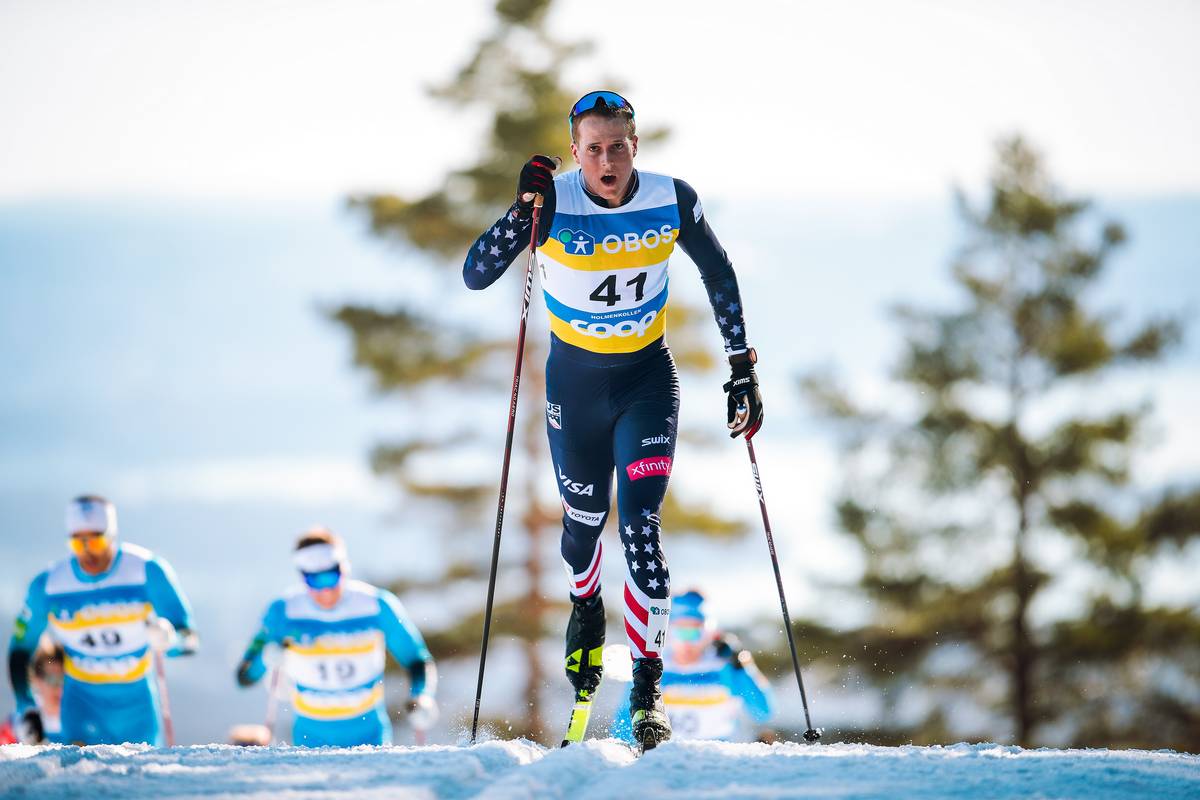
On the Wednesday before the World Cup season opens in Ruka, Jack Young sits in a small condo, looking out at over a foot of new snow that’s been drifting down all morning. The air is much warmer today than it was before he and the U.S. Ski Team loaded onto a six-plus hour bus ride yesterday — “Muonio was friggin’ cold,” he says — and the mood is calmer, quieter, the way he wants it. This is his final runway before an Olympic year truly begins, and he is spending it doing almost nothing.
Not nothing-nothing, of course. But nothing extra. No bonus minutes, no filler skis, no threshold for confidence, no volume for psychological reassurance. “The biggest thing right now is taking these two weeks absolutely as seriously as possible with rest and just not doing anything extra training-wise that I do not need to be doing,” he says. “I’m training so little right now because of how important Ruka and Trondheim are for me.”
Growing up in Northern Vermont, Jack Young had an All-American childhood. (Photo: Courtesy Photo)
Outside, the classic sprint course cuts through the forest — the first of two classic sprints in Period 1. They matter—more than they ever have. To make the Olympics, he must qualify. To qualify, he must have transformed himself into something he has never consistently been: a classic sprinter capable of making heats on the hardest stage in the world.
That he is even here, on the cusp of an Olympic selection fight, is strange enough. Stranger still is the way he got here — not built from the standardized American skiing pipeline but stitched together from its edges. A football quarterback. A baseball outfielder. A skier whose parents “didn’t know what Nordic skiing was.” A D3 athlete who reverse-engineered sprint training out of 800-meter track plans and the writings of a Swedish speed skater. A young man who kept such detailed training logs that, by the time he made the World Cup, he could begin writing his own plan.
In a sport that often rewards conformity, Young’s ascent is something close to a jailbreak.
Jack Young as he started his racing for Craftsbury. (Photo: Courtesy Photo)
A Vermont Childhood Without the Usual Skiing Script
“Neither of my parents knew what Nordic skiing was,” he says with a laugh. They loved the outdoors, yes — mountain biking, alpine skiing, the typical northern Vermont mélange of mud, woods, and winter — but their son’s athletic identity formed somewhere else entirely. “I played every sport. I loved baseball. I played basketball through elementary school. I started football as soon as I was allowed to, which I think was in fourth grade.”
He became the kind of athlete rural towns understand intuitively: the quarterback on fall afternoons, the center fielder chasing down balls in the summer dusk, the kid who could pick up anything and find competition in it. Skiing entered sideways, almost accidentally, through his sister Callie. She joined the small Nordic program in Newport, and he was brought along because that’s what families do — pack the car, hand over snacks, make it work.
“I immediately fell in love with racing,” he says. “I just love the competition.” Running around on skis made sense to him. Movement, speed, chaos — he could do that. But even with training days at Craftsbury beginning around sixth grade, he didn’t think of skiing as his primary outlet. “I wasn’t as focused as my sister was, but I would still get dragged along,” he says. “I loved skiing, but I loved football and baseball just as much.”
The irony — one he now sees clearly — is that he was training for skiing without realizing it. “All summer was spent doing fun things in the woods. We’d go to Craftsbury a couple of times per week. But I never thought of skiing as my main sport. I weighted those sports equally, even though I was putting a lot more time into skiing.”
If northern Vermont had offered a travel football club or competitive baseball without days of driving south, the story may have gone a different way. But mountain running and biking were nearby, and elite baseball diamonds were not. “I’d so much rather go for a long run in the mountains or go mountain biking than I would hit on the tee for two hours,” he says.
Sometimes this is what talent looks like in real time: a kid choosing the fun version of hard work without realizing he’s choosing a future.
When we spoke, Jack Young sat in a small condo in Ruka wearing a Boston Red Sox baseball hat, just added evidence for how important the game has been for him since he was a boy. (Photo: Courtesy Photo)
The Late Bloom: A Breakthrough and a Decision
He kept skiing in the winter, of course. Not obsessively. Not in the way some junior skiers live their lives by FIS points before they have a driver’s license. But enough to stay close. Enough to remain good. Then came the summer after his sophomore year of high school — the first time he trained like someone who had decided to see what was possible.
“I put a good summer of training in,” he says. “Had a bad football season… but that was the first time I was really starting to push the limit on what I could do training-wise while in season for football.”
He mountain-biked in races on weekends, squeezed workouts around football practices, and tried to make the whole geometry hold together. Then came Junior Nationals, and with it, proof. “I had a pretty good result in the sprint. I think I was like 18th or something… and that was the moment where I was like, okay. I am decent at least at this sport. I’m doing a lot better than I’ll ever be at baseball.”
That spring, Young emailed coaches — the NESCAC schools, Dartmouth, and UNH. Bowdoin and Dartmouth joined Colby on his shortlist. Colby won on something less quantifiable: belief.
“Tracy [Cote] was very excited about me,” he says. “And I think that resonated with me. Maybe it’s my ego, but it was nice to hear.”
He would later call it “a perfect decision.”
Jack Young enjoying some backcountry skiing in Jay. (Photo: Courtesy Photo)
Colby: Building an Athlete in a Place That Shouldn’t Have Worked
Winters in college can blur into one another — classes, training, snow, the strange mix of exhaustion and euphoria that defines 19-year-old life. But Young remembers his freshman fall with clarity: meeting people, finding balance, doing “good, not great” training, and then, once the season started, traveling west for Senior Nationals.
There, in Soldier Hollow, everything sharpened. “I think I qualified in the top 20 in the skate sprint,” he says. “That was an absolutely massive result for me. I never had anywhere near that level of success on the national level.”
He didn’t transform overnight — not yet. His sophomore season brought a “fine college season,” a top-30 at NCAAs in the 10k skate, and the sense that distance skiing was finally, mercifully making progress. But the turning point came not in results but in imagination. He learned that the U.S. would receive twelve start spots for the Canmore World Cup the following year. Twelve starts. “I was like, 12 starts… that’s not that far off,” he says. “I kind of feel like I’m in contention for that.”
To chase it, he would need to master something specific: the sprint qualifier.
And this is where the story breaks from the template completely.
Jack Young hits some big lactate numbers during a hard training session. (Photo: Courtesy Photo)
Reinventing Sprinting from Scratch
“I’ve always thought that sprint qualifiers were really similar to an 800-meter race on the track,” he says. Physiologically, mechanically, conceptually — they looked more alike than different. So he dug into 800m training. He looked for the extreme version, the distilled essence of what sprinters do when they train specifically for the thing that matters. Qualifiers are discrete. Defined. Precise. Why train them like a generalist?
Then he read Nils van der Poel.
The legendary Swedish speed skater’s manifesto, How to Skate a 10k, isn’t a skiing manual, but to Young, it may as well have been scripture: the idea of building huge aerobic capacity, then sharpening with brutally specific intervals at exact race pace. “He wants to skate as many possible laps at world record pace as possible,” Young says. “And that really struck me. I’m like — I can apply this to skiing.”
He wasn’t going to become a single-event specialist, not in college. But he could take the principle and adapt it. So he built a sprint-qualifier program composed of things like:
6 × 1 minute
4 × 90 seconds
10 × 30 seconds
8 × 45 seconds
All at precisely what he believed to be his sprint qualifier pace.
“That was the bread and butter,” he says. “I’d do those workouts once or twice a week. I didn’t actually find them that strenuous, but I was accumulating a good amount of time at exactly what I thought sprint qualifier pace was.”
He went completely dry that fall — no beer, no casual nights out, nothing that compromised sleep. “I was just recovering a lot better all the time,” he says. “I didn’t get sick at all.”
Meanwhile, Colby head coach Tracy Cote allowed him to blend his ideas into the fall plan. “We were working together. I think we ended up writing the training plan together that fall,” he says. “She was pretty stoked about the focus on recovery… and she’d let me get away with doing things a bit more geared towards sprinting.”
He trained more overall, too — a heavy summer that gave him the resilience to handle so much intensity once fall arrived. “My freshman year, I trained a little under 600. Sophomore year was around 650. My junior year I trained like 750 or something.”
This was not an American development pipeline approach.
It was an experiment.
A smart one.
A successful one.
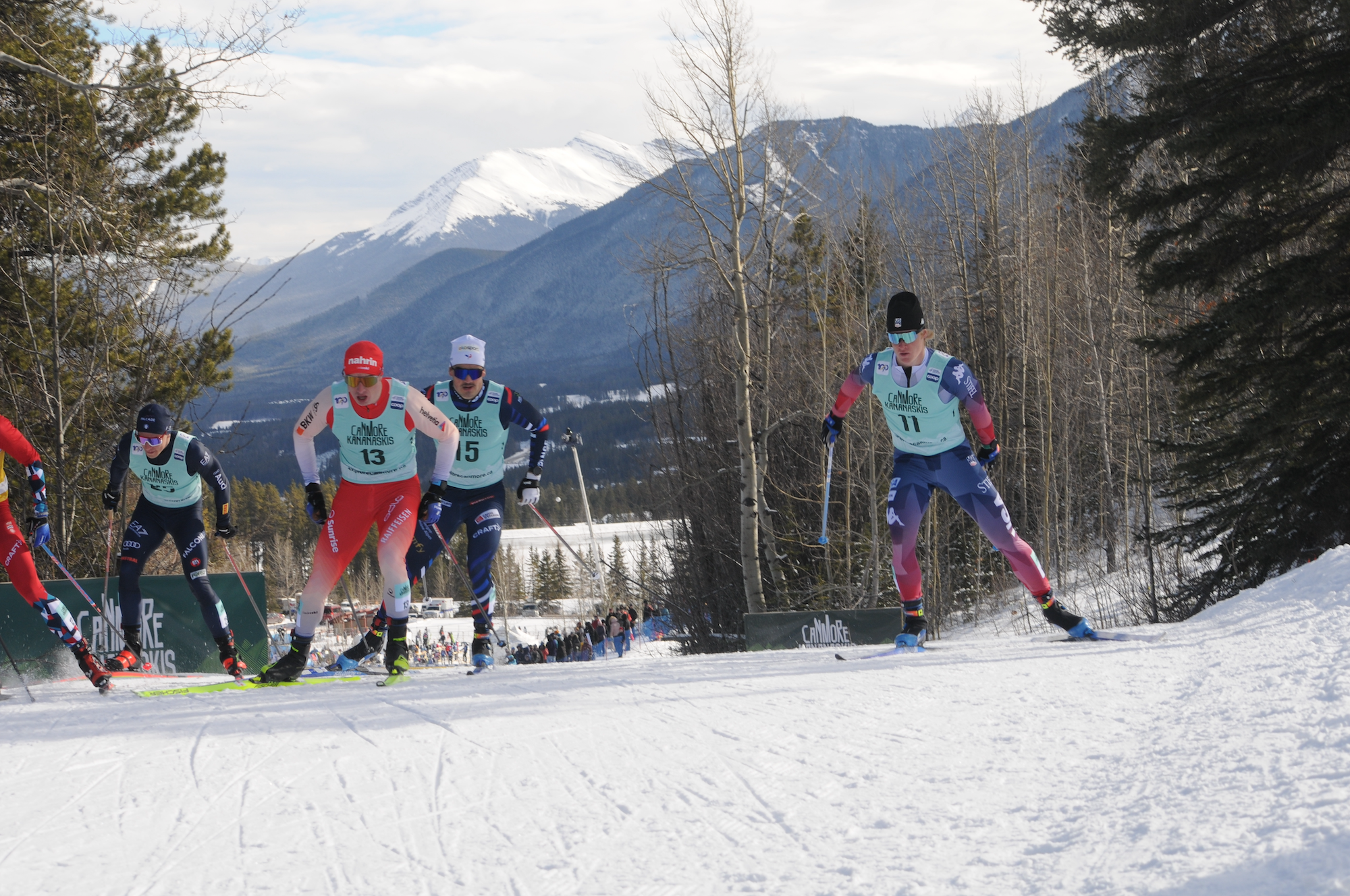
Jack Young, who a week earlier had a 3rd and 5th place in the EISA college races for Colby College delivered the 11th fastest qualifying time in the freestyle sprint at the Canmore World Cup in 2024. (Photo: Cockney/FasterSkier)
Anchorage, SoHo, Canmore — and the Race That Changed Everything
He targeted Anchorage for his first chance at the Canmore World Cup spot. He knew what he had to do: fly across the country in the early winter, race well, then perform at Senior Nationals in Soldier Hollow. Anchorage was the linchpin.
“I went into Anchorage with a lot of confidence,” he says. “I won that qualifier; it was such a surprise.”
He didn’t replicate the magic at Soldier Hollow — “I think I got like 11th” — but the Anchorage win held. He made the Canmore start list.
And then came the race of his life.
“That’s still my lowest FIS points ever,” he says. “I didn’t match that last year.”
When he crossed the line, something shifted internally. “Once I did that in Canmore… that was the first time I really thought I wanted to keep skiing after college,” he says. “That was the moment I realized how good I thought I could get.”
Call it the ignition point, the place where belief calcified into ambition.
Where a multi-sport kid from a non-skiing family, attending a D3 school, doing self-designed intervals, suddenly saw himself in a World Cup heat map and thought: Yes. Here.
Jack Young training on Eagle Glacier this past summer. (Photo: Courtesy Photo)
Writing His Own Plan on the World Cup
Two years later, he is living in Europe, often for months at a time. He is in his second year of racing full-time on the circuit. He is older, stronger, andmore certain. And he is, in many ways, coaching himself.
“For this time of year, it’s entirely guided by what I’ve done the last two years,” he says. “Which workouts worked in which places, which workouts didn’t… the comments are much more important than the hours.”
He still works closely with Pepa Miloucheva at Craftsbury — “She’s the number one on that” — but when he’s on the World Cup, he is the primary author of his training. He reads his patterns. He analyzes sensations. He looks for the combinations of stress and stimulation that make him feel dangerous on race day.
He isn’t reinventing his body now — he’s listening to it.
The independence he cultivated at Colby has become his competitive advantage.
With the Olympic sprint being in the classical technique, Jack Young (USA) hopes to find the form he has historically shown in freestyle sprinting during the early season World Cup stops. (Photo: Modica/NordicFocus)
The Classic Sprint Problem — and the Olympic Dream
To make the Olympics, the math is simple, even if the execution is brutal.
“The simplest answer is: make a big jump in classic sprinting,” he says. “If I can start qualifying for classic sprints consistently, I have a very clear path to making the Olympics.”
Last year’s results would meet the published criteria — “hypothetically, if I had the exact same season… I would technically make the team,” — but this year is different. The Olympic sprint is classic. Period 1 has two classic sprints and only one skate sprint. Some of the contenders for Olympic spots are stronger in classic than he is.
So the path is narrow: qualify in Ruka. Qualify in Trondheim. Hold form in Davos. Don’t step back. Don’t stagnate.
At the philosophical level, the criteria are simpler still.
“It’s all about execution at this point,” he says. “A good season is continuing with progress I’ve made… scoring more World Cup points than I did last year. Anything else is a step back.”
He knows progress isn’t linear. He knows failure is part of sport. But he also knows what a step backward would feel like. “I’d be lying if I said I could look at this season as successful if I don’t maintain what I’ve been doing in skating and at least make a little bit of progress in classic skiing.”
It is clear-eyed. Unsentimental. The kind of assessment you get from someone who has built his career on self-honesty.
Jack and his sister Callie after winning a slow pitch softball tournament. (Photo: Courtesy Photo)
What It Means to Make It This Way
There’s a certain poetry in the fact that Young’s rise mirrors the very way he races: a precise, deliberate accumulation of moments. Nothing in his career came from the prescribed steps, the standard routes, the familiar trophies of a groomed junior-star life. Instead, his path looks more like a map drawn after the fact — connecting points that didn’t seem aligned until the picture emerged.
A sister’s Craftsbury workouts.
A baseball-heavy early adolescence.
Mountain biking and football collisions.
A D3 program that let him try things.
A manifesto by a Swedish speed skater.
A dry collegiate fall at age 20.
A logbook of sensations.
A day in Canmore.
A belief.
There is no template for this. There never was.
But here he is anyway — on the World Cup, in an Olympic year, taking the biggest swing of his life.
And as he sits in a Ruka apartment, resting more than he ever has before a race that matters more than most, he reflects not on what’s missing from his résumé but on what got him here in the first place: a way of building a skier that is his alone.
Love Stories Like This? Help Keep Them Coming.
Feature interviews like this one take time, access, and care to produce. If you value thoughtful storytelling and independent ski journalism, please consider becoming a Voluntary Subscriber. Your support directly fuels the work we do to cover the people, places, and moments that make our sport special.
The first time you meet Patrick Weaver, you might not realize you’re talking to one of the most quietly influential coaches in American skiing. There’s no bravado, no self-promotion. Just an easy Vermont calm — a man who measures his words the same way his athletes measure their training: carefully, purposefully, with feel.
On a fall morning, the UVM Nordic team threads through the mist at the Craftsbury Outdoor Center, the quiet hum of rollerskis against asphalt echoing in the distance. Weaver watches from the side, hands in his jacket pockets, hat pulled low. He doesn’t bark instructions. He doesn’t need to. The rhythm of his teams speaks for itself.
Wilmington, Vermont’s Sophomore Luke Rizio. (Photo: Philip Belena/EISA)
“I always say it’s not the individuals that make the team fast — it’s the team that makes the individuals fast,” he says. “Once they believe that, the motivation takes care of itself.”
For nearly twenty years, that philosophy has shaped the University of Vermont into one of the most respected programs in NCAA skiing — not through hype or heavy recruiting, but through a culture of trust, humility, and balance.
Lessons in Motion
Weaver’s path to coaching wasn’t linear. It’s more like a relay through decades of ski mentors who left their fingerprints on his philosophy.
“I never had one coach through my whole career,” he says. “There were a lot of influential people — high school, Stratton, college, the national team. I just learned to take things from each of them.”
He spent a post-graduate year at Stratton Mountain School under Sverre Caldwell before skiing for Cory Schwartz at UNH — a relationship that would define his sense of what a team could feel like.
“Cory was probably the most influential,” he says. “The way he ran that program — it was a family. I took that with me when I came to UVM.”
After college, Weaver worked under a rotating cast of national and international coaches: Gordon Lange, Christer Skog, Sten Fjeldheim, Torbjørn Karlsen. Each brought a different rhythm to training. The mosaic of ideas shaped the adaptable style he’s known for today.
“There’s not one way to coach,” Weaver says. “And because of my background, I’m not a ‘my way or the highway’ coach. I’ve seen too many ways that work.”
Patrick Weaver racing in the 15 k Classic at the 2002 Olympics in Soldier Hollow, Utah. Weaver finished in 16th place. (Photo: UNH Ski Team)
The Season He Cut His Hours
In 2002, the year of his second Olympics, Weaver did something radical. He trained less.
After years of logging 800-plus-hour seasons, he realized the grind was killing his joy. So he cut down to 600 hours — just one session a day, mornings only.
“I was kind of burned out,” he says. “I’d dread the afternoon workouts. I loved the sport, but I wasn’t feeling good anymore. When I stopped doing the PM sessions, I felt better — I started looking forward to training again.”
It’s a story he still tells his athletes, not as dogma but as permission. Permission to rest. Permission to find balance.
“I’m never afraid to tell an athlete to train less,” he says. “Sometimes that’s the thing that gets them going faster.”
That season became a turning point — not just in Weaver’s career, but in his view of what performance really means. It was the seed of a coaching style rooted not in metrics, but in intuition.
Ben Ogden celebrates after sweeping the 2022 NCAA Championships in Midway, Utah. Ogden became 1 of only 4 skiers (alongside US Ski Team teammates Novie McCabe and Sophia Laukli) to win an NCAA Championship and represent the US at the Olympics in the same season. (Photo: Tobias Albrigtsen / @untraceableg)
Coaching Ben Ogden — and the Art of Listening
If Weaver’s name is not immediately known outside the NCAA world, it should be. One of his former athletes — UVM graduate Ben Ogden — is now one of the most dynamic racers on the World Cup circuit. Their partnership, built over seven years, is the epitome of Weaver’s coaching DNA: patient, collaborative, and deeply human.
“I’m not Ben’s day-to-day coach,” he explains. “He’s got great people at Stratton and the U.S. Ski Team. But we talk — a lot. Strategy, planning, recovery, the big picture. And it’s never me saying, ‘Do this.’ We talk it through and find what makes sense logically.”
That logic isn’t written in a spreadsheet. There are no lactate meters, no elaborate testing protocols.
“We’re very unscientific,” Weaver says with a grin. “Ben appreciates the go-with-the-flow training plan. It’s all feel-based. If it feels good, we go with it.”
The two share what they call the “Gus Workout” — a set of smooth, fast intervals inspired by Gus Schumacher. “It’s not about killing yourself,” Weaver says. “It’s about moving fast with good technique.”
It’s fitting that one of America’s most promising World Cup athletes traces his development back to a coach who believes that skiing, at its best, is about rhythm and relationship more than data and drive.
The UVM Way
Weaver took over the Catamount program with a straightforward goal: strip away the clutter.
“When I first got here, I just explored,” he says. “I found training venues close to campus — trails and loops that were right here. We stopped driving hours to ski. It simplified everything and gave athletes more time to recover.”
That ethos — local, focused, efficient — defines UVM’s identity. Training isn’t glamorous, but it’s deliberate. The team atmosphere is close-knit, even familial. “There’s nothing special about UVM,” Weaver jokes, “and that’s what makes it special.”
He points to the campus support network — trainers, nutritionists, sports psychologists, and strength coaches all under one roof — as one of the program’s hidden advantages. “It’s on par with professional teams,” he says. “The athletes can see everyone they need in one day.”
That infrastructure helps athletes stay healthy, grounded, and balanced — which, for Weaver, is the real key to longevity.
“We’ve had international athletes come in liking skiing, and they leave loving it,” he says. “That’s when I know we’ve done something right.”
Junior Owen Young (Anchorage, Alaska) and Sophomore Fin Bailey (Peru, Vermont). (Photo: Phillip Belena/EISA)
Through Change and Uncertainty
Weaver has been around long enough to see college skiing evolve from a regional stepping stone to a legitimate World Cup pipeline. He’s also watched it collide with new realities: NIL money, early recruitment, the escalating costs of youth development.
“When I was at UNH, I was training 500 hours a year and thought that was a lot,” he says. “Now I’ve got athletes training 700 or 800 hours — and managing school on top of it.”
That dedication, he says, is a sign of progress — but also a warning.
“Kids are training more and more at a younger age,” he says. “Sometimes it worries me. Are they doing it because they want to, or because they’re being told to?”
He worries, too, about the economic side. The college landscape, reshaped by NIL and revenue sharing, could make Olympic sports harder to sustain.
“We’re fundraising to pay athletes while big schools make $200 million a year off TV deals,” Weaver says. “It’s hard to see how that’s sustainable.”
He laughs softly when asked what NCAA skiing looks like fifteen years from now. “I hope we’re still here,” he says. “I really do.”
The Long Game
If the world of college skiing is shifting underfoot, Weaver’s motivation remains rooted in something simple: people. Every year brings a new roster, a new set of personalities, a new chance to start fresh.
“You do something long enough, it’s hard to stay motivated,” he admits. “But each fall I get new athletes, new relationships. First-year students I barely know become seniors I can’t believe are leaving. That cycle keeps it exciting.”
He pauses, then adds, almost to himself:
“Maybe that’s what success really is — watching them fall in love with skiing all over again.”
UVM Sophomore Rose Horning from Leadville, Colorado. (Photo: Phillip Belena/EISA)
Vermont’s Quiet Legacy
Weaver doesn’t measure his legacy in NCAA titles or Olympic appearances, though UVM has had plenty of both. He measures it in the quiet mornings at Craftsbury, Jericho, or Sleepy Hollow, where athletes rediscover why they started skiing in the first place.
He doesn’t see himself as a gatekeeper of results but as a caretaker of culture — one that prizes simplicity, joy, and belonging in a sport that often forgets how to slow down.
In a world obsessed with metrics, Weaver’s story is a reminder: sometimes the best architectures of success are invisible — built in the space between workouts, in trust, and in the quiet confidence that skiing, at its best, should always be fun.
“The best thing I can do,” he says, “is help people love the sport.”
Coach Weaver chats with his first-year from St. Paul, MN, Hanna Koch. (Photo: Philip Belena/EISA)
Green Racing Project (GRP) Ski & Biathlon teams are now accepting applications for the 2024-25 training year. Applications will be due by the end of day March 24 and decisions will be made by April 10. (U23 skiers’ and biathletes’ summer program is its own program for 2024. Find information about U23 programming here.)
GRP is looking for skiers and biathletes who have shown good ski speed over the past couple years. Skiers who have not yet tried biathlon will be given the opportunity if they’re interested.
In exchange for coaching, use of training facilities and travel support, GRP year-round athletes are asked to do work that contributes to the mission and operation of the Center. Projects include coaching youth and masters in skiing, biathlon, and mountain biking; managing and improving the trail system; growing vegetables for the Dining Hall; organizing events and programs at the Center; assisting the Communications Team with writing, blogging and social media.
Margie Freed (CGRP) topped the podium in the Lost Nation Roll 10 k (Photo: Paul Bierman)
If this sounds like work you would enjoy, while taking your skiing and/or biathlon to the next level, then you may be a good fit. Read more about the team at their website: www.greenracingproject.com. The application is available here for year-round, residential training and you will find FAQs for biathlon and skiing. Any remaining questions may be addressed to grpski@craftsbury.com and grpbiathlon@craftsbury.com.
Athletes applying, or thinking of applying, should talk with Head Coaches Pepa Miloucheva (ski) and Mike Gibson (biathlon) at season ending races or email and schedule Facetime or a Zoom call.
Adam Martin strides at the 2022 Holmenkollen 50 k classic in Oslo, Norway. Martin finished 26th in his third Holmenkollen in March, and recently announced his retirement. (Photo: NordicFoucs).
Adam Martin’s skiing has always tended to be best described in conjunctions rather than disjunctions. He could do this and he would do that.
Or, that’s always how his mentors looked at it. My most distinct memory of Martin is from a CXC (Central Cross Country Skiing) camp about a decade ago when Sten Fjeldheim, then Martin’s coach at Northern Michigan University (NMU), gathered a group of us J2s (U16) around in the lobby of the old Telemark Lodge and said, “there’s proof you can be an All-American caliber skier and have a 4.0 GPA too,” pointing to Martin as the example.
That stuck with me as I watched him as a US skiing fan for years. Martin was giving it everything he could in everything he did, and the juxtapositions that produced were inspiring in their absurdity.
He would run a combined bike/run hill climb andbeat all but one of the cyclists. He would win a local 5 k while pushing for pro runner–caliber paces (seriously, he ran a14:34). He would compete on the World Cup, and his best result would consistently come at its longest and hardest race – theHolmenkollen 50 k.
That pattern strung along almost a decade from his high school career to its final, most striking juxtaposition: Martin had his best season ever in 2021/2022, and now he will retire from professional skiing.
The pattern held all the way through. He gave it all, in every way, and at everything the ski world had to offer.
It was exemplary of his philosophy of inclusiveness, of an and; a persistence in bringing in others’ ideas, their accomplishments, their experiences in skiing, learning what he could, andchanneling it all into his performance out on the course.
That stance towards thoughtfulness and inclusion could be figured as an essence to Adam Martin the skier. Something that reached all the way back and followed him all the way through. When we spoke a couple weeks after his retirement, that was the timescale he reached for. “I was lucky to grow up in the nordic skiing community that I did, with a lot of great people helping me in the sport, both getting into it and supporting me today,” Martin said.
Adam Martin strides through the woods in Falun, Sweden, during a 15 k classic in January 2021. (Photo: NordicFocus)
That nordic community was the one in Martin’s hometown of Wausau, Wisconsin. He first came to skiing as a 10-year-old there – venturing out on skis after the local skating rink shut down and left his then favorite sport, figure skating, an impossibility. “It was a good winter so there was good skiing at 9-mile (Wausau’s trails) for all of March. My mom took me out once or twice a week for a whole month and I think we progressively worked up to 20 k at the end of the ski season. And that was big for me. I didn’t think about figure skating after that.”
It was an understated but persistent start in the sport that matched the ski community that Martin would grow up in. An old timber-boom relic in Wisconsin’s Northwoods, Wausau hums along as a city of 38,000 marked most prominently by Rib Mountain, an erratic that signals that glaciers crept across the land there, carving up knolls and hills under the forests that now surround it. It is as perfect ski terrain as you’ll find in the Midwest. Granite Peak, one of the oldest lift-served ski hills in the country, calls one side of Rib Mountain home. Characteristically of Martin, when I asked him if he skied there as a kid he replied “Never downhill. I used to ski up it after the lifts closed in high school though.” Martin was instead drawn into skiing by the rolling terrain at Nine-Mile County Forest, a network of trails a mile south of Rib Mountain that had already been home to a couple generations of nationally competitive skiers .
Before he joined those ranks though, Martin signed up for the Wausau Night Gliders, the community’s youth program coached by Rachel and Greg Kresse. “We met twice a week, and I was just so excited to see and learn different things in the sport. I remember the first time we learned to skate, and was like thinking, ‘could you V2 in a race?’ Because at that point I was just doing one technique. That was the clincher, I decided I wanted to race. I wasn’t even doing particularly well in the beginning, and getting extremely nervous, but I do remember one race at 9-mile where I had one of my experiences hitting the ‘flow state’ and that was it after that. I was totally hooked on that experience.”
From there, Martin started to look down the road at skiing. Standing there metaphorically, he saw skiers doing what he would one day hope to do. “[In Wausau] the Hugus brothers were three or four years older than me. When I was in 8th grade Ben [Hugus] won the state Championship. One of them was getting top 10s at Junior Nationals, and then I was good friends with Matt and Chris Nichols who were around my age. I had a lot of great competition in Wausau, and in Wisconsin too. I remember Dylan McGarthwrite (from Hayward) making the Scando (Nordic Nations U18) trip when I was a freshman in high school, and I was really hyped up about that.”
After gaining that preview of the Wisconsin nordic world, Martin would chase down each and every one of those goals reached by his role models. By the time he was a freshman in high school, he was qualifying for Junior Nationals. Then, he won the Wisconsin high school state meet, and then qualified for the U18 Scandinavian Cup trip with US Ski & Snowboard. With dreams realized and only good things ahead, Martin decided to go all in on skiing.
Adam Martin pushes over the line during a 15 k classic in Falun in February, 2020. (Photo: NordicFocus)
His time, and his place in Wausau, were serendipitous in presenting a ready-made opportunity in his own backyard. In the early 2010s, the Midwest was home to a grouping of skiers who would go on to define their generation of American skiing. Martin headed to the CXC Elite Team, where an orbit of skiers that included Jessie Diggins and Kevin Bolger, along with coaches like Jason Cork, Igor Badamshin and Bryan Fish, were all forging the philosophies and approaches to skiing that would eventually influence the direction of US skiing for years to come.
That it was happening was almost hidden by the shabby surroundings in which they were pushing forward. After joining up with CXC, Martin split his time between Wausau, and CXC’s main training site at the Telemark Lodge in Cable, WI. The training environment was spartan, but the facilities couldn’t even strive for that aesthetic – they were just run down. The VO2Max-fitted treadmill hung out in what used to be a shop floor in the Lodge’s old mall, most athlete accommodations still donned the dull color tones of the 1970s, and the old Telemark World Cup trails were overgrown and uncut.
It was out of the way, but it was also all about skiing, which let Martin fully lean into his developing thoughtfulness towards his technique and his training. “I took a lot of cues from Igor [Badamshin] there. The thing that stood out for me was that he was so joyful about skiing, and that joy could extend to looking at every little aspect of things. He’d point out a little thing in technique, and would get incredibly excited about it, and that was contagious.” (Badamshin passed away in 2014; read a FasterSkier tribute to him here).
That attitude extended to new areas of interest too for Martin, who began to take an amateur’s interest in the sports science behind cross-country skiing. “I just bought a standard exercise physiology textbook and think I like read it cover-to-cover. … I started reading all sorts of exercise physiology, and still do.”
Martin’s post-grad year was a fruition and a starting point. Going into a year at CXC, Martin was a skier whose results indicated a huge amount of physical talent and mental intelligence. Then, somewhere in the Wisconsin Northwoods, they melded together, and Martin formed a full-on focused approach to skiing.
But there was a paradox at play too. In developing this holistic approach to skiing, Martin realized he had let go of fitting skiing into his holistic approach to life. “Just focusing on skiing and putting all that pressure on one avenue of my life did not work for me. I really needed to challenge myself mentally and take the pressure off skiing after that post-grad year.”
That led Martin to another natural stopping point in his skiing career, college skiing at Northern Michigan University (NMU) under coach Sten Fjeldheim. “I really fell in love with the sport again under the tutelage of Sten, and with the incredible team environment there.” NMU had long been a waypoint for talented Midwestern juniors – the path that stemmed from JNQ wins to Marquette seemed almost ubiquitous. That meant Martin joined up with a group of teammates that could help him push and be pushed by him.
Adam Martin tags Craftsbury Green Racing teammate Caitlin Patterson during a March, 2022 4 x 5 k mixed gender relay in Falun, Sweden. (Photo: NordicFocus)
Like he had when he was a young skier in Wausau, he looked ahead to see what and where his teammates were achieving results, and found cues he could take, saying that “When I was a sophomore, Kyle Bratrud won the15 k skate at Nationals in Houghton. He was a year older than me and that really opened my eyes to say ‘ok, we can do this. That level is achievable.’”
With that long view of what he wanted to accomplish, Martin also found in Sten Fjeldheim a coach perfectly matched to the detailed approach to skiing he had formed. Fjeldheim at the time was somewhere between elder statesmen and guru in his career, which meant that the years that Martin was beyond in his skiing knowledge had found a home. “Oftentimes, before a workout, [Sten] would explain exactly why we were doing it, why we needed to execute it a certain way, and what the physiological effect would be for doing that. That was exciting to me, and it worked really well with how I looked at ski training.”
As important as his coach was the skiers that Martin called teammates during his time at NMU. “That was a rare team environment, we were all super competitive with each other but in a super constructive manner.” During his four years, Martin was part of teams that included former, present, and future US ski team members with Ian Torchia, Zak Ketterson, Kyle Bratud, and biathlete Jake Brown. At the NCAA Championships in 2016, he, Torchia, and Brown combined to put NMU at the top of the team scoring – all earning All-American status in the process. Across both the 10 k Classic and 20 k Skate races, he and Torchia were the top American-born athletes in collegiate skiing.
When Martin graduated in 2017, it was also with a distinction that marked a whole other focus during his time at NMU. He hadtwo degrees – one in mathematics and one in computer engineering. He had taken what he learned about himself during those post-grad days in Wisconsin, moved on up to the U.P., and nailed it.
Adam Martin (NMU) racing to a American-leading 23rd in men’s 15 k classic at 2016 U23 World Championships in Rasnov, Romania. (Photo: Pete Leonard)
With a 23rd in the 2016 U23 World Championships 30 k Freestyle, there were plenty of professional clubs that were interested in seeing Martin continue his skiing career. And he was up for it, if he could continue to take the holistic approach that had seen skiing not be “the only thing” in his life. From a far-flung corner of Vermont’s Northeast Kingdom, a call came in from Pepa Miloucheva, the coach atCraftsbury Outdoor Center’s Green Racing Project. The GRP was a top-level, proven club, and also one uniquely structured to have its athletes take an active role in the sustainability and outdoor recreation–focused activism of the Outdoor Center. “It just made sense,” said Martin on his decision to head to Vermont after graduating. “I was getting into a program that was more than just training…I was able to work with them, take the GRE, take grad school classes, and make it feel like NMU where I was very challenged.”
Again, Martin had put himself in a place where skiing was the thing. A small pocket of rolling hills that were a little bigger than the ones he started out on in Wausau, but rolling, nonetheless.
On the skiing front, things continued to progress for Martin after joining the CGRP. He made his World Cup debut at the 2018 openerin Ruka, where he placed 51st in the 15 k Classic. That season he also notched a pair of 2nd places at US Nationals in the 15 k Classic and the 50 k Classic, while earning consistent World Cup starts throughout that 2018-19 season. Those World Cup appearances culminated in a season-high31st place at the Holmenkollen 50k marathon in March 2019. It was Holmenkollen that year which provided another one of Martin’s realizations about himself as a skier. “I started to learn that my strength as a cross country skier is that my physiology is really geared towards distance – it’s definitely not speed or transitions. Holmenkollen specifically has these grinding features that make you get to your VO2 max and have to stay there for a long time. It’s almost a perfect physiological stress for me.”
Adam Martin during the Holmenkollen 50 k in 2020. (Photo: NordicFocus)
That further stuck out to Martin especially when he returned to the Holmenkollen race the next season, in 2020. “In 2020, it was a low snow year, so we had to do a different course than the traditional 8 k, and it was more focused on transitions. I just learned again, in one race, a lot about myself as a skier. I was just happy to finish.”
That Holmenkollen marathon also marked the end of normalcy in skiing for the next couple of seasons to come. “That was my last race on the World Cup before the pandemic, and then I came home to do the SuperTour in Minneapolis right before the World Cup, and I won. It was my first SuperTour win, and then the pandemic happened.”
Martin was in a weird spot. The markers that he had traditionally used to gauge and reach for new heights in his skiing career would suddenly disappear over the course of the next season. He was making progress, but the road didn’t have as many markers as it did before.
“[The pandemic] was something everyone dealt with differently, right? But I think for me, the big challenge was that the Craftsbury program is traditionally very communal and very close knit. It’s a big group of athletes – like 30 between our skiers and rowers – and traditionally we’re eating in a dining hall, working together, working out together, and sharing the same gym. That was a super vulnerable situation to COVID, so we went from super communal to basically not going into public buildings for that first year.”
Adam Martin races a frosty 15 k in Falun, Sweden in January, 2021. (Photo: NordicFocus)
It was as if someone flipped a switch on the type of training environment that Martin had been in since his days at CXC. His training grounds had always been out of the way geographically, but always included the ability to bounce ideas off his teammates and coaches, to try out new things, and to get feedback then and there. They also had always included a full race schedule, which due to a combination of the COVID situation locally in Craftsbury and Vermont state safety policies, became an impossibility the next season.
When Martin could race, it was internationally. “I was lucky to get a start on the World Cup at Davos in December, but while I was gone, the state of Vermont changed the rules around COVID travel. (At the time, COVID cases were undergoing a spike.) I got back and I couldn’t be on the ski trails in Craftsbury while I quarantined unless it was like before 7am or after 6pm at night. I knew I was lucky to be getting racing in, but it brought restraints that forced you to adapt your training.”
Martin credits the imperatives surrounding COVID compliance with giving him a new adaptability to his training approach, even if the changes he made were more informed by what they always had been – his coaches, his intuition, and his constant searching for knowledge that would lead to improvement. “I think there was some changes in those two years that helped me make some big improvements that were probably independent of COVID, but came about because I felt like the pressure was off again for the first time in a while.”
That intermittent COVID season’s lessons would all come to a fruition in Martin’s skiing at the start of the 2021-22 season. Martin started his season on the US SuperTour circuit, and the SuperTour circuit was to begin in the Midwest. That, for Martin, brought back an extra level of familiarity to the return of a regular racing schedule in 2022. “I was so happy to win that first SuperTour in Cable (in the15 k Classic).”
The early part of the season also saw him call to mind some of the moments that he had once seen teammates achieve back when he was based in his home region. When he came out of the first SuperTour period in 2nd place overall, behind former teammate Zak Ketterson and barely missing out on the automatic World Cup start Ketterson earned, Martin turned towards US Nationals in Soldier Hollow in January.
There, on a sunny Utah day, he won the 15 k Classic, a moment that was “particularly awesome, since it was what I watched Kyle Bratrud do at Houghton.” Over seven years, Martin had had the revelation about who he skied with, and then chased down that moment for himself.
Adam Martin at 2022 Nationals in Soldier Hollow. Martin would become a National Champion in the 15 k Classic, a goal he set 7 years earlier after watching then NMU teammate Kyle Bratrud accomplish the feat. (Photo: Tobias Albrigtsen / @untraceableg)
His National Championship and SuperTour results would, in nearly any other season, have seen him shortly to the start line of a World Cup. But for a second winter in a row, COVID was surging (this time as part of the Omicron wave). A slate of World Cups were canceled in January, and the Olympics in February took out any flexibility in the US Ski Team’s lineup. In the Olympic qualifying period, Martin was just behind Scott Patterson for 2nd place in the standings. With a more competitive field than ever before, Martin just missed out on qualifying for the 2022 Beijing team.
From there, he would continue to race the SuperTour, with his consistency throughout the whole season earning that series’ overall title, which he capped off with a win in the15 k classic at SuperTour finals in Whistler. He also would get the nod to race the final World Cup period in March. A period that included, once again, the Holmenkollen marathon.
Martin had a memory and a goal. “I had been 31st there my first time, so I wanted to notch a top-30 finish. I looked at the points list and my bib and knew it was going to be a challenge, but the way the race went out I felt like I could hang onto the pack a little longer than I had before, and with the course being one I knew I liked, I just skied with a confidence that I might not otherwise of had.” That effort and that approach, as it had throughout his career, saw him through to accomplishing his goal. Martinfinished in 26th.
Martin could continue like that – setting goals that, through the constant refinement of his approach to skiing, he would surely accomplish. But that’s where the paradox of his approach comes in again. In powering his skiing through a fine-tuned balance between focus on skiing and focus on other aspects of life, there came a time when the balance would shift towards life. For Martin, that moment is one he says has come:
“What was important to me in professional skiing is giving it everything I have, and that requires a lot of sacrifices. It’s important to me that I’m giving my best effort, and now I give that to other things in my life. I had so much fun this season, and don’t have to step away with any bitter taste in my mouth. Skiing will always be there – I’ll be doing the Birkie or the Noquemanon next year I’m sure, but I’m ready to push myself in a different sense.”
In the wake of a winter storm, athletes found ideal race conditions for a weekend of distance racing at the Craftsbury Outdoor Center, which hosted the Henchey Memorial Carnival. (Photo: NENSA Facebook Page)
By Ian Tovell and Rachel Bachman Perkins
Find FasterSkier’s coverage of Friday’s freestyle sprints here.
Saturday: 10 k Interval Start Classic
After another 4+ inches of snow fell throughout the day on Friday, NENSA described the conditions for today’s 10-kilometer interval start race as a “banner day for classic skiing” on the two-lap course at the Craftsbury Outdoor Center. The weekend of racing, titled the Henchey Memorial Carnival, included athletes of all levels, was described as “a celebration of the type of ski racing that [the late Bill Henchey] loved.” All three stages scored points toward the U.S. SuperTour Standings, while Friday and Saturday encompassed the UVM Carnival, and Saturday and Sunday’s distance races were part of NENSA’s Eastern Cup race series that allows developing athletes to qualify for Junior Nationals.
Results from the 10 k classic stage on Saturday established the start order and deficit for Sunday’s 7.5/10 k freestyle pursuit. The women took to the course first on Saturday at 9:45, with the men following at noon.
As the women lapped through the 5 k checkpoint, a familiar name topped the standings. Friday’s sprint winner Katharine Ogden (SMS T2) came through the halfway point in a time of 15:23.5. Rosie Frankowski (APU) was in second, 5.3 seconds back, while Alayna Sonnesyn (SMS T2) came through in third (+9.4). Second alternate for the Canadian Olympic Team, Jasmine Drolet (DAR) came through in fourth (+14.9), with Becca Rorabaugh (APU) right behind in fifth (+15.0). Ava Thurston (Mansfield Nordic Club) was 8th (+36.2), as the first U18 skier through the 5k mark.
Over the second lap, Ogden held onto her lead, claiming her second victory of the weekend in a time of 30:59.8. Though she has won all three SuperTour sprint races she has entered, this is Ogden’s first domestic distance win of the season. She was second to Caitlin Patterson (CGRP) in the 10 k classic in the U.S. Cross Country Championships in early January, then took second to Rosie Brennan in the same event the following weekend in Sun Valley.
“The race today was a lot of fun,” Ogden wrote to FasterSkier after the race. “It was a gorgeous Vermont day. Sunny, new snow, perfect grooming. Basically, a wonderful time. I love racing in Craftsbury with so many people I love. I also had some awesome skis, which is always a blast. It was especially fun to have my mom and dad and sister there! In terms of pacing and tactics, this course really has a lot of constant output, so I was mostly just focusing on skiing well and smoothly, and taking advantage of swapping between doublepole and striding to get little bits of recovery where I could. I got to ski with a little pack of EISA people (past and present) at the very end, which was fun.”
SMS T2 went one-two, as Sonneysn was able to catch and overtake Frankowski, placing second (+26.6) and third (+26.8), respectively. Yet another Sonnesyn-Frankowski matchup…
The women’s 10 k classic podium after the second day of SuperTour racing in Craftsbury, VT. (Photo: Craftsbury Outdoor Center/John Lazenby)
Rorabaugh crossed in fourth (+29.3), with Drolet rounding out the top-five (+34.4). Thurston was able to stay in the top-10 placing ninth (+2:18.5).
As the first collegiate racer, Drolet (DAR) topped the EISA podium with a time of 31:34.2. Yesterday’s collegiate sprint winner, Anna Bizyukova (UVM) was second (+36.1) and tied for seventh overall (+1:09.5). Erin Bianco (CBC) placed third (+58.3) and took the final spot in the top-10 overall (+1:31.7).
In the men’s race, it was between two athletes through the 5 k mark; Adam Martin (CGRP) went through with a time of 13:18.6 with Zak Ketterson (Team Birkie) only 2.1 seconds behind. Johnny Hagenbuch (SVSEF) was third (+9.3) at the half, with teammate Peter Holmes (SVSEF) in fifth (+15.0). Sitting in fourth was Finn O’Connell (BSF Pro), but his split did not register as he crossed the checkpoint.
Adam Martin races the 10 k interval start classic during the Henchey Memorial Carnival in Craftsbury, VT. (Photo: Craftsbury Outdoor Center/John Lazenby)
Martin was able to hold on for the win, closing the race with the fastest second lap split. Taking the win at home, he stopped the clock at 26:56.9. Martin took second in last weekend’s 10 k mass start free in Lake Placid, and won the 15 k classic at both the U.S. Cross Country Championships in Soldier Hollow, and the second SuperTour race weekend in Cable, WI.
Yesterday’s sprint winner Ketterson held solidly onto his position, finishing in second (+12.4), while Hagenbuch came through in third (+24.4).
“I’m really psyched to win today,” Martin wrote in a post-race email. “Interval start classic races are my favorite, so racing today at Craftsbury was close to my ideal race. A big snow storm came through Thursday night into Friday, so today’s near perfect conditions are a testament to our incredible grooming crew. I started toward the end of the A-seed directly in front of Zak Ketterson. I believe Zak put some time on me in the first 3 or 4 k, but I was able to claw that back by the lap mark and narrowly increase my lead by the finish. It deserves mention in all races, but at home when I know many of the volunteers, I especially want to thank everyone who came out to help put the races on, and as always our incredibly hard working wax techs.”
The men’s 10 k classic podium after the second day of SuperTour racing in Craftsbury, VT. (Photo: Craftsbury Outdoor Center/John Lazenby)
O’Connell finished fourth (+29.5) in the men’s overall, with Karl Schulz of Sun Valley next to round out the top-five (+38.1). It was a strong day for the Craftsbury Green Racing Project and the Sun Valley Gold Team, as both placed three skiers in the top-10.
In the collegiate race, Finn Sweet of UVM took first in a time of 28:08.5 beating two fellow Vermonters. Peter Wolter (MID) was not far behind, coming in second (+1.7). Fellow UVM skier, Gregory Burt finished third (+3.7). These athletes were 11th, 12th, and 14th in the overall standings, respectively.
The final day of racing in the Henchey Memorial Carnival featured a pursuit start for the 7.5/10-kilometer freestyle races, with start order and time back from the first starter determined by the previous stage’s results. Switching the order of the previous day, the men took to the course first, with Adam Martin (CGRP) heading out 12 seconds ahead of Zak Ketterson (Team Birkie). Johnny Hagenbuch (SVSEF) left the gate 24 seconds back, with Finn O’Connell (BSF Pro) next (+29.0), and Karl Schulz (SVSEF) starting fifth (+38.0).
With live timing giving splits solely based on time of day, overall position was tough to track from afar. As racers lapped through the 5 k checkpoint, Schulz had skied the fastest first lap, coming through midway in a time of 12:29.4. Goble Reid of BSF Pro came through with the second fastest time (+9.5), just ahead of teammate O’Connell (+10.3). Reid had started 13th, 1:18 back from Martin. Sam Wood (+12.9) of Sun Valley came through with the fourth-fastest time after starting 12th overall, 1:14 back. “Retired” long-time Craftsbury Green Racing Project team member Ben Lustgarten rounded out the top-five fastest splits at the midway point (+ 13.6). Both Martin (+37.8) and Ketterson (+25.4) were outside the top-10.
As mentioned, lap splits only tell part of the story. As the overall winner of the pursuit is whoever crosses the line first, moves and countermoves at the front of the field tell the true story of the day. Wearing a target on his back, Martin was quickly chased down by yesterday’s podium athletes, Ketterson and Hagenbuch. Lapping through the stadium, all three athletes raced together, heading out what would be a tactical second half. In the hunt were O’Connell and Schulz, both of whom were also within reach of the podium.
In the final kilometer, Hagenbuch began to lead the charge toward the finish, creating a small gap to Ketterson and Martin who were evenly matched as the leaders headed into the finish lanes. Hagenbuch held his advantage through the finish to stop the clock in a time of 26:02.0, which would also be the third fastest time of day.
Johnny Hagenbuch (SVSEF) pulls away for the win in the men’s 10 k freestyle pursuit, while Adam Martin (CGRP) and Zak Ketterson (Team Birkie) fight for second and third. (Photo: Craftsbury Outdoor Center/John Lazenby)
Dead even through the finish, Martin and Ketterson both crossed 1.2 seconds behind Hagenbuch, with second place going to Martin and third to Ketterson. O’Connell was next to the line for fourth (+3.3), with Schulz skiing the fastest time of day to take fifth (+13.0).
“It was a really fun weekend of racing in Craftsbury!” Hagenbuch wrote in a post-race email. “This was the first time I’ve competed here since I was a junior in high school in 2019, and happily the courses are much less intimidating now than they were then… The conditions for the classic race were just about as perfect as it gets; we may have raced on Blue Extra kickwax.”
Hagenbuch also provided a detailed look inside the men’s race, adding his own approach to the day, recognizing his time deficit and strengths.
“Being only 24 seconds back from Adam Martin at the start of the pursuit, I was pretty confident that I could at least catch him. I started with some intent, and I was able to reel in Zak Ketterson and Adam as Finn O’Connell and Karl Schulz reeled me in. The level of exertion dropped a lot once I caught the leaders, and I just tried to ski as smoothly as I could for the remainder of the first lap and the first half of the second five-kilometer lap. I picked up the pace at the start of the long climb from the low-point of the course – the one that includes ‘Screaming Mimi’ – and tried to hold high power through the climb. I established a decent gap – something that I didn’t necessarily expect – but had to keep pushing to hold off the chase group. Fortunately, I was able to maintain the lead and relax a little bit into the finish.”
The men’s podium after the 10-kilometer freestyle pursuit in Craftsbury, VT. (Photo: Craftsbury Outdoor Center/John Lazenby)
This is Hagenbuch’s third consecutive 10 k freestyle win of the season; he also stood atop the podium after racing on his home trails in Sun Valley, then again following the 10 k free in Lake Placid two weeks later. Putting together a solid weekend in Craftsbury, the 20-year-old was also third in the sprint qualifier on Friday, which he described as “one of his bests”. A member of the 2022 Junior World Championships team, and a soon-to-be Dartmouth College student, Hagenbuch concluded with insight into what lies ahead for him over the next few months.
“I’ll stay in Craftsbury this week, and then I’ll go directly to the pre-camp for World Juniors/U23s in Norway, which will actually be my first time to the country. Post-World Juniors, I’d like to remain in Europe for whatever competitions are offered to me. I would then go directly to SuperTour Finals in Whistler. From Canada, I would leave on March 28th to miss the first day of school and start classes on Tuesday in Hanover. It will be a whirlwind, but I’m really looking forward to it!”
As only Friday and Saturday’s events were part of the UVM carnival, collegiate race numbers dwindled on Sunday. The top EISA skier for the second day in a row was Finn Sweet (UVM) with a winning time of 27:44.6. Going one-two for UVM, teammate Bjørn Westervelt was the second collegiate skier across the line (+3:04.4), while Bowdoin’s Carson Williams finished third (+3:59).
Katharine Ogden leads the women’s 7.5 k freestyle pursuit in Craftsbury. (Photo: Craftsbury Outdoor Center/John Lazenby)
In the women’s 7.5 k pursuit, Katherine Ogden (SMS T2) was first on course with a sizable gap to the next racer. Her teammate, Alayna Sonnesyn, and APU’s Rosie Frankowski of APU Nordic headed out at 26 and 27 seconds back, respectively. Becca Rorabaugh of APU was next out of the start gate at 30 seconds back, with Alexandra Lawson of Craftsbury beginning 42 seconds back as the fifth starter.
Working to close the gap to Ogden during the first lap, Frankowski skied the fastest split through the 3.75k checkpoint with a time of 9:27.0 with Sonnesyn skiing the second fastest split (+1.9). Their work proved effective, as they caught the leader and lapped through the stadium as a group.
Rorabaugh had the third fastest 3.75 k split at the half (+14.7), while Lina Sutro (SMS T2) of SMS T2 skied the fourth fastest (+16.7) and Lawson the fifth (+15.9).
In Craftsbury’s Day 3 recap video (embedded below), produced by Mountain X Media, Frankowski described the second lap as “cat and mouse” as each of the athletes took advantage of her individual strengths to push different sections of the course. Eventually, Ogden began to fall off the pace, while Sonnesyn and Frankowski stayed tight through the final kilometer.
Rosie Frankowski (APU) leads Alayna Sonnesyn (SMS T2) and Becca Rorabaugh (APU) up a climb during the women’s 7.5 k freestyle pursuit in Craftsbury. (Photo: Craftsbury Outdoor Center/John Lazenby)
In the end, Sonnesyn found the advantage, heading into the finish lanes with a gap over the other two women to take the win in 19:40.5. Frankowski crossed 3.5 seconds back for second place, with Ogden taking third after a 23.5 second gap. Rorabaugh was fourth (+31.3), with Lawson fifth (+57.5). U18 standout Ava Thurston (Mansfield Nordic Club) skied her way from 9th to 6th (+1:31.8).
“I felt really good today and am excited about that!” Sonnesyn wrote to FasterSkier after the race. “It’s been a lot of racing the last 10 days and I was feeling the fatigue start to accumulate, but I’m also feeling confident in my distance skate skiing right now, so I was pretty excited to work hard out there.”
Over those ten days of racing, Sonnesyn has raced in five events and only missed the podium once in Friday’s freestyle sprint. She also won the 10 k mass start freestyle last weekend in Lake Placid.
“It was really fun to do a pursuit race today! We don’t typically do pursuits in the U.S. and the last few years I’ve only competed in World Cup pursuits where I started in the wave, so it was a unique and exciting day. I knew Rosie, Becca and I would want to work pretty hard in the beginning to chase down Katharine and that’s exactly what we did (although we never outwardly spoke about this plan with each other). We charged pretty hard from the start and once we became a full pack we started playing a little more cat and mouse on the second lap. We were all trying to conserve energy for the final few kilometers while also keeping up the pace, which made for some tactical racing.
“The last 1.5k are pretty much all uphill. From the bottom Rosie started charging again and I hung on. Prior to reaching the super steep pitch on Screaming Mimi, I put in a surge so I could take the most direct route around the corner. From there, I put my head down and gave it everything I had left up the last bit of the climb and into the finish.”
The women’s podium after the 7.5 k freestyle pursuit in Craftsbury, VT. (Photo: Craftsbury Outdoor Center/John Lazenby)
A graduate of UVM and now a member of the Stratton Mountain School T2 team, Sonnesyn has perhaps spent more of her competitive ski career based in the Northeast than near her childhood home in Plymouth, MN.
“The Midwest will always be my home but Vermont has become my second home the past eight years. It was pretty incredible hearing so many people cheering my name this weekend and definitely kept me charging up those hills. Really fun to be around such a great ski community and feel the love for the sport. Makes me appreciate this sport and all of the people in it!”
Wrapping up with her next steps, the two-time American Birkebeiner champion (2019 and 2021) has her eyes set on the Midwest’s marquee event.
“I’m currently en route back to the Midwest to spend a few weeks at home training for the Birkie. I’m excited to be back and the fever is definitely setting in!”
In the collegiate standings, UVM’s Annie McColgan took the win as the Catamounts topped both the men’s and women’s EISA podiums. McColgan’s time of 22:57.0 put her in 14th overall in the women’s standings. The second collegiate athlete was Emma Strack of St. Lawrence University (+2:20.9), with teammate Charlotte Browne in third (+6:15.5).
*****
As Period III draws to a close, the SuperTour race calendar breaks for the remainder of the 2022 Olympic Winter Games. The next race event will be the 50 k American Birkie, kicking off on February 26 in Hayward, WI.
SuperTour racing continued on Friday in Craftsbury, Vermont, as part of the Henchey Memorial Carnival, which also included Eastern Cup and collegiate racing. The three-day event is presented by the Craftsbury Outdoor Center, NENSA, U.S. Ski & Snowboard, and the University of Vermont (UVM), the EISA carnival host school.
Racers were faced with snowy conditions for the opening 1.4-kilometer freestyle sprint as a winter storm made its way across the Northeast. Friday morning’s grooming report mentioned 6 inches of fresh snow, as more continued to fall throughout the morning.
On the women’s side, last weekend’s 10k freestyle winner, Alayna Sonnesyn (SMS T2), won the qualifier in 3:58.27, ahead of BSF Pro Team’s Lauren Jortberg in second and APU’s Rosie Frankowski in third. Perhaps a nod to the wintery conditions, these top three finishers were separated by over six seconds.
Sonnesyn advanced from the first heat of the quarterfinals into the semis, where she finished third in the first heat behind Katharine Ogden (SMS T2) and Ava Thurston (Mansfield Nordic Club), who crossed the line together, roughly 0.4 seconds ahead of Sonnesyn. As the second semi, which was won by Jortberg, was roughly four seconds faster on average, Sonnesyn did not earn a lucky loser spot in the final. Instead, Jortberg advanced with Anna Bizyukova of UVM, Frankowski, and Craftsbury’s own Margie Freed.
Despite the trend seen in the qualifier, the final featured tight racing, with the top five athletes finishing within two seconds of one another. Just 0.6 seconds separated second from fifth.
A scene from the women’s final of the 1.4k freestyle sprint in Craftsbury. (Photo: Instagram @nensa_nordic)
Coming out on top was Ogden, who won the final in 3:59.08. After racing on the World Cup from the opening races in Ruka through the midway point of the Tour de Ski, Ogden has gone three-for-three in SuperTour sprints since returning stateside, winning classic sprints in Soldier Hollow and Lake Placid before checking off a skate win today.
Just behind, Jortberg took second place (+1.30) with U18 athlete Thurston closing in third (+1.78). Bizyukova was next to the line in fourth (+1.86), with Frankowski less than a meter behind in fifth (+1.91). Freed rounded out the women’s final in sixth (+4.51).
“I think that the biggest thing to note about today was that it was blizzarding!” wrote Ogden in a post-race email. “The heavy falling snow made the heat racing very tactical and rewarded being very quick off of the line. There was one lane on the course that was packed down by traffic and the other areas were pretty soft!”
Ogden was just 11 points behind Caitlin Patterson on the Olympic qualification distance list, based on the athletes’ best two distance races on the SuperTour or at the U.S. Cross Country Championships, during which Ogden competed in only one race – the 10k individual start classic where she was second to Patterson. The following weekend in Sun Valley, she was second in one distance race and fourth in the other, behind three Olympians and ahead of Patterson in each. As the races at U.S. Nationals were scored at a higher point value, Patterson took the final Olympic spot, leaving Ogden on the wrong side of the cusp.
Nevertheless, Ogden has found silver linings in the additional time back east.
“It was a blast to be able to race with the EISA. I miss skiing for Dartmouth (Ogden graduated in 2021), so it was fun getting to ski with some of my old teammates and some new Dartmouth skiers. It was also pretty great to ski in lots of natural snow, we rarely get a snowstorm this big anymore and it was undeniably very fun.”
The women’s podium after the opening freestyle sprint race which kicked off a weekend of SuperTour, Eastern Cup, and EISA racing. (Photo: APU Nordic Ski Center / Instagram)
As Thurston is, remarkably, still in high school, Bizyukova was the top collegiate racer to earn today’s EISA sprint title. The second and third placed collegiate racers both hailed from Dartmouth College, with Callie Young finishing fifth in the first semifinal and 10th overall, and Jasmine Drolet taking sixth in the second semi for 11th overall.
The men of the Sun Valley Ski Education Foundation (SVSEF) Gold Team swept the top-three spots in the men’s qualifier, with Karl Schulz leading the way in 3:23.48. Peter Holmes was 0.33 behind in second, with Johnny Hagenbuch in third (+1.21).
Schulz carried momentum from the qualifier win into the first quarterfinal, which he won by half a second, but his day ended soon after in the semifinal. Racing in a fast first heat that contained two eventual podium winners and found both lucky losers, Schulz was fifth in the heat, +1.72 behind winner Matias Øvrum of UVM. Sam Wood (SVSEF) was second in the heat, ahead of last weekend’s sprint winner Zak Ketterson (Team Birkie) and Gregory Burt (UVM).
In the second semi, which was nearly three seconds slower, Canada’s Étienne Hébert (CNEPH) edged out Holmes by 0.1 seconds to go 1-2 and advance to the final round.
Zak Ketterson leads up the final climb in the men’s freestyle sprint final in Craftsbury. (Photo courtesy Zak Ketterson)
The top two spots in the final were decided by a close finish between Ketterson and Øvrum, with Ketterson crossing 0.28 ahead in a time of 3:22.57 to earn his third SuperTour sprint title of the season. Øvrum was second, though he was named the collegiate race winner for UVM, with Hébert crossing the line a few meters behind on his own in third (+2.17).
“I’ve always really liked racing at Craftsbury,” Ketterson wrote to FasterSkier after the race. “It’s an awesome place and this year Team Birkie has been lucky enough to stay right at the Outdoor Center. The race course is right out our back door!”
Ketterson also provided insights to the final round for those following from afar.
“The final was really close! I gave it everything I had at the top of the last hill but I definitely started to get tired and bogged down a bit into the finish. Matias skied a smart race and gave me a really good challenge in the last few meters but luckily I was able to fend him off. It was a tricky day with super soft fresh snow and I’m happy I was able to execute.”
Zak Ketterson races a snowy freestyle sprint qualifier in Craftsbury. (Photo courtesy Zak Ketterson)
Wood was fourth in the men’s final (+6.9), with Burt fifth (+7.17), and Holmes sixth (+10.82).
The men’s freestyle sprint podium after the opening day of SuperTour racing in Craftsbury. (Photo: Instagram @nensa_nordic)
As mentioned, Øvrum was the top collegiate racer, with Burt second, going one–two for UVM. Third place among college athletes was Allan Luke of Dartmouth, who finished sixth in the first semifinal and 12th overall.
Craftsbury’s Day 1 coverage of the the 2022 Henchey Memorial Carnival: SuperTour, NENSA Eastern Cup and UVM EISA carnival.
The Craftsbury Outdoor Center (COC) in the Northeast Kingdom of Vermont has emerged as a premier year-round cross country ski training venue. The COC has also been a leader in embracing and promoting sustainability and environmental stewardships through their own day to day operations and educating their customers. They have invested in energy efficient buildings, a wood-burning central heating system, solar energy, and an abundant garden which allows them to grow much of their produce on site.
Following this ethos, the COC has partnered with the University of Vermont (UVM) on a project to develop an innovative over summer snow storage system. The system aims to guarantee one to three kilometers of skiable snow by Thanksgiving each year.
“Storing snow over the summer enables us to make the snow at the coldest times in winter, when the snowmaking is most efficient, rather than in November when the temps may be marginal,” wrote COC owner Judy Geer. “[It also] assures skiers will be able to will be able to stay home in Vermont or New England over Thanksgiving and be able to get in good training, rather than spending money and increasing their carbon footprint on trips out west.”
Snow storage systems are used in several locations throughout Europe and were responsible for making the cross-country venue at the 2018 Olympics in PyeongChang viable. So why does this development at the COC require a team of university scientists?
Paul Bierman, Ph.D is a professor of Geology and Natural Resources at the University of Vermont. (Photo: uvm.edu)
Paul Bierman, professor of Geology and Natural Resources at UVM, project leader, and nordic ski enthusiast, explains that the project is unique because Craftsbury is the lowest in latitude and elevation of any snow storage site. The majority of cross-country venues with snow storage systems are located in high latitude Scandinavia or in mountainous high altitude areas in Central Europe. Craftsbury Common, on the other hand, sits at about 44.6 degrees north latitude and about 353 meters in elevation.
“No one has ever tried [snow storage] in the worst of all possible combinations: low altitude, humid, low latitude. This was really an interesting merge between university science and engineering, and a center that is committed to trying new things as well as sustainability. Maybe that’s why it worked,” Bierman said with a laugh.
Bierman explained that the impetus for the project was born a few years ago around Thanksgiving when temperatures in Vermont were too high for snowmaking and no natural snow had fallen. A dismal combination for a skier. he COC could only produce a 100 meter lollipop on their soccer fields. While out on a ski, Geer and her husband and co-owner Dick Dressigacker began chatting with Bierman about the concept, knowing his interest in snowmelt and snowmelt hydrology.
A conic map of snow storage facilities. The Craftsbury Outdoor Center sits at the lowest combined elevation and latitude. (Photo: Optimization of over-summer snow storage at mid-latitude and low elevation, H. Weiss et. al. Click to enlarge)
Bierman spearheaded the project with a scientific lens. He recruited his undergraduate assistant Hannah Weiss who has continued with the project as a graduate student, and a colleague in mechanical engineering began with a feasibility study. They found inspiration from old fashioned Vermont ice houses, which predated modern refrigeration. Ice house technology consisted of ice harvested from the surface of rivers and lakes during the winter. It was then covered with straw and sawdust and preserved in a partially underground building to keep perishable food cool in the summer.
The team identified a storage site in a pond that no longer held water and instrumented the ground at varying depths to measure temperature.
“We wanted to make sure that the ground was not so warm that we were just going to melt the stored snow from below.”
The team monitored the temperature variation over the course of a year.
“What we realized is because of how far north Craftsbury is, ground temperatures weren’t doing all that much and there really wasn’t going to be that much flux of heat from the ground into the snow pile. So that got us thinking, ‘Okay, maybe this is going to work.’”
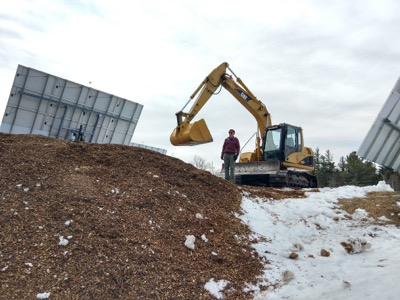
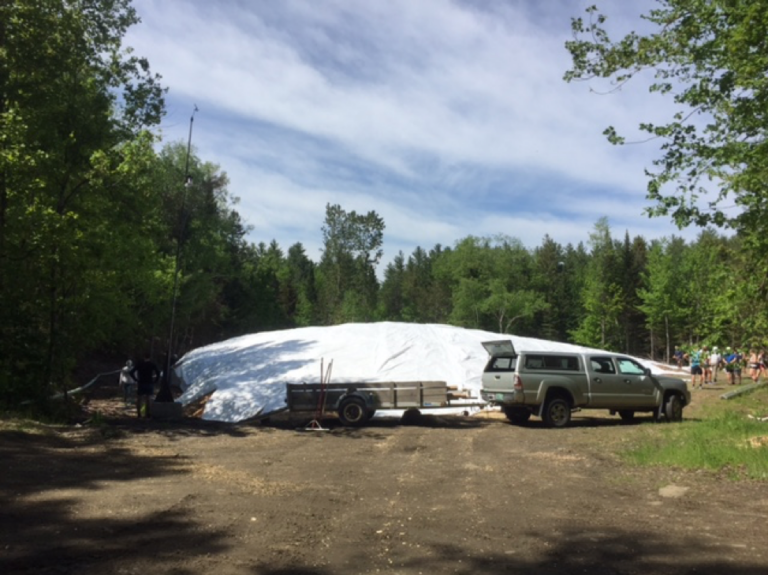
Next, with the help of the Craftsbury grooming team, they created two test piles at the end of the 2018 season in order to determine an optimal system for insulating snow through the summer. They covered the piles with roughly 25 cm of wood chips which were instrumented with thermometers. They tested a variety of covers including foams of different densities, concrete curing blankets, space blankets, and reflective mylar over the top to deflect solar radiation.
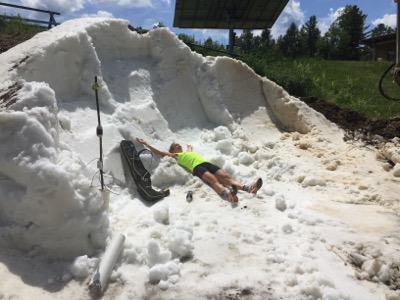
Susan Dunklee (USA Biathlon/CGRP) cools off from a mid-summer workout in a 2018 test pile. (Photo: Paul Bierman, UVM)
After monitoring the piles through the summer, they identified the optimal setup. On top of the manicured snow pile, a concrete curing blanket was laid primarily to protect the snow from debris. The blanket also adds some insulation. Next, a layer of wet wood chips 20 to 30 cm deep was spread, providing the majority of the pile’s insulation. Finally, a white mylar space was stretched across to reflect thermal energy from the sunlight. This system proved highly effective.
“When you monitor the temperature underneath that concrete curing blanket, it basically doesn’t change. No matter how hot it is outside, it basically stays at zero.”
With a scientifically-backed storage plan, the UVM and Craftsbury collaborators went into the 2019 season ready to give snow-storage a go. The pond site was improved and a road was built to improve access.
Keeping in line with its mission of sustainability, the COC purchased new energy-efficient airless snow guns which use between a quarter and a third of the power than older model fan guns. These new guns ran for a week in February, blowing roughly half the COC’s annual water allotment into a large pile.
“The beauty of it is that they don’t have to power fans anymore, so it was a lot less energy,” explained Bierman. “And they did it in the middle of their high season, and because they generate their own electricity for these guns, they have a heat recapture unit on the generator, so a significant part of the energy that would have gone up the chimney as waste heat, was now heating dorms that were full of people.”
He added that were the snow blown in November, as is the case in most snowmaking operations, the COC would have been mostly empty, meaning the heat would have been wasted that way as well.
Groomers ran a pistenbully back and forth over the pile to pack it more densely: dense snow melts more slowly. The pile was shaped with an excavator, then the team waited as it transformed into corn snow in the spring. Then the pile was covered with wood chips and the white reflective covering.
Though the storage method was tested the year before, the scale of the pile had increased dramatically.
“This was a big logistics year,” Bierman explained. “How do you do this? How do you shape a pile? How do you put chips on it? How do you put a cover on it? How do you keep the cover from blowing away in a big spring wind storm? Which it did the first time,” he laughed.
Once the pile was tucked neatly under its multilayer covering, the team sat back and monitored it regularly throughout the summer using a new style of survey equipment called terrestrial “LIDAR”, which stands for light detection and ranging. This allowed the team to track changes in the 3D surface of the pile, thereby measuring the change in volume.
“It became pretty clear by mid-July that this pile wasn’t shrinking very quickly. By the last scan in October, we had about 65% left by volume of what we put in there. And that is pretty much what Europeans in the Alps get.”
A LIDAR map of the 2019 stored snow pile at the Craftsbury Outdoor Center. Click to enlarge. (Photo: Optimization of over-summer snow storage at mid-latitude and low elevation, H. Weiss et. al.)
He explained that the limited existing data suggests that the average retention by volume of other snow storage sites is between 60-70% on average.
By their measurements in early November, the pile contained 5-6000 cubic meters of usable snow, which translates to 2-3 km of coverage at 50 cm deep and a few meters wide.
“In any normal November, that would be a godsend. Most of the early November skiing at Craftsbury is a big lollipop in the upper soccer field and down the hill in the lower soccer field, where people are going in one direction on maybe a 200 meter course around and around and around.”
He added that the preserved snow would allow “more interesting” terrain to be opened early, such as “Lemon’s Haunt”, a 1.6-kilometer blue square trail which rolls through the woods.
Feeling confident that the COC could provide a few k of skiing by its projected opening day on November 16th, the team began scraping off the layers of wood chips in early November. Then, in an unforeseen plot twist, the first snowfall of the year arrived, coating Craftsbury with a thick layer of natural snow. This interrupted the original plans of spreading the pile, but allowed the COC to open 25 kilometers of trail on opening day.
“The pity is that it didn’t work out as everybody anticipated, which was to lay a couple k of base down with this icy stuff, then have the natural snow sit on top of it, which would preserve the natural beautifully.”
He laughed that no one would want klister snow laid on top of their blue wax conditions.
So how would the pile have been transformed into ski trails had Mother Nature not trumped the scientist’s plans?
Bierman explained that during the summer, the snow transforms into “firn”, a term used most commonly with glaciers to describe an intermediate stage between snow and ice. Though icy and dense, the substance maintains its granular quality.
He explained that without the world-class groomers and equipment at the COC, making this into skiable terrain would not be possible.
“The beauty of Craftsbury is how well they groom. Their grooming is spectacular, they’ve got three piston bullies, they’ve got this.”
Prior to the natural snowfall, the grooming team had been meticulously cleaning an excavator and dump truck to ensure that dirt was not introduced into the clean snow pile, as the sun on the dark-colored dirt increases melting. Dirt in the base would be further mixed into clean natural snowfall, creating a problem from the get-go. Not to mention skiing in dirty snow is not recommended for your bases.
With clean equipment, the team would begin trucking snow to the furthest point, working their way backward toward the pile. Once the snow is laid out, groomers can work their pisten bully magic to create a surface that is pleasurable to ski.
The COC is developing a plan for how the stored snow will be used, which will be dependent on weather and natural snowfall. Some stored snow may be kept in order to patch holes in the event of a warm spell.
Next year, the team intends to again create as large a pile as possible and continue to fine tune the storage methods.
“This is just the first year, so we have a lot to learn–both in terms of process, and also environmental and cost-effectiveness,” wrote Geer.
An excavator layers wet wood chips onto the 2019 snow storage pile at the Craftsbury Outdoor Center. (Photo: Paul Bierman, UVM)
Bierman explained that the logistics of properly covering the large pile requires practice, but a lot of pitfalls have been flushed out in the first two rounds of the experiment. The COC staff will be refining their method of covering the surface with an adequate layer of wood chips which does not crack or slump, and overlapping layers of the white reflective cover to reduce the chance of exposure and rapid melting.
“Nature is going to help us because now the ground underneath that pile is cold. It has had cold melting snow on it all summer, so presumably the ground underneath there is 0 degrees C and saturated with 0 degrees C water, and it’s only going to get colder this winter.”
Bierman continued that other snow storage facilities have experienced improvement in retention each year over the first few years.
Depending on what winter has in store, the COC may increase the volume of snow that is blown into the pile in 2020.
“If we have a good snow year and they still have water left in February, they’re just going to blow it into the pile,” said Bierman.
He continued that they could scale up by an additional 50% over last year’s volume.
Overall, the project has been a great opportunity for the COC to improve upon existing snowmaking methods and to guarantee snow for Green Racing Project athletes, the local junior teams, and recreational skiers alike.
“It gives the place an insurance policy. It doesn’t matter when you put that snow away, by putting it away, Craftsbury can reliably say that they can open in November. We don’t even have to wait for snowmaking weather.”
What would it take for over summer snow storage to be implemented by other ski areas? Bierman explained that the recipe is outlined in great detail on the project website and also in a technical paper written by the UVM science team, which is currently under review (full citation below).
A white reflective space blanket is the final layer on the top of the snow storage pile. (Photo: Paul Bierman, UVM)
Clearly, the project requires significant resources: a place to store snow, an excavator, snowmaking equipment, pistenbully, coverage supplies, not to mention man-power. It is not, perhaps, readily accessible to small family run ski areas, but Bierman expressed that many major cross country centers could consider it.
Apart from the superficial benefits of early season skiing, Bierman imparted the importance of the underlying reason for the project.
“We’re on a trajectory of global warming unlike anything we’ve ever seen, and this is a Band-Aid. It’s a Band-Aid that might hold us for 10, 20, 30 years, but it’s not getting at the root issue here which is decarbonizing the global energy system. Unless we do that, all winter sports in these mid-latitudes are going to be extinct. We can’t save enough snow to have a nordic season if it doesn’t get cold anymore. If you look at the Vermont climate assessment, if we don’t change how we’re doing business — sort of the business as usual scenario, how we operate — we’re going to look something like the Great Smoky Mountains of Tennessee by 2090.
“So this is a fun thing, extend the season, that’s all great, but we have to take some serious action as a global community to deal with climate change and the use of carbon fuels.”
Overall, both Bierman’s team and the folks at the COC are pleased with the results produced by the project and the many benefits it has provided in its nascence. The large pile of preserved snow stands as a testament to creativity, dedication to sustainability, and the power of problem-solving.
“The takeaway is that it works,” concluded Bierman. “And actually, it’s a lot of fun and it’s been a great way to share what we know about climate change, and not only about climate change adaptation, which is what you’d call this project, but also climate change mitigation which is ‘how do we get on the front of this?’
“It’s a great educational tool about ‘climate change matters, and let’s see what we can do about it.’ We’re being forced to do things in New England that 20 years ago you wouldn’t have thought about doing.”
To bring this article to life, check out this video created by Bierman’s daughter, Quincy, who is a member of the junior program at Craftsbury.
References: Weiss, H. S., Bierman, P. R., Dubief, Y., and Hamshaw, S.: Optimization of over-summer snow storage at mid-latitude and low elevation, The Cryosphere Discuss., https://doi.org/10.5194/tc-2019-56, in review, 2019.
American Emily Dreissigacker racing to 47th in the women’s 10 k pursuit at the 2018 Olympics in PyeongChang, South Korea. (Photo: Ross Burton/US Biathlon)
A glance at Emily Dreissigacker’s bio shows a slew of career highlights, including a 10th place finish in the sprint, a 9th place in the pursuit, and a 15th place in the mixed team relay at the 2019 Open European Championships in Minsk-Raubichi, Belarus. There is also a bit of Dreissigacker’s backstory — how both of her parents were Olympic rowers and how she also had outstanding results as a junior in rowing before shifting her focus to biathlon after college. There is also a line that reads, “If I were not an athlete, I would…..have a cake bakery!”
However, the two pursuits are not mutually exclusive, and Dreissigacker does in fact have a hobby bakery, Kingdom Cakery, where she makes stunning and decadent occasion cakes in her spare time. FasterSkier connected with Dreissigacker via email to learn more.
FasterSkier: How did you get started as a baker and how did that transition into Kingdom Cakery?
Emily Dreissigacker: I’ve always loved to bake but I got really into cake specifically when I decided I was going to make my own wedding cake. (Dreissigacker married her CGRP and US Biathlon teammate Alex Howe in August 2016.) I did a lot of practice cakes leading up to the wedding and then afterward I had so many other flavor and decorating ideas that I wanted to sort of just kept making cakes.
In her spare time, 2018 Olympic Biathlete Emily Dreissigacker (CGRP/USA Biathlon) bakes custom cakes using seasonal and local ingredients. (Courtesy Photo)
FS: On your website, it says that you use seasonal and local ingredients – what are some examples of flavor combinations? What are some of your favorite flavors/ingredients to use?
ED: I love baking with fresh ingredients, everything from local eggs and milk to fresh berries and fruit when it’s in season. I think it makes such a huge difference in the flavor of the cake and that’s what I’m all about. A few of my personal flavor/ingredient obsessions are super dark cocoa powder, browned butter, homemade salted caramel, and chocolate cream cheese frosting.
FS: As you are training full time for biathlon, how much time are you able to put into baking and selling cakes?
ED: Not that much. It’s really still a hobby and every once in a while I get to make cakes for people. At this point, I have to turn down as many requests as I accept because of my crazy biathlon schedule and inability to plan too far in advance.
In her spare time, 2018 Olympic Biathlete Emily Dreissigacker (CGRP/USA Biathlon) bakes custom cakes using seasonal and local ingredients. (Courtesy Photo)
FS: What are your favorite types of cakes to bake/decorate? What creations are you most proud of?
ED: I love doing super tall single tier cakes. I’ve done a few weddings that have been a couple of cakes of different flavors and I love that. Thinking about the different flavors and different looks but still creating a cohesive display is a really fun challenge.
FS: Is this something you will continue doing after you retire from biathlon? Will you try to grow the business?
ED: I hope so!
For more drool-worthy cake photos, check out the Kingdom Cakery Gallery or Instagram.
In her spare time, 2018 Olympic Biathlete Emily Dreissigacker (CGRP/USA Biathlon) bakes custom cakes using seasonal and local ingredients. (Courtesy Photo)
U.S. Cross-Country Ski Championships Craftsbury, Vermont 1.5 k Classic Sprint
Friday at U.S. nationals, the women were up first with the 1.5 k classic sprint. In the qualification round, racing for the U.S. Ski Team (USST) and the Craftsbury Green Racing Project (CGRP), Ida Sargent marked the fastest time in 3:51.30 minutes. Kelsey Phinney (SMS T2) was second fastest in 3:54.04, and Julia Kern (SMS T2/USST D-Team) in third with a time of 3:54.42.
Live Timing screenshot of the top-30 qualifiers from the morning’s 1.5 k classic sprint qualifier at U.S nationals.
Sargent advanced to the finals by winning the first quarterfinal and semi-final. In the A final, she placed first in 3:43.55 to win the classic sprint national championship. Kern was second in 3:44.31, and Hannah Halvorsen (APU)third in 3:44.33.
Caitlin Patterson (CGRP) was fourth, Kaitlynn Miller (CGRP)fifth, and Hailey Swirbul (APU) sixth.
This post will be updated throughout the day as results come in.
Men’s top-30 qualifiers from the 1.5 k classic sprint a tU.S. nationals.
In the men’s qualifier, Ben Saxton (SMS T2) was first placed qualifier with a time of 3:18.58 minutes. Daniel Streinz (NMU) was second with a time of 3:19.00. Andy Newell (SMS T2/Salomon) was third fastest with a time of 3:19.12.
In the men’s A final, Canada’s Julien locke placed first in 3:15.46. Saxton placed second, but was the first American, crossing the line in 3:16.30. Logan Hanneman (APU) was third overall in 3:16.51.
Peter Holmes (SVSEF Gold Team) placed fourth, Canada’s Dominique Moncion-Groulx (Team R.A.D.) was fifth, and Zak Ketterson (NMU) sixth.
(For the U.S. podium determining the national title, Saxton was first, Hanneman second, and Holmes third.)
Erik Bjornsen (102) of Alaska Pacific University and the U.S. Ski Team celebrates his win in the men’s 50 k classic mass start at 2018 U.S. Distance Nationals on Wednesday in Craftsbury, Vt., ahead of Adam Martin (110) of the Craftsbury Green Racing Project in second. (Photo: John Lazenby/Lazenbyphoto.com)
2018 U.S. SuperTour Finals (Craftsbury, Vermont): 50 k classic mass start
In the final race of the U.S. racing season, Erik Bjornsen of Alaska Pacific University (APU) and U.S. Ski Team (USST) won his second individual race of the week at 2018 SuperTour Finals in Craftsbury, with a victory in the men’s 50-kilometer classic mass start on Wednesday for the U.S. Distance Nationals title. He previously won the 15 k freestyle mass start on Saturday.
Erik Bjornsen (102) leads his APU and U.S. Ski Team teammate Scott Patterson (101) and Craftsbury’s Adam Martin (110) during the men’s 50 k classic mass start at 2018 U.S. Distance Nationals on Wednesday in Craftsbury, Vt. (Photo: John Lazenby/Lazenbyphoto.com)
Bjornsen beat out Adam Martin of the Craftsbury Green Racing Project (CGRP) in the finishing stretch to finish first in 2:24:51.4 hours, 1.5 seconds ahead of Martin in second place.
For the first 25 k of the race, about six skiers had been in contention while skiing together at the front of the field. By 35 k, that lead group had dwindled to three, with Bjornsen and his teammate Scott Patterson (APU/USST) leading Martin. Five kilometers later, Martin led the other two, and the three stuck together into the final 5 k lap.
Ultimately, Patterson finished 22.8 seconds back in third place, ahead of another APU teammate David Norris, who came on strong while skiing alone on the last lap to close the gap to third, in fourth (+36.5).
The rest of the field was strung out as they crossed the line, with Simi Hamilton of the Stratton Mountain School (SMS) T2 Team and USST placing fifth (+1:49.0), and his teammate Paddy Caldwell (SMST2/USST) following nearly three minutes later in sixth (+4:34.4). Kris Freeman (Caldwell Sport) finished seventh (+8:10.8), Tad Elliott (Ski Club Vail) placed eighth (+9:15.6), Ian Torchia of Northern Michigan University (NMU) and the USST Development Team was ninth (+10:26.3), and Canada’s Scott Hill (Team Hardwood) 10th (+11:00.2).
In the junior men’s 30 k race, Ben Ogden (SMS) took the win in 1:29:17.6, while Hunter Wonders (APU) followed 17.2 seconds back in second place. Wyatt Gebhardt (Steamboat Springs Winter Sports Club) placed third (+1:46.6).
Start of the men’s 50 k classic mass start at 2018 U.S. Distance Nationals in Craftsbury, Vt. (Photo: John Lazenby/Lazenbyphoto.com)
Start of the men’s 50 k classic mass start at 2018 U.S. Distance Nationals in Craftsbury, Vt. (Photo: John Lazenby/Lazenbyphoto.com)
The men’s 50 k classic mass start at 2018 U.S. Distance Nationals in Craftsbury, Vt. (Photo: John Lazenby/Lazenbyphoto.com)
Men’s 50 k classic mass start leaders, with Erik Bjornsen and David Norris of Alaska Pacific University up front, at 2018 U.S. Distance Nationals in Craftsbury, Vt. (Photo: John Lazenby/Lazenbyphoot.com)
Scott Patterson (101) leads Adam Martin (110), Simi Hamilton (114) and others during the men’s 50 k classic mass start at 2018 U.S. Distance Nationals in Craftsbury, Vt. (Photo: John Lazenby/Lazenbyphoto.com)
Adam Martin (Craftsbury Green Racing Project) during the men’s 50 k classic mass start at 2018 U.S. Distance Nationals in Craftsbury, Vt. (Photo: John Lazenby/Lazenbyphoot.com)
Craftsbury’s Adam Martin (110) and Erik Bjornsen (102) of APU and the U.S. Ski Team leading the men’s 50 k classic mass start at 2018 U.S. Distance Nationals on Wednesday in Craftsbury, Vt. (Photo: John Lazenby/Lazenbyphoto.com)
Erik Bjornsen (102) leading his APU and U.S. Ski Team teammate Scott Patterson (r) and Craftsbury’s Adam Martin (l) during the men’s 50 k classic mass start at 2018 U.S. Distance Nationals in Craftsbury, Vt. (Photo: John Lazenby/Lazenbyphoto.com)
APU Head Coach Erik Flora in the ski-exchange zone for the men’s 50 k classic mass start at 2018 U.S. Distance Nationals in Craftsbury, Vt. (Photo: John Lazenby/Lazenbyphoto.com)
The ski-exchange zone for the men’s 50 k classic mass start at 2018 U.S. Distance Nationals in Craftsbury, Vt. (Photo: John Lazenby/Lazenbyphoto.com)
The feed zone for the men’s 50 k classic mass start at 2018 U.S. Distance Nationals in Craftsbury, Vt. (Photo: John Lazenby/Lazenbyphoto.com)
Sophie Caldwell (Stratton Mountain School T2 Team) running to deliver a feed during the men’s 50 k classic mass start at 2018 U.S. Distance Nationals in Craftsbury, Vt. (Photo: John Lazenby/Lazenbyphoto.com)
Simi Hamilton (l) gets a feed from his Stratton teammate Jessie Diggins during the men’s 50 k classic mass start at 2018 U.S. Distance Nationals in Craftsbury, Vt. (Photo: John Lazenby/Lazenbyphoto.com)
Everett Sapp, of Sugar Bowl Academy, racing the junior men’s 30 k classic mass start at 2018 U.S. Distance Nationals in Craftsbury, Vt. (Photo: John Lazenby/Lazenbyphoto.com)
A Craftsbury volunteer removes the timing chip of a Northern Michigan University skier after the men’s 50 k classic mass start at 2018 U.S. Distance Nationals in Craftsbury, Vt. (Photo: John Lazenby/Lazenbyphoto.com)
Adam Martin (Craftsbury Green Racing Project) after finishing second in the men’s 50 k classic mass start at 2018 U.S. Distance Nationals in Craftsbury, Vt. (Photo: John Lazenby/Lazenbyphoto.com)
Logan (l) and his older brother Reese Hanneman of Alaska Pacific University after the men’s 50 k classic mass start at 2018 U.S. Distance Nationals in Craftsbury, Vt. (Photo: John Lazenby/Lazenbyphoto.com)
The men’s 50 k classic mass start podium at 2018 U.S. Distance Nationals in Craftsbury, Vt., with Erik Bjornsen (c) in first, Adam Martin (l) in second and Scott Patterson (r) in third. (Photo: John Lazenby/Lazenbyphoto.com)
Bibs on a fence at the men’s 50 k classic mass start at 2018 U.S. Distance Nationals in Craftsbury, Vt. (Photo: John Lazenby/Lazenbyphoto.com)
Kikkan Randall (r) sprays her U.S. Ski Team teammates Jessie Diggins (c) and Sadie Bjornsen (l) with champagne on the podium of the 30 k classic mass start at U.S. Distance Nationals in Craftsbury, Vt. Diggins won, Bjornsen placed second and Randall finished third. (Photo: John Lazenby/Lazenbyphoto.com)
2018 U.S. Distance Nationals (Craftsbury, Vermont): 30 k classic mass start
Jessie Diggins swept SuperTour Finals once again, after doing so last year in Fairbanks, Alaska, and winning every individual race at 2016 SuperTour Finals the year before in Craftsbury, Vt.
Back in Craftsbury on Tuesday, and coming off three-straight victories in the classic sprint, 10-kilometer freestyle mass start and mixed relay with her Stratton Mountain School (SMS) T2 Team teammates, Diggins, 26, pulled out her fourth-straight win in her last race of the season: the women’s 30 k classic mass start, which is part of U.S. Distance Nationals.
Jessie Diggins (r) edging her U.S. Ski Team teammate Sadie Bjornsen at the line for the win in the women’s 30 k classic mass start at 2018 U.S. Distance Nationals in Craftsbury, Vt. (Photo: John Lazenby/Lazenbyphoto.com)
She did so in an all-out effort to the line, beating her fellow U.S. Ski Team (USST) member Sadie Bjornsen by just 0.4 seconds in 1:25:27.2 hours. Diggins, Bjornsen of Alaska Pacific University (APU), and another USST member Sophie Caldwell (SMST2) broke away from the pack on the first of five laps at the Craftsbury Outdoor Center. Caldwell dropped off the pace around 10 k and skied on her own for the next 15-plus kilometers before being caught by a chase group of six, led by Kikkan Randall (APU/USST), on the final lap.
Meanwhile, Diggins and Bjornsen skied together, trading the lead for the rest of the race. On the final short climb up to the stadium, Diggins pulled ahead slightly then extended her lead in the finishing straight. After finishing first and second, respectively, Diggins and Bjornsen laid on the ground for what seemed like a long time, particularly spent from the effort, before congratulating each other. Behind them, Randall outlasted the chase pack for third (+2:21.7), Caldwell followed just behind her in fourth (+2:23.1), Ida Sargent of the Craftsbury Green Racing Project (CGRP) and USST placed fifth (+2:26.5) and Rosie Frankowski (APU) finished sixth (+2:29.2).
Also in the top 10, Liz Stephen (USST) finished the last race of her professional career in seventh (+3:10.9), Caitlin Patterson (CGRP) eighth (+3:27.2), Kaitlynn Miller (CGRP) ninth (+3:56), and Chelsea Holmes (APU) 10th (+4:45.3).
Stratton had two wins on the day with Charlotte Ogden (SMS) winning the junior women’s 20 k classic mass start in 1:04:33.9. Canada’s Catherine Reed-Metayer (Skibec Nordique) placed second (+11.8), Waverly Gebhardt (Steamboat Springs Winter Sports Club) finished third (+33.8), and Phoebe Sweet (Craftsbury Nordic) was the third American junior in fourth overall (+1:10.2).
Spring Series concludes with the men’s 50 k classic mass start on Wednesday, starting at 9 a.m. EDT. Watch the races live on the SuperTour live stream.
The start of the women’s 30 k classic mass start at 2018 U.S. Distance Nationals in Craftsbury, Vt. (Photo: John Lazenby/Lazenbyphoto.com)
Jessie Diggins (1) leading the women’s 30 k classic mass start at 2018 U.S. Distance Nationals in Craftsbury, Vt. (Photo: John Lazenby/Lazenbyphoto.com)
Sadie Bjornsen (2) leading the women’s 30 k classic mass start at 2018 U.S. Distance Nationals in Craftsbury, Vt. (Photo: John Lazenby/Lazenbyphoto.com)
Sadie Bjornsen (2) leading the women’s 30 k classic mass start at 2018 U.S. Distance Nationals in Craftsbury, Vt. (Photo: John Lazenby/Lazenbyphoto.com)
Sadie Bjornsen (2) leading Jessie Diggins (c) and Sophie Caldwell (l) during the women’s 30 k classic mass start at 2018 U.S. Distance Nationals in Craftsbury, Vt. (Photo: John Lazenby/Lazenbyphoto.com)
Ida Sargent (15) leads Kikkan Randall. Caitlin Patterson, Liz Stephen (yellow bib) and others in a chase pack during the women’s 30 k classic mass start at 2018 U.S. Distance Nationals in Craftsbury, Vt. (Photo: John Lazenby/Lazenbyphoto.com)
Sadie Bjornsen (2) and Jessie Diggins (1) racing for first in the women’s 30 k classic mass start at 2018 U.S. Distance Nationals in Craftsbury, Vt. (Photo: John Lazenby/Lazenbyphoto.com)
Kikkan Randall (3) racing for third place in the women’s 30 k classic mass start at 2018 U.S. Distance Nationals in Craftsbury, Vt., ahead of Sophie Caldwell (second from l), Ida Sargent (second from r), and Rosie Frankowski (r). (Photo: John Lazenby/Lazenbyphoto.com)
Jessie Diggins (l), Liz Stephen (c) and Rosie Frankowski (r) at the finish of the women’s 30 k classic mass start at 2018 U.S. Distance Nationals in Craftsbury, Vt. (Photo: John Lazenby/Lazenbyphoto.com)
Jessie Diggins with a photo of her retiring U.S. Ski Team teammates Kikkan Randall and Liz Stephen on her cheek at 2018 U.S. Distance Nationals in Craftsbury, Vt. (Photo: John Lazenby/Lazenbyphoto.com)
Kikkan Randall (l) and Liz Stephen after the last race of their professional careers, the 30 k classic mass start at 2018 U.S. Distance Nationals in Craftsbury, Vt. (Photo: John Lazenby/Lazenbyphoto.com)
The women’s 30 k classic mass start podium at 2018 U.S. Distance Nationals in Craftsbury, Vt., with Jessie Diggins (c) in first, Sadie Bjornsen (l) in second and Kikkan Randall (r) in third. (Photo: John Lazenby/Lazenbyphoto.com)
Erik Bjornsen (2) of Alaska Pacific University and the U.S. Ski Team (USST) leads Simi Hamilton (13), of the Stratton Mountain School T2 Team and USST, and Tad Elliott (12), of Ski Club Vail toward the finish of the men’s 15 k freestyle mass start at 2018 SuperTour Finals in Craftsbury, Vt. (Photo: John Lazenby/Lazenbyphoto.com)
2018 U.S. SuperTour Finals (Craftsbury, Vermont): 10/15 k freestyle mass starts
Jessie Diggins won her second-straight race in as many days at 2018 SuperTour Finals and Erik Bjornsen pulled out a victory in the men’s 15-kilometer freestyle mass start on Saturday in Craftsbury.
Jessie Diggins (201) and Sadie Bjornsen (202) lead the women’s 10 k freestyle mass start at 2018 SuperTour Finals in Craftsbury, Vt. (Photo: John Lazenby/Lazenbyphoto.com)
Diggins, of the Stratton Mountain School (SMS) T2 Team and U.S. Ski Team (USST), won the women’s 10 k freestyle mass start in 25:56.0 minutes, just 1.2 seconds ahead of her USST teammate Sadie Bjornsen of Alaska Pacific University (APU) in second. The duo dropped the pack and battled to the line, while Kikkan Randall (APU/USST) skied on her own to third place, 12.6 seconds behind Diggins.
APU took three of the top four with Rosie Frankowski finishing 43.7 seconds back in fourth. Caitlin Patterson of the Craftsbury Green Racing Project (CGRP) followed in fifth (+1:02.2), and Sophie Caldwell (SMST2/USST) took sixth less than one-tenth of a second ahead of her Stratton teammate Katharine Ogden (Dartmouth College/SMS/USST Development Team) in seventh (+1:10.4). US Biathlon’s Susan Dunklee (CGRP) placed eighth (+1:19.4), Julia Kern (SMST2/USST D-team) finished ninth (+1:26.0), and Erika Flowers (SMST2), who competed at last weekend’s Norwegian Birkebeiner, placed 10th (+1:37.0).
In the men’s mass start, Bjornsen (APU/USST) and Simi Hamilton (SMST2/USST) went head to head down the finishing stretch for first, which Bjornsen took in 35:08.1. Hamilton finished 1.5 seconds back in second place, while Tad Elliott (Ski Club Vail) followed three seconds later in third (+4.6).
According to live timing, Paddy Caldwell (SMST2/USST) edged his fellow national-team member Scott Patterson (APU/USST) by less than one-tenth of a second for fourth place (+6.5). Brian Gregg of Central Cross Country (CXC), Team Gregg and Loppet Nordic Racing placed sixth (+30.4), David Norris (APU) finished seventh (+52.1), Jack Hegman of the Sun Valley Ski Education Foundation (SVSEF) eighth (+55.3), Adam Martin (CGRP) ninth (+56.2), and Eric Packer (APU) 10th (+59.8).
Spring Series continues Sunday with mixed relays at 9 a.m. EDT at the Craftsbury Outdoor Center.
Jessie Diggins (201) leads her U.S. Ski Team teammate Sadie Bjornsen and the rest of the women’s field in the 10 k freestyle mass start at 2018 SuperTour Finals in Craftsbury, Vt. (Photo: John Lazenby/Lazenbyphoto.com)
Jessie Diggins (SMST2/U.S. Ski Team) pushing to the line for the win in the women’s 10 k freestyle mass start at 2018 SuperTour Finals in Craftsbury, Vt. (Photo: John Lazenby/Lazenbyphoto.com)
Jessie Diggins (201) winning the women’s 10 k freestyle mass start, just ahead of Sadie Bjornsen (202) in second, at 2018 SuperTour Finals in Craftsbury, Vt. Kikkan Randall (background) placed third. (Photo: John Lazenby/Lazenbyphoto.com)
Kikkan Randall (APU/USST) racing to third in the 10 k freestyle mass start at 2018 SuperTour Finals in Craftsbury, Vt. (Photo: John Lazenby/Lazenbyphoto.com)
Kikkan Randall (l) and Jessie Diggins embrace after the finish of the women’s 10 k freestyle mass start on March 24 at 2018 SuperTour Finals in Craftsbury, Vt. Diggins won and Randall placed third. That was Randall’s second-to-last race before retiring from skiing. (Photo: John Lazenby/Lazenbyphoto.com)
Liz Stephen (U.S. Ski Team) racing to 12th in the women’s 10 k freestyle mass start at 2018 SuperTour Finals in Craftsbury, Vt. (Photo: John Lazenby/Lazenbyphoto.com)
Liz Stephen (U.S. Ski Team) having some fun at 2018 SuperTour Finals in Craftsbury, Vt. She finished 12th in the 10 k freestyle mass start. (Photo: John Lazenby/Lazenbyphoto.com)
U.S. Ski Team member Liz Stephen (yellow bib) during a photo opp at 2018 SuperTour Finals in Craftsbury, Vt. (Photo: John Lazenby/Lazenbyphoto.com)
Scott Patterson (1) leads his APU and U.S. Ski Team teammate Erik Bjornsen and the rest of the men’s field in Saturday’s 15 k freestyle mass start at 2018 SuperTour Finals in Craftsbury, Vt. (Photo: John Lazenby/Lazenbyphoto.com)
Scott Patterson (1) leads his APU and U.S. Ski Team teammate Erik Bjornsen and the rest of the men’s field in Saturday’s 15 k freestyle mass start at 2018 SuperTour Finals in Craftsbury, Vt. (Photo: John Lazenby/Lazenbyphoto.com)
The men’s 15 k freestyle mass start top six at 2018 SuperTour Finals in Craftsbury, Vt., with (from left to right) Brian Gregg in sixth, Paddy Caldwell in fourth, Simi Hamilton in second, Erik Bjornsen in first, Tad Elliott in third, and Scott Patterson in fifth. (Photo: John Lazenby/Lazenbyphoto.com)
Olympians Sadie Maubet Bjornsen, Jessie Diggins, and Kikkan Randall representing their club teams at the 2018 Super Tour Finals. (Photo: John Lazenby/Lazenbyphoto.com)
From left to right, Kikkan Randall, Bill Koch and Jessie Diggins, the U.S.A.’s three Olympic medalists in cross-country skiing at 2018 SuperTour Finals in Craftsbury, Vt. (Photo: John Lazenby/Lazenbyphoto.com)
Kikkan Randall (c) with young fans and her Olympic gold medal after the 10 k freestyle mass start at 2018 SuperTour Finals in Craftsbury, Vt. (Photo: John Lazenby/Lazenbyphoto.com)
Jessie Diggins (3) celebrates her win in the women’s classic sprint final on Friday at 2018 SuperTour Finals in Craftsbury, Vt., ahead of her Stratton Mountain School (SMS) T2 Team and U.S. Ski Team (USST) teammate Sophie Caldwell (4) in second. Craftsbury’s own Ida Sargent (in green and black), also of the USST, placed third, and Sadie Bjornsen (second from l, in blue) of Alaska Pacific University and the USST placed fourth. (Photo: John Lazenby/Lazenbyphoto.com)
2018 U.S. SuperTour Finals (Craftsbury, Vermont): Classic sprints
The end of the racing season is just around the corner. The U.S. SuperTour Finals (a.k.a. Spring Series) kicked off Friday with 1.3-kilometer classic sprints at the Craftsbury Outdoor Center, and four other days of racing are set to follow on Saturday, Sunday, Tuesday and Wednesday.
Andy Newell (101), of the Stratton Mountain School (SMS) T2 Team and U.S. Ski Team (USST), racing to first in the men’s classic sprint final at 2018 SuperTour Finals in Craftsbury, Vt., just ahead of his Stratton teammate Ben Saxton (102). Erik Bjornsen (103, behind Newell) finished third, Kris Freeman (119) placed fourth, Simi Hamilton (106) fifth, and Reese Hanneman (behind Bjornsen) sixth. (Photo: John Lazenby/Lazenbyphoto.com)
The U.S. Ski Team (USST) made the trek from Europe less than a week after racing at World Cup Finals in Sweden. Despite the travel and fatigue at the end of a long season, Andy Newell and Jessie Diggins, who both train with the Vermont-based Stratton Mountain School (SMS) T2 Team in the offseason,came won the men’s and women’s finals, respectively.
In Friday morning’s qualifiers, Simi Hamilton, also of the SMST2/USST, and Sadie Bjornsen, of Alaska Pacific University (APU) and the USST, posted the fastest men’s and women’s times, respectively. Newell qualified second, and Diggins qualified third.
Bjornsen went on to win the first quarterfinal and first semifinal, while Diggins did the same — winning the fifth quarterfinal and second semifinal. In the final, the two U.S. teammates met for the first time of the day. Diggins went on to cross the finish line first in 3:40.23, followed by her teammate Sophie Caldwell (SMST2/USST) 1.42 seconds later in second. Ida Sargent, of the Craftsbury Green Racing Project and USST, placed third (+5.18), and Bjornsen narrowly missed the podium in fourth (+0.29), Rosie Brennan (APU/USST) placed fifth (+6.54), and Kikkan Randall (APU/USST) rounded out the final in sixth (+13.56).
On the men’s side, Newell won all three of his heats, from the first quarterfinal to the first semifinal, right up to the final, crossing the line for the last time in 3:23.82. Hamilton won the third quarterfinal and placed second behind Newell in their semifinal in a photo finish for first (+0.01). Erik Bjornsen (APU/USST) won the other semifinal after winning the fifth quarterfinal as well. Ben Saxton (SMST2) advanced to the final as a lucky loser, along with Reese Hanneman (APU).
In the final, Newell bested Saxton, his Stratton teammate, by 0.68 seconds for the win. Erik Bjornsen took the final spot on the podium in third (+1.41), ahead of Kris Freeman (Caldwell Sport) in fourth (+2.14), Hamilton in fifth (+3.02), and Hanneman in sixth (+4.5).
SuperTour Finals continue Saturday with 10/15 k freestyle mass starts.
Jessie Diggins (SMST2/USST) racing to the third-fastest qualifying time in the women’s classic sprint qualifier at 2018 SuperTour Finals in Craftsbury, Vt. She went on to win the final. (Photo: John/Lazenbyphoto.com)
Andy Newell (SMST2/USST) racing to the second-fastest qualifying time in the men’s classic sprint qualifier at 2018 SuperTour Finals in Craftsbury, Vt. He went on to win the final. (Photo: John/Lazenbyphoto.com)
A pink-haired Susan Dunklee (US Biathlon) racing in the women’s classic sprint at 2018 SuperTour Finals at her home course in Craftsbury, Vt. She qualified in 19th and went on to place 22nd on the day. (Photo: John Lazenby/Lazenbyphoto.com)
U.S. biathlete Emily Dreissigacker having some fun in pink while racing the women’s classic sprint at 2018 SuperTour Finals at her home course in Craftsbury, Vt. She qualified in 25th and went on to place 24th overall on the day. (Photo: John Lazenby/Lazenbyphoto.com)
Andy Newell (101) leading one of the men’s classic sprint heats with Northern Michigan University’s Daniel Streinz (101) at 2018 SuperTour Finals in Craftsbury, Vt. Streinz reached the semifinals, where he finished third for seventh overall, while Newell won every heat, including the final. (Photo: John Lazenby/Lazenbyphoto.com)
Jessie Diggins (3) leads Ida Sargent (2) during one of the classic sprint heats at 2018 SuperTour Finals in Craftsbury, Vt. (Photo: John/Lazenbyphoto.com)
The women’s classic sprint top six at 2018 SuperTour Finals in Craftsbury, Vt., with (from left to right) U.S. Ski Team members Kikkan Randall in sixth, Sophie Caldwell in second, Jessie Diggins in first, Ida Sargent in third, Sadie Bjornsen in fourth, and Rosie Brennan in fifth. (Photo: John Lazenby/Lazenbyphoto.com)
The men’s classic sprint podium at 2018 SuperTour Finals in Craftsbury, Vt., with Andy Newell (c) in first, Ben Saxton (l) in second and Erik Bjornsen (r) in third. (Photo: John Lazenby/Lazenbyphoto.com)
Jessie Diggins (in sunglasses) during a photo opp with some young fans at 2018 SuperTour Finals in Craftsbury, Vt. (Photo: John Lazenby/Lazenbyphoto.com)
A near miss as competitors Tero Linnainmaa of Finland and Jorgen Madslien of Norway arrive at a checkpoint at the same time in the mixed relay at the International Orienteering Federation World Cup at Craftsbury Outdoor Center in Craftsbury, Vermont. (Photo: John Lazenby/Lazenbyphoto.com)
The following was submitted by Kevin Brooker, who attended the 2018 Ski Orienteering World Cup and Ski Orienteering World Masters Championships last week in Craftsbury, Vermont. Brooker, who wrote an introductory piece on ski orienteering, set out to explain how the event made its way to the small town in the Northeast Kingdom.
***
CRAFTSBURY, Vermont — Even within the tiny and tight-knit American world of nordic activities, ski orienteering is relatively unknown. Just like traditional cross country racing, the American devotees are rabid enthusiasts determined to have an impact on a sport dominated by Scandinavian athletes. Overseeing the sport is the International Orienteering Federation (IOF), whose mission is to promote the overall sport of orienteering and all of the subsets such as ski-o, mountain bike-o, and the largest segment: foot-o.
At the map exchange, athletes remove the used map, grab the next sequence and continue racing. Race volunteers collect the discarded maps and refill the board with fresh maps, as seen at the Ski Orienteering World Cup Finals in Craftsbury, Vt. (Photo: Kevin Brooker)
The IOF organizes a World Cup and World Championships for all segments and does its best to move these events around the globe. Like most international competitions, it takes several years to pull together an event. In addition to an appropriate venue, the organizing committee must have international experience, a lot of determination and grit.
Just how did the Ski-O World Cup Finals and Masters World Championships end up in Vermont and how did it go?
Ken Walker, event controller for this year’s championships in Craftsbury, explains the genesis of the event:
“I was approached several years ago while ski-0 masters racing in Europe about bringing World Cup ski-0 races back to North America. We held very successful races in Truckee, California, in 2012 and competitors wanted to return. I suggested doing it in the East and [Craftsbury Event Director] Adrian Owens was enthusiastic about holding them at Craftsbury. This was a natural choice, knowing the fine trail network and an organization welcoming competition events. My official job was national event controller. It basically means I check to ensure the races are fair, accurate and safe, and we follow the International IOF rules.”
Preparing for racers to arrive at the map exchange in the distance race at the International Orienteering Federation (IOF) Ski Orienteering World Cup at the Craftsbury Outdoor Center in Craftsbury, Vermont. (Photo: John Lazenby/Lazenbyphoto.com)
With a well-formed idea, Walker and Owens approached Judy Geer, co-owner of the Craftsbury Outdoor Center (COC), about hosting the event.
“When Adrian Owens approached us about the idea of hosting this race, which he did well over a year ago, I was pretty quick to say, ‘Sure, sounds like fun!’ ” Geer explained. “It seemed like an opportunity to share our trail system in a new way and welcome an international group of nordic skiers to Craftsbury. At the same time, we had no idea how to host such a race so it was critical that there would be a knowledgeable organizing committee to really put it all together. Luckily, we had that. “
An East-Coast venue secured, Walker and Owens assembled an organizing committee (OC) to bring the event to Vermont. The committee had more to do than just run a race; they had to educate the Craftsbury staff and teach them about ski-o.
Craftsbury Outdoor Center coach Ollie Burruss had this to say about his ski-o learning curve:
“I would just add that the organizing committee has been incredibly helpful in educating those of us at the Outdoor Center without a background in ski orienteering – I think that would be almost all of us, actually. We are quite comfortable hosting high level cross country races, but this series added new elements to our race day preparation. Without the OC stepping up and providing input, suggestion, education, and the like, we would not have known where to start.”
The finish crew getting ready to record race numbers to help verify the electronic finish order at the Ski Orienteering World Cup Finals and World Masters Championships in Craftsbury, Vt. (Photo: Kevin Brooker)
Much of a ski-o race shares a lot of similarities with a more traditional cross-country event. Both have individual starts and mass starts. With the exception of ski-o competitors wearing map holders, the starts and finishes look identical. Craftsbury was able to utilize their expertise and equipment setting up timing and start and finish areas. Where the Center needed some help was setting appropriate courses and the OC provided two expert competitors and course setters.
Alex Jospe and Andy Hall are two such experts.
“As course setter, my main task is to design an orienteering course that is appropriate for each class,” Jospe explained. “For the elite skiers, this involves very technical skiing and very technical navigation, with a mix of challenges from route choices to fine-scale navigation execution, all done at top speed. Ironically, those are the easiest courses to set, because the competitors can handle just about anything you throw at them. The tricky part is designing a course that will be navigationally challenging for the elder classes, without totally thrashing them on the ski trails.
One of the maps at the 2018 Ski Orienteering World Cup / World Masters Ski Orienteering Championships. (Photo: John Lazenby/Lazenbyphoto.com)
“Setting a course entails laying everything out on paper, and then going out into the terrain to make sure that all the trails and tracks line up the way they are supposed to,” she continued. “I also spend a lot of time skiing various route choices, to get a sense of how long it will take for the skiers to complete the course. Then we print out the maps, and go out to set up the checkpoints, which are marked with an orange and white flag. Each of these flags (called ‘controls’) has an electronic timing unit on top, so that competitors can carry a timing chip and get splits instantaneously at the finish.”
With the event completed, how does the OC feel about the event?
“We’ve been on a steep learning curve about this sport, and it’s really been fun to finally get to watch the races this week!” Greer noted. “We hope the competitors are enjoying Craftsbury as much as we’re enjoying having them here.”
“Our expectations have been more than met, with terrific support from venue staff and the trail groomers,” Walker said. “It is fun to host nearly 200 European racers and introduce more Americans to ski-o.”
The start crew preparing for the World Cup long distance event at 2018 Ski Orienteering World Cup / World Masters Ski Orienteering Championships in Craftsbury, Vt. (Photo: Kevin Brooker)
With years of racing, coaching, and organizing races, Burruss had this to say: “I really appreciate the patience they [the organizers] have showed and I hope we have held up our end of the bargain. It is a cool event and I’m glad we were able to help bring this level of racing to the NEK [Northeast Kingdom].”
The experience of setting dozens of courses for many levels of skill and age, with snow cover ranging from gray ice to a foot of fresh snow, Jospe summed up her experience:
“Hosting this event at the Craftsbury Outdoor Center has been amazing. They are generous, interested, and enthusiastic — we couldn’t do this without such good support! It’s really cool to bring so many international competitors to this corner of Vermont, and everyone is appreciating the friendly vibes.”
For those of us fortunate enough to participate in this world-class event, the hard work and effort by the OC and huge staff of volunteers at the start, finish, registration, and out on the course is greatly appreciated. The trail grooming was exceptional and the rest of the COC staff was extremely professional. Everyone worked together to provide a fantastic racing experience to spectators and participants alike.
About the Author: Kevin began nordic skiing to keep in shape for bicycle racing at the dawn of the skating revolution. He lives in Vermont with his wife and two kids, who are fortunate enough to have great skiing right out the front door.
This ski-orienteering mass-start race had two exchanges. The top map is the first taken after the start. The maps were used in different orders to deter leaching (following). The intricacies of an orienteering mass start are worthy of their own article. The course setter mixes and matches the routes, and each athlete will cover the same legs but in a different order. After all this, there is often a finishing sprint for the victory. The exchange crew must be sure to put the correct map into the proper slot to insure a fair race. (Photo: Kevin Brooker)
Sweden’s Martin Hammarberg leaving the start of the ski orienteering World Cup sprint on Tuesday in Craftsbury, Vt., with a map on a holder strapped to his chest. The first 300 meters or so of the race involve simple navigation, allowing the competitors time to read the map and formulate a plan. (All photos: Kevin Brooker)
CRAFTSBURY, Vermont — This week, the Craftsbury Outdoor Center is hosting the final three races of the 2018 Ski Orienteering World Cup as well as Ski Orienteering World Masters Championships. In addition to flocking from all over the United States, athletes have traveled from Bulgaria, Canada, Taiwan, Czech Republic, Estonia, Finland, Germany, Italy, Norway, Romania, Russia, Sweden, and Switzerland for this event.
For those FasterSkier readers worried about cross-country skiing being unknown here in the U.S., it is a safe bet “Ski-O” is orders of magnitude even more obscure.
A small ski-orienteering training map. At this scale, 1 centimeter on the map is roughly 50 meters on snow. The first number is the control for that race (athletes follow them in order) and the second is to identify the correct control has been found. Controls are scattered all over to suit different classes and only controls used for a particular class are depicted on the map.
Simply put, Ski-O is a race combining navigation and cross-country skiing. The route is up to the competitor and route choice is a big part of winning races. Just 15 seconds before they push through the wand to start their race, each athlete is given a map containing control points (used to determine distance). Most races are individual start, but there are mass start events, too (although none will be held in Craftsbury).
The skill is using a trail network to travel as fast as possible from control to control, which must be taken in a specified order. Race distances are given as control to control in a straight line and actual distance traveled is longer due to the circuitous nature of ski trails. Adding a bit of fun to the mix, not all travel is on wide, groomed trails. Athletes are free to travel off trail if they believe it is the quickest way to the next control.
The organizers prepare trails full enough for two athletes to skate alongside each other (depicted as a solid green line on the map), narrow but almost skate-able (dashed green line), or single track (dotted green line) which is pretty much a hiking trail that a skier can double poled to navigate.
The map also contains topographical information and navigable features such as buildings, cliffs, fields, fences, and just about anything which can be identified when covered with snow.
Gion Schnyder of Switzerland showing off his gear and smile after finishing seventh in Tuesday’s ski orienteering World Cup sprint in Craftsbury, Vermont.
Each skier wears a map holder which can pivot in the center allowing the athlete to orient the map if they so choose. This device also allows the skier to read the map while in motion.
Route choices are made on the basis of the quality of the ski tracks, gradient and distance, all of which can be read from the map. Each athlete decides if it is quicker to ski wide trails and travel farther while going faster, or take the shortest route through the woods while moving at a lower rate of speed. It might also be quicker to abandon mapped trails altogether and strike out through the woods.
Watching these athletes move through the woods is impressive. They travel off-trail and successfully negotiate terrain most alpine skiers would hesitate to try. There is very little slowing down, leaving a wide trail for a bit of single track. In comparison with the more well-known cross-country skiing, ski orienteers are faster on technically challenging, narrow, soft tracks.
Ski-orienteering pole baskets are relatively big since a lot of the terrain is not compacted trails.
There are a few equipment modifications for ski-o. Pole baskets are significantly larger and skis are a bit shorter than what’s used on firm groomed tracks. Skating is preferred and some competitors carry a compass. To verify finding a control, an electronic chip (looks like a thumb drive) is time stamped when the athlete passes the chip across a device which looks like a cellphone. At the end of the race the chip is downloaded to calculate the total course time. Distance is not measured. The fastest athlete to collect all controls in the specified order and complete the course is the winner.
The World Cup sprint has a point-to-point distance for the men of 3.4 kilometers, and the best distance by trail is 4.4 k. The women’s race has a point-to-point of 3 k and trail distance of 3.7 k. The men have 11 controls and the women have nine. The expected winning time for both races is 13 minutes.
On the other end of the spectrum, a long-distance event is advertised point-to-point as 24 k for the men and 18 k for the women. Both have an expected winning times of roughly 90 minutes.
At the end of the World Cup week, FasterSkier will post a short report on the races.
Here are the top-five results of Tuesday’s World Cup sprint:
Spectators alongside the trail at the 2018 Ski Orienteering World Cup in Craftsbury, Vermont.
US Biathlon’s Lowell Bailey (l) and Susan Dunklee after teaming up for bronze in the single mixed relay at 2018 IBU Open European Championships on Sunday in Ridnaun, Italy. (Photo: Manzoni/NordicFocus)
IBU Open European Championships (Ridnaun-Val Ridanna, Italy): Single mixed & mixed relays
Susan Dunklee and Lowell Bailey teamed up for the final day of the 2018 International Biathlon Union (IBU) Open European Championships in Ridnaun, Italy, and raced to a bronze medal in the single mixed relay.
The American duo, both of which earned individual medals at last year’s IBU World Championships, finished just 9.1 seconds out of first, which went to Norway’s Thelka Brun-Lie and Vetle Sjåstad Christiansen. The Norwegians won in 35:39.6 with zero penalties and six spares. They took the lead after Brun-Lie’s second leg, where she cleaned both stages without spares.
France placed second, 8.6 seconds back, with Julia Simon and Emilien Jacquelin, who combined for no penalties and 11 spares. They led the first half of the race, but slipped to second behind Norway on Simon’s second leg.
Dunklee put the Americans off in second on her first leg, which she cleaned with a spare in each stage, then they slipped one place to third on Bailey’s first leg, where he cleaned as well and used three spares. In all, they used 10 spares and avoided the penalty loop, and finished half a second out of second place.
“Over Christmas, we trained a little bit with the French athletes, including Jacquelin,” Bailey said, according to a US Biathlon press release. “So I know that he has quite a fast finish, and I thought I am kind of an old man here, I should maybe try to go harder on the first part of the lap. But he stayed with me all the time and had me in the end.”
“It was a good opportunity to tune up the race shape, build some confidence and find that sharp feeling heading into the Olympics,” Dunklee told US Biathlon. “The single mixed relay is one of my favorite race formats and today was a blast!”
Canada’s Sarah Beaudry and Carsen Campbell placed eighth of 24 teams in the single mixed relay, finishing 1:03.6 out of first with just eight spares and zero penalties. In 11th after the first leg, they moved into eighth on Campbell’s first leg, which he cleaned with one spare. Beaudry then cleaned her second leg without any spares, and Campbell anchored them to eighth.
The U.S. entered a team in the mixed relay that followed, with Chloe Levins, Deedra Irwin, Paul Schommer, and Alex Howe placing 17th (+5:55.5) of 19 teams with no penalties and 12 spares.
Ukraine won the mixed relay to conclude the championships, with Yuliia Zhuravok, Iryna Varvynets, Artem Pryma, and Dmytro Pidruchnyi combining for zero penalties and six spares and finishing in 1:11:40.1.
Russia placed second (+11.7) with Victoria Slivko, Anastasia Zagoruiko, Evgeniy Garanichev, and Alexander Loginov combining for zero penalties and nine spares.
Norway followed in third (+33.2) with Emilie Ågheim Kalkenberg, Kaia Wøien Nicolaisen, Håvard Gutuboe Bogetveit, and Fredrik Gjesbakk combing for no penalties and just four spares.
U.S. SuperTour (Craftsbury, Vermont): 5/10 k freestyle
Two Alaska Pacific University (APU) athletes topped the podium on Sunday at the SuperTour in Craftsbury, Vermont, with David Norris winning the men’s 10-kilometer freestyle individual start in 21:54.9 and Becca Rorabaugh topping the women’s 5 k freestyle in 12:06.4.
Norris won the men’s race by 6 seconds over Canada’s Andy Shields (Lappe Nordic) and Kevin Bolger of the Sun Valley Ski Education Foundation (SVSEF) placed third (+15.8). Kris Freeman (Caldwell Sport) was the third American in fourth overall (+23.7), and three Canadians took fifth through seventh with Michael Somppi (Lappe Nordic) in fifth (+27.9), Evan Palmer-Charrette (NTDC Thunder Bay) in sixth (+37.5) and Scott Hill (Barrie Cross Country) in seventh (+37.6), ahead of Brian Gregg (Team Gregg/LNR/CXC) in eighth (+39.4), Tad Elliott (Ski Club Vail) in ninth (+44.3) and Jack Hegman in 10th (+50.4).
Rorabaugh won the women’s race by just 2.2 seconds over her APU teammate Rosie Frankowski in second, and Erika Flowers of the Stratton Mountain School (SMS) T2 Team placed third (+4.6). Two Craftsbury Green Racing Project (CGRP) skiers finished fourth and fifth, with Kaitlynn Miller in fourth (+12.1) and Liz Guiney in fifth (+22.5), Kelsey Phinney (SVSEF) was sixth (+25.8), and Canadians Olivia Bouffard-Nesbitt (Rocky Mountain Racers) seventh (+26.4) and Frederique Vezina (Pierre-Harvey National Training Centre) eighth (+36.0). Corey Stock, of the Bridger Ski Foundation (BSF) placed ninth (+39.9), and Felicia Geisor (CXC Team) was 10th (+44.4).
On Saturday, the Craftsbury Outdoor Center hosted its 37th annual Craftsbury Marathon, with Nils Koons winning the 48 k men’s race in 2:28:51.0 hours and Hannah Dreissigacker winning the 48 k women’s race in 3:01.48.7.
Hannah Halvorsen of the U.S. Ski Team and APU on the start line in Ulrichen, Switzerland, after finishing fifth in the sprint qualifier. (FIS screencap)
FIS Cross Country World Junior Championships (Ulrichen, Switzerland): Freestyle sprints
World Junior Championships kicked off today with freestyle sprints in Ulrichen, Switzerland. Moa Lundgren of Sweden claimed with women’s title by 1.89 seconds over Kristine Stavås Skistad of Norway in the final, with Sweden’s Frida Karlsson finishing third (+1.89).
Hannah Halvorsen of the United States qualified in fifth place before skiing to second in her quarterfinal heat. Halvorsen hovered around third or fourth place through much of her semifinal and was unable to snipe any spots in the finishing straight, ending up fourth in the heat and eighth on the day.
Fellow Americans Margaret Gellert and Sofia Shomento also made the quarterfinals, finishing 18th and 23rd, and Canada’s Hannah Mehain wound up 29th on the day.
The new men’s junior world champion is Tom Mancini of France, who nipped Norway’s Jørgen Lippert by just 0.10 seconds to take the win. Valerie Grond gave the Swiss crowd a thrill by making it all the way to the final and taking home bronze, despite qualifying in just 21st position. The Swiss junior narrowly edged France’s Vincent Buiatti for the final step on the podium.
Canada’s Graham Ritchie finished second in his quarterfinal after qualifying in 28th position, earning an automatic spot in the semifinals. There he finished sixth (+9.30 behind Mancini), winding up 12th on the day. Teammate Antoine Cyr also made the quarterfinals where he had an impressive crash, slinging off the trail and into the infield, finishing 30th on the day. For the U.S., Gus Schumacher was the lone qualifier for the heats. He finished fourth in his quarterfinal and was just 0.22 seconds away from a “lucky loser” spot in the semifinals. Schumacher finished 19th on the day.
In the junior women’s race, Hannah Rudd of the United States finished 35th in qualification, +18.15. For Canada, Annika Richardson finished 52nd (+24.09), Catherine Reed-Metayer 56th (+28.25), and Alexandra Racine 69th (+37.27).
In the junior men’s sprint, Canada’s Reed Godfrey finished a tough 31st, just 0.21 seconds out of making the quarterfinals. Etienne Hebert rounded out the Canadian finishers in 36th place (+11.81) in the qualifier. Canyon Tobin was 41st in qualification for the U.S. (+13.46), followed by Karl Schulz in 54th (+16.90) and Luke Jager in 60th (+18.15).
FIS Nordic Combined World Cup (Seefeld, Austria): Individual normal hill/15 k
Japan’s Akito Watabe after winning the 2018 Seefeld Triple Nordic Combined World Cup. He is the only athlete besides Germany’s Eric Frenzel to win the event. (Photo: FIS Nordic Combined)
On the final day of the Seefeld Triple, Japan’s Akito Watabe completed his sweep of the three-day weekend and Norway’s Jarl Magnus Riiber reached the podium for the third-straight day, placing second. Germany’s Fabian Rießle placed third for his second podium in the last two days.
Watabe jumped to first on the normal hill and started the 15 k Gundersen 48 seconds ahead of Riiber in second. He went on to win the race by 1:14.9 minutes in 34:58.6, becoming the only man besides Germany’s Eric Frenzel to win the Seefeld Triple in its five-year history.
After jumping to fifth, Rießle won a photo finish for third (+1:57.9), edging Germany’s Vinzenz Geiger by less than a tenth of a second. Geiger moved up from ninth in the jump to fourth overall (+1:57.9).
Norway’s Jørgen Graabak followed in fifth (+2:02.4),Frenzel placed sixth (+2:07.4), Norway’s Jan Schmid was seventh (+2:09.8), Finland’s Eero Hirvonen eighth (+2:13.5), Norway’s Espen Andersen ninth (+2:28.0), and Austria’s Mario Seidl 10th (+2:42.1) out of 28 finishers.
No Americans contested the final day of the Triple, the last World Cup before the 2018 Winter Olympics in PyeongChang, South Korea.
Jessie Diggins of the U.S. Ski Team (center) celebrates after winning the 10 k mass start freestyle in Seefeld, Austria, over Heidi Weng (left) and Ragnhild Haga of Norway. (Photo: FIS Cross Country/Twitter)
FIS Cross Country World Cup (Seefeld, Austria): 10/15 k mass start freestyle
In the final World Cup race before the 2018 Olympics, Jessie Diggins achieved the ultimate goal to give herself the utmost confidence heading into PyeongChang — winning the women’s 10-kilometer freestyle mass start at the World Cup in Seefeld, Austria, on Sunday.
The win was her first of the season and fourth individual victory of her career. Diggins, a 26-year-old U.S. Ski Team member, pulled it off by attacking on a long climb and leaving Norway’s Heidi Weng, Ragnhild Haga and Ingvild Flugstad Østberg chasing. While Diggins was several seconds ahead over the top and all alone on the long descent that followed, Weng and Haga worked to close the gap — and nearly did in the finishing stretch. But Diggins held them off, winning by 0.7 seconds over Weng in second place and 1 second ahead of Haga in third, and threw her fists down in celebration as she crossed the line first in 23:08.5 minutes.
“I just put my head down and it wasn’t pretty, but I just hammered,” Diggins told the International Ski Federation (FIS) in a televised post-race interview.
She was the only non-Norwegian in the top five, with Østberg in fourth (+8.7) and Marit Bjørgen in fifth (+16.7). Austria’s Teresa Stadlober placed sixth (+16.9), Norway’s Kari Øyre Slind was seventh (+19.1), and American Sadie Bjornsen placed eighth (+20.5), ahead of Switzerland’s Nathalie von Siebenthal in ninth (+30.3).
The U.S. had three in the top 15 with Kikkan Randall (U.S. Ski Team) in 14th (+48.5), and two more women in the top 30, with Caitlin Patterson (Craftsbury Green Racing Project) in 23rd (+1:00.7) and Liz Stephen (USST) in 29th (+1:18.2). Rosie Brennan (USST) finished 53rd (+2:26.9).
Emily Nishikawa led the Canadians in 35th (+1:36.5), followed closely by teammate Cendrine Browne in 37th (+1:36.6). Dahria Beatty finished 45th (+1:58.9).
Dario Cologna of Switzerland (center) won the men’s 15 k skate mass start in Seefeld, Austria, over Alex Harvey of Canada (left) and Martin Johnsrud Sundby of Norway (right). (Photo: FIS Cross Country/Twitter)
The Olympics are nearing and so Switzerland’s Olympic legend Dario Cologna is ramping up: after winning the Tour de Ski, he took another win in the 15 k mass start skate in Seefeld, Austria, on Sunday.
With much of the field staying relatively close together until the finish, Cologna nabbed the win by 1.4 seconds over Canada’s Alex Harvey, who took his second podium of the season in addition to also finishing third in the overall Tour de Ski.
Norway’s Martin Johnsrud Sundby was third (+2.9), then teammate Didrik Tønseth in fourth (+5.9) and France’s Maurice Manificat in sixth (+7.5).
The U.S. Ski Team’s Erik Bjornsen had a breakthrough day finishing ninth (+9.3), followed by Simi Hamilton in 12th (+12.4). Behind them, Scott Patterson placed 27th (+23.4), then Patrick Caldwell 49th (+1:26.2), Ben Lustgarten 55th (+1:42.7), and Tyler Kornfield 77th (+3:00.0).
Canada’s Devon Kershaw and Graeme Killick finished 30th (+26.5) and 31st (+27.4), respectively. Len Valjas placed 58th (+1:53.1), Knute Johnsgaard 82nd (+3:23.1), Bob Thompson 87th (+4:27.5), and Julien Locke 92nd (+4:56.9).
The jumping portion of the Nordic Combined World Cup Seefeld Triple on Friday in Seefeld, Austria. (Photo: Garrott Kuzzy / LumiExperiences.com)
Nordic Combined World Cup (Seefeld, Austria): Individual normal hill/5 k
On the first of the three-day Seefeld Triple Nordic Combined World Cup, Japan’s Akito Watabe took the win and Taylor Fletcher was the top American in 28th in the individual normal hill/5-kilometer Gundersen on Friday.
Japan’s Akito Watabe heading out of the gate second in the 5 k Gundersen on Friday at the Seefeld Triple Nordic Combined World Cup in Seefeld, Austria. Watabe went on to win the race by half a second. (Photo: Garrott Kuzzy / LumiExperiences.com)
Watabe put himself in second in the jump portion and started the 5 k ski race 21 seconds behind Norway’s Jarl Magnus Riiber in first. Watabe caught Riiber and beat him at the finish line, taking the win in 11:22.3 minutes, while Riiber followed 0.5 seconds back in second place. Germany’s Fabien Rießle followed in third, 32.4 seconds out of first, after starting the 5 k in sixth and 1:03 minutes back.
Norway’s Jan Schmid jumped to third and ended up fourth (+37.8). Watabe’s brother, Yoshito Watabe placed fifth (+47.2), losing one place in the ski race after jumping to fourth.
Two Americans competed, with Fletcher jumping to 30th and ending the day in 28th, and Jasper Good finishing 52nd (+3:45.6) after jumping to 49th. Both are headed to the 2018 Olympics next month in PyeongChang, South Korea.
Taylor Fletcher (USA Nordic) starting the 5 k Gundersen on Friday at the Seefeld Triple Nordic Combined World Cup in Seefeld, Austria. He started in 30th and finished 28th. (Photo: Garrott Kuzzy / LumiExperiences.com)
***
U.S. SuperTour (Craftsbury, Vermont): Classic sprints
Forrest Mahlen (APU) celebrates his first time atop the SuperTour podium on Friday after winning the men’s 1.4 k classic sprint final in Craftsbury, Vermont. (Photo: Forrest Mahlen/Instagram)
Kaitlynn Miller and Forrest Mahlen won their respective classic-sprint finals at Friday’s SuperTour in Craftsbury, Vermont.
The 1.4-kilometer classic sprint kicked off a three-day race weekend at the Craftsbury Outdoor Center. On Saturday, the Craftsbury Marathon will be held (not a SuperTour event), followed by 5/10 k freestyle SuperTour races on Sunday.
Miller, of the Craftsbury Green Racing Project, started Friday by winning the women’s qualifier. She went on to win both her quarterfinal and semifinal before topping the final as well in 3:40.9 minutes. Also on Friday, it was formally announced that Miller was named to the U.S. Cross-Country Ski Team’s Olympic squad, which will compete in PyeongChang, South Korea, Feb. 10-25.
Kelsey Phinney, of the Sun Valley Ski Education Foundation (SVSEF), placed second in the women’s final, 0.63 seconds back, and Felicia Geisor (CXC Team) was third (+1.67). Erika Flowers, of the Stratton Mountain School (SMS) T2 Team placed fourth (+3.2), Canada’s Olivia Bouffard-Nesbitt (Rocky Mountain Racers) — fresh off NorAm Western Canadian Championships last weekend in Alberta — finished fifth (+5.46), and Alaska Pacific University (APU) skier Rosie Frankowski (who also made the U.S. Olympic team) placed sixth (+6.27).
On the men’s side, APU’s 24-year-old Mahlen qualified fifth, then won his quarterfinal and semifinal before taking the final for his first-career SuperTour win in 3:06.81. Ben Saxton (SMST2) initially won the qualifier and won his quarterfinal as well before placing second to Mahlen in the first semifinal. Saxton ended up 0.55 seconds back in second place in the final, just three-hundredths of a second ahead of Kevin Bolger (SVSEF) in third place (+0.58). Another half second back, Kris Freeman followed in fourth, just 1.09 out of first, Eric Packer (APU) was fifth (+1.39) and Canada’s Andy Shields (Lappe Nordic), who also competed at Western Canadian Championships last weekend) sixth (+8.99).
The men’s 10 k sprint podium at IBU Open European Championships, with Latvia’s Andrejs Rastorgujevs (c) in first, Russia’s Alexander Loginov (l) in second, and Bulgaria’s Krasimir Anev (r) in third. (Photo: IBU/Biathlonworld)
IBU Open European Championships (Ridnaun-Val Ridanna, Italy): Men’s and women’s sprints
Canada’s Macx Davies led the North Americans on Friday on Day 2 of the International Biathlon Union (IBU) Open European Championships in Ridnaun, Italy, placing 27th in the men’s 10-kilometer sprint with 9-for-10 shooting (1+0). Davies finished 1:32.3 minutes behind Latvia’s Andrejs Rastorgujevs, who took the win in 24:03.0 with a single penalty as well (0+1).
Russia’s Alexander Loginov placed second, 5.5 seconds back, with one penalty (1+0), and Bulgaria’s Krasimir Anev shot clean to finish third (+24.5).
“At the [last] World Cup in Anterselva [Italy], I have had a difficult time in the shooting range, and so I spent a lot of time in the last few days working on my shooting,” Rastorgujevs told the IBU after. “Today it was clear that all this hard work paid off. It is also a great motivator for Olympic gold.”
For Davies, who’s also headed to the Olympics next month, the result tied his best individual result this season after he placed 27th in an IBU Cup sprint earlier this month in Osrblie, Slovakia.
Canada entered four in the men’s race, with Carsen Campbell finishing 75th (+2:34.6) with one miss (0+1), Aidan Miller placing 91st (+3:18.2) with three penalties (1+2), and Matt Hudec finishing 119th (+4:31.6) with four misses (1+3).
Five American men raced, with Alex Howe finishing 53rd (+2:15.1) with one penalty (1+0), Jake Brown 84th (+3:02.0) with four misses (1+3), Jakob Ellingson 85th (+3:07.0) with one miss (1+0), Max Durtschi 111th (+3:50.1) with four misses (3+1), and Paul Schommer 114th (+3:59.8) with four penalties (2+2) as well.
The women’s 7.5 k sprint podium at IBU Open European Championships in Ridnaun, Italy, with Ukraine’s Iryna Varvynets (c) in first, France’s Chloé Chevalier (l) in second, and Japan’s Fuyuko Tachizaki (r) in third. (Photo: IBU/Biathlonworld)
In the women’s 7.5 k sprint that followed, Chloe Levins of the U.S. was the top North American in 59th, 2:01 behind the winner Iryna Varvynets of Ukraine. Varvynets shot clean and posted the fastest finishing time of 20:54.1, 12.5 seconds faster than France’s Chloé Chevalier, Wednesday’s 15 k champion who had one miss (0+1) on Friday and ended up second. Japan’s Fuyuko Tachizaki reached the podium in third (+15.5) and was one of four women in the top five that shot clean (only Chevalier did not).
“After the individual competition on Wednesday, I was not at all happy with my shooting,” said Varvynets, who placed fifth in the 15 k. “Today I therefore concentrated especially hard in the shooting range. It was my luck that not many finished without errors, otherwise it would probably not have been enough for the victory.”
“Two races, two medals — it could not have gone better for me,” Chevalier said. “In the standing shooting I missed the first disc and got a little nervous, but thankfully, there were no further errors.”
Tachizaki called the bronze medal a “big dream come true”.
“The focus of my season had been the Olympics and I ‘only’ took part in Ridanna as part of the preparations, but with this result I have exceeded everything I have achieved so far,” she said. “At the end of the race I did not only fight hard in the track, I was already dreaming of a medal. Now I’m in seventh heaven.”
Levins had one miss in each stage (1+1), as did fellow American Maddie Phaneuf, who finished 63rd (+2:19.0) with two penalties. Clare Egan followed in 70th (+2:34.2) with four misses (3+1), Deedra Irwin was 85th (+3:38.1) with four penalties (1+3) as well, and Jennie Bender 97th (+5:52.8) with six misses (3+3).
Two Canadians started the race, with Sarah Beaudry finishing 76th (+3:02.9) with four misses (1+3). Erin Yungblut did not finish.
Open European Championships continue Saturday with the men’s and women’s pursuits. The top 60 from the sprint qualify, which, for the North Americans, means Davies, Howe, and Levins.
The championships end Sunday with single mixed and mixed relays.
“I haven’t straight out won a highly competitive race in two years, so winning on my arch nemesis course of West Yellowstone was huge,” Hart, 25, wrote in an email last week about her Dec. 2 sprint win. “I know that the period one altitude is not my best friend, and am really working on keeping a positive and confident mentality. The race for period two World Cup starts is tight (I think right now there are five or six women all within three points), so I’m trying not to focus on that too much. It would obviously be wonderful to lock those up, but more than anything I just want to set myself up physically and mentally well for a stellar nationals in Alaska.”
The day after her win in the 1.3-kilometer skate sprint, Hart finished 15th in West Yellowstone’s 10 k classic mass start on Dec. 3. Last weekend up at Sovereign Lake in British Columbia, Hart finished seventh both in the NorAm-opening skate sprint and 10 k skate, which counted toward SuperTour standings.
She started her season with a training block in Sjusjøen, Norway, then at the Beitostølen races, with a goal of racing on snow before it really counted at this month’s SuperTour and U.S. nationals. In Beitostølen, she told FasterSkier she was mostly focused on recovering, feeling fresh, and above all, having fun.
Anne Hart (SMS Elite Team) racing in last month in Beitostølen, Norway. (Courtesy photo)
“I’ve just been doing way less training this year and paying attention with my strength coach, saying that you’re trying to be an athlete first and then the skiing comes,” she said on Nov. 17, after placing 31st in the 10 k classic in Beitostølen (she raced all three races there, repeating in 31st in the classic sprint, then 19th in the 10 k skate). “So this whole summer I’ve been working on my general athleticism and I’m just now starting to hone in on the skiing intensity of that.”
In West Yellowstone, she talked about using her journal to map out the sprint course, point pointing areas to focus on.
“In my journal last night I actually had part of the course labeled ‘mushroom boost,’ which is right over the top of that last hill,” Hart said after her sprint win, alluding to the speed burst featured in the Mario Kart Nintendo game.
“So I was able to do my planned mushroom boost at the end, came across with the win and I couldn’t be more thrilled,” she said.
That mushroom-boost reference got us thinking: what kind of journal does Hart keep? It’s nothing like a training log, she explained, but rather a tool she picked up from a mental trainer she’s been working with since the summer, at the suggestion of her strength coach Max Lipset.
“I had been doing all of this physical training, but had been struggling a bit with how to wrap my mind around all the variables inherent in ski racing,” Hart wrote in an email. “This past season I had a really hard time shaking off bad races, and ended up carrying negative feelings from one weekend to the next. And I can tell you that there is no amount of physical training that can surmount that.”
She started speaking with John D’Agostini of Invictus Leadership, a “mindset and personal leadership coaching” company based out of the Twin Cities, according to D’Agostini’s Linkedin profile. Hart grew up in Stillwater, Minnesota, attended Dartmouth College in New Hampshire, and now trains out of Stratton in southern Vermont.
Hart explained that they initially spoke twice a week and are now in contact about once every 10 days.
“The Invictus program is a bit unique in that John is not a sports psychologist — he is just an individual with a lot of experience in the arena of mental fortitude, and has developed a curriculum that has helped me immensely,” Hart wrote. “As part of my ‘homework’ he suggested I start keeping a journal. I’m the only one who looks at it (although I’ll give you a sneak peak), and it has been a great way for me to critique myself without being negative.”
Here are the key aspects of Hart’s journaling:
1. Don’t think of it as a training log. It’s for everything else that’s on your mind.
“It has absolutely nothing to do with a training log (I have a big old google spreadsheet for that), but is instead a place I write down random thoughts, anything that is bothering me, things that are empowering me, and even recipes I want to try,” she explained.
2. It can include drawings, or more specifically, course maps for pre-race, mental training.
In West Yellowstone, Hart “drew a very loose representation of the sprint course, noting how I wanted to ski different sections and places I should look for passing opportunities (to either pass or be passed),” she explained. “This ended up being a huge help, as when it came to the final of the sprint and I found myself in the back, I had already figured out four or five different places I could attempt a pass as long as I kept my head cool and my wits about me. I ended up being able to use one of my pre-planned places and come out with the win.”
3. It’s your journal. Nobody else needs to see it. Although Hart did share a few excerpts (below) as examples:
Anne Hart’s course map, as she drew it in her journal, of the SuperTour sprint course in West Yellowstone, Montana.An excerpt from Hart’s journal entry after racing in New Zealand in this past September.Recipe notes as seen in Hart’s journal.
In terms of a physical workout, here’s one Hart recommended:
“Late last winter I did a workout with the Craftsbury team that I really loved,” she wrote. “It is designed to prepare for a hard but somewhat paced 10-kilometer race, and I did it once while I was in Norway to get ready for individual start distance races.”
The Workout: 2 x 5 k time trial
Warmup: 30 minutes of easy skiing, plus 3-6 minutes of threshold
The workout: On a measured 5 k loop, time yourself while completing 5 k at threshold with an occasional Level 4 pace.
Rest for five minutes, then try to complete the same loop 15-30 seconds faster.
“It is WAY harder than I would have initially thought, but is an awesome way to find a hard but sustainable pace, and a good way to pay off part of the mortgage on your own personal pain house :)” Hart wrote.
Pepa Miloucheva (l), head coach of the Craftsbury Green Racing Project, giving biathlete Susan Dunklee some sculling instruction at the Craftsbury Outdoor Center in June 2012. (Photo: Susan Dunklee)
A critical issue looms in Craftsbury, Vt. — home to what nordic skiers know as the Craftsbury Outdoor Center (COC).
The COC runs sculling camps on the adjacent Great Hosmer Pond. Currently, motorboats and scullers share access on the pond. The tippy-sleek sculls are best on glassy water — meaning no wind and restricted speeds for any motor boats. Some homeowners along the pond are frustrated with what they claim is the COC’s monopolization of the pond, insisting their right to pursuits like high-speed boating, water skiing and tubing is restricted.
But before we dive deeper, what’s this have to do with skiing?
“What skiers may not know is that we also have a national reputation for our sculling camps which are a really wonderful place to learn how to row or get better at rowing,” Judy Geer, an owner and director of the nonprofit, said in a phone interview.
Sheldon Miller, COC communications director, wrote in an email that annually the sculling/rowing camps generate $1.2 million dollars in annual revenues. That revenue, in turn, underwrites many of the COC’s ski programs.
“The Outdoor Center is a non-profit, and it basically it’s sort of like an ecosystem,” Geer said. “The more diverse an ecosystem is, the healthier and more sustainable it is going to be. We need summer activities to balance the winter activities and we need income-generating activities, like the camps, to balance the charitable work that we do.”
Ida Sargent, a Craftsbury Green Racing Project (CGRP) skier and U.S. Ski Team member. (Photo: John Lazenby/Lazenbyphoto.com)
COC makes the FasterSkier news cycle when it hosts SuperTour-caliber ski races or its Craftsbury Green Racing Project skiers reach the podium. In recent years, COC has become a literal savior and news peg when it comes to on-snow skiing. The northeast has been hit with repeated low-snow years, and COC’s snowmaking operation has produced a reliable skiing option. What’s less known is the community outreach at the core of COC’s mission. The “charitable work,” Geer referred to.
Remoteness is the Northeast Kingdom’s liability and blessing. The most rural part of a rural state, the region remains postcard Vermont. But as such, local residents, including school-age children, often rely on the COC as their access to wellness.
“Being a rural community, there are not a lot of formal recreational opportunities,” said Dave Snedeker, executive director of the Northeastern Vermont Development Association. “The Outdoor Center provides free membership to community members in Craftsbury and Albany [Vermont]. Residents of those two communities have free access to the outdoor center all year round. It’s a great benefit because most people don’t have the option of joining a gym or have a place to go. So the Outdoor Center provides that.”
That access includes users like the roughly 850 children who visit the COC with their school in winter and have the option of using rental equipment free of charge. According to Miller, financial assistance is generous when it comes to subsidizing youth programs and offering families scholarships for its programs.
“The Center goes out of its way to remove financial barriers to entry into the youth sports it supports — primarily cross-country skiing, biathlon, and mountain biking,” Miller wrote. “For example, Craftsbury Nordic Ski Club annual fees currently amount to $800 for a high school athlete. There are currently 29 skiers in this program, and they have year-round access to three dedicated youth and junior coaches. By comparison, the same level of annual programming costs over $2,000 in central Vermont and over $8,000 in Vail, CO.”
Primed and ready for the day, some of Craftsbury Outdoor Center’s junior skiers toe the line for a fun relay. (Photo: Anna Schultz)
Considering the regional impact, any reduction to that $1.2 million influx from the COC sculling camps could potentially make nordic skiing even more exclusive in a state with a proud inclusive nordic skiing heritage.
The skiing-rowing bond is tight in Craftsbury, a town with a population of about 1,100 (in 2000). As good as the skiing can be there, the rowing on Great Hosmer Pond is considered world-class. Rowers there are protected by the pond’s geography from intolerable winds. From a programming standpoint, COC could foreseeably run sculls all day on the pond, the water conditions are most often favorable.
Here’s the watered-down version of the Great Hosmer Pond quagmire: Great Hosmer Pond is a long and skinny lake, nearly two miles in length and approximately 175-feet wide at its narrowest. By state law, a “200-foot shoreline safety zone,” exists. That safety zone means no high-speed boating, speeds in excess of 5 mile per hour within 200 feet of shore. Most spots in Great Hosmer Pond don’t meet the legally necessary conditions established in Vermont for high-speed boating.
Either way, formal regulations on the pond are rarely if ever enforced, Greer said.
As it stands, only a few small sections of the pond are suitable for high-speed use. Even in those small areas, Vermont law still restricts a motorized boat to no-wake-speeds within 200 feet of the following: “a person in the water, a canoe, rowboat, or other vessel”.
COC would like the state to enforce the pre-existing laws mandating speeds be limited to 5 mph where and when appropriate. Geer and Miller explained that COC has voluntarily cut back on camp participants and hours of use on the pond. These include self-prescribed restrictions like no camps on holiday weekends, an overall reduction in the number of campers for both week-long and weekend camps, and for 2017, a limit of eight out of 15 weekends between Memorial Day and Labor Day during which camps are run.
“We really committed to staying off the lake every afternoon, totally from 1-4 and on Saturday all the way until 7,” Geer said of COC’s commitment to compromise. “We have listened, we have made changes. It hasn’t seemed to help and it hasn’t really been acknowledged, I mean it’s been frustrating. For us, we see as the age old — how do you share a community resource? In our mind, you share it to benefit as many people as you can. And you also take care of that resource so that it is healthy and sustained into the future.”
Stakeholders on both sides of the issue are involved in community organizing and lobbying state officials. FasterSkier reached out to Sarah George, whose family owns a cabin on the pond. (George was also appointed the Chittenden County state’s attorney in January 2017.) George has spoken to the press in the past about boating use on Great Hosmer Pond, but she declined an interview request with FasterSkier. It does appear that the issue for some property owners along the lake is less about the nuances of motorboat use, and more about the idea that a business is monopolizing how the pond is used.
“An issue has arisen where the COC and there sculling camps have monopolized much of the usage of the pond during the summer months and left camp owners unable to use their motorboats and fisherman and other users unable to access the pond due to the size constraints of the pond and having 40-50 rowing shells (20′ long) on the water at one time. Despite efforts to resolve differences between the two factions, the State Department of Environmental Conservation Watershed Division has become involved to mediate the dispute and potentially enact rules restricting motorboats and other uses on the pond in favor of this private business entity doing business on land and water that belongs to the people of Vermont!”
The petition was posted online in January, and as of Thursday, it had 20 signatures.
CGRP skier Caitlin Patterson heads out on the water for a rowing workout. (Photo: Heather Mooney)
On one side, the perception is that COC monopolizes. On the other, the reality that even a single speeding boat can monopolize by creating wakes and possibly unsafe situations for scullers.
Gina Campoli, speaking on behalf of the organization, was concerned for both the COC’s viability and the state regulating non-motorized use on the pond.
“Winter and summer we are really concerned that the state of Vermont would consider diminishing the outdoor center’s ability to function,” Campoli said. “And that is to undercut their rowing program, which as you know underwrite many of the winter programs. Although this is rowing story, it is going to have a direct effect on this really special place.”
A draft proposal to mitigate the conflict was released on July 25. The only new provision was this segment: “Use of racing shells and rowing sculls is prohibited on the Pond between the hours of 1:00 pm and 4:00 pm, and the hours of 7:00 pm and sunrise, from the last Saturday in May through the first Monday in September.”
The COC remains an anchor in the community. Beyond providing cost-effective programming, COC helps maintain the pond’s ecosystem.
“Another thing the Outdoor Center does, there is an invasive aquatic species called milfoil, and the Outdoor Center fully funds its removal,” Snedeker explained. “They fully fund that. If they didn’t do that then that would be on the community taxpayers to bear, assuming they wanted to keep their lake clean.”
Offsetting costs like that to the community is one of many economic benefits the COC provides the region. Snedeker said it remains one the Northeast Kingdom’s largest employers with 60 full-time employees and maintaining 100 staff during the summer season.
Those wages eventually makes its way into the Northeast Kingdom.
“Those people live in the community and spend money at local businesses,” Miller wrote. “The Center pays all property and state taxes, and its guests infuse tourism dollars into local businesses. Whether people come to Craftsbury for a week-long camp or a two-day ski race, they stop at general stores, local breweries, and other points of interest along the way. Even guests who stay on campus bring money to local providers, as a majority of the food served at the Center is grown locally and local contractors and suppliers are used whenever possible.”
Stay tuned as the decision-making process moves forward.