From the FasterSkier archive — posts syndicated from athletes’ and coaches’ own blogs between 2004 and 2012, kept online as published. Current coverage is at fasterskier.com.

Tag: Crested Butte Nordic

  • Finding Mountains and Meaning in Crested Butte

    Finding Mountains and Meaning in Crested Butte

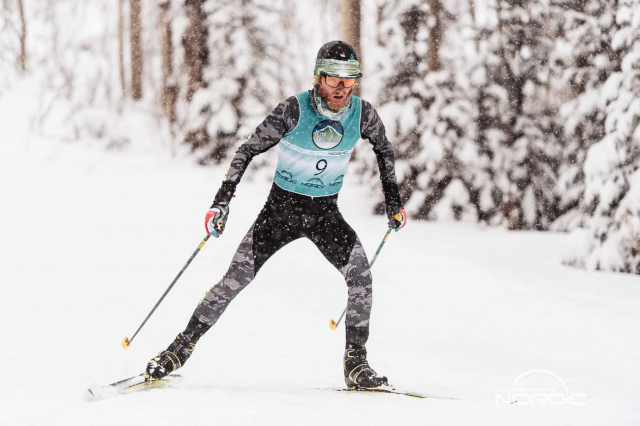
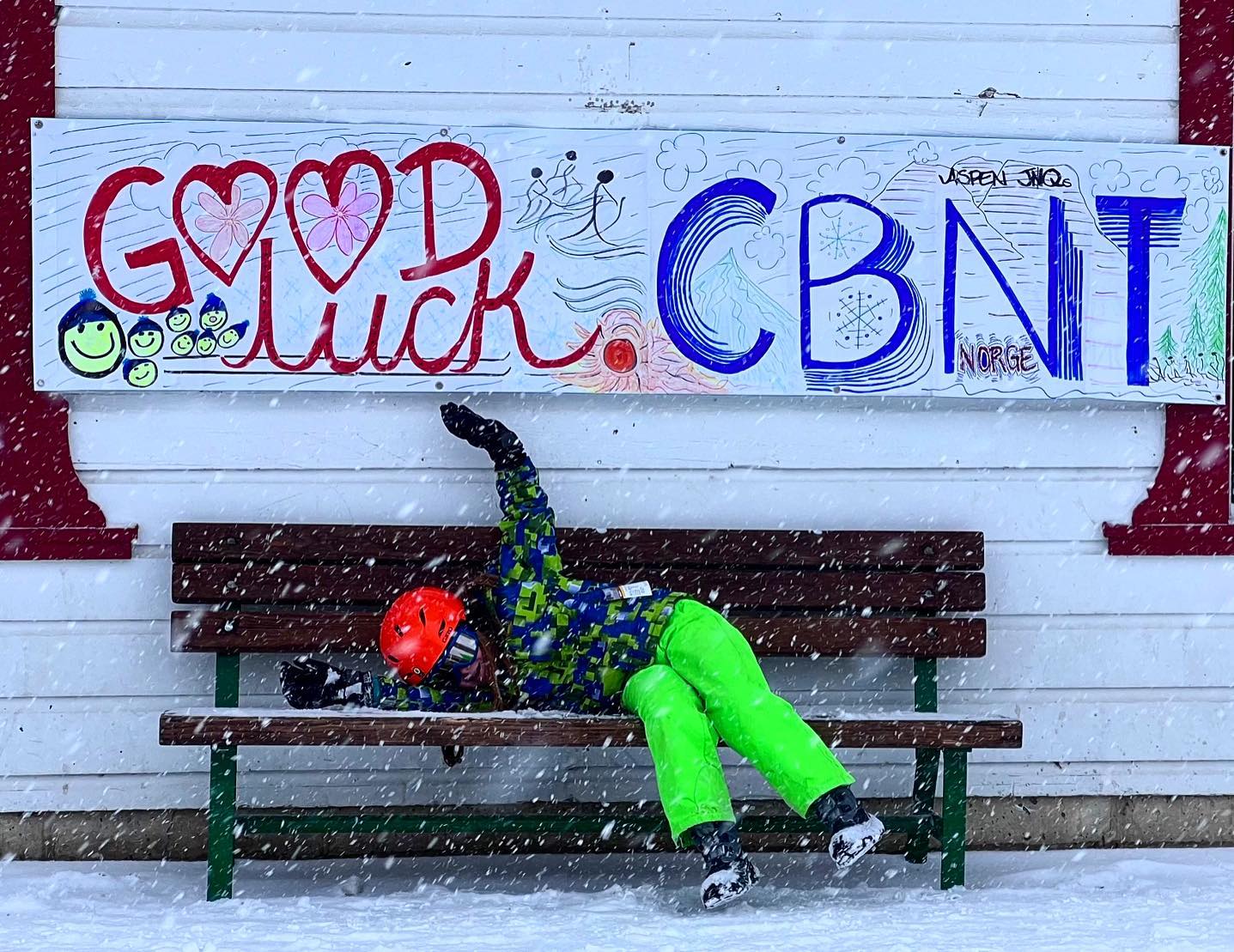
    A banner on Crested Butte’s Victorian-era City Hall bids the Crested Butte Nordic Team (CBNT) well last winter. (Photo: Crested Butte Nordic)

    Even for the US Postal Service, delivering mail to the end of the road at 9,000 feet is a challenge. Home delivery is out of the question: in Crested Butte, Colorado, you need a PO box, no matter who you are. As a consequence, a trip to pick up packages at the Post Office is something you make a day out of, and each member of the disparate factions that make up life in our mountain town—the ranchers, cowboys, ski bums, remote workers, and millionaire second homeowners—has to wait their turn. The post office is an egalitarian space by necessity.

    I was taking my turn last March when I picked up a phone call from Than Acuff. An all-trades character in a town that has knack for producing them, Than is most prominently the Crested Butte News’ one-man sports department, where he covers the gamut from homegrown Olympians to local beer league softball in his “Sports Barrel.” When I answered, I let on that I’m at the Post Office, and he responds, “So that means we can go really in-depth, right?!?”

    As it turns out, we did. We talked through how the Crested Butte Nordic Team (CBNT) had just finished our last Junior National Qualifier, and how a handful of our athletes now had their sights set on Junior Nationals in Fairbanks, Alaska. We covered how, as a coach, I was proudly looking forward to following our athletes up to Alaska.

    Then, we slipped into retrospection. When the season started out last November, it was my first as the Head Coach in town, after taking over a growing program from Molly Susla, our previous leader of nearly a decade. It was a quick learning curve, as we were slated to host the first race of the year for Rocky Mountain Nordic last December. Than and I started there, and traced a throughline from the support that had poured into putting on that race to what turned out to be an extraordinarily successful season for CBNT. We both agreed that the weekend had been the best of what our small town could be. Parents whose kids had outgrown CBNT decades ago took day-long shifts volunteering on course, little kids came out to look up to our junior skiers, our steadfast local photographer Xavi Fane (who’s photographs are featured in this article) weaved through the woods in his Telemark gear to get the best shot, the Mayor came by just to say hi, and one of our parents, Pat O’Neil, supplied a self-curated mix of Taylor Swift, Johnny Cash, and the Grateful Dead from which a random sample of the color commentary went, “Jerry Garcia, BIG nordic skiing fan, not many people know.” It was cold. It was fun. It was quirky. It was tough. It had also set a tone for the Crested Butte kids that followed them throughout their season. Up front, they saw that to be successful in the sport of skiing they didn’t have to aspire to be anything that they weren’t already. All we had to do as a team was lean into the qualities that shaped them as people, and the community they lived in.
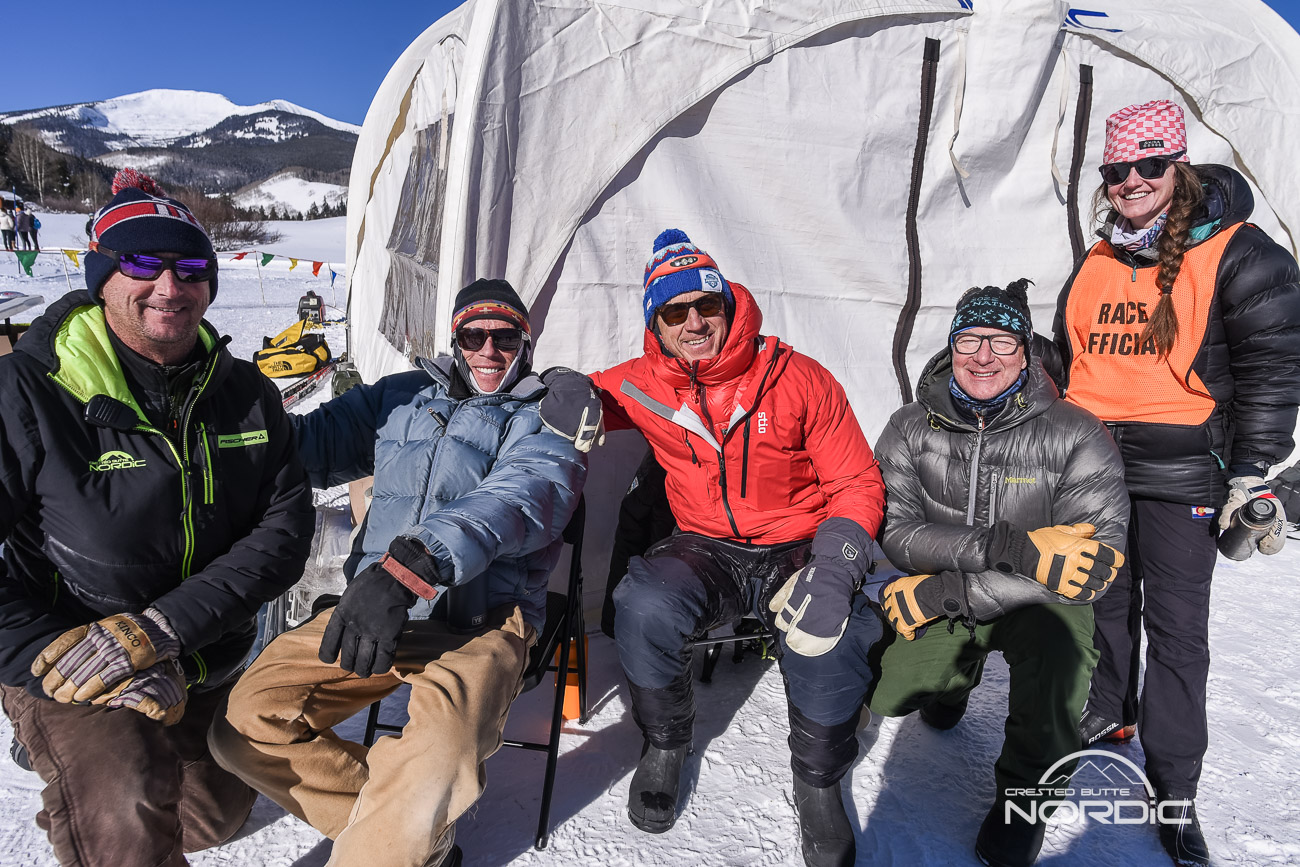
    Some of Crested Butte’s hearty volunteers (l-r) Kevin Krill, Rich Smith, Tony Veit, Tim White, and Emma Lohr. (Photo: Xavi Fane).

    After reminiscing, I said bye to Than, and from right behind me in the post office line, a voice went, “That was super fun to hear!” I turned to find Carol Kastning, whose son Andrew had skied on the Team in another iteration, long before my time, and had gone on to race and coach in Alaska, where, a couple weeks after this conversation, he would lend his voice as a commentator for Junior Nationals. Mrs. Kastning and I proceeded to recap my impromptu report, before starting to trace the throughline of that season the other way, back in time, to illuminate a nordic community that had waxed and waned in its character over the years, but never in its spirit. The theme recurred: in Crested Butte, nordic skiing had been a constant fixture, a solitary winter pursuit that so many in this deep pocket of the world had figured out how to form a life, and a community, around.

    Other members of the post office line chimed in with their variations on that theme. There were old hippies who had cleared out the mine tailings and equipment to lay the ski trails we now use every day, and parents whose kids had just taken their first stride on skis and now wanted to join in, too. Two people conversing turned into five, and then ten. A moment in the last remaining egalitarian space in town echoed out towards the past and future of a community, and did so focused around skiing.

    I picked up my packages and started to walk back to my office at the Crested Butte Nordic Center. Fresh snowflakes were falling. That directed my disposition up towards the mountains, and thoughts of skiing them rose to the top of my mind. Quickly, they were met by more thoughts about the little post office gathering I had just left that had looked to make meaning out what skiing them meant.
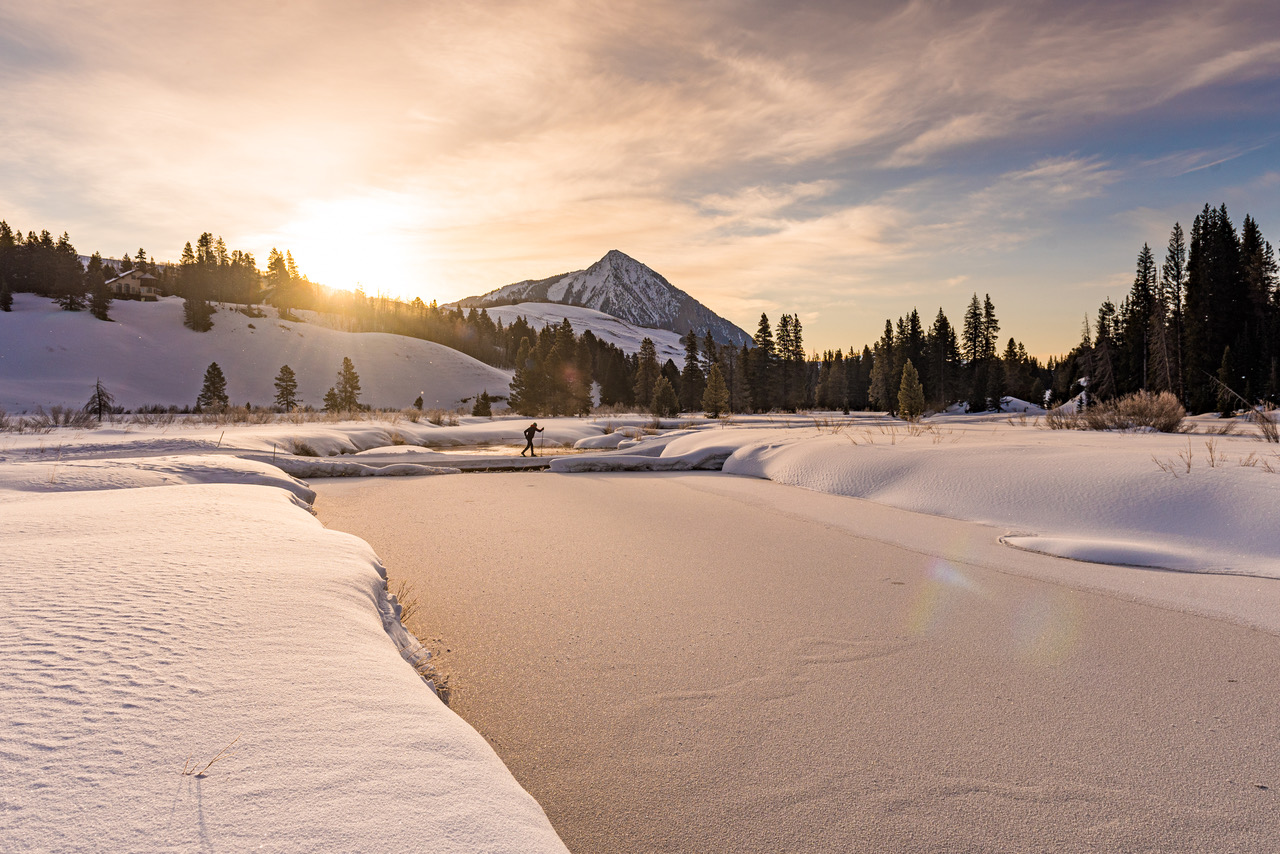
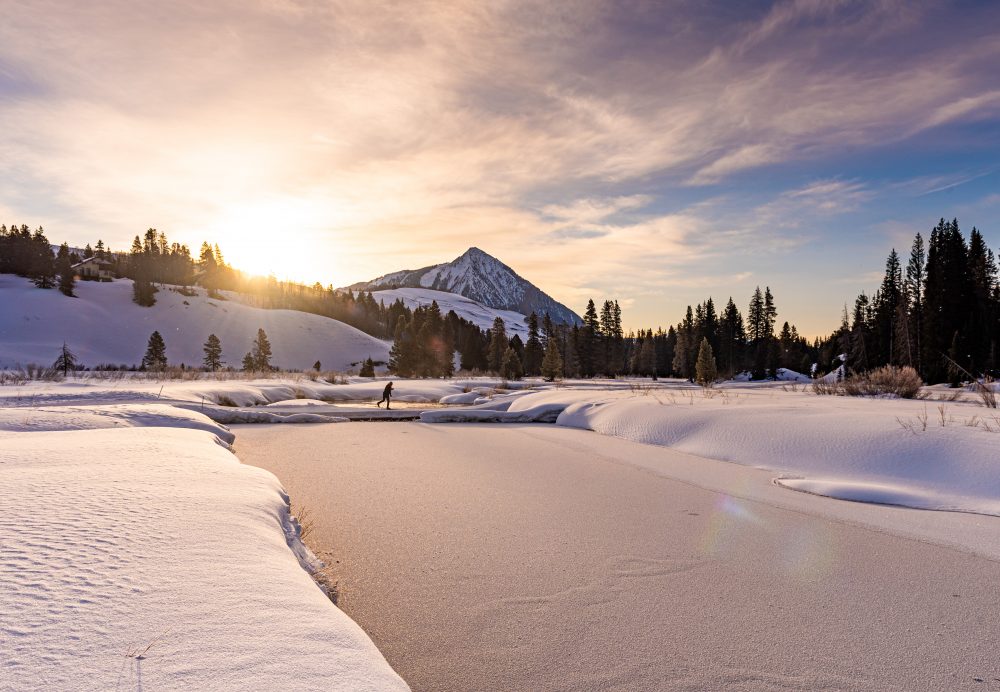
    Looking down the Slate River at Mt. Crested Butte during a winter morning. (Photo: Xavi Fane)

    I decided it was best not to search too hard. The essence of Crested Butte, this mountain town, most probably was located up in the mountains. Get two tectonic forces deep down in the Earth crashing against each other, and they’ll push up a mountain range. Likewise, the forces that move life along in a mountain town follow the same physics. On one plate, the landscape drives some kind of radically democratic impulse. Sublime is the mood of the high country, on its peaks and in its low, endless expanses. It’s rendered an uncharacteristic cession of human hubris, caused us to have marked off thousands of miles of the Rocky Mountains as land that was made for you and me – National Forests, Parks, and Wilderness Areas. On the opposing plate, however, there is the ever-more-exuberant desire to own it for oneself. Where those two forces have collided, a history has formed. For thousands of years, the Ute came to the Slate River Valley where Crested Butte currently lies in the summer and left when the snow fell, before the coal miners showed up to stake their claim. After a century, a generation of Hippies moved into those miners’ abandoned shacks, and 50 years later, a Billionaire owns half of town. Those same miners’ shacks come affixed with seven figures in the real estate ads that look to sell them.

    Viewed that way—through the lens of this latest convergence—skiing, of the cross-country variety, seemed to me the chosen medium for the Crested Butte community to keep its particular impulses as a place made for you and me a vivid thing. Seventy years ago, the coal mine that had once owned the town closed down. In the intervening time, the people of Crested Butte built, of all things, a Nordic Center where the coal mine once stood. On that March morning outside the Post Office, I chose to believe that wasn’t a coincidence.
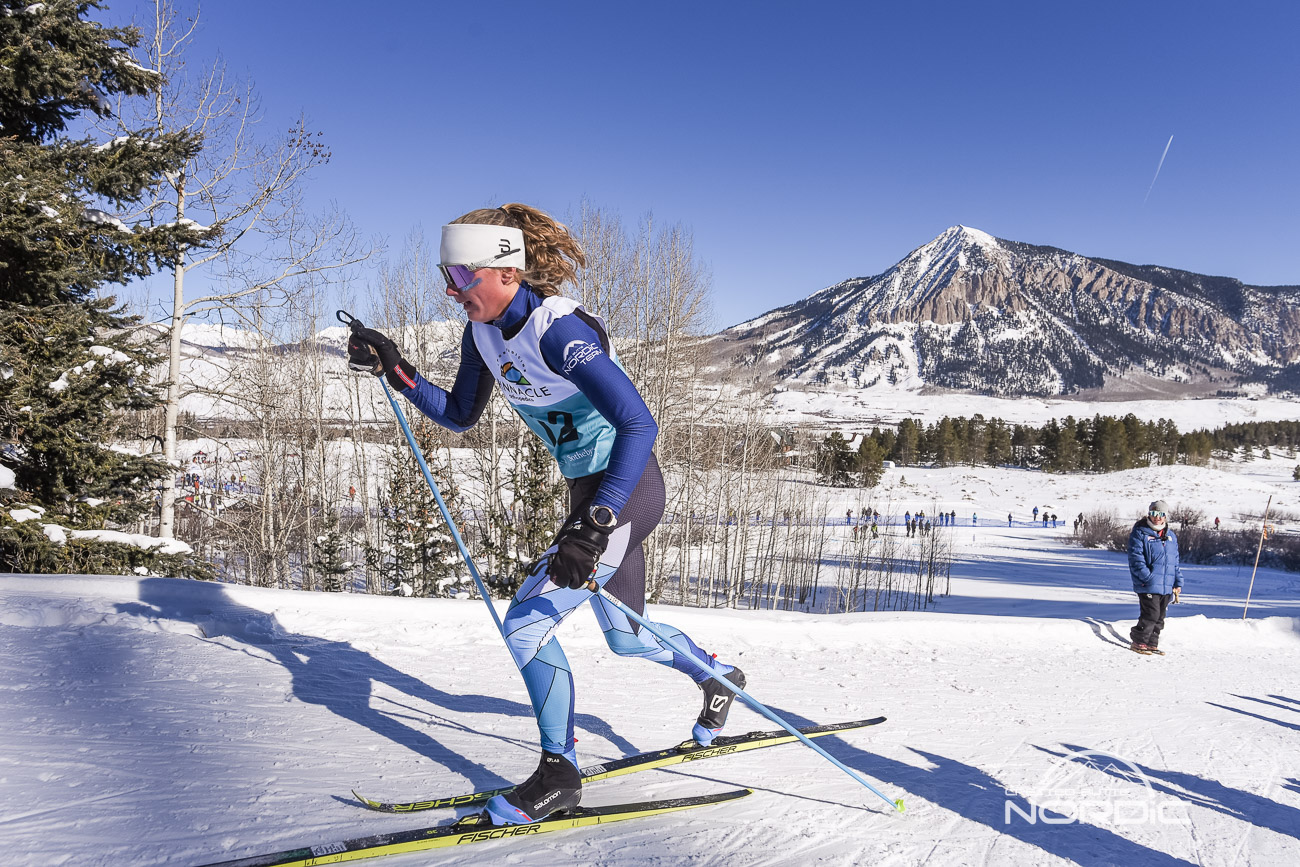
    Sawyer Ezzell (CBNT) skis up the a-climb with Mt. Crested Butte behind. (Photo: Xavi Fane).

    That sure sent me on a tangent; one which is, in many ways, ongoing. The snowflakes in March turned out to be a small part in the grand procession of what would end up being one of the biggest winters on record in Crested Butte. When I met up with the CBNT athletes in June to start summer training, we were still on snow. Then, for the next twelve weeks, we worked on growing as skiers, as athletes, and as members of our community, matching the way we trained to the temperament of the place we were doing it in. We learned that anytime of year is a good time to hop on snow, that long days running in the mountains feel short when in good company, and that while the journey towards being the best we can be is immeasurably long, the effort toward it takes place everyday.

    All the while, construction was starting on what will become the new Crested Butte Nordic Center, “the Outpost.” What began in June with bricks from the old coal coke ovens being dug up outside our present Center is now a maze of exterior plywood walls and interior studs, due to be completed this winter. On Friday, August 12th, the entirety of the Crested Butte nordic community got together to celebrate this bigger, better version of the Crested Butte Nordic Center, which will hopefully hold a bigger, better, version of ourselves.

    As part of that celebration, I was asked to make a few remarks, alongside a couple of the Crested Butte Nordic Team athletes. Those remarks are printed below. They reflect on the meaning of building a ski community which, while particular to our community, is reflective of the mechanism skiing plays in building community anywhere our sport is practiced.
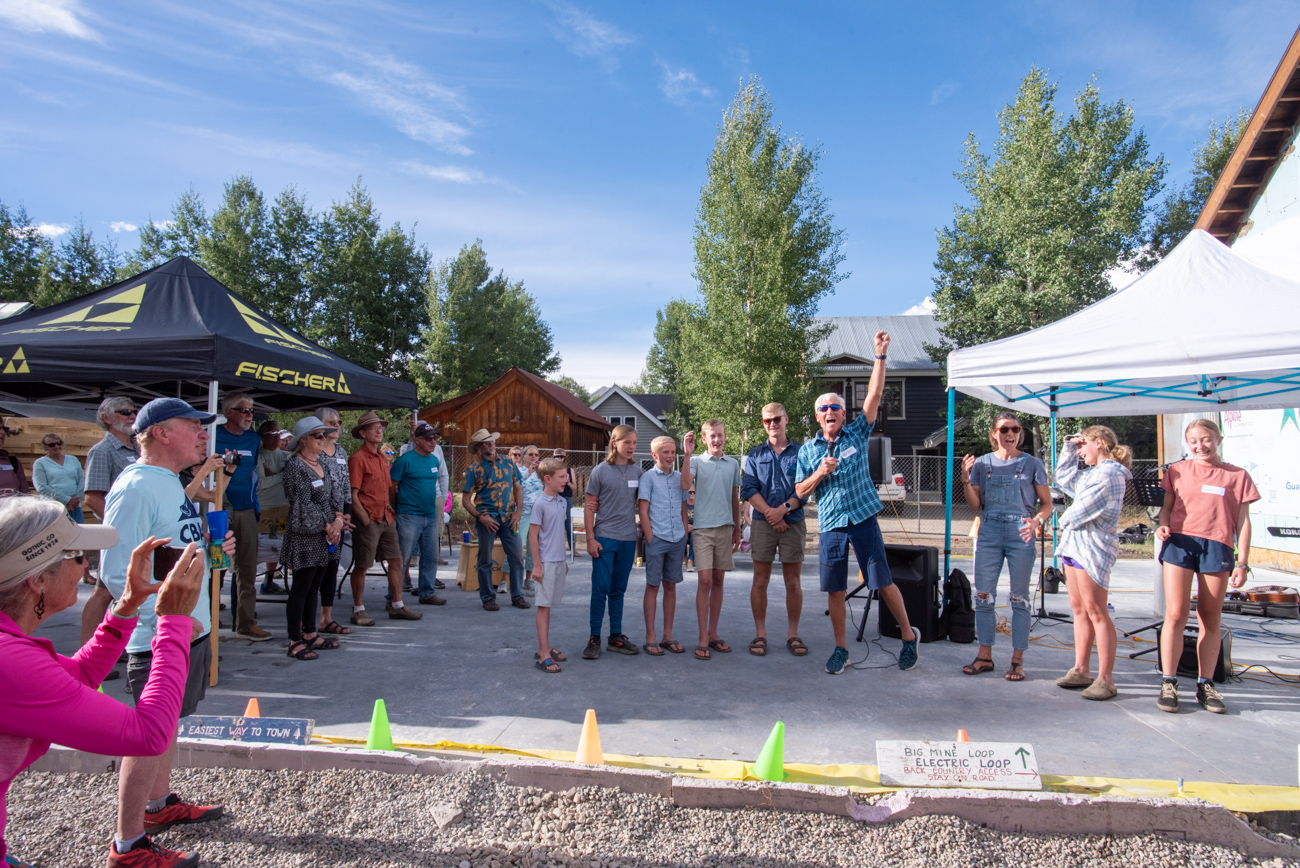
    Murray Banks delivers remarks alongside members of the Crested Butte Devo Team during a celebration of the new Crested Butte Nordic Center this month. (Photo: Xavi Fane)

    We also reflect briefly on and on our new team room’s namesake, Murray Banks, a name familiar to many from the New England ski community. As a coach for nearly fifty years, he played a pivotal role in founding Mansfield Nordic in Vermont’s Champlain Valley. He continued as a driving force in the Crested Butte nordic community for nearly twenty years. Those who know him know his disposition, and energy, are those of a much younger person. As a counter, my own penchant for being a bit of an old soul has created a middle-ground for us to form a relationship that has been an outsized blessing since I moved to town. The best way to paint the ethos of our Crested Butte coaching staff with him and I in it is that at the wax bench on a given race weekend, you’ll find one coach who has over fifty years of experience and one coach who has three years, and the latter is supposedly in charge. We push, pull, and complement. Where his knowledge of pine tar ends, my knowledge of fluoro-free top coats begins.

    Most pertinent to the purpose of sharing here, I’ve included the words shared by three of our Crested Butte Nordic Team athletes on what skiing, the ski community, and growing up with Crested Butte Nordic means to them. They are Piper O’Neil, Katie O’Neil, and Sawyer Ezzell, and their words should hold everyone over for inspiration until the snow falls, not only here in Crested Butte, but in the many ski communities like it that have used this sport as a medium to turn a solitary pursuit and its lessons into a source of positive community-building.
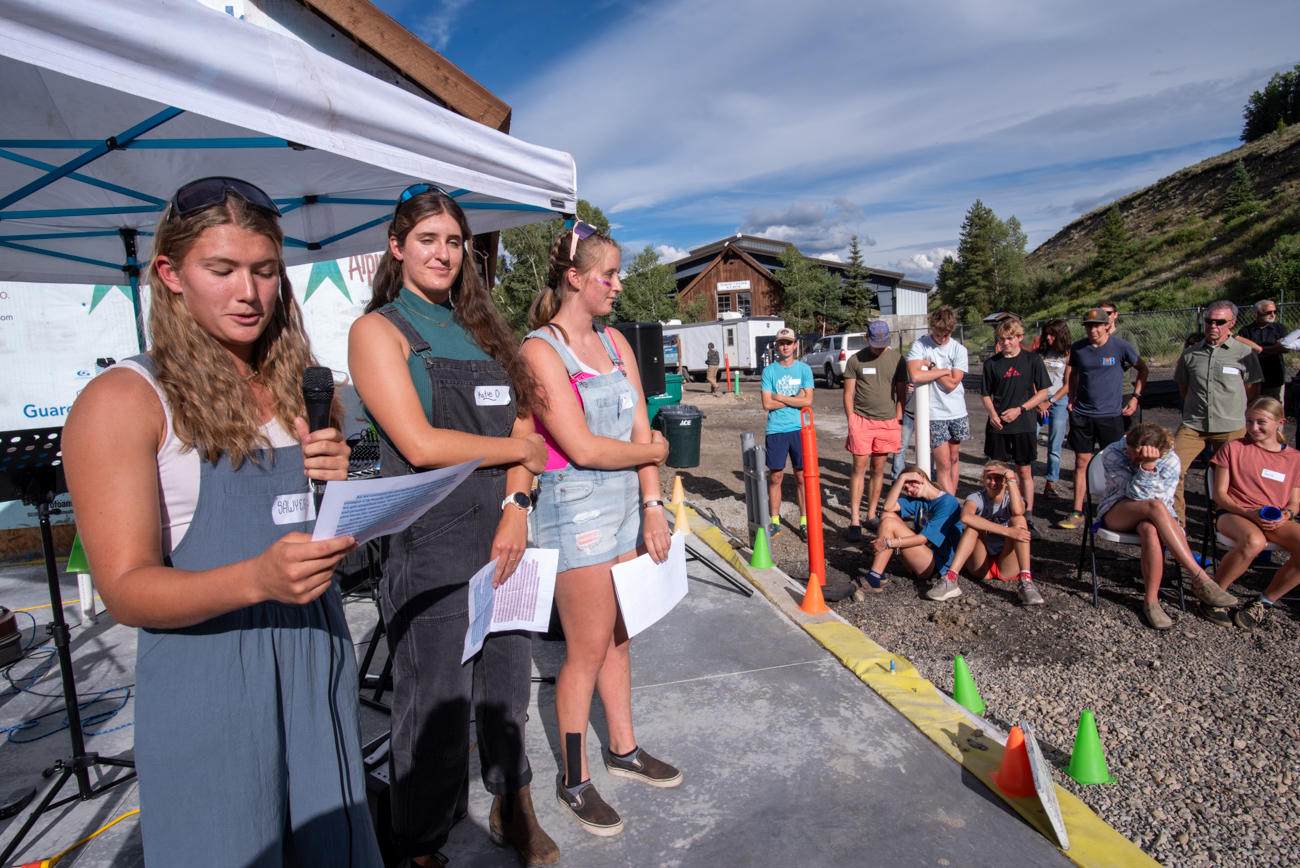
    (l-r) Sawyer Ezzell, Katie O’Neil, and Piper O’Neil—members of the Crested Butte Nordic Team—deliver remarks during a celebration of the new Crested Butte Nordic Center. (Photo: Xavi Fane)

    The following are remarks delivered at the ground-breaking of the new Crested Butte Nordic Center, the Outpost, on Friday, August 12th.

    (Edited for length and clarity)

    Remarks of Ben Theyerl:

    I tend to hold that skiing itself doesn’t change us, but instead that it allows us to recognize latent qualities within ourselves. I also tend to think that there’s no better place to understand this fact than here in Crested Butte. These towering peaks around us, the mountain meadows, and the ancient pine and aspen stands – they are here, in this valley, whether we experience them or not. What skiing represents is a way to get there: a medium to see that world as it is, and once seen, it’s a different world. Shades of green, blue, and white become richer, and with them the shades of life do too. The instant becomes glacial, each breath brings in joy – in the moment, and in the work left to do.

    All that is to say, that my job as a ski coach isn’t to mold young people into anything that they aren’t already. Rather, my job is, interval-to-interval, practice-to-practice, ski-to-ski, and stride-to-stride, to help them know themselves; to discover the unique qualities within themselves that make them not just better skiers, but better teammates, friends, and members of their communities, and specifically of this community of Crested Butte. This summer, over the past couple winters, I’ve been alongside the kids here as they’ve gotten to know the mountains that surround us, to tread carefully and with steady steps towards peaks, valleys, finish lines, and each other. At each turn, it seems they choose to take the option to do more, to be open to more, to push themselves. I mean that in the sport of ski racing, yes, but I also mean that in all the other parts of life skiing touches. Each day they wake up and choose to take more joy in their experiences, choose to invite others in wherever possible, and choose not to dull the edges of the love they can show towards others, and towards the world.
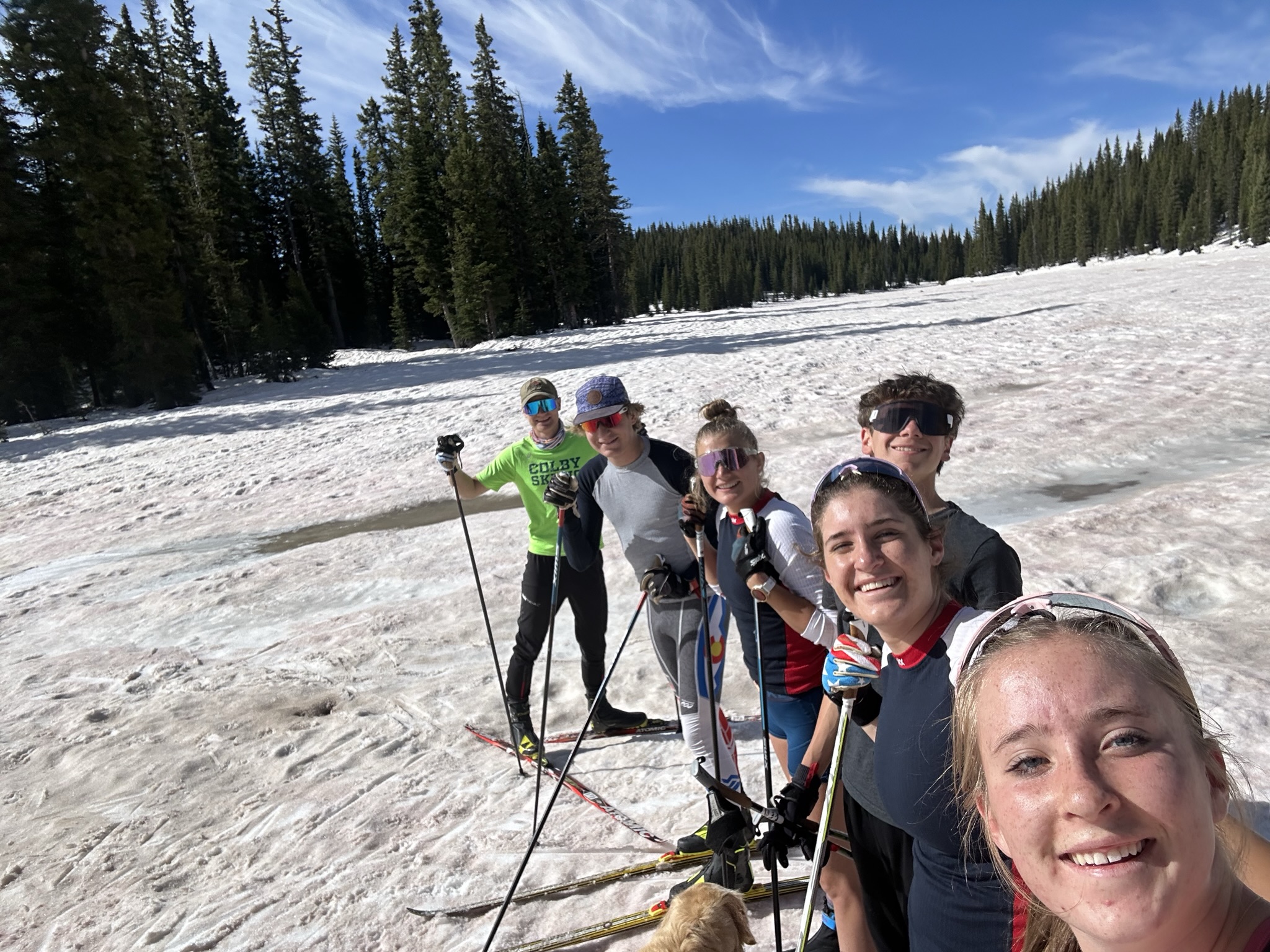
    Members of the Crested Butte Nordic Team get in a late June ski in the Elk Mountains earlier this year. (Photo: Courtesy Image)

    They have, in short, managed to lace the practice of skiing with value and meaning. And, even more impressively, they have managed to match those values with the place that they practice it in. This little town where there remains a sense that we’re all in this together, where there’s a rough nod to the little bit of everything, I do that belongs to you, full of down-to-Earth and dream-chasing folks, learning and growing in a little valley where the only platitude is that it is one of the most beautiful places on Earth. In this community, Crested Butte, this new building represents a place for that praxis these kids have formed to grow; a bigger, better version of Crested Butte Nordic to hold a bigger, better, version of ourselves.

    A couple of our skiers, Sawyer Ezzell, Piper O’Neil and Katie O’Neil, will cover the details (read their remarks below) of what exactly that is going to look like in a few seconds, but before they do, I just wanted to pause and reflect on what we’ve built here. To match the practice of skiing with values that build community is a monumental task, which even after it has happened, can easily disappear, or be transitory. We can tend to forget that here. That the community created here is infinitesimally fragile compared to the mountains that surround us and shape our experience here. Which is why, as someone tasked with tending to that community, it gives me a whole lot of comfort that our Team Room will be named after someone who is a testament to the possibility that values and the communities, they form can remain durable, because he has done so, and done so on skis for over a half-a-century: Murray Banks.

    To speak on what Murray means to this ski community would be redundant to this audience. I’m lucky enough to say though, that my journey in this sport has extended far beyond skiing in this valley, and that has given me a glimpse into what he has brought, and means, to a wider ski community – one that spans a whole continent, and a whole lot of time. Before he was here, he was back in Vermont, and via the confluence of time and place many of the kids that he coached back there were at one point or another teammates or competitors, and are friends of mine. What I was struck by when I started reflecting conversations with these friends is that no matter who the skier is, the conversation never remains at a surface level very long. It’s never, ‘how’s Murray?’ ‘Oh, he’s doing well.’ Invariably, our conversation turns quickly towards the very core of why we do this sport. We point towards the most significant lesson he teaches: to find joy in this sport, and more importantly, to never waver in spreading it. To take the path towards inclusion, towards reveling in the joy of life, and in, ultimately, building a community that reflects the things about life that make it important.

    When you see joy inching its way into your life, be it via skis or elsewhere, you ought to loose the doorjambs, feed it, let it fill up your spirit, and then immediately work hard to spread it to as many others as you can. That’s what this new iteration of Crested Butte Nordic looks to do, and in doing so, continues a role that skiing has played in shaping this community that we hope will last as long as these mountains around us stand.

    I’ll hand it over to Piper, Katie and Sawyer to expand on what this new iteration will look like…


    Remarks of Piper O’Neil, Katie O’Neil, and Sawyer Ezzell:

    Over the last four years, the Crested Butte Nordic Team has expanded from only filling the first row in our van to filling the whole van all the way to the back and hoping that the door still shuts.

    In our new Team Room in the Outpost, we are excited to have a space that’s truly our own. As a team that views itself more as a family, we can’t wait to make the Team Room a home where we can grow as athletes, as a team, and as people. One of our team values is making sure the physical and mental health of our athletes is put first. We can focus on having the time and space to build a solid foundation where athletes feel safe to address personal struggles and support each other.  As we continue to strengthen our team and program, the younger CB Nordic athletes will hopefully fall into the family we got absorbed into. More and more athletes are eager to ski and pursue the sport competitively, and the Outpost will give them the space and resources to do just that.

    With this new facility the program can further develop into what we know it can be. We believe in the value of empowerment through investment, and we are endlessly grateful for the time and funding that went into creating this new and amazing space for us. As the parents of the team and Nordic Center Staff know, we basically live at the Nordic Center, so we are so appreciative for never ending care and support. So from the Nordic Team family, thank you so much for giving our family a real home.
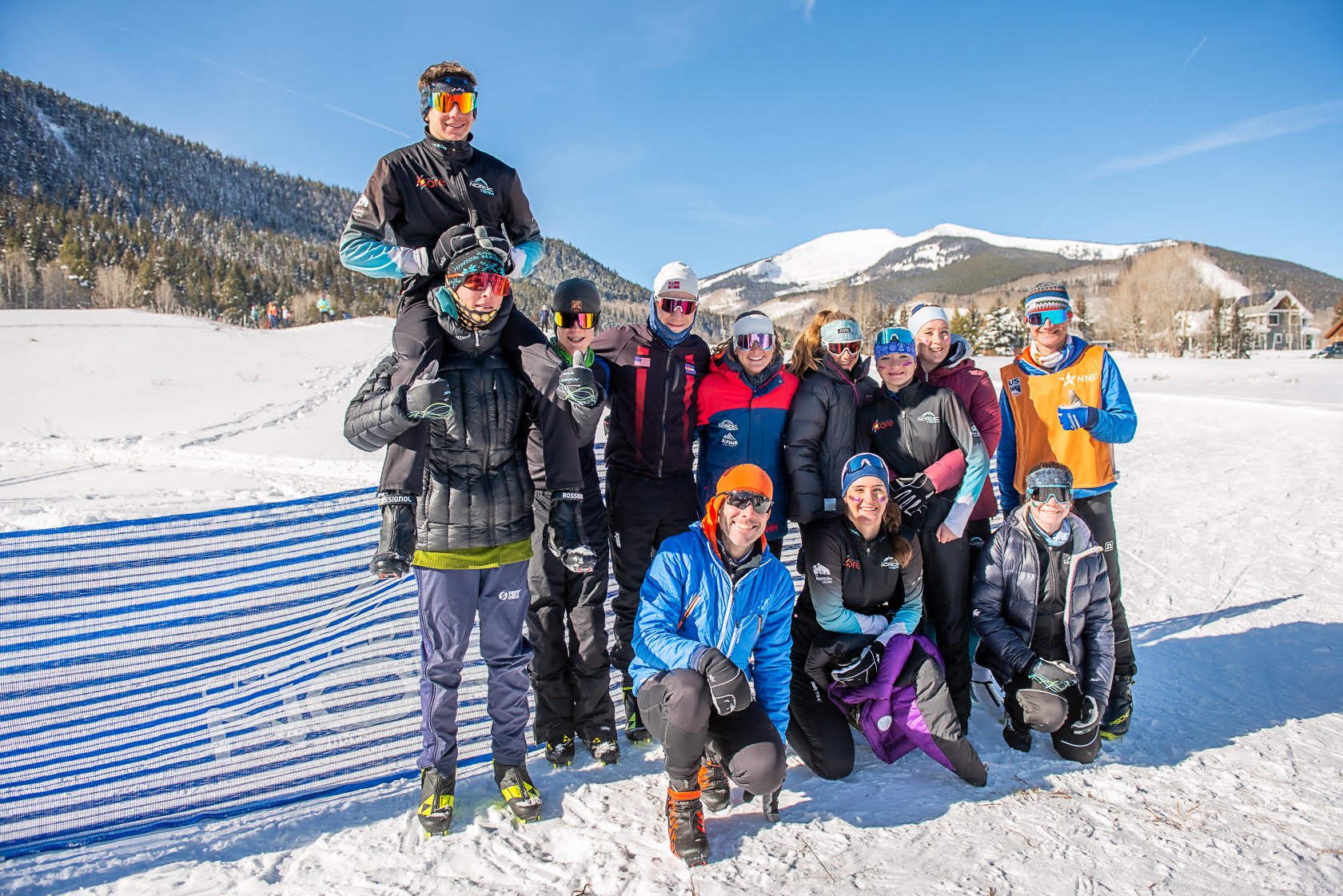
    Members of the Crested Butte Nordic Team last winter. (Photo: Alison White)
  • Ski Mountaineering is the Newest Olympic Ski Discipline, Nordic skiing is Touchstone for its American Pioneers

    Ski Mountaineering is the Newest Olympic Ski Discipline, Nordic skiing is Touchstone for its American Pioneers

    “Skimo” will be the newest Olympic ski discipline when it premiers at the 2026 Milan-Cortina Games. In 2022, those ready to represent the USA are bringing what they learned from their Nordic skiing background to higher peaks, steeper downhills, and techier technique.

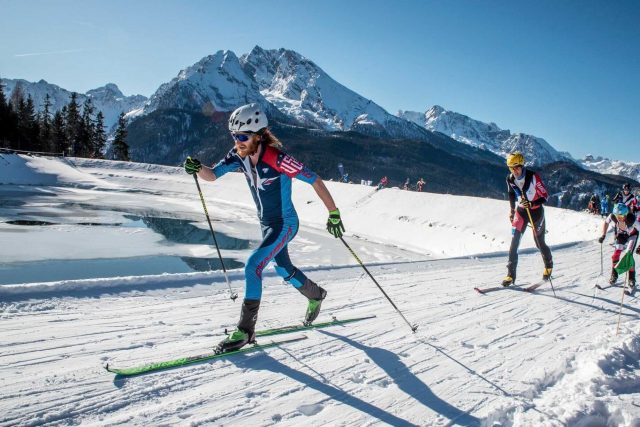
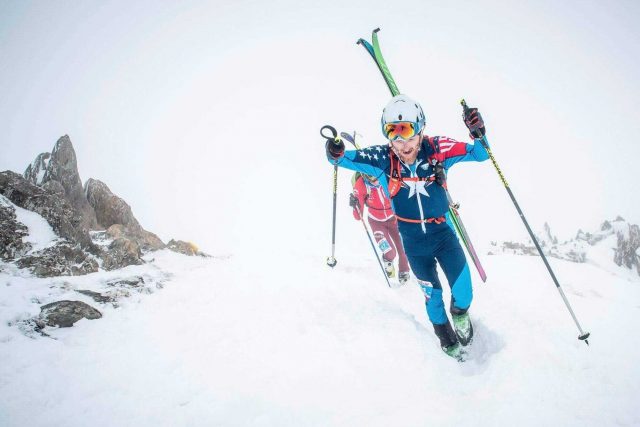
    Cam Smith strides during the early stages of a Ski Mountaineering, or “Skimo,” World Cup. Smith, who lives in Crested Butte, CO, hails from a Nordic skiing background and is currently the best Skimo athlete in the US. (Photo: USA Skimo).

    The details of ski mountaineering are dizzying. Take the little challenges unique to each discipline of skiing, amalgamate them together into one race, and you’re left with “Skimo,” which may or may not serve as a euphemism for the discipline. In cross-country, the FIS recommends that courses don’t cross the 6,000 feet (~2000 m) elevation mark. Skimo revels in regularly sending its participants from that level up to 12,000-13,000ft (~3,600m-3,900m) and down again. In between the uphills are tricky, technical descents on off-piste terrain normally reserved for extreme events most likely sponsored by Red Bull (in fact, they’re already on it). Skimo is the kind of challenge that usually comes packaged in a ski movie tour program, matched to jump cuts and a generic EDM track, with proceeds benefiting “the next generation of shredders,” or something like that.

    For the endurance skier, it is an extreme sport. Breathtaking scenery, the emotive challenge of man versus the harsh environment – turned up to its most stark proportions. Up until now it has remained on the periphery of the world of winter sports, born in the French Alps a generation ago and for the most part having stayed there.

    Last summer though, the International Olympic Committee (IOC) added Ski Mountaineering to its program for the 2026 Milano-Cortina Winter Games, which started to turn a few eyes towards who might be the first Skimo star to find themselves in the NBC prime-time slot reserved four years down the line.

    So, what stretch of the United States is home to those that are quietly, surely, plodding their way up and down mountain passes in preparation for the Olympics in 2026? Bozeman to Missoula, Anchorage to Fairbanks, maybe Durango to Aspen?

    Turns out, they’re more likely running the 700ft-850 ft of elevation between Eau Claire, Wisconsin and Duluth, Minnesota.

    Somewhere up there, near-ish to where a little rise on US-53 gives way to views of Lake Superior, Cam Smith responds to my email.

    The Athlete Leading the Way

    Cam Smith is at his family’s cabin in Gordon, Wisconsin. Like many who find retreat Up North in Wisconsin, he is from Illinois. Rockford, to be exact. A town that’s probably best known for being the next stop on I-90 West of Chicago, and for wearing a kind of flat, banal vision of American life on its sleeve with pride. Last winter, while skiing in Crested Butte, Colorado, Cam and I were talking over our shared Midwestern roots when he stopped mid-stride to declare his hometown’s motto to me: “Rockford doesn’t suck, you do!”

    That scene in Crested Butte, for all intents and purposes, is where I was introduced to Cam, and by extension, the world of Skimo too. At that juncture in December 2021, he was eyeing up the International Ski Mountaineering Federation’s (IMSF) upcoming World Cup, to be held in Andorra in January. But it wasn’t until after I saw him perform a one-man monologue about the importance of pushing through the finish-line – complete with skis, poles, and jackets strewn around as props – that I got a glimpse into his place as a rising star in the Skimo world.

    Murray Banks, coaching alongside Cam and I, and observing this performance, turned to me and asked through a laugh, “can you believe he’s one of the most serious athletes in the world?” In truth, it wasn’t exactly clear at that moment.

    A few weeks later, Cam Smith went to Andorra and earned U.S. Skimo’s first-ever IMSF World Cup podium, taking 3rd place in Comapedrosa. When I picked up the local newspaper, I found the same big grin, that weeks before had accompanied Cam’s skit, staring back at me from a podium in Europe. By making it to that podium, Smith was the first non-European to medal on  the international Skimo circuit, which started a full calendar of racing in 2008. It was a breakthrough for Smith, and for the sport in North America. 

    Cam Smith nearing the crux of a Skimo race. (Photo: USA Skimo).

    Smith returned to the North American continent in March, and quickly won the Continental Championships in Kicking Horse, British Columbia. He finished off his season in April, returning to Crested Butte to win his third straight Elk Mountain Grand Traverse, a kind of one-day classic in the U.S. Skimo world (think Paris-Roubaix, if it started at midnight and touched a 12,389ft mountain pass instead of cobblestones) from Crested Butte to Aspen. In that race, he edged out Simi Hamilton and Ben Coons for first place alongside his partner, renowned Skimo racer John Gaston.

    In the first true generation of American Skimo racers, Cam Smith is the pioneer lighting the way (to hear from him, listen to FasterSkier’s interview with Smith in 2021 here).

    A New Kind of Coach

    In the first true generation of American Skimo coaches, the same pioneering accolade could be given to Adam Loomis.

    Loomis is currently based out of Park City, Utah, where he leads a first-of-its-kind youth Skimo team with the Park City Ski and Snowboard Club, while also having earned himself a spot on the national team as an athlete this year.

    Originally though, Adam Loomis is from Eau Claire, Wisconsin – our shared hometown.

    As a kid there he showed a penchant for both taking to the most unique corners of the ski world he could find and excelling in them. He started in the ski jumping world with the Eau Claire Flying Eagles, and got his start on cross-country skis with the once-a-week after school program put on by the Eau Claire Ski Striders. By high school, he was combining the two disciplines and set to become a top-level Nordic Combined athlete. He was soon named to the U.S. Nordic Combined National team, and that took him out to Park City, Utah for the first time.

    Even during those early days as an athlete, Loomis showed an inclination towards viewing his athletic development in the context of the larger structures it was happening in – the clubs and organizations he trained with. In other words, he was thinking like a coach. Or, at least, that’s how it looked to me, a kid learning to ski race in the wake that Loomis left with his accomplishments in Eau Claire.

    (L-R) Adam Loomis, Taylor Fletcher, and Ben Loomis on the podium after the jumping portion of US Olympic Trials in 2018. (Photo: USA Nordic).

    I knew Adam as Ben Loomis’ big brother – who I was learning to ski alongside, and would eventually watch follow in the Nordic Combined path forged by Adam (where he is two Olympics in, so far). When Adam was first transitioning to being a National Team athlete, he would come back to Eau Claire to put on clinics with our middle school team, Chippewa Valley Nordic, which he had a unique role in forming as the leading athlete coached by our team founder, my father, Ted Theyerl.

    There I remember Adam, on roller skis in the vast parking lot outside of Eau Claire’s minor league baseball stadium, clad in the black Bjorn Dæhlie U.S. Ski Team warmups indicative of that early 2010s era. He looked like an alien hero, someone from another planet that each and every one of us knew, just by looking at him, that we wanted to visit. He brought insights from that far off place too. Logging training, the concept of heart rate zones, and the idea that training was something you constructed over long periods of time, not what you did to augment your baseball practice. In the winters, he would follow a few of us around on our intervals through the Wisconsin woods, pointing out small tweaks, like where to place a pole or when to transition techniques with the terrain. The snapshots in my memory of his advice come from maybe three or four sessions, which is only a further testament to Loomis’ coaching talent. When Adam gives you something to work on, it sticks.

    Adam Loomis follows the author on a trip home (circa 2012) to work with his home club Chippewa Valley Nordic. (Photo: Chippewa Valley Nordic/Ted Theyerl).

    Eventually, Loomis climbed from racing Continental Cups to World Cups. All the while, he was based in Park City, where he continued his early pattern of searching out new ways to go fast on skis. Skimo had found its way to Park City by then, with the Wasatch PowderKeg offering a community full of talented endurance athletes a gateway to the new discipline. Loomis saw a new challenge and a natural fit, and so started racing. After retiring from competitive Nordic Combined skiing, he spent a year in Alaska coaching the discipline, which further gave him access to the backcountry needed to work on the technical skills of Skimo. When he joined up with Park City Ski and Snowboard Club (PCSS) to coach their youth Nordic Combined program in 2021, he came up with the novel idea to not only race Skimo, but to help coach youth interested in the discipline as well.

    These days, his daily routine at PCSS is busy, even by ski coach standards. Beginning the morning standing at the ready to watch and coach jump practice for Ski Jumping and Nordic Combined athletes before heading over to the base of Park City resort to work on climbing on skins, transitioning, and bombing down for Skimo. And between competitions on the weekends, he gets out and races too. Loomis has forged his own way in the past, out of the county forests and bluffs of Wisconsin to high peaks and deep powder pockets, and now looks to be forging a future for a whole new sport in the present.

    New Ideas for a New Sport

    Being the first generation in a sport comes with the necessary condition that the athletes and coaches leading the way have developed in other athletic contexts. And for those now looking to lead the first generation of U.S. Skimo towards the Olympics in 2026, that’s often been in Nordic skiing (while I’m covering Smith and Loomis here, it’s worth noting that other familiar Nordic faces, including Liz Stephen, Caitlin Patterson, and Simi Hamilton have all had impressive forays into the new discipline).

    Cam Smith started his athletic career as a burgeoning track and cross-country star in Rockford, before deciding to attend Western Colorado University in Gunnison, Colorado (30 miles down valley from Crested Butte). “I loved [running], but I kept having injury issues…and at the same time [being in Gunnison] led me to start mountain biking,” he said in his email to FasterSkier. Mountain biking at Western was Smith’s gateway to the College’s unique Mountain Sports Program, which houses seven disciplines of mountain sports – from freeride to Nordic to climbing – under one program. Started in 2012 by mountain bike trailblazer and longtime Gunnison resident Dave Wiens (seen here beating Lance Armstrong in 2008), the Mountain Sports Program was designed to give institutional support to talented athletes who share a pioneering streak with their coaches to pursue the newest challenges in the mountains. Smith became the archetype for Western Mountain Sports’ success.

    Mountain biking led to learning how to Nordic ski, which led to racing with Western’s United States Collegiate Ski Association (USCSA) program. He found success there, and then was convinced by his older sister, also attending Western, to give the Grand Traverse (GT) – the same race he is now a three-time defending champion in – a try.

    Smith racing in a local 10 k near his home in Crested Butte, Colorado. (Photo: Xavi Fane/Crested Butte Nordic)

    In his first GT, Smith made it to Aspen, which for a first run was a huge success. It was enough to give him the nudge to go all in on it. He was selected to compete at Skimo World Championships for the first time in 2017, and then named to the National Team in 2019.

    Smith’s background lent itself to an ability to chart out an intensive training program for a program where training principles weren’t set. Smith frames his attitude towards training as one that sees all aspects of the challenge, “Skimo is just very dynamic! You have the same fitness and effort [as Nordic skiing] to worry about, but then also the exposure, extreme terrain, and inherent challenges to being in a high alpine environment.”

    On a typical day of training in the winter, he says:

    “I start every day with a morning session. Whether it’s before work or on the weekends I like to get started with movement. I try to ski the backcountry more often than I do on-piste (riding the chairlifts on Crested Butte) for extra technical practice. Almost every day my afternoon schedule is a little more varied – skate skiing, a session downhill skiing on the chairlifts, or a second skin in the afternoon.”

    As for hours, Smith is no stranger to putting in over 20-25 hrs a week in, but mainly marks his training off by a different metric; vertical.

    “During a hard training block, I’m climbing 40,000-60,000 vertical feet in a week.”

    The key for Smith’s training approach is building off the basic endurance-type structure of Nordic skiers, while putting in focused technical work for the challenges of extreme downhill terrain. What shooting practice is for biathletes is what vertical gain and drop is for Smith:

    “It’s a challenge to push yourself [downhill] coming off the aerobic part of Skimo (read; uphill) without taking on a lot of risk. That’s where downhill skiing relatively hard in the backcountry comes in. Rock climbing also goes a long way in the summer to being comfortable with the ‘mountaineering’ part of Skimo.”

    For Adam Loomis, adding in a layer of technical consideration to a well-tuned ski training plan was a simpler task when he started to gravitate towards Skimo more seriously a few winters ago. Swap out ski jumping for mountaineering, and the rest has been fine-tuning. That swap, it turns out, doesn’t always mean abandoning aspects from his ski jumping days, “there’s still a very big emphasis on strength training, which is super important in Skimo. You’re descending at such a fast pace after having just pushed yourself uphill, and the only way to prepare yourself is to work on muscular endurance” said Loomis, in an interview with FasterSkier.

    Adam Loomis jumping in a World Cup in 2015. These days, Loomis is both Ski Jumping and Skimo coach for Park City Ski and Snowboard Club (Photo: National Nordic Foundation)

    From the coaching perspective, Loomis sees this added emphasis as a “specific” type of general training, meaning while hours in the weight room aren’t direct correlates for Skimo, they are targeting its demands for his athletes that are coming from other athletic backgrounds, “All of my athletes are runners and bikers. That allows them to put in a lot of base hours in the off-season, so what I look at is the transition between biking and skiing. What are they going to need to make sure that fitness translates seamlessly and without injury? In Nordic Combined, that transition is a big focus you’re constantly working on for staying healthy jumping and is something I try to bring over to Skimo.”

    Loomis’ model of supplementing already hard-training athletes from other sports with specific Skimo training is one he sees as being key for the next step of the sport’s development in the United States:

    “You look at how most Skimo training plans are designed, and the metric is vertical (like Smith’s) – runners’ train by mileage, skiers by time, but there’s movement in this sport towards vertical being the important metric to center. Realistically, my athletes are all coming from those other training universes and it’s more helpful to think about what we can do to work on the specific, technical demands of Skimo.

    We start with a mix of distance and intensity days, racing and recovery. For Skimo, our intensity days specifically focus on doing a lot of vertical. We might even do a day on our Olympic Park Hill, where it’s only 100m vertical, but our workout will be doing that hill 20 times, transitioning with our [climbing] skins every time. Our easy days might entail sending our kids up to the moguls to just work on downhill skiing, since that’s a really important environment to mimic when it comes to handling the backcountry.

    Having a structured program is helpful because our athletes would be out skiing regardless, but they might not get that technical aspect otherwise. Yes, it’s nerdy stuff, but having our kids practicing ripping off skins and doing transitions on snow, and not just in their living room before they race, is very helpful to get them dialed to handle whatever comes on a Skimo course, which by design could be just about anything.”

    Both Smith and Loomis acknowledge that part of the appeal of Skimo is that it presents unknowns to sort out. Like Nordic skiers at the dawn of skate skiing in the early 80s, or mountain bikers at the dawn of dedicated off-road bikes in the late 80s, they’ve found a discipline where training strikes a balance between known endurance principles, evolving competition formats, and the capabilities of Skimo equipment.

    That last factor, equipment, has been an especially important factor in Skimo’s recent growth. It was only a decade and a half ago that the Grand Traverse, the event that introduced Smith to the sport, was regularly won by skiers on Nordic skis or Telemark ski setups shoddily adapted for climbing marginally faster (this article, written for the Aspen Times in 2002, gives a picture of what these early days were like). In 2022, Simi Hamilton and Ben Coons finished behind Smith by just a half hour on full Nordic setups, but Smith, with experience on all types of setups says, “I feel pretty strongly that Skimo gear is faster over the entire [GT] course because of its versatility.”

    Adam Loomis lights out on a technical downhill section using modern Skimo equipment during this year’s Wasatch Powderkeg in Park City, Utah. Loomis, finished 2nd in the race. (Photo: USA Skimo)

    That versatility includes extremely light and skinny downhill skis (64-66mm wide has become widely accepted, typical Nordic race skis are usually 41-44mm) that can pack in metal edges, bindings that easily switch between a heel-detached climbing mode and heel-attached descending mode, and flexible, ultralight boots that come with as much carbon as your Fischer Speedmax, but with support that holds your whole ankle in place. Today’s Skimo skis, in other words, have an answer for every time us Nordic skiers have found ourselves bushwhacking and wishing for something to make things a little more capable.

    For those coming from traditional backcountry backgrounds, Skimo skis open up the world of a true endurance sport. Loomis says, “I think there’s a lot of excitement around [Skimo] from people who had no idea of what it was a few years ago. It’s gone from this weird little thing that people raised on skinny skis like myself did, to being something that a few of those people on heavy, recreational backcountry setups looked at and said, ‘that looks like it could be some great type 2 fun.’”

    Back at the forefront of U.S. Skimo’s development, both Smith and Loomis see a blueprint for jumping off of present successes on those even skinner skis.

    “I think [with a World Cup podium this year] we showed that the U.S. has the potential to be a world player,” says Smith. “Sort of like where the Nordic ladies were 10 years ago, and I hope we can follow a similar path, but holy smokes that is a tall task.”

    Loomis, looking at those athletes coming up in the Skimo ranks, says that “I think in a couple years we could easily be up there on the world stage. Maybe not a dominant force like Italy or Switzerland, but we have some serious talent already competing. And kind of like the U.S. Ski Team the past half-decade, you can see this is a special group based on how they’ve blown past anything before them at the junior level.”

    Loomis points to one of his athletes in Park City, for example. Griffin Briley, who won the European U18 Championships in both the vertical and individual races this year. “Unfortunately, they can’t count him as the European champion because he’s not European, at which point you go, ‘ok, doesn’t that show he’s the best in the world at his age group?’”

    Those breakthrough results though, says Loomis, point Skimo towards its next step in developmental success. “Having the 2026 Olympics out there is amazing for establishing the sport as something that endurance athletes can seriously pursue. Having the Olympics means young skiers can have Olympic dreams, and for any niche sport, that’s huge. We need support to bolster the sport at the youth level though – more clubs and the ability to make the barrier to entry less daunting.”

    Smith too, has one eye on ensuring the sport’s future this way, “Broader participation at the younger levels is a huge need and a challenge. I also see making marquee events as high quality as possible as important…making the race experience a positive one is super important at all levels.”

    Bringing it All Back Home

    “When I got to the mountains, I think I looked at them and said, ‘I just want to do everything I can in them.’ The stark change in environment from my childhood in [the Midwest] just fueled this hunger to do everything, and I think I appreciate what I’m doing in part because of it.”

    “Where’d he find that wisdom?” I thought to myself as I listened to Adam Loomis provide that answer to my throwaway question about why he thought that the Midwest was a hotbed for Skimo talent. I was, of course, hoping it was something that we shared in our upbringing in Eau Claire, but initially dismissed that thought. Then I came back to it. In fact, I did pick up on that appreciation for landscape and the possibilities that they provide, in all their forms, for those willing to get out and explore by foot and by ski. I just happened to have accrued that wisdom from a skier who went out and did it first from Eau Claire: Adam Loomis himself.

    With his perspective and talents, U.S. Skimo can look towards a world of possibility in Milan-Cortina in 2026.

    As for the National Team’s current best shot at a medal there, Cam Smith, I’ll be sure to continue to report on his drive forward first-hand, with every friendly wave and “hey there!” as he passes me on the slopes of Crested Butte. He is after all, as our co-coach Murray Banks says, “one of most serious athletes in the world” and you would never suspect it.

    Loomis on course and in the mountains. (Photo: USA Skimo).
  • Nordic Nation: A Backcountry Ski Race on Skinny Skis – Simi Hamilton and Ben Koons Take Second at the 2022 Montane Grand Traverse

    Nordic Nation: A Backcountry Ski Race on Skinny Skis – Simi Hamilton and Ben Koons Take Second at the 2022 Montane Grand Traverse

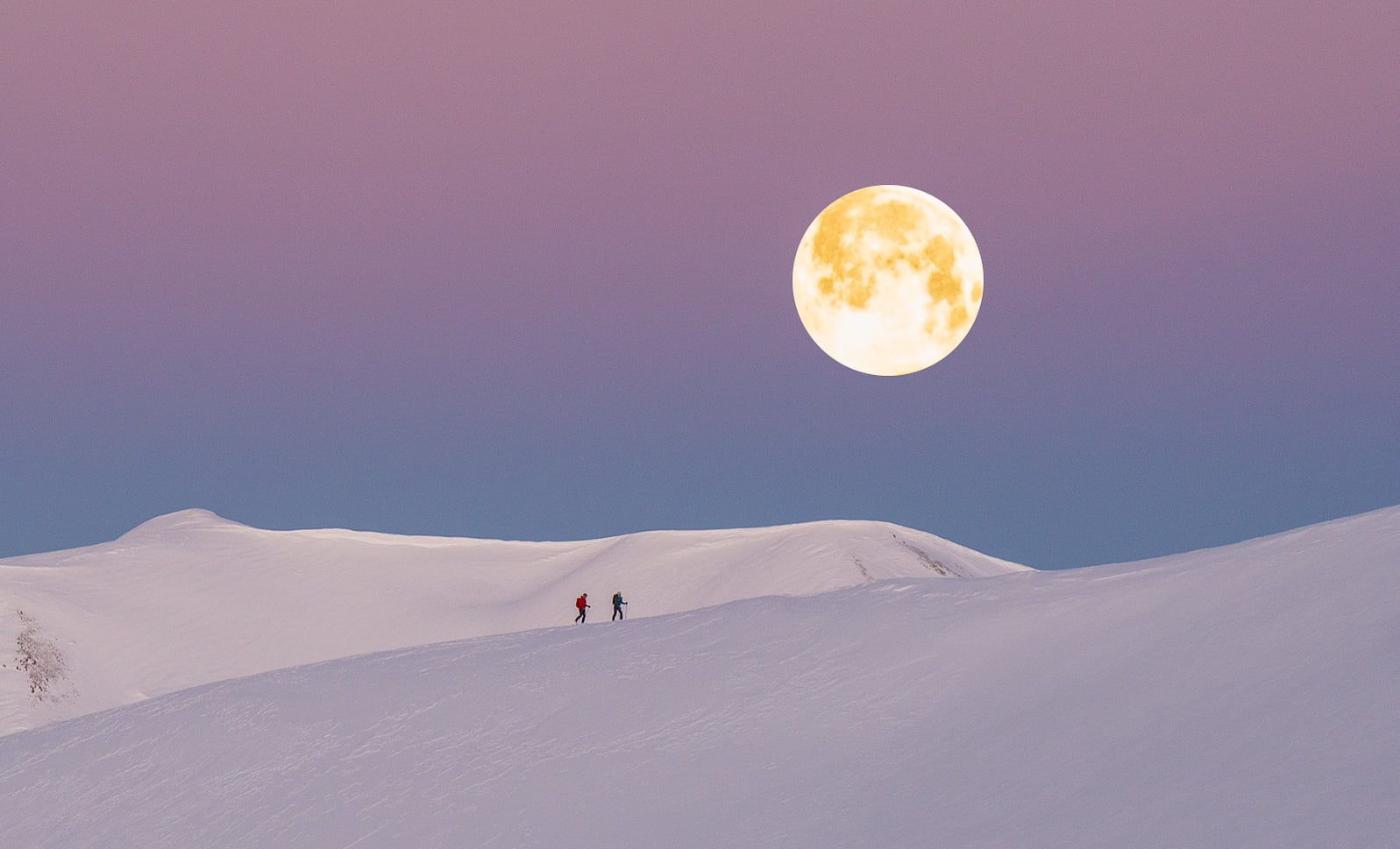
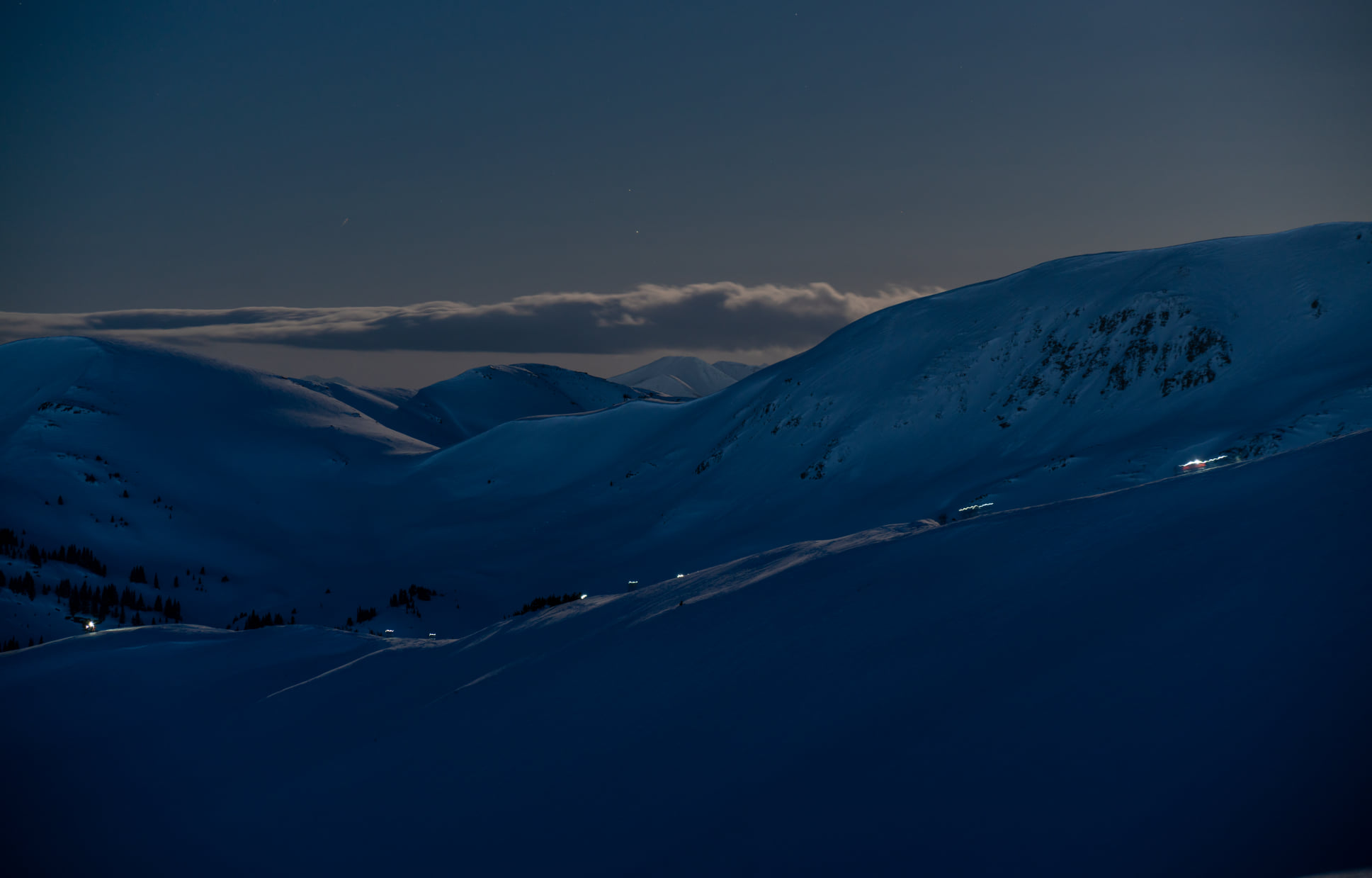
    The 2021 Grand Traverse saw a magical full moon under clear skies and mild temperatures. (Photo: Jesse Levine / Crested Butte Nordic)

    Tucked deep into snowy valleys, the tiny iconic Colorado mountain towns of Aspen and Crested Butte are separated by a mere 40 miles by foot, but roughly 200 miles by car in the winter. Separating the two is the expanse of the rugged Elk Mountain range, which features six of Colorado’s 14’ers, peaks that reach above 14,000’. 

    Now meccas of outdoor recreation, the two towns were historically established as profitable coal and silver mining sites, following the forced removal of the native Ute residents in the late 1800’s. In those days, communication between towns during the winter relied on the fortitude and alpine savvy of mail carriers, who skied back and forth between towns through burly terrain across a notoriously unstable snowpack. 

    A 2021 Grand Traverse racer descends off of Star Pass at sunrise. (Photo: Jesse Levine / Crested Butte Nordic)

    In 1998, this historic route was revived as a backcountry ski race called the “Grand Traverse”, which begins at the base of the Mt. Crested Butte ski resort and travels north over two 12,000-plus foot passes, with roughly 8,000 feet of elevation gain spread over the roughly 40 mile route. The inaugural winners (athletes must race in pairs), racing on metal edged cross country skis, were Aspen’s Travis Moore and Pierre Wille, local legends, and accomplished cross country skiers and alpinists. Moore, who taught at Aspen High School for more than 20 years and continues to coach the cross country ski program, eventually became the coach of a young Aspen resident, Simi Hamilton. 

    For many living in the Roaring Fork or Gunnison river valleys, the Grand Traverse (GT) is a storied annual pilgrimage, respected for the unique and burly nature of the route and its local lore as a rite of passage for endurance enthusiasts. Adding to the mystique, the race begins at midnight, allowing racers to cross the highest avalanche risk sections while snow is presumably frozen, firm, and at its most stable. The avalanche safety arsenal of beacon, shovel, and probe are part of a long list of items athletes must carry for safety, along with extra layers, an emergency shelter, and other items that reflect how deep into the backcountry the route leads and what it might take to survive a night out in the elements should something go awry. 

    A 2021 Grand Traverse racer receives instructions for the descent off of Star Pass from the safety dispatch stationed there. (Photo: Jesse Levine / Crested Butte Nordic)
    A racer descends off of Star Pass during the 2021 Grand Traverse ski race. (Photo: Jesse Levine / Crested Butte Nordic)

    With the rapid advancements in ski mountaineering technology, few still commit to cross country skis for the GT – SkiMo race skis with AT bindings or lightweight backcountry or telemark gear are more stable and typically handle better descending off the passes. But this year, the team of “Yeah, but we can skate” showed skinny skis aren’t yet an antiquated option for success at the GT, particularly if you’ve got the skills of two Olympians who have continued to foster their love for mountain adventures on boards less than 43 mm underfoot. 

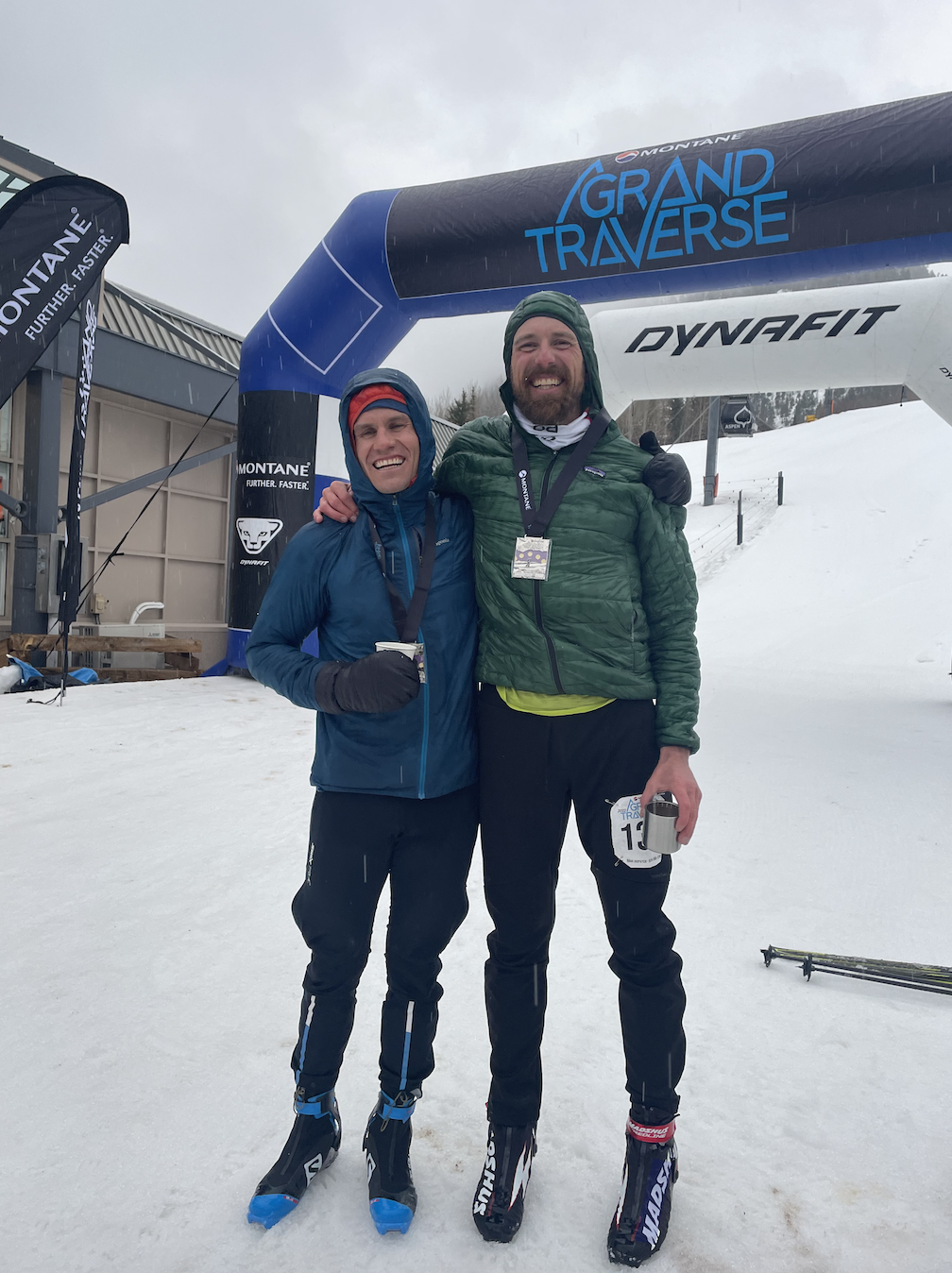
    The duo was Simi Hamilton and Ben Koons, who lined up on Fischer skate skis. After a fast start skating out of Crested Butte, the team leapfrogged with eventual winners and top SkiMo athletes Cam Smith and John Gaston, who eventually broke away as conditions favored wider skis and metal edges. Smith and Gaston made it to Aspen in 6:13:15.4, just over 36 minutes ahead of Hamilton and Koons. (Results here)   

    Before and after: still smiling. (Photos: Sophie Caldwell Hamilton)

    Though Hamilton won the GT running race in early September, 2021, it was his first crack at the storied winter event. For Koons, it was his sixth crack at chasing the ideal crust cruising conditions that might allow a strong skater with some backcountry experience under their belt to smash the course record and take the win on skinny skis. The two have shared a number of big adventure days in the mountains on ski, foot, and bike, often with a third friend, Linden Mallory, who grew up in Aspen with Hamilton and raced on the Dartmouth ski team with Koons, and later became one of his GT partners. 

    While last year boasted perhaps the most ideal conditions, with athletes racing on firm and stable snow under a full moon in mild temperatures with minimal wind, this year, mother nature had a few twists up her sleeve. The week leading into the race saw a little bit of everything springtime in the mountains has to offer: warm sunny days, heavy wet snow, rain, wind, and plenty of freeze-thaw cycles. Consequently, this was shown in the snowpack, leaving Hamilton and Koons with far less skateable conditions, lots of breakable crust, some “spicy” downhills. Nevertheless, with only one broken pole, they were still smiling at the finish, and seemingly aren’t ready to accept defeat just yet. 

    A train of headlamps climbs Star Pass during the 2021 Grand Traverse. (Photo: Jesse Levine / Crested Butte Nordic)

    For more with Hamilton and Koons, you can head to the Grand Traverse Instagram account, where the duo was interviewed pre and post-race, along with a video capture of their finish, in the rain, at the base of Aspen Mountain. For those interested in testing their mettle in next year’s Grand Traverse ski, registration opens at midnight on December 1st and spots fill very quickly. For those looking to explore the route in the summer, there is also a Grand Traverse run and bike race happening Labor Day Weekend. The events are among the primary fundraisers for the Crested Butte Nordic Center.

  • Crested Butte Nordic Trails Become a Sanctuary During COVID-19 Crisis

    Crested Butte Nordic Trails Become a Sanctuary During COVID-19 Crisis

    Sunrise skiing on “Mike’s Mile” in Crested Butte. (Photo: Xavier Fane/CB Nordic)

    Disclaimer: This article is not intended to inspire anyone to travel to Crested Butte at this time. The county’s public health office expressly asks you not to do so even if you are a second home owner. The aim here is to highlight the familiar therapeutic role cross country skiing has played in the community thus far during the COVID-19 crisis. 

    Like many other small mountain towns, Crested Butte has been labeled a “coronavirus county hot spot” as Gunnison County ranked 6th on March 29th for per capita confirmed cases of COVID-19 throughout the country. The small rural hospital has limited resources and staff, insufficient to meet the demands of a large surge in the caseload. Of the roughly 17,000 residents of Gunnison County, there have been 90 confirmed cases, with 20 pending and 711 self-reported as symptomatic as of April 8th. There has been one fatality. 

    When it became apparent that the health of the community was at risk, the county swiftly rolled out stringent public health orders, shutting down all non-essential businesses and short-term lodging. A sleepy ski town community centered upon tourism sputtered to a halt. 

    The message was clear: stay home, isolate. Gatherings of more than one individual who do not live together are forbidden, with few exceptions. This means you are disallowed from meeting up with a buddy for a ski, even if you intend to remain at least six feet apart throughout the activity. 

    On March 14th, Colorado Governor Jared Polis issued an executive order closing all ski resorts. Because the Crested Butte Mountain Resort is no longer patrolled or managed for avalanche hazard, uphill access was also ended. 

    However, mother nature missed the message that winter activities were coming to an end. Nearly 5 feet of snow fell in March — roughly a third of the annual total — making it the snowiest month of the season. The accumulation also created instability in the Elk Mountain regional snowpack, raising avalanche danger, meaning safe backcountry skiing became limited. 

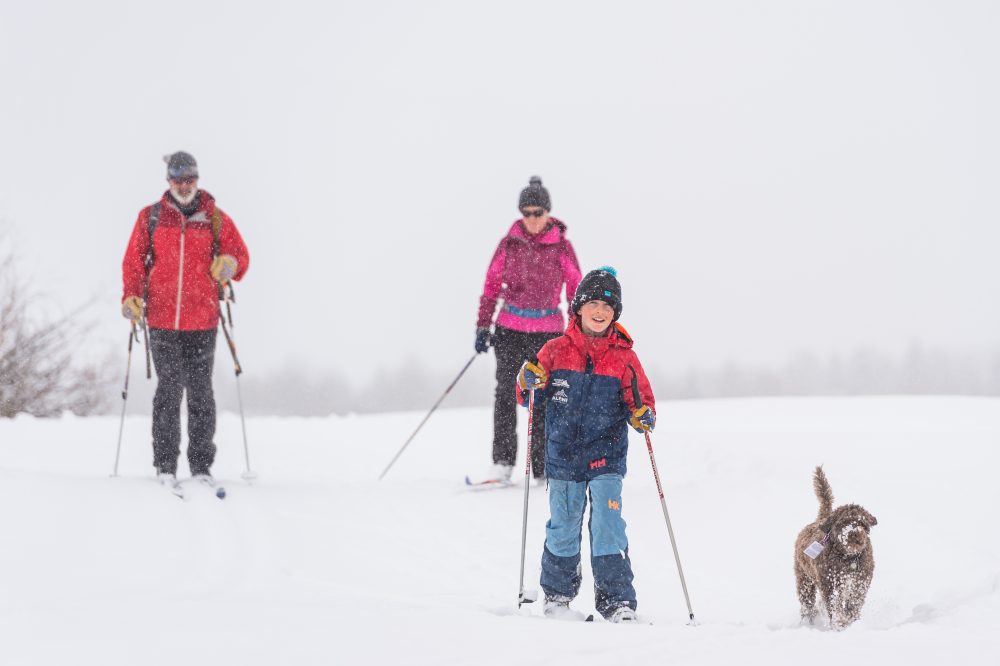
    A family enjoys a snowy March ski-break from quarantine in Crested Butte. (Photo: Xavier Fane/CB Nordic)

    Enter the nordic trails. 

    With over 50-kilometers of pistenbully groomed trails wide enough to maintain a safe physical distance between passing skiers, the local non-profit nordic center, Crested Butte Nordic, was given the green light to continue grooming operations, providing the local residents a reliable opportunity to recreate outside. A little slice of normalcy and serenity to contrast the rapidly changing circumstances around the globe.  

    “Essentially, amidst an enormous public health and economic crisis, here in Crested Butte, nordic skiing has risen up as a critical resource for health and wellbeing,” wrote CB Nordic marketing director Laura Puckett-Daniels in an email to FasterSkier. 

    This sentiment was echoed by CB Nordic executive director Christie Hicks in an email to members.

    “CB Nordic was founded on the principle that cross country skiing and snowshoeing are good for the health of our bodies, our minds, and our community,” wrote Hicks. “Never has this felt more true. While the COVID-19 pandemic rages around us and the snow continues to fall, it has become ever more clear to me that our mission is of vital importance for the health and wellbeing of our community.”

    A skier enjoys a brief respite and sunrise along the Crested Butte nordic trails. (Photo: Xavier Fane/CB Nordic)

    The phrasing is not hyperbolic. As skiers, we understand the positive impact the sport has on our mental health. The expanse of trails in Crested Butte have absorbed and dispersed a multitude of users over the last few weeks, from regulars to first timers, all expressing their deepest appreciation for the trails. 

    “We have seen an overwhelming response to our services in the last three weeks,” wrote Puckett-Daniels. “The trails are full of skiers. Our inboxes and social media feeds are full of gratitude and enthusiasm. In addition to our 1200 regular adult season passholders, we’ve issued over 135 new passes and over 400 rentals since the epidemic hit Gunnison County. CB Nordic has been praised for doing ‘hero work’ by the local paper, recommended by the County, and even designated as a Utility by the County so that we can continue our work.”

    The team at the nordic center adapted operations quickly to abide by regulations without compromising access. They decreased their grooming staff to two, who worked in separate machines and always used the same machine, changed rentals from daily to weekly to reduce the number of exchanges and rolled out an online request system. They also graciously changed rentals and passes to a by-donation system to acknowledge the severe financial impact many residents, some suddenly jobless, are experiencing.  

    “We’ve made all trail passes and adult rentals ‘pay-what-you-can’, so literally everyone, no matter their financial circumstances, can participate,” explained Puckett-Daniels. “We have been able to continue with our services because, as you know, nordic skiing requires minimal infrastructure, is easily accessible, and allows for social distancing.”

    With over 50-kilometers of wide trails, CB Nordic has remained open to support the health and wellbeing of the community during the COVID-19 crisis. (Photo: Xavier Fane/CB Nordic)

    That is not to say that CB Nordic has not experienced set-backs during this time.

    Like many other small businesses and nonprofits, CB Nordic is not immune from the economic impacts of the shut-down. They cancelled their biggest fundraiser of the year, The Grand Traverse backcountry ski race to Aspen, as well as all their remaining spring lessons, tours, and dinners at the ski-in-ski-out Magic Meadows Yurt. 

    They are optimistic that summer trail races and mountain bike events, which also benefit CB Nordic and its programming, will run as scheduled.

    CB Nordic will continue to groom its trail system through Sunday, April 12, with a possibility of extension based on conditions. Puckett-Daniels reported that users have done well with respecting physical distancing recommendations and not congregating on the trails, so it is unlikely that the privilege will be revoked.  

    “It’s been easy to stay 6 or more feet away from other trail users, and everyone’s been very good and polite about that, but it’s been hard not to stop and chat with our friends,” Puckett-Daniels shared.  “The smiles and waves are huge, and, especially when the sun’s shining, there’s an infectious joy to being out there. Like we’ve all been able to take a deep sigh of relief…  there’s a strong sense of camaraderie and community out there.” 

    Again, we are not encouraging anyone to travel to Crested Butte, nor do we aim to proliferate a feeling of missing out if you are no longer able to ski. The message is simple: as the COVID-19 pandemic destabilizes our world, access to fresh air, exercise, and sunshine are of vital importance to our collective well being. Puckett-Daniels summed it up best:

    “In a time with so much fear and uncertainty, we feel that this story of “the little sport that could” rising to serve residents’ needs — spreading joy and supporting mental and physical health — is one worth telling.”

    With plenty of snow left to groom, CB Nordic continues to serve its community during the COVID-19 crisis. (Photo: Xavier Fane/CB Nordic)
  • One For Your Bucket List: Crested Butte’s Alley Loop Marathon

    One For Your Bucket List: Crested Butte’s Alley Loop Marathon

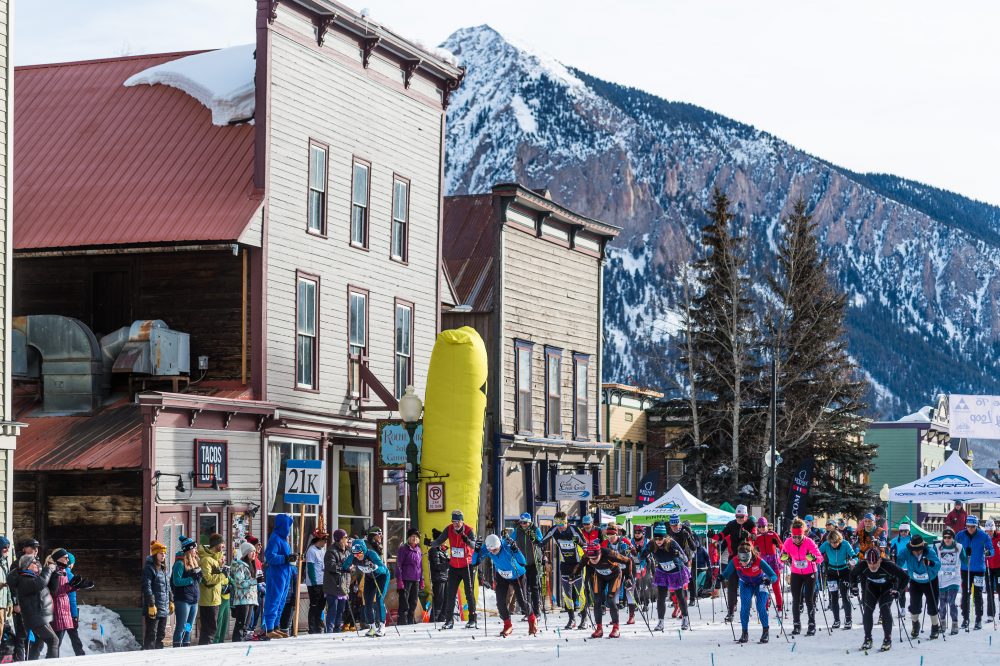
    Sent off in style: skiers take to the course during the 2020 Alley Loop Marathon in Crested Butte, Colorado. (Photo: Xavier Fane/CB Nordic)

    Rounding the final turn off Butte Avenue toward the Slate River Valley at the start of the second and final lap, I had my eyes peeled for a ride. There: the man dressed in a Birkebeiner-esque sweater with suspenders fastened to his Swix pants just beyond the — is that the Jamaican bobsled team?

    This is Crested Butte’s Alley Loop, titled a “Birkie qualifier with a twist”, a moniker that falls far short of capturing the infectious energy of this unique event. With four race lengths to choose from plus options for kiddos, the Alley Loop brings together a community of skiers of all ages, abilities, and costume intricacies. 

    Not convinced your whole party will want to race? There is a full weekend of offerings from the Elk Avenue Pub Ski Friday night where you and a group of friends can ski bar-to-bar in costume, completing quirky challenges and earning points on your scorecard along the way, to a casual Sunday brunch tour out to the Magic Meadows yurt. Unless you are averse to recreating in a beautiful place or indulging in good food and drink with friends, you will have fun at this event. 

    Nestled into the southern edge of Colorado’s Elk Mountains at 8,885 feet, the town of Crested Butte has preserved its integrity as a small and sleepy western town (along with steep real estate prices) with unlimited offerings for the outdoor junkie. For cross country skiers, this includes over 50 kilometers of groomed, variable terrain, trail: rolling meadows, steep climbs and descents, and gently graded beginner-friendly tracks, all with a jaw-dropping backdrop. In fact, the town is aptly titled “the Nordic Ski Capital of Colorado.”

    On the first weekend in February, the streets and alleys of downtown Crested Butte are transformed from a snow packed grid to a meandering strip of corduroy, welcoming skiers to the “best costume party of the year.” And they mean it. Though the origin of the tradition is unknown (perhaps some lingering 70’s and 80’s party culture at play?), the town takes advantage of every opportunity to play dress up. Word on the street is, “everyone in Crested Butte has a costume box”.

    While you may see a few tie-dye t shirts, retro race suits, and other small touches that are minimally impactful to aerodynamics on the race course, you will also note the full cast of Alice in Wonderland, Cleopatra and King Tut, a pair of blow up giraffes, and the garish orange 45th president skiing in jeans. 

    In the heart of Crested Butte, racers take to the course at the start of the 2020 Alley Loop. (Photo: Xavier Fane/CB Nordic)

    I found myself struck by how much different this was from any event I had experienced. Competitive skiers there to ski fast and breathe hard blended amongst the larger population who were celebrating the simple joy of sliding on snow in a beautiful place with good company. 

    Director of Marketing and Development at Crested Butte Nordic Laura Puckett Daniels put it simply. “It’s ALL cross-sections of the whole community, not just nordic skiers in the nordic community.”

    What does this event do for the Crested Butte community and how does the town pull it off? More on that later, but first: the race. 

    Though both techniques are offered at the 21 and 42 k distance, it is perhaps a skater’s course, and this is where you’ll tend to find the larger and more competitive field. Case in point, the 42 k skate was won by Kyle Bratrud (SMS T2) for men and Rosie Frankowski (APU) for women. (You can listen to Frankowski’s thoughts on the event here.)

    Alley Loop 42-kilometer skate winners Kyle Bratrud and Rosie Frankowski. (Photo: Xavier Fane/CB Nordic)

    Shorter skis also make it easier to navigate the narrow alleys and bridges through town, and allow for top cruising speed through the gently undulating terrain found on the bulk of the course as it winds through the meadows of the valley floor.

    The course and profile of the 42-kilometer Alley Loop marathon in Crested Butte, CO. (Photo: cbnordic.org)

    If you do plan to kick and glide, be prepared to do a lot of double poling and kick double poling. With only one significant climb per lap (four total) on the 21 k course and two per lap (six total) in the full marathon, the Alley Loop has far less vertical than the Birkie, the Lake Placid Loppet, or the Craftsbury Marathon. Granted, you’re racing close to 9,000’, so your body and lungs will feel it regardless!

    Depending on how fruitful the winter has been, the snow in town can be a little dirty and gravely, and it’s good to consider the calculus of ski selection. Know that you may come away with a few dings in your boards from the roughly 1 k section in-town, but the vast majority of the course will be immaculate. If your race boards are due for a grind and the snowbanks indicate the generosity of Ullr, send it. 

    Anecdotally, we had a fairly unremarkable winter and the snowpack in the Elk Mountain region sits close to the median. The course was immaculately prepared, though the section in town did erode by the end of my second lap. I chose to race on an older pair of race skis, which accrued a few minor scratches — nothing in any way alarming. (Side note: the available wax service made these skis ripping fast and very fun to ski!) 

    Because of the street closures and parking limitations incurred by laying a race course through the streets of a small mountain town (and to take full advantage of pre and post-race celebrations), it can be very helpful to stay within walking distance of the start line or to rely on public transit.

    A narrow footbridge takes racers from town toward the Slate River Valley in Crested Butte. (Photo:Xavier Fane/CB Nordic)

    I had a wonderful stay at the Elk Mountain Lodge, just two blocks off Elk Ave, along with several other Alley Loopers. The home-cooked breakfast was delicious and the community style table around which it was eaten fostered conversation with the other skiers who had also traveled to Crested Butte for the event. Being so close to the start, it was also possible to get out for a warm up ski, then de-layer and stay warm inside the lodge until the last minute — totally clutch as temperatures had only reached the low teens by go time!

    One final note on the race. At the start of the 21 k, a race official noticed the all-male start line and invited any female podium hopefuls to take a spot either in the front of one of the many start lanes or to start between two lanes staggered just behind the front row. As the double pole start turns quickly into a sprint to the base of a steep climb, early positioning is important, and as someone looking to race near the top of the field, I greatly appreciated this nod. Kudos to the Crested Butte Nordic Counsel for looking out for and supporting fast women! (The 21 k skate was won overall by APU’s Becca Rorabaugh.)

    Back to the spirit of the Alley Loop, which is arguably the most compelling reason to make the trip. To better capture its energy and do justice to what it takes to pull off such a feat, FasterSkier spoke with head groomer Dean Davis.

    A sno-cat lays perfect corduroy and track through a sleepy alley. (Photo: Xavier Fane/CB Nordic)

    “It’s just so cool to groom your town,” said Davis. “That is something that is just so unique, that not a lot of cat operators get to do. I love that aspect of it.” 

    That’s not to say that the process is easy or uncomplicated. Davis says he loses sleep over the Alley Loop in the middle of the summer, despite working it for 13 years. Some of the course in town is prepared up to a week in advance, and some of Elk Avenue (the town’s main strip) is laid two nights in advance. But because the final steps close down access to homes and businesses, a large amount of work must take place the night before. 

    “That all just happens in one fell swoop on Friday night and my heart is pounding. The amount of stress I go through on that night and the weeks leading up is through the roof.”

    Elk Avenue transforms from main drag to race course.

    The majority of the snow, which is taken from piles of snow that were stashed around town after being removed from the streets during storms, is laid using two loaders and a grader. Sno-cats make the final passes to groom and set track where possible. 

    This machinery has its handling well-tested through this process.

    “Our [sno-cats] barely fit down some of these alleys where there’s gas lines on both sides of you and there’s an electric line above you… I had one year, it was a pretty big snow year, where I was driving so close to a VW bug that was completely covered in snow that I was practically driving over it. Really, my track setter was just hitting the edge of the top of the roof even though there was two feet of snow on top. It didn’t hurt the car, but I had to be very aware of it.

    “I’ve had years where there is so much snow that I am driving through the alleys and looking into people’s second floor bedroom windows,” he laughed. “That’s kind of crazy”

    Aside from dodging obstacles, clear, frequent, and proactive communication with the town, its residents, and the local police department is essential to enforce street closures and parking restrictions. On top of other race preparation, the team at CB Nordic is going door to door two weeks before the race handing out reminders and placing them on parked cars. 

    Despite their best effort, the instructions are not always adhered to. This year, Davis estimated that an above-average 13 cars were towed. 

    What Davis loses the most sleep over, however, are the effects of Murphy’s law. His biggest fear is a sno-cat breaking down in the middle of the night.

    “You’ve just got to look out for what could get in your way. Anything from ‘cats breaking down to ‘do you have enough snow that year?’”

    Davis’ biggest fear is a sno-cat breaking down in the middle of the night. He explained that he has a local welder on call and ready to respond at any hour of the night, and that he is sure to stock up on hydraulic fluid, spare o-rings, and parts, which will hopefully remedy whatever issues that arise.

    Mechanical problems aside, it is always an eventful night. At 2 AM, it’s the juxtaposition of the grooming team hard at work and the debauchery of those who have stayed at the bar until closing time. Davis recounted being flashed, mostly by ladies, and multiple occurrences of someone (who may be well past the legal limit) trying to drive their car through the course, only to become stuck. 

    “It sure pisses me off because I have to go fix [the course] after they do it, but it’s always entertainment for me.”

    After surviving the late night shenanigans and setting a spectacular course, Davis likes to kick back with breakfast and a bloody mary at McGill’s Restaurant near the start on Elk Ave. In his words, he is “so psyched to be done [grooming] and can just watch the costumes go by.”

    The Jamaican bobsled team makes their way through the alleys of Crested Butte. (Photo: Xavier Fane/CB Nordic)

    For him, this is the true magic of the event.

    “For the most part, everybody loves it. People that don’t even do it come out just to watch all the crazy costumes. It really brings the community together on that day. A lot of people do it for the seriousness of the race, but most of the community just does it for the good times. The bacon stands in the alleys and the people rooting you on. People will set up whole parties in the alleys in back of their house — it’s just so fun to barbecue and listen to everyone laughing and having a good time.

    A different kind of aid station alley-side in Crested Butte. (Photo: Xavier Fane/CB Nordic)

    “I’m definitely grooming for the true racers, but the real fun of it for me is just to see all my friends just try to chug around the course. Some of them haven’t been on skis all year and they do the 5 k in a suit they can barely walk in.”

    As a parent himself, Davis finds that the kids races, in particular, tug at his heart strings. 

    “I love watching the kids just doing their best out there.”

    The Alley Loop offers a 1 or 3 k option for little ones. The kids events are seen off by Murray Banks, a CB local who became a motivational speaker after a robust career as a celebrated teacher and champion triathlete turned ski-racer. Banks is deeply rooted in the local cross country community and coaches both the youth and masters programs. 

    “He always leads the kids on in the morning and his enthusiasm is something to die for… his attitude is just so positive and the kids just love him. It melts me.”

    So whether you’re looking for a family-friendly weekend in the mountains, a pre-Birkie altitude camp and tune up race, or a rowdy weekend on snow with friends, Crested Butte has something for you at the Alley Loop. Put Saturday February 6th, 2021 on your calendar. I’ll see you there!

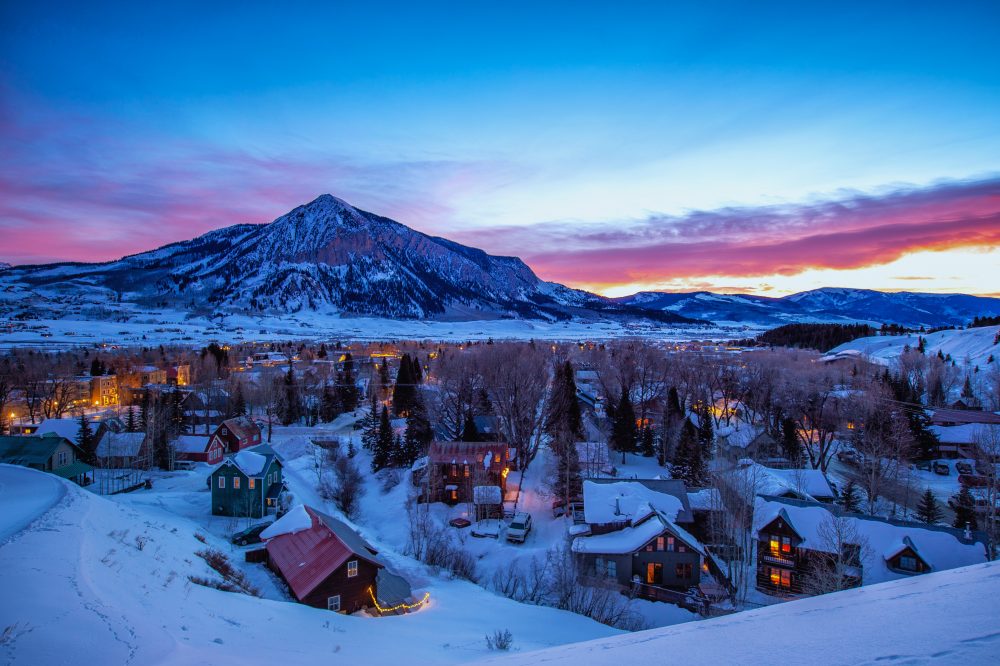
    Sunrise over Crested Butte on race morning. (Photo: Xavier Fane/CB Nordic)
  • Find Your Ski Talents in Crested Butte this Thanksgiving

    Simply imagining striding along at just shy of 9,000 feet makes the heart rate drift upwards. So let’s get this up front: if you’re coming from significantly lower elevations to Crested Butte, Colorado, take it easy for a day and acclimate.

    Big vista views in Crested Butte, Colorado.

    If you’ve got the acclimation piece down, Crested Butte could very well be the most iconic of ski towns. Tucked into a dead end valley in winter, and with it’s downtown oozing rustic ski town charm, it’s worth a pilgrimage there for any aficionado of sliding on snow. Calling it the hyperdiverse mecca of snow sliding is not an understatement. There’s snowboarders, splitboarders, alpine racers, jibbers, tele-skiers, real-deal ski mountaineers, and the skinny ski clan. None of whom, it seems on past trips there, were mutually exclusive. 

    It’s hard to get caught up in ski-turf tribalism when the Elk Mountain’s has you mesmerized.   

    If you’re looking for a dose of what Crested Butte has to offer, from Thursday November 28th (Thanksgiving) until December 1, Crested Butte Nordic will host its annual Thanksgiving Camp. (You can link to a full camp schedule here.) They’ll have a gamut of clinics catering to first timers and those looking to eek out just a bit more speed.

    The camp organizers sent along a “real time conditions” update on November 15, — and we’ll update this story as conditions change. 

    If snow conditions allow, Thanksgiving Camp clinics are based out of the in-town Crested Butte Nordic Center.

    “We have not received significant snow accumulation since October 29th. The snow events which occurred in late October laid down a skiable base at higher elevations, but have not been sufficient enough as of yet, for USFS to allow us to begin grooming operations at our high elevation venue – Lily Lake (5 miles outside Town, towards Kebler Pass)

    “Warming temperatures the last two weeks has largely evaporated our base outside our Nordic Center in town, however our north facing homologated track (mowed – 5k) is still holding a base in the trees.

    “We have a chance to receive new snow next week, with two small pulses of moisture in the forecast. Essentially, we need temperatures to drop and stay consistently cold, and get about 6″ new for our homologated track to come online for the  camp.”

    With ample snow, the cross-country skiing in Crested Butte is an in-town affair. Yet the trail system flows across meadows, kicks up benches and descends down draws, and threads through forest to provide a big dose of skiing perfection in the high mountain West. It’s easy to find your inner and outer exercise tranquility. The reality is, you’re never too far away from a fine food-coma inducing meal back in town.

    Ideally, the camp’s on-snow offerings will remain at the nordic center. However, there’s the flexibility to “adjust the camp formatting according to where snow conditions are best.” 

    Yes, kids are welcome.
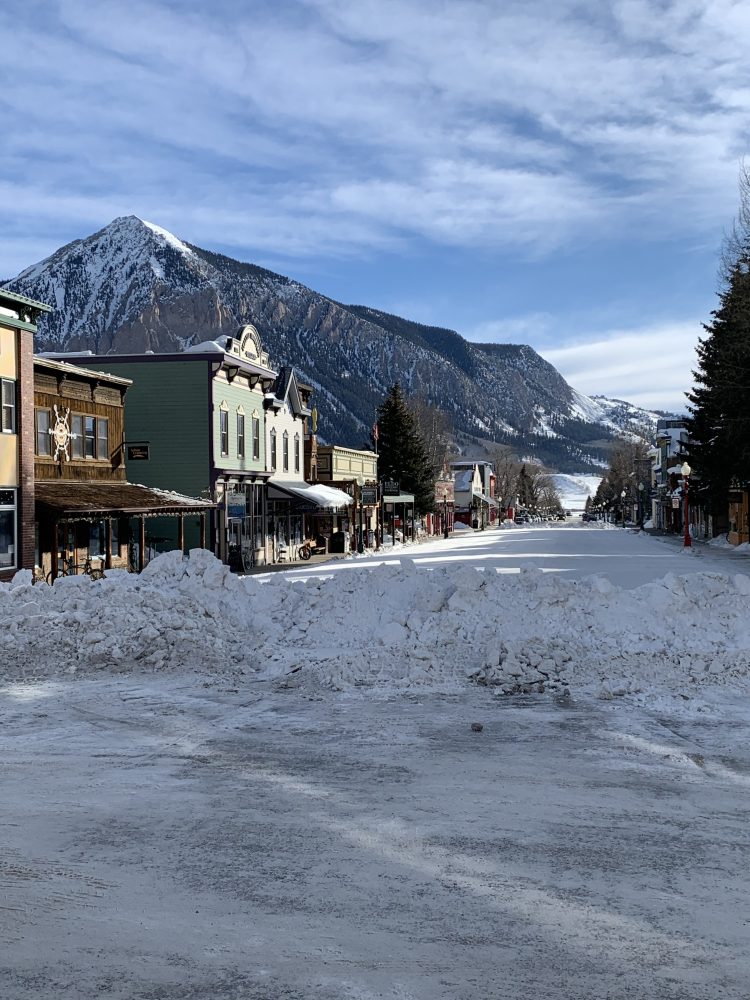
    Despite the current bony conditions in town, the snow gods have a way of blessing the kowtowing disciples in Crested Butte. 

    “While conditions are always a concern, we’ve been on snow for the last 30 years,” the camp organizers emailed. “We’ve got a devoted core following who has adapted with us when we need to, and we offer a variety of fun events beyond the on-snow training, including a wine & waxing clinic and a fun party.”

  • Crested Butte Nordic in Need of Operations Manager/Groomer

    Crested Butte Nordic in Need of Operations Manager/Groomer

    Crested Butte Nordic

    Crested Butte Nordic is looking for an operations manager/groomer who can oversee staff, trail and equipment maintenance, and manage our grooming operations.  This is a full-time seasonal position mid-October to mid-April.  For more info please email director@cbnordic.org.

  • Crested Butte Thanksgiving Camp Gallery

    Crested Butte Thanksgiving Camp Gallery

    The 2015 Crested Butte Thanksgiving Camp took place last week, Nov. 26-29. Here are a collection of photos from this year’s event.

    For more info on this camp, check out our guide to U.S. and Canadian on-snow Thanksgiving camps.


  • From Skiing to Ultras: Callahan’s New Obsession

    From Skiing to Ultras: Callahan’s New Obsession

    A creature of team sports – first baseball, then soccer – Duncan Callahan remembered his reaction when his older brother started nordic skiing at Glens Falls High School in northeastern New York.

    Courtesy photo — Crested Butte Nordic head coach Duncan Callahan coaches at Soldier Hollow in Midway, Utah, in January.

    “I thought he was the biggest nerd in the world,” he said.

    A year later, Callahan’s brother, Bill, convinced him to try it.

    In darkness, the two set out on the city’s illuminated trail system. Afterward, Bill suggested his little brother come out for the team. He still thought it was nerdy, but decided to anyway.

    In a phone conversation from Gunnison, Colo., the 28-year-old Callahan credited his brother and older teammates for their leadership. He had one coach through the seasons, Bill Parks, who helped him develop as a cross-country skier and as a runner.

    Following Callahan’s high school years, which included two trips to the New York State nordic skiing championships, he skied at Western State College in Gunnison, coached at the same institution and dove into ultra-distance events.

    In 2003, Callahan won the inaugural Leadville 100-mile ski race. A college junior at a crossroad of interests, he said the event hooked him on endurance events. Rather than ski, he chose to run.

    Since 2007, Callahan has won several ultras, including two Leadville 100-mile trail runs and the Moab 100, and set a course record at the Grand Teton 50-miler.

    Sidebar: Skier Stats

    Who: Duncan Callahan
    Age:
    28
    On snow:
    Head coach of Crested Butte Nordic and Western State College
    Nordic ski teams
    Off:
    Two-time champion of Leadville 100 trail run
    Passions:
    Coaching skiing; running ultras
    Favorite ski brand:
    Fischer
    Running shoe:
    Vasque
    Typical training session:
    Long outing of 6 hours with 7,400-foot climb
    over 28 miles.
    Mileage:
    Approximately 23,000 in last 5 years.
    More info: 
    www.strategicendurance.com

    Now the head coach of Crested Butte Nordic, he ran his fifth consecutive race in Leadville, Colo., on Aug. 20. The defending champion of the “Race Across The Sky” at elevations of 9,200 to 12,600 feet, Callahan placed ninth.

    “The hundred is so different from any other race,” he said before the 2011 Leadville challenge. “My absolute goal … is to go to the bottom of the well (and) see what’s in the heart and in the head because you’re absolutely going to need that out there. The goal of winning is secondary.”

    While Callahan was not thrilled with his result, he accepted it. His legs hadn’t cooperated over the 19 hours, 11 minutes and 15 seconds he was out there, he said, and he felt uncomfortable leading early.

    “I’m used to running from behind for most of the race,” he said.

    But quitting? That rarely crossed his mind.

    In those races, high and low points are a given, Callahan said. He tried to minimize both, riding strong moments without overdoing it and staying mentally sound through pain. Just once, earlier this year at the Hardrock 100 in Silverton, Colo., he thought about dropping out.

    “But 99.9 percent of the race, it never occurs to me,” he said. “I’m not going to lay claim to be any more mentally tough than anyone, but I do love getting to mile 80 and having to grind it out.”

    That’s why he’s hard to beat, said Callahan’s friend Adam St.Pierre, the head coach of Boulder Nordic.

    “Generally, he’s the guy that slows down the least,” said St.Pierre, who was 56th at Leadville this year in his second 100-miler.

    “At some point in your mind, you’re going to say, ‘Why am I out here? It would be easier to just stop,’ ” he said. “It’s one thing to keep going, but it’s another thing to pick up the pace from there.”

    Courtesy photo — Duncan Callahan competes in the 2009 Grand Teton 50-miler in Alta, Wyo. He won the race in 7:33.27.

    Miles of self-motivation

    To understand Callahan’s psyche, it’s helpful to know his background.

    While elite athletes tend to tread off the beaten path, Callahan’s high school coach in cross-country running, skiing and track said he was especially unique.

    “You have a sense of this is the kind of guy that was tuning out the rest of the world and was driven,” Bill Parks said. “He was actually a very fun-loving guy, but he put in a lot of miles.”

    That drive and thousands of miles – mostly rollerskiing – got Callahan into trouble. Parks remembered when a teacher approached him about penalizing Callahan for his frequent tardiness.

    Parks knew he was out rollerskiing before school, and so did the teacher. She had seen him on her way to work – still sweaty and far from home and a shower.

    “These stories would come back to me of him rollerskiing to Saratoga and back,” Parks said. That was at least 40 miles round trip.

    When he spoke about Callahan at an awards banquet, Parks pointed out that the star skier – a top Mid-Atlantic racer – had rollerskied some 2,000 to 3,000 miles, far beyond Parks’ suggestion.

    “He came up to accept the award and he looked a little puzzled,” Parks said. “He said, “ ‘You know, I skied a lot more than that, coach.’ ”

    One day, Callahan said he did 70 kilometers on the county bike path.

    “Skiing was a slightly unhealthy obsession for me from my junior year in high school to my junior year in college,” Callahan said. “The training for it kind of dominated my thought process. My schoolwork kind of suffered and socially I was kind of a dweeb. For five years of my life, skiing was absolutely my central focus.”

    After a disappointing finish at the state meet his senior year, one which neither Callahan nor Parks knew what went wrong, Callahan moved on at Western State College. There, he continued to dedicate himself to training and achieved All-American status as a sophomore at Junior Nationals.

    By his junior year, Callahan’s results stagnated. His attention shifted to new races: first, the Grand Traverse 45-mile backcountry ski and then the Leadville 100-mile ski. He realized he loved distance events and had lost an interest in college racing.

    “Training for me was way more important than racing,” he said. “And when you get to that point, you start to lose your passion for competition.”

    He bunkered down and chose a major – history – while studying exercise physiology and coaching. His discovered his knack for coaching and by the time he graduated, he had stepped back from racing altogether.

    That allowed him to meet his eventual wife, Annie, and for the first time in nearly a decade, Callahan took a season off, and it wasn’t because he was hurt.

    Mostly injury-free in high school (“I didn’t get injured,” he said, “and if I did, I didn’t care”), a couple of stress fractures in his feet forced him to take time off in college.

    For the most part, his body dictated his training. When he overdid it, his body slowed down. He wouldn’t get sick, he just couldn’t physically move as fast or at all, he said.

    “My body just shuts down and says, “Nope, you’re not doing anything today,’ ” Callahan said. Then he would rest.

    He reintroduced himself into the running world a few months after he graduated when he began coaching Western State and the Crested Butte club in 2005. Working with skiers, he decided to get back into shape.

    Courtesy photo — Duncan Callahan poses while coaching at Soldier Hollow in Midway, Utah, in January.

    After marrying Annie in 2007, he asked her, “What do you think about me doing the Leadville 100 running race this summer?” She agreed to support him, both in principle and out on the trail, and Callahan began a yearly regimen of running about 5,000 miles a year.

    “We always joke to my friends that I almost tricked her with all this,” he said.

    In 2007, he was seventh of 210 finishers at Leadville. The following year, he won it in 18:02.39, and was third in 2009. He was last year’s overall winner in 17:43.24, almost 40 minutes ahead of the second finisher.

    At the Hardrock 100 this year, he was eighth in 30:57.

    “For the most part, I could compete in the top ten if I ate well and kept up an active lifestyle,” Callahan said. “It’s a great lifestyle sport so (the) ‘W’ is not the end-all, be-all for me now.”

    The ultra appeal

    A runner since middle school, Callahan had a natural affection for the sport. He ran the mile and two mile in addition to cross country, and enjoyed lengthy workouts in preparation.

    “Training for me, essentially, was a pure expression of a passionate pursuit of something,” Callahan said. “That was certainly something that catapulted me to where I got to and held me back on the results side. I trained too much, I trained too hard. I didn’t recover enough.”

    Before running his fifth Leadville – which he said would be his last consecutive one – Callahan reflected on the appeal of endurance sports, especially for someone like him.

    “I just think there are a lot of guys who could not move on after college in marathons, not to the next level,” he said. “Finding their way into ultras was kind of a natural out.”

    He said he couldn’t compete with men or women in marathons. At 6-feet tall and 165 pounds, he said his body’s ability to burn fat helped him at long-distance events – along with the base he built nearly 15 years ago.

    While ultras initially suited 35- to 45-year-olds, Callahan said he has been among a younger, progressively dominating demographic. In 2007, two of Leadville’s top 10 finishers were in their 20s. Two years later, five of the top six fell in that age category.

    “I’ve heard it called the fastest growing segment in the outdoor industry,” Callahan said. “And the outdoor industry is one of the fastest growing segments in the world.”

    Several other 20- to 30-something nordic coaches, including St.Pierre, have also taken up distance races. For many, ski coaching allows summer flexibility, and the training enables some freedom.

    “It’s sort of weird,” St.Pierre said of his fellow coaches’ attraction to the sport.

    Eric Pepper, the head nordic coach at Ski Club Vail, was one of St.Pierre’s four pacers at Leadville this year. Nick Sterling, who coached with St.Pierre in Boulder, also ran with him for part of the race, along with Middlebury skier Josh Dalley and triathlon coach Craig Howie.

    Last year at Leadville, Noah Hoffman of the U.S. Ski Team paced his friend, Greg Adams. Next year, St.Pierre said six or seven Colorado ski coaches might race there.

    “I think ultra running let’s us take out some of our aggression,” St.Pierre joked.

    “Rocky Mountain Nordic coaches, we are staking claim,” Callahan said. “We are the fittest group of coaches in the USSA.”

    St.Pierre paced Callahan in three 100-mile ultras, and Callahan returned the favor to St.Pierre at the Western States Endurance Run in Auburn, Calif., in June.

    “We were both fitness dorks; that’s how we connected initially,” Callahan said. “We were the coaches getting up early and going on our runs.”

    At Leadville this year, Callahan had five people to run with after mile 50. His former exercise physiology professor, Scott Drum, paced him for the first 10, and his former college coach, Jesse Crandall, made the trip from Syracuse, N.Y., to run the second leg.

    At mile 76, Rich Smith, the father of one of Callahan’s skiers, took over. He handed off to Grant Ruehle, a former junior skier, and another athlete. Hannah Smith – who tweeted updates for Callahan throughout the day – ran the last five miles.

    Annie Callahan, Leadville 100
    Courtesy photo — Duncan Callahan's wife, Annie, right, holds their baby, Jordan, while checking in with Callahan at the Leadville 100 on Aug. 20. The 2010 defending champion was ninth in the 2011 race in Leadville, Colo.

    Annie Callahan met her husband at checkpoints with their newborn, Jordan Elizabeth, in tote.

    While similar races required hefty support and endless preparation – both physically and mentally – Callahan didn’t see an end in sight.

    Ultra running wasn’t the most lucrative sport, he said, but several sponsors made it easier to pursue. He belonged to the Vasque running team and was mostly supported in products from ProBar, First Endurance (sports nutrition), Vespa (natural amino acids) and Once Again Nut Butter.

    In all, he estimated he could make $3,000-$4,000 a year running.

    “It’s not a lot of money, but it is a pretty good percentage of my income, which is embarrassing to say, but it’s true,” Callahan said. “Essentially, it pays for itself. I have no expenses related to the sport.”

    Now an online coach through his own website, strategicendurance.com, Callahan said he and his wife are trying to make their dreams work. A coffee shop manager on maternity leave, Annie helped organize a 5 k to fight human trafficking and planned to put on more races.

    A few years ago, the two worked with professor Drum on an ultra-endurance experience camp, but they were unable to attract enough people.

    “I certainly see a window right now to pursue what I’ve been pursuing, what we’ve been pursuing,” Callahan said. “But I’m not quite sure what the next move will be. Fitness and endurance will always be a gigantic part of our lives forever, that’s for sure.”

    With the attention their month-old baby has received, she will likely be equally entwined in the sport.

    “She’s going to be the most decked out kid,” Callahan said, laughing.