From the FasterSkier archive — posts syndicated from athletes’ and coaches’ own blogs between 2004 and 2012, kept online as published. Current coverage is at fasterskier.com.
Three-time Olympian, gold and silver medalist, long-time chair of the World Anti-Doping Agency’s Athlete committee, Officer of the Order of Canada, company founder and CEO, the list of Beckie Scott’s achievements is both lengthy and remarkable, and those included here only scratches the surface. In the nordic world specifically, Scott made history as the first North American woman to earn a medal at the Olympics in cross-country skiing. She has also been a long-time advocate and voice in anti-doping. In recent years, Scott’s focus and attention has shifted to the creation of Spirit North, a non-profit organization using the power of sport to improve the health and well-being of Indigenous youth in Canada.
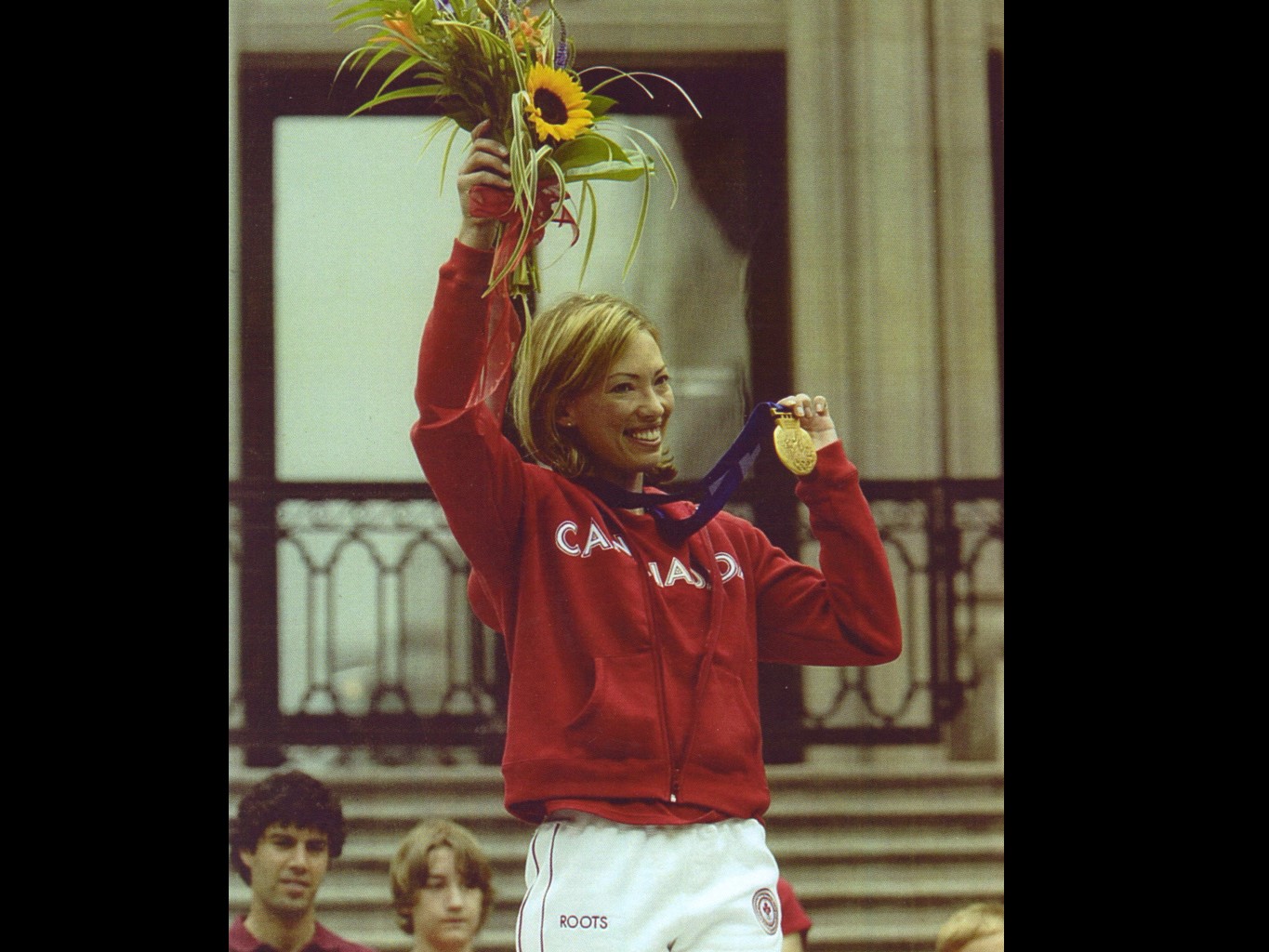
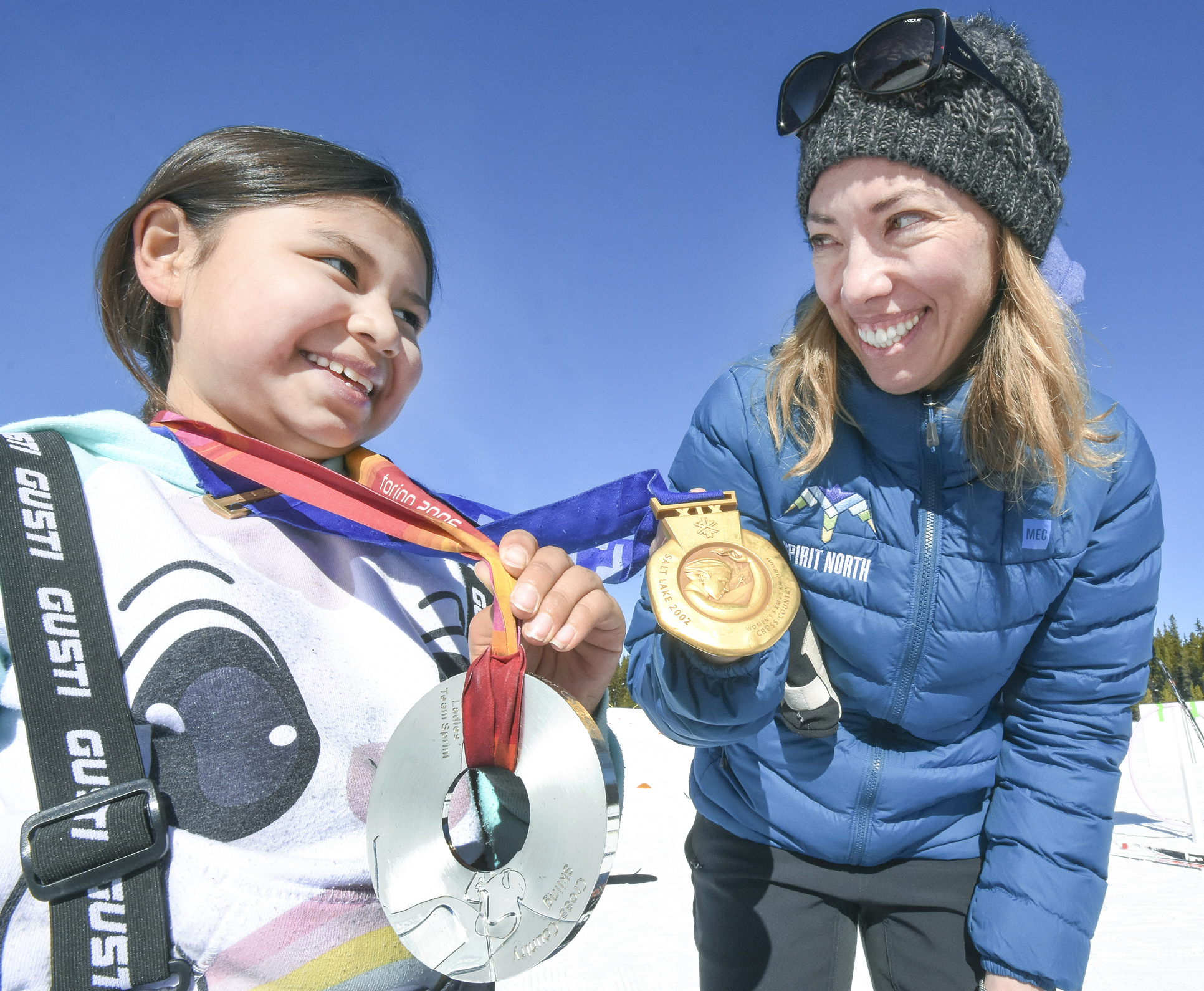
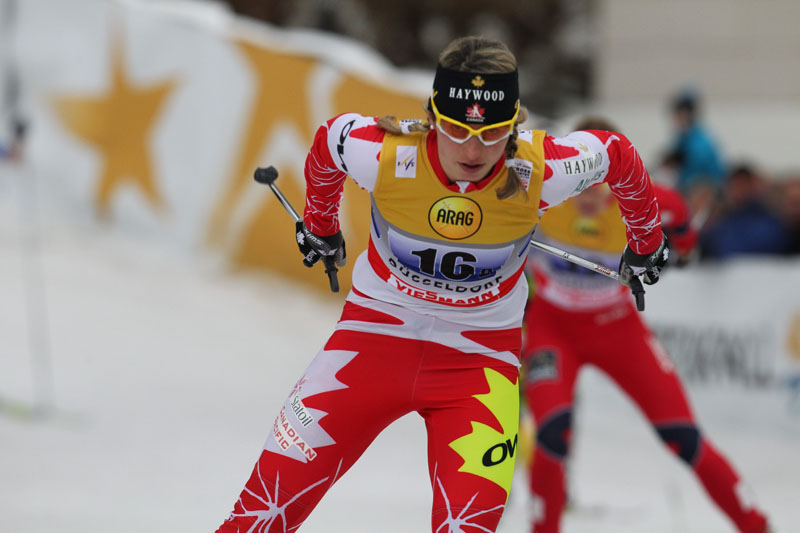
Beckie Scott displays her Olympic Gold medal from the 5 + 5 k pursuit at the Salt Lake Winter Games in 2002. She finished third but when the two women who finished in front of her were caught doping, Scott was awarded the gold in 2004. (courtesy photo)
The inspiration for founding this organization came after her retirement from ski racing, as Scott was invited to be an ambassador in a learn-to-ski program in northern Alberta funded by an oil and gas company that sponsors Cross-Country Canada.
“I started traveling up to these communities in northern Alberta for a number of years,” shared Scott, “the majority of which were indigenous, and I saw, for the first time, the realities of life there for community members, but particularly for the kids.”
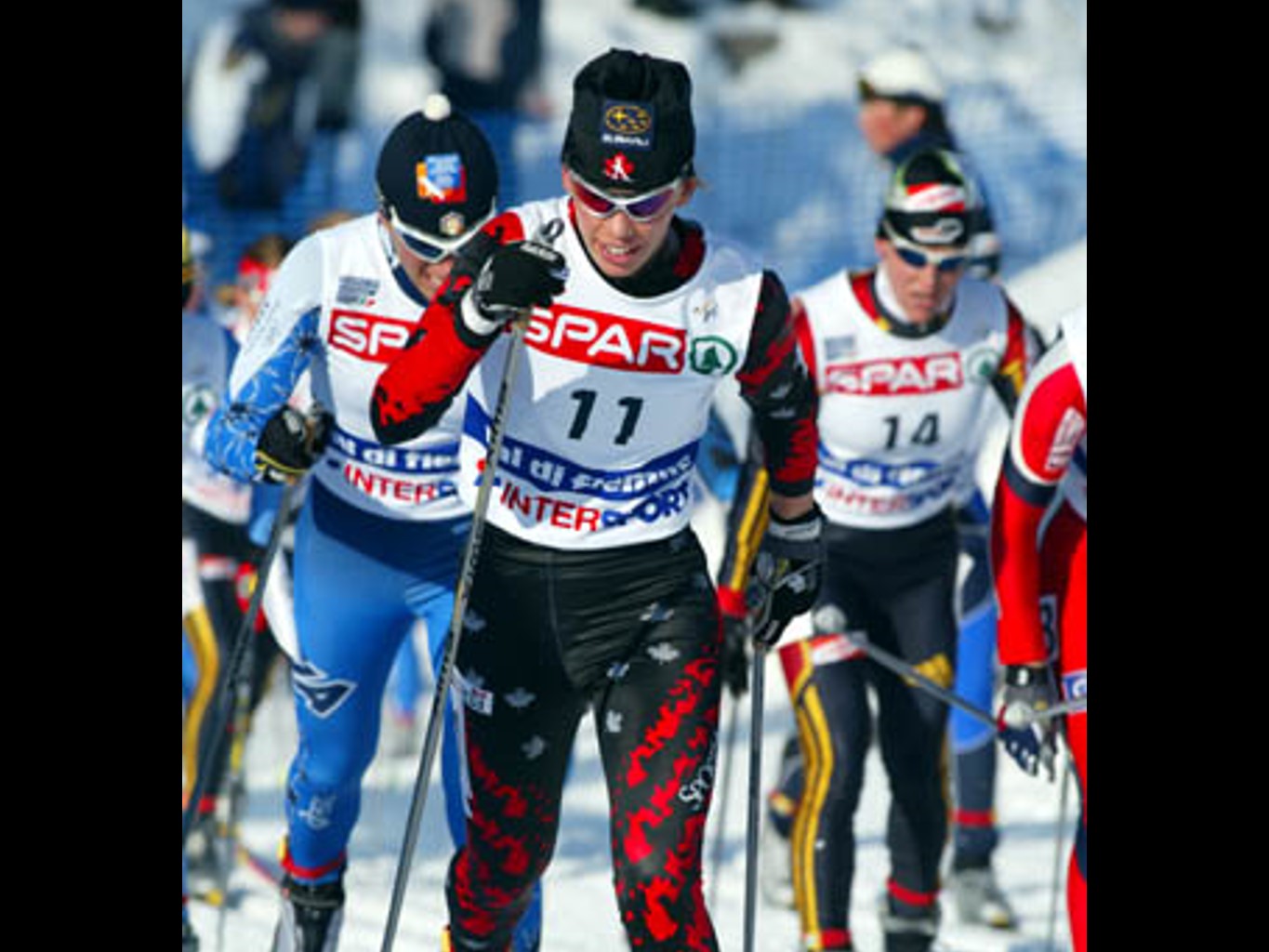
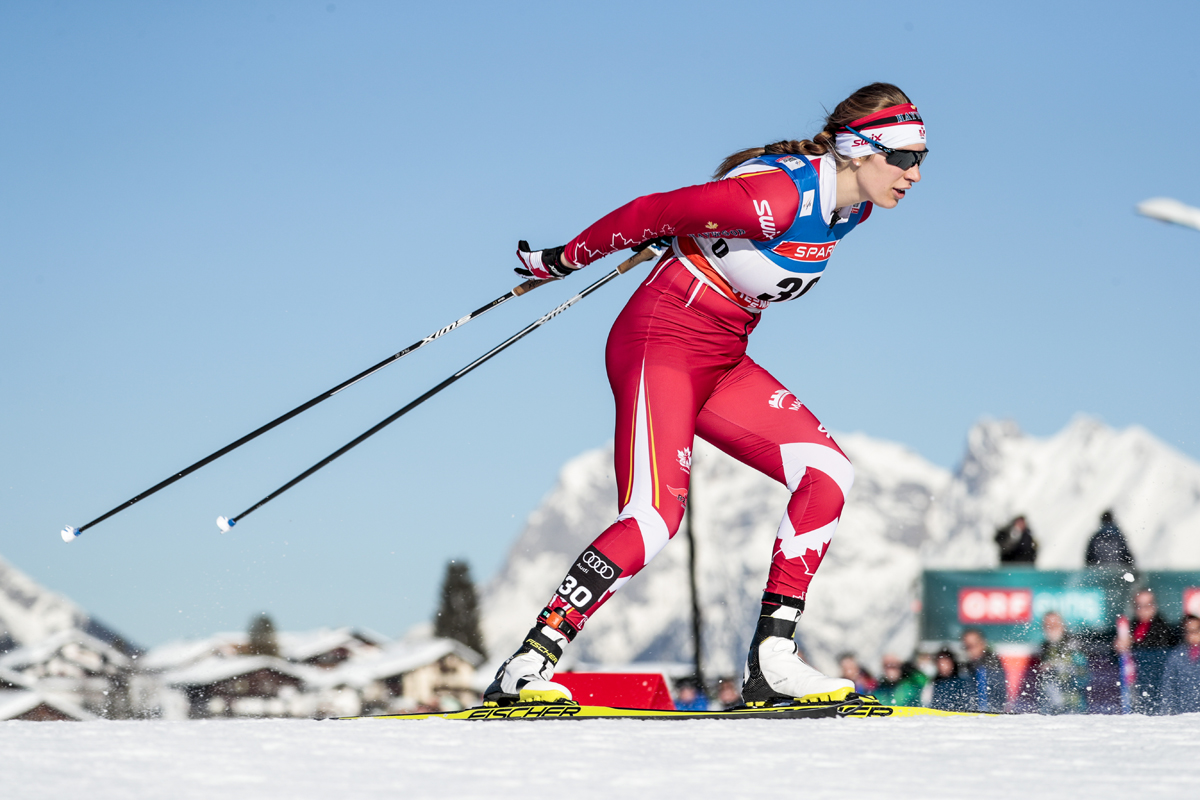
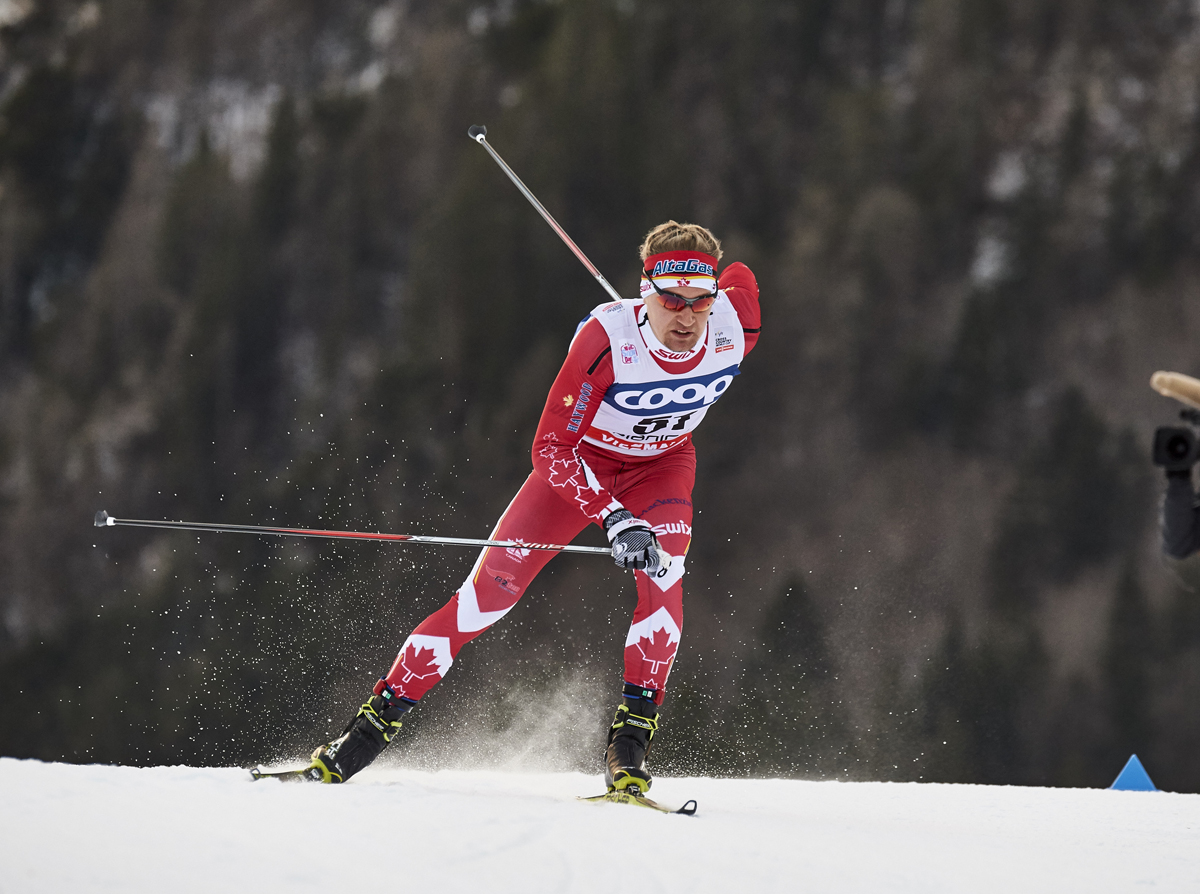
Beckie Scott racing in Val di Fiemme, Italy (courtesy photo)
Struck by how little there was in the way of sport and recreation, whether by virtue of the remoteness of the community, lack of infrastructure, or poverty, Scott noticed how many barriers there were for children in these communities to access sport.
“And yet, in parallel, when we would do this program, I was seeing this universal experience that kids have when they take part in sport,” continued Scott, “which is, just loving being out there, having fun, just walking a little taller because they’ve learned a new skill, all those great transformative benefits that come with being able to have that opportunity.”
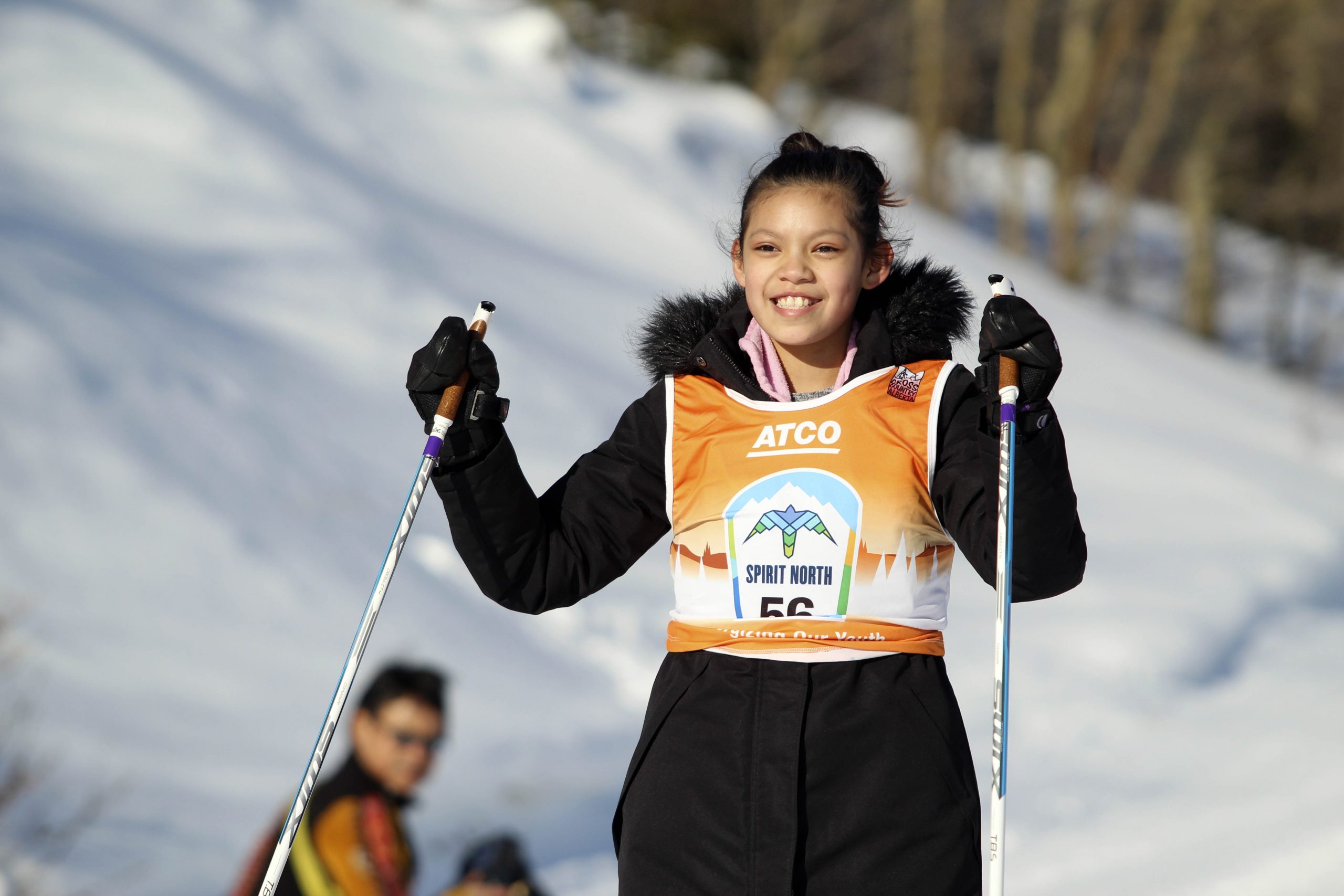
Happy kids head out for a Spirit North event (Photo: Spirit North)
After a number of years with this program, she gradually came to the realization that the program should be something more, it could be bigger, it could be better, and it should be its own organization. In 2017, Scott made it an independent entity, rebranded and renamed it, and thus, Spirit North was born.
The motivation and realization for this move was also partially spurred by the publication of the Truth and Reconciliation Commission report, published in Canada in 2015. The TRC came about after the Indian Residential Schools Settlement Agreement, to facilitate reconciliation among former students, their families, their communities and all Canadians. From 2007 to 2015 the TRC traveled throughout Canada, hearing from over 6,500 witnesses, and in June 2015 at its closing event in Ottawa, they presented an executive summary of the findings in a multi-volume final report. This report also included 94 “calls to action” to further reconciliation between Canadians and Indigenous peoples.
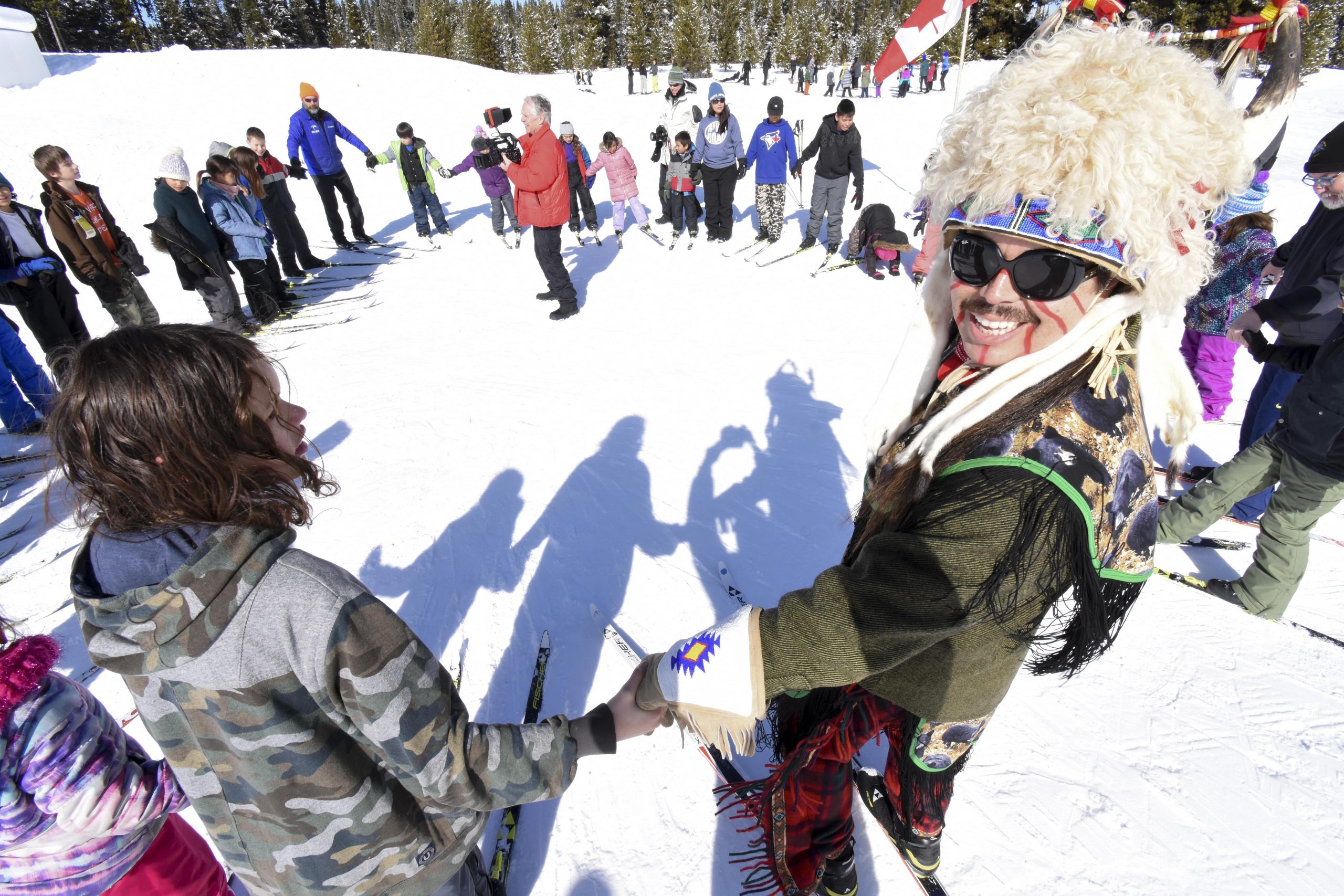
Levi Bent, a Spirit North coach, leads an event with a group of skiers (Photo: Spirit North)
“I think the Truth and Reconciliation Report was really a turning point for a lot of Canadians,” reflected Scott, “the legacy of residential schools and the intergenerational trauma, and the damage that was done, it lives on today. Those calls to action were really aimed at primarily non-Indigenous people starting to take steps to reconcile and to heal the harms of the past.”
Among the 94 calls to action were some specifically mentioning or targeting sport. The Spirit North website highlights three of them: Number 19, relating to the legacy of health, and Numbers 89 & 90, relating to sports and reconciliation.
A participant enjoying the sunshine and snow at a Spirit North event (Photo: Spirit North)
“It was really incredible to see sport in there,” said Scott, “Of course, I know that as a former athlete how valuable sport has been in my own life, not just as a professional pursuit, but in terms of life skills, friendships, and opportunities. To think that we can contribute to reconciliation through this platform, that is really at its heart a very simple concept – it’s activity, it’s play, it’s sport, and it’s something that all kids should have the opportunity to benefit from. I think it was really inspiring to know that we are part of this whole movement toward reconciliation with Indigenous peoples in Canada.”
Initially cross-country skiing was the only sport offered in the Spirit North programs, but when they started to get interest and questions about expanding beyond winter, the list of offerings started to expand.
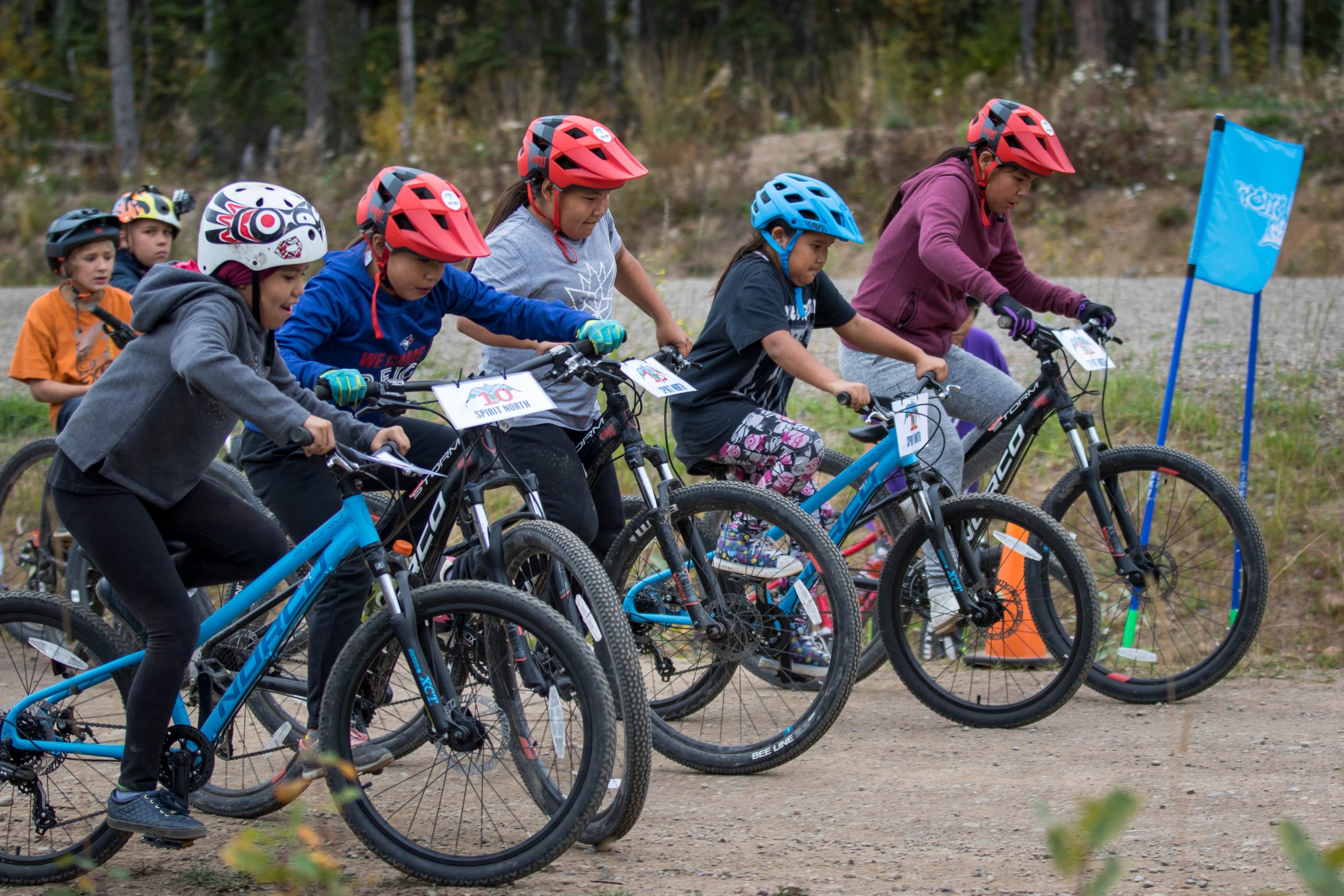
“It really grew, it just exploded this last year to include everything from rock climbing, to equestrian, to skateboarding,” said Scott, “basically, if a community indicates interest in another sport and we have the capacity to meet that interest, we will do it. One of our primary goals and objectives is to ensure the experiences are really enjoyable for kids and make sure that they have a great time, and if they want to try a new sport and it’s beneficial, then we’re open to exploring it.”
Spirit North participants work on their mountain biking skills, one of the sports added to the program. (Photo: Spirit North)
In the last year, 77 schools took part in Spirit North programs across six provinces and territories. Scott explained that they have a number of different models for programs within a community but primarily, the relationships start with what she calls a “co-creation process.” This includes meeting with the community members, teachers, elders, families or whoever is interested.
“Really, it’s a discovery,” explained Scott, “just learning what their values, beliefs, traditions, and knowledge are, and what are the barriers and then the program design is developed in collaboration with the communities. It’s very much a partnership.”
After this, the Spirit North program rolls out with a leader who is local if possible, if that capacity isn’t there, then they bring in a coach from an outside or neighboring community to lead programs.
“Every program looks a little bit different in every community, because it’s community driven,” said Scott. “We have been in communities for ten years now, there’s no cutoff date, or time we transition out,” she continued, “I think one of the reasons for success is relationship building, we just really commit to the community in terms of long-term relationships and delivering programs for as long as they want or need us there.”
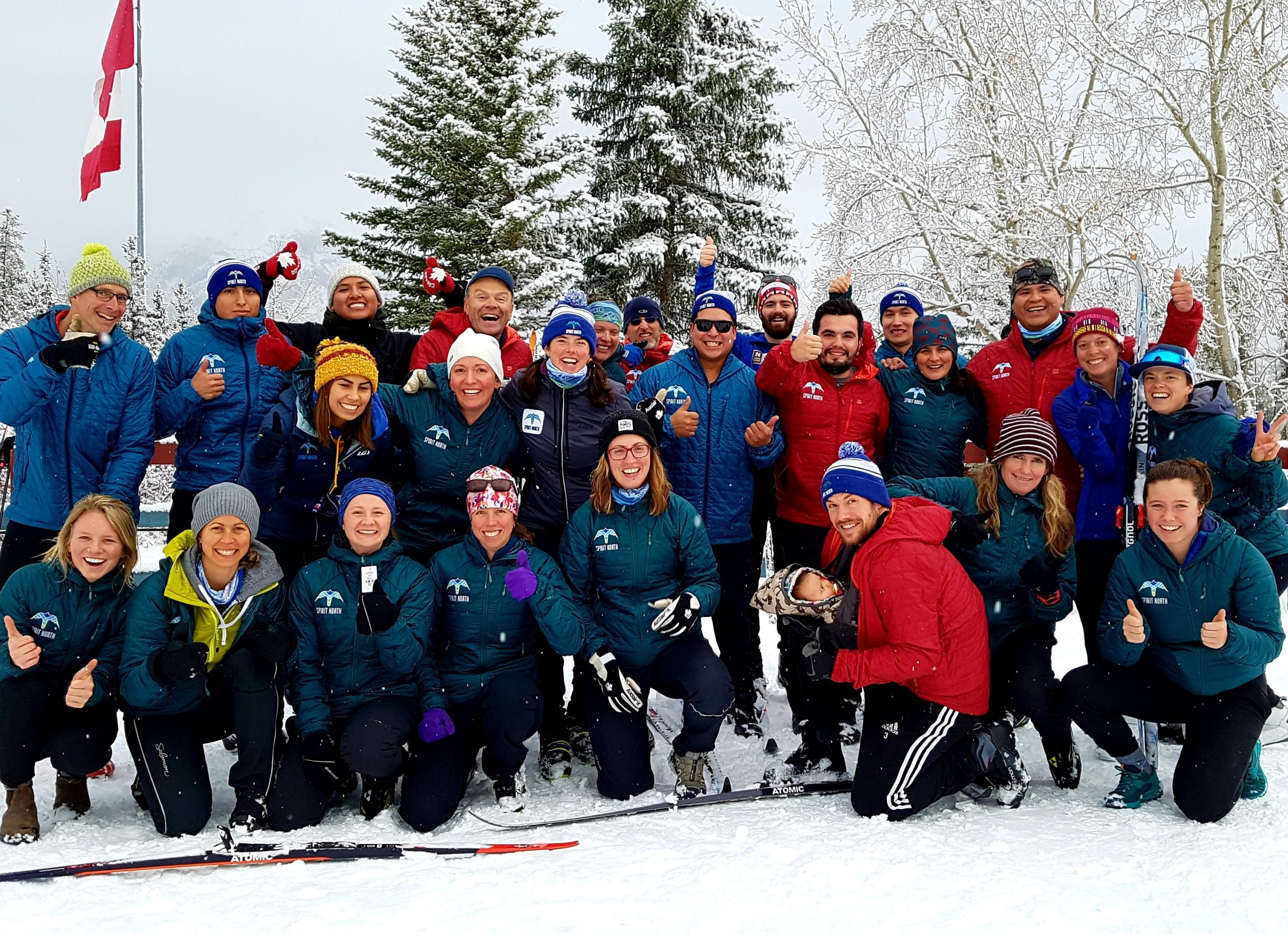
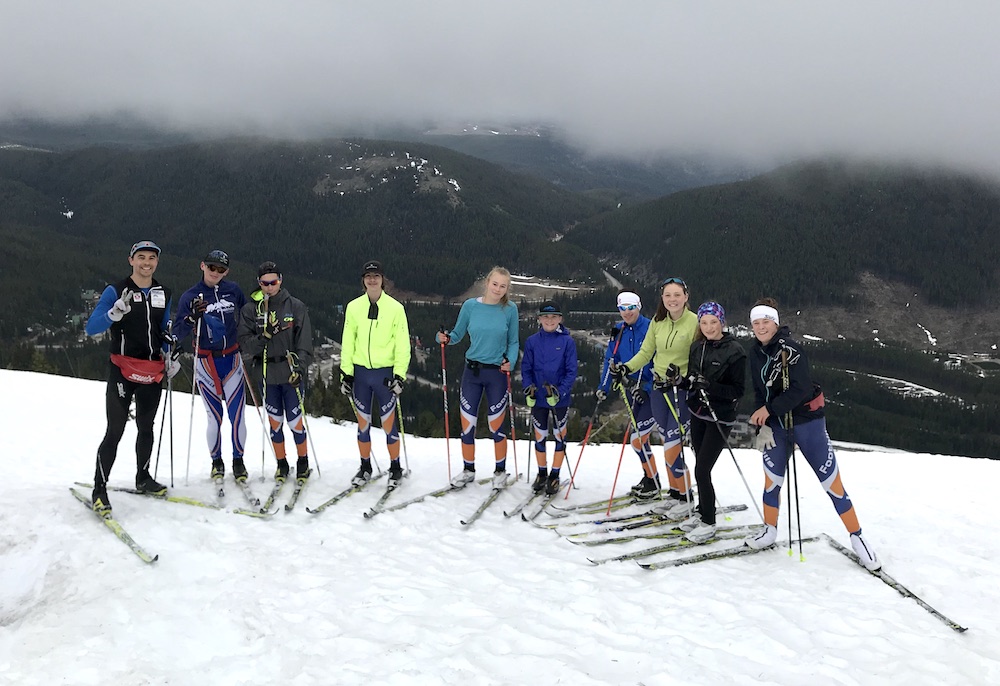
Spirit North leaders gather for a team photo (Photo: Spirit North)
It hasn’t all been smooth sailing. When asked about the learning process, Scott laughed, “I started a nonprofit really with no idea how to start, and so the learning curve was extremely steep.” However, with the help of a great team of people to lean on and provide advice and guidance, she was able to get the program off the ground. “I don’t think I could have known how much work it was going to be,” reflected Scott, though she was quick to say that it has all been worthwhile and very rewarding. “I think one of the biggest challenges we have is the challenge of every charitable organization, which is fundraising, you have to keep the lights on, and the programs running, and coaches paid.”
This has been particularly challenging during COVID. “We really have two jobs here,” said Scott, “raising money, and running programs, and raising money during COVID has been a challenge for a variety of reasons.” As with most non-profits, their fundraising success ebbs and flows. “We’re lucky and we feel fortunate, we’ve got some great backers, but growth and expansion as we go forward requires more funding. So it’s a constant sort of push and pull or a balance to try to maintain,” Scott concluded.
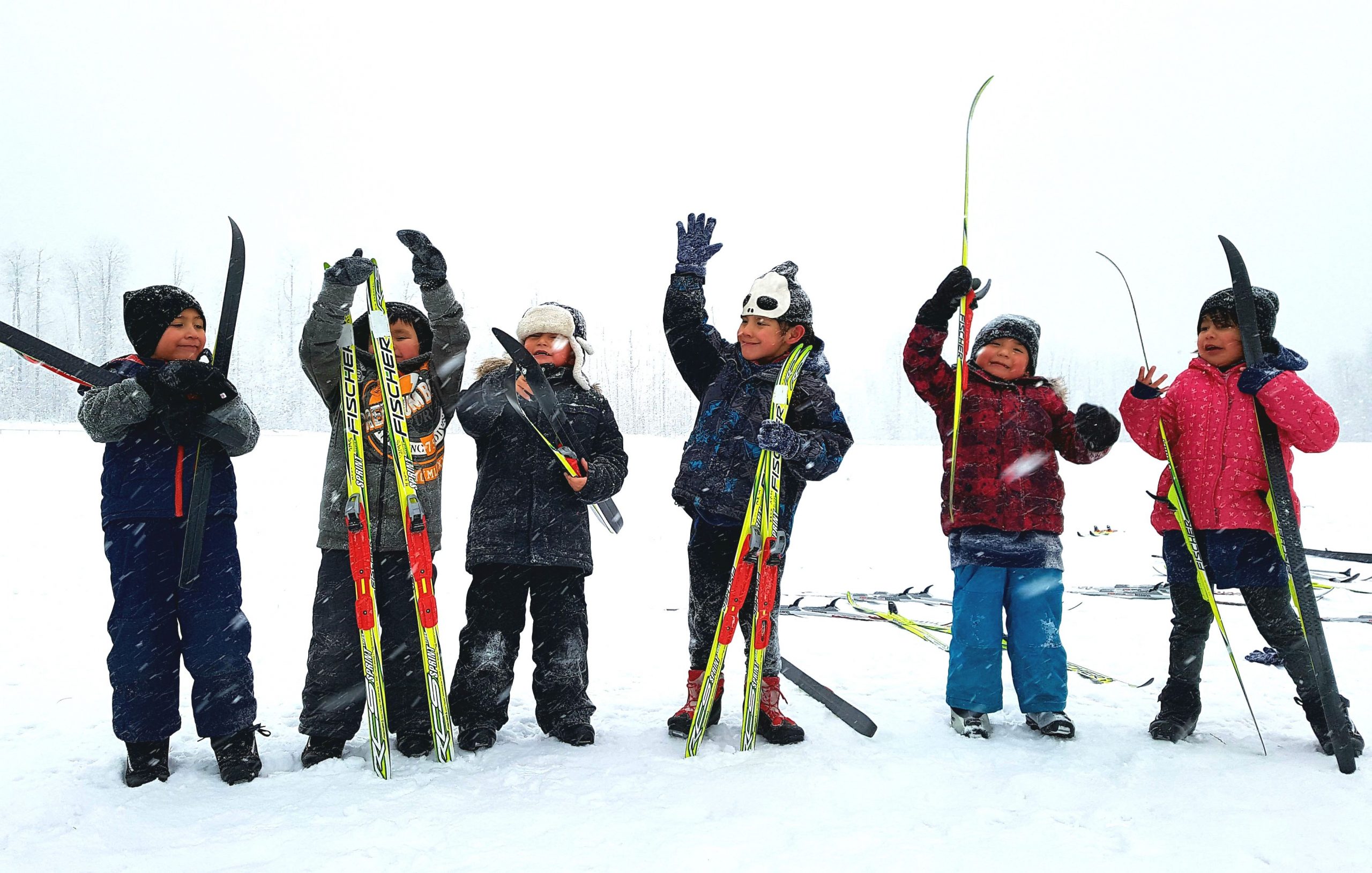
Enthusiastic little skiers show off their fischer skis, taking part in a Spirit North program (Photo: Spirit North)
On the flip side, Scott said the rewards from her efforts come in two parts, heartwarming individual stories, and the cast of extraordinary quality who work for the organization.
“We have coaches across the country now, who will send in a note or a text about a kid in the program who’s just completely transformed,” said Scott, “it’s so heartwarming and it never gets old… when we know that this program has touched them in a positive way, and it has made a difference in their life, that’s the most rewarding thing I think we could ask for.”
Regarding her team, Scott said, “the cast of people that have come to the organization – it’s been really extraordinary to see the quality of our team grow over the years, and I feel very fortunate to have the team around us that we do, running these programs, people who are really truly talented, but also caring and committed to the cause.”
As the Spirit North programs continued to grow, Scott reflected particularly on the satisfaction she draws from seeing kids participate in and enjoy Nordic skiing.
Beckie Scott shares her silver and gold Olympic medals with a Spirit North participant. (Photo: Spirit North)
“I think for me, it’s always so heartening and inspiring to see kids enjoying the sport that I love the most, and have grown up loving,” she concluded, “and just to have seen the sport, carry me through all these different phases of my life has been really something remarkable.”
To find out more about Spirit North or to make a donation, you can visit their website here.
Cross Country Ski de Fond Canada Names 18 Athletes to FIS Nordic Junior and Under-23 World Championship Team
—Family connections headline 2019 World Junior squad—
(Press release)
CANMORE, Alta.—Eighteen young Canucks who represent the next generation of cross-country ski talent in the country have just been named to Canada’s 2019 Junior and Under-23 World Championship Team that will compete in Lahti, Finland, January 19 – 27.
Cross Country Ski de fond Canada will send five women and five men to the Junior World Championships, as well as four women and four men for the Under-23 events. Athletes hail from clubs across the country in provinces and territories that include British Columbia, Alberta, Ontario, Quebec, and the Yukon.
“This is a young group with an exciting mix of International experienced athletes and first timers. These up and comers have gained experience racing domestically on the Haywood NorAm circuit,” said Erik Braten, Junior national team coach, Cross Country Ski de fond Canada. “The talent pool of young cross-country skiers continues to grow, and these athletes are well-prepared to achieve excellence in Finland.”
Each of the athletes earned a coveted spot on Team Canada based on their results at the Haywood NorAm Junior and Under-23 World Championship Trials that were held over the weekend at the Canmore Nordic Centre. The trials were originally scheduled for Whistler Olympic Park, but race officials were forced to move the event due to a lack of snow. The Canmore Nordic Ski Club graciously stepped up to successfully stage the four-day, three-race event.
Among the up and comers ready to introduce themselves to the world in junior action are two sets of siblings and the son of cross-country ski Olympians Milaine Theriault and Robin McKeever.
Jasmine Drolet and Remi Drolet from Rossland, B.C., along with Isobel Hendry and Sam Hendry from Canmore, Alta. headline the family connection. Sam Hendry and Remi Drolet are coming off a strong trials where they mixed it up with many of the country’s top senior skiers in the distance races.
The youngest member of the Canadian team will be Xavier McKeever who will gain valuable international experience in his continued development.
Before hitting the start line in Finland, the team will benefit from the experience of four-time Olympian and one of Canada’s most accomplished cross-country skiers, Devon Kershaw, who will lead the team through a weeklong training camp inSjusjøen, Norway.
The following is a complete list of Canada’s 2019 Junior and Under-23 World Championship Teams.
CCC is the governing body of cross-country skiing in Canada, which is the nation’s optimal winter sport and recreational activity with more than one million Canadians participating annually. Its 60,000 members include athletes, coaches, officials and skiers of all ages and abilities, including those on Canada’s National Ski Teams. With the support of its valued corporate partners – Haywood Securities Inc., AltaGas, Swix and Lanctôt Sports– along with the Government of Canada, Canadian Olympic Committee, Canadian Paralympic Committee, Own the Podium and B2Ten, CCC develops Olympic, Paralympic and world champions. For more information on CCC, please visit us at www.cccski.com.
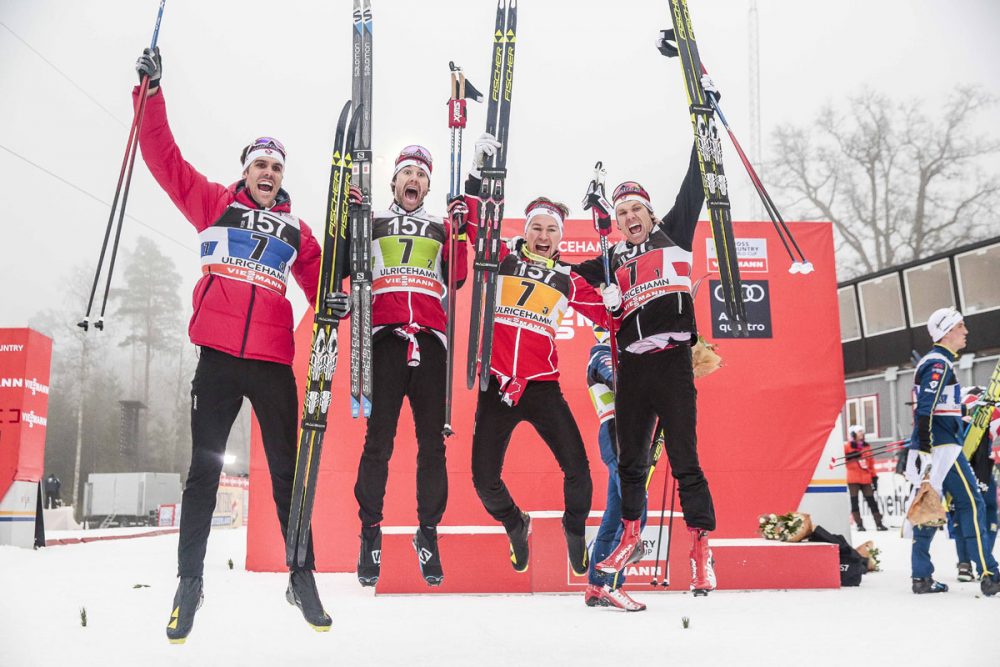
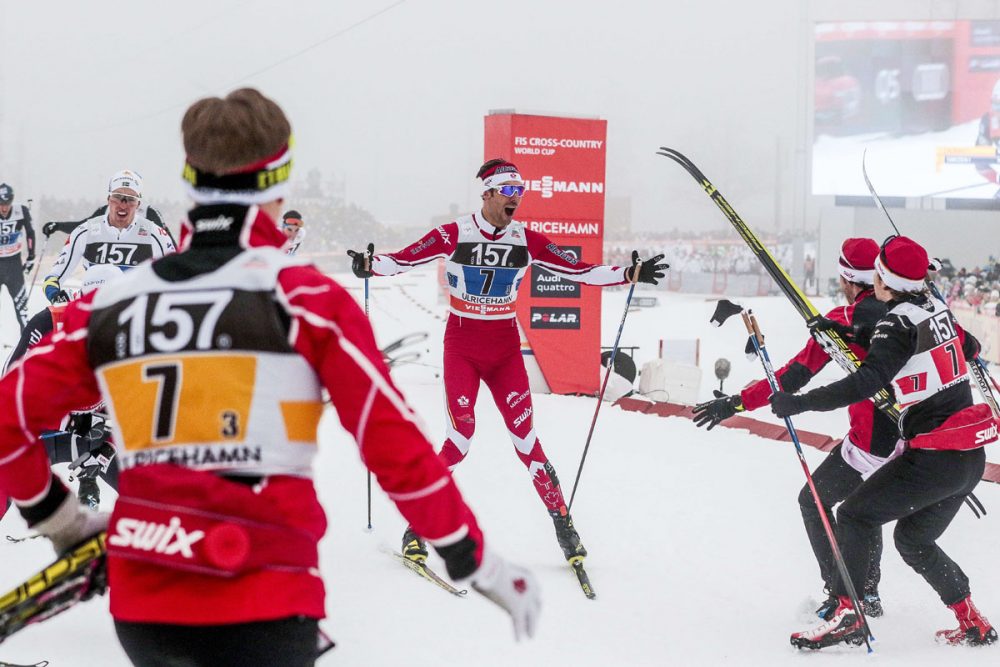
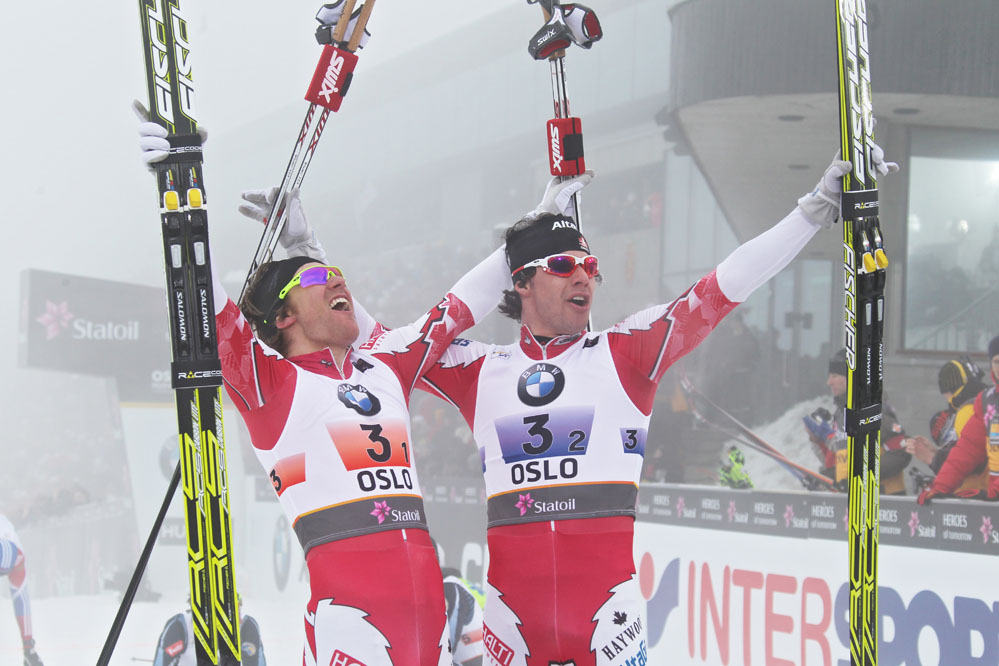
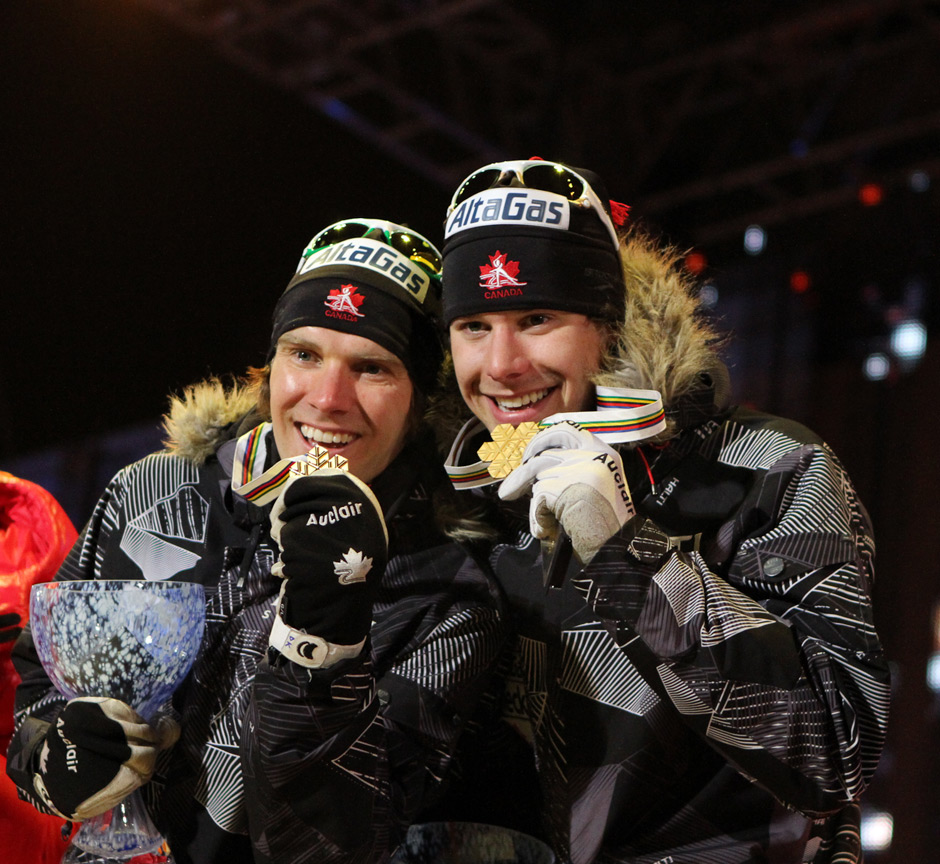
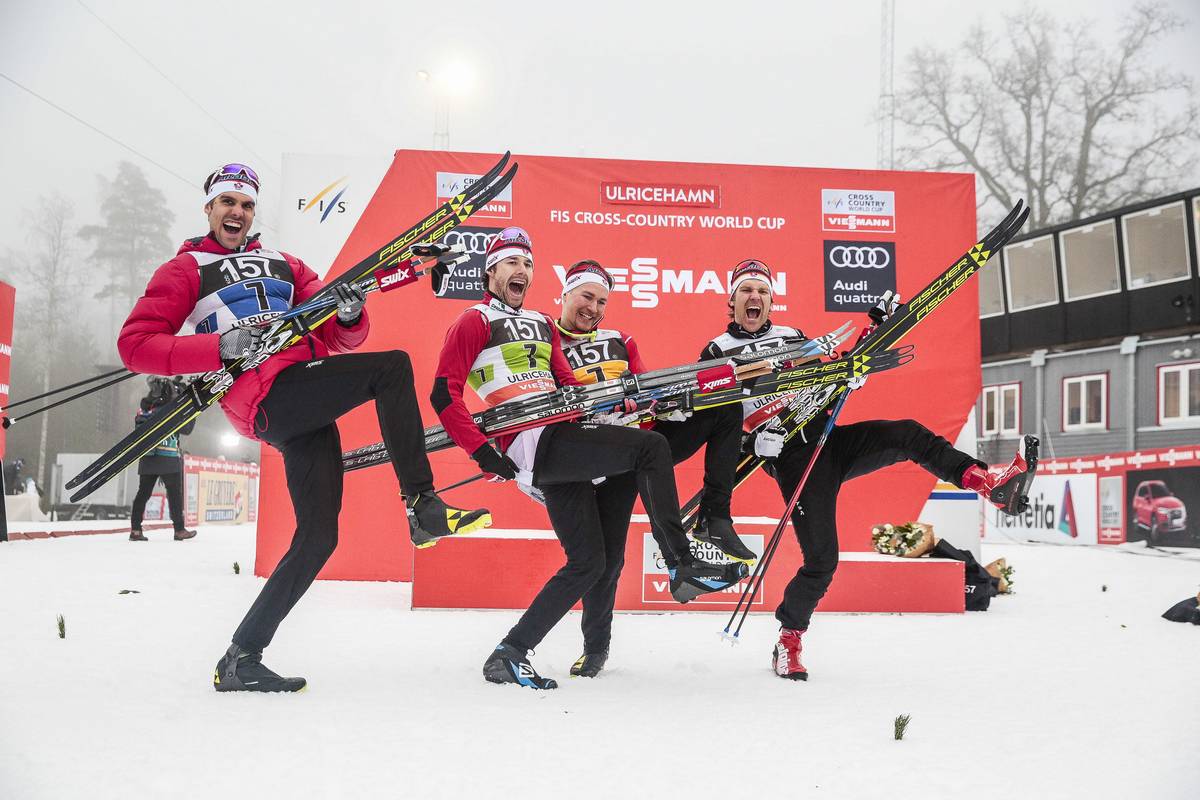
Left to right: Canada’s Len Valjas, Alex Harvey, Knute Johnsgaard, and Devon Kershaw after their historic third place finish in the 2017 men’s 4 x 7.5-kilometer team relay in Ulricehamn, Sweden. (Photo: Fischer/Nordic Focus)
This is the second part of FasterSkier’s report on the state of high performance cross-country skiing and athlete development in Canada. You can read part one here.
Cross Country Canada (CCC), as the national governing body for cross-country skiing in Canada has the difficult task of steering a rather large ship. The idea in steering the ship is to maintain a path requiring little quick and nimble maneuvering. Survey the landscape, mine the data, set a course, and sail. Along the way, there’s the ability to make slight adjustments for efficiencies, accommodate unforeseen changes.
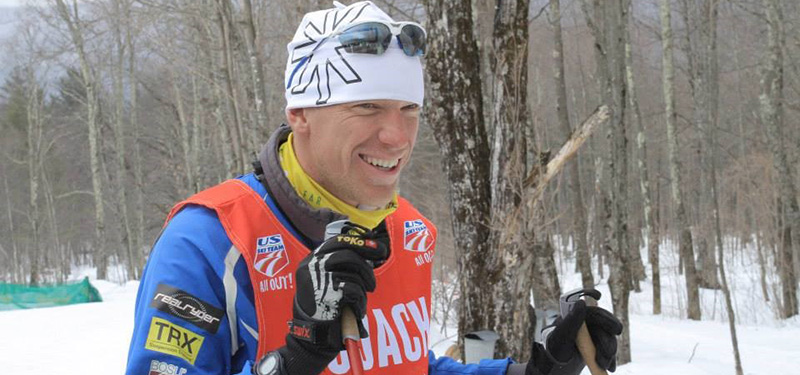
Nic Lemyre (Photo: Norges Idrettshøgskole/Norwegian Sports Academy/)
“We’re thinking our starting point is to build a really strong relay team, on both the women’s and the men’s side,” Lemyre told FasterSkier. “We want to have five athletes, so that we can rotate with the fifth athlete and we’re never in a situation where we can’t field a strong team because one athlete’s injured or sick.”
According to Lemyre, the composite team must be derived of skiers who can hit specific individual benchmarks “[When] we have athletes that can start scoring points in every race they enter on the world cup, that’s a medium term goal,” Lemyre said. “From there, we start aiming for the top-15 for all athletes that are identified in that group.“
Part of the reasoning behind the relay vision is that for a skier to get a permanent spot on the World Cup, the athlete not only has to reach a high level, but also help raise four other Canadians up to that level. Lemyre believes this should foster cooperation and team spirit.
“It helps us meet goals of performance,” Lemyre added. “But also it helps us meet goals that are related to how to build a strong performance culture, where the athletes need to support each other, to learn from each other. They need to push each other. They need to push each other beyond limits they may have experienced before.”
How do we get there?
After PyeongChang, CCC appeared to have both the political will to start the painful process of another re-invention. However, that will came with a reduced budget with which CCC could support its future options.
The simplified model of corporate restructuring begins with terminating certain roles and concludes with creating new roles filled by new individuals near the top of the organizational pyramid. Often, in a medium or large corporation, most people will be shuffled around and only a few near the top will lose their jobs. The final step is to find a quick win to help the newly reshaped organization gain morale and unify.
In a small organization like CCC, everyone is near the top. While the process works well for the survival of the organization, it can be hard on individuals.
The change at CCC began with long-time High Performance (HP) director Tom Holland’s planned retirement. Lemyre was hired as a consultant to oversee the restructuring of the HP group. Shortly before Lemyre’s hiring, CCC eliminated some positions.
As Joel Quenneville’s recent firing demonstrates, proven ability and past success is not enough to provide job security during a reboot. (Quenneville was the NHL’s Chicago, Blackhawk’s head coach since 2008. During his tenure Quenneville lead the team to three Stanley Cups.)
On November 1st, CCC hired Erik Bråten as a new national team coach and modified Louis Bouchard’s title. Bouchard remains head of the National Training Centre in Mont Ste-Anne, Québec, with the added title and responsibilities of World Cup Head Coach.
Bråten, a recent Norwegian School of Sports Science graduate with a specialization in cross-country skiing, won the 2018 coach of the year award from the Norwegian ski federation. This hiring didn’t happen as quickly as some had hoped, but is considered the first win for CCC’s new structure.
“Erik has a strong sports science background applied to cross-country skiing,” Lemyre said on the phone. “His profile is unique in our environment. The fact that he’s young is really positive for us, because he’s open to this new experience. He comes with a solid base, and his excitement and his motivation, I think, will be great assets in applying that knowledge in the right culture in Canada. At an individual level, Erik is unique in working one on one with athletes. I think our athletes are going to really appreciate that.”
Along with bringing in new personel, Lemyre aims to improve sharing of training information in Canada. In Norway’s organizational structure, athletes and coaches are able to log hours and training plans on an interface organized by the Norwegian National Ski Federation. It’s a model and template Lemyre is intimate with.
“The fact is that we have a large country, and we can’t be with athletes every day of the year following them on site,” Lemyre said. “Now the technology is there to pool [training data] in a way that our coaching staff and the local coaches can communicate really well, But also as we’re building up our science team, we also have interaction with our different people involved in helping the athletes develop.”
Dahria Beatty racing the 2018 Holmenkollen 30 k freestyle mass start in Oslo, Norway. (Photo: Fischer/NordicFocus)
Another planned shift is to interchange athletes between Europe and Canada more often. For example, Dahria Beatty will start the season in Canada — a change encouraged by her coach Chris Jeffries and supported by Lemyre.
“This summer my coach Chris and I came up with a plan that allowed me to stay in Canada to start the season to build into the race season and then head over the Europe and race on the World Cup circuit leading up to World Championships in Seefeld,” Beatty said. “With this being the first year of the new quadrennial, it is the perfect time to fine tune some of those race details domestically before leaving for Europe mid-December. I am looking forward to racing part of the Tour de Ski then period 3 and hopefully finding my peak for World Championships and World Cup finals in Quebec.”
Lemyre’s concept is to allow athletes like Beatty to build into the early part of the season domestically and arrive in Europe at a higher level of race fitness.
“The way we scheduled the trips this year, giving some athletes the chance to prepare very well before they race on the World Cup,” Lemyre added. “I think some of them will be stronger when they show up on the World Cup, and also they’ll be able to sustain that level of performance over the time period they are on the World Cup. We will try to be a little more selective and well prepared when we show up, and then post really good results when the athletes are racing the World Cup.”
Jeffries stated that the stress of living abroad, a dynamic known all to well by North American World Cup skiers, can be counterproductive to a developing athlete.
“The last few years, our top athletes spent the majority of their time in Europe,” Jeffries said. “I think it stalled our development a little bit, because we’re always living out of a suitcase, and we’re always having to ski races where we’re trying to perform.”
Dave Wood spent 18 years as a national team coach. His time leading the team included the post-Nagano rebuild and managing athletes at the Olympics in Vancouver. His vision includes giving skiers more time to develop and less emphasis on being fast all season.
“Sara [Renner] had far less World Cup starts before she was top-15 at the Olympics than the people of today,” Wood said. “I think that this big argument about experience is valuable when you are looking for seconds. When you are looking for minutes, [World Cup experience] makes no difference.”
Will it Work?
The U.S. has been able to develop a strong women’s team built off Kikkan Randall’s determination to drag U.S. skiing to the top. Randall took inspiration and knowledge from Canada’s post-1998 rebuild where Scott, Renner, Milaine Thériault, Jamie Fortier and Amanda Fortier decided it was time to lead the charge.
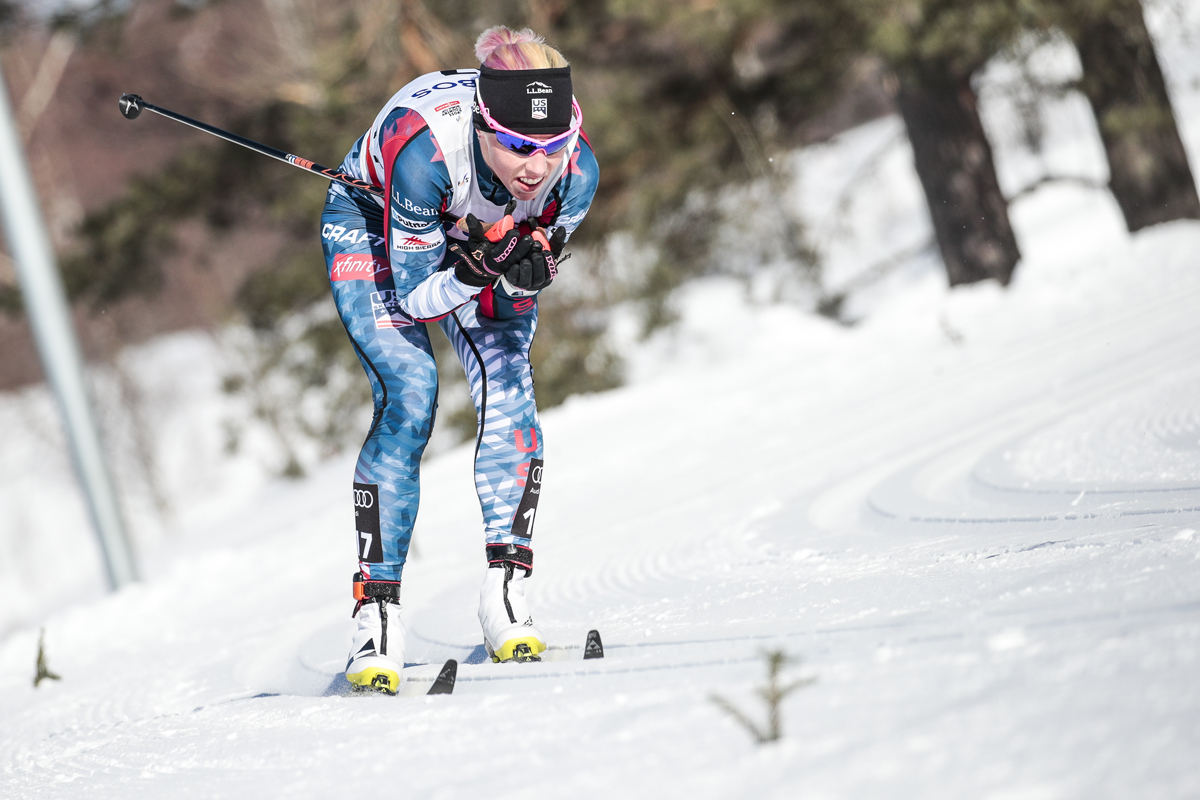
American Kikkan Randall tucking during the women’s 10 k classic mass start at 2018 World Cup Finals in Falun, Sweden. (Photo: Fischer/NordicFocus)
In both cases, the athletes didn’t succeed alone. The “fantastic five” got the support of Holland, Wood, and many others. Randall also collected a large supporting cast, well documented by Peggy Shinn’s book ‘World Class’.
Laura McCabe, now a Methow Valley coach and two-time Olympian, spent most of her free time in Nagano with the Canadian women’s team because it felt like a group that had a vision and a willingness to support one another to collective success.
“It just shoots you up the ladder when you come back and you feel like you have a very safe place, you’re working on this goal together, you’re all in it together, and you’re there for each other all the time,” McCabe told FasterSkier. “I felt like the Canadian women were doing that. And now I feel like Matt Whitcomb has led that charge for the American women.”
While crediting Randall for starting the process, McCabe feels that the team’s work to be a team is the critical factor.
“They have goals, team goals and they have personal goals,” McCabe said. “They are always there for each other. One of their biggest goals is to basically keep their relationships positive and keep everybody moving forward. I think that is one of the number one reasons that team is doing well.”
In a conversation last May with FasterSkier, Yukon coaching icon Alain Masson spoke of the complexities of achieving success on the international stage. Simply possessing physical gifts, the aerobic capacity, the predisposition to tolerate and absorb high training loads, is no guarantee of success.
There’s the behind the scenes unglamourous work of nurturing athletes, remaining true to organizational core values, and feeding the system with money, intellect, and vision.
“Definitely, there’s a minimum set of physical characteristics that you need to perform at that level,” Masson explained to FasterSkier. “But you also need many characteristics, personality characteristics, that are vital. What Alex showed, and Sara Renner, and Chandra [Crawford] and Beckie [Scott]. I think athletes that combine both the physical and the mental characteristic at a time when the program works together, and everything lines up with the funding, good leadership, and everybody working together. That’s the difficulty, this is the issue, trying to get all of that together. As the women in the U.S. have demonstrated, when you have all of that lining up, it’s amazing what you can do.”
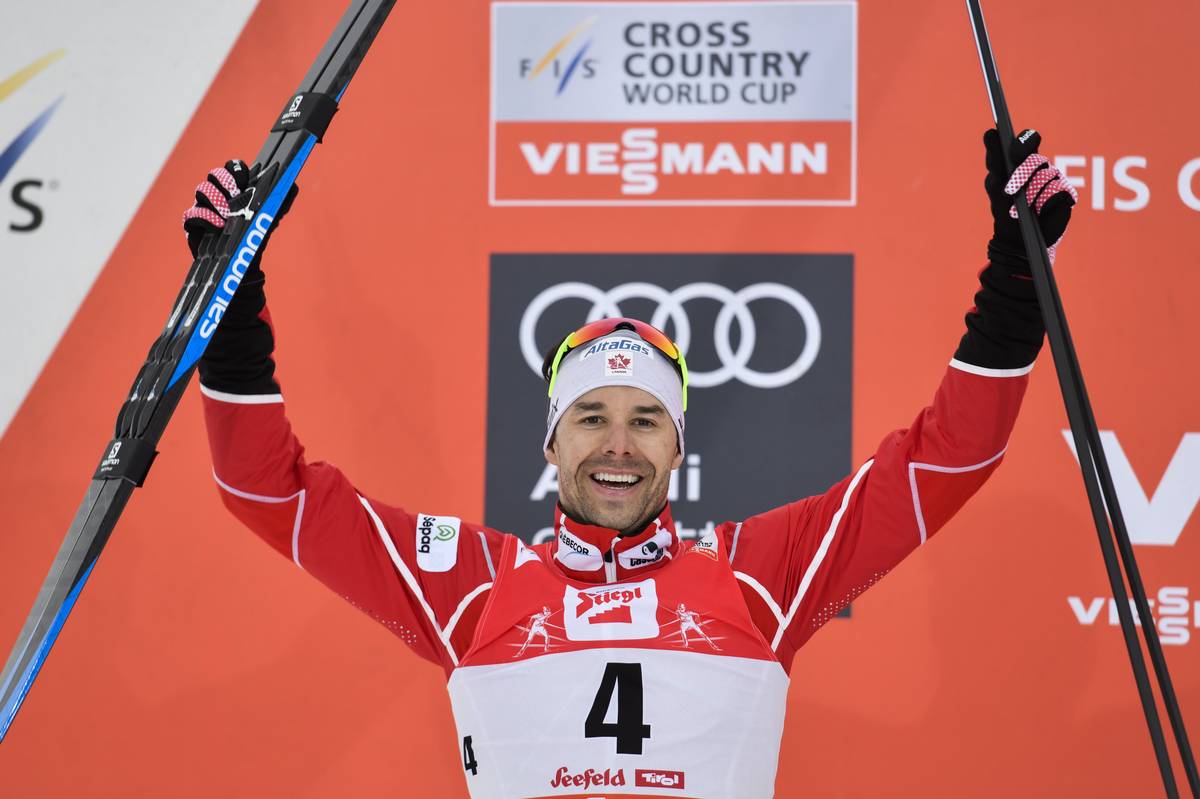
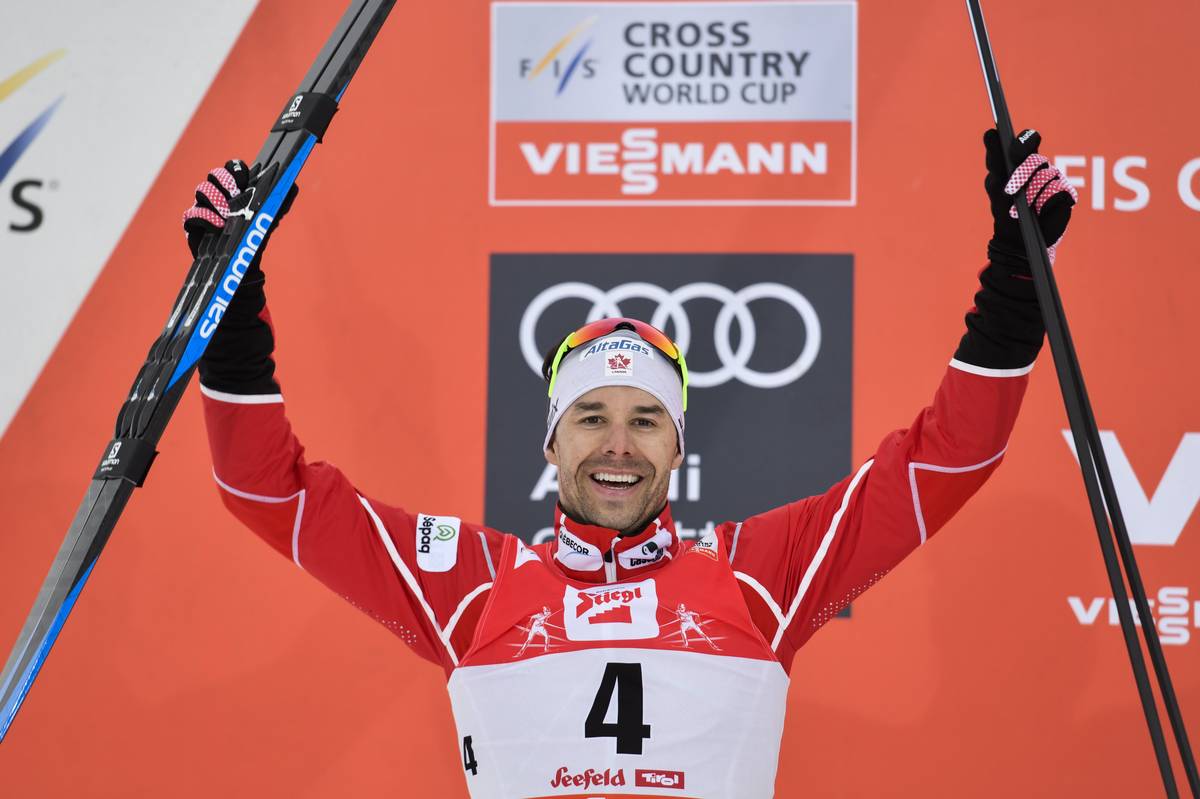
Canada’s Alex Harvey celebrating on the podium after placing second in the men’s 15 k freestyle mass start in Seefeld, Austria, for his best result of the 2018 World Cup season. (Photo: Salomon/NordicFocus)
Cross Country Canada (CCC) has begun a reboot process as the new Olympic cycle starts. Corporations call this a reset, a rebranding, a new direction, restructuring, and various other names that try to disguise the challenges and issues that come with enacting real change.
The reboot process traditionally starts with an acknowledgement that the current level of success, and that of the foreseeable future, doesn’t align with the goals or the potential of the organization.
Canada left PyeongChang with no medals at three consecutive Olympics, only one skier in the World Cup red group, and a perception that there was no obvious successor to Alex Harvey.
There are many people who, with the benefit of hindsight, believe that CCC allowed itself to be trapped by a combination of success and the Own The Podium (OTP) funding model.
The process of assigning blame for the past, called “blamestorming”in the corporate world, is one of the most effective ways to waste time and destroy morale without doing anything to improve the future. The “best practices” approach to a reboot starts with four apparently simple questions: How did we get here? Where are we now? Where do we want to be in five years? How can we get there?
While CCC does many things as a national sport body, this article will focus on high performance and the development system.
How did we get here?
After a disastrous 1998 Olympics in Nagano, CCC shrank to a full-time staff of five and endured a forced re-invention. Four years later, in 2002 at Salt Lake, Beckie Scott won all three medals in the skiathlon after the initial silver and gold medalists were caught doping. Sara Renner missed the B final in the sprint for 9th place.
Canadian Chandra Crawford in the 2011 team sprint in Dusseldorf, Germany. (Photo: Fischer/NordicFocus)
In 2006 in Torino, Chandra Crawford earned a surprise gold in the sprint while Scott finished fourth. Scott had earlier teamed up with Renner for a team sprint silver medal.
In 2010, there were no Canadian cross-country medals. However, there were signs of promise. Renner skied to her fourth Olympic top-10 finish. All four Canadians competing in the men’s skiathlon finished in the top-15. Devon Kershaw lost out in final kilometer of the 50 k to finish fifth, 1.6 seconds away from gold.
That post-Vancouver glow was possibly the point where CCC temporarily slid off the rails.
A number of Canadian sports fell victim to OTP incentives. A sport qualifies for OTP funding by having good prospects for a medal in the next Olympics. The money comes with strings attached, to ensure that resources are spent on improving the probability that specific individuals will podium. For smaller sports where the OTP money is a significant proportion of the sport’s annual budget, it is hard to make choices that put that money at risk. Choices like balancing the emerging athletes in the pipeline, while simultaneously supporting those athletes already at the top-end of the sport.
As a result, many sports have lost their OTP eligibility by losing the focus on development and the vision that qualified the sport for OTP in the first place. Some people put cross-country skiing in the list of sports that fell into this trap.
After 2010, the future looked bright. Harvey and Kershaw were World Champions in the 2011 team sprint. Kershaw was second overall in the 2011/2012 World cup. (A feat only equaled in North America by Scott and Jessie Diggins).
Harvey arrived at Sochi in 2014 as a medal favorite. He was fresh off a World Cup podium in Toblach the weekend before the 2014 Games began. Sochi ended poorly when Canada, along with Norway, couldn’t solve the difficult waxing conditions.
The results in PyeongChang were similar to 2002 numerically: Harvey was close to a medal in multiple races and Lenny Valjas collected 7th in the classic sprint. A medal would have changed the mood, but not overall situation.
Where are we now?
Post-PyeongChang, CCC believes Canada is not achieving the international results a country with plentiful snow and 37 million people is capable of.
The development system in Canada consists of the National Team, the official training centers (Centre National d’Entrainment Pierre Harvey (CNEPH), Thunder Bay National Team Development Centre (TBay), and the Alberta World Cup Academy (AWCA)), and the clubs. The ten provinces and three territories have teams, but don’t have a formal place in the development system as each of the thirteen regions approaches development support differently. In the last few years, the number of clubs actively recruiting and developing athletes while supporting a high performance team has increased. For our purposes, as no official name has been affixed to these clubs, the term ‘elite club’ will be used here.
In the past, all national team members were required to belong to a training center while developing athletes were encouraged to join.
“I can speak for many of the athletes, they thought that if they didn’t go to a training centre, then they might as well quit skiing,” Telemark’s coach Adam Elliot said. “It was that broad of a choice, they felt they had to choose between skiing and school immediately.”
The landscape is more diverse now, with more options. The examples that follow skew to Western Canada, largely because the coaches quoted brought teams to Sovereign Lake snow camps in May and November and were available for in-person interviews. Eastern Canada remains equally diverse in terms of its club offerings.
A common theme among the coaches and athletes is that each athlete’s needs are different, and he or she needs to find an environment that fills those needs. FasterSkier asked AWCA’s head coach Chris Jeffries how an athlete should choose his or her path to success.
“It’s such an individual, case by case thing,” he said. “I don’t have an answer.”
In 2017, a shift to allow more development paths resulted in new senior National Team member Gareth Williams staying at his home club, Telemark, in Kelowna, BC. Elliot described how it came about.
“Tom Holland approached us, for Gareth, and said we like what you’re doing in the Okanagan, and we want to keep Gareth there. We’re going to support you and your program to be able to support Gareth.”
Also in 2017, Julien Locke returned to his home club Black Jack while Russell Kennedy shifted to the new Team R.A.D., part of the Canmore Nordic Club.
To further illustrate the spectrum of options and pathways, FasterSkier contacted three Canadian athletes, each with a history of NorAm podiums and some international success, to discuss their ski-training choices. Dahria Beatty started at AWCA and has remained there, Evan Palmer-Charette started at TBay then recently moved to Team R.A.D., and Andy Shields has gone rogue.
Dahria Beatty en route to 20th overall in the Seefeld World Cup freestyle sprint for her season-best result in 2017/2018. (Photo: Fischer/NordicFocus)
“For me, I’ve been working with Chris [Jeffries] for six years,” Beatty told FasterSkier in November. “It works really well for me, and I have a good group of training partners where I am, that can push me everyday in training.”
AWCA is also the home training group for National Team skier Emily Nishikawa and two junior national team skiers. AWCA also benefits from its close proximity to a number of other training groups.
“For me, Canmore’s a location where I want to be training, where I want to be based out of,” Beatty said. “All the pieces fit well together for [me], it’s somewhere I think I can keep improving.”
Palmer-Charrette made a summer-time decision to change things up by finding a fresh environment in Team R.A.D.
“I think the best part of being on a training centre is the entire program is based around a small group of athletes of similar age which makes for a great training and racing environment,” Palmer-Charrette wrote. “I feel training centres, as they are, are best-suited for junior/u23 athletes and especially great for athletes who are a bit late to the game like I was at the end of high school and will really benefit from learning from other athletes on the day to day training life.”
Shields is no longer affiliated with an official team. He funds his skiing by painting houses in the summer and representing ski wax companies in the winter. Although he refers to ski racing as a hobby, he did end the last season as COC leader and will race period 1 of the World Cup.
“I don’t think I could have done this straight out of junior,” Shields wrote. “My time on Tbay is still having a huge positive effect on my ski career. Being on a team through my early years as a senior made it much easier to get a decent training base and set a couple good habits in place which are paying dividends.”
Shields did reflect and offer an alternative to how he might have changed his path to elite level skiing.
“If I could go back in time I would have gone the NCAA route straight out of junior,” Shields added. “College skiing in the States is a much better deal than a training center for people in their early twenties. You can go down to the States, get a degree, not pay a dime, and come out the other side with plenty of time to have a full-time ski racing career. I would have joined a training centre upon finishing with NCAA.”
The Canadian university system differs from the U.S. model, offering little money for sports. Heading south to the U.S. as a student-athlete remains an option for some Canadian skiers. Most athletes remain in the Canadian system to develop. With that in mind, FasterSkier asked why some athletes had chosen some of the Western based training centres.
Jeffries, who leads the AWCA, also noted how his program has evolved. There appears to be room at the AWCA for those with concurrent goals. The AWCA has partnered with the University of Calgary to allow AWCA athletes to work towards degrees.
“We’re always evolving our programming, and what it entails, and how we package it,” Jeffries said. “That’s why we have this new university program this year, because you just look at the popular decision making of graduated high school athletes.”
Elliott, based in the Okanagan, said his program offers athletes a well rounded experience too.
“You’ve got the trifecta,” Elliot said. “You’ve got access to education opportunities for post-secondary. We’ve got the university, UBC Okanagan, and the college. Most of the people who’ve moved here have gone to school. Secondly, it’s the Okanagan. Which is probably the best place to ski in North America, with skiing up and down the valley –with Nickel Plate, Telemark, [Kelowna] Nordic, Sovereign, and Larch Hills. The third is that you’re moving into a community of skiers: family, volunteers, everybody trying to make a go of keeping people in sport.”
Clearly the times have changed from a programming perspective and the past’s financial windfall for Canadian cross-country skiing.
“Probably the quad between 2010 and 2014, CCC had more money almost than it knew what to do with, ” Dave Wood, former National Team head coach, told FasterSkier in May as he finished up a long ski day. “Now, I think the budget’s still three and a half million. While it’s maybe low compared to what it has been, it’s a hell of a lot higher than it was in ‘99, by about four times.”
Former CCC High Performance Director Tom Holland spoke of those larger commitment from clubs during the Frozen Thunder races in October.
“There’s a lot more resources,” Holland said, referencing the increased numbers of coaches attending Frozen Thunder with their athletes. “One of the reasons clubs are more important now is that there are paid coaches at the clubs. That’s why training centres started in the 90’s, because you’ve got to have a coach, full-time.”
Thee deep question remains: what next for Cross Country Canada as it ponders a post-Alex Harvey scene? Better and more diverse options for Canadian skiers, like those modernizing their offerings to connect with the student-athlete, is a step forward. But fans of the sport, and of course Cross Country Canada, have short-term and long-term goals. No one wants to see another Olympic quadrennial transpire without the glimmer of medal potential at the international championship level.
“I think when Alex Harvey retires, mostly likely after next year with Lenny Valjas, it will be the end of an era having athletes being able to finish on the podium at World Cups, World Championships, said Alain Masson, Whitehorse head coach. “So definitely, the program is going to go into a real rebuilding phase with lots of young athletes, but no guarantee of success in the near future.”
With the reshuffling of Canada’s staff, up until today, CCC had not formally announced its World Cup coaching roster for the 2018-2019 season. Back on August 11th, CCC posted a job announcement for “Head Coach, Canadian Senior Cross Country Ski Team”. (Here’s a link to the formal job description.)
Today’s announcement came with news that longtime World Cup coach Louis Bouchard will be returning for another year. Bouchard leads the National Training Centre in Mont Ste-Anne, Québec and has worked closely with Alex Harvey for many years. According to the press release, Bouchard will be taking over head coaching responsibilities. Bouchard has been a World Cup Team coach for the last eight years.
CCC also revealed today that Norwegian Erik Bråten has been hired as a National Team Coach.
“Erik is a highly regarded young coach in Norway who is looking for an opportunity to contribute to our national program,” Lemyre is quoted as saying in today’s press release. “He is passionate, knowledgeable, dedicated, and driven to develop into a world-class coach. I believe he and Louis (Bouchard) will complement each other’s skillsets and will have a significant impact on the development and the performance of our nation’s best athletes. This is a dynamic duo who I believe is exactly what we need to build a medal winning program.”
Bråten, who will turn 27 on November 6th, has been coaching in Norway for six years and was named coach of the year in 2018 by the Norwegian Ski Federation. Bråten will be based in Canmore, Alberta. His duties will include monitoring athletes in western Canada, coaching Canada’s team at World Junior and U-23 World Championships, and assisting Bouchard with a portion of the season’s World Cups and the 2019 Seefeld, Austria World Championships.
FasterSkier has reached out to Bråten for comments.
CANMORE, Alta. — Cross Country Ski de fond Canada’s Events Committee is pleased to announce the Sovereign Lake Nordic Ski Club in Vernon, B.C. will play host to the 2020 Canadian Ski Championships in March 2020.
Clubs throughout the area, including Sovereign Lake, Larch Hills in Salmon Arm, Telemark out of Kelowna and Kimberley along with Black Jack from the Kootenay’s and Revelstoke have continued to support high-performance racing programs over the last 10 seasons.
“Sovereign Lake Nordic has played a critical role in providing Canadian cross-country skiers access to snow early in the season as the anchor to our NorAm program,” said Dave Dyer, CCC’s events director. “It was time we finished the season off in the same style as we have become accustomed to every December by going back to the Vernon region for our national championships.”
Dyer added the Selection Committee was especially impressed with the evolution of the leadership group and dedicated staff at Sovereign Lake Nordic.
The premier event on the 2020 domestic race calendar will fall immediately after the World Cup Finals in Canmore, Alta., March 20, 2020.
Homologated in 2005 to meet FIS standards in preparation for the return of the FIS World Cup to Canada, the trails at Sovereign Lake will provide a variety of options for both senior and junior skiers at the 94th running of the Canadian Ski Championships event.
“SLNC last hosted the Canadian Ski Championships in 1995 making the 2020 Nationals Campaign the 25th Anniversary of that event. An annual stop on the Haywood NorAm circuit each December, hosting other world-class events such as the 2005 World Cup and 2011 World Masters Championships, SLNC is poised to once again welcome our country’s top athletes during these eight days of racing,” said Pat Pearce, Chair of the Bid Committee. “The Organizing Committee is excited to get to work on its tasks to host the 2020 Canadian Ski National Championships.”
Located just 22 km from downtown Vernon, and 50 minutes from Kelowna International Airport, at an elevation of 1667m, Sovereign Lake Nordic Club and Silver Star Mountain Resort together provide over 105km of daily groomed Nordic ski trails. Its high elevation, moderate winter temperatures, world-class grooming and outstanding early and late season ski conditions provide some of the best cross-country skiing in the world.
SLNC is the largest not-for-profit ski club in North America, founded in 1974, with backcountry skiing roots dating back to the early 1930’s. With over 1850 members and a thriving Youth and Master’s program of over 340, Sovereign operates a full-service facility with night skiing, large rental/retail shop and tuning services. We host over 29,000 visitors annually and offer a busy S’Cool Ski Program for more than 1700 local children across three school districts.
The 2019 Canadian Ski Championships will be held at the Nakkertok Nordic Centre, March 13 – 20, 2019. A two-day pursuit will lead off an action-packed week of domestic racing prior to the World Cup Finals slated for Quebec City.
(CANMORE, Alberta) — Rundle Sport Inc. and Cross Country Ski de fond Canada (CCC) have announced that Rundle Sport will be an Official Equipment Supplier of CCC. As a Canadian company with world-class products, Rundle Sport is a perfect fit for the Canadian National Ski Team and is excited that the National Ski Team athletes have put their trust in Rundle Sport roller skis.
Of the new partnership, Cross Country Canada stated, “CCC is thrilled to announce Rundle Sport as an official equipment supplier of the Canadian National Ski Team. After excellent feedback from several Olympic and Paralympic athletes, CCC will be distributing Flex Skate roller skis to all Senior National Team athletes, U25 National Team athletes, and National Para-Nordic Team athletes. The athletes who have been on the Flex Skate roller skis tell us the roller skis’ smoothness, reliability, and on-snow feel will allow them to optimize their roller ski training and transition from roller skiing to snow skiing.”
Partnering with CCC will allow Rundle Sport to continue its history of product development and technical innovation while improving the roller ski training of Canada’s top athletes. Rundle Sport looks forward to supporting CCC and watching Canadian athletes reach their potential while training on Rundle Sport products.
About Rundle Sport Inc.: Rundle Sport is an athlete driven company whose mission is to give athletes an edge over their competition. Rundle Sport was launched in 2013 with the release of TrueSki™ Technology, the world’s first and only rubber-damped roller ski suspension system. TrueSki™ Technology is found exclusively in Rundle Sport Flex Skate roller skis and is the smoothest roller ski technology available. Rundle Sport’s product line has grown to include an assortment of professional level and value-oriented roller skis ensuring all skiers have the opportunity to make the most of their roller ski training. Quality, performance, value, and competitive creed make Rundle Sport the choice of dedicated athletes.
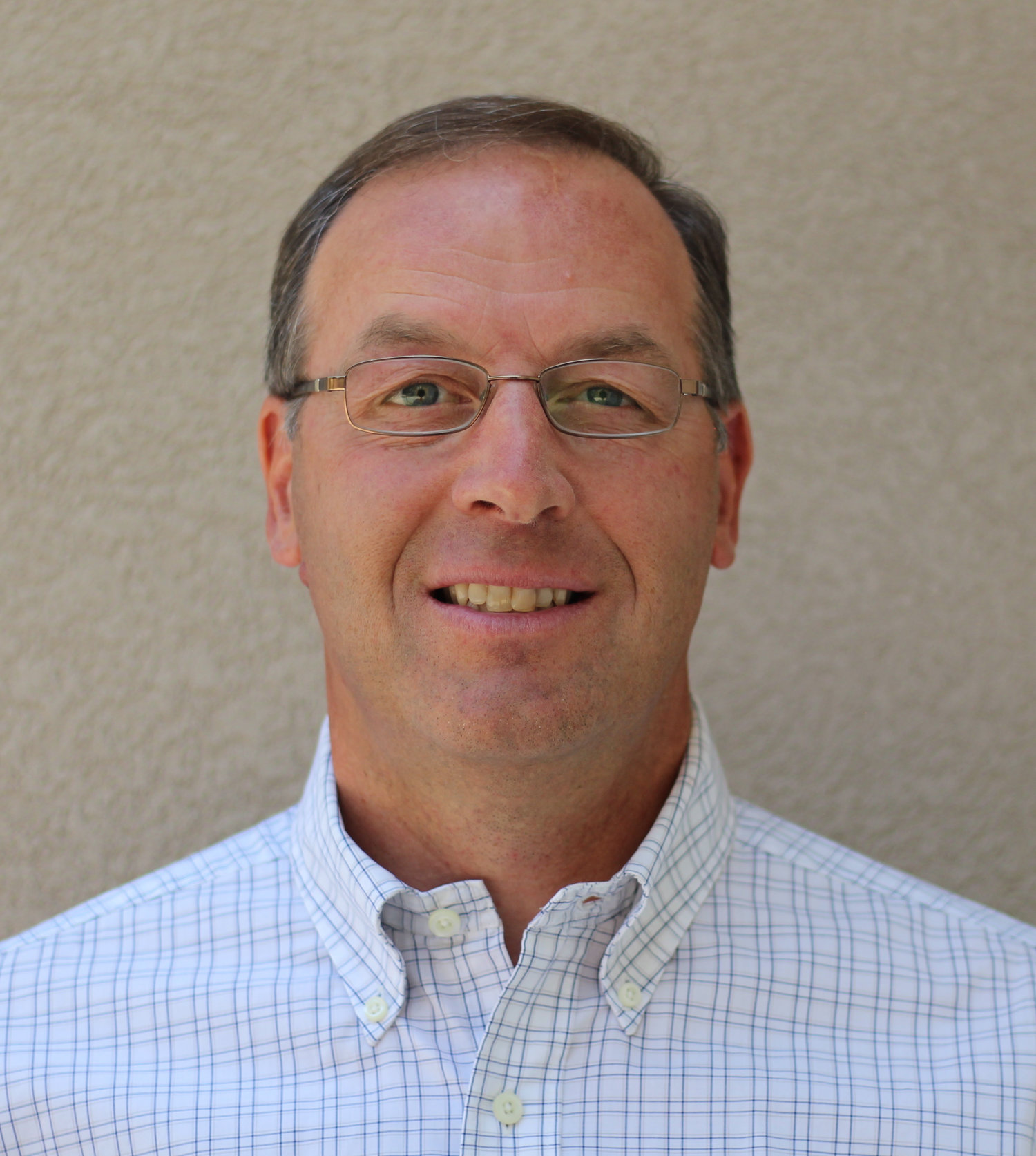
Jennifer Tomlinson, the new chair of CCC’s Board of Directors (Photo: Twitter)
On June 19, Cross Country Canada (CCC) announced that 52-year-old Jennifer Tomlinson will serve a two-year term as the new chair of its Board of Directors. She replaces Jamie Coatsworth, who served the position for the last four years.
The CCC press release opens with a statement that Tomlinson — a former racing director, volunteer coach and integral member of Nakkertok Nordic as well as former high-performance chair for Cross Country Ski Ontario — is the first women to hold the chair position within its organization. She comes with over four decades of experience in the sport, holds a degree in engineering, an MBA, and has served four years on the CCC board prior to the June announcement.
“I’d like to see ‘the first woman chair’ as not being a big deal and something that is expected,” Tomlinson told FasterSkier on the phone earlier this month. “From my perspective, it is something that was eventually going to happen at CCC. With some of the changes that have happened over the past 10 years, there is a lot more openness in the way Cross Country Canada is operated and governed. It is much more aware of representing the ski community in Canada and ensuring that the people who are making decisions represent the diversity of the cross-country skiing community in Canada.”
The execution and fulfilment of the long-term CCC plan will fall on the shoulders of Shane Pearsall, the current CCC CEO.
“Over the past four years, CCC has reevaluated its governance structure,” Tomlinson explained. “The board seeks advice with CCC’s divisions to establish organizational priorities. The board’s role is to hold the CEO accountable to key priorities determined by the board, and we look to the CEO to develop a plan and execute the plan that will achieve those priorities.”
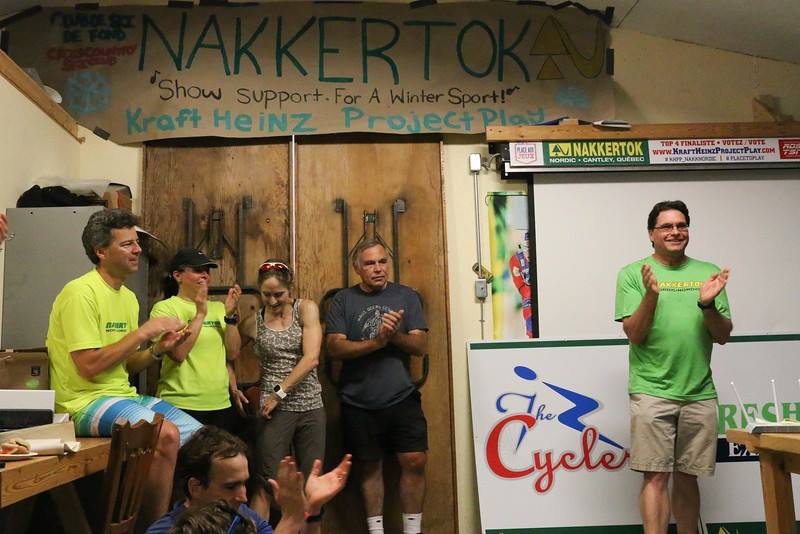
From left to right: Steve Morris, Jennifer Tomlinson, Sheila Kealey, Toni Scheler, and Robert Hornung at the announcement event for the Kraft Heinz Project Play Grand Prize Award, which Nakkertok Nordic won in August 2016.(Photo: Doug Ranahan)
CCC’s mandate is to serve the broad spectrum of cross-country skiers to ensure that the sport remains viable in Canada. Tomlinson explained the board’s perspective in terms of its stakeholders is a wide view.
“We see skiing as existing from learning to ski to success on the World Cup to being active for life, and our stakeholders start when we first strap some skis on somebody’s feet to hopefully continuing to 95,” she said.
Most notable in recent years are that funding cuts have adversely impacted both high-performance biathlon and cross-country skiing in Canada.
The most high-profile aspect of Cross Country Canada remains it’s World Cup team. Recently, Alex Harvey with his fourth place finish in the Olympic 50 k and Len Valjas, with his seventh place in the Olympic sprint, have been the individual podium hopes for the Canadian team. This past spring, Devon Kershaw and Knute Johnsgaard (half of Canada’s men’s relay team that placed third in the 2017 Ulricehamn 4 x 7.5-kilometer relay) retired. For the women, several career high points are notable but none of the main staples on the current women’s team has had World Cup podium breakthroughs.
Tomlinson explained the CCC board noticed the need for a sustainable development pipeline for both genders.
“As a chair or member of the board, we don’t get into the overall operations of CCC and how they do things,” Tomlinson said of her CCC role. “That being said, one of the key priorities set for the CEO is the development and communication of the high-performance pathway andputting in place a structured program that allows CCC, the divisions and the clubs to work together to contribute to the pipeline and developmental pathways needed to create that sustainable system. The hiring of Nic Lemyre as the high-performance advisor is a key part of establishing the sustainable system.”
Lemyre, a Canadian based in Oslo, Norway, is expected to help CCC solidify and support a devo pipeline.
A sustainable pipeline implies a steady flow of both high-performing athletes and cash. In contrast to the funding situation in the U.S., CCC receives a significant portion of its funding from government sources. That government funding has been in decline when compared to past levels of funding. Tomlinson said the board expects CCC to develop a plan to better cope with inconsistent and lower levels of government funding.
According to Tomlinson, the board approved a measure in February to help address funding concerns for developing Canadian skiers.
“The board approved the creation of the Nordic Canada Development Fund, modelled after the NNF in the US,” Tomlinson said. “There are some differences, particularly with respect to its governance, but the fund is established and it does have some money in it. The seed money came from capital that CCC had set aside from the better years. CCC is in the process of developing an integrated fundraising campaign for building the fund. The intent of the endowment fund will be to fund camps and racing opportunities targeted at developing cross-country skiers U18 to U23 who will benefit from more integrated camps and different levels competition.”
Another new initiative Tomlinson touched upon was the potential of a 2026 Winter Olympics in Calgary that could foster synergies between CCC and related nordic sports. Without mentioning details, Tomlinson explained that CCC is pursuing investigating a strategy to bolster the viability of nordic sport across the board, “to see how we can make 2026 a real milestone for nordic sport in Canada.”
Tomlinson appeared grounded in the overall CCC mission that fosters a healthy lifestyle beyond podiums.
“One long-term goal for the organization is community development and alignment,” she added. “… that goal is about growing cross-country skiing in the nation, not solely about getting people on the podium. Making the sport more accessible and get more people outside to celebrate winter.”
Another benchmark she highlighted is related to accessibility. According to Tomlinson, three years ago, only two venues in Canada had viablesnowmaking capacity. She said that number now stands at five venues with the hope that other clubs can further collaborate to build the nation’s snow-making infrastructure.
Keeping an eye on other sports and national governing bodies (NGOs), Tomlinson said she will draw on some of her past exploration of Swim Canada, U.S. Ski & Snowboard and the French Ski Federation, amongst others, as she leads CCC’s board.
“I don’t think there is any one model that will work for us given our particular circumstances,” she said. “But there are a lot of great ideas and great programs that have already been in place that we can learn, borrow and benefit from. The CCC team can create a unique approach that can work for Canada and Canadian skiers.”
She also made it clear that she and the board agreed that CCC had to improve its ability to convey its message and listen to and incorporate feedback from its divisions and clubs.
“Communication has been a weak point for CCC,” Tomlinson stated. “We as a board agreed that that needed to be one of the four priorities for the organization to ensure that it is communicating with stakeholders across the country, ensuring that people understand what CCC is doing, and how they can help.”
Tomlinson will continue her work as a management consultant based in Ottawa while she serves her two-year term as board chair.
Martin Benes, who has coached at Sugar Bowl Academy for the last seven years, was recently hired as head coach of U.S. Paralympics Nordic. (Photo: U.S. Paralympics)
(Note: This article has been updated to include the hiring of Miles Havlick as the University of Utah’s head nordic coach, which was announced Monday afternoon.)
There have been several notable career changes in North American nordic skiing this summer. Here’s a quick look at who moved where:
Robert Lazzaroni, the nordic director at U.S. Ski & Snowboard, will soon begin his new role as Salomon’s nordic regional commercial manager for the Americas. (Photo: Salomon)
Robert Lazzaroni:from U.S. Ski & Snowboard to Salomon. Last week, Salomon announced via a press release that Lazzaroni, of Park City, Utah, will join its staff as nordic regional commercial manager for the Americas, starting Aug. 27. For the last three years, Lazzaroni served as nordic director at U.S. Ski & Snowboard in Park City. Before that, he was program manager at Utah Olympic Park, and before that, a nordic division manager for Rossignol and later One Way Sport. Asked about his new job at Salomon, Lazzaroni told FasterSkier he’d be willing to talk more in depth after he starts. Until then, he’s still employed at U.S. Ski & Snowboard.
According to U.S. Ski & Snowboard’s Chief of Sport Luke Bodensteiner, many of Lazzaroni’s duties as nordic manager “have been or will be distributed across existing staff, and we’re taking the opportunity to re-align our staffing positions to make sure that we have an efficient structure that supports our priorities of athlete development, coach education, and strong domestic competition,” he wrote in an email to FasterSkier. “This will likely require hiring an additional position, but the nature of that job is TBD based upon where we determine that we need the human resource to support those priorities.” Bodensteiner expected to know more about the shift in staff responsibilities later this month.
Martin Benes:from Sugar Bowl Academy to U.S. Paralympics Nordic. Also last week, the U.S. Olympic Committee announced the hiring of Martin Benes as its new head coach of U.S. Paralympics Nordic Skiing. He replaces Eileen Carey, who was promoted to program director following the departure of John Farra (to USA Triathlon) this spring. Benes began coaching as an assistant ski coach at Bates College, then spent the last seven years as head nordic coach and director at the Sugar Bowl Academy near Truckee, California, according to his LinkedIn profile. As head coach of the U.S. Paralympics program, he will “lead the development of annual and seasonal training plans for the national team, track athlete performances, workout data, sport science data and annual progress reports, contribute to the U.S. Paralympics athlete identification and development strategy, and assist in planning travel and logistics for the Nordic skiing program to competitions, camps and events,” according to the press release.
“It’s an incredibly exciting time to join the program following such a successful performance in front of the world at the Paralympic Winter Games PyeongChang 2018,” Benes stated in the press release. “I’m eager to get started in my role so we can continue to strengthen the program and win medals on the international stage.” He’s set to begin on Aug. 20.
Fredrik Landstedt:from the University of New Mexico to the University of Utah. Late last month, the University of Utah announced it had found a new director of skiing to replace Kevin Sweeney. Landstedt had been a staple on the University of New Mexico (UNM) Ski Team for the last 21 years, spending the last 11 years as head coach of both the nordic and alpine programs (and 10 years before that as head nordic coach). His decision to take the job at Utah came less than 24 hours after the UNM Board of regents unanimously approved a proposal to eliminate four sports starting in the 2019/2020 season, according to the Albuquerque Journal. Those sports are men’s and women’s skiing, men’s soccer, and women’s beach volleyball. The proposal would also significantly impact funding for cross country and men’s track and eliminate the women’s diving program. In the meantime, UNM announced assistant coach Joe Downing will assume the role of interim head skiing coach.
“I am honored to have the opportunity to lead a program with such a rich history,” Landstedt stated in the Utah press release. “Utah has a strong winning tradition and the support that the University provides its ski team is incredible. I look forward to bringing NCAA titles back to Utah!”
Miles Havlick in November 2015 in West Yellowstone, Montana.
Also at the University of Utah, Miles Havlick: new head nordic coach. In a press release on Monday, the university announced that Havlick, one of its former skiers and a two-time NCAA champion (2012 and 2013), was hired to head up its nordic team for the coming season. Havlick, 28, skied for the the Sun Valley Ski Education Foundation Gold Team after college and won the 42-kilometer Australian Hoppet Worldloppet last August. He delved into coaching last summer in Australia with the Birkebeiner Nordic Ski Club and Victorian Junior cross-country ski team, and last winter, was an assistant coach and wax technician for the Australian junior national team at Junior World Championships. Havlick also waxed for the Australian national team last March in China. He has also assisted the Utes ski team, most recently as an assistant coach at 2018 NCAA Championships.
Eliška Hájek Albrigtsen:from Central Cross Country to the University of Alaska Fairbanks. After spending the last year filling multiple roles with Central Cross Country (CXC) out of Madison, Wisconsin (including CXC Team head coach and junior development coach), Albrigtsen has accepted an assistant-coaching position with the University of Alaska Fairbanks Ski Team, replacing Josh Eide. Albrigtsen was a four-time All-American skier for the University of Colorado Boulder and an NCAA champion in 2011.
Cross Country Canada seeks senior national team coach: Two days ago, the CCC headquarters in Canmore, Alberta, put out an announcement for applications for a full-time senior national team coach. The position indicated it requires both domestic and international travel. “Reporting to the HPD [high-performance director], the Senior National Team Head Coach (NST Head Coach) is responsible for leading the technical delivery and alignment of Senior National Ski Team (Senior NST) programs in order to achieve podium performances at Olympic Games and FIS World Championships,” the job description stated. “The NST Head Coach will have the responsibility to plan, coordinate and monitor the training and competition of NST athletes in line with CCC’s collective goals.” CCC’s senior team includes 10 athletes, five of which are on the World Cup Team. The other five are on the U25 (under-25) Team. View the job posting here.
Cross Country Canada has reset. In thisnascent Olympic cycle, there’s been an organizational seismic wave as the country’s national governing body (NGB) for nordic sport, Cross Country Canada (CCC) implements change.
For the past 21 years, Lemyre has resided and worked in Norway, most recently as a professor of sport psychology at the Norwegian School of Sport Sciences (NIH) in Oslo. He also currently serves as the head of the department of coaching and psychology at NIH. Lemyre is originally from Montreal, graduated from St. Lawrence University in upstate New York, and was a member of the original elite training group of athletes based out of Mont Sainte-Anne, Quebec.
After a year training and racing post-collegiately in the mid ’90s, Lemyre was perplexed by this common and recurring question among nordic skiers: why are the Norwegians so fast? So he traveled to Norway to investigate.
“I was really curious about how come Norway was dominating so much in cross-country skiing,” Lemyre, 45, said on the phone last week from Canmore, Alberta. “They had so many guys that were going so fast. I thought I could take a trip there and see with my own eyes. So it was not an academic reason, it was really a curiosity related to what they were doing that could explain why they were so good at skiing.”
Lemyre’s original six-month trip ballooned in duration as he earned both a masters and doctorate in sport psychology from the Norwegian School of Sport Sciences. Along the way, he had opportunities to answer his initial question about Norway’s recurrent cross-country success. He, too, eventually played a part in those achievements as a sport-psychology consultant for the Norwegian women’s biathlon team and men’s cross-country team.
“I started working for the men’s team when Trond Nystad took over,” Lemyre explained. “I had known Trond when racing against him at NCAA’s. He was racing for Vermont and I was racing for St. Lawrence, so we would compete every weekend throughout the whole winter. And him being a foreigner and me being a foreigner, we would hang out, Trond and I and some other foreign guys. It was just really fun to meet Trond again 20 years later during a very different stage of our lives and we all got along really well, not just socially but also professionally.”
“When Trond took over, Petter Northug was pretty much the only guy winning races on the men’s side and he had been doing that for many years,” Lemyre said. “Trond structured the team in a way and a year later all the guys that were on the national team had podium finishes. And everybody contributed in a significant way to the excellence of the team. So that was a very interesting period to work with them.”
Lemyre’s tasks with CCC are centered on championship and Olympic medals for both able-bodied and para-nordic skiing. As his job title denotes, he’ll advise Canada on how to develop athletes into high-performance skiers on that medal path. With his knowledge base of both Norway’s and Canada’s nordic-skiing communities, Lemyre is positioned to adopt Norwegian methodologies when it suits Canada, yet build a program that capitalizes on what is unique to Canada.
To illustrate how the systems differ, Lemyre described the vast number of young skiers vying for limited race bibs within the Oslo “neighborhood” ski clubs. He spoke of a five-week-long, Oslo-based race series for eight to 11 year olds.
“There are 1400 places and all the places are registered within 24 hours on the internet,” Lemyre said of the depth of skiers within a single slice of Norway. “We have to block it at 1400 because we would not have time to race all the kids between the time they need to get there after school and before they have to go to bed. That number is the most amount of kids we can have on two-kilometer track between, I think, it starts at 5:15 p.m. and goes until 8:15 p.m. So the kids are starting two by two every 15 second for three hours. These are only the neighborhood races.”
Lemyre also consulted for the Norwegian men’s national hockey team. His experience working with that team reinforced the importance of capitalizing on Norway’s strength: a less-physical style of play. In 2011, Norway, a relatively small country when it comes to hockey, placed sixth overall at the men’s World Championships.
“For a small nation like Norway to do that well at the World Championships it was a great performance from the team,” Lemyre recalled. “And one thing I noticed from how they were preparing and performing at the World Championships was they tried to do it their way. They did not try to meet the Canadians or the Swedes or the Americans and try to play their game and play better than them because that would not have worked. I think at the Olympics in Vancouver, our team had almost a 20-kilo deficit in terms of weight with the Canadian players. Had they been playing as physically as the Canadians, it would have been very hard for them to hold out a 60-minute game.”
His time with Norway’s hockey program will serve as a corollary for fortifying cross-country skiing in Canada. Lemyre said his commitment to developing solutions to cross-country ski development will involve building on Canada’s intrinsic strengths. He’ll simultaneously import piecemeal from Norway’s development paradigm which emphasizes a data-driven approach.
“I think it is important to find a Canadian solution and then try to be fast on skis sort of the Canadian way,” Lemyre said. “If we try to do it the Norwegian way, they will always have numbers on their side and they will always have the advantage that the whole country breathes and eats and sleeps cross-country skiing. It is important for us to import what is importable from Norway, but also find a solution that is truly Canadian.”
“It is important for us to import what is importable from Norway, but also find a solution that is truly Canadian.” — Nic Lemyre, CCC high performance and development advisor
Lemyre’s approach appears to be binary. There are the athletes and the infrastructure to support those athletes. Although stating he had not yet discussed this with his colleagues at CCC, Lemyre said one hypothesis to test is trying to recruit cross-country athletes from different sports. This “crossover” hypothesis might help identify potential elite skiers in a system lacking the raw skier numbers of a Norway.
According to Lemyre, his center’s research at NIH discovered that adolescent athletes do not need endurance training to make them faster skiers later in their careers.
“What we see is that there is very little physiological adaptation to endurance training before kids turn 13,” he said. “To have a focus on skill development and play until they reach that age is really important. Endurance is something that you can gain really quickly later in life. We could also emphasize the fact that you can be a cross-country skier in the winter to keep yourself active and develop skills and in the summer you can play soccer or do mountain biking or something else, so that we welcome you in the cross-country skiing family even though you have other sport interests. … We want cross-country skiing to be the most inclusive sport in Canada.”
Lemyre again referenced hockey to differentiate how CCC can build its roster of high-performing skiers. In Canada, he said that only ice hockey can claim a near monopoly of untapped youth talent like cross-country skiing in Norway. He described a system in Canada where the default season for aspiring hockey players is 12 months long. According to Lemyre, a stigma exists for families pulling their children out of full-time hockey training to play another sport on the side.
“There is a strong feeling with the parents if they pull out their kids from ice hockey in the summer so they play soccer then the kid will suffer when they try to come back into the structure in the fall,” he said. “Because often the coaches will interpret that as the kid being less motivated or the kid investing less in their development, so they will often make the kid, call it, ‘pay’ for them not playing hockey in the summer. I think if we can be wise in cross-country skiing and actually use the research to our advantage and encourage our kids to be multi-sport athletes down the road, we will likely have even better athletes. And one thing’s for sure, we will not have used up their motivation because they will have had the opportunity to do a lot of things while they were developing.”
The other piece of Lemyre’s development model will focus on the importance of training infrastructure. He’ll highlight the locations and facilities where athletes can form high-level training groups and learn from one another within Canada.
“I find the Americans have been doing that really well with the last generation of skiers you have at a high level,” Lemyre said. “[The Americans] focused on what you could develop within the country with the strengths they already had. You have athletes use the infrastructure already in place. The athletes are good at training in American places during the offseason and organizing training tasks where athletes can train with the best in the U.S. and learn from them and share knowledge. So we are inspired by that.”
Lemyre acknowledged that he is advising CCC during a period of change and perceived instability. When he took over the Department of Coaching and Philosophy and Psychology at NIH, he explained it was also a time of change and disruption. When he began leading the department, he was tasked with modifying the direction of research and restructuring the organization. Having led that research group for the last eight years, which includes over 30 staff members and a multi-million dollar budget, Lemyre notes he is acclimated to the challenges of organizational development.
“I understand that all the bricks aren’t in place yet [at CCC] and there are people that have left the organization that were very knowledgeable and had a lot of experience,” Lemyre said. “Some of them live here in Canmore and I happen to know some of them, so there is the human side of the situation where it’s never fun to know that somebody you know and appreciate a lot has had to make that change to their professional life. But as an organization, I think sometimes you need to regroup and downsize to know what you really have and what you need. … This is a temporary situation. It’s always hard to do those changes. But I would say in terms of our sport, it makes sense to make these big changes and restructuring when you are starting an Olympic cycle.”
Along with his new role with CCC, FasterSkier asked Lemyre whether he’d be taking on a similar role with Biathlon Canada. As of press time, Biathlon Canada neither confirmed nor directly commented on an official partnership with Lemyre.
“Biathlon Canada is in the final process of restructuring different staffing positions and official statements will be released soon,” Biathlon Canada’s National Team Head Coach Matthias Ahrens wrote in an email.
According to Lemyre, collaboration between the two NGBs was likely.
“There’s a strong interest in Canada in having more overlap at the high level between cross-country skiing and biathlon and both sports have a lot of commonalities and it makes sense to share knowledge, to share experience and to share competence,” Lemyre said when asked about a Biathlon Canada partnership. “I haven’t been part of CCC for a very long time. I still need time to get a good overview of what we have and how we can best collaborate, but there is definitely a strong interest from both sides to have more collaboration in the future and to share more resources. We don’t really know what it’s going to look like in the end, but there’s definitely strong interest on both sides to make this collaboration a success.”
Lemyre is currently in Canada but will return to Oslo with his wife and three children in August to continue his head of department duties at NIH.
“I will be doing my advisory job remotely from the month of August,” he said. “For sure it is a compromise, but that is what we could organize.”
Despite being based in Norway, Lemyre said he will be working closely with CCC’s CEO Shane Pearsall and collaborating with Canada’s provincial training centers.
“We also wish to have me do some operational things with the national teams,” Lemyre said. “Our thoughts are that during the competition season, I will have opportunities to meet up with the national-team athletes and staff on site in Europe and during championships as well. … I’ve officially been in this position for less than a week so I think maybe if we talk again in a few weeks or a month or two then definitely I’ll have a lot more insight in terms of what kind of resources we have and where we’re going and how we’re going to build it.”
Ontario’s Jennifer Tomlinson Named New Chair of the Board of Directors for Cross Country Ski de fond Canada
Tomlinson to lead Board of Directors committed to excellence, and sport development
CANMORE, Alta.—Jennifer Tomlinson will become the first woman ever to serve as chair of the Board of Directors for Cross Country Ski de fond Canada.
An energetic leader and strategic thinker in her professional career, who brings a lifelong passion for skiing and coaching, Tomlinson was acclaimed to the position for a two-year term during the organization’s Annual General Meeting in Canmore, Alberta, over the weekend.
“Cross country-skiing is deeply rooted in our family, and I’m extremely proud to carry the torch in our sport’s quest towards the future building on the success in our past,” said Tomlinson. “I am excited to have the opportunity to work with a Board of experienced professionals, that is national in scope and representation, who are committed to guiding our sport.”
An engineering major who went on to complete her MBA at Queen’s University, Tomlinson has been an Associate Partner with Avenai since 2014. She brings both experience and critical skills needed in her new role with the national sport body: vision; strategic thinking; relationship building; and strong governance experience and knowledge.
The Ottawa resident gained experience in leading, developing and implementing business strategies that build and transform organizations with her government clients over the last three decades, serving on Boards in non-profit sport, and in her coaching roles.
“Be it sport or business, the goal in my mind is the same – set aspirational goals and deliver excellence by building a team of professionals who are united under a vision they believe in,” said Tomlinson, who has served on Cross Country Ski de fond Canada’s Board of Directors since 2014 and takes over as chair from Jamie Coatsworth who served two, two-year terms.
“Our sport has had tremendous success over the last 10 years and we now have an opportunity to learn from that success and build towards our future. It is an absolute honour and privilege to bring my experience to the leadership team at Cross Country Ski de fond Canada in an effort to shape a new era for our sport in Canada.”
A skier, coach and official over the last 45 years, cross-country skiing is in Tomlinson’s blood and the sport has shaped her personality and character. As a leader, she values perseverance, respect and teamwork.
“I was never one of the best athletes, or the smartest people on my teams, but my skiing coach Dave Mallory taught me that when you put in the effort and commit to yourself and your team, you never know what you might achieve,” added Tomlinson. “Not losing sight of this mindset, my goal will be to enable a culture that is focused on investing in each other, improving communications with all of our stakeholders, establish programs that are sustainable, and most importantly, ensure our athletes know they have a team of supporters behind them who are creating an environment that will lead them to success on the ski trails.”
Having been a volunteer at the national, provincial and club level, Tomlinson has chaired several committees as a member of Cross Country Ski de fond Canada’s Board of Directors, including the Governance Committee, where she led the re-creation of the governance policy, the Education Committee, which she co-chaired, and the Human Resources Committee, responsible for the hiring and review of the organization’s chief executive officer.
“Jennifer Tomlinson is committed to excellence at the elite level, but also understands the importance of forging relationships with the divisions and clubs from coast-to-coast-to-coast if Canada is going to continue to develop Olympic and Paralympic champions in cross-country skiing,” said Shane Pearsall, chief executive officer. “Not only does Jennifer understand our sport in the boardroom, but as a skier and coach herself, she understands what our athletes require and deserve to achieve their goals.”
Tomlinson will lead a mix of new and familiar faces on the Board including: Angelo Cristofanilli; Sarah Daitch; Ryan Jackson (Athlete Director); Ted Kalil; Patricia MacDonell; Jeff Sim; Bruce Simms; and Jo Wolach (DCC Chair).
CCC is the governing body of cross-country skiing in Canada, which is the nation’s optimal winter sport and recreational activity with more than one million Canadians participating annually. Its 60,000 members include athletes, coaches, officials and skiers of all ages and abilities, including those on Canada’s National Ski Teams and Para-Nordic Ski Teams. With the support of its valued corporate partners – Haywood Securities Inc., AltaGas, Mackenzie Investments, Swix and Lanctôt Sports– along with the Government of Canada, Canadian Olympic Committee, Canadian Paralympic Committee, Own the Podium and B2Ten, CCC develops Olympic, Paralympic and world champions. For more information on CCC, please visit us at www.cccski.com.
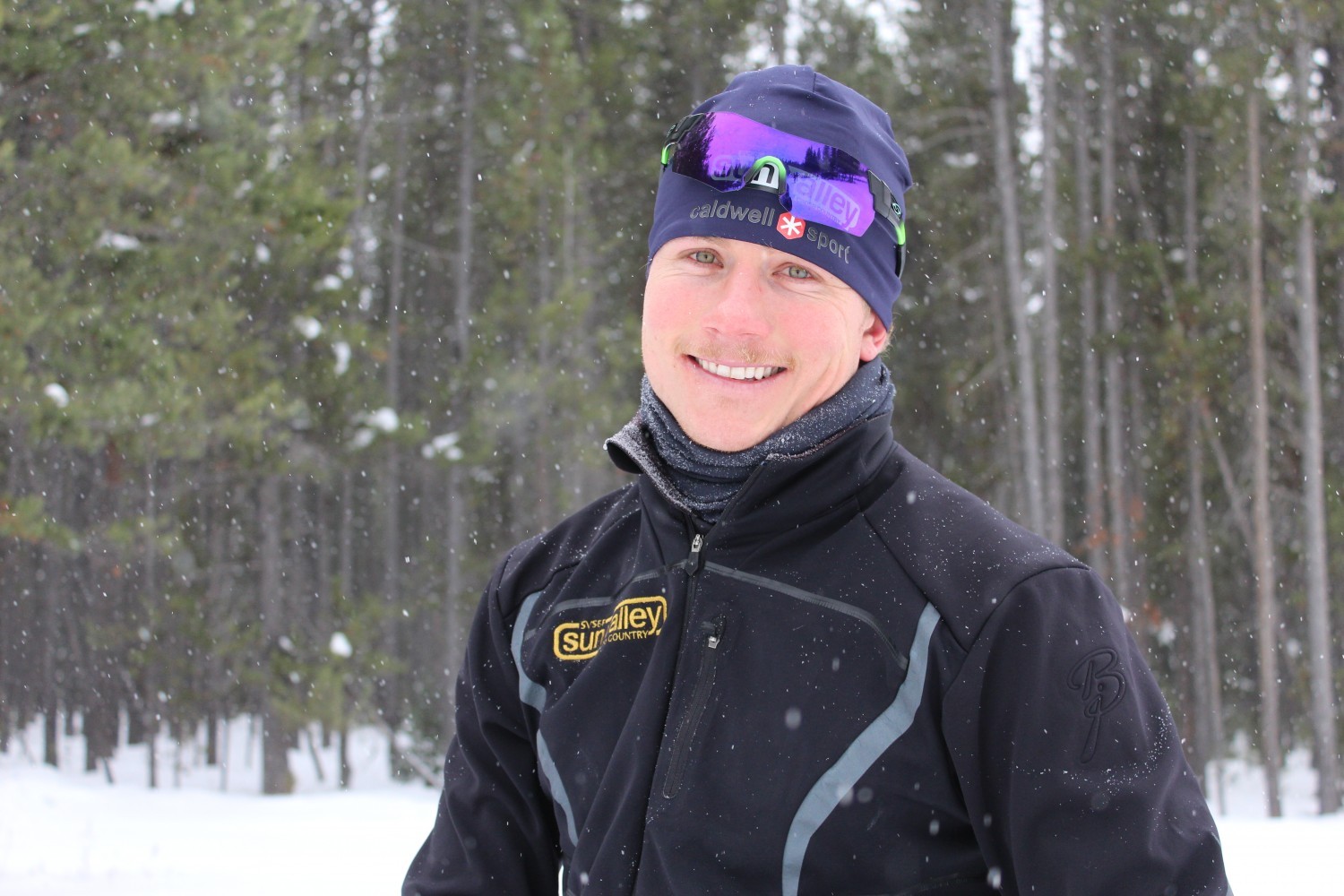
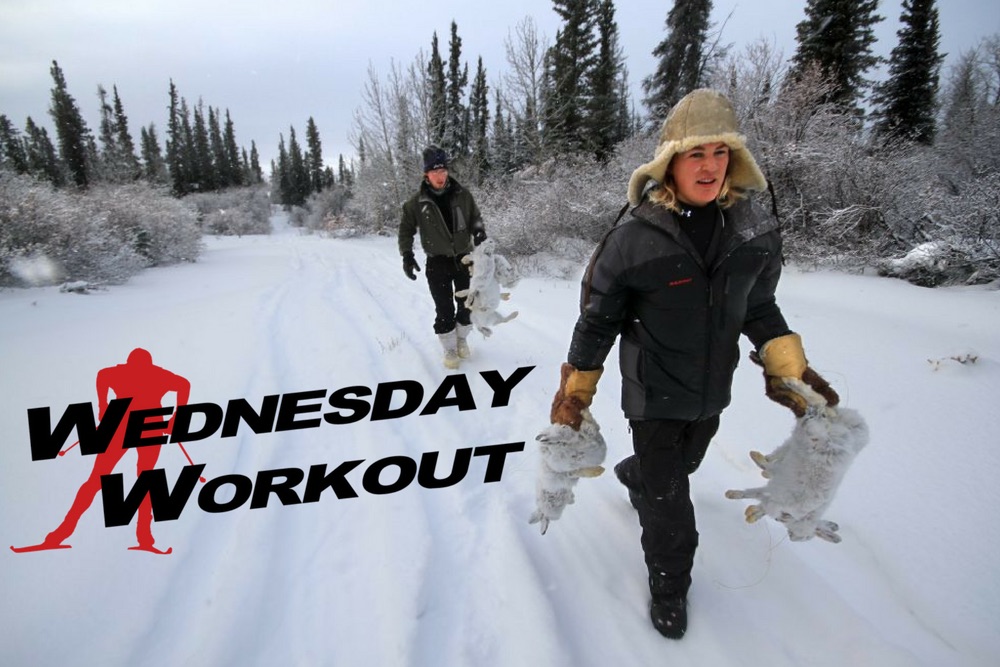
Canadian Knute Johnsgaard (r) after checking on rabbit snares on his family’s trapline in the Yukon. (Courtesy photo)
For this week’s Wednesday Workout (WW), FasterSkier is featuring Knute Johnsgaard, a native of Canada’s Yukon Territory. A 2018 Olympic cross-country skier and former Canadian World Cup Team member, Johnsgaard, 25, recently retired from professional skiing. With one of the more non-traditional ascents to the World Cup, Johnsgaard shared a workout that incorporates non-traditional training. The following assimilates chores and exercise into one, ideal for multitaskers everywhere.
***
The basement or garage might not be the first place most cross-country skiers visit before working out. For Knute Johnsgaard, however, there’s no better place to get started.
Knute Johnsgaard racing to 54th in his first international World Cup, a freestyle sprint in Planica, Slovenia, in January 2016. (Photo: Fischer/NordicFocus)
“I think athletes can benefit from doing some ‘real work’ now and then,” Johnsgaard wrote in an email. “It’s unfortunate that you don’t always get rewarded for the hard work that you put in to ski training. Usually you do see it down the road, but sometimes you may unknowingly be doing the wrong workouts at the wrong time or whatever–it just didn’t pay dividends like you thought.
“That’s why I’ve always enjoyed doing feel-good jobs or chores and treating them as a workout,” Johnsgaard explained.
His chores of choice include shoveling snow or splitting wood.
“It’s incredibly satisfying not only that you’re killing 2 birds with one stone (getting in a workout and getting chores done) but because you will always no matter what be rewarded for your efforts, especially if it’s a chore for someone else and you get to see their satisfaction as well,” Johnsgaard wrote.
So get to the garage, grab an axe or a shovel, and get to it.
The Workout: Real Work
Choose a physical task or job. Johnsgaard’s favorites include:
Shoveling snow
Splitting wood
Get the job done. Johnsgaard estimates 10.5 hours should do the trick.
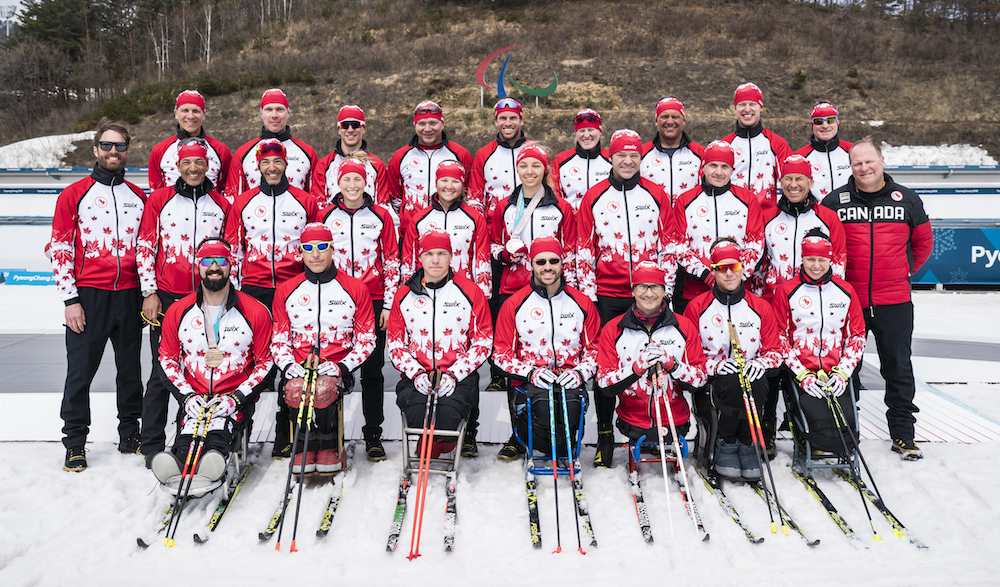
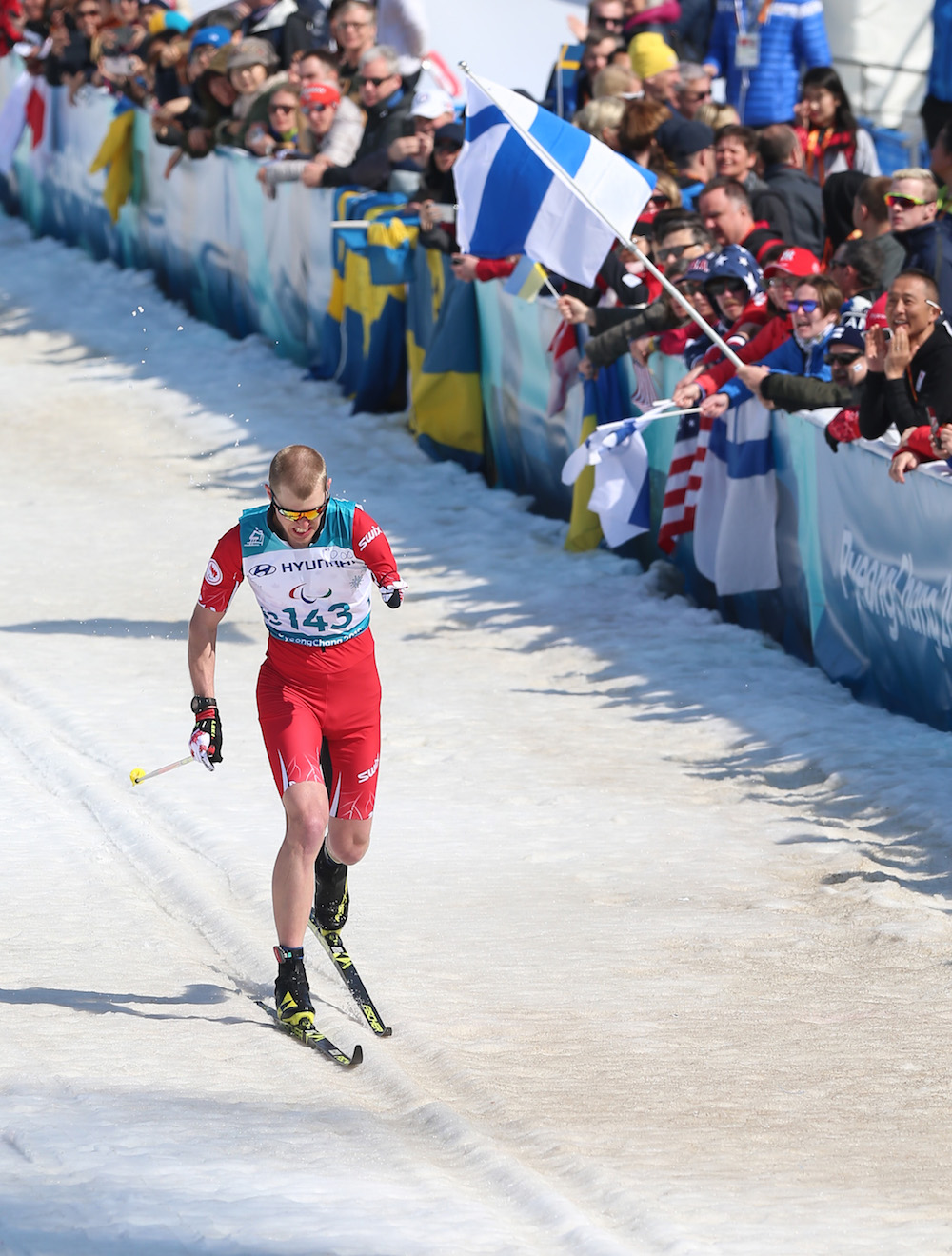
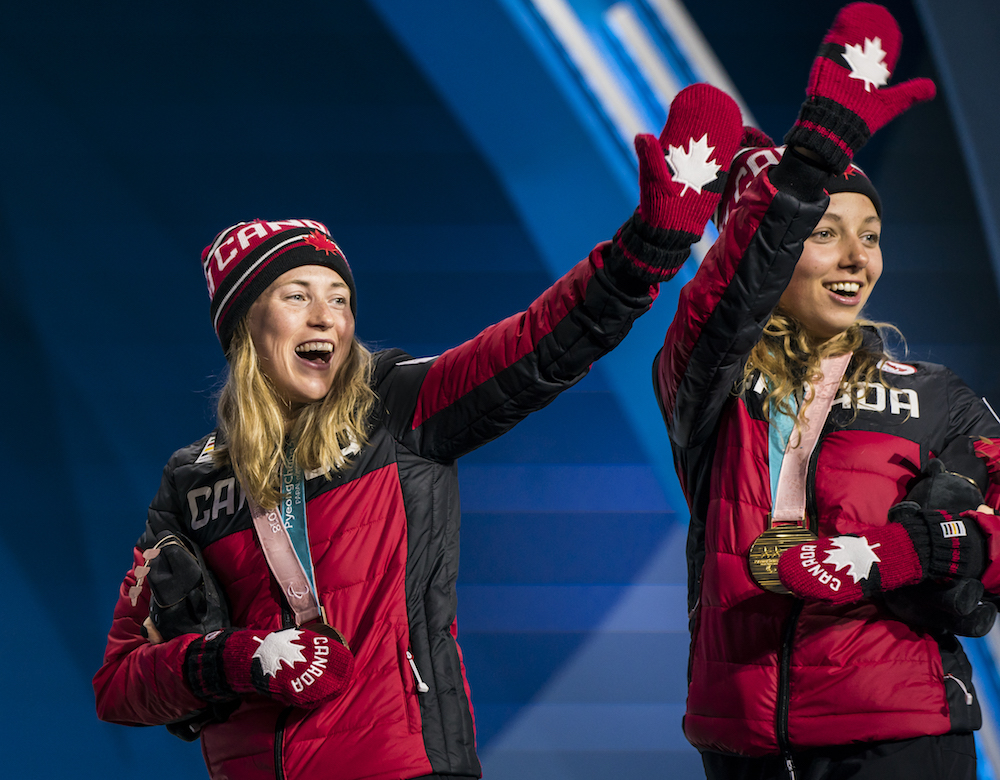
Canada’s 2018 Paralympic cross-country and biathlon team at the Alpensia Biathlon Centre on the last day of the Games in Pyeongchang, South Korea. (Photo: Dave Holland/Canadian Paralympic Committee)
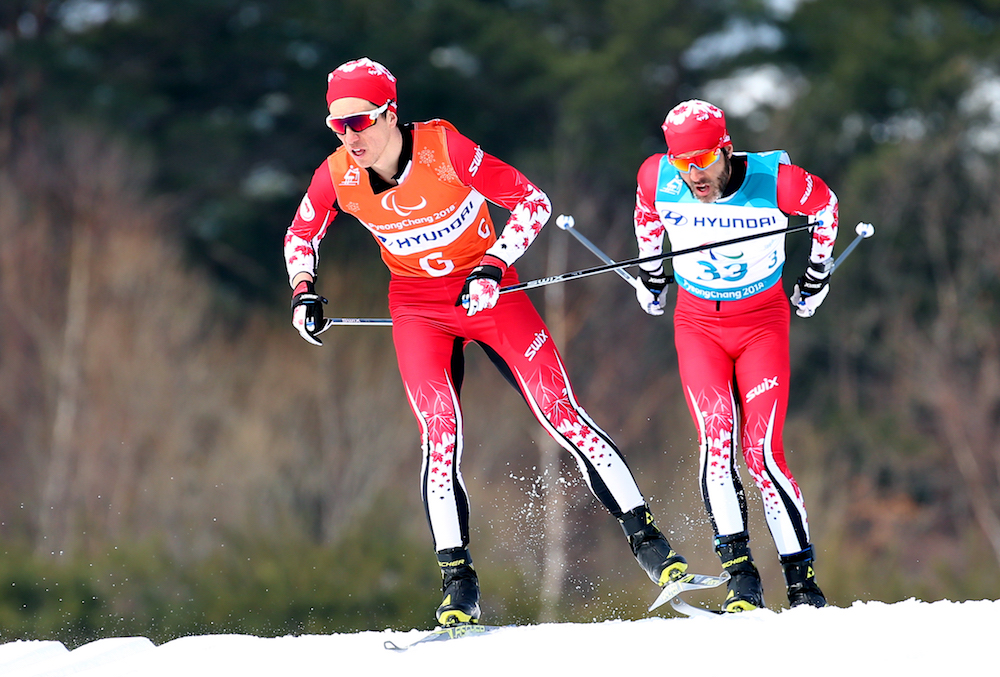
The 2018 Winter Paralympic Games was one for the books for Team Canada. Its athletes racked up a total of 28 medals in PyeongChang, South Korea, surpassing its previous record of 19 in Vancouver 2010.
Of those 28 medals, 16 came from Cross Country Canada’s (CCC) Para Nordic skiers (which includes both cross-country and biathlon). In comparison, five of the 19 medals Canada won in Vancouver were a product of a para-nordic team made up for two athletes: Brian McKeever and Colette Bourgonje.
Following the 2010 Games, Brian McKeever’s brother and guide at the time, Robin McKeever, became CCC’s Para-Nordic head coach in the fall of 2010. Around the same time Robin made the transition from athlete to coach, CCC experienced budget cuts that impacted its para-nordic program.
“When the program came to me as head coach, it was a, ‘Hey, you’re going to have to take this and rebuild it, somehow,’ starting point,” Robin McKeever said during a recent phone interview.
Brian McKeever follows guide Graham Nishikawa during the men’s visually impaired 20 k freestyle at the 2018 Paralympics in PyeongChang, South Korea. (Photo: Scott Grant/Canadian Paralympic Committee)
Over the course of eight years, McKeever, 45, has guided the program into a international powerhouse, as evidenced by its unprecedented success and increased presence in PyeongChang.
“It was a little bit of luck finding the right athletes at the right time, then it’s … working hard to keep them together as teammates who want to work and push each other to achieve their goals,” he explained.
The mindset seemed to work well for his team; with 14 athletes, it was seven times the size of that in Vancouver. And its athletes brought home more than three times the hardware it did in 2010.
“It’s attributed to having some pretty phenomenal athletes in the program, first and foremost,” Robin said, regarding the program’s surge in success. “Secondly, it’s attributed to having an awesome team supporting the athletes all working together … from medical staff to the physiologists to the development coaches to all of our wax team. They’re great people who love to be together. ”
Four women and 10 men comprised the 2018 Paralympic team roster, with two of the men being Brian McKeever’s guides, Russell Kennedy and Graham Nishikawa. Brian, 38, has long been a longtime para-nordic force, and in PyeongChang he left no room for doubt that he pervades as the cross-country king. A visually impaired athlete, he won all three cross-country races in PyeongChang: the 20-kilometer freestyle, the 1.5 k classic sprint and the 10 k classic. He also raced to bronze in the 4 x 2.5 k open relay.
With his performances in PyeongChang, Brian became Canada’s most decorated Winter Paralympian of all-time. Lana Spreeman, a para-apline skier, previously held the record at 13 medals, which she accumulated over the course of five Paralympics.
Brian currently holds 17 Paralympic medals from five Paralympics, 13 of which are gold.
“I wasn’t aware of this record, but it is pretty cool,” Brian said at the time, according to a Canadian Paralympic Committee press release. “I think for me more than anything is this is a testament to our entire program. We’ve had so many great skiers leading the way for me with my brother, Robin who is now coaching us, and Colette Bourgonje.
“Now it is awesome for me to be a part of a new generation that has arrived in Mark [Arendz], Collin Cameron, and the young women like Emily [Young], Brittany [Hudak] and Natalie [Wilkie], who are ready to carry the torch. I’m so excited to be around all of them this week and to be there cheering them on,” he added.
Also in PyeongChang, Canada’s Mark Arendz, Natalie Wilkie, Collin Cameron, Emily Young, Brittany Hudak, and Chris Klebl also earned their share of hardware on the Alpenesia ski trails.
Prior to Pyeongchang, Arendz had competed in Vancouver and then Sochi, coming away from the 2014 Paralympics with silver and bronze finishes in biathlon events. Four years after he earned his first two Paralympic medals, Arendz tallied six more in South Korea, the most medals ever won by a Canadian at a single Winter Paralympics.
Canada’s Mark Arendz en route to bronze in the men’s 1.5 k standing classic sprint at the 2018 Paralympics in PyeongChang, South Korea. (Photo: Scott Grant/Canadian Paralympic Committee)
Arendz showed versatility and strength, as his medal winning performances came in both the biathlon and cross-country events over the course of nine days in PyeongChang. He won a gold in the 15 k standing biathlon event, followed by a silver in the 7.5 k standing biathlon, silver in the 4 x 2.5 k mixed relay, along with three bronze medals, one in the 12.5 k standing biathlon, one in the 1.5 k standing sprint and one in the 10 k standing competition.
“Every time I stepped on the podium this week, I kept thinking I want to hear ‘Paralympic Champion’ and then my name announced,” Arendz, 28, told Cross Country Canada at the time, according to a press release. “I wanted nothing more than to hear my country’s anthem played. I’ve seen the maple leaf on top of the podium three times this week, but to finally have it behind the top step of the podium for me is an amazing feeling.”
Canada’s success story in South Korea did not end there. In her debut Paralympics, 17-year-old Wilkie scored big, earning bronze in the standing sprint, silver in the mixed relay, and gold in the 7.5 k classic in PyeongChang.
The youngest on her team, Wilkie was a skier before she lost four fingers on her left hand in a shop-class accident two years ago.
“Natalie was a medalist in able-bodied competition at Junior Nationals the year before,” Robin explained. “We knew that she was a strong skier that had an acquired disability and we knew that it was possible for her to race at the Paralympics one day if she wanted to. It’s a learning process and a real mental process to get over your injury and for her it was then also turned into an opportunity.”
Yet another individual medalist in multiple events in PyeongChang, Cameron, now 30, brought his team another first. With his third-place finish in the 7.5 k sitting biathlon race, he became Canada’s first male sit skier to medal in biathlon. He later earned two more bronze medals, one in the 15 k and the bronze another in the open relay.
Until four years ago, Cameron had been a sledge hockey player. He happened across his hometown’s para-nordic club by chance over the internet, joined that club and was later recruited to the national team.
“Being a part of the open relay team with Brian, and his guides Graham [Nishikawa] and Russell [Kennedy], was something really special and I will never forget it,” Cameron wrote in a previous email to FasterSkier. “Getting my third Paralympic medal with those guys was pretty cool … just being a part of this amazing and successful team of athletes, techs, and coaches has to a favourite moment.”
Natalie Wilkie (r) and Emily Young at the 2018 Paralympic medal ceremony with their gold and bronze medals in the women’s 7.5 k standing classic race in Pyeongchang, South Korea. (Photo: Dave Holland/Canadian Paralympic Committee)
Since the end of last season, CCC has undergone some changes that are affecting its Para-Nordic program. Both CCC’s para-nordic and able-bodied programs are tied under one organization, and Nic Lemyre was recently hired on as the new high-performance and development advisor for both programs. Previously, Mark Edwards served as the Para-Nordic high-performance director.
“Cross Country Canada came under some very strategic shifts with the prior organization,” Robin explained. “We’re not sure exactly how that’s going to play out. That is still in the works. We get to deal with that as it comes around, but it’s about putting a sport pillar and business pillar under two different ones and so we’re working hopefully closer with the able-bodied program.”
In terms of how CCC’s budget cuts are expected to affect its Para-Nordic program, CCC CEO Shane Pearsall expected the amount going to para-nordic to be “about the same as last year”. Asked how much of CCC’s roughly $4 million-dollar budget will go to the Para-Nordic national team’s elite programming, Pearsall estimated that amount to be about $600,000 dollars (comparable to between $500,000 and $600,000 for able-bodied national team programming).
In Robin’s opinion, working closer with the able-bodied program means the transference of ideas and potential to strengthen each other through teamwork and communal outreach. Expanding to skiers of all abilities and levels may take work from the ground up, as well as the top down.
“We need to be working together to rebuild that whole system,” Robin said, pointing out that currently, CCC’s able-bodied A-team consists of one member, Alex Harvey.
“The whole focus of the [Para-Nordic] program is about the process,” he added. “For the athletes to have their best race on a given day, the team has to also provide the best skis on a given day, the best feeds, say or whatever that requires. It’s really more about the process.”
Coach Ivan Babikov (l) at a 2016 fall training camp with Canadian World Cup Team members Alex Harvey, Devon Kershaw and Graeme Killick in Livigno, Italy. (Photo: Ivan Babikov/Instagram)
Cross Country Canada (CCC) has appointed a new high-performance and development advisor, Nic Lemyre, and laid off four staff members, CCC Chief Executive Officer Shane Pearsall confirmed in a phone interview on Thursday.
The news of Lemyre’s hiring came in the form of a press release Thursday morning, two days after four CCC employees — Ivan Babikov, Mike Edwards, Lisa Patterson, and Martine Zilligen — were informed of their release.
Babikov has spent the last two seasons as a national team and World Cup coach, Edwards was the high-performance director for CCC’s Para-Nordic Ski Team, Patterson was a longtime high-performance development coach, and Zilligen has been communications and marketing manager since 2013.
According to Pearsall, the layoffs were a direct result of CCC’s annual operating budget (which covers both able-bodied and para nordic skiing) decreasing from about $4.5 million dollars last year to what he anticipated to be $3.9 or $4 million dollars this year. The budget is not finalized, as CCC is waiting on the amount it will receive from Own the Podium (OTP), a government-backed nonprofit, which Pearsall estimated to be about 20 percent of CCC’s operating budget. That final amount is expected by mid-July, he said.
Fifty percent of CCC’s budget comes directly from the government branch of Sport Canada, and that amount has been determined, Pearsall said. He explained that money is tighter on the whole for CCC as a result of decreased government funding and sponsorship revenue.
One of CCC’s main sponsors, Mackenzie Investments, will no longer support nordic or four other snow sports as it had previously. Instead, the investment firm opted to stick with freestyle and alpine.
On the upside, he explained that another sponsor and investment firm, Haywood Securities, has agreed to sponsor the NorAm circuit as it has in the past.
Asked if budget cuts were among the biggest challenges affecting CCC at the moment and the reasoning behind the latest layoffs, Pearsall said, “Yes. If things had stayed the same that would’ve been good, but obviously that’s not the case.”
He added that CCC is faced with the ongoing challenge of competing with other sports for the support of “corporate Canada”.
“At the same time, we continue to talk to people and try to get them on our side to become part of our programs,” Pearsall said. “There’s a part of it where it always will be the challenge. You’re always looking for money for places to spend the money, and we just continue on trying to get more money.”
Asked specifically why CCC chose to release those four employees, Pearsall said, “Just trying to create a better future, efficiencies that we think we can find. It’s appropriate that at the end of the quad [Olympic quadrennial], you look at things and how to set the stage for the next quad. And even for us, we were looking at 2026. So we’ve decided this the way we’re going to go.”
CCC now has a staff size of 12. Louis Bouchard retained his job and is listed on CCC’s website as its lone national ski team/World Cup coach. Bouchard is also Alex Harvey’s personal coach and head coach of the Pierre-Harvey National Training Centre (Centre National d’Entraînement Pierre-Harvey) in Quebec.
Pearsall said he broke the news to Babikov, Edwards, Patterson, and Zilligen individually during one-on-one meetings on Tuesday.
“It’s one of those things, when you do a change, you tend to want to something like this all at one time, and that’s the strategy we executed,” he said.
CCC will be looking to replace Babikov’s position as co-World Cup coach through an “open job search,” Pearsall stated. As for Patterson’s role as a NextGen coach and development trip leader (for international competitions including U23 and Junior World Championships), Pearsall was unsure if CCC would fill that vacancy.
“When something like this happens — I’ve been involved in the corporate sector — you do a bit of a reshuffle on responsibilities, so we’re working on those on how we’ll go about that,” he said. “At this point in time, I can’t say we’ll necessarily hire somebody in that specific area, but we’re looking at how we cover responsibilities.”
As for the timing of these layoffs in early June, two months after the end of the season, Pearsall said that was a tough one.
“Can you ever find perfect timing? There’s questions about that, but this is the way we decided to go, and we’re going to make the timing work,” he said. “… This is the way things lined up. This is the way we’ve gone about it.”
According to Babikov, the layoff, which was effective immediately, caught him off guard.
“I had no idea it was coming, and it didn’t cross my mind that something like this would happen because we had already started the new summer,” Babikov said on the phone on Thursday. “I just came back from training and our CEO just called me for a meeting, and I thought it was regarding our new HPD, if we hired somebody, but then he just handed me papers and I was told to leave my credit card and keys, and we go separate ways. And that’s all that was said.”
Babikov, who’s been part of the Canadian national team for the last 10 years, first as a two-time Olympic athlete and then as a coach starting in June 2016, said there was no notice. “It was without a cause,” he said.
Asked why Babikov was fired, Pearsall said he couldn’t comment.
‘The Rebuild’
Lemyre as the high-performance and development advisor will fill the roles previously held by Edwards and Thomas Holland, the former high-performance director of able-bodied cross-country who retired at the end of last season. A Montreal native who is primarily based in Norway as a professor of sports psychology at the University of Oslo, Lemyre will work part time for CCC.
He’ll be the head of one of CCC’s two new departments, Pearsall explained, overseeing the sport side of the organization while Pearsall and Megan Begley, CCC’s operations & strategic development manager, oversee operations. Lemyre will make decisions in his department, but Pearsall will have “final approval on all personnel decisions”, according to CCC media relations consultant Chris Dornan.
Dornan clarified that Lemyre is “advising on the rebuild” and that CCC will communicate the structure of its high-performance department in the near future.
“His role is going to be advising us, going forward, on how we should look at things, and develop things,” Pearsall said of Lemyre. “He’s going to be an integral part of the decisions we make, in different areas, in the high-performance area. He will be overseeing, in the re-org, I’ve basically created two departments. One is operations, and one is sport. He will be in the mix on the sport side. Under the old structure, there was a para-nordic [director] and there was an able-bodied [director], and I’ve brought those two together to gain efficiencies and exchange more knowledge, if you will, between the two sections of para and able.”
Originally from Montreal, Lemyre takes on the role of high performance and development advisor with clear goals in mind – to break barriers and establish Canada as a strong Nordic nation with multiple male and female athletes performing at the highest level, while providing our nation’s best cross-country skiers with the means to be back on the Olympic podium in 2026 and ensure the Para-Nordic program remains a dominant force for future generations.
“We are standing on the shoulders of a group of athletes and staff who have accomplished great things for our sport in Canada over the last two decades. Together, we have to understand and identify what has led to these exceptional performances and provide the same opportunities for the next generation to succeed,” said Lemyre.
A former skier in the 1990s, Lemyre moved to Norway 21 years ago where he has applied his academic and administrative skillsets as a sports psychologist to a variety of roles in the Norwegian sport system. He has worked within the support team for the world-leading Norwegian cross-country ski squad as a sport psychologist since 2011. Lemyre will split his time advising Cross Country Ski de fond Canada’s high-performance program, while continuing his role as a professor of sports psychology at the University in Oslo over the next year.
“Cross-country skiing is a passion of mine. Things have come full circle for me since I left for Norway in 1996, and I’m very humbled to have this opportunity now to contribute to the growth of the Canadian program,” said Lemyre, who takes over from Tom Holland, who retired from the position of high-performance director following the PyeongChang Games. “I am ecstatic to be able to bring my knowledge and skills back to my sport roots at home in Canada.”
Holding a Ph.D in sport and exercise psychology from The Norwegian School of Sport Sciences, Lemyre has been the head of the school’s department of coaching and psychology since 2008. He has been the sports psychology consultant for the Norwegian Men’s Cross-Country Ski Team and the Norwegian Cycling Team from 2012-17. He has also accompanied Norway’s Olympic Team as a sport psychologist at the 2010 and 2014 Games, and worked with the Norwegian Women’s Biathlon Team between 2009-2015. Lemyre has also provided support to Norway’s alpine skiing, swimming and ice hockey programs.
“Nic is a highly-motivated professional who knows what it takes to win,” said Shane Pearsall, chief executive officer, Cross Country Ski de fond Canada. “He has been through the peaks and valleys of a respected program, while working closely with a number of accomplished high-performance directors who have achieved excellence on the biggest stage. As a result, he understands the patience and time investment required to build a medal-winning program. I am confident he can transfer this knowledge to help build a strong support team to ensure Canadian athletes and coaches achieve their performance goals.”
Canada’s cross-country ski program has made steady progress over the last two decades developing generations of Olympic, World Championship and World Cup medal-winners. While Lemyre takes over the leadership of a Para-Nordic National Team who achieved an unprecedented 16 medals at the 2018 Paralympic Winter Games, the World Cup Team has delivered impressive results on the Olympic stage but has not won a medal since the 2006 Games.
“The sport in Canada has established itself on a tradition of excellence with Pierre Harvey, Beckie Scott, Sara Renner, Brian McKeever, Chandra Crawford, Devon Kershaw, Alex Harvey, Len Valjas, and Mark Arendz leading the charge, but it is clear our National Ski Team is now at a crossroads,” said Lemyre. “It is important for us to reflect and act on what has, and has not, worked. We can learn a lot from the success of our past, and from the strength of the para-Nordic program.
“There is a lot of talent out there – good kids skiing right now. Our job is to create a Canadian-made system with our partners that will deliver a pool of resources for our athletes and coaches to develop to their full potential – from the junior to elite level – and help them achieve our collective performance goals.”
Lemyre will be based in Canmore, Alberta, throughout the summer months before returning to Norway. His first order of business will be to do a complete evaluation of the program and initiate the implementation of a plan with a focus on investing in the next generation of athletes and coaches.
“There is no doubt we have some challenges, as well as some great opportunities, ahead of us. We can’t promise things that aren’t reasonable, and this will take time, but I’m committed to working with the talented staff at CCC and our partners to get the right people in place within a structure that will provide both the able-bodied and para- women’s and men’s athletes the structure and resources they require to fully develop and excel internationally long-term,” added Lemyre, who added that sport science and innovation will be an important tool for Canadian coaches in his planning.
“The goal is to create a strong base for the next generation of athletes, while developing a culture from the ground up that prides itself on sharing knowledge, information and skillsets to succeed in building a tight-knit program across the country that pushes each other to be better every day. To me that is what it takes to win.”
Lemyre will begin to roll out the new high-performance structure in the coming weeks.
CCC is the governing body of cross-country skiing in Canada, which is the nation’s optimal winter sport and recreational activity with more than one million Canadians participating annually. Its 60,000 members include athletes, coaches, officials and skiers of all ages and abilities, including those on Canada’s National Ski Teams and Para-Nordic Ski Teams. With the support of its valued corporate partners – Haywood Securities Inc., AltaGas, Mackenzie Investments, Swix and Lanctôt Sports– along with the Government of Canada, Canadian Olympic Committee, Canadian Paralympic Committee, Own the Podium and B2Ten, CCC develops Olympic, Paralympic and world champions. For more information on CCC, please visit us at www.cccski.com.
Len Valjas (c) spreads his arms to greet his teammates Alex Harvey (far right), Knute Johnsgaard (far left) and Devon Kershaw after he crossed third in the 2017 men’s 4 x 7.5-kilometer team relay on Jan. 22, 2017, in Ulricehamn, Sweden. (Photo: Fischer/Nordic Focus)
Back on Jan. 15, 2017, current Canadian World Cup B-team member, Len Valjas was beaming. Valjas, along with podium-regular teammate Alex Harvey, had won a World Cup team sprint in Toblach, Italy. The next weekend, Valjas and three teammates (including Harvey) rocketed to third in the men’s relay at the World Cup in Ulricehamn, Sweden. The results, at the time, looked to be a good indicator for the ensuing 2017 World Championships in Lahti, Finland.
Days before the Lahti events, during a gym session, Valjas felt his upper back between his shoulders give out. He felt little initial pain, but with compromised breathing, his results fell flat in Finland. As the remaining 2016/2017 World Cup season came to pass, Valjas hadn’t yet determined the exact cause of his physical ailments. His fitness and confidence suffered.
Len Valjas (Canadian World Cup Team) en route to 10th overall in a classic-sprint stage at the 2016 Tour de Ski in Oberstdorf, Germany. (Photo: Marcel Hilger)
Prior to Lahti, Valjas was ranked 13th overall on the sprint list. By season’s end, he had dropped to a very respectable 16th in the sprint standings.
Coming into the 2018 Olympic season, Valjas remained frustrated. He knew something was off. A pattern of poor performances continued through his most recent World Cup campaign. In the big picture, this past World Cup season left a bad taste for Valjas.
“Last year, I had so many bad feelings from the year,” Valjas reflected on the phone on May 22. “I could never train in the summer because I was always injured and compensating. I could not double pole on rollerskis. My back would hurt. All these little things … The last season obviously wasn’t by any means a good smooth season for me. I did have a good Olympic race which I am super proud of, but, overall, other than that one good day, I had one of my worst and least-fun seasons I have ever had. I was dealing with an injury for the last year and a half in my back.”
At the Olympics in PyeongChang, South Korea, Valjas reached the semifinals in the individual classic sprint and ended the day in seventh for his best result at his second Olympics.
Canada’s Olympic sport-funding system emphasizes championship medals and results. Harvey and Valjas set new Olympic benchmarks this February for Canadian men’s cross-country skiing, with Valjas’s contribution being seventh overall in that classic sprint.
“It is what they wanted,” Valjas said of Cross Country Canada’s priorities. “The end goal they wanted — Olympic results this season. Alex and I set records in the individual races anyway, three new Canadian records. Alex had two of them. I had one. It was one of our most successful Olympics ever. They should be extremely proud, especially when the season wasn’t going very well for a lot of us. We had an off-year and still were able to beat three of the Canadian records at the Olympics. I think they should have been very proud.”
Valjas, 29, hasn’t felt healthy since before Lahti 2017. The year and a half he endured at less than 100 percent has literally sapped him. During his most recent interview with FasterSkier, there was a tone of lament in his voice — not anger, just a simple melancholy from an athlete known to have a mellow demeanor. From Valjas’s telling, the wires between getting a full diagnosis from the Canadian team for his original back ailment and the pressure to continue training and racing got crossed.
Canada’s Len Valjas on his way to 20th overall in a January 2017 World Cup freestyle sprint in Toblach, Italy. (Photo: Fischer/Nordic Focus)
“At World Champs [in 2017], I was begging for an MRI or some sort of check just to see what I did,” Valjas said. “But I kept getting turned down because my symptoms weren’t so bad. I didn’t have weird nerve feelings in my hands. It was kind of frustrating for the rest of that season.”
According to Valjas, he asked again in the spring of 2017 for an MRI.
“We should check to see if it is nothing, at least we will see that it is nothing,” Valjas remembered saying at the time.
Again, Valjas said, he was denied the test. He trained all summer with frequent setbacks. His 2017/2018 World Cup season began in Kuusamo, Finland, with him finishing 44th overall in the three-day mini tour. The next weekend he placed 59th in a classic sprint in Lillehammer, Norway. Valjas said he had been working with a U.S. Ski Team physiotherapist in Lillehammer due to shoulder discomfort and nerve pain.
The pair continued their work together through the rest of December 2017. After their conversations regarding the pain, physical limitations and sensations, they linked what Valjas was experiencing to the moment in the gym before Lahti 2017 when he felt the “pop” in his upper back.
“[The physio] said, ‘I don’t think this is a shoulder injury. I think this is in your back,’ ” Valjas recalled. “And that is when he kind of tied in my mind to, OK, we are dealing with the same thing when I hurt it before Lahti if he thinks it is in my back. It all made sense. … And finally, I told the team I am leaving. I am going home and getting this checked out myself.”
Switzerland’s Jovian Hediger leads Canada’s Len Valjas (r) and American Erik Bjornsen (c) during the classic team sprint at 2017 FIS Nordic World Ski Championships in Lahti, Finland. The U.S. men placed fifth and Canada finished sixth in that race. (Photo: John Lazenby/Lazenbyphoto.com)
Valjas clarified that the shoulder pain was in fact referred pain originating in his back.
Upon his return to Canada, Valjas received an MRI authorization from a trusted physician he had worked with in the past.
“Turns out it was a herniated disc at T2-T3. And I fractured a vertebra at T4,” Valjas explained. “So it was quite a bit worse than I thought at first.”
The T4 fracture Valjas incurred was not a threat to his spinal cord. The break occurred where the rib meets the vertebrae rather than along the spinal cord. The personal physician consulting Valjas also explained he had signs of arthritis in several joints around the injury zone. A consequence of working through the injury, Valjas was told, rather than taking time off. His doctor ultimately cleared him for racing since it was an Olympic year.
But, according to Valjas, it was a grim six-week buildup to PyeongChang. There was little effective training, scores of physio sessions, and the rare on-snow intensity effort to “salvage shape”. Then there was his seventh place at the Olympics. After his herculean effort in PyeongChang, he pulled the plug on the season. Time for rest, rehab, and reflection.
“To be totally honest, I kind of thought after the Olympic cycle I would be done, too,” Valjas said of the rumors swirling about his potential retirement. “That is why I probably started my own rumors, just saying that I was planning to retire.”
Several times Valjas mentioned how proud he was of his Olympic result. But the season-long canvas of results, he felt, was not reflective of his World Cup racing capacity.
“I just didn’t feel like I was finished this last year,” Valjas said. “I only raced, I don’t know, 13 races or something. Crazy low. I didn’t have the results I wanted in the end beyond the single Olympic one. It wasn’t the season I was hoping for. So I am hoping to get healthy and have a last season that I am proud of. I might not have the seventh-place result, but I just want to race well and be pain free.”
The path to pain-free racing will initially involve building up his strength while delaying his rollerski-specific training. With expected massive financial cuts looming across the board for Cross Country Canada (CCC), Valjas explained he will be based out of Canmore, Alberta, this summer with bare-bones support. Canadian World Cup coach Ivan Babikov will be writing his training plan, but according to Valjas, CCC has eliminated its physiologist and strength-trainer positions.
“It is me and Ivan, which, for what I am going through right now, is actually good,” Valjas said. “Through all this, he would fight for me. He believed me, let’s just say. There are only a couple of people who trusted what I said and the rest kind of left me out to dry there. I am happy to work with Ivan this year because, he actually knew all along. He did what he could. But at the same time, he doesn’t want to lose his job. He was working on my side for sure.”
Valjas is still processing how his medical condition was handled and how he responded. An athlete going against team wishes can have repercussions.
“It is hard to go against the team right away,” Valjas said. “If I got the MRI and there was nothing there, they might not be too happy with me either.”
Valjas hung on to the party line for months. Not exactly a “suck it up” directive, but messaging from the team that didn’t correlate with the distress and inability to rebound that Valjas experienced.
“When I told them my symptoms, the answer was always, ‘Oh, you have anxiety, your back is healthy. You have anxiety,’ ” Valjas said.
He also mentioned that he endured numerous back manipulations under the recommendation of team health care providers. Procedures, he said, that he’s now been banned from at the risk of inflaming his injury.
“It is just unprofessional how they just assume that it is anxiety and they get me manipulated probably 30 times in that year,” Valjas commented. “It could have been way worse. I feel lucky that … my spinal cord is totally fine.
“I am more worried about the future. If you break your leg, it is pretty obvious you broke your leg. It is more straightforward. If someone has a nagging spine injury, I hope that they learn from this,” he continued. “But so far I don’t feel like they have. I hope they learn you need to take these very seriously. Because you can have your athlete back in half the time if you don’t jeopardize their whole career over it. If I knew right away that it was herniated and broken, I probably could have taken a few months and gotten stronger. But the way I did it, it was a year and a few months of constant atrophy in my back and spine. I can feel it. I am weaker in the upper body than I have ever been.”
Canada’s Alex Harvey (l) and Len Valjas celebrate their 2017 World Cup freestyle team sprint win in Toblach, Italy. It was the first team-sprint victory for Canada since 2011 World Championships. (Photo: Salomon/NordicFocus)
Valjas remains focused. His new competition singularity is the upcoming freestyle team sprint at the 2018 World Championships in Seefeld, Austria. The plan is to contest the race with Harvey. A healthy Valjas could allow the tandem to revisit the emotions of their former World Cup team sprint win.
“I am doing it really just as much for me as I am for [Alex],” Valjas said of continuing in the sport and supporting his longtime friend and teammate. “It for sure helps to have a race to look forward to, even if it is a team race. It is going to help me in the rehab and the training to have something to train after, an end goal.”
Jess Cockney (l) and Foothills Nordic skiers on top of Apex, outside of Penticton, British Columbia, on May 19. After retiring from professional skiing this spring, Cockney has been helping out as an assistant coach at Foothills Nordic. He’ll study full time at the University of Calgary this fall. (Courtesy photo)
Strength. Balance. Agility. Jesse Cockney had all of those qualities as a child growing up in Yellowknife, Northwest Territories — just like most Inuit kids — according to his father, Angus. But what he could do with that talent was what Angus hoped to nurture.
Since he had put his son on skis at age 3, Angus reflected in an email that he “knew then that [Jess] had incredible potential to succeed.”
Jess Cockney and his family after the 2014 Olympic trials in Canmore, Alberta, with his mother, Trish, father, Angus, and sister, Marika. (Courtesy photo)
And so the Cockneys moved to Canmore, Alberta, when Jess was 7. That included Jess’s mother, Trish, and his sister, Marika. According to Angus, a former competitive skier and junior national champion in 1973, ’74 and ’75 (who spent two months skiing to the North Pole in 1989), the move was about giving Jess “a better opportunity to succeed as it had the right environment with the Nordic Centre and a community full of support with like-minded kids and parents. In other words, we wanted him around a healthy environment.”
It was an easy transition, Angus explained. Canmore was more conducive to training with milder temperatures than Yellowknife and a wealth of experienced coaches and athletes.
More than two decades later, Jess credited his dad for helping him reach the highest level of cross-country skiing. A two-time Olympian, Cockney, now 28, has spent 11 years on Canada’s senior national team and two more on the junior national team. He achieved a sixth-place finish in a classic sprint at U23 World Championships in 2011, as well as four individual top-10 finishes on the World Cup.
“The big reason that I have cross-country skied at this level and really understood at an early age what it meant to pursue racing at a high level was definitely because of Dad,” Cockney said on the phone in April. “He took skiing to a high level as a junior and didn’t carry on after his junior career but stayed really involved with the sport and with racing, too.”
Jess Cockney enjoying some on-snow time as a youngster. (Courtesy photo)
He emphasized how special it was to share moments like shuffling on skis at a young age with his dad to seeing him on the side of a World Cup course, calling out splits and taking pictures.
“It’s pretty fun to be able to share that time together, because skiing means so much to both of us,” Cockney said. “I’m quite happy that my career has worked out as well as it has and that Dad has been able to be there for so many of the good days with it, too.”
After six years of traveling across Europe on the World Cup circuit (as well as to places like Sochi, Russia, and PyeongChang, South Korea, for the Olympics), Cockney retired from professional skiing this spring. It was a decision that had been on his mind for the better part of the last two seasons, he explained. Toward the end of the PyeongChang Olympics in February, he felt what he described as a mental “decompression” and a natural ending to his career, which solidified his decision.
“I know how much mental energy it takes to commit towards the training year and the travel for the racing season,” Cockney said. “I had a blast doing that for so many years and I just didn’t think that I was going to be sharp enough or motivated enough. I’m just happy to have such a great season as a final year with the Olympic team and being together with so many of my teammates from over the years at those Games. It just feels like the time is right and I’m excited to do something else.”
Annika Hicks (Alberta World Cup Academy) racing in the 2016 Frozen Thunder sprint qualifier in Canmore, Alberta. (Photo: Glen Crawford Production Services)
While currently renovating his home in Canmore with his girlfriend Annika Hicks (as well as his dad, skier Bob Thompson, and another friend) and assistant coaching at Foothills Nordic, Cockney plans to start classes at the University of Calgary this fall. He was accepted into the university’s political-science program this spring.
Hicks, who previously trained out of the Alberta World Cup Academy (AWCA) in Canmore, will also be studying full time at the University of Calgary. She is halfway through her studies there toward a science/kinesiology degree in exercise and health physiology. Like Cockney, she explained in an email that she’s been “on the fence” about continuing with skiing for the last two years.
“I wanted to stop skiing on my terms and with a healthy relationship with the sport,” Hicks, 26, wrote. “I have no regrets and am happy to have that closure. I’m grateful to have had the opportunity to ski race for so long.”
In her career, she started 15 World Cup races, competed at two U23 World Championships and 2011 Junior Worlds, tallied at least three podiums at Canadian senior nationals (including two second-place results at 2018 nationals in March), and ended this season as the second-ranked Canadian woman overall on the NorAm circuit.
The Malcolm Hunter Trophy for aggregate winners of Canadian senior nationals, designed by Angus Cockney, as seen in the Canmore Nordic Centre day lodge. (Photo: Cross Country Canada)
Cockney also finished the second on the overall NorAm aggregate points list. After winning both the freestyle sprint and 15 k freestyle pursuit at this year’s nationals, he also was also awarded the Malcolm Hunter award — a trophy his dad made — as the aggregate male winner at nationals.
“It was a great way to end the season and end the career,” Cockney said. “I’d never won the nationals aggregate before so that was a big thing for me to do … To get that in my last stab at it was pretty sweet.”
Angus pointed out that his son’s aggregate win was also special because of where it took place.
“It was in Thunder Bay [Ontario] where Canada lost my good friend/foe in the late great Reijo Puiras,” Angus wrote. “He too was passionate for cross country and especially made time for and congratulated Jess whenever he could. And, Jess was presented the Malcolm Hunter trophy; a trophy I created and Malcolm was my former coach who brought me to victory in the stormy ice-cold 1975 Canada Winter Games. Therefore, it was very befitting for Jess to go out that way. He came back and told me, ‘Dad, I won the trophy you made.’ ”
Choosing nordic
Looking back, Angus explained that his proudest moment of Jess was was when his son consciously chose to pursue cross-country skiing at age 11.
“I believe he would have made the National Hockey League if he wanted to but I’m glad he picked the greatest sport in the world,” he wrote. “For Jess, I’m proud on how he has become well respected as a person in the community and abroad. Of course too, he showed he belonged on the world’s stage with a number of top ten finishes on the World Cup circuit but was especially proud of him as the second qualifier here in Canmore in 2012 sprints. He certainly had the community a buzz. As a Father/Son duo though, I’m proud too on how we are the only Father/Son duo to win our respective Canada Winter Games; 1975 and 2009.”
Jess Cockney racing to 29th in the freestyle sprint qualifier at Stage 3 of the 2016 Ski Tour Canada in Quebec City. He went on to reach the semifinals and finish the day in 10th. (Photo: John Lazenby/Lazenbyphoto.com)
Cockney had a number of standout moments at the World Cup level, the first of which came at home in Canmore in December 2012, when he placed ninth in a World Cup skate sprint. Then, late in the 2015/2016 season in Quebec City, he raced to 10th in the Ski Tour Canada’s skate-sprint World Cup stage. The next winter, he notched two more individual top-10 results: first in a classic sprint at the 2017 World Cup in PyeongChang and then in another skate sprint in Quebec City.
Those top 10’s effectively earned him a spot on Canada’s 2018 Olympic team as well as its 2017/2018 World Cup A-team.
“The time in Canmore, for sure, was such a special race for me,” Cockney reflected of his career-best World Cup result. “That was really big because it went well and my family was all there and it was just really a great surprise kind of day.”
Another race he’ll never forget was the 50 k mass start at the 2014 Sochi Olympics, a race he had never expected to enter.
“Just the way that people got sick and things don’t work out for other teammates, I was able to start it, and I was just so happy to be able to race that massive race at the Olympics,” he said. “That’s just such a big deal for me in my career, to have raced it and finished it.”
Phil Widmer (CNST/AWCA) leads teammate Jesse Cockney (second from l), Dakota Blackhorse-von Jess (Bend Endurance Academy) and Canadian Para Nordic skier Brian McKeever (r) in a classic-sprint heat at 2013 Frozen Thunder in Canmore, Alberta. (Photo: Pavlina Sudrich)
He recalled his time with the AWCA and transitioning from the NorAm to international racing with peers like Kevin Sandau, Michael Somppi, Chris Hamilton, Graeme Killick, Graham Nishikawa, Brent McMurtry, Drew Goldsack, and Phil Widmer.
“So many fun Phil battles,” Cockney reflected. “Now that that group is still there with Bob Thompson making his way — it’s great to see that group is still getting stronger with that tail end of younger guys in that group. … Probably my biggest highlight is the relationships that I’ve been able to foster and have come from skiing, for sure, is the people and the time that we’ve shared together.”
Besides his dad and his fellow competitors, he credited his high-school training group, the Banff Ski Runners, and its coach Anders Lenes, as well as Mike Cavaliere as major influences.
“We had so many good guys my same age, and really the time with friends was actually just time training so it was the perfect atmosphere for a couple of us to take it really far,” Cockney said of the Banff team.
“My coach right after Anders, Mike Cavaliere, definitely had a really big impact in fostering that next level of belief for me, from going from a good skier in Western Canada to trying to be the best that I could be in Canada,” he continued. “And then setting goals to reach potential in the international scene, too, with time together at World Juniors and Under 23’s and early in my World Cup and my first Olympics we were still working together.”
Jess Cockney racing in a 2015 World Cup classic sprint in Otepää, Estonia. (Photo: Fischer/NordicFocus)
Asked what it was like growing up on the national team and how the sport has shaped him, Cockney was introspective.
“I’m definitely softer spoken or maybe more considerate at this point,” he said. “Really what I’ve gotten to understand is respecting everybody’s hard work in sport and understanding what someone’s going through; we don’t really get it all the time.
“I’m a little bit more — I’d just say not as brash or just a little bit more reserved,” he continued. “I learned some hard lessons from being just a little bit too mouthy or a little bit too, maybe even arrogant. The time in sport has really shaped a lot of who I am, probably more than I realize. I’m super appreciative of the people who’ve been a part of that, just being such great people, and how they carry themselves, [and] emulating that where I can in life.”
A longtime member of Canada’s senior development team, Cockney was promoted to World Cup B-team status in recent years and spent his last season as an A-team member. So while funding has become tighter within Cross Country Canada (CCC) since 2014, Cockney said he had the unique experience of increased financial support in the last couple years.
“I started supporting myself for World Cup opportunities in 2014 and paying out of pocket for the whole thing, and then by this year I was getting more support from the whole team,” he explained. “My seasons have been consecutively getting more and more financially feasible, so I’m lucky it was trending in that direction and I was able to be a little bit better financially as the years went by.”
With further budget cuts for CCC expected, Cockney said his retirement wasn’t motivated by the prospects of self-funding. He is one of four men from last year’s Canadian World Cup Team who have decided to retire (the other three being Devon Kershaw, Knute Johnsgaard and Graeme Killick.) Alex Harvey and Len Valjas are the lone returners to the 2018/2019 World Cup A-team.
“Alex and Lenny and Graeme and I, we’ve been going to nationals together since I think, like, 2004,” Cockney reflected. “So it’s been a really long time together and more and more time with Devon at the top level of the sport. I was roommates with Knute for a while last year so we really felt like we’re a tight-knit group of guys and it was fun. They’re not just teammates, they’re friends that are now going to be part of our life for the rest of our time out of sport.”
The next steps
Canada’s Jesse Cockney (l) and American Simi Hamilton bump fists after anchoring their countries’ relay teams at the 2014 Olympics in Sochi, Russia.
In mid-April, Cockney said his permanent break from racing hadn’t really sunk in yet. A month later, he was coaching Foothills Nordic athletes at a training camp in Penticton.
Asked what piece of advice he’d give up-and-coming skiers, he said it was “cheesy”, but simply to be true to oneself.
“At the end of the day, it’s your name on the results and you’ve got to be able to be the one driving the train and figuring things out,” he said. “It’s a brutally honest sport, and we’re judged with a clock. It’s your name next to that time, so be true to yourself and enjoy the process so much. … In cross-country skiing, the process is 95 percent of the sport, and 5 percent of it is competing… Just having a real love for the training, the relationships, the places that you go, that’s the biggest thing.”
And as he parts ways with CCC, he stressed the importance of club programs in the development pipeline as they helped cultivate his career (Cockney grew up skiing with Foothills Nordic).
“The club systems were really strong in Canada and could provide athletes with a lot of support through different points in their career, and I think we’ve really put a big focus on the training centres, taking up the mantle with that,” Cockney said. “If clubs were able to be more supportive, be more things to athletes at different points in their career, I think that you would start to see an improvement in just the health of the sport across the country. The more places people can ski at a high level, or whatever level they feel they want to, without moving, without uprooting themselves, I think that’s the best thing. It’s not always feasible for someone to pick up and move to a training centre and change their life. If there’s a club in town that they can pursue their goals in sport, then that’s the best way to get people sticking with the sport.”
As for his future endeavors and adventures, Cockney predicted that he probably wouldn’t rollerski for fun. Rather, he was looking forward to mountain biking in the Bow Valley, going fishing and enjoying “a few more outdoor pursuits that are for myself” and a slower pace. “I think that will be good for me,” he said.
“[I’m] definitely keen to get going with something else in life,” he said. “It’s been an absolutely amazing time in sport for me and I achieved pretty much everything that I would’ve wanted to in a career and I had a great time doing it … but it’s going to be a challenge, for sure, because it’s been so long since I was doing school consistently. … Just looking forward to a new challenge.”
Reporting to the Head Coach, the Intern will gain experience in all areas of business administration. The primary role of the Business Development Intern is to develop a strategic plan to raise the profile of the NTDC in the local community and to develop a pathway for the NTDC to continue to grow as an organization. As well, the internship will allow the Intern an opportunity to gain experience in all areas of the business administration.
Qualifications:
Graduate of a University or College within the last three years from an accredited college or university
Must be a graduate of a post-secondary degree or diploma program
Must be the first full-time employment in the candidate’s field of study
Diploma/degree in Business Administration, Accounting or Marketing
Proficient with the use of personal computers on a network environment (Microsoft Office, electronic email/calendar)
Excellent organizational, analytical, & communication skills.
A team player that is able to work independently in a fast-paced, dynamic setting.
Excellent customer service skills.
We are an equal opportunity employer. Upon request, accommodations due to a disability are available throughout the selection process.
Interested applicants should submit a cover letter and resume outlining relative previous experience and training no later than June 11, 2018 to: talent@ntdctbay.ca
We thank all applicants for applying; only those selected for an interview will be contacted.
(Note: This article has been updated to reflect that Len Valjas was nominated to the B-team, rather than the A-team as previously stated.)
On Thursday, Cross Country Canada (CCC) announced its national-team nominations for the 2018/2019 season via a press release.
Canada’s Alex Harvey celebrating on the podium after placing second in the World Cup men’s 15 k freestyle mass start in Seefeld, Austria, last season. (Photo: Salomon/NordicFocus)
Notably, the World Cup A-team is made up of one man — Alex Harvey — after three athletes from last year’s World Cup A-team retired (Devon Kershaw, Jess Cockney and Knute Johnsgaard). Graeme Killick, of last season’s World Cup B-team, also retired. Len Valjas was nominated to the B-team, a demotion, he said, that was a result of him ending his season immediately after the PyeongChang Olympics.
“The reasoning is that I … didn’t show up to [the World Cup in] Drammen, is that I didn’t follow what the team said,” Valjas told FasterSkier on May 22. He explained he had a broken spine, which required rest and rehabilitation.
On the women’s side, Dahria Beatty was renominated to the World Cup B-team, while Emily Nishikawa and Olivia Bouffard-Nesbitt were not.
All five of last year’s U25 Team were renominated to the national team, with Cendrine Browne and Julien Locke making the jump to the World Cup B-team, while Katherine Stewart-Jones, Maya MacIsaac-Jones and Gareth Williams were renominated to the U25 Team. Also on the U25 development squad, Antoine Cyr was promoted from the junior national team, and Graham Ritchie earned his first national-team nomination.
The World Cup team will once again be led by co-coaches Ivan Babikov and Louis Bouchard.
On the Para-Nordic side, the World Cup Team grew by one despite the retirement of Chris Klebl. Six athletes and two guides were nominated to the Para-Nordic World Cup Team, while two were renamed to the Development & Prospects Team. Four other athletes round out the team as part of the Prospects Team.
Canada’s Devon Kershaw racing at 2017 World Cup Finals in Quebec City, where he finished 26th in the 15 k freestyle pursuit and 19th for time of day in the last race of the 2016/2017 season. (Photo: John Lazenby/Lazenbyphoto.com)
On April 26, Devon Kershaw posted a photo on social media of Alpina boots hanging on a line. The next day, he spoke on the phone with FasterSkier from his new home in Lillehammer, Norway, after a day of running around outside with his 15-month-old daughter, Asta Isabel.
Kershaw was tired, but in a good way. For the first time in 17 years, he was ready for a new challenge, a new focus and much more time with his daughter and wife, Kristin Størmer Steira, a former standout Norwegian skier.
Three years after Steira left professional cross-country skiing and pursued a career in business, starting with her master’s degree in business management, Kershaw is following suit and headed back to school. The 35-year-old Canadian hung up his boots to quietly announce his retirement after about a month of deliberation.
“I was really keen to keep ski racing, to be honest,” Kershaw said. “I had the motivation to go one more year, and in my head, I wanted to race one more season, but as things progressed in the spring, there were a lot of different factors that just made it seem like, oh man, it doesn’t look like it’s gonna be super realistic at this point.
“I struggled with that, when you feel like you still have more in the tank,” he continued. “But at the same time, it’s a bit of a double-edged sword in the sense that it’s been a fantastic career.”
Kershaw was quick to reflect on his roots as a kid growing up in Sudbury, Ontario, “a mining town with a small but passionate skiing community,” as he put it. He also reiterated how proud he was to represent Canada for 17 consecutive seasons, first as a junior national team skier for two seasons starting in 2001, then as an under-23 national team member in 2003, and finally as a full-fledged World Cup Team member starting in 2004.
Devon Kershaw (l) and Alex Harvey celebrate their 2011 World Championships gold in Oslo, Norway. (Photo: Fischer/NordicFocus)
His career included three World Cup wins and 14 podiums, and a gold medal at 2011 World Championships with teammate Alex Harvey in the classic team sprint. Kershaw finished the 2011/2012 World Cup season ranked second overall and second in the distance rankings.
When he reflects on those accomplishments, he still has a hard time believing that all happened to him.
“So instead of focusing on being bummed at the situation or a bit frustrated with the state of things in Canadian skiing right now, I have to look back with a smile,” Kershaw said. “I feel just so privileged and grateful to have had the opportunity to be part of a real movement for men’s skiing in Canada.”
Kershaw said he was left with unanswered questions this spring during a transitionary period at Cross Country Canada (CCC). The team’s budget was undetermined, camps were not yet set in stone, and Kershaw said his decision — which he wanted to make by May 1, the start of the new training year — became about energy management.
“Part of managing your energy properly is putting all of your energy and focus into training, and if you’re being pulled with uncertainty or being stressed about uncertainty, that will come back, the World Cup will exploit that,” he said.
According to CCC Chief Executive Officer Shane Pearsall, High Performance Director Thomas Holland had planned to retire this past March, yet has stayed onboard as an advisor until CCC fills the position. Pearsall said the hiring process is still ongoing and will hopefully be wrapped up by next month. He confirmed that CCC has yet to finalize its budget and doesn’t anticipate being able to do so until a government minister signs off on the amount from Own The Podium (OTP), one of its primary funding sources, in July. Pearsall explained that they expect to have a better sense of national-team finances in mid to late June.
Typically, the team’s budget is determined in May, but because of necessary “quad reviews” following the Olympics, which took place before CCC met with OTP, the process was delayed by about a month. Pearsall did not elaborate on how significantly the budget would be decreased from last year, but said, “It’s certainly tighter than last year.”
Kershaw said he needed to pay about $25,000 Canadian dollars in team fees if he wanted to continue racing this year, up from $15,000 last year. That didn’t cover the cost of living, which he figured to be around $55,000 Canadian, for a grand total of $80,000.
“The financial burden is big, and moving forward the financial burden went from big to 100 percent paying for every cost,” Kershaw said. “So all travel, accommodations, everything. … I’ve just been in the sport a long, long time, and from a directional standpoint, I’m not sure we’re moving in a direction that will yield sustainable results at this point in time, but I understand it is difficult when you’re under such financial duress to create a sustainable program. But from a vision standpoint, I think there’s a lot of questions that remain unanswered, and it’s late in April. The fact of the matter is the rest of the world has all of the holes plugged — if they have holes in their boat — because May 1 is the new year of every ski program. And we’re just constantly slow and off the mark with that.”
Budget cuts had been expected as Canada’s World Cup Team missed performance benchmarks throughout last season. The team finished 2017/2018 with just two men scoring World Cup points (top 30) in distance races: Harvey and Kershaw. Two men (Harvey and Julien Locke) scored in World Cup sprints. On the women’s side, Dahria Beatty landed one World Cup sprint top-30 last season, and Cendrine Browne was the top Canadian woman in a distance race with a 27th place for time of day in the last race of the season.
Meanwhile, Alex Harvey led the team with four World Cup podiums, including third overall in the 2018 Tour de Ski, and a top result of fourth place at the 2018 Olympics. He finished his season in fourth in both the Overall and Distance World Cup standings. But Harvey’s results alone weren’t enough to buoy the whole team for another winter.
“Throughout my entire career, it’s almost unfathomable to think that the season ends and that’s the stat line,” Kershaw said of the team’s overall results. “It wasn’t so long ago that we had over 16 World Cup podiums in a season. The truth hurts, as [former Canadian coach] Tor-Arne Hetland once said, but things go in waves and this is the reality that we live in right now.”
Despite the prospect of self-funding, Kershaw didn’t feel pressed into retirement. Several of his teammates have decided to retire as well, including Graeme Killick, Jess Cockney and Knute Johnsgaard, but Kershaw said they weren’t forced, either.
“You can choose to work and you can choose to hustle for money; there are ways to make it,” he said. “No one’s forced into it. I could keep skiing if I wanted to, but I think the stark choice you’re faced with is, maybe perhaps some people are like, I can’t really see a path to international success currently, and that’s what I think is sad…”
‘A dream scenario’
When Kershaw moved to Canmore, Alberta, in 2001 and entered Canada’s elite skiing scene, Cross Country Canada (CCC) was entering a fruitful period. At the 2002 Olympics, Beckie Scott was proclaimed winner of the women’s 10-kilometer pursuit (now called the skiathlon), becoming the first North American woman to win an Olympic gold. At 2005 World Championships, Sara Renner earned a sprint bronze to become the first North American woman to medal at World Championships. Scott and Renner teamed up for silver in the team sprint at the 2006 Olympics in Turin, Italy, where yet another Canadian woman, Chandra Crawford, won the individual skate sprint for Canada’s second-straight gold in as many Winter Olympics. Scott finished that 2005/2006 season ranked second overall in the World Cup, just 16 points behind Norway’s Marit Bjørgen in first.
Devon Kershaw (r) with Graham Nishikawa in 2013. (Photo: Devon Kershaw)
Kershaw made his Olympic debut in 2006.
“Coming into Torino, we were quoted in the newspaper as being like the world’s most anonymous men’s ski team,” he said of the Canadian men’s team that year. “We weren’t really ‘on the map,’ but I’ve just been so grateful and lucky to have such a great group of guys around that really welcomed me in.”
He credited his former roommate and teammate Chris Jeffries as well as other Canadian competitors of his time, including George Grey, Gordon Jewett, Dan Roycroft, Sean Crooks, Dave Nighbor, Phil Widmer, Brent McMurtry, and Graham Nishikawa (who’s still racing), for having a major impact on the formative stages of his career.
“[There were] so many athletes in Canmore that tried hard, wanted it bad, and loved ski racing and training,” Kershaw reflected. “That’s a dream scenario for a young athlete to come into a community like that and be welcomed into that environment.”
Less than a month after the 2006 Olympics, he notched his first World Cup podium by placing third in the Borlänge, Sweden, skate sprint. In doing so, he became the first Canadian male cross-country skier to reach the podium since Pierre Harvey (Alex’s father) in 1988 and the first ever to medal in a World Cup sprint.
“I had no idea who Pierre Harvey was,” Kershaw said of his younger self.
Pierre Harvey had previously won the 1988 Holmenkollen 50 k as well as two other World Cup distance races and the Norwegian Birkebeiner, making him the most successful Canadian male skier before Kershaw.
“He could walk into the room and I would not recognize him,” Kershaw continued. “Even his results, I had heard that he had five World Cup podiums and that seemed pretty cool, but that’s all I knew about him.”
Kershaw’s second World Cup podium came early in the 2006/2007 season in a skate sprint in Munich, Germany. That same day, Crawford — whom he was dating at the time — placed third in the women’s sprint.
Devon Kershaw after being tagged by his Canadian teammate Alex Harvey (l) in the freestyle team sprint at the 2010 Olympics in Vancouver, B.C. They went on to finish fourth.
At his second Olympics in 2010, Kershaw finished fifth in the 50 k classic mass start for the best individual Olympic result for a Canadian male nordic skier. That record stood until Alex Harvey, who burst onto the World Cup scene in 2008, bested it with a fourth place in the 50 k classic at this year’s Olympics in PyeongChang, South Korea.
Kershaw and Harvey also teamed up to place fourth in the freestyle team sprint at the 2010 Olympics.
Kershaw’s first World Cup win came in a skate sprint during the 2011 Tour de Ski. He finished that Tour in seventh, and the next year, came back to place fourth overall in the 2012 Tour de Ski (TdS). Kershaw started all 12 editions of the TdS, a record he shares with France’s Jean-Marc Gaillard.
Harvey scored his first individual World Cup podium in a 50 k classic in 2009 and won his first World Cup race (a 3.3 k freestyle prologue) at the TdS in 2012.
“Then next thing you know, Alex and I are sharing a podium on some World Cups,” Kershaw reminisced. “Two Canadians on one podium in the World Cup, like, really? And then you win World Championships and I’m on the overall World Cup podium, and then next thing you know, Alex has been on the overall World Cup podium a few times and also now 50 k world champion. It’s crazy. It’s insane. From nothing. From no results. The journey has just been amazing. … I never would’ve thought Canada would, I mean, how could you? We had Pierre Harvey and that’s it in, like, a hundred years of international ass-kicking.”
Kershaw credited his initial World Cup breakthrough as a 23-year-old skier in Borlänge to Dave Wood, Canada’s national-team coach at the time.
“I came into a team with a coach that you could call at midnight. He’d do anything for you,” he said of Wood. “There was no way I would’ve stepped onto the podium in 2006 without him, and Mike Cavaliere, too, my first-year senior, Mike was my coach. We had staff that was just committed to the core for the cause and I’m incredibly grateful for that.”
‘A hell of a season’
Canadian head coach Justin Wadsworth (r) giving splits to Devon Kershaw at 2012 World Cup Finals in Falun, Sweden.
Of his coaches, Kershaw gave special credit to Justin Wadsworth. A three-time U.S. Olympic cross-country skier who became Canada’s head coach in the spring of 2010, Wadsworth coached Kershaw for five seasons, and the two developed a close friendship.
“When Justin came into the national team, the level of professionalism and excitement and freshness that he brought … I don’t know if you call it luck or happenstance or just the right place, right time,” Kershaw reflected, alluding to his 2011 World Championships gold with Harvey and his 2012 Overall and Distance World Cup podiums. “Justin’s best results as a coach were me and my best results as an athlete were when I was coached by Justin. Talk about an amazing relationship there.”
“The main thing that I really appreciated with Devon, and I think he would say the same thing about me, is that we could be honest with each other and talk about hard things and enjoy the good times when we had them,” Wadsworth said on the phone last week. “… It’s cliche, but when I was talking to Devon the other day about his retirement, it’s not about the medals or the performances or whatever, it’s about your times together on the road.”
One of Kershaw’s biggest moments came at those 2011 World Championships in Oslo, Norway, where he and Harvey beat out Norway’s Petter Northug and Ola Vigen Hattestad by 0.2 seconds for gold on the Norwegians’ home turf. They had done so after Kershaw lost one of his skis early in the race, Wadsworth pointed out.
“His ski fully came off and he had to put it back on and get back into the race,” Wadsworth said. “Just the whole day was pretty incredible. That was a great, great opportunity for us, and the guys cashed in.”
Devon Kershaw (l) and Alex Harvey with their World Championship gold medals at the 2011 World Championships in Oslo, Norway.
In a difficult-yet-strategic move to conserve for that race, Kershaw and Harvey both sat out the 15 k classic the day before.
“With anybody else running the ship, there’s no way I would’ve trusted that [decision],” Kershaw said of Wadsworth’s call. “But I trusted Justin’s leadership and we went all-in, and the next thing you know we won World Championships. I mean, are you kidding me? How can you get a better start to the next quadrennial? And Justin as a first-year head coach of a national team, that’s gotta go down as maybe the best season ever for a first-year North American coach of a national-team program.”
He and Wadsworth reiterated the crucial foundation that Wood had laid.
“Dave Wood had done a really good job with the athletes leading into that period, mainly focused on building a big base and doing a lot of hours and also doing a lot of time at altitude,” Wadsworth explained. “And when I took over the position, I saw that both Alex and Devon were really primed and had a really good response rate to altitude, and all we had to do was fine tune a little bit of strength training and intensity. I was really excited to work with both those athletes and saw that they had a lot of potential.”
For Kershaw, Wadsworth’s “American swagger … was magic for me,” he said. During the 2011/2012 season alone, he stood on the podium 10 times, with four top-three finishes in seven races at the 2012 Tour de Ski.
“It was a hell of a season for me,” Kershaw said.
‘Best sand-digger ever’
He went on to compete at two more World Championships and two more Olympics. This past season, Kershaw finished in the top 30 in eight World Cup distance races, with a top result of 19th in the 30 k skiathlon in Lillehammer, Norway. While struggling with lung issues, he finished 26th in the 50 k classic at the PyeongChang Olympics.
Devon Kershaw racing to 25th in the World Cup 15 k classic this past March in Lahti, Finland. (Photo: Fischer/NordicFocus)
“We worked to get that under control and it was manageable but it never felt good like it felt prior to 2015,” Kershaw said his health over the last three seasons. “In PyeongChang, it was a calamity of bad luck. When we got there it was minus 20 [Celsius], and this makes me sound so soft, because I’m from northern Ontario so you’d think I’d know, but it was really cold. I did some intervals and it aggravated my lungs and it was super windy and dirty and a lot of sand blowing around, and that really flared up my asthma to the point that I was wheezing badly.”
His breathing troubles also affected his sleeping and took most of the two-week Olympics to manage. At one point, he had a chest X-ray to make sure it wasn’t pneumonia.
“It was sporting asthma,” he said. “… It took all the way to the 50 k to kind of get it 70 percent.”
While he noted he was left wanting more from a performance standpoint at both his final Olympics and in his final season, Kershaw also acknowledged that he’s his biggest critic.
“That’s been probably the biggest detriment to my entire career; I’m the best sand-digger ever,” he said. “I am disappointed in the sense that I work really hard and I train hard and I prepare well, and it didn’t go exactly as planned. … When you’ve competed in the top 10 for as many years as I have and on the podium, of course that becomes your bar that you hope to achieve, but at the same time … when you’re in the top 30 in the results page, you’re in the race at least. And I’m proud of the fact that in almost all classic races, not every, but most, I was in the top 30 and ‘in the race’.
“Am I satisfied? In my life I’ll probably never be satisfied, that’s just how it goes,” he added with a laugh. “But am I somewhat proud of maintaining a fairly competitive level? Yeah, absolutely.”
Wadsworth reflected that Kershaw was one of the best athletes he had ever seen, even “physiologically as good as Alex [Harvey]” at the peak of his career.
Left to right: Canada’s Devon Kershaw leads his teammate Alex Harvey and U.S. Ski Team members Noah Hoffman, Erik Bjornsen and Simi Hamilton during a Level 3 interval skate session up Snake Creek Canyon in Midway, Utah, during their respective teams’ 2016 training camps in Park City, Utah. (Photo: Matt Whitcomb)
“Devon’s a very intelligent person and sometimes he might’ve overthought things and lacked in confidence, and as a coach that’s really frustrating to see because you know how good they are physically,” Wadsworth said. “And when he was on mentally, too, in training, when he was at his very best, he had total confidence and could destroy anybody in any workout.”
He recalled a hill-bounding workout with the Norwegian team in which Kershaw was literally leaps and bounds ahead of everybody else — even Martin Johnsrud Sundby and Russia’s Ilia Chernousov, who joined the training session.
“He was just shelling everybody,” Wadsworth said. “So when Devon was at his best like that and mentally confident and relaxed, he was a real force of nature. Unfortunately that didn’t always translate into the racing season, but in 2012 he put it all together and had a tremendous year. … If he had the confidence the whole time, he would’ve been almost unbeatable, in my opinion, but it takes the whole package all the time, and he was among the greats there for a while.”
‘Younger, faster, better dog’
And then there was Harvey, another one Kershaw’s of his best friends and longtime roommates.
“I’ve spent more nights in a room with him than my wife or any girlfriend I’ve had,” Kershaw joked. “… He was eager to learn, he chased me for years, he was always a hard worker, too. He trained really hard, he believed in himself, and I still am in total awe of that. I’ve never met anybody as confident as him. It’s too bad that didn’t rub off on me, but that’s been great to be around.”
He likened Harvey’s addition to the team as a family adopting a puppy.
“You know when your parents get a puppy because your dog is 10 years old? He’s kind of slowing down a little bit and then you see that old dog get fired up and run again and jump around and play; that’s me,” Kershaw said. “And I’m so grateful that my owners got a younger, faster, better dog to hang out with because it was so inspiring.”
Several times over the last few years, Kershaw has said that witnessing Harvey make Canadian history has been one of his biggest reasons for staying in the sport.
“He, for sure, has kept me in this probably longer than I should’ve,” Kershaw said. “I just love traveling with him and seeing what he can accomplish and training with him and seeing that professionalism.
“There’s no question he’s the best Canadian skier ever, that’s not even close,” he added. “… I just feel so honored that I got the chance to see it all happen, from his last-year junior when he did his first World Cups and then all the way though I’ve been with him.”
The Canadian men’s relay after placing third in January 2017 in Ulricehamn, Sweden, for Canada’s best-ever World Cup result in the 4 x 7.5 k relay. From left to right: Lenny Valjas, Alex Harvey, Knute Johnsgaard, and Devon Kershaw. (Photo: Salomon/NordicFocus)
In an email, Harvey explained that he and Kershaw first met in the fall of 2005 at a training camp at Sovereign Lake, British Columbia. Harvey was on the junior team and Kershaw a senior, but the whole team stayed at the same hotel.
One morning, Kershaw accidentally took Harvey’s poles from the hotel. Harvey had to track him down on the ski trails to get them back.
“That was the first time I talked to him and to me it’s just perfect because that’s so Devon,” Harvey wrote.
Later that season on March 7, 2006, Kershaw made history with his first podium. That same day, Harvey won his first national title in the 10 k classic at Canada’s senior national championships as a 17-year-old junior.
“I guess our friendship was meant to be before we even knew it!” Harvey wrote.
When the two became teammates, Harvey immediately took to imitating Kershaw, both in training and racing.
“He took me under his wings and he has a big part in the athlete I became today,” Harvey wrote, likening Kershaw to a big brother. “I feel very privileged to have spent all that time with him. I think we became such close friends because we are both very driven athletes and we don’t accept any compromise. We’re both huge fans of our sport, ‘nor-dorks’, so we also love to talk about everything from altitude training to who is seeing who on Tour.”
Kershaw’s decision to retire didn’t surprise Harvey.
“I think it’s a mix of a few things,” Harvey wrote. “… Probably this biggest reason, he has a little girl at home. I know this winter was extremely hard on him. Not seeing Asta Isabel was pure torture, I think I would have done the exact same if I was him.
“I will miss a lot of things about Devon,” he added. “He’s always there to give good advice about everything and anything. He knows so much about all that is going on in the world, probably the most well-read person I know. He’s kinda my news source. I’m still amazed by how indecisive one can be. This brought a lot of laughter throughout the years. I have so many memories from the last 10 years with him. Seeing him dominate the World in 2012 was just amazing but also very eye-opening for me. He raised the bar for all North American skiers that year and I’m very thankful for it.
“We both lived great emotions in high accomplishments and huge disappointments. I’d like to think I helped him get through these upsets and I can say he definitively helped me get through mine. A page turns in the life of Devon Kershaw but knowing the man, I’m not worried about what’s gonna come next.”
Without Kershaw, Killick, Cockney, and Johnsgaard on the men’s team, Harvey acknowledged that next winter will be “very different” for him on the World Cup.
“All these guys are calling it a career and I’m super proud of what all my friends accomplished,” he wrote. “I’m excited to try to help the next generation step it up and fill the shoes of the previous generation. … Also, after 10 years on Tour I’ve made some friends on other teams so I’m not too worried. I’m just excited to step into a bit of a mentor role for our next generation.”
Onto the Next
As for Kershaw, he didn’t rule out coaching future generations of Canadian skiers, but he said he was focused on getting an education first. In just over a week, he’ll start a course that requires 20 hours of classes a week — all in Norwegian — for what he anticipates will take six months. The course is essentially an advanced version of Norwegian as a second language, and foreigners must pass it to pursue a degree in Norway.
After that, Kershaw plans to apply to universities “and hopefully study forever,” he said with a laugh. “Not forever, but study, and I want to stay involved in skiing in any way I can and I want to help the next generation get better.
Kristin Størmer Steira (l) and Devon Kershaw during a day hike on one of their acclimatization days. The couple got engaged in 2014 after summiting Mera Peak during a three-week trek in Nepal’s Himalayas. (Photo: Devon Kershaw)
“First things first, I have to get my Norwegian at a level where I can sit through a lecture and write an essay at a decently good level, at least good enough that my wife doesn’t have to rewrite it, she can just correct it,” he explained.
Asked what he’d like to study, Kershaw said medicine, specifically orthopedic surgery, has always intrigued him. (As a junior skier, Kershaw took undergraduate classes at the University of Calgary until 2006, but those credits have since expired.)
“But now I’m 35 and I’m going to have to do all of this in my third language,” he acknowledged. “So for now, I’d say that that’s still my first choice and I’m exploring what it would take.”
If not medicine, he’d like to pursue a degree in “some kind of science physiology, and then in a totally shifted way, if I have a panic attack and be like, ‘Science is too hard after ski racing forever,’ then I am interested in economics and economic theory and business to some degree…”
Regardless of which path he choses, he’ll be doing it in Norway, Kershaw said.
“I don’t mind the challenge. … It’s intimidating in a way, but it’s also really exciting,” he said. “Kristin’s family [who lives in Lillehammer] is just so fantastic and to see how happy my daughter is here, to have her family, to have family around her and everything for the short term, and I hope to be educated in Norway.”
Asked if he’ll jump into any ski races this season, Kershaw was quick to respond, “No.” But he will continue skiing. The beauty of the sport and the struggle, as he put it, is what’s kept him in it so long.
“Imagine just having a singleness, a purpose, a goal that’s just there in your face and then you get to wake up every day and do the things you absolutely love to do,” he said. “… I adore cross-country skiing. I just think it’s such a peaceful, beautiful exercise, and the technique and the flow of it all. … You’re just skiing through the woods peacefully, gliding over snow, over all the terrain you can cover. It’s a beautiful, zen-like endeavor, and I think that’s what’s kept me in it this long. And the people, the Canadian ski community, the world ski community, really. I’ve met so many inspiring people and beautiful people and worked with a lot of absolute experts and I’ve had brilliant teammates and brilliant coaches.”
And because of skiing, he met his wife and started a family in Norway.
“I have a daughter with a woman that I love and respect and am in total awe of every day of my life and without ski racing there’s no way that would’ve ever come to fruition,” he said. “There’s the biggest gift right there, as cliche and Hallmark as that sounds, it’s true.”