With the summer solstice long and gone in the Northern Hemisphere, it’s true, the amount of available daylight wanes. Some are rollerskiing. Some stay fit through trail running or mountain biking. Behind the scenes, cross-country ski area operators are reimagining business practices during the pandemic as they prepare f0r the moment snow flies.
“Chances are we are not having anything quick-fix,” said Reese Brown of the Cross Country Ski Areas Association (CCSAA). “The new world is we need to learn to live with it. That is where we are now. And people are figuring it out.”
It is a world, as Brown mentioned, where new Covid-19 prevention measures have become the status-quo: Maintain proper social distance, wear a mask in indoor public places, and wash hands regularly. With the steep increase in U.S. cases, some states are reverting to even stricter regulations. (As of July 15th, the use of a mask outdoors in Oregon will be required where people cannot maintain six feet apart from non-family members.)
We have become accustomed to mask-wearing in the supermarket. We don’t dawdle and socialize as we may have just months ago. You go, you shop, you leave. Dare we say it feels strangely normal? By the time the ski season is near, many people will be well-versed in COVID avoidance.
As entities requiring cashflow to operate, cross-country ski area operators are envisioning what “normal” business might resemble. Brown explained that some cross-country ski areas are open nearly year-round serving a variety of outdoor-related functions. Those facilities open in the non-winter months, Brown said, are learning and adapting before the onset of winter and a potential crush of skiers.
“I have been calling our ski areas and they were initially saying there was a big fear about opening, the big fear was what are we going to do? What is it going to be like? Is anyone going to show up?” said Brown. “Everyone who opened said it was anticlimactic, people were psyched you were open, they were appreciative of anything that you were doing for them.”
For the nordic centers operating mountain bike trails and rentals, some have adopted on-line reservation and payment systems to minimize physical contact or proximity between the customer and employees. Brown explained that some businesses have a system where the bike is set outside at a specified time and is returned later to an outdoor rack where the gear is then sanitized.
But operating outdoors during the summer months is more manageable than renting cross-country ski gear when it’s frigid. Brown noted that ski areas with larger operating budgets are thinking of novel ways to build semi-permanent infrastructure to make the rental process more streamlined. In other words, minimizing the number of users who must enter a brick and mortar ski center to rent gear, purchase a ticket, and get out on the trails. One ski area in Utah has considered purchasing a yurt to house its rental fleet and reduce the flow of visitors inside the main day lodge.
Proprietors will have to balance what services customers can do without, and what should and will remain. That can be tricky. The bottom line for many cross-country centers relies on the financial padding from retail and food sales. Just how contactless retail and food sales are will determine how some centers navigate the Covid-19 business climate this ski season. We’ll likely see more masks, gloves, plexiglass shields, sneeze guards, and possibly a cap on the number of consumers in the lodge at one single time.
On a June 17 CCSAA round table discussion titled “Learnings from Recently Opened Summer Operations at Cross Country Ski Areas” Matt Sabasteanski, the outdoor recreation director at Pineland Farms in Fort Kent, Maine, was relatively bullish.
“I would think nordic is going to have a huge advantage because there are a lot less special issues, touchpoint issues than alpine,” Sabasteanski said. “You don’t have to ride a lift with anybody if you can come up with a common-sense way to get people paid and out on the trails without having to come into your nordic center. … People do not want to go into the store to buy. People want to get out and recreate, we have seen that with all of our season pass holders – they buy a season pass and they go. The catch point for us is rentals.”
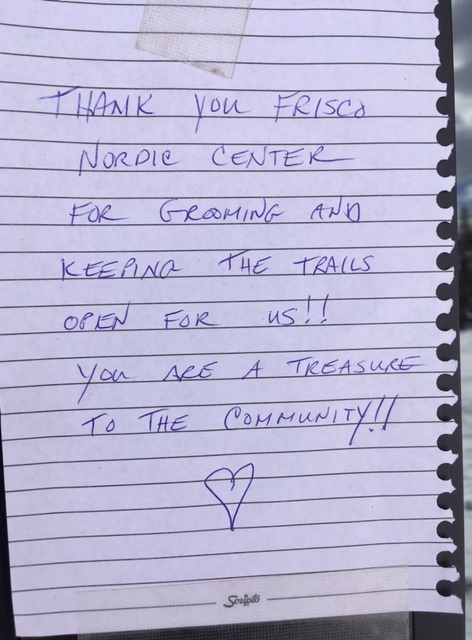
On that same round table discussion was Pete Swenson, the Frisco Nordic Center and Trails Manager based in Frisco, Colorado. The Frisco Nordic Center is owned and operated by the town, so it is able to utilize community health resources as it evolves to meet the guidelines for virus prevention. One aspect of experimentation that Swenson noted are virtual solo Strava races. The Town of Frisco is promoting a virtual solo trail running series balancing the need for social distancing with those looking for a taste of competition. In this case, registrants have a 48-hour window to run the specified course and upload the segment to Strava.
Swenson explained during the round table that the race format made him realize this might be a useful way, COVID or not, to bring more masters skiers onboard. With scheduling conflicts and life, oftentimes even a half-day commitment to race is untenable. A solo Strava option or category, Swenson said, would make sense for those skiers with less flexible schedules.
Swenson also offered advice to those seeking to hold race events next winter. As he worked through the protocols for the virtual solo series Swenson said he learned it is best to be proactive.
“I would advise anybody if you want to do events, the more protocols that you bring to the table, with your entities, [the better],” Swenson said. “Because I have to do, I have three layers if I want to do anything. I need a permit from the town even though we are the town, the county, as well as the Forest Service. What we have learned is that if you wait for them to tell you how to put the event on, it will never happen.”
What normal looks like come winter will most certainly bend the concepts of the show-up-and-ski many have become accustomed to. But that does not necessarily mean a poorer experience given the context of a global pandemic. Cross-country ski centers are focused on defining a normal that meets health guidelines while also keeping the ski experience the least disruptive as possible.
The new winter season holds promise. One anticipated dynamic is whether or not the sport can attract new skiers, much as the biking segment experienced significant growth since the pandemic’s onset. Much of that growth, according to a June 16th piece in Bicycle Retailer, was in the “beginner” category.
One certainty remains for ski centers and those responsible for welcoming skiers and deriving the template for operating safely come winter: The customer brings their own level of what Swenson calls COVID-anxiety. It’s one thing if locals are conditioned in the same environment to accept limits on their ski experience. That can be tricky in tourist towns. Cross-country ski center operators will most likely be dealing with visitors from outside their immediate region.
“Something we have learned to live with here [in Summit County], you cannot predict the level of COVID-anxiety of the consumer, you just don’t know,” Swenson said of the climate in and around Frisco which includes the recreation mecca of Breckenridge. “It is all over the map from ‘I don’t care’ to ‘I have had it’ to ‘this is very dangerous’, so it is a huge spread.”