
From the FasterSkier archive — posts syndicated from athletes’ and coaches’ own blogs between 2004 and 2012, kept online as published. Current coverage is at fasterskier.com.

Tag: cross-country ski preparation

  • Plyometrics: Where They Fit Within a Training Program

    Plyometrics: Where They Fit Within a Training Program

    This article was made possible through the generous support of our voluntary subscribers. If you value coverage like this, please support FasterSkier with a voluntary subscription.

    Where do Plyometrics Fit Within a Training Program

    Hint: You Don’t Start with Plyometrics

    Over the past few years there’s been a noticeable shift in how athletes and coaches talk about training. More emphasis on power. More interest in being “explosive.” That’s a good direction. Cross-country skiing is a power-endurance sport, and the ability to produce force quickly matters — whether it’s a finishing sprint, a tough climb, or simply skiing more efficiently at race pace.

    But as often happens, the optimal application gets missed. What I keep seeing is athletes jumping straight to plyometrics as if that’s where power development begins. It doesn’t. And when you start there, you usually end up with a lot of activity and not much adaptation.

    Plyometrics are not a shortcut. They are part of a progression — the conversion of maximal strength into power. Exercises like bounding, jumps, hurdles, and medicine ball throws can all be effective. But only when the athlete has the capacity to both absorb and produce force. Without that foundation, you’re not really training power. You’re mostly practicing jumping.

    That distinction matters more than most people think.

    I’ve used Tudor Bompa’s periodized strength model since the mid-1990s, and what still holds up is not the exercise list, but the sequencing. He didn’t build the model around movements. He built it around a logical progression. In my experience, that sequencing becomes even more important at the edges of the sport — junior athletes who are still developing and masters athletes who need to be more deliberate about how they load the system.

    And in that sequence, plyometrics come late. Not first.

    The progression is simple:

    1. Anatomical Adaptation (AA) — 4–8 weeks
    2. Maximum Strength (MS) — 6–8 weeks (minimum)
    3. Conversion to Power (CP) — 6–8 weeks
    4. Maintenance (M) — through the competitive period

    No shortcuts. No skipping steps. And no mixing phases and expecting the same result.

    Sweden’s Nicolina Lindquist jumping over Jake Pearson, of Cody, Wyo., during a strength workout at the USBA development camp in 2016 in Jericho, Vt.(Photo: Katrina Howe)

    Anatomical Adaptation

    The Anatomical Adaptation phase is the one most often underestimated, and it’s the reason a lot of strength and power work never turns into what it should. The goal here is not to get strong in the traditional sense. The goal is to prepare the athlete to train.

    That means building connective tissue tolerance, improving movement quality, and addressing the weak points most skiers share: eccentric control, single-leg stability, trunk stiffness under load, and upper body pulling strength. If those aren’t in place, everything that follows is limited.

    The work in this phase should look simple and controlled. Single-leg strength work like split squats, step-ups, and single-leg Romanian deadlifts (RDLs). Eccentric work like slow step-downs and controlled lowering. Trunk work that emphasizes force transfer, not just stability. Upper body pulling through a full range of motion. Even basic plyometric preparation — jump rope, small hops, controlled landings — but with the focus on coordination and tissue conditioning, not power.

    Two to three sessions per week is enough. The progression is not about maximizing loads. It’s about improving control under increasing demand. If this phase is done well, the athlete finishes it ready to train — not already fatigued.

    Max strength. (Photo: Corey Young)

    Maximum Strength

    From there, the focus shifts to Maximum Strength — and this is where many endurance athletes miss the point. Max strength is not circuits. It’s not high-rep fatigue work. It’s the ability to produce force.

    That means high load, low reps, and full recovery. Roughly 80–90% effort, sets of three to six reps, and enough rest between sets to maintain quality. The goal is not to exhaust the athlete. The goal is to improve motor unit recruitment and force production.

    For skiers, the work should still be sport-specific in its intent. Single-leg strength for the lower body — Bulgarian split squats, heavy step-ups. Posterior chain work — deadlifts, RDLs, hip thrusts. Upper body pulling — weighted pull-ups, heavy rows. And trunk work that connects the system under load, not isolates it.

    A session doesn’t need to be complicated. A few key movements, done well, with intent. Two to three sessions per week. Progress by increasing load, improving speed at the same load, and cleaning up movement under stress — not by constantly changing exercises.

    This phase is critical for a simple reason: you can’t convert strength you don’t have into power. In a sport already biased toward endurance, this is often the missing piece.

    Skate jumps with Chelsea Holmes back in 2014.

    Conversion to Power

    Only after that does the Conversion to Power phase make sense.

    Now the goal shifts. You’re no longer trying to get stronger. You’re trying to apply force faster. Rate of force development, timing, coordination, and the elastic qualities of muscle and tendon all become the focus.

    This is where plyometrics belong.

    The difference from the max strength phase is clear. Loads come down. Speed goes up. The movement patterns may look similar, but the intent is entirely different. If it’s not fast, it’s not power.

    That changes how the work is structured. Low volume, high quality. Three to six reps per set. Three to five sets. Full recovery. Stop when speed drops. This is neural work, not conditioning.

    Now the exercises make sense: bounding, especially uphill; single-leg hops; lateral bounds; reactive jumps; drop jumps, box jumps, hurdles. Loaded power work like jump squats and explosive step-ups. Upper body power through medicine ball throws and explosive pulling. And finally, ski-specific integration — bounding with poles, hill sprints, roller ski accelerations.

    If the power isn’t developing there, it’s not transferring.

    A session doesn’t need much. A handful of exercises, done with speed and intent. Two sessions per week is usually enough. More than that and you start turning power training into accumulated fatigue.

    This is also where athletes often get it wrong. They expect this phase to feel hard in the traditional sense. It shouldn’t. It should feel sharp. Explosive. Fresh. If it feels heavy and slow, you’re no longer training power.

    In the yearly plan, this phase typically sits in late summer or fall — after strength has been established and before racing begins. You’re not building the system at that point. You’re sharpening it.
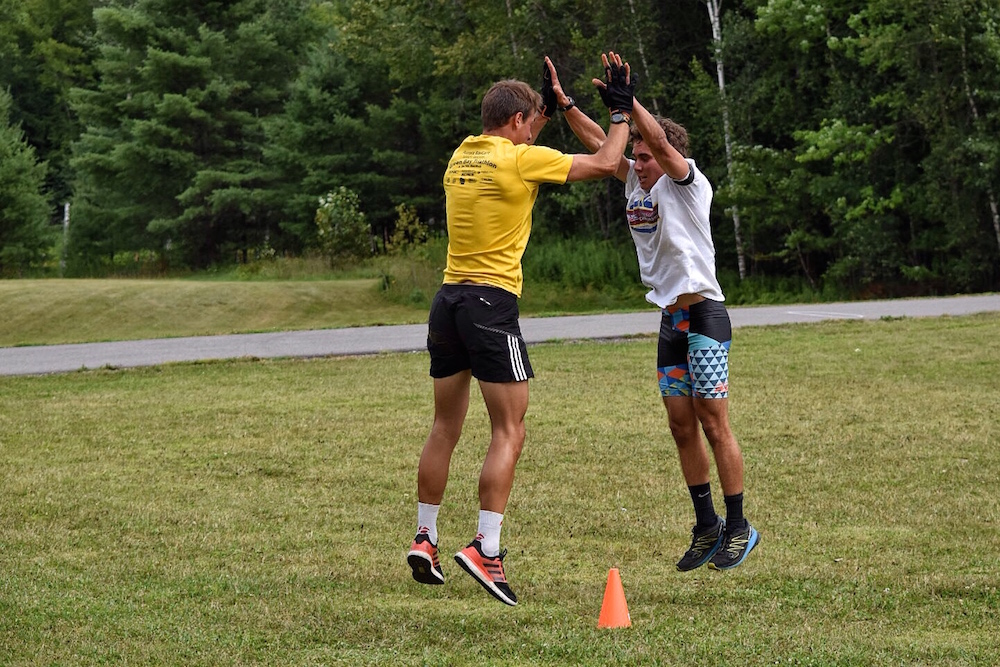
    Paul Schommer (l) and Jake Brown doing high-five partner burpees during a strength workout at the U.S. Biathlon development camp in Jericho, Vermont. (Photo: Katrina Howe)

    What This Looks Like in Practice

    What this looks like depends on the athlete. Younger athletes should spend most of their time on movement quality and basic strength, with only low-level plyometric work. Developing athletes need to build real strength first, then layer in plyometrics gradually. Senior athletes need to respect the sequence across the year — spring to rebuild, summer to get strong, fall to convert, winter to maintain.

    None of this is complicated. But it does require patience.

    There’s nothing wrong with plyometrics. Used at the right time, they’re one of the highest-return tools we have. But they’re not a starting point. They’re a finishing layer.

    Strength gives you the foundation. Plyometrics teach you how to use it.


    Help Support Our Olympic Coverage!

    If you value the thoughtful work and access FasterSkier provides, please consider becoming a Voluntary Subscriber. Your support directly fuels our work to cover the people, places, and moments that make our sport special.

    Join the FasterSkier community!
     

  • Eli Brown – The Ski Caddy

    Eli Brown – The Ski Caddy

    This article was made possible through the generous support of our voluntary subscribers. If you value coverage like this, please support FasterSkier with a voluntary subscription.

    Waxing Julia Kern’s skis in Toblach New Years 2026. (Photo: Courtesy Photo)

    On race mornings, when the athletes are still quiet, and the stadium hasn’t yet decided what kind of day it wants to be, Eli Brown is already working through choices that won’t appear anywhere in the results sheet.

    Brown is a technician for the U.S. Cross-Country Ski Team, a job title that undersells the reality of what he does. He manages ski fleets that can swell to dozens of pairs for each athlete, interprets snow that changes by the hour, balances structure, flex, base material, and wax, and does it all while standing between an athlete’s confidence and the unforgiving arithmetic of international racing. He describes the role with a metaphor that is so perfect and precise.

    “It’s kind of like being a golf caddy,” Brown said. “You’re advising. You’re coaching. You’re listening. There’s some sports psychology in there. And at the end of the day, it’s teamwork.”

    The difference, of course, is speed. Brown’s athletes are making decisions at speeds that at times surpass fifty kilometers an hour, on snow that doesn’t care how good yesterday felt. His job is to make sure they don’t have to think about their skis at all.

    This week, as the U.S. team arrives in Val di Fiemme for the 2026 Olympic Games, Brown is heading into his third Olympics as a full-time national team technician. He works primarily with Julia Kern and Ben Ogden, two athletes who could hardly be more different in how they move through the sport — or through their skis.

    What ties them together is Brown’s ability to translate snow into something usable and pressure into something manageable.

    The Mora (Minnesota) Vasaloppet in 1983. (Photo: Courtesy Photo)

    Before the Truck

    Brown didn’t arrive in the U.S. Ski Team wax truck by accident, or through a single decisive turn. He arrived there by staying in the sport long enough to see it from nearly every angle.

    He grew up outside Minneapolis, where skiing was part of the landscape rather than a specialization. From there, he headed north to Northern Michigan University, spending time embedded in one of the country’s most storied distance programs. He raced, trained, and lived the rhythms of high-level skiing there, even if the academic endpoint never quite aligned. The years mattered anyway.

    After Northern, Brown continued racing at a high level, lining up on the SuperTour with the Maine Winter Sports Center. Those seasons placed him squarely inside the domestic pipeline, moving between venues, teams, and support systems that most fans never see. It was an education in how competitive skiing actually functions in the United States — who does what, who makes decisions, and how outcomes are shaped long before race day.

    Coaching followed. Brown took over as head coach at the University of Utah, a role that asked him to shift from personal performance to collective responsibility. Coaching meant planning seasons, managing personalities, and learning how to communicate under pressure — skills that would later prove just as valuable off the racecourse as on it. It was also in Utah that he completed his degree, closing a chapter that had remained open since his time at Northern.

    His transition into technician work came gradually. After the 2014 Sochi Olympics, Brown began volunteering with the U.S. Ski Team as a tech, contributing where he could and learning how the national program operated from the inside. There was no formal on-ramp. He showed up, worked, and earned trust in the most durable way possible.

    Later that year, he became a full-time member of the U.S. Ski Team staff. He has remained in that role since, now heading into his third Olympic Games as a technician.

    That long, nonlinear path matters because it produced range. Brown understands athletes because he has been one. He understands coaches because he has been one. And he understands the demands of elite racing because he has lived alongside them for decades, in roles that rarely attract attention.

    By the time he steps into the wax truck now, Brown isn’t just a specialist. He’s a translator — carrying experience forward from each stage of his career and applying it quietly, in service of athletes who don’t have time to wonder how their skis came to be ready.

    Trailside support back in the 90’s. (Photo: Courtesy Photo)

    The Job Is Not the Ski

    Brown came up in an era when elite racers still did most of their own ski work. He’s part of what he calls “the last generation of full-time racers who maintained their own equipment,” a background that shapes how he approaches the modern technician’s role.

    Today, that role is far more layered than waxing alone. A tech has to understand how structure reduces suction in wet snow, how flex interacts with kick wax in classic skiing and changes contact on skate skiing, how base materials respond to temperature and moisture, and how all of that feels under an athlete who has preferences, moves differently, and skis faster than the tech ever will.

    “It’s complicated,” Brown said, describing how structure, grinds, and brands interact. “How it interacts with different brands and different grinds. Now we have to make sure that it interacts with our new grinds as we develop them, especially for race days in the games coming up.”

    The complexity has only increased in recent years. Product cycles are shorter. Wax formulations change constantly. “If you ask me what waxes we use,” Brown said, “it’s a combination of letters and numbers. From Swix or whoever. It’s always changing.”

    That instability has pushed the job away from recipes and toward judgment. Brown doesn’t describe himself as a scientist. He calls himself an artist.

    “I rely heavily on feel,” he said, contrasting his approach with colleagues who lean more on data. “There’s subjective testing, and that’s still really important.”

    The goal is simple, even if the path there isn’t: remove friction, remove doubt, and give the athlete skis they can trust without thinking.

    Julia Kern, Eli Brown, and Ben Ogden at the Planica World Championship. (Photo: Courtesy Photo)

    One Pair of Skis, Two Skiers

    Brown’s ability to individualize that trust is most obvious in the contrast between the two athletes he supports.

    “They’re such different athletes,” he said of Kern and Ogden. “And the way they ski, I think, is also different in the way that their ski brands are also different. So it’s hard to say there’s much crossover or similarity there.”

    Kern (Atomic) and Ogden (Madshus) race on different brands, which means separate quivers, separate development conversations, and separate ways of defining what “good” feels like. Over time, those preferences shape the skis themselves.

    “The quiver of skis develops kind of along with what the athlete wants,” Brown said. “Whether by effort or by chance.”

    For Brown, that means his own body becomes a tool — a reference point for athletes whose sensations he can’t fully replicate. In classic skiing, especially, the feedback loop is intimate and physical.

    “With Julia,” Brown said, “if I can feel the wax, then it’s good. And with Ben, I need to jump on those things and make them work. I need a hammer almost to keep up with him when he’s skiing easy.”

    Kern wants skis that give her clear feedback. Ogden wants skis that disappear under him.

    “She calls it the Eli Factor,” Brown said. “I ski in her skis a lot, and it’s like, yeah, she’ll like it if it feels a touch slow. And I question if it’s fast enough, then it’s perfect for her.”

    That calibration — knowing when “slow” is actually right — is the kind of knowledge that doesn’t show up in spreadsheets. It lives in repetition, in trust, and in the willingness to be wrong and adjust.

    Eli modeling the new Kappa kit inside the wax truck. (Photo: Courtesy Photo)

    Inside Yolanda

    The work happens inside a semi-truck the team calls Yolanda, a mobile workshop and nerve center that houses eight technicians during World Cup weekends and championships.

    “When you walk into Yolanda,” Brown said, “on the left, there’s Jason. He’s like the door security.”

    Jason Cork oversees Jesse Diggins’ skis and manages data. Across from him sits Chris Heckler, the team’s glide specialist, responsible for Gus Schumacher’s skis and for pushing development at the cutting edge. In the back corner is Oleg Ragilo, “a quiet boss from Estonia,” the head of kick wax and the truck’s mechanic. Tim Baucom, recently returned from retirement, handles hand structure. Bernie Nelson works with Jack Young and specializes in high-speed testing and emotional steadiness. Bjorn Heimdal and Per Erik Bjørnstad, both from northern Norway, bring decades of experience across glide and kick.

    “And then at table three,” Brown said, “it’s Bernie and me.”

    Everyone can wear any hat if needed, but the structure matters. Decisions are made by conversation, testing, and sometimes by vote. Kick wax choices are made by committee — “two out of three or three out of three votes advance skis” — a system designed to protect athletes from any single person’s blind spot.

    There’s humor inside the pressure. The team maintains a set of traveling trophies, passed around to mark gratitude, effort, or apology. It’s a way of acknowledging that success and failure are shared.

    “You’re on a roller coaster together,” Brown said. “The emotional roller coaster part.”

    Team Kern: Eli Brown, Julia Kern, and Kristen Bourne in Toblach. (Photo: Courtesy Photo)

    Relearning Speed

    The current era of ski preparation is defined by change. Products come and go. Environmental and health concerns have reshaped what’s allowed. Even trusted solutions can’t be trusted for long.

    “We’re on the cutting edge,” Brown said, “and it’s constantly changing.”

    That volatility has made high-speed testing more important than ever, especially in skate races where structure and glide decisions can hinge on how skis behave at race pace on the actual course. Hand structure tools, brand-specific grinds, and new base materials all interact in ways that don’t fully reveal themselves on paper.

    Brown sees his role as filtering that uncertainty before it reaches the athlete.

    “I don’t want them thinking about it,” he said. “I want them to just ski.”

    The Olympics compress all of that work. The venue in Val di Fiemme is familiar, but transformed by Olympic infrastructure. Warm weather looms as a wildcard. The margin for error narrows.

    Looking back on the Tour de Ski, Brown is candid about what he’d change. “I wish I’d given Julia slightly more kick,” he said. “Ben slightly less kick.”

    That kind of reflection isn’t self-flagellation. It’s the process.

    Eli and fiancé Colleen above snowy Predazzo days before the Olympics start. (Photo: Courtesy Photo)

    The Emotional Work

    If the technical demands are invisible, the emotional ones are even more so. A tech absorbs disappointment, so an athlete doesn’t have to. He steadies confidence when results wobble. He celebrates quietly when things click.

    Brown talks about success in broader terms than medals.

    “Gold is the goal,” he said. “But it’s also maintaining team relationships and health through an intense period.”

    That perspective extends beyond race results to the ecosystem around the sport. Brown worries about industry instability, about layoffs and shrinking budgets, about whether the work he and others do will continue to be supported.

    “We’re all one big community trying to do something special,” he said. “It’s my little cog in the machine.”

    Inside Yolanda, that belief takes practical form. Shared meals. Shared jokes. Shared responsibility when something goes wrong. The trophies circulate. The work continues.

    Skiing the 2025 Birkie with his dad, Elton Brown. (Photo: Courtesy Photo)

    What Happens When It Works

    When it works, there’s no single moment that announces it. No flag. No statistic. Just an athlete skiing freely, unencumbered by doubt.

    Brown watches from the side of the course or from inside the truck, reading body language, listening for feedback, and filing away information for the next decision. The skis disappear. The job is done.

    That’s the paradox of being a golf caddy or maybe more accurately a ski caddy: success means becoming invisible.

    For Eli Brown, that invisibility is the point.


    Help Support Our Olympic Coverage!

    FasterSkier will have our own Nat Herz on the ground at the Olympics, which, to be honest, is a very big financial lift for us. If you value the thoughtful work and access FasterSkier provides at championships like this one, please consider becoming a Voluntary Subscriber. Your support directly fuels the work we do to cover the people, places, and moments that make our sport special.

    Join the FasterSkier community!


    Eli and fiancé Colleen doing some pre Olympic cruising. (Photo: Courtesy Photo)