From the FasterSkier archive — posts syndicated from athletes’ and coaches’ own blogs between 2004 and 2012, kept online as published. Current coverage is at fasterskier.com.
This article was made possible through the generous support of our voluntary subscribers who have helped put our Nat Herz on the ground at the Olympics. If you value coverage like this, please support FasterSkier with a voluntary subscription.
At the Olympic Women’s Skiathlon podium press conference in Val di Fiemme, the three medalists provided insight into their performances, discussing equipment choices, team dynamics, and the mental preparation that shaped one of the Games’ defining races.
Heidi Weng, who earned bronze, reflected on the significance of winning a medal at a venue tied closely to her career. Thirteen years after claiming her first major championship medal in Val di Fiemme, Weng spoke with noticeably more confidence — in English — while acknowledging the emotional weight of racing, bolstered by the presence of her Italian wax technician. Technically, Weng admitted the classic portion of the race was stressful, particularly on the uphills where grip felt uncertain. The race turned for her once she switched to skating, where she immediately felt freer and more powerful. Despite Olympic stakes, Weng said her routine remained largely unchanged from previous championships, with only a sharper focus on the moment.
Gold medalist Frida Karlsson fielded questions that ranged from equipment to philosophy. She revealed she raced the classic leg on a 10-year-old pair of skis she affectionately called her “golden pair,” skis she has owned since before becoming an elite athlete and which seem to resurface whenever championships arrive. Karlsson also described her unconventional training approach, explaining that she does not track heart rate or lactate and instead trains by feel. She credited recent altitude camps with Norwegians Johannes Høsflot Klæbo and Emil Iversen for teaching patience and discipline.
Much of Karlsson’s confidence, she said, stemmed from the Swedish team environment. With multiple athletes capable of winning gold, the squad has embraced a shared mentality built on mutual belief. Seeing teammates succeed reinforces the sense that winning is possible — a mindset cultivated intentionally through visualization during team meetings before the race.
Silver medalist Ebba Andersson echoed those themes, describing her long partnership and rivalry with Karlsson at both club and national levels. That history, she said, has transformed competition into inspiration, pushing both athletes to higher levels. With another Olympic opportunity approaching later in the week, Andersson emphasized that momentum and belief remain high.
Together, the press conference painted a picture of an Olympic podium shaped as much by trust — in skis, teammates, and oneself — as by tactics and fitness, underscoring why this skiathlon resonated far beyond the finish line.
On the ground reporting by FasterSkier’s Nat Herz.
Help Support Our Olympic Coverage!
FasterSkier has our own Nat Herz on the ground at the Olympics, which is a significant financial lift for us. If you value the thoughtful work and access FasterSkier provides at championships like this one, please consider becoming a Voluntary Subscriber. Your support directly fuels our work to cover the people, places, and moments that make our sport special.
This article was made possible through the generous support of our voluntary subscribers who have helped put our Nat Herz on the ground at the Olympics. If you value coverage like this, please support FasterSkier with a voluntary subscription.
Ebba Andersson (SWE), Frida Karlsson (SWE), Astrid Oeyre Slind (NOR), Jessie Diggins (USA), and Teresa Stadlober (AUT), (l-r) lead the field out of the start during the opening race, the 20 k Skiathlon, at the 2026 Milano-Cortina Olympic Winter Games in Tesero, Italy. (Photo: Vanzetta/NordicFocus)
PREDAZZO, ITALY — The snow in the Tesero Cross-Country Ski Stadium sat in that uneasy middle ground—soft, glazed, and ready to decide races in small, brutal ways. It sat like the snow of March more than that of early February, ready to punish skis that went outside of the traffic lines, a little slushy where the sun found it, and it turned the opening day of Olympic cross-country into something more challenging than spectacular. Not just strength, not just tactics—also the small, decisive physics of momentum lost and regained, of skis that either release cleanly or cling, of a tip that vanishes into wet snow at exactly the wrong moment.
A Skiathlon is built to expose those details. Ten kilometers of classic to write the first draft—who’s fresh, who’s brave, who’s overreaching—then a transition that feels like a breath held too long, then ten kilometers of freestyle to reveal what was real and what was merely early. It is the most honest event on the program and, sometimes, the cruelest: it doesn’t only ask who is the best skier today? It asks what else failed to cooperate?
On Saturday in Val di Fiemme, Sweden arrived with a plan that looked less like a plan than a certainty. Frida Karlsson (SWE) and Ebba Andersson (SWE) skied the opening classic like athletes who had been waiting for this specific hour, not simply training toward it. Heidi Weng (NOR) carried her own bright energy into the skate leg and outlasted the late cracks around her for bronze. Behind them, the Americans—Jessie Diggins, Julia Kern, Rosie Brennan, and Novie McCabe—worked through a day where the sensations were often better than the splits, and where Diggins’ race, in particular, became a case study in how thin the margin is between a medal and an explanation.
Ebba Andersson (SWE) and Frida Karlsson (SWE), (l-r) showed they were in top form throughout the race. (Photo: Vanzetta/NordicFocus)
Sweden’s patience, Sweden’s pressure
The results tell the shape of it quickly. Karlsson won in 53:45.2, Andersson followed 51 seconds back, and Weng took bronze at 55:11.9.
But the split ranks show how they built it.
Karlsson was first at 10 k at the end of the classic leg (27:24.4) and the fastest split again in the 10 k freestyle segment (25:49.7).
For Karlsson, the victory arrived with clarity rather than chaos. She said the moment only fully registered when she grabbed the Swedish flag in the finish straight — when she realized it was real. The skis, she said, were “super,” the body “felt amazing,” and the alignment of those pieces reflected years of work with her coach and team. “I’ve never been as much in love with skiing as I am now,” she said, calling the win a once-in-a-lifetime moment — one she plans to ride forward, rather than dissect.
The only athlete under 26 minutes on the skate leg. Andersson was right there in classic—third at 10 k (27:25.3)—then held her silver with the fourth-fastest skate segment (26:41.1).
Andersson framed the result not as a surprise but as an arrival. “It means a lot,” she said, noting that this was her third Olympic Games but her first individual Olympic medal. In conditions she described as “very wet” and mentally taxing, she said the race demanded constant commitment — the willingness to keep the pace even when fatigue made that decision feel irrational. It was, she added, the product of a preparation plan she trusted, one that now allowed her to move forward with momentum rather than relief.
Heidi Weng (NOR) was a bit off during the classic leg, but found her legs during the freestyle leg to charge her way to the bronze medal. (Photo: Vanzetta/NordicFocus)
Weng’s race was the opposite kind of inevitability: not the best classic, but close enough (fifth at 10 k, 28:03.6) to keep the door open; then the second-fastest freestyle leg (26:34.8) to kick it in.
Weng later confirmed that the race unfolded exactly as those lines indicated. She said she didn’t feel at her best during the classic portion, but once those skis came off, “I had so much power. It was an amazing feeling.” Despite nerves she described as the strongest she’d ever felt, the skate leg became something closer to joy — three laps where she felt happy rather than hunted, and where her energy proved decisive.
This was the story on the ground, too: a front group that looked stable until it didn’t, and then a medal fight that shifted from who can hang on? to who still has electricity when everyone else goes dim.
Astrid Oeyre Slind (NOR) went for the win, coming into the exchange with the top Swedes, but faded in the freestyle. (Photo: Barbieri/NordicFocus)
Astrid Øyre Slind (NOR) deserves her own paragraph because she skied the first half like a spoiler and the second half like a warning. At the changeover, Slind was second at 10 k classic (27:25.0), effectively welded to the Swedish pair, the one non-Swede who could match their calm pace on the front end. Then the skate leg happened. Her freestyle segment (27:44.2) was 13th-fastest, and she slid from the medal conversation to sixth overall.
Afterward, Slind didn’t pretend it was anything else. She said she “completely died out there” on the skate portion and described the skate leg as feeling “hopeless.” That’s Skiathlon truth: you can be perfect for half a race and still spend the other half paying interest.
Jessie Diggins (USA) fell at an unfortunate time during the first lap and did not have great skis during the classic. (Photo: Vanzetta/NordicFocus)
Diggins, the season-long wager
Jessie Diggins finished eighth, 2:21.1 behind Karlsson. If you only read that line, you might miss the more useful information for the rest of these Games: Diggins’ body is not the problem.
Her splits are almost paradoxical. Diggins was 15th at 10 k (28:52.8), and then she produced the third-fastest freestyle segment (26:39.1) in the entire field. If the Olympics are an argument about peaking, that’s evidence—strong evidence—that she arrived with the fitness to fight for wins.
Diggins said as much in the mixed zone, with microphones practically stacked in front of her. “I am in the best shape of my life, and my body felt really, really good,” she said.
And yet, she also sounded like an athlete reciting the essential checklist for how an Olympic race has to go right. “There are a lot of things that need to come together for a good ski race to happen,” she said, describing “puzzle pieces” that “need to lock into place.”
Diggins came into these Olympics after a season that asked her to be visible everywhere—chasing the overall World Cup Crystal Globe, carrying the weight of expectation that comes with being the most decorated U.S. cross-country skier in history. The critique is familiar and not irrational: race too much, arrive tired. Diggins’ counter-belief is equally familiar and, for her, historically true: racing sharpens her, racing brings her up to her best. Saturday’s skate split supports Diggins’ version of the story.
So why wasn’t it a medal day?
Start with the two things Diggins named immediately: a fall, and classic skis that weren’t working the way they needed to.
“I had a crash on the first lap where my tip just disappeared in the slush,” she said, and she explained why that particular spot mattered: “it was a tough spot where you lose all your momentum.”
Jessie Diggins (USA) posted the third fastest freestyle leg, eventually catching Teresa Stadlober (AUT) to finish in eighth place. (Photo: Barbieri/NordicFocus)
Then came the other part—more delicate to describe, but impossible to ignore at this level: “the classic half, the things out of my control did not go very well,” Diggins said.
U.S. program director Chris Grover was more explicit in his post-race assessment, saying the team missed the classic setup—“wrong kick/glide combination”—and that Diggins spent too much energy working in classic as a result. In a skiathlon, “working too hard” in the first half is rarely just a feeling; it becomes a number later.
The key nuance—one that should frame every Diggins paragraph for the rest of these Games—is that she didn’t implode. She stabilized. The crash cost time and, maybe more importantly, cost free speed at the exact moment the course turned back uphill. But Diggins insisted the crash itself wasn’t the main reason the day slipped away. “The crash wasn’t that big of a deal to me,” she said. “Yes, I did lose some time, but that wasn’t the bigger problem today.”
Her response was almost clinical: “stay calm, work your way back… ski the best that you can ski.” And that’s what the freestyle split looks like: not panic, not surrender—just the third-fastest skate leg in the field.
If you want an Olympic moral, it is probably this: peak fitness is necessary; it is not sufficient. You need skis. You need timing. You need the kind of luck that doesn’t show up on the wax chart but reveals itself when your tip either rides the slush or dives into it.
Heidi Weng (NOR) celebrates the bronze medal as she crosses the line. (Photo: Vanzetta/NordicFocus)
The bronze fight that became an energy test
Behind the Swedish gold-silver pairing, the day’s most compelling drama was the fight for third—because it kept changing hands in real time as athletes discovered, one by one, what they’d brought to the skate leg.
Weng’s bronze was not a casual podium; it was earned by acceleration. Her second-ranked freestyle segment (26:34.8) is the signature of someone who didn’t just survive the transition but arrived there with something stored.
Nadja Kälin (SUI) finished fourth—her best-ever Olympic result by a wide margin—and her race reads like a smart decision made early and defended late. She described saving energy during the classic portion and then trying to go with Weng when the medal became available, only to find Weng “too strong.” Kälin’s splits support that she belonged in that conversation: eighth in the classic and sixth on the freestyle segment, good enough to hold fourth overall.
Slind’s fade is the counterexample—proof that no classic heroism is automatically convertible into skate speed in wet conditions.
And if you want to understand why Weng’s energy mattered so much, look at who clustered just behind the podium: Kerttu Niskanen (FIN) in fifth, Slind sixth, Katerina Janatová (CZE) seventh, then Diggins eighth. This was not a race where the field shattered completely; it was a race where the last ten kilometers graded everyone on what they had left.
Rosie Brennan (USA) was the top American halfway through the race as she came into the transition to freestyle. (Photo: Vanzetta/NordicFocus)
The rest of the Americans—plans, pride, and the grind
Behind Diggins, the U.S. women had a day that was quieter on the leaderboard but still useful for the team’s internal map of these Games.
Julia Kern finished 24th in a photo finish cluster at 58:02.4. Novie McCabe was 26th at 58:06.1. Rosie Brennan finished 37th (1:00:06.0).
Julia Kern (USA) was the second fastest American, skiing to 24th place. (Photo: Vanzetta/NordicFocus)
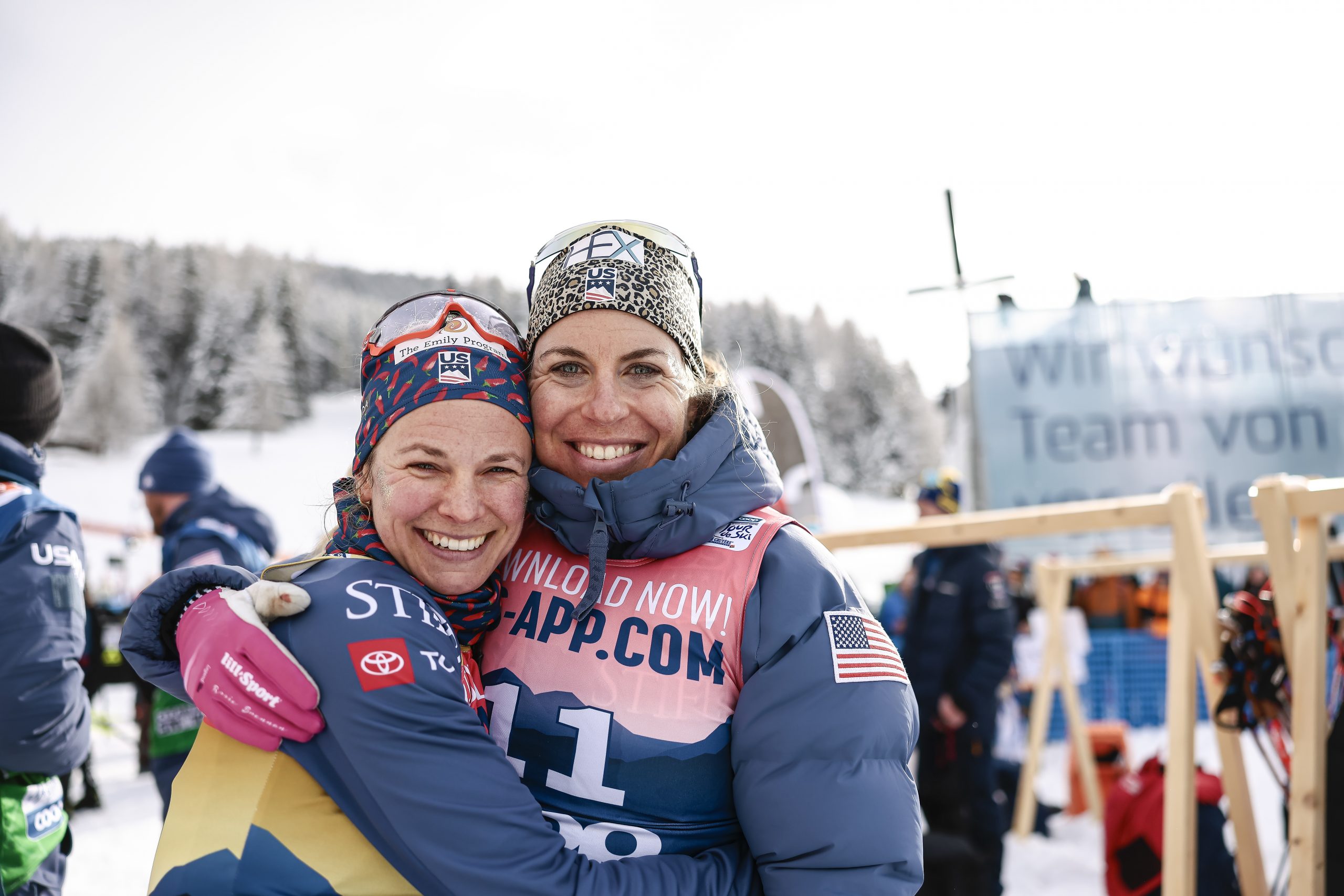
Kern framed her race as execution—sections where she wanted to push, moments where she wanted to draft and guard technique—and, in classic Kern fashion, she made it sound like survival was an intentional skill: she said she “died 20 times” and “kept coming back to life.”
Novie McCabe (USA) fought her way to 26th place on the day. (Photo: Barbieri/NordicFocus)
McCabe called the race “medium,” said the classic start felt hot and chaotic, and described finding her groove later. In the mixed zone, she also pointed to the team atmosphere—“super amazing,” “keeping things light”—which matters more than it sounds like it does when you’re staring down two weeks of Olympic pressure.
Although she faded in the freestyle leg, Rosie Brennan (USA) showed she is in great classic form. (Photo: Vanzetta/NordicFocus)
Brennan’s day is its own category because it intersects with something bigger than form: health. In the mixed zone after the race, she discussed external iliac endofibrosis restricting blood flow to her legs and causing cramping during skating, while also noting that her classic skiing felt in good shape. That context makes her split profile feel less mysterious: she was 16th at 10 k, but 49th on the freestyle segment.
Rosie Brennan (USA) has been dealing with health issues that have made skating especially challenging, but her teammates were there to help at the finish. (Photo: Barbieri/NordicFocus)
Grover acknowledged the same dynamic—good classic sensations, skating limitations—and framed it as information the team can carry into the rest of the championships.
That’s what opening-day races do at the Olympics. They crown medalists, yes. But they also establish what kind of Games it might be—for each athlete, for each wax room, for each team trying to decide where to spend its confidence.
Ebba Andersson (SWE), Frida Karlsson (SWE), and Heidi Weng (NOR), (l-r) celebrate the first cross-country ski podium of the Olympic Winter Games. (Photo: Vanzetta/NordicFocus)
What Saturday revealed about the Games to come
The easiest narrative is Sweden’s. Karlsson and Andersson made a statement that wasn’t only about today: first race, first chance, gold and silver, with Karlsson posting the fastest classic and the fastest skate segment in the field. It’s the kind of performance that turns the rest of the women’s field into economists—studying gaps, calculating where time can be found, wondering if the Swedes are simply better or if their timing and preparation have landed more perfectly on this particular snow.
But the more interesting narrative, especially from an American perspective, is Diggins’ split sheet.
Eighth place is not what she came here for. She said it plainly in the way she talked about home, community, and wanting to race in a way that “make[s] them proud.” Yet the race also offered a kind of reassurance that you don’t always get when a favorite misses the podium: the fitness signal is green.
Diggins’ third-ranked freestyle segment is the kind of number that doesn’t happen by accident. It suggests that the season-long wager—the racing, the belief that racing sharpens her rather than dulls her—has not left her empty. It suggests that if the U.S. team can find the right skis in the same wet, tricky conditions, Diggins can still play offense in the remaining distance races.
Ebba Andersson (SWE), Frida Karlsson (SWE), and Heidi Weng (NOR), (l-r) celebrate on the Olympic podium of the Women’s 20 k Skiathlon. (Photo: Barbieri/NordicFocus)
And it also reinforces the oldest Olympic truth: medals are rarely won by having one thing go right. They are won when the body is ready, and the skis are right, and the moment doesn’t ask for a recovery surge at the exact place where momentum is hardest to rebuild.
Diggins, asked how she recalibrates, returned to process: calm, work back, ski your best. She also sounded, quietly, like an athlete relieved to have begun. “It’s nice to know… my body’s in a good place,” she said. “It’s nice to get things rolling and get into the rhythm of things.”
The Olympics are never a single race. They are an accumulating story, written in conditions that change by the hour and decided by margins so small they can be hidden inside a clump of slush. On the opening day in Val di Fiemme, Sweden wrote the cleanest version of that story—sharp, bright, and undeniable.
Everyone else wrote something messier. But messy doesn’t mean finished.
For Diggins and the U.S. team, Saturday was the frustrating kind of evidence: proof that the engine is there, paired with proof that the sport still demands the other pieces. The Skiathlon exposed the puzzle, exactly as it is. Now the Games move on, and the next start will ask a simpler question—one that is still brutally hard to answer:
Can all the pieces lock into place on the same day?
Olympic Winter Games – Women’s Skiathlon – RESULTS
On the ground reporting by FasterSkier’s Nat Herz.
Help Support Our Olympic Coverage!
FasterSkier has our own Nat Herz on the ground at the Olympics, which is a significant financial lift for us. If you value the thoughtful work and access FasterSkier provides at championships like this one, please consider becoming a Voluntary Subscriber. Your support directly fuels our work to cover the people, places, and moments that make our sport special.
Norway’s greatest competitive advantage in cross-country skiing has always been depth. In an Olympic selection season, that depth becomes a headache. When the federation gathered to finalize its 2026 team, the conversation was not about who belonged at the Games — those results and calculus had been logged. It was about which version of the team could survive illness, underperformance, and the cruel compression of Olympic schedules. For several skiers who have already proven themselves capable of standing on a World Cup podium — and perhaps even an Olympic one — the answer would be no. Not because they weren’t good enough. But because someone else fit the puzzle a fraction more cleanly.
Johannes Hoesflot Klaebo (NOR) leads a train of Norwegian men in Lahti (FIN) last March. (Photo: Thibaut/NordicFocus)
Eight Men, Eight Women — Complete
The Norwegian cross-country Olympic squad now includes eight men and eight women, a balance that reflects the depth of talent and strategic breadth of Norway’s cross-country program.
With these 16 names confirmed, Norway’s roster boasts a mix of seasoned champions and hungry young stars — from Klæbo’s Olympic pedigree to Vike’s breakthrough sprint talent.
Harald Oestberg Amundsen (NOR), Mattis Stenshagen (NOR), Johannes Hoesflot Klaebo (NOR), Emil Iversen (NOR), Jan Thomas Jenssen (NOR), Erik Valnes (NOR), and Martin Loewstroem Nyenget (NOR), (l-r) come up the final climb during the Skiathlon in Trondheim (NOR) in December. (Photo: Modica/NordicFocus)
The Final Pieces of a Puzzle: Iversen and Vike
For weeks, the most hotly debated part of Norway’s Olympic selection revolved around the last two men’s spots.
Emil Iversen, the veteran 34-year-old World Cup stalwart and World Champion team sprinter, secured one of the final berths — a decision that stirred both emotion and controversy. Iversen missed out on earlier national team standing but made a compelling case this season with solid World Cup performances, including in Tour de Ski events that carried significant weight in the selection criteria.
On the younger side, Oskar Opstad Vike earned the final spot. The 22-year-old sprinter’s rise — riding strong sprint results, including a World Cup top ten — gave the selectors a promising specialist to bolster Norway’s Olympic squad.
The decision to include one established distance racer (Iversen) and one sprint threat (Vike) over alternative combinations was no accident. It reflects not only this season’s results but also the complexity of Olympic event programming — multiple distance races, relays, and sprint competitions demand versatility and redundancy.
Emil Iversen (NOR) during the Skiathlon in Trondheim (NOR) earlier this season. (Photo: Modica/NordicFocus)
What Was on the Line
Norway’s selection strategy rested on ranked criteria that put top priority on World Cup results this season, followed by last season’s performances and past championship achievements. This emphasis on objective metrics aims to ensure that the athletes selected are not just popular choices, but the ones statistically most expected to deliver in Val di Fiemme.
It’s no surprise that Johannes Høsflot Klæbo leads the team — the multiple World Cup overall and sprint title holder is already one of the greatest of all time, and his results this season keep him in clear contention for medals across disciplines.
Meanwhile, Mattis Stenshagen has been one of the season’s breakout distance performers, boasting both World Cup podiums and a strong Tour de Ski showing that solidified his place on the team.
Erik Valnes (NOR), Johannes Hoesflot Klaebo (NOR), and Oskar Opstad Vike (NOR), (l-r) share the podium in Falun (SWE) in last season. (Photo: Modica/NordicFocus)
Notable Near-Misses and Debates
Not everyone who hoped for an Olympic ticket got one.
One of the most talked-about stories this season was Lars Heggen, the 20-year-old sprint phenom who has burst onto the scene with impressive results, including a World Cup sprint victory this past weekend. Many voices in ski media argued passionately for his inclusion, citing his explosive form and tactical range. But in the end, selectors opted for experience and proven Olympic relevance — a choice that sparked debate across Norway and beyond.
Another compelling case was Andreas Fjorden Ree, whose World Cup performances and near-victory finishes led many to forecast him as a certain medal contender. His exclusion — by mere fractions in selectors’ evaluations — was described as “brutal” by some commentators, underscoring just how competitive this national squad truly is.
Kristine Stavaas Skistad (NOR) leads Maja Dahlqvist (SWE) down the homestretch of the opening stage of the Tour de Ski in Toblach (ITA) in December. (Photo: Modica/NordicFocus)
Women’s Squad: Balance of Experience and Youth
While the men’s selection drama took center stage, the women’s squad also reflects a dynamic mix of talent:
Veterans like Heidi Weng bring Olympic experience and tactical acumen.
Sprinters and all-rounders like Kristine Stavås Skistad and Karoline Simpson-Larsen add valuable firepower.
Milla Grosberghaugen Andreassen and Ingrid Bergene Aabrekk represent the up-and-coming generation making their impression through World Cup and Norwegian Championship results.
Selectors reportedly evaluated performances not just from the World Cup and Tour de Ski, but also through the Norwegian National Championships — especially when managing variables like injury and form.
Heidi Weng (NOR) during the final climb of the Tour de Ski in Val di Fiemme (ITA) earlier this month. (Photo: Vanzetta/NordicFocus)
Looking Ahead — Milan-Cortina 2026
The Winter Olympics kick off on February 6, 2026, and cross-country skiing begins early with the women’s skiathlon on February 7. In Val di Fiemme — a venue steeped in Nordic history — Norway will arrive with one of the deepest teams in the field.
For a nation where cross-country skiing is practically a national pastime, these selections carry huge anticipation. Every name on this roster is now poised to chase Olympic gold, silver, or bronze — but behind them are stories of near-misses, fierce competition, and strategic choice-making that defined this winter’s most compelling selection drama.
Let the Games begin.
Love Stories Like This? Help Keep Them Coming.
Feature stories like this one take time, access, and care to produce. If you value thoughtful storytelling and independent ski journalism, please consider becoming a Voluntary Subscriber. Your support directly fuels the work we do to cover the people, places, and moments that make our sport special.
The start of the US National Cross-Country Ski Championship Men’s 20 k Freestyle Mass Start. (Photo: Nancie Battaglia)
There are moments in endurance sport when the noise falls away—not because the stakes are small, but because they are too large to announce themselves loudly. The men who gathered on the start line at Mount Van Hoevenberg on Thursday afternoon understood that kind of quiet. The banners said US National Championships. The calendar said 20 k Freestyle Mass Start. The course—four laps of five kilometers, stitched together by long climbs and fast descents—said this will be honest. But the silence said Olympics!
For much of the week in Lake Placid, honesty had come quickly. The 10 k classic individual start exposed margins. The sprint laid bare specialization. By the time the men lined up for the 20 k Freestyle Mass Start, the argument had narrowed. There were medals to be won, yes, but more importantly, there were questions still unresolved about who might fit through the narrowing door of Olympic selection.
For Zanden McMullen, the stakes were explicit. “Today’s race was a ‘one shot, one opportunity’ type of race for me,” he said later. He knew that anything short of a win would leave his Olympic case incomplete. That knowledge sat heavily over the first kilometers—not as panic, but as pressure carefully managed.
What followed was not a race that fractured early or declared itself with theatrics. Instead, it unfolded as a study in restraint.
A large, shifting group stayed at the front early on in the race. (Photo: Nancie Battaglia)
A Race That Refused to Break
From the opening lap, the field behaved in a way that confounded expectations. In contrast to the women’s race earlier in the day, no decisive break formed. Attacks surfaced briefly—on climbs, into transitions—but were quickly absorbed by the physics of the course. Downhills regrouped the field. Drafting mattered. The snow was fast, the air cold enough to preserve glide, and separation proved expensive.
John Steel Hagenbuch allowed himself to drift deep into the pack early—sometimes close to twentieth—an approach that looked counterintuitive given both his fitness and his history on the course. It was neither indecision nor passivity. “I was just staying relaxed and letting people work out some energy that I knew wasn’t going to result in any meaningful gain,” he explained. “Racing in the U.S. is very different than racing on the World Cup, and being able to relax at the start of a mass start race is perhaps the best example of that.”
Zanden McMullen (APU) and his APU teammates Hunter Wonders (#208) and Luke Jager (#204). (Photo: Nancie Battaglia)
The early splits reflected this tension. Leaders rotated through the front, but gaps rarely exceeded a handful of seconds. By the midpoint of the race, the field had thinned not through violence but through attrition—skiers falling off the back as the pace remained relentlessly honest.
McMullen, meanwhile, adhered to a plan that demanded patience. “My race strategy was to conserve as much energy as possible,” he said. “Every time a move was made, I made sure to match it calmly but decisively.” By the second lap, he sensed the race’s texture changing. The pack stretched. Breathing deepened. The small inefficiencies of earlier surges began to show.
Zach Jayne, consistently present near the front group, felt that tension acutely. “Holding position is always difficult,” he said. “So being aware while racing is important.” In a race defined by proximity rather than separation, awareness became a skill as valuable as strength.
Olivier Leveille (CNEPH), John Steel Hagenbuch (Dartmouth), Zanden McMullen (APU), Jakob Elias Moch (CU), and Brian Bushey (Craftsbury) (l -r). (Photo: Nancie Battaglia)
Decisions Not Taken
If the race hinged on a single moment, it may have been defined instead by two moments when nothing happened.
Hagenbuch identified them clearly. The first came at the start of the third lap, at the base of the long climb—a place where he has both won and lost races before. “Looking back at it now,” he said, “the one that makes me wonder the most is the decision to not attack on the third lap.” His reasoning was sound. The conditions were fast. The field regrouped quickly on descents. “In order to get away, you would have to be very fit and have the best skis in the race,” he said. Unsure that any gap would hold, he chose restraint.
Mons Melbye (UU) leads Zanden McMullen (APU) and John Steel Hagenbuch (Dartmouth), and Jakob Elias Moch (CU) (r – l) down the final downhill into the stadium. (Photo: Nancie Battaglia)
The second moment arrived on the final sprint climb before the descent into the stadium. Again, Hagenbuch assessed the cost-benefit. He believed he could crest first—but likely only to be swallowed by the draft. “As such, I decided to follow Zanden over the top,” he said. “I think this was the correct thing to do tactically.”
That calculus—when to go, when to wait—defined the race for several athletes. McMullen made the same choice from the opposite perspective. “There was no need to do anything rash,” he said. “Just go out and race hard and smart.”
The result was a front group of four that arrived at the final kilometer together, legs full but not shattered, tension compressed into seconds.
Zanden McMullen (APU) and John Steel Hagenbuch (Dartmouth) follow Jakob Elias Moch (CU) near the end of the race. (Photo: Nancie Battaglia)
The Finish
As the leaders dropped off the final descent and into the stadium, the race became what everyone suspected it would be: a matter of position, timing, and nerve.
McMullen entered the final stretch calm by design. “During the final lap, I knew it would come down to the final meters,” he said, “and I just made sure to relax as much as I could.”
Hagenbuch, attempting to execute his finishing move, found the narrow margins of mass-start racing unforgiving. “Getting around Jakob was the crux move of the finishing maneuver I was trying to execute,” he said. “And there just wasn’t enough room for me to come around.” Pushed slightly wide through the final sweeping corner, he lost the speed he needed. “That’s racing,” he added. “It didn’t pan out, but it doesn’t always.”
McMullen surged cleanly to the line, stopping the clock at 47:37.0. The University of Utah’s Mons Melby was 7-tenths of a second behind, with Hagenbuch a second from the win for third. Behind them, the rest of the field streamed in—gaps small, order consequential.
Zanden McMullen (APU), John Steel Hagenbuch (Dartmouth), and Jakob Elias Moch (CU) — with Mons Melbye (UU) off camera — come down the finish stretch. (Photo: Nancie Battaglia)
What the Race Revealed
On paper, the result was simple: a national champion crowned. In context, it was anything but.
For McMullen, the victory represented survival as much as success. “The Olympic selection has definitely been looming over my head all week,” he admitted. The stress was real. So was the clarity. He did what he could do.
For Hagenbuch, the outcome carried both frustration and resolve. “I still have faith that there is a path for me to the Olympics,” he said, while acknowledging that the decision now sits elsewhere. He stood by his choice to skip the Tour de Ski, citing health and long-term belief. It was not a plea, but a statement of readiness.
Zach Jayne, who again placed himself among the front contenders, viewed the week through a longer lens. “If you look at my results a year ago or two, I was barely a name in the competitive field,” he said. Improvement, for him, is cumulative. “Overall development is just as important to me as any given race.”
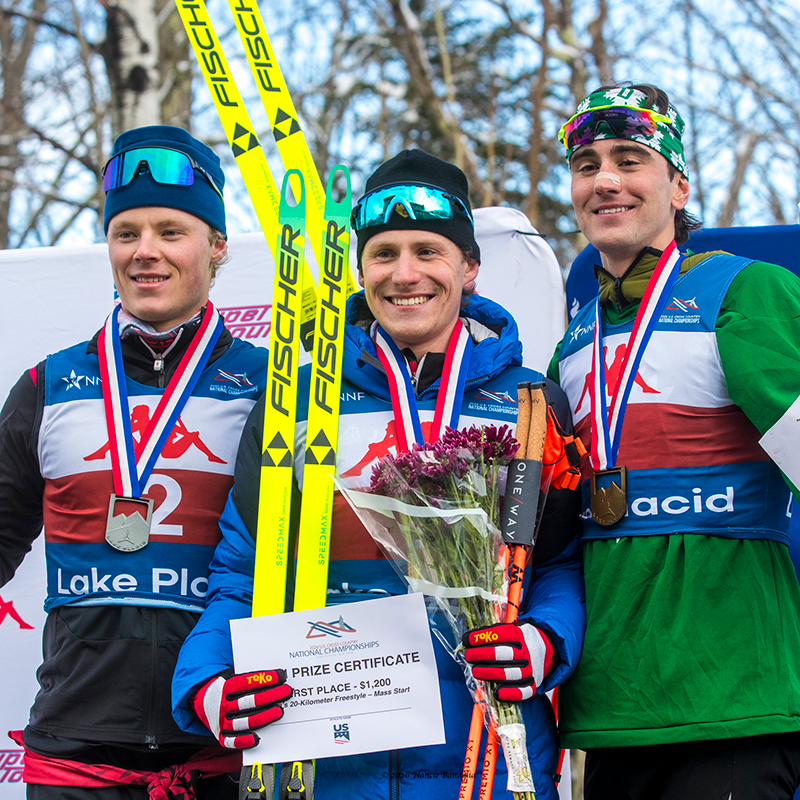
The national podium for the US National Cross-Country Ski Championship Men’s 20 k Freestyle Mass Start with Zanden McMullen (APU) first, John Steel Hagenbuch (Dartmouth) second, and Zach Jayne (UU) third. (Photo: Nancie Battaglia)
A Door, Not Yet Closed
National championships often promise clarity. This one offered something subtler: differentiation without finality. The men’s 20 k freestyle did not decide everything, but it sharpened the picture. It showed who could manage pressure, who could read a race, who could wait—and who could finish.
In an Olympic winter, those qualities matter as much as any single result.
As the stadium emptied and the snow settled back into quiet, the door to Milan–Cortina did not swing wide. But for one, and hopefully two skiers, it remained open, narrow, demanding, and earned.
Feature stories like this one take time, access, and care to produce. If you value thoughtful storytelling and independent ski journalism, please consider becoming a Voluntary Subscriber. Your support directly fuels the work we do to cover the people, places, and moments that make our sport special.
This coverage is made possible, in part, through the generous support of Marty and Kathy Hall and A Hall Mark of Excellence Award. To learn more about A Hall Mark of Excellence Award, or to learn how you can support FasterSkier’s coverage, please contact info@fasterskier.com.
Gus Schumacher (USA) and the rest of his heat work their way up and over Toblach’s signature feature during the 5 k Mass Start last week. (Photo: Modica/NordicFocus)
There are days in this sport when the numbers feel like the whole story: a time, a place, a gap. But every so often, cross-country skiing produces a day that can’t be explained by the clock alone — a day that feels bigger than the course, bigger than the snow, bigger than the athlete who happens to win it.
December 31, 2025, was one of those days.
In the space of a few hours at the Tour de Ski in Toblach, Gus Schumacher and Jessie Diggins both climbed onto the top step of the World Cup podium — Schumacher winning the men’s 5 km freestyle heat mass start in 9:35.4, Diggins winning the women’s in 10:51.2.
It’s worth pausing on what that sentence contains.
Not merely that two Americans had strong races on the same day. Not merely that the U.S. team put two athletes in contention. But that the United States — a nation that has spent decades carving out its place in a sport long dominated by Europe — produced two winners, one men’s and one women’s, on the same World Cup day, in the same venue, in a brand-new format that demanded equal parts speed, tactics, and social intelligence.
The official results pages will always show the same clean fact pattern: Schumacher over Austria’s Benjamin Moser by two-tenths, Norway’s Lars Heggen third; Diggins comfortably ahead of Sweden’s Emma Ribom and Moa Ilar.
But inside the U.S. wax room and the mixed zone, the day’s atmosphere was not clinical. It was almost disorienting — a moment that drew a line through American skiing’s past and then, for a beat, let everyone see how far the line had traveled.
“It’s probably going to take us all a little bit to really kind of wrap our heads around it,” U.S. Ski Team Nordic Director Chris Grover said afterward, still sounding like someone trying to describe a thing while standing inside it.
And then he admitted the quiet truth that every program director carries: days like this don’t happen on demand.
“It’s a special moment to see both those athletes on top at the same time,” he said. “It’s going to be hard to replicate. We’ll take it where we can get it for sure.”
U.S. head coach Matt Whitcomb saw it less as lightning and more as follow-through.
“It truly was a great day,” Whitcomb said. “And it was actually better than the results show. Every heat — with the exception of Kevin [Bolger’s] experience — our athletes moved up, finished competitively, and executed the plans they intended to execute.”
What stood out most to him wasn’t just the double victory. “Honestly,” Whitcomb said, “better than the double win is the feeling that we came up with a plan individually and as a team — and executed. It was a big win for everybody.”
Jessie Diggins (USA) wasn’t just the leader of the race and the Tour, but also of the athletes she teamed with in her heat of the 5 k Mass Start. (Photo: Modica/NordicFocus)
A day that didn’t have to happen this way
If you want to understand why Toblach felt like more than an athletic coincidence, it helps to begin with the format, because the format did not reward the simplest kind of superiority.
Stage 3 was a 5-kilometer freestyle race in four separate mass-start heats with staggered start times and a final classification determined by combined times, not by who crossed the line first in any single heat. It was new enough that even veterans were still learning what the race “wanted.”
Whitcomb described the format as genuine unknown territory — not because the course was unfamiliar, but because the distance itself had been largely absent from the World Cup.
“The 5 k hasn’t been part of the World Cup for a while,” he said. “We know historically that we skate well, sprint well, skate 10 k’s well — and we focus a lot on the 5 k as a building block in training. But nobody really knew what to expect.”
The approach, he said, was deliberately simple: stay organized, enjoy the process, and trust the system. “We just operated the way we always do,” Whitcomb said. “Be organized, enjoy each other’s company, and look at the results at the end of the day.”
In a normal interval start, you win by suffering well. In a normal mass start, you win by positioning, conserving, and timing. In this hybrid, the incentives were stranger: the best strategy could be to help your competitors go faster — to create a heat so fast that it swallowed the rest of the field on arithmetic.
That sounds like something coaches dream up in theory and athletes abandon under the first real surge.
And yet, both Diggins and Schumacher described essentially the same decision: race the clock, and don’t be precious about the heat win.
Schumacher put it in his own blunt, funny way when asked about winning on the same day as Diggins: “I think it’s super cool! Jessie had to be a huge favorite today, so it was up to us to hold up our end, haha.”
Diggins, in the mixed zone after her race, was still riding the strange energy of having watched the men first — watched the experiment play out once — and then stepping into the women’s version with a clearer sense of the rules of engagement.
“What’s nice is it was just 5 k,” she said. “After watching the men, you were like, okay, you’re going to gain or lose 10 seconds on the Tour overall. But the big thing was to just have a really fast heat.”
Then she said the thing that makes this day so revealing: she described her heat as a temporary team—a coalition formed not by flags but by incentives.
“I thought it was so cool and fun to feel the camaraderie,” Diggins said. “I was talking to all the girls beforehand, like, okay, team number three, we’re going to do this… we’re going to change leads, and everyone’s like, yeah… We had really great teamwork out there… It was an unexpected delight of the format.”
Gus Schumacher (USA) charges to the finish line to win heat two and post the fastest time of the day. (Photo: Modica/NordicFocus)
Schumacher told a version of the same story — not as delight, but as commitment.
“I think my heat-mates and I realized that having a fast heat was the biggest picture,” he said. “I was prepared to be 10th in the heat if it meant we were fast.”
From the outside, Whitcomb saw something even more deliberate.
“Gus spent time reaching out to Lars Heggen and Ben Moser and came up with a plan,” Whitcomb said. “You saw some really well-orchestrated trading off of the lead in that heat. That led to a fast heat — and it led to those three guys on the podium.”
For Whitcomb, that was the defining trait of the race. “Gus is an incredibly savvy racer,” he said. “He’s a great physical specimen — this distance suits him. But what really made the difference was his willingness to control everything he could. And that meant teaming up with athletes from Austria and Norway.”
He explained how that philosophy became practical: trading leads early, staying disciplined, then continuing to work together deeper into the race than he expected — a heat built like a rotating paceline, but on snow, at World Cup speed.
And then, of course, the part no coalition can hand you: the finish.
Schumacher still had to have enough left to win the stage outright. Diggins still had to be strong enough to make the tactics matter.
The format offered an opening. The athletes still had to ski through it.
Benjamin Moser (AUT), Gus Schumacher (USA), and Lars Heggen (NOR), (l-r) share the Tour de Ski stage podium in Toblach (ITA). (Photo: Modica/NordicFocus)
The numbers, briefly, before the meaning
It’s important in a historical story to keep the results clean and factual.
On the men’s side, Gus Schumacher (USA) won in 9:35.4, with Benjamin Moser (AUT) second at +0.2, and Lars Heggen (NOR) third at +0.6.
On the women’s side, Jessie Diggins (USA) won in 10:51.2, with Emma Ribom (SWE) second at +5.5, and Moa Ilar (SWE) third at +6.9.
Those are the hard edges of the day — the parts that will remain true no matter what story gets written around them.
But what made Toblach feel different was not just that two Americans won; it was who they were, where they were in their respective arcs, and what it implied about the American program’s shape heading into an Olympic season.
Diggins is the established cornerstone — a skier who has spent years normalizing things that once felt improbable for the U.S. program. Schumacher is the next wave, still building the evidence that Minneapolis wasn’t a one-off, that his skillset is durable, that he can win in more than one kind of race.
In the mixed zone, Diggins made it feel personal and immediate. She had the post-win glow, yes, but the first emotion she reached for was pride in Schumacher.
“It was really cool,” she said. “It was super inspiring seeing Gus with his win. I’m so proud of him. So excited for him.”
That’s the moment: the most decorated active American skier on the women’s side, standing in Toblach, still buzzing, describing the men’s win as fuel — not as separate news.
Emma Ribom (SWE), Jessie Diggins (USA), and Moa Ilar (SWE), (l-r) on the Tour de Ski podium for the 5 k Freestyle Mass Start. (Photo: Modica/NordicFocus)
Toblach, of all places
Grover, thinking like a director who has watched years of World Cup logistics and outcomes, pointed to something that has been true long enough to become lore: Toblach has often been a good venue for the U.S. team.
“It’s funny — over the years, I’ve got to say Toblach has probably been the best venue for us of any place on the World Cup,” he said. He cited previous successes there — podiums and performances from different eras and athletes — and he also offered the pragmatic layer: Toblach’s dry, manmade Italian snow can be “easier to wax for,” which matters more than casual fans appreciate.
The location matters for another reason, too: Toblach sits inside the Tour de Ski, a crucible that encourages narratives. Athletes arrive tired. They leave tired. Every result is filtered through what it means for the overall standings and what it costs to achieve it.
This year’s Stage 3 came after a rest day and arrived as a kind of reset: short enough to be explosive, structured enough to be strange, meaningful enough to be remembered.
It was also the kind of stage where the U.S. program’s long-running strengths could express themselves.
Grover offered one of the more interesting explanations for why the U.S. has historically punched above its weight in short freestyle formats: structural adoption.
When sprint racing emerged and became formalized on the World Cup, the U.S. embraced it aggressively, he said — building it into domestic racing pathways early, so the program effectively selected and developed athletes with high anaerobic capacity, then built the aerobic engine on top.
The result, over time, has been athletes who can tolerate the speed of short formats without losing the distance competence required to survive something like the Tour.
Diggins and Schumacher are not identical athletes, but the day in Toblach suggested they share a kind of hybrid competence: fast skating with depth.
And that’s exactly what the new format asked for.
The historical thread: what came before, and why this is still rare
Toblach’s double win is easier to appreciate when you place it alongside earlier American “two-at-once” moments — because it clarifies what is new here and what is part of a longer progression.
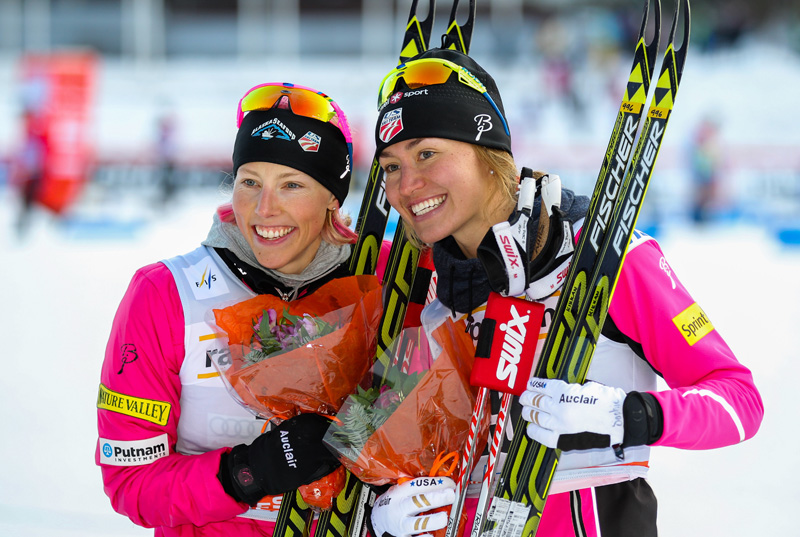
Fellow U.S. Ski Team members Kikkan Randall (l) and Sophie Caldwell after finishing an unprecedented first and third, respectively, in the World Cup freestyle sprint in Lahti, Finland in 2014. (Photo: Fischer/Nordic Focus)
Two Americans on the same World Cup podium: the women’s thread
Over the last 15 years, the most frequent American double podiums in individual races have come on the women’s side — and FasterSkier’s archive captures that evolution in chapters.
At the 2015 World Championships in Falun, Jessie Diggins and Caitlin Gregg won silver and bronze in the 10 km freestyle — an all-timer, not only for the medals but for what it did to the American imagination about what was possible in championship distance racing.
If you track those milestones as a line, you can see how the U.S. women’s program went from “breakthrough” to “repeatable.” It also helps explain why Diggins winning in Toblach — while still special — did not feel like a shock.
It felt like the continuation of a normal she helped invent.
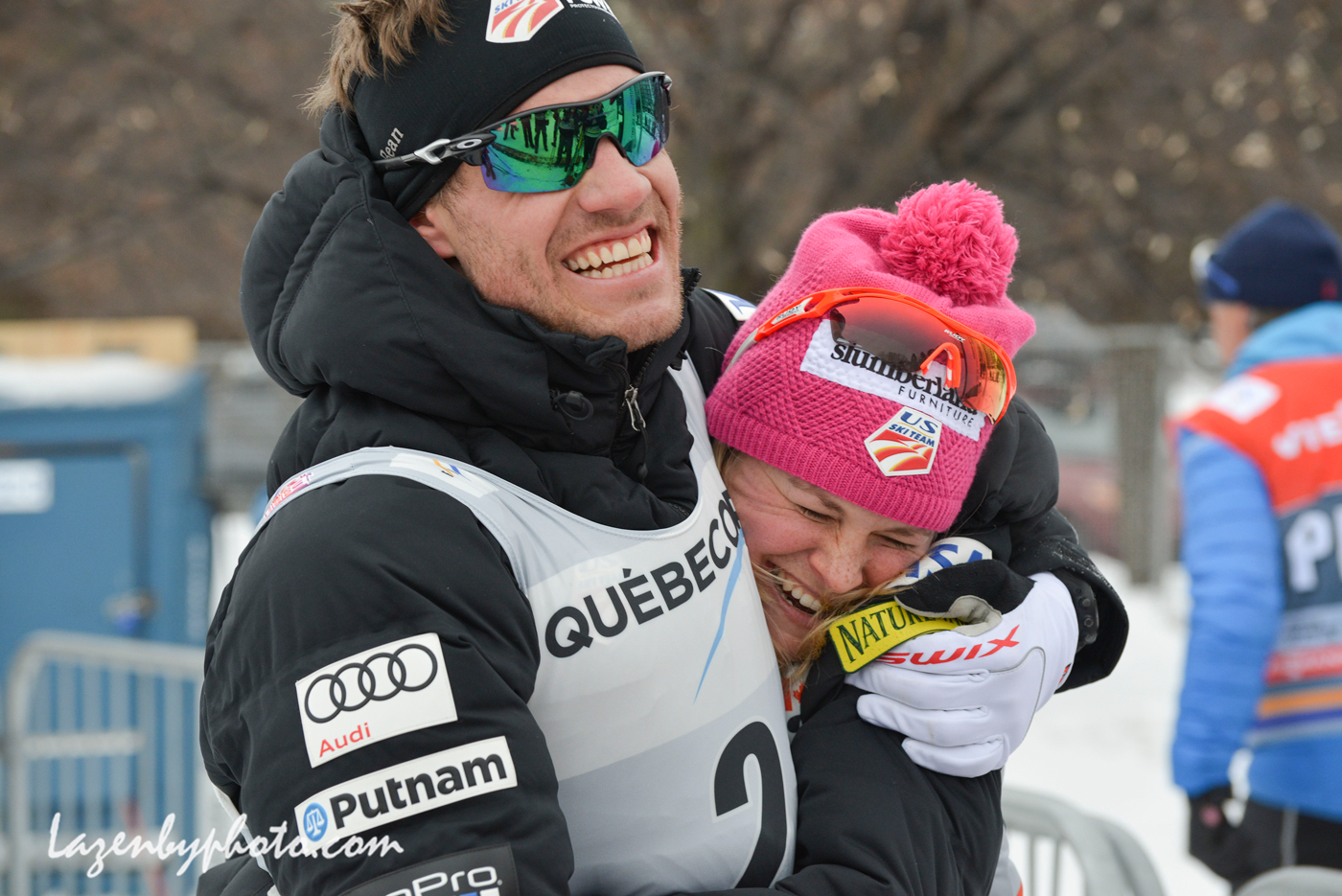
Simi Hamilton (l) hugs fellow U.S. Ski Team member Jessie Diggins after both placed third in their respective freestyle sprint finals at the World Cup stage in Gatineau, Quebec. (Photo: John Lazenby/Lazenbyphoto.com)
Men + women on the podium the same day: the precedent
Now add the second thread: men and women both reaching the podium on the same day.
That day is an important historical anchor because it shows how rare cross-gender podium alignment was, even during periods of strong U.S. women’s success.
That alignment has echoed in the recent past, too — most memorably on February 18, 2024, in Minneapolis. Schumacher’s first World Cup victory, a 10-kilometer freestyle individual start on home snow, came on a day when Diggins also climbed onto the podium, finishing third in the women’s race. It was the kind of split-screen moment that hinted at what might be coming: a U.S. program no longer living on isolated miracles, but beginning to stack elite performances across genders on the same afternoon. Toblach sharpened that earlier echo into something rarer still — not a shared podium, but shared victories, on foreign snow, inside the Tour de Ski.
Toblach 2025 goes a step further than Gatineau 2016 — not “podium together,” but win together.
And that is why Grover’s comment — “hard to replicate” — matters. Because even a strong program doesn’t get to schedule these moments. It can only position itself to recognize them when they arrive.
Gus Schumacher (USA) celebrates the victory in Toblach (ITA) with his US Ski Team teammates, coaches, and staff. (Photo: Modica/NordicFocus)
Why the double win felt like a team story
One reason Toblach resonated within the team is that both Diggins and Schumacher narrated their wins with a vocabulary that sounded less like a solitary triumph and more like collective execution.
Diggins led with skis.
“Fast snow, had really fast skis,” she said. “So thank you to our team…”
She emphasized tactics not as personal cleverness but as mutual agreement: “Everyone did their part… Okay, I can pull now, and you can pull now.”
And she framed the day’s broader meaning not as a press-release milestone but as a human reaction: “I’m so proud of Gus and everyone on the team.”
Schumacher, asked to reflect on the same-day symmetry, responded with humor and a little humility — the kind that still acknowledges responsibility.
Jessie Diggins (USA) also celebrates the victory in Toblach (ITA) with her US Ski Team teammates, coaches, and staff. (Photo: Modica/NordicFocus)
Jessie “had to be a huge favorite,” he said. So “it was up to us to hold up our end.”
That sentence contains something important about Schumacher’s emergence: he speaks like someone who believes he belongs in the job.
Not in a boastful way — in a functional way. Like a skier who believes the U.S. men’s team is allowed to contribute to a “historic day” not as an anomaly but as a duty.
Grover, who has watched the U.S. program move through phases in which the women carried the torch while the men tried to catch up, seemed to feel that shift, too.
He described the day as something that bridges eras: there were times when a strong men’s day came without a matching women’s result; times when the women’s team was deep, and the men’s team was still searching for its consistent breakthrough.
Toblach wasn’t just both genders on the podium. It was both on top.
Whitcomb saw the same pattern across the roster.
“Every one of our athletes — men and women — finished competitively in their heats,” he said. “And they executed the plans they came in with.”
That included results beyond the podium: Diggins winning, Schumacher winning, Julia Kern in 10th, Ben Ogden in 20th, and J.C. Schoonmaker in 29th. “It really was an all-around great day,” Whitcomb said. “The execution was better than the results show.”
A program doesn’t change overnight, but it does reveal itself in moments like this — when two separate pipelines deliver winners on the same day, under the same strange rules, in the same high-pressure context.
Jessie Diggins (USA) embracing the excitement in the finish corral. (Photo: Modica/NordicFocus)
The strange beauty of the format: teamwork as the unintended point
FIS likely designed the four-heat format for spectacle: shorter races, more winners crossing lines, more “events” within a day. But Diggins described a different kind of spectacle — not for the cameras, but for the athletes.
The format made cross-country skiing briefly feel like a sport of temporary alliances.
“Maybe that wasn’t the goal,” Diggins said, acknowledging that she was projecting her own values onto a structural experiment. “Maybe that wasn’t the goal to get teamwork across countries. But for me, that was the goal.”
Whitcomb was candid about why formats like this matter beyond athlete preference.
“What’s most important isn’t actually what the athletes think,” he said. “It’s what the fans think. What the fans think dictates whether or not the sport survives in some regards.”
Traditional 10 and 15-kilometer individual starts, he added, can be hard for casual viewers to engage with. “We need some change,” Whitcomb said. “And I think today provided a little bit of life to the sport. Frankly, it needs that.”
Schumacher’s description of his heat was less philosophical but equally revealing: a group of men deciding, in advance, that the only way to win was to make the whole heat fast — even if it meant giving up individual control.
This is an unusual kind of honesty in ski racing, where athletes are trained to reveal as little as possible about tactics.
And it helps explain why the double win felt like a “team day” even though cross-country skiing is, most of the time, one of the most solitary endurance sports in the world.
Both winners described the same phenomenon: speed created by cooperation.
And both wins required the same final act: individual excellence layered atop shared work.
Gus Schumacher (USA) thanks his ‘lucky’ fan club in Toblach (ITA). (Photo: Vanzetta/NordicFocus)
The human detail that made it feel like a story, not a statistic
Near the course, as the day unfolded, there was also the kind of detail that doesn’t appear in official documents but sticks to memory — the four “good luck Alaskans” who have now become part of Schumacher’s mythology.
They were present at his World Juniors victory. They were present in Minneapolis. They were in Toblach again.
They will be at the Olympics, too.
It’s an affectionate superstition, but it also points toward something real: American skiing used to feel like a sport of isolated miracles — one athlete, one day, one surprise.
Now, it is starting to feel like a sport that can sustain its own community momentum — people traveling for it, following it, building rituals around it.
A program becomes a culture not when it wins once, but when it wins often enough that people start to behave like it’s a thing worth following.
Jessie Diggins (USA) and Rosie Brennan (USA), (l-r) skied to second and third place in Davos in 2024. (Photo: NordicFocus)
What to do with a day like this
There is always a temptation, after a historic result, to treat it like a prophecy.
To declare that the U.S. has “arrived,” that the future is guaranteed, that Toblach is the beginning of the next era.
Neither Diggins nor Schumacher offered that kind of certainty. Diggins, even in the glow, stayed practical; Schumacher talked about holding up his end and taking the Tour day by day.
Grover, too, resisted prophecy. He chose something quieter: recognition, gratitude, and the realism that moments like this can’t be manufactured.
But history has its own rules. Even if athletes move on quickly, even if the World Cup continues, even if the next races erases some of last week’s glow, the record will still show: the United States won both races on the same World Cup day in Toblach.
And when future athletes look back through FasterSkier’s archive — through Lahti 2014, Falun 2015, Gällivare 2015, Toblach 2017, the Tour days with Diggins and Brennan, the first men-and-women same-day podium in Gatineau — they will see Toblach 2025 not as a random spike, but as a point that makes the line look continuous.
A story isn’t just an outcome. It’s the shape that outcomes make when you stack them over time.
On December 31, 2025, American cross-country skiing’s shape changed again — not by accident, but by two winners choosing to race the same strange day with the same clear idea of what mattered.
Feature stories like this one take time, access, and care to produce. If you value thoughtful storytelling and independent ski journalism, please consider becoming a Voluntary Subscriber. Your support directly fuels the work we do to cover the people, places, and moments that make our sport special.
It is fitting that Brennan and Diggins were there in Minneapolis to celebrate and lift Schumacher when he won his first World Cup race; it’s easy to imagine Randall, Gregg, Maubet Bjornsen, Caldwell Hamilton, and Hamilton also there lifting all of them because they are all building blocks for what comes next. (Photo: Modica/NordicFocus)