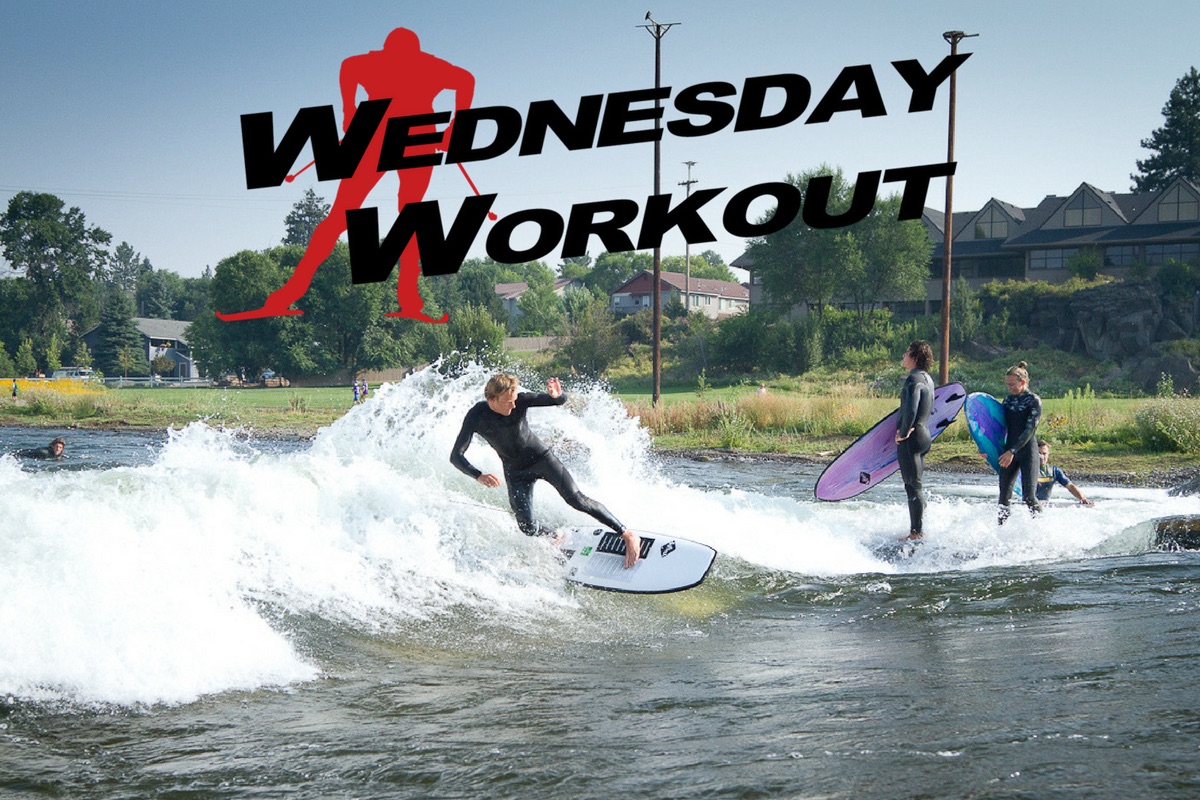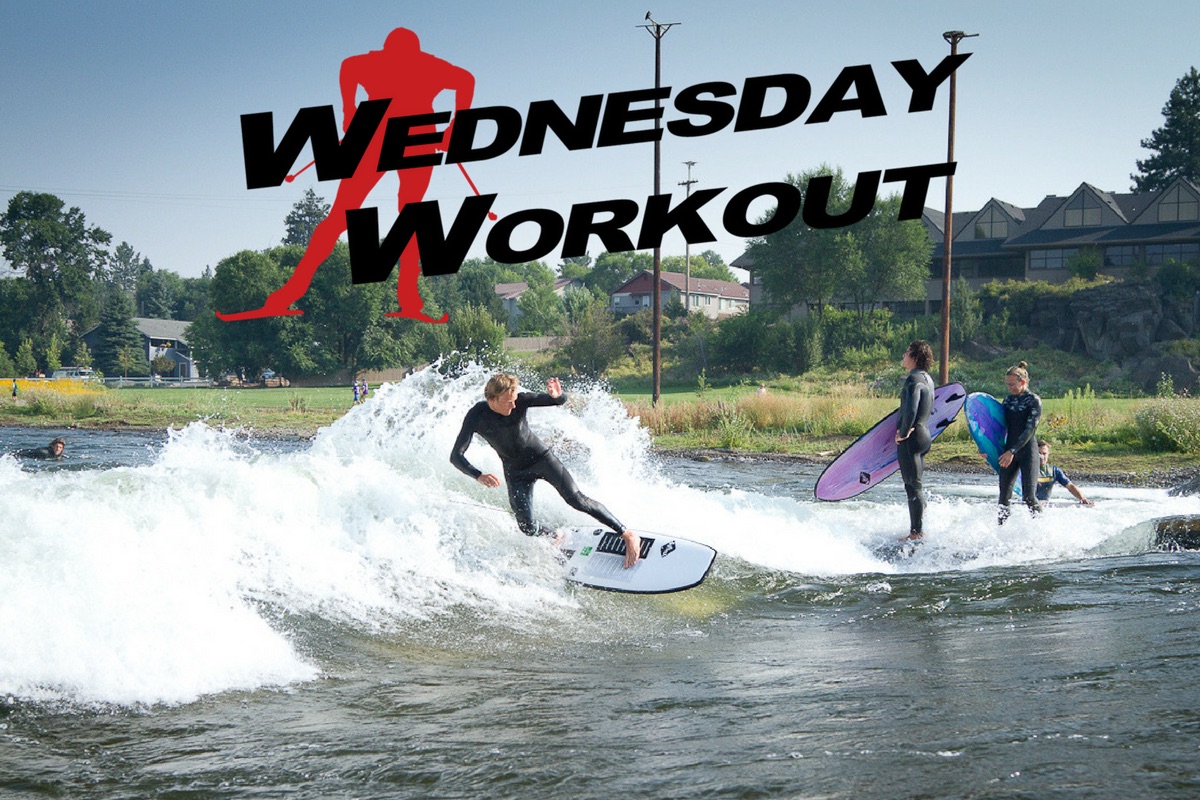
Jake Ajax, a senior on the University of Wisconsin-Green Bay nordic ski team, catching some waves in Bend, Ore. (Photo: FasterSkier)
BEND, Ore. — It’s August. That means a few things to keep in mind. Out West, it’s been hot and dry. Mid-90 temps have been the norm and in places like Bend, it’s in the teens for humidity. Don’t forget to top that with smoky air from surrounding wildfires.
On the East Coast, high humidity can turn an early morning workout into a tropical death march. Left or right coast, even in the Rockies and Midwest, the phrase “hydrate or die” remains relevant.
It’s enough to tap the brakes on traditional forms of dryland training.
That brings us back to Bend. Despite recent claims, Bend isn’t paradise, and it may not be where you want to be. Some downsides here in Bend are the busy traffic circles and dusty mountain-bike trails in summer. (Yeah, all first-world problems.) If that’s not enough to dissuade you, then there’s this not-so-well-known fact: Bend’s river surfing wave isn’t always firing with a green face; sometimes a pillow of aerated water blemishes an otherwise everlasting standing wave.
The upside (yes, there’s a big upside) is that the surfing wave at Bend’s Whitewater Park serves up a great option to diversify the off-snow training.
Sun-bleached blond. With a look like that, 21-year-old skier Jake Ajax, in Bend, Ore. for summer training, exudes the xc skier/surfer stoke. (Photo: FasterSkier)
It took a 21-year-old named Jake Ajax from Minneapolis, Minn., who currently skis for the University of Wisconsin-Green Bay, to show the light.
Jake actually goes by Ajax.
Ajax ended up in Bend for the summer to train with the Bend Endurance Academy (BEA) college training group. But surfing? That seems a bit off the radar from a nordic skier in the Midwest. Like any semi-landlocked kid, he dreamed big.
“My obsession with surfing started last summer when I read the book Barbarian Days by William Finnegan,” Ajax explained in an email. “I’ve always been interested in the sport but being from Minnesota there’s no easy way to get into it. Barbarian Days was my gateway that pushed me to give it a try and I love it. I have a sister that lives near Orange County, CA so that’s a great resource to have. I even managed to surf Lake Michigan last spring a couple times when storms hit.”
(If you think Barbarian Days sounds like some fluff surf book, think again. Finnegan won a Pulitzer for his cerebral surfing memoir.)
“I told myself, ‘I’m going to be good at that by the end of the summer,’ ” Ajax wrote. “When I first got here I bought a board and was surprised by the steep learning curve of surfing. For about the first week all I could do was ride the wave for a few seconds before face planting and getting flushed down the rapids.”
Ajax is not alone. Not to name names, but some of Bend’s most stout endurance athletes, some of them nordic skiers, have been seen flushed over the Whitewater Park’s drops after a split-second surf.
Including this guy:
Ajax admits he’s now a regular at the wave in between his morning and evening workouts.
“I usually try to make it to the wave about six days a week,” he wrote.
For those logging hours, Ajax noted he doesn’t include the surfing in his log book, since there’s a bit of standing around and his heart rate remains low. But Ajax asserts the surfing has put grins on his face and benefited his ski training.
“Physically, the basic surfing stance is fairly similar to skiing,” he wrote. “You press through the arch of your foot relaxing the toes and keep your ankles loose so you can turn back and forth on the wave. You press through the surfboard similarly to how you press through a ski. It definitely helps with balance. Mentally, ski training, especially in the off season, is always great to keep fresh. It’s been great mastering this new sport over the summer. Rollerskiing the same roads every week can get old so it’s nice to keep things fresh with the whitewater park.”
Ajax has been the pied piper of river surfing for the collegiate nordic crowd. It’s now not uncommon to see surfers/NCAA skiers at the wave from the University of New Hampshire, Colby College, University of Vermont, and a certain Harvard Ski Team alum on occasion.
“River surfing is a pretty cool sport so I think most skiers are compelled to try it,” Ajax wrote. “I’m just the one who drags them down to the wave to give it a try.”
Newell Says…
If you don’t take FasterSkier’s and Ajax’s word for it, how about the word from cross-country skiing’s answer to Kelly Slater: longtime U.S. Ski Team member and longtime surfer Andy Newell? (Seriously, shave Newell’s locks, swap out the lycra for board shorts and you’ve sort of got a Slater doppelgänger.)
“I’ve never surfed any standing waves but I try to get into the water as much as I can throughout the summer to surf in the ocean,” Newell wrote in an email.
Here are some of the ways Newell believes surfing can benefit skiers:
Mental: “There is the obvious, surfing is fun, engaging, and addicting so it is a perfect mental break for a winter sports athlete. But I think there is much more to it than that since sports like surfing practice a different type of mental/ physical connection. Skiing is a speed-based sport, it’s all about how fast you can go. Surfing is a style-based sport that is more about muscle memory and how your body moves. I think it’s great when athletes with a background in speed-based sports practice something like surfing or skateboarding because it forces us to have different mental/physical connection that is focused more on proprioception. body movement, and is 100 percent skills based. It’s good for the brain:)
Physical: “On the pure physical side, surfing is great for balance, core strength, and upper-body strength. The paddling motion of surfing is awesome for skiers because it is a similar motion that recruits a lot of the same muscles as poling but it’s also very different in a good way. Paddling and swimming where you are bringing your arm up above your head and shoulder is great for strengthening external rotation in the shoulders which is something most skiers need. Paddling a surfboard and strengthening all those small muscles around the outside of your shoulder and back will help a skier stay injury free from a repetitive poling motion. Also, when you are laying on your stomach and paddling on a board it will improve thoracic mobility (upper-back mobility) which is another weak point for a skier.”
Jake Ajax, who’s training with the Bend Endurance Academy this summer in Bend, Ore., dials in his skinny-ski balance as he carves a turn on Bend’s river-surfing wave. (Photo: FasterSkier)
In Bend, the wave is close to downtown. If you’re busy logging hours on the computer, you can multitask and check out the live streaming surf scene.
The Gear
Although we’re no experts, river surfboards are short. Some are in the 4-foot range for more experienced surfers. A stable learner board on the local Bend wave runs anywhere from 5-feet-2-inches to 5′-7″. Most surfers here use soft boards since board dings from rocks are a reality of river-wave surfing. That said, some local shapers will handcraft a pricey glass and carbon board for your liking.
This writer makes his child wear a helmet and board leash with a hand-activated break away mechanism — it’s a river, after all, meaning natural hazards exist that may snag a leash. Better safe than sorry. Some river surfers in Bend wear a personal floatation device (PFD).
Hardy folks wear board shorts as if the Cascade’s were found at 19.8968° N, 155.5828° W (a rough approximation of Hawaii’s location). Otherwise, most folks wear wetsuits. At roughly 65-degrees Fahrenheit in summer, the water in the Deschutes River as it flows through Bend isn’t shiver-inducing, but a wetsuit makes it cozy.
The Workout: Surfing
Focus on de-stressing
Smile
Have fun
Get on the wave
Try to surf
Maintain a Level 0.5 heart-rate zone (if your post-workout data indicates you were in L1, you are doing it wrong.)
Smile
Repeat
Jake Ajax paddling while river surfing. According to Andy Newell, this can improve functional shoulder strength. (Photo: FasterSkier)
U.S. Ski Team member Jessie Diggins has some serious vertical leap. (Photo: Annie Pokorny)
Anyone who follows Jessie Diggins extensively on social media knows the woman has some moves. She’s been the ringleader for multiple U.S. Ski Team choreographed dance videos, and two weeks ago, posted a video of herself doing a little “fancy footwork” House dance in Boston.
Her background in dance began at the Woodbury Dance Center just outside Saint Paul, Minn.
“I think I started the year it opened, actually!” Diggins, 25, wrote in an email about the 20-year-old dance studio. “And I took lessons once a week for 10 years. I loved it, and although I was never amazing at dance (I mean, I was never going to become a ballerina) what I really enjoyed was learning new moves, working on a routine and memorizing it, and then dancing with all the other kids as one unit. It was always so cool to see a routine come together with the music and have everyone moving in sync.”
So how much does she dance now, and is there any crossover to ski training?
“I sometimes use dance as cross training because it’s an awesome way to learn coordination and body awareness, and like skiing it uses your arms, legs and core,” she wrote. “It’s a great warmup for strength since your entire body is warmed up and going by the time you’re done!”
The lesson she took in Boston earlier this month was a drop-in, where “a separate mini-routine is taught each week,” she explained. Diggins added that’s a great format for anyone who wants to jump into a lesson or can’t commit to a weekly class.
“We spent the first 45 mins or so learning House dance style, then the last 45 mins of class the teacher taught us the routine and we learned it together,” she wrote. “I’ve found that every dance class I’ve taken has an awesome atmosphere with people high-fiving each other after learning a complicated step and cheering each other on.”
For those who want to get into dance, she recommended drop-in lessons or even Zumba.
“Or, as I enjoy doing, look up dance tutorials online and learn at your own pace and pick the song and dance you want to learn!” she wrote.
If House dance, which is defined by Wikipedia as a “social dance” that is “often improvised and emphasizes fast and complex foot-oriented steps combined with fluid movements in the torso, as well as floor work,” isn’t your style, an FS reader, former Middlebury skier and coach suggested the idea of listening to waltz-style music before going for your next ski.
“Always in the back of your mind have the feeling of dancing on skis,” Rick Eliot wrote in an email. “Often athletes have benefitted from ballet lessons, learning graceful ballroom dancing and from other rhythmical activities. Mikaela Shiffrin makes slalom racing look like an art form.”
He suggested focusing on rhythmic movements while ski training (whether it be on snow or rollerskis) with something like a Strauss Waltz (Emperor Waltz, Skater’s Waltz, etc.) in skiing tempo “running through your mind as you swing down the trail.”
“Adapting the idea of ‘skiing to music’ into a ski team practice day workout is an intriguing thought,” Eliot added. “It might work but probably would require some trial and error first. Just playing the Skater’s Waltz over an outdoor PA system is probably not going to do it on the first try. My guess is that it would take some searching to find music with just the right tempo for skiing. But ice skaters skate to music so why not skiers? After some on-ski experimenting a coach might want to talk to a local band leader about recording a couple of selections played at skiing tempo.”
Just an idea and another way to shake up training.
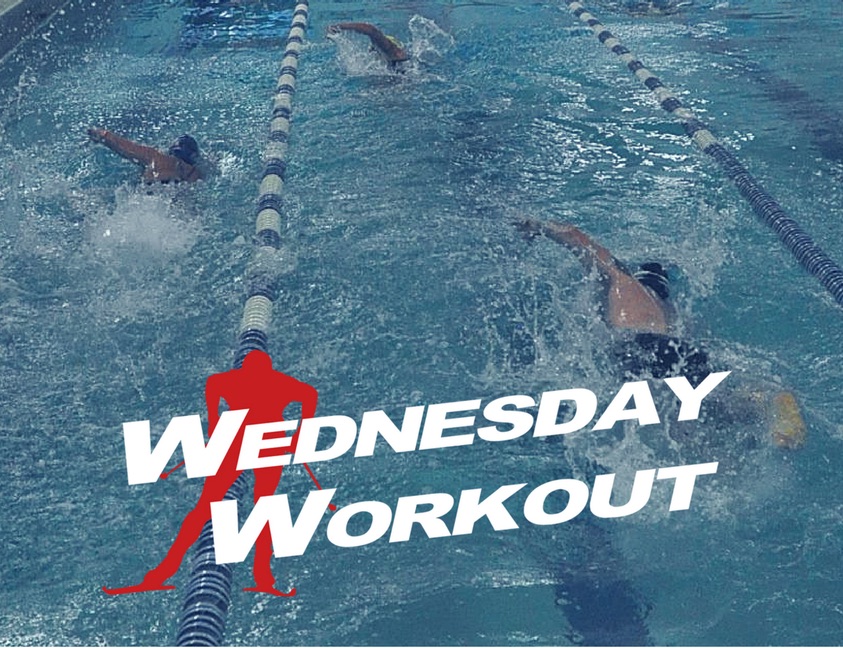
FS intern Ian Tovell is a longtime skier and triathlete training for his first Ironman. Here, he provides an indoor-swimming workout for anyone looking to measure their endurance.
Living in New England, the adult version of Christmas is waiting for the first snowfall. For most skiers in New England usually by the time the first race comes around you have skied once or twice on snow if you are lucky. The key to be race ready without going on snow is to train your body in race conditions. We do this by rollerskiing, running, strength, etc. One workout that I do to make sure my endurance is up where I need it to be is swimming. Swimming being one of the best aerobic exercises you can do (after nordic skiing, of course) is one of the main reasons a lot of skier use that in the offseason.
Ian Tovell getting ready to dive right in.
Swimming is a great way to keep up your ski fitness while changing up your daily routine. As a nordic skier and triathlete, I like to mix up my workouts so that I can work on other muscles while still staying in shape for nordic in the winter. Being able to get to the pool and work on my endurance has made the transition to skiing quite easy.
This past week, I did two hard workouts to really test the endurance level and see what I need to work on. The key was to make sure that the two workouts were separated by a few days to ensure I was rested between the two tests.
Swimming Workout 1
Warmup: 800 yards:
300 choice
100 kick
6×50 strong (Level 3), each followed by 15 seconds rest
100 easy
Main Set: 950 yards (at Level 3-4):
50 freestyle (1-minute recovery)
100 freestyle (1:30-minute recovery)
800 freestyle (2-minute recovery, or as long as you need before the cool down)
Cool down: 250 yards
5×50 Free
Total Distance: 2000 yards
Swimming Workout 2
Warmup: 800 yards:
300 choice
100 kick
4×75 build (Level 2-3), with each pool length (25 yards) faster than the last
100 easy
Main Set: 600 yards:
200 freestyle as fast as you can (2-minute recovery)
400 freestyle as fast as you can (2-minute recovery or as much time as you need before the cool down)
Cool down:350 yards:
100 Choice
5×50 easy
Total Distance: 1750 yards
During your warmup you should focus on your technique. This is the time to make sure that your technique doesn’t fall apart during the main set. The warmup is also the best time to get the junk out of your system and really gauge how your main workout will go.
When you get to the main set, this is where the fun begins. The effort should be between Level 3-4, but be at a pace that you can sustain for the whole workout. For example, you shouldn’t do the 200 freestyle as fast as you can, then by the time you get to the 400 you die halfway through it. The times for each interval will be dependent on how fast you swim. Just like in skiing, you want to be as consistent as possible with your perceived effort. Both Workout 1 and Workout 2 should be done at the same effort to get the most accurate times.
During the main set, one of the most important things is to make sure you take the appropriate rest between each set. During the rest, catch your breath, drink water and refuel your body before the next interval. Like in skiing, rest is just as important as the interval itself so ensuring you take the accurate rest is critical. The total time for each workout will vary depending on how long it takes you to warm up, race and cool down, but it usually will take about 40-60 minutes to complete from start to finish.
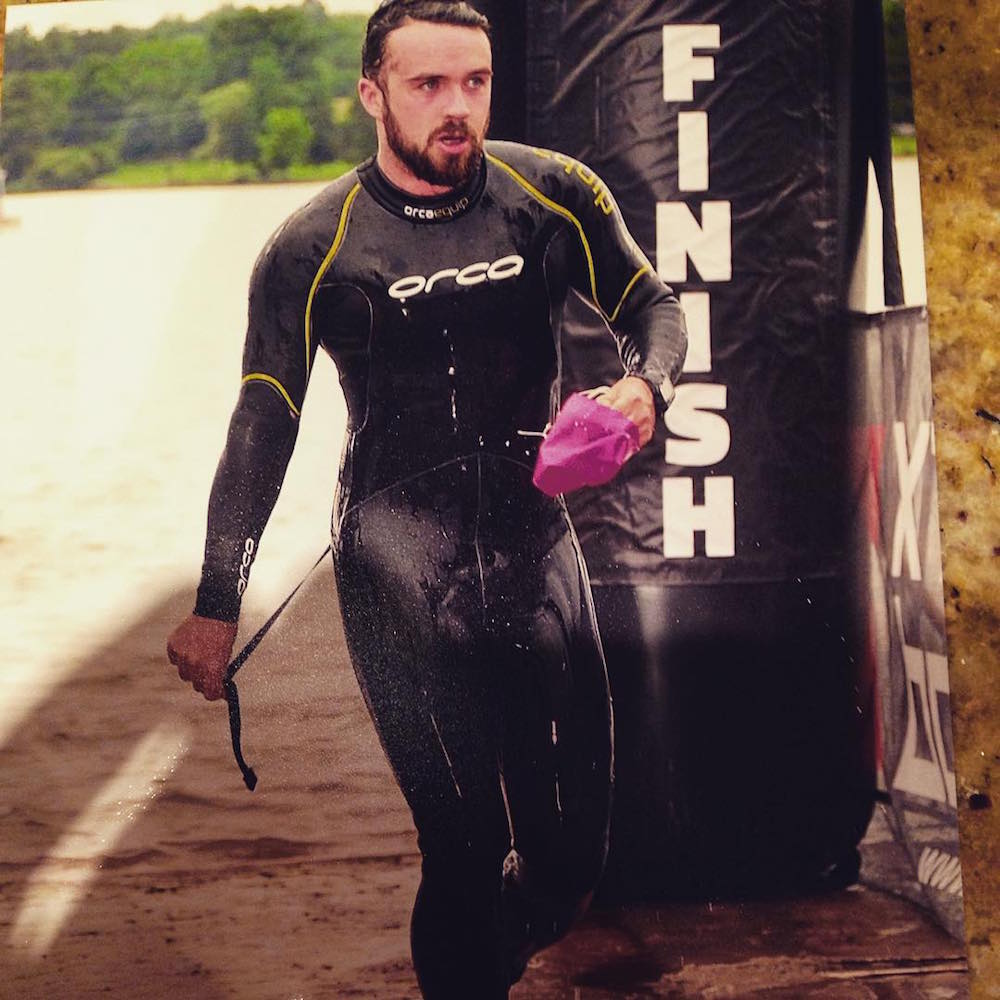
Ian Tovell after the swim leg of a triathlon. Ian is training for Ironman Mont-Tremblant.
The cool down is the final part of the workout and should be done fully. This will help to ensure that your muscles relax and you won’t be sore or unable to move your arms the next day. The cool down should be slow and easy with the effort being Level 1 or less.
A little background about myself is that I am not only a nordic skier, but I am also an avid triathlete. I am currently training for Ironman Mont-Tremblant, and this is part of my own Ironman training plan. I have done triathlons for the last 12 years and have been a nordic skier for the last 16 years. I have found a great balance between both and have found that each helps me prepare for the other. I have a great coach, Kyle Burnell, who works for PBM Coaching and provides me with workouts to help reach my full potential. He gave me this workout in order to test my “Critical Swim Speed” so that when I am in the pool I will have paces to hit based on the perceived effort for each workout.
Eventual winner David Norris (l) and his APU teammate and second-place finisher Scott Patterson (r) race in the Bird Ridge Hill Climb overlooking Turnagain Arm outside Anchorage, Alaska, in June 2016. (Photo: David Norris)David Norris is having a moment. The 25-year-old native of Fairbanks, Alaska, won his first-ever SuperTour race in Lake Placid in January. The next day, he won his second SuperTour race. In February he won the prestigious American Birkebeiner, taking home more than $10,000 dollars and leaving behind an iconic shot of him exulting as he crossed the finish line. In March, after missing out on qualifying for the Ski Tour Canada, he stayed in Alaska to train and won the Tour of Anchorage, then finished third in a slushy 50-kilometer classic mass start at U.S. Distance Nationals in Vermont.
David Norris earlier this month above Eagle Glacier outside Anchorage, Alaska. (Courtesy photo)For all of these accomplishments, Norris, who skis for Alaska Pacific University (APU), was named the FasterSkier Breakthrough Skiers of the Year among American men. As Norris wrote at the time, “I always want more from myself when any season comes to an end. I don’t think my results have put me in a different position than last year but I’m going into the summer with excitement knowing that some really great results are possible for me.”
That was in April. Norris’s words seem prescient now. Since then, he placed second in the year’s first big mountain run in southcentral Alaska, finishing behind only APU teammate Scott Patterson on a course in the Chugach foothills outside Anchorage that gained a healthy 4,300 vertical feet over 8.5 kilometers (5.3 miles). And earlier this month he traded places with Patterson, edging out his APU teammate for first in the Bird Ridge hill climb mountain run, a race that gains 3,500 vertical feet in less than three miles.
Oh, and Norris also set a new course record at Bird Ridge. The race has been held annually since 1989, and has long been a favorite fitness test for Alaskan skiers. Norris’s 37:04.70 from earlier this month beat everyone on a long line of past champions at Bird Ridge that includes Olympians Holly Brooks, Todd Boonstra, and Bill Spencer, plus former World Cup skiers Nicole DeYong, Trond Flagstad, Brent Knight, Frode Lillefjell, Toby Schwörer, and Rob Whitney.
So what’s Norris’s secret to mountain running success? As Norris modestly notes, “In the last few summers my uphill running has improved tremendously. I am not alone in this as many of my [APU] teammates both on the men’s and women’s side are constantly earning new personal best times. As a result, they regularly share the podium with me in local mountain races.”
Norris also admits, “I don’t specialize or focus on my mountain running performances, but as you can imagine the training for ski racing is great for mountain running results.”
Despite Norris’s announced lack of focus in this area, his results suggest that he knows something about running uphill fast, then translating this to ski speed.
In his own words, here are some of Norris’s top tips for going uphill fast, be it in racing or training:
– Train really hard for ski racing! “Since the major goal is skiing well next winter my training recommendation is to train a lot for skiing and the uphill running will take care of itself. I do believe the longer sustained threshold bounding workouts and distance running sessions in the mountains are especially good preparation for both winter and summer racing.”
– Switching techniques. “For many of the Alaskan mountain races there are steep sections where most racers switch to hiking. Hiking is fine and maybe even better on certain pitches, but forcing yourself back into a running stride as soon as the terrain allows is crucial. It is in some of the gear/tempo changes that I have either been dropped on a bad day or realized an advantage on my competitors. The hiking usually feels more comfortable, but it may not be the fastest.”
– Pacing. “I have discovered through epic explosions that in uphill running I can hardly move up the mountain once I max out or push too hard too early. The pacing for me seems similar to ski racing, but more important because there is no recovery time in an uphill course, in contrast to a rolling ski course. The ideal pace for me is to go out hard, then settle into something that I know is manageable before trying to pick up the pace during the last five or ten minutes of the race. Sometimes I don’t get to choose the pace and I am forced into hanging with my competitors with an early pace that is faster than I believe I can handle. In that case another important aspect to pacing is just running relaxed and keeping your arms loose through the first three quarters of the race.”
As Norris graciously concludes: “I hope some of these tips help you in your next time trial or race. The major tip that I have seen work for myself is to just train a ton for skiing! Make a lot of your training going up big hills – that is, both in easy distance and during intervals. Don’t just hit the flats because you’re supposed to be doing easy distance; take to the hills and just monitor your pace to keep it where you want it.”
David Norris of Alaska Pacific University celebrates his first victory in the American Birkebeiner 52 k freestyle race in February in Hayward, Wis. (Photo: James Netz/American Birkebeiner Ski Foundation)
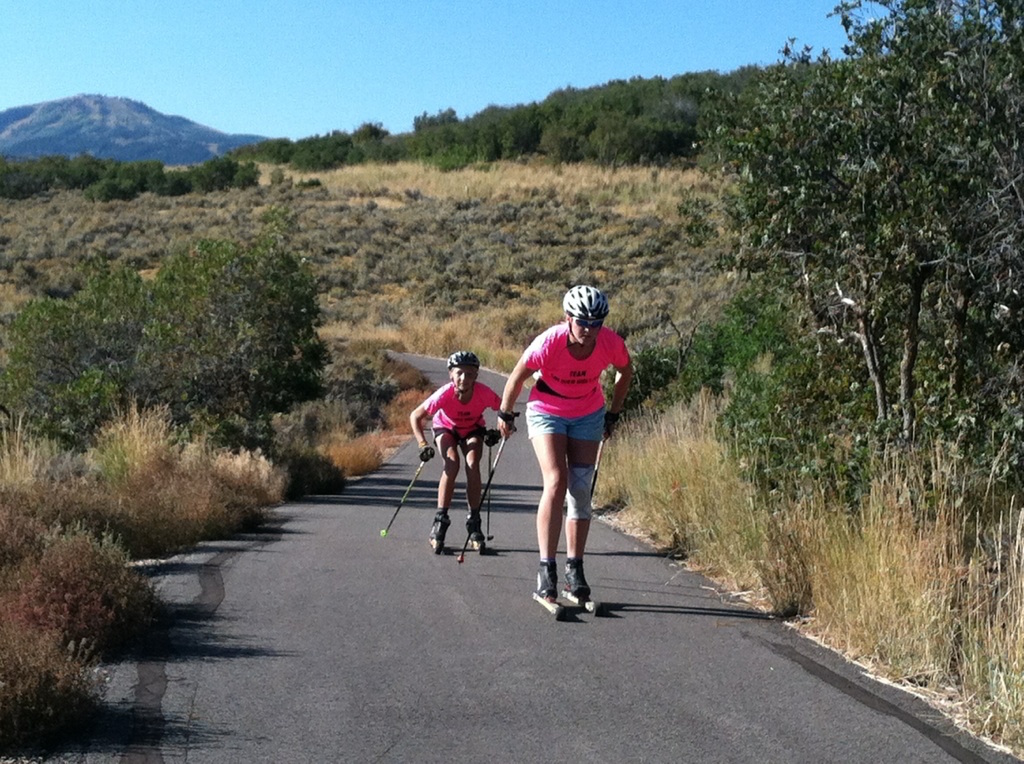
Team Soldier Hollow athletes Ingrid Norton and Pearl Harvey. during a rollerski workout near Heber and Park City, Utah. (Photo: Morgan Smyth)
This week’s workout comes from Team Soldier Hollow coach Morgan Smyth, a former World Cup racer and Alaska Pacific University skier, and caters to cross-training needs. Team Soldier Hollow trains out of Midway, Utah.
***
Many high school skiers are multi-sport athletes. This can be a challenge for athletes who have spent most of the summer ski training and working on their upper-body and ski-specific muscles. How do you participate in fall sports and not lose all those big summer gains?!
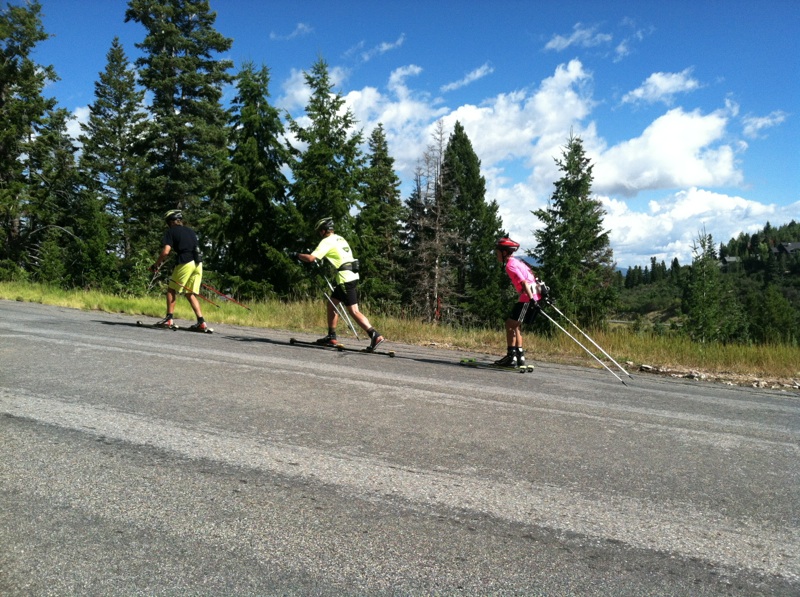
Team Soldier Hollow’s Xander Burkemo, Spencer Brosnahan and Mason Heimburger during a rollerski workout near Heber and Park City, Utah. (Photo: Morgan Smyth)
Note: Most of the Team Soldier Hollow athletes run cross-country, but this is a great ski workout to balance with most fall sports.
Since it is race season for cross-country running, most of the speed and interval workouts are done with the running team. We then add two easy rollerski workouts that focus on technique and maintaining ski specific strength.
One of our key workouts is a combo classic rollerski and a mini general-strength session in the gym.
Rollerski Workout:
Easy 20 min double pole warm up
3 x 3 minute easy single pole
Technique drills
Rollerski Total: 45-60 min
The rollerski workout ends at the gym.
For the general strength portion, the goal is to maintain the general upper-body strength gained during the spring and summer. The running team does a plyos workout once a week so we don’t do much lower-body strength. However, depending on your sport, some could be added especially to prevent muscle imbalances.
Strength Workout:
Dynamic stretching – 10m each.
Butt Kicks
High Knees
Side Lunges
Front Lunge
Alligator Crawl
Inch Worm
Strength:
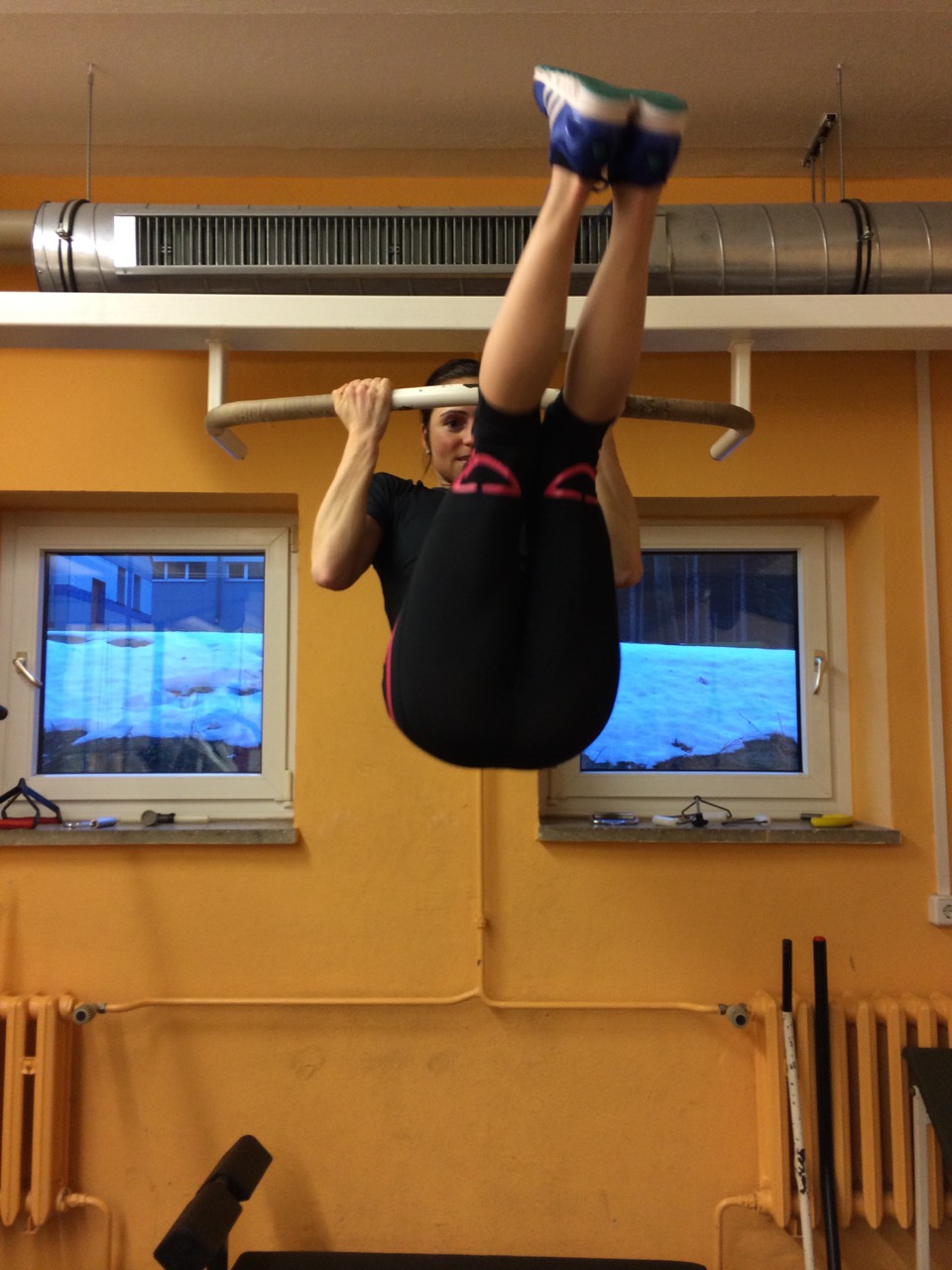
Pull Ups 2×10
Balance Clock Touch (this is a balance drill that can be done on the ground or an inflatable disc or other unstable surface)
Push Ups 2×20
Classic Arm/Leg Swing (this is a technique/balance drill that can be done on the ground or an inflatable disc or other unstable surface)
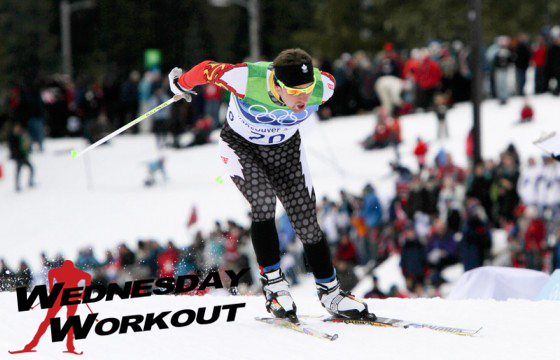
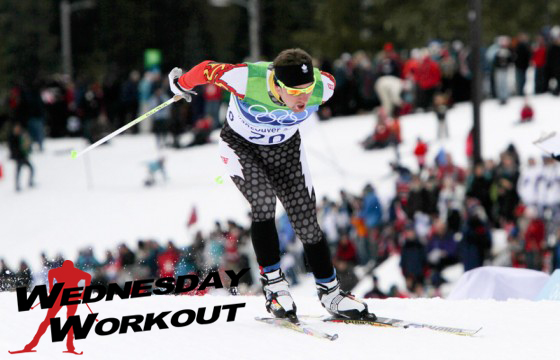
Ivan Babikov (Canadian World Cup Team) racing to eighth in the 15 k freestyle at the 2010 Vancouver Olympics.
For this week’s workout, we went back in time five-plus years to a session Canadian World Cup Team veteran Ivan Babikov shared with us in August 2010. The following comes from his days with the Russian national team and involves continuous-and-varied bounding intervals — and it’s brutal. See the original pro workout here.
***
[circa August 2010]
The harder the race, the greater the chance you’ll see Ivan Babikov at the top of the result sheet. So it’s no surprise that he uses a brutally difficult training session to prepare himself for the winter.
In an interview from his home in Canmore, Babikov said that this workout – a variation on bounding intervals – was a holdover from his younger days training in Russia.
In Canada, Babikov said, most athletes do their bounding on a single hill, “up and down and up and down.” His version is more continuous, and more varied: following the five-kilometer World Cup loop at the Canmore Nordic Center, Babikov bounds all of the climbs, and use the flats and descents for recovery.
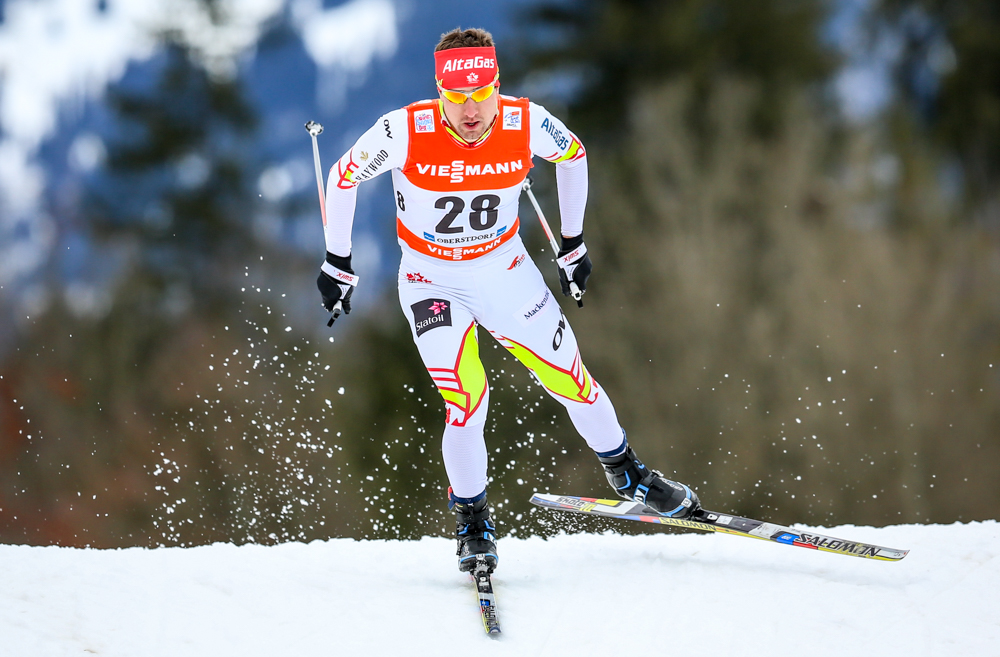
Canada’s Ivan Babikov racing in the opening stage of the 2015 Tour de Ski, the 4 k freestyle prologue, on Jan. 3 in Oberstdorf, Germany. (Photo: Marcel Hilger)
Before starting the business end of the workout, Babikov said that he usually pedals his bike to the nordic center from his home in Canmore as a warm-up. He brings standard-length classic poles, rather than the shorter ones that athletes often use for bounding – “so I can reach higher.”
The workout itself is nothing fancy. Babikov will start off running along the trail at the nordic center, and then begins bounding whenever he gets to an uphill. The technique he uses is a full bound — not like moosehoofs or ski walking.
“I just do strong, powerfull, uphill, long strides….It’s really like striding; it’s not like running,” he said. “It looks like skiing tempo.”
Proper technique and intensity pegs Babikov’s heart rate at Zone 3 on the climbs, with the occasional foray into Zone 4. “The longer [the] uphill and the steeper [the] uphill, the higher it gets,” he said.
When Babikov gets to the top of a hill, he doesn’t stop — he just switches to normal running. It’s not an easy pace, either — just enough to recover to the point where he can work harder on the next climb. He said he usually stays in Zone 2, “just to get the breath back.”
“You switch right away [at the crest of each climb]. It’s really, really hard, but that’s the point of the training….you’re lactated and really tired,” he said. “That’s how you get in the race — it’s the same. You go hard, hard, hard, but at the top of the uphill is where the best are dropping other guys.”
Usually, Babikov will complete three or four loops of the 5 k at the nordic center, for a total of two to two-and-a-half hours of training. He likes using the cross-country trails because they offer the same rolling terrain that he’s faced with in winter.
The workout is “really hard on the legs,” and Babikov ends the session “exhausted.” But the benefits are numerous.
“I think it’s where I get my strong legs from,” he said, adding that the bounding also helps with core and endurance.
In Russia, he said that skiers do this type of training all the time, even twice a week. Readers may want to start by trying workout once a week, and perhaps for less than Babikov’s two to two-and-a-half hours.
The workout: Continuous bounding intervals
Warmup: Ride your bike to training site
Bring: Standard-length classic poles
Start: by trail running, preferably on cross-country trails, then bound (explosive, full bound) when you reach an uphill (should be in Zone 3, occasionally Zone 4)
At top of each hill: resume running at a pace that is just enough to recover (Zone 2). Resume bounding whenever you reach an uphill.
Work up to: 3-4 five-kilometer loops, or 2 1/2 hours of training, potentially more than once a week
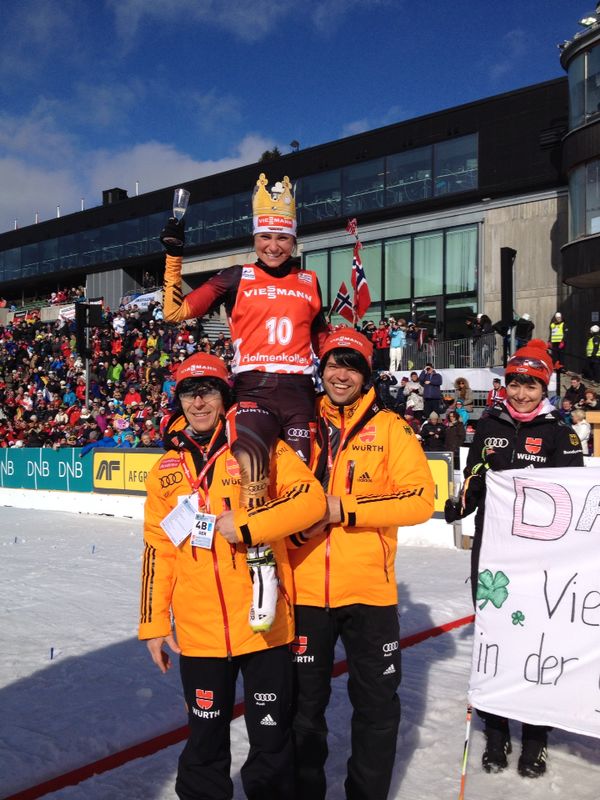
Germany’s Andrea Henkel, now Burke, after the last race of her career in March 2014 at Holmenkollen in Oslo, Norway. (Courtesy photo)
For Andrea Burke, formerly Henkel, retirement has meant embracing workouts in a new form. The 37-year-old German, who stopped racing a year ago and married Tim Burke in October, has found that in the time since she’s been able to enjoy mixed methods of exercise.
A four-time Olympic medalist and the first biathlete to win every individual event at World Championships, Burke is currently transitioning to moving from Oberhof, Germany, to Lake Placid, N.Y., where her husband grew up. There, she aims to start a personal-training business, and has been taking classes and getting licenses to do so.
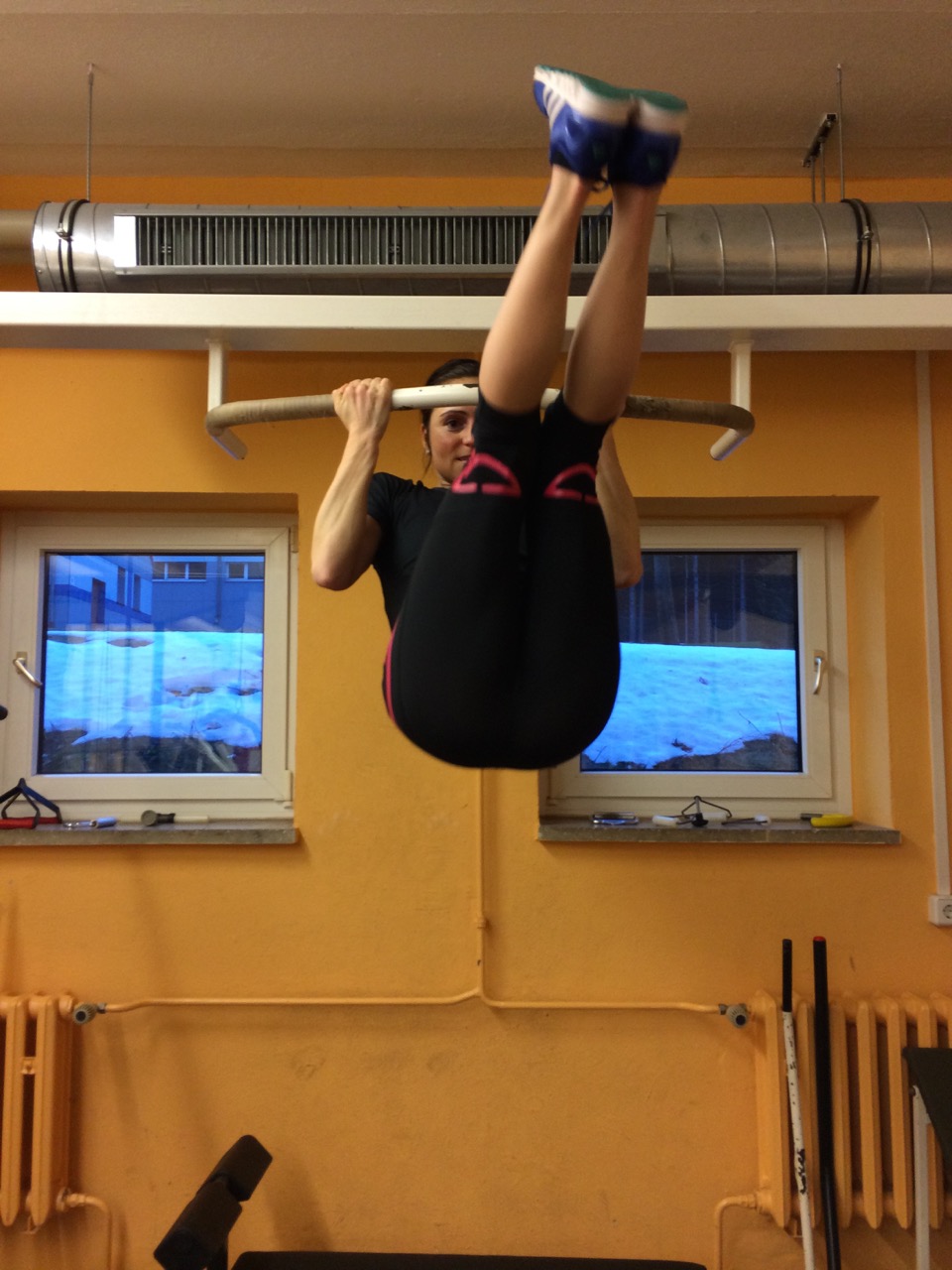
In an email earlier this spring, she provided this strength workout as a cross-training option, “especially when you do not have so much time or the conditions are very bad outside,” she wrote. “I promise you some sweat and heart rate.”
Burke added that she started doing gym sessions like these in the last two years, and more so when she finished biathlon.
“I really like to do [these] kind of programs for staying in shape and get some heart rate between studying,” she wrote. “It’s a great possibility to work out by having not so much time but still feel I get a good workout done.”
She recommends doing this kind of full-body workout twice a week.
2010 U.S. Olympian Caitlin Compton, now Caitlin Gregg, racing in West Yellowstone in November 2010.
Remember the Pro Workout? As you may or may not have already figured out, the Wednesday Workout is our weekly reincarnation. This week, we bring back a Pro Workout of the past, which features advice from Caitlin Gregg of Team Madshus/Gregg, formerly Caitlin Compton of Central Cross Country (CXC), from December 2010. See the original here.
***
[Circa December 2010, by Topher Sabot] In the past, our “Pro Workout” series has featured a single training session from an elite North American skier, but this week CXC’s Caitlin Compton gives us a slightly different take.
Instead of detailing a favorite workout, Compton addresses an oft-ignored aspect of race preparation – the ability to respond to challenging and unexpected circumstances.
Over the past several years, major North American events have been disrupted by everything from volcanic eruptions to frigid temperatures to low snow.
This is all part of being an outdoor endurance athlete, Compton explains, but how you respond can have a major impact on your success.
“You need to have the ability to be flexible and to understand that there are some things you can’t control,” Compton says. “But there are tons of options. The beauty of cross-country skiing is that we do lots of cross-training in the offseason.”
This variety means that skiers can easily turn to alternative training methods when plans need to be changed.
Compton keeps her body in running form with regular jogs throughout the ski season, meaning she can easily throw in a significant foot session – even intervals – without experiencing any soreness.
And while training indoors is often a last resort for skiers, a local gym can be a perfect fallback plan if weather forces you off the trails.
“There is always a chance that conditions may be less than ideal for a huge event,” says Compton, noting that many athletes expect that the biggest races will automatically have perfect skiing – something that rarely comes to pass, be it U.S. nationals or the Olympics.
So an athlete’s response to less than ideal circumstances throughout the year can be an important part of her preparation.
“A good way to approach an alternate workout is to think, ‘if this comes up again, I will be ready,’” explains Compton.
“The approach is the most important,” she continues. “The goal is to not let it affect you and mentally stay positive, and look at it as an opportunity to practice and have fun overcoming the adversity.”
She also points out that workouts within two weeks of a competition will not have a significant impact on fitness, so you aren’t going to make or break your big event with a specific session.
Compton gives a very recent example, describing how she and [former] CXC teammate Jessie Diggins were forced to adapt when they arrived at the 2011 U.S. nationals venue in Rumford on Wednesday.
A middle school race and a lack of snow meant there was not much skiing to be had – and none suitable for race skis. The women had not brought rock skis to the venue, so they made a quick decision.
“We had both been running, so we switched into our running shoes and went out there. We made the most of it, had fun and left the day, maybe without the same specificity of a ski workout, but with something accomplished, and our heads still psyched for the upcoming event.”
Diggins was even able to stick to her plan of doing level 3 intervals, with Compton providing support.
But Compton notes that this is a learned skill and one that must be practiced. Years of experience help, and over time the situations that cause stress become just another part of life as a ski racer.
And says Compton, freaking out will just make you more tired, and that will certainly not make you race faster.
Several years ago, when at a biathlon training camp in Torsby, Sweden, Compton was faced with highly memorable circumstances. Despite being in Scandinavia during the midwinter, in a town that is home to one of the world’s few indoor ski tunnels, there was nowhere to ski.
The weather was beautiful, but against all odds, there was little snow on the ground. Compton ended up doing combo intervals (shooting and skiing) on a quarter kilometer of snow shoveled by her coach around the range, and during her stay mixed in running intensity as well.
“Not ideal for that time of year,” Compton reminisced, but it ended up being fun.”
And as with so many things, sharing the challenging experiences with teammates is one more potential positive.
“I have definitely learned in my years of skiing that nothing ever goes perfectly. You just have to make the most of it and roll with it,” says Compton.
Sarah Max (XC Oregon) on her way to winning her fourth Pole Pedal Paddle title on May 17 in Bend, Ore. (Photo: Mike Albright/Mike Albright Photography)
After racking up her fourth Pole Pedal Paddle (PPP) victory on May 17 in Bend, Ore., Sarah Max got back to her day job as a financial writer (for publications like The New York Times, Barron’s, Entrepreneur, and Money Magazine) and executive editor of 1859 Oregon Magazine. At 39, she’s a mother of 11-year-old twins, yet Max still finds time to train and race with XC Oregon in Bend, focusing on ski marathons throughout the winter.
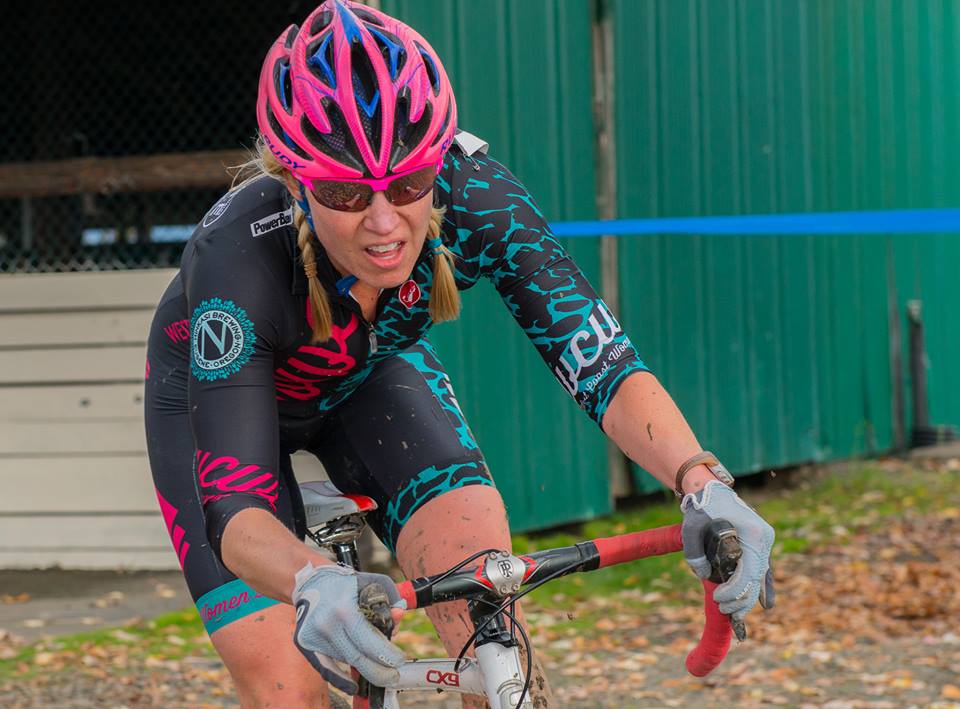
Sarah Max during a cyclocross race. (Courtesy photo)
“I’ll probably stick with a similar program as the last couple of years, which is a few bigger races, ideally in fun locations,” she wrote in an email. “Next year I may go do the Norwegian Birkie again. (I’m not a great classic skier, so like the challenge of a long, hard race.) I will probably do American Birkie again too… It’s just a nice, hard race. I usually do Boulder Mtn Tour every year, partly because my whole family likes to go — though that course doesn’t suit me. I like to ease my way into a race, and there is none of that there.”
After her seventh solo PPP (she’s also done it other times with a team), Max will likely move on to cyclocross races in the fall and some off-road triathlons or other multi-sport events this summer. This Saturday, she’s doing the Hood 2 River Relay for the first time as a pair.
In preparation for the PPP, she wasn’t overly regimented with her workouts (especially after winter of ski training), but she did work on running (see below).
***
After a winter of planned workouts, I generally don’t follow a training plan for the Pole Pedal Paddle. This year followed a similar script. Starting about six weeks before the event, I tried to get in most of the major events (ski, bike, run and paddle) about twice a week, with some doubles on a few of those days. Skiing was lowest on my list of priorities since I already had ski fitness and didn’t want to use up precious training time driving to and from Mt. Bachelor. Plus, I was ready for a change of pace.
Sarah Max on her way to another Pole Pedal Paddle victory on May 17 in Bend, Ore. (Photo: Neil Korn/BendOR Magazine)
Most of my workouts were short, usually about 45 minutes to 90 minutes tops. My thinking was that since I have a pretty big base going into the spring – training for the 90km Swedish Vasaloppet is good for that – endurance wasn’t as important as sports specificity.
Up until a couple weeks before the race, I planned my workouts around the weather, which always a crapshoot in the spring in Bend, and what my friends were doing. Probably the best thing about training for something with so many different legs is it opens the universe of workout buddies.
To recap, the PPP is a short alpine ski, followed by an 8km skate, 22-mile bike, 5-mile (ish) run, 1.5 mile paddle and short sprint to the finish.
The hardest part of the race for me, and probably most individual racers, is the run. The run in and of itself isn’t bad. It’s when you do it after alpine skiing and Nordic skiing on icy conditions, then going hard on the bike. The first 10 minutes of running always hurts. A good way to prepare for this is to tag on a short run to most of your bike workouts or do a quick bike before your longer runs. In the triathlon world this is known as a “brick,” an apt term for the discomfort of biking then running.
Here’s one workout I did along those lines.
The Plan: 1 hour 15-minute road ride followed by 15 minute run.
Warm up: My house is on the road heading toward Mt. Bachelor, which is the PPP bike course. I started out my door riding easy for the first 20 minutes, where the grade is relatively gentle.
Uphill intensity: When I hit the steeper section I started a 30-minute tempo workout, keeping my heart rate about five beats below threshold. Normally I would let myself climb out of the saddle for the steeper stretches, but I tried to stay seated for most of this.
Downhill speed: At about 50 minutes total, I turned back for the downhill. Rather than just coasting, I tried to keep pedaling through the downhill and working the few uphill sections and flats going back to my house. I can usually get back down the hill in half the time it takes to get up.
Transition: With my garage as my staging area, I changed out of bike shoes and helmet and into running shoes. Though it was tempting to go in the house and check email, change out of bike shorts, I tried to keep the transition quick, for maximum discomfort going into the run.
Ugh, the Run: Probably the most important thing about the bike to run transition is knowing that it will hurt and that you will feel slow. I play different mind games to get through the first 10 minutes, anything to just keep my legs moving. After about 10 minutes, like clockwork, things improve immensely. Though I’d planned to just run 15 minutes, I ended up going about 30 minutes.
Cool down: Since the hard part of my workout was the bike, my run was effectively a cool down. That said, I usually slow things down for the last five minutes and walk another five minutes. I try to stretch a little before I head back into the house… not always successfully.
Here’s another notable workout, mostly because it illustrates the crazy logistics that go into training for and doing this race:
The plan: 1 hour run and soccer/paddle
A week before the race, my twin daughters (11 years old) wanted to run the PPP course. They competed on a team this year, with Izzy doing the Nordic ski and Fiona doing the run, which was 2.5 miles for teams 12 and under.
My husband, Kevin, and I loaded my surf ski onto my car, and we all piled in – dog included. Kevin dropped us off at the start of the run course. While my girls and I ran the course, he drove the boat to the boat put-in at the river and took our dog for a run.
After a pretty quick run lead by Fiona, the girls helped me unload my boat and get it into the water. They grabbed their soccer balls and had a kick around, and I banged out a 30-minute paddle. An hour after we left our house, we all loaded back into the car.
Sarah Max (r) with her “twin,” Amanda Porino, her support person who surprised Max by dressing as her for the Pole Pedal Paddle on May 17. (Courtesy photo)
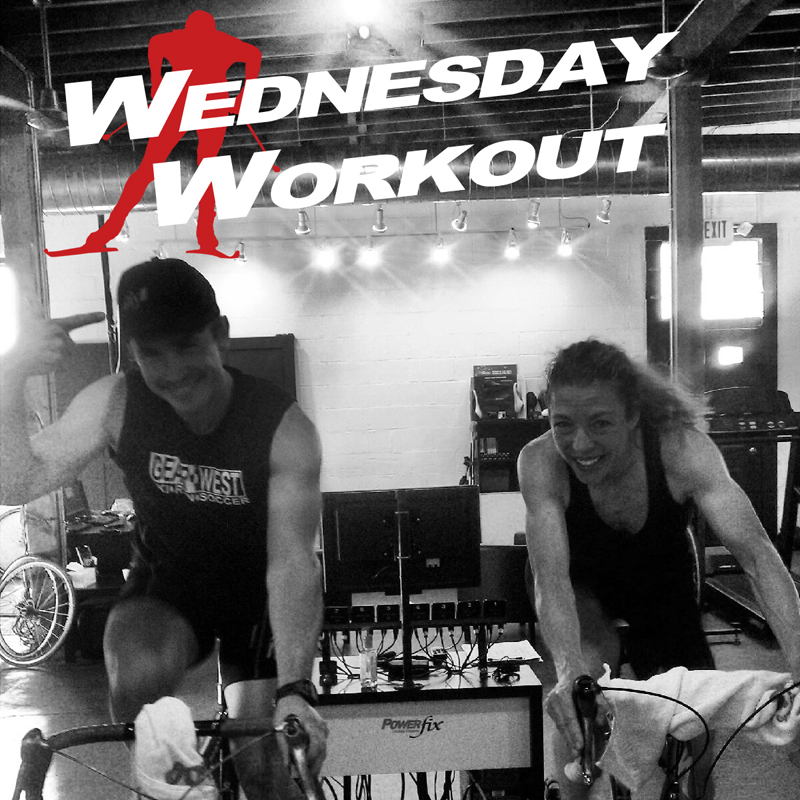
Matt Liebsch (l) gives a plug to The Fix Studio by pointing to its logo on his hat during a CompuTrainer workout with Lynne Cecil, 1990 American Birkebeiner champion and his co-worker at Gear West in Long Lake, Minn. (Courtesy photo)
Welcome to Wednesday Workout, the newest workout series on FasterSkier. This week, Matt Liebsch, an independent skier sponsored by Borton Volvo and director of race services at Gear West in Long Lake, Minn., talks about balance — with work and training, ski-specific and cross training.
Last summer I roller skied my brains out. Coming back from a bike accident/concussion and a very bad ankle sprain, running was not an option and I was gun shy about getting on a bike.
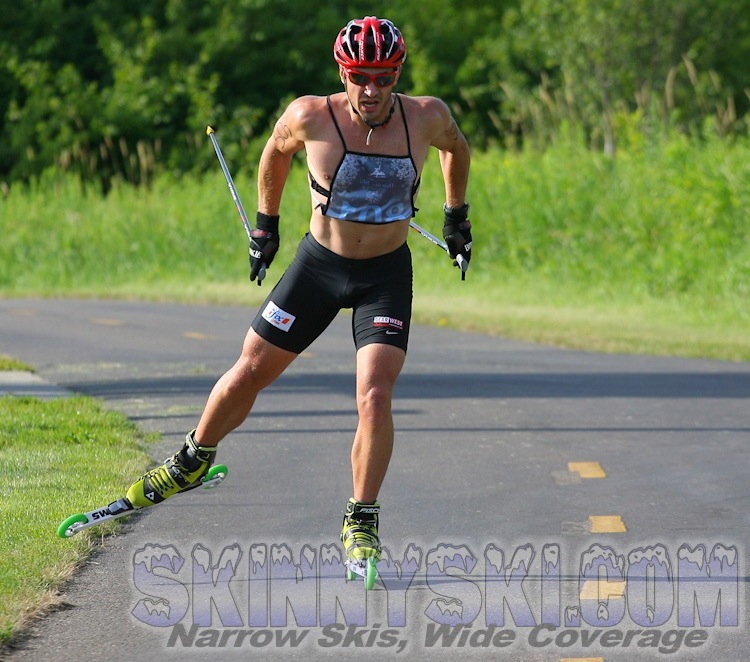
Matt Liebsch on his way to winning the 2013 Ringer Roll 10 k freestyle rollerski race by nearly a minute and a half on Aug. 2 in Maple Plain, Minn. (Photo: SkinnySki.com)
I think all the ski-specific summer/fall roller ski training is great but it is important to keep training fun and diverse at times. This way, once late fall and winter arrive, I can be mentally fresh for 100-percent, laser-guided focus on ski training and racing.
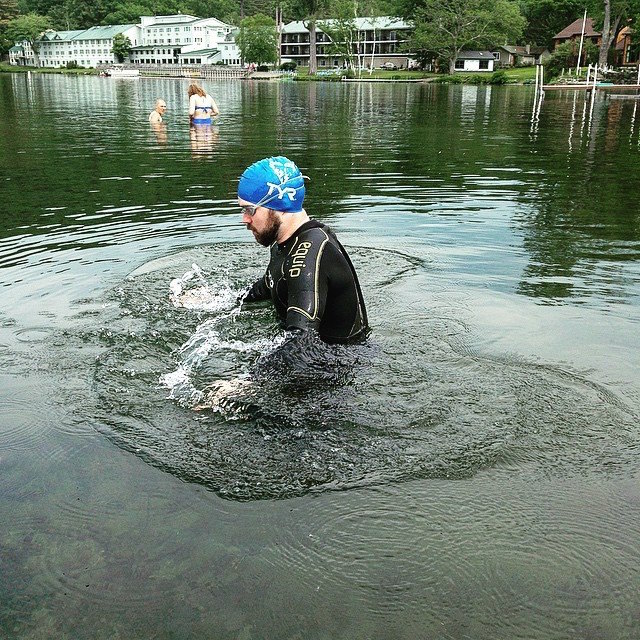
To keep things fresh, this summer I have been doing a 2.5-mile, open-water swim every Wednesday. Our Gear West group swims to an island and back in Lake Minnetonka. I love swimming because it is low impact, involves a catch, pull, reach and rhythmic breathing.
We start at 6 a.m. on Wednesday. It is an early start to the day but we do this to avoid boat traffic. On the way out to the island I try to swim relaxed (I don’t have to try very hard, I am still half asleep) and on the way back I will push the pace a bit to 1:30 minutes/100-meters if I feel good.
After swimming for an hour and 15+ we will grab a quick coffee. If it is a volume week I may run, bike or roller ski after swimming for up to an additional two hours. Generally I get home in just enough time to make myself an omelet and then blast off to work so I can open the doors are Gear West by 10 a.m. No time for naps or massages.
I love swimming because it is low impact, involves a catch, pull, reach and rhythmic breathing.
Caitlin Gregg (second from left) and others get ready for an open-water swim in Lake Minnetonka near Minnesota’s Twin Cities. According to Matt Liebsch, who swims there weekly, Gregg’s husband Brian said it’s one of the hardest workouts he’s ever done. (Photo: Matt Liebsch)
Another mode of non-ski specific workload that I have introduced more frequently this year is cycling class. I have been doing CompuTrainer class at The Fix Studio once a week.
The benefit of doing intensity on a CompuTrainer system is that I can easily track power, training stress score and I can even see my pedal-stroke power profile. Another benefit is reduction in injury. It’s amazing how hard I can push myself at class on a CompuTrainer system with almost zero risk of injury.
I’ve noticed with the extra intensity on the bike my legs are rock-solid while skate skiing. My arms and abs are still strong from all the double poling and strength training but my legs have achieved a new level of skate specific fitness. I can only attribute this to the short focused cycling classes at The Fix Studio.
A typical cycling class at The Fix Studio includes intensity structured around your FTP, “Functional Threshold Power.” In cycling, everything is based off your power output. Being able to see power on the bike makes me wish it could be measured in skiing.
In skiing, all we have to measure work is speed (affected by roller ski speed, snow speed, weather, etc), heart rate (variable on a number of factors), lactate (also variable) and perceived exertion. Luckily the highly trained athlete knows their zones very well.
At class, we usually do a 10-minute warmup, 40 minutes of structured intensity, and a short cooldown. I generally like to ride outside before or after class to add a bit of volume.
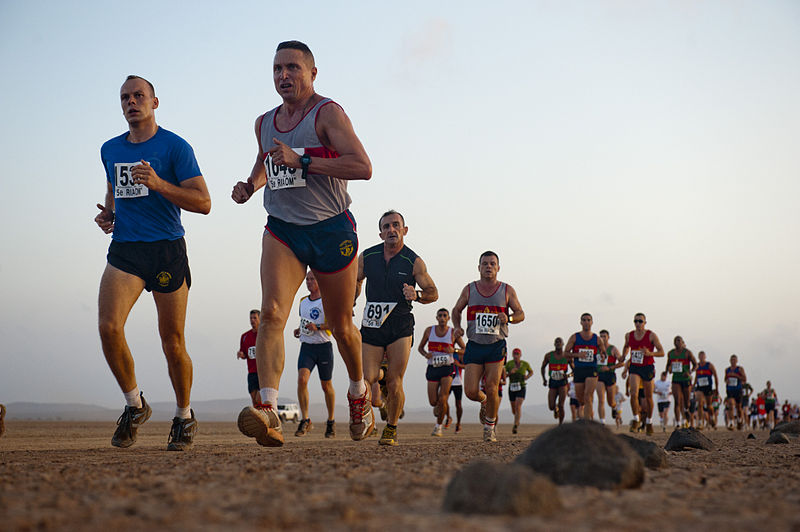
More than 250 members of the U.S. Navy cross the Grand Bara Desert at the 29th annual Grand Bara 15K race in Djibouti on Dec. 8, 2011. (Photo: Wiki Commons)
So it’s 85 degrees outside. Big deal, you think. I’ve run races on warmer days than that, I’ll probably have to compete in even hotter weather sooner than later.
You delay your run a little longer and it starts to drizzle outside. Perfect – now it’s going to cool off – so you wait even longer until it stops. By the time you step out for your one-hour jaunt, it’s about 87 degrees with a relative humidity of at least 90 percent. The Heat Index, or Real Feel, is in fact 109 degrees Fahrenheit, and you’re about to suffer.
As body temperature rises, sweat glands produce droplets to get the heat out, according to the Runner’s World August 2013 article, Sticky Situation. Humidity prevents that sweat from evaporating, and if there’s no breeze, you could be screwed (unless you’re hydrating properly). (Photo: Wiki Commons)
Now is not the time to be a tough guy or gal. Take it easy out there, know your limits, and take care of yourself after.
Across the U.S., people from sea-level towns to high-elevation dwellings have been or are still in a heat wave. You wake up: it’s muggy. You go to bed: it’s muggier.
Day after day of this kind of weather can make it tough to keep with an outdoor training regimen, especially if you can’t get out first thing in the morning. But the reality is, heat bites – even if you’re a seasoned athlete who’s dealt with humidity for years.
So before you drag yourself to the nearest gym for an air-conditioned treadmill workout, consider the following to keep yourself safe during and after an outdoor session. Above all, rehydrate, refuel and rest to prevent major setbacks from something as simple as heat cramps (ouch!) to heatstroke (yikes!).
What’s the difference?
According to MayoClinic.com, heat cramps are painful muscle contractions, most commonly in the calves, quads (thighs) and abdominal muscles. If you’re waking up in the middle of the night with charley horses (painful muscle spasms in your legs), this could be the culprit. Be sure to replenish lost fluids after every workout with plenty of water (measure by your level of thirst) as well as electrolyte-enhanced sports drinks (i.e. Gatorade, G2, and Nuun).
Heat exhaustion can bring one’s body temperature to 104 degrees Fahrenheit (40 Celsius) and lead to heat stroke. Signs include nausea, vomiting, headache, fainting, weakness and cold, clammy skin.
As your body temperature rises, so does your heart rate and brain temperature, Runner’s World reports. “Your ability to assess your own body temperature will become difficult (runners often report feeling chilled or goosebumpy when they’re overheating). You can also start to lose control of body mechanics (your form and footing will get sloppy), and your mental abilities may start to break down (you may feel dizzy or disoriented).
Heatstroke is bad. According to MayoClinic, it’s a life-threatening emergency condition that occurs when your body temperature is greater than 104 F (40 C). Your skin may become hot and you might find yourself sweating uncontrollably (the body trying to cool itself), and you could become confused or irritable. If you’re showing some serious signs, it’s probably best to seek immediate attention to prevent brain damage, organ failure or even death.
So how can you stay cooler?
Get out earlier or when the Heat Index (temperature combined with relative humidity) is lower.
Stick to shaded paths, not “heat-absorbing roads,” Runner’s World advises.
Stay near bodies of water (often cooler than inland)
Alternate between harder and easier efforts (not so much intervals but normal pace broken up by extra recovery breaks)
Wear a visor instead of a hat (your body releases heat through the head)
Keep some distance between you and your training partners to keep from soaking up their body heat, says Runner’s World.
Bring water and sports drinks for workouts lasting longer than an hour, and sip often (aim for every 15 minutes).
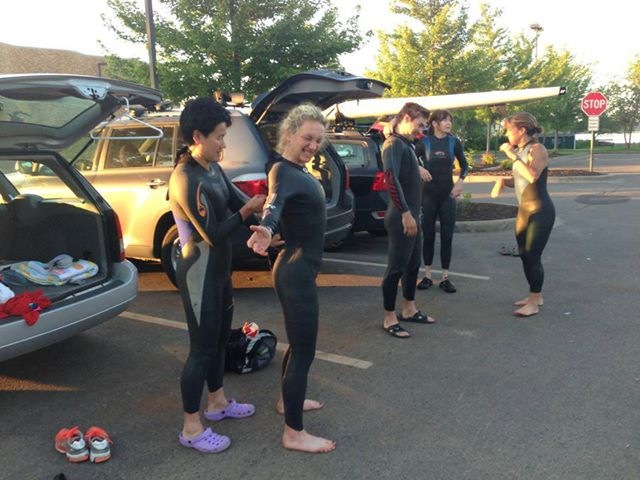
This Monday evening Jamie, Kyle, and I headed up to the church on the common to check out the Zumba class taught by Rosa, one of our community rowing regulars. For those of you who don’t know, Zumba is a dance fitness class that combines a little of everything, from belly-dancing to kick boxing to the samba. We were expecting to get a workout similar to that of yoga but an hour of booty shaking, shoulder shimmying, and dynamic footwork later we were drenched in sweat and already sore. So, we decided to take a closer look at the benefits of Zumba as cross-training.
Maximum Heart Rate: 169 I’m pretty sure this was reached during the belly-dancing portion of the class. Rosa conveniently had three extra belly-dancing hip scarves, the kind that jingle when you move, which she had us wear. Yes, Kyle wore one, and yes it was jingling.
Average Heart Rate: 140 but the only reason it wasn’t higher was because we didn’t bring our Zumba hand weights. Some of the dances were a little slower but incorporated rhythmic bicep curls with small dumbbells that doubled as maracas.
Favorite Dance Move: Butt-shake drum-walk. How it’s done: Shimmy your hips in a slight squat as you walk forward while simultaneously playing air bongo drums with your hands. Targeted muscle groups: Glutes, calves, quads, obliques, and deltoids.
Hardest Dance Move: Brazilian Samba. How it’s done: Who knows.
Easiest Dance Move: The “I workout” move. How it’s done: During the song “Sexy and I know it” by LMFAO flex both biceps in a power stance when you hear the words “I workout” followed by a sequence of hip thrusts.
Stretching: The last song was the cool down. This actually was pretty similar to yoga, if you did yoga to the beat of music and strung the poses together with a little interpretive dance.
Running, especially races, can provide a great speed or interval workout for skiers sick of rollerskiing. Photo: Mark Dewan
Tired of going out for a rollerski in the rain only to come back with soaked boots that need to sit for a day and a half trying to dry, stuffed with newspaper? Tired of rollerskiing in the hot sun? Tired of rollerskiing already, period? Running may be the answer, according to Dick Moss of Sudbury, Ontario. He’s been a coach for 29 years, working primarily with runners, but he has seen the occasional Olympian sneak into his workout. His athletes have also competed in other sports such as basketball, hockey, soccer and cross-country skiing.
He believes cross training is very important to any athlete because of the benefits to general fitness. “That improved athleticism ultimately gives the physical, mental and coordination base to become better,” said Moss.
According to Moss, running is probably the best activity to use as cross training for skiing, behind roller skiing. “Running in an outdoor setting, especially if there are uphills and downhills [is great for skiing].” The cardiovascular output and dealing with changing terrain is similar, and the benefits that running offers are almost unbeatable.
Many of the physiological requirements for skiers can be met through running. It has been established to help athletes improve their VO2 Max—the volume of oxygen the body can consume while exercising at its maximum capacity—which is a key component of fitness for any elite athlete. Skiers have been known to hold the highest VO2 max records in the world–Bjorn Daehlie holds the record for the highest at 96 ml/kg/min, achieved out of season, while Lance Armstrong was measured at a mere 88 ml/kg/min. Running also helps to improve a skier’s lactate threshold, balance and specific muscle endurance, which are other key ingredients to attaining an elite level.
There are some disadvantages to running, of course. It’s a higher impact activity compared to skiing, so there is more risk of suffering overuse injuries like shin splits and muscle fatigue. To avoid this, don’t overdo running, and make sure to change your shoes every 300 to 500 miles (500 to 800 kms). Also, though running has a similar motion to classic skiing, it does not engage the arms nearly as much. There are also added hidden dangers to running. “You’re more likely to get chased by a dog,” joked Moss. “But all in all, I’d think it’s an effective cross training method.”
XC Ottawa alum Ed McCarthy agreed that running is ideal for cross training for skiing, but made a distinction between road and trail running. “Road running, though good for building base or easy recovery, is not terribly specific. Trail running, on the other hand, is one of the most ski-specific dryland workouts you can do in every sense except for the strict technical motion.”
According to McCarthy, the effort and heart rate profile of a typical trail run will follow that of a ski race: sharp spikes during climbs, sustained tempo on flats and a bit of recovery on the downhills. “The mental discipline to keep pace over the tops of hills and to push the downhills is similar to that I use in ski racing,” he said.
McCarthy’s coaches always put a strong emphasis on running during the dryland season. “I think it’s no coincidence that many strong skiers are strong runners. The fitness level required for both is the same,” he said.
Running is also a great recovery workout and social activity. Taking an easy run with a friend is the perfect way to do active recovery and catch up on the latest skier gossip. Photo: Dick Moss
Moss shared a good workout for skiers to use for cross training from the former University of Wisconsin running coach, Peter Tegen. Try it out if you are tired of rollerskiing, if it’s raining out, or if you don’t have enough time to jump in the car and get out to where there’s good pavement.
“Dynos” are a form of controlled fartlek, or speed change, training. They focus on continuous running, even if the rest times are just a survival shuffle pace. The workout begins with a longer, aerobic interval around a 5 k race pace, which gradually becomes shorter and faster and ultimately ends in a series of short sprints. These sprints develop speed under stress and simulate the finishing kick in a race. They improve both the aerobic and anaerobic systems, the ability to surge and kick and stimulate the fast-twitch fibers that a skier like Northug, which his huge finish, must use. This workout can also be adapted in many ways to emphasize aerobic, anaerobic, or finishing kick abilities. If you run the recovery sections at a faster speed—almost lactate threshold pace—you’ll develop the ability to flush lactate out of your system more efficiently.
During the summer months, it can be hard to stay focused and keep your muscles snappy when all you seem to do is rollerskiing, rollerskiing and more rollerskiing. Cross training is important in order to avoid burnout or injury–especially for juniors or masters looking to mix it up during the off-season.
In a new series to FasterSkier, we’re going to take a look at some of the ways skiers keep themselves and their bodies sane by use of cross training. Some of the workouts are as familiar as a pre-breakfast run, while others may be as exotic as Cirque de Soleil.
Craig Pond, coach of the UBC Women’s rowing team, strongly believes in the diversity of sport as a means of teaching athletes to live an active lifestyle–instead of merely participating in a specific sport.
“It’s important, when you are a developing athlete, to have a broad range of sports. Just rowing and rowing and rowing is boring, and it’s the same with skiing. It tends to lose some of its excitement,” Pond said. “Try to keep variation so you’re not just hammering away at the same thing.”
For athletes who have been brought up in the ski arena, the sport can lose some of its shine by the time they hit the senior level. Rowing can help in keeping things fresh and new, with a little time off from the specific–but not from athletics.
Pond started out as a cross country skier in Belleville, Ontario, but was convinced to try rowing in high school. He went on to become first an elite rower, then, after injury, a coach.
“Both sports require most muscle groups in your body. Both are leverage sports that require force from your entire body,” said Pond.
Rowing can also help build strong muscles. Photo: Thomas Auer
Rowing and skiing are similar in that they both require the use of the body’s major muscle groups. A rowing stroke has both a drive and a recovery phase, not unlike skiing and both start with the bigger muscles in the body and end with the smaller ones. They’re also similar in they both have diversity in their races—sprints, mid-distance and long distances.
Andrea Bundon is a part of University of British Columbia’s (UBC’s) women’s team. She trains with them during the spring, summer and fall, then switches over to skiing for the winter to race.
She was also a guide for one of Canada’s blind skiers, Courtney Knight, in the Vancouver 2010 Paralympic Games this past winter. She finds that rowing gives her a mental break while still maintaining her fitness.
“When I hit the snow again, I feel refreshed and ready for the ski season,” said Bundon.
Here’s a sample workout from UBC’s playbook. If it’s too rainy and awful outside to rollerski, erg (or rowing) machines can usually be found at a gym to get a great interval session in. It can also be modified to become a longer interval. Pond thinks it’s a good workout because it keeps the structure of a race.
The Five -Thou-Five Workout
Do a good warm up. Either a 30 minute run or ride, or do a 30 minute rowing warm up so your muscles are ready to go.
Start with a 500-meter interval, which simulates of the beginning of a race. Make it a strong, steady burst.
Take an active break, light rowing or a couple minutes on the bike. It should be at least the same amount of time as your interval.
Hold a threshold pace for a thousand meters. This simulates the middle of a race. You should hold a strong pace with a consistent heart rate.
Take an active break.
Final 500-meter sprint to the finish line. This simulates the final sprint in a race and should be all out.
Cool down.
Rowing is a way to work at a team or solo. Above, the UBC women's lightweight four races on the Fraser River, B.C. Photo: Emmett Tuyp