From the FasterSkier archive — posts syndicated from athletes’ and coaches’ own blogs between 2004 and 2012, kept online as published. Current coverage is at fasterskier.com.
This coverage is made possible through the generous support of Marty and Kathy Hall and A Hall Mark of Excellence Award. To learn more about A Hall Mark of Excellence Award, or to learn how you can support FasterSkier’s coverage, please contact info@fasterskier.com.
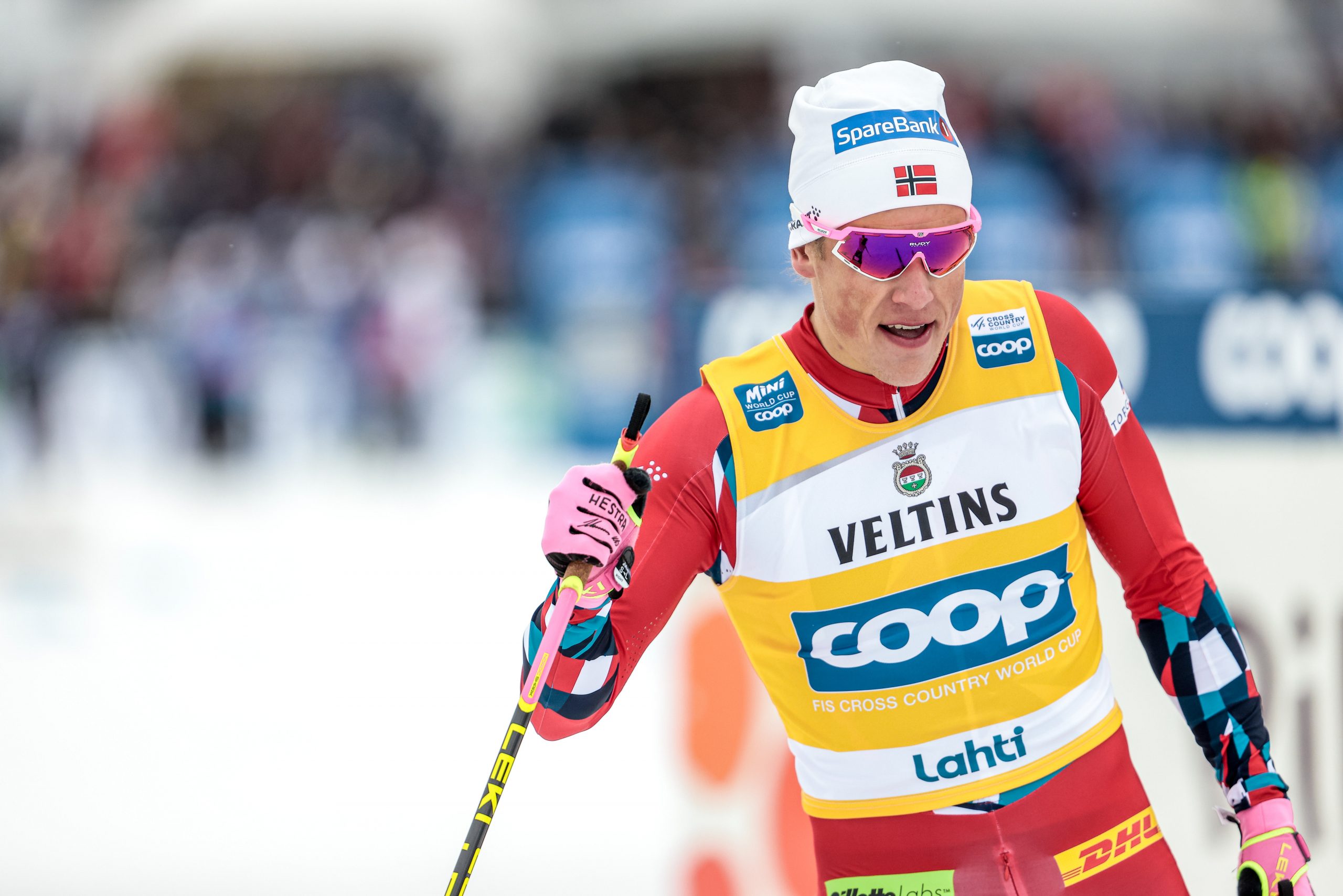
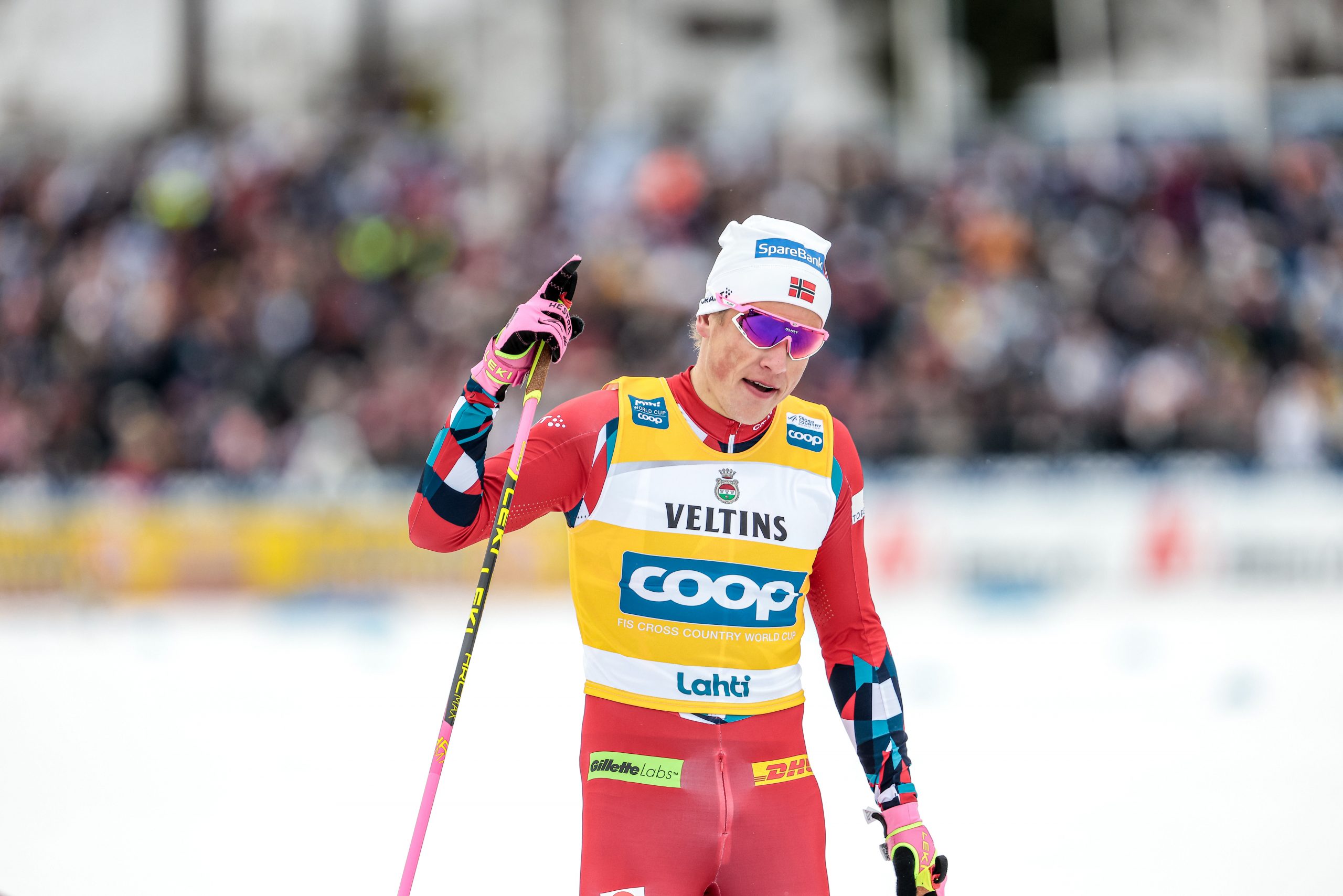
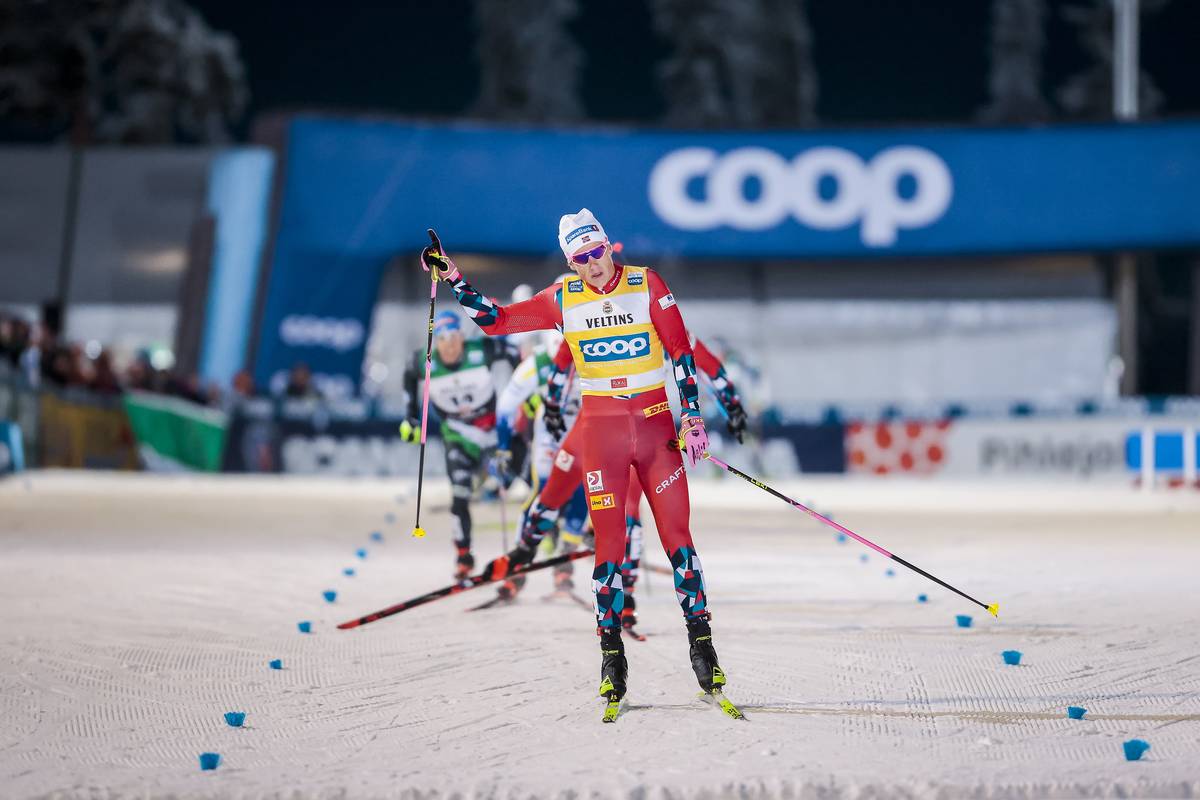
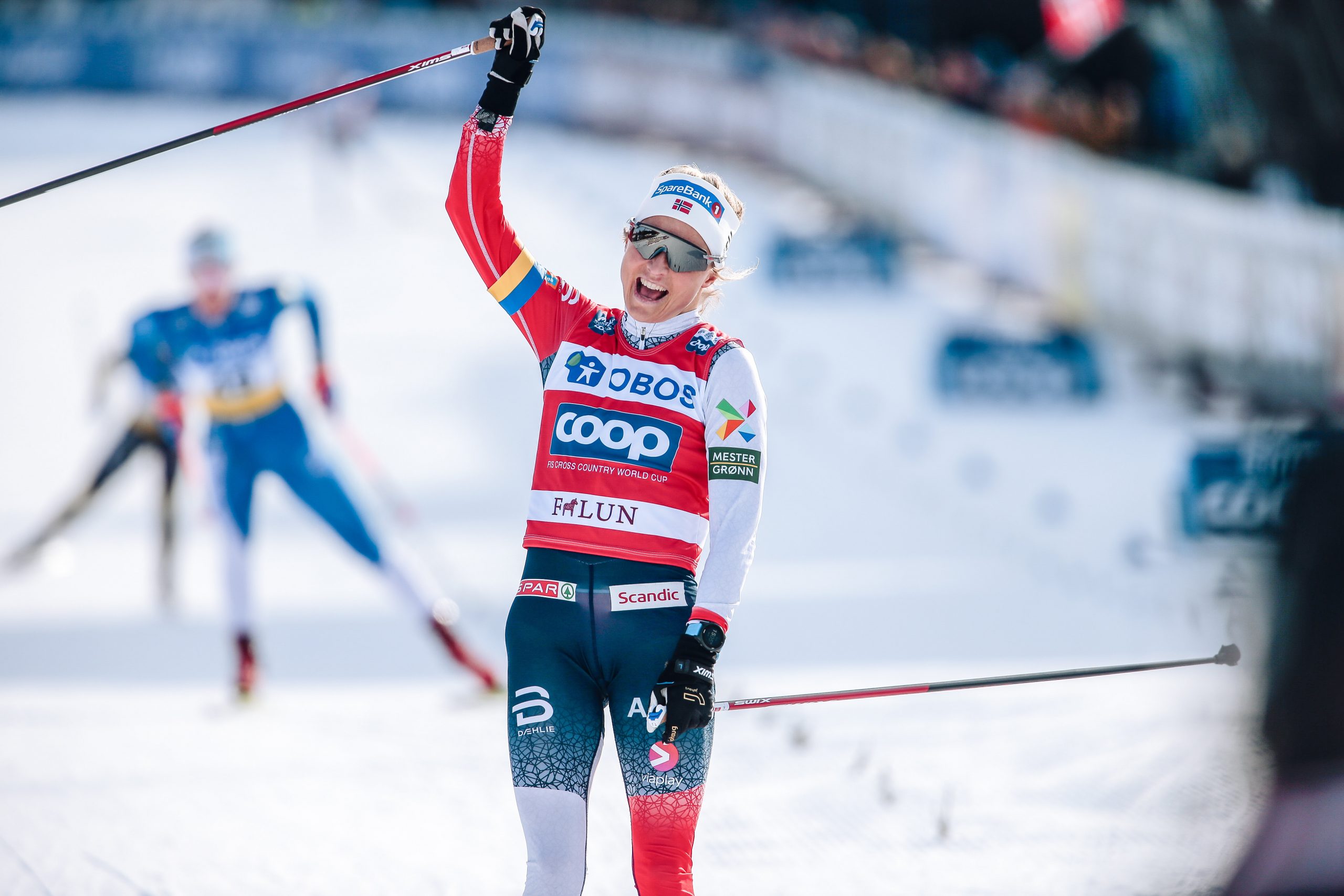
Johannes Hoesflot Klaebo (NOR) back in action and lifted by the roar of American ski fans during the World Cup 10 k Classic in Lake Placid, New York. (Photo: Dils / FasterSkier)
LAKE PLACID, NEW YORK — Ten kilometers into the second World Cup on American soil in as many decades, and the verdict is already clear: We need more racing in the United States.
That’s the message panted into my microphone by every athlete in the Mix Zone; shouted over the undulating din by every supporter I spoke with on the ice-lacquered walkways lacing Mt. Van Hoevenberg. And it’s the irresistible outcome of the turnout this afternoon in Lake Placid — with a crowd that came out in droves for Diggins, the Schumacher-Ogden’s Silver Medal Squad, and a host of homegrown heroes; that braved five inches of wet, driving snow; and that stayed to see Jessie clinch the Overall Crystal Globe, a reconstituted Klæbo overtake Amundsen in the Distance standings, and to welcome the world’s best to the conclusion of the 2025-26 season.
The reaction to racing in the United States in 2023 was overwhelmingly positive – and, it had seemed, sui generis. With four snowmaking venues spread across the Twin Cities, along with the (purportedly) highest concentration of cross-country skiers outside of Oslo, the energy that embraced Jessie Diggins in her home state and buried a generation of “almosts” for the U.S. Men’s Team in the snow and mud at Theodore Wirth could have been lightning in a bottle.
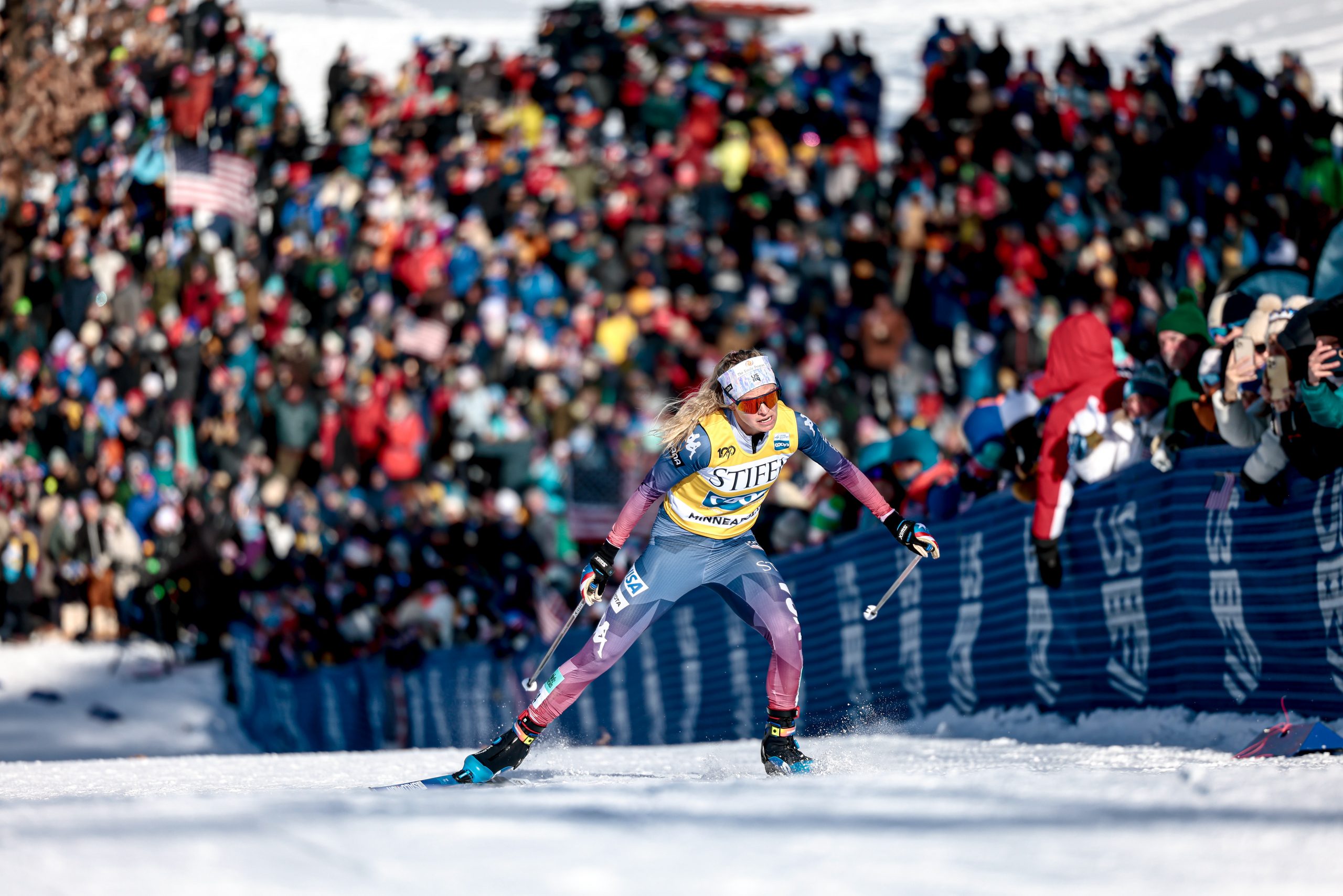
Jessie Diggins (USA) racing on home soil in Minneapolis and did so again in Lake Placid as she concludes her storied World Cup career. (Photo: Modica/NordicFocus)
I will admit my own skepticism that Lake Placid could field the fans, or the volume, of spectators to match Minneapolis. Perhaps my flight into Saranac Lake Regional Airport on Wednesday morning was my first evidence of error. Of seven passengers bobbing our way through the cloud-laden Adirondacks, four were here for the World Cup: Charlie, from Seattle; Billy (as in, Demong, the Nordic Combined gold medalist) and his son, from Salt Lake City; and myself, from D.C. Bussing to the venue the next day, I’m seated with a dozen of University of Minnesota alumni – they’ve taken off of work, graduate school, and medical school to spectate. “I’m excited just to see the number of people out cheering,” Alex Gude, who organized the trip, tells me. “I think one of the best parts about Minneapolis is just seeing the community come together, and now, away from home, we’re seeing another whole ski community come out and cheer.”
And, indeed, they are – from across the United States, from across New England, from across the Canadian border, and from right here in Lake Placid. Once we disembark, I wade through the corn snow and the first of many falling flakes to Mt. Van Hoevenberg’s sprawling Nordic Center, where the racecourse coils around the podium and snakes below the pedestrian bridge. Patricia Damp is herding thirteen might-be-members of the local ski community across the bridge; she’s a third-grade teacher here in Lake Placid, chaperoning a class field trip to the World Cup Finals.
Are the kids already Diggins die-hards, Ogden acolytes, Gus bus-riders? Not really, Patricia tells me. The class “was out here a couple months ago, cross-country skiing. We get to do the Olympic venues. We were at the museum a month ago. We have a friend who we watched ski jump. So, we’re very Olympic-oriented, and today we’re just out here to support the athletes and get some autographs.” Her students back her up. “We’re excited to get the players’ signatures,” Riley tells me. And while Declan is “excited to see the racers,” there’s no-one in particular he’s cheering for.
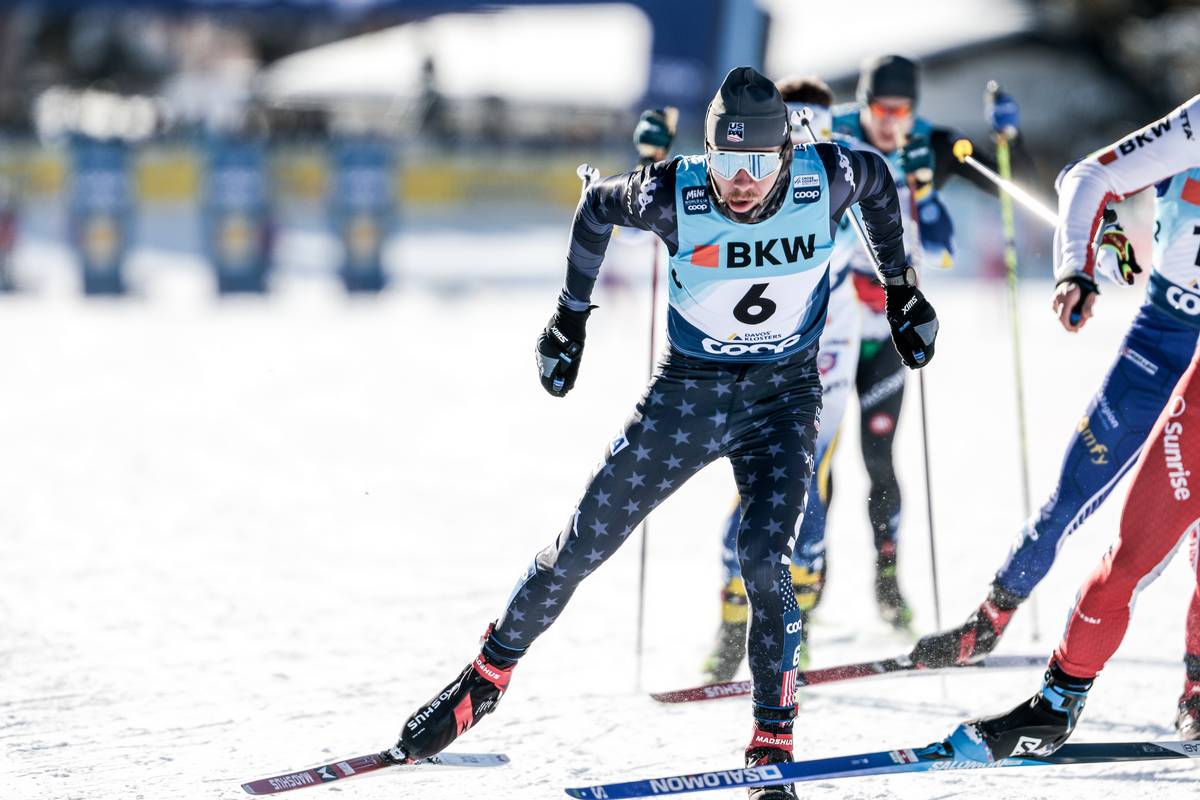
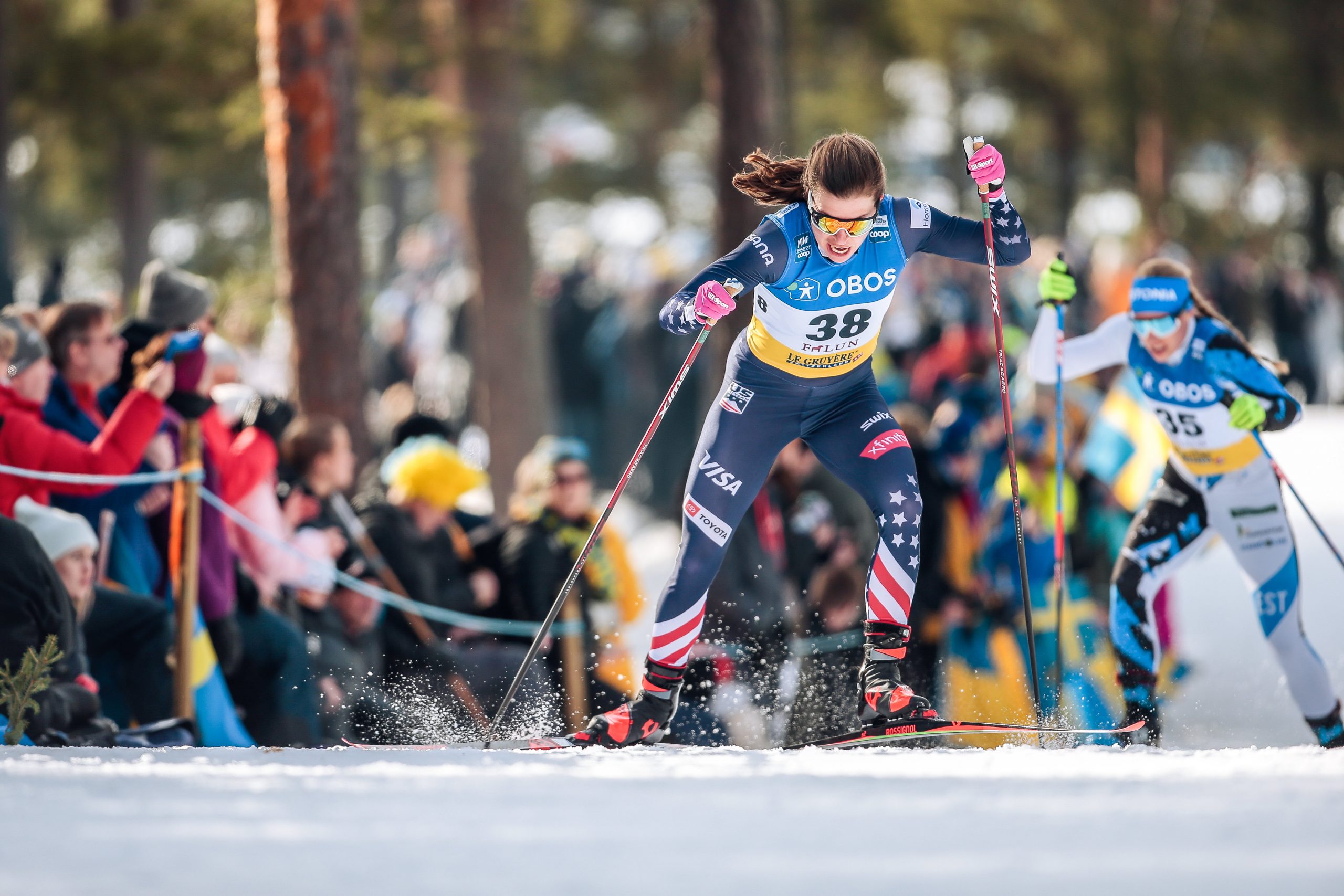
Gus Schumacher (USA) during the Men’s 10 k Classic in Lake Placid, New York. (Photo: Dils / FasterSkier)
From the mouths of children, our first – and perhaps strongest – argument for future American World Cups. The glitter-dusted kids in fan club bibs, wielding cardboard-cutout faces as large as they are, make for compelling pictures and undeniable evidence of Team USA’s impact on its next generation. But racing in the United States creates opportunities to draw an entirely new cohort of young people into the cross-country skiing community – kids who may have never tried skiing before; who may not have heard of Kikkan or Klæbo ; and whose parents certainly are not waking up before sunrise to livestream Ruka, Falun or Holmenkollen. They will not see themselves in this sport until they see this sport. What better way to do so than on a Friday field trip with Mrs. Damp?
After bidding them good luck with the signature-hunting, it’s not an easy task to wade against the current of the rest of the Lake Placid Class of 2035. Also threading his way through the third-graders is Niklas Dyrhaug, immediately recognizable even five years into retirement from World Cup racing. He’s on the other side of the v-boards this weekend, broadcasting for Norwegian television. In his first sentence, he tells me: “We are enjoying being back in the U.S. In my opinion, we should be here every year.” He’s not surprised by the number of spectators, either. “Everybody who knows the U.S. crowd knows they are really enthusiastic . . . We know the tradition, the culture, and Lake Placid’s place in that history. So, personally, I’m not that surprised. It’s really cool that we’re back here.”
That’s the sentiment just after Coaster Hill, some four kilometers into the racecourse, where Norwegian national team coach Eirik Myhr Nossum prowls the striding zone. Being back in the United States is “awesome, it’s amazing. I think we should be here every year, because you guys show up; you guys cheer for everyone, and it’s always fun to be in the U.S. and to be overseas to compete.”
And it’s the sentiment at the finish line.
Harald Oestberg Amundsen (NOR) after the 10 k Classic in Lake Placid, New York. (Photo: Thibaut/NordicFocus)
Harald Amundsen (NOR) tells me, “In the outer part of the track, there were so many people I couldn’t hear my own thinking. That’s a really good thing.” Even before he arrived at the venue, “We had a run this morning in the city. Everyone was screaming at us, ‘Good luck!’ It’s a really nice atmosphere.”
For Elia Barp (ITA), conditions were “very tough because it was really slow with this new snow, but it was fun racing for me. So I enjoyed it – at least I tried to enjoy it – it was a pack of people screaming my name so that gave me even more motivation, and was fun . . . I loved racing two years ago in Minneapolis, and here it’s packed with people, even with the snowfall, so thank you to everyone for coming. It’s really good to race here.”
Mika Vermeulen (AUT) admits, “Honestly, this is probably the worst race I’ve done in a long time. But I don’t think I’ve ever had so much fun out on the track . . . on top there, out in the forest, I just heard, ‘MI-KA, MI-KA,’ the whole time. It was insane. I had a bad race and a lot of fun.”
As for how he feels about returning to the United States: “Great, great, actually—and feeling a bit frustrated, because it just gets me pissed that we race these [bad] courses in Europe all the time, over and over and over again, and we have these freaking jewels out here which we never use. It’s crazy. I want to go to the U.S. every year for at least a whole period. It’s called the World Cup. It’s not called the European Cup, right?”
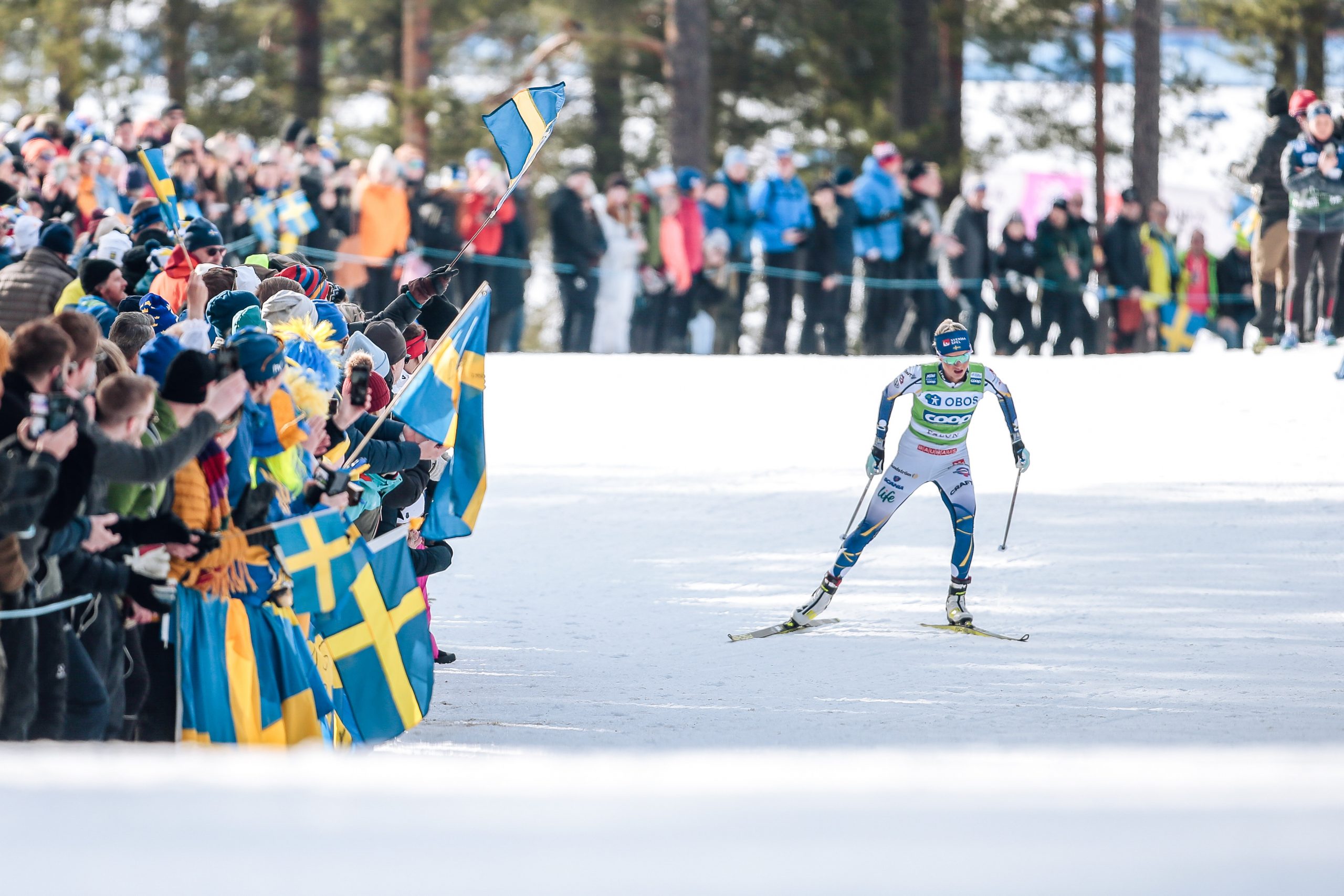
Fans all over the course with custom gear showing their fandom. (Photo: Dils / FasterSkier)
Klæbo’s opinion is a bit more measured – perhaps because he has more microphones hovering around his face. “I heard some rumors that it was supposed to be quite well [attended], and when I searched up Lake Placid and read a little bit about the place, I understood there’s not that many people living [here], but when you see how many people are here, I was pretty shocked.”
A second argument, then, in favor of World Cup racing in this country: the athletes love it. They embrace not just the energy, but the venues that push the World Cup beyond the geographic and cultural confines of Transalpine Europe.
Benjamin Dohlby (USA) at the finish of the Men’s 10 k Classic in Lake Placid. (Photo: Thibaut/NordicFocus)
For the closing statement, Ben Dohlby is among the last athletes I interview. This is Ben’s first World Cup start; a junior at University of Alaska-Fairbanks, he was 3rd in the American Birkebeiner in February. How does it feel to be making his first professional start in the United States?
“It was crazy. I went out so hard. The fans were so loud that I didn’t feel anything, and then I felt it all and got so tired – but it was awesome; a great atmosphere.” It wasn’t too long ago that Ben was skiing laps around the glazed kilometer of manmade snow at Lapham Peak State Park in Delafied, Wisconsin; now he’s here. To his former teammates, to other up and coming skiers, and to novices across similar ribbons of snow in Wisconsin, Michigan, and Minnesota, his message is simple: “Follow your dreams and you can make it happen.”
Most of the fans hiked up on the course, but the stadium filled up as the day went on. (Photo: Dils / FasterSkier)
That, then, is our concluding point: More World Cup starts on American soil means more starting berths for American skiers, and more chances for our most talented young skiers to make it to the starting line. We should savor the privilege of, as a host nation, pitting our athletes against the most accomplished figures in the sport, dreaming that a World Cup podium, an Olympic medal, could be in their future. When a lifetime of discipline and preparation meets the opportunity of a lifetime, the promise of Lake Placid – that miracles can happen – becomes deliverable.
I will leave the invariable complex problems of bidding, organizing, and logistically managing future events to far wiser pundits. But, in the meantime, the verdict is clear: FIS, U.S. Ski & Snowboard, and the American Nordic community should be eager, and determined, to have them here.
Love Stories Like This? Help Keep Them Coming.
Feature stories like this one take time, access, and care to produce. If you value thoughtful storytelling and independent ski journalism, please consider becoming a Voluntary Subscriber. Your support directly fuels the work we do to cover the people, places, and moments that make our sport special.
This coverage is made possible through the generous support of Marty and Kathy Hall and A Hall Mark of Excellence Award. To learn more about A Hall Mark of Excellence Award, or to learn how you can support FasterSkier’s coverage, please contact info@fasterskier.com.
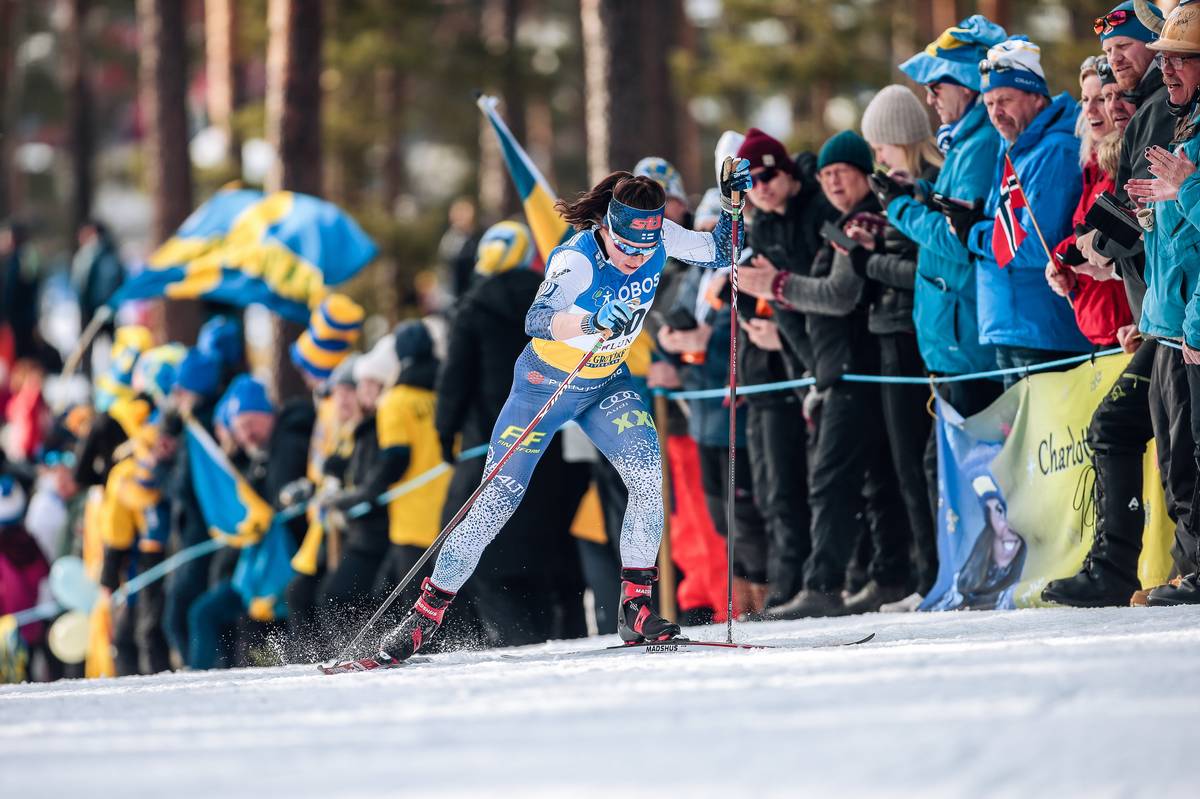
Linn Svahn (SWE) showed that she is no one-dimensional sprinter, holding off the season’s dominant Distance skier —Swedish teammate, Frida Karlsson—for the win in the FIS World Cup Final 10 k Classic Interval Start in Lake Placid. (Photo: Modica/NordicFocus)
FasterSkier’s reporters watch every single race of the World Cup and Olympic season, so we have our own ideas regarding what may happen on any given race-day. We’ve followed who has been progressing up the standings, who has been fading, who has been injured or ill and how their recovery has progressed. And we follow the amazing and durable actions of Jessie Diggins (USA) who has competed in every single race of the season (That’s right, isn’t it? Someone check the record . . .). Alone among all World Cup competitors, Diggins continues to devote herself to performing at the highest levels on every available race day. If she’s tired, she deals with it. If she gets sick, she overcomes it. If she’s injured, she races through it. If there’s a start line and a finish line, drawn on the snow Diggins is racing. While it may be argued that she might’ve performed even better if she took a day off from time to time, evidently it’s impossible for her to just sit out those race opportunities. And Diggins is also one of only two skiers in the world (along with Johannes Hoesflot Klaebo) who has an honest chance to win on any given day, regardless of distance or discipline. And the reward for such devotion and fortitude?
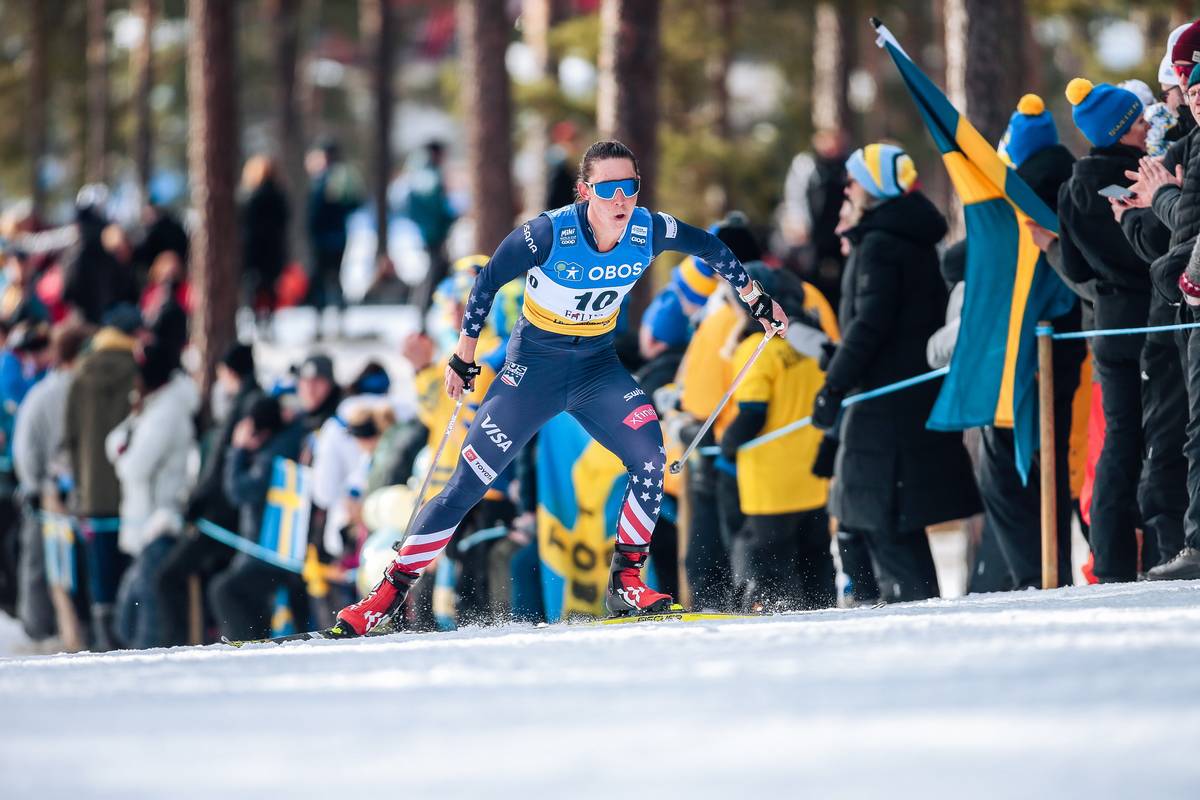
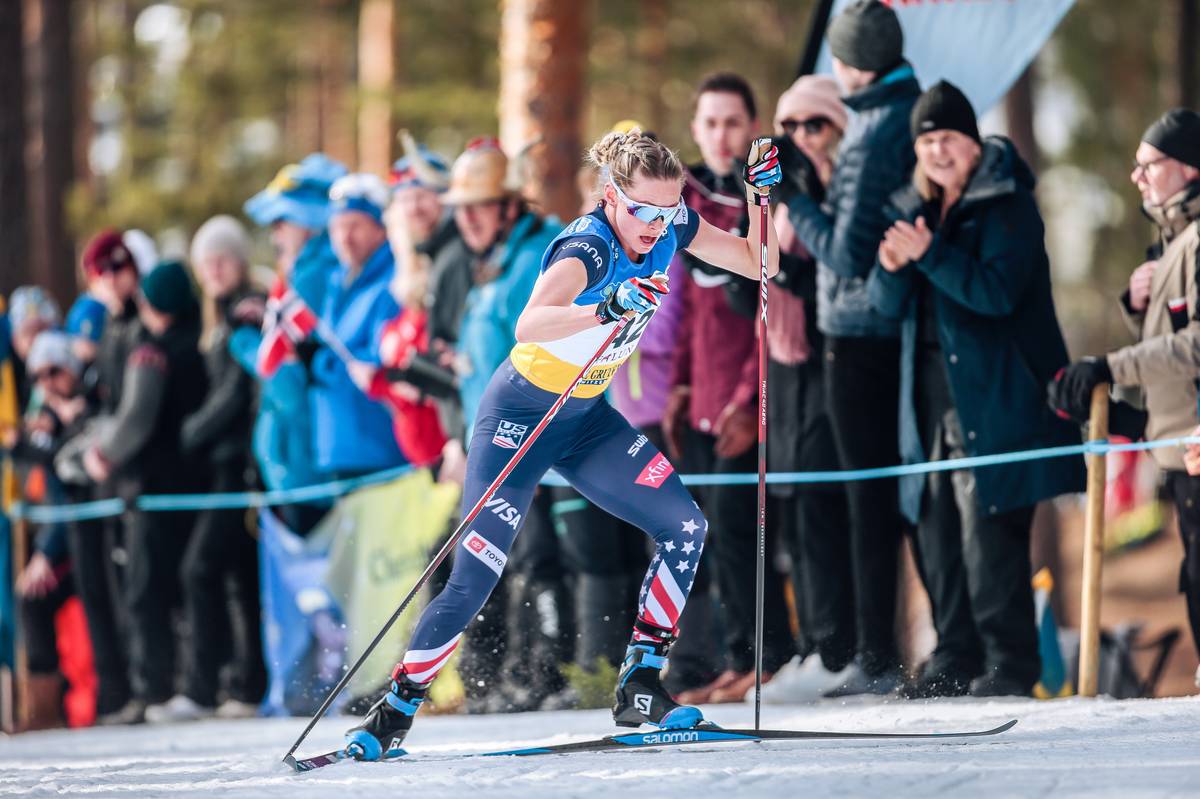
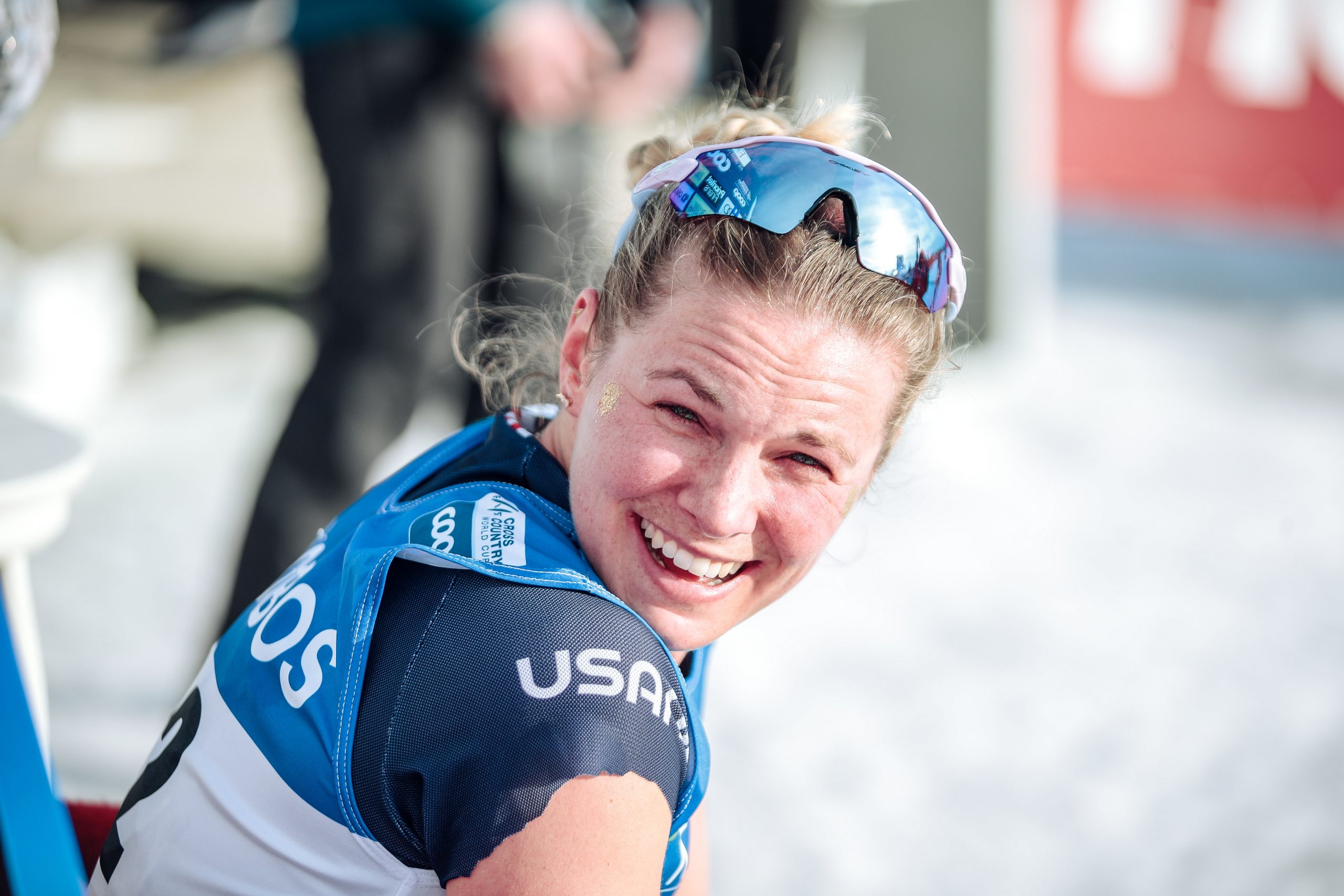
All eyes were on Jessie Diggins (USA) whose career is winding down to retirement, but not before another excellent top-five performance in the 10 k Classic, and the clinching of another World Cup Crystal Globe. (Photo: Thibaut/NordicFocus)
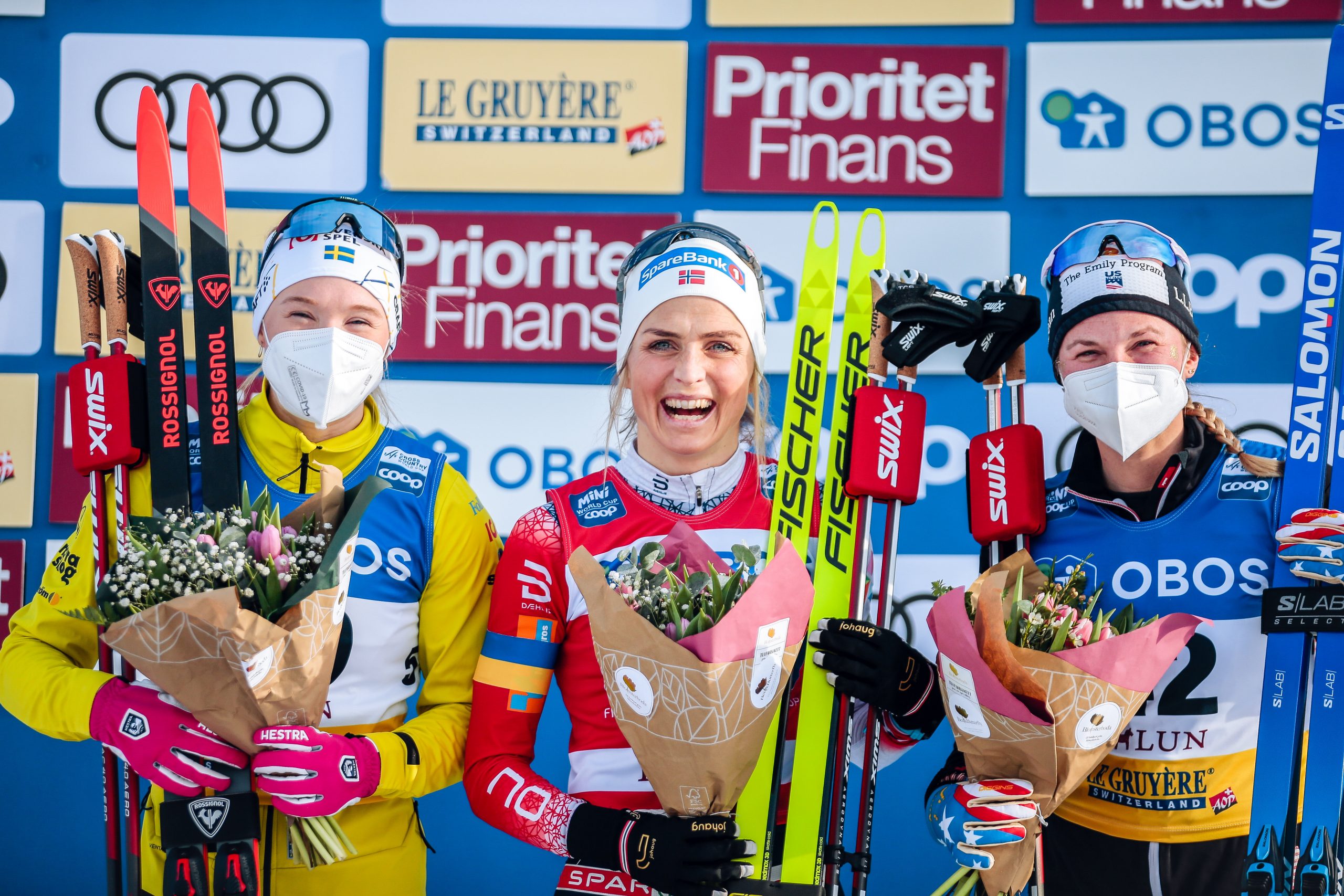
Any day’s race coverage begins with a check of the start list; that’s how we see the first inclinations of how the story might unfold. Here’s the context of today’s 10 k Classic Interval Start: perennial contenders, Ebba Andersson (SWE) and Kerttu Niskanen (FIN) have chosen to stay home home, Krista Parmakoski (FIN) retired at eh Holmenkollen finish line, and Dariya Nepryaeva (AIN) wasn’t allowed into the country (no American visas issued to Russian citizens) . . . The rest of the contenders appeared to be present. Among the logical contenders within the women’s field were those whose performances shined brightest this season, but whose illnesses and injuries kept them from contention in the year-long FIS World Cup competitions. Frida Karlsson (SWE) is undoubtedly the fastest skier in the world today as she proved repeatedly in the Olympic Winter Games and the recent Holmenkolen 50 k. She is joined by a list of other Distance contenders including Heidi Weng (NOR), Astrid Oeyre Slind (NOR) Karoline Simpson-Larson (NOR), Jonna Sundling (SWE), Moa Ilar (SWE), and Olympic Sprint champion Linn Svahn (SWE).
Host-nation USA was allowed additional entries. In addition to the much-anticipated participation of Diggins, the American roster included Emma Reeder, Alayna Sonnesyn, Katey Houser, Renae Anderson, Emma Albrecht, Samantha Smith, Novie McCabe, Kendall Kramer, and Rosie Brennan.
“It’s really awesome to know how many people care about skiing in America,” Kramer said in response to the crowds of eager spectators gather around the course. “It’s heart warming!”
“I love racing at home!” said Brennan. “It’s so awesome. I had many moments when I was second-guessing myself out there. then Id get to a hill and everyone was going nuts, yelling my name, and I was like ‘Okay, I got this! I got this!” ‘
“Honestly, I don’t care about the results,” beamed Diggins after the finish. “I just wanted to enjoy the crowd, and feel the love and the excitement, and just go as hard as I could! Laying in the snow there at the end, I was like ‘That was one of the best 10ks of my life.’”
In the end, it was Svahn winning a back-and-forth battle with her good friend, Karlsson. Sweden would top the podium, but Heidi Weng would prove the best of the rest, finishing 22 seconds behind the winner. Diggins would battle through the falling snow to secure a fifth place finish in the final interval start race of her career.
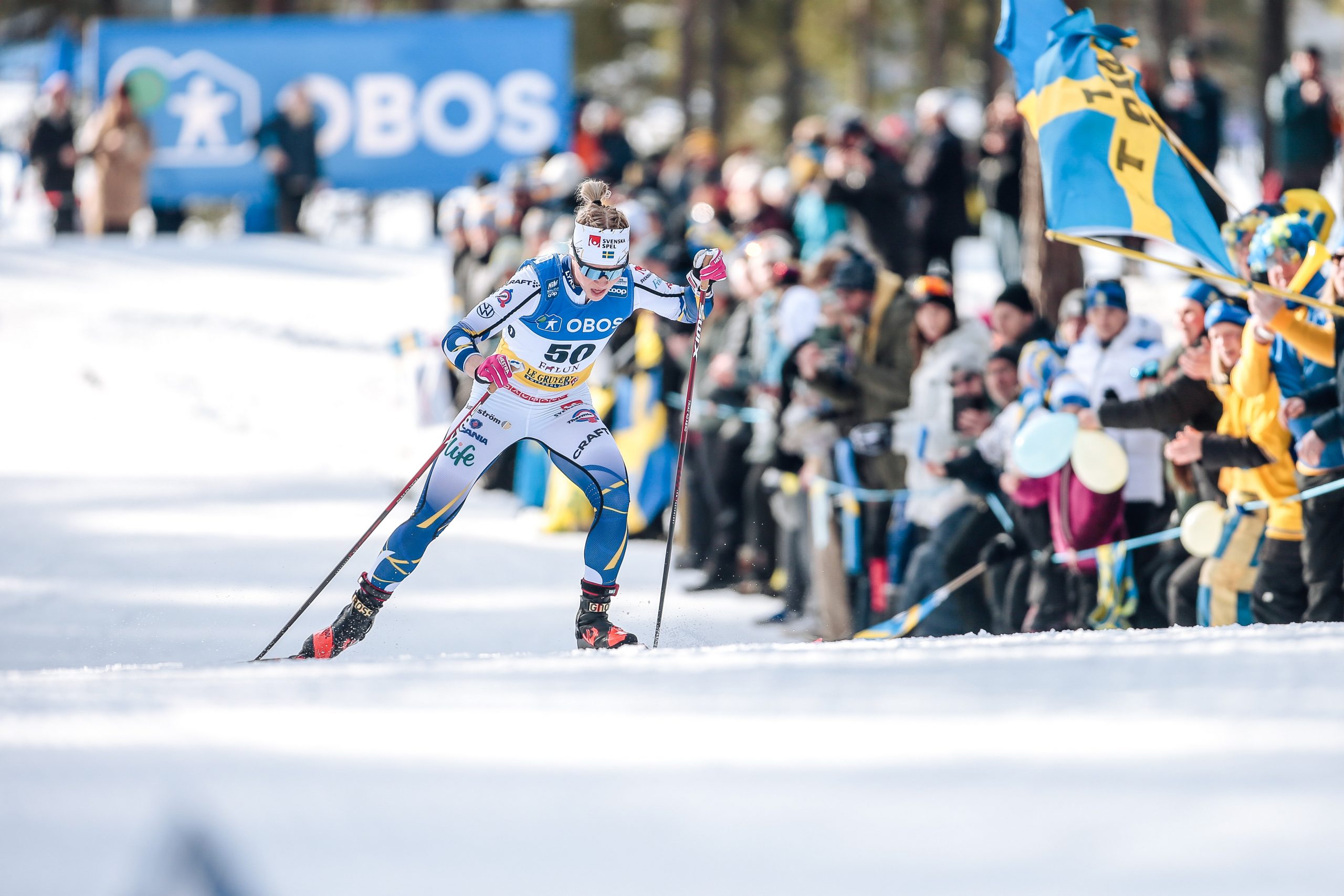
Frida Karlsson (SWE) surged to a mid-race lead, but it was not enough to overcome the momentum of her teammate, Linn Svahn. (Photo: Modica/NordicFocus)
Not Yet Spring
While the field—and the spectators—may have been hoping for sunny and mild spring conditions. Wouldn’t that have been nice? But Lake Placid sits at an elevation of 2200 feet—quite high for the east coast—and spring is notoriously late to arrive in these Adirondack mountains. Race day dawned with dense cloud and swirling snow, conditions that seemed likely to challenge ski technicians and skiers, alike.
The 10 k Classic would be skied over two five kilometer laps climbing immediately from the stadium into the woods. Svahn was the revelation among early starters, totally gapping the rest of the field at all early check points. At the halfway mark of the race, Svahn led all earlier starters by nearly a minute! Later starters among the top seed would begin whittling into Svahn’s times, but even Karlsson would trail by eleven seconds at the first checkpoint, with her teammate, Sundling, another five seconds behind.
Diggins started in bib 58. She would trail Svahn by 23 seconds at the first checkpoint (13 seconds behind Karlsson, 10 seconds behind Slind). The contenders’ splits were bunched near the front, but it was definitely Svahn who appeared strongest. Svahn continued to hold that lead over Karlsson at the 3.8 kilometer checkpoint, by which time Diggins had managed to take six seconds out of Svahn’s lead.
Svahn would surge again in the middle kilometers to put another six seconds into Diggins, but the splits identified the next serious challenger as Slind pulled within just a few seconds. And that’s when Karlsson made her move, pulling even with Svahn at 6.7 kilometers. Had Svahn gone out too fast?
Svahn has won 14 Sprint races in her career, but it is less known that she’s also won three Distance races. She is certainly no slouch when it comes to long events, and she obviously possess great endurance ability. That’s what she must’ve drawn upon in the later kilometers as—despite the charge from Karlsson—Svahn would finish in a dominant 29:04, surging to the victory by 1.4 seconds to claim the first Individual Start Distance victory of her career.
Diggins would thrill her fans with another gutsy performance, giving her all—as she has always been known to do—in finishing fifth on the day. She extended her lead in the Overall World Cup standings over her closest rival, Sweden’s Moa Ilar, virtually closing out that competition for the fourth time in Diggins’ illustrious career.
Feature stories like this one take time, access, and care to produce. If you value thoughtful storytelling and independent ski journalism, please consider becoming a Voluntary Subscriber. Your support directly fuels the work we do to cover the people, places, and moments that make our sport special.
Frida Karlsson (SWE) gave it her all in Lake Placid, only to fall just short of the performance of her good friend, Linn Svahn. (Photo: Thibaut/NordicFocus)
World Cup racing continues from Lake Placid this weekend:
Saturday, March 21
10:30 am | Women’s Sprint Qualification Free
11:05 am | Men’s Sprint Qualification Free
1:00 pm | Women’s Sprint Final Free
1:00 pm | Men’s Sprint Final Free
Sunday, March 22
12:30 pm | Men’s 20km Mass Start Free
2:30 pm | Women’s 20km Mass Start Free
4:30 pm | ONE LAST LAP w/Jessie Diggins & the Retiring Stars
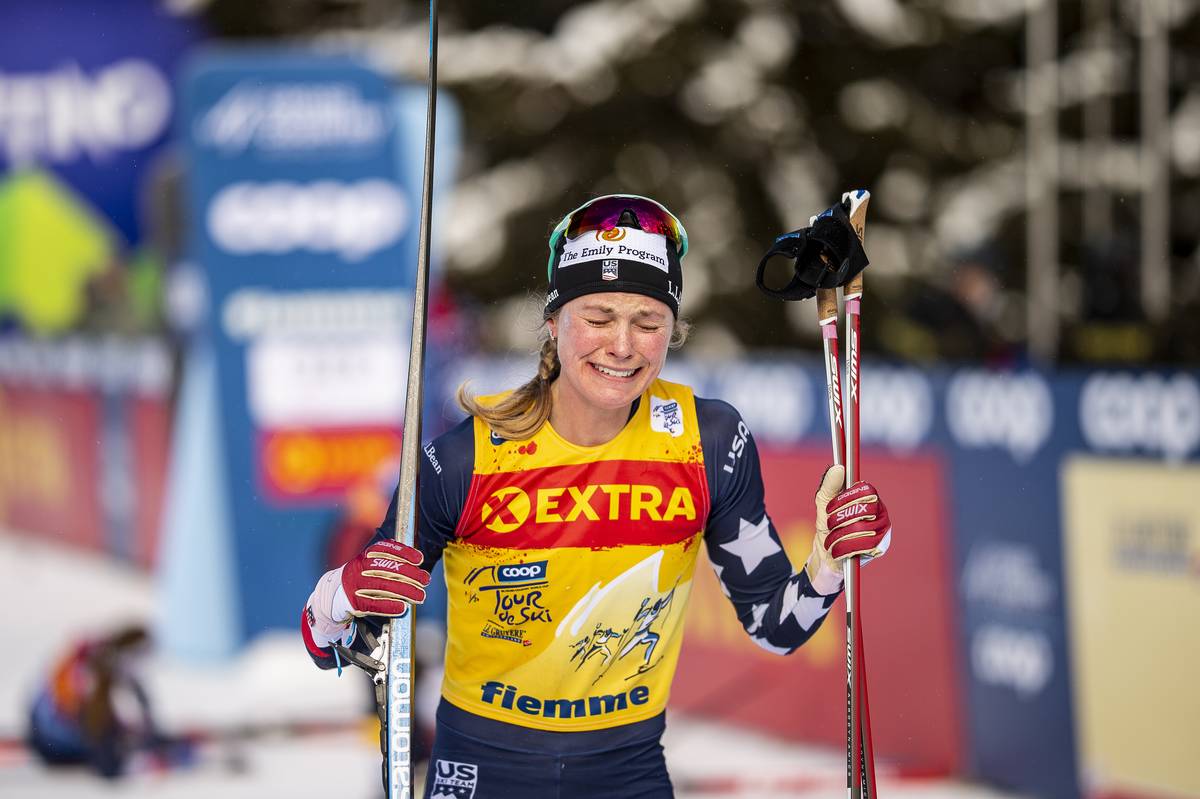
Jessie Diggins (USA) has inspired fans of all ages across the world. This weekend, many of them will gather along the race course, on her home snow, to say thank you. (Photo: Vanzetta/NordicFocus)
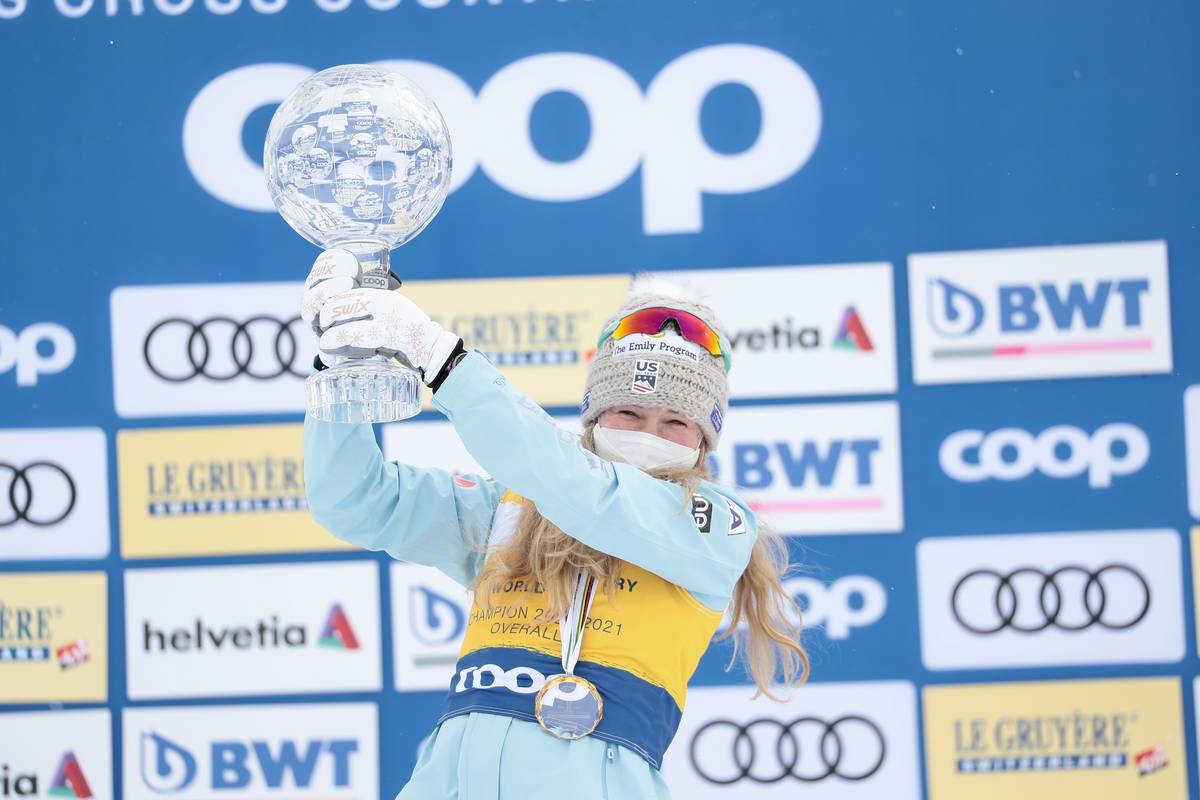
This Sunday, a lesser-heralded chapter of American history will close when Jessie Diggins enters her final World Cup event. She will leave the sport at the absolute top of her game, for the fourth time as the overall Crystal Globe winner, having slogged it out over a season that began the day after Thanksgiving above the Arctic Circle in Finland and will end 33 races later right here in Lake Placid, NY. She is the only skier, male or female, to compete in every single individual competition this year, from sub-three-minute sprints to two-plus hour marathons, before throngs of beer-guzzling fans in the sun and to empty Teutonic stadiums in the spritzing January rain.
During the run-up to the Milan Olympics, she briefly returned to the national zeitgeist, hyped for her ability to dig into the pain cave, and seen writhing on the ground beyond the finish line, a paroxysm of gasping. A high school student of mine had seen the feature on her in the New York Times, and a room of young athletes in Greenwich, CT — alien to Nordic ski culture — spent the full English class discussing the efficacy of pushing one’s limits. People around the once skilliterate Westchester County even started making the connection of why I’d named my dog “Diggins.”
Diggins Donahue (Photo: Timothy Donahue)
During her first Olympic race this year, Diggins crashed in traffic on the slushy snow and bruised her ribs. So naturally, five days later, she gritted her way to a bronze in the 10-kilometer freestyle and to 5th in the 50-kilometer classic on the final day of the Games. But just a week after this, when the collective gaze had drifted from the luge and returned to the Epstein files, she came improbably, from back in the field to within 0.1 second of winning a 20-kilometer in Falun. I watched this tuck-skate drag race with my daughter, who has a Diggins poster on her wall, and we screamed so loud the neighbors asked if everything was okay.
Against the slow off-gassing of rage coming across the airwaves — the sex trafficking, the elementary school bombing, the painful erosion of dignity and competence — Diggins has given us an important antidote all these years. In early 2021, when insurrectionists were sprawling their feet and flag across Nancy Pelosi’s office, Diggins was on her way to winning her first Tour de Ski. I remember the Alpe Cermis climb, when she crested into view in her red, white, and blue race suit, and thinking that she, too, is a compatriot. This past January, when her native Minnesota had become an epic fury, she won her third Tour de Ski title and was entering her fourth Olympics. She wrote, “For everyone out there caring for others, protecting their neighbors, and meeting people with love — every single step is for you. YOU are the ones who make me proud to carry the flag, and I hope I can bring you joy over these next few weeks.”
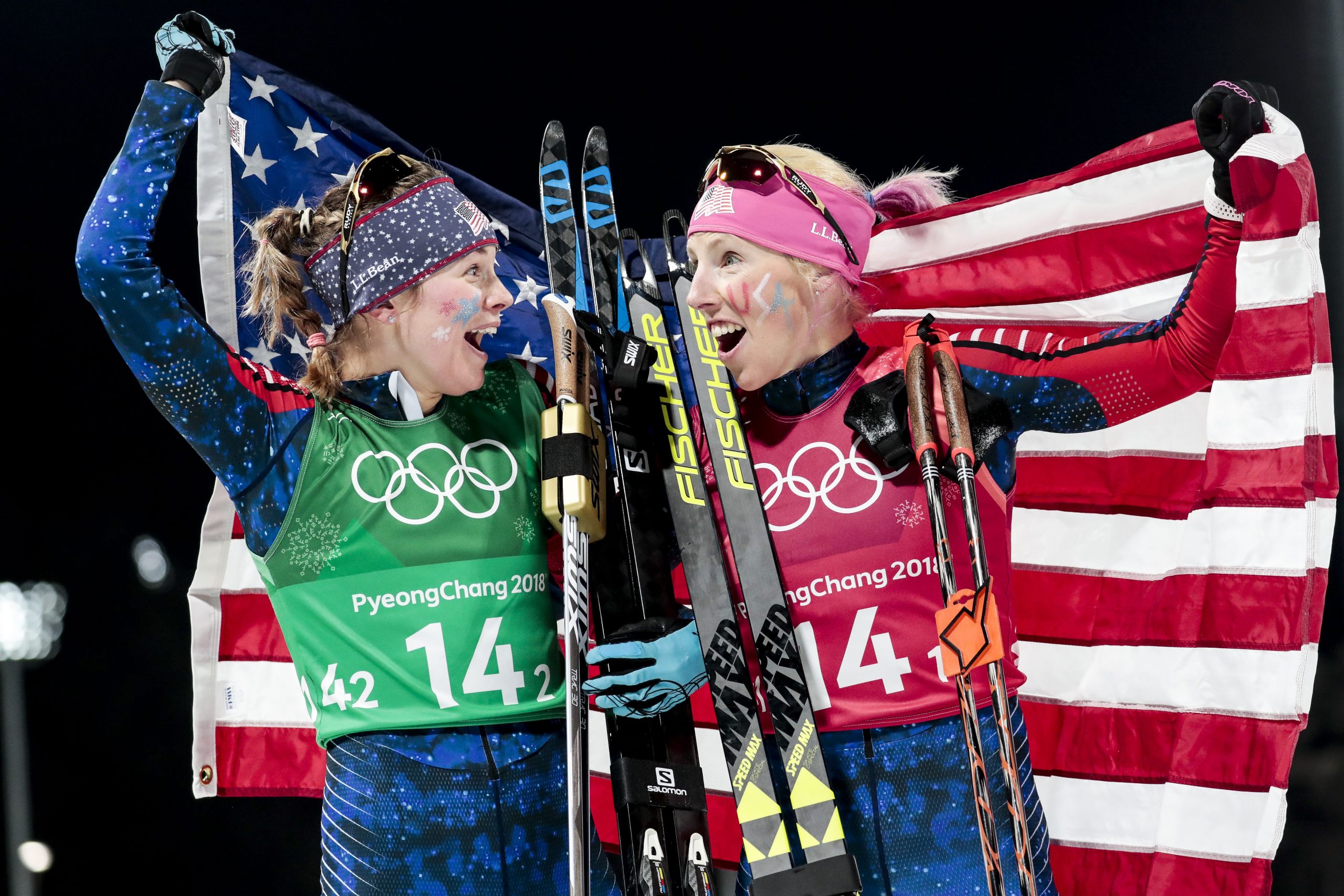
Jessica Diggins (USA), and Kikkan Randall (USA), (l-r) win America’s first cross-country Olympic gold in the women’s team sprint at the 2018 Pyeongchang (KOR) Olympics Pyeongchang. (Photo: Fischer/NordicFocus)
When she won Olympic gold with Kikkan in 2018, she was suddenly in the spotlight. Unfamiliar territory for our stoic sport whose only other American medalist to that point was Bill Koch, who won silver a half-century prior, and retreated into the moss of Vermont. But she was on the Wheaties box, and on commercials for Chipotle, Salesforce, Deliotte, and Toyota. She gave countless Swift-like appearances to throngs of impressionable youth; she lobbied in Washington D.C. for climate change reform. They found out her team nickname was “Sparkle Chipmunk,” and her pre-race glitter applications became her meme. She choreographed music videos; she shared homemade baked goods during the five-month-long European exodus. And she infected a hunger-based confidence that vaulted our underfunded, lowly squad to rival the Scandinavian powerhouses. Proclaimed as “the face of American skiing” and “America’s sweetheart,” she shouldered all this as she simultaneously maintained the fitness to train and race to her own world-best standards.
But as she reveals in the excellent, newly-released documentary about her called “Threshold” (with screenings all weekend at Lake Placid’s Palace Theater), the pressure of doing this day-in, day-out, for six solid years, got to her. As she tells the movie camera, it reacquainted her with senior year of high school: “I was trying to go 100 percent into every single corner of my life because I couldn’t sit still with the feeling that I was not enough.” In 2023, she relapsed with her eating disorder. In the film, she narrates this journey with a raw earnestness that, like her approach to skiing itself, cuts right to the marrow. “I’m willing to put my story on the line to help change this,” she says.
Jessie Diggins (CXC) on her way to first place at US Nationals in Rumford, Maine. (Photo: Hallie Herz)
Those of us who recall her first U.S. National title, back in 2011, among the paper mill aromas of Rumford, ME, fold this into our meta-narrative of triumph over challenge. Where others stand tall and firm on their skis, like maestros conducting their symphonies, Diggins hides none of the pain. Her head bobs, her shoulders undulate, her breathing seems louder than anyone else’s. She’s dropped off the back of the pack and yet somehow, she finds something. She’s not done. Here comes Diggins! If she can do it, I can do it.
This winter, I was particularly attuned to Diggins because, after two partial knee replacements, I was trying to claw my way back into competitive skiing. There were no Toyota endorsements at stake for me, but it was enough to re-connect with the core of this sport. Yes, it’s a beautifully nurturing, soul-susurrating exercise, but climbing up a hill deep into a race, it’s really just about holding off an explosion. The lack of oxygen excites my imagination and it’s all I can do to stay quiet and suppress the inevitable voices saying no, it’s too hard, this guy ahead of me is probably a wonderful father, it’s ok.
Who can say for sure what’s inside the mind of Diggins as she enters this state, this tribute of her current to her source that she has alchemized into fist-pumping, tear-jerking frenzy? But I know that the highlight reels she has brought us over her 15-year career – breaking a pole and scrambling with one arm to her first World Championship gold in 2013, finishing gloveless with a bloody face in 2023 (after another pole incident) and still earning silver, collapsing the day after food poisoning to win silver in the 2022 Olympics – this is something that should give the nation pride. She tells us, “I want to cross that finish line and I want to be so tired that I can’t even stand up, so that I know I gave everything in my heart toward my very best effort.” And she speaks with her actions.
We project our own wish fulfillment onto our heroes, and for the run of her career, with its 365 World Cup starts — more than anyone in history — Diggins has sturdily and gracefully absorbed our collective desires. Now she is leaving on her terms, from the top step of so many podiums, a master of her time.
The Donahue daughters have been inspired by Diggins their entire lives — and they’ll be on-site for one last weekend of racing, sending her off with the skier’s signature heart and a glorious sunset on an amazing career. (Photo: Timothy Donahue)
Love Stories Like This? Help Keep Them Coming.
Feature stories like this one take time, access, and care to produce. If you value thoughtful storytelling and independent ski journalism, please consider becoming a Voluntary Subscriber. Your support directly fuels the work we do to cover the people, places, and moments that make our sport special.
This coverage is made possible through the generous support of Marty and Kathy Hall and A Hall Mark of Excellence Award. To learn more about A Hall Mark of Excellence Award, or to learn how you can support FasterSkier’s coverage, please contact info@fasterskier.com.
Johannes Hoesflot Klaebo (NOR) took all six gold medals awarded in men’s cross-country skiing at the Olympics last month. (Photo: Barbieri/NordicFocus)
Johannes Hoesflot Klaebo made the call late Tuesday night… he’s racing.
According to the Scandinavian press, Klaebo departed Oslo’s Gardermoen airport at 6:25 Wednesday morning, beginning a roughly 20-hour journey to Lake Placid, where he’ll arrive about a day and a half before Friday’s 10-kilometer classic interval start. The Norwegian Ski Federation confirmed the news in a press release on Wednesday morning.
“I can see this isn’t going to be an optimal buildup, both with the long travel and not being able to adjust to the time difference,” Klaebo said. “But I want to be part of the World Cup finale in the USA.”
The decision came after Klaebo did a training session on Tuesday morning in Trondheim and responded well. National team doctor Ove Feragen gave him the green light.
Ben Ogden (USA) checks on Johannes Hoesflot Klaebo (NOR) after their crash eliminated them from the race in Drammen, Norway. (Photo: Nordnes/NordicFocus)
“After the fall during the sprint in Drammen, and some quiet days at home, Johannes has gradually resumed training and normal activity,” Feragen said. “He has responded well to this, without any recurring symptoms after the fall. After observation and further examinations, we have concluded that he is fit to compete.”
Klaebo has been sidelined since March 12, when American Ben Ogden fell across the Norwegian’s skis during Classic Sprint semifinals in Drammen, Norway. The resulting crash sent Klaebo’s head into the hard-packed snow. He was diagnosed with a mild concussion, withdrew from the Holmenkollen 50k, and scrapped a planned media tour in New York City that included sit-downs with CNN, NBC, the New York Times, and the Wall Street Journal.
Now the question shifts from whether Klaebo will race to how much he’ll race. He’s not committing to the full program.
Harald Oestberg Amundsen (NOR), Johannes Hoesflot Klaebo (NOR), and Martin Loewstroem Nyenget (NOR), (l-r) share the Skiathlon podium in Falun, Sweden, on March 1st, 2026. (Photo: Thibaut/NordicFocus.)
“My expectations for performance are not sky-high,” Klaebo said. “I’ll do my best despite a poor buildup and potential jet lag. Whether I race one, two, or three events in Lake Placid, I’ll decide once I get to the USA and get skis on my feet.”
The stakes are real despite the measured tone. Klaebo has already clinched the overall World Cup — his sixth, tying Bjoern Daehlie — and the sprint globe. But he trails Harald Oestberg Amundsen by three points in the distance standings after missing the Holmenkollen 50k. Two distance events remain: Friday’s 10 k Classic and Sunday’s 20k Freestyle Mass Start. A clean sweep of the overall, sprint, and distance globes would be a first in Klaebo’s career.
“For cross-country skiing, it’s especially important to have World Cups in the USA,” Klaebo said. “I’ve been looking forward to this finale for a long time.”
Racing begins Friday at Mt. Van Hoevenberg. Klaebo will be on the start line — jet lag and all.
Love Stories Like This? Help Keep Them Coming.
Feature stories like this one take time, access, and care to produce. If you value thoughtful storytelling and independent ski journalism, please consider becoming a Voluntary Subscriber. Your support directly fuels the work we do to cover the people, places, and moments that make our sport special.
Ben Ogden (USA) and Johannes Hoesflot Klaebo (NOR), along with Oskar Opstad Vike (NOR), (l-r) on the Olympic sprint podium last month. It should be made clear that Ogden and Klaebo have a strong respect for one another, to say the least. (Photo: Vanzetta/NordicFocus)
Fans from across the United States who will be in Lake Placid are anxiously hoping Johannes Hoesflot Klaebo (NOR) is well enough to travel and race in Lake Placid this weekend. (Photo: Authamayou/NordicFocus)
Johannes Hoesflot Klaebo has been included in Norway’s 22-athlete squad for this week’s World Cup finals at Mt. Van Hoevenberg in Lake Placid, N.Y., BUT the six-time Olympic gold medalist’s participation hinges on a decision being made today.
Klaebo, 29, suffered a mild concussion in a dramatic crash during the sprint semifinals at last Thursday’s World Cup in Drammen. American sprinter Ben Ogden lost his footing on the icy course and fell across Klaebo’s skis, sending the Norwegian backward and slamming the back of his head into the hard-packed snow. Klaebo lay on the ground for several minutes before being helped off course and transported to a hospital for evaluation.
The Norwegian Ski Federation confirmed the concussion diagnosis on Friday, and Klaebo withdrew from Saturday’s 50-kilometer race at Holmenkollen.
“He shall make an evaluation together with the national team doctor on Tuesday and would potentially travel on Wednesday,” Klaebo’s manager, Lasse Gimnes, told Norwegian broadcaster NRK on Monday. If cleared by national team doctor Ove Feragen, Klaebo would travel to New York on Wednesday — arriving just two days before Friday’s 10-kilometer classic interval start.
The crash also disrupted a planned trip to New York City for media appearances with CNN, NBC, the New York Times, and the Wall Street Journal — a reflection of the enormous international attention Klaebo has drawn since his record-setting six-gold performance at the Milano Cortina Olympics. Those in-person interviews have been scrapped, though some may shift to virtual formats.
Johannes Hoesflot Klaebo (NOR) poses with the FIS Crystal Globes he won last season at World Cup Finals in Lahti, Finland. (Photo: Thibaut/NordicFocus)
The distance globe is on a knife’s edge
The distance cup title is the central subplot heading into the finals. Before Holmenkollen, Klaebo held a 128-point lead in the distance standings. But with the Norwegian watching from home on Saturday, Amundsen’s 131-point haul vaulted him into the distance lead: Amundsen now sits at 939 points, three ahead of Klaebo’s 936. Martin Loewstroem Nyenget climbed to 914 in third. Just two distance events remain — Friday’s 10-kilometer classic interval start and Sunday’s 20-kilometer freestyle mass start. If Klaebo can travel and race, the margin is thin enough that a single strong result could flip the standings again. If the concussion keeps him out, the distance globe almost certainly goes to Amundsen.
Klaebo has already clinched both the overall World Cup — his sixth, tying Bjoern Daehlie’s all-time record — and the sprint globe.
Norway’s men’s squad: Harald Oestberg Amundsen, Martin Loewstroem Nyenget, Einar Hedegart, Andreas Fjorden Ree, Mattis Stenshagen, Emil Iversen, Johannes Hoesflot Klaebo, Lars Heggen, Even Northug, Ansgar Evensen, and Even Solem Michelsen.
Jessie Diggins soaks in all the energy from the home crowd during her warmup in Minneapolis — the last time the World Cup was on American snow. (Photo: Leann Bentley/USST)
Diggins’s farewell, and notable absences
The Lake Placid finals will serve as the final competitive races for Jessie Diggins, the most decorated cross-country skier in U.S. history. The women’s overall cup and distance cup are both decided, with Diggins winning with a comfortable margin over Sweden’s Moa Ilar in second. The three-time Olympic medalist and three-time overall World Cup champion announced before the season that this would be her last, and a farewell on home snow in front of an American crowd at the first-ever U.S.-hosted World Cup finals is about as fitting a send-off as anyone could script.
Klaebo is not the only notable question mark heading into the weekend. Norway’s Kristine Stavaas Skistad and Mathilde Myhrvold have opted to skip the finals to prepare for part two of Norwegian nationals in Harstad next week. Sweden’s Ebba Andersson has also pulled out.
Norway’s women’s squad for Lake Placid includes Astrid Oeyre Slind, Heidi Weng, Kristin Austgulen Fosnaes, Karoline Simpson-Larsen, Nora Sanness, Karoline Groetting, Julie Bjervig Drivenes, Tiril Udnes Weng, Julie Myhre, Lotta Udnes Weng, and Milla Grosberghaugen Andreassen.
The men’s freestyle mass start gets started at the US National Championships in Lake Placid, NY, 1/8/26. (Photo: Nancie Battaglia)
A historic venue
The Lake Placid finals mark the first Cross-Country World Cup finals ever held in the United States and the return of World Cup racing to Lake Placid for the first time since 1979. Racing kicks off Friday at Mt. Van Hoevenberg with the 10-kilometer classic interval start, followed by a freestyle sprint on Saturday and a 20-kilometer freestyle mass start on Sunday.
This is a developing story. FasterSkier will update when Klæbo’s decision is announced.
Help Support Our Olympic Coverage!
If you value the thoughtful work and access FasterSkier provides, please consider becoming a Voluntary Subscriber. Your support directly fuels our work to cover the people, places, and moments that make our sport special.
Stifel Lake Placid Finals, a Coop FIS Cross-Country World Cup, to Bring Elite Ski Racing and Winter Festival Atmosphere to Lake Placid
FIS Cross-Country World Cup racing, fan experiences, athlete engagement, and live entertainment coming March 19–22
LAKE PLACID, N.Y. — The Stifel Lake Placid Finals, a Coop FIS Cross-Country World Cup, will offer more than world-class competition this March. The event will transform Lake Placid into a multi-day winter sports festival featuring themed race days, live entertainment, film screenings, interactive expo activations, and family-friendly programming.
In collaboration with the New England Nordic Ski Association (NENSA), the 10th Mountain Division, U.S. Ski & Snowboard, and the International Ski and Snowboard Federation (FIS), the Olympic Regional Development Authority (Olympic Authority) has curated a dynamic schedule that celebrates Nordic skiing and outdoor winter-sport culture.
A central focus of the week will be spotlighting women and girls in sport, networking opportunities, and hands-on activities. Fans will also have unique opportunities to connect with athletes through meet-and-greets, alumni celebrations, and special legacy moments — including Sunday’s “Last Lap” ceremony honoring retiring World Cup athletes.
Together, these events are designed to foster engagement, connection, and shared celebration across the Lake Placid community and the global ski family.
One final celebration of Jessie Diggins (USA) amazing career. (Photo: Authamayou/NordicFocus)
Event & Community Programming
In addition to World Cup racing, the Stifel Lake Placid Finals will feature a range of community events, athlete appearances, and festival programming throughout the week. Activities include youth programming, athlete conversations, live music, demonstrations, and opportunities for fans to connect with past and present champions.
Programming details may evolve, and additional events may be added throughout the week. Visitors are encouraged to check the official event schedule for the most up-to-date information.
Thursday, March 19 – Community & Kickoff
Opening day features official training and festival programming at Mt Van Hoevenberg, along with an evening film screening at the Palace Theatre that kicks off the festivities in downtown Lake Placid.
Friday, March 20 – Theme: Past
Friday celebrates the legacy of Nordic skiing and Olympic history in Lake Placid. The venue opens with festival programming, including the NENSA Terrain Park and Expo with L.L. Bean, regional athlete recognition connected to the 2026 Winter Olympics, and Adirondack Birds of Prey demonstrations. Fans can also watch presentations from the 10th Mountain Division, enjoy live music, and attend athlete interviews and meet-and-greets throughout the day. A highlight of the afternoon is the “One More Lap” legacy ski, featuring international and U.S. Ski Team alumni, including Olympic legend Thomas Wassberg and American champion Bill Koch, before World Cup racing and awards ceremonies conclude the day.
Saturday, March 21 – Theme: Future
Saturday’s programming focuses on the next generation of Nordic skiing. Activities include the NENSA Terrain Park and Expo with L.L. Bean, athlete appearances, and fan engagement opportunities. The Women in Sports Heroic Panel highlights leadership and opportunities for girls and women in athletics, while fans can also attend athlete meet-and-greets and participate in interactive programming throughout the venue. Competition highlights include the freestyle sprint finals, followed by Crystal Globe presentations. Youth racing also takes center stage with the World Cup Future Stars Sprint. Additional programming includes Lollipoppers to Olympians: A Celebration of New England Skiing, a live recording of the Skirious Podcast featuring Ben Ogden and special guests at the Olympic Jumping Complex, and evening film screenings at the Palace Theatre.
Sunday, March 22 – Theme: Present
Championship Sunday features entertainment, athlete appearances, and the season-ending races of the World Cup Finals. Live music, a DJ set, and ceremonial elements, including the 10th Mountain Division Color Guard and flyover, set the stage for the final competition. The afternoon concludes with awards ceremonies and the “One Last Lap” ceremony honoring retiring World Cup athletes.
Gus Schumacher (USA) and Ben Ogden (USA), (l-r) celebrate their silver medal at the Olympic Winter Games in Tesero, Italy. (Photo: Vanzetta/NordicFocus)
Competition Schedule | FIS Cross-Country World Cup Finals
Mt Van Hoevenberg | March 19–22, 2026
World Cup official training and competition runs March 19–22 at Mt. Van Hoevenberg, where the world’s top U.S. and international cross-country skiers will compete for overall and discipline Crystal Globe honors. The weekend culminates on Sunday with championship racing, awards presentations, and the “One Last Lap” ceremony recognizing retiring athletes.
Full competition schedule:
Thursday, March 19, 2026:
11:00 – 1:00 pm | 10km Official Training
1:00 pm – 3:00 pm | Sprint Official Training
Saturday, March 21, 2026:
10:30 am | Women’s Sprint Qualification Free
10:30 am | Men’s Sprint Qualification Free
1:00 pm | Women’s Sprint Final Free
1:00 pm | Men’s Sprint Final Free
Sunday, March 22, 2026:
12:30 pm | Men’s 20km Mass Start Free
2:30 pm | Women’s 20km Mass Start Free
Jessie Diggins (USA) and the US Ski Team celebrate in Goms. (Photo: Authamayou/NordicFocus)
Broadcast Schedule
NBC will air the Sprint Finals live on Saturday, March 21, from 1–2 p.m. ET. CNBC will air coverage of the Men’s and Women’s 10km Interval Starts on Saturday, March 21, from 2–4 p.m. ET. NBC will also air the Women’s 20km Mass Start on Saturday, March 29, from 1–2 p.m. ET on tape delay.
This coverage is made possible through the generous support of Marty and Kathy Hall and A Hall Mark of Excellence Award. To learn more about A Hall Mark of Excellence Award, or to learn how you can support FasterSkier’s coverage, please contact info@fasterskier.com.
Ben Ogden (USA) and Johannes Hoesflot Klaebo (NOR), (l-r) moments after their Semifinal crash in Drammen, Norway. (Photo: Nordnes/NordicFocus)
The greatest cross-country skier in history was lying on the snow, his arms wrapped over his face, his hands holding the back of his head, and the city of Drammen — where the man-made course magically appears on top of the streets, and Norwegian children crane from balconies to watch the racing — went very, very quiet.
Johannes Hoesflot Klaebo did not finish on Thursday. Neither did Ben Ogden. The gold and silver medalists from the Olympic sprint classic in Milano Cortina just last month, the two men who have defined this event all season, were tangled together on the hard-packed final downhill before the hairpin, while the semifinal raced on without them.
After the chaos of the semi-final, which took down the two fastest qualifiers, a 25-year-old Norwegian named Ansgar Evensen — who had changed into Skiathlon boots between the quarterfinals and semifinals because he felt so unsteady on his feet — surged from sixth place in the final to cross the line first.
Evensen won ahead of Jiri Tuz, the 21-year-old Czech who earned a career-best second place. Kristian Kollerud of Norway, racing in his very first World Cup start, took a remarkable third, and Harald Oestberg Amundsen, the 2024 overall World Cup champion, finished fourth.
It was the kind of day that maybe only Drammen — with its icy hairpin, its drafting effect, and its knack for producing chaos at precisely the wrong moment — could deliver.
Johannes Hoesflot Klaebo (NOR), Bernat Selles Gasch (ESP), Theo Schely (FRA), Ludek Seller (CZE), and Vili Crv (SLO), (l-r) in the first Quarterfinal. (Photo: Nordnes/NordicFocus)
Qualification and Quarterfinals
Klaebo’s dominance was apparent from the opening qualification. He posted a 2:24.88, nearly three seconds faster than Ogden’s 2:27.47, with the next 28 qualifiers separated by less than five seconds. That kind of gap on a world-class field in sprint qualification puts his dominance in perspective.
Klaebo, as he always does, chose the first quarterfinal heat. He won it easily — clocking 2:37.14 — compared to his qualifier, a notably conservative time that suggested he was managing his energy for the rounds ahead.
Simone Mocellini (ITA), Ben Ogden (USA), and Aron Aakre Rysstad (NOR), (l-r) in the second Quarterfinal. (Photo: Nordnes/NordicFocus)
Ogden, the lone American in the top 30, qualified second and chose Quarterfinal 2 alongside Italy’s Simone Mocellini and Norway’s Even Northug. He entered the bottom of the final climb up to the iconic finish on the steps of the Neo-Gothic Bragernes Church behind the leaders, but unleashed a powerful double-pole to charge into second place, advancing comfortably.
The quarterfinals also produced some early drama. Northug, who had been enjoying a strong sprint season, was disqualified from Heat 2 after receiving his second written reprimand of the season, this time for a classical technique infraction.
And quietly, in Heat 3, Evensen advanced as a photo-finish second behind Sweden’s Alvar Myhlback.
Ben Ogden (USA) and the medical team check on Johannes Hoesflot Klaebo (NOR). (Photo: Nordnes/NordicFocus)
The Crash
The first semifinal will be remembered for the crash.
Klaebo had won his quarterfinal from the front and appeared to be cruising. Ogden, too, looked comfortable. But on the icy final descent heading toward the hairpin around the fountain behind the start gates, the pack compressed. Klaebo held tight to the inside along the fencing, leaving him vulnerable when the skis began to cross. Contact was made. Ogden’s feet swept out from under him and fell right in front of the Norwegian. Klaebo had no place to go, skiing right into Ogden, which launched him into the air, spinning backward, ultimately hitting the back of his head on the hard-packed snow.
Ben Ogden (USA) walks off after the crash in the Semifinals. (Photo: Nordnes/NordicFocus)
Listening to the broadcast, the silence in Drammen was palpable. Ogden scrambled to his feet with only one ski still attached; Klaebo did not immediately follow. Replays showed Klaebo had not only hit his head on the hard snow, but may also have been struck in the head by a trailing ski as he fell. Both men would be listed as DNF — a designation almost never seen next to Klaebo’s name in a decade of dominance.
Anton Grahn of Sweden, who had been near the front, took the semifinal win. Tuz advanced automatically in second. Alvar Myhlback of Sweden finished third but would not be fast enough to advance as a lucky loser. The crash all but guaranteed that the top four finishers from Semifinal 2 would all advance to the final.
After the crash in Semifinal 1, Semifinal 2 with Harald Oestberg Amundsen (NOR), Kristian Kollerud (NOR), Jules Chappaz (FRA), Ansgar Evensen (NOR), Noe Naeff (SUI), and Davide Graz (ITA), (l-r) race for the finals. (Photo: Nordnes/NordicFocus)
Semifinal 2 and the Path to the Final
The second semifinal, then, was a race with diminished stakes but no shortage of quality. Chappaz drove the pace from the front and never relinquished it. Kollerud, the 21-year-old in his club racing suit, making his World Cup debut, finished an impressive second.
Behind them, Amundsen and Evensen advanced as lucky losers, separated by just hundredths of a second. The final would feature three Norwegians, a Frenchman, a Czech, and a Swede — but no Klaebo and no Ogden.
Entering the finish stretch. (Photo: Nordnes/NordicFocus)
The Final
Half the final field was under 23 years old. Tuz, Kollerud, and Grahn — all 21 — represented a generational shift on a day when the established order had been upended.
Tuz, perhaps emboldened by his semifinal crash survival, went hard from the gun, leading over the opening climb. It was a brave tactic from a young racer in only his second World Cup final. Behind him, the more experienced campaigners — Amundsen, Evensen, Chappaz — bided their time, trusting that the Drammen draft would bring them back and leave them well rested for the final climb.
It did. The group had reformed as they skied behind the fountain. As they navigated the icy turn, Grahn — who had been skiing near the front all day — lost his footing on the hairpin and crashed, his race effectively over. He would finish sixth on the day.
The final dash for the line. (Photo: Nordnes/NordicFocus)
Grahn’s fall opened a lane on the outside. Evensen, who had been sitting sixth, saw it and calmly worked his way around the dicy turn.
“When Anton fell in the last corner, I had every opportunity,” Evensen said afterward. “So I took it from fifth place to first on the final.”
What followed was one of the great finishing surges in Drammen’s long sprint history. Amundsen and Kollerud were locked in their own battle, focused on each other. Chappaz was charging. But Evensen — who had finished fourth on this same course back in 2023, who knew exactly how the final 50 meters of this city sprint played out — found a gear that nobody else could match.
Harald Oestberg Amundsen (NOR), Jiri Tuz (CZE), Kristian Kollerud (NOR), Jules Chappaz (FRA), and Ansgar Evensen (NOR), (l-r) had an exciting finish in Drammen. (Photo: Nordnes/NordicFocus)
He crossed the line first, fist clenched, pounding his chest. Tuz nipped Kollerud for second by four hundredths of a second. Amundsen was fourth, just 0.43 seconds off the win.
“It was super cool and I love to ski in Drammen,” Evensen said in a post-race interview with FIS, still catching his breath. “I had to change boots to my combi boots because I felt so unbalanced in the quarterfinal. But that’s how it is. Have to stay on your feet to win. And unfortunately for Johannes and Ben, they weren’t as stable today.”
Kristian Kollerud (NOR) waits for final confirmation of his podium. (Photo: Nordnes/NordicFocus)
Kollerud’s Debut
The feel-good story of the final belonged to Kollerud, who stood on the podium in his club racing suit — not the Norwegian national team uniform — soaking in a result he could not have imagined when he woke up that morning. A podium in your first World Cup start doesn’t happen. Except when it does.
He picked up a written reprimand for a classical technique infraction during the semifinals, but it was his first of the season and carried no further consequence. What will carry forward is the confidence of knowing he can compete with the best in the world.
Tuz, too, earned a career milestone. The Czech U23 athlete had made the final in Milano Cortina but never stood on a World Cup podium before Thursday. He now has a silver medal from Drammen.
Jiri Tuz (CZE) celebrates his podium in Drammen, Norway. (Photo: Nordnes/NordicFocus)
Standings and What’s Next
Klaebo’s DNF stung, but his World Cup position remains commanding. He leads the overall standings at 2,071 points (636 points more than Amundsen in second), the sprint standings at 835 points (283 points in front of Lars Heggen), and the distance standings at 936 points (128 points in front of Amundsen).
Barring further incident, Klaebo will sweep the overall, distance, and sprint crystal globes for the season.
Whether he gets the chance to race for them this weekend, however, is now in question. Norwegian national team doctor Ove Feragen told TV2 that Klaebo was taken to the hospital following the crash for precautionary testing related to the head impact. Feragen said Klaebo was conscious, in stable condition, and not believed to be seriously injured, but the severity of the fall warranted evaluation. His status for Saturday’s 50 k Freestyle Mass Start at the historic Holmenkollen in Oslo remains uncertain.
The season concludes with World Cup Finals in Lake Placid, New York, March 20-22, where Ogden and the American men will race in front of a home crowd. With four races left, a lot of exciting racing remains.
Feature stories like this one take time, access, and care to produce. If you value thoughtful storytelling and independent ski journalism, please consider becoming a Voluntary Subscriber. Your support directly fuels the work we do to cover the people, places, and moments that make our sport special.
Jiri Tuz (CZE), Ansgar Evensen (NOR), and Kristian Kollerud (NOR), (l-r) share the Classic Sprint podium in Drammen, Norway. (Photo: Nordnes/NordicFocus)
This coverage is made possible through the generous support of Marty and Kathy Hall and A Hall Mark of Excellence Award. To learn more about A Hall Mark of Excellence Award, or to learn how you can support FasterSkier’s coverage, please contact info@fasterskier.com.
The women’s sprint final comes into the finish in Drammen, Norway with: Laura Gimmler (GER), Ane Appelkvist Stenseth (NOR), Jonna Sundling (SWE), Nadine Faehndrich (SUI), Johanna Hagstroem (SWE), and Kristine Stavaas Skistad (NOR), (l-r). (Photo: Nordnes/NordicFocus)
The snow was trucked in, the rock band was playing near the finish, and Norwegian children cheered from second-story windows along the course. On a rare midweek World Cup race day in Drammen — a small city just southwest of Oslo where the sprint course loops through the streets, wraps around an old fountain, and finishes on the snow-covered steps of an iconic church — Jonna Sundling of Sweden took home another World Cup sprint victory.
Sundling won the women’s classic sprint, going stride for stride with Norway’s Kristine Stavaas Skistad before pulling away in the final meters. Switzerland’s Nadine Faehndrich, racing her final classic sprint before retirement, earned the bronze.
It was Sundling’s fifth individual World Cup victory of the season and the latest chapter in an intensifying rivalry with Skistad that has captivated ski fans, especially Scandinavian ones, for the last few seasons. From the World Championship final in Trondheim last year to the Olympic final in Milano Cortina, Sundling, with the rest of the Swedish sprinters, and Skistad have been locked in a tactical chess match. On Thursday in Drammen, it was Sundling who played the final move.
Quarterfinal number one heads up the first climb with: Barbora Antosova (CZE), Mathilde Myhrvold (NOR), Jessie Diggins (USA), Melissa Gal (FRA), (l-r). (Photo: Nordnes/NordicFocus)
Qualification and Quarterfinals
Sweden’s Linn Svahn, the reigning Olympic sprint champion, posted the fastest qualification time at 2:41.87 — nearly three seconds clear of Sundling’s 2:44.39. But qualification speed, as World Cup sprinting always reminds us, is only the entry ticket.
Two Americans advanced to the heats. Jessie Diggins, the overall World Cup leader wearing the yellow bib in what she called a “full circle moment,” qualified 17th in 2:50.91. Rosie Brennan, seeded 28th, also made the top 30.
Diggins chose Quarterfinal 1 alongside Sundling and Skistad — a loaded heat. Skistad took the win with Sundling second via a photo finish, just 0.18 seconds separating them. Diggins fought hard for third, advancing as a lucky loser after finishing just 0.22 seconds behind Sundling.
Rosie Brennan (USA) said after the race, “Drammen is one of my favorite races, it’s a fun course and always has a lively atmosphere.” (Photo: Nordnes/NordicFocus)
Brennan’s day ended in the quarterfinals. Racing in Heat 3, she bobbled heading into the downhill and lost the draft, which was a costly moment on a course where the slipstream effect was enormous all afternoon. She finished fifth in her heat.
“I was happy to get a chance in the rounds, but the conditions were very tough,” Brennan said. “They salted the course, and it was skiing great in the qualifier and then got really icy for the rounds. Anyway, I bobbled into the downhill and lost the draft and then just don’t have the power I need to pass that many people up the finish stretch, so I was disappointed to not be more in the mix.”
Meanwhile, Svahn survived a scare of her own… as her quarterfinal rounded the fountain that anchors the bottom of the course behind the start gates, five of the six athletes ended up in a pile and Svahn seemingly had the most bodies and equipment to navigate as she got back out on the course, but somehow recovered to advance. The Olympic champion’s troubles, however, were only beginning.
Maja Dahlqvist (SWE) and Jessie Diggins (USA), (l-r) during the second semifinal. (Photo: Nordnes/NordicFocus)
Semifinals
The two semifinals told entirely different stories, and the contrast between them shaped the final.
In Semifinal 1, Skistad took the win with Sundling second, just 0.20 seconds back. Both advanced automatically. Behind them, Svahn finished third and would not advance.
Semifinal 2 was a different race entirely. Johanna Hagstroem and Ane Appelkvist Stenseth pushed the pace from the gun, stringing the field out over the first climb. But on the long downhill, the draft did its work. Faehndrich and Laura Gimmler of Germany surged past, using the slipstream to slingshot into the lead.
Nadine Faehndrich (SUI), who is planning to retire after the season, found a little extra Drammen magic today as she finished on the podium in third. (Photo: Nordnes/NordicFocus)
Faehndrich won the heat decisively. Gimmler was second. The fast overall times meant Hagstroem would advance along with Stenseth, who just out-lunged Diggins for fourth and the second lucky loser position.
For Diggins, the day ended in 10th. But she left Drammen at peace.
“This was really cool because the Drammen area was my first ever World Cup start and it was a skate sprint,” Diggins said. “So it’s kind of a very full circle moment to close it out with a classic sprint here as the last classic sprint of my career.”
She had tried something new in the heats, sitting in the draft instead of going to the front, a departure from her usual aggressive approach. “Normally, because literal strength is not my strength, I usually just try to go really, really hot and try to go off the front,” she said. “I was like, nope, I don’t think that’s gonna work for me here with the crazy draft and slingshot effect. I was taking a lot of notes in warm-up, and in the quarterfinal, I had the smallest tuck of my life. It was just really fun to try to believe in myself as more of a pure sprinter and to try to be a little more tactical.”
She acknowledged she ran out of power in the semifinal, but had no regrets. “I still felt like I executed my plan to the best of my ability, and that’s always a cool feeling.”
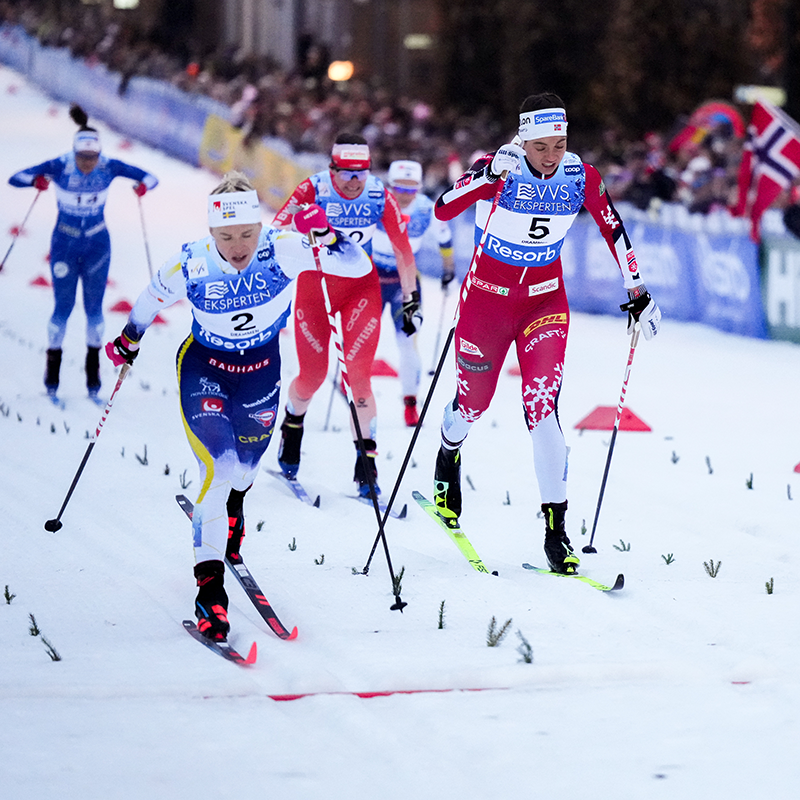
Jonna Sundling (SWE) crosses the finish line just ahead of Kristine Stavaas Skistad (NOR) for the win in Drammen, Norway. (Photo: Nordnes/NordicFocus)
The Final
Six women lined up for the final: Sundling and Hagstroem for Sweden, Skistad and Stenseth for Norway, Faehndrich for Switzerland, and Gimmler for Germany. Svahn and Maja Dahlqvist, the Olympic gold and bronze medalists in the sprint classic, were both absent.
On the opening climb, Skistad sat behind Sundling in a familiar posture — patient, conserving, waiting for the right moment. As Kikkan Randall mentioned on the broadcast, Skistad almost never leads into a downhill. She baited Gimmler into taking the front position, then tucked into her slipstream.
Coming off the descent and around the final hairpin, Faehndrich made her bid, surging past Gimmler and into third. But the race was between the two women everyone expected.
Sundling and Skistad skied side by side on the final climb, and what followed was a scene that encapsulated their rivalry. Stride for stride, shoulder to shoulder, neither yielding a centimeter. Sundling’s transition from double pole to striding was fractionally sharper — she carried more momentum through the final meters — and she crossed the line with a small advantage.
“It is usually very tight in Drammen, but today it was extremely tight,” Sundling said on air afterward. “Till the last meter. I was like, okay, I need to continue all the way over the finish line. It was tough, but I’m happy that I was the first person over the line.”
For Faehndrich, the bronze was a fitting farewell. The 30-year-old Swiss racer, who announced her retirement this season, now sits third in the sprint World Cup standings at 700 points — just behind Hagstroem (708) and within striking distance of leader Dahlqvist (720) heading into the final sprint of the season in Lake Placid next weekend.
Jessie Diggins (USA) gave her fans something to cheer about during her quarterfinal when she charged to the finish line. (Photo: Nordnes/NordicFocus)
Looking Ahead
Diggins continues to lead the overall World Cup standings with 1,961 points, 275 points ahead of Sweden’s Moa Ilar, a margin that appears insurmountable with four races remaining. The distance globe, too, seems firmly in her grasp. But the sprint crystal globe race is wide open: Dahlqvist, Hagstroem, and Faehndrich are separated by just 20 points at the top of the standings, and the final sprint in Lake Placid could decide everything.
For Diggins, there’s another milestone ahead — she’s only a few nights away from sleeping in her own bed before racing in front of an American crowd at the World Cup Finals. “Very, very, very excited about that,” she said.
The World Cup moves to the historic Holmenkollen venue in Oslo on Saturday for the Women’s 50 k Freestyle Mass Start, before the season concludes in Lake Placid, New York, March 20-22.
Feature stories like this one take time, access, and care to produce. If you value thoughtful storytelling and independent ski journalism, please consider becoming a Voluntary Subscriber. Your support directly fuels the work we do to cover the people, places, and moments that make our sport special.
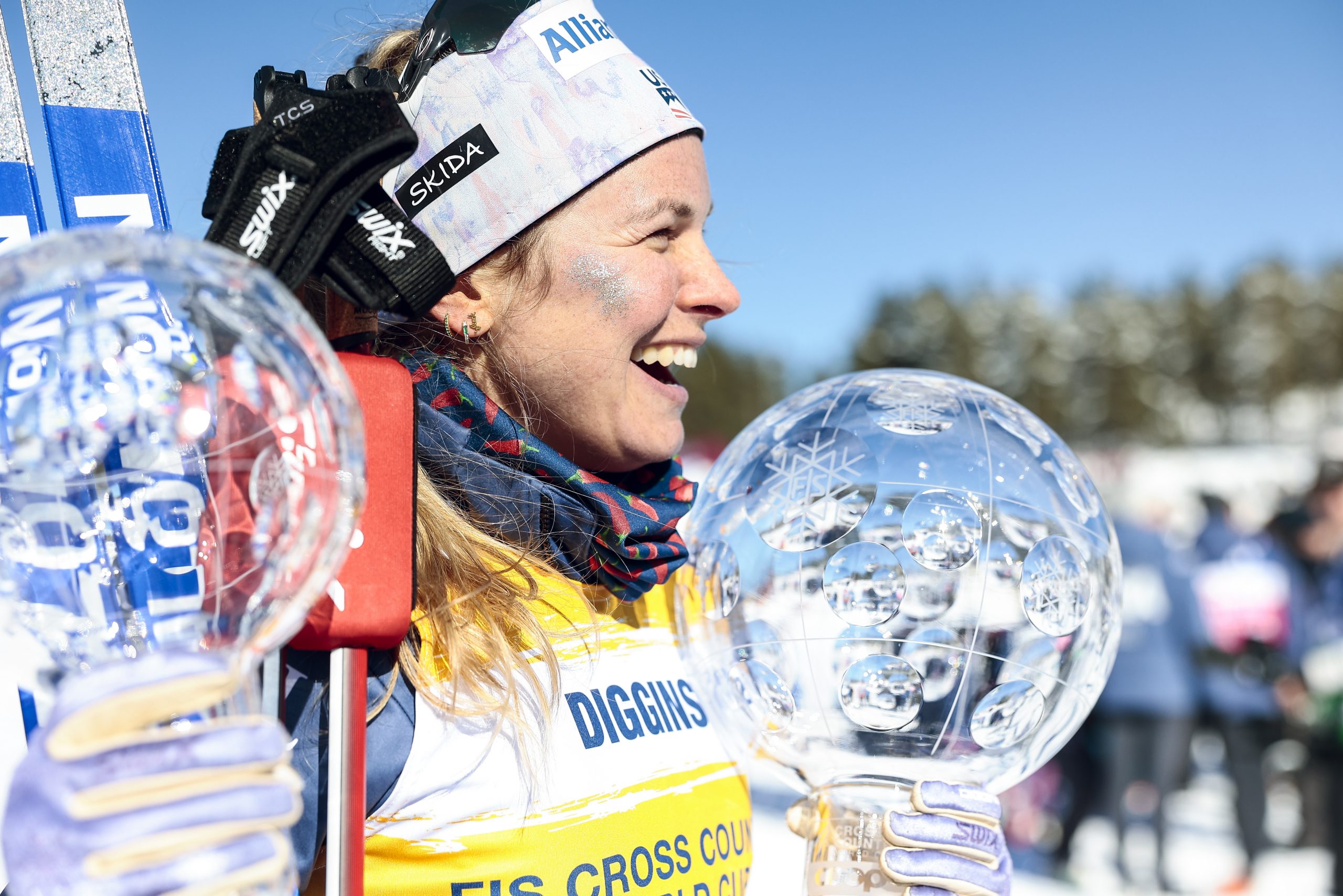
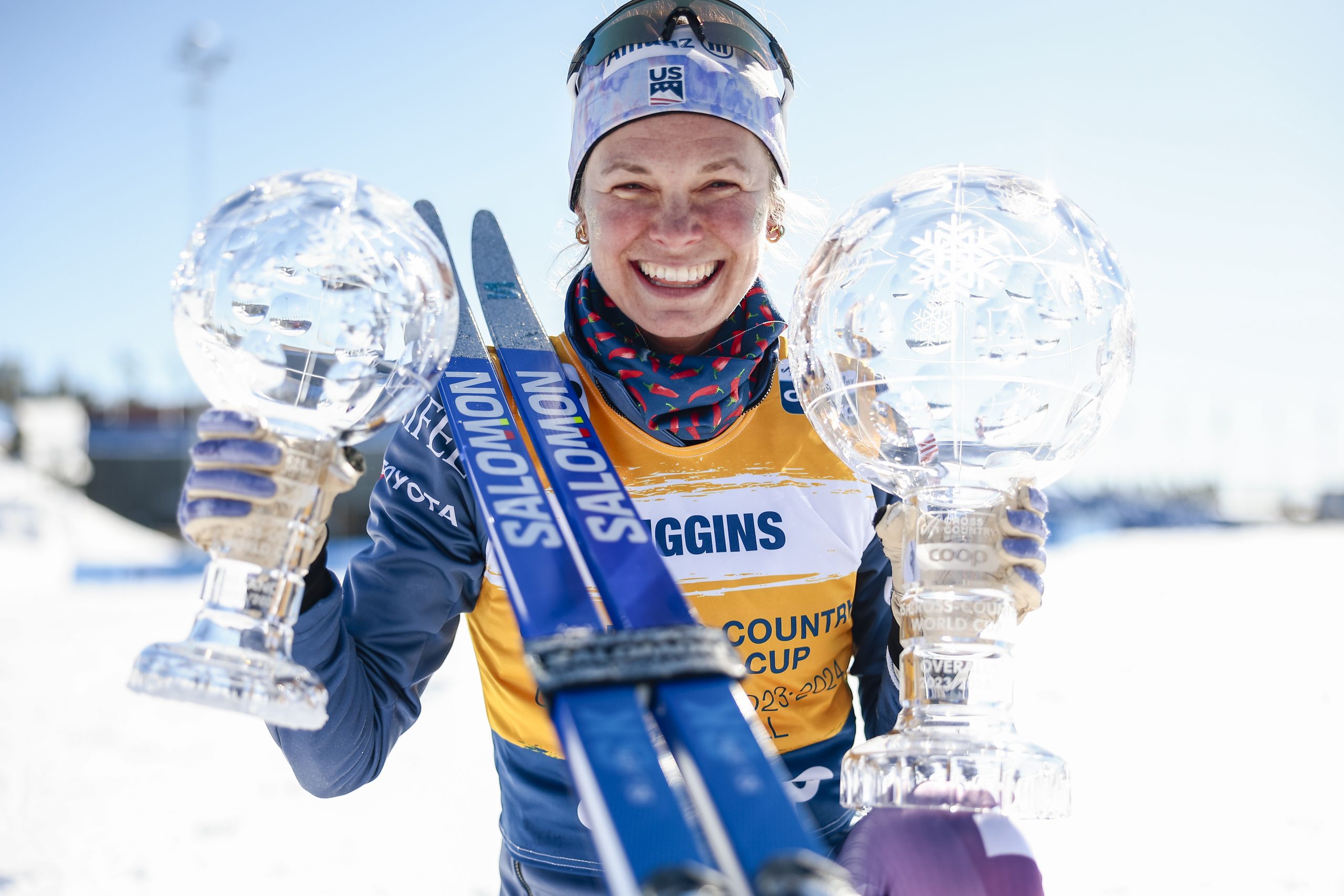
Jessie Diggins (USA) celebrates two Crystal Globes and glitter tipped skis. (Photo: NordicFocus)
Jessie Diggins, the superstar of American cross-country skiing, made history in the 2023/24 season by securing her second overall World Cup title. As she now looks to defend her crown, the upcoming season promises to be a thrilling challenge for Diggins as she faces a highly competitive field.
A Historic 2023/24 Season
The 2023/24 season was a monumental one for Diggins, filled with achievements that cemented her legacy in the sport. She won six individual races, including the prestigious Tour de Ski for the second time, and amassed a total of 2,746 points by the season’s end. This was enough to outpace her closest rival, Sweden’s Linn Svahn, by 175 points. Diggins’ performance broke several American records, including the most individual race victories in a single season, surpassing her teammate Kikkan Randall’s previous record.
Beyond the numbers, as can be seen on Strafe, Diggins’ season was marked by resilience. Early in the year, she opened up about her struggles with an eating disorder and the challenges she faced in returning to top form. Despite these personal battles, she not only participated but thrived, finishing the season on a high note with a victory in the final 20km mass start race in Falun, Sweden.
Jessie Diggins crosses the final finish-line of her historic season in Falun, Sweden, winning the 20 k skate and the World Cup Overall too. (Photo: Nordic Focus)
The Competition for the Upcoming Season
Looking ahead to the 2024/25 season, the question arises: can Diggins defend her overall World Cup title? The competition will be fierce, with top contenders like Sweden’s Linn Svahn and Frida Karlsson looking to challenge her dominance. Svahn, who pushed Diggins hard last season, remains a formidable competitor, particularly in the sprint events, where she has excelled.
However, Diggins’ versatility across both sprint and distance races gives her a significant edge. Her ability to win in different disciplines was a key factor in her victory last season, allowing her to accumulate crucial points in both types of events. This balanced skill set makes her a top contender once again, even in the face of stiff competition.
Jessie Diggins (USA) wasn’t content to just mathematically eliminate Linn Svahn. she raced hard from the start to take a dramatic victory. (Photo: Nordicfocus)
Upcoming Challenges: A World Championship Year
The 2024/25 season also brings the added challenge of the FIS Nordic World Ski Championships, which will take place in Trondheim, Norway. These events, held every two years, will add extra pressure for Diggins, as she and her American teammates look to secure their first-ever relay medal. Additionally, the introduction of the 50km women’s race, the longest distance ever for women at the championships, will be a major milestone and a significant test for Diggins.
While her focus will undoubtedly be on defending her World Cup title, the world championships will provide an additional layer of competition and potential for glory. Diggins has consistently performed well on the big stage, and her ability to manage the physical and mental demands of both the World Cup and the championships will be key to her success this season.
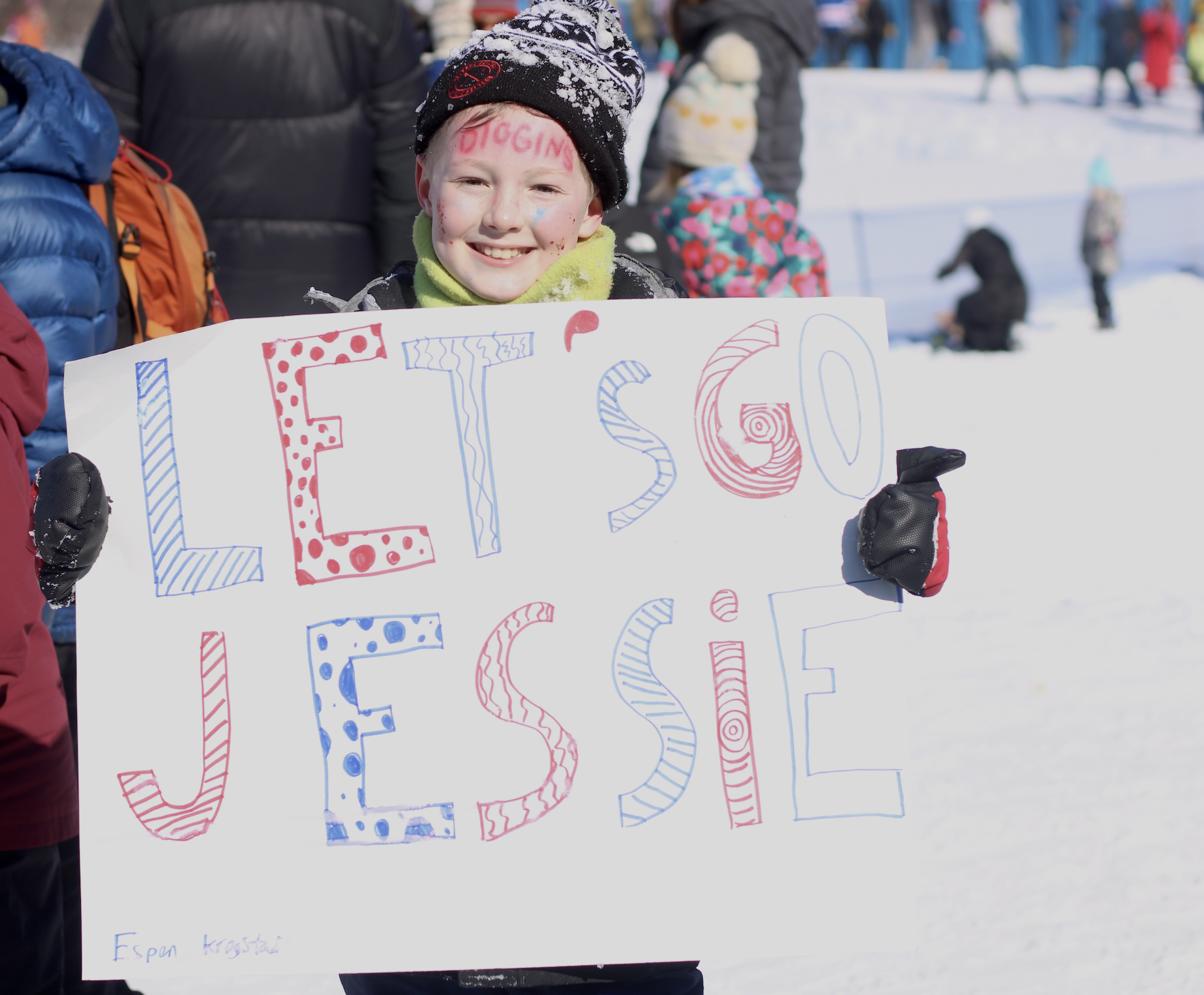
Espen Krogstad, 11, poses with his Jessie Diggins sign at the World Cup race in Minneapolis on Saturday, February 17, 2024. “I’m trying to get her autograph on Monday,” he said. (Nathaniel Herz/FasterSkier)
Mental and Physical Resilience
One of the most remarkable aspects of Diggins’ recent success has been her mental resilience. After a public battle with an eating disorder, she approached the 2023/24 season with a renewed focus on mental health. This focus, she revealed, was central to her ability to perform at such a high level. Her willingness to share her struggles has also made her an inspirational figure beyond the world of skiing.
As Diggins prepares for the upcoming season, her mental fortitude will again be tested. The intense scrutiny that comes with being a defending champion, combined with the physical demands of the sport, will require her to maintain both her physical conditioning and her mental health. But if her previous season is any indication, Diggins is more than capable of rising to the challenge.
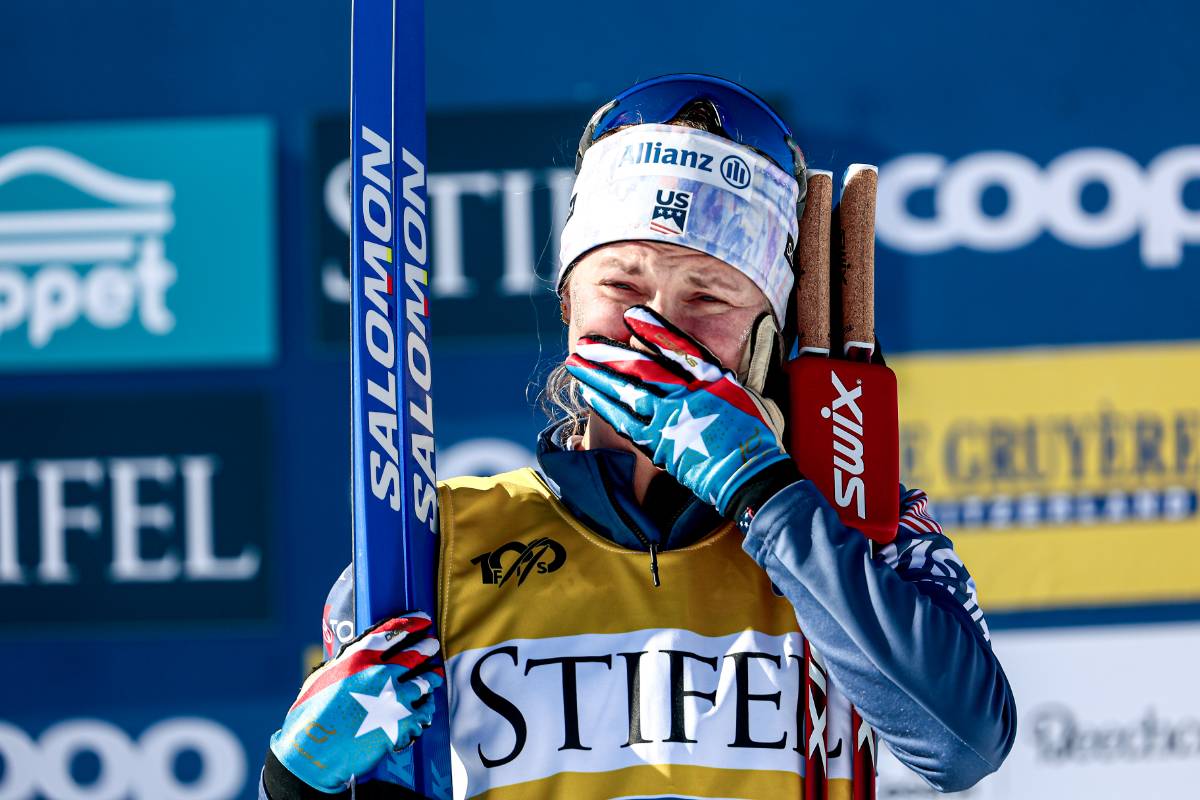
Jessie Diggins was emotional after a day in which she skied to a third place podium in front of her home crowd in Minneapolis. (Photo: Nordic Focus)
Conclusion
Jessie Diggins enters the 2024/25 season as the reigning champion, but the road ahead will not be easy. With fierce competition from some of the world’s best skiers and the added pressure of the world championships, her ability to defend her overall World Cup title will be a true test of her skill, endurance, and mental strength. If anyone is up to the task, however, it’s Diggins, who has shown time and again that she thrives under pressure.
Jessie Diggins’ quest to defend her World Cup title brings excitement to the season. Similarly, players looking for thrilling experiences can explore casinos online, where a world of gaming possibilities awaits.
This World Cup coverage is made possible through the generous support of Marty and Kathy Hall and A Hall Mark of Excellence Award. To learn more about A Hall Mark of Excellence Award, or to learn how you can support FasterSkier’s coverage, please contact info@fasterskier.com.
Number one, indeed. The World Cup Sprint performances of Johannes Hoesflot Klaebo leave little doubt. Photo: Modica/NordicFocus)
By this time in his storied and much-decorated career, Johannes Hoesflot Klaebo (NOR) definitely knows his way around a bottle of champagne. Given enough time on World Cup podiums (as Klaebo has had), an athlete will come to master the sharp-ended wire frame, the peelable foil cover, the strategic shake, the effective cork leverage, the spray-inducing thumb position. Klaebo has it down . . . in Lahti, he had his bottle primed, opened, aimed, and sprayed before the other athletes on the World Cup Sprint Crystal Globe podium—Lucas Chanavat (FRA) and Even Northug (NOR)—had even finished picking at the foil. As has so often been the case in Klaebo’s World Cup sprint career, the other guys really never stood a chance.
On Saturday, Lahti, Finland played host to the final FIS World Cup Sprint; a day when the women’s Sprint crown was decided by the narrowest of margins while the men’s Crystal Globe was awarded to an athlete who won by a mile. At only 26 years of age, Klaebo delivered his 10th Individual Sprint victory of the season, and his 67th career World Cup victory in 126 starts—an almost unheard of level of dominance and consistency. This weekend, he’ll collect both the Sprint and Overall crystal Globes after a season in which he was a contender for the podium each time he toed a starting line. It’s been a long journey, and one that FIS’ point-awarding policies seemed intended to make far more difficult for him that it turned out to be. Even the necessity of racing practically every event on the World Cup calendar could not wear him down.
“I’m looking forward to get done now,” Klaebo admitted in post-race interviews. “It will be great to finish the season now, and have some days off.”
Ben Ogden (USA) leads Ville Ahonen (FIN) and Harald Oestberg Amundsen (NOR) in their World Cup Sprint quarterfinal. Ogden qualified seventh, and would finish 13th on the day, securing his 10th place position in the season-long World Cup Sprint standings.
Ben Ogden (USA) finished 13th on the day, having led in his quarterfinal, but not at the frenetic pace he’d shown in heats earlier in the season. Ogden avoided a fall by Niilo Moilanen (FIN) on the course’s crucial downhill hairpin, but mistimed his lunge at the finish line where he was overtaken by Simone Mocellini (ITA) for the second automatic qualifying spot. Ogden’s finishing time would not be fast enough to earn a lucky loser spot.
Other American finishers included Zak Ketterson 28th, JC Schoonmaker 33rd, Kevin Bolger 48th, and Luke Jager 58th. Canadian finishers included Antoine Cyr 23rd, Graham Ritchie 42nd, Xavier McKeever 50th, and Russell Kennedy 67th.
Men’s Individual Classic Sprint
Wet crystalline snow made Lahti’s sprint course very fast, but treacherously variable. Surface irregularities—combined with the necessary finesse of klister skiing—proved to be a consistent and frustrating challenge for many racers. Lots of skiing outside the tracks, lots of tripping over klister, lots of embarrassing falls—some of the world’s best sprinters tripping onto their faces, flopping onto their backs—especially in the variable snow of the crucial hairpin turn. A day with snow conditions like these—one in which so many of the racers were choosing to ski outside the classic tracks—also provided far more potential for yellow cards; there were a remarkable number of them, resulting in the rarity of two disqualifications—Simone Mocellini (ITA) and Edvin Anger (SWE)—in the semifinals.
Lahti’s sprint course is one in which so much speed can be found in the finishing features, including the slipstream downhill to a righthand hairpin where so much of the action—and so many of the mishaps—takes place. Calle Halfvarsson (SWE) dove to the inside line on the hairpin in his quarterfinal (after having looked flat and disinterested for much of the heat), and managed to make it work. Jules Chappaz (FRA) chose the inside line, and fell in avoiding a tangle (though he’d pop up to finish third in his quarterfinal). Sindre Bjoernestad Skar (NOR) fell in the hairpin, but recovered in time to finish second in his quarterfinal. As usual, Klaebo followed no one else’s example, generally choosing the extra-wide line around the hairpin, allowing him to maintain speed that others had scrubbed.
“[It’s] really far from the top all the way to the finish area,” Klaebo said, describing Lahti’s sprint course. “[There are] a lot of tactical aspects of it.”
The speed Klaebo maintains always seems crucial to his success, and his tactical acumen—combined with his nimbleness and vision—makes him almost unbeatable. Tellingly, the few other racers who attempted Klaebo’s line foundered in soft snow and ended up on their backsides. As we’ve come to understand, only Klaebo can do what Klaebo does.
Even among fields of crowded, competitive, jostling sprinters, Johannes Hoesflot Klaebo (NOR) often finds himself alone. (Photo: Modica/NordicFocus)
In the final—five Norwegians and one lone Swede (Halfvarsson)—Klaebo led down the final downhill, his fast skis preventing other skiers from finding his slipstream and allowing him to pull clear of Halfvarsson before the crucial hairpin. Erik Valnes (NOR), Harald Oestberg Amundsen (NOR), and Even Northug (NOR) all struggled through the crowded inside line on the hairpin, their battle for third nearly undoing them all. Halfvarsson steered clear of trouble and maintained his momentum. Klaebo’s oft-chosen wide line allowed him to carry speed down the final slope, and his unmatched double poling down the finishing stretch made the result a foregone conclusion. Halfvarsson’s own strong finish allowed him to remain ahead of Valnes who would cross the line in third.
While the presentation of awards during the earlier Women’s Sprint Crystal Globe ceremony proved to be a somewhat confusing affair (even for the winners), the Men’s ceremony proved to be a more organized process leading to the predictable champagne-bottle battle. Again, no contest: Klaebo was spraying down his rivals before they’d even managed to make a move. He’d also been wise enough to hand off the precious Crystal Globe (perhaps the most fragile—and inexplicably top heavy—trophy in all of sport) before the champagne shenanigans began. Klaebo spends more time on podiums than anyone else; it comes as no surprise that his performance there would be flawless, as well.
Calle Halfvarsson (SWE), Johannes Hoesflot Klaebo (NOR), Erik Valnes (NOR) celebrate at the finish line of the FIS World Cup Individual Sprint in Lahti, Finland. (Photo: Modica/NordicFocus)
Editors note: FasterSkier’s coverage of FIS Cross Country World Cup Period I has been a cooperative effort among three dedicated staff writers: Ben Theyerl, Ken Roth, and John Teaford. Many early mornings, many calls and texts, many quotes and comments, many unforgiving deadlines bring this reporting to FasterSkier’s readers. We hope their insights have served to improve everyone’s enjoyment of the excellent racing witnessed in Period I, and that they can serve to prepare viewers for the excitement and intrigue of Period II, and beyond.
Jessie Diggins’ (USA) recent World Cup win in Davos has her positioned as one of the favorites entering Period II’s Tour de Ski. (Photo: Nordic Focus)
Ken Roth
In the Women’s World Cup, Period I has been a tale of two halves. During the first two weeks, Sweden looked unbeatable. Then, a not-so-funny thing happened on the way to global domination: illness overtook team Sweden, and they only placed one skier on the podium in individual races each of the last two weekends. For most teams, those results would be pretty good; for the Swedish women it was disappointing.
While Sweden was fading, the U.S. was surging. Jessie Diggins was transcendent in Davos, taking a first and a second. Rosie Brennan bounced back from illness to ski to third in a great 20-k freestyle race and showed unmatched grit. In retrospect, the single biggest factor of the first four weeks was the start list. I’m not throwing any shade on the Americans’ success, but many of the top skiers were absent the last two weeks, and a fair assessment must acknowledge that reality. The other reality is that you can only beat whoever shows up, and the American squad looked great doing just that.
As the World Cup tour enters Period II, the Swedes may be anticipating a resurgence. Sweden’s Tour de Ski start list includes most of their superstars. The question is, will they remain healthy? The Swedes do themselves a real disservice when they fail to provide details about absences, as information vacuums often fill with speculation. This was especially evident with regard to Frida Karlsson whose absence from Davos raised questions about her health (which Team Sweden has identified as a concern in the past).
Norway lists the three Wengs on its start list, so the competition will be stiff. Tiril Udnes Weng is skiing so balanced between distance and sprinting that, barring illness, she should be the Tour favorite. For the same reasons, you have to put Diggins into the mix.
Another big question lingers around the U.S. squad: will anyone emerge to supplement the 1-2 punch of Diggins-Brennan? Julia Kern has been right on the edge in sprints; my guess is she’ll be the next American to podium, while the women’s squad remains mostly unchanged for Period II. And FIS, your holiday present to the ski world can be to change the rules for mixed relays; and do it now. Allow teams to ski in any order they want and to submit their lineups just before the race starts (Full disclosure: I’m totally stealing this idea from the Devon Kershaw Show). Can you imagine an anchor leg with Jessie Diggins given a lead and trying to hold off Johannes Klaebo? I would pay real money to see that—and I suspect most of the cross-country fan world would too!
Ben Ogden (USA) enters Period II with top North American finishes in both sprint and distance events. (Photo: Nordic Focus)
Ben Theyerl
In his comments to FasterSkier’s Nat Herz describing the Beijing Olympics 15 k Classic Individual Start, Ben Ogden said that when Johannes Hoesflot Klaebo passed him he “Wasn’t going at a totally inhuman pace. I think one day I’ll be able to ski a longer percentage of the race at that speed.” I don’t think we anticipated how close that hypothetical day might be. With Ogden coming within an inch of Sprint Finals in consecutive weeks in Lillehammer and Beitostolen (in both Classic and Skate, to boot), it’s clear the gap is shrinking. JC Schoonmaker in sprints, and Gus Schumacher in distance races, have both continued to show the potential of the “young Americans” who were introduced to ski fans with Junior World Championship medals in 2018, 2019, and 2020. As far as percentages go, they’re not quite 100% of the way to Klaebo-pace for an entire race, but they’re definitely getting closer. Are we at a point where we might see the return of an American male to the podium for the first time since Simi Hamilton in Toblach, 2017? Considering the auspicious steps taken by young American skiers so far this season, I wouldn’t rule that out in Period II.
Finn O’Connell, Zak Ketterson, Hunter Wonders at the Tour de Ski: When I spoke to Finn O’Connell following his nomination to the US Ski Team last May, he said that one of his biggest successes last year was figuring out, “What [being] a professional skier looked like.” Along with teammates Zak Ketterson and Hunter Wonders, O’Connell is in the group who became professional skiers during the pandemic, and who have seen the early steps in their careers severely complicated by COVID’s impact. O’Connell, who had earned World Cup starts in 2020-2021, will step on to a World Cup start line for the first time at the Tour de Ski. Having the Tour de Ski be your first World Cup experience poses some unique, and demanding, challenges. O’Connell is likely to take cues from teammate Zak Ketterson who faced the same prospect just a year ago. When I spoke to him last May about hopping from the SuperTour to the World Cup for a week straight of racing, Ketterson said, “[The Tour de Ski is] overwhelming. Those first few races do feel different. It’s hard not to be super nervous, and you’re not really skiing like yourself.” That might sound daunting, but Ketterson also added that the Tour de Ski as an introduction to the World Cup, “Made the rest of races [on the World Cup last season] seem very chill by comparison.”
Johannes Hoesflot Klaebo (NOR) crosses the finish-line in Ruka wearing the yellow Overall World Cup leader’s bib. He’ll hope that a winning effort at the Tour de Ski may allow him to be wearing that bib again at the end of the 2023 season. (Photo: Nordic Focus)
John Teaford
Two weeks ago, Johannes Hosfloet Klaebo claimed his pursuit of the overall World Cup crystal globe was over. It sounded as though he might just concentrate on World Cup sprint events and save his distance-skiing energy for this season’s FIS World Championships. Then the start list for the Tour de Ski came out: Klaebo’s name is on the list. Game on . . .
FasterSkier’s Ben Theryl recently wrote about changes to the World Cup point system, summing up the changes as, “A whole lot more points for a whole lot more skiers” resulting in top skiers needing to ski more races if they hope to do well in the race for the overall Crystal Globe. Exiting Period I, Klaebo and Paal Golberg are both on the Norwegian team for the Tour de Ski (TDS), and embroiled in a close, point-by-point battle for the Crystal Globe. If Klaebo succeeds in winning this year’s TDS, he could claw back the overall title, not by hundreds of points at a time, but by a grinding accumulation of points that could—to the FIS’ delight—make the battle for the Crystal Globe very exciting, indeed.
This World Cup coverage is made possible through the generous support of Marty and Kathy Hall and the A Hall Mark of Excellence Award. To learn more about A Hall Mark of Excellence Award or to learn how you can support FasterSkier’s coverage please contact info@fasterskier.com.
There wasn’t much to be decided, only facts to reaffirmed.
In the last individual race of the World Cup season on Saturday, a 10-kilometer individual start freestyle in Falun, Sweden, the overall World Cup standings of consequence were already decided. Individual season goals for each racer were already moving towards reflection.
Off the course, bare patches of ground seemed to suggest that even the snow was ready to move on from this winter and this ski season. The air was in agreeance; it was 6℃ (44℉) at race start.
Frida Karlsson (SWE) skis past a vibrant Swedish scene in Falun. Karlsson finished 12th in the 10 k freestyle (+1:07:00), but ends the season as the World Cup Distance runner-up behind Therese Johaug (NOR). (Photo: NordicFocus)
And why wouldn’t they be? For all the hints of a return to some kind of normalcy this World Cup season – fans back at venues, a majority of courses covered with natural snow – the World Cup couldn’t out-ski the anxieties and the full-blown winds of change that the winter of 2021-22 has sent around the world. At its conclusion today, the World Cup overall will be awarded to a skier, Natalia Nepryaeva (RUS), who was barred from competing on account of the Russian government’s invasion of Ukraine. Nepryaeva sits atop a World Cup Overall points list that was shaped, and is shaped by, COVID-19 – which forced multiple cancellations of World Cup events in January, and across the season has seen individuals and teams miss races.
All we could hope for from skiing, across this season and at today’s race, was for some sort of center to hold. That we could watch and see something that we had seen before, and that it would bring light and levity to the challenges of the times.
For that type of drama? Well, while World Cup finals may have moved from Siberia to Sweden, their final destination could have been Shakespeare’s Globe.
Woven and interlocked throughout the 10 k individual start were acts ski fans have come to know by heart over the past few years and over the course of this season. But that didn’t make them any less impactful to watch. We would see valiant efforts from early starters, a women’s field where margins are only ever a few seconds throughout a race, capped off, apropos the start order,by the one question that has animated distance racing on the World Cup for nearly a decade, posed for the last time – what about Therese Johaug?
To get to the answer to that question, we would have to wait. In the meantime, the Falun course played host to narratives that followed the contours of its terrain. The 10 k was raced as 3 laps – one 2.5 k loop that was relatively flat, before two laps of a 3.75 k loop where the terrain was punctuated with a set of climbs that would look to separate the field.
Julia Kern skis to 20th in Falun’s 10 k individual start skate. (Photo: NordicFocus)
The early racer to watch in the field was bib 10, Julia Kern, who came through the 1.5 k checkpoint 3.7 seconds ahead of the field. While the top racers would soon follow, with Frida Karlsson (SWE) eventually topping Kern’s mark as she moved through the course, Kern would prove to be a pace-setter for the earlier starters throughout her 10 k effort. She set the fastest time on course at the finish, but it would fall as seeded athletes followed. Her efforts though, ultimately yielded a 20th place finish (+1:30.3), and the image of Kern crossing the line as a champion (even if it proved temporary) seemed an appropriate conclusion to a season where she had battled to overcome the growing pains of World Cup skiing from last season and prove to be one of those American women that ought to be seen as a force on the start line.
“She raced four rounds yesterday. There was gonna be a limit to the energy, [and yet] she swung really hard today and came up with a big result today. I think a fresh Julia Kern can race with the top ten, and that’s not diminishing her 20th place today. There’s more to give, and that’s exciting” said US Ski Team Head Coach Matt Whitcomb on Kern’s result in an interview with FasterSkier.
Full audio interview with Matt Whitcomb.
Jessie Diggins races to third in Falun’s 10 k skate. (Photo: NordicFocus)
Joining her in the category of American women to be excited about throughout the season has been Rosie Brennan and Jessie Diggins. Brennan started in bib 38 today, with Diggins two minutes later in bib 42. They followed the lead of Frida Karlsson and Krista Pärmäkoski throughout the duration of the course. Karlsson, in bib 23, was the first skier to top Kern’s 1.5 k mark, coming in at 2.8 seconds over the field. Pärmäkoski, in bib 30, came through that checkpoint in 2nd, +1.6 back on Karlsson. When Brennan came through, she was +2.5 seconds off Karlsson and in 5th place, and when Diggins came through she was +0.2 off Karlsson and had put herself in 2nd place. The field, in other words, was tight, and those skiers, Karlsson, Pärmäkoski, Brennan, and Diggins – along with Ebba Andersson (SWE) and Kertu Niskanen (FIN) – would jockey and swap places through the remaining 8.5 k.
Krista Pärmäkoski races the 10 k individual start free in Falun. (Photo: NordicFocus)
At 4.3 k, Pärmäkoski had overtaken Karlsson by 1.2 seconds. Brennan came in +1.7 off of Pärmäkoski. Diggins moments later came in +1.8. Through the halfway point with the group the standings read: Pärmäkoski first, Karlsson second, Brennan third, and Diggins fourth, with less than 2 seconds between them.
By 7.7 k, the gaps had started to grow. Pärmäkoski came through with a 14.6 second advantage over Karlsson, while Brennan was +21.6 off the top and back in fourth place. The, in one of the familiar sights that colored the day, Jessie Diggins had started to somehow, someway, increase her pace. She came through 7.7 k now in second place, just +2.6 seconds off of Pärmäkoski.
Rosie Brennan on course Saturday. Brennan finished 8th in the 10 k freestyle. (Photo: NordicFocus)
At 9.1 k, Pärmäkoski still had first place, but Diggins had cut her deficit to a mere +0.6 seconds. As Pärmäkoski crossed the finish in first place with 21.8 seconds on the field, one started to get the exhilarating feeling that the camera would soon cut to Jessie Diggins doing what Jessie Diggins does best.
There was almost dramatic irony to it – we, the audience, just knew that there would be Diggins, free skating, looking ahead, and somehow increasing her tempo from 100% to beyond that. Then, she did it. Diggins crossed the finish line having not only erased her deficit, but gained a second on Pärmäkoski to finish in first place, 1.9 seconds ahead of the rest of the field.
In remarks to FasterSkier, Diggins said that her race today reflected renewed energy levels after her silver-medal winning 30 k at the Olympics, “Today was wonderful. After [sitting out the Holmenkollen race], I felt like I could go out and race the way I wanted to, having the energy to really attack the course.”
Jessie Diggins sits in the winner’s circle after crossing the line in first place on a sunny day in Falun. Diggins would eventually cede the spot to Jonna Sundling (SWE), before Therese Johaug (NOR) crossed the line in first. Final results: 1st Johaug, 2nd Sundling, 3rd Diggins. (Photo: NordicFocus)
Diggins’ result though, only was a subset of the dramatic irony that prevaded the overarching race. Behind her, wearing the red leader’s bib (56, last starter in the field), fresh off of a win at the Holmenkollen 50 k, and in her individual last professional ski race, was Therese Johaug (NOR). The immensity of her character in the drama of the day was hard to understate. Johaug had already secured the Distance World Cup title for the season – her record-breaking fifth time winning that title (breaking a record jointly held by Justyna Kowalczyk and Dario Cologna). Coming into today, she was looking for her 100th World Cup win. She had been on every World Cup distance podium except one (a 4th place in a 10 k classic two years ago) since 2019.
Posting outstanding results across all distances, Jonna Sundling takes second in Falun’s 10 k skate. (Photo: NordicFocus)
What she might achieve in today’s 10 k was continuously foreshadowed throughout the course by Jonna Sundling, who wore bib 50. The Swede, on her home turf, broke through the jockeying at the top of the field when she came through the 1.5 k checkpoint 8.1 sec ahead of the field. When Johaug came through behind her in 2nd place, +4.0 sec, the little separation the pair had created seemed to be a turning point in the race. Johaug might do it. She could do it. She would probably do it. And then, she was doing it.
“It,” of course, was opening a commanding gap on the best skiers in the world. At 4.3 k, she had a 14.1 second gap on Sundling. At 7.7 k, the gap was 30.6 seconds. At 9.1 k, the gap was 35.4 seconds. Building steadily, Johaug had set the stage for a final, triumphant act.
Jonna Sundling skis past her home crowd in Falun, Sweden. Sundling finished 2nd place, after a dramatic sprint to finish 0.4 seconds ahead of third place Jessie Diggins (USA) at the line. (Photo: NordicFocus)
First though, Jonna Sundling would add another scene. As she crested the hill going into the stadium the background was dotted by her country’s flags. The clock put her agonizingly close to Jessie Diggins. She did what she does better than any other skier at the moment – the Olympic gold medalist in the freestyle sprint unleashed a finish line burst that saw her come in 0.4 seconds ahead of Jessie Diggins in first place. The Swedish crowd let out a roar. It was the best that skiing as a spectator sport has to offer.
And then, it was surpassed by the best that skiing, period, had to offer. Therese Johaug finished in first place in a time of 22:34.4. To sum up her career, all you have to do is remove the last preposition.
Therese Johaug finished in first place.
Therese Johaug (NOR) crosses the finish line, in first place, for the final time in her remarkable career. Johaug won on the day (22:34.4), and also secured the distance World Cup title for the season in Falun. (Photo: NordicFocus)
Joahaug came across her last finish line with a yelp, and then quickly turned to her competitors still mulling in the finish area. In an instance, she had gone from racer to ambassador.
With the Norwegian at the back of the seeded group, this meant the podium would be Johaug on top, Sundling in second (+35.9), and Diggins third (+38.5). Rounding out the top-five, Pärmäkoski took fourth (+38.2), with Norway’s Heidi Weng in fifth (+42.7).
The Falun 10 k freestyle podium. (l-r) 2nd place Jonna Sundling (SWE), 1st place Therese Johaug (NOR), and 3rd place Jessie Diggins (USA). (Photo: NordicFocus)
Johaug leaves a sport that’s transformed since she first raced a World Cup in 2007. For one, it is a sport in which Therese Johaug has raced. Her ability to win races so decisively, and consistently, will cast a long shadow. She finishes her final World Cup Distance title with 177 point advantage over 2nd place Frida Karlsson (SWE), who at the young age of 22 looks poised to chart a course that follows in Johaug’s footsteps. 3rd place in the classification will go to Krista Pärmäkoski (FIN).
It’s also a sport where its leading star is an American, joined by her teammates who are now capable of putting two skiers in the top ten (Diggins 3rd and Brennan 8th), and three in the top thirty (Kern 20th, +1:30.3). The depth of the Americans, in fact, was one of the great takeaways from today’s race. Caitlin Patterson just missed a top thirty finish, coming in 31st (+1:49.5). Rosie Frankowski finished 41st (+2:26.4).
Rosie Frankowski (USA) comes down the final stretch in Falun. Frankowski finished 41st (+2:26.4). (Photo: NordicFocus)
Diggins, in particular, has proved skiing’s muse of fire, her grit and heroics adding to the depth of what ski racing purports to be the ideal for. Just today, she came into the race just one point ahead of Ebba Andersson (SWE) in the World Cup Overall. Between her and Andersson, the first finished today would secure World Cup runners-up. After Diggins podium finish today, adding to the mountain of evidence she’s accrued that belief and push are worth it, she secured that title. The overall champions’ title and crystal globe, meanwhile, will go to Natalia Nepryaeva (RUS).
Diggins said of her runners-up in the World Cup overall standings:
“It was really special to finish 2nd in the overall World Cup. I’m really proud. It represents a lot of hard work and consistently giving it everything I have everytime I race…
“I’m definitely still processing it. For me, this was a season where I came in with very concrete goals about my preparation physically and mentally for the Olympics. That was the big target. I’m really proud of how as a team (coaches and teammates) we handled that, and having World Cup wins and podiums was really just the icing on the cake.”
Full post-race audio clip from Jessie Diggins.
Therese Johaug holding her record 5th World Cup Distance crystal globe after winning in Falun. Johaug announced she is retiring from professional skiing last week in Holmenkollen. (Photo: NordicFocus)
Johaug leaves a sport too, at the end of a weary and winding road of a season. Not only out-skiing the best skiers in the world, but navigating the inextricable circumstances that surround the sport in our times. COVID-19, for one, but also the rapidly shifting planes of geopolitics – and the interplay between nationalism, identity, and narrative – that have always been at the heart of all sports, and in particular (as we’ll be reminded in the team event tomorrow) skiing.
That state of flux in the meanings surrounding the sport of skiing will continue. More so now than ever. As will the stories of athletes that are, in their pursuit of dreams, caught in contested ideas that animate the world way beyond this sport.
But then again, we have seen that all before. And as today showed, when in skiing we see something familiar, it is drive, passion, and joy in their pure human forms, that make us turn our heads and pay attention.
That is, after all, the drama of skiing, and in Falun today, we saw one of its best examples.
The Canadian women also had a string of strong results today. Katharine Stewart-Jones finished 33rd (+1:57.7), Dahria Beatty finished 43rd (+2:36.7), and Jasmine Drolet finished 52nd (+3:08.2).
Canada’s Jasmine Drolet sporting Dartmouth’s signature pink-hair look as she raced her way to a 52nd on the World Cup in Falun. (Photo: NordicFocus)
As Period I wanes and the Tour de Ski approaches, curiosity is naturally piqued as to how various athletes are analyzing their first four weekends of World Cup racing. In particular, our focus is drawn to Olympic medal hopefuls, like last year’s World Cup Overall Champion Jessie Diggins. How is she feeling as she heads into the holiday break, with two individual and one team sprint podium already under her belt and another six weeks to further sharpen her race gears before the Beijing Winter Games kick off in early February?
Jessie Diggins hoists the Crystal Globe as the 2021 Overall World Cup champion. (Photo: NordicFocus)
On December 15th, Tom Horrocks, Cross Country Media Coordinator for U.S. Ski & Snowboard, facilitated a Zoom call with a small group of media representatives who wished to question Diggins on the start of her season and her plan for the months ahead. Though we often hear her feelings about individual performances through the audio clips embedded in our race reports, Diggins fielded a variety of broader questions in this call, including her thoughts on early podium finishes, nutritional strategies to support the long grind of World Cup racing, and her focus as the Olympics draw near.
In a previous media call, Diggins explained that viewers should expect her to build into the season as her primary focus was peaking in February for her Olympic goal races. Nevertheless, she won the qualifier in her first World Cup start, the classic sprint in Ruka, then continued to race her way onto the podium on the subsequent three consecutive weekends. If this is what Diggins is capable of while keeping the training volume high in the early season, it’s going to be an entertaining year to be a fan of American cross-country skiing.
“I didn’t have a lot of expectations going into Period I,” Diggins said in the call. “I was not expecting either podium, they came as a wonderful surprise that I’m very grateful for.”
Jessie Diggins in the heats during the skate sprint in Davos. (Photo: NordicFocus)
We’ve heard from both Diggins and her coaches that she is an athlete who responds well to frequent racing. While she puts in large volumes of quality work through the summer and fall, it is during the race season that Diggins truly hones her fitness, both physically and mentally.
“Basically, all of this racing is how I get in shape,” Diggins explained. “Because racing that hard gets you in shape pretty fast. So for me, it’s using the Tour de Ski as part of my preparation for the Olympics, but also – whether or not I’m working into the season, whether or not it’s part of the intentional prep phase – for me, every single race I hit it as hard as I can. And as you probably saw in Davos, I crossed the finish line and there was nothing left. And I’m very proud of that, because that’s how my head gets into the exact right space I need it to be in, so that when I am in my sharpest race form at the Olympics, I already know how to push that hard.”
Diggins also fielded a question on balancing her demanding career with ambitious goals with her life outside of skiing, to which she replied:
“To be totally honest, it is my everyday life. There is not as much balance as you might find, as I hope I find in my next job someday when I retire from the sport, a very long time from now. But it is interesting because it is very all-consuming in that everything you do does reflect upon how you race. So you do have to make sure you’re prioritizing taking care of yourself and sleeping enough and hydrating and on your rest day, you don’t want to go climb the nearest mountain, even though it looks incredibly fun, because you have to rest and let your body recover. So I do think that the way I balance it is by having hobbies that are very restful, so it doesn’t take away from my training.”
She explained that earlier that day, she had spent several hours baking a birthday cake for her teammate, Novie McCabe, who had turned 20. She also expressed gratitude for the support of her family and fiancé, Wade, who will be joining her in Davos, SUI for a week at Christmas.
Jessie Diggins and her fiance, Wade, enjoy sun and perfect tracks in Davos. (Photo: Instagram @jessiediggins)
It’s no secret that Diggins has ambitious goals, and she has been open in discussing the work she has put in to manage internal and external expectations and pressures during her career. Particularly in a year where she will receive plenty of attention from the media and her fans as she strives to add additional Olympic medals to her trophy case, she explained how diverting her focus from the end goal allows her to take the steps needed to actually attain it.
“I think it is really important to not fixate on the Olympics, and especially to not fixate on results. Because just thinking about the outcome goals is probably the worst way to achieve them. [That] will create a lot of stress, a lot of pressure and a lot of hype. So, for me, in order to try to meet these big outcome goals, I actually just spend all my time focusing on the process goals and taking care of myself because I really, truly believe that if your mental health is in the right place, that’s how you can push that hard. And that’s how you can train that much and still love it and not feel burned out or feel like racing is suddenly not fun in any way. Because I think, for me anyway, racing does have to be fun in order to be able to push my body that hard over and over and over again.”
A process focus, as Diggins explained, might look like hammering out a specific set of intervals, following a peer and mimicking their technique to fine tune her own, or focusing on skiing the race course in Dresden with powerful leg pushes to maximize her speed on flat terrain.
“It’s really just those little day to day things that add up over time and allow you to get those big goals.”
Jessie Diggins leads her heat through the quarterfinal of the opening classic sprint in Ruka. (Photo: NordicFocus)
Fielding a question from Peggy Shinn, author of World Class: The Making of the U.S. Women’s Cross Country Team and senior contributor at TeamUSA.org, Diggins discussed the upcoming Olympics and her role in guiding younger teammates through the build up to their first Games as she prepares for her third.
“It’s weird to say your first Olympics, but we are a sport that lends itself to multiple Olympic cycles because of the lifespan of our sport. So your first Olympics is, and should be, incredibly fun, and hopefully, without a lot of pressure. With every resource that you need to succeed, but without the weight of expectations on your shoulders. And so one of the things I’m going to try very, very hard to do is just – ahead of time, answering all the questions about the Olympics that they could possibly have. And also trying to answer questions that they haven’t even thought they might need to ask to prepare them for success in the little things. Like, it might be noisy, so invest in a really good pair of earplugs and an eye mask, and maybe travel with your own pillow – little things that make your room a better setup for rest and recovery. And even, ‘Hey, you know, there’s this athlete Resource Center. You should go print out some pictures of your family and hang them on the wall.’”
She explained how these little touches can go a long way to helping an athlete stay calm and comfortable amidst the wild experience of competing in what our country deems is the pinnacle of sport.
Diggins also spoke highly of the work ethic and grit of her teammates, in particular lauding Julia Kern’s anchor leg in the 4 x 5k relay in Lillehammer, and the contributions of the men who have put at least one American in the semifinals in each sprint event this season.
Jessie Diggins celebrates a podium effort with team sprint partner, Julia Kern, who anchored the team to 2nd place in Dresden, GER. (Photo: NordicFocus)
If you’ve listened to interviews with Diggins or follow her on social media, you’ll know she places a high value on teamwork. After a slew of retirements of veteran members of the team, like Sadie Maubet Bjornsen, Sophie Caldwell Hamilton, and Simi Hamilton, Diggins finds herself as the longest standing member of the U.S. Ski Team.
In the most recent episode of Nordic Nation, Gus Schumacher, Ben Ogden, and JC Schoonmaker each recognized Jessie as a mentor who has provided invaluable advice to help them succeed on and off the tracks as they step up to senior level racing on the World Cup. Whether it is support in handling the highs and lows of results, or the tactics required to be in a position to advance during the sprint rounds, they explained that Diggins has been thriving in her unofficial leadership role this season.
Diggins laughed that they may have sung her praises because she had baked them cookies the night before, but then she reflected on her own start on the World Cup and how impactful it was when her older teammates welcomed her into the fold and supported her as she first took her own steps forward in racing.
“I had so many people in my life helping me at my first Olympics,” Diggins recalled. “Obviously, we had Kikkan [Randall], and Liz [Stephen], and Holly [Brooks]. And I was going through my first Olympics, together with Sadie and Ida [Sargent] and Sophie… And on the men’s side, we had Andy [Newell], who had been there before, as well as Simi. It was so cool to feel like I could ask all my questions of them and feel so supported.
“And I also feel like a big part of it, too, is just some of the little things about being on the road. For example, we’re going into the Christmas holiday next week, and for a lot of people it is their first time on the road, away from home for Christmas. And that is hard. You know, I haven’t been home for Christmas in like 10 years. And I remember my first Christmas before the Tour [de Ski]. I was rooming with Holly Brooks. And she was like, ‘All right, no Christmas tears.’ She pulled out a whole bag of cloves and oranges and decorated the room, and we had a big secret Santa with Liz, Kikkan, Holly and me, and it was so cool to feel like they really took me under their wing. They were like, ‘We’re gonna make sure this is fun. We’re gonna make sure that you don’t feel super homesick.’ I feel like around the holidays, or really any hugely emotional time, which includes the Olympics and any Championship – anytime it’s really hard – that’s when you feel like you miss and need your family the most. And that’s when it is so important that the ski team becomes your second family because you need that support to fill those holes.”
Teamwork. Diggins lays in the snow, exhausted from the effort of earning 4th overall in the 10k skate at 2021 World Championships in Oberstdorf, while Sadie Maubet Bjornsen helps remove her skis. (Photo: NordicFocus)
Following her 2020 Tour de Ski overall victory, Diggins was interviewed by a sports dietitian on the “Eat for Endurance” podcast. One thing that caught my attention was her discussion of having a dietitian and chef on the road with the team, and how she utilized this resource to combat the inevitable depletion that occurs during an event like the Tour. She explained in the podcast that racing often leaves her stomach unsettled, making it harder for her to replace the calories expended when racing repeatedly at maximal effort in the cold. In order to absorb and translate the efforts of the Tour into a fitness boost for the second half of the World Cup season, she needed to first dig out of a calorie deficit during her post-Tour recovery week, giving her body the energy and nutrients it needed to repair and replenish reserves.
Bringing this approach forward into the upcoming Tour, Diggins explained how important focusing on her nutrition has become to ensure she doesn’t fizzle out by the later stages, or carry fatigue forward into Period III and the Olympics.
“In Tours of the past, I’d found myself getting to the last few stages and just feeling very drained. Which, of course, you will anyway, because it’s very tiring, but you don’t necessarily need to feel drained from an available energy perspective when it comes to food. So it has been really amazing having a dietitian with us during the Tour, because I’m pretty sure the extremely high calorie smoothies actually kept me alive.
“For me, it is interesting because my body manifests stress very physically, even if I don’t feel incredibly stressed – you know, I’m excited to race but not overly fluttery about it. I might feel emotionally like I’m in a great place, but my body’s like, ‘Nah, we’re still stressed.’ And so that makes it very hard to eat enough sometimes.”
Jessie Diggins collapses after climbing the Alpe Cermis to win the 2021 Tour de Ski, making her the first North American athlete to do so. (Photo: NordicFocus)Jessie Diggins is hit with emotion as she processes being the first North American athlete to win the Tour de Ski. (Photo: NordicFocus)
Diggins later explained that one of the ways the stress her body is retaining manifests itself is very visible and “kind of gross.”
“At the last Olympics, the skin just started falling off my hands to the point where I lost my fingerprints on some of my fingers. And it’s weird because – the performance side was great, my best Olympics ever, my headspace was great, the sports psychology was great, I was able to eat enough…”
Nevertheless, Diggins’ body showed clear evidence of the stress that it was under. This leaves Diggins in a catch-22 as she also recognizes the stress of high-stakes racing helps her dig deeper into the well.
“Although I don’t love what [stress] does to my body, I do thrive under that pressure. Instead of making me crack, it just unleashes that very top level of performance and it brings out the best in me. Which is why I think anchoring the relay was, for a very long time, the only way I would have an outstanding World Cup. It took me a very long time to do that individually without the pressure of holding down the team. But yeah, [when my skin started to fall off] I realized, ‘Wow, my body really feels this.’”
Acknowledging that subjecting herself to this level of stress may not be ideal for her long term health, she rationalized that it – so far – has only happened at the Olympics, which only amounts to a three-week period once every four years.
Returning to the concept of mitigating the nutritional losses accrued during the Tour de Ski, Diggins explained some of the principles that the team dietitian has helped her to develop.
“It has been really, really helpful coming up with these strategies. [One of the strategies is] using Nutrimeal in calorie-dense shakes, or stirring it into my oatmeal in the morning. A lot of peanut butter – that stays down and digests really well. And honestly, a lot of chocolate, that helps too, because you always want to eat it, it always tastes good, and you just need the calories however you can get them. So for me, it has been really fun working with the sports dietitian and figuring that out. Then especially after the Tour, it’s been really important to make sure I’m able to absorb everything that I’ve just done, because that is then going into the Olympics.”
Jessie Diggins powers through the qualifier of a skate sprint in Ulricehamn, SWE in February, 2021. (Photo: NordicFocus)
She also explained that she has been working with the dietitian to problem solve fueling throughout the day leading into an afternoon or evening race, like she will encounter in most of her Olympic events. Diggins shared that it’s a fickle balance, ensuring that her body has the energy and fuel throughout the day that it will need to perform come race time, while also making sure her stomach is settled enough that she does not risk revisiting her breakfast or lunch as she pushes herself to her physical limit.
“It’s been really interesting for me working with our amazing staff, and our awesome sports dietitian, to figure out ‘Okay, here’s what you can digest, because you need a lot of calories, it’s going to be very cold, you’re working very hard, you need that energy, but you need to time it in such a way that you will not have an upset stomach.’ You don’t need any distractions on any race day, but especially not at the Olympics.”
Apart from a dietitian, the team often has access to massage and physical therapists. Diggins credits these resources as another invaluable tool in keeping her body healthy.
“We are so fortunate to have this amazing pool of volunteer massage therapists and physical therapists. Having them on the road with us has been absolutely incredible. It’s a good way to avoid injuries before they happen by taking care of those little things that inevitably pop up, but especially during the Tour, you definitely need massage work every single day. I mean, you need even more than that – you need 10 hours of sleep every single day. So I think trying to really stay on top of the body care, the rest of the recovery, the nutrition pieces, the hydration… I travel with a ton of Nuun products, because staying hydrated through all those races, especially sprint days, which are so long, and you inevitably get dehydrated, because it’s hard to drink enough when you’re jumping up and down and your stomach sloshing. For me, trying to take care of those little pieces has been huge. And that’s definitely something that I’ll be talking to our younger and first time Tour team about. ‘Alright, look, it’s gonna be hard to eat enough, it’s gonna be hard to drink enough. But you just really have to keep hammering that home because this is what will get you through the Tour, and then get you through that week after the Tour so you can bounce back and then race well in Les Rousses (FRA).’”
Jessie Diggins follows Sweden’s Ebba Anderson during a mass start 10k classic in Val di Fiemme, ITA, during Stage 6 of the 2021 Tour de Ski. (Photo: NordicFocus)
In reviewing Diggins’ last two Olympic appearances, she raced four events in Sochi in 2014 (15k skiathlon, freestyle sprint, 4 x 5k relay, 30k freestyle), and all six events during the 2018 Olympics in PyeongChang, of course, highlighted by her Gold Medal performance in the team sprint with Kikkan Randall.
This begs the question, in her third Olympics, piggybacking on a season where she won the Overall World Cup title and became the first American to win the Tour de Ski, would Diggins take the same approach and stick her neck out in every event with the hope of having a medal placed around it? Or would the approach be more targeted, sitting out in races where perhaps her odds of a medal are lower in order to conserve energy for a few target races?
“I’m definitely one of those athletes that loves to race and to race everything and so I think for me right now, looking at the Olympics, I definitely need to be racing at a level where I’ve earned starts and where it makes sense for me to race the races, but if I’m racing the way I hopefully am when I come into that sharp form, I’d like to race everything for sure. And I think the plan includes racing nearly all the World Cups to get the experience [I need for that], because pacing different courses, different altitudes, and different techniques that does just take time to get all the little things dialed in and play around with them. So the more World Cups I can race, the more I can play around with those little pieces, especially altitude, because that’s when it gets really tricky. So yeah, I think I’ll be racing most things. Probably not every single World Cup this year, but most of them.”
FasterSkier will continue to provide insight into the American team as they continue their individual journeys through this season. If Period I is any indication of what is to come, bringing you this coverage will be a fun job.
Jessie Diggins fist bumps Jenny Solin (SWE) after the team sprint final in Dresden, where she and Julia Kern took 2nd. (Photo: NordicFocus)
Kikkan Randall (USA) and Emil Joensson (SWE) pose with their FIS Sprint Crystal Globes following the races in Stockholm (SWE). Photo: Fischer/Nordic Focus.
So much has happened since the season began in November that it’s easy to forget that, prior the first World Cup of 2012-2013, Kikkan Randall didn’t know whether she’d be able to even come close to matching her performances from the season before. An autumn injury prevented the American sprinter from training at full capacity and there was doubt in her mind as to whether she could compete at the same level that had first earned her the crystal globe the year before.
“When I was injured this fall, I didn’t know if I would be able to be in contention for the globe again this year,” Randall wrote in an email to the press on Wednesday after the last sprint of the year concluded in Stockholm, Sweden.
Fast forward a few months. Randall not only matched her level of competitiveness from last year, she actually exceeded it in certain respects. She locked down the sprint globe this year a full weekend ahead of last year’s schedule when she created an insurmountable gap in the sprint rankings with her win in Lahti, Finland, two weeks ago. The tenth and final sprint of the regular World Cup took place in Stockholm on Wednesday, whereupon Randall was presented with a second crystal globe to add to her collection.
Kikkan Randall (USA) wins her second straight FIS Sprint Crystal Globes. Photo: Fischer/Nordic Focus.
She noted it was a little strange to walk up to the podium after only finishing 22nd in that day’s classic competition, but the scenario actually highlights an interesting point about Randall’s achievement. The title of Best Sprinter in the World belongs to her in spite of the fact that her classic form was less than where she wanted it to be and, more importantly, in spite of the fact that she wasn’t able to follow her usual training plan this fall. The setback may have shown through with her distance skiing towards the end of the season but this was not the case with her skate sprinting. Out of ten sprints events on the World Cup calendar, five of them are freestyle. Randall lost only one of those, when she finished second in Canmore, Alberta. She didn’t face her toughest challenger, Marit Bjoergen (NOR), until the final skate sprint of the year, but her speed was still in a place then to put her on top of the world.
“I’m so grateful to have recovered and to have been competitive the whole season,” Randall said. “The feeling of the second one is definitely different than the first. Last year, I felt so wide-eyed and giddy. This year feels a little more familiar and a nice validation that last year wasn’t just a fluke. It was great to have the King of Sweden present the awards again and it’s always an amazing feeling to hear our national anthem played out loud.”
U.S. Ski Team women’s coach Matt Whitcomb said that even though they’ve known the title was Randall’s for weeks, it was still immensely fulfilling to finally see it awarded to her.
“Maybe the immediate excitement has worn off a bit but the accomplishment hasn’t at all,” he said. “I think you saw that today, when you had all the American athletes mixed in with the Eurosport cameras and everybody else, fighting for photos and cheering her on… The magnitude is pretty big for our team, and we all realize that.”
Randall was appreciated for the cheers from her teammates as she stood on the podium.
“I just wish I could bring all of our coaches, staff and my teammates up on that podium to share the moment with me,” she said. “A bunch of my teammates stayed a couple extra hours after their races to be there for the awards presentation and I am so grateful for their support.”


 This coverage is made possible through the generous support of Marty and Kathy Hall and A Hall Mark of Excellence Award. To learn more about A Hall Mark of Excellence Award, or to learn how you can support FasterSkier’s coverage, please contact info@fasterskier.com.