Tag: CU

  • In-Depth Race Coverage: Slow Heats with Tight Finishes in the SoHo SuperTour Classic Sprint

    In-Depth Race Coverage: Slow Heats with Tight Finishes in the SoHo SuperTour Classic Sprint

    By Rachel Bachman Perkins and Ben Theyerl 

    Precipitation was no longer a threat for the final day of racing in Soldier Hollow on Friday, a 1.5-kilometer classic sprint offered alongside the 2022 U.S. Cross Country Championships, yet classified as SuperTour only. However, athletes still faced unseasonably warm weather as blazing sun brought temperatures into the low 50’s on course during the midday heats. 

    Howling wind and rippling bibs could be heard as background noise as Adam Verrier called the event on the livestream, creating extra work for the athletes who would fight through degrading course conditions throughout the heats. This extra work showed in the times on course; with the combination of freestyle technique and significantly faster course conditions, Sunday’s sprint races featured times over a minute faster on average. A similar difference was seen even between the qualifier today at 9 a.m., when temperatures were still colder and tracks firmer, and the heats which began at 12:30 p.m. 
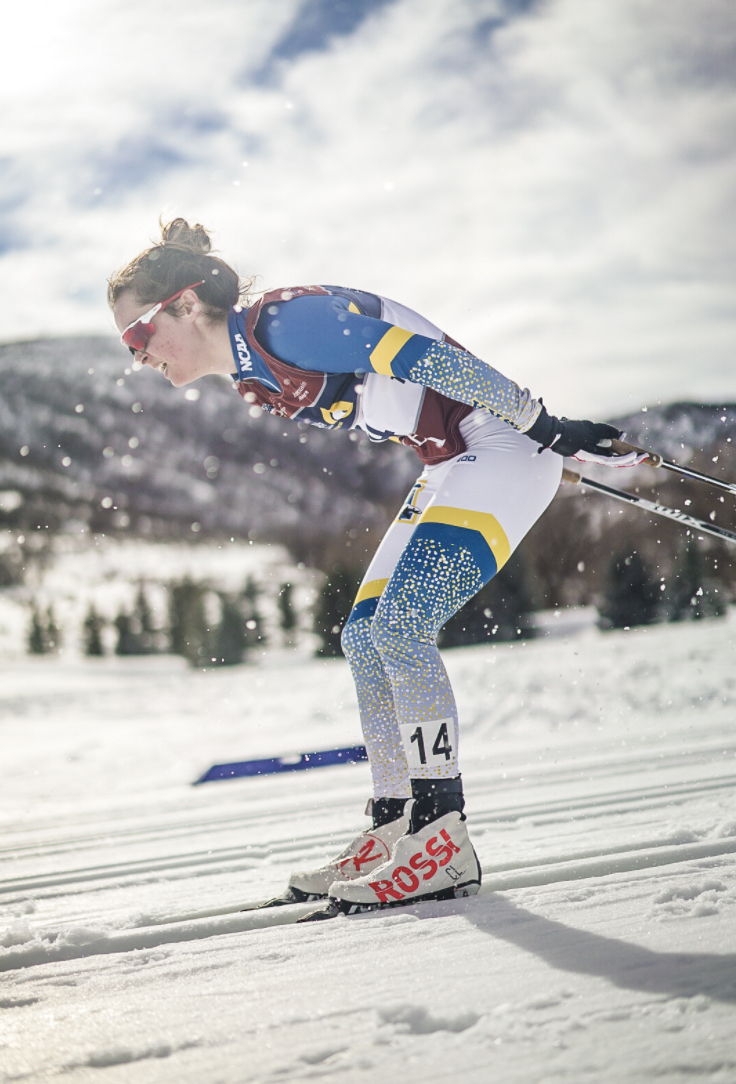
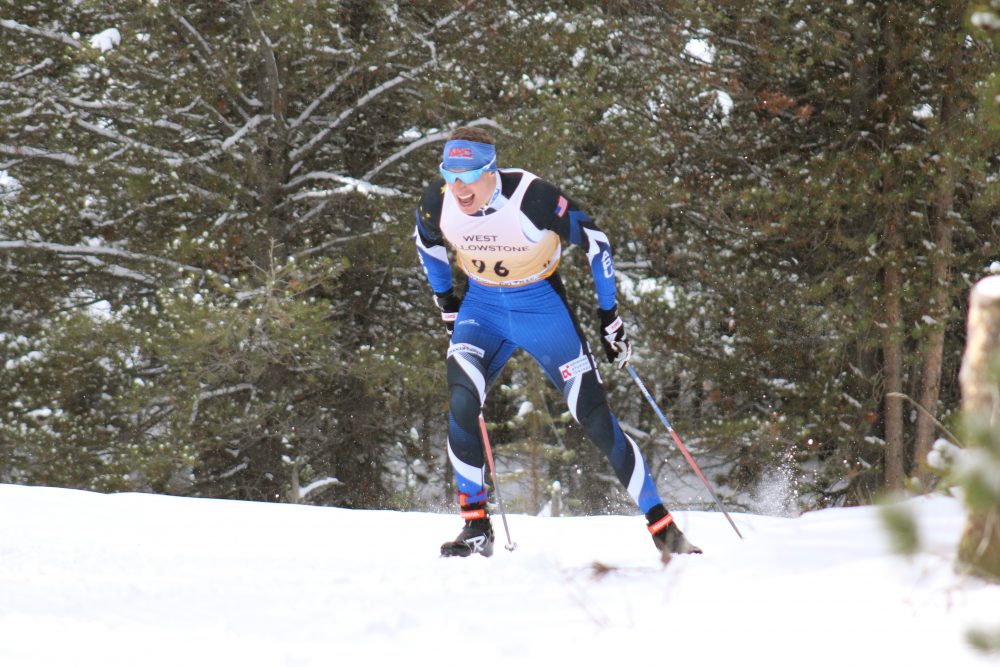
    Warm temperatures, degrading tracks, and loose granular spray set the stage for a challenging classic sprint in Soldier Hollow. (Photo: Tobias Albrigtsen / @untraceableg)

    “Sprint” seemed to perhaps be a misnomer, as times in the women’s heats climbed over five minutes and were well above four minutes in the men’s heats. Combined with a qualifier, this meant athletes who raced through the final saw between 16 and 20 minutes of racing, testing their endurance and fitness differently from the average sprint event.   

    Women’s Race: Katharine Ogden on Top from Qualifier to Final

    On the heels of a second place finish in yesterday’s 15k classic, Katharine Ogden (USST/SMS T2) set the bar in the qualifier, finishing in 3:51.79.

    Julia Richter (U of Utah) was the second fastest qualifier (+0.77), ahead of Lauren Jortberg (BSF Pro) in third (+1.48). Both Ogden and Jortberg won their quarterfinal to advance comfortably into the semis, however, Richter took fifth in Heat 4 and did not advance.

    In the first semifinal, two Craftsbury teammates Annika Landis and Caitlin Patterson led the way in the opening climb, with Ogden and Sydney Palmer-Leger (USST/U of Utah) sitting in third and fourth a few strides behind. Descending from the high point, a third Craftsbury racer, Michaela Keller-Miller, had pulled to the front, but was quickly overtaken by Patterson and Ogden as the pack headed into the final short herringbone climb before the long descent toward the stadium. Patterson and Ogden sat in low tucks, letting their fast skis glide as long as possible before transitioning to doublepole as they headed over the bridge and into the finish. 
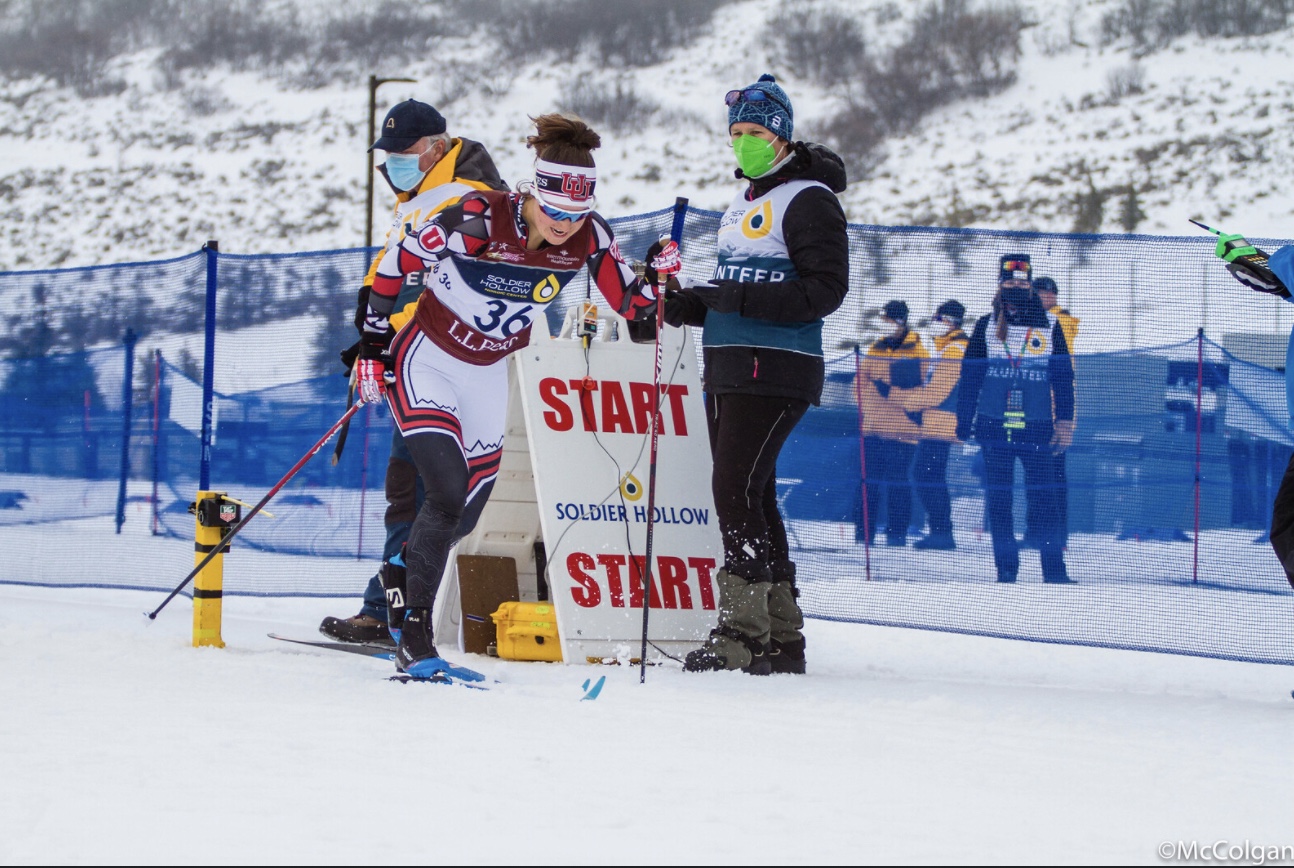
    Sydney Palmer-Leger heads out for the 10k interval start classic race during the 2022 U.S. Cross Country Championships in Soldier Hollow. (Photo: John McColgan)

    Upping the power in the final 200m, Palmer-Leger accelerated to make contact with Patterson as the women crossed over the bridge, but Patterson had better glide in the quick descent from the bridge’s exit, maintaining an advantage as they headed into the final stretch. Patterson tucked in on the tails of Ogden in the left-most track to go one-two in the heat, with Palmer-Leger not quite in the fight for an automatic qualifier spot finishing 1.5 seconds behind Patterson in third. 

    In the second semi, Bridger Ski Foundation (BSF) Pro Team members, Lauren Jortberg and Hannah Rudd lead the charging, looking as if their skis were gliding well as they pushed the downhills, perhaps with compromised kick as both showed signs of slipping in the final punchy climb. 

    In the long glideout, Lauren Jortberg moved from the far left side of the course outside of the track into the second track, losing some time on Rudd who had stuck with the second track from the start. Nevertheless, both held a significant gap over the remainder of the heat as they doublepoled over the bridge and into the finish lanes. Rudd took the win in 4:55.52, roughly +0.7 seconds ahead of Jortberg in second. 

    A few meters behind, Craftsbury teammates Margie Freed and Alexandra Lawson raced side by side to third and fourth, and as the heat proved to be seven seconds faster on average than the first, both advanced to the final.

    As the women’s final headed out of the stadium and toward the first climb, Lauren Jortberg who was the first in a train of two BSF skiers, had her ski stepped on as she was switching from doublepole to a run outside the track. This caused Jortberg to stand up, spin sideways and crash in slow motion. Rudd, who was just behind, quickly moved around Jortberg without going down, soon taking the lead charging up to top of the first climb with Patterson, Freed, and Ogden close behind.

    Patterson looked strong with solid kick as she chased a slipping Rudd up and over the final long climb, but it was Ogden on fast skis who quickly moved into second on the subsequent downhill.

    Over the last punchy climb the women ran. Heading into the long glideout, Ogden was off the front in the left-most track, but Rudd and Patterson remained within reach a few ski lengths behind. Descending off the bridge, the top three accordioned together, all choosing the same track with Ogden confidently leading the way to the finish. Patterson, who was in third, moved into her own lane to the right, slowly gaining ground on Rudd as they headed to the line. 
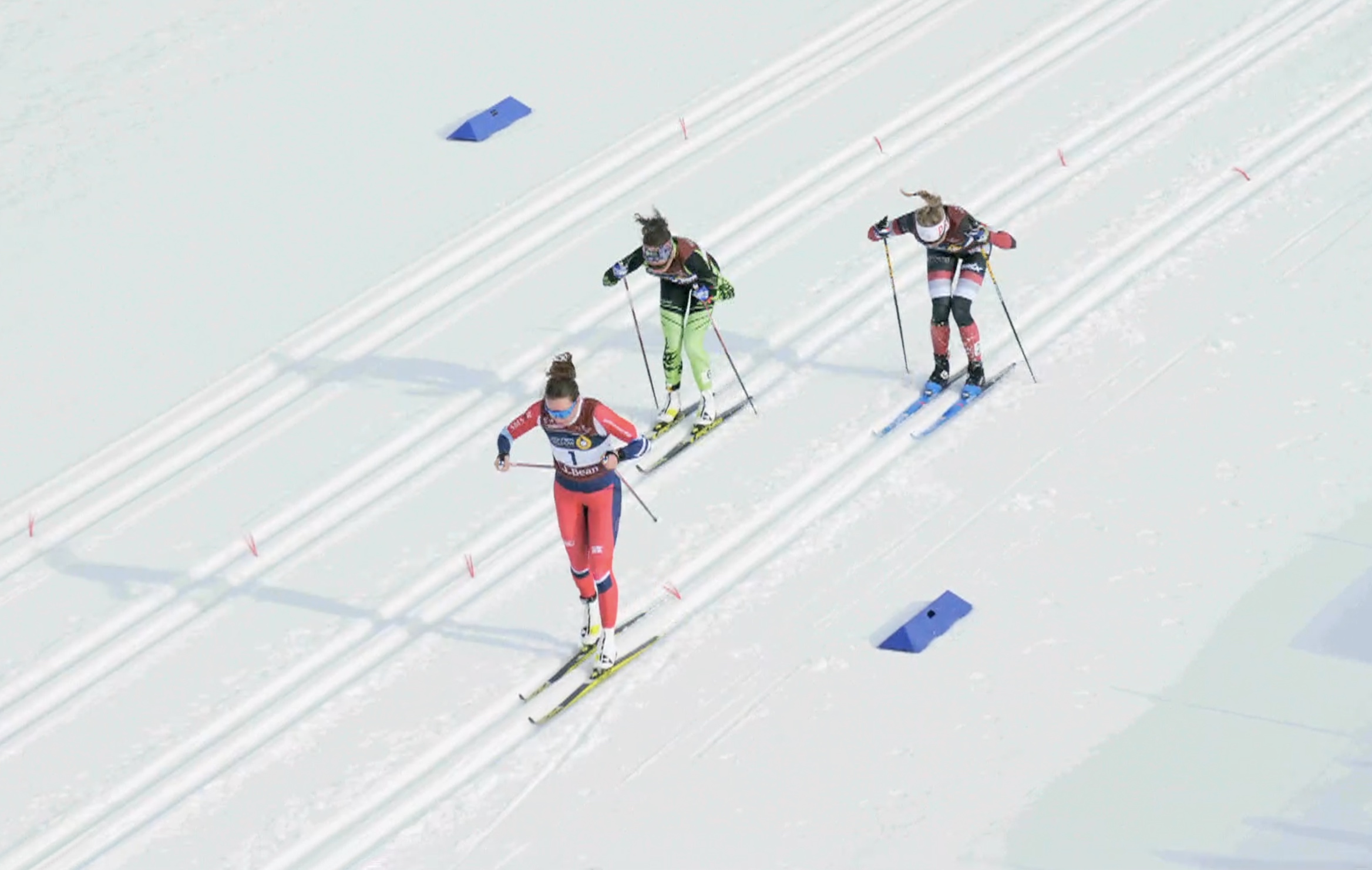
    Katharine Ogden leads Caitlin Patterson and Hannah Rudd to the line during the SuperTour classic sprints in Soldier Hollow. (Photo: Livestream Screenshot)

    Ogden maintained her lead to stop the clock in 5:01.63, while Patterson edged out Rudd for second (+0.98) and third (+1.53), respectively. After regaining contact with the pack following her crash, Jortberg finished fourth (+6.64), with Lawson fifth (+7.11), and Freed sixth (+21.55).

    “I was having a lot of fun out there today!” Ogden wrote to FasterSkier after the race. “The sprint was definitely on the long side, especially late in the day, but that did not significantly affect my strategy; I am confident in my endurance as well as my short duration power. I was really excited to have fast skis from Pat [O’Brien] and it was fun to experience the high level of sprinting in the U.S. currently. I also haven’t really done a full sprint day in a while so that was a lot of fun! It was also so impressive to see Caitlin get her fourth podium in as many races and to see Hannah Rudd have an incredible breakout performance today!”
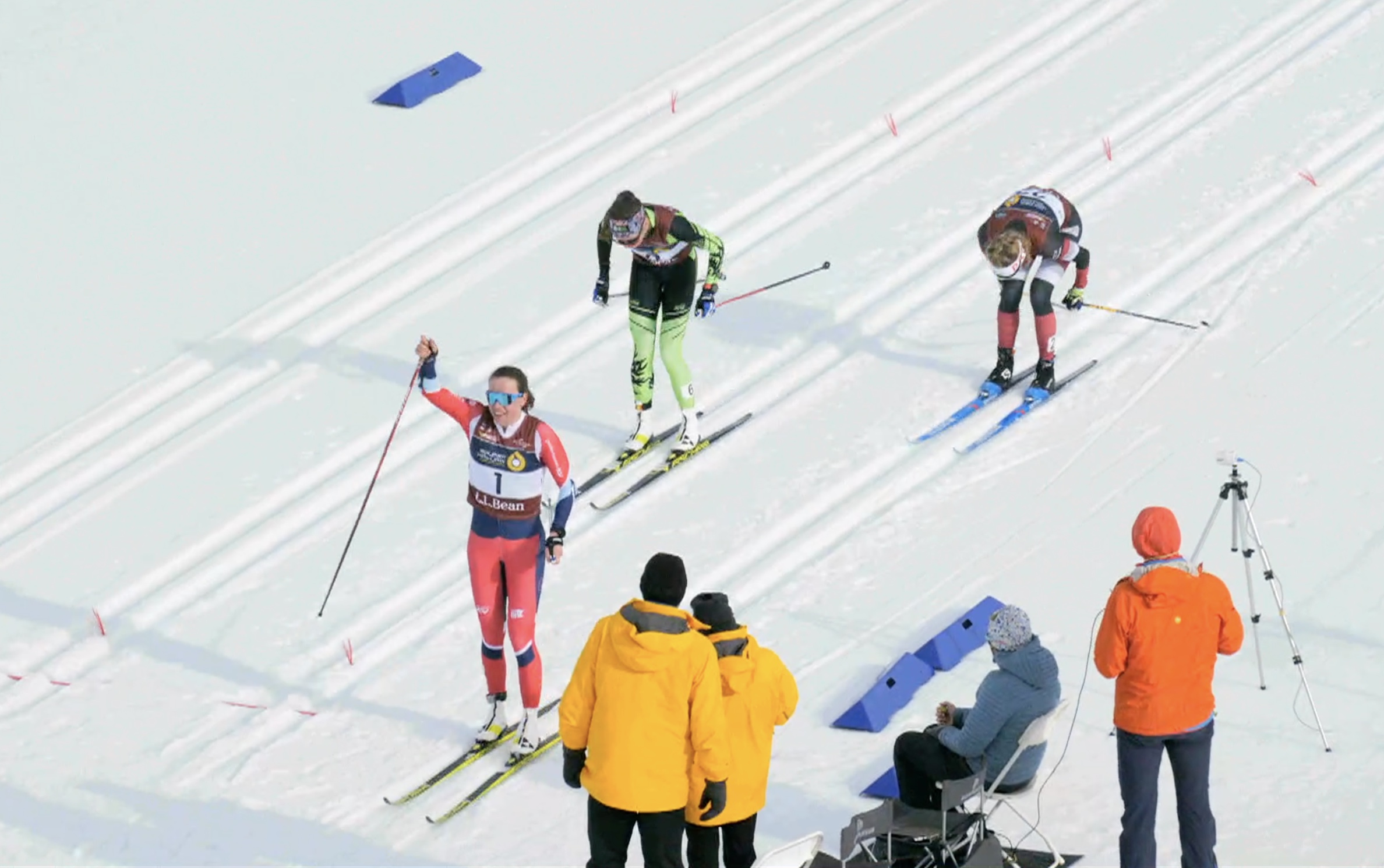
    Katharine Ogden celebrates her win in the classic sprint while Caitlin Patterson edges out Hannah Rudd for second and third. (Photo: Livestream Screenshot)

    In a post-race email, Patterson reflected on her experience racing through the heats. 

    “My racing today went fairly well, and it was a beautiful day to be out skiing and spectating,” wrote Patterson. “The sun-warmed snow became quite wet and broken apart for the heats, and combined with the wind, it certainly made a long sprint with plenty of herringbone and some sloppy tracks. I tried not to really think about the time duration much, it was mostly about getting from start to finish, however long it would take. All of the heats required some scrappy skiing, moving around through the slush and timing the length of the tuck. Now I’m really looking forward to some recovery after a good week!”

    Patterson also spoke to the week of racing in Soldier Hollow, where she finished on the podium four times in as many races, including wins in both the 10k individual classic and the skate sprint. But she was not the only person in a green suit putting together a successful week. Yesterday, she shared the distance classic podium with teammate Adam Martin. On Tuesday, Crafstbury went 3-4-5 in the 20k skate, with Lawson and Freed leading a chase group behind Frankowski and Patterson. And today, five CGRP women raced in the semis, with three advancing to the final. 

    “Everyone at Nationals is really feeling the fatigue, and myself and my team were no exception out there today. The race coughs are becoming quite terrible from so many days of racing at altitude, which is not the most fun to be coughing uncontrollably in this time of COVID. However, I was really proud of our whole team, with 5 women in the top 10! We have a really strong group, as evidenced by the performances in the distance races too; it came as no surprise to me that the women were awesome today, because training and doing intervals all summer and fall we’ve been neck-in-neck and pushing each other.”
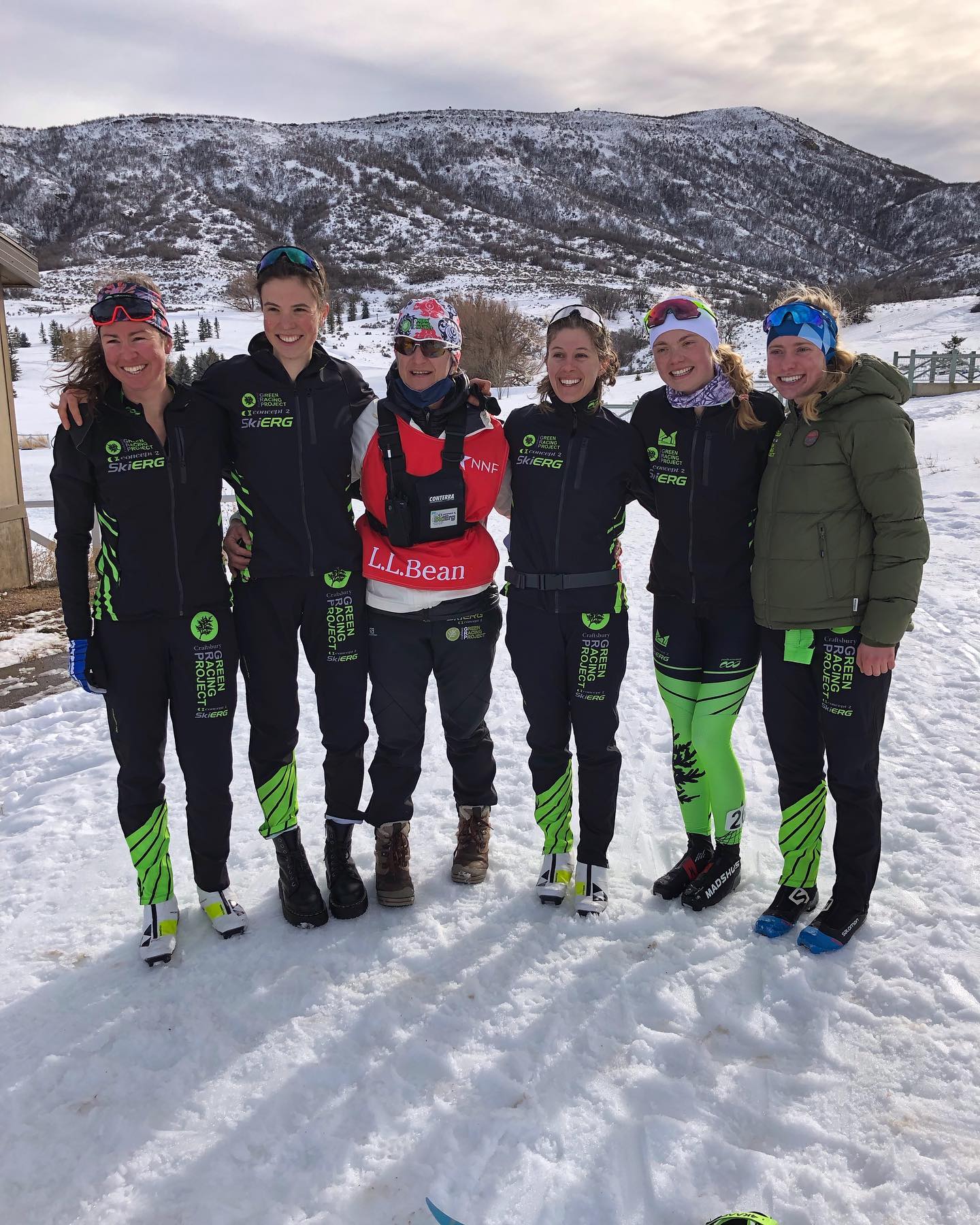
    The women of Craftsbury with coach Pepa Miloucheva. CGRP put five women into the semifinal and three into the final of the SuperTour classic sprint in Soldier Hollow. (Photo: Facebook Crafsbury Green Racing Project)

    For Rudd, this was her first career SuperTour podium. Originally from Plymouth, MN, she graduated from University of Alaska Anchorage (UAA) in May, 2020 before heading to Bozeman to join the newly minted BSF Pro Team. Placing in the top-10 in each of the three stages of the 2022 U.S. Cross Country Championships, Rudd has steadily worked her way up the results list, finishing 10th in Sunday’s freestyle sprint, 8th in the 20k mass start free, and 6th in the 10k interval start classic. She ends her week in Soldier Hollow on a podium high note. 
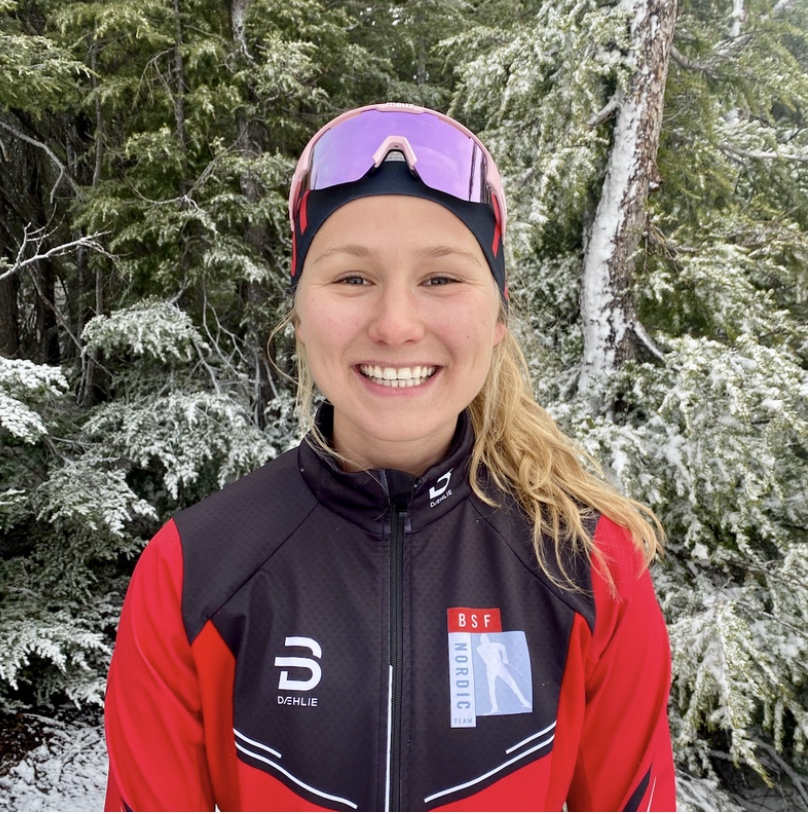
    Hannah Rudd is a member of the BSF Pro Team based in Bozeman, MT. (Photo: bridgerskifoundation.org)

    “Yesterday was a pretty exciting day for me!,” Rudd wrote to FasterSkier after the race. “The sprint course at Soldier Hollow this year was very challenging as it included three solid climbs. During the qualifier, the course remained very firm and fast. However, the temperature quickly began to rise throughout the day, and by the time the quarterfinals began, the sun was baking the course, the wind was blowing, and temps were nearing 50 degrees. This made the snow begin to transform and slow down and turned the tracks into mashed potatoes in some sections. 

    “I woke up in the morning feeling quite tired from the past week of racing so I was not sure how the day was going to play out,” Rudd continued. “I ended up qualifying in 22nd, so it was clear that I had some work to do in the heats. I felt like I was able to gain momentum and energy throughout the day, and progressed through the quarters, and semis and onto the final. Going into the final, I knew that my team’s skis were running really well so I tried to ski big and relaxed and put myself in a good position for the last downhill. It was pretty neat to be in a final with my BSF teammate Lauren Jortberg, who is an incredible sprinter and someone that I have learned a lot about sprint racing from over the past few years. I was extremely excited to land myself a spot on the podium and think it will help me to continue building momentum and confidence for the rest of the season!” 

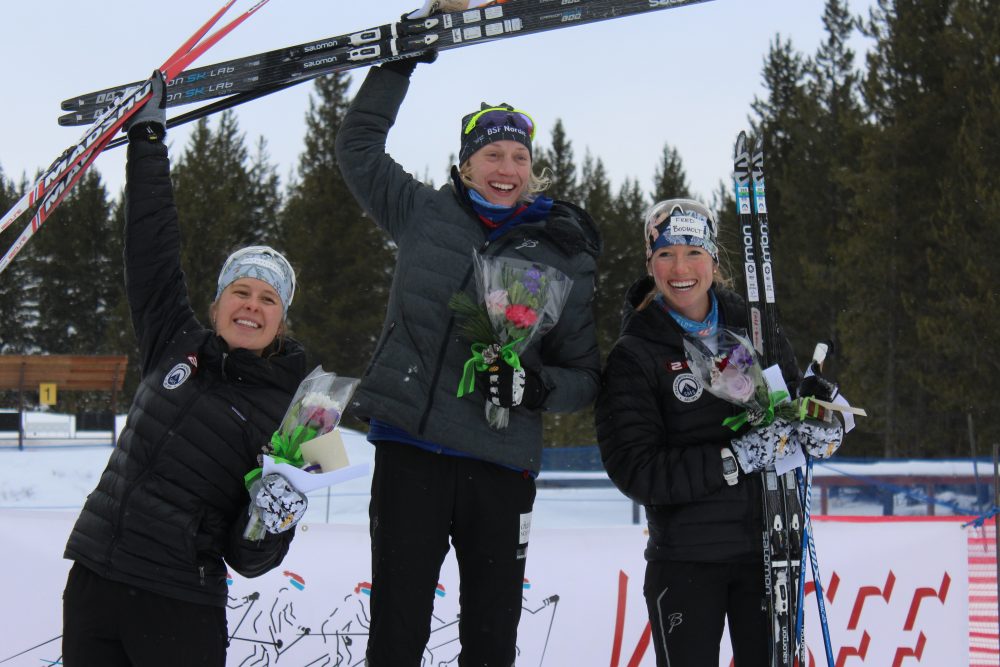
    The podium ceremony for the women’s final following the SuperTour classic sprint in Soldier Hollow. Katharine Ogden took the win ahead of Caitlin Patterson and Hannah Rudd, with Lauren Jortberg 4th, Alexandra Lawson 5th, and Margie Freed 6th. (Photo: Facebook Craftsbury Green Racing Project)
    Men’s Race: Colorado’s Magnus Bøe Upsets Schoonmaker in the Final 

    In qualifying, JC Schoonmaker (USST/UAA) showed why he has been the U.S. Ski Team’s most reliable fixture of World Cup Classic heats this season, winning the qualifying with a time of 3:08.43, 6.42 seconds ahead of 2nd place Peter Holmes (Sun Valley SEF). Andreas Kirkeng (University of Denver) rounded out the top 3 (+6.57), in a field where the top 30 were all within 20 seconds of each other.

    With a dominant performance in qualification, the racing throughout the day always seemed to have one eye on where Schoonmaker was in the field. In his quarterfinal, Schoonmaker looked to start conservatively from the back of the field, which led the whole heat to sit back as well. When he moved to the front at the beginning of the first climb, the race surged forward with him. No one could match him, however, and he finished with a comfortable lead, with Kjetil Bånerud (NMU) taking the 2nd semifinal spot (+1.02).
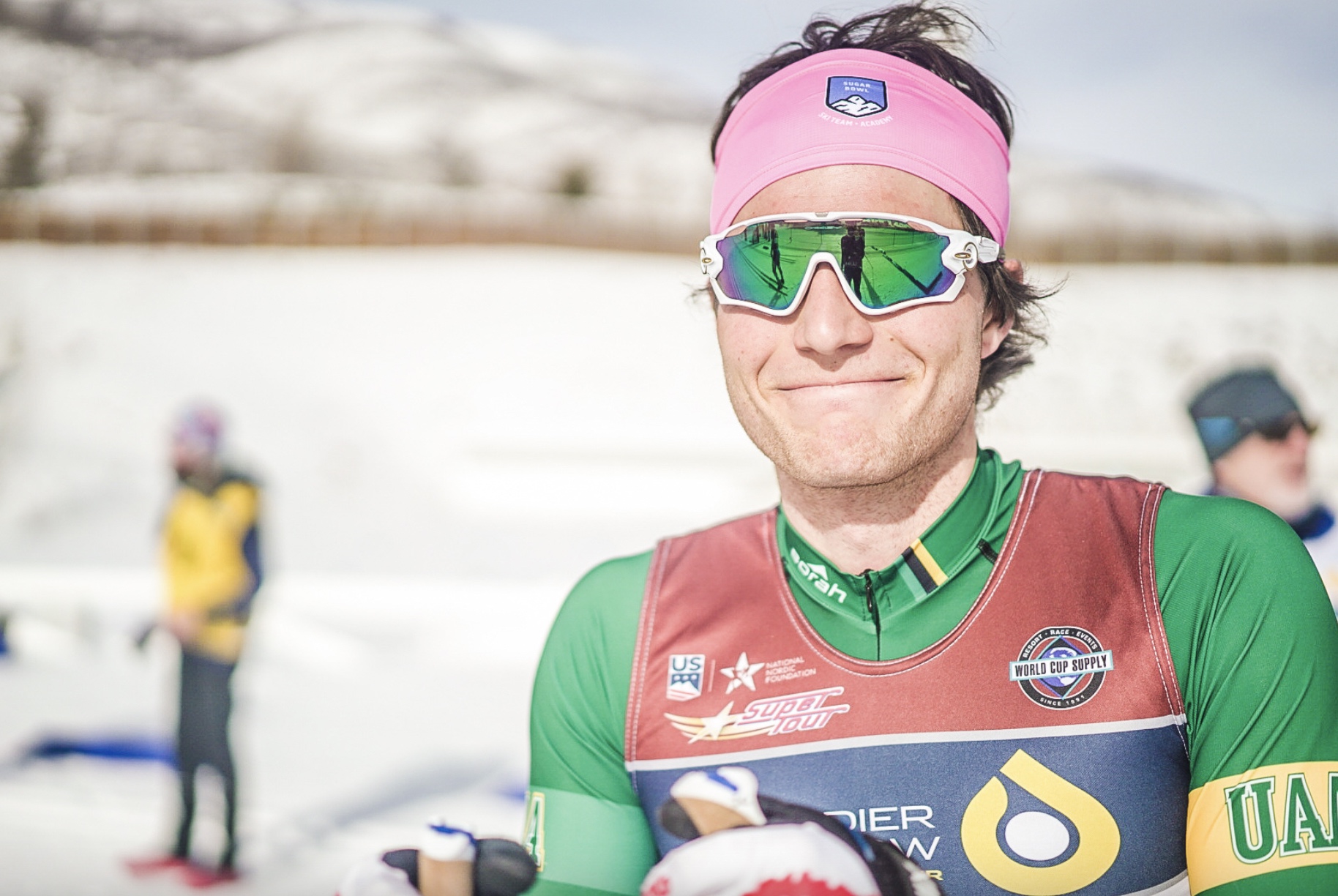
    JC Schoonmaker prepares for a sunny and warm classic sprint in Soldier Hollow. (Photo: Tobias Albrigtsen / @untraceableg)

    The following two quarterfinals also previewed the competitors, and their preferred way of attacking the course, that would define the semifinal and final racing later on.

    The second heat set a stark contrast in pace to the previous heat, with Noel Keefe (U of Utah) and Bill Harmeyer (SMS T2) leading the field out hard from the gun. Hunter Wonders (APU) and Johnny Hagenbuch (SVSEF) were able to keep with the pair though, and ended up out-sprinting Keefe and Harmeyer going into the finish. Still, the duel between Keefe and Harmeyer led to a blistering pace for the heat overall, and they would claim the lucky loser spots for the semifinals.

    Then came the 3rd quarterfinal, featuring winner of today’s most aggressive racer award (unofficially handed out here, by Fasterskier), Ian Torchia (SMS T2), who in every heat he was in today would hammer out to the front of the pack while others seemed content to let the field play out. He was joined in the heat by Magnus Bøe (U of Colo.), who made his move on the first climb, stayed out in front, and came through in first place. Torchia, meanwhile, held onto second to advance automatically to the semifinal.

    The semifinals marked more an amalgamation of race strategies than anything unique. But it was an amalgamation – which requires multiple parts. And indeed, on a course known for rewarding smart-racing, and in conditions – above freezing, on man-made, wind-swept snow – that reward smart waxing as well.
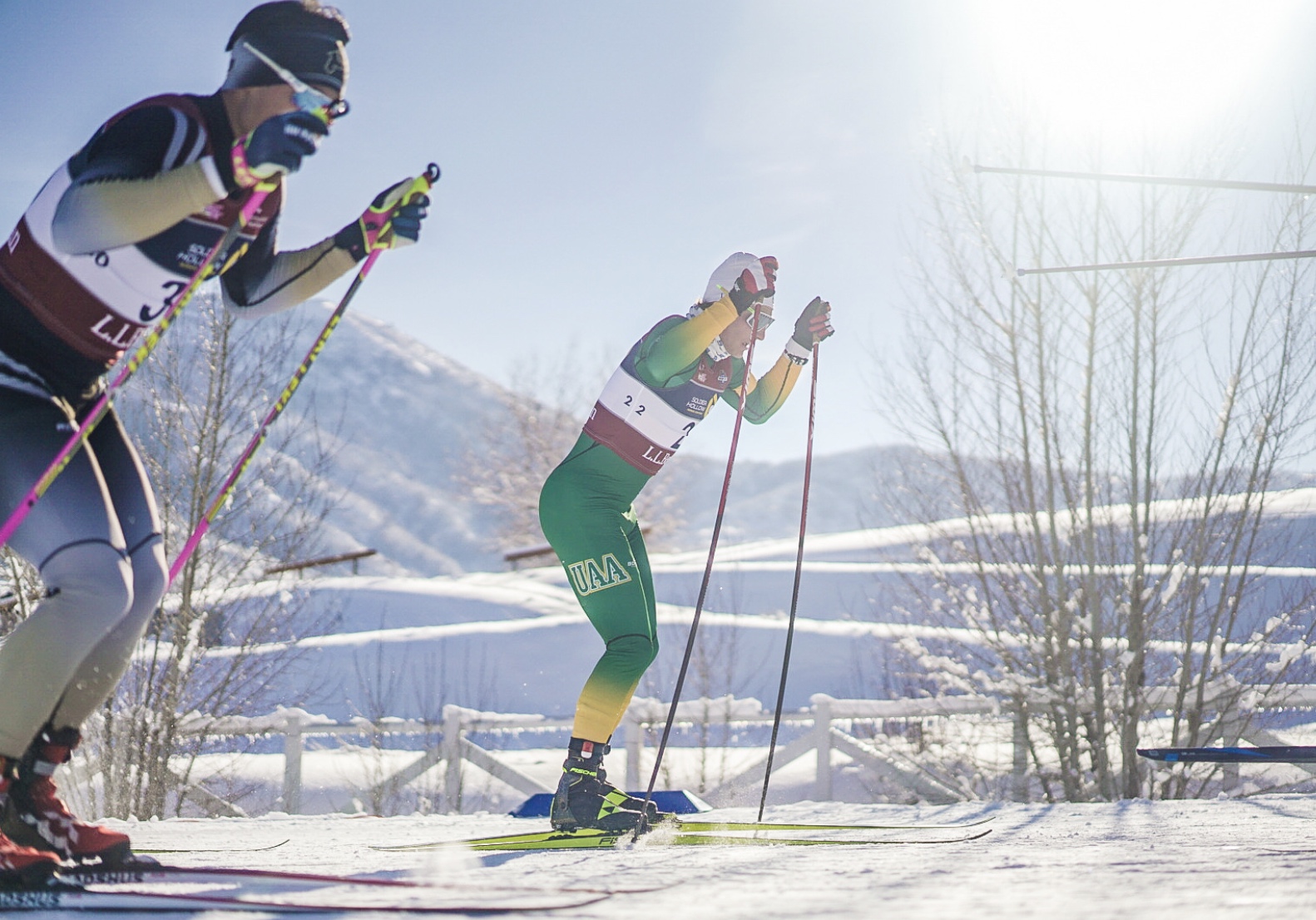
    Magnus Bøe and JC Schoonmaker are off the line during the 2022 U.S. Cross Country Championships freestyle sprint stage. (Photo: Tobias Albrigtsen / @untraceableg)

    The first semifinal featured Schoonmaker and Bøe, both of which stayed back in the back during the early part of the course. Going into the first climb, Bøe took a look back, saw Schoonmaker and Harmeyer were sitting in fifth and sixth place, respectively, and decided to attack. He led over the top, into the downhill, and up the final climb. Schoonmaker successfully did maneuver through the pack to counter the move, and on the final climb took the outside line up, cutting in to tuck behind Bøe going into the final downhill. When they came up, Schoonmaker had used the draft to put himself out front, while Bøe held off a late-surge from Hunter Wonders (APU) to take the second qualifying spot into the finals.

    The second semifinal was again led out by Ian Torchia, who was then followed by former sprint National Champion Tyler Kornfield (APU). Kornfield seemed content to sit behind Torchia until the first climb, when he put in a burst of speed and broke open the field. The smartest racer, however, may have been Karl Schulz (SVSEF), who rode Kornfield’s attack, and then drafted, to go into the final climb with speed. By the time he hit the downhill, he had a gap which would remain unclosed. Kornfield, who had gone into the downhill in second, found himself joined by Noel Keefe and Ian Torchia into the final sprint for the second spot. As it would happen, all three would make it through to the finals, with Kornfield in second, and Keefe and Torchia being rewarded for their efforts early in the race by claiming the two lucky loser spots to the final.

    The A-final then looked like this: JC Schoonmaker, Magnus Bøe, Karl Schulz, Tyler Kornfield, Noel Keefe, and Ian Torchia.

    JC Schoonmaker races the qualifier during the SuperTour classic sprints in Soldier Hollow, UT. (Photo: Tobias Albrigtsen / @untraceableg)

    With memories of Schoonmaker’s dominating qualifier in mind, it seemed like the field orbited around him off the line. Schulz found himself in front, but not going full bore to open the field up. Even Torchia, when he did make a move to the front, didn’t seem to do so with the same force that had marked his quarter and semifinal attacks. Schoonmaker waited until the first climb to move to the front, and then the final really was on. Schultz seized on the attack, and then put an extra-push into the downhill to try and open up an unclosable gap like he had in his semifinal. It was a good move, but one that didn’t prove to have the same force as his previous attack, and going into the final climb he was joined up with Bøe and Schoonmaker. 

    Then, Schoonmaker’s pace seemed to drop-off, with a few noticeable slips that progressed into a herringbone. Bøe, meanwhile, went for the herringbone from the get-go. He was the one that made contact with Schulz before the course gave way to a final downhill on the day. Schultz held a gap on the field through the glideout and over the bridge, but it proved not to be enough of a margin to feel comfortable in the final stretch. Meanwhile, Schoonmaker had fallen back to fifth.

    Utilizing his dominating doublepole sprint, when they hit the final 100m it was all Bøe, who closed a significant gap to catch Schulz in the final 50 meters. Looking as if he was leaping forward with each push, Bøe switched lanes, overtaking Schultz just before the line and letting out a fist pump as he realized a SuperTour – and collegiate – victory in a time of 4:08.28. Pushing to the line, Schulz was a close second (+0.35). (Video clip here.)
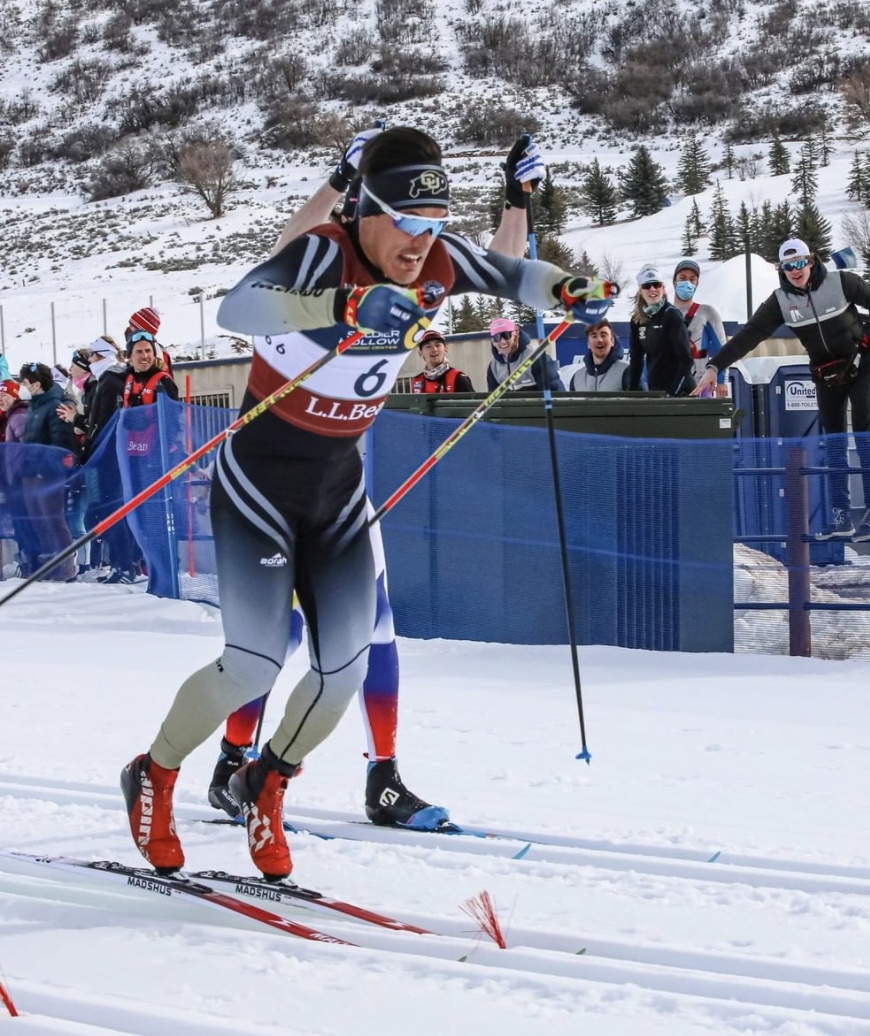
    Magnus Bøe overtakes Karl Schultz just before the finish of the men’s classic sprint final. (Photo: Instagram @cubuffs)

    After a gap, Schoonmaker, who was fighting for the final podium spot alongside Kornfield and Torchia, crossed the line outside of the track in third place (+4.53). Kornfield was a half second back from Schoonmaker for fourth (+5.10), with Torchia fifth (+5.64), and Keefe sixth (+11.02).

    After the race Bøe explained that he changed his tactics in the heats relative to Sunday’s freestyle sprint, though he joked he thought it wise not to reveal everything. 

    “Today was a windy and slow-condition day,” Bøe wrote in an email. “There was headwind in the first half, and tailwind in the second half. Hence, pulling during the first half would be pointless. Furthermore, the second half, particularly for the last downhill there was very little to gain on the slipstream, due to the low speed and the ‘suctiony’ snow (cold conditions create better glide for the person coming behind on ‘heated tracks’). Therefore during all my heats I pretty much went all out from the top of the last uphill all the way to the finish, which on sunday would’ve been a suicide.”

    Bøe walked through the final, including how he reacted to lead changes and adjusted his strategy when the race began to play out differently than anticipated. 

    The final started off very slow, but then the positioning battle developed gradually from under the bridge. My main focus was to keep my eyes on JC, since he was clearly the favorite of the day, and I knew I would do well if I laid it up to beat him. Hence I never fell for the temptation of passing him, even though I had many chances of doing so. However, he did get tired during the last climb and tried to get others to pass him. This is when Karl took off and gained a massive gap that at first seemed too late to close. As soon as I realized that JC might not be able to catch up, I committed to catching Karl by myself. I made sure to put in a great push before the downhill straight, and did the ‘supertuck’ to gain every single inch I could. Once I started double poling towards the last bend it was just heads down and maximum effort. Was never certain I would catch Karl, I thought maybe he’d have something left at the very end. But lucky for me he didn’t and I had just enough to pull it off.”
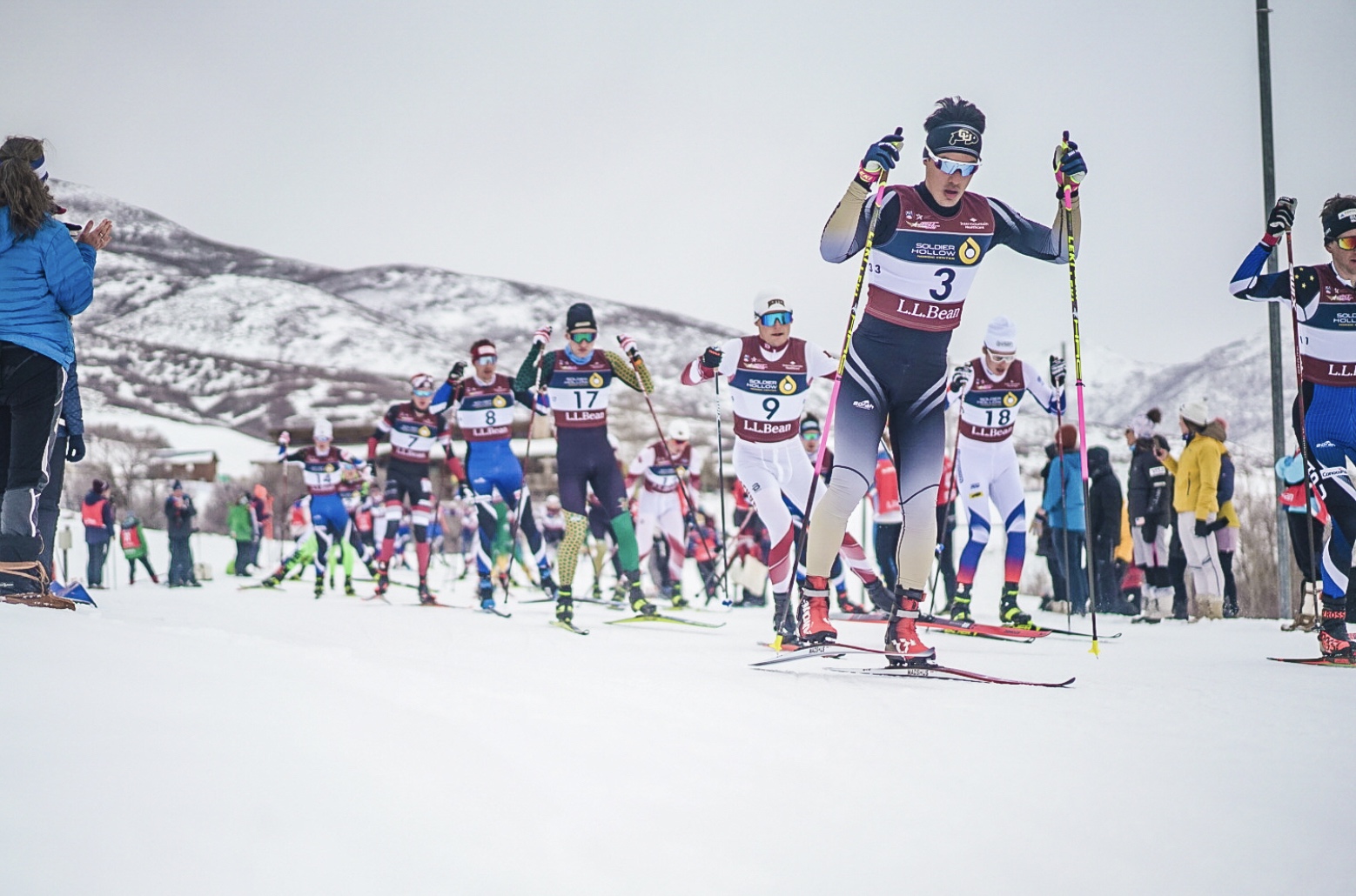
    University of Colorado’s Magnus Bøe heads out for the men’s 30k mass start free during the 2022 U.S. Cross Country Championships in Soldier Hollow. (Photo: Tobias Albrigtsen / @untraceableg)

    A dual citizen of Korea and Norway, 23-year-old Bøe has already built a robust resume in international ski racing, including competing for Korea during the 2018 Olympics in Pyeongchang. Earlier this week, Bøe was fifth in Sunday’s freestyle sprints and finished 11th in the 15k classic. His only down race of the series happened in the 30k mass start freestyle, where he finished 43rd (+12:30.9).

    This week of racing has been up and down, from a miserable 30km where I got lapped, to today’s win. It’s been a lot of fun, and not least has been helpful for my shape. Next up is the Super Tour in Sun Valley, which I am looking forward to. Think I would be able to build on top of what I gained during this week.”

    For Schultz, today also marked a career-first SuperTour podium. The 23-year-old Lake Placid, NY Native raced for the University of Vermont (UVM) until graduating in May, 2020, then heading to Sun Valley. Schultz had a podium just-miss earlier this year in a freestyle sprint where he finished fourth during the opening weekend of SuperTour racing in Duluth, MN. 

    I was pretty fatigued from the three races prior,” Schultz wrote after the race. “I knew there was a decent headwind on that first climb, so I decided I’d tuck in behind up and over the first climb. I figured I’d need to save my strength for the final climb and long finishing straight, so I played my cards well and pushed where I needed to, and it just worked perfectly. I’ve learned sprinting is about preserving energy for critical parts of the course, it couldn’t have gone better.”

    “And I won’t lie,” Schultz continued. “The spectators and everyone cheering allowed me to find another gear, especially up the last climb. I dug deeper than I have before.”
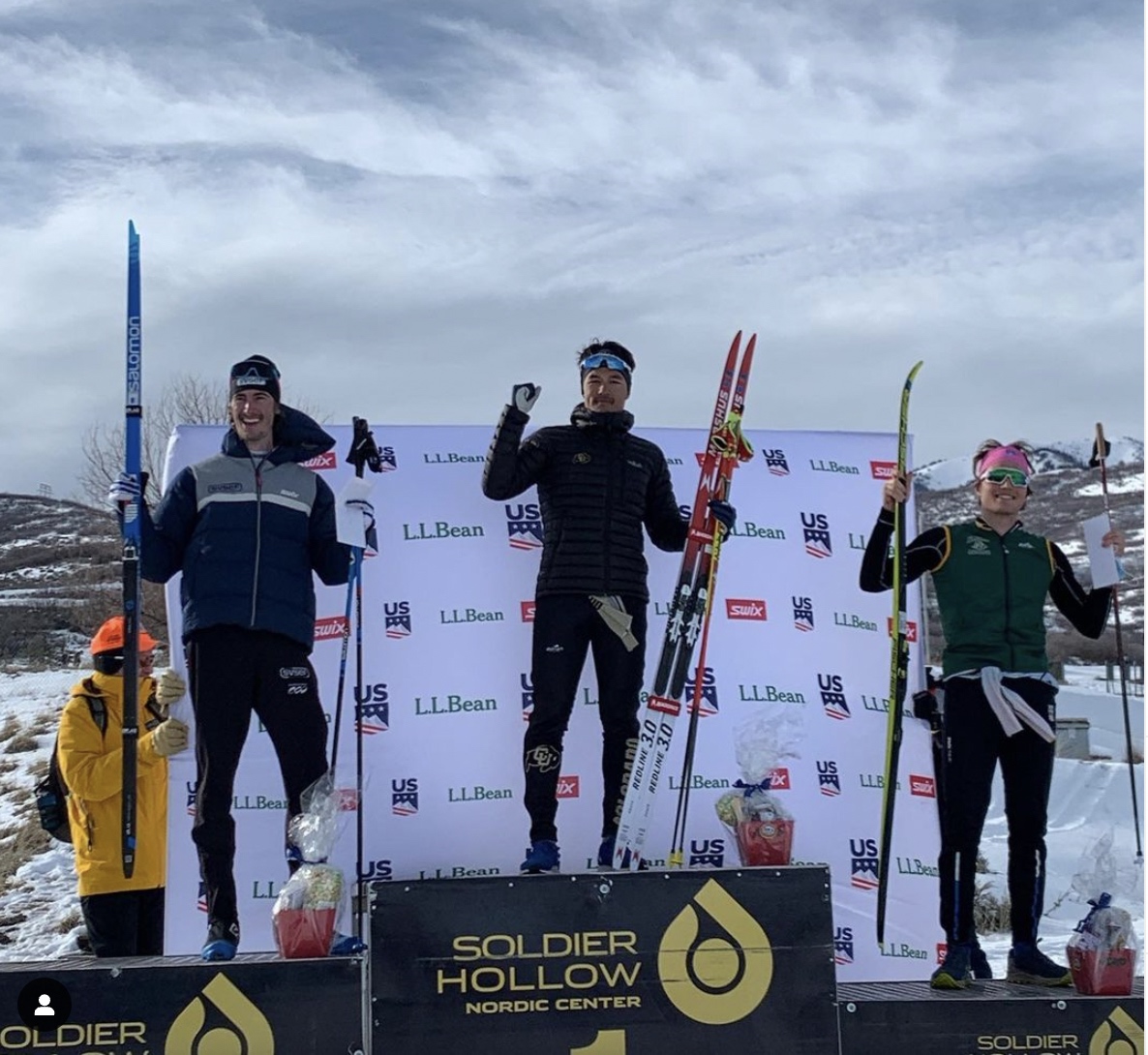
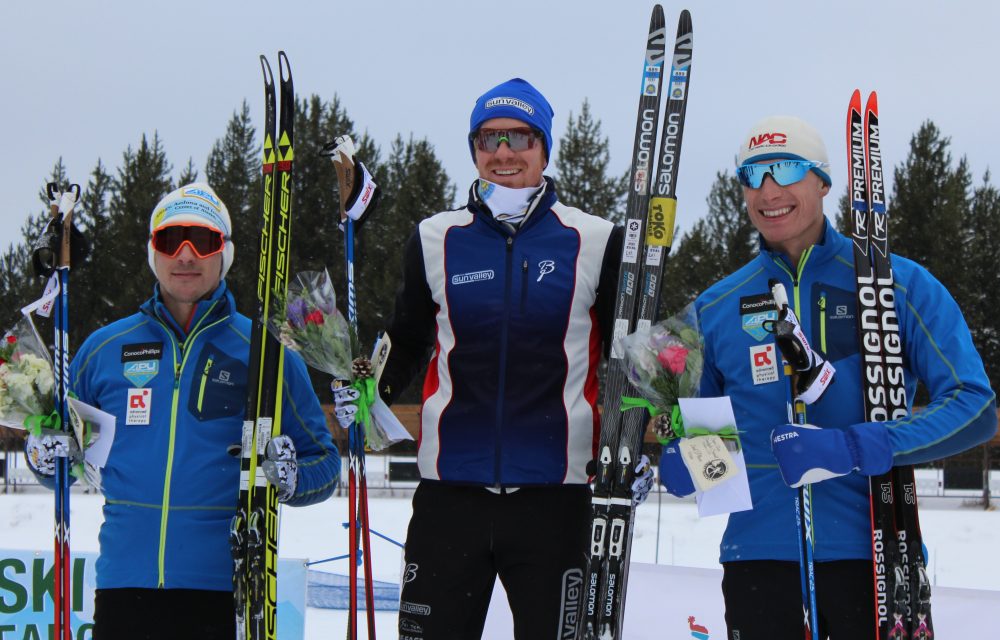
    The men’s podium of the SuperTour 1.5k classic sprint in Soldier Hollow: Magnus Bøe took the win ahead of Karl Schultz and JC Schoonmaker. (Photo: Instagram @nysefnordic)

    Writing to FasterSkier after the race, Schoonmaker explained how changing conditions forced athletes to make tough decisions about skis as well as tactics. 

    “It was a pretty crazy difference from this morning to the afternoon,” Schoonmaker explained. “The morning was icy and fast and the heats got really sloppy and slow.  I had amazing skis in the morning and in the heats I struggled a bit with choosing whether to go for more kick or glide. I ended up asking for less kick to free the ski up a bit and I’m still not sure what was the right call. It was just really challenging conditions.”

    Schoonmaker also explained that he had made fewer adjustments to the technique he had found such success with in Sunday’s skate sprint, however, the final proved to break the mold of what has historically proven to be the recipe for Soldier Hollow sprint racing.

    “For this course I tried to take a somewhat similar approach as in the skate race by respecting the draft on the last downhill and trying to be careful about the guys behind me there. In the quarterfinal I felt I was able to ski away and create a big enough gap so that I couldn’t get sucked back in by the draft. In the semifinal, I tried to stay more in the pack and use the draft for myself. The final was tricky because I was going to try and use the draft again but Karl put in a really good move on the last hill that I couldn’t match. Then I was leading the rest of the pack and I decided to push over and try to catch Karl rather than go to the back to find the draft. It ended up not working out so great, but I’m happy with the day and the tough effort.” 

    We conclude a week of racing at Soldier Hollow, then, with a race that highlighted the strength and depth of the domestic circuit of U.S. skiing at present. Variable conditions on a technical course, which racers approached with tactics as diverse as the regions they hail from, indicated that this is a field that represents top-level racing. It was a testament to the development and growth of the sport in this country that a top-level racer like Schoonmaker can come off the World Cup and find a field where every heat is raced with closeness and intensity in his own country. That bodes well, and is a great place to leave the last national gathering of the US ski racing community before its best representatives look to take a crack at the Olympic Games in Beijing next month.

    The spirit of the sport captured at the finish line as Alaska Winter Stars athlete Meredith Schwartz embraces her coach at the finish of the classic sprint in Soldier Hollow. (Photo: Tobias Albrigtsen / @untraceableg)

    FasterSkier extends congratulations to all athletes who competed in Soldier Hollow this week, commending their efforts in a fiercely competitive field through a variety of race formats and course conditions. Also, a big thank you to Tobias Albrigtsen and John McColgan, who generously shared their photos with us throughout the week. Stayed tuned for an upcoming gallery highlighting many of the fantastic images that were not included in our reports. 

    Full Results:

    Qualification | Women’s Final | Men’s Final

    Livestream Replay

  • ‘It Felt Surreal,’ Patterson Closes Out U.S. Nationals with Win No. 4

    ‘It Felt Surreal,’ Patterson Closes Out U.S. Nationals with Win No. 4

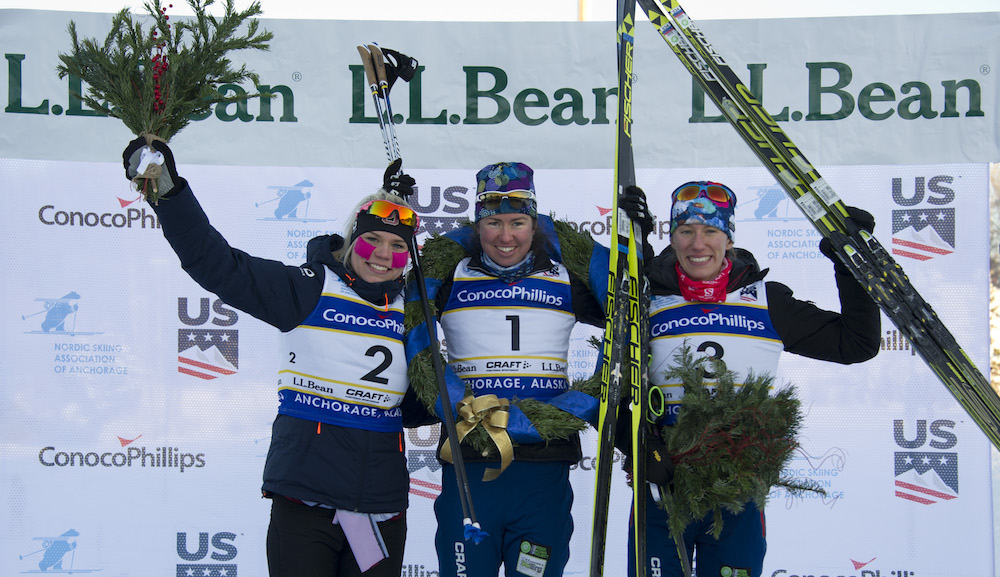
    Caitlin Patterson (c) atop the podium for the fourth-straight race of the week at 2018 U.S. Cross Country Championships in Anchorage, Alaska, joined by Finland’s Jasmi Joensuu (l) of the University of Denver, in second and Patterson’s CGRP teammate Kaitlynn Miller (r) in third. (Photo: Michael Dinneen Photography)

    Note: This article has been updated to reflect the fact that U.S. Ski Team member Jessie Diggins was the top American in four consecutive U.S. nationals races in 2012, winning the freestyle sprint, 10 k skate and 20 k classic mass start outright and placing second to Canada’s Dasha Gaiazova in the classic sprint (but topping the podium as the first American). This week, Caitlin Patterson, of the Craftsbury Green Racing Project, became the first woman since Diggins to be the top American in four U.S. national races as well.

    ***

    ANCHORAGE, Alaska — Maybe there’s something to be said for growing up in Alaska. Or maybe there’s something to be said about the mystique of Kincaid Park, its surrounding Tordillo, Chugach and Alaskan mountain ranges all bathed in sunlight at the start on the last day of 2018 U.S. Cross Country Championships during the women’s 1.5-kilometer classic sprint.

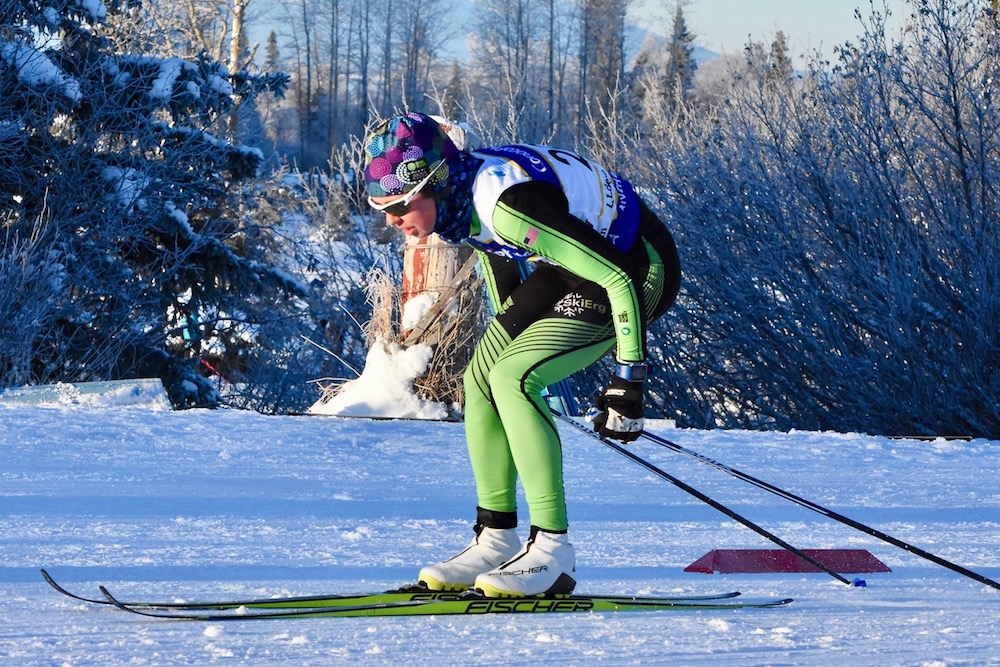
    Caitlin Patterson (Craftsbury Green Racing Project) approaching the finish line of the women’s 1.5 k classic sprint final on Monday, the last day of 2018 U.S. Cross Country Championships in Anchorage, Alaska. She won the final for her fourth-straight national title of the week. (Photo: Michael Dinneen Photography)

    Be it either of those, Caitlin Patterson became the first woman since U.S. Ski Team (USST) member Jessie Diggins, to earn four consecutive titles at a single U.S. nationals. Diggins did it in 2012 in Rumford, Maine, two years after Kikkan Randall, a USST member who trains with Alaska Pacific University (APU), swept four races outright at Kincaid. (Both Randall and Patterson grew up in Anchorage; Randall was born in Salt Lake City, born in McCall, Idaho. Patterson, 27, attended South Anchorage High School while Randall, 35, went to East Anchorage High).

    Even if Patterson, who’s currently based out of Vermont with the Craftsbury Green Racing Project (CGRP), had not won the final event of 2018 nationals, she had already posted a banner week. She started it by racing to first in the opening women’s 10 k freestyle individual start last Wednesday, amidst slushy ski trails, falling wet snow and a standard dark Alaskan winter morning sky.

    After a training day on Thursday, she returned to the Kincaid trails on Friday — which had transformed from 48 hours before — racing once again to first, this time in the women’s freestyle sprint for her first sprint title.

    Saturday brought another training day before Patterson returned on Sunday for the women’s 20 k classic mass start.

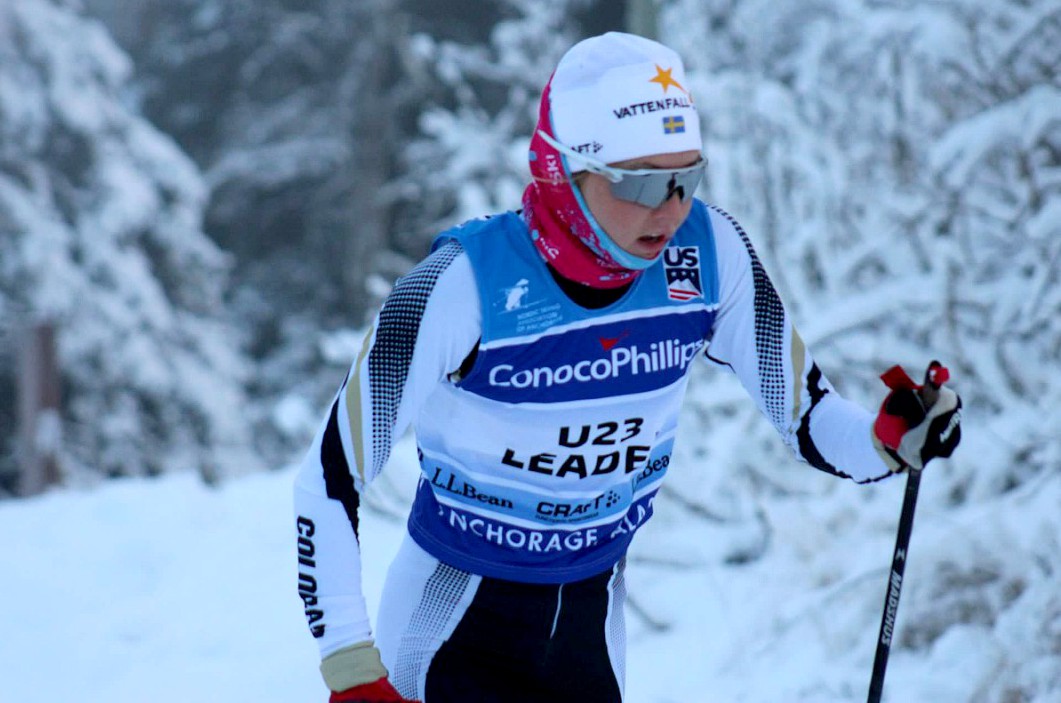
    Hedda Bångman, a Swedish freshman at the University of Colorado at Boulder (CU), racing to fourth in the qualifying round of the women’s 1.5 k classic sprint on Monday at 2018 U.S. Cross Country Championships in Anchorage, Alaska.

    Up against Sweden’s Hedda Bångman, a University of Colorado at Boulder (CU) freshman, and Rosie Frankowski (APU), the two of whom led much of Sunday’s four-lap race, Patterson had met her match. However, Frankowski’s fall on the final hill paired with Patterson’s strong skiing led Patterson to finish as the day’s top American. Bångman took the outright win while Patterson placed second overall, ahead of Frankowski in third. The two were first and second on the U.S. podium.

    If she had left it at that, Patterson would have tied Rosie Brennan — of the U.S. Ski Team and APU — who won three out of four U.S. nationals races in 2015.

    But Patterson took it one step further.

    With no training or rest day in between, the CGRP skier joined the remaining U.S. nationals field on Monday. Some skiers had already left, including Australian and APU skier, Jessica Yeaton, who flew out Monday morning to prepare for next weekend’s World Cup in Dresden, Germany.

    Based on her qualifier alone, it might have seemed Patterson was beginning to feel the effects of four days of racing since last Wednesday. She qualified seventh, 4.77 seconds behind the fastest qualifying time of 3:41.40, posted by Finnish skier and University of Denver (DU) junior Jasmi Joensuu.

    “Today qualification was really good, I felt really good,” Joensuu said after the race. “But then, my throat is really sore after the qualification … so I didn’t know if I could race actually. But I decided to race, I knew that I could win this race. I knew that there were some good girls but they also had 20 k yesterday, which I didn’t race, so that was good for me.”

    With Joensuu, 21, having sat out Sunday’s mass start and Patterson having expended herself over 20 k, the Finn may have had a leg up on the American.

    What Joensuu had not counted on was Patterson’s familiarity with the course and what the American had learned from Friday’s freestyle sprint.

    “I think that bottom corner was a really good one for me all week and in the skate sprint I figured out how to ski it with good momentum,” Patterson said after Monday’s race, referring to the slightly inclined corner about 100 meters before the finish. “Even with that big gap that she put on the hill, I think just knowing how to ski the hill here at Kincaid … the finish stretch was mine.”

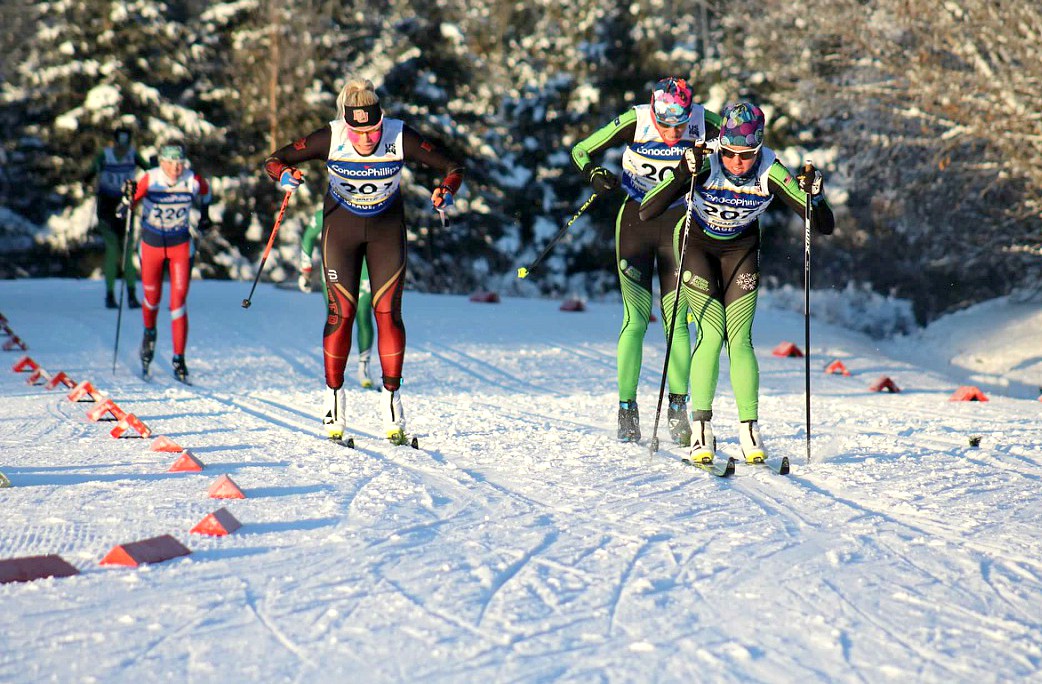
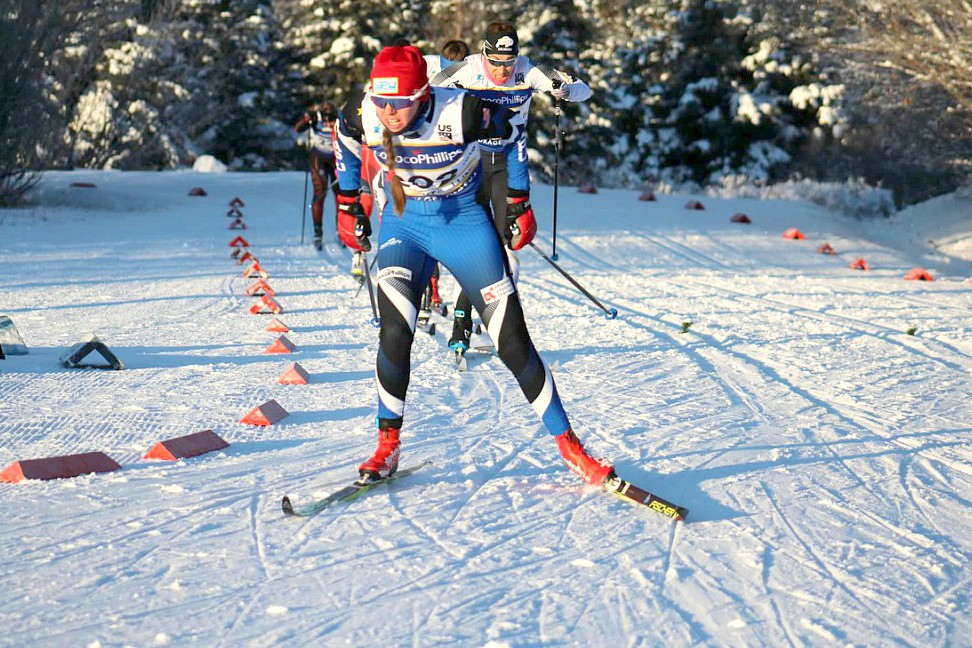
    Craftsbury’s Caitlin Patterson (207) and Kaitlynn Miller (second from r) and Jasmi Joensuu, of the University of Denver, lead their semifinal during the women’s 1.5 k classic sprint on Monday at 2018 U.S. Cross Country Championships in Anchorage, Alaska.

    In their semifinal, though Joensuu had gapped both Patterson and and another CGRP skier Kaitlynn Miller at the top of Gong Hill — the sprint’s final major climb — both Craftsbury skiers had caught Joensuu by the bottom of the descent’s corner back towards the finish.

    A similar scenario played out in the final.

    “In the final I did a tactic, I would ski the uphill as fast as I can, I don’t save anything and that almost worked,” Joensuu recalled.

    Joensuu and Petra Hyncicova, a CU senior from the Czech Republic, had pushed hard out of the start of the final, followed by Patterson and Miller, as well as Dartmouth skier Lydia Blanchet and APU’s Becca Rorabaugh.

    “I tended to lose time in the beginning of the race and then catch back up,” said Blanchet, who had to catch a plane within an hour of finishing the final. “I had great skis and downhills are one of my strengths.”

    While the two non-Americans raced to the front halfway through the course’s major climb, Blanchet, Rorabaugh, Miller, and Patterson hung behind. Then halfway through the final hill, Joensuu attacked, attempting to distance herself from the pack.

    By the top of the hill, she had done just that, with 4 meters separating her from the rest of the field. Miller and Patterson followed, tucked into the downhill swooping curve.

    As Joensuu disappeared behind the trees blocking the corner from spectator’s view, Miller and Patterson were already hot on her heels. Using her momentum, Patterson swung around Joensuu and emerged from the corner first, double poling with a sizeable lead to her fourth victory in a row in a time of 3:39.58.

    “It felt surreal coming down the finishing stretch today, realizing that I couldn’t hear people behind me and realizing that it was going to be number four,” Patterson said. “I could not have imagined this if I tried, but I’ve just had really good feelings all week. Great support from the staff and waxers and everything, and it’s fun being back here in Anchorage, especially.”

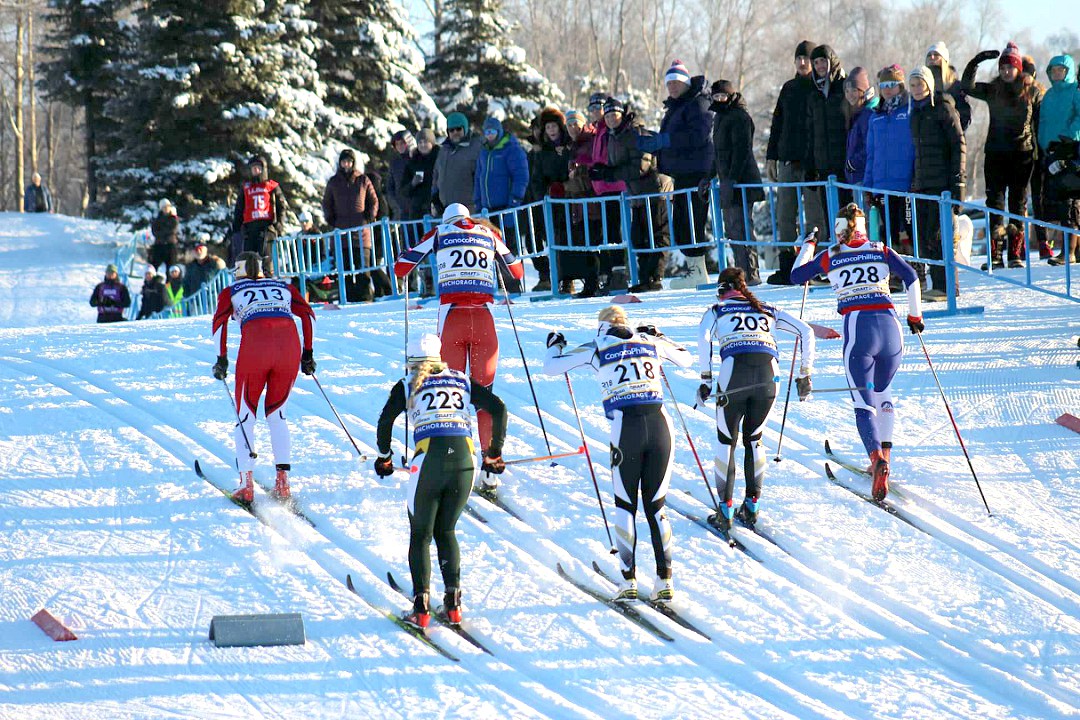
    The fifth women’s classic sprint quarterfinal heat on Monday at 2018 U.S. Cross Country Championships in Anchorage, Alaska, with CXC/Peak Nordic’s Felicia Gesior (208) leading with Corey Stock (213) of the Bridger Ski Foundation, and Northern Michigan’s Nicole Schneider (223), the University of Colorado Boulder’s Christina Rolandsen (218) and Petra Hyncicova (203), and Mae Chalmers of SMS (228) chasing.

    Finishing second, 2.36 seconds behind Patterson, was Joensuu. Capturing third for her third American podium this week was Miller (+3.9). Miller finished second to Patterson in Friday’s freestyle sprint and was the third American in Sunday’s 20 k.

    “I’m really pleased with how everything panned out,” Miller said. “To me the big sign of improvement has been in my skating and I was really excited with my skate sprint and obviously really excited with yesterday and today as well, but it’s nice to see my skating moving up a little bit.” 

    Despite being the 2016 national classic sprint champion, Miller, of Elmore, Vt., explained she entered Monday’s race with nothing held over her head.

    “I don’t ever go into a race expecting a certain result,” she said. “Anything can happen, even to strong, very experienced skiers … [but] it is exciting to be in the mix.”

    Though Miller also explained she “felt pretty tired” by the time she lined up for the final on Monday, she also acknowledged that she was, in all likelihood, not alone.

    “I think that was the situation for all of the women out there today, after the 20 k yesterday. It was sort of like, well, the snap isn’t there, the energy isn’t quite there, but everyone was in the same boat,” she said. “Everyone’s making the best of it, and your body knows what to do once you get to the start line.

    “All things considered, I felt great, had a really great result, and I’m very happy with it,” Miller added.

    Becca Rorabaugh (APU) during the women’s 1.5 k classic sprint on Monday at 2018 U.S. Cross Country Championships in Anchorage, Alaska. After finishing second in the qualifier (as the top American) she finished fourth overall in the final and was the third American on the day.

    Rorabaugh finished fourth overall (+9.92) and was the third American. The Fairbanks native, who has spent the last 10-plus years living and training in Anchorage, was the top American qualifier on Monday, 1.31 seconds behind Joensuu in first overall.

    “I was extremely excited with my qualifier,” Rorabaugh said. “It was rather unexpected. I was the first American and I had one really good qualifier in West Yellowstone this year but the other two so far have been pretty medium for me, so I was really excited really happy with this morning.”

    Though the qualifier is what counts for the Olympic points list, Rorabaugh indicated that was of less importance to her than just “getting her qualifier back.”

    “It’s been a couple years since I’ve been having a very strong qualification in sprint racing so I was just trying to work on having enough energy and having enough heat pumped to really crush a qualifier first thing in the morning,” she said.  

    “I wanted to have something special at home,” she added, referring to the friends and family that came to Kincaid to watch her race. “So it was good to have something at the end of the week.”

    With firm tracks, cold temperatures reading around 10 degrees Fahrenheit and a low sun in the sky, Rorabaugh described the final U.S. nationals event as “a quintessential Alaskan day.”

    “That was quite nice,” she added.

    Rounding out the final was Hyncicova in fifth (+10.03) and Blanchet in sixth (+11.21).

    “Today I was kind of tired. I finally hit the jet lag over the weekend,” Hyncicova, the two-time defending NCAA champion, said. “But … making the final, and even being third in the quarterfinal is awesome. It’s just proving that I am kind of in good shape so that’s a good start of the season.”

    Rounding out the remainder of the women’s top 10 was Bångman in seventh, Sun Valley Ski Education Foundation skier, Kelsey Phinney in eighth, Central Cross Country’s Felicia Geisor in ninth and Stratton Mountain’s Erika Flowers in tenth.

    In the junior women’s classic sprint, Wasatch Nordic’s Sarah Morgan took the win in 3:54.93. Novie McCabe (Methow Valley Nordic) placed second (+1.5) and her teammate teammate Ella-Sophie Kuzyk placed third (+6.66).

    Results: Women’s qualifier | Women’s final | Junior women’s final
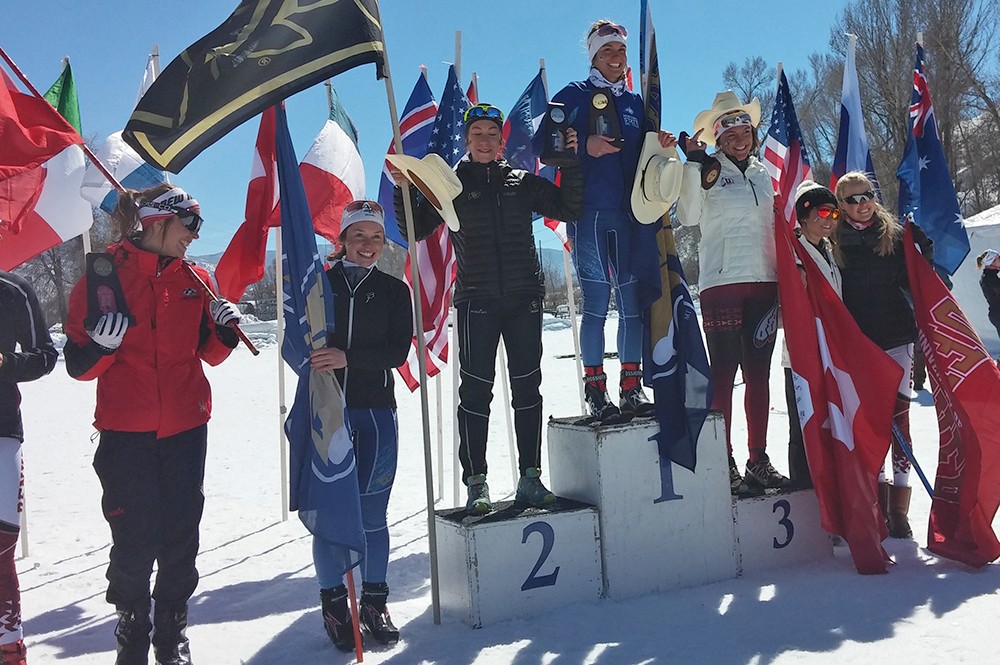
    –Ian Tovell, Andrea Pontyondy-Smith and Gavin Kentch contributed

    Highlights video by Max Romey Productions

  • Wednesday Workout with New DU Assistant Mads Strøm

    Wednesday Workout with New DU Assistant Mads Strøm

    A glance at Lookout Mountain in Golden, Colorado, where the DU Ski Team held an uphill skate workout last month. (Photo: Mads Ek Strøm)

    At the end of Mads Ek Strøm’s senior year at the University of Colorado-Boulder (CU), the 26-year-old Norwegian had some decisions to make. He started by looking for a job in the U.S., specifically in the finance industry, in addition to pursuing a master’s degree in finance.

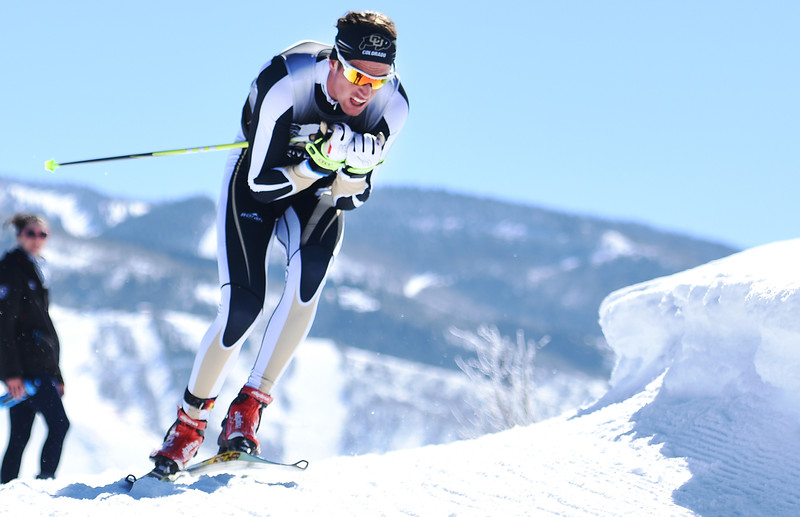
    Mads Ek Strøm of the University of Colorado-Boulder racing to a first place finish in the men’s 10 k freestyle race at the 2016 NCAA Skiing Championships in Steamboat Springs, Colo. (Photo: CUBuffs/Buffzone.com)

    Then the three-time National Collegiate Athletic Association (NCAA) champion — who won back-to-back races at the 2016 championships and came 0.5 seconds from a fourth NCAA title last year — got a call from Dave Stewart, head coach of the University of Denver (DU) Ski Team.

    DU’s assistant coach for the last six years, Hakon Johansen, had accepted a position as head coach of the Chinese biathlon federation, which is aiming to strengthen its snow-sports teams in advance of the 2022 Beijing Winter Olympics, Stewart explained in an email to FasterSkier.

    “When I started thinking about a new coach, Mads was a top choice immediately based on his experience as a competitor, as an NCAA student-athlete and from what I know he invested in his own training and in his teammates,” Stewart wrote of the Oslo native. “I have a lot of faith in a coach who is motivated to pass on to his athletes what he learned from his own experiences.”

    Strøm, a seven-time first-team All American and the winningest male skier in CU history, accepted the offer and started at DU at the beginning of the semester about a month ago. DU announced Strøm’s hiring as assistant nordic coach on Sept. 15.

    “I couldn’t say no when the offer from DU came along,” Strøm wrote in an email. “It’s been awesome so far and it was a great way to still be a part of the skiing community.”

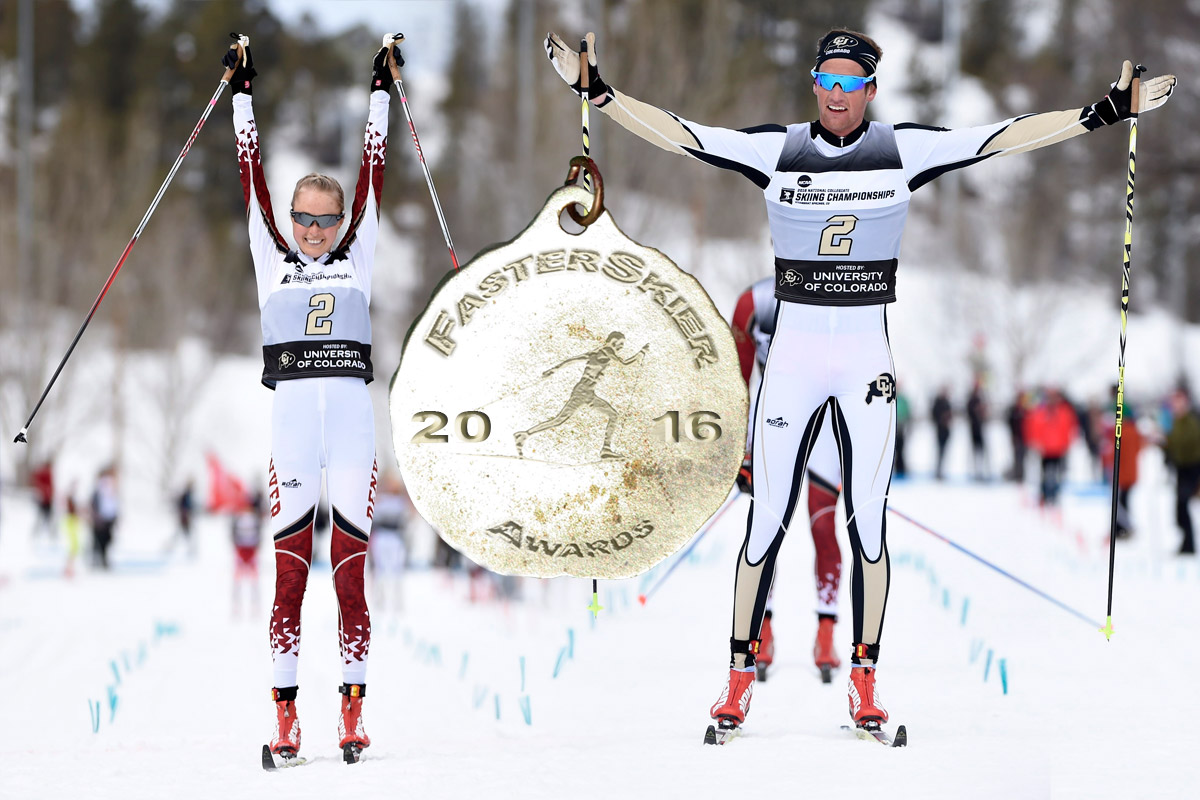
    Mads Strøm (r) and Linn Eriksen were FasterSkier’s Collegiate Skiers of 2016. Strøm is now an assistant coach at DU and Linn Eriksen, also from Oslo, Norway, is a senior at DU. (Photo: Curtis Snyder of the CU Sports Information Dept. and Jamie Schwaberow/NCAA photos).

    His responsibilities include discussing training plans with athletes and helping them reach their goals, he explained.

    “As a coach, I really hope I can help the all the athletes develop as skiers but also as human beings,” Strøm added. “Their goals are my goals and hopefully we can bring back the national championship to Denver for the 24th time. I really want to develop skiers and potentially find and help US skiing to another level.”

    “Mads has hit the ground running here and has been received well by our team,” Stewart noted. “We have a very motivated and fun team this year. A few young new faces and enough experienced returners among both women and men to lead the way. As always, our goals will be to be better than we have been before both individually and as a team and win NCAA’s.”

    We asked Strøm for a Wednesday Workout, and he shared one of the best ones he knows: Level 3 uphill skate intervals.

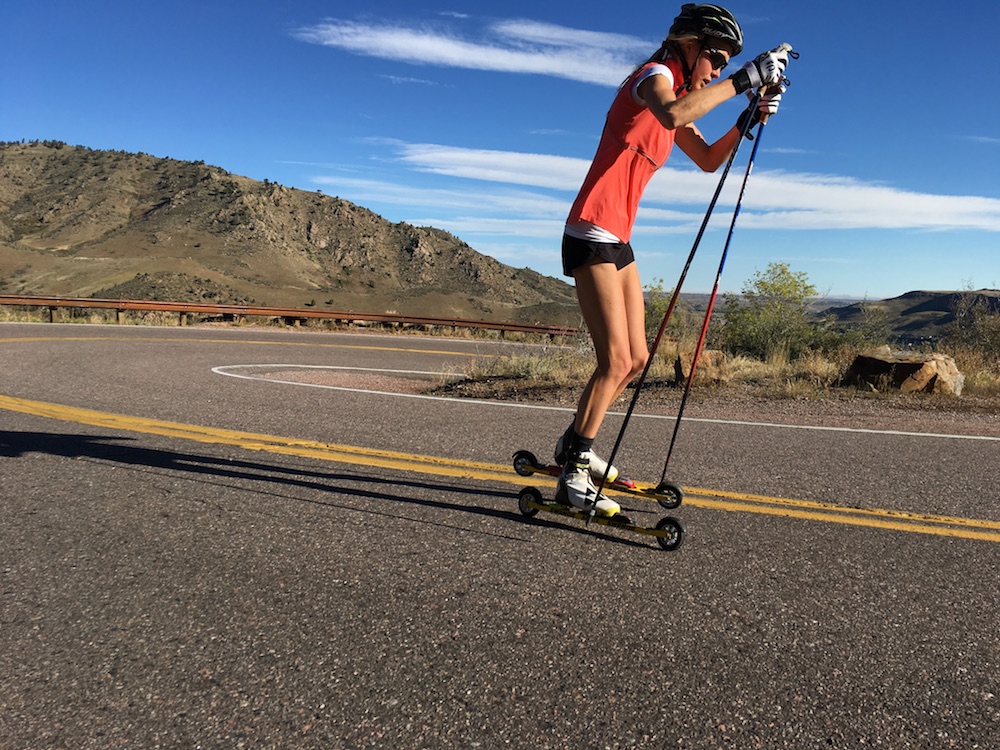
    DU senior Linn Eriksen skating up Lookout Mountain in Golden, Colorado, last month. (Photo: Mads Ek Strøm)

    “You get to increase your VO2 (Level 3-4) and you get lots of repetitive movement which makes you able to work on technique over a longer period of time in ‘race pace’,” he explained.

    “Before the workout try to make it THE workout of the week, as the interval sessions are the ones that makes you a better skier,” Strøm wrote. “Try to create a training plan where you are rested both physically and mentally the morning of the workout. The second session of the day should be a recovery workout (double poling with core strength or just easy running for 45 minutes to an hour).”

    The Workout: Level 3 6-8 x 8-minutes skate uphill

    1. Warmup: Easy skiing for 30 minutes, some minor speed increases to make the body ready for a hard workout.
    2. The Interval: 6 to 8 times 8-minutes uphill skate. Try to pace it so that every single interval is slightly faster. The last one should be in the form of 30/30, where you try increase the pace for 30 seconds and then rest for 30 seconds and do it 8 times; to increase speed and the tolerance for lactic acid to make it race specific.
    3. Cool down: 10 minutes of Level 1 and 5 minutes of Level 2 to remove as much lactic acid as possible. Remember food and drink after the workout as soon as possible (protein bars, Gatorade, etc.)
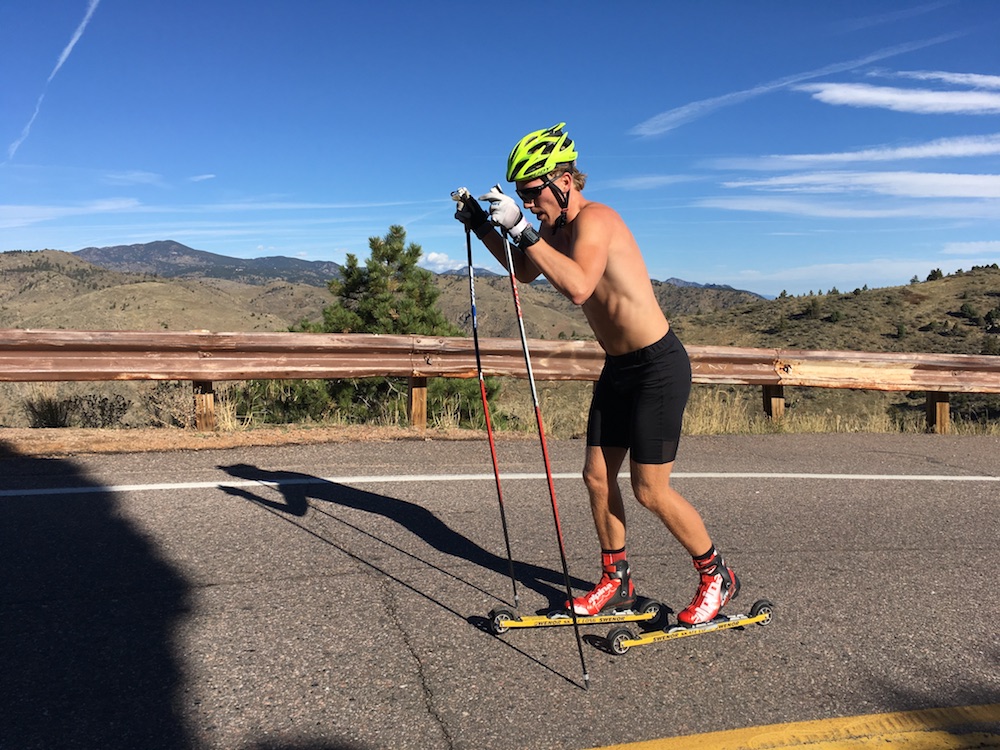
    DU sophomore Eivind Kvaale skating up Lookout Mountain in Golden, Colorado, last month. (Photo: Mads Ek Strøm)


  • Nordic Nation: The Moxie Episode with Jesse Knori

    Let’s face it, nordic ski racing is about the most physically taxing of sports. Pre-race, mid-race, post-race, it’s easy to come up with excuses and to complain. My tech missed the wax, I’m overtrained, I’m undertrained, sore muscles, no muscles … there’s a lot to whine about.

    But in this episode, we’re focusing on moxie.

    A young Jesse Knori in the skating zone: no pole style = moxie too.  (Courtesy photo)

    Mostly the sport is rife with teeth-grinding athletes seeking the sufferfest. One of those athletes is 23-year-old Jesse Knori, a 2017 University of Colorado-Boulder (CU) graduate and native of Jackson Hole, Wyo.

    On the spectrum of sufferfesting skiers, Knori is an outlier. For a young adult, Knori has already dealt with more than her fair share of physical and emotional pain. (For all the details, you’ll have to listen to the podcast episode below.)

    Jesse Knori (University of Colorado-Boulder) leading Estonia’s Anette Veerpalu during their quarterfinal of the women’s classic sprint at U23 World Championships at Soldier Hollow in Midway, Utah. Knori finished third in that heat (while Veerpalu was sixth). While she didn’t advance to the semifinals, Knori was the top U.S. woman in 15th on the day. (Photo: FlyingPointRoad.com)

    As a middle schooler, Knori was diagnosed with severe rheumatoid arthritis. Knori skied at CU and notched 15th in the classic sprint at this year’s U23 Nordic World Championships in Utah. Clearly, Knori didn’t let her autoimmune condition dictate her goal setting.

    Bottom line, Knori  is as tough as they come. And she’s a sixth-generation Jackson Hole native and new coach at the Bend Endurance Academy in Oregon. She’s the guest on Nordic Nation’s first edition of its “Moxie Episode”.

    Jesse Knori (University of Colorado-Boulder) representing the U.S. at 2017 U23 Worlds at Soldier Hollow in Midway, Utah. (Photo: Bernie Nelson)

    (To subscribe to the Nordic Nation podcast channel, download the iTunes app. If you have iTunes, subscribe to Nordic Nation here.)

    Have a podcast idea? Please email nordicnation@fasterskier.com.

  • Utah Rallies for NCAA Title; Bergström, Hyncicova Double Champs

    Petra Hyncicova of the University of Colorado-Boulder leading the women’s 15 k freestyle mass start out of the start on Saturday, the last day of NCAA Skiing Championships in Jackson, N.H., with Northern Michigan’s Nicole Schneider (2) and UVM’s Alayna Sonnesyn (3) right there with her.

    JACKSON, N.H. — Two years ago, Martin Bergström quit skiing.

    A month ago, Petra Hyncicova took three weeks off skiing following U23 World Championships due to a painful bursa between her Achilles tendon and heel bone.

    Less than a week after resuming training, Hyncicova, a 22-year-old Czech Republic native and University of Colorado-Boulder (CU) junior, raced to two National Collegiate Athletic Association (NCAA) Skiing Championships titles — the first of her career — in Jackson, N.H.

    The University of Utah ski team celebrates its first NCAA title since 2003 on Saturday, March 11 at 2017 NCAA Skiing Championships in Jackson, N.H. (Photo: Flyingpointroad.com)

    Bergström, a 25-year-old Swedish freshman at the University of Utah, did the same, winning both nordic races at 2017 NCAA Championships and leading the Utah Ski Team to its first team title since 2003.

    Both started off with decisive victories in the women’s 5-kilometer and men’s 10 k classic individual starts last Thursday, with Hyncicova topping the former by 18.7 seconds and Bergström winning the latter by 26.8 seconds.

    Then on Saturday, with temperatures hovering just above the legal racing limit of -20 degrees Celsius (-4 Fahrenheit) and winds ripping across the field that served as the stadium, the two international skiers completed their championships sweep with wins in the women’s 15 k and men’s 20 k freestyle mass starts.

    “When the season started, I figured that I was in really good shape this year,” said Hyncicova, whose previous best NCAA Championships result was second in the skate race last year in Steamboat Springs, Colo. “I was hoping that I could be on the podium again at NCAA’s and maybe hoping that I could win the skate race, but after winning the classic race and after the injury and everything I can’t believe it. It’s insane for me.”

    “Two years ago, I quit skiing back in Sweden and I took one year of just studying,” Bergström said. “And then a friend of mine was on the [Utah] team, and he said there were spots open and that I should try a different environment of skiing and studying and that I could come over here. So I talked to the coaches, and eventually went for this trip and have had so much fun and made many friends. I’m just so happy I came here.”

    On Saturday, Bergström led three Utah men in the top 10, with Martin Mikkelsen placing eighth and Kevin Bolger 10th. The three scored 84 points and their women’s team emerged as the second-highest scorers in the second race of the day to give the Utes a 16.5-point win over Colorado (CU) to end the championships.

    Reflecting on his win on Saturday, before the women’s 15 k, Bergström anticipated it would be a tall order to win the team title.

    “It’s been amazing, and it’s an amazing team,” he said of his season with Utah. “All the training we’ve done and the work we’ve put in this fall and winter. I’m just so happy. Hopefully there’s a slim chance the girls can pull off an amazing race. We’ll see.”

    Utah Director of Skiing Kevin Sweeney later explained just how difficult it was to come from second place on Friday to take the win over CU and Denver University (with Denver finishing third, just one point behind Colorado). In the last decade of NCAAs, Colorado has placed first or second seven times, according to a press release. Denver is next in line with six top-two finishes (including five titles) since 2008.

    “We’ve been crunching numbers and have been able to beat Denver and Colorado by about 30 points on a really good showing during the RMISA [Rocky Mountain Intercollegiate Skiing Association] season, but didn’t know if we could do it in the championships,” Sweeney said, according to a Utah press release. “Bergström was skiing at a whole new level this week, and Mikkelsen had stepped it up, and I knew Kevin Bolger could get top 10. I was also confident in the women, who have been skiing awesome, so I felt good there. It’s awesome to be able to take this new trophy back to our new ski building.”

    Bergström’s Late Move

    The men’s 20 k came down to a five-way sprint to the line, with Bergström taking the win by 0.5 seconds over Mads Ek Strøm, CU senior and two-time 2016 NCAA champion.

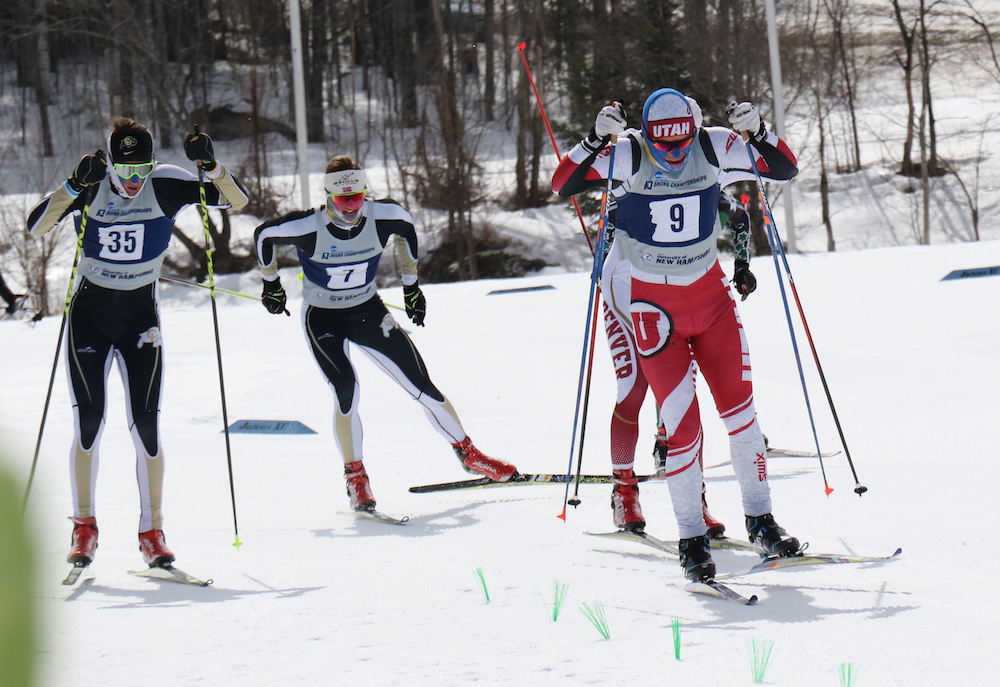
    Utah’s Martin Bergström (9) leading CU’s Mads Ek Strøm (35) and Petter Reistad (7) and DU’s Moritz Madlener (behind Bergström) down the finishing stretch of the men’s 20 k freestyle mass start at 2017 NCAA Skiing Championships on Saturday in Jackson, N.H. (Photo: Karen Brown)

    After Denver’s Moritz Madlener led most of the race, Bergström moved to the front on the start of the fourth and final lap. With 5 k remaining, six men remained together: Bergström, Madlener, Strøm, Adam Martin of Northern Michigan University (NMU), Fabian Stocek of Dartmouth College, and Petter Reistad (CU). On the final lap, the group began to string out and Bergström opened up the narrow lead he needed to win at the finish, crossing in 46:02.8 minutes.

    “I just went for it,” Bergström said. “Tried to check who still had power in the legs. Moritz just answered when I upped the tempo, and he continued my push in the second lap, and I knew I was faster in the finish than Moritz, so he had to make his move before the sprint. As an old sprinter, I feel pretty comfortable making a pass. I can maneuver pretty efficiently. I was just happy too see that it was a high-tempo, pack finish, and with the wind and everything, I think it was smart to go a little before the final stretch.”

    On the final lap, Strøm, the defending champion who won both races at last year’s NCAAs, tried to position himself near the lead going into the first climb out of the stadium, just in case someone attacked.

    “They went kind of fast up there, but not too fast, and I was in fourth and I felt pretty good,” Strøm, a 25-year-old Norwegian, said. “Adam Martin caught me sleeping, and gave a gap, so I had to pass him.”

    With about 2 k to go, Strøm said about four men remained in the front group before his teammate, Reistad, pushed to latch back on.

    “Petter came back up, and I was like, ‘Come on dude, just use the speed and try to move up and take the lead,’ and he did,” Strøm said.

    On the pivotal last A-climb at the top of the course, Strøm found himself in third and unsure of his next move.

    “I wasn’t sure how strong the people in front of me were,” he said. “I should have done something sooner, over the last hill of the race. It’s kind of short, the last stretch of the race. I felt pretty good so I’m a little disappointed in second.”

    Saturday stood as Strøm’s second skate race of the season. He had appendix surgery in January.

    “I hadn’t raced much this year,” he said. “At first, I felt pretty good, actually.”

    He started Thursday’s 10 k classic in bib 1 and double poled to eighth place.

    “We decided on double poling and I started bib 1, and I got pretty screwed by that because I had to plow all the snow out of the way,” Strøm said. “I knew the shape was good, and today I was just… I mean second place is OK, but I wanted to win.”

    Just 0.1 seconds behind Strøm on Saturday, Madlener, a 23-year-old German senior who placed second and third at NCAA’s last year, achieved his first podium of the week, 0.6 seconds out of first.

    Reistad finished fourth (+1.2), Stocek fifth (+1.9) and Martin, who was in podium contention until the final lap, sixth (+18.7).

    Asked what his skiing plans are now, Bergström wasn’t sure.

    “I started a civil engineering program back home, and I have two years of eligibility here, but I don’t know,” he said. “I took a chance, and came here, but I haven’t decided if I’m going to stay or not, but we’ll see.”

    Hyncicova Goes For It

    Petra Hyncicova (University of Colorado-Boulder) celebrates her second-straight 2017 NCAA Skiing Championships title on Saturday after winning the women’s 15 k freestyle mass start at the Jackson Ski Touring Center in Jackson, N.H. (Photo: Flyingpointroad.com)

    Two-time 2017 women’s champion Hyncicova, who broke away from the pack with the University of Vermont’s (UVM) Alayna Sonnesyn halfway though the women’s 15 k, said coming to the U.S. was one of her best decisions.

    “I’m so glad I went to the U.S. Every year I’m more and more glad,” she said. “This year was actually supposed to be my last year. I have one more year of NCAA eligibility so I applied for a master’s program so I can be here next year also and I’m so excited.”

    She raced to a 21.1-second victory over Sonnesyn on Saturday in 39:21.6. The next-closest finisher, Hyncicova’s CU teammate Christina Rolandsen, crossed 17.8 seconds later in third (+38.9).

    “Starting with bib 1, it’s easy to be first out of the start,” Hyncicova said of leading out of the start.

    After setting the pace for the first 5 k, she tucked behind Rolandsen, a Norwegian sophomore, to start the the second lap.

    “I was trying on each lap to make a little bit smaller group, and I saw my teammate Christina so I was trying to get her in the group [so] we could go together,” Hyncicova added.

    When she noticed Rolandsen tiring on the second lap, she surged back to the front.

    “Then I took off a little bit,” Hyncicova said. “It wasn’t intentional, but Alayna stuck with me, so I was like, ‘OK, we can do it together. It will be nice to go just in two.’ ”

    Sonnesyn, a junior from Minnesota, led the two-woman breakaway for roughly four kilometers, up until the final A-climb of the race.

    “Coming through this field, it’s so windy, no one wanted to be up front,” Sonnesyn reflected. “I knew that she didn’t want to take the lead, I could tell, but I thought that if I sat back and didn’t take the lead either, the other girls were gonna come back and catch us and I didn’t want that to happen.

    “I kind of knew what was going to happen,” she added of Hyncicova’s game-changing move on the last hill. “She made a really great move up one of the hardest hills up to the high point and I was so impressed with how fast she could ski. I wanted to stay with her, but I just couldn’t. … I mean, she just took off. It was impressive.”

    While the women’s race included several downhill crashes on a hard-packed course, including a close one from Sonnesyn while she was leading on the second lap, Hyncicova said she wasn’t afraid to send it.

    “I love downhill skiing on nordic skis, so for me, it was really fun,” Hyncicova said. “I’m not scared and I enjoyed it.”

    For Sonnesyn, second place marked her second podium of 2017 NCAAs after placing third last Thursday. In two NCAA appearances before that, she had yet to crack the top 20.

    “I am so happy with the way things went,” Sonnesyn said on Saturday. “I definitely had some high goals for this week. I haven’t had the best luck with my NCAA experiences in the past and so I knew I could be competitive this year, but I didn’t know how competitive I could be.”

    She made a point to focus on how she was feeling and not worry about anyone else, both in Thursday’s individual start and Saturday’s mass start.

    “It’s tough to break away on this course, so I knew that if someone was going to break away I didn’t want to be the one to do it, but I wanted to be with them,” she added. “And that’s kind of exactly how it happened. I’m just so happy with the way things went this whole week. … I feel like I’ve improved so much over these last few years with Patrick Weaver as a coach. He’s helped me so much just to become a better skier. I love the sport and I’m just so excited for next year.”

    After Anika Miller of Montana State University (MSU) placed fourth (+44.0), Utah took fifth and sixth with Merete Myrseth (+1:01.5) and Guro Jordheim (+1:16.1), and was the only women’s team with all three in the top 14 with Natalia Müller in 14th (+1:32.1). In all, the Utah women scored 73 points (behind Colorado with 77) to help their program notch its 11th NCAA Skiing title.

    “The turning point of today is when Guro broke a pole, and she was back in the 20’s, and she and Natalia were skiing together,” Sweeney said, according to the press release. “We told them that they had to go and they busted out and made a big move. The men’s results were tremendous, but whether or not we were going to win was based on those guys making the move. It was exceptional athleticism and gutsy performances.”

    Behind Utah with 541.5 points, CU (525) and DU (524) in the top three, Dartmouth placed fourth (400), UVM fifth (355), and MSU sixth (320) in the four-day alpine-nordic, season-ending series.

    Saturday’s results: Men | Women | Team

  • Gelso Wins First SuperTour Sprint; ‘Big Win’ for Bender in West

    Gelso Wins First SuperTour Sprint; ‘Big Win’ for Bender in West

    From left to right: Alaska Pacific University’s Reese Hanneman, Sun Valley Ski Education Foundation’s Matt Gelso and Alaska Pacific University’s Tyler Kornfield on the podium for the men’s SuperTour 1.3-kilometer freestyle sprint on Saturday in West Yellowstone, Mont.
    From left to right: Saturday’s third-place finisher Reese Hanneman (APU), winner Matt Gelso (SVSEF) and runner-up Tyler Kornfield (APU) on the podium at the men’s SuperTour 1.3-kilometer freestyle sprint on Saturday in West Yellowstone, Mont.

    WEST YELLOWSTONE, Mont. — With a little less than a kilometer left, the pack started to panic. Saturday marked the first SuperTour sprint of the season and the gap Sun Valley Ski Education Foundation (SVSEF) Gold Team veteran Matt Gelso had put on the five other skiers in the men’s sprint final was not getting smaller.

    The winner of last year’s SuperTour sprint season opener, Reese Hanneman of Alaska Pacific University (APU), saw the nearly 15-meter lead Gelso had established halfway through the 1.3-kilometer men’s freestyle sprint final heat as a sign.

    Alaska Pacific University's Tyler Kornfield racing during the qualifier for the men's SuperTour 1.3-kilometer freestyle sprint on Saturday in West Yellowstone, Mont.
    Tyler Kornfield (APU) racing during the qualifier of the men’s SuperTour 1.3-kilometer freestyle sprint on Saturday in West Yellowstone, Mont.

    “I was in third or fourth thinking, ‘Uh, OK, we better start closing this down,’” Hanneman said during an in-person, post-race interview.

    The odds seemed against Gelso. Racing behind him was not only Hanneman (a two-time national sprint champion), but also APU’s Tyler Kornfield (a 2012 national sprint champion), Bend Endurance Academy’s Dakota Blackhorse-von Jess (winner of three national sprint titles), as well as American junior sprint star Cole Morgan (SVSEF), and sprint specialist Ben Saxton of the Stratton Mountain School (SMST2).

    “Basically in the final it was five sprinters and then Matt,” Hanneman said. “So I think he knew that he had to go out like … and then I think none of us thought that [Gelso] could hold it all the way. … It was really impressive skiing by him to just go for it the whole time.”

    Yet, as Gelso began to climb the final hill of the course on the Rendezvous Ski Trails, he proved his gap on the other five finalists would take a strong challenge to beat. Hanneman pushed around Morgan, Saxton and Blackhorse-von Jess, while racing behind his teammate Kornfield. The two APU racers began gaining on Gelso, but not soon enough.

    With 100 meters to go, Gelso, a 28-year-old SuperTour regular best known for his distance skiing, left the two sprint champions chasing, and crossed the finish line first in a time of 2:36.85 for his first SuperTour sprint win.

    “I was pretty fired up,” Gelso said after. “I didn’t know going into the semifinal and final if [leading from the start] was going to still work … but I had the body and the skis to stay consistent with my plan.”

    Crossing 1.94 seconds after Gelso was Kornfield, who indicated that his second-place finish was his best performance on the West Yellowstone sprint course since the start of his sprint career.

    “The first year [I raced] here I didn’t even qualify,” Kornfield said after. “This is the first year I’ve moved on from the quarters…[last year] I got taken out and I took Eric Packer out too.”

    “I think none of us thought that [Gelso] could hold it all the way … It was really impressive skiing by him to just go for it the whole time.”— Reese Hanneman (APU), on Matt Gelso’s sprint performance Saturday

    The final podium finisher for the day was Hanneman, finishing 2.27 seconds after Gelso and 0.33 seconds out of second place.

    “I didn’t feel that good in the qualifier,” Hanneman said. “I was skiing a couple gears lower than I needed to be but then I started feeling better in the heats … I think after today I’ll definitely wake up and feel a little bit better.”

    The final three finishers included Saxton in fourth (+5.1), Morgan in fifth (+5.34) and Blackhorse-von Jess in sixth (+22.85).

    Results: Qualifier | Heats
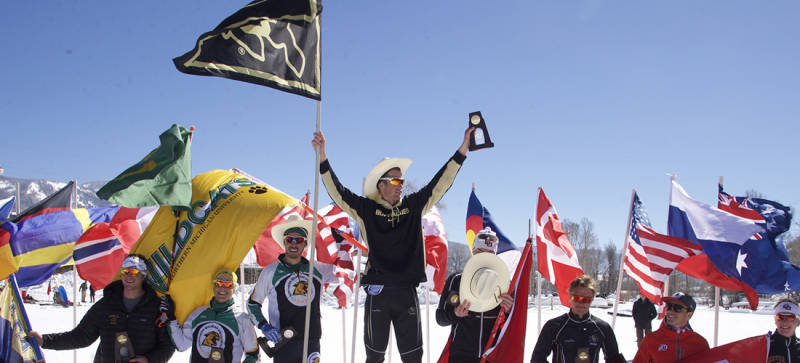
    ‘Big Win’ for Bender

    In the women’s 1.3 k freestyle sprint, it was Jennie Bender of the Bridger Ski Foundation (BSF), who took first, besting SMST2’s Erika Flowers and Annie Hart.

    Bender, 28, started the day by winning the women’s qualifier in 3:08.76, holding off Hart by three hundredths of a second.

    “My goal is to do better in qualifying, and I did that today, so that was a big win for me,” Bender said. “I love this course and I hope to repeat last year, get back to Europe and race some World Cups.”

    From left to right: Stratton Mountain School skier Annie Hart, Bridger Ski Foundation skier Jennie Bender and Stratton Mountain School skier Erika Flowers on the podium for the women’s SuperTour 1.3-kilometer freestyle sprint on Saturday in West Yellowstone, Mont.
    From left to right: Saturday’s third-place finisher Annie Hart (SMST2), winner Jennie Bender (BSF), and runner-up Erika Flowers (SMST2) on the podium at the women’s SuperTour 1.3-kilometer freestyle sprint in West Yellowstone, Mont.

    After winning the qualifier, Bender’s course time only got faster. She won her quarterfinal in 3:08.24 and her semifinal in 3:06.86. By the time she finished the women’s final in first, she had covered the 1.3 k course in 3:04.78, almost four seconds faster than her qualifying time.

    With a strong headwind challenging many of the racers who chose to lead, Bender decided in her final to follow the other finalists for the first half of the course before making her move.

    “There’s a lot of wind happening so … you kind of have to play with the wind and whether or not you want to be the only one blocking it or not,” Bender said of the heats. “I led my quarter, and I was like  ‘Holy sh*t, I took all the wind myself!’ so I was trying to kind of mess around with sitting behind people the next two heats, and that felt way better.”

    While Bender’s plan for the final was to tuck in and conserve for the first half, then surge to the front in the second half, Hart decided to lead out of the start.

    “Because we had some big headwinds [today] … the debate was whether to lead or follow,” Hart said. “I went into the rounds and decided to lead most of them, because I ski better generally when I kind of feel like I’m in control.”

    Hart skied at the front of the pack up until the course’s last climb, where her teammate Flowers passed her on the right side and Bender cruised by on her left.

    “I just, one, didn’t have much energy left, and two, there really wasn’t anywhere to go,” Hart said of her attempt to hold onto the lead. “I typically don’t do very well in West Yellowstone, so this year was by far the best first race I have had … I will take it.”

    Bridger Ski Foundation skier Jennie Bender (bib 1) leading her semifinal during the women's 1.3-kilometer freestyle sprint on Saturday in West Yellowstone, Mont.
    Jennie Bender (1) of the Bridger Ski Foundation leading her semifinal during the women’s 1.3-kilometer freestyle sprint on Saturday in West Yellowstone, Mont.

    Rounding the final turn, Bender took the inside lane while Flowers remained to the far outside left. The two raced head-to-head through the final 100 meters, lunging to the line for a photo finish.

    Bender was eventually awarded the win and Flowers took second by a mere 0.09 seconds. Hart crossed in third, 1.94 seconds behind Bender.

    “I needed a lane, so I moved outside early and zoomed up the hill as fast as I could, and then into the finish,” Flowers said of final move up the course’s last climb. “I don’t think I quite realized I was as close to Jennie as I was until about ten feet from the finish line. It was exciting, I’ve never thought of myself as a sprinter, so it was fun to do well.”

    “She was behind me the whole time until that hill,” Bender said of Flowers. “And you just save so much energy, due to headwind, so I think that helped both of us. It’s funny, we talked about it before our quarter — she was in my quarter, I was like, ‘it’s better drafting,’ and it worked out!

    “I feel pretty fit compared to previous years, I would say, and I’m hoping for a good season,” Bender concluded.

    Also in the final was Hannah Halvorsen of the Sugar Bowl Ski Academy and U.S. Ski Team in fourth (+2.0), APU’s Chelsea Holmes in fifth (+3.86), and University of Colorado-Boulder (CU) skier Petra Hyncicova in sixth (+4.53).

    Results: Qualifier | Heats

  • Wednesday Workout: Savoring Spring with CU Coach Bruce Cranmer

    Wednesday Workout: Savoring Spring with CU Coach Bruce Cranmer

    Mads Strøm, the University of Colorado-Boulder's two-time 2016 NCAA champion, at the collegiate championships in Steamboat Springs, Colo., this past March. (Photo: CU)
    Mads Strøm, the University of Colorado-Boulder’s two-time 2016 NCAA champion, at the collegiate championships in Steamboat Springs, Colo., this past March. (Photo: CU)

    Fifteen years into his tenure as head nordic coach at the University of Colorado (CU) in Boulder, Bruce Cranmer has guided his teams to NCAA Championships in 2006, 2011 and 2013. As head cross-country coach at the University of Vermont (UVM) from 1989 to 2000, his teams won four NCAA titles. He’s kind of like the Geno Auriemma (UConn women’s basketball coach) of the ski tracks — shepherding young athletes to championships and into adulthood while trying to cultivate their best athletic performances.

    So Cranmer comes with experience and he’s doubly blessed with living in an (editor’s note— we did not use the word “the”) endurance-sport capital. His nordic skiing athletes have, at their doorsteps, a host of world-class trail runs, road biking routes, and a 25-mile drive to high-alpine ski tours.

    University of Colorado-Boulder Head Coach Bruce Cranmer in 2012.
    University of Colorado-Boulder Head Coach Bruce Cranmer in 2012.

    Cranmer said April is a recovery month for his student-athletes.

    I’m not pressuring them too much in April,” he explained in a recent phone interview. “I think it’s important to emphasize a rest period because when you start back training you don’t want to go, ‘I’m already burned out.’ ”

    During the conversation, Cranmer mentioned several times that his wants his skiers to find something they love doing this time of year. Come May, when the training loads increase and more focused ski training takes priority, Cranmer asserts skiers should feel fresh.

    “You want to feel to feel a little bit hungry, ready to go,” he said. “I think it’s important to have a little bit of a break from training for a lot of the guys I know they already out hiking, backcountry skiing, and doing stuff like that anyway because they just like the activity of it. 

    “I look at May as kind of the beginning on the new training year,” he added. “As far as getting back, I always like the guys to diversify before they crank up the running miles and do a bunch of rollerskiing. I’ve always pushed the guys to do stuff they also enjoy so they are not starting off cranking off rollerski miles in May and the come October and go, ‘I am so burned out, I just can’t stand to go roller skiing again.’ ”

    Here’s Cranmer’s recommendation for some stellar April-May workouts. (Sorry, no rollerskiing workouts yet.) If you happen to live in Boulder or nearby in the Front Range, time to get outside. Odds are, if you’re there already, you’ve been doing that.

    The Workout: Cranmer’s Early Spring Recommendations

    “Spring is in all its splendor in Colorado, which can mean two to four feet of snow or 75 degrees,” he explained in an email. “This is a relaxing and resting period for the CU Ski Team with exams just around the corner. As far as a Wednesday Workout for this time of year, I recommend first and foremost, make it fun and something you really enjoy doing. I think this is a great time to focus on non-specific training, my favorite is backcountry skiing. There’s still tons of snow in Colorado, we [recently] got two to four feet [one] weekend in the mountains near Boulder, and I skied until I could barely stand up. Backcountry provides a great workout skinning up and lots of fun going down. However, I know not everyone has the snow or the equipment to go back country so here are a few suggestions.

    – I suggest for our skiers to bike up Flagstaff Mountain, which is right on the edge of town. It’s a steep climb of 2142 feet in 5 miles with an average grade of 11 percent. It takes about an hour if you start from somewhere in town, but the record from the base is under 25 minutes.

    – For those athletes that don’t like biking, I recommend an easy run-hike up Green Mountain, which takes about an hour to the top, and begins from Chautauqua Park. The vital stats: 6.47 miles round trip and a total elevation gain of 2,288 feet.
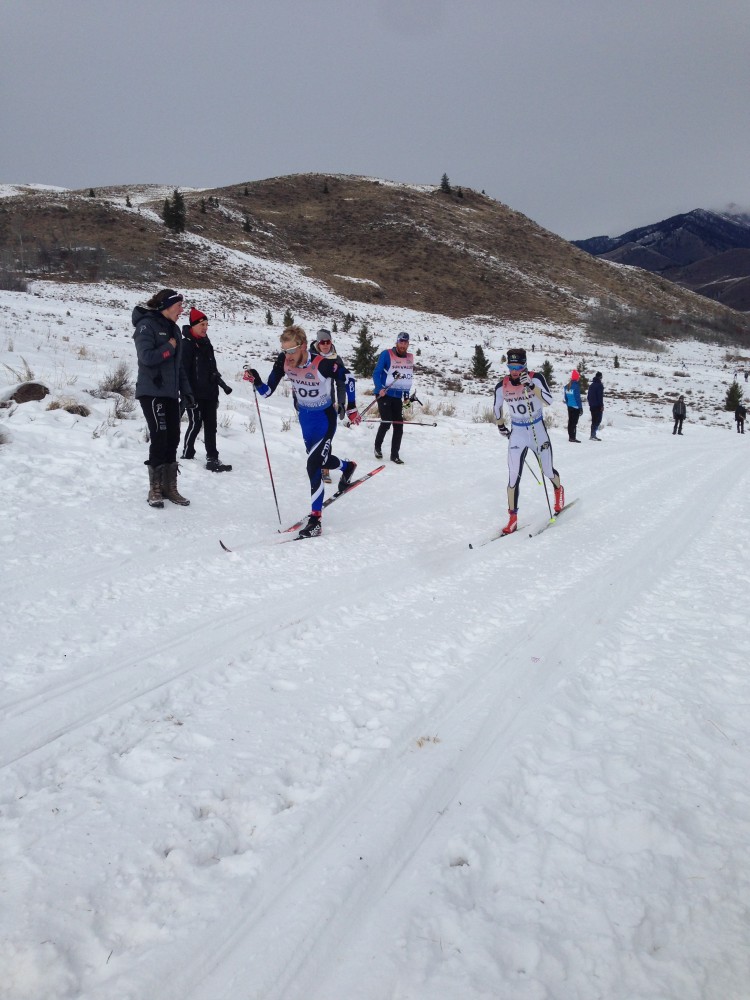
    – For those athletes studying hard for exams there’s a quick jog up Mount Sanitas. It’s 1.4 miles to the top with 1,323′ of elevation gain. Although unconfirmed, the record up is 14 minutes, 12 seconds — that’s fast — by endurance king Kilian Jornet.”

    Link to an interactive map of Boulder Mountain Parks

  • NCAA Champs Day 1: Strøm Makes CU History; Miller Nabs Individual Win for MSU

    NCAA Champs Day 1: Strøm Makes CU History; Miller Nabs Individual Win for MSU

    Note: FasterSkier is seeking photos from the nordic races at 2016 NCAA Skiing Championships. Please email info@fasterskier.com with photos of top finishers or for more info.

    ***

    Two juniors, one from Montana State University (MSU) and the other from the host team, the University of Colorado-Boulder (CU), claimed the ultimate collegiate titles on Thursday at 2016 NCAA Skiing Championships in Steamboat Springs, Colo.

    It was the first of two days of nordic racing at Howelsen Hill, and Anika Miller (MSU) and Mads Strøm (CU) emerged as the individual winners in the 5- and 10-kilometer freestyle races, respectively.

    The women's 5 k freestyle podium on the first day of nordic racing at 2016 NCAA Skiing Championships in Steamboat Springs, Colo. Anika Miller (MSU) placed first, Petra Hyncicova (CU) finished second and Utah's Sloan Storey took third. (Photo: MSUBobcats.com)
    The women’s 5 k freestyle podium on the first day of nordic racing at 2016 NCAA Skiing Championships in Steamboat Springs, Colo. Anika Miller (MSU) placed first, Petra Hyncicova (CU) finished second and Utah’s Sloan Storey took third. (Photo: MSUBobcats.com)

    Miller led four Bobcats in the top 10, winning the women’s 5 k freestyle individual start in 13:06.1. Her teammate, Cambria McDermott, placed fourth, 9.4 seconds back.

    “When I finished, I had no idea how I’d done actually until my teammates jumped on me and were screaming,” Miller told NCAA.com. “I had no idea. I just started crying.”

    A native of McCall, Idaho, Miller bested second-place finisher Petra Hyncicova (CU) by 7.9 seconds for the win, becoming the first MSU skier to win an individual title since 1978, when Dan Brelsford (now the director of skiing) won the slalom race, according to an MSU press release. She is also the first female skier to win an individual title for MSU.

    Just one-tenth of a second behind Hyncicova, Sloan Storey (University of Utah) reached the final step of the podium in third.

    An NCAA champion in 2014, Strøm achieved his second freestyle title in the men’s 10 k freestyle on Thursday in 22:06.8. His time proved to be 10.6 seconds faster than runner-up Ian Torchia of Northern Michigan University (NMU). Denver University’s Moritz Madlener placed third (+19.8).

    For Strøm, the win was his fifth in a row and seventh total this season, according to a CU press release.

    “It feels awesome, it feels amazing,” the 24-year-old Norwegian told CUBuffs.com.  “For ten months this has been my goal and to accomplish my goal is amazing. I was so nervous. I knew there was going to be a mass crowd out. I just had to find good skis, good pacing, and push it as hard as possible. It was definitely the best win of the year. Pulling it off when it matters the most is great.”

    Mads Strøm of the University of Colorado-Boulder celebrates his win in the men's 10 k freestyle on Thursday at 2016 NCAA Championships in Steamboat Springs, Colol. (Photo: Jamie Schwaberow/NCAA via CUBuffs.com)
    Mads Strøm of the University of Colorado-Boulder celebrates his win in the men’s 10 k freestyle on Thursday at 2016 NCAA Championships in Steamboat Springs, Colol. (Photo: Jamie Schwaberow/NCAA via CUBuffs.com)

    Strøm explained he had to “push it all the way to the end,” so hard that he was physically ill across the line.

    “I was so tired in the end,” he added. “As soon as I crossed the finish line, I had to lie down.”

    With his seventh win, Strøm is the winningest male nordic skier in CU history. He exceeded the amount of wins of Per Kare Jakobsen (who won six races in 1989) and Ove Erik Tronvoll (six in 1999). It was also the 89th individual win by a Buff, the most of any school in NCAA history, the CU release stated.

    For women’s runner-up Hyncicova, a 21-year-old sophomore from the Czech Republic, second stood as her best result of the season and matched her career best.

    “It was so hard, but it was really nice in the end. I didn’t hope for getting second, so it’s really nice,” Hyncicova told CUBuffs.com.  “I really didn’t have any idea what I was hoping for. In each race you want to win, but I didn’t expect that I would win here because I was always around fifth [place] this season.  I went to Romania a couple of weeks ago [for U23 World Championships], so I was really tired and didn’t feel that great.

    “I was really nervous before the start,” she added. “But once I saw everyone here — the alpine’s and everyone who cheered for us — I was like, ‘Yes I have to do it. I have to do it for the team.’ ”

    Team Standings (through 4 races):

    1. Montana State: 282
    2. Utah: 264
    3. Denver: 263
    4. Colorado: 214.5
    5. Vermont: 154
    6. New Mexico: 139.5
    7. Dartmouth: 126
    8. Alaska Anchorage: 124
    9. Northern Michigan: 122
    10. Middlebury: 81

    “I feel somewhat relieved but happy,” CU Nordic coach Bruce Cranmer said.  “Compared to racing, coaching is way more stressful.  You are worried about everyone and getting the right wax. I am still trying to calm down. I get so fired up.

    “Mads did great,” Cranmer added. “The guy that got second [Torchia] is one of the top U.S. [skiers] that went to World Juniors. [Mads] was on really good form before he got here, so I had high expectations without trying to get too caught up.

    “As for Petra, we were hoping for a top five finish. That is we thought she was capable of.  … For her to finish in second is awesome. … She does really well in skating.”

    Late last month, Torchia led the U.S. junior men in Romania with his top individual result of the week in 15th in the 15 k freestyle. It was his second-best at Junior Worlds since placing 11th last year in the 20 k skiathlon.

    Following Torchia in second, Northern Michigan had three in the top 10 with Adam Martin in fourth (+28.4) and Jake Brown in ninth (+56.1).

    “We knew that if we had a good day, all three of those guys were capable of winning and we just didn’t know which one,” said NMU Head Coach Sten Fjeldheim told NCAA.com. “We weren’t shocked or surprised that they’re all in the top 10, but you never know at altitude.”

    The base elevation of Steamboat Springs’ Howelsen Hill is about 6,700 feet.

    Through four events (two cross-country and two alpine) at 2016 NCAA Championships, Montana State leads the team standings with 282 points and Utah is second with 264. Denver is a close third, with 263 points after two days of racing. With a win and second-place finish on Thursday, CU moved into fourth in the standings, with 214.5 points.

    MSU’s previous team best was seventh, which it achieved last year with 259 points. The University has already exceeded that total at the halfway point of the championships. Racing wraps up Saturday with 15/20 k classic mass starts.

    “The momentum definitely helps our mindset, but the bottom line is we’ve got to go out and race the same way that we race everyday. That’s the way to succeed,” MSU Head Coach Matthew Johnson told NCAA.com. “Trying to mix it up and change it for the championship isn’t going to go well. Coming in with too much excitement isn’t going to go well, but skiing like we’re in the lead and skiing like we’re champions is going to do well for us.”

    5/10 k freestyle results | with splits

    Top 10 men: 

    1. Mads Strøm (CU) 22:06.8
    2. Ian Torchia (NMU) +10.6
    3. Moritz Madlener (DU) +19.8
    4. Adam Martin (NMU) +28.4
    5. Sawyer Kesselheim (MSU) +28.6
    6. Petter Reistad (CU) +35.1
    7. Nick Hendrickson (DU) +40.6
    8. Lars Hannah (DU) +50.1
    9. Jake Brown (NMU) +56.1
    10. Jack Hegman (UVM) +56.9

    Top 10 women:

    1. Anika Miller (MSU) 13:06.1
    2. Petra Hyncicova (CU) +7.9
    3. Sloan Storey (Utah) +8.0
    4. Cambria McDermott (MSU) +9.4
    5. Emilie Cedervaern (UNM) +12.8
    6. Natalia Mueller (Utah) +13.1
    7. Taeler McCrerey (DU) +13.4
    8. Linn Eriksen (DU) +13.6
    9. Ane Johnsen (CU) +14.7
    10. Mary Kate Cirelli (UVM) +17.5
  • Patterson Drops Pack for Sun Valley 15 k Win; Strøm Outlasts Packer for 2nd

    Patterson Drops Pack for Sun Valley 15 k Win; Strøm Outlasts Packer for 2nd

    Mads Strøm (center, in white) leads Niklas Persson (left), Matt Gelso (second from left, in blue), Paddy Caldwell (right), and the rest of the mens field out of the start in the 15 k classic at the Sun Valley Super Tour.
    Mads Strøm of the University of Colorado-Boulder (front, center, in white) leads Niklas Persson (left), Matt Gelso (second from left, in blue), Paddy Caldwell (far right), and the rest of the men’s field out of the start in the 15 k classic at the Sun Valley SuperTour on Sunday.

    SUN VALLEY, Idaho — Alaska Pacific University (APU) skiers Scott Patterson and Eric Packer know a thing or two about persevering through pain. Both have dealt with recent frightening incidents, Patterson with a pulmonary embolism last fall and Packer when he took a rocky tumble this past June. Despite their misfortune, neither let the mishaps hold them back. On Sunday, the duo proved how far they have come since, finishing first and third, respectively, in the Sun Valley SuperTour 15 kilometer classic mass start.

    The men started at 11 a.m. under cloudy skies and light snow flurries. From the beginning, it was clear that the APU athletes were looking to make a statement; the blue-and-black uniforms were ubiquitous in the lead pack. The Sun Valley spectators enjoyed their presence as well, rooting them on as they rounded the course.

    Eventual second-place finisher Mads Strøm, however, was excited to try to spoil the APU party. Early on in the six-lap race, he established himself as a threat, skiing comfortably towards the front of the pack. The University of Colorado-Boulder skier then used the strong APU presence around him as extra motivation to ski fast.

    Left to right: Mads Strøm (University of Colorado Boulder) is trailed closely by Eric Packer (APU), David Norris (APU), Scott Patterson (APU) and Lex Treinen (APU) during the men's SuperTour 15 k classic mass start on Sunday in Sun Valley, Idaho.
    Mads Strøm (University of Colorado-Boulder) leads APU skiers (from l to r) Eric Packer, David Norris, Scott Patterson, and Lex Treinen during the men’s SuperTour 15 k classic mass start on Sunday in Sun Valley, Idaho.

    “Going around [the course], everyone just cheering for APU. I was out there all alone,” Strøm said in a post-race interview. “I was like, I’ve got to beat some of these guys. I have to. For everybody else, I have to beat some of them at least.”

    After two laps where the leaders stuck together, only three seconds separated the top 17, the group broke apart. APU’s David Norris made an aggressive move up Coaches’ Climb on the third lap, and only a handful of racers were able to respond.

    “Norris made a bit of a surge up the biggest hill and I kind of got stuck behind a couple people and pushed over the top,” Patterson explained. “That kind of jump started me into gear.”

    Shortly thereafter on the third lap, the 23-year-old Anchorage native took the lead and didn’t relinquish it, keeping his distance ahead of any potential challengers all the way through the finish. Patterson crossed the line in 40:35.9, over 30 seconds ahead of the runner up.

    Though Norris made the early move to break the pack apart, he was unable to hold the pace, falling back on the fifth lap while a battle for second place developed between Strøm and Packer.

    In the last kilometer before the finish, the two were still neck and neck, battling for position on the final climb. Packer led Strøm over the top, but a mistake on the downhill caused him to lose some momentum and created an opportunity for Strøm.

    Scott Patterson (APU) striding to a decisive lead during the the men's SuperTour 15 k classic mass start on Sunday in Sun Valley, Idaho.
    Scott Patterson (APU) striding to a decisive lead during the the men’s SuperTour 15 k classic mass start on Sunday in Sun Valley, Idaho.

    “It was the last kilometer of a race at altitude, so I knew we were both hurting and that’s a thing to keep in mind; everybody else is hurting as bad as you are,” Packer explained of the Lake Creek venue, some 6,000 feet above sea level. “So I tried to put in a big attack over the top and then almost crashed on the downhill, and when I bobbled Mads came by and he took me at the line.”

    Strøm also was feeling confident heading into the finish. Combining good skis, a desire to disrupt an APU one-two finish and some strong skiing, he was able to claim the second podium spot, 31.6 seconds behind Patterson and 2.3 seconds ahead of Packer.

    “I knew I had fast skis going down and I know I’m a fast finisher after 15 k, I was like, I can’t let them go one-two,” said Strøm, originally from Oslo, Norway. “I have to mix it up a bit at least. But it was fun. [Packer] really tried hard and I just got some confidence in the last hill that, yeah, I should get this.”

    While he was pleased with his race, Strøm said it’s just a step towards his larger focus for the season, NCAA championships, which the University of Colorado will host March 9-12 in Steamboat Springs, Colo.

    “Obviously I wanted to win. I haven’t gotten quite there yet because I have been training almost 100 hours every month since May,” Strøm explained. “I’ve planned that in one month from now I’m going to be in better shape and my plan is to win both races at NCAA’s.”

    Eric Packer (left) and Mads Strøm (right) fight for 2nd place on the last hill of their final lap.
    Eric Packer (left) and Mads Strøm (right) fight for second place on the last hill of their final lap.

    For Patterson and Packer, who also grew up in Anchorage, the APU skiers were excited with their races and happy to have given it their all in Sun Valley. Overcoming their misfortunes only made the moment more special.

    “Every day that we get to race is just an awesome opportunity to go out and have fun,” Packer reflected. “After having a really close call and having a big fall in the mountains, everything, you look at it with a new perspective. I just feel so lucky to be out here really.”

    “I mean, watching him fall in the mountains was definitely an eye opening thing,” Patterson recalled. “We were lucky there and it’s sweet to have Eric here [on the podium]. And then, this is my first year racing this first circuit so, I mean, I’m happy to be here too, happy to not have a ski sticking out of my leg.”

    One spot from the podium in fourth was another APU skier, Lex Treinen, who finished 26.8 seconds after third and 1:00.7 behind Patterson. About a second later, Kyle Bratrud of Central Cross Country (CXC) placed fifth (+1:01.9).

    After two weekends of racing, the SuperTour takes nearly a month break before resuming with U.S. Nationals on Jan. 3 in Houghton, Mich.

    Results | Results with splits

  • Pletcher Expected To Make Full Recovery From Climbing Accident

    Pletcher Expected To Make Full Recovery From Climbing Accident


    Reid Pletcher charging hard in West Yellowstone last fall

    Three weeks after being flown out of Boulder Canyon with serious head trauma, Reid Pletcher is ready to head home to Sun Valley after his expected discharge from Craig Hospital in Denver this Friday.

    The 2011 NCAA Champion from CU fell 20 feet on May 26 when, during a fall, two pieces of climbing protection came out of the rock face.  His girlfriend Mali Noyes, who was belaying Pletcher on what was going to be their last climb of the day, described what happened.

    “He was leading the climb on a 5.11b hand crack, requiring pro placement for protection.  When he was about 20-30 feet up the wall he unexpectedly fell.  He had four trad pieces in at this point, but the top two pulled out,” she said.  “It’s rare for two pieces of equipment to pop, but there was a very old tree root in the crack that was hard to see, so what looked like really good placement actually wasn’t.”

    Pletcher, who learned to climb at a young age from his father, wasn’t wearing a helmet when he fell.  “For a climber of Reid’s ability, it’s common not to wear one unless you’re doing a multi-route.  This was a single pitch without any loose rock,” said Noyes.

    “He’ll always be wearing one now.”

    Reid Pletcher and Mali Noyes on his first day in the hospital. Photo: Mali Noyes.

    After the fall, Noyes called for help and assessed Pletcher’s condition.  “He landed on the rock ledge next to me, and because it was downward sloping, I had to keep Reid on belay to keep him from sliding off the ledge.  For the minute or two while I waited for help I could see Reid slowly moving his arms and legs.  He had a laceration on the back of his head and was bleeding a lot from his left ear.  Reid was very confused and uncooperative—he kept trying to stand up.

    “I applied pressure to the laceration on the back of his head and treated him the best I could for shock.  For the first few minutes after the fall, he was conscious and knew his name, but had no idea where he was, what had happened, or the date.”

    Noyes said she feels incredibly lucky to have taken a first aid and CPR class earlier this year.  While she applied pressure to his head, nearby climbers flagged someone down on the road to call an ambulance, and help arrived within the half hour.

    “The ledge made it difficult to treat, access, and transport Reid, but the rescue team did a great job,” she said.  “I would also like to thank the climbers who helped.  Reid was very lucky and I was grateful that they were so close and so knowledgeable.”

    Pletcher was first flown to Trauma 1 at St. Anthony Central in Denver.  “With head injuries they’re always careful.  They can look good and then go bad, so for 72 hours or more you don’t know the full extent of the injury,” said Bruce Cranmer, the head coach at CU.  Noyes called Cranmer immediately after getting back in cell range, and together they headed straight to the hospital.

    Pletcher and his father Del about a week into recovery. Photo: Mali Noyes.

    “When we got there, Reid knew who we were, but that was about it.  Even days later, he would say, ‘Really, what happened?  Why am I here?’  But his memory has been getting better every day,” said Cranmer, who has been posting regular updates on Facebook to let Pletcher’s friends know how he’s doing.

    According to Noyes, he had two skull fractures and brain contusions—bruising of the brain—with a subdural hemorrhage, which means his brain was bleeding on the surface.  His only other injury was a wrist contusion.

    “His doctors kept saying, ‘This is one lucky kid,’” Cranmer recalled.  The doctors are confident that Pletcher will make a full recovery.

    Pletcher was in the ICU at St. Anthony’s for a week and a half due to a sodium imbalance, which can frequently happen with brain injuries.  Doctors wanted to make sure he was stable before transferring him to Craig.  Due to a contusion on his left frontal lobe, he also currently has no sense of smell, which may or may not come back with time. When FasterSkier spoke with Cranmer, Pletcher no longer needed an IV and was able to leave the hospital to go to dinner with friends.  Now he is set to be released on Friday.

    As far as training goes, Cranmer says he’s going to have Pletcher take it one day at a time.  “There’s plenty of time to be fit by January or February.  I know he’ll be chomping at the bit, but his dad is an orthopedist, so he’ll make sure Reid takes things slow.”

    Pletcher working on his reflexes earlier this week. Photo: Mali Noyes.