From the FasterSkier archive — posts syndicated from athletes’ and coaches’ own blogs between 2004 and 2012, kept online as published. Current coverage is at fasterskier.com.

Tag: CXC Elite

  • From the Archives: CXC Lake Placid Training Camp Report, October 2008

    From the Archives: CXC Lake Placid Training Camp Report, October 2008

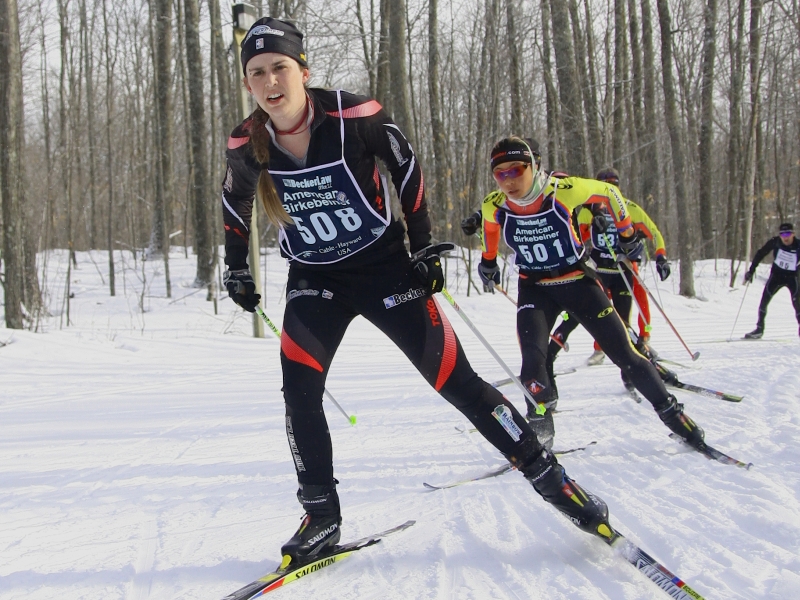
    Author Kristina Owen races in the 2009 American Birkebeiner ahead of Evelyn Dong.

    The following article was originally published on FasterSkier on October 15, 2008. It was written by CXC (Central Cross Country Skiing) athletes Kristina Owen and Heather Zimmerman. Roughly contemporary photos have been added for this reprinting; the pictures that originally appeared with this article are no longer available.

    The piece is simultaneously from very much another era, yet also completely timeless. On the one hand, “Caitlin Compton” now has a different last name; Jessie Diggins, who had recently turned 17, would go on to do things even more impressive than win the junior division of the Climb to the Castle rollerski race; the article’s authors last competed in FIS races in 2011 (Owen) and 2009 (Zimmerman). On the other hand, in October 2008 skiers enjoyed the fall foliage, did hard doublepole efforts, and benefited from having athletes from multiple clubs together in one place for head-to-head competition. A quick perusal of social media shows that New England fall colors are still a thing, and that athletes from multiple clubs (including that obscure junior, Jessie Diggins) still come together in Lake Placid for fall training. 13 years later, some seasonal rhythms of American skiing remain very much the same.
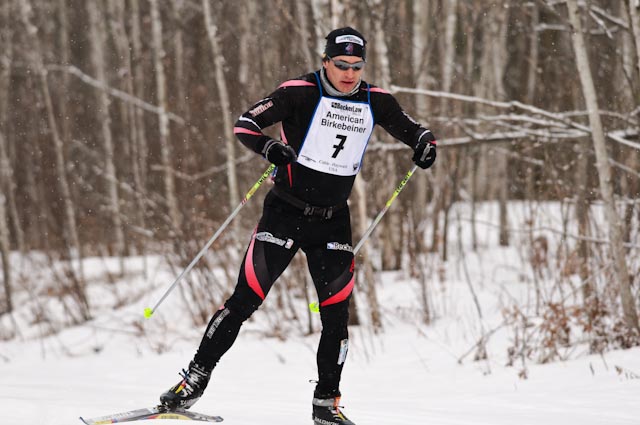
    Matt Liebsch coming up the final hill on his way to victory in the 2009 American Birkebeiner.

    CXC Elite Team – Lake Placid Training Camp Report

    The CXC Elite Team recently completed a two week monthly camp in Lake Placid, NY. We stayed and trained at the Olympic Training Center, which provided an ideal environment to make huge gains in both fitness and technique.

    The weather was excellent for the first couple days: chilly, but clear skies. “The only problem with the weather was that is was cool enough that none of the boys took off their shirts,” Caitlin Compton mentioned with a smile. After a few days of such perfect training weather, the team’s luck broke and it started raining; beautiful miserable cold rain. The training continued as planned, but between workouts the hallways were filled with the smells of damp and drying athletic apparel.

    One of the team’s favorite workouts at this annual camp is an over-distance run in Adirondack Park. We are able to take advantage of great trails up mountains with gorgeous panoramic views. This year the men’s team made it to the summit of Mt. Colden, but disaster struck on the way down. Matt Liebsch, Midwest born and bred, was unused to the speed on the steep rocky descent. He went down hard with a nasty ankle sprain. His teammates carried him out, but the injury was camp ending and he returned to the Midwest for recovery.

    Leaves in the Lake Placid region were in their peak foliage and so was the CXC Elite Team’s performance during the second week. The highlight came at the culmination of the camp, with the Whiteface rollerski race. However, there was a lot of work to be done, both intensity and volume, before the race arrived.
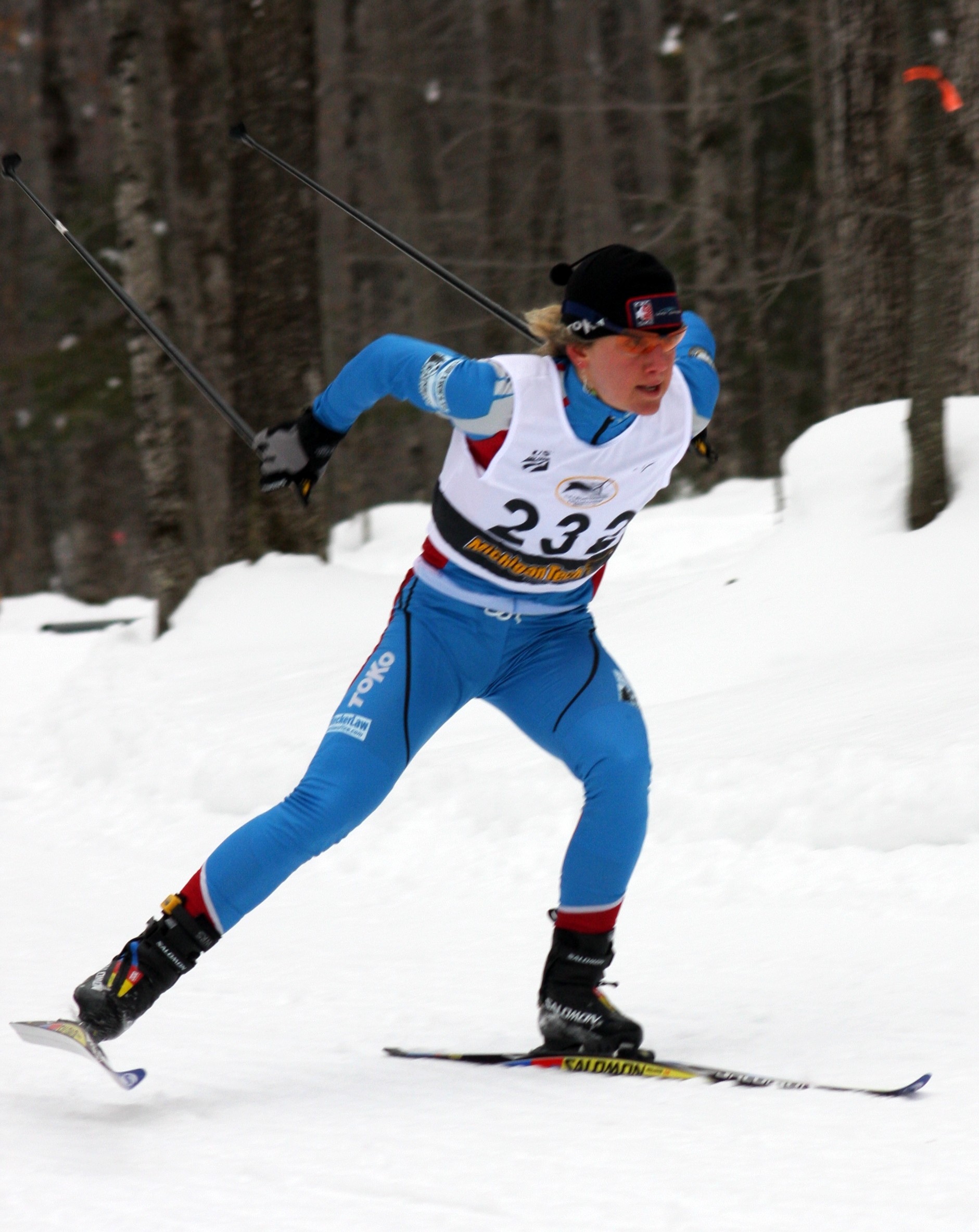
    Caitlin Compton sprinting at US Nationals in 2008 in Houghton, Michigan.

    The workload wasn’t the only thing increasing during the second week of camp. The Olympic Training Center was overtaken by Nordic athletes. CXC Elite was joined by their Junior Development Program athletes and coaches, as well as the Sun Valley team, the USST, various NENSA athletes, and some of the region’s collegiate racers. CXC Elite Team was able to frequently take advantage of the large athlete gathering, as all the groups came together for some of the workouts. The best example of this was a hard double pole workout up a long gradual hill. The men did two sets of 3×4 minutes, with a ten minute break between sets, while the women concentrated their efforts to 3 1/2 minutes. It was a great workout and the added numbers definitely helped in ramping up the intensity!

    The camp was also notably included the first competition of the year between CXC and their friendly rivals, Sun Valley. Last year Sun Valley pulled out a narrow victory in overall points. This year CXC was off to a good lead, with a win in an inter-team soccer match. The competition was fierce, but CXC’s greater numbers this year gave them the edge to pull off the victory.

    CXC Team continued to utilize the hilly terrain in the area, traveling to Whiteface Mountain for a ski walking workout on the lower trails. Some of the team returned to the mountain later in the week for an evening hike, lured in by the fresh snow that covered the top.

    Our second week contained not only some good intensity efforts but also a lot of volume. By Sunday most of the team had completed at least three ODs. All the mileage made us feel as though we had really gotten to know the Lake Placid area!
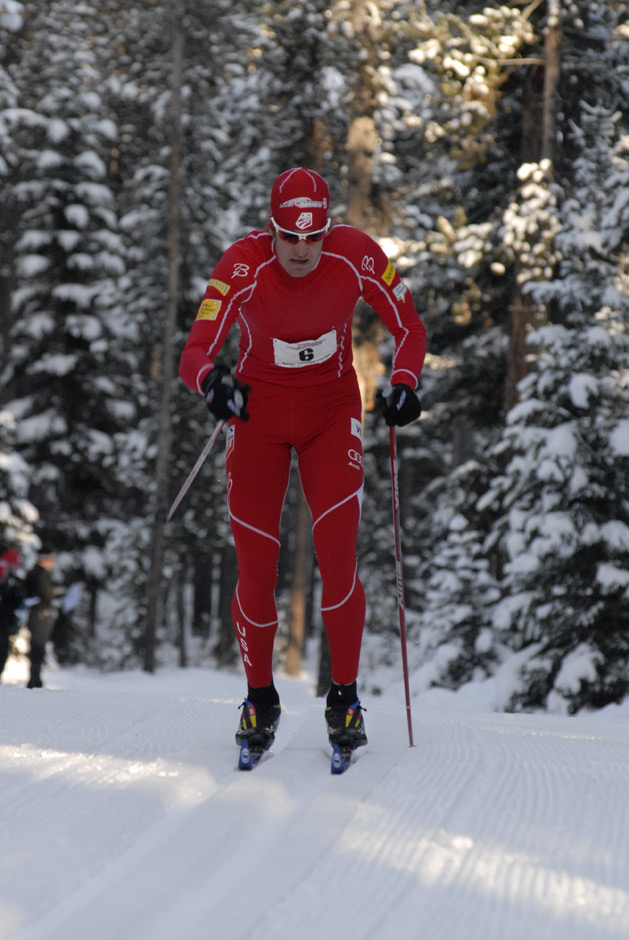
    Garrott Kuzzy (CXC Team Vertical Limit/US Ski Team) races the sprint in West Yellowstone, November 2009. (Photo: Win Goodbody)

    The camp ended with a grand finale, the Whiteface Mountain rollerski race! After testing ourselves on the area’s hills for the previous two weeks, what better way to finish up than a five mile, steep uphill race. Of coarse, mother nature decided to throw a few additional hurdles in our path before we began. The top of the toll road was too icy for skiing so the race was moved slightly down the hill. However, despite the alterations, the course still proved to be plenty challenging! Despite being tired, CXC athletes turned in some impressive results. Caitlin Compton led the way, winning the women’s race. CXC Junior Devo Program Jessie Diggins had a very impressive showing as well, placing 5th overall and winning the junior category. On the men’s side Garrott Kuzzy led the charge with a notable 4th place finish, followed closely by Brian Gregg in 6th.

    Sufficiently exhausted by this final effort the team departed Lake Placid. This was the team’s final two week dryland training camp. Athletes will now have the next four weeks at home before leaving for West Yellowstone, early snow, and the beginning of the Supertour circuit!

    We will be ready!!

    Related reading:

    “Central Cross Country Skiing Announces CXC Elite Team For The 2008-2009 Season,” FasterSkier, June 2008

  • Fear Not the Training Plan: CXC Academy Explained

    Fear Not the Training Plan: CXC Academy Explained

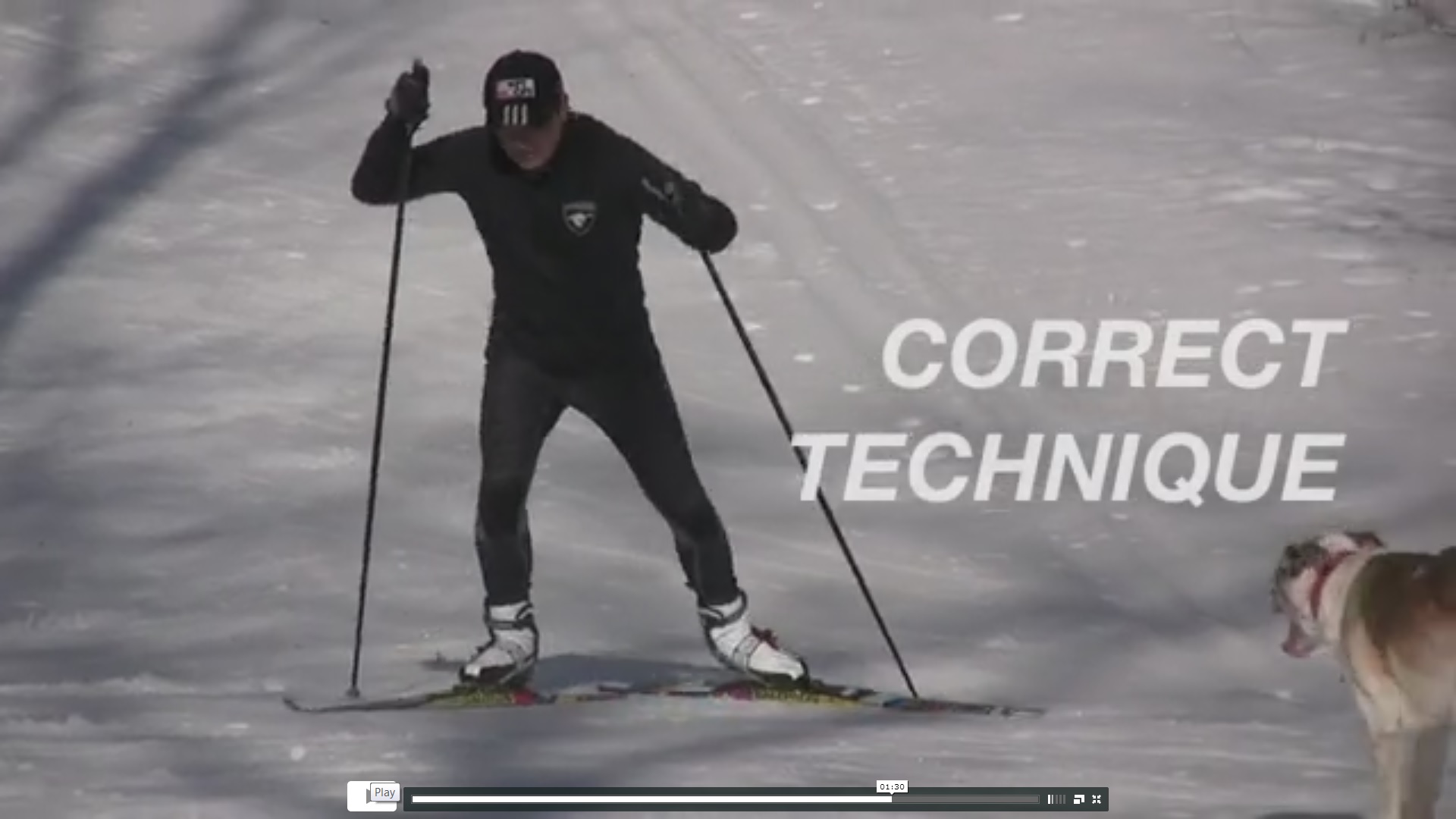
    Yuriy Gusev, Executive and Athletic Director of the Central Cross Country (CXC) Ski Association, demonstrating proper V1 technique in a CXC Academy video.
    Yuriy Gusev, Central Cross Country (CXC) executive and athletic director, demonstrating proper V1 technique in a CXC Academy video.

    You read FasterSkier so it’s probably a safe bet that you would like to, well … ski faster!

    And so if, as you recover from the recently concluded race season, you are already thinking about how to improve your race times next year, Yuriy Gusev has a plan for you. A training plan that is.

    Intrigued by the CXC Academy, I called up Gusev, executive and athletic director of the Central Cross Country (CXC) Ski Association.  The Academy is described on the CXC website  as “an online subscription service that provides professional training plans for cross country skiers of all ages and skill levels.”

    Gusev explained that was Academy was started in 2007 by himself and former CXC elite coach Bryan Fish (now the U.S. Ski Team development coach) as a way to share the state of the art ski training expertise that Gusev and Fish compiled while developing the CXC elite program.

    “Bryan and myself made a lot of connections with sports professionals in strength and conditioning and sports science and medicine,”  Gusev said.  “We started brainstorming what can it [the Academy] be and who can it serve.”

    CXC Academy promotional material with a good summary of its offerings.
    CXC Academy promotional material summing up its offerings

    In its early stages, the Academy was envisioned as at tool to share information for training elite athletes.  While the Academy still contains an elite-level plan (plans similar to those used by CXC elite-team alumni Brian and Caitlin Gregg, Matt Liebsch, and Jessie Diggins), the program quickly expanded to include novice, intermediate and elite level format.

    “Initially we thought it would work just for coaches, but it has developed pretty quickly that it can be used by anyone all over the world,” Gusev said.

    So how was the elite plan modified for intermediate and even novice skiers? “We had a lot of discussions after the first year … what we did is simple, really,” Gusev explained. “We minimized number of workouts per week and number of hours and that mostly takes care of different levels. For example, somebody who trains 260 hours per year who just wants to ski the Birkie … [they don’t] need to do two Level 4 workouts a week.  They might just need to go at Level 3 just above their comfortable pace for an hour and half once a week.”

    I explained to Gusev my difficulty in researching how to train for two 50-kilometer citizen races (the Seeley Lake, Montana OSCR and West Yellowstone Rendezvous) last winter.  My research left me overwhelmed about how I should incorporate various training elements such as intervals, strength training (I decided strength must be important after watching Kikkan Randall do pullups with weights strapped to her waist) and my first-ever pair of rollerskis, into my race preparation.

    While chatting with Gusev, I discovered I wasn’t the only one lacking a training plan. “Believe it or not, we just had a coaches conference in November with about 50 coaches, both club and high school coaches, and I asked pretty straight forward question: How many of you give your athletes a day-by-day training plan?” Gusev recalled. “And probably two or three hands went up.”

    He went on to explain CXC’s philosophy regarding training plans.  “What we believe in our organization is that any structured plan is better than no plan,” he said. “We have athletes on that plan. We have heard from high school coaches to masters skiers to senior level athletes that they have had the best seasons ever … and they still continue to improve season after season.”

    Gusev added that the Academy is for everyone from those training for marathons or short-distance races, from a high-school skier to someone who’s qualified for nationals.

    “Any structured plan is better than no plan.” — Yuriy Gusev, CXC Executive Director

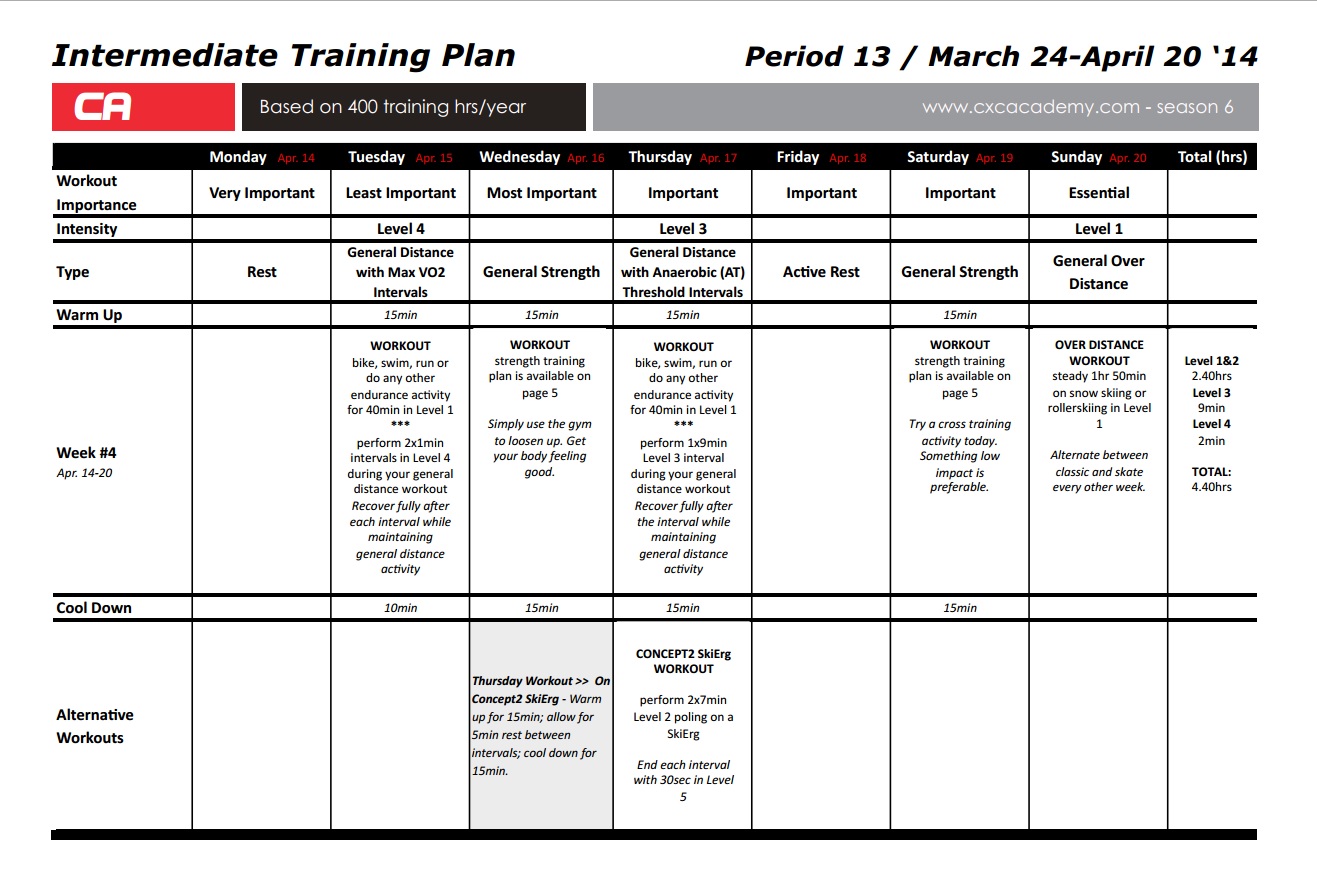
    Sample CXC Academy training plan layout.
    Sample CXC Academy training plan layout

    I told Gusev that most of my resistance to training plans was what I perceived as their inherent rigidity. I have friends who love nothing more than to see their training laid out before them on a neat, orderly grid with a little box in the corner to check when the workout has been completed.  I am not one of these people.

    To me working out is essentially goofing off, an escape from demands of work and life.  I live in Missoula, Mont., if the weather and my work schedule allows for a short mountain-bike ride on the same day when the training plan calls for strength workout in the gym, I’ll dump the plan in a heart beat.

    I asked Gusev about how his training plan can work for people with busy lives.

    “From the user side, what we’ve heard is that some people follow it like a bible, literally day by day, and some people try to adapt it to work and family and other things,” he said.  “What we suggest to people is that this is a road map … you know, its just getting those pieces done some time during the week. That’s what’s really important and everyone has a different way of how to structure the week around training.”

    Cost of CXC Academy:
    – 5-day trial: free
    – 1 month: $14.95
    – 1 year: $119.40

    Regarding alternate training activities, Gusev said, “That’s the perfect situation, if someone can do other activities, whether you are an elite athlete or you want to be a wave Birkie skier … you just do those workouts by bike or kayak or by foot or the swimming pool but you follow the plan to build your training. Obviously, the more specific you can be the better it is.  Some people might choose to rollerski once a week, and some may choose to not rollerski until September or October … so everyone is different.  Even at the elite level there is no single formula out there that will make you fast.”

    I discovered the Academy midway through my ski season and signed up for my free one-week introductory membership. My next race was the Peter Hale Memorial, a 22 k race with over 1,000 feet of climbing so I watched an Academy video on V1 technique.  In the video, Gusev demonstrated the importance using both legs equally regardless of which side you are poling on.  I focused on that single tip during my entire race.  I told Gusev that I finished ahead of two racers who had beaten me [quite easily] in a race two weeks earlier.  It was the first time I had ever finished ahead of one of them!

    I asked Gusev if my focus on his tip could have made the difference for my improvement.  “It could be, easily,” he replied. “We have a lot of people email us literally a week before the Birkie, and they say, ‘I didn’t train at all — I just want to make it through.’   You’d be amazed at how many people there are like that, and you know, there’s no magic wand to make them better, but there’s some things you can tell them, some basic tips just like what you talked about with V1.

    “I’ve heard from a lot of people that we’ve given advice and they said it was magical,” he added.

    CXC Academy video library.
    CXC Academy video library

    CXC Academy has a video library which Gusev said sets them apart, providing both technical advice and a visual demonstration of how it should be done.

    “What we learn with a technical sport like cross-country skiing that the most important part for people to understand is what they should be doing …  and how the technical elements [of skiing] make them more efficient and faster,” he said. “I haven’t seen anything else out there that gives that advice.”

    The Academy video offerings are extensive and include sections on strength training, on-snow skiing for both skate and classic, rollerskiing, dryland training, waxing and equipment.  The videos are tightly integrated with the training plans.   For example, the intermediate training plan for April calls for one day of general strength training per week.   A video demonstrating all recommended exercises is linked to the plan.  On a recovery day during the race season the plan might recommend that you get some wax into your ski bases and a link to a waxing technique video is provided.

    The CXC Academy offers a free five-day trial period.  A one-month subscription is $14.95 and one-year subscription costs $119.40.

    “Those paying members … help us pay the cost of servers, the cost of hosting videos. There is cost in everything,” Gusev said.   “We we give complementary memberships to Paralympic team members and high level para-athletes.  Those paying memberships allows us to have this resource, and without them we couldn’t help those Paralympic athletes and organizations like National Nordic Foundation.”

    Gusev said the Academy’s support of the U.S. Paralympics Nordic program wasn’t planned, but there was a need.

    “We were at Park City at the National Ability Center ski camps and they had development athletes from all over the country … and they didn’t have one centralized place for getting a plan,” he explained. “For some of them, if you have an adult who has never done any athletic training in the past, now with a disability trying to do a competitive sport, for them a training plan is like, they don’t even know from what side they need to look at it.”

    Since I’m just getting started following the intermediate training plan, I asked Gusev what I can expect next ski season.

    “You will go faster when you want to go faster and it will be a lot more enjoyable to go faster,” he responded. “I don’t race any more, I don’t have time …  but I enjoy when I go ski and I can go up a good hill at a good pace and enjoy it.  I can go ski for three hours if I want to.

    “Really, what [the Academy] does is builds all components of training, from anaerobic to aerobic and speed and endurance, so it gets to the point where you can do anything you want to,” he added.

    I told Gusev that I race mainly to provide goals to get me out exercising and skiing. While I love skiing, I don’t consider myself to be a racer. I asked if his training plan is appropriate for someone like me.

  • Jessie Diggins: Still a Junior But Certainly No Rookie

    Jessie Diggins (CXC Elite) might be the youngest on the CXC Elite squad, but the 19-year-old has stepped up to the challenges of the senior circuit.  And she still has more to offer.

    Her increased focus on racing has already paid of this season, both in terms of race results and  life lessons. “I really didn’t expect any results. I was just looking to have a good year,” Jessie Diggins said of her period 1 races. The Afton, Minnesota, native is taking a year off from school to pursue ski racing full-time with the CXC elite team.

    She has learned more about ski waxing, caring for equipment and living on the road over the course of this fall than she thought possible. “I’m better able to take care of myself, get enough sleep, not having so much to think about and it’s definitely less stress in my life,” said Diggins.

    Jessie Diggins. Photo: Toko

    “It has been a crazy learning curve,” Diggins told FasterSkier, noting that she feels well prepared for Nationals and still has more to offer than what she has showed off so far.

    “When I was racing the last Nor-Am in Rossland, I was thinking. ‘I hope this isn’t the fastest I get. I hope to continue to improve,’” commented Diggins. “I’m excited to see how (the races) go.” Her aim is to qualify for the World Juniors team in Rumford.

    “I’d like to make the World Juniors team. That’s been really good the last few years,” she said.

    Humble

    Diggins is no rookie. She has represented the United States in several FIS Nordic Junior World Championships, she has five Junior National Champion titles to her name, and she is about to take her fourth stab at the Senior Nationals. Still, she feels humble in the company of her CXC teammates and competitors.

    “I’m definitely the youngest one on my team, but everyone on the team takes really good care of me. I might need a little help, I might forget something. That’s a great part of being on a team,” Diggins said. She admits that she was getting a little homesick toward the end of the six-week SuperTour/Nor-Am road trip that concluded with the 3-day mini-tour in Rossland, British Columbia, the weekend before Christmas.

    “It was definitely nice to come home for Christmas. But now I’m really excited to be back on the road.”

    Sick to her stomach

    Diggins certainly has ambitions for her racing in Rumford. But at the same time, she is careful not to put too much emphasis on Nationals.

    “I’d like to race well, but I don’t want to come in with super-high expectations. When I come into races with a lot of expectations, I get physically sick to my stomach, just really nervous,” Diggins explained.

    At this point, Diggins must simply trust that she has done the work and prepared as well as she can.

    “I just have to relax and not doubt myself. It’s all in my own head. If I have a bad race, I have psyched myself out. I’ve done the training, I’ve done all I can do and now I just need to let it happen,” Diggins said. “When I relax and don’t stress over stuff, I race so much better.”

    At the SuperTour, Diggins has gone into every race with a  relaxed attitude, and results have followed.

    “I’ve just focused on having fun, meet new people and have a good time. I’m learning to be professional,” Diggins said, adding that sometimes she has to remind herself that it’s just ski racing.

    “I do this because I love it, not because I need to.”

  • Diggins Wins Women’s Nor-Am minitour After Rocket Performance Sunday

    Diggins Wins Women’s Nor-Am minitour After Rocket Performance Sunday

    Holly Brooks (APUNSC) was leading the overall Nor-Am mini-tour in Rossland, BC, Sunday morning and was the first skier out of the gate in the women’s 10K classic race. She was ahead by 7.3 seconds after winning the 5K skate on Saturday by 11 seconds over Sadie Bjornsen (APUNSC), and placing third in the sprint Friday. But when Jessie Diggins (CXC Elite) passed her on the last lap, there was nothing she could do. Diggins, who started in third place, 19.1 seconds behind Brooks on Sunday, was able to widen the gap and won both Sunday’s stage and the overall mini-tour title.

    “Sadie (Bjornsen) caught me on the big uphill after the first lap. We skied together for a long time; most of that second lap, and then Jessie (Diggins) basically blew by us. Then Sadie gapped me a little bit. I was able to hold off Perianne Jones and stay on the podium for the aggregate,” Brooks said.

    “I much rather be one of the chaser than being chased. You’ve got to ski fast, because you don’t know where people are. It makes it hard to ski smooth, and easy to get bad technique, forget long strides and skiing smooth,” Brooks said.

    “The race today felt awesome! I went into today’s race without a strong race plan – I didn’t really know what to expect since I haven’t done many races in this format” Jessie Diggins said in an email to FasterSkier, explaining that her plan was simply to ski fast.

    “I definitely like to chase people down more than I like being chased, so I wanted to focus on trying to catch the leaders and not on all the people trying to catch me! I ended up catching Holly (Brooks) and Sadie (Bjornsen) at the start of the second lap, and when I passed them on a downhill I just decided to go for it and see what happened, hoping they wouldn’t reel me back in. And I got lucky and had a great race,” Diggins said.

    Diggins explained that the dumping snow made for some tricky conditions, not only on the waxing side of operations, but also for the racers on the course.

    “The conditions were really interesting, since it was snowing hard and although some of the tracks had been skied in, there were definitely a few spots where it was advantageous to switch lanes,” Diggins noted.

    Diggins also contributes her success to the CXC coaches.

    “I’m beyond impressed with our coaches; they absolutely nailed the wax and my skis felt like they were on fire. They’ve also been helping me a lot with my classic technique this year and I feel like it’s all starting to come together. It’s weird because I’ve always considered myself a better skater, but today made me feel more confident in my ability to hold my classic technique together.”

    Feeling the toll

    Sadie Bjornsen (APUNSC) was almost surprised to beat Brooks in the classic race, and maintain her second place overall. She was 7.3 seconds behind Brooks at the start, and was in second place overall after the first two stages.

    “Warming up I knew I was going to have to work for this race,” Bjornsen said to FasterSkier, explaining that a 3-day mini-tour on top of the longest racing stretch in her career so far was starting to take a toll on her. While Bjornsen was surprised that she was able to catch and hold Brooks, she had not accounted for Diggins.

    “It was a really close race with like 50 girls going out in two minutes, and none of us wanted to look back. So it was quite a surprise when Jessie (Diggins) came by us so quickly. We tried to stay with her, but she as on a roll,” Bjornsen said.

    Caitlin Compton (CXC) was also impressed with her teammate.

    “I think Diggins put a ton of time on everyone that second lap. I saw her as she crested the hill and then never again,” Compton said.

    “My strategy was to catch the girls ahead of me. When I realized I wasn’t going to catch Perriane (Jones), I realized that there were still a ton of girls behind me chasing me down! So my focused shifted to holding them off for the last half of the second lap. I was happy to cross the line without giving up any places. Overall, a solid classic day for me,” Compton concluded. She was in fifth place after stage one and two, and started 36.8 seconds behind Brooks on Sunday morning, and finished fifth overall for the aggregate after an eighth place in the classic race.

    Organizers and volunteers shine

    While snow was falling throughout the weekend, the racers all chime in on how great the organizers were and how well maintained and prepped the courses were.

    “Black Jack did a great job with the event and the courses were in great shape,” Compton said.

    Diggins also noticed the effort the organizers had put into making the mini-tour a smooth, fun experience for everyone involved, from racers to spectators and support staff.

    “What I do know was that the volunteers out there this weekend made it so nice – the courses were very clearly marked, there was a sweet DJ playing, and the people at the start and finish were friendly and helpful. It was just a fun weekend,” Diggins said.

    Complete results here.

    Women's overall podium: Jessie Diggins (CXC), Sadie Bjornsen (APUNSC), Holly Brooks (APUNSC), Perianne Jones (NTS) and Caitlin Compton (CXC). Photo courtesy of Rob Whitney
  • Babikov wins Ski 2 Sea

    Babikov wins Ski 2 Sea

    By Inge Scheve

    Ivan Babikov (CAN) won the opening leg of the Ski 2 Sea relay at Mount Baker, Wash., Sunday morning. Babikov, who earned a fifth place at the 2010 Olympics in Whistler, helped the Boss Construction Open team to the overall win, beating Barron Heating Open by 5 minutes and 19 seconds over the 90-mile course from Mount Baker to Fairhaven. Babikov’s team finished in 5:47:55.

    “I didn’t know much about the course before the race. The other guys in the field were strong too. The uphills were harder than I expected,” said the rookie, who polished off the 4-mile course in 18 minutes and 15 seconds.

    “It was different than other races because you do it for the team. I’ll be back to race this again later,” Babikov said.

    “It was kind of challenging, and I didn’t expect it to be this hard,” said Babikov with a grin, explaining that this was definitely his kind of terrain. “There were huge uphills and even after that long uphill there were more. It was a World Cup kind of race and a World Cup kind of race course,” he said.

    And the field was definitely deep for a local event. While Brian Gregg was second (18:39) in the XC race, Barron Heating, with Torin Koos on the cross-country leg, was second overall. The three-time Olympian and recent graduate of the US Ski Team did not have a good day on the snow. “I blew up. I was right with Gregg and Babikov to the flats in the back, but from there it was all over. I was basically double-poling to the finish,” Koos explains, adding that his skis were as good as any. Koos was sixth in the XC race, clocking in at 19:56.

    With the typical Ski 2 Sea slushy course, overnight temperatures not even dropping below freezing and more than 500 teams churning up the snow, ski flex and the right combination of wax and structure is crucial to success. Babikov said his skis were good, he but couldn’t offer the inquisitive reporter much insight to the magic mix. “I have no idea what was on them. Our wax tech Joel did the skis before I left and they were good.”

    Eric Bjornsen (USA) was third (19:21), Martin Rosvall (SWE) fourth (19:27) and Dan Roycroft (CAN) fifth (19:44).

    In the women’s open division, Sarah Konrad (USA) beat Dasha Gaiazova (CAN) by 7 seconds, finishing in 22:18. Gaiazova’s team, Boundary Bay Brewing Company, won the Women’s Open division for the 11th consecutive year.

    The relay consists of seven legs, opening with XC, followed by a 2.5-mile downhill loop, 8-mile downhill running, 38.5-mile road biking, 18-mile canoeing, 14-mile mountain biking and concluding with 5 miles of sea kayaking. For complete results and more information, visit www.skitosea.com.

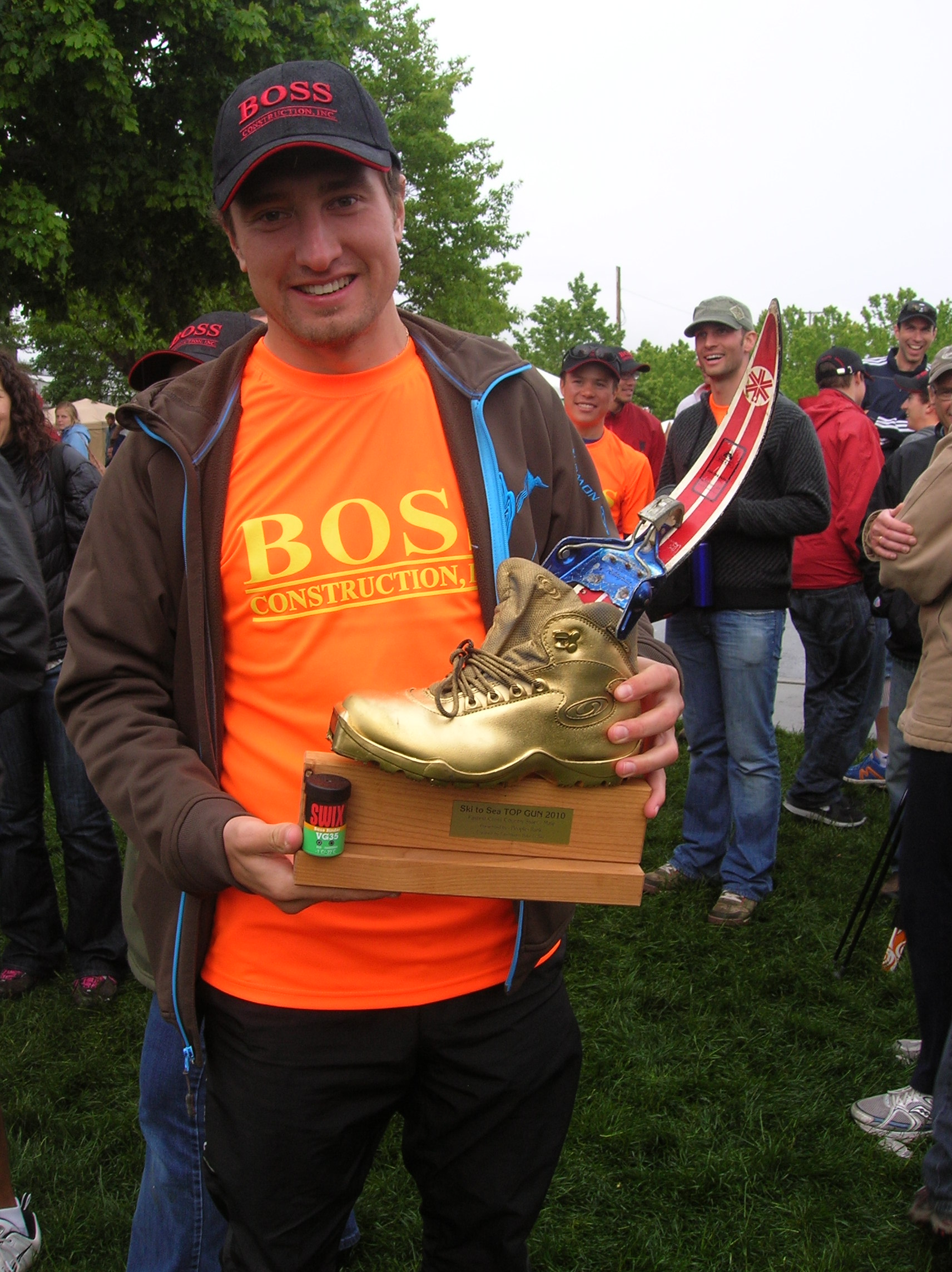
    Ivan Babikov won the Top Gun Award, given to the top male and female athlete in each of the seven legs. Photo: Inge Scheve
  • Birkie Trail Work

    The American Birkebeiner ski trail is a 52km long, 6m wide ribbon of grass that transects the Chequamegon National Forest between Cable and Hayward, Wisconsin.  Maintaining the trail requires almost constant attention.  The CXC Vertical Limit Team athletes spent Sunday afternoon doing volunteer trail work to get the trail prepped for the winter.

    Trailwork 1

    Every five years, brush needs to be cut back from the trail’s edge and tree limbs need to be trimmed.  This allows the Tidd Tech’s to groom the trails without running into downed trees and also allows maximal snow accumulation on the trail.  We got after it with chain saws, brush cutters, and tree limbers to cut back overgrowth.

    Trailwork 2

    Of course, everything that got cut had to be cleared as well.  A number of cyclists out inspecting the Fat Tire course for next weekend’s race came across our operation and got some good cyclocross practice dismounting to get over the tree piles.  In all, we cleared 2km of trail from OO South.  That’s a good chunk of the 10km that needs to be trimmed this year.

    Trailwork 3

  • Nina Gavrilyuk is My New Hero

    We are winding down another camp in Hayward, WI. This week was speed block #2 for most of the team. We had lots of hard training and we are starting to feel pretty wiped out. This morning, Coach Igor’s wife, Nina Gavrilyuk, joined us for the big OO time trial. Nina is a 4 time Olympian from Russia. She has three Olympic gold medals, one Olympic bronze, 11 World Championship medals, and 37 world cup podium finishes. She also won the prestigious Holmenkollen race in 1996. It was fun just knowing she was out there. Yesterday, the CXC women’s team joined the Ski and Tea women of Hayward to meet Nina and watch her Bronze medal performance at the Lillehammer Olympics in Norway at Mooselips over coffee and tea. She had her Olympic medals with her and we got a chance to hold them, which was a first for me.
    Tomorrow afternoon the whole CXC team will be out doing some work on the Birkie Trail that we love so much. If you are in the Hayward area, you should come to the OO trail head tomorrow and join us anytime between 12:00-5:00pm. After that I’m heading home to Marquette for some much needed rest…and a little work, school, and training. Photos from the Hayward Camp will be coming soon.

  • Nordic Walking: A Lifetime Sport

    The other week I led a CXC/Birkie Nordic Walking Clinic in Woodruff, WI at Premier Physical Medicine and Wellness Clinic. 42 people made the clinic ranging in age from 8 to 86 years old. It is one thing to hear about nordic as a lifetime sport but it is really cool to see both young and old enjoying the sport.


    Dr. Jim Mullen offering some advice on Nordic Walking. The hill behind him is a manmade playground with tunnels, paths, steps, tires and all sorts of fun things to climb on. Premier’s facility is really world class. Check out their website at http://www.premierPhysicalMedicine.com


    Uphill Technique

    The clinic went great. Everyone enjoyed the great weather and many are excited for the Birkie Trail Run and Trek on September 26.


    Unfortunatly when I got in the car to head back to Hayward. The ol’ Neon made no effort at all to start. Jim and I tried a few things before realizing it was beyond us. This could have been a rather stressful situation but thankfully the Mullens made it easy. Thanks for letting me stay with you, directing me to the great running trail, and helping me get the car fixed.


  • Fitting It All In

    Instead of sending Fish a monthly training log, I think pictures of my increasingly awful sportsbra tanline will be sufficient.

    Instead of sending Fish a monthly training log, I think pictures of my increasingly awful sportsbra tanline will be sufficient.

    Captain of the pontoon...

    Captain of the pontoon…

    Huge fish!!! Unfortunately just a huge rock...

    Huge fish!!! Unfortunately just a huge rock…

    Well, we’re in Hayward again. It’s absolutely nuts how quickly the summer is passing! It’s September already and we can technically consider it fall, yikes. Don’t get me wrong, fall is probably my favorite season, with all of the leaves changing colors and the temperature dropping a bit, but I don’t think I’m quite ready for it. I’m pretty sure I can count the number of typical “summer days” that we’ve had on one hand…maybe two…but of course none of those fell on a Monday, which is usually our only day off each week. Oh well, I can’t complain too much. The weather has been optimal for training, and though not every day is perfectly sunny in the 80’s, I still found a few days to have some relaxed, fun-in-the-sun.

    One of those days that I found was during my last two week period at home. One of the perks of working at Silver Rapids Lodge (where I work the front desk and waitress) is that employees are able to rent watercrafts for free. KP and I took advantage of that one of the Mondays that we both had off while he was visiting in Ely, and took out one of SRL’s pontoons. We were only able to stay out on the water for a few hours (due to a storm that was coming in) but it was still a relaxing, and awesome time. We packed a lunch, some fishing rods, and sunscreen, and were all set to enjoy the afternoon.

    Another highlight of my time at home was the “Get Your Nordic On” Nordic Walking Clinic that I held in Ely. I was really nervous no one was going to show up…but I actually had a few make the clinic. Though I am not an expert Nordic walker by any means, the clinic went especially well. It is awesome leaving a clinic that everyone enjoyed, and over half the people are asking you where to buy the Nordic walking poles so that they can continue the sport that you introduced to them.

  • Hello, Is there anybody in there?

    The International Mountain Bike Association (IMBA) has 10 trails around the world they call “IMBA Epics” – sort of like the Seven Wonders of the World for mountain bikers.  Atop IMBA’s list is the most famous ride, so famous that Pink Floyd named a song after the trail, Comfortably Numb.

    Comfortably Numb 1

    I’m in Whistler, BC at the moment, at a training camp with the national team, Sun Valley, Steinbock, NEG, and more.  The training and conditions have been awesome all week.  Check out TeamToday for pics and updates on the camp.  The great weather we’ve had finally gave way to rain this morning.

    Comfortably Numb 4

    Time to ride Comfortably Numb.  It wouldn’t be an Epic without wet roots or an overcast view.  Pete & I hit the trail early Saturday morning, heeding trailside warnings to “Leave with plenty of time to return before dark.”  The 17 mile trail had over 1500 vertical feet of climbing–that’s about 25 round trip rides from Fish Hatchery to OO on the new Makwa Trail in Hayward.  Success is measured on this challenging trail not by how fast you can ride it, but how long you can ride without unclipping from your pedals.  My record was about 3 minutes.  It was an awesome ride, despite the bone chilling rain.  Kicking back in the condo this afternoon, I understand why they call the trail, Comfortably Numb.

    Comfortably Numb 2

  • September Camp

    The CXC Team Vertical Limit September Camp kicked off this Thursday in Hayward, WI with VO2 max testing on the treadmill.  With multiple tests so far this year the results will be a great way to chart progress.   Ideally we will have become more aerobically efficient after the long hours of summer training.  Hopefully our threshold pace and heart rate will also have improved.   It is important to keep in mind that testing alone does not make one faster.  It is the ability to personalize and improve training based on test results in order to elicit a more positive response that really matters.  Bryan and Igor have been great at this so far and I for one am feeling great.  This summer I have enjoyed the highest quality of training I have ever experienced.  The hours have not been more then I am used to but every workout has been focused and specific with a greater emphasis on intervals.  I continue to struggle with improving my technique and am continuously focusing on tips I have gotten from Bryan while skiing.  My old habits are proving to be very stubborn but I feel progress is being made nonetheless.  In general I am trying to keep my arms and feet wider while engaging the core more and increasing the fluidity of the movements.

    Here are some pics from the V02 testing.

    The computer, V02 machine and tredmill.

    The computer, V02 machine and tredmill.

    Chuck starting out.

    Chuck starting out.

    Cook after the test.

  • BUILDING MOMENTUM


    Bryan Cook and Garrott Kuzzy descend the last mile of a 44 mile skate in the Upper Michigan’s Porcupine Mountains

    Bryan Cook and Garrott Kuzzy descend the last mile of a 44 mile skate in the Upper Michigan’s Porcupine Mountains

    AUGUST CAMP

    August 24, 2009

    August starts the downward push towards the ski season.  Training increases and specificity transitions from an emphasis on general training to primarily ski specific training.

    We had a particularly good camp in Ironwood with effective training, comfortable lodging (thanks Bob and Debbie – Wolverine Village) and well prepared meals (thanks Bill Pierce, Bob and Debbie).  None the less, the most important aspect, in my opinion, was the attitude and focus during training sessions.  The focus was there but so too was the joking afterwards.  The athletes demeanor displayed both urgency in their training at hand, but also indicated they are remaining mentally fresh and loose.  August is a taxing month of training and can be mentally challenging, but it was good to see the physical progress and positive attitude of the team.

    It is critical to build up momentum and carry that into fall instead of perceiving August as an uphill trek to maintain motivation and focus.  Many multi-sport skiers are scaling down their summer race season and starting to dust off their rollerskis.  The athletes on CXC Team Vertical Limit have logged many miles on their rollerskis and any anxious novelty of putting away the winter boards to trade them in for wheeled ones has long past. 

    CXC Jr Program & CXC Team Vertical Limit athletes head out for a scenic distance classic ski

    CXC Jr Program & CXC Team Vertical Limit athletes head out for a scenic distance classic ski

    Men ski up a steep grade during skate intervals

    Men ski up a steep grade during skate intervals

    Training year round is a unique balance and those that excel enjoy the process.  The process of training in itself needs to give back and fuel the motivation of the upcoming days, weeks and upcoming months.  Striking this balance is critical during this time of the year when ski training can wane in the mind.


    Igor strikes a balance between fun and fitness atop the Presque Isle River

    Igor strikes a balance between fun and fitness atop the Presque Isle River

    A scenic overlook of one of the waterfalls on the Black River during a distance run.

    A scenic overlook of one of the waterfalls on the Black River during a distance run.

    Remaining focused in training needs to be balanced with simply getting in physical fitness.  This balance is analogous to the difference between urgency and patience.  The goal is to remain focused and purposeful in training, but not so focused that training becomes tense – both physically and mentally. 

    The dynamic balance between these rivaling mindsets often shifts throughout the year.  Race season brings a high level of focus and urgency and it is during this time that we need to emphasize patience – step back, take a breath and then hit the start line relaxed but ready.

    The contrary is true during this time of the year.  Dryland training can become old-hat.  Many miles have been logged and the novelty of dryland training has worn off.  This time of the year requires more attention on focus and urgency, for it is during the summer months that provide us the greatest opportunity to address our weaknesses and make our greatest gains.  This requires not only hours and repetition, but the focus to execute and correct weaknesses.    Find training methods to fuel your motivation, for example select training venues with great scenery.  End your work on a beach, so you can look forward to a cool dip after a hot summer training session.  In short, be creative, so training is something you look forward to.

    Jessie Diggins ski walks up Powderhorn Mountain

    Jessie Diggins ski walks up Powderhorn Mountain

    Bryan Cook completes a classic sprint interval

    Bryan Cook completes a classic sprint interval

    The mind controls the body and a lethargic brain while training results in – well – lethargic training.  I would like confess that elite athletes and coaches are immune to mental second guessing, but four hour runs or rollerskis can challenge even the most mentally tough.  Training to put in hours is simply not enough.  Those hours have to be quality hours too.  Sure, some hours need to be more quality than others, but every time the skis are snapped into the binding is an opportunity to improve. 

    It’s safe to assume eighty percent of the athletes’ total training is distance training this time of the year.  Approximately sixty percent of that distance training is ski specific or rollerskiing for the most part.  Stride length and stride frequency are individual, but a good ball-park estimation is forty ski strokes per minute while skiing at an easy pace.  That means there are at least 9,500 strokes that an athlete has an opportunity to engrain efficient technique or not.  It is critical to maintain focus on items other that 9,500 repetitions so monotony doesn’t creep in.  The goal of keeping training mentally and physically fresh is the responsibility of both the athlete and coach.  A training plan should include variety and progressive overload, so training stimulus changes.  An athlete and coach also need to identify if the athlete has the patience, persistence and physical acuity to efficiently maintain 9,500 quality ski strokes.  Most can not.  Therefore other less specific modes of training may be selected or maybe a combination ski then run workout is appropriate.

    Kelly and Maria sprinting up the last hill in a sprint interval session

    Kelly and Maria sprinting up the last hill in a sprint interval session

     Find methods to keep the spark ignited in your training.  Work on one or two technical aspects while distance skiing.  Play around with force output, stride frequency, body position, V2 up the hill, focus on the transitions or work on downhills.  Try to master a drill that you have not fully mastered.  In short, challenge yourself while logging all those hours.  To improve skill requires additional concentration.  New skills require a focus on only one or two elements or else the body and mind are overloaded.  Work on one or two items for a short duration and then simply enjoy the opportunity to be outdoors skiing for a while.  Go ahead and return to that drill you were momentarily working on after the brain and body have had a little recovery.  A continuous distance workout can then become segmented into many different pieces and hence variety is built into the continuous training session. 

    Audrey toughs it out doing skate intervals up a 15% grade with one pole.  Rehabilitation can be looked at as a time to sit back and rest or an opportunity to focus more attention in other important areas.)

    Audrey toughs it out doing skate intervals up a 15% grade with one pole. Rehabilitation can be looked at as a time to sit back and rest or an opportunity to focus more attention in other important areas.)

  • The Dog Days of Summer

    By Gus Kaeding
    Hey everyone, I am back in Marquette after quite a bit of hopping around. For the past month I have been dealing with the fact that my body seems to be falling apart. Following our last training camp I developed a nasty case of shins splints. I was headed back to VT for a wedding so I set up an appointment with the doc who did my compartment surgery last year. I wanted to make sure this wasn’t a recurrence. We decided it was just shin splints (which is excellent news in the big scheme of things) and that my legs are actually made out of glass. Never the less, due to the shins splints I was doing a lot of double poling and managed to hurt my elbow. This left me with swimming. I hate swimming but was blessed with some unusually warm summer weather. I convinced my younger brother Sten to take a kayak around a local lake with me while I swam. I worked my way up to being able to swim (or as my brother called it “not drown”) for a solid hour. Not a bad way to spent a 90 degree afternoon! Yesterday, I arrived back in Marquette and went for my first short, pain free run which was encouraging. My elbow also seems to be healing which is good as we have a training camp starting in Hayward next Wednesday. I have to thank Donna Smyers, Pepa Mildfh, and Brian Huber for helping me out with my legs. I should also add that prior to my elbow mishap I had been doing some solid work on our new Concept 2 double pole machine. It works surprisingly well and is an excellent alternative in central Vermont to the somewhat suspect roller skiing. In fact, I have to drive nearly an hour for a paved road which can sustain skiing. If you have the same problem, I highly recommend checking out the Concept 2 machine. Hope everyone is having a solid summer as we are still waiting on ours to start here in Marquette.

    Does this count as a two lane road?

    Does this count as a two lane road?

    Smooth sailing in central VT.

    Smooth sailing in central VT.

    The new Concept 2 rocks!

  • Chicken Bingo

    I enjoy a game of Chicken Bingo. I have never been much for gambling, but as far back as I can remember I have enjoyed this game

    mother's day 126

    My brother and Me placing our bets

    For those of you unfamiliar with the game here are the rules:

    mother's day 107

    How it Works:

    • Squares are sold for 50 cents. 
    • If the chicken poops on your square you win $10. 
    • There is one winner per card, leave your contact info and we will let you know if you win

    The Rules: 

    1. There are no ties, the most poop wins.
    2. The judge makes the final decision. 
    3. You may talk to the chicken but you can’t touch the cage or the chicken. 
    4. Anyone can play.

    mother's day 128

    Cheering is a big part of the fun. mother's day 130

    My brother Chad was one of the day’s big winners

    Chicken Bingo is a great way to attract people to any booth at a fair, festival or expo.  This particular contest is part of the Methow Conservancy booth at Wintrhop, WA 49ers Day.  Stop by the CXC booth at next years Birkie Expo to see if we brought chickens. 

    My workout on Sunday ended short after I took a spill mountain biking. Thankfully I had my Rudy Project helmet on.  The impact was great enough that my helmet cut into my forehead and cracked.  I still have a small headache which makes me belive I had a minor concussion.  In case you were wondering, my ‘concussion’ photo saved right next to my ‘chickenBingo’ folder and I though those pictures were more entertaining. 

  • CXC is Trendy

    IMG_2966

    Yes, you heard it here first, CXC is Trendy.  According to Fasterskier.com, Green and Vintage are the two biggest trends of the 2009 dryland season.  They have yet to pick up on the growing Nordic Walking trend, but as they say about all things Nordic, “It’s big in Europe.”

    IMG_2967

    Bill & I spent the afternoon cutting and rebuilding old broken poles found on the Birkie trail over the past 30 years.  We will be using these recycled (read: “Green”), old (read: “Vintage”) poles to teach Nordic Walking (hey, “it’s big in Europe”) clinics around the Midwest this fall.  Let us know if you’d like to host a Nordic Walking Clinic for your fitness group.  All CXC Team Vertical Limit athletes are trained professionals and will put on an informative, entertaining clinic. Get your Nordic on!

    IMG_2968

  • August camp is over

    Well, the CXC Team Vertical Limit has just wrapped up an awesome camp in Ironwood, Michigan.  In order to convince the reader of the awesome-ness of this camp, I am going to recount, in my opinion, ”The Top-10 Reasons Why August Camp Was Awesome.”

    10.  Homemade pasta dinner.  Nothing like combining carbo-loading with a cultural experience.

    9.  OD rollerski in Porcupine State park. Beuatiful scenery, wide open road, and Lake Superior waiting at the end.CIMG2407ed

    8. Eating watermelon sitting on top of a waterfall.  CIMG2415

    7. Pasty (rhymes with nasty, but are quite the opposite) dinner.  The pasties came with three 12-oz complimentary bottles of ketchup.  We killed them all.

    6. 16% grade.CIMG2417

    5. Learning that “I can beat you with one arm tied behind my back” might not be such an exaggeration after all.Picture 088ed

    4.  Bee stings, poison ivy, and road rash.  I may be the only person who escaped all of the above (knock on wood).  Most people experienced two of the above and some even got all three.

    3. Track intervals on the square track in Bessemer.  This thing seriously had 4 turns and it took the group the first couple of intervals to determine whether it was 400 meters or 400 yards long.

    2.  No one on the team was carried away by mosquitoes.  In fact, no one even had to get the bug spray out.

    1. Lake Superior: the world’s largest fresh-water ice bath.

  • Developing a Successful Training Plan

    Developing a Successful Training Plan

    Maria Stuber is a member of the CXC Elite Team.  She is a 2009 U.S. National Championship Silver Medalist and a graduate of Northern Michigan University, where she was captain of the women’s cross country ski team.  Maria received a bachelor’s degree in Physiology from NMU in 2007 and will complete her master’s degree in Exercise science in December, 2009.  She is currently running an Endurance-Based Personal Training program called Alliance Training (www.xcskialliance.com/training) where she writes individualized training plans for athletes of all ability levels.  To get a plan of your own contact info@xcskialliance.com or call (414) 559-9147.

    A well designed training plan takes very basic exercise concepts and applies them in an organized fashion to achieve a specific goal.  The two most important concepts one must apply are: specificity and overload.  The organized, progressive fashion that these concepts are applied is called periodization.

    Maria Stuber racing at the Madison Winter Festival 2009
    Maria Stuber racing at the Madison Winter Festival 2009

    Specificity is perhaps the most basic concept.  The type of demand placed on the body dictates the type of adaptation that will occur.  An athlete will not get fast and powerful by doing all long, slow, distance training.   Likewise, an athlete will not succeed in an endurance sport if he/she spend all of his/her time in the weight room.  It is important to do intensity training that is specific to the energy demands of cross-country ski racing and to choose activities that are specific to skiing movements.  Activities like roller-skiing, ski walking, and bounding are essential to performing well in our sport.  Strength training must incorporate exercises that utilize the same muscle groups and movements used in cross-country skiing.  While general endurance activities, like running and biking, have a purpose,  they are not sufficient for ski training in the summer and fall.

    The overload concept is also simple.  In order for an athlete to improve, he/she must perform workouts of greater intensity than he/she is used to.  This can be done by changing the intensity of a workout, the duration of a workout, the frequency of hard workouts, or any combination of these things.  The overload principle must be applied strategically to attain the desired training adaptation without chronically fatiguing or overtraining the athlete.

    In a well designed training plan, both specificity and overload must display progression as the competition season approaches.  Although both specificity and overload should increase, they must do so in a discontinuous fashion.  Hard periods of training must be followed by recovery periods.  Likewise, hard days must be followed by easier days and adequate rest is important during each day of training.  Recuperation allows the body time to adapt to the overload stimulus which is what produces optimal results.  Another word for this strategic training progression is periodization.

    The first step is to assess the training status of the athlete, his/her performance goals and time availability.  It is critical to look at previous years of training volume and intensity so that one does not prescribe a plan that is too demanding.  Physical testing can be a good way to evaluate fitness.  Tests such as the 3000m run or the strength test (2 sets of 1 min timed pull-ups, sit ups, push-ups, dips, and box jumps with 1 min rest between sets and full recovery between activities) are ideal because norm values are available, and athletes can compare their results with cross-country skiers at the elite level.  Roller ski time trials are also a good way for athletes to compare their own progress from year to year, but changes in weather and roller ski speeds make this comparison more difficult.  It is important to have a test that is as repeatable and valid as possible.  Elite athletes often use lactate threshold or VO2max laboratory tests to evaluate fitness, identify weaknesses, and prescribe training intensity zones.  Although laboratory testing is not utterly necessary, it can be helpful if it is available.

    The next step in designing a training plan for any athlete is to evaluate the demands of his/her sport.  Cross-country skiing is special because it is a highly aerobic sport; however, the down hills provide some recovery, so there is often a serious anaerobic component.  In addition, athletes need to be strong and powerful without having a lot of bulky muscle so strength training and plyometrics play a major role.  Whether an athlete’s goals are to be top 10 at the State Meet, make the world cup team, or finish the Great American Birkebeiner, the components of training are identical.  It is the volume and intensity of the training components that must be manipulated to individualize an athlete’s plan.  The major components of a successful training plan are: over-distance training, interval training, speed training, and strength training.  Each component is present all year round but the primary focus of training may change depending on the time of year.  For example, an athlete’s training focus might be on over-distance (Level 1) and general strength training in May, June, and July.  Then, during August and September the focus could shift to lactate threshold (level 3) intervals and power-strength training.  Then, in October and November, the focus could shift to emphasize VO2max (level 4) intervals and speed training.  Fitness testing and non-athletic time commitments, like school, work, and family should be taken into consideration when determining the primary focus of different training periods.

    In cross-country skiing, many athletes invest huge amounts of effort, over many years, and see little or no performance gains.  Developing a successful training strategy is a complicated, yet important endeavor.  Small and simple things can make a huge difference, and it is imperative that serious athletes have a plan written out.  Likewise it is equally important to record adherence to the plan and subsequent performance changes in a recording log.  No matter what the goals of the athlete are, every athlete is different.  Developing an individualized training plan can help any level athlete maximize their potential.

    If you are serious about writing a training plan for yourself or another athlete, this short summary is a good start; however, I strongly recommend that you collaborate with a professional.  If you have the time, check out a couple books at the library or use the CXC Academy (www.cxcacademy.com) for current information and example training plans.  If you do not have the time, find a coach or an exercise science professional to help out.  Alliance Training (www.xcskialliance.com/training) is an endurance-based personal training program that has experience developing individualized training plans for athletes of all ability levels from recreational to elite.  In addition, Alliance Training specialists are committed to raising the level of cross-country skiing in the Midwest and will work with novice or volunteer ski coaches to design top-notch training plans for school and club programs.  Please visit www.xcskialliance.com/training or contact info@xcskialliance.com to get more information on Alliance Training.

    Maria Stuber (CXC Elite)
    Maria Stuber (CXC Elite)

    CXC Vertical Limit Logo

  • On the Seventh Day They Rested

    Pictures from a perfect off day, spend in the waters of the Presque Isle River in the Porcupine Mountains.

    Sometimes, you just need to take a little break from skiing, and focus on having fun. So on Monday, with no workout scheduled, Kuz, Karl, J. Diggs, Kelly, Audrey and I went in search of adventure. What we found was breathtaking, and exactly what we were looking for. And when Tuesday rolled around, we were ready, game on, to throw down on some hard uphill v1 intervals. Sometimes, you just need a little reset button, in the form of a relaxing dip!

    the swim

    the swim

    the crew

    the brave

    the brave

    the plunge!

    the plunge

    the fury of the falls

  • Birkie Masters Camp

    Birkie Masters Camp

    August 12, 2009 

    The August 7-9th Birkie Master’s Camp held at Telemark Resort in Cable, WI was the first CXC camp that was solely for Master’s skiers.  The turn out was better than expected with 25 participants (17 masters skiers and 8 of CXC Master’s Team members) and we certainly will look forward to continue to grow the successes of this first camp into the years to come.

    The goal of the camp was to disseminate the information to masters that we have continued to develop from all of our programs.  Unique topics were addressed such as ski selection, waxing protocols and Matt and Garrott discussed first-hand experiences from World Cup and the Birkie.  Also, Dr Jim Mullen from Premier Wellness led a core strength and stretching session on Sunday morning.  The goal was to provide inspire as well as provide valuable information that participants could take home and use.

    Much of the camp revolved around ski technique and with 6 coaches (Bill Pierce, Igor Badamshin, Kelly Chaudoin, Matt Liebsch, Garrott Kuzzy and me) there was a great opportunity for small group and individual attention. 

     Picture 002.jpgresize Masters skill acq

    My belief is that the fundamentals are timeless and valid whether advanced or beginning; young or old.  Skiing is a technical sport, but I believe the actual movements are quite basic with 6 movements in classic and 5 movements in skating.  My analytic background has tended me to dissect problems down to one single black and white answer.  By breaking movement patterns down into too many segments results in mechanical movements.  People start to think too much instead of simply calling on basic movements that have been developed over the years.  It is critical to keep technique training simple and integrated.  I’ve learned the hard way that the statement, “The whole is greater than the sum of the independent parts,” as it relates to learning ski technique is indeed true.   

    This basic premise was eminent throughout the camp.  We did basic skill acquisition exercises like running and jumping mechanics exercises, for it is our belief that skiing mechanics are primarily derived from basic running, jumping (jump, bound and hop mechanics) and skate mechanics. The goal was not to talk or over-analyze but instead do. 

    We set up progressions from general to specific and slow to fast.  Also, people learn different and the challenge of a coach is to find the cues and drills that are effective for that particular individual. 

    Learning dynamic balance on skis is typically the most challenging for any skier.  The movements of skiing (5 skate and 6 classic) are easy to do when standing still, but the demands of forward movement on a 2 inch ski makes these basic movements exponentially demanding.   The progression from dryland to skis is challenging, but by learning off skis first typically accelerates progress.

  • Vacation

    By Maria Stuber

    After James and Kelly’s wedding in Colorado, I had a pretty bad ankle role and couldn’t train for a couple days.  Bryan Cook and I spent some time in Boulder where our good friends Shane Mundt and Tami Kochen took excellent care of us.  Shane made us tons of good food.  There was lots of fishing and shooting guns.  We played horseshoes, had campfires, and enjoyed the fresh mountain air.  We also saw the new GI-Joe movie and met the newlyweds in Breckenridge where we stayed at the Ahern’s house.  Tami, Bryan, James, Kelly, Kyle and Kevin Ahern did a 10 K running race at 12,000 feet.  We also met Kelly’s Brother and sister-in-law (Ryan and Annie) in Denver to watch the Rockies play the Cubs.  Getting tickets was a little harder than we expected so the girls got into the game while the boys watched from a bar across the street.  We felt pretty bad leaving them, but our tickets were just a few rows behind the Cubs dugout.

    ST blog 10

    Ramen by Chef Shane

    ST blog 5

    Bryan shooting skeet after a run

    ST blog 4

    Maria shooting skeet

    ST blog 20

    Bryan and James throwing shoes

    ST blog 15

    cooking sausages on the campfire

    ST blog 11

    Bryan and Shane playing GI-Joe before seeing the movie

    ST blog 17

    Our crew at the Breckenridge trail running race

    ST blog 22

    A pack of runners at the start (Bryan is in there somewhere)

    ST blog 13

    Kelly, Maria, Tami and Annie behind the Cubs dugout at Coors Stadium

    During the first week of our Colorado trip we did a bunch of trail running and hiking.   I took a few days off after my ankle role, but I was soon able to put on a ski boot and double pole.  I had never roller skied out west before and the scenery was amazing.  In Boulder, we went up the Left Hand Canyon where you need to ski up and drive down.  Climbing for two hours is certainly not easy at that altitude.  We also did an out and back near the Eldora downhill ski area, and used a gorgeous bike path in Breckenridge.  I really enjoyed skiing with Tami again.  We had a blast.

    ST blog 21

    Tami and Maria on a roller ski

    ST blog 23

    Does this look funny to anyone else?

    ST blog 18

    double poleing near Eldora

    ST blog 16

    icing the bad ankle

    Before heading back to Marquette, Bryan and I spent the night at the Eloranta residence in Pewaukee, WI.  We went to one of my high school friend’s weddings on Saturday night, and went for a long roller ski on Sunday morning.  It was super hot and humid; however, we were still able to recruit some friends to come along.  One of my best buddies, Shane Hoelz, was home from dental school and joined us for half of the roller ski, and my little brother Thomas came all the way from Madison to roller ski with us in the heat.  We were very temped to stay in Waukesha Sunday night to check out the Wisconsin State Fair with the Hoelz family but we had to get back to Marquette for work.  Fortunately, Shane said that the chocolate covered bacon wasn’t as good as it sounds.

    ST blog 24