From the FasterSkier archive — posts syndicated from athletes’ and coaches’ own blogs between 2004 and 2012, kept online as published. Current coverage is at fasterskier.com.
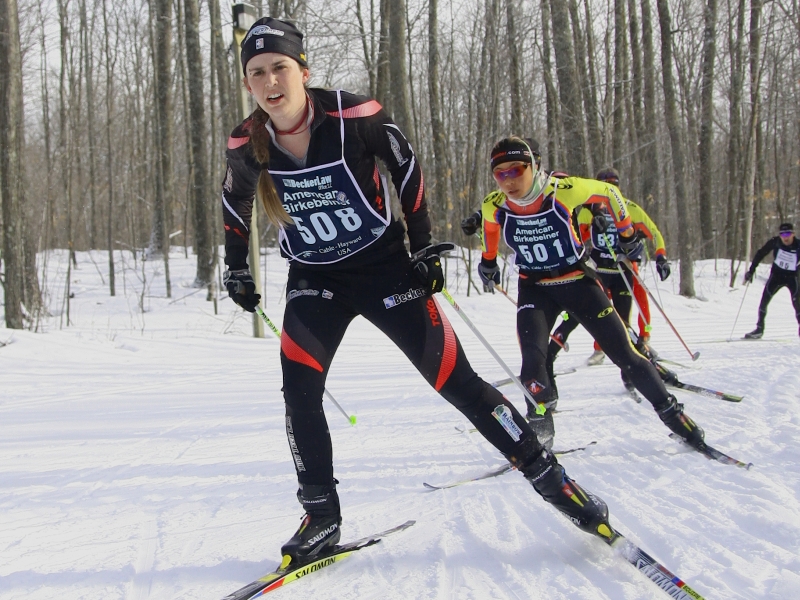
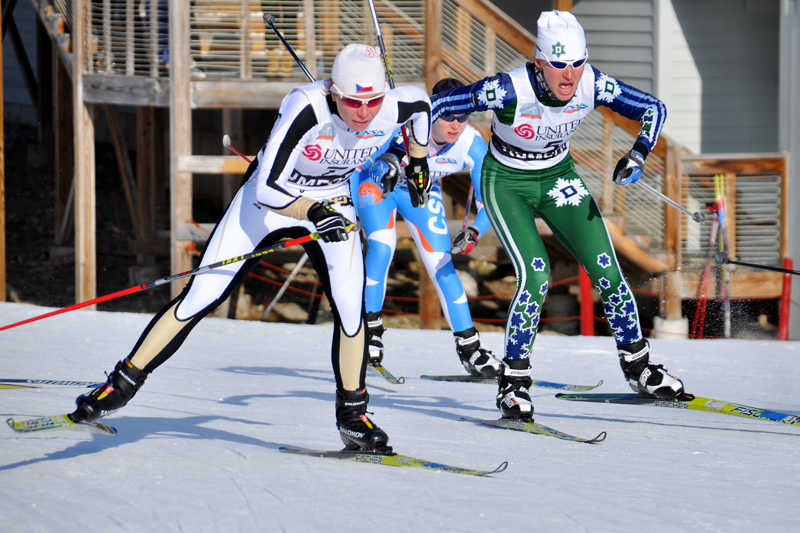
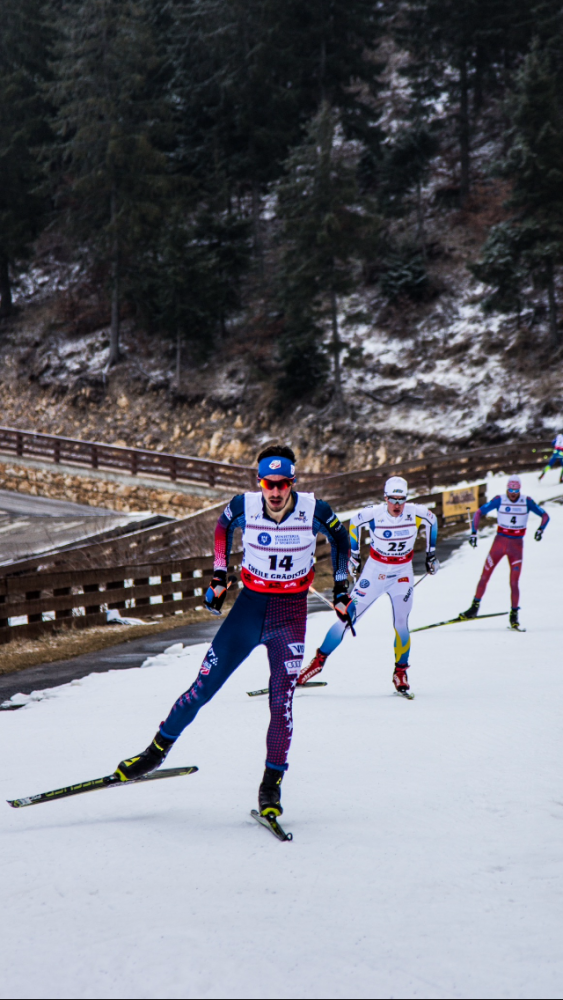
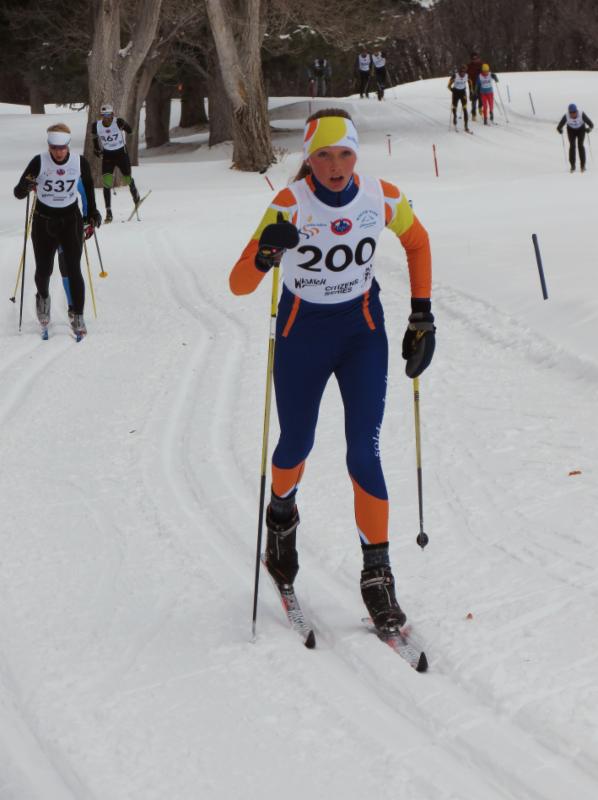
Author Kristina Owen races in the 2009 American Birkebeiner ahead of Evelyn Dong.
The following article was originally published on FasterSkier on October 15, 2008. It was written by CXC (Central Cross Country Skiing) athletes Kristina Owen and Heather Zimmerman. Roughly contemporary photos have been added for this reprinting; the pictures that originally appeared with this article are no longer available.
The piece is simultaneously from very much another era, yet also completely timeless. On the one hand, “Caitlin Compton” now has a different last name; Jessie Diggins, who had recently turned 17, would go on to do things even more impressive than win the junior division of the Climb to the Castle rollerski race; the article’s authors last competed in FIS races in 2011 (Owen) and 2009 (Zimmerman). On the other hand, in October 2008 skiers enjoyed the fall foliage, did hard doublepole efforts, and benefited from having athletes from multiple clubs together in one place for head-to-head competition. A quick perusal of social media shows that New England fall colors are still a thing, and that athletes from multiple clubs (including that obscure junior, Jessie Diggins) still come together in Lake Placid for fall training. 13 years later, some seasonal rhythms of American skiing remain very much the same.
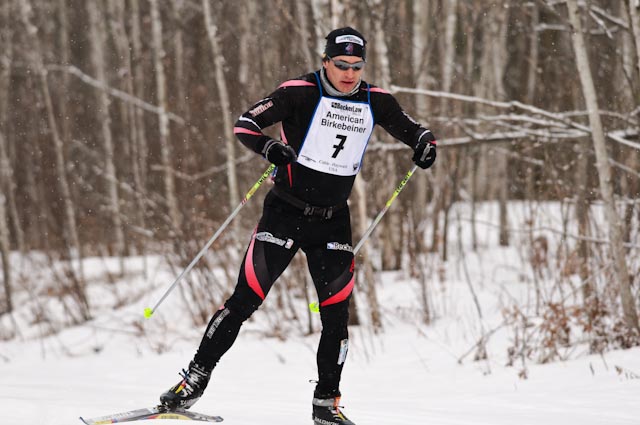
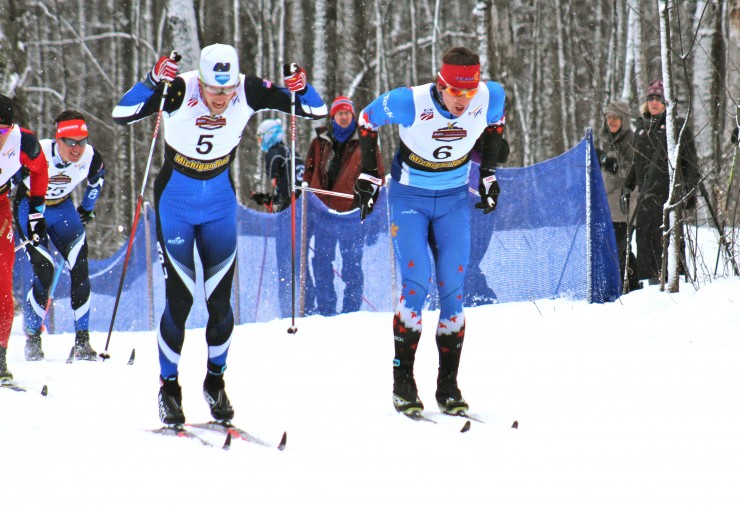
Matt Liebsch coming up the final hill on his way to victory in the 2009 American Birkebeiner.
CXC Elite Team – Lake Placid Training Camp Report
The CXC Elite Team recently completed a two week monthly camp in Lake Placid, NY. We stayed and trained at the Olympic Training Center, which provided an ideal environment to make huge gains in both fitness and technique.
The weather was excellent for the first couple days: chilly, but clear skies. “The only problem with the weather was that is was cool enough that none of the boys took off their shirts,” Caitlin Compton mentioned with a smile. After a few days of such perfect training weather, the team’s luck broke and it started raining; beautiful miserable cold rain. The training continued as planned, but between workouts the hallways were filled with the smells of damp and drying athletic apparel.
One of the team’s favorite workouts at this annual camp is an over-distance run in Adirondack Park. We are able to take advantage of great trails up mountains with gorgeous panoramic views. This year the men’s team made it to the summit of Mt. Colden, but disaster struck on the way down. Matt Liebsch, Midwest born and bred, was unused to the speed on the steep rocky descent. He went down hard with a nasty ankle sprain. His teammates carried him out, but the injury was camp ending and he returned to the Midwest for recovery.
Leaves in the Lake Placid region were in their peak foliage and so was the CXC Elite Team’s performance during the second week. The highlight came at the culmination of the camp, with the Whiteface rollerski race. However, there was a lot of work to be done, both intensity and volume, before the race arrived.
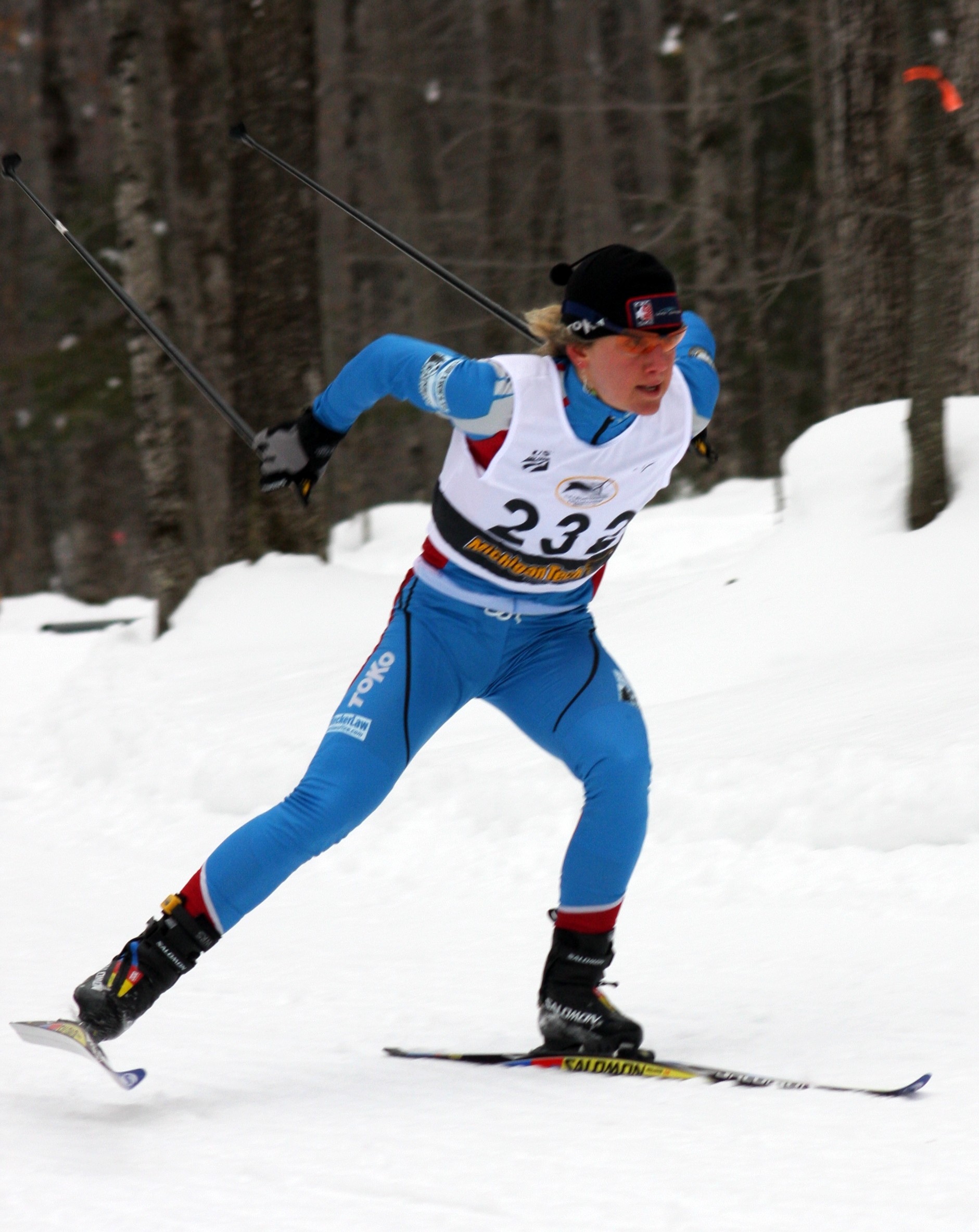
Caitlin Compton sprinting at US Nationals in 2008 in Houghton, Michigan.
The workload wasn’t the only thing increasing during the second week of camp. The Olympic Training Center was overtaken by Nordic athletes. CXC Elite was joined by their Junior Development Program athletes and coaches, as well as the Sun Valley team, the USST, various NENSA athletes, and some of the region’s collegiate racers. CXC Elite Team was able to frequently take advantage of the large athlete gathering, as all the groups came together for some of the workouts. The best example of this was a hard double pole workout up a long gradual hill. The men did two sets of 3×4 minutes, with a ten minute break between sets, while the women concentrated their efforts to 3 1/2 minutes. It was a great workout and the added numbers definitely helped in ramping up the intensity!
The camp was also notably included the first competition of the year between CXC and their friendly rivals, Sun Valley. Last year Sun Valley pulled out a narrow victory in overall points. This year CXC was off to a good lead, with a win in an inter-team soccer match. The competition was fierce, but CXC’s greater numbers this year gave them the edge to pull off the victory.
CXC Team continued to utilize the hilly terrain in the area, traveling to Whiteface Mountain for a ski walking workout on the lower trails. Some of the team returned to the mountain later in the week for an evening hike, lured in by the fresh snow that covered the top.
Our second week contained not only some good intensity efforts but also a lot of volume. By Sunday most of the team had completed at least three ODs. All the mileage made us feel as though we had really gotten to know the Lake Placid area!
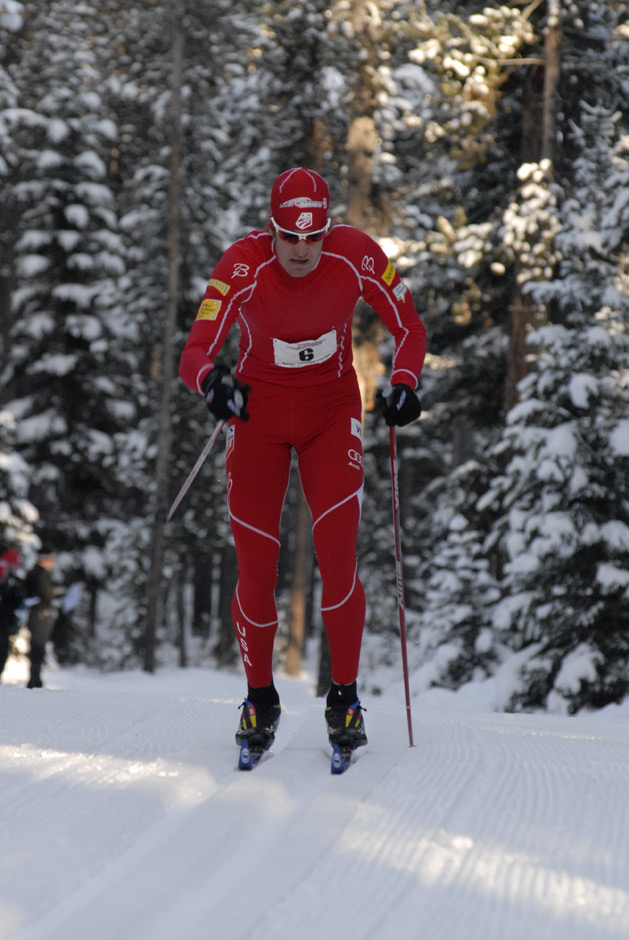
Garrott Kuzzy (CXC Team Vertical Limit/US Ski Team) races the sprint in West Yellowstone, November 2009. (Photo: Win Goodbody)
The camp ended with a grand finale, the Whiteface Mountain rollerski race! After testing ourselves on the area’s hills for the previous two weeks, what better way to finish up than a five mile, steep uphill race. Of coarse, mother nature decided to throw a few additional hurdles in our path before we began. The top of the toll road was too icy for skiing so the race was moved slightly down the hill. However, despite the alterations, the course still proved to be plenty challenging! Despite being tired, CXC athletes turned in some impressive results. Caitlin Compton led the way, winning the women’s race. CXC Junior Devo Program Jessie Diggins had a very impressive showing as well, placing 5th overall and winning the junior category. On the men’s side Garrott Kuzzy led the charge with a notable 4th place finish, followed closely by Brian Gregg in 6th.
Sufficiently exhausted by this final effort the team departed Lake Placid. This was the team’s final two week dryland training camp. Athletes will now have the next four weeks at home before leaving for West Yellowstone, early snow, and the beginning of the Supertour circuit!
In early July, the American Birkebeiner Ski Foundation announced the launch of the Team Birkie professional racing team. The elite post-graduate training group would pull from the three primary midwestern clubs, the Loppet Foundation, Central Cross Country Skiing (or CXC), and the American Birkebeiner Ski Foundation. While the midwest has a strong culture of cross country skiing with a breadth of strong youth and masters racing teams, it has been nearly a decade since the area has had a consistent robust training group that could support athletes at the elite level. In their words, this program fills this gap to allow “the next Jessie Diggins [to] stay home to train, inspire future generations, and win Olympic medals.”
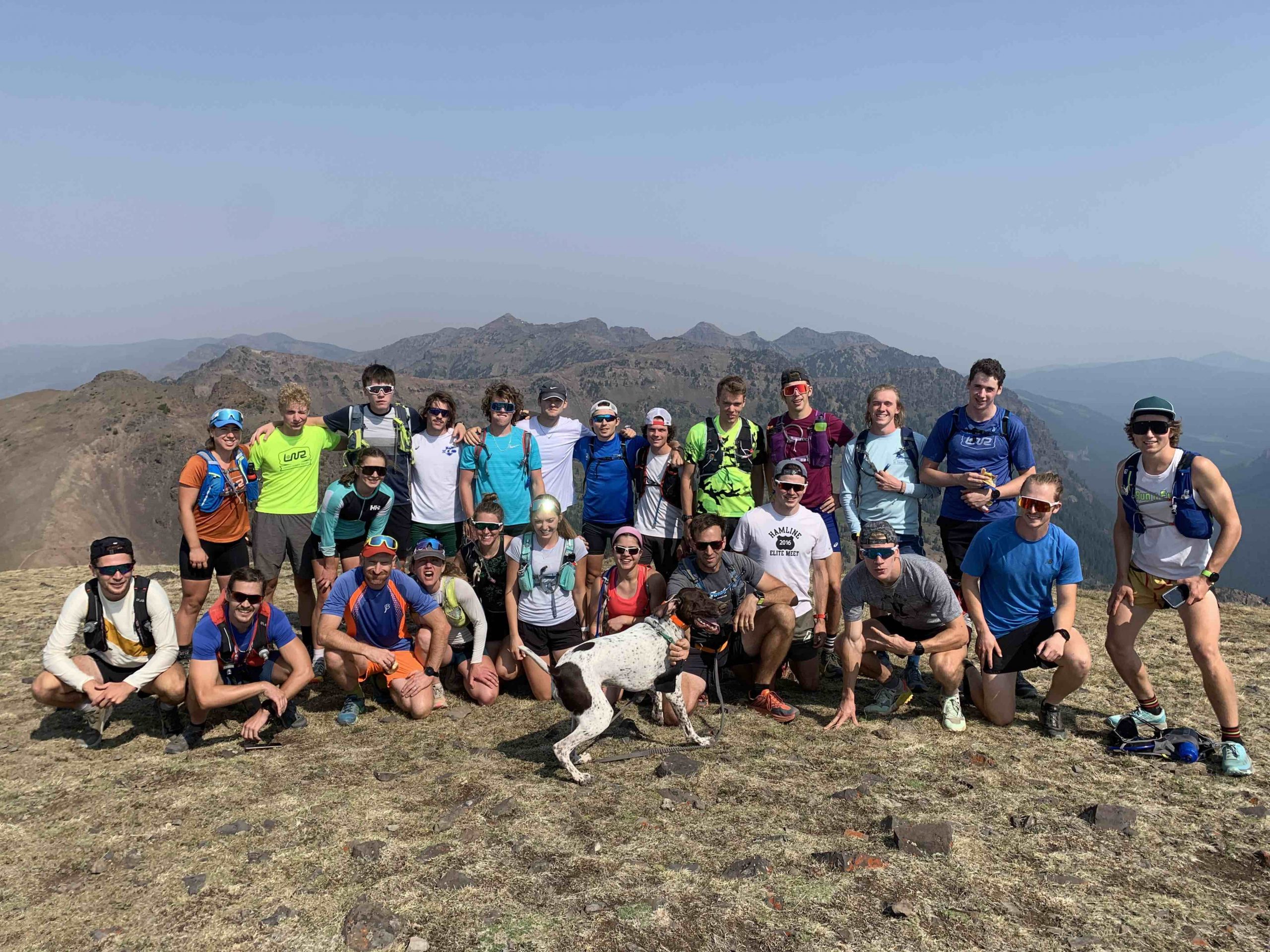
Team Birkie elite and collegiate athletes enjoys the hazy summit of Hyalite Peak during a training camp in Bozeman, MT. (Courtesy photo)
Team Birkie will be based from the Trailhead at Wirth Park in Minneapolis, headquarters of The Loppet Foundation, and led by Head Coach Caitlin Gregg, who will coach alongside co-coaches Leo Hipp and Jeremy Hecker.
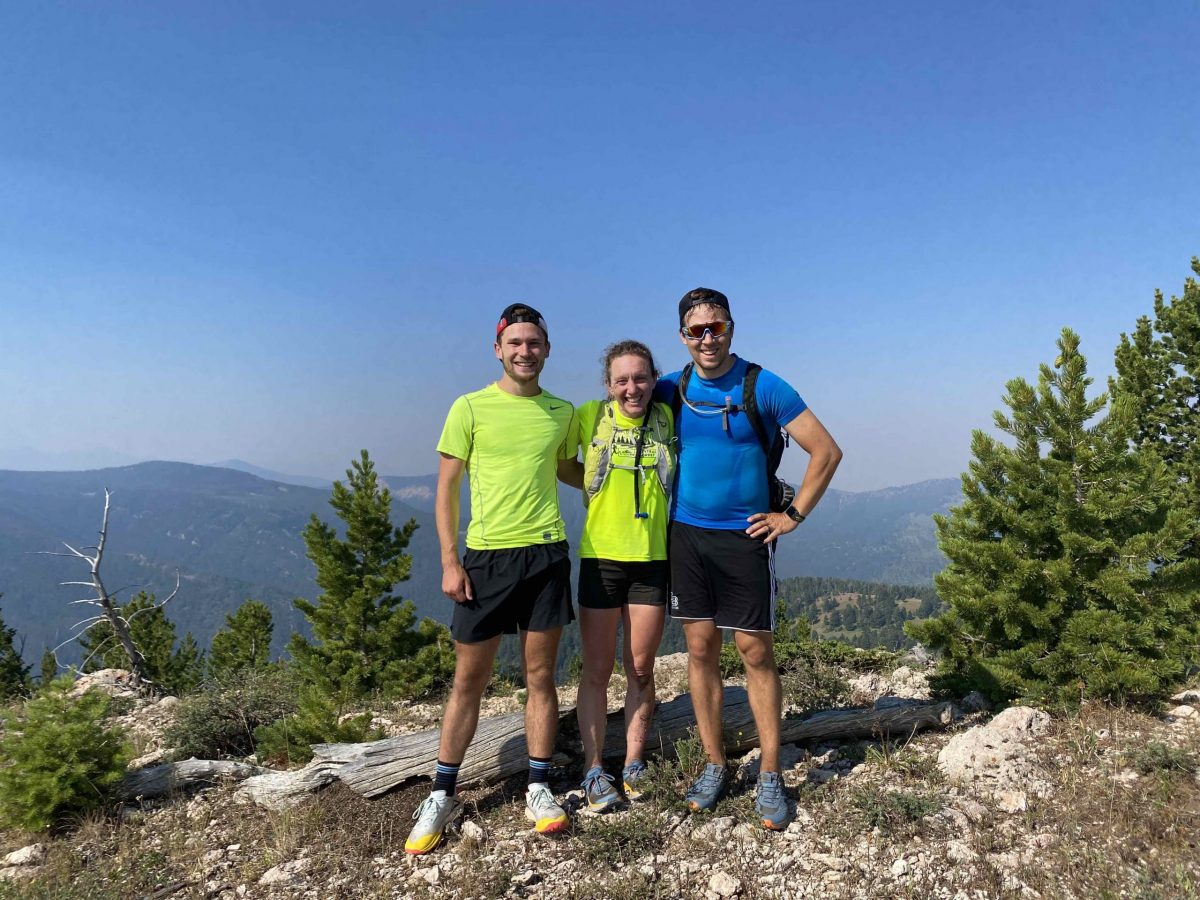
Team Birkie Coaching Squad: from left to right, Leo Hipp, Caitlin Gregg, and Jeremy Hecker. (Courtesy photo)
Gregg has spent her own career training in the area alongside her husband and fellow professional ski racer Brian Gregg. The duo — known as Team Gregg — forged their own path to the upper echelon of the domestic and international cross country race scene, gaining experience in writing their own training and supporting their careers along the way. [Find Team Gregg on a 2017 episode of Nordic Nation here.]
For those unfamiliar with Caitlin, her resume spans more than a decade of elite level ski racing; Caitlin earned her first World Cup starts in Vancouver in 2009 and was slated to start at the Minneapolis World Cup and Canmore World Cup finals in March 2020 before they were cancelled because of the impending pandemic. Those recent starts would have been just over a year after the birth of her daughter, Heidi, who is now two and a half years old and can regularly be found tagging along for her parents training.
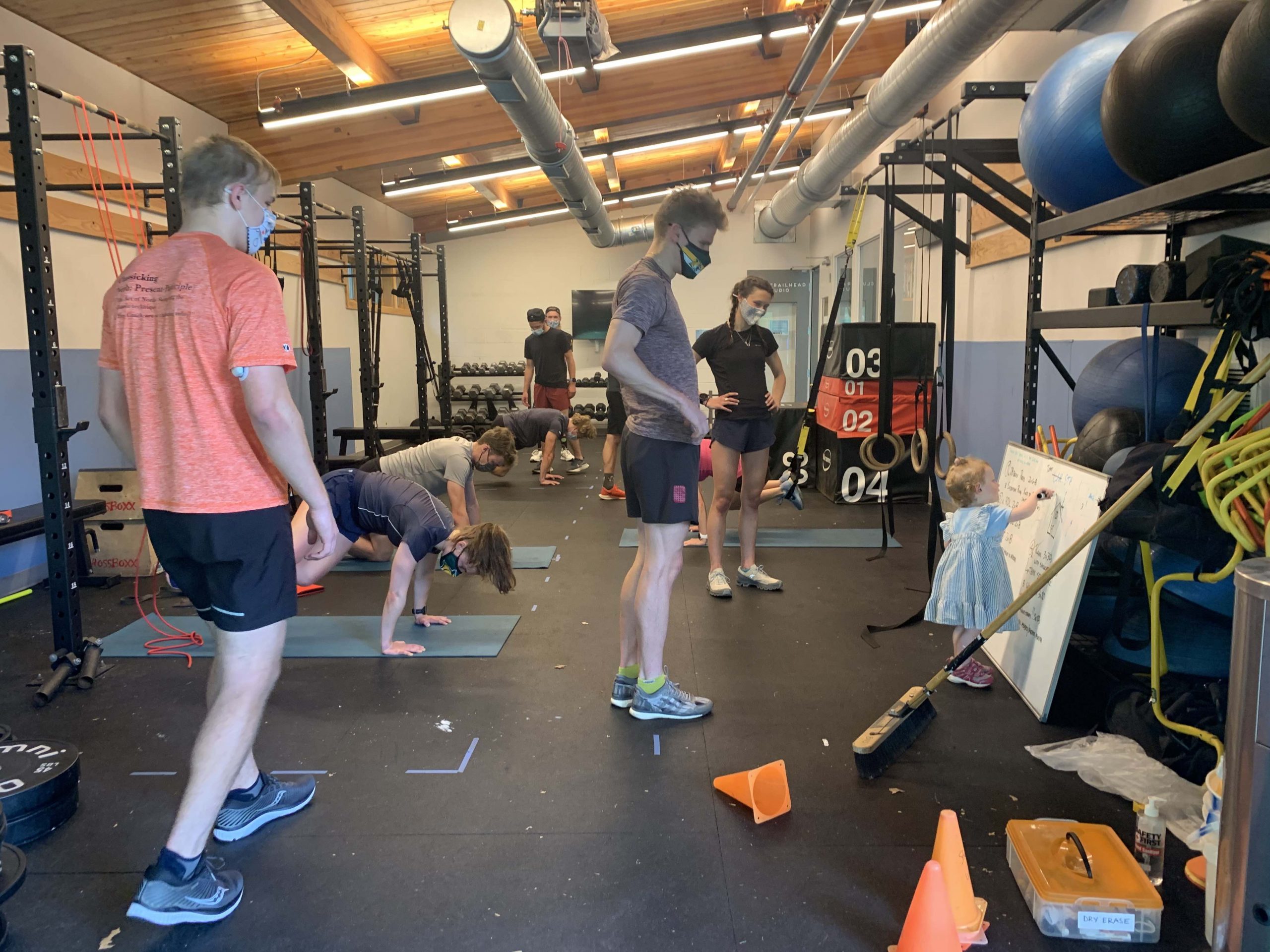
Team Birkie mini-coach Heidi Gregg writes the prescription during a strength session. (Courtesy photo)
Caitlin is a 2015 World Championship Bronze Medalist, a 2010 Olympian, and a 5 time winner of the American Birkie. She was also a member of five World Championship teams and won eight National Championship titles, with several more podium finishes. Gregg is also no stranger to disappointment; there have also been near misses for team selection, as was the case for the 2014 Olympics in Sochi and when the 2016 US Ski team nominations rolled out.
While she does not yet consider herself retired as an athlete, this transition to leading the charge and growing Team Birkie does mark a shift in the focus of her overall ski career, as we discuss in this conversation. Caitlin also speaks to the evolution of the concept behind Team Birkie and the structure of the training group for the upcoming season. She is now one of only two female coaches at her level in the US — alongside Pepa Miloucheva of the Craftsbury Green Racing Project — and the only mother. Caitlin discusses the support this requires, and how her career as a whole has provided ample insights that allow her to be a role model for her athletes.
You can find Caitlin on Instagram @Caitlincgregg (with two G’s) and follow along with Team Birkie at @teambirkie. Thanks for listening.
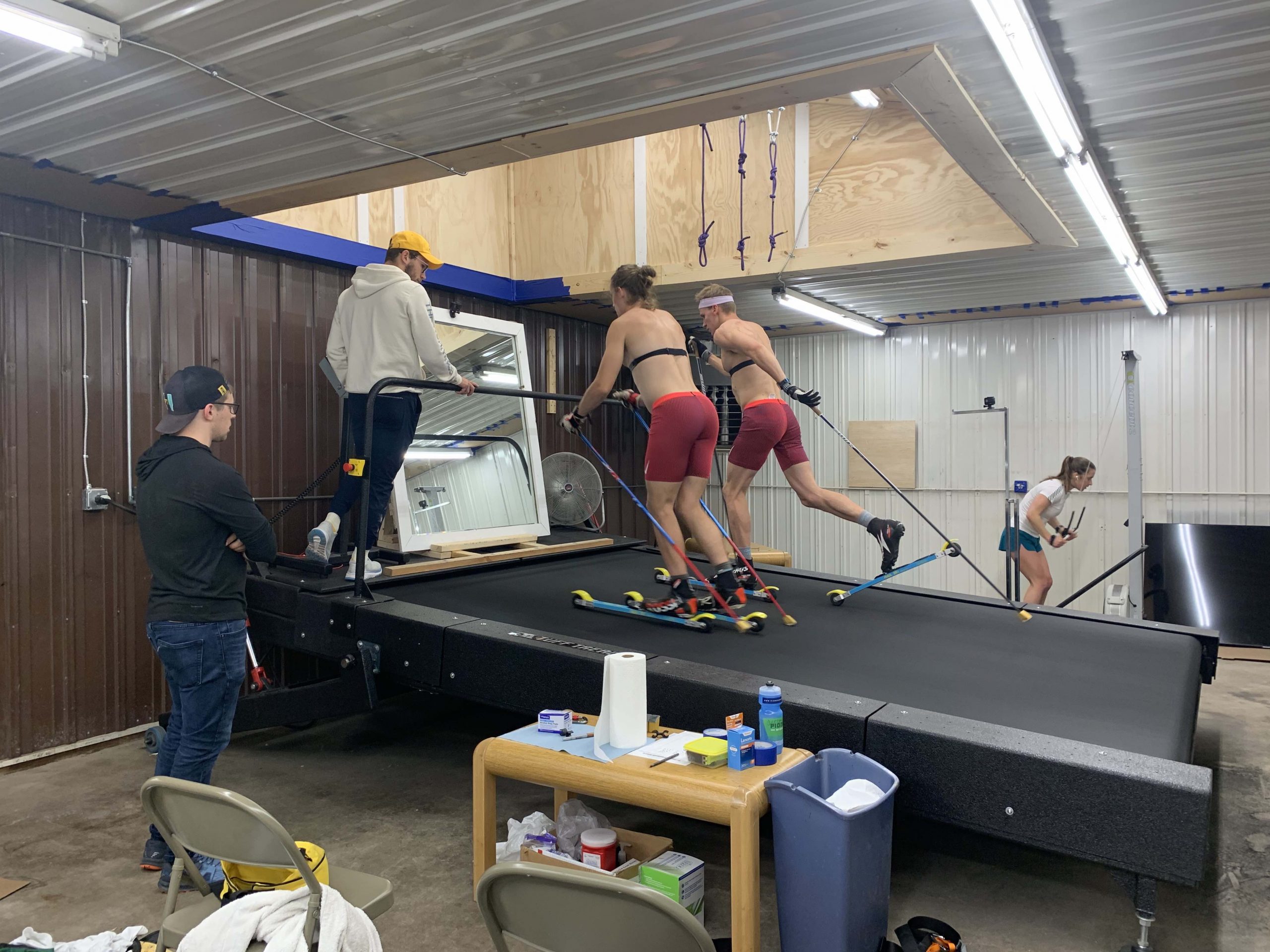
Team Birkie athletes Zak Ketterson (R) and Xavier Mansfield (L) share the rollerski treadmill, while coaches Leo Hipp and Jeremy Hecker provide feedback. (Courtesy photo)
Kyle Bratrud (c) after winning the men’s 15-kilometer classic race on Thursday at U.S. nationals in Craftsbury, Vt. Second place finisher Adam Martin (l) and third place finisher Kris Freeman. (Photo: John Lazenby)
If there’s one skier on the U.S. domestic circuit who knows how to time his wins, it’s Kyle Bratrud. The 25 year old now has three U.S. Cross Country Championship titles to his name–his most recent coming on Thursday in the men’s 15-kilometer classic race in Craftsbury, Vt–with all of these wins simultaneously falling on Championship years.
In 2015, while still a senior at Northern Michigan University, he earned his first national title by winning the men’s 15 k freestyle in Houghton, Michigan. Thanks to that performance, he went on to qualify and compete at the World Champs held in Falun, Sweden later that season.
Two years later, as a member of Central Cross Country’s (CXC) Elite Team, he earned his second U.S. nationals victory, taking the men’s 15 k skate race on the Soldier Hollow trails in Midway, Utah. A little more than a month after that win, he competed at the 2017 World Champs in Lahti, Finland.
With starts for the 2019 World Champs in Seefeld, Austria on the line for competitors at this years U.S. nationals, Bratrud once again appears to be on the right track for qualifying after his win on Thursday.
The most notable changes for the Minnesota native this season has been his switch to the Stratton Mountain School and its SMS T2 group from CXC.
“It is always an upgrade when you train with Olympians, [an] Olympic Gold medalist,” Bratrud said during an in-person interview after the race, the Olympic Gold Medalist he referenced being Jessie Diggins, whose club team is SMS T2.
“It has been great and living out East, the roller skiing is great, the running is great, and working with coach Pat I think it was making a difference,” he added.
Patrick O’Brien has been the SMS T2 head coach for the past five years, working with the likes of Andy Newell, Sophie Caldwell, Simi Hamilton, and Jessie Diggins.
Both of Bratrud’s national titles prior to Thursday were in the freestyle discipline. His most recent victory in the classical discipline came a little more than four weeks ago in the Sovereign Lake NorAm 15 k classic race.
“SilverStar was my first SuperTour classic victory so I am turning into a classic specialist these days,” Bratrud said.
Bratrud has a number of FIS regulated classic race wins. He won Thursday’s race in a time of 41:41.8, the next closest finisher being Adam Martin, who finished in a time of 42:12.8 for second place.
“I didn’t get a lot of splits on the first lap, but second and third laps I was getting consistent splits some were a little confusing,” Bratrud said. “But I was getting consistent splits that I was twenty seconds up. I know I had to keep the hammer down because that can disappear pretty quick on a course like this. It was certainly encouraging to get leader splits. I just tried to finish as hard as I could.”
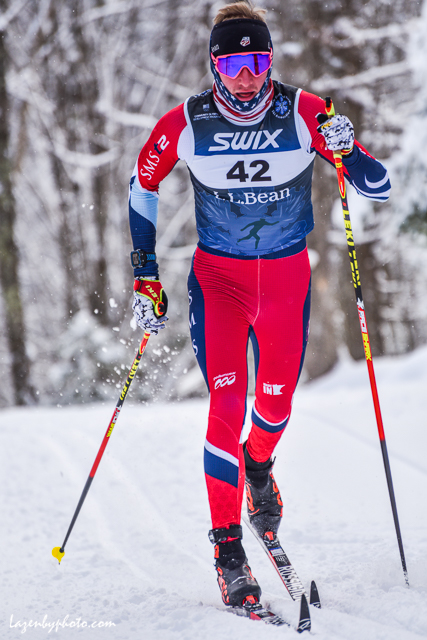
Kyle Bratrud racing to a win in the men’s 15-kilometer classic race on Thursday at U.S. nationals in Craftsbury, Vt. (Photo: John Lazenby)
For Martin, who trains with the Craftsbury Green Racing Project, the podium is his third at a Championships event. He placed third at the 2016 U.S. nationals 15 k classic in Houghton and second in last year’s Spring Series 50 k.
“The course is awesome I am psyched to be racing at home in Craftsbury,” the 24-year-old Martin told FasterSkier during an in-person interview. “I know how much work our groomers did, all the volunteers, to get snow on this course and put this race on. So I am really psyched to be here.”
The slower conditions on Thursday were no hindrance to the Wausau, Wisconsin native.
“We got three or four inches of snow overnight which whitened everything up and slowed things down a bit so I was super happy about that,” Martin said. “For me this course is pretty flat and fast for the first 3 k and then it is hard at the end. So I had to try pretty hard to go fast at the beginning.”
Rounding out the podium in third place on Thursday was four time Olympian, Kris Freeman. The 38 year old formally announced his retirement earlier this spring, though still poses a threat to anyone looking to land in the top three. He completed the 15 k in a time of 42:27.6 for third.
“Race went really well,” Freeman told FasterSkier during an in-person interview. “I felt good I had good energy and as always Caldwell Sport gave me great skis so it was fun.”
“I went out pretty conservatively and Akeo Maifeld-Carucci was my 15-second man and when I caught him I was definitely a little faster than him but not that much.” Freeman continued. “I decided to work with him for the second lap and that really saved a little bit for me in the last lap, I had something left in the legs. I moved up over the ranking over the last few K.”
Rounding out the top ten on Thursday in Craftsbury was Canada’s Evan Palmer-Charette in fourth (42:33.6), David Norris in fifth (42:37.0), Scott Patterson in sixth (42:41.2), Gus Schumacher in seventh (42:47.1), Zak Ketterson in eighth (42:57.5) and Akeo Maifeld-Carucci and Andy Newell tied for ninth (43:12.0).
Martin Benes, who has coached at Sugar Bowl Academy for the last seven years, was recently hired as head coach of U.S. Paralympics Nordic. (Photo: U.S. Paralympics)
(Note: This article has been updated to include the hiring of Miles Havlick as the University of Utah’s head nordic coach, which was announced Monday afternoon.)
There have been several notable career changes in North American nordic skiing this summer. Here’s a quick look at who moved where:
Robert Lazzaroni, the nordic director at U.S. Ski & Snowboard, will soon begin his new role as Salomon’s nordic regional commercial manager for the Americas. (Photo: Salomon)
Robert Lazzaroni:from U.S. Ski & Snowboard to Salomon. Last week, Salomon announced via a press release that Lazzaroni, of Park City, Utah, will join its staff as nordic regional commercial manager for the Americas, starting Aug. 27. For the last three years, Lazzaroni served as nordic director at U.S. Ski & Snowboard in Park City. Before that, he was program manager at Utah Olympic Park, and before that, a nordic division manager for Rossignol and later One Way Sport. Asked about his new job at Salomon, Lazzaroni told FasterSkier he’d be willing to talk more in depth after he starts. Until then, he’s still employed at U.S. Ski & Snowboard.
According to U.S. Ski & Snowboard’s Chief of Sport Luke Bodensteiner, many of Lazzaroni’s duties as nordic manager “have been or will be distributed across existing staff, and we’re taking the opportunity to re-align our staffing positions to make sure that we have an efficient structure that supports our priorities of athlete development, coach education, and strong domestic competition,” he wrote in an email to FasterSkier. “This will likely require hiring an additional position, but the nature of that job is TBD based upon where we determine that we need the human resource to support those priorities.” Bodensteiner expected to know more about the shift in staff responsibilities later this month.
Martin Benes:from Sugar Bowl Academy to U.S. Paralympics Nordic. Also last week, the U.S. Olympic Committee announced the hiring of Martin Benes as its new head coach of U.S. Paralympics Nordic Skiing. He replaces Eileen Carey, who was promoted to program director following the departure of John Farra (to USA Triathlon) this spring. Benes began coaching as an assistant ski coach at Bates College, then spent the last seven years as head nordic coach and director at the Sugar Bowl Academy near Truckee, California, according to his LinkedIn profile. As head coach of the U.S. Paralympics program, he will “lead the development of annual and seasonal training plans for the national team, track athlete performances, workout data, sport science data and annual progress reports, contribute to the U.S. Paralympics athlete identification and development strategy, and assist in planning travel and logistics for the Nordic skiing program to competitions, camps and events,” according to the press release.
“It’s an incredibly exciting time to join the program following such a successful performance in front of the world at the Paralympic Winter Games PyeongChang 2018,” Benes stated in the press release. “I’m eager to get started in my role so we can continue to strengthen the program and win medals on the international stage.” He’s set to begin on Aug. 20.
Fredrik Landstedt:from the University of New Mexico to the University of Utah. Late last month, the University of Utah announced it had found a new director of skiing to replace Kevin Sweeney. Landstedt had been a staple on the University of New Mexico (UNM) Ski Team for the last 21 years, spending the last 11 years as head coach of both the nordic and alpine programs (and 10 years before that as head nordic coach). His decision to take the job at Utah came less than 24 hours after the UNM Board of regents unanimously approved a proposal to eliminate four sports starting in the 2019/2020 season, according to the Albuquerque Journal. Those sports are men’s and women’s skiing, men’s soccer, and women’s beach volleyball. The proposal would also significantly impact funding for cross country and men’s track and eliminate the women’s diving program. In the meantime, UNM announced assistant coach Joe Downing will assume the role of interim head skiing coach.
“I am honored to have the opportunity to lead a program with such a rich history,” Landstedt stated in the Utah press release. “Utah has a strong winning tradition and the support that the University provides its ski team is incredible. I look forward to bringing NCAA titles back to Utah!”
Miles Havlick in November 2015 in West Yellowstone, Montana.
Also at the University of Utah, Miles Havlick: new head nordic coach. In a press release on Monday, the university announced that Havlick, one of its former skiers and a two-time NCAA champion (2012 and 2013), was hired to head up its nordic team for the coming season. Havlick, 28, skied for the the Sun Valley Ski Education Foundation Gold Team after college and won the 42-kilometer Australian Hoppet Worldloppet last August. He delved into coaching last summer in Australia with the Birkebeiner Nordic Ski Club and Victorian Junior cross-country ski team, and last winter, was an assistant coach and wax technician for the Australian junior national team at Junior World Championships. Havlick also waxed for the Australian national team last March in China. He has also assisted the Utes ski team, most recently as an assistant coach at 2018 NCAA Championships.
Eliška Hájek Albrigtsen:from Central Cross Country to the University of Alaska Fairbanks. After spending the last year filling multiple roles with Central Cross Country (CXC) out of Madison, Wisconsin (including CXC Team head coach and junior development coach), Albrigtsen has accepted an assistant-coaching position with the University of Alaska Fairbanks Ski Team, replacing Josh Eide. Albrigtsen was a four-time All-American skier for the University of Colorado Boulder and an NCAA champion in 2011.
Cross Country Canada seeks senior national team coach: Two days ago, the CCC headquarters in Canmore, Alberta, put out an announcement for applications for a full-time senior national team coach. The position indicated it requires both domestic and international travel. “Reporting to the HPD [high-performance director], the Senior National Team Head Coach (NST Head Coach) is responsible for leading the technical delivery and alignment of Senior National Ski Team (Senior NST) programs in order to achieve podium performances at Olympic Games and FIS World Championships,” the job description stated. “The NST Head Coach will have the responsibility to plan, coordinate and monitor the training and competition of NST athletes in line with CCC’s collective goals.” CCC’s senior team includes 10 athletes, five of which are on the World Cup Team. The other five are on the U25 (under-25) Team. View the job posting here.
Eliška Hájek Albrigtsen (formerly Hájková, front right) with Madison Nordic Ski Club’s Trail Kids this summer.(Photo: Tobias Hájek Albrigtsen)
Many mornings, Eliška Hájek Albrigtsen’s husband, Tobias Albrigtsen, has to peel her out of bed. Living the life of an early bird like her spouse is nowhere near the top of her list — partly because she spends most nights prodding her hubby awake as he finishes his work, partly because she is strung out between four jobs of her own.
Being in charge of three ski programs while assisting a fourth is not where the 29 year old envisioned herself when she moved to Madison, Wisconsin, this past June to work for Central Cross Country (CXC). But a lot can change over the course of a summer and for Albrigtsen (formerly Hájková), a lot did.
After relocating to the Badger State’s capital from Lake Tahoe, California, to serve as CXC’s Community Olympic Development Director, Albrigtsen’s responsibilities began to accrue.
It started with the addition of coaching CXC’s online master’s program. Then she had an interest in helping with CXC’s Paralympic and adaptive athletes. Finally, in late August, Andy Keller left his head-coaching position with the CXC Team to join Northern Michigan University (NMU) as an assistant coach, and Albrigtsen was in a prime spot to take over the reins.
“When Andy took the assistant coaching job at NMU, it was kind of natural that I got the CXC Team head coach position,” Albrigtsen, a Czech Republic native, said during a recent phone interview. “For me, it’s not like a big promotion, it’s just more stuff to do while I still do all the stuff I was doing before. I have a lot of responsibilities all of a sudden that I didn’t start with.”
Among those responsibilities, she has been busy making informative videos for CXC Academy under the job title of Community Olympic Development Coach.
While attending the University of Colorado-Boulder (CU), she finished in the top 10 of 45 out of 48 races over the course of her college career, according to a CU press release, all while maintaining above a 3.5 grade-point average.
Eliska Hajkova (CU), racing against Sophie Caldwell (Dartmouth) and Corey Stock (CSU) during a sprint semifinal in 2012. Hajkova graduated in 2013 and after marrying, changed her last name to Hájek Albrigtsen. (Photo: James Doucett)
After three seasons coaching the BNJRT in Colorado, Albrigtsen moved to Kings Beach at the north end of Lake Tahoe last year, where the juggling act continued. There, she served as the head coach for Tahoe XC, while also volunteering with the Auburn Ski Club’s elite athletes, taught private ski lessons for Tahoe Donner, coached an online master’s program, and once again raced U.S. nationals, placing 12th in the 20 k classic mass start.
She’s also raced more than two dozen World Cups, most recently in 2014.
Though Albrigtsen indicates that she “never stops officially training or racing” this year might be a little different as it will be her first season coaching senior elite skiers. Still, the idea of more challenging practice sessions is enough to draw her in, even if it means scaling back her training a bit. As a coach she brings not only race experience, but the empathy and understanding of an athlete.
“With U14 kids, I mean, I was challenging them, but I was not getting challenged,” she reflected. “I think being challenged as a coach, being able to hang out with your athletes, you really see and you can really feel their pain. When you’re right on their butts and doing every exercise, you can see, ‘OK, I know that in the Level 4 on the fifth minute, during the sixth interval you died, so let’s figure that out.’ I think that’s one of my powers, that I can really be there when it’s happening.”
When asked of her strengths as a coach, CXC Executive Director Yuriy Gusev was quick to respond.
“Her racing experience, number one,” he said on the phone. “And [she’s] just very energetic and hardworking and organized.”
Albrigtsen will work with three CXC Team skiers this winter: Felicia Gesior, Kyle Bratrud and Sam Elfstrom. All three graduated from NMU, are currently based out of Marquette, Michigan, and will set their focus on the first few SuperTour races and U.S. nationals before re-evaluating their season goals. The fourth CXC Team member, Nichole Bathe (who graduated from the University of Alaska Fairbanks) remains on roster, but headed to Europe earlier this fall to train in Norway with a goal of making the 2018 Winter Olympic Games for Great Britain’s national team.
Until the first week of SuperTour racing in early December, the amount of time the other three CXC elite skiers and Albrigtsen work together will depend on the athletes. Albrigtsen wanted to keep the summer and fall schedule fairly flexible so her athletes would not feel restricted in the amount of paid work or fundraising they could accomplish while training for the upcoming season.
For example, Gesior made a trip to Madison earlier this fall for a training session on CXC’s rollerski treadmill with Albrigtsen, but will spend most the next few weeks training in Marquette and preparing for a fundraiser she’s organizing: the Bergkönig trail run on Nov. 11. The event features 10 k, 5 k and 1 k races and was originally created by Maria Stuber and Bryan Cook in an effort to raise money for local cross-country skiers looking to continue their ski careers post-college.
Gesior also works as a substitute teacher in Marquette, and most of her training this summer and fall has been with the NMU women’s team. Similarly, Bratrud and Elfstrom train with the NMU men’s team.
Felicia Geisor of the CXC Team prepares to hop on the treadmill in early September. (Courtesy photo)
“I think that’s OK that they follow [NMU],” Albrigtsen said, “That’s kind of the program that really took them where they are and they have something to top it. They don’t train like college skiers; I mean, it’s their job right now so they do train more. But the base is very similar and [NMU Head Coach] Sten [Fjeldheim] is being really nice about allowing them to train with them. Not all college coaches are that way, so we’re definitely really lucky.”
According to Gusev, partnerships like the one CXC has with NMU and other programs in the Midwest are the reason for CXC’s expansion. Over the last decade, he said CXC has grown from a $50,000-dollar organization to a million-dollar one.
“It’s all of those partnerships,” Gusev said of the CXC programs’ continued growth. “They’re incredible organizations so we’re able to work with all of them together and help them work together.”
The organization hopes to continue its expansion with the addition of a $12-million-dollar training complex just outside the Madison suburb of Middleton, Wisconsin, which is currently in the planning stages. The facility would not only include a competition venue, but snowmaking equipment, a lit rollerski loop, and 30,000-square-foot facility open for recreational use as well.
The idea behind the complex, Gusev indicated, would be to provide CXC athletes with a training venue, while simultaneously encouraging community members to get outside and active, using skiing as an example. The center already has one complex, the CXC Center of Excellence in Madison, complete with rollerski treadmill. “With the CXC Team, our number-one goal is to support the athletes that need the support. That’s as simple as that,” Gusev said. “But overall, our goal as an organization is to grow the sport at all levels.”
To Albrigtsen, the new facility is another reason Madison and CXC seemed like a good choice for her and her husband, Tobias, who is CXC’s media and communications coordinator, when moving from Tahoe to the Midwest. That, and the cost of living.
“We always talk about what can Midwest offer that other regions can’t. We don’t have the mountains, we don’t have the best winters, but what we really have is the best quality of life,” Albrigtsen said.
“You can live much cheaper here than anywhere else in U.S. and still make somewhat good money,” she continued. “Not everybody, especially in the U.S., there’s maybe 10-15 people who can do this professionally and get paid being skiers, otherwise you have to work and that’s something Midwest does have to offer. You can have a normal life and be a skier. You can do it here.”
While Albrigtsen’s “normal life” is somewhat busier than others might prefer, she is in no way deterred.
“I am a total sport addict, and I think every coach has to be, otherwise it’s not really worth it,” she said. “Tobias and I, we’re just trying to do what we love and give something back.”
Give something back, and get a little training in at the same time, even if it’s in between her multiple jobs.
“My motivation is also to fit in my jeans, wearing tight dresses,” Albrigtsen added with a laugh. “I have a five-year-younger husband so I have to take care of myself.”
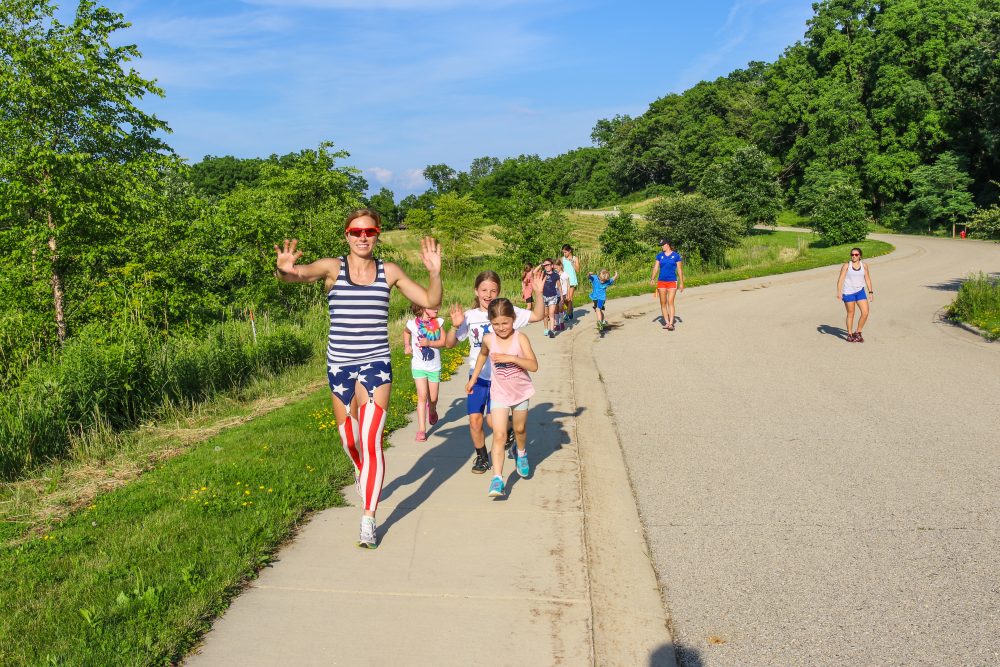
Eliska Hájek Albrigtsen (formerly Hajkova) leading a Fourth of July run with Madison Nordic Ski Club’s Trail Kids this summer. (Photo: Tobias Albrigtsen)
Central Cross Country (CXC) junior development skier Siri Martin (r) gets a mid-summer VO2max test on the rollerski treadmill at CXC’s Center of Excellence in Madison, Wis., in late July (Photo: CXC Facebook)
A glance into any one of the glass windows lining the east side of Central Cross Country (CXC) Academy’s Center of Excellence building might give the impression of the average athlete gym. But if you step across the front threshold or take a peek at the academy’s 360-degree virtual online tour and sport science page, you’ll find much more than treadmills, stationary bikes and medicine balls.
Located in Madison, Wis., the CXC Center of Excellence also houses a 10-by-12-foot rollerski treadmill, SkiErgs, and an in-house-made, power-pole machine. For many, though, equipment is not the most powerful tool in the center. Rather, it’s the center’s capacity to evaluate and educate its members and non-members alike about nordic skiing.
Currently, the Center of Excellence offers performance evaluations, as well as fitness testing for lactate and VO2max using the oversized treadmill. Recorded and individualized technique coaching sessions on the rollerski treadmill are also available for those willing to pay $150 dollars per hour. To help athletes gain a better understanding of their body within sport, the center is also presently working on developing a biomechanical analysis software.
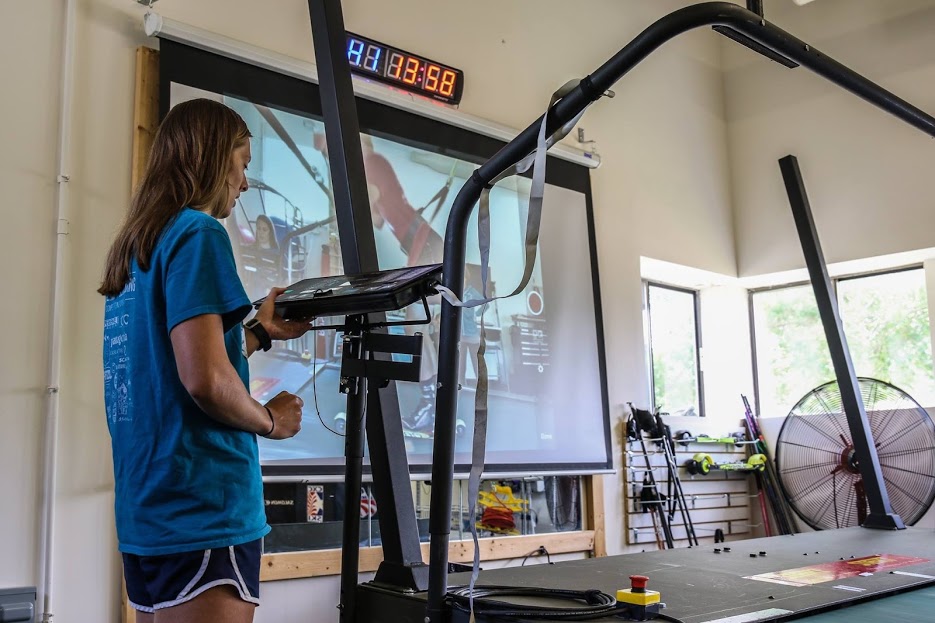
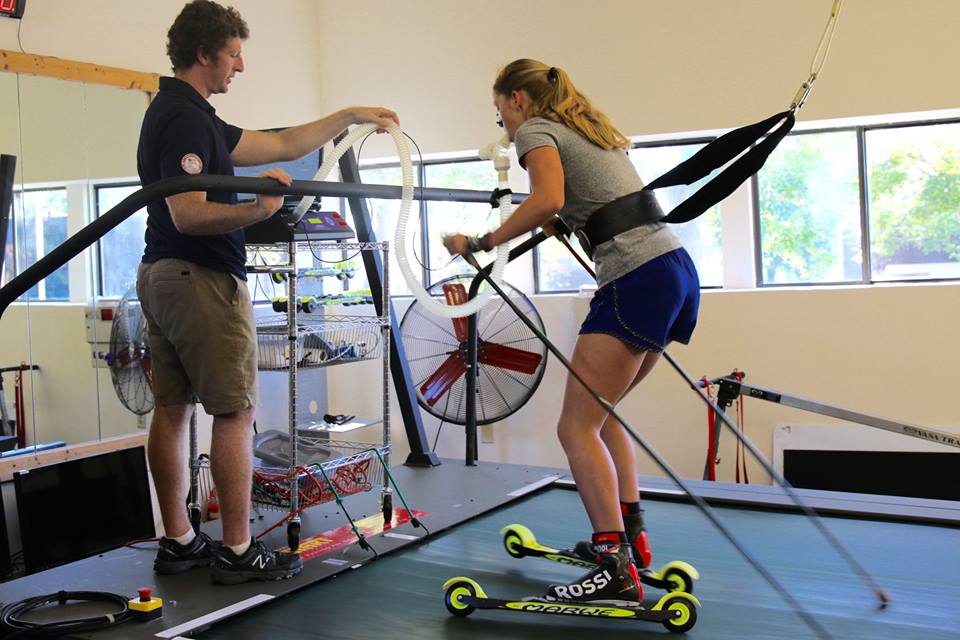
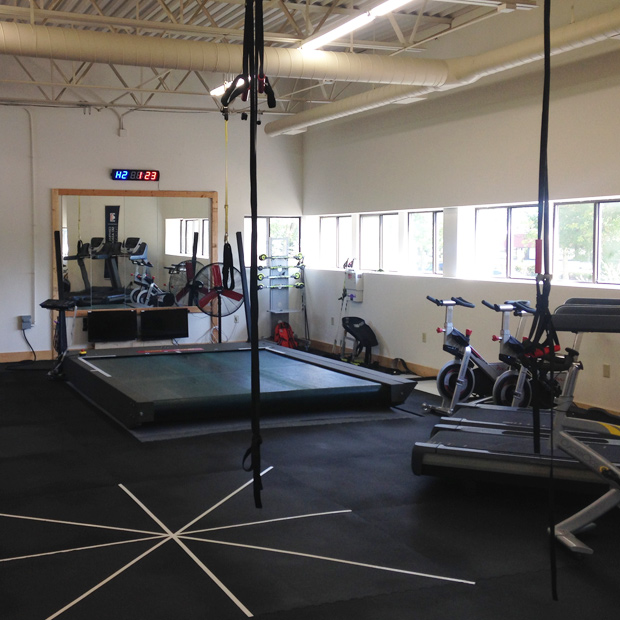
The rollerski treadmill at the CXC Academy Center of Excellence (Photo: cxcacademy.com)
And CXC recently hired a sport development and education director, Egor Akimov, CXC head coach Andy Keller explained on the phone.
“He’s got a bachelor’s and PhD from the Russian State University in physical education and sport, so he majored in human physiology, he’s competed over in Russia and then he served on the Moscow Center of advanced sports technology as the head of the science department,” Keller said. “So he’s done a lot of research over in Russia on the biomechanics and stuff like that. He’s kind of leading our center [in Madison], doing a lot of the sessions down there and the technique work.”
According to the CXC Executive and Athletic Director Yuriy Gusev, the Center of Excellence is approximately 90 percent complete. Anyone from CXC club members, to donors, to CXC team members, and the general public, can access the center at no cost. Rollerski treadmill evaluations cost CXC clubs $250 per day, $150 per hour for all others.
“We are finalizing a few more partnerships on the sports science program and equipment but will start performing studies in cross country skiing this coming fall,” Gusev wrote in an email. “Our goal is to have top sports science facility to study latest innovations in the sport, potential application in cross country skiing to improve training, recovery and performance.”
While the CXC elite team, known as the CXC Team, uses the center for testing, its current base in Marquette, Mich. has also led the team to seek out other partnerships. This included collaborating with the Northern Michigan University (NMU) Olympic Training Site, allowing CXC Team members to use the school’s facility and other amenities.
CXC Team Head Coach Andy Keller (r) works on strength with Scott Harrison outside a barn near the team’s former home base in Cable, Wis., in 2014. The team is now based in Marquette, Mich. (Photo: CXC/Facebook)
“This year we moved up to Marquette partly because a lot of the athletes have come from Northern Michigan, but also because there’s quite a bit of opportunity up here,” Keller said. “We’ve kind of partnered up with the Olympic training site located here. So we’ve been able to use the dorms on campus, offer schooling, have a training room and weight facilities available. … [The move to Marquette] has given us a lot more freedom with athlete housing and training opportunities.”
At present, the CXC Team has three full-time athletes and two part-time collegiate skiers. Kyle Bratrud returned to the CXC elite team for his second year; new full-time members include Dartmouth graduate Oscar Friedman and NMU grad Felicia Gesior. Jan Ketterson, a Dartmouth student currently taking the fall and winter trimesters off to focus on skiing, plans to race for CXC along with Nicole Bathe, presently a student at University of Alaska Fairbanks.
The growing numbers on the CXC Team was one reason CXC also recently decided to nix its marathon team, Keller explained.
“That was kind of another thing with refocusing with the marathon team, just my role and what resources I can put out just being by myself,” Keller said. “The main reason why we [ended our marathon team] is we’re trying to make a big push to promote club development.”
By discontinuing the marathon team, CXC saw an opportunity for athletes to return to their home clubs and promote racing on a more local, community-based level.
“The athletes that were on our team last year, both our current athletes and our previous athletes that we don’t have on the team anymore, we encouraged them this upcoming year to be a part of the clubs in their local area,” Keller said. “From what I heard in talking to them, most will continue to race in some facet.”
Chris Pappathopoulos won the men’s overall CXC Marathon Cup last season while competing for the CXC marathon team. (Photo: CXC)
He added that the team’s reigning CXC Marathon Cup winner Chris Pappathopoulos would likely be supported by companies like Rossignol and Boulder Nordic Sport.
While former CXC marathon team members like Pappathopoulos will look to return to their local clubs, Keller looks to expand the CXC Team program and podium at U.S. nationals with the athletes he’s currently working with.
“For a couple years [CXC] was really down and out from the years when we had Jessie [Diggins], Caitlin [Gregg], and Jennie [Bender], all those strong athletes,” he said. “So we definitely want to get back to fighting for SuperTour podiums, fighting for World Cup spots … and in this next year, I think there’s athletes who are on our team that are capable of it.”
With access to the NMU Olympic Training Site, CXC’s Center of Excellence and new scientific research taking place this fall, Keller doesn’t doubt CXC as a force to be reckoned with this season and seasons to come.
“We have the training group, we have the structure and the facilities,” Keller said. “And I think the more excitement we got here, the more we can achieve those goals of being at the top level.”
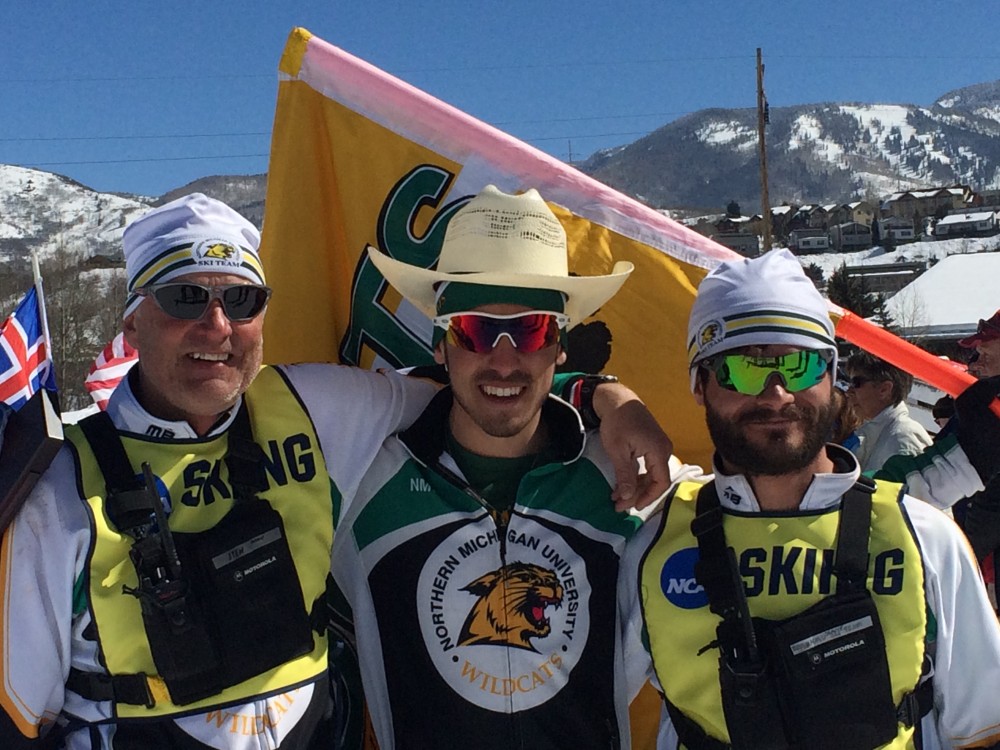
Ian Torchia (c) with Northern Michigan University Head Coach Sten Fjeldheim (l) and assistant coach Shane MacDowell after Torchia placed second in the men’s 10 k freestyle at 2016 NCAA Championship in Steamboat Springs, Colo. He went on to place fourth in the 20 k classic mass start. (Courtesy photo)
As the youngest in a family of five, it’s no wonder that Ian Torchia, an incoming junior at Northern Michigan University (NMU), considers himself “scrappy.” It’s also no wonder that, when it comes to sport, Torchia takes on skiing with tooth-and-claw grit. Within the first few hours of being a freshman on the NMU ski team, the Rochester, Minn., native established himself as tenacious if nothing else.
“Watching him ski on the treadmill the first time I worked with him, he was just raw,” Sten Fjeldheim, head coach of the NMU men’s and women’s nordic teams reflected in a phone interview. “His technique was, well, not pretty, but I knew he had a heck of an engine from his running times.”
After Torchia finished his freshman year just outside qualifying for NCAA Skiing Championships, he made it a goal to reach the championships the following year. As a sophomore, he not only qualified for NCAA’s, but he went on to place second in the men’s 10-kilometer freestyle and fourth in the 20 k classic mass start at the 2016 championships in Steamboat Springs, Colo.
By the end of his first two years at NMU, the 20-year-old Torchia had also tapped into another tool: technique. He asked his college coaches ceaseless questions, watched countless ski videos and began to implement what he saw on the screen into his own skiing.
“He’s just really good at being a student of his own sport: skiing,” Fjeldheim said of Torchia’s technical improvements.
However, the sophomore’s upward climb last season didn’t end with his work on the NMU ski team. In January, he won the junior men’s 10 k freestyle at U.S. nationals in Houghton, Mich. Also at nationals, he placed seventh among seniors in the men’s 15 k classic, and at 2016 Junior World Championships in Romania, he raced to 15th in the junior men’s 15 k freestyle.
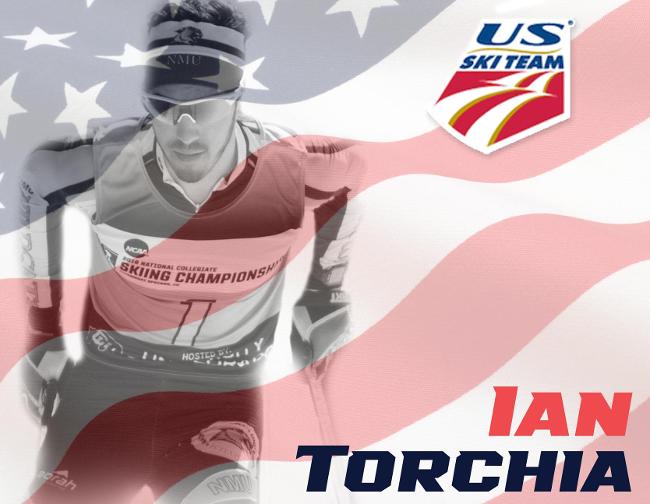
NMU designed the above image for a press release after Ian Torchia was nominated to the U.S. Ski Team D-Team. (Photo: NMU Wildcats)
Most recently, Torchia discovered he was among 16 athletes nominated to the U.S. Cross Country Ski Team.
“I was on my way to go cliff jumping when Bryan Fish [U.S. Ski Team development coach] called me,” Torchia said on the phone. “The celebratory back flip didn’t go too well.” (According to Torchia, the backflip was more of a “back flop.”)
Though perhaps brazen when it comes to black flips and Lake Superior bluffs, the main sentiment Torchia spoke of was that of humility. In his eyes, the opportunity to ski for U.S. Ski Team ‘D’ (or development) Team is an opportunity to once again put his tenacity to the test.
“You know, there’s still two more levels of the U.S. Ski Team to go,” Torchia said of the ‘A’ and ‘B’ team levels. “If anything, [the nomination] just motivates me to train harder. I mean, the way I see it, it’s an honor to be named. I get invited to the camps and I get the uniform. It puts a bigger target on my back, but I’m OK with that.”
U.S. Ski Team (USST) Head Coach Chris Grover explained in an email that the team was “looking for athletes who can deliver big results in Europe against tough fields,” he wrote. “Ian was the standout USA male once again at World Juniors and posted his second consecutive top-15 result there.”
At the 2015 Junior World Championships in Kazakhstan, Torchia notched 11th in the 20 k skiathlon.
Moving forward, Torchia plans to accept the nomination and attend the two USST summer training camps, the first one taking place in Bend, Ore., this month and the second in Anchorage, Alaska. According to Fjeldheim, not much will change for Torchia in regards to training.
“He’ll pretty much be on the same training plan that he’s been on,” Fjeldheim said. “But I think the opportunity for him to ski with some other national-team skiers is going to be good.”
Along with accepting the nomination, Torchia also plans to continue attending NMU as a full-time student and eventually earn a degree in exercise science.
Ian Torchia (c) with his parents Mike (l) and Patricia after this year’s U.S. nationals in Houghton, Mich. (Courtesy photo)
“I think my mom would kill me if I wasn’t in school,” Torchia said.
But his reasons for staying in school extend beyond his so-called death sentence, even if it means suffering through organic chemistry finals. To Torchia, continuing his education sends a broader message to other nordic athletes, especially those trying to determine whether skiing in college can lead to a ski career.
“One of the main reasons why I wanted this to happen is to show that you can do it while you’re in college,” Torchia said of his national-team nomination. “It is hard to balance school and skiing, but it’s doable. [College skiing] is a pipeline.”
School, Torchia insisted, also gives him options outside of skiing.
“Make sure to have balance in your life between skiing and make sure skiing isn’t the only thing in your life,” Torchia said of how he found success in sport. “We kind of take that mentality here at NMU. We have the top GPA of all the sports teams here, so it’s both skiing and school. It’s a lifestyle and we love it. It’s hard, but you got to go for it.”
Beyond the importance Torchia finds in education, his NMU teammates and coaches also played a large role in his decision to continue his ski career on the college path. He cited post-practice conversations and training plans his coaches provided as a staple to his success.
“I could not have done this without Sten and [NMU assistant coach] Shane MacDowell,” Torchia said.
“Ian always shows up with a smile on his face,” Fjeldheim said. “Yeah, he like to pull pranks on me and his teammates every now and then and we prank him back, but he’s a great kid to have on your team as far as sportsmanship goes and manners. He’s very humble.”
“It’s a lifestyle and we love it. It’s hard, but you got to go for it.” — Ian Torchia, NMU junior and U.S. Ski Team rookie
With teammates like Adam Martin and Jake Brown, both first-team All Americans at this year’s NCAA Championships, Torchia views his peers as motivation and proof of where they, too, are headed.
“You can never get too big of a head around here because there will always be someone to serve you a piece of humble pie,” Torchia said. “I can say that I won’t be the last one to be named [to the U.S. SKi Team] out of NMU.”
Ian Torchia (14) racing to 15th in the men’s 15 k freestyle at 2016 Junior World Ski Champioships in Rasnov Romania. (Photo: Thomas O’Harra)
With the nomination, Torchia is undecided as to where his ski career will be drawn after graduation day. Though not currently on the CXC team, joining the program is one potential route for him post-college.
“Kind of this past year, I guess I really thought about skiing after college,” Torchia said. “Right now, Kyle Bratrud is [in Marquette] skiing for [Central Cross Country] and we’re getting [Dartmouth grad] Oscar Friedman up here. I think we’re going to make a return to the days when CXC was a really a powerhouse. I can see myself here. We’ll see. It’s still a long way away.”
While Torchia’s five-year plan remains flexible, his 14 weeks of summer are at least set to go. This includes attending the two USST training camps, training in Marquette, Mich. (potentially with the likes of Kris Freeman, he said), and wedding crashing.
“I’m going to go home, surprise my mom on Mother’s Day and then head out to Bend for the camp there,” Torchia said. “Then I’ll come back [to Marquette] for June and then go out to Anchorage for that camp. And then it’s my sister’s wedding in Colorado. So it should be a fun summer.”
Particularly fun due to the training crew he plans to surround himself with.
“Basically the entire [NMU] guy’s team is going to be [in Marquette] this summer,” Torchia said. “We call it the Marquette Training Group: MTG. So, MTG 2.0 is kicking off this summer. We’re hoping that a few guest stars show up; there’s rumors that Bird [Kris Freeman] and Tad Elliott and Paddy Caldwell and Brian Gregg might be up here. So it’s going to be pretty kickass.”
While the USST nomination makes him a new training target to many, Torchia remains humble of where he’s been and where he’s headed. For now, he appears to prefer taking it one step at a time up the ski ladder — even when it comes to housing.
“I’ve got the Trailer Park Room,” he said, indicating that as one of the younger athletes, it may have fallen on him to take on the tiny living quarters in the NMU men’s ski house for the summer. “It’s the smallest room in the house, but I kind of like it. It doesn’t have a closet, very narrow and small, but I don’t know, I like it.”
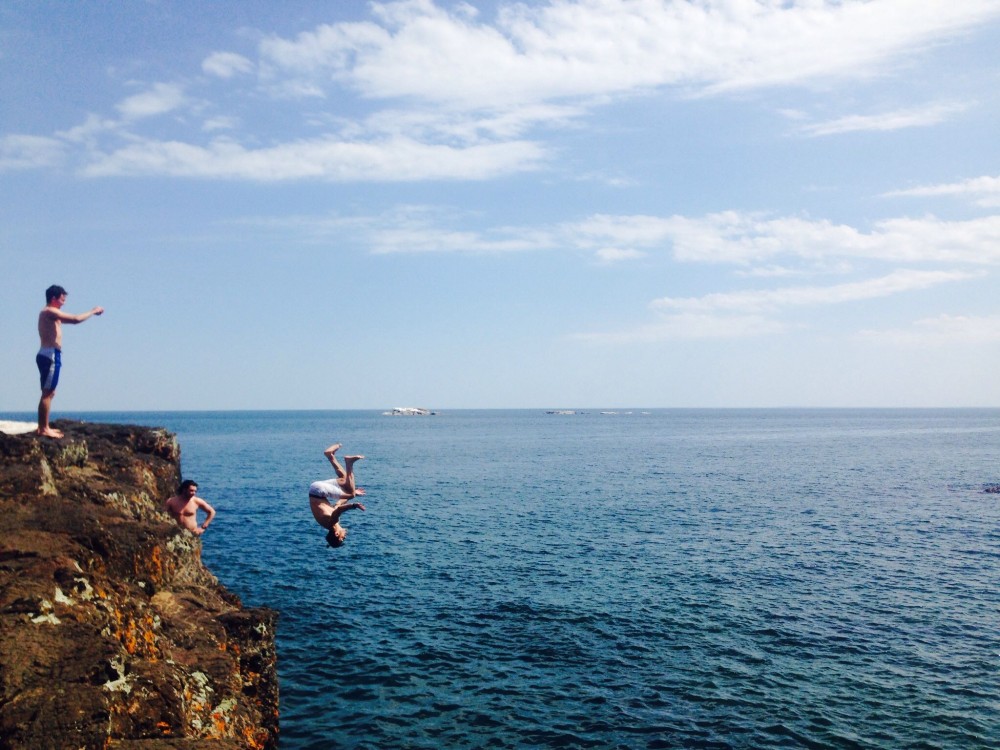
Northern Michigan University’s Ian Torchia celebrating his nomination to the U.S. Ski Team D-Team this spring with a cliff jumping back-flip. According to Torchia, it ended as more of a “backflop.” (Photo: Abby Cook)
I went pretty simple on glide for the classic race, waxing with HF Blue cut with AX134 for the guys in the AM, and a mix of HF Blue, AX134 and HF yellow for the ladies who were racing second. The traffic from all of the competitors was releasing a pretty decent amount of moisture and I wanted to soften the relatively colder HF blue paraffin for the later races. I found that I was not liking the way straight HF red was running early that week in testing so ended up on a mixed paraffin. AX134 tends to run really well at high speed or any place there is some free moisture or the track is glazed. I ended up using a different powder that I preferred in the higher moisture snow over either Jetstream red or yellow powder. Topcoat was Jetstream Red block. Safe and effective, tested well in the AM. Helix sprays felt good feel testing but weren’t drastically improving runout. I ran a pretty simple hand structure on the tails of the skis to deal with moisture in the track.
For kick, I did not go ahead and race wax with Toko kick waxes. Their red and yellow hard waxes can run really well in the warmer range, the yellow being a great last wax to try before switching away from dry wax. Although I have had a lot of success with them, I stuck to a different brand that gave m e a few different options for both speed and kick. I ran a warmer wax over a light tacky binder to form my kicking layer and ran a colder wax over top for a shell.
Skate Sprint:
I ran a pretty similar glide combo to the classic distance day for the skate sprint. The only difference was the temperature was a bit colder so I pulled the warmer paraffin out of the mix. I found that both floro blocks and certain liquids were improving the top end speed on top of powders so I burnt powder early in the day for durability. I intended to have the floro powder down as an insurance policy for the rounds and didn’t want to rework the skis too much. In testing the day before I felt that Helix 2.0 spray was once again improving the slippery feel of the ski climbing but some other liquids had higher top end speed which I really wanted to get athletes to the front of the race for the rounds. Again, I went with a pretty moderate hand structure to keep the skate skis from being too aggressive and bitey on the climb back into the stadium. Skis seemed very competitive on the day with Anne Hart finishing a career best 2nd place in the skate sprint.
Skate Mass Start:
Warmer temps greeted us for the skate mass start race. I pushed people out on warmer softer skate skis, especially for the women’s race at 1:30 PM. I figured that given the humidity in the snow and the amount of traffic, we would see a pretty hard glaze develop. Athletes wanted enough structure (especially hand structure) to deal with this moisture while still having a stiff enough ski to deal with variable track conditions. I ran a pretty warm buildup for both the guys and girls skis with HF Red, warm powder, block and liquid. I found again that certain liquids delivered better characteristics than just blocks. I buried Helix 2.0 spray under the block on a few skis and corked together for climbing freeness and topped with another brands liquid that was gliding out really well and is always a very safe bet for warmer temperatures. I ran a full length light crossing structure on the skate skis with a heavier linear structure on the tail to help with the glaze but still climb well. It seemed that this pretty straightforward approach to prioritizing hand structure and topcoat testing the morning of worked well with 3 athletes in the top 5 for the women’s 20k race.
Classic Sprint:
Warm temperatures in the 30s cooling off to low 20s by the end of the round.
I threw on paraffin without too much testing. I figured that I can always change the topcoats and dealing with kick would be more the priority. HF Red was a safe bet because it runs pretty well in a wide range of temperatures and conditions. I did burn a powder (the same powder from a different brand) that I had been running all week. It was very safe and seemed to improve speed with topcoats over it. For whatever the reason (pretty moist snow would be my guess) the Jetsteam powders were not clear test winners. I kept putting them on snow and could not get them to beat some other product out there. I find they usually prefer some more transformed snow, or much drier snow than the new moist lake effect snow we had. I ran the same topcoat build from the skate sprint.
Again for kick wax I started with a pretty warm dry wax and shell and cleaned it off after the qualifier and the semi and kept stepping down to a colder option from the same hard waxes I used on the classic day. Structure was a light crossing structure on the tails only.
Overall I felt we had decent skis on the week. I used Toko products where I knew they were safe and effective. When I could find something running better, I used it, but my familiarity with the waxing line and knowing that they wouldn’t be a liability allowed me to get skis waxed and focus my energy on testing and chasing more unknown variables.
Pat O’Brien, Head Coach SMS T2
U.S.S.A. Nationals Wax Report
We were fortunate to have had Sugar Bowl assistant coach Christina Mishica, who grew up in Hancock and raced for Michigan Tech. Her hometown knowledge was especially valuable when picking skis and waxing. The early part of the week was characterized by conditions that favored colder grinds and underlayers. Despite the cold air temps, the snow was relatively fast, especially with glazing classic tracks and during the skate heats. Throughout the week, we liked the new Toko 2.0 Jetstream Red powder.
Classic Individual: For base layer, we liked an under layer of Toko X-Cold powder, with our race paraffin a mix of HF Blue and HF AX134. The Blue provided good durability for the 10/15 km distances, while the AX134 helped the high end speed. That was key in a course where maintaining speed is crucial. For powder, the 2.0 Red Powder was consistently at the top of our test. The final layer was 2.0 Red Helix. With glazing tracks the Helix provided the best high-end speed. Blue and Red kickers with a klister/hardwax mixed binder provided good options for kick and speed.
Skate Mass Start: With slightly warmer temps for this race day, we opted for a paraffin layer of HF Red. We kept the X-Cold powder in as an underlay; happy with the breaking speed it gave us. For topcoats, based on our success with 2.0 red through the week, this was our natural starting point. We had 2.0 Red Powder ironed in with a layer of 2.0 Red Block ironed in over the top. Ironing in the block gave us better durability than rotofleecing.
Skate Sprint: Once again, Jetstream 2.0 Red Powder was a winner on the sprint day. We tried similar wax to the day before, and found that blocks were running better than any liquids. JetStream 2.0 Red Block was a clear winner in glide outs as well as on feel. Even as the day progressed, conditions remained consistent and our skis were good. We did rotofleece the block as opposed to corking it in.
– Spencer Eusden, Sugar Bowl Elite Team
Annie Hart Videos from Classic and Skate Sprints at US Nationals
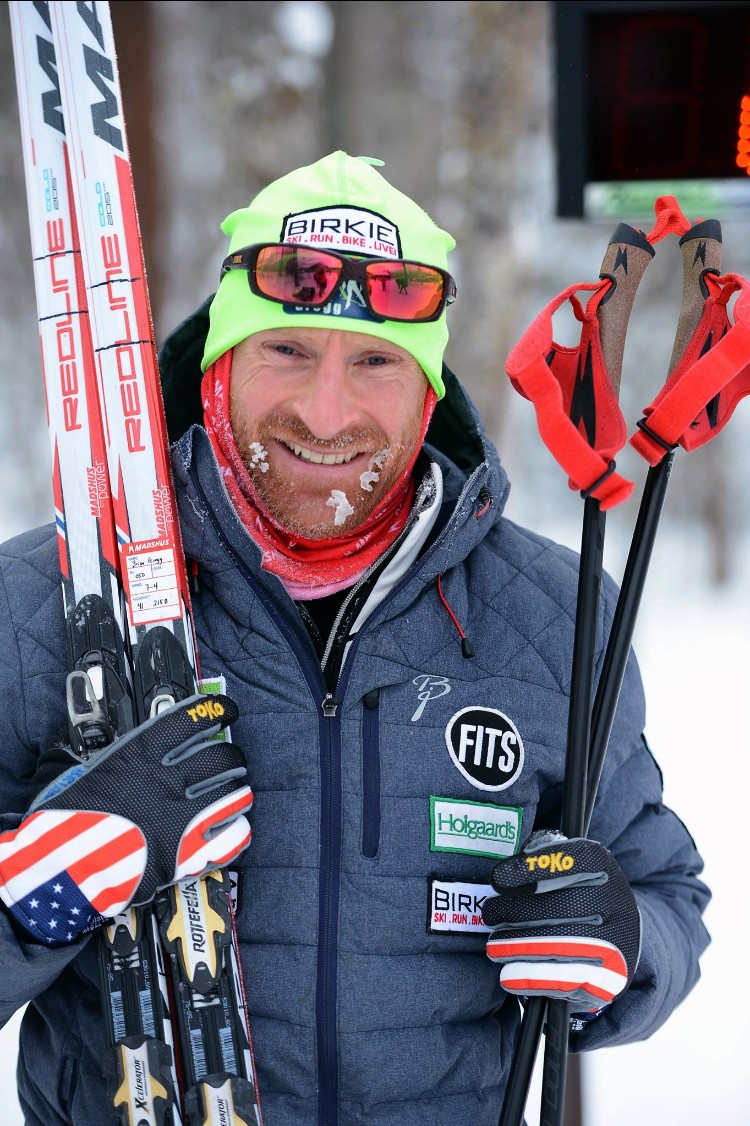
Temperatures plummeted from +25F friday to -8 F on race morning. I knew going in to the race that finding speed would be the greatest challenge. Caitlin and I have had fantastic results with Toko on the Birkie Trail over the years and went with one of our favorite combinations. I hardened my base with a layer of LF Blue and Cold Powder before putting on my final race layer of HF Blue and Cold Powder. I opted not to go with a flouro bloc with the temperature being so cold with the high forecasted as -2F. I sanded my kick zone aggressively and ironed in a green base binder, making it pretty thick under the foot and tapering out the edge, ending about an inch short of my normal kick zone. I kicked on Toko Blue hard wax covered with one layer of flourinated Swix XF30. My skis were rockets and I had great kick the entire race. Thankfully I dressed warmly and enjoyed some fantastic classic skiing. This same combination proved fantastic the next day in even colder temperatures for the Birkie Tour.
– Brian Gregg
(Congratulations to Brian on his win)
Brian Gregg at the Seeley Hills Classic (Photo credit: Once in a Blue Moon Studio- Kelly Randolph )The Seeley Hills Classic winners Natalia Naryshkina and Brian Gregg with race director Dennis Kruse
Wax Report from Seeley Hills Classic
Glide: Applied Toko LF Blue — scraped warm Applied Toko LF Blue — cooled, scraped, brushed Apply Toko HF Blue — scraped warm Applied 2nd coat of Toko HF Blue, sprinkled in Toko Cold Powder, cooled, scraped, brushed Crayoned on Blue JetStream Ironed the JetStream with a sheet of fiberlene to protect the base Cooled and Brushed Brushed again, and then polished bases with a Toko pad
Kick: Ironed in a thin coat Toko Base Green in kick zone (just to the Hard wax marking, not the Powder marking) Let cool, then cork smooth Five thin layers of Toko X-Cold kick wax — cork smooth each layer (just to the Hard wax marking, not the Powder marking) Two thin layers of Toko Blue kick wax — cork smooth each layer Two thin layers of Toko X-Cold kick wax — cork smooth each layer
Congratulations to Natalia Naryshkina on her win
– Bruce Manske, CXC Development Coach
Reports from Junior Olympic Qualifiers
BEND JNQ – Wax Report
CLASSIC RACE: Conditions were slated to be cold and clear for the first day of racing, an individual start classic race. We base-waxed with Toko LF blue, a no-brainer given how versatile and wide-ranging that wax is. On race day I tested a few different blocks but given how cold it was I didn’t find huge differences between block vs. no block and so opted to focus my attention on finding a fast kick wax in the cold snow. I tried Toko X-Cold straight, Toko Blue straight, and compared them to a few other brands’ cold waxes. After some different combos I found that two layers of Toko BLUE covered with a layer of X-Cold for speed did the trick; it was faster than straight blue and provided the softness underneath for good kick.
SKATE RACE: It was a bit warmer and fresh snow was falling for the skate day. We stuck with Toko LF Blue for base paraffin but I jumped right on testing blocks and liquids when we arrived, along with structure. I was joint-waxing with Jordan Buetow of BEA and he had some Finite tools to use for structure, so we tested those against the Toko red structure tool, run only from the heel to the tail. The Finites ran a bit faster so we went with that; both the Toko and Finite were faster than no structure and I think had he not had the Finite we would’ve definitely chosen the red structurite over any other choices.
Block choice was between a wax he thought was best and Toko JS Blue and JS Red. I thought Blue would be the ticket but it was slower than his wax. But then putting Red against his wax I felt it was faster, especially on initial acceleration; once they were up to speed it was pretty equivalent. Jeff Hashimoto of Ellensburg concurred with me and they went with JS Red block, as well.
We had two podium finishes in the U14 race and several top-12s in the U16 and up categories – a sure sign that our skiers are getting more competent with their technique and fitness and able to compete with the experienced teams.
Kongsbergers Gunnar Hagen 7.5km:
This past weekend was the KSC Gunnar Hagen, a 30km and 7.5km classic race. Dave Ford was up there as the Toko rep so he and I set up our tables in the middle of the stadium and acted as the Wax Knowledge Stations for the day. He had tested early; the temps had gone from 26F in the middle of the night, up to 32F and then back down to 23F by race time. As such there was some transformation in the snow. He and I immediately thought of Base green thick ‘n short application, and tried it with success. He called it as the top pick, but when I tested straight Toko Yellow I found that to be quite good as well. Another brand’s wax was also running but I was nervous about its speed on the back sections of the course; it didn’t seem as free as the Yellow. My athletes all went on Yellow and felt the kick was great without icing. I ended up converting a lot of the masters skiers from their choices of klister or similar gook over to an application of Toko Yellow and they all reported great skis. Once again, I was pleased at how wide a range that wax has without suffering speed.
– Sam Naney, Head Coach Momentum Northwest
Wax report from Wasatch Citizen Series 10k Classic at Mountain Dell, just outside of Salt Lake City, UT 16 January
Recently, there had been a lot of 32f and snowing type weather, so I was curious to see what the weather was going to bring for this race.
Upon arrival, snow termperature was 18f and air was 20f. I was the first skier on the course and found that the well groomed tracks had completely filled in with new fallen windblown snow. Windblown snow is generally very dry and “grabby”. I tested various kick waxes (also joined by my fellow Toko Tech Team members) and we found that a few layers of Toko Nordic Grip Red covered by a thin layer of Blue was best. Noteworthy was that as the track got skied in, the platform for skiing on was not very flat (due to all of the new snow not having been skied in perfectly flat – it resembled more of an old style track that was simply skied in). Additionally the snow was breaking on itself (shearing). So, the kick wax was sticking to the top layer of snow in the track, but the snow under the top layer wasn’t sticking to that snow resulting in less sure kick. So, in general, the snow was a bit grabby, especially in the more shaded sections, and the kick was not very sure due to the nature of the track (despite the excellent grooming by the volunteer Tuna crew – thanks!). If a person were to try for perfect kick, the only result would be a sacrifice in glide since the kick was not bomber due to the nature of the snow in the tracks.
As the air temperature rose to 28f and the snow to 24f, we settled on a race kick wax recommendation of straight Toko Nordic Grip Red put on as thinly as possible with a bit more underfoot. For glide, we went with our recommendation which was LF Black, HF Red, and an application of JetStream Red (block/fiberlene application method). As it turns out, the addition of HelX 2.0 Red was also excellent. It was nice to see that after all the dialing it in and testing, this turned out to be the exact wax recommendation made two days before the event by TTT member Barry Makarewicz. Nice job Barry!
Thanks to the Tuna crew and Mountain Dell Groomers for a great day!
HOUGHTON, Mich. — The last day of racing at U.S. Cross Country Championships on the Michigan Tech Trails wrapped up last Saturday, Jan. 9, with the 1.5-kilometer classic sprint. At the end of the day, Alaska Pacific University’s Eric Packer and Craftsbury Green Racing Project’s Kaitlynn Miller both walked away with their first U.S. national title. From the qualifier, to the rounds, to the podium ceremony, FasterSkier provides the day’s top moments in photos. Special thanks to Christopher Schmidt.
Photo: Alaska Pacific University skier Eric Packer celebrates after crossing the line in first ahead of teammate Reese Hanneman during the men’s 1.5 k classic sprint on Saturday at U.S. nationals in Houghton, Mich. (Photo credit: Christopher Schmidt)
Photo: Didrik Elset of Michigan Tech University chose to double pole on skate skis from qualifier, shown here, all the way to the final during the men’s 1.5 k classic sprint on Saturday at U.S. nationals in Houghton, Mich. Elset went on to place third overall.
Photo: Cole Morgan racing for the University of Vermont during the qualifier for the men’s 1.5 k classic sprint on Saturday at U.S. nationals in Houghton, Mich. Morgan ultimately finished in eighth overall.
Photo: (left to right) Alaska Pacific University’s Reese Hanneman, Canadian Julien Locke of Team Black Jack, Håkon Hjelstuen of Lyn Ski, Didrik Elset of Michigan Tech University, Tyler Korfield of Alaska Pacific University, and Logan Hanneman, also of Alaska Pacific University, crest the top of a climb during their semi-final of the men’s 1.5 k classic sprint on Saturday in Houghton, Mich. Hanneman and Elset advanced automatically to the final, while Hjelstuen and Kornfield moved on as the two lucky losers. (Photo credit: Christopher Schmidt)
Photo: (left to right) Kris Freeman of Team Freebird and Scott Patterson of Alaska Pacific University follow Alaska Pacific University skier Eric Packer and Canadian Julien Locke of Team Black Jack during their quarterfinal of he men’s 1.5 k classic sprint on Saturday at U.S. nationals in Houghton, Mich. Packer raced to an overall first place, while Locke went on to place tenth.
Photo: Gaspard Cuenot tucking during his semi-final of the men’s 1.5 k classic sprint on Saturday at U.S. nationals in Houghton Mich. Cuenot raced to an overall ninth. (Photo credit: Christopher Schmidt)
Photo: (right to left) Reese Hanneman of Alaska Pacific University leads Michigan Tech University Didrik Elset, Canadian Julien Locke of Team Black Jack, and younger brother Logan Hanneman, also of Alaska Pacific University during the first semi-final of the men’s 1.5 k classic sprint race on Saturday at U.S. nationals in Houghton, Mich. (Photo credit: Christopher Schmidt)
Photo: (right to left) Dakota Blackhorse-von Jess of the Bend Endurance Academy Eric Packer of Alaska Pacific University, and Cole Morgan of the University of Vermont round a corner during the men’s 1.5 k classic sprint race on Saturday at U.S. nationals in Houghton, Mich. Blackhorse-von Jess advanced to the final as did Packer. Packer ultimately won first place overall, while Blackhorse-von Jess skied to a fifth place finish in the final and Morgan finished in eighth. (Photo credit: Christopher Schmidt)
The start of the men’s classic sprint final (from left to right), with Didrik Elset of Michigan Tech, Dakota Blackhorse-von Jess of Bend Endurance Academy ), Tyler Kornfield (APU), and Reese Hanneman (APU) at the start of the final for the men’s 1.5 k classic sprint on Saturday at U.S. nationals in Houghton, Mich. (Photo: Christopher Schmidt)
APU head coach Erik Flora (98) runs alongside his athletes Eric Packer (5) and Reese Hanneman during (4) the final of the men’s 1.5 k classic sprint at U.S. nationals in Houghton, Mich., in January 2016. (Photo: Christopher Schmidt)
Photo: (left to right) Alaska Pacific University skier Eric Packer double poles to his first ever U.S. nationals championship title, ahead of teammate Tyler Kornfield, Bend Endurance Academy racer Dakota Blackhorse-von Jess, Lyn Ski racer Håkon Hjelstuen, Alaska Pacific University skier Reese Hanneman during the final of the men’s 1.5 k classic sprint race on Saturday at U.S. nationals in Houghton, Mich. (Photo credit: Christopher Schmidt)
Photo: Alaska Pacific University’s Eric Packer (center) is all smiles as he stands at the top of the podium next to second place finisher and teammate Reese Hanneman (r) and third place finisher Didrik Elset of Michigan Tech University after the men’s 1.5 k classic sprint on Saturday at U.S. nationals in Houghton, Mich.
Photo: Katharine Ogden skiing for Stratton Mountain School during the qualifier for the women’s 1.5 k classic sprint race on Saturday at 2016 U.S. nationals in Houghton, Mich.
Photo: (left to right) Sun Valley Ski Education Foundation skier Deedra Irwin, Stratton Mountain School racers Katharine Ogden and Erika Flowers, along with Dartmouth College racer Corey Stock, Bridger Ski Foundation’s Jennie Bender and Northern Michigan skier Nicole Schneider striding up the first climb in their quarterfinal of the women’s 1.5 k classic sprint on Saturday at U.S. nationals in Houghton, Mich. Aer advancing to the semi-final and final, Bender raced to a third place finish overall, while Ogden took eighth. (Photo: Christopher Schmidt)
Photo: (left to right) Northern Michigan University’s Sarah Bezdicek and Felicia Gesior, stride up a climb behind Heather Mooney of the Craftsbury Green Racing Project and Alaska Pacific University’s Jessica Yeaton during their quarterfinal of the women’s 1.5 k classic sprint on Saturday at U.S. nationals in Houghton, Mich. Mooney raced to a tenth place finish overall; Gesior took ninth. (Photo credit: Christopher Schmidt)
Photo: Craftsbury Green Racing Project skier Liz Guiney (center) makes her way around a corner ahead of Northern Michigan University’s Lea Buenter (r), University of Alaska Fairbanks skier Nicole Bathe and Stratton Mountain School racer Julia Kern during their quarterfinal of the women’s 1.5 k classic sprint on Saturday at U.S. nationals in Houghton, Mich. Guiney advanced to the semifinal and finished the day in seventh overall. (Photo credit: Christopher Schmidt)
Photo: (left to right) Stratton Mountain School skier Anne Hart strides up a climb ahead of CXC racer Natalia Naryskina, and Alaska Pacific University’s Becca Rorabaugh during their semi-final of the women’s 1.5 k classic sprint on Saturday at U.S. nationals in Houghton, Mich. All three women advanced to the final, where Hart placed second overall, Naryskina sixth, and Rorabaugh fifth. (Photo credit: Christopher Schmidt)
Photo: (right to left) Kaitlynn Miller of the Craftsbury Green Racing Project corners the final turn into the finishing stretch ahead of Bridger Ski Foundation athlete Jennie Bender and CGRP skier Caitlin Patterson during their semi-final of the women’s 1.5 k class sprint on Saturday at U.S. nationals in Houghton, Mich. (Photo credit: Christopher Schmidt)
Photo: (left to right) Craftsbury Green Racing Project skier, Kaitlynn Miller out sprints Alaska Pacific University’s Becca Rorabaugh, Bridger Ski Foundation’s Jennie Bender, and Stratton Mountain School skier Anne Hart during the final 100-meters of the final for the women’s 1.5 k classic sprint on Saturday at U.S. nationals in Houghton, Mich. Miller took first, while Hart placed second, Bender third, and Rorabaugh fifth. (Photo credit: Christopher Schmidt)
Photo: (left to right) Anne Hart of Stratton Mountain School along with Craftsburu Green Racing Project Kaitlynn Miller and Bridger Ski Foundation athlete on top the women’s 1.5 k classic sprint podium on Saturday at U.S. nationals in Houghton, Mich. (Photo credit: Christopher Schmidt)
Photo: (left to right) Kaitlynn Miller of the Craftsbury Green Racing Project stands with teammates Heather Mooney and Liz Guiney after winning her first championship title in the women’s 1.5 k classic sprint on Saturday at U.S. nationals in Houghton, Michigan. Mooney raced to a tenth place finish overall and Guiney finished seventh. (Photo credit: Christopher Schmidt)
Following a yearlong study by an independent sport task force, the U.S. Ski and Snowboard Association introduced sweeping nordic membership changes with broader offerings and prices as low as $15. This summer the USSA brought on experienced nordic leader Robert Lazzaroni to help grow USSA Nordic programs. A veteran of two decades in the cross country ski industry, he was Rossignol nordic division manager and, most recently, program manager at the Utah Olympic Park where he was instrumental in Park City Nordic being awarded the USSA’s Club of the Year honor last season.
Robert, welcome to the USSA. You started in August and are starting to roll out new programs already.
It’s been a smooth transition to bring my skills from the nordic ski industry to the USSA. The membership task force did a good job in opening the door to the possibilities and it’s been fun to start the process of engaging clubs and divisions, ski instructors, touring centers, ski industry, races organizers and retailers to grow our sport.
What were some of the outcomes of the task force?
The group represented all areas of our sport from athletes to clubs to industry and more. The key focus was ‘how do we grow our sport.’ We have over 20,000 nordic skiers actively competing but only a small percentage are USSA members. We now have memberships as low as $15 and have lowered the competitor membership from $150 to $95.
(Interview continues below)
Why is membership growth important?
Nordic skiing is a family – we’re all very close. We’re proud of our sport heroes. We need to give our entire family an opportunity to feel the pride of supporting our national team and the development system that helped them reach the top. Now, for just $15, you can be a part of their success.
What’s important for USSA competitors?
One of the most important elements of a sport program is having high quality, fair competitions. USSA events like Junior Nationals, the nationwide USSA SuperTour and the annual USSA Cross Country Ski Championships are excellent events produced by the USSA and our clubs.
Are you adding new benefits?
Last year we introduced USSA Rewards, a great discount program from our sponsors. This season we’re adding a fun program where every week we’ll do an opportunity drawing from all members who have just registered and award a lucky winner with free product from one of our sponsors.
What are some of the ‘behind the scenes’ programs implemented by the USSA?
Sport education has become much stronger with excellent cross country level 100 and 200 programs. We’ve modified our Club Liability Insurance Program (CLIP) to offer clubs more relevant coverage and pricing. And we keep a keen focus on SafeSport, with education and background screening, to ensure we provide kids and families with a safe environment.
How important is partnership?
The USSA can’t do this alone. We need to grow our partnership with the ski industry. Our new partnership with the American Birkebeiner is thriving. Soon we’ll announce partnerships with CXC (Central Cross Country) and NENSA (New England Nordic Ski Association) to work together on sport growth and membership. Our current partnership with NNF (National Nordic Foundation) is fundamental for the development of our athletes.
How can America help beyond membership?
First, we hope fans and skiers alike simply start with a USSA nordic membership for $15. But we’ve also expanded our fundraising efforts with the ability for donors to now give specifically to cross country, for example. We’re also developing a program similar to the alpine Gold Pass – a single pass with access to nordic ski areas nationwide with money going to support our nordic athletes.
Finally, Robert, where do you see this heading?
We have a great national team and excellent events here in the USA. There’s a wonderful spirit for nordic skiing. I just think about what we could do to help kids prosper in the sport if we had 10,000 members working together towards their success. Skiers and fans can learn more about USSA Nordic programs at: my.ussa.org/joinnordic
It is with tremendous gratitude that I announce our 3rd consecutive Year End Challenge Grant, ‘Support our Sport’. Once again, John & Leslie Taylor have teamed up with several CXC donors to challenge us to continue to build upon our successes from last year to further grow and promote Nordic skiing for all ages and abilities. This is a 1:1 challenge grant, so every dollar donated will be doubled! This donation opportunity provides a way for anyone to give back to our sport through CXC Programs.
You and our grassroots organization are bound together by a passion for cross country skiing. Please make a donation today, Giving Tuesday, to support all of our efforts.
Thank you.
Sincerely, Yuriy Gusev
Executive & Athletic Director
Central Cross Country Ski Association
Community Olympic Development Program
“Giving kids one more activity they find interesting and engaging, as a way to use their bodies to help settle their minds and be more available for the traditional learning is really beneficial and the ‘Nordic Rocks’ for Schools program provides that.”
– Clare Sequin, Teacher at Lincoln Elementary School in Madison, WI
Including Individuals Of All Ability Level
“Brenden has been skiing with the CXC Adaptive Program since he was 13 years old. During the past three years, CXC and the coaching staff have provided Brenden with equipment, coaching expertise and racing opportunities. Not to mention the encouragement they give him to challenge himself everyday with new goals both on and off the skis.
Brenden enjoys skiing and the CXC Adaptive Program offers him the benefit of a great workout and competitions for his competitive spirit. Thanks CXC!”
– CXC Adaptive Team Parent, Jenn Ojibway
Fueling the Athletic Pipeline
“Passion for coaching and the sport only gets you so far, then you have to have the skill set to draw from to coach properly; especially now when you are seeing the pipeline across the nation growing and getting stronger.”
– Jonathan Stone, Cooper Country Ski Tigers Coach and Club President
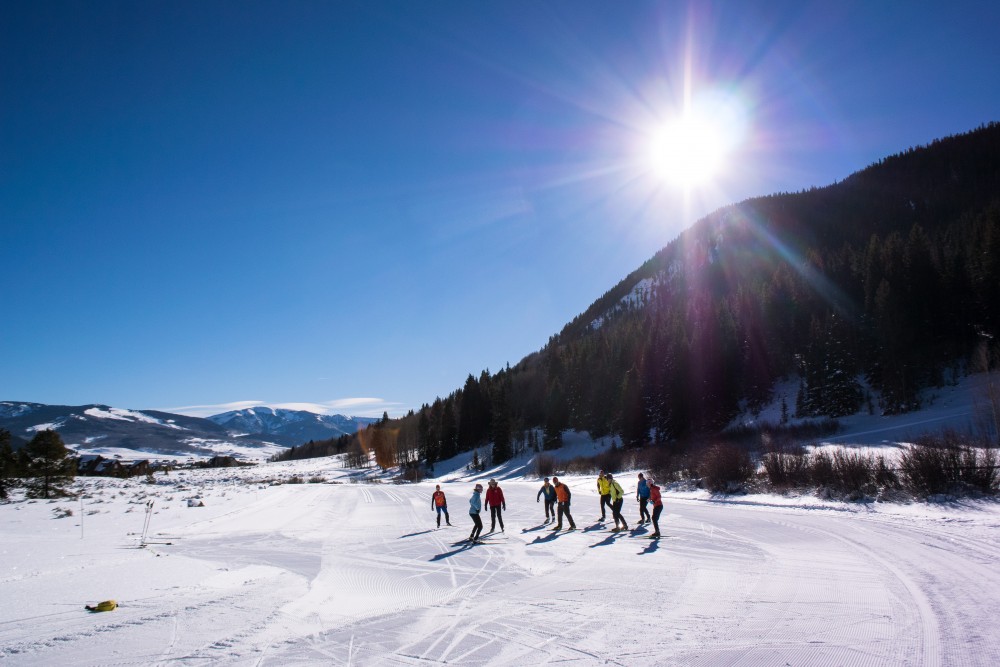
Sun stretches over the hills during a cross-country lesson at Crested Butte in Colorado. The nordic center there is hosting its annual Crested Butte Nordic Thanksgiving Camp from Thursday to Sunday. (Photo: Xavier Fane)
We’ve been hearing about West Yellowstone since, well, the U.S. Ski Team officially started its annual Fall Camp there in 1978. But surely, Montana’s southern tip can’t be the only place to get on snow this time of year…
That’s why we provided a guide to Thanksgiving on-snow camp venues in the U.S. and Canada (we realize this week isn’t Thanksgiving in Canada, but we’re sticking to areas that offer skiing around this week in late November for all intents and purposes). If we’re missing an early season camp, we apologize — it’s a big continent — but let us know so we can feature that camp in next year’s guide.
***
What:Yellowstone Ski Festival
Where: West Yellowstone, Montana
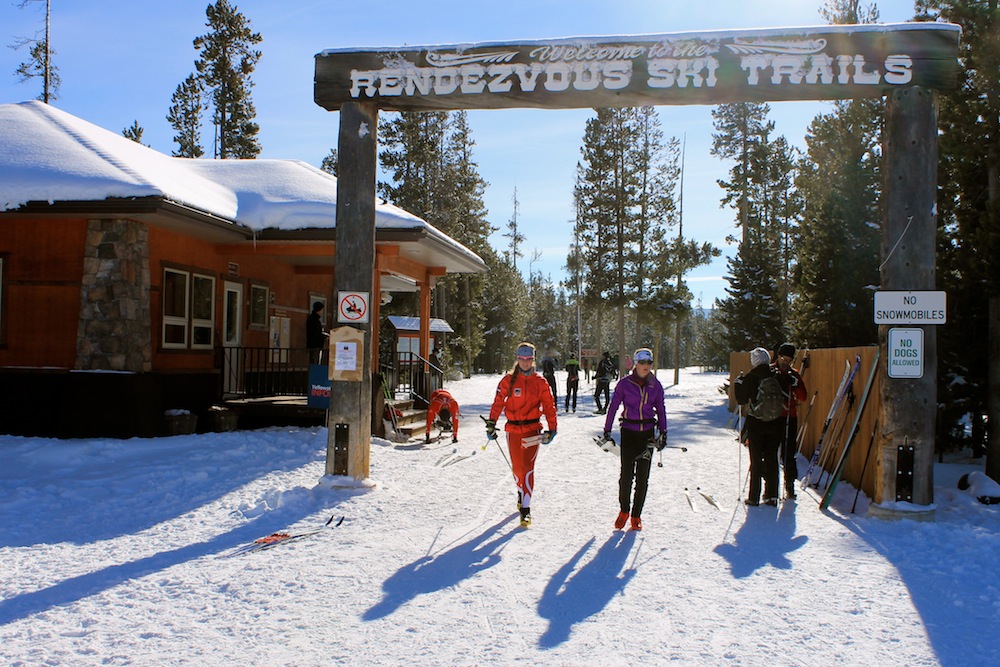
Each year, the Rendezvous Ski Trails see hundreds of skiers each day during the Yellowstone Ski Festival on Thanksgiving week in West Yellowstone, Mont.
When: Tuesday, Nov. 24, to Saturday, Nov. 28, 2015
How many years running? 20+
Target audience: Masters and beginners (clinics available for both), as well as elite racers
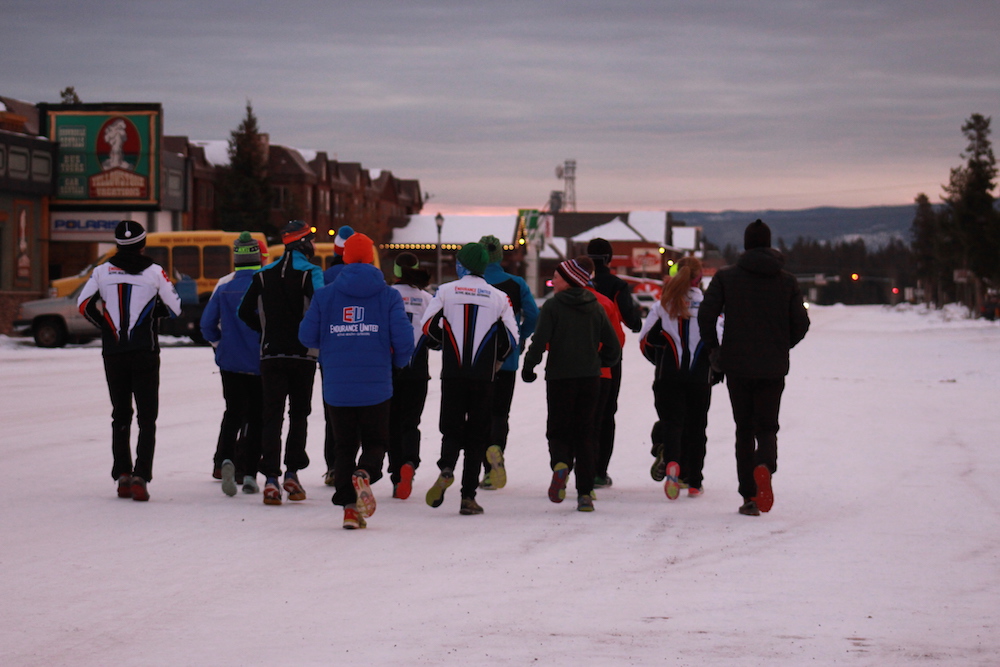
Endurance United team members get ready for a day of skiing during a morning run in West Yellowstone, Mont., at this year’s 2015 Yellowstone Ski Festival. (Photo: Gabby Naranja)
Anticipated participation: An estimated 4,000-5,000 skiers throughout the week. “It varies from year to year depending on the snow conditions and the snow level,” West Yellowstone Ski Education Foundation Program Director Moira Dow explained. “Because we’ve gotten snow early this year and good snow, we have been able to get the word out. Like right now the trails are packed. We will probably have a lot of people coming for longer periods of time.”
Advance reservation required? Racers must preregister. Trails are open to public; trail pass required.
Grooming report: Essentially everything is open. “It’s full-coverage skiing on good skis with full tracks,” Dow said. More details | Webcam
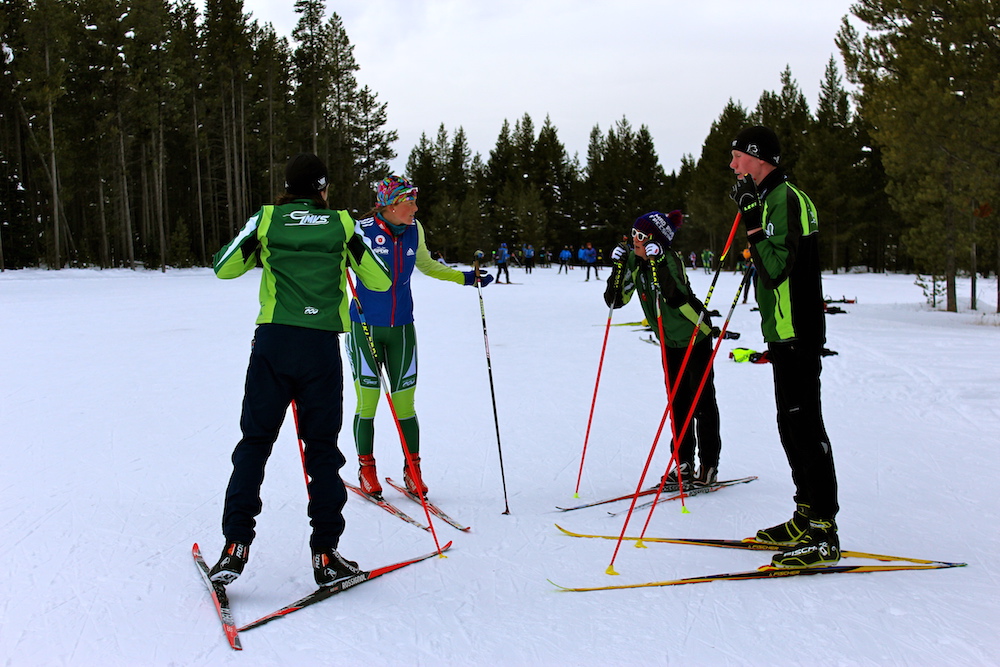
Green Mountain Valley School nordic skiers meet up during a ski on the Rendezvous Ski Trails this week in West Yellowstone, Mont. (Photo: Gabby Naranja)
What makes this camp unique? “The number of trails and the quality of snow that we have. We’re one of the few places in the country that does have consistent, early, good snow. In addition to that, we have a lot of industry participation. And we have great evening programs for people. We have not just skiing, we have the full package for everybody and anyone, from the beginner skier who wants to get out on the snow for the first time, to the SuperTour elite athlete who can train at high altitude, and good snow in the early part of the season.”
Special events:
U.S. Ski Team Development Coach Bryan Fish and the former vice president of Fischer Skis U.S. nordic division, Peter Ashley, will be featured speakers
Freebies: “Everything at the indoor expo at night is free. Anybody who has a trail pass can get into the outdoor demo area for free. In addition, on Wednesday and Friday night we have ‘après-ski’… [with] complimentary adult beverages and junior beverages, sledding, some music, and fun stuff like that. Just a little bit more of a party atmosphere after the sun goes down and before the expo opens.”
***
What:Crested Butte Nordic Thanksgiving Camp
Where: Crested Butte, Colorado
The Crested Butte Nordic Thanksgiving Camp, now in its 14th year, is a fundraiser for Crested Butte Nordic, a nonprofit dedicated to getting people on the local trails. (Photo: Xavier Fane)
Skiing at Crested Butte Nordic in Colorado. (Photo: Xavier Fane)
How many years running? 14 as an official organized camp: “Crested Butte has really good and reliable early season snow so the Nordic Center decided we should try to get folks to come here and get some instruction from our great instructors,” said Drew Holbrook, marketing director for Crested Butte Nordic and the Grand Traverse ski race. “We also have a wonderful venue for early season nordic skiing and we’ve been fortunate enough to have been on-snow every year.”
Target audience: All ages and abilities, “from never-evers to master blasters looking to improve their technique,” Holbrook said. “If parents are skiing along with children, kids ski free. All kids 17 and younger get free passes and rentals. And, actually, all season long we do that — people 17 and younger ski free. At the Thanksgiving Camp we also do free kids clinics. So if a parent is taking a clinic, then they can have their kids taken care of all day.
Anticipated participation: Several hundred skiers on the trails throughout the long weekend. For clinics, projecting 75-80 participants.
Advance reservation required? Pre-registration recommended for clinics.Nordic Center trail passes available any time. Skiing at Lily Lake, a 10 k early season trail system four miles up Kebler Pass Road, is free.
Trail pass rates: $18/day, skiers 17 & younger ski free. $130 for a 10-punch transferable pass.
Grooming report: With about a foot of snow at the venue in town, “it’s looking like in-town skiing for the camp,” Holbrook said. As of Tuesday, Ruthie’s Run (5-kilometer loop at the nordic center and up on the bench) and Lily Lake (six miles west of town up on the pass) were groomed. “We’ll have over 10 kilometers of high quality skiing available,” Holbrook added. More details
Here’s a deal: Kids 17 and under enjoy free rentals, passes and clinics at the Crested Butte Nordic Thanksgiving Camp. (Photo: Xavier Fane)
What makes this camp unique? “As a non-profit, our mission is to get people out on the trails skiing. We are not making a ton of money off it,” Holbrook said.
“We just want people to come here and use our trails and make it affordable. A lot of people come back year after year and work with the same instructor. They get to know each other and get to know the other people that come into camp. So it’s definitely got this small feel to it, it’s kind of personalized.”
Special events:
For the first time, a race (on Sunday): 5/10 k freestyle + kids’ race with new homologated course on Ruthie’s Run. “It’s engineered, seeded, and mowed,” Holbrook said. “Due to the engineering, we are able to groom the race course with a lot less snow than we used to need. That enables us to count on having this race and count on have a good race venue close to town.”
Winter Kick-Off Party (Saturday night): Fundraiser for Crested Butte Nordic, tickets $30/adult,$10/children.
Wax clinic, nutritional talk and Nov. 25 is opening day at Crested Butte Mountain Resort, with free skiing all day.
***
What: CXC Thanksgiving Nordic Festival
Where: Telemark Trails in Cable, Wisconsin
After three nights of blowing snow, CXC Thanksgiving Nordic Festival organizers were ready to groom the Telemark Trails in Cable, Wis., on Nov. 22. (Photo: Facebook)
When: Wednesday, Nov. 25, to Sunday, Nov. 29, 2015
How many years running? First year. “Our goal for the festival is to show the template to other communities, what it takes to make snow … to provide a business and operations template to other places around the Midwest so they can do these festivals in late November and then have a reliable loop for the winter,” CXC Executive and Athletic Director Yuriy Gusev explained.
A 1 k loop was made and groomed for the first-annual CXC Thanksgiving Nordic Festival in Cable, Wis. (Photo: Facebook)
Target audience: All skiers; open to the public
Anticipated participation: Based on the camp’s Facebook page, at least 75 plan on attending, and Gusev estimated that paired with a local turnout would amount to 200-300 skiers. “We don’t want to make it a big deal … just to show the community this is an opportunity to ski,” he said.
Advance reservation required? Yes, for clinics (instructed by Gusev on Friday, Saturday and Sunday).Trails open to public.
Trail pass rates: $50 season passes, good for the festival and the whole winter. Trail passes can be purchased at www.cxcskiing.org/skipass, Telemark condominium office and Cable Area Chamber of Commerce Office.
Grooming report: Skiing on a 1 k loop at Telemark started on Sunday: “Usually there’s no natural snow this time of year, so our plan was to make snow,” Gusev said. “It just didn’t get cold like it normally does.” Once temperatures finally cooled late last week, the snowmaking crew was able to work on blowing and laying out a 1-kilometer manmade loop, some of which will be used for the 2016 Junior Nationals sprint course. More details
What makes this camp unique? “Anytime you have early snow, you stand out. I think it can be a key component to have this … to provide a reliable base for the rest of the winter, especially for youth programs where the snow is critical and also for entry-level participants. We’ve seen already with the couple snowmaking areas in the Twin Cities how much impact these have on the ski industry and local ski shops. They’ve been able to actually do relatively well in snowless winters.”
Special events: Fischer Demo
***
What: Snow Mountain Ranch Nordic Ski Camp
Where: Granby, Colorado
A November day at Snow Mountain Ranch, which opened for skiing earlier this month and remains open with 50 k groomed with a set track. (Courtesy photo)
How many years running? First time in recent years
Target audience: Beginner skiers to seasoned racers
Advance reservation required? Yes.
November skiing at Snow Mountain Ranch in Granby, Colo. For the first time this year, a five-day camp was held for masters. It ended on Tuesday. (Courtesy photo)
Participation: Capped at 24. “Smaller is better from both a coaching and athlete viewpoint,” Snow Mountain Ranch’s Nordic Center Director Bill Pierce explained. In its first year with little marketing, the five-day camp attracted four athletes.
“It was really small, but it was great,” Pierce said. “It’s so early that people don’t expect there to be snow [when] it’s 60 degrees in Boulder. … We just want to put another option out there; a lot of skiers want to be on snow in early November and Denver is really easy to get to.”
Trail pass rates: $350 for the camp, includes all coaching sessions and day passes
Grooming report: 50 kilometers groomed and track-set. Snow Mountain Ranch started grooming Nov. 4 and opened for skiing on the 14th. According to Pierce, they have anywhere from a 4-5 inch base to 10 inches in some places. It was snowing there on Thanksgiving, with four inches of snow expected to fall today. More info | Webcam
What makes this camp unique? “This is the earliest masters camp in North America on-snow as a pre-Thanksgiving camp,” Pierce explained.
The idea was to run a masters camp similar to an elite or junior camp, with two-a-day sessions combining workouts and technique — all at 9,000 feet above sea level. The focus was on transitioning from dryland training to snow skiing, with an emphasis on technique and slow volume at high altitude.
With a small but mighty coaching staff (two of which are USSA certified), Pierce said the ability to work with athletes helps them set, understand and achieve skiing goals.
“We all speak the same language,” he said of the coaches. “You can go to a lot of places, and a lot of places you feel like you’re getting a lesson. There’s a difference between a lesson and coaching.”
“[This camp is] just another opportunity in the country to go skiing all day,” he added.
When: 2 1/2-day weekend and 5-day midweek camps (schedule):
A gaggle of skiers at a junior camp head out on the trails at the Sovereign Lake Nordic Centre on Nov. 14 in Vernon, British Columbia. Roughly 800 skiers took to the trails that day. Each winter, Sovereign Lake hosts a series of weekend and weekday camps, called SuperCamp. (Photo: Gerry Furseth)
Camp #1:Nov. 20-22
Camp #2: Nov. 23-27
Camp #3: Nov. 27-29 (with Pro-camp option)
Camp #4: Nov. 30-Dec. 4
Camp #5: Dec. 4-6
Camp #6: Jan. 15-17
Camp #7: Feb. 19-21
How many years running? 26 (The SuperCamp program started in 1989)
Target audience: All ages and skill levels from beginner to elite racer.
Advance reservation required? Yes.
Anticipated participation: Typically around 225 to 250 participants, hoping for 260 this year.
“In its heyday in the early ’90s [SuperCamp attracted] upwards of 400,” Sovereign Lake Nordic Center General Manager Troy Hudson explained. “We want to get back to those numbers by offering some great new initiatives like focussed Masters Pro camps for racers and more options such as the biathlon camps which are proving to be very popular.”
Trail pass rates: Dual area trail passes included in camp fee, ranges from $339 to $925 Canadian dollars per person (depending on length of camp, and half or full days). Pricing
VR40 blue-wax skiing on Nov. 16 at the Sovereign Lake Nordic Centre in Vernon, B.C. (Photo: Ryan Olson)
Grooming report: Sovereign Lake has 40 kilometers groomed and Silver Star has an additional 40 k open. More details (and webcam)
What makes this camp unique? “I’m often asked, what is Supercamp?” SuperCamp coordinator Shane Landreville wrote in an e-newsletter. “That’s a great question and because Supercamp offers so much more than a traditional ski lesson, it’s a difficult concept to explain and it’s difficult for people to wrap their heads around it. Quite simply, Supercamp is a Nordic experience.”
SuperCamp attracts top-level coaches, as many come from across Canada to get early snow before they start their season at home. Each camp includes lectures and lessons on waxing, how to build a training plan, and sports nutrition, as well as access to the national altitude training centre gym, and best of all, 105 kilometers of trails between Sovereign Lake and Silver Star — many of which are used for World Cup, NorAm, and World Master events.
With half- and full-day options, the camp is at an altitude of 1,600 metres (5,250 feet). Many of the accommodation options are on the nordic trails. You can ski or walk to restaurants and bars in the evening.
Biathlon camps are either five days long or a single afternoon, and a new Pro camp is more racing focused.
The Silver Star alpine area opened earlier this week, as did the separate Fat Bike trail system.
Special events:
Keynote speakers, a sports nutrition lecture, and wax clinics
Stretching classes, body pre-activation sessions, and for 5-day campers, two 30-minute massages. “Skiing for a solid 2 days or 5 days is tough, it really is, so taking care of your bodies is important,” Landreville wrote. “For our 5 day camps, you can also take part in the excursion to the spa and pools at Sparkling Hill Resort.”
***
Also: Canada’s Early Season XC Venues
What: Frozen Thunder
Where: Canmore, Alberta
Fresh snow at the Canmore Nordic Centre: A n Olympic Legacy Venue now a regular host of Canadian based World Cups. (Photo: Pavlina Sudrich)
How much snow: Boreal Glide, a 2.5 k manmade loop, is open for both freestyle and classic. Course map | Weather
Good to know:
According to according to Julie Moffet, the regional operations coordinator at Forêt Montmorency, la Forêt is the only place in North America with cross-country skiing as early as Oct. 30 all the way to Easter in April.
No races or special events are scheduled, simply skiing and snowshoeing for all.
To reserve a room on the trails (with two single beds and a shared bathroom), with access to a cafeteria, two lounges with a fireplace, game room, auditorium, and wax room, visit http://www.foretmontmorency.ca/en/lodging/
Hayward, WI – Fischer Sports is proud to team up with CXC Skiing to be part of the first annual CXC Thanksgiving Nordic Festival at the Telemark Resort in Cable, Wisconsin. Running from Friday November 20th through Sunday, November 29th, Fischer will join industry manufacturers with demo product for the latter days of the camp beginning the 26th.
“I’ve got a lot of great memories of when Telemark hosted some very serious racing during the Thanksgiving holiday in the late 70s and early 80s. I can’t wait to return to Telemark for serious skiing again,” explained Nordic Promotions Specialist, Rick Halling.
High caliber skiing is the goal of CXC’s snowmaking crew, a perfect kick off to the season and a chance to feel out Fischer’s newest product offerings. Open to all skiers, the camp promises early conditioning and snow acclimation.
Fischer Demos will include the new Speedmax Boots, as well as the updated Speedmax Skis. Look for the new Twin Skin ski in limited quantities for demo as well.
Sunrise on campus at Michigan Technological University in Houghton, Mich. (All photos: Alice Flanders/aliceflanders.wordpress.com)
This week’s workout comes from Michigan Tech masters student and skier, Alice Flanders, also a satellite athlete with the Central Cross Country (CXC) Team. Flanders trains with the Michigan Tech team, and largely does workouts designed by head coach Joe Haggenmiller, while CXC Team coach Andy Keller oversees her training. Read her complete blog post here.
Do you have a workout you’d like to share? Email info@fasterskier.com with the subject line: Wednesday Workout.
***
I’m waiting in the starting pen, the 20-degree wind blowing gently across the stadium as the clock beeps the tell-tale tones of another racer starting. I chisel the chunks of snow out of the bottom of my boot and clip into my skis. I step up to the wand.
“15 seconds”
“Beep… Beep… Beep….Beeeeeeeep”
I try to start but for some reason my feet just won’t move.
“Beep… Beep… Beep…. Beeeeeeeep”
“Thwap!”
Early morning speeds during metronomes at Michigan Tech in Houghton, Mich.
Groggily, I fumble through the sheets looking for my persistently beeping phone. It’s 5:52 am and my body feels like a sack of bricks.
I roll over placing my index and middle finger on the underside of my wrist. 10 beats in 15 seconds, 40 BPM (beats per minute). Not a bad a.m. pulse, but that’s a little higher than normal. I’ll have to drink lots of water today and make sure I haven’t caught the back-to-school-plague that seems to have taken over the school.
Stepping outside, the entire town seems dead. If it weren’t for the street lights, I’d be unlocking my bike by starlight. Occasionally I’ll pass by a group of ROTC students running in synchrony, but until arriving at the Student Development Center there’s no one in sight. This morning we’ll be doing metronomes, a workout where we double pole around the track at different tempos to work on technique and speed.
The Workout: Metronomes
Total Time: 45-60 min
Goal: Focus on high quality technique while using different tempos. Immediately apply this to sprints and starts.
Warmup: About 10 minutes or 3 songs
Workout:
Set 1:(with metronome playing over loudspeakers: listen to an actual metronome and match your pole plants to the beat)
2:30 @ 50 BPM
0:20 @ 60 BPM
0:10 @ 80 BPM
Repeat 3-5 times
Set Break: Length = one song of your choice
Set 2: 6-10 x 100-meter sprints
Cool down: About 10 minutes
This workout has a lot of benefits.
It teaches the athlete how to ski using varying tempos
By skiing around the track, it is much easier for coaches to work with athletes of different speeds and track progress throughout the session
Technique and tempo can be applied immediately during the 100m sprints
It’s good mass start practice due to the amount of passing that occurs
Pace lines will form and it’s fun to go fast in a group!
There are a lot of opportunities for younger skiers to ski with, watch and learn from older people on the team.
You get to listen to music
No Cars!
But be careful, this is an intensity session and should be counted as such. Recovery in between the 80 BPM and sprints should be a priority.
By 7:30 the sun is painting the sky hues of pink, purple and yellow. It’s not hard to realize how lucky we are to live in a place like this.
Class time: Where recovery and learning come together.
In class, while other students are guzzling coffee trying not to nod off, I’ve got positive endorphins keeping me engaged. However, as the day continues I find myself gazing out the window as storm clouds congregate on the horizon. It’s supposed to rain tonight. Right now I keep my fingers crossed that the rain will go somewhere else, keeping our roads dry for practice this afternoon. In a few weeks these clouds will hold potential for snow. As my professor fills the board with equations, I daydream about how much snow we’d get if it were 15 degrees cooler.
Excelling in any sport takes an extreme amount of commitment and self discipline. It takes over your thoughts, drives your decision making process and rules your schedule. Every moment of the day is carefully crafted to strengthen your body through nutrition, intensity, recovery or education. It’s an all encompassing full time job. Luckily, this job comes naturally when you have passion for the sport. It begs us to reach higher, to do one more pull-up, to push the limits of comfort and ultimately persevere. What are your goals this season?
Michigan Tech masters student and skier Alice Flanders setting goals, specifically to podium in the American Birkebeiner skate race, as photographed on Brockway Mountain in Copper Harbor, Mich. (Courtesy photo)
One day. Eight events. Introducing NEW Ultra 100K Marathon!
Hayward, WI (September 22) — The 14th annual American Birkebeiner Ski Foundation®
(ABSF) Birkie Trail Run & Trek, Presented by Salomon, will be held on the iconic Birkie Trail this
Saturday, September 26th. From the challenge and intensity of a new 100K Ultra Marathon to
the fun of a 5k run/walk, an estimated 1000 runners and trekkers from around the Midwest will
take to the trails.
The Birkie Trail Run & Trek events start and finish at Birkie Ridge Trailhead, 12.5 miles north of
Hayward, Wisconsin, and 5 miles south of Cable, Wisconsin. The eight Birkie Trail Run & Trek
events place runners and trekkers on some of the most scenic stretches of the famous Birkie Trail and single-track sections of the CAMBA (Chequamegon Area Mountain Bike Association) trail system. With eight events on the roster – including a marathon, marathon relay, half marathon, Nordic Trek, 5K run/walk, youth 5K (12 and under) and 1K (free for ages 9
and under), and this year’s new 100K Ultra Marathon – there is a north woods trail experience
available for every ability level. This year’s new Ultra 100K marathon utilizes all of the marathon
course plus two additional loops, with aid stations and support teams along the course route. Full race course information is available at www.Birkie.com.
“The Birkie Trail Run & Trek event is ideal for runners looking to break free from traditional road
running and provides an ideal crossover race experience and introduction to trail running,” said
Ben Popp, ABSF Executive Director. “Our event is continually evolving and we are excited to
offer the new Ultra 100K marathon to the mix of existing running and trekking events.”
The Birkie Trail Run & Trek welcomes new elite athletes to the marathon, including: Jeff
Quednow, Ogema WI; and Marco Sturm, Neuötting-Bavaria, Germany. Additionally, the 2014
Birkie Trail Run & Trek male marathon champion, Craig Cardinal, Northfield, MN, is back to
defend his title, while 2014 women’s half-marathon champ, Tiffany Karl, Duluth, MN, is returning
and running the full marathon.
“The trail is in great shape, volunteers are ready and we are excited to welcome runners,
trekkers and their families to this weekend’s events,” said Allan Serrano, ABSF Event Director.
“The wide, grass covered, level surface and challenging profile of the groomed Birkie Trail,
along with the smooth and fast CAMBA single-track will give runners of all abilities everything
they’re looking for this weekend.”
The weekend kicks off on Friday with bib pick-up at the Cabin Stop, Hayward, WI, with cheese,
craft beer and wine samples, and exciting door prizes. The new Ultra 100K event starts
Saturday, bright and early, with rolling starting times for all other running and trekking events
(see schedule below). Festivities continue with awards ceremonies, food, craft beer and wine,
vendor displays, and live music by Duck for the Oyster under the big tent. Later that evening,
the celebration moves to Rivers Eatery, Cable, Wisconsin, with live music by Molly and the Danger Band. This year, participants have the opportunity to camp near the start/finish area at
Birkie Ridge Trailhead.
With a focus on youth development, Annie Hart – Birkie Ambassador, 5-time All-American and
professional cross-country skier – will lead the kids warm-up games and race activities. There
will also be an obstacle course for kids and treats following the youth events, hosted by the
Central Cross Country Ski Association (CXC).
“We are very pleased to be the presenting sponsor of the Birkie Trail Run & Trek,” said Josh
Korn, Regional Marketing Manager, Salomon Soft Goods. “The Birkie trail is truly a gem of a
course for both running and Nordic trekking alike!”
Over the years, the Birkie has grown its programming into an exciting array of fitness and
recreational opportunities. The 107-kilometer Birkie Trail system attracts skiers, runners, bikers,
trekkers, and hikers, from casual day-trippers to elite superstars.
Follow us on Twitter #BirkieRun15
###
About the American Birkebeiner® Ski Foundation and Birkie® Events Located near Hayward and Cable, Wisconsin, the American Birkebeiner Ski Foundation, a 501(c)(3) organization, is known for its signature American Birkebeiner Ski Marathon held each February. Today, the Birkie brand has grown to encompass a year round lifestyle that provides healthy, active events for thousands of outdoor fitness enthusiasts of all levels. Birkie. Ski. Run. Bike. Live! Visit www.Birkie.com to learn more.
About Salomon – Designed for Freedom –For more information about Salomon, visit www.Salomon.com
Birkie Trail Run & Trek, Presented by Salomon Schedule of Events
Final Birkie Trail Run & Trek registration. There is no relay team registration
after 4pm on Wednesday, 9/23. There is no registration for all other Birkie Trail
Run & Trek events after Friday, 9/25
The 1st place winner will receive a custom designed, hand crafted, Eriksen titanium road frame built with Shimano Ultegra wheel-set (or similar equivalent) and Shimano Ultegra speed component group (or similar equivalent). Total manufacturer’s suggested retail price of the bike and included components is $8,500.00.
Second, third and fourth places will be able to choose between three packages in the order of the finish:
How Do I Win?
Tickets go on sale starting August 3, 2015 until they are sold out. The winner will be selected at the drawing on October 3rd. Delivery of complete bike by April 1, 2016. Need NOT be present to win.
Igor Badamshin enjoying some offseason, on-snow time and ice cream. Badamshin was the CXC head coach before passing away of a heart attack in January 2014. The following article written a year later is a tribute to him. (Photo: cxcnewsfeed.wordpress.com)
The following “Masters Minds” submission comes from Charlie Dee of Central Cross Country (CXC) and the American Birkebeiner Board of Directors. Dee wrote this tribute about CXC’s late coach Igor Badamshin in January.
***
Sitting inside for the the negative wind chills in the upper Midwest, instead of skiing, I’m ruminating on last year … the incredible contrast of two days I had on snow, as well as the anniversary of the coach’s death who made the good day possible.
Early January a year ago, I was warming up before the Sisu Marathon on the ABR Trails in Ironwood, Mich., when I noticed the course reversed the usual direction of “Pit Point Loop.” That got rid of a very steep downhill with a nice run-out, replacing it with a more gradual downhill ending in a 90-degree turn at the bottom.
CXC masters skier and ABSF board member Charlie Dee with one of his grandsons. (Photo: Facebook)
Tucking confidently and stepping through the turn at full speed, I thought to myself, “This is going to give some people problems.” By the time I went through it a few k’s into the race, I became “some people.” There was a huge berm on the outside, with an ice rut on the inside. I did a full-tilt-boogie, 9.9 out of 10, yard-sale fall.
I couldn’t even remember the last time I had fallen in a race. Twenty minutes later in the “Hautanen Highlands” section, a series of short but quite steep down-hills with sharp turns at the bottom offered the same scenario, conditions I’ve handled flawlessly many times in the past. But the previous fall was in my head; I was so worried about falling that I slipped on every damn one of them: five falls in less than 5 k, six overall.
In response to the first few I let out the usual self-loathing curses, including asking the universe to do to me what I always want to do with my wife or Susan Sarandon. By the fourth one, I was just laughing. A very deliberate classic skier came by me several times when I was on the ground, only to be passed by me before the next tragedy. On the first fall he asked, “You OK?” On the second, “You again? Too bad.” On the third, “Again??!!!”
A Gu pack tore off my bib, and my energy drink bottle took so many nose dives into berms that the insulated opening that had never failed me before, even in single digits, froze up at 28 degrees Fahrenheit. The only good news was no broken bones or equipment.
The next day I wanted to get part of my drive home to Milwaukee out of the way early, before precipitation set in, so I skied at Minocqua Winter Park. The conditions looked perfect for anything; I decided on classic skis and headed out to the “Lake Marie” loops.
Until last year I only classic skied when skating was impractical, such as after a big snow dump. But following a couple Central XC Skiing Masters clinics with Igor Badamshin, the former Russian Olympian and World Cup skier, I started writing a series of technique articles with him for Silent Sports Magazine, an upper-Midwest publication.
Igor Badamshin (right) laughing through technique work with (from left) Alex Howe, Dylan McGuffin, and other athletes on a junior training camp. (Photo: Martina Howe)
Igor was the best coach I ever had in any sport: high school, college, post-college. I learned quickly from Igor the basics of classic skiing that had eluded me in the decades I had been primarily skating: how to kick by rolling off my toes with a supple foot, transfer weight and move my unweighted-ski forward quickly, resulting in actual glide rather than a bouncing thrash.
It all came together on the Lake Marie trail. There was excellent, deep snow, mid-20’s, the tracks were firm with no debris, and instead of the predicted freezing rain, the sun popped through and set off a bluebird sky.
The hills in this section are not intense, but I stayed in the tracks, skiing up all of them in places where in the past my pathetic technique would force me to move out of the tracks and herringbone.
The stiffness in my back and soreness in my glutes and hips from all the falls the day before simply dissipated in my euphoria. I was classic skiing, and unlike my previous classic outings, my ankles didn’t bark nor my lower back ache.
Two-and-a-quarter hours later, sheathing my skis, I thought, “Old clumsy dog, new tricks — thanks, Igor.”
Just a week later, driving home from a movie with my wife, I got the shocking call: “Igor had a heart attack and died on the Birkie trail today.”
He was 47 and, from all outward appearances, in good health. What a loss to the skiing community.
Every time I’ve been on rollerskis or real boards since then, I think of Igor, check my technique and smile.
Charlie Dee of the American Birkebeiner Board of Directors (Photo: ABSF)
In 1972, Charlie Dee started skiing, but his ski-passion took a quantum leap when he taught a year in Denmark and travelled repeatedly to Norway to ski. A decade later as Fulbright Roving Scholar of American Studies in Norway, he lectured – and skied – throughout the country.
Charlie taught in the English and History Departments for 33 years at Milwaukee Area Technical College, was a faculty union leader, published articles on both politics and sports, had his own radio talk show in Milwaukee followed by a TV gig as a talking head on a weekly news commentary show, was a monthly op-ed columnist for the old Milwaukee Journal and has served on several non-profit boards.
Always an activist, Charlie co-founded the Wisconsin Nordic Network in 1997, the organization that raises money for high school athletes to participate in the Korteloppet. He’s a member of six different ski clubs, writes about skiing for Silent Sports magazine and has a burning desire to stay free enough from injuries to become a Birch-Legger eventually.
In addition to skiing, Charlie enjoys vegetable gardening, cooking, canoeing, kayaking, biking and playing with his twin grandsons. He is married with two adult sons.
***
Masters Minds series: Are you a masters skier who loves your club? Submit camp or training recaps or announcements to info@fasterskier.com with the subject line: “Masters Minds”. Articles can be first-person accounts or written from an observatory standpoint with comments from others.
Position Activities:Writing – Developing impactful and targeted written communications content
Data Management – Management of data of communications audiences and messages
Content Distribution – Innovative management and operation of content distribution systems including
Website, email, blogs and other means
Web Management – Management of communications on CXC’s Web site, providing leadership and
guidance to all CXC staff, plus integration with third-party sites, especially social networking and partner sites.
Planning – Assisting department leadership in developing strategic and operational plans
Support – Provide general support in all areas for department as needed including support at major CXC events and other large scale organizational activities
Interested candidates should direct cover letter, resume, list of references and salary history to yuriy.gusev@cxcskiing.org or mail to: CXC Skiing, P. O. Box 930442, Verona, WI 53593
First a bit of background, tell me about your skiing background please.
I started skiing as a child. By the time I was in first grade, my brother and I had a 5k loop we skied two or three times after school.
There was no grooming machine, so we had to make the trail ourselves each time it snowed, first ski the main track, then for the poles, before we could start training. We skied to school often. On the wall of each classroom, there was a bar chart of each kids km skied that was updated weekly. Watching my bar towering over the others as a result of all the 5k laps was a source of pride. Each school then submitted their average km skied for a national competition. By age 9, we started racing in the “point race” every Wednesday night in the lit trail 200 meters from our house. The point race was a great way to get the kids to race every week with a year-end award party at the ski club hut. Our family also had a mountain cabin and we went there most weekends and skied for 2-3 hours at a time. By age ten we started weekend racing county wide and went through the “system” to race regionally and nationally by age 14. I came to the University of Utah on an NCAA scholarship, where we won the NCAA and I became the women’s coach the last two years there. After college I only skied occasionally until I started racing the Birkie in my late thirties.
What was the path you took to your business?
I have been in several businesses. A few years back, I started a construction company with an office five minutes from our farm which is five minutes from the Greenbush ski trails. The idea was to work a bit less and train more. It didn’t quite work out that way as far as working less, but I try to keep up with the training reasonably well.
And now you are President of CXC, how do you see the organization and its growth?
The mission of CXC is simple: “To grow the sport of XC skiing”. The strategy to achieve this however is quite complex. For the sport to grow, there needs to be the synergy between high performing elite athletes and youth recruitment. Ultimately, I dream of a seamless system with strong youth programming throughout the Midwest, a funnel based junior development system that feeds the US Ski Team. CXC is working hard to support club programs and to introduce kids to the sport through offering skis to school classes. I believe the growth of the sport depends on substantially increasing this level of activity. We of course have many levels in between, and the Masters Team is a key element. Not only do the Masters Skiers offer direct funding for us, they are also leaders and trend setters in their communities. I think another key element to the growth of the sport is to have core venues where we offer early man-made snow and trails that follow international specs. I think this is especially key for our junior program, where we aim to supplement clubs’ programs and provide the best technical input possible to juniors who then move on the be world class athletes such as Jessie Diggins who had the benefit of our junior program. Masters Skiers are the backbone in so many ways because the sport today is “top heavy” age wise. I believe CXC can be ten times its current size in ten years based on this approach.
What are your most important goals to achieve?
First, we are working to increase our kids introductory program tenfold over the next five years. We purchase skis and distribute them to schools in partnership with local clubs who provide the coaching expertise. Last year we introduced 2,477 kids, this year it should be close to 6,000, and we hope to increase this each year moving forward so that in five years we will cover 25,000 per year.
Second, we want to substantially increase youth events and race programs throughout the Midwest by working with and helping developing local clubs’ programming. We aim to have a vibrant, wide spread club program with an extensive schedule that allow kids to compete close to their local environment. Another part of this goal is to host more national and international races / championships and roller ski races in the Midwest so young people can get first hand visibility of and inspiration from top level athletes.
Third, we have an ambitious goal of mirroring our able-body programming with adaptive athlete programming for youth and at the highest competition level. Our work with Veterans through our VA partnership; the distribution of sit-skis to ski venues throughout the Midwest; hosting the IPC World Championship this winter with four of our own athletes participating are great strides toward this goal.
Fourth, we believe it is critical to have venues with reliable man-made snow starting early November every year and trails with topography that allow for FIS and IPC homologated trails. We are aiming to have an Olympic and Paralympic Training Site with two satellite locations geographically distributed. These locations will be used for training camps and regional, national and international races.
Fifth, we are working toward a clear, visible and seamless talent development pipeline. We are want to streamline our regional junior athletes so that it is “the next level” for the best kids in the Midwest. We then aim to coordinate with the other regional organizations and the USSA so there is a well-functioning national system perhaps akin to that of US Swimming.
Sixth, but not least, we want the CXC Team racing program to partner with clubs to produce the best recruitment for the US Ski Team so we can all watch other athletes like Jessie Diggins, who developed through CXC’s talent development system, become international stars who serve to motivate our youths and Masters.
How would you like to see CXC five years down the road?
I hope to see CXC having developed the sport in the Midwest to be much more mainstream by achieving the goals discussed before. I am inspired by the progress we have made so far and this makes me believe that we can truly develop each element of CXC. A great testament to CXC’s success in regional development is our certification of 200 coaches over the past three years. Coach certification is an important example of our work that enhances each skiing community in their efforts to provide XC skiing venues and programming.
Raising funds to do all this work is very important, how do you do it?
CXC has developed a broad range of fundraising capabilities. I suppose I can take a little credit, but truly it is Yuriy’s tenacity, talent and creativity that is driving the fundraising today. We have key donors, grants, industry sponsors, on-line fundraising and a very strong and loyal group of Master Skiers who contribute directly and spread the word in their local communities.
In many ways CXC is like a public trust — it belongs to the people — it’s a mission that must keep expanding and growing to meet the needs of all levels of skiing.
Yuriy is the ultimate go-getter, he works so hard and never tires, what are your impressions of him?
I first got involved in CXC because a supporter of Yuriy and CXC, Kine Torinus, insisted that I meet him. I was impressed right away, and Yuriy has continued to develop his leadership abilities along with growing CXC. We are so fortunate to have him. He is so unique because he is a rare combination of a successful entrepreneur and a selfless and passionate leader in the ski community.
Why do you believe so much in cross-country skiing?
I believe endurance training, at any level, is key to health. Skiing is a great way to get outdoors in the winter, when biking and running is not so attractive. It also offers a great challenge to always improve technique, so it is never boring. For families, it is a terrific way to be out in nature together, and allow kids to develop a relationship with nature and exercise at a young age. I of course also love the elegance and athletic abilities of the world’s best skiers, and believe it is great to have top performing athletes serve as inspiration for the rest of us to stay fit and improve.
End of the Year Drive
This is a 1:2 challenge grant, we need to raise $30,000 to leverage the $60,000 from our generous benefactors. This donor opportunity provides a way for anyone to give back to our sport through CXC Programs.
Volunteers get ready to test snowmaking equipment at Telemark trails in mid-September in Cable, Wis. The IPC Nordic Skiing World Championships will be held there Jan. 22-Feb. 1, 2015. (Photo: CXC Skiing/Facebook)
Northern Wisconsin, home of the Lumberjack World Championships and largest ski marathon in North America (a.k.a. the Birkie), is about to play host to the International Paralympic Committee (IPC) Nordic Skiing World Championships in January 2015.
For the first time in 10 years, IPC World Championships is returning to the U.S. since its last visit in 2005 in Fort Kent, Maine. And it’s coming to Cable, a town with fewer than 900 residents but with a history steeped in skiing since before 1947, when Tony Wise founded Telemark Resort.
The championships are expected to attract 150 of the world’s most competitive para-nordic athletes from 20 nations slightly less than a year after the Winter Paralympics in Sochi, Russia.
Central Cross Country (CXC) is heading up the organizing efforts, working with Telemark’s owners to revamp the trails used for the 2012 and 2013 IPC World Cups — two events that drew international attention to Cable.
“One of the coaches, I can’t remember what country, said we should host world championships because both those world cups were organized so well,” Yuriy Gusev, CXC’s executive director and the Cable 2015 organizing committee chairman, recalled in a phone interview.
Cable’s World Cup organizers first entertained the idea of hosting World Championships in 2012, then, after their second World Cup in 2013, they submitted an official bid that year.
When it comes to arranging an event of this caliber — with eight days of races between the opening ceremony on Jan. 22 and closing ceremony Feb. 1 — Gusev said it’ll be completely different from putting on a SuperTour or national championships.
For instance, in many domestic ski races, fewer than 100 athletes typically participate. While there will be slightly more at IPC World Championships, the level of competition will be significantly higher than even a World Cup, which often attracts development skiers. And teams that don’t usually fly across the pond for non-World Championships events, like Hungary and South Korea, will be in Wisconsin as well.
With more top-level skiers on course, Gusev said perfecting details — from appropriate hill grades for varying abilities, to the biathlon range — has been critical.
“It’s a lot more details than anyone would ever imagine,” he said.
One example: the hill that returns skiers back up to the stadium. As U.S. Paralympics Nordic Program director John Farra explained, it was so steep for sit skiers to ascend, especially those with little to no use of their core muscles, it wasn’t legal. And while it was used in the two previous Cable World Cups, something had to be done before World Championships.
With help from former CXC head coach Bill Pierce, Gusev led the task of taking some chunks out of the hillside, as well as widening, flattening and cleaning up edges alongside the Telemark trails. That includes a homologated 5-kilometer competition loop and 2 1/2 k sit-ski loops.
This past spring, Farra and his co-coach, Eileen Carey, an experienced technical delegate, visited Cable to check on the progress and pre-empt some of the questions they knew the IPC would ask during its site visit in June.
“I’m glad we did it, and I think [Gusev’s] organizers appreciated it,” Farra said. “His new stadium is going to work, and he’s doing some pretty significant trail work … Now [the hill] is an appropriate return to the stadium. He’s done some nice improvements.”
The Hytte Recreation Center at Telemark Trails is going through makeover to be ready for the 2015 IPC Nordic Skiing World Championships and other events this winter. (Photo: CXC/Facebook)
The stadium has been moved slightly to a higher point and is near one of the oldest buildings on the Telemark property, the three- to four-thousand-square-foot Hytte Recreation Center, which Telemark’s owners agreed to let CXC renovate.
According to Gusev, CXC updated and repainted it as an events/activity center. The owners also granted them use of the Telemark trail system.
The lodge itself remains closed, but as Gusev pointed out, “most of the venues anywhere don’t have lodging facilities at the start line.” Rather, Lakewoods Resort a 10-minute drive away will be the official accommodation and site of the closing ceremony.
“It’s not that easy to find a venue with a trail system and a biathlon range,” Gusev explained. “[We had] two world cups there and all the teams really enjoyed the trails and the layout.”
The opening ceremony will be held in downtown Cable in an open area between the grocery store and chamber of commerce.
In terms of spectators, Gusev said it was difficult to predict how many people would come watch the week-and-a-half championships. Regardless, he said his seven-person organizing committee was working hard to generate as much interest as possible in the months leading up to it.
He’s currently trying to lock down corporate sponsors to provide cash flow for hosting the event. The plan was to initially work with donation partners, then use the assistance of the IPC to attract international sponsors.
A few months ago, the organizing committee secured a grant from the state department of tourism as well as support from Bayfield County.
Depending on how fundraising goes, Cable 2015 could cost anywhere from an estimated $500,000 to $750,000 dollars, Gusev explained. While details and budgets will have to be finalized by November, he’s confident they’ll get there.
“If you look at the Paralympic Games in Sochi, twenty-five countries broadcasted and two billion watched it,” he said. “For the state [of Wisconsin] and the sponsors, it’s a pretty big event to be involved in and the media exposure will be huge.”
T.V. coverage will be a combination of small-scale broadcast and live streaming on the event website. Initially, Gusev said they considered a wide-reaching broadcast platform, but found the cost to be around $500,000 for a weekend of coverage. Alternatively, the live stream, which can be accessed anywhere online, will cost the organizers about $75,000, with equipment as the main expense, specifically a satellite truck.
At the same time, that option creates more work.
“If you have half a million and you have someone come in from New York to come do it, you don’t have to worry about it…,” Gusev said. “It’s actually more complex [to do the live stream].”
And in terms of snow, that’s partly why Cable got World Championships.
“In 2013, there was no snow anywhere and the little snow there was got melted by three inches of rain the day before the first official training day,” he said of the IPC World Cup that year. “All the races were on artificial snow so nobody could believe we pulled it off.”
Part of Gusev’s master plan is putting Telemark on the map as a venue that can hold consistently successful, big events. In 2016, Junior Nationals will be held on the same homologated trails in Cable.
“The standing course is [a] legitimate, hard, Sochi-like course to throw at the athletes,” Farra said. “[And Telemark has] similarly challenging courses for sit skiers.”
(Photo: CXC/Facebook)
The Hytte Recreation Center at Telemark Trails is going through makeover to be ready for the 2015 IPC Nordic Skiing World Championships and other events this winter. (Photo: CXC/Facebook)
(Photo: CXC/Facebook)
(Photo: CXC/Facebook)
(Photo: CXC/Facebook)
(Photo: CXC/Facebook)
CXC volunteers cleared the sit-ski finish of several loads of rocks and boulders with Avant Tecno USA on Sept. 30 before the IPC Nordic Skiing World Championships in January. Next task: seeding it and putting down mats. The same trail will be used this winter for the Midwest Junior National Qualifier, Wisconsin High School State Meet and 2016 Junior National Championships. (Photo: CXC/Facebook)
Clearing the Telemark trails for IPC Nordic Skiing World Championships in January 2015.