From the FasterSkier archive — posts syndicated from athletes’ and coaches’ own blogs between 2004 and 2012, kept online as published. Current coverage is at fasterskier.com.
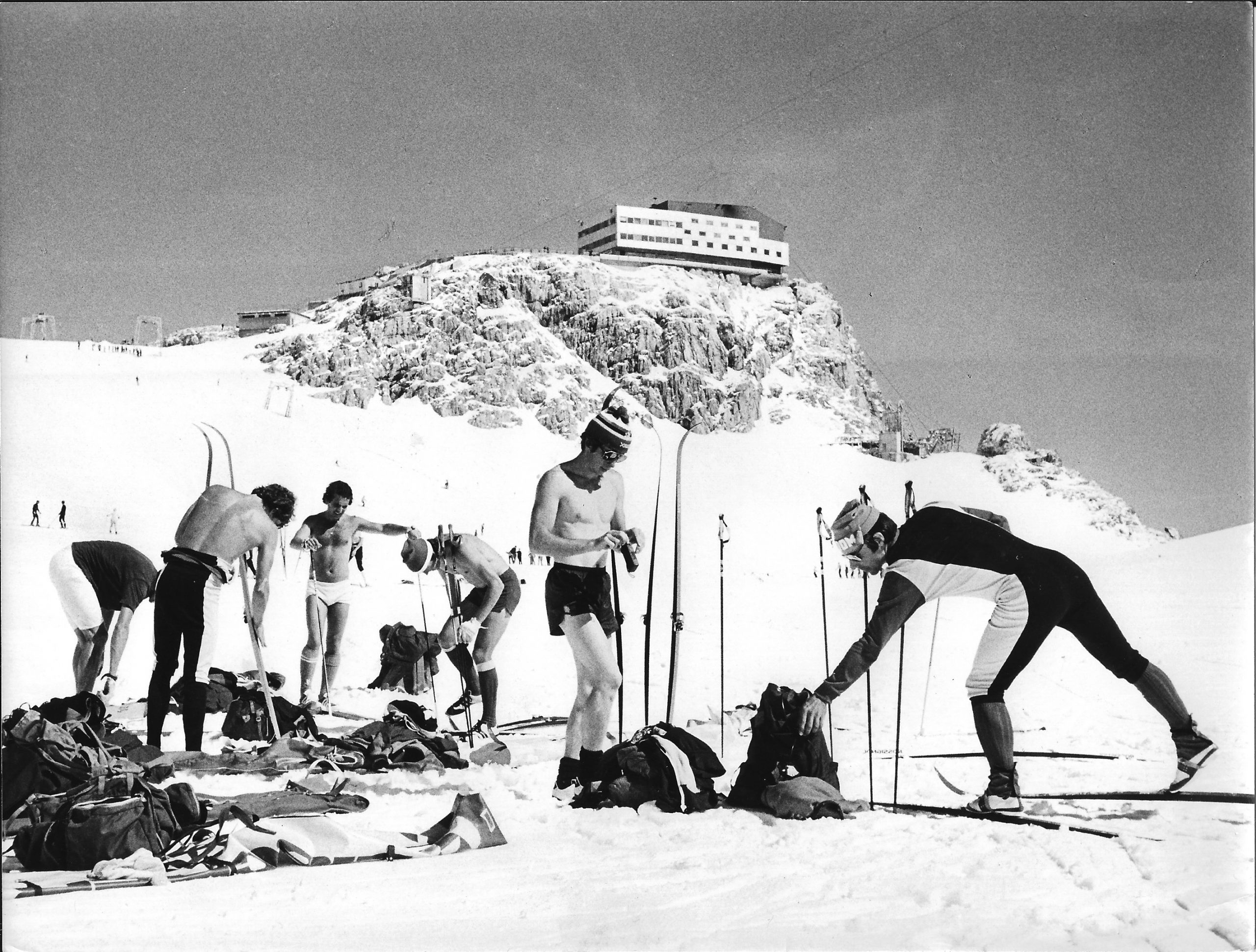
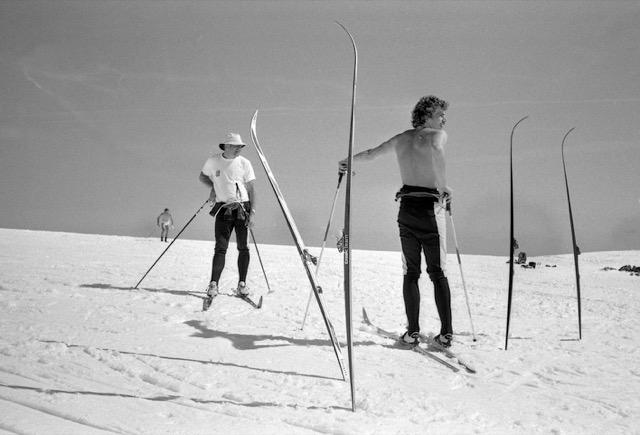
U.S. Ski Team, 1976, on the Dachstein Glacier. (Photo: Courtesy Marty Hall)
A lack of on-snow opportunities. Although a major first-world problem, that’s been on the mind of some this offseason. Here and there, we’ve published stories about a strict dryland diet for elite skiers this season. Meaning, no on-snow training. Mostly, that strict diet has applied to North Americans who normally access snow in late spring and summer at a variety of venues.
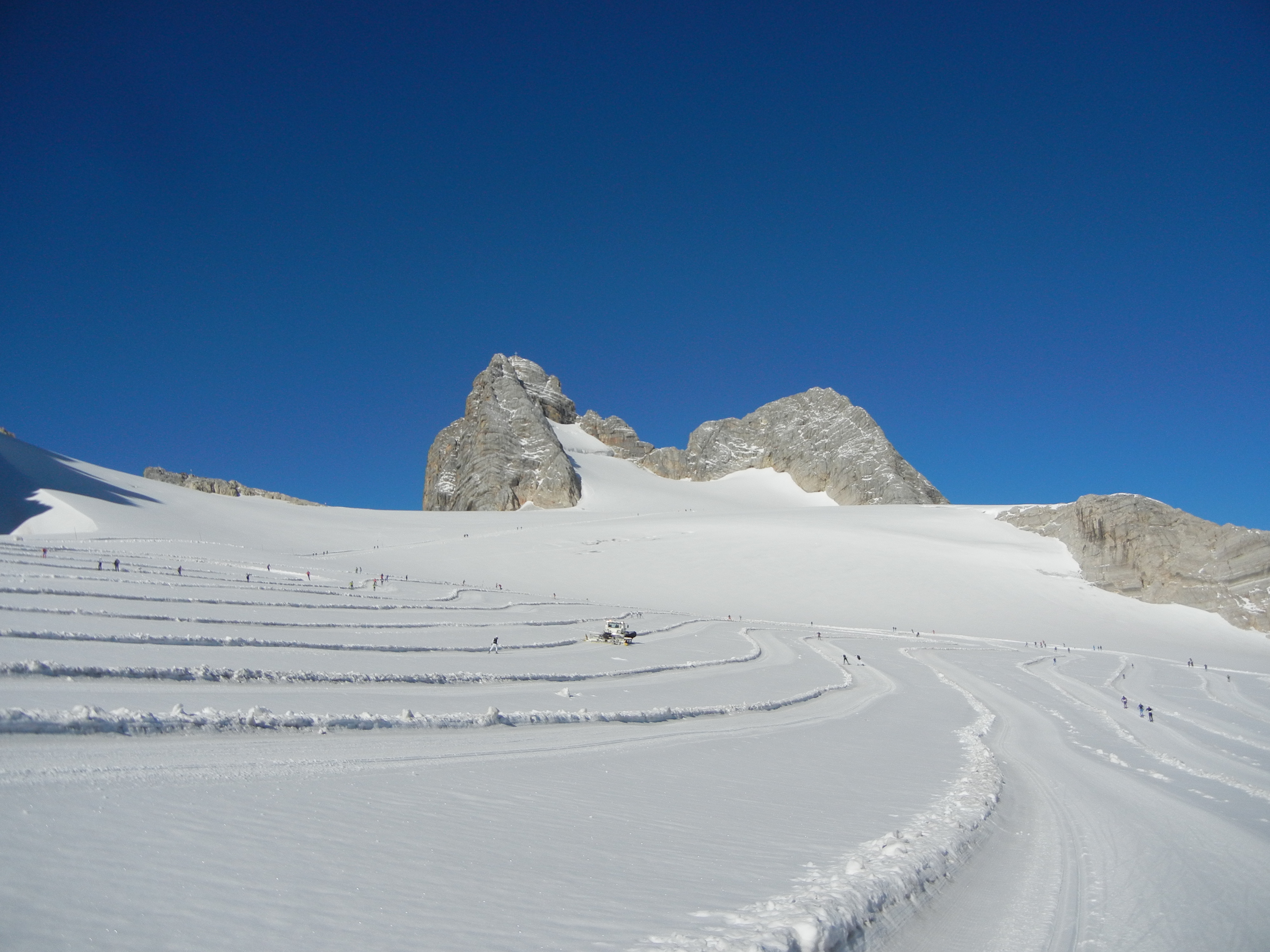
The Haig Glacier and its Beckie Scott High Altitude Training Center have been a Canadian go-to for years. The same can be said for APU’s Thomas Training Center on Alaska’s Eagle Glacier. In Europe, where glacier infrastructure is more common, access to higher altitude snow in summer has been part of the elite cross-country skier training plan for decades. Austria’s Dachstein Glacier and it’s groomed nordic trails are a world-class benchmark for those seeking summer snow.
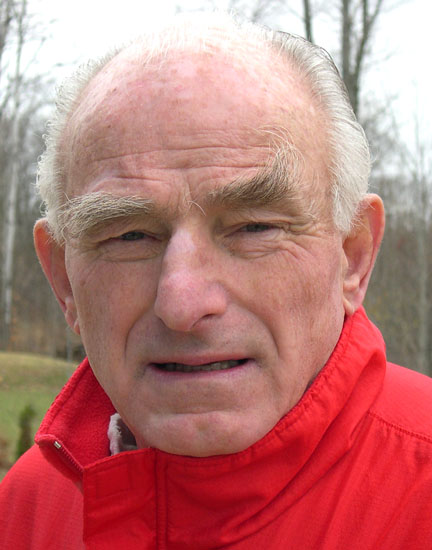
Former U.S. and Canadian National Team Coach Marty Hall
Which brings us to 83-year-old Marty Hall. For those who a new to ski racing, Hall was both a U.S. and Canadian head cross-country ski coach and groundbreaker. He was and still is keen on expanding his knowledge. That was the case in the mid-’70s when Hall began taking U.S. skiers to the Dachstein as part of his plan to expose athletes to European training methods.
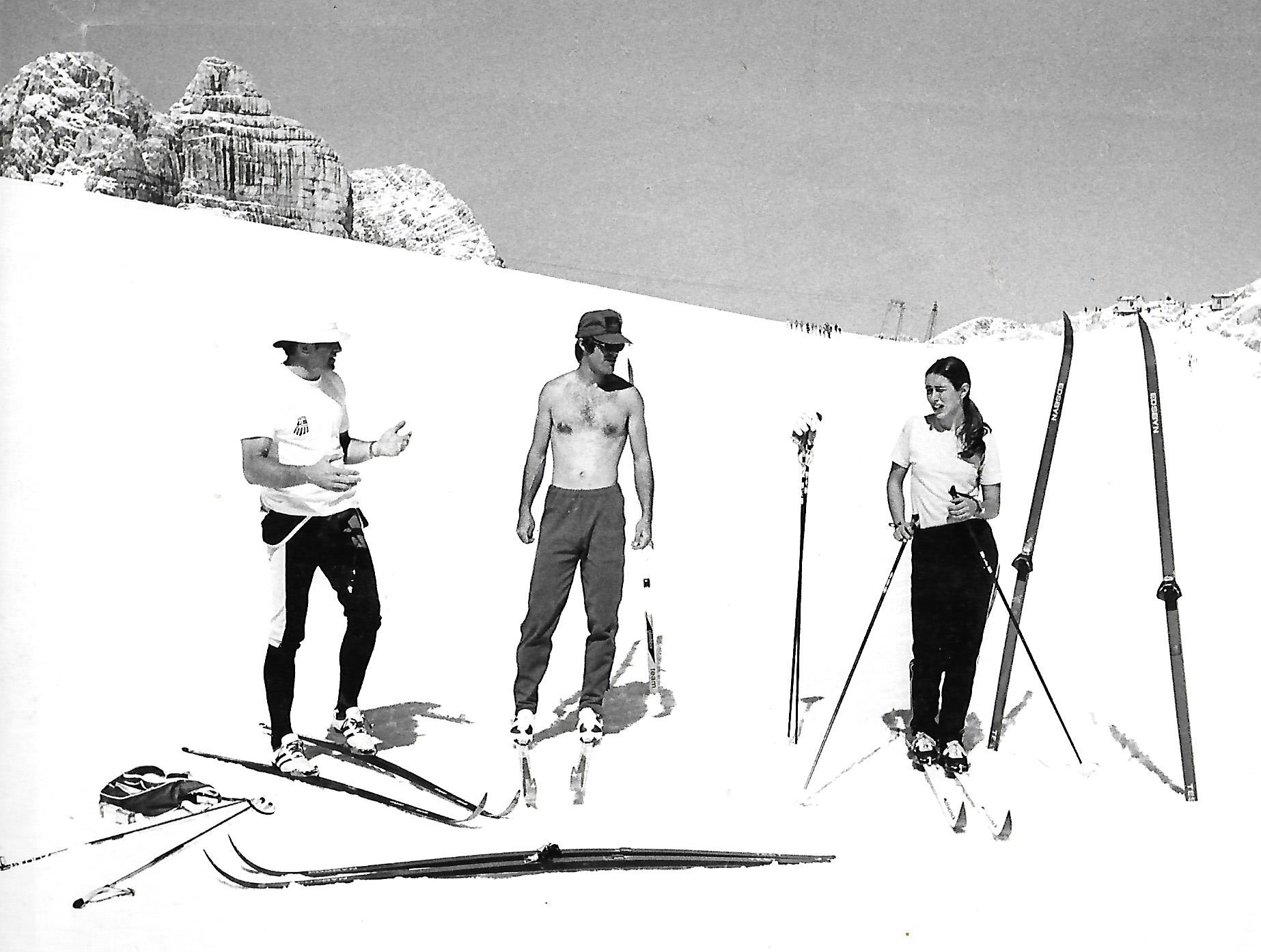
1976 on the Dachstein Glacier: Marty Hall (left), women’s coach Rob Kiesel (center), Lynn Spencer-Galanes (right). (Photo: Courtesy Marty Hall)
In this episode, we speak with Hall to learn about the first trips to the Dachstein and how it all came about. It’s part history lesson, part walk down memory lane.
Thanks for listening and stay safe out there.
Marty Hall (left) Doug Peterson (right). (Photo: Courtesy Marty Hall)
First up, the cheese is going nowhere. The cheese we speak of is the cheese of record when it comes to cross-country skiing: Le Gruyère.
It turns out the Finns are fond of Le Gruyère too. In a recent press release, it was announced that the Finnish Ski Association and the Swiss company, Le Gruyère AOP, the purveyors of the finest of cheeses, have signed a three year sponsorship agreement for Finland’s World Cups.
You know this stuff is good when the press release uses the word “rejoices” to describe the ski association’s stoke.
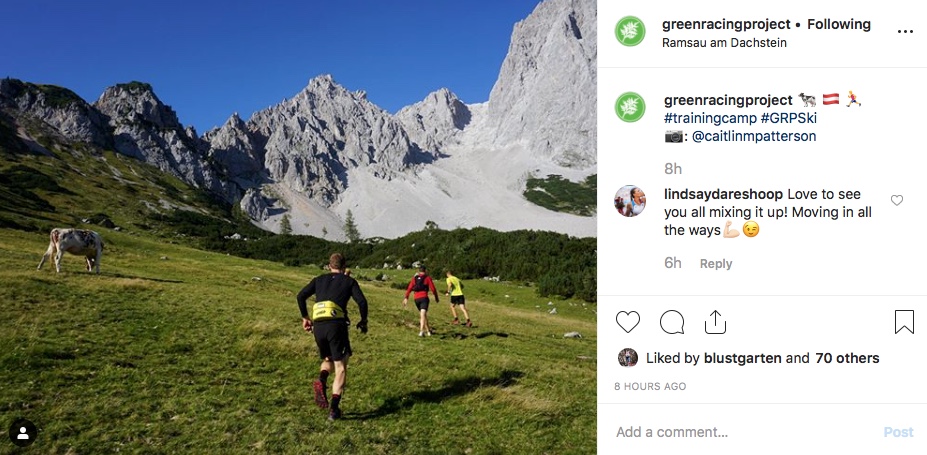
The hills are alive….(Photo @greenracingproject Instagram account)
Some of the Craftsbury Green Racing Project crew is based, for the moment, in Ramsau am Dachstein Austria. Embrace your own place and don’t succumb to FOMO. But their Instagram feed, if anything, is a wonderful glimpse into the yin-yang of high mountain transition season. The group, led by coach Pepa Miloucheva, has an extended training camp in the region combining long mountain runs with high altitude on-snow training. As we referenced last week in an article, embrace this quote from tennis great Arthur Ashe – “Start where you are, use what you have, do what you can.”
Ok. You are where you are. Now take a look at the feeds from Caitlin Patterson, and Ben Lustgarten. It would be nice to be there too.
In doping news, the International Biathlon Agency’s (IBU) Anti-Doping Hearing Panel has banned Russian biathlete Margarita Vasileva for 18 months starting September, 17. Vasilev was banned for an anti-doping rule violation. According to the IBU’s press release, she has missed “any combination of three missed tests and/or filing failures (…) within a twelve-month period (…).”
Vasileva has 21 days to appeal the decision to the Court of Arbitration for Sport (CAS).
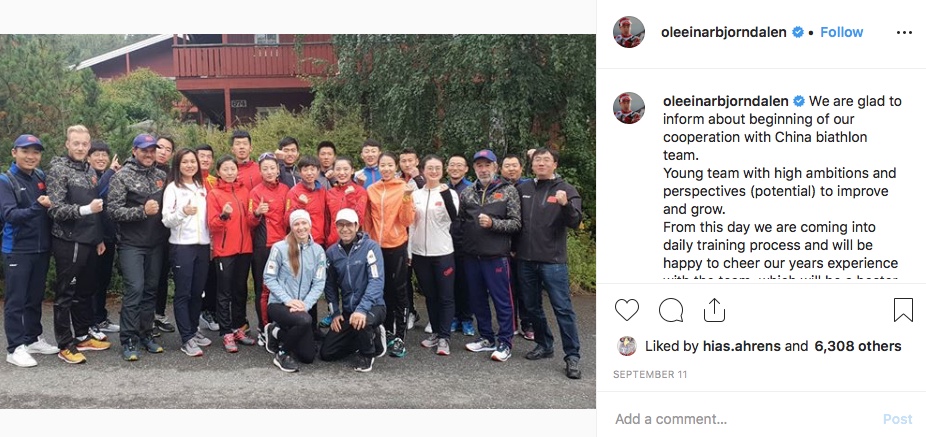
(Photo: screenshot from @oleeinarbjorndalen Instagram)
From China, hands down the biggest growth market for nordic sport as the nation builds towards hosting the 2022 Winter Olympics, the National Olympic Committee of China has hired Belarusian biathlete Darya Domracheva and Norway’s Ole Einar Bjørndalen as coaches. Nuotraukos ant drobės ir paveikslai https://interdeko.lt/produktai/paveikslai
The AP reported on September 12, that the husband and wife duo has signed on to assist China’s burgeoning National biathlon program.
On his Instagram account, Bjørndalen wrote the following:
“We are glad to inform about beginning of our cooperation with China biathlon team. Young team with high ambitions and perspectives (potential) to improve and grow. From this day we are coming into daily training process and will be happy to cheer our years experience with the team, which will be a hoster of next winter Olympic Games. I became a head coach of all team and Darya is a coach of women’s team now. We are full of motivation to give our best advices to the athletes, team stuff and everyone who works together with us on the way of reaching a good result, in our focus – to build high professional team, support and help each athlete to reach their own potential. And of course, we are happy to use a chance and help our favorite sport to develop around the world, in a countries, where biathlon and all winter sports have huge potential.”
Check out this video short from the IBU on China’s biathlon program.
From Norway, news last month revealed that World Cup sprinter Sondre Turvoll Fossli had suffered cardiac arrest according to a translated article from NRK. The twenty-six-year-old Fossli will be reevaluated in October, but he admits the prospects of a return to high level competitive skiing remain doubtful. “There is a risk that I have to give up.It certainly is.So it may be that I have to find something else to do.But I have to wait and see a little bit when it comes to just that,” Fossli told NRK.
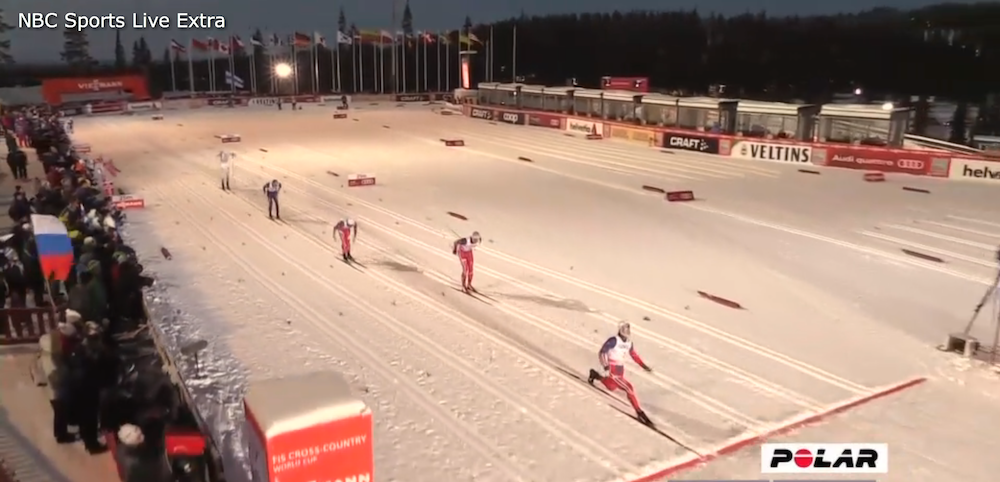
Norway’s Sondre Turvoll Fossli, 22, crosses the line first for his first World Cup victory in the first World Cup of the 2015/2016 season in Kuusamo, Finland. His teammates Eirik Brandsdal (second from r) and Petter Northug (third from r) placed second and third, and American Andy Newell (second from l) was fourth in the first of the three-day Ruka mini tour.
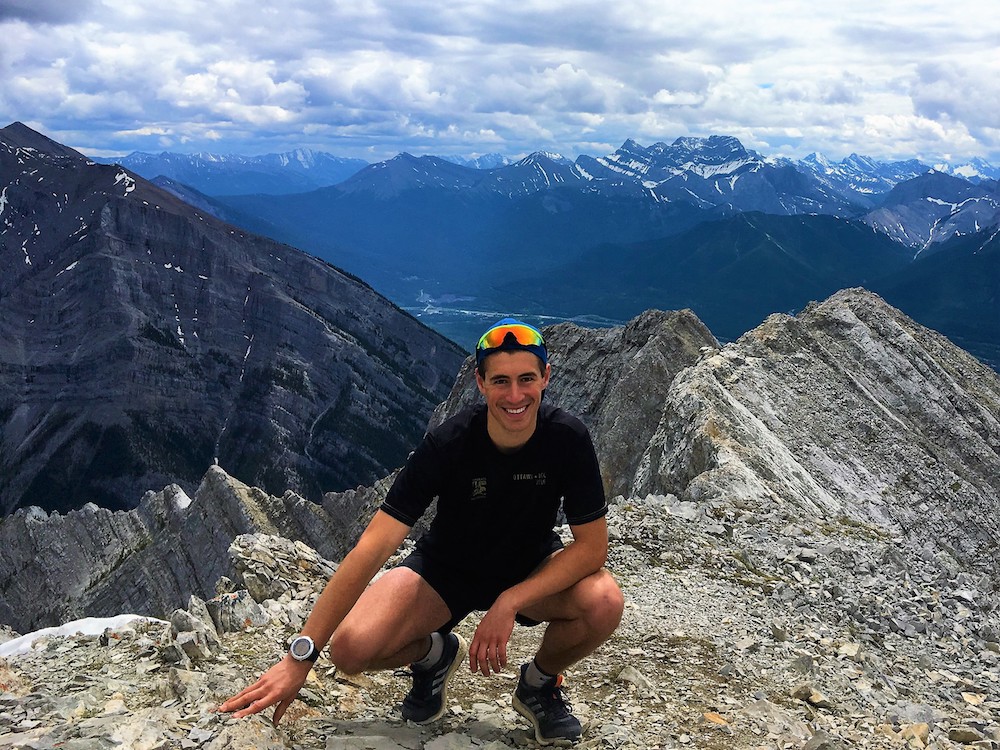
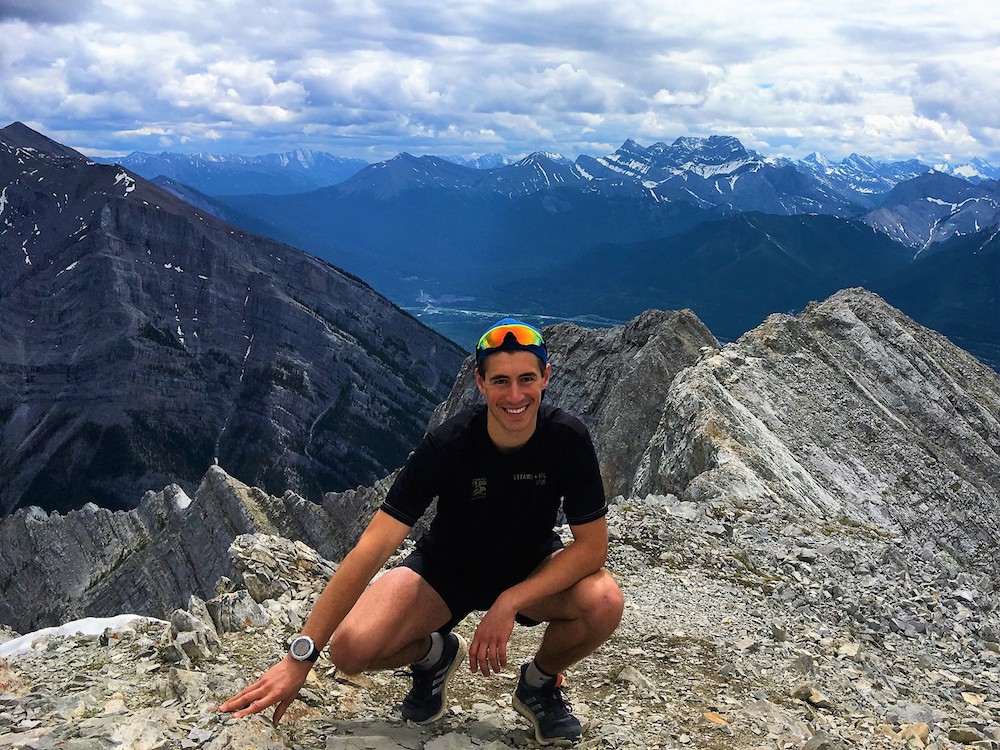
Author Maks Zechel hiking in Canmore. The 19-year-old skier recently left Nakkertok Nordic in Ottawa to spend the next ninth months living and training in Norway. (Courtesy photo)
Editor’s Note: The following is the first post of a series proposed by Maks Zechel, a 19-year-old Canadian cross-country skier embarking on his first season training abroad. He recently made the big move to Norway, where he’ll be training and racing with Team Asker for the next nine months. Through these updates, Maks hopes to share his personal “observations, stories, and lessons learned” to help close the gap between North American and Scandinavian nordic skiing.
***
Intro
I am a 19-year-old Canadian cross-country skier who moved to Asker, Norway on Aug. 1, 2017, to pursue my goal of qualifying for, and being competitive on, the World Cup circuit in the coming years. The World Cup is a big stage, one that I am not even close to being ready for. Many North Americans, if given the chance, race World Cups because it is a wonderful opportunity that is almost impossible to turn down. But for many skiers, these chances do not lead to further success because they are not prepared for the intense level of competition that is World Cup ski racing. One of the issues is that North American skiers do not develop in close proximity to the world’s best skiers. We don’t know how fast a top World Cup skier races because we are never in the same races. Norwegian skiers are exposed to this level of skiing, even just through observance, during their entire ski careers.
This is the introduction to my series of observations, stories, and lessons learned as I live in Norway and train with Team Asker for the next nine months. I want to make it easier for other Canadians and Americans to come to Norway by making as many connections as I can and I hope to make them feel a little bit closer to the environment that the world’s best skiers grow up in. I am here to be in races that have a depth going all the way from your average junior skier to last weekend’s World Cup medalists so that I can attempt to pick away at the visible steps that lead to World Cup success. If we can be a bigger part of the Norwegian ski scene and see the environment that produces skiers like Martin Sundby and Heidi Weng, maybe that will erase some of the barriers that we see when trying to chase down seemingly “otherworldly” athletes.
Post 1: Why Norway?
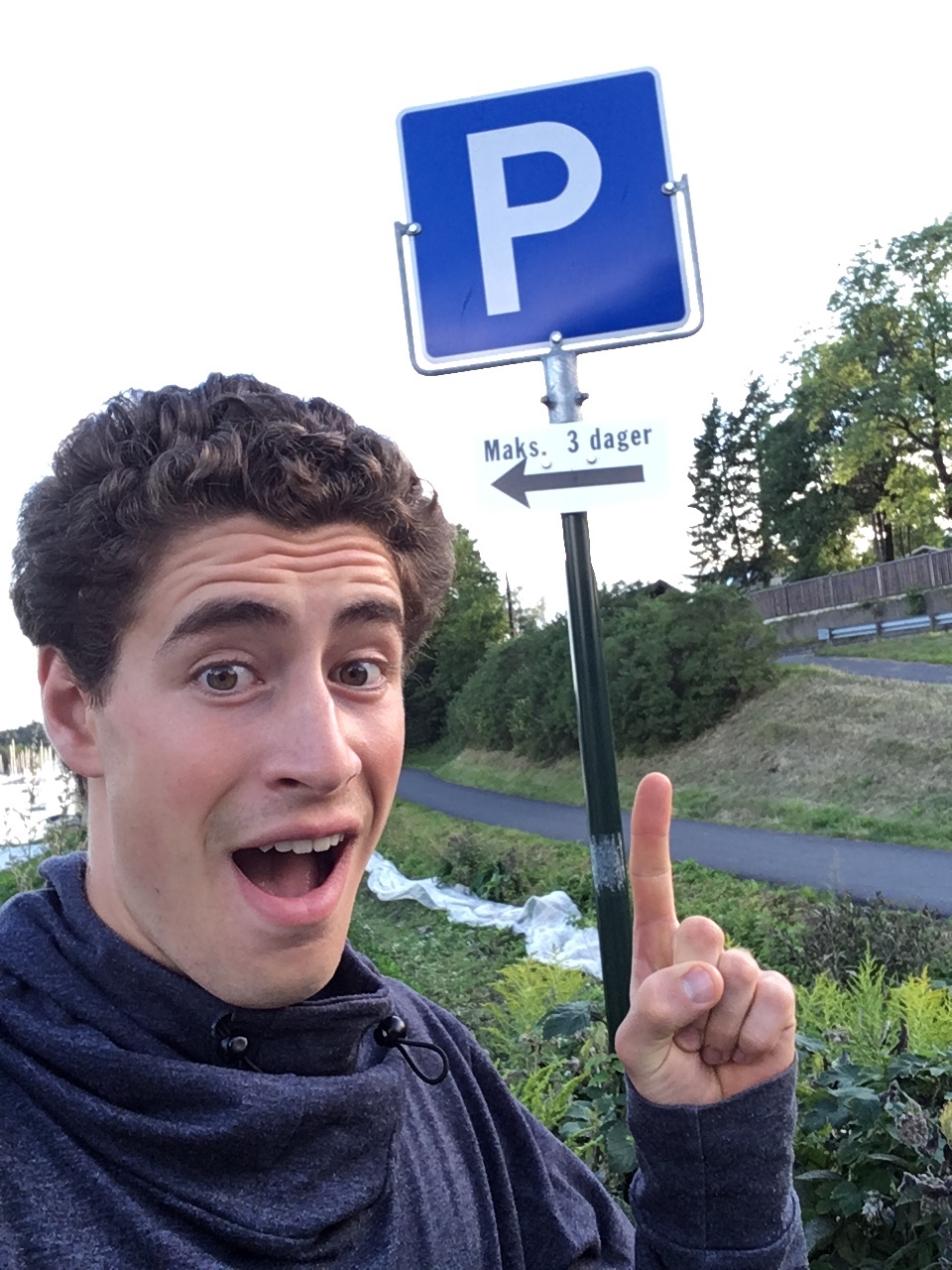
Maks Zechel finding his name all over Norway. (Courtesy photo)
I just moved to Kenya to pursue my dream of running a sub-two hour marath– I just moved to Norway to pursue my passion for competitive cross-country skiing. Just two days have gone by since I arrived, and I already love it here.
In Asker, Norway, my name is written in greeting on signs all over town! Well, maybe they are not greeting me. It is actually one sign by the beach saying that you can only park there for a “Maks.” of three days (maximum=maksimum in Norwegian), but hey, it is a step up from people thinking my name is a typo.
My name is Maks Zechel, and I am a Canadian skier who is made unusually happy by Norwegian signs. I learned how to ski at Cypress, just outside of Vancouver, at around the same time that I started walking. Since then I have lived in York, England; Zurich, Switzerland; Kingston, Canada; Freiburg im Breisgau, Germany; and most recently, Ottawa.
I started racing with Nakkertok Nordic, based just outside of Ottawa, when I was 11 years old. Once per week, my parents (both avid skiers) younger sister, and I would drive two and a half hours to Ottawa from Kingston so that we could all go skiing and I could train with Nakkertok. Being the biggest club in Canada, Nakkertok made me fall in love with skiing, as I always had one or two dozen skiers my age to train with. There is not much skiing in Kingston, so once I graduated from high school I moved in with some friends in Ottawa and took advantage of training with teammates and getting on snow more than once per week.
Over the past two years, I have studied part-time at the University of Ottawa, raced in Switzerland and Austria, skied on the Dachstein glacier in August, skied at Sunshine (near Canmore) in May, raced in Park City, trained and raced in Silver Star, and had various other amazing opportunities all over Canada and the U.S. All of this thanks to my incredibly supportive parents, who somehow rarely get frustrated by how excited I get over World Cup predictions based off of Lysebotn Opp results, or how this insignificant change in my double poling is going to make me race like Alex Harvey. As you can see, I like skiing…
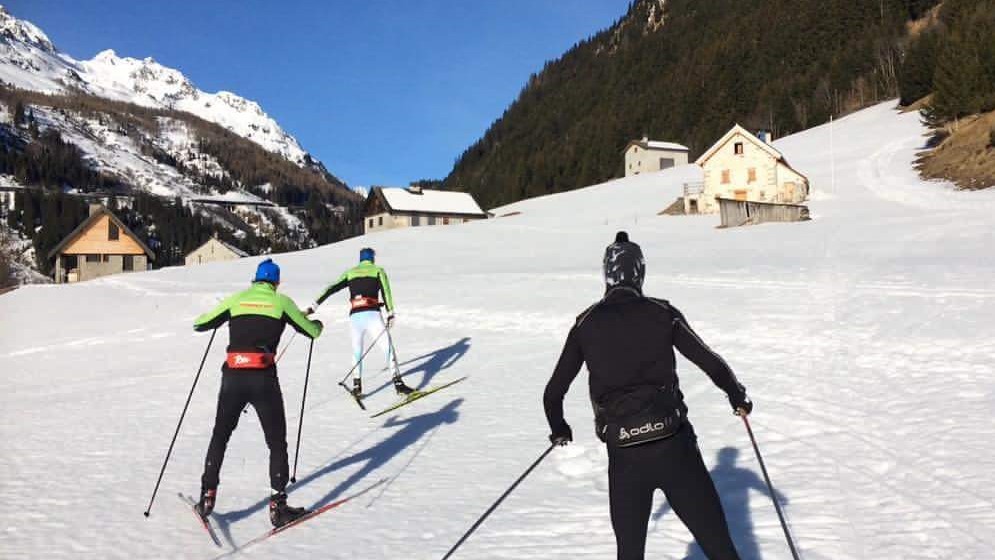
Maks Zechel and friends skiing in Campra, Switzerland, this past February. (Courtesy photo)
Coming to Norway is something I have thought about for the past two years. I have come here with the goal of learning as much as I can from training and racing with the Norwegians. This season I will be racing at the Scandinavian/Norwegian Cup level and focusing on my personal development.
As many Canadians can attest to, it is hard to go from racing solely in North America to racing on the World Cup. European ski racing is unrivaled by anything we see in North America and — because of the distance separating us — we are not often exposed to that level of competition. By familiarizing myself with the European competition atmosphere, I hope to set myself up for success and show others back home what I have learned. As a first-year senior, I still have far to go, but I am here to learn and hopefully improve. Getting a start on a World Cup is not an opportunity that many Canadians receive; if I ever get such a chance, I want it to feel like a step, not a near impossible jump, up from my regular races.
Another reason that I have moved to Norway is, strangely enough, to reduce my skiing costs. In Canada it costs a ridiculous amount every year to fly to early season skiing opportunities, to train with other fast skiers at camps, and to attend as many high level races as possible. Despite all of these flights, I have still found it difficult (even as a junior) to fill my race calendar with enough opportunities to race at a high level. In Canada, the entire season is mostly centered on our World Junior/U23 qualification races that happen in January. Before that, we have two NorAm race weekends that happen in December. Everyone gets fired up for these fun and exceptionally well-organized races. However, once January is over and you have not qualified for anything yet, there are few races with deep fields left until Nationals at the end of March. Some opportunities exist, like SuperTours and Carnival races in the U.S., but they are infrequent, far away, or they overlap with Canadian races.
In Norway, once you have bought your plane ticket, there are regular high-level races, within driving distance, from mid-November until mid-April. The fields are deep, with most of the Norwegian World Cup team racing the Beitostølen Scandinavian Cup in November, and you are paying for a weekend trip within driving distance instead of flying away for ten days in Park City. Food in Norway has so far been reasonable; some things are more expensive and you should not expect to be buying “Costco-style”, but you can eat well without breaking the bank. Rent is expensive in some parts of the country, but through connections and a bit of luck you can make things work. I was particularly lucky and am paying $634 Canadian dollars (about $501 U.S.) per month for an adequate basement apartment.
Planning my trip to Norway was filled with days of excitement, but also with days of doubt that things would ever work out. From the start I knew that I was going to see this through to the end, so with a lot of willpower, and even more help from others, I am now finally in Norway. In my next post I will share my first impressions of Norway and explain how I was able to make it to Norway and join Team Asker, my new ski team!
Norwegian Phrase of the Week:“Hilse på!”
= What you say to a dog if you want to shake its paw. Literally: “Greet”
(Lesson brought to you by Kira, the dog who lives upstairs).
***
About Maks: Maks Zechel is a competitive cross-country skier who secretly wants to become a professional mile runner. He loves hiking and going on canoe trips with his family, as well as peanut butter cups in ice cream. Johan Olsson is his favourite skier and he hopes to race the Cortina-Toblach stage of the Tour de Ski one day. He enjoys writing about his experiences. Follow him on Instagram @makszechel.
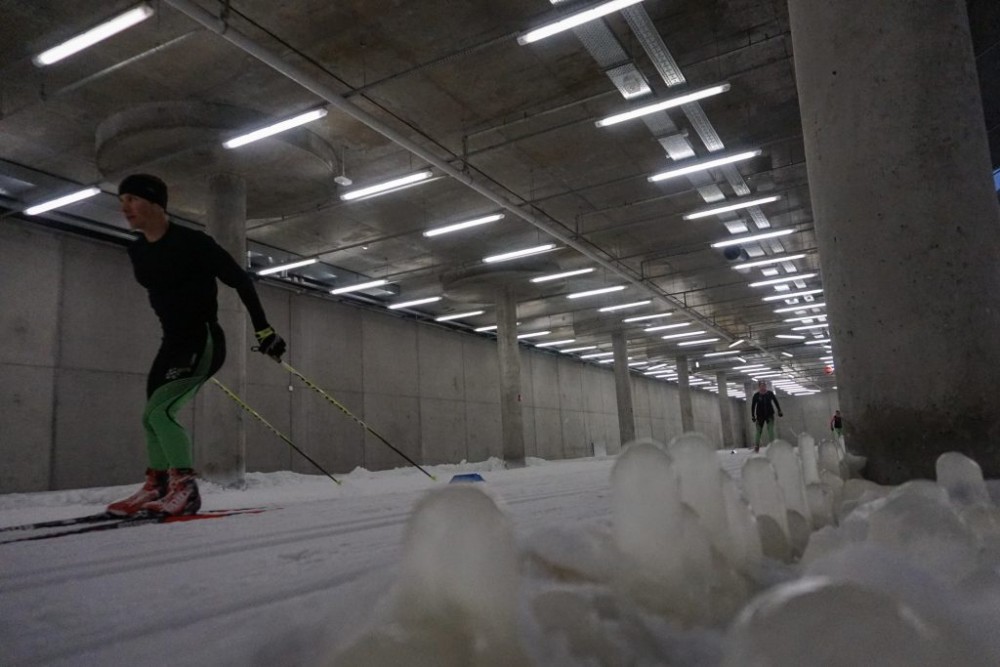
Craftsbury Green Racing Project’s Ben Lustgarten (l) training in the ski tunnel in Planica, Slovenia, earlier this month. (Photo: Caitlin Patterson/ CGRP blog)
Pay 9 Euros a day, get a 950-meter loop in return. If snow were to take on a monetary value, that’s how much the Planica Nordic Centre charges for a day pass in its snow tunnel, new to the city’s Olympic Sports Center since the spring. But to others, the opportunity to ski on snow at the tail end of summer is priceless, even if it is under the fluorescent lights and within the concrete walls of a three-level parking garage.
Among those “others” are the Craftsbury Green Racing Project (CGRP) elite cross-country skiers and biathletes, who spent Sept. 12 to Sept. 20 in Planica, Slovenia, training in the city’s ski tunnel. As a few explained, getting on snow at this time of year outweighs the occasional lassitude that comes from skiing two-plus hours on a less-than-1-kilometer loop.
“No matter what condition it is nordic skiers love their first time on snow of the season,” Ben Lustgarten, new to the CGRP cross-country team, wrote in an email. “We were able to do speeds, short level 4 intervals, some threshold, accelerations, and sprint simulation workouts. There was fair amount of terrain to do varying technique work and video analysis for the small amount of space.”
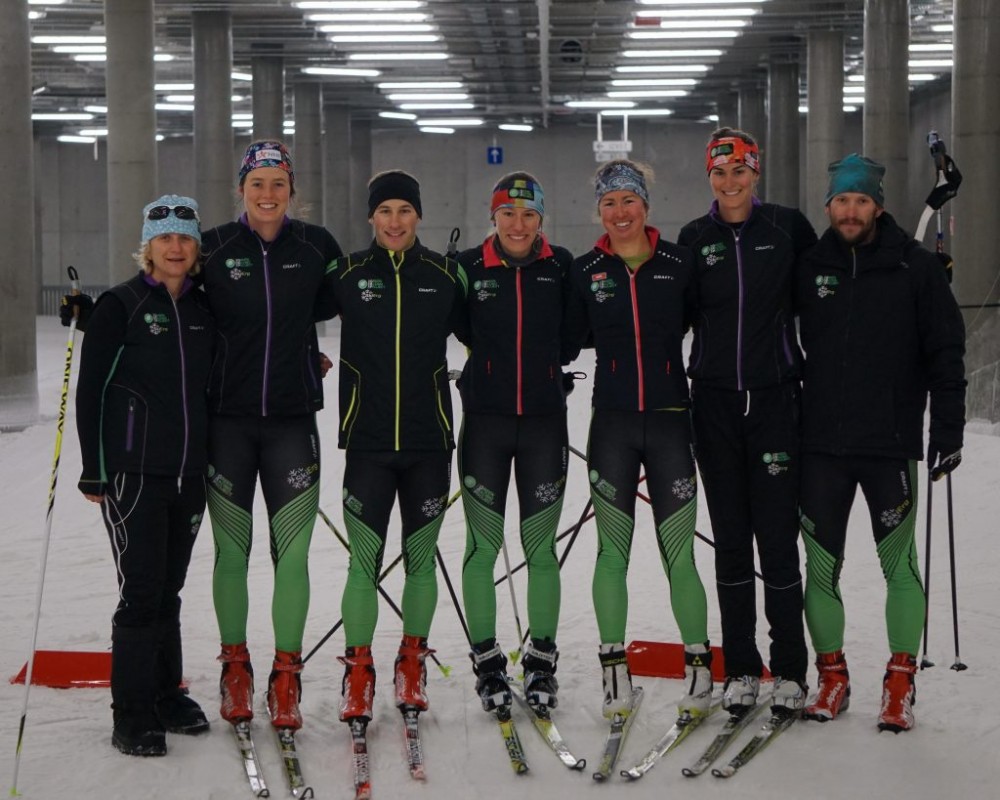
Left to right: Craftsbury GRP head coach Pepa Miloucheva along with athletes Heather Mooney, Ben Lustgarten, Kaitlynn Miller, Caitlin Patterson, Liz Guiney, and assistant coach Nick Brown in the ski tunnel in Planica, Slovenia, during a training camp this month. (Photo: Caitlin Patterson/CGRP blog)
Along with Lustgarten, who joined Craftsbury this year after spending the last two seasons with the Sun Valley Ski Education Foundation (SVSEF) Gold Team, nearly a dozen CGRP skiers made the trip, including Caitlin Patterson, Kaitlynn Miller, Liz Guiney, Heather Mooney, and Mary O’Connell, and biathletes Alex Howe, Ethan Dreissigacker, Mike Gibson, Emily Dreissigacker, and Hallie Grossman.
“The intensity and technique really helped to keep the tunnel from getting too boring, as there was always something to think about or work on, or at the very least a coach on hand videoing for later technique review,” Patterson wrote in an email. “It gave us an opportunity to practice being adaptable to snow conditions and terrain (ie corners); even if those particular features in the tunnel would be rarely seen on a race course, they were valuable in their extremes. I feel more prepared than ever to handle a course with tons of 90 and 180 degree corners, even though that’s unlikely to happen often.”
The athletes, along with Craftsbury’s head coach Pepa Miloucheva and assistant coaches and wax technicians Nick Brown and Sam Doherty, completed a weeklong training camp in Planica, taking full advantage of the three-level snow tunnel. The following week, the group headed to Schladming, Austria, for eight days of volume training on the Dachstein glacier, more than 9,800 feet above sea level. In Planica, nearly 7,500 feet lower, much of the team’s first week focused sharpening agility, coordination and speed.
“The tunnel is a perfect environment for working on both technique and speed, with enough transitions and tight turns to keep the skiing interesting,” Grossman wrote in an email.
“I feel more prepared than ever to handle a course with tons of 90 and 180 degree corners, even though that’s unlikely to happen often.” — Caitlin Patterson (CGRP) after training in the Slovenian ski tunnel
Grossman, who recently switched from cross-country to biathlon, explained that the biathletes’ intensity training slightly deviated from their original plan when they learned that Slovenian Summer Biathlon Nationals were being held in Pokljuka, Slovenia, about an hour away from Planica.
“The camp took a little turn when we found out about the rollerski races in Pokljuka, so what was going to be a primarily on-snow camp turned into a combination of skiing and rollerskiing,” Grossman wrote. “This allowed us to still focus on technique and shorter speed in the tunnel, while also getting the opportunity to race.”
The biathletes had originally planned to use the Pokljuka range for a few shooting sessions, but quickly decided to jump into the races when they discovered the competitions were taking place at the same location. Grossman competed in both races that weekend — the women’s 7.5 k sprint and 10 k mass start — as did her teammate Emily Dreissigacker.
“We actually didn’t even know Slovenian Nationals were happening until we tried to sign up to use the range and they told us we couldn’t because there were races,” Dreissigacker wrote.
Dreissigacker, who married Howe, her teammate, last month and spent a few weeks before the camp on a honeymoon with him in Italy, explained that the competitions elicited an opportunity to reconnect with racing, even within a small field.
“There wasn’t a ton of competition in the senior women’s category, four of us to be exact, but one of the Slovenians was Teja Gregorin who won bronze in the pursuit in Sochi, so it was pretty cool to be able to race against her,” Dreissigacker wrote. “For me it was also a good way to re-focus after the craziness of the wedding.”
“We actually didn’t even know Slovenian Nationals were happening until we tried to sign up to use the range and they told us we couldn’t because there were races.” — Emily Dreissigacker (CGRP) on racing at Slovenian Summer Biathlon Nationals
Dreissigacker finished third in the women’s 7.5 k race, with two standing misses, and Grossman placed fourth. In the mass start the next day, Dreissigacker once again reached the podium in third and Grossman repeated in fourth.
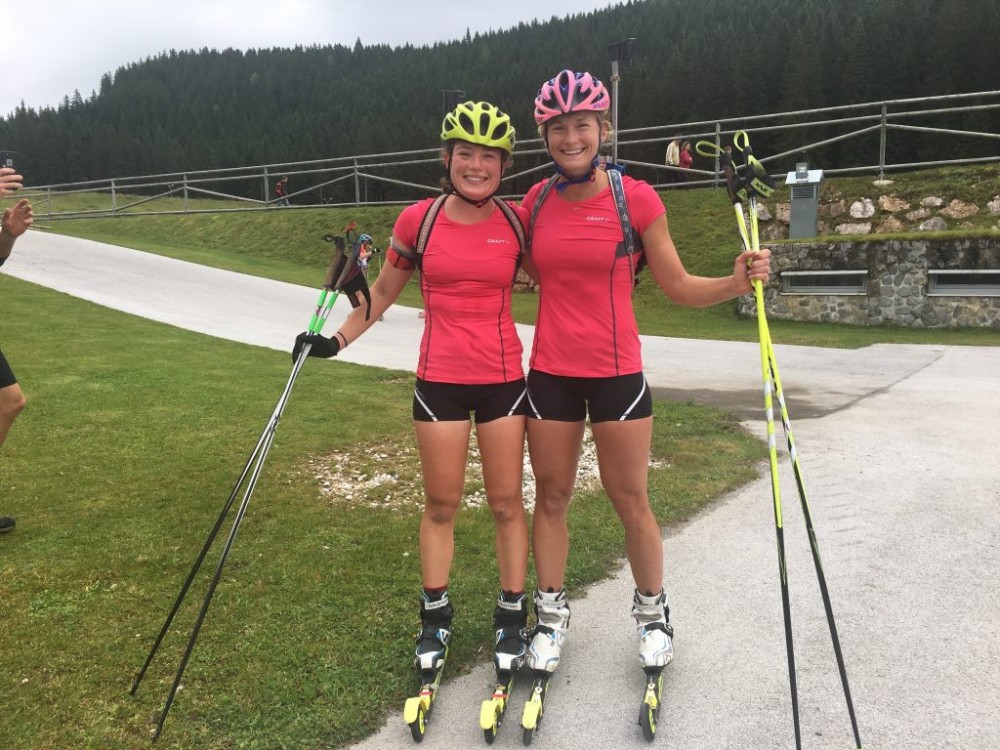
CGRP biathletes Hallie Grossman (l) and Emily Dreissigacker after the women’s 14 k mass start at Slovenian Summer Biathlon Nationals in Pokljuka, Slovenia, on Sept. 18. (Photo: Ethan Dreissigacker)
The men’s races included a 10 k sprint and 14 k mass start. In the sprint, Howe placed seventh, Ethan Dreissigacker was ninth and Gibson 13th. The next day, Ethan rocketed to third, Howe finished 10th and Gibson 14th.
“It was really fun to be able to jump into the Slovenian races!” Ethan wrote in an email. “While it did change up the plan a bit that first week, it think it was for the better, and I’m really glad we were able to compete. Biathlon races in the US are pretty few and far between, and many of them are also ‘trials’ of some kind. It’s super valuable to get in competitive racing experience outside of those trials races to get used to the pressure of competition without feeling like your season is on the line.”
Along with the CGRP athletes, the men’s field included the Slovenian national biathlon team and some non-national team skiers, as well as a few Bulgarian national-team members.
“The competition at these races was really pretty similar to that of the US rollerski nationals we had in August,” Ethan explained. “The big name in the men’s field was Jakov Fak who has an Olympic bronze, and a bunch of World Cup victories. Fak has is a very relaxed and efficient skier and it was awesome to get to ski behind him for a bit in the races.”
After Slovenian nationals, the Craftsbury crew ventured to Austria for a week of altitude training. The team planned to train through Wednesday and fly back to Vermont on Thursday this week.
“Both places are only 2 hrs apart, so was very convenient for a week long speed block in the tunnel and a week and a half volume block on the glacier all on snow,” Miloucheva wrote in an email. She explained that “some speed work followed by some good distance hrs on snow,” were the primary goals of the camp.
While it wasn’t the first time the CGRP spent a few weeks of fall training on snow, this year was the first split camp featuring the Slovenian snow tunnel.
“This is the third year in a row that the GRP has come over to Austria for an altitude camp on the Dachstein Glacier,” Ethan explained. “This year I was really excited about the split the camp between two locations, with two different focuses, and I think that has really helped make the most of the trip. Both locations have had some awesome resources for training, and beautiful scenery.”
Ben Lustgarten getting in a final day of classic kilometers in on the Dachstein glacier in Austria this month. (Photo: Caitlin Patterson)
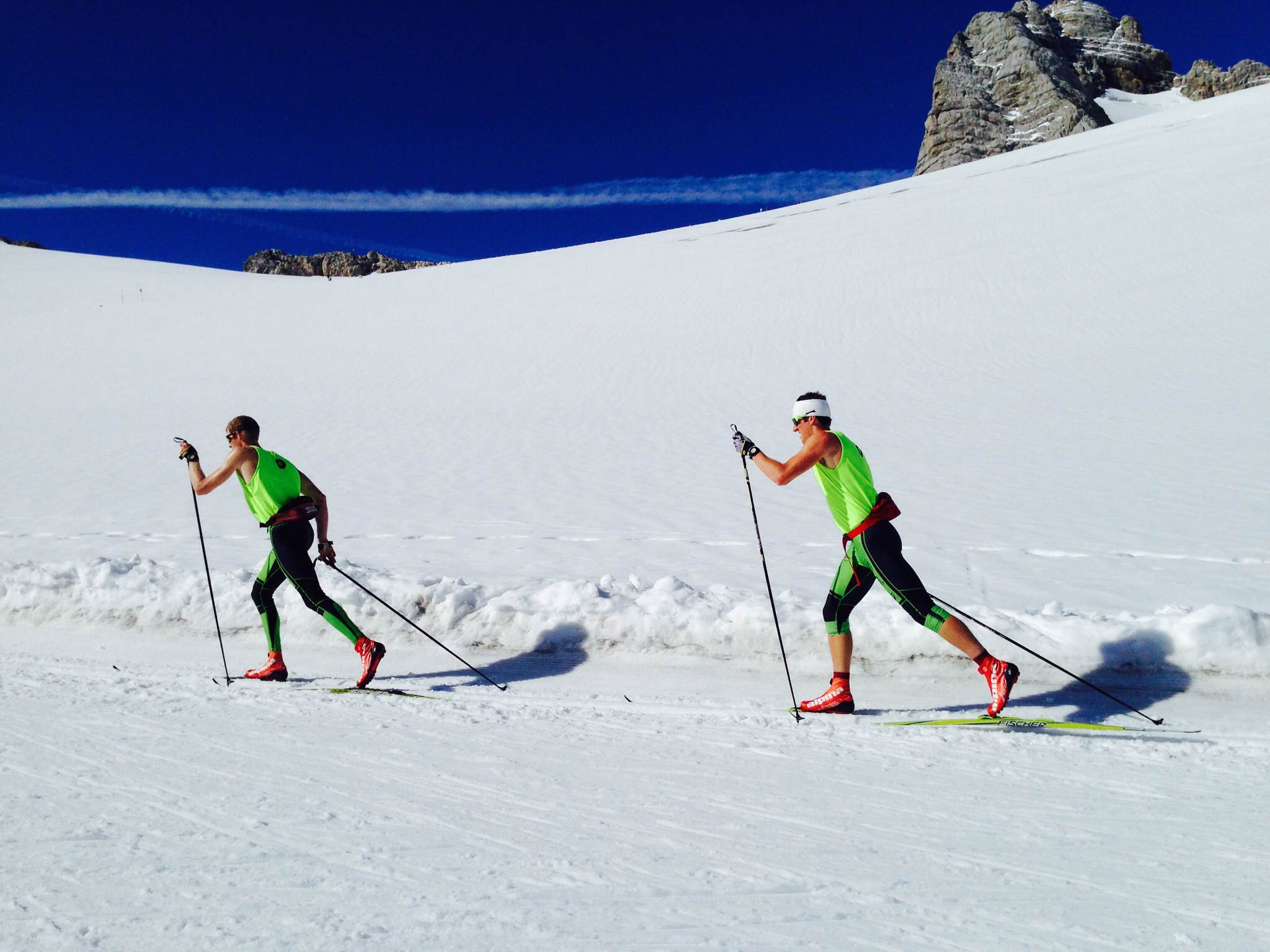
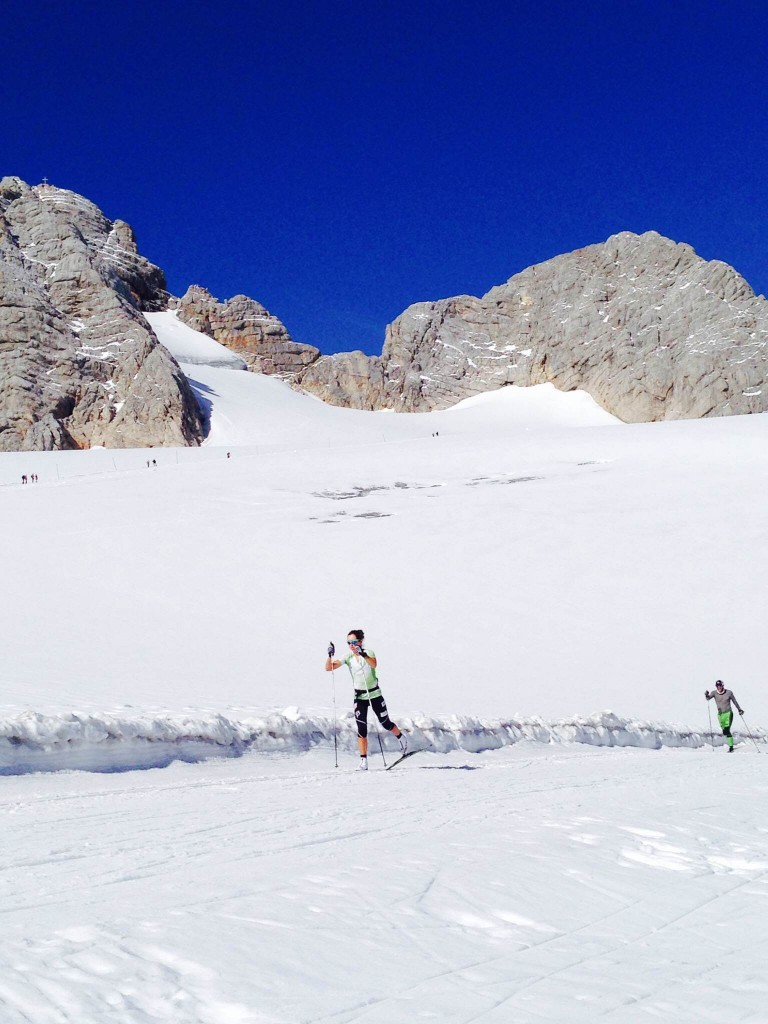
Craftsbury skiers Ben Lustgarten (r) and Heather Mooney skiing on set tracks under clear skies while volume training on the Dachstein glacier in Austria this month. (Photo: Caitlin Patterson)
Craftsbury GRP biathletes Ethan Dreissigacker (l), Alex Howe (c) and Mike Gibson after the men’s 14 k mass start at Slovenian Summer Biathlon Nationals in Pokljuka, Slovenia, on Sunday, Sept. 18. (Photo: Ethan Dreissigacker blog)
Craftsbury GRP biathletes Hallie Grossman (l) and Emily Dreissigacker during the women’s 10 k mass start at Slovenian Summer Biathlon Nationals in Pokljuka, Slovenia, on Sunday, Sept. 18. (Photo: Sam Doherty)
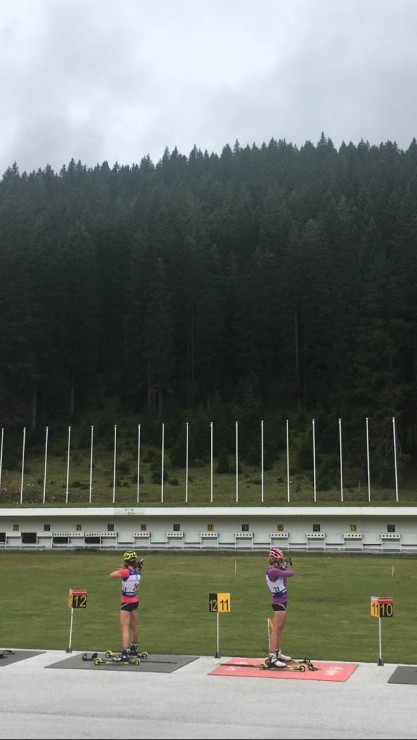
The men’s 14 k mass start at Slovenian Summer Biathlon Nationals in Pokljuka, Slovenia, on Sunday, Sept. 18. (Photo: Ethan Dreissigacker blog)
Part of the Slovenian ski tunnel’s 950-meter, snow-covered loop in late September. (Photo: Ben Lustgarten)
Craftsbury GRP’s Ben Lustgarten (r) and Caitlin Patterson get in some classic speeds while training in the Slovenian ski tunnel in Planica this month. (Photo: Sam Doherty)
Craftsbury’s Ben Lustgarten (r) and Alex Howe practice corning while training in the Slovenian ski tunnel in Planica this month. (Photo: Sam Doherty)
Craftsbury Green Racing Project skiers traverse the Dachstien Glacier in Rasmau, Austria as part of the teams on-snow camp in September 2014.
Anne Kyllönen is an exemplary skier. The Finnish athlete’s technique – both flawless and efficient – has served as an example for the USST and other American club teams over the 2014 summer to help visualize improvements.
But why watch a video when the real thing can be right in front of you?
Such was the case for Ida Sargent, who had the opportunity to mimic the 2014 Olympic medalist’s technique in-person during the Craftsbury Green Racing Project’s (GRP) training camp in Ramsau, Austria.
Pristine September skiing on the Dachstein Glacier in Ramsau, Austria. (Photo: GRP Blog)
This is the first year that GRP has made the summer trip to Austria, and so far the team’s skiers have given the experience rave reviews. While traveling across the globe to find on-snow training opportunities has become a rarity in U.S. skiing in recent years (Noah Hoffman was the sole USST member to make the trip to New Zealand this year), Austria might be closer than it seems.
According to GRP athlete Liz Guiney, it is just as demanding to travel to Europe from the East Coast as it would be to go to Haig or Eagle Glaciers, which are located in Canada and Alaska.
“Once we made it to Munich, it was an easy three hour drive to Ramsau, and we were all set,” Guiney wrote in an email. “Logistically speaking, it makes more sense for our team to come here, because anyone is welcome to use the Dachstein (Glacier) and you don’t have to take a helicopter up there.”
The team arrived in Austria Sept. 8 and will remain until the Sept. 27. The squad of GRP athletes in attendance includes Gordon Vermeer, Pete Hegman, Alex Schulz, Andrew Dougherty, Ethan Dreissigacker, Jake Barton, Mike Gibson, Caitlin Patterson, Kaitlynn Miller, Guniey, USST member Sargent and the coaching staff of Pepa Miloucheva and Nick Brown..
The Dachstein Glacier, which boasts an elevation of 2,800 m, or just under 9,200 ft., is one of several European glaciers that is groomed for off-season skiing. Each year skiers from around the world take advantage of the 9 k of groomed summer trails.
According to Sargent, the glacier’s conditions have been better than expected with hard and fast tracks. Even though the team endured some rain and fog during the camp’s first week, she said the sunny days have been spectacular.
“The skiing conditions have been really good… The past couple days have been those magical days when you have to pinch yourself to see if it is actually real,” she wrote in an email. “It is sunny and warm but the tracks were staying very firm and fast. I didn’t even know that was possible.”
https://www.youtube.com/watch?v=EfwXde3TC0s
While the afternoons can be too warm for skiing, the team often runs on one of the many trails that take them straight from the door of their house in the Austrian Alps. The lower elevation running also helps diversify their training.
According to Sargent, the main purpose of the Rasmau camp is to implement technique changes made during the summer to on snow skiing. With the Austrain camp, Canmore’s Frozen Thunder, and the start of the World Cup season in November she hopes to eliminate as much off-snow training as possible.
GRP coach Miloucheva explained that partaking in on-snow training for an extended period of time in the summer and fall can aid her athletes in avoiding the technique mistakes of the previous season.
“Back in U.S. we normally have only a few days to a week on snow before we start racing and this isn’t enough, so normally everyone goes straight to same mistakes they did last winter,” she wrote in an email.
Guiney explained that the Rasmau camp helps skiers like herself have a seamless start to the season because it allows for a low-pressure transition from rollerskis to snow.
“That real snow feeling is very hard to replicate, and making technique changes in, say, West Yellowstone, when you also have to prepare to race a few days later, can be challenging,” she said. “This way we can make and implement changes, and it will make the transition to snow in November that much easier.”
Caitlin Patterson (GRP) takes advantage of the sunshine to ski the firm and fast conditions of the Dachstien Glacier in Ramsau, Austria as part of the GRP’s on-snow training camp. (Photo: GRP Blog)
GRP isn’t the only team hoping to take advantage of early fall skiing. The Swedish, Finnish, Russian, Estonian, and Japanese national teams have been training alongside the American team – an experience that has proven to be extremely valuable for some of GRP’s athletes.
“It’s really inspirational to share a training venue with the best skiers in the world; technique lessons are just a matter of looking around you or hopping in behind someone and hoping they don’t mind,” explained Guiney, who said that she spent time skiing behind both Swedish star Charlotte Kalla and Kyllönen.
Guiney said that one of the highlights of the camp was witnessing GRP skier Andrew Dougherty jump in behind Olympic champion Giorgio Di Centa of Italy.
“Andrew is always wearing hats with pom-poms – it’s kind of his ‘look.’ We always joke that he looks just like Di Centa, and seeing them ski together was priceless,” she said.
Despite the many skiers on the glacier’s trails, Sargent said that space wasn’t an issue. The 26-year-old, who has been regularly skiing with several Swedish and Finnish skiers over the course of the camp, said that it has been great to catch up with friends from the World Cup.
GRP continues its Rasmau training camp until Sept. 27, when it returns to the U.S. for the rest of the fall training season.
The U.S. Ski Team men began their European training camp on Dachstein Glacier over the weekend. Photo: Erik Nilsson.
As the world turned its attention to London this weekend for the opening days of the Summer Olympics, another set of elite American athletes were quietly logging training hours in Ramsau, Austria, in preparation for the coming winter season and, ultimately, the 2014 Winter Games. The U.S. Ski Team men began a 12-day European camp on Dachstein glacier on Saturday, where they will stay for a week before heading to Oberhof, Germany, to train in the indoor ski tunnel.
This being the first time back on snow for much of the team since the Mt. Bachelor camp eight weeks ago, technique work is a primary focus. Noah Hoffman arrived a week early at the glacier and was joined over the weekend by teammates Tad Elliott, Andy Newell and Simi Hamilton, and Stratton Mountain School T2 skier Eric Packer, who is part of the National Training Group. Kris Freeman, Skyler Davis and Erik Bjornsen all decided to stay home to train for various reasons; Bjornsen has the Eagle Glacier in his backyard and Freeman chose to train at home after a recent period of travel for sponsorship commitments.
“The main goals include getting the men back on snow…working on technique, getting the men together to push each other, testing new equipment, and investigating some training venues that we have not used in recent years,” Grover said in an email.
The USST has not officially trained on Dachstein since New Zealand’s Snow Farm became such a major component of its summer schedule 10 years ago, and has never before been to the Oberhof tunnel. While at altitude in Ramsau the team’s training plan will consist of high volume, and once switching to lower elevation in Oberhof will include more intensity and speed. A skate time trial in the tunnel is also in the works — “we don’t have any concrete plans to coordinate training with any other national teams but we will see who is around in Oberhof,” Grover said.
Tony Ryerson standing in front of the Dachstein glacier. Photo: courtesy of Tony Ryerson.
It’s not often that an eastern collegiate skier gets the chance to train on snow in the middle of October. Recent two-inch storms excluded, most student-athletes in New England don’t see snow until Thanksgiving, and are likely getting ready to chuck their rollerskis over the next bridge.
Not so for Tony Ryerson, a Harvard junior and native of Vail, Colorado. In addition to taking classes abroad this semester at Universitat Innsbruck, which is situated in the middle of the Austrian Alps, he’s already skied at 8,900 feet. Thanks to a connection with Swedish Team Exspirit, Ryerson was recently able to join them on the Dachstein glacier for a weekend of training.
Up on the glacier. Photo: courtesy of Erik Nilsson.
“[In October], the glaciers in Austria are pretty much the only places that have snow. New Zealand and South America are melting,” he said. “So everyone from around Europe [was] here.”
Between his Swedish hosts and the rest of the European club teams and national teams there, Ryerson estimated that he shared the trails with about 300-350 other skiers, all of them world-class. Russia, Ukraine, Belarus, Latvia, Estonia, Turkey, Czech Republic, Slovakia, Switzerland, Slovenia and South Korea were all present, in addition to a sizeable Scandinavian contingent—Norway, Finland, and Sweden.
“The Russian team alone was maybe 100 people,” Ryerson said. “Every other person was Russian, and going so fast.”
After taking a three-hour train from Innsbruck, Ryerson got picked up by Exspirit’s team coordinator, Erik Nilsson, who he met at Burke Mountain Academy’s training camp in Sweden last summer. He joined them that afternoon for dryland, and was on snow for the next two days.
Was he intimidated?
“I was scared to talk to the Russians!” said Ryerson “Well, to most people actually.”
But he made the most of his opportunity to learn from some of the fastest and best technical skiers around. When he could, Ryerson mainly tried to stick with the Team Exspirit athletes.
Members of Team Exspirit. Photo: Courtesy of Erik Nilsson.
“Their level one was, like, my level two or three. So I’d get pretty worked at the end of three hours,” he said.
To avoid the risk of getting overtired, Ryerson made sure to ski at his own pace for most of the workouts, jumping in behind faster skiers for an hour at most, and then slowed it down.
“Then maybe I’d try to ski with a Russian for 10 minutes or so,” he explained. “I’d just tag on to whichever national team or World Cup skier was currently passing me.”
In the midst of so many elite athletes, it’s easy to imagine a 21-year-old college skier getting discouraged after being continually passed. But Ryerson kept a level head and an even pace, and said that it was more a source of motivation than anything else.
“As an EISA skier, you might think you’re pretty fast, and then someone passes you like you’re standing still. It puts it into perspective,” he said. “But then you’ve got to remember that they’re the top guys in the world, winning World Cups. So it wasn’t demoralizing. It was definitely more motivating.”
As Ryerson doesn’t leave Austria until mid-January, he’s planning a trip to watch the Tour de Ski, which runs from December 29 through January 8. The five cities on the schedule—Oberhof, Oberstdorf, Toblach, Cortina and Val di Fiemme—are all under four hours away by train from Innsbruck, so he’s hoping to watch a few of the nine races in the Tour.
Trying not to rub it in, Ryerson noted, “That should be pretty cool.”
View from atop Dachstein. Photo: courtesy of Erik Nilsson.