From the FasterSkier archive — posts syndicated from athletes’ and coaches’ own blogs between 2004 and 2012, kept online as published. Current coverage is at fasterskier.com.
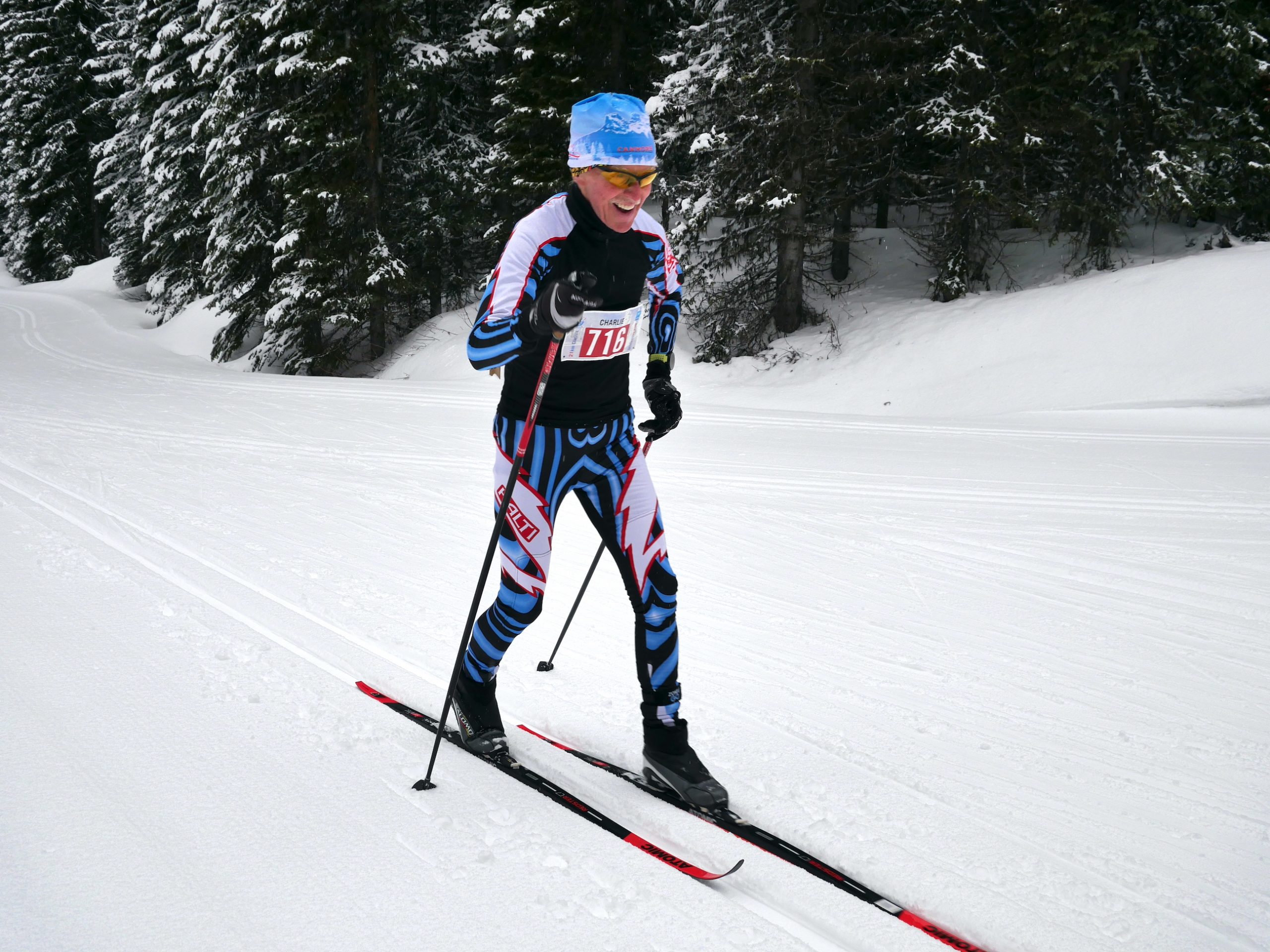
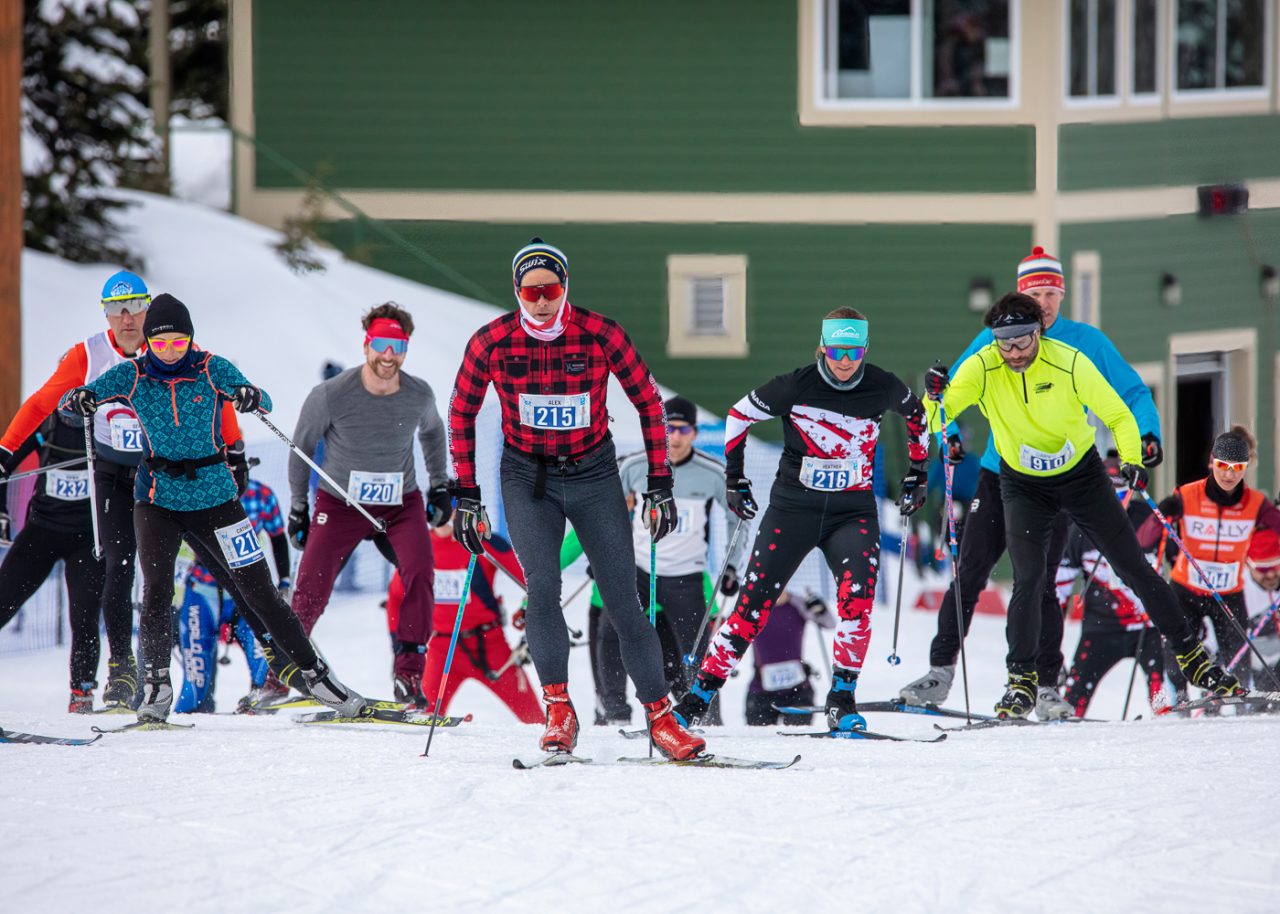
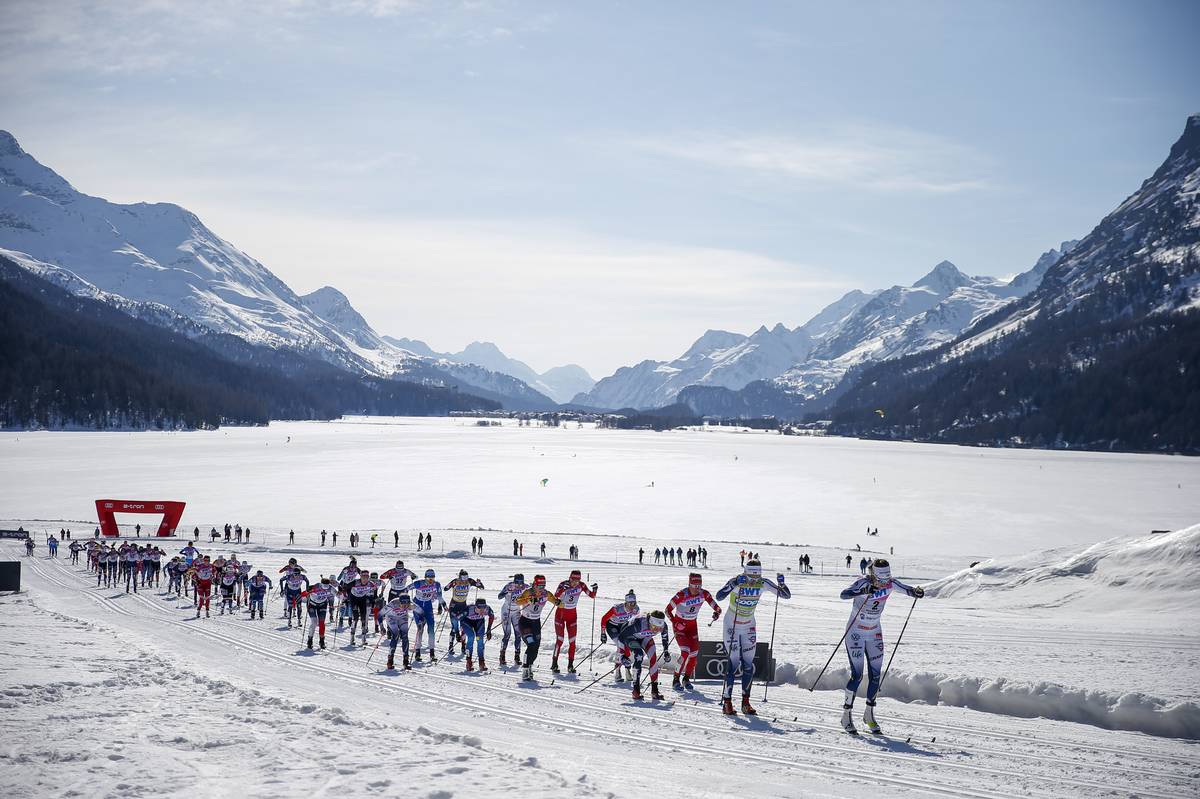
The Sovereign2SilverStar Ski Marathon started with small waves. (photo: Robert Conchie)
Disclaimer: The author skied both days and was one member of the large S2S organizing committee. This may seem like a conflict of interest, but also allows a more detailed look behind the curtain at how a new event was built.
When the moment comes to create a new destination ski marathon, how would you compile all of your dreams and mould them into a single cohesive weekend?
A group of Canadian skiers was faced with that question in the spring of 2021. And they found an answer.
Start with twos. Two interconnected ski areas. Two days. Two techniques. Two distances. Two finish line parties.
Using that model, the first annual Sovereign2SilverStar Ski Marathon was a success, at least as measured by smiles.
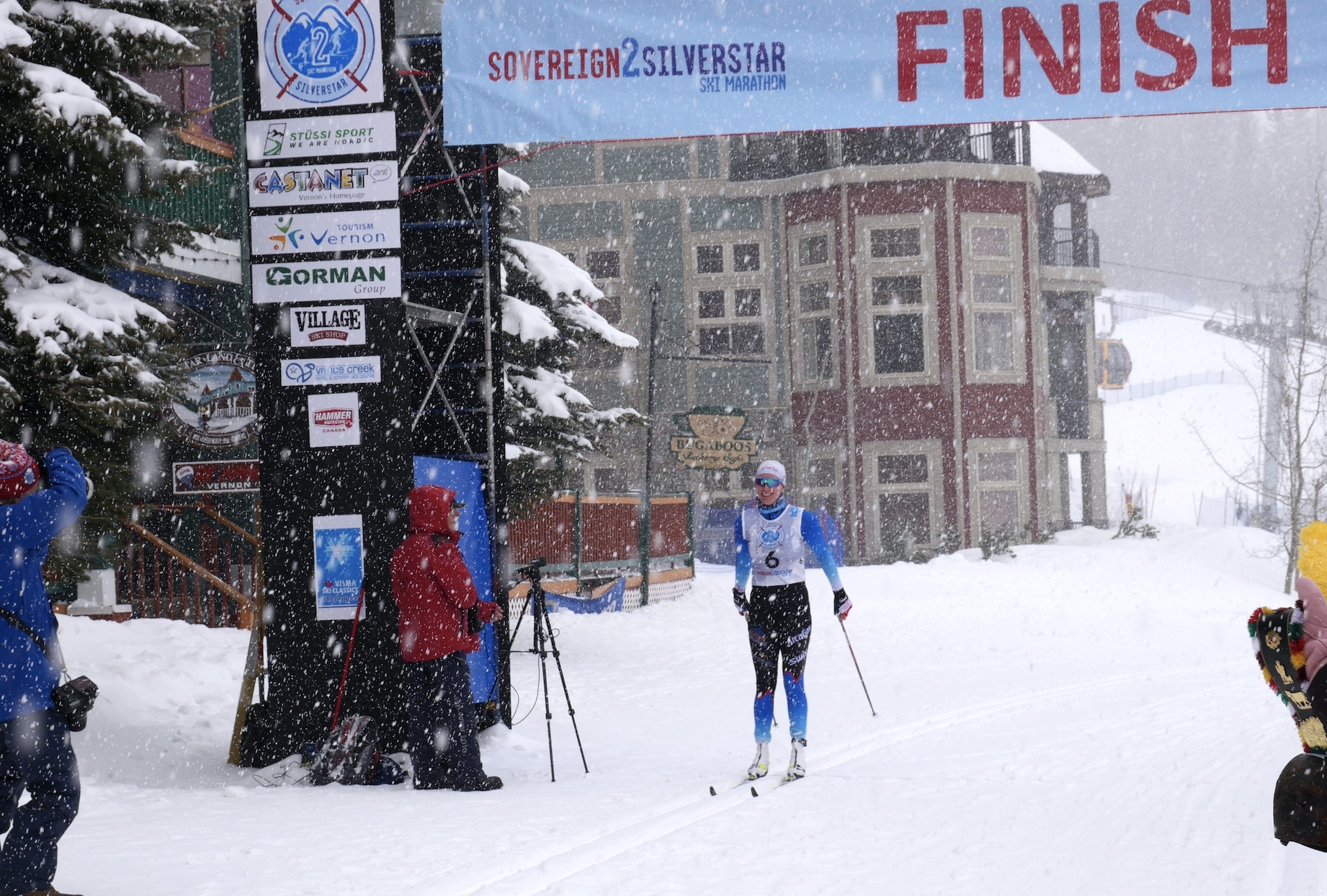
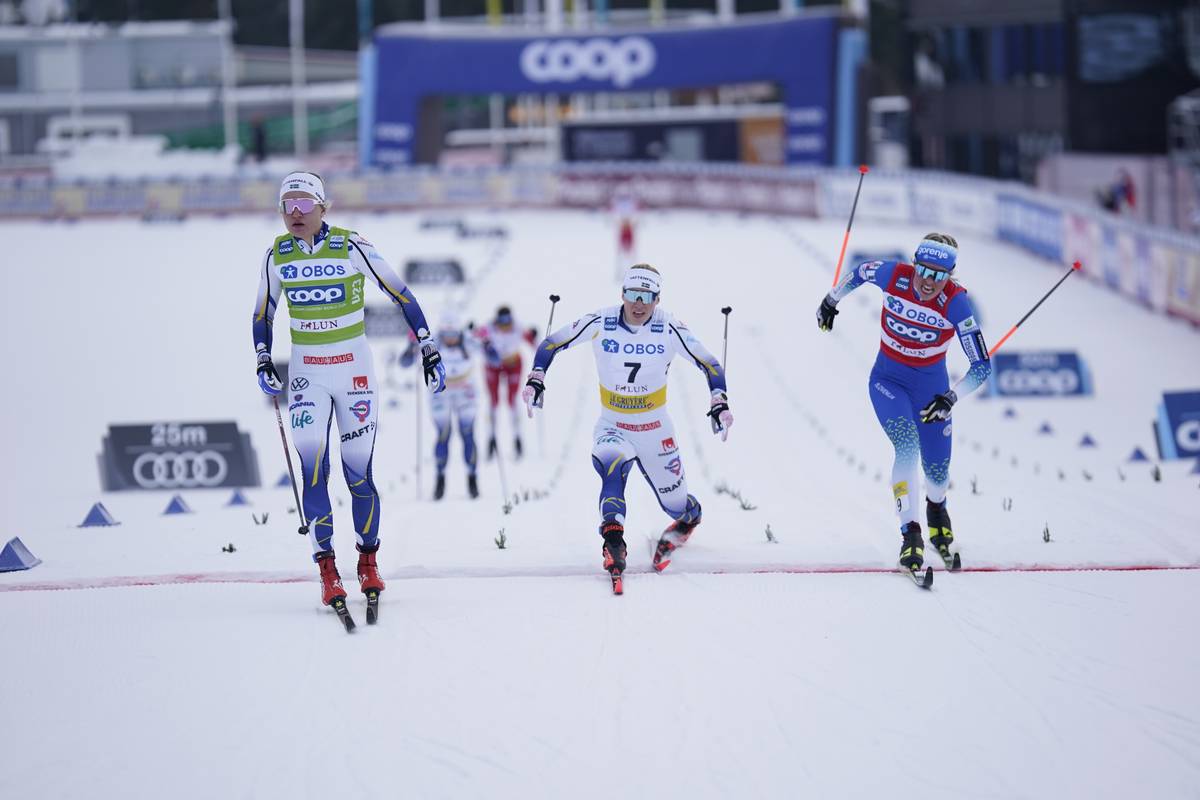
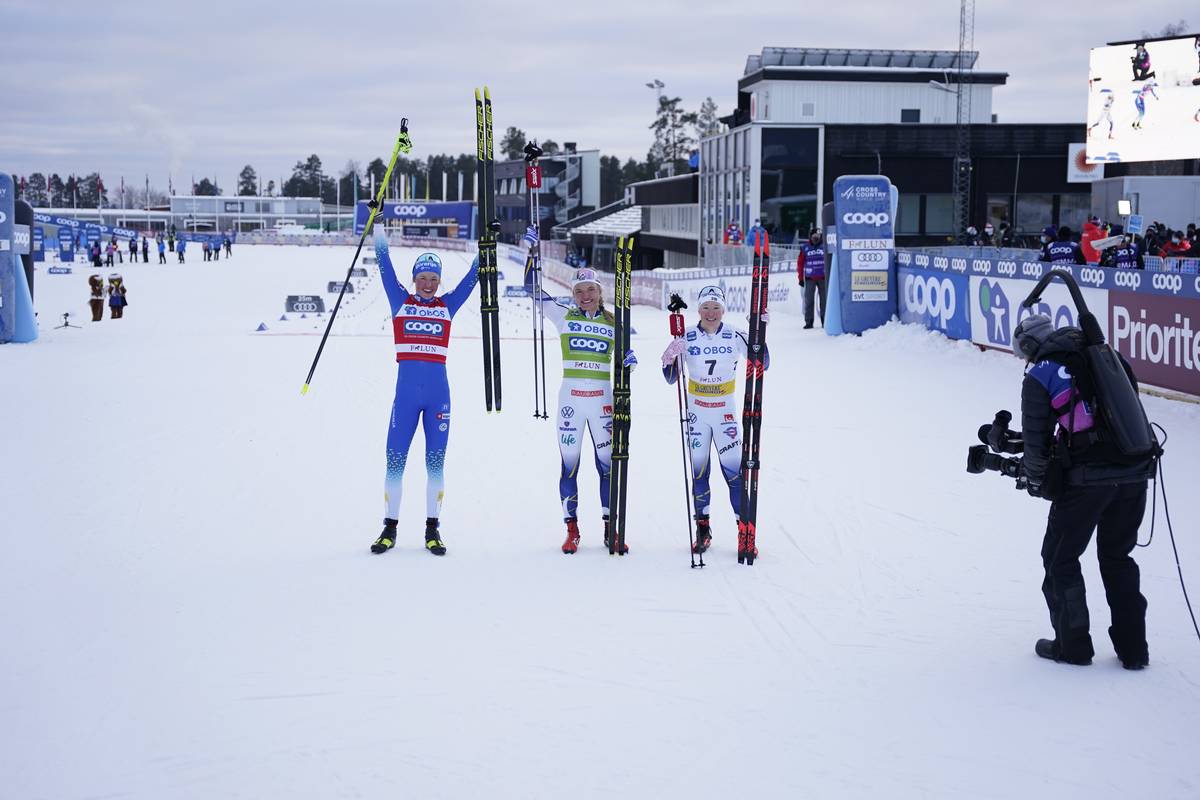
Dahria Beatty crosses the line for the women’s win in classic during the Sovereign2Silverstar Ski Marathon. (Photo: Peggy Hung)Fun at the finish line of the 2022 Sovereign2Silverstar Ski Marathon. (Photo: Peggy Hung)
The weekend kicked off with a classic day on Saturday, April 2nd. The first wave for the 21km course left at 8:30 am, followed by the 40km waves at 9:05. Predicted weather was cloudy with afternoon snow, but the first flurries hit about 8 am, setting the tone for the day.
Of the 195 finishers on Saturday, the majority were on skin skis. Many of the skiers who chose grip wax were fooled by the race date into waxing for ‘typical’ spring skiing. However, when the groomed track is set at -5C, with fresh, cold snow overnight and more dry snow falling, blue hard wax is a better choice. Three of the six athletes on the 40km podium chose VR45 covered with VR30. The Organizing Committee (OC) posted a recommendation of Swix VP45 or V45 (the event encouraged fluoro-free waxing) on Friday afternoon. Early Saturday morning, the wax recommendation was updated to VP45 covered by VP40, except that this update didn’t get shared. Oops! Add that to the list for next year.
Benoit Chauvet last skied on the World Cup in 2010 and now coaches at Toby Creek, in BC. And he did place higher in the skate 40km.
Skate day on Sunday was overcast without significant snowfall, resulting in faster conditions and a larger field of 255 finishers.
As on Saturday, the 21km waves started first at 8:30, followed by the 40km waves at 9:05. This added a fun twist as the faster 40km skiers were passing the average 21km skiers coming into the finish. Despite the number of finishers, the largest of the nine waves had 42 skiers, which meant there was a lot of room to work with.
The course crossed a number of alpine runs on the final long descent to the finish. The course marshals, who were tasked with preventing collisions, were also ringing cowbells to energize the passing skiers. Many alpine skiers and snowboarders stayed on to cheer when the marshals signalled they were free to move. It was a new experience for many participants to see spectators 4km away from the finish, cheering and recording phone videos.
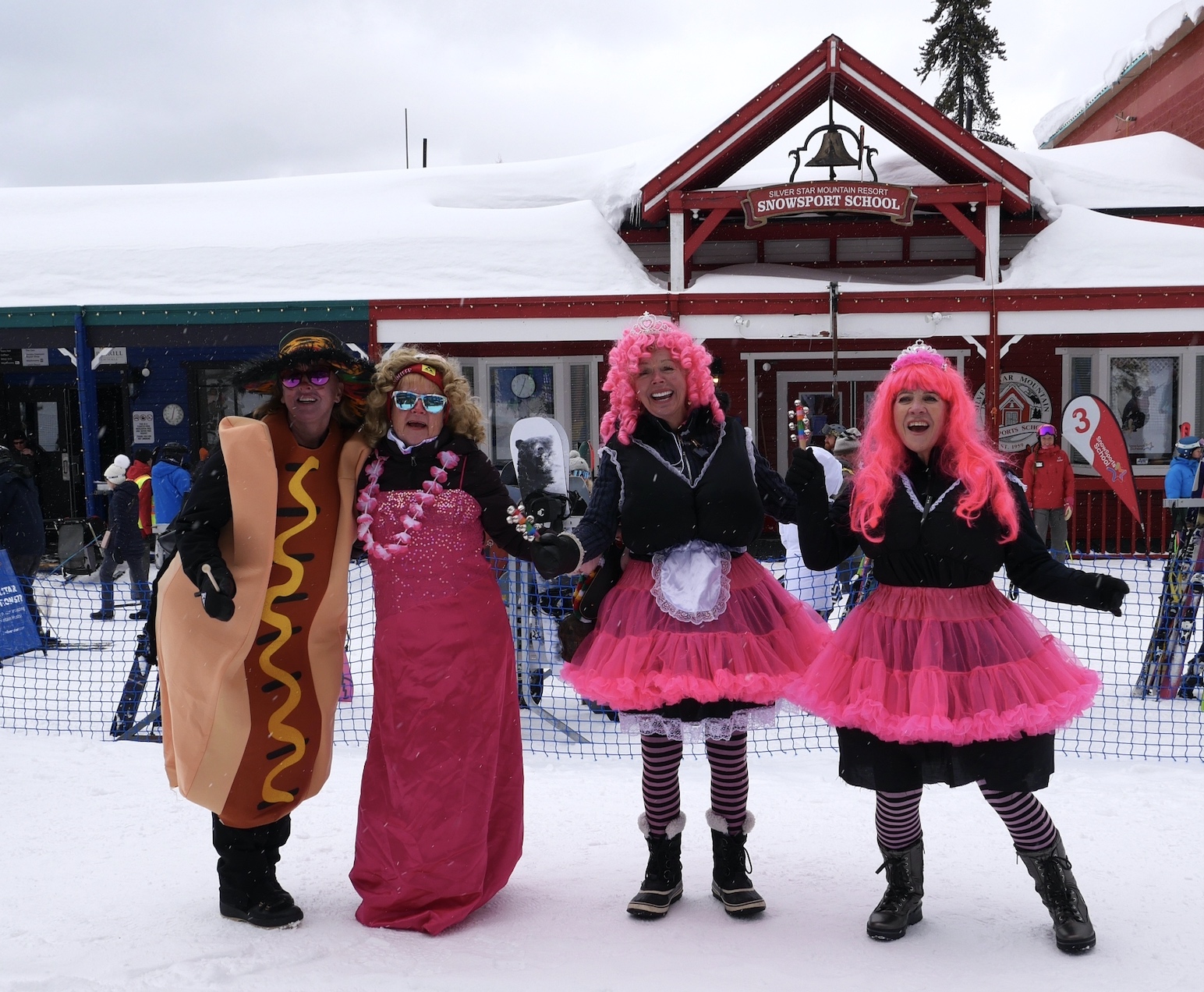
Participants who skied both days were prepared to be greeted at the finish by a dance team, lead by a hot dog. Some people were smiling because they were excited to have completed the distance, and some were smiling at the welcome.
The pandemic has greatly reduced international travel, with many skiers choosing to defer trips. S2S had one Europe-based skier registered, a Norwegian-born Swede who happened to be in Canada for a vacation.
“It’s a very fun course,” Asbjørn Grøvlen said after finishing the 40km classic. “I would recommend this one.” He went on to explain that many Ski Classics courses in Europe are just double poling and it was a nice change to stride more. Grøvlen, like a number of others, chose to do both 40km days.
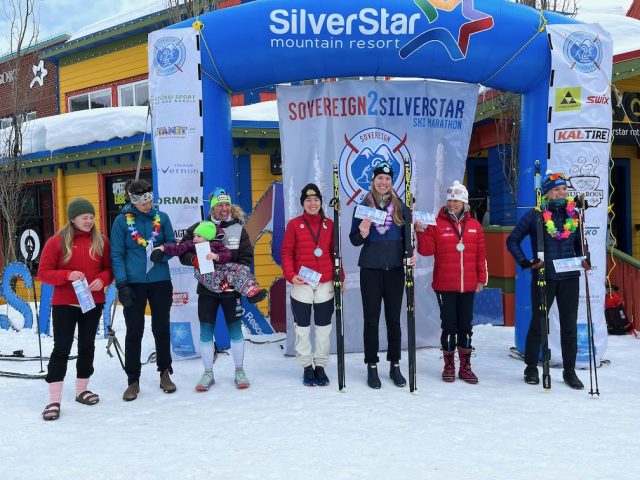
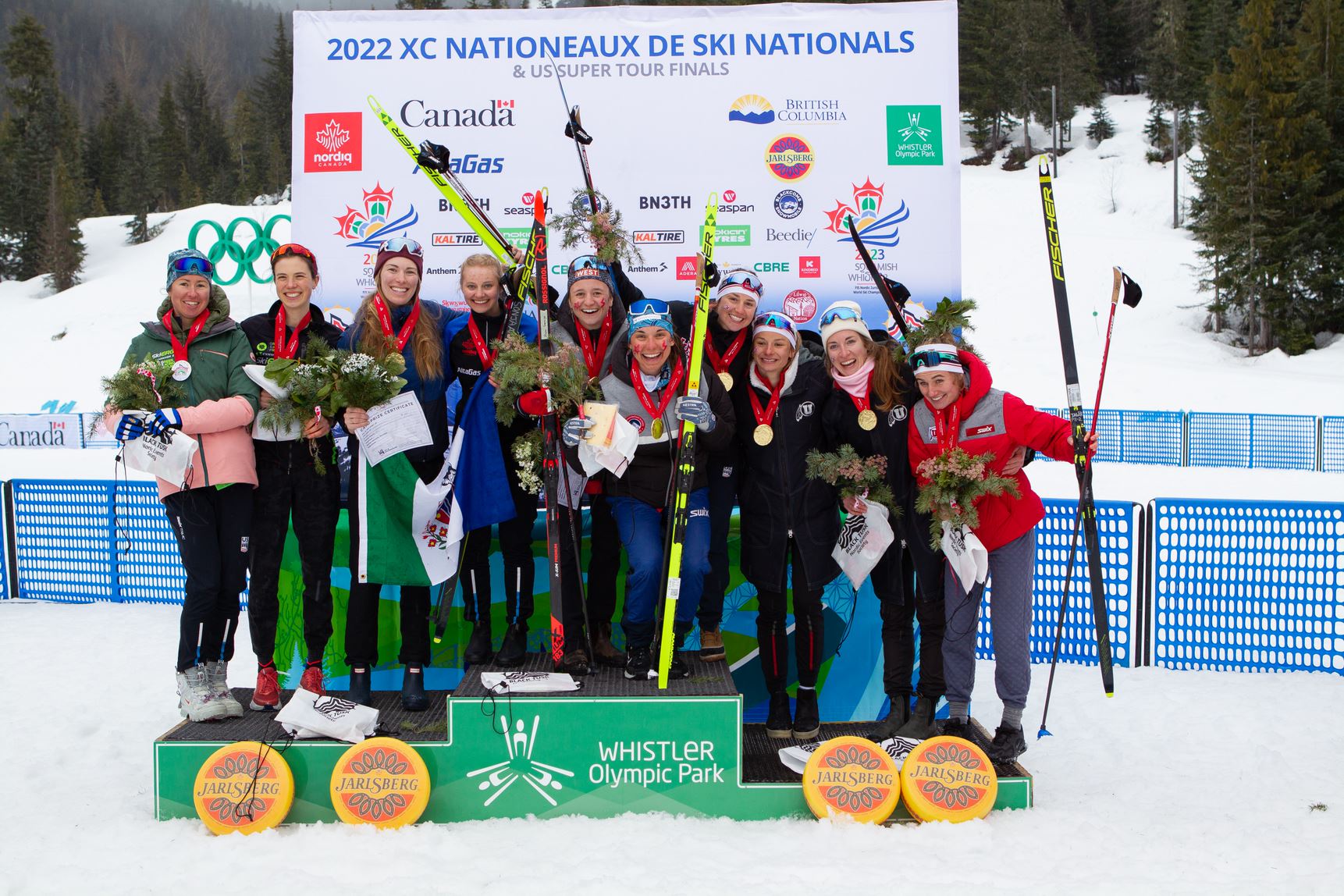
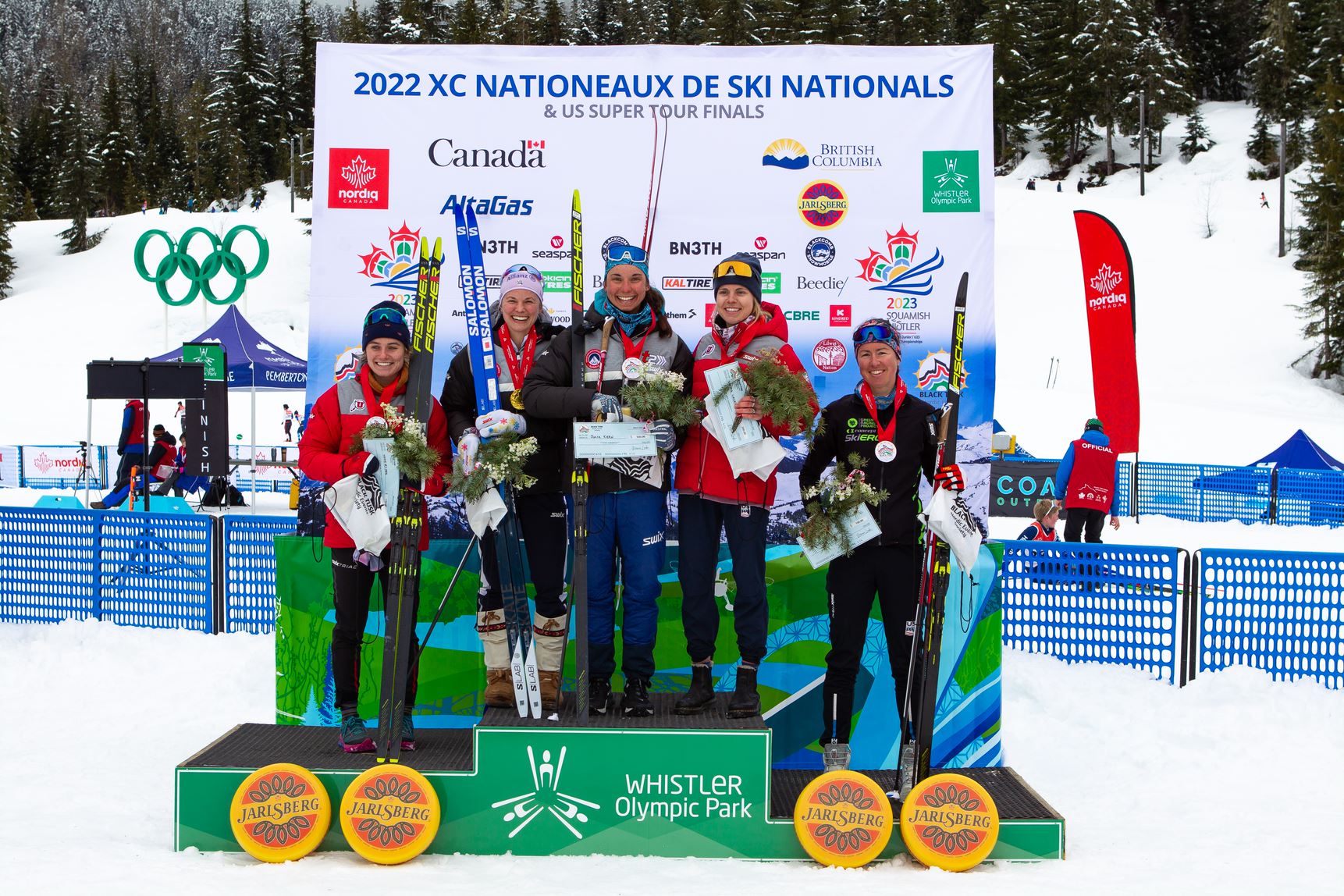
The overall podium on Sunday. L to R: Annika Hicks, Julia Ransom, Caitlin Gregg, Katherine Stewart-Jones (2nd), Dahria Beatty (1st), Laura McCabe (3rd), Anna Sellers. That is 5 Olympians, 2 biathletes, and 2 mothers.
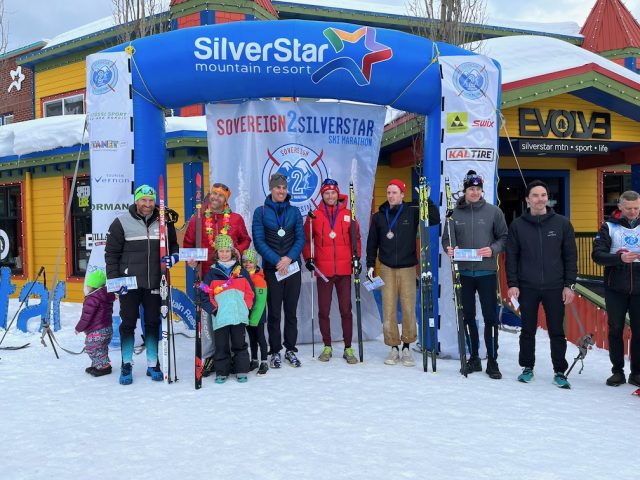
The overall podiums went to elite skiers, many of whom volunteered to present medals to the age group podiums.
Dahria Beatty was the first woman to the finish on the classic day, followed by Katherine Stewart-Jones, Novie McCabe, and Mariah Bredal. Bredal had registered late and started in the second wave, which left her 0.3 seconds behind Beatty for second place overall. Another learning moment for year two, save a few extra bibs in the elite wave for last day registrants.
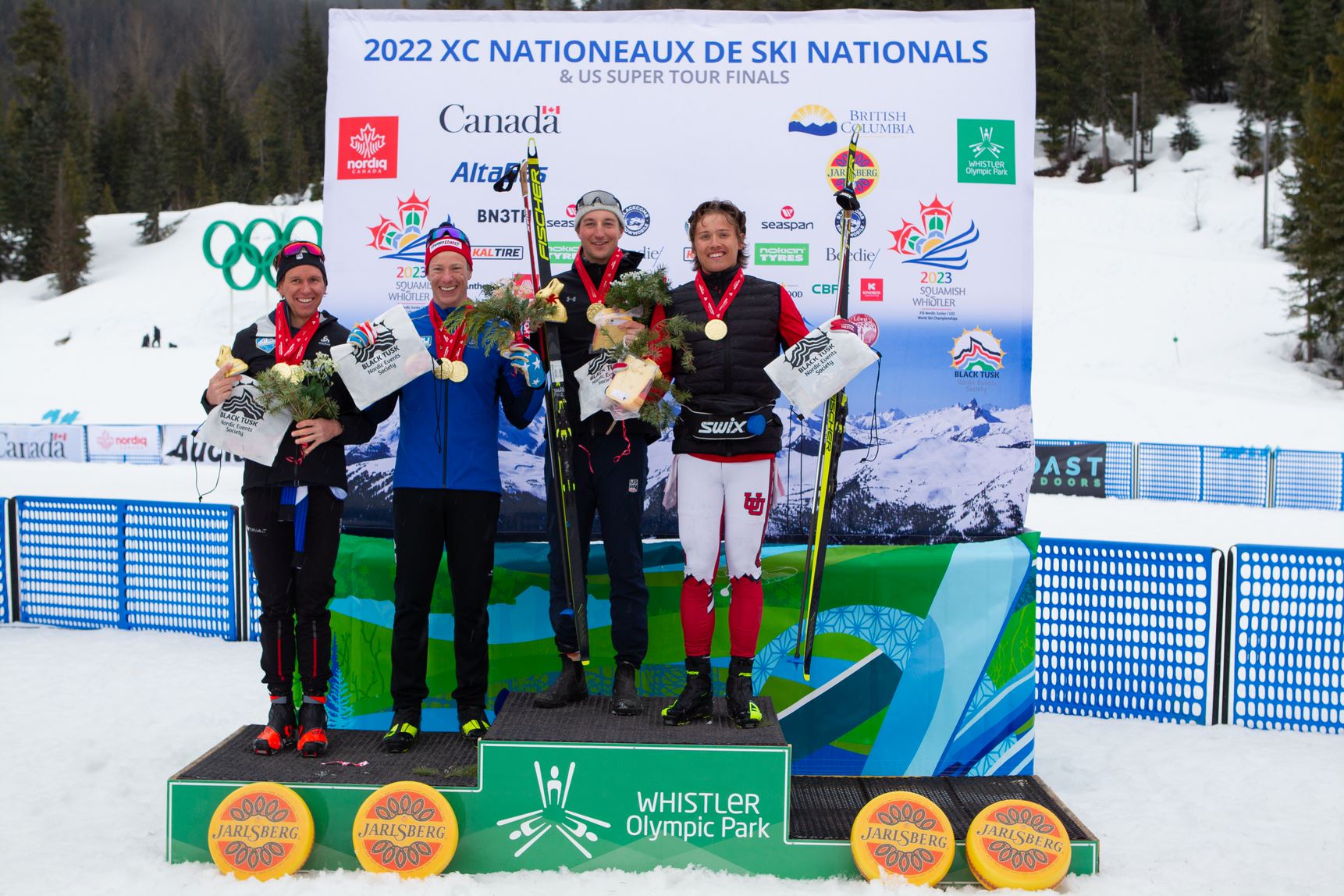
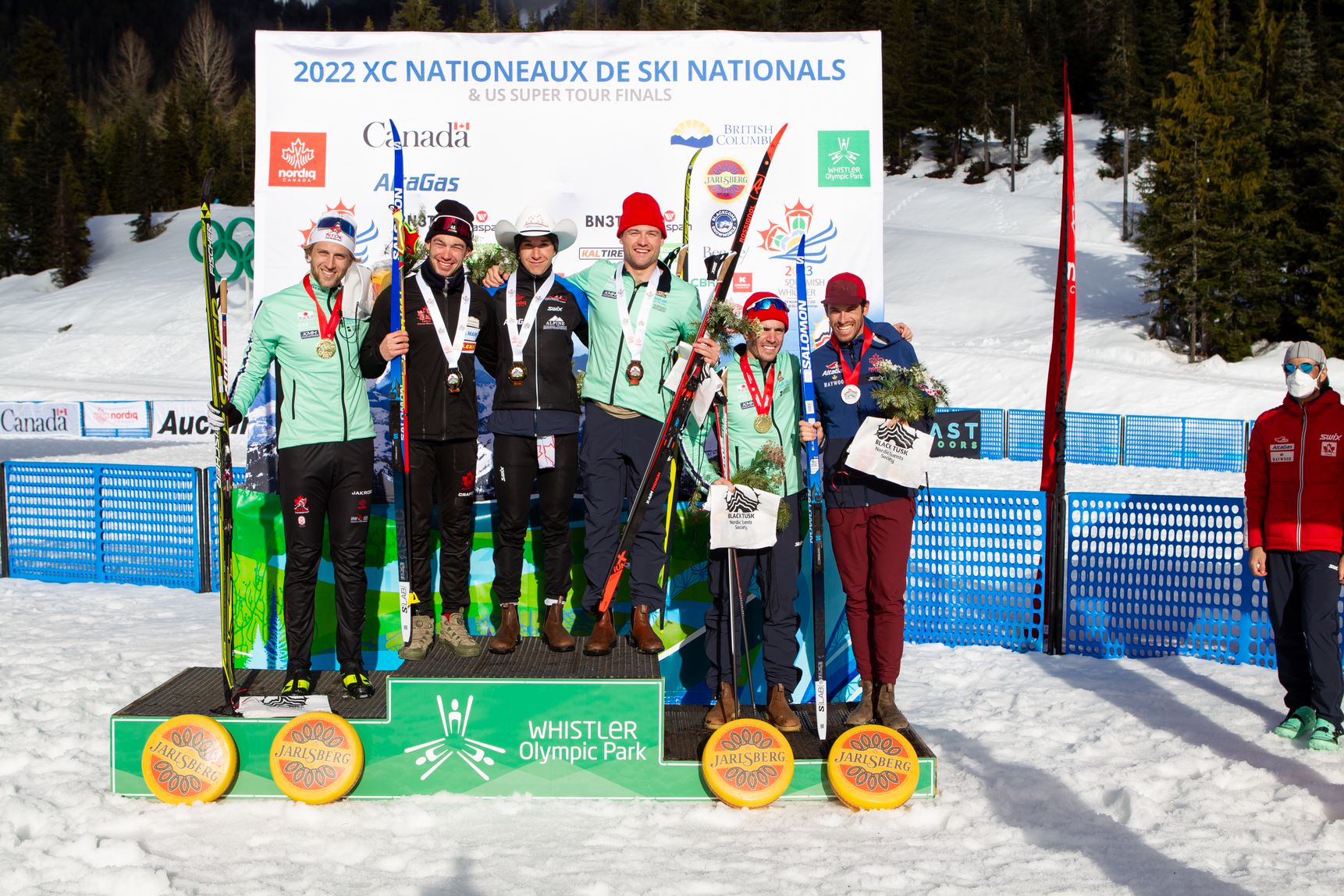
Sovereign2SilverStar overall podium. L to R: Brian Gregg, Benoit Chauvet, Scott Hill (2nd), Rémi Drolet (1st), Jack Carlyle (3rd), Julien Locke, Jess Cockney, S2S Event Director.
There was a rumour on Saturday morning that Luke Jager would double pole on skate skis, as he “always does that on long classic courses.” Jager, found before the start while applying grip wax to his skis, disagreed.
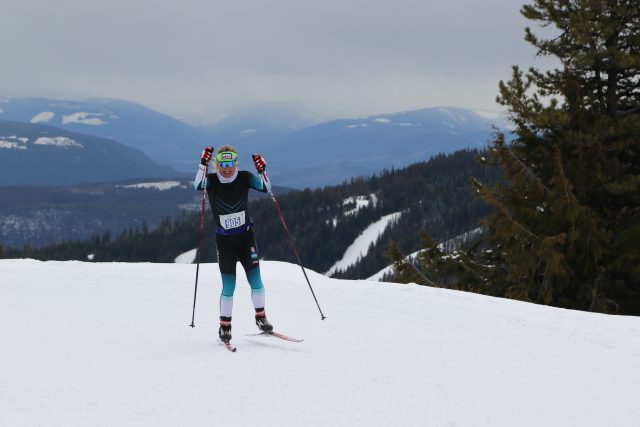
Timing was essential to get the mountain views at Alder Point. (photo: Marshall Moleschi)
In a world where ‘us versus them’ often creates divisions between similar communities, it was fun to watch alpine skiers and snowboarders stopping on Main Street to cheer on nordic finishers.
“That is so cool,” one twenty-something snowboarder said to his friends. “We are doing this next year!”
Mike Mandli, an American master who has travelled the world to ski, summed up the weekend: “This was a skier’s dream. One of the best dreams ever.”
For results, more videos, Andy Newell’s waxing advice, and over 2,000 photos, visit the event page.
“You need some Gordie Howe elbows out there today” said the commentator on the live feed at one point during Friday’s Team Sprint in Whistler.
You know, just in case you needed a reminder that this is Canadian Nationals.
Alongside his legacy as one of hockey’s greatest players of all time, leaving his mark on the sport as an indomitable force with both his goal scoring and dynamism on the ice, Howe was known as an — ahem — impassioned athlete. One achieves a “Gordie Howe hat trick” by scoring a goal, making an assist, and engaging in a fight within one game. In short, he was a bit of a wild card, and he wasn’t going to let someone else stand in his way en route to the net.
In watching the Team Sprint livestream, you can see why a similar need to protect one’s space was relevant. The wet and variable spring weather in Whistler created a tricky mix of fast, wet, and mushy snow conditions that combined with fast mass start sprinting to produce racing that tested a skiers balance and “feel” as much as their lungs and muscles. Or more succinctly, racing that was fun, and a little bit chaotic. Staying upright and not losing your own footing or being taken out by another skier might be more important than technique or tactics.
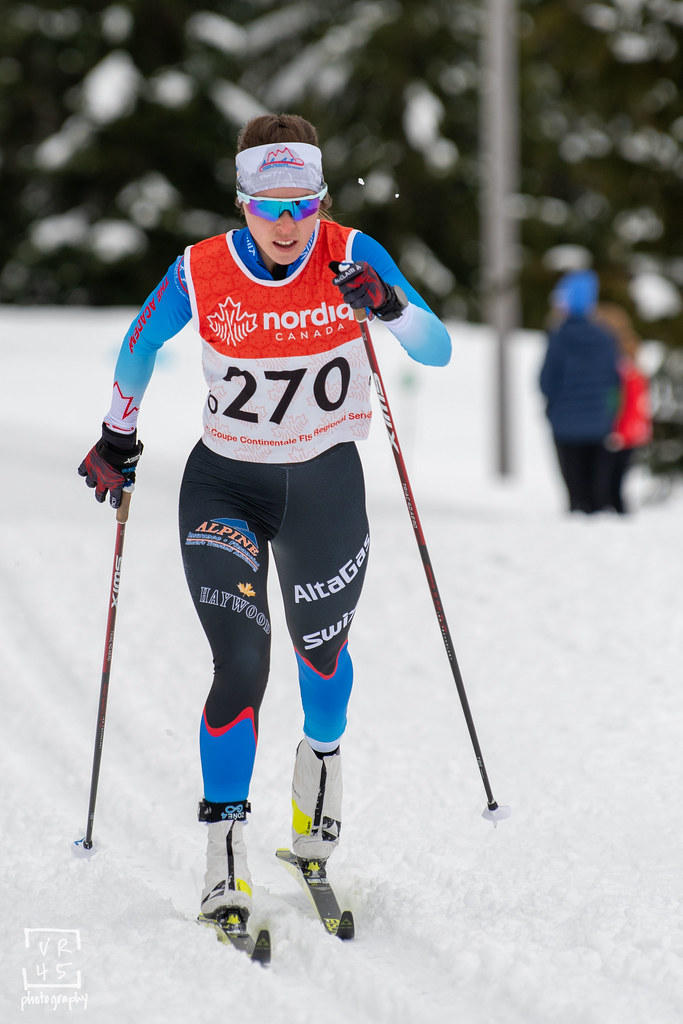
Andy Newell (BSF Pro – Coach), Julia Kern (SMS T2), and Cendrine Browne (Fondeurs-Laurentides) chat on the warm up before the freestyle team sprint. (Photo: Doug Stephen / VR 45 Photography)
Adding another layer to the challenge, the Team Sprint was raced “Dresden-style”, where two partners took turns on a 750 m lap until the pair of them had completed eight total laps. The Nordic skiing equivalent of a short-track skating relay, and with the same flow to the action.
Early attacks could fizzle out through all or any of factors like a bad transition, fatigue, or a tangle up with another skier. All those factors had the equal and opposite effect as well; no team was truly out of it until they crossed the finish line. A late surge between two teammates could pull together a race, and often did when the fields of 15 teams were unleashed on the course today.
The 750 m course was an abbreviated version of the sprint course seen on Wednesday. Each lap left the stadium and shot up a steep but short climb which lengthened into a false flat where the mushy snow on course saw some skiers muscle out a V2 while others kept to a light-footed hop-skate. Then skiers shot down a sweeping downhill where the course widened to allow for two different lines, before doing a long left turn into the finishing straight.
Every skier completed an individual lap of this course in the morning, which when combined with their team partner, yielded a seeding time. With no semi-final, the top 15 fastest combined teams qualified for the Open A finals.
The women’s team sprint podium saw a win for SMS T2, with Yukon Team 7, University of Utah 1, Craftsbury Green Racing Project, and University of Utah 2 rounding out the top five. (Photo: Joern Rohde / Nordiq Canada)
Open Women’s
In the women’s qualifier, Julia Kern (SMS T2) completed the course in the fastest time, 1:21.70. That combined with 8th place Alayna Sonneysn (+3.45 seconds) to give their SMS T2 team the top seed for the women’s A final (combined time 2:46.85). Second seed (combined, +3.73) was earned by Nakkerertok 32’s Hannah Shields (7th, +3.12) and Zoё Williams (13th, +4.01), with third seed (combined, +4.12) going to the University Utah I team of Karianne Dengerud (2nd, +2.34) and Sydney Palmer-Leger (23rd, +5.23).
When the top-15 teams started in the A final, Alayna Sonneysn shot off the front for SMS T2, which stretched the field out immediately and may have helped avoid the pile ups that had been a feature of the Challengers and College Cup heats earlier in the day. Sonneysn was covered by Yukon Team 7 (Whitehorse), with Sonjaa Schmidt catching Sonnesyn as they rounded the corner into the first exchange. Schmidt also pulled back the entire group, and so the racing was extremely tight as they handed off to their teammates. SMS T2 and the Yukon Team continued to push the pace at the front, with the University of Utah I (UU I, Palmer-Leger and Dengerud) and University of Utah II (UU II, Novie McCabe and Julia Richter) teams bridging the gap to form a four-team group leading the race.
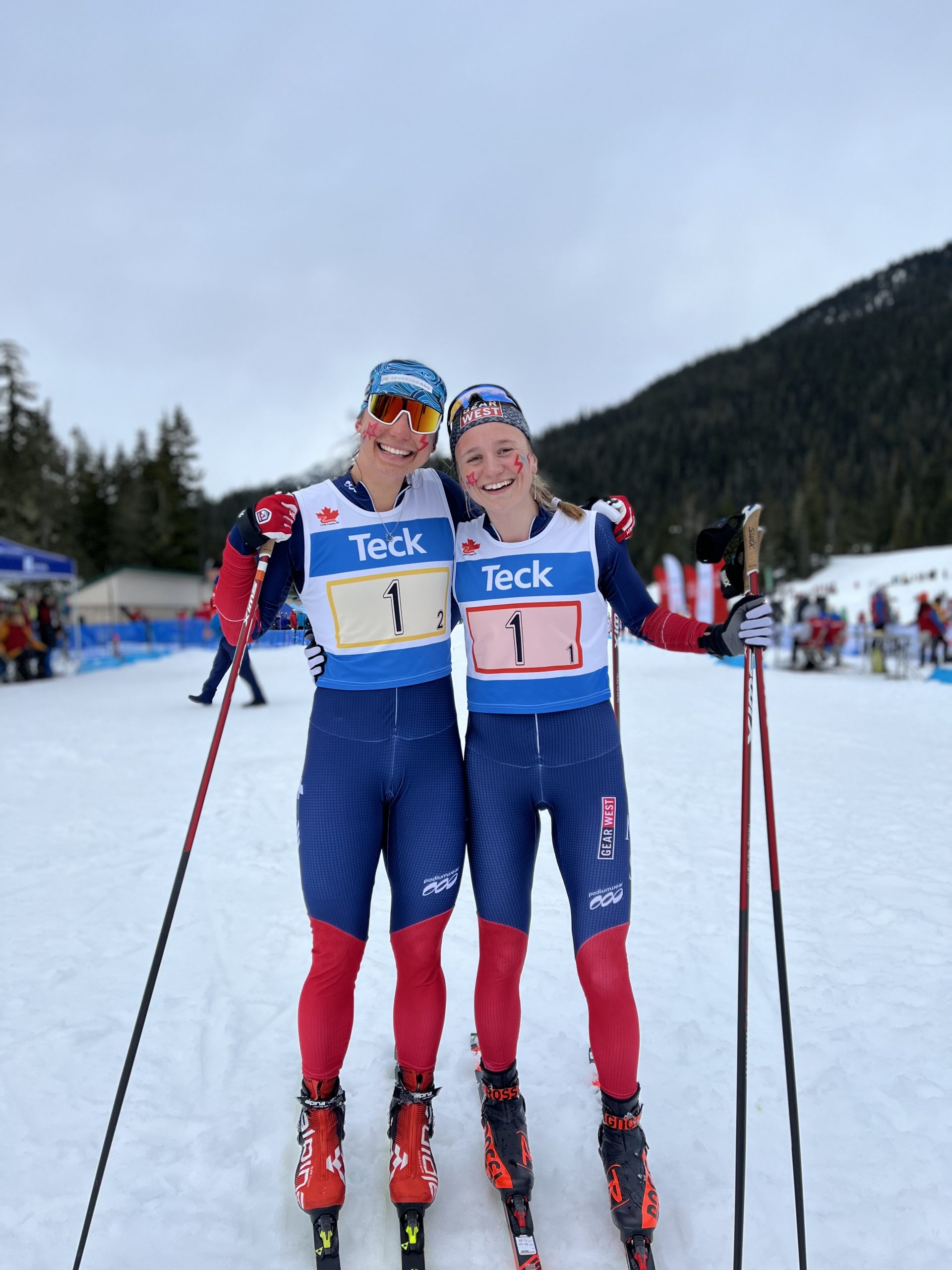
Team SMS T2, Julia Kern and Alayna Sonnesyn, after taking the win in the SuperTour Team Sprint in Whistler, BC on Friday. (Photo: Nordiq Canada / Nathaniel Mah).
From there, as the teams swapped partners through laps three, four, five, and six, a strategy of attrition started to emerge from the SMS T2 team of Kern and Sonnesyn. At each exchange, they jumped off the handoff, hopped up the hill, and continuously pushed the pace. Their gap slowly opened at the front, until, like looking up after being taken by a riptide, the mass of racing behind them was unexpectedly distant. By Sonnesyn’s final trip around the course at lap seven, their win was all but secured.
Sonnesyn said that the goal from SMS T2 was to remain consistent throughout the race, saying in an interview with Nordiq Canada that “I just wanted to be patient. I was a little surprised at the pace we went out [in] because I knew four laps on this course was going to catch up to us quick, but I kept telling myself ‘be patient, go the same pace.”
In the push for the overall podium behind, a new player had entered the scene. On lap five, Craftsbury’s Caitlin Patterson pushed across the gap to the UU I, UU II, and Team Yukon group. On lap six, her partner Alexandra Lawson held there. As the scrambling partners went out for their final lap on lap seven, UU I and UU II had formed a gap, but when the skiers handed off for the final exchange, a four-team pack came back together with UU I, UU II, Team Yukon, and Craftsbury I.
Then, it split once again.
Team Yukon’s Dahria Beatty came off the downhill on course wide to try and take an inside line into the final turn. UU I’s Karianne Dengerud took the downhill corner more inside, and tried to beat Beatty to the inside on the final turn. In the end, Beatty won, and then closed in the final stretch to take Team Yukon (Schmidt & Beatty) to second place (+11.99) behind the first place SMS T2 (12:22.16). UU I (Palmer-Leger & Dengerud) took third (+12.78).
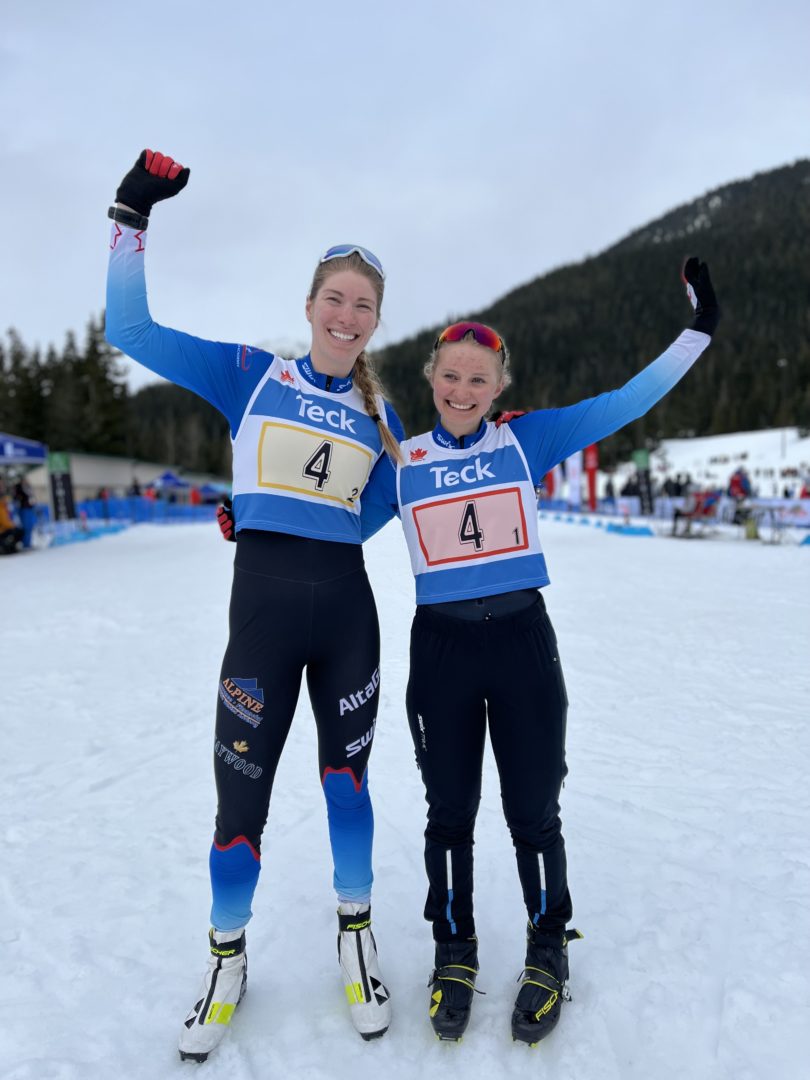
The Yukon Team 7 duo of Dahria Beatty and Sonjaa Schmidt were second overall in the women’s team sprint, taking home the Canadian national title. (Photo: Nordiq Canada / Nathaniel Mah)
The resounding win for the pairing of Kern and Sonneysn punctuated a tremendous week for Stratton Mountain School, and in particular for Kern. Apart from a second place behind teammate Jessie Diggins (SMS T2) in the 10 k skate on Monday, she has won every race at these SuperTour finals, despite tricky and variable conditions.
Team Yukon’s (Whitehorse) second place overall gives the pairing of Dahria Beatty and Sonjaa Schmidt top Canadian honors, adding to Beatty’s accumulation of National Championships this week.
Open Men
The men’s top individual qualifier was Logan Diekmann (BSF), with a time of 1:12.83, who combined with his BSF Pro I teammate Finn O’Connell (51st, +5.93) to take 5th seed (+4.44). They ran behind the top seeded (2:27.15) University of Utah I (UU I) pairing of Noel Keefe (4th, +0.67) and Luke Jager (5th, +0.82). Second seed (+2.42) went to the SMS T2 team of Finegan Bailey (6th, +1.01) and Bill Harmeyer (14th, +2.91), and third seed went to the Team Brew-ski Canmore (+3.43) pair of Russell Kennedy (3rd, +0.57) and Reed Godfrey (27th, +4.35).
Xavier McKeever (Foothills Nordic) works with teammate Tom Stephen to win the Canadian National Title in the team sprint. (Photo: Doug Stephen / VR 45 Photography)
With qualifying times extremely tight across the board, the A final promised to stay close throughout the whole 8 laps.
Noel Keefe mirrored Alayna Sonnesyn’s move from the women’s final, looking to get ahead of any tangles by pushing the pace from the start for UU I. Once the field was out of the stadium, Keefe tucked in behind Orford’s Leo Granbois, and Orford and UU I went into the first exchange with a slight gap.
Keefe handed off to Luke Jager, who looked relaxed as he allowed the field to come back together again. Animating the move that closed the gap was Northern Michigan University (NMU) skier Kristoffer Karsrud, who alongside his partner Kjetil Bånerud ducked and weaved at the front of the pack throughout the duration of the race.
On the 5th lap, another UU team, UU II, moved to the front of the pack, as Brian Bushey put in a surge. When Bushey and Keefe handed off to Bjørn Riksåsen and Jager, the race looked like it may turn into a UU team practice for the last couple of laps. That was, until Scott Patterson flew in from Alaska Pacific University (APU) in his last time around the course on lap seven. Following Patterson’s move was Bånerud from NMU, and as the four team pack of UU I, UU II, APU, and NMU went into the final exchange, it became clear; the Team Sprint would well and truly live up to the sprint moniker.
Jager for UU I came out of the exchange with a slight advantage over the field. APU’s Logan Hanneman countered that by exploding up the climb leaving the stadium. Jager used the downhill to catch Hanneman, with Rikssasen (UU II) and Karsrud (NMU) in tow. Jager, the youngest of the bunch but with plenty of sprint experience, got the inside edge into the final turn. He exploded off of that corner into the final stretch, lifting a ski and two poles as he came across the line to take the win for UU I (11:15.32).
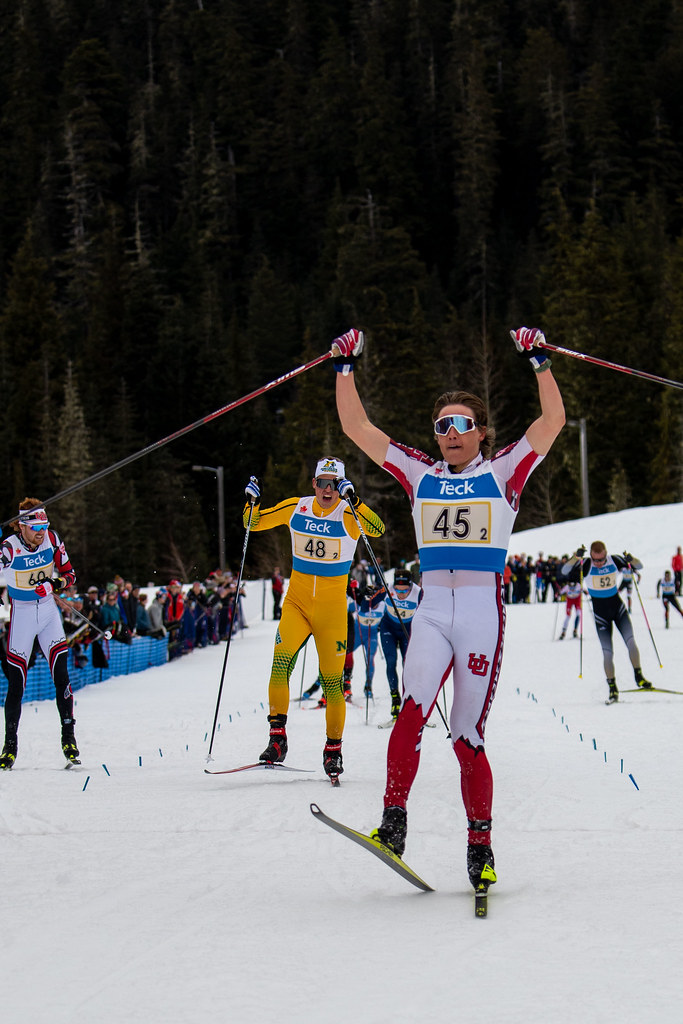
Luke Jager closes for the University of Utah 1 team, taking the win alongside teammate Noel Keeffe. (Photo: Doug Stephen / VR 45 Photography)
Hanneman finished in second (+1.39) for APU, and the NMU team finished third with Karsrud crossing the line (+1.45) right behind.
Outside of the mix for most of the race, the Foothills I team of Xavier McKeever and Tom Stephen deftly moved through the pack to come in fifth overall and claim the Canadian title on the day.
The University of Utah pairing of Jager and Keefe were especially happy to win this edition of the Team Relays, saying to Nordiq Canada that “It’s a mix-up [in these relays]. Since the race got canceled at SuperTour finals two years ago, we had this race in our scopes. The qualifier went well, we had good skis, and the race turned out great.”
University of Utah’s Noel Keefe and Luke Jager took the SuperTour and overall win in the team sprint, with APU’s Scott Patterson and Logan Hanneman in second. (Photo: Joern Rohde / Nordiq Canada)
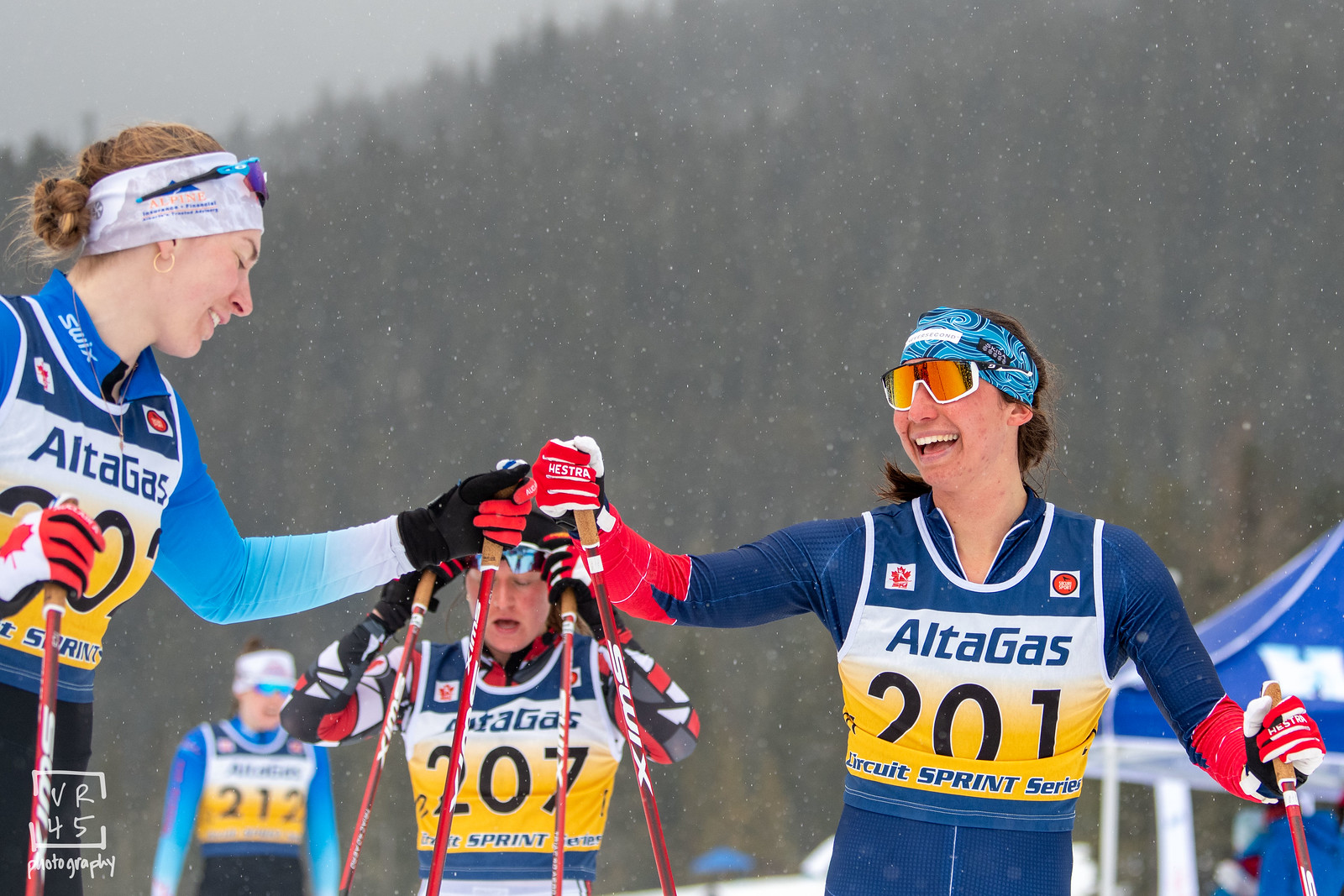
Julia Kern (SMS T2) and Dahria Beatty (Whitehorse) fist bump at the finish of the women’s classic sprint final. (Photo: Doug Stephen / VR 45 Photography)
Racing at the joint Canadian Nationals/US SuperTour Finals resumed on Wednesday, showcasing some of the best racers in North America facing off for a classic sprint.
As the Whistler Olympic Park was home for cross country skiing during the 2010 Vancouver Games, the classic sprint course on Wednesday was one that played host to an important stepping stone in North American skiing history. In that competition, both American and Canadian skiers solidified the inroads they had made into the top echelons of the sport through the burgeoning discipline of sprinting. Names like Kikkan Randall (USA), Daria Gaiazova (CAN), Chandra Crawford (CAN), Devon Kershaw (CAN), and Simi Hamilton (USA) all qualified for heats, while gracing the television screens of many athletes who now, twelve years later, carried momentum from those inspiring performances onto today’s start line in Whistler.
If my waxing nostalgia about those 2010 Olympics is making you open a new tab to see if they’re available to revisit on YouTube, let me help you: they are! But before you go, let me send you an assignment: watch how Marit Bjørgen and Justyna Kowalczyk race the final on the 1.2 k course (the men raced a 1.4 k course). Ok, here’s the link (46:16 for the final, and yes, the genders are flipped in the title).
What you’ll have seen if you completed this FasterSkier sidequest (trademark pending) is that the rolling course at Whistler presented two distinct tactical options for the skiers who made it into the heats on Wednesday. One: the Kowalczyk – attack on the steep climb that left the stadium to try and create a gap on the field that would hold as you went into the first downhill and leave you with an advantage on the second (and final) climb, or two: the Bjørgen – hold onto the pace-setter until the second hill, when a punchy attack could leave a skier with a distinct advantage going into the mostly downhill approach to the stadium and subsequent final stretch. The latter approach worked in 2010 for Bjørgen, but 2022 was twelve years on and a different field with the SuperTour.
Before we got to the heats, however, we, and the skiers, had to go through qualifying.
The Classic Sprint started off with the women’s champion in the 10 k Classic yesterday, Julia Kern (SMS T2). And after every racer in the women’s field completed the course, Kern finished in first too (3:11.14). Her qualifier was commanding, with second place Dahria Beatty (Whitehorse) +6.58 seconds back. In third place was Alayna Sonnesyn (SMS T2) (+7.54), in a field that otherwise was tight all the way through to the last heat qualifier, 30th place Mariah Bredal (BSF) (+21.37).
The men’s field that followed proved to be an even tighter affair. At the top of the field, less than a second split first place Andreas Kirkeng (Denver University) (3:09.82), second place Luke Jager (University of Utah) (+0.41) and third place Logan Hanneman (APU) (+0.88). It was only +11.97 seconds back to the last heat qualifier in 30th place, Montana State’s Reed Godfrey.
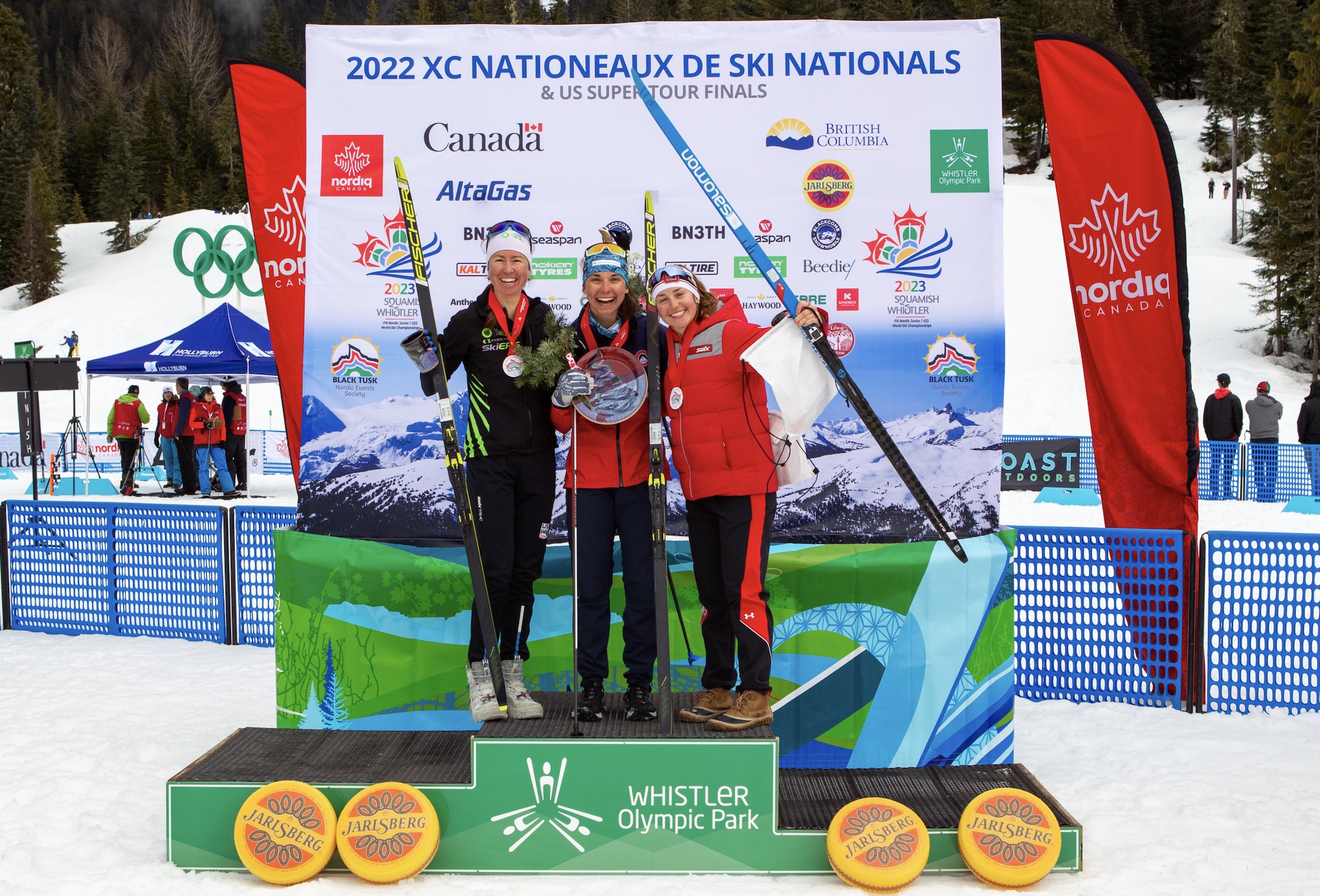
The women’s US SuperTour podium saw Julia Kern take the top step ahead of Caitlin Patterson and Sydney Palmer-Leger. (Photo: Joern Rohde / Nordiq Canada)
Women’s Open
In the women’s open quarterfinals, the top qualifiers were able to win their heats handily. Julia Kern turned in the fastest quarterfinal in the field, finishing first in a time of 3:29.93, ahead of Novie McCabe (+1.93), who advanced to the semifinals by taking second place. Kern’s fast pace-setting in heat one proved to animate the field from the gun, and third place Zoë Williams (Nakkertok) was rewarded for keeping pace with one of the lucky loser spots (+3.56).
That pattern held in the 2nd heat, when a pack loaded with talent including Caitlin Patterson (Craftsbury), Alexandra Lawson (Craftsbury), Sydney Palmer-Leger (University of Utah), Sophia Laukli (University of Utah) and Cendrine Brown (Fondeurs-Laurentides) set a furious pace from the start and held it all the way through. In a five-person sprint, Patterson took first (3:32.13), and Lawson second (+0.55), to take the automatic semi-final bids. In third place, Sydney Palmer-Leger (+1.47) took the other lucky loser spot.
When the first semi-final took to the start-line, it was filled with five skiers from those first two quarterfinals, with the sixth, 16-year-old Samantha Smith (Sun Valley), having won the third quarterfinal (3:36.43). It was no surprise then, when the “fast from the gun” tactics of those quarterfinals followed into the semis. Julia Kern (SMS T2) again attacked as soon as they hit the first incline out of the stadium, and held her lead throughout. The only skier that proved to be able to match her pace through the course was Caitlin Patterson (Craftsbury), and it would be those two who took the automatic advancement places to the finals; Kern in first (3:34.27) and Patterson second (+3:35.27).
Behind them, two of the youngest bright stars of US women’s skiing had shown their intrepid ability to match their older counterparts, with Palmer-Leger (UU) taking third place (+3.47) and Novie McCabe (UU) taking fourth (+3.74) in a sprint ahead of Samantha Smith (Sun Valley) (+4.03). For their efforts, the third and fourth place pairing advanced to the finals.
In the second semi-final, previous Canadian Sprint National Champion Dahria Beatty (Whitehorse) was able to take first place (3:38.39) ahead of second place Laurence Dumais (Fondeurs-Laurentides) (+0.34) for the second heat in a row. They finished strong in a pack that otherwise remained tight throughout, and created separation in the last stretch to finish ahead of third place Alayna Sonnesyn (SMS T2) (+1.18) and fourth place Katharine Ogden (SMS T2) (+3.45).
The final field then, was set. For the overall win, four US women – Julia Kern (SMS T2), Caitlin Patterson (Craftsbury), Sydney Palmer-Leger (UU), and Novie McCabe (UU) – and two Canadian women – Dahria Beatty (Whitehorse) and Laurence Dumais (Fondeurs-Laurentides) – would compete. That latter pairing also made the matter of the Canadian Sprint National title on the line simple; a duel between Beatty and Dumais.
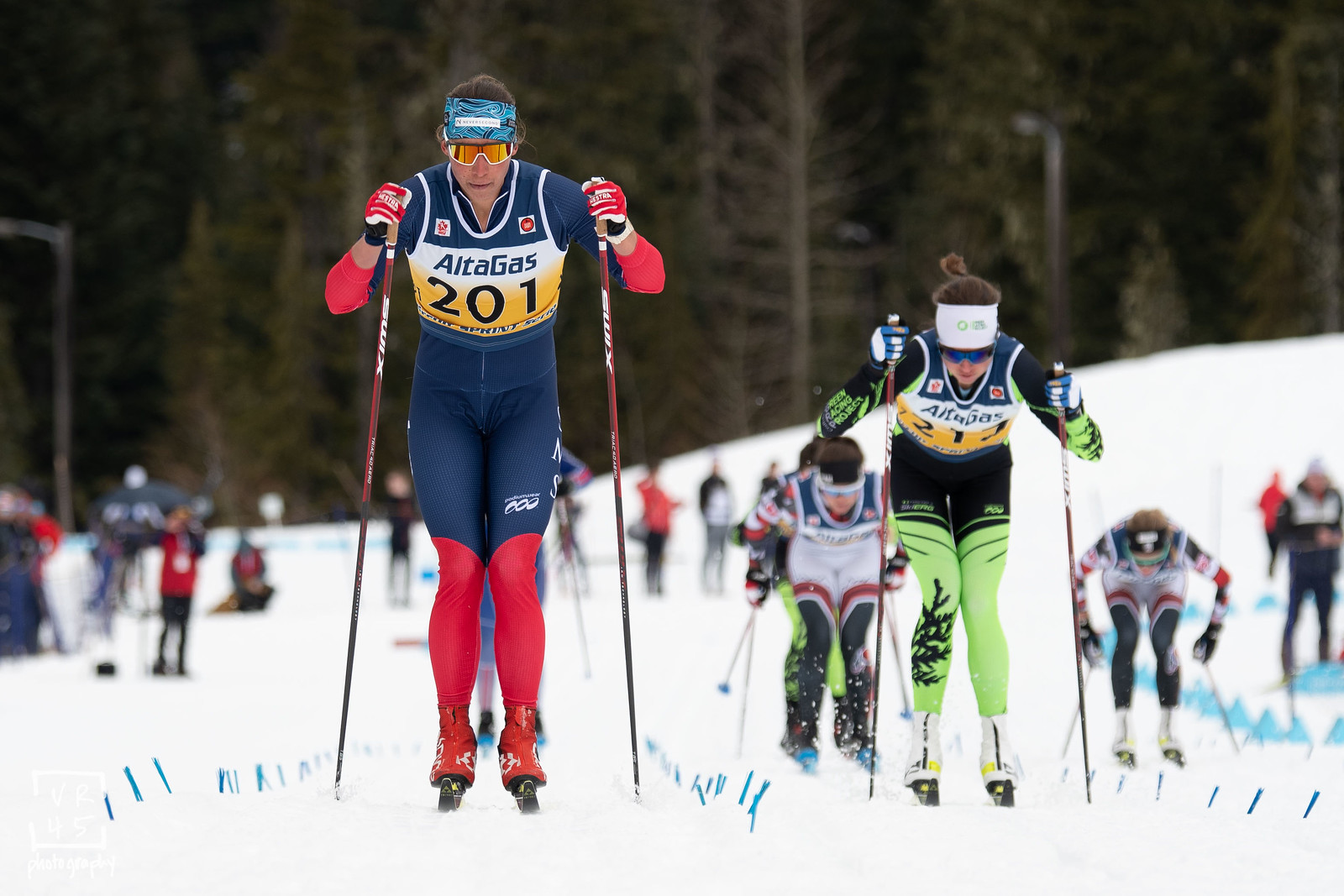
Julia Kern strikes again in the women’s classic sprint, taking the win ahead of Caitlin Patterson (CGRP) and Dahria Beatty (Whitehorse). (Photo: Doug Stephen / VR 45 Photography)
Kern, spurred on by her success racing hard from the gun all day, went for it again. In an interview with Nordiq Canada she said, “All day I just wanted to ‘send it’ – practice skiing hard and not taking any chances out there. My form and fitness is really good so I wanted to try and not leave it until the end.”
The whole field was tasked with matching her confidence…and her speed. As in the semi-finals before, just one was up to the task the whole 1.2 k through; Caitlin Patterson. Behind her, Dahria Beatty led a charge to try and keep pace, but as she said in an interview with Nordiq Canada “I was confident in my finish but trying not to lose time on the uphills today. Unfortunately, [in the final], I let a gap open up to Caitlin [Patterson] and wasn’t able to close back on that.”
And “send it” Kern did in the final. Kern took the pace out hot from the start. With a look over her shoulder, she saw that she had gapped the field by the top of the long striding climb, a position which she held, despite a bobble on the tight left hand curve on the subsequent descent, comfortably through the finish to win by several seconds.
Patterson having lead the chase group after a gap throughout the heat, found herself sprinting with a powerful doublepole into the stadium to hold her ground in second place.
Behind them, the race for the last podium spot coalesced around Beatty, Palmer-Leger and McCabe. As they entered the stadium together, Beatty stuck to a strategy that her coach pointed out earlier in the day, “it was working really well to try and go in the outside in the finish chute because people hadn’t skied there in the qualifier.”
With that bit of tactical maneuvering, she opened up a gap on the two UU teammates behind her, and came across the line in third place overall (+6.16). In doing so, she also came across with a Canadian National title – her second Canadian Sprint title (and first classic). Following her in the Canadian Nationals race was second place Laurence Dumais (Fondeurs-Laurentide), who finished the finals heat in 6th place (+21.57). Based on her time in the semi-final, Zoë Williams (Nakkertok) took third place.
Kern’s win marked her second in a row at SuperTour finals this week, which have been marked by all sorts of varying conditions that she has used to her advantage, saying to Nordiq Canada:
“I love variable conditions. Everyone says if it’s a rainy day, it’s a Julia Kern day – I’ve thrived under those conditions before…it makes you have to adjust your skiing and that makes you a better athlete.”
The Canadian women’s sprint podium, with Dahria Beatty coming out on top in the classic sprint. (Photo: Joern Rohde / Nordiq Canada)
Men’s Open
The men’s quarterfinals saw a similar pattern to the women’s, with experienced sprinters grouping together in heats, attacking early, and producing fast times that punctuated the number of racers they sent to the semi-finals. For the men that happened in quarterfinal two, with Graham Ritchie (Georgian Nordic), Antoine Cyr (Skinouk), Kjetil Bånerud (Northern Michigan), Bill Harmeyer (SMS T2), and Étienne Hébert (Montériski) all pushing each other to the line. When the five skiers came into the final stretch, it ended up being Ritchie (3:23.11) and Cyr (+0.32) who took the first and second spots, respectively. Both lucky losers came from the heat, with Bånerud in third (+0.95) and Harmeyer fourth (+1.73).
Ritchie, Cyr, and Harmeyer would all meet again in the first semi-final. There, they were joined by Andreas Kirkeng (DU), Logan Diekmann (BSF), and Magnus Bøe (CU). With tight racing throughout, Kirkeng was able to gain an advantage and hold off all challengers as he advanced to the final in first place (3:22.97) ahead of second place Antoine Cyr (+0.83). The aggressive tactics of Ritchie and Cyr again proved to push the entire field forward, with Ritchie the benefactor when his third place finish (+1.47) secured him a lucky loser spot alongside fourth place Logan Diekmann (+2.76).
The second semi-final, meanwhile, was a duel between the young stars from both sides of the 49th parallel. American Luke Jager (UU) and Canadian Xavier McKeever battled to a sprint finish in which Jager took first place (3:23.34) and McKeever took second (+0.50) to advance to the finals.
Jager and McKeever stepped up alongside Antoine Cyr (Skinouk), Andreas Kirkeng (DU), Graham Ritchie (Georgian Nordic), Magnus Bøe (CU) and Logan Diekmann (BSF). The two young skiers showed no signs of timidness against their older competitors. Jager launched an attack on the first hill that opened a gap as the field rounded the corner leading into the final climb. McKeever was back in the field, looking to “limit damage, if I’m honest” as he said in an interview with Nordiq Canada.
He followed Graham Ritchie, who was leading the charge to try and catch up to Jager. When they crested the hill, Ritchie, McKeever, and Kirkeng had all managed that feat – joining up with Jager as they went into the downhill leading to the stadium.
McKeever was still at a disadvantage though, back in the pack, when the curious mix of rain, ice, and sunshine that had worked the snow at Whistler park all day became a factor. As McKeever said to Nordiq Canada, “going into the downhill I had insane boards, and was able to glide back up to the leaders and double-pole from a good position.”
Xavier McKeever (Foothills Nordic) takes the classic sprint win with Antoine Cyr (Skinouk) on his tails and Luke Jager (University of Utah) chasing in the lane to his left. (Photo: Doug Stephen / VR 45 Photography)
When he found himself in that good position he could hardly believe it, “I was just stoked to be in the final and top-three in Canada. Going into that finish was insane, and I knew I had to get to the finish line as quickly as possible to try and steal [the National title].”
What he categorized as stealing, we’ll categorize as earned. The 18 year-old out-sprinted North America’s best head-to-head, winning the overall race, and his first Canadian National title in a time of 3:19.72. Behind him in second place was fellow Canadian Antoine Cyr (+1.38), with Luke Jager rewarded for his long-range attack with a third place overall (+1.99). Graham Ritchie, finishing fifth overall, rounded out the Canadian Nationals podium (+4.13) after a day of leading out attacks in every heat he raced.
It a promising indicator for Canada’s young up-and-comers with McKeever taking on a field of North America’s best and eeking out a win. For McKeever though, the race was only a preparation for bigger things to come, saying post-race that, “I’ve had some really good sprints this year, so I just wanted to try and challenge myself [racing up] since this is the course that we’ll be racing at World Juniors next year.”
The Canadian national podium for the classic sprint saw the young Xavier McKeever take the win ahead of Olympic classic team sprint duo Antoine Cyr and Graham Ritchie. (Photo: Joern Rohde / Nordiq Canada)
Racing continues Friday with a freestyle team sprint, which can be live-streamed here.
Carrying the momentum from the first day of racing into a second distance event, athletes lined up once more at the Whistler Olympic Park for a 10 / 15-kilometer interval start classic. Over 130 men and 90 women participated in the open categories, representing clubs across Canada and the United States.
Adding a springtime layer of complexity to remind us that we are officially past the equinox, temperatures in Whistler hovered above freezing while a mix of precipitation fell off and on throughout the day. Webcams of the venue showed the spectacular mountain backdrop hidden amongst dense clouds and conifers still laden with the week’s snow.
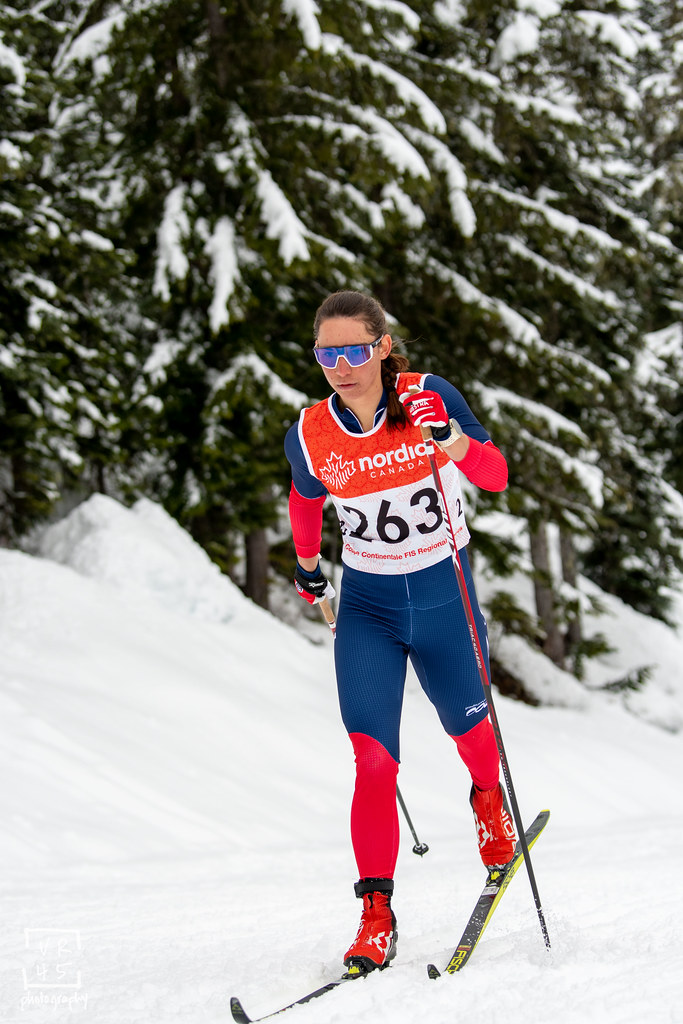
It’s a humidity-temperature combo that makes classic waxing tricky. Consequently, many athlete chose to use “hairies”, which are known as “rub skis” in Canada, essentially foregoing kick wax and opting instead for a sandpapered kick zone. For those with strong striding technique, this achieves grip without as significant a risk of icing issues, as klisters can be known create in such conditions.
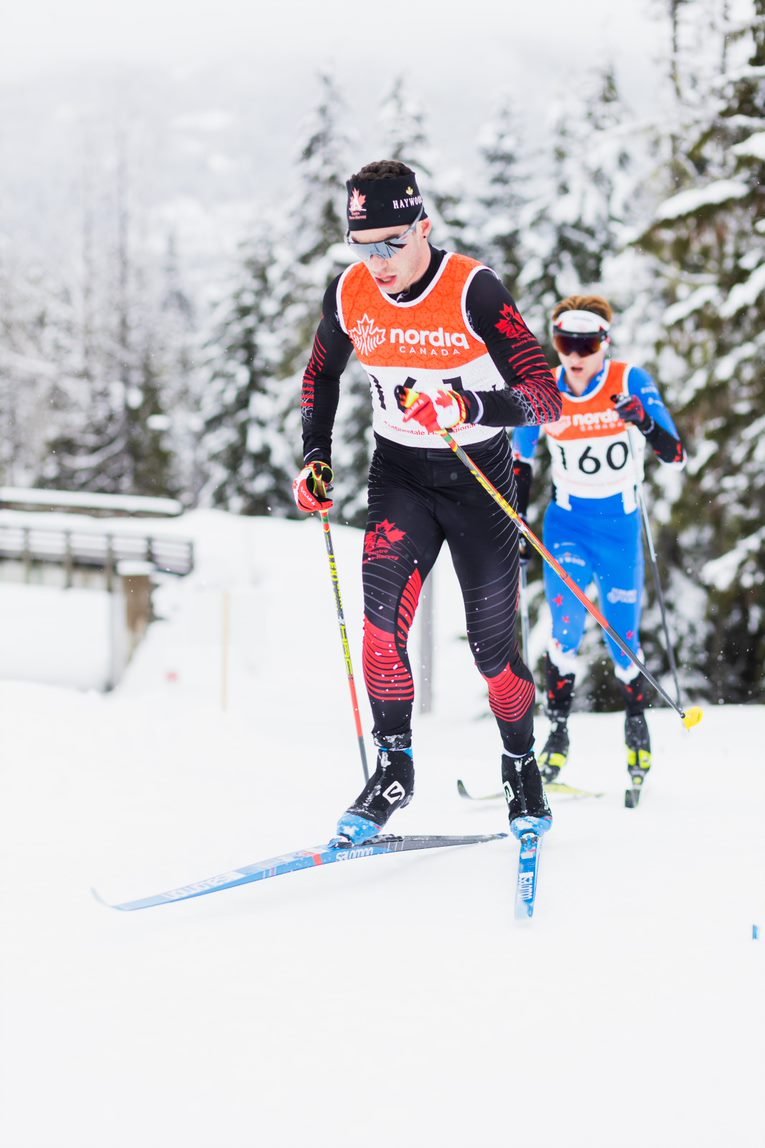
Top Canadian U20 racer Xavier McKeever (Foothills Nordic), who was 13th overall today, explained how this changes the game for those who haven’t had the experience: “You have to be a bit more careful with your kicks and a bit more gentle, because they can slip out really easily. That was the biggest focus for me [today], just to try and ski technically well.”
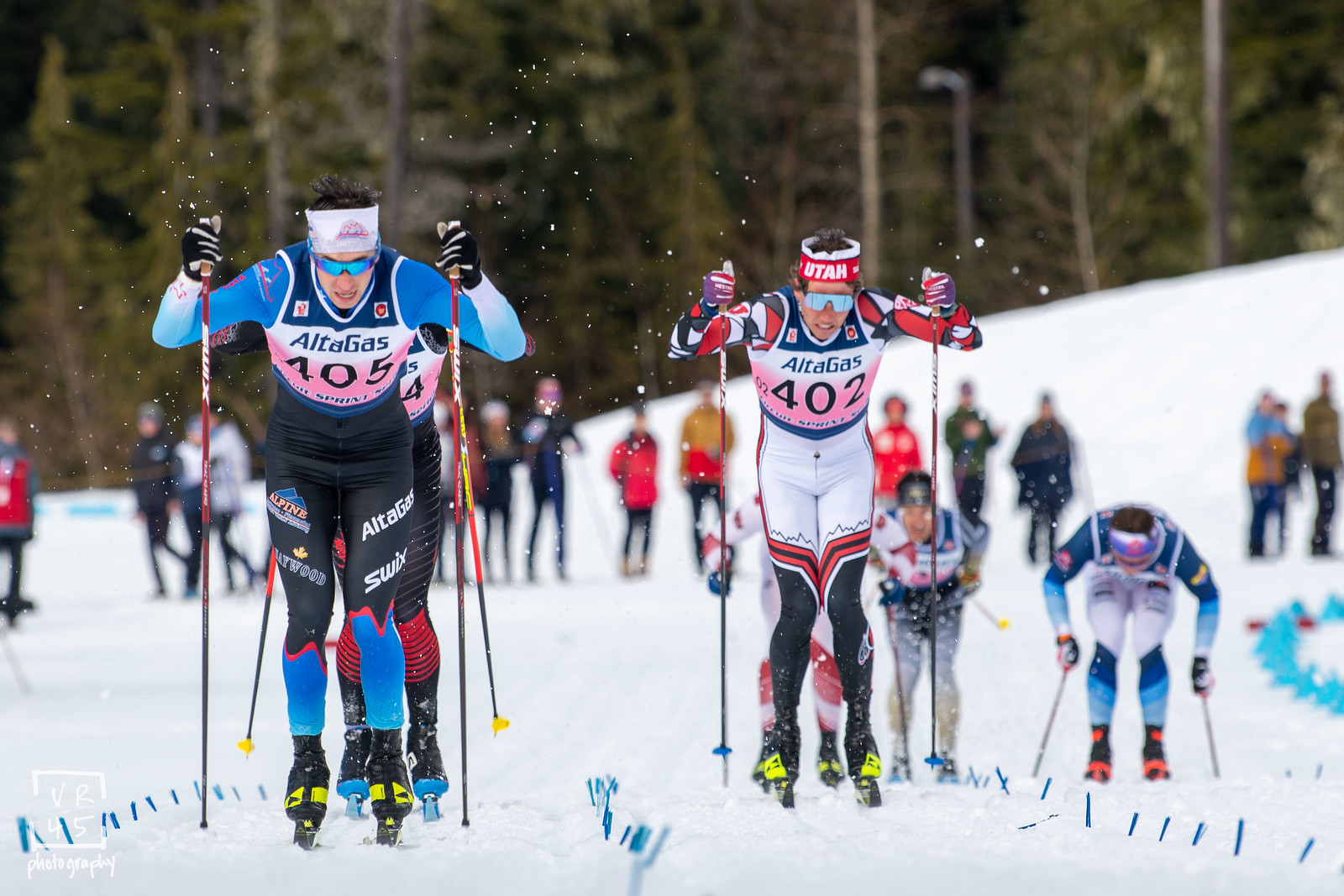
Craftsbury’s Adam Martin takes the 15 k classic win in Whistler. (Photo: Doug Stephen / VR 45 Photography)
Following 10 k sitting and standing events contested by Nordiq Canada’s Para Nordic athletes, the open men’s category headed out for the three 5 k loops. In a close race for the top podium spot, Craftsbury’s Adam Martin took the win with a time of 40:29.3. Martin was chased by today’s Canadian National Champion, Antoine Cyr (Skinouk) who hunted his times from 19 bibs behind.
Though Cyr led through the first 10 k, a strong closing lap from Martin moved the American to the lead in the splits, with Cyr skiing the third fastest final lap to take second (+1.3). Canmore’s Russell Kennedy was third overall (+13.1) for the second spot on the Canadian podium, while fellow Canmore athlete Sam Hendry, who now trains with the University of Utah, was third for Canada in fifth overall (+48.0). Both Cyr and Kennedy had also raced onto the podium in yesterday’s 10 k free.
“I felt really good today,” Martin wrote to FasterSkier after the race. “Particularly in the second half, I started to figure out how to best race this course and these conditions, and I found a good place mentally to push. I’m really happy with the outcome – that was a dream to win.”
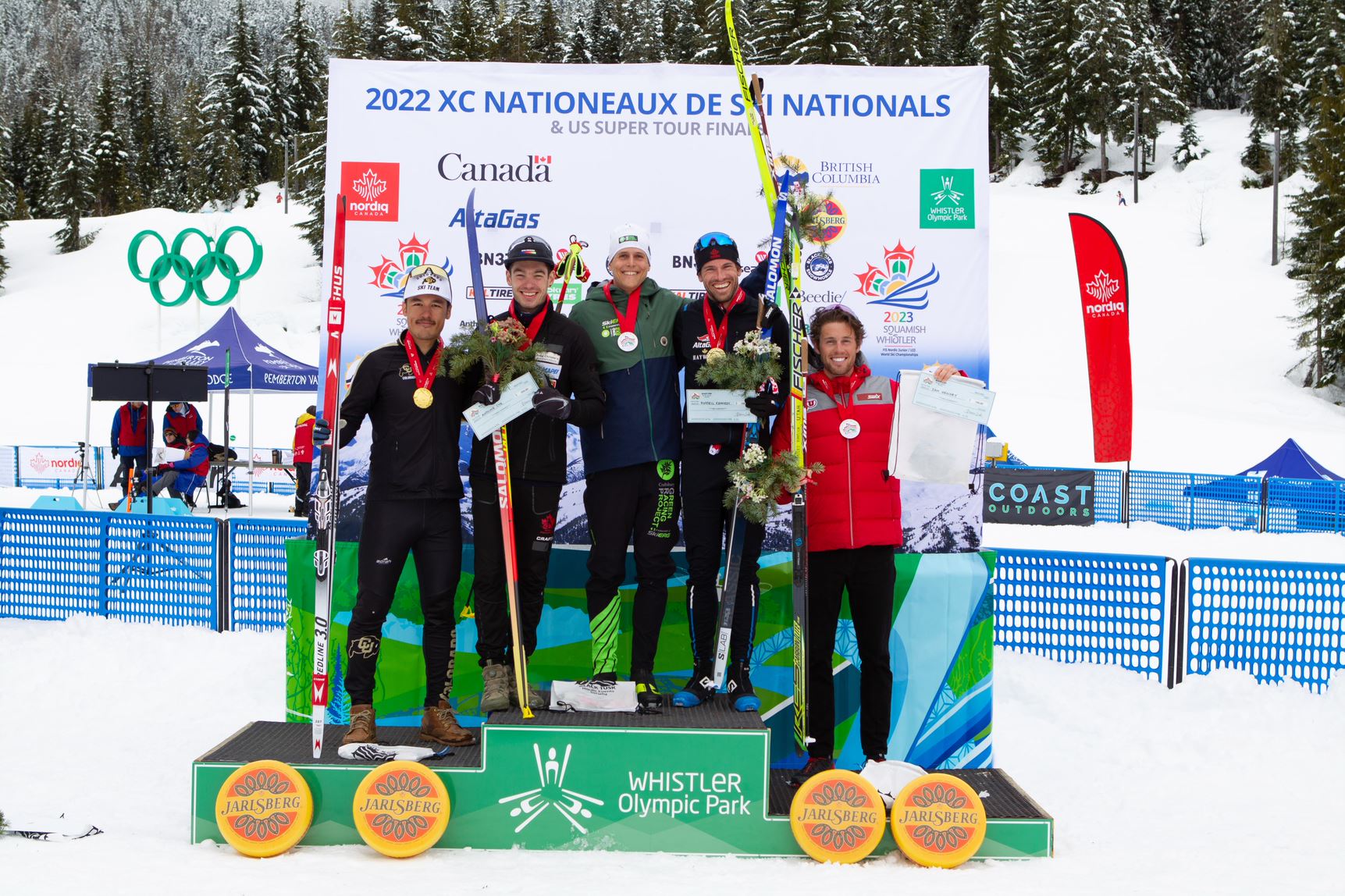
The men’s 15 k classic podium in Whistler: Adam Martin (CGRP) took the win ahead of Antoine Cyr (Skinouk), and Russell Kennedy (Canmore Nordic). (Photo: Joern Rohde / Nordiq Canada)
A successful season of SuperTour racing has Martin ranked at the top of the rankings, and earned him starts in post-Olympic World Cup events. After taking third at the American Birkie, Martin headed to Norway to race the 50 k classic at Holmenkollen, where he finished 26th. The following weekend, he skied to 44th in the 15 k free in Falun, Sweden. A week later, Martin is back with his Craftsbury team and standing atop the US SuperTour podium.
“It’s nice to return from the World Cup and still feel in good shape. After two 50 k’s, and travel, and a season that I’m really happy with, everything is a bonus at this point. I think it’s great that we are able to combine with Canada for these races. There are a lot of guys at a similar level, so it makes for some tight, fun racing.”
A 23-year-old Quebec native, Cyr’s best results have been in classic this season, namely an 11th place finish in the opening World Cup 15 k classic in Ruka, Finland, and racing with Graham Ritchie to put the Canadian team in fifth during the Olympic classic team sprint in Zhangjiakou. After the team sprint, he was praised by both his teammate and coach Erik Bråten, along with armchair quarterback Devon Kershaw, for his classic technique.
“Classic is always good for me and is a race I love,” Cyr said of today’s 15 k in a post-race interview with Nordiq Canada. “It was tough conditions this morning, and a good skier normally comes out on top in hard conditions. I was able to ski well, focus on the race, and came second overall, which is a little bittersweet because it was a really tight battle in the end. But it was really fun, the track is amazing. It’s an Olympic standard track, so it’s just really good.”
Antoine Cyr races for the Canadian National Title in the 15 k classic in Whistler. (Photo: Nordiq Canada / Nathaniel Mah)
In his second lap, Cyr had caught yesterday’s winner, Rémi Drolet (Team Black Jack), whom Cyr credited in supporting his strong result today.
“When I saw was closing the gap on him on the first lap, I decided to go a little harder than I planned to catch up with him. [I then tried] to relax behind him for a lap or half of a lap.. In the end, I was missing a little bit on the last lap. I think that that helped for sure, skiing with someone strong like Rémi.”
Finally, Cyr spoke to the importance of an international field featuring all age groups coming together this week, particularly on the heels of a two-year hiatus due to pandemic restrictions.
“It is so good for the young kids — us older guys, we’ve been racing on the World Cup, but like the juvenile and junior, they almost have no races in Canada. To have a big event like this is just amazing and we’ve been looking at the younger guys’ results for an hour yesterday, seeing who’s in good form, and who’s coming up, and you are the next guys to be like taking over. So for them, it is awesome, and for us too, racing with the US is always — it should always be like this.”
Joining Martin for the SuperTour podium, BSF Pro Team athlete Finn O’Connell was 7th overall (+1:06.4) and second American, with University of Utah’s Luke Jager half a second behind in 8th overall (+1:06.9).
Julia Kern strides for the win in tricky conditions during the 10 k classic in Whistler. (Photo: Doug Stephen / VR 45 Photography)
In the women’s 10 k, SMS T2’s Julia Kern skied a strong second lap to take the win in her second consecutive day on the podium, stopping the clock at 29:54.3. Her club and national teammate, Jessie Diggins, took the second step finishing +18.3 back, while University of Utah’s Sophia Laukli skied to third (+1:03.2).
Looking at tough conditions, Kern explained she raced by trial and error today, exploring which techniques were most efficient on different sections.
“I kind of had an open mindset going in today,” she told Nordiq Canada after the race. “I knew that the tracks might be a little bit punchy or washed out in sections, and so I was double pulling wide or double polling narrow or just like power striding on the flats if it was getting too punchy out there. So just trying it all.”
She continued that she was looking to “have fun, send it from the start, and see if I could hold that pace the whole time,” which she ultimately proved able to do. It’s the time of year where the hay is in the barn training-wise, and athletes have had a long season, leaving them in varying states heading into the last hurrah. On whether she was looking to just have fun at these races, or whether it was a serious quest for the podium, Kern said “both”.
“I think the end of the season is always really fun. It’s so cool to have this many athletes here. And I’ve been feeling really good the last few weeks and so enjoying racing when it does feel good and when I’m able to push really hard. We’re all really tired at the end of the season, but also, when the body’s in form you might as well take advantage of it and send it on the course.”
The women’s 10 k classic podium on day 2 in Whistler: Julia Kern (SMS T2) took the win ahead of Jessie Diggins (SMS T2) and Sophia Laukli (Univ. of Utah). (Photo: Joern Rohde / Nordiq Canada)
Winning back-to-back Canadian National titles, Katherine Stewart-Jones (Nakkertok Nordique) was again on top for the Canucks, finishing sixth overall (+1:17.5). Finishing in the same order as yesterday, Dahria Beatty (Whitehorse Ski Club) was second for Canada in eighth overall (+1:55.0), while Cendrine Browne (Fondeurs-Laurentides) rounded out the podium in ninth overall (+2:14.5).
“I went out really hard knowing that that’s what I had to do if I wanted to make the podium,” Stewart-Jones said of her race. “I had a good first lap, and I definitely slowed down a lot on the first part of the second lap. I was just tired and was having a hard time staying in the zone and keeping the rhythm, but I was able to pull it together a bit for the second half of the second lap. So I was really happy with that. And I was happy with how hard I pushed. I just didn’t have it quite in me today, and sometimes that happens.”
On the importance of focusing on her technique on this type of course with sub-optimal conditions, she continued, “It’s really important, especially on the climbs. The grip isn’t always perfect in these conditions, so you really have to make sure to stay on top of your skis. If you get tired and you start leaning forward, then it makes it even harder to kick… And then on the flatter sections, it was a bit awkward, and you had to expect that. Either you’re striding awkwardly or you’re doing a kick double pool, but your poles are sinking. You have to just really focus on committing to whatever you decide to do and not like trying to switch too much between.”
Speaking to already standing atop two podiums, Stewart-Jones responded with pride, while also acknowledging that the overall win would be sweeter.
“Oh, it’s definitely nice to be winning the national championship title… because we’re racing against the Americans, I obviously care about the overall too, so maybe it feels a little less exciting, but for sure, I’m proud of that.”
Katherine Stewart-Jones (Nakkertok Nordique) takes back-to-back national titles in the women’s 10 k classic in Whistler. (Photo: Doug Stephen / VR 45 Photography)
In order to get closer to the overall podium, she said he would focus on resting as much as possible and maintaining the head space to perform her best. “It’s been a long season and I haven’t raced this much in a long time. I think everyone’s pretty tired. But also just being able to also be mentally strong [over the next races]. And yeah, you never know what’s gonna happen.”
Racing continues Wednesday with individual classic sprints, which will be live-streamed by the Black Tusk Nordic Events Society. If you’re looking for additional video updates, follow along on the Nordiq Canada and Black Tusk Instagram pages.
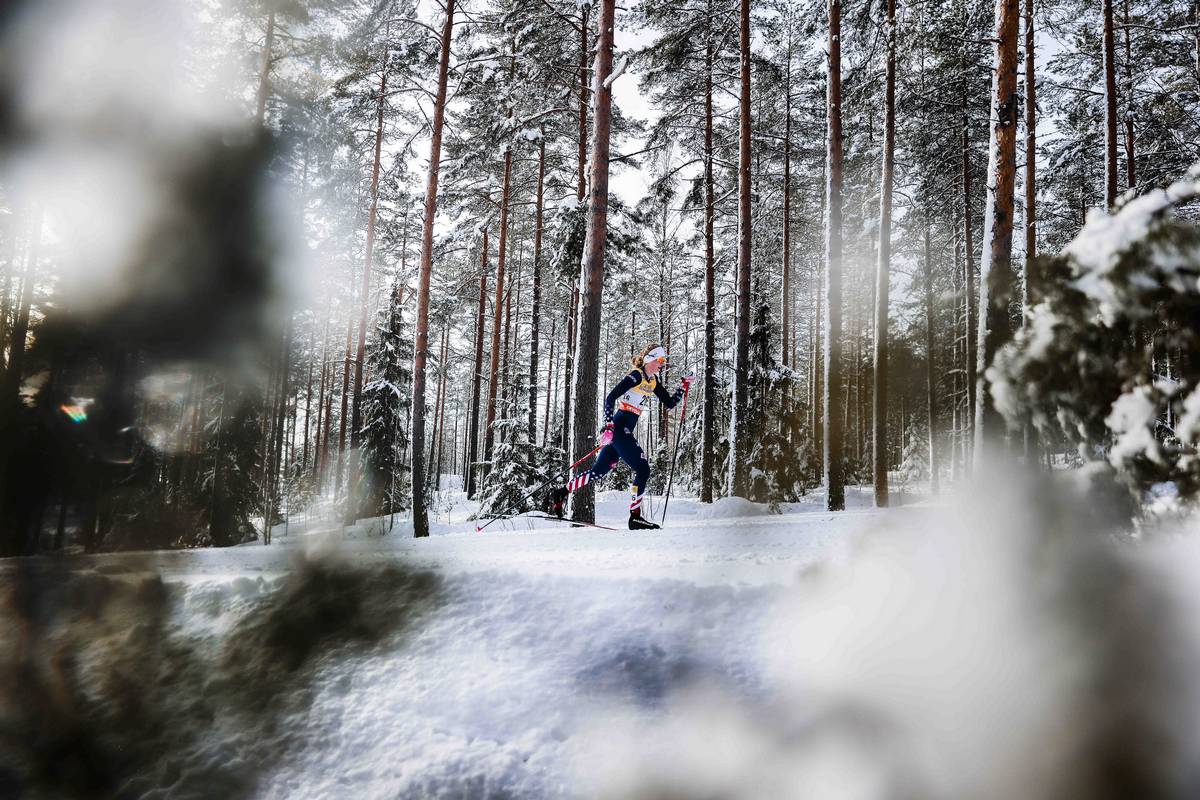
Hailey Swirbul races through the snow-capped pines of Lahti, FIN. (Photo: NordicFocus)
This World Cup coverage is made possible through the generous support of Marty and Kathy Hall and the A Hall Mark of Excellence Award. To learn more about A Hall Mark of Excellence Award or to learn how you can support FasterSkier’s coverage please contact info@fasterskier.com.
An iconic venue, Lahti’s ski jumps rise out of the pine forest from atop the rolling hills, tucked between the many lakes of the region in southern Finland. After two years of empty trails and stadiums, horns blazed, cowbells rang, and voices cheered during the women’s 10-kilometer individual start classic race as fans lined the hills and filled the stadium, memories of pre-pandemic racing flooded back into mind.
What has remained constant through the last two years is the presence of Norway’s Therese Johaug at the top of the results sheet in distance races, particularly classic. Johaug started as the final athlete in the seeded group wearing bib 60, meaning she would have information available to her from the start on how hard she would
A little over halfway through the first of two 5 k laps, it looked like Johaug would run away with yet another World Cup distance race. At the 3.7 time check, Johaug was 11.7 seconds up on Natalia Nepyraeva of Russia who had clocked the fastest prior split, with the Finnish Olympic bronze and silver medalists, Krista Pärmäkoski and Kerttu Niskanen, lurking just behind at 16.2 and 17.5 seconds back. And the Finns were racing on home soil with most of the aforementioned fans waving their country’s flag.
Norway’s Therese Johaug races the 10 k interval start classic in Lahti, FIN. (Photo: NordicFocus)
Sure enough, the margin of Johaug’s lead narrowed. At the lap, she was just under ten seconds ahead of Nepryaeva, who looked to have conserved her energy in the first lap to push the pace in the second. While the Finns became less of a threat to Johaug, the Norwegian’s margin over the Russian’s splits whittled down rapidly.
And ironically, the Russian’s fast second lap might have been partly Johaug’s own doing. As the Norwegian had headed out on course, Nepryaeva was lapping through the stadium, allowing her to match pace as she chased the high-tempo Norwegian through the woods for the second 5 k, perhaps pressuring Johaug to burn a few of her matches a bit earlier than she’d otherwise planned.
Regardless of what was going through each athlete’s mind, Nepryaeva finished her second lap to set the bar at 24:29.6.
Over the first kilometer of Johaug’s second lap, now racing on her own, the time difference between the two women was slashed in half, from 9.8 to 4.8 seconds, and at 8.7 k, it had essentially remained constant at 5.5 seconds. It would come down to the wire.
Looking back at the season, it might be easy to focus on the three Olympic gold medals Johaug won in Zhangjiakou, including in the 10 k classic event. But, she had been beaten in the only other 10 k classic she’s raced on the World Cup this year, which also took place in Finland, during the opening weekend of World Cup racing in Ruka. She might be the favorite, but she’s also beatable.
Natalia Nepryaeva puts together a strong performance in the 10 k classic in Lahti. (Photo: NordicFocus)
As Nepryaeva watched the clock eagerly from the leader’s chair, Johaug kicked, glided, and double poled through the final kilometer. Having over ten minutes prior, she had plenty of time to wait, watch, and be watched by the cameras.
Nepryaeva leaned forward, not taking her eyes off the leaderboard as Johaug made the tight right-hand turn down into the stadium without losing too much momentum, and began to charge as hard as she could toward the line.
With 15 seconds remaining to stay inside Nepryaeva’s mark, Johaug rounded the corner to the finish. With ten seconds to go, she hit the lanes. Nepryaeva watched the seconds tick by hoping Johaug’s time would change to red, while the Norwegian was just trying to keep it in the green.
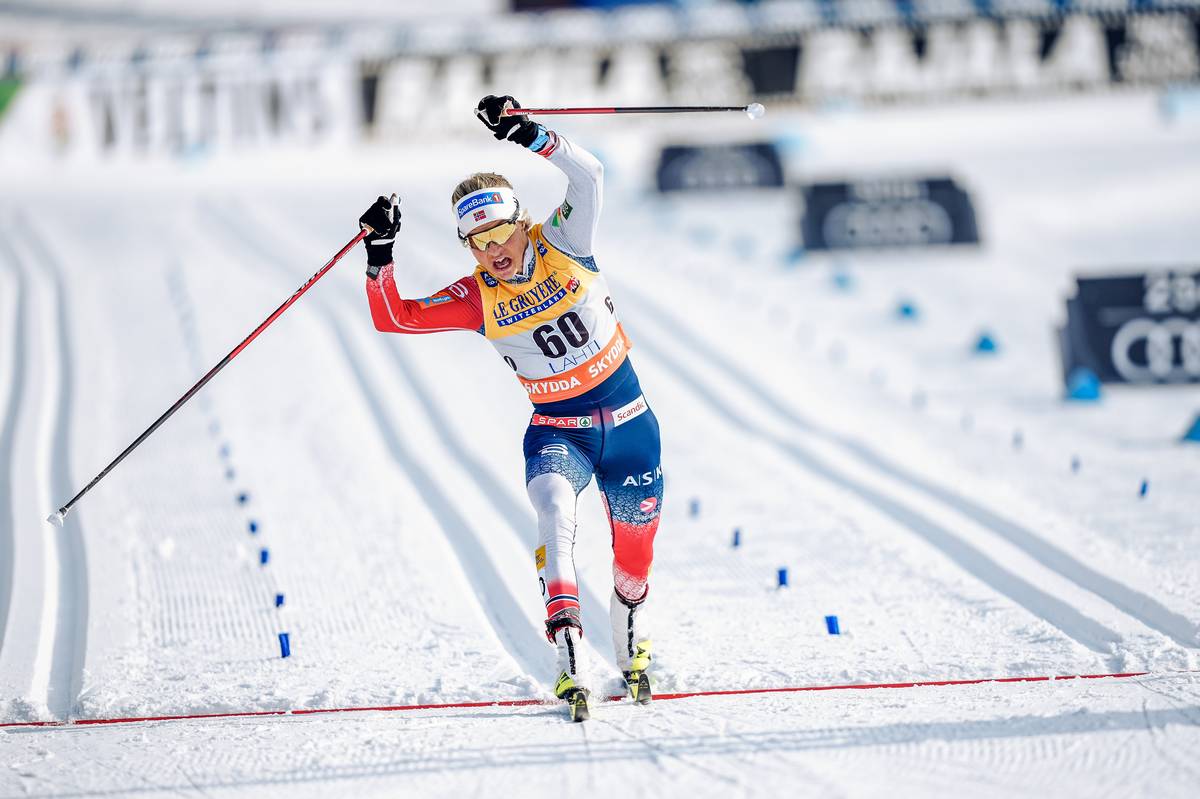
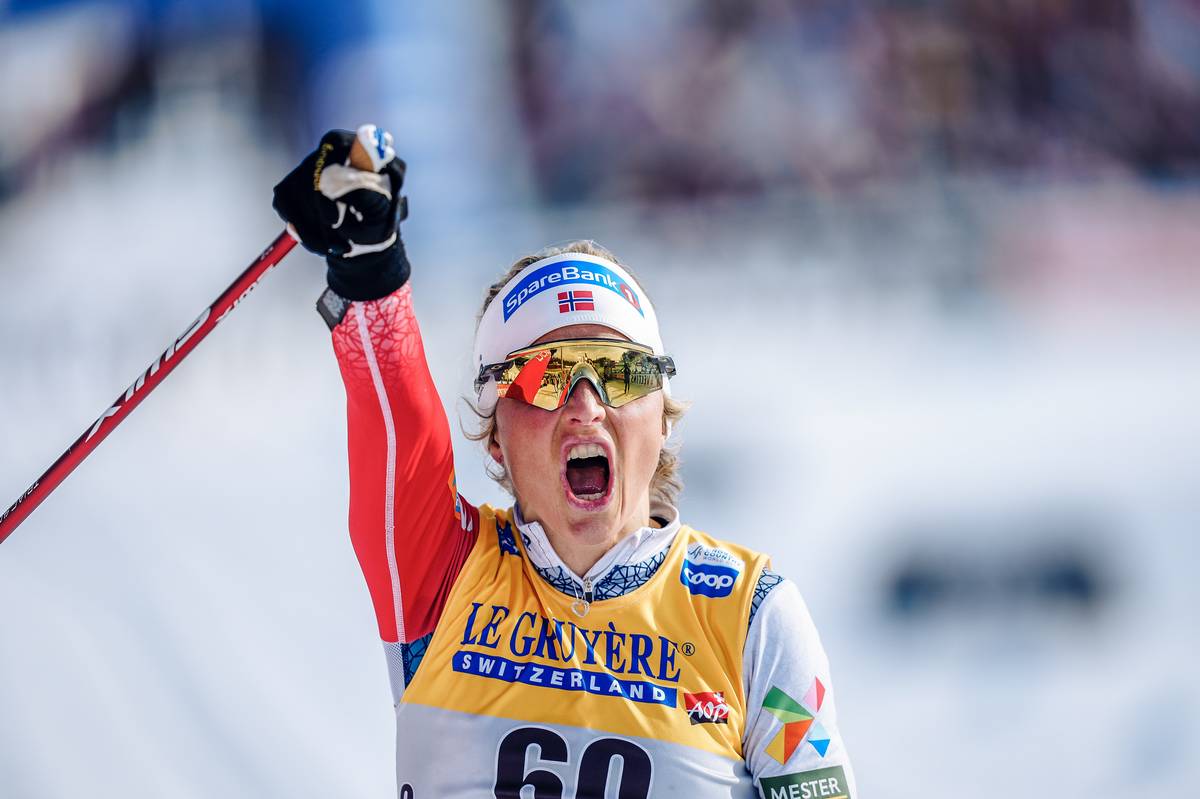
Therese Johaug (NOR) throws her boot to take the win just 1.2 seconds ahead of Russia’s Natalia Nepryaeva. (Photo: NordicFocus)Therese Johaug (NOR) celebrates her victory in Lahti’s 10 k individual start classic. (Photo: NordicFocus)
Until the actual finish line was crossed, it felt like the result could go either way. But with a final push from her poles and kick with her boot, Therese Johaug sealed the deal, just 1.2 seconds ahead of Natalia Nepryaeva. Johaug let out a victorious roar, just before cameras showed the Russian roll her eyes in exasperation, as if thinking, “Really? Not again.”
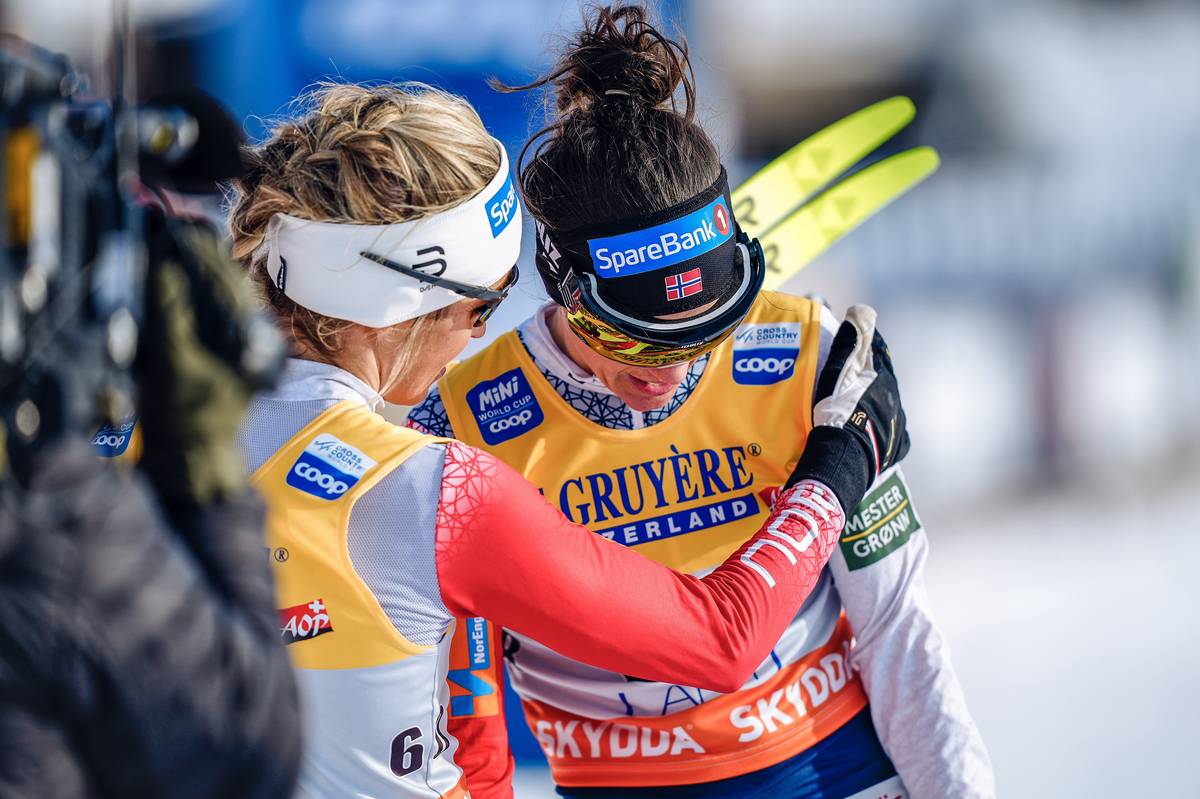
Cameras panning back to Johaug watched her shift away from her own celebration to comfort a very disappointed Heidi Weng, who had started a minute ahead of Johaug in bib 58, but finished 42 seconds behind her teammate in 19th place (+1:42.4). After promising results in the Tour de Ski, Weng had tested positive for COVID just prior to the Olympics, leaving her watching the event from afar. From Weng’s disappointment at the finish, it looked as though she had been looking for more in her return to racing on the World Cup.
Therese Johaug (NOR) comforts her disappointed teammate Heidi Weng at the finish of the 10 k individual start classic in Lahti. (Photo: NordicFocus)
Johaug spoke with FIS after the finish, speaking to what it means to win again today as she nears the end of a successful season, including the three gold medals earned in Zhangjiakou this month.
“It means a lot for me, and I am so happy that I have a second on my side,” Johaug said with a laugh. “After the Olympics, you’re coming home and it’s a little bit hard to motivate again, but when I come to Lahti and go on this beautiful track, I really enjoy it.”
Johaug was also asked whether she felt the benefits of having trained and raced at altitude surrounding the Games, which were held at roughly 5,500 feet above sea level.
“Yeah, I feel that,” Johaug said of the boost. “When you train a lot at altitude and then you go down, you feel like you have more energy in the hills. I think my shape right now is really good, so I’m excited to race at the Holmenkollen next weekend, and in Falun, then the rest of the season.”
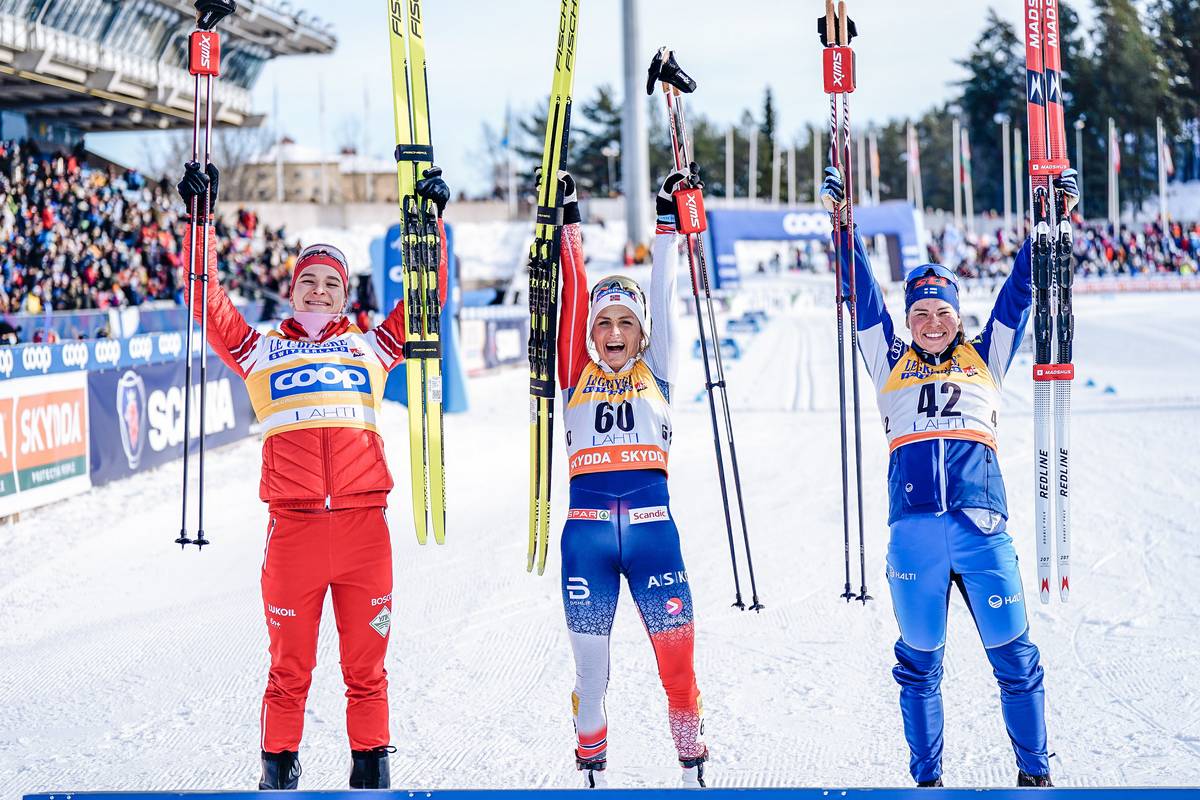
The women’s podium in Lahti: Therese Johaug (NOR) took the win ahead of Natalia Nepryaeva (RUS) and Krista Pärmäkoski (FIN). (Photo: NordicFocus)
Rounding out the women’s podium, Finland’s Pärmäkoski held her margin to 16.7 seconds at the finish for third place, followed after a gap by her teammate Niskanen in fourth (37.7). Sweden’s sprint champion Jonna Sundling was just behind in fifth (+40.7).
Leading the way for the American team, Rosie Brennan posted consistent splits to hover in sixth place through the first lap. Maintaining even tempo and effort, Brennan remained in this position until the last checkpoint, which showed a hard-charging Ebba Andersson of Sweden trade positions to bump Brennan back to 7th.
Rosie Brennan leads the American team during a 10 k individual start classic in Lahti, FIN. (Photo: NordicFocus)
Also posting a split Brennan was not quite able to match in the final kilometer, the American lost nearly eight seconds to Germany’s Katharina Hennig between the final time check at 8.7 k and the finish, leaving Brennan in eighth place overall (+1:02.8) at the finish.
“I am really happy with today.,” Brennan wrote in a post-race email. “I have always struggled post-championships, not so much in my body, but in my mind. It’s really difficult to live on the road and be sharp and push so hard all the time. It often feels like there is never a chance to let down the way someone who goes home every week might experience. I am always trying to figure this out and work towards finding ways to let down and then pull the fight back up for the weekend. It’s all part of the game and it’s a good challenge to try to figure everything out.
“Anyway, today, I felt much more like myself and was able to ski the way I wanted to. Lahti has been a tough venue for me in the past and today I really felt strong in my classic skiing and had some ability to push hard. I was definitely frustrated after yesterday and am really happy I was able to let it go and find myself out there today. We have had really great weather this weekend and a big crowd so that was a huge bonus. It was a joy to not be skiing in an arctic tornado!”
Rosie Brennan crosses the line for 8th place in Lahti’s 10 k interval start classic. (Photo: NordicFocus)Jessie Diggins skis to 20th place in the 10 k classic in Lahti, FIN. (Photo: NordicFocus)
Following a podium near-miss in yesterday’s sprint, Jessie Diggins was next for the U.S., just behind Heidi Weng in 20th (+1:43.4). Julia Kern and Hailey Swirbul also raced into the top-30 for the second day in a row, finishing 28th (+2:03.2) and 29th (+2:10.5), respectively.
Just off Swirbul’s split, Canada’s Katherine Stewart-Jones led her team in 30th place (+2:10.7), with her teammate Dahria Beatty just outside the top-30 in 33rd (+2:19.4). Cendrine Browne raced to 36th (+2:24.5), while Laura Leclair was the final Canadian woman in 58th (+4:29.7).
Canada’s Katherine Stewart-Jones leads her team in 30th during the 10 k individual start classic in Lahti, FIN. (Photo: NordicFocus)
Finishing 30 seconds outside the top-30, Katharine Ogden returned to the World Cup in 43rd (+2:40.8).
Following the races, US Ski Team head coach Matt Whitcomb provided insights into both the women’s and men’s races in Lahti, as well as sharing the news that Östersund, SWE may become the host to the initially cancelled World Cup Finals that had been scheduled for Tyumen, Russia. Whitcomb also speaks to the “Olympic hangover” that can make hard for athletes to perform at their best the weekend following the Games, and gave a shoutout to the athletes racing at World Juniors in nearby Lygna.
World Cup racing continues on Thursday, March 3rd with a classic sprint in Drammen, Norway, just prior to the storied 30/50 k mass start classic races at the Holmenkollen in Oslo.
Canucks celebrate best Olympic relay result since 2002
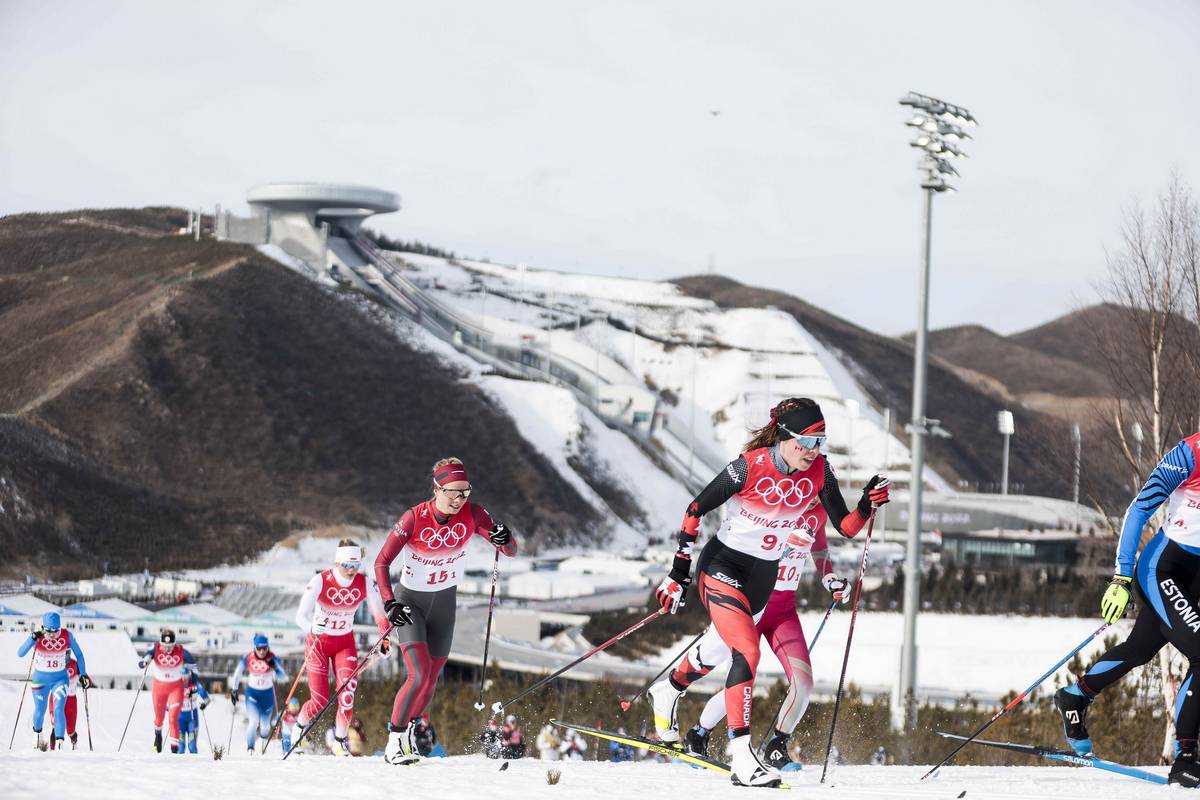
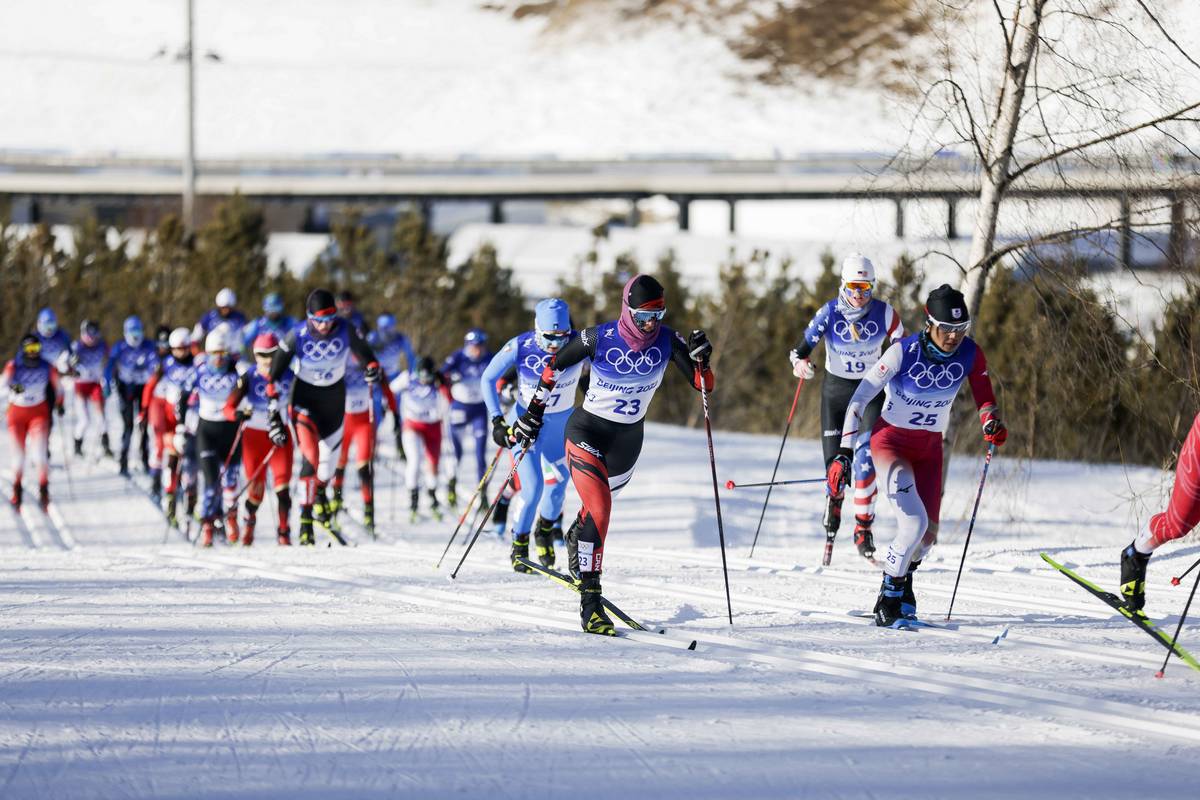
BEIJING, Chn—The Canadian women’s relay squad skied to its best result Olympic result in two decades, finishing ninth on Saturday at the Zhangjiakou National Cross-Country Ski Centre.
Skiing on a mission for eighth spot, the women’s team of Katherine Stewart-Jones, Dahria Beatty, Cendrine Browne and Olivia Bouffard-Nesbitt mixed together their best relay result on the sport’s ultimate stage since the 2002 Games, skiing into the top-10 in the 4 x 5 kilometre race with a combined time of 57:20.9.
Katharine Stewart-Jones skis the opening leg of the women’s 4 x 5 k relay. (Photo: NordicFocus)
“I love relay days. There is no race more fun than a relay. The 5 k’s are brutal. They are really rough. We all went out together and gave it absolutely everything,” said Stewart-Jones. “I had a good time cheering the girls on when I was done, and I think we can be really proud of our effort.”
The women’s relay consists of each athlete skiing one five-kilometre leg. The first two athletes ski classic-ski format followed by the final two members of the team taking on the skate-skiing legs.
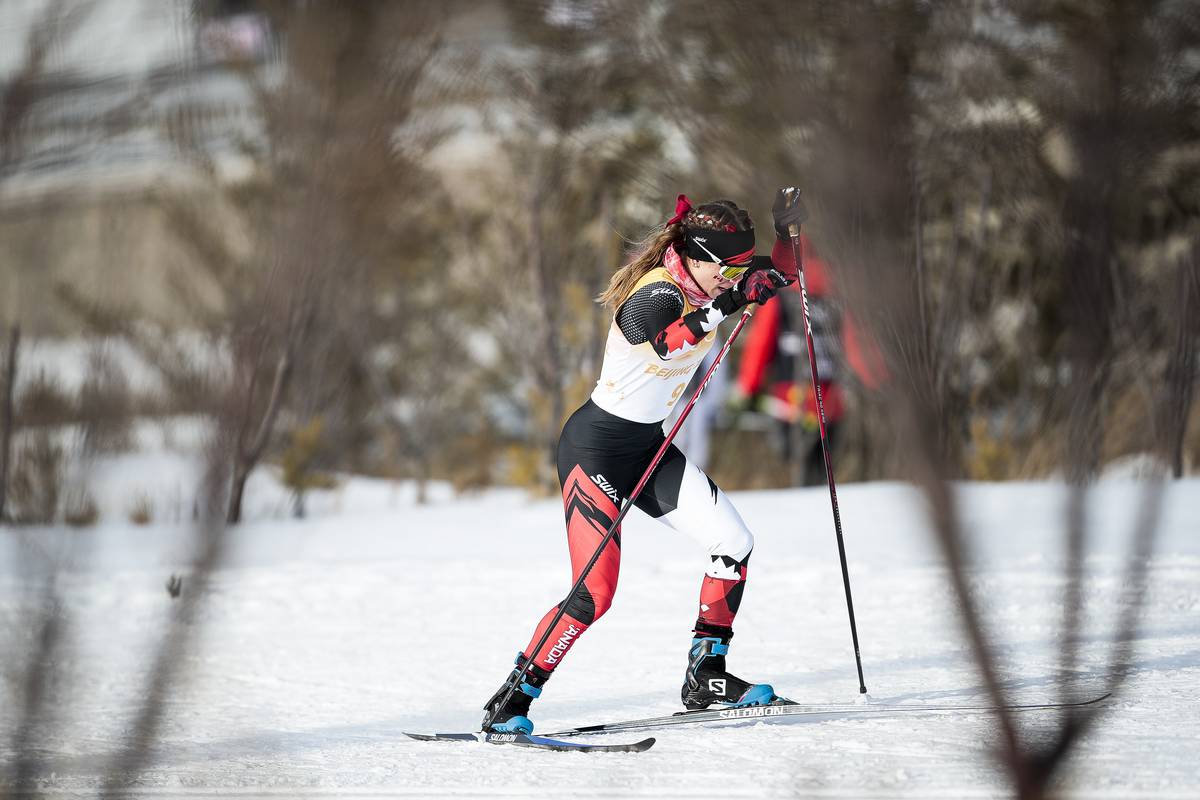
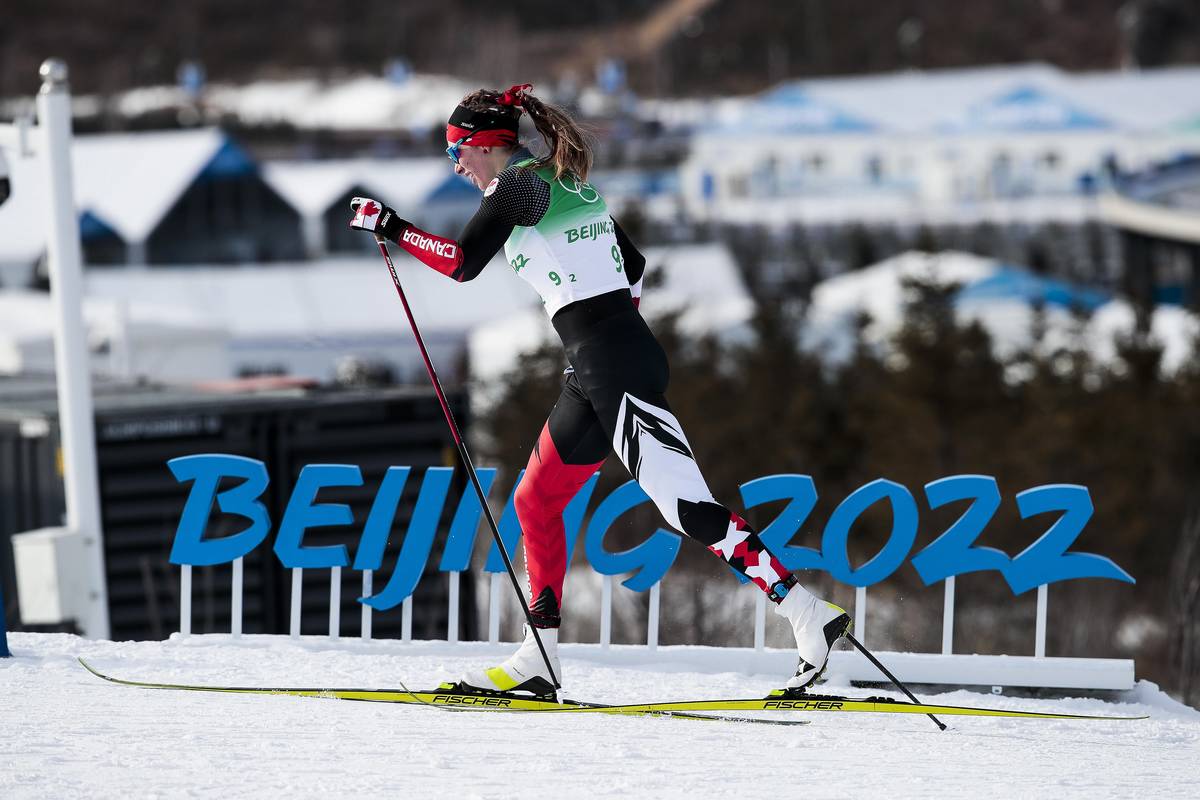
Stewart-Jones (Chelsea, Que.) was first out of the gate for the Canucks , skiing a steady 5km before passing off to Dahria Beatty (Whitehorse) in 10th spot. Beatty, a two-time Olympian, continued her solid run in Beijing where she has rattled off a trio of career-best races, by grabbing two spots on the field before completing her five-kilometre charge around the challenging Nordic trails.
“I just tried to empty the tank out there and give it all I had. I had China to catch at the beginning and saw Japan in the distance and tried to reel them in,” said Beatty. “There was a new pack well out in front of me that was a big group. I did a solo time trial out there and gave it all I had. It was a great result for the team.”
Cendrine Browne races the 4 x 5 k relay during the 2022 Beijing Olympic Winter Games. (Photo: NordicFocus)
Cendrine Browne (Prévost, Que.) – the only other two-time Olympian on Canada’s Nordic Ski Team in China – skied a steady third leg to hang onto the eighth spot before tagging Olivia Bouffard-Nesbitt for the anchor portion of the race.
“Katherine got us in good position and Dahria skied really well. When she tagged me, my job was to keep the gap. I was able to do that,” said Browne. “We were aiming for top-eight. Olivia skied really strong. I’m so proud of our entire team.”
Dahria Beatty races the third leg of the 4 x 5 k relay during the 2022 Olympic Winter Games. (Photo: NordicFocus)
Bouffard-Nesbitt gutted out a solid skate-ski leg where she continued to hold eighth spot until the final kilometre of the race. The Morin Heights, Que. resident battled the last Italian skier through to the finishing stretch but was edged out at the line.
“It was such a privilege to be racing with this team. I was so impressed with my teammates. They did everything they could and I so badly wanted that eighth-place for the team,” said Bouffard-Nesbitt. “It was tough at the end. I could feel Italy on me. I tried to use whatever tactics I had left to play with in last 400 metres.
“She was a little too strong for me in last 50 metres, but I think ninth by four-tenths shows eighth was a realistic goal and all of the girls did exactly what we needed to do.”
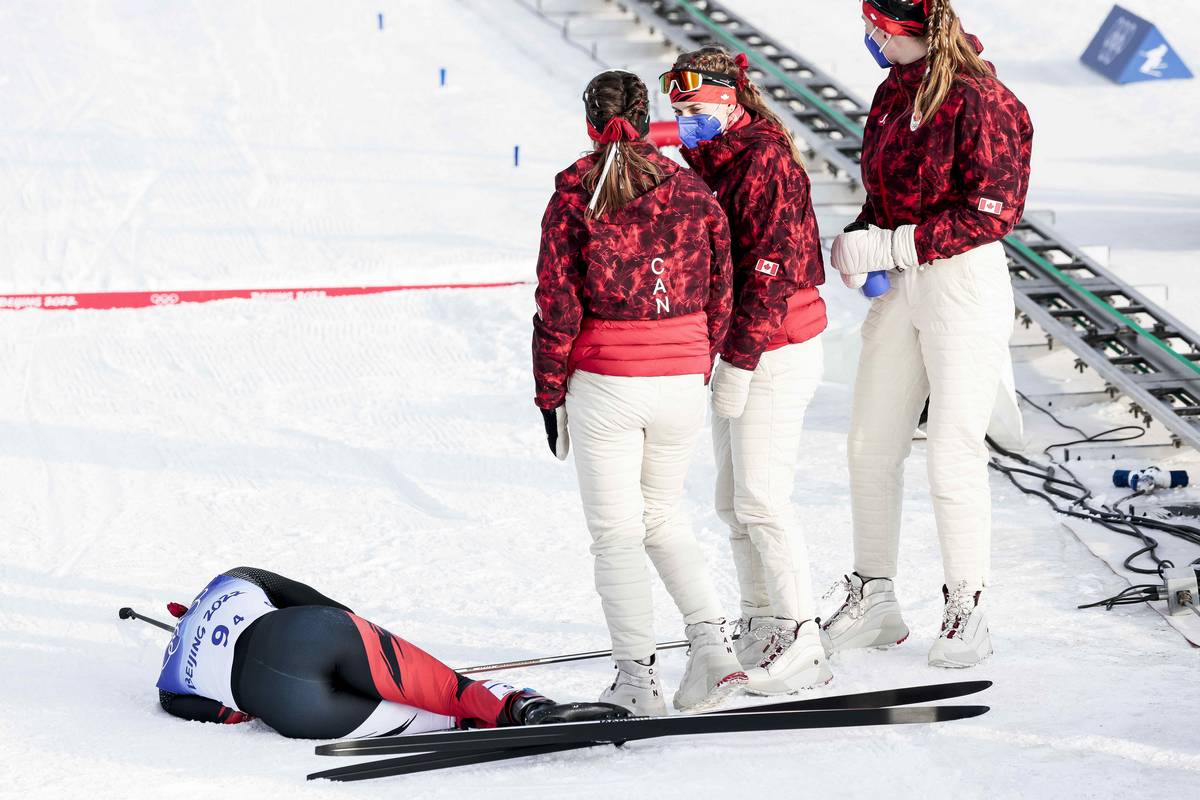
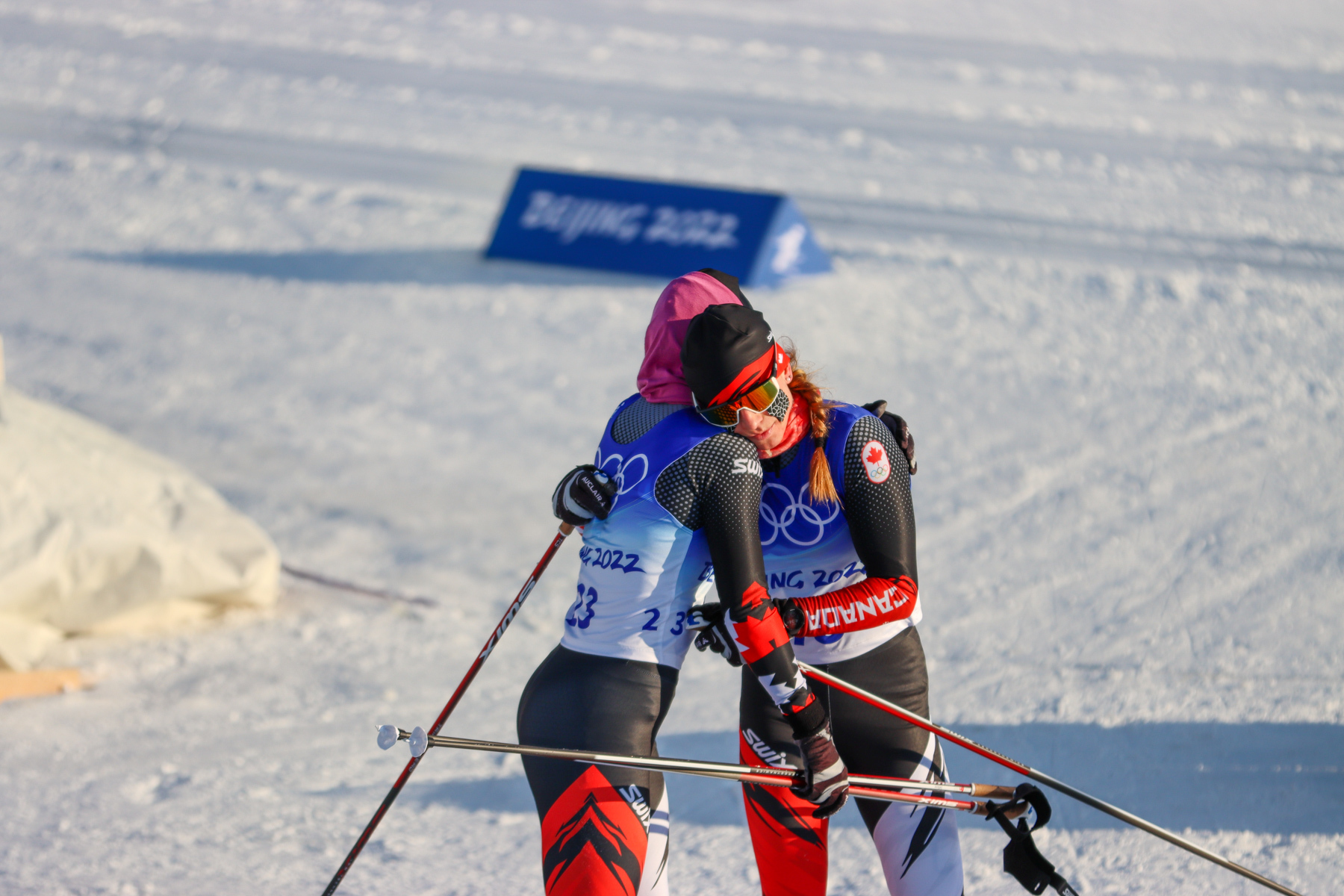
Olivia Bouffard-Nesbitt (CAN) collapses as she’s greeted by her team at the finish of the 4 x 5 k relay. (Photo: NordicFocus)
Canada’s women’s Olympic relay team of Beckie Scott, Milaine Theriault, Sara Renner and Amanda Fortier were eighth in 2002. The Canadian women also posted ninth at last year’s World Championships, which was also the best result at the premier event in a non-Olympic year in two decades.
Athletes representing the Russian Olympic Committee won the women’s relay with a time oof 53:41.0. Germany was second at 53:59.2, while Sweden skied to the bronze medal with a time of 54:01.7.
This World Cup coverage is made possible through the generous support of Marty and Kathy Hall and the A Hall Mark of Excellence Award. To learn more about A Hall Mark of Excellence Award or to learn how you can support FasterSkier’s coverage please contact info@fasterskier.com.
Thursday morning saw the third women’s cross-country race in the Zhangjiakou stadium. On the docket, a 10-kilometer individual start classic with two laps of a challenging 5 k course. After a reprieve from the wind during the sprint event Tuesday evening, it was blowing once again as the athletes headed to the start.
Zhangjiakou 5 k course. (screenshot from FIS homologation certificate)
Unlike the skiathlon which saw 62 finishers, the start list for the 10 k individual classic featured 98 racers. Most of the later starters represented nations we don’t normally see at World Cup events, such as Greece, Brazil, and Hungry. Many of these skiers fall into the ‘B-standard’ Olympic qualification category; provided they can earn less than 300 FIS points in a competition prior to the games, but have greater than the 100 point threshold of the A-standard, these athletes can race in the 10 k and relay events.
To set the stage for Thursday’s race, we can begin with a brief dive into recent Olympic, World Championship, and World Cup results at this distance. Given that this year’s edition of the individual-start 10 k event was contested in classic technique, the 10 k individual start in PyeongChang was a freestyle race (disciplines alter every two years at championship events). As such, it is harder to draw direct predictions from the podium four years ago to possible success in today’s event. Nevertheless, to remind ourselves, it was Ragnhild Haga of Norway who walked away with the gold in 2018. Charlotte Kalla of Sweden finished second and she was followed by Marit Bjørgen of Norway in third position. Delving deeper into the Olympic records, a look at the results from the 10 k individual classic in Sochi, shows that Justyna Kowalczyk of Poland took gold, with Kalla again the runner-up, and Therese Johaug rounding out the podium with bronze.
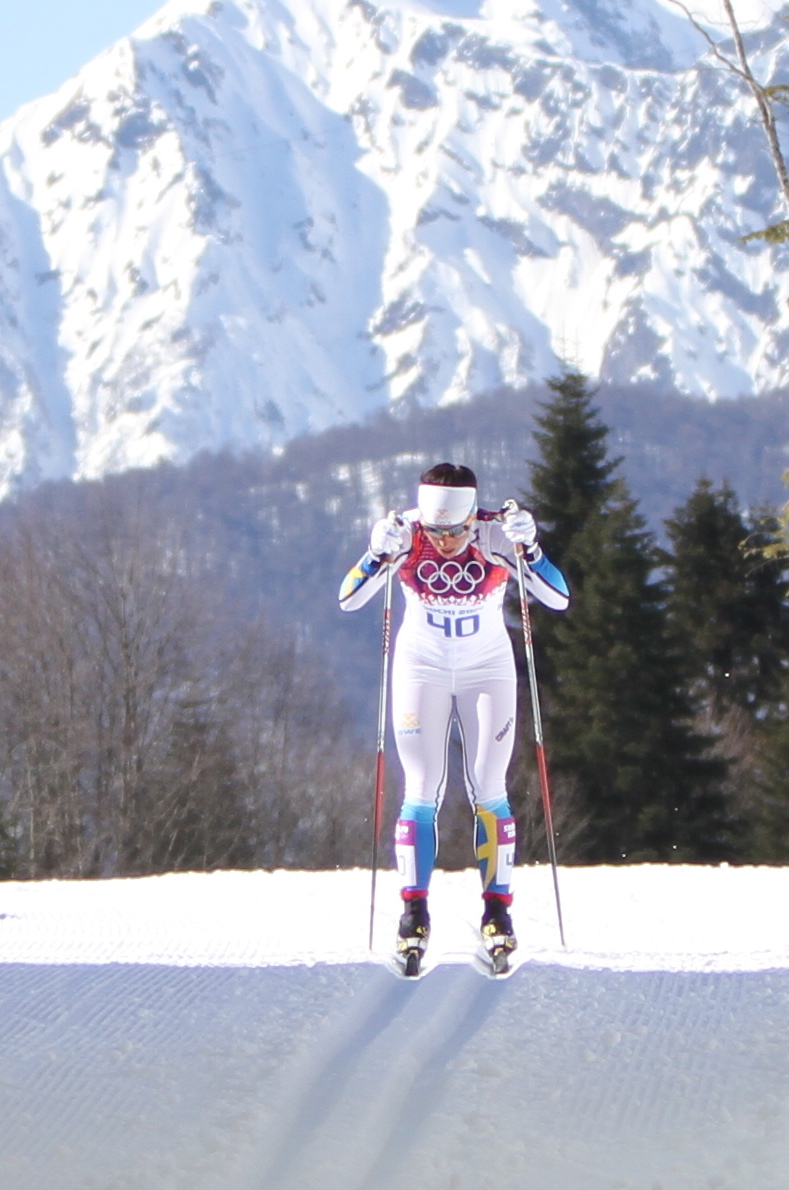
Sweden’s Charlotte Kalla racing to silver in the 10 k classic individual start at the 2014 Olympics in Sochi, Russia. (Photo: FS archives)
The most recent championship-level 10 k individual-start classic race was in Seefeld, Austria when the World Championships were held there in 2019. There, the victory went to Therese Johaug who finished 12.2 seconds ahead of Frida Karlsson of Sweden. Johaug’s teammate, Ingvild Flugstad Østberg was third, but has since battled health concerns and been largely absent from international racing.
This season, the two 10 k individual start classic events have been won by Karlsson (in Ruka, FIN +13.7 ahead of Johaug) and Kerttu Niskanen of Finland in Lenzerheide, SUI (during the Tour de Ski in which Johaug did not compete).
Perhaps one of the more open events in terms of podium predictions, the race turned out to be an exciting one with the margins between medal positions coming down to hundredths of seconds. In the end, it was Johaug of Norway who walked away with her second gold medal from these Games, eking out a win ahead of Niskanen (FIN) by just 0.4 seconds.
Therese Johaug (NOR) crosses the finish line and collapses (Photo: NordicFocus)
Rewinding to the start, Russian Olympic Committee athletes Natalia Nepryaeva and Tatiana Sorina clocked the fastest times to begin. Looking at the course profile, the first split at 1.3 k comes at the end of a good deal of climbing. Close behind the ROC athletes were two Finn’s, Niskanen and Krista Pärmäkoski, with Johaug rounding out the top five, a surprising +12.8 seconds behind Nepryaeva.
Move forward to 3.6 k and the top three were within 0.5 seconds of each other, Niskanen and Johaug tied with a split of 10:47.7, Nepryaeva passing through at 0.5 seconds off their mark. With one lap complete, Nepryaeva had started to fade, perhaps paying the price for her early pace. At 5 k it was Johaug with the advantage over Niskanen, but only by +0.6 seconds, and Nepryaeva was now +6.2 behind.
Therese Johaug (NOR) striding her way to a win in the 10 k classic (Photo: NordicFocus)
Through 6.3 k it seemed like Niskanen had made a break, pulling ahead of Johaug by 11 seconds, on a section of course that is mostly climbing, generally a strong point for Johaug. Nepryaeva was still in third +14.7 behind Niskanen and Pärmäkoski (FIN) was holding onto her fourth place position, +17.7 back. In the next 0.5 k, something appears to have happened to the ROC athlete, as Nepryaeva lost 12.1 seconds to Niskanen (+26.8) and was overtaken in by Pärmäkoski who moved into third +18 seconds behind her teammate.
The final course split was at the 8.6 k mark and with Johaug having the earlier bib, we saw her through first. She had gained the minute start deficit she had to Jessie Diggins and moved past the American, employing her signature high tempo up the final A-climb. When Niskanen came through moments later, her body language was visibly more labored than Johaug’s. In spite of this, Niskanen still held the lead, +1.3 seconds ahead of the Norwegian. Pärmäkoski remained in third, +23.6 behind, followed by Nepryaeva who was +31.8 behind.
Natalia Nepryaeva (ROC) slides her foot across the line, 0.1 seconds behind Krista Pärmäkoski of Finland (Photo: NordicFocus)
Entering the stadium, Johaug was skiing outside the windblown tracks. Knowing the margins were tight, she pushed hard, crossing the finish line in a time of 28:06.3. Facing a headwind into the finish, Niskanen chose to keep her skis inside the tracks, battling the final meters as the stopwatch ticked by. Sliding her foot across the line, the timestamp turned to red. She crossed +0.4 seconds behind Johaug.
“It was the two most nervous minutes in my life, waiting for [Niskanen]”, said Johaug in the press conference after the race.
“It was a really tough race out there today and, as Kerttu said, it was really close race,” Johaug continued. “So I feel that it’s also Kerttu’s gold medal because 0.4 second is nothing. I think we both are the the winners today in my head.”
Kerttu Niskanen (FIN) digs deep for precious time in the 10 k classic (Photo: NordicFocus)Teammates Krista Pärmäkoski (FIN) and Kerttu Niskanen (FIN) celebrate their podium finishes. (Photo: NordicFocus)
After earning her first individual gold medal just days ago in the skiathlon, Johaug continues to cement her place in history as she gains another. Her performance gives the Norwegians something to hold onto as the rest of the team struggled to perform at the level fans are accustomed to.
With twins Tiril Udnes and Lotta Udnes Weng finishing 21st and 25th respectively and Mathilde Myhrvold back in 44th position, the remaining women racing on behalf of Norway did not have their strongest showing.
So far, Johaug is the only female Norwegian athlete to earn a medal of any color, while Johannes Høsflot Klæbo earned the only medal on the men’s side, a gold in the 1.5 k freestyle sprint on Tuesday. Three Norwegian athletes, including medal favorites Heidi Weng and Simen Hegstad Krüger, remain detained due to a positive COVID test just prior to travel. Weng recently announced on social media that she will not be making it to China and it is unclear whether Krüger will be cleared in time to compete in events next week.
Lotta Udnes Weng (NOR) finished 25th in the 10 k classic (Photo: NordicFocus)
For Kerttu Niskanen, this silver marks her first individual championship medal. She holds two silver medals from team events, both coming from Sochi in 2014. Niskanen only has three World Cup victories to her name and they all were in 10 k classic events, a specialty of hers.
“My plan before this race was to push hard every time and try to ski within my limits,” Niskanen explained in the press conference. “In the second laps on the long uphill from stadium, on the big uphill, [that] was the best part part for me in these tracks… I tried to push hard also end of the race but the I can say that Therese was much better than me. I did my best and it was really near but, yeah.”
Kerttu Niskanen (FIN) celebrating her first individual Olympic medal (photo: NordicFocus)
The bronze medal was also decided by a razor-thin margin. Pärmäkoski started bib number 38 and was hunted by Nepryaeva in bib 60 who had the advantage of more split information. However, when Nepryaeva crossed the finish line, she was outside by just 0.1 seconds, having finished in a time of 28:37.9 whereas Pärmäkoski came across in 28:37.8. Pärmäkoski has three individual Olympic medals, from a range of events in PyeongChang. She earned bronze in both the skiathlon and 10 k individual freestyle in 2018, as well as silver in the 30 k classic mass start.
Krista Pärmäkoski (FIN) stretching for the lunge that gave her third place (Photo: NordicFocus)
For the American contingent, there was some back and forth playing out between Jessie Diggins and Rosie Brennan throughout the race. Just 48 hours after winning the first individual medal for women’s cross-country skiing, Diggins was back on the start line wearing bib 34, starting one minute ahead of eventual winner, Johaug in bib 36. Brennan started in bib 44.
Jessie Diggins (USA) crests a climb in the 10 k individual start classic (Photo: NordicFocus)
At the 1.3 k mark, the two were 13th and 14th, with Brennan +19.9 behind and Diggins +20.4. At 3.6 k Brennan had moved into 8th, +21.3 behind with Diggins in 10th, +25.1 back. With the climbing complete for the first lap, the 5 k split showed Diggins in 9th, +30.1 behind with Brennan now behind her in 11th, +31.8. Begin the climbing for the second lap and Brennan was again the first American, in 9th place and +45.7 behind while Diggins was in 14th, +52.7.
Rosie Brennan (USA) hits a dynamic stride in the 10 k classic (photo: NordicFocus)
At 8.6 k the two were neck and neck, Diggins in 10th, +1:05.6 and Brennan in 11th, +1:11.6. Over the final 1.4 k Diggins grew her advantage over her teammate to finish in 8th position, +1:08.8 behind winner, Therese Johaug (NOR). Brennan finished her day in 13th place, +1:22.3 behind Johaug.
Jessie Diggins (USA) left it all out on the course in the 10 k classic, per usual. (Photo: NordicFocus)
As she provided comments on today’s performance, Diggins first spoke to savoring the moment of yesterday’s medal ceremony. “It was so special to call my family and call my fiancé, and come back to the apartment and show our staff like our coaches the medal and just enjoy that moment.”
After a “rollercoaster” of eating, drinking, and other recovery-focused actions – Diggins said the Tour de Ski was helpful for knowing how to handle the tight turnaround – she turned her full attention to today’s classic race.
“I was really, really happy today,” Diggins said in the mixed zone. “I was so focused on my process. This is undoubtably my weakest event, but I was just so focused on enjoying it – like, ‘Great! No pressure. This is just my day to go out there and enjoy racing at the Olympics.’ Especially seeing Novie do her first Olympic race – I got to put the glitter on her I give her a hug – it was honestly pretty emotional. But in a good way.”
Though she has steadily closed the gap between her results in skate and classic performances, Diggins has been primarily seen success in freestyle competitions. On today’s race, she maintained that her focus was not on the result, but on giving her all despite classic being her weaker technique.
“It was so cool to work on that process and dial in the kick,” Diggins said. “I was so, so grateful for awesome skis. When I go really hard, I can’t feel my body from the waist down. And when you can’t feel your legs and you’re still kicking up the hill – you have to have great kick… And man, they delivered. I was just so proud of them.Especially in challenging conditions where it’s windblown in the tracks, or you’re trying to keep skis fast and grippy. That’s hard… I think they did a great job.”
Speaking to whether she has made progress in her classic skiing, Diggins continued, “I would like to think so. I’ve been working very very hard on it for a lot of years. I’ve been just so focused on that process on the technique and every single stride I was just thinking so hard about my technique. It really kept me right in the moment and thinking about what I could do so yeah, I’m gonna keep working on it to keep improving it.”
Jessie Diggins skis to 8th in the 10 k classic. (Photo: NordicFocus)
On a course Brennan described as “brutal” she explained that seconds could easily be gained or lost along any stretch, up or downhill. She also acknowledged the challenge of facing the wind in an interval start race where there may be less opportunity to use another skier to block the wind than there is in a mass start. Overall, Brennan executed her goals on the day, despite looking to be higher on the results sheet.
“I was really focused on having powerful classic skiing and I was pretty happy with how I skied,” Brennan said in the mixed zone. “I wish I had a little more, but I did what I could with what I had today.”
Brennan finished one place (just 0.6 seconds) behind Sweden’s Frida Karlsson, who has two wins in the 10 k classic on the World Cup, including a win over Johaug earlier this season. This strong result is on the heels of her Olympic career best finish in the individual skate sprint, which was held under the lights Tuesday evening.
“The turnaround was definitely hard,” Brennan said. “It’s really hard with these late night races to get good sleep afterwards. So I think that was challenging. I did a lot of training this summer to try to like mimic that load. So I’m hoping that I can manage it, but we will take it day by day and see what we can do.”
Rosie Brennan comes to the line in 13th in the 10 k individual start classic. (Photo: NordicFocus)
Making her Olympic debut, Novie McCabe was the first starter for the United States, wearing bib number 5. At the age of 20, McCabe is the youngest member of a young team in Beijing. After earning her first World Cup points in Davos earlier this year, McCabe also notched a top-ten finish during the Alpe Cermis hill climb during the Tour de Ski. In an impressive performance, McCabe skied her way to 24th in a time of 30:34.9.
When she started, the British Eurosport announcers remarked, “I think McCabe is going to be a superstar like Diggins in a few years.”
At 5 k, McCabe was in 38th position, +1:27.9 behind Johaug. At 6.3 k she had moved into 32nd, at 6.8 k she was in 29th and by 8.6 k she had jumped to 24th, which she held through the finish.
“The long last hill was, for sure, so hard,” McCabe said after the race. “I tried to kind of just zone out and get through it. And I knew that it would be tough, especially on the last time up. But it was nice also to have so many people like around me out there and kind of have people to watch ahead of me. That helps a lot.”
Novie Mccabe (USA) skiing strong in her first Olympic race (Photo: NordicFocus)
Hailey Swirbul was the fourth American competitor and wore bib 27. Swirbul raced in the skiathlon earlier this week and finished in 40th. In today’s 10 k classic, she bested that performance and landed herself in 32nd, +2:59.0 behind Johaug. Swirbul was just five seconds outside of the Top-30.
“It was better than my last race,” Swirbul said simply in response to how she felt about her day. “I’m excited. I had a little bit of a reset – had a few days to recover from that first effort and have really focused on kind of resetting my goals, trying to push as hard as I could through that whole race and not give up no matter what. And I was able to do that today.”
With the women’s relay looming, team selection is a buzzing topic amongst ski fans. Swirbul skied a classic leg in the December, 2021 relay in Lillehammer, NOR, and was a member of the 2021 World Championship relay team in Oberstdorf, GER. The American team finished just off the podium in fourth in both races.
Swirbul said that relay team selection was not on her mind during her race today, though she does feel the pressure to perform that is perhaps inescapable at an Olympic level competition.
“That definitely does factor in for all of us here,” she said. “But I think at the end of the day, everyone on our team is confident that we’re going to try to put in the team with the best shot of a relay medal. So there are no hard feelings. There’s nothing personal about that team selection. We all trust that we’re just trying to do the best for our nation and give us a good shot.”
Hailey Swirbul (USA) working her way to a 32nd place finish in the 10 k classic (Photo: NordicFocus)
For the Canadians, Dahria Beatty continued her momentum, building off of strong performances in both the skiathlon and sprint to finish 18th, +1:53.9. This is a personal best for Beatty, following a week of personal bests. She finished 25th in the skiathlon and 25th in the sprint; her best Olympic performance before that was a 37th place in 2018 during the 10 k freestyle at PyeongChang.
Dahria Beatty (CAN) skiing to a personal best result of 18th (Photo: NordicFocus)
Behind Beatty, Kathrine Stewart-Jones finished 36th for team Canada, +3:02.3 behind. Cendrine Brown was 48th (+3:41.6), and Olivia Bouffard-Nesbitt was 61st (+4:54.8).
Canada’s Dahria Beatty was beaming after cracking the top-20 for the first time in her two trips to the Olympic Winter Games, finishing the women’s individual start 10-kilometre classic cross-country skiing event in 18th spot.
Feeding off career-best Olympic performances in her first two starts, the 27-year-old put down a memorable performance, skiing twice around the demanding five-kilometre loop in a time of 30:00.2.
“I definitely feel like I am in the best shape of my season now, so I knew there was potential for a strong race today,” said Beatty, who placed 28th in the skiathlon and 25th in the sprint races earlier this week.
“I’ve been feeling good in the other two events and think that I’ve been building through each one. I had a strong result in this race at our Trials in Canmore and I feel like I’m in a lot better shape now. It was a happy surprise to be in the top-20.”
The cagey veteran of the National Ski Team skied smart and aggressively while finding her groove while powering her way through the heavy winds and steadily working her way up the epic climbs at the Zhangjiakou National Cross-Country Ski Centre.
“I was able to get into my own rhythm. I felt I was too conservative in the skiathlon (earlier in the week) on the climbs – especially in the classic part of the race. I had a better idea of how that would go today.
“I really tried to push my limits on the climbs and trust that I’d be able to recover enough on the downhills to go into the next one.”
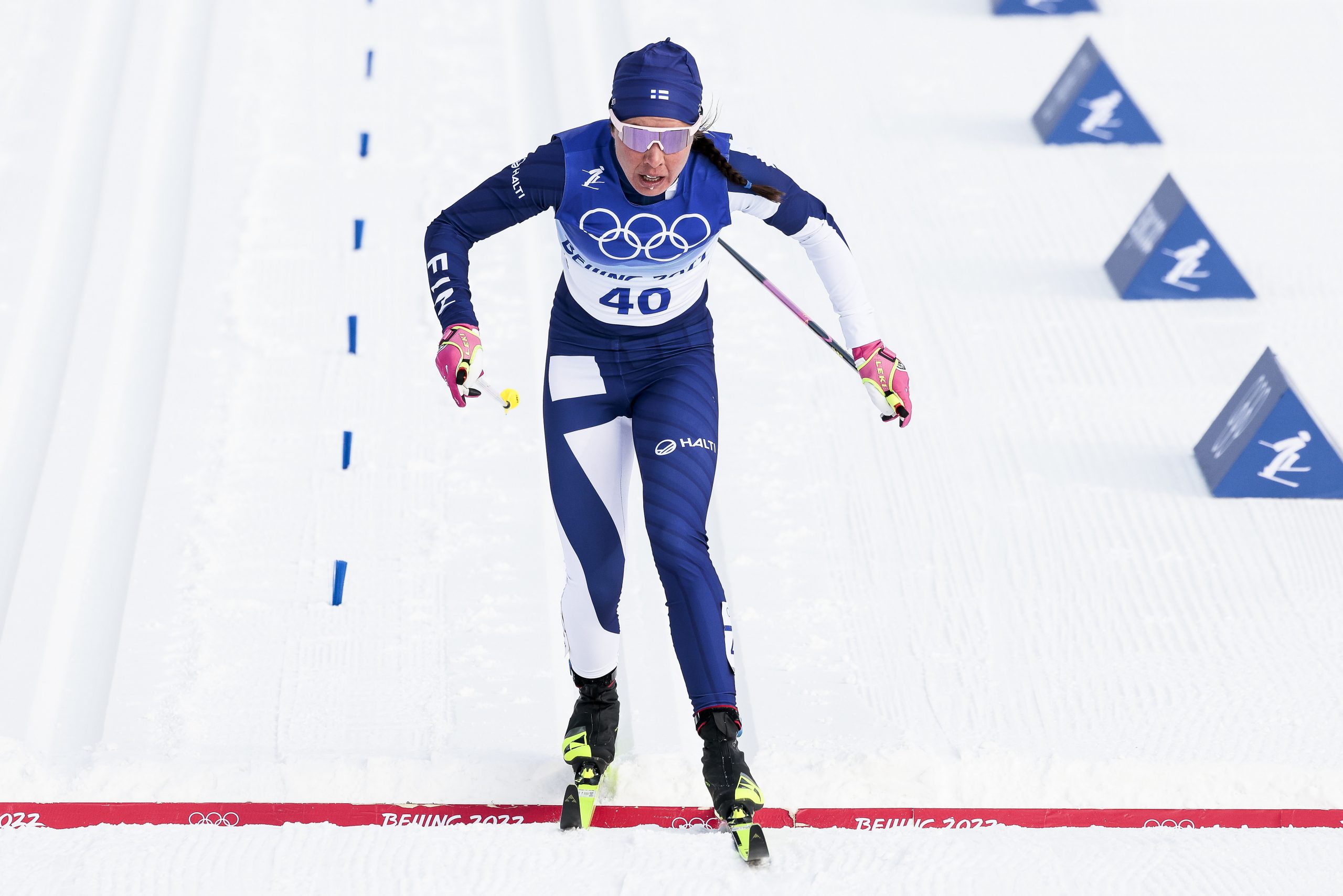
Dahria Beatty (CAN) skiing to a personal best Olympic result of 18th in the 10 k classic. (Photo: NordicFocus)
The Whitehorse resident was hanging tough with the sport’s elite, progressively gaining time on the field as the race went on.
Norway’s Therese Johaug clocked the golden time at 28:06.3, edging out Finland’s Kerttu Niskanen by .4 seconds. Niskanen celebrated the silver medal at 28:06.7. Her teammate, Krista Parmakoski, finished 31.5 seconds off the leading mark to claim the bronze medal at 28:37.8.
Beatty has only finished in the top-20 on the World Cup four times throughout her career. Three of those performances – two 15ths and a 16th place – have come in sprint races. Steadily making progress with her distance skiing, Beatty’s best World Cup distance race came last season when she was 15th in a 30-kilometre pursuit in Engadin, Switzerland.
“If you go back to my teenage years, I was more of a distance skier, but I’ve had a lot more success sprinting internationally,” said Beatty. “It is definitely easier to break into sprinting if you are able to get that qualifying speed, but the last few years, I’ve been able to have good training seasons and that overall fitness has been caught back up with the tactical power I’ve had for sprinting.
“I’ve never given up saying I’m an all-around skier so I’m happy that I am finally showing that again after all of these years.”
Katharine Stewart-Jones (CAN) races the 10 k individual start classic during the 2022 Olympic Winter Games. (Photo: NordicFocus)
Three other talented Canadian women also hit the start line on Thursday for the individual start race. Katherine Stewart-Jones (Chelsea, Que.) battled to 36th place with a time off 31:08.6. Cendrine Browne (Prévost, Que.) skied into 48th spot with a time of 31:47.9. Olivia Bouffard Nesbitt (Morin Heights, Que.) completed the 10-kilometre test in a time of 33:01.1 for 61st place.
Additional Canadian Athlete Quotes
Olivia Bouffard Nesbitt
“I tried super hard, and I was able to make myself hurt. Some of those uphill’s were painful in the best way. That is how absolutely what you want in this race is to finish having hurt yourself a little bit. I’m pumped. I’m super grateful to be here and to have an Olympic bib on.”
Cendrine Browne
“Sadly, it was tougher today. I always have more difficulty with the 10 km classical event and the second part of the race today was a bit more difficult. I was on my own on the track for a while. I gave everything I had today even if it’s not the result I was looking for. It can only be better next time. I am looking forward to the relay event with the girls. I believe we are all in a good shape right now and the best is yet to come for us.”
Katherine Stewart-Jones
“Definitely pretty disappointed with my race. After the skiathlon I know that I’m in really good shape so I thought I could get a really good result today. I just fell short of that. I gave everything I had but it just wasn’t the feeling I wanted. I know I’m in shape and that’s nto the problem. I have other races to look forward to so I am excited for that.”
Three Canadian men – Olivier Léveillé (Sherbrooke, Que.), Antoine Cyr (Gatineau, Que.) and Rémi Drolet (Rossland, B.C.) – will compete in Friday’s 15-kilometre individual start classic-ski race.
Stay tuned for in-depth race coverage, coming soon.
The third women’s cross country ski competition of the 2022 Beijing Winter Olympic Games featured a 10-kilometer interval start classic competition.
Starting as the second athlete in the seeded group in bib 36, Therese Johaug (NOR) set a high bar, her tempo quick and her breathing labored as she worked every meter of the course to finish in 28:06.3. The next two seeded bibs, both of Finland, served as her biggest threats for the win; at 6.3 k, Kerttu Niskanen was 11 seconds ahead of Johaug, with Krista Pärmäkoski just under 7 seconds behind.
In the final kilometers, Johaug and Niskanen’s times began to converge, with the leader uncertain through the finish. As Johaug stared at the clock, Niskanen double poled through the finish lanes, using her final energy for a final boot kick as she slid over the line 0.4 seconds behind Niskanen to earn the silver medal. Pärmäkoski held pace for third (+31.5).
Jessie Diggins was the top American skier in 8th (+1:08.8), with Rosie Brennan 13th (+1:22.3).
In her first Olympic appearance, 20-year-old Novie McCabe finished 24th (+2:28.6), with Hailey Swirbul just missing the top-30 in 32nd (+2:59.0).
Racing for Canada, Dahria Beatty had a standout performance to finish 18th (+1:53.9), with Katherine Stewart-Jones finishing as the next Canadian in 36th (+3:02.3). Cendrine Browne was 48th today (+3:41.6), while Olivia Bouffard Nesbitt rounded out the team’s results in 61st (+4:54.8).
Three Canadian women ski into elite group of 30 on grueling race day in Beijing
By Chris Dornan on behalf of Nordiq Canada
Katharine Stewart-Jones (bib 23) skis to 23rd in the women’s 15k skiathlon, which opened the 2022 Beijing Olympic Games. (Photo: NordicFocus)
BEIJING, Chn — Cendrine Browne and her teammates set the tone for the Canada’s cross-country skiers at the 2022 Winter Games after putting down her best-ever Olympic performance, skiing to 20th place in the women’s 15-kilometre skiathlon race on Saturday in Beijing, China.
Competing in her second Olympic Games, the 28-year-old from Prévost, Que. clocked a time of 47:58.1 after a gutsy effort that challenged the top women’s cross-country skiers who were faced with long punishing climbs and blustery winds on a frigid afternoon at the Zhangjiakou National Cross-Country skiing Centre.
“That is a career-best result today! I’m really, really happy and proud of how I raced,” said Browne. “I worked very hard on my classic the last year and I think that really helped me today. It was definitely a tough race with tough conditions so I’m glad I was able to ski relaxed and be conservative with my energy. It was really fun being in the same pack as Katherine! I’m so proud of our team. This shows that we are in great shape!”
Canada’s Browne, Katherine Stewart-Jones (Chelsea, Que.) and Dahria Beatty (Whitehorse) worked together in the chase pack for much of the race. Browne and Stewart-Jones exchanged positions as the top Canuck in each of the four laps. Skiing strong, the Canadian trio conserved their energy for a strong finish in the top-30.
Dahria Beatty races the 15k skiathlon in Zhangjiakou, the opening event of the 2022 Beijing Winter Olympic Games. (Photo: NordicFocus)
Skiing in and out of the top-20 on the wide-open course, Stewart-Jones (Chelsea, Que.) finished 23rd at 48:17.3 in her Olympic debut.
“This is my first Olympic Games, so it was a really great experience. There was a lot of wind today, so it was important to stay in the tracks and conserve energy,” said Stewart-Jones. “It was a long 15 kms given how tough a course this is. I was happy with the way I felt out there despite it being so long since I had raced, and I didn’t really know what to expect. This will do a lot for my confidence for the rest of these Games.”
Beatty also had a boost of confidence with her career best Olympic result, skiing steady in the middle of the pack en route to a 28th place finish at 48:52.0.
“You had to be pretty strategic on the downhills today. With the wind, my goal was to be as small as possible on the downhills and then give everything I had on the climbs. I’m super happy with how it went for me. Being in the top-30 in a distance race is always something I’m happy with,” said Beatty.
Olivia Bouffard Nesbitt (Morin Heights, Que.) scrapped her way to 44th in a time of 50:11.7.
“It was super challenging conditions for everyone. It was windy, cold, the snow was slow, and this is a heck of a course,” said Bouffard Nesbitt. “It is one of the hardest courses if not the hardest. It was just epic today – my first Olympic race – getting blasted by the wind right off the start. You really could just feel the size of the event right away.”
Battling for the first Nordic skiing medal of the Games, the field of 63 women set an electric pace from the start gun and held it throughout the challenging 15-kilometre test which combined 7.5 kilometres of classic cross-country skiing followed by 7.5 additional kilometres in the free technique. Athletes change equipment in a pit stop area between the two legs with the clock still running.
Cendrine Browne (right) hugs teammate Katharine Stewart-Jones (left) after the pair finished 20th and 23rd, respectively, in the 15k Olympic skiathlon. (Photo: Nat Herz/FasterSkier-ADN)
Norway’s Therese Johaug controlled the pack in both disciplines. A force from start-to-finish, Johaug led a group of approximately 15 athletes who strung out the field on the second hill in the first lap. Charging out onto the second half of the course after leading the pack into the exchange area, the Norwegian skied with a handful of athletes until surging with less than three kilometres to go en route to winning the gold medal with a time of 44:13.7.
Natalia Nepryaeva, who is an athlete representing the Russian Olympic Committee, was the next best finisher 30.2 seconds off the golden pace. Nepryaeva claimed the silver with a time of 44:43.9, topping Austria’s Teresa Stadlober who grabbed the bronze medal at 44:44.2.
The Canadian men will hit the Olympic start line for a 30-kilometre skiathlon race on Sunday.
Katherine Stewart-Jones sprinting over the saddle at Sovereign Lake during the Beijing Prep Camp. (Photo: Peggy Hung)
Canada was successful in delivering the team to Beijing and getting them on snow in Zhangjiakou. The decision to go above and beyond in isolating athletes before a carefully planned drive to a charter flight worked, although other countries also succeeded with a more laid-back approach.
What can fans expect from the Canadian team in Beijing? It all comes down to qualifying and performing.
Qualifying
Canada had an Olympic quota of four women and three men, with a pretty high probability of gaining another woman and man in reallocation. The size of the quota depends on World Cup/World Championship performance and domestic FIS races; the top countries earned the maximum team size of 8 per gender. As Canada cancelled all races last season and only took a small team to Europe for a six week visit, the only path to a larger team would have been more athletes getting top 30 results in Europe last season.
Three men (Tony Cyr, Olivier Léveillé, Graham Ritchie) and one woman (Katherine Stewart-Jones) met the world cup results standard for Olympic qualification during period 1. The Trials in Canmore (January 6th to 11th) would then select three women, and possibly one woman and one man who would have first dibs after reallocation.
Dahria Beatty, an Olympic veteran from Pyeongchang, was one of the skiers who now had to qualify through a rigid qualification document at Canmore trials.
“Yes, it was definitely different last time. I was qualified for the [2018] Games a season in advance, essentially,” Beatty explained at the Prep Camp at Sovereign Lake.
At the Canmore sprint, Beatty qualified third and finished the heats in 4th, which meant Laura Leclair earned her first Olympic berth and Cendrine Browne her second.
For Beatty, selection came down to Saturday’s 10km individual classic. If she won, or placed second to Stewart-Jones, she got the spot. The latter happened, with Beatty 0.5 seconds behind and 20 seconds clear of third.
“Honestly, I don’t think I’ve had to qualify for a team specifically like that since U23 World Champs so it’s been a long time definitely.”
Olivia Bouffard-Nesbitt was ranked 5th after trials, waiting on the reallocation process. Her journey has been longer than most, with injuries, training setbacks, car accidents, and bad luck. In 2014, she recovered from a back injury just in time to compete at Olympic trials. She won the qualifier on her first race day of the season. While lining up for the A-final heat with selection on the line, she was told that the jury had disqualified her for micro-skating during the quarter-final earlier. This year, the pieces came together.
“It’s hard to find words. It’s something that I believed in, like my whole life, I believed that it was possible. But then throughout the setbacks, the doubt kind of built up. And, increased and I thought it wouldn’t happen, maybe and that I just had to grow up and face that reality. But there was still like, a little voice inside me that thought it was possible. And just to have– persisted, and trusted that with patience like things would line up for me. It means so much, it means so much for me but also for the people who helped me get here because it feels like I know that they would support me no matter what but it just feels like doing them justice as well. Like putting all the time into this project that is me trying to get to the Olympics was worth it.”
Jasmine Drolet was next, with only the faint hope of moving up through a positive COVID test for an athlete above. Jasmine does have the consolation of earning a start at U20 World Championships.
Russell Kennedy finished 27th in the Ruka 15km classic in November, enough to help Canada’s World Cup quota for next season. Kennedy would have needed to ski 15 seconds faster to take the 20th place from Federico Pellegrino and earn the 4th Olympic spot. The next day he moved up to 21st in the pursuit with the 24th fastest time of day, again just outside the criteria.
The reallocation spot would be decided in the 15km individual start classic on January 8th. Whoever finished highest, after excluding the three already qualified men, would be on tenterhooks until the 17th and then be officially announced on the 19th.
Rémi Drolet in a practice skiathlon at the Beijing Prep Camp at Sovereign Lake, Jan 23, 2022. (Photo: Peggy Hung)
Cyr won, surprising no one, with Rémi Drolet edging out Kennedy by 10.8 seconds to take second. Every skier in the top ten had either a WC top 30 or a Canada Cup podium this season. Every one of those skiers could believe that their best effort would end in selection.
Rémi is a second year senior who chose to take a gap year from Harvard to focus on getting faster on the World Cup and qualifying for Beijing. He didn’t get selected for Period 1, but did get some good results in early season Continental Cup races in Finland and Sweden.
“For me, it was important to try really hard to make it this time around, because I think it’ll be an important stepping stone in my career,” he told FasterSkier during the prep camp. “To be able to, I guess, be a leader in the team, with so many strong guys coming up.”
Rémi is getting good results for his age, but also looking over his shoulder at juniors like Tom Stephen and Xav McKeever, who are already collecting senior wins at Canada Cup races. These three teamed up with Léveillé to collect a relay silver at U20 Worlds two years ago.
Kennedy is now 30. His ‘day job’ is with Canada’s Para National team, one of two guides for Brian McKeever. After PyeongChang, his goal was not just to qualify, but deliver at Beijing, and that dream ended with an invitation to train as a spare.
“Well, I mean, for me, it’s been a rough two weeks. I spent three years working for this year. I was focused on the Olympics, and not really as much qualifying I guess.”
Asked about sharing a bubble for two weeks with the four men who are living his dream, Kennedy didn’t shy away from truth.
“And yeah, it’s been hard. But I’ve been trying to put on a good face around them. Because it’s sweet [for them]. They’ve done it, they’re going to the Olympics, it’s a huge goal and a huge achievement. But for me, it’s definitely hard. I’m really fast right now, which just makes it harder. But that’s part of sport.”
Performing
For some people, just reaching the Olympics is the pinnacle of their dreams. And it is a major achievement, even more so now with smaller quotas. In 2006, Canada had five women who earned Torino quota spots, in addition to the ten nations spots, allowing Canada to select 15 women.
What distinguishes the athletes who deliver results from those who participate?
“Some people believe, and some people want to believe, but [it’s] the ones that really believe.” Dave Wood explained to FasterSkier in July of 2021.
Going back to 2006, three Canadian women came home with medals: Chandra Crawford, Beckie Scott, and Sara Renner. Each of these women had individual World Cup podiums in the final two months of preparation and came into Torino with confidence.
The current team of nine Canadians has only two members with Olympic experience: Beatty and Browne. It will be much harder for this team to dream of podiums.
Stewart-Jones, Cyr, Léveillé, and Ritchie can find confidence from their period 1 results. Drolet can find confidence in beating Léveillé and Kennedy at trials as both have World Cup top 30’s this season.
The others? They will have to find confidence inside themselves.
Expecting
One of the common expectations of sports fans is that Olympians should produce their best performance of the season on the biggest stage. Athletes work their whole lives to get to an Olympics and it seems obvious that they should be peaking at precisely the right moment.
“The results came from those that started their Olympics in May or April.” – Dave Wood, talking about Vancouver 2010.
Wood was referring to athletes who qualified for the Olympics during the previous season, allowing them to build the entire training year around performing during a two week period. Athletes who have not qualified in advance have to focus their season plan on earning selection.
Kennedy was one athlete who missed that balance.
“Because sometimes I feel with sport, you have to choose if you want to go or if you want to do well. It’s the one thing that I’ve been struggling with. And also, it’s hard because like the people making the decisions don’t really have any repercussions for their choices. So the repercussions fall on athletes, and unfortunately, this year fell on me. Yeah. It sucks, but it’s part of it. I knew what I signed up for.”
Once selected, each athlete can then reset their priorities. Four Canadians hit that point in December, three more on January 8th, and the last two on January 17th. With the first race on February 5th, which feels like the 4th after crossing the international date line, the one big thing athletes can do is not catch COVID-19.
Back in 2010, Canada had four men performing on the world cup and when it came time to pick four men for the 50km on the final day, there were five names. Ivan Babikov, George Gray, and Alex Harvey had placed 5th, 8th, and 9th in the skiathlon and were obvious choices. The final place had to go to either Brian McKeever, who had qualified first at trials in Canmore, or Devon Kershaw, whose best individual result was a 16th. Unusually for Canada, there was outside pressure on this selection, as McKeever would have been the first person to compete at the Olympics and Paralympics in the same season.
“The way the other four boys had been skiing, there was no decision, there was no discussion,” Wood explained. “Brian didn’t beat Kershaw and Alex and Ivan and George [at trials], he beat the others.”
The coaches chose Kershaw, which paid off with a 5th place finish, 1.6 seconds from gold. In 2022, there will be no difficult decisions for the men, but there are five women and four starts per individual race.
FasterSkier asked Beatty what races she was looking forward to.
“Well, if I get a start in the team sprint, I love team sprints, I love team events. So I’m definitely hoping to be doing that race, I’m looking forward to that. I’m also really looking forward to the individual sprint and the 10k individual.”
This may not be the Norwegian or Swedish level of choice, with eight skiers and four starts, but expect Canada to hold some time trials during the Olympics to inform the coaches’ choice.
Beatty and Browne were in PyeongChang, and will have experience to share with the neophytes.
“The races themselves, even though they will be the most stressful part, are also going to be the most fun because that’s what we dream of,” Bouffard-Nesbitt speculated three days before getting on the plane.
“I’ve never been to an Olympic Games, and especially a COVID games. So I don’t know what the rest of the time will be like.”
The Canadian women having (distanced) fun. Click the image to see the Instagram reel.
Early evidence is athletes will be killing time in their rooms and finding virtual fun with your teammates.
Dreaming
FasterSkier asked a number of the athletes a simple question: when you first dreamed of the Olympics, what sport were you dreaming of?
“I have to say, probably hockey with that one. For sure. I didn’t know I was gonna end up as a cross country skier.” — Ritchie
“Cross country skiing. Yeah, it’s always been that.” — Stewart-Jones
“I definitely think it was probably cross country skiing. That’s always been the sport I’ve been strongest at, even as a kid. I did a bunch of different sports. I always loved watching figure skating at the Olympics, but I knew that I was never going to pursue that long term, definitely was not flexible enough.” — Beatty
“I don’t know. I guess when I first really thought about the Olympics was back when I was playing hockey. But at that time, it wasn’t really, it was kind of just like, whoa, it’d be cool to go to the Olympics. But I didn’t really think of what sport I might make it in. It’s only really four years ago, I started thinking, this is what I need to work towards, to make the Olympics in Beijing.” – Rémi Drolet
“That is such a good question. Because around the time when I became really inspired by the Olympics was the 2000 Olympics in Sydney, and I think Simon Whitfield winning the triathlon was the really big moment at that Olympics. And at the time, in my youth, I was just obsessed with soccer, but also skiing, so I dreamt of either/or soccer or skiing.” — Bouffard-Nesbitt
“Oh, man, I didn’t really have a sport I was dreaming of, exactly. But I thought maybe skiing because I was on skis at two years old. More downhill racing.” – Kennedy
“I was the dreaming to go to the Olympics as a cross country skier. It didn’t happen as a cross country skier but as a technician.” — Simon Boisvert
“Ah, to be honest, I’ve always been into cross country skiing with my dad and my sister, my older sister ahead of me, but always been into cross country skiing, and I thought that maybe mountain biking, but a few years ago, I knew I was not. I wasn’t going as an athlete, but I’m pretty pumped to go for my first time as a wax technician.” — Félix-Antoine Vezina
Katherine Stewart-Jones ready to start a skiathlon at the Olympic Prep Camp.
The Canadian Prep Camp in Sovereign Lake and SilverStar, BC prior to the 2022 Beijing Olympics sounds like a nordic skier’s heaven.
A two-week ski vacation with 100 kilometres of perfectly groomed snow. A private room above a great coffee shop (pain au chocolate!) and next door to some great beer. January weather just below freezing with enough falling snow to make every day a hardwax day. Two weeks of what locals call superhero snow. A whole lot of sunshine.
The reality was a little different: COVID stress, travel uncertainty, and outside pressure combined to make this very much a work trip, not a vacation.
The camp, which ran from January 12th to 25th, included nine athletes, the high-performance manager plus two coaches, two wax techs, a massage therapist, and a cook.
The athletes included the majority of the 2022 Olympic Team: Katherine Stewart-Jones, Laura Leclair, Dahria Beatty, Tony Cyr, Olivier Léveillé, and Graham Ritchie. Alternates Olivia Bouffard-Nesbitt and Rémi Drolet would officially join the team after the quota reallocation during the second week. Second alternate Russell Kennedy will not add to his Olympic CV and will instead go to his third Paralympics as a guide, supporting the well-decorated visually impaired athlete, Brian McKeever. The only Olympic team member not in attendance was Cendrine Browne, who chose to train in Canmore, while second alternate Jasmine Drolet returned to school at Dartmouth and earned her first collegiate wins.
World Cup coach Erik Bråten, Next Gen coach Eric de Nys, Team Lead and high performance manager Joel Jaques, techs Simon Boisvert and Félix-Antoine Vezina, massage therapist Stephen Waterreus, and Zoe the cook made up the support crew. Everyone except de Nys and Zoe are going to Beijing.
When this writer asked for last names, the response was always, “Zoe? You know Zoe.” In the end, it was revealed that Zoe is Zoë Roy, who retired from racing in 2014 as a founding member of Team Ninja. Yup, we all know Zoë.
All interviews were done on snow, from a distance, with FasterSkier wearing an N95 mask.
On Snow Training
The on-snow part of the camp was reported to have gone very well. The coaches were able to find times and trails that allowed training races that closely matched the Olympic course for profile and elevation while keeping distance from the local skiers.
The Zhangjiakou 5km course elevation range is 1639m to 1696m. The Sovereign Lake upper World Cup 5km is 1651m to 1708m, with the stadium at 1660m.
The Friday sprint course worked fairly well, despite a layout that would give any technical delegate apoplexy. As Bråten explains above, the coaches chose to do four qualifiers instead of heats to manage risk.
The Sunday skiathlon course ended up being 13km for the women and 17km for the men, with some flat sections removed from the 5km loop to better mimic the Olympic courses.
Bråten was often seen working with athletes one-on-one.
As the days counted down to departure, skiers were working on filling their bags with seconds gained: a tweak in one skate (V2) poling, free skating further on a fast flat section, experimenting with pacing on courses that simulate Zhangjiakou.
The mood of the camp seemed slightly tense, at least to a journalist who was careful not to pierce the bubble. The change on Tuesday morning, 12 hours after everyone passed the final COVID test, was dramatic, with smiles everywhere.
“It’s been fantastic conditions and just a really nice camp all around, it’s always nice when you get some sunshine,” Kennedy told FasterSkier. “So yeah, especially after a [World Cup] Period One in Finland in the dark.”
First time Olympian Rémi Drolet is all smiles after passing the final pre-travel testing.
COVID Management
COVID protocols at the camp were strict, races were more relaxed.
A positive test would be the end of one person’s Olympic dreams and a logistical nightmare for the support team. Any close contact of the infected person would not be able to travel. Any replacement person, athlete or not, would need to follow the same testing protocol. If that replacement wasn’t ready for the scheduled flight, the complexity of travel planning might be insurmountable.
In order to travel to the Olympics, the athletes, coaches, and techs would all have to pass two PCR tests less than 24 hours apart in the final 96 hours before boarding. Once at the Calgary airport, there would be another PCR test, with a fourth upon arrival in China.
Nordiq Canada chose a more restrictive plan than some other countries. Each person (athlete, coach, tech, cook, massage therapist) had their own room and didn’t enter other rooms. Meals were delivered. Grocery shopping was done by local resident, de Nys, scheduled for 7am to avoid crowds. No one entered coffee shops, bars, or restaurants. Each morning, everyone would do a rapid antigen test in their room. Athletes skied from their accommodation at SilverStar to the homologated trails at Sovereign Lake to avoid close contacts in vehicles. Only de Nys and Zoë the cook had contacts outside the bubble, and neither is going to Beijing.
The goal behind this aggressive protocol was twofold. First, to prevent exposures. Second, if one person tested positive, there would be no close contacts forced into isolation or removed from the Olympics. The two wax techs (Simon Boisvert and Félix-Antoine Vezina) inevitably had a shared bubble as they shared a private waxing room.
Was this the right answer? We got three answers to that.
Drolet found the camp harder than usual: “We were still able to ski together a little bit, but it was definitely a little bit lonely at times.”
Kennedy, entering with a mentally tough prospect of only making the team if disaster struck a friend, found the positive. “The guys have been playing, like hanging out online together… And we’ve been skiing together. So it’s separate, but at the same time, not too lonely.”
“Ask me on Monday afternoon when we get all the results back,” Jaques told FasterSkier on Sunday morning. “We’ve taken the right precautions so we’ll just see. But I think it’s looking good.”
A number of athletes mentioned feeling comfort in knowing they were doing everything possible to protect their Olympic dreams.
The system has worked. Everyone tested negative and the entire team is now on snow in Zhangjiakou.
CANMORE, Alta.—Eight Canadians are readying themselves to head to Europe in the coming weeks to open the highly-anticipated Olympic and Paralympic season while bringing the maple leaf to the World Cup cross-country skiing start line.
Nordiq Canada will send a dynamic group of four women and four men who are determined to climb up the international rankings in the first three weeks of World Cup action before returning to Canada for the holiday break followed by the 2022 Olympic and Junior/U23 World Championship Ski Trials set for the Canmore Nordic Centre, January 6-11.
Olympians Dahria Beatty (Whitehorse) and Cendrine Browne (Saint-Jérôme, Que.) will be joined by National Teammates Katherine Stewart-Jones (Chelsea, Que.) and Maya MacIsaac-Jones (Athabasca, Alta.) on the women’s start line. The four Canadian women have been making steady progression and regularly posting results in the top-25 over the last year.
Russell Kennedy (Canmore, Alta.) who competed at the 2018 Olympics before guiding Brian McKeever at the Paralympic Games in PyeongChang will lead a young men’s team loaded with potential. Kennedy will be joined by Graham Ritchie (Parry Sound, Ont.) and Antoine Cyr (Gatineau, Que.) who were both seventh in the team sprint at the 2020 World Ski Championships. Olivier Léveillé (Sherbrooke, Que.), who was just the third Canadian ever to win an individual cross-country ski medal at the Junior World Championships last year when he finished third in the 10-kilometre skate-ski race, will take his first strides into the senior ranks.
Selection announcement and synopsis can be found here.
Katherine Stewart-Jones during the 10 k skate in Falun, Sweden. (Photo: NordicFocus)
“This is a determined group of athletes who have earned the opportunity to represent Canada and compete on the elite stage of our sport through their impressive results over the last year,” said Joel Jaques, high-performance manager, Nordiq Canada.
“This group has represented Canada at all levels of the sport internationally, and are now anxious to demonstrate their potential during this important season which will serve as the ultimate benchmark in their continued development. I have full confidence they will be fully prepared to achieve our team and their personal goals.”
The majority of the Canadian Team will depart, November 18, to compete in the following races prior to the holiday break:
Nordiq Canada will hold a media availability with Canadian Team athletes participating in the Frozen Thunder Training Camp at the Canmore Nordic Centre, November 2, in advance of their departure to Europe.
Nordiq Canada is the governing body of para-nordic and cross-country skiing in Canada, which is the nation’s optimal sport and recreational activity with more than one million Canadians participating annually. Its 60,000 members include athletes, coaches, officials and skiers of all ages and abilities. With the support of its valued corporate partners – Haywood Securities Inc., AltaGas, Swix and Lanctôt Sports– along with the Government of Canada, Canadian Olympic Committee, Canadian Paralympic Committee, Own the Podium and B2Ten, Nordiq Canada develops Olympic, Paralympic and world champions. For more information on Nordiq Canada, please visit us at https://nordiqcanada.ca.
Remi Drolet and Russell Kennedy racing for Canada in Oberstdorf, Germany. (Photo: NordicFocus)
Mountains and speedy skiers were the spectacles for Saturday’s 10 k mass start classic. (Photo: NordicFocus)
The story line from today’s near-to-the-end chapter of this World Cup season will not include the words high-tempo. News came from FIS earlier that Therese Johaug, winner of all the individual distance medals at the 2021 World Championships, was sitting out the weekend due to an inflamed wrist. Add to the injury list Sweden’s Frida Karlsson, who is recovering from an injury sustained in the World Championship 30 k classic. For her part, Karlsson placed second to Johaug in the three individual distance races in Oberstdorf. Those two preeminent skiers would be watching from home.
So there you have it, with the usual lock for the win out, the prospects for the podium’s top spot, or a step up on to the podium for for the field became a few percentage points better. With the weekend’s racing moved from Oslo to Engadin, Switzerland due to COVID related Norwegian travel restrictions, premier cross-country racing immersed itself in a Swiss mountain dreamscape. The 3.3 k course primarily flowed out in the open valley, with long climbs inserted that edged up along the side of the valley.
Jessie Diggins, wearing the yellow bib as the overall World Cup leader, skis in the pack early in Saturday’s race. (Photo: NordicFocus)
Diggins, who earlier this season secured the overall World Cup crystal globe, the first North American woman to do so, and the first North American since Bill Koch in 1982. With the overall wrapped up, this final weekend of distance racing would finalize the position for the still-up-for-grabs distance globe. Coming into the day, Diggins led that category too by a 62 point margin over Andersson in second, and 108 points ahead of Stupak and Brennan, tied for third, 108 points behind.
Early on, during the first of three laps on a course sculpted along the valley sides for the climbs and descents and returning to the floor for the double poling terrain, Sweden’s Ebba Andersson was the primary pace agitator. She strung out the field as she sent it up front. Coming through the lap area at 3.3 k, Andersson pulled teammate Linn Svahn, Diggins, Norway’s Heidi Weng for the top-four past the time check in close contact. American Rosie Brennan was 15th, 7.2 seconds off the pace.
Ebba Andersson, leading the pack. She animated the race early to break apart the stream of skiers. (Photo: NordicFocus)
With third on the day, Andersson sits in second place in the distance points standings. (Photo: NordicFocus)
By the time the second lap concluded, a distinct front group had formed including Andersson, Yulia Stupak of Russia, Weng, and Diggins. With the pedal down on the third lap, Diggins began to fall off the pace while the trio upfront became the likely podium. With 1.5 k remaining, Diggins 7.9 seconds behind.
Stupak stamped her authority on this race on the final climb. Striding, running, poling, she crested the climb with about ten meters back to Weng and still more ground to Andersson. Stupak won in 25:13.3 minutes, with Weng second (+7.1), and Andersson third (+8.5). This was the fourth World Cup win for Stupak.
Yulia Stupak of Russia wins on Saturday for her fourth career World Cup victory. (Photo: NordicFocus)
Norway’s Heidi Weng poles for second place Saturday with Sweden’s Ebba Andersson trailing behind for in third. (Photo: NordicFocus)
The podium from Saturday’s 10 k mass start classic in Engadin, Switzerland: Heidi Weng (NOR) second, Yulia Stupak (RUS) first, and Ebba Andersson (SWE), (l-r). (Photo: NordicFocus)
Germany’s Laura Gimmler (27) caught and passed Diggins to place fourth (+16.4), with Diggins coming through in fifth (+20.7). According to FIS, this is Gimmler’s best career distance result and her first top-10 outside of a sprint.
“That was a fun day, and really exciting to see a new venue!,” wrote Diggins. “I’ve been really enjoying and appreciating the beauty of the Engadin Valley, and although I am SO excited to be going home to my fiance soon, I was proud of the energy and fight I brought to this weekend! I was proud of how we all worked together as a team to get through a long and challenging season, and I’m very excited to rip down the valley tomorrow and work as hard as I can one last time!”
Jessie Diggins placing fifth on Saturday. Before the race, she already secured the World Cup overall and leads the distance standings heading into Sunday’s season ending race. (Photo: NordicFocus)
Hailey Swirbul placed 12th (+49.1) for a near best career result. She placed third in this season’s 10 k skate in Davos and had a seventh fastest time of day on the way to 13th in Val Müstair’s 10 k skate pursuit during the Tour de Ski.
“My best classic result to date,” Swirbul emailed. “That was exciting! First, I’d give a huge shout out to the waxing staff for coming through with bomber skis today. That really gave me a platform to have a good day! I enjoyed being back at altitude again, and on another Swiss-field course… those have tended to serve me well. It was a good day to start a bit more gradually and really work into the race for me. Once you cross the red line on an altitude, gradual course like this one, I find it difficult to come back, so I really tried to make sure that didn’t happen. Overall, I’m proud of our team and really looking forward to giving it one last go in the 30k tomorrow!”
Hailey Swirbul for the U.S. skied to 12th on the day. (Photo: NordicFocus)
Brennan, trying to remain in the hunt for a top-three in the distance cup, placed 14th (+58.0). Her efforts on Saturday were stymied early. She began strong, racing near the front end of the starters. Near the 2.5 k mark, she was involved in tight-pack racing and broke a pole.
Brennan, in bib 4, close to the up-front action on Saturday. Coming into Sunday’s racing, she is fourth on the distance points list. (Photo: NordicFocus)
“We are racing our last weekend of World Cups in the Engadin Valley in Switzerland which is a new location for the World Cup,” Brennan emailed. “That brings a lot of excitement and learning as we are all doing this race for the first time. We are at altitude and I consider that one of my strengths so I was really looking forward to this weekend. I felt really good off the line today, but unfortunately got my pole kicked and broken about 2.5km into the race. It was a bad place to break a pole and it took me awhile to get my spare pole so I lost the lead pack at that time. I did what I could to climb my way back, but did not have enough in me. I am really heartbroken that I couldn’t find another gear to fight back because I had great skis and had a lot riding on this weekend for the Overall World Cup. Tomorrow we start based on our finish today so it was a really bad day to not finish strong, but I will give it all I have tomorrow and do what I can finish the season strong.”
Rosie Brennan for the U.S. in true grit fashion racing to 14th overall on Saturday. (Photo: NordicFocus)
Also for the U.S., and outside the points, were Katharine Ogden in 33rd (+1:45.8), Sophia Laukli in 46th (+2:10.8), and Julia Kern 47th (+2:27.7).
Canada’s Dahria Beatty posted her best result of the season in 23rd (+1:15.9). Outside her racing at the recently concluded World Championships, this is Beatty’s sixth World Cup race of the year.
“I’m really happy. It has been a tough season for me so far, but just really happy to have this race today before the end of the season,” said Beatty to Nordiq Canada after the race. “I started with bib 58 so I had a lot of moving up to do. I watched the men’s race, and how Antoine skied having started in a similar position. I just tried to stay relaxed, ski as smooth as I could and not lose contact with the pack.”
“I knew I had the ability to have a strong distance race,” added Beatty. “It has been a weird season. I had the best training season ever and my body felt amazing, but when I got to Europe in January my body felt off and I wasn’t skiing how I normally feel which was frustrating.
“It took until the World Championships to feel better. I have been trending in the right direction and finishing 34th in the 30km on an extremely hard course put me in a good mindset for today’s race. The combination of people not liking altitude and I do, great skis and feeling good – it all came together today.”
Canada’s Katherine Stewart-Jones was 44th (+2:04.9), and Cendrine Browne 49th (+2:30.2).
Dahria Beatty, shown here during World Championships last week in Oberstdorf, Germany. (Photo: NordicFocus)
Tomorrow’s racing is a 30 k skate pursuit. Stupak will lead off that race. As far as the distance crystal globe is concerned, the standings tightened slightly. During Saturday’s race, bonus sprint points were on offer. The top racers on the day, gobbled those valuable points up, knowing the final distance standings would be close.
Diggins still leads after accruing 51 points with 603 points. Andersson is second, 43 points back, Stupak third, 44 points back, and Brennan falling off to fourth 141 points behind Diggins.
The 30 k racing should be visually epic as the race organizers have laid out a stunning point to point course up the Engadin valley.
A clear day after Friday’s snowstorm greeted the start of the women’s 30 k classic in Oberstdorf. (Photo: NordicFocus)
This World Championship coverage is made possible through the generous support of Marty and Kathy Hall and their A Hall Mark of Excellence Award. To learn more about A Hall Mark of Excellence Award or to learn how you can support FasterSkier’s coverage please contact info@fasterskier.com.
A blanket of fresh snow lay on the ground while the frozen rocky peaks of the Bavarian Alps peaked through the clouds. Finally, Oberstdorf, Germany looked like a wintery venue.
With temperatures that might feel brisk relative to the tropical heatwave earlier in the week, the women’s field took to the tracks for their final event of the 2021 World Championships: a 30-kilometer mass start classic.
The women’s 30 k closes out racing for the women at the 2021 World Champs. (Photo: NordicFocus)
To set the stage for today’s race, one should first look back to the 2019 World Championships, which featured a 30 k freestyle, and the 30 k classic at last year’s Holmenkollen in Oslo, the last World Cup race to take place before the season was truncated due to the rise of the COVID-19 pandemic.
Let’s glance at the World Champs in Seefeld, Austria, where Norway’s Therese Johaug led the field through the first 5 k, then pulled away. She gapped the field by more than 30 seconds, holding her ground on her own at the front for the remainder of the race. Her teammate Ingvild Flugstad Østberg led the chasers to take second place, followed by, what was at the time a new name, Sweden’s 19-year-old Frida Karlsson, earning a bronze medal in her inaugural World Championships.
Johaug’s performance at the Holmenkollen looked to be an attempt to repeat this style of victory. She was off the front at the 20 k mark, but had not taken the opportunity to switch her skis. Working together on fresh boards were Karlsson and teammate Ebba Andersson, who steadily closed the gap to Johaug. With less than 2 k to go, Karlsson could be seen from the same camera angle, gaining ground with every kick and glide.
Inside the last kilometer, Karlsson overtook Johaug on a long climb. Despite the Norwegian’s best efforts, she could not match the speed of the Swede’s skis on the downhill and Karlsson broke away to win by just under 2 seconds.
So what would it be today?
Therese Johaug on course during the World Championshp 30 k classic in Oberstdorf, Germany. (Photo: NordicFocus)
Johaug’s pace from the start seemed impossible to sustain for the full duration of the event. While other women looked steady and controlled, Johaug was simply charging, her rapid breathing matched by her tempo.
By 10 k, Johaug had a lead of over 53 seconds to the first chase group, led by her teammate Heidi Weng, Andersson of Sweden, and Katharina Hennig of Germany. At the halfway mark, this lead ballooned to over 1:32. Even if impeded by subpar skis, it looked to be an insurmountable margin. Spoiler alert: it was. This left a race for silver and gold in her wake.
Ebba Andersson, Heidi Weng, Frida Karlsson, and Therese Stadlober – the main chasers – play for second and third place as Johaug skis off the front. (Photo: NordicFocus)
A pack of five women seemed to be pulling ahead of the larger chase group that had been together from the start. At 15k it was: Andersson, Karlsson, Weng, Hennig, and Therese Stadlober of Austria.
After a 15 second gap, Krista Pärmäkoski skied alone in an effort to gap up, leaving behind a second chase group that included Sadie Maubet Bjornsen in 8th, in what she announced would be the final race of her professional career.
Sadie Maubet Bjornsen (USA) alongside Yana Kirpichenko (RSF), (l-r) in the 30 k classic. The race closes out Maubet Bjornsen’s international race career. (Photo: NordicFocus)
At 18k Johaug smoothly switched into new boards, while the first chase pack worked their way toward the stadium in the background. Johaug’s gap was approaching two minutes.
A solo affair for the win: Therese Johuag of Norway during the 30 k classic. (Photo: NordicFocus)
Inside the final 10k, a few women led by Pärmäkoski, had gapped up to the first chase group. After a crash took out the three women at the front — Andersson, Karlsson, and Weng — Stadlober snuck around the right side, increasing her tempo to kick and glide away from the women now 16 seconds behind her in pursuit.
Striding and poling in sync, Karlsson, Andersson, and Weng looked determined to regain contact with the Austrian. As they departed the stadium in the sun with 6k to go, the threesome had achieved this goal. They strided away up tracks that looked to be eroding in the sun, heading into the woods where the course looked much different. As more crashes had already happened behind them on sugary sweeping downhills, the task ahead looked to be as much about staying upright as skiing fast.
Heidi Weng (NOR) leads Therese Stadlober (AUT) and Frida Karlsson (SWE) during the mass start 30 k classic. (Photo: NordicFocus)
Talking to a trailside coach on a climb with 2k to go, Johaug seemed to be basking in the confidence of her victory. Attacking through the final kilometer of the course nonetheless, Johaug alternated between a spicy double pole and throwing her arms up in celebration as she made her way down the finishing lanes to stop the clock in 1:24:56.3.
Therese Johaug is a singular distance champ. (Photo: NordicFocus)
Earning her 14th championship medal, ten of which are gold, Johaug has overtaken Norwegian ski legend Marit Bjørgen for the most World Championship medals. The first in her collection was a bronze in the 30k classic in Sapporo, Japan in 2007. Johaug struck out in 2009, but came into the 2011 World Championships on her home turf in Oslo ready to go, taking gold in the 30 k skate and relay, and bronze in the skiathlon.
Johaug is also the second woman to have won 30 k events in both freestyle and classic at the World Championship, following in the footsteps of Elena Välbe of Russia who retired after the Nagano Olympics in 1998. Johaug also joins Välbe and Bjørgen as the only women to have won successive 30 k events at a World Championships.
Therese Johaug takes a fourth gold medal in the 30 k mass start classic. (Photo: NordicFocus)
“It’s amazing, actually,” said of her string of four gold medal performances in Oberstdorf in a post-race interview with FIS. “I work so hard for it, training so much to reach my goals. To come here to Oberstdorf and fight for four gold medals, I have no words. I know so many girls train really hard to reach their goals, and I know that I have a lot of pressure on me when I come here. I was a favorite to win the distance, but you have to do it, and it takes a lot of focus to reach your goals.”
The FIS interviewer called it the “era of Therese Johaug”, to which the Norwegian gave an emotional response, her voice breaking tearfully with her final statement.
“I never have been in such good shape. I am so happy. I’m 33 years and I know I’m getting older and older and I know that this time ends soon, so I am just so happy.”
Sun, glory, and another championship distance win. (Photo: NordicFocus)
In the closing kilometers of the race for silver and bronze, Weng, Andersson, and Karlsson began to drop Stadlober. Finding a new gear as she surged up the last steep climb, Weng rounded the hairpin turn in the lead and dropped into a tuck.
With just a sugary right hand curve out of the downhill to navigate before the final straightaway, Weng was shooting her shot. However, Karlsson’s skis and double pole were superior as they headed down the lanes, gaining her centimeters on Weng with each strike.
In the end, the small gap Weng had created from her move was enough. By a margin of 0.6 seconds, Weng took silver (+2:34.2), leaving Karlsson with her second bronze medal in the event (+2:34.8).
Frida Karlsson, and Heidi Weng (NOR), (l-r) dual for silver and bronze. (Photo: NordicFocus)Heidi Weng (NOR) edges out Frida Karlsson (SWE) for a silver medal in the 30 k classic. (Photo: NordicFocus)
Andersson held on for fourth (+2:36.3), followed by Stadlober in fifth (+2:59.4).
After the finish, Karlsson was seen rolling up the sleeve of her race suit and holding her forearm, which she proceeded to show the Swedish support staff. After icing and splinting the injury, she was reportedly taken away by medical staff and did not participate in the podium ceremony. In an interview with the Swedish news outlet Expressen, a team doctor explained that the injury occured in the crash with Andersson and Weng and that she is being taken to the hospital for x-rays. FasterSkier will share additional information as it becomes available.
Frida Karlsson was carted away for x-rays after a bronze medal performance in the 30 k classic. (Photo: Expressen.se)Only gold and silver represented at the podium ceremony after the 30 k classic. Therese Johaug (NOR) took the win ahead of Heidi Weng (NOR), with Frida Karlsson (SWE) earning bronze before being taken away for x-rays of her arm injury. (Photo: NordicFocus)
Turning our focus to North America, Maubet Bjornsen skied her way to 15th. After falling off the pace with the second chase group as it broke apart, Maubet Bjornsen held her ground well inside the top-20 over the final two laps. Finishing in a tight finish with Johanna Matintalo of Finland and Emma Ribom of Sweden, who took 13th and 14th respectively, Maubet Bjornsen crossed the line 4:42.4 behind Johaug.
In a close finish, Sadie Maubet Bjornsen takes 15th in the 30 k classic. (Photo: NordicFocus)
“I had many kilometers of celebrating and it was just the hardest 30 k I have ever done,” said Maubet Bjornsen after her race. “So you know, nothing like going out on that to remind you how hard this sport is.”
Providing insight into her day, Maubet Bjornsen reflected positively on the first half of her racing, adding that her equipment could not quite match her effort after the ski change.
“I felt totally incredible for the first three laps and then I switched onto some skis that were not quite good enough to stay with the pack I was skiing with. Then it was just like fighting to get to the finish. But I feel really stoked about my first 15 k and that is a good memory, just feeling like one of the strongest girls climbing that monster hill. That is a fun memory to go out with.”
Sadie Maubet Bjornsen ends her professional career at the World Championship 30 k classic in Oberstdorf, Germany. (Photo: NordicFocus)
Closing out her initial thoughts on her final race, Maubet Bjornsen added, “I definitely feel really grateful for my whole career and this last week was definitely really special and the relay was certainly the highlight of the week. It is good to finish on a really hard note too, pushing through 30 kilometers and yeah, I am thankful for my whole career.”
Also inside the top-30 were Hailey Swirbul in 26th (+6:55.6) and Sophia Laukli in 28th (+8:00.7). The final American starter, Katharine Ogden, took 37th (+11:30.7).
“I think it went pretty well for me,” said Swirbul after her race. “I am happy with my day. I had a pretty fast start and I got to ski with my Sadie for a brief moment there in her last race as a professional, so that was really special.”
Hailey Swirbul of the U.S., cresting a hill during the 30 k classic. (Photo: NordicFocus)
“In the 30 k there are so many deaths, and so many revivals that you just have to keep going,” Swirbul continued. “And I went through a couple of those and was very relieved to see the finish line. I am proud out team today and some good fighting.”
For Laukli, today was a first — her debut in the 30 k event. She explained after the race that was not sure how to pace, and felt she had good energy throughout, never on the cusp of a bonk despite skiing alone with no one to draft behind for much of the distance.
“This is the type of race you want to ski with other people,” Laukli said regarding what she learned. “And also, you should switch skis — which I forgot to do. Definitely a learning experience and there’s a lot I can improve on, but I am overall happy with how it went.”
Sophia Laukli crosses the line 28th in the 30 k classic. (Photo: NordicFocus)Sophia Laukli and Hailey Swirbul share a supportive hug after 30 kilometers of classic ski racing. (Photo: NordicFocus)
Canada’s Katherine Stewart-Jones led the way for our neighbors to the North (or East, if you’re Alaskan), finishing 23rd (+6:05.7). Stewart-Jones went out at a fast pace, sitting at the back of Maubet Bjornsen’s chase group in 17th at the 10 k mark, fading into 21st by 20k, holding her ground in this range for the remainder of the day.
Katherine Stewart-Jones (CAN) chases Tatiana Sorina (RUS) during the mass start 30 k classic. (Photo: NordicFocus)
Cendrine Browne was next for Canada, finishing 27th (+7:57.6). Outside the top-30, Dahria Beatty took 34th (+10:01.0).
Canada’s Cendrine Browne racing to 27th in the 30 k classic. (Photo: NordicFocus)
Jessie Diggins and Rosie Brennan did not start today, reportedly conserving energy for the final World Cup stop in Engadin, Switzerland beginning March 13th. The weekend will include a 10 k classic and 30 k skate.
Rosie Brennan charges up the first and longest climb on the sprint tracks in Falun, Sweden. (Photo: NordicFocus)
This World Cup coverage is made possible through the generous support of Marty and Kathy Hall and their A Hall Mark of Excellence Award. To learn more about A Hall Mark of Excellence Award or to learn how you can support FasterSkier’s coverage please contact info@fasterskier.com.
If you had any question about the strength and depth of the Swedish sprint team, look no further than the qualification list from today’s classic sprint in Falun. Led by Johanna Hagström with a time of 3:14.18, Sweden put six women in the top-10. This number was repeated in the semi-final, leading into a half-Swedish final round on home soil.
The sprint tracks featured the longest climb first, followed by a spiraling curve to send the women up the second climb. A sharp left turn and a roller brought the athletes back toward the stadium and into the final stretch. As the heats unfolded, this looked like a series of uphill sprints out of the track, some furious double poling, and some powerful cornering.
The profile of the sprint tracks in Falun, Sweden. (Photo: https://skidspelen.se/)
Of the Americans in the heats, Jessie Diggins was the top qualifier in 15th, with Rosie Brennan 20th and Sophie Caldwell Hamilton, back from her mid-season Vermont training camp, in 25th.
During the first heat of the quarters, Diggins looked confident in her tactics, sitting in the middle of the pack. Making assertive moves to seize optimal tracks, she swung wide in the final curve to set herself up to capitalize on her double pole as she sprinted her way from fourth to first. Diggins ceded time at the line to Sweden’s Linn Svahn to finish comfortably in second.
Jessie Diggins skis to 8th in the classic sprint in Falun, Sweden. (Photo: NordicFocus)
Racing in the first heat of the semis, Diggins looked to be employing a similar tactic of patiently waiting to pounce in the back half of the loop. Heading up the second climb in the 5th spot, she began to hammer, but by that time, Svahn and Norway’s Tiril Udnes Weng had created a small gap she could not close. Challenging Anna Dyvik of Sweden, Diggins powered over the final roller and worked her double pole, but was unable to make up any ground and finished 4th.
This ended Diggin’s day, putting her in 8th place overall.
“Whew, today was exhausting!” wrote Diggins after the race. “I think all the all-out efforts in the cold finally started to catch up to me, as I was definitely getting pretty tired in my semifinal. But I was really proud of how I skied today – especially in really tricky kicking conditions with steep hills and tracks that were deteriorating, and a ton of herringbone out there! It’s a very encouraging step forward in my classic technical skiing. We also had great skis which is always important!”
Advancing from the second heat of the semis, Slovenia’s Anamarija Lampic took the lead to pull the group through a fast heat. A few meters back, Sweden’s Jonna Sundling edged out Ane Appelkvist Stenseth and fellow Swede Hagström in a tight finish, which allowed all three women to advance to the final.
Poling in sync, the final round of the classic sprint in Falun takes to the tracks. (Photo: NordicFocus)
Let’s regroup. Three Swedes, two Norwegians, and one Slovenian in the final: Svahn, Sundling, Hagström of Sweden; Weng, Stenseth of Norway; and Lampic of Slovenia. The two semifinal leaders, Svahn and Lampic, pushed the pace from the front, up and over the two significant climbs. Sitting in a tuck to conserve energy for a final sprint over the roller and toward the lanes, Svahn was on the tails of Lampic, with Sundling just behind. The Swedes gained ground over the roller, setting up an exciting race down the finish lanes.
Anamarija Lampic and Linn Svahn push the pace during the final round of the classic sprint in Falun, Sweden. (Photo: NordicFocus)
With the line just moments away, Svahn simply attacked the ground with her double pole, pulling ahead for a back-to-back win in Falun.
Just behind, Lampic and Sundling were virtually tied as they crossed the line in a photo finish. Though times were the same to the hundredth of a second, Lampic was declared second and Sundling third.
Linn Svahn takes back-to-back wins in Falun, while Anamarija Lampic and Jonna Sundling slide in for the remaining podium spots. (Photo: NordicFocus)Anamarija Lampic (SLO) edges out Jonna Sundling (SWE) for second place in the classic sprint in Falun, Sweden. (Photo: NordicFocus)
“I’ve been feeling a little bit tired since yesterday’s race, but it’s so fun to compete in Falun. I really enjoy racing on a home course, so it was a good day,” Svahn told FIS at the finish.
Despite her age, this is 21-year-old Svahn’s 7th individual win in a World Cup sprint, split almost equally between skate and classic. It is also her second consecutive classic sprint victory on the Falun tracks, as she stood atop the podium in February 2020, also alongside Sundling third place.
The women’s classic sprint podium in Falun. Linn Svahn nailed her second consecutive win on the course, with Anamarija Lampic (SLO) second, and Jonna Sundling (SWE) third. (Photo: NordicFocus)
Svahn was also asked about the close finish and whether she was sure of her win in the moment.
“I’m never sure of a victory until I pass the finish line first, but it’s cool to see how many strong girls we are competing in sprint races. I think the levels are really high now and it’s tough to win each race, but I’m really glad I managed to do that today, especially in a classic sprint, because it’s my goal this year.”
Looking back, Brennan raced in heat 4 of the quarter finals, where she finished 4th, unable to advance. This left Brennan in 19th overall.
Powering uphill, Rosie Brennan skis her way to 4th in her quarterfinal in Falun, Sweden. (Photo: NordicFocus)
After a conservative start, Caldwell Hamilton skied her way into 2nd position at the top of the intermediate climb. Looking strong as she transitioned from double pole into diagonal stride over the last roller, she held her position around the final curve and into the finish lanes. Swinging around her and quickly closing the gap with her double pole, Sweden’s Hanna Falk overtook the American in the final meters. As the second heat ended up the fastest, Caldwell Hamilton was not able to advance and ended her day in 16th.
“Today was a really solid race for me,” wrote Caldwell Hamilton in a post-race email. “It wasn’t my best, but it was my first time skiing the heats in a classic sprint this year (actually probably in 11 months) and after a qualifier that felt so-so, I was happy with how I skied my quarter. Falun is a very tough course with some big climbs and technical downhills, but I like those features in a classic course.”
Sophie Caldwell Hamilton crests the intermediate climb on the sprint tracks in Falun, Sweden. (Photo: NordicFocus)
“After the first few races of the tour, I took the opportunity to spend a few weeks at home in Vermont during a time where I wouldn’t be missing many sprints,” Caldwell Hamilton continued. “It was such a nice break and I had skiing at the nordic center our neighbors own, Wild Wings, that I could ski to from my house, so I was a pretty happy camper to just spend some time at home doing some solid training and taking a break from the World Cup scene. Now I feel mentally and physically recharged and ready to take on the last couple months of the season! My qualifier today felt a little like I hadn’t done an effort like that in awhile, but I think every race effort will help make that feel a little more normal.”
Jessie Diggins and Canada’s Katherine Stewart-Jones (bib 29) climb side by side during the first heat of the quarterfinals in the classic sprint in Falun, Sweden. (Photo: NordicFocus)
After qualifying in 29th, Canada’s Katherine Stewart-Jones landed in the first heat of the quarterfinals with Diggins. Stewart-Jones held strong with the lead group through the second climb, but fell off the pace to finish last in the heat, just behind Norway’s Anna Svendsen. Stewart-Jones was 30th in the final results.
Outside the rounds, Julia Kern qualified in 35th (+12.95), Hannah Halvorsen 56th (+22.59), and Alayna Sonnesyn 65th (+30.2).
Maya Macisaac-Jones (CAN) races to 54th in the qualifier of the Falun, Sweden classic sprint. (Photo: NordicFocus)
Racing for Canada, Dahria Beatty qualified 48th (+17.29), Maya Macisaac-Jones 54th (+21.77), and Laura Leclair 58th (+24.77).
As part of an ongoing webinar series, Nordiq Canada held a webinar titled Group vs Individual Training. Senior National Team athlete Dahria Beatty, National Team coach Erik Bråten, Para Nordic head coach Robin McKeever, and sports psychologist Jon Coleman were on the panel.
For any person interested in learning about the yin-yang of individual versus group training sessions, the video, which runs nearly an hour, is well worth a viewing.
Bråten, originally from Norway, was hired as a national team coach in 2018. During the webinar, he quickly informed viewers his comments might possess a counterculture perspective.
“I think that there is a culture maybe, not specifically Canada but maybe a little bit everywhere, where you put some things in the box of what to do together and a box of what not to do together,” Bråten said. “Overall what I have seen in Canada is a lot of training together,” he continued. “It is almost daily at a lot of programs. Up to five or six sessions a week which is extremely big in my opinion. There are a lot of ways to roam — it might work for your program and I do not have all the insight and the details, but that is a big number for me. I am more used to two to three times a week.”
Bråten explores the notion of allowing for more autonomy in an athlete’s training and how that often allows for more creativity. He challenges clubs, coaches, and athletes to think about what exactly the individual and group would like to achieve and then drills down on what makes the best sense in balancing group and individual needs. He provides a clear example of how group intensity sessions can inform an athlete when they set out for a solo workout. Bråten describes it as building awareness in a “standardized session to learn what it is supposed to feel like.” Once the athlete knows their individual sensations at a specific training intensity, an individual intensity session may have benefits.”[They can] flip between a group and individually, they know how they should feel,” Bråten added.
Dahria Beatty racing in the 2020 Falun, Sweden classic sprint. (Photo: Nordic Focus)
Dahria Beatty (bib 55) racing in the 2020 Falun, Sweden 10 k mass start skate. (Photo: Nordic Focus)
Beatty (26) is based in Canmore and is a longtime member of the Alberta World Cup Academy (AWCA) and Senior National Team. As she developed as a skier in Whitehorse and became a member of the AWCA where her training loads increased, she began to balance the group and individual conundrum. Beatty suggested her individual workouts are most often very focused and many times are organized around a session where she is gauging periodic progression.
“When I plan in workouts like that with my coaches, [the periodic progressions], then I am less willing to budge or change the format in order to do it as a group,” she said in a follow-up phone call. “But, I would say pretty rarely, for a harder session, if someone wants to join in am I going to say ‘no don’t join, I want to do this all by myself’. If it is something historically that I have done by myself, for example, and I don’t want to get a draft from another skier, then I would do the workout by myself.”
Beatty explained that as a veteran elite skier, she’s had to be clear in defining and meeting her specific goals. And in turn, reflect on the group-individual balance.
“Really just knowing how you are going to get to these goals that you have made,” she said. “I know athletes of all ages are good at making a goal, a big goal, that is an easy thing to do. It is often harder to make those small goals in between. Or actually make the conscious steps to follow through and get to those goals.”
For his part, Coleman unpacked the concept of intrinsic and extrinsic motivators as well as the opportunities and challenges of training in a group and individually. A key take away was guiding skiers through the ups and downs of seeing a teammate make gains while they themselves may be struggling.
We’ve embedded the Nordic Canada video in the story. However, you can find a menu of Nordiq Canada’s Nordiq Connection webinars here.
Early race agitators: Norway’s Therese Johaug and Heidi Weng. (Photo: NordicFocus)
As always, it was a reset: a new day at the start of a World Cup race. On Sunday, the ribbon of snow in Falun, Sweden offered an opportunity for a sixty-six women field to race head to head in a 10 k mass start freestyle race.
With a course that some noted was softened in difficulty by eliminating the infamous Moderbakken climb — which has become a feared incline on the World Cup circuit — the racing was expected to be a close contact affair. The women raced four laps of a roughly 2.5 k circuit featuring punchy hills and terrain requiring athletes to work with little opportunity to recover.
Coming into the race, Norway’s Therese Johaug had been synonymous with the words distance race and victory. She has been unstoppable. She has won 11 of the last 13 individual distance events on the World Cup. According to FIS, in a string of 24 distance races, Johaug has placed first or second in 23 of them: the only outlier a 4th place in the 10 k mass start classic in Val di Fiemme, Italy during the fifth stage of the 2019-2020 Tour de Ski.
Again, it has been a year in which Johaug has been dominant in the win column, but not necessarily in her margin of victory. In year’s past, seeing Johaug way off the front, a minute plus ahead of the field was not uncommon. This season, the gaps have been more humane.
From the start on Sunday, Johaug was out front and the skier to match. Through the first lap, it was Johaug, Heidi Weng of Norway, Ebba Andersson of Sweden, Astrid Uhrenholdt Jacobsen of Norway, and Sweden’s reassimilating Frida Karlsson who had been off the World Cup this season since the opening weekend in Ruka, Finland for failing to meet team body-metric requirements, who looked poised to keep pace.
Early on, Weng took pulls and Andersson contributed to a pace that would snap any imaginable cord to those wishing to gap up. At 3.6 k Johaug, Weng, and Andersson pushed discernibly ahead, as Jacobsen and Karlsson fell off to a bit more than six seconds back. Jessie Diggins, starting in bib 5 for the U.S., came through the 3.6 k check in eighth, at 17.2 seconds behind, as the Norwegians and Swedes kept the tempo hot.
Frida Karlsson back on the World Cup for Sweden. (Photo: NordicFocus)
Although a mass start, the race at the sharp end whittled away at the masses. Three off the front was for real. Morderbakken or not, there would be no catching them: the three leaders had 18.8 seconds on Karlsson in fourth and 19.4 seconds on Jacobsen in fifth by 6.7 k.
Weng hung on until the closing 1.5 k when she too began to wither as Johaug began to write the conclusion to this 10 k script. The overall World Cup distance leader, Johaug, won in 25:04.1. And as she crossed the line, arms raised to the sky, Johaug displayed a stoke often reserved for bigger championship stages. Andersson, who missed the first part of the season with an injury, placed second (+6.5). For Andersson, her second place matched her season best result during the fourth stage of the Tour de Ski, a 10 k mass start classic. Weng hung on for third (+23.8).
Johaug stoke: the 10 k mass start win in Falun. (Photo: NordicFocus)
After Sunday’s race, Johaug has a commanding lead in the distance standings with 1011 points. Weng sits in second with 665 points.
“It was tough conditions and of course with a mass start in Skating it’s not my favorite but I think the tracks were so slow and it was better than I had expected it,” Johaug told FIS after the race.
Diggins was the top American in 14th, 57 seconds back. At moments Diggins appeared poised to link up with Jacobsen and Karlsson in the early stages, but oftentimes she found herself working alone. In the windy conditions, the effort became too taxing.
“It wasn’t my best day out there but I was proud how I just kept fighting even as a large pack was moving in to catch me up, I did everything I could in the moment,” Diggins said after the race.
She comes off a training camp at mid-altitude in Seefeld, Austria and a mystery kink in her neck that appeared the morning of Saturday’s classic sprint in Falun. (In the audio posted below, Diggins discussed how she has been handling the pressure of expectations after realizing the dream of an Olympic gold medal.)
Diggins driving during the 10 k mass start skate in Falun. (Photo: NordicFocus)
Post-race interview with Jessie Diggins
U.S. skiers Sadie Maubet Bjornsen placed 21st (+1:28.2), and Rosie Brennan 23rd (+1:31.1).
“I had a challenging day today,” Brennan emailed. “Nothing went particularly wrong but I just wasn’t moving as fast as I thought I should be. It was very tough conditions with no natural snow and warm temperatures and falling rain. It was a short 2.5km loop that didn’t provide much rest but also not too many climbs. While this type of race has never been my forte, I did expect a little bit more of myself. I will take the week to hopefully find a little more speed and be ready for the Ski Tour 2020.”
Also for the U.S., Hailey Swribul placed 35th (+1:56.2), Sophie Caldwell 38th (+2:11.3), Alayna Sonnesyn 49th (+2:38.8), and Julia Kern 57th (+3:20.1).
Post-race interview with World Cup Coach Matt Whitcomb
Canada’s Cendrine Browne scored in the points with a season best 29th place (+1:40.1). Katherine Stewart-Jones skied to 37th (+1:59.9), Dahria Beatty 40th (+2:14.1), and Emily Nishikawa 46th (+2:35.5).
Canada’s Cendrine Browne racing into the points in Falun. (Photo: NordicFocus)
Racing continues next Saturday with a skate sprint in Åre, Sweden — the start of the Ski Tour 2020.
The 10 k mass start podium from Falun: Ebba Andersson (SWE) second, Therese Johaug (NOR) first, and Heidi Weng (NOR) third, (l-r). (Photo: NordicFocus)
The women’s podium in Falun, Sweden. Linn Svahn (SWE) took the win ahead of Natalia Nepryaeva (RUS) and Jonna Sundling (SWE). (Photo: NordicFocus)
Not the backdrop one might expect from Scandiavia in mid-winter, rather, green grass, bare ski jumps, and a ribbon of snow were found in Falun, Sweden. However, what was lacking in snow was made up for by a densely packed crowd of cheering fans, erupting as athletes flew by in the women’s classic sprint.
An occurrence that might meet our expectations is that the Swedish women showed up on home turf. Johanna Hagström won the qualifier in 3:15.96, followed by Anna Dyvik. Sweden also took 4th, 5th, 8th, 9th, and 10th. Yes, seven of the top ten qualifiers were from Sweden. Only Sophie Caldwell, Ane Appelkvist Stenseth of Norway, and Anamarija Lampic of Slovenia in 3rd, 6th, and 7th, respectively, were the outliers from other nations.
Sophie Caldwell chases Anna Svendsen (NOR) and Jonna Sundling (SWE) during the quarterfinal of the classic sprint in Falun. (Photo: NordicFocus)
Five of the seven continued on to the semifinals, along with four Norwegians who weren’t going to back down easily. To round out the remaining three nations, Sophie Caldwell advanced to the semis as a lucky loser after a photo finish with Sweden’s Jonna Sundling in the first heat, which was won by Russia’s Natalia Nepraeva. Lampic moved on by taking second in the next heat.
Fast racing in the semi-final of the 2020 classic sprint in Falun, Sweden. (Photo: NordicFocus)
The intensity ramped up in the stacked first heat of the semi: Nepryaeva, Lampic, Hagström, Jonna Sundling (SWE), Maiken Caspersen Falla (NOR), and — perhaps unexpected in a sprint semi — Therese Johaug. Nepryaeva led the charge with Sundling and Hagström. The pack took the troublesome corner fast, but the women kept their composure, with Nepraeva shooting out of the turn with high speed. She held the lead all the way into the stadium as a group of Lampic, Sundling, and Falla duked it out for the remaining spots in the final.
In the final sprint, Lampic and Sundling created a gap to Falla, surging to a photo finish. Lampic took second, Sundling third, and Falla crossed a second behind in fourth. As the pace was hot, all four women moved on.
Sophie Caldwell matches Sweden’s Jonna Sundling stride for stride up the climb in Falun. (Photo: NordicFocus)
For Caldwell, the next round was spicy. With a misstep on a punchy climb, Sweden’s Anna Divyk dropped to her knee, catching Caldwell’s arm and pole with hers and robbing some of the American’s momentum. Climbing halfway, Caldwell was trapped on the inside of a left turn. Skis were stepped on, racers were slipping, but she made it through. Calm and collected, she dropped into a tuck and glided into third as they headed for the final climb.
Attacking the double pole sprint down the straightaway, Caldwell challenged Norway’s Astrid Jacobsen for the second guaranteed spot in the final. Caldwell threw her boot early, with Jacobsen’s foot matching hers at the line for a photo finish. After review, the two could not be differentiated. It was declared a perfect tie, down to the hundredth. Though their times were too slow for a lucky loser, both women advanced, making it a final of seven women.
Captured. A perfect tie between Sophie Caldwell and Astrid Jacobsen during the semifinal of the classic sprint in Falun. (Photo: Screenshot FIS-ski.com)
Six women across, with the second lucky loser, Falla, in the second row behind Svahn. And off they went.
The two Swedes, Svahn and Sundling, led the charge into the first climb, Lampic occupying the outside lane. Around the sweeping turn they went unscathed, Sundling continued to push the pace up the next climb, with Lampic losing grip alongside her. The lead group was four deep in the final climb and into the downhill towards the stadium.
Three across, Svahn, Sundling, and Nepryaeva powered down the final stretch as the crowds leaned in with bated breath. In the final meters, Svahn crept just ahead of the other two, throwing her boot for the win in 3:23.54. At her heel, the boots of Sundling and Nepryaeva slid across in a photo finish. It was deemed that the Russian was 0.02 seconds ahead of the Swede, taking the second spot on the podium. Both women were within a tenth of a second of Svahn.
By a boot, Linn Svahn takes her third World Cup victory as Johnna Sundling crosses just behind. (Photo: NordicFocus)
Linn Svahn takes the win in Falun, Sweden. (Photo: NordicFocus)
“It’s fantastic. I wanted to win so, so much today,” gushed an out of breath Svahn during her interview with FIS. “I pushed so hard on the final, and managed to win. Before the start, I saw Maiken behind me and I thought, ‘What is happening?’ So it was special, but so nice to compete in my hometown and to win. And to get Jonna on the podium as well, we are a strong team.”
A unique statistic, Svahn is the second woman to win three individual World Cup sprints before her 21st birthday, which she celebrates in September.
Lampic took the fourth spot in the final (+0.93), followed by Falla in fifth (+3.70). Jacobsen and Caldwell had fallen off the pace by the halfway mark. They finished sixth (+7.00) and seventh (+8.46), respectively.
After the race, Caldwell discussed her three week training block in Seefeld, Austria, interrupted by the races in Oberstdorf, Germany, where she finished fourth. She also spoke to the tangle with Divyk and how she stayed relaxed in order to ski the downhill well in order to reconnect with the group. She also discussed the evolution of her career and the effect of her plans to head back to Vermont after the FIS Ski Tour, missing the city sprints in Drammen, Norway to focus on the sprints in Quebec and Minneapolis.
Post-race interview with Sophie Caldwell.
Three victories before her 21st birthday, Linn Svahn strikes again in Falun, Sweden. (Photo: NordicFocus)
Three other Americans headed into the heats with Caldwell. Sadie Maubet Bjornsen qualified in 11th. Racing in the 4th heat, Maubet Bjornsen tucked into the middle of the group. As they reached the swooping icy found along the downhill halfway, the women began pumping the brakes to stay upright, and Maubet Bjornsen was nearly slingshot off course into the banner lining the outer edge of the turn. She regained her composure and made it through the remaining turns with more speed. However, she was not able to catch the leaders and finished 4th in the heat, 17th overall.
“I always struggle a bit in these conditions, so I didn’t have a star performance, but felt proud that I fought back even after coming dangerously close to falling on the fast, crazy corner,” Maubet Bjornsen emailed after the race. “At one point I feel like I skied the side of the fence, so I sure hope Bode Miller was watching me try to reinact his famous move!
“Despite a 17th place classic sprint, I am still believing in my body’s ability to feel sharper and shaper going into the Tour de 2020. Sometimes when I have been training at altitude, it takes my muscles a bit to get firing on high speed. The Swedes sure managed to find that speed today, so I will have to kick it into gear quickly to keep up! I look forward to another wild ride tomorrow for the 10k mass start. My goal is to stay on my feet, and find some of my gears that I know are in there!”
Jessie Diggins fights through the quarter final of the classic sprint in Falun, Sweden. (Photo: NordicFocus)
Jessie Diggins was the next American qualifier in 25th. She too finished 4th in her heat, ending the day in 20th. In a post-race call, Matt Whitcomb explained that Diggins was fighting a “tweaked neck”, but with the help of Zuzanna Rogers, the team therapist, it is showing improvement.
Whitcomb provided further insight into Diggins’ day, her likelihood to rebound tomorrow, and how the course and conditions affect the type of athlete that can excel on the tracks of Falun.
Post-race interview with Matt Whitcomb.
Hailey Swirbul qualified just behind Diggins in 28th for her third set of World Cup points. She landed in the top-30 on both days in Davos, Switzerland. Swirbul raced in the first heat with Caldwell, where she finished 5th in the heat and 25th for the day.
Hailey Swirbul charges the hill for the 28th fastest qualifying time in Falun, Sweden. (Photo: NordicFocus)
“I am learning so much with every World Cup race this season,” wrote Swirbul in a post-race email. “I thought my skis and support were great today on the tricky course. It was sweet to race in a heat with Sophie and learn from the best in the world up those climbs! I hope to get another opportunity to mix it up in the heats soon.”
Outside the points, Alayna Sonnesyn qualified in 46th (+23.45), followed by Caitlin Patterson in 47th (+23.50).
For Canada, Maya Macisaac-Jones qualified in 23rd and raced in the fifth heat, which was won by Svahn. She was fifth in the heat, ending her day in 24th.
Canada’s Maya Macisaac-Jones chases Katri Lylynpera (FIN) during the quarterfinal of the classic sprint in Falun. (Photo: NordicFocus)
Also bearing the maple leaf, Dahria Beatty qualified in 37th (+17.03), followed by Cendrine Browne in 43rd (+22.96), and Katherine Weaver in 48th (+23.62).