From the FasterSkier archive — posts syndicated from athletes’ and coaches’ own blogs between 2004 and 2012, kept online as published. Current coverage is at fasterskier.com.

Tag: Dan Cnossen

  • Cnossen Tallies 3rd Medal of PyeongChang Paralympics; Soule and Arendz Take Bronze

    Cnossen Tallies 3rd Medal of PyeongChang Paralympics; Soule and Arendz Take Bronze

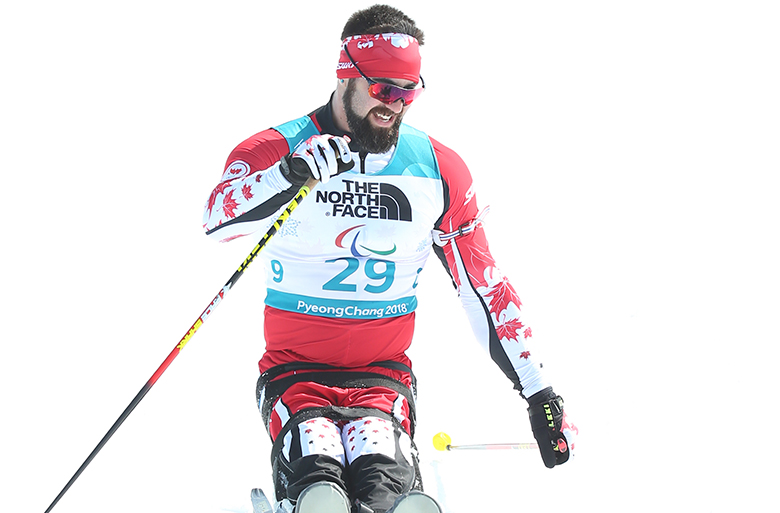
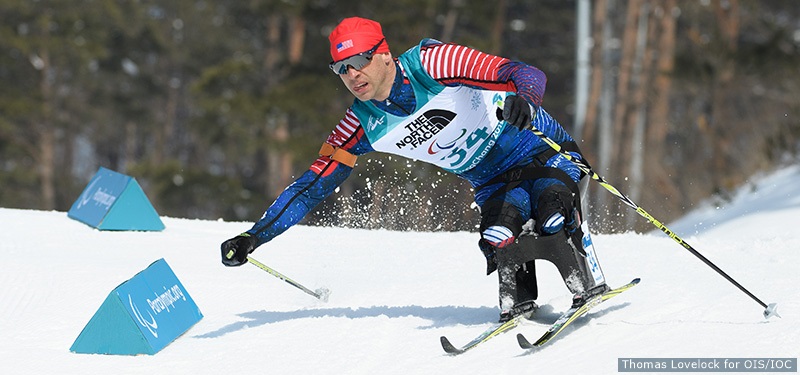
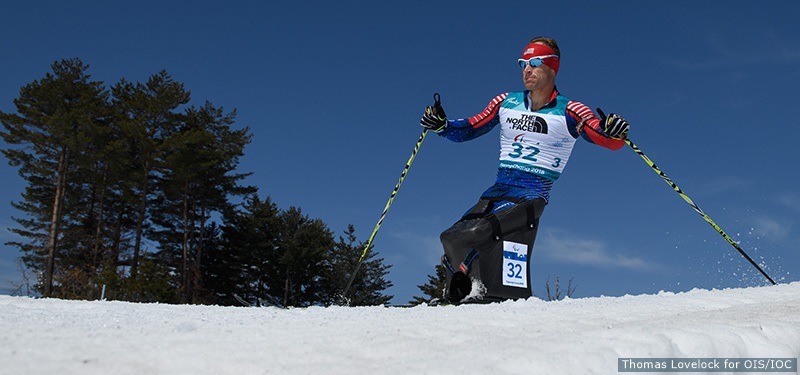
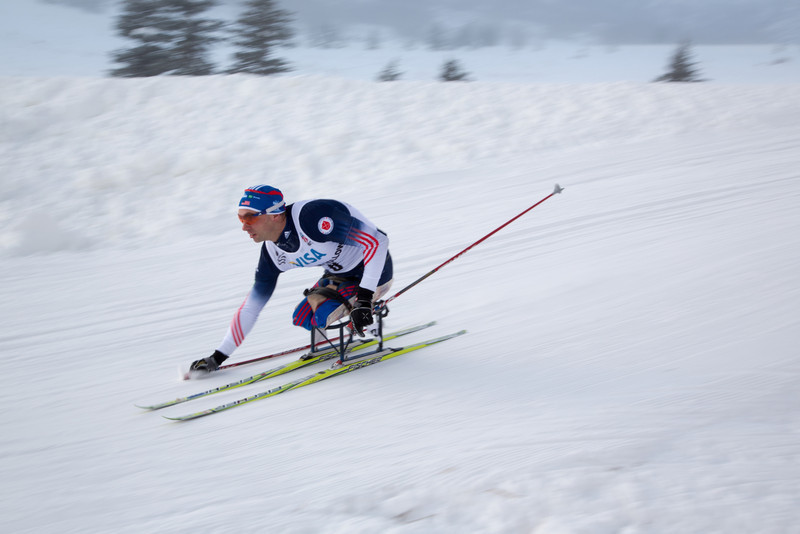
    American Dan Cnossen racing to silver in the men’s 12.5 k biathlon sitting on Tuesday and his third medal in as many races at the 2018 Paralympics in PyeongChang, South Korea. (Photo: U.S. Paralympics/Thomas Lovelock – OIS/IOC)

    2018 Winter Paralympics (PyeongChang, South Korea): 10/12.5 k biathlon races

    Amid soft and slow conditions at the Alpensia Biathlon Centre on Tuesday, American Dan Cnossen raced to his third-straight medal in as many races at the 2018 Paralympics, claiming silver in the men’s 12.5-kilometer sitting biathlon race just ahead of his U.S. Paralympics Nordic teammate and fellow military veteran Andy Soule, who earned bronze.

    Cnossen, a retired Navy SEAL, previously won gold in Saturday’s 7.5 k biathlon sprint and silver in Sunday’s 15 k cross-country race. Despite wind gusts up to 15 miles per hour on Tuesday, Cnossen hit all 20 of his targets and finished second, 1:01.7 minutes behind Ukraine’s Taras Rad, who won in 45:35.6 with clean shooting as well.

    “Personally, this was such an important breakthrough, to shoot 20 for 20, especially on the last shooting stage,” the 37-year-old Cnossen said, according to a U.S. Paralympics press release. “I’ve had some mental blocks in the past where I overthink things or get a little anxious, so I really took my time, especially on the last two shots. I wanted to get my heart rate down and make sure the wind wasn’t blowing. It feels really good to overcome this mental hurdle. I just wanted to see what I could do today, and have my own race, and not worry about what other people are doing.”

    Soule, a 38-year-old Army veteran, missed two on his third shooting stage (0+0+2+0) to finish third, 1:33.1 out of first. It was the second Paralympic medal of his career after Soule he earned bronze in the biathlon pursuit at the 2010 Games in Vancouver, British Columbia.

    “I was really skiing at an aggressive pace,” Soule told U.S. Paralympics on Tuesday. “I was struggling to hold it together at the range those last two shootings. When I missed those two, I also knew that I had seen other people missing. I knew a miss or two wasn’t going to necessarily put me out of it. I knew I just needed to get back up, set the same aggressive pace, and maybe back it off just a little earlier on the next lap to make sure I get the shots. It came together just fine.”

    It was another special moment for the U.S. Paralympics program with two of its leading men on the podium.

    “I’m really happy for our whole team, to see how much success we’re having,” Soule said. “I think it’s a testament to great coaching, great support, great staff. Lots of great work being done behind the scenes by so many people that you don’t even see who are out here long before we even arrive at the venue. It’s a great group of athletes. I’m so happy to be a teammate with these guys.”

    “This race feels especially good because I have my teammate, Andy, on the podium,” Cnossen said. “I knew he was going to have a good race. I’m really proud and happy to see him on the podium.”

    Also for the U.S., Aaron Pike placed seventh in that race (+5:38.1) with a single miss (0+0+0+1), Sean Halsted finished 14th (+10:35.7) with five penalties, and Bryan Price was 16th (+17:02.3) with 10 misses.

    Canada’s lone man in the 12.5 k sitting biathlon race, Derek Zaplotinsky finished 12th (+9:15.3) with five penalties.
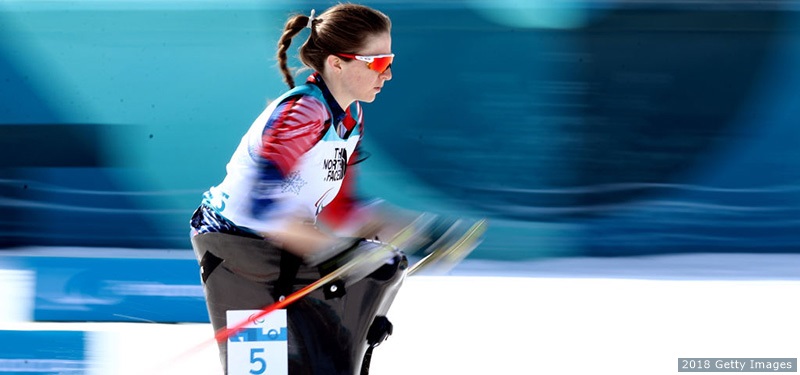
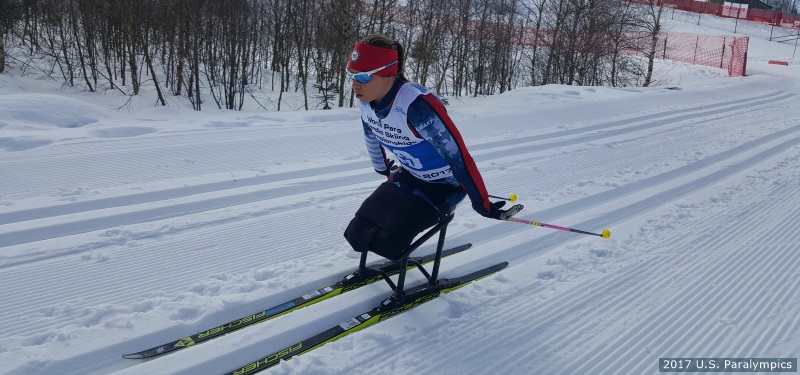
    American Kendall Gretsch racing to fourth in the women’s 10 k sitting biathlon race on Tuesday at the 2018 Paralympics in PyeongChang, South Korea. (Photo: U.S. Paralympics/ Maddie Meyer – Getty Images)

    Coming off two medals in the women’s sitting biathlon and cross-country events last weekend, Kendall Gretsch placed fourth in the 10 k sitting biathlon race on Tuesday, 16.5 seconds out of third. According to a U.S. Paralympics press release, she fell three times and incurred three penalties (1+0+0+2), finishing 2:05.4 behind the winner, Germany’s Andrea Eskau.

    A four-time gold medalist in Paralympic cycling with two silver medals in cross-country skiing (from two Winter Paralympics), Eskau, 46, claimed her first gold of the PyeongChang Games in 42:36.6 with one miss (0+0+1+0). Marta Zainullina and Irina Guliaeva, of the Neutral Paralympic Athletes (NPA), took silver (+1:15.5) and bronze (+1:48.9), respectively, with Zainullina skiing just one penalty lap and Guliaeva having to ski three.

    Oksana Masters did not finish, pulling out after 8.64 k with six penalties (1+2+1+2).

    Second Medal for Arendz
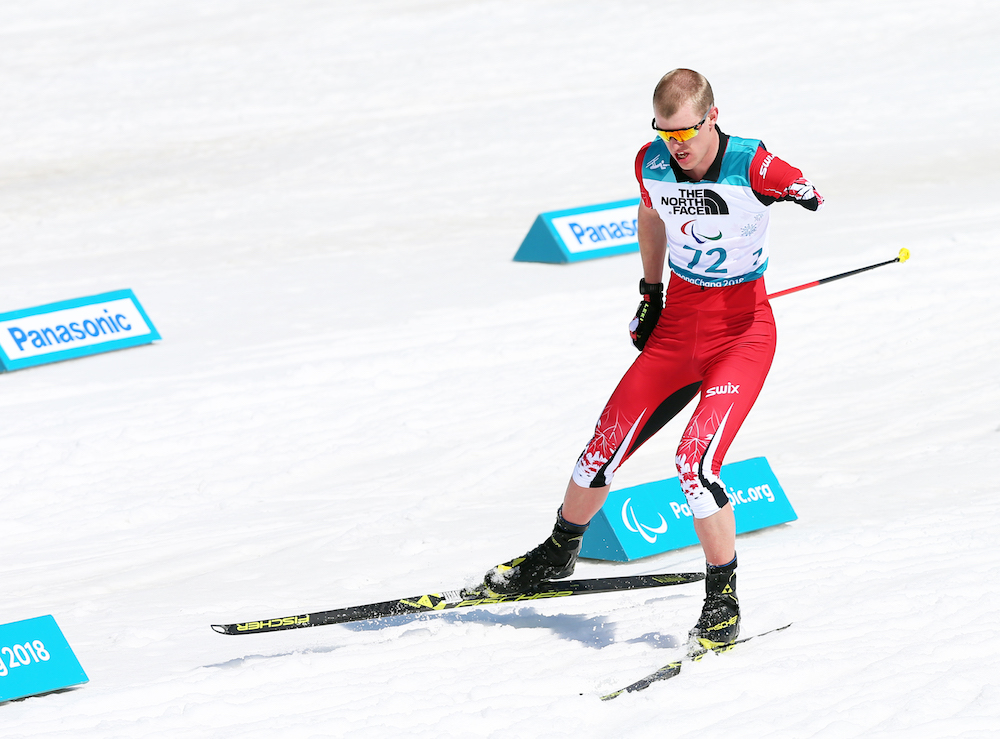
    Canada’s Mark Arendz racing to bronze in the men’s 12.5 k standing biathlon race on Tuesday at the 2018 Paralympic Games in PyeongChang, South Korea. (Photo: Scott Grant/Canadian Paralympic Committee)

    Mark Arendz led Canada with his second medal in the second biathlon race, the men’s 12.5 k standing, racing to bronze, 30.9 seconds out of first. Arendz cleaned three stages before missing one on his last shooting (0+0+0+1), causing him to ski an additional 150 meters in the penalty lap.

    France’s Benjamin Daviet won that race in 38:55.5 with one late penalty as well (0+0+0+1), and Ukraine’s Ihor Reptyukh collected silver (+6.7) with one miss as well (0+0+1+0).

    “I knew there were some tired guys, so I went for it from the start and tried to put some pressure on,” Arendz, 28, said in a Cross Country Canada press release. “I decided in that last bout to go for it all, throw it down, and go for the win. Unfortunately, I had the one miss and it made it a tight and interesting race.”
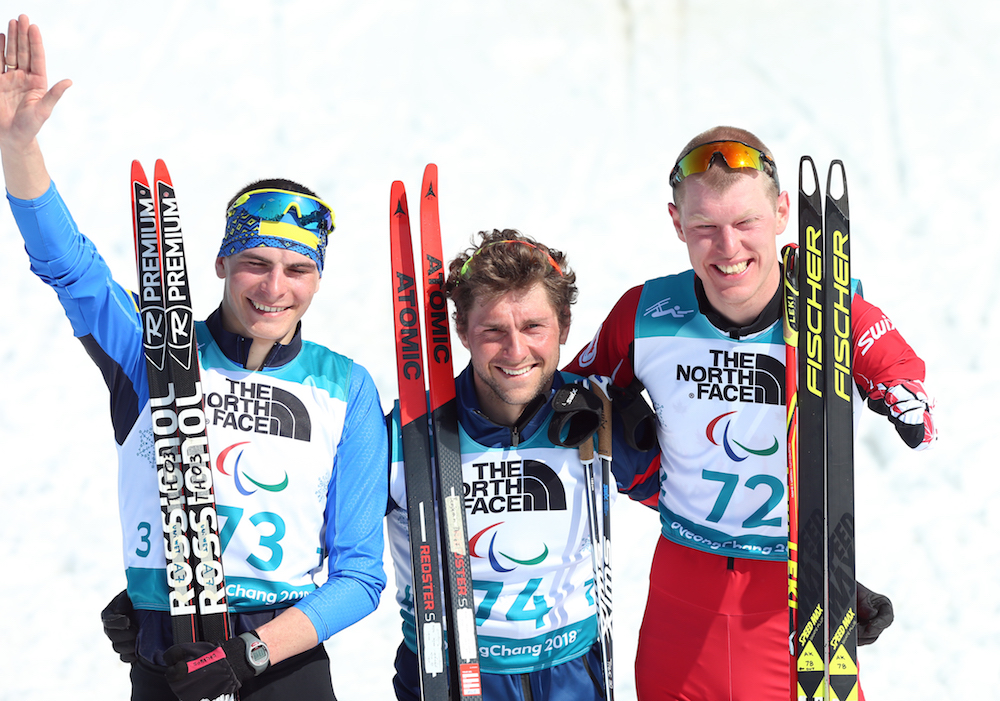
    The men’s 12.5 k standing biathlon podium at the 2018 Paralympics in PyeongChang, South Korea, with France’s Benjamin Daviet (c) in first, Ukraine’s Ihor Reptyukh (l) in second, and Canada’s Mark Arendz (r) in third. (Photo: Scott Grant/Canadian Paralympic Committee)

    Arendz, who took silver in the opening biathlon sprint and also has two biathlon silver medals from the 2014 Paralympics, is seeking his first Paralympic gold.

    “It was a really tough battle all day. I handed it to them early and had a choice: to go for gold or settle for the podium. I went for the win and had that one miss that cost me today,” he said. “I ran out of energy at the end. I am really happy with my race and it is another medal for Canada. I know everything is going well. I just need that last little tweak to finally win one.”

    American Ruslan Reiter finished 11th in that race (+8:41.4) with three penalties (0+2+1+1).

    Brittany Hudak led the Canadian women in fifth in the 10 k standing biathlon race, 5:45.8 behind Ekaterina Rumyantseva (NPA) in first. Hudak cleaned the first three stages before missing one in the last bout (0+0+0+1).

    “The first lap I felt good,” Hudak recalled in the team press release. “The skis were running well in these conditions, but then it just got slower as we went on. The flat sections you really try put power to glide the ski but your weight is sinking you into the snow. It got harder to get some glide and as my legs got more tired I didn’t feel like I was moving fast.

    “I tried to keep calm in the range and take my time,” she added. “The wind today was gusting, so I took a bit longer on my setup than I usually would and tried to be consistent. For the most part it worked well until that last lap, and that last bout. Overall it was an OK race.”

    Paralympic racing continues Wednesday with men’s and women’s cross-country sprints, starting at 10 a.m. Korea time (7 p.m. EDT Tuesday).

    Complete results

  • Gretsch Scores Second Gold, Cnossen Silver, Masters Bronze in PyeongChang

    Gretsch Scores Second Gold, Cnossen Silver, Masters Bronze in PyeongChang

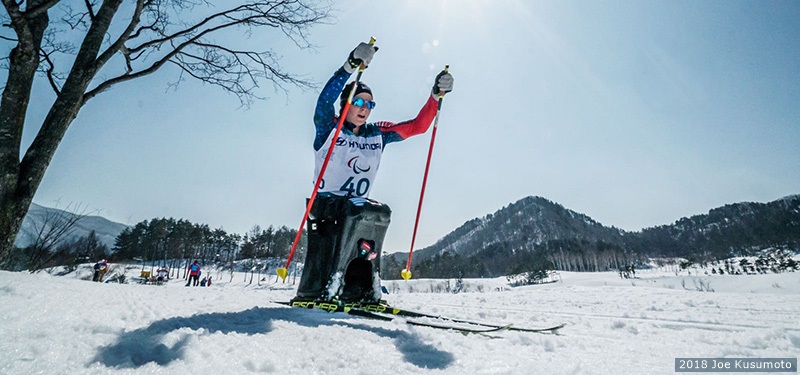
    Kendall Gretsch racing to her second gold medal of the 2018 Winter Paralympics on Sunday in the women’s 12 k sitting cross-country race in PyeongChang, South Korea. (Photo: US Paralympics/Joe Kusumoto)

    2018 Winter Paralympics (PyeongChang, South Korea): 12/15 k sitting cross-country races

    It was a gold, silver and bronze day for the U.S. Paralympics Nordic team on Sunday at the 2018 Paralympics in PyeongChang, as Kendall Gretsch raced to her second-straight victory in as many races, Dan Cnossen took silver and Oksana Masters claimed bronze in the cross-country distance events.

    A day after achieving a historic bronze for Canada in a biathlon sit-ski event, Collin Cameron led his country in fifth in Sunday’s 15-kilometer sitting cross-country race.

    Gretsch, a Paralympic rookie who won the sitting biathlon sprint to open the Paralympics, also won the women’s 12 k sitting cross-country race on Sunday in 38:15.9 minutes, 34.5 seconds clear of Germany’s Andrea Eskau in second, while Masters followed 49 seconds back in third.

    “For cross-country, I was pretty unsure going in here,” said the 25-year-old Gretsch, according to a U.S. Paralympics Nordic Skiing press release. “I knew that since our last World Cup I had improved a lot, but you never know until you race. Just happy with how things went today and I was able to put together another good race.”

    “It’s a very humbling experience being able to hear your anthem,” she said of her second gold medal. “Puts everything into perspective. Knowing that you’re here not just here for yourself but for your country, it’s amazing.”

    For Masters, who is recovering from an elbow injury, it was her second medal after taking silver in Saturday’s biathlon sprint.

    “I’m just so happy to be on the podium,” Masters told U.S. Paralympics. “I was a little worried on the long distance considering I haven’t done intensity in three weeks. It definitely is a very painful, rude awakening to how painful the sport is. I’m happy to be on the podium.”

    She described the pain in her elbow as “extremely excruciating. It feels like there’s just a saw going at your bone 24/7, especially hammering up the climbs,” Masters said. “I had a spill over there through the stadium, but mind over matter.”

    Ukraine’s Maksym Yarovyi won the men’s 15 k sitting in 41:37.0, and Cnossen, who had taken gold in the men’s sitting biathlon sprint, placed second, 43.1 seconds back. Sin Eui-hyun claimed South Korea’s first medal of the Games in third (+51.9) ahead of China’s Zheng Peng in fourth (+1:18.5) and Canada’s Cameron in fifth (+2:09.0).

    “I’ve already exceeded my expectations,” Cnossen, 37, said of his second Paralympic medal in as many days. “I’m very proud to represent the U.S. Today, I dug as deep as I could and went as hard as I could, and regardless of where I ended up on the result, it is my success to go as hard as I could.”

    Canada’s Colin Cameron racing to bronze in the mens 7.5 k sitting biathlon sprint on Saturday at the 2018 Paralympic Games in PyeongChang, South Korea. (Photo: Scott Grant/Canadian Paralympic Committee)

    “It was really soft out there, but the skis were still fast,” Cameron, 29, said, according to a Canadian team press release. “The skis have been awesome both days – the guys are working their butts off back in the wax room.”

    Cameron explained his goal for Sunday’s race was to “start steady and be comfortable, to get rid of the bugs from yesterday’s race because I was pretty tight.

    “I was able to loosen up as I went along, which allowed me to dig a little deeper today,” he continued. “It’s tough to go from biathlon to this event. It is a totally different mindset for pacing, a totally different game. I wasn’t event thinking about [yesterday’s medal] I just wanted to build off it and take that momentum with me the rest of the week. Today was a different day and I’m happy with how I was able to perform.”

    Also for Canada, Chris Klebl, who won gold in the 10 k sitting event at the 2014 Paralympics, finished eighth (+2:25.6), Derek Zaplotinsky followed in ninth (+2:42.6), Sebastien Fortier finished 18th (+5:01.0), Ethan Hess 24th (+10:37.1), and Yves Bourque 25th (+11:35.7)

    In the women’s sitting race, Canada’s Cindy Ouellet, a 29-year-old Paralympic wheelchair basketball player, placed 18th (+11:37.3).

    “This is my first race over five kilometres and it was tough,” Ouellet said, according to the press release. “Basketball is all stop and go, but endurance is much different. I just need more races.”

    For the U.S., Andy Soule placed 11th (+2:59.1) and Sean Halsted finished 22nd (+7:18.0).

    Paralympic racing continues Monday with the men’s and women’s standing and visually impaired cross-country long-distance events, starting at 10 a.m. Korea time on Monday (7 p.m. EDT on Sunday).
    Complete results

  • Gretsch, Cnossen Nab Historic Biathlon Golds at Paralympics

    Gretsch, Cnossen Nab Historic Biathlon Golds at Paralympics

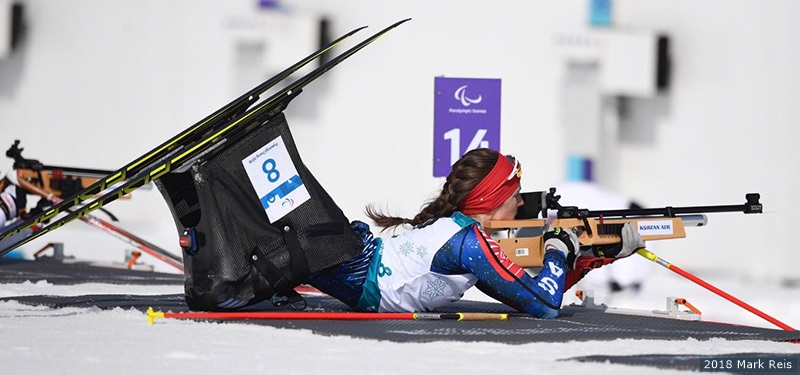
    Kendall Gretsch takes aim during the women’s 6-kilometer sitting biathlon at the 2018 Paralympic Winter Games on Saturday in PyeongChang, South Korea. She won the race to become the first American woman to medal in a biathlon event at the Paralympics (or Olympics). (Photo: US Paralympics/Mark Reis)

    2018 Winter Paralympics (PyeongChang, South Korea): Biathlon sprints

    The 2018 Paralympic Winter Games in PyeongChang, South Korea, opened in a big way for the U.S. and Canadian Paralympic nordic and biathlon teams on Saturday, with Kendall Gretsch and Dan Cnossen winning the U.S.A.’s first-ever gold medals in biathlon, and Canada’s Mark Arendz racing to silver for his third Paralympic biathlon medal and Collin Cameron becoming the first Canadian man to medal in a Paralympic sit-ski race.

    In her first Paralympics, Gretsch, a 25-year-old three-time gold medalist in paratriathlon, led U.S. teammate Oksana Masters across the line in the women’s sitting biathlon 6 k sprint, finishing in 21:52.0 with a single miss (0+1). Masters shot clean (0+0) and finished 22.8 seconds back for silver, less than three weeks after injuring her elbow.

    “I’m just really excited to be here,” Gretsch said, according to a U.S. Paralympics Nordic Skiing press release. “It’s just a great way to kick off the week and hopefully [there’s] more to come. It was an awesome race.”

    Her gold medal was also the first for an American woman in Paralympic nordic skiing.

    “It’s incredible,” Gretsch said. “For the U.S., we’ve been watching the Olympics and [Kikkan Randall and Jessie Diggins] had their historical medal for the women’s cross-country and that definitely motivated us coming here, so if I was able to do that, that’s great.

    “Motivation to get a medal definitely heightened after seeing that and seeing how they pushed through all their races,” she continued. “They’re such a great team and we also have a really strong aspect of a really strong team all working together.”

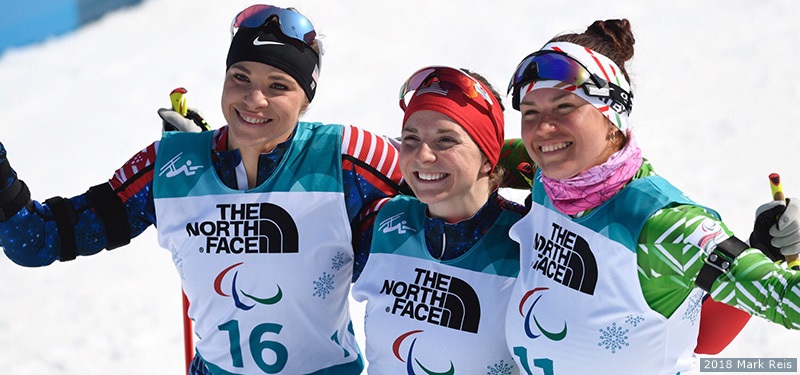
    The women’s 6-kilometer sitting biathlon podium on Day 1 of the 2018 Paralympics in PyeongChang, South Korea, with Americans Kendall Gretsch (c) in first and Oksana Masters (l) in second, and Lidziya Hrafeyeva of Belarus (r) in third. (Photo: US Paralympics/Mark Reis)

    At the 2014 Paralympics in Sochi, Russia, Masters earned silver and bronze in cross-country skiing events. She also took a bronze medal in rowing at the 2012 Summer Paralympics.

    “I am so happy, I feel like I just won my gold medal, basically. I’m so happy to be on the podium,” Masters, 28, told U.S. Paralympics after her first Paralympic biathlon medal.

    “I was told I was not going to be able to race,” Masters said of her injury just before the Games. “I was basically fighting for a chance at the start line. I dug as deep as I could for my team and I’m happy to be standing on the podium next to Kendall.

    “It’s amazing to have team USA having not only its first female biathlon medal but the first female Paralympic gold, followed by a silver,” she added. “It gives me goosebumps. It could not have been a better feeling.”

    In his second Paralympics, Cnossen, a 37-year-old retired Navy SEAL, achieved his first medal — gold — in the men’s sitting biathlon 7.5 k sprint in 23:49.7. With a single miss (0+1), he skied in the top three throughout Saturday’s race before beating Belarus’s Dzmitry Loban, who also had a penalty (1+0), by 7.3 seconds for the win.

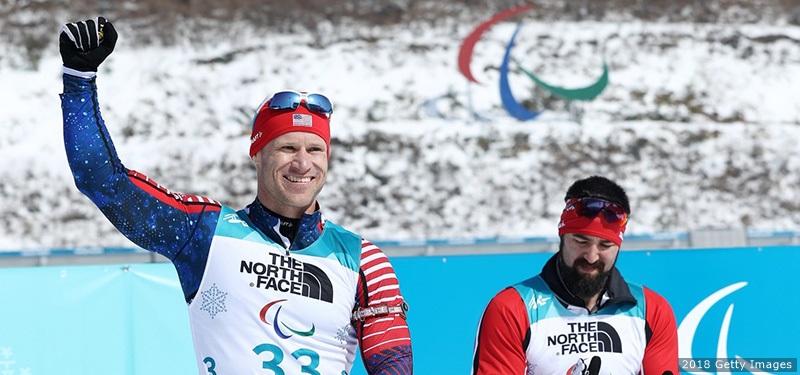
    American Dan Cnossen (l) celebrates gold on Day 1 of the 2018 Paralympics in PyeongChang, South Korea, next to Canadian bronze medalist Collin Cameron. (Photo: US Paralympics/Getty Images)

    Cnossen’s previous best in Sochi was sixth in the cross-country sprint and 10th in the biathlon individual race. He is also a world championships para-cyclist pursuing his second graduate degree from Harvard University.

    “I would say Andy Soule was the trailblazer,” Cnossen said of his teammate’s bronze medal from the 2010 Paralympics in Vancouver, British Columbia. “When I was new on the team, he was the inspiration, and I know he’s going to pop a good race here as well.

    “In the race, I just wanted to see what I can do, not worrying about anything else,” he explained. “In the last Games that I did in Sochi, I let the TV screens and the announcer get to me and today I just focused on what I can do and nothing else matters. I crossed the line and I wasn’t even going to look at the board and I was pleasantly surprised at the end.”

    American Andy Soule racing to eighth in he men’s 7.5 k sitting biathlon sprint at the 2018 Paralympics in PyeongChang, South Korea. (Photo: US Paralympics/Thomas Lovelock for OIS/IOC)

    With a total of nine Americans in the top 20 — Soule placed eighth, Aaron Pike 12th, Joy Rondeau 14th, Ruslan Reiter 16th, Jeremy Wagner 19th, and Bryan Price 20th — Cnossen said the best was yet to come. With the exception of Reiter, who competes in the standing division, all of those results came in Saturday’s sitting biathlon races.

    “We have such an amazing team,” Cnossen said. “The way they’ve recruited new athletes, developed the waxing protocol — it’s really showing. This is just the start and we have six more races including the relays to go. It’ll be exciting.”

    Silver + Bronze for Canada

    In his third Paralympics, Arendz, 28, opened with a silver medal in the men’s standing biathlon 7.5 k sprint, matching his result in that event in Sochi four years ago. He shot clean and finished in 18:25.9 on Saturday, 30.8 seconds behind France’s Benjamin Daviet, who also cleaned the two-stage race and won in 17:56.6.

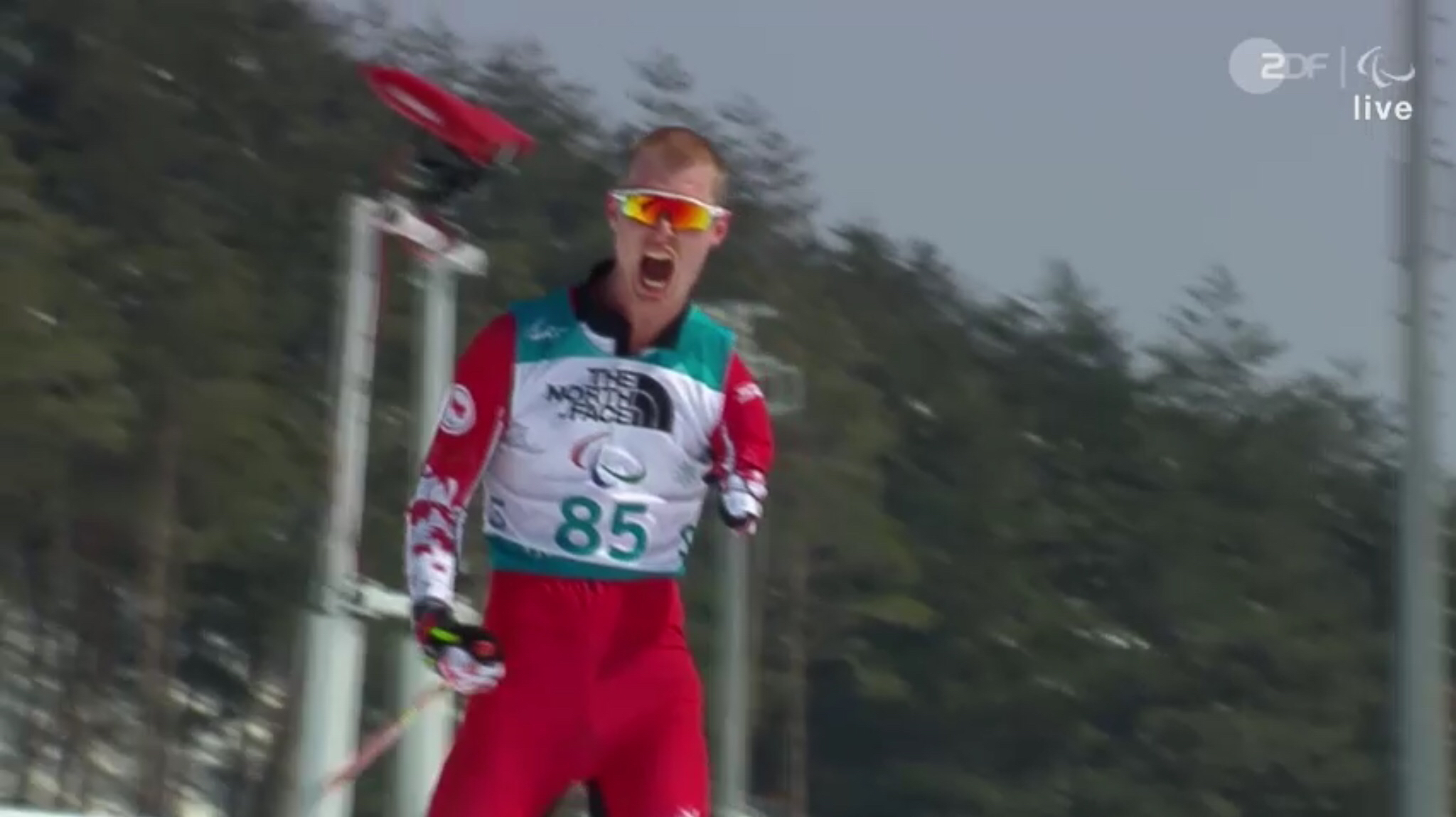
    Canada’s Mark Arendz crossing the line for silver in the men’s standing biathlon 7.5 k sprint on Saturday at the 2018 Paralympics in PyeongChang, South Korea. (Screenshot: ZDF broadcast)

    “Coming across the line I thought I had it,” Arendz said, according to a Canadian team press release. “I’m really happy with the day. It was an awesome race for me, but someone was just a little faster.”

    Earlier in the day, Cameron, 29, raced to bronze in the men’s sitting sprint, missing one target (0+1) and finishing 9.7 seconds behind Cnossen in first.

    “I got to the venue and saw Collin’s name at the top of the standings in his final lap of the sit-ski race,” Arendz recalled. “I cheered him on up his final hill and I took a lot of energy from watching him win his first ever Paralympic medal this morning.”

    A former sledge hockey player, Cameron started skiing three years ago. In achieving his first Paralympic medal, he became the first Canadian male biathlete to reach the podium in sit skiing at the Paralympics.

    “This is crazy. I didn’t expect this today,” Cameron said according to the press release. “I felt really great getting down on the mat and was in position every time. It got me on the podium today, and it is absolutely crazy.

    “When I was coming into the range for the second time, I heard on [my coach John Jaques’s] radio when he bent down to give me my rifle that I was in third, and I missed that shot,” he added. “I took a breath and got the rest – then I just went for it. Coming up that final hill, the whole team was just screaming at me and I went as hard as I could.

    “Everything came together today, and I don’t know why,” Cameron continued. “I think just the build up through the season. I was progressively getting snappier and faster, and all the work John spent with me in Sudbury. We focused on race procedure and that paid dividends today. It is such a fun course here.”

    In the women’s 6 k standing biathlon sprint, Canada’s Emily Young placed seventh with a single miss (0+1), just ahead of teammate Brittany Hudak in eighth with two penalties (1+1).

    Racing in PyeongChang continued Sunday with men’s and women’s sitting cross-country long-distance events, starting at 10 a.m. Korea time (8 p.m. EST on Saturday).
    Complete results

  • U.S. Paralympics Nordic Skiing Names 2017/2018 National Team

    U.S. Paralympics Nordic Skiing Names 2017/2018 National Team

    Three-time Paralympic medalist Oksana Masters won her third consecutive overall women’s sitting IPC World Cup globe in cross-country. (Photo: U.S. Paralympics)

    (Press release)

    COLORADO SPRINGS, Colo. — Thirteen athletes, including seven U.S. Paralympians in Nordic skiing, were named to the 2017-2018 U.S. Paralympics Nordic Skiing National Team on June 1 by U.S. Paralympics, a division of the United States Olympic Committee.

    “The level to which our Nordic skiers have performed already is very inspiring,” said Paralympic Nordic Skiing head coach Eileen Carey. “Our veteran athletes have continued to improve as we approach the Paralympic Winter Games PyeongChang 2018, and the addition of new members on our national and development teams is promising for the future.”

    Three-time Paralympic medalist Oksana Masters (Louisville, Kentucky) highlights the team after claiming four world championships titles during the 2016-17 season, including cross-country crowns in sprint, middle and long distances, as well as the sprint biathlon title. She capped off the season by securing her third consecutive overall women’s sitting world cup globe in cross-country at the World Para Nordic Skiing World Cup Finals in Sapporo, Japan. Additionally, Masters finished third in the world cup overall rankings in biathlon.

    Kendall Gretsch (Chicago, Illinois), Ruslan Reiter (Manchester, Maine) and Daniel Romanchuk (Mount Airy, Maryland) all make the national and development teams for the first time.

    Four military veterans are featured on the roster, including Dan Cnossen (Topeka, Kansas/Navy), Sean Halsted (Rathdrum, Idaho/ Air Force), Bryan Price (Belton, Missouri/Army) and Andy Soule (Pearland, Texas/Army).
    Team USA had a record-breaking 2016-17 season that finished with 33 world cup medals by five athletes, setting a record for the Nordic skiing team. Of the 33 world cup medals acquired, 12 were in biathlon. All A- and B-Team athletes reached the podium this past season, including first-time medals for Jake Adicoff (Sun Valley, Idaho) and guide Sawyer Kesselheim (Bozeman, Montana), as well as Aaron Pike (Park Rapids, Minnesota) at the PyeongChang Test Event.

    2017-18 U.S. Paralympics Nordic Skiing National Teams

    *Denotes U.S. Paralympian in Nordic skiing

    # Denotes U.S. Military veterans

    A Team

    • Jake Adicoff (Sun Valley, Idaho) – visually impaired skier*
    • Dan Cnossen (Topeka, Kansas/Navy) – sit skier*#
    • Sawyer Kesselheim (Bozeman, Montana) – guide
    • Oksana Masters (Louisville, Kentucky) – sit skier*

    B Team

    • Aaron Pike (Park Rapids, Minnesota) – sit skier*
    • Andy Soule (Pearland, Texas/Army) – sit skier*#

    C Team

    • Kendall Gretsch (Chicago, Illinois) – sit skier

    Development Team

    • Sean Halsted (Rathdrum, Idaho/Air Force) – sit skier*#
    • Bryan Price (Belton, Missouri/Army) – sit skier*#
    • Ruslan Reiter (Manchester, Maine) – standing skier
    • Daniel Romanchuk (Mount Airy, Maryland) – sit skier
    • Joy Rondeau (Granby, Colorado) – sit skier
    • Mia Zutter (Sun Prairie, Wisconsin) – visually impaired skier
  • FasterSkier’s Para-Nordic Skiers of 2015: Andy Soule and Oksana Masters

    FasterSkier’s Para-Nordic Skiers of 2015: Andy Soule and Oksana Masters

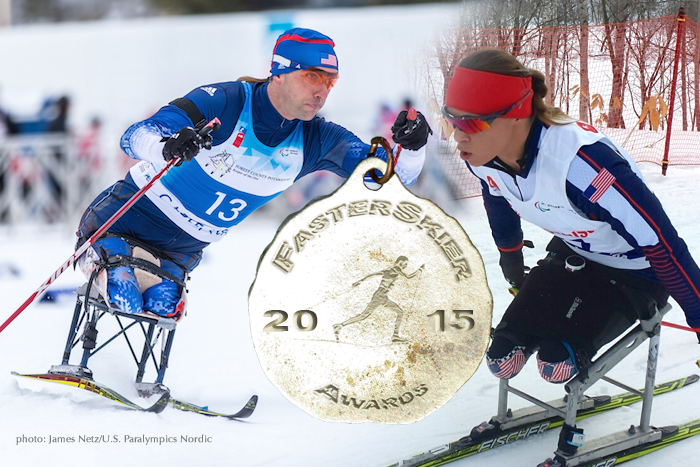
    Andy Soule (l) and Oksana Masters, both of U.S. Paralympics Nordic, are FasterSkier's 2015 Para-Nordic Skiers of the Year.
    Andy Soule (l) and Oksana Masters, both of U.S. Paralympics Nordic, are FasterSkier’s 2015 Para-Nordic Skiers of the Year.

    Andy Soule

    When you become the first American to rack up five medals in six individual events at World Championships, you’re essentially a shoo-in for Para-Nordic Skier of the Year. Andy Soule, a U.S. Army veteran and sit skier, did just that at the 2015 International Paralympic Committee (IPC) World Championships in January in Cable, Wis., taking silver in two biathlon events and the 10-kilometer cross-country race plus bronze in the cross-country 15 k and sprint.

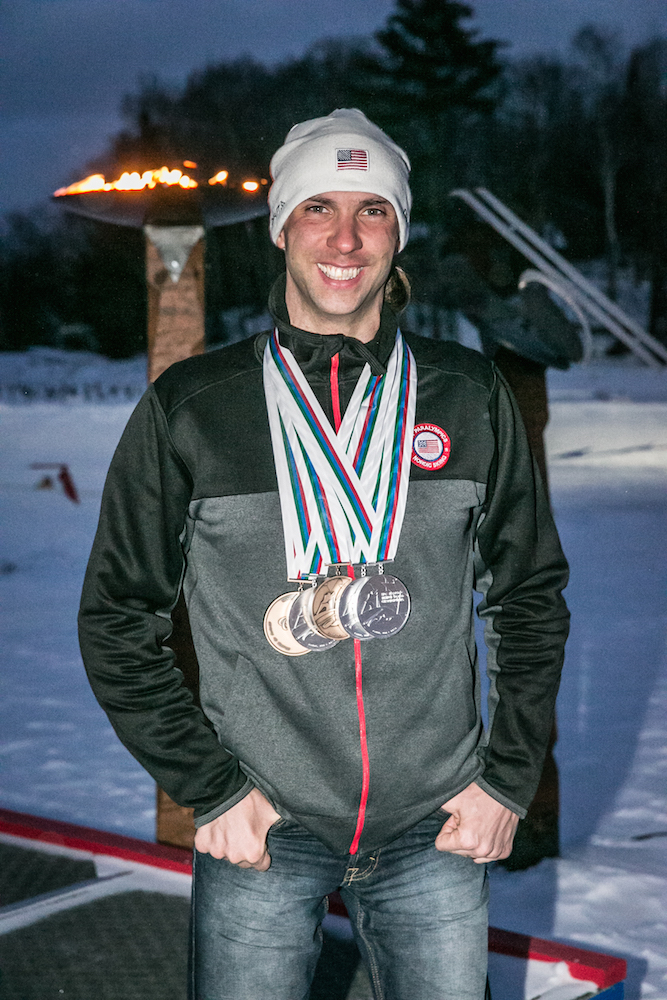
    Andy Soule and his hardware from 2015 IPC World Championships: five medals with three silvers and two bronze. (Photo: James Netz)
    Andy Soule and his hardware from 2015 IPC World Championships: five medals with three silvers and two bronze. (Photo: James Netz)

    “After the second podium, I just started feeling like that wasn’t a fluke,” Soule said in February.  “This isn’t just a one-time thing … I can come out and compete on a level with the top guys every day. It was a confidence builder as well when you have that feeling.”

    In his eighth year on the U.S. Paralympics Nordic Team, Soule, 35, was named IPC’s January athlete of the month. After World Championships, he improved to third overall in the World Cup and finished the season first overall in the cross-country standings.

    “It is a great feeling and a great finish to the season,” he said at World Cup Finals in Surnadal, Norway.

    In all, Soule tallied four World Cup golds — all of which came in Asahikawa, Japan — and a bronze during the 2014/2015 season.

    And all the success has led him to commit to another three seasons leading up to the 2018 Paralympics in Pyeongchang, South Korea. According to his teammate, Dan Cnossen, Soule considered retiring after 2013/2014.

    “I’m right at that age and I’m right at the point in my career where I’m in the prime of real top-performance potential,” Soule said. “I feel really great about what I have going forward and that I’ll be able to build on it and still improve on it.”

    Oksana Masters

    It got even better for U.S. Paralympics as Oksana Masters, another sit skier, also rose to the top of the 2014/2015 World Cup cross-country podium in her second year on the team.

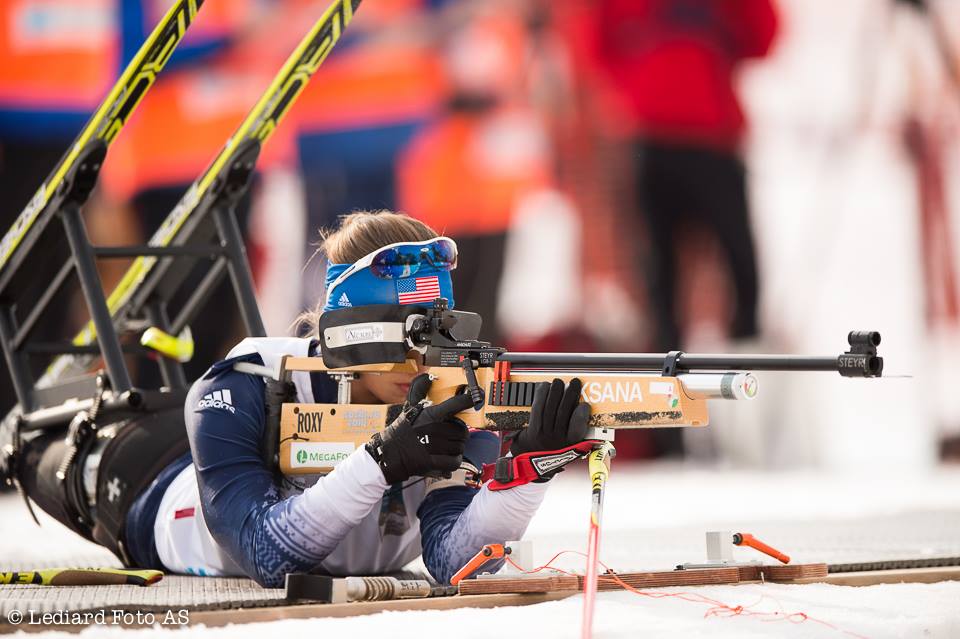
    Oksana Masters (U.S. Paralympics Nordic) in a biathlon competition at 2015 IPC World Cup Finals in Surnadal, Norway. Masters won Saturday's 5 k cross-country sitting to clinch the overall World Cup cross-country title for 2014/2015. (Photo: IPC Nordic Skiing/Facebook)
    Oksana Masters (U.S. Paralympics Nordic) in a biathlon competition at 2015 IPC World Cup Finals in Surnadal, Norway. Masters won the 5 k cross-country sitting to clinch the overall World Cup cross-country title for 2014/2015. (Photo: IPC Nordic Skiing/Facebook)

    A rowing convert, Masters, 25, earned two cross-country medals at 2015 World Championships — silver in the middle distance and bronze in the sprint — and won four out of five races in Japan this year. That put her on top of the IPC overall and she ended the season in first with a total of seven individual World Cup golds and two silvers.

    “I respect my competition, of the years they put in to be where they are now,” Masters said in February. “I’m playing catchup and I’m just doing what I can and focusing on myself. It just so happens to be putting me much higher than I ever could imagine being.”

    She explained that it took her 13 years to reach the Paralympic podium in rowing (she earned bronze in the double scull in 2012) and was humble about the strides she had made in skiing since starting the sport a year and a half ago.

    A silver and bronze medalist at the 2014 Winter Paralympics, Masters committed to skiing full time last spring, partially to alleviate a past rowing injury in her back. A training crash leading up to 2015 U.S. nationals re-aggravated the injury, forcing her to sit out the week.

    A week before World Championships, she got back on snow while fighting bronchitis and walking pneumonia.

    “World Championships was just more of a mental battle than … just a battle for getting medals, with one setback after another,” Masters said. “I didn’t really have much expectations for myself … so [I was] just basically trying to survive at that point.”

    The bronze medal she earned in Cable, her first of World Championships, brought her some serious relief.

    “[It] also just brought my focus more towards, OK, I had setbacks, but I still can be within the competition and hang with the field, so just believe in the previous training that I’ve done and what I do know and just do it,” she said.

    Masters made the nomination list for IPC athlete of the month in February.

    Honorable mentions: 

    Brittany Hudak

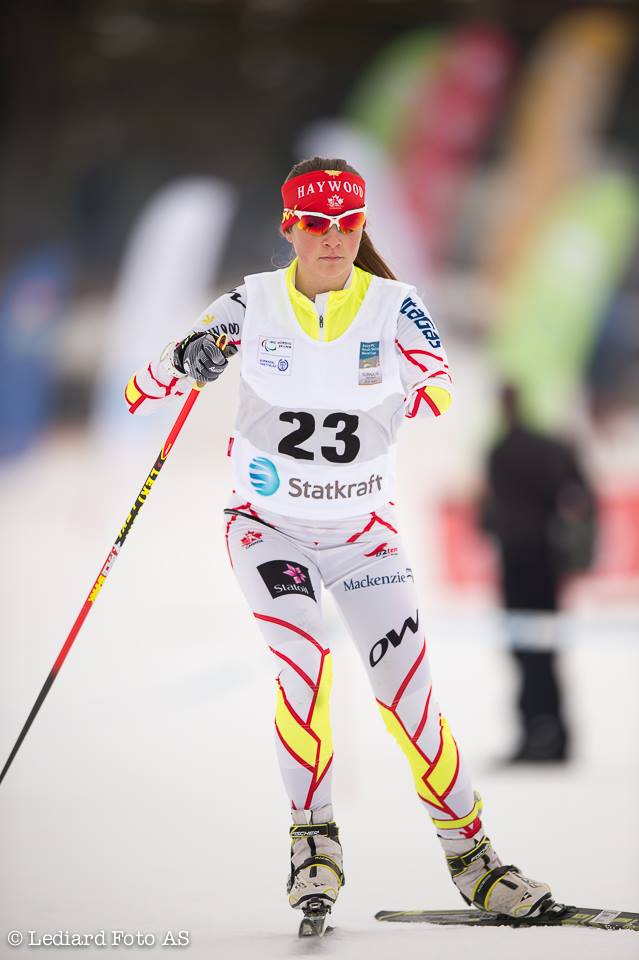
    Brittany Hudak (Canadian Para-Nordic Ski Team) at 2015 IPC World Cup Finals in Surnadal, Norway. Hudak won the 2014/2015 World Cup Overall Cross-Country title. (Photo: IPC Nordic Skiing/Facebook)
    Brittany Hudak (Canadian Para-Nordic Ski Team) at 2015 IPC World Cup Finals in Surnadal, Norway. Hudak won the 2014/2015 World Cup Overall Cross-Country title. (Photo: IPC Nordic Skiing/Facebook)

    The Canadian Para Nordic Ski Team had a banner season as well, with standing skier Brittany Hudak topping the overall World Cup cross-country podium in her first year on the development team.

    “The learning curve has been so huge for me,” Hudak, 21, said in a team press release after winning two consecutive races in Asahikawa.

    At the following World Cup Finals, she collected three medals: silver in the 15 k cross-country, silver in the 12.5 k biathlon and bronze in the 6 k biathlon.

    “Having the opportunity to attend national training camps … I have noticed a huge improvement in my technique,” she added. “It has been such an advantage for me to be in the same environment with the high-performance athletes, seeing how the train and learning from them.”

    Hudak wrapped up 2015 with two World Cup golds, two silvers and a bronze in cross-country, and a silver and a bronze in biathlon.

    Chris Klebl

    It’s a close call between several Canadian Para-Nordic teammates for the men’s pick for honorable mention, but Klebl tops the list as he placed third overall on the cross-country World Cup and is currently first in the IPC rankings. Standing biathlete Mark Arendz was was fourth overall in biathlon, and longtime team veteran Brian McKeever — a visually impaired distance specialist — won most of the races he jumped into for third overall in cross-country.

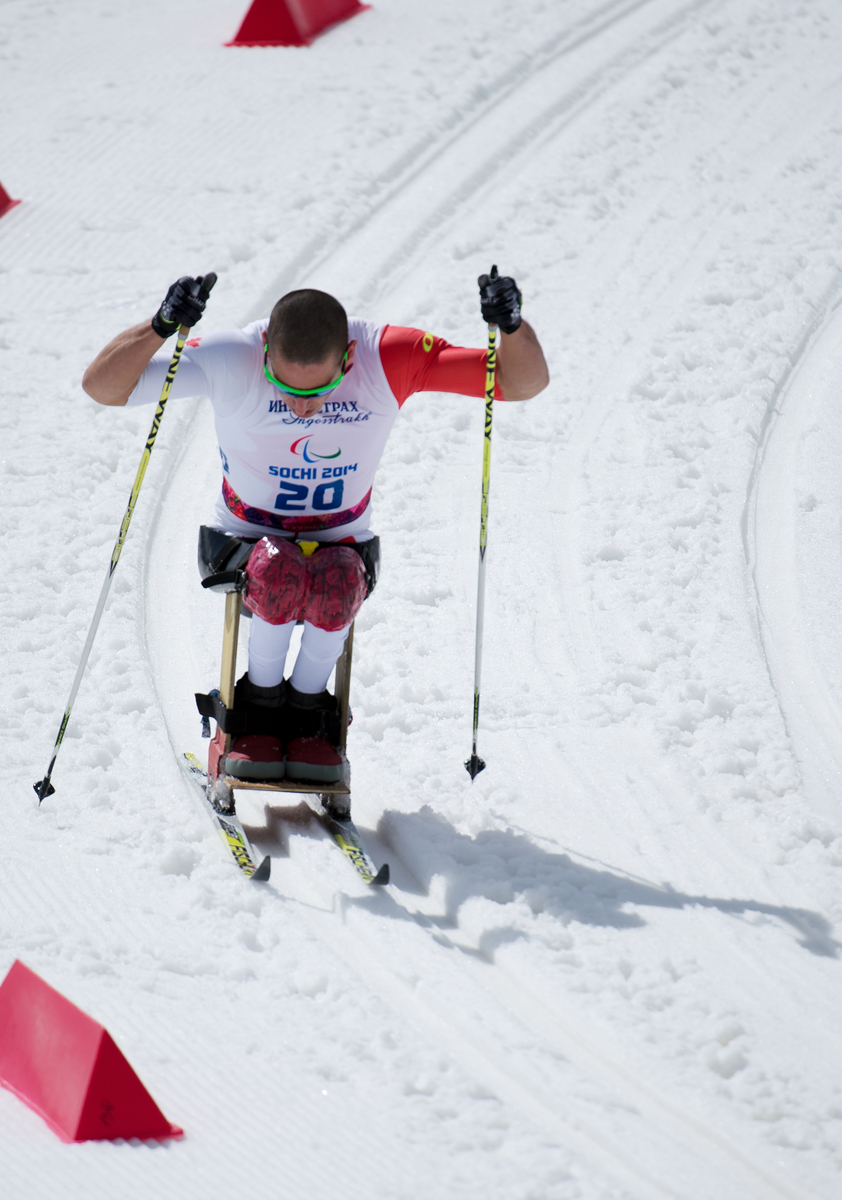
    Canada's Chris Klebl racing to gold in the last race of his third Paralympics on Sunday in the cross-country 10 k sit-ski  at the 2014 Paralympic Winter Games in Sochi, Russia.  (Photo: Matthew Murnaghan/Canadian Paralympic Committee)
    Canada’s Chris Klebl racing to gold in the cross-country 10 k sit-ski at the 2014 Paralympic Winter Games in Sochi, Russia. (Photo: Matthew Murnaghan/Canadian Paralympic Committee)

    In Asahikawa, both Klebl and Arendz notched back-to-back bronze medals before Klebl placed second in both the 10 and 15 k cross-country races. Klebl, a 2014 Paralympic gold medalist in the 10 k, went on to win the 15 k at World Cup Finals.

    McKeever won the 20 k that same day in Surnadal (he won the same event at 2015 World Championships; it was the lone race he competed in there) and took first in the 10 k classic in Japan as well.

    Arendz picked up two bronze medals at World Cup Finals in the biathlon sprint and following pursuit.

    Klebl edged American Dan Cnossen by 40 points for third overall on the World Cup, making Cnossen — who won his first World Cup in Japan and achieved multiple podiums later in the season — worthy of mention as well.

    ***

    Other 2015 Skiers of the Year (SOTY): Junior | Collegiate | Nordic Combined | Biathlon

  • Hudak, Masters and Soule End Season with Overall IPC World Cup Crowns

    Hudak, Masters and Soule End Season with Overall IPC World Cup Crowns

    Brittany Hudak (Canadian Para-Nordic Ski Team) at 2015 IPC World Cup Finals in Surnadal, Norway. Hudak took silver in Saturday's 5 k cross-country sitting to clinch the 2014/2015 World Cup Overall Cross-Country title. (Photo: IPC Nordic Skiing/Facebook)
    Brittany Hudak (Canadian Para-Nordic Ski Team) at 2015 IPC World Cup Finals in Surnadal, Norway. Hudak took silver in Saturday’s 5 k cross-country sitting to clinch the 2014/2015 World Cup Overall Cross-Country title. (Photo: IPC Nordic Skiing/Facebook)

    Three North Americans, count ’em, three, topped the 2014/2015 International Paralympic Committee (IPC) Overall World Cup cross-country podiums, ending their seasons on Sunday at IPC World Cup Finals in Surnadal, Norway.

    Canada’s 21-year-old Brittany Hudak tallied her third medal of the week on Sunday, taking silver in the women’s 12.5-kilometer biathlon race a day after clinching the women’s overall cross-country title in the standing division by 33 points over Russia’s Ekaterina Rumyantseva.

    Hudak placed fourth in Saturday’s 5 k cross-country race then finished second in Sunday’s biathlon distance race, 50.4 seconds behind Ukraine’s Oleksandra Kononova, who won in 39:46.2.

    While Kononova missed two — one in each of the last shooting stages — Hudak cleaned every stage except the first, in which she missed one.

    “The learning curve has been so huge for me,” Hudak said in a Canadian Para-Nordic team press release.

    Two years ago, Canada’s legendary (now-retired) sit skier Colette Bourgonje encouraged her to try skiing while Hudak was working at a Canadian Tire store.

    “Having the opportunity to attend national training camps, particularly the New Zealand camp this summer, I have noticed a huge improvement in my technique,” Hudak said. “It has been such an advantage for me to be in the same environment with the high-performance athletes, seeing how the train and learning from them.”

    In all, she racked up two golds, two silvers and one bronze medal in IPC cross-country events this season, plus a silver and bronze in biathlon at World Cup Finals.

    Oksana Masters (U.S. Paralympics Nordic) in a biathlon competition at 2015 IPC World Cup Finals in Surnadal, Norway. Masters won Saturday's 5 k cross-country sitting to clinch the overall World Cup cross-country title for 2014/2015. (Photo: IPC Nordic Skiing/Facebook)
    Oksana Masters (U.S. Paralympics Nordic) in a biathlon competition at 2015 IPC World Cup Finals in Surnadal, Norway. Masters won Saturday’s 5 k cross-country sitting to clinch the overall World Cup cross-country title for 2014/2015. (Photo: IPC Nordic Skiing/Facebook)

    Hailing from south of the Canadian border, two Americans topped the overall IPC World Cup sitting standings, with Oksana Masters and Andy Soule claiming the cross-country crowns on Saturday, which U.S. Paralympics dubbed as a “three-medal day for Team USA.”

    Masters and teammate Lt. Dan Cnossen won the women’s 5 k and men’s 10 k cross-country races, respectively, with the former capping her season with the overall win as well. Throughout this season, Masters earned seven World Cup golds and two silvers, plus a silver and bronze at IPC World Championships in January.

    “I felt really good today,” Masters told U.S. Paralympics on Saturday. “It was a hard race, but my skis were fast, and I felt good. This is a great way to end the cross-country season. Everything has been pretty perfect here.”

    A U.S. Army veteran, Andy Soule (U.S. Paralympics Nordic) at 2015 IPC World Cup Finals in Surnadal, Norway. Soule finished third in Saturday's 10 k cross-country sitting to clinch the overall World Cup cross-country title for 2014/2015. (Photo: IPC Nordic Skiing/Facebook)
    A U.S. Army veteran, Andy Soule (U.S. Paralympics Nordic) at 2015 IPC World Cup Finals in Surnadal, Norway. Soule finished third in Saturday’s 10 k cross-country sitting to clinch the overall World Cup cross-country title for 2014/2015. (Photo: IPC Nordic Skiing/Facebook)

    The 25-year-old former Paralympic rower won the women’s 5 k by 28 seconds over Norway’s Mariann Marthinsen in 14:19, and beat Marthinsen in the overall by 160 points.

    On Sunday, Masters placed fifth in the final biathlon event: the 12.5 k sitting. While Germany’s Anja Wicker missed two shots to win in 48:46.5, Masters had a total of eight penalties to finish 5:38.2 behind.

    Cnossen won Saturday’s cross-country 10 k sitting in 25:37, edging Russia’s Alexey Bychenok by 3.8 seconds. Soule finished third, 19.8 seconds back, to take the men’s overall cross-country title by 155 points over Bychenok. Cnossen ended up fourth in the overall cross-country standings.

    Lt. Dan Cnossen (U.S. Paralympics Nordic) at 2015 IPC World Cup Finals in Surnadal, Norway. Cnossen won Saturday's 10 k cross-country sitting to finish fourth in the overall World Cup cross-country standings. (Photo: IPC Nordic Skiing/Facebook)
    Lt. Dan Cnossen (U.S. Paralympics Nordic) at 2015 IPC World Cup Finals in Surnadal, Norway. Cnossen won Saturday’s 10 k cross-country sitting to finish fourth in the overall World Cup cross-country standings. (Photo: IPC Nordic Skiing/Facebook)

    “I was getting updates from the coaches during the race that it was a really tight race between Alexey Bychenok and myself,” Cnossen told U.S. Paralympics on Saturday. “I was really happy for Andy, who came in third and got the World Cup overall win — that is even better. Our team had a great performance today.”

    “It is a great feeling and a great finish to the season,” Soule, 35, said after his first podium at World Cup Finals. “This took a lot of hard work by myself, my teammates, my coaches and wax techs. This is just a great end to the season.”

    At World Championships, Soule racked up an unprecedented five medals for the U.S., three of which were in cross-country races. Adding to that haul, he totaled four World Cup golds and a bronze this season.

    On Sunday, he placed seventh in the 15 k biathlon race with six penalties (1+1+2+2), finishing 4:03.6 behind Germany’s Martin Fleig, who won in 49:32.1. Cnossen was 5.4 seconds off the podium in fourth with five misses (1+2+0+2).

    Canada’s Chris Klebl placed fifth in Saturday’s 10 k sitting, 51.3 seconds behind Cnossen. The result helped him secure third overall in the men’s cross-country sitting on the IPC World Cup,  40 points ahead of Cnossen. Klebl did not race on Sunday.
    Klebl’s teammate, Mark Arendz finished fifth in the men’s biathlon 15 k standing on Sunday, 3:23.2 behind Ukraine’s Ihor Reptyukh, who won in 42:17.6. While Reptyukh had three penalties (1+0+1+1), Arendz had five (1+1+1+2). The Canadian placed fourth overall in the biathlon World Cup, 161 points behind Reptyukh in third.

    Mark Arendz (Canadian Para-Nordic Ski Team) at 2015 IPC World Cup Finals in Surnadal, Norway. He placed fourth overall in the 2014/2015 IPC World Cup biathlon standings. (Photo: IPC Nordic Skiing/Facebook)
    Mark Arendz (Canadian Para-Nordic Ski Team) at 2015 IPC World Cup Finals in Surnadal, Norway. He placed fourth overall in the 2014/2015 IPC World Cup biathlon standings. (Photo: IPC Nordic Skiing/Facebook)

    Results:

    Saturday’s cross-country: Women | Men

    Sunday’s biathlon: Women | Men

    Overall World Cup standings

  • From Students to Favorites: Masters, Soule Lead IPC World Cup Before Finals in Norway

    From Students to Favorites: Masters, Soule Lead IPC World Cup Before Finals in Norway

    The U.S. Paralympics Nordic team at the World Cup in Asahikawa, Japan, Feb. 14-19. (Photo: Eileen Carey/U.S. Paralympics Nordic)
    The U.S. Paralympics Nordic team at the World Cup in Asahikawa, Japan, Feb. 14-19, including athletes Andy Soule (l), Oksana Masters (second from l) and Dan Cnossen (second from r). (Photo: Eileen Carey/U.S. Paralympics Nordic)

    Heading into the last races of the season, the International Paralympic Committee (IPC) World Cup Finals, the U.S. Paralympics Nordic Program is probably used to the weight of carrying several medals around, but its athletes aren’t feeling any pressure.

    “I honestly can not believe that I am currently the World Cup leader,” U.S. sit skier Oksana Masters wrote in an email last month after winning two-consecutive World Cup races in Asahikawa, Japan.

    In her second year of skiing, the 25-year-old former Paralympic rower went on to win four out of five races in Asahikawa to stay on top of the overall World Cup standings and earn a nomination for IPC Athlete of the Month.

    Oksana Masters racing to gold in the cross-country 5 k sit ski at the World Cup last month in Asahikawa, Japan.(Photo: Eileen Carey/U.S. Paralympics Nordic)
    Oksana Masters racing to gold in the cross-country 5 k sit ski at the World Cup last month in Asahikawa, Japan.(Photo: Eileen Carey/U.S. Paralympics Nordic)

    “It’s a great feeling knowing what I have been working on is working,” Masters continued. “I feel like anything can happen … I am just eager to continue to grow as a skier and feeling more confident on the snow.”

    At IPC World Championships in January, Masters earned silver in the cross-country middle distance and bronze in the cross-country sprint in Cable, Wis. She was the second-most decorated skier on her team after Andy Soule, who racked up five medals in seven races.

    A few weeks beforehand, Masters had to skip U.S. nationals at Soldier Hollow in Midway, Utah. Leading into the championships, she injured her back in training, compressing nerves on the right side while stopping suddenly and aggravating a previous injury from rowing.

    “I sat out the whole week of nationals and then that week before Cable, I started to get back on snow,” she explained on the phone in early February. “I was basically on the bed for that week, then afterwards, [I] kind of had to fight off a little bug that I got that week prior to Cable, which happened to turn into bronchitis and walking pneumonia. So World Championships was just more of a mental battle than gonna be just a battle for getting medals, with one setback after another.”

    “I didn’t really have much expectations for myself at all considering there’s only so much your body will allow you to do when it’s trying to get back to it’s healthy stage and so [I was] just basically trying to survive at that point,” Masters continued. “Instead of being in the top five or something, I was trying to focus on areas where I need to be focused in any race, which is technical aspects, like turns and transitions, up and over the hill, and kind of take it one race at a time.”

    She quickly found her racing form in Cable.

    Asked how her first race there felt, she reflected: “Like I was gonna die. I just saw the black light, nothing else … but skiing-wise, it was the first time since about three weeks that I’d basically did anything and pushed my body at that race pace, so that first [biathlon] race was brutal and tough, but at the same time, it got my body more ready and prepared me for the cross-country races and [upcoming] races through that week.”

    In total, Masters competed in six events in Cable and explained she was shocked after taking her first medal — bronze — in the sprint.

    “Not to fall and to end up with that medal was kind of a relief, but [it] also just brought my focus more towards, OK I had setbacks, but I still can be within the competition and hang with the field, so just believe in the previous training that I’ve done and what I do know and just do it,” she said.

    “I’m just doing what I can and focusing on myself. It just so happens to be putting me much higher than I ever could imagine being.” — Oksana Masters (U.S. Paralympics Nordic)

    Last year, Masters made herself known as one of the world’s most competitive sit skiers after taking two medals (silver and bronze) at the Sochi Paralympics. She went on to podium in three races at this season’s IPC World Cup opener in Vuokatti, Finland.

    Based on her experience in rowing, in which it took her 13 years to medal at the Paralympics (she earned bronze in the double scull in 2012), she appreciated the time it takes to become a veteran of any sport — despite being a new favorite in nordic.

    “I’m now that the stage where I respect my competition, of the years they put in to be where they are now,” she said. “I’m playing catchup and I’m just doing what I can and focusing on myself. It just so happens to be putting me much higher than I ever could imagine being.”

    Lt. Cmdr. Dan Cnossen (l) and Oksana Masters with their gold medals from the  Asahikawa World Cup in Japan last month. (Photo: Eileen Carey/U.S. Paralympics Nordic)
    Lt. Cmdr. Dan Cnossen (l) and Oksana Masters with their gold medals from the Asahikawa World Cup in Japan last month. (Photo: Eileen Carey/U.S. Paralympics Nordic)

    Next week from March 16 to 22, Masters and her teammates will be competing at IPC World Cup Finals in Surnadal, Norway.

    “I think our athletes are still feeling fresh and motivated and excited to get another opportunity to race, especially with the full field competing,” U.S. Paralympics High-Performance Coach Eileen Carey wrote in an email. “Our goals will be to continue the process of progress, and squeeze as much as we can from final days on snow this season.”

    There’s no ignoring that they’ll be favorites. At the last World Cup in Asahikawa in mid-February, Soule, an Army veteran, won four-straight races. His teammate, Lt. Cmdr. Dan Cnossen won the fifth: the middle-distance cross-country.

    “I knew that with a small but strong field there was a good chance for several very good and meaningful finishes,” Soule wrote in an email earlier this month. “The whole week felt great and was an amazing experience. I have never had a string of wins like that, but tried to approach it the same way I do any other race series, taking one day and one race at a time, trying not to think too far ahead.”

    With his success in Japan, Soule, 35, rose from third to first in the overall World Cup.

    “I am excited to go to Norway and have a good strong finish to the season,” he said.

    A biathlon specialist, he’s looking forward to three biathlon events in Norway.

    Cnossen pointed out that Soule considered retiring before this season. Soule explained that, because he was doing well at the end of last year and still having a lot of fun, he couldn’t imagine ending his ski career. As of February, Soule said he was committed through the 2018 Paralympics in Pyeongchang, South Korea.

    “The mental space he is in is pretty remarkable and I think it has allowed him to relax and let his skills, experience, and love for skiing take over,” Carey explained. “He is aware of the results and knows what he has to do to clinch the World Cup overall, but isn’t letting that distract him from focusing on the basics when he gets to the start line. More than his personal performances, I think he is excited by the team’s performance as a whole.”

    While he didn’t have his best performance in the final middle-distance race in Asahikawa, Cnossen did — and Carey wrote that Soule was excited for him.

    “It has strengthened him to be a part of the success and progress of the team as a whole,” she added. “The coolest thing about Andy and all our National Team athletes is that they are still very much in progress. They have all made gains this year and all have more to make. It is exciting for all of us as a team to feel the progress but to also see the space for improvements.”

    Cnossen, for instance, took a major risk in the last World Cup race in Japan and came out with huge gains.

    Dan Cnossen racing to gold in 10 k cross-country sit ski at the World Cup last month in Asahikawa, Japan.(Photo: Eileen Carey/U.S. Paralympics Nordic)
    Dan Cnossen racing to gold in 10 k cross-country sit ski at the World Cup last month in Asahikawa, Japan.(Photo: Eileen Carey/U.S. Paralympics Nordic)

    “I decided to ski a hard first lap on the 10km race and see if I could hang on for the remaining three laps,” Cnossen wrote in an email.

    “The coaches mentioned during the team meeting the previous night that we should use this World Cup event as an opportunity to take chances without worrying about the finishing result. I wanted to see if skiing an overly-fast first lap, out of four total, would result in an implosion or if I could hang on knowing I’m in with the leaders.”

    On the second lap, a Norwegian wax technician told him he was in the lead.

    “The US coaches may not have wanted me to know that early!” Cnossen reflected.

    He went on to win by 13.4 seconds over Canada’s Chris Klebl. Cnossen spent the better part of the fall and winter in San Diego — not exactly ideal for a winter athlete.

    “This season has been a transition for me, with a move [from Colorado] to San Diego in order to out-process from the military,” he explained. “Accordingly, my training time on snow has suffered, so my goal this year is to accumulate as much race experience as possible and work on a relaxed, powerful double pole technique.”

    The process, which involves a thorough evaluation by the Veterans Affairs and Departments of Defense, will have taken the 34-year-old Navy SEAL commander six months to complete. Unable to get on snow in southern California, he spent about two to three hours a day training with a Ski Erg or hand cycle, after taking up competitive cycling last summer.

    “Now, so close to retiring, I’m able to train in the mornings for a couple hours as I normally would, with a second workout in the afternoon,” he wrote. “I’m going to attempt to travel to Norway one week in advance of my team, which would be ten days ahead of the first competition, to train on snow.”

    As for the team on the whole, Carey wrote that she could not be more proud.

    “Our athletes have taken being students of the sport to a new level this year,” she wrote. “They enjoy doing the hard and sometimes frustrating work to back up what they are learning.  Of course it is motivating to see race results back up the progress. But we are not getting too distracted by the podiums.

    “There is a lot of progress left to make so we try to keep sight of that,” she added.

  • T-1 Day ‘Til IPC World Championships in Cable; U.S. Team Raring to Go

    T-1 Day ‘Til IPC World Championships in Cable; U.S. Team Raring to Go

    (L-R) Dan Cnossen, Omar Bermejo and Oksana Masters are three members of the U.S. team who will be competing at the IPC Nordic Skiing World Championships in Cable, Wisconsin. (Photo: U.S. Paralympics)
    From left to right: Dan Cnossen, Omar Bermejo and Oksana Masters are three members of the U.S. team who will be competing at the IPC Nordic Skiing World Championships in Cable, Wis., with races starting on Saturday. (Photo: U.S. Paralympics)

    Note: This article has been updated to include the most recent information on the 2015 IPC Nordic Skiing World Championships according to an IPC Nordic Skiing press release.

    This past fall, FasterSkier spoke with Yuriy Gusev, head of the Cable 2015 organizing committee and executive director of Central Cross Country (CXC), about the ongoing preparations to host the upcoming International Paralympic Committee (IPC) Nordic Skiing World Championships in Cable, Wis. It seemed like a long ways off at the time, and now it’s here: being held for the third time in the U.S., for the first time in a decade.

    With Cable and the Telemark primed for the event, which includes 135 athletes from 15 countries from Jan. 23-Feb. 1, we had an opportunity to check in with U.S. Paralympics Nordic High Performance Coach Eileen Carey to see how the U.S. team was preparing. The U.S. roster was announced Jan. 9 and includes nine returners (out of 16) from last year’s Paralympics team at the Sochi Winter Games. All but one of them are sit skiers; Omar Bermejo is the lone standing athlete.

    U.S. 2015 IPC Nordic World Championships Team:

    Men

    – Omar Bermejo (Marine Corps/Grand Rapids, Mich.)
    – Lt. Cmdr. Dan Cnossen (Navy/Topeka, Kan.)
    – Sean Halsted (Air Force/Rathdrum, Wash.)
    – Augusto Perez (East Syracuse, N.Y.)
    – Aaron Pike (Park Rapids, Minn.)
    – Bryan Price (Army/Belton, Mo.)
    – Andy Soule (Army/Pearland, Texas)

    Women

    – Oksana Masters (Louisville, Ky.)
    – Tatyana McFadden (Clarksville, Md.)

    The two members of the women’s team found repeated success in Sochi, with Oksana Masters and Tatyana McFadden taking home three combined medals.

    Masters became the first female U.S. cross-country skier to win a Paralympic medal in 20 years at the Games, initially earning silver in the 12-kilometer sitting event. She also won bronze in the 5 k cross-country. This season, Masters racked up three medals at the World Cup opener in Finland, winning gold in the 1 k cross-country sprint, and silver in the biathlon 6 k as well as the 5 k cross-country.

    In Sochi, McFadden notched silver in the women’s 1 k cross-country sprint, and in the time since, she has continued her domination of the road-marathon circuit. After the ski season ended, McFadden won four world-caliber marathons in Boston, London, Chicago and New York City. It was the second-straight year that McFadden achieved the marathon grand slam in wheelchair racing.

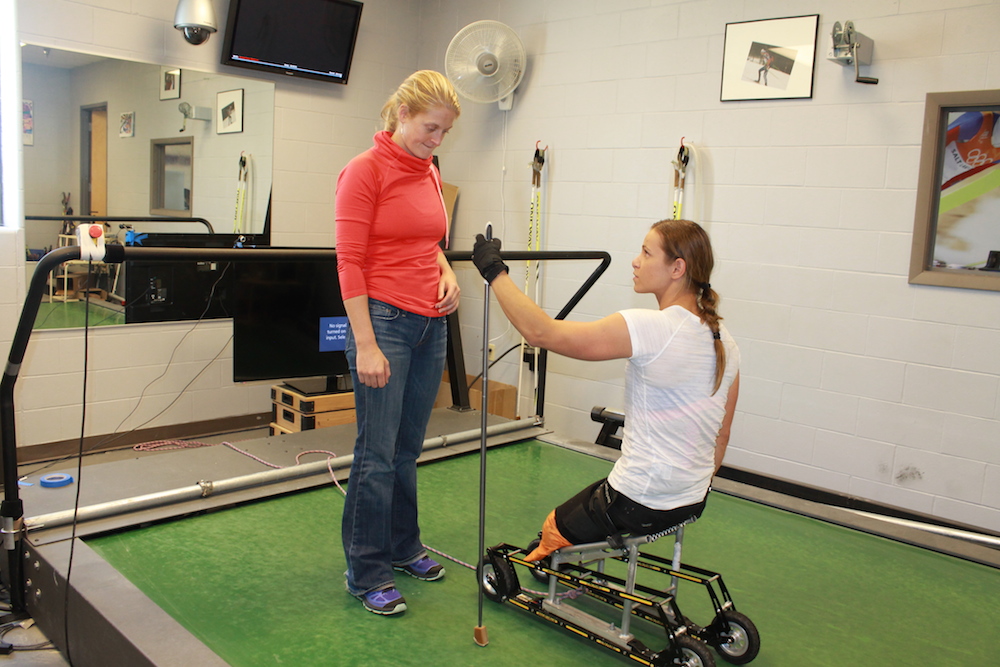
    U.S. Paralympics Nordic skier Oksana Masters (r} talks to coach Eileen Carey before her first time on a treadmill on Sept. 16 at the Olympic Training Center on Sept. 16 in Lake Placid, N.Y.
    U.S. Paralympics Nordic skier Oksana Masters (r) talks to coach Eileen Carey before her first time on a treadmill on Sept. 16 at the Olympic Training Center on Sept. 16 in Lake Placid, N.Y.

    Masters and McFadden missed U.S. nationals because of injury and ilnees, respectively.

    “Earlier in the season, Masters had a minor back injury and McFadden had the flu and were forced to miss the last World Cup event and the US Nationals,” Carey explained. “Both are back healthy and will be in the field in Cable.”

    On the men’s side, Andy Soule leads a strong men’s team heading into World Championships. A veteran sit skier, Soule is a bronze Paralympic medalist from the 2010 Games in Vancouver, British Columbia, where he shot an unprecedented perfect 50-for-50 in all three biathlon races. In Sochi, Soule finished in the top five in every event he competed in and placed fourth twice (in the 7.5 k biathlon and 15 k biathlon).

    He split the number of U.S. sit-ski titles won at this year’s nationals with teammate Lt. Dan Cnossen (both men won two races at Soldier Hollow in Midway, Utah). Cnossen won the men’s sitting short and sprint cross-country races, while he finished as the runner-up to Soule in the long distance cross-country and biathlon sprint races.

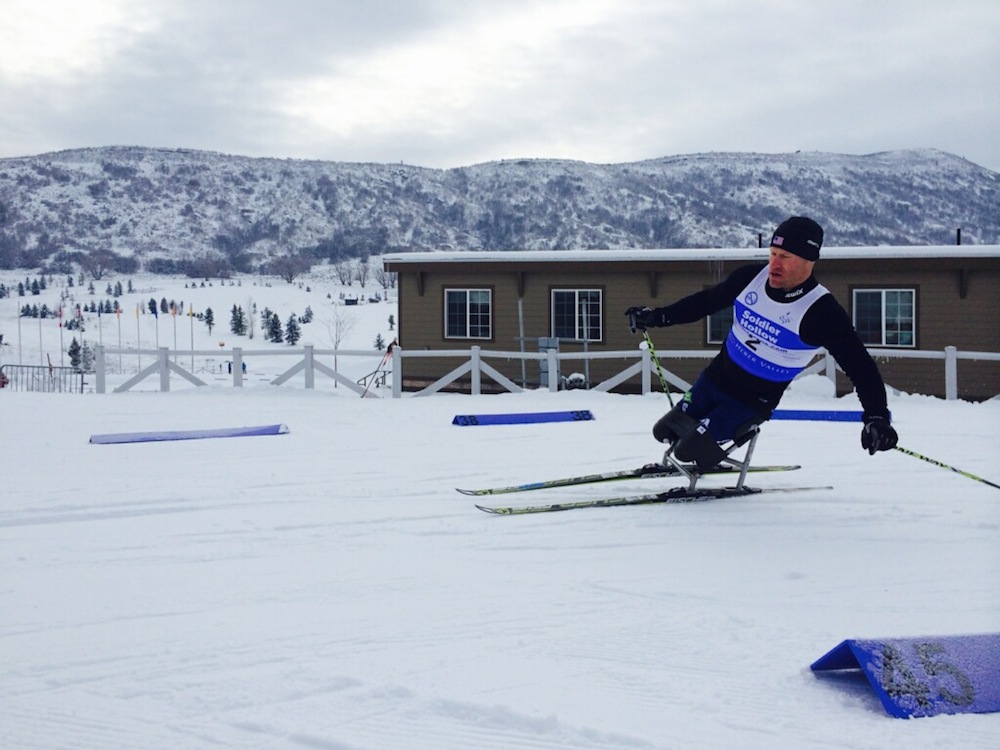
    Lt. Dan Cnossen negotiates the final turn on the course 100 meters from the finish en route to his sprint-final victory at 2015 U.S. Paralympics Nordic Nationals at Soldier Hollow in Midway, Utah. (Photo: U.S. Paralympics Nordic Program)
    Lt. Dan Cnossen negotiates the final turn 100 meters from the finish en route to his sprint-final victory at 2015 U.S. Paralympics Nordic Nationals at Soldier Hollow in Midway, Utah. (Photo: U.S. Paralympics Nordic Program)

    FasterSkier: How has the season gone so far?

    Eileen Carey: We had a strong opening to our season at the December World Cup races in Finland with a small group of athletes. We followed that with a great U.S. Nationals that brought together our top athletes with developing skiers and biathletes. Those two events showed both the high performance capacity and development focus of our program, both of which are critical to our long-term success.

    FS: What is the atmosphere of the team leading to these World Championships on U.S. soil?

    EC: Our athletes are becoming students of skiing and biathlon and driving the process of what and how they want to learn. This has created a great atmosphere for our whole program and has energized both athletes and staff. We are excited to take that energy to an event like World Champs, especially being at home. The Cable organizing committee has always been so welcoming and excited to have us and that gives us a great boost as a team.

    FS: What are your goals and expectations for this years team?

    EC: Our team philosophy is based on the concept that athletes are their own best coaches. Their training and racing has been focused on the idea that there are no “right” ways to do anything. As a result, this season they have gotten really creative and analytical about figuring out what works for them and exploring many different solutions. Our intentions are that bi-products of this exploration are improvements in skill, self-awareness as an athlete, and eventually performance. Our goals and expectations as a program are that our athletes will keep pushing those boundaries and continuing to think of different and perhaps better ways to train and race. Through this continual evolution, I think great performances will follow.

    FS: What are your thoughts on this years course? How does this course compare to 2013?

    EC: The courses in Cable will be a combination of courses we have skied there in the past, and some new features that will improve the experience for the athletes. We have spent some workouts focused on some of the terrain and technical features we will see there, so I think everyone is excited to be on the snow in Cable and test out what we have been working on.

    FS: What events will the team participate in?

    EC: We will have athletes competing each race day, with most competing in a combination of biathlon and cross-country races. Eight of our 9 athletes are sit skiers.  Omar Bermejo is our only standing skier to make the team and this will be the first time this season that we will all be together, so we are looking forward to being a full team.

    “We have a great team of athletes who have taken a very professional approach to training and building upon last season, ”Carey said in a U.S. Paralympics press release. “We are thrilled to get another chance to test out some of our training and racing strategies, ultimately focused on improving in each race. Having the opportunity to do that on home snow is a great bonus for us.”

    IPC Nordic Skiing World Championships Schedule of Events

    The opening ceremony will kick off Friday, Jan. 23 and the championships run through Feb. 1. 

    All seven days of the championships, which includes 38 events between cross-country and biathlon, will be streamed live at Cable2015.com and USParalympics.org from Jan. 24 to Feb. 1.

    Saturday, Jan. 24
    Biathlon Sprint – Penalty Loop
    Sitting: Men 7.5km (3 x 2.5 km) / Women 6.0 km (3 x 2.0 km)
    Standing: Men 7.5km (3 x 2.5 km) / Women 6.0 km (3 x 2.0 km)
    Visually Impaired: Men 7.5km (3 x 2.5 km) / Women 6.0 km (3 x 2.0 km)

    Sunday, Jan. 25
    Cross Country Long – Free
    Sitting: Men 15 km (5 x 3.0 km) / Women 12 km (4 x 3.0 km)
    Standing: Men 20 km (5 x 4.0 km) / Women 15 km (5 x 3.0 km)
    Visually Impaired: Men 20 km (5 x 4.0 km) / Women 15 km (5 x 3.0 km)

    Tuesday, Jan. 27
    Biathlon Middle Distance – Penalty Loop
    Sitting: Men 12.5 km (5 x 2.5 km) / Women 10 km (5 x 2.0 km)
    Standing: Men 12.5 km (5 x 2.5 km) / Women 10 km (5 x 2.0 km)
    Visually Impaired: Men 12.5 km (5 x 2.5 km) / Women 10 km (5 x 2.0 km)

    Wednesday, Jan. 28
    Cross Country Sprint – Classic
    Sitting: Men/Women 0.8 km
    Standing: Men/Women 1.2 km
    Visually Impaired: Men/Women 1.2 km

    Friday, Jan. 30
    Biathlon Individual Distance
    Sitting: Men 15 km (5 x 3.0 km) / Women 12.5 km (5 x 2.5 km)
    Standing: Men 15 km (5 x 3.0 km) / Women 12.5 km (5 x 2.5 km)
    Visually Impaired: Men 15 km (5 x 3.0 km) / Women 12.5 km (5 x 2.5 km)

    Saturday, Jan. 31
    Cross Country Relay – CL/Free/CL/Free
    Open: 10 km (4 x 2.5 km)
    Mixed: 10 km (4 x 2.5 km)

    Sunday, Feb. 1
    Cross Country Middle Distance – Classic
    Sitting: Men 10 km (4 x 2.5 km) / Women 5 km (2 x 2.5 km)
    Standing: Men 10 km (4 x 2.5 km) / Women 5 km (2 x 2.5 km)
    Visually Impaired: Men 10 km (4 x 2.5 km) / Women 5 km (2 x 2.5 km)

    For updates throughout IPC World Championships, follow FasterSkier’s Para Nordic blog.

  • McFadden Takes Silver in Sochi Sprint, Dream Comes True; Masters One Second from Bronze

    McFadden Takes Silver in Sochi Sprint, Dream Comes True; Masters One Second from Bronze

    Silver Medalist Tatyana McFadden (L) and gold medalist Mariann Marthinsen following the women's 1 k sprint race.
    U.S. silver medalist Tatyana McFadden (l) and Norway’s gold medalist Mariann Marthinsen after the women’s 1 k sprint race. (Photo: Greg Rawlings/U.S. Paralympics Nordic)
    In a phone interview from Sochi just before the opening of 2014 Paralympic Winter Games, Tatyana McFadden told FasterSkier,  “The sprint is my favorite, I love to sprint in track and I love to sprint on skis.”

    On Wednesday, the marathon-racing queen’s love of sprinting transformed to silver.

    In the women’s 1-kilometer sit-ski sprint final at the Laura Cross Country Center in Krasnaya Polyana, Russia, McFadden finished second overall, just one-tenth of a second behind Norway’s gold-medal winer Mariann Marthinsen.

    Second out of the start behind Germany’s Andrea Eskau, McFadden surged to first when Eskau fell. The American Winter Paralympics rookie led the race until the finish line where she was edged out by Marthinsen.
    “I could not go easy, I needed to go hard from the start,” McFadden told the U.S. Olympic Committee. “I knew that they were coming and I could feel them down my neck.”
    American Oksana Masters (second from l) with her silver medal from the first sit-ski competition of the 2014 Sochi Paralympics. In her second race on Wednesday, she earned bronze to become the most successful female nordic skier in U.S. Paralympic history. (Photo U.S. Paralympics Nordic)
    American Oksana Masters (second from l) with her silver medal from the 12 k sit-ski competition, the first of the 2014 Sochi Paralympics. In her second race on Wednesday, the 1 k sprint, she placed fourth, one second away from bronze. (Photo: U.S. Paralympics Nordic)

    McFadden’s teammate, who also picked up the sport last season, Oksana Masters finished fourth, one second away from bronze.

    Masters was in third until the final straightaway, where Russia’s Marta Zaynullia passed her for bronze.  Eskau was disqualified  due to an illegal lane change.

    McFadden, 24, of Clarksville, Md., became the second U.S. women to win a Paralympic medal in cross county skiing in last 20 years. The first was Masters, who won bronze in the women’s 12 k distance race on Sunday.

    After picking up skiing just over a year ago, McFadden advanced to the finals on Wednesday by placing fourth in the qualifier and second to Marthinsen in the semifinal. Masters was third in the qualifier round and second in her semi.

    At age 6, McFadden was adopted from St. Petersburg, Russia, by American Deborah McFadden. Her birth mother, whom Tatyana recently met, has been in attendance at the Games to watch her compete.

    Oksana Masters' silver  medal in the 12 k distance event at the 2014 Sochi Paralympics. (Photo: U.S. Paralympics Nordic)
    Oksana Masters’ silver medal in the 12 k distance event at the 2014 Sochi Paralympics. (Photo: U.S. Paralympics Nordic)

    McFadden told FasterSkier before the Games that having both her moms there with her in Sochi “has definitely been a dream of mine … Just having my whole family in the stands is going to be a huge fulfillment so I’m going to take that energy and put it into my skiing.”

    Describing McFadden’s rise from a skiing newcomer to Winter Paralympic medalist, U.S. Paralympics Nordic High Performance Director John Farra wrote in an email, “It was definitely a like cramming for a final exam … like fitting in 4 years of college education into one semester, but we started with an athlete with RAW physical talent, power and strength and willingness to work.”

    McFadden is a 10-time world champion and three-time Paralympic gold medalist in track racing. She’s competed at three Summer Paralympics and became the first person to win all four major marathons (Boston, London, Chicago, and New York) in a single season. In the 12 k distance event on Saturday, she placed fifth in her first Winter Paralympics race.

    “It was definitely a like cramming for a final exam … but we started with an athlete with RAW physical talent, power and strength and willingness to work.” — U.S. High Performance Director John Farra on Tatyana McFadden

    “We kept her on snow as much as possible from the start of the season until Sochi … and today it all came together for her,” Farra explained.

    A packed cross country stadium at the 2014 Winter Paralympic Games sprint races.
    A packed cross country stadium at the 2014 Winter Paralympic Games sprint races. (Photo U.S. Paralympics Nordic)

    In the men’s sprint final Andy Soule placed fifth and Dan Cnossen took sixth. Sochi roommates, Soule and Cnossen were 6.4 and 8.3 seconds back from bronze, respectively.

    “My performances here have been very good for me, every race has been one of the very best of my career,” wrote Soule, who won bronze in biathlon at the 2010 Paralympics.

    Soule’s best race, the distance biathlon, will be held Friday March 14th.   “I feel very confident about the final biathlon event.  The long distance biathlon is a very good event for me.” Soule noted.

    Cnossen, a newcomer to the  Paralympic Games,  described his races in an e-mail, ” [In the semi final] I came around that first sharp right turn wide … then drafted off two Russians and came in third.  In the final, I stumbled at the start … and was never able to reel in the other competitors.”


    U.S. Paralympics silver medalist Tatyana McFadden with her first medal of the Winter Games in Sochi, Russia, on Wednesday after placing second in the 1 k sit-ski sprint. (Photo: John Farra/U.S. Paralympics Nordic)
    U.S. Paralympics silver medalist Tatyana McFadden with her first medal of the Winter Games in Sochi, Russia, on Wednesday after placing second in the 1 k sit-ski sprint. (Photo: John Farra/U.S. Paralympics Nordic)
  • Sochi Paralympics Preview: U.S. Medal Chances and More

    Sochi Paralympics Preview: U.S. Medal Chances and More

    Returning 2010 Paralympic bronze medalist Andy Soule racing at the 2014 US national championships. (Photo Victor Henderson)
    Returning 2010 Paralympic bronze medalist Andy Soule racing at the 2014 US national championships. (Photo Victor Henderson)

    At the 2014 Winter Paralympics from March 7 to 16 in Sochi, Russia, nordic skiing and biathlon will account for more that half of the available medals.

    How will the United States fare in the medal chase?

    Downplaying expectations in an interview with FasterSkier, John Farra, the high-performance director of U.S. Paralympics Nordic, didn’t rule out a surprise or two from his team.

    “While we are not expected to win any medals … we are spending a lot of time and effort to find that extra half percent or 1 percent that gets [our athletes] into the top three to steal a medal from the Russians or the Ukrainians.”

    The Russians, in particular, have been dominant in World Cup sit-ski competitions this season. In December in Canmore, Alberta, both the Russian and U.S. teams showed up in full force to prepare for Sochi.

    The Russians won most of the medals available and swept several podiums, while the U.S. men missed out on the podium.

    “They [the Russians] really came to ready to race,” Farra said.

    Sights on Biathlon

    For the men’s team, biathlon looks to be a place where the U.S. program has an opportunity for success. At the Vancouver 2010 Winter Games, Army veteran Andy Soule earned the United States’ first-ever Olympic or Paralympic medal in biathlon, finishing third.

    Soule returns to this year’s team and told FasterSkier, “I’m probably better on the longer races, the biathlon long course (15 Kilometer) is my best race, not because of the skiing, but because the shooting penalty is considerably larger for that event.”

    Regarding the technical aspect of biathlon, Soule said, “I’m definitely working on a being more aggressive. I’ve been a decent shooter for some time and I’m working on cutting down on my range times.”

    U.S. Paralympics Biathlon coach Rob Rosser said the team has a good chance to score an upset in biathlon.

    “In cross-country skiing, it can takes years to develop and significantly change your level of fitness,” Rosser said. “That’s why biathlon is so interesting as a sport, so many things can happen with the shooting that the outcomes are much less predictable.”

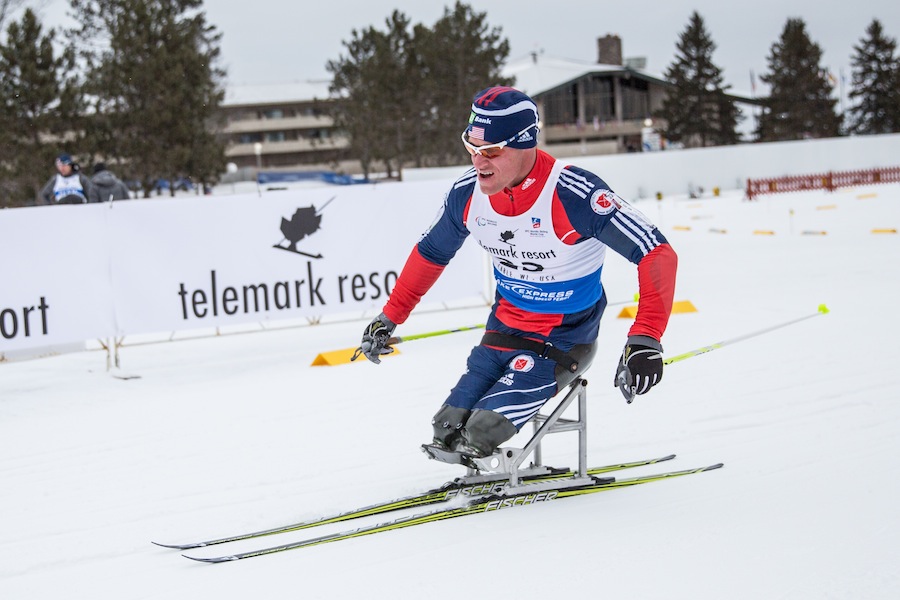
    Dan Cnossen racing at the 2013 IPC World Cup in Canmore, Canada, in December. (Photo: Pam Doyle)
    Dan Cnossen racing at the 2013 IPC World Cup in Canmore, Canada, in December. (Photo: Pam Doyle)

    A leading member of the team after just a few seasons in the sport, Lt. Dan Cnossen edged Soule at U.S. nationals in January, beating Soule by 2.8 seconds in the 7.5 k race, after Soule missed a shot on his final round in the range.

    Cnossen will be competing at his first Paralympics this month.

    “He trains unbelievably professionally,” Farra said. “He really puts everything into it.”

    This year Cnossen has focused on upping his game in biathlon.

    “I’ve made some changes in my training for the biathlon,” Cnossen said at the beginning of the season. “I had some troubles with my rifle that we’ve ironed out, so I think you’ll see some improved hit rates.”

    At nationals, the sit-ski sprint lived up to it’s reputation where anything can happen. A relative newcomer, Jeremy Wagner became a national champion with his first national title, topping 2010 Paralympian Sean Halsted.

    U.S. Women’s Prospects

    The U.S. women’s team makes up four of the 18 athletes on the team, but they have delivered the most impressive results and generated the most media buzz this Olympic year.

    Oksana Masters is the top U.S. contender for a medal based on her World Cup results this season.

    Oksana Masters racing in the IPC World Cup Canmore sprint race. (Photo: Pam Doyle)
    Oksana Masters racing in the IPC World Cup Canmore sprint race. (Photo: Pam Doyle)

    Masters won bronze medals in the 12 k in Oberstdorf, Germany, as well as the 5 k in Canmore. She narrowly missed the podium in the sprints at Canmore due to an “unlucky tangle” with another skier.

    Recruited to skiing based on her background as a bronze-medal winning Paralympic rower, Masters has shown remarkable adeptness at learning a sport she first tried two years ago.

    “She’s fearless, so she ended up crashing a lot early on because she just wanted to go fast,” Farra explained. “She didn’t know how to control the [sit-ski] to be able to turn it left or right to avoid the tree, and often times she’d connect with the tree or crash and break a pole.”

    He laughed.

    “She was a bit of a … well, you know, it was pretty funny actually in some ways. As long as she wasn’t getting hurt it was fun to watch.”

    In an email to FasterSkier, Masters cited her inexperience with skiing and her surprise at her success. About her Canmore medal, she said, “I knew that just about every other woman skier out there had years of experience on me and I am still a newbie. I went into the the race with the mind set of I’m not going to be top 5 but I wanted to try my darn hardest to make it in the top 10.”

    As for her first World Cup podium: “I didn’t know instantly that I got third. I was shocked and thought it was a mistake at first.”

    So is she getting more comfortable and does she believe she can compete with the best in the world? Farra thought so.

    “I think it is fair to say she is starting to believe it, yes. She is so competitive and really was pumped to get on the podium in Oberstdorf. She has really refined her technique to a very smooth, powerful and efficient motion. … She will get there.”

    Masters has garnered national media attention since her appearance in the 2012 London Paralympic Games. Her life story as a Ukrainian orphan adopted by her U.S. mother has been featured in various media forms, including Sports Illustrated and Southwest Airlines’ in-flight magazine.

    She was named one of the “11 hottest paralympic athletes” by MSN “Now.” She was named one of ten U.S. athletes to watch by The Guardian.

    Apple featured her in a video, “Making a difference: one app at a time”, where she demonstrated how she uses an iOS app to control her prosthetic legs and put on high heeled shoes.

    Perhaps most famously, Masters posed nude for ESPN’s 2012 “Bodies We Want” issue.

    Tatyana McFadden racing at US nationals Soldier Hollow. (Photo: Victor Henderson)
    Tatyana McFadden racing at US nationals Soldier Hollow. (Photo: Victor Henderson)

    As the U.S. heads for Sochi, world-class wheelchair racing champion and summer Paralympic cross-over athlete, Tatyana McFadden is another woman to watch. McFadden and Kikkan Randall were featured together in BP television ads during NBC’s coverage of the Winter Olympic Games.

    Apart from her celebrity status as the most decorated U.S. athlete going to Sochi, McFadden is candid about her newness to skiing.

    “For track, since I’ve been to other races and other Paralympics … I know what to expect between events and the transitions and about getting on the bus and off the bus and into the venue and what its going to feel like,” McFadden said. “For Sochi, I don’t know any of that. I have no idea because everything is so new for me.”

    McFadden’s ski results have steadily improved as she gains experience. She has cracked the top 10 three times in IPC world cup competition this season, finishing ninth in the 12 k and tenth in the sprint at Oberstdorf. She placed seventh in the sprint at Canmore, narrowly missing the six-woman final round.

    McFadden and her London 2012 Paralympic teammate Jessica Long are both Russian orphans who were adopted and brought to the United States by American families. Both have been outspoken against Russia president Vladimir Putin’s 2012 law banning adoption of Russian children by U.S. citizens.

    McFadden said she was excited to return to Russia for the Sochi Paralympics.

    “It’s part of my culture, it’s part of who I am, and that will never be apart from me,” she said. “But I’m going to be going and competing for the United States of America.”

  • 2014 U.S. Paralympics Nordic Team Nominated

    2014 U.S. Paralympics Nordic Team Nominated

    Tatyana McFadden (l) and Jeremy Wagner are headed to the 2014 Paralympics in Sochi, Russia. (Photo: TeamUSA.org)
    Tatyana McFadden (l) and Jeremy Wagner are headed to the 2014 Paralympics from March 7-16 in Sochi, Russia. (Photo: TeamUSA.org)

    (Press release)

    COLORADO SPRINGS – U.S. Paralympics, a division of the United States Olympic Committee, announced Wednesday that 16 Nordic skiing athletes and two guides have been nominated to the 2014 U.S. Paralympic Team to compete in biathlon and cross-country skiing at the 2014 Paralympic Winter Games in Sochi, Russia, March 7-16. The nominations are subject to approval of the USOC.

    After sending six athletes to the Vancouver 2010 Paralympic Winter Games, Team USA’s Nordic roster will nearly triple in size with 12 men, four women and two guides for visually impaired athletes.

    “We are thrilled to bring such a large team of athletes and professional staff to Sochi,” said John Farra, high performance director for U.S. Paralympics Nordic skiing. “We have made a concerted effort to introduce more athletes to the sports of cross-country skiing and biathlon over the past two-and-a-half seasons, and this growth is a sign of our success in keeping many of them excited about our Nordic sports and working toward becoming internationally competitive.

    “In addition to building the numbers with new developing athletes, we have also focused many resources to help our top athletes get close to hitting the podium. Great focus was given towards equipment design for sit skiers, race ski selection and preparation in partnership with the U.S. Biathlon Association, and access to the best training camps and competitions around the world.”

    2014 U.S. Paralympic Nordic Team Nominees:
    (Subject to USOC approval)

    Women
    Monica Bascio (Evergreen, Colo.)

    Oksana Masters (Louisville, Ky.)
    Tatyana McFadden (Clarksville, Md.)
    Beth Requist (Winter Park, Colo.)

    Men

    Jake Adicoff (Sun Valley, Idaho)

    Omar Bermejo (Grand Rapids, Mich.)
    Kevin Burton (Boulder, Colo.)
    Lt. Cmdr. Dan Cnossen (Topeka, Kan.)
    Travis Dodson (Deming, N.M.)
    Sean Halsted (Spokane, Wash.)
    John Oman (Rice Lake, Wis.)
    Augusto Perez (East Syracuse, N.Y.)
    Aaron Pike (Park Rapids, Minn.)
    Bryan Price (Belton, Mo.)
    Andy Soule (San Antonio, Texas)
    Jeremy Wagner (Nanakuli, Hawaii)

    Guides

    David Chamberlain (Wilton, Maine)

    Reid Pletcher (Ketchum, Idaho)

    Three athletes return from the Vancouver 2010 Paralympic Winter Games, including Andy Soule (San Antonio, Texas) who won the first-ever U.S. medal in the Olympic or Paralympic Winter Games in the biathlon with his bronze in the men’s 2.4-kilometer race. Soule will be joined by his 2010 teammates Sean Halsted (Spokane, Wash.) and Monica Bascio (Evergreen, Colo.).

    Bascio boasts the most Winter Games experience, with Sochi marking her third Winter Games and fourth Games overall.  Having just recently retired from cycling, Bascio is one of three athletes who medaled at the London 2012 Paralympic Games. Other cross-over athletes include Tatyana McFadden (Clarksville, Md.) and Oksana Masters (Louisville, Ky.). McFadden is a 10-time Paralympic medalist in track and field, while Masters partnered with Rob Jones to become the first Americans to win a Paralympic rowing medal in the trunk and arms mixed double sculls event with their third place finish.

    More than half of the athletes nominated to the men’s team are military veterans: Omar Bermejo (Marines/Grand Rapids, Mich.), Kevin Burton (Navy/Boulder, Colo.), Travis Dodson (Marines/Deming, N.M.), Halsted (Air Force/Spokane, Wash.), Bryan Price (Army/ Belton, Mo.), Soule (Army) and Jeremy Wagner (Army Reserves/Nanakuli, Hawaii). Lieutenant Commander Dan Cnossen (Topeka, Kan.) is the only active duty member of the team as he currently serves with the United States Navy.

    Competition for Nordic skiing will take place March 8-16 with March 13 scheduled as an off-day. Nordic skiing includes both biathlon and cross-country skiing, both of which have three events contested at the Games, in addition to two cross-country relays.

    The majority of the U.S. Paralympic Nordic Skiing Team will compete in both sports. A list of events entered by each athlete will be available in February.

    The USOC and NBC Olympics have partnered to provide an unprecedented level of coverage to the Paralympic Winter Games. NBC and NBC Sports Network will combine to air 50 hours of television, starting on March 7 with the Opening Ceremony. It will be followed by daily coverage of all five Paralympic sports in the Sochi program, before the Games’ Closing Ceremony is broadcast on March 16. In addition to the unprecedented U.S. television coverage, the USOC and streaming sponsors BMW, BP, Citi, Liberty Mutual Insurance, Procter & Gamble and The Hartford will provide live online coverage at TeamUSA.org.

    U.S. Paralympic Team nominees for alpine skiing, biathlon, cross-country skiing, sled hockey, snowboarding and wheelchair curling will be finalized by the USOC no later than Feb. 21, the deadline to submit Sochi 2014 Paralympic Winter Games delegation rosters to the International Paralympic Committee. Selection procedures and dates can be found at TeamUSA.org/ParalympicGames/.

  • Cnossen, Masters Win Three of Four Races at U.S. Paralympics Nationals

    Cnossen, Masters Win Three of Four Races at U.S. Paralympics Nationals

    Lt. Dan Cnossen on his way to winning Tuesday's 10 k sit-ski at 2014 U.S. Paralympics Nordic Skiing Nationals at Soldier Hollow in Midway, Utah.
    Lt. Dan Cnossen (U.S. Paralympics) out of the start in Tuesday’s 10 k sit-ski at 2014 U.S. Paralympics Nordic Skiing Nationals at Soldier Hollow in Midway, Utah. He won by 18.2 seconds in 32:21.9.

    FasterSkier’s coverage of the 2014 U.S. Cross Country Championships is brought to you through the generous support of The Memory Clinic in Bennington, Vt.

    MIDWAY, Utah — Rounding Soldier Hollow’s 2.5-kilometer sit-ski course on Tuesday, Oksana Masters and Lt. Dan Cnossen muscled through methodically, powerfully.

    Even with two victories apiece behind them from earlier in the week at U.S. Paralympics Nordic Skiing Nationals, these two had business to tend to: take care of some optimal conditions in Utah, then get ready for the Jan. 16-19 World Cup in Oberstdorf, Germany.

    Sochi was undoubtedly on their minds, with the 2014 Winter Paralympics exactly 60 days away from Tuesday’s 5- and 10-kilometer sit-ski races, but neither Masters or Cnossen were getting ahead of themselves.

    Men's 10 k sit-ski podium at 2014 U.S. Paralympics Nordic Nationals on Tuesday, with winner Dan Cnosson (c), who won three out of four events this week, Andy Soule (l) in second, and Sean Halsted (r) in third.
    Men’s 10 k sit-ski podium at 2014 U.S. Paralympics Nordic Nationals on Tuesday, with winner Dan Cnosson (c), who won three out of four events this week, Andy Soule (l) in second, and Sean Halsted (r) in third.

    “I’m just gonna focus on the next step which is the World Cup right now and then being named to the team hopefully, and go from there,” said Cnossen, 33, after winning his third out of four races at nationals in 32:21.9 minutes, 18.2 seconds ahead of U.S. Paralympics teammate Andy Soule (Army) in second.

    A Navy SEAL who lost his legs in an explosion in Afghanistan in 2009, Cnossen is one of the team’s frontrunners in the leadup to Sochi, yet he was looking forward to seeing how he fares on internationally before turning his focus toward what would be his first Paralympics.

    Last year, he won silver in the first race of the International Paralympic Committee (IPC) Nordic Skiing World Cup in Cable, Wis., in the 10 k. At the IPC World Cup in Canmore, Alberta, from Dec. 9-16, Cnossen notched a couple top 10s and put himself 11th in the Cross-Country World Cup standings. As of Dec. 15, he was 14th on the Biathlon World Cup list.

    In Soldier Hollow from Jan. 2-6, Cnossen opened with a victory in the 7.5 k biathlon race, then went on to win the 15 k distance race, place fourth in the sprint, and ultimately finish with a 10 k title.

    “Had some good races; the courses were awesome,” Cnossen said. “They’re really similar to what we’ll be experiencing in Sochi, definitely the altitude is.”

    While the temperature was a little cooler than what’s expected in Sochi, with the men and women racing on a just-above-freezing morning on Tuesday, Cnossen said the slower snow worked to his favor.

    Oksana Masters en route to winning Tuesday's 5 k sit-ski at 2014 U.S. Paralympics Nordic Skiing Nationals at Soldier Hollow in Midway, Utah.
    Oksana Masters (U.S. Paralympics) en route to winning Tuesday’s 5 k sit-ski at 2014 U.S. Paralympics Nordic Skiing Nationals at Soldier Hollow in Midway, Utah.

    A Paralympic bronze medalist in rowing, Masters, 24, raced to her third championship of the week as well, winning the women’s 5 k in 18:13.2, about 2 1/2 minutes faster than Monica Bascio in second.

    In Canmore, Masters opened with a bronze in the World Cup 5 k and placed fourth in the sprint. She finished the series ranking fourth in the Cross-Country World Cup and eighth in biathlon.

    “Hopefully it continues,” Masters said on Tuesday. “Last year I kind of had an injury going into it starting out and also lack of on-snow experience. I was on snow for a total of two days before going out here last year to nationals … I think I was just trying to hammer it too hard instead of try to slow down and learn the technique to it.”

    With her rib injury healed and breathing easier at some 5,500 feet above sea level, Masters was looking forward to returning to Germany after training in the Oberhof ski tunnel in October.

    “I love the competitiveness; I really like the fact that it’s something that I can grow myself as an athlete and I can broaden that spectrum of my athleticism,” the U.S. Development Team skier said. “The team camaraderie is really cool. Everyone, the girls, the guys, have their unique personalities and it wouldn’t be the same team without one person.”

    Women's 5 k sit-ski podium at 2014 U.S. Paralympics Nordic Nationals, with winner Oksana Masters (c), who won three of four events this week, Monica Bascio (l) in second, and Tatyana McFadden (r) in third.
    Women’s 5 k sit-ski podium at 2014 U.S. Paralympics Nordic Nationals, with winner Oksana Masters (c), who won three of four events this week, Monica Bascio (l) in second, and Tatyana McFadden (r) in third.

    As for the transition from rowing, Masters said the pulling motion is similar, but the winter weather had been a tough adjustment.

    “I think it helped to come from a sport background where it was an endurance sport also along with strength,” she said. “My biggest challenge from rowing would be the variety of an 800-meter sprint to a 12 1/2 k or 10 k, so I have to build that up.”

    As for her Winter Paralympics aspirations, Masters said set on not giving up.

    “I’m a perfectionist, and I strive to be the best I can in whatever I do,” she said. “I’m not going to start something and just stop it.”

    The men’s 10 k runner-up, Soule called this year’s nationals “a good race experience.”

    “Nationals always is a good little prep period before going over to compete World Cup,” he said.

    Sean Halsted (Navy) placed third after miscounting his laps and coming into the finish one loop too soon. He had to turn around and head backward down the finishing straight to get to the lap lane, ultimately finishing 50 seconds behind Soule.

    “I didn’t realize we were on the course that we were on I thought we were going three laps of 3 k,” Halsted said with a laugh.

    Either way, the national-team member said nationals were a good tuneup before they resume international racing.

    “It’s all about prep trying to get that race experience in,” Halsted said. “It’s not just, ‘Hey you might be first or second,’ well, you don’t hold on to that. … You use that to motivate you for when you’re going on the international [scene].”

    In the women’s race, Tatyana McFadden placed third, about 45 seconds after Bascio, and Beth Requist was fourth.

    Results | Complete 2014 U.S. Paralympics Nationals Results

    Jan. 2: Biathlon 6/7.5 k

    Jan. 3: Sit-ski 10/15 k

    Jan. 4: Sit-ski sprint; Standing 5/10 k classic

    Jan. 5: Standing sprint freestyle

    Jan. 6: Sit-ski 5/10 k

    Jan. 8: Standing 5/10 freestyle mass start

    Photo Gallery (through first three days)

  • In Third Season, Cnossen Aims to Lead U.S. Paralympics Nordic, Starting in Canmore

    In Third Season, Cnossen Aims to Lead U.S. Paralympics Nordic, Starting in Canmore

    Lt. Dan Cnossen (U.S. Paralympics) racing to 11th in Tuesday's sit-ski sprint at the IPC World Cup in Canmore, Alberta. (Photo: Pam Doyle)
    Lt. Dan Cnossen (U.S. Paralympics) racing to 11th in Tuesday’s sit-ski sprint at the IPC World Cup in Canmore, Alberta. (Photo: Pam Doyle)

    One of the most successful men on the U.S. Paralympics Nordic Team last season,  Lt. Dan Cnossen cut right to the chase when asked about his training this summer and fall.

    “I think we’re going to find out real quick when I go up against the Russians,” Cnossen responded in a phone interview before the first International Paralympic Committee (IPC) World Cup in Canmore, Alberta, from Dec. 9 to 17.

    According to U.S. Paralympics High Performance Director John Farra, Cnossen, originally from Topeka, Kansas, is relatively new to the sport.  He joined the team after the 2010 Winter Paralympics, and in the three years since he’s been living and training in Winter Park, Colo., Cnossen has risen to lead the U.S. men’s sit-ski team.

    Dan Cnossen (Navy) goes out hard from the start of the 15 k sit ski at U.S. Adaptive Championships in Soldier Hollow on Saturday.
    Lt. Dan Cnossen (Navy) racking up one of three national titles at U.S. Adaptive Championships last season in Midway, Utah.

    “He trains unbelievably professionally,” Farra said. “He really puts everything into it.”

    A Navy SEAL who lost both his legs in an Afghanistan explosion in 2009, the first day he was promoted to lieutenant, Cnossen, 33, has full use of his core.

    “He is a ‘V’ cut, super-strong … looking guy,” Farra said.

    Last year, Cnossen excelled on the domestic and international scene, notching podiums at U.S. nationals and the IPC World Cup in Cable, Wis.

    This summer, he ventured down to Argentina to train and race the 21-kilometer Marchablanca and 42 k Ushuaia Loppet. “That trip really reinvigorated my training,” Cnossen said.

    Skiing on snow is important to Cnossen, because he describes his mountain board (a sit skier’s equivalent to rollerskis) as a “strength machine.”

    “It’s very hard to work my cardio on it because it doesn’t roll very fast,” he said.

    Lt. Dan Cnossen of the U.S. Paralympics Nordic National Team doing loaded pull-ups during a strength session at the Lake Placid Olympic Training Center. (Photo: www.facebook.com/USParalympicsNordic)
    Lt. Cnossen of the U.S. Paralympics Nordic National Team doing loaded pull-ups during a strength session at the Lake Placid Olympic Training Center two summers ago. (Photo: U.S. Paralympics Nordic/Facebook)

    Using prosthetic legs, Cnossen has devised other ways to raise his heart rate.

    “You do what you can, and for me, I was a big runner before my injury,” he said. “I’m very lucky that I can do it, and I’m really lucky that I can walk too. ”

    He mostly runs 5- and 10-k races, which helps with his nordic training.

    “Plus, running gives me a chance to rest my shoulders,” he said.

    Cnossen is testing in a new custom sit ski this year, a lighter model that he hopes will help him ski faster.

    “It’s a really important part of the sport; you have to be comfortable, you have to be well secured … not only for power transfer, but for ski control,” he said. “I found a group of engineers who were willing to work with me and they’ve done a great job.”

    Summing up his thoughts about the season ahead, Cnossen said he was confident in his skiing abilities.

    “I’m hoping I’m a little better tactician,” he said. “I know I’m stronger physically this year and I have better equipment so it will be exciting to see how I end up on the results list.”

    Lt. Dan Cnossen at the start of a sprint qualifier at a 2013 test event in Sochi, Russia.
    Lt. Dan Cnossen at the start of a sprint qualifier at a 2013 test event in Sochi, Russia.

    In terms of tactics, he said he needs to work on sprinting.

    “I try to be a sponge,” he said. “Since this is only my third year, every time I go to a World Cup I try to watch the Russians and the athletes from other countries.  I watch what lines they take.  Are they in the track are they out of the track? Their rhythm of double poling, the nuances of ski handling. I hope it pays off.”

    Also a biathlete who’s tweaked his training, Cnossen predicts improvement there as well.

    “I think you’ll see some improved hit rates,” he said. “I knew the first couple of years, even if I shot perfectly I wouldn’t ski fast enough, no where near it. First and foremost, I thought the strength and conditioning would take the longest to develop.  I have a background in shooting and I can tweak that in a relatively short amount of time compared to how long it would take do develop the strength to conditioning to be fast enough to keep up with the top guys.”

    So far, he’s notched ninth place in the 10 k at Canmore, leading the U.S. men. On Tuesday, he placed 11th in the sprint behind teammates Sean Halsted and Andy Soule in eighth and ninth, respectively.

    Lt. Dan Cnossen (U.S. Paralympics) tallied multiple podiums at the IPC World Cup in Cable, Wis., in January. (Photo: James Netz)
    Lt. Dan Cnossen (U.S. Paralympics) tallied multiple podiums at the IPC World Cup in Cable, Wis., in January. (Photo: James Netz)

    ***

    What: IPC World Cup at the Canmore Nordic Centre in Canmore, Alberta

    Schedule:
 

    IPC Cross Country World Cup

    • December 9 10:00am Men’s 10km/Women’s 5km Skate
    • December 10 11:00am Sprint Classic (Heats start at 12:00)
    • 
December 12 10:00am Men’s 20km/Women’s 15km Classic

    IPC Biathlon World Cup

    • 
December 14 10:00 Biathlon Sprint
    • December 15 10:00 Biathlon Middle Distance
    • December 17 10:00 Biathlon Long Distance
  • A Defending Champ and Newcomer Claim Sit-Ski National Titles

    A Defending Champ and Newcomer Claim Sit-Ski National Titles

    Dan Cnossen (U.S. Paralympics) leading the men’s 15 k sit ski at U.S. Adaptive Championships on Saturday at Soldier Hollow in Midway, Utah.

    FasterSkier’s coverage of the 2013 US Cross Country Championships is brought to you through the generous support of The Memory Clinic in Bennington, Vt.

    MIDWAY, Utah – They couldn’t have finished much more than 20 minutes earlier, yet there they were – Lt. Dan Cnossen and Oksana Masters – ready to duke it out at Soldier Hollow. The two lined up at one end of a set of tracks in the stadium, poles high and waiting for the go-ahead from their coach.

    The more seasoned of the two, Cnossen, a U.S. Navy SEAL, double poled alongside Masters, a Ukranian-born rower who recently won bronze for the U.S. at the London Paralympics. The 23-year-old from Louisville, Ky., started skiing seven days ago.

    Dan Cnossen (c), Oksana Masters (second from r) and Tatyana McFadden talk to their coaches, including U.S. Paralympics high-performance director John Farra (front) after their distance races at U.S. nationals on Saturday in Soldier Hollow.

    Yet after her first race – in which she placed fourth in the women’s 9 k sit ski at U.S. Adaptive Championships on Saturday – Masters wanted more. She wanted to learn some technique.

    The men’s 15 k champion who picked up the sport two years ago, Cnossen took it upon himself to help her, and so the two did pickups to determine inefficiencies in her double pole. With a similar injury after losing use of their legs, Cnossen – originally from Topeka, Kan. – could relate.

    “We’ve got some really talented new athletes that have barely been on snow so if I can give them advice and help build the team then that’s the least I can do,” said Cnossen, one of six U.S. Paralympics Nordic team members.

    Fresh off a trip to Vuokatti, Finland, where he notched fifth and ninth at the opening International Paralympic Committee (IPC) World Cups, Cnossen defended his distance title on Saturday (he won the abbreviated 12.5 k course at nationals last year in Rumford, Maine).

    “I’ve been working hard, but so has everybody else,” Cnossen said after rounding the five-lap course fastest in 45:43.4.

    Teammate Andy Soule (Army) was 2:20.9 back in second. The two were the lone national team members sent to Finland.

    Cnossen said it was advantageous to race competitive international skiers early in the season, before nationals. It was even better to get out of the darkness in Finland and into the Utah sun. Saturday’s race was pushed back from its original 8:30 a.m. start to 2 p.m. Saturday to allow temperatures to warm up. By Saturday afternoon, it was comfortably in the 20s.

    Dan Cnossen (Navy) goes out hard from the start of the 15 k sit ski at U.S. Adaptive Championships in Soldier Hollow on Saturday.

    Cnossen said he was simply grateful to put on a bib and race, and went out hard from the start.

    “I think I went a little too hard the first lap because the second lap I thought, ‘Oh man, I have four more to go,’ ” he said. “But I held on and then the fifth lap, I always have energy because I have a good kick normally. I prefer to go out a little on the aggressive side and be in the race and not lose time. I think it’s easier to be in the race and stay in the race then be out of the race and get back into it.”

    Pushing from start to finish and skiing outside the tracks at times in the warming snow, Cnossen sealed another victory, which he was happy about. But he still didn’t consider himself a veteran. It was hard to with Olympians Soule and Sean Halsted (Air Force), who finished third (+3:01.6), on the team.

    “Mainly, I’m just doing what I’m told and really it’s the coaches who are getting me where I am and where I will be a year from now,” he said. “Who knows? It’s exciting because I can just see progress. I don’t know where I’ll be in a year, but I’m sure it’ll be better than I am now.”

    ***

    In the women’s race, one of those rookies Cnossen was referring to, Beth Requist won her first national title, completing the 9 k course in 39:53.7. After dabbling in the sport last season, she began training with Cnossen and Jeremy Wagner more seriously this year in her hometown of Winter Park, Colo. There, she participated in her first race a few weeks ago, a 6.8 k.

    Beth Requist of Winter Park, Colo., en route to winning the women’s 9 k sit ski at U.S. Adaptive Championships in Soldier Hollow on Saturday.

    Even though that was shorter, Requist said it felt similar with bigger hills some 4,000 feet higher in elevation than Soldier Hollow (which rises to nearly 6,000 feet above sea level). But Saturday’s race was still pretty technical with a corner at the bottom of the course.

    “I fell a couple times, which was kind of a bummer, but I got back up,” Requist said with a laugh. “I was trying to catch the girls [Tatyana McFadden and Kristy Vaughn] and then I fell [on the first lap] and tried to catch them again. Then I caught up and passed them and then I fell and they passed me and then I caught back up again.”

    A former flight attendant who suffered a severe back injury while cliff jumping in 2009, Requist humbly accepted her national-championship medallion and smiled broadly after the podium ceremony.

    “I love [skiing],” she said. “All the hard work I’ve done is starting to pay off. I still have a lot of work to do, just keep at it.”

    McFadden, a 10-time Paralympic medalist in track events and Chicago Marathon winner, finished second in her first ski race, 1:28.9 behind Requist. Like Masters, she picked up the sport a couple of weeks ago at an introductory clinic in Breckenridge, Colo. From there, she decided to come to nationals.

    “It’s hard, but fun,” the 23-year-old McFadden said. Born in Russia, she spent the first six years of her life in St. Petersburg before being adopted and moving to the U.S. Now a full-time student at the University of Illinois, she’s not sure how the on-snow training will be, but she’s hoping to use skiing for cross training and hopefully make the 2014 Sochi Olympics.

    Ten-time Paralympic medalist (in track events), Tatyana McFadden leads Kristy Vaughn of the U.S. development team back up to the stadium during the 9 k sit ski at U.S. Adaptive Championships on Saturday. McFadden ultimately placed second in her first race and Vaughn was third.

    “The first race is always good to get out of the way,” McFadden said. “You kind of get the feel how your body’s gonna do on the course and where you’re gonna fall and how to get back up and make all the mistakes in your first race. … We’ll see where it goes and how I do, but everyone’s been really supportive. All the coaches have been supportive and the teammates so it makes it a lot of fun.”

    Masters, who finished behind Kristy Vaughn of the U.S. development team in third, felt similarly.

    “I like the intensity and the toughness [nordic skiing] has and the competitiveness,” Masters said. “My expectations coming in here were to take not an hour or an hour max, so I did it in under and hour, which is good. I didn’t really have much expectations because this is my first race, just to go out there and finish.”

    U.S. Paralympics Nordic High Performance Director John Farra beamed when he spoke about the successful day and national event on the whole. The 2013 edition featured more adaptive racers than ever before and for the first time, several international skiers, including a few from Canada, China and Mongolia.

    “I’m absolutely thrilled to have 22 sit skiers all come together,” Farra said Saturday.

    He was particularly excited about the recent interest of competitive female athletes.

    “It’s been a long time in the making for us to have a really big group of athletes,” he said. “I think most of these women on the podium today really should be in Cable [for the IPC World Cup Jan 12-20]. “They’re already at a World Cup capacity. They just need to learn how to do technique and take corners and do all the technical parts of the sport. That’s the hardest part. Time will pass. Five, six days of skiing? I mean, come on.”

    Alfredo “Freddy” De Los Santos working hard on two broken skis. Despite snapping them on the second of five laps, he finished the 15 k race at U.S. adaptive nationals at Soldier Hollow on Saturday.

    A highlight of Saturday’s race for all but the man directly involved was Alfredo De Los Santos’s impressive finish after breaking both his skis two laps in. He had crashed on the big downhill, gone into a ditch and compressed both skis, snapping them in front of the binding. Fara said he was OK and resolved to finish the race.

    “When he said to me he wanted to finish, I thought he meant the lap,” Farra said. “So I went to grab some skis that maybe might fit his sled.”

    Aware of De Los Santos’s old binding system (U.S. Paralympics recently converted their athletes’ sit skis to one standard system), Farra grabbed four pairs of skis that could potentially work from the wax room. None of them worked with his bindings.

    “Everybody’s standardized now except Freddy, who hasn’t been with us all year so he hadn’t had the chance to have it switched,” Farra explained. “I saw four pair in there that had two bindings, but they were either too short or too long, all of them. It’s one thing they have two bindings but then they have different [lengths].

    “It’s the worst part of our sport when I came in is just that nobody, there was no standardization,” he explained. “So we not only design them so that they’re interchangeable and everybody’s on them, but the coaches boot can actually fit on the ski, and up to this point, the system would not allow that.”

    Men’s and women’s results

  • U.S. Adaptive Nationals: Video Recap

    U.S. Adaptive Nationals: Video Recap

    RUMFORD, Maine — After the final sit-ski and stand-up distance events of the 2012 U.S. Adaptive Cross Country Championships on Saturday, athletes and coach John Farra reflect on their week (with three total races, including the 0.8 k sprint and 5/10 k)  at Black Mountain in Rumford, Maine.

  • U.S. Adaptive Nationals End on High Note

    U.S. Adaptive Nationals End on High Note

    2012 Nationals
    U.S. Paralympic Nordic Director John Farra (left) cheers on Jeremy Wagner of the U.S. Paralympic Nordic Team during the men's sit-ski 12 k at the U.S. Adaptive Cross Country Championships on Saturday at Black Mountain in Rumford, Maine. Wagner placed third.

    RUMFORD, Maine – As the men’s and women’s adaptive skiers at the 2012 U.S. Cross Country Championships crossed the finish line in a spread-out finish, they did what many racers often don’t think to do – they waited.

    After their longest races of the week — 6 k for most women and 12 k for most men in the sit-ski category –several were noticeably cold. But they were also a family, joint by backgrounds of personal challenges and united in their passion for hard work and skiing.

    The second-place finisher in Saturday’s individual start after winner Dan Cnossen, Paralympian Sean Halsted sat quietly behind a barricade at the finish, looking for others to cheer on as they entered the stadium. Some had two laps to go.

    Saturday’s Podium:

    Men’s sit-ski 12 k 

    1. Dan Cnossen

    2. Sean Halsted

    3. Jeremy Wagner

    Women’s sit-ski 6 k 

    1. Alicia Dana

    2. Christina Kouros

    3. MiKayla Briere

    Stand-up 4 k 

    1. Eric McDaniel, Jr

    For complete results, click here.

    But the number of competitors — 17 on Saturday — was a good sign for the sport. Back in 2006 when Halsted, a U.S. Air Force veteran injured when he fell 40 feet out of a helicopter, was trying to make the Paralympics, he was one of four men competing for a spot.

    “For the next couple years after that, it would just be four of us, so you’d go, ‘OK, who wants to take U.S. Nationals today?’ You kind of hand it to each other,” Halsted said. “Just to have the numbers, it’s showing this improvement … We’ve got some new energy with us being under U.S. Paralympics. Hopefully that energy will just keep growing and building our numbers.”

    On Saturday, U.S. Paralympic Nordic teammates Halsted, Cnossen and Andy Soule, who was fourth, genuinely competed for the win. Halsted started just ahead of Cnossen and had to work hard to remain in first. He did so for the first two laps, but by the third of six, Cnossen tied his lead. A former Navy SEAL who lost both his legs in a land-mine explosion in Afghanistan in 2009, Cnossen continued to push the pace in Saturday’s 12 k and secured a 25-second victory.

    In his second season of racing, the Topeka native has been skiing for just over a year. With a background in running and triathlons, he had the endurance to help him transition to nordic after his injury, and he moved to Winter Park, Colo., to train full time. This week at nationals, he won two of the three adaptive events, including Thursday’s 10 k, and was second in the 0.8 k sprint to Halsted.

    “If it weren’t for Sean Halsted and Andy Soule, I wouldn’t have progressed nearly as far,” Cnossen said of the national team veterans. “I’ve learned a lot from them.”

    While adaptive sports don’t often draw crowds with such a small number of participants involved, the athletes at U.S. Nationals were grateful to those that came out.

    “It’s tough to be involved in this sport because there’s not a lot of support,” said Alicia Dana, the 6 k champion, who was third in Thursday’s 5 k. “The equipment is pretty expensive and hard to come by.”

    A Bill Koch and junior nationals skier in her youth, Dana broke her back when she fell out of a tree at 17. A few years ago, the hand cyclist from Putney, Vt., started sit skiing a few years ago.

    “It feels wonderful to be skiing again,” said Dana, 42. “It’s a huge part of my childhood and upbringing.”

    Alicia Dana (Northeast Passage) races to victory in the women's sit-ski 6 k at the 2012 U.S. Cross Country Championships on Saturday.

    She noted the struggles for an adaptive skier not supported by the military, especially as a single mother with an 8-year-old at home.

    “If more people really kind of cared and knew about (adaptive sports), perhaps there would be more support, which would be wonderful,” she said.

    Just getting started on her journey in skiing, 16-year-old Christina Kouros of Cape Elizabeth, Maine, picked up the sport last season after doing exceptionally well in track and field. Born without a right leg, she won the 5 k sit-ski event on Thursday and captured her second silver medal of the week on Saturday.

    “It’s just been really good to come here and be with everyone else,” Kouros said of the adaptive events that were mixed in with the able-bodied U.S. Nationals at Black Mountain.

    “When I first came here I was kind of unsure about doing the long races because I was like, ‘I don’t know how good I am compared to these people,’ ” she said. “It feels good to be with the top people; it feels good to be good at it.”

    A member of the Cape Elizabeth ski team, Kouros jumped in high school races with able-bodied skiers last season and continues to race the same courses they do.

    “I think that’s what really sets me up for the races here,” said Kouros, a junior who will likely attend World Cup races in Cable, Wis., at the end of the month. “Right now, I’m exhausted.”

    As the top three finishers from the sit-ski races and the winner of the stand-up category gathered for the awards ceremony, most of the other competitors put down their lunches joined them on the deck of the Black Mountain lodge.

    With a few able-bodied nordic skiers mingling about during afternoon training, U.S. Paralympic Nordic Director John Farra said it was important to hold the U.S. Nationals events simultaneously.

    “We’ve been doing it for years; we may be one of the only sports that does that,” Farra said. “I think it gives the able-bodied athletes something to really be inspired by and definitely gives our athletes a visual of what fast ski racing’s all about.”

    ***

    For complete results from the 2012 U.S. Adaptive Cross Country Championships, click here.

  • Cnossen, Edwards, Leach Capture Victories at Adaptive Nationals

    Cnossen, Edwards, Leach Capture Victories at Adaptive Nationals

    Christina Kouros on her way to winning the adaptive 5km sit-ski. Photo: Flying Point Road.

    RUMFORD, Maine — Following the completion of Thursday morning’s 10/15 k freestyle distance events, the adaptive skiers had their chance to take to the course at the 2012 U.S. Adaptive Cross Country Nationals at Black Mountain.

    A change in schedule resulted with the adaptive race being shortened. The male sit-skiers completed four laps of the 2.5 k loop for 10 k while the women did two laps for 5 k.

    With 18 athletes out on course, there was no shortage of excitement. All of the sit-skiers were out on course together, despite the fact that not all athletes were completing the same number of laps. Tactics played  role, as athletes completing all four laps had to be sure they were conserving enough energy for the remainder of the race, while the athletes competing in the shorter distance were able to take a more aggressive stance.

    Two racers head back into the stadium during the adaptive 5km sit-ski.

    U.S. Paralympics High Performance Nordic Director John Farra was excited that 18 athletes competed in the event, matching the record number of entrants set on Tuesday in the sit-ski sprint race at Black Mountain.

    In the stand-up division, David Leach outpaced Eric McDaniel, Jr., for the victory.

    Dan Cnossen set a blistering pace to take the win in the men’s race by more than a minute. Cnossen was followed by his teammates on the U.S. Paralympic Nordic Team, Sean Halsted in second and Andy Soule in third.

    In the women’s race, Sarah Edwards claimed her second win of the week with Christina Kouros second and Mikayla Briere in third.

    Complete Results

    All Flying Point Road photo proceeds will be donated to the National Nordic Foundation (NNF).