From the FasterSkier archive — posts syndicated from athletes’ and coaches’ own blogs between 2004 and 2012, kept online as published. Current coverage is at fasterskier.com.
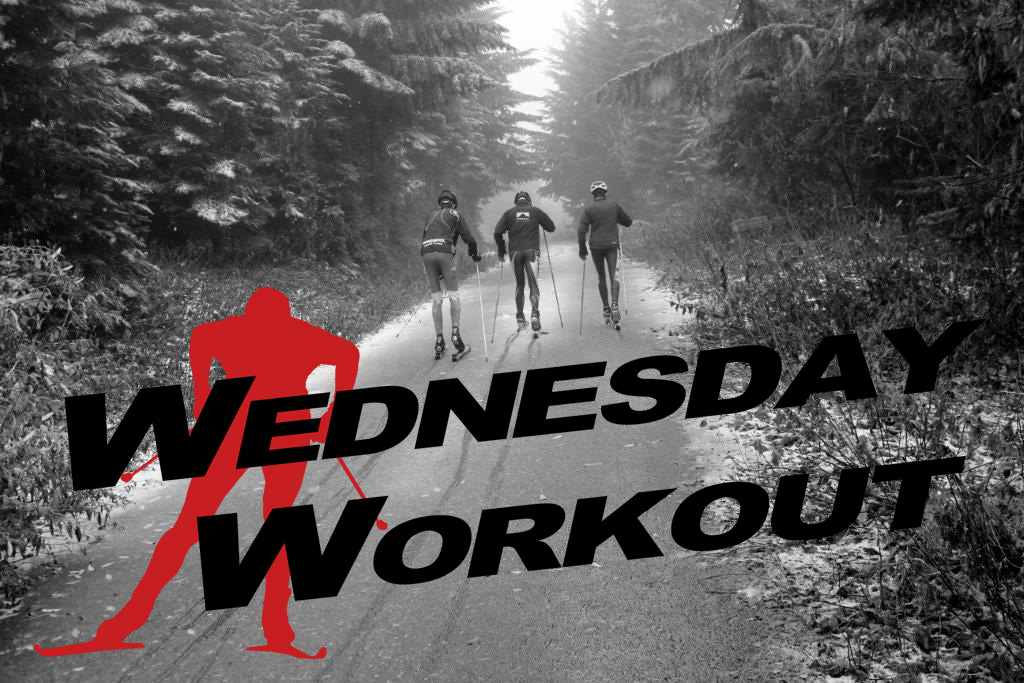
MBSEF skiers Matt Hecker (l), Casey Shannon (c), and Zeb Millslagle striding up Kochie’s Hill, a remote single-lane road in western Oregon with 4,645 feet of vertical climb in 14.6 miles. (Photo: Dan Simoneau)
Time passes and skiers come and go, but terrain (usually) doesn’t change – especially in remote parts of Oregon. In this week’s workout, Dan Simoneau, nordic program director at the Mt. Bachelor Sports Education Foundation (MBSEF) and 1984 Olympian, shares a place from the past, which he still drives his athletes from Bend, Ore., to today.
***
Kochie’s Hill in western Oregon: 4,645 feet of vertical climb in 14.6 miles. (Photo: Dan Simoneau)
Late summer can be tough training. Though MBSEF may have the shortest dryland season in the world, (we ski ’til late June), it’s hot, we’re tired of roller skiing, summer camps are over, winter seems so far away.
Late fall is also tough training. It’s now been months without a good yardstick to measure our fitness. Our roller ski wheels are worn. Our roller skiing patience is over. Snow seems near, but it also teases us, disturbing our training.
This year we broke up these two blocks with a trip to a pretty special place. A place that’s special to me and a place I wanted to pass on to the next generation.
I call it Kochie’s Hill. It’s a one-lane, paved logging road in the middle of dense, lush, nearly rain forest of Western Oregon. I don’t know the history of it, but I suspect it was built in the ’70s when lumber was the king of Oregon’s economy.
“From the bottom to the top it’s 14.6 miles with an elevation difference of about 3,700 feet. It’s all up. Striding up. There are a couple flats, and even a couple pretty substantial downs, but when you’re done you’ll only remember the up.”
For a couple years in the mid ’80s, Bill Koch lived in Eugene where I went to school and later graduated as an Oregon Duck. When the World Cup season would come to an end, we would both fly to Eugene where he would get back to family and I would get back to school.
Though I studied there from April to August and he lived just across town, we only trained together a couple times. That might have been a good thing because every time we trained together he left me wrecked – a shell of myself.
U.S. cross-country skiing great Bill Koch, who found a favorite hill climb in Oregon by plane. (Photo: Peter Ashley)
When he arrived in Eugene, I was anxious to show Bill my roller ski hills.
I say hills because my workouts were defined by the hills. Having been in Eugene for a few years I had the West Hills scouted. I knew the best hills, the long hills, the great intervals. I wanted to show him Gimple Hill, Baily Hill, Dillard Road, Briggs Hill, and a host of other roads that made me the skier I was.
But when we finally found a way to get together for a roller ski, Kochie had his hill in mind. He found it with a plane. I could have scoured the hills and roads of Oregon for years and there was no chance I would have ever found this road. To make a long story short, we went, he conquered, I crawled home.
Today, Kochie’s Hill lives on. From all evidence it sees little logging or traffic of any kind. It’s single lane road that at times is more of a bike path as moss, grass and trees are absorbing it back into the forest.
According to Map My Run, from the bottom to the top it’s 14.6 miles with an elevation difference of about 3,700 feet. It’s all up. Striding up. There are a couple flats, and even a couple pretty substantial downs, but when you’re done you’ll only remember the up. Total climb is 4,645 ft. You read that right. 4,645 ft of vertical in 14.6 miles.
The road has switchbacks, some chip seal for the first few k’s, plus plenty of places where nature is taking back its turf. But mostly it’s a great classic striding workout where you don’t need high visibility clothes, where you’ll stride for hours, and where the snow on top is a symbolic end to the dryland season.
Kochie’s hill is 90 minutes from MBSEF and it’s become a special place. A place we go when we need a change, when we need to escape the dog days of August, when we want to confirm that we’re fit enough for winter, and when we want to absorb some of the greatness of the best skier of the prior generation. Unfortunately, it’s also a place where the old coach starts telling old stories.
Kochie’s Hill profile
Kochie’s Hill map
MBSEF skiers Zeb Millslagle, Casey Shannon and Matt Hecker during a fall over-distance stride up Kochie’s Hill in western Oregon. (Photo: Dan Simoneau)
MBSEF skiers Zeb Millslagle, Casey Shannon and Matt Hecker striding up Kochie’s Hill in western Oregon in less-than-ideal conditions. (Photo: Dan Simoneau)
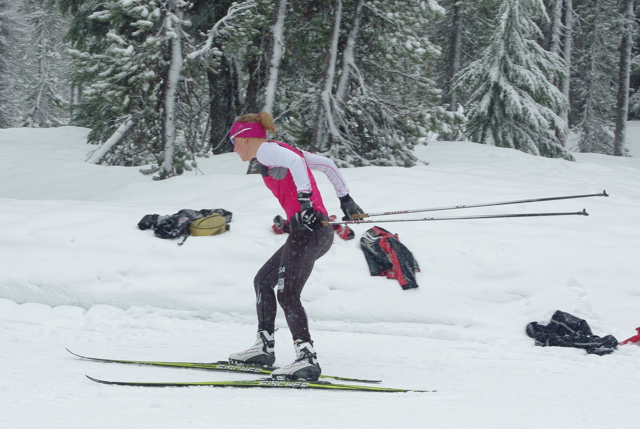
Emily Hyde (MBSEF) heads up Kochie’s Hill in Oregon. (Photo: Dan Simoneau)
Sierra Foster (MBSEF) double poling up Kochie’s Hill (Photo: Dan Simoneau)
MBSEF skiers at Kochie’s Hill in western Oregon: (from left to right) Sierra Foster, Brandi Jacobson, Matt Hecker, Casey Shannon, Zeb Millslagle, Emily Hyde, and Alec Wiltz. (Photo: Dan Simoneau)
Casey Shannon
Matt Hecker
Skiers train at Mt. Bachelor. (Photo: Dan Simoneau)
Sadie Bjornsen (USST) does video work. (Photo: Dan Simoneau)
Bjornsen. (Photo: Dan Simoneau)
Ida Sargent, USST. (Photo: Dan Simoneau)
Holly Brooks, USST. (Photo: Dan Simoneau)
Biathlon training in Bend. (Photo: Dan Simoneau)
Junior skiers follow a Canadian National Ski Team member. (Photo: Dan Simoneau)
Devon Kershaw, CNST. (Photo: Dan Simoneau)
(Photo: Dan Simoneau)
(Photo: Dan Simoneau)
(Photo: Dan Simoneau)
Lenny Valjas, CNST. (Photo: Dan Simoneau)
Valjas. (Photo: Dan Simoneau)
Bend area athletes. (Photo: Dan Simoneau)
(Photo: Dan Simoneau)
No-poles technique work. (Photo: Dan Simoneau)
(Photo: Dan Simoneau)
The U.S. and Canadian national teams currently in Bend, Ore., for their spring camps had an unstructured training session at Mt. Bachelor this weekend. Mt. Bachelor Ski Education Foundation nordic director and three-time Olympian Dan Simoneau snapped photos of junior skiers and World Cup athletes alike ski laps around the trails.
“One of the cool parts of these generation of racers is how much they want to pull kids along,” Simoneau said.
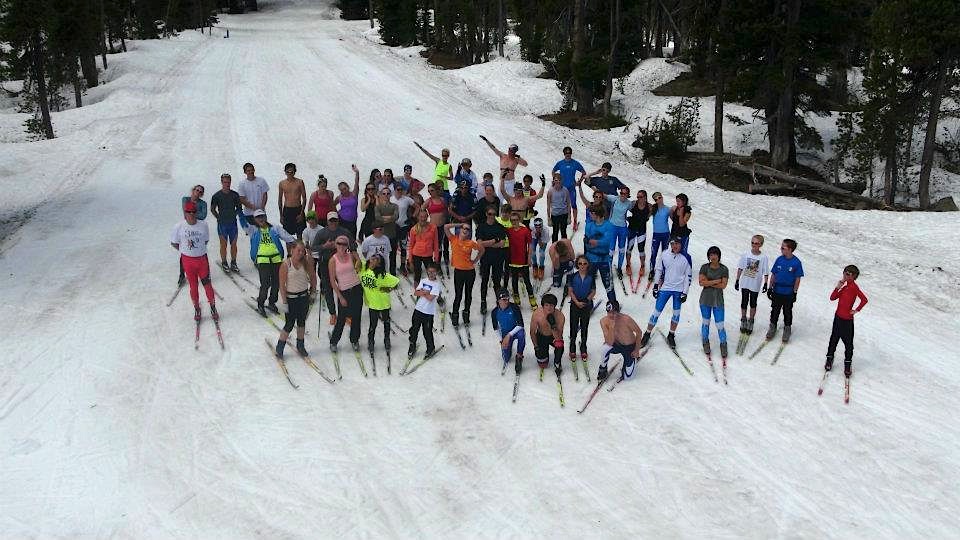
The Fire and Ice Camp crew last week at Mt. Bachelor in Bend, Ore. (MBSEF photo)
After a massive wave of spring skiers left Bend, Ore., last month, the groomers at Mt. Bachelor hardly packed it in. The U.S. and Canadian national teams and several elite squads were gone, but nearly the same amount of skiers – 150 – were expected to flock to the snow-covered trails in June.
The Mt. Bachelor Nordic Center and its club, the Mt. Bachelor Sports Education Foundation (MBSEF), planned accordingly. On June 16, the MBSEF greeted about 55 juniors to its five-day Fire and Ice camp, an annual tradition that’s followed national-team visits for years.
Lars Flora shows off his balancing skills at the Fire and Ice Camp from June 16-20 in Bend, Ore. Flora was the camp’s head coach. (MBSEF photo)
Lars Flora, a two-time Olympian and Alaska Pacific University (APU) skier, made the trip down from Anchorage for his third-straight year to serve as head coach. He worked with MBSEF Nordic Program Director Dan Simoneau, who coordinates the camp, to attract six competitive skiers to Fire and Ice as coaches.
After all the 9- to 18-year-olds said their goodbyes last Wednesday along with coaches Matt Liebsch, Torin Koos, Tyler Kornfield, Sylvan Ellefson, Ollie Burruss and Zoe Roy, Flora talked about the experience on the phone from Eugene, Ore., while watching the Olympic track and field trials on Saturday.
FasterSkier:How long has the Fire and Ice junior camp existed?
Lars Flora: Four years, I believe. It’s been going on for, off and on, forever. Now with two periods of skiing and Mt. Bachelor way more behind it, they are really getting interest from skiers. There were 300 skiers between the two periods of skiing this year, so that was really good. When the national teams were there, they were at 150, and around another 150 in the second period in June. The town’s really excited about it. It’s awesome.
FS:What’s the goal of the camp?
LF: Dan [Simoneau] and I came up with the idea to bring more top athletes to help coach and train while they’re in Bend. This was the third year we did it. This year we had a really good group of coaches. Sylvan volunteered his time because he was out there training and Matt Liebsch and Torin and Tyler Kornfield were asked early on. It was really cool that Sylvan just stepped up and wanted to help out.
FS:Where do the participants come from?
Trail running/bounding at the Fire and Ice junior camp last week in Bend, Ore. (MBSEF photo)
LF: Most of the skiers were from PNSA [Pacific Northwest Ski Association], so Washington and Oregon. There were around 55 [junior] skiers who did the camp and they range from 9 years old up to 18. It’s a pretty big range of ages.
FS:How did they respond to having so many talented coaches?
LF: Sometimes I wonder if they always realized what kind of lineup of coaches they have. You know how it is, you’re always skiing and then you just hang out with your friends and you kind of forget who these skiers are. But it’s the time we spend with athletes; we spend from 8 a.m. to 4 p.m. every day with them. We do a lot of fun stuff like rafting and paddleboarding and running and playing games, playing soccer and whatnot. I think it’s just a lot of good time to observe the top athletes and watch them and the inspiration to be around the best athletes in the U.S.
Like Matt and Sylvan and Torin, from an athlete’s standpoint, they’re great around kids; all three of them are amazing. [A University of Alaska Fairbanks skier,] Tyler’s just getting into that stuff. He’s young, he’s only 21, so it was really good for him to be there. It’s good for athletes to learn how to coach and put on clinics.
FS: How was the coaching and group size structured?
LF: It was a free-for-all (laughs). Nah, it was small groups. Sometimes we would split the group into two: the young ones, everyone under 13 and then everybody above 13. Other times we would take 10 to 15 skiers out at a time [with] one coach. It varied throughout the camp.
FS: They were on snow for all five days?
LF: Five days on snow and five days of dryland activity.
FS:How were the snow conditions and weather overall?
LF: It was really good. The first half it was a little dirtier than usual and then it snowed one night midway through and cleaned it all up. Driving over the pass [Saturday], it was snowing pretty hard. …
I would say [it was around] 50 to 60 [degrees] when we were skiing and then in town it was 70 to 80.
The first day after the camp ended it started raining so we lucked out with 10 days of sun. I say 10 days because the first five days the coaches were there training and then the second five days was the Fire and Ice camp.
FS:What were some of the most popular camp activities?
Part of the Fire and Ice Camp included whitewater rafting on the Deschutes River. (MBSEF photo)
LF: They loved to play Sharks and Minnows on skis. Sylvan actually said he might want to put that into his training plan next year. He had a good time playing Sharks and Minnows with the kids. The older ones respond to intervals with the coaches. We’ll pop into intervals with the 17- and 18-year-olds and I think that’s one of the best activities with 18-year-olds.
Everybody loves the raft trips. We had eight boats going down the Deschutes [River] and jumped in the water; a lot of water fights. I was with the 10- to 12-year-olds so that was fun to go down the Big Eddy with a bunch of young kids.
FS:And paddleboarding?
LF: Paddleboarding and rafting is with Sun Country Tours, [which] is owned by Dennis Oliphant who’s the president of MBSEF and used to be the nordic coach when I was younger. We paddleboard right down by Old Mill on the Deschutes.
FS:You mentioned the first camp sleepover this year. How did that go?
Site of the Fire and Ice camp sleepover, the Mt. Bachelor Nordic Center on Saturday after camp ended Wednesday, June 20. (MBSEF photo)
LF: Dan had this whole idea that he was going to do the first-ever sleepover at the nordic center and all the other coaches were like, ‘You’ve got to be kidding me.’ It ended up [being] great. We had a barbeque up there [on Tuesday night]. All the kids brought sleeping bags and pads, about ten of them slept out on the deck. It was a nice crisp night up there, and just kids everywhere camped out. They had a dance party.
It was pretty mellow actually, I was surprised. We had all of them to bed by 12 [a.m.] and woke up around 7 o’clock and had breakfast. We did a night ski around 10 p.m. and it was just rock-hard, perfect skiing so that was fun.
FS:How tired were you by the end of camp on Wednesday?
LF: I was pretty tired. It wasn’t so bad. It’s so much different now that I’m not training so coaching, you have way more energy. We used to do this camp while we trained, so we’d get out in the morning, and that’s what Matt and Tyler [were] doing, and Matt coached the whole time. Tyler coached two days, Torin coached two days, and Sylvan coached one day. Zoe coached one day.
FS:What draws you to these types of programs?
LF: I just think it’s really good for everyone. It’s a really good for development to get the top athletes in front of the younger skiers more, and Bend camp is the perfect place to have that happen.
FS:What do you think the impact is for the skiers and coaches?
LF: Some of the athletes were saying they’re going to spend a month out there next spring skiing and stuff. Sylvan was really excited about that and Tyler was just blown away. It was Tyler’s first time down to Bend so it was fun to bring him down there and show him a new place. He’s spent a lot of time in Alaska training in Fairbanks and Anchorage and he’s kind of at that point in his career where he needs a bit more. For him to go down to Bend and just see the resources that are in Oregon for skiing is a pretty good time. He was telling all his friends about it and sending them emails.
FS:Thanks. Are you spending the rest of the day at Hayward Field?
LF: Yeah, definitely. Rooting on the hometown boy from Bend. Ashton Eaton is leading the decathlon right now. (Note: Eaton not only qualified for the London Games this summer, but also broke the world record on Saturday.)
MBSEF juniors jumped in behind Ida Sargent (USST/Craftsbury) as she led the women's relay race at Mount Bachelor on Wednesday.
BEND, Ore. – The U.S. and Canadian national teams are here in Bend to get on snow, and they seem to be loving it.
But what about skiers who are already located in the Oregon Cascades? On several days, local high school athletes have also made the drive up to Mount Bachelor to ski and soak in the atmosphere at North America’s own version of the Dachstein glacier.
Unlike senior World Cup athletes, most juniors are still doing spring sports, and they haven’t started doing ski-specific intervals yet. But regardless of the difference in their yearly training plan, locals are making sure they show up.
“They’re not in ski season, and actually the biggest problem is the kids are all in school,” Mount Bachelor Sports Education Foundation (MBSEF) Head Coach Dan Simoneau said on Wednesday. “They’re all juniors, so they all skipped school today.”
Many local athletes participated in the Pole Pedal Paddle, and some had the chance to see U.S. Ski Team (USST) athletes there. That’s where North Eugene High School coach Tom Opsal ran into USST coaches.
“I met the coaches – Chris Grover, Matt Whitcomb, and a guy who introduced himself as a PT for the team – while setting up boats for the paddle section of the PPP,” Opsal said. “I asked what time they started skiing in the morning and if it would be okay for our kids to observe. I told the guys how little on snow experience we have, and a bit about the kids, and they all said, ‘Sure come ski with us.’ ”
Eugene is far enough west of the mountains that it doesn’t receive snow, meaning that Opsal’s athletes only get to ski at weekend camps and races; they are typically fit runners who do their best to quickly improve on technique. None, for instance, have been to Junior Nationals. But that didn’t limit the goodwill from national team coaches, according to Opsal, who grew up skiing in Canada.
“The next morning as we were getting ready to head out on the snow I saw Justin Wadsworth and again repeated my spiel about the kids,” he said. “Without exception the coaches’ reactions were very, very inclusionary. Even I was surprised how accommodating they were.”
Kikkan Randall with North Eugene High School skiers (l-r) Claire Pettit, Rheanna Williams, Helen Cutting, and Pearl Cutting at Fast and Female in Bend. Photo: Nancy Unruh.
Later in the day, the team lined the side of the hill as three USST coaches worked with Jessie Diggins and Ida Sargent on classic technique. Opsal pointed things out to his racers, including Toby Woods, a graduating senior who is done with his competitive ski career but will be playing baseball in college.
“At one point, Matt Whitcomb came over to us and started talking to the kids and even asked Toby about playing ball for Cornell,” Opsal said. “That a national team coach would take that much interest in a kid from Eugene who is never going to be a next-level skier speaks very highly of Matt in my mind, and in Toby’s.”
MBSEF, Eugene, and other high school teams spent several days skiing around Mount Bachelor, watching and following the national team and senior club athletes. While Simoneau, a 1984 and 1988 Olympian, said that a big goal was for his athletes to be able to observe the older skiers’ technique and mirror it to improve their own, it was also just a fun way to get motivated for another season of training.
“They’re up here jumping in behind skiers,” he said. “I told them to pick up the athletes halfway up the hill because they’ll be a little tired so they can stay with them. What a kick for a J1 to be following Kris Freeman!”
Opsal agreed, saying that his athletes were “shy at first” but then jumped in behind some of the U.S. women and chased them “to the best of their abilities.”
The high school racers picked up plenty of knowledge besides technique improvements, too. For Simoneau’s year-round training group, skiing around with World Cup athletes gave them a way of checking what aspects of skiing they needed to work on the most, which were sometimes different that what they had thought.
“I think it’s huge,” Simoneau said of the opportunity. “They follow them over the hill, they start down, and then they get dropped on the downhill. They’re learning something. What an opportunity – they had a great time. It was amazing.”
For Opsal’s group, just observing how the athletes approach training provided reinforcement for several things that he has been unsuccessfully trying to drill into the athletes.
“We spent a bit of time just looking at how every one of the skiers brought water and snacks to training,” Opsal said sheepishly. “And a big thanks to all the male skiers who skied with their shirts off, so I could point out over and over again that skiers use heart rate monitors. It’s simple stuff, but not one of my kids brought those things.”
Both Simoneau’s and Opsal’s skiers participated in the Fast and Female event on Sunday afternoon, and Simoneau said that he hoped the experience would get more girls from the Bend area involved in skiing.
“The biggest problem this year is that we had our kids event [the mini Pole Pedal Paddle] that day too, so we had 1500 kids doing that,” he said. “We have to get the calendar right next year.”
Fast and Female included a parallel session for parents and coaches featuring presentations on nutrition, physiology, development, and endurance training for young female athletes. For Simoneau, who spent 15 years away from the sport before returning to help out when MBSEF needed a coach, the presentations were a good brush-up.
For the Eugene athletes, the benefit of having the national teams around was mostly motivational.
“There were so many awesome encounters that weekend,” Opsal said. “I got a text that night from [a parent] on the drive home that the kids were still buzzing at 10 p.m. It was not the usual climb into the back of the car and fall asleep trip. … The biggest gain for me is the increased potential for motivated kids next year. Now when they recruit other kids [to the team] they will have stories of Olympians and World Champions to add to their tales.”
This article is the first installment of the ‘Where are They Now’ series, made possible through the generous support of Fischer Sports. Learn more about their products at www.fischersports.com.
John Caldwell. Photo: courtesy of Sophie Caldwell.
If you were to take stock of the people who have contributed the most to the development of cross-country skiing in the US, John Caldwell should be near the top of the list. He may beat everyone else simply because he’s had the longest amount of time to accomplish things—and at 82, he’s still got his opinions and and is not afraid to share them. Though he’s had multiple hip replacements and is a candidate for two new knees, Caldwell can still be seen shuffling on classic skis around New England.
Part of the goal of a “Where They Are Now” series is enlighten the younger generation on how something came to be. Though some past movers and shakers in the ski world may no longer be as active in the community as they once were, they are relevant for the same reason society bothers to study history. The past causes the present.
As a major player in the development of an always-changing sport, Caldwell is no mere historian. But the former Olympian, U.S. Ski Team (USST) coach, Putney School teacher, author, and New England Nordic Ski Association (NENSA) founder doesn’t like to single out any one of his accolades.
“I don’t think of being proud of anything,” he said in a recent interview with FasterSkier. “I just plug along.”
Caldwell was born in Pennsylvania, but his parents moved to Putney, Vt., in 1941, and he’s remained closely tied to the town ever since. He began his athletic career as a basketball player, but without a team to go out for in Putney, Caldwell’s dad got him started skiing. He skied at Dartmouth College at a time when intercollegiate skiing still featured four events. After graduating in 1950 and going to the 1952 Olympics as a Nordic Combined skier, he settled in Vermont to become a math teacher and ski coach at the Putney School.
Caldwell’s ski team quickly became so popular with students that he found himself with 50 skiers of widely varying abilities. As a matter of survival, he relied on repeated technique drills to manage athletes and develop good technical skiers, among them Bill Koch, Mike Gallagher, and his own children.
“It’s the idea of practicing something, not just, ‘Hey, go out and ski 5 k easy today,’” he said. “Some coaches will give you a heart monitor and tell you to keep your hear rate between 130 and 132 beats per minute, or something ridiculous like that, and think that they’re coaching. You’ve got to establish the importance of technique.”
John Caldwell, front left, with his wife, Hep, and all 10 of their grandchildren. Photo: courtesy of Sophie Caldwell.
With a seemingly endless supply of interesting and entertaining anecdotes, Caldwell has a story for every occasion.
Not long into the interview, he began reminiscing about his days as a coach for the U.S. national squad and interacting with the Soviet team.
At the height of the Cold War in 1966, the Americans and Soviets stayed in the same location for the World Championships in Oslo, Norway. Not wanting to appear in favor of one side of the Iron Curtain over another, the International Ski Federation (FIS) stuck the two countries together. It was Caldwell’s first time meeting the Russians.
“The Russians lent us their masseur, they said, ‘Do you boys want a massage?’ And the guys loved it,” laughed Caldwell. “They couldn’t have been nicer.”
The conversation soon moved to the American role as leaders in ski innovation during Caldwell’s day. It wasn’t just the advent of skating, he said, though that’s certainly the most-referenced example. According to Caldwell, the U.S. was also at the forefront of knowledge of equipment and wax. America boasted the first national team to shed bamboo poles in favor of lightweight metal poles in 1968—it was an American, Ed Scott, who invented the technology.
As for wax, even though it was originally a European product, Americans were also the first to realize that glide wax was for more than just going down hills.
“People in the sport now think, ‘Oh sure, you put glide wax on the tips and tails,’ but gosh almighty,we were the first country to do that. We had a clinic in Colorado Springs in the ’70s, and European coaches came over here to learn about waxing. We were at the forefront for a long time,” Caldwell said. And as a USST coach from 1960 to 1972, as well as the cross-country Olympic team coach in 1968, 1974 and 1984, he was right in the middle of it.
The U.S. even paved the way in the ever-important area of ski fashion. Caldwell recalled that his team in 1972 was the first one to race in one-piece uniforms. “Everyone looked at us like we were off the planet or something.”
America’s most famous contribution to the development of cross-country skiing is, of course, in the advancement of the skate technique. The U.S. didn’t invent it—according to Caldwell, that credit goes to a Finn, Paul Siitonen. But when Dan Simoneau came back from Europe one winter and told Caldwell about skiers he’d seen doing the marathon skate technique, the Putney School math teacher decided to set up an experiment.
With the help of a few of his students, Caldwell set up a test to compare kick double-pole and straight double-pole against the marathon skate. He measured not only lap times around a course, but also took heart rate data to determine if skating required more effort. Finding the new technique to be more efficient, Caldwell wrote an article saying skating was “the way to go,” but it still took a few years to catch on. Even after Bill Koch, Tom Siebels and Caldwell’s son Tim skated the whole stadium area during the World Juniors relay in 1971, the international ski community still hesitated to embrace the new technique—despite gaining the Americans gaining significant ground during the race and “astounding spectators.”
Jumping forward to the Lake Placid Olympics in 1980, the Games following Koch’s silver medal four years previously in Innsbruck, everyone expected Koch to produce even better results on home turf, but instead, “He blew up. It was a disaster.” Caldwell explained how, after the winter following the Lake Placid Games, Koch, angry at his performance, spent countless hours practicing the marathon skate on the trails in Putney.
“He would practice that all of ’81,” Caldwell recalled. “He’s very analytical. He’d set a 5 k course and do it three times. There’s a long uphill finish there, a great wide open field, and you could see his skate steps. The next time around he’d match up with those, trying to go the same distance with each step without losing energy or glide.”
The following winter, Koch was the overall World Cup champion, which Caldwell believes is in large part because he was the only one who could effectively skate. “He should, well, he does get credit for [developing skating]. He won the World Cup because of the extra speed from the marathon skate. Others weren’t doing it, or if they were, not with the same competence,” Caldwell said.
Following the 1982 season, FIS was forced to come up with a solution to the fact that skating was clearly faster than the diagonal stride, and it divided the races into separate events the following year.
When talking about Koch and the work he put in between the disappointment of 1980 and winning the overall World Cup in 1982, Caldwell pauses to explain why he thinks the US hasn’t been able to produce Koch’s level of results since.
“The team in 1981, after Lake Placid, didn’t have a lot of money,” he sad. “It’s something the USST has never figured out: ‘How come these guys got so good without our help?’ Most of these guys were living around East Putney and Brattleboro, except for Dan. They trained together a lot, but they didn’t have a coach. I didn’t pretend to be their coach … these guys just trained like hell, and that’s the best team we’ve ever had. I don’t think anyone can dispute that.”
Caldwell’s dissatisfaction with USSA is no secret. He published a series of critical articles on this website back in 2007, and his malcontent led him to help found NENSA in 1997. When the conversation shifted to his role in that organization’s formation, Caldwell reneged on his initial claim that no single contribution to skiing gave him more pride than another.
“That is one thing I am proud of. I think I was most responsible for starting that. I wrote the USST and said, ‘You guys aren’t helping us, so we’re gonna start our own organization,’ ” Caldwell said.
Critique of the USST wasn’t just words for Caldwell. He saw a gap in skiing development, and acted on his conviction. NENSA’s mission was, and still is, to get regional skiers at all levels involved in skiing, and to provide the infrastructure needed for athletes to reach their potential. Caldwell served as NENSA’s president until 2002, and most recently, New England has won the Alaska Cup at Junior Nationals for the past three years.
Current USST athletes Liz Stephen, Ida Sargent, Skyler Davis, Andy Newell and Kris Freeman have all taken part in the NENSA program.
“We should count more on the divisions, on the regions, and not have the USST try to be the overall rule,” he said. “They should be supporting programs like New England, Sun Valley, Alaska, Far West, and the rest.”
Caldwell believes this development model would provide at least part of a solution to the USST’s diminished budget. “They have what, four or five coaches out there?” he said. “That seems, I dunno…I know Zach [Caldwell] has been coaching Freeman, Sverre [Caldwell] coaches Newell and that new kid, Skyler Davis. Pretty soon you’re down to one coach for each person on the team. That’s not practical. Support the regions, then have your Olympic tryouts or whatever and may the best skiers win.”
When Caldwell himself was a coach, Olympic athletes were required by the International Olympic Committee (IOC) to maintain amateur status. The IOC removed the distinction between “amateur” and “professional” from its charter in 1986. None of the athletes Caldwell worked with, including Bill Koch, had any sponsors. He described his own job as their coach as completely amateur, too. Between 1966 and 1972, he recalled getting paid one of those years — $6,000 plus travel and expenses.
These days, Caldwell spends his time at home with his wife, Hep. He’s been known to bet New England skiers a beer they won’t be able to beat his grandkids, five of which are currently athletes on the eastern college or junior circuits. He admits he wouldn’t be able to coach anymore — “The whole sport has gone so technical.” Asked if he has anything to do with his family all being “above average” athletes, he credited keeping sports a fun family activity for his kids, who in turn did the same for the youngest generation of Caldwells.
So, where is John Caldwell now? Getting his sauna ready to enjoy with his friends, and looking forward to rooting for his grandchildren this winter.
Fire and Ice, the latest cross country ski camp on groomed trails in the US will take place from June 16 to 20 on the trails of Mt. Bachelor. Run by the Mt. Bachelor Sports Education Foundation Fire and Ice is the only camp in the US offering the opportunity for skiers to ski on World Class trails with impeccable grooming that late in the year.
“Skiers around the world are looking for high quality on-snow skiing opportunities in June,” said Lars Flora, two-time Olympian and Head Coach of MBSEF’s Fire and Ice. “But unless you’re on the trails of Mt. Bachelor, there isn’t a better place in the world with deep snow, on real ski trails, with high quality grooming at a reasonable altitude.”
According to Dan Simoneau, MBSEF Nordic Program Director who organizes the camp, “Fire and Ice is the latest evolution of camps that have been on the trails and slopes of Mt. Bachelor for over 30 year. In the weeks and days leading up to Fire and Ice, the US and Canadian National teams and some of the best clubs in the US will be using the same trails. If these trails are the best training for Canada’s new World Champions Alex Harvey and Devon Kershaw and US World Cup star Kikkan Randall, then this is clearly great skiing.”
“When Lars joined the staff of Fire and Ice a year ago, I fully expected to function as head coach, but once we got on snow, it was obvious Lars would function as head coach because he just had so much to offer the skiers,” said Simoneau. “He’s been skiing these trails from November till June since he was a kid and when he got in front of skiers he just wanted to share all that he has learned. Lars is a natural and gifted coach that we’re all lucky to be able to work with.”
New to Fire and Ice is the American Summer Cross Country Championships a sprint relay held on the last day of camp.
“After a few days of skiing the campers just want to go fast so we added fun race with a fun Championship format this year,” said Simoneau. “We just don’t know if this is the last race of last year, or the first race of the coming year.”
The 2011 Fire and Ice Summer Cross Country Ski Camp will feature:
15 kilometers of groomed skiing on the trails of Mt. Bachelor.
Five on-snow training sessions (2 Classic and 3 Skating)
Five dryland training sessions
Daily video technique analysis
Whitewater raft trip on the Deschutes River
Camp t-shirt
The American Summer Cross Country Skiing Championships
A BBQ with beach volleyball, awards, and prizes.
Fire and Ice, Bend Camp 2010 will have the following options:
3 day on snow only camp for skiers 8-11 for $325.
5 day Junior Camp for skiers 12-18 for $325.
5 day Masters Camp for $325.
For more information Fire and Ice 2011 contact Dan Simoneau at dansimoneau@bendcable.com or 541-350-9126. Registration forms for the Fire and Ice camp are available at www.mbsef.org/programs/crosscountry/ or visit BendCamp on Facebook.
MBSEF: 563 SW 13th, Suite 201 – Bend, OR 97701. Tel: 541-388-0002 – www.mbsef.org