Tag: Daniel Böhm

  • Germany Wins at Home in Soccer Arena; Canada Debuts at Schalke

    Germany Wins at Home in Soccer Arena; Canada Debuts at Schalke

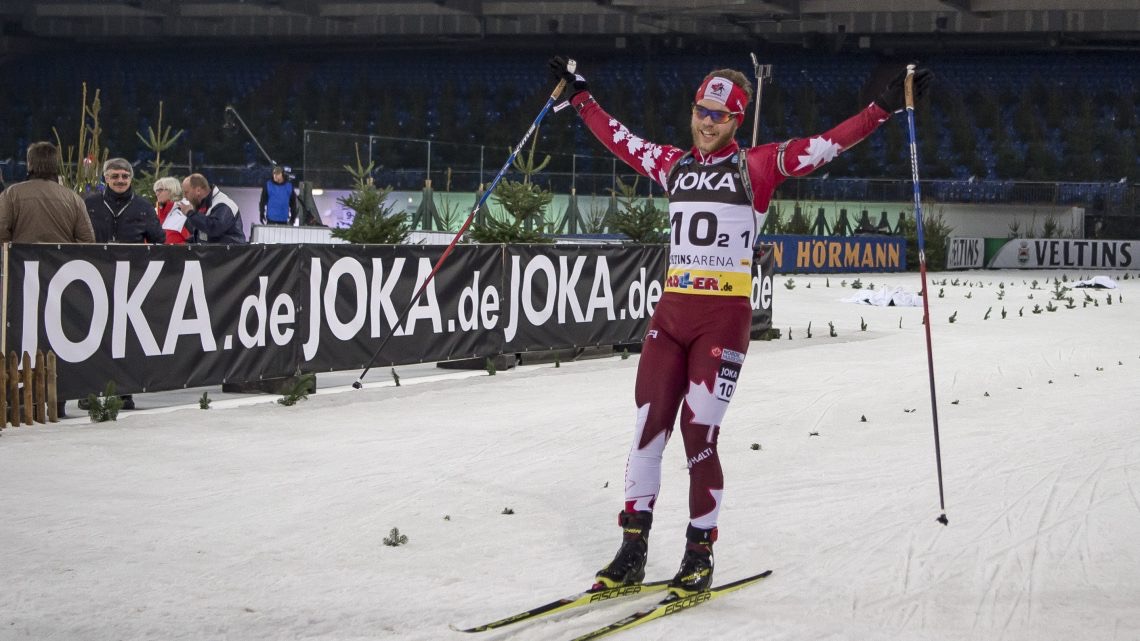
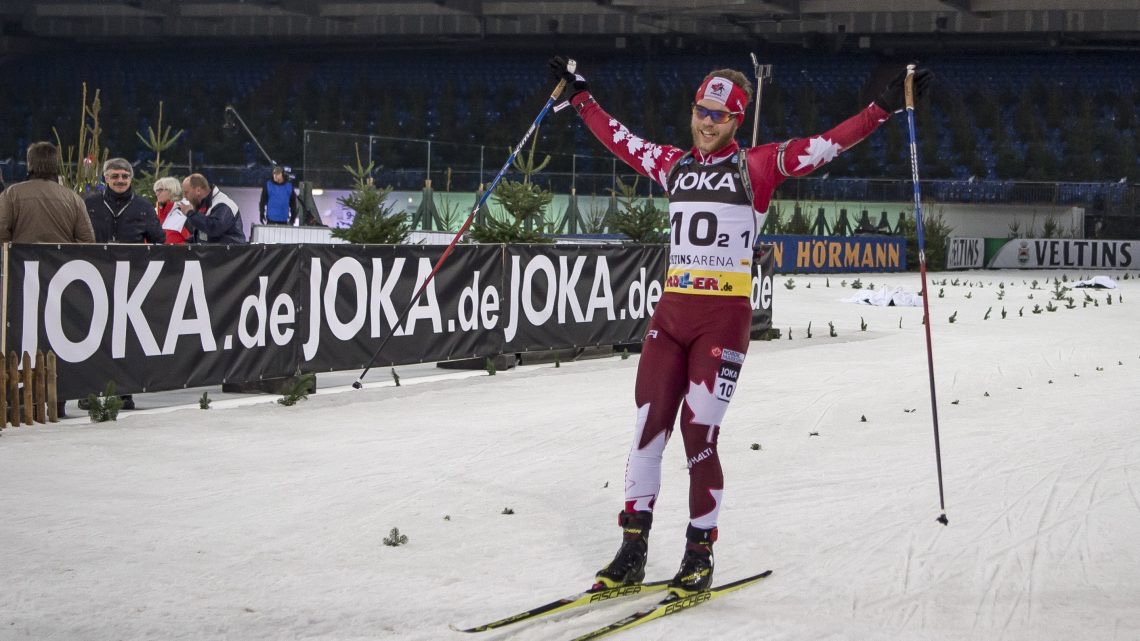
    Canada’s Macx Davies celebrates as he is cheered on by 42,000 fans during the final lap of the 2016 Biathlon auf Schalke invitational race. The Canadian relay team, with his partner Megan Tandy, finished 10th. (Photo: Biathlon-aufschalke.de)
    Canada’s Macx Davies celebrates as he is cheered on by 42,000 fans during the final lap of the 2016 Biathlon auf Schalke invitational race. The Canadian relay team, with his partner Megan Tandy, finished 10th. (Photo: Biathlon-aufschalke.de)

    A biathlon relay with athletes skiing around and through a huge soccer arena in a city with no snow seems like a crazy idea.

    But in the 1990s, the German cross-country skier and biathlete Herbert Fritzenwenger, who had retired from active sports after competing in the 1988 Calgary Olympic Games, believed there had to be some way to make biathlon even more attractive for viewers. He wanted to mix sports and entertainment bringing the sport out of the forest and closer to the people, the way city sprints are now doing it for cross-country. He also believed a discipline where women and men compete together would be more interesting to watch.

    Thus the World Team Challenge was born, a two-person mixed relay invitational, with each team representing a country. In 2002, Frizenwenger took the next step to bring that race to an even higher level of awareness. Together with the then-manager of first-league soccer team Schalke 04, he moved the event to the team’s newly constructed Veltins Arena in Gelsenkirchen, Germany. Only problem: The arena, which features a retractable roof, is located in a flat region of the country far away from any mountain range with predictable snowfall. But using manmade snow from a nearby ski hall to create a course just for this race every year the concept instantly worked, and has drawn some of the biggest crowds for any biathlon event in the world ever since.

    Now in its 15th year, the “Biathlon auf Schalke” race has become a Christmas holiday break tradition on TV in Germany, also broadcast live in several other countries. Many biathletes love the event for its atmosphere in front of 42,000 raucous fans in the arena, and as an interesting way to keep the race shape sharp during the break.

    This year’s edition took place on Wednesday evening, and it was the first time a Canadian relay was at the start, with Megan Tandy and Macx Davies teaming up to represent Canada in a show event that combines a mass start with a pursuit after a short “halftime” intermission.

    In both races, the Canadian pair quickly incurred a number of penalty laps (unlike in other relays the athletes are not allowed to use spares in the fast-paced competition) and slipped to the back of the field of 10 teams, tagging off to the partner after each shooting stage to chase once more over the 1.3-kilometer course around the arena.

    But Davies finished the event to huge cheers, with the audience elated by a victory of the home teams seemingly not wanting the show to be over yet, and screaming until he had crossed the line.

    “The atmosphere was GREAT!!!” Davies wrote in an email to FasterSkier. “Very loud and very fun crowd. They even cheered most of our shootings! (When we were the only ones in the range.) It was amazing to ski through the tunnel the last time to such a big ROAR from the stadium.”

    The arena was rocking particularly loudly as Germany’s fan-favorite Simon Schempp entered the finishing stretch for his first victory at Schalke with his partner Vanessa Hinz, crossing the line in a time of 33:11.4 minutes (with four penalties).

    Originally, the German coaches hadn’t selected Hinz to compete at Schalke, but she replaced her sick teammate, Franziska Preuss, to team up with Schempp. Last year, Hinz and Schempp had placed third in the World Team Challenge, with Hinz also subbing in at the last moment. This year, it was their time on the top of the podium.

    “Yeah, this is pretty crazy,” Schempp told German TV broadcaster ZDF after the race, in an interview that was heard throughout the arena. “That must be how soccer players feel every week. The atmosphere is gigantic. This is much more extreme than in a biathlon arena because there is a roof. I don’t know how many exactly, but I believe 40,000 people are here and it’s just crazy fun. [Cheers in the arena] You can hear it, craziness.”

    The announcer asked Hinz how she stayed so calm in front of her home crowd on the shooting range.

    “That’s what we do all year, but in front of such an audience your knees get weak,” she said. “It’s just brutal. We just want to say many thanks, because to experience something like this is unique.”

    The audience in the arena was happy to hear that, erupting in huge cheers again. Germany last won the event in 2013 with Laura Dahlmeier and Florian Graf. Dahlmeier, the current women’s overall IBU World Cup leader, took a break this year, as did the defending World Team Challenge champions Marie Dorin Habert and Martin Fourcade of France.
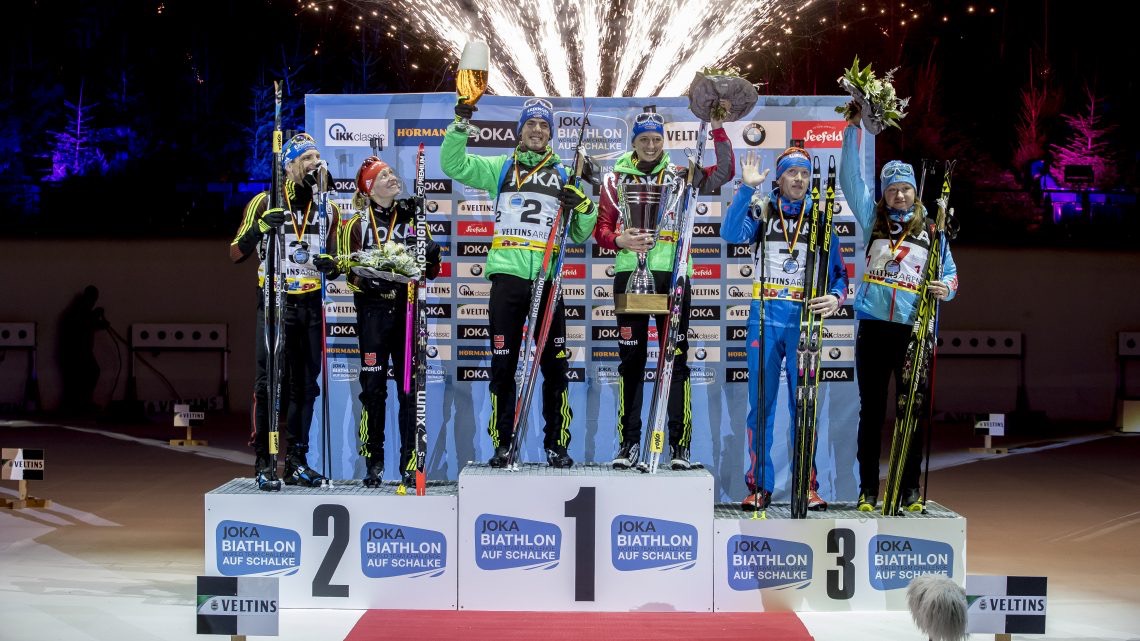
    The 2016 Biathlon auf Schalke podium on Wednesday night, with (from left to right) Germany’s Erik Lesser and Franziska Hildebrand (second place), Germany’s Simon Schempp and Vanessa Hinz (first place), and Russia’s Olga Podchufarova and Alexey Volkov (third place). (Picture: Biathlon-aufschalke.de)
    The 2016 Biathlon auf Schalke podium on Wednesday night, with (from left to right) Germany’s Erik Lesser and Franziska Hildebrand (second place), Germany’s Simon Schempp and Vanessa Hinz (first place), and Russia’s Olga Podchufarova and Alexey Volkov (third place). (Photo: Biathlon-aufschalke.de)

    Despite usually entering multiple teams at Schalke, Germany had not been able to claim first and second on the podium — until this year, which sent the arena into frenzy.

    For Germany’s second team, Franziska Hildebrand teamed up with Erik Lesser for the second-straight year after the duo finished seventh in 2015. They came close to the overall victory this time, winning the mass start by 15 seconds ahead of Hinz and Schempp, and later staying in their vicinity throughout the pursuit. But Lesser missed his final standing shot when he still had a small chance to catch up to Schempp in first.

    “Of course [the atmosphere] is pushing me,” Hildebrand had told ZDF at halftime, after the mass start. “It’s such an incredible audience. It’s so beautiful when you come into the arena as a German athlete and experience such a loud support. That is always a total buzz, a breathtaking moment.”

    On the first loop of the pursuit Lesser broke his pole after stepping on it, and did not receive a replacement until after the exchange to Hildebrand.

    “For the shooting I don’t need a pole, and afterwards that half-a-second I lost I can deal with that, before someone runs over and probably breaks his foot,” he told ZDF after the race, causing a big laughter in the arena. “Such a great atmosphere. The spectators are really picking it up. And that’s why I am here.”

    At times more than a minute ahead of the field, the German teams made the race relatively close again with two laps to go, when standing next to each other both Hinz and Hildebrand shot two penalties despite their otherwise almost-flawless shooting performances.

    The third place on the podium went to Russia’s Olga Podchufarova and Alexey Volkov (who won gold with the men’s relay at the 2014 Olympics), narrowly edging out France’s Anaïs Bescond and Jean-Guillaume Béatrix (+42.6), Austria’s Julia Schwaiger and Simon Eder (+43.0) and Norway’s husband-and-wife team of Fanny Horn Birkeland and Lars Helge Birkeland (+43.3) on the final loop and finishing sprint.

    Long Day on a Challenging Course

    Originally, Tandy — who trains and lives in Germany for part of the year — had planned on racing with Biathlon Canada teammate Nathan Smith, but Smith returned to Canada after struggling in the initial World Cup races of the season with unclear symptoms, which he has since been trying to resolve.

    “After Nathan went home I was talking with Megan and [coach] Matthias Ahrens about if it would be possible to race,” Davies explained. “Because I have been watching this race for a long time now and always thought it would be an awesome event to compete at, which it is! So I changed my plans so we could start an all-Canadian team and I am very happy to have raced the World Team Challenge!”
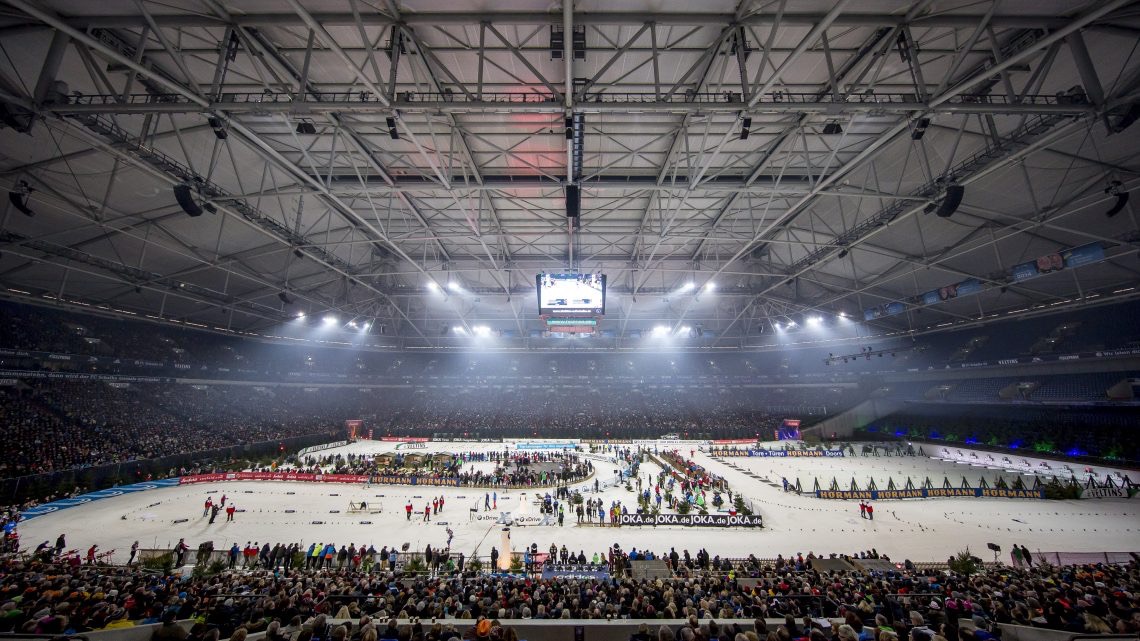
    View of the indoor section of the ski track and the shooting range inside the domed Veltins Arena during the 2016 Biathlon auf Schalke invitational. (Photo: Biathlon-aufSchalke.de)
    View of the indoor section of the ski track and the shooting range inside the domed Veltins Arena during the 2016 Biathlon auf Schalke invitational. (Photo: Biathlon-aufSchalke.de)

    Even more so than a regular IBU World Cup, the race is held in a huge party atmosphere, with athletes skiing through a winter village park with food stands and sponsor exhibition tents lining the artificial snow track around the huge soccer arena, before entering the pitch inside the arena again via a darkened tunnel with light effects. And then having to shoot in front of the 42,000 fans, frequently with loud music blaring, and the noise level amplified indoors many times.

    The World Team Challenge relay race is also executed in a special format, with one woman and one man forming a team and exchanging repeatedly, each skiing a loop of about 1.3 k and having to clean a shooting stage — or ski a shorter-than-usual 75-meter penalty lap — before tagging off to their teammate again. While one athlete was out on the track, crews of wax technicians hurried to clean and prepare the skis of the athlete who was receiving a short break. This mode of competition is fairly similar to the new single mixed relay in biathlon or the team sprint in cross-country.

    It was a long race day for the athletes, with a “shootout” followed by the main event split into two “halftimes,” as the organizers called it, borrowing the terms from soccer. At first a nine-loop mass start (the women skied four loops, the men five including the final loop) on the 1.3 k course, followed by a pursuit race of that same length after just a short intermission. Thus the women had to ski about 10 k in total, while the men had to ski 13 k.

    The gaps to the best team in the mass start were halved respectively, capped at a maximum of 45 seconds for the pursuit, so even the teams at the back of the field like Canada could still have a realistic shot at the podium.

    Prone and standing stages interchanged with each partner shooting twice in prone and twice in standing per race, and because the loops were comparatively short and intense, like a sprint, shooting accuracy was at least as important as in regular World Cup races.

    “I really like the format of this race, and think maybe it should replace the Single Mixed relay,” Davies explained in his email. “But maybe only race once, doing both was very challenging. But it is a fun event nonetheless!”

    In the first few years of the Biathlon auf Schalke event, the course was a relatively flat loop, but after a redesign last year added longer climbs and a downhill section on the part of the track that meanders through the park outside the arena, it is supposed to more closely resemble what athletes would see “on the World Cup level,” as the organizers announced in a presentation before the race.

    Using artificial snow mostly coming from a ski hall in the nearby city of Neuss, every loop is now 1,300 meters long, featuring 30 meters of vertical climb nicknamed the “Ruhrpott Glacier”, which added up to about 300 meters for the men and 240 for the women for the whole race day.

    “It’s really not just a show race,” Schempp told broadcaster ZDF. “The legs are really burning very much. Because you have those short individual loops, but that just makes it even worse because you just ski that kilometer even faster than at normal competition speed. And because of that it is really challenging, but still is a lot of fun.”

    “The course is really good for what they have,” Davies wrote in his email. ”The stadium is exciting with all the corners and I think the track is decently difficult, though below World Cup level. I think they did a better job on the downhill corner this year, because it was easier to ski, the athletes don’t like to see crashes.”

    The athletes had fewer problems with that downhill section leading into a sharp-right hairpin turn than during the prior year when that was introduced, but the Czech Republic’s defending World Cup winner Gabriela Koukalová fell this year, grimacing and rubbing her thigh as she got back up. She finished seventh with her partner, Michal Šlesingr, after placing second with Ondrej Moravec in 2015.

    “We just saw [a replay of] Gabriela slipping out there,” Hildebrand told ZDF when questioned about her more conservative downhill snowplow technique. “I wanted to avoid that at all costs, so I chose the safety version.”

    After some years where the organizers experimented with rifles using a laser-aiming system, the athletes now use their own rifles with real ammunition on the 10-position range again, with bulletproof glass walls and an empty section behind it to protect the audience.

    The difficulty of the course was once again evident during the races. Despite the indoor shooting range with almost no wind influence, many athletes who are known as good shooters incurred more misses and thus had to skate more penalty loops than they normally would in a World Cup.

    “The shooting range was good, no wind, which is nice, but you are skiing very hard into the range and must shoot fast and accurately to stay with the leaders,” Davies commented.

    2016 World Team Challenge Results 

    1. Germany I (Vanessa Hinz/Simon Schemp) 33:11.4
    2. Germany II (Franziska Hildebrand/Erik Lesser), +16.7
    3. Russia (Olga Podchufarova/Alexey Volkov), +40.2
    4. France (Anaïs Bescond/Jean-Guillaume Béatrix), +42.6
    5. Austria (Julia Schwaiger/Simon Eder), +43.0
    6. Norway (Fanny Horn Birkeland/Lars Helge Birkeland), +43.3
    7. Czech Republic (Gabriela Koukalová/Michal Šlesingr), +57.6
    8. Italy (Dorothea Wierer/Dominik Windisch), +1:06.1
    9. Ukraine (Olena Pidhrushna/Serhiy Semenov), +1:20.0
    10. Canada (Megan Tandy/Macx Davies), +2:32.0
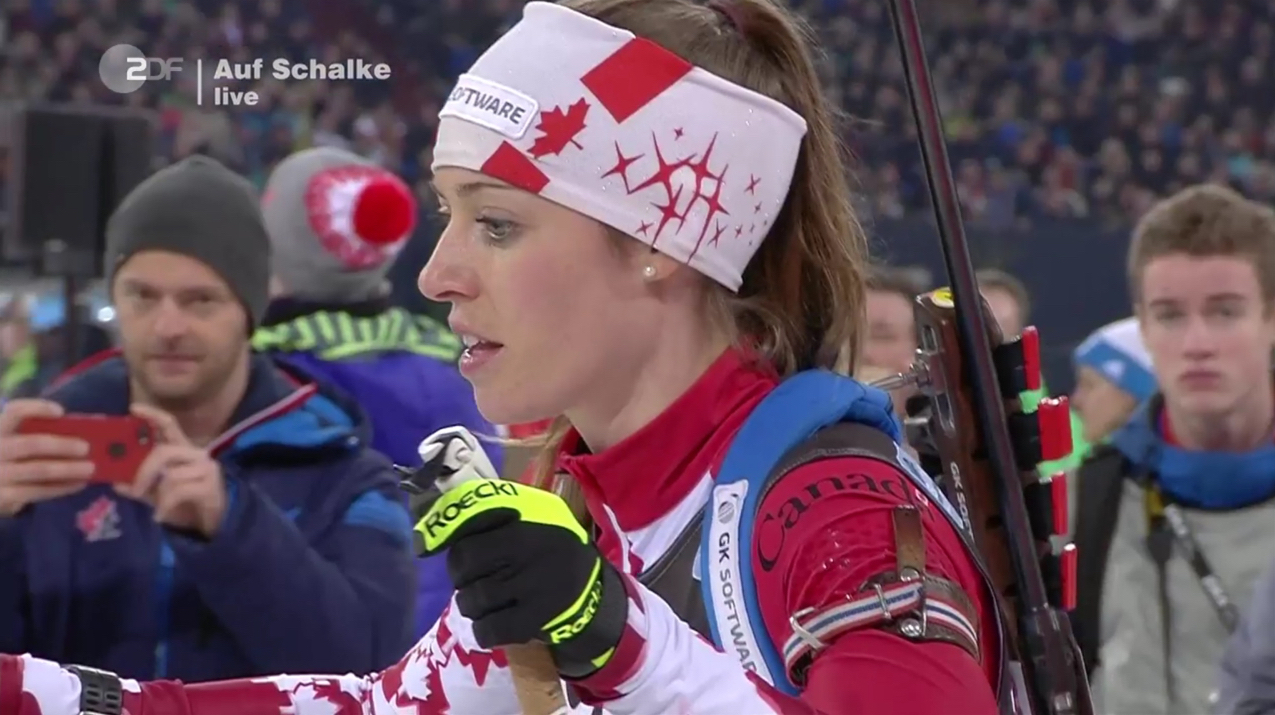
    Canada’s Megan Tandy at the start of the pursuit race during the 2016 Biathlon auf Schalke invitational event. (Photo: ZDF broadcast)
    Canada’s Megan Tandy at the start of the pursuit race during the 2016 Biathlon auf Schalke invitational event. (Photo: ZDF broadcast)

    Tandy and Davies became the fifth North American team to be invited to the Biathlon auf Schalke event, and the first Canadian one. In 2008 and 2009, Lanny Barnes and Jay Hakkinen represented the U.S., placing ninth and sixth for the best finish by a North American team to-date. In 2010, Tracy Barnes-Coliander and Tim Burke finished 10th, and in 2012, Susan Dunklee teamed up with Burke for 10th.

    “What a fun event last night,” Davies summed up his experience on his Facebook page. “I am very thankful to have been able to compete in the Biathlon World Team Challenge and I hope to be invited back to show you how good Canada can be! (Unfortunately we didn’t do very well this time…) Till next year.”

    “I second everything Macx wrote ☺ ☺ ☺,” Tandy commented on his status.

    Pre-Race Events with a Farewell to a Former World Champion

    Before the two main races of the evening, Russia’s Volkov won a “shootout” event among all participating women and men, narrowly edging out Austria’s Eder, who is known for his fast shooting performances on the World Cup circuit, with Germany’s Hildebrand finishing third and Schempp fourth. Tandy and Davies had not qualified for the final of that event.

    In this competition the athletes — while not wearing skis — were required to run up to the shooting mats and hit 20 targets as fast as possible (5 prone, 5 standing, 5 prone, 5 standing), using as many spare rounds as necessary.

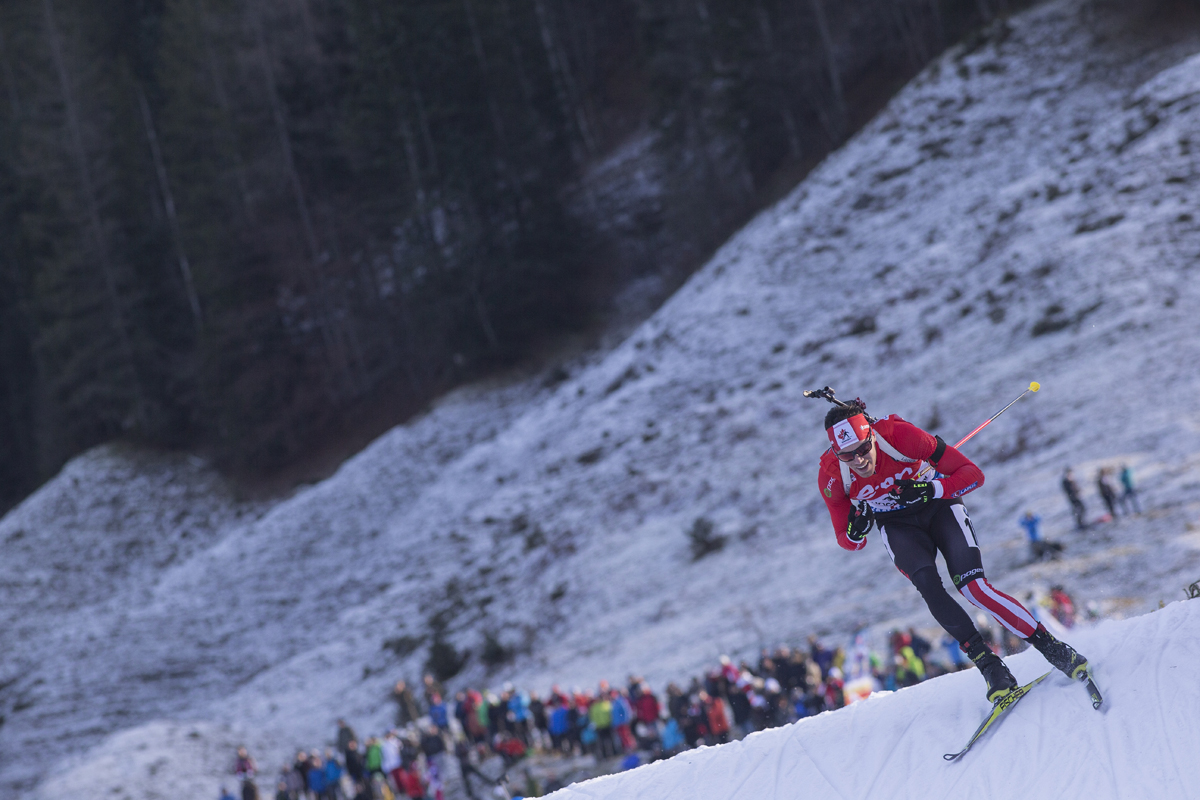
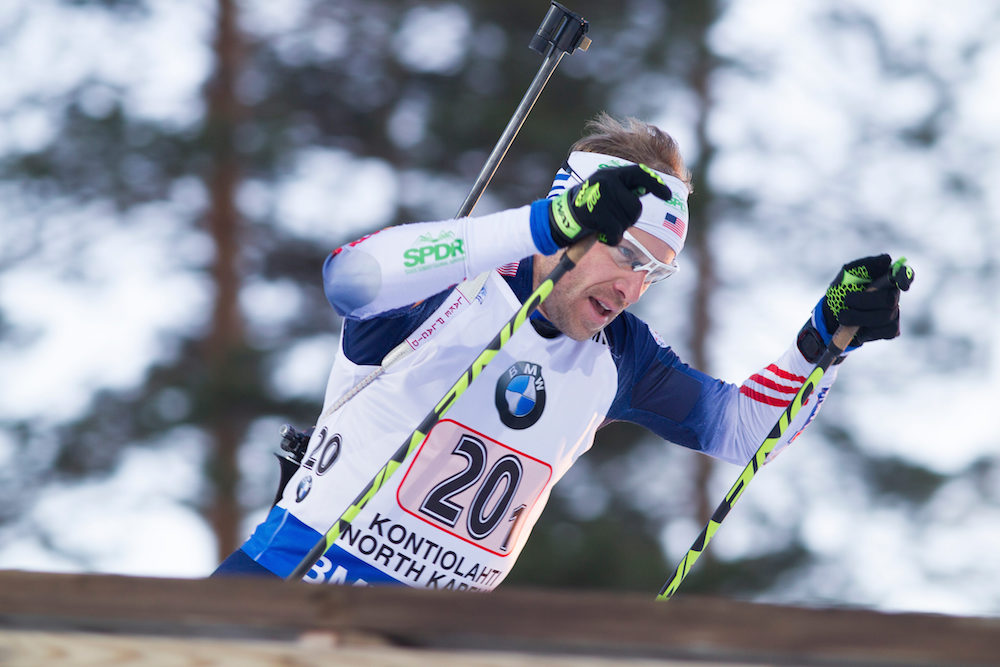
    The organizers also used the shootout event as a farewell to Germany’s national team member Daniel Böhm, men’s relay gold medal winner at the 2015 World Championships in Kontiolahti, Finland, and silver medalist in the relay at the 2014 Olympics in Sochi, who announced his retirement from biathlon earlier this month. He qualified for the final round of the shootout, where he finished fifth. Böhm plans to begin a training program to become a helicopter pilot with the German federal police.

    “In the shootout I was a little bit shaky,” Böhm told ZDF. “It is something very special to compete here at Schalke. And I think there is nobody who can completely tune this out. It’s crazy what the fans are doing here, and great that I am allowed to say goodbye on this stage. That is a special honor, and now I can enjoy it looking on from the outside.”

    While the IBU has adopted the mixed and single mixed relay formats in the last years as attractive new disciplines, Biathlon auf Schalke is an invitation-only race not hosted by the IBU, so there were no World Cup points to win in the event. However about €168,000 ($175,000 dollars) in prize money were awarded.

    The IBU World Cup will resume next week Jan. 5-8 in Oberhof, Germany, with sprint races, pursuits and mass starts.
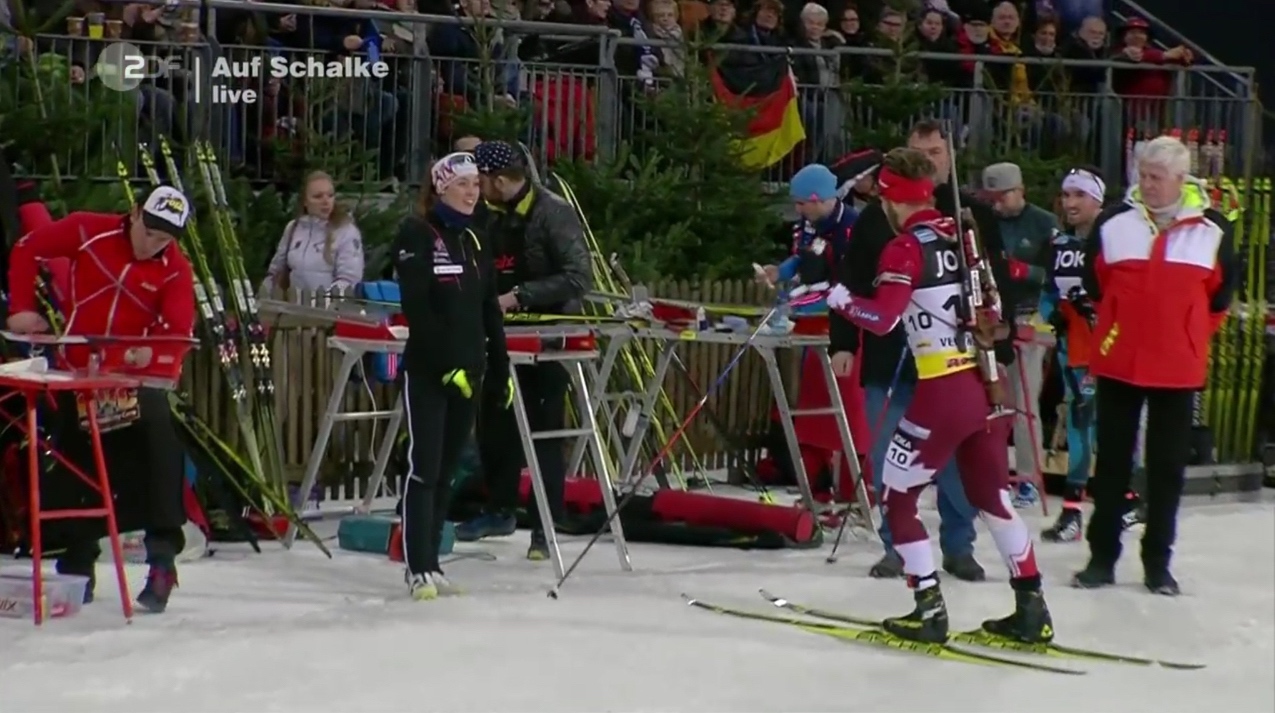
    Canada Biathlon’s Megan Tandy (in black) greets her relay partner Macx Davies in the tech service area after the mass start race during the 2016 Biathlon auf Schalke invitational event. (Photo: ZDF broadcast)
    Canada Biathlon’s Megan Tandy (in black) greets her relay partner Macx Davies in the tech service area after the mass start race during the 2016 Biathlon auf Schalke invitational event. (Photo: ZDF broadcast)
  • Fourcade Strikes Back in Hochfilzen Pursuit; Bailey Just Misses Top 10

    Fourcade Strikes Back in Hochfilzen Pursuit; Bailey Just Misses Top 10

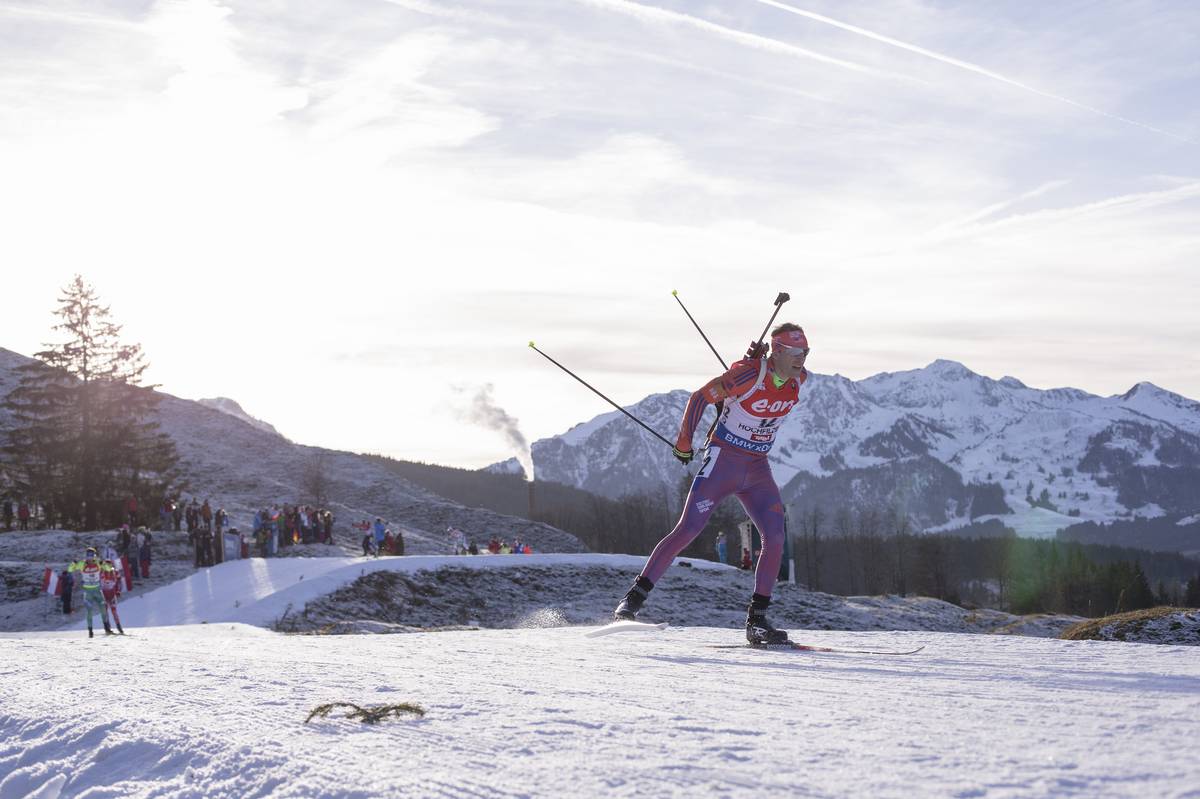
    Lowell Bailey on his way to 13th in the men's 12.5 k pursuit at the IBU World Cup in Hochfilzen, Austria. (Photo: USBA/NordicFocus)
    Lowell Bailey (US Biathlon) on his way to 13th in the men’s 12.5 k pursuit at the IBU World Cup in Hochfilzen, Austria. (Photo: USBA/NordicFocus)

    Despite the best efforts of his competitors, it appeared French biathlon star Martin Fourcade was almost his own worst enemy in Saturday’s 12.5-kilometer World Cup pursuit in Hochfilzen, Austria.

    In a scene reminiscent of Norwegian cross-country skier Heidi Weng’s mistake in Kuusamo earlier this season, Fourcade, who was being followed closely by Germany’s Simon Schempp and Russia’s Anton Shipulin, nearly skipped his final shooting stage. He was saved, though, because as he turned towards the finishing stretch, he saw his two competitors ski toward the range again. He very quickly realized his mistake, and followed them, keeping his focus to clean the final stage.

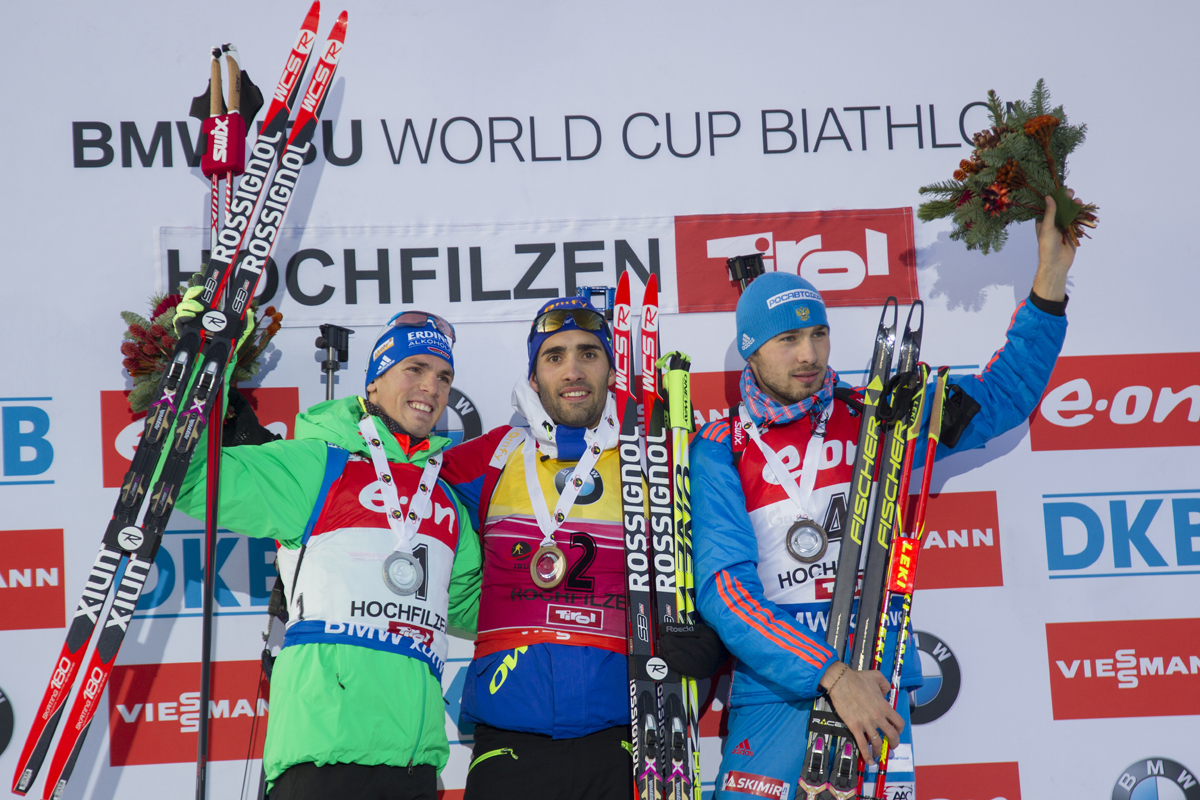
    After that he never looked back until he finished first in 31:19.9, pounding his chest and pointing to the crowd as he did so. Schempp finished 8.9 seconds later in second place and Shipulin was 19.1 seconds back in third to round out the podium.

    After what runner-up Simon Schempp (l) of Germany called a "psycho race" Schempp, winner Martin Fourcade (c) of France, and Russia's Anton Shipulin (r) shared the pursuit podium at the IBU World Cup in Hochfilzen, Austria. (Photo: Fischer/NordicFocus)
    After what runner-up Simon Schempp (l) of Germany called a “psycho race” Schempp, winner Martin Fourcade (c) of France, and Russia’s Anton Shipulin (r) shared the pursuit podium at the IBU World Cup in Hochfilzen, Austria. (Photo: Fischer/NordicFocus)

    During a post-race press conference, Fourcade had no comment on his nearly-disastrous wrong turn. But Schempp, who suspected a mistake mused it might just have been a move by Fourcade to avoid having to go on the first position on the shooting range.

    “It was a wonderful victory at the site of the next [2017] World Championships,” Fourcade told the IBU. “My fan club, my family, is here, and it was a really good fight. I love to win, but I love to win more when the opponents are really strong. Today it was a great fight, which is why I’m so happy to succeed.”

    For most of the race, Friday’s sprint runner-up Fourcade had struck with or been within a few seconds of sprint winner Schempp and Shipulin, who started fourth. After taking the control of the pursuit, each with two clean shooting stages, Schempp and Shipulin at times slowed down considerably on the track, skating next to each other with Shipulin gesturing wildly for Schempp to take his turn in front, but the German was seemingly unwilling to set the pace.

    This posturing enabled a few athletes, including Fourcade, to close the gap to them again, after Fourcade had missed two targets in the second shooting. But he, too, didn’t want to take the lead.

    All three athletes managed to leave the crucial last shooting stage without a miss. Fourcade shot the fastest, and Schempp entered the final lap about five seconds later, with Shipulin 12 seconds behind. They tried everything in their power to catch Fourcade, but to no avail.

    “I am happy about the second place,” Schempp told the German broadcaster ARD, “but it was a complete psycho race. Like Martin not wanting to go in front, then attacking just ahead of the shooting, then he wanted to skate into the finish…”

    “It was not so easy for my brain. Topsy-turvy, but that’s part of the game,” he added. “It was a fine competition [for me] with one miss on the shooting range. And of course I’m happy with the second place.”

    Nathan Smith (Biathlon Canada) racing to 18th in the IBU World Cup pursuit in Hochfilzen, Austria. (Photo: Fischer/NordicFocus)
    Nathan Smith (Biathlon Canada) racing to 18th in the IBU World Cup pursuit in Hochfilzen, Austria. (Photo: Fischer/NordicFocus)

    Both athletes complimented their fierce competition afterward.

    “I gave all I had in the beginning of the loop,” Schempp said in the press conference. “The gap was the same a long time, but at the last hill, Martin was very strong, so I had to defend my second place to Anton.”

    Fourcade echoed those remarks after swapping positions with Schempp in two races between Friday and Saturday.

    “Simon showed me on the last lap it was necessary to do my best,” Fourcade said. “This week I had to give 100 percent. It was a great fight between us.”

    Shipulin also expressed his satisfaction with his first podium of the season.

    “I realized those are my conditions and I’m getting better and better compared to the first leg in Östersund,” he said through a translator. “I still have to work hard on my form, but I’m really glad this is the first podium for me, and I’m doing better and better race by race.

    “I have always loved pursuits,” Shipulin added. “Of course, I was a bit disappointed [Friday] with the fourth place, but I only tried to pay attention to today and in the end the podium is a good result.”

    Last week at the World Cup in Östersund, Sweden, Schempp struggled mightily with the windy range, missing the pursuit after placing out of the top 60 in the sprint.

    Asked before Saturday’s race how he coped and turned a difficult situation into a sprint victory on Friday, Schempp revealed his latest training secret to ARD: last week, he had worked with his home-team coach and assistant national-team coach Andreas Stitzl, using a leaf blower to simulate strong sudden gusts of wind.

    While he acknowledged Fourcade’s strong performance in the two Hochfilzen individual races, Schempp was not too pleased with a scene that happened during the final shooting stage. He claimed Fourcade, who was next to him, nicked Schempp’s ski poles on the mat between his legs while Fourcade left the range.

    “You have to be able to focus on yourself, but of course you notice what happens left and right,” Schempp told ARD. “I noticed Martin had hit everything in the last shooting, he was a little bit faster than me. And then when he was leaving, he hit my ski poles good, while I still had one shot. That brought me out of my rhythm a little bit, but thank God I hit it. Then on the last round I tried everything, but there was nothing left.”

    Schempp reiterated this irritation in his post-race interview with the IBU: “I was not calm every time. It was a psycho race. You have to be calm.”

    Norway’s Tarjei Bø, who had started the pursuit in third, always kept the leaders in viewing distance but couldn’t quite catch them in the end, finishing with two penalties (0+1+0+1) and missing the podium by 12 seconds (+31.2).

    With about 8,000 spectators in the stadium and lining the course in the Austrian Alps, local fan favorite Dominik Landertinger managed to move up eight positions with a single miss, finishing fifth place (+39.8), ahead of Norwegian stars Ole Einar Bjørndalen (+57.5) and Emil Hegle Svendsen (+59.5).

    Landertinger told the Austrian television broadcaster ORF that he’s been struggling with the recent death of his mother and wished she could have been there to see him.

    “Everything I had to go through in recent weeks, I can tune that out pretty well during the race,” he said. “I have a great family with everyone supporting each other, but this has been a hard time for me.

    “That was a very good race. I came through the shooting great. I achieved exactly what I had set out to do. Focus just on myself,” Landertinger added. “But for the podium I should not have had that miss. You’ve got to be satisfied, there are so many good guys here.”

    Bailey Just Outside Top 10

    Lowell Bailey on his way to 13th in the men's 12.5 k pursuit at the IBU World Cup in Hochfilzen, Austria. (Photo: USBA/NordicFocus)
    Lowell Bailey on his way to 13th in the men’s 12.5 k pursuit at the IBU World Cup in Hochfilzen, Austria. (Photo: USBA/NordicFocus)

    Of the eight North American men in Saturday’s pursuit, US Biathlon’s Lowell Bailey came closest to a top 10 after starting 12th and briefly moving into eighth with two clean prone stages. He skied the third lap in a fairly large chase group with six other athletes, but after missing a target in the first standing, Bailey fell back to 13th.

    From there, the 34-year-old Bailey pushed to hang on up two climbs on the course. After cleaning his final standing stage, he left the range for a last time in 10th place, just between Germany’s Andreas Birnbacher and Slovenia’s Jakov Fak. Bailey faded a bit on the last loop, and in the finish he had given up the positions he previously gained on the shooting range, ending the day in 13th place (+1:20).

    “Today was a great indicator of how strong the current men’s World Cup field is,” Bailey said in a US Biathlon press release. “I feel really good about my race today, but unfortunately I wasn’t able to hold or improve my starting place. Some days the field is just that strong and you just have to live with the result. Still, I’m happy with another top-15 and excited for the relay tomorrow.”

    Nathan Smith of Canada skates his way to 18th at the IBU World Cup pursuit in Hochfilzen, Austria. (Photo: Fischer/NordicFocus)
    Nathan Smith (Biathlon Canada) racing to 18th in the IBU World Cup pursuit in Hochfilzen, Austria. (Photo: Fischer/NordicFocus)

    Biathlon Canada’s Nathan Smith ended the day in 18th (+1:48.4) — the same position he had started in — with too many penalty laps preventing a better result. Smith missed two targets in the first shooting, then cleaned the next two stages before adding another two penalties in the last standing to his tally. His skiing remained strong, posting the fifth-fastest time on the final lap for the 13th-best course time overall.

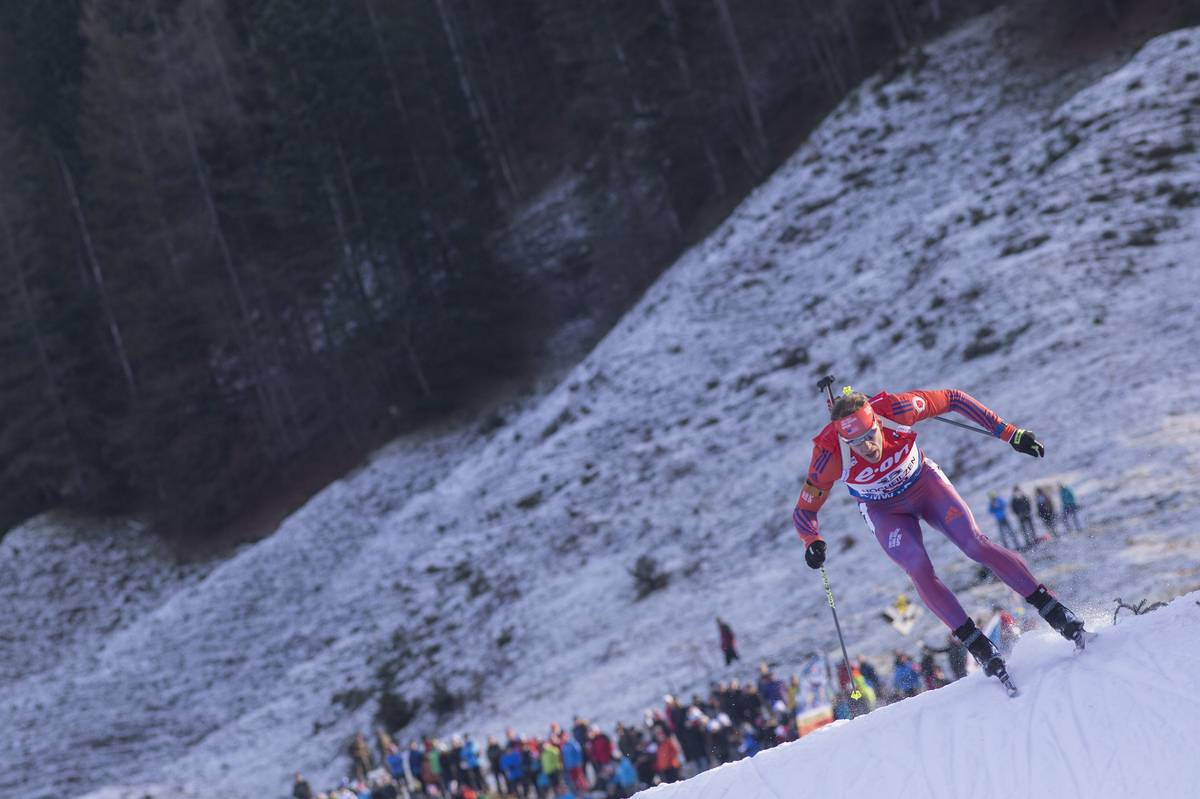
    On Friday, Smith had predicted “some spectacular crashes” in the pursuit, due to the difficult snow conditions on the course. Crashes didn’t decide the outcome of Saturday’s race, but indeed, there were some victims. Germany’s Daniel Böhm careened off the course on the third lap in a downhill hairpin turn, then struggled back to his feet and onto the elevated track. Worse yet, in addition to the lost time, Böhm damaged his rifle in the crash and had to switch to the official reserve each team has in store during a race. However, as he explained after the race, that replacement rifle has a generic fit, rather than being fitted to any one athlete. Böhm went on to miss three shots between the last two standing stages, ultimately falling nine spots to 55th (+6:14.2).

    Tim Burke achieved another top 30 for the U.S., moving up three spots to finish the day in 27th (+2:38.5). He cleaned the first two prone stages, before missing three on the next two (0+0+2+1) and crashing, which set him back farther.

    “I had a great start to the race today with two clean prone stages and solid skiing,” Burke wrote in an email. “Unfortunately, I had a huge crash on the third loop and lost a lot of time.  This definitely took a little wind out of my sails.”

    He was cheered on by his wife, retired German biathlete Andrea Burke (formerly Henkel), who attended the race with a few friends from her national-team days.

    “Considering [the crash], I was very happy to still move up a few places,” Burke continued. “I was really happy with my skiing so far this week.  It was a big improvement from Ostersund and I feel like I am back to my normal ski form.

    “I am pretty banged up from the crash today,” he added. “But am hoping to feel better for the relay tomorrow.  Everyone seems to be in good shape, so anything is possible!”

    A third American, Sean Doherty started 45th and ended the pursuit in 35th (+3:24.8). He missed six (2+1+1+2) while skiing the 23rd-fastest course time. Leif Nordgren placed 52nd (+5:27.1) for the U.S., with three misses in the first shooting and five in all (3+0+1+1).

    Canada’s Christian Gow moved up 20 spots to finish 39th (+3:43.1) after having missed two targets and cleaning both standing stages (1+1+0+0), while his older brother Scott Gow missed six targets (2+3+1+0), and dropped 12 places to end the day in 45th (+4:23.8).

    Racing continues in Hochfilzen with the four-person relays on Sunday.

    Results

  • Deutschland Does It Again, Racks Up Second-Straight Relay Gold at IBU World Champs

    Deutschland Does It Again, Racks Up Second-Straight Relay Gold at IBU World Champs

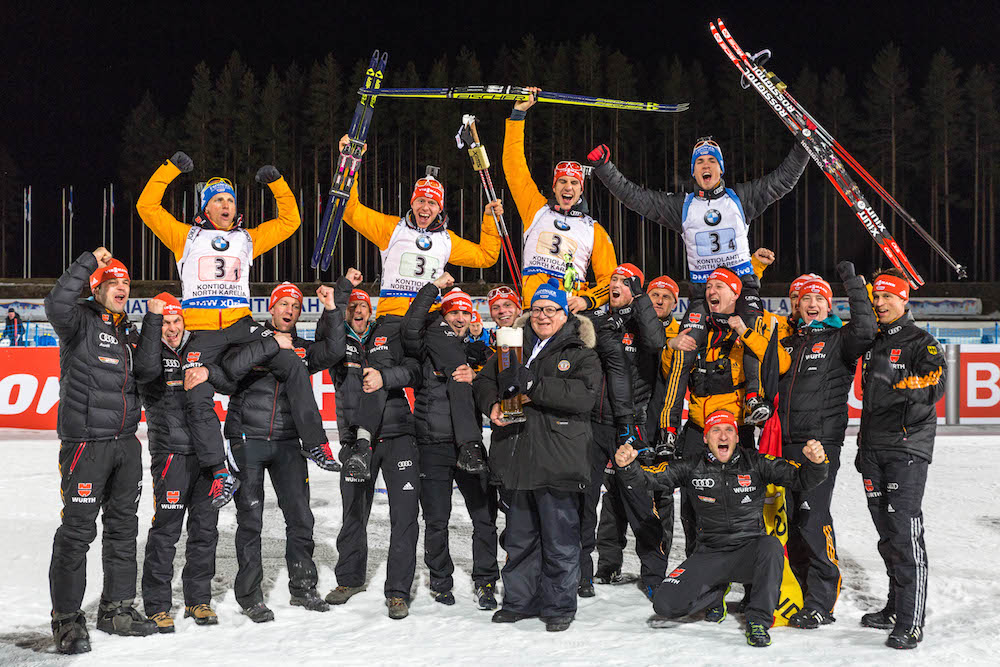
    A happy German team celebrates its second win in two days of relays at 2015 IBU World Championships in Kontiolahti, Finland, with the men's 4 x 7.5 k victory on Saturday. From left to right: Erik Lesser, Daniel Böhm, Arnd Peiffer, and Simon Schempp. (Photo: Kontiolahden Urheilijat/Kari Kuninkaanniemi)
    A happy German team celebrates its second win in two days of relays at 2015 IBU World Championships in Kontiolahti, Finland, with the men’s 4 x 7.5 k victory on Saturday. Above, from left to right: Erik Lesser, Daniel Böhm, Arnd Peiffer, and Simon Schempp. (Photo: Kontiolahden Urheilijat/Kari Kuninkaanniemi)

    KONTIOLAHTI, Finland — After more than a week of waiting, Simon Schempp could finally enjoy  the 2015 IBU World Championships in Kontiolahti, specifically the last two hundred meters of the men’s 4 x 7.5-kilometer relay and everything that came after that.

    Schempp, 27, had been given the task of anchoring the German team on Saturday, and after two races in which he failed to medal (including his 77th place in the sprint), it seemed like a tall order.

    But Schempp spent much of this season ranked second overall in the IBU World Cup, so he simply needed to restore his confidence back to its pre-World Championships level. He did so in Thursday’s 20 k individual, placing eighth.

    “I caught the self confidence for today and was prepared for this relay,” he explained in press conference after Saturday’s relay.

    Germany's Simon Schempp soaks up his team's victory after anchoring the men's relay to gold on Saturday at 2015 IBU World Championships in Kontiolahti, Finland. (Photo: Kontiolahden Urheilijat/Risto Kuittinen)
    Germany’s Simon Schempp soaks up his team’s victory after anchoring the men’s relay to gold on Saturday at 2015 IBU World Championships in Kontiolahti, Finland. (Photo: Kontiolahden Urheilijat/Risto Kuittinen)

    Things were better then — he had secured a 15.4-second victory for his team, matching the gold the German women won in the 4 x 6 k relay the day before.

    His teammate Arnd Pfeiffer shot a perfect 10-for-10 on the third leg to tag him in first at the final exchange, 15.3 seconds ahead of Norway. Schempp proceeded to clean prone without any need for spares then used a single spare in standing to leave the range for the last time 15 seconds ahead of Emil Hegle Svendsen in second.

    Svendsen also shot clean on his first stage and used a spare in standing to neither make up nor lose ground to Schempp, which he tried to change on the last lap. Meanwhile, French anchor Martin Fourcade went from fifth (behind the Czech Republic and Slovenia) to fourth on his first lap and used one spare to emerge from prone in third, 41.6 seconds out of first and 28.3 seconds from second.

    The next time and final time around, Fourcade rattled off five quick shots to clean standing with the second-fastest range time. He remained in third, but within 25.6 seconds of Schempp and 10.6 of Svendsen.

    Considering that, Svendsen had to think about defending silver and pressing for gold simultaneously on his last 2.5 k loop.

    “I just tried to ski fast and didn’t look much behind,” Svendsen said in the press conference. “I tried to catch Simon, but had no chance.”

    After being cheered on by his teammates while leaving the range, Schempp extended his gap to 19 seconds a kilometer into the final lap, then 20.9 seconds less than a kilometer later.

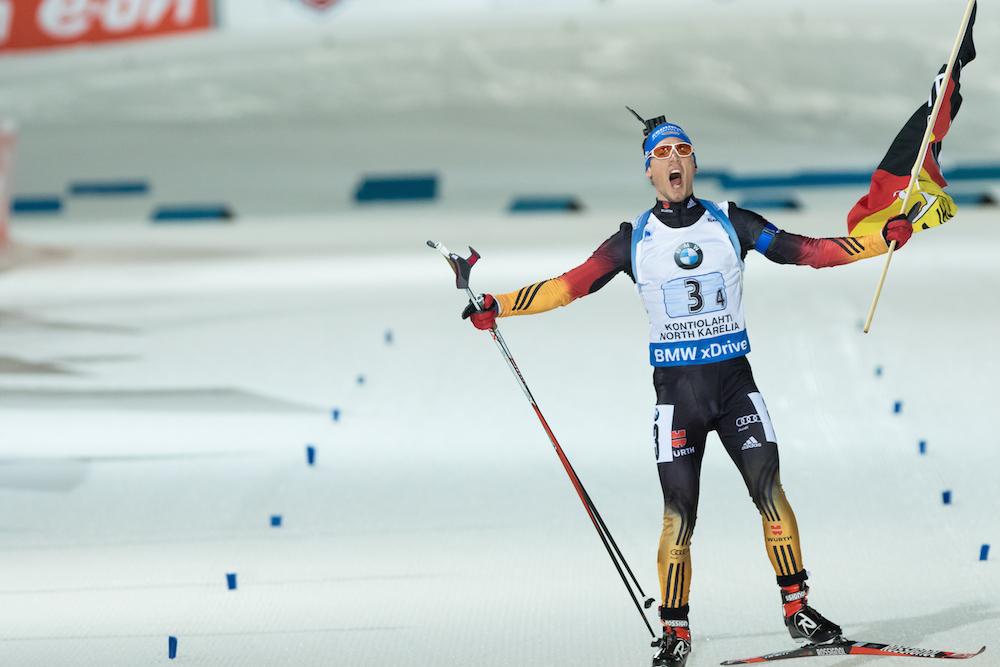
    He finished 15.4 seconds ahead of Svendsen, taking the time to enjoy the finishing stretch while carrying the German flag.

    “Only the last two-hundred meters I could enjoy because before, I gave all I have,” Schempp said. “I’m really happy and proud to be a part of this team.”

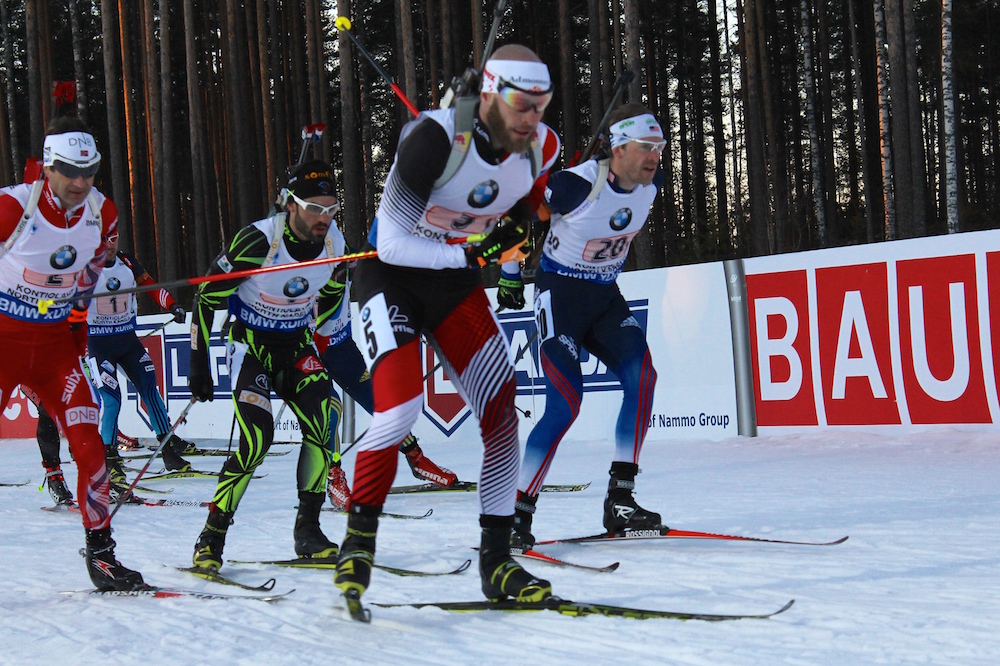
    The Germans achieved gold with first and second skiers, Erik Lesser, who won the pursuit last Sunday, and Daniel Böhm, who opened the championships in sixth with the mixed relay.

    Lesser hit all 10 of his targets without any problems to hand off in third, 6.4 seconds behind Norway’s Ole Einar Bjørndalen, who also cleaned to take the lead, and France’s Simon Fourcade, who cleaned as well to trail in second.

    “I think all the team was determined to get a medal today,” Simon Fourcade said in the conference. In the last week, he placed fourth in both the sprint and 20 k individual.

    “I know the relay is not only about me; I wanted to do my best on the first leg to give the best position to [my teammates],” he added.

    During the second leg, Norway dropped to fifth with three standing spares from Tarjei Bø. Jean-Guillaume Béatrix used one spare in each stage to bring France into first by the second exchange, 0.7 seconds ahead of Italy and 3.1 seconds ahead of Böhm — who used two standing spares to keep Germany in third.

    “Today, I felt a lot of tension in our team. Everybody wanted to have this victory,” Böhm recalled. “Watching the two others after me was harder than skiing.”

    “I felt a lot of tension in our team. Everybody wanted to have this victory. Watching the two others after me was harder than skiing.” — Daniel Böhm, Germany’s second leg on its gold-medal winning relay

    Just over a year ago, the German men took silver in the 2014 Olympic relay behind Russia. They had the same team and same order.

    “I was very nervous today, even more nervous before the individual races,” Peiffer said.

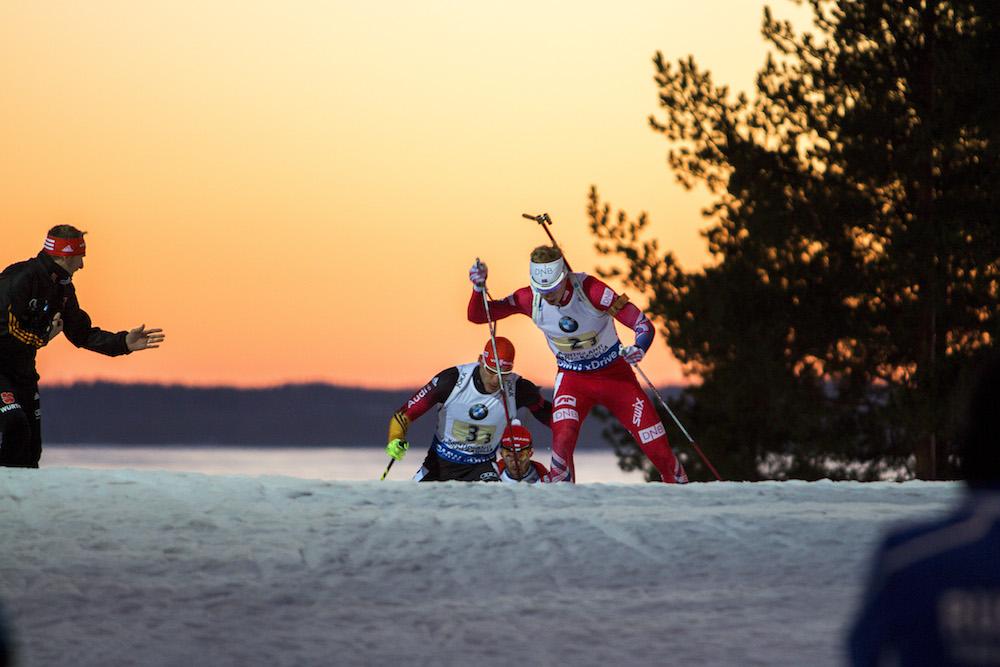
    Johannes Thingnes Bø of Norway leads Germany's Arnd Peiffer up and over the wall during the third leg of the men's 4 x 7.5 k relay at 2015 IBU World Championships in Kontiolahti, Finland. Germany went on to win gold and Norway took silver ahead of France. (Photo: Kontiolahden Urheilijat/Janina Joutsen)
    Johannes Thingnes Bø of Norway leads Germany’s Arnd Peiffer up and over the wall during the third leg of the men’s 4 x 7.5 k relay at 2015 IBU World Championships in Kontiolahti, Finland. Germany went on to win gold and Norway took silver ahead of France. (Photo: Kontiolahden Urheilijat/Janina Joutsen)

    He took the lead with a flawless prone, leaving the range 2 seconds ahead of Norway’s Johannes Thingnes Bø, who also cleaned. Bø passed him early in the lap and the two skied together into the range for standing. There, Peiffer cleaned again and Bø used a spare, which made the difference.

    “I knew that I was together with Johannes and it was going to be a hard last lap so I tried to save some energy and tried to [have a] good standing shooting,” Peiffer explained.

    He left the range 13.3 seconds ahead of Bø, and the Czech Republic’s Michal Slesinger moved into second during that last lap of the third leg, coming within 14 seconds of Peiffer. Bø passed Slesinger back before the exchange, and the Czech tagged in third — one tenth of a second behind Norway.

    With Ondrej Moravec skiing the last leg, the Czech Republic slipped to fourth with his three prone spares. Russia’s Anton Shipulin and Austria’s Dominik Landertinger both hit every standing target without any slipups to overtake Moravec before the final lap. The Czech fell to sixth, where he would end up at the finish, behind Russia in fourth and Austria in fifth.

    While Germany won in 1:13.49.5 and Norway was 15.4 seconds back in second, Fourcade pushed hard on the last lap aim for silver, but came up 18.2 seconds short in third.

    “I was really happy to conclude what the team did,” Fourcade said in the conference. “Jean-Guillaume and Simon [Fourcade] were perfect on the track and on the shooting range. I think we had a bit more pressure, but we are really satisfied with this third place.”

    Bailey Surges for Early Lead

    American Lowell Bailey thrust himself into the spotlight as the first skier for the U.S., taking the lead 1.8 k in and holding it as he and the 27-team field approached the range for the first time.

    Lowell Bailey (US Biathlon) led early as the first leg in the men's 4 x 7.5 k relay at 2015 IBU World Championships and ultimately handed off in seventh. The U.S. ended up 14th with two penalties and 11 spares in Kontiolahti, Finland. (Photo: USBA/NordicFocus)
    Lowell Bailey (US Biathlon) led early as the first leg in the men’s 4 x 7.5 k relay at 2015 IBU World Championships and ultimately handed off in seventh. The U.S. ended up 14th with two penalties and 11 spares in Kontiolahti, Finland. (Photo: USBA/NordicFocus)

    Perhaps even more impressive was the fact that Bailey started near the back of the pack in the seventh of nine rows.

    While the start was congested from his vantage point, Bailey explained he was able to use his fast skis and an eye for an opening before the first descent to move toward the front. By the first uphill, he found himself around fourth.

    “Then I got to the front, and I think [Austria’s Daniel] Mesotitsch was trying to slow things down,” Bailey said. “On the wall, I just figured there’s no real advantage in this range to go in third or fourth. Normally it can be, but in this range, being in first is fine.

    “I was just going my own pace and I wasn’t sure where that would end up, but I figured there can’t be any harm in going to the front and staying up there,” he added. “No one wanted to pass and that was fine with me.”

    During that prone stage, Bailey cleaned without any spares and left the range in sixth, 3.6 seconds out of first. The following lap, he pushed the pace once again on the “wall,” the course’s biggest climb, to move into second behind Mesotitsch.

    American Lowell Bailey (r) enters the range with race leaders Daniel Mesotitsch of Austria (second from r), France's Simon Fourcade (second from l), and Norway's Ole Einar Bjørndalen (l) for the first time in the men's 4 x 7.5 k relay at 2015 IBU World Championships in Kontiolahti, Finland.
    American Lowell Bailey (r) enters the range for prone with race leaders Daniel Mesotitsch of Austria (second from r), France’s Simon Fourcade (second from l), and Norway’s Ole Einar Bjørndalen (l) during the men’s 4 x 7.5 k relay at 2015 IBU World Championships in Kontiolahti, Finland.

    Bailey entered the standing stage with the leaders, where he used two spares to clean standing and slipped to ninth, nearly 23 seconds out of first. He went on hand off to teammate Leif Nordgren in seventh, 30.3 seconds back.

    “I lost contact with that lead group, but all in all, I was pretty happy with it,” Bailey said of his race. “Using two extras, that’s an extra 20 seconds, but what we want to do today is, if we all can perform at our normal capacity, then I think we can have a solid result. It’s not like all four of us have to shoot the moon. We all have to have good, solid days.”

    On a good day, the U.S. would finish with less than eight spares, he said. Even better would be if they ended up with six.

    “It’s not like all four of us have to shoot the moon. We all have to have good, solid days.” — Lowell Bailey (US Biathlon)

    Despite Nordgren keeping the team in contention, using one spare in each round and tagging Tim Burke in eighth at the second exchange, the Americans ended up with more extras and penalties than they’d hoped.

    Burke used one spare in prone then all three in standing before skiing two penalty laps. When Nordgren tagged him in eighth, Burke had been 34.7 seconds out of first. By the time he handed off to anchor Sean Doherty, the U.S. was 2:22 back in 15th.

    Leif Nordgren (US Biathlon) skiing the second leg for the U.S. men's relay team at 2015 IBU World Championships in Kontiolahti, Finland. After receiving the tag from Lowell Bailey in seventh, Nordgren handed off in eighth. (Photo: USBA/NordicFocus)
    Leif Nordgren (US Biathlon) leads Jaroslav Soukup (Czech Republic) while skiing the second leg for the U.S. men’s relay team at 2015 IBU World Championships in Kontiolahti, Finland. After receiving the tag from Lowell Bailey in seventh, Nordgren handed off to Tim Burke in eighth. (Photo: USBA/NordicFocus)

    “Standing, I bobbled the spare a little bit … it was probably an extra second or two,” Nordgren explained of his second leg. “I came back again with one extra and pushed as hard as I could the last loop. In the relay, you just have to do what you can, and hopefully it comes together [for] all four of us.”

    Doherty used all three spares during prone, but escaped without a penalty to hold onto 15th. In standing, he hit every target without any extras to move into 14th.

    He finished 14th, 3:31.6 behind Germany and 6.5 seconds after Finland in 13th. In all, the Americans had two penalties and 11 spares.

    “I stared pretty hard and I paid for it in prone,” Doherty said. “I had a good skiing day today and course is in good shape, so it was fun, but it was tough to be out of the mix a little bit.”

    Earlier this season, Doherty, 19, skied the second leg on the U.S. men’s relay, which placed eighth at the World Cup in Antholz, Italy. Before that, he was the third leg on the team that placed 16th at the 2014 Olympics.

    In terms of what it felt like to anchor his first World Championships relay, Doherty said he didn’t read too much into the start order.

    “It’s a compliment in a way if they think I’m mature enough as an athlete to handle that role well,” he said. “It wasn’t the same pressure as if we were fighting for the medals, but still, I’m not gonna want to miss.”

    Christian Gow Gets Up Front, Smith Shoots 10-for-10

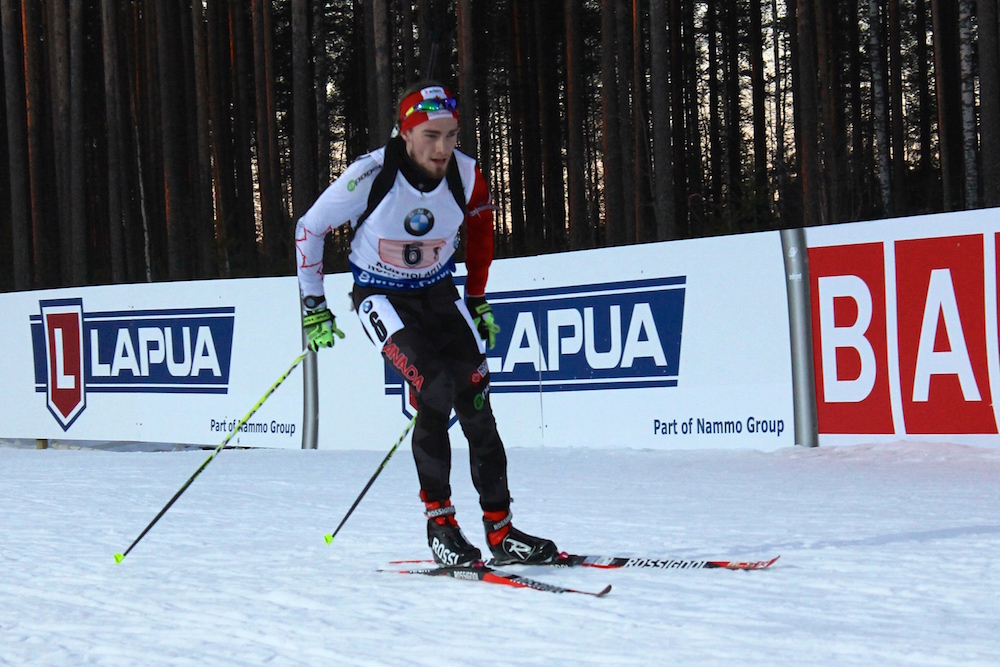
    Starting Saturday’s race off for Canada, Christian Gow started in the second row in bib 6 and moved into fifth by 1.8 k. Following Bailey, he entered prone in the lead pack, around seventh.

    Christian Gow (Biathlon Canada) approaches the range for his standing stage during the men's 7.5 k relay at 2015 IBU World Championships in Kontiolahti, Finland.
    Christian Gow (Biathlon Canada) approaches the range for his standing stage during the men’s 7.5 k relay at 2015 IBU World Championships in Kontiolahti, Finland.

    “I thought quite a bit about the start of this race and just the way the course flows,” Gow, 21, explained.

    He wanted to avoid the accordion stop-and-go effect of being near the back before short pitches and any crashes on a particularly icy downhill corner.

    “I knew I wanted to be right with the top guys,” Gow said. “I knew that was totally possible. I had a blast on that first loop. … It felt so easy to just stay right at the front. That’s an amazing feeling. I know it doesn’t mean much, per say, but to be able to ski with some of my idols and just feel so relaxed, like really feel like I belong in that group, the relays are for sure my favorite for that. It’s such a great experience and so much fun.”

    In prone, he used two spares to drop to 24th, 27.5 seconds out of first. He moved back into 23rd heading into the range for standing, before using another extra there and heading into his last lap in 22nd.

    “I’m really happy with what I did skiing,” Gow said. “I finally felt strong on skis, but my shooting wasn’t quite there. I think I was pretty nervous coming in just so far up. I don’t think I was quite as settled as I should have been.”

    Gow tagged teammate Nathan Smith in 22nd, 1:20 back. Smith proceeded to shoot a perfect 10-for-10 with the fastest shooting and fourth-fastest course times of the second leg to bring the Canadians to 10th.

    “It was actually a really good race for me, my second best race here,” said Smith, who earned silver in the sprint last weekend. “I skied pretty relaxed. It was pretty icy, though, so my shins were hurting by the last lap. If I can do a race like today again tomorrow [in the mass start], it will be a really good result.”

    In terms of team goals, he said their “middle goal” was a top eight, “really good would have been top six.” At the last World Cup relay in Oslo, Norway, the Canadian men placed fifth with the same lineup. They were seventh at the Olympics with Jean-Phillipe Le Guellec, Scott Perras, Brendan Green, and Smith as the anchor.

    “It’s so fast right now that if you have a few spares, it puts you way back, more than normal,” Smith explained of Saturday’s boilerplate conditions.

    After he tagged Scott Gow in 10th, 44.8 seconds behind the leaders, Gow used all three spares and had two penalty loops in prone to fall to 19th, 2:11.1 out of first.

    “The whole race wasn’t very good,” Scott Gow said. “I felt good going into today, but I was gassed the whole time and then prone was really bad, I have no idea what happened there.”

    In standing, he used two more spares but remained in 19th, 3 minutes back, before tagging Green in the same position, 3:48.5 behind.

    “[I] was so far back that they only thing I could try to do was to ski hard and try to make up as much time as possible. It couldn’t get any worse so it was worth just going for it,” Scott said.

    “We came in fifth in Oslo, we’ve had sixth places, top tens before, so I think the expectation was if everyone pulled their own weight and put in little bit extra in the range, that we could walk away with a top eight and maybe another fifth place would be great,” he added. “It’s a little disappointing to not even be close.”

    Receiving the tag 40 seconds behind Sweden, which was 18th, Green said he raced hard for a couple laps to see if he could catch its anchor, Ted Armgren, but he was too far ahead.

    Green cleaned prone and used one standing spare to maintain 19th and avoid being lapped, which happened to Poland in 20th as well as seven other teams behind them.

    “On the last loop, the techs told me I had a cushion so I was able to relax and kind of coast it home,” Green said after finishing 19th, 5:03.4 behind Germany.

    In all, the Canadians had two penalties and nine spares.

    “Today definitely didn’t turn out the way were hoping, but the guys tried their best,” Green said. “It happens from time to time. It’s always unfortunate when it’s at World Championships, but you’ve got to roll with the punches, I guess.”

    He said his solid-shooting streak was a good indicator for Sunday’s mass start, which he qualified for along with Smith for Canada, and Burke and Bailey for the U.S.

    “I’m definitely a little tired. Tomorrow will be the sixth race [here], but I’m definitely excited at the opportunity,” Green said. “Mass starts are always a lot of fun and pretty tense, so looking forward to it.”

    Results

    Sunday’s mass start: Women’s 12.5 k start list | Men’s 15 k start list